HPLC vs. UV-Vis Spectrophotometry: A Comprehensive Guide to Advantages, Disadvantages, and Application Selection
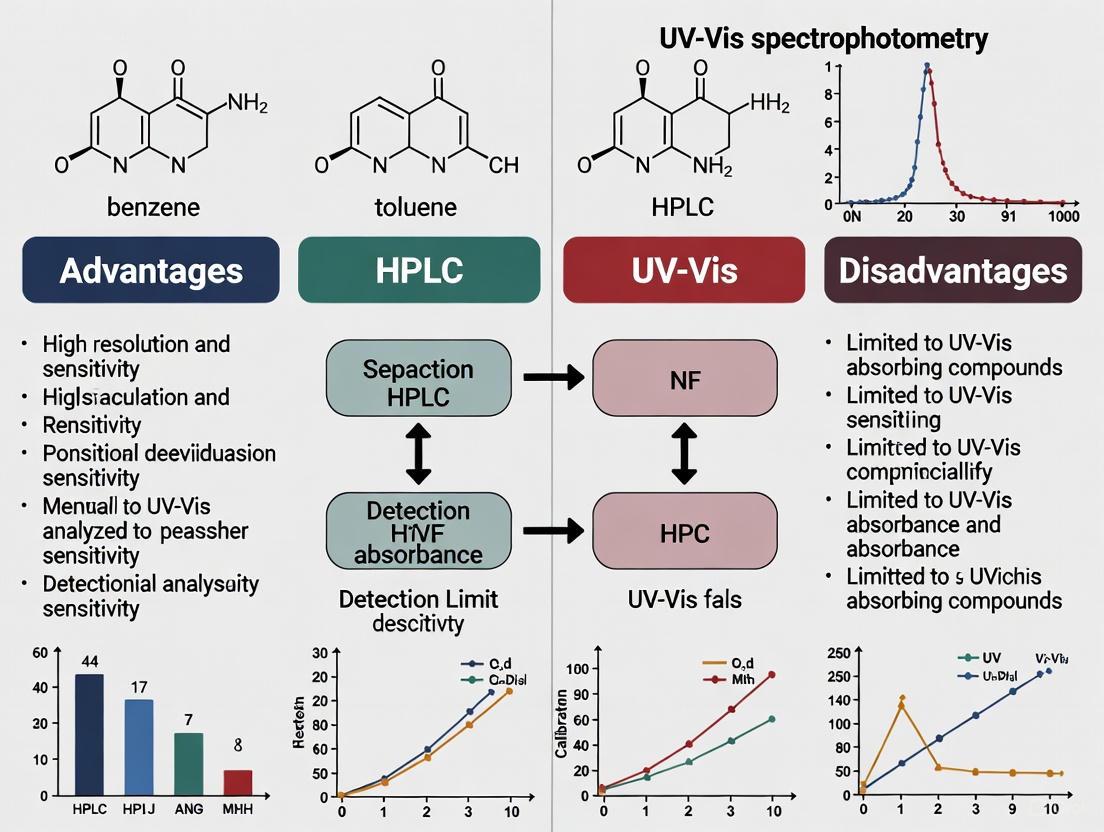
This article provides a detailed comparative analysis of High-Performance Liquid Chromatography (HPLC) and UV-Vis Spectrophotometry for researchers and drug development professionals.
HPLC vs. UV-Vis Spectrophotometry: A Comprehensive Guide to Advantages, Disadvantages, and Application Selection
Abstract
This article provides a detailed comparative analysis of High-Performance Liquid Chromatography (HPLC) and UV-Vis Spectrophotometry for researchers and drug development professionals. It covers foundational principles, methodological applications across pharmaceutical and biomedical fields, practical troubleshooting guidance, and validation protocols. Synthesizing current research and case studies, the content delivers actionable insights for selecting the optimal analytical technique based on specific project goals, from routine quality control to complex bioanalysis, ensuring data accuracy and regulatory compliance.
Core Principles Unveiled: How HPLC and UV-Vis Spectrophotometry Work
High-Performance Liquid Chromatography (HPLC) is a pivotal analytical technique that plays a crucial role in separating, identifying, and quantifying compounds in complex mixtures across various scientific disciplines [1]. This column chromatography method involves the high-pressure injection of a sample (analyte) dissolved in a solvent (mobile phase) through a column packed with chromatographic material (stationary phase) [2]. The fundamental principle of HPLC separation revolves around the differential distribution of compounds between a stationary phase and a mobile phase, leading to separation based on chemical properties [1].
The dominance of HPLC as a premier analytical technique stems from its exceptional versatility in analyzing diverse analyte types, ranging from small organic molecules and ions to large biomolecules and polymers [3]. When coupled with mass spectrometry (MS), HPLC gains unparalleled sensitivity and specificity, creating what many consider "the perfect analytical tool" for bioanalytical testing, trace analysis, and life science research [3]. Furthermore, the exceptional precision and robustness of HPLC with ultraviolet (UV) detection make it indispensable for quality control applications in regulated industries [3].
Core Principles of Chromatographic Separation
The Chromatographic Process
The fundamental mechanism of HPLC separation operates on a simple principle: compounds within a mixture are separated based on their differential interactions with a stationary phase and a mobile phase [1]. The stationary phase typically consists of a solid adsorbent or a liquid-coated surface packed within the column, while the mobile phase is a liquid solvent or mixture of solvents that transports the sample through the system [1].
Three fundamental factors govern the separation process in HPLC: the compounds (solutes in the sample solution), the mobile phase (solution delivered using solvent delivery pumps), and the stationary phase (functional groups chemically modified onto particles packed in the column) [4]. Compounds that interact more strongly with the mobile phase elute faster from the column, while those that interact more strongly with the stationary phase are retained longer [4]. This "interaction" refers to the chemical attraction between molecules, and selecting the appropriate interaction type for the target compound's properties is essential for separation optimization [4].
Figure 1: Fundamental HPLC Separation Process
Primary Separation Modes
HPLC offers several separation modes that leverage different chemical interactions between analytes and the stationary phase. The choice of separation mode depends on the chemical properties of the target compounds and the specific analytical requirements [4].
Reversed-Phase Chromatography (RPC) is the most widely used separation mode, where separation is based on hydrophobicity [4]. Non-polar compounds interact more strongly with the hydrophobic stationary phase (typically C8 or C18 chains bonded to silica particles) and are thus retained longer, while polar compounds elute more quickly [1]. This method is particularly suitable for small molecule pharmaceuticals, vitamins, and many organic compounds [4].
Normal-Phase Chromatography (NPC) operates on the opposite principle, separating compounds based on hydrophilicity (high polarity) [4]. In this mode, polar compounds are retained longer by the polar stationary phase (such as silica with hydroxyl groups), while non-polar compounds elute first [1]. This technique is especially effective for saccharides, nucleic acids, and other highly polar compounds [4].
Ion-Exchange Chromatography (IEC) separates compounds based on electrostatic interactions between charged analytes and oppositely charged functional groups on the stationary phase [4]. This mode is particularly suitable for inorganic ions, amino acids, proteins, and other charged molecules [1] [4].
Size-Exclusion Chromatography (SEC) separates molecules based on their size, with larger molecules eluting earlier than smaller ones because they cannot enter the pores of the stationary phase and thus travel through the column more quickly [1]. This technique is valuable for analyzing synthetic polymers, biopolymers, and polysaccharides [4].
Table 1: HPLC Separation Modes and Their Applications
| Separation Mode | Basis of Separation | Primary Interactions | Typical Applications |
|---|---|---|---|
| Reversed-Phase | Hydrophobicity | Hydrophobic | Small molecule pharmaceuticals, vitamins [4] |
| Normal-Phase | Polarity | Hydrophilic, hydrogen bonding | Saccharides, nucleic acids [4] |
| Ion-Exchange | Charge | Electrostatic | Inorganic ions, amino acids, proteins [4] |
| Size-Exclusion | Molecular size | Steric hindrance | Synthetic polymers, biopolymers [1] [4] |
HPLC Instrumentation and Components
A modern HPLC system consists of several critical components that work in concert to achieve precise separations. The key modules include solvent reservoirs, high-pressure pumps, an injection system, the separation column, a detector, and data processing software [3].
The solvent delivery system comprises reservoirs for the mobile phase and high-pressure pumps that maintain a constant and pulse-free flow of solvent through the system. Modern HPLC pumps can deliver pressures up to 1000 bar or more in UHPLC systems, enabling the use of smaller particle sizes for enhanced efficiency [5] [3].
The injection system, typically an autosampler, introduces the sample into the mobile phase stream with high precision and reproducibility. Automated injectors enable the sequential analysis of numerous samples with minimal manual intervention, significantly improving throughput in analytical laboratories [3].
The chromatographic column serves as the heart of the HPLC system, where the actual separation occurs. Columns are typically stainless steel tubes packed with micron-sized particles that constitute the stationary phase. Recent innovations in column technology include superficially porous particles (also known as fused-core), monodisperse fully porous particles, and advanced bonding chemistries that enhance efficiency, peak shape, and separation speed [5].
The detection system identifies and quantifies the separated compounds as they elute from the column. Various detector types are available, with UV-Vis spectrophotometers being among the most common due to their versatility and robustness [3]. Other detection methods include fluorescence, refractive index, evaporative light scattering, and mass spectrometry, with the latter providing unparalleled sensitivity and specificity [3].
Figure 2: Simplified HPLC Instrumentation Schematic
Comparative Analysis: HPLC vs. UV-Vis Spectrophotometry
Fundamental Differences in Principle and Application
While both HPLC and UV-Vis spectrophotometry are analytical techniques that utilize light absorption properties of compounds, they operate on fundamentally different principles and serve distinct purposes in analytical chemistry.
UV-Vis spectroscopy measures the amount of discrete wavelengths of UV or visible light absorbed by or transmitted through a sample in comparison to a reference or blank sample [6]. This technique provides information about electronic transitions in molecules and is primarily used for identification and quantification of chromophoric compounds in solution, but without physical separation of mixture components [6].
In contrast, HPLC is primarily a separation technique that physically resolves mixture components before detection. It utilizes differential partitioning between stationary and mobile phases to separate compounds, which are then typically detected and quantified using UV-Vis spectroscopy or other detection methods [1] [3]. This combination of separation with detection makes HPLC far more powerful for analyzing complex mixtures.
Experimental Comparison Study
A direct comparison of HPLC and UV-Vis spectrophotometry for determining Levofloxacin concentrations released from mesoporous silica microspheres/nano-hydroxyapatite composite scaffolds provides valuable insights into their relative performance characteristics [7].
Table 2: Method Comparison for Levofloxacin Analysis [7]
| Parameter | HPLC Method | UV-Vis Method |
|---|---|---|
| Regression Equation | y = 0.033x + 0.010 | y = 0.065x + 0.017 |
| Coefficient of Determination (R²) | 0.9991 | 0.9999 |
| Recovery Rate (Low Concentration) | 96.37 ± 0.50% | 96.00 ± 2.00% |
| Recovery Rate (Medium Concentration) | 110.96 ± 0.23% | 99.50 ± 0.00% |
| Recovery Rate (High Concentration) | 104.79 ± 0.06% | 98.67 ± 0.06% |
| Precision | High (low RSD) | Moderate |
The study demonstrated that while both methods showed excellent linearity, HPLC provided superior precision and more consistent recovery rates across different concentration levels, particularly for medium and high concentrations [7]. The researchers concluded that UV-Vis spectrophotometry is less accurate for measuring drug concentrations released from complex composite scaffolds, making HPLC the preferred method for evaluating sustained release characteristics in drug delivery systems [7].
Essential Research Reagent Solutions
Successful HPLC analysis requires careful selection of reagents and consumables tailored to the specific separation mode and application requirements. The following table outlines key research reagent solutions essential for HPLC operations.
Table 3: Essential HPLC Research Reagents and Materials
| Reagent/Material | Function/Description | Application Notes |
|---|---|---|
| Stationary Phases | Chromatographic media packed in columns | C18 for reversed-phase, silica for normal-phase, ion-exchange resins [5] [4] |
| Mobile Phase Solvents | Carrier for samples through the system | HPLC-grade methanol, acetonitrile, water, buffer solutions [3] |
| Reference Standards | Calibration and quantification | High-purity compounds for method development and calibration [3] |
| Inert Hardware Columns | Minimize metal-sensitive analyte interactions | Enhanced peak shape and recovery for phosphorylated compounds [5] |
| Guard Columns | Protect analytical columns from contamination | Extend column lifetime, typically 5 x 2.1 mm or 5 x 3.0 mm dimensions [5] |
Recent innovations in HPLC consumables focus on improving performance for specific applications. For instance, inert hardware columns with passivated surfaces minimize interactions with metal-sensitive analytes, particularly beneficial for phosphorylated compounds and biomolecules [5]. Similarly, advanced stationary phases like superficially porous particles (e.g., Halo, Ascentis Express) provide enhanced efficiency and peak shape for challenging separations [5].
Advantages and Limitations in Pharmaceutical Analysis
Strengths of HPLC in Drug Development
HPLC offers numerous advantages that make it indispensable in pharmaceutical research and quality control:
Exceptional Precision and Reproducibility: HPLC delivers highly reproducible assays with precision levels achieving <0.1% relative standard deviation (RSD) for UHPLC systems, which is crucial for regulatory compliance and quality control [3].
High-Sensitivity Assays: Modern HPLC systems can detect trace impurities at levels as low as 0.01%, meeting stringent regulatory requirements for pharmaceutical purity testing [3].
Comprehensive Component Analysis: HPLC can simultaneously separate, identify, and quantify multiple components in complex mixtures, including isomers and structurally related compounds [3].
Robustness Across Laboratories: Well-developed HPLC methods demonstrate excellent transferability between different laboratories, instruments, and analysts [3].
Versatile Detection Options: Compatibility with various detectors (UV, fluorescence, MS) enables method optimization for specific analytes and applications [3].
Limitations and Challenges
Despite its widespread utility, HPLC does present certain limitations:
Lack of Universal Detector: No single detector is optimal for all compound types, though UV-Vis detectors approach universality for chromophoric compounds and mass spectrometry covers many ionizable analytes [3].
High Operational Costs: HPLC systems represent significant capital investment ($35,000 or more for complete systems), with ongoing expenses for columns, solvents, and consumables [2].
Complex Method Development: The multitude of available columns, mobile phases, and operating parameters makes method development challenging, particularly for novice users [3].
Time-Consuming Regulated Testing: Analysis under Good Manufacturing Practices (GMP) requires extensive documentation, system suitability testing, and quality control measures, making the process arduous compared to spectroscopic techniques [3].
Moderate Separation Efficiency: Conventional HPLC has practical peak capacity of approximately 200, though this limitation is addressed by UHPLC (400-1000 peak capacity) and two-dimensional LC techniques [3].
Methodologies and Experimental Protocols
Standard HPLC Method Development Protocol
Developing a robust HPLC method requires systematic optimization of multiple parameters:
Sample Preparation: Dissolve sample in appropriate solvent, typically compatible with the mobile phase. Filter through 0.45 μm or 0.22 μm membrane to remove particulates.
Column Selection: Choose appropriate stationary phase based on compound properties. C18 columns are standard for reversed-phase applications [5].
Mobile Phase Preparation: Prepare HPLC-grade solvents with optional buffers or modifiers. Filter and degas to remove bubbles and particulates.
System Equilibration: Flush system with starting mobile phase composition until stable baseline is achieved, typically 10-30 column volumes.
Detection Optimization: Set detection parameters (wavelength for UV, or MS parameters) appropriate for target analytes.
Method Scouting: Perform initial runs with gradient elution to determine optimal isocratic conditions or gradient profile.
Parameter Optimization: Systematically adjust flow rate, temperature, and gradient profile to achieve resolution, efficiency, and analysis time goals.
Validation: Establish method specificity, linearity, accuracy, precision, and robustness according to regulatory requirements.
Case Study: Pharmaceutical Stability Testing
The application of HPLC in pharmaceutical stability testing illustrates its capabilities in quality control [3]. In a typical stability study for a drug tablet formulation:
- Tablets are stored under accelerated stability conditions (e.g., 40°C/75%RH or 50°C/75%RH) for designated time periods [3].
- At each time point, tablets are extracted with appropriate solvent and analyzed using a stability-indicating HPLC method [3].
- The method simultaneously quantifies the active pharmaceutical ingredient (API) and multiple impurities/degradants, including diastereomers and oxidative degradants [3].
- Data precision allows tracking of subtle changes in impurity profiles over time, enabling accurate determination of product shelf life [3].
This application highlights HPLC's ability to generate highly reliable data that can be reproduced across different laboratories - a critical requirement for regulatory submissions and quality assurance in the pharmaceutical industry [3].
The fundamental mechanism of HPLC - differential partitioning of compounds between stationary and mobile phases under high pressure - provides an exceptionally powerful foundation for separation science. While the technique demands significant expertise, instrumentation, and operational resources, its unparalleled capabilities for separating complex mixtures with high precision, sensitivity, and reproducibility ensure its continued dominance in analytical chemistry, particularly in pharmaceutical research and quality control.
The comparison with UV-Vis spectrophotometry reveals that while UV-Vis offers simplicity and speed for specific applications, HPLC provides superior analytical performance for complex mixtures and precise quantification requirements. Ongoing innovations in column technologies, instrumentation, and detection methods continue to expand HPLC capabilities, addressing current limitations and opening new applications in life sciences, environmental monitoring, and pharmaceutical development.
Ultraviolet-visible (UV-Vis) spectroscopy is a foundational analytical technique in modern laboratories, measuring the absorption of discrete wavelengths of ultraviolet or visible light by a sample. This technique operates on the principle that molecules undergo electronic transitions when they absorb light energy, providing critical insights into their composition and concentration. The widespread adoption of UV-Vis spectroscopy across pharmaceutical, biotechnology, environmental, and materials science fields is evidenced by market projections estimating the UV spectroscopy market will reach USD 27.62 billion by 2030, advancing at a 5.12% compound annual growth rate (CAGR) [8]. In the pharmaceutical sector alone, which accounts for nearly half of the UV spectroscopy market share, the technique has become indispensable for drug quality control, release testing, and bioprocess monitoring [8].
The versatility of UV-Vis spectroscopy stems from its ability to provide rapid, non-destructive analysis of samples with minimal preparation. When applied within its operational parameters, it delivers exceptional precision for quantifying analytes with characteristic chromophores. This technical guide explores the fundamental principles governing UV-Vis spectroscopy, with particular emphasis on the Beer-Lambert Law, while contextualizing its advantages and limitations within the broader analytical landscape of pharmaceutical research and development, especially when compared with complementary techniques like high-performance liquid chromatography (HPLC).
Fundamental Principles: The Interaction of Light with Matter
Light Energy and Electronic Transitions
UV-Vis spectroscopy investigates the interaction between light and matter at the electronic level. Light possesses a specific energy inversely proportional to its wavelength, meaning shorter wavelengths carry higher energy. When a photon of light with energy matching the energy gap between a molecule's ground state and excited state interacts with that molecule, the photon may be absorbed, promoting an electron to a higher energy orbital [6].
The ultraviolet region spans wavelengths from approximately 100 nm to 400 nm, while the visible region extends from 400 nm to 780 nm, corresponding to the violet-to-red spectrum detectable by the human eye [6]. Different bonding environments in molecules require specific energy amounts for electronic promotions, which is why absorption occurs at characteristic wavelengths for different substances, creating unique spectral fingerprints.
The Beer-Lambert Law
The quantitative foundation of UV-Vis spectroscopy is the Beer-Lambert Law, which establishes the relationship between light absorption and analyte properties. This law states that the absorbance (A) of a solution is directly proportional to the concentration (c) of the absorbing species and the path length (L) of light through the solution [6].
The mathematical expression of Beer-Lambert Law is: A = ε × L × c
Where:
- A is absorbance (no units)
- ε is the molar absorptivity or extinction coefficient (typically in L·molâ»Â¹Â·cmâ»Â¹)
- L is the path length of the light through the solution (usually in cm)
- c is the concentration of the absorbing species (in mol·Lâ»Â¹)
Absorbance is defined mathematically as A = -logâ‚â‚€(I/Iâ‚€), where Iâ‚€ is the intensity of incident light and I is the intensity of transmitted light [6]. The transmittance (T) is simply I/Iâ‚€, expressing the fraction of light that passes through a sample.
For accurate quantitative analysis, absorbance values should generally be maintained below 1.0, as this corresponds to 10% transmittance. Beyond this value, detector sensitivity limitations can compromise reliability [6]. The linear relationship described by Beer-Lambert Law enables researchers to determine unknown concentrations by comparing measured absorbances to standard solutions of known concentration.
Instrumentation and Measurement
Core Components of a UV-Vis Spectrophotometer
A UV-Vis spectrophotometer consists of several integrated components that work in concert to measure light absorption:
Light Source: Provides broad-spectrum illumination across UV and visible wavelengths. Common configurations include a single xenon lamp or a dual-lamp system with a deuterium lamp for UV (190-400 nm) and a tungsten/halogen lamp for visible regions (350-780 nm) [6].
Wavelength Selector: Isolates specific wavelengths from the broad emission spectrum. Modern instruments primarily use monochromators containing diffraction gratings with 300-2000 grooves per mm for wavelength selection. Higher groove frequencies provide better optical resolution, while lower frequencies offer broader usable ranges [6].
Sample Holder: Contains the sample solution during analysis. For UV measurements, quartz cuvettes are essential as quartz is transparent to most UV light, unlike glass or plastic which absorb UV radiation [6]. Standard path lengths are 1 cm, though shorter path lengths (e.g., 1 mm) accommodate limited sample availability.
Detector: Converts transmitted light intensity into an electrical signal. Photomultiplier tubes (PMT) are common for their sensitivity to very low light levels, while photodiodes and charge-coupled devices (CCD) offer alternative semiconductor-based detection [6].
The instrumental configuration significantly impacts data quality. For instance, dual-beam systems currently dominate the UV spectroscopy market share due to their superior stability during long analytical runs and high level of automation in data collection [9] [8].
Measurement Process and Workflow
The following diagram illustrates the typical workflow and component interaction within a UV-Vis spectrophotometer:
Figure 1: UV-Vis spectrophotometer component workflow
The measurement process begins when the light source emits broad-spectrum radiation. The monochromator selects a specific wavelength, which is typically split into two beams: one passing through the sample and another through a reference blank. The detector measures the intensity difference between these beams, and the data system converts this information into absorbance values. Modern instruments automatically scan across wavelength ranges to generate complete absorption spectra [6].
Experimental Protocol: Quantitative Analysis of Levofloxacin
To illustrate practical application of UV-Vis spectroscopy in pharmaceutical analysis, consider this detailed protocol for quantifying levofloxacin concentration, adapted from a published methodology comparing HPLC and UV-Vis techniques [7].
Research Reagent Solutions
Table 1: Essential materials and reagents for levofloxacin analysis
| Reagent/Material | Specifications | Function/Purpose |
|---|---|---|
| Levofloxacin Standard | National Institutes for Food and Drug Control (Ref: 130455-201106) | Primary reference standard for calibration curve |
| Simulated Body Fluid (SBF) | Aqueous buffer solution (pH ~7.4) | Dissolution medium mimicking physiological conditions |
| Volumetric Flasks | Class A, 10 mL, 100 mL | Precise preparation and dilution of standard solutions |
| Quartz Cuvettes | 1 cm path length | Sample holder transparent to UV light |
| UV-Vis Spectrophotometer | Dual-beam system with deuterium lamp | Instrument for absorbance measurements |
Methodology
Step 1: Preparation of Standard Stock Solution
- Precisely weigh 30.00 mg of levofloxacin reference standard using an analytical balance.
- Transfer the compound to a 10 mL volumetric flask and dissolve with simulated body fluid (SBF).
- Bring to volume with SBF to obtain a 3 mg/mL (3000 μg/mL) stock solution [7].
Step 2: Generation of Calibration Standards
- Serially dilute the stock solution with SBF to create 14 concentration gradients: 300, 200, 100, 50, 25, 10, 5, 2.5, 1, 0.5, 0.25, 0.1, 0.05, and 0.01 μg/mL [7].
- Each standard should be prepared in triplicate to ensure method reliability.
Step 3: Spectral Analysis and Wavelength Selection
- Using a medium concentration standard (25 μg/mL), scan from 200-400 nm against a blank of pure SBF.
- Identify the wavelength of maximum absorption (λmax) for levofloxacin, which typically occurs at ~290 nm [7].
- Set the spectrophotometer to this specific wavelength for all subsequent quantitative measurements.
Step 4: Measurement and Data Collection
- Measure the absorbance of each calibration standard at the predetermined λmax.
- For quality control, analyze prepared solutions at low, medium, and high concentrations (5, 25, and 50 μg/mL) in triplicate to assess precision [7].
- Record all absorbance values for construction of the calibration curve.
Step 5: Data Analysis
- Plot average absorbance (y-axis) versus concentration (x-axis) for all standards.
- Perform linear regression to establish the calibration equation. In comparative studies, this typically yields relationships such as y = 0.065x + 0.017 with R² = 0.9999 for UV-Vis [7].
- Determine unknown concentrations by interpolating sample absorbances using this calibration curve.
Comparative Performance in Pharmaceutical Analysis
Quantitative Comparison of HPLC and UV-Vis Techniques
UV-Vis spectroscopy serves as a rapid screening tool in pharmaceutical analysis, but understanding its performance relative to HPLC is crucial for appropriate method selection. The following table summarizes key comparative data from a study analyzing levofloxacin released from composite scaffolds [7]:
Table 2: Performance comparison of HPLC and UV-Vis for levofloxacin quantification
| Parameter | HPLC Performance | UV-Vis Performance |
|---|---|---|
| Linear Range | 0.05–300 μg/mL | 0.05–300 μg/mL |
| Regression Equation | y = 0.033x + 0.010 | y = 0.065x + 0.017 |
| Coefficient (R²) | 0.9991 | 0.9999 |
| Recovery (5 μg/mL) | 96.37 ± 0.50% | 96.00 ± 2.00% |
| Recovery (25 μg/mL) | 110.96 ± 0.23% | 99.50 ± 0.00% |
| Recovery (50 μg/mL) | 104.79 ± 0.06% | 98.67 ± 0.06% |
| Key Advantage | Superior accuracy in complex matrices; specific detection | Excellent linearity; rapid analysis; cost-effective |
The data reveals that while both techniques offer wide linear dynamic ranges and excellent correlation coefficients, HPLC demonstrates superior accuracy and precision, particularly at medium and high concentrations, with recovery rates closer to the ideal 100% value [7]. The higher specificity of HPLC reduces interference from complex matrix components in drug delivery systems.
Strategic Technique Selection Framework
The following decision diagram outlines the methodology selection process for pharmaceutical analysis:
Figure 2: Pharmaceutical analysis technique selection framework
Advantages and Limitations in Pharmaceutical Context
UV-Vis Spectroscopy Advantages:
- Operational Efficiency: Minimal sample preparation, rapid analysis, and ease of use make UV-Vis ideal for high-throughput environments [10].
- Cost-Effectiveness: Lower instrument costs, minimal consumable expenses, and reduced training requirements provide economic advantages [6] [10].
- Non-Destructive Analysis: Samples remain intact after measurement, allowing for additional testing or recovery of valuable materials [10].
- Real-Time Monitoring Capability: Particularly valuable for bioprocess monitoring, with the bioprocess monitoring segment projected to grow at 8.56% CAGR through 2030 [8].
UV-Vis Spectroscopy Limitations:
- Specificity Challenges: Limited ability to distinguish between compounds with similar chromophores, particularly problematic in complex biological matrices [7].
- Interference Susceptibility: Any component absorbing at the measurement wavelength contributes to signal, potentially leading to inaccurate quantification [7] [6].
- Structural Requirement: Dependent on presence of chromophores; compounds without suitable light-absorbing groups cannot be directly analyzed [6].
- Limited Sensitivity: For trace analysis requiring detection below 0.05%, HPLC with UV detection is often mandated by regulatory guidelines [11].
HPLC Complementary Strengths:
- Enhanced Specificity: Physical separation prior to detection eliminates most interference issues, providing accurate quantification in complex matrices like drug-loaded scaffold systems [7].
- Superior Sensitivity: HPLC-UV systems can achieve detection limits compliant with ICH Q3A guidelines requiring 0.05-0.10% sensitivity for impurity profiling [11].
- Universal Detection Compatibility: Compatibility with multiple detectors (MS, FLD, CAD) extends applicability to non-chromophoric compounds [12] [11].
HPLC Practical Constraints:
- Resource Intensity: Higher instrumentation costs, substantial solvent consumption, and need for skilled operators increase overall cost of analysis [12] [13].
- Time Investment: Longer analysis times and extensive method development requirements reduce operational efficiency compared to UV-Vis [7] [12].
UV-Vis spectroscopy remains an indispensable analytical technique in pharmaceutical research and quality control, with its utility rooted in the fundamental principles of the Beer-Lambert Law. While its simplicity, speed, and cost-effectiveness make it ideal for routine quantitative analysis of chromophoric compounds, technical limitations regarding specificity and matrix interference necessitate complementary use with separation-based techniques like HPLC.
The growing UV-Vis spectroscopy market, particularly within pharmaceutical and biotechnology sectors, reflects continued innovation in areas such as microvolume sampling, portable/hand-held devices (projected to grow at 7.46% CAGR), and bioprocess monitoring applications [9] [8]. Strategic implementation based on a thorough understanding of both UV-Vis spectroscopy and HPLC capabilities will continue to optimize analytical workflows in drug development, ensuring efficient resource utilization while maintaining rigorous quality standards.
High-Performance Liquid Chromatography (HPLC) and Ultraviolet-Visible (UV-Vis) spectrophotometry are foundational techniques in modern analytical laboratories. HPLC is renowned for its powerful separation capabilities, while UV-Vis spectroscopy offers rapid, cost-effective quantitative analysis. These techniques are indispensable in pharmaceuticals, biotechnology, environmental monitoring, and clinical research. This guide provides a detailed examination of their core components, operational principles, and practical applications, framed within a broader analysis of their comparative advantages and limitations for research and drug development professionals. The global market for HPLC is projected to grow from USD 5.01 billion in 2024 to USD 7.74 billion by 2032, reflecting its critical role in industry and research [14].
High-Performance Liquid Chromatography (HPLC) System Components
HPLC is a versatile and robust analytical technique used to separate, identify, and quantify components in a mixture. Its dominance stems from high separation efficiency, applicability to diverse analytes, and excellent precision [3] [12]. The fundamental principle involves the differential partitioning of analytes between a stationary phase (the column packing) and a mobile phase (the solvent) pumped under high pressure [13].
Core HPLC Instrumentation
A modern HPLC system consists of several integrated modules, each performing a critical function. The sequence of components and the flow of sample and data are illustrated in the workflow below:
The key components, as shown in the workflow, are:
- High-Pressure Pump: Delivers a constant, pulse-free flow of the mobile phase through the system, typically operating at pressures ranging from several hundred to over a thousand bar, especially in Ultra-High-Pressure Liquid Chromatography (UHPLC) [12] [13].
- Autosampler: Automates the introduction of the sample solution from a vial into the flowing mobile phase with high precision and reproducibility, crucial for robust quantitative analysis [12].
- Chromatographic Column: The heart of the separation process. It is a stainless-steel tube packed with micron-sized particles (the stationary phase). Recent innovations include columns with sub-2-μm fully porous or core–shell particles for higher efficiency, and those with inert hardware to prevent adsorption of metal-sensitive analytes like phosphorylated compounds and oligonucleotides [3] [5].
- Detector: Measures the eluting analytes as they exit the column. Common detectors include:
- UV-Vis Detector: Measures absorbance at specific wavelengths, providing good sensitivity for chromophoric compounds [13].
- Mass Spectrometer (MS): Provides exceptional sensitivity and selectivity, enabling structural identification and trace analysis. HPLC-MS is a standard platform for bioanalytical testing and life science research [3].
- Fluorescence (FLD) and Charged Aerosol Detectors (CAD): Offer high sensitivity for fluorescent compounds or act as a more universal detector, respectively [3] [12].
- Data System: A computer software that controls the instrument parameters, acquires the detector signal, processes the data (e.g., peak integration), and generates reports [12].
Ultraviolet-Visible (UV-Vis) Spectrophotometer System Components
UV-Vis spectroscopy is a technique that measures the absorption of light in the ultraviolet (190–400 nm) and visible (400–800 nm) regions of the electromagnetic spectrum. It is a cost-effective, simple, and non-destructive method for quantitative analysis and purity assessment [6] [15]. The principle is based on the Beer-Lambert Law, which states that the absorbance (A) of a solution is directly proportional to its concentration (c) and the path length (l) of the sample: A = εcl, where ε is the molar absorptivity [6] [15].
Core UV-Vis Instrumentation
The components of a UV-Vis spectrophotometer work in concert to select a specific wavelength, pass it through the sample, and measure its intensity. The arrangement of these components varies between single-beam and double-beam configurations, as shown below:
The key components, integral to the path shown, are:
- Light Source: Provides broad-spectrum light. Instruments often use two lamps: a deuterium lamp for UV light and a tungsten or halogen lamp for visible light [6] [15].
- Monochromator: This critical component isolates a single wavelength from the broad spectrum of the light source. It typically uses a diffraction grating with a high groove density (e.g., 1200 grooves per mm or more) to achieve a narrow band of light with high optical resolution [6].
- Sample Container: Holds the solution being analyzed. The sample is contained in a cuvette, which must be transparent to UV and/or visible light. Quartz cuvettes are required for UV measurements below 350 nm, as glass and plastic absorb strongly in this region [6] [15].
- Detector: Converts the intensity of transmitted light into an electrical signal. Modern instruments use photomultiplier tubes (PMT) for high sensitivity, photodiodes, or Charge-Coupled Devices (CCD) for rapid full-spectrum acquisition [6] [16].
Performance Data and Comparison
To objectively evaluate the two techniques, their key performance characteristics and market trends are summarized in the tables below.
Table 1: Key Quantitative Performance Metrics for HPLC and UV-Vis
| Performance Metric | HPLC / HPLC-MS | UV-Vis Spectrophotometry |
|---|---|---|
| Typical Analytical Time | Minutes to tens of minutes [3] | Seconds [16] |
| Measurement Precision (RSD) | <0.1–0.3% RSD (peak area) [3] | Varies with sample and concentration |
| Typical Detection Limits | Trace impurities ~0.01% [3] | Low nanogram (CAD) [3] |
| Sample Consumption | Microliters (injection volume) | 0.5 μL (microvolume) to mLs [16] |
| Peak Capacity (Complexity) | 200–1000 [3] | Not Applicable (non-separative) |
| Key Quantitative Law | N/A | Beer-Lambert Law [6] [15] |
Table 2: Market and Application Trends for HPLC and UV-Vis (2024-2030+)
| Aspect | HPLC Market & Trends | UV-Vis Market & Trends |
|---|---|---|
| Global Market Size (2024/2025) | USD 5.01 Billion (2024) [14] | USD 21.52 Billion (2025) [8] |
| Projected Market Size | USD 7.74 Billion by 2032 [14] | USD 27.62 Billion by 2030 [8] |
| Dominant End-User Segment | Pharmaceutical & Biotechnology Companies (58.5%) [14] | Pharmaceutical & Biotechnology Companies (48.54%) [8] |
| Fastest-Growing Application | Diagnostic Applications [14] | Bioprocess Monitoring (8.56% CAGR) [8] |
| Key Innovation Drivers | UHPLC, 2D-LC, inert columns, bioinert systems [3] [5] | Miniaturization, portability, AI-enhanced analytics [17] [8] |
Detailed Experimental Protocols
HPLC Protocol: Stability-Indicating Assay for a Pharmaceutical Product
This protocol is critical in pharmaceutical development for tracking the formation of degradants and establishing a drug's shelf life [3].
1. Objective: To separate, identify, and quantify the active pharmaceutical ingredient (API) and its related impurities/degradants in a solid dosage form after accelerated stability testing.
2. Materials and Reagents:
- Mobile Phase A: 20 mM ammonium formate, pH 3.7.
- Mobile Phase B: 0.05% formic acid in acetonitrile.
- Diluent: 20% acetonitrile in 0.1 N HCl.
- Standards: API, and available impurity standards (e.g., process impurities, degradants).
- Columns: 100 mm × 3.0 mm, 2-μm dp C18 column (e.g., ACE Excel 2 C18) [3].
3. Instrumentation and Conditions:
- System: UHPLC system capable of handling pressures up to 450 bar.
- Flow Rate: 0.8 mL/min.
- Column Temperature: 40 °C.
- Detection: UV absorbance at 280 nm.
- Injection Volume: 3 μL.
- Gradient Program: [3]
- 5–15% B in 2 min
- 15–40% B in 10 min
- 40–90% B in 1 min
4. Procedure:
- Sample Preparation: Weigh and finely powder not less than 10 tablets. Extract a portion of the powder equivalent to one tablet using the diluent. Filter the extract through a 0.45-μm membrane filter.
- Standard Preparation: Dissolve accurately weighed API and impurity standards in diluent to known concentrations.
- System Suitability: Inject the standard solution to ensure the chromatogram meets pre-defined criteria (e.g., resolution, tailing factor, repeatability).
- Analysis: Inject the blank (diluent), standard, and sample solutions. The total run time is approximately 13 minutes.
5. Data Analysis: Integrate the peaks for the API and all impurities. Calculate the percentage of each impurity relative to the API peak area. Track the increase in degradant levels (e.g., M399) in stability samples stored under accelerated conditions (e.g., 50 °C/75% relative humidity) as shown in the referenced study [3].
UV-Vis Protocol: Quantification of Nucleic Acid Concentration and Purity
This is a fundamental, rapid protocol for quality control in molecular biology.
1. Objective: To determine the concentration and assess the purity of a DNA or RNA sample.
2. Materials and Reagents:
- Sample: DNA or RNA solution.
- Blank: The buffer in which the nucleic acid is dissolved (e.g., TE buffer, nuclease-free water).
- Cuvettes: Quartz or specialized microvolume pedestals.
3. Instrumentation and Conditions:
- System: UV-Vis spectrophotometer with scanning capability.
- Path Length: 1 cm (standard) or 0.05–1 mm (for microvolume systems) [16].
- Wavelength Range: 230 nm to 350 nm.
4. Procedure:
- Blank Measurement: Pipette the blank solution into the cuvette (or onto the pedestal) and perform a background measurement.
- Sample Measurement: Carefully wipe the cuvette and load the DNA sample. Measure the absorbance.
- Data Recording: Record the absorbance values at 230 nm, 260 nm, and 280 nm.
5. Data Analysis: [15]
- Concentration (for dsDNA): ( \text{Conc. (μg/mL)} = A_{260} \times \text{Dilution Factor} \times 50 )
- Purity Ratios:
- ( A{260}/A{280} ): A ratio of ~1.8 indicates pure DNA; ~2.0 indicates pure RNA. Significant deviation suggests protein contamination.
- ( A{260}/A{230} ): A ratio in the range of 2.0-2.2 indicates minimal contamination by salts or organic compounds.
The Scientist's Toolkit: Essential Research Reagents and Materials
Table 3: Key Reagents and Consumables for HPLC and UV-Vis Experiments
| Item | Function / Application | Technical Notes |
|---|---|---|
| HPLC-Grade Solvents (ACN, MeOH) | Mobile phase components. | Low UV absorbance and high purity to minimize background noise and prevent system damage [12]. |
| Buffers (Ammonium Formate/Acetate) | Mobile phase additives for controlling pH and ionic strength. | Volatile buffers are preferred for LC-MS compatibility [3]. |
| Reverse-Phase C18 Column | The stationary phase for separating a wide range of non-polar to moderately polar analytes. | The "workhorse" column. Available in various particle sizes (e.g., 1.7, 3, 5 μm) and pore sizes [5]. |
| Inert HPLC Column | Stationary phase with passivated hardware. | Essential for analyzing metal-sensitive compounds like phosphorylated species, chelating PFAS, and oligonucleotides to prevent adsorption and peak tailing [5]. |
| 0.45/0.22 μm Syringe Filters | Clarification of samples and mobile phases. | Removes particulates that could clog the HPLC column or tubing [12]. |
| Quartz Cuvettes | Sample holder for UV-Vis spectroscopy in the UV range. | Transparent down to ~190 nm; required for measurements below 350 nm [6]. |
| Nucleic Acid Standards | Calibration and verification of UV-Vis spectrophotometer performance. | Used to create calibration curves and validate concentration/purity calculations. |
| Boc-D-Arg(Pbf)-OH | Boc-D-Arg(Pbf)-OH, CAS:186698-61-3, MF:C24H38N4O7S, MW:526.6 g/mol | Chemical Reagent |
| Boc-Cys(Npys)-OH | Boc-Cys(Npys)-OH, CAS:76880-29-0, MF:C13H17N3O6S2, MW:375.4 g/mol | Chemical Reagent |
Advantages and Limitations: A Comparative Analysis
High-Performance Liquid Chromatography (HPLC)
- Advantages:
- High Resolution and Peak Capacity: Can separate complex mixtures containing dozens or even hundreds of components, with modern UHPLC achieving a peak capacity of 400–1000 [3].
- Versatile Detection and Identification: Coupling with mass spectrometry (LC-MS) provides unparalleled specificity and sensitivity for identification and trace analysis, making it a "perfect analytical tool" for bioanalysis [3].
- Excellent Quantitation and Reproducibility: Delieves highly precise and robust quantitative data (<0.1% RSD), which is indispensable for quality control (QC) and regulatory compliance in industries like pharmaceuticals [3] [12].
- Limitations:
- Operational Complexity and Cost: Requires significant capital investment, expensive consumables (columns, solvents), and skilled personnel for operation, maintenance, and method development [12].
- Time-Consuming and Arduous: Analysis times are longer than UV-Vis, and procedures, especially in regulated environments, involve many steps (system suitability, lengthy data review) [3].
- High Solvent Consumption: Generates significant organic solvent waste, creating an environmental burden and requiring waste management procedures, though "green chromatography" initiatives aim to mitigate this [12].
UV-Vis Spectrophotometry
- Advantages:
- Simplicity and Speed: The technique is relatively straightforward, and modern instruments can provide results in seconds, making it ideal for high-throughput checks and routine analysis [16] [15].
- Cost-Effectiveness and Non-Destructive Nature: Lower initial and operational costs compared to HPLC. The sample is generally not consumed or destroyed, allowing for recovery and further analysis [16] [15].
- Easy Quantification: The direct relationship between absorbance and concentration via the Beer-Lambert Law makes quantification simple and rapid for a single analyte in solution [6].
- Limitations:
- Lack of Inherent Selectivity: Cannot distinguish between different compounds that absorb at the same wavelength, making it unsuitable for analyzing complex mixtures without prior separation [16].
- Lower Sensitivity and Potential for Interference: Has lower sensitivity compared to fluorescence or MS-based techniques. The accuracy of measurements can be affected by stray light, turbidity, and the presence of other chromophores [16].
- Limited Applicability: Only useful for analytes that absorb in the UV-Vis region or can be derivatized to do so. It provides no structural information on its own [3].
HPLC and UV-Vis spectrophotometry are complementary pillars of the modern analytical laboratory. HPLC is the undisputed choice for resolving complex mixtures and providing definitive identification and quantification with high precision, despite its higher operational demands. In contrast, UV-Vis spectroscopy offers unparalleled speed, simplicity, and cost-efficiency for specific quantitative and purity assessment tasks. The ongoing innovation in both fields—such as the development of more robust and inert HPLC columns and the miniaturization and integration of AI in UV-Vis systems—ensures they will remain vital tools for researchers and drug development professionals. The choice between them is not a matter of superiority, but of selecting the right tool to answer the specific scientific question at hand.
High-Performance Liquid Chromatography (HPLC) and Ultraviolet-Visible (UV-Vis) Spectrophotometry are two foundational analytical techniques in modern laboratories, each possessing a unique profile of inherent strengths and limitations. HPLC is a dominant separation technique that has been widely practiced for five decades, generating over $4 billion in annual sales of equipment and accessories [3]. The technique operates on the principle of separating compounds between a stationary phase and a mobile phase, with different chemical components separating as they move at different speeds through the column [18] [19]. UV-Vis spectroscopy, conversely, is an analytical technique that measures the amount of discrete wavelengths of UV or visible light absorbed by or transmitted through a sample in comparison to a reference or blank sample [6]. This property is influenced by the sample composition, providing information on what is in the sample and at what concentration [6].
The selection between these techniques represents a critical decision path for researchers and drug development professionals, balancing factors including analytical needs, sample complexity, and resource constraints. This technical guide provides a comprehensive examination of both techniques' operational profiles to inform these methodological choices.
Fundamental Principles and Instrumentation
HPLC Operational Framework
HPLC utilizes a pump to force a liquid solvent (mobile phase) through a column packed with solid adsorbent material (stationary phase) [18] [19]. The separation mechanism is based on the differential distribution of compounds between these two phases. As the injected sample travels through the column with the mobile phase, components migrate at different velocities based on their chemical characteristics and interaction with the stationary phase [19]. Compounds spending more time in the mobile phase elute faster, while those with stronger affinity for the stationary phase are retained longer [19]. This differential migration enables physical separation of mixture components, which are then detected as they exit the column [19]. The resulting chromatogram provides both qualitative information through retention times and quantitative data through peak areas [19].
UV-Vis Spectrophotometry Fundamentals
UV-Vis spectroscopy operates on the principle that molecules containing π-electrons or non-bonding electrons can absorb energy from ultraviolet or visible light, promoting electrons to higher anti-bonding molecular orbitals [20]. The technique measures this absorption as a function of wavelength, producing an absorption spectrum [6]. According to the Beer-Lambert Law, absorbance is directly proportional to the concentration of the absorbing species: A = εlc, where A is absorbance, ε is the molar absorptivity, l is the path length, and c is concentration [6] [20]. This relationship enables quantitative analysis when the molar absorptivity is known and operating within the instrument's linear dynamic range [6].
Advantages and Limitations: Comparative Analysis
Strengths of HPLC
Table 1: Key Advantages of HPLC
| Advantage | Technical Basis | Typical Performance Metrics |
|---|---|---|
| High Resolution & Efficiency | Uses pump-driven forced flow through columns packed with fine particles [3] [18] | Peak capacity of ~200 for conventional HPLC; 400-1000 for UHPLC in 60 minutes [3] |
| Excellent Quantitation | Automated process with precision detectors [3] | Precision <0.1% RSD for UHPLC; 0.2-0.3% RSD for HPLC [3] |
| Versatile Detection Options | Compatible with multiple detectors (UV, fluorescence, MS, CAD) [3] | UV detection sensitivity ~0.01% for trace impurities; MS provides exceptional specificity [3] |
| Broad Applicability | Suitable for diverse analyte types [3] | Handles small molecules to large biomolecules; compatible with various separation mechanisms [3] [19] |
| Automation & Robustness | Automated sample injection and solvent delivery [3] | Highly reproducible between laboratories with different instruments [3] |
HPLC's most significant strength lies in its exceptional separation capability, which allows researchers to resolve complex mixtures into individual components with high precision [3]. The technique provides excellent quantitative data, with modern systems achieving relative standard deviations below 0.1% for both retention times and peak areas [3]. This precision makes HPLC indispensable for quality control applications in pharmaceuticals and other regulated industries [3]. The coupling of HPLC with mass spectrometry (LC-MS) has created what many consider "the perfect analytical tool," combining excellent separation capability with the sensitivity and specificity of MS detection [3]. This combination is particularly powerful for bioanalytical testing, trace analysis, and life science research [3].
Limitations of HPLC
Table 2: Key Limitations of HPLC
| Limitation | Technical Basis | Practical Implications |
|---|---|---|
| Cost & Complexity | Requires sophisticated instrumentation, expensive columns, and high-purity solvents [18] | Large quantities of expensive organics needed; development of new methods requires significant expertise [18] |
| Lack of Universal Detector | No single detector identifies all compounds effectively [3] | UV detection limited to chromophoric compounds; refractive index detection has sensitivity limitations [3] |
| Method Development Challenges | Bewildering number of columns, mobile phases, and parameters [3] | Substantial experience needed to develop new methods or troubleshoot problems [3] |
| Time-Consuming Procedures | Multiple steps from sample prep to data reporting [3] | Regulated analysis under GMP can be particularly arduous despite automation [3] |
| Limited Sensitivity for Certain Compounds | Detection capability compound-dependent [18] | Some compounds show low sensitivity; volatile substances better handled by GC [18] |
The primary limitations of HPLC include its operational complexity and cost requirements [18]. The technique demands significant expertise for method development and troubleshooting, with a "bewildering number of HPLC modules, columns, mobile phases, and operating parameters" that can challenge novices [3]. While running established methods is relatively straightforward with modern automated systems, developing new methods requires substantial experience and scientific judgment [3]. The lack of a truly universal detector means that method development must carefully consider detection capabilities for target analytes [3]. Additionally, HPLC can be time-consuming and arduous for regulated testing, despite automation of many steps [3].
Strengths of UV-Vis Spectrophotometry
Table 3: Key Advantages of UV-Vis Spectrophotometry
| Advantage | Technical Basis | Typical Performance Metrics |
|---|---|---|
| Rapid Analysis | Direct measurement without separation [21] | Almost immediate results; suitable for high-throughput environments [21] |
| Cost-Effectiveness | Simpler instrumentation compared to HPLC [21] [20] | Lower initial investment and operating costs [21] |
| Non-Destructive Testing | Light absorption measurement without consuming sample [21] | Enables repeated measurements on same precious sample [21] |
| High Sensitivity | Detects minute changes in absorbance [21] | Can detect extremely low concentrations of substances [21] |
| Ease of Use | Straightforward operational principles [22] | Simple to operate with minimal training requirements [22] |
UV-Vis spectroscopy's greatest strength is its simplicity and efficiency [21] [22]. The technique provides almost immediate results, making it ideal for time-sensitive applications and high-throughput environments [21]. Its non-destructive nature allows researchers to preserve precious samples for additional analysis [21]. UV-Vis instruments are considerably more affordable than HPLC systems both in initial investment and operating costs [21] [20]. The technique also offers high sensitivity for detecting low concentrations of analytes with appropriate chromophores [21]. Operation is relatively straightforward, with minimal training requirements compared to more complex analytical techniques [22].
Limitations of UV-Vis Spectrophotometry
Table 4: Key Limitations of UV-Vis Spectrophotometry
| Limitation | Technical Basis | Practical Implications |
|---|---|---|
| Limited to Chromophores | Requires light-absorbing species [6] | Compounds without suitable chromophores cannot be detected directly [6] |
| Sample Complexity Challenges | Overlapping absorption bands in mixtures [21] | Limited utility for complex mixtures without separation [21] |
| Interference Issues | Stray light, scattering, background absorption [21] | Requires careful sample preparation; turbidity affects accuracy [21] |
| Limited Structural Information | Measures absorption/transmission only [21] | Cannot provide detailed molecular structure information [21] |
| Sensitive Experimental Conditions | Vulnerable to external interference [22] | Requires careful setup to exclude outside light and vibrations [22] |
The most significant limitation of UV-Vis spectroscopy is its requirement for analytes to contain chromophores that absorb in the ultraviolet or visible range [6]. Compounds without suitable chromophores cannot be detected directly. The technique struggles with complex mixtures where multiple absorbing components lead to overlapping absorption bands, making it difficult to discern individual substances [21]. Sample preparation is critical, as turbidity or particulate matter can scatter light and affect accuracy [21]. Unlike techniques such as IR or NMR spectroscopy, UV-Vis provides limited information about molecular structure [21]. The method is also sensitive to experimental conditions, requiring careful setup to exclude outside light and vibrations that could interfere with results [22].
Experimental Protocols and Methodologies
Representative HPLC Protocol: Pharmaceutical Stability Testing
Objective: To quantify drug components and degradants in tablet formulations to establish shelf life [3].
Materials and Reagents:
- UHPLC System: Configured with binary pump, autosampler, column oven, and UV detector [3]
- Analytical Column: 100 mm × 3.0 mm, 2-μm dp C18 stationary phase [3]
- Mobile Phase A: 20 mM ammonium formate buffer (pH 3.7) [3]
- Mobile Phase B: 0.05% formic acid in acetonitrile [3]
- Reference Standards: Active pharmaceutical ingredient (API) and known impurities/degradants [3]
- Sample Solvent: 20% acetonitrile in 0.1 N HCl [3]
Procedure:
- Mobile Phase Preparation: Prepare fresh mobile phases using high-purity solvents and filter through 0.45-μm membrane
- Standard Solution Preparation: Accurately weigh and dissolve reference standards to known concentrations
- Sample Preparation: Extract tablet formulation using sample solvent with appropriate dilution
- System Equilibration: Prime system with initial mobile phase composition (5% B) at 0.8 mL/min flow rate
- Chromatographic Conditions:
- Flow rate: 0.8 mL/min
- Column temperature: 40°C
- Injection volume: 3 μL
- Detection: UV absorbance at 280 nm
- Gradient program:
- 5-15% B in 2 minutes
- 15-40% B in 10 minutes
- 40-90% B in 1 minute
- System Suitability: Verify precision, resolution, and tailing factor using standard solution
- Sample Analysis: Inject samples and quantify components against calibrated standards
Data Analysis: Quantitate all components (API and related substances) by comparing peak areas to calibration curves. Report impurities at levels as low as 0.01% [3].
Representative UV-Vis Protocol: Concentration Determination
Objective: To determine the concentration of an analyte in solution using the Beer-Lambert Law [6] [20].
Materials and Reagents:
- UV-Vis Spectrophotometer: Equipped with deuterium and tungsten lamps [6]
- Cuvettes: Quartz for UV analysis, with 1 cm path length [6]
- Standard Solution: Precisely known concentration of target analyte
- Sample Solution: Prepared in appropriate solvent
- Blank Solution: Pure solvent used for sample preparation
Procedure:
- Instrument Preparation:
- Allow instrument to warm up for recommended time
- Select appropriate wavelength based on analyte's absorption maximum
- Ensure cuvette compartment is free from contaminants
- Blank Measurement:
- Fill cuvette with blank solution
- Place in sample holder and measure baseline
- Auto-zero instrument using blank
- Standard Curve Preparation:
- Prepare minimum of five standard solutions covering concentration range
- Ensure absorbance values remain below 1.0 for linearity
- Measure absorbance of each standard solution
- Plot absorbance versus concentration to generate calibration curve
- Sample Measurement:
- Transfer sample solution to clean cuvette
- Measure absorbance at same wavelength as standards
- Repeat for improved precision
- Validation Checks:
- Verify blank reading periodically
- Measure mid-range standard as quality control check
Data Analysis: Calculate sample concentration using the equation A = εlc, where A is measured absorbance, ε is molar absorptivity determined from standards, l is path length, and c is concentration [6] [20]. For optimal accuracy, ensure all measurements fall within the linear range of the calibration curve.
Essential Research Reagent Solutions
Table 5: Key Research Reagents and Materials
| Item | Function | Technical Considerations |
|---|---|---|
| HPLC-Grade Solvents | Mobile phase components | Low UV absorbance; minimal particulate matter [3] |
| Chromatography Columns | Stationary phase for separation | Select chemistry based on application (C18, cyano, phenyl, etc.) [3] [19] |
| Buffer Salts | Mobile phase modifiers | Volatile salts (ammonium formate/acetate) preferred for LC-MS [3] |
| Reference Standards | System calibration and identification | High-purity characterized materials for accurate quantitation [3] |
| UV Cuvettes | Sample holders for spectroscopy | Quartz for UV range; proper path length selection critical [6] |
| Standard Reference Materials | Calibration of spectrophotometers | NIST-traceable materials for accurate absorbance measurements [6] |
| Filters | Mobile phase and sample preparation | 0.45-μm or 0.22-μm membranes to remove particulates [3] |
Technique Selection Guidelines
The choice between HPLC and UV-Vis spectrophotometry depends primarily on the analytical problem's specific requirements. HPLC is the preferred technique when dealing with complex mixtures requiring component separation, when analyzing multiple analytes simultaneously, when high precision quantitation is necessary, or when working with regulated methods requiring robust validation [3] [18]. UV-Vis spectrophotometry is more appropriate for simple mixtures or pure compounds, when rapid analysis is prioritized, when working with limited budgets, when sample quantity permits non-destructive testing, or when monitoring specific chromophore-containing compounds in time-dependent studies [21] [20].
For the most challenging analytical problems, both techniques may be employed complementarily—using UV-Vis for rapid screening and HPLC for definitive separation and quantitation. Understanding the inherent strengths and limitations of each technique enables researchers to make informed decisions that optimize analytical outcomes while efficiently utilizing available resources.
Strategic Applications: Choosing the Right Technique for Your Analysis
High-Performance Liquid Chromatography (HPLC) has become an indispensable analytical technique in the pharmaceutical industry, serving as a cornerstone for drug development and quality control. Its dominance stems from exceptional separation power, precision, and versatility in analyzing diverse analyte types, from small organic molecules to large biomolecules [3]. In modern pharmaceutical analysis, HPLC applications span three critical domains: quantifying active pharmaceutical ingredients (APIs) in drug assays, identifying and characterizing impurities to ensure drug safety, and determining key pharmacokinetic properties during drug discovery [23] [24]. The technique's compatibility with various detection methods, especially mass spectrometry (LC-MS), provides an invincible edge combining excellent separation capability with unsurpassed sensitivity and specificity [3]. This technical guide examines the fundamental principles, experimental methodologies, and applications of HPLC within pharmaceutical sciences, framed against its comparative advantages and limitations with UV-Vis spectrophotometry.
Fundamental Principles and Comparative Value
Core HPLC Principles
HPLC separates complex mixtures through differential partitioning of analytes between a stationary phase (typically packed into a column) and a mobile phase (liquid solvent pumped under high pressure) [12]. Components migrate at different velocities through the column based on their chemical characteristics and interaction with the stationary phase, emerging as separated bands detected at the column outlet [3]. Key performance parameters include theoretical plate count (efficiency), peak symmetry, resolution between adjacent peaks, and analysis time [3].
Reversed-phase liquid chromatography (RPLC) dominates pharmaceutical applications due to its compatibility with most drug molecules' hydrophobic characteristics [25]. RPLC employs a non-polar stationary phase (typically C8 or C18 bonded silica) and a polar mobile phase (often water-methanol or water-acetonitrile mixtures), providing sufficient retention and mass balance for comprehensive purity assays [25].
HPLC versus UV-Vis Spectrophotometry
While both HPLC and UV-Vis spectrophotometry are essential analytical techniques, they serve complementary but distinct roles in pharmaceutical analysis. The table below summarizes their core characteristics:
Table 1: Comparison of HPLC and UV-Vis Spectrophotometry in Pharmaceutical Analysis
| Parameter | HPLC | UV-Vis Spectrophotometry |
|---|---|---|
| Selectivity | High (separates multiple components) [26] | Low (measures total absorbance) [26] |
| Analysis of Complex Mixtures | Excellent (individual component quantification) [3] | Poor (cannot resolve mixtures) [26] |
| Specificity | High (retention time + spectral data) [26] | Moderate (spectral data only) [26] |
| Precision | Excellent (RSD < 0.1-0.3%) [3] | Good (RSD < 1.5%) [26] |
| Linear Range | Wide (5 orders of magnitude with UV detection) [25] | Limited (requires dilution for concentrated samples) |
| Sample Preparation | Often complex (filtration, extraction) [25] | Simple (dissolution in solvent) [26] |
| Analysis Time | Longer (10-60 minutes) [3] | Rapid (minutes) [26] |
| Instrument Cost | High (>$100,000) [25] | Low |
| Operator Skill Required | Substantial for method development [3] | Minimal |
UV-Vis spectrophotometry provides rapid, cost-effective analysis for single-component determinations but cannot resolve mixtures without prior separation [26]. HPLC, while more complex and expensive, delivers unparalleled capability for multi-component analysis in complex matrices like pharmaceutical formulations and biological fluids [3] [27].
HPLC in Drug Assay and Content Uniformity
Experimental Protocol for Drug Assay
A validated HPLC method for drug assay must demonstrate specificity, accuracy, precision, linearity, and robustness per ICH guidelines [26]. The following protocol for repaglinide tablet assay illustrates a typical approach:
Mobile Phase Preparation: Methanol and water in 80:20 (v/v) ratio, with pH adjusted to 3.5 using orthophosphoric acid. The mixture is filtered through a 0.45 μm membrane filter and degassed by sonication [26].
Standard Solution Preparation: Accurately weigh 10 mg of repaglinide reference standard and transfer to a 10 mL volumetric flask. Dissolve and dilute to volume with methanol to obtain 1000 μg/mL stock solution. Dilute aliquots with mobile phase to obtain working standards in 5-50 μg/mL range [26].
Sample Solution Preparation: Weigh and finely powder 20 tablets. Transfer powder equivalent to 10 mg repaglinide to 100 mL volumetric flask, add 30 mL methanol, sonicate for 15 minutes, dilute to volume with methanol, and mix. Filter through 0.45 μm membrane, discard first few mL, and dilute filtrate with mobile phase to final concentration within linear range [26].
Chromatographic Conditions:
- Column: Agilent TC-C18 (250 mm × 4.6 mm i.d., 5 μm particle size)
- Mobile Phase: Methanol:water (80:20 v/v, pH 3.5)
- Flow Rate: 1.0 mL/min
- Injection Volume: 20 μL
- Detection: UV at 241 nm
- Run Time: 10-15 minutes [26]
System Suitability Testing: Before analysis, verify system performance by injecting standard solution to ensure tailing factor <1.5, theoretical plates >2000, and RSD of peak areas from replicate injections <1.0% [26].
Performance Data
Table 2: Validation Parameters for Repaglinide HPLC Assay [26]
| Validation Parameter | Result |
|---|---|
| Linearity Range | 5-50 μg/mL |
| Correlation Coefficient (r²) | >0.999 |
| Precision (Repeatability, %RSD) | <1.5% |
| Accuracy (Mean Recovery) | 99.71-100.25% |
| LOD | ~0.5 μg/mL (calculated) |
| LOQ | ~1.5 μg/mL (calculated) |
The exceptional precision of HPLC with UV detection (RSD <0.2%) makes it indispensable for quality control, enabling highly reproducible assays across different laboratories with instruments from various vendors and columns from different batches [3] [25].
Figure 1: HPLC Drug Assay Workflow
Impurity Profiling
The Critical Role of Impurity Profiling
Impurity profiling represents a systematic approach to identify, isolate, and elucidate the structure of unknown impurities in pharmaceutical substances [23]. This process is crucial for drug safety, efficacy, and stability, as impurities—even in trace amounts—can pose significant toxicological risks or reduce therapeutic activity [23]. HPLC has become the premier technique for impurity profiling due to its high resolution, sensitivity, and ability to separate diverse chemical structures [3] [23].
Impurities in pharmaceuticals originate from multiple sources:
- Process-related impurities: Starting materials, intermediates, catalysts, reagents from API synthesis [23]
- Degradation products: Formed from API decomposition under stress conditions (heat, light, pH) [3]
- Related substances: Structurally similar compounds including isomers and diastereomers [3]
- Residual solvents: Organic volatile chemicals from manufacturing [23]
Stability-Indicating Assay Methodology
Stability-indicating methods must accurately quantify API while resolving and quantifying degradation products. The following UHPLC protocol exemplifies a stability-indicating assay:
Chromatographic Conditions:
- Column: 100 mm × 3.0 mm, 2-μm dp ACE Excel 2 C18
- Mobile Phase A: 20 mM ammonium formate (pH 3.7)
- Mobile Phase B: 0.05% formic acid in acetonitrile
- Flow Rate: 0.8 mL/min
- Temperature: 40°C
- Gradient Program: 5→15% B in 2 min, 15→40% B in 10 min, 40→90% B in 1 min
- Detection: UV absorbance at 280 nm
- Injection Volume: 3 μL [3]
Forced Degradation Studies: Stress the drug substance under various conditions:
- Acidic Hydrolysis: 0.1N HCl at 60°C for 1-24 hours
- Basic Hydrolysis: 0.1N NaOH at 60°C for 1-24 hours
- Oxidative Degradation: 3% Hâ‚‚Oâ‚‚ at room temperature for 1-24 hours
- Thermal Degradation: Solid state at 105°C for 1-7 days
- Photolytic Degradation: Expose to UV and visible light [3]
Method Validation for Impurity Quantification:
- Specificity: Demonstrate resolution from all potential impurities and degradation products
- LOQ: Typically 0.05-0.10% of target concentration to meet regulatory requirements [3]
- Linearity: Establish from LOQ to 120-150% of specification level
- Accuracy: Recovery 90-110% for impurities [26]
Impurity Profiling Performance
Table 3: HPLC Capabilities in Pharmaceutical Impurity Profiling
| Parameter | Capability | Regulatory Significance |
|---|---|---|
| Detection Limit | ~0.01% relative to API [3] | Meets ICH threshold for reporting impurities |
| Quantification Limit | 0.05% (required by regulations) [3] | Enables precise impurity control |
| Precision | RSD <0.1% for UHPLC [3] | Ensures reliable trending of impurity levels |
| Isomer Separation | Excellent (diastereomers, enantiomers with chiral columns) [27] | Critical as isomers may have different toxicological properties |
| Peak Capacity | 200 (conventional HPLC) to 1000 (UHPLC) [3] | Determines capability to resolve complex mixtures |
HPLC's ability to track subtle changes in impurity profiles over time provides essential data for establishing drug shelf life and storage conditions [3]. In stability studies, HPLC can detect increased levels of specific degradants under accelerated conditions (e.g., 50°C/75%RH), informing appropriate packaging and expiration dating [3].
HPLC in Pharmacokinetic Studies
Determining Lipophilicity (log P/log D)
Lipophilicity significantly influences drug absorption, distribution, metabolism, and toxicity [24]. HPLC provides an efficient, reproducible alternative to traditional shake-flask methods for determining lipophilicity, especially for poorly water-soluble or volatile compounds [24].
Experimental Protocol for log P Determination:
- Column: C18 stationary phase (150 mm × 4.6 mm, 5 μm)
- Mobile Phase: Water-methanol or water-acetonitrile mixtures
- Standard Compounds: Minimum 6 compounds with known log P values for calibration
- Gradient Program: 5-95% organic modifier over 30 minutes
- Detection: UV at appropriate wavelength for analyte
- Temperature: 25°C maintained in column oven [24]
Calculation: Measure retention factor (k) at multiple mobile phase compositions and extrapolate to 100% aqueous conditions to obtain log k_w, which correlates with log P:
where φ is volume fraction of organic modifier and S is a constant [24].
The OECD endorses RP-HPLC as a preferred method for determining log P, particularly for compounds challenging to measure via traditional techniques [24].
Correlation with Pharmacokinetic Properties
HPLC-derived lipophilicity parameters strongly correlate with key ADME properties:
Absorption: Optimal log P values (0-3) balance solubility and membrane permeability for oral absorption [24]. Compounds with log P <0 may have good solubility but poor passive permeability, while those with log P >5 often exhibit poor aqueous solubility and excessive metabolism [24].
Distribution: Lipophilicity influences volume of distribution, plasma protein binding, and blood-brain barrier penetration. For effective CNS penetration, ideal log P is approximately 2 [24].
Metabolism and Toxicity: Higher lipophilicity generally correlates with increased metabolic clearance and potential for toxicity [24]. According to Lipinski's "Rule of Five," approximately 90% of approved drugs have log P values between 0 and 5 [24].
Figure 2: Lipophilicity Correlations with ADME Properties
Bioanalytical Method for Pharmacokinetic Studies
HPLC methods for bioanalysis require enhanced sensitivity and selectivity to quantify drugs in biological matrices:
Sample Preparation: Protein precipitation using acetonitrile or methanol, liquid-liquid extraction, or solid-phase extraction to remove interfering endogenous compounds [27].
Chromatographic Conditions: Typically UHPLC with sub-2μm particles for improved resolution and speed. Mobile phases often contain volatile additives (ammonium formate/acetate, formic acid) for MS compatibility [3].
Detection: LC-MS/MS, particularly triple quadrupole systems, provide exceptional sensitivity (ng/mL to pg/mL) and specificity for quantifying drugs and metabolites in biological fluids [3].
The Scientist's Toolkit: Essential Research Reagents and Materials
Table 4: Key Reagents and Materials for Pharmaceutical HPLC Analysis
| Item | Function | Application Notes |
|---|---|---|
| C18 Columns | Reversed-phase separation of non-polar to moderately polar compounds | Workhorse for most small molecule drugs; various dimensions and particle sizes available [26] |
| Buffered Mobile Phases | Control pH to suppress ionization and modulate retention | Ammonium formate/acetate (MS-compatible); phosphate buffers (UV detection) [3] |
| Organic Modifiers | Solvent strength adjustment in reversed-phase | Acetonitrile (sharp peaks), Methanol (alternative selectivity) [26] |
| Volatile Acids | Improve peak shape for ionizable compounds | Formic acid, trifluoroacetic acid (0.05-0.1%) [3] |
| Reference Standards | Method calibration and quantification | Certified purity; required for system suitability testing [26] |
| Solid Phase Extraction Cartridges | Sample clean-up for biological matrices | Remove proteins and interfering compounds prior to analysis [27] |
| Syringe Filters | Particulate removal from samples | 0.45 μm or 0.22 μm nylon or PVDF membranes [26] |
| Boc-NH-C4-acid | Boc-NH-C4-acid, CAS:27219-07-4, MF:C10H19NO4, MW:217.26 g/mol | Chemical Reagent |
| DL-valine | DL-valine, CAS:516-06-3, MF:C5H11NO2, MW:117.15 g/mol | Chemical Reagent |
HPLC remains an indispensable analytical technique in pharmaceutical development and quality control, offering unparalleled capabilities for drug assay, impurity profiling, and pharmacokinetic property determination. Its exceptional resolving power, precision, and compatibility with diverse detection methods make it superior to UV-Vis spectrophotometry for complex analyses requiring component separation. While challenges including instrument cost, operational complexity, and regulatory burdens exist, ongoing advancements in column technology, instrumentation miniaturization, and hyphenated techniques like LC-MS continue to expand HPLC's capabilities. As pharmaceutical compounds become increasingly complex, HPLC's role in ensuring drug safety, efficacy, and quality remains fundamentally irreplaceable.
Within pharmaceutical research and drug development, the selection of an analytical technique is a critical decision balancing speed, cost, accuracy, and regulatory compliance. This whitepaper examines the role of Ultraviolet-Visible (UV-Vis) spectroscopy for nucleic acid quantification and routine quality control (QC), framing its advantages and limitations within a broader comparison with High-Performance Liquid Chromatography (HPLC). While HPLC is renowned for its high resolution and specificity for complex separations [3], UV-Vis spectroscopy remains a cornerstone technique for its simplicity, speed, and cost-effectiveness in specific, well-defined analytical scenarios [28]. This guide provides a detailed technical examination of UV-Vis applications, offering validated protocols and data to inform method selection for scientists and drug development professionals.
Theoretical Principles of UV-Vis Spectroscopy
UV-Vis spectroscopy is an analytical technique that measures the attenuation of light as it passes through a sample. The fundamental principle is based on the absorption of ultraviolet or visible light by molecules, promoting electrons to higher energy states. The amount of light absorbed at a specific wavelength is quantitatively related to the concentration of the analyte in solution [6].
The relationship between absorbance and concentration is governed by the Beer-Lambert Law:
A = ε * b * c
Where:
- A is the measured absorbance (no units)
- ε is the molar absorptivity or extinction coefficient (L·molâ»Â¹Â·cmâ»Â¹)
- b is the path length of the light through the sample (cm)
- c is the concentration of the analyte (mol·Lâ»Â¹)
For nucleic acid quantification, this principle is applied by exploiting their intrinsic property of absorbing light maximally at a wavelength of 260 nm due to the purine and pyrimidine bases in their structure [29] [30]. The concentration of a nucleic acid sample is directly calculated from its absorbance at 260 nm (A₂₆₀) using its known extinction coefficient. For double-stranded DNA (dsDNA), an A₂₆₀ of 1.0 (measured in a 1 cm path length cuvette) corresponds to a concentration of 50 µg/mL [30]. A key quality check is the A₂₆₀/A₂₈₀ ratio, which assesses purity; a ratio of approximately 1.8-2.0 indicates pure DNA, while significant deviation suggests contamination by protein (which absorbs at 280 nm) or other reagents [30].
UV-Vis Instrumentation and Core Components
A UV-Vis spectrophotometer, while varying in design and automation, is built around several key components that work in concert to measure light absorption [6]:
- Light Source: Provides broad-spectrum light, typically from a deuterium lamp for the UV range and a tungsten or halogen lamp for the visible range [6].
- Wavelength Selector: A monochromator, often using a diffraction grating, is used to select a specific, narrow wavelength of light from the broad-spectrum source to pass through the sample [6].
- Sample Holder: A cuvette, traditionally with a 1 cm path length, holds the sample. Modern instruments often use micro-volume platforms where the path length is minimized or automatically corrected for, allowing measurements with sample volumes as low as 1-2 µL [29] [30].
- Detector: Measures the intensity of the light after it has passed through the sample. Common detectors include photomultiplier tubes (PMTs), photodiodes, and charge-coupled devices (CCDs), which convert the light signal into an electrical signal proportional to the light's intensity [6].
The signal from the detector is then processed to calculate the absorbance, from which the sample's concentration is derived. Modern instruments are highly automated, with intuitive software that handles calculations, data storage, and compliance documentation, making them accessible to non-specialist operators [31] [28].
Experimental Protocol: Nucleic Acid Quantification
The following section provides a detailed, step-by-step methodology for the quantification and purity assessment of nucleic acids using UV-Vis spectroscopy, based on established laboratory procedures [30].
Research Reagent Solutions
The following table lists essential materials and reagents required for the experiment.
Table 1: Essential Research Reagent Solutions for Nucleic Acid Quantification
| Item | Function/Brief Explanation |
|---|---|
| Nucleic Acid Standard (e.g., Calf Thymus DNA) | A standard of known concentration is used to validate the instrument's performance and create a calibration curve, ensuring quantitative accuracy [30]. |
| UV-Transparent Microplate or Cuvette | The sample holder must be transparent to UV light. Quartz is required for high-accuracy UV work, while specialized plastic plates (e.g., UV-Star) are suitable for many routine applications [6] [30]. |
| Dilution Buffer (e.g., TE buffer or Nuclease-Free Water) | A pure solvent is used to dilute the nucleic acid sample. It serves as the blank to zero the instrument and must not absorb significantly at 260 nm [30]. |
Step-by-Step Workflow
Step 1: Instrument Preparation and Blank Measurement
- Turn on the UV-Vis spectrophotometer and allow the lamp to warm up as per the manufacturer's instructions.
- If using a traditional cuvette, ensure it is clean and designed for UV measurements.
- Pipette a volume of the dilution buffer (e.g., 350 µL for a microplate well) into the sample holder. This is your blank.
- Place the blank in the instrument and perform a blank measurement to set the baseline absorbance to zero for the solvent [30].
Step 2: Sample Preparation and Measurement
- Prepare dilutions of your nucleic acid sample in the same buffer used for the blank. The ideal dilution should yield an A₂₆₀ reading between 0.1 and 1.0, which is within the linear dynamic range of most instruments where the Beer-Lambert law holds true [6].
- Pipette the same volume of your diluted sample into the sample holder.
- Measure the absorbance at 260 nm (A₂₆₀) for concentration calculation. Also, measure the absorbance at 280 nm (A₂₈₀) for purity assessment [30].
Step 3: Data Analysis and Calculation
- Concentration Calculation: For dsDNA, use the formula: Concentration (µg/mL) = A₂₆₀ × Dilution Factor × 50 µg/mL. The factor of 50 is based on the standard extinction coefficient for dsDNA, where an A₂₆₀ of 1.0 equals 50 µg/mL for a 1 cm path length [30]. Modern software often automates this calculation, even applying path length correction for micro-volume measurements [30].
- Purity Assessment: Calculate the A₂₆₀/A₂₈₀ ratio. A ratio of ~1.8 is generally accepted for pure DNA, while ~2.0 is indicative of pure RNA. Significant deviations suggest contamination; a lower ratio often indicates protein contamination, while a very high ratio may suggest residual guanidine salts or RNA in a DNA sample [30].
Performance Data and Method Validation
For any analytical method to be adopted in a research or quality control setting, its performance must be rigorously validated. The following data summarizes the typical performance characteristics of a well-executed UV-Vis method for quantitative analysis.
Table 2: Quantitative Performance of UV-Vis Spectrophotometry
| Validation Parameter | Performance Data | Context & Comparison |
|---|---|---|
| Linearity | R² > 0.999 [26] | Excellent linear response across the working concentration range. |
| Precision (Repeatability) | % R.S.D. < 1.50 [26] | Demonstrates high reproducibility for repeated measurements of the same sample. |
| Accuracy (% Recovery) | 99.63 - 100.45% [26] | Confirms that the method measures the true value accurately. |
| Sensitivity (Nucleic Acids) | 2-5 ng/µL (or µg/mL) [32] | Suitable for medium to high concentration samples. Less sensitive than fluorescence or qPCR. |
| Dynamic Range (Nucleic Acids) | 1.5 - 13,750 ng/µL [29] | A wide dynamic range, especially in modern microvolume instruments, often eliminates the need for sample dilution. |
The data in Table 2, particularly from the pharmaceutical analysis of repaglinide, demonstrates that UV-Vis methods can be developed and validated to exhibit excellent linearity, precision, and accuracy, making them reliable for routine quality control of bulk drugs and formulations [26].
Comparative Analysis: UV-Vis vs. HPLC in Pharmaceutical QC
The choice between UV-Vis and HPLC is dictated by the specific analytical requirement. The table below provides a structured comparison to guide this decision.
Table 3: Technique Selection: UV-Vis vs. HPLC for Pharmaceutical Analysis
| Parameter | UV-Vis Spectrophotometry | High-Performance Liquid Chromatography (HPLC) |
|---|---|---|
| Principle | Measures light absorption by molecules in solution [6]. | Separates components in a mixture based on interaction with stationary and mobile phases, followed by detection (e.g., UV) [3]. |
| Key Advantage | Speed, simplicity, cost-effectiveness, ease of use [28]. | High resolution, specificity, ability to separate and quantify multiple components in a complex mixture [3]. |
| Primary Limitation | Low specificity for mixtures; cannot distinguish between DNA and RNA without prior separation [32]. | More complex operation, longer analysis time, higher initial and operational costs [3]. |
| Ideal Application | Quantification of pure nucleic acids or proteins; rapid purity checks (A₂₆₀/A₂₈₀); bacterial culture growth (OD₆₀₀) [31] [30]. | Stability-indicating assays for drug products; quantification of APIs and multiple impurities/degradants in a single run [26] [3]. |
| Sensitivity | Moderate (µg/mL range for nucleic acids) [32]. | High (can detect impurities at ~0.01% level) [3]. |
| Regulatory Robustness | Excellent for specific, compendial tests (e.g., identity, purity) [31]. | The gold standard for quantitative impurity profiling and release testing in GMP environments [3]. |
As evidenced in Table 3, HPLC possesses a clear advantage for the analysis of complex mixtures, such as tracking the formation of multiple degradants in a stability study for a drug product, where high resolution is paramount [3]. Conversely, UV-Vis is unmatched for simple, rapid quantification of pure analytes, such as determining the concentration of a purified DNA plasmid or a protein solution [28].
UV-Vis spectroscopy remains an indispensable tool in the analytical scientist's toolkit. Its strengths—speed, simplicity, low cost, and wide applicability—make it the unequivocal first choice for routine quantification of nucleic acids and proteins, as well as for rapid purity assessment [28]. However, its fundamental limitation is a lack of specificity when faced with complex, multi-component mixtures [32].
Therefore, within the context of a comprehensive analytical strategy for drug development, UV-Vis and HPLC are not competitors but complementary techniques. UV-Vis serves as a frontline tool for rapid, cost-effective analysis of pure substances and in-process checks. In contrast, HPLC is deployed for more complex challenges requiring high-resolution separation, precise quantification of multiple components, and rigorous regulatory submission support [3]. Understanding the capabilities and limitations of each technique allows researchers and drug development professionals to construct efficient, reliable, and fit-for-purpose analytical workflows.
The development of advanced drug delivery systems, such as biodegradable composite scaffolds, presents unique challenges for analytical scientists. These systems are engineered to provide controlled, sustained release of therapeutic agents, revolutionizing treatment for conditions ranging from bone infections to cancer [7] [33]. However, their complexity introduces significant obstacles for accurate drug quantification and release profiling. The very components that make these scaffolds effective—polymeric matrices, mesoporous silica microspheres, nano-hydroxyapatite particles, and other functional excipients—can interfere with analytical techniques that work well for simple drug formulations [7] [33].
This case study examines a critical challenge faced in modern pharmaceutical analysis: the accurate quantification of Levofloxacin released from a novel mesoporous silica microspheres/nano-hydroxyapatite/polyurethane (MSNs/n-HA/PU) composite scaffold [7]. Through a direct comparison of ultraviolet-visible (UV-Vis) spectroscopy and high-performance liquid chromatography (HPLC), this analysis demonstrates how matrix complexity can compromise even well-established analytical methods, and provides guidance for selecting appropriate characterization techniques in drug delivery research.
The Scaffold System and Analytical Dilemma
Composite Scaffold Architecture
The drug delivery system in question consists of a sophisticated composite scaffold designed for biodegradable, sustainable antibiotic release [7]. The architecture includes:
- Mesoporous Silica Microspheres (MSNs): Nanostructured materials with adjustable surface, large pore volume, and controllable pore size, serving as primary drug reservoirs [7].
- Nano-Hydroxyapatite (n-HA): A biocompatible ceramic providing structural support and osteoconductive properties.
- Polyurethane (PU) Matrix: A biodegradable polymer forming the scaffold backbone.
- Levofloxacin: A broad-spectrum fluoroquinolone antibiotic loaded into the MSNs via electrostatic attraction [7].
This multi-component system creates an efficient drug delivery platform but introduces multiple potential sources of analytical interference, including light scattering from suspended particles, chemical interactions between components, and simultaneous release of non-API substances that may absorb at similar wavelengths [7].
Fundamental Principles of UV-Vis Spectroscopy
UV-Vis spectroscopy operates on the principle that molecules absorb specific wavelengths of ultraviolet or visible light, with the absorbance (A) following the Beer-Lambert law [6]:
A = εlc
Where ε is the molar absorptivity, l is the path length, and c is the concentration [6] [33]. The technique measures the amount of discrete wavelengths of UV or visible light absorbed by or transmitted through a sample compared to a reference [6]. While cost-effective and convenient, UV-Vis lacks inherent selectivity as it cannot distinguish between different compounds with similar absorption profiles [6] [33].
Experimental Comparison: HPLC vs. UV-Vis Performance
Methodology and Instrumentation
HPLC Method
- Instrument: Shimadzu liquid chromatograph with LC-2010AHT gradient pump and UV-Visible detector [7]
- Column: Sepax BR-C18 (250×4.6 mm; 5 µm particle diameter) [7]
- Mobile Phase: 0.01 mol/L KHâ‚‚POâ‚„, methanol, and 0.5 mol/L tetrabutylammonium hydrogen sulphate (75:25:4 ratio) [7]
- Flow Rate: 1 mL/min [7]
- Detection Wavelength: 290 nm [7]
- Injection Volume: 10 µL [7]
- Internal Standard: Ciprofloxacin (500 µg/mL) [7]
UV-Vis Method
- Instrument: UV-2600 UV-Vis spectrophotometer [7]
- Wavelength Selection: Scanning from 200–400 nm to identify maximum absorption [7]
- Sample Preparation: Direct analysis of release media without separation [7]
Quantitative Performance Comparison
Table 1: Analytical Method Validation Parameters for Levofloxacin Quantification
| Parameter | HPLC Method | UV-Vis Method |
|---|---|---|
| Linear Range | 0.05–300 µg/mL | 0.05–300 µg/mL |
| Regression Equation | y = 0.033x + 0.010 | y = 0.065x + 0.017 |
| Correlation Coefficient (R²) | 0.9991 | 0.9999 |
| Recovery (Low Concentration, 5 µg/mL) | 96.37 ± 0.50% | 96.00 ± 2.00% |
| Recovery (Medium Concentration, 25 µg/mL) | 110.96 ± 0.23% | 99.50 ± 0.00% |
| Recovery (High Concentration, 50 µg/mL) | 104.79 ± 0.06% | 98.67 ± 0.06% |
The experimental data reveals a critical finding: while both methods showed excellent linearity across the concentration range, HPLC exhibited abnormal recovery rates at medium and high concentrations (110.96% and 104.79% respectively), suggesting possible matrix effects or interaction with the internal standard [7]. In contrast, UV-Vis demonstrated near-ideal recovery rates across all concentrations but ultimately proved inaccurate for actual scaffold release studies due to interference from scaffold degradation products [7].
Impact on Sustained Release Characterization
Table 2: Practical Considerations for Drug Release Studies from Composite Scaffolds
| Aspect | HPLC Analysis | UV-Vis Analysis |
|---|---|---|
| Selectivity in Complex Matrices | High (separates analytes from interference) | Low (measures total absorbance) |
| Ability to Detect Degradation Products | Excellent (via peak identification) | Poor (cannot distinguish compounds) |
| Accuracy in Sustained Release Profiles | Reliable for kinetic modeling | Compromised by cumulative interference |
| Suitability for Scaffold Release Studies | Preferred method | Not recommended |
The study concluded that UV-Vis spectrophotometry tended to overestimate drug release due to the cumulative absorbance from both the drug and scaffold degradation products, making it "not accurate to measure the concentration of drugs loaded on the biodegradable composite composites by UV-Vis" [7]. HPLC emerged as the preferred method for evaluating sustained release characteristics despite its more complex implementation [7].
Table 3: Key Research Reagent Solutions for Scaffold Drug Release Studies
| Reagent/Equipment | Function in Analysis | Application Notes |
|---|---|---|
| C18 Reverse Phase Columns | Separation of analytes based on hydrophobicity | Most versatile; 31.6% of HPLC columns market [34] |
| Tetrabutylammonium Salts | Ion-pairing reagents for separating ionic compounds | Enhances separation of charged molecules like fluoroquinolones [7] |
| Simulated Body Fluid (SBF) | Biorelevant release medium | Mimics physiological conditions for drug release [7] |
| Methanol (HPLC-grade) | Mobile phase component | Organic modifier for reverse phase chromatography [7] |
| Biocompatible Columns | Analysis of biomolecules | Constructed with MP35N, gold, ceramic for bio-inert applications [35] |
| Internal Standards (e.g., Ciprofloxacin) | Quantification control | Corrects for procedural losses and injection variability [7] |
Technological Advances and Future Perspectives
The pharmaceutical industry continues to advance HPLC technologies to address complex analytical challenges. Recent developments include:
- Bio-inert HPLC Systems: Specifically designed for biopharmaceutical quality control, featuring MaxPeak HPS technology and bio-inert design to handle pressures up to 12,000 psi [35].
- UHPLC Systems: Offering higher pressure capabilities (up to 1300 bar) and improved separation efficiency for complex samples [35].
- Advanced Detection Methods: Integration with mass spectrometry (LC-MS) provides unparalleled specificity and sensitivity for drug quantification in complex matrices [36].
- Green Chromatography Initiatives: Movement toward environmentally friendly solvents and processes, including supercritical fluid chromatography using carbon dioxide [37].
The global HPLC market reflects these technological advancements, valued at USD 5.01 billion in 2024 and projected to reach USD 7.74 billion by 2032, driven by rising demand for precise analytical testing in pharmaceutical applications [14].
This case study demonstrates that while UV-Vis spectroscopy remains valuable for simple analytical applications, its limitations become critically evident in complex drug delivery systems. The composite scaffold environment, with multiple interacting components and potential interferents, requires the superior selectivity of chromatographic methods. HPLC provides the necessary resolution to distinguish the active pharmaceutical ingredient from matrix components, enabling accurate drug release profiling essential for understanding sustained release kinetics and predicting in vivo performance [7].
The global chromatography market's continued growth—projected to reach $19.8 billion by 2030 at a CAGR of 8.4%—underscores the critical importance of these analytical technologies in advancing pharmaceutical development, particularly for complex drug delivery systems and biologics [37]. As drug delivery platforms grow increasingly sophisticated, analytical methods must evolve correspondingly, with HPLC and LC-MS representing essential tools for reliable characterization and successful translation of these advanced therapies to clinical application.
High-Performance Liquid Chromatography (HPLC) and UV-Vis Spectrophotometry are foundational techniques in modern analytical laboratories. HPLC excels in separating complex mixtures with high precision, while UV-Vis spectroscopy offers rapid, cost-effective quantitative analysis [12] [6]. The convergence of these methodologies with advanced platforms like Liquid Chromatography-Mass Spectrometry (LC-MS) and microvolume sampling has created powerful hybrid approaches that address critical analytical challenges in pharmaceutical, biomedical, and life science research. This technical guide examines the principles, applications, and protocols for these advanced techniques, framing them within a broader evaluation of their comparative advantages and limitations for research applications.
High-Performance Liquid Chromatography (HPLC) and LC-MS
HPLC operates on the principle of differential partitioning of analytes between a stationary phase and a high-pressure mobile phase, effectively separating components in a complex mixture [12]. Its coupling with mass spectrometry (LC-MS) combines exceptional separation capability with the unsurpassed sensitivity and specificity of MS detection, creating a dominant platform for bioanalytical testing [38] [3].
Key Advantages: HPLC and LC-MS offer high separation efficiency, broad applicability to diverse analyte types (from small molecules to large biomolecules), excellent precision and sensitivity for trace-level analysis, and high robustness for quality control environments [12] [3]. LC-MS specifically provides unparalleled specificity in complex matrices and the ability to differentiate between molecular isoforms, modifications, and structurally similar compounds [38] [39].
Key Limitations: These techniques involve high instrumentation and operational costs, stringent sample preparation requirements, significant solvent consumption creating environmental concerns, and operational complexity requiring skilled personnel [12]. LC-MS can also face challenges with matrix effects and requires volatile mobile phases for optimal ionization [38].
Microvolume UV-Vis Spectrophotometry
UV-Vis spectroscopy measures the absorption of discrete wavelengths of ultraviolet or visible light by a sample, following the Beer-Lambert law where absorption is proportional to the concentration of the absorbing species and the pathlength [40] [6]. Microvolume adaptations utilize surface tension to hold a 1-2 μL droplet between optical surfaces, eliminating the need for traditional cuvettes [40].
Key Advantages: Microvolume UV-Vis offers extreme sample conservation (requiring only 1-2 μL), elimination of dilution requirements for concentrated samples, rapid analysis (typically 3-10 seconds), simple cleanup procedures, and low operational costs [41] [40]. Modern instruments feature intuitive interfaces, compact footprints, and connectivity to digital lab ecosystems [42].
Key Limitations: The technique is generally unsuitable for volatile solvents due to evaporation issues, has limited applicability for non-chromophoric compounds, provides less specificity for complex mixtures compared to separation-based methods, and has a more limited dynamic range for very dilute samples without pathlength adjustment [40] [6].
Table 1: Quantitative Comparison of Advanced Analytical Techniques
| Parameter | Traditional HPLC-UV | LC-MS/MS | Microvolume UV-Vis |
|---|---|---|---|
| Sample Volume | 10-100 μL [12] | 10-100 μL [12] | 1-2 μL [40] |
| Analysis Time | 10-60 minutes [12] | 10-60 minutes [12] | 3-10 seconds [41] |
| Detection Limit | Low ng (UV-visible) [12] | Sub-pg to pg (MS) [38] | 0.75 ng/μL (dsDNA) [40] |
| Dynamic Range | ~10³ [12] | >10ⵠ[38] | 0.75-37,500 ng/μL (dsDNA) [40] |
| Quantitative Precision | <0.1-0.3% RSD [3] | <0.1% RSD [38] | High reproducibility [41] |
| Operational Cost | High (solvents, columns) [12] | Very High [39] | Low |
Table 2: Application-Based Technique Selection Guide
| Application Scenario | Recommended Technique | Rationale |
|---|---|---|
| Routine Nucleic Acid Quantitation | Microvolume UV-Vis | Preserves precious samples, rapid results, no dilution typically required [40] |
| Targeted Metabolite Quantification | LC-MS/MS | High specificity and sensitivity in complex matrices [38] |
| Protein Purity Assessment | HPLC-UV | Excellent for detecting related substances and degradants [3] |
| Biomarker Discovery | High-Resolution LC-MS | Unmatched capability for identifying unknown compounds [38] |
| Therapeutic Protein Analysis | Hybrid LC-MS/MS | Combines affinity capture with MS detection for large molecules [43] |
| Kinetic Enzyme Studies | Cuvette-based UV-Vis | Stable, continuous measurements over time [40] |
| Quality Control Testing | HPLC-UV | Robust, precise, and compliant with regulatory requirements [3] |
Advanced Hybrid LC-MS Applications
Hybrid LBA/LC-MS Bioanalysis
Hybrid Ligand Binding Assay (LBA)/LC-MS combines the selectivity of affinity capture with the analytical power of tandem mass spectrometry. This approach typically requires only one antibody compared to conventional LBAs which usually need two, leveraging the combined selectivity of affinity extraction and the analytical power of LC-MS/MS to effectively distinguish analytes from potential interferents [44] [43].
Workflow: The process begins with selective affinity capture of the target protein or peptide using magnetic beads or column-based supports. The captured protein is then digested to generate surrogate peptides. These peptides are specifically detected using LC-MS/MS, where the first mass analyzer selects specific peptide ions, which are then fragmented, with the second analyzer detecting the resulting fragments [43].
Key Benefits: This technology offers high specificity for closely related molecules (distinguishing proteins differing by only 1-2 amino acids), enhanced sensitivity through signal-to-noise optimization, sequence confirmation capability, and multiplexing potential for tracking numerous peptides or proteins in parallel [43].
IC-MS for Polar Compound Analysis
Ion Chromatography-Mass Spectrometry (IC-MS) extends the chromatographic separation space beyond reversed-phase chromatography (RP-LC) and hydrophilic interaction liquid chromatography (HILIC), offering unique capabilities for ionic compounds [38]. While there is some overlap with HILIC-MS and ion-pairing chromatography, the distinct retention mechanism in IC-MS allows for high sensitivity and specificity when analyzing highly polar and ionic metabolites such as sugars, organic acids, nucleotides, and amino acids [38].
Applications: IC-MS has been successfully employed for separation and identification of sugar phosphates in plant tissues, providing insights into metabolic pathways and cellular homeostasis [38]. In clinical chemistry, it plays a critical role in detecting ionic metabolites and electrolytes in biological fluids for diagnosing diseases, and in environmental analysis for detecting ionic pollutants like nitrates, perchlorates, and chlorides in water samples [38].
Experimental Protocols and Methodologies
Detailed Protocol: Hybrid LC-MS/MS for Protein Quantitation
Principle: This method combines immunoaffinity capture with LC-MS/MS detection to quantify proteins in complex biological matrices. It leverages the specificity of antibody-antigen interactions for enrichment and the precision of mass spectrometry for detection [43].
Materials and Reagents:
- Anti-target protein antibody (monoclonal recommended)
- Magnetic protein A/G beads or comparable solid support
- Digestion buffer: 50 mM Tris-HCl, pH 8.0
- Reduction agent: 10 mM dithiothreitol (DTT) in digestion buffer
- Alkylation agent: 25 mM iodoacetamide in digestion buffer
- Protease: Sequencing-grade modified trypsin
- Solid-phase extraction cartridges (C18, 1cc)
- LC-MS grade water, acetonitrile, and formic acid
- Stable isotope-labeled internal standard peptide
Procedure:
Sample Preparation:
- Add 100 μL of biological sample (plasma, serum, or tissue homogenate) to a low-protein-binding microcentrifuge tube.
- Spike with 10 μL of internal standard solution.
- Dilute with 200 μL of phosphate-buffered saline (PBS), pH 7.4.
Affinity Capture:
- Add 10 μg of capture antibody to the sample.
- Incubate with gentle mixing for 60 minutes at 4°C.
- Add 50 μL of pre-washed magnetic protein A/G beads.
- Incubate with mixing for 30 minutes at room temperature.
- Separate beads using a magnetic rack and discard supernatant.
- Wash beads twice with 200 μL PBS.
Protein Digestion:
- Resuspend beads in 50 μL of digestion buffer.
- Add 5 μL of 10 mM DTT and incubate at 60°C for 30 minutes.
- Cool to room temperature, add 5 μL of 25 mM iodoacetamide, and incubate in the dark for 30 minutes.
- Add 2 μg of trypsin (1:25 enzyme-to-substrate ratio) and incubate overnight at 37°C with shaking.
- Acidify with 5 μL of 10% formic acid to stop digestion.
Sample Cleanup:
- Transfer supernatant to conditioned C18 SPE cartridge.
- Wash with 1 mL of 0.1% formic acid in water.
- Elute peptides with 500 μL of 0.1% formic acid in 50% acetonitrile.
- Concentrate eluent to near-dryness using a vacuum centrifuge.
- Reconstitute in 30 μL of 0.1% formic acid in water.
LC-MS/MS Analysis:
- Inject 10 μL onto UHPLC system with C18 column (2.1 × 100 mm, 1.7 μm).
- Use gradient elution: 5-35% B over 10 minutes (A: 0.1% FA in water, B: 0.1% FA in ACN).
- Flow rate: 0.3 mL/min, column temperature: 40°C.
- MS detection: Positive ion mode, multiple reaction monitoring (MRM).
- Source parameters: ESI voltage: 5500V, temperature: 500°C.
- Monitor 2-3 transitions per peptide for confirmatory quantification.
Detailed Protocol: Microvolume UV-Vis for Nucleic Acid QC
Principle: This method utilizes microvolume technology to quantify nucleic acids by measuring their intrinsic absorbance at 260 nm. The short pathlength (typically 0.2-1.0 mm) enables direct measurement of concentrated samples without dilution [40].
Materials and Reagents:
- Microvolume UV-Vis spectrophotometer with pathlength correction technology
- Laboratory wipe (lint-free, optical quality)
- Deionized water or appropriate buffer blank
- Nucleic acid samples (DNA or RNA)
- Optional: dsDNA standards for calibration verification
Procedure:
Instrument Initialization:
- Power on the instrument and allow 15 minutes for lamp warm-up and system stabilization.
- Select the nucleic acid application from the instrument software.
- Choose appropriate sample type (dsDNA, ssDNA, RNA) for automatic calculations.
Blank Measurement:
- Pipette 1-2 μL of suspension buffer (typically TE buffer or nuclease-free water) onto the measurement pedestal.
- Lower the sampling arm and initiate blank measurement.
- Clean both optical surfaces thoroughly with laboratory wipe after measurement.
Sample Measurement:
- Pipette 1-2 μL of nucleic acid sample directly onto the measurement pedestal.
- Ensure the droplet bridges both optical surfaces without air bubbles.
- Lower the sampling arm and initiate measurement.
- Record absorbance values at 260 nm (nucleic acid), 280 nm (protein contamination), and 230 nm (solvent contamination).
- Clean surfaces thoroughly between samples.
Data Analysis:
- Calculate nucleic acid concentration using the Beer-Lambert law: Concentration (ng/μL) = A260 × Conversion Factor × Dilution Factor
- Standard conversion factors: dsDNA: 50, ssDNA: 33, RNA: 40
- Assess purity using ratios: A260/A280 (pure DNA: ~1.8, pure RNA: ~2.0) and A260/A230 (typically >2.0)
- Apply pathlength correction factor if automatically calculated by instrument software.
Essential Research Reagent Solutions
Table 3: Key Research Reagents and Materials for Advanced Hybrid Techniques
| Reagent/Material | Function/Application | Technical Considerations |
|---|---|---|
| Core Chromatography Materials | ||
| C18 UHPLC Columns (sub-2μm) | High-resolution separation of small molecules and peptides | Provides high peak capacity; compatible with pressures up to 1000 bar [12] |
| HILIC Stationary Phases | Retention of highly polar compounds | Complementary to reversed-phase; uses hydrophilic interactions [38] |
| Ion Exchange Columns | IC-MS analysis of ionic compounds | Specialized for sugars, organic acids, nucleotides [38] |
| Sample Preparation | ||
| Magnetic Protein A/G Beads | Antibody-based affinity capture in hybrid LC-MS | Solid support for immunoenrichment; compatible with automation [43] |
| Sequencing-Grade Trypsin | Protein digestion to peptides | High purity minimizes autolysis; ensures reproducible digestion [43] |
| Solid-Phase Extraction Cartridges | Sample cleanup and concentration | Removes interfering salts and lipids; improves MS sensitivity [43] |
| MS-Specific Reagents | ||
| Stable Isotope-Labeled Internal Standards | Absolute quantification in LC-MS | Corrects for matrix effects and recovery variations [43] |
| LC-MS Grade Solvents | Mobile phase preparation | Minimal impurities reduce background noise and ion suppression [38] |
| Volatile Buffers (ammonium formate/acetate) | LC-MS mobile phase additives | MS-compatible; easily removed by evaporation [3] |
| UV-Vis Analysis | ||
| Nucleic Acid QC Standards | Instrument calibration and verification | Validates measurement accuracy for dsDNA, RNA applications [40] |
| Quartz Cuvettes | UV range measurements for traditional UV-Vis | Transparent down to 190 nm; required for UV analysis [6] |
The ongoing evolution of HPLC and UV-Vis technologies focuses on enhancing efficiency, sustainability, and integration. Key development trends include:
Miniaturization and Portability: Microfluidic HPLC systems and compact UV-Vis instruments enable smaller footprints and higher efficiency while maximizing bench space [42] [12].
Advanced Column Technologies: Sub-2μm fully porous and core-shell particles continue to improve resolution and reduce analysis times, while novel stationary phases expand application ranges [12].
Green Analytical Chemistry: Reduced organic solvent usage through narrower columns, elevated temperatures, and alternative separation modes addresses environmental concerns [12].
Intelligent Automation: Integration with artificial intelligence and data analytics enables automated method development, real-time system monitoring, and predictive maintenance [12].
Enhanced Detection Capabilities: High-resolution mass spectrometry systems (Orbitrap, Q-TOF) provide unprecedented mass accuracy and resolution, while modern UV-Vis instruments incorporate advanced optics and detection systems for improved stability and sensitivity [38] [42].
The strategic integration of LC-MS and microvolume UV-Vis technologies represents a powerful paradigm in modern analytical science. LC-MS provides unparalleled capabilities for targeted quantification, structural elucidation, and analysis of complex mixtures, while microvolume UV-Vis offers rapid, economical quality assessment with minimal sample consumption. Within pharmaceutical and biomedical research, these techniques serve complementary roles across the development pipeline—from rapid formulation screening and stability testing to comprehensive metabolite identification and biomarker validation. The continuing advancement of these platforms, particularly through hybrid approaches that leverage the strengths of multiple technologies, will further expand their critical role in addressing complex analytical challenges across diverse scientific disciplines.
Practical Solutions: Overcoming Common Challenges in HPLC and UV-Vis
In the landscape of modern analytical techniques, High-Performance Liquid Chromatography (HPLC) maintains a dominant position due to its exceptional versatility, precision, and quantitative capabilities [3]. Compared to spectroscopic methods like UV-Vis spectrophotometry, HPLC offers superior separation power, allowing researchers to accurately quantify individual components in complex mixtures—a critical advantage in pharmaceutical analysis where specificity for target analytes amidst complex matrices is paramount [7]. This technical guide addresses two fundamental components that ensure HPLC reliability: column care and pump maintenance. Proper maintenance of these subsystems is essential for generating the highly reproducible, high-quality data that makes HPLC indispensable in research and quality control laboratories worldwide [45] [46].
HPLC Pump Troubleshooting: Resolving Pressure and Performance Issues
The HPLC pump serves as the heart of the liquid chromatography system, responsible for delivering a consistent and precise flow of mobile phase [45]. Any deviation in its performance can cascade into a myriad of issues affecting the entire analysis. Pressure abnormalities are primary indicators of pump health and overall system integrity [45].
Diagnosing and Resolving Common Pump Pressure Problems
Low Pressure Problems
Symptoms: Consistently low pressure readings, no or very little mobile phase flow, audible hissing or dripping sounds [45].
Troubleshooting Steps:
- Check for Leaks: Systematically inspect all fittings, connections, and pump seals for visible leaks or signs of mobile phase residue. Tighten any loose fittings [45].
- Inspect Pump Seals: A blown or worn pump seal can cause constant low pressure and visible leakage. Replace damaged seals promptly [45].
- Degas Solvents: Insufficiently degassed mobile phases can lead to air bubbles forming in pump heads, reducing pumping efficiency. Ensure all solvents are properly degassed via helium sparging, vacuum, or inline degasser [45].
- Purge Pumps: If bubbles are suspected, thoroughly purge pump heads to remove trapped air by running the pump at a higher flow rate through the waste line for several minutes [45].
High Pressure Problems
Symptoms: Pressure readings significantly above the method's typical operating pressure, potential leaks at fittings, no or reduced flow [45].
Troubleshooting Steps:
- Check Inline Filter/Prefilter: The inline filter, typically located just before the column, is designed to trap particulates and is a common site for clogs [45].
- Isolate the filter by loosening the fitting immediately downstream. If pressure drops to normal, the filter is likely clogged.
- If pressure remains high after loosening the upstream fitting, the issue is further upstream (e.g., pump check valve).
- Clean the frit thoroughly or replace it with a new one.
- Inspect Check Valves: Worn or dirty check valves in the pump head can restrict flow, leading to increased backpressure [45].
- Examine Tubing and Fittings: Kinks or blockages in system tubing or partially occluded fittings can also cause high pressure [45].
Cycling Pressure Deviations
Symptoms: Pressure gauge rapidly fluctuating up and down in a rhythmic pattern, inconsistent flow delivery [45].
Troubleshooting Steps:
- Degas and Purge: Ensure mobile phases are thoroughly degassed and perform comprehensive pump purging to remove trapped air [45].
- Inspect Check Valves: Dirty, sticky, or damaged check valves (both inlet and outlet) can cause pressure pulsations. Clean or replace them if necessary [45].
- Re-check for Leaks: Even small leaks can introduce air into the system, contributing to cycling pressure [45].
HPLC Pump Troubleshooting Table
The following table summarizes common HPLC pump issues, their symptoms, and recommended solutions:
Table 1: HPLC Pump Troubleshooting Guide
| Problem Type | Key Symptoms | Primary Causes | Corrective Actions |
|---|---|---|---|
| Low Pressure [45] | Consistently low pressure readings; no mobile phase flow; audible hissing | System leaks; worn pump seals; air bubbles in pump | Check/tighten fittings; replace pump seals; degas solvents and purge pump |
| High Pressure [45] | Pressure significantly above normal; leaks at connections; reduced flow | Blocked inline filter; dirty/ worn check valves; kinked tubing | Clean/replace inline filter; clean/replace check valves; inspect tubing |
| Cycling Pressure [45] | Rhythmic pressure fluctuations; inconsistent flow | Air bubbles in pump; malfunctioning check valves; small leaks | Degas solvents and purge pump; clean/replace check valves; check for leaks |
HPLC Column Care: Maintenance and Troubleshooting
The column represents the core of the separation process in HPLC, and its proper maintenance is critical for obtaining reliable, reproducible chromatographic data [46]. Understanding common performance issues and implementing systematic care protocols significantly extends column lifespan and ensures data integrity.
Common Column Performance Issues and Diagnosis
Indicators of a Struggling Column:
- Broad or Tailing Peaks: Suggests poor column efficiency, channeling, or adsorption issues [46].
- Shifting Retention Times: Indicates inconsistent column chemistry, temperature fluctuations, or mobile phase variations [46].
- High Backpressure: Often a sign of particulate clogging at the inlet frit or within the column bed [46].
- Low or Variable Signal: Could point to detector issues, but also poor analyte elution or degradation on the column [46].
- Baseline Instability: May indicate contamination, poor equilibration, or detector noise [46].
Before concluding column failure, systematically eliminate other variables within the HPLC system, such as pump pulsations, detector malfunctions, or mobile phase preparation errors [46].
Essential Column Maintenance Protocols
Post-Use Washing and Storage
After each use, or after changing mobile phase or application, thoroughly washing the reversed-phase column is essential [46].
Recommended Washing Procedure:
- Strong Solvent Flush: Flush the column with 20-30 mL (or 10-20 column volumes) of the strongest organic solvent used in the mobile phase (e.g., 100% methanol or acetonitrile) to remove strongly retained compounds [46].
- Storage Solvent Flush: Transition to the chosen storage solvent (e.g., 70% methanol in water) and flush an additional 10-20 column volumes [46].
- Monitor Baseline: Continuously monitor system pressure and detector baseline during washes. Consistent pressure and a stable, low baseline indicate effective cleaning [46].
Achieving Proper Column Equilibration
Equilibration conditions the stationary phase with the mobile phase before sample injection. Insufficient equilibration frequently causes poor reproducibility and peak shape [46].
General Equilibration Guidelines:
- Column Volumes: As a rule of thumb, 10 column volumes of mobile phase are often sufficient. Complex methods, gradient runs, or high surface area columns may require more [46].
- Monitoring Stability: The column is equilibrated when retention times, peak areas, and peak shapes for a standard analyte become consistent over several injections. The detector baseline should also be stable [46].
Estimating Column Volume (Vₘ): A simple approximation for column volume in mL is: Vₘ ≈ 0.5 × L × d², where L is the column length in cm and d is the column internal diameter in cm [46].
Preventing Hydrophobic Collapse ("De-wetting")
Hydrophobic collapse affects C18 and other highly hydrophobic reversed-phase columns. When washed or equilibrated with 100% water for extended periods, the hydrophobic C18 surface inside the pores can repel water, causing the bonded phase to collapse [46]. This makes pores inaccessible, altering retention and efficiency [46].
Prevention and Recovery:
- Avoid 100% Aqueous: Never store or extensively flush a reversed-phase column with 100% water. Always maintain at least 5-10% organic solvent in mobile phase or storage solution [46].
- Re-wetting: If de-wetting is suspected, flush the column with a high concentration (e.g., 95-100%) of a strong organic solvent like acetonitrile or isopropanol for several column volumes, then gradually transition back to the desired mobile phase [46].
HPLC Column Troubleshooting Table
The following table outlines common HPLC column issues and their resolutions:
Table 2: HPLC Column Troubleshooting Guide
| Problem Type | Key Symptoms | Primary Causes | Corrective Actions |
|---|---|---|---|
| Peak Shape Issues [46] | Broad, tailing, or fronting peaks | Poor efficiency; column channeling; adsorption | Ensure proper column washing/equilibration; use appropriate mobile phase pH |
| Retention Time Shifts [46] | Inconsistent retention times | Inconsistent column chemistry; mobile phase variation; temperature fluctuation | Ensure mobile phase consistency; maintain constant temperature; adequate equilibration |
| High Backpressure [46] | Increased system pressure | Particulate clogging at inlet frit; contaminated column | Filter samples and mobile phases; flush with strong solvent; reverse flow (as last resort) |
| Hydrophobic Collapse [46] | Altered retention; loss of efficiency | Exposure to 100% aqueous mobile phase | Flush with 95-100% organic solvent; maintain min. 5-10% organic in mobile phase |
Experimental Protocols: HPLC Method Verification and Comparison with UV-Vis
Detailed Methodology for HPLC Analysis of Levofloxacin
A comparative study of HPLC and UV-Vis for determining Levofloxacin released from composite scaffolds provides an excellent case study for methodological rigor [7].
Equipment and Reagents:
- HPLC System: Shimadzu liquid chromatograph with LC-2010AHT gradient pump, CBM-20A system controller, and UV-Visible detector [7].
- Column: Sepax BR-C18 column (250 × 4.6 mm; 5 µm particle diameter) [7].
- Chemicals: Levofloxacin standard, methanol (HPLC-grade), tetrabutylammonium bromide, KHâ‚‚POâ‚„, and ciprofloxacin as internal standard [7].
Chromatographic Conditions:
- Mobile Phase: 0.01 mol/L KHâ‚‚POâ‚„ : methanol : 0.5 mol/L tetrabutylammonium hydrogen sulphate in proportion 75:25:4 [7].
- Flow Rate: 1.0 mL/min [7].
- Column Temperature: 40°C [7].
- Detection Wavelength: 290 nm [7].
- Injection Volume: 10-20 µL [7].
Sample Preparation:
- Prepare standard Levofloxacin solution (3 mg/mL) in simulated body fluid (SBF) [7].
- Dilute to 14 concentration gradients ranging from 0.01-300 µg/mL [7].
- Add 10 µL ciprofloxacin (500 µg/mL) as internal standard to 100 µL of each working solution [7].
- Vortex-mix for 5 minutes [7].
- Add 800 µL dichloromethane, vortex-mix for 5 minutes, and centrifuge at 7,155 × g for 5 minutes at 25°C [7].
- Extract 750 µL of supernatant, dry with nitrogen in a 50°C water bath [7].
- Reconstitute the residue with 100 µL of mobile phase for HPLC injection [7].
Comparative Analytical Performance: HPLC vs. UV-Vis
The same study provided quantitative data comparing the performance of HPLC and UV-Vis methods for Levofloxacin analysis [7]:
Table 3: Comparison of HPLC and UV-Vis Methods for Levofloxacin Analysis [7]
| Parameter | HPLC Method | UV-Vis Method |
|---|---|---|
| Linear Range | 0.05 - 300 µg/mL | 0.05 - 300 µg/mL |
| Regression Equation | y = 0.033x + 0.010 | y = 0.065x + 0.017 |
| Coefficient (R²) | 0.9991 | 0.9999 |
| Recovery (Low Conc.) | 96.37 ± 0.50% | 96.00 ± 2.00% |
| Recovery (Medium Conc.) | 110.96 ± 0.23% | 99.50 ± 0.00% |
| Recovery (High Conc.) | 104.79 ± 0.06% | 98.67 ± 0.06% |
This data demonstrates that while both techniques showed excellent linearity, HPLC provided more consistent and accurate recovery rates across different concentration levels, particularly for medium and high concentrations [7]. This highlights HPLC's advantage in quantifying specific analytes within complex matrices like composite scaffold release media, where UV-Vis may suffer from interference [7].
The Scientist's Toolkit: Essential Research Reagents and Materials
The following table details key reagents and materials essential for successful HPLC analysis and maintenance:
Table 4: Essential Research Reagents and Materials for HPLC Maintenance and Analysis
| Item | Function/Application | Technical Specifications |
|---|---|---|
| HPLC-Grade Solvents [7] | Mobile phase preparation; minimizes baseline noise and column contamination | Low UV absorbance; high purity; filtered and degassed |
| Buffer Salts [7] | Mobile phase modification for controlling pH and ionic strength | High purity (e.g., KHâ‚‚POâ‚„, ammonium formate); often HPLC-grade |
| Internal Standards [7] | Quantitation accuracy control; accounts for procedural variations | Analytically pure; structurally similar but resolvable from analyte (e.g., Ciprofloxacin for Levofloxacin) |
| Syringe Filters [46] | Sample clarification; particulate removal to protect column | 0.2 µm or 0.45 µm pore size; compatible with sample solvent |
| Column Cleaning Solvents [46] | Remove strongly retained compounds during maintenance | High purity methanol, acetonitrile, isopropanol |
| Standard Reference Materials [7] | System suitability testing; method calibration and verification | Certified reference materials with known purity (e.g., National Institutes for Food and Drug Control) |
| Talazoparib | Talazoparib|Potent PARP Inhibitor|For Research | Talazoparib is a potent PARP1/2 inhibitor for cancer research. This product is for Research Use Only (RUO) and is not intended for diagnostic or therapeutic use. |
| Nav1.7 inhibitor | Nav1.7 Inhibitor | This potent Nav1.7 inhibitor targets pain research. It is for Research Use Only (RUO), not for human or veterinary diagnostic or therapeutic applications. |
Visualizing HPLC Troubleshooting Workflows
HPLC Pump Pressure Troubleshooting
HPLC Pump Troubleshooting Pathway
HPLC Column Maintenance Workflow
Column Maintenance and Issue Resolution
Proper maintenance of HPLC pumps and columns is not merely about instrument preservation—it directly impacts the quality and reliability of analytical data. Within the broader comparison of analytical techniques, HPLC's distinct advantage over UV-Vis spectrophotometry lies in its superior separation power and specificity, particularly when analyzing complex mixtures [7]. While UV-Vis may offer simplicity and speed for certain applications, HPLC provides the uncompromised quantitative accuracy and sensitivity required in regulated pharmaceutical environments and research settings [3] [7].
The troubleshooting and maintenance protocols outlined in this guide enable scientists to maintain their HPLC systems at optimal performance, ensuring the generation of precise, reproducible data that leverages HPLC's full capabilities. As analytical science continues to evolve with advancements in UHPLC, column technology, and detection systems, these fundamental maintenance principles remain essential for maximizing investment in HPLC technology and ensuring the integrity of analytical results [47].
Ultraviolet-Visible (UV-Vis) spectrophotometry is a cornerstone analytical technique in pharmaceutical and research laboratories due to its ease of use, cost-effectiveness, and broad applicability for quantitative analysis [6] [48]. However, the accuracy and reliability of its measurements can be significantly compromised by two major factors: stray light and matrix effects. These phenomena, if not properly identified and mitigated, can lead to erroneous data, potentially impacting drug development and quality control outcomes.
This guide provides an in-depth examination of stray light and matrix effects, framing these challenges within the broader context of analytical method selection. High-Performance Liquid Chromatography (HPLC) is often lauded for its superior specificity and resolution in analyzing complex mixtures [25] [3]. Understanding the inherent limitations of UV-Vis, particularly its susceptibility to spectral interferences, clarifies its complementary role alongside HPLC in the analytical scientist's toolkit. We will explore detailed experimental protocols for diagnosing these issues and present robust strategies to ensure the integrity of your UV-Vis results.
Stray Light: Origins, Impact, and Quantification
Stray light is defined as any light that reaches the detector within a UV-Vis spectrophotometer but which does not originate from the selected wavelength band of the monochromator [49] [50]. This unintended light can arise from scattering or diffraction by optical components, poor instrumental alignment, reflections from mechanical mounts, or the use of damaged or inappropriate cuvettes [51] [49].
The Detrimental Effects of Stray Light
The primary consequence of stray light is a deviation from the Beer-Lambert law, which is the fundamental principle governing quantitative absorbance measurements [49]. Stray light introduces a positive error in transmittance and a corresponding negative error in absorbance, which becomes particularly significant at high absorbance values (typically >2 AU) [49] [50]. This effectively reduces the usable linear dynamic range of the instrument and impairs the accuracy of concentration measurements for highly absorbing samples [51]. The effect is most pronounced in the UV region where the energy output of the light source is naturally lower, making any stray component a larger relative contributor to the total signal [49].
Experimental Protocol: Checking for Stray Light
Pharmacopoeial methods provide standardized procedures for quantifying stray light using certified liquid filters, also known as cut-off filters, which block all light below a specific wavelength [51].
Procedure according to European Pharmacopoeia (Ph. Eur. chapter 2.2.25) and USP <857> Procedure B:
- Reference Measurement: Fill a reference cuvette (e.g., 10 mm path length) with pure water and place it in the spectrophotometer. Perform a baseline correction or blank measurement.
- Sample Measurement: Fill a matching sample cuvette with the appropriate stray light filter solution (see Table 1). The solution must be prepared with high-purity reagents and at the specified concentration.
- Measurement: Measure the absorbance of the filter solution against the water reference at the recommended wavelength.
- Acceptance Criteria: The measured absorbance value must meet or exceed the minimum value specified for the solution used. Any transmitted light detected at the cut-off wavelength is, by definition, stray light. A reading below the acceptance criterion indicates an unacceptable level of stray light in the instrument [51].
Table 1: Standard Solutions for Stray Light Testing according to Pharmacopoeias
| Filter / Solution | Concentration | Recommended Wavelength | Acceptance Criterion (Min. Absorbance) |
|---|---|---|---|
| Potassium Chloride | 12 g/L | 198 nm | ≥ 2.0 |
| Sodium Iodide | 10 g/L | 220 nm | ≥ 3.0 |
| Potassium Iodide | 10 g/L | 250 nm | ≥ 3.0 |
| Sodium Nitrite | 50 g/L | 340 nm & 370 nm | ≥ 3.0 |
| Acetone | Pure Liquid | 300 nm | > 2.0 (vs. Air) |
The following workflow diagram illustrates the key steps for the stray light verification procedure:
Matrix Effects: The Sample's Hidden Challenge
The sample matrix refers to all components of a sample other than the analyte of interest [52]. Matrix effects occur when these other components alter the analyte's detector response, leading to either signal suppression or enhancement. In UV-Vis spectroscopy, a primary mechanism for this is solvatochromism, where the absorptivity (and thus the measured absorbance) of the analyte is influenced by the solvent environment [52]. This is distinct from, but analogous to, the more frequently discussed ionization suppression in LC-MS [53].
Diagnosing Matrix Effects
The first step in addressing matrix effects is recognizing their presence.
- Calibration Curve Comparison: A common diagnostic approach is to compare the slope of a calibration curve prepared in a pure solvent (e.g., water or methanol) with one prepared in the sample matrix [52]. A statistically significant difference in the slopes indicates a matrix effect.
- Standard Addition Method: This is a powerful technique for quantifying analytes in a complex matrix. Known increments of the analyte standard are added to the sample, and the measured signal is plotted against the amount added. The absolute value of the x-intercept gives the original concentration of the analyte in the sample. This method inherently corrects for matrix effects because the analyte is measured within the sample's own matrix.
Table 2: Strategies to Mitigate Stray Light and Matrix Effects in UV-Vis
| Interference Type | Primary Mitigation Strategy | Key Procedures & Tools | Advantages | Limitations |
|---|---|---|---|---|
| Stray Light | Instrumental Qualification & Maintenance | Use of certified cut-off filters (e.g., KCl, NaI) per Ph. Eur. or USP [51] [49]. | Directly quantifies the instrument parameter. Simple, standardized procedure. | Does not fix the source; may require service. Solutions have limited wavelength ranges. |
| Matrix Effects | Sample Preparation & Calibration Design | Sample dilution, clean-up (filtration, extraction), matrix-matched calibration, standard addition method [52]. | Can physically remove interfering substances. Standard addition is highly accurate for complex matrices. | Adds time and complexity. May not be feasible for all sample types. |
The following diagram outlines the decision process for diagnosing and selecting the appropriate method to overcome matrix effects:
The Scientist's Toolkit: Essential Research Reagent Solutions
The following table lists key reagents and materials required for the experimental protocols described in this guide.
Table 3: Essential Reagents and Materials for UV-Vis Accuracy Assurance
| Item | Function / Application | Specific Example / Note |
|---|---|---|
| Stray Light Filter Solutions | To verify and qualify the stray light performance of a UV-Vis spectrophotometer as per pharmacopoeial standards [51]. | Potassium Chloride (12 g/L), Sodium Iodide (10 g/L), Sodium Nitrite (50 g/L). Available as certified liquid filters from suppliers like Hellma Analytics. |
| High-Quality Cuvettes | To hold liquid samples for measurement. Material must be appropriate for the wavelength range. | Quartz for UV range (below ~350 nm); optical glass or plastic for visible range only [6]. |
| High-Purity Solvents | For preparing sample and reference solutions, and for dilution to minimize matrix effects. | HPLC-grade water, methanol, or acetonitrile to avoid UV-absorbing impurities. |
| Volumetric Glassware | For accurate preparation of standard solutions and samples. | Class A volumetric flasks and pipettes to ensure precision in concentration [25]. |
| Certified Reference Standards | For preparing calibration standards and for use in the Standard Addition method. | Ensures accuracy and traceability of quantitative results. |
| P505-15 | P505-15, CAS:1370261-96-3, MF:C19H23N9O, MW:393.4 g/mol | Chemical Reagent |
| RI-2 | RI-2, CAS:1417162-36-7, MF:C21H18Cl2N2O4, MW:433.285 | Chemical Reagent |
Contextualizing UV-Vis within the Analytical Landscape: A Comparison with HPLC
Understanding the strengths and limitations of UV-Vis is best achieved through a comparison with HPLC, a workhorse of pharmaceutical analysis.
UV-Vis Strengths and Role: UV-Vis spectroscopy excels in simplicity, speed, and cost-effectiveness [48]. It is ideal for direct quantitative analysis of purified solutions, routine concentration checks, and applications where the analyte is well-defined and in a relatively simple matrix. Its operation is generally more straightforward, and the initial instrument investment is lower than that for HPLC [48].
HPLC as a Complementary Technique: HPLC's primary advantage is its powerful separation capability prior to detection [25] [3]. It can resolve and individually quantify multiple components in a complex mixture, such as a drug substance and its related impurities or degradation products [25]. This separation step inherently eliminates many matrix effects and spectral interferences that would confound a direct UV-Vis measurement. As noted in one study, HPLC was found to be more accurate than UV-Vis for measuring drug release from a complex composite scaffold due to its ability to separate the analyte from interfering matrix components [7]. Furthermore, the coupling of HPLC with mass spectrometry (MS) provides unparalleled specificity and sensitivity for identification and quantification [3].
In conclusion, while HPLC offers superior resolution for complex samples, UV-Vis remains a vital tool for many applications. A rigorous approach to mitigating stray light and matrix effects ensures that the data generated by UV-Vis spectrophotometry is accurate, reliable, and fit for its intended purpose in the drug development workflow.
Sample Preparation Best Practices for Both Techniques
In pharmaceutical research and drug development, the choice of analytical technique and the quality of sample preparation are pivotal for generating reliable data. High-Performance Liquid Chromatography (HPLC) and UV-Visible (UV-Vis) Spectrophotometry represent two fundamental pillars of modern analysis, each with distinct advantages and limitations. HPLC provides superior separation capabilities and specificity for complex mixtures, while UV-Vis spectroscopy offers simplicity, speed, and cost-effectiveness for specific applications. The efficacy of both techniques, however, is profoundly influenced by sample preparation protocols, which serve to minimize matrix effects, protect instrumentation, and ensure accurate quantification. This technical guide examines the best practices in sample preparation for both HPLC and UV-Vis spectroscopy, providing a structured framework for researchers to optimize their analytical workflows within the broader context of technique selection for pharmaceutical analysis.
HPLC Sample Preparation: Comprehensive Techniques for Complex Matrices
Core Objectives and Workflow
HPLC sample preparation aims to render a sample compatible with the chromatographic system by achieving several key objectives: removing interferences from the sample matrix, concentrating analytes to enhance detection sensitivity, protecting the HPLC column from damage or clogging, and ensuring reproducibility of results [54] [55]. A standardized workflow, as illustrated below, is crucial for achieving these objectives consistently.
Detailed Methodologies for HPLC Sample Preparation
Solid Phase Extraction (SPE)
SPE is a highly selective technique for concentrating and purifying analytes from complex matrices [54] [55]. The process involves passing a liquid sample through a cartridge or disk containing a solid sorbent material.
- Protocol:
- Conditioning: Prepare the SPE cartridge by passing 2-3 column volumes of an appropriate solvent (e.g., methanol) to wet the sorbent, followed by a solvent that matches the sample matrix (e.g., water or buffer) [54].
- Loading: Apply the sample to the cartridge under gentle vacuum or gravity flow. The analyte and some interferences are retained on the sorbent.
- Washing: Remove unwanted matrix components by passing a weak solvent that elutes impurities but retains the analyte of interest.
- Elution: Retrieve the purified analyte by passing a strong solvent that disrupts the interaction between the analyte and the sorbent [54].
- Sorbent Selection: The choice of sorbent is critical and depends on analyte properties.
Protein Precipitation
This technique is essential for analyzing small molecules in biological fluids like plasma or serum, where proteins can interfere with the analysis or damage the HPLC column [54] [55].
- Protocol:
- Add a precipitating agent to the sample in a specific ratio (e.g., a 2:1 or 3:1 ratio of organic solvent to plasma) [54].
- Vortex-mix vigorously for 30-60 seconds to ensure complete protein denaturation.
- Centrifuge the mixture at high speed (e.g., 10,000-15,000 × g) for 5-10 minutes to pellet the precipitated proteins.
- Carefully collect the supernatant and either inject it directly or evaporate and reconstitute it in a mobile phase-compatible solvent before HPLC analysis [54].
- Common Precipitants: Acetonitrile, methanol, and trichloroacetic acid (TCA) are commonly used, with acetonitrile often providing the cleanest supernatant [54].
Filtration
Filtration is a critical, often final, step to remove particulate matter that could clog the HPLC system's tubing or column [54] [55] [56].
- Protocol:
- Select the appropriate filter type and pore size. For most HPLC applications, a 0.45 µm or 0.22 µm pore size is standard [54] [56].
- Pre-rinse the filter with the same solvent used to prepare the sample to remove potential contaminants from the filter membrane.
- Pass the sample through the filter using a syringe or vacuum manifold. Gentle pressure is recommended to avoid filter rupture.
- Filter Selection:
- Aqueous samples: Use hydrophilic filters (e.g., Nylon, PES).
- Organic solvents: Use hydrophobic filters (e.g., PTFE) [54].
UV-Vis Sample Preparation: Optimizing for Optical Properties
Core Principles and Workflow
The primary goal of UV-Vis sample preparation is to ensure the sample is in a form that allows for accurate and reproducible measurement of its interaction with light. This involves selecting the correct physical state (solution vs. solid film), ensuring optimal concentration, and minimizing light scattering or absorption from non-analyte components [57]. The workflow differs significantly based on the sample's physical state.
Detailed Methodologies for UV-Vis Sample Preparation
Solution-State Preparation
Measuring samples in solution is the most straightforward approach, confining the material within a controlled environment of known path length [57].
- Protocol:
- Solvent and Concentration: Dissolve the material in a high-purity, UV-transparent solvent at an appropriate concentration. The sample must be completely dissolved to avoid light scattering from particulates [57].
- Cuvette Handling:
- Cleaning: Use a standard glass washing procedure or, at a minimum, rinse thoroughly with the last used solvent, followed by a rinsing agent like acetone, and finally with the solvent the sample is dissolved in [57].
- Reference Measurement: Always take a reference (blank) measurement using the cuvette filled only with the pure solvent used to dissolve the sample. This accounts for any absorbance from the cuvette or solvent [57].
- Concentration and Path Length Optimization: The sample concentration and cuvette path length must be optimized to ensure the absorbance falls within the instrument's linear range (typically 0.1-1.0 AU). If the sample is too concentrated, dilute it or use a cuvette with a shorter path length (e.g., 1 mm instead of 10 mm) [57].
Solid Thin-Film Preparation
For materials like polymers or thin-film coatings, measurement in their solid state is more relevant to their application [57].
- Protocol:
- Substrate Selection: Use substrates with high UV-Vis transmission, such as quartz glass, especially if measurements require UV light transmission. Standard glass slides are adequate for visible light only [57].
- Film Formation: Prepare the film using techniques like spin-coating, drop-casting, or doctor blading from a precursor solution. The solution should be filtered before deposition to remove any aggregates or contaminants that could create film defects [57].
- Thickness and Uniformity: Ensure the film is as smooth and uniform as possible. Varying the spin speed or precursor concentration during spin-coating can control thickness. Defects, pinholes, or inconsistencies will scatter light and adversely affect the spectroscopy measurements [57].
Comparative Analysis: HPLC vs. UV-Vis in Pharmaceutical Research
Quantitative Method Comparison
The choice between HPLC and UV-Vis is often dictated by the required specificity, sensitivity, and complexity of the sample matrix. The table below summarizes key performance metrics from validated methods for different pharmaceuticals.
Table 1: Quantitative Performance Comparison of HPLC and UV-Vis Methods
| Pharmaceutical Compound | Analytical Technique | Linear Range | Regression Equation | R² | Recovery (%) | Key Applications & Limitations |
|---|---|---|---|---|---|---|
| Levofloxacin [7] | HPLC | 0.05 – 300 µg/mL | y = 0.033x + 0.010 | 0.9991 | 96.37 – 110.96 | Preferred for complex matrices (e.g., drug-release scaffolds). High specificity, accurate in presence of impurities. |
| UV-Vis | 0.05 – 300 µg/mL | y = 0.065x + 0.017 | 0.9999 | 96.00 – 99.50 | Less accurate for loaded drugs in scaffolds due to impurity interference. | |
| Dexibuprofen [58] | HPLC | 10 – 60 µg/mL | y = 0.0186x + 0.044 | 0.9915 | ~100.01 | Robust for tablet analysis. High precision, specific, and able to separate excipients. |
| UV-Vis | 2 – 12 µg/mL | y = 0.1117x + 0.0095 | 0.9973 | ~102.28 | Simpler and faster, but limited to simpler formulations without interfering absorbances. | |
| Favipiravir [59] | HPLC | 10 – 60 µg/mL | - | >0.999 | ~100.5 | High specificity and accuracy. Essential for stability-indicating methods and impurity profiling. |
| UV-Vis | 10 – 60 µg/mL | - | >0.999 | ~100.3 | Suitable for raw material and simple formulation assay where specificity is not a primary concern. |
Advantages, Limitations, and Selection Criteria
HPLC Advantages and Limitations:
- Advantages: Superior specificity and separation power, making it a stability-indicating method; excellent precision and reproducibility; can quantify multiple components (API and impurities) simultaneously; highly robust in quality control settings [3] [7].
- Limitations: More complex and time-consuming sample preparation; requires expensive instrumentation and columns; requires a higher level of technical expertise for method development and troubleshooting; lack of a true universal detector [3].
UV-Vis Advantages and Limitations:
- Advantages: Instrumentation and operation are simple, fast, and cost-effective; requires minimal sample preparation for simple matrices; highly user-friendly [59].
- Limitations: Lacks inherent separation capability, leading to poor specificity in complex mixtures; vulnerable to interference from other absorbing species or turbidity; generally less accurate and precise than HPLC for complex samples [7] [59].
Technique Selection Guide:
- Use HPLC for: Complex biological or environmental matrices, impurity profiling, stability studies, assays requiring high specificity and accuracy, and simultaneous multi-analyte determination.
- Use UV-Vis for: Routine analysis of raw materials, simple pharmaceutical formulations without interfering compounds, kinetic studies where speed is essential, and situations with limited access to advanced instrumentation.
The Scientist's Toolkit: Essential Research Reagent Solutions
Table 2: Key Materials and Reagents for HPLC and UV-Vis Sample Preparation
| Item | Function | Application Notes |
|---|---|---|
| SPE Cartridges (C18, Silica, Ion-Exchange) [54] | Selective extraction and cleanup of analytes from complex samples. | Chosen based on analyte polarity/charge. C18 is most common for reversed-phase HPLC. |
| HPLC-Grade Solvents [60] [56] | Dissolving samples and mobile phase preparation. | Low UV cutoff and minimal impurities prevent background interference and column contamination. |
| Syringe Filters (0.22 µm, 0.45 µm) [54] [56] | Removal of particulate matter to protect HPLC columns and ensure clear UV-Vis samples. | Pore size 0.22 µm for UHPLC or MS detection; 0.45 µm for standard HPLC. Material (Nylon, PES, PTFE) must be solvent-compatible. |
| Quartz Cuvettes [57] | Holding liquid samples for UV-Vis measurement. | Required for UV range measurements; ensure clean, scratch-free optical surfaces. |
| Protein Precipitants (e.g., Acetonitrile) [54] | Removing proteins from biological samples. | Prevents column fouling and minimizes matrix effects in bioanalysis. |
| Buffer Salts & pH Adjusters [60] | Adjusting mobile phase pH and ionic strength (HPLC) or sample pH (UV-Vis). | Critical for controlling analyte ionization, retention, and stability. |
| Baloxavir | Baloxavir Marboxil | Baloxavir marboxil is a first-in-class cap-dependent endonuclease inhibitor for influenza research. For Research Use Only. Not for human use. |
| Galidesivir hydrochloride | Galidesivir hydrochloride, CAS:222631-44-9, MF:C11H16ClN5O3, MW:301.73 g/mol | Chemical Reagent |
The selection between HPLC and UV-Vis spectrophotometry is a strategic decision that balances the need for specificity and separation against the imperatives of speed, cost, and simplicity. HPLC stands as the undisputed choice for the quantitative analysis of complex mixtures, offering unmatched resolution and reliability for drug development and quality control. UV-Vis, while less specific, remains a powerful and accessible tool for routine analysis of well-characterized systems. Ultimately, the integrity of data generated by either technique is fundamentally rooted in rigorous, technique-appropriate sample preparation. By adhering to the best practices and protocols outlined in this guide, researchers and drug development professionals can ensure the generation of accurate, reproducible, and meaningful analytical results, thereby reinforcing the scientific rigor of their work.
In pharmaceutical research and drug development, the precision of analytical methods directly correlates to the reliability of scientific outcomes. High-Performance Liquid Chromatography (HPLC) and UV-Vis Spectrophotometry represent two foundational pillars in the analytical scientist's toolkit, each with distinct advantages and limitations for compound analysis. Sensitivity (the ability to detect small quantities of an analyte) and resolution (the ability to distinguish between closely related compounds) are critical parameters that determine method suitability for specific applications [3] [12]. The optimization of these parameters remains central to method development across diverse sectors including pharmaceutical quality control, environmental monitoring, and clinical research [14] [61].
This technical guide examines core optimization strategies for both techniques within the context of a broader comparative analysis, providing actionable protocols to enhance analytical performance. With the global HPLC market projected to reach USD 7.74 billion by 2032 and the UV-Vis spectrophotometer market estimated at USD 2.5 billion in 2025, understanding the strategic application and optimization of these techniques is more relevant than ever for researchers and drug development professionals [14] [62].
Fundamental Principles: HPLC and UV-Vis Spectrophotometry
High-Performance Liquid Chromatography (HPLC)
HPLC is a dominant separation technique based on the differential partitioning of analytes between a stationary phase (column packing material) and a mobile phase (liquid solvent system) under high pressure [3] [12]. The core components of an HPLC system include:
- High-pressure pump: Delivers a stable, high-pressure mobile phase
- Injection system: Typically an autosampler for accurate sample introduction
- Chromatographic column: The core separation unit containing stationary phase
- Detector: Measures eluted compounds (UV-Vis, MS, FLD, etc.)
- Data system: Processes signals and outputs chromatograms [12]
The technique's premier advantage lies in its exceptional separation capability, making it indispensable for complex mixtures [3]. Modern innovations like ultrahigh-pressure liquid chromatography (UHPLC), core–shell particles, and improved stationary phases have further enhanced separation efficiency, with peak capacities now reaching 400–1000 in approximately 60 minutes [3].
UV-Vis Spectrophotometry
UV-Vis spectroscopy measures the absorption of discrete wavelengths of ultraviolet or visible light by a sample compared to a reference [6] [16]. The fundamental principle follows the Beer-Lambert Law, which states that absorbance is directly proportional to the concentration of the absorbing species and the path length through the sample [6] [16]. Key instrument components include:
- Light source (xenon, deuterium, or tungsten/halogen lamps)
- Wavelength selector (monochromator or filters)
- Sample holder (cuvette or microvolume platform)
- Detector (photodiode, photomultiplier tube, or CCD) [6] [16]
The technique is valued for its simplicity, speed, and non-destructive nature, allowing repeated measurements of precious samples [16] [63]. However, it generally offers lower specificity for complex mixtures compared to separation-based techniques like HPLC [63].
Comparative Analysis: Advantages and Limitations
Table 1: Comparative Analysis of HPLC and UV-Vis Spectrophotometry
| Parameter | HPLC | UV-Vis Spectrophotometry |
|---|---|---|
| Separation Capability | High (can resolve complex mixtures) [3] [12] | Limited (best for pure compounds or simple mixtures) [63] |
| Sensitivity | Excellent (trace analysis to ~0.01%) [3] | Good (dependent on molar absorptivity) [16] |
| Analysis Speed | Minutes to hours per sample [12] | Seconds to minutes per sample [16] [63] |
| Automation Potential | High (autosamplers, automated method switching) [3] | Moderate to High (autosamplers available for higher-end systems) |
| Operational Complexity | High (requires significant expertise) [3] [12] | Low to Moderate (easily operated by non-specialists) [16] [63] |
| Cost Considerations | High (instrumentation, columns, solvents) [12] | Lower (affordable instrumentation, minimal consumables) [63] |
| Environmental Impact | High solvent consumption [12] | Minimal waste generation [63] |
| Sample Requirements | Often requires extensive preparation [12] | Minimal preparation (sometimes direct measurement) [16] |
Table 2: Quantitative Performance Metrics from a Comparative Pharmaceutical Study [64]
| Method | Analytes | Precision (%RSD) | Accuracy (%) | Linearity (R²) | Sensitivity (LOD) |
|---|---|---|---|---|---|
| UV-Vis (Absorbance Ratio) | Cefixime & Moxifloxacin | <2% | 98-102% | >0.999 | Low ng range |
| UV-Vis (First Order Derivative) | Cefixime & Moxifloxacin | <2% | 98-102% | >0.999 | Low ng range |
| RP-HPLC | Cefixime & Moxifloxacin | <2% | 98-102% | >0.999 | Low ng range |
Current Innovations Enhancing Performance
HPLC Column and Instrumentation Advances
Recent innovations in HPLC technology focus significantly on enhancing both sensitivity and resolution through improved materials and system design:
Advanced stationary phases: Superficially porous particles (core–shell) like the Halo 90 Å PCS Phenyl-Hexyl provide enhanced peak shape and loading capacity for basic compounds, offering alternative selectivity to traditional C18 phases [5]. The trend toward monodisperse fully porous particles (MFPP) as seen in Evosphere columns demonstrates higher efficiency compared to conventional polydisperse packings [5].
Inert hardware: Bio-inert or metal-free systems prevent analyte adsorption and improve recovery for metal-sensitive compounds like phosphorylated molecules and chelating analytes [5]. This is particularly valuable for biopharmaceutical applications where analyte-surface interactions can compromise sensitivity.
Extended pH stability: Columns with enhanced pH stability (e.g., pH 1-12) enable method development flexibility and improved resolution for ionizable compounds through manipulation of mobile phase pH [5].
UHPLC adoption: Ultrahigh-pressure liquid chromatography systems operating at significantly higher pressures (>400 bar) provide superior resolution and faster analysis times through the use of sub-2μm particles [3].
UV-Vis Spectrophotometry Innovations
Modern UV-Vis systems incorporate several features that address traditional limitations:
Microvolume analysis: Systems like the DeNovix DS-11 Series enable accurate measurements of sample volumes as small as 0.5 μL using specialized pedestal technology, preserving precious samples [16].
Enhanced software capabilities: Integrated software with preconfigured methods for nucleic acid, protein, and kinetic assays reduces operator error and standardizes results across laboratories [16].
Instrument miniaturization: Portable, handheld UV-Vis devices are expanding applications to field-based testing and point-of-care diagnostics [62].
Advanced detection systems: Improved CCD arrays and photomultiplier tubes provide better signal-to-noise ratios, thereby enhancing measurement sensitivity and reducing limits of detection [6].
Method Optimization Strategies
HPLC Optimization for Enhanced Resolution and Sensitivity
Column Selection and Temperature Optimization The selection of an appropriate stationary phase is fundamental to resolution. For small molecules, C18 columns remain the workhorse, but alternative phases such as phenyl-hexyl, biphenyl, or polar-embedded groups can provide different selectivity for challenging separations [5]. The trend toward superficially porous particles (2.7μm) provides efficiency approaching sub-2μm fully porous particles without the high backpressure, allowing operation on conventional HPLC systems [5]. Column temperature optimization (typically between 30-60°C) reduces mobile phase viscosity, improving efficiency and potentially enhancing sensitivity through better peak shape.
Mobile Phase Optimization Mobile phase composition significantly impacts both resolution and sensitivity. For reversed-phase separations:
- Organic modifier selection: Acetonitrile typically provides sharper peaks than methanol, potentially enhancing sensitivity.
- pH control: Using buffers (e.g., ammonium formate, phosphate) at appropriate concentrations (10-50 mM) controls ionization of analytes, dramatically affecting retention and selectivity [3].
- Additive optimization: Trifluoroacetic acid (TFA) or formic acid can improve peak shape for ionizable compounds, but may suppress ionization in LC-MS applications [3].
Detection Strategy Selection Detector selection and configuration directly impact method sensitivity:
- UV detection: Optimal wavelength selection should maximize absorbance while minimizing mobile phase absorption. Diode array detectors enable post-run wavelength optimization.
- MS detection: Mass spectrometry provides unparalleled sensitivity and specificity, particularly for complex matrices. Interface selection (ESI vs. APCI) and parameter optimization are critical [3].
UV-Vis Spectrophotometry Optimization for Sensitivity
Path Length and Wavelength Selection According to the Beer-Lambert Law, sensitivity is directly proportional to path length. While standard cuvettes use 1 cm path lengths, microvolume techniques effectively create shorter path lengths (0.2-1 mm) but concentrate the sample for measurement [16]. Wavelength selection should target the maximum absorbance (λmax) of the analyte while ensuring the solvent or buffer does not significantly absorb at that wavelength. Scanning instruments can identify this optimum, while fixed-wavelength instruments require prior knowledge of the analyte's absorption properties.
Sample Preparation and Solvent Selection Proper sample preparation is crucial for accurate UV-Vis results:
- Solvent transparency: Ensure the solvent has minimal absorption at the measurement wavelength. Quartz cuvettes are essential for UV work below 350 nm [6].
- Analyte concentration: Optimize concentration to achieve absorbance values between 0.1-1.0 AU, within the instrument's linear dynamic range [6].
- Interference mitigation: For mixtures, derivative spectroscopy or mathematical correction can resolve overlapping absorption bands [64].
Reference Measurement and Baseline Correction Accurate baseline correction using an appropriate reference solution (typically the solvent used for sample preparation) is essential. The reference should contain all solution components except the analyte(s) of interest. Modern instruments automate this process, but manual verification ensures accuracy, particularly for turbid or scattering samples [6].
Experimental Protocols for Method Validation
HPLC Protocol for Pharmaceutical Analysis
Method Overview: This protocol describes an optimized UHPLC method for pharmaceutical stability testing, adapted from published applications [3].
Materials and Equipment:
- UHPLC system capable of 450 bar pressure
- C18 column (100 mm × 3.0 mm, 2-μm dp)
- Mobile phase A: 20 mM ammonium formate (pH 3.7)
- Mobile phase B: 0.05% formic acid in acetonitrile
- Autosampler vials and caps
Chromatographic Conditions:
- Flow rate: 0.8 mL/min
- Temperature: 40°C
- Injection volume: 3 μL
- Detection: UV absorbance at 280 nm
- Gradient program:
- 0-2 min: 5-15% B
- 2-12 min: 15-40% B
- 12-13 min: 40-90% B
- 13-15 min: 90% B (column cleaning)
- 15-16 min: 90-5% B (re-equilibration)
- 16-18 min: 5% B (equilibration)
Validation Parameters:
- System suitability: Inject standard mixture to verify plate count >20,000, tailing factor <2.0, and %RSD <1.0
- Linearity: Prepare calibration standards covering 50-150% of target concentration (R² >0.999)
- Precision: Inject six replicates of standard solution (%RSD <2.0)
- Accuracy: Spike recovery studies at three levels (80%, 100%, 120%)
UV-Vis Spectrophotometry Protocol for Drug Combination Analysis
Method Overview: This protocol describes the simultaneous quantification of two drugs using derivative spectroscopy, adapted from a validated comparative study [64].
Materials and Equipment:
- Double-beam UV-Vis spectrophotometer with derivative capability
- Quartz cuvettes (1 cm path length)
- Standard compounds: Cefixime Trihydrate and Moxifloxacin Hydrochloride
- Methanol (HPLC grade) for dissolution
Procedure:
- Standard solution preparation: Prepare individual stock solutions of CEFI (100 μg/mL) and MOXI (100 μg/mL) in methanol.
- Mixed standard preparation: Combine appropriate volumes of stock solutions to prepare mixtures containing both drugs.
- Spectral acquisition:
- Scan standards from 200-400 nm
- Obtain first-order derivative spectra (Δλ = 4 nm)
- Identify zero-crossing points for each drug
- Quantification:
- For CEFI: Measure derivative amplitude at 289.0 nm (zero-crossing point for MOXI)
- For MOXI: Measure derivative amplitude at 262.4 nm (zero-crossing point for CEFI)
- Calibration: Prepare series of standard solutions and construct calibration curves at selected wavelengths.
Validation Parameters:
- Linearity: Verify R² >0.999 for both compounds over working range
- Precision: Repeat analysis six times (%RSD <2.0)
- Specificity: Confirm no interference from excipients at measurement wavelengths
- Accuracy: Perform recovery studies using standard addition method
Essential Research Reagent Solutions
Table 3: Key Research Reagents and Materials for HPLC and UV-Vis Analysis
| Reagent/Material | Function | Application Notes |
|---|---|---|
| Core-Shell Particle Columns | Stationary phase for high-efficiency separations | Provides superior efficiency (2.7μm particles) with moderate backpressure [5] |
| Inert Hardware Columns | Metal-free surfaces for sensitive analytes | Prevents adsorption of metal-sensitive compounds (phosphorylated, chelating) [5] |
| Ammonium Formate Buffer | Mobile phase additive for LC-MS | Provides volatile buffer for mass spectrometry compatibility [3] |
| High-Purity Acetonitrile | Organic mobile phase component | Minimizes UV background absorption; HPLC grade essential [3] |
| Quartz Cuvettes | Sample holder for UV measurements | Required for UV range below 350 nm; various path lengths available [6] |
| Certified Reference Standards | Method calibration and validation | Essential for quantitative accuracy and regulatory compliance [64] |
The optimization of sensitivity and resolution in analytical methods requires a strategic approach tailored to specific application requirements. HPLC remains the undisputed choice for complex mixtures where high resolution is paramount, despite its higher operational complexity and cost [3] [12]. UV-Vis spectrophotometry offers simplicity, speed, and cost-effectiveness for routine analysis of pure compounds or simple mixtures [16] [63].
Future developments in both techniques continue to address their inherent limitations. For HPLC, trends include miniaturization, reduced solvent consumption (green chromatography), and increased automation with AI-assisted method development [12] [61]. For UV-Vis, advancements focus on microvolume capability, portability, and enhanced software integration [62] [16].
The comparative study validating both techniques for pharmaceutical analysis demonstrates that when properly optimized, both HPLC and UV-Vis can provide accurate, precise results suitable for quality control applications [64]. The strategic choice between these techniques ultimately depends on the specific analytical requirements, available resources, and required throughput, with many modern laboratories maintaining both capabilities to address their complete analytical needs.
Data Integrity Face-Off: Validation, Specificity, and Regulatory Acceptance
The selection of an appropriate analytical technique is fundamental to the success of any pharmaceutical or bioanalytical method development. High-performance liquid chromatography (HPLC) and ultraviolet-visible (UV-Vis) spectrophotometry are two cornerstone techniques in this field, each with distinct advantages and limitations. This whitepaper provides a direct technical comparison of these methods, focusing on three critical validation parameters: recovery rates, limit of detection (LOD), and limit of quantitation (LOQ). Understanding the performance characteristics of each technique enables researchers, scientists, and drug development professionals to make informed decisions that enhance data reliability, streamline regulatory compliance, and ultimately accelerate the drug development pipeline.
High-Performance Liquid Chromatography (HPLC)
HPLC is a separation technique that leverages a pressurized liquid mobile phase to force a sample mixture through a column packed with a solid stationary phase [3]. Components within the mixture are separated based on their differing interactions with the stationary phase, leading to distinct retention times. A critical advantage of HPLC is its coupling with mass spectrometry (MS), creating a platform that combines superior separation capability with the sensitivity and specificity of MS detection [3]. HPLC-UV, a common configuration, is renowned for its exceptional precision and robustness, making it indispensable for quality control (QC) applications, such as stability-indicating assays that track drug impurities over time [3].
UV-Vis Spectrophotometry
UV-Vis spectroscopy is an analytical technique that measures the attenuation of a beam of light after it passes through a sample solution [6]. The fundamental principle is that molecules can absorb light of specific wavelengths, promoting electrons to higher energy states. The relationship between absorbance and concentration is governed by the Beer-Lambert Law [6] [16]. A key strength of UV-Vis is its straightforward operation and non-destructive nature, allowing for repeated analysis of the same sample [16]. However, its primary limitation in complex mixture analysis is the lack of inherent separation capability, which can lead to overlapping spectral signals from multiple analytes.
Direct Performance Comparison
The following tables provide a synthesized comparison of key performance metrics for HPLC and UV-Vis spectrophotometry, based on data from the cited research.
Table 1: Comparison of Core Performance Metrics
| Performance Parameter | HPLC (with UV detection) | UV-Vis Spectrophotometry |
|---|---|---|
| Typical Recovery Rates | 96.5% – 101% [65] | Not explicitly quantified in search results; technique is less suitable for direct recovery studies in mixtures. |
| Limit of Detection (LOD) | Determined via uncertainty/profile methods; highly compound-dependent [66] [67]. | Varies by instrument; example values for Fe(III) analysis range from ~0.63 ppm (poor) to much lower [68]. |
| Limit of Quantitation (LOQ) | Determined via uncertainty/profile methods; provides a realistic lowest limit for precise quantification [66] [67]. | Varies by instrument; example value for one instrument was 0.63 ppm for Fe(III) [68]. |
| Precision (Repeatability) | Excellent (RSD < 2.0%) [65] | Good for specific applications, but generally lower than HPLC due to lack of separation [16]. |
| Key Advantage for Comparison | Can accurately quantify all components (API and related substances) in a mixture simultaneously [3]. | Speed and ease of use; provides results in seconds for a single analyte in solution [16]. |
Table 2: Method Characteristics and Applicability
| Characteristic | HPLC (with UV detection) | UV-Vis Spectrophotometry |
|---|---|---|
| Analytical Scope | Wide applicability from small molecules to large biomolecules [3]. | Best for chromophoric compounds (those that absorb UV or visible light) [6]. |
| Sensitivity | High, capable of trace impurity analysis (~0.01%) [3]. | Generally lower sensitivity and selectivity compared to fluorescence or HPLC-MS [16]. |
| Analysis of Mixtures | Excellent; core strength is separating and quantifying multiple components. | Poor without separation steps; spectra of multiple compounds overlap. |
| Sample Throughput | Slower run times (e.g., 10-60 min) but high information per run. | Very fast (seconds per sample) for single-analyte determination [16]. |
| Operational Cost | High (costly organics, instrument maintenance) [65] [69]. | Relatively low. |
Critical Analysis of LOD and LOQ Determination
A significant challenge in analytical validation is the lack of a universal protocol for determining LOD and LOQ [66] [67]. Different calculation methods can yield significantly different values. A study on an HPLC-UV method for carbamazepine and phenytoin found that the signal-to-noise ratio (S/N) method provided the lowest LOD/LOQ values, while the standard deviation of the response and slope (SDR) method yielded the highest values [70]. This highlights that reported sensitivity parameters are strongly influenced by the chosen calculation methodology.
Recent advancements promote graphical validation strategies, such as the uncertainty profile and accuracy profile, which are based on tolerance intervals [66] [67]. These methods provide a more realistic and reliable assessment of LOD and LOQ compared to classical statistical approaches, which tend to underestimate these limits [66] [67]. The uncertainty profile, in particular, allows for the simultaneous examination of method validity and estimation of measurement uncertainty, offering a comprehensive decision-making tool for analysts [66].
Detailed Experimental Protocols
An HPLC-UV Method for the Analysis of Carvedilol and its Impurities
The following protocol, adapted from a recent study, exemplifies a validated approach for the simultaneous determination of an active pharmaceutical ingredient (API) and its related impurities [65].
1. Instrumentation and Reagents:
- HPLC System: Agilent 1260 system or equivalent.
- Column: Inertsil ODS-3 V column (4.6 mm ID × 250 mm, 5 μm particle size).
- Mobile Phase A: 0.02 mol/L potassium dihydrogen phosphate solution (pH adjusted to 2.0 with phosphoric acid).
- Mobile Phase B: Acetonitrile (HPLC grade).
- Standards: Carvedilol, Impurity C, and N-Formyl carvedilol reference standards.
- Detection Wavelength: 240 nm.
2. Chromatographic Conditions:
- Flow Rate: 1.0 mL/min.
- Injection Volume: 10 μL.
- Gradient Elution and Column Temperature:
- The method uses a linear gradient and a variable column temperature program as detailed in Table 3.
Table 3: Gradient Elution and Temperature Program for Carvedilol HPLC Method [65]
| Time (min) | Mobile Phase A (%) | Mobile Phase B (%) | Column Temperature (°C) |
|---|---|---|---|
| 0 | 75 | 25 | 20 |
| 10 | 75 | 25 | 20 |
| 38 | 35 | 65 | 40 (ramp from 20°C) |
| 50 | 35 | 65 | 40 |
| 50.1 | 75 | 25 | 20 (ramp from 40°C) |
| 60 | 75 | 25 | 20 |
3. Forced Degradation Studies (to demonstrate specificity):
- Acidic Degradation: Place five carvedilol tablets in a 100 mL volumetric flask. Add 30 mL of diluent and sonicate. Add 10 mL of 1 N HCl and incubate in an 80°C water bath for 1 hour. Neutralize with 10 mL of 1 N NaOH, dilute to volume with diluent, mix, and filter [65].
- Similar procedures are followed for alkaline, thermal, oxidative, and photolytic degradation to ensure the method can distinguish the API from its degradation products.
4. Validation Data:
- Linearity: R² > 0.999 for all analytes [65].
- Precision: RSD% < 2.0% [65].
- Accuracy (Recovery): 96.5% to 101% [65].
A UV-Vis Spectrophotometry Method for Iron(III) Quantification
This protocol outlines a general approach for quantitative analysis using UV-Vis, as demonstrated in an instrument comparison study [68].
1. Instrumentation and Reagents:
- Spectrophotometer: Any calibrated UV-Vis spectrophotometer.
- Cuvettes: Quartz or plastic compatible with the measurement wavelength.
- Standards: A 995 ppm iron(III) standard solution.
- Complexing Agent: Thiocyanate ion solution to form a red-colored complex.
2. Analytical Procedure:
- Preparation of Standards: Prepare a series of standard solutions from the stock iron(III) solution via serial dilution.
- Complex Formation: Add a consistent, excess amount of thiocyanate ion to each standard and unknown sample to ensure complete complex formation.
- Blank Measurement: Use a cuvette filled with the solvent and complexing agent (without analyte) as the reference or blank.
- Absorbance Measurement: Measure the absorbance of each standard and unknown sample at the determined maximum absorbance wavelength (e.g., 479 nm for the iron(III)-thiocyanate complex) [68].
- Calibration Curve: Plot the absorbance values of the standards against their known concentrations. The curve should be linear within the working range.
- Quantification: Calculate the concentration of the unknown sample from its absorbance using the equation of the calibration curve.
Workflow and Logical Relationships
The following diagram illustrates the logical decision-making process for selecting an analytical technique based on project goals and sample complexity.
Analytical Technique Selection Workflow
The Scientist's Toolkit: Essential Research Reagent Solutions
Table 4: Key Reagents and Materials for HPLC and UV-Vis Analysis
| Item | Function | Application Note |
|---|---|---|
| Potassium Dihydrogen Phosphate | Component of aqueous buffer for mobile phase; controls pH and ionic strength. | Used in the carvedilol HPLC method at 0.02 mol/L, pH 2.0 [65]. |
| HPLC-Grade Acetonitrile | Organic modifier in reversed-phase HPLC mobile phase. | Its quality is critical for low UV background noise and consistent retention times [65]. |
| Inertsil ODS-3 V Column | A common C18 reversed-phase column for separating non-polar to moderately polar compounds. | Used for the separation of carvedilol and its impurities [65]. |
| Carvedilol Reference Standard | Highly pure substance used to calibrate the analytical method and quantify the API. | Essential for accurate and precise quantification in method development and validation [65]. |
| Quartz Cuvettes | Sample holder for UV-Vis spectroscopy. | Required for UV range analysis as glass and plastic absorb strongly in the UV [6]. |
| Thiocyanate Ion | Complexing agent that reacts with Iron(III) to form a colored complex for detection. | Enables the spectrophotometric determination of Iron(III) at 479 nm [68]. |
| BDA-366 | BDA-366, MF:C24H29N3O4, MW:423.5 g/mol | Chemical Reagent |
| Nsi-189 phosphate | NSI-189 Phosphate|Research Compound|RUO | NSI-189 phosphate is a novel neurogenic agent for research on MDD and cognitive function. This product is for Research Use Only (RUO). Not for human consumption. |
HPLC and UV-Vis spectrophotometry serve distinct yet complementary roles in the analytical laboratory. HPLC is the unequivocal choice for the precise quantification of multiple components in a complex matrix, such as determining an API alongside its impurities and degradants, with validated recovery rates between 96.5% and 101% [65]. Its superior separation power, sensitivity, and precision make it indispensable for pharmaceutical QC and bioanalytical applications.
Conversely, UV-Vis spectrophotometry excels in rapid, straightforward quantitative analysis of a single analyte in solution, offering unparalleled speed and operational simplicity [16]. Its limitations in sensitivity and inability to deconvolute mixture signals without prior separation are its primary drawbacks.
The determination of LOD and LOQ remains method-dependent, and analysts should adopt modern graphical validation strategies like the uncertainty profile for a more realistic assessment of a method's capabilities [66] [67]. The choice between these techniques should be guided by the specific analytical question, the complexity of the sample, and the required level of precision and sensitivity.
In pharmaceutical research and drug development, the accurate analysis of complex mixtures is a cornerstone of ensuring product safety, efficacy, and quality. The huge number of compounds present in samples from environmental, biomedicine, toxicology, and food applications presents a significant challenge for analytical chemists [71]. Within this context, High-Performance Liquid Chromatography (HPLC) and UV-Vis Spectrophotometry emerge as two foundational techniques, each with distinct advantages and limitations. The choice between them often hinges on a trade-off between specificity and sensitivity, particularly when analyzing target analytes at trace or ultra-trace levels within a complicated matrix [71] [72]. This article provides an in-depth technical comparison of these two techniques, focusing on their performance in handling complex mixtures. It will explore their fundamental principles, showcase experimental protocols, and provide a clear framework for selecting the appropriate method based on analytical requirements.
Fundamental Principles and Technical Capabilities
UV-Vis Spectrophotometry: Principles and Limitations
UV-Vis spectroscopy is an analytical technique that measures the amount of discrete wavelengths of ultraviolet or visible light absorbed by a sample in comparison to a reference or blank sample [6]. The fundamental principle is based on the Beer-Lambert law, which establishes a linear relationship between absorbance and the concentration of the analyte in solution [26] [6]. When a molecule absorbs light energy, electrons are promoted to a higher energy state, and the specific amount of energy required for this transition corresponds to particular wavelengths, providing a characteristic absorption spectrum [6] [73].
A key limitation of UV-Vis in analyzing complex mixtures is its limited specificity. Since the technique measures total absorbance at a given wavelength without separation, it is susceptible to signal overlap from multiple compounds that absorb at similar wavelengths [72] [73]. This makes it difficult to distinguish the target analyte from interfering substances in the matrix, a significant drawback for complex samples. Furthermore, the technique is generally less sensitive than HPLC for trace analysis, with a practical quantitation range typically higher [72] [26]. Its applicability is also restricted to compounds containing chromophores—functional groups that absorb UV or visible light [72].
HPLC: The Separation Powerhouse
HPLC is a chromatographic technique that separates components in a liquid mixture by pumping a pressurized liquid solvent (the mobile phase) through a column packed with a solid adsorbent material (the stationary phase) [74]. Sample components interact differently with the stationary phase due to variations in their chemical properties, causing them to elute at different retention times [74]. This physical separation is the key to HPLC's high specificity, as it allows individual quantification of multiple analytes even in complex matrices [72] [74].
The heart of HPLC's power is its coupling with various detection systems. While UV-Vis detectors are common, the combination of separation with detection overcomes the fundamental limitation of standalone UV-Vis spectroscopy [74]. For ultimate specificity and sensitivity, HPLC is frequently coupled with Mass Spectrometry (MS). HPLC-MS provides unambiguous molecular identification based on mass-to-charge ratio (m/z), enabling high-confidence analysis even when components co-elute [36] [74]. The development of Ultra-High-Performance Liquid Chromatography (UHPLC) has further enhanced these capabilities by using smaller particle sizes (<2 µm) and higher operating pressures, resulting in faster analysis times, higher resolution, and increased sensitivity [75].
Table 1: Key Technical Comparisons Between HPLC and UV-Vis Spectrophotometry
| Aspect | UV-Vis Spectrophotometry | HPLC |
|---|---|---|
| Principle | Measures light absorption by molecules [6] | Separates components based on differential partitioning between mobile and stationary phases [74] |
| Specificity | Limited; susceptible to spectral overlaps [72] [73] | High; components are physically separated before detection [72] [74] |
| Sensitivity | Good for simple assays; typically in µg/mL range [72] [26] | Superior; can detect low-level impurities (e.g., ~0.01%) [72] [3] |
| Sample Complexity | Best for simple, single-component or well-characterized mixtures [72] | Ideal for complex mixtures, impurity profiling, and stability studies [72] [74] |
| Data Output | Absorption spectrum [6] | Chromatogram (retention time vs. detector response) [74] |
Experimental Protocols for Complex Mixture Analysis
Detailed HPLC Protocol for Drug Analysis
The following methodology, adapted from a study on repaglinide, outlines a validated approach for quantifying an active pharmaceutical ingredient (API) in a tablet formulation using Reverse-Phase HPLC (RP-HPLC) [26].
3.1.1 Instrumentation and Conditions
- Chromatograph: Agilent 1120 Compact LC or equivalent.
- Column: Agilent TC-C18 (250 mm × 4.6 mm i.d., 5 µm particle size). The C18 stationary phase is standard for reverse-phase separations of small molecules.
- Mobile Phase: Methanol and water in a ratio of 80:20 v/v. The pH is adjusted to 3.5 with orthophosphoric acid to suppress silanol group ionization and improve peak shape.
- Flow Rate: 1.0 mL/min.
- Detection: UV detection at 241 nm (wavelength of maximum absorption for the analyte).
- Injection Volume: 20 µL.
- Column Temperature: Ambient.
3.1.2 Sample and Standard Preparation
- Standard Stock Solution (1000 µg/mL): Accurately weigh 10 mg of repaglinide reference standard and dissolve in 10 mL of methanol.
- Sample Solution (Tablet Extract): Weigh and finely powder 20 tablets. Transfer a portion of the powder equivalent to 10 mg of the API to a 100 mL volumetric flask. Add about 30 mL of methanol, sonicate for 15 minutes to ensure dissolution, make up to volume with methanol, and mix well. Filter the solution to remove insoluble excipients.
- For analysis, dilute aliquots of both standard and sample solutions with the mobile phase to obtain final concentrations within the linearity range (e.g., 5-50 µg/mL).
3.1.3 System Suitability and Validation Before sample analysis, the system's suitability is tested to ensure adequate performance [72] [26]. Key parameters include:
- Linearity: Prepare and inject at least six standard solutions across the concentration range (5-50 µg/mL). The correlation coefficient (r²) should be >0.999.
- Precision: Inject six replicates of the 100% test concentration. The relative standard deviation (R.S.D.) of peak areas should be <1.0%.
- Accuracy: Perform a recovery study by spiking a pre-analyzed sample with known quantities of the standard (e.g., at 80%, 100%, and 120% of the target concentration). The mean recovery should be between 98-102%.
- Specificity: The method should demonstrate that excipients in the sample do not produce any interfering peak at the retention time of the analyte.
UV-Vis Spectrophotometry Protocol
For the same drug, a simpler UV-Vis method can be developed for routine quality control where high specificity is not the primary concern [26].
3.2.1 Instrumentation and Conditions
- Instrument: Shimadzu 1700 Double beam UV-Vis spectrophotometer or equivalent.
- Cuvettes: 1.0 cm path length quartz cells.
- Wavelength: 241 nm (determined from a prior spectral scan from 200-400 nm).
- Solvent: Methanol.
3.2.2 Sample and Standard Preparation
- Standard Stock Solution (1000 µg/mL): Prepared identically to the HPLC method.
- Sample Solution (Tablet Extract): Prepared identically to the HPLC method.
- For analysis, dilute aliquots of both standard and sample solutions with methanol to obtain final concentrations within the linearity range (e.g., 5-30 µg/mL).
3.2.3 Method Validation Validation follows similar principles as HPLC but is adapted for the technique [72] [26]:
- Linearity: Analyze standard solutions in the range of 5-30 µg/mL. The correlation coefficient (r²) should be >0.999.
- Precision and Accuracy: Determined via repeatability and recovery studies, similar to the HPLC protocol. Acceptable R.S.D. values are typically <1.5%.
Diagram 1: Analytical method selection workflow.
Advanced Applications and Overcoming Limitations
Enhancing HPLC with Advanced Detection and Sample Prep
For highly complex samples, basic HPLC-UV may still be insufficient. Advanced detection strategies are critical for achieving the necessary specificity and sensitivity.
Mass Spectrometric Detection (LC-MS): The integration of HPLC with Mass Spectrometry (LC-MS) is arguably the most powerful tool for analyzing complex mixtures [36] [74]. An MS detector measures the mass-to-charge ratio (m/z) of an analyte, providing an unambiguous molecular signature. This allows for high-confidence identification and quantification, even when components co-elute chromatographically. Tandem Mass Spectrometry (MS/MS) fragments the ionized molecules, generating a unique spectral fingerprint for even more definitive identification [74]. LC-MS is a cornerstone of proteomics, metabolomics, and drug metabolism studies [36].
Advanced Sample Preparation: A robust sample preparation workflow is essential to overcome matrix effects—where co-extracted substances interfere with analyte detection [74].
- Solid Phase Extraction (SPE): SPE is a powerful technique for sample cleanup and analyte enrichment. It uses cartridges with various stationary phases to selectively retain analytes while washing away unwanted matrix components [71] [74]. The direct online coupling of SPE with LC facilitates automation and minimizes analysis time and solvent use [71].
- Functionalized Monoliths: Recent advancements include using monolithic sorbents functionalized with biomolecules (antibodies, aptamers) or engineered as Molecularly Imprinted Polymers (MIPs) [71]. These materials provide highly selective extraction by retaining only the target analytes, thereby eliminating matrix effects that are widely encountered in LC-MS analysis [71].
The Role of UHPLC and Method Scalability
The evolution from HPLC to Ultra-High-Performance Liquid Chromatography (UHPLC) represents a significant leap in analytical capability. UHPLC utilizes columns packed with smaller particles (<2 µm) and operates at much higher pressures (up to 15,000 psi) [75]. This results in:
- Faster Analysis Times: Reductions in run time by over 50% compared to traditional HPLC.
- Higher Resolution: The ability to separate more components in a complex mixture.
- Enhanced Sensitivity: Lower detection limits due to sharper, more concentrated peaks [75].
However, method transferability between HPLC and UHPLC is not straightforward. The distinct operational parameters (efficiency, pressure, particle size) require thoughtful adjustments or complete redevelopment to ensure compatibility and consistent results [75].
Table 2: Comparison of Detector Types for Complex HPLC Analysis
| Detector Type | Principle | Advantages for Complex Samples | Limitations |
|---|---|---|---|
| UV-Vis | Measures UV/Visible light absorption [74] | Common, affordable, reliable for chromophores [74] | Lacks specificity for co-eluting peaks [74] |
| Mass Spectrometry (MS) | Measures mass-to-charge ratio (m/z) [74] | Unambiguous identification, high sensitivity and specificity [36] [74] | High cost, requires specialized expertise [74] |
| Evaporative Light Scattering (ELSD) | Measures scattered light from non-volatile particles [74] | Universal detector, compatible with gradient elution [74] | Less sensitive than MS, requires volatile mobile phase [74] |
| Fluorescence | Measures light emission after excitation [74] | Very high sensitivity and selectivity [73] | Limited to naturally fluorescent or derivatized compounds [74] |
The Scientist's Toolkit: Essential Research Reagents and Materials
Table 3: Key Reagents and Materials for HPLC and UV-Vis Analysis
| Item | Function | Typical Example |
|---|---|---|
| C18 Reverse-Phase Column | The stationary phase for separating non-polar to moderately polar analytes. The workhorse of most HPLC methods [26] [74]. | Agilent TC-C18, 250 mm x 4.6 mm, 5 µm [26] |
| Methanol / Acetonitrile (HPLC Grade) | Organic modifiers for the mobile phase in reverse-phase HPLC. They elute retained compounds from the column [26]. | Methanol used in repaglinide method [26] |
| Buffers / pH Adjusters | Added to the aqueous portion of the mobile phase to control pH, which improves peak shape and separation reproducibility [26]. | Orthophosphoric acid to adjust pH to 3.5 [26] |
| Reference Standard | A highly pure substance used to calibrate the analytical method and quantify the analyte in unknown samples [26]. | Repaglinide reference standard [26] |
| Solid Phase Extraction (SPE) Cartridges | For sample clean-up and pre-concentration of analytes from complex matrices, reducing interference and improving sensitivity [71] [74]. | C18-bonded silica cartridges for environmental water analysis [74] |
| Monolithic Sorbents | Sorbents with a biporous structure (macropores and mesopores) enabling high flow rates with low backpressure, ideal for online SPE coupling [71]. | Functionalized monoliths for selective extraction [71] |
| Quartz Cuvettes | Sample holders for UV-Vis spectroscopy. Quartz is transparent to UV light, unlike plastic or glass [6]. | 1.0 cm path length cuvette [26] |
| ZK 93426 hydrochloride | ZK 93426 hydrochloride, CAS:1216792-30-1, MF:C18H21ClN2O3, MW:348.827 | Chemical Reagent |
| Desmethyl-YM-298198 hydrochloride | Desmethyl-YM-298198 hydrochloride, CAS:1216398-09-2, MF:C18H23ClN4OS, MW:378.9 g/mol | Chemical Reagent |
The showdown between HPLC and UV-Vis spectrophotometry for analyzing complex mixtures ultimately concludes that HPLC is the unequivocally superior technique when high specificity and sensitivity are required. Its power to physically separate components before detection allows it to deconvolute the overlapping signals that fundamentally limit UV-Vis. The coupling of HPLC with advanced detectors like mass spectrometers and the development of UHPLC and selective sample preparation materials like functionalized monoliths have further extended its dominance for the most challenging analytical problems [71] [36] [74].
UV-Vis spectrophotometry retains its value as a straightforward, rapid, and cost-effective tool for routine quality control of relatively simple or well-characterized samples, such as measuring the concentration of a pure API in a solution [72] [26]. However, for the characterization of complex mixtures, impurity profiling, stability-indicating assays, and trace analysis in demanding matrices, HPLC and its advanced derivatives provide the necessary performance, reliability, and data integrity to meet rigorous regulatory standards and drive modern drug development forward.
In the landscape of pharmaceutical analysis, High-Performance Liquid Chromatography (HPLC) and UV-Vis Spectrophotometry represent two foundational analytical techniques with distinct cost-benefit profiles. The selection between these methods impacts not only immediate analytical outcomes but also long-term operational efficiency and financial resource allocation in drug development. This whitepaper provides a detailed cost-benefit analysis framed within a broader thesis on the comparative advantages and disadvantages of HPLC and UV-Vis spectrophotometry for research applications. We examine instrumentation costs, operational expenses, time investment, and analytical capabilities to guide researchers, scientists, and drug development professionals in making informed methodological choices that align with their specific analytical requirements and budgetary constraints. The pharmaceutical industry faces continuous pressure to balance analytical precision with economic efficiency, making such comparative assessments increasingly valuable for strategic laboratory planning and resource management.
Cost Analysis of Instrumentation and Operation
Instrumentation Acquisition Costs
The initial capital investment for analytical instrumentation varies significantly between HPLC and UV-Vis systems, with HPLC representing a substantially higher financial commitment across all performance tiers.
Table 1: Comparative Instrumentation Costs [76] [77]
| System Tier | HPLC Price Range | UV-Vis Price Range | Primary Applications |
|---|---|---|---|
| Entry-level | $10,000 - $40,000 | $1,500 - $5,000 | Routine analysis, teaching labs, basic QC |
| Mid-range | $40,000 - $100,000 | $5,000 - $15,000 | Pharmaceutical R&D, environmental testing |
| High-end/Specialized | $100,000 - $500,000+ | $15,000 - $50,000+ | Biopharmaceutical production, complex research |
The price differential stems from fundamental technical complexity. HPLC systems incorporate sophisticated pumps, precise injection systems, separation columns, and detectors, whereas UV-Vis instruments utilize a simpler component structure centered around a light source, wavelength selector, sample holder, and detector [6] [16].
Operational and Maintenance Expenses
Beyond initial acquisition, operational and maintenance costs contribute substantially to the total cost of ownership, with HPLC consistently demanding greater financial resources across all categories.
Table 2: Ongoing Operational and Maintenance Costs [76]
| Cost Category | HPLC Systems | UV-Vis Spectrophotometers |
|---|---|---|
| Annual Maintenance Contracts | $5,000 - $20,000 | $500 - $2,000 (calibration services) |
| Consumables | Columns ($200-$1000), high-purity solvents, replacement seals | Cuvettes (quartz/plastic), replacement lamps |
| Solvent/Reagent Consumption | High (continuous mobile phase flow) | Minimal (small sample volumes) |
| Software Licensing | Often required with annual fees | Typically included or minimal cost |
| Operational Labor | Skilled operator required | Minimal training required |
The operational workflow for HPLC necessitates continuous consumption of high-purity solvents and specialized columns, whereas UV-Vis primarily requires periodic lamp replacements and appropriate cuvettes [76] [77]. Additionally, HPLC systems typically demand more extensive operator training and specialized expertise for both operation and troubleshooting, contributing to higher indirect labor costs [3].
Comparative Operational Characteristics
Analytical Performance and Applications
The analytical capabilities of HPLC and UV-Vis spectrophotometry differ substantially, informing their respective positions within the pharmaceutical analytical workflow.
Analytical Technique Selection Workflow
Table 3: Analytical Performance Comparison [72] [3] [78]
| Parameter | UV-Vis Spectrophotometry | HPLC |
|---|---|---|
| Selectivity | Limited; prone to interference in mixtures | High; excellent separation of complex mixtures |
| Sensitivity | Good for concentrated samples | Superior; detects trace impurities (≤0.01%) |
| Sample Throughput | Very high (seconds per sample) | Moderate (minutes per sample) |
| Multi-component Analysis | Limited without separation | Excellent for complex mixtures |
| Regulatory Acceptance | Limited for complex formulations | Extensive in pharmaceutical QC |
| Ease of Method Development | Straightforward | Complex; requires optimization |
UV-Vis spectrophotometry provides exceptional efficiency for simple, rapid analyses but lacks the separation capabilities required for complex mixtures [72]. HPLC delivers unparalleled separation power and specificity, making it indispensable for regulatory applications and complex samples, though at the cost of greater operational complexity [3].
Time Investment and Workflow Considerations
The temporal aspects of analytical methods significantly impact laboratory efficiency and resource allocation.
Time Investment Comparison by Analytical Stage
UV-Vis spectrophotometry offers significant time advantages for sample preparation, analysis, and data processing, making it ideal for high-throughput environments where rapid results are prioritized [16]. HPLC demands substantially more time for method development, system equilibration, and chromatographic separation, but provides comprehensive data that often eliminates the need for additional orthogonal analyses [3].
Experimental Protocols and Methodologies
UV-Vis Spectrophotometry for Compound Quantification
The quantification of active pharmaceutical ingredients (APIs) using UV-Vis spectrophotometry follows a well-established protocol that emphasizes efficiency and simplicity [78].
Materials and Equipment
- UV-Vis Spectrophotometer: Single or double-beam system with wavelength range of 190-1100 nm [77] [6]
- Cuvettes: Quartz for UV range, glass or plastic for visible range measurements [6]
- Reference Standard: High-purity analyte of known concentration
- Solvent: Appropriate solvent transparent in the spectral region of interest [6]
Detailed Methodology
Sample Preparation Protocol:
- Prepare a stock solution of the reference standard at approximately 100 μg/mL in suitable solvent
- Dilute the stock solution to create calibration standards spanning the expected concentration range (typically 5-50 μg/mL)
- Process unknown samples using identical dilution factors as standards
- Prepare blank solution containing all components except the analyte
Instrumental Analysis:
- Switch on the spectrophotometer and allow the lamp to warm up for 15-30 minutes
- Set the optimal wavelength based on the absorption maximum of the compound (e.g., 262 nm for bakuchiol) [78]
- Measure the blank solution and set baseline (zero absorbance)
- Measure calibration standards from lowest to highest concentration
- Measure unknown samples under identical conditions
Data Analysis:
- Plot absorbance versus concentration for calibration standards
- Determine the regression equation and correlation coefficient
- Calculate unknown concentrations using the regression equation
- Apply dilution factors to determine original sample concentration
HPLC Method for Pharmaceutical Analysis
HPLC methods provide comprehensive separation and quantification of active ingredients and related substances, making them essential for regulatory compliance and complex formulations [3].
Materials and Equipment
- HPLC System: Binary or quaternary pump, autosampler, column oven, and UV/Vis or DAD detector [76]
- Analytical Column: C18 reversed-phase column (e.g., 150 mm × 4.6 mm, 5 μm)
- Mobile Phase: High-purity water and acetonitrile or methanol, with potential modifiers such as formic acid or buffer salts [3]
- Reference Standards: Authentic samples of all analytes of interest
Detailed Methodology
Mobile Phase Preparation:
- Prepare mobile phase A: aqueous component (e.g., 0.1% formic acid in water)
- Prepare mobile phase B: organic component (e.g., 0.1% formic acid in acetonitrile)
- Filter all mobile phases through 0.45 μm membrane filters and degas by sonication
System Preparation and Equilibration:
- Install the appropriate column and set temperature to 30-40°C
- Prime the system with mobile phase and set initial conditions (e.g., 5-10% B)
- Establish a stable baseline at the desired flow rate (typically 1.0 mL/min)
- Equilibrate the system for 10-15 column volumes or until stable baseline achieved
Sample Analysis:
- Prepare calibration standards covering the expected concentration range
- Inject standards and samples (typical injection volume 5-20 μL)
- Employ gradient elution if necessary (e.g., 5-95% B over 15-30 minutes)
- Monitor detection at appropriate wavelength(s) for target analytes
Data Interpretation:
- Identify peaks based on retention time comparison with standards
- Integrate peak areas and construct calibration curves
- Calculate concentrations in unknown samples using regression parameters
- Assess system suitability parameters (resolution, tailing factor, theoretical plates)
Essential Research Reagent Solutions
Successful implementation of either analytical technique requires specific materials and reagents that ensure analytical integrity and reproducibility.
Table 4: Essential Research Reagents and Materials [76] [6] [72]
| Category | Specific Items | Function and Importance |
|---|---|---|
| HPLC-Specific Consumables | Reversed-phase columns (C8, C18) | Stationary phase for compound separation based on hydrophobicity |
| Guard columns | Protect analytical column from particulates and contaminants | |
| In-line filters | Remove particulate matter to protect instrumentation | |
| High-purity solvents (HPLC grade) | Mobile phase components with minimal UV absorbance | |
| UV-Vis Specific Consumables | Quartz cuvettes | Allow UV light transmission for spectral measurements below 350 nm |
| Deuterium and tungsten lamps | Light sources for UV and visible spectral regions respectively | |
| Standard reference materials | Ensure spectrophotometer accuracy and calibration verification | |
| Shared Consumables | Volumetric glassware | Precise solution preparation for both techniques |
| Syringe filters (0.45 μm) | Sample clarification and particulate removal | |
| pH buffers and modifiers | Control ionization state of analytes for reproducible analysis |
The cost-benefit analysis between HPLC and UV-Vis spectrophotometry reveals a clear trade-off between analytical capability and economic efficiency. UV-Vis spectrophotometry offers substantial advantages in instrumentation cost, operational expense, and analytical speed, making it ideal for simple quantitative analyses, routine quality control, and resource-limited environments. However, these benefits come at the cost of limited selectivity and inability to resolve complex mixtures. HPLC delivers unparalleled separation power, sensitivity, and regulatory acceptance, making it indispensable for complex formulations, impurity profiling, and stability-indicating methods, though with significantly higher capital investment, operational complexity, and time requirements. The decision between these techniques should be guided by specific analytical requirements, regulatory considerations, and available resources, with the understanding that hybrid approaches often provide optimal solutions for comprehensive pharmaceutical analysis.
Within the tightly regulated pharmaceutical industry, analytical techniques must provide reliable, accurate, and verifiable data to ensure drug safety and efficacy. High-Performance Liquid Chromatography (HPLC) and Ultraviolet-Visible (UV-Vis) Spectrophotometry are two foundational techniques governed by stringent pharmacopeial standards. These standards, established by compendia like the United States Pharmacopeia (USP), provide the framework for method validation, application, and compliance [79]. HPLC is a dominant analytical technique with "mature" technologies that have been widely practiced for five decades, offering exceptional precision and robustness for quality control (QC) [3]. UV-Vis spectroscopy, while simpler and more cost-effective, is a powerful technique for quantification, purity checks, and chemical identification across various stages of drug development [6] [31]. This guide examines the advantages, limitations, and regulatory considerations of both techniques, providing a strategic overview for their application within the modern pharmaceutical landscape. Adherence to evolving standards, such as the ongoing revision of USP general chapters, is crucial for maintaining regulatory predictability throughout the drug lifecycle [79] [80].
HPLC in Pharmaceutical Analysis
Core Principles and Advantages
HPLC separates complex mixtures into individual components using a pressurized liquid mobile phase and a solid stationary phase. Its dominance in pharmaceutical analysis is no accident, stemming from several key advantages [3]:
- Applicability and Specificity: HPLC is applicable to a diverse range of analytes, from small organic molecules to large biomolecules. It can separate and quantitate all components in a sample, including isomers and related substances, providing a highly specific profile of a drug product [3].
- Hyphenation with Mass Spectrometry (MS): The successful coupling of HPLC to MS provides an "invincible edge," combining excellent separation capability with the sensitivity and specificity of MS. LC-MS is the standard platform for bioanalytical testing, trace residue analysis, and life science research [3].
- Exceptional Precision and Robustness: HPLC with UV detection delivers excellent precision, with relative standard deviations (RSD) for peak areas and retention times routinely below 0.1% for UHPLC. This makes it indispensable for quality control, where highly reproducible assays are required across different laboratories and instrument batches [3].
- High Sensitivity: Modern HPLC, particularly UHPLC, can achieve high-sensitivity assays for trace impurities at levels around 0.01%, comfortably meeting regulatory requirements for impurity quantification [3].
Regulatory Applications and Methodologies
HPLC's capabilities make it suitable for a wide array of regulatory-tested applications in the drug development and manufacturing lifecycle [81].
Table 1: Key Pharmaceutical Applications of HPLC
| Application Area | Specific Use Case | Regulatory Significance |
|---|---|---|
| Impurity & Degradation Analysis | Profiling related substances and degradants in active pharmaceutical ingredients (APIs) and finished drug products to establish shelf life [3]. | Required for New Drug Applications (NDAs) and Abbreviated New Drug Applications (ANDAs) to prove product safety and stability [79]. |
| Bioanalytical Testing | Quantifying drug concentrations and metabolites in biological fluids (plasma, serum) for pharmacokinetic studies [3] [81]. | Supports clinical trial data submitted in Investigational New Drug (IND) applications and NDAs. |
| Peptide Mapping & Antibody Analysis | Characterizing and identifying molecular targets for biopharmaceuticals [81]. | Critical for Biologics License Applications (BLAs) to demonstrate product consistency. |
| Dissolution Testing | Analyzing the release of a drug substance from its dosage form [31]. | Monographed in USP as a critical quality control test for solid oral dosage forms. |
Detailed Methodology: Stability-Indicating Assay for a Drug Product
A stability-indicating HPLC assay is a classic example of a regulated pharmaceutical analysis. The following protocol, based on a published case study, outlines the key steps [3]:
Chromatographic Conditions:
- Column: C18 column (e.g., 100 mm × 3.0 mm, 2-µm particle size).
- Mobile Phase: A gradient elution is used. For example:
- Mobile-phase A: 20 mM ammonium formate (pH 3.7).
- Mobile-phase B: 0.05% formic acid in acetonitrile.
- Flow Rate: 0.8 mL/min.
- Column Temperature: 40 °C.
- Detection: UV absorbance at 280 nm.
- Injection Volume: 3 µL.
System Suitability Testing: Before sample analysis, the system must meet predefined criteria (e.g., resolution, tailing factor, RSD of retention time and area for a standard) as per USP guidelines [80]. This ensures the system is operating correctly for its intended purpose.
Sample Preparation: A representative sample (e.g., a homogenized tablet) is accurately weighed and dissolved in an appropriate solvent (e.g., 20% acetonitrile in 0.1 N HCl). The solution is then centrifuged or filtered.
Analysis and Reporting: The sample solution is injected, and the chromatogram is acquired. Peaks for the API and all impurities/degradants are integrated. Concentrations are calculated against qualified reference standards, and a comprehensive report is generated for regulatory review.
UV-Vis Spectrophotometry in Pharmaceutical Analysis
Core Principles and Strengths
UV-Vis spectroscopy measures the amount of UV or visible light absorbed by a sample. When light at a specific wavelength is passed through a sample, electrons in the molecules are promoted to a higher energy state, resulting in absorption. The amount of absorbed light is quantitatively related to the concentration of the analyte via the Beer-Lambert Law [6] [16]. Its key strengths include:
- Simplicity and Speed: The technique is straightforward, and modern spectrophotometers with user-friendly software enable non-technical operators to obtain results within seconds [16].
- Non-destructive Nature: Analysis does not consume or damage the sample, allowing for repeated studies or the use of the sample in further testing, which is highly beneficial for quality assurance [16].
- Cost-Effectiveness: UV-Vis instruments are generally less expensive to purchase and maintain than HPLC systems, and they do not require large quantities of expensive organic solvents [82].
Regulatory Applications and Methodologies
UV-Vis is a well-established technique in pharmaceutical research and quality control, with numerous monographed methods in the USP and other pharmacopeias [31].
Table 2: Key Pharmaceutical Applications of UV-Vis Spectrophotometry
| Application Area | Specific Use Case | Regulatory Context |
|---|---|---|
| Chemical Identification | Confirming the identity of raw materials and APIs (e.g., Ibuprofen) against a reference spectrum [31]. | Often a required identity test in USP drug monographs. |
| Assay and Purity Testing | Quantifying the main component in a drug substance or product; checking nucleic acid purity via A260/A280 ratio [31] [16]. | Used in monographs for potency assessment, though often for simpler formulations. |
| Dissolution Testing | Measuring the concentration of drug released from a dosage form in dissolution media [31] [83]. | A standard, high-throughput QC test for solid oral dosage forms. |
| Enzymatic Assays | Quantifying specific analytes in research or quality control using enzymatic reaction kits [31]. | Used in various testing protocols, supported by dedicated software. |
Detailed Methodology: Dissolution Testing of Tablets
UV-Vis is widely used for the high-throughput analysis of dissolution samples. The following protocol is a generalized example:
Instrument Calibration: The spectrophotometer is zeroed (blanked) using the dissolution medium (e.g., 0.1 N HCl or a buffer) to establish a baseline [6].
Wavelength Selection: The analysis wavelength is determined from the maximum absorbance of a standard solution of the API, as specified in the pharmacopeial monograph (e.g., 290 nm for Levofloxacin) [7].
Standard Curve Establishment: A series of standard solutions of the API within a specified concentration range (e.g., 0.05–300 µg/ml for Levofloxacin) are measured to create a calibration curve, ensuring it is linear with a high coefficient of determination (R² > 0.999) [7].
Sample Analysis: At specified time points, aliquots of the dissolution medium are withdrawn from each vessel, filtered if necessary, and placed in a quartz cuvette. The absorbance is measured immediately.
Calculation and Reporting: The concentration of the drug in each vessel is calculated from the calibration curve using the regression equation (e.g., y = 0.065x + 0.017). The cumulative percentage of drug released is then reported versus time [7].
Comparative Analysis: HPLC vs. UV-Vis
A direct comparison reveals the fundamental trade-offs between these two techniques, guiding the selection process for a given analytical problem.
Table 3: Quantitative Comparison of HPLC and UV-Vis Techniques
| Parameter | HPLC | UV-Vis Spectrophotometry |
|---|---|---|
| Analytical Scope | Separation and individual quantification of multiple components in a mixture [3]. | Total quantification of a single, specific chromophore in a sample [6]. |
| Specificity/Selectivity | Very High. Can resolve isomers, impurities, and degradants from the API [3] [7]. | Low to Moderate. Cannot distinguish between compounds with overlapping absorbance [7]. |
| Sensitivity | High (e.g., LOQ ~0.01% for impurities) [3]. | Moderate. Less sensitive than fluorescence-based methods [16]. |
| Precision | Excellent (RSD < 0.1% for UHPLC) [3]. | Good, but generally lower than HPLC. |
| Analysis Speed | Moderate (10-30 minutes per run) [82]. | Very Fast (seconds per sample) [16]. |
| Operational Cost | High (costly instrumentation, columns, and solvent consumption) [82]. | Low (inexpensive instrumentation and minimal consumables) [82]. |
| Ease of Use | Complex; requires significant expertise for method development and troubleshooting [3] [82]. | Simple; can be operated by non-specialists with minimal training [16]. |
| Regulatory Fit | Complex impurity profiling, stability-indicating methods, bioanalysis [3] [81]. | Identity testing, dissolution testing, assay of simple formulations [31]. |
The limitations of UV-Vis become particularly apparent in complex matrices. A 2019 study directly comparing HPLC and UV-Vis for measuring Levofloxacin released from a composite scaffold found that while UV-Vis showed excellent linearity (R²=0.9999), its recovery rates were less accurate, especially at medium and high concentrations, compared to HPLC. The study concluded that HPLC is the preferred method for accurate determination in complex drug-delivery systems due to its superior ability to separate the drug from interfering substances released by the scaffold [7].
The Scientist's Toolkit: Essential Research Reagents and Materials
The following table details key materials and reagents essential for implementing HPLC and UV-Vis methods in a regulated environment.
Table 4: Essential Research Reagents and Materials for HPLC and UV-Vis
| Item | Function | Key Considerations |
|---|---|---|
| HPLC-Grade Solvents | Serve as the mobile phase to transport the sample through the HPLC system. | High purity is critical to minimize baseline noise and UV absorbance background, ensuring accurate detection [7]. |
| Chromatographic Column | The stationary phase where the actual separation of analytes occurs. | Selection (e.g., C18, C8) is based on analyte properties. Reproducibility between column batches is vital for method robustness [3]. |
| Certified Reference Standards | Used to calibrate the instrument, identify analytes via retention time, and perform quantitative calculations. | Must be of the highest available purity and obtained from a qualified supplier, as they are the cornerstone of quantitative accuracy [3]. |
| Volumetric Glassware | For precise preparation of mobile phases, standard solutions, and samples. | Class A glassware is required to meet the precision and accuracy tolerances specified in validation protocols [7]. |
| UV-Vis Cuvettes | Hold the liquid sample in the light path of the spectrophotometer. | For UV wavelengths (<340 nm), quartz cuvettes must be used, as glass and plastic absorb UV light and are unsuitable [6]. |
| Buffer Salts & Reagents | Used to prepare mobile phases (HPLC) and control pH of sample solutions (HPLC & UV-Vis). | Purity must be appropriate for the application. Buffers for LC-MS must be volatile (e.g., ammonium formate) [3]. |
| CYM50179 | CYM50179, CAS:1355026-47-9, MF:C13H9Br2Cl2NO2, MW:441.9 g/mol | Chemical Reagent |
| ML-332 | ML-332, MF:C14H16ClF3N2O3S, MW:384.8 g/mol | Chemical Reagent |
Navigating the Evolving Regulatory Landscape
Pharmacopeial standards are not static. Regulatory bodies like the FDA work closely with the USP to develop and update public standards that strengthen product quality and ensure regulatory predictability [79]. Professionals must stay informed of ongoing revisions.
A key upcoming change is the proposed revision of USP General Chapter <1225> "Validation of Compendial Procedures", now titled "Validation of Analytical Procedures" [80]. This revision aims to:
- Align with ICH Q2(R2): The chapter will be more closely harmonized with the international ICH Q2(R2) guideline on analytical procedure validation.
- Emphasize "Fitness for Purpose": Validation will be framed as ensuring the procedure is suitable for its intended use in decision-making, moving beyond a simple checklist of parameters.
- Introduce Statistical Rigor: Concepts like statistical intervals (confidence, prediction) and a more nuanced approach to precision and accuracy will be incorporated to better control the uncertainty of the reportable result [80].
These changes underscore the need for a lifecycle approach to analytical procedures, from development and validation to ongoing performance verification. For both HPLC and UV-Vis methods, the principles of specificity, accuracy, precision, and robustness remain paramount, but the framework for demonstrating them is becoming more scientifically rigorous and risk-based [80].
HPLC and UV-Vis spectrophotometry are complementary pillars of pharmaceutical analysis, each with a distinct and vital role within the regulatory ecosystem. HPLC is the undisputed tool for complex separations, offering unmatched specificity, precision, and sensitivity for stability testing, impurity profiling, and bioanalysis. Its primary disadvantages are cost and complexity. UV-Vis spectroscopy offers simplicity, speed, and cost-effectiveness for well-defined tests like identity confirmation, dissolution testing, and quantification of pure analytes, but it lacks the specificity for analyzing complex mixtures.
The choice between them is not a matter of which is superior, but of fitness for purpose. By understanding their inherent advantages and limitations, and by diligently following evolving pharmacopeial standards such as the modernized USP <1225>, scientists and drug development professionals can make informed decisions. This ensures the generation of reliable, high-quality data that protects patient safety, meets regulatory obligations, and brings effective medicines to market.
Conclusion
The choice between HPLC and UV-Vis spectrophotometry is not a matter of which technique is superior, but which is optimal for a specific analytical challenge. HPLC stands out for its unparalleled specificity, ability to separate complex mixtures, and robustness in regulated environments like pharmaceutical impurity profiling and bioanalysis. UV-Vis offers unmatched speed, cost-effectiveness, and ease of use for routine quantification of single analytes in clean matrices. Future directions point towards the integration of these techniques, with trends focusing on miniaturization, greener solvents, intelligent automation, and advanced detector technology like LC-MS/MS and vacuum ultraviolet (VUV) detection. For biomedical research, this evolution promises even more powerful tools for drug delivery system evaluation, therapeutic monitoring, and complex multi-omics studies, ultimately accelerating discovery and ensuring product quality.
References
- 1. Separation Techniques in HPLC: Exploring the ... [https://conquerscientific.com/separation-techniques-in-hplc-exploring-the-fundamentals/]
- 2. High-Performance Liquid Chromatography Market Size to ... [https://www.precedenceresearch.com/high-performance-liquid-chromatography-market]
- 3. The Essence of Modern HPLC: Advantages, Limitations ... [https://www.chromatographyonline.com/view/essence-modern-hplc-advantages-limitations-fundamentals-and-opportunities]
- 4. Principle of Separation in HPLC [https://www.shimadzu.com/an/service-support/technical-support/analysis-basics/basic/principle_of_separation_in_hplc.html]
- 5. Innovations in Liquid Chromatography: 2025 HPLC ... [https://www.chromatographyonline.com/view/innovations-in-liquid-chromatography-2025-hplc-column-and-accessories-review]
- 6. UV-Vis Spectroscopy: Principle, Strengths and Limitations ... [https://www.technologynetworks.com/analysis/articles/uv-vis-spectroscopy-principle-strengths-and-limitations-and-applications-349865]
- 7. Comparison of high-performance liquid chromatography ... [https://pmc.ncbi.nlm.nih.gov/articles/PMC6425260/]
- 8. UV Spectroscopy Market Size & Share Analysis [https://www.mordorintelligence.com/industry-reports/uv-spectroscopy-market]
- 9. UV/Visible Spectroscopy Markets, 2025 - Growing Use of ... [https://finance.yahoo.com/news/uv-visible-spectroscopy-markets-2025-065400631.html]
- 10. The Role of Spectroscopy in Modern Pharmaceutical Industry [https://www.simsonpharma.com/us/blog-details/the-role-of-spectroscopy-in-modern-pharmaceutical-industry]
- 11. Ultraviolet Detectors: Perspectives, Principles, and Practices [https://www.chromatographyonline.com/view/ultraviolet-detectors-perspectives-principles-and-practices]
- 12. Advantages, Limitations, And Future Trends Of High- ... [https://www.alwsci.com/news/advantages-limitations-and-future-trends-of-85237687.html]
- 13. High-Performance Liquid Chromatography (HPLC): Principles ... [https://www.openaccessjournals.com/articles/highperformance-liquid-chromatography-hplc-principles-applications-versatality--efficiency-innovation--and-comparative-analysis-in-18065.html]
- 14. High-Performance Liquid Chromatography Market to ... [https://www.globenewswire.com/news-release/2025/11/19/3190839/0/en/High-Performance-Liquid-Chromatography-Market-to-Reach-USD-7-74-Billion-by-2032-Driven-by-Rising-Demand-for-Precise-Analytical-Testing-and-Advancing-Lab-Technologies-SNS-Insider.html]
- 15. UV-Vis Spectroscopy: Principle, Parts, Uses, Limitations [https://microbenotes.com/uv-vis-spectroscopy/]
- 16. What is a UV-Vis Spectrophotometer? [https://www.denovix.com/what-is-a-uv-vis-spectrophotometer/]
- 17. Ultraviolet-Visible Spectrometer 2025-2033 Overview [https://www.archivemarketresearch.com/reports/ultraviolet-visible-spectrometer-266366]
- 18. Disadvantages & Advantages Of An HPLC - Sciencing [https://sciencing.com/disadvantages-advantages-hplc-5911530.html]
- 19. Review of High Performance Liquid Chromatography and ... [https://www.rroij.com/open-access/review-of-high-performance-liquid-chromatography-and-its-applications.php?aid=93616]
- 20. UV/VIS Spectroscopy - an overview [https://www.sciencedirect.com/topics/chemistry/uv-vis-spectroscopy]
- 21. Advantages of UV-Vis Spectrophotometers [https://www.acttr.com/en/en-faq/en-faq-uv-vis/134-en-faq-uv-vis-advantage-disadvantage.html]
- 22. Advantages & Disadvantages Of A UV-VIS Spectrometer [https://www.sciencing.com/advantages-disadvantages-uvvis-spectrometer-6466475/]
- 23. Advances in Impurity Profiling of Pharmaceutical ... [https://biomedres.us/fulltexts/BJSTR.MS.ID.009393.php]
- 24. Liquid chromatography in determination of ... [https://www.sciencedirect.com/science/article/abs/pii/S1570023225001266]
- 25. The Good, the Bad, and the Ugly of HPLC ... [https://www.chromatographyonline.com/view/reflections-on-hplc-in-pharma-analysis]
- 26. Comparison of UV spectrophotometry and high ... [https://pmc.ncbi.nlm.nih.gov/articles/PMC3658086/]
- 27. HIGH PERFOMANCE LIQUID CHROMATOGRAPHY IN ... [https://pmc.ncbi.nlm.nih.gov/articles/PMC7250120/]
- 28. Advantages and Applications of UV-Vis Analysis [https://www.richmondscientific.com/advantages-and-applications-of-uv-vis-analysis?srsltid=AfmBOooVBAyRDbgBrH3xz9Nf4NAO-jviV-fhFIkW6wiQstiqpT4LQKNE]
- 29. UV/Vis Spectroscopy for DNA & Protein Analysis [https://www.unchainedlabs.com/uv-vis-spectroscopy/]
- 30. UV absorbance DNA quantitation [https://www.bmglabtech.com/en/application-notes/uv-absorbance-dna-quantitation/]
- 31. UV-Vis Spectrophotometer Applications [https://www.thermofisher.com/us/en/home/industrial/spectroscopy-elemental-isotope-analysis/molecular-spectroscopy/uv-vis-spectrophotometry/applications.html]
- 32. Nucleic Acid Quantification Methods: A Comprehensive ... [https://www.blue-raybio.com/en/blog/Nucleic-Acid-Quantification-Methods-A-Comprehensive-Guide]
- 33. Hydrogels as Drug Delivery Systems: A Review of Current ... [https://pmc.ncbi.nlm.nih.gov/articles/PMC7762425/]
- 34. HPLC Columns Market Size, Trends & YoY Growth Rate, ... [https://www.coherentmarketinsights.com/industry-reports/hplc-columns-market]
- 35. New HPLC, MS, and CDS Products from 2024–2025 [https://www.chromatographyonline.com/view/new-hplc-ms-and-cds-products-from-2024-2025-a-brief-review]
- 36. Innovative applications and future perspectives of ... [https://pmc.ncbi.nlm.nih.gov/articles/PMC11979114/]
- 37. Chromatography Technologies Powering the Future of ... [https://www.bccresearch.com/pressroom/bio/chromatography-technologies-powering-the-future-of-biopharmaceuticals?srsltid=AfmBOooUSmAxz_DbAtF2jrJ8B6N-gPyjsyY4IgCZUqksWoK0MalQT36-]
- 38. Comprehensive analytical approaches: The use of LC-MS ... [https://www.sciencedirect.com/science/article/abs/pii/S0026265X25021289]
- 39. The advantages and the limitations of LC-MS/MS and Elisa ... [https://www.biotrial.com/bioanalysis-lc-ms-ms-vs-elisa/]
- 40. UV-Vis Measurements: 1 uL Microvolume Mode vs. Cuvette [https://www.denovix.com/uv-vis-microvolume-vs-cuvette/]
- 41. Micro-Volume UV/Vis Spectrophotometer Selection Guide [https://www.blue-raybio.com/en/blog/Micro-Volume-UVVis-Spectrophotometer-Selection-Guide]
- 42. How UV-Vis is Evolving in 2025 for Better Lab Efficiency [https://www.richmondscientific.com/how-uv-vis-is-evolving-in-2025-for-better-lab-efficiency?srsltid=AfmBOopROfaU6q97A31ZIG-haioI0bBsK6W8uMq_yxd5NXM3XgQSalPN]
- 43. Understanding Hybrid LC-MS/MS Bioanalysis [https://kcasbio.com/blogs/what-is-hybrid-lc-ms-ms-and-how-can-it-benefit-you/]
- 44. Hybrid LBA/LC-MS [https://www.bioanalysis-zone.com/spotlights/hybrid-lba-lc-ms/]
- 45. HPLC Pump Troubleshooting: Resolve Pressure & ... [https://www.labx.com/resources/hplc-pump-troubleshooting-resolve-pressure-performance-issues-in-hplc-systems/27]
- 46. HPLC Column Troubleshooting: Restore Performance & ... [https://www.labx.com/resources/hplc-column-troubleshooting-restore-performance-optimize-your-chromatography/26]
- 47. Principles and Applications of High-Performance Liquid ... [https://biomedpharmajournal.org/vol18no2/principles-and-applications-of-high-performance-liquid-chromatography-hplc-a-review/]
- 48. Advantages and Applications of UV-Vis Analysis [https://www.richmondscientific.com/advantages-and-applications-of-uv-vis-analysis?srsltid=AfmBOorvz-BwV3VPXJco6MrKEk29wpmuWtjAV5SpSn1AFeVC1wfHBmQw]
- 49. What is Stray light and how it is monitored? [https://lab-training.com/what-is-stray-light-and-how-it-is-monitored/]
- 50. The importance of stray light suppression in UV-Vis ... [https://eureka.patsnap.com/article/the-importance-of-stray-light-suppression-in-uv-vis-spectrometers]
- 51. Checking for stray light - Calibration Standards [https://www.hellma.com/en/calibration-standards/checking-for-stray-light]
- 52. Matrix Effects on Quantitation in Liquid Chromatography [https://www.chromatographyonline.com/view/matrix-effects-on-quantitation-in-liquid-chromatography-sources-and-solutions]
- 53. Compensate for or Minimize Matrix Effects? Strategies ... [https://pmc.ncbi.nlm.nih.gov/articles/PMC7412464/]
- 54. HPLC Sample Preparation [https://www.organomation.com/hplc-sample-preparation]
- 55. Sample Preparation for HPLC Analysis: Step Guides and ... [https://www.drawellanalytical.com/sample-preparation-for-hplc-analysis-step-guides-and-common-techniques/]
- 56. Everything You Need to Know About HPLC Sample Preparation [https://www.hplcvials.com/knowledge/everything-you-need-to-know-about-hplc-sample-preparation.html]
- 57. Sample Preparation for UV-Vis Spectroscopy [https://www.ossila.com/pages/preparing-samples-uv-vis-spectroscopy]
- 58. Development and Validation of a HPLC and an UV ... [https://pmc.ncbi.nlm.nih.gov/articles/PMC3263711/]
- 59. Comparison of HPLC and UV Spectrophotometric Methods ... [https://brieflands.com/journals/ijpr/articles/124310]
- 60. Sample Preparation – HPLC [https://pccl.chem.ufl.edu/sample-preparation-hplc/]
- 61. High-Performance Liquid Chromatography | Trends 2025 [https://www.6wresearch.com/market-takeaways-view/what-is-the-market-size-of-high-performance-liquid-chromatography]
- 62. UV-Vis Spectrophotometers 2025 Trends and Forecasts ... [https://www.archivemarketresearch.com/reports/uv-vis-spectrophotometers-494269]
- 63. Advantages and Applications of UV-Vis Analysis [https://www.richmondscientific.com/advantages-and-applications-of-uv-vis-analysis?srsltid=AfmBOoo3vh8tjg0-2vUZnG7EgnIPCq5RcxHUFdJ40a565TvzIl1YfC-1]
- 64. Comparative validation of UV-spectrophotometry and RP ... [https://pubmed.ncbi.nlm.nih.gov/39603316/]
- 65. Optimization and Validation of an HPLC Method ... [https://pmc.ncbi.nlm.nih.gov/articles/PMC12409534/]
- 66. Comparison of approaches for assessing detection and ... [https://www.nature.com/articles/s41598-024-83474-5]
- 67. Comparison of approaches for assessing detection and ... [https://pubmed.ncbi.nlm.nih.gov/39952988/]
- 68. UV-Vis Spectrophotometer Comparison [https://asu-ir.tdl.org/items/691f2911-d161-47c3-a374-bdb724a8b9c7]
- 69. Advantages and Disadvantages of High-Performance ... [https://www.hilarispublisher.com/open-access/advantages-and-disadvantages-of-highperformance-liquid-chromatography-hpcl-76240.html]
- 70. Comparison of Different Approaches for Calculating LOD ... [https://ps.tbzmed.ac.ir/Article/ps-40452]
- 71. HPLC 2025 Preview: Functionalized Monoliths as ... [https://www.chromatographyonline.com/view/functionalized-monoliths-as-selective-sample-preparation-materials]
- 72. Comparative Study of UV And HPLC Methods for ... [https://www.ijsrtjournal.com/article/Comparative+Study+of+UV+And+HPLC+Methods+for+Estimation+of+Drug]
- 73. Comparing UV-Vis vs. Fluorescence Spectrophotometers [https://synapse.patsnap.com/article/comparing-uv-vis-vs-fluorescence-spectrophotometers]
- 74. High-Performance Liquid Chromatography (HPLC) for ... [https://www.labmanager.com/high-performance-liquid-chromatography-hplc-for-complex-mixtures-34238]
- 75. Difference Between UHPLC and Traditional HPLC [https://lifesciences.danaher.com/us/en/products/chromatography-columns/topics/uhplc-vs-hplc-columns.html]
- 76. Chromatography System Costs: Factors & Pricing Breakdown [https://www.excedr.com/blog/chromatography-system-pricing-guide]
- 77. Spectrophotometer Pricing Guide: What to Expect [https://www.excedr.com/blog/spectrophotometer-pricing-guide-what-to-expect]
- 78. Comparison of Quantification Using UV-Vis, NMR, and ... [https://www.mdpi.com/1422-0067/26/14/6638]
- 79. Quality and Regulatory Predictability: Shaping USP ... [https://www.fda.gov/drugs/news-events-human-drugs/quality-and-regulatory-predictability-shaping-usp-standards-12112025]
- 80. Proposed Revision of USP Published in the ... [https://www.gmp-compliance.org/gmp-news/proposed-revision-of-usp-1225-published-in-the-pharmacopeial-forum]
- 81. HPLC Applications | Thermo Fisher Scientific - US [https://www.thermofisher.com/us/en/home/industrial/chromatography/chromatography-learning-center/liquid-chromatography-information/hplc-applications.html]
- 82. Disadvantages & Advantages Of An HPLC [https://www.sciencing.com/disadvantages-advantages-hplc-5911530/]
- 83. Comparison of Ultraviolet and Liquid Chromatographic ... [https://www.sciencedirect.com/science/article/pii/S0022354915472739]