UV-Vis Spectroscopy in Drug Stability Testing: A Complete Guide from Method Development to Validation
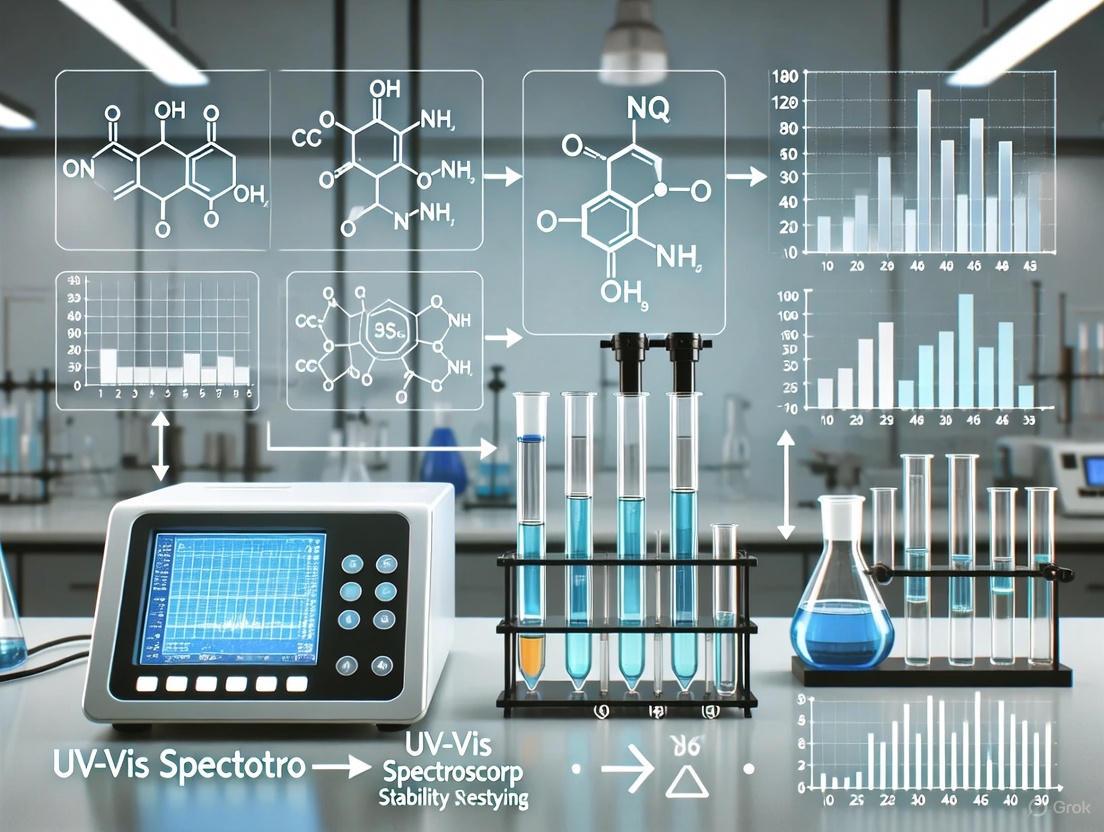
This article provides a comprehensive guide for researchers and drug development professionals on the application of Ultraviolet-Visible (UV-Vis) spectroscopy in drug stability testing.
UV-Vis Spectroscopy in Drug Stability Testing: A Complete Guide from Method Development to Validation
Abstract
This article provides a comprehensive guide for researchers and drug development professionals on the application of Ultraviolet-Visible (UV-Vis) spectroscopy in drug stability testing. It covers the foundational principles of how UV-Vis spectroscopy functions as a stability-indicating tool, detailed methodologies for forced degradation and routine analysis, practical troubleshooting for common instrumental and sample-related challenges, and a comparative analysis with other techniques like HPLC. The content synthesizes current best practices and validation parameters as per ICH guidelines, offering a holistic resource for ensuring drug product stability, predicting commercial viability, and complying with regulatory standards.
UV-Vis Spectroscopy Fundamentals: Principles and Role in Drug Stability
Core Principles of UV-Vis Spectroscopy and the Beer-Lambert Law
Ultraviolet-Visible (UV-Vis) spectroscopy is an indispensable analytical technique in pharmaceutical research, particularly for drug stability testing. This method quantifies the absorption of ultraviolet and visible light by molecules, providing critical data on drug composition, concentration, and purity. The technique operates on the fundamental principle that when matter absorbs specific wavelengths of light, electrons transition to higher energy states, creating measurable absorption patterns that serve as molecular fingerprints. For drug development professionals, UV-Vis spectroscopy offers a rapid, economical, and accurate method for assessing key stability indicators, including active pharmaceutical ingredient (API) quantification and contaminant identification [1] [2]. The integration of the Beer-Lambert law transforms these absorbance measurements into precise concentration values, establishing UV-Vis spectroscopy as a cornerstone technique throughout drug development and manufacturing processes.
Theoretical Foundations
The Beer-Lambert Law
The Beer-Lambert law forms the quantitative foundation for UV-Vis spectroscopy, establishing a linear relationship between the absorbance of light and the properties of the absorbing substance [3] [4]. This relationship is mathematically expressed as:
A = ε · c · l
Where:
- A is the Absorbance (a dimensionless quantity) [3] [2]
- ε is the Molar absorptivity (also called the molar extinction coefficient, with units of L·molâ»Â¹Â·cmâ»Â¹) [4] [5]
- c is the Concentration of the absorbing species (in mol/L or M) [3] [6]
- l is the Path length (the distance the light travels through the solution, typically 1 cm for standard cuvettes) [3] [4]
According to this law, absorbance is directly proportional to both the concentration of the solution and the path length of the light through the sample [6]. This linear dependence enables researchers to determine unknown concentrations by measuring absorbance, which is the primary utility of the Beer-Lambert Law in analytical applications [3].
The relationship between absorbance and transmittance is logarithmic, defined as:
A = logâ‚â‚€(Iâ‚€/I)
Where Iâ‚€ is the incident light intensity and I is the transmitted light intensity [3] [4]. The following table shows how specific absorbance values correspond to percentage transmittance, demonstrating this fundamental relationship [3]:
Table 1: Absorbance and Transmittance Values
| Absorbance | Transmittance |
|---|---|
| 0 | 100% |
| 1 | 10% |
| 2 | 1% |
| 3 | 0.1% |
| 4 | 0.01% |
| 5 | 0.001% |
For accurate quantitative analysis, absorbance values should generally be kept below 1, which corresponds to 10% transmittance. This ensures measurements remain within the instrument's optimal dynamic range, as higher absorbance values result in insufficient light reaching the detector for reliable quantification [2].
Electronic Transitions and Chromophores
The fundamental physical process underlying UV-Vis spectroscopy involves the promotion of electrons from ground state orbitals to higher energy excited states when molecules absorb specific wavelengths of light [7] [8]. This energy absorption occurs in quantized amounts, meaning only photons with precisely the correct energy to bridge the gap between molecular orbitals will be absorbed.
The probability and energy requirements of these electronic transitions depend on the molecular structure of the analyte. Key transitions include:
- π → π* transitions: Occur in molecules with conjugated π-electron systems, typically requiring less energy and appearing at longer wavelengths with high probabilities [7]
- n → π* transitions: Involve promotion of non-bonding electrons to anti-bonding orbitals, generally appearing at lower energies but with significantly lower transition probabilities [7]
Chromophores are the functional groups within molecules responsible for light absorption in the UV-Vis range [7] [8]. These molecular moieties contain π-electrons or non-bonding electrons that undergo electronic transitions when irradiated. Extensive conjugation in molecules moves absorption maxima to longer wavelengths and typically increases absorption intensity, a property particularly valuable for analyzing pharmaceutical compounds with aromatic structures [7].
The following diagram illustrates the core principle of electronic transitions and the logical flow of light absorption in UV-Vis spectroscopy:
Diagram 1: Electronic transition principle
Instrumentation and Methodology
UV-Vis Spectrophotometer Components
A UV-Vis spectrophotometer consists of several key components that work in concert to measure light absorption by samples:
Light Source: Provides broad-spectrum illumination across UV and visible wavelengths. Common configurations include:
Wavelength Selector: Isolates specific wavelengths from the broad emission spectrum of the light source. Monochromators containing diffraction gratings (typically 1200-2000 grooves/mm) are most common, providing precise wavelength selection through rotation of the grating [2].
Sample Container: Holds the solution being analyzed. Standard cuvettes with 1 cm path length are most common, though various path lengths are available for different concentration ranges. Quartz cuvettes are essential for UV measurements as glass and plastic absorb UV light [2].
Detector: Converts transmitted light intensity into electrical signals. Photomultiplier tubes (PMT) are common for their high sensitivity, while photodiodes and charge-coupled devices (CCD) offer alternative semiconductor-based detection [2].
Instrument designs vary, with single-beam instruments measuring sample and reference sequentially, and double-beam instruments simultaneously measuring sample and reference for improved accuracy and stability [5].
Critical Research Reagents and Materials
Table 2: Essential Research Reagents and Materials for UV-Vis Spectroscopy in Drug Stability Testing
| Item | Function & Importance in Stability Testing |
|---|---|
| High-Purity Solvents (Methanol, Water, Buffers) | Dissolve drug substances without introducing interfering chromophores; solvent polarity can affect absorption spectra [9] [6] |
| Reference Standards (Certified API Standards) | Enable accurate calibration curve generation for precise quantification of drug degradation [5] [9] |
| Quartz Cuvettes (1 cm path length) | Contain samples during analysis; quartz is transparent to UV light, unlike glass or plastic [2] |
| Forced Degradation Reagents (Acid, Base, Hâ‚‚Oâ‚‚) | Stress samples to accelerate degradation and identify potential degradation products [9] |
| Volumetric Glassware (Flasks, Pipettes) | Precisely prepare standard solutions and sample dilutions with minimal error [5] |
Applications in Drug Stability Testing
Stability-Indicating Methodology
UV-Vis spectroscopy serves as a powerful stability-indicating method in pharmaceutical development, enabling researchers to monitor drug integrity under various stress conditions. Stability testing is crucial for determining appropriate shelf-life, storage conditions, and usage instructions for drug products [1]. According to ICH guidelines, drug substances and products must undergo systematic stability testing to support marketing authorization applications [10].
Forced degradation studies employing UV-Vis spectroscopy help identify how environmental stressors affect drug molecules. Typical stress conditions include:
- Acidic and alkaline hydrolysis (using 0.1N HCl or NaOH)
- Oxidative degradation (using 3% Hâ‚‚Oâ‚‚)
- Thermal degradation (elevated temperatures)
- Photolytic degradation (exposure to UV or visible light) [9]
These studies reveal degradation pathways and help establish the stability-indicating properties of analytical methods. Research shows that some drugs like candesartan cilexetil demonstrate appreciable degradation under stress conditions, with sensitivity following the order: acidic > neutral > oxidative > thermal > alkaline > photolytic > UV degradation [9].
Quantitative Analysis and Calibration
The application of Beer-Lambert law enables precise quantification of drug concentrations during stability studies. A properly validated calibration curve is essential for accurate results:
Linearity Range: Establish using at least three, but ideally five, concentrations spanning the expected sample concentrations. For example, candesartan cilexetil shows excellent linearity in the 10-90 μg/mL range [9]
Calibration Standards: Prepare using digital pipettes and volumetric flasks rather than graduated cylinders for improved accuracy [5]
Validation Parameters: Include correlation coefficient (R² > 0.999), precision, accuracy, and recovery studies (typically 98-102%) [9]
The following workflow outlines the complete experimental protocol for drug stability monitoring using UV-Vis spectroscopy:
Diagram 2: Drug stability testing workflow
Molar Absorptivity in Pharmaceutical Analysis
Molar absorptivity (ε) is a compound-specific property that indicates how strongly a substance absorbs light at a particular wavelength [3] [7]. This parameter is crucial for method development in drug stability testing:
Table 3: Molar Absorptivity Values for Common Pharmaceutical Compounds
| Compound Class | Typical Molar Absorptivity Range (L·molâ»Â¹Â·cmâ»Â¹) | Significance in Stability Testing |
|---|---|---|
| Strongly Absorbing Chromophores (Extended conjugation) | >10,000 | High sensitivity for detection of low concentrations and minor degradation products [7] |
| Weakly Absorbing Chromophores (Isolated functional groups) | 10 - 100 | May require larger sample concentrations or path lengths for reliable detection [7] |
| Proteins (A280, Tryptophan) | ~5,000 - 15,000 | Enables quantification of protein-based therapeutics and detection of aggregation [6] |
| Nucleic Acids (A260, DNA/RNA) | ~6,500 - 13,000 | Assesses integrity of nucleic acid-based therapies and potential contaminants [6] |
The magnitude of ε reflects both the size of the chromophore and the probability that light of a given wavelength will be absorbed when it strikes the chromophore [7]. Understanding these values helps researchers optimize detection parameters for specific drug compounds during stability studies.
Experimental Protocols
Forced Degradation Study Protocol
This protocol outlines the specific methodology for conducting forced degradation studies on candesartan cilexetil, which can be adapted for other drug substances with appropriate modifications [9]:
Objective: To evaluate the stability of drug substances under various stress conditions and develop a stability-indicating analytical method.
Materials and Equipment:
- UV-Vis spectrophotometer (e.g., Shimadzu 1700)
- API sample (candesartan cilexetil)
- Reagents: 0.1N NaOH, 0.1N HCl, 3% Hâ‚‚Oâ‚‚, methanol:water (9:1)
- Thermal oven, UV chamber
- Volumetric flasks, pipettes, quartz cuvettes
Procedure:
Solution Preparation:
- Prepare stock solution (100 μg/mL) by dissolving 10 mg candesartan cilexetil in 100 mL methanol:water (9:1)
- Determine λmax by scanning dilution (10 μg/mL) from 200-400 nm against solvent blank (λmax = 254 nm for candesartan)
Alkaline Degradation:
- Accurately weigh 10 mg API into 10 mL volumetric flask
- Add 0.1N NaOH to volume, reflux at 60°C for 5 hours
- Withdraw samples hourly, prepare 30 μg/mL solution in methanol:water (9:1)
- Measure absorbance at 254 nm
Acidic and Neutral Degradation:
- Repeat procedure using 0.1N HCl and distilled water as media respectively
- Maintain same conditions (60°C, 5 hours)
Oxidative Degradation:
- Dissolve 10 mg API in 2-3 drops methanol:water (9:1)
- Make to volume with 3% Hâ‚‚Oâ‚‚ in 10 mL volumetric flask
- Keep in dark for 12 hours
- Withdraw samples at 6-hour intervals, prepare 30 μg/mL solution
- Measure absorbance at 254 nm
Photolytic Degradation:
- Spread 150 mg API in Petri dish, expose to direct sunlight for 3 days
- Withdraw samples every 6 hours, prepare 30 μg/mL solution
- Measure absorbance at 254 nm
Thermal Degradation:
- Place API in Petri dish, heat in oven at 60°C
- Withdraw samples periodically, prepare 30 μg/mL solution
- Measure absorbance at 254 nm
UV Degradation:
- Expose API to UV light in chamber
- Withdraw samples every 8 hours, prepare 30 μg/mL solution
- Measure absorbance at 254 nm
Data Analysis:
- Calculate % drug remaining = (At/A0) × 100
- Where At = absorbance at time t, A0 = absorbance at time zero
- Compare degradation rates across different stress conditions
Calibration Curve Method for Quantitative Analysis
Objective: To establish a linear relationship between absorbance and concentration for accurate quantification of drug content during stability studies [5] [9].
Procedure:
Standard Solution Preparation:
- Prepare stock solution (100 μg/mL) of reference standard in appropriate solvent
- Create serial dilutions to cover concentration range (e.g., 10, 20, 30, 40, 50, 60, 70, 80, 90 μg/mL)
Spectrophotometric Measurement:
- Measure blank solution (solvent only) to zero instrument
- Measure absorbance of each standard solution at predetermined λmax
- Perform triplicate measurements for each concentration
Calibration Curve Construction:
- Plot average absorbance (y-axis) versus concentration (x-axis)
- Perform linear regression analysis
- Verify correlation coefficient (R² > 0.999 for acceptable calibration)
- Determine regression equation: y = mx + c, where m = slope, c = y-intercept
Sample Analysis:
- Prepare test samples at appropriate dilution to fall within linear range
- Measure absorbance at same λmax
- Calculate concentration using regression equation
Validation Parameters:
- Linearity: Across specified concentration range (e.g., 10-90 μg/mL)
- Precision: Relative Standard Deviation (RSD) < 2% for replicate measurements
- Accuracy: Percentage recovery 98-102% for spiked samples
- LOD/LOQ: Determined by signal-to-noise ratio of 3:1 and 10:1 respectively
UV-Vis spectroscopy, grounded in the fundamental principles of the Beer-Lambert law, provides an indispensable analytical framework for drug stability testing in pharmaceutical development. The technique's ability to accurately quantify drug concentration and detect degradation products through forced degradation studies makes it particularly valuable for establishing shelf-life and appropriate storage conditions for drug products. When properly validated with appropriate calibration curves and reference standards, UV-Vis methods offer a robust, cost-effective solution for stability-indicating analysis that meets regulatory requirements. The direct proportionality between absorbance and concentration established by the Beer-Lambert law enables researchers to precisely monitor API levels over time, providing critical data for predicting drug viability and ensuring product safety and efficacy throughout the intended shelf-life.
Why Use UV-Vis for Stability Testing? Linking Absorbance to Drug Potency and Purity
This application note details the use of Ultraviolet-Visible (UV-Vis) spectroscopy as a critical analytical technique for stability testing in pharmaceutical development. It establishes the direct correlation between absorbance measurements and key stability indicators—drug potency and purity. The note provides a comprehensive theoretical framework, supported by experimentally determined quantitative data, and delivers detailed protocols for forced degradation and accelerated aging studies. Designed for researchers and drug development professionals, this document underscores how UV-Vis spectroscopy offers a rapid, reliable, and compliant methodology for assessing product stability and predicting commercial viability.
Stability testing is a regulatory requirement that evaluates how the quality of a drug substance or product varies with time under the influence of environmental factors. The primary goal is to establish a shelf life and ensure patient safety by identifying and quantifying degradation products. UV-Vis spectroscopy serves as a fundamental tool in these studies due to its direct connection to the electronic properties of molecules. The technique measures the absorption of light by chromophores in an active pharmaceutical ingredient (API), providing a sensitive means to monitor chemical changes such as degradation, impurity formation, and loss of potency. Its speed, accuracy, and cost-effectiveness make it indispensable for both early-stage formulation screening and ongoing quality control, enabling scientists to make data-driven decisions about product viability [1].
Theoretical Principles: Linking Absorbance to Drug Attributes
The foundational principle of UV-Vis spectroscopy in quantitative analysis is the Beer-Lambert Law (or Beer's Law). This law states a linear relationship between the absorbance of a solution and the concentration of the absorbing species [2].
The relationship is expressed as: A = εbc Where:
- A is the measured Absorbance (no units)
- ε is the Molar Absorptivity (a compound-specific constant in L·molâ»Â¹Â·cmâ»Â¹)
- b is the Path Length of the light through the sample (in cm)
- c is the Concentration of the analyte (in mol·Lâ»Â¹)
This principle directly links spectroscopic measurement to critical quality attributes:
- Potency: A direct measure of the API concentration. A decrease in absorbance at the API's characteristic wavelength (( \lambda_{\text{max}} )) indicates a loss of potency, often due to primary degradation.
- Purity: The appearance of new absorption peaks or shifts in the spectral profile can indicate the formation of degradation-related impurities. Peak purity analysis, which compares spectra across a chromatographic peak, can confirm the presence of co-eluting impurities [11].
The following diagram illustrates the core principle and its application in a stability testing context:
Key Applications in Stability Testing
UV-Vis spectroscopy is applied across various stages of stability testing to monitor different aspects of product quality [12] [1].
- Potency and Assay: Quantifying the API concentration in drug products over time to ensure it remains within specification limits (e.g., 98.0-102.0% of label claim) [11].
- Degradation Product Analysis: Monitoring for the formation of known and unknown impurities under stress conditions (e.g., hydrolysis, oxidation). Changes in the UV spectrum can reveal the formation of new chromophoric degradation products.
- Forced Degradation Studies: Subjecting the API to extreme conditions (high temperature, acidic/basic pH, oxidative light) to identify likely degradation pathways and validate the stability-indicating power of analytical methods.
- Accelerated Stability Studies: Determining the shelf life by storing products under elevated temperature and humidity and measuring the rate of API degradation at various time points.
Table 1: Quantifiable Stability Indicators via UV-Vis Spectroscopy
| Stability Indicator | Measurable Parameter | Typical UV-Vis Output | Significance |
|---|---|---|---|
| Potency Loss | Decrease in Absorbance at ( \lambda_{\text{max}} ) of API | Reduction in peak height/area at characteristic wavelength. | Directly measures loss of active ingredient; critical for efficacy. |
| Impurity Formation | Appearance of new absorbance peaks or shoulders | Spectral shifts or new peaks at different wavelengths. | Indicates chemical degradation and potential safety concerns. |
| Oxidation | Shift in ( \lambda_{\text{max}} ) or hyperchromic/hypsochromic effects | Altered spectral profile, often increased absorbance. | Monitors susceptibility of API to oxidative degradation pathways. |
Experimental Protocols
The following protocols are designed for a standard cuvette-based UV-Vis spectrophotometer.
Protocol 1: Forced Degradation Study for Method Validation
This protocol is used to deliberately degrade a drug substance to validate that the analytical method is "stability-indicating" [12].
The Scientist's Toolkit: Essential Materials
| Material/Reagent | Function in the Protocol |
|---|---|
| High-Purity API Reference Standard | Serves as the undegraded benchmark for spectral comparison and quantification. |
| UV-Transparent Solvent (e.g., HPLC-grade Methanol, Buffer) | Dissolves the API without interfering with UV absorption in the analyzed range. |
| Quartz Cuvettes (1 cm path length) | Holds the sample for analysis; quartz is essential for UV range transparency. |
| Stress Condition Reagents (e.g., 0.1M HCl, 0.1M NaOH, 3% Hâ‚‚Oâ‚‚) | Introduce specific degradation stressors (acid/base hydrolysis, oxidation). |
| Controlled-Temperature Water Bath or Oven | Provides a consistent thermal stress environment for the samples. |
Procedure:
- Solution Preparation: Prepare a stock solution of the API at a known concentration (e.g., 10 µg/mL) in a suitable solvent. Ensure the absorbance at the analytical wavelength is within the linear range of the Beer-Lambert law (preferably below 1.0 AU).
- Stress Application: Aliquot the stock solution into separate vials and subject them to various stress conditions:
- Acidic Hydrolysis: Add dilute HCl to one aliquot to achieve pH ~2. Heat at 60°C for 1-8 hours.
- Basic Hydrolysis: Add dilute NaOH to another aliquot to achieve pH ~12. Heat at 60°C for 1-8 hours.
- Oxidative Degradation: Add a small volume of hydrogen peroxide (e.g., 3% v/v) to an aliquot. Keep at room temperature or mildly elevated temperature.
- Thermal Degradation: Heat an aliquot of the neutral solution at 80°C for several hours.
- Photolytic Degradation: Expose a neutral aliquot to UV light (as per ICH guidelines).
- Neutralization/Dilution: After the stress period, neutralize the acid/base samples and dilute all samples to the same volume with solvent to stop the reaction.
- Spectrum Acquisition: Using the unstressed API solution as a reference, obtain the full UV-Vis spectrum (e.g., 200-400 nm) for each stressed sample.
- Data Analysis: Compare the spectra of the stressed samples to the unstressed control. Look for:
- A decrease in the absorbance peak of the API.
- The appearance of new absorption maxima or shoulders indicating degradation products.
- Isosbestic points, which suggest a direct conversion between two species.
Protocol 2: Real-Time & Accelerated Stability Potency Monitoring
This protocol is used to track the potency of a drug product stored under recommended (real-time) and accelerated (high-stress) storage conditions [1].
Procedure:
- Calibration Curve: Prepare a series of standard solutions of the API reference standard at concentrations spanning the expected range (e.g., 5, 10, 25, 50, 100 µg/mL). Measure the absorbance of each standard at the predetermined ( \lambda_{\text{max}} ) of the API. Plot absorbance versus concentration and perform linear regression to obtain the calibration equation.
- Sample Placement: Store the finished drug product (e.g., powdered API, tablet blend, or solution) in stability chambers under ICH-defined conditions:
- Long-Term: 25°C ± 2°C / 60% RH ± 5% RH
- Accelerated: 40°C ± 2°C / 75% RH ± 5% RH
- Sample Withdrawal and Preparation: At predetermined time points (e.g., 0, 1, 3, 6, 9, 12, 24, 36 months), withdraw samples from the chambers. For solid dosage forms, crush and dissolve a representative sample in a known volume of solvent, then filter or centrifuge to obtain a clear solution. Dilute to a concentration within the calibration range.
- Absorbance Measurement: Measure the absorbance of the prepared sample solutions at the API's ( \lambda_{\text{max}} ).
- Potency Calculation: Use the calibration curve equation to calculate the concentration of the API in each sample. Report the potency as a percentage of the initial (time-zero) concentration.
Table 2: Example Kinetic Data from an Accelerated Stability Study
| Time Point (Months) | Storage Condition | Measured Absorbance (AU) | Calculated Potency (% of Initial) | Regulatory Action Level |
|---|---|---|---|---|
| 0 | N/A | 0.745 | 100.0% | - |
| 3 | 25°C / 60% RH | 0.740 | 99.3% | - |
| 3 | 40°C / 75% RH | 0.715 | 96.0% | - |
| 6 | 25°C / 60% RH | 0.735 | 98.7% | - |
| 6 | 40°C / 75% RH | 0.680 | 91.3% | Alert Threshold |
| 12 | 25°C / 60% RH | 0.725 | 97.3% | - |
| 12 | 40°C / 75% RH | 0.605 | 81.2% | Out of Specification |
The workflow for these stability studies is summarized below:
Regulatory Compliance and Best Practices
Adherence to regulatory guidelines is paramount. The International Council for Harmonisation (ICH) guidelines Q1A(R2) on stability testing and Q3B on impurities set the global standards [12] [11]. UV-Vis methods used for regulatory filing must be validated per ICH Q2(R1) to demonstrate parameters such as accuracy, precision, linearity, specificity, and range.
Best Practices for Reliable Data:
- System Suitability: Ensure the spectrophotometer is qualified and performance-checked. Use appropriate wavelength and absorbance standards for calibration.
- Sample Integrity: Use high-purity, UV-transparent solvents. For UV light below 200 nm, an argon-purged system is necessary as oxygen absorbs in this region [2].
- Path Length Consistency: Use matched quartz cuvettes with a defined path length (typically 1 cm) to ensure accurate application of the Beer-Lambert law.
- Dynamic Range: Keep absorbance readings preferably between 0.2 and 0.8 AU for optimal signal-to-noise ratio and linearity. Concentrations leading to absorbance >1.0 should be diluted [2].
UV-Vis spectroscopy remains a cornerstone of pharmaceutical stability testing due to its robust theoretical foundation, practical simplicity, and cost-effectiveness. By providing a direct link between absorbance and the molecular concentration of chromophores, it enables precise monitoring of drug potency and the early detection of purity-compromising degradation products. The protocols outlined herein for forced degradation and accelerated stability studies provide a framework for generating high-quality, regulatory-compliant data. When integrated into a comprehensive stability program, UV-Vis spectroscopy empowers scientists to make critical decisions on formulation strategy and product shelf life, thereby ensuring that only safe, efficacious, and high-quality medicines reach patients.
In the pharmaceutical industry, demonstrating the stability of a drug substance (DS) or drug product (DP) over its shelf life is a critical regulatory requirement [13]. Stability testing helps determine shelf life, identify degradation pathways, and ensure that medications remain potent and safe for use in the real world [1] [12]. A stability-indicating method (SIM) is a validated quantitative analytical procedure that can detect and quantify both the active pharmaceutical ingredient (API) and its related compounds (process impurities and degradation products) without interference [14] [13]. Ultraviolet-Visible (UV-Vis) Spectroscopy serves as a fundamental technique in these stability-testing protocols due to its speed, simplicity, cost-effectiveness, and non-destructive nature [15].
This application note details the use of UV-Vis spectroscopy for tracking key stability indicators—specifically, API content and degradation products—within the context of drug stability testing. We will cover fundamental principles, essential experimental protocols, and data interpretation strategies to support researchers and drug development professionals.
Key Stability Indicators and UV-Vis Fundamentals
The primary goal of stability testing is to monitor changes in the quality of a drug substance or product over time under the influence of various environmental stressors such as temperature, humidity, and light [1]. The key chemical indicators of stability are:
- Active Pharmaceutical Ingredient (API) Content: A decrease in API concentration from the initial labeled amount is a direct measure of potency loss [1] [14].
- Degradation Products (Impurities): The formation and increase in concentration of impurities resulting from the chemical breakdown of the API can compromise therapeutic value and patient safety [14] [13].
UV-Vis spectroscopy quantifies the amount of ultraviolet or visible light absorbed by a compound in solution [1] [5]. The fundamental principle is the Beer-Lambert Law (Equation 1), which relates the absorption of light to the properties of the material through which the light is traveling:
Equation 1: Beer-Lambert Law [ A = \varepsilon b c ] Where:
- ( A ) is the measured absorbance (unitless)
- ( \varepsilon ) is the molar absorptivity (Mâ»Â¹cmâ»Â¹)
- ( b ) is the path length of the cuvette (cm)
- ( c ) is the concentration of the analyte (M)
By tracking changes in absorbance at specific wavelengths over time, UV-Vis spectroscopy provides an objective means to assess API concentration and detect the formation of contaminants, making it a cornerstone of stability-indicating assays [1] [15].
Table 1: Key Stability Indicators Accessible via UV-Vis Spectroscopy
| Stability Indicator | Description | Role of UV-Vis Spectroscopy |
|---|---|---|
| Potency/Potency Loss | The strength of a drug product, represented by the concentration of the Active Pharmaceutical Ingredient (API). | Quantifies API concentration via absorbance measurements, allowing for the construction of calibration curves for potency determination [15]. |
| Degradation Products | Unwanted chemical species formed from the breakdown of the API due to environmental stressors. | Detects the presence of new chromophores or changes in spectral profile that indicate the formation of impurities, often via peak purity analysis or shifts in absorbance [12] [13]. |
| Chemical Stability | The ability of the API to maintain its chemical structure and integrity over time. | Monitors changes in the molecular structure by observing shifts in the absorption spectrum (e.g., λ_max) or the appearance of new absorption bands [12]. |
Experimental Protocols
Sample and Standard Preparation
Proper sample preparation is crucial for obtaining accurate and reproducible results [15].
- Solvent Selection: Choose a solvent that is optically transparent in the spectral region of interest and does not react with the analyte. Common solvents include water, methanol, and acetonitrile [15].
- Standard Solutions: Accurately prepare a series of standard solutions from a certified reference standard of the API. The concentration range should bracket the expected concentration of the test samples and fall within the instrument's linear range (typically absorbance values between 0.1 and 1.0 AU) [5] [15].
- Test Sample Solution: For a solid dosage form (e.g., tablet), crush and dissolve a representative sample in a known volume of the selected solvent. For a liquid formulation, dilute an aliquot as needed. The final solution must be optically clear and free of particulate matter to prevent light scattering [15]. Filter the solution using a 0.45 μm or 0.2 μm syringe filter if necessary.
- Blank Solution: Prepare a blank consisting of the solvent and any excipients (if possible) to zero the instrument and account for any background absorption [5].
Forced Degradation Studies (Stress Testing)
Forced degradation studies are performed to generate degradation products, identify likely degradation pathways, and validate the stability-indicating nature of the analytical method [14] [13].
- Objective: To intentionally degrade the API or drug product by exposing it to harsh conditions, typically targeting about 5-20% degradation, to understand its intrinsic stability [13].
- Common Stress Conditions:
- Acidic Hydrolysis: Expose the sample to a defined concentration of HCl (e.g., 0.1 M) at an elevated temperature (e.g., 60°C) for a set time (e.g., 1-24 hours). Neutralize after stress.
- Basic Hydrolysis: Expose the sample to a defined concentration of NaOH (e.g., 0.1 M) at an elevated temperature (e.g., 60°C) for a set time. Neutralize after stress.
- Oxidative Degradation: Expose the sample to an oxidizing agent like hydrogen peroxide (e.g., 3-30%) at room or elevated temperature for a set time.
- Photolytic Degradation: Expose the solid or solution sample to UV/Vis light (e.g., as per ICH Q1B option 1 or 2) for a specified duration.
- Thermal Degradation: Heat the solid sample at a defined elevated temperature (e.g., 70-105°C) for a prolonged period in a stability chamber.
Instrumental Analysis and Calibration
- Instrument Setup: Use a double-beam or diode-array UV-Vis spectrophotometer for higher accuracy and the ability to collect full spectra [5]. Set the wavelength range to encompass the absorption maxima (λ_max) of the API and potential degradants (e.g., 200-400 nm for UV).
- Calibration Curve:
- Measure the absorbance of each standard solution at the λ_max of the API.
- Plot the absorbance (y-axis) against the corresponding concentration (x-axis).
- Perform linear regression analysis. The correlation coefficient (R²) should be 0.9 or better for an acceptable calibration [5].
- Sample Analysis:
- Measure the absorbance of the prepared test sample and forced degradation samples at the analytical wavelength(s).
- For degraded samples, collect full spectra (e.g., 200-400 nm) to look for spectral changes and new absorption peaks indicating degradation products [13].
Data Analysis and Interpretation
- Quantifying API Content: Use the linear equation from the calibration curve to calculate the concentration of the API in the test sample.
- Assessing Degradation: In forced degradation samples, a decrease in the API peak absorbance, coupled with the appearance of new spectral features (shoulders or new peaks), confirms degradation. The percentage degradation can be estimated by quantifying the remaining API [13].
Workflow and Signaling Pathways
The following workflow diagrams outline the core processes for forced degradation studies and the subsequent UV-Vis analysis for stability assessment.
Diagram 1: Forced degradation and analysis workflow.
Diagram 2: UV-Vis quantification protocol.
The Scientist's Toolkit: Essential Research Reagents and Materials
A successful stability study relies on the use of specific, high-quality materials and reagents. The following table details essential items for experiments tracking API content and degradation products via UV-Vis spectroscopy.
Table 2: Essential Research Reagents and Materials
| Item | Function / Purpose |
|---|---|
| High-Purity API Reference Standard | Serves as the benchmark for identity, purity, and potency; essential for preparing calibration standards [13]. |
| UV-Transparent Solvent (HPLC Grade) | Dissolves the analyte without interfering with its UV-Vis absorption spectrum in the region of interest [15]. |
| Standard Volumetric Glassware (e.g., Flasks, Pipettes) | Ensures accurate and precise preparation of standard and sample solutions, which is critical for reliable quantification. |
| Optically Matched Quartz Cuvettes | Holds liquid samples for analysis; quartz is required for UV range measurements below ~350 nm [15]. |
| Syringe Filters (0.45 μm or 0.2 μm) | Removes particulate matter from sample solutions to prevent light scattering, which can cause inaccurate absorbance readings [15]. |
| Stress Reagents (e.g., HCl, NaOH, Hâ‚‚Oâ‚‚) | Used in forced degradation studies to simulate hydrolytic and oxidative degradation pathways and validate the stability-indicating method [14] [13]. |
| Actagardin | Actagardin, MF:C81H132N20O23, MW:1754.0 g/mol |
| Cethromycin-d6 | Cethromycin-d6, MF:C42H59N3O10, MW:772.0 g/mol |
UV-Vis spectroscopy remains a powerful, accessible, and indispensable technique for tracking key stability indicators in pharmaceutical development. Its ability to provide fast, economical, and accurate quantification of API content, coupled with its utility in detecting the formation of degradation products—especially when integrated into systematic forced degradation studies—makes it a cornerstone of modern stability testing protocols. By adhering to the detailed methodologies and workflows outlined in this application note, scientists and drug development professionals can generate robust, high-quality data to support regulatory submissions, ensure product quality, and ultimately guarantee the safety and efficacy of pharmaceutical products for patients worldwide.
The Critical Role of Stability Testing in Predicting Drug Commercial Viability
Stability testing is an indispensable component of the drug development process, serving not only to meet regulatory requirements but also as a critical tool for predicting commercial viability. In the highly competitive pharmaceutical industry, efficacy alone is insufficient for commercial success; drugs must maintain their potency and safety over time under various environmental conditions [1]. The integration of UV-Vis spectrophotometry into stability testing protocols provides researchers with a fast, economical, and accurate method for assessing key stability indicators throughout drug development and manufacturing [1]. This analytical approach enables pharmaceutical companies to make informed decisions regarding resource allocation early in development, potentially identifying stability issues before substantial investments are made in clinically efficacious but commercially unviable compounds [1].
The Link Between Drug Stability and Commercial Success
Stability Testing as a Predictor of Viability
Stability testing provides critical data that helps pharmaceutical companies determine which drug candidates are most likely to succeed in the market. Through rigorous stability assessment, developers can:
- Establish appropriate shelf-life, storage conditions, and usage instructions for end users
- Identify potential stability issues early in development, allowing for formulation improvements or strategic discontinuation of problematic candidates
- Prevent costly failures during later stages of development or after market launch
- Optimize resource allocation by focusing on drug candidates with superior stability profiles [1]
The commercial impact of stability testing is significant, as evidenced by cases where "oncology drugs that were shown to be very efficacious in the clinic were removed from development because of stability reasons" [1]. This underscores how stability considerations can outweigh even demonstrated clinical efficacy in determining a drug's commercial fate.
Mechanisms of Drug Degradation
Understanding the chemical basis of drug degradation is fundamental to effective stability testing. Most pharmaceutical compounds are small organic molecules whose reactivity follows predictable patterns based on their functional groups and connectivity [1]. Common degradation pathways include:
- Hydrolysis: Breakdown of molecular bonds through reaction with water
- Oxidation: Reaction with atmospheric oxygen leading to structural changes
- Photodegradation: Structural changes induced by light exposure
- Thermal degradation: Molecular breakdown accelerated by elevated temperatures
These chemical reactions can affect active pharmaceutical ingredient (API) levels, introduce harmful impurities, and compromise both the therapeutic value and safety of medications [1]. Environmental stressors such as light, temperature, pH changes, oxidation, and hydrolysis can destabilize the chemical structure of medications, making stability testing under these conditions essential [1].
UV-Vis Spectrophotometry in Stability-Indicating Methods
Fundamental Principles
UV-Vis spectrophotometry operates on the principle of measuring the absorption of ultraviolet or visible light by chemical compounds. This technique quantifies the amount of UV or visible light absorbed by a compound, allowing researchers to objectively assess multiple stability indicators simultaneously [1]. The method is particularly valuable for:
- Determination of active pharmaceutical ingredients (API)
- Identification and quantification of contaminants
- Monitoring chemical changes in response to environmental stressors
- Assessing purity and stability across different formulations [1]
The extraordinary analytical capabilities of modern UV-Vis spectrophotometers have made them essential for quality control monitoring during manufacturing, with increasing integration throughout drug production processes [1].
Advantages for Stability Testing
UV-Vis spectrophotometry offers several distinct advantages for stability testing in pharmaceutical development:
- Speed and efficiency: Rapid analysis enables high-throughput screening of multiple samples
- Cost-effectiveness: Lower operational costs compared to more complex analytical techniques
- Accuracy and precision: Reliable quantitative results with appropriate validation
- Versatility: Applicable to various stages of drug development, from initial testing to commercial production
- Simplicity: Minimal sample preparation required for many applications [16]
These advantages make UV-Vis spectrophotometry particularly valuable for forced degradation studies, accelerated aging tests, and real-time stability monitoring, providing critical data at any stage of product development or manufacturing [1].
Experimental Protocols for Drug Stability Assessment
Sample Preparation and Degradation Studies
Drug Stock Solution Preparation
- Letrozole stock standard solution (1000.00 µg/mL): Transfer 100 mg of LTZ reference standard into a 100-mL volumetric flask and dilute to volume with absolute ethanol [16]
- Working standard solution (100.00 µg/mL): Pipette 10 mL of stock solution into a 100-mL volumetric flask and dilute to volume with absolute ethanol [16]
- Storage conditions: Store solutions at 4°C protected from light when not in use
Alkali-Induced Degradation Procedure
- Transfer 5.0 mL of LTZ stock solution (1000.00 µg/mL) to a round-bottom flask
- Add 10.0 mL of 2.0 N NaOH solution
- Reflux at 75°C for 30 minutes in the dark to prevent photo-degradation
- Cool the solution to room temperature
- Neutralize with 2.0 N HCl
- Transfer to a 50-mL volumetric flask and dilute to volume with ethanol
- The resulting solution contains alkali-induced degradation products equivalent to 100.00 µg/mL of LTZ [16]
Degradation Confirmation
- TLC confirmation: Use silica gel F254 plates with hexane:ethyl acetate (1:1 v/v) as mobile phase
- FTIR spectroscopy: Verify degradation products and confirm degradation mechanism [16]
Spectrophotometric Methodologies
Zero-Order (D0) Spectrophotometric Method
- Instrument calibration: Shimadzu UV-Vis 1601 double beam spectrophotometer with 1.00 cm path-length quartz cells
- Scanning parameters: 200.0-400.0 nm range with 0.1 nm intervals against ethanol blank
- Quantitative determination: Measure absorbance at λmax 239.0 nm
- Calibration curve: Plot absorbance versus LTZ concentrations (1.00-16.00 µg/mL) [16]
Second Derivative (D2) Spectrophotometric Method
- Signal processing: Compute second derivative of stored zero-order spectra using Δλ = 8 nm and scaling factor 100
- Measurement: Record peak amplitudes at 226.8 nm
- Calibration: Construct curve using LTZ peak amplitude versus concentrations (1.00-16.00 µg/mL) [16]
Ratio Difference (RD) Spectrophotometric Method
- Signal processing: Divide zero-order spectra of LTZ by spectrum of 10.00 µg/mL alkali-induced degradation products
- Measurement: Record amplitudes of ratio spectra at 240.0 nm and 258.0 nm
- Calculation: Compute amplitude difference (ΔP240.0-258.0)
- Calibration: Plot amplitude difference versus LTZ concentrations (3.00-16.00 µg/mL) [16]
First Derivative of Ratio Spectra (DD1) Method
- Signal processing: Divide zero-order spectra by spectrum of 10.00 µg/mL degradation products, then compute first derivative with Δλ = 8 nm and scaling factor 10
- Measurement: Record peak amplitude at 246.0 nm
- Calibration: Plot peak amplitude versus LTZ concentrations (3.00-16.00 µg/mL) [16]
Method Validation Parameters
All proposed spectrophotometric methods should be validated according to ICH guidelines with the following parameters:
Table 1: Validation Parameters for Spectrophotometric Stability-Indicating Methods
| Validation Parameter | D2 Method | RD Method | DD1 Method |
|---|---|---|---|
| Linearity range (µg/mL) | 1.00-16.00 | 3.00-16.00 | 3.00-16.00 |
| Recovery % | 100.02 ± 1.371 | 100.05 ± 1.972 | 100.40 ± 1.223 |
| LOD (µg/mL) | Calculated as 3.3 × SD/S | Calculated as 3.3 × SD/S | Calculated as 3.3 × SD/S |
| LOQ (µg/mL) | Calculated as 10 × SD/S | Calculated as 10 × SD/S | Calculated as 10 × SD/S |
| Intra-day precision (RSD%) | Determined at 3 concentrations in triplicate | Determined at 3 concentrations in triplicate | Determined at 3 concentrations in triplicate |
| Inter-day precision (RSD%) | Determined on 3 consecutive days | Determined on 3 consecutive days | Determined on 3 consecutive days |
| Robustness | Evaluated with ± 2 nm wavelength variation | Evaluated with ± 2 nm wavelength variation | Evaluated with ± 2 nm wavelength variation |
Data Analysis and Interpretation
Stability Assessment Workflow
The following diagram illustrates the complete workflow for stability assessment of pharmaceutical compounds using UV-Vis spectrophotometry:
Method Selection Logic
The following decision diagram guides researchers in selecting the appropriate spectrophotometric method based on their specific analytical needs:
The Scientist's Toolkit: Essential Research Reagents and Materials
Table 2: Essential Research Reagents and Materials for UV-Vis Stability Testing
| Item | Specifications | Function/Application |
|---|---|---|
| UV-Vis Spectrophotometer | Double-beam, 1.00 cm path-length quartz cells, 200-400 nm range | Primary analytical instrument for absorbance measurements and degradation monitoring [16] |
| Reference Standard | Certified purity (e.g., Letrozole 100.17% ± 0.789) | Quantification reference and method validation [16] |
| Absolute Ethanol | Spectroscopic grade | Solvent for stock and working solutions preparation [16] |
| Sodium Hydroxide (NaOH) | Analytical grade, 2.0 N solution | Alkali-induced degradation studies [16] |
| Hydrochloric Acid (HCl) | Analytical grade, 2.0 N solution | Neutralization after alkali degradation [16] |
| TLC Plates | Silica gel F254, 0.25 mm thickness | Initial degradation confirmation [16] |
| FTIR Spectrometer | Standard configuration | Structural confirmation of degradation products [16] |
| pH Meter | Standard laboratory model (e.g., Jenway 3505) | pH measurement and adjustment [16] |
| Ultrasonic Water Bath | Standard laboratory model | Solution homogenization and degassing [16] |
| Yadanzioside F | Yadanzioside F, MF:C29H38O16, MW:642.6 g/mol | Chemical Reagent |
| Butenafine-d4 | Butenafine-d4, MF:C23H27N, MW:321.5 g/mol | Chemical Reagent |
Advanced Applications and Sustainability Assessment
White Analytical Chemistry (WAC) Assessment
Modern stability-indicating methods should be evaluated not only for their analytical performance but also for their environmental impact. The Whiteness tool using the RGB12 algorithm provides a comprehensive assessment of environmental aspects, while the ChlorTox scale helps evaluate chemical hazards associated with the analytical methodology [16]. This integrated approach aligns with the principles of Green Analytical Chemistry and promotes sustainable practices in pharmaceutical analysis.
Regulatory Considerations and Commercial Translation
The development of stability-indicating methods must consider eventual regulatory requirements for drug approval. Key considerations include:
- Early planning for potential bridging studies between clinical trial assays and final diagnostic devices
- Sample retention strategies for future comparative analyses (FDA requires 90-95% sample availability for retesting)
- Documentation rigor including chain-of-custody records and stability studies [17]
Proper attention to these regulatory aspects during early development facilitates smoother transition to commercial production and increases the likelihood of successful regulatory approval.
UV-Vis spectrophotometry provides a robust, efficient, and economically viable approach to stability testing that directly informs predictions of drug commercial viability. The methodologies outlined in this document—including zero-order, second derivative, ratio difference, and first derivative of ratio spectra techniques—offer pharmaceutical researchers powerful tools for assessing stability indicators throughout drug development. By implementing these protocols and considering both analytical performance and environmental impact, drug development teams can make informed decisions regarding resource allocation and product advancement, ultimately increasing the likelihood of commercial success for new pharmaceutical products.
Forced degradation, also known as stress testing, is an essential developmental process in pharmaceutical science that involves the intentional degradation of new drug substances and products under conditions more severe than those used in accelerated stability studies [18] [19]. These studies serve as a critical bridge between drug development and regulatory approval, providing insight into the intrinsic stability characteristics of pharmaceutical molecules [18]. The primary objective is to generate representative degradation products that can be studied to determine the stability of the molecule, establish degradation pathways, and most importantly, validate stability-indicating analytical methods that demonstrate the ability to accurately measure the active pharmaceutical ingredient without interference from degradation products [18] [19].
Regulatory guidelines including those from ICH, FDA, and regional authorities like Brazil's Anvisa (RDC 964/2025) mandate forced degradation studies to support regulatory submissions [20] [19]. These studies are not part of the formal stability program but are instead considered a scientific necessity during drug development [18]. By subjecting drug substances and products to controlled stress conditions, pharmaceutical scientists can develop formulations with improved stability, recommend appropriate packaging and storage conditions, and establish scientifically justified shelf lives [18] [21].
Regulatory Framework and Objectives
Regulatory Guidelines and Requirements
Forced degradation studies are governed by various international and regional regulatory guidelines. The ICH Q1A(R2) guideline provides the fundamental framework for stress testing, requiring comprehensive evaluation of drug substance stability under exaggerated conditions [19]. Recent updates, such as Anvisa RDC 964/2025 in Brazil, have refined these requirements by eliminating the previous obligation to degrade 10% of the API, provided that all relevant degradation chemistry is demonstrated [20]. This evolution reflects a regulatory shift toward scientific justification rather than strict numerical targets.
The ICH Q2(R1) guideline establishes the link between forced degradation studies and method validation, specifically emphasizing the need to demonstrate method specificity – the ability to accurately measure the analyte in the presence of potential interferants including degradation products [19] [22]. Regulatory agencies utilize forced degradation data to confirm that no harmful degradation products are formed, the drug maintains its potency, and product quality remains consistent throughout the proposed shelf life [19].
Key Objectives of Forced Degradation Studies
- Identify Degradation Products and Pathways: Forced degradation studies help elucidate the chemical behavior of drug molecules, revealing primary and secondary degradation products and the mechanisms of their formation [18].
- Develop Stability-Indicating Methods: These studies generate samples containing degradation products that are used to validate analytical methods, proving they can accurately quantify the active ingredient while separating and detecting degradation products [18] [19].
- Inform Formulation and Packaging Development: Understanding a drug's susceptibility to various stress conditions enables scientists to design more stable formulations and select appropriate packaging to protect against identified vulnerabilities [18] [1].
- Support Regulatory Submissions and Shelf-Life Predictions: The data generated provides evidence of product understanding and supports the proposed shelf life and storage conditions in regulatory filings [19].
Experimental Design and Strategy
Strategic Approach to Stress Conditions
Designing an effective forced degradation study requires a balanced approach to stress conditions. The generally accepted optimal degradation range is 5-20% of the active pharmaceutical ingredient, which ensures sufficient degradation products are formed to challenge the analytical method while remaining relevant to typical impurity thresholds [18] [19]. Over-stressing samples may lead to the formation of secondary degradation products not observed in formal stability studies, while under-stressing may fail to reveal critical degradation pathways [18] [19].
A strategic approach begins with considering the drug substance's chemical structure to identify potentially labile functional groups [18]. Initial trials should aim to establish conditions that cause approximately 10% degradation, with some scientists recommending starting with extreme conditions (e.g., 80°C) at multiple time points to evaluate degradation rates [18]. Alternatively, a more gradual approach using milder conditions initially, with subsequent increases or decreases to achieve sufficient degradation, may prevent reaction mechanism changes that can occur under harsh conditions [18].
Critical Factors in Study Design
- Drug Concentration Selection: While not specified in regulatory guidance, studies are typically initiated at a concentration of 1 mg/mL, which usually allows detection of even minor decomposition products. Some studies should also be performed at the concentration expected in the final formulation, as degradation pathways may differ at various concentrations [18].
- Time Considerations: Forced degradation studies are typically conducted over a much shorter timeframe (mostly a few weeks) compared to formal stability studies (6-12 months), allowing for more rapid development of stability-indicating methods [18]. Solution-based stress testing is generally limited to a maximum of 14 days, with oxidative testing often complete within 24 hours [18].
- Batch Requirements: Regulatory guidelines typically require forced degradation studies on at least one batch of the drug substance and drug product [20]. Studies should be repeated when formulations or analytical methods change significantly, as these changes may lead to the production of new degradation products [18].
Table 1: Standard Stress Conditions for Forced Degradation Studies
| Stress Condition | Typical Parameters | Purpose | Common Duration |
|---|---|---|---|
| Acid Hydrolysis | 0.1-1 M HCl at elevated temperatures (40-80°C) | Assess susceptibility to acidic conditions | 1-7 days [18] [21] |
| Base Hydrolysis | 0.1-1 M NaOH at elevated temperatures (40-80°C) | Evaluate stability in alkaline environments | 1-2 days [18] [21] |
| Oxidation | 3-30% Hâ‚‚Oâ‚‚ at room temperature or elevated temperatures | Determine sensitivity to oxidative degradation | 1 day to 1 week [18] [21] [23] |
| Thermal Stress | 40-80°C with or without humidity control | Investigate thermal stability and effect of moisture | 1-14 days [18] [21] |
| Photolysis | Exposure to UV and visible light per ICH Q1B | Assess photosensitivity and identify photodegradants | 1-14 days [18] [21] |
Stress Conditions and Methodologies
Hydrolytic Degradation
Hydrolytic stress testing evaluates the drug's susceptibility to degradation in aqueous environments across a wide pH range [19]. This includes:
- Acid and Base Hydrolysis: Typical reagents include hydrochloric acid (HCl) or sulfuric acid (Hâ‚‚SOâ‚„) for acid hydrolysis, and sodium hydroxide (NaOH) or potassium hydroxide (KOH) for base hydrolysis, generally in concentrations ranging from 0.1 M to 1 M [19]. A common starting protocol involves refluxing the drug substance solution in 0.1 N acid or base for approximately eight hours, though conditions should be tailored to the molecule's known functional groups [19].
- Neutral Hydrolysis: Studies are also conducted in aqueous solutions without added acid or base to evaluate stability under neutral conditions [21].
- Advanced Techniques: Microwave-assisted hydrolysis has emerged as an efficient alternative to conventional heating methods, significantly reducing necessary exposure times from hours to minutes while maintaining control over reaction kinetics [19] [23].
Oxidative, Thermal, and Photolytic Stress
- Oxidative Stress: Traditional oxidative studies employ hydrogen peroxide (Hâ‚‚Oâ‚‚) at concentrations typically ranging from 3% to 30% [18] [21] [23]. Recent regulatory updates, such as Anvisa RDC 964/2025, now require additional auto-oxidation experiments using radical initiators like azobisisobutyronitrile (AIBN), increasing the number of required oxidation tests from two to three (peroxide, metal, and auto-oxidation) [20].
- Thermal Stress: Solid-state thermal degradation is typically conducted at temperatures ranging from 40°C to 80°C, often with controlled humidity (e.g., 75% RH) to evaluate both thermal and moisture-mediated degradation pathways [18] [21].
- Photolytic Stress: Photostability testing follows ICH Q1B guidelines, requiring exposure to both UV (320-400 nm) and visible light outputs. Studies typically include exposure levels at 1× and 3× ICH recommended light energies to thoroughly evaluate photosensitivity [18] [21].
Table 2: Advanced and Alternative Stress Conditions
| Condition | Advanced Parameters | Application Notes |
|---|---|---|
| Microwave-Assisted Hydrolysis | Variable power (140-700W) and irradiation time | Expedites hydrolysis reactions; reduces processing time from hours to minutes [23] |
| Radical Initiated Oxidation | Azobisisobutyronitrile (AIBN) at 40-60°C | Assesses auto-oxidation pathways; now required by updated regulations [18] [20] |
| Thermal-Humidity Combined Stress | 60-80°C/75% RH | Evaluates synergistic effects of heat and moisture on drug stability [18] |
| Enhanced Photostability | 3× ICH light energy | Provides more rigorous evaluation of photosensitivity beyond minimum requirements [18] |
Experimental Design Optimization
Traditional forced degradation studies often employ a trial-and-error approach, which can be time-consuming and resource-intensive [23]. Experimental design (DoE) methodologies offer a more systematic alternative by simultaneously optimizing multiple factors such as concentration, temperature, and exposure time [19] [23]. Factorial designs investigating all possible combinations of factors and levels can efficiently identify significant variables responsible for degradation and determine optimal degradation conditions with scientific rigor [23].
The implementation of DoE is particularly valuable given that the optimal degradation window targets 5-20% API degradation – a range that ensures sufficient degradant formation without generating secondary, non-relevant degradation products that might complicate method development [19] [23].
Analytical Techniques for Degradation Assessment
Separation Techniques and Peak Purity
High-Performance Liquid Chromatography (HPLC) is the primary analytical technique employed in forced degradation studies for separating and quantifying drug substances and their degradation products [23] [22]. The development of stability-indicating methods requires demonstrating that the method can adequately resolve the parent drug from its degradation products [22].
Peak Purity Assessment (PPA) is a critical component of method validation, ensuring that the chromatographic peak representing the main analyte is spectrally pure and free from co-eluting impurities [22]. Several techniques are available for PPA:
- PDA-Facilitated UV PPA: The most common approach, which examines changes in UV absorbance spectrum throughout the peak to detect co-eluted compounds with different spectral characteristics [22].
- Mass Spectrometry-Facilitated PPA: Utilizes mass spectrometers to verify peak purity by demonstrating consistent precursor ions, product ions, and/or adducts across the peak attributed to the parent compound [22].
- Orthogonal Techniques: Including two-dimensional liquid chromatography (2D-LC) or spiking with impurity markers can provide additional confirmation of peak purity [22].
UV-Vis Spectrophotometry in Stability Testing
UV-Vis spectrophotometry serves as a valuable technique in stability testing, particularly during initial method development and for routine analysis [21] [1]. While it may not offer the same separation capabilities as chromatographic methods, it provides a fast, economical, and accurate means of assessing key stability indicators, including determination of active pharmaceutical ingredients and identification of contaminants [1].
The technique measures the amount of UV or visible light absorbed by a compound, allowing researchers to monitor changes in drug potency and detect degradation products in response to stress conditions [21] [1]. In one case study, a stability-indicating UV/Vis spectrophotometric method was developed and validated for estimation of diazepam in tablet dosage form, with the drug substance and product exposed to thermal, photolytic, hydrolytic, and oxidative stress conditions [21]. The method demonstrated ability to detect changes due to stress conditions despite not identifying specific degradation products [21].
Diagram 1: Forced Degradation Study Workflow from Stress Conditions to Stability-Indicating Method Development
Essential Research Reagents and Materials
Table 3: Key Research Reagent Solutions for Forced Degradation Studies
| Reagent/Material | Typical Specifications | Primary Function in Forced Degradation |
|---|---|---|
| Hydrochloric Acid (HCl) | 0.1-1 M solutions in water or hydro-organic mixtures | Acid hydrolysis studies to simulate gastric environment and acid-catalyzed degradation [18] [21] |
| Sodium Hydroxide (NaOH) | 0.1-1 M aqueous solutions | Base hydrolysis studies to assess susceptibility to alkaline conditions [18] [21] |
| Hydrogen Peroxide (Hâ‚‚Oâ‚‚) | 3-30% solutions in water | Oxidative stress studies to evaluate susceptibility to peroxide-mediated degradation [18] [21] [23] |
| Radical Initiators (e.g., AIBN) | Pharmaceutical grade, typically in solution | Auto-oxidation studies to generate radical species and assess susceptibility to radical-mediated degradation [18] [20] |
| Buffer Solutions | Various pH values (e.g., 2, 4, 6, 8) | Hydrolytic studies at specific pH values to characterize pH-dependent degradation [18] |
| High-Purity Solvents | HPLC grade methanol, acetonitrile, water | Sample preparation, mobile phase preparation, and dilution of stressed samples [21] [23] |
| Reference Standards | Certified reference materials of drug substance and known impurities | Method calibration and identification of degradation products [23] [22] |
Protocol for Forced Degradation Studies
Standard Operating Procedure for Hydrolytic Degradation
Objective: To evaluate the susceptibility of the drug substance to hydrolysis under acidic, basic, and neutral conditions.
Materials and Equipment:
- Drug substance (API)
- 0.1 M HCl, 0.1 M NaOH, and purified water
- Thermostatically controlled water bath or heating block (40°C, 60°C)
- Volumetric flasks (100 mL)
- HPLC system with PDA detector or UV-Vis spectrophotometer
Procedure:
- Prepare stock solution of drug substance at 1 mg/mL in appropriate solvent [18] [23].
- For acid hydrolysis, transfer 10 mL of stock solution to 100 mL volumetric flask and add 10 mL of 0.1 M HCl. Dilute to volume with solvent to achieve final concentration of 0.1 mg/mL [21].
- Repeat step 2 using 0.1 M NaOH for basic hydrolysis and purified water for neutral hydrolysis.
- Store samples at 40°C and 60°C, collecting aliquots at 1, 3, and 5 days [18].
- Neutralize acid and base samples at each time point before analysis (dilution or pH adjustment) [18].
- Analyze samples using developed HPLC or UV-Vis method alongside unstressed controls.
- Calculate percentage degradation by comparing peak areas or absorbance values of stressed samples with controls.
Note: For drug products, prepare sample using finely powdered tablets equivalent to 100 mg of API, following the same procedure [21] [23].
Protocol for Oxidative Stress Testing
Objective: To assess the susceptibility of the drug substance to oxidative degradation.
Materials and Equipment:
- Drug substance (API)
- 3% and 30% hydrogen peroxide (Hâ‚‚Oâ‚‚)
- Thermostatically controlled water bath (25°C, 60°C)
- Volumetric flasks (100 mL)
- HPLC system with PDA detector
Procedure:
- Prepare stock solution of drug substance at 1 mg/mL in appropriate solvent.
- Transfer 10 mL of stock solution to 100 mL volumetric flask and add 10 mL of 3% Hâ‚‚Oâ‚‚. Dilute to volume with solvent [21] [23].
- Repeat with 30% Hâ‚‚Oâ‚‚ for more aggressive oxidative stress.
- Store samples at 25°C and 60°C, collecting aliquots at 1, 3, and 5 days [18].
- For peroxide-containing samples, heat on water bath for 10 minutes to remove excess hydrogen peroxide before analysis [23].
- Analyze samples using developed HPLC method.
- Include controls without peroxide to account for non-oxidative degradation.
Additional Stress Protocols
- Thermal Degradation: Expose solid drug substance and drug product in petri plates to dry heat at 60°C and 80°C (with and without 75% RH) for up to 14 days [18] [21]. Analyze samples at appropriate time intervals.
- Photolytic Degradation: Expose solid drug substance and drug product in thin layers in covered petri plates to direct sunlight or controlled light sources providing both UV and visible light per ICH Q1B requirements [18] [21]. Include dark controls to distinguish thermal from photolytic effects.
- Microwave-Assisted Degradation: For accelerated hydrolysis studies, use microwave oven with controlled power (140-700W) and irradiation time (minutes rather than days) [23]. Optimize conditions using experimental design approaches.
Data Interpretation and Regulatory Submissions
Mass Balance and Peak Purity Considerations
Mass balance is a critical concept in forced degradation studies, representing the accounting for all material in a stressed sample as the sum of the remaining parent drug and the formed degradation products [20]. Recent regulatory updates, such as Anvisa RDC 964/2025, allow for more scientific justifications in explaining mass balance deviations, which may occur due to factors including non-UV absorbing degradants, volatile degradation products, or compounds not extracted during sample preparation [20].
Peak purity assessments provide essential evidence of method selectivity [22]. The most common approach utilizes photodiode array (PDA) detection to evaluate spectral homogeneity throughout the chromatographic peak [22]. A pure peak demonstrates consistent spectral characteristics across its entire width, while co-elution of impurities manifests as spectral variations [22]. It is important to recognize that PDA-based peak purity assessments cannot detect co-eluting impurities with identical UV spectra, potentially leading to false negatives [22].
Stability-Indicating Method Validation
A validated stability-indicating method must demonstrate specificity, accuracy, precision, and robustness [21] [23]. The forced degradation study provides the foundational evidence for method specificity by showing separation of the parent drug from its degradation products [19] [22]. Additional validation parameters include:
- Linearity: Demonstrated over a specified range (e.g., 0.5-5 μg/mL for rebamipide) with correlation coefficient R² ≥ 0.999 [21] [23].
- Accuracy: Typically established through recovery studies at 80%, 100%, and 120% of target concentration, with acceptable recoveries of 98-102% [21].
- Precision: Determined through repeatability (intra-day) and intermediate precision (inter-day) studies with RSD ≤ 2% [21] [23].
- Robustness: Evaluated by deliberate variations in method parameters to ensure reliability during routine use [23].
Forced degradation studies represent a fundamental scientific exercise in pharmaceutical development, providing critical insights into drug stability behavior and forming the basis for validated stability-indicating methods [18] [19]. When properly designed and executed using systematic approaches such as experimental design, these studies enable comprehensive understanding of degradation pathways, facilitate development of stable formulations, and support regulatory submissions with scientifically justified stability claims [18] [23].
The evolving regulatory landscape continues to emphasize scientific rationale over prescriptive requirements, as evidenced by recent updates allowing justification-based approaches to degradation limits and mass balance deviations [20]. By implementing well-designed forced degradation protocols and employing appropriate analytical techniques with rigorous peak purity assessment, pharmaceutical scientists can ensure development of robust, stability-indicating methods that maintain their accuracy and selectivity throughout the drug product lifecycle [19] [22].
Developing Robust UV-Vis Methods for Stability-Indicating Assays
Ultraviolet-Visible (UV-Vis) spectroscopy is a cornerstone analytical technique in pharmaceutical development, prized for its simplicity, cost-effectiveness, and rapid analysis capabilities [2]. Within stability testing protocols, it provides critical data for determining the shelf life of drug substances and products by quantifying the active pharmaceutical ingredient (API) and monitoring the formation of degradation products over time [12]. This application note details a systematic, step-by-step protocol for developing and validating a robust UV-Vis spectroscopic method, framed within the context of a broader thesis on stability testing of drug products. The guidance adheres to the principles of the International Council for Harmonisation (ICH) Q1A(R2) stability guidelines and ICH Q2(R1) validation of analytical procedures [10] [24] [15], providing researchers and drug development professionals with a clear roadmap from initial solvent selection to final wavelength validation.
Theoretical Principles of UV-Vis Spectroscopy
UV-Vis spectroscopy measures the amount of discrete wavelengths of ultraviolet or visible light that are absorbed by or transmitted through a sample in comparison to a reference or blank sample [2]. The fundamental principle underpinning quantitative analysis is the Beer-Lambert Law, which states that the absorbance (A) of a solution is directly proportional to the concentration (c) of the absorbing species and the path length (L) of the light through the solution [2]. The mathematical relationship is expressed as:
A = ε * c * L
Where:
- A is the measured absorbance (no units)
- ε is the molar absorptivity or extinction coefficient (L molâ»Â¹ cmâ»Â¹)
- c is the concentration of the analyte (mol Lâ»Â¹)
- L is the path length of the cuvette (cm)
The technique relies on the excitation of electrons to higher energy states upon absorption of light [2]. The resulting plot of absorbance versus wavelength is called an absorption spectrum, which serves as a unique fingerprint for the analyte and is instrumental in selecting the optimal wavelength for quantification [2]. For method development, the goal is to establish experimental conditions where this relationship holds true, providing accurate, precise, and specific quantification of the target analyte within a complex pharmaceutical matrix.
Preliminary Steps and Solvent Selection
Understanding the Analyte and Matrix
Before experimental work begins, a thorough literature and theoretical review of the physicochemical properties of the analyte is essential. Key parameters to investigate include:
- Chemical structure and functional groups to predict absorption characteristics.
- Solubility profile in various solvents.
- pKa value for ionizable compounds, which can drastically affect UV absorption.
- Stability under various pH, light, and temperature conditions to avoid artifact formation during analysis.
Solvent Selection Criteria
The choice of solvent is critical, as it must dissolve the analyte without interfering with its measurement. Key selection criteria are detailed in the table below.
Table 1: Solvent Selection Criteria for UV-Vis Method Development
| Criterion | Description | Considerations and Examples |
|---|---|---|
| Solubility | The solvent must completely dissolve the analyte at the required concentration. | Inadequate dissolution leads to light scattering and erroneous absorbance readings. |
| UV Transparency | The solvent should not absorb significantly within the wavelength range intended for analyte measurement. | Solvents have a "UV cutoff" wavelength below which they absorb strongly. For UV work, high-quality solvents like acetonitrile, methanol, or water are typically used [2]. |
| Chemical Inertness | The solvent should not react chemically with the analyte. | Ensures the stability of the analyte during the analysis. |
| pH and Buffer Systems | For ionizable compounds, a buffered system may be necessary to maintain a consistent chemical form. | The pH of the solvent can shift the absorption spectrum; buffering at a suitable pH ensures reproducibility [15]. |
| Regulatory & Safety | Preference for solvents that are safe, readily available, and acceptable for use in regulated environments. | - |
Sample and Solvent Preparation Protocols
- Solvent Preparation: Use high-purity, HPLC-grade solvents to minimize UV-absorbing impurities. For buffered solutions, prepare using high-purity water and reagents. Filter through a 0.45 µm or 0.22 µm membrane filter to remove particulates.
- Sample Preparation: Accurately weigh the analyte and dissolve it in the selected solvent. For low-solubility compounds, sonication or gentle heating may be applied, provided the analyte is stable. The final solution must be optically clear. For solid dosage forms, perform a quantitative extraction of the API from the matrix into the solvent.
Wavelength Selection and Validation
Experimental Protocol for Initial Wavelength Scanning
- Blank Preparation: Fill a quartz cuvette with the selected solvent. Quartz is mandatory for UV range analysis as glass and plastic absorb UV light [2].
- Sample Preparation: Prepare a standard solution of the analyte at a concentration that is expected to yield an absorbance between 0.5 and 1.0 AU.
- Instrument Setup: Use a spectrophotometer equipped with a deuterium lamp (UV) and tungsten/halogen lamp (visible light) [2]. Set the scan speed to medium and the data interval to 1 nm.
- Baseline Correction: Place the blank cuvette in the sample holder and run a baseline correction or auto-zero function.
- Scanning: Replace the blank with the sample cuvette and perform a full spectrum scan across a relevant wavelength range (e.g., 200-400 nm for UV). The resulting spectrum will show one or more absorption peaks [2].
Wavelength Validation and Specificity
The peak with the maximum absorbance (λmax) is typically chosen for quantification due to higher sensitivity [2]. However, the specificity of this wavelength must be confirmed, especially in the context of stability testing where degradation products may be present.
- Forced Degradation Studies: Stress the drug substance (e.g., with acid, base, oxidation, heat, or light) to generate degradation products [24] [12].
- Specificity Scan: Obtain the UV spectrum of the stressed sample and overlay it with the spectrum of the pure analyte. The chosen λmax for the analyte should be sufficiently resolved from the absorption maxima of any degradation products. If a degradation product co-absorbs at the analyte's λmax, an alternative, specific wavelength must be selected.
Table 2: Key Parameters for Wavelength Selection and Validation
| Parameter | Objective | Experimental Procedure |
|---|---|---|
| λmax Identification | To identify the wavelength of maximum absorbance for the target analyte. | Scan a pure standard solution across a broad UV-Vis range and identify the absorption peak[s]. |
| Specificity | To confirm that the chosen wavelength is selective for the analyte in the presence of impurities and degradation products. | Compare the spectrum of a pure analyte standard with samples spiked with known impurities and forced degradation samples [12]. |
| Linearity | To verify that the absorbance at the chosen wavelength is linearly proportional to concentration. | Prepare a series of standard solutions at different concentrations and measure their absorbance. Plot absorbance vs. concentration [15]. |
The workflow for the entire method development process, from start to finish, is visualized below.
Method Validation for Stability Testing
Following development, the method must be validated per ICH Q2(R1) guidelines to ensure it is suitable for its intended use in stability testing [15]. The key validation parameters are summarized in the table below.
Table 3: Method Validation Parameters as per ICH Q2(R1)
| Validation Parameter | Objective | Recommended Protocol for UV-Vis Assay |
|---|---|---|
| Linearity & Range | To demonstrate that the method produces results directly proportional to analyte concentration. | Prepare at least 5 concentrations in the expected working range (e.g., 50-150% of target assay concentration). The correlation coefficient (r) should be >0.999. |
| Accuracy | To establish that the method yields results close to the true value. | Spike a placebo matrix with known quantities of the analyte (e.g., 80%, 100%, 120%) and analyze. Recovery should be 98-102%. |
| Precision | To determine the closeness of repeated measurements.1. Repeatability2. Intermediate Precision | 1. Analyze six independent samples at 100% concentration.2. Perform the analysis on a different day, with a different analyst, or different instrument. %RSD should be <2.0%. |
| Specificity | To confirm that the method can accurately measure the analyte in the presence of other components. | Verify that the absorbance from placebo, degradation products, or impurities does not interfere with the analyte's absorbance at λmax [12]. |
| Robustness | To evaluate the method's reliability when small, deliberate changes are made to operational parameters. | Assess the impact of small variations in pH of the solvent (±0.2 units), wavelength (±2 nm), and using different instrument models. |
Essential Research Reagent Solutions and Materials
Successful execution of the protocols outlined in this document requires the use of specific, high-quality materials and reagents.
Table 4: The Scientist's Toolkit: Essential Materials for UV-Vis Method Development
| Item | Function/Justification |
|---|---|
| High-Purity Solvents (HPLC-grade water, acetonitrile, methanol, buffer reagents) | To ensure minimal UV-absorbing impurities that can elevate baseline noise and interfere with analyte measurement [2]. |
| Quartz Cuvettes (1 cm path length is standard) | Required for UV range analysis as quartz is transparent to UV light, unlike glass or plastic [2]. |
| Analytical Balance (high precision) | For accurate weighing of standard compounds to ensure the integrity of calibration curves. |
| UV-Vis Spectrophotometer | The core instrument, equipped with a deuterium (UV) and tungsten/halogen (visible) lamp [2]. A photomultiplier tube (PMT) is a common detector for its sensitivity [2]. |
| Volumetric Flasks and Pipettes (Class A) | For precise preparation and dilution of standard and sample solutions. |
| Syringe Filters (0.45 µm or 0.22 µm, Nylon or PTFE) | For removing particulate matter from samples and solvents to prevent light scattering, which leads to inaccurate absorbance readings [15]. |
| pH Meter (calibrated) | Critical for preparing buffered solvents when analyzing ionizable compounds, as pH can significantly alter the absorption spectrum [15]. |
Application in Stability Testing Protocol
Once developed and validated, the UV-Vis method is integrated into the stability study protocol as defined by ICH Q1A(R2) [10] [24]. For a drug product with a proposed shelf life of 24 months, the long-term stability testing condition is typically 25°C ± 2°C / 60% RH ± 5% RH [24]. Samples are pulled at predetermined intervals (e.g., 0, 3, 6, 9, 12, 18, and 24 months) and analyzed using the validated method. The absorbance data is converted to concentration via the calibration curve, and the percentage of the initial concentration remaining is plotted over time to establish the product's expiration date.
The following diagram illustrates the integration of the developed UV-Vis method into the overall stability testing workflow.
This application note provides a comprehensive, step-by-step framework for developing and validating a UV-Vis spectroscopic method tailored for stability testing of pharmaceutical drug products. By meticulously following the protocols for solvent selection, wavelength identification and validation, and formal method performance checks, researchers can generate reliable, high-quality data that complies with global regulatory standards. A robust UV-Vis method serves as a powerful, efficient, and cost-effective tool in the scientist's arsenal, ultimately contributing to the assurance of drug product quality, safety, and efficacy throughout its shelf life.
Forced degradation, or stress testing, is an essential developmental process in pharmaceutical science, involving the intentional degradation of drug substances and products under exaggerated environmental conditions to understand their intrinsic stability [18] [19]. These studies are foundational for developing and validating stability-indicating methods, elucidating degradation pathways, and identifying degradation products, thereby ensuring the safety, efficacy, and quality of pharmaceuticals throughout their shelf life [25] [26]. Within the broader context of research on UV-Vis spectroscopy for stability testing, forced degradation provides the critical stressed samples necessary to demonstrate that spectroscopic methods can detect changes in drug quality attributes under various stress conditions [21] [1]. This application note details structured protocols for designing and executing forced degradation studies, providing a framework for generating analytically useful degradation profiles for method validation.
Objectives and Strategic Importance in Method Development
The primary objective of forced degradation is to generate a representative degradation profile that reveals the intrinsic stability of the molecule and provides samples for challenging analytical methods [18] [19]. Key goals include:
- Establishing Degradation Pathways: To understand the chemical behavior of the drug molecule under different stress conditions such as hydrolysis, oxidation, and photolysis [18] [27].
- Method Validation: To demonstrate the stability-indicating power of analytical methods, particularly proving that UV-Vis or chromatographic methods can accurately quantify the active pharmaceutical ingredient (API) in the presence of degradation products [21] [19].
- Supporting Formulation Development: To identify unstable functional groups within the API, guiding the development of more stable formulations and appropriate packaging [18] [25]. For UV-Vis spectroscopy research, forced degradation is indispensable. The stressed samples generated allow for the direct demonstration that the spectroscopic method can detect decreases in API potency and the potential formation of chromophoric degradation products, thereby confirming its suitability as a stability-indicating tool [21] [1].
Experimental Design and Critical Parameters
Optimal Degradation and Stress Endpoints
A critical consideration in forced degradation study design is achieving sufficient degradation to challenge the analytical method without causing over-degradation. The generally accepted optimal degradation for small molecules is 5% to 20% loss of the API [19] [27]. This range ensures that primary degradation products are generated in detectable quantities while minimizing the formation of secondary degradants that are not pharmaceutically relevant [26] [19]. The study can be terminated if no significant degradation is observed after exposing the sample to conditions more severe than accelerated stability protocols, as this itself indicates high stability [18] [25].
Drug Concentration and Matrix Considerations
While regulatory guidance does not specify a particular drug concentration for stress studies, a starting concentration of 1 mg/mL is often recommended [18]. This concentration is typically high enough to allow for the detection of minor degradation products. For drug products, it is also advisable to perform studies at the concentration expected in the final formulation, as degradation pathways can be concentration-dependent [18]. Stress testing should be performed on both the drug substance and the drug product, as the excipients in the product can influence stability [25]. A placebo should be stressed similarly to distinguish excipient-derived impurities from true API degradation products [27].
Table 1: Key Stress Conditions and Recommended Parameters for Forced Degradation Studies [18] [26] [19]
| Stress Condition | Typical Parameters | Purpose | Relevant Degradation Pathways |
|---|---|---|---|
| Acid Hydrolysis | 0.1 - 1 M HCl, 40-70°C, up to 14 days | Assess susceptibility to acid-catalyzed degradation | Ester/amide hydrolysis, dehydration, rearrangement |
| Base Hydrolysis | 0.1 - 1 M NaOH, 40-70°C, up to 14 days | Assess susceptibility to base-catalyzed degradation | Ester/amide hydrolysis, dehydrohalogenation, racemization |
| Oxidation | 0.3-3% H₂O₂, room temperature-40°C, 1-7 days | Evaluate oxidative susceptibility | N-/S-oxidation, ring hydroxylation, dehydrogenation |
| Thermal Stress | Solid-state: 40-80°C, 75% RH, up to 14 days | Determine thermal and moisture sensitivity | Dehydration, pyrolysis, oligomerization, Maillard reactions (with excipients) |
| Photolysis | Exposure to UV/Vis light per ICH Q1B | Determine photosensitivity | Isomerization, ring modification, dimerization, bond cleavage |
The Research Toolkit: Essential Reagents and Materials
A standardized toolkit is required to execute the protocols effectively.
Table 2: Research Reagent Solutions for Forced Degradation Studies
| Reagent/Material | Function in Forced Degradation | Application Notes |
|---|---|---|
| Hydrochloric Acid (HCl) | Provides acidic environment for hydrolytic stress testing | Used at 0.1 M to 1 M concentrations; often requires neutralization before analysis [18] [19]. |
| Sodium Hydroxide (NaOH) | Provides basic environment for hydrolytic stress testing | Used at 0.1 M to 1 M concentrations; often requires neutralization before analysis [18] [19]. |
| Hydrogen Peroxide (Hâ‚‚Oâ‚‚) | Oxidizing agent for oxidative stress testing | Typically used at 0.3%-3% (w/w); higher concentrations/temperatures may generate non-relevant radicals [26]. |
| AIBN (Azobisisobutyronitrile) | Azo radical initiator to simulate autoxidation | Used ~5 mM in acetonitrile/MeOH at 40°C to generate peroxyl radicals for pharmaceutically relevant oxidation [18] [26]. |
| Buffer Solutions | Maintain specific pH for hydrolysis kinetics | Used to evaluate pH-rate profiles and maximum stability [27]. |
| Photostability Chamber | Provides controlled light exposure for photolysis | Must meet ICH Q1B requirements for UV and visible light output [25] [28]. |
| Stability Chamber/Oven | Provides controlled temperature and humidity for thermal stress | Used for solid-state and solution-state thermal/humidity studies [18] [19]. |
| walrycin B | walrycin B, MF:C14H10F3N5O2, MW:337.26 g/mol | Chemical Reagent |
| Anticancer agent 87 | Anticancer agent 87, MF:C30H21BrCl2N2O3S, MW:640.4 g/mol | Chemical Reagent |
Detailed Experimental Protocols
Hydrolytic Degradation (Acid/Base/Neutral)
Objective: To evaluate the drug's susceptibility to hydrolysis across a wide pH range [19].
- Sample Preparation: Prepare separate solutions of the drug substance or drug product in 0.1 M HCl, 0.1 M NaOH, and neutral solvent (e.g., water or buffer) at a target concentration of ~1 mg/mL [18].
- Stress Application: Seal the solutions and expose them to elevated temperatures (e.g., 40°C, 60°C, or 70°C). Sampling should be performed at multiple time points (e.g., 1, 3, 5 days) to monitor the degradation progress and avoid over-stressing [18] [19].
- Reaction Quenching: After the desired exposure time, neutralize the acid and base samples to pH ~7 to stop the degradation reaction before analysis [18].
- Analysis: Analyze the stressed samples alongside appropriate controls (unstressed drug and stressed placebo) using UV-Vis spectrophotometry. Monitor for changes in the UV spectrum, such as a decrease in the main analyte peak or the appearance of new spectral features, which indicate degradation [21].
Oxidative Degradation
Objective: To assess the susceptibility of the drug molecule to oxidative degradation [26].
- Peroxide-Mediated Oxidation:
- Prepare a solution of the drug substance or product in a suitable solvent containing 0.3-3% (v/v) hydrogen peroxide (Hâ‚‚Oâ‚‚) [18] [26].
- Keep the solution at room temperature or 40°C for a period of 1 to 7 days. Avoid higher temperatures to prevent the homolytic cleavage of H₂O₂ and the generation of non-pharmaceutically relevant hydroxyl radicals [26].
- Analyze the samples at scheduled intervals.
- Radical-Mediated Autoxidation:
- Prepare a solution of the drug in acetonitrile with ~10% v/v methanol, containing ~5 mM AIBN [26].
- Incubate at 40°C for ~48 hours. The methanol scavenges alkoxy radicals, ensuring the degradation is driven by pharmaceutically relevant peroxyl radicals [26].
- Analyze the samples to identify autoxidation products.
Thermal and Photolytic Degradation
Thermal Stress Protocol:
- Solid State: Expose the powdered API or final drug product (in its immediate packaging) to controlled temperatures (e.g., 60°C, 80°C) and humidity (e.g., 75% RH) in a stability chamber for up to 14 days [18] [21].
- Solution State: Heat drug solutions in inert solvents at elevated temperatures (e.g., 60°C) and analyze at various time points [21].
Photolytic Stress Protocol:
- Sample Preparation: Spread the solid drug substance or drug product thinly in a transparent container to ensure maximum light exposure. For solution studies, use quartz cells [19].
- Light Exposure: Place samples in a photostability chamber that provides combined visible and UV (320-400 nm) irradiation as per ICH Q1B guidelines [25] [19]. Include a dark control (wrapped in aluminum foil) to account for thermal effects.
- Analysis: After achieving the target light exposure, analyze samples for changes in appearance, potency, and the formation of degradation products.
Workflow and Degradation Pathway Analysis
The following diagram illustrates the logical workflow for a comprehensive forced degradation study, from strategic design to data application.
Diagram 1: Forced Degradation Study Workflow
The data generated from these stress studies enables researchers to propose degradation pathways. The diagram below outlines a general decision-making process for identifying the primary stressor based on the degradation products observed.
Diagram 2: Decision Tree for Degradation Pathway Identification
Well-designed forced degradation studies are a scientific and regulatory imperative in pharmaceutical development. By implementing the structured protocols and strategic considerations outlined in this application note—including the targeted 5-20% degradation, comprehensive stress conditions, and appropriate analytical challenges—researchers can generate meaningful data. This data is crucial for developing robust, stability-indicating UV-Vis spectroscopic methods, elucidating degradation pathways, and ultimately formulating stable, safe, and effective drug products. Integrating these studies early in the development process facilitates informed decision-making and enhances the overall efficiency and success of drug development programs.
Within the framework of stability testing for drug products, the development of robust, cost-effective analytical methods is paramount. UV-Vis spectroscopy remains a cornerstone technique in this field, particularly valued in resource-conscious settings for its simplicity, low operational cost, and minimal maintenance requirements [29]. This case study details the development and validation of a stability-indicating UV spectroscopic method for Candesartan Cilexetil (CC), an angiotensin II receptor blocker used in the management of hypertension. The method's capability to distinguish the active pharmaceutical ingredient (API) from its degradation products under various stress conditions aligns with the core objectives of stability testing, ensuring accurate assessment of drug product shelf-life and safety [29] [30].
Key Reagents and Instrumentation
The following table lists the essential materials and equipment required for the execution of this analytical method.
Table 1: Research Reagent Solutions and Essential Materials
| Item | Function/Description |
|---|---|
| Candesartan Cilexetil API | Active Pharmaceutical Ingredient for analysis [29]. |
| Methanol:Water (9:1 v/v) | Solvent system for dissolving the drug and preparing standard solutions [29]. |
| 0.1 N Hydrochloric Acid (HCl) | Medium for conducting forced degradation under acidic conditions [29]. |
| 0.1 N Sodium Hydroxide (NaOH) | Medium for conducting forced degradation under alkaline conditions [29]. |
| 3% Hydrogen Peroxide (Hâ‚‚Oâ‚‚) | Medium for conducting forced degradation under oxidative conditions [29]. |
| UV-Vis Spectrophotometer | Instrument for measuring light absorption (e.g., Shimadzu model 1700) [29]. |
| Electronic Balance | For accurate weighing of the API and reagents [29]. |
Experimental Protocols
Standard Solution Preparation
- Stock Solution (100 µg/mL): Accurately weigh 10 mg of Candesartan Cilexetil bulk drug and transfer it to a 100 mL volumetric flask.
- Dissolve and dilute the volume to the mark with the solvent system (Methanol:Water, 9:1 v/v). Shake properly to ensure complete dissolution [29].
- Working Standard Solutions: Prepare a series of dilutions from the stock solution using the same solvent to obtain concentrations ranging from 10 to 90 µg/mL for the construction of the calibration curve [29].
Wavelength Determination (λmax)
- Scan a standard solution of CC (e.g., 10 µg/mL) over the ultraviolet range of 200-400 nm against a blank of the solvent system.
- The characteristic absorption maximum (λmax) for Candesartan Cilexetil is identified at 254 nm, which will be used for all subsequent analyses [29].
Forced Degradation Studies
Forced degradation is performed to validate the method as stability-indicating. Accurately weigh approximately 10 mg of bulk drug for each stress condition.
- Acidic and Alkaline Hydrolysis: Introduce the API into 10 mL of 0.1 N HCl (acidic) or 0.1 N NaOH (alkaline). Reflux the solution at 60°C for 5 hours. Withdraw samples at regular intervals (e.g., every hour) [29].
- Neutral Hydrolysis: Subject the API to reflux in 10 mL of distilled water at 60°C for 5 hours with hourly sampling [29].
- Oxidative Degradation: Add 2-3 drops of methanol:water to the API to wet it, then make up the volume to 10 mL with 3% Hâ‚‚Oâ‚‚. Keep the solution in a dark place for 12 hours, withdrawing samples every 6 hours [29].
- Photolytic Degradation: Expose a thin layer of approximately 150 mg of bulk drug to direct sunlight for three days. Sample every 6 hours [29].
- Thermal Degradation: Place the API in a petri dish and heat in an oven at 60°C for 12 hours, with periodic sampling [29].
- UV Degradation: Expose the API to UV light for 48 hours, sampling every 8 hours [29].
For all withdrawn samples, prepare a dilution with the solvent system to achieve a final concentration of 30 µg/mL (within the linearity range) and measure the absorbance at 254 nm [29].
Analysis of Pharmaceutical Dosage Forms
- Weigh and powder 20 tablets.
- Transfer a portion of the powder equivalent to 10 mg of Candesartan Cilexetil to a 100 mL volumetric flask.
- Add the solvent system (Methanol:Water, 9:1), sonicate for 15 minutes, and filter.
- Make further dilutions with the solvent to obtain a concentration within the linearity range (e.g., 30 µg/mL).
- Measure the absorbance at 254 nm against a blank and calculate the drug content using the standard calibration curve [29].
Data Presentation and Analysis
Optical Characteristics and Validation Parameters
The developed method was validated as per ICH guidelines, demonstrating excellent performance characteristics as summarized below.
Table 2: Optical Characteristics and Method Validation Data for the UV Method [29]
| Parameter | Result |
|---|---|
| Wavelength of Maximum Absorbance (λmax) | 254 nm |
| Beer's Law Range (Linearity) | 10 - 90 µg/mL |
| Regression Equation (Y = mx + c) | Y = 0.032X + 0.022 |
| Correlation Coefficient (R²) | 0.999 |
| Limit of Detection (LOD) | 0.0413 µg/mL |
| Limit of Quantification (LOQ) | 0.1253 µg/mL |
| Precision (% R.S.D.) | 1.467% |
| Accuracy (% Recovery) | 99.76 - 100.79% |
Forced Degradation Profile
The results from the forced degradation studies confirm that the method is stability-indicating, as it effectively quantifies the loss of intact drug in the presence of degradation products.
Table 3: Summary of Forced Degradation Results for Candesartan Cilexetil [29] [30]
| Stress Condition | Duration | % Assay of Active Substance | % Degraded | Order of Sensitivity |
|---|---|---|---|---|
| Acidic Hydrolysis (0.1 N HCl) | 5 hours | 54.17% | 45.83% | Highest |
| Neutral Hydrolysis | 5 hours | 56.36% | 43.64% | ↑ |
| Oxidative Degradation (3% Hâ‚‚Oâ‚‚) | 6 hours | 56.66% | 43.44% | |
| Thermal Degradation | 12 hours | 64.67% | 35.33% | |
| Alkaline Hydrolysis (0.1 N NaOH) | 5 hours | 71.77% | 28.23% | |
| Photolytic Degradation | 12 hours | 81.15% | 18.85% | |
| UV Light Degradation | 48 hours | 87.92% | 12.08% | Lowest |
This case study successfully demonstrates the development of a simple, specific, accurate, and stability-indicating UV spectroscopic method for the analysis of Candesartan Cilexetil. The method was rigorously validated per ICH guidelines and proved capable of quantifying the drug in the presence of its degradation products formed under a variety of stress conditions. The findings underscore the significant role of UV-Vis spectroscopy as an accessible and effective tool for stability testing in pharmaceutical development. The method is particularly suitable for routine quality control and stability assessment of Candesartan Cilexetil in both bulk and pharmaceutical dosage forms, offering a reliable and cost-effective solution for ensuring drug product quality and shelf-life.
Within pharmaceutical development, ultraviolet-visible (UV-Vis) spectroscopy serves as a cornerstone technique for quantifying active pharmaceutical ingredients (APIs) and assessing drug product stability. This technique quantifies the amount of discrete wavelengths of UV or visible light absorbed by a sample, providing critical data on concentration and purity [2]. The reliability of stability testing, essential for determining shelf life and appropriate storage conditions, is fundamentally dependent on robust quantification strategies [1] [31]. This document details established protocols for developing standard curves, validating method linearity, and applying these techniques to assay commercial formulations, providing a framework for generating reliable data in drug stability studies.
Theoretical Foundations of UV-Vis Quantification
UV-Vis spectroscopy operates on the principle that molecules absorb specific wavelengths of light in the ultraviolet (typically 200-400 nm) and visible (400-780 nm) ranges. The amount of light absorbed is quantitatively related to the concentration of the analyte in solution, as described by the Beer-Lambert Law [2]:
Absorbance (A) = ε * L * c
Where:
- A is the measured absorbance (unitless)
- ε is the molar absorptivity (L·molâ»Â¹Â·cmâ»Â¹)
- L is the path length of the cuvette (cm)
- c is the concentration of the analyte (mol·Lâ»Â¹)
This relationship is the fundamental principle enabling the use of standard curves for concentration determination. For a given analyte and instrument path length, absorbance is directly proportional to concentration, allowing for the quantification of unknown samples [2].
Experimental Protocol: Constructing a Standard Curve
Materials and Reagents
The following "Research Reagent Solutions" are essential for executing the quantification protocols:
| Item | Function & Specification |
|---|---|
| API Reference Standard | High-purity compound for preparing calibration standards; enables accurate curve construction. |
| Appropriate Solvent | Dissolves the API without interfering spectrally; often a buffer like 0.01N HCl [32]. |
| Volumetric Flasks | For precise preparation and dilution of stock and standard solutions. |
| UV-Vis Spectrophotometer | Instrument with a deuterium (UV) and/or tungsten/halogen (Vis) lamp [2]. |
| Quartz Cuvettes | For UV range analysis; glass or plastic cuvettes are unsuitable for UV light [2]. |
Step-by-Step Procedure
- Stock Solution Preparation: Accurately weigh a specified amount of the API reference standard (e.g., 50 mg). Transfer it to a volumetric flask (e.g., 200 mL) and dissolve with the chosen solvent to obtain a known concentration stock solution (e.g., 250 µg/mL) [32].
- Serial Dilution: Prepare a series of standard solutions covering a defined concentration range by performing serial dilutions of the stock solution. For example, dilute the stock to prepare standards of 5, 15, and 25 µg/mL [32].
- Spectrum Acquisition: Using a UV-Vis spectrophotometer, scan each standard solution across a relevant wavelength range (e.g., 230-400 nm) to identify the wavelength of maximum absorption (λmax) [32].
- Absorbance Measurement: At the predetermined λmax, measure the absorbance of each standard solution and a blank (pure solvent).
- Calibration Plot: Construct a scatter plot with concentration on the x-axis and the measured absorbance (blank-corrected) on the y-axis.
- Linear Regression: Perform a least-squares linear regression analysis on the data points to obtain the equation of the line (y = mx + c) and the coefficient of determination (R²).
The workflow for developing and validating a standard curve is summarized in the diagram below:
Validation of Method Linearity
For a quantitative analytical method to be considered valid, its linearity must be rigorously demonstrated. This involves establishing that the method produces results directly proportional to the concentration of the analyte within a specified range [33].
Key Validation Parameters
Table 2: Validation parameters for assessing linearity and method performance.
| Parameter | Protocol & Acceptance Criteria | Application in Stability Testing |
|---|---|---|
| Linearity & Range | Construct a calibration curve with ≥5 concentrations. Report the coefficient of determination (R²); a value of ≥0.998 is excellent [33] [32]. | Ensures accurate quantification of APIs and degradation products over expected concentrations. |
| Precision | Measure repeatability (intra-day) and intermediate precision (inter-day) via multiple measurements. Coefficient of variation (CV) < 2% is typically acceptable [33] [32]. | Confirms that stability results (e.g., potency loss over time) are reproducible and reliable. |
| Accuracy | Determine via recovery studies; add known amounts of API to the sample matrix. Recovery of 98-102% is often required [33]. | Verifies that the method accurately measures the true API content in a formulated product. |
| LOD & LOQ | LOD (Limit of Detection): Lowest detectable analyte level. LOQ (Limit of Quantification): Lowest quantifiable level with precision and accuracy. Calculated from the calibration curve (e.g., LOD = 3.3σ/S, LOQ = 10σ/S) [33]. | Critical for detecting and quantifying low levels of degradation products in forced degradation studies [31]. |
| Robustness | Evaluate the method's resilience to deliberate, small changes in parameters (e.g., pH, supplier of solvent) [33]. | Ensures method reliability under minor variations in stability testing conditions. |
Advanced Validation Frameworks
Beyond traditional validation, the Analytical Quality by Design (AQbD) approach offers a more systematic framework. AQbD begins by defining an Analytical Target Profile (ATP), which outlines the method's required performance characteristics [34]. Tools like the accuracy profile, which uses β-expectation tolerance limits to ensure a high proportion of future results fall within acceptance limits, provide a high level of confidence in method validity [34].
Protocol for Assay of Commercial Formulations
Quantifying the API in a commercial drug product requires careful sample preparation to extract the analyte from the formulation matrix.
Sample Preparation Workflow
- Sample Extraction: Accurately weigh or measure a portion of the commercial formulation (e.g., a volume of injectable solution). Dilute it with an appropriate solvent to dissolve the API and extract it from excipients. For complex matrices, techniques like sonication or filtration may be necessary [33] [32].
- Filtration or Centrifugation: Remove insoluble excipients by filtering (e.g., using a 0.22 µm filter) or centrifuging the sample solution to obtain a clear analyte solution for analysis [33].
- Dilution to Working Range: Further dilute the clear extract to a concentration that falls within the linear range of the previously established calibration curve [32].
- Absorbance Measurement and Calculation: Measure the absorbance of the prepared sample solution at the λmax. Use the linear regression equation from the standard curve to calculate the API concentration in the sample, and back-calculate to find the amount in the original formulation [33].
Application in Drug Stability Testing
In stability testing, these quantification strategies are applied to monitor the integrity of a drug product over time. Forced degradation studies intentionally expose the drug to harsh conditions (e.g., acid, base, oxidation, heat, light) to generate degradation products and elucidate potential degradation pathways [1] [31]. A validated UV-Vis method can then be used to track the decrease in the main API peak and, if the degradation products are also chromophoric, the appearance of new peaks.
The STABLE toolkit formalizes this evaluation by providing a standardized, color-coded scoring system to quantify an API's stability across five key stress conditions: oxidative, thermal, acid hydrolysis, base hydrolysis, and photostability [31]. This systematic approach helps in making critical early-stage decisions in drug development about a candidate's commercial viability based on its stability profile [1] [31].
In the realm of pharmaceutical development, ensuring the stability of a drug product is a critical challenge. A key aspect of this is guaranteeing that the excipients, the so-called "inactive ingredients," do not interfere with the Active Pharmaceutical Ingredient (API) by inducing or undergoing chemical reactions. Such drug-excipient interactions can compromise product safety, efficacy, and shelf-life [35] [36]. Within the context of a broader thesis on UV-Vis spectroscopy for stability testing, this application note details how this technique, in conjunction with robust experimental protocols, can be employed to investigate and ensure the specificity of formulations. Spectroscopic methods provide a rapid, non-destructive means to monitor potential incompatibilities, offering a valuable tool for researchers and scientists during pre-formulation screening [35] [37].
Key Interactions and Mechanisms of Interference
Excipients, despite their designation as inert, can have a substantial impact on drug stability. Interactions are often accelerated by stress conditions such as heat, humidity, and light, which can activate reactive functional groups present in the excipients or their synthesis impurities [36] [38]. The primary mechanisms of interference include:
- Hydrolytic Degradation: Impurities in excipients can alter the microenvironmental pH, catalyzing the hydrolysis of susceptible APIs. For instance, acetylsalicylic acid is prone to hydrolysis into salicylic and acetic acids in the presence of moisture [39].
- Oxidation: Excipients such as povidone and crospovidone may contain peroxide or phenolic impurities that can lead to the oxidation of the API [36].
- Maillard Reaction: Excipients containing reducing sugars (e.g., lactose, maltose) or such sugars as impurities (e.g., in microcrystalline cellulose) can react with primary and secondary amine-containing drugs, leading to discoloration and degradation [36].
- Physical and Chemical Adsorption: The carbonyl groups in polymers like poly(vinylpyrrolidone) (PVP) can form hydrogen bonds with APIs, while residual aldehydes in lactose, starch, or PEG can cause chemical degradation [35] [36].
UV-Vis Spectroscopic Methods for Detection
UV-Vis spectroscopy is a versatile, cost-effective, and rapid technique for detecting drug-excipient interactions by monitoring spectral changes of the API in the presence of excipients under stress conditions.
Fundamentals and Applications
When an API degrades or interacts with an excipient, its chemical structure changes, typically leading to an alteration in its chromophore and consequently its UV-Vis absorption spectrum. The appearance of new peaks, shoulder formation, shifts in absorption maxima (λmax), or changes in absorbance values can all indicate an interaction [37]. The high sensitivity of modern UV-Vis spectrometers allows for the investigation of even minor changes in local drug concentration and diffusivity, which can be correlated with stability [40].
Advanced spectrophotometric methods enable the simultaneous quantitation of an API and its degradation products without prior separation, which is crucial for specificity. These include [37]:
- Dual Wavelength Method (DW): Measures the difference in absorbance at two selected wavelengths for each component.
- Ratio Difference Method (RD): Uses the difference in amplitudes of the ratio spectrum at two wavelengths.
- First Derivative Ratio Method (1DD): Employs the first derivative of the ratio spectrum to resolve overlapping peaks.
- Mean Centering of Ratio Spectra (MCR): A chemometric technique that enhances spectral resolution and permits direct quantification.
Quantitative Assessment of Interactions
The following table summarizes key quantitative findings from compatibility studies, illustrating how different excipients and formulations can impact API stability. The data underscores the necessity of empirical testing.
Table 1: Quantitative Data from Drug-Excipient Compatibility Studies
| API / Formulation | Excipient / Condition | Key Finding | Analysis Method |
|---|---|---|---|
| Acetylsalicylic Acid (ASA) - Formulation A [39] | Geloil SC (No heat, ambient dispersion) | 0.5% Salicylic Acid (SA) formed after 3 months at 40°C/75% RH | UPLC |
| Acetylsalicylic Acid (ASA) - Formulation B [39] | Labrafac Lipophile & Geleol (With heat) | 2.0% SA formed after 3 months at 40°C/75% RH | UPLC |
| Acetylsalicylic Acid (ASA) - Formulation C [39] | Maisine CC & Geleol (With heat) | 4.0% SA formed after 3 months at 40°C/75% RH | UPLC |
| Acetylsalicylic Acid (ASA) - Formulations A, B, C [39] | TAM Interaction Energy after 10 days at 40°C | Interaction energies of 0.23, 1.16, and 5.87 J/g, respectively | Isothermal Microcalorimetry (TAM) |
| Timolol (TIM), Naphazoline (NAPH), Diflunisal (DIF) [35] | Binary mixtures with Mannitol (MAN) and Tris HCl (TRIS) at 70°C/80% RH | Interactions clearly identified via chemometrics | FT-IR/ATR & NIR Spectroscopy |
Experimental Protocols
A science-based protocol is essential for the rapid and accurate assessment of excipient compatibility. The following sections outline a recommended workflow and a novel high-throughput approach.
Workflow for Excipient Compatibility Screening
The diagram below outlines a systematic workflow for conducting an excipient compatibility study using a combination of stress testing and spectroscopic analysis.
Detailed Protocol: Forced Degradation and Spectroscopic Analysis
This protocol leverages forced degradation to accelerate potential interactions, allowing for early risk identification [35].
Objective: To identify potential incompatibilities between an API and candidate excipients using stress conditions and UV-Vis spectroscopy.
Materials:
- API (Drug Substance)
- Candidate excipients (e.g., Mannitol, PVP, HPC, Lactose, Magnesium Stearate)
- Volumetric flasks, vials, micro-pipettes
- Stability chambers (for temperature and humidity control)
- UV-Vis Spectrometer with quartz cuvettes
- Data analysis software (e.g., Minitab for MCR)
Procedure:
Sample Preparation:
- Prepare binary mixtures of the API with each excipient in a 1:1 ratio (w/w). Triturate gently to ensure uniform mixing without inducing phase changes.
- Prepare controls: pure API and pure excipients.
- For liquid-assisted studies, add 5-20% (w/w) of water to a separate set of mixtures to simulate moisture uptake [36].
Stress Conditions:
- High Temperature/Humidity: Place samples in open vials in a stability chamber set at 40°C ± 2°C / 75% ± 5% RH for 1-3 months [36] [41]. For more accelerated testing, conditions of 70°C / 80% RH can be used [35].
- Photolytic Stress: Expose samples to UV/Vis light with a total dose of approximately 94.5 kJ/m² [35].
- Include controls stored at refrigerated conditions as a baseline.
Spectroscopic Analysis:
- Withdraw samples at predetermined intervals (e.g., 0, 2, 4, 8 weeks).
- Dissolve a precise weight of each sample in a suitable solvent to a known concentration within the linear range of the UV-Vis spectrometer.
- Scan the absorption spectrum of each solution from 200 nm to 400 nm.
- Record the spectra of the pure API and excipients under the same conditions.
Data Analysis and Interpretation:
- Visual Assessment: Overlay the spectra of the stressed mixtures with those of the initial mixture and the individual components. Look for the appearance of new peaks, shifts in λmax, or changes in spectral shape.
- Chemometric Analysis: For complex or overlapping spectra, apply chemometric methods.
- Mean Centering of Ratio Spectra (MCR): Use the absorption spectra of the pure degradant (if available) or the API as a divisor. Process the ratio spectra data using software to obtain mean-centered values, which can then be plotted against concentration for quantification [37].
- Principal Component Analysis (PCA): Input the spectral data to identify clusters and outliers, which can reveal interactions not visible to the naked eye [35].
Novel Vial-in-Vial Protocol for Rapid Screening
For a more rapid and discriminating screening, a novel vial-in-vial approach is recommended. This method allows the drug-excipient mixture to absorb moisture based on its intrinsic physicochemical properties, creating a more realistic microenvironment [36].
Procedure:
- Place the drug-excipient physical mixture (100-200 mg) in a small, open glass vial.
- Place this small vial inside a larger glass vial containing a saturated salt solution (e.g., Potassium Nitrate for ~92% RH at 25°C) or a known quantity of water at the bottom.
- Seal the larger vial tightly and store it at an accelerated temperature (e.g., 40°C).
- The relative humidity inside the large vial is maintained by the saturated solution, allowing the powder blend to equilibrate and absorb moisture without direct contact with water.
- Analyze the samples after a shortened timeframe (e.g., 1-2 weeks) using the spectroscopic methods described above. This approach has been shown to induce significant and discriminative degradation comparable to longer-term conventional studies [36] [38].
The Scientist's Toolkit: Key Reagents and Materials
The following table lists essential materials used in the described experiments for excipient compatibility screening.
Table 2: Key Research Reagent Solutions for Compatibility Studies
| Reagent / Material | Function in Experiment | Key Consideration |
|---|---|---|
| Mannitol (MAN) | Diluent/Bulking Agent | Potential incompatibility due to trace amounts of reducing sugars [35]. |
| Polyvinylpyrrolidone (PVP) | Binder/Stabilizer | Carbonyl groups can form H-bonds; may contain peroxide impurities leading to oxidation [35] [36]. |
| Lactose Monohydrate | Diluent | A reducing sugar; can undergo Maillard reaction with amine-containing APIs [36]. |
| Microcrystalline Cellulose (MCC) | Diluent/Disintegrant | May contain aldehyde and reducing sugar impurities, posing a risk of interaction [36]. |
| Magnesium Stearate | Lubricant | Can influence microenvironmental pH; potential for surface adsorption [36]. |
| Tris HCl (TRIS) | Buffering Agent | Can improve dissolution but may interact with specific APIs like diflunisal [35]. |
| Hydroxyethyl Cellulose (HEC) | Thickening/Suspending Agent | Generally good compatibility, but synthesis residues (ethylene oxide) may pose a risk [35]. |
| Saturated Salt Solutions | Humidity Control in Vial-in-Vial | Creates specific, constant %RH for stress testing (e.g., KNO₃ for ~92% RH) [36]. |
| Rifapentine-D8 | Rifapentine-D8, MF:C47H64N4O12, MW:885.1 g/mol | Chemical Reagent |
| Rifapentine-d8 | Rifapentine-d8, MF:C47H64N4O12, MW:885.1 g/mol | Chemical Reagent |
Ensuring that excipients do not interfere with the API is a foundational step in developing a stable and effective drug product. UV-Vis spectroscopy, particularly when enhanced with chemometric techniques like MCR and PCA, provides a powerful, non-destructive, and rapid means to screen for these critical interactions. The experimental protocols outlined, especially the novel vial-in-vial method, offer researchers and scientists robust and efficient tools for pre-formulation compatibility assessment. By integrating these methodologies into the early stages of product development, pharmaceutical professionals can make science-driven decisions, mitigate stability risks, and significantly shorten the drug development cycle.
Troubleshooting UV-Vis Assays: Overcoming Common Pitfalls for Reliable Data
In the realm of pharmaceutical research, UV-Vis spectroscopy serves as a cornerstone analytical technique for drug stability testing, enabling the quantification of active pharmaceutical ingredients (APIs) and the detection of degradants [1]. However, the accuracy and reliability of these analyses can be significantly compromised by inherent instrumental limitations, principally stray light and baseline shifts. Within the context of stability studies, these artifacts can lead to erroneous potency assessments and inaccurate kinetic degradation profiles, ultimately jeopardizing the validity of shelf-life predictions [42] [1]. This application note details the identification and correction of these critical limitations, providing robust protocols to ensure data integrity in pharmaceutical development.
Understanding the Limitations
Stray Light
Stray light is defined as any detected light that falls outside the intended bandpass function for a given wavelength [43]. It is unwanted radiation that reaches the detector without interacting with the sample, introducing noise and background interference that distorts the baseline and reduces apparent absorbance [44]. Its impact is most pronounced in regions of low detector sensitivity, such as the UV and IR spectral edges, and when measuring samples with high absorbance [43] [42].
In drug stability testing, this can lead to significant errors in quantifying APIs, especially for compounds that absorb strongly in the UV range, such as many UV-LEDs and substances critical for photobiological safety evaluation [43]. Stray light compromises the linear relationship described by the Beer-Lambert law, potentially obscuring the detection of low-concentration degradants.
Baseline Shifts
Baseline shifts refer to a steady upward or downward trend in the absorbance signal during an analysis, which can obscure important peaks and compromise data quality [45]. In chromatographic applications linked to UV-Vis detection, such as HPLC analysis of degraded drug samples, these shifts are a common disruptive factor [45].
The causes are multifactorial, including:
- Mobile Phase Composition: Shifting solvent proportions in gradient elution methods can cause refractive index imbalances and varying UV absorbance [45] [46].
- Environmental Fluctuations: Changes in laboratory temperature or drafts can affect detector stability [42] [45].
- System Contamination: Residual contaminants in tubing or the flow cell can cause a gradual baseline drift [45].
For long-term stability studies, a shifting baseline can make it difficult to accurately track the emergence and growth of degradation peaks over time.
Detection and Identification Protocols
Protocol for Stray Light Identification
Principle: This method estimates stray light by measuring a substance that completely blocks the intended wavelength but is transparent to other wavelengths. Any light detected is therefore stray light.
Materials:
- High-purity cutoff filters (e.g., potassium chloride or sodium iodide solutions for UV cutoff) [42].
- Matched quartz cuvettes.
- UV-Vis spectrophotometer.
Procedure:
- System Preparation: Ensure the instrument is warmed up and stable.
- Baseline Correction: Perform a baseline correction with a blank cuvette filled with the solvent (e.g., water).
- Sample Measurement: Fill a cuvette with a prepared cutoff filter solution at a concentration that provides an absorbance greater than 6 AU at the target wavelength.
- Measurement and Calculation: Measure the transmittance (%T) at the wavelength of interest. The measured %T is a direct indicator of the stray light level. For example, a 0.1% transmittance reading corresponds to a stray light level of 0.001 absorbance units.
Interpretation: Compare the measured stray light value against the instrument's specifications. Elevated levels indicate compromised performance, necessitating corrective action.
Protocol for Diagnosing Baseline Shifts
Principle: This procedure systematically isolates the root cause of a drifting baseline in UV-Vis or HPLC-UV analyses.
Materials:
- Fresh, high-quality solvents and mobile phase additives.
- Degassed mobile phase.
Procedure:
- Blank Gradient Run: Execute a blank gradient without any sample injection. An observed drift implicates the mobile phase system [45].
- Mobile Phase Audit:
- System Maintenance Check:
- Environmental Monitoring: Ensure the instrument is located away from air conditioning vents or drafts and that the detector temperature is stable and appropriately set [45].
Table 1: Troubleshooting Guide for Baseline Shifts
| Observation | Likely Cause | Diagnostic Experiment |
|---|---|---|
| Baseline rises with gradient slope | Unequal UV absorbance of solvents [46] | Check solvent UV cutoffs; run a blank gradient. |
| Erratic or noisy baseline | Air bubbles in the flow cell [45] | Thoroughly degas mobile phases; check for leaks. |
| Gradual upward drift over many runs | System contamination [45] | Perform aggressive system cleaning with strong solvents. |
| Cyclic baseline oscillations | Temperature fluctuations from drafts [45] | Monitor lab temperature; insulate exposed tubing. |
Correction Methodologies and Experimental Protocols
Stray Light Correction
A two-pronged approach is recommended for stray light correction, combining hardware and software solutions.
a) Hardware Suppression Techniques:
- Optical Filtering: Use of long-pass or bandpass filters to physically block unwanted wavelengths from entering the monochromator [44].
- Monochromator Design: Employing high-quality diffraction gratings with low scatter and precise optical alignment to minimize the generation of stray light [44].
- Sample Compartment Optimization: Using anti-reflective coated cuvettes and ensuring proper sample alignment to reduce reflections [44].
b) Software-Based Stray Light Correction: Advanced spectrometers can apply a device-specific stray light correction matrix during data processing [43]. The methodology is as follows:
Principle: The instrument is characterized to determine how light from every pixel on the detector contributes stray light to every other pixel. This data forms a matrix that is subtracted from measured spectra.
Protocol:
- Instrument Characterization: The manufacturer performs a comprehensive calibration using tunable monochromatic light to map the stray light contribution across the entire spectral range.
- Matrix Generation: The bandpass function of the true signal is mathematically subtracted, resulting in a device-specific stray light matrix [43].
- Application: This matrix is stored in the instrument's firmware and automatically applied during spectral acquisition to correct measurements in real-time.
Experimental Consideration: Instruments like the stray light-corrected CAS 140D demonstrate that this approach significantly optimizes optical dynamism, making it ideal for accurate measurement in the UV and for applications like blue light hazard determination [43].
Stray Light Correction Workflow
Baseline Shift Correction
Correcting baseline shifts involves both preventive maintenance and instrumental features.
a) Preventive and Corrective Maintenance:
- Mobile Phase Management: Prepare fresh mobile phases daily. Use high-quality, UV-transparent solvents and ensure both aqueous and organic phases have matched absorbance at the detection wavelength to minimize gradient drift [45].
- System Cleaning: Regularly clean the system, including mobile phase lines, to remove residual contaminants. For reversed-phase columns, a cleaning regimen with methanol, acetonitrile, and acetone can remove lipophilic compounds [46].
- Proper Equilibration: Ensure the column is fully equilibrated with at least two column volumes (CV) of the initial mobile phase before starting a gradient run [46].
b) Instrumental Baseline Correction: Modern flash chromatography and HPLC systems often feature real-time baseline correction capabilities.
Protocol for Real-Time Baseline Correction:
- System Initialization: The system performs an initial scan of the mobile phase conditions without a sample.
- Reference Storage: This scan creates a reference baseline profile of the solvent's UV absorption throughout the planned gradient.
- Real-Time Subtraction: During the actual purification or analysis run, the system subtracts this stored reference baseline from the detected signal in real-time [46].
- Output: The result is a stable, flat baseline that enhances detection sensitivity and ensures accurate fraction collection.
Baseline Shift Diagnosis and Correction
The Scientist's Toolkit: Essential Reagents and Materials
Table 2: Key Research Reagent Solutions for Method Validation and Correction
| Item | Function/Application | Example in Protocol |
|---|---|---|
| High-Purity Cutoff Filters | Identification and quantification of stray light. | Potassium chloride solutions for determining UV range stray light [42]. |
| Certified Reference Materials | Calibration and performance verification of spectrophotometers. | Holmium oxide for wavelength accuracy; nicotinic acid for linearity checks [42]. |
| UV-Grade Solvents & Cuvettes | Minimizing background absorption and scatter during sample analysis. | Quartz cuvettes for UV range measurements; ethyl acetate/hexanes for chromatography [46]. |
| Formulated Cleaning Agents | Removing contaminants from instrumentation flow paths. | Alkaline and acidic cleaners for in-line cleaning validation and system maintenance [47]. |
| Stray Light Correction Matrix | Software-based correction for enhanced spectral accuracy. | Device-specific matrix applied in array spectroradiometers like the CAS 140D [43]. |
| 3'-Mant-GDP | 3'-Mant-GDP, CAS:91828-87-4, MF:C18H22N6O12P2, MW:576.3 g/mol | Chemical Reagent |
| Reductiomycin | Reductiomycin, MF:C14H15NO6, MW:293.27 g/mol | Chemical Reagent |
Within the rigorous framework of drug stability testing, controlling instrumental variables is not merely good practice—it is a fundamental requirement for regulatory compliance and product safety. Proactive identification and robust correction of stray light and baseline shifts, as outlined in these protocols, are essential for generating reliable, high-fidelity data. Implementing a regimen of regular instrument qualification, preventive maintenance, and leveraging advanced correction technologies empowers scientists to mitigate these limitations effectively. This ensures that UV-Vis spectroscopy remains a powerful, trustworthy tool for determining the shelf-life and commercial viability of pharmaceutical products.
Within the rigorous framework of drug development, stability testing is critical for determining the shelf-life, storage conditions, and ultimate safety and efficacy of a drug product [1]. UV-Vis spectrophotometry serves as a cornerstone technique in this process, enabling researchers to quantify active pharmaceutical ingredients (APIs) and detect degradants and contaminants with speed and accuracy [1] [2]. However, the reliability of this analytical data is highly dependent on sample integrity. Challenges such as light scattering from particulate matter, interference from solvent systems, and the presence of contaminants can significantly compromise spectral data, leading to inaccurate conclusions about a drug's stability [48]. This application note provides detailed methodologies to identify, mitigate, and correct for these common sample-related challenges, ensuring data integrity in stability-testing protocols.
Scattering in UV-Vis Spectra
Principle and Impact
Scattering in a sample occurs when particles—such as undissolved API, precipitates, or colloidal aggregates—deflect incident light, preventing it from reaching the detector. This light loss is interpreted by the instrument as absorption, leading to elevated baseline readings and inaccurate data, particularly problematic for quantitative analysis governed by the Beer-Lambert Law [48]. The spectral signature of scattering is a steadily increasing baseline towards shorter wavelengths (the blue end of the spectrum), which follows a relationship proportional to λâ»â´ (Rayleigh scatter) [48]. If unaddressed, this interference can cause significant overestimation of analyte concentration, especially in the UV region where many APIs absorb.
Experimental Protocol for Scatter Identification and Correction
Objective: To identify the presence of scatter in a sample spectrum and apply a mathematical correction to obtain the true absorption profile.
Materials:
- UV-Vis spectrophotometer with cuvette holder
- Quartz cuvettes (pathlength as appropriate)
- Sample solution (e.g., drug product in aqueous or organic solvent)
- Reference solvent (identical to sample solvent without the analyte)
- Software with scatter correction functionality (e.g., a|e software tools [48])
Procedure:
- Baseline Acquisition: Record a baseline spectrum using a quartz cuvette filled with the reference solvent.
- Sample Measurement: Replace the reference with the sample solution and acquire the absorption spectrum.
- Visual Inspection: Examine the acquired sample spectrum. A hallmark of scattering is a non-flat, sloping baseline in spectral regions where the sample is not expected to absorb (often the red/near-IR end) that rises sharply towards the UV region [48].
- Scatter Fitting:
- Activate the background subtraction tool in the analysis software.
- Using the data cursor tool, select a data range in the long-wavelength (red) region where the analyte has no genuine absorption bands. This defines the primary interval for the scatter fit.
- Optionally, select additional single data points at shorter wavelengths (to the left of absorption bands) where absorption is known to be zero.
- Execute the fitting routine. The software will typically fit a function (e.g.,
A = Aâ‚€ + c/λâ´) to the selected data points to model the scatter contribution [48].
- Fit Validation: Visually inspect the fitted scatter baseline (often plotted in black). It is critical that this fitted line lies below the raw absorption spectrum across the entire wavelength range. If the fit is poor, especially at high energies, try alternate fit functions (e.g., "Alternate" or "Linear" functions available in the software) that may be less steep and better suited for narrow fitting ranges [48].
- Spectral Subtraction: Subtract the validated scatter baseline from the raw absorption spectrum. The resulting corrected spectrum should have a flat baseline in non-absorbing regions, reflecting the true absorption characteristics of the dissolved analytes [48].
Table 1: Scatter Correction Fit Functions
| Function Name | Mathematical Form | Application Context |
|---|---|---|
| Scatter | A = A₀ + c/λⴠ|
Ideal for a wide data range; physically meaningful for Rayleigh scatter [48]. |
| Alternate | A = A₀ + c/λ² |
Less steep; useful when the fitting range is narrow due to sample absorption [48]. |
| Linear | A = A₀ + cλ |
Least steep; an empirical function for complex scattering where λâ»â´ dependency is too strong [48]. |
Scatter Correction Workflow
The following diagram illustrates the logical workflow for identifying and correcting scattering in a UV-Vis spectrum.
Solvent Effects
Principle and Impact
The solvent chosen to dissolve a drug substance is not a passive spectator; it can significantly influence the absorption spectrum through various solvent effects. These effects arise from physical and chemical interactions between the analyte molecules and the surrounding solvent molecules. Key interactions include:
- Polarity and Hydrogen Bonding: Solvents can stabilize different electronic states of a molecule to varying degrees, leading to shifts in the absorption maxima (λmax). For example, a bathochromic (red) shift is often observed with increasing solvent polarity for π→π* transitions.
- UV Cutoff: Every solvent has a specific wavelength below which it itself absorbs a significant amount of UV light. This solvent cutoff defines the lower usable wavelength limit for measurement. Using a solvent past its cutoff leads to excessive noise and unreliable data.
- pH and Ionic Strength: For ionizable compounds, the pH of the solvent can dramatically alter the electronic structure and, consequently, the absorption spectrum. Changes in ionic strength can also affect aggregation and solubility.
Experimental Protocol for Solvent Selection and Blanking
Objective: To select an appropriate solvent for a drug substance and establish a correct blank baseline to isolate the analyte's absorption from solvent interference.
Materials:
- UV-Vis spectrophotometer
- Quartz cuvettes (for UV work; ensure transparency down to at least 200 nm)
- High-purity solvents (e.g., HPLC-grade water, methanol, acetonitrile)
- Drug substance (API)
Procedure:
- Solvent Selection:
- Choose a solvent that adequately dissolves the API at the desired concentration.
- Critical: Consult solvent transparency data to ensure the solvent's UV cutoff is at least 20-30 nm below the lowest wavelength of interest for your analyte. For example, water (cutoff ~190 nm) is excellent for far-UV, whereas acetone (cutoff ~330 nm) is unsuitable for measuring most APIs in the UV range.
- Reference (Blank) Preparation:
- Prepare the reference solution to be as identical as possible to the sample solution, minus the specific analyte of interest. For a drug in an aqueous buffered solution, the blank is the aqueous buffered solution alone [2]. For a bacterial culture medium, the sterile media is the appropriate blank [2].
- Cuvette Compatibility:
- Use quartz cuvettes for any measurement involving UV light below ~350 nm, as glass and plastic absorb strongly in this region [2].
- Baseline Correction:
- Place the matched quartz cuvette containing the reference solvent in the spectrophotometer.
- Execute a baseline correction or blank measurement. This stores the solvent's absorption profile, which the instrument will automatically subtract from subsequent sample measurements [2].
- Sample Measurement:
- Replace the blank cuvette with the cuvette containing the drug solution in the same solvent.
- Acquire the spectrum. The resulting output should represent the absorption of the drug molecule itself, with the solvent contribution effectively removed.
Table 2: Common Solvent UV Cutoffs
| Solvent | UV Cutoff (nm) | Notes for Stability Testing |
|---|---|---|
| Water | ~190 nm | Excellent UV transparency; ideal for aqueous formulations [2]. |
| Acetonitrile | ~190 nm | Common for HPLC; high UV transparency. |
| n-Hexane | ~200 nm | Useful for non-polar compounds. |
| Methanol | ~205 nm | Common solvent; good transparency for most APIs. |
| Chloroform | ~245 nm | Limited use due to higher cutoff. |
| Acetone | ~330 nm | Unsuitable for most API analysis in UV region. |
| Dimethyl Sulfoxide (DMSO) | ~265 nm | Use with caution; high cutoff can interfere with API peaks. |
Contamination
Principle and Impact
Contamination in stability testing samples can originate from various sources, including leachables from containers, microbial growth, process-related impurities, or degradation products of the API or excipients [1] [49]. These contaminants can introduce unexpected absorption peaks, elevate the baseline, or mask the true absorption of the API. In the context of water-based formulations or analytical methods, bacterial contamination is a particular concern [49]. Accurate identification and quantification of the API in the presence of potential contaminants are essential for assigning stability profiles correctly.
Experimental Protocol for Contaminant Detection and Analysis
Objective: To detect and account for common contaminants, such as chlorine residuals and bacterial cells, in a drug solution or its components (e.g., water used in formulation).
Materials:
- UV-Vis spectrophotometer (portable systems are suitable for field or in-line work [49])
- Appropriate cuvettes
- Sample solutions
- Standard solutions (e.g., sodium hypochlorite for chlorine calibration)
Procedure for Chlorine Residual Analysis:
- Standard Curve Generation:
- Prepare a series of standard solutions with known concentrations of free chlorine (e.g., from sodium hypochlorite dilution).
- Measure the absorbance of each standard at a characteristic wavelength (e.g., ~290 nm for hypochlorite).
- Plot absorbance versus concentration to create a calibration curve adhering to Beer-Lambert's Law [49].
- Sample Measurement:
- Obtain the sample solution (e.g., water from a purification system used in drug formulation).
- Measure the absorbance at the same wavelength used for the standards.
- Quantification:
- Use the calibration curve to determine the concentration of chlorine residual in the sample. This allows for differentiation between 'free' and 'combined' chlorine forms based on their distinct spectral signatures, which is critical for ensuring the quality of water used in pharmaceutical processes [49].
Procedure for Bacterial Contaminant Screening:
- Blank Measurement:
- Sample Measurement:
- Quantification (if calibrated):
- The intensity of the scattered light can be correlated to bacterial cell density. For a validated method, this can provide a rapid, non-destructive alternative to traditional, time-consuming microbial culturing techniques [49].
Contaminant Analysis Workflow
The workflow for analyzing a sample for two common contaminants—chlorine and bacteria—is outlined below.
The Scientist's Toolkit: Essential Research Reagents and Materials
The following table details key materials and reagents essential for executing the protocols described in this application note and for maintaining rigorous UV-Vis spectroscopy practice in a pharmaceutical stability-testing context.
Table 3: Essential Materials for UV-Vis Sample Analysis
| Item | Function/Application | Critical Specification Notes |
|---|---|---|
| Quartz Cuvettes | Holding liquid samples for spectral measurement. | Must be used for UV range measurements (<350 nm); pathlengths of 1 cm are standard, but shorter pathlengths (e.g., 1 mm) are available for high-concentration samples [2]. |
| High-Purity Solvents | Dissolving analyte and preparing blank/reference solutions. | Must be spectrophotometric grade or equivalent with a known UV cutoff that does not interfere with analyte peaks [2]. |
| Buffer Salts & Reagents | Maintaining physiological or controlled pH for stability studies. | Must be of high purity to avoid introducing UV-absorbing impurities; the buffer itself should be transparent in the spectral region of interest. |
| Standard Reference Materials | Calibrating the spectrophotometer and generating quantitative calibration curves. | Used for validation and for quantifying specific contaminants like chlorine [49]. |
| 3D-Printed Diffusion Accessories | Enabling specialized experiments like diffusion coefficient measurements in various media. | Attaches to standard cuvettes to create a defined diffusion path; useful for investigating drug diffusion under different physiological conditions [40]. |
| Certified Reference Materials (CRMs) | Verifying instrument wavelength accuracy and photometric scale. | Traceable standards (e.g., holmium oxide filters) for ensuring data integrity and meeting regulatory requirements. |
| Anticancer agent 245 | Anticancer agent 245, MF:C24H22BNO4, MW:399.2 g/mol | Chemical Reagent |
Navigating sample-related challenges is fundamental to leveraging the full power of UV-Vis spectroscopy in drug stability testing. A systematic approach to identifying and correcting for light scattering, a diligent strategy for managing solvent effects through appropriate blanking, and a vigilant protocol for detecting chemical and microbial contamination are all critical for generating reliable, high-quality data. The methodologies detailed in this application note provide a clear framework for researchers to overcome these hurdles, thereby ensuring that stability conclusions are based on the true spectral properties of the drug substance and its genuine degradation products. This, in turn, supports robust shelf-life predictions and ultimately safeguards patient safety.
In the context of stability testing for drug products, the integrity of UV-Vis spectroscopic data is paramount for determining shelf life, identifying degradation pathways, and ensuring regulatory compliance [12]. Sample preparation is a critical source of variability, where errors in dilution and cuvette handling can directly compromise the accuracy of absorbance measurements, leading to flawed stability assessments [50] [51]. This application note provides detailed protocols and best practices to enable researchers, scientists, and drug development professionals to minimize these prevalent errors, thereby enhancing the reliability of their analytical results.
Essential Research Reagent Solutions and Materials
The following table details key materials and reagents essential for robust sample preparation in UV-Vis spectroscopy for stability testing.
Table 1: Essential Research Reagent Solutions and Materials for UV-Vis Sample Preparation
| Item | Function & Importance in Sample Preparation |
|---|---|
| High-Purity Solvents | Solvents must not absorb significantly in the wavelength range of interest to avoid interference with the analyte's absorbance signal. Incompatible solvents can also dissolve certain types of cuvettes [52] [50]. |
| Standard Reference Materials | Used for regular instrument calibration to prevent systematic errors. Potassium dichromate is a common example for verifying photometric accuracy [50]. |
| Matched Quartz Cuvettes | Quartz cuvettes are transparent in the UV and visible range (190–900 nm). Using a matched pair for the blank and sample is crucial for consistency and accurate baseline correction [51]. |
| Lint-Free Wipes | Essential for properly cleaning and drying cuvettes without scratching the optical surfaces or leaving fibers that can scatter light [51]. |
| Appropriated Cleaning Solvents | Solvents like ethanol, acetone, or distilled water are used to clean cuvettes after use, preventing cross-contamination between samples [51]. |
Optimizing Cuvette Handling to Minimize Errors
Improper cuvette handling is a dominant source of error, directly impacting the pathlength and clarity of the optical path.
Cuvette Selection and Inspection
- Material Compatibility: Select cuvette material based on the spectral range of analysis. Quartz is essential for UV-range stability studies (190-900 nm), while optical glass (360-900 nm) or plastic (380-800 nm) may suffice for visible-range analysis only [51].
- Inspection and Cleaning: Before use, visually inspect cuvettes for scratches, chips, or etching on the optical surfaces. Scratched cuvettes should be replaced as they scatter light [50]. Clean cuvettes thoroughly with compatible solvents and dry them using a lint-free cloth or tissue, taking care not to rub the optical surfaces [50] [51].
Proper Handling and Positioning Techniques
- Hold by Frosted Sides: Always handle cuvettes by their frosted sides to prevent fingerprints on the optical windows, which can scatter light and cause significant absorbance errors [51].
- Consistent Orientation and Alignment: Insert the cuvette with its transparent windows aligned with the instrument's light beam path. The frosted sides or an arrow on the cuvette often indicate the correct orientation. Maintain the same orientation for both blank and sample measurements to ensure consistency [51].
- Correct Filling Volume: Fill the cuvette to about two-thirds to three-quarters of its height. This ensures the light beam passes entirely through the sample and prevents spillage that could contaminate the instrument [51]. Tap the cuvette gently to dislodge any air bubbles, which can scatter light and cause false readings [51].
The following workflow outlines the critical steps for proper cuvette handling to ensure accurate and reproducible UV-Vis measurements.
Ensuring Accuracy in Sample Dilution
Inaccurate dilution is a primary source of error in concentration determination, a key parameter in stability testing.
Principles of Dilution and Absorbance Range
- Maintain Optimal Absorbance Range: To ensure photometric linearity, prepare and dilute samples so that absorbance readings fall within the optimal range of 0.1 to 1.0 absorbance units [50] [15]. Absorbance values above 1.0 often lead to detector saturation and a non-linear response, while values below 0.1 lack sufficient sensitivity [50].
- Account for Path Length: The Beer-Lambert law states that Absorbance (A) is proportional to the path length (b). Ensure you are using a cuvette with a known path length (typically 10 mm) and account for this in your concentration calculations. If you switch to a non-standard cuvette, you must adjust your calculations accordingly [50].
Quantitative Dilution Guide
The required dilution factor depends on the initial sample concentration and its resulting absorbance. The following table provides a structured approach to corrective dilution based on measured absorbance values.
Table 2: Dilution Guide Based on Measured Absorbance Values
| Measured Absorbance | Interpretation | Recommended Corrective Action |
|---|---|---|
| > 2.0 | Signal is likely beyond the detector's linear range. Data is unreliable. | Make a significant dilution (e.g., 10-fold or greater) and re-measure. |
| 1.0 - 2.0 | Outside the optimal linear range. Quantification may be inaccurate. | Dilute the sample to bring the absorbance below 1.0. A 2 to 5-fold dilution is typically sufficient. |
| 0.1 - 1.0 | Ideal linear range for accurate quantification. | No dilution needed. Proceed with measurement. |
| < 0.1 | The sample is too dilute; signal-to-noise ratio is poor. | Concentrate the sample or use a cuvette with a longer path length. |
Step-by-Step Dilution Protocol
- Perform Wavelength Scan: Conduct an initial scan of the undiluted sample, if possible, to identify the wavelength of maximum absorbance (λmax) for the analyte [50].
- Measure Initial Absorbance: Take a single absorbance reading at the λmax of the undiluted sample to estimate its approximate concentration.
- Calculate Dilution Factor: Based on the initial absorbance and the optimal range (Table 2), calculate the necessary dilution factor (DF) using the formula: DF = A_initial / A_desired.
- Execute Dilution: Perform a serial dilution if a large DF is required. Use volumetric flasks and pipettes that are properly calibrated. Always dilute the sample with the same solvent used for the blank.
- Verify Final Absorbance: Measure the absorbance of the diluted sample to confirm it is within the 0.1-1.0 AU range before proceeding with formal analysis.
Integrated Experimental Protocol for Sample Preparation in Drug Stability Testing
This consolidated protocol integrates cuvette handling and dilution for assessing drug product stability.
Scope and Application
This procedure describes the preparation of liquid samples from drug substances and products for UV-Vis spectroscopic analysis to monitor chemical stability and degradation under specified stress conditions [12].
Materials and Equipment
- UV-Vis Spectrophotometer with thermostat-controlled cuvette holder
- Matched quartz cuvettes (e.g., 10 mm path length)
- High-purity solvents (as per drug product monograph)
- Volumetric flasks and Class A pipettes
- Lint-free laboratory wipes
- Sample filtration units (if required)
Step-by-Step Procedure
- Instrument Preparation: Turn on the UV-Vis spectrophotometer and allow the lamp to warm up for at least 20 minutes to achieve stable output [52].
- Blank Solution Preparation: Prepare a blank solution containing all components except the analyte (e.g., the same buffer or solvent used to dissolve the drug product).
- Cuvette Preparation (Blank):
- Inspect and clean a quartz cuvette.
- Fill it 3/4 full with the blank solution.
- Wipe the optical surfaces with a lint-free wipe.
- Insert the cuvette into the holder with correct alignment and close the lid.
- Perform a blank measurement to zero the instrument.
- Initial Sample Preparation:
- Extract or dissolve the drug product in the appropriate solvent to obtain a stock solution.
- If the solution is cloudy or contains particulates, centrifuge or filter it to ensure optical clarity [15].
- Preliminary Absorbance Measurement:
- Using a clean, dry cuvette, measure the absorbance of the stock solution at the analytical wavelength.
- Refer to Table 2 to determine if dilution is required.
- Sample Dilution:
- Based on the dilution guide (Table 2), perform the necessary dilution using calibrated volumetric glassware.
- Mix the diluted solution thoroughly by inverting the flask several times.
- Final Absorbance Measurement:
- Ensure the sample cuvette is clean and dry.
- Fill it with the diluted sample, avoiding bubbles.
- Wipe the optical surfaces and insert the cuvette into the holder with the same orientation as the blank.
- Close the compartment lid and record the absorbance.
- Post-Measurement Cuvette Care:
- Clean the cuvette immediately after use. For aqueous samples, rinse with distilled water. For organic samples, rinse with a compatible solvent like ethanol or acetone [51].
- Air-dry the cuvette in a dust-free environment and store it in its protective case.
The following diagram summarizes the logical decision-making process for sample preparation, from initial measurement to final analysis, integrating both dilution and handling considerations.
Meticulous attention to sample preparation is not merely a procedural step but a fundamental requirement for generating reliable UV-Vis spectroscopic data in drug stability testing. By rigorously adhering to the protocols for cuvette handling and sample dilution outlined in this document, scientists can significantly reduce analytical variability. This, in turn, ensures the accuracy of stability data, supports robust shelf-life determinations, and ultimately upholds the quality, safety, and efficacy of pharmaceutical products.
Within the framework of research on UV-Vis spectroscopy for stability testing of drug products, analysts frequently encounter two significant interpretative challenges: overlapping spectral peaks and non-linearity in analytical response. These issues can compromise the accuracy of quantifying active pharmaceutical ingredients (APIs) and their degradation products, potentially leading to incorrect stability assessments and shelf-life predictions [53] [1].
Spectral overlapping occurs when the absorption bands of multiple components in a mixture coincide, making it difficult to resolve individual contributions to the total absorbance [53]. Non-linearity, a deviation from the Beer-Lambert law, can arise from various instrumental and chemical factors, complicating concentration determination. This application note details robust chemometric and machine learning methodologies to overcome these hurdles, ensuring data integrity in pharmaceutical stability studies.
Advanced Chemometric Methods for Deconvolving Overlapping Peaks
Core Principles and Experimental Protocol
When analyzing drug combinations, overlapping UV-Vis spectra are a common problem. The following protocol, adapted from a study on Amlodipine besylate (AMLB) and Telmisartan (TEL), outlines a systematic approach for simultaneous quantification using chemometric methods [53].
Materials and Reagents:
- API Standards: Certified reference standards of the drugs under investigation (e.g., AMLB and TEL).
- Green Solvent: Propylene glycol (selected via a green solvent selection tool for its sustainability profile) [53].
- Equipment: Dual-beam UV-Vis spectrophotometer with a spectral bandwidth of 1 nm, equipped with data processing software (e.g., Shimadzu UV-1800 series with UV-Probe software).
- Vessels: Class A volumetric flasks and quartz cuvettes with a 1 cm pathlength.
Procedure:
- Standard Stock Solution Preparation: Accurately weigh and transfer 2 mg of each API into separate 10 mL volumetric flasks. Dissolve and dilute to volume with propylene glycol to obtain stock solutions of 200 µg/mL. Store under refrigeration to prevent degradation [53].
- Working Standard Solution Preparation: Dilute appropriate aliquots from the stock solutions with purified water to create a series of mixed standard solutions covering the desired concentration range for calibration.
- Spectral Acquisition: Scan all solutions against a purified water blank across a relevant wavelength range (e.g., 200-400 nm) at a medium scan speed (e.g., 120 nm/min) and a resolution of 1 nm. Record triplicate measurements for each solution [53] [54].
- Chemometric Analysis: Process the acquired zero-order absorption spectra (
D0) using the following techniques to resolve the overlapping signals:- First Derivative Spectrophotometry (
D1): Transform the zero-order spectra to the first derivative. The concentrations of the individual drugs are then proportional to the absolute value of the derivative amplitude at a pre-selected wavelength where the other component shows a zero-crossing point [53]. - Ratio Difference Method: Divide the zero-order spectrum of the mixture by the spectrum of a standard solution of one analyte (divisor) to obtain the ratio spectrum. The difference in amplitudes of this ratio spectrum at two carefully selected wavelengths is proportional to the concentration of the other analyte [53].
- Amplitude Factor Method: Uses the ratio spectrum and involves calculating the concentration based on the amplitude at a specific wavelength and a predetermined factor [53].
- First Derivative Spectrophotometry (
The workflow for this multi-method approach is summarized in the diagram below.
Performance Data and Greenness Assessment
The described chemometric methods were validated for the simultaneous assay of AMLB and TEL. The table below summarizes key performance metrics, demonstrating the methods' accuracy and sensitivity while utilizing a sustainable solvent [53].
Table 1: Performance Metrics of Chemometric Methods for AMLB and TEL Analysis
| Method | Analyte | Detection Limit (µg/mL) | Quantification Limit (µg/mL) | Greenness Score (GAPI/BAGI) |
|---|---|---|---|---|
| First Derivative | AMLB | 0.1211 | 0.4036 | 7.8 (Propylene Glycol) |
| TEL | 0.0773 | 0.2576 | ||
| Ratio Difference | AMLB | 0.4304 | 1.4346 | 7.8 (Propylene Glycol) |
| TEL | 0.5640 | 1.8799 | ||
| Amplitude Factor | AMLB | 0.2211 | 0.7370 | 7.8 (Propylene Glycol) |
| TEL | 0.2202 | 0.7340 |
Addressing Non-Linearity with Machine Learning and Preprocessing
Understanding and Correcting Non-Linear Response
Non-linearity in UV-Vis analysis can stem from high analyte concentrations, chemical interactions, or stray light. Machine learning (ML) models are highly effective for modeling these complex, non-linear relationships between absorbance and concentration [55] [54].
Protocol for ML Model Development:
- Sample Preparation: Prepare a large and diverse set of calibration samples with concentrations spanning the expected range, including levels where non-linearity is suspected. For drug products, this should include the API and potential degradation products.
- Spectral Acquisition and Preprocessing: Acquire full-spectrum data (e.g., 200-1020 nm) for all samples.
- Feature Selection/Reduction: To handle the high dimensionality of full-spectrum data, use Principal Component Analysis (PCA) to transform the original wavelength variables into a smaller set of uncorrelated principal components that retain most of the original information [55] [54].
- Model Training and Validation:
- Implement a feed-forward Artificial Neural Network (ANN). A typical architecture includes an input layer (number of PCs or selected wavelengths), one or more hidden layers with non-linear activation functions, and an output layer (concentration).
- Train the network using an algorithm like Levenberg-Marquardt.
- Divide the dataset randomly into training (70%), validation (15%), and testing (15%) subsets. The validation set is used to prevent overfitting during training, and the testing set provides an unbiased evaluation of the final model [55].
- Performance Assessment: Evaluate the model using the correlation coefficient (R) and mean squared error (MSE) between predicted and actual concentrations. A well-trained model should achieve R > 0.98 across all data subsets [55].
The logical flow for building and deploying such a model is illustrated as follows.
Application Example: Hybrid Machine Learning for Complex Mixtures
For particularly complex mixtures like those with multiple interfering ions, a hybrid model combining classification and regression can be highly effective. A study on simultaneous detection of nitrate and nitrite demonstrated this approach [54].
- Procedure: A Joint Classifier (JC) comprising Support Vector Machine (SVM), Logistic Regression (LR), and Random Forest (RF) was first used to categorize samples based on the concentration ratio of the analytes.
- Regression: For each category, a specific regression sub-model (e.g., Partial Least Squares - PLS, or Least Squares SVM) was optimized to predict concentrations. This division-of-labor strategy significantly improved accuracy, reducing average relative errors to below 1% compared to 4-5% for conventional derivative methods [54].
The Scientist's Toolkit: Essential Reagents and Materials
Successful implementation of these advanced interpretive techniques relies on the use of specific reagents and software tools.
Table 2: Essential Research Reagent Solutions and Materials
| Item | Function/Application | Example/Note |
|---|---|---|
| Propylene Glycol | Green solvent for dissolving poorly water-soluble drugs. | Selected via solvent selection tools; offers a high greenness score (G=7.8) [53]. |
| Quartz Cuvettes (10 mm) | Holder for liquid samples during spectrophotometric analysis. | Standard pathlength for most quantitative applications; ensures accurate absorbance measurements. |
| Certified API Standards | Provides the primary reference for quantification. | Essential for preparing calibration curves with known accuracy and traceability. |
| Savitzky-Golay Filter | Digital filter for spectral smoothing to reduce high-frequency noise. | Preprocessing step to improve signal-to-noise ratio before chemometric analysis [55]. |
| Pekarian Function (PF) | A fitting function for high-accuracy deconvolution of overlapping bands. | Useful for resolving vibronic structures in UV-Vis spectra of conjugated molecules [57]. |
| ANN/PLS Software | Platform for developing machine learning and multivariate calibration models. | MATLAB, Python (with scikit-learn), or commercial spectroscopy software suites. |
The challenges of overlapping peaks and non-linearity in UV-Vis spectroscopy for drug stability testing are no longer insurmountable obstacles. As detailed in these application notes, the strategic application of chemometric methods (derivative, ratio, and amplitude factor techniques) and machine learning models (ANN, hybrid classification-regression) provides a powerful toolkit for extracting accurate, reliable quantitative data from complex spectral information. Adopting these protocols, which also emphasize the use of sustainable solvents, enables researchers to enhance the robustness of their stability-indicating methods, ensuring drug product safety and efficacy throughout its shelf life.
Best Practices for Calibration, Maintenance, and Environmental Control
Within the critical field of pharmaceutical research, Ultraviolet-Visible (UV-Vis) spectroscopy serves as a fundamental analytical technique for drug stability testing, a process essential for determining the shelf-life, storage conditions, and overall commercial viability of drug products [1]. The reliability of this stability data is paramount and is entirely dependent on the analytical instrument's performance. This document outlines detailed application notes and protocols for the calibration, maintenance, and environmental control of UV-Vis spectrophotometers, providing researchers and drug development professionals with a structured framework to ensure data integrity, comply with regulatory standards, and accurately predict drug product stability.
Calibration Protocols
Regular and rigorous calibration is the foundation of reliable spectrophotometric data. The following protocols, based on standard operating procedures, verify the critical performance parameters of the instrument [58].
Control of Wavelength
Objective: To verify the accuracy of the wavelength scale of the spectrophotometer. Principle: This test uses holmium perchlorate solution, which has sharp and well-defined absorption peaks at known wavelengths. The measured maxima are compared against established reference values [58].
- Reagent: Holmium oxide dissolved in 1.4 M Perchloric acid.
- Procedure:
- Select the control of wavelength method file on the instrument.
- Perform a baseline correction with a blank cuvette filled with 1.4 M Perchloric acid.
- Scan the holmium perchlorate solution and identify the absorption maxima.
- Verify that the recorded peaks fall within the permitted tolerances of the reference wavelengths [58].
Table 1: Permitted Tolerances for Wavelength Calibration Using Holmium Perchlorate
| S.No. | Certified Wavelength (nm) | Permitted Tolerance (nm) |
|---|---|---|
| 1 | 241.15 | 240.15 to 242.15 |
| 2 | 287.15 | 286.15 to 288.15 |
| 3 | 361.50 | 360.50 to 362.50 |
| 4 | 536.30 | 533.30 to 539.30 |
Control of Absorbance
Objective: To ascertain the accuracy of the photometric scale (absorbance reading). Principle: A solution of potassium dichromate of known concentration and purity is prepared, and its absorbance is measured at specific wavelengths. The measured absorbance is compared against standard values of specific absorptivity [58].
- Reagent: Potassium dichromate (dried to constant weight at 130°C) in 0.005M sulphuric acid.
- Procedure:
- Prepare two solutions: Solution (A) ~60 mg/L and Solution (B) ~60 mg/100 mL in 0.005M Sulphuric acid.
- Select the control of absorbance method file and zero the instrument with the sulphuric acid blank.
- Measure the absorbance of Solution (A) at 235 nm, 257 nm, 313 nm, and 350 nm.
- Measure the absorbance of Solution (B) at 430 nm.
- Calculate the absorbance, E(1%, 1 cm), and confirm it lies within the accepted range [58].
Table 2: Permitted Tolerances for Absorbance Calibration Using Potassium Dichromate
| S.No. | Wavelength (nm) | Standard Absorbance E(1%, 1 cm) | Permitted Tolerance |
|---|---|---|---|
| 1 | 235 | 124.5 | 122.9 to 126.2 |
| 2 | 257 | 144.0 | 142.8 to 145.7 |
| 3 | 313 | 48.6 | 47.0 to 50.3 |
| 4 | 350 | 106.6 | 104.9 to 108.2 |
| 5 | 430 | 15.9 | 15.7 to 16.1 |
Limit of Stray Light
Objective: To confirm that the instrument is free from significant stray light at a specified wavelength. Principle: A concentrated solution of potassium chloride, which should absorb all incident light at 200 nm, is used. Any light detected at this wavelength is attributed to stray light [58].
- Reagent: A 1.2% w/v solution of Potassium chloride in distilled water.
- Procedure:
- Select the limit of stray light method file.
- Using water as a blank, measure the absorbance of the potassium chloride solution at 200 nm.
- The recorded absorbance must be greater than 2.0 to demonstrate acceptable stray light performance [58].
Resolution Power
Objective: To verify the instrument's ability to distinguish between closely spaced absorption peaks. Principle: A dilute solution of toluene in hexane is scanned, and the ratio of the absorbance at a peak maximum and an adjacent minimum is calculated [58].
- Reagent: 0.02% v/v Toluene in Hexane.
- Procedure:
- Select the resolution power method file.
- Using hexane as a blank, measure the absorbance of the toluene solution at 266 nm and 269 nm.
- The ratio of the absorbance at 269 nm to that at 266 nm should be more than 1.5 [58].
The following workflow integrates these individual tests into a coherent calibration protocol:
Routine Maintenance and Operational Best Practices
Scheduled maintenance and correct operational procedures are crucial for sustaining instrument performance and preventing systematic errors that can compromise drug stability data.
Routine Maintenance Schedule
Table 3: UV-Vis Spectrophotometer Maintenance Schedule
| Activity | Frequency | Key Steps & Rationale |
|---|---|---|
| Instrument Standardization | Minimum every 8 hours or when internal sensor temperature changes by 5°C [59]. | Resets the instrument to a known state, reducing drift errors caused by light, temperature, or atmospheric fluctuations [59]. |
| Cuvette Inspection & Cleaning | Before every use; more frequently with messy samples [60] [59]. | Clean with appropriate solvents and lint-free cloth. Inspect for scratches or chips, which scatter light and cause false readings. Replace damaged cuvettes immediately [60]. |
| General Component Cleaning | Weekly (exterior, sensor, mount); adjust for environment (e.g., dusty areas require more frequent cleaning) [59]. | Follow user manual instructions. Use non-abrasive tools to avoid damage. Prevents dirt and grime from obscuring measurement results [59]. |
| Power Cord & Optics Inspection | Weekly [59]. | Check power cord for integrity. Verify optics are clean and undamaged to ensure optimal light path and sensor function [59]. |
| Comprehensive Maintenance | As per manufacturer's schedule or when performance issues are suspected [60]. | May include lamp replacement, checking for dust on internal mirrors, and software updates [60]. |
Common Mistakes to Avoid
- Neglecting the Blank Solution: Always zero the instrument with the solvent or buffer used for the sample. Failing to do so incorporates the absorbance of the solvent and impurities into your sample reading [60].
- Using Incorrect Sample Concentration: Absorbance values should ideally be between 0.1 and 1.0 AU. Overly concentrated samples can lead to detector saturation (absorbance >1), while overly dilute samples may fall below the quantifiable limit, both causing inaccuracies [60].
- Ignoring Temperature Effects: Temperature changes can affect the absorption spectra of compounds and the instrument's baseline. For temperature-sensitive samples, use a thermostatic cell holder and allow samples to equilibrate to the measurement temperature [60].
- Using Inappropriate Solvents: The solvent must be transparent in the spectral region of interest. For UV measurements below 300 nm, use solvents like water or high-purity hexane, as plastic and glass cuvettes or some buffers can absorb significantly [2] [60].
Environmental Control
A stable operating environment is non-negotiable for obtaining precise and reproducible spectrophotometric measurements, especially in long-term stability studies.
Key Environmental Factors
The stability of a UV-Vis instrument and the samples it analyzes can be significantly influenced by several external factors, as illustrated below:
- Temperature: The operating environment must be kept within the tolerance range specified by the instrument's manufacturer. Temperature fluctuations can cause instrumental drift and affect the sample; for instance, thermochromic materials change color with temperature [59]. Direct sunlight on the instrument or samples must be avoided [59].
- Humidity: Constant humidity within the manufacturer-specified range is crucial. High humidity can lead to condensation on optical components and may cause hydrochromic or hygrochromic samples to change color [59].
- Atmosphere and Light: The air should be clear of smoke, dust, and chemical vapors that could contaminate the instrument or samples [59]. Furthermore, as drug stability testing often involves forced degradation studies with light as a stressor, controlling ambient light exposure for samples awaiting analysis is critical to prevent unintended photodegradation [1].
The Scientist's Toolkit: Essential Research Reagents and Materials
The following table lists key materials required for the effective calibration, maintenance, and operation of a UV-Vis spectrophotometer in a drug stability testing context.
Table 4: Essential Research Reagents and Materials
| Item | Function/Application |
|---|---|
| Holmium Oxide | Primary standard for wavelength accuracy verification [58]. |
| Potassium Dichromate | Primary standard for photometric (absorbance) scale calibration [58]. |
| Potassium Chloride | Used for stray light verification at low UV wavelengths [58]. |
| Toluene in Hexane | Standard solution for checking the instrument's resolution power [58]. |
| High-Purity Quartz Cuvettes | Required for UV range measurements as quartz is transparent to UV light; plastic and glass are not [2]. |
| Lint-Free Wipes / Cloths | For cleaning cuvettes and instrument components without introducing scratches or fibers [60]. |
| Appropriate Solvents | High-purity solvents (e.g., water, hexane, 0.005M sulphuric acid) for preparing standards, blanks, and samples without introducing interference [58] [60]. |
In the highly regulated and data-driven environment of pharmaceutical development, the integrity of drug stability data is sacrosanct. Adherence to the detailed protocols for calibration, maintenance, and environmental control outlined in this document ensures that UV-Vis spectrophotometers function at their optimal performance. This rigorous approach to instrument management provides the reliable and high-quality analytical data necessary to make accurate predictions about drug stability, shelf-life, and ultimately, commercial viability, thereby safeguarding public health and ensuring regulatory compliance.
Method Validation and Comparative Analysis: UV-Vis vs. HPLC
{ "abstract": ["This application note provides detailed experimental protocols for the validation of UV-Visible spectrophotometric methods according to ICH Q2(R2) guidelines, with a specific focus on stability testing of drug products. It delivers structured methodologies, acceptance criteria, and visualization tools for the core validation parameters of Accuracy, Precision, Specificity, and Linearity, enabling researchers to ensure the robustness and regulatory compliance of their analytical procedures."] }
{ "keywords": ["ICH Q2(R2)", "Method Validation", "UV-Vis Spectroscopy", "Stability Testing", "Accuracy", "Precision", "Specificity", "Linearity"] }
The ICH Q2(R2) guideline, officially adopted in March 2024, provides an updated framework for the validation of analytical procedures, reinforcing principles that ensure the quality, safety, and efficacy of pharmaceuticals [61]. This revision, coupled with the new ICH Q14 guideline on Analytical Procedure Development, marks a significant evolution from the previous ICH Q2(R1) standard, introducing a more comprehensive lifecycle approach to method validation [62]. For researchers employing UV-Vis spectroscopy in stability testing, this holistic view is critical. It integrates robust method development with continuous validation, ensuring that analytical procedures remain fit-for-purpose throughout their operational use, thereby supporting reliable stability data for drug substances and products [63] [62].
The update from Q2(R1) to Q2(R2) is particularly relevant given the increasing complexity of modern drug development, including biologics. ICH Q2(R2) enhances the scope and detail of validation parameters and mandates a more science- and risk-based approach [62]. For quantitative assays in stability testing, parameters such as Accuracy, Precision, Specificity, and Linearity form the foundation for demonstrating that a UV-Vis method is suitable for its intended use, which is to accurately monitor the strength, purity, and potential degradation of a drug product over time [63].
Core Validation Parameters: Definitions and Protocols
This section delineates the experimental protocols and acceptance criteria for the four fundamental validation parameters, providing a direct application for UV-Vis spectroscopic methods in drug stability studies.
Accuracy
- Definition and Regulatory Context: Accuracy expresses the closeness of agreement between the conventional true value or an accepted reference value and the value found. This parameter is crucial for confirming that a method yields results that are unbiased and truthful, which is essential for correct potency and stability assessments [63] [62].
- Experimental Protocol for Drug Assay (as per ICH Q2(R2)):
- Sample Preparation: Prepare a mixture of the drug product placebo (excipients without the active ingredient) to simulate the final formulation.
- Spiking Scheme: Spike the placebo with known quantities of the drug substance at three concentration levels covering the specified range (e.g., 50%, 100%, and 150% of the target assay concentration). Prepare each level in triplicate.
- Analysis: Analyze the prepared samples using the developed UV-Vis method. A blank (diluent) and a standard solution of known concentration should be analyzed in parallel.
- Calculation: For each concentration level, calculate the percentage recovery of the drug substance using the formula:
% Recovery = (Measured Concentration / Spiked Concentration) × 100 - Data Interpretation: Report the individual recoveries, the mean recovery, and the relative standard deviation (%RSD) for each level.
- Typical Acceptance Criteria for UV-Vis Methods:
- Drug Substance (Assay): Mean recovery should be 98.0–102.0% [64].
- Drug Product (Assay): Mean recovery should be 98.0–102.0%.
- Precision: The %RSD at each level should typically be ≤ 2.0%.
Table 1: Example Accuracy Study Data for a Hypothetical Drug Assay via UV-Vis
| Spiked Concentration (μg/mL) | Measured Concentration (μg/mL) | % Recovery | Mean Recovery (%) | %RSD (n=3) |
|---|---|---|---|---|
| 5.0 (50%) | 4.95, 5.05, 4.98 | 99.0, 101.0, 99.6 | 99.9 | 1.0 |
| 10.0 (100%) | 9.90, 10.10, 9.95 | 99.0, 101.0, 99.5 | 99.8 | 1.0 |
| 15.0 (150%) | 14.85, 15.15, 14.93 | 99.0, 101.0, 99.5 | 99.8 | 1.0 |
Precision
- Definition and Regulatory Context: Precision denotes the closeness of agreement between a series of measurements obtained from multiple sampling of the same homogeneous sample under the prescribed conditions. ICH Q2(R2) defines three levels: Repeatability (intra-day precision), Intermediate Precision (inter-day, inter-analyst, inter-equipment variability), and Reproducibility (between different laboratories) [63] [62]. Precision is vital for establishing the reliability of stability data points over time.
- Experimental Protocol for Repeatability (as per ICH Q2(R2)):
- Sample Preparation: Prepare six independent sample preparations of a single, homogeneous batch of the drug substance or product at 100% of the test concentration.
- Analysis: Analyze all six samples in a single sequence by the same analyst, using the same instrument and reagents on the same day.
- Calculation: Calculate the measured concentration for each preparation. Determine the mean, standard deviation, and %RSD of the six results.
- Experimental Protocol for Intermediate Precision:
- Experimental Design: To quantify the method's robustness within a laboratory, perform the analysis on a different day, with a different analyst, and/or using a different UV-Vis instrument of the same model.
- Analysis: Analyze the same homogeneous sample (at 100% test concentration) in six replicates under these varied conditions.
- Calculation: Calculate the mean, standard deviation, and %RSD for the second set of results. The overall intermediate precision is assessed by comparing the combined data from both sets or by using an analysis of variance (ANOVA).
- Typical Acceptance Criteria for UV-Vis Methods (Repeatability):
- Drug Substance/Product (Assay): %RSD should be ≤ 2.0% [64].
Table 2: Precision Study Design and Data Interpretation
| Precision Level | Experimental Variables | How to Assess | Typical Acceptance Criteria (%RSD) |
|---|---|---|---|
| Repeatability | Same analyst, same instrument, same day, six preparations. | Calculate %RSD of the six results. | ≤ 2.0% for assay [64] |
| Intermediate Precision | Different analyst, different instrument, different day. | Compare results from two separate sets; combined %RSD should be within specified limits. | ≤ 2.0% for assay (combined data) |
| Reproducibility | Different laboratories (e.g., collaborative study). | Compare the overall results and precision from each participating laboratory. | Defined per study protocol |
Specificity
- Definition and Regulatory Context: Specificity is the ability to assess unequivocally the analyte in the presence of components that may be expected to be present, such as impurities, degradation products, and matrix components [63] [62]. For stability testing using UV-Vis, this ensures that the measured absorbance is due solely to the drug analyte and not from interfering substances like degradation products.
- Experimental Protocol for Stability-Indicating Method:
- Forced Degradation Studies: Subject the drug substance and product to various stress conditions: acid hydrolysis (e.g., 0.1M HCl), base hydrolysis (e.g., 0.1M NaOH), oxidative stress (e.g., 3% H₂O₂), thermal stress (e.g., 60°C), and photolytic stress.
- Sample Analysis: Analyze the stressed samples alongside a freshly prepared, unstressed standard and a placebo (if available) using the UV-Vis method.
- Peak Purity/ Spectral Overlay Assessment: While UV-Vis lacks the inherent peak separation of chromatography, specificity can be demonstrated by comparing the spectra of the stressed samples to the standard. The spectrum of the analyte peak in the stressed sample should be identical to that of the pure standard, indicating no spectral interference from degradation products. A significant shift in λmax or change in spectral shape indicates lack of specificity.
- Data Interpretation: The method is considered specific if there is no significant interference from the placebo at the analyte's λmax, and the analyte spectrum in the presence of degradation products remains unchanged.
Diagram 1: Specificity assessment workflow for UV-Vis methods.
Linearity and Range
- Definition and Regulatory Context: Linearity is the ability of the method to obtain test results that are directly proportional to the concentration of the analyte within a given range. The Range is the interval between the upper and lower concentrations of analyte for which it has been demonstrated that the analytical procedure has a suitable level of precision, accuracy, and linearity [63] [62].
- Experimental Protocol (as per ICH Q2(R2)):
- Preparation of Standard Solutions: Prepare a minimum of five concentrations covering the specified range (e.g., 50%, 75%, 100%, 125%, 150% of the target concentration).
- Analysis: Analyze each concentration in duplicate or triplicate.
- Calibration Curve: Plot the average measured absorbance (y-axis) against the corresponding concentration (x-axis).
- Statistical Analysis: Perform linear regression analysis on the data to determine the slope, y-intercept, and coefficient of determination (R²). The residual sum of squares can also be examined.
- Typical Acceptance Criteria for UV-Vis Methods:
- Correlation Coefficient (R): R ≥ 0.995 [64].
- Coefficient of Determination (R²): R² ≥ 0.990.
- Y-Intercept: Visually, the line should pass through or near the origin. Statistically, the y-intercept should not be significantly different from zero.
Table 3: Example Linearity Data for a UV-Vis Method
| Concentration (μg/mL) | Absorbance 1 | Absorbance 2 | Mean Absorbance |
|---|---|---|---|
| 2 | 0.215 | 0.221 | 0.218 |
| 4 | 0.440 | 0.448 | 0.444 |
| 6 | 0.675 | 0.685 | 0.680 |
| 8 | 0.899 | 0.911 | 0.905 |
| 10 | 1.125 | 1.135 | 1.130 |
Regression Output: y = 0.1126x + 0.0103; R² = 0.99068 [64]
The Scientist's Toolkit: Reagents and Materials
Table 4: Essential Research Reagent Solutions for UV-Vis Method Validation
| Reagent/Material | Function in Validation | Example and Notes |
|---|---|---|
| High-Purity Reference Standard | Serves as the benchmark for accuracy, linearity, and specificity studies. | Certified reference standard of the drug substance with known purity and characterization. |
| Placebo Mixture | Mimics the final drug product formulation without the active ingredient for specificity and accuracy (recovery) studies. | A blend of all excipients used in the commercial product at their exact ratios. |
| Pharmaceutical Grade Solvents | Act as diluents and dissolution media to ensure no UV interference. | Methanol, water, and buffer solutions (e.g., 0.1N HCl) must be UV-grade and transparent at the λmax used [64]. |
| Forced Degradation Reagents | Used in specificity studies to generate degradation products and demonstrate stability-indicating capability. | 0.1-1.0 M HCl/NaOH, 1-3% Hâ‚‚Oâ‚‚. Must be prepared fresh and of analytical grade. |
Integrated Workflow for Method Validation
The following diagram synthesizes the core validation parameters into a cohesive, sequential workflow for implementing a UV-Vis method according to ICH Q2(R2), highlighting the critical decision points.
Diagram 2: ICH Q2(R2) compliant validation workflow for UV-Vis methods.
The implementation of ICH Q2(R2) represents a significant step towards more robust, reliable, and scientifically grounded analytical procedures. For scientists utilizing UV-Vis spectroscopy in stability testing, a thorough understanding and meticulous application of the validation parameters for Accuracy, Precision, Specificity, and Linearity are non-negotiable. By adhering to the detailed protocols and acceptance criteria outlined in this application note, and by adopting the integrated lifecycle approach championed by ICH Q2(R2) and Q14, researchers can generate high-quality, defensible data that ensures the ongoing safety and efficacy of drug products throughout their shelf life.
In the realm of pharmaceutical development, particularly in stability testing of drug products using UV-Vis spectroscopy, establishing the limits of an analytical method is paramount to ensuring product safety, efficacy, and quality. The Limit of Detection (LOD) and Limit of Quantitation (LOQ) are two critical performance characteristics that define the sensitivity and utility of an analytical procedure [65]. For stability-indicating methods, these parameters determine the lowest levels at which a drug substance can be reliably detected and quantified, enabling scientists to monitor degradation products and assess product shelf-life accurately [66]. This application note provides detailed protocols and frameworks for determining LOD and LOQ, with specific emphasis on UV-Vis spectroscopic applications in stability testing.
Defining the Fundamental Parameters
Understanding the hierarchical relationship between blank, detection, and quantitation limits is essential for proper method validation [65] [67].
Limit of Blank (LOB) represents the highest apparent analyte concentration expected to be found when replicates of a blank sample containing no analyte are tested [65]. It is calculated as LOB = mean~blank~ + 1.645(SD~blank~) and defines the threshold where a false positive (Type I error) may occur with a 5% probability [65] [68].
Limit of Detection (LOD) is the lowest analyte concentration likely to be reliably distinguished from the LOB and at which detection is feasible [65]. The LOD must be greater than the LOB and is calculated as LOD = LOB + 1.645(SD~low concentration sample~) [65]. At this concentration, the probability of a false negative (Type II error) is limited to 5% [68].
Limit of Quantitation (LOQ) is the lowest concentration at which the analyte can not only be reliably detected but also quantified with acceptable precision and accuracy under stated experimental conditions [65] [66]. The LOQ is always greater than or equal to the LOD and represents the point where predefined goals for bias and imprecision are met [65].
Table 1: Key Characteristics of Blank, Detection, and Quantitation Limits
| Parameter | Definition | Sample Type | Key Statistical Basis | Typical Replicates (Verification) |
|---|---|---|---|---|
| Limit of Blank (LOB) | Highest apparent concentration expected when testing a blank sample | Sample containing no analyte | 95th percentile of blank distribution (one-sided) | 20 replicates [65] |
| Limit of Detection (LOD) | Lowest concentration reliably distinguished from LOB | Sample with low concentration of analyte | LOB + 1.645(SD~low concentration sample~) | 20 replicates [65] |
| Limit of Quantitation (LOQ) | Lowest concentration quantifiable with acceptable precision and accuracy | Sample with concentration at or above LOD | Meets predefined bias and imprecision targets | 20 replicates [65] |
Methodologies for Determining LOD and LOQ
Multiple approaches exist for determining detection and quantitation limits, each with specific applications and requirements [69].
Signal-to-Noise Ratio Method
The signal-to-noise (S/N) ratio method is particularly applicable to analytical techniques like chromatography and spectroscopy that produce baseline noise [69] [68]. This approach is commonly used for UV-Vis spectroscopy and is recognized by multiple regulatory bodies including ICH [69].
Protocol:
- Instrument Preparation: Ensure the UV-Vis spectrophotometer is properly calibrated and warmed up according to manufacturer specifications.
- Blank Analysis: Run multiple replicates (n ≥ 6) of the blank solution (solvent without analyte) and measure the baseline noise over a range equivalent to 20 times the width at half-height of the analyte peak [68].
- Low Concentration Standard Analysis: Prepare and analyze a series of standard solutions at decreasing concentrations near the expected detection limit.
- Noise Measurement: Measure the peak-to-peak noise of the blank (h~noise~) around the retention time or wavelength where the analyte signal is expected.
- Signal Measurement: For each low concentration standard, measure the height of the analyte signal (h~analyte~).
- Calculation: Determine the S/N ratio using the formula: S/N = 2H/h where H is the height of the analyte peak and h is the peak-to-peak noise of the blank [68].
- Establish Limits: The LOD is the concentration that yields S/N = 2-3:1, while the LOQ is the concentration that yields S/N = 10:1 [69] [70].
Standard Deviation of Blank and Calibration Curve Method
For techniques where blank noise is minimal or not easily measurable, the standard deviation and slope approach provides an alternative determination method [69] [71]. This method is endorsed by ICH Q2(R1) guidelines and is widely applicable to UV-Vis spectroscopy [71].
Protocol:
- Blank Replicates: Analyze a sufficient number of blank samples (n ≥ 10) using the complete analytical procedure [69].
- Calibration Curve: Prepare and analyze a calibration curve with a minimum of 5 concentration levels in the range of the expected LOQ [69] [71].
- Regression Analysis: Perform linear regression analysis on the calibration data to determine the slope (S) and the standard error of the regression (s~y/x~) or standard deviation of the y-intercepts [71].
- Calculation:
Table 2: Comparison of LOD and LOQ Determination Methods
| Method | Basis | Applications | Advantages | Limitations |
|---|---|---|---|---|
| Signal-to-Noise Ratio | Ratio of analyte signal to background noise | Techniques with measurable baseline noise (HPLC, UV-Vis) | Simple, intuitive, instrument-generated | Requires consistent noise measurement; subjective for visual estimation [68] |
| Standard Deviation of Blank | Variability of blank response | All quantitative techniques | Direct measurement of method noise at zero concentration | Does not evaluate low concentration performance [69] |
| Calibration Curve | Slope and standard error from linear regression | Techniques with linear response at low concentrations | Uses actual calibration data; statistically rigorous | Assumes linearity and homoscedasticity at low concentrations [71] |
| Visual Evaluation | Human or instrument detection capability | Qualitative and semi-quantitative methods | Practical for non-instrumental methods | Subjective; requires logistics regression for statistical validity [69] |
Experimental Protocol for UV-Vis Spectroscopy Applications
This detailed protocol adapts the general methodologies specifically for UV-Vis spectroscopy in drug stability testing.
Reagent and Material Preparation
Table 3: Essential Research Reagent Solutions for LOD/LOQ Determination in UV-Vis Spectroscopy
| Reagent/Material | Specification | Function in Analysis | Stability & Handling |
|---|---|---|---|
| Analyte Reference Standard | Certified purity ≥95%; characterized by HPLC, NMR | Primary standard for calibration and recovery studies | Store according to supplier recommendations; protect from light and moisture |
| Matrix-Matched Blank Solvent | Same lot as used for sample preparation; filtered through 0.45μm filter | Establishes baseline signal and determines background noise | Prepare fresh daily; degas if necessary |
| Mobile Phase/Solvent System | HPLC grade or better; filtered and degassed | Dissolution and spectral measurement medium | Prepare fresh weekly; protect from evaporation and contamination |
| Low Concentration QC Samples | Prepared at 1x, 2x, and 3x expected LOD/LOQ | Verification of detection and quantitation capabilities | Prepare fresh from stock solutions; use within 24 hours |
Step-by-Step Experimental Workflow
The following workflow outlines the complete procedure for establishing LOD and LOQ for a UV-Vis spectroscopic method in stability testing.
Step 1: Instrument Qualification and Parameters
- Verify spectrophotometer performance using certified reference materials prior to analysis
- Set appropriate spectral bandwidth (typically 1-2 nm for UV-Vis)
- Select optimal wavelength (λ~max~) confirmed by scanning standard solutions
- Establish appropriate integration parameters for peak area/height measurements
Step 2: Solution Preparation
- Prepare blank solution using the same matrix as samples but without analyte
- Prepare a minimum of 5 concentration levels spanning the expected range from below LOD to above LOQ
- Use serial dilution from stock solutions to ensure accuracy of low concentrations
- Prepare sufficient replicates for statistical significance (minimum n=6 per concentration)
Step 3: Data Collection
- Analyze all solutions in random order to minimize systematic bias
- For intermediate precision assessment, perform analysis over 3 different days with fresh preparations
- Record both peak height and peak area measurements at λ~max~
- Document baseline noise by measuring peak-to-peak variation in blank scans
Step 4: Calculation and Verification
- Calculate LOD and LOQ using at least two different methods for comparison
- Prepare verification samples at the calculated LOD and LOQ concentrations
- Analyze a minimum of 6 replicates of each verification sample
- For LOQ verification, ensure that both precision (CV ≤ 20%) and accuracy (80-120% of theoretical) meet acceptance criteria [66]
Application to Stability Testing of Drug Products
In stability testing, establishing appropriate LOD and LOQ values is particularly critical for monitoring degradation products that may form over time [66]. The LOQ should be sufficiently low to detect clinically relevant degradation levels, typically at or below the identification threshold specified in ICH Q3B guidelines [66].
For stability-indicating methods, it is essential to verify that LOD and LOQ remain consistent throughout the method's use period. This includes:
- Regular verification using quality control samples prepared at LOQ concentration
- Demonstration that the method can detect and quantify degradation products in the presence of the active pharmaceutical ingredient
- Confirmation that excipients in the drug product do not interfere with detection and quantitation of degradation products
When degradation products are detected at levels between the LOD and LOQ, the result should be reported as "detected but not quantifiable" [70]. In such cases, strategies to improve quantitation include sample preconcentration, optimization of instrumental parameters, or implementation of more sensitive analytical techniques [70].
Regulatory Considerations and Method Validation
For regulatory submissions, the approach used to determine LOD and LOQ must be clearly documented with appropriate scientific justification [69] [71]. Regulatory authorities expect that these parameters are verified under actual conditions of use, including in the presence of sample matrix components [66].
The validation of LOD and LOQ should include:
- Demonstration of robustness across different instrument systems and operators
- Assessment of variability introduced by different reagent lots
- Verification using samples prepared in the actual drug product matrix
- Documentation of all raw data and statistical calculations
When the analytical method is transferred between laboratories, re-verification of LOD and LOQ is necessary to ensure comparable performance characteristics in the receiving laboratory environment.
The selection of an appropriate analytical technique is a critical strategic decision in pharmaceutical development, particularly for stability testing of drug products. Ultraviolet-visible (UV-Vis) spectroscopy and high-performance liquid chromatography (HPLC) represent two foundational methodologies with distinct capabilities and limitations. Within stability-indicating assays, the ability to accurately monitor the active pharmaceutical ingredient (API) while simultaneously detecting and quantifying degradants is paramount for establishing shelf life and appropriate storage conditions [72]. This application note provides a detailed, technical comparison of these techniques, delivering structured experimental protocols and data to guide scientists in selecting the optimal method for their specific analytical challenges in drug development.
Fundamental Principles and Instrumentation
UV-Vis Spectroscopy: Principle and Components
UV-Vis spectroscopy operates on the principle of measuring the absorption of discrete wavelengths of ultraviolet or visible light by a sample. When light energy corresponds to the energy required to promote electrons to a higher energy state, absorption occurs, providing information on the sample's composition and concentration [2]. The instrumentation typically consists of a light source (e.g., deuterium lamp for UV, tungsten or halogen lamp for visible light), a wavelength selector (such as a monochromator or filter), a sample holder (cuvette), and a detector (e.g., photomultiplier tube or photodiode) to convert light intensity into an electronic signal [2]. Quantification follows the Beer-Lambert law, which establishes a linear relationship between absorbance and concentration [2].
HPLC: Principle and Detection Modes
HPLC is a separation technique where a liquid mobile phase forces a sample through a column packed with a solid stationary phase. Components within the sample interact differently with the stationary phase, leading to separation as they elute at different retention times [72]. The heart of the system's versatility lies in its detectors, which analyze the separated components. Common detectors include:
- UV-Vis/Photodiode Array (PDA): Measures absorbance of UV or visible light, providing spectral information for peak purity assessment [73] [74].
- Fluorescence (FLD): Offers exceptional sensitivity for compounds that naturally fluoresce or can be derivatized to become fluorescent [75] [73].
- Refractive Index (RID): A universal detector that measures changes in refractive index, suitable for compounds lacking chromophores, such as sugars and polymers, but is generally less sensitive and incompatible with gradient elution [75] [76].
- Mass Spectrometry (MS): Provides unparalleled selectivity and sensitivity by detecting compounds based on their mass-to-charge ratio, enabling structural elucidation [72] [73].
Direct Technical Comparison
Quantitative Performance Data
The following table summarizes key performance metrics for UV-Vis and HPLC, particularly in the context of pharmaceutical analysis.
Table 1: Comparative Performance of UV-Vis and HPLC in Pharmaceutical Analysis
| Parameter | UV-Vis Spectroscopy | HPLC with UV Detection | Notes and Context |
|---|---|---|---|
| Linear Dynamic Range | Demonstrated for Levofloxacin (0.05–300 µg/ml) [77] | Demonstrated for Levofloxacin (0.05–300 µg/ml) [77] | Both techniques can exhibit a wide dynamic range. |
| Sensitivity | Varies with molar absorptivity; generally moderate. | High; impurities can be detected at ~0.01% of API [72]. | HPLC excels at trace-level impurity detection. |
| Accuracy (Recovery Example) | 96.00–99.50% for Levofloxacin in SBF [77] | 96.37–110.96% for Levofloxacin in SBF [77] | UV-Vis can be less accurate with complex matrices [77]. |
| Precision | Generally good. | Excellent; RSD <0.1% achievable with UHPLC [72]. | HPLC provides superior reproducibility for QC. |
| Analysis Time | Minutes or less per sample. | Typically several minutes to tens of minutes per run. | UV-Vis offers significant speed advantages for simple assays. |
The core advantages and limitations of each technique determine their suitability for different applications in drug development.
Table 2: Core Strengths and Limitations of UV-Vis and HPLC
| Aspect | UV-Vis Spectroscopy | HPLC |
|---|---|---|
| Key Strengths | - Rapid analysis and easy operation [72]- Cost-effective instrumentation [73]- Non-destructive to samples [74] | - High selectivity and resolution [72]- Superior sensitivity for trace analysis [75]- Can quantify multiple components simultaneously [72]- Robust and reproducible (ideal for GMP environments) [72] |
| Key Limitations | - Lacks inherent separation power; measures total absorbance [77]- Susceptible to interference from excipients and impurities [77] [73]- Limited to compounds with chromophores [75] | - Complex operation and higher cost [72]- Time-consuming method development and analysis [72]- Requires skilled personnel for operation and troubleshooting [72] |
Experimental Protocols for Stability Testing
Protocol: Quantification of a Single API by UV-Vis
This protocol is suitable for the rapid analysis of an API in a simple formulation where there is no spectral interference from excipients or degradants.
1. Instrument Calibration and Wavelength Selection:
- Prepare a standard stock solution of the reference standard API in an appropriate solvent (e.g., simulated body fluid, methanol).
- Dilute the stock solution to prepare at least five standard solutions of known concentration, covering the expected working range.
- Using a UV-Vis spectrophotometer, scan a medium concentration standard (e.g., 25 µg/mL) from 200 nm to 400 nm to identify the wavelength of maximum absorption (λmax) [77].
- Calibrate the instrument by measuring the absorbance of all standard solutions at the predetermined λmax. Generate a calibration curve (Absorbance vs. Concentration).
2. Sample Preparation:
- For a solid dosage form, accurately weigh and powder not less than 10 tablets. Dissolve an equivalent weight of the powder to one tablet in the solvent, sonicate and/or vortex to extract the API, and dilute to volume. Filter if necessary.
- For liquid formulations, a simple dilution in the mobile phase may be sufficient.
3. Analysis:
- Measure the absorbance of the prepared sample solution at the same λmax.
- Calculate the API concentration using the regression equation from the calibration curve.
Protocol: Stability-Indicating Assay by HPLC
This method is designed to separate, identify, and quantify the API and its potential degradants in a finished drug product, making it a true stability-indicating method.
1. Chromatographic Conditions (Example):
- Column: C18, 150 mm x 4.6 mm, 2.7 µm [72]
- Mobile Phase: A: 20 mM ammonium formate (pH 3.7); B: Acetonitrile [72]
- Gradient: 5-15% B in 2 min, 15-40% B in 10 min, 40-90% B in 1 min [72]
- Flow Rate: 0.8 mL/min [72]
- Column Oven: 40°C [72]
- Detection: UV-Vis/PDA at 280 nm [72]
- Injection Volume: 3 µL [72]
2. System Suitability Testing:
- Prior to sample analysis, inject a system suitability solution containing the API and its known impurities.
- Criteria for acceptance must be met, including resolution between critical pairs (Rs > 1.5), tailing factor (T ≤ 2.0), and %RSD for replicate injections of the API peak (typically ≤ 2.0%).
3. Sample and Standard Preparation:
- Prepare a standard solution of the reference standard API at the target concentration.
- For stability samples (e.g., tablets stored in a stability chamber at 40°C/75%RH), extract the powder equivalent to one tablet into the solvent, sonicate, dilute to volume, and centrifuge or filter [72].
4. Analysis and Quantification:
- Inject the standard and sample solutions.
- Identify peaks based on retention time comparison with standards and/or via PDA spectral libraries.
- Quantify the API and individual impurities/degradants using external standard or area normalization methods.
Selection Workflow and Strategic Implementation
The decision to use UV-Vis or HPLC for stability testing is multi-faceted. The following workflow provides a logical pathway for selecting the appropriate technique based on key analytical questions.
The Scientist's Toolkit: Essential Research Reagents and Materials
The following table details key materials required for implementing the protocols described in this application note.
Table 3: Essential Reagents and Materials for Stability Testing
| Item | Function/Application | Technical Notes |
|---|---|---|
| Reference Standards | Provides identity and quantitative reference for the API and known impurities. | Must be of high and documented purity; sourced from official pharmacopeias or certified suppliers. |
| HPLC-Grade Solvents | Used for mobile phase and sample preparation to minimize UV-absorbing impurities and background noise. | Acetonitrile and methanol are common. Use high-purity water (e.g., 18.2 MΩ·cm). |
| Buffers & Additives | Modifies mobile phase to control pH and ionic strength, improving peak shape and separation. | e.g., Ammonium formate, phosphate buffers, tetrabutylammonium salts [77] [72]. Must be volatile for LC-MS. |
| Chromatography Columns | The stationary phase where chemical separation occurs. | C18 columns are most common. Particle size (e.g., 1.7-5 µm) impacts efficiency and pressure [72]. |
| Simulated Body Fluid (SBF) | Dissolution medium for in-vitro release studies and sample preparation mimicking physiological conditions [77]. | |
| Syringe Filters | Clarifies sample solutions prior to injection into the HPLC, protecting the column from particulates. | Typically 0.45 µm or 0.22 µm pore size, compatible with organic solvents. |
| Volumetric Glassware | Ensures precise and accurate measurement of volumes during standard and sample preparation. | Class A glassware is required for quantitative work. |
In the pharmaceutical industry, maintaining the stability of drug products is paramount to ensure their safety, efficacy, and quality throughout their shelf life. Ultraviolet-Visible (UV-Vis) Spectroscopy stands as a cornerstone analytical technique for stability testing, offering a robust means to detect degradation, quantify active pharmaceutical ingredients (APIs), and ensure product consistency [15]. This application note provides a detailed cost-benefit analysis of implementing UV-Vis spectroscopy in routine quality control (QC) environments, framed within the context of stability testing for drug products. It examines equipment costs, operational expenditures, and suitability factors to guide researchers, scientists, and drug development professionals in making informed decisions. The content is supported by current market data, detailed protocols, and visualized workflows tailored for pharmaceutical applications.
The UV-Vis spectroscopy market demonstrates robust growth, driven largely by demands from the pharmaceutical and biotechnology sectors. Understanding the market size and cost structure is essential for a realistic budget allocation and return-on-investment calculation.
Global Market Size and Growth Trajectory
- Ultraviolet-Visible Spectroscopy Market: The market size was estimated at $1.57 billion in 2024 and is projected to grow at a compound annual growth rate (CAGR) of 6.7% to reach $2.12 billion by 2029 [78]. This growth is fueled by increased pharmaceutical production and stringent quality assurance requirements.
- UV Spectroscopy Market: A broader market analysis, which may include related techniques, reports a higher figure of $21.52 billion in 2025, advancing at a 5.12% CAGR to reach $27.62 billion by 2030 [79].
- In-Line UV-Vis Spectroscopy Market: As a segment focused on real-time monitoring, it was valued at $1.29 billion in 2024 and is expected to reach $2.47 billion by 2034, growing at a CAGR of 6.72% [80]. This reflects a trend towards integrated Process Analytical Technology (PAT).
Instrument Cost and Segmentation Analysis
The cost of UV-Vis systems varies significantly based on type, configuration, and compliance requirements. The following table summarizes key cost-influencing factors and market segments.
Table 1: UV-Vis Spectroscopy Market and Instrument Cost Analysis
| Aspect | Market Data and Cost Implications | Source |
|---|---|---|
| Overall Market Growth | Projected CAGR of 6.7% (2024-2029); strong demand from pharma/biotech. | [78] |
| Leading Instrument Type | Benchtop spectrophotometers dominated, holding 55.67% market share in 2024. | [79] |
| Leading Technology | Dual-beam optics held 41.45% revenue share in 2024. | [79] |
| GMP-Compliant Instrument Cost | A benchtop system with full qualification can exceed $85,000. | [79] |
| Fastest-Growing Technology | Diode-array configurations are growing at a 7.76% CAGR. | [79] |
| Fastest-Growing Instrument Type | Portable/Hand-held devices are projected to expand at a 7.46% CAGR. | [79] |
Core Operational Protocols for Stability Testing
Routine performance verification is critical for generating reliable and reproducible data in stability-indicating methods. The following protocol outlines a standard operating procedure (SOP) for performance checks.
Performance Check Protocol for UV-Vis Spectrophotometers
1. Purpose: To ensure the UV-Vis Spectrophotometer is functioning accurately and providing reliable, consistent results for stability testing analyses [81].
2. Responsibility: Lab Technicians perform the checks; the Lab Manager oversees the process.
3. Equipment and Materials: * Calibrated UV-Vis Spectrophotometer * Calibration standards (e.g., Potassium Dichromate for wavelength and photometric accuracy) * Holmium Oxide filter (alternative for wavelength verification) * Sodium Chloride (NaCl) solution (for stray light check) * Water (deionized or distilled) * Matched quartz cuvettes (for UV range) * Lint-free cloth and mild cleaning solution * Performance check log sheet
4. Procedure:
A. Daily Performance Check (Before Use) [82] [81]
- Warm-up: Switch on the instrument and allow it to warm up for at least 15–30 minutes.
- Zeroing: Place a cuvette filled with the blank solvent (e.g., deionized water) in the sample holder. Close the compartment and set the instrument to zero absorbance (100% transmittance).
- Lamp Function: Verify that the UV and visible lamps are functioning correctly as per the instrument's status indicators.
B. Wavelength Accuracy Check [81]
- Standard: Use a Potassium Dichromate solution or a Holmium oxide filter.
- Measurement: For Potassium Dichromate, measure the absorbance and identify the peak wavelengths (e.g., 235 nm, 257 nm, 313 nm).
- Acceptance Criteria: The measured peak wavelengths should be within ±2 nm of the known values. If outside tolerance, recalibration is required.
C. Photometric Accuracy Check [81]
- Standard: Use a standard solution of Potassium Dichromate with a known absorbance value at a specific wavelength.
- Measurement: Measure the absorbance of the standard at the specified wavelength.
- Acceptance Criteria: The measured absorbance must be within the acceptable range of the standard's certified value (typically within ±0.01 AU or as per manufacturer's specification).
D. Stray Light Check [81]
- Standard: Use a Sodium Chloride (NaCl) solution (e.g., 1.2% w/v) or Potassium Chloride.
- Measurement: Set the spectrophotometer to a wavelength where the solution has high absorbance (e.g., 340 nm for NaCl) and measure the transmittance.
- Acceptance Criteria: The stray light should be minimal, typically corresponding to a transmittance of <0.5% (Absorbance >2.3). Exceeding this limit may require service.
E. Resolution and Bandwidth Check [81]
- Method: Measure a standard with sharp, well-defined peaks (e.g., Toluene in hexane). The instrument should resolve the peaks without excessive broadening.
- Bandwidth: Ensure the instrument's bandwidth setting (typically 1-2 nm) is appropriate for the analysis and provides sufficient resolution.
5. Monthly Performance Check: A comprehensive calibration, including all checks above, should be performed monthly according to the manufacturer's recommendations. Service needs, such as lamp intensity verification, should also be assessed [81].
The Scientist's Toolkit: Key Research Reagent Solutions
The following table details essential materials and their functions for conducting UV-Vis spectroscopy in a pharmaceutical QC setting.
Table 2: Essential Research Reagent Solutions for UV-Vis Spectroscopy in Pharma QC
| Reagent/Material | Function and Application in Stability Testing |
|---|---|
| Potassium Dichromate | A primary standard for verifying wavelength accuracy and photometric scale calibration [81]. |
| Holmium Oxide Filter | A solid-state or liquid filter providing sharp, well-defined peaks for high-precision wavelength calibration [81]. |
| Sodium Chloride (NaCl) Solution | Used for the critical performance check of stray light, ensuring instrument accuracy at high absorbance values [81]. |
| Deuterated Solvents (e.g., Dâ‚‚O) | High-purity solvents used for preparing samples for analysis, ensuring they do not absorb in the UV range and interfere with the analyte signal [15]. |
| Matched Quartz Cuvettes | Essential sample holders for UV range analysis, as quartz is transparent to UV light. They must be matched to ensure pathlength accuracy [2]. |
| Certified Reference Materials (CRMs) | Substances with certified purity and spectral properties, used for method validation and ensuring data integrity against regulatory standards [79]. |
Workflow and Signaling Pathways
The application of UV-Vis spectroscopy in drug stability testing follows a logical sequence from sample preparation to data-driven decisions. The workflow below visualizes this process, highlighting critical control points.
Diagram 1: UV-Vis Workflow for Drug Stability Testing
Cost-Benefit and Suitability Analysis
A comprehensive cost-benefit analysis must extend beyond the initial purchase price to consider long-term operational factors and the instrument's suitability for the high-stakes environment of pharmaceutical QC.
Quantitative Cost-Benefit Breakdown
Table 3: Cost-Benefit Analysis of UV-Vis Spectroscopy in Routine QC
| Factor | Cost / Challenge | Benefit / Suitability |
|---|---|---|
| Capital Expenditure | High for compliant systems; a GMP-benchtop unit can exceed $85,000 [79]. | Low operational cost per sample after initial investment; rapid ROI through high-throughput testing. |
| Operational Costs | Consumables (cuvettes, standards), qualified service contracts, and solvent/reagent costs. | Fast and simple analysis reduces technician time; minimal sample volume required reduces reagent costs [15]. |
| Regulatory Compliance | Cost of 21 CFR Part 11 compliant software, validation (IQ/OQ/PQ), and ongoing documentation [79] [15]. | Inherently suitable for regulated environments; supports data integrity (ALCOA+) and is recognized by FDA/ICH guidelines [15]. |
| Personnel & Training | Requires a skilled workforce; modern systems integrate chemometrics, creating a training gap [79]. | User-friendly interfaces and pre-programmed methods minimize errors and reduce training needs for routine tests [83]. |
| Throughput & Efficiency | Traditional systems can be slow; sample preparation can be a bottleneck for complex matrices. | High-speed scanning and microvolume systems enable dozens to hundreds of samples per day, ideal for stability studies [83] [79]. |
| Method Suitability | Not a structural elucidation technique; limited to absorbing compounds. | Excellent for identity, purity, and potency testing; ideal for quantifying APIs and detecting impurities in stability samples [15]. |
Strategic Implications for Routine QC
- Integration with Digital Ecosystems: Modern UV-Vis systems feature connectivity options (e.g., SD cards, PC software) for secure data handling and automatic backup, which is crucial for audit trails and regulatory compliance [83] [79].
- Trend Towards Portability and Compact Designs: The fast growth of portable and benchtop instruments helps maximize valuable lab space and supports testing in decentralized environments, such as within production areas for at-line checks [83] [79].
- The Impact of AI and Industry 4.0: The integration of machine learning and IoT is revolutionizing the field. AI-enhanced spectral analytics improve pattern recognition for impurity detection and enable predictive maintenance, boosting both data quality and operational efficiency [79] [80].
UV-Vis spectroscopy remains a highly suitable and economically viable technique for routine quality control, particularly in the stability testing of drug products. While the initial investment for a GMP-compliant instrument and the associated operational costs are significant, they are counterbalanced by substantial benefits. These include high analytical throughput, simplicity of use, low cost-per-test, and strong alignment with global regulatory requirements. The ongoing evolution of the technology—towards greater connectivity, miniaturization, and intelligence through AI—ensures that UV-Vis spectroscopy will continue to be an indispensable tool in the pharmaceutical scientist's toolkit, offering a favorable cost-benefit profile for ensuring drug safety and efficacy.
Within the paradigm of a broader thesis on UV-Vis spectroscopy for drug stability testing, the evolution towards hybrid and advanced chromatographic systems represents a critical progression. While conventional UV-Vis spectroscopy offers a fundamental approach for stability-indicating assays, the integration of these spectroscopic principles with high-performance liquid chromatography (HPLC) creates sophisticated analytical platforms with enhanced capabilities [84] [1]. This integration manifests primarily in two configurations: HPLC-UV, which couples the separation power of HPLC with single-wavelength ultraviolet detection, and HPLC-DAD, which incorporates a diode array detector for full spectral analysis [84]. These hybrid systems have become indispensable in modern pharmaceutical analysis for stability testing, impurity profiling, and method validation in compliance with international regulatory standards [84] [85].
The fundamental advantage of these integrated systems lies in their ability to deconvolute complex mixtures while providing robust spectroscopic data for compound identification and quantification. This application note details the operational principles, methodological protocols, and specific applications of HPLC-UV and HPLC-DAD systems within pharmaceutical stability testing, providing researchers with practical frameworks for implementation.
Technical Foundations and Comparative Analysis
Core System Configurations
The HPLC-UV system represents the foundational hybrid configuration, where HPLC components separate complex mixtures followed by UV detection at specific wavelengths. This system provides excellent sensitivity for compounds containing chromophores but offers limited spectral information [84]. In contrast, the HPLC-DAD system represents a technological advancement that enables simultaneous multi-wavelength detection and full spectral acquisition during chromatographic separation [85] [86]. The DAD detector captures complete UV-Vis spectra (typically 190-800 nm) for each eluting peak, facilitating peak purity assessment and spectral identification without requiring multiple injections [86] [87].
The instrumental setup for both systems shares common core components: a binary or quaternary pump for mobile phase delivery, an autosampler for precise sample introduction, a thermostatted column compartment for separation stability, and a detector module tailored to each configuration [85] [88]. The critical distinction resides in the detection technology: HPLC-UV employs a single-wavelength or variable-wavelength detector with limited spectral capability, while HPLC-DAD utilizes a diode array that simultaneously captures multiple wavelengths through a polychromator and photodiode array arrangement [86] [87].
Comparative System Characteristics
Table 1: Technical comparison between HPLC-UV and HPLC-DAD configurations
| Parameter | HPLC-UV | HPLC-DAD |
|---|---|---|
| Spectral Information | Single wavelength or limited multiple wavelengths | Full spectral range (190-800 nm) simultaneously |
| Peak Purity Assessment | Limited capability | Excellent with spectral comparison algorithms |
| Method Development Flexibility | Fixed wavelengths per analyte | Post-acquisition wavelength optimization |
| Sensitivity | High at optimized wavelength | Comparable, with multi-wavelength options |
| Selectivity | Moderate, based on retention time | High, based on retention time and spectral match |
| Data Richness | Chromatographic data only | Chromatographic + full spectral data |
| Cost and Complexity | Lower cost, simpler operation | Higher cost, requires specialized software |
| Regulatory Acceptance | Well-established | Preferred for stability-indicating methods [85] [86] |
Experimental Protocols
Stability-Indicating Method Development Using HPLC-DAD
Objective: To develop and validate a stability-indicating HPLC-DAD method for simultaneous quantification of active pharmaceutical ingredients (APIs) and degradation products in pharmaceutical formulations.
Materials and Reagents:
- Reference standards of APIs and potential degradation products
- HPLC-grade solvents (acetonitrile, methanol, water)
- Buffer salts (potassium dihydrogen phosphate, ammonium formate)
- pH adjustment reagents (phosphoric acid, acetic acid, sodium hydroxide)
- Pharmaceutical formulation (tablets, capsules, injectables)
Chromatographic Conditions (Adapted from published methods [85] [86] [88]):
- Column: C18 reversed-phase (e.g., Symmetry C18, 75-250 mm × 4.6 mm, 3-5 μm)
- Mobile Phase: Gradient or isocratic mixture of aqueous buffer and organic modifier
- Flow Rate: 1.0-2.0 mL/min
- Column Temperature: 25-40°C
- Injection Volume: 10-20 μL
- Detection: DAD with spectral acquisition 200-400 nm, quantification at λmax of analytes
- Run Time: 15-30 minutes based on complexity
Sample Preparation:
- Standard Solution: Accurately weigh API reference standard (approximately 25 mg) into 25 mL volumetric flask. Dissolve and dilute to volume with diluent (typically methanol or mobile phase) to obtain 1 mg/mL stock solution [85].
- Sample Solution: For solid dosage forms, weigh and powder not less than 20 tablets. Transfer accurately weighed portion equivalent to one dosage unit into volumetric flask. Add diluent, sonicate for 10-15 minutes with occasional shaking, and dilute to volume. Filter through 0.45 μm membrane filter before injection [85] [9].
- Forced Degradation Samples: Subject drug product and API to stress conditions (acid, base, oxidation, thermal, photolytic). Prepare samples at appropriate concentrations for analysis [85] [86].
Method Validation Parameters (Following ICH Guidelines [84] [85]):
- Specificity: Verify separation of APIs from degradation products and excipients. Confirm using peak purity index from DAD data.
- Linearity: Prepare standard solutions at 5-8 concentration levels (e.g., 1-25 μg/mL). Inject in triplicate, plot peak area vs. concentration, calculate correlation coefficient (r² > 0.999) [85].
- Accuracy: Perform recovery studies at 80%, 100%, 120% of target concentration (mean recovery 98-102%).
- Precision: Determine repeatability (intra-day, n=6) and intermediate precision (inter-day, different analyst) with RSD < 2%.
- Robustness: Deliberately vary method parameters (column temperature ±2°C, flow rate ±0.1 mL/min, mobile phase pH ±0.1 units).
- LOD and LOQ: Determine based on signal-to-noise ratio of 3:1 and 10:1, respectively [85].
Forced Degradation Studies Protocol
Objective: To subject drug substances and products to accelerated stress conditions and profile degradation products using HPLC-DAD.
Stress Conditions [85] [86] [9]:
- Acidic Hydrolysis: Expose drug solution (1 mg/mL) to 0.1-1 N HCl at 60-80°C for 1-48 hours. Neutralize before analysis.
- Alkaline Hydrolysis: Expose drug solution to 0.1-1 N NaOH at 60-80°C for 1-48 hours. Neutralize before analysis.
- Oxidative Degradation: Treat drug solution with 1-3% Hâ‚‚Oâ‚‚ at room temperature for 1-24 hours.
- Thermal Degradation: Expose solid drug substance and product to dry heat (70-105°C) for 1-7 days.
- Photolytic Degradation: Expose solid and solution samples to UV (254 nm) and visible light for 1-7 days.
Analysis and Interpretation:
- Inject stressed samples under developed HPLC-DAD method.
- Monitor chromatograms for appearance of new peaks and disappearance of API peak.
- Assess peak purity of API using DAD spectral analysis.
- Characterize major degradation products using retention times and UV spectra.
- Quantify degradation products relative to API and calculate mass balance.
Advanced Applications in Pharmaceutical Analysis
Complex Formulation Analysis
HPLC-DAD systems demonstrate exceptional utility in analyzing complex pharmaceutical formulations containing multiple active ingredients and excipients. A representative study successfully developed an HPLC-DAD method for concurrent estimation of terconazole and five co-formulated preservatives and antioxidants (benzoic acid, methylparaben, propylparaben, butylated hydroxyanisole, and butylated hydroxytoluene) in vaginal preparations [86]. The method effectively separated all six compounds and resolved them from degradation products formed under various stress conditions, demonstrating the power of DAD detection for multi-component analysis in quality control.
The key advantage in such applications is the ability of DAD to monitor each compound at its specific λmax while simultaneously acquiring full spectra for peak identity confirmation. This capability significantly reduces analysis time compared to multiple single-wavelength methods while providing comprehensive stability assessment of both active and inactive components [86].
Stability-Indicating Method Applications
Advanced HPLC-DAD applications in stability testing are well illustrated by a validated method for stiripentol, an antiepileptic drug [85]. The method employed a Symmetry C18 column with photodiode array detection, demonstrating specificity, linearity (r² = 0.9996, range 1-25 μg/mL), and appropriate precision (RSD < 2%). Forced degradation studies revealed that stiripentol degraded significantly only under acidic conditions, producing a single degradation product well-resolved from the pure drug. The DAD detector provided spectral confirmation of degradation product formation and enabled peak purity assessment of the parent drug [85].
Similarly, an HPLC-DAD method for the veterinary anti-parasitic drugs clorsulon and moxidectin demonstrated effective separation of both APIs from degradation products formed under various stress conditions [88]. The method was validated per ICH guidelines and applied to injection solutions, with the DAD detector enabling confirmation of degradation pathway elucidation.
Method Optimization Strategies
Advanced method development increasingly employs systematic optimization approaches such as Box-Behnken Design (BBD) combined with Response Surface Methodology (RSM) [87]. This statistical approach efficiently optimizes multiple chromatographic variables (mobile phase composition, pH, gradient profile) while evaluating their effects on critical resolution parameters. In one application, this strategy achieved complete separation of seven food additives and caffeine in less than 16 minutes by optimizing gradient initiation (8.5% methanol) and termination (90% methanol) points at pH 6.7 [87].
Table 2: Research Reagent Solutions for HPLC-DAD Method Development
| Reagent/Chemical | Function | Application Example | Considerations |
|---|---|---|---|
| C18 Stationary Phases | Reverse-phase separation | Symmetry C18, 75-250 mm × 4.6 mm, 3-5 μm [85] [88] | Particle size affects efficiency and backpressure |
| Potassium Dihydrogen Phosphate | Buffer component for mobile phase | 50 mM, pH 4.1 ± 0.1 with phosphoric acid [85] | pH critical for ionization and separation |
| Phosphoric Acid | Mobile phase pH adjustment | Adjust to pH 4.1 for acidic compounds [85] | Preferred over TFA for UV transparency |
| Acetonitrile/Methanol | Organic modifiers in mobile phase | Gradient elution from 8.5% to 90% organic [87] | Acetonitrile offers lower viscosity |
| Trichloroacetic Acid | Protein precipitation in biological samples | Sample preparation for plasma analysis [89] | Compatible with UV detection |
| Hydrogen Peroxide | Oxidative stress studies | 1-3% for forced degradation [85] [9] | Concentration and time affect degradation extent |
| Dimethyl Sulfoxide (DMSO) | Solvent for standard preparation | Dissolving reference standards [90] | High UV cutoff requires dilution |
Data Analysis and Interpretation
Spectral Data Utilization
The rich spectral data generated by HPLC-DAD systems enables comprehensive analysis beyond simple quantification:
- Peak Purity Assessment: DAD software algorithms compare spectra across different points of a chromatographic peak (apex, upslope, downslope). A purity match factor close to 1.000 indicates a homogeneous peak, while lower values suggest co-elution [85] [86].
- Spectral Matching: Library search functions compare unknown peak spectra against reference standards for identification, with match thresholds typically > 990 (out of 1000) for positive identification [86] [87].
- Wavelength Optimization: Post-acquisition processing allows determination of optimal quantification wavelengths for each analyte in complex mixtures, maximizing sensitivity and minimizing interference [87].
Method Validation Reporting
Comprehensive validation of HPLC-DAD methods requires demonstration of multiple performance characteristics as outlined in ICH guidelines [84] [85]. Validation reports should include:
- System suitability tests establishing resolution, tailing factor, theoretical plates, and reproducibility criteria
- Specificity chromatograms demonstrating separation of APIs from degradation products and excipients
- Linearity data with regression equations, correlation coefficients, and residual plots
- Accuracy profiles showing recovery across the concentration range
- Precision data at multiple levels (repeatability, intermediate precision)
- Robustness assessment documenting method resilience to deliberate parameter variations
- Solution stability data establishing storage conditions and stability periods for standard and sample solutions
The integration of UV spectroscopic detection with HPLC separation in HPLC-UV and HPLC-DAD systems represents a sophisticated approach that transcends the capabilities of standalone UV-Vis spectroscopy for drug stability testing. These hybrid systems provide the critical advantage of combining separation power with spectral identification, making them indispensable for modern pharmaceutical analysis. The HPLC-DAD configuration, with its ability to acquire full spectral data during chromatographic separation, offers particularly advanced capabilities for peak purity assessment, method development flexibility, and comprehensive stability indication.
The protocols and applications detailed in this document provide researchers with practical frameworks for implementing these advanced systems in pharmaceutical development and quality control settings. As regulatory requirements for pharmaceutical characterization continue to evolve, these hybrid approaches will remain essential tools for ensuring drug safety, efficacy, and quality throughout the product lifecycle.
Conclusion
UV-Vis spectroscopy remains a cornerstone technique for drug stability testing, offering an unparalleled blend of speed, cost-effectiveness, and reliability for monitoring API integrity and degradation. Its successful application, from foundational method development through rigorous validation, is paramount for establishing accurate shelf-life, ensuring patient safety, and making critical go/no-go decisions in drug development. Future directions will likely see further integration of UV-Vis with advanced separation and detection technologies like LC-MS and the increased adoption of quality-by-design (QbD) principles, paving the way for more robust, efficient, and predictive stability assessment protocols in biomedical research.
References
- 1. Using UV-Vis Spectrophotometry In Drug Stability Testing ... [https://www.hunterlab.com/blog/using-uv-vis-spectrophotometry-in-drug-stability-testing-can-predict-commercial-viability/]
- 2. UV-Vis Spectroscopy: Principle, Strengths and Limitations ... [https://www.technologynetworks.com/analysis/articles/uv-vis-spectroscopy-principle-strengths-and-limitations-and-applications-349865]
- 3. Beer-Lambert Law | Transmittance & Absorbance [https://www.edinst.com/resource/the-beer-lambert-law/]
- 4. The Beer-Lambert Law [https://chem.libretexts.org/Bookshelves/Physical_and_Theoretical_Chemistry_Textbook_Maps/Supplemental_Modules_(Physical_and_Theoretical_Chemistry)/Spectroscopy/Electronic_Spectroscopy/Electronic_Spectroscopy_Basics/The_Beer-Lambert_Law]
- 5. 4.4: UV-Visible Spectroscopy [https://chem.libretexts.org/Bookshelves/Analytical_Chemistry/Physical_Methods_in_Chemistry_and_Nano_Science_(Barron)/04%3A_Chemical_Speciation/4.04%3A_UV-Visible_Spectroscopy]
- 6. Beer-Lambert Law: Principles and Applications - CSIR NET ... [https://www.letstalkacademy.com/beer-lambert-law-principles-and-applications/]
- 7. UV-Visible Spectroscopy [https://www2.chemistry.msu.edu/faculty/reusch/virttxtjml/spectrpy/uv-vis/spectrum.htm]
- 8. What Is the Principle of UV-Vis Spectroscopy and Why It ... [https://connect.ssllc.com/learning-center/principle-of-uv-vis-spectroscopy/]
- 9. Development and Validation of a Stability-indicating UV ... [https://pmc.ncbi.nlm.nih.gov/articles/PMC3480759/]
- 10. Q1 Stability Testing of Drug Substances and Drug Products [https://www.fda.gov/regulatory-information/search-fda-guidance-documents/q1-stability-testing-drug-substances-and-drug-products]
- 11. Ultraviolet Detectors: Perspectives, Principles, and Practices [https://www.chromatographyonline.com/view/ultraviolet-detectors-perspectives-principles-and-practices]
- 12. Analytical Techniques In Stability Testing [https://www.sepscience.com/analytical-techniques-in-stability-testing-11908]
- 13. Current Practices and Considerations for a Stability- ... [https://www.chromatographyonline.com/view/current-practices-and-considerations-stability-indicating-method-pharmaceutical-analysis]
- 14. Choices of chromatographic methods as stability indicating ... [https://pmc.ncbi.nlm.nih.gov/articles/PMC8027279/]
- 15. Spectroscopic Methods in Pharma QA/QC: UV-Vis, IR, and ... [https://www.labmanager.com/spectroscopic-methods-in-pharma-qa-qc-uv-vis-ir-and-nmr-applications-34005]
- 16. Stability-indicating spectrophotometric manipulations for ... [https://pmc.ncbi.nlm.nih.gov/articles/PMC11890550/]
- 17. Practical Guidance for Implementing Predictive Biomarkers ... [https://pmc.ncbi.nlm.nih.gov/articles/PMC3819825/]
- 18. Development of forced degradation and stability indicating ... [https://pmc.ncbi.nlm.nih.gov/articles/PMC5761119/]
- 19. Forced Degradation Study as per ICH Guidelines [https://resolvemass.ca/forced-degradation-study-ich-guideline/]
- 20. Anvisa RDC 964/2025: What You Need To Know About ... [https://www.lhasalimited.org/blog/anvisa-rdc-964-2025/]
- 21. Validation; Forced Degradation | Linearity | Specificity | UV/ ... [https://www.ijpsonline.com/articles/stabilityindicating-uvvis-spectrophotometric-method-for-diazepam-development-and-validation-3468.html?view=mobile]
- 22. Liquid Chromatographic Peak Purity Assessments in ... [https://www.chromatographyonline.com/view/liquid-chromatographic-peak-purity-assessments-in-forced-degradation-studies---an-industry-perspective]
- 23. Optimization of Forced Degradation Using Experimental ... [https://pmc.ncbi.nlm.nih.gov/articles/PMC3097498/]
- 24. ICH Guidelines: Drug Stability Testing Essentials [https://amsbiopharma.com/ich-guidelines-drug-stability-testing/]
- 25. Forced Degradation Studies: Regulatory Considerations ... [https://www.biopharminternational.com/view/forced-degradation-studies-regulatory-considerations-and-implementation]
- 26. Pharmaceutical Forced Degradation (Stress Testing ... [https://www.sciencedirect.com/science/article/abs/pii/S0022354923003623]
- 27. Forced Degradation – A Review [https://biomedres.us/fulltexts/BJSTR.MS.ID.007492.php]
- 28. Forced Degradation Testing [https://galbraith.com/services/forced-degradation-testing/]
- 29. Development and Validation of a Stability-indicating UV Spectroscopic ... [https://ncbi.nlm.nih.gov/pmc/articles/PMC3480759]
- 30. Analytical Method | Candesartan Cilexetil | Degradation | UV Spectroscopy | Validation [https://www.ijpsonline.com/articles/development-and-validation-of-a-stabilityindicating-uv-spectroscopic-method-for-candesartan-in-bulk-and-formulations.html?view=mobile]
- 31. Stability Toolkit for the Appraisal of Bio/Pharmaceuticals ... [https://www.mdpi.com/2673-4532/6/3/25]
- 32. Development and validation of an ultraviolet-visible ... [https://www.frontiersin.org/journals/analytical-science/articles/10.3389/frans.2023.1066348/full]
- 33. VALIDATION OF ANALYTICAL METHOD BY UV ... [https://portal.amelica.org/ameli/journal/157/1572064007/html/]
- 34. Development and Validation of an in-line API ... [https://pmc.ncbi.nlm.nih.gov/articles/PMC7076712/]
- 35. Spectroscopic and Chemometric Evaluation of the Stability ... [https://pmc.ncbi.nlm.nih.gov/articles/PMC12473119/]
- 36. Drug-Excipient Compatibility Study Through a Novel Vial-in ... [https://pmc.ncbi.nlm.nih.gov/articles/PMC10169295/]
- 37. Different spectrophotometric methods for simultaneous ... [https://pmc.ncbi.nlm.nih.gov/articles/PMC10754859/]
- 38. Drug‑Excipient Compatibility Study Through a Novel Vial‑in ... [https://www.pharmaexcipients.com/news/novel-vial%E2%80%91in%E2%80%91vial/]
- 39. A Quick Approach for Evaluation of Drug-Excipient ... [https://drug-dev.com/131805-2/]
- 40. Application of a UV-vis spectrometer to investigate the ... [https://www.sciencedirect.com/science/article/pii/S0022354924004131]
- 41. Stability Studies and Testing of Pharmaceuticals [https://www.chromatographyonline.com/view/stability-studies-and-testing-pharmaceuticals-overview]
- 42. UV-VIS Spectroscopy Not Working? Common Limitations ... [https://www.pgeneral.com/service-maintenance-and-repair/uv-vis-spectroscopy-not-working-common-limitations-and-how-to-overcome-them/]
- 43. Stray Light Correction [https://www.instrumentsystems.com/en/products/calibration-standards-services/stray-light-correction]
- 44. The importance of stray light suppression in UV-Vis ... [https://eureka.patsnap.com/article/the-importance-of-stray-light-suppression-in-uv-vis-spectrometers]
- 45. Why Your HPLC Baseline Drifts—And How to Stop It [https://www.sepscience.com/why-your-hplc-baseline-drifts-and-how-to-stop-it-11018]
- 46. Why is my UV baseline changing during flash column ... [https://www.biotage.com/blog/why-is-my-uv-baseline-changing-during-flash-column-chromatography]
- 47. In-line UV Spectrometry Monitoring in Cleaning Validation [https://www.pharmtech.com/view/in-line-uv-spectrometry-monitoring-in-cleaning-validation]
- 48. Scatter in UV-Vis absorption spectra [https://www.fluortools.com/software/ae-uv-vis-ir-spectral-software/ae-documentation-pages/aes-spectral-tools/scatter-in-uv-vis-absorption-spectra]
- 49. UV-VIS Spectroscopy for Water Analysis and ... [https://www.hunterlab.com/blog/uv-vis-spectroscopy-for-water-analysis-and-environmental-applications/]
- 50. Top 10 Mistakes to Avoid in UV-Vis Spectrophotometry [https://labindia-analytical.com/Blog_detail/view/Top-10-Mistakes-to-Avoid-in-UV-Vis-Spectrophotometry?srsltid=AfmBOopVgYJhHzSTiRlwTfGEWTFyp6NjDZ9ZLTyV5LlwYrnK1-Ulrt9y]
- 51. How to Use a Cuvette Correctly in UV-Vis Spectroscopy? [https://www.jk-sci.com/blogs/resource-center/how-to-use-cuvettes?srsltid=AfmBOorwQZ4GvL5g1JaviMOEYf49_DRQPN6-MAaTEXdyUlMJshNq14vt]
- 52. UV-Vis Spectroscopy Troubleshooting Made Easy [https://www.ossila.com/pages/troubleshooting-uv-vis-spectroscopy]
- 53. Spectrophotometric approach for deconvolving overlapped ... [https://pmc.ncbi.nlm.nih.gov/articles/PMC12257698/]
- 54. Simultaneous Detection of Nitrate and Nitrite Based on UV ... [https://www.spectroscopyonline.com/view/simultaneous-detection-of-nitrate-and-nitrite-based-on-uv-absorption-spectroscopy-and-machine-learning]
- 55. Ultraviolet–visible spectral characterization and ANN ... [https://pmc.ncbi.nlm.nih.gov/articles/PMC12582463/]
- 56. A review on spectral data preprocessing techniques for ... [https://www.sciencedirect.com/science/article/pii/S258900422501020X]
- 57. Analyzing experimental UV–vis spectra of conjugated ... [https://pubs.rsc.org/en/content/articlehtml/2025/nj/d4nj05537c]
- 58. SOP for Calibration of UV-Vis Spectrophotometer [https://www.pharmaguideline.com/2011/02/sop-for-calibration-of-uv-vis.html]
- 59. Spectrophotometer Best Practices [https://www.hunterlab.com/blog/spectrophotometer-best-practices/]
- 60. Top 10 Mistakes to Avoid in UV-Vis Spectrophotometry [https://labindia-analytical.com/Blog_detail/view/Top-10-Mistakes-to-Avoid-in-UV-Vis-Spectrophotometry?srsltid=AfmBOooPkkwm4s0OytPNnrep-a0h1EAJaV39YBNh2UlPqT087exy-y5-]
- 61. Q2(R2) Validation of Analytical Procedures March 2024 [https://www.fda.gov/regulatory-information/search-fda-guidance-documents/q2r2-validation-analytical-procedures]
- 62. Navigating the Biopharmaceutical Method Validation [https://synergbiopharma.com/navigating-the-evolution-from-ich-q2r1-to-ich-q2r2-and-implementation-of-ich-q14-in-biopharmaceutical-method-validation/]
- 63. ICH Q2(R2) Validation of analytical procedures [https://www.ema.europa.eu/en/ich-q2r2-validation-analytical-procedures-scientific-guideline]
- 64. Analytical Method Development and Validation of UV- ... [https://juniperpublishers.com/gjpps/GJPPS.MS.ID.555735.php]
- 65. Limit of Blank, Limit of Detection and Limit of Quantitation [https://pmc.ncbi.nlm.nih.gov/articles/PMC2556583/]
- 66. Limit of Quantitation - an overview [https://www.sciencedirect.com/topics/nursing-and-health-professions/limit-of-quantitation]
- 67. Approaches to Assay Characterization and Validation: Part 1 [https://www.quanterix.com/approaches-to-assay-characterization-and-validation-part-1-limit-of-detection-and-lower-limit-of-quantitation/]
- 68. The Limit of Detection [https://www.chromatographyonline.com/view/limit-detection]
- 69. Method Validation Essentials, Limit of Blank ... [https://www.biopharminternational.com/view/method-validation-essentials-limit-blank-limit-detection-and-limit-quantitation]
- 70. Practical Analysis of LOD and LOQ with Examples [https://www.chemistryjobinsight.com/2025/03/practical-analysis-lod-loq-method.html]
- 71. Determining LOD and LOQ Based on the Calibration Curve [https://www.sepscience.com/hplc-solutions-126-chromatographic-measurements-part-5-determining-lod-and-loq-based-on-the-calibration-curve-6959]
- 72. The Essence of Modern HPLC: Advantages, Limitations ... [https://www.chromatographyonline.com/view/essence-modern-hplc-advantages-limitations-fundamentals-and-opportunities]
- 73. The Eyes of HPLC: Strategic Use of Detectors [https://www.qbdgroup.com/en/blog/hplc-detectors-drug-development-quality-control]
- 74. The Different Types of HPLC Detectors [https://scioninstruments.com/us/blog/the-different-types-of-hplc-detectors/]
- 75. Understanding Detectors in HPLC: Which One is Right for ... [https://www.mastelf.com/understanding-detectors-in-hplc-which-one-is-right-for-your-analysis/]
- 76. Comparing HPLC Detectors: UV vs Refractive Index [https://eureka.patsnap.com/report-comparing-hplc-detectors-uv-vs-refractive-index]
- 77. Comparison of high-performance liquid chromatography ... [https://pmc.ncbi.nlm.nih.gov/articles/PMC6425260/]
- 78. Ultraviolet-Visible Spectroscopy Global Market Report 2025 [https://www.thebusinessresearchcompany.com/report/ultravioletvisible-spectroscopy-global-market-report]
- 79. UV Spectroscopy Market Size & Share Analysis [https://www.mordorintelligence.com/industry-reports/uv-spectroscopy-market]
- 80. In-Line UV-Vis Spectroscopy Market Size 2025 to 2034 [https://www.precedenceresearch.com/in-line-uv-vis-spectroscopy-market]
- 81. SOP for Performance Check of UV-Visible ... [https://pharmatimesofficial.com/project/sop-for-performance-check-of-uv-visible-spectrophotometer/]
- 82. The Operating Manual for UV-Vis Spectrophotometer [https://universallab.org/blog/the_operating_manual_for_uv_vis_spectrophotometer]
- 83. How UV-Vis is Evolving in 2025 for Better Lab Efficiency [https://www.richmondscientific.com/how-uv-vis-is-evolving-in-2025-for-better-lab-efficiency?srsltid=AfmBOorBHZZUzncQdlwkDaKFoLtAGiXqhWspyseIKj-qRYEKxajCQiib]
- 84. Comparative Study of UV And HPLC Methods for ... [https://www.ijsrtjournal.com/article/Comparative+Study+of+UV+And+HPLC+Methods+for+Estimation+of+Drug]
- 85. A Stability-Indicating HPLC-DAD Method for Determination ... [https://pmc.ncbi.nlm.nih.gov/articles/PMC4211168/]
- 86. Inclusive stability study and validated HPLC-DAD ... [https://www.sciencedirect.com/science/article/abs/pii/S0026265X25019058]
- 87. Development and Validation of HPLC-DAD Method for ... [https://pmc.ncbi.nlm.nih.gov/articles/PMC7466259/]
- 88. A stability-illustrating HPLC-DAD method for assessment of ... [https://bmcchem.biomedcentral.com/articles/10.1186/s13065-025-01401-9]
- 89. Development and Validation of HPLC-DAD/FLD Methods for ... [https://pmc.ncbi.nlm.nih.gov/articles/PMC12525618/]
- 90. Development and Validation of an HPLC–DAD Method for ... [https://link.springer.com/article/10.1007/s12161-025-02776-0]