Advanced Strategies for Improving Signal-to-Noise Ratio in Raman Spectroscopy: A Comprehensive Guide for Biomedical Research
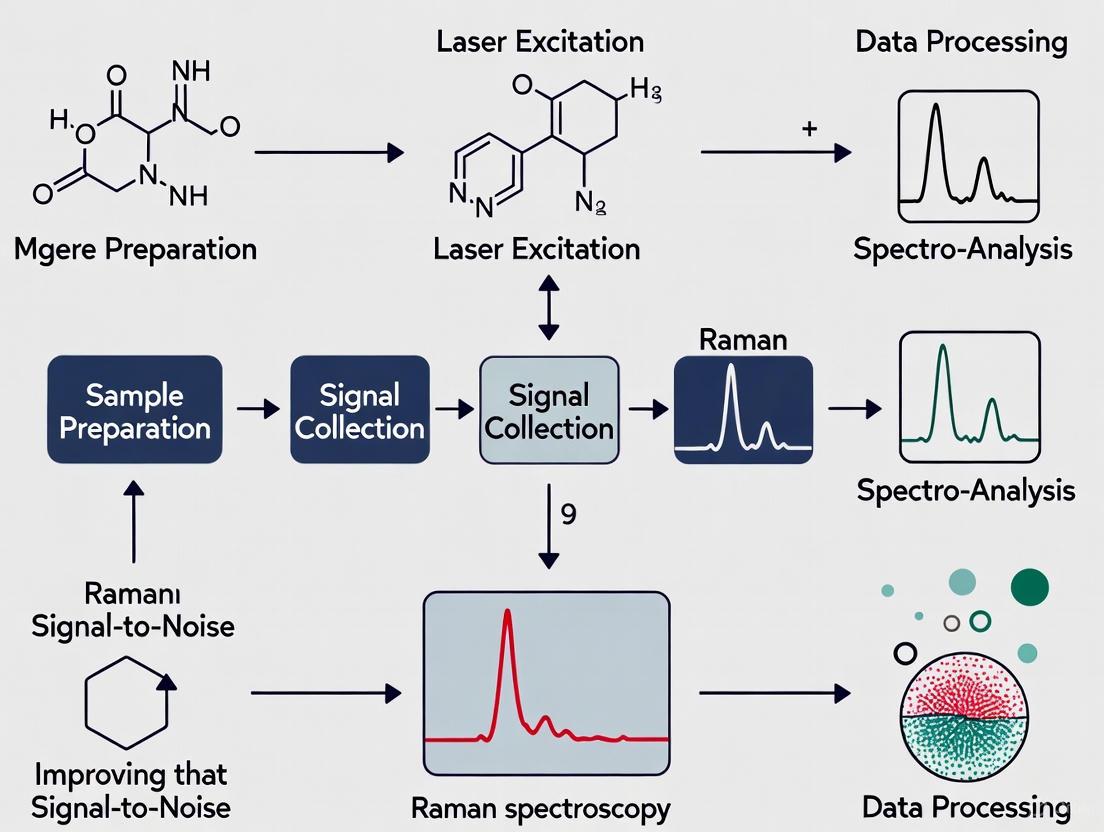
This article provides a comprehensive overview of both established and cutting-edge strategies for enhancing the signal-to-noise ratio (SNR) in Raman spectroscopy, a critical factor for obtaining high-quality data in biomedical...
Advanced Strategies for Improving Signal-to-Noise Ratio in Raman Spectroscopy: A Comprehensive Guide for Biomedical Research
Abstract
This article provides a comprehensive overview of both established and cutting-edge strategies for enhancing the signal-to-noise ratio (SNR) in Raman spectroscopy, a critical factor for obtaining high-quality data in biomedical and pharmaceutical research. Covering foundational concepts, advanced hardware optimizations, sophisticated data processing algorithms, and rigorous validation methodologies, it serves as a vital resource for researchers and drug development professionals. The content synthesizes the latest advancements, including machine learning denoising, optimized hardware configurations, and specialized techniques like SERDS, offering practical insights for troubleshooting and implementing these methods to accelerate analysis, enable nanoplastic detection, and improve precision in drug component detection.
Understanding SNR in Raman Spectroscopy: Why It's Fundamental for Reliable Data
Defining Signal-to-Noise Ratio (SNR) and Its Impact on Spectral Quality
A technical guide for researchers navigating one of the most fundamental concepts in spectroscopic analysis.
Signal-to-Noise Ratio (SNR) is a critical metric in Raman spectroscopy, quantifying the strength of a desired analytical signal relative to the background noise. Its calculation and optimization are fundamental to achieving reliable detection, accurate identification, and precise quantification of chemical species. This guide addresses common researcher questions on defining, calculating, and improving SNR to enhance spectral data quality.
[ FAQs on SNR Fundamentals ]
What is Signal-to-Noise Ratio (SNR) and why is it critical in Raman spectroscopy?
In Raman spectroscopy, the Signal-to-Noise Ratio (SNR) is a quantitative measure that compares the magnitude of the Raman scattering signal from your analyte to the level of background noise present in the system. A higher SNR indicates a cleaner, more reliable spectrum, which is crucial for:
- Accurate Material Identification: Raman spectral fingerprints are distinctive; high SNR ensures that key peaks are visible and not obscured by noise, enabling confident identification [1].
- Lower Detection Limits: The limit of detection (LOD) for an analyte is statistically defined by an SNR of 3 or greater. Improving your SNR directly allows for the detection of analytes at lower concentrations [2] [3].
- Data Reliability: High SNR spectra are a prerequisite for advanced data analysis techniques, including chemometric modeling and machine learning, as noise can skew results and lead to incorrect conclusions [1] [4].
How is SNR calculated, and why do different methods give different results?
There is no single universal method for calculating SNR, and the formula used can significantly impact the reported value and your instrument's apparent Limit of Detection (LOD). The core definition from international standards (like IUPAC) is the signal magnitude ((S)) divided by the standard deviation of that signal ((σS)) [2]. The critical difference lies in how (S) and (σS) are defined.
The table below summarizes common SNR calculation methods found in Raman literature:
Table: Common SNR Calculation Methods in Raman Spectroscopy
| Method Category | Signal (S) Definition | Noise (σ_S) Definition | Best Application | Key Consideration |
|---|---|---|---|---|
| FSD (or SQRT) Method [5] | Peak intensity minus background intensity. | Square root of the background signal. | Comparing photon-counting spectrofluorometers. | Assumes noise follows Poisson statistics. |
| RMS Method [5] | Peak intensity minus background intensity. | Root Mean Square (RMS) noise from a kinetic scan or off-peak spectral region. | Instruments with analog detectors. | Requires a second experiment to measure time-based noise. |
| Single-Pixel Method [2] [3] | Intensity of the center pixel of a Raman band. | Standard deviation of the signal from a background region. | Common in literature, simple to compute. | Ignores signal information in the bandwidth, leading to lower reported SNR. |
| Multi-Pixel Area Method [2] [3] | Integrated area under the Raman band. | Standard deviation of the integrated area, derived from background variations. | Optimizing Limit of Detection (LOD) for weak signals. | Uses more spectral information, can detect features single-pixel methods miss. |
| Multi-Pixel Fitting Method [2] [3] | Amplitude or area from a fitted function (e.g., Gaussian) to the Raman band. | Standard deviation derived from the fit residuals. | Complex spectra with overlapping peaks. | Can be computationally intensive but models the entire band shape. |
A key finding from recent research is that multi-pixel methods can report SNR values 1.2 to over 2 times larger than single-pixel methods for the same Raman feature. This is because multi-pixel methods incorporate the signal from across the entire bandwidth, not just a single point [2] [3]. Therefore, it is essential to use the same calculation method when comparing SNR values from different instruments or studies.
Understanding the sources of noise is the first step to mitigating it. The primary sources include:
- Shot Noise: Noise inherent to light itself, proportional to the square root of the total signal (including any fluorescence background). It is a fundamental physical limit [6] [1].
- Read Noise: Electronic noise introduced when the charge-coupled device (CCD) detector is read out [6].
- Dark Noise: Signal generated by the detector in the absence of light, which is highly dependent on temperature (cooled detectors reduce this noise) [5] [1].
- Fluorescence Background: While often considered a "background" rather than "noise," its random fluctuations contribute significant shot noise, which is a major noise source for many samples [1].
[ Troubleshooting Guide: Improving Your SNR ]
Optimizing SNR involves a combination of instrument parameter adjustment, experimental design, and post-processing. The following workflow outlines a logical path to improve your spectral quality.
Step 1: Optimize Hardware and Data Acquisition Parameters
Before collecting your final data, fine-tune these key instrument settings to maximize signal and minimize noise.
Table: Key Experimental Parameters for SNR Optimization
| Parameter | Guideline for High SNR | Practical Consideration |
|---|---|---|
| Laser Power | Use the highest power your sample can tolerate without damage or burning [6]. | For sensitive samples (e.g., carbon nanotubes, SERS substrates), precise control at the tenths of milliwatts level is desirable [6]. |
| Aperture (Slit/Pinhole) | Use the largest slit size whenever possible (e.g., 50-100 μm) [6]. | A larger aperture admits more light, significantly boosting signal. While this may slightly degrade spectral resolution, the trade-off is often worthwhile for weak signals [6]. |
| Exposure Time vs. Number of Exposures | For a given total measurement time, use longer exposure times rather than a larger number of short exposures [6]. | Longer exposures reduce the contribution of read noise from the detector. For a 1-minute total time, 2 exposures of 30 seconds will yield lower noise than 60 exposures of 1 second [6]. |
| Spectral Resolution (Slit Width) | Use wider slits (e.g., 10 nm) to increase signal throughput [5]. | Doubling the slit width from 5 nm to 10 nm can increase the SNR by a factor of more than 3, as throughput scales with the square of the slit size [5]. |
| Detector Temperature | Use a cooled detector housing [5]. | Cooling the detector (e.g., a PMT or CCD) significantly reduces dark counts, thereby lowering the background noise [5]. |
Step 2: Apply Computational Methods to Enhance SNR
After data acquisition, computational techniques can further improve SNR.
- Spectral Denoising Algorithms: These algorithms process the raw spectrum to suppress noise. They are categorized into:
- Moving Window Smoothing (e.g., Savitzky-Golay filter): Simple and effective for general noise reduction [1].
- Power Spectrum Estimation: Useful for extracting signals with specific frequency components from noise [1].
- Deep Learning-Based Algorithms: Powerful, data-driven methods that can learn complex noise patterns and are highly effective for challenging denoising tasks [1].
- Baseline Correction: Fluorescence background is a major source of noise. Applying baseline correction algorithms is a critical step. Recent advances include Triangular Deep Convolutional Networks, which effectively remove fluorescence while preserving Raman peak integrity [7].
- Correct for Long-Term Instrument Drift: Raman devices can exhibit spectral variations over time (weeks or months). Techniques like Extensive Multiplicative Scattering Correction (EMSC) can be used to estimate and suppress these device-related variations, improving model reliability and data comparability [4].
[ The Scientist's Toolkit: Key Research Reagents and Materials ]
For reliable and reproducible Raman experiments, especially when quantifying SNR, well-characterized standard materials are essential.
Table: Essential Materials for Raman Spectroscopy Quality Control
| Material | Function / Application | Example |
|---|---|---|
| Raman Standard Solvents | Used for sensitivity tests like the water Raman test. Provides a stable, well-understood signal. | Ultrapure Water (for Raman peak at 397 nm with 350 nm excitation) [5]. Cyclohexane [4]. |
| Solid-State Standards | Used for instrument calibration, including wavenumber and intensity. Critical for long-term stability monitoring. | Silicon (strong peak at 520 cm⁻¹) [4]. Paracetamol [4]. Polystyrene [4]. |
| Stable Chemical Compounds | Used to benchmark instrument performance and stability over time. Cover a range of Raman signals similar to biological samples. | Solvents: Ethanol, Isopropanol, DMSO [4]. Carbohydrates: Sucrose, Glucose, Fructose [4]. Lipids: Squalene [4]. |
We hope this technical support guide empowers your research. For further assistance, consult your instrument manufacturer's application notes or explore the cited scientific literature.
Frequently Asked Questions (FAQs)
What are the most common sources of noise in Raman spectroscopy? The most prevalent noise sources include fluorescence background (often the most significant limitation), shot noise from the detection system, cosmic spikes on detectors, and amplified spontaneous emission (ASE) from laser sources. Fluorescence can overwhelm the Raman signal, as it's a much more efficient process, creating a broad background that obscures characteristic Raman peaks [8] [9].
How can I tell if my spectrum is affected by fluorescence interference? Fluorescence manifests as a slowly changing, broad background upon which the sharper, narrower Raman peaks are superimposed. In extreme cases, this background can be so intense that the signal-to-noise ratio (SNR) drops below 2, making quantitative analysis impossible [8] [10].
My sample is highly fluorescent. What are my options? You have several options, which can be used in combination:
- Shift excitation wavelength: Use a longer wavelength laser (e.g., 785 nm or 1064 nm) to move away from the sample's absorption band [9].
- Advanced algorithms: Employ techniques like Moving Window Sequentially Shifted Excitation (MW-SSE) or Shifted Excitation Raman Difference Spectroscopy (SERDS) to mathematically isolate and extract the Raman signal from the fluorescence [8].
- Time-gated detection: Use ultrafast lasers and Kerr gates to temporally separate the instantaneous Raman scattering from the longer-lived fluorescence emission [11].
- Surface-Enhanced Raman Spectroscopy (SERS): This technique can quench fluorescence and is not susceptible to it for strongly SERS-active materials [9].
What experimental adjustments can improve my Signal-to-Noise Ratio (SNR)?
- Laser Line Filters: Incorporate single or dual laser line filters to suppress Amplified Spontaneous Emission (ASE) and side modes, which can improve the Side Mode Suppression Ratio (SMSR) by more than 20 dB [12].
- Signal Averaging: Increase the integration time or number of accumulations, though this must be balanced with sample integrity and time constraints [13].
- Optical Configuration: Ensure the laser emission has a narrower linewidth than the detector resolution for optimal signal quality [12].
Troubleshooting Guides
Problem: Overwhelming Fluorescence Background
Diagnosis: A large, sloping baseline dominates the spectrum, completely obscuring Raman peaks. The SNR may be very low (below 2).
Solutions:
- Wavelength Selection: If possible, switch to a longer excitation wavelength (e.g., from 532 nm to 785 nm or 1064 nm). This is often the most effective first step [9].
- Algorithmic Background Removal:
- Protocol for Moving Window SSE:
- Acquire multiple spectra with slightly shifted laser wavelengths.
- Apply a moving window algorithm to differentiate and isolate the Raman peaks from the slowly varying fluorescent background.
- Reconstruct a fluorescence-free spectrum. This method has been shown to enable quantification even with SNR as low as 0.1 [8].
- Protocol for Computational Filters (e.g., ANFIS with Moving Averages):
- Use an Adaptive Neuro-Fuzzy Inference System (ANFIS) to model and subtract the complex fluorescence baseline.
- Apply a moving averages filter to reduce high-frequency shot noise.
- This combined approach has been successfully used for preprocessing large volumes of Raman data from biological tissues like breast cancer samples [14].
- Protocol for Moving Window SSE:
Problem: Low Signal-to-Noise Ratio (Non-Fluorescent Samples)
Diagnosis: Raman peaks are visible but are noisy and poorly defined, making peak identification and quantification difficult.
Solutions:
- Improve Laser Purity:
- Protocol for ASE Suppression: Integrate one or two laser line filters into your 638 nm or 785 nm laser diode/system. A second filter can suppress SMSR to more than 60 dB and 70 dB, respectively, dramatically reducing noise near the laser line and improving the SNR for low wavenumber measurements [12].
- Post-Processing Denoising:
- Protocol for Ensemble Learning Denoising:
- Train an ensemble learning model (e.g., based on U-Net and Wiener estimation) using a dataset of paired low-SNR and high-SNR Raman spectra.
- Apply the trained model to recover clean spectral signals from noisy measurements. A 2024 study demonstrated this approach could effectively denoise spectra acquired with 200 times shorter integration times, with an average RMSE of only 1.337 × 10⁻² compared to reference spectra [13].
- Protocol for Ensemble Learning Denoising:
- Standard Preprocessing Workflow:
- Spikes Removal: Identify and replace cosmic spikes by comparing successive spectra or screening along the wavenumber axis for abnormal, intense narrow bands [10].
- Smoothing: Apply a moving-window low-pass filter (e.g., Gaussian or Savitzky-Golay) to reduce high-frequency noise. Use this sparingly, as it can degrade spectral resolution [10].
- Baseline Correction: Use algorithms like asymmetric least squares (AsLS) or polynomial fitting to subtract any remaining non-fluorescent background [10].
- Normalization: Scale the spectrum by dividing by the area under the curve (area normalization) or the intensity of a known stable peak to account for intensity fluctuations [10].
Problem: Cosmic Spikes
Diagnosis: Random, extremely narrow, and intense spikes appear at single wavenumber positions on the detector.
Solutions:
- Protocol for Joint Inspection and Replacement:
- Method A: Compare two successively measured spectra. Identify spikes as features present in one spectrum but not the other. Replace the spike-affected data points via interpolation from neighboring points in the same spectrum.
- Method B: Use algorithms that jointly inspect intensity changes along the wavenumber axis and between successive measurements. Replace the spikes with intensities from the successive measurement at the same wavenumber positions, accounting for any overall intensity or fluorescence changes [10].
Data Presentation: Quantitative Noise Mitigation Performance
The following table summarizes the quantitative effectiveness of several advanced techniques discussed in the troubleshooting guides.
Table 1: Performance Comparison of Advanced Noise Mitigation Techniques
| Technique | Key Principle | Reported Performance | Best For |
|---|---|---|---|
| Moving Window SSE [8] | Multiple shifted excitations to isolate Raman signal | Enables quantification with SNR as low as 0.1; r² > 0.96 for binary mixtures. | Highly fluorescent samples; quantitative analysis. |
| Dual Laser Line Filters [12] | Suppression of Amplified Spontaneous Emission (ASE) | Improves SMSR to >70 dB (785 nm laser); enhances SNR for low wavenumber shifts. | Reducing laser-based noise and sidebands. |
| Ensemble Learning Denoising [13] | AI-based recovery of signal from noisy data | RMSE of 1.337 × 10⁻² vs. reference; allows 200x shorter integration times. | Rapid acquisition from noise-prone biological samples. |
| ANFIS + Moving Average [14] | Fuzzy logic and filtering for background removal | Effective fluorescence and shot noise removal in breast tissue spectra; optimized processing time. | Complex biological samples with mixed noise. |
Experimental Protocols in Detail
Detailed Protocol: Time-Gated Raman with an Optical Kerr Gate
This method physically separates Raman and fluorescence signals based on their different emission lifetimes [11].
- Excitation: A sample is excited with an ultrafast laser pulse (e.g., 140 fs pulse at 404 nm).
- Beam Splitting: The initial pulse train is split. One beam (the "gate pump") is delayed. The other is frequency-doubled and sent to the sample.
- Signal Collection: The Raman and fluorescence light from the sample is collected and collimated.
- Optical Gating: The signal beam is combined with the delayed gate pump beam in a nonlinear medium (e.g., a CS₂ cuvette). The intense gate pump beam temporarily makes the medium birefringent, acting as a fast shutter for the signal beam.
- Detection: An analyzer is set to only transmit light when the shutter is open. Since Raman scattering is instantaneous and fluorescence is delayed, the Kerr gate only transmits the Raman signal. This system can operate with a shutter that opens and closes in 800 fs with a peak efficiency of approximately 5%.
Detailed Protocol: Baseline Correction Workflow
A standard mathematical approach for fluorescence removal involves the following steps [10]:
- Quality Control: Inspect raw spectra for obvious artifacts and excessive noise.
- Spike Removal: Apply a cosmic spike removal algorithm as described above.
- Estimate Baseline: Model the fluorescent background using a sensitive nonlinear iterative peak (SNIP) clipping algorithm or asymmetric least squares (AsLS) smoothing. These algorithms are designed to fit the slow, broad variations of the fluorescence without fitting the sharper Raman peaks.
- Subtract Baseline: Subtract the estimated baseline model from the original raw spectrum.
- Validate: Check the resulting spectrum to ensure Raman peaks are intact and the baseline is flat.
The Scientist's Toolkit: Key Research Reagent Solutions
Table 2: Essential Materials for Raman Noise Mitigation Experiments
| Reagent / Material | Function in Experiment | Key Application Note |
|---|---|---|
| Carbon Disulfide (CS₂) | Serves as the nonlinear medium in Optical Kerr Gates due to its high nonlinear index (n₂ = 3.1 x 10⁻¹⁸ m²/W) and short temporal response [11]. | Enables time-gated detection to reject fluorescence. |
| Laser Line Filters | Integrated into laser diodes/modules to suppress Amplified Spontaneous Emission (ASE), improving spectral purity and SNR [12]. | Critical for reducing laser-induced noise, especially in low wavenumber regions. |
| Standard Reference Materials (e.g., Toluene, Sulfur) | Used for system alignment, calibration, and performance validation [11] [15]. | Toluene is a common Raman standard; sulfur is a strong scatterer useful for testing. |
| β-Barium Borate (BBO) Crystal | A nonlinear crystal used for frequency doubling (e.g., converting 808 nm light to 404 nm) [11]. | Provides the excitation wavelength for certain time-gated or resonance Raman experiments. |
| Notch/Razor-Edge Filters | Placed in the collection path to block the intense Rayleigh-scattered laser light while transmitting the shifted Raman signal [15]. | Essential for all Raman spectrometers; angle-tuning can help recover low-shift peaks. |
Workflow Visualization
The following diagram illustrates the logical workflow for diagnosing and addressing common noise issues in Raman spectroscopy, integrating the solutions discussed in this guide.
Diagram: Logical workflow for diagnosing and mitigating noise in Raman spectroscopy.
The Critical Link Between SNR and Measurement Parameters (Integration Time, Laser Power)
Core Concepts: SNR and Measurement Parameters
The Signal-to-Noise Ratio (SNR) is a critical metric in Raman spectroscopy that determines the quality and reliability of the acquired spectra. It is directly and dynamically influenced by key experimental parameters, primarily laser power and integration time. Optimizing these parameters is essential for distinguishing weak Raman signals from inherent noise.
The table below summarizes how these core parameters interact with SNR and provides data-driven guidance for their optimization.
| Parameter | Effect on Raman Signal | Effect on Noise | Key Optimization Strategy | Typical Trade-offs & Considerations |
|---|---|---|---|---|
| Laser Power | Directly proportional; doubling power ~ doubles signal counts [6] [16]. | Can increase shot noise from sample fluorescence; minimal effect on read noise. | Use full laser power first; fine-tune to avoid sample burning [6] [16]. | High power can damage or alter sensitive samples (e.g., biomaterials, carbon nanotubes) [16] [17]. |
| Integration Time | Directly proportional; longer time collects more signal photons. | Reduces read noise impact with longer exposures; shot noise remains. | For weak, non-fluorescent samples, use fewer, longer exposures (e.g., 2x 30s vs 60x 1s) [6]. | Very long exposures risk cosmic ray hits and instrument drift; practical limits on measurement duration. |
| Aperture Size | Larger apertures (e.g., 50-100 µm) admit more signal [6]. | Minimal direct effect. | Use the largest aperture that still provides required spectral resolution [6]. | Larger apertures slightly degrade spectral resolution; crucial for distinguishing polymorphs [6]. |
Systematic Workflow for SNR Optimization
The following workflow provides a step-by-step methodology for systematically optimizing your Raman measurements to achieve the best possible SNR. Adhering to this sequence helps in making informed adjustments and avoiding common pitfalls.
Workflow Execution Guide
- Initial Hardware Configuration: Begin by selecting the largest aperture (e.g., a 50-100 µm slit) that is compatible with your required spectral resolution. This maximizes the amount of light entering the spectrometer [6].
- Laser Power Calibration: Set the laser to the maximum power that does not cause damage, burning, or spectral alterations to your sample. For sensitive or unknown samples, start with low power and increase exponentially while monitoring for damage [6] [16].
- Signal Acquisition and Saturation Check: Collect a spectrum with a conservative integration time. Inspect the raw data for detector saturation, indicated by peaks that are "cut off at the top" [18]. If saturation occurs, reduce the integration time and reacquire the data.
- SNR Assessment and Iteration: If the signal is not saturated but the SNR is too low, increase the integration time. For samples with minimal fluorescence, using fewer, longer exposures is more effective at reducing read noise than many short exposures [6].
- Final Optimization: Once a stable signal is acquired, perform final checks. Ensure the laser is optimally focused on the sample, as proper focus is critical for maximizing signal [6]. Verify that all optics and the sampling window are clean, as contamination can drastically reduce signal intensity [19].
Advanced Experimental Protocols
Protocol: Long-Term Stability Monitoring for Reliable SNR
Objective: To monitor and correct for instrumental drifts (e.g., laser power fluctuation, optical misalignment) over time, which are critical for studies requiring data comparison over days or months.
Background: Long-term drifts can introduce substantial spectral variations, reducing the reliability of models for disease diagnostics or quantitative analysis. A systematic approach using stable control references is required [4].
Materials:
- Raman spectrometer.
- Selected stable reference substances (e.g., Cyclohexane, Paracetamol, Polystyrene for wavenumber calibration; solvents like Ethanol; carbohydrates like Sucrose) [4].
Procedure:
- Weekly Measurement: On a fixed day each week, measure approximately 50 Raman spectra of each reference substance using a standardized protocol (e.g., 1 s integration time, fixed laser power) [4].
- Data Preprocessing: Perform consistent preprocessing: despiking, wavenumber calibration, baseline correction, and L2 normalization [4] [20].
- Stability Benchmarking: Analyze the collected data weekly to discover variability.
- Correlation Analysis: Calculate the Pearson's Correlation Coefficient (PCC) between the mean spectra of different measurement days.
- Computational Correction: Apply advanced data processing methods, such as a Variational Autoencoder (VAE) combined with Extended Multiplicative Scattering Correction (EMSC), to estimate and suppress the identified technical variations from your research data [4].
Protocol: Time-Gated Raman for Fluorescence Suppression
Objective: To separate the instantaneous Raman signal from longer-lived fluorescence and optical fibre backgrounds using time-resolved detection, thereby drastically improving SNR in fluorescent samples or when using fibre probes.
Background: Fluorescence can be 2-3 orders of magnitude more intense than Raman signals, masking them entirely. Time-gating exploits the nanosecond-scale lifetime of fluorescence to collect only the instantaneous Raman photons [21].
Materials:
- Pulsed laser (e.g., 775 nm, 70 ps pulse width).
- Time-resolved SPAD (Single-Photon Avalanche Diode) line sensor spectrometer.
- Standard multimode optical fibre (for probe experiments).
Procedure:
- System Setup: Align the pulsed laser and time-correlated single photon counting (TCSPC) spectrometer. For fibre-probe experiments, connect a 1 m multimode fibre to deliver illumination and collect spectra [21].
- Data Acquisition: Record a histogram of photon arrival times for each spectral channel (pixel) with respect to the laser sync pulse. A typical exposure time is 30 seconds [21].
- Data Processing:
- Perform dark count subtraction and correct for pixel timing variations.
- Sum photon counts within a narrow time-window (e.g., 200 ps) immediately after the laser pulse. This gate captures the Raman signal while excluding most of the delayed fluorescence and fibre background [21].
- The result is a Raman spectrum with significantly improved SNR and minimal fluorescent background.
Troubleshooting Guides and FAQs
FAQ: Addressing Common SNR Challenges
Q1: My spectrum shows a very broad, intense background that drowns out the Raman peaks. What should I do? This is likely strong fluorescence interference. You can:
- Switch Excitation Wavelength: Use a near-infrared laser (e.g., 785 nm) instead of a visible wavelength to reduce fluorescence excitation [16] [17].
- Use Time-Gated Detection: If available, employ a time-gated system to collect only the instantaneous Raman signal [21].
- Post-Processing: Apply a validated baseline correction algorithm after data collection, but be cautious not to over-optimize and distort the Raman peaks [20] [17].
Q2: I see sharp, random spikes in my spectrum that are not reproducible. What are they and how do I remove them? These are cosmic rays, caused by high-energy particles striking the detector.
- Automatic Removal: Most modern software includes an automated cosmic ray removal function for this purpose [16].
- Manual Method: Acquire multiple, successive spectra and compare them. Replace the spiked data points with interpolated values from adjacent, unaffected scans [17].
Q3: Despite long integration times, my signal remains weak and noisy. What are the potential causes?
- Optical Contamination: Check and clean the optics, laser window, and sample surface. Dust and debris can drastically scatter light [19].
- Poor Focus: Ensure the laser is correctly focused on the sample. Use the instrument's autofocus feature if available, especially with NIR lasers where visual and optimal Raman focus differ [6].
- Sample Positioning: Verify the sample is correctly positioned at the focal point of the laser beam [19].
Q4: Why is proper calibration critical for SNR and quantitative analysis? Skipping calibration leads to systematic drifts in wavenumber and intensity. These drifts overlap with sample-related changes, making data comparison invalid and machine learning models unreliable. Regular calibration with certified standards is non-negotiable for high-quality research [20].
The Scientist's Toolkit: Key Reagents & Materials
The following table lists essential materials used in the featured experiments for calibration, validation, and sample preparation.
| Item Name | Function / Application | Key Characteristics & Rationale |
|---|---|---|
| Cyclohexane, Paracetamol, Polystyrene | Wavenumber calibration standards [4]. | Stable substances with well-defined, sharp Raman peaks across a wide wavenumber range. Used to correct for instrumental drift. |
| Silicon Wafer | Intensity calibration and exposure time verification [4]. | Provides a single, strong, and consistent Raman band at 520 cm⁻¹. |
| Quartz Cuvette | Sample holder for liquids [4] [22]. | Provides a low Raman background signal at 785 nm excitation, minimizing unwanted spectral contributions. |
| Stainless Steel, CaF₂, or MgF₂ Slides | Alternative substrate for microscopy [16]. | Replace standard glass slides to eliminate the strong, broad Raman background contributed by glass. |
| Squalene, Sucrose, DMSO | Biological-mimicking quality control (QC) references [4]. | Stable lipids, carbohydrates, and solvents whose spectral features resemble biological samples. Used to benchmark instrument performance for biological applications. |
| Certified Reference Materials (CRMs) | Independent verification of instrument performance [19]. | Substances with known and certified Raman spectra, used to validate calibration and measurement accuracy. |
Frequently Asked Questions (FAQs)
Q1: What are the immediate consequences of low SNR in my Raman spectra?
Low Signal-to-Noise Ratio (SNR) directly compromises the reliability of your data. The primary consequences are:
- Impaired Peak Identification: Noise can obscure characteristic Raman peaks, especially weaker ones, leading to misidentification of chemical compounds [23] [24]. In highly fluorescent or colored samples, noise from fluorescence can completely mask the Raman signal of the polymer itself [24].
- Reduced Quantitative Accuracy: Noise limits the accuracy of quantitative analysis, such as determining component concentrations in pharmaceutical mixtures or other chemical samples. This manifests as higher Root Mean Square Error (RMSE) and lower coefficients of determination (R²) in your chemometric models [23].
Q2: I work with colored plastics/biomedical samples. Why is SNR a particular challenge for me?
Your samples have inherent properties that introduce significant noise:
- Colored Plastics: Dyes and pigments, especially red colorants, can induce strong fluorescence and cause peak broadening. This interferes with the Raman signal, often reducing identification match scores and leading to misidentification of the base polymer [24].
- Biological/Biomedical Samples: These typically exhibit strong autofluorescence that is often multiple times stronger than the weak Raman signal. This large, unstable fluorescent background can overwhelm the Raman spectrum and is subject to photobleaching, making accurate noise estimation and SNR calculation difficult [25].
Q3: How does the method of calculating SNR affect my reported results and detection limits?
Different SNR calculation methods are not equivalent and can significantly alter your reported limits of detection (LOD) [2].
- Single-Pixel Methods: Use only the intensity of the center pixel of a Raman band. They ignore the remaining signal across the bandwidth and may fail to detect spectral features at lower concentrations [2].
- Multi-Pixel Methods: Use information from across the entire Raman bandwidth (e.g., by calculating the area under the band or fitting a function). These methods include more of the total signal, resulting in a higher calculated SNR (reports show ~1.2 to over 2 times higher) and a better (lower) LOD for the same data [2].
Q4: Can't I just increase the laser power to improve a low SNR?
While increasing laser power can boost the Raman signal, it is a risky strategy that can lead to sample damage [26] [27]. Many samples, especially biological materials or complex polymers, have a laser power density threshold beyond which they undergo structural or chemical changes [27]. It is often preferable to use advanced computational methods to denoise spectra or employ techniques like time-gated Raman to suppress fluorescence, allowing for good signal quality at safer laser power levels [26] [13].
Troubleshooting Guide: Improving Low SNR
Step 1: System and Experimental Optimization
Before data collection, ensure your system and setup are optimized.
- Laser Wavelength: Switch to a longer wavelength (e.g., 785 nm or 1064 nm) to reduce fluorescence excitation [9] [27].
- Laser Power: Use the highest power that does not damage your sample. Consider spreading the laser over a larger area (e.g., line focus) to reduce power density [27].
- Integration Time: Increase the acquisition time to collect more signal. However, be aware of signal instability from photobleaching in biological samples over long times [25].
- Calibration: Perform regular wavenumber and intensity calibration using standards to prevent systematic drifts that can be mistaken for sample-related changes [20].
Step 2: Data Preprocessing and Advanced Analysis
After data collection, apply computational techniques to enhance SNR.
Method 1: Low-Rank Estimation (LRE) for Pharmaceutical Analysis
This method leverages the inherent high correlation between spectral signatures in a dataset.
- Objective: Improve the accuracy and robustness of chemometric models (like PLS and SVM) for quantitative analysis of pharmaceutical mixtures [23].
- Materials:
- Raman spectral data matrix (A) of your samples.
- Computer with programming environment (e.g., Python, MATLAB) to implement the algorithm.
- Protocol:
- Input your raw Raman spectral data matrix
A. - Initialize the algorithm with an initial solution
X0 = 0. - Iterate (for i = 0 to N, where N is typically 5-20):
a. Compute the search direction
susing an Alternating Least Squares (ALS) algorithm on the matrix(A - Xi). b. Compute the step lengthrthat minimizes(A - (Xi + r(si+1 - Xi))). c. Update the solution:Xi+1 = (1 - ri+1)Xi + ri+1si+1. - Check Stopping Criterion: The loop continues until
ALS(Xi+1)si+1 > m, wheremis a low-rank constraint factor (typically 0.01 to 0.001). - Output the final low-rank matrix
X, which is the denoised version of your original data [23].
- Input your raw Raman spectral data matrix
- Expected Outcome: Significant improvement in R² and reduction in RMSE for quantitative models compared to using raw data or traditional wavelet transform methods [23].
Method 2: Standard Sample for System Performance Assessment
This methodology uses a homogeneous biological standard to reliably compare system configurations or inter-probe variability.
- Objective: Accurately evaluate the performance and SNR of a fiber-optic probe-based Raman system for biomedical analysis [25].
- Materials:
- Dairy milk (homogenized, full-fat) as a biological standard.
- Your Raman system with the fiber-optic probe to be tested.
- Protocol:
- Submerge the distal end of the fiber-optic probe into a container of milk. This ensures a consistent sampling geometry and eliminates signal variation from probe orientation.
- Collect a spectral dataset with multiple acquisitions.
- Correct for Photobleaching: Apply a model-based correction to the dataset to remove the decaying fluorescence background, which stabilizes the signal and allows for accurate noise calculation.
- Calculate SNR: Use the corrected data to compute SNR according to the standard definition:
SNR = S(v˜) / σ(v˜), whereSis the Raman peak intensity at a specific wavenumber, andσis its standard deviation over multiple acquisitions [25].
- Expected Outcome: A reliable and reproducible measure of your system's SNR that accounts for biological-like fluorescence and stray light, enabling fair comparisons between different setups [25].
The table below summarizes the performance of different denoising methods on pharmaceutical quantitative analysis, demonstrating the significant advantage of advanced algorithms.
Table 1: Comparison of Quantitative Analysis Performance for Pharmaceutical Components Using Different Spectral Processing Methods (Adapted from [23])
| Pharmaceutical Component | Chemometric Model | Processing Method | Coefficient of Determination (R²) | Root Mean Square Error (RMSE) |
|---|---|---|---|---|
| Norfloxacin | PLS | Raw Data | 0.7504 | 0.0780 |
| Wavelet Transform (WT) | 0.8598 | 0.0642 | ||
| Low-Rank Estimation (LRE) | 0.9553 | 0.0259 | ||
| SVM | Raw Data | 0.8297 | 0.1097 | |
| Penicillin Potassium | PLS | Raw Data | 0.8692 | 0.1218 |
| Wavelet Transform (WT) | 0.9548 | 0.0974 | ||
| Low-Rank Estimation (LRE) | 0.9848 | 0.0522 | ||
| Sulfamerazine | PLS | Raw Data | 0.7323 | 0.0608 |
| Wavelet Transform (WT) | 0.8862 | 0.0376 | ||
| Low-Rank Estimation (LRE) | 0.9609 | 0.0225 |
Research Reagent Solutions
Table 2: Essential Materials for Featured Raman Experiments
| Item | Function/Benefit | Example Application |
|---|---|---|
| Dairy Milk | A homogeneous, readily available biological standard with spectral properties similar to tissue. Enables reproducible testing of system performance without probe-orientation dependence. | System performance assessment and standardization [25]. |
| Metallic Nanoparticles / SERS Substrates | Enhance Raman signal intensity by orders of magnitude via surface-enhanced Raman scattering (SERS), allowing detection of trace analytes. | Biosensing, detection of low-concentration contaminants or compounds [27]. |
| Deuterium-Labeled Compounds | Act as metabolic probes. The carbon-deuterium bond creates a unique vibrational signature in the "silent" region of the spectrum, free from native background interference. | Tracking metabolic activity in cells and tissues (e.g., using DO-SRS) [28]. |
| Wavenumber Standard (e.g., 4-Acetamidophenol) | A reference material with many known peaks used to calibrate the wavenumber axis of the spectrometer, ensuring measurement accuracy over time. | Instrument calibration and quality control [20]. |
| Alternating Least Squares (ALS) Algorithm | A computational tool used to decompose a matrix and estimate its low-rank components, crucial for implementing the LRE denoising method. | Low-Rank Estimation for spectral denoising [23]. |
Workflow: From Low SNR to Improved Analysis
The following diagram visualizes a systematic workflow for diagnosing and addressing low SNR, incorporating both experimental and computational strategies.
Hardware and Algorithmic Methods for Superior SNR Enhancement
Frequently Asked Questions (FAQs)
Q1: What is Amplified Spontaneous Emission (ASE) and how does it affect my Raman spectra?
Amplified Spontaneous Emission (ASE) is a low-level broadband emission originating from band-to-band semiconductor recombination in laser diodes. In Raman spectroscopy, this unwanted emission introduces background noise into the detected signal, which obscures the weaker Raman peaks and reduces the overall Signal-to-Noise Ratio (SNR), making it harder to accurately identify and quantify chemical species. [12]
Q2: How do laser line filters improve Raman system performance?
Laser line filters are optical components added to laser diodes or modules to isolate the intended excitation laser wavelength by filtering out undesired spectral components. They work by suppressing ASE and other side modes, leading to a cleaner laser output. This reduction in background noise directly results in a higher SNR, allowing for more precise measurement of peak positions, intensities, and ratios in the Raman spectrum. [12]
Q3: What is the Side Mode Suppression Ratio (SMSR) and why is it important?
The Side Mode Suppression Ratio (SMSR) is a measure, expressed in decibels (dB), of how effectively a laser suppresses unwanted side modes and ASE relative to the main laser line. A higher SMSR indicates a spectrally purer laser source. In Raman spectroscopy, a high SMSR is crucial for applications requiring high spectral purity, as it minimizes noise and leads to a superior SNR. [12]
Q4: Can I add a laser line filter to my existing laser source?
This depends on the type of laser and module. Many industrial laser diodes and modules are available with the option to include a single or even a dual laser line filter. Common laser types that support this include TO-Can, Butterfly, and various U-Type, M-Type, and L-Type modules. Integrated systems, such as tethered heads or integrated Raman probes, often come with dual filters pre-installed for optimal performance. [12]
Q5: My goal is to measure low wavenumber Raman shifts (< 100 cm⁻¹). What is the best configuration?
Measuring low wavenumber Raman shifts requires exceptional suppression of spectral content very close to the laser line. For this application, a configuration with a dual laser line filter is highly recommended. This setup provides the highest SMSR near the laser emission line, effectively reducing noise in the spectral region where the low wavenumber Raman signal appears. [12]
Troubleshooting Guide
| Problem | Possible Cause | Solution |
|---|---|---|
| High background noise in spectra | High level of ASE from the laser source. | Integrate a single or dual laser line filter to improve SMSR and suppress ASE. [12] |
| Inability to resolve low wavenumber Raman peaks | Insufficient suppression of laser emission near the excitation line. | Implement a dual laser line filter configuration for maximum SMSR close to the laser line. [12] |
| Weak or poorly defined Raman peaks | General low Signal-to-Noise Ratio (SNR). | Ensure the laser linewidth is narrower than the detector resolution and use laser line filters to minimize noise. [12] |
Experimental Protocols and Data
Quantitative Impact of Laser Line Filters on SMSR
The following table summarizes experimental data demonstrating the performance gain achieved by adding laser line filters to two common Raman laser wavelengths. [12]
Table 1: Side Mode Suppression Ratio (SMSR) Improvement with Laser Line Filters
| Laser Wavelength | Front Facet Coating | Intrinsic SMSR (No Filter) | SMSR with 1 Filter | SMSR with 2 Filters |
|---|---|---|---|---|
| 638 nm | Conventional AR coating | ~45 dB | >50 dB | >60 dB |
| 785 nm | Low-AR coating | ~50 dB | >60 dB | >70 dB |
Methodology for Assessing Laser Purity and Filter Performance
- Setup: Use a spectrometer with a resolution higher than the laser's linewidth. Connect the laser source directly to the spectrometer, ensuring the power is attenuated to avoid detector damage. [12]
- Baseline Measurement: Record the emission spectrum of the bare laser diode without any filtering. Note the intensity of the primary laser peak compared to the ASE background to calculate the intrinsic SMSR. [12]
- Filter Integration: Introduce a single laser line filter into the beam path and realign the system as needed. Record a new emission spectrum and calculate the improved SMSR. [12]
- Dual-Filter Test: For maximum performance, add a second laser line filter and repeat the spectral measurement. The dual-filter configuration will show a further reduction in the ASE background, yielding the highest SMSR. [12]
- Data Analysis: Calculate the SMSR for each configuration by comparing the power of the main laser line to the power of the most prominent side mode or the ASE level at a specific wavelength (e.g., at a 32 cm⁻¹ or 49 cm⁻¹ Raman shift from the laser line). [12]
System Optimization Workflow
The following diagram illustrates the logical decision process for optimizing a Raman system's laser source using the principles of ASE suppression.
The Scientist's Toolkit: Essential Components
Table 2: Key Research Reagent Solutions for Laser ASE Suppression
| Item | Function in Experiment |
|---|---|
| Wavelength-Stabilized External-Cavit Laser | Provides a narrow linewidth source, which is a foundational requirement for high SNR. The stabilized output is easier to filter effectively. [12] |
| Volume Bragg Grating (VBG) | Acts as a wavelength-selective element within the laser cavity to refine the laser output and reduce the breadth of emitted wavelengths. [12] |
| Single Laser Line Filter | An external optical filter that cleans the laser beam by suppressing Amplified Spontaneous Emission (ASE) and side modes, typically improving SMSR by 5-10 dB. [12] |
| Dual Laser Line Filter Configuration | A setup involving two sequential filters to achieve the highest level of ASE suppression and SMSR, critical for demanding applications like low wavenumber Raman. [12] |
| High-Resolution Spectrometer | Essential for diagnostic measurements to characterize the laser emission spectrum, measure the intrinsic SMSR, and verify the performance of added filters. [12] |
Frequently Asked Questions (FAQs)
Q1: What are the fundamental mechanisms behind the signal enhancement in SERS?
The dramatic signal enhancement in SERS arises from two primary mechanisms working synergistically [29] [30] [31]:
- Electromagnetic Enhancement: This is the dominant mechanism. When laser light interacts with nanostructured metal surfaces (typically gold or silver), it excites coherent oscillations of surface electrons, known as localized surface plasmon resonances [31]. This leads to a massive amplification of the electromagnetic field, particularly in nanoscale gaps and crevices between nanoparticles, known as "hotspots" [30]. The Raman signal, which is proportional to the electric field to the fourth power, is enormously enhanced for molecules located in these regions [31].
- Chemical Enhancement: This mechanism involves the formation of a charge-transfer complex between the analyte molecule and the metal surface [29] [31]. When the molecule chemisorbs to the surface, its polarizability can increase, leading to a further, though smaller, enhancement of its Raman cross-section [30].
Q2: Why is my SERS signal irreproducible, even when using the same protocol?
Signal irreproducibility is one of the most common challenges in SERS and can stem from several factors [29] [30] [32]:
- Inconsistent Nanoparticle Aggregation: For colloidal-based SERS, the signal heavily depends on the formation of "hotspots" through nanoparticle aggregation [30] [32]. Small, uncontrolled variations in the aggregation process (e.g., when adding aggregating agents like salts) can lead to significant differences in the number and quality of hotspots, causing large intensity variations between experiments [30].
- Non-uniform Substrates: Even fabricated solid SERS substrates can have inherent nanoscale variations that lead to spot-to-spot signal heterogeneity. One study suggested measuring over 100 spots may be necessary to properly capture this variance [30].
- Analyte-Surface Interaction: The signal depends on the number of analyte molecules that successfully adsorb to the metal surface [30]. Factors such as pH, which affects the charge of both the analyte and the nanoparticle surface, can drastically alter adsorption efficiency and binding modes, thus affecting reproducibility [29].
Q3: My target molecule doesn't seem to produce a SERS signal. What could be wrong?
If your molecule isn't producing a signal, consider these aspects:
- Distance Dependence: The SERS effect is a short-range phenomenon, decaying significantly within a few nanometers from the metal surface [30]. Your molecule may not be adsorbing to or coming into close enough proximity with the SERS-active surface.
- Affinity for the Surface: Molecules must interact with the metal surface to be enhanced. Molecules without functional groups that favor adsorption (e.g., thiols, amines, or pyridines) may show weak or no SERS signal [30]. In such cases, surface functionalization (e.g., with a capture agent like boronic acid for glucose) may be necessary [30].
- Concentration and Surface Coverage: At low concentrations, the surface coverage may be too sparse to detect. The signal is often modeled by a Langmuir isotherm, correlating with the molecule's affinity for the surface [30].
Q4: How can SERDS help overcome fluorescence background in Raman measurements?
While the provided search results focus on SERS, the core principle of SERDS is to eliminate broad, structured fluorescence background. SERDS uses two slightly different excitation wavelengths (typically a few nanometers apart) [33]. The Raman peaks shift accordingly with the excitation source, while the fluorescent background remains largely unchanged. By taking the difference between the two collected spectra, the unchanging fluorescent background is mathematically subtracted, leaving a derivative-like spectrum of the pure Raman signal. This technique is particularly powerful for recovering Raman signals from highly fluorescent samples.
Q5: What are the best practices for optimizing a SERS experiment?
A systematic, multivariate approach is far superior to optimizing one factor at a time [29] [32].
- Use Design of Experiments (DoE): Employ statistical experimental design to efficiently screen and optimize multiple parameters simultaneously, such as nanoparticle synthesis conditions, aggregating agent concentration, pH, and analyte-to-nanoparticle ratio [29] [32]. This approach reveals optimal conditions and interaction effects between parameters that would be missed with one-factor-at-a-time optimization.
- Characterize Your Nanoparticles: Always use UV-Vis spectroscopy to check the surface plasmon resonance peak (λmax) and its full width at half maximum (FWHM), which indicates size distribution and monodispersity of your colloids [29]. Techniques like Dynamic Light Scattering (DLS) for size and zeta potential for surface charge and colloidal stability are also highly recommended [29].
- Control the Chemical Environment: Adjust the pH to promote analyte adsorption and use aggregating agents (e.g., NaCl, HCl) judiciously to induce controlled aggregation without causing precipitation [29] [32].
- Perform Time Studies: The SERS signal can evolve over time as aggregation proceeds. Determine the optimal time window for stable and maximum SERS response for your specific system [29].
Troubleshooting Guides
Problem: Weak or No SERS Signal
| Possible Cause | Diagnostic Steps | Solution |
|---|---|---|
| Insufficient Hotspots | Check UV-Vis spectrum of colloid after aggregation; a broadened and red-shifted peak indicates aggregation. | Optimize the type and concentration of aggregating agent. Use DoE to find the optimal ratio [32]. |
| Poor Analyte Adsorption | Verify the charge of your analyte and nanoparticles at the experimental pH. | Modify pH to facilitate attraction between analyte and nanoparticle surface. Consider chemical modification of the analyte or surface [29] [30]. |
| Low Laser Power | Check power at the sample. | Increase laser power within safe limits to avoid sample damage. |
| Incompatible Excitation Wavelength | Compare your laser wavelength with the nanoparticle's plasmon band (e.g., ~400 nm for Ag, ~520 nm for Au). | Ensure your laser wavelength overlaps with the surface plasmon resonance of your nanoparticles for maximum enhancement [29]. |
Problem: Irreproducible SERS Signal
| Possible Cause | Diagnostic Steps | Solution |
|---|---|---|
| Uncontrolled Aggregation | Monitor aggregation kinetics with time-resolved UV-Vis; check for precipitation. | Standardize the mixing process (vortex vs. pipetting), incubation time, and salt addition order. Use a rigorous DoE approach to establish a robust protocol [29] [32]. |
| Non-uniform Substrate | Perform Raman mapping on a solid substrate to visualize signal heterogeneity. | Source substrates from reputable suppliers. For colloids, ensure synthesis reproducibility by严格控制 reaction conditions (e.g., temperature, stirring rate) [29]. |
| Inconsistent Sample Preparation | Audit your lab protocol for variables like incubation time, washing steps, and drying conditions. | Create a highly detailed, step-by-step standard operating procedure (SOP) and ensure all researchers adhere to it strictly. |
Problem: Distorted or Unrecognizable Spectral Peaks
| Possible Cause | Diagnostic Steps | Solution |
|---|---|---|
| Fluorescence Background | Inspect the raw spectrum for a large, sloping baseline. | Use SERDS if available. Apply computational baseline correction algorithms (e.g., asymmetric least squares) [34] [35]. |
| Laser-Induced Sample Damage | Check for visual changes at the measurement spot. Repeat acquisition with lower power. | Reduce laser power (often to <1 mW) and/or shorten integration time [30]. |
| Surface-Induced Chemical Reactions | Compare SERS spectrum with a spontaneous Raman spectrum of the pure analyte. | Use lower laser powers. Be aware that some molecules (e.g., para-aminothiophenol) can undergo photoreactions on the surface, changing their spectra [30]. |
| Saturation of Detector | Check if strong peaks have a flat top. | Reduce integration time or laser power. |
Key Experimental Protocols
This protocol outlines a systematic approach to finding the optimal conditions for a SERS experiment.
1. Define Factors and Levels:
- Select critical parameters to optimize. For a citrate-reduced gold nanoparticle (AuNP) system with an aggregating agent, these could be:
- Factor A: AuNP synthesis condition (e.g., varying citrate/gold ratio: SA, SB, SC).
- Factor B: Concentration of aggregating agent (e.g., HCl: 0.3 M, 0.5 M, 0.7 M).
- Factor C: Volume ratio of analyte to nanoparticles (e.g., 0.5, 2, 3.5).
- Choose a DoE array, such as a full 3-factor, 3-level design.
2. Execute the Experiment:
- Prepare nanoparticles and reagents according to the DoE matrix.
- For each experimental run, mix the components in the specified ratios.
- Acquire SERS spectra (e.g., 31 acquisitions of 3 seconds each) using a standardized method.
3. Analyze and Interpret Data:
- Pre-process spectra (e.g., apply baseline correction and smoothing).
- Use the intensity of a key characteristic Raman band of your analyte as the optimization response.
- Input the data into statistical software to generate a model and identify the significant factors and their optimal levels.
4. Verify Optimal Conditions:
- Run confirmation experiments using the predicted optimal conditions to validate the model's accuracy and the robustness of the SERS signal.
This protocol aims to improve quantitative accuracy and reproducibility.
1. Substrate Preparation:
- Use a characterized batch of nanoparticles or a commercial solid SERS substrate.
- If using colloids, induce aggregation in a controlled manner based on your optimized DoE results.
2. Sample and Standard Preparation:
- Co-adsorb the target analyte with a known quantity of an internal standard.
- The internal standard should be a molecule that adsorbs to the surface, provides a strong and non-overlapping SERS signal, and behaves similarly to the analyte during sample preparation. A stable isotope variant of the target analyte is ideal [30].
3. Data Acquisition:
- Acquire spectra from multiple spots (e.g., >100 spots for colloids dried on a substrate) to average out spatial heterogeneity [30].
- Use consistent, low laser power (<1 mW) and integration times to prevent photodegradation.
4. Data Analysis:
- For quantification, normalize the intensity of the analyte's characteristic peak to the intensity of a peak from the internal standard. This corrects for variations in hotspot density and laser alignment.
Research Reagent Solutions
The following table details key materials used in SERS experiments and their functions.
| Item | Function | Key Considerations |
|---|---|---|
| Gold Nanoparticles (AuNPs) | Most common plasmonic substrate; high enhancement, good biocompatibility. | Citrate-reduced is standard; size and shape (spheres, rods, stars) tune plasmon resonance [29] [31]. |
| Silver Nanoparticles (AgNPs) | Provides stronger enhancement than gold in the visible range. | Can be less stable and more cytotoxic than gold [29]. |
| Sodium Citrate | Common reducing and stabilizing agent in nanoparticle synthesis. | Concentration affects final nanoparticle size [29]. |
| Hydrochloric Acid (HCl) | Used as an aggregating agent and to adjust pH. | Concentration is critical; too much causes rapid precipitation [29] [32]. |
| Sodium Chloride (NaCl) | Common aggregating agent to induce nanoparticle clustering. | Must be added consistently; small volumes of concentrated solution are typical [29]. |
| Raman Reporter Molecule | A molecule with a high Raman cross-section used for SERS tagging (e.g., rhodamine, aromatic thiols). | Should bind strongly to metal and have a unique, strong fingerprint spectrum [30]. |
| Internal Standard | A reference compound added to samples for signal normalization. | Corrects for spot-to-spot variation; ideal standards are co-adsorbed with the analyte [30]. |
Signaling Pathways and Workflows
SERS Optimization Workflow
Relationship Between Key SERS Parameters
Frequently Asked Questions (FAQs)
Q1: What are the main advantages of using CNNs over traditional methods for Raman spectral analysis? CNNs automate the feature extraction process, directly learning from raw or minimally preprocessed spectral data. This eliminates the need for multiple manual preprocessing steps like denoising and baseline correction, which are typically required by traditional chemometric methods such as Partial Least Squares (PLS) [36] [37]. CNNs are also highly effective at capturing complex, non-linear relationships in spectral data, making them more robust for classifying complex samples or enhancing the Signal-to-Noise Ratio (SNR) in noisy measurements [37] [38].
Q2: My model performs well on training data but poorly on new data. What is happening? This is a classic sign of overfitting. It occurs when a model learns the training data too closely, including its noise and random fluctuations, rather than the underlying general patterns [39]. This is common when the model is too complex for the amount of available training data.
Q3: How can I improve my model when I have a limited amount of experimental Raman data? Several strategies can address data scarcity:
- Data Augmentation: Use techniques like WGAN-GP (Wasserstein Generative Adversarial Network with Gradient Penalty) to generate realistic synthetic spectra and fill concentration gradients, thereby expanding your training dataset [36].
- Transfer Learning: Pretrain a deep learning model on a large dataset of synthetic Raman spectra generated through semi-empirical quantum chemistry methods. This model can then be fine-tuned on your smaller, experimental dataset, significantly improving performance [40].
- Ensemble Learning: Combine the predictions of multiple models to improve overall accuracy and robustness, as demonstrated in ensemble approaches for Raman denoising [13].
Q4: What is "mode collapse" in Generative Adversarial Networks (GANs) and how can it be fixed? Mode collapse is a common GAN failure mode where the generator learns to produce only one or a few types of plausible outputs, instead of a diverse range. For example, it might generate the same Raman spectrum regardless of the input [41]. Solution: Using a modified GAN architecture, such as one employing Wasserstein loss (WGAN-GP), can help alleviate mode collapse by providing better training gradients and preventing the discriminator from becoming too strong too quickly [36] [41].
Troubleshooting Guide
This guide addresses common issues when applying machine learning to enhance SNR in Raman spectroscopy.
Problem Category 1: Data Quality and Preparation
| Problem Symptom | Possible Root Cause | Solution Steps & Diagnostic Commands |
|---|---|---|
| Poor model generalization to new datasets; high error. | Insufficient or Low-Quality Training Data: The dataset is too small, lacks diversity, or is too noisy [40] [39]. | 1. Data Augmentation: Use algorithms to simulate linear/non-linear mixing effects and concentration-dependent responses to expand the dataset [36].2. Synthetic Data: Generate a large, diverse library of simulated vibrational spectra for pretraining using semi-empirical quantum methods [40].3. Ensemble Averaging: Acquire multiple spectra of the same sample and average them to improve the inherent SNR before training [42]. |
| Model performance is unpredictable; difficult to pinpoint errors. | Unbalanced Datasets or Presence of Outliers [39]. | 1. Data Auditing: Use box plots to identify and remove outliers.2. Data Balancing: Apply resampling techniques (oversampling the minority class or undersampling the majority class) to ensure data is equally distributed across target classes [39]. |
| Model training is slow and unstable; features on different scales. | Lack of Feature Normalization/Standardization [39]. | Apply scaling techniques to bring all spectral features to the same magnitude. This ensures no single feature dominates the model training due to its scale. |
Problem Category 2: Model Training and Performance
| Problem Symptom | Possible Root Cause | Solution Steps & Diagnostic Commands |
|---|---|---|
| Model performs well on training data but poorly on validation/test data (Overfitting). | Model is too complex and has memorized the training data noise [39]. | 1. Regularization: Apply techniques like dropout or penalize discriminator weights in GANs [41].2. Cross-Validation: Use k-fold cross-validation to ensure the model generalizes well and to select the best model based on a bias-variance tradeoff [39].3. Simplify the Model: Reduce model complexity or use data augmentation as described above. |
| Model consistently fails to generate diverse spectral outputs (Mode Collapse). | Common failure in Generative Adversarial Networks (GANs) [41]. | 1. Use Advanced GANs: Implement WGAN-GP, which uses Wasserstein loss with a gradient penalty to stabilize training and encourage diversity [36] [41].2. Unrolled GANs: Use a generator loss function that incorporates the outputs of future discriminator versions to prevent over-optimizing for a single discriminator [41]. |
| Model fails to learn meaningful patterns (Underfitting). | Model is too simple for the data or has not been trained sufficiently [39]. | 1. Increase Model Complexity: Choose a more advanced architecture (e.g., deeper CNN).2. Hyperparameter Tuning: Adjust parameters like learning rate, filter size, and the number of layers [38] [39].3. Feature Engineering: Create new features or modify existing ones to provide more meaningful input to the model [39]. |
| Discriminator becomes too good, halting generator progress (Vanishing Gradients). | The discriminator in a GAN learns too fast, providing no useful gradient for the generator to improve [41]. | 1. Modified Loss Functions: Use Wasserstein loss or a modified minimax loss to provide more stable gradients even with an optimal discriminator [36] [41].2. Add Noise: Add noise to the inputs of the discriminator to make its task harder [41]. |
Problem Category 3: Model Interpretation and Validation
| Problem Symptom | Possible Root Cause | Solution Steps & Diagnostic Commands |
|---|---|---|
| The model is a "black box"; hard to trust or interpret results. | Lack of model interpretability features. | Implement architectures that provide explainable AI (XAI) outputs. For instance, use models that leverage multi-head attention mechanisms to generate attention heatmaps, visually showing which spectral regions (peaks) were most important for the decision [36]. |
The table below summarizes key performance metrics from recent studies using CNNs and Ensemble Learning for Raman spectroscopy tasks, including SNR enhancement.
Table 1: Performance Metrics of ML Models in Raman Spectroscopy
| Model/Algorithm | Application Context | Key Performance Metric | Result |
|---|---|---|---|
| RS-MLP (CNN + MLP-Mixer) [36] | Qualitative & Quantitative analysis of chemical agent simulants | Recognition Rate (Qualitative) | 100% |
| Avg. Root Mean Square Error - RMSE (Quantitative) | < 0.473% | ||
| Ensemble Learning Approach [13] | Denoising of Raman measurements from fungal samples | Average RMSE (vs. high-SNR reference) | 1.337 × 10⁻² |
| Average Mean Absolute Error - MAE (vs. high-SNR reference) | 1.066 × 10⁻² | ||
| Custom CNN (ResNet-based) [37] | Classification of biological Raman spectra without preprocessing | Robustness to various baselines | Superior to conventional methods |
| 1D-CNN [38] | Classification of irradiated vs. non-irradiated breast tumour tissue | Classification Accuracy (3 days post-irradiation) | 92.1% |
Experimental Protocol: SNR Enhancement with an Ensemble Learning Approach
This protocol is based on the method described for recovering low-SNR Raman measurements [13].
1. Objective: To numerically improve the SNR of Raman measurements using an ensemble learning model, enabling rapid acquisition with shorter integration times.
2. Materials and Equipment:
- Raman spectrometer
- Biological samples (e.g., fungal samples)
- Computing hardware with adequate GPU support
3. Data Acquisition and Preparation:
- For each sample, acquire two sets of spectra:
- Low-SNR Spectra: Use a short integration time (e.g., 1/200th of the reference time).
- High-SNR Reference Spectra: Use a long integration time (e.g., 200 times longer than the low-SNR acquisition) from the exact same sample spot [13].
- Organize the data into 986 (or a suitable number) of matched pairs, each consisting of a low-SNR spectrum and its corresponding high-SNR reference.
4. Model Training:
- The ensemble learning model (e.g., based on U-Net and Wiener estimation) is trained to map the low-SNR input spectra to their high-SNR counterparts [13].
- The model learns to denoise and recover the signal by minimizing the difference between its output and the high-SNR reference.
5. Validation and Evaluation:
- Evaluate the model's performance on a separate test set of unseen data.
- Quantify the improvement by calculating the Root Mean Square Error (RMSE) and Mean Absolute Error (MAE) between the model's output and the high-SNR reference spectrum. The target is to achieve values as low as 1.337 × 10⁻² and 1.066 × 10⁻², respectively [13].
Research Reagent Solutions
Table 2: Essential Materials for Raman Spectroscopy ML Experiments
| Item | Function in the Experiment |
|---|---|
| Chemical Warfare Agent Simulants (e.g., DMMP, DIMP, TEP) [36] | Non-toxic substitutes with molecular structures similar to real chemical agents, used for safe development and validation of detection algorithms. |
| Biological Samples (e.g., Fungal samples, Bacterial strains, Tumour xenografts) [13] [38] [40] | Used to test the applicability of ML models in complex, real-world biomedical scenarios, such as disease diagnosis or treatment monitoring. |
| Semi-Empirical Quantum Chemistry Methods (e.g., GFN2-xTB) [40] | Generates large libraries of synthetic vibrational spectra for pretraining deep learning models, overcoming the scarcity of experimental data. |
| Wasserstein GAN with Gradient Penalty (WGAN-GP) [36] | A type of generative model used for robust data augmentation, simulating mixed spectra and filling in concentration gradients. |
Workflow and Architecture Diagrams
Raman spectroscopy is a powerful, non-destructive technique for qualitative and quantitative material characterization, but its utility is often limited by an inherently weak signal susceptible to noise, particularly in biological samples [43] [44]. Furthermore, baseline drift can blur or swamp signals, deteriorating analytical results [45] [46]. This technical resource center details two critical algorithms—Wiener Estimation and Adaptive Iteratively Reweighted Penalized Least Squares (airPLS)—developed to overcome these challenges within the broader thesis context of improving the signal-to-noise ratio (SNR) in Raman spectroscopy research. These methods enable faster data acquisition and more reliable analysis, which are crucial for applications ranging from nanoplastic detection to biomedical diagnostics [47] [48].
Core Algorithm FAQs
Wiener Estimation
What is the fundamental principle behind Wiener Estimation for Raman spectral recovery? Wiener Estimation is based on the minimum mean square error (MMSE) criterion. It estimates a clean, high-dimensional Raman spectrum from low-dimensional, noisy measurements [44]. The process involves a calibration stage, where a "Wiener matrix" is constructed using known calibration data, and a test stage, where this matrix is applied to new, noisy measurements for spectral reconstruction [47].
How does Wiener Estimation specifically handle fluorescence background, a common issue in biological samples? Standard Wiener estimation assumes minimal fluorescence. For data with significant and variable fluorescence background, advanced versions like Modified Wiener Estimation and Sequential Weighted Wiener Estimation have been developed [47]. These methods improve accuracy by synthesizing additional narrow-band measurements or by optimizing the calibration dataset through iterative reweighting, making them suitable for simple Raman setups without specialized fluorescence suppression capabilities [47].
My reconstructed spectrum shows significant distortion. What could be the cause? This is often related to an inadequate calibration dataset. The calibration spectra must be representative of the test samples. If the biochemical composition varies significantly, the Wiener matrix will not be accurate. Solutions include:
- Using a Universal Calibration Dataset: Create a calibration set from Raman spectra of basic biochemical components (e.g., proteins, lipids) expected in your samples [44].
- Using a Numerical Calibration Dataset (NCD): Generate a synthetic calibration set comprising numerically generated Gaussian peaks to which realistic noise (e.g., Gaussian or Poisson) has been added. This eliminates the need for experimental calibration measurements and enhances universality [44].
What are the key advantages of Wiener Estimation over common smoothing filters? Unlike Savitzky-Golay or moving-average filters, whose performance is highly sensitive to parameter selection (like window length and polynomial order), Wiener Estimation has been demonstrated to be significantly less sensitive to parameter choices. It provides comparable or superior denoising performance, especially in low-SNR conditions, without requiring extensive user experience [44].
Adaptive Iteratively Reweighted Penalized Least Squares (airPLS)
What is the primary function of the airPLS algorithm? The airPLS algorithm is designed for automatic baseline correction. It estimates and removes the fluorescent background or baseline drift that often obscures the true Raman signal, without requiring any user intervention or prior information such as peak detection [45] [46].
How does the iterative reweighting in airPLS work? The algorithm works by iteratively changing the weights of the sum of squares errors (SSE) between the fitted baseline and the original signal. In each iteration, points whose intensity lies above the current fitted baseline are considered potential peaks and are assigned a weight of zero, excluding them from the next baseline fit. Points below the baseline are assigned weights that increase exponentially based on their deviation [49]. This process adaptively forces the baseline to fit through the lowest points in the spectrum.
The algorithm fails to converge or produces an unrealistic baseline. How can I fix this? This can be due to improper parameter settings. Key parameters to check are:
- Lambda (λ): The penalty coefficient for smoothness. An excessively high value can over-smooth the baseline, while a too-low value may cause the baseline to follow noise. Adjust this parameter to find a balance.
- Maximum Iterations: The algorithm may be stopping before convergence. Increase the maximum number of iterations.
- Convergence Criterion: The default criterion stops when the sum of negative deviations is less than 0.001 times the sum of the absolute values of the signal [49]. If your spectrum is very noisy or has a strong baseline, this threshold might need tuning.
Why is airPLS preferred over traditional polynomial fitting for baseline correction? Traditional polynomial fitting requires user intervention (e.g., selecting peak-free regions) and is prone to variability, especially in low-SNR environments. airPLS is fully automatic, fast, and flexible, as it does not need any user-inputted prior knowledge [45] [46].
Troubleshooting Guides
Common Wiener Estimation Implementation Issues
| Problem | Possible Causes | Solutions |
|---|---|---|
| High Reconstruction Error | Non-representative calibration dataset [44]. | Use a universal or numerical calibration dataset (NCD) tailored to your sample's expected spectral features [44]. |
| Significant, unaccounted-for fluorescence background [47]. | Switch from traditional to Modified or Sequential Weighted Wiener Estimation [47]. | |
| Poor Performance on SERS Data | Using overly complex advanced methods. | For Surface-Enhanced Raman Spectroscopy (SERS) data with low fluorescence, traditional Wiener estimation can be as effective as advanced methods and is computationally faster [47]. |
| Artifacts in Reconstructed Spectrum | Calibration data is noisy or has an uncorrected baseline. | Pre-process calibration spectra (e.g., apply baseline correction and denoising) before building the Wiener matrix. |
Common airPLS Implementation Issues
| Problem | Possible Causes | Solutions |
|---|---|---|
| Baseline Over-fits the Peaks | The weight assignment is too aggressive. | The standard airPLS can be too strict. Consider the arPLS method, which uses a logistic function for weighting, allowing a more gradual transition and better handling of noise on the baseline [49]. |
| Slow Computation | Large dataset size and many iterations. | Use the sparse matrix implementation (airPLS 2.0), which is reported to be over 100 times faster than the initial version [50]. |
| Inconsistent Baseline Fit | The default parameters are unsuitable for your data's noise level or baseline curvature. | Manually tune the smoothing parameter lambda and the convergence criterion ratio to match the characteristics of your Raman spectra [49]. |
Experimental Protocols & Data Presentation
Protocol: Recovering Raman Spectra Using Wiener Estimation
This protocol is adapted from studies validating Wiener estimation on biological samples and phantoms [43] [47] [44].
1. Sample Preparation and Data Acquisition:
- Samples: Prepare calibration and test samples. For biological applications, this could include cell suspensions (e.g., leukemia cells) or tissue phantoms (e.g., agar phantoms) [43] [47].
- Instrumentation: Use a confocal Raman micro-spectrometer (e.g., Renishaw inVia system) with a 785 nm excitation laser. Collect spectra over a relevant wavenumber range (e.g., 600–1800 cm⁻¹) with a spectral resolution of 2 cm⁻¹ [47].
- Reference Spectra: For the calibration set, acquire high-SNR Raman spectra from your calibration samples using long integration times and multiple accumulations [44].
2. Data Preprocessing:
- Subtract the fluorescence background from all high-SNR calibration spectra using a method like polynomial fitting or airPLS [47].
3. Calibration Stage:
- Option A (Experimental Calibration): Use the preprocessed high-SNR spectra from your calibration samples as the clean reference data.
- Option B (Numerical Calibration): Create a numerical calibration dataset. Generate clean spectra as a series of Gaussian peaks with parameters (peak position, intensity, bandwidth) covering the expected range in your samples. Generate corresponding noisy spectra by adding random noise (Gaussian or Poisson) to these clean spectra [44].
- Simulate narrow-band measurements from the calibration spectra (clean or noisy) by multiplying with the transmission spectra of selected filters [47].
- Construct the Wiener matrix W using the formula: W = E(s cᵀ) [ E(c cᵀ) ]⁻¹, where s is the vector of clean Raman spectra and c is the vector of narrow-band measurements [47].
4. Test Stage:
- Acquire a low-SNR Raman measurement from an unknown test sample.
- Use the pre-calculated Wiener matrix W to reconstruct the estimated clean spectrum: sreconstructed = W • ctest.
5. Validation:
- Calculate the relative Root Mean Square Error (rRMSE) between the reconstructed spectrum (after baseline removal) and a measured high-SNR reference spectrum from the same sample [47] [44].
Workflow for Wiener Estimation Spectral Recovery
Protocol: Baseline Correction using airPLS
This protocol is based on the original airPLS publication and its implementations [45] [46] [49].
1. Input the Noisy Spectrum:
- Load the raw Raman spectrum vector y that requires baseline correction.
2. Algorithm Initialization:
- Initialize the weight vector w for all data points to 1.
- Set the algorithm parameters: the penalty coefficient
lambda(e.g., 10⁵ to 10⁸), the order of differences (e.g., 2), and the maximum number of iterations [49].
3. Iterative Reweighting and Fitting:
- Step 1: Fit a temporary baseline z to the current spectrum using the Whittaker smoother, which minimizes the function: Q = ∑ᵢ wᵢ(yᵢ - zᵢ)² + λ∑ᵢ(Δˢzᵢ)² [49].
- Step 2: Calculate the difference d = y - z.
- Step 3: Update the weights w. For all points where yᵢ ≥ zᵢ (potential signal peaks), set wᵢ = 0. For points where yᵢ < zᵢ, set wᵢ = exp( t × |dᵢ| / |d| ), where t is the iteration number and |d| is the absolute value of the sum of negative deviations [49].
- Step 4: Check for convergence. The iteration stops if |d| < 0.001 × |y| or the maximum iteration count is reached [49].
4. Output the Result:
- The final fitted baseline z is subtracted from the original spectrum y to yield the baseline-corrected Raman signal.
Workflow for airPLS Baseline Correction
Quantitative Performance Comparison
Table 1: Comparison of Denoising and Baseline Correction Algorithms
| Algorithm | Key Parameters | Typical Performance Metrics | Advantages | Limitations |
|---|---|---|---|---|
| Wiener Estimation | Composition of calibration dataset, number of narrow-band filters [47] [44]. | Relative RMSE: Superior accuracy in recovery from extremely low-SNR measurements compared to SG, FIR, wavelet, and factor analysis [43]. | Less sensitive to parameter choices; can work with a universal or numerical calibration dataset [44]. | Requires a representative calibration dataset; advanced methods are computationally heavier [47]. |
| airPLS | Penalty coefficient (λ), maximum iterations, difference order [49]. | Fast and flexible fitting; requires no user intervention or prior peak information [45] [46]. | Fully automatic; fast computation (especially sparse version); handles diverse baselines [50] [46]. | Can over-fit in very noisy conditions; standard version may ignore low-level baseline noise [49]. |
| Savitzky-Golay (SG) | Polynomial order, window length [44]. | Performance highly variable and dependent on careful parameter selection; can degrade spectral resolution [44]. | Simple and widely available. | Performance is highly sensitive to user-selected parameters; requires significant experience [44]. |
| Wavelet Transform | Wavelet type, decomposition level, thresholding method [43]. | Effective but performance depends on separation of signal and noise frequency components [44]. | Good at isolating noise in frequency domain. | Choice of parameters is complex and subjective; can introduce artifacts [44]. |
The Scientist's Toolkit
Table 2: Essential Research Reagents and Materials
| Item | Function / Application | Example Use Case |
|---|---|---|
| Agar | Used to create tissue-simulating phantoms for method validation [43]. | Agar phantoms were used to validate the Wiener estimation denoising method [43]. |
| Biological Cells (e.g., Leukemia Cells) | Provide complex, real-world Raman spectra with significant biochemical variance and fluorescence background [47]. | Live, apoptotic, and necrotic leukemia cells were used to test advanced Wiener estimation methods in the presence of fluorescence [47]. |
| Silver Colloidal Nanoparticles | Act as a substrate for Surface-Enhanced Raman Spectroscopy (SERS), which amplifies the weak Raman signal [47]. | Mixed with human blood serum from cancer patients to acquire SERS spectra for analysis [47]. |
| Chemical Warfare Agent Simulants (e.g., DMMP, DIMP) | Non-toxic substitutes with similar molecular structures to real agents, used for safe development of detection algorithms [36]. | Used as samples to test a novel Raman spectroscopy algorithm based on deep learning for qualitative and quantitative analysis [36]. |
## Frequently Asked Questions (FAQs)
Q1: Why should I consider data augmentation by averaging for my Raman spectral data? Raman spectroscopy often deals with an inherently weak signal, making measurements susceptible to noise from various sources like instrumental artifacts and fluorescence [51] [52]. Data augmentation by averaging is a primary method to improve the Signal-to-Noise Ratio (SNR) before applying more complex computational techniques. This simple approach increases the reliability of your data, which is crucial for building robust machine learning models for applications such as cancer detection or material identification [53] [54].
Q2: What is the fundamental difference between single-pixel and multi-pixel SNR calculations, and why does it matter for detection limits? The method you use to calculate SNR has a direct impact on your stated Limit of Detection (LOD). Different SNR calculation methods are not equivalent and cannot be compared directly across scientific literature [2] [3].
- Single-Pixel Methods use only the intensity from the center pixel of a Raman band for the signal calculation.
- Multi-Pixel Methods utilize the signal information across the entire bandwidth of the Raman band (e.g., by calculating the area under the curve or fitting a function).
Multi-pixel methods are superior for low-SNR data because they incorporate more of the genuine signal, leading to a reported SNR that is approximately 1.2 to over 2 times larger than that from single-pixel methods for the same feature. This allows for the statistical confirmation of spectral bands that would otherwise be below the detection limit with a single-pixel approach [2].
Q3: I've averaged my spectra, but my machine learning model is still overfitting. What are the next steps? Averaging improves baseline SNR, but for complex deep learning models like Convolutional Neural Networks (CNNs), you often need a larger volume of diverse training data. After initial averaging, you can employ advanced data augmentation strategies to artificially expand your dataset and improve model generalizability. Proven techniques include [53] [54]:
- Adding random noise to existing spectra.
- Introducing small spectral shifts.
- Artificially synthesizing new, realistic Raman spectra using Generative Adversarial Networks (1D-GAN).
Research has shown that such augmentation can improve the Area Under the Curve (AUC) for skin cancer classification models by 2-4% [54].
Q4: In what order should I perform key preprocessing steps on my spectral data? The sequence of operations is critical to avoid introducing artifacts. A common and recommended workflow is [20]:
- Cosmic Ray Removal
- Wavelength/Intensity Calibration
- Baseline Correction (must be performed before normalization)
- Spectral Normalization
- Denoising / Filtering
A frequent error is performing spectral normalization before background correction, which can bias the normalization constant with the fluorescence intensity and lead to incorrect results [20].
Q5: My sample has a strong fluorescent background that overwhelms the Raman signal. What can I do? Fluorescence is a traditional limitation of Raman spectroscopy [9]. Solutions include:
- Using a longer excitation wavelength (e.g., switching from 532 nm to 785 nm or even 1064 nm) to move away from the sample's absorption wavelength and reduce fluorescence excitation [9] [52].
- Employing Surface-Enhanced Raman Spectroscopy (SERS), which can boost the Raman signal by millions of times and is also effective for fluorescent samples [9] [52].
- Applying robust baseline correction algorithms during preprocessing to mathematically separate the broad fluorescence background from the sharp Raman peaks [51] [20].
## Troubleshooting Guides
### Issue: Inconsistent or Poor Results After Spectral Averaging
Problem: After performing spectral averaging, the resulting spectrum still has a low SNR, or the averaged data is producing unreliable outcomes in downstream analysis.
Solution Guide:
- Verify Data Quality Pre-Averaging:
- Action: Ensure that the individual spectra you are averaging are truly aligned and from the same sample spot. Check for major cosmic ray spikes or sudden, intense noise bursts that should be removed prior to averaging.
- Rationale: Averaging misaligned spectra or spectra containing uncorrected artifacts will blur Raman features and reduce effective SNR.
Re-evaluate Your SNR Calculation Method:
- Action: Switch from a single-pixel to a multi-pixel SNR calculation method.
- Protocol:
a. Identify the Raman band of interest.
b. For the Multi-Pixel Area Method, define a region of interest (ROI) around the band. The signal (S) is the sum of intensities of all pixels within the ROI minus the baseline. The noise (σs) is the standard deviation of the intensities in a nearby, signal-free region of the spectrum.
c. Calculate SNR as:
SNR = S / σs[2]. - Rationale: This method utilizes more of the genuine signal, providing a statistically better assessment of your data's quality and improving the apparent LOD [2].
Check Preprocessing Order:
- Action: Confirm you are correcting for baseline drift (background correction) before applying normalization to your averaged spectrum.
- Rationale: Normalizing a spectrum that still has a fluorescent background will "bake in" the background intensity, skewing all subsequent analysis [20].
### Issue: Machine Learning Model Performance is Poor on Low-SNR Data
Problem: A classifier trained on your Raman database has low accuracy, high overfitting, or fails to generalize to new, noisy validation data.
Solution Guide:
- Implement a Comprehensive Data Augmentation Pipeline:
- Action: Do not rely on averaging alone. Use the following table to select augmentation techniques suitable for your data size and goals.
Table: Data Augmentation Strategies for Raman Spectral Databases
| Technique | Methodology | Best For | Key Benefit |
|---|---|---|---|
| Spectral Averaging | Averaging multiple scans of the same sample point. | All studies, as a fundamental first step. | Directly improves the SNR of the input data. |
| Add Random Noise | Adding Gaussian or Poisson noise to existing spectra in the training set. | Expanding dataset size and forcing model to learn noise-invariant features. | Improves model robustness to real-world noise [53] [54]. |
| Spectral Shift | Applying small, random shifts along the wavenumber axis. | Accounting for minor instrumental calibration drifts. | Teaches the model to be invariant to small peak shifts [54]. |
| 1D-GAN | Using a Generative Adversarial Network to generate entirely new, synthetic spectra. | Large, complex models (e.g., CNNs) where a massive dataset is needed. | Creates high-quality, realistic training samples that expand feature space [53]. |
- Ensure Proper Dataset Splitting:
- Action: When splitting data into training, validation, and test sets, ensure that all spectra from a single biological replicate or patient are contained within a single set.
- Rationale: Placing different scans from the same sample in different sets leads to information leakage, causing a significant overestimation of your model's true performance on new, independent samples [20].
### Experimental Protocol: Signal-to-Noise Ratio (SNR) Calculation for Low-Limit Detection Studies
Objective: To quantitatively compare the performance of single-pixel and multi-pixel SNR calculation methods for detecting weak Raman features.
Materials:
- Raman spectrometer system
- Standardized sample with a known, weak Raman band (e.g., a low-concentration analyte)
- Data analysis software (e.g., Python, Matlab, Origin)
Methodology:
- Data Collection: Acquire a series of spectra from the standardized sample. The number of spectra should be sufficient for successive averaging (e.g., 1, 2, 4, 8, 16... spectra averaged).
- Preprocessing: Apply a consistent preprocessing pipeline to all data: cosmic ray removal, calibration, and baseline correction.
- SNR Calculation: For each level of spectral averaging, calculate the SNR for the target Raman band using both a single-pixel and a multi-pixel method.
- Single-Pixel Method:
- Signal (S) = Intensity at the center pixel of the Raman band.
- Noise (σs) = Standard deviation of intensities in a silent (signal-free) region of the spectrum.
- Multi-Pixel Area Method:
- Signal (S) = Sum of intensities of all pixels within the full width at half maximum (FWHM) of the Raman band, minus the baseline.
- Noise (σs) = Standard deviation of intensities in a silent region of the spectrum.
- Single-Pixel Method:
- Analysis: Plot the calculated SNR against the number of spectra averaged for both methods. The multi-pixel method is expected to show a steeper initial slope, confirming that it detects the spectral band with fewer averages and provides a better LOD [2].
### Workflow Diagram: Data Augmentation and Analysis for Low-SNR Raman Data
### The Scientist's Toolkit: Research Reagent & Computational Solutions
Table: Essential Solutions for Enhancing Raman Spectral Quality
| Item / Solution | Function / Description | Application Context |
|---|---|---|
| 785 nm or 1064 nm Laser | A near-infrared excitation laser to reduce fluorescence background, a common source of noise. | Measuring biological tissues, colored materials, or any sample prone to fluorescence [9] [52]. |
| SERS Substrates | Roughened metallic surfaces or nanoparticles that enhance Raman signal by up to a billion times. | Detecting trace amounts of analytes (ppm/ppb levels) or analyzing strongly fluorescent samples [9]. |
| Wavenumber Standard (e.g., 4-acetamidophenol) | A reference material with known, sharp peaks for accurate wavelength/ wavenumber calibration. | Critical for ensuring spectral alignment over time and avoiding systematic drifts that can be mistaken for sample changes [20]. |
| Convolutional Denoising Autoencoder (CDAE) | A deep learning model that removes noise while preserving the shape and intensity of Raman peaks. | Preprocessing step for denoising when traditional filters (Savitzky-Golay) negatively impact peak morphology [34]. |
| One-Dimensional Convolutional Neural Network (1D-CNN) | A deep learning architecture ideal for classifying 1D spectral data, automatically learning relevant features. | High-accuracy classification of Raman spectra (e.g., cancer vs. benign) after sufficient data augmentation [54] [55]. |
Practical Troubleshooting and Optimization Protocols for Challenging Samples
Strategies for Overcoming Strong Fluorescence Background in Biological Tissues
Frequently Asked Questions (FAQs)
What is the primary cause of strong fluorescence in biological tissues, and why is it a problem for Raman spectroscopy?
Fluorescence in biological tissues arises from endogenous fluorophores such as porphyrins and other organic molecules. When excited by a laser, these fluorophores emit broad, intense light that can overwhelm the inherently weak Raman signal. This fluorescence background creates a high baseline that obscures the sharper, information-rich Raman peaks, severely affecting the sensitivity and accuracy of the measurement [9] [56].
What are the main instrumental strategies to reduce fluorescence interference?
The primary instrumental approach is the careful selection of the excitation laser wavelength. Moving to longer wavelengths, such as 785 nm or 1064 nm, in the near-infrared (NIR) region significantly reduces fluorescence excitation because the lower-energy photons are less likely to excite fluorescent molecules. For highly fluorescent samples, 1064 nm excitation is often the most effective at minimizing fluorescence [57] [9] [58]. Advanced methods like time-gated Raman spectroscopy also exist, which exploit the fact that Raman scattering is instantaneous while fluorescence occurs on a longer timescale. Using pulsed lasers and fast detectors, it's possible to collect the Raman signal before the fluorescence emerges, effectively gating out the fluorescent background [21].
Are there computational methods to correct for fluorescence after data acquisition?
Yes, computational baseline correction is a common post-processing step. Techniques include polynomial fitting, iterative smoothing, and other algorithms designed to model and subtract the fluorescent baseline from the measured spectrum. However, a significant challenge is that there is no perfect way to quantitatively assess the performance of different correction algorithms, as the "true" baseline is unknown. The choice of method often relies on expert judgment and the intended downstream use of the data, such as how it affects the performance of a subsequent predictive model [59].
A dual-wavelength system incorporates two lasers at different wavelengths (e.g., 866 nm and 1064 nm) into a single setup. This configuration allows a researcher to acquire two complementary datasets:
- 1064 nm excitation: Optimized for collecting the "fingerprint" Raman region (below 2000 cm⁻¹) with minimal fluorescence.
- 866 nm excitation: Enables the extension of the spectral range into the high-frequency region (2400–4000 cm⁻¹), which contains valuable information about O-H and C-H bonds, crucial for studying features like water content in tissues. This approach provides flexibility, allowing the user to select the best excitation source for their specific analytical goal and to overcome the limitations of a single-wavelength system [57].
Can machine learning be used to improve Raman signals from fluorescent samples?
Yes, machine learning (ML) is a powerful and emerging tool for enhancing Raman spectroscopy. ML models, such as convolutional neural networks (CNNs) and ensemble learning methods, can be trained to denoise spectra and recover Raman signals from data with very low signal-to-noise ratios (SNR). These models learn to distinguish the underlying Raman signal from noise and fluorescence background, enabling faster acquisition times or the analysis of previously challenging samples [48] [13].
Troubleshooting Guide: Experimental Protocols
This methodology is designed to eliminate both common and wavelength-dependent fluorescence (e.g., from porphyrins) to obtain high-quality Raman spectra for biomedical applications like cancer diagnosis [56].
1. Principle: The method uses two lasers with a significant wavelength difference (e.g., 532 nm and 633 nm) to excite the same sample spot. A two-step normalization calibration process is then applied to the collected signals to subtract both the ordinary fluorescence and any additional fluorescence that is dependent on the excitation wavelength.
2. Materials and Equipment:
- Lasers: Two lasers at distinct wavelengths (e.g., 532 nm and 633 nm).
- Spectrometer: A spectrometer coupled to a sensitive detector (e.g., a CCD or InGaAs detector, depending on the wavelength).
- Dichroic Mirrors & Filters: For directing the laser beams and filtering the collected signal.
- Microscope Objective: To focus the laser onto the sample and collect the scattered light.
- Computer: For system control, data acquisition, and performing the normalization algorithm.
3. Step-by-Step Procedure: 1. System Setup: Align the two laser paths to ensure they excite the exact same region on the sample. 2. Data Acquisition: * Acquire the first spectrum using Laser 1 (e.g., 633 nm). * Acquire the second spectrum using Laser 2 (e.g., 532 nm) from the same spot. 3. Two-Step Normalization Calibration: * Process the two spectra using the specialized algorithm to subtract the fluorescent backgrounds. 4. Spectral Analysis: Analyze the resulting high-quality Raman spectrum for biological markers.
The following workflow diagram illustrates the core steps of this method:
Protocol 2: Time-Gated Raman Spectroscopy for Fluorescence Suppression
This protocol uses a pulsed laser and a time-resolved single-photon avalanche diode (SPAD) detector to separate the instantaneous Raman scattering from the slower fluorescence emission [21].
1. Principle: Raman scattering occurs virtually instantaneously (on the femtosecond scale), while fluorescence has a longer lifetime (picoseconds to nanoseconds). A time-gated system detects photons only within a very short time window (e.g., 200 ps) synchronized with the laser pulse, effectively capturing the Raman signal before the fluorescence dominates.
2. Materials and Equipment:
- Pulsed Laser: e.g., a 775 nm laser with a pulse width of 70 ps.
- Time-Gated Detector: A CMOS SPAD line sensor array capable of time-correlated single-photon counting (TCSPC).
- Spectrometer: Dispersive spectrograph with a transmission grating.
- Optical Filters: Bandpass and longpass filters for cleaning the laser line and blocking Rayleigh scattering.
- Fibre-Optic Probe: A single multimode fibre can be used for probe miniaturization.
3. Step-by-Step Procedure: 1. System Alignment: Align the free-space optical path or connect the fibre-optic probe. 2. Laser Synchronization: Synchronize the SPAD detector with the pulsed laser source. 3. TCSPC Data Acquisition: Illuminate the sample and record photon arrival times at each wavelength channel to build a histogram of intensity vs. time and wavelength. 4. Data Processing: * Apply timing correction algorithms to account for detector jitter. * Define a narrow time gate (e.g., 200 ps) around the laser pulse. * Sum all photon counts within this gate across the spectral axis to reconstruct the fluorescence-suppressed Raman spectrum. 5. Background Removal: The time-gating simultaneously removes Raman background generated within the optical fibre itself.
Comparative Data Tables
Table 1: Comparison of Laser Wavelength Strategies for Fluorescence Reduction
| Laser Wavelength | Key Advantages | Key Limitations | Ideal Use Cases |
|---|---|---|---|
| 785 nm [9] [58] | Good balance between Raman scattering efficiency and reduced fluorescence; widely available components. | Some fluorescence may persist in highly fluorescent biological samples. | General-purpose biological analysis, raw material identification (RMID). |
| 1064 nm [57] [9] | Significantly suppressed fluorescence for high-fluorescent specimens; enables detection of fingerprint region. | Lower Raman scattering efficiency requires higher laser power; often requires an InGaAs detector. | Highly fluorescent samples like human dental tissues, plant and fruit skins. |
| Dual-Wavelength (e.g., 866 nm & 1064 nm) [57] | Extends spectral range to high-frequency vibrations (C-H, O-H); provides flexibility to choose best excitation. | System complexity and cost are higher due to multiple lasers and optics. | Probing hydration levels in tissues; comprehensive molecular analysis where both fingerprint and high-frequency data are needed. |
| Technique | Underlying Principle | Key Instrumental Requirements |
|---|---|---|
| Dual-Wavelength Excitation with Calibration [56] | Uses two lasers and a normalization algorithm to subtract both general and wavelength-specific fluorescence. | Two lasers with different wavelengths; software for two-step normalization calibration. |
| Time-Gated Detection [21] | Separates Raman and fluorescence signals in the time domain by exploiting their different emission lifetimes. | Pulsed laser; fast time-gated detector (e.g., CMOS SPAD array); time-correlated single-photon counting (TCSPC) electronics. |
| Shifted Excitation Raman Difference Spectroscopy (SERDS) [21] | Acquires spectra at two slightly shifted laser wavelengths; the fluorescence remains constant while Raman peaks shift, allowing for its subtraction. | Laser with a tunable wavelength or two lasers with very close wavelengths. |
| Machine Learning Denoising [48] [13] | An AI model is trained to recognize and recover the true Raman signal from noisy, fluorescence-affected data. | A database of high- and low-quality spectra for training; computational resources for model training and application. |
The Scientist's Toolkit: Key Research Reagent Solutions
| Item | Function in Experiment |
|---|---|
| InGaAs Detector [57] | A detector material optimized for the near-infrared (NIR) region, essential for Raman spectroscopy with 1064 nm excitation where silicon-based CCDs are inefficient. |
| NIR Lasers (e.g., 785 nm, 1064 nm) [57] [9] [58] | Longer wavelength excitation sources that minimize the excitation of fluorescent molecules in biological tissues, thereby reducing the fluorescence background. |
| Polyethylene Glycol (PEG) Embedding Medium [60] | An alternative to paraffin for embedding tissue sections for multimodal vibrational imaging. It results in less fluorescence during Raman measurement and helps retain lipids in the tissue. |
| Mirrored Stainless-Steel Slides [60] | A substrate for tissue mounting that is compatible with both IR and Raman spectroscopy, facilitating complementary multimodal analysis. |
| CMOS SPAD Line Sensor [21] | A specialized, time-resolved detector that enables time-gated Raman measurements, allowing for the rejection of fluorescence based on its longer emission lifetime. |
Automated Baseline Correction and Noise Estimation with the DSW^k Method
Fundamental Concepts: Understanding the DSW^k Method
What is the DSW^k method and what problem does it solve? The Double Sliding-Window with k-iterations (DSW^k) method is an advanced algorithm designed for the automated baseline correction and noise estimation of Raman spectra. It specifically addresses the challenge of strong fluorescence backgrounds caused by additives and biological materials in environmental samples, which complicates chemical identification and quantification. Unlike methods requiring manual intervention, the DSW^k method enables fully automated processing, making it feasible for high-throughput and standardized analyses [61] [62].
How does the DSW^k method differ from traditional sliding-window techniques? The DSW^k method enhances the traditional sliding-window approach by tackling its two main limitations: baseline estimation bias and sensitivity to window size.
- Bias Correction: The original method systematically estimates baselines below the true signal because it uses local minima. DSW^k incorporates noise estimation to correct this bias [61].
- Window Size Sensitivity: It intelligently combines the results from both small and large window sizes. Small windows capture baseline fluctuations but can misidentify wide peaks as baseline, while large windows correctly handle wide peaks but miss fluctuations. DSW^k calculates optimal weights to merge both estimates for a superior result [61].
What is the significance of the 'k' parameter? The 'k' parameter represents the number of iterations the algorithm performs. A convergent evaluation study determined that a k value of 20 provides the optimal balance between achieving convergence and maintaining reasonable computational intensity [63].
Implementation Guide: Protocols and Setups
Experimental Protocol for Method Validation
The performance of the DSW^k method was rigorously evaluated using the following protocol, which you can adapt for verifying the method in your own laboratory [61]:
Spectral Data Collection:
- Simulated Spectra: Generate spectra with predefined baselines (flat, elevated, fluctuating, or a combination) and varying levels of additive noise to create a range of known Signal-to-Noise Ratios (SNR from 10 to 1000).
- Experimental Spectra: Acquire Raman spectra from real-world environmental samples containing microplastics like Polyethylene (PE), Polypropylene (PP), and Polystyrene (PS).
Algorithm Application:
- Process both simulated and experimental spectra using the DSW^k algorithm with a k-value of 20.
- In parallel, process the same datasets using other common baseline correction methods (e.g., polynomial fitting, least squares) for comparison.
Performance Metrics Calculation:
- For simulated spectra, calculate the accuracy of noise estimation by comparing the result to the known reference value.
- Calculate the accuracy of SNR estimation.
- For all spectra, evaluate the quality of baseline correction by examining the removal of fluorescence background and the preservation of Raman peak integrity.
Essential Research Reagent Solutions
The table below lists key materials and their functions relevant to experiments in this field, particularly for microplastics analysis [61]:
Table: Key Materials and Functions for Raman Analysis of Microplastics
| Material / Reagent | Function in Experiment |
|---|---|
| Polyethylene (PE) Particles | Used as a standard polymer sample for validating the identification and baseline correction performance of the method. |
| Polypropylene (PP) Particles | Serves as another common polymer standard for testing the algorithm's effectiveness on environmental microplastics. |
| Polystyrene (PS) Particles | A reference material for evaluating spectral similarity and correction quality after DSW^k processing. |
| Environmental Microplastic Samples | Real-world samples that contain additives and biofilms, generating complex fluorescence used to test the method's robustness. |
| Wavenumber Standard (e.g., 4-acetamidophenol) | Critical for wavelength/wavenumber calibration of the spectrometer to ensure spectral accuracy and reproducibility [20]. |
Troubleshooting Common Issues
The estimated baseline seems inaccurate or the noise level is overestimated. What could be wrong? Inaccurate results can stem from an improperly chosen k-value. If the k-value is too low, the algorithm may not converge to a stable solution. If it is too high, you incur unnecessary computational cost without meaningful improvement. Solution: Use the researched optimal k-value of 20 as your starting point. Conduct a convergence test on a subset of your data by running the algorithm with increasing k-values and observing when the results stabilize [63].
The baseline correction is distorting my Raman peaks, especially in spectra with very low SNR. Why is this happening? This is a known limitation of the method. The DSW^k method, while superior to many alternatives, can reduce peak heights in spectra with an extremely low Signal-to-Noise Ratio. Solution: If your primary analysis relies on precise peak intensity, be cautious when applying any baseline correction to very noisy spectra. The method remains highly effective for polymer identification (e.g., PE, PP, PS) even when this limitation is present [63].
My overall data analysis pipeline seems biased. Could the order of operations be the problem? Yes. A common mistake in Raman data processing is performing spectral normalization before background correction. This sequence bakes the fluorescence intensity into the normalization constant, potentially biasing all subsequent models. Solution: Always perform baseline correction before you normalize your spectra [20].
Performance and Comparative Analysis
Quantitative Performance of the DSW^k Method
The following table summarizes the key performance metrics of the DSW^k method as established in validation studies [63]:
Table: DSW^k Method Performance Metrics
| Performance Aspect | Metric | Result | Context / Comparison |
|---|---|---|---|
| Spectral Noise Estimation | Accuracy | 1.01 - 1.08 times the reference value | Achieved across various baseline types and SNR levels. |
| Signal-to-Noise Ratio (SNR) Estimation | Accuracy | 0.89 - 0.93 times the reference value | Demonstrated on spectra with elevated/fluctuating baselines. |
| Improvement in SNR Estimation | Performance Gain | 74.5% - 131.7% improvement | Compared to the conventional sliding-window method on complex baselines. |
Comparison with Alternative Methods
The DSW^k method was developed to overcome the shortcomings of other common techniques [61] [64]:
- Polynomial Fitting: Its performance is highly dependent on the correct selection of the polynomial order, which is often difficult and can lead to underfitting or overfitting.
- Wavelet Decomposition: This method can be difficult to use because it requires selecting the proper decomposition scale and can lead to a loss of spectral information.
- Least Squares Methods: The challenge here lies in selecting an appropriate model and determining the best polynomial orders.
- Machine Learning Methods: While promising, these typically require large, representative training datasets and can be case-specific, limiting their broad applicability.
The DSW^k method provides a more intuitive and robust alternative that better handles local baseline fluctuations and automates the critical parameter selection.
Workflow and Process Diagrams
DSW^k High-Level Workflow
Deep Learning-Based Adaptive Focusing for Consistent Signal Maximization
Troubleshooting Guides
Common Experimental Issues and Solutions
Table 1: Troubleshooting Guide for Adaptive Focusing Implementation
| Problem Category | Specific Symptom | Potential Cause | Recommended Solution | Key References |
|---|---|---|---|---|
| Focus Quality | Inaccurate focus prediction on uneven samples. | Model trained on flat surfaces; cannot handle topographic variation. | Generate a focus prediction map to account for regional height differences on the sample surface. [65] | |
| Inconsistent focus determination by operator. | Subjective visual focus determination lacks quantifiability. | Implement a focus metric combining Gradient and Discrete Cosine Transform (DCT) for objective, quantifiable focus determination. [65] | ||
| Data Quality | Low Signal-to-Noise Ratio (SNR) in spectra. | Defocus measurement weakens the spectral signal. | Use the adaptive focusing method to ensure accurate focus, optimizing SNR and peak-to-peak ratio accuracy. [65] | |
| Strong fluorescence background obscuring Raman bands. | Sample fluoresces under laser excitation. | Switch excitation wavelength (e.g., from 532 nm to 785 nm) to reduce fluorescence interference. [66] | ||
| Model Performance | Slow focusing speed hinders real-time observation. | Traditional autofocus methods require multiple scans. | Use a trained ResNet50 model for prediction from a single bright-field image (e.g., 120 ms per image). [65] | |
| Poor model generalization to new sample types. | Training dataset lacked diversity and representative samples. | Use a large, diverse, and representative dataset for training; apply data augmentation techniques. [67] | ||
| Hardware/Setup | High laser power damaging sensitive samples. | Laser power density exceeds sample threshold. | Spread incident laser power over a larger area using a line focus mode to reduce power density. [66] | |
| Spectral contributions from container/substrate. | Unwanted signal from glass slides or containers. | Use high numerical aperture (N.A.) objectives with highly confocal settings to minimize sampling volume, or switch to low-background substrates. [66] |
Data Analysis and Preprocessing Pipeline
Adhering to a correct data analysis pipeline is crucial for reliable results. The following workflow outlines the key steps and highlights common mistakes to avoid. [20]
Critical Mistakes to Avoid in Your Analysis: [20]
- Mistake #1: Skipping Calibration. Failure to perform wavenumber calibration using a standard (e.g., 4-acetamidophenol) can cause systematic drifts to be misinterpreted as sample-related changes.
- Mistake #2: Incorrect Preprocessing Order. Performing spectral normalization before background correction is a critical error. The fluorescence intensity will bias the normalization constant, leading to skewed results. Baseline correction must always precede normalization. [20]
- Mistake #3: Over-Optimized Preprocessing. Using the final model performance to optimize preprocessing parameters (like baseline correction) can lead to overfitting. The optimization should be based on spectral markers or other intrinsic merits.
- Mistake #4: Model Evaluation Errors. To avoid information leakage and over-optimistic performance estimates, ensure that independent biological replicates or patients are entirely contained within the training, validation, or test sets (e.g., use "replicate-out" cross-validation). [20]
Frequently Asked Questions (FAQs)
Q1: What is the core advantage of using deep learning for autofocusing in Raman spectroscopy compared to traditional methods? Traditional autofocus methods, which rely on evaluating image quality or Raman signal strength through Z-axis scanning, are often time-consuming and can require additional hardware. Deep learning-based autofocusing uses a trained model (e.g., ResNet50) to predict the defocus distance from a single bright-field image in milliseconds (e.g., 120 ms), enabling rapid, accurate, and hardware-independent focusing, which is essential for real-time observation and studying sensitive samples. [65]
Q2: My Raman signal is weak. Besides optimal focusing, what other hardware and experimental strategies can I use to improve the Signal-to-Noise Ratio (SNR)? There are several established hardware and experimental approaches to enhance SNR: [33] [66]
- Signal Averaging: Collecting and averaging multiple scans. The SNR improves with the square root of the number of scans (n). For example, 4 scans improve SNR by a factor of 2, and 16 scans by a factor of 4. [33]
- Laser Wavelength Selection: Using a longer excitation wavelength (e.g., 785 nm or 1064 nm) can significantly reduce fluorescence background, a major source of noise. [66]
- Surface Enhancement Techniques: For trace analysis, using Surface-Enhanced Raman Spectroscopy (SERS) or Tip-Enhanced Raman Spectroscopy (TERS) can dramatically increase the Raman signal intensity by millions or even billions of times. [66]
- Optical Configuration: Using a high numerical aperture (N.A.) objective and confocal settings maximizes light collection and spatial resolution while minimizing background from the substrate. [66]
Q3: What are the key requirements for training a robust deep learning model for adaptive focusing? Training a robust model requires attention to several key factors: [67] [65]
- High-Quality Dataset: A large, diverse, and representative dataset is crucial. This should include thousands of images captured at different Z-axis positions, covering various focus states (positive defocus, in-focus, negative defocus).
- Accurate Ground Truth Labels: The focus position used for training must be determined accurately. Combining metrics like image gradient and Discrete Cosine Transform (DCT) can provide a reliable and objective ground truth. [65]
- Model Architecture: Choosing an appropriate network, such as ResNet50, helps alleviate problems like vanishing gradients, enabling the training of deeper, more accurate models with better generalization. [65]
- Computational Resources: Significant computational resources are typically required for model training, including powerful GPUs and sufficient memory. [67]
Q4: How can I trust the predictions made by a "black box" deep learning model for my scientific research? The interpretability of deep learning models is an active research area. Techniques like Grad-CAM++ can be integrated into the model to provide visual explanations. These tools highlight the specific regions in the input bright-field image that most influenced the model's focus prediction, adding a layer of transparency and helping researchers understand and trust the AI's decision-making process. [68]
Q5: My biological sample is morphologically complex and not flat. How can adaptive focusing handle this? A simple prediction for the entire field of view is insufficient for uneven samples. The solution is to create a focus prediction map. This involves dividing the sample image into different regions and predicting the focus distance for each region individually. This map accounts for the actual height variations across the sample surface, ensuring accurate focus over the entire area of interest. [65]
Experimental Protocols & Workflows
Protocol: Implementing ResNet-Based Adaptive Focusing
This protocol details the methodology for setting up a deep learning-based adaptive focusing system for Micro-Raman spectroscopy. [65]
Objective: To achieve rapid (sub-second) and accurate (e.g., 1 µm) automatic focusing on samples using a pre-trained residual network.
Materials:
- Raman spectrometer with an automated microscope stage.
- Computer with deep learning framework (e.g., PyTorch, TensorFlow) and necessary GPU.
- Pre-trained ResNet50 model for defocus prediction.
- Sample of interest (e.g., induced pluripotent stem cells).
Procedure:
- System Setup: Ensure the Raman microscope is properly aligned and calibrated. The communication between the computer and the motorized Z-stage must be functional.
- Image Acquisition: Capture a single bright-field image of the sample at the current objective position. The image does not need to be in focus.
- Defocus Prediction: Input the acquired bright-field image into the trained ResNet50 model. The model will process the image and output a predicted defocus distance (in µm).
- Stage Adjustment: Send a command to the Z-stage to move by the predicted defocus distance to bring the sample into the focal plane.
- (Optional) Validation: Capture a new bright-field image at the new position to verify that the sample is now in focus, or commence Raman spectral acquisition.
Workflow Logic:
Protocol: Signal Averaging for SNR Enhancement
This protocol describes the standard method for improving SNR by accumulating multiple spectral readings. [33]
Objective: To enhance the Signal-to-Noise Ratio (SNR) of a Raman measurement by a factor of √n through the acquisition and averaging of n scans.
Concept: The desired Raman signal (S) is determinate and adds linearly with the number of scans (n), so Sn = nS. The random noise (N), however, adds as the root mean square, so Nn = √n N. Consequently, the SNR improves as: (S/N)n = √n (S/N). [33]
Procedure:
- Define Parameters: Set the instrument parameters (laser power, integration time, spectral range). Determine the number of scans (n) to average. Common values are 4, 16, or 64, depending on the required SNR and sample stability.
- Acquire Spectra: Collect n number of consecutive spectra from the same spot on the sample.
- Average Spectra: Use the spectrometer's software or a custom script to compute the average intensity at each wavenumber point across all n spectra.
Table 2: Signal Averaging Impact on Signal-to-Noise Ratio
| Number of Scans (n) | Mathematical SNR Improvement | Typical Use Case |
|---|---|---|
| 1 | 1 x (Baseline) | Preliminary scans, stable samples with strong signal. |
| 4 | 2 x | General purpose improvement for most samples. |
| 16 | 4 x | High-quality publication data, weak signals. |
| 64 | 8 x | Very weak signals, single-molecule studies. |
Considerations:
- Sample Stability: The technique assumes the sample and instrument are stable during the total acquisition time. Photobleaching or degradation can occur with sensitive samples.
- Diminishing Returns: While SNR improves with n, the acquisition time increases linearly. A balance must be struck between data quality and experimental time.
The Scientist's Toolkit: Essential Research Reagents & Materials
Table 3: Key Research Reagents and Materials for Raman Experiments
| Item | Function/Benefit | Example Application / Note |
|---|---|---|
| Induced Pluripotent Stem Cells (iPSCs) | A biologically relevant sample system for testing intracellular molecular detection and monitoring cell state. [65] | Used as a model biological sample in the development of the adaptive focusing method. [65] |
| Gold Nanorods (AuNRs) | Serve as a potent SERS substrate, providing massive signal enhancement (up to billion-fold) for detecting low-concentration analytes. [65] | Functionalized with Raman reporters (e.g., 4-MPy) for intracellular sensing. [65] |
| 4-Mercaptopyridine (4-MPy) | A Raman reporter molecule that binds to gold surfaces. Its distinct fingerprint spectrum is used to track and validate SERS signals. [65] | Commonly used in biosensing applications to confirm successful SERS activation. |
| Stainless Steel, CaF₂, or MgF₂ Slides | Microscope slides that produce a lower Raman background compared to standard glass, reducing unwanted spectral contributions from the substrate. [66] | Essential for measuring weak Raman signals from biological cells or thin samples. |
| 4-Acetamidophenol | A well-characterized wavenumber standard with multiple sharp peaks across a wide spectral range. [20] | Used for daily calibration and verification of the wavenumber axis of the Raman spectrometer to ensure data consistency. |
| Phosphate Buffered Saline (PBS) | A standard buffer solution for maintaining physiological pH and osmolarity for biological samples during live-cell Raman measurements. [65] | Prevents sample dehydration and maintains cell viability. |
Optimizing SERDS Parameters for Effective Fluorescence Removal in Fiber Optic Probes
What is SERDS and why is it used in fiber optic Raman probes? Shifted-excitation Raman difference spectroscopy (SERDS) is an analytical technique that utilizes two slightly offset laser excitation wavelengths to effectively suppress fluorescence backgrounds in Raman spectroscopy [69]. In fiber optic applications, SERDS is particularly valuable because it enables Raman analysis of naturally fluorescing samples, such as biological tissues or pharmaceutical compounds, without requiring complex pulsed lasers or expensive 1064-nm instrumentation [69] [70]. The method leverages the fact that Raman peaks shift with excitation wavelength while fluorescence remains largely unchanged, allowing mathematical extraction of pure Raman signatures.
What are the critical parameters for optimizing SERDS performance? The most critical parameters include: excitation wavelength separation (typically matching Raman band widths), acquisition speed (to counter dynamic fluorescence), laser power stability, fiber coupling efficiency, and appropriate spectral processing algorithms [69] [70]. For fiber optic implementations, additional considerations include minimizing fiber autofluorescence, maintaining bend radius specifications, and ensuring proper connector care to prevent signal loss [71].
How does acquisition speed affect SERDS performance? Rapid acquisition is crucial when dealing with dynamically changing fluorescence, such as from bleaching biological samples or moving heterogeneous specimens [70]. Conventional CCD-based systems limited to ~10 Hz struggle with such scenarios, while advanced charge-shifting CCD implementations can achieve 10 kHz rates, providing 1000-fold faster sampling for effective background suppression in challenging applications [70].
Optimizing SERDS Parameters: Experimental Protocols
Table 1: Laser Excitation Parameters for SERDS Optimization
| Parameter | Optimal Range | Experimental Impact | Reference |
|---|---|---|---|
| Wavelength Separation | Match Raman band width (e.g., 1 nm at 785 nm) | Smaller than Raman bandwidth increases noise; larger reduces spectral fidelity | [69] |
| Power Stability | <5 pm wavelength drift daily | Critical for quantitative analysis; VBG-stabilized diodes recommended | [69] |
| Output Power | 50-100 mW at sample (biological); Higher for non-biological | Sufficient signal without sample damage; reduced for living tissue to prevent drying | [72] [69] |
| Switching Method | Fiber-optic switch or modulated diodes | Ensures precise alternation between excitation wavelengths | [69] |
Experimental Protocol: Laser Setup and Validation
- Select two wavelength-stabilized laser diodes with fixed separation corresponding to approximately the width of your sample's Raman bands (e.g., 784.5 nm and 785.5 nm) [69].
- Stabilize lasers using volume Bragg gratings (VBGs) to maintain wavelength stability <5 pm over measurement duration.
- Couple lasers to a single output fiber using a fiber-optic switch or combine beams before fiber coupling.
- Measure power at fiber tip to ensure consistent illumination (70% coupling efficiency is achievable with proper alignment) [72].
- Validate system by measuring a known fluorescent sample like Rhodamine 6G (R6G) dye to confirm Raman peak shifting between excitations while fluorescence background remains static [69].
Fiber Optic Probe Design and Signal Acquisition
Table 2: Fiber Probe Configuration and Signal Acquisition Parameters
| Parameter | Optimal Configuration | Impact on SERDS Performance | |
|---|---|---|---|
| Core Size | 300 μm for balance of light throughput and resolution | Larger cores collect more signal but reduce spatial resolution | [72] |
| Fiber Configuration | 1 excitation + 7 collection fibers for Raman; Separate fibers for fluorescence | Enables simultaneous multimodality; specialized filters reduce background | [72] |
| Collection Fibers | Array around excitation fiber with donut-shaped long-pass filter | Maximizes signal capture while effectively rejecting laser scatter | [72] |
| Acquisition Speed | 10 kHz for dynamic backgrounds; 1 kHz for static fluorescence | Faster sampling prevents artifacts from fluorescence bleaching or sample movement | [70] |
| Bend Radius | >2 cm STBR for 300 μm core fibers | Prevents signal attenuation and fiber damage | [71] |
Experimental Protocol: Fiber Probe Assembly and Testing
- Construct probe with central excitation fiber surrounded by multiple collection fibers in stainless steel needle tube (14-gauge extra-thin-wall: 0.072 in. ID, 0.083 in. OD) [72].
- Install band-pass filter on excitation fiber and long-pass filter on collection fibers to reject laser light while transmitting Raman signal.
- Incorporate focusing lens to ensure overlapping measurement volumes for both spectroscopic modalities.
- Characterize lateral resolution and distance dependency of both Raman and fluorescence signals using standardized samples.
- Test probe on tissue phantoms or known samples (e.g., bone, fat, muscle) to validate discrimination capability before proceeding to unknown samples [72].
Figure 1: SERDS Experimental Workflow with Fiber Optic Probe Components
Signal Processing and Data Analysis
Experimental Protocol: Spectral Processing for SERDS
- Collect spectra sequentially at two excitation wavelengths with integration times matched to fluorescence dynamics (shorter for rapidly changing backgrounds).
- Correct raw spectra for dark background and relative pixel response using white light correction.
- Normalize spectra to account for potential laser power fluctuations.
- Calculate difference spectrum by subtracting Spectrum B (λ₂) from Spectrum A (λ₁).
- Process resulting difference spectrum (derivative-like features) either directly for analysis or reconstruct conventional Raman spectrum using reconstruction algorithms [69].
Advanced Processing: Multi-pixel SNR Calculations For low-signal scenarios, employ multi-pixel signal-to-noise ratio calculations rather than single-pixel methods:
- Multi-pixel area method: Calculate signal as sum of intensities across full Raman band width
- Multi-pixel fitting method: Fit Raman band with appropriate function before SNR calculation These approaches provide 1.2-2+ fold higher SNR compared to single-pixel methods, significantly improving limits of detection [2].
Troubleshooting Guide: Common SERDS Implementation Challenges
Problem: Incomplete fluorescence cancellation in difference spectra
- Potential Cause 1: Laser wavelength instability during acquisition
- Solution: Use VBG-stabilized laser diodes and monitor wavelength drift (<5 pm). Ensure consistent operating temperature [69].
- Potential Cause 2: Dynamic fluorescence changes between spectral acquisitions
- Solution: Increase acquisition speed using charge-shifting CCD technology (up to 10 kHz) to sample both wavelengths before significant background evolution [70].
- Potential Cause 3: Fiber autofluorescence contributing to background
- Solution: Photobleach cables before measurement; use solarization-resistant fibers for UV/visible applications; reduce bend radius stress [73] [71].
Problem: Low signal-to-noise ratio in reconstructed spectra
- Potential Cause 1: Insufficient laser power at sample
- Solution: Verify power at fiber tip (aim for 50-100 mW for biological samples); check coupling efficiency; inspect connectors for damage [72] [71].
- Potential Cause 2: Suboptimal fiber configuration
- Solution: Implement 1 excitation + 7 collection fiber geometry; verify filter alignment and integrity; ensure focusing lens is clean [72].
- Potential Cause 3: Inefficient SNR calculation method
- Solution: Replace single-pixel SNR calculations with multi-pixel methods that utilize signal across entire Raman bandwidth [2].
Problem: Signal instability or degradation over time
- Potential Cause 1: Fiber damage from excessive bending or heat
- Solution: Maintain bend radius >2 cm for 300 μm core fibers during use; avoid temperatures exceeding 100°C for standard fibers [71].
- Potential Cause 2: Connector contamination or damage
- Solution: Clean fiber ends periodically with lens paper and distilled water, alcohol, or acetone; replace damaged end caps; inspect ferrules for scratches [71].
- Potential Cause 3: Photobleaching of sample or fiber materials
- Solution: Reduce laser power when possible; implement detrending algorithms in post-processing; use premium solarization-resistant fibers [73].
Essential Research Reagent Solutions
Table 3: Key Reagents and Materials for SERDS Experiments
| Reagent/Material | Function in SERDS Experiments | Application Notes |
|---|---|---|
| Gold nanostars (GNSs) | Surface-enhanced Raman scattering substrates | Provide ~100× fluorescence quenching when molecules contact metal surface [74] |
| Rhodamine 6G (R6G) | Validation standard for SERDS performance | Fluorescent dye with known Raman peaks; confirms system functionality [69] [74] |
| Methanol/ethanol mixtures | Quantitative analysis test samples | Enable verification of SERDS concentration prediction accuracy [69] |
| Solarization-resistant fibers | UV/visible light transmission without degradation | Essential for UV-SERDS; prevent signal loss from fiber damage [71] |
| Volume Bragg gratings | Laser wavelength stabilization | Maintain precise wavelength separation critical for SERDS efficacy [69] |
| Sodium borohydride | Chemical treatment for autofluorescence reduction | Attenuates background fluorescence in fixed samples [75] |
Figure 2: SERDS Instrumentation Setup with Critical Components
Effective SERDS implementation in fiber optic probes requires careful attention to multiple interdependent parameters. The most critical factors for success include: (1) wavelength-stabilized laser sources with appropriate separation, (2) rapid acquisition capabilities to handle dynamic fluorescence, (3) optimized fiber probe geometry with proper filtering, and (4) advanced signal processing utilizing multi-pixel SNR calculations. By following the protocols and troubleshooting guidance outlined in this technical support document, researchers can achieve significantly improved fluorescence suppression and detection limits in challenging Raman applications, particularly in biological and pharmaceutical contexts where fluorescence interference has traditionally limited analytical sensitivity.
For persistent implementation challenges, consider advanced approaches such as combining SERDS with fluorescence lifetime imaging (FLIM) for additional discrimination capabilities [72] [75], or utilizing surface-enhanced SERDS substrates with controlled metal-molecule distances for simultaneous fluorescence quenching and Raman enhancement [74].
Dual-Algorithm Approaches for Resolving Baseline Drift and Preserving Peak Integrity
Frequently Asked Questions (FAQs)
Q1: Why are dual-algorithm approaches necessary for Raman spectroscopy preprocessing? Traditional single-algorithm methods often struggle to simultaneously address the multiple challenges in Raman spectra, such as strong fluorescence backgrounds and high-frequency noise. Dual-algorithm approaches combine specialized methods to tackle these issues sequentially and more effectively, leading to superior signal clarity and more reliable peak preservation for both qualitative and quantitative analysis [34] [76].
Q2: What is the risk of using a single algorithm for baseline correction? Using a single, inadequately calibrated algorithm can cause oversmoothing or underfitting. This often results in the distortion of Raman peaks, reduction of their intensity, or even the removal of weak but critical spectral features, ultimately compromising any subsequent quantitative analysis [34] [77].
Q3: How do I choose the right combination of algorithms for my data? The optimal combination depends on the primary source of interference in your spectra. For intense fluorescence and baseline drift, a pair like airPLS and a piecewise interpolation method is effective. For complex scenarios with both high noise and fluctuating baselines, a deep learning model combining a Convolutional Denoising Autoencoder (CDAE) and a baseline correction autoencoder (CAE+) has shown robust performance [34] [76].
Q4: Can these advanced methods be applied to different sample types? Yes. Research has successfully demonstrated the use of dual-algorithm preprocessing on a wide variety of samples, including biological fluids like blood serum and gastric juice, pharmaceutical formulations (tablets, liquids, gels), and environmental samples like microplastics [78] [76] [79].
Troubleshooting Guides
Issue 1: Poor Quantitative Results Despite High Signal-to-Noise Ratio (SNR)
Problem: Your Raman system reports a high SNR, but the quantitative analysis of component concentrations remains inaccurate and unstable.
Diagnosis: The baseline correction algorithm is likely distorting the Raman peak intensities. A high SNR does not guarantee that peak shapes and heights have been preserved during preprocessing. Accurate quantitative analysis depends on the integrity of these features [34].
Solution: Implement a dual-algorithm approach that specifically uses a baseline correction method designed to preserve peak morphology.
- Recommended Workflow:
- Apply an Asymmetrically Reweighted Penalized Least Squares (airPLS) algorithm for initial baseline estimation and removal. This method is adaptive and avoids the need for manual peak detection [76] [77].
- Follow with a piecewise cubic Hermite interpolating polynomial (PCHIP) interpolation. This method helps to reconstruct a more accurate spectral baseline by connecting identified peaks and valleys, further refining the correction and protecting peak shapes [76].
Verification: Compare the peak intensity ratios of known standards before and after preprocessing. A reliable method should maintain these ratios consistently.
Issue 2: Failure to Detect Trace Components in Complex Mixtures
Problem: You are unable to identify or accurately quantify trace components in a mixture, especially when their Raman peaks are weak or overlap with stronger peaks from other components.
Diagnosis: The preprocessing protocol may be suppressing weak signals. Standard denoising and baseline correction can inadvertently remove the subtle spectral features of low-concentration analytes [36].
Solution: Utilize a deep learning-based dual-model framework that excels at feature preservation.
- Recommended Workflow:
- Denoise the raw spectrum using a Convolutional Denoising Autoencoder (CDAE). This model uses convolutional layers to extract features and eliminate noise while preserving the fine details of weak peaks better than traditional filters [34].
- Correct the baseline of the denoised output using a dedicated Convolutional Autoencoder for baseline correction (CAE+). This model incorporates a comparison function after decoding to effectively separate and remove the fluorescence baseline without subtracting signal from the Raman peaks themselves [34].
Verification: Spike your sample with a known trace amount of a target analyte and process the data through the CDAE-CAE+ pipeline. Check if the model can now identify the characteristic peaks of the spiked component.
Protocol 1: Dual-Algorithm for Pharmaceutical Analysis
This protocol is adapted from a study on detecting active ingredients in compound medications [76].
- Objective: To accurately identify and quantify active pharmaceutical ingredients in the presence of strong fluorescence interference.
- Sample Preparation: Minimal preparation required. Solid tablets, liquid injections, and gels were analyzed directly.
- Instrumentation: Raman spectrometer with a 785 nm excitation laser.
- Procedure:
- Acquire Raman spectra with an integration time of several seconds.
- Apply the airPLS algorithm to remove the fluorescent background and smooth general noise.
- Use the interpolation peak-valley method with PCHIP to perform a final, precise baseline correction that preserves the integrity of characteristic Raman peaks.
- Outcome: The method successfully identified active ingredients like antipyrine, paracetamol, and lidocaine across different drug formulations with high accuracy.
Protocol 2: Deep Learning Preprocessing for Complex Mixtures
This protocol is based on a unified deep learning solution for Raman preprocessing [34].
- Objective: To denoise and correct baselines in Raman spectra while maximizing the preservation of Raman peak intensities.
- Data Preparation: A dataset of Raman spectra (both clean and noisy) is required to train the models. Synthetic data augmentation can be used.
- Software/Models:
- CDAE Model: A convolutional denoising autoencoder with two extra convolutional layers in its bottleneck for enhanced noise reduction.
- CAE+ Model: A convolutional autoencoder with a comparison function for baseline correction.
- Procedure:
- Train the CDAE model using noisy spectra as input and clean spectra as the target, using Mean Square Error (MSE) as the loss function.
- Train the CAE+ model to map raw spectra to their corresponding baseline-free versions.
- Sequentially apply the trained CDAE and then the CAE+ model to new, unseen Raman data.
- Outcome: The unified solution demonstrated improvements in noise reduction and baseline correction compared to traditional methods, with superior preservation of Raman peak shapes and intensities.
The table below summarizes the performance of various dual-algorithm approaches as reported in recent studies.
| Application Domain | Algorithm Combination | Reported Performance | Citation |
|---|---|---|---|
| Medical Diagnostics (Gastric Lesions) | Stacked Machine Learning Model | 90% accuracy, 97% specificity in pathological staging | [78] |
| Pharmaceutical Analysis | airPLS + PCHIP Interpolation | Accurate ID of active components in solids, liquids, and gels | [76] |
| Microplastics Analysis | k-iterative Double Sliding-Window (DSW^k) | 74.5%-131.7% improvement in SNR estimation over conventional methods | [80] |
| Chemical Agent Simulants | RS-MLP (Deep Learning Framework) | Concentration prediction RMSE of < 0.473% | [36] |
The Scientist's Toolkit: Essential Research Reagents & Materials
| Item | Function in Experiment | |
|---|---|---|
| Calcium Fluoride (CaF₂) Substrate | A low-background Raman substrate used for depositing sample aliquots (e.g., gastric juice) to minimize interference during spectral acquisition. | [78] |
| Gastric Juice Supernatant | A proximal biofluid that directly reflects the stomach's pathophysiological state; contains biomarkers for gastric cancer and H. pylori infection. | [78] |
| Chemical Warfare Agent Simulants (e.g., DMMP, DIMP, TEP) | Non-toxic substitutes with molecular structures similar to real chemical agents, used for safe method development in detection research. | [36] |
| Sulfamic Acid Catalytic Reaction System | An experimental system (e.g., for synthesizing aspirin) used to generate Raman spectra with known and intense fluorescence baselines for testing correction algorithms. | [81] |
| Acetylsalicylic Acid (Aspirin) | A standard compound used to create defined Raman spectra and baseline challenges for validating preprocessing methods. | [81] |
Workflow Visualization
Dual-Algorithm Preprocessing Workflow
The diagram below illustrates the logical flow of a sequential dual-algorithm approach for processing a raw Raman spectrum.
CDAE-CAE+ Deep Learning Architecture
This diagram outlines the architecture of a unified deep-learning solution for denoising and baseline correction.
Validating and Comparing SNR Enhancement Techniques for Real-World Applications
Frequently Asked Questions (FAQs)
1. What is Root Mean Square Error (RMSE) and how is it interpreted?
Answer: Root Mean Square Error (RMSE) is a standard metric used to measure the average difference between values predicted by a statistical model and the actual observed values [82]. It is the standard deviation of the residuals, which represent the distances between the data points and the regression line [82].
Interpretation is straightforward: lower RMSE values indicate a model with less error and more precise predictions, while higher values suggest greater error [82] [83]. The value of the RMSE is expressed in the same units as the dependent variable, making it intuitively understandable [82] [84]. For example, if a model predicting final exam scores (on a scale of 0-100) has an RMSE of 4, it means the typical prediction error is 4 points [82].
2. How does RMSE differ from other common accuracy metrics like MAE and MSE?
Answer: RMSE, Mean Absolute Error (MAE), and Mean Squared Error (MSE) all measure average prediction error but have key differences in their calculation and sensitivity, as summarized in the table below.
Table 1: Comparison of Regression Accuracy Metrics
| Metric | Formula | Sensitivity to Outliers | Interpretation | ||
|---|---|---|---|---|---|
| MSE (Mean Squared Error) | (\frac{1}{n}\sum{i=1}^{n}(yi - \hat{y}_i)^2) [84] | High | Average of squared errors. Not in the same units as the response variable. | ||
| RMSE (Root Mean Square Error) | (\sqrt{\frac{1}{n}\sum{i=1}^{n}(yi - \hat{y}_i)^2}) [84] | High | Square root of MSE. In the same units as the response variable. | ||
| MAE (Mean Absolute Error) | (\frac{1}{n}\sum_{i=1}^{n} | yi - \hat{y}i | ) [84] | Low | Average of absolute errors. Robust to outliers. |
A core difference is sensitivity: RMSE penalizes larger errors more heavily than MAE because it squares the errors before averaging [83] [84]. A significant gap between a high RMSE and a lower MAE signals that your model, while generally adequate, is making a few large errors [84].
3. Why is assessing accuracy and error important in Raman spectroscopy?
Answer: In Raman spectroscopy, quantitative analysis relies on accurately relating spectral features (like peak intensity or area) to analyte concentration [9]. The inherently weak Raman signal is susceptible to various sources of noise, such as instrumental effects and fluorescence [13] [85]. Accuracy metrics are crucial for:
- Model Validation: Evaluating the performance of multivariate calibration models (e.g., PLS) used for concentration prediction [86].
- Limit of Detection (LOD): Statistically determining the lowest amount of an analyte that can be reliably detected, often defined by a signal-to-noise ratio (SNR) threshold [2]. Improving SNR directly lowers the LOD [2].
- Method Comparison: Objectively comparing the performance of different instruments, sampling interfaces, or data processing algorithms [86] [2].
4. My model has a low MAE but a high RMSE. What does this indicate?
Answer: This is a classic sign that your model is generally performing well but is making a few severe errors [84]. As illustrated in Table 1, RMSE's squaring effect amplifies the impact of these large errors (outliers). Your troubleshooting should focus on identifying and understanding these outliers. Investigate whether they are caused by:
- Sample Anomalies: Impurities, bubbles, or degradation in specific samples.
- Instrument Artifacts: Cosmic spikes in the spectrometer or temporary laser instability [86] [85].
- Sampling Issues: Inconsistent focus or positioning for particular measurements.
5. How can I calculate RMSE for my Raman data in Python?
Answer: You can efficiently calculate RMSE using Python's scikit-learn library. The following code snippet demonstrates the process:
Troubleshooting Guides
Issue: High RMSE in Raman Concentration Models
A high RMSE indicates significant differences between your model's predictions and the actual reference values. This guide will help you diagnose and correct the issue.
Diagnosis Workflow:
The following diagram outlines a logical sequence for diagnosing the root cause of a high RMSE in your Raman data analysis.
Potential Causes & Solutions:
Low Signal-to-Noise Ratio (SNR) in Spectra
- Description: The inherent Raman signal is weak and obscured by noise, leading to poor model performance [13] [85].
- Solution:
- Experimental: Increase laser integration time or power (within sample tolerance). Use a laser wavelength less likely to cause fluorescence (e.g., 785 nm or 1064 nm) [9]. Ensure proper optical alignment and a clean sampling interface [86].
- Numerical: Apply signal processing techniques to improve SNR, such as ensemble averaging [13], smoothing algorithms, or advanced deep learning-based denoising methods [85].
Spectral Artifacts and Anomalies
- Description: Unwanted features in your spectra, such as cosmic spikes, fluorescence backgrounds, or etaloning effects, are introducing erroneous data [85].
- Solution:
- Cosmic Spikes: Apply cosmic spike removal algorithms. Modern multistage recognition algorithms can effectively discriminate spikes from real Raman peaks without user intervention [86].
- Fluorescence: Use Surface-Enhanced Raman Spectroscopy (SERS) to quench fluorescence and amplify the signal [9]. For post-processing, apply baseline correction algorithms to subtract the fluorescent background [85].
Model Overfitting
- Description: Your model is overly complex and has learned the noise in your training data rather than the underlying chemical relationship. It performs poorly on new, unseen data.
- Solution: Simplify the model by reducing the number of variables (wavelengths) used. Use regularization techniques (e.g., Ridge, Lasso). Always validate your model on a separate test set, not the data it was trained on [82].
Incorrect Reference Values
- Description: The "actual" concentration values used to train and validate the model are inaccurate, making it impossible for the model to learn correctly.
- Solution: Re-check the calibration of your reference method (e.g., HPLC). Ensure sample preparation for reference analysis is precise and consistent.
Issue: Large Discrepancy Between RMSE and MAE
Diagnosis: This occurs when your dataset contains outliers or a small number of large errors [84]. MAE treats all errors equally, while RMSE squares them, making large errors disproportionately influential [83] [84].
Solutions:
- Identify Outliers: Plot the residuals (errors) against the predicted values. Points far from zero are outliers.
- Investigate Cause: Determine if outliers are due to measurement error (e.g., a cosmic spike, sample mishandling) or represent a legitimate but rare phenomenon.
- Mitigate:
- If the outlier is an error, remove or correct it.
- If outliers are valid, consider using MAE as your primary metric if large errors are not of particular concern.
- Use modeling techniques that are inherently robust to outliers.
Experimental Protocols
Protocol: Validating a Raman Quantitative Model using RMSE
This protocol outlines the steps to build and validate a model for predicting analyte concentration using Raman spectroscopy, with RMSE as the key validation metric.
1. Objective: To develop a multivariate calibration model that predicts the concentration of an analyte in a mixture with minimal error (low RMSE).
2. Research Reagent Solutions & Essential Materials
Table 2: Key Materials for Raman Quantitative Experiment
| Item | Function / Explanation |
|---|---|
| Standardized Analyte | The pure chemical compound of interest. Used to create calibration samples with known concentrations. |
| Solvent (e.g., Water) | A solvent that does not have Raman peaks that overlap significantly with the analyte. Ideal for aqueous solutions as water is a weak Raman scatterer [9]. |
| Raman Spectrometer | A system with a stable laser and detector. The choice of laser wavelength (e.g., 785 nm) can help minimize fluorescence [9]. |
| Multivariate Software | Software capable of performing regression techniques like Partial Least Squares (PLS) regression. |
3. Step-by-Step Methodology:
- Sample Preparation: Prepare a calibration set of samples covering the entire expected concentration range of the analyte. A separate validation set with known concentrations should also be prepared.
- Spectral Acquisition: Collect Raman spectra for all calibration and validation samples under consistent instrumental conditions (laser power, integration time, etc.).
- Pre-processing: Apply necessary spectral pre-processing to the raw data. This may include:
- Model Training: Use the pre-processed spectra from the calibration set and their known reference concentrations as inputs to a PLS regression algorithm to build your predictive model.
- Prediction & RMSE Calculation: Use the trained model to predict the concentrations of the validation set samples. Compare the predicted values to the known reference values to calculate the RMSE (see Python code in FAQs).
4. Expected Outcome: The primary output is the RMSE of Prediction (RMSEP) for the validation set. This value quantifies the expected average error when the model is applied to new, unknown samples. A lower RMSEP indicates a more accurate and reliable model. For example, a recent study using an ensemble learning approach to denoise Raman spectra reported an average RMSE of only (1.337 \times 10^{-2}) when comparing recovered spectra to high-SNR references [13].
In Raman spectroscopy research, achieving a high signal-to-noise ratio (SNR) is paramount for accurate molecular analysis. The inherently weak Raman signal, often obscured by noise from various sources, presents a significant challenge in fields ranging from medical diagnostics to environmental monitoring. This technical support center provides a comparative analysis of denoising methods, offering troubleshooting guidance and experimental protocols to help researchers select and implement the most effective strategies for their specific applications. The following sections address common challenges through FAQs, troubleshooting guides, and detailed methodologies to enhance your Raman spectroscopy research.
Frequently Asked Questions (FAQs)
1. What are the primary limitations of traditional denoising filters for Raman spectra?
Traditional filters, while computationally efficient, often struggle with preserving critical spectral features. Savitzky-Golay (SG) filtering and wavelet denoising can inadvertently reduce Raman peak intensities and alter peak shapes, especially when parameters are not optimally tuned [34]. These methods typically perform well on bulk properties but introduce significant errors in fine, pore-scale features or complex baseline scenarios [87]. Their effectiveness is highly dependent on manual parameter selection, which requires considerable operator experience and can lead to inconsistent results across different datasets [34].
2. How do machine learning (ML) methods address the shortcomings of traditional filters?
ML denoising models, particularly deep learning approaches, excel at automating feature extraction and adapting to complex noise patterns without manual parameter tuning. Convolutional Neural Networks (CNNs) and autoencoders can effectively distinguish noise from signal even in low-SNR conditions, preserving the integrity of Raman peaks [34] [88]. For instance, a Convolutional Denoising Autoencoder (CDAE) enhanced with additional bottleneck layers has demonstrated superior noise reduction while maintaining Raman peak integrity compared to traditional methods [34]. Ensemble learning approaches have also been shown to recover Raman measurements with high fidelity to reference spectra, achieving very low error rates [13].
3. When should I choose a supervised versus an unsupervised deep learning model?
Your choice depends on the availability of high-quality reference data. Supervised models like Noise2Clean (N2C) deliver the best performance but require paired noisy/clean reference images for training [87] [89]. Semi-supervised approaches (e.g., N2N75, which uses 75% clean reference data) offer a compelling balance, showing promising results for both bulk and fine-scale metrics while reducing the need for extensive clean datasets [87]. Unsupervised models like Noise2Void (N2V) are valuable when clean references are entirely unavailable, though they may exhibit higher error rates compared to supervised alternatives [87] [89].
4. Can I use denoising methods developed for other imaging techniques on Raman data?
Yes, with careful adaptation. Deep learning architectures successfully applied in other domains, such as micro-computed tomography (MCT) and hyperpolarized 129Xe MRI, demonstrate transferable principles [87] [89]. For example, studies comparing supervised (N2C) and unsupervised (N2V) methods in MCT imaging have direct parallels to challenges in Raman spectroscopy, particularly in balancing noise reduction with feature preservation [87]. The core principle of leveraging spatial or spectral correlations to distinguish signal from noise is universally applicable.
Troubleshooting Guide
| Problem | Possible Cause | Solution |
|---|---|---|
| Over-smoothed Spectra | Excessively aggressive filtering; incorrect parameters in traditional filters (e.g., too large a window in SG filter) [34]. | Reduce filter window size/strength. Switch to a denoising method better at feature preservation, such as a 1D Convolutional Autoencoder [90] [34]. |
| Persistent Low-Frequency Fluorescence Background | Denoising algorithm is not designed for baseline correction. | Apply a dedicated baseline correction algorithm. A Convolutional Autoencoder (CAE+) model with a built-in comparison function has been shown to effectively correct baselines without reducing peak intensity [34]. |
| Low Classification Accuracy Post-Denoising | Denoising process has removed or distorted classification-relevant spectral features [88]. | Implement feature selection after denoising. Use Explainable AI (XAI) techniques like GradCAM with CNNs to identify and retain features most important for classification [88]. |
| High Computational Time or Resource Demand | Use of complex deep learning models (e.g., CCGAN) without adequate hardware [87]. | For rapid processing, use traditional filters like SG for initial tests. For production, consider computationally efficient DL models like N2C [87]. |
| Poor Model Generalization to New Data | Model was trained on a dataset not representative of your noise conditions or sample types. | Augment training data with noise profiles (e.g., Gaussian, Poisson, Perlin noise) that match your experimental conditions [87]. Use ensemble learning to improve robustness [13]. |
Research Reagent Solutions: Essential Materials for ML-Assisted Raman Denoising
The following table details key computational "reagents" and their functions for building an effective denoising pipeline.
| Item | Function in Denoising | Key Considerations |
|---|---|---|
| Savitzky-Golay (SG) Filter [90] [34] | A traditional smoothing filter that fits a polynomial to adjacent data points. | Ideal for quick preprocessing; balances noise reduction and peak preservation with correct parameters (window size=11, polynomial order=3) [90]. |
| Wavelet Denoising [34] | Multi-resolution analysis that separates signal from noise at different frequency scales. | Effective for non-stationary signals; performance depends on selecting the right wavelet family and thresholding rule [34]. |
| Convolutional Denoising Autoencoder (CDAE) [34] | Deep learning model that learns to map noisy input to a clean output via a compressed representation. | Excels at capturing local spectral features; enhanced by adding convolutional layers at the bottleneck for better performance [34]. |
| Noise2Noise (N2N) [87] [89] | A semi-supervised DL framework that learns from pairs of noisy images, eliminating the need for clean ground truth data. | Highly effective when clean reference data is scarce; requires multiple noisy acquisitions of the same sample [87]. |
| Ensemble Learning Model [13] | Combines predictions from multiple models (e.g., U-Net, Wiener estimation) to improve denoising accuracy and robustness. | Proven to recover Raman spectra with high fidelity (e.g., RMSE of 1.337×10⁻²); ideal for rapid acquisition scenarios [13]. |
| GradCAM & Attention Mechanisms [88] | Explainable AI (XAI) tools used for feature selection by identifying wavenumbers most relevant to the model's decisions. | Critical for model interpretability and for reducing data dimensionality while maintaining high accuracy in the reduced feature space [88]. |
Experimental Protocols & Data Presentation
Protocol 1: Implementing a Convolutional Denoising Autoencoder (CDAE) for Raman Spectra
This protocol is based on the unified preprocessing solution described in the search results [34].
- Data Preparation: Start with a set of clean Raman spectra. Synthetically corrupt them by adding a mixture of Gaussian and Poisson noise to create your noisy training input (
x̃). The original clean spectra serve as the target output (x). - Model Architecture:
- Encoder: Construct an encoder with two convolutional layers, each followed by a pooling layer to extract features and compress the input.
- Bottleneck: Incorporate two additional convolutional layers at the bottleneck (the layer with the lowest dimensionality) to enhance the learning of spectral features without excessive compression.
- Decoder: Build a decoder with two upsampling layers, each followed by a convolutional layer, to reconstruct the data to its original dimensions.
- Training: Use Mean Squared Error (MSE) as the loss function to minimize the difference between the model's output (
z) and the original clean spectrum (x). Train the model to learn the mappinggφ(fθ(x̃)). - Validation: Evaluate the model on a held-out test set using metrics like Signal-to-Noise Ratio (SNR) and Mean Square Error (MSE), and visually inspect the preservation of Raman peaks.
Protocol 2: Comparative Performance Analysis of Denoising Methods
This protocol outlines a standardized procedure for evaluating different denoising techniques, derived from multiple studies [87] [90] [34].
- Dataset: Use a standardized benchmark dataset of Raman spectra, ensuring it includes a variety of sample types and noise conditions. Split the data into training and test sets, ensuring all spectra from a single sample are in either set to prevent data leakage [78].
- Methods to Compare:
- Traditional: Savitzky-Golay (SG) filtering, Wavelet Denoising.
- Deep Learning: CDAE, Ensemble Learning (e.g., U-Net + Wiener).
- Evaluation Metrics: Quantify performance using:
- Computational Efficiency: Measure the processing time and memory requirements for each method.
Quantitative Performance Comparison of Denoising Methods
Table 1: A summary of quantitative findings from comparative studies on denoising methods.
| Method | Type | Key Performance Metrics | Best Use Cases |
|---|---|---|---|
| Savitzky-Golay (SG) [90] | Traditional Filter | Increased classification accuracy from 0.71 (noisy) to 1.00 (denoised); achieved perfect AUC-PR of 1.00 [90]. | Rapid preprocessing where computational resources are limited and high peak preservation is needed. |
| Convolutional Denoising Autoencoder (CDAE) [34] | Deep Learning (Supervised) | Shows improvements in SNR and MSE; superior at preserving Raman peak intensities and shapes compared to traditional methods [34]. | Applications requiring high fidelity in peak information and where a dataset of clean reference spectra is available. |
| Ensemble Learning Approach [13] | Deep Learning (Supervised) | Achieved low error rates relative to high-SNR reference (Avg. RMSE: 1.337×10⁻², MAE: 1.066×10⁻²) [13]. | Recovering Raman signals from very low-SNR measurements, such as in rapid acquisition from biological samples. |
| Noise2Noise (N2N) [87] | Deep Learning (Semi-Supervised) | Showed minimal bias in quantitative metrics like Ventilation Defect Percentage (bias = +1.88%) in medical imaging, indicating reliable feature preservation [87]. | Scenarios where clean ground truth data is impossible or costly to obtain, but multiple noisy measurements are feasible. |
Workflow and Signaling Diagrams
Troubleshooting Guide: FAQs on Low-SNR Raman Spectroscopy for Nanoplastics
Q1: My Raman signals for nanoplastic samples are consistently drowned in noise. What are the primary factors I should check?
The inherently weak Raman signal is the chief challenge in nanoplastic analysis [91]. You should systematically investigate the following:
- Laser Wavelength: Fluorescence from samples or contaminants is a major source of overwhelming background noise [9]. Switching to a longer excitation wavelength (e.g., 785 nm or 1064 nm) is a common and effective strategy to mitigate this [9].
- Laser Purity: Broadband amplified spontaneous emission (ASE) from the laser itself can contribute to detected noise. Using laser line filters can suppress this ASE and significantly improve the Signal-to-Noise Ratio (SNR) [12].
- Suitability of Technique: For nanoplastics at environmental concentrations, conventional Raman spectroscopy is often not sensitive enough. You should consider moving to advanced techniques like Surface-Enhanced Raman Spectroscopy (SERS), which enhances the Raman signal by several orders of magnitude, or hyphenated techniques that combine Raman with other methods [91].
Q2: I am using a good instrument, but my SNR is still too low for reliable identification. Are there data processing methods that can help?
Yes, computational methods can significantly recover signals from noisy data.
- SNR Calculation Method: How you calculate the SNR itself can impact the perceived limit of detection. Multi-pixel SNR methods (which use the signal across the entire Raman band) can provide a ~1.2 to 2+ fold higher SNR compared to single-pixel methods (which use only the center pixel), allowing you to detect spectral features that were previously below the noise floor [2] [92].
- Machine Learning Denoising: Advanced algorithms, such as ensemble learning approaches, have been developed specifically to denoise Raman measurements. These methods can effectively recover Raman spectra from data with very low SNR, making them a powerful post-processing tool [13].
Q3: My machine learning model works perfectly on pristine plastic samples but fails on real-world environmental samples. Why?
This is a common issue when models are trained on ideal data but applied to complex, real-world scenarios.
- Spectral Interferences: Real-world nanoplastics are often weathered and contain additives (e.g., colorants like copper phthalocyanine) that alter their Raman spectra [93]. A model trained only on pristine polymer spectra will not recognize these modified fingerprints.
- Dataset for Training: To improve reliability, ensure your model is trained and tested on comprehensive datasets that include weathered particles and common additives [93]. Utilizing open-source libraries like FLOPP-E and SLOPP-E, which contain spectra from environmental samples, is crucial for building robust models [93].
Experimental Protocol: The Pathway to High-Accuracy Nanoplastic Identification
The following workflow integrates both experimental enhancements and computational analysis to achieve high classification accuracy from low-SNR data.
Detailed Methodology
Step 1: Sample Preparation and SERS Enhancement
- Protocol: Deposit the nanoplastic sample (e.g., less than 0.01 mg) onto a suitable SERS substrate. Commonly used substrates include aggregates of gold or silver nanoparticles. The substrate enhances the local electromagnetic field, drastically boosting the Raman signal of analytes adsorbed onto its surface [91].
- Troubleshooting Tip: The uniformity and reproducibility of the SERS substrate are critical. Inconsistent substrate preparation is a major source of unreliable quantification.
Step 2: Raman Spectral Acquisition with Optimized Hardware
- Instrument Settings: Based on the search results, key parameters for handheld systems can include a 532 nm laser, 5-second acquisition time, 5 accumulations, and the use of instrument denoising functions if available [93].
- Critical Adjustment: If fluorescence is observed, switch to a 785 nm or 1064 nm laser line [9]. Furthermore, ensure your laser system is equipped with a laser line filter to suppress Amplified Spontaneous Emission (ASE), which directly improves the SNR of the measured spectrum [12].
Step 3: Data Pre-processing and Denoising
- Algorithm Implementation: Apply a machine learning-based denoising model, such as the ensemble learning approach described by Jia et al. [13]. This model was shown to effectively recover high-SNR-like Raman spectra from measurements acquired with 200 times shorter integration time, making it ideal for rapid analysis of low-SNR data.
Step 4: Feature Detection and SNR Calculation
- Protocol: When identifying Raman peaks in noisy data, employ a multi-pixel method for calculating the Signal-to-Noise Ratio. Instead of using the intensity of a single pixel, calculate the signal from the integrated area of the entire fitted Raman band and divide by the standard deviation of the background [2]. This method more fully utilizes the available signal and can confirm the presence of features that single-pixel methods would miss.
Step 5: Machine Learning Model Training and Classification
- Dataset Curation: Train your classification model (e.g., a Subspace k-Nearest Neighbors (SKNN) or Wide Neural Network model) on a large and diverse spectral database. It is imperative to use a database that includes real-world environmental samples, such as the Spectral Library of Plastic Particles aged in the Environment (SLOPP-E) [93]. This ensures the model learns the spectral features of weathered plastics and common additives.
- Validation: Test the model's performance on a separate set of validation spectra to achieve and confirm the high classification accuracy.
Research Reagent Solutions and Key Materials
Table 1: Essential materials for high-accuracy nanoplastic analysis via Raman spectroscopy.
| Item | Function / Relevance |
|---|---|
| SERS Substrates (e.g., gold/silver nanoparticles) | Enhances the inherently weak Raman signal of nanoplastics by several orders of magnitude, making detection feasible [91]. |
| Bioorthogonal MARS Dyes | Specially engineered Raman reporters with unique signatures in the cell-silent region (2000–2400 cm⁻¹); useful as SERS tracers and are spectrally compatible with tissue clearing methods [94]. |
| SLOPP-E / FLOPP-E Database | Open-source spectral libraries of environmentally aged plastic particles. Essential for training robust machine learning models to identify real-world nanoplastics [93]. |
| Laser Line Filters | Optical components that suppress broadband Amplified Spontaneous Emission (ASE) from lasers, leading to a cleaner excitation source and improved system SNR [12]. |
| rDISCO Tissue Clearing Protocol | A tissue clearing method optimized for Raman dyes. Allows for deep optical access into thick biological samples to locate ingested nanoplastics [94]. |
Table 2: Experimentally demonstrated performance data from recent research.
| Metric | Demonstrated Performance | Key Enabling Factor(s) | Reference |
|---|---|---|---|
| Machine Learning Classification Accuracy | ~99% (on pristine synthetic data); ~73% (on real-world environmental data) | Use of champion models like Subspace k-Nearest Neighbors (SKNN) trained on large spectral datasets [93]. | [93] |
| SNR Calculation Improvement | 1.2 to 2+ times higher SNR | Using multi-pixel methods (area or fitting) vs. single-pixel methods [2]. | [2] |
| Signal Enhancement | Nanomolar sensitivity; 10¹³-fold enhancement of Raman cross-section | Surface-Enhanced Raman Spectroscopy (SERS) and electronic pre-resonance Stimulated Raman Scattering (epr-SRS) [91] [94]. | [91] [94] |
Core Challenges in Spectral Validation
Validating Raman spectroscopy methods in complex matrices like pharmaceuticals and biological samples presents unique challenges that directly impact the signal-to-noise ratio (SNR) and the reliability of results. Understanding these challenges is the first step toward effective troubleshooting.
Table 1: Common Spectral Artifacts and Their Impact on Validation
| Artifact Type | Common Causes | Effect on SNR & Data Quality | Common in Matrix Type |
|---|---|---|---|
| Fluorescence Interference | Sample impurities, biological fluorophores, packaging materials | Obscures Raman peaks, creates elevated baselines, reduces peak visibility [76] [85] | Biological samples, compound medications [76] [95] |
| Spectral Noise | Detector noise, low photon count, short integration times | Obscures weak Raman bands, reduces precision for quantitative analysis [13] [85] | All, especially low-concentration analytes |
| Cosmic Rays | High-energy particles striking the detector | Sharp, intense spikes can be mistaken for Raman peaks [20] | All applications |
| Baseline Drift | Sample heating, instrument instability, fluorescence | Complicates background correction and quantitative analysis [76] [20] | Solid dosages (e.g., tablets), gels |
| Wavenumber Drift | Instrument calibration issues, temperature fluctuations | Reduces spectral reproducibility and model transferability [20] [96] | Long-term or multi-instrument studies |
The following diagram illustrates the relationship between core challenges and the recommended correction pathways.
Troubleshooting Guides & FAQs
Frequently Asked Questions
Q1: Our Raman spectra from biological samples have an overwhelming fluorescence background. What can we do beyond changing the laser wavelength?
A: A multi-pronged approach is effective. Experimentally, if possible, use a longer excitation wavelength (e.g., 785 nm or 1064 nm) to reduce fluorescence generation [76] [85]. Computationally, advanced baseline correction algorithms are highly effective. The adaptive iteratively reweighted penalized least squares (airPLS) algorithm has proven successful in selectively removing fluorescent backgrounds while preserving Raman features in complex drug formulations [76]. For particularly strong interference, a novel dual-algorithm approach combining airPLS with an interpolation peak-valley method can resolve baseline drift and preserve characteristic peaks [76].
Q2: We are getting inconsistent results when building quantitative models. What are the most common mistakes in Raman data analysis that we should avoid?
A: Inconsistency often stems from errors in the data analysis pipeline. Key mistakes to avoid include [20]:
- Incorrect Processing Order: Performing spectral normalization before background correction. This codes the fluorescence intensity into the normalization constant, biasing the model. Always correct the baseline first.
- Over-Optimized Preprocessing: Using over-aggressive smoothing or baseline correction parameters that distort the Raman bands. Use spectral markers, not just model performance, to optimize parameters.
- Model Evaluation Errors: The most critical error is information leakage between training and test sets. Ensure that all spectra from a single biological replicate or patient are placed entirely in either the training or test set. Violating this can overestimate model performance by 40% or more [20].
Q3: How can we confidently distinguish a weak Raman signal from noise, especially for trace-level contaminants?
A: Optimizing your Signal-to-Noise Ratio (SNR) calculation method is key. Avoid single-pixel methods that only use the intensity of the center pixel of a Raman band. Instead, use multi-pixel methods (e.g., band area or fitted function) that integrate the signal across the entire bandwidth of the Raman band. Multi-pixel methods can yield a 1.2 to 2-fold higher SNR for the same feature, significantly improving the limit of detection (LOD) and allowing you to detect signals previously lost in noise [2].
Step-by-Step Troubleshooting Guide
Problem: Poor SNR in Aqueous Biological Samples (e.g., Cell Culture Media)
Goal: Improve SNR for real-time monitoring of metabolite concentrations.
Step 1: Verify Instrumental Setup
Step 2: Optimize Data Acquisition
- Systematically increase the integration time to maximize signal collection. Balance this with the potential for sample degradation.
- If the signal remains weak, carefully increase laser power, but stay below the sample's damage threshold [85].
- Acquire and average multiple spectra to reduce random noise.
Step 3: Apply Advanced Computational Denoising
- If acquisition optimization is insufficient (e.g., for rapid measurements), employ a post-processing algorithm.
- Implement an ensemble learning approach (e.g., based on U-Net or Wiener estimation), which has been shown to effectively recover Raman signals from very noisy measurements, achieving high fidelity to reference spectra acquired with 200x longer integration times [13].
Step 4: Validate with Multivariate Modeling
- Use a Partial Least Squares (PLS) regression model to correlate the cleaned-up Raman spectra with reference analyte concentrations (e.g., from HPLC).
- Validate the model with an independent test set to ensure a high coefficient of determination (R² > 0.95 is desirable) [97].
Advanced Protocols for SNR Improvement
Protocol 1: Dual-Algorithm Baseline Correction for Complex Formulations
This protocol is designed to handle strong fluorescence in samples like composite medications [76].
- Data Acquisition: Collect Raman spectra at an excitation wavelength of 785 nm to minimize fluorescence initiation.
- Initial Baseline Estimation: Apply the airPLS algorithm to the raw spectrum. This algorithm iteratively weights the residuals between the fitted baseline and the original signal, effectively identifying and smoothing the fluorescent background.
- Peak-Valley Identification and Interpolation: On the airPLS-corrected spectrum, identify all local peaks and valleys.
- Baseline Reconstruction: Use the Piecewise Cubic Hermite Interpolating Polynomial (PCHIP) interpolation on the identified valleys to reconstruct a more accurate baseline that follows the natural curvature of the fluorescence.
- Final Subtraction: Subtract the PCHIP-interpolated baseline from the original raw spectrum to yield a fluorescence-corrected Raman spectrum.
- Validation: Support spectral interpretation by comparing experimental Raman shifts with theoretical shifts calculated using Density Functional Theory (DFT) [76].
Protocol 2: Multi-Pixel SNR Calculation for Limit of Detection (LOD) Determination
This protocol ensures you get the best possible LOD from your data by using all available signal information [2].
- Spectral Acquisition: Acquire a sufficient number of replicate spectra for the sample and a blank/reference.
- Define the Raman Band: Identify the region of interest (ROI) for the specific Raman band you wish to quantify.
- Calculate Signal (S):
- Method A (Area): Integrate the intensity across all pixels within the full width at half maximum (FWHM) of the Raman band. Subtract the integrated baseline from a nearby silent region.
- Method B (Fitting): Fit the Raman band to a function (e.g., Gaussian/Lorentzian). The integrated area under the fitted curve is the signal.
- Calculate Noise (σS): The noise is the standard deviation of the signal (S) measurement. For the area method, this is the standard deviation of the integrated area from multiple blank measurements. For the fitting method, it is related to the uncertainty of the fit parameters.
- Compute SNR: Calculate SNR = S / σS. A statistically significant detection is typically defined as SNR ≥ 3.
Table 2: Comparison of SNR Calculation Methods
| Method | Signal Calculation | Key Advantage | Impact on LOD |
|---|---|---|---|
| Single-Pixel | Intensity of the center pixel of the Raman band. | Simple and fast to compute. | Higher (worse) LOD; can miss signals just below the detection threshold. |
| Multi-Pixel Area | Integrated intensity across the entire Raman band. | Uses all signal information from the band, improving sensitivity. | Lower (better) LOD; can detect fainter signals. |
| Multi-Pixel Fitting | Area under a function fitted to the Raman band. | Robust against high-frequency noise on the band. | Lower (better) LOD; can be more accurate for overlapping bands. |
The Scientist's Toolkit: Essential Research Reagents & Materials
Table 3: Key Materials for Raman Spectroscopy Validation
| Item | Function & Rationale | Application Example |
|---|---|---|
| NIST Standard Reference Materials (SRMs) | Certified materials for instrument calibration and validation. Ensure wavenumber accuracy and intensity response across instruments [96]. | Using SRM 2242 (series of luminescent glasses) for intensity calibration. |
| 4-Acetamidophenol | A common wavenumber standard with multiple, well-defined peaks across a wide spectral range. Critical for calibrating the x-axis of the spectrometer [20]. | Constructing a new, stable wavenumber axis before a measurement campaign to prevent drift from overlapping with sample changes. |
| Engineered SERS Substrates | Nanostructured metal surfaces (e.g., gold/silver nanoparticles) that enhance Raman signals by factors of 10⁶–10¹⁰ via plasmonic effects [97]. | Detecting trace-level contaminants (e.g., leachables) or low-concentration APIs in biological matrices where inherent signal is too weak. |
| Stable Laser Line Filters | Optical filters integrated into the laser path to suppress Amplified Spontaneous Emission (ASE). This reduces background noise and improves the overall system SNR [12]. | Essential for measuring low wavenumber Raman emissions (< 100 cm⁻¹) and ensuring spectral purity for quantitative analysis. |
The following workflow summarizes the integrated validation strategy for complex matrices.
FAQs: Optimizing Signal-to-Noise Ratio in Raman Spectroscopy
What is the primary cause of poor SNR in my Raman spectra, and how can I address it?
The most common causes are fluorescence background and instrumental noise. Fluorescence, a competing emission process, can overwhelm the weaker Raman signal, creating a large, sloping baseline that obscures Raman peaks [9] [98]. To address this:
- Use a longer excitation wavelength (e.g., switch from 532 nm to 785 nm or 1064 nm) to move away from the sample's absorbance band and reduce fluorescence [9] [98].
- Employ fluorescence rejection algorithms or specialized baseline correction techniques in your data processing workflow [20] [9] [80].
Instrumental noise can originate from the laser source itself. Amplified spontaneous emission (ASE) is a low-level broadband emission from the laser diode that increases detected noise. Adding one or two laser line filters can suppress this ASE, significantly improving the Side Mode Suppression Ratio (SMSR) and, consequently, the SNR [12].
My SNR is unstable. Could my sample preparation be the issue?
Yes, sample presentation and environment significantly impact measurement stability. Evaporation of liquid samples, particularly in setups with higher magnification or when using small containers, can lead to concentration changes and shifting signals [99]. Ensure samples are properly sealed. Furthermore, for low-concentration analytes, standard Raman might not be sensitive enough. In drug detection, this is often overcome by using Surface-Enhanced Raman Spectroscopy (SERS), which uses metallic nanostructures to boost the Raman signal by millions of times, allowing detection at parts-per-billion (ppb) levels [9] [98].
What is the most critical mistake to avoid in data processing that harms SNR estimation?
A critical mistake is performing spectral normalization before background correction. The intense fluorescence background becomes encoded into the normalization constant, which can bias all subsequent models and analyses. Always perform baseline correction to remove the fluorescent background before you normalize the spectra [20]. Another common error is improper model evaluation that leads to over-optimistic results; always ensure your training and testing data sets are independent to avoid information leakage [20] [10].
Troubleshooting Guides
Guide 1: Diagnosing and Resolving Low SNR
| Step | Symptom | Check/Action |
|---|---|---|
| 1 | Very high, sloping baseline obscuring all peaks. | Suspect fluorescence. Switch to a longer-wavelength laser (e.g., 785 nm). Apply mathematical baseline correction methods post-measurement [9] [98]. |
| 2 | Consistently weak Raman signal across all samples. | Check laser power and focus. Ensure laser power is at the maximum level your sample can tolerate without damage [98]. Verify the laser is focused correctly on the sample. |
| Evaluate optical path. Use objectives with high numerical aperture (N.A.) to collect more light. For samples in containers, use confocal settings to minimize background from the container walls [99] [98]. | ||
| 3 | Random, sharp spikes in the spectrum. | Identify cosmic rays. These are high-energy particles hitting the detector. Use your instrument's automated cosmic spike removal function or interpolate from adjacent data points [20] [10] [98]. |
Guide 2: A Systematic Workflow for SNR Optimization
Follow this logical pathway to troubleshoot and optimize your Raman system's SNR.
Performance Benchmark Data
Quantitative SNR Enhancements from Recent Studies
The following table summarizes specific SNR benchmarks achieved through various optimization strategies, providing tangible goals for method development.
| Enhancement Method / Material | Key Experimental Parameter | Reported SNR Performance | Citation Context |
|---|---|---|---|
| Hollow-Core mPOF (Selectively Filled) | Medium-size fiber, 532 nm laser, Potassium ferricyanide (2140 cm⁻¹ band) | Strongest Raman signal reported; significantly higher than cuvette-based measurements [99]. | Confocal Raman microscope; SNR linked to fiber geometry and filling method [99]. |
| Hollow-Core mPOF (Non-Selectively Filled) | Simply cleaved and immersed fiber | Clear SNR enhancement over conventional cuvette measurements [99]. | Offers a practical trade-off between performance and ease of fiber preparation [99]. |
| Laser Diode with Dual Line Filter | 785 nm laser, front facet with low-AR coating | SMSR > 70 dB, suppressing noise at 787 nm (Raman shift 32 cm⁻¹) [12]. | Reduces Amplified Spontaneous Emission (ASE), a key source of noise, improving overall system SNR [12]. |
| k-iterative Double Sliding-Window (DSW^k) | Algorithm for baseline correction and SNR estimation on environmental microplastics | Accurate SNR estimation (0.89-0.93x reference value) in spectra with challenging baselines [80]. | Enables automated, accurate evaluation of spectral quality, critical for robust analysis [80]. |
Essential Research Reagent Solutions
This table lists key materials and their functions for developing high-SNR Raman assays, particularly in pharmaceutical and bio-applications.
| Reagent / Material | Function in SNR Optimization |
|---|---|
| Hollow-Core Microstructured Polymer Optical Fibers (mPOFs) | Acts as a liquid-core waveguide, dramatically increasing the effective interaction path length between light and sample, thereby boosting the collected Raman signal [99]. |
| SERS-Active Substrates | Roughened metallic surfaces or colloidal nanoparticles that provide massive Raman signal enhancement (by factors up to billions) for detecting trace analytes like APIs or contaminants [9] [98]. |
| Laser Line Filters | Optical filters placed after the laser diode to suppress Amplified Spontaneous Emission (ASE), a broadband noise source, resulting in a spectrally pure excitation and higher SNR [12]. |
| Wavelength Standards (e.g., 4-acetamidophenol) | A critical material for spectrometer calibration. It ensures a stable and accurate wavenumber axis, preventing spectral drifts that can be misinterpreted as signal or noise [20]. |
| Design of Experiments (DOE) & MVDA Software | A methodological approach and tool for planning efficient experiments and building robust, quantitative calibration models that correlate spectral features to analyte concentration, maximizing information extraction from SNR [100]. |
Detailed Experimental Protocols
Protocol 1: Implementing Fiber-Enhanced Raman Spectroscopy for Liquid Samples
This protocol is adapted from studies using Hollow-Core microstructured Polymer Optical Fibers (mPOFs) to achieve superior SNR compared to cuvettes [99].
- Fiber Preparation: Select a PMMA-based mPOF with a hollow-core diameter suitable for your sample volume.
- Selective Filling (Highest SNR): Use capillary forces or pressure to fill only the core of the fiber with the liquid sample (e.g., an API solution). This requires specialized handling.
- Non-Selective Filling (Easier): Simply cleave both ends of the fiber and immerse it in the sample vial. This method still provides significant SNR gains over cuvettes with minimal preparation [99].
- Optical Alignment: Place the prepared fiber in the Raman microscope. Carefully align the laser to launch into the core of the fiber and ensure the scattered light from the sample-filled core is efficiently collected by the detector.
- Data Acquisition: Use a 532 nm laser for the strongest Raman signals, unless the sample fluoresces. Test different magnifications, noting that higher magnification can improve light confinement but may introduce stability issues due to localized heating or evaporation [99].
- Data Analysis: Compare the acquired spectra against a control measurement taken with a standard cuvette. The SNR enhancement is typically quantified by comparing the height of a characteristic Raman peak (e.g., Potassium ferricyanide at 2140 cm⁻¹) to the standard deviation of the background noise [99].
Protocol 2: A Robust Data Analysis Workflow for Reliable SNR
Following a standardized data preprocessing pipeline is essential for accurate and reproducible SNR assessment [20] [10].
- Spike Removal: Identify and replace narrow, intense spikes caused by cosmic rays using interpolation or comparison with successive measurements [10].
- Calibration: Use a standard like 4-acetamidophenol to calibrate the wavenumber axis. Perform intensity calibration using a white light source to correct for the system's spectral response [20] [10].
- Baseline Correction: Apply algorithms like Asymmetric Least Squares or SNIP clipping to remove the fluorescent background. This must be done before normalization [20] [10].
- Normalization: Scale the spectral intensities (e.g., by the vector norm or a selected peak) to account for fluctuations in laser power or focusing [10].
- Smoothing: Apply a moving-window low-pass filter only if the data is exceptionally noisy, as it can reduce spectral resolution [10].
Conclusion
The pursuit of a higher signal-to-noise ratio in Raman spectroscopy is successfully advancing on multiple fronts, integrating refined hardware engineering with revolutionary data science. Key takeaways include the proven effectiveness of hardware solutions like laser line filters for spectral purity, the transformative potential of machine learning models for denoising and classifying extremely low-SNR data, and the critical role of tailored algorithmic processing for specific challenges like fluorescence. The convergence of these strategies enables once-impossible applications, from rapid nanoplastic classification to non-destructive, high-precision pharmaceutical analysis. Future directions will likely involve the deeper integration of AI into instrument control for real-time optimization, the development of standardized, open-source databases for algorithm training, and the translation of these robust, fast-acquisition techniques into compact, point-of-care diagnostic devices, thereby profoundly impacting biomedical research and clinical practice.
References
- 1. Recent progress and applications of Raman spectrum ... [https://www.sciencedirect.com/science/article/abs/pii/S0165993624000608]
- 2. Improving spectroscopic detection limits with multi-pixel ... [https://www.sciencedirect.com/science/article/abs/pii/S0003267025004660]
- 3. Improving spectroscopic detection limits with multi-pixel ... [https://pubmed.ncbi.nlm.nih.gov/40316387/]
- 4. Long-term device stability for Raman spectroscopy [https://pubs.rsc.org/en/content/articlehtml/2025/an/d5an00255a]
- 5. How to Calculate Signal to Noise Ratio [https://www.horiba.com/usa/scientific/technologies/fluorescence-spectroscopy/how-to-calculate-signal-to-noise-ratio/]
- 6. Understanding Raman Spectrometer Parameters [https://www.spectroscopyonline.com/view/understanding-raman-spectrometer-parameters]
- 7. Baseline correction of Raman spectral data using triangular ... [https://pubs.rsc.org/en/content/articlehtml/2025/an/d5an00253b]
- 8. Quantitative Raman when the Signal-to- Spectroscopy is Below... Noise [https://pubmed.ncbi.nlm.nih.gov/27613308/]
- 9. Frequently Asked Questions (FAQ) about Raman ... [https://www.metrohm.com/en/discover/blog/20-21/frequently-asked-questions--faq--about-raman-spectroscopy--theor.html]
- 10. Key Steps in the Workflow to Analyze Raman Spectra [https://www.spectroscopyonline.com/view/key-steps-in-the-workflow-to-analyze-raman-spectra]
- 11. Rejection of Fluorescence Background in Resonance and... [https://www.jove.com/t/2592/rejection-fluorescence-background-resonance-spontaneous-raman]
- 12. Optimizing Signal-to-Noise Ratio in Raman Spectroscopy [https://www.azom.com/article.aspx?ArticleID=24198]
- 13. Improving signal-to-noise ratio of Raman measurements ... [https://pubmed.ncbi.nlm.nih.gov/39613989]
- 14. Optimizing the Removal of Fluorescence and Shot in Noise ... Raman [https://link.springer.com/chapter/10.1007/978-3-030-71051-4_57]
- 15. Raman spectroscopy setup and experiments for the ... [https://www.spiedigitallibrary.org/conference-proceedings-of-spie/9793/97931M/Raman-spectroscopy-setup-and-experiments-for-the-advanced-undergraduate-lab/10.1117/12.2223121.full]
- 16. Overcoming the limitations of Raman spectroscopy [https://www.renishaw.com/en/overcoming-the-limitations-of-raman-spectroscopy--25811?srsltid=AfmBOorEsONEcqqY8NezyXhsUKMvu409TYO-I0ydfOD8gojX3uMTh9Sj]
- 17. How to Read Raman Spectroscopy Results: A Beginner's ... [https://www.azooptics.com/Article.aspx?ArticleID=2803]
- 18. Welcome to Ramansystems - Troubleshooting [http://ramansystems.com/english/troubleshooting.htm]
- 19. Diagnosing & Fixing Performance Issues in Mini Portable ... [https://secuzoan.com/news/1168.html]
- 20. Errors and Mistakes to Avoid when Analyzing Raman Spectra [https://www.spectroscopyonline.com/view/errors-and-mistakes-to-avoid-when-analyzing-raman-spectra]
- 21. Time-resolved Raman spectroscopy using a CMOS SPAD ... [https://pmc.ncbi.nlm.nih.gov/articles/PMC12265467/]
- 22. A Setup for Automatic Raman Measurements in High ... [https://pmc.ncbi.nlm.nih.gov/articles/PMC12417782/]
- 23. Raman Spectroscopy for Pharmaceutical Quantitative ... [https://pmc.ncbi.nlm.nih.gov/articles/PMC6139353/]
- 24. Challenges in Raman spectroscopy of (micro)Plastics [https://www.sciencedirect.com/science/article/abs/pii/S0269749124019675]
- 25. Performance assessment of probe-based Raman ... [https://pmc.ncbi.nlm.nih.gov/articles/PMC10368060/]
- 26. FAQ: Will my samples be damaged during measurements? [https://www.timegate.com/resources/blog/faq-will-my-samples-be-damaged-during-measurements]
- 27. Overcoming the limitations of Raman spectroscopy [https://www.renishaw.com/en/overcoming-the-limitations-of-raman-spectroscopy--25811?srsltid=AfmBOopNFsuEEDOA18QyLX1e56YSdIGEyDn-Iu-a1cR1m-vXgU3ReBXv]
- 28. Lingyan Shi of the University of California, San Diego [https://www.spectroscopyonline.com/view/the-2025-emerging-leader-in-molecular-spectroscopy-lingyan-shi-of-the-university-of-california-san-diego]
- 29. Achieving optimal SERS through enhanced experimental design [https://pmc.ncbi.nlm.nih.gov/articles/PMC4984853/]
- 30. A Newcomer's Guide to Using Surface Enhanced Raman ... [https://www.spectroscopyonline.com/view/demystifying-sers-newcomer-s-guide-using-surface-enhanced-raman-scattering]
- 31. Surface-enhanced Raman scattering (SERS) technology [https://www.sciencedirect.com/science/article/abs/pii/S1046202325001306]
- 32. Optimization of experimental conditions by surface ... [https://www.sciencedirect.com/science/article/pii/S1386142521012051]
- 33. 5.3: Signal-to-Noise Enhancement [https://chem.libretexts.org/Bookshelves/Analytical_Chemistry/Instrumental_Analysis_(LibreTexts)/05%3A_Signals_and_Noise_(TBD)/5.03%3A_Signal-to-Noise_Enhancement]
- 34. Denoising and Baseline Correction Methods for Raman ... [https://pmc.ncbi.nlm.nih.gov/articles/PMC11125329/]
- 35. Pipeline for the removal of hardware related artifacts and ... [https://www.sciencedirect.com/science/article/pii/S2215016120301023]
- 36. A Raman spectroscopy algorithm based on convolutional ... [https://pubs.rsc.org/en/content/articlehtml/2025/an/d5an00075k]
- 37. Deep convolutional neural networks as a unified solution ... [https://www.sciencedirect.com/science/article/pii/S0030401822000402]
- 38. Raman spectroscopy and convolutional neural networks ... [https://www.nature.com/articles/s41598-023-28479-2]
- 39. The Lazy Data Scientist's Guide to AI/ML Troubleshooting [https://odsc.medium.com/the-lazy-data-scientists-guide-to-ai-ml-troubleshooting-abaf20479317?source=post_internal_links---------0----------------------------]
- 40. Transfer-Learning Deep Raman Models Using Semiempirical ... [https://pmc.ncbi.nlm.nih.gov/articles/PMC12264939/]
- 41. Common Problems | Machine Learning [https://developers.google.com/machine-learning/gan/problems]
- 42. Techniques to Improve Your Signal-to-Noise Ratio [https://www.nutsvolts.com/magazine/article/march2016_SignalToNoiseRatio]
- 43. Recovery of Raman spectra with low signal - to - noise using... ratio [https://pubmed.ncbi.nlm.nih.gov/24921330/]
- 44. Denoising Raman spectra by Wiener with a numerical... estimation [https://opg.optica.org/boe/abstract.cfm?URI=boe-11-1-200]
- 45. Baseline correction using adaptive iteratively reweighted ... [https://pubmed.ncbi.nlm.nih.gov/20419267/]
- 46. airPLS: Baseline correction using adaptive iteratively ... [https://rdrr.io/github/zmzhang/airPLS_R/man/airPLS.html]
- 47. Optimization of advanced Wiener estimation methods ... - PMC [https://pmc.ncbi.nlm.nih.gov/articles/PMC4505715/]
- 48. Machine learning-enhanced Raman spectroscopy for fast ... [https://www.sciencedirect.com/science/article/abs/pii/S0925400525010925]
- 49. implementation of airPLS and arPLS methods in C++ [https://izadori.net/en/math-baseline-airpls-arpls-en/]
- 50. zmzhang/airPLS: baseline correction using adaptive ... [https://github.com/zmzhang/airPLS]
- 51. A review on spectral data preprocessing techniques for ... [https://www.sciencedirect.com/science/article/pii/S258900422501020X]
- 52. Overcoming the limitations of Raman spectroscopy [https://www.renishaw.com/en/overcoming-the-limitations-of-raman-spectroscopy--25811?srsltid=AfmBOor5GuUmEv_zScJL74e0JOjMVAR7LYTdFTmSF-EWry5skgio-SAX]
- 53. Deep learning data augmentation for Raman spectroscopy ... [https://www.nature.com/articles/s41598-021-02687-0]
- 54. Improving skin cancer detection by Raman spectroscopy ... [https://pubmed.ncbi.nlm.nih.gov/38962264/]
- 55. Improving skin cancer detection by Raman spectroscopy ... [https://www.frontiersin.org/journals/oncology/articles/10.3389/fonc.2024.1320220/full]
- 56. A high-quality fluorescence elimination dual-wavelength ... [https://www.sciencedirect.com/science/article/abs/pii/S1386142524017050]
- 57. High-Frequency Raman Analysis in Biological Tissues Using ... [https://pmc.ncbi.nlm.nih.gov/articles/PMC7034537/]
- 58. Laser wavelength selection in Raman spectroscopy [https://pubs.rsc.org/en/content/articlehtml/2025/an/d5an00324e]
- 59. Quantify the effectiveness of baseline correction in Raman ... [https://chemistry.stackexchange.com/questions/116976/quantify-the-effectiveness-of-baseline-correction-in-raman-spectra]
- 60. Improved tissue preparation for multimodal vibrational ... [https://www.sciencedirect.com/science/article/pii/S2666054722000023]
- 61. A double sliding-window method for baseline correction ... [https://www.sciencedirect.com/science/article/abs/pii/S0025326X23003181]
- 62. A double sliding-window method for baseline correction ... [https://pubmed.ncbi.nlm.nih.gov/37023548/]
- 63. An automatic method for accurate signal-to-noise ratio ... [https://pubmed.ncbi.nlm.nih.gov/39216139/]
- 64. Two methods for baseline correction of spectral data [https://nirpyresearch.com/two-methods-baseline-correction-spectral-data/]
- 65. Raman signal optimization based on residual network ... [https://www.sciencedirect.com/science/article/abs/pii/S138614252400115X]
- 66. Overcoming the limitations of Raman spectroscopy [https://www.renishaw.com/en/overcoming-the-limitations-of-raman-spectroscopy--25811?srsltid=AfmBOopAlEspEzKivT_gzFSUjQbHYd4roYsZFK2rytPpHNCYy3d5HhZX]
- 67. Implementation of the deep learning method for signal ... [https://www.sciencedirect.com/science/article/pii/S2405844024014051]
- 68. New Deep Learning AI Tool Decodes Minerals with Raman ... [https://www.spectroscopyonline.com/view/new-deep-learning-ai-tool-decodes-minerals-with-raman-spectroscopy]
- 69. A Novel Method for Practical Implementation of the Shifted ... [https://www.spectroscopyonline.com/view/novel-method-practical-implementation-shifted-excitation-raman-difference-spectroscopy-serds]
- 70. 10 kHz Shifted-Excitation Raman Difference Spectroscopy ... [https://pmc.ncbi.nlm.nih.gov/articles/PMC10331517/]
- 71. Five Simple Rules for Fiber and Probe Maintenance [https://www.oceanoptics.com/blog/fiber-and-probe-maintenance/]
- 72. Combined fiber probe for fluorescence lifetime and Raman ... [https://pmc.ncbi.nlm.nih.gov/articles/PMC4995092/]
- 73. Troubleshooting - Fiber Photometry User Guide [https://www.tdt.com/docs/fiber-photometry-user-guide/troubleshooting/]
- 74. Investigation of simultaneously existed Raman scattering ... [https://www.nature.com/articles/s41598-017-07311-8]
- 75. Learn how to Remove Autofluorescence from your ... [https://www.leica-microsystems.com/science-lab/life-science/learn-how-to-remove-autofluorescence-from-your-confocal-images/]
- 76. Advanced Raman Spectroscopy Method Boosts Precision ... [https://www.spectroscopyonline.com/view/advanced-raman-spectroscopy-method-boosts-precision-in-drug-component-detection]
- 77. Baseline correction for Raman spectra using a spectral ... [https://opg.optica.org/ao/upcoming_pdf.cfm?id=489478]
- 78. Raman spectroscopy and machine learning for early ... [https://www.nature.com/articles/s41598-025-20270-9]
- 79. Assessment of blood serum stability with Raman ... [https://www.sciencedirect.com/science/article/pii/S1386142525006031]
- 80. An automatic method for accurate signal-to-noise ratio ... [https://ui.adsabs.harvard.edu/abs/2025AcSpA.32525061Y/abstract]
- 81. Baseline Correction for Raman Spectra Based on ... [https://www.spectroscopyonline.com/view/baseline-correction-raman-spectra-based-piecewise-linear-fitting]
- 82. Root Mean Square Error (RMSE) [https://statisticsbyjim.com/regression/root-mean-square-error-rmse/]
- 83. Root Mean Square Error (RMSE) In AI: What You Need To ... [https://arize.com/blog-course/root-mean-square-error-rmse-what-you-need-to-know/]
- 84. Evaluating Model Accuracy: MSE, RMSE, and MAE in ... [https://codesignal.com/learn/courses/regression-models-for-prediction/lessons/evaluating-model-accuracy-mse-rmse-and-mae-in-regression-analysis]
- 85. Artifacts and Anomalies in Raman Spectroscopy: A Review on ... [https://pmc.ncbi.nlm.nih.gov/articles/PMC11478279/]
- 86. Addressing the Challenges of Process Raman Spectroscopy [https://www.spectroscopyonline.com/view/addressing-challenges-process-raman-spectroscopy]
- 87. Comparative Study of Traditional and Deep-Learning ... [https://www.frontiersin.org/journals/water/articles/10.3389/frwa.2021.800369/full]
- 88. Explainable AI-Based Feature Selection Approaches for ... [https://pmc.ncbi.nlm.nih.gov/articles/PMC12385318/]
- 89. Comparative Evaluation of Supervised and Unsupervised ... [https://pmc.ncbi.nlm.nih.gov/articles/PMC12370284/]
- 90. Machine Learning-Assisted Denoising of Raman Spectral ... [https://www.techscience.com/RIG/v34n1/63123/html]
- 91. Advanced Raman spectroscopy for nanoplastics analysis [https://www.sciencedirect.com/science/article/abs/pii/S0165993623002753]
- 92. Improving Spectroscopic Detection Limits with Multi-Pixel ... [https://astrobiology.com/2025/04/improving-spectroscopic-detection-limits-with-multi-pixel-signal-to-noise-ratio-calculations-application-to-the-sherloc-instrument-aboard-the-perseverance-rover.html]
- 93. Reliability Testing of Machine Learning Model Prediction ... [https://microplastics.springeropen.com/articles/10.1186/s43591-024-00107-4]
- 94. Highly-multiplexed volumetric mapping with Raman dye ... [https://pmc.ncbi.nlm.nih.gov/articles/PMC8930416/]
- 95. Raman spectroscopy in the analysis of food and ... [https://pmc.ncbi.nlm.nih.gov/articles/PMC9359147/]
- 96. Existing Standards,Guides and Practices for Raman ... - Optosky [https://www.optosky.net/article-5379848187747613.html]
- 97. Streamlining Development with Raman Spectroscopy [https://www.bioprocessintl.com/product-characterization/streamlining-biopharmaceutical-development-and-manufacturing-a-detailed-exploration-of-raman-spectroscopy]
- 98. Overcoming the limitations of Raman spectroscopy [https://www.renishaw.com/en/overcoming-the-limitations-of-raman-spectroscopy--25811?srsltid=AfmBOoqRyLiahHJ--pDOQKlneX5ySlPrgYOWyZzfi2PXF4zuXeNrD4C4]
- 99. Comparative analysis of Signal-to-Noise ratio in Raman ... [https://www.sciencedirect.com/science/article/pii/S106852002500255X]
- 100. Best Practices for Raman Spectroscopy Data Analysis [https://www.sartorius.com/en/knowledge/science-snippets/best-practices-for-raman-spectroscopy-data-analysis-1017174]