Electronic Transitions in UV-Vis Spectroscopy: Principles, Applications, and Advances for Pharmaceutical Research
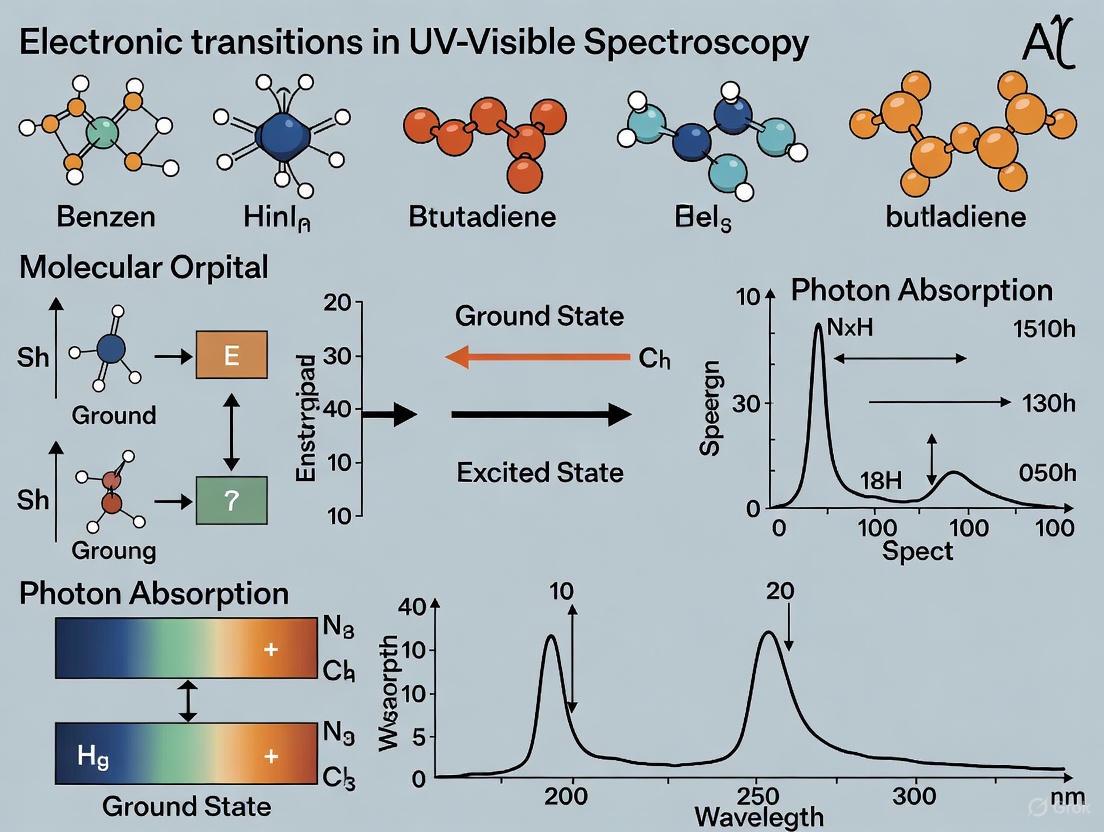
This article provides a comprehensive exploration of the principles of electronic transitions in UV-Vis spectroscopy, tailored for researchers and drug development professionals.
Electronic Transitions in UV-Vis Spectroscopy: Principles, Applications, and Advances for Pharmaceutical Research
Abstract
This article provides a comprehensive exploration of the principles of electronic transitions in UV-Vis spectroscopy, tailored for researchers and drug development professionals. It covers the foundational theory of how molecules absorb light, leading to σ→σ*, n→σ*, π→π*, and n→π* transitions. The scope extends to methodological applications in pharmaceutical analysis, including drug dissolution imaging and quality control, followed by troubleshooting common issues and optimizing experimental parameters. Finally, it examines advanced validation techniques and compares UV-Vis with other spectroscopic methods, highlighting its critical role in modern biomedical research and development.
The Fundamentals of Light Absorption and Electronic Excitations
Ultraviolet-Visible (UV-Vis) spectroscopy is a fundamental analytical technique based on the absorption of light in the ultraviolet and visible regions of the electromagnetic spectrum. Its principle is the interaction of light with matter, where molecules absorb specific wavelengths of light, prompting electrons to transition from a ground state to a higher energy excited state [1]. The analysis of these electronic transitions provides critical insights into molecular structure, identity, and concentration, forming a core principle in spectroscopic research across chemistry, pharmaceuticals, and materials science.
Principles of UV-Vis Spectroscopy and Electronic Transitions
The foundational principle of UV-Vis spectroscopy is that molecules can absorb specific energies of light corresponding to the promotion of electrons from lower to higher energy molecular orbitals [1]. The energy of the absorbed photon must exactly match the energy difference (ΔE) between the two orbital levels involved in the transition [2].
The energy associated with electromagnetic radiation is inversely proportional to its wavelength, described by the equation ( E = hν = hc/λ ), where ( h ) is Planck's constant, ( c ) is the speed of light, ( ν ) is frequency, and ( λ ) is wavelength [3] [2]. This relationship means that shorter wavelengths carry higher energy, and the specific wavelength absorbed reveals the energy gap between molecular orbitals [4].
Electronic transitions occur when an electron is promoted from the Highest Occupied Molecular Orbital (HOMO) to the Lowest Unoccupied Molecular Orbital (LUMO) [2] [5]. The energy required for this transition determines the wavelength of light absorbed, typically falling within the 190 to 800 nm range for UV-Vis spectroscopy [1].
Figure 1: An electron absorbs a photon's energy to transition from the HOMO to the LUMO. The energy of the photon (E) must exactly match the energy difference (ΔE) between the orbitals for absorption to occur.
Types of Electronic Transitions
The primary electronic transitions observed in UV-Vis spectroscopy involve the promotion of electrons from bonding (σ, π) or non-bonding (n) orbitals to antibonding (σ, π) orbitals [6] [5]. The energy required for these transitions varies significantly, leading to absorption across different spectral regions.
Table 1: Characteristics of Primary Electronic Transitions in UV-Vis Spectroscopy
| Transition Type | Energy Required | Typical λmax Range | Example Compounds | Molar Absorptivity (ε) |
|---|---|---|---|---|
| σ → σ* | Very High | < 200 nm (Far UV) | H₂, Alkanes (e.g., Ethane) | High |
| n → σ* | High | 150 - 250 nm | Saturated Halides, Alcohols, Ethers | Medium (100 - 3000 L mol⁻¹ cm⁻¹) |
| π → π* | Medium | 170 - 220 nm (Isolated); Up to 800 nm (Conjugated) | Alkenes (e.g., Ethene: 174 nm), Conjugated Polymers (e.g., β-Carotene) | Very High (10,000 - 25,000 L mol⁻¹ cm⁻¹) |
| n → π* | Low | 270 - 300 nm | Carbonyl Compounds (e.g., Acetone) | Low (10 - 100 L mol⁻¹ cm⁻¹) |
- σ → σ* Transitions: These require the most energy and occur in the far UV region (<200 nm), involving electrons in single bonds (e.g., C-C, C-H). They are seldom observed with standard spectrophotometers, which require a vacuum environment for measurements below ~200 nm [2] [5].
- n → σ* Transitions: These involve the promotion of a non-bonding electron (e.g., from O, N, S, or halogen atoms) to a σ* antibonding orbital. They occur at longer wavelengths than σ→σ* transitions but are often still below 200 nm [6].
- π → π* Transitions: These are the most common transitions observed in routine UV-Vis analysis. For an isolated C=C double bond (e.g., in ethene), λmax is around 170-175 nm. However, conjugation—the presence of alternating single and double bonds—dramatically lowers the HOMO-LUMO energy gap, causing a bathochromic shift (red shift) to longer wavelengths and a hyperchromic effect (increase in intensity) [3] [2]. For example, 1,3-butadiene absorbs at 217 nm, and β-carotene, with its 11 conjugated double bonds, absorbs in the visible region at ~450 nm, appearing orange [5].
- n → π* Transitions: These are the lowest energy transitions, typically observed for molecules with heteroatoms containing lone pairs adjacent to π systems, such as carbonyl groups (C=O). They are "forbidden" by selection rules, resulting in low-intensity absorption bands [6] [5].
Instrumentation and Experimental Protocol
The instrumentation for UV-Vis spectroscopy is designed to generate light across a spectrum of wavelengths, pass it through a sample, and precisely detect which wavelengths are absorbed [1] [4].
Core Components of a UV-Vis Spectrophotometer
A UV-Vis spectrophotometer consists of several key components that work in sequence [1] [4]:
- Light Source: Provides broad-spectrum radiation. Common sources include deuterium lamps for the UV region and tungsten or halogen lamps for the visible region. Some instruments use a single xenon lamp for both ranges [1] [4].
- Wavelength Selector (Monochromator): This component isolates a narrow band of wavelengths from the broad spectrum emitted by the source. It typically uses a diffraction grating that can be rotated to select the desired wavelength for analysis [1] [4].
- Sample Holder: The sample, usually dissolved in a suitable solvent, is contained in a cuvette with a defined path length (typically 1 cm). For UV light, quartz cuvettes are essential as they are transparent to UV radiation. Glass or plastic cuvettes can be used for visible light measurements only [4].
- Detector: Measures the intensity of the light beam after it passes through the sample. Photomultiplier tubes (PMTs) are common detectors due to their high sensitivity, while photodiodes and charge-coupled devices (CCDs) are also used [4].
- Computer and Software: Process the signal from the detector, convert it into an absorbance value, and display the resulting spectrum [1].
Figure 2: Workflow of a UV-Vis spectrophotometer, showing the path of light from source to data output.
Detailed Experimental Protocol for Quantitative Analysis
The following protocol outlines the standard procedure for determining the concentration of an analyte using a UV-Vis spectrophotometer.
Step 1: Instrument Preparation and Warm-up
- Turn on the spectrophotometer and allow the lamp and electronics to stabilize for at least 15-30 minutes as recommended by the manufacturer [4].
Step 2: Selection of Appropriate Solvent
- Choose a solvent that does not absorb significantly in the spectral region of interest. Common solvents for UV work include water, hexane, cyclohexane, and methanol [3] [4]. Ensure the solvent is spectroscopically pure and compatible with the sample and cuvette material.
Step 3: Preparation of Blank Solution
- Prepare the blank, which is a cuvette filled only with the pure solvent used to dissolve the sample. The blank is used to correct for absorbance from the solvent and cuvette, establishing a 0% absorbance baseline [4].
Step 4: Preparation of Standard Solutions
- Prepare a series of standard solutions with known, precise concentrations of the analyte. The concentrations should bracket the expected concentration of the unknown sample. Ensure all solutions are within the optimal absorbance range (0.1 - 1.0) for highest accuracy [4].
Step 5: Measurement of Blank and Standards
- Place the blank cuvette in the sample compartment and run a baseline correction.
- For each standard solution, fill a clean cuvette, place it in the spectrometer, and measure the absorbance at the predetermined λmax of the analyte. Record the absorbance for each concentration [7].
Step 6: Creation of Calibration Curve
- Plot the measured absorbance (y-axis) versus the known concentration (x-axis) for each standard solution. Use linear regression to fit a straight line to the data points. The slope of this line is equal to the molar absorptivity (ε) multiplied by the path length (l) [7].
Step 7: Measurement of Unknown Sample and Data Analysis
- Prepare the unknown sample in the same solvent and measure its absorbance at the same λmax.
- Use the equation of the calibration curve (A = εlc) to calculate the concentration of the unknown sample [7].
The Scientist's Toolkit: Key Reagents and Materials
Successful UV-Vis spectroscopy requires careful selection of reagents and materials to ensure accurate and reproducible results.
Table 2: Essential Research Reagent Solutions and Materials for UV-Vis Spectroscopy
| Item | Function/Role | Key Considerations |
|---|---|---|
| High-Purity Solvents | To dissolve the analyte without interfering with its absorption spectrum. | Must be "spectrophotometric grade" with low UV absorbance. Water, acetonitrile, and hexane are common. Avoid solvents like acetone for low-wavelength UV work [4]. |
| Quartz Cuvettes | To hold the liquid sample in the light path. | Required for UV measurements (190-400 nm) due to UV transparency. Path length is typically 1.0 cm [4]. |
| Standard Reference Materials | To calibrate the spectrometer and verify wavelength and photometric accuracy. | Holmium oxide or didymium filters are standard for wavelength calibration [4]. |
| Analytical Balance | To accurately weigh solid samples for preparing standard solutions. | High precision (e.g., 0.1 mg) is crucial for preparing accurate standard solutions for quantitative work. |
| Volumetric Flasks and Pipettes | To prepare solutions of precise concentration. | Required for accurate dilution and preparation of standard and sample solutions. |
Data Interpretation and Analytical Applications
Interpreting a UV-Vis Spectrum
A UV-Vis spectrum is a plot of absorbance (or transmittance) versus wavelength [8]. Key features to interpret include:
- Lambda max (λmax): The wavelength at which maximum absorption occurs. This value is characteristic of the chromophore (the light-absorbing part of the molecule) and its electronic environment. It provides information about the energy of the electronic transition and the extent of conjugation [8] [7].
- Molar Absorptivity (ε) at λmax: The intensity of the absorption, calculated using the Beer-Lambert law (A = εlc). A high ε value (e.g., >10,000 L mol⁻¹ cm⁻¹) indicates a highly probable or "allowed" transition, such as a π→π* transition in a conjugated system. A low ε value (e.g., 10-100 L mol⁻¹ cm⁻¹) suggests a "forbidden" transition, such as an n→π* transition [3] [6].
- Number and Shape of Peaks: The presence of multiple peaks can indicate several distinct chromophores or a single chromophore capable of different transitions. Broad peaks are common in solution spectra, while sharp peaks might indicate a rigid, vapor-phase molecule [7].
Quantitative Analysis: The Beer-Lambert Law
The Beer-Lambert law is the fundamental principle for quantitative analysis in UV-Vis spectroscopy [1] [4]. It states that the absorbance (A) of a solution is directly proportional to the concentration (c) of the absorbing species and the path length (l) of the light through the solution:
A = εlc
Where:
- A is Absorbance (unitless)
- ε is the Molar Absorptivity (L mol⁻¹ cm⁻¹)
- l is the Path Length of the cuvette (cm)
- c is the Concentration of the solution (mol L⁻¹)
This linear relationship allows for the determination of an unknown concentration by measuring its absorbance, provided ε is known or a calibration curve has been established [4].
Critical Applications in Research
- Pharmaceutical Analysis: UV-Vis spectroscopy is used for drug identification, quantification of active pharmaceutical ingredients (APIs), and assessment of impurity profiles. It is crucial in quality control and drug development workflows [1].
- Nucleic Acid and Protein Quantification: In molecular biology, the purity and concentration of DNA and RNA samples are routinely checked using UV-Vis spectroscopy. The ratio of absorbance at 260 nm and 280 nm (A260/A280) is a standard metric for assessing protein contamination [1].
- Chemical Kinetics: By monitoring the change in absorbance at a specific wavelength over time, researchers can track the progress of a chemical reaction and determine reaction rates [1].
- Environmental Monitoring: The technique is employed to detect and quantify pollutants, such as heavy metals and organic compounds, in air, water, and soil samples [1].
The Beer-Lambert Law (BLL), also referred to as Beer's Law, is a fundamental principle in optical spectroscopy that quantitatively relates the attenuation of light to the properties of the material through which the light is traveling [9]. This law forms the cornerstone of quantitative analysis in UV-Vis spectroscopy, enabling researchers to determine the concentration of analytes in solution. Within the context of electronic transitions, the BLL provides the experimental framework for connecting the theoretical probabilities of these transitions, expressed via the molar absorptivity, to a measurable quantity—absorbance [9]. This allows scientists, particularly in drug development, to move beyond mere detection to precise quantification of compounds, a critical step in tasks ranging from assessing compound purity to determining enzyme kinetics.
The law is an amalgamation of the findings of Pierre Bouguer, Johann Heinrich Lambert, and August Beer [10] [11]. Its modern formulation states that the absorbance (A) of a light beam through a sample is directly proportional to the concentration (c) of the absorbing species and the path length (l) of the light through the sample [9] [12]. This relationship is expressed mathematically as: A = εlc where ε is the molar absorptivity (also known as the molar extinction coefficient), a substance-specific constant that is a measure of the probability of an electronic transition at a given wavelength [9] [11].
The derivation of the law begins with the observation that the differential decrease in light intensity (dI) as it passes through an infinitesimally thin layer of material is proportional to the incident intensity (I), the concentration of the absorber, and the thickness of the layer (dx) [13] [11]. This leads to a differential equation whose integration over the entire path length yields the familiar logarithmic relationship [11]. The absorbance is defined through the incident intensity (I₀) and transmitted intensity (I) as: A = log₁₀(I₀/I) [9] [13] [12].
The Theoretical Framework and Electronic Transitions
Fundamental Quantities and Their Relationships
The Beer-Lambert Law integrates several key spectroscopic quantities, summarized in the table below.
Table 1: Fundamental Quantities in the Beer-Lambert Law
| Quantity | Symbol | Definition | Relationship to BLL |
|---|---|---|---|
| Transmittance | T | Ratio of transmitted to incident light intensity (I/I₀) [12] | The measured value from which absorbance is calculated [12]. |
| Absorbance | A | Logarithmic measure of light absorbed by the sample [9] | The primary analytical signal, defined as A = -log₁₀(T) [9] [12]. |
| Molar Absorptivity | ε | Substance-specific constant indicating how strongly a species absorbs at a given wavelength [9] | A measure of the probability of an electronic transition; links absorbance to concentration and path length [9]. |
| Path Length | l | The distance light travels through the sample solution [9] | A linear factor in the BLL equation; typically the width of the cuvette (e.g., 1 cm) [12]. |
| Concentration | c | The amount of the absorbing species in the solution [9] | The target variable for quantitative analysis; linearly related to absorbance under valid conditions [9]. |
The following diagram illustrates the logical and mathematical relationships between these core concepts and the derivation of the Beer-Lambert Law.
The relationship between transmittance and absorbance is logarithmic, not linear. This means that an absorbance of 1 corresponds to 10% transmittance (90% of the light is absorbed), and an absorbance of 2 corresponds to 1% transmittance [9] [12]. This logarithmic scale is essential because it allows the absorbance to be directly proportional to the concentration, forming the basis for quantitative analysis.
The Physical Basis: Link to Electronic Transitions
In UV-Vis spectroscopy, absorption of light occurs when a photon's energy matches the energy required to promote an electron from a lower energy state to a higher one [9]. The molar absorptivity (ε) is a direct measure of the probability of this electronic transition. A high value of ε indicates a highly probable transition, resulting in strong absorption, whereas a low value indicates a forbidden or low-probability transition [9].
The energy of the absorbed photon is determined by the wavelength of light, which is characteristic of the molecular structure or chromophore. The concentration of the chromophore and the path length of the light determine the number of molecules the light beam encounters, thus controlling the total number of absorption events. The Beer-Lambert Law elegantly synthesizes these two aspects—the intrinsic probability of the transition (ε) and the statistical likelihood of an interaction (c and l)—into a single quantitative relationship [9].
Experimental Validation and Methodologies
Detailed Experimental Protocol for Validation
Validating the linear relationship between absorbance and concentration is a critical step in any quantitative spectroscopic method. The following workflow details a standard protocol for creating a calibration curve, a fundamental tool in analytical chemistry.
Step-by-Step Methodology:
- Solution Preparation: A stock solution of the analyte (e.g., potassium permanganate, a protein, or a drug compound) with a known, precisely determined concentration is prepared [14]. A series of standard solutions are then created via serial dilution to cover a range of concentrations, typically from very dilute to near the expected upper limit of linearity [12] [14].
- Spectrophotometric Measurement:
- Instrument Calibration: A wavelength accuracy test should be performed using a standard filter (e.g., Holmium glass with known absorption peaks at 361 nm, 445 nm, and 460 nm) to ensure the spectrophotometer is free from instrumental errors [14].
- Baseline Correction: The spectrophotometer is zeroed using a cuvette filled only with the solvent (blank) to account for any light absorption or scattering by the solvent or cuvette walls [15].
- Data Acquisition: The absorbance of each standard solution is measured at the analyte's wavelength of maximum absorption (λ_max) to ensure the highest sensitivity and minimal error from small wavelength shifts [12] [16]. A constant path length cuvette (typically 1.0 cm) is used for all measurements [12].
- Data Analysis and Calibration:
- The absorbance values are plotted against their corresponding concentrations.
- A linear regression analysis is performed on the data points. The Beer-Lambert law holds if the data forms a straight line, typically with a coefficient of determination (R²) very close to 1 [12].
- The slope of the resulting line is equal to the product of the molar absorptivity and the path length (εl). For a known path length, the molar absorptivity (ε) can be determined from this slope [9] [12].
The Scientist's Toolkit: Essential Research Reagents and Materials
The successful application of the Beer-Lambert Law relies on a set of specific materials and reagents. The following table outlines key components used in a typical spectrophotometric experiment.
Table 2: Essential Materials and Reagents for Spectrophotometric Analysis
| Item | Function / Rationale | Example / Specification |
|---|---|---|
| UV-Vis Spectrophotometer | Instrument to measure the intensity of light transmitted through a sample versus a reference [12] [14]. | Should have a wavelength accuracy of ±1 nm or better; a dual-beam instrument is preferred for stability [14]. |
| Cuvettes | Containers to hold the liquid sample in the light path [9]. | Typically with a fixed path length of 1.0 cm; made of quartz for UV work (below 350 nm) or glass/plastic for visible range [9]. |
| Analytical Grade Solvent | A chemically inert medium to dissolve the analyte that does not absorb significantly in the wavelength region of interest [14]. | Distilled water, hexane, methanol, etc. Sourced to high purity (e.g., Sigma Aldrich) [14]. |
| Holmium Glass Filter | A reference material with sharp, known absorption peaks used for wavelength calibration and validation of the spectrophotometer [14]. | Peaks at 361 nm, 445 nm, and 460 nm; verifies instrumental accuracy [14]. |
| Dispersants (e.g., PVP, DME) | Used in some applications (e.g., graphene-modified materials) to promote uniform dispersion of analytes and prevent scattering, ensuring the system adheres to the assumptions of the BLL [17]. | Polyvinyl pyrrolidone (PVP), Dipropylene glycol dimethyl ether (DME) [17]. |
Limitations, Deviations, and Advanced Considerations
Despite its widespread utility, the Beer-Lambert Law is an idealization and is subject to several limitations and deviations, which researchers must recognize to avoid inaccurate results.
Fundamental and Chemical Deviations
- High Concentrations: At high concentrations (typically >0.01 M), the linear relationship between absorbance and concentration often breaks down [14] [16]. This real deviation occurs due to several factors, including changes in refractive index and solute-solute interactions (e.g., dimerization) that alter the analyte's absorptivity [10] [14]. For example, the absorbance of DNA solutions becomes non-linear when the absorbance exceeds ~1.5-2 for a 1 cm path length, likely due to DNA-DNA interactions [16].
- Chemical Equilibria: shifts in chemical equilibrium dependent on concentration, pH, or temperature can lead to chemical deviations. If the absorbing species is involved in an equilibrium (e.g., acid-base indicators), a change in concentration may shift the equilibrium, altering the absorption spectrum and violating the assumption that only one absorbing species is present [14].
Instrumental and Electro-Magnetic Deviations
- Polychromatic Light: The law is strictly valid only for monochromatic light. Using a light source with a too-wide bandwidth can lead to negative deviations from Beer's Law, as the measured absorbance becomes an average over a range of wavelengths where ε is not constant [15].
- Stray Light and Scattering: Imperfections in the spectrometer can allow stray light (light not of the selected wavelength) to reach the detector, leading to inaccurate absorbance readings, particularly at high absorbances [10] [15]. Scattering from particulates or micro-bubbles in the solution also causes apparent absorption, violating the assumption that attenuation is due solely to absorption [11].
- Electromagnetic Effects and Refractive Index: The classical derivation of the BBL law neglects the wave nature of light. In reality, effects such as refractive index changes and interference (e.g., in thin films) can cause significant deviations. These effects become pronounced when the sample is not a dilute solution but a solid film or a highly concentrated solution where the refractive index varies significantly with concentration [10] [15]. Recent research has proposed extensions to the BBL law based on electromagnetic theory, incorporating higher-order terms for concentration to account for the complex refractive index, which improves accuracy at high concentrations [14].
Table 3: Summary of Key Limitations and Deviations from the Beer-Lambert Law
| Deviation Type | Cause | Effect on Absorbance-Concentration Linearity |
|---|---|---|
| Fundamental (Real) | High analyte concentration leading to intermolecular interactions and refractive index changes [14]. | Negative deviation (curve bends downward) [14]. |
| Chemical | Shift in chemical equilibrium (e.g., association, dissociation, complex formation) with changing concentration [14]. | Positive or negative deviation depending on the equilibrium [14]. |
| Instrumental | Use of polychromatic light, presence of stray light, or fluorescence of the sample [10] [15]. | Typically a negative deviation [15]. |
| Scattering | Particulates, turbidity, or bubbles in the sample causing loss of light from the beam [11]. | Positive deviation (apparent absorption increases). |
The Beer-Lambert Law remains an indispensable tool in the scientist's arsenal, providing a direct and powerful link between the macroscopic measurement of absorbance and the microscopic properties of matter, specifically the concentration of a species and the probability of its electronic transitions. Its formulation, A = εlc, is deceptively simple, yet it underpins vast areas of quantitative analysis in chemical and biological research, including drug development.
A critical understanding of its assumptions and limitations is paramount for research professionals. While the law provides an excellent approximation for dilute solutions, deviations due to high concentration, chemical equilibria, and electromagnetic effects are common and must be accounted for to ensure data integrity. Ongoing research into electromagnetic extensions of the law promises to enhance its accuracy and extend its applicability to more complex systems, ensuring its continued relevance in advanced spectroscopic research.
A chromophore is the part of a molecule responsible for its color, derived from the Greek words chrōma (color) and -phoros (carrier of) [18]. The color perceived by an observer is not the light absorbed by the molecule, but rather the combination of wavelengths that are reflected or transmitted [19]. Chromophores achieve this by containing regions where the energy difference between two separate molecular orbitals falls within the visible spectrum (approximately 380-780 nm) [18] [1]. When visible light strikes a chromophore, electrons can be excited from their ground state to a higher energy state, absorbing specific wavelengths in the process [18].
In biological systems, chromophores serve crucial functions in light capture and detection. For instance, the chromophore retinal is used in the eye to detect light, while chlorophyll enables plants to perform photosynthesis [18]. In analytical chemistry and drug development, understanding chromophores is fundamental to techniques like UV-Vis spectroscopy, which relies on the specific light absorption patterns of chromophores to identify and quantify molecules in samples ranging from pharmaceutical compounds to nucleic acids [4] [1].
Structural Basis of Chromophores
Fundamental Electronic Transitions
The light-absorbing capability of chromophores arises from electronic transitions that occur when specific energy levels of light are absorbed. These transitions involve the promotion of electrons from ground state orbitals to higher energy excited state orbitals [19] [1]. For chromophores, the most relevant transitions occur within the wavelength range of 200-800 nm, which encompasses both the ultraviolet and visible regions of the electromagnetic spectrum [19].
Chromophores can be categorized based on their orbital chemistry, which determines the types of electronic transitions they can undergo [19]:
- Chromophores containing only π electrons (typically found in double bonds) undergo π-π* transitions, where an electron is excited from a π bonding orbital to a π* anti-bonding orbital.
- Chromophores containing both π electrons and non-bonding (n) electrons (often lone pairs on heteroatoms like nitrogen, oxygen, or sulfur) can undergo both n-π and π-π transitions.
The energy required for these transitions follows the relationship: n-π* < π-π* < n-σ, with n-π transitions requiring the least energy and therefore absorbing longer wavelengths [19].
The Role of Conjugation
Conjugation—the presence of alternating single and multiple bonds in a molecule—plays a fundamental role in determining the absorption properties of chromophores [18]. In a conjugated π-system, electrons become delocalized and can resonate across multiple adjacent p-orbitals, similar to how a radio antenna detects photons along its length [18].
The extent of conjugation directly influences the wavelength of light absorbed through its effect on the HOMO-LUMO gap (Highest Occupied Molecular Orbital - Lowest Unoccupied Molecular Orbital gap) [19]. As conjugation increases:
- The energy difference between the π-bonding and π*-anti-bonding orbitals decreases
- Less energy is required to promote electrons to excited states
- Longer wavelengths of light are absorbed
This relationship explains why compounds with fewer than eight conjugated double bonds typically absorb only in the ultraviolet region and appear colorless to the human eye, while more highly conjugated systems absorb visible light and appear colored [18]. For example, each additional double bond in a conjugated system progressively shifts absorption toward longer wavelengths, potentially changing the observed color from colorless to yellow to red as the system lengthens [18].
Key Chromophore Functional Groups
Specific functional groups serve as chromophores due to their electronic structures that enable the transitions described above. The table below summarizes important chromophoric functional groups and their characteristics:
Table 1: Key Chromophore Functional Groups and Their Properties
| Group Name | Structure | Primary Transition | Characteristics |
|---|---|---|---|
| Alkene | C=C | π-π* | π-conjugated system |
| Carbonyl | C=O | n-π, n-σ | Strong electron-withdrawing group |
| Azo | N=N | n-π* | Dependent on surrounding moieties, π-conjugated |
| Nitro | NO₂ | n-π* | Strong electron-withdrawing group |
| Nitroso | N=O | n-π* | π-conjugated, electron-withdrawing |
| Carboxyl | COOH | n-π* | Acidic, pH-dependent |
| Amide | CONH₂ | n-π* | Electron-rich, π-conjugated |
Source: Adapted from [19]
Auxochromes and Spectral Tuning
Definition and Function of Auxochromes
An auxochrome is a functional group of atoms attached to a chromophore that modifies its light-absorbing properties [18]. While auxochromes themselves do not typically absorb radiation significantly in the near-UV or visible regions, they can profoundly alter both the wavelength (bathochromic or hypsochromic shift) and intensity (hyperchromic or hypochromic effect) of a chromophore's absorption [19] [20].
Auxochromes achieve this modification through several mechanisms:
- Electron donation or withdrawal that alters the electron density within the conjugated system
- Extending the conjugation through their non-bonding electrons
- Changing the polarity or solubility of the molecule
- Enhancing the affinity of dyes toward specific substrates [20]
The combination of a chromophore with an auxochrome effectively creates a new chromophoric system with distinct spectral properties characterized by different values of λmax (wavelength of maximum absorption) and εmax (molar absorption coefficient) [20].
Common Auxochrome Groups
Table 2: Common Auxochrome Groups and Their Effects
| Group Name | Structure | Transitions | Characteristics |
|---|---|---|---|
| Hydroxyl | OH | n-σ* | Polar, can donate electrons through resonance |
| Amine | NH₂, NHR, NR₂ | n-σ* | Polar, basic, strong electron-donating capability |
| Thiol | SH | n-σ* | Polar, can form disulfide bonds |
| Carboxyl | COOH | n-π* | Acidic, can act as electron-withdrawer |
| Sulfonate | SO₃H | N/A | Increases water solubility, ionic character |
Source: Adapted from [19] [20]
In textile dyeing applications, auxochromes not only modify color but also enhance the affinity of dyes toward fibers, making them essential for the dyeing process [20]. For example, the auxochrome groups -COOH, -SO₃H, -OH, and -NH₂ are commonly incorporated into dye molecules to improve their binding to fabric substrates [20].
Quantitative Characterization of Chromophores
The Beer-Lambert Law
The relationship between light absorption and chromophore concentration is quantitatively described by the Beer-Lambert Law, which forms the foundation for UV-Vis spectroscopic quantification [21] [4] [1]. The law states that the absorbance (A) of a solution is directly proportional to the concentration (c) of the absorbing species and the path length (L) through which the light travels:
A = ε × c × L
Where:
- A is the measured absorbance (dimensionless)
- ε is the molar absorptivity or molar absorption coefficient (M⁻¹cm⁻¹)
- c is the concentration of the absorbing species (mol/L or M)
- L is the path length of the sample container (cm)
The absorbance is defined as A = log(I₀/I) = log(1/T), where I₀ is the intensity of incident light, I is the intensity of transmitted light, and T is the transmittance (T = I/I₀) [21]. This relationship enables researchers to determine unknown concentrations of chromophores by measuring absorbance, provided the molar absorptivity and path length are known [21].
It is important to note that the Beer-Lambert law assumes linearity only in highly diluted solutions, and deviations can occur at higher concentrations due to factors such as molecular interactions and the inner filter effect [21] [4]. For accurate quantification, absorbance values should generally be kept below 1.0, which corresponds to approximately 10% transmittance [4].
Molar Absorptivity of Common Chromophores
The molar absorptivity (ε) is a fundamental property of a chromophore that indicates how strongly it absorbs light at a specific wavelength. Higher ε values indicate greater absorption efficiency. The table below presents absorption characteristics for common chromophores used in research:
Table 3: Absorption Properties of Common Research Chromophores
| Chromophore | Detection Wavelength | Molar Absorption Coefficient (ε) | Applications/Notes |
|---|---|---|---|
| p-Nitroanilide (pNA) | 405-410 nm | 9,450 M⁻¹cm⁻¹ (405 nm) 8,800 M⁻¹cm⁻¹ (410 nm) | Serine and cysteine protease assays |
| p-Nitrophenyl ester (ONp) | 347 nm | 5,500 M⁻¹cm⁻¹ | Esterase activity measurements |
| 2,4-Dinitrophenyl (Dnp) | 365 nm | 17,300 M⁻¹cm⁻¹ | Also used as a quencher for fluorophores |
| Thiobenzyl Ester (SBzl) | 324 nm 410 nm | 19,800 M⁻¹cm⁻¹ 14,000 M⁻¹cm⁻¹ | Requires color reaction with DTNB (Ellman's reagent) |
| 3-(2-Furyl)acryloyl (FA) | 322-345 nm | 13,400-24,700 M⁻¹cm⁻¹ | Continuous spectrophotometric assays of proteases |
| Bromophenol blue (yellow form) | 591 nm | Not specified | pH indicator |
| Malachite green | 617 nm | Not specified | Dye, biochemical staining |
| β-carotene | 452 nm | Not specified | Natural pigment |
Source: Adapted from [18] [21]
It is important to note that molar absorption coefficients can depend on experimental conditions such as temperature, pH, and ionic strength of the solution [21]. Therefore, values reported in the literature should be considered as guidelines rather than absolute constants.
Chromophores in UV-Vis Spectroscopy
Instrumentation and Experimental Workflow
UV-Vis spectroscopy relies on chromophores' specific light absorption properties to identify and quantify molecules in a sample [4] [1]. A typical UV-Vis spectrophotometer consists of four main components:
- Light Source: Provides broad-spectrum UV and visible light, commonly using deuterium lamps for UV region and tungsten or halogen lamps for visible region [4] [1].
- Wavelength Selector: Typically a monochromator containing a diffraction grating that selects specific wavelengths from the broad spectrum [4].
- Sample Container: Holds the sample solution, usually a cuvette with a standard path length of 1 cm [4].
- Detector: Converts transmitted light intensity into an electrical signal for measurement, often using photomultiplier tubes or photodiodes [4].
Figure 1: Schematic workflow of a UV-Vis spectrophotometer illustrating the path of light from source to detection.
Standard Experimental Protocol for UV-Vis Analysis
Methodology for Concentration Determination of Chromophores
Instrument Calibration:
- Turn on the UV-Vis spectrophotometer and allow the lamp to warm up for 15-30 minutes.
- Select the appropriate wavelength based on the chromophore's absorption maximum.
- Perform a baseline correction with the pure solvent (blank) to account for any solvent absorption.
Sample Preparation:
- Prepare a series of standard solutions with known concentrations of the target chromophore.
- Ensure samples are within the linear range of the Beer-Lambert law (typically absorbance < 1.0).
- Use appropriate solvent that does not significantly absorb at the measurement wavelength.
Measurement Procedure:
- Place the blank solution in the sample holder and set the instrument to 100% transmittance (zero absorbance).
- Replace with sample solutions and record absorbance values.
- Repeat measurements for each standard and unknown sample.
Data Analysis:
- Plot a calibration curve of absorbance versus concentration for standard solutions.
- Determine the molar absorptivity (ε) from the slope of the standard curve.
- Calculate unknown concentrations using the Beer-Lambert law: c = A/(ε × L)
Quality Control:
This protocol enables accurate quantification of chromophore concentrations in various applications, from pharmaceutical analysis to environmental monitoring [1].
Chromophores in Research and Industry
Natural and Synthetic Chromophores
Chromophores occur widely in nature and are also synthetically engineered for specific applications. Naturally occurring chromophores include:
- Chlorophyll: A porphyrin ring system with a central magnesium ion that absorbs red (~660 nm) and blue (~430 nm) light, appearing green [18] [19]. Essential for photosynthesis in plants.
- Heme: Contains a porphyrin ring with an iron ion at the center, absorbs green and blue light (540-580 nm), and appears red [19]. Enables oxygen transport in blood.
- β-Carotene: A highly conjugated hydrocarbon that absorbs at 452 nm, appearing orange [18]. Found in carrots and other vegetables.
- Anthocyanins: Flavonoid pigments responsible for red, purple, and blue colors in many flowers and fruits [18].
- Bilirubin and Urobilin: Tetrapyrrole compounds that exhibit yellow color, breakdown products of heme metabolism [18].
Synthetic chromophores have been developed for diverse applications including biological sensing and imaging, sunscreen formulations, organic light-emitting diodes (OLEDs), solar cells, and crime scene analysis [19]. Through molecular engineering, researchers can tune absorption properties by modifying conjugation length and incorporating different functional groups to meet specific application requirements [19].
Research Reagent Solutions
Table 4: Essential Research Reagents for Chromophore Studies
| Reagent/Material | Function/Application | Technical Notes |
|---|---|---|
| p-Nitroanilide (pNA) substrates | Protease enzyme assays | Liberated p-nitroaniline measured at 405-410 nm [21] |
| Thiobenzyl Ester (SBzl) substrates | Thioester hydrolysis assays | Requires DTNB (Ellman's reagent) to form 2-nitro-5-thiobenzoate anion measured at 410 nm [21] |
| 3-(2-Furyl)acryloyl (FA) substrates | Continuous spectrophotometric assays of proteases | Based on blue shift in absorption upon peptide bond hydrolysis [21] |
| p-Nitrophenyl ester (ONp) substrates | Esterase activity measurements | Direct measurement of p-nitrophenol at 347 nm, pH-independent [21] |
| DTNB (Ellman's reagent) | Thiol group quantification | Forms 2-nitro-5-thiobenzoate anion (ε = 14,000 M⁻¹cm⁻¹ at 410 nm) [21] |
| 4,4'-Dithiodipyridine | Thiolation degree measurement | Forms 4-thiopyridone (ε = 19,800 M⁻¹cm⁻¹ at 324 nm) [21] |
| Quartz cuvettes | Sample containers for UV measurements | Transparent to UV light; required for measurements below 350 nm [4] |
Applications in Pharmaceutical and Biomedical Research
Chromophores play crucial roles in pharmaceutical development and biomedical research:
- Drug Discovery and Development: UV-Vis spectroscopy utilizing chromophore absorption is employed for drug identification, quantification of impurities, and characterization of chemical components [1].
- Enzyme Activity Assays: Synthetic chromophore-containing substrates (e.g., pNA substrates for serine and cysteine proteases) enable continuous monitoring of enzymatic activity [21].
- DNA/RNA Analysis: Chromophore properties of nucleic acids allow verification of purity and concentration measurements through absorbance at 260 nm [1].
- Biological Staining: Chromophores are used in various staining techniques to differentiate between microorganisms in microbiological studies [19].
The electronic transitions fundamental to chromophore function can be visualized as follows:
Figure 2: Electronic transitions in chromophores showing π-π and n-π* transitions from ground to excited states.*
Advanced Chromophore Systems
Metal Complex Chromophores
Metal ions play important roles in many chromophoric systems, particularly in inorganic and organometallic compounds [19]. Metal complex chromophores contain a metal center coordinated with organic ligands and exhibit unique photophysical properties:
- Chlorophyll: Contains magnesium coordinated in a chlorin-type macrocycle ring [18].
- Hemoglobin: Features an iron ion in a porphyrin ring (heme group) that gives blood its red color [18].
- Phthalocyanines: Synthetic macrocyclic compounds with coordinated metal ions, used as blue and green dyes [20].
Metal centers facilitate electronic transitions through several mechanisms:
- Providing d-orbitals that participate in charge transfer transitions
- Enabling metal-to-ligand charge transfer (MLCT) or ligand-to-metal charge transfer (LMCT)
- Modulating the energy gap between electronic states through the specific metal and its oxidation state
- Stabilizing electronic structures through coordination with ligands [19]
The presence of metal ions can significantly influence absorption spectra and excited state lifetimes of chromophores [18]. For example, the nature of the central metal in porphyrin complexes affects both the wavelength of absorption and the photophysical properties of the excited states [18].
Environmental and pH Effects on Chromophores
Chromophores can exhibit sensitivity to their chemical environment, particularly pH changes, a phenomenon known as halochromism [18]. This property is exploited in pH indicators whose molecular structure changes in response to pH variations:
- Phenolphthalein: Colorless below pH 8.2 and pink to fuchsia above pH 8.2 due to structural changes that extend conjugation [18].
- Bromophenol Blue: Yellow form absorbs at 591 nm [18].
The mechanism underlying halochromism typically involves protonation or deprotonation that alters the electron distribution in the chromophore, potentially creating or extending conjugated systems. For instance, in phenolphthalein under basic conditions (pH > 8.2), a central carbon becomes sp² hybridized, allowing p-orbital overlap that conjugates three aromatic rings together to form an extended chromophore that absorbs longer wavelength visible light [18].
Environmental factors such as solvent polarity, temperature, and ionic strength can also influence chromophore absorption by affecting molecular conformation, stabilization of ground versus excited states, and extent of conjugation [21]. These dependencies enable the use of chromophores as molecular probes for monitoring microenvironmental changes in complex systems.
Ultraviolet-Visible (UV-Vis) spectroscopy is a fundamental analytical technique that probes the electronic structure of molecules by measuring their absorption of light in the ultraviolet and visible regions of the electromagnetic spectrum (typically 190-800 nm) [22] [7]. When a molecule absorbs light, electrons undergo transitions from ground state orbitals to higher energy excited state orbitals [5]. The energy of the absorbed light corresponds precisely to the energy difference between these molecular orbitals, following the relationship ΔE = hν, where h is Planck's constant and ν is the frequency of the absorbed light [6]. The resulting absorption spectrum provides critical insights into molecular structure, conjugation, functional groups, and concentration, making it indispensable for researchers, scientists, and drug development professionals characterizing molecular properties and interactions [6] [7].
The four primary types of electronic transitions—σ→σ, n→σ, π→π, and n→π—differ significantly in their energy requirements, probabilities, and structural dependencies [23]. This technical guide examines these fundamental electronic transitions within the broader context of UV-Vis spectroscopy research principles, detailing their underlying mechanisms, characteristic spectral features, experimental protocols for their investigation, and practical applications in molecular analysis.
Molecular Orbital Framework
Electronic transitions in molecules occur within the framework of molecular orbital theory, where atomic orbitals combine to form bonding and antibonding molecular orbitals [5] [2]. The highest occupied molecular orbital (HOMO) represents the most energetic ground state electrons, while the lowest unoccupied molecular orbital (LUMO) is the lowest energy orbital available for excited electrons [5]. The energy gap between HOMO and LUMO determines the wavelength of light a molecule will absorb [2]. When electromagnetic radiation with energy matching this HOMO-LUMO gap interacts with a molecule, electrons may be promoted from the HOMO to the LUMO, resulting in characteristic absorption spectra that serve as molecular fingerprints [5] [22].
The probability and energy requirements for electronic transitions depend critically on the type of molecular orbitals involved and their energy separation. Sigma (σ) orbitals result from head-on overlap of atomic orbitals and form strong bonds with relatively large energy gaps to their corresponding antibonding (σ) orbitals [2]. Pi (π) orbitals arise from sideways overlap of p-orbitals in double and triple bonds, creating weaker bonds with smaller energy separations from their antibonding (π) counterparts [2]. Non-bonding (n) orbitals contain lone pair electrons that occupy orbitals at energy levels between bonding and antibonding orbitals [24]. These fundamental differences in orbital energies and overlaps give rise to the characteristic properties of the four primary electronic transitions in molecular spectroscopy.
Energy Relationships and Selection Rules
The relative energies of molecular orbitals follow a consistent pattern: σ orbitals are the most stable, followed by non-bonding (n) orbitals, then π orbitals, with all antibonding orbitals (π* and σ) being significantly higher in energy [24]. This energy hierarchy directly determines the wavelengths at which molecules absorb light, with larger energy gaps corresponding to shorter wavelengths (higher energy) photons [5]. The energy required for different transitions generally decreases in the order: σ→σ > n→σ* > π→π* > n→π* [23].
Electronic transitions are governed by selection rules that determine their probability and intensity [6]. The spin selection rule dictates that transitions between states with different spin multiplicities are forbidden, making singlet-to-singlet and triplet-to-triplet transitions allowed while forbidding singlet-to-triplet transitions [6]. The Laporte selection rule (or parity rule) states that in centrosymmetric molecules, transitions between orbitals of the same parity (g→g or u→u) are forbidden, while those between different parity orbitals (g→u) are allowed [6]. The symmetry selection rule requires that for a transition to be allowed, the direct product of the irreducible representations of the initial and final states must contain the irreducible representation of the transition moment operator [6].
Forbidden transitions may still occur with lower intensity due to vibronic coupling, which relaxes these selection rules by mixing vibrational and electronic wavefunctions [6]. The intensity of an electronic transition is proportional to the square of the transition dipole moment, with allowed transitions having larger transition dipole moments and thus higher intensities [6].
Characterizing the Four Electronic Transitions
σ→σ* Transitions
Sigma to sigma star (σ→σ) transitions involve the promotion of an electron from a bonding σ orbital to an antibonding σ orbital [5] [23]. These transitions require the highest energy among the four types because σ bonds are the strongest molecular bonds with consequently large energy gaps between bonding and antibonding orbitals [2]. Sigma bonds result from direct head-on overlap between atomic orbitals such as s-s, s-sp³, or sp³-sp³, forming the fundamental framework of single bonds in organic molecules [2].
The high energy requirement places σ→σ* absorption maxima in the far ultraviolet region below 150 nm [2]. For example, molecular hydrogen (H₂) undergoes a σ→σ* transition at 112 nm, while ethane absorbs at 135 nm [5] [23]. These wavelengths are sufficiently energetic to break strong sigma bonds, explaining why far-UV radiation is damaging to biological tissues and organic compounds [2]. Standard UV-Vis spectrophotometers typically operate down to approximately 200 nm, making σ→σ* transitions largely inaccessible for routine analysis and thus of limited practical utility in most analytical applications [5] [25].
Table 1: Characteristics of σ→σ* Transitions
| Parameter | Specification | Example Compounds |
|---|---|---|
| Energy Requirement | Very High (>200 kcal/mol) | H₂, CH₄, C₂H₆ |
| Wavelength Range | <150 nm (Far UV) | H₂ (112 nm), Ethane (135 nm) |
| Absorption Intensity | Strong | |
| Practical Accessibility | Limited with standard UV-Vis instruments | |
| Bond Strength Impact | Direct correlation with higher energy requirements |
n→σ* Transitions
Non-bonding to sigma star (n→σ) transitions occur when electrons in non-bonding orbitals (lone pairs) are excited to σ antibonding orbitals [6] [23]. These transitions require less energy than σ→σ* transitions, as non-bonding electrons are higher in energy than σ-bonding electrons yet still must overcome a significant energy gap to reach σ* orbitals [23]. Non-bonding orbitals are typically found on heteroatoms such as oxygen, nitrogen, sulfur, and halogens in molecules like water, alcohols, amines, and ethers [6].
n→σ* transitions generally occur in the range of 150-250 nm, bridging the far and near ultraviolet regions [23]. Water, for instance, displays an n→σ* transition at 167 nm with a molar absorptivity of 7,000 [23]. While these transitions are more accessible than σ→σ* transitions with specialized equipment, they still frequently fall near the lower operational limit of conventional UV-Vis spectrometers (which typically start at 190-200 nm), limiting their routine analytical application [6]. The intensity of n→σ* transitions is typically moderate, falling between the strong σ→σ* and weak n→π* transitions.
Table 2: Characteristics of n→σ* Transitions
| Parameter | Specification | Example Compounds |
|---|---|---|
| Energy Requirement | High (150-200 kcal/mol) | H₂O, CH₃OH, CH₃NH₂ |
| Wavelength Range | 150-250 nm | Water (167 nm) |
| Absorption Intensity | Moderate | Trimethylamine (199 nm) |
| Structural Requirement | Heteroatoms with lone pairs | |
| Molar Absorptivity Range | ~1,000-10,000 |
π→π* Transitions
Pi to pi star (π→π) transitions involve the excitation of an electron from a bonding π orbital to an antibonding π orbital [5] [23]. These transitions are particularly important in analytical chemistry as they occur at energies accessible to standard UV-Vis instruments and provide crucial structural information about unsaturated compounds [5] [22]. Pi bonds result from sideways overlap of p-orbitals in alkenes, alkynes, carbonyls, and other unsaturated systems, forming molecular orbitals with smaller energy gaps between bonding and antibonding states compared to sigma bonds [2].
Isolated π→π* transitions typically occur in the range of 160-220 nm [2]. For example, ethylene (C₂H₄) absorbs at 165 nm, while 1,3-butadiene (C₄H₆) absorbs at 217 nm [5] [25]. The most significant feature of π→π* transitions is their dramatic response to conjugation—the presence of alternating single and multiple bonds in a molecule [5] [3]. As conjugation increases, the π-system becomes more extensive, lowering the HOMO-LUMO energy gap and shifting absorption to longer wavelengths (bathochromic shift) while increasing intensity (hyperchromic effect) [3]. This phenomenon explains why extensively conjugated compounds like β-carotene (with 11 conjugated double bonds) absorb in the visible region at 470 nm, appearing orange [5] [25].
Table 3: Characteristics of π→π* Transitions
| Parameter | Specification | Example Compounds |
|---|---|---|
| Energy Requirement | Moderate | Ethene (165 nm), Butadiene (217 nm) |
| Wavelength Range | 160-700 nm (conjugation dependent) | Hexatriene (258 nm), β-carotene (470 nm) |
| Absorption Intensity | Strong (ε = 10,000-25,000 for dienes) | |
| Conjugation Effect | Bathochromic & hyperchromic shift with increased conjugation | |
| Molar Absorptivity | Increases with conjugation |
n→π* Transitions
Non-bonding to pi star (n→π) transitions occur when non-bonding electrons (typically on heteroatoms adjacent to π-systems) are excited to π antibonding orbitals [24] [25]. These transitions require the least energy among the four types because the non-bonding electrons are already at relatively high energy levels, while the π* orbitals are comparatively low-lying in systems with heteroatoms [24]. This small energy gap places n→π* transitions at longer wavelengths, typically in the 250-300 nm range for isolated carbonyls, and extending into the visible region for conjugated systems [24] [25].
n→π* transitions are notably weak (low intensity) with molar absorptivities typically between 10-100 L·mol⁻¹·cm⁻¹ [24]. This low intensity results from poor orbital overlap between the non-bonding orbital (which is perpendicular to the π-system in carbonyls) and the π* orbital (which lies in the molecular plane) [24]. In carbonyl compounds like acetone, the n→π* transition appears as a weak band around 275 nm, while the stronger π→π* transition occurs below 200 nm [24]. These transitions are particularly sensitive to solvent effects, typically undergoing hypsochromic (blue) shifts in polar solvents due to hydrogen bonding stabilization of the non-bonding electrons in the ground state [24].
Table 4: Characteristics of n→π* Transitions
| Parameter | Specification | Example Compounds |
|---|---|---|
| Energy Requirement | Low | Acetone (275 nm), Acetaldehyde (290 nm) |
| Wavelength Range | 250-300 nm (isolated), up to visible (conjugated) | |
| Absorption Intensity | Weak (ε = 10-100) | |
| Solvent Sensitivity | High (hypsochromic shift in polar solvents) | |
| Structural Requirement | Heteroatoms adjacent to π-systems |
Experimental Protocols and Methodologies
UV-Vis Spectrophotometer Operation
The quantitative analysis of electronic transitions relies on precise operation of UV-Vis spectrophotometers following standardized protocols. Modern UV-Vis instruments consist of several key components: a light source (typically deuterium lamp for UV, tungsten-halogen for visible), a monochromator to select specific wavelengths, sample and reference cuvette holders, a detector (usually a photomultiplier tube or photodiode array), and a data processing system [22] [7]. The fundamental measurement principle involves comparing the intensity of light passing through a sample (I) to that passing through a reference blank (I₀) across a range of wavelengths [22].
The critical experimental parameters that must be controlled include: sample concentration (typically 10⁻⁵ to 10⁻² M for organic compounds), path length (usually 1.0 cm for standard cuvettes), solvent selection (ensuring transparency in the spectral region of interest), scanning speed (balanced between resolution and signal-to-noise), spectral bandwidth (affecting resolution), and temperature control (minimizing thermal fluctuations) [7]. The instrument records absorbance (A) according to the equation A = log(I₀/I), generating a spectrum of absorbance versus wavelength that reveals characteristic electronic transitions [22]. For quantitative work, absorbance should ideally fall between 0.1 and 1.0 AU to minimize relative error while avoiding detector saturation [7].
Sample Preparation and Solvent Selection
Proper sample preparation is critical for obtaining reliable UV-Vis spectroscopic data. The multi-step protocol begins with solvent selection—choosing a solvent that is transparent in the spectral region of interest and does not interact chemically with the analyte [7]. Common spectroscopic solvents include hexane (transparent to ~200 nm), acetonitrile (~190 nm), methanol (~205 nm), and water (~190 nm) [3]. Next, solution preparation involves accurately weighing the analyte and dissolving it in the chosen solvent to achieve an appropriate concentration, typically using volumetric flasks for precision [7].
Filtration or degassing may be necessary to remove particulate matter or dissolved oxygen that can cause light scattering or bubble formation [7]. The prepared solution is then transferred to a spectroscopic cuvette with appropriate path length (typically 1.0 cm), ensuring the cuvette is clean, free of scratches, and properly positioned in the instrument [7]. A matched reference cuvette containing pure solvent is prepared simultaneously to compensate for solvent absorption and reflection losses [22]. For concentration determinations, a series of standard solutions are prepared following the same protocol to establish a calibration curve [22] [7].
Quantitative Analysis Using Beer-Lambert Law
The Beer-Lambert law provides the fundamental relationship for quantitative analysis in UV-Vis spectroscopy: A = εlc, where A is absorbance, ε is the molar absorptivity (L·mol⁻¹·cm⁻¹), l is the path length (cm), and c is the concentration (mol/L) [22]. This linear relationship enables the determination of unknown concentrations by measuring absorbance at the characteristic λmax and applying a predetermined calibration curve [7].
The experimental protocol for quantitative analysis involves: (1) preparing a series of standard solutions with known concentrations covering the expected range of the unknown; (2) measuring the absorbance of each standard at the analytical wavelength (typically λmax); (3) plotting absorbance versus concentration to generate a calibration curve; (4) verifying linearity (R² > 0.995) across the concentration range; (5) measuring the absorbance of the unknown sample under identical conditions; and (6) determining the unknown concentration from the calibration curve [22] [7]. For maximum accuracy, measurements should be performed in the absorbance range of 0.1-1.0, and the solvent and instrumental parameters must remain constant throughout the analysis [7].
Research Reagents and Materials
Table 5: Essential Research Reagents and Materials for UV-Vis Spectroscopy
| Reagent/Material | Specification/Purity | Primary Function |
|---|---|---|
| Spectroscopic Solvents | HPLC or Spectrophotometric Grade | Dissolve analytes without interfering absorption |
| Volumetric Flasks | Class A, various sizes (10-100 mL) | Precise solution preparation and dilution |
| Spectroscopic Cuvettes | Quartz (UV), Glass/Plastic (Vis) | Contain samples with defined path length |
| Reference Standards | Certified Purity (>99.5%) | Calibration and instrument validation |
| Filter Membranes | 0.45 μm or 0.2 μm pore size | Remove particulate matter from solutions |
Data Interpretation and Analytical Applications
Spectral Interpretation Methodology
Systematic interpretation of UV-Vis spectra enables researchers to extract meaningful structural information about unknown compounds. The analytical workflow begins with identifying λmax values—the wavelengths of maximum absorption that correspond to the most probable electronic transitions [7]. Next, evaluating absorption intensities at these λmax values provides information about transition probabilities, with high molar absorptivities (ε > 10,000) suggesting allowed transitions (typically π→π), while weak absorptions (ε < 100) often indicate forbidden transitions (typically n→π) [24] [7].
The analysis of spectral shifts reveals environmental effects and structural features: bathochromic shifts (to longer wavelengths) suggest increased conjugation or solvent polarity effects, while hypsochromic shifts (to shorter wavelengths) may indicate decreased conjugation or specific substituent effects [3]. Examining band shape and fine structure can distinguish between aromatic systems (showing vibrational fine structure) and aliphatic conjugated systems (typically broader bands) [26] [3]. Finally, correlating spectral features with possible structures by comparing observed λmax and ε values with literature data for known chromophores enables preliminary structural identification [7].
Advanced Applications in Research
UV-Vis spectroscopy provides powerful applications beyond basic characterization that are particularly valuable in pharmaceutical and materials research. Equilibrium constant determination measures the ratio of species in chemical equilibria (such as acid-base or complexation equilibria) by monitoring absorbance changes as a function of pH or concentration [6]. Kinetic studies track reaction rates by following the appearance or disappearance of chromophores over time, enabling determination of rate constants and reaction mechanisms [6].
Molecular interaction studies investigate binding events between drugs and receptors, or between biomolecules, by observing spectral shifts or intensity changes upon complex formation [6]. Aggregation and conformational analysis detects molecular stacking or structural changes through characteristic alterations in absorption spectra, such as H- or J-aggregate formation in dyes or proteins [7]. Purity assessment evaluates sample quality by identifying unexpected absorption bands that may indicate impurities or degradation products [7]. These advanced applications make UV-Vis spectroscopy an indispensable tool throughout drug discovery and development pipelines.
Molecular Orbital Energy Diagram
The diagram above illustrates the relative energy levels of molecular orbitals and the four primary electronic transitions in UV-Vis spectroscopy. The vertical arrangement reflects typical energy separations, with σ orbitals being the most stable (lowest energy), followed by π orbitals, then non-bonding (n) orbitals, with all antibonding orbitals (π* and σ*) being significantly higher in energy [5] [24]. This energy hierarchy directly determines the wavelengths at which molecules absorb light, with larger energy gaps corresponding to shorter wavelengths (higher energy) photons.
The systematic investigation of σ→σ, n→σ, π→π, and n→π electronic transitions forms the theoretical foundation of UV-Vis spectroscopy and its extensive applications in chemical and pharmaceutical research. These distinct transition types, with their characteristic energy requirements, intensities, and structural dependencies, provide complementary information about molecular structure, conjugation, and functional group composition [5] [23]. The rigorous experimental protocols governing sample preparation, solvent selection, and instrumental operation ensure the generation of reliable, reproducible spectral data suitable for both qualitative structural analysis and quantitative determination [22] [7].
For research scientists and drug development professionals, mastery of electronic transition principles enables sophisticated spectral interpretation that extends beyond basic functional group identification to include the study of molecular interactions, conformational changes, and dynamic processes [6]. The integration of UV-Vis spectroscopy with complementary analytical techniques, coupled with ongoing advancements in instrumentation and computational analysis, continues to expand its utility in addressing complex research challenges across chemical, materials, and biological sciences.
In molecular orbital theory, the Highest Occupied Molecular Orbital (HOMO) and the Lowest Unoccupied Molecular Orbital (LUMO) are collectively known as the frontier molecular orbitals [27] [28]. These orbitals define the boundary between occupied and unoccupied electron states within a molecule and play a critical role in determining its chemical reactivity and optoelectronic properties [27]. The HOMO represents the highest energy orbital that contains electrons, while the LUMO is the lowest energy orbital that is vacant [27] [28]. The energy difference between these orbitals is termed the HOMO-LUMO gap, which determines the molecule's stability and the energy required for electronic transitions [28] [29].
For researchers in drug development and materials science, understanding frontier orbitals is essential for predicting how molecules will interact with light, their potential as semiconductors, and their behavior in charge-transfer processes [27]. In organic electronic devices such as photovoltaics and LEDs, the HOMO and LUMO energies dictate charge injection, transport properties, and light emission characteristics [27].
Theoretical Foundations of Electronic Transitions
Molecular Orbital Formation
Molecular orbitals form through the combination of atomic orbitals when atoms bond together [27]. When two atomic orbitals overlap, their wavefunctions combine through either constructive or destructive interference:
- Bonding orbitals result from constructive interference, where electron density concentrates between nuclei, stabilizing the molecule by lowering its overall energy [27]
- Antibonding orbitals result from destructive interference, creating a node (region of zero electron density) between the nuclei, which reduces stability and raises the molecule's energy [27]
The HOMO is typically a bonding or non-bonding orbital containing the molecule's highest-energy bound electrons, while the LUMO is often an antibonding orbital that represents the next available energy level for electrons to occupy [27].
Electronic Transition Types in UV-Vis Spectroscopy
When molecules absorb ultraviolet or visible light, electrons undergo transitions from ground states to excited states [30]. Several types of electronic transitions can occur, with varying probabilities and energy requirements:
Table: Types of Electronic Transitions in UV-Vis Spectroscopy
| Transition Type | Description | Typical Energy Range | Molar Absorptivity (L·mol⁻¹·cm⁻¹) | Chromophores Involved |
|---|---|---|---|---|
| σ → σ* | Electron in bonding σ orbital excited to antibonding σ* orbital | High energy (~125 nm for methane) | Not typically observed in conventional UV-Vis | C-C, C-H single bonds |
| n → σ* | Promotion of non-bonding electron to antibonding σ* orbital | 150-250 nm | 10-100 | Sat compounds with lone pairs (O, N, S, halogens) |
| π → π* | Electron in π bonding orbital excited to π* antibonding orbital | 200-700 nm | 1,000-10,000 | Alkenes, alkynes, conjugated systems |
| n → π* | Promotion of non-bonding electron to π* antibonding orbital | 200-700 nm | 10-100 | Carbonyl, nitro, azo compounds |
| Charge-Transfer | Electron transfer from donor to acceptor component | Varies | >10,000 | Inorganic complexes, donor-acceptor systems |
For organic compounds with conjugated π systems, the most relevant transitions for UV-Vis spectroscopy are π → π and n → π transitions [30]. The π → π* transitions typically have higher molar absorptivities and are more affected by solvent polarity than n → π* transitions [30]. As conjugation increases, the HOMO-LUMO gap narrows, resulting in absorption at longer wavelengths [5] [29].
HOMO-LUMO Transitions in UV-Vis Spectroscopy
The Relationship Between Orbital Gap and Absorption
The HOMO-LUMO gap directly determines the wavelength of light a molecule can absorb. According to the equation E = hc/λ, where E is the energy gap, h is Planck's constant, c is the speed of light, and λ is the wavelength, a smaller HOMO-LUMO gap corresponds to longer wavelengths of absorbed light [5].
In conjugated systems, as the number of conjugated double bonds increases, the HOMO-LUMO gap decreases, causing absorption bands to shift to longer wavelengths (bathochromic shift) [5] [29]. For example:
- Ethene (isolated double bond): π→π* transition at 165 nm [5]
- 1,3-Butadiene (conjugated diene): π→π* transition at 217 nm [5] [29]
- 1,3,5-Hexatriene (conjugated triene): π→π* transition at 258 nm [5]
- β-Carotene (11 conjugated double bonds): absorbs in the blue region (~470 nm), appearing orange [5]
This systematic relationship enables researchers to estimate the HOMO-LUMO gap from UV-Vis absorption spectra, particularly from the onset of absorption or the lowest-energy absorption maximum [27].
Spectral Band Shape and Vibronic Transitions
Electronic absorption bands in UV-Vis spectra are generally broad due to the superposition of vibrational and rotational transitions on electronic transitions [30]. The Pekarian function provides a sophisticated approach for fitting experimental UV-Vis spectra, accounting for vibronic progression where electronic transitions couple with vibrational modes [31].
For a molecule in solution, the absorption band shape can be described by a modified Pekarian function for absorption spectra (PFa):
$$PFa(ν) = \sum{k=0}^{n} \frac{S^k}{k!} × G(1, ν0 + kΩ + δk^2, σ_0)$$
Where:
- (S) = Huang-Rhys factor (mean number of vibrational quanta accompanying the transition)
- (ν_0) = 0-0 transition energy
- (Ω) = vibrational quantum energy
- (σ_0) = Gaussian broadening parameter
- (δ) = correction factor for other vibrational modes
- (k) = vibrational quantum number (typically 0-8 is sufficient) [31]
This approach allows researchers to deconvolute complex spectra with overlapping bands, extracting quantitative information about electronic transitions and their associated vibrational structures [31].
Computational Methods for HOMO-LUMO Gap Prediction
Density Functional Theory (DFT) Methodologies
Computational quantum chemistry methods, particularly Density Functional Theory (DFT), are widely used to calculate HOMO-LUMO energies and predict UV-Vis spectra [27] [32]. The accuracy of these predictions depends critically on the choice of exchange-correlation functional [32].
Table: Comparison of DFT Functionals for HOMO-LUMO Gap Prediction
| Functional Type | Representative Functionals | Accuracy Considerations | Computational Cost |
|---|---|---|---|
| Conventional Global Hybrid | B3LYP, PBE0 | Reasonable for ground states; may underestimate gaps due to self-interaction error | Moderate |
| Dispersion-Corrected | B3LYP-D, B3LYP-D3 | Improved accuracy for systems with significant dispersion interactions | Moderate |
| Long-Range Corrected | CAM-B3LYP, LC-ωPBE, ωB97XD | Better for charge-transfer transitions and excited states; more accurate gap prediction | Moderate to High |
| Double Hybrid | B2PLYP | High accuracy but computationally expensive | High |
| Screened Hybrid | HSE06 | Effective for periodic systems and band gap estimations | Moderate |
Recent benchmarking studies on thiophene-, selenophene-, and tellurophene-based helicenes have demonstrated that the ωB97XD functional provides excellent accuracy for HOMO-LUMO gap predictions when compared to the gold-standard CCSD(T) method [32]. For larger systems, a cost-effective approach involves geometry optimization with B3LYP followed by single-point energy calculations with ωB97XD [32].
Time-Dependent DFT (TD-DFT) for Excited States
Time-Dependent Density Functional Theory (TD-DFT) extends standard DFT to excited states and is the most common method for simulating UV-Vis spectra [32] [33]. TD-DFT calculations can:
- Predict excitation energies and oscillator strengths
- Identify the character of electronic transitions (e.g., π→π, n→π, charge-transfer)
- Model solvent effects using implicit solvation models
- Provide insights for molecular design in organic electronics [33]
For example, TD-DFT studies on (E)-2-(2-hydroxy-5-methoxybenzylidene)hydrazinecarbothioamide and its derivatives successfully identified n→π* and π→π* transitions that correspond to experimental UV-Vis absorptions [33].
Experimental Protocols and Methodologies
UV-Vis Spectrophotometer Instrumentation
Modern UV-Vis spectrophotometers consist of several key components that work together to measure light absorption [4]:
UV-Vis Spectrophotometer Workflow
The measurement process follows these steps:
- Light Source: Provides broad-spectrum UV and visible light
- Wavelength Selection: Monochromator with diffraction grating (typically 1200+ grooves/mm) isolates specific wavelengths
- Sample Interaction: Light passes through the sample in appropriate cuvette (quartz for UV, glass/plastic for visible)
- Detection: Photomultiplier tube, photodiode, or CCD converts transmitted light to electrical signal
- Data Processing: Instrument compares sample signal to reference to calculate absorbance [4]
Quantitative Analysis Using Beer-Lambert Law
The fundamental equation for quantitative UV-Vis spectroscopy is the Beer-Lambert Law:
A = εbc
Where:
- A = Absorbance (unitless)
- ε = Molar absorptivity (L·mol⁻¹·cm⁻¹)
- b = Path length (cm)
- c = Concentration (mol·L⁻¹) [30] [4]
For accurate quantification:
- Maintain absorbance values below 1.0 (within instrument's dynamic range)
- Use matched quartz cuvettes with 1 cm path length for UV measurements
- Prepare appropriate blank/reference solutions matching sample solvent
- Establish calibration curves with standard solutions for concentration determination [4]
Advanced Spectral Analysis Protocol
For detailed analysis of HOMO-LUMO transitions in complex spectra, follow this experimental protocol based on Pekarian function fitting [31]:
Sample Preparation:
- Prepare dilute solutions (absorbance < 1.0) in spectrographic grade solvents
- Degas solutions if measuring oxygen-sensitive compounds
- Use quartz cuvettes with tight-fitting lids to prevent solvent evaporation
Data Collection:
- Record spectra with appropriate slit width (1-2 nm) for balance between resolution and signal-to-noise
- Maintain constant temperature using thermostatted cell holders
- Collect multiple scans for signal averaging when needed
Spectral Deconvolution:
- Import data into fitting software (PeakFit, Origin, or custom Python scripts)
- Apply modified Pekarian function for each electronic transition component:
- Set initial parameters: ν₀ (estimated from spectrum), S (~0.5-2.0), Ω (1300-1600 cm⁻¹ for C=C stretch)
- Allow parameters to optimize: S, ν₀, Ω, σ₀, and δ
- Use multiple components for overlapping transitions
- Validate fit quality with residual analysis and statistical parameters [31]
Interpretation:
- Compare weighted average 〈νge*〉 = ν₀ + Ω × S to theoretical excitation energies from TD-DFT
- Correlate transition energies with HOMO-LUMO gaps from computational chemistry
- Analyze temperature dependence of parameters for insights into molecular dynamics [31]
Research Reagent Solutions and Materials
Table: Essential Materials for HOMO-LUMO Transition Studies
| Material/Reagent | Specifications | Function/Application | Notes |
|---|---|---|---|
| Spectrophotometric Solvents | HPLC or spectrographic grade | Sample preparation with minimal UV absorption | Acetonitrile, hexane, water for varying polarity |
| Cuvettes | Quartz (UV), glass/plastic (Vis) | Sample containment with defined path length | 1 cm path length standard; ensure matching reference |
| Reference Standards | Analytical grade purity | Instrument calibration and method validation | Potassium dichromate, holmium oxide filters |
| Degassing Materials | Argon or nitrogen gas | Remove oxygen for oxygen-sensitive samples | Prevents oxidation and gas bubble formation |
| Software Tools | PeakFit, Origin, Python | Spectral analysis and deconvolution | Custom PekarFit scripts for advanced fitting [31] |
| Computational Resources | Gaussian, ORCA, NWChem | Quantum chemical calculations | DFT/TD-DFT for HOMO-LUMO energies and transitions |
Applications in Research and Drug Development
The analysis of HOMO-LUMO transitions through UV-Vis spectroscopy provides critical insights for pharmaceutical and materials research:
Drug Development Applications:
- Determination of electronic properties relevant to phototoxicity and stability
- Analysis of chromophores in drug molecules that may cause photosensitivity
- Studies of charge-transfer complexes in drug-receptor interactions
- Concentration determination of active pharmaceutical ingredients [4]
Materials Science Applications:
- Design of organic semiconductors with tailored band gaps
- Development of non-linear optical materials for photonic applications
- Optimization of donor-acceptor systems for photovoltaic devices
- Characterization of conjugated polymers for electronic devices [27] [33]
The integration of experimental UV-Vis spectroscopy with computational TD-DFT calculations creates a powerful framework for understanding and predicting the electronic properties of novel compounds, accelerating the design of materials with customized optical and electronic characteristics for targeted applications.
Ultraviolet-Visible (UV-Vis) spectroscopy is a fundamental analytical technique that measures the absorption of light in the 200-800 nm range by molecules, resulting in electronic transitions where electrons are excited from their ground state to higher energy states [6]. The energy of the absorbed light must exactly match the energy difference between the ground state and the excited state of the molecule, following the equation ΔE = hν, where h is Planck's constant and ν is the frequency of the absorbed light [6] [34]. This precise energy requirement explains why molecules absorb specific wavelengths of light while transmitting others, creating characteristic absorption spectra that provide crucial information about electronic structure, conjugation, and functional groups [6] [3].
The interaction between light and matter in UV-Vis spectroscopy provides a window into the quantized energy levels of molecules. When electromagnetic radiation passes through a sample, much of the radiation transmits without intensity loss, but at selected wavelengths where the photon energy matches the energy gap between molecular orbitals, attenuation occurs through absorption [34]. This absorption phenomenon forms the physical basis for why compounds appear colored to the human eye, with the perceived color representing the complementary color to the wavelengths absorbed [3].
Theoretical Framework: Molecular Orbitals and Energy Gaps
Molecular Orbital Theory and Chromophores
According to molecular orbital theory, when atomic orbitals combine, they form molecular orbitals (MOs) that encompass the entire molecule [35]. These MOs are classified as bonding orbitals, which are lower in energy and contribute to molecular stability, and antibonding orbitals (denoted with an asterisk, e.g., σ* and π*), which are higher in energy [35]. In the ground state, electrons preferentially occupy the bonding orbitals, with the highest occupied molecular orbital (HOMO) and the lowest unoccupied molecular orbital (LUMO) being particularly important for understanding electronic transitions [36] [35].
Molecular moieties that absorb light in the UV-Vis region are called chromophores, which typically consist of pi-electron functions and heteroatoms with non-bonding valence-shell electron pairs [3]. Common chromophores include isolated double and triple bonds, as well as extended conjugated systems where alternating single and multiple bonds create a delocalized electron network [3]. The energy gap between the HOMO and LUMO determines the specific wavelength of light a chromophore will absorb, with smaller HOMO-LUMO gaps corresponding to longer wavelength absorption [36].
The HOMO-LUMO Gap and Wavelength Selection
The relationship between the HOMO-LUMO energy gap and the wavelength of absorbed light follows fundamental quantum mechanical principles. The most favorable electronic excitation occurs from the HOMO to the LUMO, as this requires the least energy [3]. The energy required for this transition (ΔE) determines the wavelength (λ) of light absorbed according to the equation:
λ = hc/ΔE
where h is Planck's constant and c is the speed of light [3]. This inverse relationship between energy gap and wavelength means that molecules with smaller HOMO-LUMO gaps absorb longer wavelengths (closer to the visible region), while those with larger gaps absorb shorter wavelengths (deeper into the UV region) [36] [3].
The following diagram illustrates how conjugation affects the HOMO-LUMO gap and consequently the wavelength of absorbed light:
Types of Electronic Transitions and Their Energetics
Classification of Electronic Transitions
In molecular UV-Vis spectroscopy, four primary types of electronic transitions are recognized, each with characteristic energy requirements and associated wavelength ranges [6] [35]. These transitions involve the promotion of electrons from ground state orbitals to higher energy excited state orbitals, with the probability and energy of each transition governed by quantum mechanical selection rules [6].
Table 1: Types of Electronic Transitions in UV-Vis Spectroscopy
| Transition Type | Orbitals Involved | Energy Requirement | Typical Wavelength Range | Example Compounds | Molar Absorptivity (ε) |
|---|---|---|---|---|---|
| σ → σ* | Bonding σ to antibonding σ* | Very High | <200 nm (Far UV) | Alkanes, Molecular hydrogen | High (>10,000) |
| n → σ* | Non-bonding to antibonding σ* | High | 150-250 nm | Alcohols, amines, ethers | Medium (100-3,000) |
| π → π* | Bonding π to antibonding π* | Moderate | 160-380 nm (lower with conjugation) | Alkenes, conjugated polyenes | High (5,000-25,000+) |
| n → π* | Non-bonding to antibonding π* | Low | 250-700 nm | Carbonyl compounds, nitro compounds | Low (10-100) |
Transition Probabilities and Selection Rules
Not all possible electronic transitions occur with equal probability. The intensity of an absorption band, measured by its molar absorptivity (ε), depends on the transition probability, which is governed by quantum mechanical selection rules [6] [35]. The two primary selection rules are:
- Spin selection rule: Transitions between states with different spin multiplicities are forbidden. Thus, singlet-to-singlet and triplet-to-triplet transitions are allowed, while singlet-to-triplet transitions are forbidden [6].
- Laporte selection rule: For centrosymmetric molecules, transitions between orbitals of the same parity (gg or uu) are forbidden, while transitions between orbitals of different parity (gu) are allowed [6].
Transitions that violate these selection rules are termed "forbidden" and typically exhibit low intensities (ε < 100), while "allowed" transitions have high intensities (ε > 10,000) [35]. For example, the n→π* transition in carbonyl compounds is forbidden by symmetry considerations, resulting in weak absorption bands (ε = 10-100), whereas the π→π* transition in conjugated dienes is allowed and produces intense absorption (ε > 10,000) [35].
Experimental Protocols and Methodologies
Standard Protocol for UV-Vis Absorption Measurements
Objective: To obtain the UV-Vis absorption spectrum of a compound and determine its λmax and molar absorptivity.
Principle: Molecules absorb specific wavelengths of UV or visible light that match their electronic transition energy gaps. The resulting spectrum provides information about electronic structure, conjugation, and concentration [6] [3].
Materials and Equipment:
- UV-Vis spectrophotometer (single-beam, double-beam, or array-based system) [37]
- Matched quartz cuvettes (1 cm pathlength standard)
- Analytical balance
- Volumetric flasks
- High-purity solvents (spectrophotometric grade)
- Standard solutions for instrument validation
Table 2: Research Reagent Solutions for UV-Vis Spectroscopy
| Reagent/Material | Specifications | Function/Application | Key Considerations |
|---|---|---|---|
| Quartz Cuvettes | 1 cm pathlength, spectral range 200-800 nm | Sample holder for liquid samples | Quartz transmits UV; glass only for >350 nm |
| Spectrophotometric Solvents | HPLC or spectrophotometric grade | Dissolve analyte without interfering absorption | Common: hexane, acetonitrile, methanol, water |
| Holmium Oxide Filter | NIST-traceable | Wavelength calibration | Validates instrument wavelength accuracy |
| Potassium Dichromate | ACS grade, dried | Absorbance/Photometric calibration | Verifies absorbance scale accuracy |
| Neutral Density Filters | Certified values | Routine performance verification | Checks photometric linearity |
Procedure:
Sample Preparation:
- Accurately weigh the analyte (typically 1-10 mg) and dissolve in an appropriate solvent.
- Prepare a stock solution, then serially dilute to obtain solutions with concentrations in the range of 10⁻⁵ to 10⁻³ M for measurement.
- Ensure analyte concentration falls within the linear range of the instrument (absorbance typically 0.1-1.0 AU for optimal accuracy).
Instrument Setup:
- Turn on the UV-Vis spectrophotometer and allow it to warm up for 15-30 minutes.
- Select the appropriate wavelength range (typically 200-800 nm for full UV-Vis analysis).
- Set scanning parameters: medium scan speed (1 nm/s), 1 nm data interval, and auto-smoothing if available.
- Perform baseline correction with a blank cuvette containing only solvent.
Data Collection:
- Place the sample cuvette in the sample holder and initiate scanning.
- Record the full absorption spectrum, identifying all local maxima and minima.
- Determine the wavelength of maximum absorption (λmax) for each significant peak.
- For quantitative analysis, measure absorbance at specific λmax values for all standard and unknown solutions.
Data Analysis:
- For each absorption maximum, calculate the molar absorptivity (ε) using the Beer-Lambert law: A = εlc, where A is absorbance, l is pathlength (cm), and c is concentration (mol/L).
- Report λmax values with their corresponding ε values for all significant absorption bands.
- Compare the observed transitions with known chromophores to identify possible electronic transitions.
The following workflow diagram illustrates the key steps in UV-Vis spectral analysis:
Advanced Protocol: Determination of Skin Optical Properties In Vivo
Objective: To quantify chromophore concentrations and scattering properties of human skin using diffuse reflectance spectroscopy in the UV-visible range [38] [39].
Principle: This method employs a multi-distance reflectance approach with a diffusing probe containing multiple source-detector separations. The measured reflectance spectra are fit to a diffusion model to separate absorption from scattering contributions, enabling quantification of chromophores like hemoglobin, melanin, and carotenoids [38].
Materials and Specialized Equipment:
- Custom diffusing probe with Spectralon layer
- Multi-distance fiber optic probe (source-detector separations: 1.44, 1.92, 2.4, 2.88 mm)
- Broadband tungsten halogen light source (400-1000 nm)
- Spectrometer with back-thinned CCD detector
- Optical switch for sequential source illumination
- Calibration phantoms with known optical properties
Procedure:
System Calibration:
- Measure reflectance standards with known reflectance properties.
- Characterize system response function using calibrated light source.
- Validate system with tissue-simulating phantoms of known optical properties.
Subject Measurement:
- Position probe gently on skin site of interest with minimal pressure.
- Acquire reflectance spectra sequentially for all source-detector separations.
- Collect 10-20 measurements per site to assess variability.
- For dynamic studies (e.g., venous occlusion), collect continuous measurements over time.
Data Processing:
- Normalize reflectance from each source-detector pair to the shortest separation (1.44 mm) as reference.
- Fit normalized reflectance versus source-detector separation to a modified two-layer diffusion model using least-squares minimization.
- Extract absorption (μa) and reduced scattering (μs') coefficient spectra from the fit.
Chromophore Quantification:
- Fit the extracted absorption spectrum to a linear combination of known chromophore absorption spectra: μa(λ) = εHbO2(λ)[HbO2] + εHb(λ)[Hb] + ε_mel(λ)[melanin] + ...
- Perform separate fitting for visible (500-600 nm) and near-infrared (600-1000 nm) regions due to different sampling depths.
- Calculate chromophore concentrations and scattering parameters from the fit.
Applications: This methodology enables non-invasive assessment of cutaneous physiology, including microvascular function (hemoglobin oxygenation), melanin content, carotenoid levels, and structural changes in health and disease [38] [39].
Factors Influencing Absorption Spectra
Conjugation and Bathochromic Shifts
The most significant structural factor affecting absorption spectra is conjugation - the presence of alternating single and multiple bonds in a molecule [36] [3]. Conjugation dramatically affects the HOMO-LUMO energy gap, with each additional conjugated double bond typically shifting the absorption maximum about 30 nm to longer wavelengths (bathochromic shift) while approximately doubling the molar absorptivity (hyperchromic effect) [3].
Table 3: Effect of Conjugation on Absorption Maxima
| Compound | Number of Conjugated Double Bonds | λmax (nm) | ε (L·mol⁻¹·cm⁻¹) | Transition Type |
|---|---|---|---|---|
| Ethene | 1 | 165 | 15,000 | π → π* |
| 1,3-Butadiene | 2 | 217 | 21,000 | π → π* |
| 1,3,5-Hexatriene | 3 | 258 | 35,000 | π → π* |
| β-Carotene | 11 | 450, 470 | 150,000 | π → π* |
Extended conjugation eventually narrows the HOMO-LUMO gap sufficiently that absorption occurs in the visible region, imparting color to compounds [36]. For example, β-carotene, with its system of 11 conjugated double bonds, absorbs light in the blue region (450-470 nm) while transmitting red-yellow wavelengths, resulting in its characteristic orange color [36] [3].
Solvent Effects
The solvent environment can significantly influence UV-Vis absorption spectra through several mechanisms [6]:
- Polarity Effects: Polar solvents often cause bathochromic (red) shifts in π→π* transitions due to better stabilization of the more polar excited state compared to the ground state.
- Hydrogen Bonding: For n→π* transitions, hydrogen-bonding solvents (e.g., water, alcohols) typically cause hypsochromic (blue) shifts by stabilizing the non-bonding electrons in the ground state, thereby increasing the energy required for excitation.
- Polarizability: Solvent polarizability affects the extent of spectral shifts, with more polarizable solvents generally producing larger bathochromic shifts.
These solvent effects must be carefully considered when comparing spectral data from different sources, and the solvent should always be specified when reporting UV-Vis spectra.
Structural and Environmental Modifiers
Additional factors that influence absorption spectra include:
- Auxochromes: Substituents with non-bonding electrons (e.g., -OH, -NH₂, -Cl) attached to chromophores can cause bathochromic shifts and intensity changes through mesomeric and inductive effects.
- Steric Effects: Steric hindrance that disrupts coplanarity in conjugated systems can diminish conjugation, leading to hypsochromic shifts and reduced intensity.
- pH: For compounds with ionizable groups, pH changes can dramatically alter absorption spectra by converting one chromophoric form to another (e.g., phenol to phenolate).
- Temperature: Elevated temperatures generally cause spectral broadening due to increased vibrational and rotational energy levels, but typically have minimal effect on λmax.
Applications in Pharmaceutical and Biomedical Research
Drug Discovery and Development
UV-Vis spectroscopy plays multiple crucial roles in pharmaceutical research and drug development [37] [39]:
- Compound Characterization: Determination of λmax and ε values for new chemical entities provides important structural information and serves as a fingerprint for compound identification.
- Purity Assessment: Detection of chromophoric impurities through unexpected absorption bands or deviations from expected ε values.
- Protein Quantification: Standard methods like Bradford and BCA assays rely on UV-Vis absorption for protein concentration determination.
- Binding Studies: Monitoring spectral shifts upon drug-biomolecule interaction provides information about binding constants and mechanisms.
- Kinetic Studies: Time-dependent absorption changes enable determination of reaction rates and mechanisms for drug degradation or metabolic processes.
The COVID-19 pandemic highlighted the importance of UV-Vis spectroscopy in vaccine development, where it was used extensively for characterization of nucleic acids, proteins, and excipients [37]. The technique provides "fast, easy, and accurate characterization of components" that can "impact the time-to-result for both downstream and upstream processes, including quality control" [37].
Biomedical Diagnostics and Tissue Characterization
Quantitative UV-Vis spectroscopy has emerged as a powerful tool for non-invasive biomedical diagnostics, particularly in cancer detection and characterization [39]. By analyzing the absorption properties of tissues, researchers can quantify physiologically relevant parameters including:
- Hemoglobin Oxygenation: Differentiation of oxy- and deoxy-hemoglobin forms provides information about tissue oxygenation status, a crucial factor in tumor metabolism and treatment response [39].
- Vascularization: Total hemoglobin concentration correlates with blood volume and vascular density, important markers of tumor angiogenesis [39].
- Redox State: The ratio of NADH to FAD provides information about cellular metabolic state, known as the "optical redox ratio," which changes with oncogenic transformation [39].
- Extracellular Matrix Composition: Collagen and elastin content can be assessed through their characteristic absorption signatures [39].
These applications leverage the fact that "optical spectroscopy is a technique that is exquisitely sensitive to several important biomarkers of cancer" and can provide "quantitative, physically or physiologically meaningful measures of tissue properties" for "diagnosis, prognosis, and treatment of various cancers" [39].
Emerging Trends and Future Perspectives
The field of UV-Vis spectroscopy continues to evolve with several emerging trends:
- High-Throughput Screening: Automated systems with array-based detectors enable rapid screening of large compound libraries for drug discovery and materials science [37].
- Portable and Handheld Devices: Miniaturization of spectrometer components has enabled development of field-deployable instruments for point-of-care diagnostics and environmental monitoring [37] [40].
- Data Mining and Computational Integration: Text-mining tools like ChemDataExtractor are being used to auto-generate large databases of UV-Vis spectral parameters from scientific literature, enabling data-driven materials discovery [41]. These databases combine experimental results with computational predictions using density functional theory, creating "cognate sets of experimental and computational data that describes key features of optical absorption spectra" [41].
- Multimodal Integration: Combination of UV-Vis spectroscopy with other analytical techniques (e.g., chromatography, mass spectrometry) provides complementary information for comprehensive sample characterization.
- Advanced Computational Methods: High-throughput electronic structure calculations using simplified Tamm-Dancoff approach and traditional time-dependent density functional theory are being used to predict λmax and oscillator strengths, with strong correlations to experimental data [41].
The global UV-Vis spectroscopy market, valued at $1.57 billion in 2024 and projected to reach $2.12 billion by 2029, reflects the continued importance and expanding applications of this fundamental analytical technique [37]. Growth in pharmaceutical and biotechnology sectors, environmental testing, and food quality assurance continues to drive technological innovations and methodological advances in the field [37] [40].
Within the framework of electronic transitions in UV-Vis spectroscopy research, understanding the factors that govern the energy, or wavelength, of these transitions is fundamental. This technical guide examines the principle that extended conjugation and specific molecular structural elements systematically lower the energy required for electronic transitions, resulting in a bathochromic shift (shift to longer wavelength) of the absorption maximum (λmax) [42] [43]. This relationship is not merely an observational fact but is rooted in quantum mechanical principles, where conjugation alters the energies of the frontier molecular orbitals, effectively narrowing the HOMO-LUMO gap [42] [36]. For researchers in drug development, mastering these concepts is essential for the rational design of chromophores, dyes, and photoactive pharmaceutical agents, where precise control over light absorption properties is critical.
Theoretical Foundations: Conjugation and the HOMO-LUMO Gap
The Molecular Orbital Picture of Conjugation
Conjugation occurs when a molecule contains alternating single and double bonds, allowing π-electrons to delocalize across multiple adjacent atoms with overlapping p-orbitals [42]. This delocalization creates a unified electronic system, fundamentally different from a collection of isolated double bonds.
In an isolated double bond, as in ethylene, the π electrons are confined between two carbon atoms. The energy gap (ΔE) between the highest occupied molecular orbital (HOMO, a π-bonding orbital) and the lowest unoccupied molecular orbital (LUMO, a π*-antibonding orbital) is large [42] [36]. In a conjugated system, such as 1,3-butadiene, the p-orbitals from all four carbons overlap, forming a set of molecular orbitals whose energies are closer together. The resulting HOMO is higher in energy, and the LUMO is lower in energy, leading to a smaller HOMO-LUMO gap compared to an isolated double bond [42] [2]. A smaller ΔE directly corresponds to the absorption of lower-energy photons, which have longer wavelengths [36].
Visualizing the Conjugation Effect
The following diagram illustrates the central concept of how extending a conjugated system reduces the HOMO-LUMO energy gap.
This narrowing of the HOMO-LUMO gap is the quantum mechanical basis for the bathochromic shift observed in UV-Vis spectra. The effect is progressive; as the conjugated system grows larger, the HOMO-LUMO gap decreases further, and the wavelength of absorbed light moves from the ultraviolet into the visible region, imparting color to the molecule [42] [2]. Beta-carotene, with its 11 conjugated double bonds, absorbs in the blue region and appears orange, providing a classic example of this principle [36].
Quantitative Data: Structural Features and Spectral Shifts
The relationship between molecular structure and absorption λmax has been quantitatively established for numerous classes of compounds. The data in the tables below serve as a reference for predicting UV-Vis absorption properties.
Table 1: Effect of Conjugation Length in Linear Polyenes [44] [43]
| Compound Name | Structure | λmax (nm) |
|---|---|---|
| 1,3-Butadiene | H₂C=CH–CH=CH₂ | 217 |
| 1,3,5-Hexatriene | H₂C=CH–CH=CH–CH=CH₂ | 258 |
| 1,3,5,7-Octatetraene | H₂C=CH–CH=CH–CH=CH–CH=CH₂ | 290 |
Table 2: Absorption Maxima of Selected Conjugated Systems [44] [43] [36]
| Compound Name | Structure | λmax (nm) | Transition Type |
|---|---|---|---|
| Ethylene | H₂C=CH₂ | 165 / 170 [36] [2] | π → π* |
| 3-Buten-2-one | CH₂=CH–C(=O)CH₃ | 219 | π → π* |
| Benzene | C₆H₆ | 254 | π → π* |
| Naphthalene | Bicyclic aromatic | 275 (approx.) [43] | π → π* |
| Anthracene | Tricyclic aromatic | 356 (approx.) [43] | π → π* |
| 4-methyl-3-penten-2-one | (CH₃)₂C=CH–C(=O)CH₃ | 236 (π→π) / 314 (n→π) [36] | π → π* / n → π* |
The bathochromic shift with increasing conjugation is evident. Furthermore, the presence of heteroatoms can introduce n → π transitions, which typically appear as weaker intensity bands at longer wavelengths compared to π → π transitions, as seen in carbonyl-containing compounds [36].
Advanced Experimental Protocols
Temperature-Dependent UV-Vis Spectral Analysis
For high-precision research, such as characterizing new conjugated organic semiconductors or dyes, temperature-controlled studies are essential. Molecular geometry and vibrational broadening are highly temperature-dependent, which can obscure the true electronic transition energies if not properly controlled [31].
- Objective: To determine the vibronic coupling and true electronic transition energy of a conjugated molecule (e.g., rubrene) by analyzing its UV-Vis absorption spectrum across a temperature range.
- Materials:
- High-precision UV-Vis spectrophotometer with a temperature-controlled cuvette holder.
- Quartz cuvettes (e.g., 10 mm pathlength).
- Sample of the conjugated compound (e.g., rubrene).
- Spectroscopic-grade solvent (e.g., toluene).
- Temperature controller with stability of ±0.1 °C.
- Methodology:
- Prepare a dilute solution (e.g., ~10⁻⁵ M) of the compound in a suitable solvent to avoid aggregation effects [31].
- Place the sample in a temperature-controlled cuvette holder, starting at the lowest temperature (e.g., 5 °C).
- Allow the system to thermally equilibrate for at least 15 minutes before measurement.
- Record the absorption spectrum across the relevant wavelength range.
- Incrementally increase the temperature (e.g., to 20 °C, 40 °C, 60 °C, 90 °C) and repeat steps 3 and 4.
- Data Analysis:
- Observe the systematic narrowing of individual vibronic bands and the increase in overall intensity as temperature decreases [31].
- To extract quantitative parameters, fit the absorption bands using a modified Pekarian function (PF) [31]. The PF for an absorption band (PFa) is defined as a sum of individual vibrational bands:
- PFa(ν) = Σ [Sᵏ e⁻S / k!] × G(1, νₖ, σ₀), where νₖ = ν₀ + kΩ + δk² [31].
- The fitting process optimizes five key parameters:
- S: The Huang-Rhys factor, representing the average number of vibrational quanta involved.
- ν₀: The origin of the electronic transition (0-0 transition energy).
- Ω: The effective wavenumber of the principal vibrational mode.
- σ₀: The Gaussian broadening parameter.
- δ: A global correction for contributions from other vibrational modes.
- The weighted average transition energy <νge*> can be calculated as <νge*> = ν₀ + Ω × S [31]. This value should be compared with the results of quantum mechanical calculations (e.g., TD-DFT).
Workflow for Spectral Acquisition and Analysis
The following diagram outlines the end-to-end experimental workflow for acquiring and interpreting a UV-Vis spectrum, from sample preparation to structural insight.
The Scientist's Toolkit: Essential Research Reagents and Materials
Table 3: Key Reagents and Materials for UV-Vis Spectroscopy of Conjugated Molecules
| Item | Function & Importance | Technical Considerations |
|---|---|---|
| Spectroscopic Grade Solvents (e.g., Acetonitrile, Hexane, Toluene) | To dissolve the analyte without interfering with its absorption spectrum. | Must have low UV cutoff; avoid solvents like acetone and chloroform which absorb strongly at lower wavelengths [7]. Polarity can cause solvatochromic shifts. |
| Quartz Cuvettes | Sample containers for UV-Vis measurement. | Quartz is transparent down to ~190 nm; ensure they are clean and optically matched for double-beam instruments [7]. |
| Pekarian Function (PF) Fitting Software (e.g., PeakFit, Origin, or custom Python scripts) | To deconvolute complex, overlapping absorption bands into their electronic and vibronic components with high accuracy [31]. | More advanced than standard Gaussian/Lorentzian fits; requires optimization of parameters S, ν₀, Ω, σ₀, and δ [31]. |
| Quantum Chemistry Software (e.g., for TD-DFT calculations) | To compute theoretical electronic transition energies and oscillator strengths for comparison with experimental λmax [33]. | Methods like DFT/B3LYP/6-311++G(d,p) are commonly used for geometry optimization and TD-DFT spectral simulation [33]. |
| Deuterium & Tungsten-Halogen Lamps | Light sources for the UV and visible regions, respectively. | Standard components in UV-Vis spectrometers; ensure they are within their operational lifetime for stable output [1]. |
The influence of conjugation and molecular structure on electronic transition energy is a cornerstone of interpreting UV-Vis spectra. The fundamental principle—that extended conjugation and specific structural motifs lower the HOMO-LUMO gap, leading to bathochromic shifts—provides a powerful predictive framework. For research scientists and drug development professionals, moving beyond simple λmax identification to advanced techniques like temperature-dependent studies and Pekarian function analysis offers a deeper, more quantitative understanding of molecular electronic structure. This rigorous approach, supported by computational chemistry, is indispensable for the rational design of new compounds with tailored photophysical properties.
Within the framework of principles governing electronic transitions in UV-Vis spectroscopy research, the influence of the solvent environment is not merely a procedural consideration but a fundamental factor that dictates spectroscopic outcomes. Solvent effects, encompassing both bulk polarization properties and specific solute-solvent interactions, can induce substantial shifts in the position, intensity, and shape of absorption bands. This phenomenon, known as solvatochromism, serves as a powerful experimental tool to probe the electronic structure of molecules in their ground and excited states [45]. For researchers and drug development professionals, understanding solvatochromism is critical for applications ranging from optimizing the photophysical properties of advanced materials to predicting the behavior of active pharmaceutical ingredients in different solvent environments [45]. This guide provides an in-depth technical examination of the physical origins of solvent effects, detailed experimental and computational methodologies for their study, and their practical applications in modern scientific research.
Fundamental Concepts of Solvatochromism
Solvatochromism is defined as the change in the position and sometimes intensity of a UV-Vis absorption (or emission) band of a solute due to a change in the solvent's polarity [45] [46]. The direction and magnitude of the spectral shift provide critical insights into the nature of the electronic transition and the relative polarity of the solute's excited state compared to its ground state.
The key to understanding solvatochromism lies in the differential stabilization of a molecule's electronic states by the solvent. When a molecule absorbs a photon and undergoes an electronic transition, its electron density is redistributed instantaneously. The surrounding solvent molecules, however, cannot reorientate their electrons and nuclei at the same speed. The Franck-Condon principle dictates that the initial solvation shell remains "frozen" during the instant of absorption, responding only with its fast, electronic polarization [47]. The subsequent relaxation of the solvent cage to equilibrate with the new excited-state dipole moment contributes to the observed Stokes shift in fluorescence.
The two primary spectral shifts are:
- Bathochromic Shift (Red Shift): A shift of the absorption maximum to a longer wavelength. This indicates that the excited state is more polar than the ground state and is thus stabilized more effectively by polar solvents, reducing the energy gap (( \Delta E )) between the states.
- Hypsochromic Shift (Blue Shift): A shift of the absorption maximum to a shorter wavelength. This indicates that the ground state is more polar than the excited state. Polar solvents stabilize the ground state more, thereby increasing the energy gap (( \Delta E )) for the transition.
Physical Origins and Types of Solvent Interactions
The interactions between a solute and its solvent environment can be categorized into non-specific (universal) and specific interactions. The combined effect of these interactions determines the overall solvatochromic response.
Non-Specific (Universal) Interactions
Non-specific interactions depend on the bulk properties of the solvent and are governed by continuum models, such as the Polarizable Continuum Model (PCM) used in computational chemistry [47]. The primary physical properties include:
- Dielectric Constant (D): Measures the solvent's ability to reduce the internal electric field by orienting its permanent dipoles. It is a key factor in stabilizing charged or highly dipolar species.
- Refractive Index (n): Related to the solvent's electronic polarizability, which is its ability to generate instantaneous dipoles in response to the electric field of the solute.
The overall solvation energy due to these non-specific interactions can be related to a solvent polarity function, ( \Delta f ), which combines both the dielectric constant and refractive index [48]: [ \Delta f = \frac{D-1}{2D+1} - \frac{n^2-1}{2n^2+1} ] A linear correlation between the transition energy (( E_T )) and ( \Delta f ) is often observed for many solvatochromic dyes, confirming the role of bulk polarization.
Specific Solute-Solvent Interactions
Specific interactions involve directed forces between the solute and solvent molecules. The most common are:
- Hydrogen Bonding: This is a particularly strong dipole-dipole interaction. A protic solvent (e.g., methanol) can act as a hydrogen bond donor (HBD) or acceptor (HBA), while an aprotic solvent (e.g., acetone) can only act as an HBA.
- Dipole-Dipole and Ion-Dipole Interactions: These occur between the permanent dipole of the solute and the permanent dipoles or ions of the solvent.
- Charge-Transfer Interactions: These can lead to the formation of new complexes with distinct absorption bands.
Solvent Effects on Electronic Transitions
The magnitude and direction of a solvatochromic shift are highly dependent on the type of electronic transition involved. The most commonly observed transitions in organic chromophores are the n→π* and π→π* transitions.
Table 1: Characteristics of n→π* and π→π* Transitions
| Feature | n→π* Transition | π→π* Transition |
|---|---|---|
| Typical λ_max | Longer Wavelengths (Lower Energy) | Shorter Wavelengths (Higher Energy) |
| Molar Absorptivity (ε) | Low (10-100 L·mol⁻¹·cm⁻¹) [30] | High (1,000-10,000 L·mol⁻¹·cm⁻¹) [30] |
| Effect of Increasing Solvent Polarity | Hypsochromic (Blue) Shift [30] [49] | Bathochromic (Red) Shift [30] [49] |
| Physical Origin | Non-bonding (n) electrons are strongly stabilized by H-bonding in the ground state. The excited state (π*) is less stabilized, increasing the energy gap [48]. | The excited state (π*) has a significantly larger dipole moment than the ground state (π). Polar solvents stabilize the excited state more, decreasing the energy gap [48]. |
Illustrative Examples from Research
- n→π* Transition: The UV absorption peaks of pyridine in the 320-380 nm range, assigned to an n→π* transition, show a distinct blue shift when the solvent is changed from non-polar hexane to polar, hydrogen-bonding methanol. The lone pair on nitrogen is strongly stabilized by hydrogen bonding with methanol in the ground state, raising the energy required for the transition [49].
- π→π* Transition: In contrast, the π→π* transition in benzene exhibits a slight red shift in methanol compared to hexane. The excited state, being more polarizable, is stabilized more by the polar solvent than the ground state [49].
- Intramolecular Charge Transfer (ICT): Molecules with conjugated systems bearing strong electron-donor and electron-acceptor groups often exhibit large solvatochromic shifts due to ICT. A study on a novel 4-nitro-2-cyano-azo benzene dye demonstrated significant changes in its longest wavelength ICT absorption band across different solvents, which were analyzed using linear solvation energy relationships [46].
The following diagram illustrates the differential stabilization of electronic states that leads to these characteristic shifts.
Experimental and Computational Methodologies
Experimental Protocol for Solvatochromic Studies
A typical experiment to characterize the solvatochromic behavior of a new compound involves the following steps:
- Solution Preparation: Prepare a series of solutions of the solute (typically at concentrations of 10⁻⁵ to 10⁻³ M) in a carefully selected set of solvents. The solvents should cover a wide range of polarities and hydrogen-bonding capabilities (e.g., cyclohexane, toluene, diethyl ether, dichloromethane, acetone, acetonitrile, ethanol, methanol, water). Ensure the solute is completely dissolved and the solutions are homogeneous.
- UV-Vis Spectrophotometry: Record the UV-Vis absorption spectrum of each solution using a spectrophotometer (e.g., Shimadzu MultiSpec-1501 or similar) [46]. Standard parameters include:
- Wavelength Range: 200 - 800 nm.
- Cuvette Path Length: 1 cm.
- Use a matched quartz cuvette for all measurements.
- Always run a blank spectrum of the pure solvent and subtract it from the sample spectrum.
- Data Analysis:
- Identify the wavelength of maximum absorption (( \lambda_{max} )) for the band of interest (e.g., the ICT band) in each solvent.
- Calculate the corresponding transition energy in wavenumbers (( ET ) in kK or cm⁻¹), where ( ET = 1 / \lambda{max} ) (with ( \lambda{max} ) in cm).
- Plot ( ET ) versus a solvent polarity parameter, such as ( ET(30) ) or the solvent polarity function ( \Delta f ). Analyze the correlation to determine the nature of the transition and the extent of solvatochromism.
Table 2: Common Solvents for Solvatochromic Studies and Their Properties
| Solvent | Type | Dielectric Constant (D) | Refractive Index (n) | Remarks |
|---|---|---|---|---|
| Cyclohexane | Non-polar | ~2.0 [46] | ~1.42 [48] | Inert, non-polar reference. |
| Toluene | Non-polar | ~2.4 [46] | ~1.50 | Polarizable π-system. |
| Diethyl Ether | Polar Aprotic | ~4.3 [46] | ~1.35 | Strong H-bond acceptor. |
| Chloroform | Polar Aprotic | ~4.7 [46] | ~1.44 | Weak H-bond donor. |
| Ethyl Acetate | Polar Aprotic | ~6.0 | ~1.37 | Moderate polarity. |
| Tetrahydrofuran | Polar Aprotic | ~7.6 | ~1.41 | Strong H-bond acceptor. |
| Acetone | Polar Aprotic | ~20.7 [46] | ~1.36 | Strong dipole, H-bond acceptor. |
| Acetonitrile | Polar Aprotic | ~35.1 [46] | ~1.34 | High polarity, weak H-bond acceptor. |
| Methanol | Polar Protic | ~32.7 [46] | ~1.33 | Strong H-bond donor/acceptor. |
| Ethanol | Polar Protic | ~24.3 | ~1.36 | Strong H-bond donor/acceptor. |
| Water | Polar Protic | ~80.1 | ~1.33 | Very strong H-bond network. |
Computational Modeling of Solvent Effects
Computational chemistry is indispensable for interpreting experimental solvatochromic data and elucidating the nature of excited states. The standard protocol combines Time-Dependent Density Functional Theory (TD-DFT) with a solvation model.
- Geometry Optimization: First, optimize the molecular geometry of the solute in the ground state, both in the gas phase and in solution. This is typically done using Density Functional Theory (DFT) with functionals like B3LYP or PBE0 and basis sets like 6-31+G(d,p) [47].
- Excited State Calculation: Calculate the vertical excitation energies using TD-DFT. The choice of functional is critical; long-range corrected functionals like CAM-B3LYP are often necessary for accurately describing charge-transfer states [47].
- Solvation Model: Incorporate solvent effects using an implicit solvation model. The Polarizable Continuum Model (PCM) is the most widely used [47]. Several state-specific variants exist:
- Linear Response (LR-PCM): The solvent is in equilibrium with the ground state charge distribution during excitation.
- Corrected Linear Response (cLR) & State-Specific (SS) Models: These methods (e.g., cLR, IBSF) allow the solvent to equilibrate with the excited state electron density, providing more accurate solvent shifts for transitions with a large change in dipole moment [47].
- Analysis: Compare computed transition wavelengths and oscillator strengths with experimental data. Analyze the molecular orbitals involved in the key transitions to confirm their nature (e.g., n→π, π→π, or ICT).
Advanced Applications in Research and Industry
Solvatochromism transcends academic interest and provides tangible solutions in various fields.
- Drug Discovery and Development: Solvatochromic probes can be used to assess the local polarity and hydration of binding pockets in proteins, which is crucial for understanding drug-receptor interactions [45] [50]. Furthermore, analyzing the solvatochromism of drug-like molecules helps predict their solubility and stability in different physiological environments.
- Distinguishing Structurally Similar Compounds: Solvatochromism has been demonstrated to differentiate between peptide isomers, proteins with slight conformational changes, and even compounds differing only by a single methylene group in aqueous solutions [45] [50]. The technique's sensitivity to the micro-environment makes it a potential auxiliary tool for quality control of biologics and biosimilars [50].
- Determination of Dipole Moments: The solvatochromic shift is a primary method for estimating the change in dipole moment (( \Delta \mu )) between the ground and excited states of a molecule, which is difficult to measure by other means [45].
- Design of Nonlinear Optical (NLO) Materials and Sensors: The strong solvent dependence of ICT transitions is directly linked to a molecule's NLO properties, such as its hyperpolarizability ((\beta)) [45]. This knowledge is exploited to design efficient frequency doublers and electro-optic modulators. Solvatochromic dyes are also the working principle behind many environment-sensitive fluorescent sensors [45] [46].
The Scientist's Toolkit: Essential Research Reagents and Materials
Table 3: Key Reagents and Materials for Solvatochromism Research
| Item | Function / Description | Example Use Case |
|---|---|---|
| Solvatochromic Dyes | Compounds whose UV-Vis spectrum is highly sensitive to solvent polarity. | Reichardt's Betaine Dye: Determines the empirical ( E_T(30) ) polarity scale [50]. 4-Nitroaniline Derivatives: Probe hydrogen-bonding capacity [50]. |
| High-Purity Solvents | A suite of solvents spanning the polarity spectrum. | Creating a solvent series (e.g., cyclohexane → water) to construct a solvatochromic plot and calculate dipole moments. |
| UV-Vis Spectrophotometer | Instrument for measuring light absorption across UV and visible wavelengths. | Recording absorption spectra of dye solutions in different solvents to identify ( \lambda_{max} ) shifts. |
| Quartz Cuvettes | Cuvettes transparent down to ~200 nm UV light. | Holding liquid samples during spectrophotometric analysis. |
| Computational Chemistry Software | Software packages for quantum chemical calculations (e.g., Gaussian, ORCA). | Performing TD-DFT/PCM calculations to model solvent effects on electronic transitions and interpret experimental data [47]. |
The role of solvent effects, through polarization and solvatochromism, is a cornerstone of interpreting electronic transitions in UV-Vis spectroscopy. A deep understanding of how non-specific and specific interactions modulate a molecule's energy levels is essential for accurately predicting and exploiting its photophysical behavior. The integration of robust experimental protocols with advanced computational models like TD-DFT/PCM provides a powerful framework for deciphering complex solvatochromic data. As research continues, the applications of solvatochromism are expanding, offering sophisticated tools for drug development, materials science, and analytical chemistry, ultimately enabling scientists to tailor molecular properties for specific technological and biomedical applications.
Practical Applications in Pharmaceutical Analysis and Drug Development
Ultraviolet-Visible (UV-Vis) spectrophotometry is a fundamental analytical technique in modern laboratories, enabling researchers to identify and quantify substances based on their interaction with light. The principles of electronic transitions form the theoretical foundation of this technique, where molecules absorb specific wavelengths of light, promoting electrons from ground states to higher energy excited states [5]. The instrumentation designed to measure these transitions must be precisely engineered to provide accurate, reliable data. This guide provides a comprehensive technical breakdown of the three core components of a UV-Vis spectrophotometer—light sources, monochromators, and detectors—focusing on their operational principles, characteristics, and integration within the context of advanced research and drug development.
Fundamental Principles of Electronic Transitions
Understanding UV-Vis instrumentation begins with the electronic transitions it is designed to measure. When a molecule absorbs photons in the ultraviolet or visible region of the electromagnetic spectrum (typically 190–800 nm), electrons are promoted from the highest occupied molecular orbital (HOMO) to the lowest unoccupied molecular orbital (LUMO) [5].
The key types of electronic transitions include:
- π→π* transitions: These occur in molecules with conjugated π systems and are typically high-intensity. The energy gap decreases as conjugation increases, resulting in absorption at longer wavelengths [5].
- n→π* transitions: These involve the excitation of a non-bonding electron (e.g., from a carbonyl oxygen) and are typically lower intensity. They occur at longer wavelengths than π→π* transitions in the same molecule [5].
- σ→σ* transitions: These require high energy and occur in saturated hydrocarbons, absorbing at short wavelengths below 150 nm, often outside the standard UV-Vis range [51].
The absorbance (A) of light at a specific wavelength is quantitatively described by the Beer-Lambert Law: ( A = \epsilon c l ), where ( \epsilon ) is the molar absorptivity coefficient, ( c ) is the concentration, and ( l ) is the path length [51] [4]. The primary goal of UV-Vis instrumentation is to accurately measure this absorbance across a range of wavelengths to generate an absorption spectrum, which serves as a fingerprint for the analyte.
Core Components of UV-Vis Instrumentation
The accurate measurement of electronic transitions relies on a coordinated system of optical and electronic components. The following workflow illustrates the logical relationship and signal path between these core elements.
A stable and bright light source is the starting point for spectrophotometric measurement. Ideal sources provide consistent intensity across a wide wavelength range. Since no single lamp excels across the entire UV-Vis spectrum, most instruments use multiple sources that are switched or combined [52] [53].
Table 1: Characteristics of Common UV-Vis Light Sources
| Light Source Type | Principle of Operation | Wavelength Range (nm) | Key Advantages | Key Limitations | Typical Lifetime (Hours) |
|---|---|---|---|---|---|
| Deuterium Lamp | Electric arc through deuterium gas [52] | 190–400 [52] [53] | Stable, continuous UV spectrum [52] | Requires large power supply; more expensive [52] | ~1,000 [53] |
| Tungsten-Halogen Lamp | Incandescence from heated filament with halogen cycle [52] | 350–2,500 [52] [53] | Low cost, stable, long-lasting [52] | Low UV output; emits significant heat [4] | ~2,000 [52] [53] |
| Xenon Arc Lamp | Electric discharge through xenon gas [52] | 190–1,100 [53] | High intensity; continuous UV-Vis spectrum [52] [53] | Expensive; output can fluctuate [52] [53] | 200–3,000 [53] |
| Xenon Flash Lamp | Pulsed discharge through xenon gas [52] | 190–1,100 [53] | Less heat; long life; good for array detectors [52] | Pulsed output requires signal integration [52] | >5,000 (due to pulsed operation) |
| LED | Semiconductor electron-hole recombination [53] | 375–1,000 (narrow bands) [53] | Long life, low cost, instant on/off [53] | Narrow emission band; requires multiple LEDs for range [53] | >10,000 |
For instruments combining deuterium and halogen lamps, switching typically occurs between 300 and 350 nm, where their emission intensities are comparable [52]. This can be achieved by physically moving the lamps or, more commonly, by rotating a reflector to direct light from the desired source into the optical path [52].
Wavelength Selection: Monochromators
The monochromator is the optical component responsible for selecting a specific, narrow band of wavelengths from the broad spectrum emitted by the light source to probe specific electronic transitions [54] [55]. Its performance directly impacts the resolution and accuracy of the measurement.
The internal structure of a monochromator is designed to create, disperse, and select light. The following diagram details the components and light path within a Czerny-Turner configuration, the most common design in modern spectrophotometers.
Key components include:
- Entrance Slit: Controls the amount of light entering the monochromator and defines the initial light beam [54] [55].
- Collimating Mirror: A concave mirror that makes the diverging light rays from the slit parallel [55].
- Diffraction Grating: The primary dispersive element. It is a surface with many closely spaced parallel grooves that angularly separate light into its constituent wavelengths. Rotating the grating changes the wavelength that is directed toward the exit slit [55].
- Focusing Mirror: A second concave mirror that focuses the dispersed light onto the exit slit [55].
- Exit Slit: Allows only a narrow band of wavelengths to pass through to the sample. The width of the entrance and exit slits determines the spectral bandwidth [54].
Spectral bandwidth, determined by the slit widths, is a critical specification [51]. A narrower bandwidth provides higher spectral resolution, allowing closely spaced absorption peaks to be distinguished. However, it also reduces the light energy reaching the detector, which can worsen the signal-to-noise ratio [54]. A wider bandwidth improves light throughput but reduces resolution [51].
Advanced instruments may use double monochromators (two monochromators in series) to achieve a narrower bandwidth and significantly reduce stray light—any light outside the selected wavelength band that reaches the detector [51] [55]. Stray light is a primary source of error in absorbance measurements, especially at high absorbance values [51] [52].
An alternative to this scanning monochromator design is the diode-array detector (DAD). In a DAD system, the optical path is reversed: white light first passes through the sample, and is then dispersed by a fixed grating onto an array of silicon photodiodes, allowing simultaneous measurement of all wavelengths [56]. This enables extremely fast spectral acquisition [57].
Detectors
The detector converts the transmitted light intensity into an electrical signal proportional to the light's power. The choice of detector influences the sensitivity, speed, and signal-to-noise ratio of the instrument.
Table 2: Common Detector Types in UV-Vis Spectrophotometry
| Detector Type | Principle of Operation | Key Advantages | Key Limitations |
|---|---|---|---|
| Photomultiplier Tube (PMT) | Photoelectric effect with electron multiplication via dynodes [57] [4] | Extremely high sensitivity; fast response; well-suited for low-light measurements [57] [4] | Can be damaged by high-intensity light; requires a high-voltage power supply [57] |
| Silicon Photodiode | Semiconductor generates current when photons create electron-hole pairs [4] | Rugged, compact, and low-cost; longer lifetime than PMT [57] | Lower sensitivity compared to PMT [57] |
| Photodiode Array (PDA/DAD) | Array of hundreds of individual photodiodes on a single chip [57] [56] | Simultaneous detection of all wavelengths; very fast acquisition speeds [57] [56] | Generally lower sensitivity and resolution than a PMT-based scanning system [57] |
| Charge-Coupled Device (CCD) | Similar to PDA but uses an array of photo-capacitors (pixels) [57] | Very high sensitivity; excellent for low-intensity signals [57] | More complex and expensive than PDA; can require cooling to reduce noise [57] |
Practical Considerations for Method Development
Optimizing Signal-to-Noise and Compliance
For researchers, especially in regulated industries like drug development, understanding and controlling instrumental parameters is critical for generating valid data.
- Stray Light Verification: Regularly test instrument stray light using appropriate cutoff filters [51]. High stray light causes negative deviations from the Beer-Lambert law and compromises accuracy at high absorbances [51].
- Spectral Bandwidth Selection: Choose a spectral bandwidth that is narrower than the natural width of the sample's absorption peak. A good rule of thumb is to use a bandwidth that is one-tenth of the peak's half-width [51].
- Absorbance Range: For quantitative work, maintain absorbance readings between 0.1 and 1.0 AU to ensure linearity and minimize photometric error [4].
- Wavelength Accuracy: Verify wavelength accuracy using holmium oxide or didymium filters, or the sharp emission lines from a deuterium (656.1 nm) or mercury lamp (e.g., 253.7 nm) [52].
Essential Research Reagents and Materials
Table 3: Essential Materials for UV-Vis Spectroscopy in Research
| Material/Reagent | Function & Technical Rationale |
|---|---|
| Quartz Cuvettes | Sample holder for UV-Vis measurements. Quartz is transparent down to ~190 nm, unlike glass or plastic, which absorb UV light [4]. |
| High-Purity Solvents | To dissolve analytes. Solvents must be spectrophotometric grade to ensure low UV absorbance of their own. Common choices are water, hexane, acetonitrile, and methanol [51]. |
| Buffer Salts | To maintain constant pH for analytes like proteins and nucleic acids. pH can significantly affect the absorption spectrum of chromophores (e.g., tyrosine) [51]. |
| Holmium Oxide Filter | A certified reference material for wavelength calibration of the spectrophotometer, ensuring accuracy of reported λmax values [51]. |
| Stray Light Filter | A sharp-cutoff filter (e.g., potassium chloride or sodium iodide solution) used to validate and quantify the level of stray light in the instrument [51]. |
Advanced Applications in Drug Development
The principles of electronic transitions and advanced instrumentation underpin critical assays in pharmaceutical research:
- Nucleic Acid Purity and Quantitation: The ratio of absorbance at 260 nm vs. 280 nm (A260/A280) is a primary metric for assessing DNA/RNA purity, with protein contamination indicated by a lowered ratio. The A260/A230 ratio further indicates salt or solvent contamination [4].
- Protein Characterization: UV-Vis is used to determine protein concentration (e.g., via Bradford or BCA assays) and to monitor structural changes. The technique can also characterize charge-transfer complexes common in metalloproteins [51].
- High-Performance Liquid Chromatography (HPLC) Detection: The DAD is a preferred detector for HPLC method development. It captures the full spectrum of each eluting peak, providing a purity check (by confirming spectral homogeneity) and aiding in peak identification [56].
The sophisticated interplay between light sources, monochromators, and detectors in a UV-Vis spectrophotometer enables the precise measurement of electronic transitions in molecules. From the stable output of a deuterium lamp to the high sensitivity of a photomultiplier tube and the resolution of a diffraction grating, each component is engineered to overcome specific analytical challenges. For the drug development professional, a deep understanding of this instrumentation is not merely academic; it is essential for developing robust, reliable analytical methods, troubleshooting system performance, and ensuring the integrity of data that supports critical decisions in the research and development pipeline.
The quantitative analysis of active pharmaceutical ingredients (APIs) is a cornerstone of pharmaceutical development and manufacturing, ensuring drug products meet stringent quality, safety, and efficacy standards. This technical guide examines concentration determination within the framework of electronic transitions in UV-Vis spectroscopy, exploring fundamental principles and advanced methodologies for API purity assessment. The precision of these analyses is critical, as regulatory standards mandate that API content in finished drug products must not fall below 95% of the labeled amount throughout their shelf life [58].
UV-Vis spectroscopy serves as a powerful technique for these determinations, relying on the absorption of electromagnetic radiation by molecules undergoing electronic transitions between distinct energy states. The application of this principle, governed by the Beer-Lambert Law, enables researchers to quantify API concentration with accuracy, precision, and sensitivity [30]. Furthermore, the integration of spectroscopic methods as Process Analytical Technology (PAT) tools facilitates real-time monitoring and quality control in modern pharmaceutical manufacturing, aligning with Quality by Design (QbD) and Analytical Quality by Design (AQbD) principles [59] [60].
Theoretical Foundations: Electronic Transitions in UV-Vis Spectroscopy
Molecular Orbitals and Energy Transitions
Ultraviolet-Visible spectroscopy operates on the principle that molecules absorb light in the 200-700 nm range, causing electrons to transition from ground state to excited state molecular orbitals. When a molecule absorbs photons of specific energy, its electrons are promoted from the Highest Occupied Molecular Orbital (HOMO) to the Lowest Unoccupied Molecular Orbital (LUMO). The energy difference (ΔE) between these orbitals determines the wavelength of light absorbed, following the relationship ΔE = hc/λ, where h is Planck's constant, c is the speed of light, and λ is the wavelength [5].
The key electronic transitions relevant to organic molecules and APIs include:
- σ → σ* transitions: Require high energy, typically occurring at wavelengths below 150 nm, and are therefore not commonly observed in standard UV-Vis spectra.
- n → σ* transitions: Occur in saturated compounds with lone pair electrons, typically absorbing in the 150-250 nm range.
- π → π* and n → π* transitions: Represent the most analytically useful transitions for API analysis, occurring within the 200-700 nm range, particularly in molecules with conjugated π systems [30].
Molecules containing chromophores—functional groups with valence electrons of low excitation energy—demonstrate characteristic absorption in the UV-Vis region, forming the basis for quantitative analysis [30].
The Beer-Lambert Law and Quantitative Analysis
The fundamental principle governing quantitative analysis in UV-Vis spectroscopy is the Beer-Lambert Law, which states that the absorbance (A) of a solution is directly proportional to the path length (b) through the sample and the concentration (c) of the absorbing species:
A = εbc
Where:
- A is the measured absorbance
- ε is the molar absorptivity coefficient (L·mol⁻¹·cm⁻¹)
- b is the path length of the sample cell (cm)
- c is the concentration of the analyte (mol·L⁻¹)
The molar absorptivity (ε) is a characteristic physical constant for each compound at a specific wavelength, representing how strongly a chemical species absorbs light at that wavelength. For API quantification, this relationship enables the construction of calibration curves where absorbance is measured against known concentrations of standard solutions [30].
The nature of the electronic transition influences the analytical sensitivity. π → π* transitions typically exhibit high molar absorptivities (ε = 1,000-10,000 L·mol⁻¹·cm⁻¹), making them ideal for sensitive quantification, while n → π* transitions show lower absorptivities (ε = 10-100 L·mol⁻¹·cm⁻¹) [30].
Spectroscopic Techniques for API Quantification
UV-Vis Spectroscopy in Pharmaceutical Analysis
UV-Vis spectroscopy serves as a versatile tool for API quantification across various pharmaceutical applications. Recent advancements have demonstrated its effectiveness as an in-line Process Analytical Technology (PAT) for monitoring API concentration during manufacturing processes like hot melt extrusion (HME). Research has validated methods for quantifying piroxicam in Kollidon VA64 formulations during HME, achieving accuracy profiles with 95% β-expectation tolerance limits within ±5% acceptance limits [59] [60].
The technique's sensitivity allows detection of subtle process variations, with studies demonstrating robustness against changes in critical process parameters like screw speed (150-250 rpm) and feed rate (5-9 g/min) [60]. Furthermore, UV-Vis imaging has been applied to investigate API concentration fluctuations caused by powder sticking behavior in mixing vessels, identifying elevated API concentrations on vessel walls as a potential source of poor content uniformity [61].
Table 1: UV-Vis Spectroscopy Applications in API Quantification
| Application | Experimental Approach | Key Performance Metrics | Reference |
|---|---|---|---|
| In-line HME Monitoring | Transmission UV-Vis spectroscopy at extrusion die | Accuracy profile with ±5% acceptance limits; Robust to process parameter variations | [59] [60] |
| Powder Adhesion Studies | UV-Vis imaging with Raman chemical imaging comparison | Detection of API concentration fluctuations on metal surfaces | [61] |
| Peak Purity Assessment | HPLC with photodiode array detection | Spectral contrast analysis for detecting co-eluting impurities | [62] |
Near-Infrared (NIR) Spectroscopy
Near-Infrared spectroscopy has emerged as a powerful complementary technique for API quantification, particularly valuable for its non-destructive, rapid analysis capabilities without extensive sample preparation. NIR spectroscopy utilizes the wavelength range of 900-1700 nm, measuring overtones and combinations of fundamental molecular vibrations [63].
Advanced NIR systems can quantify API content in pharmaceutical tablets within 3.9 milliseconds per tablet, achieving root mean square error of prediction (RMSEP) values of 0.5-3%,- making them suitable for 100% tablet inspection [64]. The technique has been successfully applied for content uniformity testing, with reported correlation coefficients (R²) of 0.99 and RMSEP of ±0.1% for API quantification in formulations [63].
Research has demonstrated NIR spectroscopy's effectiveness for quantifying dexketoprofen trometamol in various production steps (granulation and coated tablets), with errors of prediction of 1.01% for granulated samples and 1.63% for tablets [65]. This capability for monitoring API content across multiple manufacturing stages makes NIR spectroscopy particularly valuable for PAT initiatives.
Table 2: Comparison of Spectroscopic Techniques for API Quantification
| Parameter | UV-Vis Spectroscopy | NIR Spectroscopy |
|---|---|---|
| Wavelength Range | 200-700 nm | 900-1700 nm |
| Analytical Principle | Electronic transitions | Molecular overtone and combination vibrations |
| Sample Preparation | Typically requires dissolution | Minimal or none; direct tablet analysis |
| Destructive | Often requires sample destruction | Non-destructive |
| Analysis Time | Seconds to minutes | Milliseconds to seconds |
| Sensitivity | High for chromophores | Moderate; LOQ typically 0.1-1% w/w |
| Primary Applications | Solution concentration measurement, purity assessment | Content uniformity, process monitoring, raw material identification |
Complementary Analytical Techniques
While spectroscopic methods offer rapid analysis, they are often complemented by other techniques for comprehensive API purity assessment:
Liquid Chromatography with Peak Purity Assessment: HPLC with photodiode array detection enables peak purity assessment (PPA) through spectral contrast analysis, comparing UV absorbance spectra across chromatographic peaks to detect co-eluting impurities. The approach calculates purity angles and thresholds, with peaks considered pure when the purity angle is less than the purity threshold [62].
Thermal Analysis Methods: Differential Scanning Calorimetry (DSC) and Thermogravimetric Analysis (TGA) provide alternative approaches for API quantification in finished dosage forms. These methods are valuable for detecting non-compliant drug products and distinguishing products from different manufacturers, with the advantages of minimal sample preparation, small sample requirements, and short analysis times [58].
Experimental Protocols and Methodologies
Development and Validation of UV-Vis Spectroscopic Methods
The implementation of UV-Vis spectroscopy for API quantification follows systematic method development and validation approaches, increasingly incorporating Analytical Quality by Design (AQbD) principles. The process begins with establishing an Analytical Target Profile (ATP) defining the method performance requirements [59].
Protocol: AQbD-based Method Development for In-line API Quantification
ATP Definition: Define the ATP for API content, typically targeting accuracy profiles with 95% β-expectation tolerance limits within ±5% acceptance limits [60].
Risk Assessment: Conduct failure mode and effect analysis to identify factors impacting measurement capability. Critical attributes typically include color parameters (L* lightness, b* yellow-blue) linked to API content measurement capability and transmittance [59].
Method Development:
- Select appropriate wavelength based on API chromophore properties (typically π→π* or n→π* transitions)
- Establish calibration model using standard solutions or process samples with known API concentrations
- For in-line applications, install UV-Vis probes in transmission configuration with reference measurement using empty system [60]
Method Validation:
NIR Spectroscopy Method Development
NIR spectroscopy methods for API quantification require careful calibration model development to account for various sources of variability:
Protocol: NIR Calibration Model Development for API Quantification
Sample Set Preparation:
- Collect production samples spanning expected API concentration range
- Prepare laboratory samples with expanded concentration range (typically ±20-30% of target) through underdosing and overdosing
- For tablets, use intact units or milled powders depending on analysis requirements [65]
Spectra Acquisition:
- Record reflectance or transmission spectra using appropriate instrumentation
- For tablets, analyze both sides and average spectra
- Use ceramic reference standard for background measurement
- Average multiple scans (typically 32) to improve signal-to-noise ratio [65]
Multivariate Model Development:
- Apply spectral pretreatments: Standard Normal Variate (SNV), first or second derivatives using Savitzky-Golay algorithm
- Develop Partial Least Squares (PLS) regression models
- Select optimal number of factors based on minimum PRESS value
- Validate models using cross-validation and external validation sets [65]
Method Performance Assessment:
Essential Research Reagents and Materials
Successful implementation of API quantification methods requires specific materials and reagents tailored to the analytical technique and pharmaceutical formulation.
Table 3: Essential Research Reagent Solutions for API Quantification Studies
| Material/Reagent | Function/Application | Technical Specifications | Example Usage |
|---|---|---|---|
| API Reference Standards | Calibration curve development; method validation | High purity (>95%); well-characterized structure | Primary standard for quantitative analysis [59] |
| Chromatographic Solvents | Sample preparation; mobile phase components | HPLC grade; low UV cutoff; minimal impurities | Dissolving samples for HPLC-UV analysis [62] |
| Polymer Carriers | Matrix for hot melt extrusion studies | Pharmaceutical grade; compatible with API | Kollidon VA64 for HME process [60] |
| Excipient Mixtures | Placebo formulation preparation; specificity studies | Representative of commercial formulation composition | Microcrystalline cellulose, starch derivatives [65] |
| Spectroscopic References | Instrument calibration; background correction | Certified reference materials; stable spectral properties | Ceramic reference for NIR spectroscopy [65] |
Regulatory Considerations and Validation Approaches
Pharmaceutical API quantification methods must demonstrate suitability for intended use through comprehensive validation following regulatory guidelines. The ICH Q2(R1) guideline provides the foundational framework for analytical procedure validation, while emerging approaches address spectroscopy-based and PAT methods [59] [62].
Validation for Spectroscopy-Based Methods
For UV-Vis and NIR spectroscopy methods, particularly those employed as PAT tools, the accuracy profile approach has gained acceptance as an effective validation strategy. This approach, developed by the Société Française des Sciences et Techniques Pharmaceutiques (SFSTP), integrates trueness and precision data to establish β-expectation tolerance intervals that define the method's accuracy over the validated concentration range [59].
The validation should demonstrate:
- Linearity across the specified concentration range (typically 80-120% of target)
- Accuracy with mean recovery values of 98-102%
- Precision with relative standard deviation ≤2%
- Specificity against placebo and potential degradants
- Robustness against minor method parameter variations [59] [60]
For NIR methods, additional validation elements include:
- Instrument qualification verifying photometric wavelength, noise, and linearity
- Model robustness to physical variations in samples
- Outlier detection procedures to identify atypical samples [63]
Quantitative analysis of API concentration through spectroscopic methods represents a sophisticated application of electronic transition principles, enabling precise, accurate, and efficient purity assessment throughout pharmaceutical development and manufacturing. The fundamental relationship between molecular structure, electronic transitions, and light absorption provides the theoretical foundation for these analytical techniques.
Advancements in UV-Vis spectroscopy, NIR spectroscopy, and complementary techniques continue to enhance API quantification capabilities, supported by AQbD principles and comprehensive validation approaches. The integration of these methods as PAT tools facilitates real-time quality assurance, aligning with regulatory initiatives promoting quality-by-design and continuous manufacturing in the pharmaceutical industry.
As analytical technologies evolve, the correlation between electronic structure characterization and quantitative analysis will further strengthen, enabling more robust, sensitive, and efficient API purity assessment methods to ensure drug product quality, safety, and efficacy.
Ultraviolet-Visible (UV-Vis) spectroscopy is a cornerstone analytical technique in pharmaceutical sciences, fundamentally relying on the principle of electronic transitions. When photons in the UV-Vis range (190–800 nm) interact with a molecule, electrons can absorb specific amounts of energy and be promoted from a ground state to a higher energy, excited state [1]. Most drug molecules contain chromophores, molecular segments that absorb light in this range due to these electronic transitions [66] [1]. The intensity of the absorbed light is quantitatively related to the concentration of the chromophore via the Beer-Lambert Law [1].
UV Dissolution Imaging is an advanced application that exploits this foundational principle. While traditional UV-Vis spectrometry is used for quantifying dissolved analytes in a bulk solution, UV imaging extends this capability by generating spatially and temporally resolved absorbance maps [66]. It transforms a point measurement into a dynamic visualization, allowing researchers to see the dissolution process of a solid drug substance or dosage form in real-time. This provides unparalleled insight into the kinetics and mechanisms of drug release at the solid-liquid interface.
Theoretical Foundation: From Electronic Transitions to Spatial Concentration Maps
The ability of UV Dissolution Imaging to visualize drug release is a direct consequence of the electronic structure of pharmaceutical compounds.
Core Principles of Light Absorption
The fundamental process involves:
- Energy Absorption: A drug molecule absorbs a photon of ultraviolet light, typically between 190 and 400 nm [66].
- Electronic Excitation: The energy from the photon promotes an electron from a bonding or non-bonding molecular orbital (e.g., π, n) to a higher-energy anti-bonding orbital (π*) [1].
- Quantitative Measurement: The extent of this light absorption at a specific wavelength is directly proportional to the concentration of the drug molecule in the light path, as described by the Beer-Lambert law [1].
From Spectrometry to Imaging
UV imaging instrumentation builds upon the classic double-beam spectrometer. A broad-spectrum light source, such as a pulsed xenon lamp, is used [67] [68]. The light is filtered to a specific wavelength relevant to the drug's chromophore and directed through a quartz flow cell containing the dissolving sample and the flowing dissolution medium. A key differentiator is the detector: instead of a single photodiode, a CMOS image sensor with over a million pixels is used [68]. This allows the instrument to capture a high-resolution, two-dimensional map of light transmission, which is then converted into an absorbance map using the Beer-Lambert law [68]. The resulting sequence of images creates a movie of the dissolution process, revealing not just how much drug has dissolved, but where and how it is happening.
Instrumentation and Methodology
System Components
A typical UV Dissolution Imaging system, such as the ActiPix SDI300 or Sirius SDI2, integrates several key components to enable precise visualization [69] [68]:
- Light Source: A pulsed xenon lamp provides high-intensity, broad-spectrum UV-Vis light.
- Wavelength Selector: A narrow bandpass filter (e.g., 10 nm bandwidth) selects the optimal wavelength for the drug compound [67].
- Flow Cell: A specially designed quartz cell provides a laminar flow of dissolution medium across the sample surface. Its small volume (e.g., ~500 µL) allows for rapid media changes and is cost-effective when using biorelevant media [67] [70].
- Detector: A CMOS image sensor (e.g., 9 mm × 7 mm, 1.3 million pixels) captures transmission data, which is converted into spatially resolved absorbance values [67] [68].
- Syringe Pump: Delicates dissolution medium at a controlled, programmable flow rate.
- Thermostatic Controller: Maintains the system at physiological temperature (e.g., 37 ± 0.5 °C) [67].
The following diagram illustrates the workflow and logical relationships within a standard UV imaging experiment:
Key Experimental Protocols
Protocol for Intrinsic Dissolution Rate (IDR) Measurement
This protocol is used to characterize the dissolution properties of a pure Active Pharmaceutical Ingredient (API) [70] [68].
- Sample Preparation: Accurately weigh a small amount of API powder (e.g., 4 mg). Compact it into a stainless-steel sample cup using a miniature press and a torque screwdriver to ensure a uniform, flat surface [70] [68].
- System Setup: Fill the quartz flow cell with the selected dissolution medium. Record dark and reference images with the empty sample cup in place to calibrate the instrument [67].
- Data Acquisition: Insert the sample-containing cup into the flow cell. Initiate the flow of medium at a defined laminar flow rate (e.g., 0.1 to 2.0 mL/min). Begin recording UV images at a specific wavelength and frame rate (e.g., 280 nm, 3.82 frames/sec) for the duration of the experiment (e.g., 20-60 minutes) [67] [68].
- Data Analysis: The software identifies a measurement zone downstream of the sample. By applying the Beer-Lambert law and correcting for the laminar flow profile, it calculates the mass transport through this zone. The Intrinsic Dissolution Rate (IDR) is then calculated as mass per time per unit surface area (e.g., mg/min/cm²) [68].
Protocol for Whole Dosage Form Imaging
This protocol is used to study intact tablets or capsules using systems with a larger observation area, such as the SDi2 [66] [69].
- Dosage Form Placement: An intact tablet or the contents of a capsule are placed directly into a larger flow cell chamber. The SDi2 apparatus, for instance, can accommodate forms up to 12 mm in height and 24 mm in width [69].
- Multidimensional Data Capture: The dissolution is studied under various conditions, which may include different media (e.g., pH 1.2 HCl, pH 6.8 phosphate buffer) and different wavelengths to monitor the drug and potentially other components [69].
- Visualization and Analysis: The system captures real-time images showing not only drug dissolution but also macroscopic changes in the dosage form, such as erosion, swelling, and gel layer formation [69]. This provides direct insight into the drug release mechanism.
Essential Research Reagent Solutions
The following table details key materials and reagents used in a typical UV dissolution imaging experiment.
Table 1: Key Research Reagents and Materials for UV Dissolution Imaging
| Item | Function & Application | Example & Specification |
|---|---|---|
| API/Formulation Compact | The solid sample whose dissolution is being studied; can be pure API or a final dosage form. | Pure API (e.g., 4 mg compact [70]); Commercial tablet (e.g., Glucophage [69]). |
| Biorelevant Dissolution Media | Simulates the physiological conditions of the gastrointestinal tract to provide clinically relevant data. | FaSSGF (Fasted State Simulated Gastric Fluid); FaSSIF (Fasted State Simulated Intestinal Fluid) [70]. |
| Buffer Salts | Used to prepare compendial and biorelevant media with precise pH and ionic strength. | Phosphates; Chlorides [70]. |
| Surfactants | Included in media to simulate the solubilizing effect of bile or to wet poorly soluble compounds. | Sodium dodecyl sulfate (SDS) [67]. |
| Bile Components | Key for creating biorelevant media that accurately mimic the intestinal environment. | Sodium Taurocholate (bile salt); Lecithin [70]. |
| Quartz Flow Cell | Holds the sample and dissolution medium; quartz is transparent to UV light. | Sealed rectangular tube with defined path length (e.g., 7.5 mm × 3.0 mm) [67] [68]. |
Applications in Pharmaceutical Research
UV Dissolution Imaging has become an indispensable tool throughout the drug development pipeline.
Table 2: Key Application Areas of UV Dissolution Imaging
| Application Area | Key Insights Delivered | Representative Example |
|---|---|---|
| Form Selection & Solid-State Characterization | Visualizes dissolution differences between polymorphs, salts, and cocrystals; detects solution-mediated phase transformations. | Distinguishing dissolution rates and behaviors of crystalline vs. amorphous forms of a drug [70]. |
| Intrinsic Dissolution Rate (IDR) Measurement | Provides a rapid, compound-sparing method to determine the intrinsic dissolution rate of a pure API. | Calculating IDR of furosemide and atenolol under different flow conditions in under 20 minutes [68]. |
| Drug-Excipient & Formulation Compatibility | Elucidates interactions between the API and inactive ingredients that may impede or enhance release. | Observing the gelling effect of HPMC polymer in Sporanox that creates a diffusional release barrier [70]. |
| Whole Dosage Form Release Studies | Visualizes drug release from final formulations (tablets, capsules) and monitors concomitant events like swelling and erosion. | Studying the release of metformin from Glucophage IR and XR tablets under different pH conditions [69]. |
| Method Development for IVIVC/IVIVR | Generates rich, multidimensional data to build better in vitro-in vivo correlations and relationships using AI/ML. | Using CNN models on dissolution images to predict in vivo metformin plasma concentrations [69]. |
Current Challenges and Future Perspectives
Despite its powerful capabilities, UV Dissolution Imaging faces certain challenges. The throughput can be lower compared to some small-scale, parallel dissolution methods, and the quantification relies on suitable hydrodynamic models, which may contribute to variability [66]. Furthermore, the technique is inherently limited to molecules that possess a UV chromophore [66].
The future of this technology is closely tied to data integration and analysis. A major emerging trend is the coupling of UV imaging with Artificial Intelligence (AI) and Machine Learning (ML). Researchers are now using Convolutional Neural Networks (CNNs) to analyze the entire dissolution image, allowing the AI to autonomously identify critical features that predict in vivo performance, potentially revealing patterns missed by traditional analysis [69]. This synergistic combination of advanced imaging and intelligent data processing is poised to significantly enhance the predictive power of in vitro dissolution testing.
UV Dissolution Imaging represents a significant evolution in dissolution testing, moving from a data-rich but information-poor single point measurement to a knowledge-driven, mechanistic understanding of drug release. By harnessing the fundamental principles of electronic transitions and UV-Vis spectroscopy, it provides a unique window into the dynamic processes occurring at the solid-liquid interface. Its ability to visualize and quantify dissolution in real-time under physiologically relevant conditions makes it an invaluable tool for overcoming the pervasive challenges of poorly soluble drugs and for building robust bridges between in vitro performance and in vivo efficacy.
Intrinsic Dissolution Rate (IDR) Measurements for Form Selection
The Intrinsic Dissolution Rate (IDR) is defined as the dissolution rate of a pure drug substance under constant surface area, temperature, pH, and hydrodynamic conditions. It is a critical physicochemical parameter expressed in units of mass per time per unit area (typically mg/min/cm²) [71]. For drug development professionals, IDR serves as a fundamental property that aids in predicting in vivo absorption and selecting optimal formulation strategies, especially for poorly water-soluble compounds [72]. Unlike traditional dissolution testing which measures drug release from final dosage forms, IDR characterizes the API itself, providing insights into intrinsic properties unaffected by formulation variables [73].
The significance of IDR stems from its ability to bridge fundamental material properties with biopharmaceutical performance. A drug with a low IDR is likely to exhibit dissolution rate-limited absorption, potentially leading to low and variable bioavailability. Consequently, IDR profiling enables formulation scientists to identify such challenges early and pursue appropriate enabling formulations, such as amorphous solid dispersions, nanoformulations, or salt forms [72] [74]. Within the context of UV-Vis spectroscopy research, IDR measurements exploit the principle of electronic transitions in drug molecules containing chromophores. When exposed to UV light, these molecules undergo promotions of electrons to higher energy states, with the extent of absorption providing a quantitative relationship for concentration determination via Beer-Lambert's law [4].
Theoretical Foundations: Linking IDR to Electronic Transitions in UV-Vis Spectroscopy
Principles of Electronic Transitions and Quantification
UV-Vis spectroscopy operates on the fundamental principle that drug molecules containing chromophores absorb light in the ultraviolet (190-400 nm) or visible (400-800 nm) regions when electrons are promoted to higher energy anti-bonding orbitals [4]. The energy of incident photons must match the energy gap between molecular orbitals for absorption to occur. This relationship is described by the equation:
E = hc/λ
where E is energy, h is Planck's constant, c is the speed of light, and λ is wavelength. The resulting absorbance (A) follows Beer-Lambert's law:
A = ε × L × C
where ε is the molar absorptivity (a compound-specific constant dependent on the probability of electronic transitions), L is the path length, and C is the concentration [4]. This quantitative relationship forms the basis for real-time concentration monitoring during IDR experiments, enabling the calculation of dissolution rates from the slope of concentration versus time profiles.
The Noyes-Whitney Equation and Boundary Layer Theory
The theoretical framework for IDR is rooted in the Noyes-Whitney equation, which describes dissolution as a diffusion-controlled process:
dC/dt = (D/h) × A × (Cs - Ct)
where dC/dt is the dissolution rate, D is the diffusion coefficient, h is the thickness of the diffusion boundary layer, A is the surface area, Cs is the saturation solubility, and Ct is the concentration at time t [74]. Under sink conditions (Ct << Cs) and with constant surface area, this simplifies to the IDR. The boundary layer thickness (h) is influenced by hydrodynamic conditions and represents the stagnant layer through which dissolved API must diffuse before reaching the bulk medium [75]. Advanced modeling approaches consider the interdependence between hydrodynamics, boundary layer formation, and intrinsic dissolution behavior, with the Reynolds number (Re) serving as a key descriptor of flow behavior [75].
Figure 1: Theoretical Pathway from Electronic Transitions to IDR Determination
Methodological Approaches for IDR Determination
Compendial and Miniaturized Disc Methods
The traditional approach for IDR determination employs the rotating disc method as described in USP Chapter 1087, where a compact of pure API is mounted in a rotating holder immersed in dissolution medium [72]. This method maintains a constant surface area throughout the experiment, allowing direct calculation of IDR from the slope of the cumulative drug release versus time curve. While robust, this approach requires 150-700 mg of API and may require extended timeframes for poorly soluble compounds [72] [73]. To address these limitations, miniaturized disc methods have been developed, such as the µDISS Profiler, which requires only 5-10 mg of material while maintaining the constant surface area principle [73]. These systems utilize in situ fiber optic UV probes for real-time concentration monitoring, enabling frequent data collection without manual sampling.
Emerging and Alternative Methods
UV dissolution imaging represents an advanced methodology that generates spatially and temporally resolved absorbance maps at the solid-liquid interface [66]. This technique, commercially available as Surface Dissolution Imaging (SDI), utilizes a flow cell containing the API compact, with a CMOS array detector capturing UV images of the concentration gradient near the dissolving surface [76]. The benefits include visualization of dissolution phenomena alongside quantification, though throughput may be lower compared to multi-station traditional systems [66].
For compounds with very low solubility, powder and suspension-based methods offer advantages by increasing the total surface area available for dissolution, thereby achieving detectable concentrations more rapidly [72] [74]. The controlled suspension method utilizes wet-milled sub-micron suspensions to maximize surface area, enabling IDR determination within minutes using microgram quantities of material [74]. The suspension IDR (SIDR) values have demonstrated excellent correlation with traditional disc IDR (DIDR) measurements while significantly reducing experimental time [74].
Table 1: Comparison of IDR Measurement Techniques
| Method | Sample Requirement | Measurement Time | Key Advantages | Limitations |
|---|---|---|---|---|
| Traditional Disc (USP) | 150-700 mg [72] | Hours to days [73] | Standardized, constant surface area | High material requirement, time-consuming |
| Miniaturized Disc | 5-10 mg [73] | Hours [73] | Material-sparing, real-time monitoring | Limited to compounds with Sapp >1 mg/mL [73] |
| Powder Dissolution | 1-5 mg [74] | Minutes to hours [74] | Rapid for low solubility compounds | Surface area estimation required |
| Controlled Suspension | µg-scale [74] | Minutes [74] | Very fast, minimal material | Requires particle size characterization |
| UV Dissolution Imaging | 3-5 mg [76] | Variable | Visualizes concentration gradients | Lower throughput, complex data analysis [66] |
Standardized Experimental Protocol: Disc-Based IDR Measurement
The following detailed protocol outlines a standardized approach for disc-based IDR determination using miniaturized apparatus:
Sample Preparation: Precisely weigh 5-10 mg of API and compress in a suitable die using a hydraulic press at defined pressure (e.g., 15 bar for 30 seconds) to form a compact with known surface area [75]. The compression force should be standardized to ensure consistent porosity between experiments.
Medium Selection: Based on the intended study objectives, select appropriate dissolution media. For biorelevant profiling, Fast State Simulated Intestinal Fluid (FaSSIF) or Fed State Simulated Intestinal Fluid (FeSSIF) are recommended [72]. For fundamental characterization, phosphate buffer (pH 6.5) is commonly employed [73].
Instrument Setup: Place the compact in an appropriate holder ensuring only one surface is exposed to the dissolution medium. Maintain constant temperature at 37±0.5°C and controlled hydrodynamics (e.g., specific rotation speed or flow rate) [73].
Real-time Concentration Monitoring: Use in situ UV fiber optic probes or imaging to monitor drug concentration at appropriate wavelengths (e.g., 257 nm for benzocaine, 285 nm for carbamazepine) [75]. Collect data at frequent intervals (e.g., every second) to establish detailed dissolution profiles.
IDR Calculation: During the initial linear phase of dissolution, calculate IDR using the formula: IDR = (dC/dt) × (V/A) where dC/dt is the slope of the concentration versus time plot (μg/mL/min), V is the volume of dissolution medium (mL), and A is the exposed surface area (cm²) [73].
Figure 2: Experimental Workflow for Standardized IDR Measurement
Applications in Pharmaceutical Form Selection
Solid Form Selection and Polymorph Screening
IDR measurements provide critical data for selecting optimal solid forms during early development. Different polymorphs, salts, or co-crystals of the same API can exhibit significantly different dissolution behaviors due to variations in crystal energy and lattice arrangement [72]. For example, UV dissolution imaging has been applied to study crystal form changes during dissolution, such as conversions from anhydrate to hydrate forms, which directly impact dissolution rates [66] [76]. By comparing IDR values across different solid forms, researchers can identify forms with enhanced dissolution properties, potentially improving bioavailability for BCS Class II and IV compounds [72].
Formulation Strategy Guidance
IDR values serve as key indicators for appropriate formulation selection. Research has suggested a DIDR cutoff of approximately 100 μg/min/cm² to distinguish between soluble and poorly soluble drugs, informing decisions on whether particle size reduction or more advanced enabling formulations are necessary [74]. The relationship between IDR and apparent solubility (Sapp) provides additional insights; compounds with an IDR/Sapp ratio below 0.1 typically benefit from particle size reduction, while those with lower ratios may require solubilization technologies such as amorphous solid dispersions or lipid-based formulations [74].
Drug-Excipient Compatibility and Co-processed API Screening
UV dissolution imaging enables the investigation of drug-excipient interactions at the solid-liquid interface, providing insights into compatibility issues that might affect dissolution performance [66]. In co-processed API formulation development, SDI has been utilized to screen carrier materials and evaluate drug release from co-processed formulations [76]. This application is particularly valuable for low-dose, high-potency compounds where content uniformity and dissolution enhancement are critical considerations.
Table 2: IDR-Based Decision Framework for Formulation Strategy
| IDR Value (μg/min/cm²) | Solubility Profile | Recommended Formulation Strategy | Rationale |
|---|---|---|---|
| >100 [74] | High solubility | Conventional immediate release | Dissolution unlikely to be rate-limiting for absorption |
| 1-100 | Moderate to low solubility | Particle size reduction, solid dispersions | Potential for dissolution-limited absorption |
| <1 [73] | Very low solubility | Advanced enabling formulations (e.g., amorphous systems, nanoparticles, lipid-based) | Significant risk of incomplete dissolution and poor bioavailability |
| Variable between forms | Similar solubility between forms | Select form with highest IDR | Maximize dissolution rate while maintaining physical stability |
Advanced Applications and Future Perspectives
Integration with Biorelevant Media and In Vivo Prediction
Contemporary IDR profiling increasingly utilizes biorelevant media such as FaSSIF and FeSSIF to better simulate intestinal conditions [72]. These media contain bile salts and phospholipids that mimic the solubilizing capacity of human intestinal fluids, providing more physiologically relevant dissolution data. Multivariate analysis has revealed that IDR in these media depends not only on API solubility but also on compound partitioning into bile salt micelles, which is governed by lipophilicity, hydrophobicity, and ionization state [72]. This advanced profiling enables more accurate predictions of food effects and in vivo performance.
Modeling and Simulation Approaches
Recent research has focused on developing robust models to predict intrinsic dissolution behavior. These models consider the interdependence between hydrodynamics, boundary layer thickness, and dissolution rate, with the Reynolds number (Re) serving as a key parameter [75]. Computational fluid dynamics (CFD) simulations complement experimental studies by modeling boundary layer thicknesses under various flow conditions, providing deeper understanding of dissolution mechanisms at the microscopic level [75]. Such modeling approaches contribute to the quality of in silico predictions and support the development of more bio-predictive dissolution methodologies.
The Scientist's Toolkit: Essential Research Reagents and Materials
Table 3: Essential Research Reagents and Materials for IDR Studies
| Item | Function/Application | Examples/Specifications |
|---|---|---|
| UV-Vis Spectrophotometer | Quantification of drug concentration via absorbance measurements | Fiber optic systems (e.g., µDISS Profiler), imaging systems (e.g., ActiPix SDI 300) [76] [73] |
| Biorelevant Media | Simulate intestinal conditions for physiologically relevant dissolution | FaSSIF, FeSSIF (containing bile salts/phospholipids) [72] |
| Compaction Device | Prepare compacts with defined surface area for disc-based IDR | Hydraulic press with customizable dies [75] |
| Flow Cell Apparatus | Control hydrodynamic conditions during dissolution | USP type IV-like flow-through cells, channel systems [66] [75] |
| Stabilizing Excipients | Prevent aggregation in suspension-based IDR methods | PVP K30, HPMC, SDS (typically 0.2-1.0% w/w) [74] |
| Standard Buffer Systems | Fundamental dissolution profiling at controlled pH | Phosphate buffer (pH 6.5), 0.1N HCl [73] |
| Material Characterization Tools | Assess particle size and solid state properties | Zetasizer for particle size distribution, XRD for crystallinity [74] |
Intrinsic Dissolution Rate measurements represent a critical methodology in pharmaceutical development, providing fundamental insights into API properties that directly influence formulation strategy and bioperformance. The integration of UV-Vis spectroscopy principles with advanced dissolution methodologies enables robust IDR determination through monitoring of electronic transitions in chromophore-containing drug molecules. Contemporary approaches, including miniaturized systems, biorelevant media, and modeling techniques, continue to enhance the predictive capability of IDR measurements, supporting more efficient form selection and formulation development for poorly soluble drugs. As these methodologies evolve, they will increasingly contribute to the rational design of optimized drug products with enhanced bioavailability.
The quantification and purity assessment of nucleic acids are fundamental techniques in molecular biology, pharmaceutical research, and clinical diagnostics. These analyses predominantly exploit the principles of ultraviolet-visible (UV-Vis) spectroscopy, which are rooted in the electronic structure of molecules and their interaction with light. When biological molecules are exposed to specific wavelengths of light, their electrons undergo transitions between molecular orbitals, absorbing characteristic amounts of energy that provide both qualitative and quantitative information about the sample [77] [1].
The underlying mechanism involves photons in the UV range, particularly around 260 nanometers, possessing precisely the right energy to promote electrons in the purine and pyrimidine rings of nucleic acids from their ground state to higher-energy excited states [1]. This phenomenon, known as electronic transition, results in the absorption of incident light at specific wavelengths, creating a characteristic absorption profile that serves as a molecular fingerprint. The extent of this light absorption follows the Beer-Lambert law, which establishes a direct proportional relationship between absorbance and the concentration of the absorbing species in solution [78] [1] [79]. This fundamental physical relationship enables researchers to accurately determine nucleic acid concentrations by measuring absorbance at 260 nm, with established conversion factors indicating that an absorbance of 1.0 corresponds to approximately 50 μg/mL for double-stranded DNA, 40 μg/mL for single-stranded RNA, and 33 μg/mL for single-stranded DNA [80] [81] [79].
Electronic Transitions and Light Absorption in Nucleic Acids
Molecular Basis of UV Absorption
The characteristic UV absorption of nucleic acids originates from the complex system of conjugated double bonds within their constituent nitrogenous bases: adenine, guanine, cytosine, thymine, and uracil. These conjugated systems contain π-electrons that are delocalized across multiple atoms, creating molecular orbitals with specific energy gaps. When photons of UV light strike these molecules, the energy is transferred to the π-electrons, promoting them from the highest occupied molecular orbital (HOMO) to the lowest unoccupied molecular orbital (LUMO) [1]. This π→π* transition requires precisely the amount of energy corresponding to wavelengths in the 260 nm region, making nucleic acids particularly efficient at absorbing light at this specific point in the electromagnetic spectrum.
The efficiency of this light absorption process is quantified by the molar absorptivity coefficient (ε), which is unique for each type of nucleic acid due to differences in their base composition and structural conformation [78] [79]. The variation in extinction coefficients between different nucleic acid forms explains why distinct conversion factors are required for accurate quantification of dsDNA, ssDNA, and RNA. These electronic transitions can be visually represented using Jablonski diagrams, which illustrate the energy absorption and subsequent relaxation processes that occur when photons interact with molecules [77].
Instrumentation and Measurement
UV-Vis spectrophotometers designed for nucleic acid analysis incorporate several key components that exploit these electronic transition principles. The typical instrument configuration includes a light source (often deuterium lamps for UV light), a wavelength selector (monochromator containing a prism or diffraction grating), a sample container (cuvette or microvolume pedestal), and a detector that converts light intensity into electrical signals [1]. Modern microvolume instruments, such as the NanoDrop spectrophotometer, allow measurements of minimal sample volumes (1-2 μL) by utilizing surface tension to hold the sample between two optical surfaces, thereby eliminating the need for cuvettes and enabling rapid analysis of concentrated samples without requiring dilution [78] [80].
The measurement process involves directing UV light at the sample and precisely quantifying the attenuation of light intensity at specific wavelengths after passing through the sample. The instrument software then applies the Beer-Lambert law (A = ε × C × L, where A is absorbance, ε is the molar absorptivity coefficient, C is concentration, and L is path length) to calculate nucleic acid concentration based on the measured absorbance values [78] [1] [81]. For microvolume measurements where the path length is reduced, sophisticated algorithms automatically apply path length corrections to maintain accuracy across varying sample volumes [79].
Quantitative Analysis of Nucleic Acids
Concentration Determination Methods
The quantification of nucleic acid concentration relies on the precise measurement of absorbance at 260 nm and application of the Beer-Lambert law. Different conversion factors are applied depending on the type of nucleic acid being analyzed, reflecting their distinct molar absorptivity coefficients. These established conversion factors enable researchers to quickly calculate concentrations without requiring standard curves for every measurement, though appropriate blank corrections are essential for accurate results [81] [79].
Table 1: Nucleic Acid Quantification Parameters
| Nucleic Acid Type | Absorbance Maximum | Conversion Factor | Concentration at A260 = 1 |
|---|---|---|---|
| Double-stranded DNA | 260 nm | 50 μg/mL | 50 μg/mL |
| Single-stranded RNA | 260 nm | 40 μg/mL | 40 μg/mL |
| Single-stranded DNA | 260 nm | 33 μg/mL | 33 μg/mL |
| Protein | 280 nm | 1 mg/mL | 1 mg/mL |
The practical implementation of these quantification methods varies based on instrument type. Traditional cuvette-based spectrophotometers require specific path lengths and sample dilutions to remain within the linear dynamic range of detection, whereas microvolume spectrophotometers can analyze concentrated samples directly by effectively reducing the path length [80] [79]. For double-stranded DNA quantification, modern instruments like the NanoDrop series offer broad dynamic ranges from 2-15,000 ng/μL depending on the specific model, with higher-end models capable of detecting concentrations as low as 0.2 ng/μL and as high as 27,500 ng/μL [78] [80].
Alternative Quantification Methods
While UV absorbance spectrophotometry represents the most common approach for nucleic acid quantification due to its simplicity and ability to provide purity assessment, fluorescence-based methods offer superior sensitivity and specificity, particularly for low-concentration samples or in the presence of contaminants [78] [81]. Fluorometric methods utilize dyes that selectively bind to specific nucleic acid types and emit fluorescent signals only when bound to their targets. Common fluorescence-based approaches include the Quant-iT PicoGreen assay for dsDNA detection, which can detect concentrations as low as 0.005 ng/μL, significantly lower than the typical UV absorbance detection limit of 2 ng/μL [78].
Agarose gel electrophoresis represents another quantification approach that provides additional information about nucleic acid integrity and size distribution, though it is less quantitative than spectroscopic methods [82]. This technique separates nucleic acid fragments based on size by applying an electric field to samples embedded in an agarose matrix, with smaller fragments migrating faster than larger ones. While primarily used for quality assessment, comparison of band intensity against DNA ladders of known concentration can provide semi-quantitative concentration estimates [82] [81].
Table 2: Comparison of Nucleic Acid Quantification Methods
| Parameter | UV-Vis Spectrophotometry | Fluorometry | Agarose Gel Electrophoresis |
|---|---|---|---|
| Principle | Absorbance at 260 nm | Fluorescence emission | Migration in electric field |
| Sensitivity | 2-15,000 ng/μL (varies by instrument) | 0.005-4000 ng/μL (varies by assay) | ~10-100 ng/band |
| Sample Volume | 1-2 μL (microvolume), 50-1000 μL (cuvette) | 1-20 μL | 10-50 μL |
| Advantages | Rapid, provides purity ratios, no reagents required | Highly specific and sensitive, unaffected by contaminants | Size information, integrity assessment |
| Limitations | Cannot distinguish between DNA and RNA, affected by contaminants | Requires specific dyes, no purity information | Semi-quantitative, time-consuming |
Purity Assessment of Nucleic Acids
Absorbance Ratios and Contaminant Detection
The assessment of nucleic acid purity represents a critical quality control step that directly impacts downstream applications. Spectrophotometric purity assessment utilizes ratio-based measurements that exploit the differential absorption properties of nucleic acids and common contaminants at specific wavelengths. The 260/280 nm absorbance ratio serves as the primary purity indicator, with ideal values approximately 1.8 for pure DNA and 2.0 for pure RNA [77] [83]. These differential ratios between DNA and RNA primarily reflect the distinct absorbance properties of uracil (found in RNA, 260/280 ratio ~4.00) compared to thymine (found in DNA, 260/280 ratio ~1.47), which influence the weighted average of all nucleotide bases present in the nucleic acid polymer [77].
The 260/230 nm absorbance ratio provides a secondary purity measurement that indicates the presence of organic compound contamination, including phenol (particularly TRIzol), EDTA, guanidine HCL, and carbohydrates [77] [83]. These contaminants are commonly introduced during nucleic acid extraction procedures and can inhibit enzymatic reactions in downstream applications. Generally accepted 260/230 ratios fall within the range of 2.0-2.2 for both DNA and RNA, with values lower than this range suggesting significant contamination with the aforementioned compounds [77] [83].
Table 3: Nucleic Acid Purity Assessment Guidelines
| Purity Ratio | Ideal Value | Significance of Deviation | Common Contaminants |
|---|---|---|---|
| A260/A280 | DNA: ~1.8RNA: ~2.0 | Low: Protein or phenol contaminationHigh: RNA contamination in DNA samples (or vice versa) | Proteins, Phenol |
| A260/A230 | 2.0-2.2 | Low: Organic compound or salt contamination | Phenol, EDTA, Guanidine HCL, Carbohydrates |
Factors Influencing Purity Ratios
Several technical and sample-specific factors can influence absorbance ratios and potentially lead to misinterpretation of nucleic acid purity. Sample pH represents a significant variable, with acidic solutions potentially under-representing the 260/280 ratio by 0.2-0.3 units, while basic solutions may over-represent the ratio by a similar magnitude [83]. This phenomenon emphasizes the importance of using appropriate blank solutions that closely match the ionic strength and pH of the sample buffer, as using water to blank samples dissolved in TE buffer can produce artificially low 260/230 ratios [83].
Instrument-specific factors also contribute to ratio variability, with wavelength accuracy specifications particularly influencing 260/280 measurements. The absorbance of nucleic acids at 260 nm occurs within a plateau region of the spectrum, while the 280 nm absorbance is typically measured on a steeply sloped portion of the spectral curve. Consequently, even minor wavelength inaccuracies can disproportionately affect the 280 nm measurement, potentially creating up to 0.4 units difference in 260/280 ratios when measuring the same sample on instruments from different manufacturers [83]. Additionally, sample concentration impacts ratio reliability, with inaccurate ratios frequently observed for nucleic acid samples near the lower detection limit of the instrument [83].
Experimental Protocols
UV-Vis Spectrophotometry for DNA/RNA Quantification and Purity Assessment
Principle: This protocol utilizes the intrinsic absorbance properties of nucleic acids at specific UV wavelengths to determine concentration and assess sample purity through characteristic absorbance ratios [77] [81].
Materials and Equipment:
- UV-Vis spectrophotometer (cuvette-based or microvolume)
- Matching blank solution (nuclease-free water or storage buffer)
- Nucleic acid sample (DNA or RNA)
- Lint-free wipes for microvolume pedestal cleaning
- Appropriate pipettes and tips
Procedure:
- Power on the spectrophotometer and initialize the associated software.
- Select the appropriate application setting (dsDNA, ssDNA, or RNA) based on your sample type [80].
- For microvolume systems:
- Gently lift the sample arm and clean both pedestals with a lint-free wipe [80].
- Pipette 1-2 μL of blank solution onto the lower pedestal [80].
- Close the arm and initiate the blank measurement using the software interface [80].
- Lift the arm and thoroughly wipe both pedestals clean [80].
- Apply 1-2 μL of sample to the lower pedestal, close the arm, and initiate sample measurement [80].
- For cuvette-based systems:
- Record the concentration values (automatically calculated by the instrument software) and the A260/A280 and A260/A230 purity ratios [78] [81].
- Clean the pedestals or cuvettes thoroughly after measurement.
Data Analysis:
- Concentration calculation: The instrument typically applies the Beer-Lambert law automatically [78] [81]. For manual calculation: DNA Concentration (μg/mL) = A260 × dilution factor × 50 μg/mL [81].
- Purity assessment: Compare recorded A260/A280 and A260/A230 ratios to established purity standards [77] [83].
Agarose Gel Electrophoresis for Nucleic Acid Quality Assessment
Principle: This technique separates nucleic acid fragments by size in an agarose matrix under an electric field, allowing visual assessment of sample integrity, approximate size determination, and semi-quantitative concentration estimation [82].
Materials and Equipment:
- Agarose (molecular biology grade)
- Electrophoresis buffer (TAE or TBE for DNA; MOPS for RNA under denaturing conditions)
- Nucleic acid stain (e.g., SYBR Safe, GelRed, or ethidium bromide)
- Loading dye (containing tracking dyes such as bromophenol blue)
- DNA/RNA ladder (size markers)
- Electrophoresis chamber, casting tray, and combs
- Power supply
- Gel documentation system or UV transilluminator
Procedure:
- Prepare agarose gel:
- Weigh appropriate agarose (concentration depends on expected fragment size) and add to electrophoresis buffer [82].
- Heat to dissolve completely (microwave or hot plate), then cool to approximately 50-60°C [82].
- Add nucleic acid stain if incorporating directly into gel [82].
- Pour into casting tray with well comb and allow to solidify completely [82].
- Prepare samples:
- Load and run gel:
- Visualize and document:
Data Interpretation:
- For DNA: Discrete, sharp bands indicate intact nucleic acids; smearing suggests degradation [82].
- For total RNA: Intact eukaryotic RNA shows two prominent ribosomal bands (28S and 18S) with intensity ratio approximately 2:1 [82].
- Concentration estimation: Compare band intensity to known standards in the ladder [82].
The Scientist's Toolkit: Essential Research Reagents and Materials
Table 4: Essential Reagents and Materials for Nucleic Acid Analysis
| Item | Function/Application | Key Considerations |
|---|---|---|
| NanoDrop Spectrophotometer | Microvolume nucleic acid quantification and purity assessment | Enables measurement of 1-2 μL samples without cuvettes; provides full spectral data from 220-750 nm [80] |
| UV-Transparent Cuvettes | Sample holders for traditional spectrophotometry | Must be compatible with UV wavelengths; require larger sample volumes (typically 50-1000 μL) [81] [79] |
| Qubit Fluorometer | Highly specific and sensitive nucleic acid quantification | Uses target-specific fluorescent dyes; superior for low-concentration samples or in presence of contaminants [78] |
| Agarose | Matrix for gel electrophoresis separation | Concentration determines pore size and resolution range (0.7-2.0% typical) [82] |
| Nucleic Acid Stains | Visualization of nucleic acids in gels | Includes ethidium bromide, SYBR Safe, GelRed; intercalate into DNA/RNA for detection under UV light [82] |
| DNA/RNA Ladders | Size standards for gel electrophoresis | Contain nucleic acid fragments of known sizes for sample comparison [82] |
| Loading Dyes | Sample preparation for electrophoresis | Contains dense substance (glycerol/Ficoll) and tracking dyes to monitor migration [82] |
| Electrophoresis Buffers | Conduct current and maintain pH during separation | TAE or TBE for DNA; MOPS for denaturing RNA gels [82] |
| RNase-free Reagents | Prevention of RNA degradation | Essential for RNA work; includes water, tubes, and tips [82] |
Troubleshooting and Technical Considerations
Common Issues and Solutions
Abnormal purity ratios frequently indicate specific contamination issues that can compromise experimental results. Low A260/A280 ratios (below 1.8 for DNA or 2.0 for RNA) typically suggest protein contamination, often resulting from inefficient separation during nucleic acid extraction [77] [80] [83]. Conversely, unexpectedly high A260/A280 ratios may indicate contamination with RNA in DNA samples or vice versa, or possible guanidine salt contamination [83]. Low A260/A230 ratios (generally below 2.0) commonly signal contamination with organic compounds such as phenol, EDTA, guanidine HCL, or carbohydrates, which are frequently introduced during nucleic acid purification procedures [77] [83].
When abnormal ratios are detected, several corrective approaches can be implemented. Additional purification steps, such as re-precipitation followed by ethanol washing and extended air-drying before resuspension in fresh buffer, can effectively remove many common contaminants [80]. For microvolume measurements, ensuring that the blank solution precisely matches the sample buffer in ionic strength and pH is crucial, as mismatches can significantly impact ratio accuracy [83]. When using traditional cuvettes, verifying that the instrument path length is correctly configured in the software settings prevents concentration miscalculations [79].
Method Selection Guidelines
The optimal quantification approach depends on specific experimental requirements and sample characteristics. UV-Vis spectrophotometry represents the most appropriate choice for routine quantification of relatively pure samples when information about potential contaminants is valuable, and when sample volume is not limiting (cuvette-based) or when dealing with concentrated samples (microvolume) [78] [81]. Fluorescence-based methods are preferable for applications requiring high sensitivity (particularly with low-concentration samples), specific quantification of particular nucleic acid types (e.g., dsDNA without RNA interference), or when working with potentially contaminated samples where absorbance methods would produce inaccurate results [78] [81].
Agarose gel electrophoresis provides the most value when sample integrity information is paramount, when verifying amplicon sizes in PCR applications, or when performing semi-quantitative assessments of nucleic acid concentration alongside size separation [82] [81]. For the highest reliability, many researchers employ complementary approaches, such as using UV-Vis spectrophotometry for initial concentration and purity screening followed by fluorometric quantification for critical applications requiring high accuracy, or using gel electrophoresis to confirm nucleic acid integrity when quality concerns exist [81].
Drug-Excipient Compatibility Studies in Preformulation
Drug-excipient compatibility studies represent a critical stage in preformulation development, aimed at identifying interactions between the Active Pharmaceutical Ingredient (API) and inactive formulation components. Such interactions can profoundly impact the physicochemical stability, bioavailability, and overall safety and efficacy of the final drug product [84]. Within this framework, Ultraviolet-Visible (UV-Vis) spectroscopy emerges as a powerful analytical technique, whose fundamental principles are rooted in the study of electronic transitions within molecules. This guide details the application of UV-Vis spectroscopy, through the lens of these electronic transitions, for the systematic assessment of drug-excipient compatibility.
The necessity of these studies is underscored by the fact that excipients, though often considered inert, can directly react with the API or introduce impurities that catalyze degradation. Factors such as microenvironmental pH, moisture content, and the presence of reactive impurities in excipients are known to accelerate drug degradation [85]. While techniques like High-Performance Liquid Chromatography (HPLC) and thermal analysis are commonly employed, UV-Vis spectroscopy offers a cost-effective, rapid, and non-destructive means for initial compatibility screening [86].
Theoretical Foundations: Electronic Transitions in UV-Vis Spectroscopy
Basic Principles of Light Absorption
UV-Vis spectroscopy measures the absorption of electromagnetic radiation in the ultraviolet (typically 190-400 nm) and visible (400-800 nm) regions. The energy absorbed promotes valence electrons from their ground state to higher energy, excited states. The relationship between the energy absorbed (( \Delta E )) and the wavelength of light (( \lambda )) is given by ( \Delta E = hc / \lambda ), where ( h ) is Planck's constant and ( c ) is the speed of light [6]. This relationship means that shorter wavelengths correspond to higher energy transitions, a fundamental concept for interpreting UV-Vis spectra.
The absorption of light by a sample is quantitatively described by the Beer-Lambert Law: [ A = \epsilon \cdot c \cdot l ] where ( A ) is the measured absorbance (unitless), ( \epsilon ) is the molar absorptivity (L·mol⁻¹·cm⁻¹), ( c ) is the concentration of the analyte (mol·L⁻¹), and ( l ) is the path length of the sample cell (cm) [86] [30]. This law forms the basis for quantitative analysis, allowing scientists to determine the concentration of a drug in a solution from its absorbance value.
Types of Electronic Transitions
The absorption of UV-Vis light initiates specific electronic transitions, which depend on the molecular structure of the analyte. Understanding these transitions is key to selecting appropriate wavelengths for analysis and interpreting spectral changes that may indicate incompatibility.
Table 1: Fundamental Electronic Transitions in UV-Vis Spectroscopy
| Transition Type | Electrons Involved | Typical Energy/Wavelength | Example Chromophores | Molar Absorptivity (ε) |
|---|---|---|---|---|
| σ → σ* | Sigma (σ) bonding electrons | High energy / <150 nm | C-H, C-C (saturated bonds) | - |
| n → σ* | Non-bonding (n) electrons | ~150-250 nm | H₂O, CH₃OH, CH₃Cl | 100-300 L·mol⁻¹·cm⁻¹ |
| π → π* | Pi (π) bonding electrons | ~170-250 nm (isolated), longer in conjugated systems | C=C, C=O, aromatic rings | 1,000-10,000 L·mol⁻¹·cm⁻¹ |
| n → π* | Non-bonding (n) electrons | ~250-400 nm | C=O, C≡N, N=O | 10-100 L·mol⁻¹·cm⁻¹ |
The most relevant transitions for pharmaceutical analysis are the π → π and n → π transitions, as they occur at wavelengths within the standard UV-Vis range and are characteristic of common chromophores—functional groups that absorb light, such as carbonyl groups (C=O), aromatic rings, and conjugated double bond systems [6] [30]. The presence of an auxochrome, a functional group without inherent absorption but that can shift the absorption of a chromophore (e.g., -OH, -NH₂), can alter the λmax and intensity, providing a spectral fingerprint for the molecule [87].
The following diagram illustrates the relative energy levels and the primary electronic transitions discussed, highlighting how energy absorption promotes electrons to excited states.
Solvent Effects and Spectral Shifts
The solvent in which a sample is dissolved can significantly influence its UV-Vis spectrum. Polar solvents can stabilize electronic states to different extents, leading to shifts in the absorption maximum (λmax) [30]. For instance:
- n → π* transitions typically experience a hypsochromic (blue) shift (to shorter wavelength) with increasing solvent polarity. This is because polar solvents hydrogen bond with the lone pair electrons, stabilizing the n orbital and increasing the energy gap for the transition.
- π → π* transitions often experience a bathochromic (red) shift (to longer wavelength) in polar solvents due to greater stabilization of the excited state, which reduces the energy gap between states.
These shifts are not merely artifacts; they can provide clues about the nature of the transition and the environment of the chromophore, which may change in a drug-excipient mixture.
UV-Vis Spectroscopy in Drug-Excipient Compatibility
Detecting Incompatibility via Spectral Changes
The core principle of using UV-Vis for compatibility screening is that any chemical interaction or degradation of the API that alters its chromophore will manifest as a change in its UV-Vis spectrum. These changes can include [87]:
- A shift in λmax (Bathochromic or Hypsochromic): Indicates a change in the electronic environment of the chromophore, such as the formation of a new bond, ionization, or change in conjugation.
- A change in absorbance intensity (Hyperchromic or Hypochromic Effect): Suggests a change in the concentration of the API (e.g., due to degradation) or a change in the probability of the electronic transition.
- The appearance or disappearance of absorption bands: Suggests the formation of new degradation products with different chromophores or the destruction of the original API chromophore.
A decrease in drug recovery of ≥10% from the initial concentration is often considered indicative of instability in a compatibility study [88].
Chemometric-Assisted UV-Spectrophotometry
Traditional UV-Vis can be limited when analyzing mixtures where the drug and excipient spectra overlap. Chemometric techniques, such as Partial Least Squares (PLS) regression, overcome this limitation by extracting quantitative information from complex spectral data [88].
A practical application was demonstrated in a study on clindamycin HCl with alginate and chitosan polymers. A PLS calibration model was developed using standard drug-polymer mixtures. This model was then used to predict the drug concentration in test mixtures over time. The study found average drug recovery after seven days was 95.4 ± 4.0% for alginate and 91.4 ± 3.8% for chitosan, suggesting better compatibility with alginate. This approach was validated with conventional techniques like DSC and FTIR [88].
Table 2: Key Experimental Parameters from a Chemometric UV-Vis Compatibility Study [88]
| Parameter | Specification | Details / Rationale |
|---|---|---|
| Drug-Polymer Ratios | 1:1, 1:2, 1:0.5 w/w | Tests excess of either component to force interactions. |
| Drug Concentration Range | 0.008 – 0.14 mg/mL | Ensures absorbance within the linear range of the Beer-Lambert law. |
| Wavelength Range | 190 – 250 nm | Region of maximum sensitivity for clindamycin with minimal instrumental noise. |
| Stability Testing | 25°C for 7 days | Accelerated conditions to observe degradation trends. |
| Chemometric Model | Partial Least Squares (PLS) | Handles spectral overlap between drug and polymer. |
| Instability Criterion | ≥10% decrease in drug recovery | A standardized threshold for significant degradation. |
Experimental Protocol: A Step-by-Step Guide
This section outlines a detailed protocol for conducting a drug-excipient compatibility study using UV-Vis spectroscopy, incorporating both simple and chemometric-assisted methods.
Sample Preparation
- Preparation of Stock Solutions: Prepare separate stock solutions of the API and the excipient in a suitable solvent (e.g., phosphate buffer, water, or 0.5% acetic acid for chitosan). A common concentration is 10 mg/mL [88].
- Preparation of Calibration Mixtures: Create a calibration set of mixtures containing varying ratios of drug to excipient (e.g., 1:1, 1:2, 1:0.5 w/w) across the drug's linear concentration range (e.g., 0.008-0.14 mg/mL). This set is used to build the chemometric model [88].
- Preparation of Test Mixtures: Prepare independent test mixtures at a 1:1 w/w ratio using drug concentrations different from the calibration set but within the linear range. These will be used for the stability study.
- Stress Conditions: Aliquot the test mixtures into suitable vials and store them at accelerated stability conditions (e.g., 25°C, 40°C/75% Relative Humidity). Scan the samples initially (time zero) and after predetermined intervals (e.g., 3, 7, 14 days) [88] [85].
Instrumentation and Data Acquisition
- Spectrophotometer: Use a double-beam UV-Vis spectrophotometer, which automatically compares the sample beam to a reference beam containing only the solvent, compensating for source fluctuations [86].
- Light Source: Typically, a combination of a deuterium lamp (UV) and a tungsten/halogen lamp (visible) [4] [86].
- Cuvettes: Use quartz cuvettes for UV analysis, as glass and plastic absorb strongly in the UV region [4].
- Data Collection Parameters: Scan over an appropriate wavelength range (e.g., 190-400 nm). Use a bandwidth of 1 nm, a scan rate of 1 nm/s, and collect data at 1.0 point/nm intervals. Perform multiple scans (e.g., three) for each sample and average them to improve the signal-to-noise ratio [88].
Data Analysis and Interpretation
For Simple Systems (No Spectral Overlap):
- Measure the absorbance at the λmax of the API.
- Use a pre-established Beer-Lambert calibration curve of the pure API to determine the concentration in the test mixtures at each time point.
- Calculate the percent drug recovery:
(Concentration at time t / Initial concentration) * 100%.
For Complex Systems (Spectral Overlap) - Chemometric Approach:
- Import the full spectral data from the calibration mixtures into chemometric software (e.g., Essential FTIR, MATLAB).
- Develop a PLS regression model that correlates the spectral data to the known drug concentration.
- Validate the model using leave-one-out cross-validation, selecting the number of principal components that gives the lowest Root Mean Square Error of Cross Validation (RMSECV) and highest calibration coefficient (R²) [88].
- Use this model to predict the drug concentration in the stressed test mixtures from their scanned spectra.
- Calculate the percent drug recovery over time.
The following workflow summarizes the key stages of a compatibility study, from sample preparation to data interpretation.
The Scientist's Toolkit: Essential Reagents and Materials
Table 3: Key Research Reagent Solutions and Materials for UV-Vis Compatibility Studies
| Item | Function / Purpose | Technical Considerations |
|---|---|---|
| API (Drug Substance) | The primary analyte whose stability is being assessed. | High purity. Should be well-characterized, with a known UV-Vis spectrum and λmax. |
| Excipients | Inactive components tested for compatibility with the API. | Pharmaceutical grade. Consider potential impurities (e.g., peroxides, aldehydes) that may drive degradation [85]. |
| Buffer Salts (e.g., Potassium Dihydrogen Phosphate) | To prepare aqueous phases and control pH during analysis. | Use HPLC grade. The pH and ionic strength can influence drug stability and must be controlled. |
| HPLC Grade Solvents (Water, Acetonitrile, Methanol) | For preparing stock solutions, mobile phases (if used with HPLC), and as diluents. | High purity minimizes UV-absorbing impurities that can interfere with the analysis. |
| Quartz Cuvettes | Sample holders for UV-Vis spectrophotometry. | Quartz is transparent down to ~190 nm; glass and plastic are not suitable for UV [4]. |
| Chemometric Software | For developing multivariate calibration models (e.g., PLS). | Essential for deconvoluting overlapping spectra of drug and excipient. Examples include Essential FTIR, MATLAB, or R [88]. |
| Centrifugal Filter Devices | To remove insoluble excipients from solution prior to scanning, if necessary. | Prevents light scattering which can artificially increase absorbance readings [88]. |
Drug-excipient compatibility studies are a vital safeguard in pharmaceutical development. UV-Vis spectroscopy, particularly when its application is guided by a deep understanding of electronic transitions, provides a robust, accessible, and information-rich platform for these studies. The technique's value is significantly enhanced when coupled with chemometric tools like PLS regression, enabling researchers to detect and quantify instability even in complex mixtures. By integrating the theoretical principles of molecular electronics with practical experimental protocols, scientists can effectively screen for incompatibilities early in the formulation process, thereby de-risking development and paving the way for stable and effective drug products.
In the competitive landscape of manufacturing, the importance of quality control (QC) and consistency cannot be overstated. Quality control involves systematic processes and measures to maintain and improve product quality, ensuring that every item meets or exceeds customer expectations. This commitment to excellence is what sets industry leaders apart from their competition [89].
For researchers, scientists, and drug development professionals, the principles of quality control find a parallel in analytical techniques like UV-Vis spectroscopy. The precision, standardization, and consistent measurement required to obtain reliable spectroscopic data mirror the methodologies employed in industrial quality control to ensure product consistency. Both fields rely on rigorous protocols, calibrated instrumentation, and systematic monitoring to validate results and outputs, whether it's a pharmaceutical compound or a manufactured component [30] [5] [90].
Theoretical Foundations: Electronic Transitions in UV-Vis Spectroscopy
UV-Vis spectroscopy operates on the principle that molecules absorb ultraviolet or visible light, causing electrons to be promoted from their ground state to an excited state. The absorbance of this light is quantitatively described by Beer's Law, which states that Absorbance (A) is directly proportional to the path length (b) and the concentration (c) of the absorbing species: A = εbc, where ε is the molar absorptivity, a constant of proportionality [30].
Types of Electronic Transitions
The absorption of UV or visible radiation corresponds to the excitation of outer electrons. Several types of electronic transitions are relevant to organic molecules and drug compounds [30] [5]:
π → π* Transitions: These occur in molecules with conjugated π systems, where an electron is excited from a π bonding orbital to a π* antibonding orbital. These transitions typically give strong absorption bands with high molar absorptivities (ε between 1,000 and 10,000 L mol⁻¹ cm⁻¹) and are sensitive to solvent effects, often exhibiting a red shift with increasing solvent polarity.
n → π* Transitions: These involve the excitation of a non-bonding electron (lone pair) to a π* antibonding orbital. These transitions have relatively low molar absorptivities (ε from 10 to 100 L mol⁻¹ cm⁻¹) and are characterized by a blue shift with increasing solvent polarity.
Charge-Transfer Transitions: These occur in complexes where one component has electron-donating properties and another can accept electrons. Absorption of radiation involves transferring an electron from the donor to an orbital associated with the acceptor, resulting in very high molar absorptivities (ε > 10,000 L mol⁻¹ cm⁻¹) [30].
The specific wavelengths at which these transitions occur provide characteristic spectral fingerprints for chemical compounds, while the intensity of absorption relates directly to concentration—fundamental relationships that form the basis for quantitative analysis in pharmaceutical development [5].
Quality Control Methods and Techniques in Manufacturing
Several methodological approaches have been developed to implement quality control in manufacturing environments, each with distinct applications and advantages [90].
Table 1: Quality Control Methods and Techniques
| Method | Key Focus | Application Context | Primary Advantage |
|---|---|---|---|
| Inspection | Examination of finished products | Industries where final product verification is critical | Direct assessment of final product quality |
| Statistical Quality Control (SQC) | Scheduled or random sampling | Process manufacturing with consistent production history | Efficient for large-volume production with predictable quality |
| Just-in-Time (JIT) | Quality integration with material flow | Lean manufacturing environments | Prevents disruption by ensuring quality at point of use |
| Workstation Quality | Individual operator inspection | Skilled-operation environments (e.g., CNC machining) | Leverages operator expertise for immediate feedback |
| Total Quality Management (TQM) | Organization-wide quality culture | Companies seeking comprehensive quality integration | Empowers all staff to identify and address quality issues |
These methods can be understood as existing on a spectrum from defect detection to defect prevention, with inspection representing the most reactive approach and TQM representing the most proactive philosophy [89] [90].
Quality Assurance vs. Quality Control
It is crucial to distinguish between quality assurance (QA) and quality control (QC), as these terms, while often used interchangeably, represent distinct concepts [89] [90]:
Quality Assurance (QA): A proactive process focusing on preventing defects before they occur. It encompasses the entire manufacturing process, from raw material sourcing to production methods. QA involves developing standards, guidelines, and employee training to ensure the manufacturing process is capable of consistently delivering quality products. Common QA procedures include process standardization, statistical process control (SPC), and preventative maintenance.
Quality Control (QC): A reactive process aimed at identifying and addressing defects in finished products. It involves various inspection and testing methods to verify that products meet established quality standards. QC techniques include visual inspections, performance testing, and durability assessments to identify deviations from desired quality levels.
Both QA and QC are vital for achieving high-quality manufacturing outcomes, but they approach this goal from different angles—QA focuses on process prevention, while QC focuses on product detection [89].
Implementing Robust Quality Control Systems
Core Components of Effective QC Implementation
Implementing a robust quality control system requires attention to several key components that ensure comprehensive coverage across the manufacturing process [89] [90]:
Standardized Processes and Documentation: Establishing and documenting standardized work procedures ensures consistency and provides a benchmark for quality assessment. Any deviation from standardized processes is likely to produce out-of-specification products and generate waste.
Data Collection and Analysis: Collecting data on part quality is essential for auditing production processes and ensuring that work instructions produce quality components while reducing waste. Modern QC systems utilize automated data collection from equipment and operators to accurately measure cycle times, part counts, and reject reasons.
Supplier and Material Management: Quality control must extend to vendor relationships and incoming materials, particularly in JIT environments where defective incoming parts can disrupt entire production lines.
Ergonomic Design and Workplace Organization: Reducing human error through ergonomic considerations and organized workspaces minimizes mishandling or damage to components. An orderly environment facilitates easier monitoring and reduces the likelihood of errors.
Durable Equipment and Tooling: Using robust containers and equipment made from materials resistant to chemicals, moisture, and impacts protects contents from environmental factors that could compromise quality throughout the manufacturing cycle.
Quality Control Improvement Strategies
Continuous improvement of quality control processes is essential for maintaining high standards in production. Several strategies have proven effective [90]:
Process Auditing: Before any improvements can be implemented, existing processes must be thoroughly audited. This includes benchmarking to establish accurate understanding of shop floor performance, from cycle times to scrap rates. Pareto charts are particularly helpful for identifying the most common reasons for rejected parts.
Automated Data Collection: While manual data collection is time-consuming and error-prone, automated data collection provides real-time information that enables rapid decision-making. As manufacturers build out connected factory technology, data collection and sharing capabilities help overcome limitations of legacy solutions.
Machine Data Platforms: Implementing specialized data platforms empowers manufacturers with real-time production data that can be leveraged using actionable insights from advanced analytics. These platforms make data immediately available to operators and managers in formats that support rapid decision-making.
These improvement strategies enable manufacturers to move quality control closer to the point of production, allowing defects to be detected earlier and reducing the cost of rework or scrap [90].
Application in Pharmaceutical Development and Manufacturing
The principles of quality control find critical application in pharmaceutical development and manufacturing, where UV-Vis spectroscopy serves as an essential analytical tool for ensuring product consistency and compliance.
Research Reagent Solutions for Quality Control
Table 2: Essential Research Reagents and Materials for Pharmaceutical Quality Control
| Item | Function/Application | Quality Considerations |
|---|---|---|
| High-Purity Solvents | Sample preparation for spectroscopic analysis | Low UV absorbance; absence of fluorescent impurities |
| Reference Standards | Instrument calibration and method validation | Certified purity; traceable to national standards |
| Cuvettes/Measurement Cells | Sample containment during spectral analysis | Matched optical pathlength; material compatibility (e.g., quartz, glass) |
| Buffer Systems | pH control and ionic strength modification | Spectral transparency; non-interference with analytes |
| Stable Chromophores | System suitability testing | Known molar absorptivity; photostability |
Experimental Protocol: Drug Concentration Assay Using UV-Vis Spectroscopy
Objective: To determine the concentration of an active pharmaceutical ingredient (API) in solution using UV-Vis spectroscopy.
Materials and Equipment:
- UV-Vis spectrophotometer with matched quartz cuvettes
- Standard reference material of the API
- Appropriate solvent system (e.g., buffer at physiological pH)
- Volumetric flasks and precision pipettes
Methodology:
- Preparation of Standard Solutions: Create a series of standard solutions covering the expected concentration range of the API (typically 5-7 concentration points). Ensure concentrations fall within the linear range of Beer's Law for the compound.
Spectral Acquisition: Scan each standard solution across the appropriate wavelength range (typically ±50 nm from the known λmax) to confirm the absorption maximum. Measure the absorbance at λmax for all standard solutions using the solvent as a blank.
Calibration Curve Construction: Plot absorbance versus concentration for the standard solutions. Perform linear regression analysis to establish the relationship A = εbc, where the slope represents εb.
Sample Analysis: Measure the absorbance of the unknown sample solution at the same λmax and under identical instrumental conditions. Calculate the concentration using the established calibration curve.
Validation Parameters: Determine method linearity (R² > 0.995), precision (RSD < 2%), accuracy (90-110% recovery), and limit of detection/quantitation as per ICH guidelines.
This methodology exemplifies how the principles of electronic transitions—specifically the quantitative relationship between light absorption and concentration governed by Beer's Law—are applied in pharmaceutical quality control to ensure product consistency and potency [30] [5].
Workflow Visualization: Quality Control Process
The following diagram illustrates a generalized quality control process that integrates both manufacturing and analytical verification steps, highlighting decision points and potential outcomes.
Diagram 1: Integrated Quality Control Workflow
Quality control in manufacturing represents a systematic approach to ensuring product consistency through standardized processes, rigorous monitoring, and continuous improvement. The principles underlying these practices share fundamental similarities with analytical techniques like UV-Vis spectroscopy, where consistent measurement, calibration, and adherence to established protocols ensure reliable results.
For drug development professionals, integrating robust quality control systems with analytical verification methods provides a comprehensive framework for delivering pharmaceuticals that consistently meet safety and efficacy standards. As manufacturing technologies evolve, the integration of real-time data collection and analysis platforms will further enhance the ability to maintain quality control throughout production processes, ultimately ensuring greater product consistency and patient safety.
Ultraviolet-visible (UV-Vis) spectroscopy is an analytical technique that measures the amount of discrete wavelengths of UV or visible light absorbed by or transmitted through a sample in comparison to a reference or blank sample [4]. This property is influenced by the sample composition, providing information about what is in the sample and at what concentration [4]. The technique operates on the fundamental principle that when sample molecules are exposed to light with energy matching a possible electronic transition within the molecule, some light energy is absorbed as electrons are promoted to higher energy orbitals [3].
The UV-Vis region of the electromagnetic spectrum covers 1.5-6.2 eV, relating to a wavelength range of 800-200 nm [91]. The energy associated with this spectrum is sufficient to promote or excite a molecular electron to a higher energy orbital, which is why absorption spectroscopy in this region is often called "electronic spectroscopy" [3]. Of the various possible electronic transitions, the two lowest energy ones are achieved by energies available in the 200-800 nm spectrum [3]. The energetically favored electron promotion typically occurs from the highest occupied molecular orbital (HOMO) to the lowest unoccupied molecular orbital (LUMO), resulting in an excited state species [3].
The ability of drug substances to absorb light forms the basic principle of UV-Vis spectrophotometry and its imaging applications [66]. Most pharmaceutically relevant applications use light in the wavelength range of 190-800 nm, with UV light ranging from 190-400 nm and visible light from 400-800 nm [66]. This absorption occurs when an electron is promoted to a higher energy state by the energy of an incident photon, with the extent of light absorption at a specific wavelength revealing information about the sample composition and concentration [66].
Theoretical Framework: Electronic Transitions and Spectroscopic Principles
The Beer-Lambert Law and Quantification
The Beer-Lambert Law is the fundamental principle behind absorbance spectroscopy, expressed mathematically as A = εbc, where A is absorbance (unitless), ε is the molar absorptivity of the compound or molecule in solution (M⁻¹cm⁻¹), b is the path length of the cuvette or sample holder (usually 1 cm), and c is the concentration of the solution (M) [91]. This relationship enables the quantification of sample concentration after measuring absorbance when the molar absorptivity and path length are known [4].
Molar absorptivity (ε) is particularly useful when comparing spectra of different compounds and determining the relative strength of light-absorbing functions (chromophores) [3]. It is defined as ε = A/cl, where A = absorbance, c = sample concentration in moles/liter, and l = length of light path through the sample in cm [3]. Molar absorptivities may be very large for strongly absorbing chromophores (>10,000) and very small if absorption is weak (10-100) [3]. The magnitude of ε reflects both the size of the chromophore and the probability that light of a given wavelength will be absorbed when it strikes the chromophore [3].
Chromophores and Conjugation Effects
Chromophores are light-absorbing groups in molecules, primarily consisting of pi-electron functions and heteroatoms with non-bonding valence-shell electron pairs [3]. The presence of chromophores in a molecule is best documented by UV-Vis spectroscopy, with conjugation generally moving absorption maxima to longer wavelengths [3]. This bathochromic shift (shift to longer wavelength) occurs because increased conjugation brings the HOMO and LUMO orbitals closer together, reducing the energy (ΔE) required to effect electron promotion [3]. According to the relationship λ = hc/ΔE, this reduced energy requirement corresponds to increased wavelength [3].
Each additional double bond in a conjugated pi-electron system typically shifts the absorption maximum about 30 nm, with molar absorptivity (ε) roughly doubling with each new conjugated double bond [3]. This understanding of chromophores and conjugation is crucial in pharmaceutical sciences, as most drug entities possess chromophores absorbing light in the range of 190-800 nm [66].
UV Dissolution Imaging: Principles and Instrumentation
UV dissolution imaging is an emerging technology that generates spatially and temporally resolved absorbance maps by exploiting the UV absorbance of analytes [66]. This technique provides visualization of material dissolution and subsequent related events at the solid-liquid interface while simultaneously obtaining concentration measurements [66]. Also referred to as UV/Vis imaging or surface dissolution imaging, this methodology offers insights into API behavior that provide understanding of phenomena not typically captured in offline measurements [66].
The technology represents a significant advancement over traditional drug dissolution and release testing methods, which are based on measurements of the active pharmaceutical ingredient (API) in bulk solution or samples withdrawn from the medium [66]. These traditional measurement approaches may be intrusive and disturb the release process without offering significant insights into drug release mechanisms [66]. UV dissolution imaging enables real-time analysis and continuous monitoring to better understand dissolution and drug release phenomena [66].
Instrumentation Components
UV-Vis spectrophotometers, including those used for dissolution imaging, typically consist of several key components [4]:
- Light source: A steady source emitting light across a wide range of wavelengths is essential. Single xenon lamps are commonly used for both UV and visible ranges, though instruments may employ two lamps (tungsten/halogen for visible light and deuterium for UV light) [4].
- Wavelength selection: Monochromators are most commonly used to separate light into narrow wavelength bands, typically using diffraction gratings with 1200-2000 grooves per mm for UV-Vis spectroscopy purposes [4].
- Sample analysis: The selected wavelengths pass through a sample, with reference measurements (blank samples) crucial for obtaining accurate absorbance values [4].
- Detection: After light passes through the sample, detectors convert light into readable electronic signals. Common detectors include photomultiplier tubes (PMT), photodiodes, and charge-coupled devices (CCD) [4].
For UV imaging applications, specific considerations include the use of quartz sample holders because quartz is transparent to most UV light, while plastic and glass absorb UV wavelengths [4]. Additionally, cuvette-free systems enable analysis of very small sample volumes, which is particularly useful in pharmaceutical applications [4].
Figure 1: UV Dissolution Imaging Instrumental Workflow
Experimental Protocols and Methodologies
Intrinsic Dissolution Rate (IDR) Determination
UV dissolution imaging provides a compound-sparing approach for determining intrinsic dissolution rates (IDR), which is particularly valuable during early drug development [66]. The experimental protocol involves several key steps:
Sample Preparation: Drug substances are compacted into a small well or as a single particle, with measurements possible on samples as small as 14 μg [66]. The compacted sample is mounted in the imaging cell with one surface exposed to the dissolution medium.
Dissolution Media Selection: Appropriate aqueous buffered solutions are selected based on the physiological conditions being simulated. The reference sample consists of the dissolution media without the drug substance [4].
Image Acquisition: The instrument generates spatially and temporally resolved absorbance maps by acquiring sequential images of the solid-liquid interface during dissolution [66]. Measurements are typically performed at the wavelength of maximum absorbance (λmax) for the specific drug compound.
Data Analysis: Concentration gradients are quantified based on absorbance measurements using the Beer-Lambert law [91]. IDR values are calculated from the flux of drug molecules away from the solid surface, derived from the concentration gradients and flow conditions [66].
Whole Dosage Form Release Studies
The introduction of USP type IV-like whole dose cells in dissolution imaging has facilitated studies on tablets and capsules [66]. The experimental methodology includes:
Dosage Form Placement: Whole tablets or capsules are placed in the flow-through cell, allowing direct observation of the dissolution process [66].
Flow Conditions: Laminar flow conditions are maintained to enable quantitative interpretation of concentration profiles based on Fick's laws of diffusion [66].
Real-time Monitoring: The technology allows visualization and quantification of drug release in real-time, providing insights into release mechanisms and heterogeneity [66].
Image Analysis: Advanced algorithms process the acquired images to generate concentration maps and release profiles, enabling the identification of localized dissolution phenomena [66].
Table 1: Key Experimental Parameters for UV Dissolution Imaging Studies
| Parameter | IDR Determination | Whole Dosage Form Imaging | Critical Considerations |
|---|---|---|---|
| Sample Mass | 14 μg - few mg [66] | Full tablet/capsule [66] | Compound availability, representative sampling |
| Flow Rate | 0.1 - 1.0 mL/min [66] | 1.0 - 16 mL/min [66] | Laminar flow maintenance, shear effects |
| Wavelength | λmax of specific drug | Single or multiple wavelengths [66] | Interference from excipients, saturation avoidance |
| Spatial Resolution | 5 - 50 μm [66] | 10 - 100 μm [66] | Feature identification, measurement precision |
| Temporal Resolution | 1 - 10 seconds [66] | 5 - 30 seconds [66] | Kinetic parameter determination, data storage |
Calibration and Validation Protocols
For quantitative analysis, proper calibration is essential [91]:
Calibration Curve Preparation: At least three concentrations of the compound are needed, though five concentrations provide more accurate curves [91]. Concentrations should start just above the estimated unknown sample concentration and extend about an order of magnitude lower [91].
Reference Measurements: A blank reference is essential at the beginning of analysis for the solvent used [91]. The reference sample signal is used automatically by the instrument to obtain true absorbance values [4].
Quality Assessment: The correlation coefficient of an acceptable calibration should be 0.9 or better [91]. Solutions should be prepared using digital pipettes and volumetric flasks instead of graduated cylinders and beakers for maximum accuracy [91].
Applications in Pharmaceutical Analysis
Form Selection and Polymorph Characterization
UV dissolution imaging has significant applications in form selection during early drug development [66]. Different solid forms (polymorphs, solvates, cocrystals) exhibit distinct dissolution behaviors that can be characterized in real-time [66]. The technology enables:
- Identification of form transformations during dissolution by detecting changes in dissolution rates and surface morphology [66]
- Quantification of dissolution advantages for metastable forms with higher apparent solubility [66]
- Detection of solution-mediated phase transformations through changes in concentration profiles and surface characteristics [66]
Drug-Excipient Compatibility Studies
During formulation development, UV imaging facilitates the assessment of drug-excipient interactions by visualizing and quantifying dissolution behavior in the presence of different excipients [66]. Applications include:
- Identification of incompatibilities that alter dissolution rates or mechanisms [66]
- Visualization of precipitation phenomena that may occur with certain excipient combinations [66]
- Optimization of formulation compositions based on measured dissolution performance [66]
Non-Oral Formulation Assessment
While most UV imaging applications concern oral drug delivery, the technology has been applied to other routes of administration [66]:
- Transdermal delivery: One of the earliest applications visualized nicotine release from transdermal patch samples [66]
- Subcutaneous deposition: Monitoring drug release and distribution from depot formulations [66]
- Ocular and nasal delivery: Characterizing drug release from formulations designed for local administration [66]
Table 2: UV Dissolution Imaging Applications in Pharmaceutical Development
| Application Area | Key Measured Parameters | Impact on Development | Technical Advantages |
|---|---|---|---|
| Preformulation | IDR, solubility, diffusion coefficients [66] | Form selection, salt selection | Compound sparing, high information content |
| Formulation Screening | Drug release rates, excipient effects [66] | Formulation optimization, identify incompatibilities | Direct visualization, mechanistic insights |
| Product Characterization | Release mechanisms, heterogeneity [66] | Quality control, product understanding | Real-time monitoring, non-invasive |
| Physical Chemistry | Precipitation, transformation kinetics [66] | Biorelevance prediction, IVIVC | Spatial resolution, dynamic measurements |
The Scientist's Toolkit: Essential Research Reagents and Materials
Table 3: Key Research Reagent Solutions for UV Dissolution Imaging
| Reagent/Material | Function | Technical Specifications | Application Notes |
|---|---|---|---|
| UV-Transparent Cell | Sample containment during analysis | Quartz material for UV transparency [4] | Path length typically 1 cm; ensures minimal UV absorption by cell itself |
| Reference Standards | Instrument calibration and validation | High-purity drug substance [91] | Essential for quantitative analysis; should cover concentration range of interest |
| Dissolution Media | Simulate physiological conditions | Aqueous buffers (pH 1.2-7.4) [66] | Selection based on gastrointestinal tract region being simulated |
| Flow System Components | Maintain controlled flow conditions | Precision pumps, tubing [66] | Laminar flow essential for quantitative interpretation of results |
| Data Processing Software | Image analysis and quantification | Custom algorithms for concentration mapping [66] | Converts absorbance data to concentration using Beer-Lambert law |
Current Challenges and Future Perspectives
Technical Limitations and Considerations
Despite its significant advantages, UV dissolution imaging faces several challenges [66]:
Throughput Limitations: Compared to traditional dissolution methods, UV imaging generally has lower throughput, which may limit its application in high-throughput screening scenarios [66].
Variability Concerns: Quantification relies on the suitability of hydrodynamic models for prevailing flow conditions and image analysis, potentially leading to higher variability in IDR values [66].
Spectral Interferences: Excipients or formulation components with overlapping absorbance spectra may interfere with drug quantification, requiring careful wavelength selection or additional analytical techniques [66].
Concentration Limitations: For quantitative accuracy, absorbance values should be kept below 1, as higher values indicate 90% absorption of incoming light, leaving insufficient light for reliable detection [4]. This may require sample dilution or decreased path length [4].
Future Directions
The applications of UV imaging continue to expand, with emerging areas including [66]:
- Integration with other analytical techniques such as Raman spectroscopy for comprehensive solid-state and dissolution characterization
- Advanced data analysis employing machine learning algorithms for improved pattern recognition and prediction
- Miniaturization enabling even smaller sample sizes and higher spatial resolution
- Regulatory acceptance through method validation and standardization, potentially positioning UV imaging as a complementary technique to traditional dissolution testing
Figure 2: Molecular Electronic Transitions and Dissolution Mechanism
UV-Vis spectroscopy, particularly through the advanced application of UV dissolution imaging, provides powerful capabilities for analyzing drug dissolution mechanisms. The technique leverages fundamental principles of electronic transitions, where electrons in molecular orbitals are promoted from ground states to excited states through absorption of specific light wavelengths [3]. This theoretical foundation enables both quantitative analysis through the Beer-Lambert law [91] and qualitative assessment of dissolution phenomena through spatially and temporally resolved imaging [66].
The application of UV dissolution imaging in pharmaceutical research bridges critical knowledge gaps between traditional dissolution testing and understanding fundamental drug release mechanisms [66]. By providing real-time visualization and quantification of dissolution events at the solid-liquid interface, this technology offers unique insights into processes such as form transformations, precipitation, and diffusion phenomena [66]. As the technique continues to evolve and overcome current challenges related to throughput and variability, its integration into pharmaceutical development workflows promises to enhance formulation design and optimization, ultimately contributing to more effective drug products with predictable performance.
Optimizing Experimental Parameters and Overcoming Common Challenges
Ultraviolet-Visible (UV-Vis) spectroscopy is a fundamental analytical technique used to identify and quantify compounds in solution by measuring their absorption of light in the ultraviolet and visible regions of the electromagnetic spectrum [51]. The technique relies on the principle that molecules undergo electronic transitions when they absorb light energy, promoting electrons from ground states to higher energy excited states [3] [30]. For researchers and drug development professionals, selecting an appropriate solvent is a critical consideration, as the solvent itself must not absorb significantly in the spectral region of interest for the analyte. The solvent cutoff point—defined as the wavelength below which the solvent itself absorbs significantly, typically with an absorbance greater than 1 Absorbance Unit (AU) in a 1 cm pathlength cell—determines the useful UV transparency range for experimental work [92]. This guide explores the principles of electronic transitions underlying UV-Vis spectroscopy and provides a practical framework for selecting solvents based on their cutoff points, with direct application to pharmaceutical research and development.
Theoretical Foundation: Electronic Transitions in UV-Vis Spectroscopy
The absorption of UV or visible radiation corresponds to the excitation of outer electrons in molecules [30]. When a molecule absorbs energy, electrons are promoted from their ground state to an excited state. For organic molecules, the most relevant electronic transitions involve σ, n, and π electrons, with the energy required for these transitions following the general order: σ→σ* > n→σ* > π→π* > n→π* [3] [30].
Types of Electronic Transitions
- σ→σ* Transitions: These require the most energy and occur in saturated hydrocarbons, with absorption maxima at very short wavelengths (e.g., methane at 125 nm), typically outside the range of conventional UV-Vis spectrometers [30].
- n→σ* Transitions: These transitions occur in saturated compounds containing heteroatoms with lone pairs (non-bonding electrons), such as oxygen, nitrogen, or halogen atoms. They are typically observed in the range of 150-250 nm [30].
- π→π* and n→π* Transitions: These are the most analytically useful transitions, occurring within the 200-700 nm range accessible by most UV-Vis instruments [93]. They require the presence of unsaturated functional groups (chromophores) to provide the π electrons. π→π* transitions generally yield higher molar absorptivities (ε = 1,000-10,000 L·mol⁻¹·cm⁻¹) compared to n→π* transitions (ε = 10-100 L·mol⁻¹·cm⁻¹) [30].
Chromophores with extended conjugation undergo bathochromic shifts (red shifts), where absorption maxima move to longer wavelengths with increased intensity, due to decreased energy separation between the highest occupied molecular orbital (HOMO) and the lowest unoccupied molecular orbital (LUMO) [3]. The solvent environment can significantly influence these electronic transitions, particularly for n→π* transitions, which typically undergo a blue shift (to shorter wavelengths) with increasing solvent polarity due to enhanced solvation of the lone pair electrons in the ground state [30] [51].
Solvent Cutoff Points: A Critical Parameter for UV Transparency
The solvent cutoff represents the wavelength threshold below which the solvent demonstrates significant absorbance, thereby interfering with the detection of analyte signals [92]. This parameter is quantitatively defined as the wavelength at which the solvent absorbance equals 1 AU in a standard 1 cm pathlength cell using water as a reference [92]. Operating at wavelengths close to or below this cutoff value compromises measurement accuracy due to reduced light throughput and increased noise, which diminishes the signal-to-noise ratio and elevates the limit of detection [51].
The UV absorption behavior of solvents directly results from their molecular structure and electronic transition capabilities. Solvents possessing high-energy chromophores, such as those with σ-bonds only (e.g., pentane, acetonitrile) or isolated lone pairs, exhibit low cutoff values below 200 nm [92] [30]. Conversely, solvents containing extended π-systems or low-energy n-electrons demonstrate significantly higher cutoff points, rendering them unsuitable for measurements requiring low-wavelength UV transparency [92].
UV Cutoff Values of Common Pharmaceutical Solvents
Table 1: UV cutoff values for common solvents organized by increasing wavelength [92].
| Solvent | UV Cutoff (nm) | Solvent | UV Cutoff (nm) |
|---|---|---|---|
| Acetonitrile | 190 | n-Butyl Chloride | 220 |
| Pentane | 190 | Glyme | 220 |
| Water | 190 | Isobutyl Alcohol | 220 |
| Hexane | 195 | Propylene Carbonate | 220 |
| Cyclopentane | 198 | Ethylene Dichloride | 228 |
| Cyclohexane | 200 | 1,1,2-Trichlorotrifluoroethane | 231 |
| Heptane | 200 | Dichloromethane | 233 |
| Isopropyl Alcohol | 205 | Chloroform | 245 |
| Methanol | 205 | n-Butyl Acetate | 254 |
| Ethyl Alcohol | 210 | Ethyl Acetate | 256 |
| 2-Methoxyethanol | 210 | Dimethyl Acetamide | 268 |
| Methyl t-Butyl Ether | 210 | N,N-Dimethylformamide | 268 |
| n-Propyl Alcohol | 210 | Dimethyl Sulfoxide | 268 |
| Trifluoroacetic Acid | 210 | Toluene | 284 |
| Tetrahydrofuran | 212 | N-Methylpyrrolidone | 285 |
| n-Butyl Alcohol | 215 | Chlorobenzene | 287 |
| 1,4-Dioxane | 215 | o-Xylene | 288 |
| Ethyl Ether | 215 | o-Dichlorobenzene | 295 |
| Iso-Octane | 215 | 1,2,4-Trichlorobenzene | 308 |
Solvent Selection Guidelines for Specific Spectral Regions
- Far-UV Region (190-220 nm): Solvents with cutoff values below 200 nm (e.g., water, acetonitrile, hexane, cyclohexane) are essential for detecting analytes with high-energy transitions, such as isolated carbonyl groups or simple alkenes [92] [30].
- Mid-UV Region (220-250 nm): Solvents like dichloromethane (233 nm cutoff) or chloroform (245 nm cutoff) may be suitable for conjugated dienes and other chromophores absorbing in this range, provided the analyte's λmax is sufficiently above the solvent cutoff [92].
- Near-UV/Visible Region (>250 nm): Aromatic solvents (toluene, xylenes) and ketones (acetone, methyl ethyl ketone) with high cutoff values are restricted to visible region applications or analyses of highly conjugated systems with long-wavelength absorptions [92].
Experimental Protocols for Solvent Selection and Verification
Determining Solvent Suitability for a Given Application
Principle: Verify that the solvent exhibits minimal absorbance (±0.05 AU) at the λmax of the analyte to ensure accurate measurement of absorption maxima and reliable quantitative analysis based on the Beer-Lambert law [51].
Materials:
- High-purity UV-Vis grade solvent
- Spectrophotometer with double-beam configuration
- Matched quartz cuvettes (typically 1 cm pathlength)
- Gas-tight syringes for volatile solvents
- Nitrogen purge system (for measurements below 240 nm)
Procedure:
- Instrument Calibration: Warm up the UV-Vis spectrophotometer for at least 30 minutes. Perform wavelength calibration according to manufacturer specifications using holmium oxide or didymium filters [51].
- Baseline Correction: Fill both sample and reference cuvettes with the pure solvent of interest. For volatile solvents, use sealing caps to prevent evaporation. Acquire a baseline spectrum over the desired wavelength range (e.g., 190-400 nm for far-UV to near-UV studies).
- Solvent Absorbance Measurement: Place the solvent-filled sample cuvette in the sample beam and the reference cuvette (containing the same solvent) in the reference beam. Record the absorbance spectrum with appropriate parameters (scan speed: medium; spectral bandwidth: 1 nm or less for optimal resolution) [51].
- Cutoff Determination: Identify the wavelength at which the solvent absorbance reaches 1 AU. This represents the practical cutoff for most analytical applications. For high-precision work, note the wavelength where absorbance exceeds 0.1 AU, as this may already impact measurements of low-concentration analytes [92].
- Documentation: Record the solvent lot number, expiration date, and measurement conditions. Compare the measured cutoff with literature values to verify solvent quality [92].
Method for Assessing Solvent-Induced Spectral Shifts
Principle: Characterize bathochromic (red) or hypsochromic (blue) shifts in analyte λmax resulting from solvent polarity and specific solvent-solute interactions [30] [51].
Materials:
- Analytic standard of known purity
- Minimum of three solvents with varying polarity (e.g., hexane, chloroform, methanol)
- Volumetric flasks for precise solution preparation
Procedure:
- Solution Preparation: Prepare analyte solutions at identical concentrations (typically 10⁻⁵ M for qualitative scans) in each selected solvent. Ensure complete dissolution and homogeneity.
- Spectral Acquisition: Collect UV-Vis spectra for each solution using the appropriate solvent in the reference cell for background correction.
- Shift Analysis: Determine the λmax for the principal absorption band in each solvent system. Correlate the direction and magnitude of observed shifts with solvent polarity parameters (e.g., dielectric constant, ET(30) values) and the nature of the electronic transition (n→π* transitions typically blue-shift with increasing polarity, while π→π* transitions may red-shift) [30].
- Extinction Coefficient Calculation: For quantitative applications, determine molar absorptivity (ε) at λmax in each solvent using the Beer-Lambert law (A = ε·c·l), where A is measured absorbance, c is molar concentration, and l is pathlength [93].
The Scientist's Toolkit: Essential Research Reagent Solutions
Table 2: Key reagents and materials for UV-Vis spectroscopy experiments in pharmaceutical research.
| Item | Function/Purpose | Critical Specifications |
|---|---|---|
| UV-Vis Grade Solvents | High-purity solvents with minimal UV absorbance for sample preparation and reference measurements | Certified UV cutoff; low particulate matter; sealed under inert gas [92] |
| Quartz Cuvettes | Contain liquid samples for spectral measurement; quartz is transparent down to ~190 nm | Matched pairs (±0.5% T); 1 cm standard pathlength; clear transmission walls [51] |
| Reference Standards | Validate instrument wavelength and photometric accuracy | NIST-traceable (e.g., holmium oxide for wavelength; potassium dichromate for absorbance) [51] |
| Gas-Tight Syringes | Precise handling and transfer of volatile organic solvents | Low solvent adsorption; PTFE seals; appropriate volume range (e.g., 50 μL-5 mL) |
| Nitrogen Purge System | Remove oxygen absorption interference for measurements below 240 nm | High-purity nitrogen grade; regulated flow rate; compatible with instrument compartment |
| Spectrophotometer Validation Kits | Verify critical instrument performance parameters | Contain filters/solutions for wavelength accuracy, stray light, resolution, and photometric scale verification [51] |
Current Trends and Future Outlook in Pharmaceutical Solvent Applications
The pharmaceutical solvents market is experiencing significant transformation, driven by evolving regulatory requirements and sustainability initiatives. The market, valued at approximately USD 1,984.8 million in the U.S. in 2023, is projected to reach USD 2,793.0 million by 2030, reflecting a compound annual growth rate (CAGR) of 4.9% [94]. Globally, the pharmaceutical solvents market is expected to grow from USD 4.9 billion in 2025 to approximately USD 7.2 billion by 2035, at a CAGR of 5.6% [95].
Key Industry Trends
- Shift Toward Green Solvents: Increasing regulatory scrutiny and environmental concerns are accelerating the adoption of sustainable, bio-based solvents with reduced toxicity and environmental impact [96] [95]. The European Union's REACH regulations and similar frameworks globally are driving this transition, with bio-derived alternatives like ethanol and propylene glycol gaining prominence [95] [97].
- High-Purity Solvent Demand: Stringent quality requirements, particularly for high-potency active pharmaceutical ingredients (APIs), biologics, and oligonucleotide therapies, are increasing demand for solvents with documented metal ions at sub-ppb levels and full traceability [96]. FDA guidance capping residual benzene at 2 ppm has elevated standards for solvent purity in pharmaceutical applications [96].
- Solvent Recovery and Recycling: Pharmaceutical manufacturers are increasingly implementing closed-loop recovery systems to reduce costs and environmental impact, with advanced distillation technologies enabling the reuse of high-value solvents while maintaining GMP purity standards [96] [97].
- Regional Market Dynamics: The Asia-Pacific region leads in market growth (CAGR 5.76%), fueled by expanding pharmaceutical manufacturing capabilities in India and China, while North America maintains dominance in innovative therapeutic sectors and high-purity solvent production [96] [95].
These trends highlight the growing importance of strategic solvent selection that balances analytical requirements with regulatory compliance, environmental considerations, and supply chain stability in pharmaceutical development.
Proper solvent selection based on UV cutoff points represents a fundamental aspect of method development in UV-Vis spectroscopy. Understanding the theoretical principles of electronic transitions enables researchers to make informed decisions about solvent compatibility with target analytes. The comprehensive solvent cutoff data and experimental protocols provided in this guide offer practical tools for implementing scientifically sound spectroscopic methods. As the pharmaceutical industry continues to evolve toward more complex formulations and sustainable practices, the strategic selection of high-purity, environmentally conscious solvents will remain crucial for analytical scientists and drug development professionals. By integrating fundamental spectroscopic principles with current industry trends, researchers can optimize solvent selection to enhance method performance while aligning with broader quality, regulatory, and sustainability objectives.
This technical guide explores the fundamental principles of managing path length and concentration to maintain absorbance within the optimal dynamic range in UV-Vis spectroscopy. Operating below an absorbance of 1 is critical for ensuring data accuracy, adhering to the Beer-Lambert law, and minimizing quantitative errors. Framed within the context of electronic transition theory, this whitepaper provides drug development researchers and scientists with detailed methodologies, practical tools, and visual guides for implementing these principles in analytical protocols, particularly for applications such as battery metal quantification and pharmaceutical analysis.
Ultraviolet-Visible (UV-Vis) spectroscopy probes the electronic structure of molecules by measuring the absorption of light energy that promotes electrons from ground states to higher energy excited states [26]. These electronic transitions are fundamentally quantized events where electrons absorb photons of specific energies corresponding to the difference between molecular orbitals [51]. For organic chromophores, these typically involve transitions from π or n orbitals to π* orbitals, while transition metal complexes exhibit additional complexity due to d-d orbital transitions and charge-transfer phenomena [51].
The Franck-Condon principle dictates that electronic transitions occur on a timescale significantly faster than nuclear motion, resulting in "vertical transitions" in the potential energy diagram [98]. This principle explains the characteristic vibrational fine structure often observed in electronic absorption spectra, where transitions occur between various vibrational levels of the electronic states [99]. The resulting absorption spectra provide both qualitative identification through characteristic λmax values and quantitative concentration data through the Beer-Lambert relationship [91].
The Beer-Lambert Law: Fundamental Relationship
The Beer-Lambert law establishes the fundamental relationship between absorbance and the experimental parameters of path length and concentration [51]:
A = ε × c × l
Where:
- A is the measured absorbance (unitless, but often reported in AU)
- ε is the molar absorptivity or extinction coefficient (M⁻¹cm⁻¹)
- c is the concentration of the absorbing species (M)
- l is the path length (cm)
This linear relationship forms the cornerstone of quantitative UV-Vis spectroscopy, enabling researchers to determine unknown concentrations from measured absorbance values when the extinction coefficient and path length are known [91]. The direct proportionality between absorbance and both concentration and path length provides two independent variables for controlling absorbance within the optimal measurement range.
Table 1: Parameters of the Beer-Lambert Law
| Parameter | Symbol | Units | Role in Beer-Lambert Law |
|---|---|---|---|
| Absorbance | A | AU (Absorbance Units) | Dependent variable measured by spectrometer |
| Molar Absorptivity | ε | M⁻¹cm⁻¹ | Substance-specific constant at λmax |
| Concentration | c | M (mol/L) | Primary adjustable parameter for dilution |
| Path Length | l | cm | Secondary adjustable parameter via cuvette selection |
The Critical Importance of Absorbance < 1
Dynamic Range Limitations
Maintaining absorbance below 1.0 is critical for quantitative accuracy in UV-Vis spectroscopy. While modern instruments can technically measure absorbances up to 3-4 AU, the reliability and linearity of measurements significantly decrease at higher values due to instrumental limitations [100]. The optimal range for precise quantitative work lies between absorbance values of 0.1 and 1.0, which corresponds to 10-90% light transmission [100].
Multiple instrumental factors contribute to measurement inaccuracy at elevated absorbance levels:
- Stray light: At high absorbances, stray light that bypasses the sample constitutes a significant portion of the detected signal, leading to underestimated absorbance readings [51].
- Spectral bandwidth: Non-monochromatic light sources can cause deviations from the Beer-Lambert law, particularly when the spectral bandwidth approaches the width of absorption peaks [51].
- Detector linearity: Photodetectors may exhibit non-linear response characteristics at extreme absorbance values where transmitted light intensity becomes very low [101].
Table 2: Absorbance Ranges and Data Quality Implications
| Absorbance Range | Transmission (%) | Data Quality Assessment | Recommended Application |
|---|---|---|---|
| < 0.1 | > 90% | Low signal-to-noise ratio; high relative error | Qualitative screening only |
| 0.1 - 1.0 | 90% - 10% | Optimal for quantitative analysis | Calibration curves; quantitative assays |
| 1.0 - 2.0 | 10% - 1% | Decreasing accuracy; moderate deviations | Semi-quantitative applications |
| > 2.0 | < 1% | Significant deviations; non-linear response | Avoid for quantitative work |
Experimental Control of Path Length and Concentration
Path Length Selection Strategies
Path length provides a direct means of modulating absorbance without altering sample composition. The inverse relationship between path length and required concentration enables method optimization for various sample types:
A ∝ l (at constant concentration)
Available path lengths typically range from 1 mm to 10 mm, with 10 mm being the standard for most applications [102]. For samples with high analyte concentrations or strong chromophores, reduced path length cells (1-2 mm) provide an effective means of maintaining absorbance within the optimal range without sample dilution [102].
Concentration Optimization Protocols
When path length adjustment alone proves insufficient, strategic concentration management becomes essential:
- Serial dilution methods: Systematic dilution of stock solutions to identify the optimal concentration range [91]
- Calibration curves: Preparation of at least five standard solutions spanning the expected concentration range to verify linearity [91]
- Sample-specific considerations: Accounting for matrix effects, solvent absorbance, and potential intermolecular interactions
For battery metal analysis (Ni, Co, Mn), research demonstrates that concentration ranges of 0.1-0.5 M in aqueous solutions with 10 mm path lengths typically yield absorbances below 1.0 at characteristic λmax values [102].
Case Study: Battery Metal Quantification
Experimental Protocol for Metal Ion Analysis
A recent feasibility study demonstrates the practical application of these principles in quantifying nickel, cobalt, and manganese concentrations for battery applications [102]:
Materials and Reagents:
- Metal salts: NiSO₄·6H₂O, CoSO₄·7H₂O, MnSO₄·H₂O (analytical grade, ≥98% pure)
- Solvent: Deionized water (Milli-Q system)
- Cuvettes: Quartz cells with 10 mm and 2 mm path lengths
Instrumentation:
- UV-Vis Spectrometer: Lambda 365 UV/Vis with spectral range 190-1100 nm
- Path length: 10 mm and 2 mm quartz cuvettes
- Reference: DI water in matched quartz cuvette
- Scanning parameters: 200-800 nm range, 240 nm/min scan rate
Methodology:
- Prepare stock solutions of individual metal salts in deionized water
- Create serial dilutions covering concentration range 0.05-0.8 M
- Measure absorbance spectra using both 10 mm and 2 mm path lengths
- Identify λmax for each metal ion: Ni²⁺ (394 nm), Co²⁺ (510 nm), Mn²⁺ (298 nm)
- Construct calibration curves at each λmax using absorbance values < 1.0
- Validate method accuracy using ICP-OES as reference technique [102]
Results and Path Length Optimization
The study demonstrated that 10 mm path lengths produced absorbances > 1.0 at concentrations above 0.3 M for cobalt and nickel solutions. By implementing 2 mm path length cells, linear calibration curves with absorbance < 1.0 were maintained across the entire analytical range (0.1-0.5 M), with excellent correlation to ICP-OES reference data [102].
Table 3: Optimal Analytical Conditions for Battery Metal Quantification
| Metal Ion | λmax (nm) | Optimal Path Length | Linear Concentration Range (M) | Maximum Absorptivity (M⁻¹cm⁻¹) |
|---|---|---|---|---|
| Nickel (Ni²⁺) | 394 nm | 2 mm | 0.1 - 0.5 M | ~5.2 |
| Cobalt (Co²⁺) | 510 nm | 2 mm | 0.1 - 0.4 M | ~4.8 |
| Manganese (Mn²⁺) | 298 nm | 10 mm | 0.05 - 0.3 M | ~2.1 |
The Researcher's Toolkit: Essential Materials and Reagents
Table 4: Essential Research Reagent Solutions for UV-Vis Spectroscopy
| Item | Specifications | Function in Experiment |
|---|---|---|
| Quartz Cuvettes | 10 mm, 2 mm path length; 200-2500 nm range | Sample holder with defined path length; quartz enables UV transmission |
| Deuterium/Tungsten Lamp | 190-600 nm (D₂), 350-1100 nm (W) | Broadband light source covering UV-Vis spectrum |
| Metal Salt Standards | NiSO₄·6H₂O, CoSO₄·7H₂O, MnSO₄·H₂O (≥98%) | Primary standards for calibration curve preparation |
| HPLC-grade Water | 18.2 MΩ·cm resistivity | Solvent with minimal UV absorbance; reduces background interference |
| pH Buffer Solutions | Appropriate pKa for analyte stability | Maintains consistent chromophore protonation state |
| Spectrophotometer | Double-beam design; spectral bandwidth < 5 nm | Instrument platform for precise absorbance measurement |
| Digital Pipettes | 0.5-5 mL range; ±1% accuracy | Precise volumetric transfers for serial dilution preparation |
Advanced Considerations for Method Development
Spectral Artifacts and Correction Methods
Several experimental factors can introduce deviations from ideal Beer-Lambert behavior:
- Stray light compensation: Use of double-monochromator instruments to reduce stray light effects at high absorbances [51]
- Bandwidth optimization: Selection of appropriate spectral bandwidth (typically 1-2 nm) to balance resolution and signal-to-noise ratio [101]
- Solvent background subtraction: Careful matching of reference and sample cell composition to minimize solvent absorbance contributions [91]
Temperature and Environmental Controls
Electronic transition probabilities exhibit temperature dependence due to their relationship with vibrational sublevels [26]. Maintaining constant temperature (±0.5°C) during measurements minimizes baseline drift and improves reproducibility, particularly for measurements requiring high precision (RSD < 0.2%) in pharmaceutical applications [101].
Maintaining absorbance below 1.0 through strategic management of path length and concentration represents a fundamental requirement for precise quantitative analysis in UV-Vis spectroscopy. The interdependence of these parameters, grounded in the electronic transition theory governed by the Franck-Condon principle, provides researchers with multiple pathways to optimize analytical methods. Implementation of the protocols and considerations outlined in this guide enables robust method development across diverse applications, from battery metal quantification to pharmaceutical analysis, ensuring data quality while operating within the validated dynamic range of modern spectrophotometric instrumentation.
Instrument Calibration and Baseline Correction with Reference Samples
In UV-Vis spectroscopy, the accurate measurement of a sample's absorption of ultraviolet or visible light is fundamental for studying electronic transitions within molecules. These transitions, where electrons are excited from ground states to higher energy states, provide critical information about molecular structure, concentration, and interactions [6]. The fidelity of these measurements is entirely dependent on proper instrument calibration and baseline correction with reference samples. These procedures correct for instrumental noise, light-scattering particulates, and other factors that can cause offset in absorbance readings, ensuring that the resulting spectra truly represent the sample's electronic properties [103]. Within the context of electronic transition principles, this technical guide provides researchers and drug development professionals with detailed methodologies for establishing robust calibration protocols and baseline correction techniques essential for reliable spectroscopic analysis.
Electronic Transitions and Spectral Measurement Fundamentals
Principles of Electronic Transitions
UV-Vis spectroscopy measures the absorption of light in the 200-800 nm range, which corresponds to the energy required to promote electrons from occupied molecular orbitals to unoccupied ones [6]. The energy of the absorbed light (ΔE) equals the energy difference between ground and excited states, following the equation ΔE = hν, where h is Planck's constant and ν is the frequency of absorbed light [6]. Several types of electronic transitions can occur, each with characteristic energy requirements and spectral signatures:
- σ → σ* transitions: Require high-energy, short-wavelength UV light
- n → σ* transitions: Involve non-bonding electrons (lone pairs) on heteroatoms
- π → π* transitions: Common in conjugated double bonds and aromatic systems
- n → π* transitions: Occur in molecules with heteroatoms conjugated with π systems
- Charge-transfer transitions: Involve electron excitation from donor to acceptor moieties [6]
The selection rules governing these transitions—including spin and Laporte selection rules—determine their relative intensities in UV-Vis spectra, with allowed transitions exhibiting higher molar extinction coefficients (ε) than forbidden transitions [6].
Spectral Features and Their Significance
The key parameters derived from UV-Vis spectra provide essential information about electronic structure:
- λmax (wavelength of maximum absorption): Indicates the energy gap between ground and excited states
- Molar extinction coefficient (ε): Relates to the probability of the electronic transition
- Band shape and width: Provides insights into vibrational and rotational fine structure [6]
Proper calibration and baseline correction are essential for accurate determination of these parameters, which form the basis for quantitative analysis and molecular characterization in pharmaceutical research and development.
Baseline Correction Methodologies
Principles of Baseline Correction
Baseline correction addresses offsets in absorbance readings caused by instrument noise and light-scattering particulates in samples [103]. Without proper baseline correction, significant errors in concentration calculations can occur. For example, an uncorrected baseline shift at 340 nm can lead to approximately 20% higher reported absorbance at 260 nm and consequently inaccurate concentration calculations [103]. The fundamental approach involves subtracting the absorbance value at a specific wavelength where neither the sample nor its buffer exhibits significant absorption from all wavelengths across the sample spectrum.
Wavelength Selection Guidelines
Selecting the appropriate baseline correction wavelength is method-dependent and should be empirically determined for each sample type [103]. General recommendations include:
Table 1: Baseline Correction Wavelength Selection Guidelines
| Application Type | Recommended Baseline Wavelength | Considerations |
|---|---|---|
| Standard UV applications | 340 nm | For methods using UV-only wavelength ranges (190–350 nm) |
| Methods extending to visible range | 750 nm | For ranges extending to 750 nm or greater |
| Nucleic acids/proteins | 320–340 nm | Traditional correction at 320 nm; 340 nm now common with modern instruments |
| Dyes with absorbance >700 nm | ≥800 nm | Prevents interference with dye-specific analysis wavelengths |
| Microarray/labeled proteins | 750 nm (default) | Visual spectrum anchoring with 340 nm bichromatic normalization |
Empirical Verification Protocol
To empirically determine the optimal baseline correction wavelength for custom methods:
- Ensure measurement surfaces are clean
- Launch the UV-Vis application and disable baseline correction
- Measure a blank using an appropriate solvent (e.g., 1 μL dH₂O)
- Apply a fresh aliquot of solvent and measure again to verify a flat baseline
- Measure the sample buffer to confirm minimal absorbance at the proposed correction wavelength
- Measure the sample to confirm minimal absorbance at the proposed correction wavelength [103]
This verification ensures that the selected correction wavelength does not coincide with absorption features of either the buffer or analyte, which would introduce errors in the corrected spectrum.
Calibration Approaches and Reference Standards
External Standard Calibration
External standard calibration represents the classical approach where instrument response (peak area) is plotted against known concentrations of reference standards [104]. This method generates a calibration curve that should demonstrate linearity over the analytical range of interest. While this approach mitigates the need to consider response factors and doesn't assume the components of interest are the only sample constituents, it suffers from experimental uncertainties introduced by sample preparation and injection variations [104]. These uncertainties can be substantial, particularly with complex sample preparation techniques, where extraction variability may introduce errors of 10% or more.
Internal Standard Calibration
Internal standard calibration addresses variability in sample preparation and injection by incorporating a known quantity of a reference compound not present in the original samples [104]. The peak areas of analytes are ratioed against the internal standard peak area before plotting the calibration curve. This approach requires careful selection of an internal standard that:
- Cannot be present as an analyte, contaminant, or interference in samples
- Undergoes similar behavior and recovery in extraction processes
- Experiences similar inlet discrimination during injection
- Does not chromatographically overlap with any sample components
- Is available at high, reproducible purity [104]
In pharmaceutical applications, deuterated analogs of target compounds often serve as ideal internal standards, particularly in GC-MS analyses, where they provide nearly identical extraction and chromatographic behavior with slightly different retention times and distinct mass spectral signatures [104].
Specialized Calibration for Trace Analysis
In applications requiring detection of trace components, such as pharmaceutical impurity profiling or environmental contaminant analysis, calibration standards at parts-per-billion (ppb) concentrations become necessary [105]. This level of calibration demands specialized equipment, including gas mixers capable of generating precise gas mixtures at ppb concentrations for calibrating detectors associated with chromatographic systems [105]. The enhanced sensitivity and accuracy provided by ppb-level calibration is essential for meeting regulatory requirements in pharmaceutical quality control and environmental monitoring.
Experimental Workflows
Integrated Calibration and Baseline Correction Workflow
The following workflow diagram illustrates the comprehensive procedure for proper instrument calibration and baseline correction in UV-Vis spectroscopy:
Instrument Calibration and Analysis Workflow
Baseline Correction Methodology
The process for establishing proper baseline correction involves systematic verification at each stage:
Baseline Correction Establishment Process
Research Reagent Solutions
The following reagents and materials are essential for implementing robust calibration and baseline correction protocols in UV-Vis spectroscopy:
Table 2: Essential Research Reagents for UV-Vis Calibration and Baseline Correction
| Reagent/Material | Function | Application Notes |
|---|---|---|
| High-purity solvents | Blank measurements and sample preparation | Must exhibit minimal absorbance in spectral region of interest |
| Certified reference standards | Calibration curve generation | Traceable to national/international standards |
| Buffer components | Sample preparation | Must be verified for low absorbance at baseline correction wavelength |
| Sodium lauryl sulfate (SLS) | Hb-specific quantification | Provides specificity, ease of use, and safety versus cyanmethemoglobin methods [106] |
| Potassium cyanide | Cyanmethemoglobin method | Traditional Hb quantification with toxicity concerns [106] |
| Coomassie Plus reagent | Protein quantification assay | Non-specific protein detection; requires confirmation of target protein absence [106] |
| BCA assay reagents | Protein quantification | Non-specific method; useful for general protein estimation [106] |
Method Selection and Analytical Considerations
Method-Specific Considerations
Selection of appropriate quantification methods requires careful consideration of analytical goals and potential interferences:
- Hb-specific methods (SLS-Hb, cyanmetHb): Essential when accurate hemoglobin quantification is required in the presence of other proteins [106]
- General protein assays (BCA, Bradford): Appropriate for total protein estimation when sample composition is well-characterized [106]
- Direct absorbance measurement: Suitable for purified compounds with known extinction coefficients
The growing preference for SLS-Hb methods over traditional cyanmethemoglobin approaches reflects important considerations regarding laboratory safety, waste disposal, and analytical performance [106].
Troubleshooting Common Issues
Persistent challenges in UV-Vis spectroscopy include baseline drift, multiplicative scatter effects in complex matrices, and inter-instrument variability [107]. Advanced correction techniques such as multiplicative scatter correction (MSC), standard normal variate (SNV), and extended multiplicative scatter correction (EMSC) can address these issues, though they require careful implementation to avoid introducing bias or overfitting [107]. Regular verification of baseline correction effectiveness and calibration curve linearity through quality control samples is essential for maintaining analytical integrity.
Proper instrument calibration and baseline correction with reference samples form the foundation of reliable UV-Vis spectroscopic analysis in pharmaceutical research and development. These procedures enable accurate characterization of electronic transitions in molecules, providing essential information about molecular structure, concentration, and interactions. By implementing the detailed methodologies outlined in this technical guide—including appropriate wavelength selection for baseline correction, validation of calibration approaches, and careful selection of research reagents—scientists can ensure the generation of high-quality, reproducible spectroscopic data essential for drug development workflows. As spectroscopic techniques continue to evolve, maintaining rigorous calibration and correction protocols remains paramount for extracting meaningful information from electronic transition data.
In UV-Vis spectroscopy, the accurate characterization of electronic transitions—the excitation of outer electrons from ground state to higher energy states—is fundamental to understanding molecular structure and concentration [30]. The quality of this data is directly governed by the signal-to-noise ratio (SNR), a key parameter determining the reliability of measured absorption bands corresponding to structural groups within molecules. Optimizing SNR is particularly crucial for detecting weak absorption features from low-probability transitions, such as n→π* transitions which have molar absorptivities 10-100 times lower than π→π* transitions [30].
The relationship between SNR and measurement parameters follows fundamental principles: signal increases proportionally with integration time, while noise has a more complex relationship with both integration time and slit width. Integration time (also called acquisition time) determines how long the detector collects photons from the sample, directly influencing the number of photons captured for measurement. Slit width, a physical aperture in the spectrophotometer, controls the bandwidth of light reaching the sample and detector, affecting both light throughput and spectral resolution [4]. This technical guide examines the principled optimization of these parameters within the context of electronic transition research, providing methodologies essential for researchers requiring precise spectral data for quantitative analysis.
Theoretical Foundation: Electronic Transitions and Measurement Principles
Electronic Transitions in UV-Vis Spectroscopy
UV-Vis spectroscopy probes the electronic structure of molecules through transitions between energy states when photons in the ultraviolet (190-400 nm) or visible (400-800 nm) range are absorbed [30] [1]. These electronic transitions involve promoting electrons from occupied molecular orbitals to unoccupied ones, with different transition types exhibiting characteristic absorption properties:
- π→π* transitions occur in molecules with conjugated systems, typically showing high molar absorptivities (ε = 1,000-10,000 L·mol⁻¹·cm⁻¹) and often appearing in the experimentally convenient 200-700 nm range [30].
- n→π* transitions involve excitation of non-bonding electrons, exhibiting lower molar absorptivities (ε = 10-100 L·mol⁻¹·cm⁻¹) and being more susceptible to solvent effects [30].
- Charge-transfer transitions produce intense absorption bands with molar absorptivities typically exceeding 10,000 L·mol⁻¹·cm⁻¹, resulting from electron transfer between donor and acceptor moieties within a molecule [30].
The accurate detection and quantification of these transitions, especially weaker n→π* transitions, demands optimized SNR through careful parameter adjustment.
Fundamental Relationship Between SNR and Instrument Parameters
The signal-to-noise ratio in UV-Vis spectroscopy follows photometric principles where the measured signal (S) is proportional to the number of photons collected, while noise (N) has components from both the light source and detector. The relationship can be expressed as:
SNR ∝ (P × t) / √(P × t + D × t + Nₑ²)
Where P is photon flux, t is integration time, D is dark current, and Nₑ is readout noise. This equation reveals that longer integration times increase both signal and noise, but signal increases more rapidly, resulting in improved SNR until other factors dominate.
Slit width affects SNR through its control of photon flux and spectral bandwidth. Wider slits allow more light to reach the detector, increasing signal strength, but simultaneously decrease spectral resolution by increasing the bandwidth of light measured at each wavelength [4]. This trade-off must be carefully managed based on the specific requirements of the experiment, particularly when resolving fine spectral features of electronic transitions.
Table 1: Key Parameters Affecting SNR in UV-Vis Spectroscopy
| Parameter | Effect on Signal | Effect on Noise | Primary Impact on Spectrum |
|---|---|---|---|
| Integration Time | Increases linearly | Increases as √t (until dominated by other factors) | Improved SNR for all features, potential saturation if excessive |
| Slit Width | Increases quadratically (with width increase) | Increases with √photon flux | Decreased resolution, potentially obscuring fine features |
| Sample Concentration | Increases with absorbance (Beer-Lambert Law) | Minimal direct effect | Increased absorbance until detector saturation |
| Path Length | Increases linearly (Beer-Lambert Law) | Minimal direct effect | Increased absorbance until detector saturation |
Parameter Optimization Strategies
Systematic Optimization of Integration Time
Integration time should be optimized to maximize SNR without introducing measurement artifacts or causing detector saturation. The following protocol provides a methodological approach:
Experimental Protocol 1: Integration Time Optimization
- Initial Setup: Prepare a standard sample with absorbance ≈ 0.5 AU at the wavelength of interest. Set slit width to a moderate value (e.g., 1 nm if available).
- Baseline Correction: Collect reference spectra with the blank solvent using the same parameter set.
- Time Series Acquisition: Acquire spectra of the standard sample at integration times from 0.01s to 10s (adjust range based on instrument capability).
- SNR Calculation: For each integration time, measure the peak signal height (at λmax) and the noise in a flat region of the spectrum with no absorption features (e.g., >50 nm from λmax).
- Optimal Range Identification: Identify the integration time where SNR plateaus or begins to show diminishing returns.
- Saturation Check: Ensure the maximum absorbance in the spectrum remains within the linear range of the detector (typically <2 AU for most instruments).
Advanced applications requiring rapid measurements may employ significantly shorter integration times. Real-time spectroscopy of photocatalytic degradation, for example, has been demonstrated with integration times as short as 20ms, though this typically requires specialized detectors such as CMOS cameras [108].
Strategic Slit Width Selection
Slit width optimization requires balancing the competing demands of signal intensity and spectral resolution:
Experimental Protocol 2: Slit Width Optimization
- Initial Setup: Select a standard with known fine spectral features (e.g., didymium filter or a compound with vibronic structure).
- Fixed Integration Time: Set integration time to a value that provides good SNR without saturation at intermediate slit widths.
- Spectral Acquisition: Collect spectra across a range of slit widths, typically from the minimum to maximum available values.
- Resolution Assessment: Measure the width of sharp spectral features at each slit width.
- SNR Evaluation: Calculate SNR as described in Protocol 1 for each slit width setting.
- Optimal Selection: Choose the slit width that provides sufficient resolution for your application while maintaining adequate SNR.
The selection criteria should align with experimental goals: quantitative analysis of single compounds typically benefits from wider slits providing higher SNR, while qualitative analysis of complex mixtures with overlapping peaks may require narrower slits to resolve individual components [109].
Table 2: Optimization Guide for Different Experimental Scenarios
| Application Scenario | Recommended Integration Time | Recommended Slit Width | Rationale |
|---|---|---|---|
| Quantitative Analysis (High Precision) | Longer (1-5s) | Wider (2-5nm) | Maximizes SNR for accurate concentration determination |
| Kinetic Studies | Shorter (0.01-0.1s) | Wider (2-5nm) | Balances temporal resolution with adequate SNR |
| Multi-Component Analysis | Moderate (0.5-2s) | Narrower (0.5-2nm) | Maintains resolution of overlapping peaks with reasonable SNR |
| Weak Absorber Detection | Longer (2-10s) | Widest available (5nm+) | Maximizes light throughput for low-signal samples |
| Vibronic Structure Resolution | Moderate to Long (1-5s) | Narrowest available (0.1-1nm) | Prioritizes resolution of fine spectral features |
Advanced Methodologies and Instrumentation
Specialized Techniques for Enhanced SNR
Advanced spectroscopic systems employ specialized approaches to overcome traditional SNR limitations:
Real-Time UV-Vis Spectroscopy utilizes a broadband light source and CMOS camera detector to capture all spectral information simultaneously within a single camera frame, enabling high-temporal-resolution measurements (e.g., 20ms frame rate for photocatalytic degradation monitoring) without sacrificing spectral information [108]. This approach eliminates the need for wavelength tuning and its associated noise.
Multitrack Linearly Polarized Spectrometry represents another advancement, employing a charge-coupled device (CCD)-based detector to simultaneously acquire multiple spectra including reference, forward transmission, and sideward polarized detection tracks [110]. This integrated approach enables concurrent quantification of UV-vis extinction, polarization-resolved scattering, and fluorescence intensities while effectively mitigating reproducibility issues associated with sequential measurements.
Computational Approaches for SNR Enhancement
Modern analysis increasingly incorporates computational methods to extract meaningful information from noisy data:
Multicomponent Analysis Algorithms including multilinear regression, partial least squares, and neural networks can resolve overlapping spectral features from multiple compounds, effectively enhancing the useful information extracted from spectra with marginal SNR [109]. These approaches are particularly valuable in pharmaceutical analysis where excipients and active compounds may exhibit interfering absorption.
Pekarian Function Fitting provides a physically-grounded approach to spectral analysis, modeling absorption bands based on underlying electronic and vibronic transitions rather than simple Gaussian or Lorentzian functions [31]. This method optimizes five parameters (S, ν₀, Ω, σ₀, and δ) that define band shape, offering improved accuracy for interpreting experimental UV-vis spectra, particularly for organic conjugated compounds with varying degrees of vibrational resolution.
Experimental Protocols for SNR Validation
Comprehensive SNR Assessment Workflow
The following integrated protocol provides a systematic approach for validating SNR performance under optimized parameters:
Experimental Protocol 3: Integrated SNR Validation
System Preparation
- Ensure instrument warm-up (≥30 minutes for lamp stability)
- Verify proper baseline correction with matched reference and sample solvents
- Confirm cuvette orientation and cleanliness
Parameter Optimization
- Perform integration time optimization (Protocol 1)
- Conduct slit width optimization (Protocol 2)
- Establish optimal parameter set for target application
Performance Validation
- Acquire 10 sequential spectra of standard sample
- Calculate mean peak height and standard deviation at λmax
- Compute final SNR as mean/standard deviation
- Verify against application requirements (typically SNR >100:1 for quantitative work)
Documentation
- Record all instrument parameters (integration time, slit width, data interval, etc.)
- Note environmental conditions (temperature, humidity) if performing sensitive measurements
- Document sample details (concentration, solvent, path length)
SNR Optimization Workflow
Research Reagent Solutions for SNR-Critical Studies
Table 3: Essential Research Reagents for Method Validation
| Reagent / Material | Function in SNR Optimization | Application Context |
|---|---|---|
| Potassium Permanganate (KMnO₄) | Standard for resolution verification with characteristic fine structure | Slit width optimization studies |
| Didymium Glass Filter | Wavelength calibration standard with sharp peaks at known wavelengths | Instrument validation and wavelength calibration [108] |
| Polystyrene Nanoparticles (200 nm) | Light scattering standard for system validation | Polarization-resolved spectroscopy [110] |
| meso-Tetrakis(4-sulfonatophenyl)porphyrin (TSPP) | Model compound for self-assembly kinetics | Real-time spectroscopy validation [110] |
| Starna Scientific Reference Materials | Certified standards for fluorescence and absorbance | Cross-instrument validation and QC |
The principled optimization of integration time and slit width parameters represents a critical methodology in UV-Vis spectroscopy, directly impacting the quality of electronic transition data essential to molecular characterization. By understanding the fundamental relationships between these parameters and SNR, researchers can make informed decisions that balance the competing demands of signal intensity, spectral resolution, and measurement time. The protocols and strategies presented in this guide provide a systematic approach to parameter optimization across diverse application scenarios, from routine quantitative analysis to advanced kinetic studies of fast dynamic processes. As UV-Vis methodologies continue to evolve with real-time spectroscopy and advanced computational analysis, the foundational principles of SNR optimization remain essential for generating reliable, reproducible spectral data in pharmaceutical research and molecular characterization.
Handling Sample Turbidity and Light Scattering Effects
In UV-Vis spectroscopy research, the accurate identification and quantification of substances in aqueous solutions is fundamental. This process is governed by the excitation of outer electrons within molecules, leading to electronic transitions such as π–π and n–π transitions, which are central to the Beer-Lambert law [5] [30]. However, a pervasive challenge complicating this principle is sample turbidity caused by suspended particles. These particles interfere with measurement accuracy through light scattering and absorption effects, leading to significant deviations in absorbance readings and consequently, inaccurate substance quantification [111] [112]. This technical guide provides an in-depth analysis of turbidity interference mechanisms and presents structured methodologies and advanced compensation techniques to enhance measurement accuracy in spectroscopic analysis for research and drug development.
Theoretical Foundations: Electronic Transitions and Turbidity Interference
Electronic Transitions in UV-Vis Spectroscopy
The absorption of ultraviolet and visible radiation corresponds to the excitation of a molecule's outer electrons from their ground state to an excited state [30]. Key transitions involving electrons in molecular orbitals include:
- π–π* Transitions: Occur in molecules with conjugated π systems, requiring less energy than σ-σ* transitions and typically exhibiting high molar absorptivity between 1,000 and 10,000 L·mol⁻¹·cm⁻¹ [5] [30]. The energy gap for these transitions narrows as the conjugated system enlarges, shifting absorption to longer wavelengths.
- n–π* Transitions: Involve the excitation of non-bonding (lone pair) electrons to π* antibonding orbitals. These transitions are characterized by lower molar absorptivity (10 to 100 L·mol⁻¹·cm⁻¹) and appear at longer wavelengths due to the smaller energy gap [5] [30].
- Charge-Transfer Transitions: Result in very high molar absorptivity (often greater than 10,000 L·mol⁻¹·cm⁻¹) and involve electron transfer from a donor to an acceptor orbital within a complex [30].
The accurate measurement of these transitions according to the Beer-Lambert law (A = εbc) is compromised when scattering particles are present in the sample, leading to erroneous predictions of analyte concentration [111] [113].
Mechanisms of Turbidity Interference
Turbidity in liquids arises from suspended particles that possess a refractive index different from the surrounding medium. These particles cause incident light to be reflected, absorbed, and scattered, altering its directional path [112]. The intensity and spatial distribution of scattered light are primarily influenced by the wavelength of light and the size of the suspended particles [112].
- Scattering Effects: Turbidity causes attenuation of the light beam through scattering, which is misinterpreted as absorbance by the spectrometer. This effect is wavelength-dependent, often increasing significantly at shorter UV wavelengths [111] [114].
- Impact on Electronic Transitions: The scattering-induced deviation obfuscates the genuine absorbance signal from the analyte's electronic transitions (e.g., π-π* or n-π*), compromising the linear relationship between true absorbance and concentration [111]. This interference is particularly problematic for analytes absorbing at higher wavelengths, such as chlorophyll, and in samples with low analyte concentrations but high turbidity [111].
Established Turbidity Compensation Methodologies
Several mathematical and computational approaches have been developed to compensate for turbidity. The choice of method depends on the sample characteristics, available instrumentation, and required accuracy.
Scattered Light Measurement and Difference Spectra
This method directly quantifies turbidity by measuring scattered light at a specific wavelength, typically in the near-infrared region where absorption by chromophores is minimal.
- Principle: Simultaneous determination of turbidity using scattered light measurement at 850 nm [111]. This information generates a turbidity-compensation curve, which corrects the absorption spectrum by subtracting the turbidity-related absorbance according to the Lambert-Beer law [111].
- Protocol:
- Instrument Setup: Use a spectrophotometer capable of simultaneous UV-Vis and fluorescence spectroscopy or one equipped with a dedicated scatter measurement detector [111].
- Scatter Measurement: Record the intensity of scattered light at 850 nm [111].
- Baseline Correction: Relate the scatter signal to the level of turbidity, often quantified using formazine as a standard [111] [112].
- Spectral Correction: Generate a full turbidity-compensation curve from the scatter measurement and subtract it from the original absorption spectrum to obtain a corrected absorbance spectrum [111].
- Performance: This method has demonstrated a substantial reduction in prediction error, for example, lowering the RMSE for rhodamine B predictions from 0.5935 mg·L⁻¹ to 0.0218 mg·L⁻¹ [111].
Exponential and Mie Scattering Models
These models mathematically describe the spectral shape of turbidity absorbance to isolate and subtract its contribution.
- Principle: The absorbance (
A) of turbidity caused by light scattering decreases approximately exponentially with increasing wavelength (λ). This relationship can be modeled asA(λ) = exp(k*ln(λ) + b), wherekandbare fitting parameters [114]. - Protocol:
- Calibration: Measure absorption spectra of standard turbidity suspensions (e.g., formazine) across a range of known concentrations [114].
- Model Fitting: For each spectrum, perform linear regression on the logarithmic-transformed data (
ln(A)vs.ln(λ)) within the linear range (e.g., 220–660 nm) to determine parametersk(slope) andb(intercept) [114]. - Validation: Ensure high coefficients of determination (R² > 0.98) for the linear fits [114].
- Sample Application: For an unknown sample, measure the visible absorbance (e.g., at 660 nm), use the exponential model to predict the turbidity contribution across the UV range, and subtract it from the overlapped spectrum [114].
- Performance: When applied to Chemical Oxygen Demand (COD) measurement, this model yielded an RMSE of 9.51 compared to 29.9 for uncompensated spectra and outperformed a Lambert-Beer law-based model (RMSE=12.53) [114].
Deep Learning-Based Compensation
Advanced computational methods utilize artificial neural networks to learn and correct for complex turbidity interference patterns.
- Principle: A one-dimensional U-Net (1D U-Net) convolutional neural network is trained to map turbidity-affected spectra to their corrected versions [113].
- Protocol:
- Data Preparation: Acquire a large dataset of paired spectra—turbidity-affected spectra (input) and their corresponding corrected spectra (output). Corrections can be generated via filtering or advanced methods like ME-EMSC for training data [113].
- Model Training: Train the 1D U-Net on the paired dataset. The U-Net architecture, with its encoder-decoder structure and skip connections, is effective for capturing spectral features at multiple scales [113].
- Prediction and Analysis: Use the trained model to predict corrected spectra from new, turbid samples. Subsequently, apply multivariate regression (e.g., Partial Least Squares Regression - PLSR) to the corrected spectra to determine analyte concentrations [113].
- Performance: This approach has shown significant improvement, with the R² between predicted and true values increasing from 0.918 to 0.965 and RMSE decreasing from 0.526 mg·L⁻¹ to 0.343 mg·L⁻¹ for TOC prediction [113].
Comparative Analysis of Compensation Methods
Table 1: Quantitative Comparison of Turbidity Compensation Methods
| Method | Key Principle | Reported Performance (RMSE) | Advantages | Limitations |
|---|---|---|---|---|
| Scattered Light & Difference Spectra [111] | Direct scatter measurement at 850 nm to generate compensation curve. | Rhodamine B: 0.0218 mg·L⁻¹ (from 0.5935 mg·L⁻¹) | Applicable over full UV-Vis spectrum; effective at high turbidity. | Requires specialized instrumentation for scatter detection. |
| Exponential Model [114] | Models turbidity absorbance as an exponential function of wavelength. | COD: 9.51 (from 29.9) | Simple, robust, suitable for embedded systems and online sensors. | Accuracy depends on particle properties; may require calibration. |
| Deep Learning (1D U-Net) [113] | Neural network learns mapping from turbid to corrected spectra. | TOC: 0.343 mg·L⁻¹ (from 0.526 mg·L⁻¹) | Handles complex, non-linear interference; no prior physical model needed. | Requires large, high-quality training dataset; computationally intensive. |
| Extended Multiplicative Signal Correction (EMSC) [113] | Extended least-squares fit with polynomial terms to correct scattering. | N/A (Used as a benchmark for deep learning) | Powerful preprocessing tool for isolating scattering effects. | Computationally intensive; can require weeks for model training. |
Experimental Protocols for Turbidity Compensation
This section provides a detailed workflow and methodology for implementing turbidity compensation in spectroscopic analysis.
General Workflow for Turbidity Compensation
The following diagram illustrates the logical sequence and decision points in a comprehensive turbidity compensation workflow.
Diagram 1: Experimental workflow for selecting and applying turbidity compensation methods.
Detailed Protocol: Exponential Model for COD Measurement
This protocol is adapted from a study that successfully compensated for turbidity in COD measurements [114].
Materials and Reagents:
- Spectrophotometer System: Comprising a xenon lamp light source (e.g., 185-2000 nm), a quartz cell with a 10 mm path length, and a micro UV-Vis spectrometer (e.g., Horiba UV20) [114].
- Turbidity Standards: Formazine suspensions prepared according to ISO 7027-2016. Prepare 15 suspensions in the range of 10–200 FNU for model calibration [114].
- COD Standard: Stock solution of Potassium Hydrogen Phthalate in ultrapure water (e.g., 18.2 MΩ·cm at 25°C) [114].
- Test Samples: 30 different mixtures with specific concentrations of COD and turbidity, prepared from the stock solution and formazine suspension [114].
Experimental Procedure:
- Instrument Setup and Calibration:
- Data Acquisition for Model Building:
- Thoroughly agitate each formazine standard to ensure uniform particle distribution.
- Measure the absorbance spectrum of each standard five times and average the results to minimize random error [114].
- Exponential Model Calibration:
- For each averaged spectrum from the formazine standards, transform the absorbance (A) and wavelength (λ) data to natural logarithms for the range of 220–660 nm [114].
- Perform a linear regression of
ln(A)againstln(λ)for each turbidity level to obtain the slope (k) and intercept (b) parameters. Record the R² value to confirm linearity (>0.98 is typical) [114]. - The established model for predicting turbidity absorbance at any wavelength λ is:
A(λ) = exp(k * ln(λ) + b)[114].
- Measurement and Compensation of Unknown Samples:
- Acquire the absorbance spectrum of the unknown, turbid sample following the same measurement procedure.
- Apply the exponential model to predict and subtract the turbidity contribution across the entire spectrum, isolating the analyte-specific absorbance.
The Scientist's Toolkit: Essential Research Reagents and Materials
Table 2: Key Research Reagents and Materials for Turbidity Compensation Studies
| Item Name | Technical Specification / Standard | Primary Function in Experimentation |
|---|---|---|
| Formazine | Prepared per ISO 7027-2016 from hydrazine sulfate and hexamethylenetetramine [114]. | The primary standard for calibrating and quantifying turbidity levels (in FNU/FNU) in methodological development [111] [112] [114]. |
| Quartz Cuvette/Cell | Standard optical path length of 10 mm [114]. | Holds liquid samples for spectroscopic measurement; quartz is essential for UV range transparency. |
| Micro UV-Vis Spectrometer | e.g., Horiba UV20 (256-pixel); range ~185-1100 nm [114]. | The core instrument for acquiring high-resolution absorption spectra from liquid samples. |
| Stable Light Source | Xenon lamp (e.g., 185-2000 nm output) with collimating optics [114]. | Provides a stable, broad-spectrum illumination essential for consistent and accurate absorbance measurements. |
| Potassium Hydrogen Phthalate | High-purity reagent for preparing COD stock solutions [114]. | Serves as a standard organic compound for validating turbidity compensation methods in COD analysis. |
| Ultrapure Water System | Producing water with resistivity of 18.2 MΩ·cm at 25°C [114]. | Used for preparing all solutions, blanks, and references to minimize background contamination. |
| Membrane Filters | 0.45 μm pore size [114]. | Used to create turbidity-free filtered samples for obtaining "true" analyte spectra or validating compensation methods. |
The interference of turbidity and light scattering presents a formidable challenge in UV-Vis spectroscopy, directly impacting the accuracy of analyzing electronic transitions for quantitative detection. This guide has detailed the theoretical underpinnings of this interference and presented a suite of compensation methodologies, from the experimentally straightforward exponential model to the advanced data-driven deep learning approach. The selection of an appropriate method must be guided by the specific application, sample matrix, and available instrumental resources. As spectroscopic technology continues to evolve, the integration of robust turbidity compensation—particularly through real-time scatter measurement and adaptable machine learning models—will remain a critical factor in advancing the precision and reliability of water quality analysis, pharmaceutical development, and broader analytical science.
Mitigating Instrumental Deviations from the Beer-Lambert Law
The Beer-Lambert Law (BLL) is a cornerstone of optical spectroscopy, providing the fundamental relationship between light absorption and the properties of a material. It states that the absorbance (A) of light by a solution is directly proportional to the concentration (c) of the absorbing species and the path length (l) of the light through the medium, expressed as ( A = \epsilon c l ), where ( \epsilon ) is the molar absorptivity coefficient [115]. This law enables the quantitative analysis of substances across numerous fields, from pharmaceutical development to environmental monitoring [116].
However, the practical application of this law is often compromised by instrumental deviations that disrupt the linear relationship between absorbance and concentration. For researchers and scientists, particularly in drug development, recognizing and correcting for these deviations is critical for ensuring data accuracy and reliability. This guide provides an in-depth examination of the sources of these instrumental errors and details systematic protocols for their mitigation, framed within the broader context of electronic transition principles in UV-Vis spectroscopy.
Theoretical Foundation: Electronic Transitions and the BLL
Principles of Electronic Transitions in UV-Vis Spectroscopy
UV-Vis spectroscopy probes the electronic structure of molecules by measuring their absorption of ultraviolet and visible light (typically 200-800 nm). The absorbed energy promotes electrons from their ground state to higher energy, excited states [6]. The energy of the absorbed photon (( \Delta E = h\nu )) must precisely match the energy difference between these electronic states.
The probability and energy of these transitions are governed by selection rules:
- The spin selection rule dictates that transitions must not involve a change in spin multiplicity (e.g., singlet-to-singlet transitions are allowed) [6].
- The Laporte selection rule states that, for centrosymmetric molecules, transitions involving a change in parity (g u) are allowed [6].
The molar absorptivity (( \epsilon )) in the BLL is a direct measure of the probability of a specific electronic transition. High ( \epsilon ) values indicate "allowed" transitions that fully comply with these rules, while "forbidden" transitions, which gain weak intensity through vibronic coupling, have low ( \epsilon ) values [6].
The Ideal Beer-Lambert Law and Its Significance
In its ideal form, the BLL assumes a linear relationship between absorbance and concentration for a fixed path length and monochromatic light. This linearity is the bedrock of quantitative analysis, allowing researchers to construct calibration curves for determining unknown concentrations [12] [115]. The law also implies that the absorptivity is an intrinsic molecular property, dependent only on the substance and the wavelength of light, not on its concentration [115]. This framework is essential for interpreting spectra and understanding molecular properties based on absorption band positions, strengths, and shapes [10].
Deviations from the BLL can be categorized into three primary types: chemical, physical, and instrumental. This guide focuses on instrumental deviations, which arise from the spectrophotometer itself rather than the sample [117] [118].
Table 1: Common Instrumental Deviations and Their Effects
| Deviation Source | Underlying Cause | Impact on Measurement | Typical Manifestation |
|---|---|---|---|
| Stray Light | Unwanted light outside the nominal wavelength band reaches the detector [116]. | Causes negative deviation at high absorbance; readings are lower than true values [116] [119]. | Non-linearity in calibration curves, especially at A > 1.2 [116]. |
| Non-Monochromatic Light | Use of a light beam with a finite, rather than infinitely sharp, bandwidth [119]. | Reduces measured absorbance as the bandwidth covers regions where ( \epsilon ) is not constant [119]. | Curvature in the calibration plot, reduced sensitivity. |
| Wavelength Calibration Error | Misalignment of the monochromator or light source [118]. | Incorrect wavelength reading, leading to measurement at a non-optimal ( \lambda_{max} ) [118]. | Shifted absorption maxima, inaccurate concentration values. |
| Detector Non-Linearity | Photomultiplier tube (PMT) sensitivity variations or detector saturation [118]. | The electrical signal is not proportional to the light intensity over the entire range [118]. | Deviation from linearity across a range of absorbances. |
| Optical Path Length Variations | Misalignment of cuvette or optical components, non-standard cell length [118]. | Direct error in the path length (l) variable of the BLL equation [118]. | Consistent proportional error in calculated concentration. |
Experimental Protocols for Identification and Mitigation
Systematic Workflow for Diagnosing Deviations
A structured approach is essential for pinpointing the root cause of observed deviations. The following diagram outlines a logical diagnostic workflow.
Key Experimental Calibration Procedures
Protocol for Wavelength Calibration
Objective: To verify and correct the accuracy of the spectrophotometer's wavelength axis [118].
- Required Reagents: Holmium oxide (Ho₂O₃) glass filter or a holmium oxide solution in perchloric acid [116].
- Procedure:
- Place the certified holmium oxide reference material in the sample compartment.
- Scan the absorption spectrum across the recommended range (e.g., 240-650 nm).
- Record the wavelengths of the characteristic absorption peaks. Well-known peaks for holmium oxide include 241.0 nm, 279.3 nm, 287.5 nm, 360.8 nm, and 536.4 nm, though the exact values should be cross-referenced with the certificate of the standard used.
- Compare the measured peak wavelengths to the certified values. If the deviations exceed the instrument's specifications (typically ±0.5 nm for a research-grade instrument), perform a wavelength correction as per the manufacturer's software instructions.
- Frequency: Before each major set of experiments or weekly, depending on usage and required precision [116].
Protocol for Stray Light Testing
Objective: To quantify the level of stray light in the instrument, which is critical for accurate high-absorbance measurements [116].
- Required Reagents: High-purity solutions or filters that block light intensely at a specific wavelength. A common standard is a 12 g/L potassium chloride (KCl) solution in a 1 cm path length cuvette for testing at 200 nm [116].
- Procedure:
- Fill a high-quality, clean quartz cuvette with the KCl solution.
- Set the spectrophotometer to the test wavelength (e.g., 200 nm).
- Use an air blank (empty beam) or a water blank as the reference.
- Measure the transmittance (T) of the KCl solution. Since KCl is opaque at 200 nm, any measured transmittance is defined as stray light.
- Calculate the stray light percentage: ( \% \text{Stray Light} = T_{\text{sample}} \times 100 ).
- Acceptance Criteria: The stray light should typically be less than 0.1% for reliable measurements at high absorbances [116].
Protocol for Detector Linearity Verification
Objective: To confirm that the instrument's response (absorbance reading) is linear with the concentration of the analyte.
- Required Reagents: A stable, pure absorbing substance with a high molar absorptivity. Potassium dichromate (K₂Cr₂O₇) in dilute perchloric or sulfuric acid is a well-characterized standard [116].
- Procedure:
- Prepare a stock solution of known concentration.
- Serially dilute the stock to create a standard series of at least 5 concentrations, ideally covering an absorbance range from 0.1 to 2.0 AU.
- Measure the absorbance of each standard at the relevant wavelength (e.g., ~350 nm for dichromate).
- Plot absorbance versus concentration and perform a linear regression analysis.
- Assess linearity by examining the correlation coefficient (R²) and the residuals plot. A deviation from linearity, especially at high absorbances, indicates a potential issue with detector linearity or the presence of stray light.
- Mitigation: Always ensure samples are measured within the verified linear range of the instrument (generally A < 1.0 for optimal results) [116].
The Scientist's Toolkit: Essential Research Reagents
The following table details key materials required for the calibration and validation experiments described above.
Table 2: Key Research Reagents for Instrument Validation
| Reagent/Standard | Function and Application | Critical Specification |
|---|---|---|
| Holmium Oxide Filter | Wavelength calibration; provides sharp, certified absorption peaks across UV-Vis range [116]. | Traceability to a national standard (e.g., NIST) [116]. |
| Potassium Chloride (KCl) | Stray light testing; creates a near-opaque cutoff at 200 nm to measure unwanted light [116]. | High optical purity to avoid interference from other absorbing impurities. |
| Potassium Dichromate | Detector linearity and absorbance accuracy verification; stable and well-defined absorber [116]. | Analytical standard grade for precise concentration preparation. |
| Neutral Density Filters | Alternative for pathlength verification and quick linearity checks; certified transmittance values. | Calibrated absorbance/transmittance across a range of wavelengths. |
| Certified Cuvettes | Hold samples; consistent optical path length is critical for accurate 'l' in BLL [118]. | Matched pair, precise path length (e.g., 1.000 cm ± 0.5%) [116]. |
Advanced Compensation Techniques
Instrumental Upgrades and Features
For critical applications, investing in instrumentation with advanced designs can preemptively mitigate deviations.
- Double-Beam Spectrophotometers: These instruments measure the sample and reference beams simultaneously, effectively compensating for drift in the light source intensity, electronic noise, and minor baseline shifts, thereby providing superior stability [116].
- High-Resolution Monochromators: Systems with narrower spectral bandwidths provide light that is closer to being truly monochromatic, minimizing deviations caused by measuring over a range of wavelengths where ε varies [116].
- Photodiode Array (PDA) Detectors: While also requiring calibration, PDA detectors can rapidly capture full spectra, eliminating mechanical drift associated with scanning monochromators.
Software-Based Corrections
Modern spectroscopy software often includes built-in algorithms to correct for certain instrumental artifacts.
- Baseline Correction: This function allows subtraction of a baseline scan (e.g., of a pure solvent blank) from the sample spectrum, correcting for solvent absorption, cuvette imperfections, and minor stray light effects [116].
- Derivative Spectroscopy: Taking the first or second derivative of an absorption spectrum can help resolve overlapping absorption bands and reduce the impact of baseline drift and turbidity, which often appear as broad, low-frequency signals [116] [113].
Instrumental deviations from the Beer-Lambert Law present a significant challenge in quantitative UV-Vis spectroscopy. However, by understanding the electronic transition principles that underpin the law and systematically addressing the root causes of these deviations—through rigorous calibration, proactive instrument maintenance, and thoughtful experimental design—researchers can ensure the generation of accurate and reliable data. The protocols and methodologies outlined in this guide provide a actionable framework for scientists, particularly in demanding fields like drug development, to validate their instrumental performance and uphold the highest standards of analytical rigor.
In UV-Vis spectroscopy, the accurate measurement of electronic transitions in molecules is foundational. When a molecule absorbs ultraviolet or visible light, its electrons are promoted from a ground state to an excited state. The probability of these transitions is quantified by the Beer-Lambert law, which relates the absorption of light to the properties of the material through which the light is passing. The cuvette, as the container for the sample, is not merely a passive vessel; it is an integral optical component that must be transparent to the excitation wavelengths used. Selecting a cuvette material that absorbs light in the spectral region of interest can introduce significant error, effectively filtering the light before it interacts with the sample and leading to inaccurate measurements of these fundamental electronic processes. This guide provides a detailed, technical comparison of quartz and glass cuvettes to enable informed selection for research and drug development applications.
Fundamental Material Properties and Optical Transmission
The performance of a cuvette is dictated by its intrinsic material properties, which determine its transmission characteristics across the light spectrum.
Composition and Structure
Quartz Cuvettes are made from either fused quartz or fused silica. The term "quartz glass" typically refers to the amorphous solid formed by melting naturally occurring quartz, while "fused silica" is made from a purified silicon dioxide precursor, resulting in exceptionally high purity [120]. Both are forms of amorphous silicon dioxide (SiO₂) with a purity exceeding 99.99% [121]. This amorphous structure makes the material optically isotropic, meaning it has no birefringence [122].
Glass Cuvettes, typically termed optical glass, are composed of approximately 70-75% silica, with the remainder consisting of network modifiers such as sodium oxide (Na₂O) and calcium oxide (CaO). These additives lower the melting temperature and cost but fundamentally alter the optical and thermal properties [121].
Transmission Spectra and Cutoff Wavelengths
The most critical differentiating factor is the material's transmission range, which directly controls the wavelengths available for probing electronic transitions.
Quartz Cuvettes offer superior broadband transmission. They are transparent deep into the ultraviolet region, down to a cutoff of approximately 190 nm, and remain highly transparent through the visible and into the near-infrared spectrum, up to 2500 nm [123] [124]. This makes them suitable for the entire UV-Vis range.
Glass Cuvettes, in contrast, have a significantly higher UV cutoff wavelength due to their composition. They begin to absorb light strongly below approximately 320 nm to 340 nm and are therefore unsuitable for most UV absorption studies [123] [124]. They provide excellent transmission only in the visible to near-IR range (approximately 320-2500 nm).
Table 1: Optical Transmission Properties Comparison
| Property | Quartz Cuvettes | Glass Cuvettes |
|---|---|---|
| Transmission Range | 190 - 2500 nm [123] | 320 - 2500 nm [123] |
| UV Transparency (below 300 nm) | Excellent (>90% transmission) [121] | Opaque (0% transmission) [125] |
| Primary Application Spectrum | Ultraviolet (UV), Visible (VIS), & Near-IR [126] | Visible (VIS) & Near-IR only [123] |
| Key Limiting Factor | Intrinsic electronic bandgap of pure SiO₂ [127] | Iron oxide (Fe₂O₃) and other impurity absorption [128] |
The physical origin of the UV cutoff in glass is often extrinsic absorption from trace impurities, particularly iron. Iron can exist in both ferric (Fe³⁺) and ferrous (Fe²⁺) states, with Fe³⁺ having an absorption coefficient about four times greater than Fe²⁺ at 254 nm [128]. The presence of these metal ions, along with the fundamental composition of the glass matrix, leads to the absorption of high-energy UV photons, preventing their use in exciting sample molecules.
Technical Comparison for Laboratory Applications
Beyond transmission range, several other technical factors influence cuvette selection for specific experimental protocols.
Chemical and Physical Durability
Chemical Resistance: Quartz glass exhibits exceptional resistance to most acids, alkalis, and organic solvents, with minimal leaching or contamination [121]. This is critical for sensitive analytical measurements where leached ions could interfere with the sample. Ordinary glass shows significant vulnerability to alkali attack above pH 9 and dissolves in hydrofluoric acid [121].
Thermal Stability: Quartz has a maximum continuous operating temperature of 1000°C and can withstand rapid thermal shocks up to 1000°C temperature differentials due to its very low coefficient of thermal expansion (5.5 × 10⁻⁷/°C) [121]. Ordinary glass softens at 600°C and is prone to cracking with thermal shocks above 150°C ΔT [121].
Mechanical Durability: While both materials are fragile, quartz is generally more durable and resistant to chemical degradation over the long term, making it a preferred choice for reusable, high-precision applications [123].
Cost-Benefit Analysis
Quartz Cuvettes are a premium product, typically costing 5 to 15 times more than standard glass cuvettes [121]. This is due to the high-purity raw materials, specialized high-temperature furnaces (exceeding 2000°C), and controlled atmosphere processes required for their manufacture.
Glass Cuvettes offer a cost-effective solution for routine analyses and educational laboratories where UV transmission is not required [123] [124]. Their lower cost makes them suitable as disposable items in high-throughput visible light applications.
Table 2: Operational and Economic Considerations
| Factor | Quartz Cuvettes | Glass Cuvettes |
|---|---|---|
| Relative Cost | High (5x to 15x more expensive) [121] | Low [124] |
| Chemical Inertness | Excellent (High purity, minimal leaching) [121] | Moderate (Susceptible to alkalis, can leach ions) [123] |
| Thermal Shock Resistance | Excellent [121] | Poor [121] |
| Reusability & Lifespan | High (With proper care) [123] | Moderate [123] |
Experimental Protocols and Selection Guidelines
Cuvette Selection Workflow
The following decision diagram outlines the systematic process for selecting the appropriate cuvette material based on experimental parameters.
Detailed Methodologies for Key Experiments
Protocol 1: DNA/Protein Quantification using UV Absorbance
- Principle: DNA and protein concentration and purity are routinely assessed by measuring their intrinsic UV absorbance (e.g., DNA at 260 nm, proteins at 280 nm). Accurate measurement requires a cuvette transparent at these UV wavelengths.
- Cuvette Requirement: Quartz cuvette is mandatory [126] [124].
- Procedure:
- Blank Measurement: Fill a matched quartz cuvette with the solvent/buffer used to dissolve the biomolecule. Place it in the spectrophotometer and record a baseline absorbance.
- Sample Measurement: Replace the blank with the DNA or protein solution. Measure the absorbance at the relevant wavelength (e.g., 260 nm for DNA).
- Analysis: Calculate the sample concentration using its specific extinction coefficient (e.g., for dsDNA, A₂₆₀ of 1.0 corresponds to ~50 µg/mL).
Protocol 2: Fluorescence Assays with Dilute Samples
- Principle: Fluorescence measurements involve exciting a sample at one wavelength and detecting the emitted light at a longer wavelength. Sensitivity is paramount, especially with low-concentration samples.
- Cuvette Requirement: For maximum sensitivity, especially in the UV range, standard quartz cuvettes are used. For the highest signal-to-noise ratio in fluorescence, black-walled quartz cuvettes are preferred as their design absorbs stray light, preventing it from reaching the detector and significantly improving the signal-to-noise ratio [126].
- Procedure:
- Cuvette Orientation: In a black-walled cuvette, ensure the transparent windows are aligned with the instrument's excitation and emission light paths.
- Measurement: Place the sample in the cuvette and run the fluorescence protocol. The black walls will minimize interference from scattered excitation light and reflections, yielding a cleaner signal.
The Scientist's Toolkit: Essential Research Reagent Solutions
Table 3: Key Materials for UV-Vis Spectroscopic Analysis
| Item | Function/Benefit | Technical Note |
|---|---|---|
| High-Purity Quartz Cuvettes | Enables accurate absorbance measurements in the UV range (190-400 nm), essential for studying biomolecules [126] [124]. | Optically matched pairs are recommended for high-accuracy quantitative work to cancel out minor differences between cells. |
| Black-Walled Quartz Cuvettes | Significantly reduces stray light and background noise, enhancing the signal-to-noise ratio in fluorescence and low-concentration absorbance measurements [126]. | The black walls absorb scattered light, ensuring only light passing through the sample is detected. |
| Spectrophotometer with D₂ & W Lamps | A UV-Vis instrument requires a deuterium (D₂) lamp for UV light and a tungsten (W) lamp for visible light to cover the full spectrum from ~190-1100 nm [129]. | The instrument's stray light specification (e.g., ≤0.05 %T) is critical for maintaining linearity at high absorbance values [129]. |
| Chemically Inert Solvents | To prepare samples without introducing interfering absorbance in the spectral region of interest. | Ensure the solvent does not absorb at the measurement wavelength. For far-UV (<200 nm), high-purity solvents and nitrogen purging are necessary [124]. |
The choice between quartz and glass cuvettes is a fundamental one in spectroscopic experimental design. This decision should be guided primarily by the wavelength requirements of the assay, driven by the electronic transitions of the analyte under investigation.
- Quartz Cuvettes are the indispensable choice for all applications involving ultraviolet light, especially below 340 nm. Their broad transmission spectrum, excellent chemical resistance, and thermal stability make them the superior, albeit more expensive, option for high-precision research, drug development, and any quantitative work involving proteins, nucleic acids, or other UV-absorbing compounds.
- Glass Cuvettes provide a cost-effective and satisfactory solution for experiments confined to the visible and near-infrared spectrum. They are perfectly suited for educational labs, routine colorimetric assays, and any situation where budget constraints are a primary concern and UV light is not required.
By aligning the intrinsic material properties of the cuvette with the photophysical requirements of the experiment, researchers can ensure the integrity of their data and the accuracy of their conclusions in the study of electronic transitions.
Best Practices for Method Validation and Reproducibility
Ultraviolet-Visible (UV-Vis) spectroscopy serves as a cornerstone technique in analytical laboratories for quantitative analysis, relying on the fundamental principle that molecules absorb light in the ultraviolet and visible regions of the electromagnetic spectrum. This absorption causes electrons to transition from their ground state to higher energy states, a process governed by well-defined electronic transition principles. The reliability of any analytical method built upon this technique, however, is entirely dependent on a rigorous process of method validation and a demonstrated commitment to reproducibility. For researchers and drug development professionals, establishing a method that is not only scientifically sound but also compliant with regulatory standards such as the International Council for Harmonisation (ICH) guidelines is paramount. This guide details the best practices for validating UV-Vis methods, ensuring that the data generated for your bulk substances and pharmaceutical formulations is accurate, precise, and dependable.
Theoretical Foundations: Electronic Transitions in UV-Vis Spectroscopy
The analytical signal in UV-Vis spectroscopy originates from electronic transitions within a molecule. When a molecule absorbs ultraviolet or visible light, energy is consumed, promoting an electron from a low-energy orbital to a higher-energy orbital. The energy of the absorbed photon corresponds precisely to the energy difference between these two electronic states, as described by the equation ΔE = hν, where h is Planck's constant and ν is the frequency of the light [6].
The type of electronic transition dictates the wavelength of absorption and is central to understanding a molecule's spectrophotometric behavior. The most common transitions involved in UV-Vis analysis include:
- π → π* Transitions: These occur in molecules with conjugated π systems, such as alkenes or aromatic compounds. They are characterized by high molar absorptivity (typically ε = 1,000 - 10,000 L·mol⁻¹·cm⁻¹) and are often observed in the UV region. The energy gap decreases as conjugation increases, leading to a bathochromic shift (red shift) to longer wavelengths [30] [5].
- n → π* Transitions: These involve the excitation of a non-bonding electron (lone pair) to a π* antibonding orbital. Common in molecules containing carbonyl or nitro groups, these transitions have low molar absorptivity (ε = 10 - 100 L·mol⁻¹·cm⁻¹) and occur at longer wavelengths than π → π* transitions in the same molecule. They are highly susceptible to solvent effects, often exhibiting a hypsochromic shift (blue shift) in polar solvents [30] [6].
- n → σ* and σ → σ* Transitions: These require high energy and generally fall outside the typical UV-Vis range (e.g., σ → σ* in methane is at 125 nm), making them less common for routine quantitative analysis [30].
The following diagram illustrates the relative energy levels and the most common electronic transitions relevant to quantitative UV-Vis spectroscopy.
The relationship between the electronic structure of a molecule, the concentration of the analyte, and the resulting absorbance is quantitatively described by the Beer-Lambert Law (or Beer's Law): A = εbc, where A is the measured absorbance, ε is the molar absorptivity (a compound-specific constant), b is the path length of the cell (in cm), and c is the concentration of the analyte (in mol/L) [30]. This equation forms the foundational principle for all quantitative applications of UV-Vis spectroscopy.
Core Validation Parameters and Experimental Protocols
Method validation is a systematic process that proves an analytical method is suitable for its intended purpose. The following parameters, as outlined in ICH guidelines, are essential for demonstrating the reliability of a UV-Vis spectrophotometric method [130] [131].
Linearity and Range
Linearity is the ability of the method to produce results that are directly proportional to the concentration of the analyte within a given range.
- Experimental Protocol: Prepare a standard stock solution of the analyte. From this, prepare a series of at least five to six standard solutions covering the intended range. For example, in the validation for terbinafine hydrochloride, standard solutions from 5–30 μg/mL were prepared by diluting appropriate aliquots of the stock solution [130]. Measure the absorbance of each standard at the predetermined λmax (e.g., 283 nm for terbinafine). Plot absorbance versus concentration and perform linear regression analysis.
- Acceptance Criteria: The correlation coefficient (r) should be greater than 0.999, and the y-intercept should not be significantly different from zero [130] [131]. Visual inspection of the residual plot should show a random distribution, indicating a good fit [132].
Accuracy
Accuracy expresses the closeness of agreement between the value found and the value accepted as a true or reference value. It is typically assessed through a recovery study.
- Experimental Protocol: To a pre-analyzed sample solution (e.g., from a formulation), add known quantities of the standard analyte at three different levels—typically 80%, 100%, and 120% of the target concentration. Analyze these spiked samples and calculate the percentage recovery of the added standard [130].
- Acceptance Criteria: The mean recovery should be between 98% and 102% for each level, demonstrating that the method accurately measures the analyte in the presence of excipients or other matrix components [130] [132].
Precision
Precision describes the closeness of agreement between a series of measurements from multiple samplings of the same homogeneous sample. It is investigated at multiple levels.
- Repeatability (Intra-day Precision): Analyze multiple replicates (n=6) of the same sample solution on the same day by the same analyst. The relative standard deviation (%RSD) of the results should be less than 2% [130] [131].
- Intermediate Precision (Inter-day Precision): Analyze the same sample solutions on three different days over a period of a week. The %RSD between the results from different days should also be less than 2%, demonstrating the method's robustness against minor day-to-day variations [130].
Sensitivity: LOD and LOQ
The sensitivity of a method is defined by its Limit of Detection (LOD) and Limit of Quantitation (LOQ).
- LOD is the lowest concentration of analyte that can be detected, but not necessarily quantified.
- LOQ is the lowest concentration that can be quantified with acceptable precision and accuracy.
- Experimental Protocol: LOD and LOQ can be calculated based on the standard deviation of the response (σ) and the slope (S) of the calibration curve:
LOD = 3.3σ/SandLOQ = 10σ/S[130] [131].
Robustness and Ruggedness
Robustness and ruggedness evaluate the method's capacity to remain unaffected by small, deliberate variations in method parameters and its reliability when used under different conditions.
- Robustness: Deliberately vary method parameters such as wavelength (±1 nm) or different solvent batches, and observe the impact on the results. A %RSD < 2% under varied conditions indicates good robustness [131].
- Ruggedness: Assess the reproducibility of the method when performed by different analysts or using different instruments. The results obtained by different analysts should show no significant statistical difference [130].
Table 1: Summary of Key Validation Parameters and Acceptance Criteria
| Validation Parameter | Experimental Approach | Acceptance Criteria | Example from Literature |
|---|---|---|---|
| Linearity & Range | Analyze 5-6 standard solutions across the range | Correlation coefficient, r > 0.999 | Terbinafine HCl: 5-30 μg/mL, r²=0.999 [130] |
| Accuracy | Recovery study at 80%, 100%, 120% levels | Mean recovery: 98-102% | Terbinafine HCl: 98.54-99.98% recovery [130] |
| Precision (Repeatability) | Six replicate measurements of same sample | %RSD < 2% | Caffeine: %RSD of 0.16-1.89% [131] |
| Sensitivity (LOD/LOQ) | Calculation from calibration curve | LOD=3.3σ/S, LOQ=10σ/S | Caffeine: LOD=0.55 μg/mL, LOQ=1.66 μg/mL [131] |
| Robustness | Small, deliberate changes to parameters (e.g., wavelength ±1 nm) | %RSD of results remains < 2% | Caffeine: %RSD 1.51% at 272 nm vs. 273 nm [131] |
The Scientist's Toolkit: Essential Research Reagents and Materials
The development and execution of a validated UV-Vis method require specific, high-quality materials and reagents. The following table details the essential components of the analytical toolkit.
Table 2: Key Research Reagent Solutions for UV-Vis Method Validation
| Item / Reagent | Function / Purpose | Technical Considerations |
|---|---|---|
| High-Purity Reference Standard | Serves as the benchmark for identity, purity, and concentration for calibration. | Must be of the highest available purity and well-characterized. Critical for building an accurate calibration curve [130]. |
| Appropriate Solvent (e.g., Water, Methanol, 0.1N HCl) | Dissolves the analyte to form a homogeneous solution for measurement. | Must be transparent in the spectral region of interest and not react with the analyte. Choice affects λmax (solvatochromism) [131]. |
| Volumetric Flasks | Used for precise preparation of standard and sample solutions. | Class A glassware is essential for ensuring accuracy in dilution and concentration calculations [130]. |
| Matched Quartz Cuvettes | Hold the sample solution in the light path. | Standard pathlength is 1 cm. Must be matched to ensure identical absorbance readings for sample and blank [131]. |
| UV-Vis Spectrophotometer | Measures the intensity of light absorbed by the sample solution. | Must be properly calibrated and qualified. Key parameters are wavelength accuracy and photometric accuracy [133]. |
Method Workflow and Reproducibility Assessment
A standardized workflow is critical for ensuring that every analysis is performed consistently, which is the foundation of reproducibility. The following diagram outlines the key stages in the development and validation of a UV-Vis method, from initial setup to the final assessment of reproducibility.
Experimental Protocol for Reproducibility Testing
Reproducibility, a critical aspect of precision, ensures that the method yields consistent results when the analysis is repeated over time, by different analysts, or across laboratories.
- Protocol: Prepare a homogenous sample solution (e.g., 20 μg/mL of terbinafine hydrochloride). Have at least two analysts analyze this same sample solution independently using the same operational and environmental conditions [130]. Each analyst should perform multiple replicate measurements (n=6).
- Data Analysis: Calculate the mean concentration and the %RSD for the results from each analyst. Compare the means using a Student's t-test to determine if there is a statistically significant difference.
- Acceptance Criteria: The %RSD for each set of measurements should be less than 2%, and the t-test should show no significant difference (p-value > 0.05) between the results obtained by different analysts [130]. This demonstrates that the method is not dependent on a single operator and is rugged.
The integration of a solid theoretical understanding of electronic transitions with a rigorous, systematic validation protocol is non-negotiable for developing reliable UV-Vis spectrophotometric methods. By adhering to ICH guidelines and implementing the best practices outlined for linearity, accuracy, precision, and robustness, researchers can generate data with a high degree of confidence. Furthermore, a steadfast focus on reproducibility—through ruggedness testing and strict adherence to standardized protocols—ensures that analytical results are not only scientifically valid but also consistent and transferable. This commitment to quality and reliability ultimately upholds the integrity of the drug development process and the safety of pharmaceutical products.
Advanced Techniques, Validation, and Comparative Analysis with Other Methods
Ultraviolet-Visible (UV-Vis) spectroscopy is a foundational analytical technique in modern laboratories, operating on the principle of measuring the absorption of discrete wavelengths of UV or visible light by a sample. The core mechanism involves electrons in chromophores absorbing specific amounts of energy from photons, which promotes them to a higher energy state—a process known as an electronic transition [4] [1]. The specific wavelength absorbed is uniquely determined by the molecular structure of the analyte, allowing for both identification and quantification [1].
Method validation transforms this fundamental principle from a theoretical concept into a reliable analytical tool. It provides a formal proof that the analytical procedure is suited for its intended purpose, ensuring that the data generated regarding a sample's composition and concentration are accurate, precise, and reproducible [134] [135]. Within the context of electronic transitions research, validation is paramount. It guarantees that the observed absorption spectrum and its derived parameters (λmax, absorbance) are a true and consistent representation of the electronic environment and concentration of the analyte, rather than an artifact of instrumental drift or procedural inconsistency. This rigorous framework allows researchers to confidently correlate experimental spectral data with quantum mechanical calculations of electronic structures [31].
Core Principles: Electronic Transitions and the Beer-Lambert Law
The analytical power of UV-Vis spectroscopy is rooted in the interplay between quantum electronic phenomena and a key quantitative law.
Electronic Transitions
When light in the UV-Vis range (typically 190–800 nm) interacts with a molecule, electrons can be promoted from their ground state to a higher-energy excited state. The energy required for this transition is quantized, meaning a molecule will only absorb light of a specific wavelength that provides the exact energy needed to bridge the gap between two electronic orbitals. This results in a characteristic absorption spectrum, which serves as a fingerprint for the substance [4] [1]. Factors such as molecular structure, conjugation (as in conjugated organic molecules), and the solvent environment can all shift the absorption wavelength, a property known as solvatochromism [31].
The Beer-Lambert Law
For quantitative analysis, the relationship between light absorption and analyte concentration is described by the Beer-Lambert Law. This law states that the absorbance (A) of a solution is directly proportional to the concentration (c) of the absorbing species and the path length (L) of the light through the solution [4] [1]. The law is mathematically expressed as:
A = ε * c * L
Where:
- A is the measured Absorbance (no units)
- ε is the Molar Absorptivity (L mol⁻¹ cm⁻¹)
- c is the Concentration (mol L⁻¹)
- L is the Path Length (cm)
This linear relationship is the cornerstone of quantitative UV-Vis analysis, enabling the determination of an unknown concentration from a measured absorbance, provided the absorptivity and path length are known [4].
Figure 1: Fundamental process of a UV-Vis spectroscopic measurement, showing the electronic transition caused by photon absorption and the resulting measurable signal.
Key Validation Parameters: Protocols and Data Interpretation
Method validation is a systematic process that evaluates specific performance characteristics. The following parameters are critical for establishing the reliability of a UV-Vis method, particularly for quantitative analysis.
Linearity
Objective: To demonstrate that the analytical method produces results that are directly proportional to the concentration of the analyte within a specified range.
Experimental Protocol:
- A stock standard solution of the analyte is prepared.
- A series of standard working solutions are prepared by precise dilution to cover the expected concentration range (e.g., 5-7 concentration levels) [134] [132].
- The absorbance of each standard solution is measured at the predetermined maximum absorption wavelength (λmax).
- A calibration curve is constructed by plotting the average absorbance (y-axis) against the corresponding concentration (x-axis).
- The data is subjected to linear regression analysis to obtain the slope, intercept, and coefficient of determination (R²).
Data Interpretation: A linear relationship is confirmed by a high R² value. For precise pharmaceutical analysis, R² should typically be ≥ 0.995 [134] [132]. The residual plot should show a random scatter, indicating a good fit [132].
Accuracy
Objective: To assess the closeness of agreement between the value found by the method and the value accepted as a true or reference value.
Experimental Protocol (Recovery Study):
- A sample of known composition (e.g., a placebo or pre-analyzed material) is spiked with a known quantity of the analyte at different concentration levels (e.g., 80%, 100%, 120% of the target concentration).
- The spiked samples are analyzed using the validated method.
- The measured concentration is compared to the theoretical (spiked) concentration.
Data Interpretation: Accuracy is expressed as % Recovery. % Recovery = (Measured Concentration / Theoretical Concentration) * 100 Acceptance criteria vary but are often in the range of 98–102% [132], demonstrating excellent agreement.
Precision
Objective: To evaluate the closeness of agreement between a series of measurements obtained from multiple sampling of the same homogeneous sample under prescribed conditions.
Experimental Protocol:
- Repeatability (Intra-day Precision): Multiple independent preparations of the same sample are analyzed within the same day, using the same instrument and analyst.
- Intermediate Precision (Inter-day Precision): The same sample is analyzed over different days, by different analysts, or on different instruments to assess the method's ruggedness.
Data Interpretation: Precision is expressed as the % Relative Standard Deviation (%RSD). %RSD = (Standard Deviation / Mean) * 100 A lower %RSD indicates higher precision. For assay methods, an %RSD of ≤ 2% is often acceptable, with advanced methods achieving values as low as 0.13% [134].
Table 1: Acceptance Criteria for Key UV-Vis Method Validation Parameters
| Parameter | Experimental Approach | Typical Acceptance Criteria | Exemplary Data from Literature |
|---|---|---|---|
| Linearity | Analysis of 5+ standard solutions across a specified range [134] [132]. | Correlation coefficient (R²) ≥ 0.995 [134]. | R² = 0.995 for ascorbic acid [134]; R² = 0.9994 for chalcone [132]. |
| Accuracy | Recovery study using spiked samples [134] [132]. | Recovery of 98–102% [132]. | 103.5% recovery for ascorbic acid in a beverage [134]. |
| Precision | Multiple injections/preparations of a single sample [134]. | %RSD ≤ 2% for assay methods. | %RSD of 0.126% for ascorbic acid [134]; 1.92% for chalcone [132]. |
| LOD / LOQ | Signal-to-noise ratio or based on standard deviation of the response [134]. | LOD: S/N ~3:1LOQ: S/N ~10:1 | LOD = 0.429 ppm, LOQ = 1.3 ppm for ascorbic acid [134]. |
Advanced Spectral Analysis for Research
For fundamental research into electronic transitions, advanced spectral fitting techniques move beyond simple concentration determination. The modified Pekarian Function (PF) has been shown to fit UV-Vis absorption and fluorescence spectra of conjugated organic molecules with high accuracy [31]. This approach is crucial for deconvoluting overlapping electronic transitions and extracting quantitative information about the electronic structure.
The PF fit optimizes five key parameters:
- S (Huang-Rhys factor): Represents the mean number of phonons/vibrational quanta accompanying the optical transition.
- ν₀: The central wavenumber for the transition.
- Ω: The wavenumber of the principal vibrational mode.
- σ₀: The Gaussian broadening parameter.
- δ: A global correction for contributions from other vibrational modes [31].
This method allows researchers to compare experimental spectra directly with the results of quantum mechanical calculations, avoiding misinterpretations that can arise from using symmetric Gaussian or Lorentzian functions for fitting, which do not account for the inherent non-centrosymmetry of electronic bands [31].
Figure 2: UV-Vis method development and validation workflow, from initial setup to routine use.
The Scientist's Toolkit: Essential Research Reagent Solutions
The reliability of a validated method depends heavily on the quality and appropriateness of the materials used.
Table 2: Key Reagents and Materials for UV-Vis Method Validation
| Item | Function / Purpose | Technical Considerations |
|---|---|---|
| High-Purity Solvent | Dissolves analyte without interfering absorbance [4]. | Must be transparent in the spectral region of interest; common choices are water, methanol, hexane, or carbon tetrachloride [132]. |
| Primary Reference Standard | Used to prepare calibration solutions for accurate quantitation [134]. | Must be of known high purity and stability (e.g., USP/EP reference standards). |
| Spectrophotometric Cuvettes | Holds the sample solution in the light path [4]. | Quartz is essential for UV range (<300 nm); glass or plastic may be used for visible light only. Standard path length is 1 cm [4]. |
| Deuterium & Tungsten/Halogen Lamps | High-intensity light sources for UV and visible regions, respectively [4] [1]. | Many instruments use both lamps with an automatic switchover around 300-350 nm [4]. |
| Monochromator (Diffraction Grating) | Selects a specific, narrow wavelength of light from the broad-spectrum source to probe the sample [4]. | Holographic gratings (≥1200 grooves/mm) provide better optical resolution and fewer defects than ruled gratings [4]. |
| Photomultiplier Tube (PMT) Detector | Converts transmitted light intensity into an electrical signal for measurement [4]. | Highly sensitive for detecting very low light levels, essential for accurate absorbance measurement [4]. |
The validation of accuracy, precision, and linearity is not merely a regulatory hurdle but a fundamental scientific practice that ensures the integrity of data generated by UV-Vis spectroscopy. By rigorously establishing these parameters, researchers and pharmaceutical scientists can have full confidence in their quantitative results. Furthermore, the application of advanced fitting models like the Pekarian function empowers deeper investigation into the principles of electronic transitions themselves, bridging the gap between observed experimental spectra and theoretical quantum mechanical calculations. As UV-Vis instrumentation continues to evolve with a focus on user-friendly interfaces, speed, and connectivity, the principles of method validation remain the constant and critical foundation for reliable analytical science [136] [31].
Ultraviolet/Visible Diffusion-Ordered Spectroscopy (UV/Vis-DOSY) represents a significant analytical advancement that simultaneously probes molecular size and electronic absorption characteristics. This technique merges the principles of diffusion NMR spectroscopy with electronic absorption spectroscopy, creating a two-dimensional separation method where one dimension displays the UV/Vis absorption spectrum and the other the diffusion coefficient (or molecular size) [137]. Understanding this methodology requires foundational knowledge of the electronic transitions that form the basis of conventional UV/Vis spectroscopy.
Electronic transitions occur when molecules absorb ultraviolet or visible light, causing electrons to jump from ground-state orbitals to higher-energy excited states [5] [6]. The energy of the absorbed light corresponds precisely to the energy difference between these states, following the equation ΔE = hν, where h is Planck's constant and ν is the frequency of the absorbed light [6]. Several types of electronic transitions are possible, each with characteristic energy requirements and probabilities governed by quantum mechanical selection rules [6].
Table: Fundamental Electronic Transitions in UV/Vis Spectroscopy
| Transition Type | Energy Requirement | Typical Wavelength Range | Chromophore Examples |
|---|---|---|---|
| σ → σ* | Very High | < 200 nm (Far UV) | C-C, C-H single bonds |
| n → σ* | High | 150-250 nm | Molecules with heteroatoms (O, N) |
| π → π* | Moderate | 170-300 nm (isolated), up to visible (conjugated) | Alkenes, conjugated systems |
| n → π* | Low | 250-600 nm | Carbonyl groups, conjugated with heteroatoms |
The most chemically relevant transitions for complex molecules involve π → π and n → π excitations, particularly in extended conjugated systems where the energy gap (ΔE) narrows sufficiently to produce absorption in the visible region [5] [2]. This principle explains the color of many biological pigments, such as β-carotene, whose system of 11 conjugated double bonds absorbs blue light and transmits red-yellow wavelengths [5]. UV/Vis-DOSY builds upon these principles by not only identifying chromophores based on their absorption wavelengths but also separating them by their hydrodynamic size in solution.
Theoretical Foundations of UV/Vis-DOSY
Core Principle: Linking Diffusion and Electronic Absorption
The innovative concept behind UV/Vis-DOSY is the creation of a two-dimensional spectrum where the X-axis represents the absorption wavelength, and the Y-axis represents the diffusion coefficient [137]. The diffusion coefficient (D) is a physical property that relates directly to the effective hydrodynamic radius of a molecule or particle in solution via the Stokes-Einstein equation:
D = kₜT / 6πμrₕ
Where:
- kₜ is the Boltzmann constant
- T is the absolute temperature
- μ is the solvent viscosity
- rₕ is the hydrodynamic radius [137]
In a mixture, different components typically have different diffusion coefficients based on their molecular sizes. UV/Vis-DOSY exploits this property, allowing the electronic absorption spectra of individual components in a mixture to be separated and visualized according to their respective sizes, without requiring physical separation [137].
Relationship to Electronic Transition Principles
The electronic absorption dimension of the UV/Vis-DOSY spectrum provides information about the chromophores present in each size-resolved component. The wavelength of maximum absorption (λmax) indicates the energy gap for the predominant electronic transition, while the molar absorptivity (ε) at λmax relates to the transition's probability [6] [2].
For instance, a molecule with extended conjugation will exhibit a π → π* transition at longer wavelengths (lower energy) with high intensity, while a carbonyl-containing molecule might show a weaker n → π* transition at a similar wavelength [5] [6]. UV/Vis-DOSY can distinguish these if the molecules differ in size, which would be challenging with conventional UV/Vis spectroscopy. The technique is particularly powerful for analyzing systems where chromophores of different sizes may have overlapping absorption bands, such as in biological mixtures or complex reaction products.
Experimental Methodology and Protocols
Instrumentation and Workflow
The UV/Vis-DOSY technique utilizes specialized flow technology to create a step-function concentration profile inside an optical sample cell [137]. The apparatus measures the time-dependent absorption spectrum in a solvent-filled region of the sample volume as molecules diffuse through it. The following diagram illustrates the core experimental workflow:
Key Experimental Protocol: Aqueous Dye Mixture Analysis
The following detailed protocol is adapted from the working paper that introduced UV/Vis-DOSY, demonstrating its application to mixed aqueous solutions of fluorescent dyes and biomolecules [137]:
Sample Preparation:
- Prepare individual stock solutions of each dye (e.g., fluorescein, rhodamine B) or biomolecule at concentrations in the micromolar (μM) range.
- Create a mixture containing all analytes of interest in the appropriate solvent (e.g., aqueous buffer).
- Ensure sample volumes are sufficient for the flow cell system (typically 1-2 mL).
Instrument Setup:
- Utilize a UV/Vis spectrometer equipped with specialized flow cell technology capable of creating a sharp concentration boundary.
- Set appropriate wavelength detection range (e.g., 200-700 nm) based on the chromophores being analyzed.
- Configure data acquisition software for time-dependent spectral measurements with appropriate time resolution.
Step Gradient Formation:
- Initially fill the optical sample cell with pure solvent.
- Introduce the sample solution using flow technology to establish a step-function concentration profile at the interface.
Data Acquisition:
- Initiate passive diffusion by stopping the flow.
- Record absorption spectra at predetermined time intervals (e.g., every 30 seconds) in the initially solvent-filled portion of the cell.
- Continue acquisition until adequate diffusion data is collected (typically 30-60 minutes depending on molecular sizes).
Data Processing:
- For each wavelength, analyze the time-dependent absorption increase as molecules diffuse into the detection zone.
- Fit the absorption-time data to the appropriate diffusion equations (typically Fick's second law) to extract diffusion coefficients (D) at each wavelength.
- Construct the 2D UV/Vis-DOSY spectrum with wavelength on one axis and diffusion coefficient on the other.
Data Interpretation:
- Identify distinct "spots" or contours in the 2D spectrum, each representing a different species.
- The horizontal position (wavelength) indicates the electronic absorption characteristics.
- The vertical position (diffusion coefficient) reflects the molecular size.
- For known standards, correlate diffusion coefficients with molecular weights using appropriate calibration curves.
Essential Research Reagent Solutions
Table: Key Reagents and Materials for UV/Vis-DOSY Experiments
| Reagent/Material | Function/Purpose | Technical Specifications |
|---|---|---|
| Chromophore Standards | Method validation and diffusion coefficient calibration | Fluorescent dyes (e.g., fluorescein, rhodamine B), biomolecules; purity >95% |
| Aqueous Buffer Systems | Maintain physiological pH and ionic strength for biological samples | Common buffers: phosphate, Tris; concentration 10-50 mM; pH 7.0-7.4 |
| Organic Solvents | Dissolve hydrophobic analytes; study solvent effects on diffusion | HPLC-grade solvents: acetonitrile, methanol; with appropriate UV cutoffs |
| Flow Cell Apparatus | Create step concentration gradient and enable diffusion monitoring | Specialized optical cell with flow control; precise temperature regulation |
| Reference Materials | System suitability testing and quality control | Certified reference materials with known absorption spectra and diffusion coefficients |
Technical Specifications and Data Interpretation
Quantitative Performance Characteristics
UV/Vis-DOSY has been successfully demonstrated on various systems, including mixed aqueous solutions of fluorescent dyes, biomolecules, and complex natural product extracts like coffee, which contains caffeine and chlorogenic acid [137]. The technique operates effectively at concentrations in the micromolar (μM) range, making it suitable for analyzing precious biological samples.
Table: UV/Vis-DOSY Analytical Performance Metrics
| Performance Parameter | Typical Range/Capability | Application Notes |
|---|---|---|
| Concentration Sensitivity | Micromolar (μM) range | Suitable for most chromophores with moderate extinction coefficients |
| Size Resolution | Differentiation of molecules with >15% difference in hydrodynamic radius | Depends on diffusion coefficient precision |
| Dynamic Range | 100 Da to 100,000 Da (molecular weight) | Limited at upper end by slow diffusion kinetics |
| Temperature Control | ±0.1°C critical for reproducible results | Diffusion coefficient has temperature dependence |
| Data Acquisition Time | 30-60 minutes typical | Shorter for small molecules, longer for large biomolecules |
| Spectral Resolution | Standard UV/Vis spectrometer capability (typically 1-2 nm) | Determined by spectrometer specifications |
Data Interpretation Framework
Interpreting a UV/Vis-DOSY spectrum requires understanding both dimensions of information. The following diagram illustrates the logical process for analyzing the two-dimensional data:
For each resolved component in the 2D spectrum, analysts can extract both the electronic absorption spectrum (indicating chromophore identity and electronic transitions) and the diffusion coefficient (indicating molecular size). This is particularly valuable for characterizing:
- Supramolecular complexes: Where binding events change molecular size without altering chromophores
- Biomolecular interactions: Such as protein-ligand binding where both parties may have distinct chromophores
- Polymer mixtures: With similar chromophores but different molecular weights
- Degradation products: Where the chromophore remains but molecular size changes
Applications in Pharmaceutical Research and Development
UV/Vis-DOSY offers significant potential for drug development, particularly in the characterization of complex pharmaceutical mixtures, where it aligns with the growing emphasis on real-time process monitoring in the pharmaceutical industry [138] [139]. The global market for in-line UV-Vis spectroscopy in pharmaceutical applications is expanding rapidly, projected to grow at a CAGR of 8.56% through 2030, reflecting the technique's increasing importance in quality control and process analytical technology [138].
Specific pharmaceutical applications include:
Biologics Characterization: The technique can monitor antibody concentrations and assess protein aggregation (a critical quality attribute) without sample dilution, aligning with Quality by Design principles emphasized by regulatory agencies [138].
Forced Degradation Studies: UV/Vis-DOSY can separate and identify degradation products in pharmaceutical formulations by distinguishing components based on both spectral characteristics and molecular size changes [138].
Natural Product Analysis: The method has demonstrated efficacy in analyzing complex natural product mixtures like coffee, simultaneously identifying caffeine and chlorogenic acid based on their distinct sizes and UV absorption profiles [137].
Polymer Drug Delivery Systems: Characterizing polymeric excipients and their interactions with active pharmaceutical ingredients (APIs), where both chromophore identity and molecular size distribution are critical parameters.
The integration of UV/Vis-DOSY with advanced data analytics, including machine learning algorithms for pattern recognition, represents the next frontier for this technology, potentially enabling automated analysis of complex mixtures in pharmaceutical quality control environments [138] [140].
Comparative Analysis with Related Techniques
UV/Vis-DOSY complements existing analytical methods, offering unique advantages for specific applications:
Table: Comparison of UV/Vis-DOSY with Related Analytical Techniques
| Technique | Key Information Provided | Advantages/Limitations vs. UV/Vis-DOSY |
|---|---|---|
| Conventional UV/Vis | Electronic absorption spectrum only | Simpler operation but no size-based separation of mixtures |
| NMR DOSY | Diffusion coefficients with structural information | Excellent for structural elucidation but lower sensitivity than UV/Vis |
| Chromatography-UV | Separation followed by UV detection | Excellent separation but requires physical separation process |
| Light Scattering | Molecular size and molecular weight | Direct size measurement but no electronic transition information |
| UV/Vis-DOSY | Electronic spectra separated by molecular size | Label-free, simultaneous size and spectral analysis in mixtures |
UV/Vis Diffusion-Ordered Spectroscopy represents a powerful fusion of hydrodynamic separation principles with electronic absorption spectroscopy. By leveraging the fundamental principles of electronic transitions while adding a molecular size dimension, this technique enables researchers to resolve complex mixtures without physical separation. As pharmaceutical and biological research increasingly focuses on complex mixtures and interactions, UV/Vis-DOSY offers a unique analytical capability that aligns with the growing demand for sophisticated characterization tools in drug development and quality control. The continuing development of this technology, particularly through integration with advanced data analytics and miniaturized instrumentation, promises to expand its applications across pharmaceutical analysis, biomolecular characterization, and materials science.
Ultraviolet-Visible (UV-Vis) and Fluorescence Spectroscopy are fundamental analytical techniques in modern laboratories, each operating on distinct principles of electronic transitions to provide unique insights into molecular structure and composition. This whitepaper provides a comparative analysis of these two techniques, detailing their theoretical foundations in electronic excitation, instrumentation, sensitivity, and practical applications. Framed within the broader context of electronic transition principles, this guide serves as a technical resource for researchers and drug development professionals in selecting the appropriate spectroscopic method for their analytical needs.
Theoretical Foundations and Electronic Transitions
The core principle of UV-Vis spectroscopy involves the absorption of ultraviolet or visible light, which promotes electrons in a molecule from their ground state to a higher energy, excited state [5] [1]. This absorption is governed by the Beer-Lambert law (A = εbc), which states that absorbance (A) is directly proportional to the concentration (c) of the absorbing species and the path length (b) of the light through the sample, with ε being the molar absorptivity [30] [1]. The specific wavelengths absorbed provide a fingerprint for identifying chemical substances.
Fluorescence spectroscopy, in contrast, is a two-step process involving both absorption and emission. A molecule first absorbs photons, promoting an electron to an excited singlet state [141] [142]. As the excited electron returns to the ground state, it emits a photon of light at a longer wavelength (lower energy) than the absorbed light, a phenomenon known as the Stokes shift [142]. This emitted light is measured perpendicular to the excitation beam to avoid interference from the transmitted light, a key configuration that contributes to its high sensitivity [143].
Electronic Transitions in UV-Vis Spectroscopy
The absorption of UV or visible radiation corresponds to the excitation of outer electrons. Several types of electronic transitions are possible, depending on the nature of the molecular orbitals involved [5] [30]:
- π → π* Transitions: These occur in molecules with conjugated π systems, where an electron is excited from a bonding π orbital to an antibonding π* orbital. These transitions typically have high molar absorptivities (ε between 1,000 and 10,000 L mol⁻¹ cm⁻¹) and are the most common in organic chromophores [30].
- n → π* Transitions: These involve the excitation of a non-bonding (lone pair) electron to a π* antibonding orbital. These transitions require less energy than π → π* transitions, resulting in absorption at longer wavelengths, but have lower molar absorptivities (ε from 10 to 100 L mol⁻¹ cm⁻¹) [5] [30].
- σ → σ* Transitions: These require significant energy, as an electron in a bonding σ orbital is excited to the corresponding antibonding orbital. Consequently, absorption maxima for these transitions typically fall below the range of standard UV-Vis spectrophotometers (e.g., 125 nm for methane) [30].
The energy gap for these transitions decreases as the extent of conjugation increases, causing the absorption bands to shift to longer wavelengths. For instance, the π→π* transition shifts from 165 nm in ethene to 217 nm in 1,3-butadiene and 258 nm in 1,3,5-hexatriene [5].
Instrumentation and Measurement
UV-Vis Spectrophotometry
A typical UV-Vis spectrometer consists of several key components [1]:
- Light Source: Often a combination of deuterium lamps (for UV light) and halogen or tungsten lamps (for visible light) to cover the full wavelength spectrum.
- Wavelength Selector: A monochromator containing a prism or diffraction grating to narrow down the broad range of wavelengths to the specific ones required for the experiment.
- Sample Container: A cuvette or cell holder for the sample and, in double-beam instruments, a reference.
- Detector: Converts the transmitted light into electrical signals for analysis by computer software.
UV-Vis spectrophotometers measure the intensity of light before and after it passes through a sample, calculating absorbance based on the difference between the incident and transmitted light [144] [143]. In a double-beam instrument, the light is split, with one beam passing through the sample and the other through a blank reference, allowing for direct comparison and more accurate absorbance calculation [1].
Fluorescence Spectrophotometry (Fluorometer)
Fluorometers have a distinct configuration designed to capture emitted light [142]:
- Excitation Monochromator: Selects the wavelength used to excite the sample.
- Emission Monochromator: Placed at a 90-degree angle to the excitation beam, it selects the wavelengths of emitted light to be detected.
- High-Intensity Light Source: Required to produce a measurable fluorescence signal.
- Sample Holder: Typically a cuvette with multiple transparent windows for excitation and emission.
- Highly Sensitive Detector: Often a photomultiplier tube, capable of detecting low-intensity emitted light.
Unlike UV-Vis, fluorescence instruments measure the emitted light directly, not as a difference from a reference beam. The detector is positioned perpendicular to the excitation path to avoid collecting the intense source light, a key factor in its superior sensitivity [143].
Comparative Technical Specifications
Table 1: Key Technical Differences Between UV-Vis and Fluorescence Spectroscopy
| Parameter | UV-Vis Spectroscopy | Fluorescence Spectroscopy |
|---|---|---|
| Fundamental Principle | Measurement of absorbed light [144] | Measurement of emitted light [144] |
| Primary Measurement | Absorbance (A = log(I₀/I)) | Fluorescence intensity at longer wavelength |
| Detection Limits | ~10⁻⁶ to 10⁻⁷ M [143] | ~10⁻⁹ to 10⁻¹² M (up to 1000x more sensitive) [143] |
| Signal Measurement | Difference between incident and transmitted light [143] | Direct measurement of emitted light against dark background [143] |
| Concentration Dependence | Directly proportional (Beer's Law: A = εbc) [30] [1] | Directly proportional at low concentrations; linear range typically up to A < 0.05 [142] |
| Information Obtained | Primarily quantitative (concentration) and some qualitative (chromophore identity) [144] | Both quantitative and qualitative (molecular environment, interactions) [144] |
| Spectra Generated | Absorption spectrum only | Excitation spectrum and emission spectrum [142] |
| Effect of Solvent Polarity | Blue shift for n→π; often red shift for π→π transitions [30] | Can significantly affect fluorescence intensity and Stokes shift [142] |
Sensitivity and Detection Limits
The dramatic difference in detection limits between the two techniques stems from their fundamental measurement principles. In UV-Vis, the instrument measures a small difference between two large signals (the incident and transmitted light), and noise affects both measurements, becoming a significant proportion of the signal at low concentrations [143]. In fluorescence, the signal is measured directly against a dark background with no reference subtraction, resulting in a much higher signal-to-noise ratio and, consequently, lower detection limits—often up to three orders of magnitude lower than UV-Vis [143] [142].
Experimental Protocols and Applications
Protocol for Vinegar Authentication Using Spectroscopy
A study comparing UV-Vis, fluorescence, and mid-infrared spectroscopy for detecting adulteration in apple vinegars provides a robust experimental framework [145].
1. Sample Preparation:
- Collect authentic apple vinegar samples from trusted producers.
- Prepare adulterated sample sets: apple-vinegar/spirit-vinegar and apple-vinegar/acetic-acid mixtures.
- Create adulteration levels of 1, 5, 10, 20, 30, 40, and 50% (v/v).
- Dilute glacial acetic acid to a typical vinegar acetic acid level (4% v/v) before mixing.
2. Spectral Acquisition:
- UV-Vis Protocol: Measure absorbance across the UV and visible range (e.g., 200-700 nm) using a quartz cuvette with a 1 cm path length. Use water or a solvent blank for baseline correction.
- Fluorescence Protocol: Acquire Excitation-Emission Matrix (EEM) spectra by scanning multiple excitation wavelengths and recording the full emission spectrum for each. Alternatively, record an emission spectrum at a fixed excitation wavelength (e.g., 290 nm) determined to be optimal for the sample.
3. Data Analysis with Chemometrics:
- Use multivariate statistical methods like Partial Least Squares Discriminant Analysis (PLS-DA) or Orthogonal PLS-DA (OPLS-DA) to differentiate authentic and adulterated samples.
- Generate classification models through multiple calibration and validation sets to ensure robustness.
- Evaluate model performance based on classification rate, sensitivity, and specificity.
Protocol for Diffusion Coefficient Measurement Using UV-Vis
UV-Vis spectroscopy can be adapted to investigate the diffusivity of small molecules and proteins, a valuable application in pharmaceutical research [146].
1. Instrument Modification:
- Attach a 3D-printed cover with a narrow, open slit to a standard UV-Vis cuvette. This ensures the incident UV light only passes through the slit to measure local concentration.
2. Diffusion Experiment:
- Fill the cuvette with the solvent or polymer solution of interest.
- Carefully layer the drug molecule or protein solution at the bottom of the cuvette.
- Monitor the concentration at the slit height as a function of time using the UV-Vis spectrometer.
3. Data Calculation:
- Calculate the diffusion coefficient based on Fick's law of diffusion using the concentration-time data.
- Employ both analytical and numerical approaches for the calculation to ensure accuracy and reproducibility.
Table 2: Essential Research Reagent Solutions for Spectroscopic Analysis
| Reagent/Material | Function/Purpose | Example Application |
|---|---|---|
| Quartz Cuvettes | Container for liquid samples; transparent to UV and visible light. | Standard sample holder for both UV-Vis and fluorescence measurements [1]. |
| Reference Solvents (e.g., Water, Methanol, Hexane) | To establish a baseline absorbance/emission and dissolve samples. | Baseline correction and sample preparation; choice affects spectral shifts [30]. |
| Fluorescent Dyes (e.g., Fluorescein) | Tags for non-fluorescent molecules or sensitivity standards. | Calibrating fluorometers; creating calibration curves from 5·10⁻¹³ to 1.5·10⁻⁶ M [142]. |
| Standard Solutions for Calibration | Known concentrations of analytes to create a calibration curve. | Quantifying unknown concentrations and verifying instrument performance. |
| pH Buffers | Control the ionization state of analytes, which affects absorption/fluorescence. | Studying pH-dependent structural changes or maintaining consistent conditions. |
| Chemical Acetic Acid (for vinegar studies) | Adulterant model compound in authentication studies. | Preparing defined mixtures to test sensitivity of adulteration detection [145]. |
Application Scenarios in Research and Industry
Pharmaceutical Analysis: UV-Vis is extensively used for drug discovery, quantifying impurities, and determining component concentration, while fluorescence spectroscopy is applied in studying molecular interactions, conformational changes in proteins, and monitoring biological processes [1] [142].
Food and Beverage Quality Control: Both techniques are employed for authentication and detection of adulteration. A specific study found mid-infrared spectroscopy superior for classifying apple vinegars adulterated with spirit vinegar or acetic acid, though UV-Vis and fluorescence provided valuable complementary data [145].
Environmental Monitoring: Fluorescence spectroscopy, particularly with EEM fingerprinting, is highly effective for characterizing dissolved organic matter and detecting pollutants in water, leveraging its high sensitivity for complex mixtures [143].
Biochemical Research: Fluorescence is indispensable for studying protein folding, ligand binding, and nucleic acid interactions due to its sensitivity to the local environment and ability to probe dynamics. UV-Vis remains a standard tool for quantifying nucleic acid purity and concentration [1] [142].
UV-Vis and fluorescence spectroscopy offer complementary capabilities rooted in their distinct principles of electronic transitions. UV-Vis spectroscopy, measuring the absorption of light during electron excitation, provides a robust, cost-effective method primarily for quantitative concentration analysis. Fluorescence spectroscopy, measuring the light emitted during electron relaxation to the ground state, offers superior sensitivity and rich qualitative information about molecular structure and environment. The choice between these techniques depends fundamentally on the analytical question: UV-Vis for routine concentration measurements of light-absorbing species, and fluorescence for trace-level analysis or when studying molecular interactions and microenvironmental changes is paramount. Understanding their theoretical basis in electronic transitions allows researchers to strategically deploy these powerful tools across diverse fields from pharmaceutical development to food authentication.
Spectroscopy, the study of the interaction between light and matter, is a cornerstone of modern analytical chemistry. This whitepaper provides a detailed comparative analysis of three pivotal techniques: Ultraviolet-Visible (UV-Vis), Infrared (IR), and Raman spectroscopy. The analysis is framed within the context of investigating electronic transitions, a core principle of UV-Vis spectroscopy research. These methods are indispensable across scientific disciplines, from drug development and material science to environmental monitoring, owing to their ability to provide precise information on molecular structure, composition, and dynamics [147]. UV-Vis spectroscopy primarily probes the electronic structure of molecules through promotions of electrons to higher energy orbitals. In contrast, IR and Raman spectroscopy are vibrational techniques that reveal insights into molecular geometry, chemical bonds, and functional groups by measuring the energy required to alter molecular vibrations [148].
The excitation of atoms and molecules by photons forms the basis of molecular spectroscopy. The induced quantum mechanical changes manifest as either resonant vibrations or electronic transitions. Vibrational transitions, which correspond to changes in molecular vibrational states, are typically observed in the infrared region. Electronic transitions, resulting from changes in the electronic state of atoms and molecules, are typically measured in the UV-visible region of the electromagnetic spectrum [148]. While UV-Vis is a form of absorption spectroscopy, measuring the direct absorption of photons, Raman spectroscopy is a scattering technique that measures the inelastic scattering of light, providing complementary information to IR absorption [149] [148]. The continued evolution of these techniques, including the development of miniaturized instruments and advanced signal processing, ensures their critical role in addressing future analytical challenges [150].
Fundamental Principles and Theoretical Framework
UV-Visible Spectroscopy: Probing Electronic Transitions
UV-Vis spectroscopy is fundamentally concerned with the promotion of electrons from the ground state to an excited state within a molecule or atom. This technique operates within the ultraviolet (190 to 360 nm) and visible (360 to 780 nm) regions of the electromagnetic spectrum [151]. The types of electrons that can be excited by this energy are primarily those involved in single bonds, double and triple bonds, and non-bonding electrons (lone pairs). The specific wavelength at which a molecule absorbs light is highly dependent on its molecular structure, particularly the presence of chromophores—functional groups responsible for color, such as nitriles, alkenes, carbonyls, and aromatic rings [151].
The energy of the absorbed photon must exactly match the energy difference between the molecular orbitals involved in the transition. For example, the π → π* transitions in alkenes typically occur around 175 nm, while the n → π* transitions in ketones can be observed near 280 nm [151]. The ability of attached moieties and conjugated systems to alter the energy required for these electronic "jumps" makes UV-Vis a valuable tool for identifying specific molecules and comparing substances against known references, a common practice in the pharmaceutical industry [151]. While not as information-rich as IR or Raman spectra for detailed structural elucidation, UV-Vis spectra provide a distinct signature related to a molecule's electronic structure.
Infrared Spectroscopy: Molecular Vibrations and Dipole Moments
Infrared (IR) spectroscopy is a fundamental vibrational technique that measures the absorption of infrared light by molecules. This absorption occurs when the frequency of the incident IR radiation matches the frequency of a molecular vibration, but only if the vibration causes a change in the dipole moment of the molecule. These conditions are known as the selection rules for IR activity [149]. When this occurs, the molecule absorbs the energy and vibrates more vigorously, transitioning to a higher vibrational energy level.
IR spectroscopy provides intense, isolated, and reliable absorption bands from fundamental molecular vibrations, making it exceptionally powerful for identifying functional groups in polymers and organic compounds [151]. The dominant spectral features correspond to fundamental stretching and bending vibrations of key chemical bonds. These include:
- C-H vibrations from methyl, methylene, and aromatic groups.
- O-H stretching from hydroxyl groups.
- N-H stretching from amines.
- C=O stretching from carbonyls in esters, acetates, and amides.
- C≡N stretching from nitriles.
- C-F and C-Cl stretching from halogenated hydrocarbons [151].
The technique is highly effective for solid-, liquid-, or gas-phase measurements, often requiring relatively small pathlengths (0.1 to 1.0 mm) for hydrocarbon liquids and solids [151].
Raman Spectroscopy: Inelastic Scattering and Polarizability
Raman spectroscopy, like IR, is a vibrational spectroscopy technique, but it is based on a fundamentally different physical principle: the inelastic scattering of monochromatic light, typically from a laser in the visible or near-infrared range [149]. When light interacts with a molecule, most photons are elastically scattered (Rayleigh scattering), meaning they retain their original energy. However, a tiny fraction (about 1 in 10^7 photons) undergoes inelastic scattering, resulting in a shift in energy equivalent to the vibrational energy levels of the molecule [149] [152].
This energy shift, known as the Raman shift, is plotted in wavenumbers (cm⁻¹) to form a Raman spectrum, which serves as a unique "molecular fingerprint" [149]. The selection rule for Raman activity requires that a molecular vibration causes a change in the polarizability of the electron cloud around the molecule. Consequently, symmetric molecular vibrations and bonds with delocalized electron clouds (e.g., C=C, S-S, and aromatic rings) tend to be strong Raman scatterers [149]. Raman scattering is categorized into two types:
- Stokes scattering: The scattered photon has less energy than the incident photon (most common).
- Anti-Stokes scattering: The scattered photon has more energy than the incident photon (less intense, as it requires the molecule to be in an excited vibrational state initially) [149] [152].
In practice, the more intense Stokes line is typically measured. A key advantage of Raman spectroscopy is its compatibility with aqueous solutions, as water produces a very weak Raman signal, unlike its strong absorption in IR [149].
Diagram: Principles of UV-Vis, IR, and Raman Spectroscopy
The following diagram illustrates the core principles of electronic and vibrational transitions in UV-Vis, IR, and Raman spectroscopy.
Comparative Technical Analysis
Direct Technique Comparison Table
The following table provides a structured, quantitative comparison of the core characteristics of UV-Vis, IR, and Raman spectroscopy.
| Feature | UV-Visible Spectroscopy | Infrared (IR) Spectroscopy | Raman Spectroscopy |
|---|---|---|---|
| Spectral Region | 190–780 nm [151] | Mid-IR: ~4000–400 cm⁻¹ [151] | Visible/NIR lasers; spectrum in cm⁻¹ [149] |
| Physical Principle | Electronic absorption | Infrared absorption | Inelastic light scattering |
| Measured Transition | Electronic (π→π*, n→π*) [151] | Vibrational (change in dipole moment) [149] | Vibrational (change in polarizability) [149] |
| Key Information | Chromophores, conjugation, concentration | Functional groups, molecular fingerprint | Molecular fingerprint, symmetric bonds, crystal structure |
| Sample Form | Liquids, gases | Solids, liquids, gases (special cells) | Solids, liquids, gases, mixed-phase [149] |
| Water Compatibility | Moderate | Poor (strong water absorption) | Excellent (weak water signal) [149] |
| Quantitative Ability | Excellent (Beer-Lambert law) | Good | Good (signal proportional to concentration) [149] |
| Typical Applications | Concentration analysis, reaction monitoring, HPLC detection [151] | Polymer analysis, organic compound ID, quality control [151] | Aqueous solutions, inorganic, pharmaceuticals, biomedicine [151] [149] |
Complementary Nature of IR and Raman Spectroscopy
While both IR and Raman spectroscopy provide vibrational spectra, their selection rules are distinct and often complementary. A vibration that is strong in the IR spectrum may be weak in the Raman spectrum, and vice versa. This complementarity is powerfully illustrated by the analysis of indoor air, where the Raman spectrum shows strong peaks for the homonuclear diatomic molecules N₂ and O₂, while the IR spectrum clearly reveals vibrational peaks for H₂O and CO₂, despite these being minor components [148]. This occurs because N₂ and O₂, being symmetric, have no dipole moment change and are IR-inactive, but they are strong Raman scatterers due to changes in polarizability during vibration.
The table below highlights typical functional groups and their relative sensitivity in each technique.
| Chemical Group / Vibration | IR Sensitivity | Raman Sensitivity |
|---|---|---|
| O–H, N–H Stretch | Strong | Weak |
| C=O Stretch | Strong | Medium |
| C≡C, C≡N Stretch | Weak | Strong |
| C=C Aromatic | Variable | Strong |
| S–S, C–S Stretch | Weak | Strong |
| Symmetric Backbone | Weak | Strong [151] [149] |
Experimental Protocols and Methodologies
Detailed Protocol: Counterfeit Drug Analysis via Raman and UV-Vis
A recent study demonstrated a rapid, cost-effective method to detect counterfeit over-the-counter medication syrups using a combination of Raman and UV–visible spectroscopy with multivariate analysis [153]. This protocol is ideal for field use and in-situ testing by drug development professionals and regulators.
- Objective: To accurately identify and quantify key active ingredients like acetaminophen and guaifenesin in oral medication syrups without complex sample preparation [153].
- Sample Preparation: The method requires minimal sample preparation. Liquid syrup samples can be analyzed directly without dilution or extraction. This is a key advantage for rapid screening.
- Instrumentation and Data Acquisition:
- Raman Spectroscopy: Use a portable or benchtop Raman spectrometer equipped with a laser source (e.g., 785 nm or 1064 nm to minimize fluorescence). The sample is placed in a glass vial or a dedicated sampling cup. The spectrum is acquired over a predefined wavenumber range (e.g., 200–2000 cm⁻¹) with an integration time of several seconds to achieve a good signal-to-noise ratio [153] [149].
- UV-Vis Spectroscopy: Transfer a small aliquot of the syrup to a quartz or disposable plastic cuvette. Acquire the absorption spectrum across the UV-Vis range (e.g., 200–800 nm). The distinct absorption profiles of the active ingredients serve as identifiers [151] [153].
- Data Analysis and Multivariate Modeling:
- Preprocessing: Subject both Raman and UV-Vis spectra to preprocessing steps such as baseline correction, normalization, and smoothing to remove instrumental artifacts and background effects.
- Model Development: Use chemometric techniques like Principal Component Analysis (PCA) for qualitative identification of counterfeit samples based on spectral differences. For quantitative analysis, employ Partial Least Squares (PLS) regression to build a calibration model that correlates spectral features with known concentrations of active ingredients [153].
- Validation: The published method demonstrated high predictive accuracy with detection limits as low as 0.02 mg/mL, making it suitable for quantifying API concentration and detecting adulterants [153].
The Scientist's Toolkit: Essential Reagents and Materials
Successful implementation of spectroscopic analyses requires specific reagents and materials. The following table details key items for the experiments cited in this guide.
| Item | Function | Application Example |
|---|---|---|
| Quartz Cuvettes | Transparent to UV and visible light; used for holding liquid samples. | UV-Vis analysis of drug solutions and concentrations [151]. |
| Deuterium Oxide (D₂O) | A stable isotope of water used as a solvent and metabolic tracer. | In Raman, used for DO-SRS to track newly synthesized lipids, proteins, and DNA via C-D bonds [154]. |
| NIST-Traceable Standards | Calibration standards with known, certified values. | Essential for calibrating Raman spectrometers to ensure spectral accuracy and reproducibility [153]. |
| SERS Substrates | Nanostructured metal surfaces (e.g., gold, silver). | Enhance weak Raman signals by 10³–10⁶ times for detecting trace amounts of analytes [152]. |
| Deuterium & Tungsten-Halogen Lamps | Stable, broadband light sources. | Standard illumination sources for UV-Vis spectrophotometers [155]. |
| ATR Crystal (e.g., Diamond) | Internal reflection element for sample contact. | Enables direct, minimal-prep IR analysis of solids, liquids, and pastes [151]. |
Diagram: Experimental Workflow for Drug Analysis
This workflow outlines the key steps for the combined Raman/UV-Vis spectroscopic analysis of pharmaceutical products.
Advanced Applications and Future Directions
Emerging Applications in Biomedical and Pharmaceutical Research
The application of these spectroscopic techniques is rapidly advancing, particularly in biomedical and pharmaceutical fields. Raman spectroscopy is transforming microbiological and biomedical research due to its non-invasive nature. It is now used for diagnostics, microbial taxonomy, and molecular biology [153]. Enhanced techniques like Surface-Enhanced Raman Spectroscopy (SERS) and Tip-Enhanced Raman Spectroscopy (TERS) enable the detection of minute biomolecular changes, aiding in early cancer diagnosis, drug analysis, and real-time oxygen monitoring [153]. Researchers anticipate that Raman spectroscopy will become vital in personalized medicine and molecular diagnostics [153].
A leading example is the work of Lingyan Shi at UC San Diego, who integrates Stimulated Raman Scattering (SRS) microscopy with other modalities like fluorescence lifetime imaging (FLIM) to study metabolic activity in biological tissues. Her lab has developed metabolic imaging approaches using deuterium-labeled compounds, which allow the detection of newly synthesized macromolecules (lipids, proteins, DNA) through their carbon-deuterium vibrational signatures [154]. This provides a powerful tool for studying disease progression, therapeutic response, and metabolic regulation in situ.
Market Trends and Technological Evolution
The global market for Raman spectroscopy is experiencing significant growth, reflecting its increasing adoption. The market was valued at approximately $1.47 billion in 2025 and is projected to reach $2.88 billion by 2034, driven largely by pharmaceutical and R&D sectors [153]. This growth outpaces many competing spectroscopic technologies. A key trend is the shift toward portable and handheld Raman systems, which now represent 27% of the market and are growing at twice the rate of benchtop systems, indicating a strong movement toward point-of-need testing [150].
The pharmaceutical and biotechnology sectors constitute the largest market segments for Raman spectroscopy, accounting for nearly 35% of total demand. These industries highly value Raman's non-destructive analysis capabilities for drug formulation, quality control, and counterfeit detection, with the added advantage of analyzing samples through packaging [150]. As a Process Analytical Technology (PAT), Raman is no longer seen as a last resort but as a first-choice tool for providing real-time, specific chemical data to monitor and control manufacturing processes, ensuring product quality and compliance with regulatory standards [149] [147].
Hyphenated techniques represent a revolutionary approach in analytical chemistry, developed from the coupling of a separation technique with an online spectroscopic detection technology [156]. The term "hyphenation" was introduced several decades ago to refer to this online combination, which typically pairs chromatographic separation with spectroscopic detection [156]. Liquid Chromatography-Ultraviolet (LC-UV), also referred to as LC-PDA (Photodiode Array) in its more advanced form, is a fundamental hyphenated technique that combines the exceptional separation power of liquid chromatography with the qualitative and quantitative capabilities of ultraviolet-visible spectroscopy.
This technique has become indispensable in fields ranging from pharmaceutical analysis to environmental monitoring and natural product research [156] [157]. For researchers and drug development professionals, LC-UV provides a robust platform for analyzing complex mixtures, enabling both the separation of individual components and their identification based on characteristic UV-Vis absorption profiles [156]. The power of this combination lies in exploiting the advantages of both techniques: chromatography produces pure or nearly pure fractions of chemical components in a mixture, while spectroscopy produces selective information for identification using standards or library spectra [156].
When framed within the broader context of research on electronic transitions in UV-Vis spectroscopy, LC-UV takes on enhanced significance. The fundamental principles governing electronic transitions—the excitation of electrons from ground state to higher energy orbitals when molecules absorb specific wavelengths of light—provide the theoretical foundation for detection and characterization in LC-UV systems [3] [5]. This article explores the principles, instrumentation, methodologies, and applications of LC-UV technology, with particular emphasis on its foundation in electronic transition theory.
Theoretical Foundations: Electronic Transitions in UV-Vis Spectroscopy
Basic Principles of Electronic Transitions
The underlying principle of UV-Vis spectroscopy involves the interaction between ultraviolet/visible light and matter, resulting in the absorption of specific wavelengths by analyte molecules [1]. When a molecule is exposed to light having energy that matches a possible electronic transition, some light energy is absorbed as electrons are promoted to higher energy orbitals [3]. The ultraviolet region of the electromagnetic spectrum spans 190-400 nm, while visible light covers 400-800 nm [3] [1]. This energy range is sufficient to promote molecular electrons to higher energy orbitals, leading to what is termed "electronic spectroscopy" [3].
The energy associated with electromagnetic radiation in the UV-Vis range causes transitions of valence electrons in molecules, primarily involving π-electrons, non-bonding electrons (n-electrons), and σ-electrons [5]. The most common electronic transitions observed in organic molecules relevant to LC-UV analysis include:
- π → π* transitions: These occur in molecules with unsaturated centers such as C=C, C=O, or aromatic rings
- n → π* transitions: These involve excitation of non-bonding electrons, typically found in molecules containing heteroatoms like nitrogen, oxygen, or sulfur
- n → σ* and σ → σ* transitions: These require higher energy and typically occur at shorter wavelengths [5]
The energy required for these electronic transitions follows the relationship: ΔE = hc/λ, where ΔE is the energy difference between molecular orbitals, h is Planck's constant, c is the speed of light, and λ is the wavelength of absorbed light [5].
Chromophores and Conjugation
Molecules or functional groups that absorb light in the UV-Vis region are called chromophores [3] [5]. A key structural feature that significantly influences absorption characteristics is conjugation—the presence of alternating single and multiple bonds in a molecule. Conjugation dramatically affects electronic transitions by decreasing the energy gap between the highest occupied molecular orbital (HOMO) and the lowest unoccupied molecular orbital (LUMO), resulting in a bathochromic shift (shift to longer wavelengths) and often a hyperchromic effect (increased absorption intensity) [3].
This relationship between conjugation and absorption is quantitatively demonstrated in the following table:
Table 1: Effect of Conjugation on UV Absorption Characteristics
| Compound | Number of Conjugated Double Bonds | λmax (nm) | Molar Absorptivity (ε) | Transition Type |
|---|---|---|---|---|
| Ethene | 1 | 165 | 10,000 | π → π* |
| 1,3-Butadiene | 2 | 217 | 21,000 | π → π* |
| 1,3,5-Hexatriene | 3 | 258 | 35,000 | π → π* |
| β-Carotene | 11 | 470 | 150,000 | π → π* |
As conjugation increases, the HOMO-LUMO energy gap narrows, requiring less energy for electronic transitions and thus shifting absorption to longer wavelengths [3] [5]. This principle is particularly valuable in drug development for designing compounds with specific chromophoric properties and for identifying unknown compounds based on their UV-Vis spectra.
The Beer-Lambert Law
The quantitative foundation of UV-Vis spectroscopy is the Beer-Lambert law, which states that absorbance is directly proportional to the concentration of the absorbing species and the path length of the absorbing medium [1]. Mathematically, this is expressed as:
A = ε × c × l
Where:
- A = Absorbance (unitless)
- ε = Molar absorptivity (L·mol⁻¹·cm⁻¹)
- c = Concentration (mol/L)
- l = Path length (cm)
This relationship enables the quantitative applications of LC-UV in determining analyte concentrations in complex mixtures, making it indispensable for pharmaceutical analysis where precise quantification is critical [1].
LC-UV Instrumentation and Technical Specifications
System Components and Configuration
An LC-UV system integrates two primary components: the liquid chromatography module and the UV-Vis detector. The detailed instrumentation and workflow can be visualized as follows:
Diagram 1: LC-UV system workflow and detection
Liquid Chromatography Components
The liquid chromatography system consists of several key components:
- Mobile Phase Reservoir: Contains the solvent system that carries the sample through the system. The composition can be isocratic (constant) or gradient (changing) [156] [158].
- Pump: Delivers the mobile phase at a constant, pulse-free flow rate, typically in the range of 0.1-2.0 mL/min for analytical LC [156].
- Injector: Introduces the sample into the mobile phase stream without disrupting flow. Modern systems use automated injectors for precision [156].
- Chromatographic Column: Contains the stationary phase where separation occurs. Columns are typically packed with silica-based particles (3-5 μm diameter for HPLC; sub-2 μm for UHPLC) with various surface chemistries [158].
UV-Vis Detection System
The UV-Vis detection system comprises:
- Light Source: Typically deuterium lamps for UV range (190-400 nm) and tungsten or halogen lamps for visible range (400-800 nm) [1].
- Monochromator: Selects specific wavelengths using diffraction gratings or filters. Photodiode array detectors capture entire spectra simultaneously by dispersing light across an array of photodiodes after it passes through the flow cell [1].
- Flow Cell: Where detection occurs, with typical path lengths of 5-10 mm and volumes of 5-15 μL to maintain chromatographic resolution [1].
- Photodetector: Converts transmitted light intensity into electrical signals. Silicon photodiodes are commonly used for their sensitivity and linearity [1].
Research Reagent Solutions and Essential Materials
Table 2: Essential Research Reagents and Materials for LC-UV Analysis
| Item | Function/Purpose | Technical Specifications |
|---|---|---|
| HPLC-Grade Solvents | Mobile phase components | Low UV cutoff, high purity, minimal particulate matter |
| Buffers & Additives | Mobile phase modifiers | Control pH, ion pairing, typically 10-50 mM concentration |
| Stationary Phases | Chromatographic separation | C18, C8, phenyl, cyano, amino functional groups; 3-5 μm particle size |
| Reference Standards | Compound identification & quantification | High-purity characterized compounds for calibration |
| Syringe Filters | Sample preparation | 0.22-0.45 μm porosity, compatible with organic solvents |
| LC Vials & Inserts | Sample containment | Low adsorption, chemical resistance, certified for autosamplers |
Method Development and Experimental Protocols
Method Development Framework
Developing a robust LC-UV method requires systematic optimization of multiple parameters:
Sample Preparation: Depending on the sample matrix, this may involve extraction, filtration, dilution, or preconcentration. Biological samples often require protein precipitation, liquid-liquid extraction, or solid-phase extraction [156].
Column Selection: Choose based on analyte properties:
- Reversed-phase (C18, C8) for most small molecules
- HILIC for polar compounds
- Ion-exchange for charged analytes
- Chiral columns for enantiomer separation [158]
Mobile Phase Optimization:
- Aqueous component (water with buffers) and organic modifier (acetonitrile, methanol)
- pH adjustment (typically 2.0-8.0 for silica-based columns)
- Buffer concentration (10-50 mM)
- Gradient or isocratic elution [158]
Detection Parameters:
- Wavelength selection based on analyte chromophores
- Bandwidth settings
- Sampling rate (typically 5-20 Hz) [1]
Detailed Experimental Protocol for Pharmaceutical Analysis
Objective: Separation and quantification of active pharmaceutical ingredients and related impurities in a tablet formulation.
Materials and Equipment:
- LC-UV system with photodiode array detector
- C18 column (150 × 4.6 mm, 5 μm)
- HPLC-grade water, acetonitrile, and phosphoric acid
- Reference standards of active ingredient and known impurities
- Analytical balance, volumetric flasks, syringe filters (0.45 μm)
Sample Preparation Protocol:
- Accurately weigh and powder 20 tablets
- Transfer an amount equivalent to one tablet to a 100 mL volumetric flask
- Add 70 mL of diluent (mobile phase), sonicate for 30 minutes with occasional shaking
- Dilute to volume with mobile phase and mix well
- Filter through a 0.45 μm syringe filter, discarding the first few mL of filtrate
Chromatographic Conditions:
- Mobile Phase A: 0.1% phosphoric acid in water
- Mobile Phase B: Acetonitrile
- Gradient program: 0 min (10% B), 0-10 min (10-50% B), 10-15 min (50-90% B), 15-20 min (90% B)
- Flow rate: 1.0 mL/min
- Column temperature: 30°C
- Injection volume: 10 μL
- Detection: UV at 254 nm (with spectral scanning from 200-400 nm)
System Suitability Tests:
- Resolution between critical pair of analytes: not less than 2.0
- Tailing factor: not more than 2.0
- Theoretical plates: not less than 2000
- Relative standard deviation of peak areas from six replicate injections: not more than 2.0%
Quantification:
- Prepare standard solutions at five concentration levels across the expected range
- Inject each standard in triplicate and record peak areas
- Plot average peak area versus concentration to generate calibration curve
- Determine correlation coefficient (should be ≥0.999)
- Inject prepared samples and quantify using calibration curve
Protocol for Method Validation
For regulatory submissions, methods must be validated according to ICH guidelines:
- Linearity: Minimum of 5 concentrations over specified range with R² > 0.999
- Accuracy: Recovery of 98-102% for drug substance, 95-105% for formulations
- Precision: Repeatability (RSD < 1%), intermediate precision (RSD < 2%)
- Specificity: No interference from excipients, degradation products, or impurities
- Detection and Quantitation Limits: Typically signal-to-noise ratios of 3:1 and 10:1 respectively
- Robustness: Deliberate variations in flow rate, mobile phase composition, and column temperature
Applications in Complex Mixture Analysis
Pharmaceutical Applications
LC-UV has become indispensable in pharmaceutical analysis, with specific applications including:
- Stability Testing: Forced degradation studies under acid, base, oxidative, thermal, and photolytic conditions with monitoring of degradation products [1]
- Impurity Profiling: Detection and quantification of process-related impurities and degradation products at levels as low as 0.05% [159]
- Dissolution Testing: Monitoring drug release from formulations using USP apparatus with automated sampling and analysis
- Content Uniformity: Assessing dose-to-dose consistency in solid oral dosage forms
- Metabolic Studies: Identification of drug metabolites in biological fluids, often as a preliminary to LC-MS analysis
Natural Products and Herbal Medicine Analysis
The analysis of natural products presents particular challenges due to their complex composition. LC-UV enables:
- Chemical Fingerprinting: Creating characteristic profiles for authentication and quality control of herbal medicines [156]
- Marker Compound Quantification: Determining levels of bioactive compounds for standardization [160]
- Dereplication: Rapid identification of known compounds to avoid re-isolation [156]
Bioanalysis and Metabolomics
In biological systems, LC-UV provides:
- Biomarker Quantification: Measurement of endogenous compounds in physiological and pathological states
- Drug Monitoring: Therapeutic drug monitoring in patient serum/plasma samples
- Metabolite Profiling: Tracking changes in metabolic pathways in response to stimuli
The relationship between electronic transitions and molecular structure provides critical information for these applications, as different chromophores yield characteristic spectra that aid in compound identification [3] [5].
Data Interpretation and Analytical Figures of Merit
Chromatographic and Spectral Data Analysis
Effective interpretation of LC-UV data requires understanding both chromatographic and spectroscopic information:
- Retention Time: Provides information about compound polarity and interaction with stationary phase
- Spectral Characteristics: UV-Vis spectra offer insights into chromophores and conjugation
- Peak Purity: Assessed by comparing spectra across the peak using PDA detection
- Co-elution Detection: Identified through spectral deconvolution
The following diagram illustrates the decision process for analyzing LC-UV data:
Diagram 2: LC-UV data analysis workflow
Analytical Performance Characteristics
Table 3: Typical Analytical Figures of Merit for LC-UV Systems
| Parameter | Typical Performance Range | Influencing Factors |
|---|---|---|
| Detection Limit | 0.1-1.0 ng (depending on chromophore) | Molar absorptivity, detector sensitivity, noise level |
| Quantitation Limit | 0.5-5.0 ng | Signal-to-noise ratio, baseline stability |
| Linear Range | 2-3 orders of magnitude | Detector linearity, Beer-Lambert law adherence |
| Precision (RSD) | 0.5-2.0% (injection repeatability) | Autosampler performance, pump stability |
| Accuracy | 98-102% (for API quantification) | Calibration standards, sample preparation |
| Spectral Resolution | 1-2 nm (PDA detectors) | Slit width, diode array density |
Recent Advances and Future Perspectives
Technological Innovations
The field of LC-UV continues to evolve with several significant advances:
- UHPLC Coupling: Ultra-high performance liquid chromatography utilizing sub-2 μm particles provides enhanced resolution, faster analysis, and improved sensitivity compared to conventional HPLC [158].
- Advanced Detection Systems: Photodiode array detectors with improved resolution, faster scanning rates, and lower noise characteristics [160].
- Hybrid Hyphenated Systems: Integration of LC-UV with additional detection methods such as MS or NMR in comprehensive analytical workflows [156] [160].
- Miniaturization: Development of nano-LC and capillary LC systems for limited sample availability [158].
Emerging Applications and Future Directions
Current research focuses on expanding LC-UV capabilities in several areas:
- High-Throughput Analysis: Automated method development and analysis for pharmaceutical screening [159]
- Multidimensional Separations: Comprehensive LC×LC systems with UV detection for extremely complex mixtures [160]
- Imaging Applications: Spatial resolution of compounds in tissue sections via MALDI-like approaches with UV detection
- On-line Reaction Monitoring: Real-time analysis of chemical and biochemical reactions [160]
The integration of LC-UV within broader analytical frameworks continues to enhance its utility. When combined with the structural elucidation power of techniques like MS and NMR, LC-UV forms part of a comprehensive analytical strategy for complex mixture analysis [156] [160].
LC-UV remains a cornerstone technique for the analysis of complex mixtures, particularly in pharmaceutical research and development. Its strength lies in the powerful synergy between high-resolution separation and selective detection based on the fundamental principles of electronic transitions in UV-Vis spectroscopy. The theoretical framework of electronic transitions—including π→π, n→π transitions, chromophore behavior, and conjugation effects—provides the scientific foundation for method development, optimization, and data interpretation.
For researchers and drug development professionals, understanding both the practical aspects of LC-UV operation and the underlying theoretical principles enables more effective application of this technology to challenging analytical problems. As hyphenated techniques continue to evolve, LC-UV maintains its essential role as a robust, reproducible, and highly informative analytical platform that continues to deliver critical insights into complex chemical mixtures across diverse scientific disciplines.
Within the framework of electronic transitions studied by Ultraviolet-Visible (UV-Vis) spectroscopy, charge-transfer (CT) transitions represent a distinct category with unique characteristics and significant analytical utility. While typical electronic transitions involve promotion of electrons between orbitals primarily localized on a single atom or ligand, charge-transfer transitions involve the movement of electron density between different molecular entities—typically from a donor to an acceptor moiety [161]. These transitions are particularly important in coordination chemistry and materials science because they often produce intense absorption bands that can be several orders of magnitude stronger than d-d transitions, making them exceptionally valuable for analytical applications and detection sensitivity [161] [162].
The fundamental principle underlying UV-Vis spectroscopy involves the absorption of photons in the ultraviolet (190-400 nm) and visible (400-800 nm) regions of the electromagnetic spectrum, promoting electrons from ground states to excited states [2] [1]. For charge-transfer transitions, this excitation corresponds to an actual shift of electron density between different parts of a molecule or complex, often resulting in a temporary separation of charge that gives these transitions their name and distinctive properties [161] [162].
Fundamental Characteristics of Charge-Transfer Transitions
Electronic Structure and Orbital Origins
Charge-transfer transitions occur between molecular orbitals that are predominantly localized on different parts of a chemical system. The two primary categories are:
- Ligand-to-Metal Charge Transfer (LMCT): Electron transition from molecular orbitals primarily associated with the ligand to orbitals primarily associated with the metal center [161].
- Metal-to-Ligand Charge Transfer (MLCT): Electron transition from metal-centered orbitals to ligand-centered orbitals [161].
In mixed-ligand complexes, additional complexity arises with possibilities such as mixed metal-ligand-to-ligand charge transfer (MMLL'CT), where the highest occupied molecular orbital (HOMO) has contributions from both metal and donor ligand, while the lowest unoccupied molecular orbital (LUMO) is localized on an acceptor ligand [163].
Spectral Properties and Distinguishing Features
Charge-transfer transitions exhibit several characteristic properties that distinguish them from other electronic transitions:
- High Intensity: CT bands are typically both spin- and Laporte-allowed, resulting in molar absorptivities (ε) in the range of 10,000-100,000 M⁻¹cm⁻¹, significantly more intense than d-d transitions (ε typically 10-500 M⁻¹cm⁻¹) [161].
- Solvatochromism: Many CT transitions exhibit pronounced solvatochromic effects—shifts in absorption maxima depending on solvent polarity—due to the significant change in dipole moment between ground and excited states [161] [163].
- Energy Ranges: CT transitions typically occur in the UV-Vis region from approximately 200-800 nm, with LMCT often in the UV region (200-400 nm) and MLCT frequently extending into the visible region (400-700 nm) [164].
Table 1: Comparison of Charge-Transfer Transition Types
| Transition Type | Electronic Process | Typical Energy Range | Molar Absorptivity (ε) | Common Examples |
|---|---|---|---|---|
| LMCT | Ligand → Metal electron transfer | UV region (200-400 nm) | High (≥10,000 M⁻¹cm⁻¹) | Permanganate (MnO₄⁻), Chromate (CrO₄²⁻) |
| MLCT | Metal → Ligand electron transfer | UV-Visible (300-700 nm) | High (≥10,000 M⁻¹cm⁻¹) | [Ru(bpy)₃]²⁺, M(diimine)(dithiolate) complexes |
| MMLL'CT | Mixed metal/ligand → ligand transfer | Visible region (400-750 nm) | High (≥10,000 M⁻¹cm⁻¹) | Pt(diimine)(dithiolate) complexes |
| d-d transitions | Metal-centered d-orbital transitions | Visible region (400-700 nm) | Low (10-500 M⁻¹cm⁻¹) | [Ti(H₂O)₆]³⁺, [Cu(NH₃)₄]²⁺ |
Factors Governing Charge-Transfer Transition Energies
Electronic and Structural Influences
The energy of charge-transfer transitions depends critically on several molecular and electronic factors:
- Metal Oxidation State: For LMCT transitions, higher metal oxidation states lower the energy of metal-centered acceptor orbitals, facilitating electron transfer from ligand to metal [161].
- Ligand Properties: Ligands with high-energy filled orbitals (strong π-donors) favor LMCT transitions, while ligands with low-energy empty π* orbitals favor MLCT transitions [161] [163].
- Metal-Ligand Covalency: Increased covalent character between metal and ligand can modify orbital energies and mixing, thereby affecting CT transition energies [163].
For LMCT transitions, the most favorable conditions occur when the metal has a high positive charge (high oxidation state) and few or no d-electrons, while the ligand possesses high-energy filled orbitals [161]. This explains the intense colors of permanganate (MnO₄⁻, Mn(VII)), chromate (CrO₄²⁻, Cr(VI)), and other high-oxidation state complexes with π-donor ligands like oxo and halo groups [161].
For MLCT transitions, favorable conditions include low metal oxidation states (raising the energy of metal-centered orbitals) and ligands with low-energy π* acceptor orbitals [161]. This is exemplified by complexes such as [Ru(bpy)₃]²⁺ and other transition metal complexes with diimine ligands.
Environmental Effects
The surrounding medium significantly influences charge-transfer transitions:
- Solvent Polarity: Polar solvents stabilize the charge-separated excited state more than the ground state, leading to red-shifted absorption with increasing solvent polarity for transitions where the excited state has a larger dipole moment [161] [163].
- Temperature and Phase: CT band positions and intensities can vary with temperature and physical state (solid vs. solution) due to changes in molecular geometry and solvent reorganization energies [162].
Table 2: Factors Affecting Charge-Transfer Transition Energies
| Factor | Effect on LMCT Transitions | Effect on MLCT Transitions | Experimental Manifestation |
|---|---|---|---|
| Metal Oxidation State | Higher oxidation state lowers transition energy | Lower oxidation state lowers transition energy | Shift of λmax to longer wavelengths |
| Ligand Donor/Acceptor Strength | Stronger donor ligands lower transition energy | Stronger acceptor ligands lower transition energy | Changes in absorption maxima and intensity |
| Solvent Polarity | Moderate solvatochromic effects | Pronounced solvatochromic effects | Solvent-dependent spectral shifts |
| Metal Identity | Varies with metal electronegativity and redox potential | Heavier transition metals often lower transition energy | Metal-dependent coloration |
Experimental Protocols for Studying Charge-Transfer Transitions
UV-Vis Spectroscopic Instrumentation and Methodology
The investigation of charge-transfer transitions employs UV-Vis spectroscopy with specific instrumental considerations:
Instrumentation Components:
- Light Source: Typically deuterium lamps for UV region (190-400 nm) and tungsten or halogen lamps for visible region (400-800 nm) [1].
- Wavelength Selector: Monochromators containing prisms or diffraction gratings to select specific wavelengths [1].
- Sample Container: Cuvettes with appropriate path lengths (typically 1 cm) made of quartz for UV transparency [1].
- Detector: Photomultiplier tubes or photodiode arrays to convert transmitted light intensity into electrical signals [1].
Measurement Protocols:
- Baseline Correction: Collect reference spectrum with pure solvent in both sample and reference paths to account for solvent absorption and instrument characteristics [1].
- Sample Preparation: Prepare solutions with appropriate concentrations (typically micromolar to millimolar range) to ensure absorbance readings within the instrument's linear range (0.1-1.0 AU ideal) [2] [1].
- Spectral Acquisition: Scan across relevant wavelength range (typically 200-800 nm) with appropriate resolution (1-2 nm) [164].
- Data Analysis: Identify absorption maxima (λmax), calculate molar absorptivities using Beer-Lambert law (A = εcl), and analyze band shapes and intensities [1].
Advanced Characterization Techniques
For comprehensive understanding of charge-transfer transitions, UV-Vis spectroscopy is often combined with complementary techniques:
- Magnetic Circular Dichroism (MCD): Provides information about electronic degeneracies and magnetic properties of excited states [164].
- Resonance Raman Spectroscopy (rR): Enhances vibrational modes associated with the chromophore involved in the CT transition [164].
- Transient Absorption Spectroscopy: Monitors the dynamics of CT excited states on femtosecond to nanosecond timescales, particularly valuable for photocatalytic applications [164].
- Electrochemical Methods: Correlate CT transition energies with redox potentials of donor and acceptor moieties [163] [162].
Analytical Applications of Charge-Transfer Transitions
Quantitative Analysis and Detection
The high intensity of charge-transfer transitions makes them exceptionally valuable for analytical applications:
- Trace Metal Detection: LMCT transitions enable sensitive detection of metal ions at low concentrations, with detection limits often in the parts-per-billion range [1].
- Pharmaceutical Analysis: Quantification of active pharmaceutical ingredients and detection of impurities through their characteristic CT bands [1].
- Biomolecule Analysis: Verification of DNA and RNA purity and concentration measurements based on their UV absorption characteristics [1].
- Environmental Monitoring: Detection and quantification of contaminants in air, water, and soil samples [1].
Materials Characterization and Functional Applications
Charge-transfer transitions provide critical insights in materials science and development of functional materials:
- Catalyst Characterization: Identification of active sites and oxidation states in transition metal catalysts, particularly in zeolite-based systems [164].
- Photocatalytic Materials: Evaluation of charge separation efficiency in materials for solar energy conversion and photocatalytic water splitting [164].
- Nonlinear Optical (NLO) Materials: Design of materials with large molecular hyperpolarizabilities based on understanding of CT transitions in mixed-ligand complexes [163].
- Electrochromic Devices: Development of materials with reversible color changes upon application of electrical potentials, often based on MLCT transitions [163].
Table 3: Analytical Applications of Charge-Transfer Transitions
| Application Domain | Specific Uses | Analytical Advantages | Typical Systems Studied |
|---|---|---|---|
| Pharmaceutical Analysis | Drug discovery, impurity quantification, component identification | Minimal sample preparation, non-destructive | Transition metal-based therapeutics, organic CT complexes |
| Environmental Monitoring | Detection of heavy metals, organic contaminants | High sensitivity, rapid analysis | LMCT complexes of Fe, Cu, Cr in water and soil |
| Catalysis Research | Active site identification, oxidation state determination, reaction monitoring | In situ capability, real-time monitoring | Zeolite-encapsulated metals, homogeneous catalysts |
| Materials Science | Band gap determination, electronic structure mapping, doping analysis | Correlation with electronic properties | Semiconductor nanoparticles, coordination polymers |
| Biological Chemistry | Cofactor characterization, metalloenzyme studies, biosensing | Selective probing of metal centers | Heme proteins, molybdenum pterin cofactors, iron-sulfur clusters |
The Scientist's Toolkit: Key Reagents and Materials
Table 4: Essential Research Reagents for Charge-Transfer Studies
| Reagent/Material | Function in CT Studies | Specific Applications | Technical Considerations |
|---|---|---|---|
| Transition Metal Salts | Metal center source for coordination complexes | Synthesis of CT-active complexes | Oxidation state control, counterion selection |
| Diimine Ligands (e.g., bipyridine, phenanthroline) | Acceptors for MLCT transitions | Ru(II), Fe(II), Cu(I) complexes | π-conjugation extent tunes acceptor strength |
| Dithiolate Ligands | Donors for LMCT/MMLL'CT transitions | Mixed-ligand complexes with diimines | Strong electron-donating capability |
| π-Donor Ligands (Oxo, Halo) | Facilitate LMCT transitions | High-oxidation state metal complexes | Strong electron-donating ability enhances LMCT |
| Spectroscopic Grade Solvents | Medium for spectral measurements | Solvatochromism studies | UV transparency, polarity variation |
| Deuterium & Tungsten Lamps | UV and visible light sources | Spectrometer operation | Wavelength range coverage, intensity stability |
| Quartz Cuvettes | Sample containers for UV-Vis | Spectral measurements | UV transparency, path length accuracy |
Current Research and Future Perspectives
Recent advances in charge-transfer transition research focus on several emerging areas:
- Ultrafast Dynamics: Transient absorption spectroscopy with femtosecond resolution enables real-time observation of charge transfer processes, providing insights into electron transfer mechanisms in photocatalytic systems [164].
- Heterostructure Interfaces: Studies of charge transfer between two-dimensional materials, such as graphene/α-RuCl₃ heterostructures, reveal massive charge transfer that modifies electronic properties of both materials [165].
- Computational Prediction: Time-Dependent Density Functional Theory (TD-DFT) methods have become increasingly accurate in predicting CT transition energies and characters, enabling rational design of CT-based materials [163].
- In Situ Spectroscopy: Advanced UV-vis-NIR spectroscopy under operational conditions (in situ/operando) provides real-time insights into catalytic mechanisms and catalyst behavior [164].
The understanding of charge-transfer transitions continues to evolve, with growing applications in emerging fields such as quantum materials, spintronics, and energy conversion technologies. The integration of advanced spectroscopic methods with computational modeling promises to further enhance our ability to harness these fundamental electronic processes for technological applications.
Ultraviolet-Visible (UV-Vis) spectroscopy probes the electronic structure of molecules by measuring their absorption of light in the 200-800 nm range. The fundamental principle involves the promotion of molecular electrons from ground states to excited states. The energies required for these transitions fall within the 36-143 kcal/mole range, sufficient for exciting electrons to higher energy orbitals, making this technique a form of electronic spectroscopy [3]. The most common and energetically favored transitions are from the highest occupied molecular orbital (HOMO) to the lowest unoccupied molecular orbital (LUMO) [3]. The resulting spectrum, a plot of absorbance versus wavelength, provides a fingerprint of a molecule's electronic environment. Key molecular moieties that absorb light in this region are chromophores, typically featuring pi-electron systems or heteroatoms with non-bonding valence-shell electron pairs [3]. The presence of conjugation in a molecular system is a critical structural feature, as it generally shifts absorption maxima to longer wavelengths (a bathochromic shift) and increases their intensity (a hyperchromic shift) [3].
Theoretical Foundations of DFT and TD-DFT
From Ground State to Excited States
Density Functional Theory (DFT) is a computational method used for determining the electronic structure of molecules, primarily their ground-state properties. It operates by solving for the electron density of a system rather than the complex many-electron wavefunction. In the context of UV-Vis spectroscopy, the ground-state geometry of a molecule is first optimized using DFT, ensuring the structure is at a true energy minimum (with no imaginary frequencies) [166]. However, the absorption of light is an excited-state process. This is where Time-Dependent Density Functional Theory (TD-DFT) comes into play [167]. TD-DFT is an extension of DFT that handles the response of the electron density to a time-dependent external potential, such as an oscillating electromagnetic field. It is the primary tool for calculating vertical excitation energies—the energy required to promote an electron to a higher orbital without changing the nuclear coordinates—which correspond directly to the peaks observed in a UV-Vis spectrum [166] [168].
Key Concepts in Computational Spectroscopy
- Vertical Excitation: The calculation of the energy required for an electronic transition, assuming instantaneous electron promotion and fixed nuclear positions. This provides a direct simulation of the UV-Vis absorption bands [166].
- Solvent Effects: The surrounding environment significantly impacts the electronic spectrum of a molecule. The Polarizable Continuum Model (PCM) is a common approach to incorporate solvent effects, treating the solvent as a continuous dielectric field [166]. As solvent polarity increases, the compatibility and spectral shifts can vary, influencing both the energy and intensity of absorption bands [166].
- Orbital Analysis: TD-DFT calculations allow for the assignment of spectral peaks to specific electronic transitions, such as HOMO→LUMO or HOMO-1→LUMO [168]. These are often characterized as π→π* (pi-to-pi-star) or n→π* (lone-pair-to-pi-star) transitions, providing a physical interpretation of the underlying electronic changes [166].
Computational Protocols and Workflows
A robust protocol for modeling UV-Vis spectra involves a sequential process from molecular setup to spectral simulation. The following workflow outlines the key stages, from initial geometry optimization to the final analysis of the simulated spectrum.
Detailed Methodology for Key Calculations
Geometry Optimization in Ground State
The initial step involves a full geometry optimization of the molecule in its electronic ground state. This process finds the nuclear configuration with the lowest possible energy, which is a prerequisite for accurate excitation energy calculations.
- Functional and Basis Set: Common practice employs hybrid DFT functionals like B3LYP [166]. The basis set choice is critical; a 6-311++G(d,p) basis set is often used for accurate optimizations, as it includes polarization and diffuse functions which are important for correctly describing electron distributions [166].
- Validation: The optimized geometry must be confirmed as a true minimum on the potential energy surface, not a saddle point. This is done via a frequency calculation; the absence of imaginary frequencies validates the structure as a minimum [166].
Excited-State Calculation with TD-DFT
With a stable ground-state geometry, the vertical excitation energies and oscillator strengths are calculated using TD-DFT.
- Method: The same functional (e.g., B3LYP) or range-separated functionals (e.g., CAM-B3LYP) can be used for the TD-DFT calculation [169]. Range-separated functionals can provide better accuracy for charge-transfer excitations [169].
- Solvent Inclusion: The solvent environment is incorporated, typically using a model like the Polarizable Continuum Model using the Integral Equation Formalism (IEF-PCM). The molecule is placed in a cavity within a dielectric continuum representing the solvent [166].
- Output: The calculation yields a list of excited states, each with an excitation energy (in eV or nm) and an oscillator strength (unitless), which is proportional to the band intensity in the spectrum [166].
Spectral Simulation and Broadening
The raw output of a TD-DFT calculation is a series of discrete lines. To compare with experimental spectra, which are continuous, the data must be converted into a spectral plot.
- Procedure: Each excitation is given a shape, often a Gaussian or Lorentzian function, centered at its calculated wavelength and with a height proportional to its oscillator strength. The full spectrum is the sum of all these individual bands [167].
- Broadening Width: A half-width at half-maximum (HWHM) is applied, typically around 0.2-0.3 eV, to simulate the effects of vibrational broadening and instrumental resolution [167].
Representative Research Reagent Solutions
The following table details key computational and experimental reagents essential for conducting research in this field.
Table 1: Essential Research Reagents and Tools for DFT-Based UV-Vis Spectroscopy
| Item Name | Type/Class | Primary Function in Research |
|---|---|---|
| B3LYP Functional | Computational Method (Hybrid DFT) | A widely used exchange-correlation functional for geometry optimization and TD-DFT calculations, offering a good balance of accuracy and computational cost [166]. |
| 6-311++G(d,p) | Computational Basis Set | A triple-zeta basis set including polarization and diffuse functions on all atoms, crucial for accurately modeling anions and excited states involving diffuse electron densities [166]. |
| Polarizable Continuum Model (PCM) | Solvation Model | An implicit solvation model that treats the solvent as a continuous dielectric, allowing for the calculation of solvent effects on spectral properties without explicit solvent molecules [166]. |
| Benzotriazole UV Absorbers | Experimental Compound (Triazole) | Used as a benchmark system to validate computational methods; exhibits characteristic absorption maxima in UVB (~300 nm) and UVA (~350 nm) regions via ESIPT [166]. |
| 2-Hydroxyphenyl-s-triazine | Experimental Compound (Triazine) | A high-performance UV absorber used in studies of solvent compatibility and spectral shifts; its chromophore is easily modified for computational structure-property analysis [166]. |
Data Presentation and Validation with Experimental Results
Case Studies and Quantitative Comparisons
The true test of a computational methodology is its ability to reproduce experimental data. The following table summarizes findings from several studies, demonstrating the application and accuracy of DFT/TD-DFT.
Table 2: Comparison of Theoretical and Experimental UV-Vis Spectral Data
| Molecule / System | Computational Method | Key Theoretical Findings | Experimental Validation | Reference |
|---|---|---|---|---|
| Purpurin (1,2,4-trihydroxy-9,10-anthraquinone) | TD-CAM-B3LYP | Prediction of electronic transition moments and directions for all major spectral features. | Synchrotron Radiation Linear Dichroism (SRLD) confirmed wavenumbers, intensities, and polarization directions. | [169] |
| Vandetanib (Pharmaceutical) | DFT/TD-DFT (B3LYP) | Primary absorption band at ~339 nm assigned to HOMO-1→LUMO charge-transfer excitation. | Successfully reproduced the two main experimental UV-Vis absorption bands, explaining photosensitivity. | [168] |
| Triazole & Triazine UV Absorbers (e.g., HMPBZ, T400) | DFT/B3LYP, TD-DFT (PCM) | Spectral shifts with solvent polarity; transitions identified as π→π* and n→π*. | UV absorbance experiments confirmed the computed spectral shifts and band shapes in different solvents. | [166] |
| General Chromophores | Theory of Conjugation | Each new conjugated double bond causes a bathochromic shift of ~30 nm and a rough doubling of molar absorptivity (ε). | Consistent with empirical data from UV-Vis spectra of polyenes and other conjugated systems. | [3] |
Advanced Analysis: Orbital Contributions and Solvatochromism
The relationship between molecular structure and spectral properties is complex. The diagram below illustrates the logical flow from a molecule's structure to its observable UV-Vis spectrum, highlighting the role of key quantum chemical concepts.
- Orbital Analysis: In the case of the drug Vandetanib, TD-DFT revealed that the primary electronic transition responsible for its ~339 nm absorption band is a charge-transfer excitation from HOMO-1 (located on the N-methyl piperidine ring) to the LUMO (on the quinazoline ring). This pinpoints the specific molecular fragment interaction that leads to photosensitivity [168].
- Solvent Effects: A study on triazole and triazine UV absorbers demonstrated that as solvent polarity increases, the compatibility and spectral properties of the absorber change. For instance, a molecule with a long alkyl chain exhibited a spectrum at longer wavelengths with low energy variation, highlighting the interplay between molecular structure and solvent environment [166].
Application in Drug Development and Research
The application of DFT-based computational spectroscopy is particularly valuable in pharmaceutical research. It provides a molecular-level understanding of a drug's photophysical and photochemical behavior, which is critical for anticipating and mitigating adverse effects.
- Predicting Photosensitivity: As demonstrated with Vandetanib, an EGFR inhibitor, TD-DFT can identify charge-transfer transitions and metabolic hotspots (like the N-methyl piperidine ring) that contribute to photoreactivity. This insight helps in understanding the structural origins of photosensitivity side effects and can guide the design of safer drugs with reduced phototoxic risks [168].
- Validation of Mechanism: For UV-absorbing compounds used in formulations, computational studies can validate the excited-state intramolecular proton transfer (ESIPT) mechanism, which is key to their function. The absorber dissipates UV energy as heat through ESIPT, preventing degradation of the active pharmaceutical ingredient. DFT/TD-DFT calculations can model this process and confirm the stability and efficacy of the absorber [166].
The integration of Density Functional Theory and Time-Dependent DFT has established an indispensable framework for modeling and interpreting UV-Vis spectra. This computational approach moves beyond mere spectral prediction to provide deep, quantum-mechanical insights into the nature of electronic transitions, solvent interactions, and structure-property relationships. When coupled with experimental validation, as shown in multiple case studies, it forms a powerful tool for researchers and drug development professionals. It enables the rationalization of observed phenomena, from the bathochromic shifts caused by conjugation to the charge-transfer excitations underlying drug photosensitivity, thereby accelerating the design and optimization of new molecular entities in advanced research.
Positioning UV-Vis within the Broader Spectroscopic Toolkit for Drug Development
Modern drug discovery, a discipline that has evolved significantly over the past two centuries, is fundamentally a science-driven and highly regulated process [170]. The biopharmaceutical pipeline progresses through distinct stages—from discovery and preclinical research to clinical development—with specific deliverables required at each stage to advance a drug candidate [170]. Throughout this pipeline, biophysical and analytical techniques enable critical characterization, ensuring drug candidates and final products are properly detected, identified, quantified, monitored, and controlled [170]. The spectroscopic toolkit available to scientists is rich and varied, encompassing methods that exploit diverse light-matter interactions across the electromagnetic spectrum [171]. Within this toolkit, Ultraviolet-Visible (UV-Vis) spectroscopy serves as a fundamental technique whose utility must be understood in the context of both its physical principles and its practical application alongside complementary methodologies.
Theoretical Foundations: Electronic Transitions in UV-Vis Spectroscopy
At its core, UV-Vis spectroscopy measures the absorption of ultraviolet and visible light by a sample. The technique is governed by the principle that molecules containing chromophores—functional groups with conjugated pi-electron systems or heteroatoms with non-bonding valence-shell electron pairs—can absorb light of specific energies, promoting electrons from ground states to higher energy excited states [3] [51].
The electromagnetic spectrum covered by UV-Vis spectroscopy typically spans from approximately 100 nm to 780 nm, though routine measurements often focus on 200-800 nm due to technical constraints with atmospheric oxygen and common solvents [3] [4]. The photon energy in this region (approximately 36-143 kcal/mole) is sufficient to cause electronic transitions [3]. For organic molecules, the most relevant transitions in this energy range are:
- π → π* (pi to pi star) transitions, typically occurring in molecules with double bonds or conjugated systems.
- n → π* (n to pi star) transitions, involving the promotion of a non-bonding electron (e.g., from oxygen or nitrogen) to an anti-bonding π orbital [3] [51].
The specific wavelength of maximum absorption (λmax) and its intensity (molar absorptivity, ε) are characteristic of a given chromophore and its molecular environment. The relationship between absorbance (A) and sample properties is quantitatively described by the Beer-Lambert Law: A = εcl, where 'c' is the molar concentration and 'l' is the path length [4] [51]. This foundational relationship enables the quantitative applications of UV-Vis in pharmaceutical analysis.
Diagram 1: Fundamental principle of UV-Vis spectroscopy based on electronic transitions.
The Spectroscopic Toolkit: Comparative Analysis of Techniques
The broader spectroscopic toolkit for pharmaceutical analysis includes multiple techniques, each exploiting different light-matter interactions and providing unique chemical information [171]. Selection of an appropriate method depends on the nature of the analyte, required sensitivity and specificity, sample preparation needs, and regulatory considerations [171].
Table 1: Comparison of Key Spectroscopic Techniques in Pharmaceutical Analysis
| Technique | Spectral Range | Primary Molecular Information | Key Pharmaceutical Applications | Key Strengths | Key Limitations |
|---|---|---|---|---|---|
| UV-Vis Spectroscopy | 100 nm - 1 µm [171] | Electronic transitions in chromophores [3] [171] | API quantification, purity checks, nucleic acid analysis, kinetic studies [4] [51] | Rapid, inexpensive, simple operation, quantitative via Beer-Lambert law [4] [51] | Limited structural information, spectral overlap in mixtures, requires chromophore [4] [171] |
| Infrared (IR) Spectroscopy | 1 - 30 µm [171] | Molecular vibrations (functional groups, bonds) [171] | Raw material identification, polymorph screening, reaction monitoring [147] | Rich structural fingerprint, functional group identification [147] | Strong water absorption, limited for aqueous solutions, sample preparation often needed [171] |
| Nuclear Magnetic Resonance (NMR) | Radiofrequency | Nuclear spin transitions in magnetic field [170] | Molecular structure elucidation, confirmation of synthetic compounds, impurity identification [170] [147] | Detailed atomic-level structural information, quantitative capabilities [170] | Expensive instrumentation, lower sensitivity, requires expert interpretation [170] |
| Raman Spectroscopy | Varies with laser source | Inelastic light scattering (molecular vibrations) [171] | Polymorph characterization, API distribution in formulations, process monitoring [171] [147] | Minimal sample preparation, suitable for aqueous solutions, spatial mapping capability [171] | Fluorescence interference, inherently weak signal, may require enhanced techniques [171] |
| Mass Spectrometry (MS) | Not applicable (mass-to-charge) | Molecular mass and fragmentation pattern [147] | Impurity profiling, metabolite identification, biomarker validation [147] | Exceptional sensitivity and specificity, isotopic information [147] | Destructive technique, requires ionization, matrix effects [147] |
UV-Vis occupies a unique position in this landscape as a workhorse technique for quantitative analysis rather than detailed structural elucidation. Its value lies in simplicity, speed, and cost-effectiveness for routine concentration measurements, particularly in quality control environments [4] [147].
UV-Vis Applications in Drug Development Workflows
Drug Discovery and Early Development
In discovery phases, UV-Vis provides rapid identification and purity analysis of potential drug candidates [170]. For small molecules, it can quickly assess chromophore presence and estimate concentration in high-throughput screening assays [170]. The technique is particularly valuable for characterizing compounds with extensive conjugation, where bathochromic (red) shifts in λmax indicate extended conjugated systems—a property that can influence drug design [3].
For biotherapeutics, UV-Vis serves crucial roles in quantifying protein concentration (e.g., via A280 measurements) and monitoring aggregation behavior through changes in spectral profiles [170]. The low-risk development pathway for biologics depends on analytical characterization capabilities, with UV-Vis often serving as a first-line tool [170].
Pharmaceutical Quality Control and Manufacturing
In quality control and manufacturing, UV-Vis is routinely employed for:
- Assay and potency testing of Active Pharmaceutical Ingredients (APIs) in final drug products [147]
- Dissolution testing monitoring to track drug release from formulations
- Raw material identification and verification against reference standards [147]
- Purity assessment through absorbance ratio methods, particularly for nucleic acids [4]
The technique's simplicity and reliability make it ideal for quality control laboratories where rapid, reproducible results are essential for batch release testing [147]. Its non-destructive nature also allows further testing on valuable samples [147].
Advanced Applications with Computational Enhancements
Recent advances have combined UV-Vis with multivariate calibration and machine learning to overcome traditional limitations, particularly for analyzing complex mixtures with overlapping spectra. For example, one recent study demonstrated the simultaneous quantification of three cardiovascular drugs—propranolol, rosuvastatin, and valsartan—in ternary mixtures using UV spectroscopy coupled with Artificial Neural Networks (ANN) optimized with the Firefly Algorithm (FA) [172]. This approach achieved excellent accuracy and precision while providing an environmentally friendly alternative to chromatographic methods with significant organic solvent consumption [172].
Diagram 2: Workflow for advanced UV-Vis analysis of drug mixtures using machine learning.
Experimental Protocols and Best Practices
Standard Protocol for API Quantification
Objective: To determine the concentration of an Active Pharmaceutical Ingredient (API) in a solution using UV-Vis spectroscopy and the Beer-Lambert Law.
Materials and Reagents:
- Double-beam UV-Vis spectrophotometer with deuterium and tungsten/halogen lamps [4]
- Matched quartz cuvettes (typically 1 cm path length) [4]
- High-purity solvent (e.g., water, methanol, buffer) [51]
- API reference standard of known purity
- Volumetric flasks and pipettes
Procedure:
- Instrument Calibration: Perform wavelength and absorbance calibration of the spectrophotometer according to manufacturer specifications using certified reference materials [173].
- Preparation of Standard Solutions: Accurately prepare a series of standard solutions covering the expected concentration range of the API (typically 5-6 concentrations). Ensure absorbance values remain below 1.0 AU for linearity [4].
- Blank Measurement: Fill a cuvette with the solvent used for sample preparation and measure the baseline absorbance across the desired wavelength range (typically 200-400 nm) [4].
- Spectrum Acquisition: Obtain the full UV spectrum of the standard solutions to identify λmax. Then measure absorbance at this wavelength for all standards and samples [4].
- Calibration Curve: Plot absorbance versus concentration of standards and perform linear regression. The correlation coefficient (R²) should typically be >0.995 for reliable quantitation [51].
- Sample Analysis: Measure absorbance of unknown samples at the same λmax and calculate concentration using the calibration curve equation.
Data Analysis: Apply the Beer-Lambert law: A = εcl, where:
- A = Measured absorbance at λmax
- ε = Molar absorptivity (L·mol⁻¹·cm⁻¹) derived from the calibration curve slope
- c = Concentration (mol/L)
- l = Path length (cm)
Essential Research Reagent Solutions
Table 2: Key Reagents and Materials for UV-Vis Pharmaceutical Analysis
| Reagent/Material | Function/Purpose | Critical Considerations |
|---|---|---|
| Quartz Cuvettes | Sample holder for UV-Vis measurement | Quartz is transparent down to ~200 nm; plastic and glass absorb UV light [4] |
| High-Purity Solvents | Dissolve and dilute analyte | Must be transparent in spectral region of interest; common choices: water, ethanol, hexane, acetonitrile [51] |
| Buffer Solutions | Maintain constant pH environment | pH can significantly affect absorption spectrum of ionizable compounds; must not absorb in region of interest [51] |
| Certified Reference Standards | Instrument calibration and method validation | Must be of known purity and identity to ensure accurate quantification [173] |
| Absorbance Filters | Wavelength verification and instrument validation | Used for periodic performance checks of spectrophotometer accuracy [173] |
Critical Method Validation Parameters
For pharmaceutical applications regulated under ICH guidelines, UV-Vis methods must be validated for:
- Linearity: Across the specified concentration range (typically R² > 0.995) [172]
- Accuracy: Percentage recovery (should be 98-102% for APIs) [172]
- Precision: Repeatability (intra-day) and intermediate precision (inter-day) with RSD < 2% [172]
- Specificity: Ability to measure analyte accurately in presence of excipients, impurities, or degradation products [172] [171]
- Detection and Quantitation Limits: Typically determined from signal-to-noise ratios of 3:1 and 10:1, respectively [171]
Strengths, Limitations, and Complementary Approaches
Key Advantages of UV-Vis Spectroscopy
UV-Vis offers several compelling advantages that ensure its continued relevance:
- Operational Simplicity: Minimal training required compared to techniques like NMR or MS [4]
- Cost-Effectiveness: Instrumentation and maintenance costs are significantly lower than many alternatives [4] [171]
- Analysis Speed: Measurements typically require seconds to minutes [4] [147]
- Quantitative Precision: Excellent for concentration determination of purified analytes [4] [51]
- Non-destructive Nature: Samples can be recovered for further analysis [147]
Inherent Limitations and Mitigation Strategies
The technique's limitations dictate when complementary methods are required:
- Structural Specificity: UV-Vis provides limited structural information compared to IR, NMR, or MS [171]. This is mitigated by using it as a first-line screen before more specific techniques.
- Spectral Overlap: Complex mixtures with multiple chromophores show overlapping absorptions [4] [172]. Advanced chemometrics (e.g., ANN, PLS) can resolve these overlaps [172].
- Chromophore Requirement: Compounds without suitable chromophores cannot be detected [51]. Derivatization or alternative techniques are needed for such analytes.
- Matrix Effects: Excipients or solvent systems can interfere [51]. Method development must include matrix matching and specificity testing.
Synergistic Integration with Other Techniques
UV-Vis rarely operates in isolation. Its true value emerges when integrated with complementary techniques:
- Chromatography Coupling: As a HPLC detector, UV-Vis provides both quantitative and limited qualitative information during separation [51].
- Hyphenated Systems: Combined with techniques like MS or NMR in comprehensive analytical workflows [160].
- Process Analytical Technology (PAT): UV-Vis probes can monitor reactions in real-time during manufacturing [147].
- Spectroelectrochemistry: Combined with electrochemistry to study redox properties of drug molecules [174].
UV-Vis spectroscopy maintains a fundamental position within the spectroscopic toolkit for drug development, serving as an accessible, cost-effective, and robust technique for quantitative analysis. While its limitations in structural elucidation necessitate complementary methods like NMR and MS, its strengths in rapid quantification, ease of use, and regulatory acceptance ensure its continued importance throughout the pharmaceutical development pipeline.
Future directions point toward increased integration of computational methods, with artificial intelligence and machine learning algorithms enhancing the resolution of complex mixtures [172]. The growing emphasis on green analytical chemistry also favors UV-Vis approaches, which typically consume less solvent and energy than chromatographic methods [172]. Furthermore, miniaturization and cuvette-free systems are expanding applications to smaller sample volumes, while real-time monitoring capabilities continue to grow in importance for advanced manufacturing paradigms [4] [147].
As drug modalities evolve from small molecules to complex biologics, mRNA therapies, and nanoparticle delivery systems, UV-Vis spectroscopy adapts through methodological innovations and computational enhancements [170]. Its position within the analytical arsenal remains secure—not as the most sophisticated technique, but as an indispensable workhorse that delivers reliable quantitative data efficiently and economically.
Conclusion
The principles of electronic transitions form the bedrock of UV-Vis spectroscopy, a versatile and indispensable tool in pharmaceutical research. From foundational concepts like HOMO-LUMO transitions and the Beer-Lambert law to cutting-edge applications in dissolution imaging and UV/vis-DOSY, this technique provides critical insights into molecular identity, concentration, and behavior. For drug development professionals, mastering both its applications and limitations is key to leveraging its full potential in API characterization, formulation development, and quality control. Future directions point toward deeper integration with computational chemistry for spectral prediction and the continued development of advanced imaging modalities, promising to further solidify the role of UV-Vis spectroscopy in accelerating biomedical innovation and ensuring therapeutic efficacy.
References
- 1. What Is the Principle of UV-Vis Spectroscopy and Why It ... [https://connect.ssllc.com/learning-center/principle-of-uv-vis-spectroscopy/]
- 2. Introduction To UV-Vis Spectroscopy [https://www.masterorganicchemistry.com/2016/09/16/introduction-to-uv-vis-spectroscopy/]
- 3. UV-Visible Spectroscopy [https://www2.chemistry.msu.edu/faculty/reusch/virttxtjml/spectrpy/uv-vis/spectrum.htm]
- 4. UV-Vis Spectroscopy: Principle, Strengths and Limitations ... [https://www.technologynetworks.com/analysis/articles/uv-vis-spectroscopy-principle-strengths-and-limitations-and-applications-349865]
- 5. 4.4: Ultraviolet and visible spectroscopy [https://chem.libretexts.org/Courses/Oregon_Institute_of_Technology/OIT%3A_CHE_333_-_Organic_Chemistry_III_(Lund)/New_Page/4%3A_Structure_Determination_I-_UV-Vis_and_Infrared_Spectroscopy_Mass_Spectrometry/4.4%3A_Ultraviolet_and_visible_spectroscopy]
- 6. 9.1 UV-visible spectroscopy and electronic transitions [https://fiveable.me/molecular-physics/unit-9/uv-visible-spectroscopy-electronic-transitions/study-guide/NlR9tQyvdmu9422y]
- 7. How to Interpret UV-Vis Spectroscopy Results [https://www.azooptics.com/Article.aspx?ArticleID=2768]
- 8. 3.6: Interpreting Ultraviolet Spectra [https://chem.libretexts.org/Bookshelves/Organic_Chemistry/Introduction_to_Organic_Spectroscopy/03%3A_Conjugated_Compounds_and_Ultraviolet_Spectroscopy/3.06%3A_Interpreting_Ultraviolet_Spectra]
- 9. The Beer-Lambert Law [https://chem.libretexts.org/Bookshelves/Physical_and_Theoretical_Chemistry_Textbook_Maps/Supplemental_Modules_(Physical_and_Theoretical_Chemistry)/Spectroscopy/Electronic_Spectroscopy/Electronic_Spectroscopy_Basics/The_Beer-Lambert_Law]
- 10. The Bouguer‐Beer‐Lambert Law: Shining Light on the ... [https://pmc.ncbi.nlm.nih.gov/articles/PMC7540309/]
- 11. Beer–Lambert law [https://en.wikipedia.org/wiki/Beer%E2%80%93Lambert_law]
- 12. Beer-Lambert Law | Transmittance & Absorbance [https://www.edinst.com/resource/the-beer-lambert-law/]
- 13. Derivation of Beer Lambert Law [https://byjus.com/physics/derivation-of-beer-lambert-law/]
- 14. beyond the Bouguer–Beer–Lambert law | Discover Chemistry [https://link.springer.com/article/10.1007/s44371-025-00214-y]
- 15. Understanding the Limits of the Bouguer-Beer-Lambert Law [https://www.spectroscopyonline.com/view/understanding-the-limits-of-the-bouguer-beer-lambert-law]
- 16. Concentration Determination Using Beer-Lambert Law [https://researchportalplus.anu.edu.au/en/publications/concentration-determination-using-beer-lambert-law/]
- 17. Applications of Lambert-Beer law in the preparation and ... [https://www.sciencedirect.com/science/article/abs/pii/S0950061820335868]
- 18. Chromophore [https://en.wikipedia.org/wiki/Chromophore]
- 19. What is a Chromophore? | Functional Groups and Examples [https://www.ossila.com/pages/chromophore]
- 20. Chromophore - an overview | ScienceDirect Topics [https://www.sciencedirect.com/topics/engineering/chromophore]
- 21. Chromophores, Fluorophores: properties and characteristics [https://www.bachem.com/knowledge-center/technical-notes/chromophores-fluorophores-spectral-properties-and-characteristics/]
- 22. 14.7: Ultraviolet Spectroscopy [https://chem.libretexts.org/Bookshelves/Organic_Chemistry/Organic_Chemistry_(OpenStax)/14%3A_Conjugated_Compounds_and_Ultraviolet_Spectroscopy/14.07%3A_Ultraviolet_Spectroscopy]
- 23. Molecular electronic transition [https://en.wikipedia.org/wiki/Molecular_electronic_transition]
- 24. UV-Vis Spectroscopy: Absorbance of Carbonyls [https://www.masterorganicchemistry.com/2016/09/26/uv-vis-spectroscopy-absorbance-of-carbonyls/]
- 25. Interpreting UV Spectra | MCC Organic Chemistry [https://courses.lumenlearning.com/suny-mcc-organicchemistry/chapter/interpreting-uv-spectra/]
- 26. Electronic Spectroscopy - Interpretation [https://chem.libretexts.org/Bookshelves/Physical_and_Theoretical_Chemistry_Textbook_Maps/Supplemental_Modules_(Physical_and_Theoretical_Chemistry)/Spectroscopy/Electronic_Spectroscopy/Electronic_Spectroscopy_-_Interpretation]
- 27. Understanding HOMO and LUMO in Chemistry [https://www.ossila.com/pages/homo-lumo]
- 28. HOMO and LUMO [https://en.wikipedia.org/wiki/HOMO_and_LUMO]
- 29. 29.1: Molecular Orbitals of Conjugated Pi Systems [https://chem.libretexts.org/Bookshelves/Organic_Chemistry/Organic_Chemistry_(Morsch_et_al.)/29%3A_Orbitals_and_Organic_Chemistry_-_Pericyclic_Reactions/29.01%3A_Molecular_Orbitals_of_Conjugated_Pi_Systems]
- 30. UV-Vis Absorption Spectroscopy - Theory [https://teaching.shu.ac.uk/hwb/chemistry/tutorials/molspec/uvvisab1.htm]
- 31. Analyzing experimental UV–vis spectra of conjugated ... [https://pubs.rsc.org/en/content/articlehtml/2025/nj/d4nj05537c]
- 32. Accurate Prediction of HOMO–LUMO Gap Using DFT ... [https://pmc.ncbi.nlm.nih.gov/articles/PMC12223471/]
- 33. Molecular structure, UV–Visible spectra and other ... [https://www.sciencedirect.com/science/article/pii/S2211715625000098]
- 34. 1.2: Spectroscopy Based on Absorption [https://chem.libretexts.org/Courses/Cornell_College/CC_CHM_411%3A_Advanced_Analytical_Chemistry/01%3A_Spectroscopic_Methods/1.02%3A_Spectroscopy_Based_on_Absorption]
- 35. in Electronic visible transition UV spectroscopy [https://www.pharmatutor.org/articles/summary-on-electronic-transition-in-uv-visible-spectroscopy]
- 36. 4.5: Ultraviolet and visible spectroscopy [https://chem.libretexts.org/Bookshelves/Organic_Chemistry/Book%3A_Organic_Chemistry_with_a_Biological_Emphasis_v2.0_(Soderberg)/04%3A_Structure_Determination_I-_UV-Vis_and_Infrared_Spectroscopy_Mass_Spectrometry/4.05%3A_Ultraviolet_and_visible_spectroscopy]
- 37. Ultraviolet-Visible Spectroscopy Global Market Report 2025 [https://www.thebusinessresearchcompany.com/report/ultravioletvisible-spectroscopy-global-market-report]
- 38. Chromophore concentrations, absorption and scattering ... [https://pmc.ncbi.nlm.nih.gov/articles/PMC2754563/]
- 39. Advances in Quantitative UV-Visible Spectroscopy for ... [https://pmc.ncbi.nlm.nih.gov/articles/PMC2742920/]
- 40. Molecular Spectroscopy Market Size and Share by 2034 [https://www.alliedmarketresearch.com/molecular-spectroscopy-market-A34944]
- 41. Comparative dataset of experimental and computational ... [https://www.nature.com/articles/s41597-019-0306-0]
- 42. Conjugation in UV/Vis spectroscopy - Science and Machines [https://scienceandmachines.com/daily/2025-06-24/]
- 43. 14.8: Interpreting Ultraviolet Spectra- The Effect of ... [https://chem.libretexts.org/Bookshelves/Organic_Chemistry/Organic_Chemistry_(Morsch_et_al.)/14%3A_Conjugated_Compounds_and_Ultraviolet_Spectroscopy/14.08%3A_Interpreting_Ultraviolet_Spectra-_The_Effect_of_Conjugation]
- 44. 14.8 Interpreting Ultraviolet Spectra: The Effect of ... [https://openstax.org/books/organic-chemistry/pages/14-8-interpreting-ultraviolet-spectra-the-effect-of-conjugation]
- 45. Exploring solvatochromism: A comprehensive analysis of ... [https://www.sciencedirect.com/science/article/abs/pii/S0026265X24002789]
- 46. Exploring solvatochromism: a comprehensive analysis of ... [https://bmcchem.biomedcentral.com/articles/10.1186/s13065-024-01249-5]
- 47. A Theoretical Study of Solvent Effects on the Structure and ... [https://pmc.ncbi.nlm.nih.gov/articles/PMC10249394/]
- 48. Solvent Effects on the UV-visible Absorption Spectra [https://mas-iiith.vlabs.ac.in/exp/uv-visible-spectra/theory.html]
- 49. 2.4: Effect of Solvent [https://chem.libretexts.org/Bookshelves/Analytical_Chemistry/Molecular_and_Atomic_Spectroscopy_(Wenzel)/2%3A_Ultraviolet_Visible_Absorption_Spectroscopy/2.4%3A_Effect_of_Solvent]
- 50. Solvatochromism as a new tool to distinguish structurally ... [https://pmc.ncbi.nlm.nih.gov/articles/PMC6440649/]
- 51. Ultraviolet–visible spectroscopy - Wikipedia [https://en.wikipedia.org/wiki/Ultraviolet%E2%80%93visible_spectroscopy]
- 52. Light Sources for Spectrophotometers [https://www.shimadzu.com/an/service-support/technical-support/uv/essential_knowledge/lightsources.html]
- 53. Buyer's Guide: Light Sources for UV/Vis Spectrophotometry [https://www.labcompare.com/10-Featured-Articles/581180-Buyer-s-Guide-Light-Sources-for-UV-Vis-Spectrophotometry/]
- 54. What is a monochromator in a UV-Vis spectrophotometer? [https://knowledge.cphnano.com/en/pages/what-is-a-spectral-bandwidth]
- 55. The Monochromator and Its Role in the Spectrograph [https://www.technologynetworks.com/analysis/articles/the-monochromator-and-its-role-in-the-spectrograph-369390]
- 56. UV detectors [https://en.wikipedia.org/wiki/UV_detectors]
- 57. Characteristics of UV-VIS Spectrophotometric detectors [https://lab-training.com/characteristics-of-uv-vis-spectrophotometric-detectors/]
- 58. Methods of Thermal Analysis as Fast and Reliable Tools ... [https://pmc.ncbi.nlm.nih.gov/articles/PMC12473009/]
- 59. Development and Validation of an in-line API ... [https://pmc.ncbi.nlm.nih.gov/articles/PMC7076712/]
- 60. Development and Validation of an in-line API ... [https://www.mdpi.com/1999-4923/12/2/150]
- 61. UV–VIS imaging-based investigation of API concentration ... [https://www.sciencedirect.com/science/article/pii/S0378517324002448]
- 62. Liquid Chromatographic Peak Purity Assessments in ... [https://www.chromatographyonline.com/view/liquid-chromatographic-peak-purity-assessments-in-forced-degradation-studies---an-industry-perspective]
- 63. Quantitative analysis of pharmaceutical forms [https://www.iris-eng.com/quantitative-analysis-of-pharmaceutical-forms/]
- 64. Quantification of API content in pharmaceutical tablets ... [https://www.sciencedirect.com/science/article/pii/S0731708524004126]
- 65. API Determination by NIR Spectroscopy Across ... [https://pmc.ncbi.nlm.nih.gov/articles/PMC2628264/]
- 66. Application of UV dissolution imaging to pharmaceutical ... [https://www.sciencedirect.com/science/article/abs/pii/S0169409X21003422]
- 67. 2.9. UV Imaging Release Experiments [https://bio-protocol.org/exchange/minidetail?id=3692752&type=30]
- 68. Pharmaceutical Dissolution and UV Imaging [https://www.americanlaboratory.com/914-Application-Notes/1108-Pharmaceutical-Dissolution-and-UV-Imaging/]
- 69. Harnessing Real-Time UV Imaging and Convolutional ... [https://pmc.ncbi.nlm.nih.gov/articles/PMC12196273/]
- 70. Surface Dissolution UV Imaging for Investigation of ... [https://pmc.ncbi.nlm.nih.gov/articles/PMC6394625/]
- 71. What is intrinsic dissolution rate? [https://www.pion-inc.com/blog/what-is-intrinsic-dissolution-rate]
- 72. Intrinsic Dissolution Rate Profiling of Poorly Water-Soluble ... [https://pmc.ncbi.nlm.nih.gov/articles/PMC7356998/]
- 73. Interlaboratory Validation of Small-Scale Solubility and ... [https://www.sciencedirect.com/science/article/abs/pii/S002235491600438X]
- 74. Controlled Suspensions Enable Rapid Determinations of ... [https://pmc.ncbi.nlm.nih.gov/articles/PMC5533823/]
- 75. Intrinsic Dissolution Modeling: Interdependence Between ... [https://pmc.ncbi.nlm.nih.gov/articles/PMC12114800/]
- 76. From Detection to Imaging: UV Spectroscopy for ... [https://www.americanpharmaceuticalreview.com/Featured-Articles/177714-From-Detection-to-Imaging-UV-Spectroscopy-for-Dissolution-in-Pharmaceutical-Development/]
- 77. How does UV/Vis spectroscopy enable RNA quantification? [https://www.rna-seqblog.com/how-does-uv-vis-spectroscopy-enable-rna-quantification/]
- 78. DNA and RNA Quantification | Thermo Fisher Scientific - ES [https://www.thermofisher.com/us/en/home/life-science/dna-rna-purification-analysis/nucleic-acid-quantitation.html]
- 79. UV absorbance DNA quantitation [https://www.bmglabtech.com/en/application-notes/uv-absorbance-dna-quantitation/]
- 80. The Nanodrop Spectrophotometer: Quantification Made Easy [https://bitesizebio.com/25329/nanodrop-spectrophotometer-pros-and-cons-2/]
- 81. How to Quantify DNA and RNA [https://www.mpbio.com/bs/how-to-quantify-dna-and-rna?srsltid=AfmBOor38XdPd874skf5F4qOEh0rEjcp04fOhGlCja42J42Y-Zzviile]
- 82. How to do to Agarose Gel Electrophoresis for DNA and RNA ... [https://www.clyte.tech/post/mastering-the-matrix-your-comprehensive-guide-to-agarose-gel-electrophoresis-for-dna-and-rna-analys?srsltid=AfmBOopGhwHtFoREfJFTrw90WBAlvQhNOgpEkd2LM0DgayK_wy1rEnrk]
- 83. Purity Ratios | Nucleic Acid Ratios | Technical Note 130 [https://www.denovix.com/tn-130-purity-ratios-explained/]
- 84. Chapter 6 - Excipient Compatibility [https://www.sciencedirect.com/science/article/abs/pii/B9780444532428000060]
- 85. Drug-Excipient Compatibility Study Through a Novel Vial-in ... [https://pmc.ncbi.nlm.nih.gov/articles/PMC10169295/]
- 86. UV-Vis Spectroscopy: Principle, Parts, Uses, Limitations [https://microbenotes.com/uv-vis-spectroscopy/]
- 87. UV spectroscopy, Electronic transitions, law of ... [https://www.slideshare.net/slideshow/uv-spectroscopy-electronic-transitions-law-of-uv-deviations-of-uv-chromophore-auxochrome-instrumentation-single-beam-spectrophotometer-double-beam-spectrophotometer-choice-of-solvent-application-of-uv-spectroscopy/247700152]
- 88. Investigation of Drug–Polymer Compatibility Using ... [https://pmc.ncbi.nlm.nih.gov/articles/PMC5374373/]
- 89. Ensuring Quality Control and Consistency in Manufacturing [https://endural.com/blogs/news/ensuring-quality-control-and-consistency-in-manufacturing]
- 90. Quality Control in Manufacturing | Basics and Best Practices [https://www.machinemetrics.com/blog/quality-control-in-manufacturing]
- 91. 4.4: UV-Visible Spectroscopy [https://chem.libretexts.org/Bookshelves/Analytical_Chemistry/Physical_Methods_in_Chemistry_and_Nano_Science_(Barron)/04%3A_Chemical_Speciation/4.04%3A_UV-Visible_Spectroscopy]
- 92. UV Cutoff [https://macro.lsu.edu/HowTo/solvents/UV%20Cutoff.htm]
- 93. Electronic Spectra: Ultraviolet and Visible Spectroscopy [https://chem.libretexts.org/Bookshelves/Organic_Chemistry/Map%3A_Organic_Chemistry_(Vollhardt_and_Schore)/14%3A_Delocalized_Pi_Systems%3A_Investigation_by_Ultraviolet_and_Visible_Spectroscopy/14.11%3A_Electronic_Spectra%3A__Ultraviolet_and__Visible__Spectroscopy]
- 94. U.S. Pharmaceuticals Solvent Market Market 2025 [https://www.linkedin.com/pulse/us-pharmaceuticals-solvent-market-2025-artificial-gqmaf/]
- 95. Pharmaceutical Solvents Market Size, Trends & Forecast ... [https://marketmindsadvisory.com/pharmaceutical-solvents-market-trends/]
- 96. Pharmaceutical Solvents Market Size & Share Analysis [https://www.mordorintelligence.com/industry-reports/pharmaceutical-solvents-market]
- 97. 2025 Market Analysis of Pharmaceutical Hydrocarbon ... [https://industrytoday.co.uk/chemicals/2025-market-analysis-of-pharmaceutical-hydrocarbon-solvents-trends-opportunities-and-forecasts-pw-consulting]
- 98. Franck–Condon principle [https://en.wikipedia.org/wiki/Franck%E2%80%93Condon_principle]
- 99. Electronic Spectra of Molecules [http://hyperphysics.phy-astr.gsu.edu/hbase/molecule/molelect.html]
- 100. Optical density and absorbance measurements [https://www.bmglabtech.com/en/blog/optical-density-for-absorbance-assays/]
- 101. Ultraviolet Detectors: Perspectives, Principles, and Practices [https://www.chromatographyonline.com/view/ultraviolet-detectors-perspectives-principles-and-practices]
- 102. Quantification of nickel, cobalt, and manganese concentration using... [https://pmc.ncbi.nlm.nih.gov/articles/PMC9038011/]
- 103. Baseline Correction | Technical Note 119 [https://www.denovix.com/tn-119-baseline-correction/]
- 104. From Detector to Decision, Part III: Fundamentals of ... [https://www.chromatographyonline.com/view/from-detector-to-decision-part-iii-fundamentals-of-calibration-in-gas-chromatography]
- 105. When Does a GC Machine Need Calibration Standards with ... [https://www.environics.com/2024/10/24/when-does-a-gc-machine-need-calibration-standards-with-ppb-concentrations/]
- 106. Comparative Evaluation of UV-Vis Spectroscopy-Based ... [https://pmc.ncbi.nlm.nih.gov/articles/PMC11430504/]
- 107. The Frontier of Spectroscopy: 10 Unsolved Questions [https://www.spectroscopyonline.com/view/the-frontier-of-spectroscopy-10-unsolved-questions]
- 108. Real-Time UV/VIS Spectroscopy to Observe Photocatalytic ... [https://www.mdpi.com/2073-4344/13/4/683]
- 109. From mono- to multicomponent methods in UV-VIS ... [https://www.sciencedirect.com/science/article/pii/S0165993622002552]
- 110. Multitrack Linearly Polarized Spectrometer for Simultaneous ... [https://pmc.ncbi.nlm.nih.gov/articles/PMC12371581/]
- 111. A novel turbidity compensation method for water ... [https://www.sciencedirect.com/science/article/pii/S0263224124013320]
- 112. Turbidity Guide: Measurements on light scattering ... [https://www.optek.com/en/turbidity-guide.asp]
- 113. Deep learning–based turbidity compensation for ultraviolet ... [https://www.frontiersin.org/journals/environmental-science/articles/10.3389/fenvs.2022.986913/full]
- 114. A straightforward approach utilizing an exponential model ... [https://pmc.ncbi.nlm.nih.gov/articles/PMC10364633/]
- 115. Beer-Lambert Law | Intermolecular Forces and Properties [https://www.sparkl.me/learn/collegeboard-ap/chemistry/beer-lambert-law/revision-notes/652]
- 116. UV-VIS Spectroscopy Not Working? Common Limitations ... [https://www.pgeneral.com/service-maintenance-and-repair/uv-vis-spectroscopy-not-working-common-limitations-and-how-to-overcome-them/]
- 117. Some considerations on apparent deviations from lambert- ... [https://www.sciencedirect.com/science/article/abs/pii/S0003267001956478]
- 118. Spectrophotometer Measurement Errors [https://aelabgroup.com/spectrophotometer-measurement-error/]
- 119. Beer-Lambert Law- Definition, Derivation, and Limitations [https://microbenotes.com/beer-lambert-law/]
- 120. Glass 101: Fused Silica vs. Quartz [https://mo-sci.com/glass-101-fused-silica-vs-quartz/]
- 121. Quartz Glass vs Ordinary Glass: Key Differences Explained [https://toquartz.com/quartz-glass-vs-ordinary-glass-differences/]
- 122. Fused Silica [https://www.rp-photonics.com/fused_silica.html]
- 123. Quartz vs. Glass Cuvettes: Which One is Best for Your Lab? [https://mxrady.com/quartz-vs-glass-cuvettes/]
- 124. How to Select Cuvette Material for UV-VIS Absorbance ... [https://lab-training.com/select-right-cuvette-material-uv-vis-absorbance-studies/]
- 125. Which Cuvette Is the Right One? Glass vs. Plastic, VIS ... [https://www.eppendorf.com/us-en/lab-academy/lab-solutions/other/which-cuvette-is-the-right-one-glass-vs-plastic-vis-vs-uv-micro-volume-vs-macro-volume/]
- 126. Why Are Black Quartz Cuvettes Essential for 2025 Laboratory ... [https://toquartz.com/black-quartz-cuvettes-2025-benefits-in-applications/]
- 127. How Should Engineers Evaluate Quartz Glass Transmission ... [https://toquartz.com/quartz-glass-transmission-optical-design-2025/]
- 128. Effects of reducing atmosphere and iron content on UV ... [https://www.sciencedirect.com/science/article/abs/pii/S0022309323000042]
- 129. Single Beam UV Visible Spectrophotometer BSSUV-201 [https://biolabscientific.com/Single-Beam-UV-Visible-Spectrophotometer/p/BSSUV-201]
- 130. Development and validation of the UV-spectrophotometric ... [https://pmc.ncbi.nlm.nih.gov/articles/PMC3658052/]
- 131. Analytical method development and validation of UV- ... [https://ijpca.org/archive/volume/10/issue/2/article/22042]
- 132. Development and validation of a UV–Vis ... [https://www.sciencedirect.com/science/article/pii/S2215016124005703]
- 133. Reproducibility of a UV-Visible Spectrophotometer - JASCO Inc [https://jascoinc.com/applications/reproducibility-uv-visible-spectrophotometer/]
- 134. Validation of the UV-Vis Spectrophotometric Method for ... [https://oahsj.org/index.php/oahsj/article/view/101]
- 135. Review on Analytical Method Development & Validation by ... [https://ijrpas.com/AbstractView.aspx?PID=2024-3-6-18]
- 136. How UV-Vis is Evolving in 2025 for Better Lab Efficiency [https://www.richmondscientific.com/how-uv-vis-is-evolving-in-2025-for-better-lab-efficiency?srsltid=AfmBOoqN4sLeyeAc8Z3jJa2C08eNlurvztE4-_rXTG35HpUr1jt5rqCY]
- 137. A Simultaneous Probe of Molecular Size and UV/Visible ... [https://chemrxiv.org/engage/chemrxiv/article-details/661d11f491aefa6ce199789a]
- 138. UV Spectroscopy Market Size & Share Analysis [https://www.mordorintelligence.com/industry-reports/uv-spectroscopy-market]
- 139. In-line UV-vis Spectroscopy Market Size, Growth Trends 2035 [https://www.researchnester.com/reports/in-line-uv-vis-spectroscopy-market/7986]
- 140. In-Line UV-Vis Spectroscopy Market Size 2025 to 2034 [https://www.precedenceresearch.com/in-line-uv-vis-spectroscopy-market]
- 141. Principles and Theory of Fluorescence Spectroscopy [https://www.horiba.com/usa/scientific/technologies/fluorescence-spectroscopy/principles-and-theory-of-fluorescence-spectroscopy/]
- 142. Fluorescence Spectroscopy (The Basics) - JASCO Inc [https://jascoinc.com/learning-center/theory/spectroscopy/fluorescence-spectroscopy/]
- 143. Why fluorescence spectrophotometry offers lower detection ... [https://www.lambda-at.com/why_fluorescence_spectrophotometry_offers_lower_detection_limits_than_UV-Vis_spectrophotometry.html]
- 144. Comparing UV-Vis vs. Fluorescence Spectrophotometers [https://synapse.patsnap.com/article/comparing-uv-vis-vs-fluorescence-spectrophotometers]
- 145. Applications of UV–Visible, Fluorescence and Mid-Infrared ... [https://pmc.ncbi.nlm.nih.gov/articles/PMC10048337/]
- 146. Application of a UV-vis spectrometer to investigate the ... [https://www.sciencedirect.com/science/article/pii/S0022354924004131]
- 147. The Role of Spectroscopy in Modern Pharmaceutical Industry [https://www.simsonpharma.com/us/blog-details/the-role-of-spectroscopy-in-modern-pharmaceutical-industry]
- 148. Principles of molecular spectroscopy (2)-Basics ... [https://www.jasco-global.com/principle/principles-of-molecular-spectroscopy-2-basics-of-molecular-spectroscopy/]
- 149. Principles of Raman spectroscopy [https://www.endress.com/en/support-overview/learning-center/raman-spectroscopy-measuring-principle]
- 150. Raman Spectroscopy vs Other Spectroscopic Techniques [https://eureka.patsnap.com/report-raman-spectroscopy-vs-other-spectroscopic-techniques-comparison]
- 151. The Essentials of Analytical Spectroscopy: Theory and ... [https://www.spectroscopyonline.com/view/the-essentials-of-analytical-spectroscopy-theory-and-applications]
- 152. Introduction to Raman Spectroscopy Techniques [https://andor.oxinst.com/learning/view/article/raman-spectroscopy]
- 153. Best of the Week: New Raman Spectrometer Product Line ... [https://www.spectroscopyonline.com/view/best-of-the-week-new-raman-spectrometer-product-line-best-of-spectroscopy-interviews-from-june-2025]
- 154. Lingyan Shi of the University of California, San Diego [https://www.spectroscopyonline.com/view/the-2025-emerging-leader-in-molecular-spectroscopy-lingyan-shi-of-the-university-of-california-san-diego]
- 155. Raman vs. Infrared Spectroscopy: A Comparative Analysis ... [https://www.azonano.com/article.aspx?ArticleID=6785]
- 156. Introduction to hyphenated techniques and their ... [https://pmc.ncbi.nlm.nih.gov/articles/PMC3658024/]
- 157. Hyphenated Techniques: A Powerful Tool for Complex ... [https://www.ijpsjournal.com/article/Hyphenated+Techniques+A+Powerful+Tool+for+Complex+Analysis]
- 158. Separation science and hyphenated techniques [https://mccullagh.chem.ox.ac.uk/lc-ms]
- 159. Hyphenated Techniques: LC-MS, GC-MS, and ICP-MS [https://www.labmanager.com/hyphenated-techniques-lc-ms-gc-ms-and-icp-ms-34245]
- 160. A comprehensive review-current development in ... [https://www.sciencedirect.com/science/article/pii/S2211715625003248]
- 161. 11.3.7: Charge-Transfer Spectra [https://chem.libretexts.org/Bookshelves/Inorganic_Chemistry/Inorganic_Chemistry_(LibreTexts)/11%3A_Coordination_Chemistry_III_-_Electronic_Spectra/11.03%3A_Electronic_Spectra_of_Coordination_Compounds/11.3.07%3A_Charge-Transfer_Spectra]
- 162. Electronic Spectra - Ultraviolet and Visible Spectroscopy [https://chem.libretexts.org/Courses/Providence_College/CHM_331_Advanced_Analytical_Chemistry_1/09%3A_Applications_of_Ultraviolet-Visable_Molecular_Absorption_Spectrometry/9.02%3A_Absorbing_Species/9.2.03%3A_Electronic_Spectra_-_Ultraviolet_and_Visible_Spectroscopy_-_Metal_to_Ligand_and_Ligand_to_Metal_Charge_Transfer_Bands]
- 163. Coordination Chemistry Reviews [https://www.sciencedirect.com/science/article/abs/pii/S0010854510000020]
- 164. Unlocking Catalytic Insights with UV–vis–NIR Absorption ... [https://www.spectroscopyonline.com/view/unlocking-catalytic-insights-with-uv-vis-nir-absorption-spectroscopy]
- 165. Direct Visualization of the Charge Transfer in a Graphene/α ... [https://pmc.ncbi.nlm.nih.gov/articles/PMC10510581/]
- 166. A study of UV–vis spectroscopic and DFT calculation of the ... [https://www.sciencedirect.com/science/article/abs/pii/S0300944019304370]
- 167. Theoretical UV-Vis and Excitation Spectrum using DFT ... [https://github.com/Manohara-Ai/UV-Vis_and_Excitation_Energy]
- 168. A Dual EGFR/SARS-CoV-2 Mpro Inhibitor [https://pubmed.ncbi.nlm.nih.gov/41011168/]
- 169. Electronic transitions of the purpurin dye. UV-Vis ... [https://www.sciencedirect.com/science/article/pii/S0301010425002496]
- 170. Tools shaping drug discovery and development - PMC [https://pmc.ncbi.nlm.nih.gov/articles/PMC10903431/]
- 171. Comparison of Optical Spectroscopy Techniques for ... [https://www.americanpharmaceuticalreview.com/Featured-Articles/618205-Comparison-of-Optical-Spectroscopy-Techniques-for-Pharmaceutical-Analysis/]
- 172. UV-Vis spectroscopy coupled with firefly algorithm ... [https://www.nature.com/articles/s41598-025-89187-7]
- 173. 5 Common Practices to Manage UV-VIS Spectroscopy ... [https://www.wvgazettemail.com/sponsored/articles/5-common-practices-to-manage-uv-vis-spectroscopy-correctly/article_febb81ed-af49-4bdf-a664-5e2c0b0ffd4e.html]
- 174. Progress and future directions in determining drugs using ... [https://www.sciencedirect.com/science/article/pii/S2949771X25000180]