GC-MS vs. LC-MS: Choosing the Optimal Technique for Emerging Contaminant Analysis
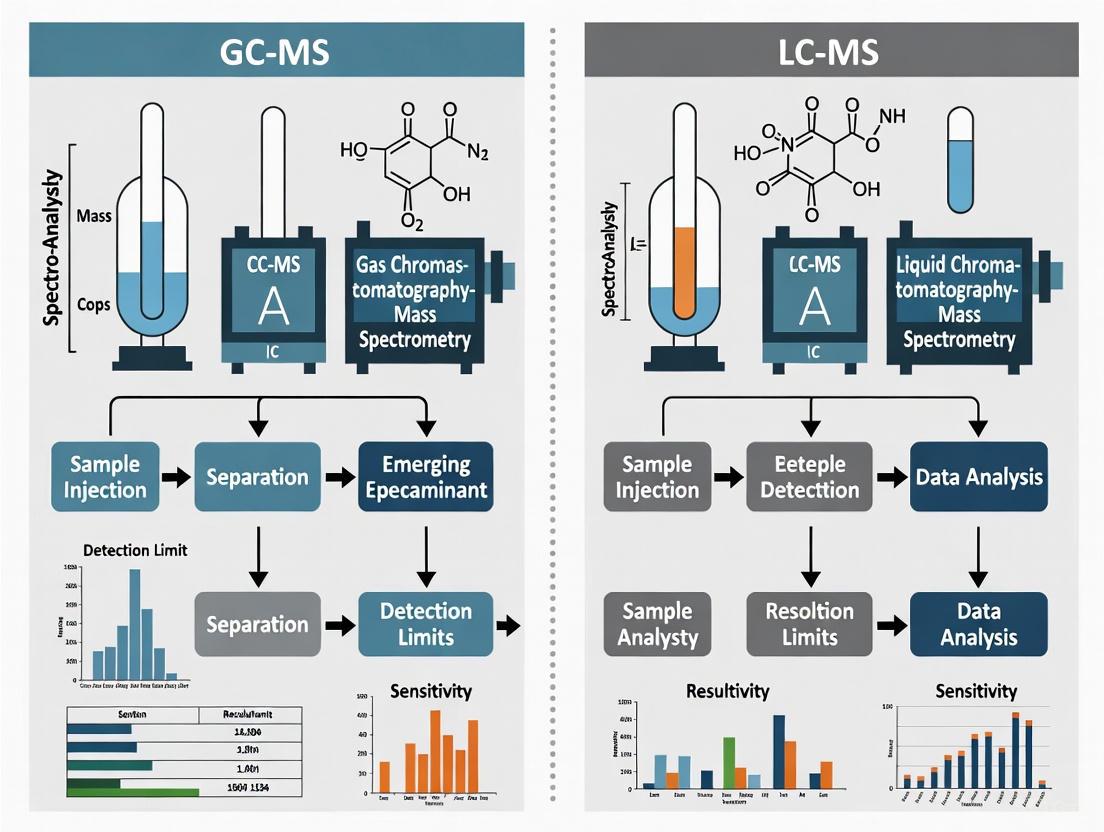
This article provides a comprehensive guide for researchers and scientists selecting between Gas Chromatography-Mass Spectrometry (GC-MS) and Liquid Chromatography-Mass Spectrometry (LC-MS) for the analysis of emerging contaminants (ECs).
GC-MS vs. LC-MS: Choosing the Optimal Technique for Emerging Contaminant Analysis
Abstract
This article provides a comprehensive guide for researchers and scientists selecting between Gas Chromatography-Mass Spectrometry (GC-MS) and Liquid Chromatography-Mass Spectrometry (LC-MS) for the analysis of emerging contaminants (ECs). Covering foundational principles, we detail the distinct advantages of each technique: GC-MS for volatile and semi-volatile compounds, and LC-MS for non-volatile, polar, and thermally labile analytes. The discussion extends to methodological applications across environmental, pharmaceutical, and food safety sectors, alongside practical troubleshooting for matrix effects and sensitivity optimization. By synthesizing validation data and comparative performance metrics, this guide delivers a strategic framework for method selection, ensuring accurate, sensitive, and reliable detection of ECs in complex matrices to support advanced research and regulatory compliance.
Core Principles: Understanding the Fundamental Differences Between GC-MS and LC-MS
In the field of analytical chemistry, particularly in research on emerging contaminants, two powerful techniques stand out: Gas Chromatography-Mass Spectrometry (GC-MS) and Liquid Chromatography-Mass Spectrometry (LC-MS). Both are hyphenated techniques that combine separation science with mass spectral detection, yet they function on different principles and are suited to different types of analytes. This guide provides an objective comparison of their working principles, performance, and applications to inform researchers and drug development professionals.
Core Principles of Operation
The fundamental operation of both techniques can be broken down into two main stages: chromatographic separation followed by mass spectrometric detection. The critical difference lies in the nature of the separation phase.
The GC-MS Workflow
GC-MS is designed for the analysis of volatile and thermally stable compounds [1] [2] [3]. The process begins in the gas chromatograph, where the sample is vaporized. An inert carrier gas (e.g., helium) serves as the mobile phase, transporting the vaporized sample through a heated column (the stationary phase) [4] [5]. Separation occurs based on the compounds' volatility and their interaction with the column's coating [1] [2]. As the separated compounds exit the column, they are transferred via a heated interface to the mass spectrometer. There, they are ionized, most commonly by electron ionization (EI), a "hard" method that causes significant fragmentation of the molecules. The resulting ions are then separated by the mass analyzer based on their mass-to-charge ratio (m/z) and detected [2] [5]. The output is a mass spectrum that serves as a unique fingerprint for each compound, which can be compared against extensive standard libraries [2].
The LC-MS Workflow
LC-MS, in contrast, is ideal for non-volatile, thermally labile, polar, or high-molecular-weight compounds [1] [3]. In the liquid chromatograph, a liquid mobile phase (a blend of solvents) carries the sample through a column packed with a stationary phase. Separation is based on properties like polarity, ionic charge, or affinity [1] [5]. The separated liquid stream then enters the mass spectrometer through a critical interface that must remove the solvent and ionize the analytes. Common "soft" ionization techniques include electrospray ionization (ESI) and atmospheric pressure chemical ionization (APCI), which typically produce intact molecular ions with little fragmentation [6] [2] [5]. These ions are then analyzed by the mass spectrometer to determine their m/z ratios.
The following diagram illustrates the core workflows and logical relationships for both techniques.
Technical Comparison and Performance Data
The differing principles of GC-MS and LC-MS lead to distinct performance characteristics, costs, and suitability for various analytical tasks. The table below summarizes quantitative data and key differentiators.
Table: Technical and Performance Comparison of GC-MS and LC-MS
| Feature | GC-MS | LC-MS |
|---|---|---|
| Separation Principle | Volatility & interaction with column [2] | Polarity, ionic charge, affinity [1] [5] |
| Ideal Analyte Properties | Volatile, thermally stable, non-polar, often <500 Da [2] [3] | Non-volatile, thermally labile, polar, ionic; small molecules to large biomolecules (>10 kDa) [1] [2] |
| Typical Ionization Method | Electron Ionization (EI) [2] [5] | Electrospray Ionization (ESI), Atmospheric Pressure Chemical Ionization (APCI) [6] [2] [5] |
| Sample Preparation | Often requires derivatization for non-volatile compounds [2] [3] | Typically minimal; may require careful pH/buffer control [2] |
| Identification Strength | High-confidence library matching (NIST/Wiley) [2] | Relies on MS/MS, accurate mass, and retention time [2] |
| Approx. Operational Cost | Lower CAPEX and OPEX; simple gas eluents [4] [2] | Higher OPEX; expensive solvents, more maintenance [1] [2] |
| Publication Rate (PubMed 1997-2023) | ~3,042/year [7] | ~3,908/year [7] |
Experimental Protocols for Emerging Contaminant Analysis
The choice between GC-MS and LC-MS for analyzing emerging contaminants is dictated by the physicochemical properties of the target analytes. Here are detailed methodological considerations.
GC-MS Experimental Protocol
GC-MS is the gold standard for volatile and semi-volatile organic contaminants.
- Target Analytes: This method is ideal for pollutants like volatile organic compounds (VOCs), polycyclic aromatic hydrocarbons (PAHs), and many pesticides [1] [5]. It is also the preferred technique for residual solvent analysis in pharmaceuticals [3].
- Sample Preparation: For non-volatile or polar targets, chemical derivatization is a critical step. This process modifies the analytes (e.g., by silylation or alkylation) to increase their volatility and thermal stability, making them amenable to GC analysis [2].
- Instrumental Analysis: The derivatized sample is injected into a heated inlet, vaporized, and carried by an inert gas (e.g., Helium) through a heated capillary column. After separation, compounds are ionized by EI (70 eV), which generates highly reproducible fragment ions. The resulting mass spectra are compared against large, well-established libraries (e.g., NIST) for confident identification [2] [5].
LC-MS Experimental Protocol
LC-MS is indispensable for polar, ionic, and thermally labile contaminants that are not suitable for GC-MS.
- Target Analytes: This method excels at detecting modern contaminants such as pharmaceuticals, personal care products, per- and polyfluoroalkyl substances (PFAS), and cyanotoxins [1] [3].
- Sample Preparation: Biological or environmental samples often undergo protein precipitation or solid-phase extraction (SPE) to clean up the matrix and pre-concentrate the analytes. Derivatization is generally not required [2].
- Instrumental Analysis: The extract is injected into the LC system, where metabolites are separated on a reversed-phase C18 column using a gradient of water and organic solvent (e.g., methanol or acetonitrile), often modified with buffers. The eluent is then ionized using a soft ionization technique like ESI, which typically produces intact [M+H]+ or [M-H]- ions. For unambiguous identification, tandem mass spectrometry (MS/MS) is used to generate unique fragment ion spectra, and quantification is performed by comparing against authentic analytical standards [6] [2] [5].
Research Reagent Solutions
A successful analysis requires careful selection of reagents and consumables. The table below details essential materials for GC-MS and LC-MS workflows.
Table: Essential Research Reagents and Materials
| Item | Function | Example Use Cases |
|---|---|---|
| Derivatization Reagents | Increases volatility of polar compounds for GC-MS | MSTFA for silylation of acids and sugars; PFBBr for phenols [2] |
| Inert Carrier Gas | Mobile phase for GC-MS; must be chemically inert | Ultra-high-purity Helium or Hydrogen [4] [5] |
| HPLC-Grade Solvents | Mobile phase for LC-MS; low UV cutoff and impurities | Acetonitrile, Methanol, Water for dissolving samples and running gradients [1] |
| LC-MS Buffers & Additives | Modifies mobile phase to control separation and ionization | Ammonium acetate/formate (volatile buffers); Formic acid (promotes positive ionization) [2] |
| Stationary Phases | The medium that interacts with analytes to achieve separation | Fused-silica capillary columns (GC-MS); C18, HILIC, or Ion-Exchange columns (LC-MS) [1] [2] |
| Stable Isotope-Labeled Internal Standards | Corrects for matrix effects and instrument variability; essential for quantification | 13C-, 2H-, or 15N-labeled versions of target analytes [7] |
| Quality Control (QC) Samples | Monitors instrument performance and corrects for long-term signal drift | Pooled samples from study subjects or certified reference materials [8] |
GC-MS and LC-MS are complementary, not competing, pillars of modern analytical science. GC-MS offers robust, library-supported identification for volatile and thermally stable compounds, often at a lower operational cost. LC-MS provides unparalleled versatility for analyzing a vast range of non-volatile, polar, and high-molecular-weight compounds, which includes many emerging contaminants of concern. The choice between them is not about which is superior, but about selecting the right tool based on the chemical nature of the analyte, the required sensitivity, and available resources. For the most comprehensive analytical coverage, many laboratories strategically employ both techniques to overcome the limitations of either one used alone.
In the field of emerging contaminant analysis, the selection of an appropriate analytical technique is paramount. The dichotomy between Gas Chromatography-Mass Spectrometry (GC-MS) and Liquid Chromatography-Mass Spectrometry (LC-MS) represents a fundamental technical divide rooted in the core physical and chemical properties of target analytes [1]. Emerging contaminants (ECs) encompass a remarkably diverse range of substances including pharmaceuticals, personal care products, endocrine-disrupting chemicals, per- and polyfluoroalkyl substances (PFAS), and microplastics, each with distinct chemical characteristics that directly influence analytical suitability [9] [10]. This guide provides an objective comparison of how volatility, polarity, thermal stability, and molecular weight dictate whether GC-MS or LC-MS delivers optimal performance for specific analytical challenges in environmental and pharmaceutical research.
The critical importance of technique selection is underscored by the expanding scope of EC monitoring. These contaminants are increasingly detected in various environmental matrices at trace concentrations (typically ng/L to μg/L), posing potential ecological and human health risks including endocrine disruption, antibiotic resistance, and bioaccumulation in aquatic organisms [9] [10]. Accurate identification and quantification at these low levels demands techniques specifically matched to analyte properties, as improper technique selection can result in failed detection, inaccurate quantification, or compound degradation [1] [2].
Fundamental Principles: How GC-MS and LC-MS Operate
Core Technological Foundations
Gas Chromatography-Mass Spectrometry (GC-MS) separates chemical mixtures using a gas mobile phase (typically helium) and a heated capillary column [11] [12]. Analytes must be vaporized without decomposition, making this technique ideal for volatile and semi-volatile compounds [13]. The separation occurs based on boiling point and interaction with the column's stationary phase [2]. Following separation, compounds enter the mass spectrometer where they are typically ionized using Electron Ionization (EI), a "hard" ionization method that produces extensive, reproducible fragmentation patterns ideal for library matching against established databases like NIST and Wiley [12] [2].
Liquid Chromatography-Mass Spectrometry (LC-MS) employs a liquid mobile phase under high pressure to separate compounds through a particle-packed column [11] [12]. Separation occurs primarily by molecular polarity, affinity for the stationary phase, and in some cases, size or charge [2]. This technique operates at ambient temperature, preserving thermally labile compounds that would degrade in GC-MS systems [1]. LC-MS predominantly uses "soft" ionization techniques like Electrospray Ionization (ESI) and Atmospheric Pressure Chemical Ionization (APCI) that produce minimal fragmentation, typically displaying the molecular ion with little breakage [12] [14]. This preserves the intact molecule for detection but provides less structural information without tandem MS capabilities.
The Volatility Threshold: A Decision Framework
The selection between GC-MS and LC-MS fundamentally hinges on analyte volatility and thermal stability, creating a natural analytical decision tree [2]. A practical rule of thumb suggests: if a compound is volatile and thermally stable at GC-MS operating temperatures (typically up to 300-350°C), it likely suits GC-MS analysis. Conversely, non-volatile, polar, ionic, or thermolabile compounds generally require LC-MS [1] [2]. Molecular weight provides another crucial selection criterion, with GC-MS typically performing best for compounds under approximately 500 Da, while LC-MS readily handles molecules ranging from small metabolites to large biomolecules weighing tens of thousands of Daltons [2].
Table 1: Technique Selection Guide Based on Analyte Properties
| Analyte Property | GC-MS Suitability | LC-MS Suitability |
|---|---|---|
| Volatility | High - Naturally volatile or semi-volatile | Low - Non-volatile, requires dissolution |
| Thermal Stability | High - Withstands vaporization temperatures (typically 300-350°C) | Low - Degrades under heat (thermolabile) |
| Polarity | Low to moderate polarity | Wide range including highly polar and ionic compounds |
| Molecular Weight | Typically <500 Da (lower molecular weight) | Small molecules to large biomolecules (>10,000 Da) |
| Sample State | Can be vaporized without decomposition | Stable in liquid solution |
This volatility divide creates complementary analytical domains. GC-MS excels for environmental volatile organic compounds (VOCs), essential oils, hydrocarbons, and many small metabolites [11] [2]. LC-MS dominates for pharmaceuticals, peptides, proteins, most PPCPs, and highly polar pesticides that cannot be vaporized without decomposition [1] [15]. For emerging contaminants specifically, this means volatile pollutants like certain solvents and lighter hydrocarbons align with GC-MS, while polar pharmaceuticals, complex PFAS, and most endocrine disruptors typically require LC-MS analysis [9] [15].
Technical Comparison: Performance Metrics and Limitations
Ionization Mechanisms and Information Output
The ionization processes in GC-MS and LC-MS differ dramatically, directly impacting the type of structural information obtained and the applicability for different compound classes [12].
GC-MS Ionization (Electron Ionization - EI):
- Process: Sample molecules in gaseous state are bombarded with high-energy electrons (typically 70 eV) [12]
- Fragmentation: Extensive and reproducible fragmentation patterns [2]
- Structural Information: Rich structural data from fragment ions
- Library Matching: Excellent compatibility with extensive EI spectral libraries (NIST, Wiley) enabling confident identification [2]
- Limitation: Often fragments molecular ion, making it difficult to determine original molecular weight
LC-MS Ionization (ESI/APCI):
- Process: Electrospray ionization (ESI) applies high voltage to liquid flow creating charged droplets; APCI uses corona discharge in heated chamber [13] [14]
- Fragmentation: Minimal in-source fragmentation ("soft" ionization) [12]
- Structural Information: Preserves molecular ion; requires tandem MS (MS/MS) for structural data
- Library Matching: Limited standardized libraries; relies more on retention time and accurate mass [2]
- Advantage: Excellent for molecular weight determination and labile compounds
Table 2: Ionization Characteristics and Information Output Comparison
| Parameter | GC-MS (EI) | LC-MS (ESI) | LC-MS (APCI) |
|---|---|---|---|
| Ionization Type | Hard ionization | Soft ionization | Soft ionization |
| Typical Fragmentation | Extensive | Minimal | Minimal |
| Molecular Ion Visibility | Often absent | Prominent | Prominent |
| Mass Range | Typically <500 Da | Wide range (up to >10,000 Da) | Small to medium molecules |
| Optimal Compound Types | Volatile, thermally stable | Polar, ionic, large biomolecules | Less polar, small to medium molecules |
| Matrix Effects | Less susceptible | More susceptible | Moderate susceptibility |
Sensitivity and Detection Limits
Sensitivity varies significantly between techniques and depends heavily on the specific analyte properties and instrumentation. LC-MS often provides superior limits of detection (LOD) in targeted bioanalysis for polar compounds, frequently reaching femtogram levels (10⁻¹⁵ mol) [12] [6]. GC-MS demonstrates excellent sensitivity for suitable volatile targets, typically in the picogram range (10⁻¹² mol), and can offer better separation of structural isomers due to higher chromatographic resolution [12] [2]. Advanced LC-MS systems like triple quadrupole and high-resolution Orbitrap instruments have dramatically improved sensitivity, enabling trace-level detection of emerging contaminants in complex environmental matrices [1] [6].
For emerging contaminant analysis specifically, LC-MS has demonstrated exceptional capability in detecting pharmaceuticals, pesticides, and personal care products at environmentally relevant concentrations (ng/L) in groundwater and wastewater [15]. GC-MS remains the gold standard for volatile and semi-volatile organic compounds including certain pesticides, hydrocarbons, and industrial chemicals where its separation power and library matching provide confident identification [11] [2].
Sample Preparation Requirements
Sample preparation diverges significantly between the two techniques, adding another crucial consideration in technique selection [13].
GC-MS Sample Preparation:
- Derivatization: Often required for non-volatile compounds to increase volatility and thermal stability [2]
- Solvent Compatibility: Requires non-polar solvents; water is particularly damaging to GC systems and columns [13]
- Drying: Critical step to remove all water residues using agents like sodium sulfate or specialized drying systems [13]
- Complexity: Derivatization adds steps, potential variability, and may lead to compound degradation or loss [2]
LC-MS Sample Preparation:
- Derivatization: Rarely required; samples are typically analyzed in native form or with minimal modification [2]
- Solvent Compatibility: Compatible with aqueous matrices and polar solvents; water is an acceptable mobile phase component [13]
- Cleanup: Often necessary to remove salts and ionization-suppressing contaminants [14]
- pH Control: Careful control of pH and buffer composition is essential to maximize ionization efficiency [14]
The sample preparation workflow directly impacts analysis time, potential analyte loss, method robustness, and overall cost. GC-MS derivatization can introduce additional variability and requires optimization, while LC-MS must carefully manage matrix effects that can suppress or enhance ionization [14].
Experimental Protocols and Methodologies
Standardized Analytical Workflows
Establishing robust experimental protocols is essential for reliable emerging contaminant analysis. The following workflows represent standardized approaches for both techniques.
GC-MS Protocol for Emerging Contaminant Analysis:
- Sample Preparation: Liquid-liquid extraction with non-polar solvents (hexane, dichloromethane) followed by drying through anhydrous sodium sulfate [13]
- Derivatization (if required): For polar compounds like phenols, acids, or certain pharmaceuticals, use BSTFA/TMCS or MSTFA for silylation at 60-70°C for 30-60 minutes [2]
- GC Conditions:
- MS Conditions:
LC-MS Protocol for Emerging Contaminant Analysis:
- Sample Preparation: Solid-phase extraction (SPE) using hydrophilic-lipophilic balance (HLB) cartridges; elution with methanol/acetonitrile; concentration under nitrogen [15]
- LC Conditions:
- MS Conditions:
- Ionization: ESI positive/negative mode switching or targeted mode
- Source temperature: 350°C
- Nebulizer gas: 30-50 psi
- Drying gas: 8-12 L/min
- Capillary voltage: 3000-4000V [14]
Research Reagent Solutions and Essential Materials
Successful implementation of GC-MS and LC-MS methods requires specific reagents and materials optimized for each technique.
Table 3: Essential Research Reagents and Materials for Emerging Contaminant Analysis
| Category | Specific Reagents/Materials | Function | Technique |
|---|---|---|---|
| Derivatization Reagents | BSTFA with 1% TMCS, MSTFA | Increase volatility of polar compounds for GC analysis | GC-MS |
| SPE Sorbents | HLB (Hydrophilic-Lipophilic Balance), C18, Ion Exchange | Extract and concentrate analytes from complex matrices | Both (LC-MS predominant) |
| LC Mobile Phase Additives | Ammonium formate, Ammonium acetate, Formic acid | Modify pH and improve ionization efficiency | LC-MS |
| GC Inlet Liners | Deactivated glass wool, Single/double taper designs | Ensure efficient vaporization and transfer | GC-MS |
| Ionization Assistants | Trimethylamine, Ammonium hydroxide (for negative mode) | Enhance ionization in specific modes | LC-MS |
| Quality Control | Deuterated/internal standards, System suitability mixes | Verify method performance and quantification accuracy | Both |
Application-Specific Performance in Emerging Contaminant Analysis
Comparative Performance Across Contaminant Classes
The analytical performance of GC-MS versus LC-MS varies significantly across different classes of emerging contaminants, reinforcing the importance of technique selection based on compound characteristics [9] [15].
Table 4: Technique Performance Across Emerging Contaminant Classes
| Contaminant Class | Representative Analytes | Optimal Technique | Detection Limits | Key Advantages |
|---|---|---|---|---|
| Pharmaceuticals | Antibiotics, Antidepressants, Analgesics | LC-MS (typically) | Low ng/L range [15] | Handles polar, thermolabile compounds without derivatization |
| Pesticides | Organophosphates, Triazines, Glyphosate | GC-MS (volatile) LC-MS (polar) | 0.14-3.20 μg/L [15] | GC-MS: Library matching LC-MS: Polar compound analysis |
| PFAS | PFOA, PFOS, GenX compounds | LC-MS (predominantly) | Sub-ng/L levels | Ideal for ionic, non-volatile fluorinated compounds |
| Endocrine Disruptors | Bisphenol A, Alkylphenols, Phthalates | GC-MS (after derivatization) LC-MS (native) | Varies by compound | GC-MS: Sensitivity after derivation LC-MS: Direct analysis |
| Microplastics | Polymer fragments, Additives | Pyrolysis-GC-MS | Material dependent | Direct polymer characterization |
Complementary Approaches for Comprehensive Analysis
For many environmental monitoring programs targeting broad suites of emerging contaminants, GC-MS and LC-MS serve as complementary rather than competing techniques [2]. Research demonstrates that comprehensive characterization of complex environmental samples often requires both platforms to cover the diverse chemical space occupied by different contaminant classes [9] [15]. GC-MS excels for volatile fractions including certain solvents, lighter weight hydrocarbons, and many legacy pesticides, while LC-MS dominates for polar, ionic, and thermally labile compounds including most pharmaceuticals, modern pesticides, and PFAS [15] [2].
Laboratories conducting extensive emerging contaminant research increasingly employ both techniques in tandem, recognizing that the "volatility divide" creates natural analytical domains for each platform [2]. This complementary approach is particularly valuable for non-targeted analysis where the full scope of contaminants may not be known in advance, allowing researchers to capitalize on the strengths of both platforms for comprehensive environmental assessment [9] [15].
The divide between GC-MS and LC-MS fundamentally reflects the core chemical properties of target analytes, particularly volatility and thermal stability. GC-MS remains the technique of choice for volatile and semi-volatile compounds that can withstand vaporization, offering excellent chromatographic resolution, reproducible fragmentation patterns, and extensive library matching capabilities [11] [2]. LC-MS dominates for polar, ionic, and thermally labile compounds, providing exceptional sensitivity for pharmaceuticals, personal care products, and other challenging emerging contaminants that represent growing environmental concerns [9] [15].
Strategic technique selection should begin with careful consideration of analyte properties, particularly volatility, polarity, thermal stability, and molecular weight [2]. The analytical objectives—whether targeted quantification, non-targeted screening, or structural characterization—further refine this selection [1]. Practical considerations including available instrumentation, expertise, sample throughput requirements, and operational budgets also influence the final decision [1] [2]. For comprehensive emerging contaminant analysis where resources allow, implementing both techniques as complementary approaches provides the most complete analytical coverage across the diverse chemical landscape of environmental pollutants [9] [15] [2].
In the analysis of emerging contaminants (ECs)—a diverse group of substances ranging from pharmaceuticals and personal care products (PPCPs) to microplastics and endocrine-disrupting chemicals—researchers are often faced with a critical initial choice: Gas Chromatography-Mass Spectrometry (GC-MS) or Liquid Chromatography-Mass Spectrometry (LC-MS) [9]. This decision is predominantly governed by two fundamental chemical properties of the target analytes: thermal stability and polarity [16] [1]. GC-MS requires compounds to be volatile and thermally stable to survive the high-temperature vaporization process in the GC inlet, whereas LC-MS is uniquely suited for non-volatile, thermally labile, and polar compounds, as it operates with a liquid mobile phase at room temperature [1] [4]. Navigating these limitations is essential for developing accurate, sensitive, and reliable methods for environmental and pharmaceutical analysis.
Core Principle Comparison: GC-MS vs. LC-MS
The following table summarizes the fundamental operational differences and how they relate to analyte properties.
Table 1: Fundamental differences between GC-MS and LC-MS in relation to chemical limitations.
| Feature | GC-MS | LC-MS |
|---|---|---|
| Mobile Phase | Gas (e.g., Helium) [11] [4] | Liquid (e.g., Methanol, Water, Buffers) [11] [1] |
| Separation Principle | Volatility & Interaction with column [1] | Polarity & Chemical Affinity [16] |
| Analyte Ideal Profile | Volatile and thermally stable compounds [16] [1] | Non-volatile, thermally labile, and polar compounds [1] |
| Key Limitation | Analyte must be vaporized without decomposition [16] | Analyte must be soluble in the mobile phase [16] |
| Common Workaround | Chemical derivatization [16] [1] | Optimization of mobile phase composition [16] |
Experimental Insights into Limitations and Solutions
Matrix Effects and Thermal Degradation in GC-MS
Experimental Context: A systematic investigation into the GC-MS analysis of 32 flavor components revealed that analytes are highly susceptible to matrix effects (MEs), particularly those with high boiling points, polar functional groups (e.g., -OH, -COOH), or when present at low concentrations [17]. These MEs often manifest as adsorption or degradation of analytes at active sites in the GC inlet or column, leading to poor peak shapes, low sensitivity, and inaccurate quantification [17].
Key Quantitative Data: Table 2: Impact of matrix effects and compensation using analyte protectants (APs) in GC-MS [17].
| Analyte Characteristic | Impact on GC-MS Signal | Compensation Strategy | Result after AP Application |
|---|---|---|---|
| High Boiling Point | Significant signal loss | AP combination: Malic acid + 1,2-tetradecanediol (1 mg/mL each) | Improved linearity and recovery (89.3–120.5%) |
| Polar Groups (e.g., -OH) | Peak tailing & adsorption | APs with strong hydrogen bonding capacity | Lowered LOQ (5.0–96.0 ng/mL) |
| Low Concentration | May remain undetected | Broad retention time coverage by APs | Enhanced sensitivity and detection |
Methodology: The compensation strategy involved adding analyte protectants (APs) to both samples and solvent-based calibration standards. The APs, which are compounds with high affinity for active sites (e.g., those with multiple hydroxyl groups), are introduced first and "mask" these sites, preventing the subsequent adsorption of target analytes [17]. The most effective combination was determined through a comprehensive evaluation of 23 potential APs, considering their retention time, hydrogen bonding capability, and concentration [17].
Ion Suppression and Quantification Challenges in LC-MS
Experimental Context: A nationwide U.S. study on antibiotics in sewage sludge quantified the impact of different LC-MS/MS quantification methods on analytical results [18]. The study highlighted that matrix effects, such as ion suppression or enhancement, are a major limitation in LC-MS, especially for complex environmental samples. Co-eluting matrix components can suppress the ionization of target analytes, leading to significant underestimation of concentration [18].
Key Quantitative Data: Table 3: Comparison of quantification methods for analyzing antibiotics in biosolids via LC-MS/MS [18].
| Quantification Method | Relative Performance (vs. Benchmark) | Key Implication |
|---|---|---|
| External Calibration | Over- or underestimation from 110% to 14,700% | Highly inaccurate for complex matrices |
| Standard Addition | More accurate, but labor-intensive | Requires analyzing each sample multiple times |
| Isotope Dilution (Non-target standard) | Variable performance (6% to 98% underestimation) | Better than external calibration, but not ideal |
| Isotope Dilution (Authentic target analog) | Most accurate and reliable | Gold standard; corrects for extraction loss & matrix effects |
Methodology: The study compared four quantification methods for six antibiotics (e.g., erythromycin, oxytetracycline) in biosolids [18]:
- External Calibration: Standards prepared in pure solvent.
- Isotope Dilution with Authentic Target Analog: Using a heavy-isotope-labeled version of the exact target analyte as an internal standard.
- Isotope Dilution with Non-target Standard: Using a heavy-isotope-labeled but structurally different compound as an internal standard.
- Standard Addition: Adding known amounts of the native standard directly to the sample extract.
The benchmark for comparison was the isotope dilution method for erythromycin and the standard addition method for other antibiotics [18].
The Scientist's Toolkit: Essential Research Reagents and Materials
Table 4: Key reagents and materials for navigating chemical limitations in GC-MS and LC-MS.
| Item | Function | Application Context |
|---|---|---|
| Analyte Protectants (e.g., Malic acid, 1,2-tetradecanediol) | Masks active sites in the GC system to prevent analyte adsorption/ degradation [17]. | GC-MS analysis of thermolabile or polar compounds to improve peak shape and sensitivity. |
| Derivatization Agents (e.g., BSTFA, PFBBr) | Chemically modifies analytes to increase their volatility and thermal stability [16]. | Enabling GC-MS analysis of otherwise non-volatile compounds (e.g., certain hormones, acids). |
| Isotopically Labeled Internal Standards (e.g., ¹³C, ²H analogs) | Corrects for analyte loss during sample preparation and compensates for matrix-induced ionization effects [18]. | Essential for accurate quantification in LC-MS/MS, especially in complex matrices like sludge or plasma. |
| QuEChERS Kits | Provides a quick, easy, cheap, effective, rugged, and safe method for sample extraction and clean-up [19]. | Preparing complex food and environmental samples for both GC-MS and LC-MS analysis to reduce matrix interference. |
| Ultra-Pure Solvents & Mobile Phase Additives | Serves as the liquid medium for separation; additives can modulate ionization efficiency and selectivity [16] [6]. | Critical for achieving optimal separation and detection sensitivity in LC-MS. |
Decision Workflow for Analytical Technique Selection
The following diagram outlines a logical pathway for choosing between GC-MS and LC-MS based on the chemical properties of the analytes and the required sample preparation.
The limitations imposed by thermal stability and polarity are not merely technical hurdles but foundational parameters that guide analytical method development. GC-MS excels for volatile and stable analytes but often requires strategies like derivatization or the use of analyte protectants to overcome its inherent limitations [17] [16]. LC-MS provides a versatile platform for polar and thermally labile molecules, yet its accuracy is highly dependent on sophisticated quantification methods like isotope dilution to account for matrix effects [18]. For researchers tackling emerging contaminants, a clear understanding of these core principles, complemented by the appropriate toolkit and workflows, is essential for generating reliable data that can inform public health and environmental policy.
The choice of ionization technique is a critical determinant of success in mass spectrometry (MS)-based analysis, particularly within the evolving field of emerging contaminant (EC) research. The fundamental division between gas chromatography-mass spectrometry (GC-MS) and liquid chromatography-mass spectrometry (LC-MS) often dictates the available ionization strategies. Within the context of analyzing ECs—which include pharmaceuticals, personal care products, and industrial chemicals with diverse physicochemical properties—selecting the appropriate ionization mechanism is paramount for achieving the necessary sensitivity, specificity, and reliability [20]. This guide provides a detailed, objective comparison of four cornerstone ionization techniques: Electron Ionization (EI), Electrospray Ionization (ESI), Atmospheric Pressure Chemical Ionization (APCI), and Atmospheric Pressure Photoionization (APPI). By framing this comparison within the practical challenges of EC analysis, we aim to equip researchers and drug development professionals with the data needed to optimize their analytical workflows.
Core Principles and Mechanisms
Electron Ionization (EI)
Mechanism: EI is a hard ionization technique conducted under high vacuum. A heated filament emits electrons, which are accelerated to 70 eV before colliding with gaseous analyte molecules. This high-energy interaction causes the analyte (M) to lose an electron, forming a radical cation (M⁺⁺), and often leads to extensive fragmentation [21] [22]. The resulting fragmentation patterns are highly reproducible and serve as a "fingerprint" for compound identification [21].
Ionization Pathway Diagram for EI:
Electrospray Ionization (ESI)
Mechanism: ESI is a soft desorption ionization technique that operates at atmospheric pressure. A sample solution is sprayed through a charged capillary to create a fine mist of charged droplets. As the solvent evaporates, the charge density on the droplets increases until Coulombic repulsion causes the ejection of analyte ions [21] [23]. For proteins and peptides, this process often yields multiply charged ions, effectively reducing their mass-to-charge ratio (m/z) and enabling the analysis of high molecular weight biomolecules [21] [23]. A key mechanistic model is the Charged-Residue Mechanism (CRM), where the analyte is ionized as the final solvent molecule evaporates, making the technique susceptible to adduction with non-volatile salts [24].
Ionization Pathway Diagram for ESI:
Atmospheric Pressure Chemical Ionization (APCI)
Mechanism: APCI is a soft ionization technique that also occurs at atmospheric pressure but involves gas-phase ion-molecule reactions. The sample solution is first nebulized and completely vaporized in a heated chamber (350–500 °C). A corona discharge needle then ionizes the solvent vapor (e.g., H₂O) to create primary reagent ions (e.g., H₃O⁺, H⁺(H₂O)ₙ). These reagent ions subsequently transfer charge to the analyte molecules (M) through proton transfer or adduction reactions, forming ions such as [M+H]⁺ [21] [25]. Unlike ESI, ionization occurs after the analyte is vaporized, making it less suitable for large, thermally labile biomolecules [25].
Ionization Pathway Diagram for APCI:
Atmospheric Pressure Photoionization (APPI)
Mechanism: APPI is designed for less polar compounds that may not ionize efficiently via ESI or APCI. In APPI, the nebulized and vaporized sample is exposed to photons from a ultraviolet (UV) lamp, typically filled with krypton or xenon [21]. If the analyte's ionization energy (IE) is lower than the photon energy, it can be ionized by direct photoionization (M → M⁺⁺). For analytes with higher IEs, a dopant (e.g., toluene or acetone) is added. The dopant is first ionized by the photons and then transfers charge to the analyte via ion-molecule reactions [21] [26].
Ionization Pathway Diagram for APPI:
Comparative Analysis of Ionization Techniques
Table 1: Comprehensive Comparison of EI, ESI, APCI, and APPI Ionization Techniques
| Feature | Electron Ionization (EI) | Electrospray Ionization (ESI) | Atmospheric Pressure Chemical Ionization (APCI) | Atmospheric Pressure Photoionization (APPI) |
|---|---|---|---|---|
| Ionization Mechanism | High-energy electron bombardment [21] | Charge residue from charged droplets [21] [24] | Gas-phase chemical ionization via corona discharge [21] [25] | Gas-phase photoionization, often with a dopant [21] |
| Ionization Environment | High vacuum [22] | Atmospheric pressure [23] | Atmospheric pressure [25] | Atmospheric pressure [21] |
| Typical Analyte Phase | Gas-phase [21] | Liquid-phase (directly from solution) [21] | Liquid-phase (vaporized before ionization) [25] | Liquid-phase (vaporized before ionization) [21] |
| Ion Types Produced | M⁺⁺ (radical cations), extensive fragments [22] | [M+nH]ⁿ⁺, [M-nH]ⁿ⁻ (multiply charged), adducts [21] | [M+H]⁺, [M-H]⁻, adducts [25] | M⁺⁺, [M+H]⁺, [M-H]⁻, dependent on dopant [21] |
| Fragmentation Level | High (hard ionization) [21] | Low (soft ionization) [21] | Low (soft ionization) [25] | Low to moderate (soft ionization) [21] |
| Ideal Analytes | Small, volatile, thermally stable molecules (< 600 Da) [21] [22] | Polar compounds, large biomolecules, peptides, proteins, non-covalent complexes [21] | Low-to-medium polarity, thermally stable small molecules (< 1500 Da), less polar than ESI analytes [21] [25] | Non-polar compounds (e.g., PAHs, lipids, steroids) [21] |
| Compatible Chromatography | GC-MS [21] | LC-MS [21] | LC-MS (handles high flow rates) [25] | LC-MS [21] |
| Key Advantages | Reproducible spectral libraries, rich structural info, robust [21] [22] | Analyzes large, non-volatile biomolecules; high sensitivity [21] [23] | Tolerates higher buffer concentrations than ESI; good for less polar small molecules [21] [25] | Handles non-polar compounds poorly ionized by ESI/APCI [21] [26] |
| Key Limitations | Not for thermally labile or non-volatile samples; weak molecular ion [21] | Susceptible to ion suppression from salts/matrix [21] [24] | Requires thermal stability; not for large, fragile biomolecules [21] | Lower efficiency for polar compounds; requires optimization of dopant [21] |
Table 2: Quantitative Performance Data in Drug Discovery Context (Positive Ion Mode) [26]
| Ionization Technique | Detection Rate (Set 1, n=86) | Detection Rate (Set 2, n=201) | Comparative Ionization Efficiency |
|---|---|---|---|
| APPI | 100% | 94% | Highest overall |
| APCI | Not Reported | 84% | Intermediate |
| ESI | Not Reported | 84% | Intermediate |
Experimental Protocols and Recent Advancements
Protocol for Native ESI-MS Analysis in High-Salt Buffers
The analysis of proteins and protein complexes directly from physiologically relevant buffers containing non-volatile salts (e.g., NaCl) is a significant challenge for native ESI-MS due to ion suppression and salt adduction. A refined protocol using theta emitters has been developed to address this [24].
Methodology:
- Emitter Preparation: Theta emitters (borosilicate glass capillaries with an internal septum creating two channels) are pulled to an inner diameter of ~1.4 μm [24].
- Sample Loading: One channel of the theta emitter is loaded with the protein sample dissolved in a biological buffer (e.g., PBS). The other channel is loaded with 199 mM ammonium acetate (AmAc) containing a solution additive, such as bromide or iodide anions, which have relatively low proton affinities [24].
- Ionization and Mass Analysis: Dual platinum wires are inserted into each channel. A voltage of 0.80 – 2.0 kV is applied to generate an electrospray. Theta emitters are positioned 1–2 mm from the MS orifice [24].
- Gas-Phase Activation: Two sequential collisional heating methods are used to remove salt adducts without causing dissociation:
- Beam-type Collision-Induced Dissociation (BTCID): Ions are accelerated into a quadrupole collision cell containing N₂ bath gas (6–10 mTorr) [24].
- Dipolar Direct Current (DDC) Offset: An offset potential is applied across opposing rods of a linear quadrupole ion trap, displacing ions into regions of higher RF field strength, increasing collision energies with bath gas via RF-heating [24].
Key Findings: The addition of low proton affinity anions (Br⁻, I⁻) to the AmAc channel significantly reduces chemical noise and ionization suppression compared to using AmAc alone. This strategy increases the signal-to-noise (S/N) ratios, reproducibility, and robustness for mass analyzing proteins and complexes from solutions with physiologically relevant salt concentrations [24].
Performance Evaluation in Drug Discovery
A comparative study of 201 proprietary drug candidates evaluated the universality of APPI, APCI, and ESI [26]. The results, summarized in Table 2, demonstrate that APPI provided the highest detection rate (94%) in positive ion mode, compared to 84% for both APCI and ESI. When combining positive and negative ion modes, the detection rate for APPI reached 98%, compared to 91% for the other two techniques. This study concluded that APPI is a more universal ionization method, especially beneficial for analyzing compounds with diverse structures and polarities in high-throughput drug discovery settings [26].
The Scientist's Toolkit for Ionization Method Selection
Table 3: Essential Research Reagents and Materials for Ionization Techniques
| Item | Function/Description | Primary Application |
|---|---|---|
| Ammonium Acetate (Volatile Salt) | A MS-compatible buffer for exchanging non-volatile biological salts to reduce ion suppression and adduction in ESI [24]. | ESI, APCI, APPI |
| Theta Emitters | Dual-channel glass emitters (~1.4 μm i.d.) enabling rapid mixing of sample and additive streams immediately prior to electrospray, aiding analysis in high-salt buffers [24]. | ESI |
| Dopants (e.g., Toluene, Acetone) | Compounds with low ionization energy that are first ionized by UV photons, subsequently transferring charge to the analyte via ion-molecule reactions [21]. | APPI |
| Corona Discharge Needle | A sharp electrode maintained at a few microamps of current to generate a stable electrical discharge for producing primary reagent ions [25]. | APCI |
| Krypton/Xenon UV Lamp | A photon source (typically 10 eV) used to ionize the analyte or a dopant molecule through photoionization [21]. | APPI |
| Heated Nebulizer Interface | Vaporizes the LC eluate into a gaseous state before it reaches the ionization region, a critical step for gas-phase ionization techniques [25]. | APCI, APPI |
| Non-volatile Salts (e.g., NaCl, KCl) | Used to mimic physiologically relevant conditions or are inherent components of biological buffers; their management is a key challenge in MS analysis [24]. | ESI (Challenge) |
The selection of an ionization technique is inextricably linked to the analytical goal and the physicochemical nature of the target analytes, a decision often guided by the choice between GC-MS and LC-MS platforms. For the analysis of emerging contaminants, which represent a highly diverse group of compounds, no single ionization method is universally optimal.
- GC-EI-MS remains the gold standard for volatile and semi-volatile organic compounds (e.g., certain pesticides, PAHs) due to its robust libraries and rich structural information [21] [20].
- LC-ESI-MS is the dominant technique for polar, non-volatile, and thermally labile compounds, such as pharmaceuticals, personal care products, and their metabolites, directly from liquid samples [20].
- LC-APCI-MS serves as a vital bridge for semi-volatile and moderately polar compounds that are less amenable to ESI, including certain steroids and lipids, and offers greater tolerance to higher buffer concentrations [21] [25].
- LC-APPI-MS fills a critical niche by ionizing non-polar compounds (e.g., some PAHs, flame retardants) that are poorly handled by both ESI and APCI, making it the most universal technique for diverse compound sets in drug discovery [26].
The ongoing development of emitter designs, gas-phase activation methods, and the strategic use of solution additives are pushing the boundaries of what is possible, particularly in analyzing complex biological samples with minimal pre-treatment. By understanding the fundamental mechanisms, strengths, and limitations of each ionization technique, researchers can make informed decisions to enhance the sensitivity, accuracy, and scope of their analyses in environmental and pharmaceutical research.
Strategic Applications: Matching GC-MS and LC-MS to Emerging Contaminant Classes
In the evolving landscape of environmental analytical chemistry, researchers confront a complex array of hazardous compounds, from volatile organic compounds (VOCs) signaling disease to persistent legacy pesticides cycling globally for decades. While Liquid Chromatography-Mass Spectrometry (LC-MS) has gained prominence for polar, non-volatile, and thermally labile compounds, Gas Chromatography-Mass Spectrometry (GC-MS) maintains a definitive position for analyzing volatile and semi-volatile organic compounds critical to environmental and human health assessment. The technique's resolving power, sensitivity, and robust spectral libraries make it indispensable for specific contaminant classes, even as LC-MS applications expand. This guide objectively compares GC-MS performance against alternative techniques, focusing on its specialized domains: VOCs, polycyclic aromatic hydrocarbons (PAHs), and legacy pesticides, providing researchers with experimental data and protocols to inform analytical selection within a broader methodology framework.
GC-MS Analysis of Volatile Organic Compounds (VOCs)
Performance Data and Applications
GC-MS excels in separating, identifying, and quantifying Volatile Organic Compounds (VOCs), which are characterized by their high vapor pressure and low water solubility. Recent studies highlight its application across diverse matrices, from biological fluids to environmental materials.
Table 1: GC-MS Performance in VOC Analysis Across Matrices
| Application Domain | Sample Matrix | Key Sample Preparation | Analytical Performance | Reference |
|---|---|---|---|---|
| Biomarker Discovery | Whole Blood (Veterinary) | Urea-NaCl mixture for protein denaturation | Detection sensitivity increased by 151.3%; Matrix effect variation reduced to -35.5% to 25% | [27] |
| Plant Volatilome | Tomato Plants | Optimized collection procedure; AOAC Guideline validation | 15 VOCs analyzed; Method validated for repeatability and reproducibility | [28] |
| Material Emissions | Plastic Runway Tracks | Environmental chamber; SUMMA canister; Three-stage cold trap | 101 VOCs simultaneously determined; LOD: 0.005–0.220 ppb; RSD: 0.16–4.94% | [29] |
Detailed Experimental Protocol: Whole Blood VOCs
A novel sample preparation method for analyzing VOCs in whole blood demonstrates significant advancements in handling complex matrices [27]:
- Protein Denaturation: Add a reagent combination of urea and NaCl to the whole blood sample. This mixture disrupts protein-VOC binding, enhancing the release (decoupling) of VOCs.
- Analysis: Analyze the prepared sample using GC-MS.
- Performance Gain: This optimized preparation advanced detection sensitivity by up to 151.3% and significantly reduced matrix effect variation (-35.5% to 25%) compared to a water-only control, making it particularly suitable for veterinary cancer biomarker research.
Workflow for VOC Analysis from Solid Materials
The analysis of VOCs emitted from materials like plastic runways requires a controlled release and highly sensitive collection and detection strategy, as visualized below.
GC-MS Analysis of Polycyclic Aromatic Hydrocarbons (PAHs)
Performance Data and Applications
PAHs are stable, non-polar organic contaminants with two or more fused benzene rings, many of which are carcinogenic. GC-MS, particularly GC-MS/MS, is a benchmark technique for their determination in food and environmental samples.
Table 2: GC-MS Performance in PAH Analysis
| Application Domain | Sample Matrix | Key Sample Preparation | Analytical Performance | Reference |
|---|---|---|---|---|
| Food Safety | Dried Tea | Acetonitrile extraction; Cleanup with C18, Z-Sep+, MgSO4 | 29 analytes (PAHs & derivatives); LOD: 0.10–1.99 ng g⁻¹; LOQ: 1–10 ng g⁻¹; Recovery: 70.9–103.0% | [30] |
| Food Safety & Risk Assessment | Herbs & Spices | Alkaline hydrolysis (KOH), n-hexane extraction, Florisil SPE cleanup | LOD: 0.08–0.18 µg/kg; LOQ: 0.24–0.55 µg/kg; Rec. consistent with AOAC | [31] |
Detailed Experimental Protocol: PAHs in Herbs and Spices
A validated GC-MS method for quantifying four marker PAHs (4PAHs) in herbs and spices involves a robust sample preparation protocol based on the Korean MFDS method [31]:
- Alkaline Hydrolysis: Accurately weigh 10 g of homogenized sample into a flask. Spike with internal standards (Chrysene-d12 and Benzo[a]pyrene-d12). Add 100 mL of 1 M potassium hydroxide (KOH) solution and reflux at 80°C for 3 hours.
- Liquid-Liquid Extraction: After cooling, add 50 mL of n-hexane via the condenser. Transfer the hydrolysate to a separatory funnel and wash with 50 mL of ethanol/n-hexane (1:1, v/v). Perform two further extractions, each with 50 mL of n-hexane.
- Cleanup: Combine the n-hexane layers and wash three times with 50 mL of deionized water. Dry the extract over sodium sulfate (Na₂SO₄) and concentrate using rotary evaporation.
- Solid-Phase Extraction (SPE): Condition a Florisil cartridge with 10 mL of dichloromethane (DCM) and 20 mL of n-hexane. Load the concentrated extract and elute the PAHs with 10 mL of n-hexane, followed by 20 mL of n-hexane/DCM (3:1, v/v).
- Analysis: Evaporate the eluate to dryness under a nitrogen stream, reconstitute in 1 mL of DCM, filter through a 0.45 μm PTFE membrane, and analyze by GC-MS.
GC-MS Analysis of Legacy Pesticides
Performance Data and Trends
Legacy pesticides, such as organochlorine pesticides (OCPs), are semi-volatile compounds whose environmental persistence and potential for long-range transport make them ideal candidates for GC-MS monitoring.
Table 3: GC-MS Performance in Monitoring Legacy Pesticides in Air
| Aspect | Findings | Reference |
|---|---|---|
| Target Analytes | 30 OCPs and related metabolites monitored over a 10-year period at a rural site in the Czech Republic. | [32] |
| Sampling Protocol | Biweekly sampling using high-volume air sampler. Gaseous OCPs collected on pre-cleaned Polyurethane Foam (PUF) plugs; particles on Quartz Fibre Filters (QFFs). | [32] |
| Key Trend Findings | Despite bans, OCPs persist. Overall decreasing atmospheric concentrations indicate diminishing environmental reservoirs. For some OCPs (e.g., γ-HCH, DDE), leveling trends suggest enhanced secondary sources or re-volatilization. | [32] |
Detailed Experimental Protocol: Atmospheric Pesticides
Long-term monitoring of atmospheric pesticides requires rigorous sampling and preparation to ensure data integrity and comparability over time [32]:
- Air Sampling: A high-volume air sampler (e.g., Digitel DH77) with a PM10 inlet is used. The gaseous phase is collected on a polyurethane foam (PUF) plug, while the particulate phase is collected on a quartz fiber filter (QFF). Sampling is typically conducted over week-long periods.
- Sample Preparation: Prior to sampling, PUF plugs are pre-cleaned via Soxhlet extraction with appropriate solvents (e.g., acetone and dichloromethane) to remove background contamination.
- Extraction and Analysis: After collection, samples are spiked with isotopically labeled internal standards and extracted automatically (e.g., using a Büchi E-800 system). The final extract is concentrated and analyzed by GC-MS.
The Scientist's Toolkit: Essential Research Reagent Solutions
Table 4: Key Reagents and Materials for GC-MS Analysis of Target Contaminants
| Item Name | Function in Analysis | Application Examples |
|---|---|---|
| Urea with NaCl | Protein denaturation reagent; enhances VOC release from proteins in complex biological matrices like blood. | Veterinary VOC biomarker discovery [27] |
| SUMMA Canister | Inert, passivated container for collecting whole air samples; preserves VOC composition without bias. | Sampling VOCs from materials and ambient air [29] |
| C18, Z-Sep+, MgSO4 | Sorbent combinations for dispersive solid-phase extraction (d-SPE); remove matrix interferents during sample cleanup. | PAH analysis in dried tea [30] |
| Florisil Cartridge | Adsorbent for Solid-Phase Extraction (SPE); purifies extracts by retaining non-polar interferences like fats and pigments. | Cleanup for PAH determination in herbs/spices [31] |
| Polyurethane Foam (PUF) Plug | Traps gaseous-phase semi-volatile organic compounds (e.g., pesticides, PCBs) from high-volume air samples. | Atmospheric monitoring of legacy pesticides [32] |
| Tenax TA | Porous polymer adsorbent; used in thermal desorption tubes for trapping and concentrating VOCs from air or gas streams. | Common in air monitoring and material emission studies |
GC-MS vs. LC-MS: A Comparative Framework for Contaminant Analysis
The choice between GC-MS and LC-MS is fundamentally guided by the physicochemical properties of the target analytes, primarily their volatility, polarity, and thermal stability [1] [20].
GC-MS is the superior technique for analyzing volatile and semi-volatile, thermally stable, non-polar to moderately polar compounds. This makes it the "gold standard" for VOCs, PAHs, and legacy pesticides like OCPs [20]. Its strengths include high chromatographic resolution, robust and reproducible quantitative analysis, and access to extensive, well-established electron ionization (EI) spectral libraries for confident compound identification [1].
LC-MS, in contrast, is designed for non-volatile, thermally labile, and polar compounds that are not amenable to GC-MS analysis without complex derivatization. It is the preferred technique for pharmaceuticals, personal care products, polar pesticides, and large biomolecules [1] [20]. Its primary advantage is the ability to directly analyze this wider range of compounds, with electrospray ionization (ESI) being particularly effective for ionic and readily ionizable species.
It is crucial to note that the techniques are often complementary. For example, while GC-MS is ideal for parent PAH compounds, LC-MS may be better suited for studying their polar metabolic derivatives [20]. Furthermore, sample preparation can blur the lines; derivatization can make some polar compounds amenable to GC-MS analysis, expanding its applicability [1].
The following diagram summarizes the decision-making workflow for selecting the appropriate mass spectrometry technique.
GC-MS remains an indispensable and highly effective platform for the analysis of specific, critical classes of environmental contaminants. Its capabilities for providing highly sensitive, reproducible, and library-supported data on VOCs, PAHs, and legacy pesticides ensure its continued relevance in environmental monitoring, food safety, and health research. While LC-MS has expanded the analytical toolbox to cover a broader spectrum of polar and labile emerging contaminants, the techniques are best viewed as complementary. The choice between them should be a deliberate decision based on the chemical nature of the target analytes, with GC-MS representing the optimal solution for volatile and semi-volatile organic compound analysis.
The analysis of emerging contaminants, such as pharmaceuticals, personal care products (PPCPs), and polar metabolites, presents a significant challenge in modern environmental and pharmaceutical research. These compounds are often polar, thermally labile, and present in complex matrices at trace concentrations, making them difficult to separate, identify, and quantify. The selection of the appropriate analytical technique is crucial for accurate monitoring and risk assessment. This guide objectively compares the performance of Liquid Chromatography-Mass Spectrometry (LC-MS) and Gas Chromatography-Mass Spectrometry (GC-MS) for this application, providing experimental data to highlight the distinct advantages of LC-MS platforms, particularly for polar and non-volatile molecules.
Fundamental Principles and Technical Comparison
Liquid Chromatography-Mass Spectrometry (LC-MS) combines the physical separation capabilities of liquid chromatography (LC) with the mass analysis capabilities of mass spectrometry (MS). The LC system separates mixtures of components using a pressurized liquid mobile phase and a stationary phase column. The separated components are then transferred into the mass spectrometer via an interface, most commonly an electrospray ionization (ESI) source, which efficiently ionizes the molecules from a liquid state for mass analysis [33] [34]. This interface is critical as it bridges the fundamental incompatibility between a pressurized liquid system and the high-vacuum environment of the mass spectrometer [33].
Gas Chromatography-Mass Spectrometry (GC-MS), in contrast, separates mixtures by vaporizing the analytes and carrying them through the column with an inert gas. The separated components are then ionized, typically by electron ionization (EI), in the MS source [35]. This technique requires that analytes be volatile and thermally stable enough to survive the vaporization process without decomposing.
The fundamental distinction in ionization techniques is the primary factor determining the suitability of each method for different classes of compounds. ESI and other atmospheric pressure ionization (API) techniques used in LC-MS are exceptionally well-suited for polar, thermally labile, and higher molecular weight compounds, as they do not require volatility or thermal stability [33].
Table 1: Core Technical Comparison of LC-MS and GC-MS
| Feature | LC-MS | GC-MS |
|---|---|---|
| Ionization Source | Electrospray Ionization (ESI), Atmospheric Pressure Chemical Ionization (APCI) [33] | Electron Ionization (EI), Chemical Ionization (CI) [33] |
| Analyte Requirements | Must be soluble in liquid mobile phase; no volatility required | Must be volatile and thermally stable |
| Ideal Analyte Properties | Polar, non-volatile, thermally labile, high molecular weight [36] | Volatile, thermally stable, semi-volatile |
| Sample Preparation | Can be minimal (e.g., filtration, dilution); Solid-Phase Extraction (SPE) common [37] | Often requires derivatization for polar compounds; Liquid-Liquid Extraction common [35] |
| Primary Strength | Analysis of pharmaceuticals, polar metabolites, peptides, proteins [37] [36] | Analysis of volatile organic compounds (VOCs), fuels, fragrances [35] |
Experimental Data: Performance Comparison for PPCP Analysis
Direct comparative studies provide empirical evidence for the strengths of LC-MS in analyzing emerging contaminants. A study focused on analyzing PPCPs in surface and treated wastewater directly compared HPLC-TOF-MS and GC-MS, revealing clear differences in performance.
Table 2: Comparison of Detection Limits for Selected PPCPs by LC-MS and GC-MS [35]
| Compound | Therapeutic Class | Detection Limit (LC-MS) | Detection Limit (GC-MS) |
|---|---|---|---|
| Carbamazepine | Antiepileptic | Lower | Higher |
| Ibuprofen | Non-steroidal anti-inflammatory drug (NSAID) | Lower | Higher |
| Ketoprofen | Non-steroidal anti-inflammatory drug (NSAID) | Lower | Higher |
| Naproxen | Non-steroidal anti-inflammatory drug (NSAID) | Lower | Higher |
| Triclocarban | Antimicrobial | Lower | Higher |
| β-Estradiol | Hormone | Lower | Higher |
The data consistently shows that HPLC-TOF-MS yielded lower detection limits than GC-MS for the panel of PPCPs tested [35]. Furthermore, the study found that for several compounds, liquid-liquid extraction provided superior recoveries over solid-phase extraction, though the optimal sample preparation method is often analyte- and matrix-dependent [35].
The robustness of LC-MS is further demonstrated in targeted application studies. A multi-residue method for 52 pharmaceuticals in drinking water using UHPLC-MS/MS with direct injection achieved recoveries of 70–120% for most analytes and repeatability within 20%, successfully validating the method for real-world monitoring [37]. This "fit-for-purpose" approach highlights the practicality of LC-MS for routine screening.
Detailed Experimental Protocol: A Representative LC-MS Workflow
The following is a detailed methodology for the analysis of PPCPs in water samples using solid-phase extraction coupled with LC-MS/MS, representative of established protocols in the field [37] [35].
Materials and Reagents
- Internal Standards: Deuterated or other stable isotope-labeled analogs of the target analytes are essential for accurate quantification, correcting for matrix effects and variability in sample preparation and ionization [38].
- Solvents: LC-MS grade methanol, acetonitrile, and water.
- SPE Sorbents: Reversed-phase polymer sorbents (e.g., Oasis HLB) [37].
- Syringe Filters: PTFE or cellulose, 0.2 µm porosity [37].
Sample Collection and Preparation
- Collection: Collect water samples in clean glass or plastic containers. Preserve by acidifying or adding chelating agents like EDTA to prevent analyte degradation during transport and storage [37].
- Filtration: Filter samples through a 0.2 µm filter to remove suspended particles.
- Internal Standard Addition: Add a known amount of internal standard solution to the sample immediately prior to extraction to account for procedural losses and matrix effects [38] [37].
- Solid-Phase Extraction (SPE):
- Condition the SPE sorbent with sequential volumes of methanol and reagent water.
- Load the sample onto the cartridge at a controlled flow rate (e.g., 0.15–0.2 mL/min).
- Dry the cartridge under vacuum for ~20 minutes to remove residual water.
- Elute analytes with an organic solvent such as acetonitrile or methanol.
- Gently evaporate the eluate under a stream of nitrogen and reconstitute in an injection-compatible solvent [35].
Instrumental Analysis: UHPLC-MS/MS
- Chromatography:
- Column: Reversed-phase C18 column (e.g., 150 mm x 2.1 mm, 1.8–3.5 µm particle size).
- Mobile Phase: (A) Water with 0.1% formic acid; (B) Acetonitrile with 0.1% formic acid.
- Gradient: Programmed from 20% B to 80% B over 20 minutes, followed by a wash and re-equilibration step [35].
- Flow Rate: 0.2-0.4 mL/min.
- Injection Volume: 1-10 µL.
- Mass Spectrometry:
- Ionization: Electrospray Ionization (ESI) in positive or negative mode, depending on the analyte.
- Operation Mode: Multiple Reaction Monitoring (MRM) for high sensitivity and selectivity quantitative analysis.
- Source Parameters: Optimize desolvation gas temperature and flow, nebulizer pressure, and capillary voltage [37] [35].
Identification and Quantification
- Identification: Confirm analyte presence by matching the retention time and the relative intensity of two MRM transitions with a reference standard [39].
- Quantification: Use a calibration curve constructed from analyte standards, with peak areas normalized to the internal standard for precise and accurate results [38].
LC-MS Workflow for PPCP Analysis in Water
The Scientist's Toolkit: Essential Research Reagent Solutions
Successful LC-MS analysis relies on a suite of essential reagents and materials to ensure accuracy, precision, and reliability.
Table 3: Essential Reagents and Materials for LC-MS Analysis of PPCPs
| Item | Function/Purpose | Example |
|---|---|---|
| Stable Isotope-Labeled Internal Standards | Corrects for sample loss, matrix effects, and ionization variability; essential for precise quantification [38]. | Deuterated (D₃, D₅) analogs of target pharmaceuticals. |
| LC-MS Grade Solvents | Minimizes background noise and ion suppression; ensures high signal-to-noise ratio and system cleanliness. | Methanol, Acetonitrile, Water with < 5 ppb UV absorbance. |
| SPE Sorbents | Isolates, purifies, and concentrates target analytes from complex aqueous matrices. | Oasis HLB, Strata-X [37]. |
| Mobile Phase Additives | Promotes protonation/deprotonation of analytes in the ESI source; improves chromatographic peak shape. | Formic Acid, Ammonium Acetate, Ammonium Formate. |
| UHPLC Columns | Provides high-resolution separation of complex mixtures, reducing co-elution and matrix effects. | C18, 1.8 µm particle size, 100-150 mm length. |
| Quality Control (QC) Materials | Verifies instrument performance, method accuracy, and precision throughout an analytical batch. | Processed Blank, Continuing Calibration Verification, Spiked Samples. |
The experimental data and technical comparisons presented in this guide unequivocally demonstrate that LC-MS is the superior analytical technique for targeting pharmaceuticals, PPCPs, and polar metabolites. Its principal advantage lies in its compatibility with polar, non-volatile, and thermally labile compounds without the need for complex derivatization. When the analytical challenge involves these emerging contaminants in complex matrices like water, biological fluids, or food, LC-MS provides the sensitivity, selectivity, and robust quantitative results necessary for reliable research and monitoring.
The analysis of emerging contaminants presents a significant challenge for modern analytical science, requiring techniques that are both highly specific and sensitive. Within this context, the combination of chromatography with mass spectrometry has become an indispensable tool. While Gas Chromatography and Liquid Chromatography coupled to mass spectrometry have long been foundational techniques, their tandem mass spectrometry (MS/MS) and high-resolution mass spectrometry (HRMS) hybrids represent the current state-of-the-art [40] [41].
This guide objectively compares the performance of GC-MS/MS and LC-MS/MS systems, focusing on their application in identifying and quantifying trace-level contaminants in complex matrices. The evolution from single-stage MS to MS/MS and HRMS configurations has substantially improved analytical specificity and sensitivity, enabling researchers to differentiate target analytes from complex background interference with greater confidence [42] [40]. The selection between GC and LC platforms fundamentally hinges on the physicochemical properties of the analytes, yet advanced hybrid approaches are continually expanding the boundaries of what each technique can achieve.
Fundamental Principles and Technical Configurations
Core Technological Differences
GC-MS/MS and LC-MS/MS systems, though sharing the common goal of separating and identifying compounds, diverge significantly in their operational principles and ideal application domains. The primary distinction lies in the chromatographic phase and the sample introduction and separation process.
GC-MS/MS employs a gas mobile phase to transport a vaporized sample through a heated column. This technique is exceptionally suited for volatile and thermally stable compounds that can be vaporized without decomposition [42] [11] [4]. The mass spectrometry component typically utilizes electron ionization (EI), a hard ionization method that generates extensive, reproducible fragment spectra. A key strength of GC-EI-MS is the availability of extensive, universal spectral libraries, such as those from the National Institute of Standards and Technology (NIST), which facilitate compound identification [41].
LC-MS/MS utilizes a liquid mobile phase (often a mixture of solvents and buffers) to push the sample through a column at room temperature. This makes it ideal for non-volatile, thermally labile, or polar molecules that would decompose under GC heating conditions [43] [40] [11]. LC-MS/MS predominantly uses soft ionization techniques like electrospray ionization (ESI) and atmospheric pressure chemical ionization (APCI), which produce less fragmentation, often yielding molecular or protonated molecules as primary ions [40]. This gentler process allows for the analysis of a broader range of compounds, including large biomolecules.
Table 1: Fundamental Operating Principles of GC-MS/MS and LC-MS/MS
| Feature | GC-MS/MS | LC-MS/MS |
|---|---|---|
| Mobile Phase | Inert gas (He, H₂, N₂) [42] [4] | Liquid solvents and buffers [11] [4] |
| Sample State | Must be volatile and thermally stable [42] | Can be non-volatile and thermally labile [43] [40] |
| Separation Mechanism | Boiling point/polarity interaction with column [42] | Polarity/hydrophobicity/size interaction with column [40] |
| Common Ionization | Electron Ionization (EI) [41] | Electrospray Ionization (ESI), Atmospheric Pressure Chemical Ionization (APCI) [40] |
| Typical Ionization Outcome | Extensive fragmentation; library-searchable spectra [41] | Minimal fragmentation; prominent molecular ion [40] |
Advanced HRMS and Hybrid Workflows
Modern high-resolution mass spectrometers (HRMS) like Quadrupole Time-of-Flight (QTOF) and Orbitrap analyzers have further enhanced these techniques. GC-HRMS and LC-HRMS provide accurate mass measurements, enabling the determination of elemental compositions with high confidence, which is crucial for identifying unknown contaminants [41].
Recent hybrid configurations integrate additional separation dimensions. For instance, GC-APCI-IMS-QTOF MS combines gas chromatography with a soft atmospheric pressure chemical ionization source, an ion mobility spectrometer (IMS), and a high-resolution QTOF mass analyzer [41]. Ion mobility provides an additional separation based on the ion's size, shape, and charge, yielding a collisional cross-section (CCS) value—a reproducible physicochemical property that serves as an extra identifier and helps reduce false positives [41]. Conversely, GC-EI-QOrbitrap MS leverages the robust fragmentation of EI with the high mass accuracy and resolving power of an Orbitrap mass analyzer, making it exceptionally powerful for non-targeted screening using established libraries [41].
Experimental Performance Comparison
Quantitative Performance Data
A direct comparison of GC-MS and LC-MS/MS for urinalysis of five benzodiazepines under the Department of Defense Drug Demand Reduction Program revealed key performance metrics. Both technologies were evaluated using internally prepared control urine samples around a 100 ng/mL decision point [43].
Table 2: Quantitative Performance of GC-MS vs. LC-MS/MS for Benzodiazepine Analysis in Urine [43]
| Analyte | Technology | Average Accuracy (%) | Average Precision (%CV) |
|---|---|---|---|
| Alpha-hydroxyalprazolam | GC-MS | 99.7 - 107.3 | < 9.0 |
| LC-MS/MS | 99.7 - 107.3 | < 9.0 | |
| Oxazepam | GC-MS | 99.7 - 107.3 | < 9.0 |
| LC-MS/MS | 99.7 - 107.3 | < 9.0 | |
| Lorazepam | GC-MS | 99.7 - 107.3 | < 9.0 |
| LC-MS/MS | 99.7 - 107.3 | < 9.0 | |
| Nordiazepam | GC-MS | 99.7 - 107.3 | < 9.0 |
| LC-MS/MS | 99.7 - 107.3 | < 9.0 | |
| Temazepam | GC-MS | 99.7 - 107.3 | < 9.0 |
| LC-MS/MS | 99.7 - 107.3 | < 9.0 |
The study concluded that both technologies produced comparable accuracy and precision for the target analytes at the administrative decision point [43]. However, a notable finding was a 39% increase in the mean measured concentration of nordiazepam by LC-MS/MS in some service member specimens. This was attributed to ion suppression of the deuterated internal standard caused by the presence of a flurazepam metabolite (2-hydroxyethylflurazepam), highlighting the importance of monitoring for matrix effects even when using stable isotope internal standards [43].
Operational and Practical Considerations
Beyond pure performance data, several practical factors influence the choice of technique.
Sample Preparation: LC-MS/MS often requires minimal sample preparation; in some cases, samples can be simply diluted and injected ["dilute-and-shoot"] [43]. In contrast, GC-MS/MS typically requires more extensive preparation, including derivatization to increase the volatility and thermal stability of polar compounds, a process that adds time and complexity [43] [42].
Analysis Speed and Throughput: The avoidance of derivatization and the potential for faster run times make LC-MS/MS a more expedient technology for high-volume laboratory environments [43].
Scope of Analysis: LC-MS/MS can identify and measure a broader range of compounds, including those that are not amenable to GC due to polarity or thermal lability [43]. GC-MS/MS, however, remains superior for volatile and semi-volatile organic compounds.
Experimental Protocols for Emerging Contaminant Analysis
Sample Preparation Workflow
Robust sample preparation is critical for accurate analysis, especially in complex matrices like biological or environmental samples.
Protocol for Fish Feed/Environmental Samples (Based on GC-HRMS Method) [41]:
- Homogenization: Samples are homogenized using a crushing machine, often with dry ice.
- Spiking (for QC): For quality control, samples are spiked with a mix of target analytes and allowed to equilibrate.
- Extraction: An accurately weighed sample (e.g., 5 g) is vortexed with an organic solvent (e.g., 10 mL acetonitrile).
- Partitioning: A salt (e.g., 1 g MgSO₄) is added to induce phase separation, followed by shaking and centrifugation.
- Cleanup: The supernatant undergoes a clean-up step using a Dispersive Solid-Phase Extraction (d-SPE) kit (e.g., containing PSA, C18, and MgSO₄) to remove interfering matrix components like lipids and organic acids.
- Concentration: The cleaned extract is evaporated to dryness under a gentle nitrogen stream and then reconstituted in a small volume of a suitable solvent (e.g., hexane) for injection.
Protocol for Urinalysis (LC-MS/MS Method) [43]:
- Enzymatic Hydrolysis: A urine aliquot is combined with β-glucuronidase enzyme and buffer, then incubated (e.g., 60 min at 55°C) to hydrolyze glucuronide conjugates and release the parent drugs or metabolites.
- Solid-Phase Extraction (SPE): The hydrolyzed sample is loaded onto a conditioned SPE cartridge. Impurities are washed away, and the analytes of interest are eluted with an organic solvent.
- Evaporation and Reconstitution: The eluent is evaporated to dryness and reconstituted in a mobile-phase-compatible solvent for LC-MS/MS analysis. Notably, this protocol does not require a derivatization step.
Instrumental Analysis Parameters
Detailed instrumental methods are key to reproducibility.
GC-MS/MS Analysis (e.g., for Benzodiazepines) [43]:
- Instrument: Agilent 7890 GC coupled to a 5975 MS.
- Column: HP-ULTRA 1 (15 m, 0.20 mm, 0.33 μm).
- Carrier Gas: Helium at 0.9 mL/min.
- Injection: Pulsed splitless mode, 0.5 μL.
- Derivatization: After extraction, dried extracts are derivatized with a reagent like MTBSTFA (with 1% MTBDMCS) at 65°C for 20 minutes.
LC-MS/MS Analysis (General Principles) [40]:
- Ionization: Electrospray Ionization (ESI) in positive or negative mode.
- Mass Analyzer: Triple quadrupole (QqQ).
- Data Acquisition: Multiple Reaction Monitoring (MRM). The first quadrupole (Q1) selects a specific precursor ion from the analyte. The second quadrupole (q2) acts as a collision cell, fragmenting the precursor ion using an inert gas. The third quadrupole (Q3) selects a specific product ion. This precursor→product ion pair is monitored for highly specific and sensitive detection.
Essential Research Reagent Solutions
The following reagents and materials are critical for conducting reliable GC-MS/MS and LC-MS/MS analyses in research on emerging contaminants.
Table 3: Key Research Reagents and Materials for Hybrid MS Approaches
| Reagent/Material | Function | Example Application |
|---|---|---|
| Deuterated Internal Standards (ISTDs) | Corrects for sample loss during preparation and mitigates matrix effects (ion suppression/enhancement) [43] [40]. | Quantification of benzodiazepines in urine; essential for accurate LC-MS/MS bioanalysis [43]. |
| β-Glucuronidase Enzyme | Hydrolyzes glucuronide conjugates of drugs and metabolites in biological samples, releasing the aglycone for measurement [43]. | Sample pre-treatment for urinalysis of drug metabolites [43]. |
| Derivatization Reagents (e.g., MTBSTFA) | Increases volatility and thermal stability of polar compounds for GC-MS analysis by substituting active hydrogens (e.g., in -OH, -NH groups) [43]. | Analysis of benzodiazepines like temazepam and oxazepam by GC-MS [43]. |
| Solid-Phase Extraction (SPE) Columns | Isolates, purifies, and concentrates analytes from complex sample matrices, reducing ion suppression and improving sensitivity [43]. | Cleanup of urine extracts prior to GC-MS or LC-MS/MS analysis [43] [41]. |
| QuEChERS d-SPE Kits | Provides a streamlined, mixed-sorbent cleanup for complex food and environmental matrices following extraction [41]. | Removal of fats, pigments, and organic acids from fish feed and food samples [41]. |
| High-Purity Solvents & Buffers | Serves as the mobile phase (LC) or extraction solvents; impurities can cause significant background noise and ion suppression [43] [40]. | Acetonitrile, methanol, formic acid, and ammonium buffers are ubiquitous in sample prep and LC-MS [43]. |
GC-MS/MS and LC-MS/MS are powerful, complementary techniques in the analytical chemist's toolkit for emerging contaminant research. The choice between them is not a matter of one being universally superior but rather which is best suited to the specific analytical problem.
GC-MS/MS excels in the cost-effective, highly sensitive analysis of volatile and thermally stable compounds, with the unmatched advantage of universal, searchable EI spectral libraries. It remains a gold standard for applications like pesticide analysis, petroleum hydrocarbons, and fire investigation [42] [44] [4].
LC-MS/MS provides a broader analytical scope, capable of handling non-volatile, polar, and thermally labile molecules with minimal sample preparation [43] [11]. Its superiority in analyzing large biomolecules, combined with high throughput, makes it indispensable in biotechnology, pharmaceutical analysis, and clinical toxicology [43] [45].
The ongoing integration of high-resolution accurate mass (HRAM) analyzers, ion mobility separation, and sophisticated data processing workflows is blurring the lines between targeted and non-targeted screening. As these hybrid HRMS approaches continue to evolve, they will undoubtedly unlock deeper insights into the complex world of emerging contaminants, empowering researchers and drug development professionals to make more informed decisions.
The analysis of emerging contaminants, such as Pharmaceuticals and Personal Care Products (PPCPs) in water and mycotoxins in food, is critical for public health and environmental safety. These analyses present significant challenges due to the complexity of sample matrices and the need to detect trace-level concentrations of target analytes. Within this analytical landscape, mass spectrometry (MS) coupled with chromatographic techniques has become the cornerstone for reliable detection and quantification. The choice between Gas Chromatography-Mass Spectrometry (GC-MS) and Liquid Chromatography-Mass Spectrometry (LC-MS) is pivotal and depends on the physicochemical properties of the target analytes and the specific analytical requirements. This guide objectively compares the performance of GC-MS and LC-MS through real-world case studies, providing experimental data and protocols to inform method selection for emerging contaminant analysis.
Performance Comparison: GC-MS vs. LC-MS for Contaminant Analysis
The following tables summarize key performance metrics from published studies for PPCP and mycotoxin analysis, highlighting the relative strengths of each technique.
Table 1: Performance comparison for PPCP analysis in water matrices
| Performance Metric | GC-MS Performance | LC-MS Performance | Context from Case Studies |
|---|---|---|---|
| Detection Limits | Generally higher LODs for many PPCPs [46] | Lower detection limits reported; e.g., 1–2 ppt for multi-residue analysis [47] | HPLC-TOFMS provided lower detection limits than GC-MS for PPCPs in surface water [46] |
| Analyte Coverage | Better for legacy organochlorine pesticides [48] | Broader coverage for polar, non-volatile, and thermally labile compounds [49] [50] | LC-MS/MS allows simultaneous analysis of highly water-soluble estrogens and pesticides without derivatization [48] |
| Sample Preparation | Often requires derivatization for many PPCPs [49] | Minimal sample cleanup; no derivatization needed [49] | LC-MS/MS analysis possible with minimal sample cleanup, while GC-MS can require time-consuming derivatization [49] |
| Recovery Efficiency | Varies with compound and extraction | Varies with compound and extraction; LLE showed superior overall recoveries for a PPCP panel [46] | In a direct comparison, liquid-liquid extraction gave superior overall recoveries for a panel of PPCPs [46] |
Table 2: Performance comparison for mycotoxin analysis in food matrices
| Performance Metric | GC-MS Performance | LC-MS Performance | Context from Case Studies |
|---|---|---|---|
| Primary Application | Screening and quantitative analysis, often for certain mycotoxin types [19] | The most widely used technique for multi-mycotoxin analysis [51] [19] [52] | LC-MS is now the most widely used technique for the detection of mycotoxins in food [19] |
| Multi-analyte Capacity | Limited | Excellent for simultaneous determination of multiple mycotoxins [51] [19] | LC-MS/MS has been used to analyze over 120 food matrices for mycotoxins [19] |
| Sensitivity | Good sensitivity [19] | High sensitivity; LODs in the low ng/g range are achievable [19] | LC-MS and GC-MS have better sensitivity than conventional HPLC methods [19] |
| Sample Preparation | Can require derivatization | QuEChERS is a fast, simple, and effective sample pre-treatment [51] [19] | QuEChERS method is economical, fast, and does not require specialized personnel [51] |
Case Study 1: Analysis of PPCPs in Surface and Wastewater
Experimental Protocol
A direct comparison of GC-MS and LC-MS for analyzing PPCPs was conducted using water samples from the Tar River and a local wastewater treatment plant in North Carolina [46].
- Sample Collection: Water samples were obtained in spring 2013 and fall 2015.
- Sample Preparation:
- Extraction: Both Solid Phase Extraction (SPE) and Liquid-Liquid Extraction (LLE) were compared. SPE was performed using C18 disks conditioned with acetonitrile, methanol, and deionized water. LLE was performed with organic solvents.
- Procedure: For SPE, 500 mL of spiked water was loaded onto the disk, dried, and eluted with acetonitrile. The eluate was concentrated to under 1 mL before analysis [46].
- Instrumental Analysis:
- GC-MS: An Agilent 7890A/5975B system with a DB-5MS column was used. The temperature program was 150°C (hold 5 min) to 300°C at 10°C/min. Helium was the carrier gas [46].
- LC-MS: An Agilent 1200/6220 HPLC-TOFMS system with a C18 column was used. The mobile phase was a gradient of water and acetonitrile, both with 1% formic acid [46].
- Quantification: Calibration curves from 5 µg/mL to 25 ng/mL were constructed for both instruments [46].
Results and Data Interpretation
The study provided a direct, quantitative comparison of the two techniques for the same set of samples [46].
- Extraction Efficiency: Liquid-Liquid Extraction (LLE) was found to provide overall superior recoveries compared to Solid Phase Extraction (SPE) for the panel of PPCPs [46].
- Detection Sensitivity: HPLC-TOFMS yielded lower detection limits than GC-MS for the analyzed compounds [46].
- Identified Contaminants: The methods successfully detected numerous PPCPs and metabolites, including carbamazepine, iminostilbene, oxcarbazepine, epiandrosterone, loratadine, β-estradiol, and triclosan [46].
This case study demonstrates that for a broad panel of PPCPs with diverse properties, LC-MS (specifically HPLC-TOFMS) can offer superior sensitivity while LLE provides a more efficient extraction approach.
Case Study 2: Multi-Mycotoxin Analysis in Food Commodities
Experimental Protocol
Advanced LC-MS/MS methods have become the benchmark for multi-mycotoxin analysis, as demonstrated in a study of soy-based burgers [19].
- Sample Material: Soy-based burgers were used as a representative complex food matrix.
- Sample Preparation:
- Instrumental Analysis:
- Technique: Ultra-High-Performance Liquid Chromatography coupled with Quadrupole Exactive Orbitrap High-Resolution Mass Spectrometry (UHPLC-Q-Exactive-Orbitrap HRMS).
- Separation: A C18-AR column provided an effective separation of key mycotoxins, including structurally similar aflatoxins, in less than 5 minutes [52].
- Quantification: The high resolution and accurate mass capabilities of the Orbitrap mass spectrometer enabled precise identification and quantification against matrix-matched calibration curves [19].
Results and Data Interpretation
The application of advanced LC-HRMS provides comprehensive contaminant profiling.
- Method Performance: The method showed recoveries in the range of 78–108% for the target mycotoxins, with high precision (RSD < 12%). The limits of quantitation (LOQs) for all compounds were in the low ng/g range [19].
- Multi-analyte Capacity: The method successfully identified and quantified 21 mycotoxins and 12 isoflavones in a single run, showcasing its high-throughput capability [19].
- Real-World Findings: The co-existence of multiple mycotoxins was observed in almost all analyzed samples, highlighting the prevalence of combined contamination [19].
This case study confirms that LC-MS/MS, particularly when leveraging HRMS and efficient sample preparation like QuEChERS, is a powerful tool for monitoring complex mixtures of mycotoxins in challenging food matrices.
The Scientist's Toolkit: Key Reagents and Materials
Successful analysis requires careful selection of reagents and materials. The following table lists essential components for these analytical workflows.
Table 3: Essential research reagents and materials for contaminant analysis
| Category | Specific Examples | Function in Analysis |
|---|---|---|
| Extraction Sorbents | ENVI-Disk C18 [46]; DVB-VP and PS-DVB polymers [53] | Solid-phase extraction to isolate and concentrate target analytes from liquid samples. |
| Extraction Solvents | Acetonitrile, Methanol, Ethyl Acetate [46] [51] | Liquid-liquid extraction to partition analytes from the aqueous or solid sample matrix. |
| Chromatography Columns | DB-5MS (GC) [46]; Zorbax Eclipse Plus C18 (LC) [46]; ACE Excel 2 C18-AR (for mycotoxins) [52] | Stationary phases for separating individual analytes from each other and from matrix components. |
| Mobile Phase Additives | Formic Acid, Ammonium Formate, Ammonium Acetate [47] [49] | Volatile buffers and ion-pairing agents to improve chromatographic separation and MS ionization. |
| Internal Standards | Isotopically Labeled Analogs (e.g., Erythromycin-13C₂) [18] | To correct for analyte loss during sample preparation and matrix effects during ionization. |
| Sample Preservatives | Ascorbic Acid, Sodium Thiosulfate [53] | Added to water samples to neutralize disinfectants like chlorine that can degrade target PPCPs. |
Critical Considerations for Analytical Method Selection
The Impact of Quantification Methods on Data Accuracy
The choice of quantification method significantly impacts the accuracy of results, especially in complex matrices. A systematic study comparing four common quantification methods for LC-MS/MS analysis of antibiotics in sewage sludge revealed substantial variations [18].
- External Calibration: When used as a benchmark, other methods showed overestimations (110–450%) or underestimations (10–60%) for the antibiotic erythromycin [18].
- Isotope Dilution Method: This method, which uses isotopically labeled analogs of the target analytes as internal standards, is considered the most accurate and is the most commonly used in published literature for pharmaceuticals in sewage sludge [18].
- Standard Addition: This method can be a reliable alternative when isotopically labeled standards are unavailable [18].
- Matrix Effects: The study confirmed that signal suppression or enhancement is dependent on both the matrix and analyte type. For instance, erythromycin consistently showed signal suppression across all sample matrices [18].
This underscores that the analytical technique (GC-MS or LC-MS) is only one part of the equation; the quantification strategy must be experimentally validated for specific analyte-matrix combinations to ensure data reliability.
Analytical Workflow and Contaminant Pathways
Understanding the complete pathway of contaminants from the environment to the laboratory is key to designing a robust monitoring program. The following diagram illustrates the journey of PPCPs and the corresponding analytical workflow.
The direct comparison of GC-MS and LC-MS for analyzing PPCPs and mycotoxins reveals a clear and complementary picture. LC-MS/MS is the dominant and more versatile technique for these applications, particularly due to its ability to analyze polar, non-volatile, and thermally labile compounds without derivatization, its superior sensitivity for a broad range of emerging contaminants, and its excellent performance in multi-residue methods [46] [19] [49]. However, GC-MS/MS maintains a crucial role for specific analytes, such as legacy pesticides (e.g., DDT) and certain less-polar mycotoxins, where it can offer robust performance [19] [48].
The choice between these powerful techniques should be guided by the specific physicochemical properties of the target analytes, the required sensitivity, and the complexity of the sample matrix. Furthermore, the selection of an appropriate quantification method, such as isotope dilution, is equally critical for generating accurate and reliable data [18]. As the list of emerging contaminants continues to grow, the synergy between advanced LC-MS and GC-MS platforms will remain fundamental to comprehensive environmental and food safety monitoring.
Optimization and Problem-Solving: Enhancing Sensitivity and Overcoming Matrix Effects
In the realm of analytical chemistry, particularly in the analysis of emerging contaminants, sample preparation is a critical step that significantly influences the accuracy, sensitivity, and reliability of final results. Efficient extraction techniques isolate target analytes from complex matrices while removing interfering substances, thereby enhancing detection capabilities and instrument performance. Within the context of comparing Gas Chromatography-Mass Spectrometry (GC-MS) and Liquid Chromatography-Mass Spectrometry (LC-MS) for emerging contaminant research, the choice of extraction method becomes even more pivotal. GC-MS is ideally suited for volatile, thermally stable, and non-polar compounds, whereas LC-MS excels at analyzing polar, large biomolecules, or thermally unstable compounds [1] [3]. The compatibility between the extraction technique and the subsequent analytical instrument directly affects method performance, making it essential to understand the strengths and limitations of each approach.
This guide provides a comprehensive, data-driven comparison of two fundamental sample preparation techniques: Solid Phase Extraction (SPE) and Liquid-Liquid Extraction (LLE). By examining their principles, efficiencies, and practical applications, we aim to equip researchers and drug development professionals with the knowledge needed to select the optimal sample preparation strategy for their specific analytical challenges in emerging contaminant analysis.
Understanding the Fundamental Principles
Solid Phase Extraction (SPE)
Solid Phase Extraction is a sophisticated sample preparation technique that utilizes a solid sorbent material to selectively retain target analytes from a liquid sample based on specific physical or chemical interactions [54]. The process is characterized by its sequential phases: the sorbent is first conditioned with solvents to prepare its surface, after which the sample is loaded, allowing analytes to bind to the sorbent. A washing step follows to remove undesired matrix components, and finally, a selective elution solvent is applied to release the purified analytes for analysis [55]. The selectivity of SPE is largely determined by the sorbent material, with common options including reversed-phase (e.g., C18 for non-polar compounds), normal-phase (for polar compounds), and ion-exchange sorbents (for charged analytes) [56] [57]. Key technical parameters influencing SPE performance include sorbent material chemistry, particle size, pore size, surface area, and bed mass [58]. Modern advancements like Oasis PRiME HLB sorbents have simplified protocols by eliminating conditioning and equilibration steps, thereby speeding up the sample preparation workflow [59].
Liquid-Liquid Extraction (LLE)
Liquid-Liquid Extraction, also known as solvent extraction, is a traditional separation technique that exploits the differential solubility of compounds between two immiscible liquid phases, typically an aqueous phase and an organic solvent [55]. In practice, the sample is mixed vigorously with an immiscible organic solvent, enabling analytes to partition between the two phases based on their relative solubilities and polarity [56] [57]. After mixing, the phases are allowed to separate, and the phase containing the enriched analytes is collected for further processing and analysis [55]. The efficiency of LLE is governed by the Nernst distribution law, which states that a solute will distribute itself between two immiscible solvents in a constant ratio of concentrations, known as the partition coefficient. While LLE is well-established and requires minimal specialized equipment, it can be labor-intensive, time-consuming, and prone to emulsion formation, which complicates phase separation [56] [55]. Additionally, it typically consumes larger volumes of organic solvents compared to modern alternatives like SPE [55].
Supported Liquid Extraction (SLE) – A Hybrid Technique
Supported Liquid Extraction represents a modern hybrid approach that incorporates aspects of both LLE and SPE. In SLE, the aqueous sample is immobilized on an inert, high-surface-area support material, such as diatomaceous earth [59] [56]. An immiscible organic solvent is then passed through this supported aqueous layer, facilitating the partitioning of analytes into the organic phase without the vigorous shaking required in traditional LLE [59] [54]. This technique offers several advantages, including the elimination of emulsion formation, easier automation compared to LLE, and no need for conditioning steps [54]. However, like SPE, it requires specialized single-use consumables (columns or plates) [56].
Table 1: Fundamental Characteristics of Extraction Techniques
| Characteristic | Solid Phase Extraction (SPE) | Liquid-Liquid Extraction (LLE) | Supported Liquid Extraction (SLE) |
|---|---|---|---|
| Principle | Physical/chemical adsorption onto solid sorbent [54] | Partitioning between two immiscible liquids [55] | Partitioning using an inert support to hold aqueous phase [59] |
| Primary Mechanism | Selective retention and elution [55] | Differential solubility [57] | Differential solubility without shaking [54] |
| Phase Interface | Solid-Liquid | Liquid-Liquid | Liquid-Liquid (supported) |
| Emulsion Formation | No [54] | Yes, common problem [56] [55] | No [54] |
| Automation Potential | High [55] | Low [55] | Moderate to High [56] |
Diagram 1: Fundamental principles and optimal applications of three common extraction techniques: Solid Phase Extraction (SPE), Liquid-Liquid Extraction (LLE), and Supported Liquid Extraction (SLE).
Head-to-Head Comparison: Experimental Data and Efficiency Metrics
Recovery Efficiency and Matrix Effects
Comparative studies provide valuable insights into the performance characteristics of different extraction techniques. A comprehensive evaluation examining 22 pharmaceuticals, steroids, and drugs of abuse in plasma and 23 drugs of abuse in urine revealed significant differences in extraction efficiency. Oasis PRiME HLB SPE demonstrated superior recoveries and reduced matrix effects across most tested analytes compared to both SLE and LLE, without requiring method optimization. Specifically, SLE and LLE showed lower recoveries for polar basic analytes in urine samples and acidic analytes in plasma samples. While LLE and SLE protocols could be optimized for these problematic compounds, such improvements came at the expense of recovery for other analytes. Only the Oasis PRiME HLB SPE method successfully extracted all analytes from both plasma and urine matrices using a single, unmodified protocol [59].
Throughput, Solvent Consumption, and Practical Considerations
From a practical workflow perspective, SPE offers distinct advantages in throughput and solvent consumption. SPE protocols have been documented as "significantly faster" compared to SLE and LLE, particularly when using modern sorbents that eliminate conditioning and equilibration steps [59]. The μElution format further streamlines the process by enabling direct injection of extracts without evaporation or reconstitution. In contrast, LLE typically requires a solvent evaporation step followed by reconstitution, adding time and complexity to the process [59]. Regarding solvent usage, SPE generally consumes low to moderate solvent volumes, while LLE is characterized by high solvent consumption [55]. LLE is also more labor-intensive and less amenable to automation compared to SPE, which can be readily automated for high-throughput workflows [55].
Table 2: Quantitative Performance Comparison of SPE vs. LLE
| Performance Metric | Solid Phase Extraction (SPE) | Liquid-Liquid Extraction (LLE) | Experimental Context |
|---|---|---|---|
| Recovery (Plasma) | Superior for most analytes [59] | Lower for acidic analytes [59] | 22 drugs in plasma [59] |
| Recovery (Urine) | Higher for polar bases [59] | Lower for polar bases [59] | 23 drugs of abuse in urine [59] |
| Matrix Effects | Improved (cleaner extracts) [59] | More pronounced [59] | Plasma and urine matrices [59] |
| Extraction Protocol Time | Significantly faster [59] | Labor-intensive and time-consuming [59] [55] | Generic protocol comparison [59] |
| Solvent Consumption | Low to Moderate [55] | High [55] | General methodology [55] |
| Method Development | May require optimization [56] | Well-established but may need optimization for specific analytes [59] | Application-specific development |
| Single-Method Versatility | Successfully extracted all analytes with single method [59] | Required multiple protocols for comparable recovery [59] | 22 analyte mixture [59] |
Application-Based Selection Guide
Alignment with Analytical Instrumentation
The choice between SPE and LLE should be strongly influenced by the subsequent analytical technique, particularly when framed within the GC-MS vs. LC-MS context. GC-MS is ideal for volatile, thermally stable, and non-polar compounds, such as residual solvents, hydrocarbons, and some pesticides [1] [3]. For this technique, both SPE and LLE can be effective, though LLE has a long history of use for extracting non-polar analytes compatible with GC-MS. In contrast, LC-MS excels with polar, thermally unstable, and larger molecules, including many pharmaceuticals, peptides, and biomarkers [1] [3]. SPE is generally preferred for LC-MS applications because it efficiently removes matrix components that can interfere with electrospray ionization, provides excellent recovery for polar compounds, and allows for sample concentration [59]. The direct compatibility of SPE eluents with LC-MS mobile phases further simplifies the analytical workflow.
Matrix and Analyte Considerations
The sample matrix and specific properties of target analytes significantly influence the optimal extraction choice:
- Biological Matrices (Plasma, Urine, Blood): SPE generally demonstrates superior performance for complex biological samples, providing cleaner extracts with reduced matrix effects [59]. Specific SPE sorbents can be selected to target particular compound classes, such as drugs of abuse or pharmaceuticals, in these matrices [59] [55].
- Environmental Samples (Water, Soil Extracts): Both techniques are widely applied. SPE is preferred for concentrating trace-level pollutants like pesticides, herbicides, and pharmaceutical residues from water samples [55]. LLE remains common for extracting semi-volatile organics from wastewater, particularly when dealing with large sample volumes [55].
- Food and Beverage Matrices: SPE effectively captures mycotoxins, veterinary drug residues, and other contaminants from complex food matrices [55] [19]. LLE is suitable for extracting fat-soluble vitamins from oils and other non-polar analytes [55].
Table 3: Scenario-Based Selection Guide
| Scenario | Recommended Technique | Rationale |
|---|---|---|
| Selective analyte isolation from complex matrix | SPE [55] | High selectivity for target compounds [55] |
| Processing large sample volumes | LLE [55] | Effective for large volumes with minimal equipment [55] |
| High-throughput workflows | SPE [55] | Highly automatable with parallel processing capabilities [59] [55] |
| Minimizing solvent consumption | SPE [55] | Lower solvent usage compared to LLE [55] |
| Non-polar analytes in simple matrices | LLE [55] | Effective for non-polar/semi-polar analytes [55] |
| Polar or basic analytes | SPE [59] | Superior recovery for polar bases versus LLE [59] |
| Emerging contaminant screening | SPE [59] | Broader analyte coverage with single method [59] |
| Limited budget for equipment | LLE [56] | Requires minimal specialized equipment [56] |
Diagram 2: Decision workflow for selecting the most appropriate extraction technique based on key experimental parameters and requirements.
Essential Research Reagent Solutions
Successful implementation of extraction methodologies requires specific materials and reagents. The following table outlines essential components for SPE and LLE workflows:
Table 4: Essential Research Reagents and Materials for Extraction Protocols
| Item | Function/Application | Extraction Technique |
|---|---|---|
| C18 Sorbent | Reversed-phase extraction of non-polar to moderately polar analytes [58] | SPE |
| Ion-Exchange Sorbents (SCX, SAX) | Selective extraction of charged analytes through ionic interactions [58] | SPE |
| Polymeric Sorbents (e.g., HLB) | Broad-spectrum extraction of acidic, basic, and neutral compounds [59] | SPE |
| Diatomaceous Earth | Inert support material for aqueous sample immobilization [56] | SLE |
| Methyl tert-butyl ether (MTBE) | Organic extraction solvent for medium to non-polar compounds [59] | LLE, SLE |
| Dichloromethane | Organic solvent for extracting non-polar compounds [57] | LLE |
| Formic Acid (0.1%) | Common mobile phase additive in LC-MS to improve ionization [59] | SPE post-elution |
| β-Glucuronidase Enzyme | Hydrolyzes conjugated metabolites in biological samples prior to extraction [59] | Sample pretreatment |
| Oasis PRiME HLB | Novel sorbent that eliminates conditioning/equilibration steps [59] | SPE |
| μElution Plates | Format enabling direct injection of extracts without evaporation [59] | SPE |
The comparative analysis of SPE and LLE reveals a clear paradigm: there is no universally superior technique, only the most appropriate choice for a specific analytical challenge. SPE demonstrates distinct advantages in recovery efficiency for a broad range of analytes, particularly polar compounds, while offering higher throughput, lower solvent consumption, and superior automation potential. Its ability to provide cleaner extracts with reduced matrix effects makes it particularly valuable for complex matrices and trace-level determination of emerging contaminants. The development of simplified SPE protocols, such as those enabled by Oasis PRiME HLB, further enhances its practicality for modern laboratory workflows.
LLE maintains relevance for specific applications, particularly when processing large sample volumes or extracting non-polar analytes from simpler matrices. Its minimal equipment requirements and established protocols make it accessible for laboratories with budget constraints or specialized application needs. However, its limitations in selectivity, emulsion formation, and automation compatibility increasingly position it as a legacy technique in many analytical domains.
Within the context of GC-MS versus LC-MS for emerging contaminant research, SPE generally offers greater versatility and performance for the diverse chemical properties of contemporary analytes. As mass spectrometry continues to evolve toward higher sensitivity and throughput, sample preparation techniques like SPE that minimize matrix effects and provide consistent, high-quality extracts will become increasingly indispensable in analytical laboratories tackling the challenges of emerging contaminant analysis.
Matrix effects represent a significant challenge in mass spectrometry, potentially compromising data accuracy, precision, and sensitivity. These interference phenomena manifest differently in liquid chromatography-mass spectrometry (LC-MS) and gas chromatography-mass spectrometry (GC-MS), necessitating distinct identification and mitigation strategies. For researchers analyzing emerging contaminants—including pharmaceuticals, personal care products, and endocrine disruptors—understanding these matrix effects is paramount for generating reliable results. This guide provides a comprehensive comparison of matrix effects in LC-MS versus GC-MS, offering practical experimental protocols and data-driven strategies to combat these analytical challenges.
Understanding Matrix Effects: LC-MS vs. GC-MS
Ion Suppression in LC-MS
In LC-MS, the predominant matrix effect is ion suppression, which occurs when co-eluting matrix components interfere with the ionization efficiency of target analytes. This phenomenon is particularly problematic in electrospray ionization (ESI) sources [60].
- Mechanism: Ion suppression primarily stems from competition for charge and space on the surface of ESI droplets. Compounds with high surface activity or basicity can outcompete analytes for the limited available charge, while non-volatile materials can alter droplet formation and prevent analytes from reaching the gas phase [60] [61].
- Impact: Ion suppression negatively affects detection capability, precision, and accuracy, potentially leading to false negatives or inaccurate quantification [60] [61].
Matrix Interferences in GC-MS
GC-MS experiences different matrix effects, primarily related to the vaporization and ionization processes:
- Mechanism: Unlike LC-MS, GC-MS matrix effects often involve thermal degradation of analytes or matrix components in the injection port or column. Non-volatile matrix components can also accumulate in the system, leading to active sites that cause adsorption and decomposition of analytes [43] [62].
- Impact: These effects manifest as poor peak shape, decreased response, reduced chromatographic performance, and diminished reproducibility [35] [43].
Table 1: Fundamental Differences in Matrix Effects Between LC-MS and GC-MS
| Characteristic | LC-MS | GC-MS |
|---|---|---|
| Primary Mechanism | Ionization competition in ESI source | Thermal degradation & adsorption |
| Main Sources | Phospholipids, salts, ion-pairing agents | Lipids, non-volatile materials, pigments |
| Effect on Analysis | Reduced ion formation | Analyte decomposition & adsorption |
| Susceptible Ionization | ESI > APCI | EI, CI |
| Typical Manifestation | Signal suppression/enhancement | Peak tailing, signal loss |
Detection and Evaluation: Experimental Protocols
Detecting Ion Suppression in LC-MS
Two established experimental protocols can validate the presence and extent of ion suppression:
Protocol 1: Post-Extraction Addition Method [60] [61]
- Prepare a blank sample matrix (e.g., plasma, water, tissue extract) and process it through the entire extraction procedure.
- Fortify the processed blank matrix with target analytes at known concentrations.
- Compare the response of these post-extraction spiked samples to neat standard solutions in mobile phase.
- Calculate the matrix effect (ME) using the formula: ME (%) = (B/A) × 100, where A is the peak area in neat solution and B is the peak area in post-extracted sample.
- A value significantly <100% indicates ion suppression; >100% suggests ion enhancement.
Protocol 2: Post-Column Infusion Method [60] [61] [63]
- Connect a syringe pump containing a standard solution of the analyte to the column effluent via a T-connector.
- Infuse the analyte at a constant rate while injecting a blank matrix extract into the LC system.
- Monitor the signal response of the infused analyte throughout the chromatographic run.
- Observe for regions of signal depression in the baseline, which indicate the elution of ion-suppressing matrix components.
- This method provides a chromatographic profile of suppression zones, guiding method optimization.
Evaluating Matrix Effects in GC-MS
Protocol: Matrix-Matched Calibration Comparison [35] [43]
- Prepare calibration standards in pure solvent and in blank matrix extract.
- Analyze both sets using the same GC-MS conditions.
- Compare the slope and intercept of the two calibration curves.
- Significant differences indicate matrix effects. The magnitude can be calculated as: Matrix Effect (%) = [(Slopematrix - Slopesolvent)/Slope_solvent] × 100.
- Additionally, monitor for peak shape deterioration, retention time shifts, and signal loss in matrix-matched standards.
Strategic Comparison: Mitigation Approaches for LC-MS vs. GC-MS
Table 2: Comprehensive Strategy Comparison for Combating Matrix Effects
| Strategy | LC-MS Applications | GC-MS Applications | Effectiveness |
|---|---|---|---|
| Sample Cleanup | SPE: Effective for phospholipid removal [63] | SPE: Removes non-volatile interferents [35] | High for both |
| Phospholipid Removal Plates: Specifically target phospholipids [63] | Gel Permeation Chromatography: Separates lipids [62] | High for both | |
| LLE: Redizes matrix components [61] | Saponification: Destroys fatty materials [62] | Medium-High | |
| Chromatographic Separation | Improved Resolution: Separates analytes from interferents [60] | Backflushing: Removes heavy materials [35] | High for both |
| Longer Run Times: Allows separation of analytes from matrix [61] | Guard Columns: Protect analytical column [35] | Medium | |
| Delay Columns: Redirect contaminant elution [64] | Medium | ||
| Internal Standards | Stable Isotope-Labeled IS: Compensates for suppression [43] | Stable Isotope-Labeled IS: Compensates for matrix effects [43] | High for both |
| Structural Analogs: Partial compensation [61] | Structural Analogs: Partial compensation [35] | Medium | |
| Instrumental Modifications | APCI vs ESI: Often less suppression [60] | Pulsed Splitless Injection: Reduces degradation [43] | Medium-High |
| Source Geometry Changes: Alters ionization efficiency [61] | Liner Deactivation: Minimizes adsorption [35] | Medium |
Experimental Data and Case Studies
Quantitative Comparison of LC-MS vs. GC-MS Performance
Table 3: Analytical Performance Comparison for Benzodiazepines in Urine [43]
| Analyte | Accuracy (%) LC-MS/MS | Accuracy (%) GC-MS | Precision (%CV) LC-MS/MS | Precision (%CV) GC-MS |
|---|---|---|---|---|
| Alpha-Hydroxyalprazolam | 101.2 | 99.8 | 5.2 | 7.8 |
| Oxazepam | 107.3 | 102.1 | 8.9 | 6.3 |
| Lorazepam | 102.5 | 101.7 | 7.4 | 8.2 |
| Nordiazepam | 99.7 | 100.3 | 6.1 | 5.9 |
| Temazepam | 104.6 | 103.9 | 5.8 | 7.1 |
Case Study: Phospholipid Removal in LC-MS Bioanalysis
A direct comparison of sample preparation techniques demonstrated significant advantages for targeted phospholipid removal [63]:
- Protein Precipitation: Resulted in significant phospholipid content and ion suppression, with sensitivity decreasing by >100,000 peak area counts after 250 injections.
- Phospholipid Removal Plates: Eliminated virtually all phospholipids, maintained stable signal with only 50,000 count decrease after 250 injections, and provided 2.5x higher initial sensitivity.
Case Study: PPCP Analysis in Surface Water
A comparison of LC-MS and GC-MS for pharmaceutical and personal care product analysis in surface water found [35]:
- HPLC-TOF-MS: Provided lower detection limits for most target PPCPs.
- Liquid-Liquid Extraction: Yielded superior recoveries compared to solid-phase extraction for both techniques.
- Complementarity: Some compounds were better detected by GC-MS, highlighting the value of both techniques for comprehensive analysis.
Visualization of Workflows and Strategies
LC-MS Ion Suppression Investigation Workflow
Matrix Effect Mitigation Decision Framework
The Scientist's Toolkit: Essential Research Reagents and Materials
Table 4: Key Research Reagent Solutions for Combating Matrix Effects
| Reagent/Material | Function | Application |
|---|---|---|
| Stable Isotope-Labeled Internal Standards | Compensates for analyte loss during sample preparation and matrix effects during analysis [43] | LC-MS & GC-MS |
| Phospholipid Removal Plates | Selectively removes phospholipids from biological samples [63] | LC-MS (Bioanalysis) |
| Solid-Phase Extraction Cartridges | Extracts and concentrates analytes while removing interfering matrix components [64] [35] | LC-MS & GC-MS |
| Derivatization Reagents (e.g., MTBSTFA) | Enhances volatility and stability of analytes for GC-MS analysis [43] | GC-MS |
| Delay Columns | Redirects contaminant phthalates and other interferents to alternate retention times [64] | LC-MS (Environmental) |
| Ultra-Pure Solvents | Minimizes background contamination and interference [64] | LC-MS & GC-MS |
The strategic selection between LC-MS and GC-MS for emerging contaminant analysis depends heavily on the specific analytical challenges posed by sample matrices. LC-MS excels for polar, thermally labile compounds but requires vigilant management of ion suppression through sample cleanup and isotope dilution. GC-MS provides robust analysis for volatile and semi-volatile compounds but demands careful attention to thermal degradation and adsorption issues.
Successful method development incorporates pre-emptive testing for matrix effects using the described experimental protocols, implements appropriate mitigation strategies from the toolkit provided, and validates method performance with relevant quality controls. By understanding the distinct nature of matrix effects in both platforms, researchers can develop more robust analytical methods capable of producing reliable data for emerging contaminant research, ultimately supporting better environmental and public health decisions.
The analysis of emerging contaminants (ECs)—such as pharmaceuticals, personal care products, and per- and polyfluoroalkyl substances (PFAS)—demands analytical techniques capable of detecting trace levels within complex environmental matrices [9] [20]. The choice between Gas Chromatography-Mass Spectrometry (GC-MS) and Liquid Chromatography-Mass Spectrometry (LC-MS) is pivotal, as each technique possesses distinct strengths governed by the physicochemical properties of the target analytes [11] [4] [20]. The core thesis of this guide is that while the fundamental goal of achieving maximum signal is consistent across both platforms, the specific strategies for optimizing ion source parameters and collision energy are technique-dependent and must be tailored to the analytical challenge at hand. Ultimately, robust method development for ECs relies not only on selecting the appropriate chromatographic technique but also on a deep understanding of parameter optimization to enhance sensitivity, specificity, and overall data quality.
This guide provides a comparative overview of parameter tuning for GC-MS and LC-MS, focusing on the critical levers of ion source and collision energy optimization. It is structured to provide experimental protocols and data-driven comparisons to support researchers in making informed decisions for their analytical methods.
Key Differences in GC-MS and LC-MS for EC Analysis
While both GC-MS and LC-MS combine separation with mass spectrometric detection, their operational principles dictate different application domains and optimization strategies. GC-MS is ideal for volatile and semi-volatile compounds that can withstand the high temperatures required for vaporization [11] [4] [20]. It uses a gas mobile phase and heat for separation and is often the gold standard for analyzing volatile organic compounds, certain pesticides, and other industrial chemicals [4] [20].
In contrast, LC-MS is better suited for non-volatile, thermally labile, and polar compounds [11] [4] [20]. It uses a liquid mobile phase and is gentler, making it indispensable for analyzing a wide range of emerging contaminants, including many pharmaceuticals, personal care products, and large biomolecules, which would decompose in a GC inlet [20] [6]. The selection of the appropriate technique is therefore the first and most critical step in any analytical method development workflow for ECs.
Table 1: Comparative Overview of GC-MS and LC-MS for Emerging Contaminant Analysis
| Feature | GC-MS | LC-MS |
|---|---|---|
| Best For | Volatile, semi-volatile, and thermally stable compounds [20] | Non-volatile, thermally labile, and polar compounds [20] |
| Common EC Applications | Industrial chemicals, certain pesticides, polycyclic aromatic hydrocarbons (PAHs) [20] | Pharmaceuticals, personal care products (PPCPs), per- and polyfluoroalkyl substances (PFAS), endocrine disruptors [9] [20] |
| Ionization Source | Electron Ionization (EI), Chemical Ionization (CI) | Electrospray Ionization (ESI), Atmospheric Pressure Chemical Ionization (APCI), Atmospheric Pressure Photoionization (APPI) [14] [40] |
| Typical Ions | Singly charged, extensive fragmentation (EI) [40] | Singly or multiply charged, minimal in-source fragmentation (ESI) [40] |
| Sample Preparation | Often requires derivatization for polar/non-volatile compounds | Typically minimal derivatization; direct analysis of aqueous samples is common [4] |
The following decision workflow can guide researchers in selecting and proceeding with the appropriate technique.
Ion Source Optimization
The ion source is where the analytes are converted into gas-phase ions, making its optimization fundamental to achieving a strong signal. The approaches for GC-MS and LC-MS are fundamentally different.
LC-MS Ion Source Selection and Tuning
LC-MS predominantly uses soft ionization techniques that occur at atmospheric pressure. The choice of interface is a key strategic decision [14] [40]:
- Electrospray Ionization (ESI): Best for moderately polar to polar molecules and those that are already ionic in solution. It is highly effective for a wide range of emerging contaminants, including pharmaceuticals and their metabolites [14] [40]. ESI can produce multiply charged ions for large molecules, extending the mass range of the analyzer.
- Atmospheric Pressure Chemical Ionization (APCI): Best for less polar, thermally stable, low-molecular-weight compounds. APCI involves nebulization and vaporization of the LC eluent, followed by chemical ionization using a corona discharge. It is less susceptible to ion suppression from matrix effects than ESI in some cases [40].
- Atmospheric Pressure Photoionization (APPI): Designed for non-polar compounds such as certain steroids or polyaromatic hydrocarbons. Its efficiency can be significantly boosted by using a dopant which is first ionized by the photon beam, subsequently ionizing the analyte through charge exchange [14].
A critical practice for selecting the correct ionization mode and initial parameters is direct infusion of the analyte standard [14]. The protocol involves:
- Preparing a standard solution of the target analyte.
- Using a tee-piece to mix the standard with the mobile phase (a 50:50 mix of organic solvent and buffer, e.g., ammonium formate at different pH levels) at the analytical flow rate.
- Infusing the mixture directly into the ion source, alternating between positive and negative ionization modes.
- Using the instrument's autotune routine followed by manual tuning of key parameters like source voltages, gas flows, and temperatures to achieve the optimum signal for the analyte [14].
A key principle in setting these source parameters (e.g., ESI source voltages, temperatures, and gas flows) is to seek a maximum plateau in the response curve, not just an absolute maximum. Setting the value on a plateau ensures that small, inevitable variations in the parameter do not produce large changes in instrument response, leading to a more robust routine method [14].
Table 2: Common LC-MS Ion Sources and Their Optimization Parameters
| Ion Source | Best for Analyte Type | Key Optimization Parameters | Typical Emerging Contaminant Applications |
|---|---|---|---|
| Electrospray Ionization (ESI) | Polar, ionizable compounds [14] [40] | Nebulizer gas pressure, capillary voltage, source temperature, drying gas flow and temperature [14] | Pharmaceuticals (e.g., antibiotics, antidepressants), PFAS, personal care products [9] [20] |
| Atmospheric Pressure Chemical Ionization (APCI) | Less polar, low-MW, thermally stable compounds [14] [40] | Corona discharge current, vaporizer temperature, nebulizer gas pressure [40] | Free steroids, certain pesticides, lipids, fat-soluble vitamins [40] |
| Atmospheric Pressure Photoionization (APPI) | Non-polar compounds [14] | Dopant type and flow, lamp photon energy, vaporizer temperature [14] | PAHs, certain legacy persistent organic pollutants (POPs) [14] |
GC-MS Ion Source Considerations
In GC-MS, Electron Ionization (EI) is the most common ionization technique. It is a hard ionization method where analytes are bombarded with high-energy electrons (typically 70 eV), leading to extensive and reproducible fragmentation [40]. This reproducibility allows for the creation of extensive standard spectral libraries. While EI parameters are more standardized than LC-MS sources, optimization of the source temperature and the electron energy can be explored for specific applications. Chemical Ionization (CI),
a softer alternative, can be used to produce protonated molecular ions [M+H]+ with less fragmentation, which is useful for confirming molecular weights.
Collision Energy Optimization
After the ion source produces precursor ions, collision energy (CE) optimization is critical for tandem mass spectrometry (MS/MS) experiments, which are the cornerstone of selective and sensitive quantification of ECs.
The Role of Collision Energy
In a tandem mass spectrometer (e.g., a triple quadrupole), the first quadrupole (Q1) selects the precursor ion of interest. This ion is then accelerated into a collision cell (Q2) filled with an inert gas like nitrogen or argon. The energy with which these ions collide with the gas molecules—the collision energy—is a voltage that can be controlled by the user. The collision-induced dissociation (CID) that occurs breaks the precursor ion into characteristic product ions, which are then analyzed by the third quadrupole (Q3) [40].
Protocol for Optimizing Collision Energy
The goal of CE optimization is to find the voltage that produces the most abundant and stable product ion(s) for the intended transition, typically for a Selected Reaction Monitoring (SRM) or Multiple Reaction Monitoring (MRM) experiment [14] [40].
The standard protocol is as follows:
- Define the Precursor Ion: Using the optimized ionization mode and eluent composition, first identify the intact precursor ion (e.g.,
[M+H]+or[M-H]-). - Product Ion Scan: Introduce the standard analyte into the mass spectrometer and perform a product ion scan, where Q1 is fixed on the precursor ion, and Q3 is scanned over a defined mass range while ramping the collision energy.
- Systematic Optimization: Alternatively, and more commonly for quantitative SRM, the collision cell voltage is systematically ramped (e.g., from 5 eV to 50 eV) while monitoring the intensity of specific product ions.
- Select Optimal CE: The optimum collision energy is the voltage that generates the most intense signal for the chosen product ion. A good rule of thumb is to adjust the CE so that the precursor ion is depleted, leaving about 10–15% of its original intensity, and the product ion signal is maximized [14]. It is advisable to choose product ions that are both high in abundance and structurally significant to ensure specificity.
Table 3: Example Experimental Data for Collision Energy Optimization The following table illustrates hypothetical data for the optimization of an LC-MS/MS method for a common pharmaceutical emerging contaminant, Carbamazepine.
| Analyte | Precursor Ion (m/z) | Product Ion (m/z) | Collision Energy (eV) | Signal Intensity (Counts per Second) |
|---|---|---|---|---|
| Carbamazepine | 237.1 | 194.1 | 15 | 1.5 x 10⁵ |
| 20 | 3.2 x 10⁵ | |||
| 25 | 2.8 x 10⁵ | |||
| 30 | 1.1 x 10⁵ | |||
| Carbamazepine | 237.1 | 179.1 | 15 | 8.0 x 10⁴ |
| 20 | 1.5 x 10⁵ | |||
| 25 | 2.1 x 10⁵ | |||
| 30 | 1.6 x 10⁵ |
Based on this data, the optimal SRM transition for maximum sensitivity would be 237.1 -> 194.1 at 20 eV. The transition 237.1 -> 179.1 at 25 eV could be used as a qualifying ion for confirmatory purposes.
The Scientist's Toolkit: Essential Research Reagents and Materials
Successful parameter tuning and method development require high-quality reagents and materials. The following table details key items used in the featured experiments.
Table 4: Essential Research Reagents and Materials for LC-MS/MS Method Development
| Item | Function / Purpose | Example in Protocol |
|---|---|---|
| Ammonium Formate / Acetate | Volatile buffer salt for mobile phase; facilitates efficient ionization and prevents source contamination [14]. | Preparing mobile phase buffers at pH 2.8 and 8.2 for initial ionization screening [14]. |
| High-Purity Solvents (Acetonitrile, Methanol) | Organic modifiers in the mobile phase; essential for chromatographic separation and influencing ionization efficiency in ESI [14]. | Used in gradient elution (e.g., 5-100% solvent B) during method development [14]. |
| Analyte Standard (Certified Reference Material) | Pure substance used to establish retention time, optimize MS parameters, and create calibration curves. | A 1 µg/mL standard used for initial tuning and collision energy optimization [14]. |
| Liquid Chromatography Column | Stationary phase for separating analytes from each other and matrix components before they enter the MS. | Using a C18 column for reverse-phase separation of emerging contaminants. |
| Syringe Pump / Infusion Apparatus | Allows for direct introduction of the analyte solution into the ion source for rapid parameter tuning without chromatography. | Performing an infusion of the standard via a tee-piece for initial ionization mode selection [14]. |
For researchers analyzing emerging contaminants, the choice between gas chromatography-mass spectrometry (GC-MS) and liquid chromatography-mass spectrometry (LC-MS) often hinges on a fundamental property: the volatility of the target analytes. GC-MS has long been the gold standard for volatile and semi-volatile organic compounds, offering superior chromatographic resolution and access to robust, reproducible electron ionization (EI) spectral libraries [2]. However, many compounds of interest in environmental, pharmaceutical, and food safety research are polar, ionic, or thermally labile, making them seemingly unsuitable for GC-MS analysis without a critical intermediate step: chemical derivatization [65] [66].
This guide explores how derivatization serves as a powerful workaround, strategically expanding the applicability of GC-MS to a wide range of non-volatile compounds. We will objectively compare the performance of derivatization-GC/MS (Der-GC/MS) with LC-MS, providing experimental data and protocols to help researchers select the optimal technique for their analytical challenges.
Fundamental Principles: Why Derivatization is Necessary for GC-MS
GC-MS requires analytes to be volatile and thermally stable enough to be vaporized in the injection port and travel through the GC column without decomposing. Non-volatile compounds, such as many pharmaceuticals, metabolites, and pesticides, typically have high polarity due to functional groups like -OH, -NH2, and -COOH. These groups form strong intermolecular hydrogen bonds, leading to high boiling points and low volatility [66].
Derivatization chemically modifies these analytes to reduce their polarity and increase their volatility and thermal stability. Common derivatization techniques include [66]:
- Silanization: Replaces active hydrogens in functional groups with a trimethylsilyl (TMS) group.
- Acylation: Introduces acyl groups to amines and alcohols.
- Alkylation (e.g., Methylation): Adds alkyl groups to carboxylic acids and alcohols.
The following diagram illustrates the conceptual workflow of transforming a non-volatile analyte into a form amenable for GC-MS analysis.
Comparative Analysis: Derivatization-GC/MS vs. LC-MS
The decision to use Der-GC/MS or LC-MS involves trade-offs across several technical parameters. The table below summarizes a direct comparison based on key analytical figures of merit.
Table 1: Performance Comparison of Derivatization-GC/MS and LC-MS for Non-Volatile Compound Analysis
| Analytical Parameter | Derivatization-GC/MS | LC-MS |
|---|---|---|
| Analyte Suitability | Volatile/Semi-volatile, thermally stable; extends to polar compounds after derivatization [67] [65] | Polar, ionic, thermolabile, and high molecular weight compounds without modification [2] [1] |
| Typical Molecular Weight Range | Best for compounds < ~500 Da [2] | Small metabolites to large biomolecules > 10 kDa [2] |
| Ionization Technique | Electron Ionization (EI) [2] | Electrospray Ionization (ESI), Atmospheric Pressure Chemical Ionization (APCI) [6] [1] |
| Identification Strength | Highly reproducible EI spectra; extensive NIST/Wiley libraries for confident identification [68] [2] | Relies on MS/MS fragmentation, accurate mass, and retention time; library coverage less comprehensive [68] [2] |
| Chromatographic Resolution | Excellent for separating structural isomers [2] | Method-dependent; generally high with modern UHPLC [6] |
| Sample Preparation | Often requires derivatization, adding steps, time, and potential variability [67] [66] | Typically minimal for volatility; may require cleanup for matrix effects [2] |
| Sensitivity | High for suitable volatile targets [67] | Often superior in targeted bioanalysis; can reach picogram-femtogram levels [6] [1] |
| Operational Costs | Lower operational costs; simple gas mobile phase [2] | Higher operational costs; solvents, maintenance, consumables [2] [1] |
Experimental Protocols and Data: A Case Study in Food Metabolomics
A 2025 study optimized a Der-GC/MS method for analyzing non-volatile metabolites in the soy sauce koji-making process, providing a robust example of the technique's application and performance [67].
Detailed Methodology
- Sample Extraction: Raw materials were extracted using 80% methanol, followed by 10 min of ultrasonic treatment and 20 h of shaking [67].
- Derivatization Protocol: A 100 μL aliquot of the extract was reacted with 120 μL of N-Methyl-N-(trimethylsilyl)trifluoroacetamide (MSTFA), a common silylation reagent, to form trimethylsilyl derivatives [67].
- Instrumental Analysis: The derivatized samples were analyzed by GC-MS. The protocol's performance was directly compared to Nuclear Magnetic Resonance (NMR) spectroscopy [67].
Quantitative Performance Data
The experimental results demonstrated the enhanced capability of the derivatization approach.
Table 2: Comparative Metabolite Detection in Koji Samples: Der-GC/MS vs. NMR [67]
| Metabolite Category | Number Detected by NMR | Number Detected by Der-GC/MS |
|---|---|---|
| Amino Acids | 13 | 17 |
| Organic Acids | 4 | 12 |
| Sugars & Sugar Alcohols | 4 | 18 |
| Fatty Acids | Not Reported | 4 |
| Other Compounds | 3 | 12 |
| Total Metabolites | 24 | 63 |
The Der-GC/MS method showed significantly higher sensitivity and broader metabolite coverage, identifying 63 compounds compared to only 24 by NMR [67]. This study also effectively tracked the dynamic changes of these metabolites, revealing stage-specific patterns critical for understanding the fermentation process.
The Scientist's Toolkit: Essential Reagents for Derivatization
Successful implementation of Der-GC/MS for non-volatile analytes requires specific reagents and materials.
Table 3: Key Research Reagent Solutions for GC-MS Derivatization
| Reagent/Material | Function | Common Application Examples |
|---|---|---|
| MSTFA (N-Methyl-N-(trimethylsilyl)trifluoroacetamide) | Silylation reagent; replaces active H with a trimethylsilyl group [67] | Amino acids, organic acids, sugars, sugar alcohols [67] |
| BSTFA (N,O-Bis(trimethylsilyl)trifluoroacetamide) | Silylation reagent; often used with a catalyst like TMCS [65] | Amino acids, pharmaceuticals, steroids [65] |
| Methanol (with HCl or BF₃) | Methylation reagent for carboxylic acids [65] | Fatty Acid Methyl Esters (FAMEs) for lipid analysis [65] |
| Acetic Anhydride | Acylation reagent for amines and alcohols [65] | Amino acids, drug metabolites [65] |
| n-Alkane Standard (C₇-C₃₀ or similar) | For calculating Retention Index (RI) to aid in compound identification [67] | Essential for confirming identities when using GC-MS libraries [68] |
Navigating the Limitations and Challenges
While powerful, the derivatization workaround introduces its own complexities.
- Added Steps and Variability: The derivatization reaction is an additional sample preparation step that can introduce variability, requires optimization of time and temperature, and must be accounted for in quantitative analysis [67] [2].
- Incomplete Reactions: Side reactions or incomplete derivatization can lead to multiple peaks for a single analyte, complicating data interpretation [2].
- Long-Term Data Drift: In long-term studies, GC-MS signal intensity can drift. A 2025 study highlighted the use of pooled Quality Control (QC) samples and machine learning algorithms, like Random Forest, to effectively correct for this long-term instrumental drift, ensuring data reliability [8].
- Software-Dependent Interpretations: Untargeted analysis can be affected by the choice of data processing software (e.g., AMDIS, ChromaTOF), with different algorithms potentially reporting varying lists of putative identifications for the same dataset [68].
For the analysis of emerging non-volatile contaminants, the choice between Der-GC/MS and LC-MS is not about finding a superior technique, but about selecting the right tool for the specific analytical question.
- Choose Derivatization-GC/MS when your project prioritizes confident, library-supported compound identification, requires excellent separation of structural isomers, and involves smaller molecules (<500 Da) for which reliable derivatization protocols exist [67] [2].
- Choose LC-MS when analyzing thermolabile compounds, large biomolecules, or when your workflow demands higher throughput without the added step of derivatization [2] [1]. LC-MS is also indispensable for the broadest, most sensitive targeted screening of polar contaminants in complex matrices [35] [6].
Ultimately, Der-GC/MS and LC-MS are highly complementary. A strategic approach for comprehensive exposome or metabolomics research often involves leveraging both techniques to achieve a more complete picture of the chemical landscape under investigation [2] [69].
Data-Driven Decisions: Validation Results and Comparative Performance Metrics
The accurate detection of emerging contaminants — such as pharmaceuticals, personal care products, and industrial chemicals — in complex matrices is a critical challenge in environmental and pharmaceutical research. The choice of analytical instrumentation is paramount, with Gas Chromatography-Mass Spectrometry (GC-MS) and Liquid Chromatography-Mass Spectrometry (LC-MS) standing as two predominant techniques. Selecting the appropriate method directly influences the reliability, sensitivity, and scope of analytical results. This guide provides a head-to-head comparison of GC-MS and LC-MS, focusing on their limits of detection (LOD) and accuracy to help researchers and drug development professionals make an informed decision based on empirical data and validated experimental protocols.
Fundamental Principles and Instrumentation
GC-MS and LC-MS are both hybrid techniques that combine superior separation power with sensitive mass spectrometric detection, yet they operate on fundamentally different principles suited to different classes of analytes.
GC-MS Principle: This technique is designed for the separation of volatile and thermally stable compounds. The sample is vaporized and carried by an inert gas through a heated capillary column. Separation occurs based on the analyte's boiling point and its interaction with the column's stationary phase. Following separation, molecules are typically ionized by electron ionization (EI), a "hard" ionization method that produces extensive, reproducible fragmentation spectra, which are ideal for library matching [2] [70].
LC-MS Principle: This technique is suited for polar, ionic, or thermally labile molecules that are not amenable to GC-MS. Separation occurs at ambient temperature using a liquid mobile phase pumped through a particle-packed column. Analytes are separated based on polarity, affinity, and charge. The most common ionization technique is electrospray ionization (ESI), a "soft" process that typically generates molecular ions or protonated molecules with minimal fragmentation, making it excellent for detecting intact molecules and complex biomolecules [6] [2].
The following diagram illustrates the core workflows for both techniques, highlighting the critical differences in sample preparation and analysis.
Experimental Comparison: Protocols and Performance Data
Representative Experimental Protocols
To objectively compare performance, it is essential to understand the standard methodologies employed for each technique. The following protocols are compiled from validated procedures used in the analysis of emerging contaminants.
Protocol 1: GC-MS Analysis of Penicillin G in Poultry Eggs [71] This method showcases a robust GC-MS/MS protocol for a non-volatile compound, requiring derivatization.
- Extraction: Homogenize the sample (whole egg, yolk, or albumen). Use Accelerated Solvent Extraction (ASE) with acetonitrile for efficient and rapid extraction.
- Purification: Clean the extract using a Solid-Phase Extraction (SPE) cartridge (e.g., Oasis HLB, 60 mg/3 mL).
- Derivatization: React the purified penicillin G with Trimethylsilyl Diazomethane (TMSD) to produce a volatile derivative suitable for GC analysis.
- GC-MS/MS Analysis:
- Column: TG-1MS capillary column (30 m × 0.25 mm i.d., 0.25 µm).
- Carrier Gas: Helium at a constant flow of 1.0 mL/min.
- Temperature Program: Initial 100°C (hold 1 min), ramp to 220°C at 30°C/min (hold 1 min), then to 280°C at 30°C/min (hold 5 min).
- Ionization: Electron Ionization (EI).
- Detection: Tandem Mass Spectrometry (MS/MS) in Multiple Reaction Monitoring (MRM) mode for high selectivity.
Protocol 2: LC-MS/MS Analysis of Multiple Mycotoxins in Foodstuffs [19] This protocol highlights the ability of LC-MS/MS to simultaneously screen for multiple, diverse contaminants with minimal sample prep.
- Extraction: Grind and homogenize the food sample (e.g., grains, nuts, soy burgers). Use a QuEChERS (Quick, Easy, Cheap, Effective, Rugged, and Safe) method, which involves extraction with acetonitrile and salt-induced partitioning.
- Purification: The QuEChERS extract is often cleaned using dispersive SPE (d-SPE) to remove fatty acids and other interferents.
- LC-MS/MS Analysis:
- Column: Reversed-phase C18 column.
- Mobile Phase: Gradient of water and acetonitrile, both with additives like formic acid or ammonium acetate.
- Ionization: Electrospray Ionization (ESI), typically in positive mode.
- Detection: Tandem Mass Spectrometry (MS/MS) in MRM mode.
Direct Comparison of Limits of Detection and Accuracy
The following tables summarize key performance metrics for GC-MS and LC-MS from various experimental studies, providing a direct comparison of their capabilities for different analytes.
Table 1: Performance Metrics for GC-MS-Based Analyses
| Analytic | Sample Matrix | Limit of Detection (LOD) | Limit of Quantification (LOQ) | Accuracy (Recovery %) | Reference |
|---|---|---|---|---|---|
| Penicillin G | Chicken Egg (Yolk) | 3.20 μg/kg | 8.50 μg/kg | 80.31 - 94.50% | [71] |
| Penicillin G | Chicken Egg (Albumen) | 1.70 μg/kg | 6.10 μg/kg | 80.31 - 94.50% | [71] |
| Mycotoxins | Grain Flour | 25–250 μg/kg* | - | - | [19] |
| *Methodology varies; values represent a range from a DART-Orbitrap MS study. |
Table 2: Performance Metrics for LC-MS-Based Analyses
| Analytic | Sample Matrix | Limit of Detection (LOD) | Limit of Quantification (LOQ) | Accuracy (Recovery %) | Reference |
|---|---|---|---|---|---|
| Multiple Mycotoxins | Soy Burger | 0.05–0.50 μg/kg | - | 78 - 108% | [19] |
| Multiple Mycotoxins | Table-ready Foods | 0.01–2.4 μg/kg | - | - | [19] |
| 22 CECs* | Surface/Drinking Water | Low ng/L | - | Bias <10% (with IDMS) | [72] |
| CECs: Contaminants of Emerging Concern. *IDMS: Isotope Dilution Mass Spectrometry. |
Table 3: Overall Technique Comparison for Emerging Contaminant Analysis
| Criterion | GC-MS | LC-MS |
|---|---|---|
| Ideal Analytic Profile | Volatile, semi-volatile, thermally stable (typically < 500 Da) [2] [70]. | Polar, ionic, thermolabile; small molecules to large biomolecules (>10 kDa) [6] [2]. |
| Typical LOD Range | Low μg/kg to ng/kg (for amenable compounds) [71] [19]. | Low ng/kg to ng/L (often superior in targeted bioanalysis) [19] [72]. |
| Typical Accuracy | High (Recoveries ~80-95%), but can be compromised by incomplete derivatization [71]. | High (Recoveries ~78-108%); Isotope Dilution MS provides exceptional accuracy (<10% bias) [19] [72]. |
| Key Strengths | Excellent chromatographic resolution; highly reproducible, library-searchable spectra (EI); lower operational cost [2] [70]. | Broad analyte coverage; simple sample prep (no derivatization); high sensitivity and selectivity for polar compounds [6] [72]. |
| Key Limitations | Requires derivatization for non-volatile compounds, adding time, complexity, and potential for error [71] [70]. | Higher operational cost; susceptible to matrix effects that can suppress ionization; less universal spectral libraries [2]. |
The Scientist's Toolkit: Essential Research Reagent Solutions
The following table details key reagents and materials critical for executing the experimental protocols for GC-MS and LC-MS analysis, based on the cited methodologies.
Table 4: Essential Reagents and Materials for Contaminant Analysis
| Item | Function | Example in Protocol |
|---|---|---|
| Trimethylsilyl Diazomethane (TMSD) | A safer and more stable derivatization reagent used to convert polar, non-volatile analytes (e.g., penicillin G) into volatile derivatives for GC-MS analysis [71]. | Derivatization of Penicillin G [71]. |
| Isotopically Labeled Internal Standards | Stable isotope-labeled versions of target analytes (e.g., Deutrated or C13-labeled). Used in isotope dilution mass spectrometry (IDMS) to correct for sample loss and matrix effects, significantly improving accuracy and precision [72]. | Quantification of CECs in water [72]. |
| QuEChERS Kits | A sample preparation toolkit for Quick, Easy, Cheap, Effective, Rugged, and Safe extraction. Contains salts for partitioning and sorbents for clean-up, ideal for multi-residue analysis in complex matrices like food [19]. | Extraction of mycotoxins from foodstuffs [19]. |
| Oasis HLB SPE Cartridges | A reversed-phase solid-phase extraction sorbent for purifying and concentrating a wide range of analytes from aqueous or organic samples. Used to remove matrix interferents before instrumental analysis [71]. | Purification of penicillin G extract [71]. |
| LC-MS Grade Solvents | High-purity solvents (e.g., Acetonitrile, Methanol) with minimal UV-absorbing impurities and low background ions. Essential for maintaining low baseline noise and preventing instrument contamination in LC-MS [71]. | Mobile phase preparation [71]. |
The choice between GC-MS and LC-MS is not a matter of one technique being universally superior, but of selecting the right tool for the specific analytical challenge. GC-MS remains the gold standard for volatile and thermally stable compounds, offering robust performance, excellent separation, and unparalleled library-based identification. However, its requirement for derivatization can be a significant drawback for many emerging contaminants. In contrast, LC-MS provides a powerful and versatile platform for polar, ionic, and high molecular weight contaminants, often delivering superior sensitivity (LOD in the low ng/L range) and high accuracy, especially when combined with isotope dilution methodology.
For researchers and drug development professionals, the decision should be guided by the physicochemical properties of the target analytes, the required sensitivity, and the complexity of the sample matrix. In an ideal scenario, these techniques are used as complementary tools to provide a comprehensive picture of contaminant profiles in complex samples.
In the analytical determination of emerging contaminants, the sample matrix—comprising all components other than the target analytes—poses a significant challenge to achieving trueness. Trueness refers to the closeness of agreement between the average value obtained from a large series of test results and an accepted reference value [73]. In food and environmental analysis, co-extracted matrix components can dramatically interfere with detection, leading to signal suppression or enhancement in mass spectrometry, ultimately compromising the accuracy and reliability of quantitative results [74] [73]. The choice between Gas Chromatography-Mass Spectrometry (GC-MS) and Liquid Chromatography-Mass Spectrometry (LC-MS) is therefore critical, as each technique interacts differently with complex matrices and requires specific validation strategies to ensure data integrity.
GC-MS vs. LC-MS: A Comparative Framework for Complex Samples
The selection of an appropriate mass spectrometry technique is foundational to managing matrix effects. The table below summarizes the core characteristics of each method in the context of complex sample analysis.
Table 1: Core Comparison of GC-MS and LC-MS for Complex Matrices
| Feature | GC-MS | LC-MS (ESI) |
|---|---|---|
| Ideal Analyte Properties | Volatile, semi-volatile, thermally stable, low molecular weight [1] | Non-volatile, thermally labile, polar, high molecular weight [20] [1] |
| Typical Matrix Effects | Matrix-induced signal enhancement (due to active site deactivation) [74] | Predominantly signal suppression (due to ionization competition) [74] |
| Sample Preparation Complexity | Often requires derivatization for non-volatile compounds [43] [1] | Typically less extensive; can sometimes use dilute-and-shoot [43] |
| Key Strength | Robust, reproducible, and extensive spectral libraries [1] | Exceptional versatility for a broad range of compounds, including biomolecules [6] |
Experimental Protocols for Assessing Matrix Impact
To ensure trueness, regulatory guidelines mandate the assessment of matrix effects during method validation. The following post-extraction addition protocol is a standard approach.
Protocol 1: Determining Matrix Effect Factor
This procedure quantifies the extent to which the matrix alters the analytical signal [74].
- Sample Preparation: Prepare a set of at least five (n=5) replicate samples for both conditions within a single analytical run:
- Solvent Standard: A known concentration of the analyte prepared in a clean solvent.
- Matrix-Matched Standard: The same known concentration of the analyte spiked into a sample extract after the extraction process is complete.
- Instrumental Analysis: Analyze all samples under identical chromatographic and mass spectrometric conditions.
- Calculation: Calculate the Matrix Effect (ME) factor for each analyte using the formula:
- ME (%) = (B / A - 1) × 100
- Where A is the peak response of the analyte in the solvent standard, and B is the peak response of the analyte in the matrix-matched standard [74].
- Interpretation: A negative value indicates signal suppression, a positive value indicates signal enhancement. Best practice recommends implementing compensation strategies if effects exceed ±20% [74].
Protocol 2: Assessing Extraction Recovery
This complementary protocol evaluates the efficiency of the sample preparation itself.
- Sample Preparation: Prepare two sets of samples:
- Set 1 (Post-Extraction Spike): The matrix-matched standard described in Protocol 1.
- Set 2 (Pre-Extraction Spike): A sample spiked with the analyte before the extraction process begins.
- Analysis and Calculation: Analyze all samples and calculate recovery:
- Recovery (%) = (C / B) × 100
- Where C is the peak response from the pre-extraction spiked sample, and B is the peak response from the post-extraction spiked sample [74].
- Purpose: This determines the efficiency with which the analyte is extracted from the matrix, isolated from the ionization effects measured in Protocol 1.
The logical relationship and workflow between these validation protocols can be visualized as follows:
Supporting Data from Comparative Studies
Empirical data from published studies highlights the practical impact of matrices and the performance differences between GC-MS and LC-MS.
Table 2: Reported Performance Data in Complex Matrices
| Study Context | Technique | Key Quantitative Finding | Observation on Matrix Impact |
|---|---|---|---|
| PPCPs in Surface Water [35] | HPLC-TOF-MS | Lower detection limits than GC-MS for the studied compounds. | LC-MS demonstrated superior sensitivity for these polar contaminants in environmental water. |
| Benzodiazepines in Urine [43] | LC-MS/MS vs. GC-MS | Both produced accuracies between 99.7% and 107.3%. | Different degrees of matrix effect observed in LC-MS/MS, but were controlled using deuterated internal standards. |
| Pesticides in Food [74] | LC-MS/MS (ESI) | Fipronil in egg: 30% suppression.\nPicolinafen in soybean: 40% enhancement. | Provides a clear example of matrix effects in opposite directions, necessitating compensation. |
The Scientist's Toolkit: Essential Reagents and Materials
Successful analysis and validation in complex matrices require a set of key research reagents and materials.
Table 3: Essential Research Reagent Solutions for Method Validation
| Item | Function in Validation | Application Examples |
|---|---|---|
| Deuterated Internal Standards (ISTDs) | Compensates for variability in sample preparation, matrix effects, and instrument response; added before or after extraction [75] [43] [73]. | PCP-13C for PCP-Na analysis [75]; deuterated benzodiazepines for urine analysis [43]. |
| Certified Reference Materials | Provides an accepted reference value to establish method trueness and evaluate recovery during validation [76]. | Certified food matrices for validating element analysis [76]. |
| Solid-Phase Extraction (SPE) Cartridges | Purifies samples by selectively retaining analytes or impurities, reducing matrix complexity and mitigating matrix effects [75] [43]. | Mixed-mode anion exchange (MAX) for PCP-Na [75]; C18 and mixed-phase for PPCPs [43] [35]. |
| Chemical Derivatization Reagents | For GC-MS, modifies non-volatile analytes to increase volatility and thermal stability, expanding the technique's applicability [1]. | MTBSTFA for benzodiazepines [43]. |
The pursuit of trueness in the analysis of emerging contaminants in food and environmental samples is a deliberate and systematic endeavor. GC-MS and LC-MS are complementary, not competing, technologies. GC-MS excels for volatile, stable compounds and offers robust, reproducible data with strong library support. In contrast, LC-MS is indispensable for non-volatile, polar, and thermally labile compounds, though it is more susceptible to ion suppression effects.
The critical differentiator for any analytical method is not the complete elimination of matrix effects, but their comprehensive characterization and control. Researchers must prioritize validation protocols that rigorously assess matrix effects and recovery, employing tools like isotopic internal standards and matrix-matched calibration to deliver accurate, reliable, and true data that can inform public health and environmental policy.
The selection of an appropriate analytical instrument is a critical decision for research and quality control laboratories, profoundly impacting data quality, operational workflow, and fiscal budgeting. For the analysis of emerging contaminants—a class encompassing pharmaceuticals, personal care products, and industrial chemicals increasingly detected in environmental samples—Gas Chromatography-Mass Spectrometry (GC-MS) and Liquid Chromatography-Mass Spectrometry (LC-MS) are two cornerstone techniques. This guide provides an objective comparison of GC-MS and LC-MS, focusing on the pivotal factors of throughput, operational efficiency, and instrumentation expense to inform researchers, scientists, and drug development professionals.
Instrument Cost and Ownership Analysis
The financial outlay for a mass spectrometer extends far beyond the initial purchase price. A comprehensive budget must account for the Total Cost of Ownership (TCO), which includes installation, maintenance, consumables, and training.
Initial Purchase Price
The capital cost of a mass spectrometer is highly dependent on the instrument type, performance specifications, and manufacturer. The table below summarizes the typical price ranges for new mass spectrometry systems.
Table 1: Mass Spectrometer Initial Purchase Price Ranges (New Instruments)
| Instrument Type | Typical Price Range (New) | Primary Applications & Notes |
|---|---|---|
| Basic Benchtop MS | From $10,000 [77] | Teaching, basic research [77]. |
| Quadrupole MS | $50,000 - $150,000 [78] | Routine analysis in environmental testing and pharmaceuticals [78]. |
| GC-MS Systems | Generally less expensive than LC-MS [77] | Analysis of volatile compounds [77]. |
| Ion Trap MS | $100,000 - $300,000 [78] | Structural analysis for small molecules, drug discovery [78]. |
| Intermediate MS | $20,000 - $50,000 [77] | More advanced research or clinical use [77]. |
| LC-MS Systems | Can be significantly more expensive than GC-MS [77] | Analysis of non-volatile compounds; offers broader compound range [77]. |
| Triple Quadrupole (QQQ) | $75,000 - $1,000,000 [77] | Highly sensitive targeted quantification (e.g., clinical diagnostics, environmental testing) [77] [78]. |
| Time-of-Flight (TOF) | $200,000 - $500,000+ [78] | High-resolution, fast acquisition for proteomics, metabolomics [78]. |
| Orbitrap | $400,000 - $1,000,000+ [78] | Ultra-high-resolution for advanced life sciences research [78]. |
| Advanced MS | >$100,000 [77] | Cutting-edge research, industrial, or government use [77]. |
| Fourier Transform (FT-ICR) | >$1,500,000 [78] | Gold standard for ultra-high-resolution analysis [78]. |
The condition of the instrument is another major cost determinant. Refurbished models, certified by the OEM or a reputable third-party vendor, can offer substantial savings, typically costing 40-60% of the price of a new instrument [77]. This provides a viable pathway for labs operating under budget constraints to acquire reliable instrumentation [79].
Total Cost of Ownership (TCO)
The ongoing operational expenditures can be significant and must be factored into long-term budgeting.
Table 2: Ongoing Operational and Maintenance Costs
| Cost Component | GC-MS | LC-MS | Notes |
|---|---|---|---|
| Annual Service Contract | $10,000 - $50,000 (for MS systems in general) [78] | $10,000 - $50,000 (for MS systems in general) [78] | Covers repairs, calibration, software updates. |
| Carrier Gas / Mobile Phase | Helium (costs rising >50% recently) [79]. | HPLC-grade solvents and buffers. | GC-MS helium consumption is a major concern; new energy-efficient modules can reduce use by 40% [79]. |
| Average Annual Maintenance | Can exceed $12,000 [79] | Similar or slightly higher than GC-MS due to complex LC components. | Includes column replacements, detector calibration, parts. |
| Consumables & Reagents | Calibration standards, inlet liners, columns. | LC columns, ionization source components, solvents. | Costs vary with sample throughput and application. |
| Skilled Labor | Required for operation and data interpretation. | Required for operation and data interpretation; can be complex [80]. | Training is an ongoing expense to maintain proficiency. |
For GC-MS, the cost and supply volatility of helium, the most common carrier gas, is a notable challenge. Annual maintenance costs for a GC-MS system frequently exceed $12,000 [79], and helium prices have seen hikes of over 50% in recent years due to global shortages [79]. LC-MS systems do not face this specific issue, though they require a steady supply of high-purity solvents.
Throughput and Operational Efficiency
Throughput is a function of sample preparation time, instrumental analysis time, and data processing efficiency. The choice between GC-MS and LC-MS can dramatically affect laboratory workflow speed.
Analysis Speed and Sample Throughput
GC-MS Throughput: Modern GC-MS methods can be exceptionally fast. A 2025 study demonstrated a complete separation of two pharmaceutical compounds in just 5 minutes [81]. The technique is inherently suited for high-throughput analysis, with one review noting that environmental testing labs often prefer standalone GC systems for their cost-effectiveness and fast throughput [79]. Automated sample preparation and injection systems further minimize manual intervention and reduce cycle times [82].
LC-MS Throughput: Advancements in Ultra-High-Performance Liquid Chromatography (UHPLC) have drastically reduced LC-MS run times. UHPLC-MS methods can achieve analysis times of 2–5 minutes per sample [6], making it highly competitive for high-throughput screening. Furthermore, innovative workflows like the Vanquish Neo UHPLC system's tandem direct injection eliminate method overhead by performing column loading and equilibration in parallel with the analytical gradient, significantly boosting throughput [83].
Sample Preparation and Labor Intensity
The nature of the analytes and the sample matrix directly influence the complexity and time required for sample preparation, which is a major component of total analysis time.
GC-MS Sample Preparation: Typically requires samples to be volatile and thermally stable. For non-volatile analytes, this often necessitates a derivatization step—a chemical modification that adds time, cost, and complexity to the workflow. This extra step can be a significant bottleneck and increase labor intensity.
LC-MS Sample Preparation: Is generally more straightforward for a wider range of compounds, particularly non-volatile and thermally labile emerging contaminants. While techniques like solid-phase extraction (SPE) are common, they often do not require the additional chemical modification step needed in GC-MS, potentially simplifying and speeding up the preparation process.
Experimental Comparison: A Case Study in Pharmaceutical Analysis
A direct comparison of experimental protocols highlights the practical differences in methodology, speed, and cost-between the two techniques.
Detailed Experimental Protocols
GC-MS Protocol for Paracetamol/Metoclopramide (2025 Green Method) [81]
- Objective: Simultaneous quantification of paracetamol and metoclopramide in pharmaceuticals and human plasma.
- Instrumentation: Agilent 7890A GC with 5975C MSD.
- Chromatography:
- Column: Agilent 19091S-433 HP-5ms (5% Phenyl Methyl Silox), 30 m × 250 μm × 0.25 μm.
- Carrier Gas: Helium, constant flow rate of 2 mL/min.
- Sample Preparation: Samples were prepared in ethanol. A simple dilution series was used for calibration.
- Analysis Time: 5 minutes total runtime.
- Detection: Mass spectrometry in Selected Ion Monitoring (SIM) mode at m/z 109 (paracetamol) and 86 (metoclopramide).
- Key Advantage: The method was validated and scored highly (82.5) on the BAGI greenness assessment tool, emphasizing its eco-friendliness and speed [81].
Typical LC-MS/MS Protocol for Small Molecule Analysis [80] [6]
- Objective: Quantitative and qualitative analysis of non-volatile or thermally labile analytes.
- Instrumentation: LC system coupled with a triple quadrupole mass spectrometer (e.g., LCMS-8060RX).
- Chromatography:
- Column: UHPLC C18 column (e.g., 2.1 x 50 mm, 1.7 μm).
- Mobile Phase: Gradient of water and organic solvent (e.g., methanol or acetonitrile), often with modifiers like formic acid.
- Flow Rate: ~0.4 mL/min.
- Sample Preparation: Can vary from simple dilution to protein precipitation or solid-phase extraction, but often avoids derivatization.
- Analysis Time: Can be very fast, with modern UHPLC-MS systems achieving 2-5 minute run times [6].
- Detection: Mass spectrometry in Multiple Reaction Monitoring (MRM) mode for high sensitivity and selectivity.
- Key Advantage: Broad applicability without need for derivatization, suitable for a wider range of compound classes [77].
Essential Research Reagent Solutions
The following table details key consumables and reagents required for the respective techniques.
Table 3: Key Research Reagent Solutions for GC-MS and LC-MS
| Item | Function | Technique |
|---|---|---|
| Derivatization Reagents | Chemically modifies non-volatile analytes to make them volatile and thermally stable for GC analysis. | GC-MS |
| High-Purity Helium | Serves as the carrier gas, moving the sample through the GC column. | GC-MS |
| HP-5ms (5% Phenyl Methyl Silox) GC Column | A standard high-polarity column for separating volatile compounds. | GC-MS |
| HPLC-Grade Solvents | High-purity water, methanol, and acetonitrile form the liquid mobile phase for compound separation. | LC-MS |
| UHPLC C18 Column | A standard reverse-phase column with small particle sizes (<2μm) for high-efficiency separation under high pressure. | LC-MS |
| Volatile Mobile Phase Additives | Acids like formic acid improve ionization efficiency and chromatographic peak shape for analytes. | LC-MS |
| Electrospray Ionization (ESI) Source | The interface that converts liquid-phase analytes into gas-phase ions for mass analysis. | LC-MS |
Workflow and Application Diagrams
The following diagrams illustrate the core workflows for GC-MS and LC-MS analysis, highlighting key decision points and procedural differences.
GC-MS Analysis Workflow: The pathway for Gas Chromatography-Mass Spectrometry begins with sample preparation. A critical decision point is determining if derivatization is required to make non-volatile samples suitable for GC analysis. Following separation in the GC, the compounds are detected and analyzed by the mass spectrometer to produce data on volatile compounds [81].
LC-MS Analysis Workflow: The pathway for Liquid Chromatography-Mass spectrometry starts with sample preparation, which may include techniques like solid-phase extraction (SPE). The sample is then separated by the liquid chromatography (LC) system. A crucial subsequent step is ionization (e.g., via Electrospray Ionization), which converts the liquid-phase analytes into gas-phase ions for mass spectrometry (MS) detection and analysis, yielding data for non-volatile compounds [6].
The choice between GC-MS and LC-MS is not a matter of one being universally superior, but rather which is optimal for a specific laboratory context.
Select GC-MS if: Your primary analytes are volatile and thermally stable, and initial capital cost is a major constraint. It is an excellent choice for high-throughput, routine analysis of such compounds in environmental and food safety testing, offering fast run times and lower instrument costs [77] [79] [81]. Be mindful of the potential for rising long-term costs associated with helium and the need for derivatization for some compounds.
Select LC-MS if: Your work requires the analysis of non-volatile, thermally labile, or a broader range of emerging contaminants. Its superior versatility and ability to handle complex mixtures without derivatization make it indispensable in modern pharmaceutical research, proteomics, and metabolomics [77] [6]. While the initial investment is typically higher, the avoidance of derivatization can save significant time and labor in sample preparation.
Ultimately, the decision should be guided by a holistic view of the target analytes, required throughput, available budget, and the often-substantial impact of operational costs. For many laboratories, the two techniques serve as powerful, complementary tools in the analytical arsenal.
The accurate identification and quantification of emerging contaminants (ECs)—such as pharmaceuticals, personal care products, and endocrine-disrupting compounds—is critical for assessing environmental and public health risks [10] [84]. For researchers and drug development professionals, Gas Chromatography-Mass Spectrometry (GC-MS) and Liquid Chromatography-Mass Spectrometry (LC-MS) are two cornerstone techniques for this analysis. While both separate complex mixtures and provide definitive identification via mass spectrometry, their underlying principles make them suited to different classes of analytes [4] [11]. This guide provides an objective, data-driven framework to help you select the most appropriate technology for your research on emerging contaminants, supported by experimental protocols and comparative data.
Core Principles and Technical Differentiation
Understanding the fundamental operational differences between these platforms is the first step in making an informed choice.
The GC-MS Workflow: Separation by Volatility
GC-MS is designed to analyze volatile and thermally stable compounds. The process begins with the sample being vaporized and transported by an inert carrier gas (the mobile phase), such as helium, through a heated column (the stationary phase) where separation occurs based on volatility and polarity [4] [12]. The separated analytes then enter the mass spectrometer. The most common ionization technique in GC-MS is Electron Impact (EI), a "hard" ionization method that typically causes extensive analyte fragmentation, producing rich, reproducible mass spectra [12]. This fragmentation is beneficial for matching against standardized spectral libraries.
The LC-MS Workflow: Separation by Polarity
LC-MS, in contrast, is ideal for non-volatile, thermally labile, or larger molecules. The mobile phase is a liquid, which carries the sample through a column under high pressure. Separation is based on the analyte's chemical affinity for the stationary phase versus the liquid mobile phase [4] [12]. A key differentiator is the ionization technique. Electrospray Ionization (ESI) is most prevalent; it is a "soft" process that produces ions with little fragmentation, often yielding molecular ions like [M+H]+ or [M-H]- [40] [49]. Other techniques like Atmospheric Pressure Chemical Ionization (APCI) are available for less polar compounds [40].
The following diagram illustrates the core workflows for both techniques, highlighting the critical differences in the sample pathway.
Comparative Performance Data and Experimental Protocols
Direct comparisons of GC-MS and LC-MS performance for specific analyte classes provide the empirical foundation for instrument selection.
Quantitative Comparison of Key Analytical Parameters
The table below summarizes the core technical and performance characteristics of both platforms, drawing from application notes and comparative studies.
| Feature | GC-MS | LC-MS |
|---|---|---|
| Mobile Phase | Gas (e.g., Helium) [4] [12] | Liquid (e.g., Methanol, Acetonitrile) [4] [12] |
| Sample State | Volatile or derivatized [12] | Liquid (can be in native solution) [43] |
| Common Ion Source | Electron Impact (EI) [12] | Electrospray Ionization (ESI) [40] [12] |
| Ionization Character | Hard (high fragmentation) [12] | Soft (low fragmentation; [M+H]+ common) [40] |
| Typical Sensitivity | ~10-12 mol [12] | ~10-15 mol [12] |
| Key Applications | Volatile organics, fuels, pesticides, metabolomics for volatile compounds [4] [11] [12] | Pharmaceuticals, peptides, proteins, lipids, polar pesticides, clinical biomarkers [4] [11] [40] |
Experimental Case Study: Benzodiazepine Analysis in Urine
A direct comparative study of benzodiazepine analysis in urine demonstrates the practical trade-offs between the two techniques [43].
1. Experimental Objective: To compare the accuracy, precision, and workflow efficiency of LC-MS/MS and GC-MS for detecting five benzodiazepine compounds (e.g., nordiazepam, oxazepam) around a 100 ng/mL decision point [43].
2. Sample Preparation Protocols:
- GC-MS Protocol: This method required extensive sample preparation. A 1 mL urine aliquot was subjected to enzyme hydrolysis, followed by solid-phase extraction (SPE) and a derivatization step using MTBSTFA to make the analytes volatile and thermally stable. The entire process was time-consuming [43].
- LC-MS/MS Protocol: This method used a significantly streamlined preparation. A 0.5 mL urine aliquot underwent a single SPE step with no hydrolysis or derivatization required, making the process quicker and less complex [43].
3. Key Comparative Results: Both methods produced analytically valid results. The table below summarizes the quantitative outcomes.
| Analyte | GC-MS Average Accuracy (%) | LC-MS/MS Average Accuracy (%) | Note on LC-MS/MS |
|---|---|---|---|
| Alpha-hydroxyalprazolam | 99.7 - 107.3 | 99.7 - 107.3 | Comparable performance |
| Oxazepam | 99.7 - 107.3 | 99.7 - 107.3 | Comparable performance |
| Nordiazepam | 99.7 - 107.3 | 99.7 - 107.3 | 39% mean concentration increase due to matrix effect |
4. Critical Interpretation of Data: While both techniques demonstrated excellent accuracy and precision (%CV <9%), the study highlighted a crucial consideration for LC-MS/MS: matrix effects [43]. Ion suppression from a co-eluting metabolite caused a 39% positive bias in nordiazepam concentration measured by LC-MS/MS. However, this was effectively corrected for by using a stable, deuterated internal standard (ISTD), which is a best practice in quantitative LC-MS/MS [43] [45]. The primary advantage for LC-MS/MS was operational: it offered a "broader range of compounds that can be analyzed," a shorter run time, and a much faster, less labor-intensive sample preparation protocol by eliminating derivatization [43].
A Practical Decision Framework for Analysts
The following decision diagram synthesizes the core principles and experimental data into a actionable workflow for method selection.
Essential Research Reagent Solutions
The following table details key reagents and materials critical for developing robust methods on either platform, as evidenced in the cited studies.
| Item | Function | Application Context |
|---|---|---|
| Deuterated Internal Standards (ISTDs) | Corrects for loss during sample prep and ion suppression/enhancement in MS ion source. Critical for quantitative accuracy in LC-MS/MS [43] [45]. | Universal for quantitative MS |
| Derivatization Reagents (e.g., MTBSTFA) | Increases volatility and thermal stability of non-volatile analytes for GC-MS analysis [43]. | GC-MS |
| Solid-Phase Extraction (SPE) Columns | Purifies and concentrates analytes from complex biological or environmental matrices, reducing background interference [43]. | Universal sample cleanup |
| Volatile Buffers (e.g., Ammonium Formate/Acetate, Formic Acid) | Provides pH control for LC separation without leaving crystalline residues that can clog the MS interface [40] [49]. | LC-MS |
| β-glucuronidase Enzyme | Hydrolyzes phase II metabolites (glucuronides) in biological samples to release the parent drug for measurement [43]. | Forensic/Clinical Bioanalysis |
The choice between GC-MS and LC-MS is not a matter of one being universally superior, but of selecting the right tool for the specific analytical question. GC-MS remains a robust, cost-effective, and highly reproducible platform for volatile and derivatizable compounds, with the advantage of extensive, searchable EI spectral libraries [4] [12]. LC-MS/MS offers a broader analytical scope, capable of detecting a more diverse range of polar, thermally labile, and high molecular weight emerging contaminants with minimal sample preparation and often higher sensitivity [43] [12] [49].
For researchers in environmental and pharmaceutical fields grappling with the diverse nature of emerging contaminants, LC-MS/MS often provides the necessary flexibility. However, a well-equipped lab will benefit from having both technologies available, using the decision framework provided to deploy each instrument to its strengths, thereby ensuring the most accurate and reliable data for protecting public and environmental health.
Conclusion
The choice between GC-MS and LC-MS is not a matter of one technique being superior, but rather of selecting the right tool for the specific analytical challenge. GC-MS remains the gold standard for volatile and semi-volatile compounds, offering robust, reproducible results. In contrast, LC-MS provides unparalleled versatility for non-volatile, polar, and thermally labile emerging contaminants, such as pharmaceuticals and modern pesticides, often with minimal sample preparation. The evolving landscape of contaminants, coupled with advancements in high-resolution mass spectrometry and hybrid tandem systems, points toward a future of complementary use and integrated methodologies. For researchers in drug development and clinical fields, this synergy enables more comprehensive contaminant profiling, ensuring higher accuracy in risk assessment and supporting the development of safer biomedical products. A strategic, compound-driven approach to technique selection is paramount for advancing environmental and public health research.
References
- 1. LCMS vs. GCMS: When to Choose Each for Optimal ... [https://emerypharma.com/blog/lcms-vs-gcms-when-to-choose-each-for-optimal-results-in-your-analytical-chemistry/]
- 2. GC-MS vs LC-MS: How to Choose for Metabolomics ... [https://www.arome-science.com/metabolomics/gc-ms-vs-lc-ms-how-to-choose-for-metabolomics-research/]
- 3. GC-MS vs LC-MS [https://resolvemass.ca/gc-ms-vs-lc-ms/]
- 4. The Difference Between GC/MS and LC/MS Systems [https://gentechscientific.com/the-difference-between-gc-ms-and-lc-ms-systems/]
- 5. Hyphenated Techniques: LC-MS, GC-MS, and ICP-MS [https://www.labmanager.com/hyphenated-techniques-lc-ms-gc-ms-and-icp-ms-34245]
- 6. Recent Advances in Liquid Chromatography–Mass ... [https://pmc.ncbi.nlm.nih.gov/articles/PMC12204688/]
- 7. Perspectives of Quantitative GC-MS, LC-MS, and ICP-MS in ... [https://pmc.ncbi.nlm.nih.gov/articles/PMC11641993/]
- 8. Correction of gas chromatography–mass spectrometry long ... [https://www.nature.com/articles/s41598-025-24794-y]
- 9. A comprehensive review of emerging environmental ... [https://link.springer.com/article/10.1007/s44274-025-00259-x]
- 10. Comprehensive review of emerging contaminants [https://www.sciencedirect.com/science/article/pii/S0147651324004962]
- 11. The Difference Between GC/MS and LC/MS Systems [https://conquerscientific.com/the-difference-between-gc-ms-and-lc-ms-systems/]
- 12. LC-MS VS GC-MS: What's the Difference [https://www.metwarebio.com/lc-ms-vs-gc-ms-whats-the-difference/]
- 13. How does your sample prep change for LC/MS vs GC/MS [https://www.biotage.com/blog/how-does-your-sample-prep-change-for-lc/ms-vs-gc/ms]
- 14. Tips for Optimizing Key Parameters in LC–MS [https://www.chromatographyonline.com/view/tips-optimizing-key-parameters-lc-ms]
- 15. Occurrence, transport, and detection techniques of ... [https://pmc.ncbi.nlm.nih.gov/articles/PMC10122002/]
- 16. Navigating the Nuances of Sample Preparation for LC-MS ... [https://blog.organomation.com/blog/navigating-the-nuances-of-sample-preparation-for-lc-ms-and-gc-ms]
- 17. Systematic investigation into matrix effect compensation in ... [https://www.sciencedirect.com/science/article/abs/pii/S003991402500308X]
- 18. Impact of LC-MS/MS quantification methods on analytical ... [https://www.sciencedirect.com/science/article/abs/pii/S0048969723030462]
- 19. A review on recent advances in mass spectrometry ... [https://pmc.ncbi.nlm.nih.gov/articles/PMC10428016/]
- 20. Environmental Applications of Mass Spectrometry for ... [https://www.mdpi.com/1420-3049/30/2/364]
- 21. Top 6 Ion Sources in Mass Spectrometry: EI, CI, ESI, APCI, ... [https://www.metwarebio.com/top-6-ion-sources-mass-spectrometry/]
- 22. Electron Ionization [https://www.creative-proteomics.com/support/electron-ionization.htm]
- 23. Electrospray Ionization Mass Spectrometry [https://chem.libretexts.org/Bookshelves/Analytical_Chemistry/Supplemental_Modules_(Analytical_Chemistry)/Instrumentation_and_Analysis/Mass_Spectrometry/Mass_Spectrometers_(Instrumentation)/Electrospray_Ionization_Mass_Spectrometry]
- 24. Improved Mass Analysis of Proteins and ... [https://pmc.ncbi.nlm.nih.gov/articles/PMC12453605/]
- 25. Atmospheric-pressure chemical ionization [https://en.wikipedia.org/wiki/Atmospheric-pressure_chemical_ionization]
- 26. Advantages of atmospheric pressure photoionization mass ... [https://pubmed.ncbi.nlm.nih.gov/15912481/]
- 27. A Novel Sample Preparation Method for GC-MS Analysis of ... [https://pubmed.ncbi.nlm.nih.gov/40429811/]
- 28. Accurate and robust method for plant volatilome analysis ... [https://www.sciencedirect.com/science/article/pii/S2666831925001791]
- 29. Simultaneous determination of 101 volatile organic ... [https://www.frontiersin.org/journals/chemistry/articles/10.3389/fchem.2025.1605810/full]
- 30. Simultaneous determination of polycyclic aromatic ... [https://www.sciencedirect.com/science/article/pii/S2590157525008764]
- 31. Quantitative Analysis and Risk Assessment of Polycyclic ... [https://pmc.ncbi.nlm.nih.gov/articles/PMC12607612/]
- 32. Current-use and legacy pesticides' multi-annual trends in air ... [https://acp.copernicus.org/articles/25/12467/2025/]
- 33. Liquid chromatography–mass spectrometry [https://en.wikipedia.org/wiki/Liquid_chromatography%E2%80%93mass_spectrometry]
- 34. High-performance liquid chromatograph with mass ... [https://www.mpi-bremen.de/en/HPLCMS.html]
- 35. Comparison of LC–MS and GC–MS for the Analysis ... [https://www.chromatographyonline.com/view/comparison-lc-ms-and-gc-ms-analysis-pharmaceuticals-and-personal-care-products-surface-water-and-t-0]
- 36. HPLC-MS Analysis | Laboratory Testing Services [https://measurlabs.com/methods/liquid-chromatography-mass-spectrometry-hplc-ms/]
- 37. Monitoring Pharmaceuticals and Personal Care Products in Drinking... [https://pmc.ncbi.nlm.nih.gov/articles/PMC10421426/]
- 38. What are the Best Practices of LC-MS/MS Internal ... [https://www.nebiolab.com/what-are-the-best-practices-of-lc-ms-internal-standards/]
- 39. Rapid screening of 70 colorants in dyeable foods by using ... [https://www.sciencedirect.com/science/article/abs/pii/S030881462100649X]
- 40. Principles and Applications of Liquid Chromatography ... [https://pmc.ncbi.nlm.nih.gov/articles/PMC2643089/]
- 41. Approaches for GC-HRMS Screening of Organic ... [https://pmc.ncbi.nlm.nih.gov/articles/PMC12129252/]
- 42. Gas Chromatography Mass Spectrometry (GC-MS) ... [https://www.thermofisher.com/us/en/home/industrial/mass-spectrometry/mass-spectrometry-learning-center/gas-chromatography-mass-spectrometry-gc-ms-information.html]
- 43. of Comparison – LC -MS and MS – GC Analysis of Benzodiazepine... MS [https://pmc.ncbi.nlm.nih.gov/articles/PMC4885916/]
- 44. Why GC-MS is Ideal for Real-Time Process Gas Analysis [https://www.jeolusa.com/NEWS-EVENTS/Blog/why-gc-ms-is-ideal-for-real-time-process-gas-analysis]
- 45. The advantages and the limitations of LC-MS/MS and Elisa ... [https://www.biotrial.com/bioanalysis-lc-ms-ms-vs-elisa/]
- 46. Comparison of LC–MS and GC–MS for the Analysis ... [https://www.spectroscopyonline.com/view/comparison-lc-ms-and-gc-ms-analysis-pharmaceuticals-and-personal-care-products-surface-water-and-tre]
- 47. Detecting PPCPs in Water Using LC–MS [https://www.chromatographyonline.com/view/making-it-crystal-clear-detecting-ppcps-water-using-lc-ms]
- 48. Comparison of GC-MS/MS and LC-MS/MS for the analysis ... [https://pubs.rsc.org/en/content/articlelanding/2019/ay/c8ay02774a]
- 49. The Use of Liquid Chromatography with Tandem Mass ... [https://www.spectroscopyonline.com/view/use-liquid-chromatography-tandem-mass-spectrometry-analysis-emerging-environmental-contaminants-0]
- 50. Analytical Methods for the Determination of ... [https://pmc.ncbi.nlm.nih.gov/articles/PMC11357415/]
- 51. Advances in Analysis and Detection of Major Mycotoxins ... [https://pmc.ncbi.nlm.nih.gov/articles/PMC7230321/]
- 52. The Rapid Determination of Mycotoxins by LC–MS/MS [https://www.chromatographyonline.com/view/rapid-determination-mycotoxins-lc-msms]
- 53. For the occurrence of PPCPs from source to tap [https://www.sciencedirect.com/science/article/abs/pii/S000326702400463X]
- 54. SLE, SPE and LLE – How are Those Different? [https://www.biotage.com/blog/sle-spe-and-lle-how-are-those-different]
- 55. Solid Phase Extraction vs Liquid-Liquid ... [https://www.labmanager.com/solid-phase-extraction-vs-liquid-liquid-extraction-vs-filtration-which-extraction-method-is-more-efficient-33687]
- 56. Liquid-Liquid vs Supported-Liquid vs Solid-Phase Extraction [https://www.aurorabiomed.com/comparing-liquid-liquid-extraction-supported-liquid-extraction-and-solid-phase-extraction/?srsltid=AfmBOopdqvPkonKvOdjg_kybtfx9lF20MAui1fzsHDNgoBVWFO83UBTO]
- 57. Liquid-Liquid Extraction vs. Solid-Phase Extraction [https://www.aurorabiomed.com/a-breakdown-of-liquid-liquid-extraction-and-solid-liquid-extraction/?srsltid=AfmBOoosujKPKhTQRqonHShrjqNwytdnmeBXqaJQQk5464lo_NaM2B8j]
- 58. Important Technical Parameters of SPE Columns - Hawach [https://www.specartridge.com/important-technical-parameters-of-spe-columns/]
- 59. Comparing Solid Phase vs. Solid Liquid vs. ... [https://www.waters.com/nextgen/us/en/library/application-notes/2017/solid-phase-extraction-vs-solid-liquid-extraction-vs-liquid-liquid-extraction.html?srsltid=AfmBOoq3ZTCoutyW7SC8VD8JVrGAPASI1BkluWzU3Zig-oezNNVhOQ2K]
- 60. Ion Suppression: A Major Concern in Mass Spectrometry [https://www.chromatographyonline.com/view/ion-suppression-major-concern-mass-spectrometry]
- 61. Ion suppression; A critical review on causes, evaluation ... [https://www.sciencedirect.com/science/article/abs/pii/S0039914013001975]
- 62. Use of LC-MS and GC-MS Methods to Measure Emerging ... [https://www.longdom.org/open-access/use-of-lcms-and-gcms-methods-to-measure-emerging-contaminants-pharmaceutical-and-personal-care-products-ppcps-in-fish-50039.html]
- 63. An Improved Method for Eliminating Ion Suppression and ... [https://www.spectroscopyonline.com/view/improved-method-eliminating-ion-suppression-and-other-phospholipid-induced-interferences-bioanalytic]
- 64. Demonstrating the application of a liquid chromatography ... [https://pubs.rsc.org/en/content/articlehtml/2025/ay/d5ay01057h]
- 65. Which Non-Volatile Compounds Can Be Analyzed By GC- ... [https://www.alwsci.com/news/which-non-volatile-compounds-can-be-analyzed-b-84283724.html]
- 66. Analyzing Non-Volatile Compounds with GC-MS: A Guide [https://www.hplcvials.com/faq/analyzing-non-volatile-compounds-with-gc-ms-a-guide.html]
- 67. Optimization of derivatization-gas chromatography/mass ... [https://www.sciencedirect.com/science/article/abs/pii/S0308814625024033]
- 68. Comparison of untargeted gas chromatography-mass ... [https://www.sciencedirect.com/science/article/abs/pii/S0021967323007446]
- 69. Liquid and gas-chromatography-mass spectrometry ... [https://www.sciencedirect.com/science/article/pii/S0021967325000779]
- 70. Gas chromatography-mass spectrometry and high- ... [https://www.sciencedirect.com/science/article/abs/pii/S0165993611001701]
- 71. Establishment and Validation of a GC–MS/MS Method for ... [https://pmc.ncbi.nlm.nih.gov/articles/PMC8621557/]
- 72. Results of an Interlaboratory Comparison of Analytical ... [https://pubmed.ncbi.nlm.nih.gov/24328196/]
- 73. Validation challenges in liquid chromatography-tandem ... [https://www.sciencedirect.com/science/article/abs/pii/S0308814619307319]
- 74. Determining Matrix Effects in Complex Food Samples [https://www.waters.com/blog/understanding-sample-complexity-determining-matrix-effects-in-complex-food-samples/?srsltid=AfmBOoraarVlNpH4K72kU7gDSq9kueKtdPRuAe-KtdW_kMDCgmlAeD_i]
- 75. Development and validation of an LC-MS/MS method for the ... [https://pmc.ncbi.nlm.nih.gov/articles/PMC11565629/]
- 76. Validation of a methodology to quantify macro, micro, and ... [https://www.sciencedirect.com/science/article/pii/S0308814622026310]
- 77. How Much Does a Mass Spectrometer Cost? [https://gentechscientific.com/how-much-does-a-mass-spectrometer-cost/]
- 78. Mass Spectrometer Costs: How Much Should You Budget? [https://www.excedr.com/blog/mass-spectrometer-pricing-guide]
- 79. Gc and Gc-Ms Market Report | Forecast [2033] [https://www.marketgrowthreports.com/market-reports/gc-and-gc-ms-market-109088]
- 80. LC-MS/MS 2025 Trends and Forecasts 2033 [https://www.archivemarketresearch.com/reports/lc-msms-287243]
- 81. BAGI-assessed green GC-MS method for rapid analysis of ... [https://www.nature.com/articles/s41598-025-25388-4]
- 82. GC and GC-MS Charting Growth Trajectories: Analysis and ... [https://www.archivemarketresearch.com/reports/gc-and-gc-ms-785450]
- 83. New HPLC, MS, and CDS Products from 2024–2025 [https://www.chromatographyonline.com/view/new-hplc-ms-and-cds-products-from-2024-2025-a-brief-review]
- 84. Environmental Applications of Mass Spectrometry for ... [https://pubmed.ncbi.nlm.nih.gov/39860232/]