Handheld NIR Spectrometers for Field Drug Analysis: A Guide to On-Site Identification, Quantification, and Operational Workflows
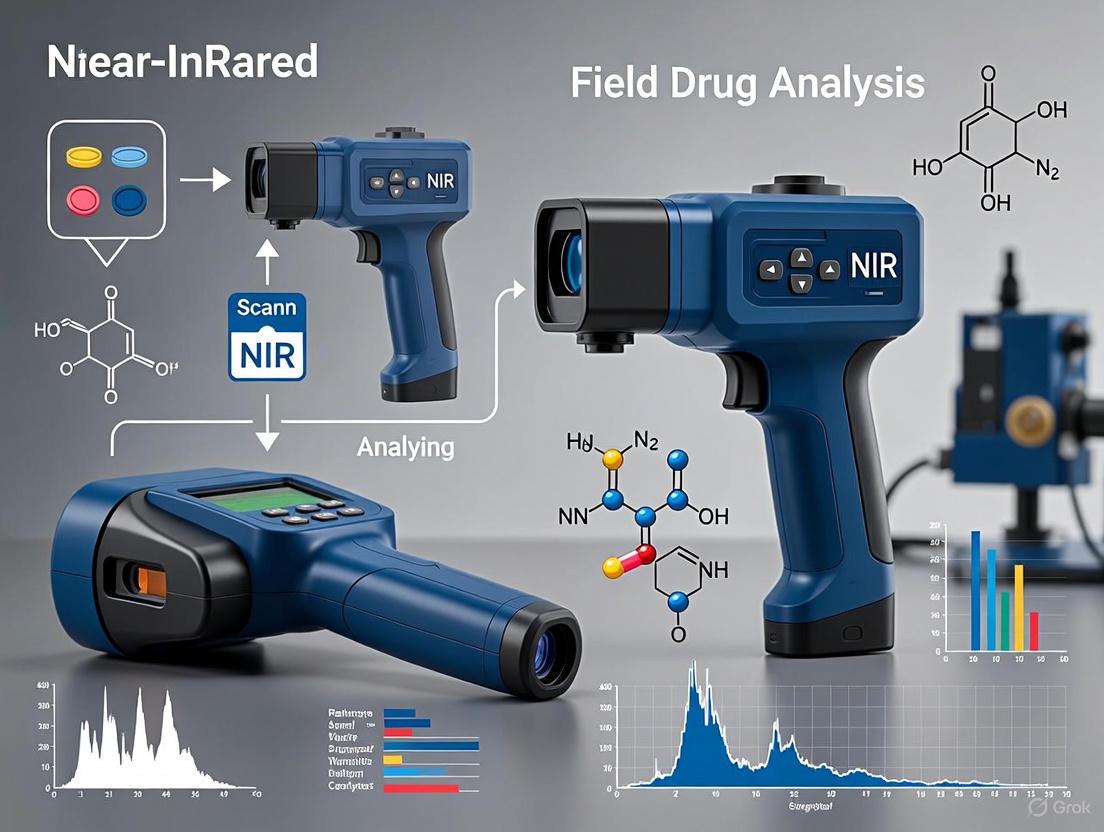
This article provides a comprehensive overview of the application of handheld Near-Infrared (NIR) spectroscopy for the rapid, non-destructive analysis of illicit drugs and pharmaceuticals in field settings.
Handheld NIR Spectrometers for Field Drug Analysis: A Guide to On-Site Identification, Quantification, and Operational Workflows
Abstract
This article provides a comprehensive overview of the application of handheld Near-Infrared (NIR) spectroscopy for the rapid, non-destructive analysis of illicit drugs and pharmaceuticals in field settings. Tailored for researchers, scientists, and drug development professionals, it explores the foundational principles of ultra-portable NIR technology, details methodological workflows integrating machine learning for identification and quantification, addresses key challenges in model optimization and calibration transfer, and validates performance against traditional laboratory techniques. The scope covers practical implementation, from device operation to data interpretation, empowering professionals to leverage this technology for decentralized forensic capabilities and quality control.
The Principles and Rise of Portable NIR Technology in Decentralized Drug Analysis
The deployment of near-infrared (NIR) spectroscopy for field-based drug analysis relies on the successful miniaturization of three core technological components: Micro-Electro-Mechanical Systems (MEMS), specific detector materials like InGaAs, and the strategic selection of operational spectral ranges. These elements collectively enable the transition of NIR technology from laboratory benchtops to portable, handheld devices capable of providing rapid, non-destructive chemical analysis in the field. For forensic and pharmaceutical researchers, understanding these components is critical for method development, instrument selection, and the valid interpretation of spectral data acquired outside controlled laboratory settings [1] [2].
MEMS technology allows for the fabrication of microscopic mechanical elements on silicon chips, which can replace bulky optical components in traditional spectrometers. Concurrently, the choice of detector material, such as Indium Gallium Arsenide (InGaAs), dictates the wavelength range and sensitivity of the device. The 950-1650 nm spectral range is particularly valuable as it captures meaningful molecular overtone and combination bands while being accessible to compact, cost-effective detector systems [2] [3]. This combination of technologies has made handheld NIR spectrometers a practical tool for on-site identification of counterfeit drugs, quality control of pharmaceutical ingredients, and forensic evidence analysis [1] [4].
Detailed Technology Breakdown
Micro-Electro-Mechanical Systems (MEMS)
MEMS are miniature integrated devices that combine mechanical elements, sensors, actuators, and electronics on a common silicon substrate. In handheld NIR spectrometers, MEMS are primarily used to create two types of miniaturized spectral engines: scanning grating mirrors and Fourier Transform (FT) interferometers.
A prominent approach involves using a simple single-axis MEMS scanning mirror to replace traditional optical components. In this design, a deflectable mirror illuminates a fixed grating, creating an optical path similar to the classic Czerny-Turner spectrometer design. As the mirror plate rotates, the angle of incidence on the grating varies, allowing different wavelengths to pass through an exit slit and reach a single-pixel detector. This scanning action builds a full spectrum sequentially, enabling a spectrometer footprint as small as 10 × 10 × 6 mm³ while maintaining a spectral resolution of approximately 10 nm FWHM across the 950-1900 nm range [2].
Alternative MEMS implementations include MEMS-based FT-NIR spectrometers, such as the NeoSpectra by Si-Ware, which utilize micro-scale interferometers to collect spectral data through Fourier transformation. These MEMS-FT systems can cover an extended spectral range from 1300 nm to 2600 nm, accessing the combination spectral region which provides richer chemical information for complex analyses [1] [3]. The primary advantages of MEMS technology in field instruments include dramatically reduced size and weight, lower power consumption suitable for battery operation, reduced production costs at scale, and enhanced robustness against mechanical shock—a critical feature for field deployment [1] [2].
InGaAs Detectors and Spectral Ranges
The detector material is a decisive factor in defining the performance characteristics of a handheld NIR spectrometer. While silicon detectors are cost-effective, their operational range is limited to approximately 1050 nm. For field drug analysis, which often requires broader spectral information, Indium Gallium Arsenide (InGaAs) detectors have become the preferred solution, offering sensitivity across the 950-1650 nm range and beyond [2] [3].
InGaAs detectors provide high sensitivity to weak NIR signals, which is essential for analyzing diffuse reflectance from solid dosage forms like tablets and capsules. Their ability to operate at room temperature, without requiring cryogenic cooling, makes them ideally suited for portable instrumentation. The spectral range of 950-1650 nm is particularly informative for pharmaceutical analysis because it captures the first and second overtone regions of fundamental molecular vibrations, especially those of C-H, O-H, and N-H bonds [5] [2]. These functional groups are ubiquitous in active pharmaceutical ingredients (APIs) and excipients, enabling the distinction between different chemical compounds based on their unique spectral fingerprints.
Table 1: Common Detector Technologies in Handheld NIR Spectrometers
| Detector Material | Typical Spectral Range | Advantages | Common Applications |
|---|---|---|---|
| InGaAs | 950-1650 nm (extended to 1700-2100 nm) | High sensitivity, room-temperature operation, broad range | Primary choice for drug analysis; identifies APIs & excipients [2] [3] |
| Silicon (Si) | 400-1050 nm | Low cost, widely available | Limited to very short-wave NIR (vis-SWNIR); basic material ID [2] |
The photodetectors themselves, such as the FPD310 series, are engineered for high performance with features including ultrafast response (rise times below 0.5 ns), broad spectral sensitivity covering 950–1650 nm, and wide bandwidth for high-speed data acquisition. These characteristics ensure that handheld instruments can capture clean, high-fidelity spectra even from weakly scattering samples, which is paramount for building robust chemometric models [5].
Application in Field Drug Analysis
Research Context and Significance
The application of handheld NIR spectrometers equipped with MEMS and InGaAs detectors is transforming the landscape of drug analysis, particularly in combating the global threat of substandard and falsified (SF) medicines. It is estimated that 10.5% of medicines in low- and middle-income countries are SF, contributing to approximately 1 million deaths annually [4]. Traditional laboratory analysis using techniques like High-Performance Liquid Chromatography (HPLC), while highly accurate, is costly, time-consuming, and requires sample destruction, making it impractical for widespread field screening [4] [3].
Handheld NIR devices address these limitations by enabling real-time, non-destructive analysis at the point of inspection, such as pharmacies, border crossings, or crime scenes. They function by illuminating a sample and capturing its spectral signature in the NIR range. This signature, which represents the unique chemical composition of both the API and excipients, is then compared against a reference library of authentic products using chemometric algorithms. A mismatch indicates a potentially falsified product, while a deviation in spectral intensity can suggest a substandard product with incorrect API concentration [4].
A 2025 comparative study in Nigeria, which tested 246 drug samples from retail pharmacies, highlighted both the promise and current challenges of the technology. While the study found that 25% of samples failed HPLC analysis, the handheld NIR spectrometer showed a sensitivity of 37% for analgesics, indicating a need for further refinement in detection algorithms for certain drug formulations [4]. Despite this, the advantages of speed, portability, and non-destructive testing make these instruments an invaluable screening tool for regulators and law enforcement.
Experimental Protocol for Drug Verification
This protocol outlines the standard operating procedure for using a handheld NIR spectrometer to verify the authenticity and quality of solid oral dosage forms (e.g., tablets) in a field setting.
Title: Field Verification of Pharmaceutical Tablets Using Handheld NIR Spectroscopy Objective: To non-destructively identify counterfeit or substandard pharmaceutical tablets by comparing their NIR spectral signature to a validated reference library. Principle: The method is based on the differential absorption of NIR radiation by organic functional groups (C-H, O-H, N-H) in the 950-1650 nm range, providing a unique molecular "fingerprint" for the tablet's composition [1] [3].
Materials and Equipment:
- Handheld NIR Spectrometer (e.g., based on MEMS scanning grating or MEMS-FT technology with an InGaAs detector).
- Tablet samples for testing.
- Device charger or spare batteries.
- Smartphone or tablet with proprietary data analysis software (if required).
- Reference spectral library for target drug products, pre-loaded on the device or accessible via cloud.
- Soft, lint-free cloth for cleaning the measurement window.
Procedure:
- Instrument Preparation:
- Power on the handheld spectrometer.
- Allow the instrument to initialize and perform a self-check. Ensure the battery level is sufficient.
- If applicable, allow the instrument to warm up for the time specified by the manufacturer to ensure signal stability.
System Calibration (if performed daily):
- Follow the manufacturer's instructions for a background or reference measurement. This typically involves placing a certified reflectance standard (e.g., a ceramic tile) over the measurement window and acquiring a reference spectrum.
Sample Measurement:
- Wipe the instrument's measurement window with a soft, lint-free cloth to remove any dust or debris.
- Place the tablet sample directly against the measurement window, ensuring full and firm contact.
- Initiate the spectral acquisition using the device's trigger or touchscreen. Keep the instrument steady during the measurement, which typically takes 10-20 seconds [4].
- Repeat the measurement on different spots/faces of the same tablet if heterogeneity is suspected (e.g., for a layered tablet). A minimum of three measurements per tablet is recommended for representative sampling.
Data Analysis and Interpretation:
- The instrument's software will automatically pre-process the spectrum (e.g., using Standard Normal Variate (SNV) or derivative filtering) and compare it to the reference library using built-in chemometric models (e.g., Principal Component Analysis (PCA) or Spectral Angle Mapper (SAM)).
- Review the result provided by the device, which is typically a "Match" or "Non-Match" for authenticity, and may include a quantitative estimate of API concentration.
- For "Non-Match" results, the software may provide a measure of spectral similarity (e.g., a score or distance metric) to aid in decision-making.
Reporting:
- Document the result, including sample ID, date, time, and operator name. If the device is equipped with GPS and a camera, this metadata should be automatically linked to the result.
- Samples flagged as "Non-Match" should be secured and sent to a qualified laboratory for confirmatory analysis using a reference method (e.g., HPLC).
Quality Control:
- Periodically test a verified authentic standard to confirm the system is functioning correctly.
- Keep the reference spectral library updated with new products and formulations.
Limitations:
- The method is a screening tool. Results are not definitive proof of falsification and require confirmatory testing.
- Performance can be affected by variations in tablet coating, color, and excipient composition not accounted for in the model.
- The reference library must be representative of the genuine product for accurate results [1] [4].
Diagram 1: Drug verification workflow using a handheld NIR spectrometer.
Essential Research Reagent Solutions
The following table details key materials and software solutions essential for conducting reliable field drug analysis with handheld NIR spectrometers.
Table 2: Key Research Reagents and Materials for Handheld NIR Drug Analysis
| Item | Function / Role | Specification Notes |
|---|---|---|
| Handheld NIR Spectrometer | Core device for spectral acquisition in the field. | Must feature an InGaAs detector and cover at least the 950-1650 nm range. MEMS-based systems (e.g., NeoSpectra, Texas NanoNIR) are preferred for portability [1] [2]. |
| Certified Reflectance Standard | For daily instrumental calibration and validation (background measurement). | A stable, high-reflectance material (e.g., ceramic or Spectralon) with a known and stable spectral response [3]. |
| Reference Spectral Library | Database of authentic drug spectra for comparison. | Must be built with authentic, verified samples and updated regularly to account for formulation changes. Often cloud-based and powered by proprietary AI [4]. |
| Chemometric Software | Transforms spectral data into actionable results (qualitative and quantitative). | Software packages (often proprietary) that perform preprocessing (SNV, derivatives) and multivariate analysis (PCA, PLS) [1] [3]. |
| Power Supply | Ensures uninterrupted operation in the field. | Rechargeable lithium-ion battery packs and portable power banks suitable for all-day use. |
The integration of MEMS technology, high-sensitivity InGaAs detectors, and the strategically selected 950-1650 nm spectral range has successfully enabled the development of powerful handheld NIR spectrometers. These instruments have moved NIR analysis from the laboratory directly into the hands of researchers and regulators in the field. While challenges remain—such as the need for robust, representative spectral libraries and ongoing improvements in the sensitivity of detection algorithms—this core technology provides a rapid, non-destructive, and practical first line of defense in the critical global effort to ensure drug safety and authenticity [1] [4]. The continued evolution of these technologies promises even greater analytical capabilities in future generations of portable spectroscopic devices.
Near-infrared (NIR) spectroscopy has emerged as a powerful analytical technique, with its miniaturization into handheld and portable devices revolutionizing field-based analysis. This application note details the core advantages—non-destructive analysis, rapid results in approximately five seconds, and minimal sample preparation—that make handheld NIR spectrometers indispensable for field drug analysis. Framed within broader research on decentralized forensic capabilities, we provide validated experimental protocols, quantitative performance data, and a detailed toolkit for researchers and scientists deploying this technology. The evidence underscores handheld NIR's role in enhancing operational efficiency, supporting rapid decision-making, and preserving evidence integrity.
The analysis of illicit drugs traditionally relies on laboratory-based techniques such as gas chromatography-mass spectrometry (GC-MS) and high-performance liquid chromatography (HPLC). While these are considered gold standards for accuracy, they have significant limitations for field deployment: they are time-consuming, require destructive sample preparation, and demand specialized laboratory environments [6].
Driven by the need for rapid, on-the-spot results, handheld Near-Infrared (NIR) spectrometers have filled this critical gap. NIR spectroscopy operates by measuring the absorption of light in the 780 to 2500 nm wavelength range, corresponding to overtone and combination vibrations of molecular bonds like C-H, O-H, and N-H [7] [8]. This interaction provides a molecular "fingerprint" that can be used for both identification and quantification. Advances in micro-electro-mechanical systems (MEMS) and linear variable filter (LVF) technologies have enabled the miniaturization of these spectrometers into devices weighing less than 100 grams, making them truly portable and field-deployable [9] [8].
Core Advantages and Quantitative Performance
The value proposition of handheld NIR spectrometers for field drug analysis rests on three pillars, each supported by robust experimental data.
Non-Destructive Analysis
The technique is fundamentally non-destructive, as NIR radiation causes no physical or chemical degradation to the sample.
- Evidence Preservation: The original sample remains intact for subsequent confirmatory analysis in a laboratory, preserving the chain of custody for legal proceedings [6] [10].
- Material Reusability: The same sample can be analyzed multiple times, facilitating method development and verification directly in the field.
High-Speed Results (~5 Seconds)
The time from measurement to result is exceptionally fast, enabling real-time decision-making.
- Rapid Screening: A study on illicit drug analysis demonstrated that an ultra-portable NIR detector connected to a mobile application could provide results to end-users within 5 seconds [6].
- Operational Efficiency: This speed allows law enforcement and researchers to screen a large number of samples quickly in fast-paced environments, drastically reducing the backlog in central laboratories [10].
Minimal Sample Preparation
Handheld NIR spectrometers require no complex sample preparation, which is a significant advantage over traditional methods.
- Direct Measurement: Analysis is typically performed by bringing the spectrometer window into direct contact with the sample in its native state (e.g., a powder, pill, or plant material), requiring no solvents, reagents, or extraction steps [8].
- Ease of Use: This simplicity allows the technology to be operated effectively by personnel without extensive analytical training, broadening its applicability for field use [8].
Table 1: Quantitative Performance of Handheld NIR in Forensic Drug Analysis
| Analyte | Sensitivity | Number of Samples | Analysis Time | Reference |
|---|---|---|---|---|
| Cocaine | 0.994 | 2047 | ~5 seconds | [6] |
| Heroin | High (Precise value not stated) | Not Specified | ~5 seconds | [6] |
| Cannabis (CBD vs. THC-type) | Effective classification confirmed vs. UHPLC | >250 | Real-time | [10] |
Experimental Protocols for Field Drug Analysis
The following protocols are adapted from validated methodologies used in forensic research for the analysis of seized drugs.
Protocol 1: Qualitative Identification of Illicit Substances
This protocol is designed for the rapid identification of substances like cocaine, heroin, and cannabis.
Research Reagent Solutions & Materials: Table 2: Essential Materials for Field Drug Analysis with Handheld NIR
| Item | Function/Description |
|---|---|
| Handheld NIR Spectrometer (e.g., Viavi MicroNIR Onsite W 1700) | Ultra-compact device (e.g., 250g) operating in the 950-1650 nm range with Bluetooth connectivity. |
| Reference Standards (e.g., pure cocaine HCl, heroin) | Required for building and validating chemometric models. |
| Calibration Model | Pre-loaded model for target analytes, developed using techniques like PCA or PLS-DA. |
| Mobile Application & Cloud Platform | For instrument control, data transmission, and real-time result display. |
| Sample Containers (e.g., glass vials) | For presenting samples to the spectrometer in a consistent manner. |
Procedure:
- Instrument Preparation: Power on the handheld NIR spectrometer and establish a connection to the mobile application via Bluetooth. Ensure the battery has sufficient charge for the intended number of measurements.
- System Check: Perform a quick validation check using a built-in reference standard or a provided calibration tile to ensure instrument performance.
- Sample Presentation: For a solid powder, place a small, representative amount in a glass vial. Ensure the sample is homogeneous. Bring the spectrometer's measurement window into direct contact with the bottom of the vial or hold it at a consistent short distance from the sample.
- Spectral Acquisition: Initiate the measurement from the mobile application. A typical spectrum is acquired in 1-3 seconds. For heterogeneous samples, collect multiple spectra from different spots.
- Data Processing & Result: The acquired spectrum is automatically transmitted to a cloud-based platform via the mobile app. The system compares the sample's spectrum against the pre-loaded qualitative model.
- Result Interpretation: The application displays the result (e.g., "Cocaine identified" or "No match") within approximately 5 seconds of measurement initiation. The sample is preserved for further analysis.
The following workflow diagram illustrates the streamlined process from sample to result:
Protocol 2: Quantitative Analysis of Purity
This protocol outlines the steps for estimating the concentration of an active compound in a street sample, such as cocaine purity.
Procedure:
- Calibration Model Verification: Ensure the instrument is loaded with a validated quantitative model, typically developed using Partial Least Squares (PLS) regression against reference data (e.g., from GC-MS).
- Sample Handling: Follow the same sample presentation steps as in Protocol 1. For quantitative analysis, ensuring sample homogeneity is critical for an accurate result.
- Measurement: Acquire the NIR spectrum. It is recommended to take at least three replicate measurements from different spots on the sample to account for heterogeneity.
- Quantitative Prediction: The transmitted spectrum is analyzed by the quantitative model in the cloud, which predicts the concentration of the target analyte.
- Result: The estimated purity or concentration (e.g., "Cocaine: 78% purity") is displayed on the mobile application. This result can be used for rapid triage, such as categorizing a case as personal consumption or trafficking based on the amount of pure substance [6].
The quantitative analysis process involves a pre-established calibration model, as shown below:
Discussion and Implementation Framework
The decentralization of forensic capabilities is a significant trend, and handheld NIR technology is at its forefront [6]. The non-destructive nature of the analysis ensures that valuable evidence is preserved, while the speed and lack of required preparation make it an ideal triage tool for law enforcement and field researchers. A "toolkit" approach, where handheld NIR is used alongside other portable technologies like handheld Raman or GC-MS, is recommended for the most robust field identification of a wide range of illicit substances and new psychoactive substances (NPS) [11].
Successful deployment relies on:
- Robust Calibration Models: Models must be built using a large and diverse set of samples that represent the variability encountered in street products.
- Cloud-Based Data Management: This facilitates real-time analysis, continuous model improvement, and intelligence-led policing by aggregating data from multiple field devices [6].
- User Training: While operation is simple, users must be trained in basic instrument handling, sample presentation, and result interpretation to ensure data quality.
The field of analytical spectroscopy is undergoing a profound transformation, marked by a significant migration from traditional benchtop instruments toward miniature, portable systems. This evolution is particularly impactful in forensic science, where handheld near-infrared (NIR) spectrometers are revolutionizing field-based drug analysis. These portable tools enable researchers and law enforcement professionals to perform rapid, on-site identification and quantification of illicit substances with laboratory-grade accuracy, directly at the point of need [12]. This shift is driven by advancements in micro-electro-mechanical systems (MEMS), sophisticated chemometrics, and growing demand for real-time analytical data across multiple sectors [13] [9].
The global market data underscores this technological transition. The miniaturized spectrometer market, valued at $1.04 billion in 2024, is projected to grow at a robust compound annual growth rate (CAGR) of 12.8%, reaching $1.91 billion by 2029 [13]. This growth is largely propelled by the critical need for portable diagnostic instruments and point-of-care solutions in fields ranging from law enforcement to pharmaceutical development [13].
Market Evolution and Quantitative Landscape
The quantitative data on the miniaturized spectrometer market reveals a consistent and accelerating expansion, reflecting the increasing adoption of these portable technologies across diverse applications.
Table 1: Miniaturized Spectrometer Global Market Size and Forecast
| Year | Market Size (USD Billion) | Compound Annual Growth Rate (CAGR) |
|---|---|---|
| 2024 | 1.04 | |
| 2025 | 1.18 | 13.2% |
| 2029 | 1.91 | 12.8% |
This historic growth is attributed to increased demand for field-based chemical analysis, government-led initiatives, and expanded use in industrial applications like textiles and printing [13]. The forecast period growth will be fueled by trends such as smartphone-based spectroscopy, wearable spectrometer devices, and progress in AI-enhanced spectral data interpretation [13].
The market segmentation further illustrates the diverse technological approaches and application areas driving this sector.
Table 2: Miniaturized Spectrometer Market Segmentation and Key Players
| Segment Type | Categories | Representative Companies |
|---|---|---|
| Product Type | Portable, Handheld, Benchtop | Thermo Fisher Scientific Inc., Viavi Solutions Inc. |
| Technology | MEMS, Micro-Optical, Fabry-Perot, Filter-Based | Si-Ware Systems, InnoSpectra, Hamamatsu Photonics |
| Application | Pharmaceuticals, Food & Beverage, Environmental Testing, Chemical Analysis, Life Sciences | Bruker Corporation, HORIBA Ltd. |
| End User | Healthcare, Industrial, Research Institutes, Environmental Monitoring | Ocean Insight Inc., B&W Tek LLC |
North America dominated the market in 2024, but the Asia-Pacific region is predicted to exhibit the most rapid growth in the coming years [13].
Technological Drivers and Miniaturization Trends
The miniaturization of spectrometers has been made possible by several key technological advancements that have redefined instrument design and capability.
Core Miniaturization Technologies
Modern portable NIR spectrometers primarily leverage one of several optical designs, each with distinct advantages. These include Linear-Variable Filter (LVF) instruments, MEMS-based Fourier Transform-NIR (FT-NIR) spectrometers, devices using a Digital Micro-mirror Device (DMD), Fabry-Perot tunable filters, and miniaturized NIR grating systems [12]. These technologies have enabled the replacement of bulky optical components with micro-scale equivalents, drastically reducing the size, weight, and power consumption of the instruments without sacrificing analytical performance.
Performance and Form Factor Evolution
The evolution in form factor is dramatic. Where earlier portable instruments were often heavy and limited in capability, current handheld devices can weigh less than 100 grams [12]. For instance, the Viavi MicroNIR 1700ES weighs approximately 64 grams, while the Spectral Engines NIRONE sensor is a mere 15 grams [9]. This reduction in size and complexity has been matched by improvements in performance. A 2025 prototype demonstrated a spectrometer "orders of magnitude smaller than current technologies" that could accurately measure light from ultraviolet to the near-infrared, small enough to "fit on your phone" or even be made "as small as a pixel" [14].
Application Focus: Handheld NIR Spectrometers for Field Drug Analysis
The deployment of handheld NIR spectrometers for the analysis of narcotics and illicit substances represents a paradigm shift in forensic science, enabling decentralized testing and real-time decision-making.
Experimental Protocol for Illicit Drug Identification and Quantification
The following protocol is adapted from a study that optimized and assessed the implementation of NIR spectroscopy for illicit drug analysis in an Australian context [15].
1. Objective: To rapidly identify and quantify the composition of seized illicit drug specimens in a field setting using a handheld NIR spectrometer.
2. Research Reagent Solutions & Essential Materials
Table 3: Essential Materials for Field Drug Analysis with NIR Spectroscopy
| Item | Function & Specification |
|---|---|
| Handheld NIR Spectrometer (e.g., Viavi MicroNIR) | The core analytical instrument; must be portable, robust, and capable of collecting spectra in the 1100-1650 nm or 1600-2400 nm ranges. |
| Chemometric Software Suite (e.g., NIRLAB Pro) | Software for developing, validating, and deploying quantitative and qualitative (classification) models based on spectral data. |
| Calibrated Reference Dataset | A library of NIR spectra from chemically validated drug specimens (e.g., methamphetamine HCl, cocaine HCl, heroin HCl) and common adulterants. |
| Seized Drug Specimens | The unknown samples to be tested. Requires minimal preparation (e.g., placed directly in a glass vial or a specialized sample holder). |
| Laboratory Reference Method (e.g., GC-MS) | A standard laboratory technique used to provide the definitive identity and purity values for building the initial calibration model. |
3. Procedure:
- Step 1: Instrument Preparation. Power on the handheld NIR spectrometer and allow it to warm up as per the manufacturer's instructions. Perform a background or reference scan to calibrate the instrument for the current environmental conditions.
- Step 2: Spectral Acquisition. Present the seized drug specimen to the spectrometer's measurement window. For solids, this may involve placing the substance in a consistent manner against the window. Acquire the NIR spectrum. Each measurement is typically completed within seconds.
- Step 3: Data Preprocessing. The acquired raw spectrum is automatically preprocessed by the instrument's software. Common preprocessing steps include Standard Normal Variate (SNV), Multiplicative Scatter Correction (MSC), and derivative treatments (e.g., Savitzky-Golay) to remove light-scattering effects and enhance spectral features [16].
- Step 4: Chemometric Analysis. The preprocessed spectrum is analyzed against pre-loaded chemometric models.
- Identification: A classification model, such as Partial Least Squares-Discriminant Analysis (PLS-DA), compares the unknown spectrum to the reference database to identify the primary substance (e.g., methamphetamine vs. cocaine) [16].
- Quantification: A regression model, typically Partial Least Squares (PLS) Regression, predicts the concentration or purity percentage of the primary component based on the spectral features [15] [16].
- Step 5: Result Interpretation. The software displays the results, typically showing the identified substance and its predicted purity or concentration with an associated confidence metric. The entire process, from measurement to result, is designed to be completed in less than 30 seconds.
4. Performance Metrics: In a validation study using 608 real-world specimens, this methodology demonstrated exceptional accuracy. Identification accuracy rates for crystalline methamphetamine HCl, cocaine HCl, and heroin HCl were 98.4%, 97.5%, and 99.2%, respectively. Quantification was also highly accurate, with 99% of predicted values falling within ±15% of the reference laboratory values [15].
The workflow for this analytical protocol is outlined in the diagram below.
Broader Applications and Future Directions
The utility of miniature NIR systems extends far beyond drug analysis, demonstrating their versatility as a general-purpose analytical tool.
Diverse Industry Applications
In the dairy industry, portable NIR devices are used for the rapid, non-destructive determination of fat, protein, and moisture content in products like liquid milk, cheese, and dairy powders, enabling quality control from the farm to the production line [9]. In pharmaceuticals, they are deployed to combat counterfeit medicines by allowing regulators to verify the authenticity of medical products within seconds [17]. Harm reduction organizations use portable analyzers like the NIRLAB to screen for more than 150 illicit and psychoactive substances, providing critical data for public health interventions [17]. Furthermore, these devices are used in polymer identification for plastic sorting and recycling, highlighting their role in supporting circular economies [17].
Emerging Trends and Future Outlook
The future trajectory of miniature spectrometers points toward even deeper integration into daily professional and consumer life. Key trends include:
- Ultra-Miniaturization and Integration: Research continues to push size boundaries, with developments like single-pixel spectrometers small enough for integration into smartphone cameras, promising a future where spectroscopic analysis is truly ubiquitous [14] [18].
- Wearable Spectrometers: The emergence of flexible organic photodetectors (OPDs) is paving the way for wearable NIR sensors for real-time health monitoring, such as measuring muscle oxygenation in athletes or enabling neuroimaging with wearable fNIRS headbands [18].
- AI-Enhanced Data Interpretation: The reliance on advanced chemometrics will intensify, with artificial intelligence and machine learning algorithms becoming central to extracting more complex information from spectral data with greater speed and accuracy [13] [16].
- The Route to Green Analytical Chemistry: Portable NIR spectroscopy is recognized as a "true green analytical chemistry" method, as it eliminates the need for solvents, extensive sample preparation, and transportation of samples to a lab, thereby reducing the environmental impact of chemical analysis [12].
The convergence of these technologies and trends is summarized in the following evolution pathway.
Addressing the Need for Decentralization in Forensic and Pharmaceutical Workflows
The analysis of pharmaceutical and illicit drug substances faces persistent challenges regarding the production of timely and reliable results. Traditional laboratory techniques, while highly accurate, are centralized, time-consuming, destructive, and difficult to deploy outside a controlled laboratory environment [6]. There is a growing trend toward the decentralization of analytical capabilities, allowing critical data to be acted upon more efficiently at the point of need—be it a crime scene, customs checkpoint, or pharmacy [19] [15]. Handheld Near-Infrared (NIR) spectroscopy, combined with robust chemometric modeling, has emerged as a powerful technology to meet this need. This document outlines application notes and detailed protocols for implementing handheld NIR spectrometers to decentralize workflows in forensic and pharmaceutical analysis, enabling rapid, non-destructive, and reliable identification and quantification of materials directly in the field.
Application Notes
Handheld NIR spectrometers have been rigorously validated across multiple studies for various applications. The following tables summarize key quantitative performance data.
Table 1: Performance in Illicit Drug Analysis (Laboratory Validation)
| Drug Substance | Identification Accuracy | Sensitivity | Quantitative Performance | Citation |
|---|---|---|---|---|
| Crystalline Methamphetamine HCl | 98.4% | 96.6% | 99% of values within ±15% uncertainty | [15] |
| Cocaine HCl | 97.5% | 93.5% | 99% of values within ±15% uncertainty | [15] |
| Heroin HCl | 99.2% | 91.3% | 99% of values within ±15% uncertainty | [15] |
| Cocaine (Street Samples) | N/A | 99.4% (Specificity) | N/A | [6] |
Table 2: Performance in Pharmaceutical Analysis
| Application | Drug Classes | Model Performance | Citation |
|---|---|---|---|
| Counterfeit Tablet Detection | Various Pharmaceutical Tablets | swNIR+SVM: 100% (Cal), 96.0% (Val)cNIR+LDA: 99.9% (Cal), 91.1% (Val) | [20] |
| Detection of Substandard and Falsified (SF) Medicines | Analgesics, Antimalarials, Antibiotics, Antihypertensives | Overall Sensitivity: 11%; Specificity: 74%Analgesics Sensitivity: 37%; Specificity: 47% | [4] |
Table 3: Operational Advantages of Portable NIR vs. Traditional Methods
| Parameter | Handheld NIR | GC-MS / HPLC |
|---|---|---|
| Analysis Time | ~5 to 20 seconds | Minutes to hours [6] |
| Sample Preparation | Non-destructive; no preparation required | Extensive; destructive [21] [6] |
| Deployment | Fully portable for field use | Laboratory-bound |
| Chemical Reagents | Not required | Often required |
| Data Integration | Real-time results with cloud connectivity | Offline analysis |
Key Technological Workflow
The power of decentralized NIR analysis lies in the integration of hardware, software, and cloud-based data management. The following diagram illustrates the end-to-end workflow for on-site analysis.
On-Site NIR Analysis Workflow
Experimental Protocols
Protocol 1: Rapid Identification and Quantification of Illicit Street Drugs
This protocol is adapted from studies demonstrating the accurate identification and quantification of heroin, cocaine, and methamphetamine in five seconds using ultra-portable NIR technology [19] [6].
Research Reagent Solutions & Essential Materials
Table 4: Essential Materials for Illicit Drug Analysis
| Item | Function | Specification / Notes |
|---|---|---|
| Portable NIR Spectrometer | Acquires spectral data from samples. | E.g., MicroNIR Onsite W 1700; Spectral range: 950–1650 nm; Weight: ~250g [6]. |
| Mobile Application & Cloud Database | Controls the spectrometer, hosts chemometric models, and displays results. | Must provide secure, real-time communication with the spectrometer and cloud [19]. |
| Chemometric Prediction Models | For qualitative ID and quantitative purity. | Pre-trained and validated models for target drugs (e.g., heroin, cocaine, cannabis) [15] [6]. |
| Reference Drug Samples | For model calibration and validation. | Chemically characterized specimens representative of the local drug market [15]. |
| Gloves & Personal Protective Equipment (PPE) | Ensures analyst safety during handling of unknown substances. | Disposable nitrile gloves are recommended. |
Step-by-Step Procedure
- Instrument Preparation: Power on the handheld NIR spectrometer and ensure it connects via Bluetooth to the dedicated mobile application. Verify that the instrument has undergone a successful background/reference scan.
- Sample Presentation: Place a small, representative amount of the street drug sample directly onto the spectrometer's sampling window. For crystalline or powdered samples, ensure a consistent and even layer.
- Spectral Acquisition: Initiate the scan from the mobile application. The acquisition time is typically 5 seconds. The spectrum is automatically transmitted to the cloud database.
- Real-Time Analysis: The cloud-based chemometric model instantly analyzes the spectral data.
- Qualitative Identification: The model compares the sample's spectrum against the spectral library of known substances and provides an identification result (e.g., "Cocaine HCl").
- Quantification: The model simultaneously predicts the concentration or purity of the identified active substance (e.g., "78% Cocaine HCl").
- Result Reporting: The identification and quantification results are displayed on the mobile application within seconds of scan completion. The result can be geo-tagged and time-stamped for intelligence purposes.
- Data Management: Results are logged securely in the cloud database, accessible for later review, reporting, or intelligence analysis.
Protocol 2: Authentication of Pharmaceutical Tablets and Detection of Counterfeits
This protocol is based on methods developed for creating large spectral databases of legitimate pharmaceutical products and using supervised classification models to identify counterfeit tablets with high accuracy [20].
Research Reagent Solutions & Essential Materials
Table 5: Essential Materials for Pharmaceutical Authentication
| Item | Function | Specification / Notes |
|---|---|---|
| Handheld NIR Spectrometer | Acquires spectral data from solid dosage forms. | May offer dual functionality (handheld/benchtop). High signal-to-noise ratio (e.g., 4500:1) for precision [22]. |
| Spectral Database & Software | Stores reference spectra and runs classification models. | Contains spectra of all authentic products. Software like Visum Master can automate model building [22]. |
| Chemometric Classification Model | Differentiates authentic from counterfeit products. | Support Vector Machine (SVM) or Linear Discriminant Analysis (LDA) models have proven effective [20]. |
| Authentic Pharmaceutical Tablets | For building and validating the reference database. | Should encompass all products, batches, and dosages to be screened. |
| Suspect/Counterfeit Tablets | Test samples for model validation and routine screening. | May include generics and outright fakes. |
Step-by-Step Procedure
- Database Creation (One-time Calibration):
- Collect a comprehensive set of authentic tablet samples from the manufacturer.
- Using the handheld NIR spectrometer, acquire multiple spectra for each authentic product to account for natural batch-to-batch variability.
- Use software (e.g., Visum Master) to compile these spectra into a reference database and train a supervised classification model (e.g., SVM or LDA). Validate the model's performance using an independent set of validation samples [20] [22].
- Routine Screening of Unknown Tablets:
- Power on the handheld NIR spectrometer and load the pre-trained classification model.
- Place the unknown tablet on a clean, stable surface or directly onto the spectrometer's sampling window.
- Initiate the scan. The acquisition time is typically 3-10 seconds.
- The instrument's software automatically compares the unknown tablet's spectrum against the model.
- Result Interpretation: The output is a straightforward classification, such as "Authentic - Matches Product X" or "Non-Authentic - Does Not Match Database," often accompanied by a correlation distance metric for confidence assessment [20].
Protocol 3: Field Classification of Cannabis Types
This protocol supports law enforcement in making rapid decisions in the field by distinguishing between legal (e.g., high-CBD) and illegal (e.g., high-THC) cannabis types, as demonstrated in Swiss deployments [19] [6].
Step-by-Step Procedure
- Instrument Preparation: Ensure the handheld NIR spectrometer and mobile application are powered on and connected.
- Sample Presentation: Place a small, representative floral sample of the cannabis in contact with the spectrometer's sampling window.
- Spectral Acquisition: Initiate a scan. The process is non-destructive and takes only a few seconds.
- Model Prediction: The dedicated classification model for cannabis analyzes the spectral signature, which differs between THC- and CBD-dominant strains.
- Result Reporting: The application displays the classification, for example, "THC-type (Illicit)" or "CBD-type (Legal)," providing immediate actionable intelligence to the officer.
The logical decision-making process supported by this protocol is summarized below.
Cannabis Field Decision Logic
Operational Workflows: From Spectral Acquisition to Machine Learning-Driven Results
This Standard Operating Procedure (SOP) outlines the protocols for using handheld Near-Infrared (NIR) spectrometers for the analysis of suspected narcotic substances in field settings. The procedures are designed to ensure the generation of reliable, consistent, and accurate quantitative data for research on substance composition and heterogeneity, directly supporting harm reduction initiatives and forensic science. Adherence to this SOP is critical for maintaining personal safety, sample integrity, and data validity in non-laboratory environments [23].
Safety Precautions
- Personal Protective Equipment (PPE): Always wear appropriate PPE, including nitrile gloves and safety glasses, when handling unknown substances.
- Non-Contact Principle: Utilize the non-contact scanning capability of the spectrometer whenever possible to minimize exposure and cross-contamination [23].
- Decontamination: Clean the device's sapphire glass with ethanol and a lint-free tissue before and after analyzing each sample [23].
Experimental Protocols and Workflows
Sample Presentation and Preparation
Proper sample presentation is fundamental for obtaining high-quality spectra. The chosen method depends on the sample's physical form and the required analytical precision [23].
Table 1: Sample Presentation Methods for Field-Based NIR Analysis
| Sample Type | Presentation Method | Key Considerations |
|---|---|---|
| Intact Tablets (e.g., XTC) | Scan the pill in its original state. | Do not crush or alter the pill. Take multiple measurements from different angles if the initial result is "unknown substance" [23]. |
| Powders | Place powder in a small, neutral aluminum cup. | The aluminum cup provides a spectrally neutral background. For high-quantity or non-homogeneous powders, use the Sample Scan mode to assess homogeneity [23]. |
| Small Samples | Contain within a small aluminum cup. | Prevents sample loss and ensures a consistent, minimal gap between the device and the sample [23]. |
| Samples in Bags | Scan through thin, clear plastic. | A minimal gap of 1-2 mm is acceptable, though direct contact yields the best accuracy for quantification [23]. |
The following workflow outlines the decision process for sample preparation in the field:
Spectrometer Setup and Scanning Protocol
This section details the operational steps for the handheld NIR spectrometer from startup to data acquisition.
3.2.1 Device Setup and Calibration
- Power and Connect: Power up the handheld spectrometer. Launch the dedicated application on the mobile device and establish a connection via Bluetooth pairing [23].
- Calibrate: Perform a calibration using the provided white reference mirror. Follow the in-app instructions to ensure spectral accuracy before commencing sample analysis [23].
3.2.2 Scanning Mode Selection Two primary scanning modes are available. The choice depends on the balance required between speed and analytical depth [23].
Table 2: Scanning Mode Selection for Field Analysis
| Scanning Mode | Use Case | Protocol |
|---|---|---|
| Quick Scan | Rapid identification during outreach; initial assessment. | Provides immediate substance profiles. Position the device in direct contact or at a 1-2 mm gap from the sample. Point the device downwards during measurement [23]. |
| Sample Scan | Detailed analysis of heterogeneous powders; research-grade quantification. | Averages multiple scans to provide a thorough substance breakdown and homogeneity assessment. Requires the sample to be presented in an aluminum cup [23]. |
The following diagram illustrates the core operational workflow for field scanning:
Data Collection and Presentation
For research purposes, quantitative data on sample heterogeneity can be systematically collected and presented. The following table summarizes a methodology for assessing the effect of sample preparation based on established principles of NIR analysis [24].
Table 3: Quantitative Assessment of Sample Homogeneity via NIR
| Sample Group | Preparation Method | Number of Scans per Sample (n) | Observed Statistical Error | Key Finding |
|---|---|---|---|---|
| Ground Wheat | Homogenized using a mill (e.g., TWISTER) | 10 | No significant statistical error | Reliable and meaningful analytical results [24]. |
| Unground Wheat | No preparation (whole grains) | 10 | Significant deviations and considerable statistical error | Results show systematic inaccuracies due to poor light scattering and heterogeneity [24]. |
The Scientist's Toolkit: Research Reagent Solutions
The following table details essential materials and their functions for field-based NIR analysis of narcotic substances.
Table 4: Essential Materials for Field-Based NIR Analysis
| Item | Function / Rationale |
|---|---|
| Handheld NIR Spectrometer | Mobile analytical device for non-destructive, non-contact quantitative analysis of substances [23]. |
| Neutral Aluminum Cups | Provides a spectrally inert background for measuring powders and small samples, minimizing spectral interference [23]. |
| White Reference Mirror | Essential calibration standard for ensuring the spectral accuracy and repeatability of the spectrometer [23]. |
| Ethanol (≥70%) & Lint-Free Tissues | For cleaning the sapphire glass window of the spectrometer to prevent cross-contamination between samples [23]. |
| Laboratory Mill (e.g., TWISTER) | Although not for field use, this is critical for R&D to homogenize samples for method development and validation, ensuring reliable results by achieving analytical fineness [24]. |
The Role of Cloud Databases and Mobile Applications for Real-Time Analysis and Reporting
The proliferation of handheld Near-Infrared (NIR) spectrometers has revolutionized field-based drug analysis, enabling rapid, non-destructive identification and quantification of illicit substances and falsified pharmaceuticals outside traditional laboratory settings. These portable analytical capabilities have created a paradigm shift in forensic science and harm reduction strategies [6] [25]. However, the full potential of this technology is only realized through its integration with cloud databases and mobile applications, which together transform standalone devices into networked intelligence systems. This integration enables real-time analysis, continuous model improvement, and immediate reporting that is critical for public health interventions and law enforcement operations [26] [27].
The convergence of miniature NIR spectrophotometers weighing as little as 100-200 grams with advanced data management architectures represents a significant milestone in decentralized forensic capabilities [25]. This technological synergy allows field operators to bypass the traditional bottlenecks of laboratory analysis while maintaining analytical rigor through cloud-accessible calibration models and substance libraries. For researchers and drug development professionals, this ecosystem provides unprecedented access to distributed intelligence gathering capabilities, enabling more responsive and data-driven public health strategies [26] [6].
System Architecture & Workflow
The operational framework for handheld NIR spectroscopy in drug analysis combines hardware, software, and connectivity components into a seamless workflow from sample acquisition to result reporting. The system architecture ensures that complex computational tasks are handled efficiently while maintaining the portability and speed required for field deployment.
Integrated System Components
The typical ecosystem consists of multiple interoperating elements, each serving a distinct function in the analytical chain:
Handheld NIR Spectrometer: Portable devices such as the NIRLIGHT (250g weight) or Visum Palm (1.8kg) operate in the 900-1700nm or 950-1650nm spectral ranges, featuring Bluetooth connectivity and battery lives exceeding 5 hours [26] [22] [6]. These instruments capture spectral data through diffuse reflectance measurements with acquisition times as short as 3-5 seconds [22] [6].
Mobile Application: Native Android and iOS applications (e.g., NIRLAB's platform) provide the user interface for instrument control, results visualization, and data management [28] [26]. These apps display scanning results within seconds, showing identified substances, quantification values, and detected cutting agents in an easily interpretable format.
Cloud Infrastructure: Cloud platforms host spectral databases, machine learning models, and processing algorithms that would be too computationally intensive for the handheld devices themselves [28] [27]. This architecture enables continuous model updates and expansion of substance libraries without requiring device replacement.
Reference Databases: Centralized spectral libraries containing 300+ substances including narcotics, cutting agents, and precursors form the core identification resource [26]. These databases are continuously expanded with new substances, with updates immediately available to all users through cloud synchronization.
The following diagram illustrates the integrated workflow from sample analysis to result reporting:
Data Processing Workflow
The analytical pathway from spectral acquisition to result generation involves multiple validation and processing stages:
Spectral Acquisition: The handheld spectrometer illuminates the sample with NIR light and captures the reflected spectra across its operational wavelength range. Modern devices complete this process within 3-5 seconds while operating through various packaging materials including blister packs [27].
Data Preprocessing: Raw spectral data undergoes preprocessing algorithms including Standard Normal Variate (SNV) and Multiplicative Signal Correction (MSC) to reduce noise and correct for baseline variations caused by environmental factors or sample presentation [25].
Cloud-Based Analysis: Processed spectra are transmitted to cloud services where machine learning models perform substance identification and quantification. These models employ Principal Component Analysis (PCA), Support Vector Machines (SVM), and neural networks to compare unknown spectra against reference libraries [27].
Result Generation: Identification results show the detected primary substance along with cutting agents and purity estimates. Quantification models can determine active pharmaceutical ingredient (API) concentrations, such as sildenafil in falsified Viagra, with accuracy comparable to reference chromatographic methods [27].
Data Synchronization: Results are stored locally on the mobile device while simultaneously synchronizing with cloud databases to contribute to continuous model improvement and population-level trend analysis.
Performance Metrics & Validation
The analytical performance of cloud-enhanced handheld NIR systems has been rigorously validated against established laboratory techniques across multiple substance categories. The integration with cloud databases has significantly improved reliability compared to early standalone devices that suffered from limited spectral libraries and calibration drift.
Quantitative Analytical Performance
Extensive validation studies have demonstrated the capability of these systems to accurately identify and quantify substances across diverse forensic samples:
Table 1: Performance Metrics of Handheld NIR Systems for Drug Analysis
| Parameter | Cocaine Analysis | Heroin Analysis | Pharmaceutical Analysis | Cannabis Analysis |
|---|---|---|---|---|
| Sensitivity | 0.994 (2047 specimens) [6] | High (matrix-dependent) [6] | 100% authentication (PCA/Euclidean) [27] | Type differentiation [6] |
| Quantification Accuracy | Purity determination [26] | Purity determination [26] | RMSEP 0.52% (sildenafil) [27] | THC/CBD content [26] |
| Analysis Time | <5 seconds [26] [6] | <5 seconds [26] [6] | <30 seconds [29] | <5 seconds [26] |
| Cutting Agent ID | Lidocaine, benzocaine, levamisole, caffeine, etc. [26] | Common diluents [26] | Excipient profiling [27] | N/A |
The validation of these systems extends beyond laboratory settings to real-world operational environments. For cocaine analysis, models demonstrated exceptional sensitivity (0.994) when testing 2047 specimens, with only 12 samples not correctly identified [6]. For pharmaceutical applications, portable NIR devices coupled with cloud processing achieved 100% accuracy in distinguishing authentic from falsified Viagra tablets using PCA and Euclidean distance measurements [27].
Operational Advantages in Field Deployments
The integration of handheld NIR devices with cloud databases provides significant operational benefits for field-based drug analysis:
Non-Destructive Testing: Samples remain intact after analysis, preserving evidence for subsequent confirmatory testing or legal proceedings [25].
Through-Package Analysis: Capability to analyze substances through translucent packaging materials, reducing contamination risk and handling hazards [27].
Continuous Improvement: Cloud-connected systems benefit from expanding substance libraries, with new compounds added regularly and immediately available to all devices [26].
Operational Efficiency: Significant reduction in analysis backlog by enabling preliminary testing at point of need rather than relying exclusively on central laboratories [6].
The implementation of these systems follows a structured deployment pathway that includes feasibility assessment, data acquisition, model development, and field validation phases to ensure reliability in operational environments.
Experimental Protocols
To ensure reproducible and reliable results, researchers should follow standardized protocols for field-based NIR analysis of drugs and pharmaceuticals. The following section outlines comprehensive methodologies for both qualitative screening and quantitative analysis.
Protocol 1: Qualitative Identification of Illicit Substances
This protocol describes the procedure for rapid identification of unknown substances in field conditions, particularly suited for harm reduction services and law enforcement operations.
Research Reagent Solutions & Materials
Table 2: Essential Materials for Field Drug Analysis Using Handheld NIR
| Item | Specification | Function/Purpose |
|---|---|---|
| Handheld NIR Spectrometer | NIRLIGHT (250g) or Visum Palm (1.8kg); 900-1700nm range [26] [22] | Spectral acquisition from samples |
| Mobile Device | Android or iOS tablet/smartphone with dedicated application [28] | Instrument control, data visualization, cloud connectivity |
| Reference Standards | Certified reference materials for validation [6] | System performance verification, quality control |
| Sampling Accessories | Disposable cups, spatulas, weighing boats [22] | Safe sample handling without cross-contamination |
| Calibration Reference | Spectralon or white ceramic reference tile [25] | Instrument calibration before measurements |
Step-by-Step Methodology
Instrument Preparation:
- Power on the handheld NIR spectrometer and ensure battery charge exceeds 50%
- Establish Bluetooth connection between spectrometer and mobile device
- Launch the dedicated mobile application (e.g., NIRLAB drug checking application)
- Allow 5-10 minutes for instrument warm-up if previously stored in cold conditions [25]
System Calibration:
- Obtain reference spectrum using certified reflectance standard (Spectralon or equivalent)
- Perform calibration validation using a known reference standard from the system library
- Confirm calibration acceptance criteria are met before proceeding with unknown samples
Sample Preparation:
- For homogeneous powders: Present in a clean, disposable container with minimal headspace
- For tablets: Analyze intact tablet surface, preferably through original packaging when possible
- For plant material: Gently compress to create uniform surface for analysis
- Ensure sample completely covers the instrument's measurement aperture
Spectral Acquisition:
- Position spectrometer probe in direct contact with sample or at specified standoff distance
- Initiate measurement via mobile application interface or device trigger
- Maintain stable position during the 3-5 second acquisition period
- Acquire triplicate spectra from different sample positions if sufficient material available
Data Analysis:
- Transmit acquired spectra to cloud processing service via mobile data or WiFi connection
- Await results from cloud-based pattern matching algorithms (typically 5-10 seconds)
- Review identification report showing primary substance, cutting agents, and match confidence
Quality Assurance:
- Reanalyze reference standard after every 10 samples to monitor instrumental drift
- Document any environmental factors that may affect results (temperature, humidity)
- For inconclusive results, collect sample for confirmatory laboratory analysis when possible
The following workflow diagram illustrates the qualitative identification process:
Protocol 2: Quantitative Analysis of Pharmaceutical Formulations
This protocol describes the procedure for quantifying active pharmaceutical ingredients (APIs) in formulations, with particular application to falsified medicine detection.
Materials and Calibration Standards
- Handheld NIR Spectrometer with spectral range covering 900-1700nm
- Reference API Standards of known purity for model development
- Placebo Formulations without API for matrix-specific calibration
- Chromatographic Reference Method (HPLC/GC-MS) for validation [27]
- Controlled Environment for model development to minimize temperature/humidity variation
Methodology for Quantitative Model Development
Calibration Set Preparation:
- Prepare 50-100 samples with API concentrations spanning expected range (e.g., 0-120% of label claim)
- For tablet analysis, create uniform mixtures of API and excipients at varying concentrations
- For liquid formulations, prepare standard solutions across concentration range
- Document exact composition of each calibration standard
Reference Method Analysis:
- Analyze all calibration samples using reference chromatographic method (HPLC or GC-MS)
- Establish reference values for API concentration in each sample
- Ensure reference methods follow validated protocols with documented accuracy and precision
Spectral Database Creation:
- Acquire NIR spectra for all calibration samples using standardized procedure
- For each sample, collect multiple spectra from different positions to account for heterogeneity
- Associate each spectrum with reference API concentration value
- Upload spectral database with reference values to cloud platform
Chemometric Model Development:
- Utilize cloud-based processing to develop quantitative models using algorithms such as:
- Partial Least Squares (PLS) regression
- Support Vector Machine (SVM) regression
- Artificial Neural Networks (ANN)
- Employ cross-validation techniques to optimize model parameters
- Validate model performance using independent test set not included in calibration
- Utilize cloud-based processing to develop quantitative models using algorithms such as:
Model Deployment:
- Deploy validated quantification model to field devices through cloud synchronization
- Establish ongoing performance monitoring with control charts tracking prediction accuracy
- Update models periodically as new formulations or API forms are encountered
For sildenafil quantification in falsified Viagra tablets, this approach has demonstrated the ability to achieve a Root Mean Square Error of Prediction (RMSEP) of 0.52% using neural network models, providing accuracy comparable to reference chromatographic methods [27].
Advanced Applications & Future Directions
The integration of cloud databases with handheld NIR spectrometers has enabled several advanced applications in drug analysis and forensic science while pointing toward promising future developments.
Intelligence-Led Harm Reduction
Cloud-connected handheld NIR systems have transformed harm reduction services by providing real-time drug composition data at the point of consumption. This capability allows service providers to:
- Issue immediate alerts when substances with unexpected potency or dangerous adulterants are detected
- Monitor trends in drug composition across geographical regions and time periods
- Provide data-driven education to users about the actual composition of substances in circulation
- Support public health responses to emerging drug threats through early warning systems [26]
The implementation of these systems in Switzerland has demonstrated practical utility in differentiating between personal use and trafficking quantities through rapid purity assessment, directly informing legal proceedings [6].
Federated Learning for Privacy-Preserving Collaboration
Emerging approaches in decentralized federated learning (DFL) address the challenge of collaborative model improvement while maintaining data privacy across institutions. This innovative framework:
- Enables multiple organizations to collaboratively enhance spectral models without sharing raw data
- Maintains data sovereignty for law enforcement agencies and forensic laboratories
- Uses peer-to-peer model updates instead of central data aggregation
- Achieves performance within 5-8% of centralized models while preserving privacy [30]
The DFL approach is particularly valuable in regulated environments where data sharing restrictions might otherwise limit model development, creating opportunities for cross-jurisdictional collaboration without compromising legal or privacy requirements.
Emerging Technological Capabilities
Future developments in cloud-connected handheld spectrometry are focusing on several key areas:
Expanded Substance Libraries: Continuous growth of reference databases, particularly for new psychoactive substances (NPS) that frequently emerge in drug markets [26]
Advanced Algorithms: Implementation of deep learning approaches for improved quantification and mixture analysis [30] [27]
Integration with Complementary Technologies: Combination of NIR with other portable analytical techniques to address limitations of individual methods [25]
Automated Reporting Systems: Direct integration with public health surveillance systems and law enforcement databases for real-time trend monitoring [6]
These advancements will further enhance the role of cloud databases and mobile applications in transforming handheld NIR spectrometers from simple identification tools into comprehensive chemical intelligence systems for field-based drug analysis.
The Scientist's Toolkit
Table 3: Essential Research Reagent Solutions for Field NIR Drug Analysis
| Item | Function/Purpose | Specification/Notes |
|---|---|---|
| NIR Spectrometer | Field-based spectral acquisition | 900-1700nm range; Bluetooth connectivity; battery operation [26] [22] |
| Mobile Application Platform | User interface and result display | Android/iOS compatibility; offline functionality [28] |
| Cloud Processing Service | Data analysis and model hosting | Machine learning capabilities; expandable libraries [28] [27] |
| Certified Reference Materials | System validation and calibration | Purity-certified drug standards; excipient mixtures [6] |
| Sampling Kits | Safe sample handling | Disposable containers; spatulas; personal protective equipment [22] |
| Reference Standards | Instrument calibration | Spectralon tiles; white ceramic references [25] |
The proliferation of illicit drugs and the increasing complexity of street samples, often adulterated with cutting agents, present significant challenges for law enforcement and public health agencies worldwide. In this context, the decentralization of forensic capabilities through handheld Near-Infrared (NIR) spectroscopy has emerged as a transformative approach for rapid, on-scene drug analysis. This technology enables the deployment of analytical capabilities directly to frontline personnel, providing results within seconds rather than days while minimizing operator exposure to potentially hazardous substances. The efficacy of handheld NIR technology hinges on the development of robust chemometric models that can accurately identify and quantify illicit substances such as cocaine, heroin, and methamphetamine in field conditions. These models must account for the considerable chemical variability in street samples, which are frequently mixed with various adulterants including levamisole, lidocaine, caffeine, and sugars [31]. The integration of machine learning algorithms with portable NIR spectroscopy represents a significant advancement over traditional colorimetric tests, which are prone to false positives and require physical handling of unknown substances [31]. This application note details the methodologies, validation protocols, and implementation frameworks for building reliable chemometric models tailored to the identification of illicit substances within the operational constraints of field deployment.
Handheld NIR spectrometers have undergone significant miniaturization while maintaining analytical performance comparable to benchtop instruments. Modern ultra-portable devices, such as the MicroNIR (Viavi Solutions Inc.) and NIRLAB's systems, typically weigh between 100-250 grams, operate in the 740-1650 nm wavelength range, and connect via Bluetooth to mobile applications for real-time analysis [19] [8]. These instruments utilize various wavelength selection technologies, including linear-variable filters with array detectors, MEMS-based FT-NIR systems, and Fabry-Perot etalons, with indium gallium arsenide (InGaAs) being the preferred detector material [8]. The primary advantages of handheld NIR systems for field drug analysis include non-invasive measurement through packaging materials, minimal sample preparation, rapid analysis (results in approximately 5 seconds), and reduced safety risks for operators [19] [31]. Unlike Raman spectroscopy, NIR is not affected by fluorescence interference, and the instruments are generally more affordable, facilitating wider deployment among law enforcement agencies [31]. The operational principle relies on measuring overtone and combination vibrations of characteristic molecular bonds (C-H, O-H, N-H, C=O, and C=C) present in illicit substances, though these signals occur at 10-100 times lower intensity compared to fundamental vibrations in the mid-infrared region [8].
Table 1: Performance Summary of Handheld NIR for Illicit Substance Identification
| Substance | Identification Accuracy | Sensitivity | Quantification Performance | Sample Size |
|---|---|---|---|---|
| Methamphetamine HCl | 98.4% | 96.6% | 99% of values within ±15% uncertainty | 608 specimens |
| Cocaine HCl | 97.5% | 93.5% | 99% of values within ±15% uncertainty | 2047 specimens |
| Heroin HCl | 99.2% | 91.3% | 99% of values within ±15% uncertainty | 608 specimens |
| Cocaine (Limited Range NIR) | 97% True Positive | 98% True Negative | Concentration and composition prediction | >10,000 spectra |
Critical Components of Chemometric Modeling
Spectral Database Development
The foundation of any robust chemometric model is a comprehensive spectral database containing chemically relevant specimens representative of the illicit drug market. This database must encompass not only pure substances but also common adulterants and mixtures encountered in street samples. Studies have demonstrated that chemical differences between drugs from different geographical regions must be incorporated into the database to ensure accurate model prediction [15]. A study utilizing the MicroNIR system compiled 608 illicit drug specimens seized by the Australian Federal Police, comprising primarily crystalline methamphetamine HCl, cocaine HCl, and heroin HCl, along with traditional drugs, new psychoactive substances, and adulterants, resulting in 3673 NIR scans for model development [15]. For cocaine detection specifically, research has shown that models based on more than 10,000 spectra from case samples can achieve 97% true-positive and 98% true-negative results [31]. The database should be continuously updated to adapt to changes in the illicit drug market, with metadata enriched by results from subsequent confirmatory laboratory analyses [31].
Data Preprocessing Techniques
Raw NIR spectra contain physical artifacts and noise that must be addressed through appropriate preprocessing to extract meaningful chemical information. The most widely used preprocessing techniques can be classified into scatter-correction methods and spectral derivatives [32]. Standard Normal Variate (SNV) is commonly employed to remove undesired spectral variations due to light scatter effects and variations in effective path length by normalizing each spectrum to zero mean and unit variance [32]. Multiplicative Scatter Correction (MSC) is another prevalent technique for compensating for scattering effects. For spectral derivatives, Savitzky-Golay (SG) polynomial derivative filters are frequently applied to enhance spectral features by reducing baseline offsets and isolating overlapping peaks [32]. The optimal selection and sequencing of these preprocessing methods are determined through iterative testing, with parameters such as polynomial order, window size, and derivative order carefully optimized for each specific application. The interactive preprocessing workflow in platforms like KNIME allows researchers to compare the effects of different methods and parameter settings before applying the transformations to the entire dataset [32].
Machine Learning Algorithms for Identification and Quantification
Chemometric modeling employs both unsupervised and supervised machine learning algorithms to extract meaningful patterns from spectral data. Principal Component Analysis (PCA) is commonly used for exploratory data analysis, outlier detection, and dimensionality reduction, transforming the original variables into a smaller set of principal components that capture the maximum variance in the data [32]. For qualitative identification (classification), algorithms such as Soft Independent Modeling of Class Analogy (SIMCA), Partial Least Squares-Discriminant Analysis (PLS-DA), k-Nearest Neighbors (kNN), Support Vector Machines (SVM), and Random Forest have demonstrated excellent performance [31]. For quantitative analysis, Partial Least Squares (PLS) regression is the most widely used algorithm for establishing relationships between spectral data and substance concentrations [15] [31]. More advanced approaches include multi-stage machine learning strategies that combine classification and regression models, such as using SIMCA for initial substance classification followed by dedicated PLS models for quantification of identified substances [31]. The integration of artificial intelligence, particularly convolutional neural networks (CNN), has shown promising results for complex pattern recognition in spectral data, with one study achieving 97.92% prediction accuracy for geographical identification of camelina oil using NIR spectra-based CNN models [33].
Experimental Protocol for Model Development
Sample Collection and Preparation
A representative set of drug specimens should be obtained from relevant law enforcement agencies, covering the expected variability in the target market. The protocol should include:
Sample Acquisition: Collect seized drug specimens with appropriate legal documentation and safety protocols. The study should include primarily target substances (methamphetamine HCl, cocaine HCl, heroin HCl) along with common adulterants and new psychoactive substances to assess selectivity [15].
Reference Analysis: All specimens must be analyzed using reference laboratory methods (typically GC-MS or LC-MS) to establish ground truth for identity and quantification values [15]. This reference data serves as the benchmark for training and validating the chemometric models.
Spectral Acquisition: Using the handheld NIR device (e.g., MicroNIR with NIRLAB infrastructure), scan each specimen according to manufacturer guidelines. Typical parameters include: spectral range of 950-1650 nm, 128-pixel linear InGaAs array detector, with multiple scans per sample to account for heterogeneity [15] [19].
Data Annotation: Each spectrum should be meticulously annotated with metadata including substance identity, concentration, sample origin, date of seizure, and identified adulterants. This metadata is crucial for assessing model performance across different sample characteristics.
Data Preprocessing Workflow
Implement a systematic preprocessing pipeline to enhance spectral quality and remove artifacts:
Spectral Visualization: Initially plot and inspect all spectra to identify obvious outliers, noise patterns, and regions of high absorbance [32].
Region Selection: Identify optimal spectral regions for analysis (e.g., 1500-2000 nm) through iterative testing, focusing on regions with high information content and minimal noise [32].
Preprocessing Sequence: Apply a sequence of preprocessing techniques, typically:
- Savitzky-Golay smoothing (e.g., 2nd order polynomial, 15-21 point window)
- Standard Normal Variate (SNV) or Multiplicative Scatter Correction (MSC)
- First or second derivatives (using Savitzky-Golay) to resolve overlapping peaks [32]
Data Splitting: Divide the preprocessed dataset into training (≈70%), validation (≈15%), and test (≈15%) sets, ensuring each set contains representative samples across all classes and concentrations.
Model Training and Validation
Develop and validate chemometric models using a structured approach:
Qualitative Model Development:
- For each target substance, develop classification models using algorithms such as PLS-DA, SIMCA, or kNN.
- Optimize model parameters through cross-validation on the training set.
- Validate model performance on the independent test set, reporting accuracy, sensitivity, specificity, and precision [15] [31].
Quantitative Model Development:
- For concentration prediction, develop PLS regression models for each target substance.
- Determine the optimal number of latent variables through cross-validation to avoid overfitting.
- Validate quantification accuracy against reference laboratory values, with acceptance criteria such as 99% of values falling within ±15% uncertainty of reference methods [15].
Robustness Testing:
- Evaluate model performance across different sample presentations, environmental conditions, and instrument operators.
- Test selectivity by challenging models with unknown adulterants and new psychoactive substances not included in the training set.
Table 2: Research Reagent Solutions for NIR-based Drug Identification
| Item | Function | Specifications |
|---|---|---|
| Handheld NIR Spectrometer | Spectral acquisition in field conditions | 950-1650 nm range, InGaAs detector, Bluetooth connectivity [19] |
| Reference Drug Standards | Method validation and calibration | Certified reference materials of cocaine HCl, heroin HCl, methamphetamine HCl [15] |
| Common Adulterants | Selectivity assessment | Levamisole, lidocaine, caffeine, phenacetin, sugars [31] |
| Chemometric Software | Data preprocessing and model development | KNIME, MATLAB, or proprietary software with PCA, PLS, SVM capabilities [32] |
| Mobile Application Interface | Result visualization and data management | Real-time analysis display, cloud database connectivity, geo-referencing [19] |
Implementation and Operational Considerations
Successful deployment of chemometric models in field settings requires careful attention to several practical aspects. The integration of NIR results with geolocation data presents valuable opportunities for forensic intelligence, enabling the tracking of drug distribution patterns and emergence of new substances in specific locales [19]. Operational protocols must include regular quality control checks, using validated reference standards to verify instrument and model performance before each use or at minimum daily. For non-expert operators, user interface design should prioritize simplicity with clear, unambiguous results (e.g., "MATCH" or "NO MATCH" indicators) rather than raw spectral output. The implementation of secure cloud databases allows for continuous model improvement, as field data from confirmed samples can be incorporated to expand spectral libraries and adapt to evolving drug markets [19] [31]. This dynamic updating capability is particularly valuable given the rapid emergence of new psychoactive substances and changing adulteration practices. Additionally, operational safety protocols should be maintained despite the non-contact nature of NIR analysis, including appropriate procedures for sample handling, data security, and chain of custody documentation.
Handheld NIR spectroscopy combined with robust chemometric modeling represents a paradigm shift in field-based drug analysis, enabling accurate identification and quantification of illicit substances within seconds. The success of this methodology depends critically on the development of comprehensive spectral databases, appropriate preprocessing strategies, and validated machine learning algorithms tailored to the specific challenges of illicit drug analysis. When properly implemented, these systems have demonstrated exceptional performance, with identification accuracy exceeding 97% for major illicit drugs including methamphetamine, cocaine, and heroin. The integration of these technologies into law enforcement operations enhances situational awareness, improves evidence-based decision making, and strengthens the connection between forensic science and frontline policing. As handheld NIR technology continues to evolve, future developments in miniaturization, computational power, and artificial intelligence will further expand the capabilities of these systems, ultimately contributing to more effective drug enforcement and public health interventions.
Implementing Quantitative Analysis for Purity Assessment and Dosage Determination
Near-infrared (NIR) spectroscopy has emerged as a powerful analytical technique for the quantitative analysis of pharmaceutical compounds, enabling rapid purity assessment and dosage determination directly in the field. This technology operates in the 750-2500 nm spectral region, where molecular overtone and combination vibrations of characteristic functional groups (C-H, O-H, N-H) provide chemical fingerprints for identification and quantification [34]. The advent of handheld and ultra-portable NIR spectrometers has revolutionized pharmaceutical analysis by transferring laboratory-grade capabilities to point-of-need settings, allowing researchers and forensic scientists to perform rapid, non-destructive testing of pharmaceutical materials without extensive sample preparation [19] [35].
For field-based drug analysis research, handheld NIR spectrometers offer distinct advantages over traditional chromatographic methods, including minimal-to-no sample preparation, non-destructive analysis, and the generation of results within seconds [19]. A 2024 study demonstrated that ultra-portable NIR technology could provide illicit drug identification within five seconds using devices weighing only 250 grams, highlighting the transformative potential for decentralized forensic and pharmaceutical analysis [19]. This application note provides detailed protocols and methodologies for implementing quantitative NIR analysis specifically tailored to field-based purity assessment and dosage determination of pharmaceutical compounds.
Principles of Quantitative NIR Analysis
Theoretical Foundations
Quantitative NIR spectroscopy relies on the correlation between the intensity of light absorption at specific wavelengths and the concentration of chemical components in a sample. According to the Beer-Lambert law, absorbance is directly proportional to the concentration of the absorbing species and the path length of light through the sample. In practice, NIR spectra contain broad, overlapping absorption bands requiring multivariate calibration techniques to extract quantitative information [36] [37].
The fundamental equation for NIR quantitative analysis is: A = ε·c·l + E Where A is absorbance, ε is molar absorptivity, c is concentration, l is path length, and E represents measurement errors. For multi-component analysis, the extended derivative ratio technique can be employed where the spectrum of a mixture M is divided by the spectrum of a mixture containing all components except the analyte of interest, followed by derivative processing to generate signals proportional to analyte concentration [38].
Critical Analytical Parameters
Successful implementation of quantitative NIR methods depends on several key parameters. Wavelength range must be appropriate for the target analytes, typically covering 1100-2500 nm for pharmaceutical applications [36] [34]. Signal-to-noise ratio should be maximized through appropriate scanning protocols (often 32 scans per spectrum) to achieve precision better than 1% [39] [36]. Spectral resolution affects the ability to distinguish between closely spaced absorption bands, with higher resolution providing more detailed spectral information [34]. For field instruments, a balance must be struck between resolution and portability requirements.
Experimental Design and Protocols
Sample Preparation Methodology
Although NIR analysis often requires minimal sample preparation, homogenization is critical for reliable quantitative results, especially for solid dosage forms. A comparative study demonstrated that unground samples showed significant measurement deviations, while ground, homogenized samples provided statistically reliable results [24].
Protocol: Sample Homogenization for Solid Dosage Forms
- Place intact tablets or granules in a suitable mill (e.g., Retsch TWISTER mill)
- Grind for 30-60 seconds until uniform powder is achieved
- Transfer powder to sample vial, ensuring representative sampling
- For laboratory-based calibration development, prepare underdosed and overdosed samples by adding known amounts of excipients or API to powdered production tablets [36]
- Mix in a Turbula shaker or equivalent until NIR spectra show no appreciable changes between consecutive measurements
Protocol: Liquid Sample Preparation
- For liquid formulations, use a transparent sample container with appropriate path length
- Ensure sample is free of air bubbles or particulate matter that may scatter light
- For quantitative analysis, maintain consistent temperature during measurement as NIR spectra are temperature-sensitive
Instrument Calibration and Method Development
Developing robust calibration models is essential for accurate quantification. Partial Least Squares (PLS) regression is the most widely used multivariate calibration method for NIR spectroscopy [36] [37].
Protocol: PLS Calibration Model Development
- Prepare calibration set with API concentrations spanning the expected range (typically 75-120% of target concentration) [36]
- Collect NIR spectra for all calibration samples using consistent instrument parameters
- Apply spectral pre-treatments such as Standard Normal Variate (SNV) and Savitzky-Golay derivatives to minimize physical and light scattering effects
- Use cross-validation to determine the optimal number of PLS factors, selecting the model with minimum prediction error
- Validate model performance using an independent set of validation samples not included in calibration
Table 1: Representative Calibration Model Performance for API Quantification
| Sample Matrix | API Concentration Range | Spectral Pre-treatment | PLS Factors | RMSECV | R² |
|---|---|---|---|---|---|
| Pharmaceutical Granules | 75-120 mg/g | 2nd Derivative | 7 | 1.01% | 0.991 |
| Coated Tablets | 75-120 mg/g | 2nd Derivative | 8 | 1.63% | 0.985 |
| Low-Dose Formulation | 1.5-4.5% w/w | SNV + 1st Derivative | 6 | 0.28% | 0.994 |
Quantitative Analysis Protocol for Field Deployment
Protocol: Routine Quantitative Analysis Using Handheld NIR
- Power on handheld NIR spectrometer and allow to warm up for 5-10 minutes
- Perform instrument validation using built-in reference standards
- Position sample to ensure consistent measurement geometry
- Acquire spectrum with appropriate scanning parameters (typically 32 scans per spectrum)
- Evaluate spectrum quality based on signal-to-noise ratio and absence of saturation
- Apply pre-processing and calibration model to predict analyte concentration
- Document results with timestamp and geolocation data if required [19]
- For questionable results, repeat measurement or perform confirmatory analysis
Data Analysis and Validation
Chemometric Methods for Quantitative Analysis
Multivariate Curve Resolution-Alternating Least Squares (MCR-ALS) provides an advanced chemometric approach for resolving complex mixtures. This method employs a bilinear decomposition of the data matrix D into pure concentration (C) and spectral profiles (ST) according to: D = CST + E, where E is the residuals matrix [38]. The alternating least squares optimization can be enhanced with constraints such as non-negativity, closure, and correlation to improve resolution accuracy.
For quantitative applications, the correlation constraint is particularly valuable as it enables building calibration models that quantify components in the presence of unknown interferences—a common challenge in field analysis of pharmaceutical samples [38]. Model consistency is evaluated through lack of fit (%) and explained variance (R²), with acceptable values typically below 5% and above 95%, respectively.
Method Validation Requirements
Quantitative NIR methods must be rigorously validated according to ICH and EMEA guidelines [36]. Key validation parameters include:
Table 2: Validation Criteria for Quantitative NIR Methods
| Parameter | Acceptance Criteria | Assessment Method |
|---|---|---|
| Accuracy | Recovery 98-102% | Comparison to reference method |
| Precision | RSD ≤ 2% | Repeated measurements |
| Specificity | No interference from excipients | Spectral analysis |
| Linearity | R² ≥ 0.990 | Across working range |
| Range | 75-120% of target concentration | -- |
| Robustness | Insensitive to minor variations | Changed conditions |
Implementation in Field Settings
Handheld NIR Instrument Selection
When selecting handheld NIR instruments for field drug analysis, consider wavelength range (950-1650 nm sufficient for most pharmaceutical applications), detector type (InGaAs arrays provide good sensitivity), connectivity options (Bluetooth for mobile integration), and battery life [19] [34]. Instruments should have validated chemometric models embedded for target analytes or support development of custom models.
Essential Research Reagent Solutions
Table 3: Key Materials for Field-Based NIR Analysis
| Item | Function | Application Notes |
|---|---|---|
| Portable NIR Spectrometer | Spectral acquisition | Weight <500g, Bluetooth connectivity |
| Sample Mill | Homogenization | Essential for solid dosage forms |
| Reference Standards | Method validation | Certified purity for quantitative work |
| Calibration Set | Model development | Spanned concentration range |
| Spectral Database | Compound identification | Library of API and excipient spectra |
| Mobile Computing Device | Data processing | Tablet or smartphone with dedicated app |
Applications and Case Studies
Pharmaceutical Formulation Analysis
NIR spectroscopy has been successfully implemented for quantifying active ingredients at various production stages. A study on dexketoprofen trometamol tablets demonstrated the ability to determine API content in granulation (error 1.01%) and coated tablet stages (error 1.63%) using PLS calibration models [36]. This capability enables real-time release testing and process monitoring in pharmaceutical manufacturing.
For low-dose formulations (3% w/w acetaminophen), in-line NIR calibration models have been developed to simultaneously determine drug concentration, bulk density, and relative specific void volume within a tablet press feed frame, demonstrating the technique's versatility for monitoring multiple critical quality attributes [37].
Field-Based Forensic Analysis
Ultra-portable NIR technology has revolutionized forensic drug analysis, enabling identification and quantification of illicit substances within five seconds [19]. A comprehensive study validated qualitative models for heroin, cocaine, and cannabis with sensitivity ratings of 0.994, demonstrating performance comparable to traditional laboratory methods. The integration of geolocation data with analytical results provides valuable intelligence for tracking drug distribution patterns.
Workflow Visualization
Quantitative NIR Analysis Workflow
Handheld NIR spectrometers provide viable solutions for quantitative purity assessment and dosage determination in field settings when supported by robust calibration models and appropriate sample handling protocols. The technology enables rapid, non-destructive analysis with minimal sample preparation, making it particularly valuable for pharmaceutical screening, forensic investigations, and quality control in decentralized environments. Success depends on proper method development, validation, and operator training to ensure reliable quantitative results comparable to traditional laboratory techniques.
The efficient and accurate analysis of illicit drugs remains a constant challenge in Australia given the high volume of drugs trafficked into and around the country. Traditional analytical techniques, while accurate, are confined to laboratory settings, creating significant delays between drug seizure and the availability of analytical results for intelligence-led policing [40]. Portable drug testing technologies facilitate the decentralisation of the forensic laboratory, enabling analytical data to be acted upon more efficiently [15].
Near-infrared (NIR) spectroscopy combined with chemometric modelling has emerged as a rapid, accurate, and non-destructive solution for in-field drug testing [15]. This case study details the groundbreaking application of portable NIR technology by an international team of researchers from the Centre for Forensic Science at the University of Technology Sydney, the École des Sciences Criminelles at the University of Lausanne, and the Australian Federal Police [40]. Their work has demonstrated exceptional accuracy rates exceeding 97% for identifying major illicit drugs, establishing a new benchmark for field-based forensic analysis.
Experimental Setup & Key Research Tools
Instrumentation and Sample Collection
The study employed a MicroNIR spectrometer (Viavi Solutions Inc.) to analyze 608 illicit drug specimens seized by the Australian Federal Police [40]. The sample set was comprehensive, comprising primarily crystalline methamphetamine hydrochloride (HCl), cocaine HCl, and heroin HCl, alongside a range of other traditional drugs, new psychoactive substances (NPS), and common adulterants to rigorously assess the method's selectivity [15].
The Scientist's Toolkit: Essential Research Reagent Solutions
The following table details the key materials and computational tools essential for replicating this field-based drug identification research.
Table 1: Essential Research Reagents and Materials for Field-Based NIR Drug Identification
| Item Name | Category | Function & Application in Research |
|---|---|---|
| MicroNIR Spectrometer (Viavi Solutions Inc.) | Hardware | Portable spectrometer for rapid, non-destructive NIR spectral acquisition in the field. |
| Crystalline Methamphetamine HCl | Analytical Standard | Primary reference standard for model training and validation of methamphetamine detection. |
| Cocaine HCl | Analytical Standard | Primary reference standard for model training and validation of cocaine detection. |
| Heroin HCl | Analytical Standard | Primary reference standard for model training and validation of heroin detection. |
| New Psychoactive Substances (NPS) & Adulterants | Analytical Standards | Used to challenge and validate the selectivity of the chemometric models against interferents. |
| Chemometric Software (e.g., NIRLAB) | Software | Platform for developing and deploying machine learning models for substance identification and quantification. |
Methodology and Analytical Workflow
The methodology was built upon a robust workflow encompassing sample preparation, spectral acquisition, chemometric model development, and validation.
Spectral Acquisition Protocol
- Sample Presentation: Solid samples (crystals, powders, tablets) were presented to the spectrometer's sampling window with minimal preparation. The non-destructive nature of NIR analysis allows the same sample to be sent for confirmatory laboratory testing [40].
- Spectral Collection: Each specimen underwent multiple scans to ensure data robustness, resulting in a total of 3,673 NIR scans across the 608 samples. The rapid scan time of 0.25-0.5 seconds per measurement enables high-throughput analysis [40].
- Data Pre-processing: Acquired NIR spectra were subjected to standard pre-processing techniques (e.g., scatter correction, smoothing, and derivatives) to remove physical artifacts and enhance chemical information prior to model development.
Chemometric Modeling and Data Analysis
The core of the identification and quantification system relies on machine learning algorithms. The process can be visualized as follows:
Diagram 1: Chemometric modeling workflow for drug identification and quantification.
The models were trained and validated against reference data obtained from standard laboratory techniques, such as gas chromatography-mass spectrometry (GC-MS), which provided the definitive identity and quantification of the active substances in the seized samples [15] [40].
Results & Performance Data
The portable NIR technology, combined with optimized chemometric models, delivered exceptional performance in both identifying and quantifying illicit substances within the Australian context.
Qualitative Identification Accuracy
The system achieved high accuracy in classifying the primary drugs of interest, as summarized below:
Table 2: Accuracy and Sensitivity for Primary Illicit Drug Identification
| Drug Substance | Identification Accuracy | Sensitivity |
|---|---|---|
| Crystalline Methamphetamine HCl | 98.4% | 96.6% |
| Cocaine HCl | 97.5% | 93.5% |
| Heroin HCl | 99.2% | 91.3% |
The accuracy rates, all exceeding 97% for the main targets, demonstrate the technology's reliability for definitive substance identification. The high sensitivity indicates a low rate of false negatives, which is critical for law enforcement and public safety applications [40].
Quantitative Analysis Performance
The quantitative performance was equally remarkable. For the three main drugs (methamphetamine, cocaine, and heroin), the NIR technology provided quantification where 99% of the predicted values fell within a relative uncertainty of ±15% of the reference laboratory values [15]. This high level of precision allows law enforcement to not only identify a substance but also to estimate its purity, which is valuable for intelligence purposes.
Field Deployment Protocol
For researchers and technicians deploying this technology in the field, the following step-by-step protocol is recommended.
Operational Workflow for Field-Based Drug Identification
The entire process, from sample seizure to result interpretation, is designed for efficiency and reliability in a field setting.
Diagram 2: Operational workflow for field deployment.
Step 1: Sample Seizure & Logging
- Collect the suspected drug sample using appropriate safety and chain-of-custody procedures.
- Log the sample with unique identifiers, date, time, and location.
Step 2: NIR Spectral Acquisition
- Power on the portable NIR spectrometer and allow it to initialize.
- Present a representative portion of the sample to the instrument's sampling interface.
- Acquire multiple scans (recommended: 3-5 scans) to ensure a representative spectrum and average them to reduce noise.
Step 3: Spectral Pre-processing
- The integrated software automatically applies pre-defined pre-processing algorithms (e.g., Standard Normal Variate (SNV) and detrending) to correct for light scatter and baseline drift.
Step 4: Chemometric Model Prediction
- The processed spectrum is automatically analyzed by the pre-loaded chemometric models for identification and quantification.
- The system compares the unknown spectrum against the validated database of known drug substances.
Step 5: Result Interpretation & Reporting
- The software displays the identification result (e.g., "Cocaine HCl") with an associated confidence metric and the estimated purity.
- The result is recorded electronically. For intelligence purposes, results can be aggregated to map drug trends.
Step 6: Confirmatory Analysis (if required)
- Due to the non-destructive nature of NIR testing, the same sample can be sent to a central laboratory for confirmatory analysis using reference methods like GC-MS, particularly for legal proceedings or in cases of an inconclusive NIR result [40].
Discussion
The successful deployment of portable NIR technology by the Australian Federal Police marks a significant advancement in forensic science. The achieved accuracy rates of over 97% for key illicit drugs demonstrate that rapid, in-field analysis can meet the rigorous demands of law enforcement [40]. The operational benefits are substantial: real-time analysis empowers officers with immediate intelligence, allowing for more informed decision-making both in reactive situations and proactive operations.
A critical success factor highlighted in this study is the development of a region-specific spectral database. The chemical profiles of illicit drugs can vary significantly between different countries and regions due to variations in production methods and common cutting agents. The high accuracy attained was dependent on building a robust database with samples that are chemically representative of the Australian drug market [15]. This underscores the importance of local model calibration for global deployment of this technology.
This case study unequivocally validates the application of portable NIR spectroscopy combined with machine learning for the rapid, accurate, and non-destructive identification and quantification of illicit drugs in a real-world Australian context. The technology successfully addresses the critical need to decentralize forensic analytical capabilities, providing law enforcement with a powerful tool that enhances operational efficiency, safety, and intelligence-led policing strategies. The documented protocol, achieving over 97% accuracy for substances like methamphetamine, cocaine, and heroin, sets a new standard for field-based drug analysis with global implications for forensic science and public safety.
Overcoming Field Challenges: Model Optimization, Calibration Transfer, and Error Reduction
The deployment of handheld Near-Infrared (NIR) spectrometers for field drug analysis represents a significant advancement in rapid, non-destructive screening. However, the dynamic nature of illicit drug manufacturing, characterized by the continuous emergence of novel formulations and sophisticated adulterants, poses a substantial challenge to the reliability of analytical models [41]. Model performance can degrade when encountering samples that differ chemically or physically from those used in the initial calibration, a phenomenon known as model drift [41]. This application note outlines standardized protocols and strategies to detect, manage, and adapt to such novel samples, ensuring sustained analytical accuracy and instrument fidelity in field research.
Background & Core Principles
NIR spectroscopy operates in the 780–2500 nm range, probing molecular vibrations of C–H, N–H, and O–H bonds to generate a chemical fingerprint of a sample [41] [42]. Its effectiveness in field drug analysis hinges on the synergy between the spectrometer and chemometric models—statistical and machine learning algorithms that correlate spectral data with sample properties [41] [32].
The primary challenge in the field is the "unknown unknown"—a sample whose chemical composition was not represented in the model's training set. This can lead to false negatives or, more dangerously, incorrect and confident false identifications. Furthermore, variations in physical sample properties such as particle size and density can introduce light scattering effects that obscure the chemical signal, necessitating robust spectral preprocessing [41] [24].
Detection and Management Strategies for Novel Samples
A multi-layered strategy is essential for maintaining model reliability when faced with novel samples. The workflow below outlines the core process for detecting and managing novel samples to ensure model reliability.
Detecting Novelty and Model Drift
The first line of defense is recognizing when a sample differs significantly from the model's experience.
- Class Modeling with DD-SIMCA: One-class classifiers like Data-Driven Soft Independent Modeling of Class Analogy (DD-SIMCA) are particularly effective for authenticity testing [43]. These models create a statistical boundary around a target class (e.g., a pure pharmaceutical). Samples falling outside this boundary are flagged as atypical or novel, indicating potential adulteration or a new formulation.
- Leveraging Principal Component Analysis (PCA): PCA is a foundational technique for exploratory data analysis and outlier detection [42] [32]. A sample's distance to the model (DModX) in the PCA space can be used as a metric for novelty. A high DModX suggests the sample's spectral profile is not well-explained by the existing model, warranting further investigation [32].
- Monitoring Model Performance Metrics: A gradual increase in prediction errors or uncertainty estimates over time can indicate model drift. Implementing routine checks with validation standards is crucial for early detection.
Model Updating and Adaptive Learning
When novel samples are confirmed via reference methods, the model must be updated to maintain its relevance.
- Leveraging Advanced Machine Learning: Recent studies demonstrate that Support Vector Regression (SVR) and Convolutional Neural Networks (CNNs) can outperform traditional methods like Partial Least Squares (PLS) due to their superior ability to handle complex, non-linear relationships in spectral data [44] [45].
- Hyperparameter Optimization: For complex models like CNNs, performance is highly dependent on network architecture and training parameters. Bayesian hyperparameter optimization provides an efficient, automated way to identify the optimal model configuration, enhancing predictive accuracy and robustness across different sample types [44].
- Model Transfer and Standardization: To ensure a model performs consistently across multiple handheld devices, calibration transfer techniques like Piecewise Direct Standardization (PDS) can be used to correct for minor instrumental variations, preserving prediction accuracy [42].
Experimental Protocols
Protocol: Building a Robust Calibration Model
This protocol provides a detailed methodology for developing a core chemometric model for drug analysis using a handheld NIR spectrometer.
1. Sample Preparation and Spectral Acquisition:
- Materials: Active Pharmaceutical Ingredient (API) reference standards, common adulterants (e.g., caffeine, paracetamol, sugars), and excipients.
- Procedure:
- Create a calibration set with systematically varied concentrations of the API and adulterants.
- For powdered samples, standardize preparation by grinding to a consistent particle size (e.g., using a centrifugal mill like the Retsch TWISTER) to minimize spectral scatter [24].
- Pack samples uniformly into measurement cups.
- Acquire NIR spectra in diffuse reflectance mode using the handheld spectrometer. Average multiple scans (e.g., 32 scans) per spectrum to improve the signal-to-noise ratio [45].
- Record environmental conditions (temperature, humidity).
2. Spectral Preprocessing and Model Development:
- Software: Use chemometric software (e.g., KNIME, Matlab, or Python with Scikit-learn) [32].
- Procedure:
- Apply preprocessing techniques to raw spectra. Common methods and their purposes are listed in Table 1.
- Split data into training (∼70%), validation (∼15%), and test (∼15%) sets.
- Develop a model using algorithms like PLS or SVR. Use the validation set for parameter tuning to avoid overfitting.
- Validate the final model with the independent test set, reporting key metrics like R², RMSEP, and specificity.
Table 1: Common Spectral Preprocessing Techniques and Their Functions
| Technique | Primary Function | Key Parameters |
|---|---|---|
| Standard Normal Variate (SNV) | Corrects for scatter and path length variations by row-wise normalization [41]. | N/A |
| Savitzky-Golay (SG) Smoothing & Derivatives | Reduces high-frequency noise. The 1st derivative removes baseline offset; the 2nd derivative enhances peak resolution [41] [46]. | Polynomial order, window size. |
| Multiplicative Scatter Correction (MSC) | Compensates for additive and multiplicative scatter effects [44]. | N/A |
| Normalization (e.g., Mean-Center) | Centers data around zero, often used before PCA or PLS [32]. | N/A |
Protocol: On-Boarding a Novel Adulterant
This protocol should be followed when a new, previously unmodeled adulterant is identified in the field.
1. Confirmation and Analysis:
- Materials: Suspect sample, laboratory reference standards, access to confirmatory techniques (e.g., GC-MS, HPLC).
- Procedure:
- Analyze the suspect sample using a confirmatory laboratory method to unequivocally identify the novel adulterant and its concentration.
- Acquire a pure reference standard of the identified adulterant.
2. Model Expansion and Validation:
- Procedure:
- Spike the original calibration sample set with the novel adulterant across a range of relevant concentrations.
- Acquire new NIR spectra for this expanded sample set.
- Update the existing chemometric model by retraining it on the new, expanded dataset. Bayesian-optimized CNNs or SVR models are recommended for their ability to integrate new, complex data [44] [45].
- Rigorously validate the updated model's performance for both the original and new adulterant profiles before redeployment.
The following workflow details the logical process for integrating a newly identified adulterant into an existing analytical model.
The Scientist's Toolkit
Table 2: Essential Research Reagent Solutions and Materials for Handheld NIR Method Development
| Item | Function/Explanation |
|---|---|
| API & Adulterant Reference Standards | High-purity chemical standards are essential for building accurate calibration models and for confirming the identity of novel adulterants. |
| Portable/Handheld NIR Spectrometer | The core analytical device. Key specs include a spectral range of 900-1700 nm, good signal-to-noise ratio, and portability for field use [47] [46]. |
| Standardized Grinding Mill (e.g., Retsch TWISTER) | Ensates consistent particle size in solid samples, which is critical for reducing light scattering effects and generating reproducible spectra [24]. |
| Chemometric Software (e.g., KNIME, Python/R) | Used for spectral preprocessing, model development, and validation. Open-source platforms like KNIME facilitate reproducible workflow creation [32]. |
| Validation Set with Known Targets | An independent set of samples with known composition, used to objectively evaluate model performance and detect model drift over time. |
The reliability of handheld NIR spectrometers for field drug analysis is not a one-time achievement but a continuous process. By implementing a structured framework that integrates robust calibration, vigilant novelty detection, and systematic model updating, researchers can transform these portable devices from simple screeners into adaptive and trustworthy analytical tools. The protocols and strategies outlined herein provide a roadmap for maintaining the scientific integrity of field-based research amidst the evolving challenges of novel drug formulations and adulterants.
The deployment of handheld Near-Infrared (NIR) spectrometers for field drug analysis represents a significant advancement in forensic science and harm reduction strategies. These portable instruments enable researchers and law enforcement professionals to rapidly identify and quantify illicit substances on-site, providing results within seconds without the need for destructive sample preparation [17]. However, the analytical performance of these low-cost devices hinges on a critical process: calibration transfer. This technique allows the application of a calibration model, developed on a primary (master) instrument, to one or more secondary (slave) field instruments, ensuring consistent and reliable results across multiple devices [48].
The fundamental challenge in field deployment stems from the fact that no two spectrometers, even of identical make and model, produce perfectly identical measurements due to variations in optical components, detectors, and environmental conditions. These differences can lead to significant prediction errors when a calibration developed on one instrument is applied directly to another without standardization [49]. For drug analysis research, where accuracy can have profound legal and public health implications, calibration transfer techniques become indispensable for maintaining data integrity across the analytical ecosystem—from central laboratories to field deployment sites.
Theoretical Foundation of NIR Spectroscopy and Calibration
Principles of NIR Spectroscopy
NIR spectroscopy is a vibrational spectroscopy technique that probes molecular overtone and combination vibrations, primarily from CH, NH, and OH functional groups [50]. When NIR light (1000-2500 nm) interacts with a sample, these molecular bonds absorb specific wavelengths of energy. The resulting spectrum provides a molecular fingerprint that can be used for both qualitative identification and quantitative analysis [51]. Unlike mid-infrared spectroscopy, NIR can penetrate deeper into samples and requires minimal preparation, making it ideal for analyzing intact pharmaceutical tablets and seized drug samples in field conditions [50].
NIR is considered a secondary analytical technique because it depends on calibration against primary reference methods. The calibration process establishes a mathematical relationship between the spectral data and the chemical or physical properties of interest determined through reference methods such as gas chromatography (GC) or high-performance liquid chromatography (HPLC) [52]. For drug analysis, this might involve correlating NIR spectral features with the concentration of active pharmaceutical ingredients (APIs) like MDMA in ecstasy tablets or THC in cannabis products [53] [17].
The Calibration Transfer Problem
The core issue addressed by calibration transfer techniques is the instrument-induced variance that occurs when moving calibrations between devices. Even instruments with identical designs from the same manufacturer exhibit subtle differences in wavelength accuracy, photometric response, and resolution due to tolerances in optical components and detectors [48]. These differences manifest as spectral variations that can degrade the performance of multivariate calibration models developed on a primary instrument when applied to secondary instruments.
Multivariate calibration transfer techniques have become a widely accepted solution to this problem, avoiding time-consuming complete recalibration procedures when instruments are changed or replaced [49]. The goal of these techniques is to standardize the responses from different instruments so that a calibration model developed on a master instrument can be successfully applied to slave instruments without significant loss of predictive accuracy [48]. This is particularly important for field drug analysis where multiple handheld devices may be deployed across different locations but need to provide consistent results for legal admissibility and public health decision-making.
Calibration Transfer Methodologies
Standardization Approaches
Direct Standardization and Piecewise Direct Standardization
Direct Standardization (DS) is a multivariate method that transforms entire spectra from a secondary instrument to resemble spectra from a primary instrument [49]. The method establishes a linear transformation matrix (F) that relates the response of the secondary instrument to that of the primary instrument:
S₁ = S₂ × F
where S₁ and S₂ are the data matrices of standardization samples measured on primary and secondary instruments, respectively [49]. The transformation matrix F is estimated in a least-squares sense and applied to future samples measured on the secondary instrument.
Piecewise Direct Standardization (PDS) extends this concept by establishing a windowed transformation around each wavelength, making it more flexible for correcting slight wavelength shifts between instruments [48]. This approach accounts for the fact that instrumental differences may affect spectral regions differently, providing a more nuanced standardization that often yields superior results compared to the global DS approach.
Slope and Bias Correction
Slope and Bias Correction (SBC) represents a simpler approach that operates on the predicted values rather than the spectra themselves. This method applies a linear correction to the predictions from the secondary instrument:
ŷ₂, corrected = a × ŷ₂ + b
where ŷ₂ represents the predicted values from the secondary instrument, and a and b are the slope and bias correction parameters determined by comparing predictions of transfer samples between primary and secondary instruments [48]. While less computationally intensive than spectral standardization methods, SBC may be insufficient when instruments exhibit complex spectral differences.
Control Chart Approaches for Transfer Verification
Multivariate control charts based on Net Analyte Signal (NAS) provide a comprehensive framework for verifying the success of calibration transfer [49]. This method decomposes a sample spectrum into three components:
- NAS vector: The part unique to the analyte of interest
- Interference vector: Contributions from other compounds in the sample
- Residual vector: Unexplained variance
Control limits for NAS, interference, and residual charts are established using spectra measured under Normal Operating Conditions (NOC) on the primary instrument. After calibration transfer, these same control limits can be applied to monitor the performance of secondary instruments, providing a statistical framework for determining whether transferred calibrations remain in control [49].
Table 1: Comparison of Major Calibration Transfer Techniques
| Technique | Principle | Advantages | Limitations | Suitable Applications |
|---|---|---|---|---|
| Direct Standardization (DS) | Transforms entire spectra using a global transformation matrix | Comprehensive spectral correction; handles large differences | May overfit with small transfer sets; computationally intensive | Instruments with significant but consistent differences |
| Piecewise Direct Standardization (PDS) | Applies windowed transformation around each wavelength | Handles wavelength shifts; more flexible than DS | More parameters to estimate; requires careful window selection | Instruments with slight wavelength miscalibrations |
| Slope and Bias Correction (SBC) | Adjusts predicted values rather than spectra | Simple implementation; minimal computation | Assumes consistent spectral differences; may not handle complex variations | Similar instruments with minimal spectral differences |
| Model Updating | Adds samples from secondary instrument to calibration set | Improves model robustness; adapts to new instrument | Requires more reference analyses; time-consuming | When secondary instrument will be used long-term |
Experimental Protocols
Protocol 1: Sample Selection and Preparation for Calibration Transfer
Objective: To select and prepare a representative set of transfer samples that capture the spectral variability encountered in field drug analysis.
Materials and Reagents:
- Drug standards (e.g., MDMA, MDA, caffeine, precursors) at known purity
- Common excipients found in illicit formulations (e.g., lactose, cellulose, magnesium stearate)
- Solvents for homogenization (if preparing liquid standards)
- Analytical balance (precision 0.1 mg)
- Mortar and pestle or ball mill for homogenization
Procedure:
- Design Transfer Set: Utilize statistical experimental design approaches (e.g., D-optimal design) to create transfer samples that efficiently represent the chemical space of interest, including variations in API concentration, excipient ratios, and physical properties [49]. A minimum of 10-20 transfer samples is recommended, though complex matrices may require more.
Sample Preparation: Weigh appropriate quantities of APIs and excipients on an analytical scale to achieve target concentrations. For solid samples, mix thoroughly for 3 minutes and vortex for 1 minute to ensure homogeneity [49]. Prepare samples covering the expected concentration range of field samples, including:
- Blank samples (excipients only)
- In-control samples (target concentration)
- Out-of-control samples (deviations from target)
Reference Analysis: Analyze all transfer samples using primary reference methods (e.g., GC-MS, HPLC) to establish reference values for APIs and major components [52]. Ensure reference methods have appropriate precision and accuracy for the intended application.
Spectral Collection: Measure all transfer samples on both primary and secondary instruments using consistent sampling techniques and environmental conditions. For solid drug samples, use diffuse reflectance measurements with consistent packing pressure and presentation geometry.
Protocol 2: Direct Standardization Implementation
Objective: To implement Direct Standardization for transferring a calibration model from a primary to a secondary handheld NIR spectrometer.
Materials and Equipment:
- Primary (master) NIR spectrometer
- Secondary (slave) handheld NIR spectrometer(s)
- Transfer samples (from Protocol 1)
- Computer with multivariate analysis software (e.g., MATLAB, Python with scikit-learn, or commercial chemometrics package)
Procedure:
- Spectral Acquisition: Collect spectra of all transfer samples on both primary and secondary instruments using consistent measurement parameters (resolution, number of scans, spectral range). For handheld devices designed for drug analysis, typical parameters might include: 32 scans co-added, resolution of 8-16 cm⁻¹, and range of 1000-2400 nm [49] [53].
Spectral Preprocessing: Apply appropriate preprocessing techniques to minimize non-chemical spectral variations. Common methods include:
- Multiplicative Scatter Correction (MSC): Corrects for scattering effects in solid samples
- Savitzky-Golay Derivatives: Enhance spectral features and remove baseline offsets
- Standard Normal Variate (SNV): Normalizes spectral intensity
Transfer Matrix Calculation:
- Arrange spectra from transfer samples measured on primary instrument into matrix S₁
- Arrange corresponding spectra from secondary instrument into matrix S₂
- Calculate transformation matrix F using the equation: F = pinv(S₂) × S₁ where pinv() denotes the Moore-Penrose pseudoinverse [49]
Validation: Apply the transformation matrix to an independent set of validation samples measured on the secondary instrument and compare predictions to reference values. Calculate performance metrics including Root Mean Square Error of Prediction (RMSEP) and Bias.
Implementation: Incorporate the transformation matrix into the prediction workflow for the secondary instrument, where all future spectra (x₂) are transformed (x₁ = x₂ × F) before application of the calibration model.
Protocol 3: Performance Verification Using Control Charts
Objective: To verify the success of calibration transfer using multivariate control charts based on Net Analyte Signal.
Materials and Equipment:
- Transferred calibration model
- Validation samples with known reference values
- Statistical software with multivariate control chart capabilities
Procedure:
- Establish Control Limits: Using historical data from the primary instrument under Normal Operating Conditions (NOC), calculate control limits for three charts:
- NAS Chart: Monitors the component of the signal unique to the analyte of interest
- Interference Chart: Tracks signal from other sample components
- Residual Chart: Captures model mismatch and unaccounted variance [49]
Chart Implementation:
- For each new sample measured on the secondary instrument, calculate NAS, interference, and residual values
- Plot these values on the respective control charts with established control limits
- Apply Western Electric rules or similar statistical criteria to identify out-of-control conditions
Ongoing Monitoring: Continuously monitor control charts during field deployment to detect calibration drift or instrument performance degradation. Implement a system for recalibration or maintenance when control limits are consistently exceeded.
Essential Research Reagents and Materials
Table 2: Research Reagent Solutions for NIR Calibration Transfer in Drug Analysis
| Reagent/Material | Function | Application Notes |
|---|---|---|
| Drug Standards (e.g., MDMA, MDA, MDEA) | Provide reference spectra and calibration points for target analytes | Source certified reference materials for quantitative work; purity should be >98% |
| Common Excipients (lactose, cellulose, magnesium stearate) | Simulate real-world formulations and matrix effects | Include excipients commonly found in seized samples from relevant geographic regions |
| Polystyrene Standard | Wavelength calibration and instrument qualification | Use highly crystalline standard with consistent thickness; measure reflectance with >95% reflective backing [48] |
| Calibration Transfer Samples | Bridge instruments by providing correlated spectral measurements | Design to capture expected chemical and physical variability; preserve for periodic recalibration verification |
| Spectralon or similar reflectance standard | Photometric calibration and day-to-day performance verification | Use for establishing consistent reflectance measurements across instruments |
Applications in Field Drug Analysis
Seized Drug Analysis
The application of handheld NIR spectrometers with properly transferred calibrations has revolutionized the initial screening of seized drugs. Brazilian researchers demonstrated the effectiveness of NIR spectroscopy for characterizing ecstasy samples, achieving over 96% efficiency in classification and quantification of active substances including MDMA, MDA, and MDEA [53]. The validation results showed root mean square errors of validation of 4.4, 4.2, and 2.7 % (m/m) for total actives, MDMA, and MDA content, respectively, demonstrating the quantitative potential of properly standardized handheld devices.
Commercial solutions like the NIRLAB system have capitalized on these approaches, creating handheld analyzers that can identify and quantify more than 150 illicit and psychoactive substances within seconds [17]. This capability is particularly valuable for harm reduction services where rapid identification of street drugs can prevent overdoses and adverse reactions by detecting unexpected components or unusually potent batches.
Pharmaceutical Counterfeit Detection
The detection of substandard and falsified medical products represents another critical application for calibrated handheld NIR devices. With proper calibration transfer, these instruments can identify counterfeit medications within 5 seconds, serving the needs of regulatory authorities, pharmaceutical companies, and healthcare providers [17]. The technology can distinguish between genuine products and counterfeits based on differences in API content, excipient composition, or physical properties, even through original packaging in some configurations.
Cannabis Potency Testing
The cannabis industry has benefited significantly from portable NIR solutions that can quantify cannabinoids (e.g., THC, CBD, CBG) in seconds [17]. Calibration transfer enables testing laboratories to maintain consistent results across multiple devices at different locations, supporting quality control from cultivation through product manufacturing. This application demonstrates how calibration transfer supports not only forensic applications but also regulatory compliance in legal markets.
Workflow Visualization
Figure 1: Comprehensive workflow for implementing calibration transfer from laboratory master instruments to field-deployed handheld devices for drug analysis applications.
Calibration transfer techniques represent a critical enabling technology for expanding the use of handheld NIR spectrometers in field drug analysis. By implementing robust standardization protocols such as Direct Standardization and verification methods using multivariate control charts, researchers can ensure consistent analytical performance across multiple devices. This consistency is essential for applications ranging from law enforcement to harm reduction, where analytical results may inform significant legal and public health decisions.
The ongoing miniaturization and improvement of handheld NIR technology, coupled with advanced chemometric approaches for calibration transfer, promises to further expand the applications of this technology in field settings. As these methods continue to evolve, they will likely incorporate more adaptive algorithms that can automatically compensate for instrument drift and environmental factors, making the technology even more reliable and accessible for a wider range of field applications.
Near-infrared (NIR) spectroscopy has become an indispensable tool for pharmaceutical analysis, offering rapid, non-destructive quantification of materials. The advent of handheld NIR spectrometers has further extended these capabilities to field applications, enabling on-site detection of counterfeit drugs and quality control [20]. However, spectra collected in field environments are particularly susceptible to noise, baseline shifts, and light scattering effects caused by variations in sample presentation, environmental conditions, and instrumental factors [54] [55]. These undesired variations often constitute the major part of the total spectral variance, manifesting as baseline shifts (additive effects) and multiplicative effects that can obscure crucial chemical information [54].
Effective preprocessing is therefore a critical step before developing chemometric models for quantitative or qualitative analysis. Among the plethora of available techniques, Savitzky-Golay (SG) smoothing and derivatives, Multiplicative Scatter Correction (MSC), and Standard Normal Variate (SNV) have emerged as fundamental preprocessing methods for addressing these challenges [54] [56]. This application note provides a detailed framework for selecting and optimizing these algorithms specifically for noisy NIR data acquired by handheld spectrometers in field-based pharmaceutical analysis.
Theoretical Foundations of Key Preprocessing Methods
Origins of Spectral Distortions in Field Data
In ideal measurement conditions, the relationship between absorbance and analyte concentration follows the Beer-Lambert law. However, field measurements from handheld devices deviate significantly from these ideal conditions due to several factors:
- Light Scattering Effects: Biological and pharmaceutical samples often contain particles comparable in size to NIR wavelengths, leading to Lorentz-Mie scattering which is anisotropic and shape-dependent [54]. This scattering causes both additive baseline effects and multiplicative pathlength variations.
- Multiplicative Effects: Differences in sample density, particle size, and physical presentation alter the effective path length, scaling the entire spectrum by a constant factor [57].
- Additive Effects: Background absorption, instrument drift, and environmental fluctuations introduce baseline offsets that obscure true spectral features [55].
- Random Noise: Detector noise, fluctuations in light source intensity, and environmental interferences contribute high-frequency noise that can overwhelm subtle spectral features [58].
These distortions can be mathematically represented as:
[ A{\lambda} = k \cdot A{0\lambda} + A{b\lambda} + A{n\lambda} ]
where (A{\lambda}) is the measured absorbance, (k) is a multiplicative factor, (A{0\lambda}) is the true absorbance, (A{b\lambda}) is the baseline offset, and (A{n\lambda}) is random noise [57].
Algorithmic Principles
Table 1: Fundamental Characteristics of SG, MSC, and SNV Algorithms
| Algorithm | Primary Function | Theoretical Basis | Corrected Effects | Key Parameters |
|---|---|---|---|---|
| Savitzky-Golay (SG) | Smoothing & Derivative | Local polynomial regression | Additive baseline, multiplicative trends, high-frequency noise | Window size, polynomial order, derivative order |
| Multiplicative Scatter Correction (MSC) | Scatter correction | Linearization to reference spectrum | Multiplicative & additive scattering effects | Reference spectrum selection |
| Standard Normal Variate (SNV) | Scatter correction & normalization | Spectrum standardization | Multiplicative effects & particle size variation | None (per-spectrum operation) |
Savitzky-Golay Filtering: The SG algorithm operates by fitting a polynomial of specified order to a moving window of spectral data points using least-squares regression [58]. The central point in the window is then replaced by the value of the fitted polynomial. For derivative applications, the algorithm computes the analytical derivative of the fitted polynomial. The first derivative removes constant baseline offsets, while the second derivative eliminates both constant baseline and linear trends [54] [56]. The critical parameters requiring optimization are the window width (number of points in the filter) and the polynomial order, which together determine the trade-off between noise reduction and signal preservation [58].
Multiplicative Scatter Correction (MSC): MSC assumes that the multiplicative and additive effects are uniform across the wavelength range. The method operates by estimating correction coefficients for each spectrum relative to a reference spectrum (typically the mean spectrum of the dataset) [54] [56]. Each spectrum is corrected according to:
[ x_{\text{corrected}} = \frac{(x - a)}{b} ]
where (a) is the additive term and (b) is the multiplicative term determined by linear regression against the reference spectrum.
Standard Normal Variate (SNV): SNV standardizes each spectrum individually by centering it around zero (mean subtraction) and scaling it to unit variance [56] [57]. This correction is performed spectrum-wise rather than relative to a reference:
[ x_{\text{SNV}} = \frac{(x - \mu)}{\sigma} ]
where (\mu) is the mean of the spectrum and (\sigma) is its standard deviation. While SNV and MSC are mathematically similar in their correction capabilities, SNV does not require a reference spectrum, making it potentially more robust for field applications with diverse sample types [56].
Performance Comparison and Quantitative Assessment
Table 2: Comparative Performance of Preprocessing Methods Across Different Applications
| Application Domain | Optimal Algorithm | Performance Metrics | Key Findings |
|---|---|---|---|
| Soil Analysis (C, N prediction) | SG 2nd derivative | R²: 0.98 (cal), 0.86 (val); RPIQ: 10.9/4.1 | Superior for extracting subtle spectral features from complex matrices [59] |
| Counterfeit Tablet Detection | MSC + LDA/SNV + SVM | Correct identification: 96-100% (cal), 91.1% (val) | Effective removal of inter-tablet scattering variations [20] |
| Pharmaceutical Quality Control | SNV or MSC with 1st-order reference | Model complexity reduction, improved robustness | Recommended for most NIR reflectance applications [54] |
| Aquaphotomics | Normalization (short-wave), SG derivatives | Enhanced peak identification, preserved relative intensities | Application-dependent optimal choice [57] |
Empirical evidence across diverse fields demonstrates that proper preprocessing significantly enhances model performance. In soil analysis, SG derivatives enabled exceptional prediction accuracy for carbon and nitrogen content, achieving R² values exceeding 0.98 in calibration and 0.86 in validation [59]. For pharmaceutical applications, handheld NIR spectrometers coupled with appropriate preprocessing successfully identified counterfeit tablets with 91-100% accuracy, highlighting the practical utility of these methods in field settings [20].
The selection of optimal preprocessing depends heavily on the specific characteristics of the spectral data and the analytical task. Studies comparing 55 different preprocessing procedures revealed that no single method universally outperforms others, emphasizing the need for empirical evaluation [59]. SG derivatives particularly excel at resolving overlapping peaks and enhancing spectral resolution, while MSC and SNV are more effective for standardizing variations caused by physical sample properties.
Experimental Protocols and Implementation Guidelines
Comprehensive Workflow for Preprocessing Optimization
The following diagram illustrates the systematic workflow for selecting and optimizing preprocessing algorithms for field-based NIR spectroscopy:
Savitzky-Golay Implementation Protocol
Objective: Reduce high-frequency noise while preserving meaningful spectral features through optimal parameter selection.
Materials and Equipment:
- Raw NIR spectra from handheld spectrometer
- Computational environment with SG implementation (e.g., Python SciPy, MATLAB, R)
- Validation dataset with known reference values
Procedure:
- Initial Parameter Estimation:
- Begin with a window size of 5-25 points and polynomial order of 2-3
- Calculate the w/p (window-to-polynomial) ratio, targeting values between 2.5-5.5 [58]
Systematic Parameter Screening:
- Test window sizes from 5 to 31 points in increments of 2
- Evaluate polynomial orders from 2 to 4
- For derivative applications, test 1st and 2nd derivatives
Visual Assessment:
- Plot processed spectra overlaid on raw data
- Identify regions with known chemical features and assess preservation
- Check for excessive smoothing (feature suppression) or insufficient noise reduction
Quantitative Validation:
- Develop preliminary PLS or PCA models with each parameter set
- Evaluate model performance using RMSE, R², and model complexity
- Select parameters that maximize signal-to-noise ratio without introducing artifacts
Troubleshooting:
- Excessive smoothing: Reduce window size or increase polynomial order
- Inadequate noise reduction: Increase window size or decrease polynomial order
- Edge effects: Apply symmetric padding or use larger initial dataset
- Feature distortion: Adjust w/p ratio toward 3.5-4.5 for better balance [58]
MSC/SNV Implementation Protocol
Objective: Correct for multiplicative light scattering effects and pathlength variations.
Materials and Equipment:
- Raw NIR spectra from handheld spectrometer
- Representative reference spectrum (for MSC)
- Computational environment with multivariate analysis capabilities
Procedure: For MSC Implementation:
- Reference Spectrum Selection:
- Calculate mean spectrum of all samples as default reference
- For heterogeneous datasets, consider cluster-based representative spectra
- Correction Application:
- For each spectrum, perform linear regression against reference: ( xi = a + b \cdot x{\text{ref}} + e )
- Apply correction: ( x{\text{corrected}} = (xi - a)/b )
- Evaluate correction effectiveness through PCA clustering improvement
For SNV Implementation:
- Per-Spectrum Standardization:
- For each spectrum, calculate mean absorbance: ( \mu = \frac{1}{n} \sum xi )
- Compute standard deviation: ( \sigma = \sqrt{\frac{1}{n-1} \sum (xi - \mu)^2 } )
- Apply transformation: ( x_{\text{SNV}} = \frac{(x - \mu)}{\sigma} )
- Validation:
- Examine reduction in physical-based variability
- Assess improvement in clustering by chemical class in PCA scores
Method Selection Guidelines:
- Prefer SNV when no appropriate reference spectrum is available or for diverse sample sets
- Prefer MSC when a representative reference spectrum can be reliably established
- For complex field data, test both methods and select based on validation performance
Table 3: Critical Tools and Algorithms for Field NIR Preprocessing
| Tool/Category | Specific Solutions | Function/Purpose | Implementation Notes |
|---|---|---|---|
| Programming Environments | Python (SciPy, Scikit-learn), R, MATLAB | Algorithm implementation | Python's savgol_filter() essential for SG processing [58] |
| Smoothing Algorithms | Savitzky-Golay with adjustable parameters | Noise reduction & derivative computation | Critical parameters: window size (5-25), polynomial order (2-4) [58] |
| Scatter Correction | MSC, SNV, EMSC variants | Pathlength & particle size effect correction | SNV preferred for heterogeneous field samples [56] |
| Validation Metrics | RMSE, R², RPIQ, Classification accuracy | Performance quantification | Use multiple metrics for comprehensive assessment [59] |
| Spectral Databases | Reference libraries of authentic materials | Model calibration & validation | Essential for counterfeit detection applications [20] |
The optimization of preprocessing algorithms for handheld NIR spectrometers in field drug analysis requires a systematic, evidence-based approach. Savitzky-Golay filtering excels at addressing high-frequency noise and enhancing spectral resolution through its derivative capabilities, while MSC and SNV effectively correct for light scattering effects that commonly plague field measurements. The optimal selection depends critically on the specific spectral characteristics, analytical objectives, and available reference materials.
Empirical evidence demonstrates that properly optimized preprocessing pipelines can achieve exceptional performance, with validation accuracies exceeding 90% for challenging field applications such as counterfeit drug detection. By adhering to the protocols and guidelines presented in this document, researchers can significantly enhance the reliability and analytical performance of handheld NIR spectrometers for critical pharmaceutical applications in field settings.
Near-infrared (NIR) spectroscopy combined with chemometric modeling serves as a powerful analytical technique for rapid, non-destructive identification and quantification of substances. Its application in field-based drug analysis presents unique challenges, including the need for robust models that can handle complex, high-dimensional spectral data with a low signal-to-noise ratio and severe spectral band overlap [60] [61]. A critical step in overcoming these challenges is feature extraction, which reduces data dimensionality while preserving and enhancing critical discriminant information [60]. This article examines and compares two dominant strategies for feature extraction: the indirect method of Principal Component Analysis followed by Linear Discriminant Analysis (PCA-LDA) and the direct method of Orthogonal Linear Discriminant Analysis (OLDA), framing this technical discussion within the practical context of forensic drug analysis using handheld NIR spectrometers.
Theoretical Foundations of Feature Extraction Methods
The Challenge of High-Dimensional NIR Data
NIR spectra are characteristically high-dimensional, often comprising absorbance values at hundreds or thousands of wavelengths. This creates a "curse of dimensionality" scenario, particularly problematic when the number of samples is much smaller than the number of features, a known issue in forensic drug analysis where large, comprehensive sample sets are difficult to assemble [61] [62]. Directly classifying such data leads to computational inefficiency, model overfitting, and unreliable performance [61]. Feature extraction transforms the original high-dimensional data into a lower-dimensional space that retains the most discriminative information, thereby mitigating these issues and improving the accuracy and robustness of subsequent classification models.
Indirect Method: PCA-LDA
The PCA-LDA approach is a two-stage, indirect feature extraction method.
- Principal Component Analysis (PCA): The first stage involves an unsupervised dimensionality reduction. PCA identifies new, uncorrelated variables called Principal Components (PCs), which are linear combinations of the original wavelengths. These PCs are calculated to capture the maximum variance in the spectral data without using class label information [63]. This step effectively compresses the data and reduces noise.
- Linear Discriminant Analysis (LDA): The second stage is a supervised transformation. LDA projects the PCA-reduced data onto new axes that maximize the variance between different classes (e.g., different drug types or origins) while minimizing the variance within the same class [63] [64]. This enhances class separability for the classifier. A known limitation of LDA is the Small Sample Size (SSS) problem, where the within-class scatter matrix becomes singular when the number of features exceeds the number of samples, preventing its direct application to raw spectral data [60] [62]. PCA as a preliminary step is a common solution to this problem.
Direct Method: Orthogonal Linear Discriminant Analysis (OLDA)
OLDA represents a category of direct, single-stage feature extraction methods designed to address the SSS problem and extract optimal features more efficiently. Unlike PCA-LDA, OLDA and its variants operate directly on the original data or its full-class covariance structure. The core idea of OLDA is to employ an orthogonal transformation on the class centroid space, which ensures that the extracted features are uncorrelated, potentially leading to better generalization [65]. Other related direct LDA variants mentioned in the literature include:
- Null-space LDA (NLDA): Projects data into the null space of the within-class scatter matrix, where within-class variance is zero, thus achieving perfect separability [60].
- Direct LDA (DLDA): Diagonalizes the between-class and within-class scatter matrices simultaneously, discarding the null space of the between-class scatter matrix but preserving the null space of the within-class scatter matrix [64].
- Fuzzy DLDA (FDLDA): An enhancement of DLDA that incorporates fuzzy set theory to handle overlapping and uncertain data points by assigning membership degrees, thereby improving feature extraction from complex, overlapping spectra [64].
Performance Comparison in Analytical Applications
The table below summarizes the performance of indirect and direct feature extraction methods as reported in various NIR spectroscopy applications.
Table 1: Performance Comparison of Feature Extraction Methods in NIR Spectroscopy Applications
| Application Domain | Feature Extraction Method | Classifier Used | Reported Performance | Key Advantage Demonstrated |
|---|---|---|---|---|
| Corn Seed Identification [65] | OLDA | Biomimetic Pattern Recognition (BPR) | High correct recognition ratios; Improved model robustness when new varieties were added. | Superior robustness and stability with new data. |
| Lettuce Storage Time [60] | NLDA | Categorical Boosting (CatBoost) | 97.67% classification accuracy. | Effective solution to the SSS problem. |
| Milk Origin Authentication [64] | LDA | k-Nearest Neighbor (KNN) | 94.67% accuracy. | Baseline performance. |
| DLDA | k-Nearest Neighbor (KNN) | 94.67% accuracy. | Addresses SSS problem. | |
| FDLDA | k-Nearest Neighbor (KNN) | 97.33% accuracy. | Handles data overlap effectively. | |
| Chinese Wolfberry Origin [62] | PCA-LDA (L2-norm) | Support Vector Machine (SVM) | ~92% accuracy. | Traditional approach. |
| PCA-L21 & L21-RLDA | Support Vector Machine (SVM) | 95.83% accuracy. | Improved robustness to outliers. |
Key Findings from Comparative Data
- Robustness and Stability: The study on corn seeds demonstrated that OLDA effectively maintained high correct recognition ratios even when new sample varieties were introduced into the model, a common challenge in real-world drug analysis where new psychoactive substances constantly emerge. This suggests OLDA's potential for creating more stable recognition software that requires less manual parameter adjustment [65].
- Handling Data Overlap: In the milk origin study, FDLDA, which uses fuzzy membership to handle ambiguous data points, achieved the highest accuracy, outperforming both standard LDA and DLDA. This indicates the value of direct methods that can manage the inherent overlap in spectral data from complex samples [64].
- Addressing Outliers: Research on wolfberry origins showed that direct methods based on L1-norm and L21-norm (e.g., L21-RLDA) were more robust to outliers in spectral data compared to traditional L2-norm-based PCA-LDA, leading to higher classification accuracy [62].
Experimental Protocols for Drug Analysis Using Handheld NIR
Protocol 1: Building a Robust Drug Identification Model with OLDA
This protocol is designed for creating a stable identification model for illicit drugs (e.g., methamphetamine, cocaine, heroin) that remains effective as new variants are encountered.
Table 2: Research Reagent Solutions for Forensic Drug Analysis
| Item / Reagent | Function / Explanation |
|---|---|
| Handheld NIR Spectrometer | Portable device for rapid, on-site spectral acquisition. |
| Certified Reference Materials | Pure drug standards for model calibration and validation. |
| Historical Seizure Samples | Chemically characterized specimens to enrich the training dataset. |
| Spectral Preprocessing Software | Algorithms (SG, MSC, SNV) to reduce noise and light scatter effects. |
Sample Collection & Spectral Acquisition:
- Collect a diverse set of drug specimens seized in the field. Acquire their NIR spectra using a portable NIR spectrometer (e.g., MicroNIR). Ensure each scan is accompanied by a confirmed identity from a reference laboratory method (e.g., GC-MS) [15].
- Critical Note: Incorporate a bank of historical spectral data from the same drug species to create a larger and richer training dataset. This practice was shown to significantly improve model robustness [65].
Data Preprocessing:
Feature Extraction using OLDA:
- Project the preprocessed training data into a feature space constructed using Partial Least Squares (PLS) based on the enriched dataset.
- Apply OLDA to extract the final feature vectors. The orthogonal transformation in OLDA will maximize class separability while ensuring features are uncorrelated [65].
Model Building & Validation:
- Use a classifier like Biomimetic Pattern Recognition (BPR) or Support Vector Machine (SVM) on the OLDA-extracted features to build the identification model [65] [63].
- Validate the model's performance using an independent test set not used in training. Crucially, test its stability by introducing spectra from new, previously unseen drug variants and monitoring the change in correct recognition ratios [65].
Protocol 2: Comparing PCA-LDA vs. Direct LDA Variants
This protocol provides a systematic method for evaluating and selecting the optimal feature extraction method for a specific drug analysis task.
Dataset Preparation:
Preprocessing and Feature Extraction:
Model Training and Evaluation:
- Train identical classifiers (e.g., KNN or SVM) using the feature vectors obtained from each extraction method.
- Evaluate and compare all models on the same, held-out test set. Key performance metrics should include:
The choice between indirect (PCA-LDA) and direct (OLDA and its variants) feature extraction methods is pivotal for optimizing handheld NIR spectrometers in field drug analysis. While PCA-LDA remains a widely used and effective baseline approach, evidence from various applications indicates that direct methods can offer superior performance, particularly in terms of robustness to new sample types, effectiveness in handling the small sample size problem, and managing overlapping spectral data. For forensic scientists and researchers, the optimal strategy involves benchmarking several methods, including OLDA, NLDA, and FDLDA, against PCA-LDA on their specific datasets. This empirical comparison ensures the development of the most accurate, reliable, and robust analytical models for rapid, on-site drug identification and quantification, thereby enhancing the efficiency of law enforcement and forensic workflows [15] [66].
For researchers utilizing handheld Near-Infrared (NIR) spectrometers in field-based drug analysis, controlling environmental variables is not merely a best practice—it is a fundamental requirement for generating reliable, reproducible, and legally defensible data. The core advantage of these portable devices—their deployment outside the controlled laboratory environment—simultaneously presents their greatest challenge: exposure to fluctuating ambient conditions that can compromise spectral integrity. This application note details the significant effects of temperature and ambient light on spectral stability, providing evidence-based protocols and mitigation strategies framed within the context of illicit drug analysis for researchers and forensic science professionals. The quantitative data and standardized methodologies presented herein are designed to fortify analytical outcomes against environmental interference, ensuring that data quality remains consistent between the laboratory and the field.
Theoretical Background: How Environment Influences NIR Spectra
The Mechanism of Temperature-Induced Spectral Variation
The influence of temperature on NIR spectra is rooted in fundamental molecular physics. NIR spectroscopy operates by measuring the absorption of light corresponding to overtones and combinations of fundamental molecular vibrations, primarily involving C-H, O-H, and N-H bonds [67]. The harmonic oscillator model, a cornerstone of quantum mechanics, describes the discrete vibrational energy levels of these molecules. The probability of a molecule occupying a given quantum level (n) is governed by the Boltzmann distribution [68]:
Pn = (e^(-En/(kb*T))) / Z
Where Pn is the probability of populating quantum level n, En is the energy of that level, kb is the Boltzmann constant, T is the absolute temperature, and Z is the partition function. As temperature increases, the population of higher vibrational energy levels increases, thereby altering the absorption characteristics of the sample [68]. This results in measurable shifts in the NIR spectrum. Furthermore, elevated temperatures increase molecular motion, leading to peak broadening due to the Doppler effect and increased collision rates, an effect more pronounced in liquids and gases than in solids [68]. For drug analysis, where samples may be powders, tablets, or liquids, these temperature-dependent effects can directly impact the accuracy of identification and quantification.
The Challenge of Ambient Light
In a laboratory setting, NIR spectrometers are isolated from external light sources. In the field, however, measurements can be affected by ambient light—from sunlight to artificial lighting—which can introduce significant spectral noise. A handheld spectrometer detects all light reaching its detector. If the ambient light is not accounted for, it will be added to the signal from the instrument's own NIR light source, leading to a distorted spectrum. This is particularly critical for diffuse reflectance measurements, which are commonly used for analyzing solid drug samples in bags or containers [69] [70]. While some instruments are designed with physical shields or modulated light sources to minimize this interference, the risk of spectral contamination remains a key consideration for any field protocol.
Quantitative Impact of Environmental Variables
The following tables summarize the documented effects of environmental variables on NIR predictions, drawing from controlled studies.
Table 1: Documented Impact of Temperature Variation on NIR Prediction Accuracy for Various Analytes
| Analyte/Application | Absolute Change per °C | Relative Error per °C | Key Observation | Source Context |
|---|---|---|---|---|
| Polyol (Hydroxyl Value) | Not Specified | >1% | Linear decrease in predicted value with increasing temperature | [68] |
| Diesel (Cetane Index) | Not Specified | Significant | Clear trend in predicted values with temperature | [68] |
| Methoxypropanol (Moisture) | Not Specified | Significant (worse at low conc.) | Linear change in prediction; relative error more significant at lower concentrations | [68] |
| General Aqueous Systems | Spectral shifts & peak broadening | Not Quantified | Shift in peak around 6900 cm⁻¹ to higher wavenumbers; evidence of multiple water structures | [71] |
Table 2: Error Analysis for a Polyol Sample (Hydroxyl Value) Demonstrating Cumulative Temperature Error
| Error Type | Value at 26°C (mg KOH/g) | Error for ΔT= +1°C | Error for ΔT= +2°C |
|---|---|---|---|
| Predicted Value | 24.91 | Decreases linearly | Decreases linearly |
| Repeatability Error | ±0.05 (0.20%) | ±0.05 (0.20%) | ±0.05 (0.20%) |
| Temperature-Induced Error | - | >0.24 mg KOH/g (>1%) | >0.49 mg KOH/g (>2%) |
| Total Error | - | >1.2% | >2.2% |
Source: Adapted from Metrohm Application Note [68]
Experimental Protocols for Managing Environmental Variables
Protocol 1: Temperature Control and Spectral Acquisition for Liquid Drug Precursors
This protocol is designed for the analysis of liquid samples, such as drug precursors or liquid formulations, where temperature has a pronounced effect.
4.1.1 Research Reagent Solutions & Essential Materials
Table 3: Essential Materials for Temperature-Controlled NIR Experiments
| Item | Function/Justification |
|---|---|
| Handheld NIR Spectrometer (e.g., Viavi MicroNIR) | Primary analytical device. Must have spectral range covering key analyte absorptions (e.g., C-H, O-H, N-H). |
| Temperature-Controlled Sample Holder | Critical for maintaining sample at a constant, known temperature during measurement. |
| Sample Vials (e.g., 8 mm pathlength) | Standardized containers to ensure consistent light path and sample presentation. |
| Internal Temperature Probe/Sensor | Monitors actual sample temperature, not just the holder temperature. Essential for validation. |
| Chemical Standards (e.g., pure methamphetamine HCl, cocaine HCl) | Required for building and validating chemometric models. Purity must be certified. |
| Chemometric Software (e.g., PLS, PCA algorithms) | For developing quantitative models linking spectral data to analyte concentration and correcting for temperature effects. |
4.1.2 Step-by-Step Methodology
- Instrument Preparation: Power on the handheld NIR spectrometer and allow it to warm up for the manufacturer-recommended time. Conduct all necessary diagnostic checks.
- Temperature System Setup: Set the temperature-controlled sample holder to the target temperature (e.g., 25 °C). Allow the holder to stabilize fully.
- Sample Loading & Equilibration:
- Pipette 1 mL of the liquid sample (e.g., a drug precursor solution) into a standard 8 mm glass vial.
- Place the vial into the temperature-controlled holder.
- Crucially, monitor the sample temperature directly using an internal probe. Do not rely on a fixed waiting time. Initiate spectral acquisition only after the sample temperature has reached and stabilized at the target temperature (±0.1 °C) [68].
- Spectral Acquisition: Take a minimum of three replicate spectra per sample. For each scan, record the actual sample temperature.
- Data Analysis:
- Use Partial Least Squares (PLS) regression or other machine learning techniques to build a quantitative model that correlates the pre-processed spectral data with reference method values (e.g., from GC-MS) [67] [15].
- Integrate temperature as an explicit variable in the model, or ensure all calibration models are built using data collected at a single, tightly controlled temperature.
The workflow for this protocol is summarized in the following diagram:
Protocol 2: On-Site Drug Analysis with Ambient Light Mitigation
This protocol is designed for the presumptive testing of solid illicit drugs (powders, tablets) in field conditions where temperature control and ambient light are significant variables.
4.2.1 Research Reagent Solutions & Essential Materials
- Handheld NIR Spectrometer: A device robust for field use, with a robust library of drug spectra (e.g., NIRLAB, TactiScan) [26] [69].
- Opaque Sampling Accessories: A sampling cup or clip with a sealed, light-proof lid to completely exclude ambient light during measurement.
- Reference Standards for Validation: Portable reference standards (e.g., ceramic tiles) for instrument performance verification on-site.
- Cloud-Based Database & Chemometrics: Access to a continuously updated spectral library and machine learning algorithms capable of handling mixture analysis and identifying cutting agents [26] [15].
4.2.2 Step-by-Step Methodology
- Site Selection: Choose a measurement location that is as shaded and stable as possible. Avoid direct sunlight and areas with strong, fluctuating artificial light.
- Instrument Preparation: Power on the device and connect it to the mobile application. Perform a quick performance check using the internal or external reference standard.
- Sample Introduction:
- Place the solid sample (e.g., a powder in a clear bag) directly against the instrument's reading window or into the provided light-proof sampling accessory. Ensure a consistent and firm contact if the measurement is in contact mode.
- If using a accessory, securely close the lid to create a light-sealed environment.
- Rapid Spectral Acquisition: Initiate the scan. Acquisition times are typically 5-10 seconds [26] [69]. Hold the device steady throughout.
- Real-Time Analysis & Result Interpretation:
- The device's internal algorithm (e.g., a Convolutional Neural Network or PLS-DA model) will compare the acquired spectrum against its cloud-based library [26] [67].
- The result, including substance identity and quantification (e.g., purity), is displayed on the connected mobile app along with a confidence metric.
- Data Logging: The result, timestamp, and GPS location are automatically saved to a secure cloud server, ensuring chain of custody corroboration [69].
The following diagram illustrates the logical workflow for managing environmental variables in the field:
The spectral stability of handheld NIR spectrometers in field drug analysis is inextricably linked to the management of environmental variables. As demonstrated, uncontrolled temperature variations can introduce significant and predictable errors in quantification, while ambient light poses a direct threat to spectral fidelity. The protocols and strategies outlined in this document—emphasizing direct sample temperature monitoring, the use of light-proofing accessories, and the application of robust, temperature-aware chemometric models—provide a scientific framework for mitigating these risks. By systematically implementing these application notes, researchers and forensic professionals can enhance the accuracy, reliability, and operational value of handheld NIR spectroscopy, ensuring that its promise as a rapid, non-destructive analytical tool is fully realized in the challenging environment of the field.
Benchmarking Performance: Validation Against GC-MS and Cost-Benefit Analysis
The proliferation of substandard and falsified (SF) medicines poses a major global public health threat, particularly in low- and middle-income countries (LMICs), where an estimated 10.5% of medicines are SF, contributing to approximately 1 million deaths annually [4]. The deployment of handheld near-infrared (NIR) spectrometers offers a promising solution for field-based screening of drug quality, providing rapid, non-destructive analysis that is accessible to regulators, law enforcement, and healthcare providers [4] [72]. However, the reliability of these devices depends critically on the establishment of rigorous validation metrics—sensitivity, specificity, and quantitative accuracy—to ensure their analytical performances meet the demands of real-world applications [4] [15].
This application note details the validation protocols and performance metrics essential for establishing handheld NIR spectrometers as trustworthy tools for field drug analysis. We synthesize recent field studies and methodological advancements to provide researchers and drug development professionals with a standardized framework for evaluating these portable technologies within a broader thesis context.
Performance Metrics from Recent Field Applications
Recent field applications of handheld NIR spectrometers demonstrate a range of performance metrics across different drug types and operational contexts. The table below summarizes key quantitative findings from recent studies.
Table 1: Performance Metrics of Handheld NIR Spectrometers in Recent Field Studies
| Study Context / Drug Type | Sensitivity | Specificity | Quantitative Accuracy | Reference Method |
|---|---|---|---|---|
| Pharmaceuticals in Nigeria (Analgesics, Antimalarials, Antibiotics, Antihypertensives) | 11% (All), 37% (Analgesics only) | 74% (All), 47% (Analgesics only) | Not specified for quantification | HPLC [4] |
| Illicit Drugs in Australia (Crystalline Methamphetamine HCl) | 96.6% | Not explicitly stated | 99% of values within ±15% uncertainty | Reference laboratory analysis [15] [40] |
| Illicit Drugs in Australia (Cocaine HCl) | 93.5% | Not explicitly stated | 99% of values within ±15% uncertainty | Reference laboratory analysis [15] [40] |
| Illicit Drugs in Australia (Heroin HCl) | 91.3% | Not explicitly stated | 99% of values within ±15% uncertainty | Reference laboratory analysis [15] [40] |
The data illustrates a significant performance variation. The Nigerian study on pharmaceuticals revealed major challenges in sensitivity, particularly for non-analgesic drugs, indicating a high risk of false negatives if used for general screening [4]. In contrast, the Australian study on illicit substances demonstrated that with optimized chemometric models, handheld NIR can achieve high sensitivity and a quantitative accuracy where 99% of predictions fall within ±15% of the reference value [15] [40]. This underscores that performance is not inherent to the technology alone but is highly dependent on implementation.
Experimental Protocols for Method Validation
Protocol for Qualitative Model Validation (Sensitivity & Specificity)
This protocol is designed to validate the ability of a handheld NIR spectrometer to correctly identify genuine and falsified drug samples.
1. Sample Preparation & Reference Analysis:
- Sample Collection: Acquire a comprehensive set of drug specimens. This should include a sufficient number of genuine products (from known, verified sources) and falsified/substandard products (e.g., seized samples, artificially created variants with incorrect APIs or dosages) [4] [72].
- Reference Analysis: All samples must be definitively characterized using a reference method, typically High-Performance Liquid Chromatography (HPLC). HPLC provides definitive quantitative analysis of the Active Pharmaceutical Ingredient (API) and is considered the gold standard [4].
- Sample Splitting: Randomly split the characterized samples into a training/calibration set (approximately 2/3) and a validation/test set (approximately 1/3).
2. Spectral Acquisition & Model Development:
- Spectral Library Building: Using the training set, scan each genuine drug sample with the handheld NIR spectrometer to build a reference spectral library. The device compares the spectral signature of an unknown sample to this AI-powered cloud-based library [4].
- Chemometric Modeling: Develop a qualitative classification model, such as Soft Independent Modeling of Class Analogy (SIMCA). SIMCA is a one-class classification technique that creates a model for the "genuine" drug class based on principal component analysis (PCA) of its NIR spectra. New samples are accepted as genuine if their spectrum fits the model within a defined confidence level [72].
3. Model Validation & Metric Calculation:
- Blinded Testing: Scan all samples in the validation/test set with the handheld NIR spectrometer without referring to their HPLC results.
- Result Interpretation: The spectrometer, using its model, will classify each sample as "Match" (genuine) or "Non-Match" (falsified) [4].
- Calculation:
- Sensitivity (Ability to detect SF medicines): = [Number of SF samples correctly identified as "Non-Match"] / [Total number of SF samples confirmed by HPLC] × 100% [4].
- Specificity (Ability to identify genuine medicines): = [Number of genuine samples correctly identified as "Match"] / [Total number of genuine samples confirmed by HPLC] × 100% [4].
Protocol for Quantitative Model Validation (Accuracy & Uncertainty)
This protocol validates the device's ability to accurately quantify the amount of API present in a sample.
1. Sample Preparation & Reference Analysis:
- This follows the same initial steps as the qualitative protocol, ensuring all samples have accurate HPLC-measured API concentrations [73].
2. Spectral Acquisition & Model Development:
- Scanning: Scan all training and validation set samples with the NIR spectrometer.
- Regression Modeling: Develop a Partial Least Squares (PLS) regression model. PLS correlates the spectral data (X-matrix) with the known API concentrations from HPLC (Y-matrix) to create a predictive model [73].
3. Model Validation & Metric Calculation:
- Prediction: Use the calibrated PLS model to predict the API concentrations of the samples in the validation set.
- Calculation:
- Root Mean Square Error of Prediction (RMSEP): Measures the average difference between the NIR-predicted values and the HPLC reference values [73].
- Accuracy (±% Uncertainty): Calculate the relative prediction error for each sample. The quantitative accuracy is often expressed as the percentage of validation samples for which the NIR-predicted concentration falls within a pre-defined acceptance limit (e.g., ±15%) of the HPLC value [15]. This directly indicates the method's fitness for purpose.
Workflow and Research Toolkit
Validation Workflow Diagram
The following diagram illustrates the logical sequence and decision points for establishing validation metrics for handheld NIR spectrometers in field drug analysis.
The Scientist's Toolkit: Essential Research Reagents & Materials
Table 2: Key Materials and Reagents for Handheld NIR Spectrometer Validation
| Item | Function / Explanation |
|---|---|
| Handheld NIR Spectrometer (e.g., MicroNIR, proprietary AI-powered devices) | The core analytical tool. It uses a NIR light source (750-1500 nm) to probe molecular vibrations in a sample, generating a unique spectral fingerprint for identification and quantification [4] [15] [40]. |
| Verified Drug Samples | A comprehensive set of genuine (from manufacturers) and known falsified/substandard (from seizures or custom-made) samples. Representativeness of the sample set is critical for building a robust model [4] [72]. |
| Reference Analytical Instrument (HPLC System) | Considered the gold standard for quantitative analysis. It provides definitive measurements of the Active Pharmaceutical Ingredient (API) concentration against which the NIR spectrometer's performance is validated [4] [73]. |
| Chemometric Software | Software packages used to develop and validate mathematical models (e.g., SIMCA, PLS). These are essential for transforming spectral data into actionable identification and quantification results [15] [72] [73]. |
| Cloud-Based Spectral Library | A proprietary database storing spectral signatures of authentic products. The handheld device compares field samples against this library in real-time for authentication [4]. |
The establishment of rigorous validation metrics is paramount for the credible application of handheld NIR spectrometers in the critical field of drug analysis. As evidenced by recent studies, the performance of these devices can vary significantly. While they hold immense promise for decentralizing drug quality control, as demonstrated in illicit drug detection achieving ±15% quantitative accuracy, their limitations in detecting certain pharmaceutical formulations must be acknowledged and actively addressed [4] [15]. The protocols and metrics outlined in this document provide a foundational framework for researchers and professionals to critically evaluate, optimize, and responsibly implement this powerful technology, ensuring it delivers reliable results that can protect public health and strengthen supply chain security.
Near-infrared (NIR) spectroscopy has emerged as a powerful analytical technique for the identification and quantification of chemical substances across various fields. In forensic drug analysis, portable NIR devices offer the potential for rapid, on-site screening of seized materials, providing law enforcement and forensic professionals with immediate preliminary results. However, these field-based results must demonstrate strong correlation with established laboratory gold-standard methods to be considered forensically valid. Gas chromatography-mass spectrometry (GC-MS) remains the benchmark technique in forensic laboratories for its exceptional separation power and definitive identification capabilities [74]. This application note provides a detailed comparative analysis of portable NIR spectroscopy against GC-MS for drug analysis, presenting experimental protocols, validation data, and implementation frameworks to guide researchers and forensic professionals in evaluating and deploying these complementary technologies.
Technical Comparison of Analytical Techniques
Fundamental Principles and Operational Characteristics
Portable NIR Spectroscopy utilizes the absorption of light in the near-infrared region (typically 750-2500 nm) to generate chemical fingerprints based on molecular overtone and combination vibrations. Modern portable units such as the MicroNIR Onsite W 1700 (950-1650 nm) and Visum Palm (900-1700 nm) weigh approximately 250g, require minimal sample preparation, and provide results within 5 seconds to 2 minutes through transparent packaging without destroying evidence [6] [75] [76]. The technique employs multivariate calibration models, including partial least squares (PLS) regression, to correlate spectral data with reference values.
GC-MS combines the separation power of gas chromatography with the identification capability of mass spectrometry. It requires sample dissolution, extraction, and injection into the system, with analysis times typically ranging from 4-15 minutes for fast GC-MS to substantially longer for complex mixtures [77]. This technique is destructive to samples but provides definitive compound identification through retention time matching and mass spectral interpretation, with the added advantage of separating complex mixtures into individual components for unambiguous identification.
Performance Metrics and Validation Parameters
Table 1: Comparative Technical Specifications of Portable NIR and GC-MS
| Parameter | Portable NIR Spectroscopy | GC-MS |
|---|---|---|
| Analysis Time | 5 seconds to 2 minutes [6] [75] | 4-15 minutes (portable) to hours (lab) [77] |
| Sample Preparation | Minimal to none; can analyze through packaging [75] [6] | Extensive (dissolution, extraction, derivatization) [77] |
| Destructive | No | Yes |
| Sensitivity | ~0.1-1% w/w (limit of quantification) [76] | Parts per billion to trillion levels |
| Quantitative Precision | R² = 0.99, RMSEP = ±0.1% for APIs [76] | RSD <5% typical for validated methods |
| Spectral Range | 900-1700 nm (Visum Palm) to 1350-2600 nm [76] [75] | Mass range: typically 35-500 m/z |
| Multiplex Analysis | Simultaneous API and excipient quantification [76] | Requires method development for multiple analytes |
Table 2: Correlation Performance Between NIR and Reference Methods
| Application | Matrix | Correlation Metric | Performance Outcome |
|---|---|---|---|
| Cathinone Isomers | Casework samples (N=22) | Correct detection rate | 100% identification [75] |
| Pharmaceutical API | Tablets (N=20) | R² / RMSEP | 0.99 / ±0.1% [76] |
| Dexketoprofen | Granules & coated tablets | RSEP | 1.01-1.63% [36] |
| Illicit Drug Detection | Street samples | Sensitivity | 0.994 (cocaine) [6] |
Experimental Protocols for Method Correlation
Protocol 1: Qualitative Identification of Illicit Substances
Purpose: To validate portable NIR for presumptive identification of controlled substances against GC-MS confirmation.
Materials and Equipment:
- Portable NIR spectrometer (e.g., MicroNIR Onsite W 1700)
- Benchtop GC-MS system with appropriate columns
- Controlled substance reference standards
- Sample containment (vials, plastic bags)
- Software for multivariate analysis (e.g., Unscrambler, Vision)
Procedure:
- Sample Collection: Obtain representative specimens from seized materials (minimum 50-100 samples per drug class) [6].
- NIR Analysis:
- Record spectra in triplicate from different sample areas
- Use reflectance mode for solids, transmission for liquids
- Spectral range: 950-1650 nm (32 scans averaged at 2-nm intervals) [6]
- Acquisition time: 2-5 seconds per spectrum
- GC-MS Analysis:
- Prepare sample solutions in appropriate solvents (e.g., methanol)
- Use splitless injection (1µL) with temperature programming
- Employ 30m × 0.25mm × 0.25µm 5% phenyl methyl polysiloxane column
- Mass detection: EI mode, 70eV, m/z 40-500
- Data Correlation:
- Develop PLS-DA or SIMCA models using NIR spectra
- Use GC-MS results as reference classification
- Validate with independent test set (minimum 20% of samples)
- Calculate sensitivity, specificity, and correct classification rate
Validation Parameters:
- Sensitivity: >0.99 for cocaine/heroin models [6]
- Specificity: Document matrix effects and interferences
- Cross-validation: Leave-one-out or k-fold (k=10)
Protocol 2: Quantitative Analysis of Active Components
Purpose: To establish correlation between portable NIR quantification and reference chromatographic methods for potency assessment.
Materials and Equipment:
- Portable NIR with quantitative capabilities (e.g., Visum Palm)
- HPLC or GC-MS system for reference analysis
- Certified reference materials for calibration
- Microbalance (±0.0001g precision)
- Sample preparation equipment (mortar/pestle, mills)
Procedure:
- Calibration Set Design:
- Prepare samples spanning expected concentration range (e.g., 70-120% of target)
- Include production samples and laboratory-prepared overdosed/underdosed specimens [36]
- Ensure chemical and physical variability representative of casework
- Reference Analysis:
- Perform duplicate analysis by reference method (HPLC/GC-MS)
- Establish accuracy and precision of reference method (RSD <5%)
- NIR Analysis:
- Acquire spectra under controlled conditions (consistent lighting, temperature)
- Use standard sample presentation (e.g., glass vial, powder holder)
- Collect sufficient spectra for robust modeling (32 scans averaged) [36]
- Chemometric Modeling:
- Apply spectral preprocessing (SNV, derivatives, detrending)
- Develop PLS regression models relating spectra to reference values
- Optimize factors to avoid overfitting
- Validate with independent set not used in calibration
Validation Parameters:
- R²: >0.99 for API quantification [76]
- RMSEP: <2% of target concentration [36]
- RPD (Ratio of Performance to Deviation): >3 for screening, >5 for quantification
Figure 1: Experimental workflow for correlating portable NIR with GC-MS methods
Critical Applications and Case Studies
Isomeric Differentiation of New Psychoactive Substances
The differentiation of isomeric forms represents a particular challenge in drug analysis, as different isomers may have distinct legal statuses despite similar chemical structures. Portable NIR has demonstrated exceptional capability in distinguishing between cathinone analogs such as 2-MMC, 3-MMC, and 4-MMC. In a comprehensive study analyzing 51 mixtures and 22 seized casework samples, portable NIR (1350-2600 nm) achieved 100% correct detection of the isomeric form in all casework samples and most mixtures, with only a few exceptions at very low concentrations (10 wt%) [75]. This performance highlights the technique's specificity despite the subtle structural differences between these isomers.
Intelligence-Led Sampling and Prioritization
The Geneva Cantonal Police Force implemented an operational protocol using portable NIR devices to optimize forensic workflows. Officers conduct initial screening of seized materials at the scene, enabling rapid classification of exhibits and informed decisions about which specimens require comprehensive laboratory analysis. This intelligence-led approach has demonstrated significant improvements in efficiency, allowing forensic laboratories to prioritize cases based on field-generated data and reducing backlogs without compromising evidential standards [66]. The implementation includes continuous communication channels between law enforcement and laboratory personnel to maintain analytical integrity.
Pharmaceutical Quality Assessment
Beyond illicit drug analysis, portable NIR has demonstrated strong correlation with reference methods for pharmaceutical quality control. In content uniformity testing of solid dosage forms, NIR quantification of active ingredients achieved correlation coefficients (R²) of 0.99 with reference methods, with root mean squared error of prediction (RMSEP) of ±0.1% for the active component [76]. The non-destructive nature of NIR analysis allows for 100% product verification where traditional methods would require destructive sampling of limited batches.
Figure 2: Integrated workflow for field and laboratory drug analysis
The Scientist's Toolkit: Essential Research Reagents and Materials
Table 3: Essential Materials for Portable NIR Drug Analysis Research
| Item | Specifications | Research Function |
|---|---|---|
| Portable NIR Spectrometer | 900-1700 nm or 1350-2600 nm range; Bluetooth connectivity | Field-deployable spectral acquisition |
| Certified Reference Standards | USP/EP grade APIs; DEA-exempt controlled substance analogs | Method calibration and validation |
| GC-MS System | Benchtop with electron ionization; NIST/Adams libraries | Definitive compound identification |
| Multivariate Software | PLS, PCA, SIMCA algorithms; cross-validation tools | Chemometric model development |
| Sample Containers | Quartz vials; disposable glass inserts; transparent bags | Standardized sample presentation |
| Spectral Validation Standards | NIST-traceable wavelength and reflectance standards | Instrument performance verification |
| Mobile Documentation Kit | Tablet with dedicated software; digital scale; photography | Chain of custody and data management |
Discussion and Implementation Framework
Strategic Integration in Forensic Workflows
The correlation data demonstrate that portable NIR spectroscopy serves as an excellent presumptive technique that can be strategically integrated into forensic drug analysis workflows. Rather than replacing GC-MS, portable NIR extends analytical capabilities to the point of seizure, enabling rapid triage and intelligence-led sampling. The strongest correlation is observed for qualitative identification of pure substances and high-potency mixtures, while quantitative analysis requires careful method validation and understanding of limitations, particularly for complex mixtures and trace-level components [77].
Limitations and Mitigation Strategies
Current limitations of portable NIR include reduced sensitivity for components present at low concentrations (<0.1-1%) and challenges with highly complex mixtures where spectral overlapping occurs. These limitations can be mitigated through:
- Strategic sample preparation: Simple extraction and concentration protocols can enhance detection of minor components [77].
- Advanced chemometrics: Multiway analysis and machine learning approaches can resolve complex spectral data.
- Hybrid screening approaches: Combining NIR with complementary techniques such as Raman spectroscopy provides orthogonal verification [77].
Regulatory Considerations and Quality Assurance
Implementation of portable NIR in regulated environments requires adherence to relevant guidelines, including FDA 21 CFR Part 11 for electronic records, USP Chapter 1119, and the EMA Guideline on the use of NIR spectroscopy [76]. A robust quality assurance program should include:
- Regular performance verification using certified standards
- Ongoing method monitoring with control charts
- Periodic revalidation against reference methods
- Comprehensive documentation and audit trails
- Analyst training and proficiency testing
The demonstrated correlation between portable NIR results and GC-MS confirmation supports the adoption of these field-deployable technologies in forensic drug analysis. When properly validated and implemented within a quality framework, portable NIR devices provide reliable screening data that correlates strongly with gold-standard methods while offering unprecedented speed and operational flexibility for field deployments.
This application note quantifies the operational advantages of deploying handheld Near-Infrared (NIR) spectrometers for field-based drug analysis. By moving analytical capabilities from the central laboratory directly to the point of need, institutions can achieve significant gains in throughput and substantial reductions in laboratory workload. The documented benefits include the acceleration of analytical results from days to seconds, a corresponding decrease in the reliance on traditional, resource-intensive laboratory techniques, and a compelling return on investment (ROI) driven by labor savings and operational efficiency.
Quantitative Efficiency Gains
Data from recent field deployments and studies provide clear evidence of the performance and efficiency improvements offered by handheld NIR spectrometers.
Table 1: Throughput and Analytical Performance of Handheld NIR in Drug Analysis
| Metric | Traditional Lab Method | Handheld NIR Method | Data Source / Context |
|---|---|---|---|
| Analysis Time | Hours to days [40] | ~0.25-0.5 seconds per scan [40] | Illicit drug identification |
| Identification Accuracy | Laboratory reference standard | Methamphetamine: 98.4%Cocaine: 97.5%Heroin: 99.2% [15] [40] | Australian Federal Police study (608 specimens) |
| Quantification Accuracy | Laboratory reference standard | 99% of values within ±15% relative uncertainty [15] [40] | Crystalline methamphetamine, cocaine, heroin |
| Low-Dose Detection | Requires specific method | Detects API concentration changes as low as 0.50 %w/w [78] | Pharmaceutical powder blend monitoring |
Table 2: Operational Cost-Benefit Analysis of Handheld NIR Deployment
| Benefit Category | Quantitative & Qualitative Impact |
|---|---|
| Laboratory Workload Reduction | Enables scientists to focus on problem-solving instead of routine QA/QC, reducing lab backlog [79]. |
| Return on Investment (ROI) | Calculated based on operator labor and time savings; improved by reduced inventory and warehouse costs [79]. |
| Logistical & Safety Benefits | Non-destructive analysis preserves evidence/samples; minimal sample requirement; reduces contamination risk and transport to labs [40]. |
| Informed Decision-Making | Provides real-time analytical data for frontline personnel, enhancing the speed and effectiveness of operations [15]. |
Experimental Protocols
Protocol for Illicit Drug Identification and Quantification in the Field
This protocol is adapted from a study conducted with the Australian Federal Police for the rapid screening of seized substances [15] [40].
- Objective: To rapidly and accurately identify and quantify illicit drug substances in a field setting using a handheld NIR spectrometer.
- Equipment:
- Handheld NIR spectrometer (e.g., Viavi Solutions Inc. MicroNIR).
- Device pre-loaded with chemometric models calibrated for target drugs (e.g., methamphetamine HCl, cocaine HCl, heroin HCl).
- Smartphone or tablet for data interface and result visualization (if not integrated).
- Procedure:
- Instrument Preparation: Power on the handheld NIR spectrometer and ensure it has a stable connection to its operating software. Verify that the appropriate drug identification and quantification method is selected.
- Sample Presentation: Place a small, representative portion of the seized material in direct contact with the spectrometer's sampling window. For through-barrier analysis, ensure the packaging is transparent to NIR light.
- Spectral Acquisition: Initiate the scan. The measurement is typically complete within 0.25 to 0.5 seconds. Reposition the sample and repeat for a total of 3-5 scans to ensure representativeness.
- Data Analysis & Reporting: The integrated chemometric model automatically processes the spectral data. The result, including drug identity and concentration, is displayed on the screen almost instantly.
- Data Interpretation: The model provides a qualitative identification with associated accuracy (e.g., "Methamphetamine HCl, 98.4% confidence") and a quantitative estimate. The quantification is considered highly accurate if it falls within ±15% of the value determined by reference methods [15] [40].
Protocol for Raw Material Identification (RMID) in Pharmaceutical Warehousing
This protocol outlines the use of handheld NIR or Raman spectrometers for verifying incoming raw materials at a pharmaceutical manufacturing site [79].
- Objective: To accurately identify raw materials (RM) at the receiving dock or in the warehouse, eliminating delays associated with laboratory testing.
- Equipment:
- Handheld NIR or Raman spectrometer.
- A validated spectral library of all approved raw materials.
- Standard operating procedure (SOP) for the RMID process.
- Procedure:
- Library Verification: Prior to use, confirm that the instrument's spectral library is current and has been validated according to the company's quality standards.
- Sample Access: Obtain a sample from the raw material container. For NIR, the scan can often be performed through translucent plastic liners.
- Spectral Measurement: Point the spectrometer at the sample and acquire a spectrum. Measurement time is typically less than 5 seconds.
- Library Matching: The instrument's software automatically compares the acquired spectrum against the reference library.
- Result and Action:
- Pass: If the spectrum matches a library entry with a high-confidence score, the material is accepted, and inventory is updated.
- Fail/Flag: If no match is found or the confidence is low, the material is quarantined and submitted to the quality control (QC) laboratory for further investigation.
- ROI Calculation: The return on investment can be calculated based on the time saved per analysis versus traditional lab methods, reduced inventory holding times, and freed-up laboratory capacity [79].
Operational Workflow Visualization
The following diagram illustrates the stark contrast between traditional and NIR-based operational workflows, highlighting the points of efficiency gain.
Field vs. Lab Analysis Workflow
The Scientist's Toolkit: Essential Research Reagent Solutions
Successful implementation of handheld NIR for drug analysis relies on a combination of hardware, software, and calibrated models.
Table 3: Key Research Reagent Solutions for Handheld NIR Drug Analysis
| Item | Function & Importance |
|---|---|
| Handheld NIR Spectrometer | The core hardware (e.g., Viavi MicroNIR). Its portability enables decentralized, on-site analysis without sacrificing analytical capability [15] [79]. |
| Chemometric/Machine Learning Models | Software algorithms that translate raw spectral data into identifiable and quantifiable results. Their accuracy is critical for reliable field deployment [15] [80]. |
| Validated Spectral Library | A comprehensive database of reference spectra for target drugs, excipients, and common adulterants. Essential for accurate raw material and seized material identification [79]. |
| Representative Calibration Set | A large and chemically diverse set of samples used to train and calibrate the chemometric models. Model performance depends heavily on the quality and relevance of this dataset [15]. |
| Fleet Management Software | In regulated environments, this software ensures all deployed instruments use identical, up-to-date libraries and algorithms, guaranteeing consistent results across different users and locations [79]. |
Near-infrared (NIR) spectroscopy has emerged as a powerful tool for field-based drug analysis, offering rapid, non-destructive screening capabilities. This application note delineates the boundaries of handheld NIR technology within forensic drug analysis, specifying operational constraints and scenarios demanding traditional analytical confirmation. We provide validated protocols for field deployment and laboratory verification, ensuring reliable data generation for forensic intelligence and legal proceedings.
The proliferation of portable near-infrared (NIR) spectrometers is transforming frontline forensic operations, enabling law enforcement and researchers to conduct rapid, on-site analysis of suspected illicit substances [40]. This technology leverages NIR spectroscopy (780–2500 nm) to probe molecular vibrations, generating chemical fingerprints that machine learning algorithms can classify and quantify [81] [82]. While offering significant advantages in speed and portability, handheld NIR spectrometers operate within specific methodological boundaries. A clear understanding of their limitations and the precise circumstances under which traditional laboratory methods remain indispensable is critical for developing robust, legally defensible analytical workflows in drug analysis research [83].
Key Limitations of Handheld NIR Spectroscopy
Despite its utility, handheld NIR technology possesses inherent constraints that define its scope of application.
Detection Limit and Sensitivity Constraints
Handheld NIR is predominantly effective for identifying and quantifying primary drug components present at relatively high concentrations (typically >1-5%). Its capability diminishes significantly for trace-level analysis, such as detecting low-percentage adulterants, residual synthetic precursors, or metabolites, which are crucial for detailed chemical profiling [83]. Furthermore, NIR signals from elements and ions are often indirect, relying on their coordination with organic molecules. While metals like calcium can show strong correlations, others with multiple oxidation states, such as iron, demonstrate poor predictability with NIR [81].
Dependence on Robust Chemometric Models
The analytical performance of NIR is entirely contingent on the quality and scope of the chemometric models it employs [40] [82]. These models require extensive, representative spectral libraries built from certified reference materials. They demonstrate high accuracy for common drugs like methamphetamine, cocaine, and heroin but struggle with Novel Psychoactive Substances (NPS) that are absent from the training dataset [83]. Model performance is also sensitive to environmental variables and sample physical characteristics, requiring continuous updates and localization to maintain accuracy [40] [84].
Inability to Provide Structural Elucidation
A fundamental limitation of NIR spectroscopy is its inability to definitively elucidate molecular structures for unknown compounds [83]. While it can match a spectral pattern to a known library entry, it cannot determine the precise chemical structure of an uncharacterized NPS. This makes the technique a powerful classifier but not a discoverer of novel molecular entities.
Environmental and Sample Presentation Interference
Field conditions introduce variables that can degrade spectral quality. Studies note that environmental factors like temperature and humidity can impact predictive accuracy [84]. While analysis through transparent packaging is possible, the presence of multiple, interfering packaging materials or highly colored additives can complicate spectral interpretation [40] [85].
Table 1: Quantitative Performance Metrics of Handheld NIR for Illicit Drug Analysis [40] [82]
| Drug Compound | Identification Accuracy (%) | Sensitivity (%) | Quantification Uncertainty (±%) |
|---|---|---|---|
| Methamphetamine HCl | 98.4 | 96.6 | 15 |
| Cocaine HCl | 97.5 | 93.5 | 15 |
| Heroin HCl | 99.2 | 91.3 | 15 |
Table 2: Scenarios Requiring Traditional Analytical Method Confirmation
| Scenario | NIR Limitation | Required Traditional Method |
|---|---|---|
| Novel Psychoactive Substance (NPS) | Inability to identify compounds not in the model library; no structural elucidation. | GC-MS, LC-MS/MS, NMR [83] |
| Trace Analysis (Precursors, Adulterants) | Limited sensitivity and high limit of detection. | GC-MS, LC-MS/MS [83] |
| Legal Proceedings requiring definitive evidence | Evidentiary standards may require orthogonal confirmation from a gold-standard method. | GC-MS, validated LC-MS/MS [83] |
| Complex Mixtures | Spectral overlap from multiple active components and cutting agents. | GC-MS, LC-MS/MS with chromatographic separation [83] |
| Isotopic Profiling for Origin Assessment | Cannot measure isotopic ratios. | Isotope Ratio Mass Spectrometry (IRMS) [83] |
Essential Scopes: Traditional Methods Workflow
The following decision workflow outlines the integrated role of handheld NIR and traditional methods in a defensible analytical chain of custody.
Experimental Protocols
Protocol A: Field Deployment with Handheld NIR
Objective: To perform rapid, non-destructive screening of suspected illicit drugs in a field setting.
Materials:
- Handheld NIR Spectrometer (e.g., Viavi MicroNIR)
- Single-use gloves
- Sampling cards or inert containers
- Low-density polyethylene bags (if analyzing through packaging)
- Device pre-loaded with validated chemometric models
Procedure:
- Safety & Preparation: Don appropriate personal protective equipment. Power on the NIR device and allow it to initialize and perform a self-check.
- Sample Logging: Create a unique identifier for the sample and log it in the device.
- Spectral Acquisition:
- Direct Contact: Place a representative portion of the homogeneous sample on a clean sampling card. Bring the spectrometer window in direct, firm contact with the sample.
- Through Packaging: If the substance is in a transparent bag, ensure the bag is clean and press the spectrometer window firmly against the bag over the sample.
- Data Collection: Initiate the scan. A typical scan requires 0.25 to 0.5 seconds [40] [82]. Acquire multiple scans (e.g., 3-5) from different spots of the sample to account for heterogeneity.
- Model Application: The integrated software will automatically pre-process the spectra and apply the chemometric model (e.g., PLS-DA, 1D-CNN) [84].
- Result Interpretation: Record the result provided by the instrument (e.g., "Presumptive Positive: Methamphetamine" or "No Match"). This is a screening result and must be documented as such.
Protocol B: Confirmatory Analysis via GC-MS
Objective: To provide definitive identification and quantification of drug compounds for legal admissibility.
Materials:
- Gas Chromatograph-Mass Spectrometer (GC-MS)
- Analytical balance (±0.0001 g)
- Solvents (e.g., methanol, acetonitrile)
- Certified reference standards of target analytes
- Syringe filters (0.22 µm PTFE)
- Volumetric flasks and vials
Procedure:
- Sample Preparation: Accurately weigh approximately 10 mg of the seized sample. Dissolve and dilute to a known volume (e.g., 10 mL) with an appropriate solvent such as acetonitrile. Vortex mix and sonicate for 10 minutes to ensure complete dissolution. Filter through a 0.22 µm PTFE syringe filter prior to injection [86] [83].
- Calibration: Prepare a series of calibration standards (e.g., 5-6 points) from certified reference materials in the same solvent matrix.
- Instrumental Analysis:
- Chromatography: Inject 1 µL of the sample extract onto the GC column. Use a temperature program to effectively separate the target analyte from interferents.
- Mass Spectrometry: Operate the MS in electron impact (EI) mode. Use Selected Ion Monitoring (SIM) for quantification and full scan mode for library searching.
- Data Analysis:
- Identify the analyte by comparing its retention time and mass spectrum to those of the calibration standard.
- Quantify the concentration by integrating the peak area and comparing it to the calibration curve.
- Reporting: The final report must include the sample ID, identified compound(s), quantified concentration, and a statement of confirmation based on retention time and mass spectral match.
The Scientist's Toolkit: Research Reagent Solutions
Table 3: Essential Materials for Handheld NIR-based Drug Analysis Research
| Item | Function | Specification / Example |
|---|---|---|
| Portable NIR Spectrometer | Primary device for field-based spectral acquisition. | Viavi MicroNIR (950–1650 nm) [40] [82] |
| Certified Reference Materials | For calibration model development and validation. | Methamphetamine HCl, Cocaine HCl, Heroin HCl of known purity [40] |
| Chemometric Software | To develop, validate, and apply classification/quantification models. | Software supporting PLS-DA, 1D-CNN, and data pre-processing [84] |
| Sample Presentation Accessories | Ensure consistent and reproducible spectral collection. | Non-reflective sampling cards, transparent LDPE bags [40] [85] |
| GC-MS System | Gold-standard instrument for confirmatory analysis. | System with autosampler, capillary GC, and EI mass spectrometer [83] |
| Solvents | For sample preparation in confirmatory analysis. | HPLC/GC grade methanol, acetonitrile [86] |
| Micro-balance | Accurate weighing of samples and standards for quantitative work. | Capacity 100 g, readability 0.0001 g [86] |
The proliferation of substandard and falsified (SF) medicines, estimated to constitute up to 15% of the global pharmaceutical market and contributing to approximately 1 million deaths annually, presents a critical public health challenge, particularly in low- and middle-income countries [87] [4]. Portable Near-Infrared (NIR) spectrometers have emerged as a frontline defense, enabling rapid, non-destructive analysis of drugs in field settings, from pharmacies to supply chain checkpoints [88] [87]. The analytical heart of these systems is their spectral signature libraries. The core challenge, and the focus of this application note, is future-proofing these libraries—ensuring they can be systematically expanded to encompass new pharmaceutical substances and the critical solid-form variations known as polymorphs. Polymorphs, different crystalline forms of the same active pharmaceutical ingredient (API), can significantly alter a drug's bioavailability, stability, and efficacy, making their detection a vital aspect of quality control [89]. This document provides detailed protocols for researchers and drug development professionals to build, validate, and expand robust, polymorph-aware NIR spectral libraries, thereby enhancing the long-term utility and accuracy of handheld NIR devices in combating SF medicines.
Background and Principles
Near-Infrared spectroscopy probes molecular vibrations through overtones and combination bands, typically in the 800–2500 nm (12,500–4000 cm⁻¹) range [90]. This confers specific advantages for field-based drug analysis: it is non-destructive, requires minimal sample preparation, and can analyze samples through packaging like blister packs [87]. The miniaturization of NIR technology into portable and handheld devices has moved analysis from the laboratory directly to the point of need [90] [88].
A primary differentiator between portable and benchtotop NIR spectrometers is their spectral resolution. While benchtop Fourier-Transform NIR (FT-NIR) systems may achieve a resolution of 2 cm⁻¹, portable devices often have a lower resolution, ranging between 20–42 cm⁻¹ [87]. However, given the inherently broad nature of NIR absorption bands, this lower resolution is often not a limiting factor for many qualitative and quantitative applications, provided robust chemometric models are developed [90] [87].
A spectral library is a collection of reference spectra from authenticated drug products. The identification of an unknown sample is based on the statistical comparison of its spectrum to this reference library. The sensitivity of NIR spectra to both the chemical composition (API and excipients) and physical properties (hardness, density, particle size, polymorphic form) means that library development must meticulously account for these variations to avoid false negatives [89] [87]. Failure to include major polymorphic forms in the library can render the device incapable of detecting a legitimate, but different, solid form of the drug, potentially misclassifying it as falsified.
Experimental Protocols for Library Development and Expansion
The following protocols provide a standardized framework for creating and expanding spectral libraries to include new substances and polymorphs.
Protocol 1: Initial Spectral Signature Development for a New Substance
Objective: To establish a foundational spectral signature library for a new pharmaceutical product (e.g., "Tablet A").
Materials:
- Handheld NIR Spectrometer (e.g., with a Tungsten lamp source, spectral range 1600–2400 nm) [87].
- Authentic drug product samples from a minimum of three different manufacturing lots [87].
- Controlled environment chamber (for temperature and humidity stability, if available).
- PC with chemometric software (vendor-provided or third-party).
Methodology:
- Sample Collection: For each of the three lots, select three tablets at random.
- Spectral Acquisition: Collect five spectra from each side of each tablet, resulting in 30 spectra per lot and a total of 90 spectra for the initial "training set" [87]. Ensure consistent positioning and pressure during measurement.
- Data Pretreatment: Apply a sequence of data pretreatment steps to the raw spectral data to remove scattering effects and enhance chemical information. A typical regimen is:
- Standard Normal Variate (SNV) correction: Corrects for light scattering due to particle size differences [87].
- Savitzky-Golay 2nd derivative: (e.g., with 5-point smoothing and 2nd-order polynomial) to resolve overlapping peaks and remove baseline offsets [87].
- Unit Vector Normalization: Normalizes the spectrum to a constant length.
- Library Creation: This pretreated set of 90 spectra constitutes the initial reference signature library for the product.
Protocol 2: Incorporating Polymorphic Forms
Objective: To expand an existing library to include known polymorphic forms of the API.
Materials:
- Pure API samples of all known polymorphic forms (e.g., Form I, Form II, hydrate, solvate) [89].
- Laboratory-scale equipment for polymorph preparation (e.g., recrystallization tools).
- Validated reference method for polymorph quantification (e.g., PXRD, DSC) [89].
Methodology:
- Polymorph Generation and Verification: Generate pure samples of each polymorphic form through controlled recrystallization from different solvents or under different thermodynamic conditions. Verify the solid form and purity of each batch using PXRD and DSC [89].
- Blend Preparation: Create binary blends of the API (with different polymorphs) and common excipients (e.g., microcrystalline cellulose, lactose) across a range of concentrations (e.g., 5%-95% w/w of the polymorph of interest). This quantifies the detection limit and model robustness [89].
- Spectral Acquisition and Analysis: Acquire NIR spectra for all pure polymorphs and blends following the methodology in Protocol 1.
- Chemometric Modeling: Develop quantitative models (e.g., using Partial Least Squares Regression, PLSR) to correlate spectral features with the concentration of a specific polymorph. For qualitative identification, use classifiers like Linear Discriminant Analysis (LDA) [89] [88].
- Library Integration: Integrate the characteristic spectra of the validated polymorphic forms into the main library, clearly tagging them as legitimate variations of the product.
Protocol 3: Validation and Threshold Determination
Objective: To validate the expanded library and establish a statistical threshold for authentic product identification.
Materials:
- Additional authentic lots not used in the training set (e.g., 5 new lots) [87].
- Placebo samples (if available).
- Stressed samples (e.g., exposed to 60°C/75% RH for extended periods).
- Potential counterfeit or generic samples.
Methodology:
- Specificity Testing: Test the additional authentic lots, placebos, and stressed samples against the library. Record the spectral match values (where 1.0 is a perfect match).
- Ruggedness Testing: Have a second analyst test the samples using a different, calibrated handheld unit from the same vendor to assess inter-instrument and inter-operator variability [87].
- Threshold Calculation: Statistically analyze the match values from the authentic samples. The threshold for identification is typically set at the 95% confidence lower tolerance limit of the authentic sample population. For example, if the analysis yields a lower limit of 0.996, any sample with a match value below this would be flagged for further investigation [87].
- Robustness Evaluation: Test the library's performance against deliberately introduced variations, such as changing the instrument's lamp, to ensure the match threshold remains valid [87].
Table 1: Performance Metrics of Handheld NIR in a Recent Field Study
| Drug Category | HPLC Failure Rate | NIR Sensitivity | NIR Specificity |
|---|---|---|---|
| All Medicines | 25% | 11% | 74% |
| Analgesics | Not Specified | 37% | 47% |
| Antibiotics | Not Specified | Not Specified | Not Specified |
| Antihypertensives | Not Specified | Not Specified | Not Specified |
| Antimalarials | Not Specified | Not Specified | Not Specified |
Data adapted from a 2025 study comparing a proprietary handheld NIR device with HPLC in Nigeria [4]. Note the significant room for improvement in sensitivity, underscoring the need for robust libraries.
The Scientist's Toolkit: Key Research Reagent Solutions
Table 2: Essential Materials for Library Development and Expansion
| Item | Function/Explanation |
|---|---|
| Authentic Drug Product Lots | A minimum of 3-5 lots manufactured at different sites and times is critical to capture legal variations in physical properties (particle size, hardness) that affect NIR spectra [87]. |
| Polymorphic Reference Standards | Pure, well-characterized samples of all known API polymorphs and solvates, verified by PXRD, are essential for building models that can distinguish between solid forms [89]. |
| Placebo Formulation | The drug product formulation without the API. Used to confirm that the spectral signature is specific to the API and not just the excipient matrix [87]. |
| Chemometric Software | Software for data pretreatment (SNV, derivatives), pattern recognition (PCA, LDA), and quantitative modeling (PLSR) is indispensable for translating spectra into actionable results [87]. |
| Stressed Samples | Authentic samples subjected to high heat and humidity. These help establish a match value threshold that can differentiate between degraded authentic products and true counterfeits [87]. |
Visualization of Workflows
Library Expansion and Validation Workflow
The following diagram illustrates the comprehensive process for expanding a spectral library to include new substances and polymorphs, and for validating its performance.
Diagram 1: A multi-protocol workflow for expanding and validating NIR spectral libraries.
NIR Spectral Analysis Pathway
This diagram details the core signal processing and decision-making pathway within a handheld NIR device when analyzing a sample.
Diagram 2: The core analytical pathway in a handheld NIR device for drug verification.
The dynamic nature of the pharmaceutical landscape, marked by the continuous introduction of new drugs and the critical presence of polymorphs, demands a proactive and strategic approach to managing handheld NIR spectral libraries. Future-proofing is not an option but a necessity. By adhering to the rigorous, systematic protocols outlined here—which emphasize the inclusion of multiple manufacturing lots, intentional integration of polymorphic forms, and robust statistical validation—researchers and regulators can significantly enhance the reliability and service life of these powerful field tools. This structured expansion of spectral libraries directly addresses current performance gaps, such as low sensitivity, and transforms portable NIR spectrometers into a more accurate, trustworthy, and adaptable defense in the global effort to ensure drug safety and efficacy.
Conclusion
Handheld NIR spectrometry has unequivocally matured into a powerful tool for field-based drug analysis, offering a proven blend of speed, portability, and analytical robustness. The synthesis of advancements in spectrometer miniaturization, sophisticated machine learning models, and robust calibration transfer methods enables accurate identification and quantification of substances outside the traditional lab. For biomedical and clinical research, the implications are profound, paving the way for real-time quality control of pharmaceuticals, rapid on-site screening in clinical toxicology, and enhanced field capabilities for public health monitoring. Future directions will likely focus on expanding spectral libraries to encompass novel psychoactive substances, further integrating artificial intelligence for automated interpretation, and developing even more compact, cost-effective devices to democratize access to high-quality analytical science.
References
- 1. Miniaturized Near-Infrared Spectrophotometers in Forensic ... [https://www.spectroscopyonline.com/view/miniaturized-near-infrared-spectrophotometers-in-forensic-analytical-science]
- 2. Compact MEMS-Based NIR Spectroscopy for Mobile ... [https://www.techbriefs.com/component/content/article/47303-compact-mems-based-nir-spectroscopy-for-mobile-applications]
- 3. The Application of Handheld Near-Infrared Spectroscopy ... [https://pmc.ncbi.nlm.nih.gov/articles/PMC10708147/]
- 4. A comparative study between Near-Infrared (NIR) ... [https://pmc.ncbi.nlm.nih.gov/articles/PMC11936202/]
- 5. FPD310-FC-NIR & FPD310-FS-NIR - Photodetectors [https://www.menlosystems.com/products/photodetectors/fpd310-fc-fs-nir/]
- 6. Providing illicit drugs results in five seconds using ultra- ... [https://www.nirlab.com/providing-illicit-drugs-results-in-five-seconds-using-ultra-portable-nir-technology-an-opportunity-for-forensic-laboratories-to-cope-with-the-trend-toward-the-decentralization-of-forensic-capabiliti-2/]
- 7. An Inside Look at Near-infrared (NIR) Spectroscopy [https://www.spectroscopyonline.com/view/an-inside-look-at-near-infrared-nir-spectroscopy]
- 8. Handheld Near-Infrared Spectroscopy: State-of-the-Art ... [https://www.mdpi.com/2227-9040/11/5/272]
- 9. Recent Advances in Portable and Handheld NIR ... [https://pmc.ncbi.nlm.nih.gov/articles/PMC8535602/]
- 10. Revolutionizing Cannabis Analysis with Handheld NIR [https://www.nirlab.com/handheld-nir-spectroscopy-revolutionizing-thc-cbd-cannabis-analysis/]
- 11. Illicit Drug Analysis in the Field with a Portable Instrument ... [https://labscievents.pittcon.org/event/pittcon-2025/planning/UGxhbm5pbmdfMjQ1MzQ5NA==]
- 12. Portable NIR spectroscopy: the route to green analytical ... [https://www.frontiersin.org/journals/chemistry/articles/10.3389/fchem.2023.1214825/full]
- 13. Miniaturized Spectrometer Market Trends 2025-2029 [https://natlawreview.com/press-releases/miniaturized-spectrometer-market-trends-2025-2029-regional-outlook-and]
- 14. New Spectrometer Is Small Enough to Fit on Your Phone [https://news.ncsu.edu/2025/07/tiny-spectrometer/]
- 15. Development and evaluation of portable NIR technology ... [https://www.sciencedirect.com/science/article/pii/S0379073824002603]
- 16. Exploring NIR spectroscopy data: A practical chemometric ... [https://www.sciencedirect.com/science/article/pii/S0169743924002314]
- 17. Our Spectroscopy Applications [https://www.nirlab.com/applications/]
- 18. Portable and Wearable Spectrometers in Our Future [https://www.spectroscopyonline.com/view/portable-and-wearable-spectrometers-in-our-future]
- 19. Revolutionizing Forensic Analysis with Ultra-Portable NIR. [https://www.nirlab.com/revolutionizing-forensic-analysis-with-ultra-portable-nir-technology/]
- 20. Performance of NIR handheld spectrometers for the ... [https://pubmed.ncbi.nlm.nih.gov/28153309/]
- 21. Rapid Identification of Illicit and Prescription Drugs Using ... [https://www.spectroscopyonline.com/view/rapid-identification-illicit-and-prescription-drugs-using-ft-nir-spectroscopy]
- 22. Handheld NIR analyzer | Visum Palm™ [https://www.iris-eng.com/device/handheld-nir-analyzer-visum-palm/]
- 23. How to Set Up Your NIRLAB Spectrometer for Harm ... [https://www.nirlab.com/how-to-set-up-your-nir-spectrometer-for-optimal-results-in-harm-reduction/]
- 24. Sample Preparation for NIR Analysis [https://www.spectroscopyonline.com/view/sample-preparation-nir-analysis]
- 25. Handheld NIR Spectrophotometers: Transforming Forensic ... [https://www.spectroscopyonline.com/view/handheld-nir-spectrophotometers-transforming-forensic-analysis-with-portable-technology]
- 26. Drug Checking - Handheld Narcotics Analyzer [https://www.nirlab.com/drug-checking/]
- 27. Rapid detection and quantification of falsified Viagra using ... [https://www.sciencedirect.com/science/article/pii/S073170852500281X]
- 28. FIELDLAB - develop NIR spectroscopy Apps for any ... [https://www.nirlab.com/fieldlab/]
- 29. Pharmaceutical QA/QC, Manufacturing Solutions [https://www.thermofisher.com/us/en/home/industrial/spectroscopy-elemental-isotope-analysis/portable-analysis-material-id/portable-pharmaceutical-qa-qc-manufacturing-solutions.html]
- 30. Decentralized Federated Learning Enables Privacy ... [https://www.sciencedirect.com/science/article/pii/S0169743925002680]
- 31. Rapid and robust on‐scene detection of cocaine in street ... [https://pmc.ncbi.nlm.nih.gov/articles/PMC7590077/]
- 32. Shedding Light: NIR Analysis with KNIME [https://www.knime.com/blog/near-infrared-spectroscopy-nir-data-analysis-using-knime]
- 33. Research progress on the application of near-infrared ... [https://bjbas.springeropen.com/articles/10.1186/s43088-025-00660-8]
- 34. NIR spectroscopy principle and selection guidelines [https://www.auroraprosci.com/nir-spectroscopy-principle-and-selection-guidelines?srsltid=AfmBOoqhajr8D9X612Uy7dOCHr0EF7inXVwevAaQPvU_dC0h7u-bWWd8]
- 35. 2025 Review of Spectroscopic Instrumentation [https://www.spectroscopyonline.com/view/2025-review-of-spectroscopic-instrumentation]
- 36. API Determination by NIR Spectroscopy Across ... [https://pmc.ncbi.nlm.nih.gov/articles/PMC2628264/]
- 37. Development of near infrared spectroscopic calibration ... [https://www.sciencedirect.com/science/article/abs/pii/S0731708518318272]
- 38. Spectrophotometric and Multivariate Calibration ... [https://pmc.ncbi.nlm.nih.gov/articles/PMC7275968/]
- 39. A Guide to Quantitative NMR (qNMR) [https://emerypharma.com/blog/a-guide-to-quantitative-nmr-qnmr/]
- 40. Portable NIR Technology Applied to Illicit Drug Detection in ... [https://www.spectroscopyonline.com/view/portable-nir-technology-applied-to-illicit-drug-detection-in-australia]
- 41. Detection of Adulterants in Powdered Foods Using Near ... [https://pmc.ncbi.nlm.nih.gov/articles/PMC12470096/]
- 42. Near-infrared spectroscopy applications in pharmaceutical ... [https://www.sciencedirect.com/science/article/abs/pii/S003991400600823X?trk=public_post_comment-text]
- 43. Near-infrared (NIR) spectroscopy combined with ... [https://www.sciencedirect.com/science/article/abs/pii/S0889157525003862]
- 44. Quantitative Analysis of Near-Infrared Spectroscopy Using ... [https://www.mdpi.com/2227-9717/12/2/272]
- 45. New NIR-Based Technique Promises Rapid, Accurate ... [https://www.spectroscopyonline.com/view/new-nir-based-technique-promises-rapid-accurate-analysis-of-flavonoid-and-protein-content-in-buckwheat]
- 46. A Handheld IoT Vis/NIR Spectroscopic System to Assess ... [https://www.mdpi.com/1424-8220/25/14/4523]
- 47. A portable NIR system for nondestructive assessment of ... [https://www.sciencedirect.com/science/article/pii/S0023643822007447]
- 48. Calibration Transfer, Part II: The Instrumentation Aspects [https://www.spectroscopyonline.com/view/calibration-transfer-part-ii-instrumentation-aspects]
- 49. A Multivariate Control Chart Approach for Calibration ... [https://pmc.ncbi.nlm.nih.gov/articles/PMC6182936/]
- 50. Near-Infrared Spectroscopy in Bio-Applications - PMC [https://pmc.ncbi.nlm.nih.gov/articles/PMC7357077/]
- 51. Near Infrared (NIR) Spectroscopy Equipment & Technology [https://www.viavisolutions.com/en-us/osp/solutions/nir-spectroscopy]
- 52. What is an NIR Calibration? [https://www.kpmanalytics.com/blog/what-is-an-nir-calibration]
- 53. NIR Tested for Drug Screening Capabilities [https://www.spectroscopyonline.com/view/nir-tested-for-drug-screening-capabilities]
- 54. Review of the most common pre-processing techniques for ... [https://www.sciencedirect.com/science/article/abs/pii/S0165993609001629]
- 55. Mini-Tutorial: Cleaning Up the Spectrum Using ... [https://www.spectroscopyonline.com/view/mini-tutorial-cleaning-up-the-spectrum-using-preprocessing-strategies-for-ft-ir-atr-analysis]
- 56. A local pre-processing method for near-infrared spectra ... [https://www.sciencedirect.com/science/article/abs/pii/S000326701630054X]
- 57. Preprocessing NIR Spectra for Aquaphotomics - PMC [https://pmc.ncbi.nlm.nih.gov/articles/PMC9610546/]
- 58. Savitzky–Golay smoothing method [https://nirpyresearch.com/savitzky-golay-smoothing-method/]
- 59. An Evaluation of Different NIR-Spectral Pre-Treatments to ... [https://pmc.ncbi.nlm.nih.gov/articles/PMC7922103/]
- 60. Combining Feature Extraction Methods and Categorical ... [https://pmc.ncbi.nlm.nih.gov/articles/PMC12071761/]
- 61. Interpretability of selected variables and performance ... [https://www.sciencedirect.com/science/article/abs/pii/S1386142521004261]
- 62. Near-infrared spectroscopy coupled with machine learning ... [https://www.sciencedirect.com/science/article/abs/pii/S0308814625031140]
- 63. Handheld NIR Spectroscopy Combined with a Hybrid LDA ... [https://pmc.ncbi.nlm.nih.gov/articles/PMC11594020/]
- 64. Several Feature Extraction Methods Combined with Near- ... [https://www.mdpi.com/2304-8158/13/11/1783]
- 65. [A New Feature Extraction Method of Near-Infrared Spectra ... [https://pubmed.ncbi.nlm.nih.gov/30222260/]
- 66. The Impact of Portable NIR Devices in Forensic Drug ... [https://www.nirlab.com/the-impact-of-portable-nir-devices-in-forensic-drug-analysis/]
- 67. A Review of Machine Learning for Near-Infrared ... [https://www.mdpi.com/1424-8220/22/24/9764]
- 68. Why control temperature for more accurate and ... [https://www.metrohm.com/en/discover/blog/2024/nirs-temperature-control.html]
- 69. TactiScan – A portable narcotics detection [https://tactiscan.com/tactiscan-a-portable-narcotics-detection/]
- 70. NIRvascan™ Handheld NIR Spectrometer | Portable 900– ... [https://www.alliedscientificpro.com/nirvascan]
- 71. Chemometrics: An Excavator in Temperature-Dependent Near ... [https://pmc.ncbi.nlm.nih.gov/articles/PMC8777604/]
- 72. Comparing the qualitative performances of handheld NIR ... [https://www.sciencedirect.com/science/article/abs/pii/S0039914019304382]
- 73. Development and Validation of a Near-Infrared ... [https://www.mdpi.com/2297-8739/9/10/310]
- 74. GC×GC–MS for Forensic Analysis [https://www.spectroscopyonline.com/view/gc-gc-ms-forensic-analysis-1]
- 75. Portable near infrared spectroscopy for the isomeric ... [https://www.sciencedirect.com/science/article/pii/S0379073822002973]
- 76. Quantitative analysis of pharmaceutical forms [https://www.iris-eng.com/quantitative-analysis-of-pharmaceutical-forms/]
- 77. Portable Spectrometers Give On-Site Drug Testing a Boost [https://pmc.ncbi.nlm.nih.gov/articles/PMC9951272/]
- 78. Real-time monitoring of small changes in powder blends ... [https://pubmed.ncbi.nlm.nih.gov/39755344/]
- 79. Pharmaceutical analysis with portable spectrometers [https://www.europeanpharmaceuticalreview.com/article/168732/pharmaceutical-analysis-with-portable-spectrometers/]
- 80. Advancing Near-Infrared Spectroscopy and Machine ... [https://www.spectroscopyonline.com/view/advancing-near-infrared-spectroscopy-and-machine-learning-for-personalized-medicine]
- 81. Comparative study of NIR spectroscopy and traditional ... [https://www.sciencedirect.com/science/article/abs/pii/S0889157525000900]
- 82. NIR Technology for Drug analysis in Australia [https://www.nirlab.com/use-of-portable-nir-technology-for-drug-analysis-in-australia/]
- 83. Forensic Narcotics Drug Analysis: State-of-the-Art ... [https://www.mdpi.com/2227-9717/13/8/2371]
- 84. Handheld NIR Technology Proves a Game-Changer in ... [https://www.spectroscopyonline.com/view/handheld-nir-technology-proves-a-game-changer-in-combatting-counterfeit-cashmere]
- 85. Best of the Week: Handheld NIR Spectrometry, Previewing ... [https://www.spectroscopyonline.com/view/best-of-the-week-handheld-nir-spectrometry-previewing-pittcon-icons-of-spectroscopy]
- 86. AQbD Approach Applied to NIR in a Complex Topical ... [https://pmc.ncbi.nlm.nih.gov/articles/PMC12298797/]
- 87. Near-Infrared (NIR) Spectral Signature Development and ... [https://www.americanpharmaceuticalreview.com/Featured-Articles/37319-Near-Infrared-NIR-Spectral-Signature-Development-and-Validation-for-Counterfeit-Drug-Detection-Using-Portable-Spectrometer/]
- 88. Portable NIR Spectrometers Enhance Flexibility in Forensic ... [https://www.spectroscopyonline.com/view/portable-nir-spectrometers-enhance-flexibility-in-forensic-science]
- 89. Advances in Quantitative Analytical Methods for Solid Drugs [https://www.mdpi.com/2073-4352/15/1/38]
- 90. Principles and Applications of Miniaturized Near‐Infrared ... [https://pmc.ncbi.nlm.nih.gov/articles/PMC7894516/]