HPLC System Suitability Parameters: A Comprehensive Guide to Method Validation and Regulatory Compliance
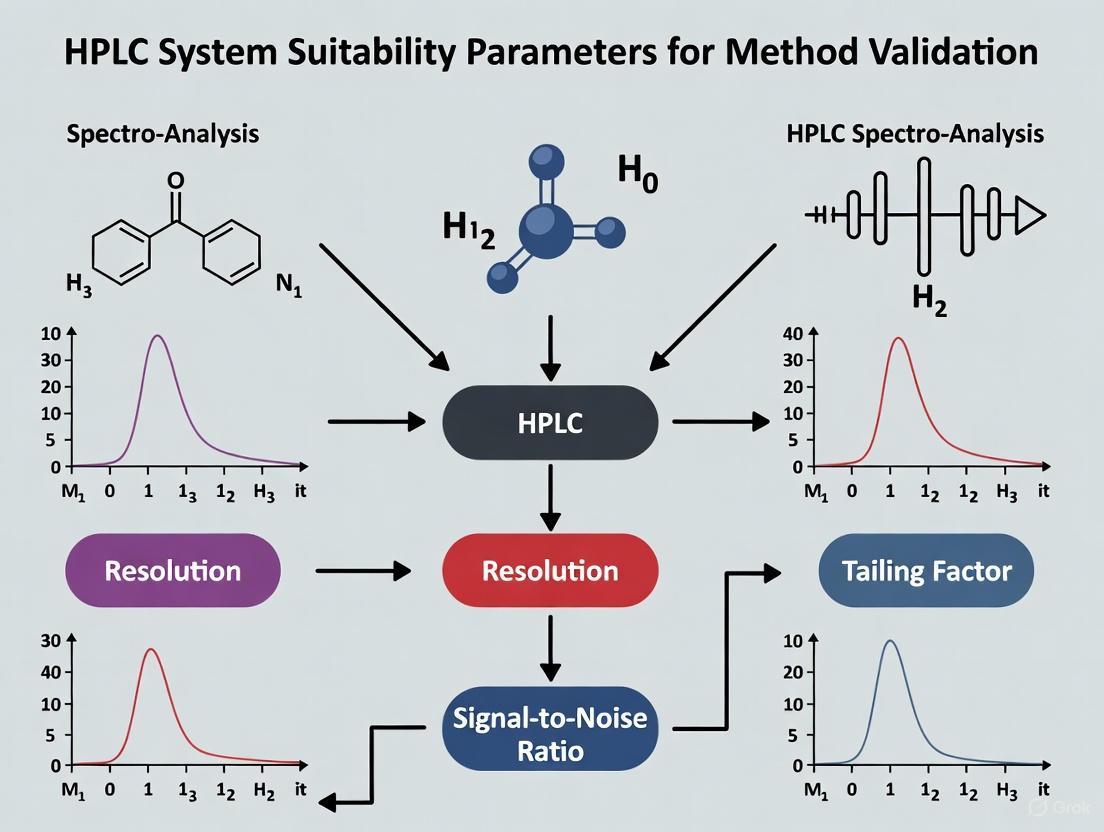
This article provides researchers, scientists, and drug development professionals with a comprehensive framework for understanding and implementing HPLC system suitability testing within method validation.
HPLC System Suitability Parameters: A Comprehensive Guide to Method Validation and Regulatory Compliance
Abstract
This article provides researchers, scientists, and drug development professionals with a comprehensive framework for understanding and implementing HPLC system suitability testing within method validation. Covering foundational principles from USP and ICH guidelines, it details critical parameters like resolution, precision, and tailing factor. The content extends to practical protocols, advanced troubleshooting for common failures, and integration with broader validation and quality assurance frameworks. By synthesizing regulatory requirements with practical application, this guide aims to ensure data integrity, regulatory compliance, and reliable analytical results in pharmaceutical analysis.
Understanding the Pillars of HPLC System Suitability
System suitability testing (SST) serves as the final gatekeeper of data quality in High-Performance Liquid Chromatography (HPLC) analysis. It is a formal, prescribed test that verifies the entire analytical system—instrument, column, reagents, and software—is operating within pre-established performance limits immediately before sample analysis [1]. While method validation proves that an analytical procedure is reliable in theory, system suitability proves that the specific instrument, on a specific day, is capable of generating high-quality data according to the validated method's requirements [1]. This critical pre-analysis check prevents wasted effort and ensures that every analytical result is accurate, precise, and defensible.
Key System Suitability Parameters and Acceptance Criteria
System suitability testing evaluates specific chromatographic parameters against predefined acceptance criteria. These criteria, established during method validation, are designed to ensure the system produces reliable results for the intended samples [2] [3].
Table 1: Fundamental System Suitability Parameters and Acceptance Criteria
| Parameter | Definition | Typical Acceptance Criteria | Purpose |
|---|---|---|---|
| Resolution (Rs) | Measure of separation between two adjacent peaks [4]. | Typically ≥ 2.0 [5] or as specified by method [2]. | Ensures critical pairs of analytes (e.g., API and impurity) are adequately separated [3]. |
| Tailing Factor (T) | Measure of peak symmetry [4]. | USP Tailing Factor < 2.0 [2]. | Indicates column health and absence of active interaction sites; affects integration accuracy [3]. |
| Theoretical Plates (N) | Measure of column efficiency [4]. | Meets or exceeds method specification. | Indicates the column's performance and separation efficiency [3]. |
| Precision/Repeatability (%RSD) | Measure of reproducibility from replicate injections [4]. | RSD for peak areas typically < 1.0-2.0% [2] [1]. | Confirms the instrument's injector and detection system are providing consistent results [3]. |
| Signal-to-Noise Ratio (S/N) | Ratio of analyte peak height to background noise [4]. | Set based on method sensitivity requirements (e.g., for trace analysis). | Assesses detector performance and method sensitivity, especially for low-level impurities [3]. |
The following workflow outlines the standard process for executing and evaluating system suitability tests:
System Suitability in Method Validation
System suitability is not a replacement for method validation but is an essential component of it. During validation, the performance characteristics of the HPLC method itself are established [6]. System suitability tests are then derived from this validation data to ensure the method continues to perform as validated each time it is used [2].
For instance, in a validated method for Ga-68-DOTATATE, the precision was confirmed with coefficients of variation between 0.22% and 0.52% for intraday precision [7]. This laboratory-validated repeatability provides the scientific basis for setting the ongoing system suitability precision limit, such as %RSD < 2.0% for replicate injections, to ensure the system performs adequately during routine quality control [7] [2].
Similarly, validation parameters like specificity—the ability to discriminate between the analyte and interfering components—are monitored during routine analysis through SST parameters like resolution [6]. A method developed for acetylsalicylic acid impurities validation, for example, set a system suitability requirement for a minimum resolution of 2.0 between acetylsalicylic acid and salicylic acid peaks [5].
Troubleshooting Guide: Common System Suitability Failures
When a system suitability test fails, it is a critical warning that the analytical system is not performing correctly. The analytical run must be stopped immediately, and the root cause investigated [1]. The following table addresses common SST failures and their solutions.
Table 2: Troubleshooting Common System Suitability Failures
| Symptom | Potential Causes | Corrective Actions |
|---|---|---|
| Low Resolution | Column degradation, incorrect mobile phase composition/pH, column temperature too high [8]. | Replace column. Prepare fresh mobile phase with correct pH. Adjust column temperature [8]. |
| High Tailing Factor | Column voiding (particularly at UHPLC pressures), blocked frit, active sites on column, basic compounds interacting with silanol groups [9]. | Replace column. Use high-purity silica or shield phases. For basic compounds, add a competing base like triethylamine to the mobile phase [9]. |
| Poor Precision (%RSD too high) | Air in autosampler syringe, leaking injector seal, sample degradation, contaminated needle, bubble in syringe [9]. | Purge autosampler fluidics. Check and replace injector seals and needle. Use appropriate sample storage conditions [9]. |
| Retention Time Drift | Poor temperature control, incorrect mobile phase composition, poor column equilibration, change in flow rate [8]. | Use a thermostat column oven. Prepare fresh mobile phase. Increase column equilibration time. Check and reset flow rate [8]. |
| Pressure Fluctuations/High Pressure | Blocked column, blocked in-line filter, blocked injector, air in system, pump seal failure [8]. | Backflush or replace column. Replace in-line filter. Flush injector. Purge pump to remove air. Replace pump seals [8]. |
Experimental Protocol: Executing a System Suitability Test
This protocol outlines the steps for performing system suitability testing, a critical pre-analysis check [1] [5].
Materials and Reagents
Table 3: Essential Research Reagent Solutions
| Item | Function |
|---|---|
| HPLC or UHPLC System | The instrumental platform for performing the separation and detection. |
| Qualified Chromatography Column | The stationary phase specified in the analytical method (e.g., Waters Symmetry C18) [5]. |
| Reference Standard (Certified Reference Material) | A highly pure, well-characterized substance used to prepare the system suitability test solution [5]. |
| HPLC-Grade Solvents | High-purity solvents (e.g., acetonitrile, water) used to prepare mobile phases and solutions, minimizing background noise [9]. |
| System Suitability Test (SST) Solution | A solution containing the analytes of interest at specified concentrations, used to challenge the chromatographic system [5]. |
Step-by-Step Procedure
- Develop the SST Protocol: Based on the validated method, define the specific parameters (e.g., Resolution, %RSD), their acceptance criteria, and testing frequency [1].
- Prepare the Mobile Phase: Prepare the mobile phase as per the method specification. Filter and degas the solution before use [8].
- Prepare the SST Solution: Accurately prepare the system suitability test solution using the reference standard. The concentration should be representative of a typical sample [1] [5]. For example, a protocol for an acetylsalicylic acid method may use a solution containing both the API and its key impurity, salicylic acid [5].
- Equilibrate the System: Pump the mobile phase through the system and column until a stable baseline is achieved.
- Perform Injections: Make 5-6 replicate injections of the SST solution [5].
- Evaluate Results: The CDS software will automatically calculate the SST parameters. Compare the results against the predefined acceptance criteria.
- Act on the Outcome:
- PASS: If all parameters meet the criteria, the system is deemed suitable. Proceed with the analysis of unknown samples [1].
- FAIL: If any parameter fails, immediately halt the run. Do not analyze samples. Begin troubleshooting to identify the root cause (e.g., column, mobile phase, instrument maintenance). After corrective action, re-run the SST until it passes [3] [1].
Frequently Asked Questions (FAQs)
What is the primary purpose of system suitability testing? The primary purpose is to verify that the entire analytical system (instrument, column, reagents, software) is performing according to the validated method's requirements immediately before a batch of samples is analyzed. It is the final check for data quality [1].
How is system suitability different from method validation? Method validation is a one-time process that proves an analytical procedure is suitable for its intended purpose. System suitability testing is a recurring check performed before each analytical run to prove that a specific system is executing the validated method correctly on that particular day [1].
What should I do if my system fails a suitability test? Stop the analytical run immediately. Do not proceed with sample analysis. Begin a systematic investigation to find the root cause, which could be a degraded column, contaminated mobile phase, air bubbles, or instrument malfunction. Once the issue is resolved, you must re-run and pass the system suitability test before analyzing any samples [3] [1].
When should system suitability testing be performed? SST should be performed at the beginning of every analytical run. For long-running batches (e.g., over 24 hours), it is also recommended to perform SST periodically throughout the run to ensure continued system performance [1].
For researchers and drug development professionals, navigating the harmonized yet complex landscape of United States Pharmacopeia (USP), International Council for Harmonisation (ICH), and U.S. Food and Drug Administration (FDA) requirements is fundamental to ensuring HPLC method validity and regulatory compliance. These guidelines provide the framework for proving that an analytical procedure is fit for its intended purpose, ensuring the reliability, accuracy, and consistency of data used in pharmaceutical quality control [10].
The regulatory environment has modernized significantly with the simultaneous release of ICH Q2(R2) on the validation of analytical procedures and ICH Q14 on analytical procedure development. This shift moves from a prescriptive, "check-the-box" approach to a more scientific, risk-based, and lifecycle-based model for method validation [10]. For laboratories in the United States, complying with ICH standards is a direct path to meeting FDA requirements, which is critical for regulatory submissions such as New Drug Applications (NDAs) and Abbreviated New Drug Applications (ANDAs) [10].
The core parameters required to demonstrate that an analytical method is fit-for-purpose are outlined in ICH Q2(R2) and USP General Chapter <1225> [10] [11]. The specific parameters tested depend on the type of method (e.g., identification, quantitative assay, or impurity test).
The table below summarizes these key validation parameters and their definitions:
Table 1: Core Analytical Method Validation Parameters
| Parameter | Definition | Regulatory Reference |
|---|---|---|
| Accuracy | The closeness of test results to the true value. | ICH Q2(R2) [10] |
| Precision | The degree of agreement among individual test results from repeated samplings. Includes repeatability, intermediate precision, and reproducibility. | ICH Q2(R2) [10] |
| Specificity | The ability to assess the analyte unequivocally in the presence of components that may be expected to be present (e.g., impurities, matrix). | ICH Q2(R2) [10] |
| Linearity | The ability of the method to obtain test results directly proportional to analyte concentration within a given range. | ICH Q2(R2) [10] |
| Range | The interval between upper and lower analyte concentrations for which suitable levels of linearity, accuracy, and precision have been demonstrated. | ICH Q2(R2) [10] |
| Limit of Detection (LOD) | The lowest amount of analyte that can be detected, but not necessarily quantitated. | ICH Q2(R2) [10] |
| Limit of Quantitation (LOQ) | The lowest amount of analyte that can be quantitatively determined with acceptable accuracy and precision. | ICH Q2(R2) [10] |
| Robustness | A measure of the method's capacity to remain unaffected by small, deliberate variations in method parameters. | ICH Q2(R2) [10] |
USP <1225> categorizes analytical procedures and specifies which validation tests are required for each category [11]. For example, a Category I method for assaying a drug substance or product requires accuracy, precision, specificity, linearity, and range, while a Category IV identification test requires only specificity [11].
System Suitability: The Bridge Between Method Validation and Routine Testing
Definition and Purpose
System suitability is a critical pharmacopeial requirement that verifies the analytical system's performance at the time of the test. While method validation proves the procedure itself is reliable, system suitability testing confirms that the instruments, reagents, columns, and operators are functioning properly as an integrated system for that specific analysis [12]. Think of method validation as proving the method works, while system suitability ensures the analytical system is capable of delivering that validated performance during routine use [12]. These are complementary processes that together maintain data integrity.
Key Parameters and Acceptance Criteria
System suitability tests are performed before sample analysis begins and involve making multiple injections of a standard or system suitability solution [12]. The resulting chromatogram is evaluated against predefined acceptance criteria.
Table 2: Key System Suitability Parameters and Typical Acceptance Criteria
| Parameter | Description | Typical Acceptance Criteria |
|---|---|---|
| Retention Time Consistency | Confirms the method's reproducibility and correct compound identification. | Retention time variability < 2% RSD [12] |
| Resolution (Rs) | Quantifies the separation between two adjacent peaks. | Rs ≥ 2.0 for baseline separation [12] |
| Tailing Factor (T) | Measures peak symmetry. | T between 0.8 and 1.5 [12] |
| Theoretical Plates (N) | Indicates column efficiency. | Meets or exceeds predefined limit |
| Precision (Repeatability) | Assesses signal consistency from replicate injections. | %RSD of peak areas or height ≤ 2.0% for 5 replicates [12] |
| Signal-to-Noise Ratio (S/N) | Determines sensitivity and detection capability. | S/N ≥ 10 for quantitation; S/N ≥ 3 for detection [12] |
Regulatory Requirements and Protocol Setup
Regulatory agencies like the FDA, USP, and ICH all require system suitability testing, though their emphases may differ slightly [12]. The FDA strongly emphasizes data integrity in the documentation of these tests, while USP chapters <621> and <1225> provide detailed procedural instructions [13] [12]. ICH guidelines focus on ensuring method reproducibility [12].
To set up an effective protocol, you must define clear acceptance criteria based on the method's critical performance parameters, as shown in Table 2 [12]. The testing frequency—typically at the beginning of each batch analysis or after significant instrument maintenance—should be justified and documented [12].
The Scientist's Toolkit: Essential Reagents and Materials
A well-written analytical procedure must list all required reagents and materials in sufficient detail to ensure reproducibility [13].
Table 3: Essential Research Reagent Solutions for a Regulated HPLC Method
| Item | Function / Purpose | Example / Specification |
|---|---|---|
| HPLC Column | Stationary phase for chromatographic separation. | ACE 3 C18, 150 x 4.6 mm, 3 µm [13] |
| Mobile Phase A | Aqueous component of mobile phase. | 20 mM ammonium formate buffer, pH 3.7 [13] |
| Mobile Phase B | Organic modifier component of mobile phase. | Acetonitrile with 0.05% formic acid [13] |
| Diluent | Solvent for dissolving and preparing samples and standards. | Matches initial mobile phase composition (e.g., 20 mM ammonium formate buffer, pH 3.7) [13] |
| Reference Standard | Qualified material used to calibrate the testing system. | Qualified G-1234 reference standard [13] |
| Reagents | Chemicals for mobile phase and sample preparation. | HPLC-grade Acetonitrile; ≥97% Formic Acid; LC/MS-grade Ammonium Formate [13] |
| Syringe Filter | Clarification of sample solutions prior to injection. | 0.45 µm Nylon [13] |
Frequently Asked Questions (FAQs) and Troubleshooting Guides
FAQ 1: What is the main benefit of the new ICH Q2(R2) and Q14 guidelines?
The main benefit is a fundamental shift from a rigid, prescriptive approach to a flexible, science- and risk-based framework. This allows laboratories to better understand their methods, demonstrate quality through a continuous lifecycle approach, and manage post-approval changes more efficiently without extensive regulatory filings [10].
FAQ 2: How do ICH and FDA guidelines differ for analytical method validation?
The ICH develops harmonized guidelines that are globally accepted. The FDA, as a key member of the ICH, adopts and implements these guidelines. Therefore, for most new drug submissions, following the latest ICH guidelines (Q2(R2) and Q14) is the key to meeting FDA requirements [10].
FAQ 3: What is an Analytical Target Profile (ATP)?
Introduced in ICH Q14, the ATP is a prospective summary that describes the intended purpose of an analytical procedure and its required performance criteria. Defining the ATP at the start of method development ensures the method is designed to be fit-for-purpose from the very beginning [10].
Troubleshooting Guide: Common System Suitability Failures
Table 4: Troubleshooting Common System Suitability Issues
| Problem | Possible Causes | Corrective Actions |
|---|---|---|
| Inadequate Resolution | Degraded or dirty column; incorrect mobile phase pH or composition; column temperature not optimal. | Adjust mobile phase composition or pH; clean or replace the column; adjust column temperature [12]. |
| Poor Precision (%RSD too high) | Injection-related issues; pump flow instability; problems with sample preparation. | Check autosampler performance and injection volume consistency; verify pump performance for stable flow rate; review and standardize sample preparation techniques [12]. |
| Peak Tailing | Column degradation (e.g., voiding); active sites on the column; sample solvent stronger than mobile phase; sample overload. | Clean or replace the column; use a different column chemistry; adjust pH of mobile phase; ensure sample solvent is compatible with mobile phase; reduce sample concentration [12]. |
| Retention Time Drift | Mobile phase composition change (evaporation, poor preparation); column temperature fluctuation; pump flow rate inaccuracy. | Prepare fresh mobile phase; ensure column thermostat is functioning correctly; verify pump calibration and check for leaks [12]. |
Method Lifecycle Management: From Development to Validation
The modernized ICH guidelines emphasize that analytical procedure validation is not a one-time event but a continuous process throughout the method's lifecycle [10]. The following workflow visualizes this integrated approach, from development through routine monitoring, highlighting where system suitability provides ongoing assurance of performance.
Diagram 1: Analytical Method Lifecycle with Integrated System Suitability Testing
This lifecycle management, supported by a robust change management system, allows for justified modifications to a method without extensive regulatory filings, provided a sound scientific rationale and risk assessment are in place [10].
Experimental Protocol: A Template for a Regulated HPLC Analytical Procedure
Based on FDA guidance and industry best practices, the following template outlines the essential components of a well-written analytical procedure for regulated HPLC testing [13].
1. Principle/Scope:
- Description: Briefly state the test's purpose (e.g., potency, related substances, identity), the target analyte, and the sample matrix (e.g., drug product capsule).
- Example: "To determine the assay (% Label Claim), related substances, and identity in G-1234 drug product capsules by HPLC." [13]
2. Apparatus/Equipment:
- Description: List all required qualified equipment. Keep instrument descriptions generic (e.g., "HPLC system with binary pump, autosampler, column compartment, UV-detector"). The column description must be specific, including manufacturer, dimensions, and particle size (e.g., "ACE 3 C18, 150 mm x 4.6 mm, 3 µm"). [13]
3. Operating Parameters:
- Description: Provide a detailed table of all chromatographic conditions to ensure reproducibility.
- Example Parameters: Column temperature, flow rate, injection volume, detection wavelength, mobile phase gradient program, and needle wash solution composition. [13]
4. Reagents/Standards:
- Description: List all reagents with their specified grades and any qualified reference standards, including source and storage conditions. [13]
5. Mobile Phase and Standard Solution Preparation:
- Description: Provide step-by-step preparation instructions with weights, volumes, and pH adjustment directions (if needed). Specify the diluent. [13]
6. Sample Preparation:
- Description: Detail the procedure for sample handling, including the number of replicates, units of concentration, and specific steps like sonication, filtration (specifying filter type and discard volume), and storage conditions for prepared solutions. [13]
7. System Suitability:
- Description: Define the tests, parameters, and acceptance criteria (e.g., "The relative standard deviation (RSD) for five replicate injections of the standard solution must be NMT 2.0%"). [13] [12]
8. Procedure:
- Description: Provide a step-by-step description of the injection sequence (e.g., blanks, standards, samples) and any allowable operating ranges. [13]
9. Calculations:
- Description: Include all formulas used for data analysis (e.g., for assay and impurities) and a description of the integration method. [13]
System suitability testing is a critical pharmacopeial requirement to ensure that a chromatographic system is functioning correctly and is capable of providing reliable data for its intended purpose. These tests verify that the complete analytical system—including the instrument, column, reagents, and operator—is performing as expected on the day of analysis. For any High-Performance Liquid Chromatography (HPLC) method used in pharmaceutical analysis, demonstrating system suitability is a mandatory step before samples can be analyzed. The core parameters of Resolution, Precision, and Tailing Factor provide fundamental insights into the separation quality, data reliability, and peak shape of your analysis.
Core Parameters and Their Acceptance Criteria
The table below summarizes the three core system suitability parameters, their purpose, calculation methods, and standard acceptance criteria as defined by regulatory standards.
| Parameter | Purpose & Importance | Calculation Formula | Acceptance Criteria |
|---|---|---|---|
| Resolution (R) [14] [2] | Measures the separation between two adjacent peaks. Ensures the method can discriminate between the analyte and impurities. | ( R = \frac{2(t2 - t1)}{(W1 + W2)} ) where ( t ) = retention time, ( W ) = peak width at baseline [14]. | R ≥ 1.5 (or as specified in the monograph) [14] [2]. |
| Precision (Repeatability) [2] | Evaluates the consistency of peak responses for multiple injections of the same standard. Ensures the system delivers reproducible results. | Calculated as the Relative Standard Deviation (RSD%) of peak areas or retention times. | RSD ≤ 2.0% for peak area of the active compound (for 5 replicate injections) [2]. |
| Tailing Factor (T) [14] [2] | Assesses the symmetry of a chromatographic peak. Excessive tailing can indicate column issues or secondary interactions. | ( T = \frac{W{0.05}}{2f} ) where ( W{0.05} ) = peak width at 5% height, ( f ) = distance from peak front to the peak maximum at 5% height [14]. | T ≤ 2.0 [2]. |
Experimental Protocols for Determination
Protocol for Determining Resolution and Tailing Factor
This procedure outlines the steps to confirm that your method can adequately separate components and produce symmetric peaks [15].
Materials:
- Chromatographic System: Qualified HPLC system with UV or DAD detector.
- Column: As specified in the method (e.g., a phenyl-hexyl column for certain separations) [15].
- Mobile Phase: Prepared as per method. For example: 20 mM ammonium acetate buffer pH 3.5 and Methanol (65:35 %v/v) [15].
- Test Solution: A "cocktail" or system suitability solution containing the primary analyte and its closest eluting impurity or a second analyte at known concentrations [6].
Procedure:
- Equilibrate the system with the mobile phase until a stable baseline is achieved.
- Inject the test solution and record the chromatogram.
- Measure retention times (t): Note the retention time for each peak of interest.
- Measure peak widths (W): For resolution, determine the peak width at baseline for the two adjacent peaks. For the tailing factor, measure the peak width at 5% of the peak height ((W_{0.05})) and the distance from the peak front to the peak maximum at 5% height (f) [14].
- Calculate parameters: Use the formulas provided in the table above to compute Resolution (R) and Tailing Factor (T).
Protocol for Determining Precision (System Repeatability)
This test confirms the instrument's injection repeatability [6] [2].
Materials:
- Standard Solution: A homogeneous solution of the active pharmaceutical ingredient (API) at a known concentration, typically at 100% of the test concentration.
Procedure:
- Inject the standard solution sequentially for at least five or six replicates [6] [2].
- Record the chromatograms and integrate all peaks consistently.
- For the main analyte peak, record the peak area and retention time for each injection.
- Calculate the mean, standard deviation, and Relative Standard Deviation (RSD%) for the peak areas.
- Compare the RSD% of the peak areas to the acceptance criterion of ≤ 2.0% [2].
Troubleshooting Common Issues
The table below lists common problems, their potential causes, and solutions related to the core system suitability parameters.
| Problem | Potential Causes | Solutions & Corrective Actions |
|---|---|---|
| Poor Resolution (R < 1.5) | - Inadequate mobile phase composition or pH [15] [16].- Column degradation or void [9].- Extra-column volume too large [9].- Flow rate or temperature not optimal [15]. | - Re-optimize mobile phase organic ratio, buffer pH, or gradient [15] [16].- Replace the column if degraded [9].- Use shorter, narrower internal diameter (i.d.) capillaries to reduce extra-column volume [9]. |
| Poor Precision (RSD > 2%) | - Air bubbles in the autosampler syringe or fluidics [9].- A leaking injector seal [9].- Sample degradation during the sequence [9].- Inconsistent integration [9]. | - Purge the autosampler fluidics to remove air [9].- Check and replace worn injector seals [9].- Use a thermostatted autosampler to stabilize the sample [9].- Review and adjust integration parameters for consistency [9]. |
| High Tailing Factor (T > 2) | - Silanol interaction (for basic compounds) [9].- Column void or channeling [9].- Sample solvent stronger than the mobile phase [9].- Contaminated guard column or analytical column head [9]. | - Use high-purity silica (Type B) or polar-embedded columns [9].- Replace the column if a void is present [9].- Ensure the sample is dissolved in the starting mobile phase or a weaker solvent [9].- Replace the guard column frit or flush the analytical column [9]. |
The Scientist's Toolkit: Essential Research Reagent Solutions
The table below lists key reagents and materials crucial for robust HPLC method development and validation.
| Reagent/Material | Function & Purpose | Application Example |
|---|---|---|
| Ammonium Acetate Buffer | Provides a volatile buffer system to control pH, influencing ionization and retention of ionizable compounds. Compatible with LC-MS [15]. | Used at 20 mM concentration, pH 3.5, to optimize resolution between metoclopramide and camylofin on a phenyl-hexyl column [15]. |
| High-Purity Silica (Type B) Columns | Minimizes silanol interactions, which are a primary cause of peak tailing for basic compounds [9]. | Essential for achieving symmetric peaks (Tailing Factor < 2) when analyzing amine-containing APIs [9]. |
| HPLC-Grade Methanol & Acetonitrile | Act as organic modifiers in reversed-phase chromatography. They control solvent strength and selectivity, directly impacting resolution and retention times [16]. | Used in binary or gradient elution modes to elute analytes of varying hydrophobicities. Acetonitrile often provides sharper peaks than methanol [16]. |
| Phosphate Buffers | Provide a wider pH range for controlling analyte retention. Not volatile, so used primarily for LC-UV applications [9]. | Can be used for methods requiring pH > 8 where ammonium acetate loses buffering capacity. Avoid with LC-MS [9]. |
System Suitability Workflow and Relationships
The following diagram illustrates the logical workflow for evaluating HPLC system suitability, showing the relationships between tests, criteria, and subsequent actions.
Frequently Asked Questions (FAQs)
What happens if my system fails the tailing factor requirement?
If the tailing factor (T) is greater than 2.0, it indicates poor peak shape, which can lead to inaccurate integration and quantitation. First, ensure your mobile phase pH and buffer concentration are correct. The most common cause for basic compounds is interaction with acidic silanols on the column. Switching to a high-purity silica-based column or a column with a different chemistry (e.g., phenyl-hexyl) can significantly reduce tailing [9].
Can I adjust my HPLC method if it fails system suitability?
Yes, but within strict limits. USP Chapter <621> provides guidance on permissible adjustments to existing methods without requiring full re-validation. These may include minor changes to flow rate, mobile phase pH (± 0.2 units), column temperature, and gradient time, provided all system suitability criteria are still met after the changes. Any major change requires regulatory consultation and likely, re-validation [2].
How is system suitability different from analytical method validation?
System suitability is a set of tests performed during routine use of an already validated method to ensure the system works correctly on a given day. Method validation is a one-time (though lifecycle-managed) comprehensive process that proves the analytical method itself is suitable for its intended purpose, establishing its accuracy, precision, specificity, etc., during the method's development stage [2] [10].
My resolution is acceptable, but precision is failing. What should I check first?
When resolution is good but precision is poor (high RSD%), the issue is likely not related to separation. Your primary suspects should be the injection system and sample stability. Check for air bubbles in the autosampler syringe, a leaking injector seal, or a partially clogged injection needle. Also, verify that your sample solution is stable for the duration of the analytical run by using a thermostatted autosampler [9].
In pharmaceutical analysis and other regulated laboratories, ensuring the quality and reliability of analytical data is paramount. The Data Quality Triangle is a conceptual framework that illustrates the hierarchical and interdependent relationship between four key activities that collectively guarantee data integrity. This framework, modified from the United States Pharmacopoeia (USP) general chapter <1058>, consists of Analytical Instrument Qualification (AIQ), Analytical Method Validation, System Suitability Tests (SSTs), and Quality Control (QC) Check Samples [17].
Understanding this framework is not merely a regulatory requirement but represents fundamental good analytical science. It describes a system where each layer builds upon the foundation of the previous one, ensuring that instruments are properly qualified, methods are rigorously validated, and system performance is verified both before and during sample analysis. This integrated approach provides substantial business benefit by reducing the risk of releasing inadequate analytical results and protecting the investment in analytical operations [17].
The following diagram illustrates the logical relationships and dependencies within the Data Quality Triangle framework:
Understanding the Four Components
Analytical Instrument Qualification (AIQ)
Analytical Instrument Qualification (AIQ) forms the foundation of the Data Quality Triangle. USP <1058> defines AIQ as "the collection of documented evidence that an instrument performs suitably for its intended purpose" [17]. Essentially, AIQ answers the critical question: Do you have the right system for the right job?
The AIQ process follows the 4Qs model across the instrument's lifecycle [17] [18]:
- Design Qualification (DQ): Defining user requirements before instrument purchase
- Installation Qualification (IQ): Verifying correct installation of components
- Operational Qualification (OQ): Demonstrating the system meets specifications in the user's environment
- Performance Qualification (PQ): Providing ongoing evidence that the system continues to perform appropriately
AIQ is the only component of the data quality triangle that is instrument-specific. It includes testing fundamental instrument functions against manufacturer or user specifications using traceably calibrated equipment. For an HPLC system, this includes testing parameters such as pump flow rate accuracy, detector wavelength accuracy, autosampler injection volume precision, and detector linearity [17]. Without proper AIQ, all subsequent work in the higher levels of the data quality triangle becomes suspect.
Analytical Method Validation
Analytical Method Validation represents the second layer of the triangle, building upon the foundation of a properly qualified instrument. USP <1058> defines it as "The process to demonstrate via documentation that any analytical procedure is suitable for its intended use" [17]. The fundamental question addressed here is: Have we got the right method for the right job?
Method validation relies on the fact that the instrument is qualified and works correctly. The corollary is that methods developed and validated on unqualified equipment raise serious questions about the quality and reliability of the generated data [17]. Method validation typically includes assessment of parameters such as specificity, accuracy, precision, linearity, range, detection limit, quantification limit, and robustness [19].
System Suitability Tests (SSTs)
System Suitability Tests (SSTs) constitute the third layer of the triangle and serve as the first "on-the-day" check before sample analysis commences. According to USP <1058>, SSTs "verify that the system will perform in accordance with the criteria set forth in the procedure" [17]. In practical terms, SSTs answer the question: Is the method running on the system working as expected today, before samples are analyzed?
SSTs are method-specific checks performed by making replicate injections of a standard preparation to ascertain that the chromatographic system meets predefined acceptance criteria before and during sample analysis [4] [20]. These tests are not performed only at the beginning of the assay alone but should be conducted at regular intervals for periodic monitoring, as system performance may change due to continuous use [4].
Quality Control Check Samples
Quality Control Check Samples form the apex of the Data Quality Triangle. These are method-based checks interspersed throughout the analytical run to provide ongoing confirmation that the chromatographic system continues to work correctly during sample analysis [17]. Typically, these independently prepared samples of known concentration or amount are analyzed as unknown samples and calculated as such to confirm continued system performance.
QC samples differ from SSTs in their placement within the analytical run and their purpose. While SSTs verify system performance before sample analysis begins, QC samples monitor continued performance throughout the analysis, detecting any degradation or changes in system performance that might occur during extended sequences [17].
System Suitability Parameters and Acceptance Criteria
System Suitability Testing establishes acceptance criteria that must be met prior to sample analysis. The following table summarizes key SST parameters, their calculation methods, and typical acceptance criteria for HPLC analysis in pharmaceutical applications [4] [20]:
| Parameter | Calculation Formula | Acceptance Criteria | Purpose |
|---|---|---|---|
| Resolution (Rₛ) | ( RS=\frac {tRB – tRA}{0.5 (WA + W_B) } ) | ≥1.5 [20] | Measures quality of separation between two peaks [4] [20] |
| Tailing Factor (T) | ( T = \frac {a+b}{2a} ) (at 5% peak height) | ≤2 [20] | Assesses peak symmetry; values 0.9-1.1 ideal [20] |
| Theoretical Plates (N) | ( N =16{[\frac{(tR)}{W}]}^2 ) or ( N = 5.54{[\frac{(tR)}{W_{1/2}}]}^2 ) | ≥2000 [20] | Measures column efficiency [4] [20] |
| Precision (RSD) | ( RSD = \frac{Standard\ Deviation}{Mean} \times 100\% ) | <2% for 5 or 6 replicates [20] | Verifies injection repeatability [4] [20] |
| Signal-to-Noise Ratio (S/N) | ( S/N = \frac{Signal}{Noise} ) | ≥3 for LOD; ≥10 for LOQ [20] | Determines system performance at lower end [4] [20] |
| Retention Factor (k') | ( k' = \frac{tr – tm}{t_m} ) | >2.0 [20] | Measures retention strength; unitless [20] |
Key Parameter Details
Resolution is one of the most important SST parameters as it directly measures the quality of separation between two chromatographic peaks. Well-resolved peaks are a basic requirement for both qualitative and quantitative analysis. Resolution can be improved by changing mobile phase polarity, increasing column length, or reducing particle size of the stationary phase [20].
Tailing factor becomes important when peak tailing may affect method performance. An ideal chromatographic peak should be of symmetrical Gaussian shape, but deviations often occur due to various factors, primarily multiple mechanisms of analyte retention. Tailing can be reduced by changing mobile phase pH or using end-capped stationary phases [20].
Theoretical plates represent column efficiency, with higher plate numbers indicating better resolution in a given column length. The plate number changes depending on the type of analysis and provides a measure of band broadening [4] [20].
Experimental Protocols for System Suitability Testing
Protocol for SST Implementation
Preparation of Standard Solution: Prepare a standard solution containing the analytes of interest at known concentrations. For pharmaceutical applications, this typically involves the active pharmaceutical ingredient and any critical pairs that require separation.
System Equilibration: Allow the chromatographic system to equilibrate with the mobile phase until a stable baseline is achieved. Monitor pressure and baseline stability to ensure proper equilibration [8].
Replicate Injections: Perform five or six replicate injections of the standard solution. Use five replicates if the required relative standard deviation is less than 2%, and six replicates if the requirement is more than 2% [20].
Parameter Calculation: Calculate all relevant system suitability parameters from the resulting chromatograms:
- Measure retention times and peak widths for resolution calculations
- Determine peak widths at 5% height for tailing factor
- Calculate peak area RSD for precision
- Measure signal and noise for S/N ratio [20]
Comparison to Acceptance Criteria: Compare all calculated parameters against predefined acceptance criteria. If any parameter falls outside acceptable limits, troubleshooting must be performed before proceeding with sample analysis.
Periodic Monitoring: For extended analytical sequences, perform system suitability testing at regular intervals throughout the sequence to monitor system performance over time [4].
Protocol for Precision Determination
Solution Preparation: Prepare a single standard solution at the concentration specified in the analytical method.
Replicate Injections: Inject the standard solution six consecutive times using the same chromatographic conditions [19].
Peak Area Measurement: Integrate the peak areas for the analyte of interest from all six chromatograms.
Calculation: Calculate the mean, standard deviation, and relative standard deviation (RSD) of the six peak areas.
Acceptance Criteria: The RSD of the peak areas should be less than 2%. Documentation should include seven chromatograms (one blank and six sample injections) [19].
HPLC Troubleshooting Guide
Even with proper qualification and validation, chromatographic issues can arise during routine analysis. The following troubleshooting guide addresses common HPLC problems, their likely causes, and recommended solutions:
Peak Shape Issues
| Symptom | Likely Culprit | Solution |
|---|---|---|
| Peak Tailing | Basic compounds interacting with silanol groups | Use high-purity silica or shield phases; add competing base like triethylamine; use buffers of high ionic strength [9] |
| Peak Tailing | Extra-column volume too large | Use shorter, narrower internal diameter connection capillaries; ensure extra-column volume < 1/10 of smallest peak volume [9] |
| Peak Tailing | Column degradation or void | Replace column; try reverse flushing; avoid pressure shocks and aggressive pH conditions [9] |
| Peak Fronting | Blocked frit or particles on column head | Replace pre-column frit; identify source of particles (sample, eluents, pump mechanics) [9] |
| Peak Fronting | Column overload | Reduce sample amount; increase column volume; use larger internal diameter column [9] |
| Peak Fronting | Sample dissolved in strong eluent | Dissolve sample in starting mobile phase; reduce sample solvent strength or injection volume [9] |
| Split Peaks | Contamination on column or guard inlet | Replace guard column; flush analytical column with strong mobile phase; replace column if needed [8] |
| Split Peaks | Poor tubing cut or connection | Check all tubing connections for voids; ensure proper cutting and installation of tubing [21] |
Retention Time Issues
| Symptom | Likely Culprit | Solution |
|---|---|---|
| Retention Time Drift | Poor temperature control | Use thermostat column oven; change column oven temperature [8] |
| Retention Time Drift | Incorrect mobile phase composition | Prepare fresh mobile phase; check mixer function for gradient methods [8] |
| Retention Time Drift | Poor column equilibration | Increase column equilibration time; condition column properly [8] |
| Retention Time Drift | Change in flow rate | Reset flow rate; test using liquid flow meter [8] |
| Decreasing Retention Time | Faulty aqueous pump | Purge pump and clean check valves; replace consumables on aqueous pump [21] |
| Increasing Retention Time | Faulty organic pump | Purge pump and clean check valves; replace consumables on organic pump [21] |
Pressure and Baseline Issues
| Symptom | Likely Culprit | Solution |
|---|---|---|
| High Pressure | Column blockage | Backflush column; replace column [8] |
| High Pressure | Injector blockage | Flush injector with strong organic solvent; replace injector if needed [8] |
| Pressure Fluctuations | Air in system | Degas all solvents; purge pump [8] |
| Pressure Fluctuations | Check valve fault | Replace check valves [8] |
| Baseline Noise | Leak | Check for loose fittings; tighten gently; check pump seals [8] |
| Baseline Noise | Air bubbles in system | Flush system with strong organic solvent; purge system; degas mobile phase [8] |
| Baseline Drift | Column temperature fluctuation | Use thermostat column oven; verify temperature accuracy [8] |
| Baseline Drift | Contamination of detector flow cell | Flush flow cell with strong organic solvent; replace if necessary [8] |
Frequently Asked Questions
General Concepts
Q: Why can't System Suitability Tests substitute for Analytical Instrument Qualification?
A: SSTs and AIQ serve fundamentally different purposes. AIQ verifies that the instrument itself meets specifications and is suitable for its intended use, while SSTs verify that a specific method is working correctly on a qualified system on the day of analysis. SSTs are method-specific and cannot verify fundamental instrument parameters such as pump flow rate accuracy, detector wavelength accuracy, or autosampler injection volume precision, which are essential components of AIQ [17].
Q: What is the difference between method validation and system suitability testing?
A: Method validation demonstrates that an analytical procedure is suitable for its intended purpose, while system suitability testing verifies that the system is performing adequately on the day of analysis according to the validated method's criteria. Method validation is performed once (with possible partial revalidation for changes), while SSTs are performed before each analytical run [17].
Parameter Specific Questions
Q: Why are 5 or 6 replicate injections used in SST instead of other numbers?
A: The number of replicates is based on statistical requirements and regulatory guidance. Five replicate injections are used when the requirement for relative standard deviation is less than 2%, and six replicates are used when the RSD requirement is more than 2% [20]. This provides sufficient data for meaningful statistical evaluation while maintaining practical efficiency.
Q: Why must resolution be at least 1.5 for complete separation?
A: A resolution value of 1.5 indicates essentially complete separation between two peaks, with only about 0.1% overlap between the peaks. Lower values may not provide adequate separation for accurate quantification, especially for minor components or impurities [20].
Q: What causes peak tailing and how can it be minimized?
A: Peak tailing is mainly due to more than one mechanism of analyte retention. Common causes include secondary interactions of polar analytes with active sites (such as silanol groups) in the system or column. Tailing can be reduced by changing mobile phase pH, using high-purity silica with end-capping, adding competing bases to the mobile phase, or using alternative stationary phases [20] [9].
Implementation Questions
Q: How often should system suitability testing be performed during an analytical sequence?
A: SST should be performed at the beginning of the assay and at regular intervals during the analytical sequence. This periodic monitoring is necessary because system performance may change due to continuous use. The frequency should be determined based on the method stability and regulatory requirements [4].
Q: What are the consequences of not following the Data Quality Triangle framework?
A: Failure to implement this framework can result in: purchasing inappropriate instruments, using instruments outside their validated operating ranges, making unsuitable decisions based on unreliable data, and regulatory citations. FDA warning letters frequently cite failures related to inadequate equipment qualification and calibration [17].
Essential Research Reagent Solutions
Successful implementation of the Data Quality Triangle requires appropriate materials and reagents. The following table details key research reagent solutions and their functions in HPLC analysis for pharmaceutical applications:
| Material/Reagent | Function | Application Notes |
|---|---|---|
| High-Purity Type B Silica Columns | Reduces peak tailing for basic compounds | Minimizes interaction with acidic silanol groups; essential for analyzing basic pharmaceuticals [9] |
| HPLC-Grade Buffers | Controls mobile phase pH | Essential for reproducible retention times; required for ionization control of analytes [19] |
| Therapyl (TFA, Phosphate, Acetate) | Mobile phase modifiers | Improves peak shape; suppresses silanol interactions; choice depends on detection method and pH requirements [9] |
| Triethylamine (TEA) | Competing base | Added to mobile phase to reduce tailing of basic compounds by blocking silanol interactions [9] |
| HPLC-Grade Solvents | Mobile phase components | Minimize baseline noise and ghost peaks; ensure reproducibility [8] |
| System Suitability Standards | SST test mixtures | Verify system performance; typically contain compounds to test resolution, tailing, and efficiency [4] |
| Certified Reference Standards | Method validation and calibration | Provide traceability and accuracy for quantitative measurements [19] |
Why SSTs are Non-Negotiable for Data Integrity and Patient Safety
System Suitability Tests (SSTs) are a set of predefined criteria that confirm your High-Performance Liquid Chromatography (HPLC) system is performing adequately and is capable of generating reliable data for a specific analysis on the day it is run [4] [2]. In pharmaceutical analysis, they are not just a best practice but a regulatory requirement for method validation and routine use, serving as the final quality gate before sample analysis [4] [2]. Adherence to SSTs is fundamental for patient safety, as it ensures the accuracy and reliability of data used to make critical decisions about drug quality, efficacy, and stability.
The Role of System Suitability in Pharmaceutical Analysis
System suitability provides objective evidence that the complete analytical system—including the instrument, column, mobile phase, and analyst—is fit for its intended purpose [22]. It is a critical component of the Analytical Instrument Qualification (AIQ) framework described in USP <1058>, which positions SSTs as the final verification that the entire system is operating correctly for a specific method, complementing instrument qualification and method validation [2].
The failure to perform or pass SSTs can have severe consequences. Regulatory bodies like the FDA stipulate that if SST results fall outside acceptance criteria, the analytical run may be invalidated [2]. More importantly, neglecting SSTs compromises data integrity, potentially leading to the release of substandard or unsafe drug products, which directly jeopardizes patient safety [22].
Key System Suitability Parameters and Their Acceptance Criteria
SSTs evaluate the chromatographic system against several key parameters. The table below summarizes these critical parameters and their typical acceptance criteria as guided by pharmacopeial standards like the USP [2].
Table: Key System Suitability Parameters and Acceptance Criteria
| Parameter | Description | Typical Acceptance Criteria | Significance for Data Integrity |
|---|---|---|---|
| Resolution (Rs) | Ability to separate two adjacent peaks [22]. | Minimum requirement, often >1.5 [2]. | Ensures accurate quantification of individual components, especially critical for impurities and active ingredients [4]. |
| Tailing Factor (Tf) | Measure of peak symmetry [4]. | USP Tailing Factor < 2.0 [2]. | Asymmetric (tailed) peaks can lead to inaccurate integration and quantification [4]. |
| Precision/Repeatability | Agreement between successive measurements under the same conditions [4]. | Relative Standard Deviation (RSD) of peak areas for replicate injections < 2.0% [2]. | Confirms the system's stability and the analyst's ability to produce reproducible results. |
| Theoretical Plates (N) | Indicator of column efficiency [4]. | Minimum as per method; higher is generally better. | A low number indicates poor column performance, leading to broader peaks and reduced sensitivity [4]. |
| Signal-to-Noise Ratio (S/N) | Measure of detection sensitivity at the lower end [4]. | Typically ≥ 10 for quantification. | Essential for reliably detecting and quantifying low-level impurities [4]. |
SST Troubleshooting FAQs
Here are answers to common questions and issues encountered during System Suitability Testing.
FAQ 1: The resolution between my two critical peaks is below the acceptance criterion. What should I do?
Low resolution means two compounds are not fully separated, risking inaccurate quantification.
- Possible Causes & Solutions:
- Column Degradation or Wrong Column: Replace the column with a new one of the correct stationary phase [9] [8].
- Incorrect Mobile Phase Composition: Prepare a fresh mobile phase, ensuring precise pH and buffer concentration [8]. For methods with flexibility per USP <621>, slight adjustments to the organic ratio or buffer strength may be permissible with regulatory approval [2].
- Temperature Too Low: Increase the column temperature [8].
- Strong Sample Solvent: Ensure the sample is dissolved in a solvent that is not stronger than the initial mobile phase composition [9].
FAQ 2: Why is my peak tailing excessive, and how can I fix it?
Peak tailing can lead to poor integration and inaccurate results.
- Possible Causes & Solutions:
- Active Silanol Sites (for basic compounds): Use a high-purity (Type B) silica column or a polar-embedded phase. Adding a competing base like triethylamine to the mobile phase can also help [9].
- Column Void: A void has formed at the column inlet. Replace the column [9].
- Blocked Frit: Replace the guard column or the column's inlet frit [9].
- Inappropriate Mobile Phase pH: Adjust the pH to suppress analyte ionization [8].
FAQ 3: My retention times are drifting. How does this affect my analysis and how can I stabilize them?
Retention time drift makes peak identification unreliable and can cause peaks to fall outside the reporting window.
- Possible Causes & Solutions:
- Poor Temperature Control: Use a thermostat column oven to maintain a stable temperature [8].
- Mobile Phase Instability: Prepare a fresh mobile phase consistently. For gradient methods, ensure the mixer is functioning correctly [8].
- Insufficient Column Equilibration: Increase the column equilibration time when changing mobile phases [8].
- Change in Flow Rate: Check and reset the flow rate; test with a flow meter if necessary [8].
FAQ 4: The precision of replicate injections is outside the limit (%RSD > 2.0). What is the problem?
Poor precision indicates instability in the injection process or the analytical system.
- Possible Causes & Solutions:
- Air in the Autosampler Syringe: Purge the autosampler fluidics to remove bubbles [9].
- Leaking Injector Seal: Check and replace worn injector seals [9].
- Sample Degradation: Use a thermostatted autosampler to maintain sample stability [9].
- Needle Issue: The injector needle could be clogged or deformed and may need replacement [9].
Experimental Protocol: System Suitability Assessment for a Docetaxel HPLC Method
The following is an example methodology adapted from a published research paper, demonstrating the integration of SSTs into an analytical workflow [22].
1. Objective To establish and validate a stability-indicating HPLC method for Docetaxel (DTX) injection formulation, with system suitability as a cornerstone for ensuring method reliability.
2. Materials and Reagents Table: Key Research Reagent Solutions
| Item | Function / Description |
|---|---|
| Zorbax XDB C18 Column (150 mm × 4.6 mm, 5µm) | The stationary phase for chromatographic separation [22]. |
| HPLC-grade Acetonitrile | Organic modifier in the mobile phase [22]. |
| Glacial Acetic Acid | Used to adjust the pH of the aqueous component of the mobile phase [22]. |
| Docetaxel Reference Standard | Certified standard used to prepare calibration and system suitability solutions [22]. |
| System Suitability Solution | A mixture containing DTX and known related compounds to test resolution and other parameters [22]. |
3. Chromatographic Conditions
- Mobile Phase: Water:Acetonitrile (55:45, v/v) [22].
- Flow Rate: 1.5 mL/min [22].
- Column Temperature: 30°C [22].
- Detection Wavelength: 230 nm [22].
- Injection Volume: As per validated method.
4. System Suitability Testing Procedure
- Equilibration: Equilibrate the HPLC system with the mobile phase until a stable baseline is achieved.
- Blank Injection: Inject the blank solvent (diluent) to confirm no interfering peaks are present at the retention times of the analytes.
- System Suitability Solution: Inject the system suitability solution. The chromatogram should show a resolved peak for any known impurity and the main analyte.
- Standard Solution Replicates: Inject the DTX regular standard solution five times.
5. Data Analysis and Acceptance Calculate the following parameters from the chromatograms and ensure they meet the pre-defined criteria [22]:
- Resolution (Rs) between DTX and a close-eluting impurity: NLT 3.0.
- Tailing Factor (Tf) for DTX peak: NMT 1.0.
- Theoretical Plates (N) for DTX peak: NLT 7481.
- Precision (%RSD) of DTX peak area for five replicate injections: NMT 0.6%.
The workflow and decision-making process for this SST is outlined below.
System Suitability Tests are a non-negotiable pillar of analytical quality control. They are not a mere bureaucratic hurdle but a scientifically rigorous practice that safeguards the integrity of every data point generated. For researchers and drug development professionals, a robust SST protocol is the most effective early-warning system to detect analytical problems before they can compromise product quality or, ultimately, patient safety.
Implementing Robust System Suitability Protocols
Step-by-Step Guide to Developing an SST Protocol
What is a System Suitability Test (SST) and why is it critical in HPLC analysis?
A System Suitability Test (SST) is a set of checks performed to prove that a chromatographic system—comprising the instrument, column, mobile phase, and analytical method—is functioning correctly and is ready for sample analysis [4] [2]. It is a mandatory requirement before starting any HPLC sample analysis and should be performed at regular intervals during an analytical run to ensure continued system performance [4].
SST is not an instrument qualification test. Instead, it verifies that the entire analytical system is performing adequately for a specific method on the day of analysis [2]. According to regulatory guidance, if SST results fall outside acceptance criteria, the analytical run may be considered invalid [2].
What are the key SST parameters and their acceptance criteria?
The following table summarizes the core SST parameters and their typical acceptance criteria as defined by pharmacopeial standards like the USP [2].
| SST Parameter | Description | Typical Acceptance Criteria |
|---|---|---|
| Resolution (Rs) | Ability to separate two adjacent peaks. Confirms the method's selectivity [4]. | A minimum value must be demonstrated between the API and any known impurity [2]. |
| Precision (Repeatability) | Closeness of agreement between a series of measurements. Measured as %RSD of peak areas from replicate injections [4] [6]. | %RSD of < 2.0% for peak area of the active compound (typically from 5-6 injections) [6] [2]. |
| Tailing Factor (Tf) | Measure of peak symmetry. Asymmetric peaks can affect accuracy and resolution [4]. | USP Tailing Factor of < 2.0 [2]. |
| Theoretical Plates (N) | Indicator of column efficiency. A higher number indicates better efficiency [4]. | Meets predefined method requirement. |
| Retention Time (tᵣ) | The time taken for a compound to elute from the column [4]. | Fairly constant and within a specified window. |
| Signal-to-Noise Ratio (S/N) | Measure of the system's sensitivity and performance at the lower end of detection [4]. | Meets predefined requirement, especially for impurity methods. |
A step-by-step protocol for developing your SST
Developing a robust SST protocol is a systematic process. The workflow below outlines the key stages from defining requirements to final implementation.
Step 1: Define the Purpose and Review the Analytical Method
Before selecting SST parameters, understand the method's intent. Is it for an assay, impurity quantification, or dissolution testing? [4]. Review the method's validation report to identify parameters that are most critical for its performance and most likely to vary [6].
Step 2: Identify and Prioritize Critical SST Parameters
Based on the method's purpose, select the non-negotiable parameters from the table in Section 2. For instance:
- All methods must include Precision (repeatability) to ensure the system's response is stable [6] [2].
- Methods separating multiple compounds must include Resolution to confirm the method's selectivity remains adequate [4] [2].
- Methods quantifying low-level impurities must include Signal-to-Noise ratio to ensure detection capability [4].
Step 3: Establish Scientifically Sound Acceptance Criteria
Set acceptance limits that are realistic, achievable, and ensure the method's validity. Use regulatory guidelines (e.g., USP) and method validation data as a foundation [2]. Criteria must be tight enough to detect system failure but not so tight that they cause unnecessary method failure. Statistical analysis of validation or historical data is used to set these limits [4].
Step 4: Select and Prepare the SST Test Solution
The SST solution must be capable of demonstrating all the parameters you have selected. Common choices include:
- A standard solution of the active pharmaceutical ingredient (API) for precision (tailing factor, theoretical plates) [6].
- A "cocktail" solution containing the API spiked with known impurities or degradation products to demonstrate resolution [6].
- A diluted standard solution to determine the Signal-to-Noise ratio [15].
- A forced degradation sample or an aged stability sample can be used as an interim SST solution if impurity reference standards are unavailable [6].
Step 5: Execute Protocol and Document the SST
Formalize the SST protocol in a standard operating procedure (SOP) or analytical method. The documentation must clearly state [4] [2]:
- The exact composition and preparation of the SST solution.
- The number of replicate injections required (typically 5 or 6).
- The precise formulas for calculating each parameter.
- The definitive acceptance criteria for each parameter.
- The frequency of SST execution during a sequence.
Essential research reagents and materials for SST
The table below lists key materials required for developing and executing a robust SST protocol.
| Reagent / Material | Function in SST Protocol |
|---|---|
| Certified Reference Standards | High-purity API and impurity standards to prepare the SST solution for accurate parameter measurement [6]. |
| Chromatography Column | The specific column (chemistry, dimensions, particle size) listed in the analytical method. Its performance is being evaluated [23]. |
| HPLC-Grade Solvents & Reagents | To prepare the mobile phase and sample solutions, ensuring no interference or artifacts that affect SST results [15] [24]. |
| Placebo Mixture | A mock formulation without the API, used in drug product methods to demonstrate specificity and lack of interference from excipients [6]. |
| Forced Degradation Samples | Samples of the drug substance or product stressed under various conditions (e.g., heat, light, acid, base) used during development to verify method specificity and resolution [6]. |
Troubleshooting FAQs: Addressing common SST failures
Q: My SST is failing the precision requirement (%RSD too high). What should I check? A: A failing precision test indicates instability in the chromatographic system. Focus on:
- The HPLC Pump: Check for leaking seals, faulty check valves, or irregular flow rate causing retention time shifts and area variation.
- The Autosampler: Ensure the injection volume is precise and that there is no carryover between injections.
- The Column: Confirm the column is not overloaded and is at a stable temperature. A deteriorating column can cause peak broadening and shifting retention times.
- The SST Solution: Verify the solution is stable, homogeneous, and properly prepared.
Q: The resolution between two critical peaks is below the acceptance criterion. How can I address this? A: Failing resolution means the method's selectivity is inadequate on that day. Investigate:
- Mobile Phase: Verify it was prepared correctly (pH, buffer concentration, organic ratio). A small change in pH can significantly impact the resolution of ionizable compounds [23].
- Column Health and Temperature: A degraded column has reduced resolving power. Ensure the column temperature is controlled and as specified in the method.
- Column Chemistry: Confirm that the correct column (make, model, and lot) is being used. Small differences between columns from different manufacturers can cause resolution failure.
Q: The tailing factor for my main peak is too high. What does this mean? A: An elevated tailing factor suggests a potential interaction of the analyte with active sites on the chromatography column or issues with the mobile phase [4]. To resolve this:
- Mobile Phase pH: Adjust the pH of the mobile phase to suppress silanol interactions, which are a common cause of tailing for basic compounds.
- Column Condition: A contaminated or aged column often shows increased peak tailing. Consider regenerating or replacing the column.
- Inadequate Sample Solvent: Ensure the sample is dissolved in a solvent that is weaker than or similar to the mobile phase to avoid peak distortion upon injection.
System Suitability Testing (SST) is a critical component of HPLC method validation, ensuring that the entire analytical system—comprising the instrument, column, mobile phase, and software—is performing adequately and can generate reliable and reproducible results on the day of analysis [6] [2]. This guide provides detailed protocols and troubleshooting advice for preparing SST solutions and meeting acceptance criteria.
Understanding System Suitability Tests (SST)
Purpose and Regulatory Importance
System Suitability Tests are method-specific checks performed prior to, or during, a batch of analytical samples. They are not a substitute for Analytical Instrument Qualification (AIQ) but verify that a qualified system is functioning correctly for the specific method at the time of analysis [2]. According to regulatory bodies like the FDA, if SST results fall outside acceptance criteria, the analytical run may be considered invalid [2].
SST solutions are typically mixtures of the target analytes and key impurities or degradation products used to challenge the chromatographic system. Passing SST confirms that the method has the necessary specificity, precision, and resolution to provide meaningful data [6] [2].
Key System Suitability Parameters and Acceptance Criteria
The table below summarizes the core SST parameters, their purposes, and typical acceptance criteria as defined by regulatory guidelines like those from the USP [2].
Table 1: Key System Suitability Parameters and Acceptance Criteria
| Parameter | Purpose | Typical Acceptance Criteria |
|---|---|---|
| Resolution (Rs) | Measures the separation between two adjacent peaks, typically between the API and its closest eluting impurity [6] [2]. | A minimum value must be demonstrated (e.g., Rs > 1.5 or 2.0) [2]. |
| Precision (Repeatability) | Assesses the variability of multiple injections of the same standard solution [6]. | Relative Standard Deviation (RSD) of peak areas or retention times is typically < 1.0% or < 2.0% [6] [2]. |
| Tailing Factor (Tf) | Quantifies peak symmetry. Asymmetric peaks can affect resolution and integration accuracy [2]. | USP Tailing Factor is typically < 2.0 [2]. |
| Theoretical Plates (N) | Indicates the efficiency of the chromatographic column [6]. | A minimum number is often specified, indicating good column performance. |
Preparation of the SST Solution: Methodologies and Protocols
Composition of the SST Solution
The ideal SST solution is a "cocktail" or "retention marker solution" that contains:
- The Active Pharmaceutical Ingredient (API) at a known concentration, often around 100% of the test concentration.
- Known specified impurities and degradation products that are available as reference standards [6].
- For methods that quantify impurities, the solution should challenge the method at relevant levels (e.g., from reporting thresholds to 120% of specification limits) [6].
If reference materials for impurities are unavailable, a suitable interim substitute is a mixed forced-degradation sample or an aged accelerated stability sample (e.g., a sample stored for three months at 40°C and 75% relative humidity) [6].
Step-by-Step Experimental Protocol
The following workflow outlines the standard procedure for preparing and using an SST solution.
Detailed Methodology:
- Identify Data Sources: Begin by defining the required components of the SST solution based on the analytical procedure. This typically includes the API and critical impurities or degradation products [25].
- Weighing: Accurately weigh the required amounts of each certified reference standard using a calibrated analytical balance [15].
- Dissolution and Dilution: Transfer the weighed standards into a suitable volumetric flask. Dissolve them in the mobile phase or a solvent weaker than the mobile phase to prevent chromatographic issues like peak fronting [8] [9]. Bring to volume with the solvent.
- Sonication: Sonicate the solution to ensure complete dissolution and homogeneity.
- Filtration: Filter the final solution through a 0.45 µm or 0.22 µm membrane filter to remove any particulate matter that could damage the HPLC column or system [15].
- System Suitability Test: Inject the recommended number of replicates of this SST solution (e.g., five or six injections) [6]. Evaluate the resulting chromatograms for the parameters listed in Table 1. The system is only approved for sample analysis if all predetermined acceptance criteria are met.
The Scientist's Toolkit: Essential Reagents and Materials
Table 2: Key Research Reagent Solutions for SST Preparation
| Item | Function / Purpose |
|---|---|
| Certified Reference Standards | High-purity API, impurity, and degradant materials used to prepare the SST solution; their certified purity is essential for accurate quantification. |
| HPLC-Grade Solvents | High-purity solvents (e.g., methanol, acetonitrile, water) used to prepare the mobile phase and sample solutions; minimize baseline noise and contamination. |
| Volumetric Flasks | Precisely calibrated glassware for accurate dilution and preparation of standard solutions to the required concentration. |
| Membrane Filters | (0.45 µm or 0.22 µm) Used to remove particulate matter from mobile phases and sample solutions, protecting the HPLC column and system. |
| Placebo Mixture | A mock drug product containing all excipients without the API; used during method validation to demonstrate specificity and a lack of interference from the formulation matrix [6]. |
FAQs and Troubleshooting Guide
Frequently Asked Questions
Q1: Can I modify an existing USP HPLC method for my specific instrument? Yes, within limits. USP Chapter <621> provides guidance on permissible adjustments (e.g., changes to flow rate, column length, particle size) without requiring full re-validation, provided all system suitability requirements are still met [2]. Always obtain approval from your Regulatory Affairs department before implementing any changes.
Q2: What is the difference between method validation and system suitability? Method validation is a comprehensive, one-time (with periodic re-validation) process that demonstrates an analytical procedure is suitable for its intended purpose [6] [23] [25]. System suitability is a routine check performed each time the method is used to ensure the analytical system is performing appropriately at that moment [2].
Q3: My SST solution does not contain all known impurities. Is it still valid? While not ideal, it is sometimes unavoidable if impurity reference standards are unavailable. In early-phase development, a mixed forced-degradation sample can be used as an interim SST solution to aid in identifying key analytes [6]. For late-phase and commercial methods, obtaining authentic standards for all specified impurities is essential.
Troubleshooting Common SST Failures
The following diagram outlines a logical approach to diagnosing and resolving common system suitability failures.
Detailed Troubleshooting Steps:
For Sub-optimal Resolution:
- Column degraded or contaminated: Flush the column with a strong solvent or replace it if flushing is ineffective [8] [9].
- Incorrect mobile phase composition: Prepare a fresh mobile phase and ensure the mixer is working correctly for gradient methods [8].
- Unsuitable column temperature: Adjust the column temperature to optimize separation; use a thermostat column oven for stability [8] [9].
For Poor Precision (High RSD):
- Air bubbles in the system: Degas the mobile phase thoroughly and purge the pump to remove air [8].
- A leak in the system: Check for loose fittings and tighten them gently. Inspect pump seals and replace them if worn out [8] [9].
- Injector issues: A leaking injector seal, a bubble in the syringe, or a clogged/deformed needle can cause imprecise injection volumes. Flush the injector and replace worn parts [9].
For Peak Tailing:
- Active sites on the column: Basic compounds can interact with silanol groups on the silica. Switch to a column with high-purity (type B) silica or a polar-embedded group [9].
- Incorrect mobile phase pH: Adjust the pH of the mobile phase and prepare a new batch [8].
- Column void: A void has formed in the column packing, often due to pressure shocks. The column typically needs to be replaced [9].
Establishing Acceptance Criteria for Key Chromatographic Parameters
For researchers and drug development professionals, establishing robust acceptance criteria for chromatographic parameters is a critical component of method validation that ensures data integrity and regulatory compliance. These criteria verify that your analytical system performs adequately for its intended purpose and generates reliable results throughout the method lifecycle. This technical guide provides comprehensive troubleshooting and procedural support for implementing effective acceptance criteria frameworks aligned with current regulatory standards.
Key Parameter Specifications
Table 1: Acceptance Criteria for Key Chromatographic Parameters
| Parameter | Regulatory Basis | Acceptance Criteria | Purpose |
|---|---|---|---|
| Specificity | ICH Q2(R1), USP <1225> [6] | Baseline resolution between critical pairs; Peak purity match ≥ threshold; No interference from blank/placebo [6] | Ensures method measures only intended analyte without interference [6] |
| Accuracy | ICH Q2(R1) [6] | Recovery: 98–102% for APIs; Sliding scale for low-level impurities; 9 determinations over 3 levels [6] | Confirms closeness of test results to true value [6] |
| Precision (Repeatability) | USP <621> [2] | RSD ≤ 2.0% for assay; ≤ 5–10% for impurities [6] [2] | Verifies results reproducibility under same operating conditions [6] |
| Linearity | ICH Q2(R1) [6] | R² ≥ 0.999; Residuals within ±1.96 [26] | Demonstrates proportional response to analyte concentration [27] |
| Resolution (Rs) | USP <621> [2] | Rs ≥ 2.0 between critical pairs [2] | Ensures adequate separation between analyte peaks [2] |
| Tailing Factor (Tf) | USP <621> [2] | Tf ≤ 2.0 [2] | Confirms acceptable peak symmetry [2] |
| Limit of Detection (LOD) | ICH Q2(R1) [26] | Signal-to-noise ≥ 3:1 [19] | Lowest detectable analyte level [27] |
| Limit of Quantification (LOQ) | ICH Q2(R1) [26] | Signal-to-noise ≥ 10:1; RSD ≤ 2% [19] | Lowest quantifiable analyte level with acceptable precision [27] |
System Suitability Testing: Core Concepts
What are system suitability tests and why are they mandatory?
System suitability tests (SSTs) are quality control checks that verify your chromatographic system can deliver reliable results during actual usage [3]. They confirm that the entire analytical system—including instrument, column, mobile phase, and software—is functioning properly on the day of analysis [2]. Regulatory bodies including FDA, ICH, and USP require SSTs as they serve as the cornerstone of data integrity, directly determining whether your equipment can generate trustworthy results that support quality decisions [3].
How do system suitability requirements differ from full method validation?
While method validation demonstrates the procedure is suitable for its intended purpose, system suitability confirms the system is performing adequately at the time of analysis [6] [2]. System suitability parameters are typically a subset of the full validation criteria and are monitored before each analytical run, whereas full validation is conducted comprehensively during method development [6] [3].
Experimental Protocols & Methodologies
Specificity and Selectivity Assessment
Protocol: To demonstrate specificity, analyze procedural blanks, placebo formulations (for drug products), and samples spiked with potential impurities [6]. Perform forced degradation studies under stress conditions (acid, base, oxidation, thermal, photolytic) to generate degradation products [6] [19].
Methodology: Inject degraded samples and demonstrate baseline resolution between the active pharmaceutical ingredient (API) and all degradants [6]. Use peak purity assessment with photodiode array or mass spectrometry detection to confirm analyte homogeneity [6]. For formulations, verify no interference from excipients at the retention time of the API [6].
Troubleshooting: If interference occurs, optimize chromatographic conditions by adjusting mobile phase pH, organic modifier gradient, or column temperature [19]. Consider alternative column chemistry if resolution remains inadequate [19].
Accuracy/Recovery Determination
Protocol: Prepare a minimum of nine determinations over three concentration levels (typically 80%, 100%, 120% of target) covering the specified range [6]. For drug products, spike API into placebo matrix at each level [6].
Methodology: Compare measured concentrations to known added amounts [6]. Calculate percent recovery for each level and statistical evaluation across all levels [6].
Troubleshooting: Consistently high or low recovery across all levels may indicate method bias requiring investigation of extraction efficiency or reference standard qualification [6]. Inconsistent recovery at specific levels may suggest non-linearity in the working range [26].
Precision Evaluation
Protocol: Conduct repeatability testing using six sample preparations at 100% concentration or three concentrations in triplicate [6] [27]. For intermediate precision, repeat studies on different days, with different analysts, and different instruments [19].
Methodology: Inject replicates and calculate relative standard deviation (RSD) for peak areas (system precision) and calculated content (method precision) [6].
Troubleshooting: High system RSD may indicate instrument issues such pump fluctuations or detector instability [3]. High method RSD suggests sample preparation inconsistencies or homogeneity issues [6].
Linearity and Range Establishment
Protocol: Prepare standard solutions at 5-7 concentration levels from LOQ to at least 120% of target concentration [19]. Use independent dilutions rather than adjusting injection volume [19].
Methodology: Plot analyte response against concentration and perform linear regression analysis [26]. Examine residuals for random distribution and assess for significant quadratic patterns [26].
Troubleshooting: Non-linear response may require investigation of detector linearity range or assessment of secondary equilibrium effects [26]. Systematic patterns in residuals indicate potential non-linearity requiring method modification [26].
System Suitability Validation Workflow
Frequently Asked Questions
What should I do when system suitability failures occur?
Failed system suitability tests invalidate analytical results and require investigation before proceeding with sample analysis [2] [3]. Begin by examining column performance metrics, check for mobile phase preparation errors, and verify instrument components for leaks or malfunctions [3]. Document all troubleshooting steps to build a knowledge base for future reference [3].
How much method adjustment is permitted without revalidation?
USP Chapter <621> provides guidance on permissible adjustments to existing methods without requiring full revalidation [2]. Changes such as increasing column length by up to 50%, adjusting particle size up to 50-100%, or minor modifications to flow rate, temperature, injection volume, and mobile phase pH (within ±0.2 units) are typically acceptable provided system suitability criteria are still met [2]. Always obtain regulatory approval before implementing method changes [2].
How should acceptance criteria be established for impurities methods?
For impurities, accuracy acceptance criteria often follow a sliding scale that allows higher allowable recovery ranges for low-level impurities [6]. Precision expectations should be tighter for major analytes (RSD ≤ 2.0%) and more lenient for trace impurities (RSD ≤ 5-10%) [6]. The reporting threshold, identification threshold, and qualification threshold should be established based on ICH Q3 guidelines [6].
What is the scientific basis for setting tailing factor criteria?
Tailing factor criteria (typically ≤2.0) ensure acceptable peak symmetry for accurate integration and reproducible quantification [2]. Asymmetric peaks can lead to integration errors, retention time shifts, and resolution issues [2]. Excessive tailing may indicate active sites in the chromatographic system, inappropriate mobile phase pH, or secondary interactions with the stationary phase [3].
Research Reagent Solutions
Table 2: Essential Materials for Chromatographic Method Validation
| Reagent/ Material | Function/Purpose | Technical Considerations |
|---|---|---|
| Reference Standards | Quantitation and method calibration | Use certified standards with documented purity; Establish storage conditions and stability profiles [6] |
| Chromatographic Columns | Analytical separation | Evaluate multiple lots and brands for robustness; Document column specifications and performance history [19] |
| Mobile Phase Reagents | Liquid chromatographic separation | Use HPLC-grade solvents; Filter and degas before use; Document preparation procedures [28] |
| Placebo Formulations | Specificity demonstration | Match composition of drug product without API; Verify non-interference at analyte retention times [6] |
| Forced Degradation Materials | Specificity and stability indication | Use appropriate stress conditions: acid, base, oxidation, thermal, photolytic [6] |
Properly established acceptance criteria for chromatographic parameters provide the foundation for reliable analytical methods in pharmaceutical development. By implementing the protocols, troubleshooting guides, and FAQs presented in this technical support center, researchers can ensure their methods generate scientifically sound and regulatory-compliant data throughout the method lifecycle. Regular monitoring of system suitability parameters and comprehensive method validation ultimately safeguard product quality and patient safety.
System Suitability Testing (SST) is a critical quality control procedure that verifies whether a chromatographic system, such as an HPLC or GC, is performing adequately and is capable of producing accurate, reliable, and reproducible results for a specific analytical method on the day of analysis [4] [29]. It is an integral part of the analytical procedure and is performed to ensure that the entire system—comprising the instrument, reagents, analytical method, and operator—is fit for its intended purpose before and during the analysis of actual samples [4] [30]. Unlike Analytical Instrument Qualification (AIQ), which proves an instrument is operating correctly across its general operating ranges, SST is method-specific and confirms that a validated method performs as expected at the time of sample analysis [29] [31].
Key System Suitability Parameters and Acceptance Criteria
System suitability is evaluated against a set of predefined chromatographic parameters and their acceptance criteria, which are established during method development and validation [29] [30]. The following table summarizes the core parameters and their typical purposes.
Table 1: Key System Suitability Test Parameters and Their Purposes
| Parameter | Purpose and Description | Typical Acceptance Criteria |
|---|---|---|
| Precision/Repeatability | Measures the system's injection precision, expressed as %RSD of peak areas or retention times from replicate injections of a standard [29] [6]. | For assays, RSD is often NMT 1.0-2.0% for 5-6 replicates [29] [32]. |
| Resolution (R) | Assesses the degree of separation between two adjacent peaks, which is critical for accurate quantitation [4] [29]. | Typically, R ≥ 1.5 between critical pairs [30]. |
| Tailing Factor (T) | Evaluates peak symmetry. Asymmetric peaks can affect integration accuracy and resolution [4] [29]. | Generally between 0.8 and 1.8 [30]. |
| Theoretical Plates (N) | Measures column efficiency or "band broadening." Indicates the chromatographic column's performance under the method conditions [4] [30]. | A minimum value is set, e.g., N ≥ 2000, based on column performance data [30]. |
| Signal-to-Noise Ratio (S/N) | Evaluates system sensitivity and is crucial for methods quantifying low-level impurities [4] [29]. | S/N ≥ 10 for quantitation limit (QL) levels [30] [33]. |
| Retention Time (RT) / Capacity Factor (k') | Confirms that the analyte elutes within an expected window, indicating stable and reproducible chromatographic conditions [4] [29]. | Based on observed retention time stability [30]. |
When and How Often to Perform SSTs
Frequency of SST Execution
System Suitability Testing is not a one-time event; it must be performed with every analytical run to ensure system performance is acceptable at the precise time of sample analysis [4] [29].
- Before Sample Analysis: An SST sequence is run prior to the injection of actual test samples. The analytical run may only proceed if all SST criteria are met [29] [30].
- During Sample Analysis: For long sequences, SST criteria are often monitored throughout the run. Standards or control samples are typically bracketed within the sequence (e.g., at the beginning, middle, and end) to continuously verify system performance over time [31] [32]. As stated in pharmacopeial guidelines, compliance with system suitability criteria is required throughout the chromatographic procedure [32].
- For Every Method on the Same System: If the same instrument is used for multiple different analytical methods in a single day, SST must be executed for each method and each analytical run [32]. Performance verified for one method does not qualify the system for a different method.
The following workflow outlines the typical end-to-end process for executing system suitability within an analytical run:
Step-by-Step Experimental Protocol for HPLC SST
This protocol provides a detailed methodology for performing a standard system suitability test in an HPLC analysis.
Materials and Reagents
Table 2: Research Reagent Solutions for SST
| Item | Function and Description |
|---|---|
| SST Test Solution | A solution containing the analyte(s) of interest at a specified concentration. It is used to assess chromatographic performance [30]. |
| High-Purity Reference Standard | A qualified primary or secondary reference standard, not from the same batch as the test samples, used to prepare the SST solution [29]. |
| Mobile Phase | The solvent system specified in the analytical method. The SST solution should ideally be prepared in the mobile phase or a similar solvent [29]. |
| Sensitivity/QL Solution | A solution of the analyte at the quantitation limit concentration, used to verify the signal-to-noise ratio [30]. |
Procedure
- Preparation of SST Solution: Prepare the system suitability test solution as specified in the analytical method. This is often a solution of a high-purity reference standard dissolved in the mobile phase or a compatible solvent at a concentration relevant to the method (e.g., at 100% of the test concentration for an assay) [29] [30].
- Chromatographic System Setup: Ensure the HPLC system is set up according to the method parameters (column, temperature, flow rate, mobile phase composition, and detection wavelength). Allow the system sufficient time to equilibrate until a stable baseline is achieved.
- Injection Sequence Setup: Program the autosampler sequence to include:
- Data Acquisition and Processing: Run the injection sequence and process the resulting chromatograms using the data system. Integrate all peaks from the SST injections consistently.
- Calculation of SST Parameters: Calculate the predefined SST parameters from the replicate injections. Key calculations include:
- Precision (%RSD): Calculate the relative standard deviation of the peak areas (and sometimes retention times) for the replicate injections.
- Resolution (R): Calculate between two critical adjacent peaks as per pharmacopeial formulas [4].
- Tailing Factor (T): Measure at a specified percentage of the peak height (e.g., 5%) [30].
- Theoretical Plates (N): Calculate using the specified formula from the pharmacopeia [4].
- Signal-to-Noise Ratio (S/N): Measure for the sensitivity solution, typically by comparing the analyte peak amplitude to the baseline noise [30] [33].
- Comparison to Acceptance Criteria: Compare the calculated values for each parameter against the predefined acceptance criteria documented in the analytical method.
- Decision Point: If all parameters meet the acceptance criteria, the system is deemed suitable, and the analysis of test samples may proceed. If any parameter fails, the system is not suitable, and the entire assay or run is discarded. No sample results can be reported, and an investigation must be initiated to identify and correct the cause of the failure [29].
Frequently Asked Questions (FAQs) and Troubleshooting
Q1: Why are 5 or 6 replicate injections required for precision in SST, rather than just 2? The number of replicates is based on statistical power. A larger number of injections provides a more reliable and statistically sound estimate of the system's precision. Using only two injections would not provide enough data to confidently assess variability [32].
Q2: Our SST passes at the beginning of the run, but can we use the same data for the entire sequence? No. System performance can change over time due to factors like column degradation, mobile phase depletion, or instrument drift. Therefore, it is a best practice and often a regulatory requirement to monitor performance throughout the run by bracketing the sequence with standards or control samples to ensure SST criteria are maintained from the start to the end of the analysis [31] [32].
Q3: What is the difference between a "System Suitability Test" and "Sample Suitability"? System Suitability verifies that the analytical system is performing correctly. Sample Suitability is an additional check to ensure the sample itself produces an acceptable response, for example, by requiring that replicate preparations from the same sample solution meet predefined variability criteria. Both can be part of a complete analytical control strategy [34].
Q4: What should we do if the SST fails? If an SST fails, the analytical run is invalid and must be discarded. No sample results can be reported. A laboratory investigation should be initiated per the laboratory's quality system to determine the root cause (e.g., instrument fault, column failure, reagent issue, or preparation error). Corrective actions must be taken before repeating the SST and analysis [29].
Q5: Can we use the same SST results for two different methods run on the same instrument on the same day? No. SST is method-specific. Each analytical method must have its own SST performed prior to sample analysis to verify that the system is suitable for that particular method's requirements [32].
Documentation and Record-Keeping for Regulatory Audits
Troubleshooting Guides for System Suitability Test Failures
System suitability testing (SST) is a fundamental pharmacopeial requirement to verify that the chromatographic system is capable of performing the intended analysis on the day of testing. The following guide addresses common SST failures and their corrective actions [2].
Troubleshooting Common System Suitability Parameters
| Failed Parameter | Potential Causes | Corrective Actions & Investigation Steps | Required Documentation for Audit |
|---|---|---|---|
| Low Plate Count (Insufficient efficiency) [2] | - Column degradation or contamination- Incorrect mobile phase pH or composition- Extra-column volume- Flow rate too high | - Flush and re-equilibrate column- Prepare fresh mobile phase- Check system for loose fittings- Verify calibrated flow rate | - Column usage log- Mobile phase preparation records- Instrument maintenance log |
| High Tailing Factor (Peak asymmetry >2) [2] | - Active sites on the column- Mobile phase pH mismatch with analyte pKa- Column overload (injection volume too high) | - Use a guard column- Adjust mobile phase pH (typically ±0.5 from analyte pKa)- Reduce sample concentration or injection volume | - SST chromatograms showing peak shape- Records of mobile phase pH adjustment- Column certificate of analysis |
| Poor Precision (%RSD >2% for replicate injections) [2] [35] | - Air bubbles in pump or detector- Incomplete sealing of injection valve- Sample stability issues- Fluctuating detector lamp | - Purge system thoroughly- Replace injection valve rotor seal- Confirm sample stability in diluent- Check detector lamp energy and hours | - Sequence file with injection IDs and results- Sample preparation records- Instrument performance qualification records |
| Inadequate Resolution (Rs < required minimum between critical pair) [2] | - Mobile phase strength too strong- Column selectivity not optimal- Temperature not controlled | - Optimize organic modifier ratio (±2-5%)- Change column chemistry (e.g., C8 vs. C18)- Ensure column oven is at set temperature ±2°C | - Method validation report proving resolution capability- Data supporting permitted adjustments per USP <621> [2]- Column temperature monitoring records |
Frequently Asked Questions (FAQs) on Audit Preparedness
Q1: What is the minimum set of system suitability tests (SSTs) required for a validated HPLC method, and what are the typical acceptance criteria?
A1: The minimum SST parameters, as defined by pharmacopeial standards, are Resolution, Precision, and Tailing Factor [2]. A specific method may include additional checks. Typical acceptance criteria are:
- Resolution (Rs): A minimum value, often not less than 1.5 or 2.0 between the analyte and its closest eluting potential impurity [2].
- Precision: Replicate injections of a standard preparation must have a %RSD for peak areas of not more than 2.0% [2] [35].
- Tailing Factor (Tf): USP Tailing Factor should typically be less than 2.0 [2].
Q2: If a system suitability test fails, can I make adjustments to the method and reprocess the data?
A2: Permissible adjustments are strictly defined by regulatory guidelines like USP General Chapter <621> [2]. You may adjust parameters within the allowed tolerances (e.g., flow rate ±50%, column length ±70%, temperature ±10°C) only if the system suitability then passes. All adjustments and the initial failure must be documented in an investigation report. You cannot use SST to invalidate an out-of-specification (OOS) result without a documented, justified investigation [2].
Q3: What specific records must be readily available for an auditor reviewing our HPLC method validation?
A3: You must be able to produce the complete validation report demonstrating the core parameters as per ICH Q2(R2) guidelines [35] [36]. This includes documented evidence for:
- Specificity/Forced Degradation: Chromatograms from stress studies (acid, base, oxidative, thermal, photolytic) proving the method can separate the analyte from its degradation products [37].
- Linearity: The calibration curve, regression equation (e.g., y = 173.53x – 2435.64), and correlation coefficient (e.g., R² = 0.9992) [37] [35].
- Accuracy & Precision: Recovery data (e.g., 99.05%–99.25%) and %RSD for repeatability and intermediate precision [37] [35].
- Robustness: Data showing the method's reliability when small, deliberate variations are made to operational parameters [37].
Experimental Protocol: Forced Degradation Studies
Forced degradation (stress testing) is critical for demonstrating method specificity and stability-indicating capability, a key focus in regulatory audits [37] [35].
Objective
To intentionally degrade the drug substance under a variety of stress conditions to validate that the analytical method can accurately quantify the active ingredient and resolve it from its degradation products.
Materials & Reagents
- API: Mesalamine (purity ≥99.8%) [37]
- Acid: 0.1 N Hydrochloric Acid (HCl)
- Base: 0.1 N Sodium Hydroxide (NaOH)
- Oxidizing Agent: 3% Hydrogen Peroxide (H₂O₂) [37]
- Diluent: Methanol:Water (50:50, v/v) [37]
- Equipment: HPLC system with UV detector, thermostatted oven, photostability chamber
- Sample Preparation: Prepare a stock solution of the drug substance at a known concentration (e.g., 1 mg/mL) in a suitable diluent.
- Stress Conditions:
- Acidic Hydrolysis: Mix 1 mL of stock solution with 1 mL of 0.1 N HCl. Heat at 25°C for 2 hours. Neutralize with 0.1 N NaOH.
- Alkaline Hydrolysis: Mix 1 mL of stock solution with 1 mL of 0.1 N NaOH. Heat at 25°C for 2 hours. Neutralize with 0.1 N HCl.
- Oxidative Degradation: Mix 1 mL of stock solution with 1 mL of 3% H₂O₂. Keep at 25°C for 2 hours.
- Thermal Degradation: Expose the solid API to dry heat at 80°C for 24 hours. After stress, dissolve in diluent to the target concentration.
- Photolytic Degradation: Expose the solid API to UV light at 254 nm for 24 hours in accordance with ICH Q1B. After stress, dissolve in diluent.
- Analysis: Inject the stressed samples into the HPLC system using the validated method. Compare the chromatograms with a freshly prepared unstressed control.
- Documentation: For each condition, document the chromatogram, the percentage of drug degraded, and the formation of any degradation products. This data is essential for the audit trail.
Research Reagent Solutions for HPLC Method Validation
The following table lists essential materials and their critical functions in developing and validating a robust HPLC method, based on the cited studies.
| Reagent / Material | Function & Importance in Validation | Example from Literature |
|---|---|---|
| HPLC-Grade Methanol & Acetonitrile | Organic modifiers in the mobile phase; purity is critical for low UV background noise and reproducible retention times. | Used in mobile phase for mesalamine (60:40 Methanol:Water) and dobutamine methods [37] [38]. |
| HPLC-Grade Water | Aqueous component of the mobile phase; must be free of organics and particles to prevent baseline drift and column contamination. | Used in all mobile phase and diluent preparations across cited studies [37] [24] [38]. |
| Buffer Salts & pH Modifiers (e.g., Sodium Dihydrogen Phosphate, Formic Acid) | Control the pH of the mobile phase, which is crucial for achieving peak symmetry, resolution, and reproducibility for ionizable compounds. | Used in dobutamine method optimization to control analyte interaction with the stationary phase [38]. |
| Certified Reference Standard | A substance with certified purity and identity, used to prepare the standard solutions for calibration, accuracy, and precision studies. | Mesalamine API with 99.8% purity from Aurobindo Pharma [37]. |
| Pharmaceutical Formulation | The actual drug product (tablet, capsule, etc.) used for the assay and to demonstrate method applicability (Accuracy/Recovery). | Mesacol tablet (800 mg mesalamine) used to test method applicability [37]. |
| Chromatographic Column (e.g., C18, 150-250 mm x 4.6 mm, 5 µm) | The stationary phase where separation occurs; column chemistry and dimensions are Established Conditions for the method. | Inertsil ODS C18 column (250 x 4.6 mm, 5 µm) used for gabapentin, levetiracetam, and piracetam analysis [24]. |
Workflow Diagrams
HPLC Method Validation and Documentation Lifecycle
System Suitability Failure Investigation Path
Diagnosing and Resolving System Suitability Failures
Common SST Failure Modes and Their Root Causes
Within pharmaceutical analysis and method validation research, the System Suitability Test (SST) is a critical quality control measure that confirms an analytical system is performing adequately for its intended purpose. For researchers and drug development professionals, SST failures represent significant hurdles, causing delays, compromising data integrity, and requiring substantial resources to investigate. This guide addresses common SST failure modes, their root causes, and structured troubleshooting protocols to restore data quality and ensure regulatory compliance.
Core System Suitability Parameters and Acceptance Criteria
System suitability evaluates chromatographic system performance through predefined parameters. The table below summarizes these key parameters, their ideal acceptance criteria, and the implications of failure.
Table 1: Key HPLC System Suitability Parameters and Criteria
| Parameter | Description | Typical Acceptance Criteria | Consequence of Failure |
|---|---|---|---|
| Peak Area %RSD | Measure of injection repeatability for replicate standards [39]. | ≤ 2.0% for n=5 or 6 injections [40] [6]. | Poor precision invalidates quantitative results. |
| Resolution (Rs) | Ability to separate two adjacent peaks [22]. | Typically ≥ 2.0 between critical pairs [5] [22]. | Inaccurate quantification of analytes and impurities. |
| Tailing Factor (Tf) | Measure of peak symmetry [39] [22]. | Typically ≤ 2.0 [39]. | Reduced resolution, inaccurate integration. |
| Theoretical Plates (N) | Indicator of column efficiency [39] [22]. | As per method specification; should be consistent. | Poor separation power and peak shape. |
| Signal-to-Noise Ratio | Measure of detector sensitivity [4]. | As per method specification for limit tests. | Inability to reliably detect low-level impurities. |
Troubleshooting Guide: Common Failures and Root Causes
FAQ: Why am I failing the repeatability (%RSD) requirement for peak area?
This is a common failure where the relative standard deviation of peak areas for replicate injections exceeds the limit (e.g., >2.0%).
Root Causes and Corrective Actions:
- Injection System Issues: A faulty autosampler is a primary suspect. This can include a misaligned syringe, a partially blocked injection needle, or bubble formation during aspiration, all leading to inaccurate and variable injection volumes [40] [41].
- Sample Stability: If the sample is degrading in the autosampler tray (e.g., due to temperature, light, or solvent evaporation), the analyte concentration will change between injections, causing high %RSD [40] [39].
- Mobile Phase or Column Inconsistency: Inadequate equilibration, fluctuating mobile phase composition, pH, or temperature, or a deteriorating column can cause retention time and peak area shifts [39] [41].
- Detector Problems: A UV lamp nearing end-of-life or a faulty flow cell can cause unstable baselines and fluctuating peak response [39].
Experimental Protocol for Diagnosis: To isolate the cause of high %RSD, perform a diagnostic sequence:
- Prepare a single, large volume of standard solution.
- Program the autosampler to make 10 consecutive injections from the same vial.
- Calculate the %RSD for these 10 injections.
Interpretation: A low %RSD in this test suggests the problem lies in sample preparation variability or vial-to-vial differences. A high %RSD confirms an issue with the instrument's injection system or detector [40].
FAQ: Why is the resolution between two peaks insufficient?
Inadequate resolution (Rs < 2.0) means critical analyte pairs are not fully separated, leading to co-elution and inaccurate quantification.
Root Causes and Corrective Actions:
- Column Degradation: The stationary phase may be contaminated or damaged, losing its separating power. This is the most common cause [41].
- Incorrect Mobile Phase: Using a mobile phase with the wrong pH, buffer concentration, or organic solvent ratio will alter selectivity and resolution [39] [22].
- Incorrect Flow Rate or Temperature: Deviations from the method-specified flow rate or column temperature can compress the separation, reducing resolution [22].
Experimental Protocol for Diagnosis:
- Inject a "cocktail" solution containing the analytes of interest and available impurities.
- Check the column performance by evaluating the number of theoretical plates and tailing factor.
- If resolution is poor, first try flushing and regenerating the column as per the manufacturer's instructions. If this fails, replace the guard column or the entire analytical column [41].
FAQ: Why is the tailing factor too high?
A high tailing factor (Tf > 2.0) indicates asymmetric, tailing peaks, which harm resolution and integration accuracy.
Root Causes and Corrective Actions:
- Column Issues: The most frequent causes are a voided column bed, contaminated stationary phase, or a mismatch between the sample solvent and the mobile phase [22].
- Secondary Interactions: For basic compounds on silica-based columns, interactions with residual silanols can cause severe tailing. Using a dedicated column for basic compounds or adding a masking agent like triethylamine to the mobile phase can help [22].
- Overloaded Column: Injecting too much mass of the analyte can saturate the column's binding sites, leading to fronting or tailing peaks. Diluting the sample may resolve this.
FAQ: Why are the retention times unstable?
Significant drift or variation in retention times between injections makes peak identification and integration unreliable.
Root Causes and Corrective Actions:
- Mobile Phase Inconsistency: Improper mobile phase preparation, solvent evaporation (especially for volatile buffers), or inadequate degassing can cause retention time drift [39].
- Column Oven Temperature Fluctuation: An improperly calibrated or malfunctioning column oven will cause retention time shifts.
- Insufficient Equilibration: The system, especially the column, must be equilibrated with the mobile phase until a stable baseline and consistent retention are achieved. This can require a significant number of column volumes [41].
Systematic Troubleshooting Workflow
A systematic "divide and conquer" approach is the most efficient way to troubleshoot SST failures [40]. The following diagram outlines a logical troubleshooting pathway.
Systematic Troubleshooting Pathway for HPLC SST Failures
The Scientist's Toolkit: Essential Research Reagent Solutions
The following table lists key materials and reagents critical for successful HPLC method development and SST troubleshooting.
Table 2: Essential Research Reagents and Materials for HPLC Troubleshooting
| Item | Function in SST | Key Considerations |
|---|---|---|
| HPLC-Grade Solvents | Mobile phase components for separation. | Low UV absorbance, high purity to prevent background noise and contamination [7] [5]. |
| High-Purity Water | Aqueous component of mobile phase and diluent. | Must be 18.2 MΩ-cm resistivity, free of organics and particles [5]. |
| Analytical Standards (CRM) | System suitability test solution preparation. | Certified Reference Materials ensure accuracy and are essential for validating method precision and accuracy [5]. |
| Buffer Salts & Additives | Control pH and ionic strength of mobile phase. | High purity; volatile buffers (e.g., ammonium formate) are preferred for LC-MS [7]. |
| Spare HPLC Column | Critical for troubleshooting separation issues. | Identical to the one in the method (L1 packing, dimensions, particle size) to ensure method reproducibility [40] [41]. |
| Syringe Filters | Clarification of samples and standards. | 0.45 µm or 0.22 µm, compatible with solvent (e.g., Nylon, PVDF) to prevent particulate column blockage [5]. |
FAQ: Addressing Baseline Noise
What are the most common causes of baseline noise in HPLC and how can I fix them?
Baseline noise is a common HPLC issue that can significantly impact your signal-to-noise ratio, detection, and quantification limits [42] [43]. The table below summarizes frequent causes and their solutions.
| Cause of Noise | Symptoms | Corrective Actions |
|---|---|---|
| Contaminated Mobile Phase [42] | High noise, prominent in gradient elution, phantom peaks | Use fresh, HPLC-grade solvents [42] [8]. Use inlet solvent reservoir filters [42]. |
| Malfunctioning Degasser [42] | Pulsations in baseline coinciding with pump strokes | Ensure degasser is functioning properly. Purge system to remove air bubbles [42] [8]. |
| Detector Lamp or Flow Cell [42] [43] | Elevated general noise or spiking baseline | Replace aging lamp [42] [43]. Clean contaminated or dirty flow cell windows and optics [43]. |
| Pump Issues [42] | Pulsations in baseline | Replace pump seals (typically annually) or faulty check valves [42]. Purge system to remove air bubbles [8]. |
| Column Contamination [42] | Increased noise from contaminants washing off | Replace dirty or degraded column. For diagnosis, replace column with a union and run method to observe baseline [42]. |
| Improper Detector Settings [43] | High noise at lower wavelengths | Use acetonitrile instead of methanol for UV detection below 220 nm. Avoid highly absorbing buffers. Optimize detector slit width, data acquisition rate, and response time [44] [43]. |
How is signal-to-noise ratio defined and why is it critical for method validation?
The Signal-to-Noise Ratio (SNR) is the ratio of the detector's signal response to a specified standard compared to the background signal variation [42]. It is a key system suitability parameter.
According to ICH guidelines, the Limit of Detection (LOD) is the lowest concentration where an analyte can be detected, typically at a signal-to-noise ratio of 3:1 [45]. The Limit of Quantitation (LOQ) is the lowest concentration that can be quantified with acceptable accuracy and precision, defined by a signal-to-noise ratio of 10:1 [45]. In practice, real-life conditions often require stricter SNRs, such as 10:1 for LOD and 10:1 to 20:1 for LOQ [45].
FAQ: Addressing Poor Peak Resolution
What factors contribute to poor peak resolution and how can I improve it?
Poor resolution, or co-elution of peaks, affects accurate identification and quantification [44]. Improving resolution involves optimizing multiple parts of your HPLC system.
| Factor | Impact on Resolution | Optimization Strategy |
|---|---|---|
| Column Selection [44] | Stationary phase chemistry, particle size, and pore size dictate selectivity and efficiency. | Use smaller particle sizes (e.g., 1.7-5.0 µm) and solid-core particles for higher efficiency [44]. Match column chemistry to analyte properties. |
| Mobile Phase Composition [44] | Solvent ratio, pH, and buffer strength profoundly affect analyte retention and selectivity. | Adjust organic/aqueous ratio. Modify pH to ionize/neutralize analytes. Optimize buffer type and ionic strength [44]. |
| Flow Rate [44] | Affects peak broadening and analysis time. | Lower flow rates generally narrow peaks and improve resolution but increase run time. Find optimal balance [44]. |
| Column Temperature [44] | Influences separation efficiency and selectivity. | Higher temperatures speed analysis but may lower resolution or cause degradation. Lower temperatures improve retention and resolution [44]. |
| Injection Volume [44] | Excessive volume causes peak broadening (mass overload). | Inject 1-2% of total column volume for sample concentrations of ~1 µg/µL. Dilute sample if needed [44]. |
Can you provide a proven experimental protocol for HPLC method development?
The following protocol, adapted from a validated method for simultaneous drug analysis, provides a robust starting point [15].
Experimental Protocol: HPLC-UV Method for Simultaneous Analysis
- Objective: To develop and validate a stable reversed-phase HPLC (RP-HPLC) method for the simultaneous determination of multiple analytes in a pharmaceutical formulation.
- Instrumentation: HPLC system with UV detector, data acquisition software, analytical balance, pH meter, ultrasonic bath.
- Chromatographic Conditions (Example):
- Column: Phenyl-hexyl column (e.g., 250 x 4.6 mm, 5 µm) [15].
- Mobile Phase: Methanol and 20 mM Ammonium Acetate Buffer (pH adjusted to 3.5 with glacial acetic acid) in a ratio of 35:65 (Organic:Aqueous) [15].
- Flow Rate: 1.0 mL/min (can be optimized between 0.9-1.1 mL/min for robustness) [15].
- Detection Wavelength: 210 nm (ensure analyte absorption) [24].
- Column Temperature: Ambient (or controlled, e.g., 25°C) [24] [15].
- Injection Volume: 20 µL [24].
- Methodology:
- Mobile Phase Preparation: Prepare the buffer solution accurately, adjust pH, and mix with organic solvent. Freshly prepare, filter through a 0.45 µm membrane, and degas daily [15].
- Standard Solution Preparation: Weigh and dissolve pure analytical standards in a suitable solvent (e.g., water or mobile phase) to prepare stock solutions. Further dilute with mobile phase to create a calibration curve covering the expected concentration range (e.g., 10-100 µg/mL) [24].
- System Equilibration: Pump the mobile phase through the system until a stable baseline is achieved (typically 20-30 column volumes).
- Calibration: Inject standard solutions in triplicate. Plot average peak areas against corresponding concentrations and compute regression equations [24].
- Validation: Perform validation according to ICH guidelines for parameters including specificity, linearity, accuracy, precision (repeatability and intermediate precision), LOD, LOQ, and robustness [15].
The Scientist's Toolkit: Essential Research Reagents & Materials
The table below lists key materials and reagents essential for reliable HPLC analysis and method validation.
| Item | Function & Importance |
|---|---|
| HPLC-Grade Solvents [42] | High-purity solvents (Methanol, Acetonitrile, Water) minimize baseline noise and UV-absorbing contaminants, ensuring consistent detector response. |
| Buffer Salts & Additives [15] | High-purity salts (e.g., Ammonium Acetate) and acids/bases (e.g., glacial acetic acid) are used to prepare mobile phases for controlling pH and ionic strength, critical for reproducible retention times and peak shape. |
| Analytical Reference Standards [24] | Substances of certified purity and identity are essential for accurate method development, calibration, and quantification of analytes in samples. |
| In-Line Filters & Degasser [42] | In-line solvent inlet filters prevent particulate introduction. A functioning degasser removes dissolved air to prevent baseline pulsations and erratic flow. |
| Guard Column [8] | A small cartridge containing the same stationary phase as the analytical column, placed before it. It protects the more expensive analytical column from contamination and extends its lifetime. |
Troubleshooting Guide: Identifying Common HPLC Column Issues
When High-Performance Liquid Chromatography (HPLC) column performance declines, it manifests through specific, measurable changes in your chromatographic data. Correctly identifying these symptoms is the first step toward a solution. The following table summarizes the key indicators of a struggling column, their common causes, and initial investigative actions.
| Observed Symptom | Potential Causes | Initial Investigation Steps |
|---|---|---|
| Broad or Tailing Peaks [46] [9] | - Column degradation or void formation [9]- Silanol interaction with basic compounds [9]- Contamination on column inlet [9] | - Check peak asymmetry factor [47]- Inject a standard to compare against baseline performance [47] |
| Shifting Retention Times [46] | - Insufficient column equilibration [46]- Chemical changes to the stationary phase [46]- Mobile phase composition or temperature fluctuations [46] | - Confirm mobile phase consistency and column temperature- Ensure adequate equilibration (e.g., 10 column volumes) [46] |
| Increased Backpressure [46] [48] | - Particulate clogging at the inlet frit [46]- Accumulation of contaminants on the column head [48] | - Check system pressure without the column to isolate the issue- Look for particulate matter in samples/mobile phases [46] |
| Loss of Resolution [47] [2] | - Reduced column efficiency (theoretical plates) [47]- Changes in peak symmetry [2] | - Calculate resolution and theoretical plate count for a standard [47] [2]- Compare to established baseline metrics [47] |
| Peak Splitting or Shouldering [9] | - Blocked frit or channels in the column bed [9]- Column overload [9] | - Reduce sample concentration or volume [9]- Check for sample solvent strength mismatch [9] |
Diagnostic Workflow Diagram
The following flowchart provides a systematic approach to diagnosing the root cause of HPLC column performance degradation.
Performance Benchmarks and System Suitability
For method validation and reliable day-to-day analysis, the performance of the entire HPLC system, including the column, must meet predefined criteria known as System Suitability Requirements [2].
Key System Suitability Parameters (USP)
The United States Pharmacopeia (USP) outlines critical parameters to ensure a method is suitable for use. Adherence to these criteria confirms the chromatographic system is performing adequately [2].
| Parameter | Acceptance Criteria | Purpose & Rationale |
|---|---|---|
| Resolution (Rs) | A minimum between the active ingredient and any related compound must be demonstrated [2]. | Measures the ability to separate two adjacent peaks. Indicates column selectivity and efficiency. |
| Precision (RSD) | Relative Standard Deviation (RSD) for peak areas of replicate injections must be < 2% [2]. | Ensures the system delivers reproducible results, critical for quantitative accuracy. |
| Tailing Factor (Tf) | USP Tailing Factor should be < 2 [2]. | Assesses peak symmetry. A factor >2 suggests secondary interactions or column degradation. |
| Theoretical Plates (N) | As per method specifications; typically should be within a defined range from the column's baseline [47]. | Quantifies column efficiency. A declining number indicates packing degradation or void formation. |
Establishing a Performance Baseline
To effectively monitor degradation, you must first establish a performance baseline for a new column [47]. This involves:
- Documenting Key Metrics: Systematically record retention times, peak symmetry, theoretical plate count, and backpressure using a standardized test mixture under defined conditions [47].
- Creating a Tracking Protocol: Implement a digital or physical log to track these parameters at routine intervals, allowing for easy trend analysis and early detection of performance shifts [47].
Experimental Protocols for Column Restoration
Standard Washing and Re-equilibration Protocol
This procedure is a fundamental maintenance step to remove common contaminants and restore performance [46] [48].
- Flush with Strong Solvent: After analysis, flush the column with 20-30 mL (or 10-20 column volumes) of a strong organic solvent (e.g., 100% acetonitrile or 100% methanol) to remove strongly retained compounds [46].
- Transition to Storage Solvent: Flush with an additional 10-20 column volumes of your chosen storage solvent (e.g., 70% methanol in water). Never store a reversed-phase column in 100% water [46].
- Re-equilibrate for Analysis: When returning to the analytical mobile phase, flush the column with at least 10 column volumes, or until retention times and the detector baseline are stable [46].
Advanced Restoration for Fouled Columns
For more severe contamination, a targeted restoration procedure is required. Note: Always ensure solvent miscibility to prevent precipitation [48].
| Packing Material Type | Restoration Procedure | Key Precautions |
|---|---|---|
| Standard Reversed-Phase (e.g., C18, C8) | Flush with 40:40:20 (Acetonitrile:Isopropanol:Water) for 5-10 column volumes [48]. | Isopropanol is viscous; expect high backpressure. Ensure system pressure limits are not exceeded. |
| Ion-Exchange Columns (e.g., PRP-X100) | Pump ~50 mL of methanol with 1% 6 N nitric acid. Equilibrate with starting mobile phase for ~200 column volumes [48]. | Use high-purity reagents. Follow with extensive equilibration to remove all traces of acid. |
| General Procedure for Clogged Frits | 1. Reverse the column (connect inlet tubing to column outlet). 2. Direct outlet to waste, not the detector. 3. Flush with 5-10 column volumes of mobile phase or restoration solvent [48]. | Flow reversal risks disrupting the packed bed. Use as a last resort before column replacement [46]. |
The Scientist's Toolkit: Essential Research Reagents and Materials
The following table details key materials and reagents used in the maintenance, troubleshooting, and performance validation of HPLC columns.
| Item | Function & Application |
|---|---|
| HPLC-Grade Methanol & Acetonitrile | Primary organic modifiers in reversed-phase mobile phases; used for strong solvent flushes and column storage [46] [49]. |
| Isopropanol | A strong, viscous solvent used in restoration protocols (e.g., 40:40:20 mixture) to dissolve very hydrophobic contaminants [48]. |
| HPLC-Grade Water | The aqueous component of mobile phases; must be free of particulates and organics to prevent baseline noise and column contamination [9]. |
| Buffer Salts (e.g., Phosphate, Acetate) | Used to control mobile phase pH, which is critical for reproducible separation of ionizable compounds [9]. |
| 0.2 μm Syringe Filters | For filtering samples prior to injection to prevent particulate matter from clogging the column inlet frit [46]. |
| Guard Column | A small, disposable cartridge installed before the analytical column to trap particulates and impurities, extending the analytical column's life [48]. |
| System Suitability Test Mix | A solution of standard compounds used to verify column performance against established benchmarks for parameters like plates, tailing, and resolution [47] [2]. |
Frequently Asked Questions (FAQs)
Q1: How can I tell if my HPLC column is failing versus my HPLC instrument? A: The most reliable way is to perform a system suitability test. If the test fails with your current column but passes with a new, certified column under identical instrument conditions, the problem is almost certainly with the original column. Isolating the issue by checking system pressure without the column and injecting a standard can also help pinpoint the fault [46] [2].
Q2: What is "hydrophobic collapse" and how can I prevent it? A: Hydrophobic collapse (or "de-wetting") occurs in reversed-phase columns like C18 when they are exposed to 100% aqueous mobile phases for extended periods. The water is repelled from the hydrophobic pores, causing the bonded phase to collapse and making the pores inaccessible. To prevent this, always maintain at least 5-10% organic solvent in your mobile phase or storage solution. If it occurs, flush the column with a high concentration (95-100%) of a strong organic solvent like acetonitrile to re-wet the phase [46].
Q3: Is it safe to reverse the flow direction through my column to clear a clog? A: Reversing the flow can sometimes dislodge particulate clogs at the inlet frit. However, this should be a last-resort measure as it carries a significant risk of disrupting the packed bed integrity, leading to channeling and irreversible damage. Always flush with the column outlet directed to waste, not connected to the detector [46] [48].
Q4: When should I stop trying to restore a column and simply replace it? A: Replacement is typically warranted if, after thorough troubleshooting and reconditioning attempts (e.g., strong solvent flushes, flow reversal), performance issues such as poor efficiency, irreproducible results, or high backpressure persist. If the column has irreversible physical damage or chemical modification, or if the cost of troubleshooting time outweighs the cost of a new column, replacement is the most pragmatic choice [46].
Q5: How should I store my HPLC column for long-term stability? A: For long-term storage (over two weeks), flush the column thoroughly to remove all buffers and salts with 100% water, then flush with 5 column volumes of a storage solvent like 40-80% methanol or acetonitrile in water. This inhibits microbial growth. Ensure the column is tightly capped to prevent it from drying out [46] [48].
Optimizing Methods Under USP <621> Guidance
Frequently Asked Questions (FAQs)
1. To what degree can a chromatographic procedure be modified and still be in compliance? Can column length, internal diameter, and mobile phase composition be modified?
Chromatography General Chapter <621> contains a list of allowed adjustments to chromatographic systems. However, you should verify the suitability of the method under the new conditions by assessing the relevant analytical performance characteristics potentially affected by the change. System suitability must be met after any adjustments [50].
2. What are the key system suitability requirements for a USP HPLC method?
USP outlines several critical parameters to confirm the analytical system is performing adequately [2]:
- Resolution: A minimum resolution between the active ingredient and any related compound or impurity must be demonstrated.
- Precision: The Relative Standard Deviation (RSD) for peak areas of replicate injections of the active compound must be less than 2%.
- Tailing Factor: The USP Tailing Factor (TF) should be less than 2, indicating acceptable peak symmetry.
3. How much deviation is allowed from a relative retention time prescribed in a monograph?
Deviations of relative retention time values measured for the test substance from the values obtained for the reference compound should not exceed the reliability estimates determined statistically from replicate assays. Note that relative retention times may be provided in monographs for informational purposes only to aid in peak identification, and in such cases, no acceptance criteria are applied [50].
4. What are the recent changes to USP <621> and when do they become official?
The latest update to USP <621> introduces new requirements for System Sensitivity and Peak Symmetry under the System Suitability section [51] [52]. The official implementation date for these changes is May 1, 2025 [52] [53].
- System Sensitivity: This requirement applies specifically to impurity tests only when a reporting threshold is stated in the individual monograph. It defines how the signal-to-noise (S/N) test is performed and the requirement met [51].
- Peak Symmetry: This requirement applies to Organic Impurities/Related Substances tests and Assays. It refers to the peak in the standard solution used for quantitation. The requirement is waived if a percentage relative standard deviation determination is prescribed in the System Suitability test [51].
System Suitability Troubleshooting Guide
This guide helps diagnose and resolve common system suitability failures. Always make one change at a time and document all adjustments [54].
Troubleshooting Common HPLC Problems
Table: Troubleshooting Common System Suitability Failures
| Problem Observed | Potential Causes | Recommended Actions |
|---|---|---|
| Insufficient Resolution | - Column degradation or contamination- Incorrect mobile phase pH or composition- Flow rate too high- Column temperature incorrect | - Replace or regenerate guard/analytical column- Prepare fresh mobile phase; verify pH and composition- Adjust flow rate within allowable limits (e.g., ±10-25%)- Adjust column temperature [15] |
| Poor Precision (High RSD) | - Injected volume variability- Air bubbles in system or sample- Leaks in the chromatographic system- Sample stability issues | - Check autosampler function; ensure proper sample mixing- Degas mobile phase; sonicate samples- Check and tighten fittings; replace seals if necessary- Verify sample stability in the injection solvent/mobile phase [2] |
| High Tailing Factor | - Active sites on the column- Incorrect mobile phase pH- Column overload (sample concentration too high)- Voids in the column bed | - Use a column with higher phase coverage or different chemistry- Adjust pH to suppress analyte ionization (typically ±0.1-0.2 units allowed)- Dilute the sample or inject a smaller volume- Replace the column if damaged [52] [2] |
| Low Signal-to-Noise Ratio | - Detector lamp failure- Mobile phase contamination |
- Replace UV/Vis lamp if energy is low or nearing end of life- Use high-purity reagents; prepare fresh mobile phase- Use a guard column; ensure column temperature limits are not exceeded- Check for pump pulsation; ensure proper mobile phase degassing [52] |
Permissible Modifications Under USP <621>
USP <621> provides flexibility for method adjustment without full revalidation, provided system suitability is met. The following table summarizes key allowed adjustments.
Table: Allowable Adjustments to Chromatographic Parameters per USP <621>
| Parameter | Type of Elution | Permissible Adjustment Range | Key Constraints |
|---|---|---|---|
| Column Length | Isocratic & Gradient | Up to ±70% allowed [52] | The ratio of column length to particle size (L/dp) must remain constant or result in equivalent or higher efficiency. |
| Column Internal Diameter | Isocratic & Gradient | Adjustable | Linear velocity must be kept constant (proportional adjustment to flow rate). |
| Particle Size | Isocratic & Gradient | Decrease up to 50% allowed [52] | Must not increase the column length; must result in equivalent or higher efficiency. |
| Flow Rate | Isocratic | Adjustable within ±25% [52] | Must meet system suitability requirements. |
| Flow Rate | Gradient | Adjustable within ±25% [52] | The gradient time (tG) must be adjusted proportionally to the change in flow rate to maintain the same gradient volume. |
| Injection Volume | Isocratic & Gradient | Can be reduced | May be increased only if it does not lead to loss of resolution or unacceptable peak shape. |
| Mobile Phase pH | Isocratic & Gradient | Adjustable within ±0.1–0.2 units [15] | The buffer concentration can be adjusted by ±10% if the new concentration is ≥10mM. |
| Buffer Concentration | Isocratic & Gradient | Adjustable within ±10% (if ≥10mM) [15] | Must not exceed the column's pH stability limits. |
| Column Temperature | Isocratic & Gradient | Adjustable within ±5°C [15] | Must be within the column's stability limits. Must not violate any monograph-specific temperature requirements. |
Experimental Protocols for Key Parameters
Protocol 1: Signal-to-Noise (S/N) Ratio Measurement for System Sensitivity
This protocol is required for impurity methods when a reporting threshold is specified in the monograph [52].
- Preparation of Standard: Prepare the pharmacopoeial reference standard at the concentration specified for the LOQ, which should correspond to an S/N of 10:1 [52].
- Chromatographic Analysis: Inject the standard solution as per the method conditions.
- Measurement: Using the Chromatography Data System (CDS) software, measure the S/N of the relevant analyte peak. Ensure the CDS is configured to use the "USP Formula" for S/N calculation, as the harmonized formula was retracted [53].
- Acceptance Criterion: The S/N ratio should be ≥10 for the LOQ level standard [52].
Protocol 2: Peak Symmetry Measurement
This protocol applies to the peak from the standard solution in Assays and Organic Impurities/Related Substances tests [51].
- Chromatographic Analysis: Inject the standard solution used for quantitation.
- Identification: Identify the main analyte peak in the chromatogram.
- Calculation: The CDS software typically calculates the USP Tailing Factor (Tf). The formula is based on the peak width at 5% of the peak height.
- Acceptance Criterion: The tailing factor should typically be less than 2.0 [2]. This requirement is waived if a percentage RSD determination is prescribed in the SST [51].
Analytical Workflow and Relationships
The following diagram illustrates the logical workflow for optimizing and troubleshooting an HPLC method within the USP <621> framework, highlighting the critical decision points.
The Scientist's Toolkit: Essential Research Reagents & Materials
Table: Key Reagents and Materials for HPLC Method Development and Validation
| Item | Function / Purpose | Example from Literature |
|---|---|---|
| Phenyl-Hexyl Column | Provides alternative selectivity for resolving compounds with aromatic rings and moderate polarity, especially useful for complex mixtures. | Used for separation of metoclopramide and camylofin exploiting π-π interactions [15]. |
| C18 Column (e.g., Inertsil ODS-3) | The most common reversed-phase stationary phase; a versatile starting point for method development for a wide range of analytes. | Used for simultaneous analysis of piracetam, gabapentin, and levetiracetam [24]. |
| Ammonium Acetate Buffer | A volatile buffer suitable for HPLC-UV and LC-MS; provides controlled pH for separation of ionizable analytes. | 20 mM, pH 3.5 used to control ionization and enhance peak shape for metoclopramide and camylofin [15]. |
| HPLC-Grade Methanol | Common organic modifier in reversed-phase chromatography; used for elution strength and selectivity adjustment. | Used in ratios from 15% to 35% with water or buffer as the aqueous component [15] [24]. |
| Pharmacopeial Reference Standards | Crucial for system suitability testing, qualification, and ensuring method validity against compendial standards. | Required for measuring System Sensitivity (S/N) and Peak Symmetry; must be used for SSTs, not samples [52]. |
Preventive Maintenance and Performance Trending
Frequently Asked Questions
Q1: What is the difference between system suitability testing and instrument qualification? System suitability testing (SST) verifies that the entire analytical system—including instrument, column, mobile phase, and software—is functioning properly for a specific method on the day of analysis. In contrast, Analytical Instrument Qualification (AIQ) ensures that instruments themselves are fit for purpose, using certified columns and traceable standards independent of any specific method [2].
Q2: How often should I perform preventive maintenance on my HPLC system? While frequency depends on usage and application criticality, a general guideline includes: daily purge and leak checks, weekly pump seal washing and injector cleaning, monthly lamp hours checking and detector window inspection, and quarterly check valve testing and full system performance validation. Always consult your instrument manufacturer's recommendations [8] [9].
Q3: What performance trends should I monitor to predict HPLC system failure? Key trends to monitor include: gradual increase in system pressure (indicating clogging), decreasing peak areas (suggesting injector issues), retention time drift (temperature or mobile phase issues), rising baseline noise (detector or mobile phase problems), and decreasing resolution (column degradation) [8] [9].
Q4: Can I adjust my HPLC method without re-validation? Limited adjustments are permitted under USP <621> guidelines without full re-validation, such as increasing column length by up to 50%, as long as all system suitability criteria are still met. However, always obtain approval from your Regulatory Affairs department before implementing any method changes [2].
Troubleshooting Guides
Pressure Abnormalities
| Symptom | Possible Causes | Solutions |
|---|---|---|
| High Pressure | Column blockage [8] [9], Flow rate too high [8], Mobile phase precipitation [8], Column temperature too low [8], In-line filter blockage [8] | Backflush column; Replace column [8] [9]; Lower flow rate [8]; Flush system with strong solvent; Prepare fresh mobile phase [8]; Increase column temperature [8]; Replace filter [8] |
| Low Pressure | Leak in system [8] [9], Flow rate too low [8], Column temperature too high [8], Check valve fault [8], Air bubbles in system [8] | Identify and fix leak; Tighten/replace fittings [8] [9]; Increase flow rate [8]; Decrease column temperature [8]; Replace check valves [8]; Purge system; Prime with mobile phase [8] |
| Pressure Fluctuations | Air in system [8], Leak [8] [9], Pump seal failure [8], Check valve fault [8], Blocked column [8] | Degas solvents; Purge pump [8]; Identify leak; Tighten/replace fittings [8] [9]; Replace seal [8]; Replace check valves [8]; Reverse flush or replace column [8] |
Peak Shape Issues
| Symptom | Possible Causes | Solutions |
|---|---|---|
| Tailing Peaks | Active sites on column [8] [9], Blocked column [8], Wrong mobile phase pH [8], Interfering peak [8], Basic compounds interacting with silanol groups [9] | Change column [8] [9]; Reverse flush column [8]; Adjust mobile phase pH [8]; Change mobile phase composition [8]; Use high-purity silica; Add competing base [9] |
| Fronting Peaks | Column overload [8] [9], Column stationary phase depleted [8], Wrong mobile phase composition [8], Temperature too low [8], Channels in column [9] | Reduce injection volume; Dilute sample [8] [9]; Replace column [8]; Prepare fresh mobile phase [8]; Increase temperature [8]; Replace column [9] |
| Broad Peaks | Mobile phase composition changed [8], Column temperature too low [8], Flow rate too low [8], Extra-column volume too large [9], Detector response time too long [9] | Prepare fresh mobile phase; Add buffer [8]; Increase column temperature [8]; Increase flow rate [8]; Reduce connection tubing length/diameter [9]; Decrease detector time constant [9] |
Baseline Problems
| Symptom | Possible Causes | Solutions |
|---|---|---|
| Baseline Noise | Leak [8], Air bubbles in system [8] [9], Detector lamp low energy [8], Detector cell contaminated [8], Mobile phase issues [8] | Check/tighten fittings; Replace pump seals [8]; Degas mobile phase; Purge system [8] [9]; Replace lamp [8]; Clean detector cell [8]; Check mobile phase composition [8] |
| Baseline Drift | Column temperature fluctuation [8], Mobile phase composition change [8], Contamination of detector flow cell [8], UV-absorbing mobile phase [8], Poor column equilibration [8] | Use thermostat column oven [8]; Prepare fresh mobile phase [8]; Flush or replace flow cell [8]; Use non-UV absorbing solvents [8]; Increase equilibration time [8] |
Preventive Maintenance Schedule
The following table outlines a comprehensive preventive maintenance schedule for HPLC systems:
| Frequency | Maintenance Task | Purpose | Documentation Required |
|---|---|---|---|
| Daily | Purge system; Check for leaks [8] [9]; Run system suitability test [2] | Remove air bubbles; Prevent downtime; Verify system performance | Pressure logs; SST results [2] |
| Weekly | Wash pump seals [9]; Clean injector; Replace solvent filters | Prevent seal damage; Reduce carryover; Ensure clean mobile phase | Maintenance log; Cleaning records |
| Monthly | Check detector lamp hours; Inspect detector windows; Check tubing and fittings | Plan lamp replacement; Maintain sensitivity; Prevent leaks | Lamp life tracking; Visual inspection report |
| Quarterly | Test check valves [8]; Replace pump seals; Perform full system qualification | Ensure consistent flow; Prevent failure; Verify overall performance | Valve performance data; Seal replacement records; AIQ report [2] |
| As Needed | Replace column [8] [9]; Clean detector flow cell [8]; Replace tubing | Maintain separation; Reduce noise; Prevent leaks | Column performance records; Baseline noise measurements |
Performance Trending Parameters
Effective performance trending requires monitoring these key parameters with established acceptance criteria:
| Parameter | Acceptance Criteria | Impact on System Suitability |
|---|---|---|
| Pressure | Within ±10% of baseline [8] [9] | Affects retention time precision and peak shape [9] |
| Retention Time | RSD ≤ 1% for replicate injections [55] | Critical for system suitability and method precision [2] [55] |
| Peak Area Precision | RSD ≤ 2% for active compounds [2] [55] | Directly relates to system precision requirement [2] [55] |
| Baseline Noise | ≤ 1% of target peak height | Affects detection limits and quantitative accuracy [55] |
| Resolution | Meets method-specific requirements [2] | Ensures adequate separation between critical pairs [2] |
| Tailing Factor | Typically ≤ 2.0 [2] | Indicates proper column condition and appropriate mobile phase [2] |
The Scientist's Toolkit: Essential Research Reagents and Materials
| Item | Function | Application Notes |
|---|---|---|
| Certified System Suitability Standards | Verify overall system performance against traceable standards [2] | Use for daily system suitability testing and instrument qualification [2] |
| High-Purity Solvents and Buffers | Mobile phase components with minimal UV absorption and contaminants [8] [9] | Filter and degas before use; Prepare fresh regularly [8] |
| Column Equilibration Solution | Ensure consistent column performance between mobile phase changes [8] | Use 20 column volumes for complete equilibration [8] |
| Seal Wash Solvents | Prevent buffer crystallization and extend pump seal life [9] | Compatible with mobile phase; use as recommended by manufacturer [9] |
| Needle Wash Solution | Reduce carryover between injections [9] | Strong enough to dissolve samples but compatible with autosampler components [9] |
| Detector Performance Standards | Verify detector sensitivity and wavelength accuracy [9] | Use for periodic performance verification during method validation [55] |
Workflow: Maintenance to System Suitability
This diagram illustrates the relationship between preventive maintenance activities and system suitability verification:
System Suitability Verification Protocol
Experimental Methodology
This protocol outlines the procedure for verifying HPLC system suitability as part of method validation research:
Materials and Equipment:
- HPLC system with qualified instrumentation [2]
- Certified reference standard of analyte and known impurities [2]
- Validated chromatographic column [2]
- Prepared mobile phase and diluents as per method specification [8]
Procedure:
- System Preparation: Equilibrate the HPLC system with mobile phase at specified flow rate until stable baseline is achieved (typically 30-60 minutes) [8]
- Standard Preparation: Prepare six replicate injections of system suitability standard containing target analyte at 100% concentration and critical impurities at specified levels [55]
- Chromatographic Analysis: Inject replicates using validated method parameters including column temperature, flow rate, injection volume, and detection wavelength [2]
- Data Analysis: Calculate resolution between critical pair, tailing factor for analyte peak, percent RSD for peak areas and retention times, and theoretical plates [2] [55]
Acceptance Criteria:
- Resolution: ≥ 2.0 between analyte and closest eluting impurity [2]
- Precision: ≤ 2.0% RSD for peak area of analyte [2] [55]
- Tailing Factor: ≤ 2.0 for analyte peak [2]
- Theoretical Plates: As specified in method requirements [2]
Documentation: Record all system suitability results including chromatograms, calculations, and comparison to acceptance criteria. Investigate any failures per established OOS procedures and implement corrective actions before proceeding with method validation experiments [2].
Integrating SST within Analytical Method Validation
FAQs: Connecting System Suitability to Validation
FAQ 1: How do specific System Suitability Test (SST) parameters directly support the validation claims for Accuracy, Precision, and Specificity?
System Suitability Tests (SSTs) act as the final, practical check before analytical runs to ensure the entire HPLC system is performing adequately for its intended use. The SST parameters provide direct, measurable evidence that the conditions under which the method was validated are met on the day of analysis. The core relationships are summarized in the table below.
Table 1: Linking SST Parameters to Method Validation Characteristics
| Validation Characteristic | Relevant SST Parameter(s) | How SST Supports the Validation Claim |
|---|---|---|
| Accuracy [6] | Peak Area Precision (RSD) [6] | Confirms the system can produce reproducible peak area responses, which is foundational for achieving accurate concentration measurements. High injection repeatability (low RSD) underpins accurate results. |
| Precision [56] [6] | Peak Area & Retention Time Precision (RSD) [2] [6] | Directly demonstrates the "closeness of agreement" for repeated measurements under the same operating conditions, verifying the method's repeatability. |
| Specificity [56] [6] | Resolution (Rs) [2] | Provides direct proof that the method can discriminate between the analyte and closely eluting peaks (impurities, degradants, or excipients), confirming specificity for the analyte of interest. |
The following diagram illustrates the logical workflow from passing SST parameters to establishing confidence in the method's validated state.
FAQ 2: My method validation was successful, but my SST fails due to poor resolution. Does this invalidate the method's specificity?
Not necessarily. A failure in resolution during an SST does not invalidate the proven specificity from the validation study, but it does indicate that the current analytical system is not operating as it was during validation and cannot be trusted to provide specific results today [2]. The specificity, validated through forced degradation studies and peak purity tests, is an inherent property of the method when executed correctly. An SST resolution failure is a diagnostic tool pointing to a system problem, such as:
- Column Degradation: The column may have aged or been damaged, changing its selectivity.
- Incorrect Mobile Phase: The pH or composition of the mobile phase may be inaccurate.
- Temperature Fluctuations: The column temperature may be outside the validated range.
Action: Troubleshoot the specific cause of the resolution loss rather than questioning the validated method itself. Once the system is corrected and the SST passes, the original validation data for specificity remains valid.
FAQ 3: Can I use SST results to compensate for a marginal performance in a validation parameter like precision?
No. System Suitability Testing and method validation are distinct but interconnected processes. SST is an ongoing verification that the system is performing adequately on a given day, while method validation is the comprehensive, one-time (though sometimes re-validated) process that establishes the performance characteristics of the procedure itself [2] [56].
If intermediate precision (a validation parameter) showed marginal results during validation—for example, an RSD of 1.9% against a criteria of 2.0%—this indicates the method itself is operating at its limit of variability. Passing a subsequent SST with an RSD of 0.5% does not "fix" or compensate for the marginal validation result. Instead, it simply confirms that on that particular day, under ideal conditions, the system met the requirement. The validation data stands as the proof of the method's capability under expected variations (e.g., different analysts, instruments, days).
Troubleshooting Guides
Problem: Consistently Failing SST for Precision (High RSD)
Potential Cause: Inconsistent injection volume or detector response.
Troubleshooting Steps:
- Verify System Performance: Confirm the HPLC pump is delivering a stable flow rate and the detector lamp is not failing (check energy and baseline noise).
- Check the Sample Solution: Ensure the sample is stable and properly dissolved in the mobile phase. Re-prepare the standard solution to rule out preparation error.
- Inspect the Autosampler: Look for air bubbles in the sample syringe or needle seal leaks. Perform multiple injections of the same standard vial to isolate the problem to the sample preparation or the injection process [57].
- Implement an Internal Standard: For methods dealing with complex matrices or requiring high accuracy, using a suitable internal standard can correct for variations in injection volume and sample preparation [57].
Problem: Failing SST for Resolution (Rs) Between Critical Pair
Potential Cause: Changes in chromatographic selectivity.
Troubleshooting Steps:
- Confirm Mobile Phase Composition: Precisely prepare a fresh batch of mobile phase, verifying the pH and buffer concentration. Do not adjust a mobile phase beyond the robustness limits established during validation without re-qualification [2].
- Evaluate the Column:
- Check the column temperature for stability.
- If resolution has gradually declined, the column may be exhausted. Replace it with a new column of the same type and lot, if possible.
- Use a retention marker or "cocktail" solution containing the critical pair to test the column's performance [6].
- Review the Method's Robustness Data: Consult the method validation report to see which parameters (e.g., mobile phase pH, gradient slope) most affected resolution. Make small, deliberate adjustments within the proven robustness range to recover resolution [58].
Key Experimental Protocols for Establishing the SST-Specificity Link
Protocol: Forced Degradation Study for Specificity and Resolution Criteria
This protocol is used during method development and validation to generate samples that prove the method can separate the API from its degradation products.
1. Experimental Workflow:
2. Detailed Methodology [59] [6]:
Materials:
- Drug substance (API) and placebo/formulated drug product.
- Reagents: e.g., 0.1M HCl, 0.1M NaOH, 3% H₂O₂.
- Equipment: HPLC system with Photodiode Array (PDA) or Mass Spectrometry (MS) detector, thermal chamber, UV light chamber.
Procedure:
- Subject the API and drug product (separately) to controlled stress conditions:
- Acidic/Basic: Treat with 0.1N HCl or 0.1N NaOH at room temperature or elevated temperature (e.g., 60°C) for several hours to achieve ~5-20% degradation.
- Oxidative: Treat with 3% H₂O₂ at room temperature for a similar period.
- Thermal: Expose solid samples to dry heat (e.g., 70°C).
- Photolytic: Expose samples to UV light as per ICH guidelines.
- Neutralize or stop the reactions as needed.
- Analyze the stressed samples alongside an unstressed control and a placebo (if applicable) using the developed HPLC method.
- Use a PDA detector to demonstrate peak purity of the main API peak, proving no co-elution. MS detection can provide orthogonal confirmation [56] [6].
- Measure the resolution between the API and the closest eluting degradation product. This measured resolution value, plus a safety margin, becomes the minimum resolution requirement for your SST [2]. For example, if the closest degradant has a resolution of 2.5, your SST limit might be set at Rs ≥ 2.0.
- Subject the API and drug product (separately) to controlled stress conditions:
The Scientist's Toolkit: Essential Research Reagents & Materials
Table 2: Key Materials for HPLC Method Validation and SST
| Item | Function / Purpose |
|---|---|
| Pharmaceutical Grade Reference Standards [6] | To prepare calibration standards for establishing accuracy, linearity, and range. High-purity standards are critical for reliable quantification. |
| Certified Impurity Standards [6] | Used to spike samples to demonstrate specificity, accuracy, and to set resolution criteria for SSTs. |
| Placebo Formulation [6] | A mixture of all excipients without the API. Used in specificity testing to prove the absence of interfering peaks from the formulation matrix. |
| "System Suitability Solution" [6] | A ready-to-inject mixture containing the analyte and key impurities or a degradation marker. Used to verify resolution, relative retention time, and precision before a batch analysis. |
| High-Purity HPLC Solvents & Buffers [57] | Essential for preparing a reproducible mobile phase. Variations in solvent quality or buffer pH can drastically alter retention times and resolution, failing SST. |
| Qualified C18 (or other phase) HPLC Columns [57] | The heart of the separation. Using a column that meets performance criteria (e.g., plate count, tailing) is fundamental. Maintaining and tracking column performance is part of system suitability. |
What is the fundamental difference between System Precision and Method Precision?
In High-Performance Liquid Chromatography (HPLC) validation, System Precision demonstrates the performance of the instrument itself. It measures the reproducibility of replicate injections of a homogeneous standard solution without sample preparation, confirming that the chromatographic system is operating correctly before sample analysis [4] [60]. Conversely, Method Precision (also known as repeatability) evaluates the complete analytical procedure, including sample preparation, on multiple samples from a homogeneous sample lot to determine the method's consistency under normal operating conditions [61].
Troubleshooting Guides
Poor System Precision
What are the symptoms and solutions for poor system precision (high %RSD in replicate injections)?
| Symptom | Possible Cause | Solution |
|---|---|---|
| Retention time drift | Poor temperature control, incorrect mobile phase composition, poor column equilibration [8] | Use thermostat column oven, prepare fresh mobile phase, increase column equilibration time [8] |
| Peak area variation | Air bubbles in system, leaking injector seal, injector needle clogged [8] [9] | Degas mobile phase, purge system, check injector seals, replace needle [8] [9] |
| Baseline noise | Leak, contaminated detector cell, detector lamp low energy [8] | Check and tighten loose fittings, clean detector flow cell, replace lamp [8] |
| Pressure fluctuations | Air in system, check valve fault, pump seal failure, blocked flow cell [8] | Degas solvents, purge pump, replace check valves or seals, clean or replace flow cell [8] |
Poor Method Precision
What issues lead to poor method precision (high %RSD between sample preparations)?
| Symptom | Possible Cause | Solution |
|---|---|---|
| Inconsistent sample preparation | Volume errors during transfers, extractions, or dilutions [62] | Use internal standard method to correct for volume errors, improve technique [62] |
| Matrix effects | Co-elution of interfering compounds, ion suppression in MS detection [23] | Dilute sample, implement extraction, use 2D-LC, switch to more selective detection [23] |
| Sample degradation | Analyte instability during preparation or analysis [9] | Use appropriate storage conditions (e.g., thermostatted autosampler), stabilize sample solvent [9] |
| Integration variability | Positions of integration delimiters vary due to baseline noise or peak shape issues [9] | Optimize software integration settings, use fixed data rate, ensure stable baseline [9] |
Experimental Protocols & Data
Protocol for Assessing System Precision
How do I perform a system precision test?
- Preparation: Prepare a standard solution of the reference standard at the working concentration. No complex sample preparation is involved [4].
- Instrument Setup: Ensure the HPLC system is equilibrated with the mobile phase and the column is properly conditioned.
- Injection: Inject the standard solution a minimum of five or six times [4].
- Measurement: Record the peak responses (area and retention time) for the analyte.
- Calculation: Calculate the % Relative Standard Deviation (%RSD) for the peak areas and retention times of the analyte peak.
- Acceptance Criteria: Typically, the %RSD for the peak areas from the replicate injections should be not more than 1.0% for the assay of a drug substance. Criteria may be tighter for specific applications [4].
Protocol for Assessing Method Precision
How do I perform a method precision (repeatability) test?
- Sample Preparation: Prepare a minimum of six test samples of a homogeneous batch from the same uniform batch of material. Each sample should be taken through the entire analytical procedure, including all sample preparation steps (weighing, dilution, extraction, derivatization, etc.) [61].
- Analysis: Analyze all six samples following the validated method.
- Calculation: For each sample, calculate the content of the analyte (e.g., % of label claim). Then, calculate the %RSD of the results from the six samples.
- Acceptance Criteria: The %RSD for the assay results is typically acceptable at not more than 2.0%. Acceptance criteria should be based on the specific method requirements and validation guidelines [61].
Quantitative Comparison: Internal vs. External Standard Methods
The choice of calibration method significantly impacts precision, especially when volume errors are a factor. The following table summarizes data from a systematic study comparing these methods [62].
Table: Precision Data (%RSD) from a Comparative Study of Calibration Methods [62]
| Analyte & Concentration | Injection Volume (µL) | ESTD Nominal Volume | ESTD Weight | IS Solution |
|---|---|---|---|---|
| Diuron (1 mg/mL) | 1.0 | 1.84 | 0.73 | 0.31 |
| 5.0 | 0.64 | 0.48 | 0.25 | |
| 10.0 | 0.69 | 0.47 | 0.23 | |
| Indoxacarb (0.5 mg/mL) | 1.0 | 2.36 | 1.41 | 0.62 |
| 5.0 | 0.89 | 0.82 | 0.47 | |
| 10.0 | 0.83 | 0.79 | 0.39 |
Key Insight: The internal standard (IS) method outperformed external standard (ESTD) methods in all instances, demonstrating superior precision by correcting for injection volume errors and other variables [62].
Visual Workflows & Relationships
Precision Assessment Workflow
Relationship Between Suitability Parameters
Frequently Asked Questions (FAQs)
Q1: Can good System Precision guarantee good Method Precision? A1: No. Good system precision is a prerequisite for good method precision, but it does not guarantee it. Method precision can be adversely affected by issues unrelated to the instrument, such as inconsistent sample preparation, extraction efficiency, or analyte stability [62] [61].
Q2: When should I use an Internal Standard to improve precision? A2: An internal standard is highly recommended when the analytical procedure involves multiple sample preparation steps where volume errors are difficult to predict and control, such as transfers, extractions, and dilutions. It corrects for these variations and improves overall method precision [62].
Q3: What is an acceptable %RSD for System Precision? A3: For assay methods of drug substances, the %RSD for peak responses from replicate injections of a standard solution is typically ≤1.0%. For impurity methods at low levels, a higher %RSD may be acceptable. Always refer to specific pharmacopoeial or validation protocol requirements [4].
Q4: My method precision failed. Where should I start troubleshooting? A4: Begin by verifying your system precision is acceptable. If it is, then focus on the sample preparation process. Key areas to investigate include: weighing accuracy, pipetting technique, extraction time and efficiency, and solution stability. Using an internal standard can often help identify and correct for these issues [62] [9].
The Scientist's Toolkit: Key Research Reagents & Materials
Table: Essential Materials for HPLC Precision Studies
| Item | Function / Application |
|---|---|
| Internal Standards (e.g., p-terphenyl) | Added in a constant amount to samples and standards to correct for volume errors and losses during preparation, thereby improving precision [62]. |
| HPLC-Grade Solvents (Acetonitrile, Methanol) | Used in mobile phase and sample preparation to minimize baseline noise and ghost peaks caused by UV-absorbing impurities [8]. |
| Volumetric Glassware (Class A) | Ensures high accuracy during the preparation of standard and sample solutions, directly impacting method precision [62]. |
| C18 Reverse-Phase Columns | The most common stationary phase for separating compounds based on hydrophobic interactions; column integrity is critical for maintaining system precision [61]. |
| Buffer Salts (e.g., Ammonium Phosphate) | Used to control mobile phase pH, which affects analyte retention and selectivity, influencing both system and method performance [63] [61]. |
| Reference Standards | Highly characterized materials with known purity and identity, used for system suitability testing and calibration to ensure the accuracy and precision of the method [4]. |
High-Performance Liquid Chromatography (HPLC) is a cornerstone technique for the analysis of pharmaceutical formulations. The task becomes significantly more complex when the drug product contains multiple active pharmaceutical ingredients (APIs), as the analytical method must successfully separate, identify, and quantify each component in a single run [64]. This case study examines the application of HPLC for a multi-component formulation, focusing on the system suitability parameters that ensure method validity and reliability. Within the broader context of method validation research, demonstrating that the chromatographic system is "fit for purpose" through predefined suitability criteria is not merely a regulatory formality but a fundamental scientific requirement. This analysis is structured to provide a practical troubleshooting guide and Frequently Asked Questions (FAQs) to assist researchers and scientists in overcoming common challenges encountered in such complex analyses.
System Suitability: The Foundation of Validated Methods
Before any analytical data can be considered reliable, the HPLC system must pass a set of system suitability tests (SSTs). These tests verify that the complete analytical system—including the instrument, column, mobile phase, and analyst—is performing adequately for its intended purpose on the day of analysis [2]. The following table summarizes the key USP system suitability parameters and their acceptance criteria.
Table 1: Key USP System Suitability Parameters and Acceptance Criteria [2]
| Parameter | Description | Typical Acceptance Criteria |
|---|---|---|
| Resolution (Rs) | The degree of separation between two adjacent peaks, most critical for multi-component formulations. | A minimum resolution between the API and any known impurity must be demonstrated (often Rs > 1.5 or 2.0). |
| Precision | The reproducibility of peak area or retention time for replicate injections. | Relative Standard Deviation (RSD) for peak areas of replicate injections must be < 2.0%. |
| Tailing Factor (Tf) | A measure of peak symmetry. | USP Tailing Factor should be < 2.0, indicating acceptable peak shape. |
These criteria confirm that the chromatographic separation is specific, stable, and capable of providing quantitative data. It is crucial to note that if SST results fall outside the acceptance criteria, the entire analytical run may be invalidated [2].
Case Study: Simultaneous Analysis of Neuromodulating Agents
A recent study developed a sustainable multi-task HPLC-UV method for the simultaneous analysis of three neuromodulating agents—Piracetam (PIR), Gabapentin (GBP), and Levetiracetam (LEV)—which could be co-administered in the management of epilepsy [24]. This serves as an excellent model for a multi-component formulation analysis.
Experimental Protocol and Methodology
The following table details the key reagents and materials essential for replicating this analysis, forming a "Scientist's Toolkit" for this specific application.
Table 2: Research Reagent Solutions and Essential Materials for the Antiepileptic Drug Assay [24]
| Item | Specification | Function in the Experiment |
|---|---|---|
| HPLC System | Shimadzu LC-20AI pump with SPD-20A UV detector | Provides the high-pressure fluid delivery and detection capabilities required for separation. |
| Analytical Column | Inertsil ODS-3 C18 (250 mm × 4.6 mm, 5.0 μm) | The stationary phase responsible for separating the three analytes based on hydrophobicity. |
| Mobile Phase | Methanol and Water (15:85, v/v) | The liquid solvent that carries the sample through the column; isocratic elution ensures a constant composition. |
| Standard Materials | Certified PIR, GBP, and LEV reference standards | Used to prepare calibration standards for identifying and quantifying the analytes in unknown samples. |
| Sample Solvent | Double distilled water | Used to dissolve and dilute samples and standards for injection. |
| Membrane Filter | 0.45 μm porosity | Used to filter the prepared sample solutions to remove particulate matter that could damage the column. |
Detailed Methodology [24]:
- Mobile Phase Preparation: A mixture of HPLC-grade methanol and water in a ratio of 15:85 (v/v) was prepared. The mobile phase was likely degassed (e.g., by sonication) to prevent air bubble formation in the system.
- Chromatographic Conditions:
- Column Temperature: Ambient (approx. 25 °C).
- Flow Rate: 1.5 mL/min.
- Detection Wavelength: 210 nm.
- Injection Volume: 20 μL.
- Standard and Sample Preparation: Stock standard solutions of PIR (200 μg/mL), LEV (200 μg/mL), and GBP (2000 μg/mL) were prepared in water. Calibration curves were constructed by diluting these stocks to cover concentration ranges of 10.0–100.0 μg/mL for PIR and LEV, and 30.0–1000.0 μg/mL for GBP. Pharmaceutical formulations (tablets/capsules) were powdered, dissolved in water, sonicated, filtered, and diluted with the mobile phase before injection.
- System Suitability Testing: Prior to sample analysis, the method's performance was verified. The reported parameters included:
- Linearity: The method demonstrated excellent linearity (R² > 0.999) across the specified ranges.
- Precision: Both intra-day and inter-day precision, measured as Relative Standard Deviation (RSD), were found to be below 2%, meeting the standard USP requirement [2].
The workflow for this analytical method, from setup to data interpretation, is outlined below.
HPLC Troubleshooting Guide & FAQs for Multi-Component Analysis
Even with a well-developed method, issues can arise. The following section addresses common problems, their causes, and solutions in a question-and-answer format tailored for researchers.
Frequently Asked Questions (FAQs)
FAQ 1: My peaks are tailing badly, which is affecting resolution between two closely eluting compounds. What could be the cause and how can I fix it?
Peak tailing is a common issue that can severely impact separation quality in multi-component mixtures.
- Possible Causes & Solutions:
- Active Sites on Column: Silanol groups on the silica-based stationary phase can interact with basic compounds. Solution: Use a high-purity (Type B) silica column or a polar-embedded phase. Adding a competing base like triethylamine to the mobile phase can also help [9].
- Column Void: A void can form at the column inlet, especially at high UHPLC pressures. Solution: Replace the column. To prevent this, avoid pressure shocks and operate columns below 70-80% of their pressure specification [9].
- Insufficient Buffer Capacity: If analyzing ionizable compounds, the pH of the mobile phase may not be adequately controlled. Solution: Increase the buffer concentration to ensure stable pH [9].
FAQ 2: The retention times for my analytes are drifting over a sequence of injections. How can I stabilize the system?
Retention time drift indicates a lack of chromatographic stability.
- Possible Causes & Solutions:
- Poor Temperature Control: Fluctuations in column temperature affect retention. Solution: Use a thermostat column oven and maintain a consistent temperature [8].
- Incorrect Mobile Phase Composition: The mobile phase may be evaporating or not mixing properly in a gradient system. Solution: Prepare fresh mobile phase and check that the pump's mixer is functioning correctly [8].
- Poor Column Equilibration: After a change in mobile phase composition, the column may not be fully equilibrated. Solution: Increase column equilibration time, flushing the system with 20 column volumes of the new mobile phase [8].
FAQ 3: I am seeing extra peaks (ghost peaks) in my chromatogram. Where are they coming from?
Ghost peaks can indicate contamination or carryover from previous samples.
- Possible Causes & Solutions:
- Carryover: A compound from a previous injection may be eluting later. Solution: Flush the system with a strong organic solvent and increase the run time or the gradient's final organic percentage to ensure all compounds are eluted [8].
- Contamination: Contaminants can come from the eluents, sample, or the system itself. Solution: Flush the entire system, use a guard column, filter your samples, and replace solvent bottle filters regularly [8].
- Contaminated Eluents: Bacterial growth in aqueous mobile phases or degraded modifiers can be a source. Solution: Use high-purity HPLC-grade water and prepare mobile phases fresh daily [9].
FAQ 4: My peaks are broader than expected, leading to poor resolution. What should I check?
Broad peaks reduce the ability to distinguish between different components.
- Possible Causes & Solutions:
- Extra-Column Volume: Tubing between the column and detector that is too long or has a large internal diameter can cause peak broadening. Solution: Use short capillaries with a narrow internal diameter (e.g., 0.13 mm for UHPLC). The extra-column volume should not exceed 1/10 of the smallest peak volume [9].
- Column Degradation: The column may be worn out or contaminated. Solution: Replace the column. If contaminated, try flushing with a strong solvent [8].
- Low Flow Rate or Column Temperature: Solution: Check and, if necessary, increase the flow rate or the column temperature within the method's validated limits [8].
FAQ 5: The peak area precision is poor (high %RSD). Is this a problem with my sample or the instrument?
This requires a systematic approach to diagnose.
- Troubleshooting Steps:
- Differentiate Sample vs. System: Perform multiple injections of the same sample. If the sum of all peak areas varies, the issue is likely with the injector. If only some peak areas vary, the sample may be unstable [9].
- Check the Autosampler: The injector needle could be clogged or the syringe might have an air bubble. Solution: Flush the needle or replace it; purge the autosampler fluidics of air [9].
- Review Sample Preparation: Ensure the sample is fully dissolved and homogenous. Degas samples with high gas content and reduce the autosampler draw speed [9].
The logical process for diagnosing and resolving these common HPLC issues is summarized in the following troubleshooting flowchart.
The successful HPLC analysis of multi-component formulations hinges on a robust, well-characterized method and a deep understanding of system suitability principles. As demonstrated in the case study, achieving separation of multiple APIs like PIR, GBP, and LEV requires careful optimization of chromatographic conditions [24]. Furthermore, a systematic troubleshooting approach is indispensable for maintaining data integrity when issues such as peak tailing, retention time drift, or ghost peaks arise. By adhering to USP guidelines for system suitability [2] and employing the diagnostic strategies outlined in this guide, researchers and drug development professionals can ensure their HPLC methods remain validated, reliable, and capable of producing high-quality data for regulatory submission and quality control.
Assessing Measurement Uncertainty in Validated Methods
Frequently Asked Questions (FAQs)
Q1: What is measurement uncertainty, and why is it important in validated HPLC methods? Measurement uncertainty (MU) is a quantitative indicator of the confidence in analytical results, defining the range within which the true value of a measured quantity is expected to lie. It is a crucial parameter for demonstrating the reliability and suitability of an analytical method, providing a systematic way to account for all potential sources of error in the measurement process [65] [66]. Estimating MU has become an essential criterion for method validation, confirming data quality and ensuring compliance with international standards like ISO/IEC 17025 [66].
Q2: When should measurement uncertainty be evaluated for an HPLC method? Measurement uncertainty should be evaluated during the method validation process. It is a key parameter that confirms the overall quality and reliability of the analytical data produced by the method [65] [66]. Furthermore, the concept of an "Analytical Life Cycle" implies that performance should be monitored over time, suggesting that uncertainty should be reviewed periodically or when significant changes occur to the method or instrumentation [67].
Q3: What is the relationship between System Suitability Tests (SST) and measurement uncertainty? System Suitability Tests (SST) and measurement uncertainty are complementary but distinct concepts. SSTs are pass/fail checks performed on a specific day to verify that the entire analytical system (instrument, column, reagents, and method) is performing adequately before sample analysis [2] [4]. They are not a substitute for instrument qualification. In contrast, measurement uncertainty is a broader assessment of the method's reliability, quantifying the cumulative effect of all potential error sources identified during validation [2] [66]. A robust SST protocol helps control some of the random variations that contribute to measurement uncertainty.
Q4: What are the main sources of uncertainty in an HPLC analysis? The main sources of uncertainty in HPLC analysis can be grouped into several categories, as identified in bottom-up uncertainty evaluations [68] [66]:
- Sample Preparation: Weighing, dilution steps, and extraction efficiency.
- Instrumental Performance: Calibration of the instrument, detector noise (affecting signal-to-noise ratio), and pump flow rate precision.
- Data Processing: Peak integration and calibration curve fitting.
Q5: My method is validated and passes system suitability. Do I still need to estimate uncertainty? Yes. While a validated method that passes SST is a prerequisite for generating reliable data, it does not automatically quantify the confidence in individual results. Estimating measurement uncertainty provides a single, numerical value that encompasses all the effects of the analytical procedure, offering a more comprehensive view of data quality, which is often required for regulatory compliance and international standards [66].
Troubleshooting Guides
High Measurement Uncertainty in Quantitative Impurity Analysis
Problem: The estimated measurement uncertainty for an impurity assay is unacceptably high, making it difficult to demonstrate that the impurity level is within specification.
Investigation & Resolution:
| Investigation Step | Potential Root Cause | Corrective Action |
|---|---|---|
| Check signal quality at impurity level | Poor signal-to-noise (S/N) ratio near the Limit of Quantification (LOQ) [52] | Optimize detector settings or sample preparation to concentrate the analyte. Ensure the S/N SST is met [52]. |
| Review precision data | High variability in replicate injections (poor precision) [2] [66] | Check instrument performance (e.g., pump, injector). Ensure sample and standard solutions are stable. |
| Examine calibration curve | Non-linearity or high uncertainty in the regression fit | Use a sufficient number of calibration standards. Verify the purity and preparation of reference standards. |
| Assess peak integration | Inconsistent or inaccurate integration of small impurity peaks [2] | Review and standardize integration parameters. Ensure good chromatographic resolution from the main peak [2] [4]. |
Inconsistencies in Uncertainty Between Laboratories During Method Transfer
Problem: Two laboratories estimating uncertainty for the same validated method report significantly different values.
Investigation & Resolution:
| Investigation Step | Potential Root Cause | Corrective Action |
|---|---|---|
| Compare system suitability data | Differences in instrumental performance (e.g., detector sensitivity, pump pressure stability) [69] | Perform a thorough Analytical Instrument Qualification (AIQ) to ensure instruments are equivalent and fit-for-purpose [2]. |
| Review sample preparation protocols | Minor deviations in technique (e.g., shaking time, pipetting) contributing to bias or imprecision [66] | Harmonize Standard Operating Procedures (SOPs) between labs. Provide additional training. |
| Analyze uncertainty budgets | One lab may have identified a significant uncertainty source that the other overlooked [68] | Jointly review the cause-and-effect diagram or uncertainty budget to ensure all relevant sources are considered. |
Experimental Protocols
Protocol: A Bottom-Up Approach for Estimating Measurement Uncertainty in an HPLC Assay
This protocol outlines a "bottom-up" methodology for estimating the measurement uncertainty in the determination of a main active pharmaceutical ingredient (API), as demonstrated in the analysis of Alectinib [68] [70].
1. Define the Measurand
- Clearly state the quantity intended to be measured (e.g., "the mass concentration of Alectinib in a capsule formulation, expressed in mg/mL").
2. Identify Uncertainty Sources
- Construct a cause-and-effect (fishbone) diagram to identify all potential sources of uncertainty. Key sources typically include:
- Sample Preparation: Weight of the sample, volume of solvent for extraction and dilution.
- Reference Standard: Purity of the standard, preparation of stock and working standard solutions.
- Instrumental Analysis: Calibration curve fitting, precision of the HPLC instrument (injection repeatability), and instrument calibration itself.
- Data Processing: Choice of integration algorithm.
3. Quantify the Uncertainty Components
- Type A Evaluation (by statistical analysis): Calculate the standard deviation from repeated measurements, such as the repeatability of sample preparations or the standard error of the estimate from the calibration curve.
- Type B Evaluation (by other means): Use manufacturer's specifications (e.g., balance and pipette tolerance limits, standard purity certificate) to estimate standard uncertainties. Convert rectangular or triangular distributions to standard uncertainties as needed.
4. Calculate the Combined Standard Uncertainty
- Combine all the individual standard uncertainty components using the law of propagation of uncertainty. If the mathematical model for the calculation is a product or quotient of the input quantities, the combined relative standard uncertainty can be calculated as the square root of the sum of the squares of the individual relative standard uncertainties.
5. Calculate the Expanded Uncertainty
- Multiply the combined standard uncertainty by a coverage factor (k), typically k=2, to obtain the expanded uncertainty at approximately a 95% confidence level.
Protocol: Establishing System Suitability to Control Uncertainty
This protocol defines the execution of System Suitability Tests (SSTs), which are critical for controlling the day-to-day variability that contributes to measurement uncertainty [2] [4] [67].
1. Preparation of SST Solution
- Prepare a solution containing the analyte(s) of interest at a known concentration, typically from a certified reference standard. For impurity methods, this should include a solution at or near the LOQ to assess sensitivity [52].
2. Chromatographic Analysis
- Inject the SST solution a minimum of five times (for precision assessment) at the beginning of the analytical sequence.
3. Data Analysis and Acceptance
- Calculate the key SST parameters from the resulting chromatograms and verify they meet pre-defined acceptance criteria as established during method validation. These typically include:
- Precision: Relative Standard Deviation (RSD) of peak areas or retention times for replicate injections must be < 2% for API assays [2].
- Resolution (Rs): A minimum resolution between the API and a critical peak (impurity/degradant) must be demonstrated [2] [4].
- Tailing Factor (Tf): The USP Tailing Factor should be < 2.0 to ensure acceptable peak symmetry [2].
- Theoretical Plates (N): A minimum column efficiency must be met [4].
- Signal-to-Noise (S/N): For impurity/LOQ methods, the S/N ratio for the analyte peak should be ≥ 10 [52].
4. Action on Failure
- If SST results fall outside acceptance criteria, the analytical run is considered invalid. The system must be investigated, corrected, and the SST repeated until it passes before any unknown samples can be analyzed [2].
The Scientist's Toolkit: Research Reagent Solutions
The following table lists key materials and reagents used in the development and validation of robust HPLC methods with controlled measurement uncertainty, as referenced in the cited studies.
| Item | Function & Application |
|---|---|
| Certified Reference Standards (e.g., Alectinib, organic acids) [68] [70] | High-purity substances used to prepare calibration standards and SST solutions. Their certified purity and concentration are critical for accuracy and contribute to the uncertainty budget. |
| HPLC/MS Grade Solvents (Acetonitrile, Methanol) [65] [68] [66] | High-purity solvents for mobile phase and sample preparation to minimize baseline noise and ghost peaks, thereby improving detection limits and S/N ratios. |
| Buffering Salts (Ammonium acetate, formate) [68] [70] | Used to prepare mobile phase buffers for controlling pH, which is essential for achieving consistent retention times and resolution for ionizable compounds. |
| Chemometric Software (for Box-Behnken Design) [68] [70] | Software tools used for multivariate optimization of chromatographic methods, helping to identify robust method conditions that are less sensitive to minor variations. |
| QuEChERS Extraction Kits [66] | Standardized kits for sample preparation (e.g., for pesticide residues in food), which help reduce variability and uncertainty introduced during the extraction and clean-up steps. |
The Role of SST in Technology Transfer and Equivalence Studies
Understanding System Suitability Test (SST) Fundamentals
What is a System Suitability Test (SST) and why is it critical?
A System Suitability Test (SST) is a verification performed to demonstrate that a chromatographic or analytical system is suitable for its intended purpose on the day of analysis [29]. SST is not a one-time activity but an integral part of each analytical run, ensuring the system's performance meets pre-defined acceptance criteria before sample analysis proceeds [29] [4]. For technology transfers, SST serves as a crucial benchmark to verify that a method performs consistently and reliably when transferred between sites, instruments, or analysts.
How does SST differ from Analytical Instrument Qualification (AIQ)?
SST must not be confused with or replaced by Analytical Instrument Qualification (AIQ). While AIQ proves that an instrument is operating correctly according to manufacturer specifications across defined operating ranges (performed initially and at regular intervals), SST is method-specific and performed each time immediately before or in parallel with sample analysis [29]. The relationship is hierarchical: AIQ forms the foundation, method validation establishes performance characteristics, and SST provides ongoing verification of fitness for purpose [29].
What are the regulatory requirements for SST?
Major pharmacopeias including the United States Pharmacopeia (USP) and European Pharmacopoeia (Ph. Eur.) contain strong recommendations for SST performance [29]. Regulatory authorities require SST as evidence that analytical methods remain suitable throughout their lifecycle, particularly during technology transfers where method robustness is critically evaluated. Failure to meet SST criteria requires discarding the entire assay run, with no results reported other than the failure [29].
Key SST Parameters and Acceptance Criteria
Core HPLC SST Parameters and Their Significance
Table 1: Essential SST Parameters for HPLC Methods
| Parameter | Definition | Purpose | Typical Acceptance Criteria |
|---|---|---|---|
| Precision/Repeatability | Measure of system performance under defined conditions [29] | Demonstrates injection reproducibility and system stability | RSD ≤ 2.0% for 5 replicates for assays; may require 6 replicates for RSD >2.0% [29] |
| Resolution (Rs) | Measures how well two peaks are separated [29] [4] | Ensures critical separations are feasible; essential for impurity determinations | Rs > 1.5 between critical peak pairs [29] |
| Tailing Factor (As) | Measures peak symmetry [29] [4] | Indicates potential column degradation or inappropriate mobile phase conditions; affects integration accuracy | Typically ≤ 2.0 [29] |
| Signal-to-Noise Ratio (S/N) | Ratio of analyte signal to background noise [29] [4] | Assesses system sensitivity at lower detection limits; critical for impurity methods | Varies by application; often ≥ 10 for quantitation [29] |
| Theoretical Plates (N) | Indicator of column efficiency [4] | Measures column performance and band broadening | Method-specific; should be consistent with validation data |
| Retention Time | Time taken for analyte to elute [4] | Monitors system stability and reproducibility | Fairly constant within defined window [4] |
Establishing SST Acceptance Criteria
SST criteria are established during method validation and must be method-specific [29]. For chromatographic methods, USP <621> and Ph. Eur. chapter 2.2.46 provide guidance on default parameters and calculations [29]. The Ph. Eur. imposes particularly strict requirements for repeatability, especially for methods with narrow specification limits, allowing a maximum repeatability of 1.27% when B = 3.0 with 6 replicates [29].
SST Implementation in Technology Transfer
The Role of SST in Equivalence Studies
During technology transfer, SST provides critical evidence of method equivalence between sending and receiving sites. Traditional statistical approaches that test for "zero-difference" can be problematic, as even small, practically insignificant differences may be statistically significant with highly precise methods [71]. Instead, equivalence testing using approaches like the Two One-Sided Test (TOST) is recommended, where the null hypothesis states there is a bias between means larger than a practically "acceptable difference" [71].
For example, if an acceptable difference limit of ±3% is established between sites, and the 90% confidence interval for the difference between site means falls entirely within this margin, the sites can be concluded equivalent per the TOST approach [71]. This methodology aligns with USP <1010> guidance on analytical data interpretation [71].
Variance Components Analysis in Transfer Studies
A comprehensive technology transfer study should include variance components analysis to isolate and quantify sources of variation including site, analyst, preparation, and injection variability [71]. This analysis enables calculation of the three levels of precision defined in ICH guidelines:
- Repeatability: Injection variation
- Intermediate Precision: Sum of analyst and preparation variation
- Reproducibility: Site variation [71]
This approach allows evidence-based decisions about method transfer success and identifies potential sources of variability that need addressing.
Troubleshooting Guides and FAQs
Frequently Asked Questions
Q: Why are 5 or 6 replicates required for SST precision testing rather than fewer injections? A: The requirement for 5 or 6 replicates is based on statistical power considerations [32]. For assays where RSD ≤ 2.0% is required, 5 replicates are typically sufficient, while 6 replicates are needed for methods with RSD >2.0% [29]. This sample size provides sufficient statistical confidence to detect meaningful system variation while maintaining practical efficiency.
Q: Should SST be performed for each analytical run, even when using the same system multiple times per day? A: Yes, SST should be performed for each individual analytical run, regardless of how recently the system was used [32]. System performance can change due to multiple factors including mobile phase composition, column age, and environmental conditions. Each run must demonstrate system suitability specific to the method being executed.
Q: How do we derive appropriate %RSD limits for SST when product specifications are very tight? A: For methods with tight specifications, pharmacopeial equations can calculate maximum permitted RSD based on specification limits [29] [32]. Many organizations adopt a default limit of ≤1.0% RSD for high-precision methods, while the Ph. Eur. provides specific formulas that consider both specification limits and number of replicates [29] [32].
Q: When during a sequence should SST parameters like resolution and tailing be checked? A: For assay methods, SST standards are typically spread throughout the sequence per FDA requirements [32]. Critical parameters like resolution and tailing are usually verified at the beginning of the sequence, though for impurity methods where external calibration is used, verification at the end may also be appropriate depending on criticality [32].
Common SST Failure Scenarios and Solutions
Table 2: SST Troubleshooting Guide
| Failure Mode | Potential Causes | Corrective Actions |
|---|---|---|
| High RSD (>2%) in precision testing | - Inconsistent injection technique- Air bubbles in system- Pump fluctuations- Column degradation | - Check autosampler function- Purge system to remove bubbles- Verify pump performance- Replace column if needed |
| Poor resolution | - Mobile phase composition change- Column temperature drift- Column aging- Incorrect flow rate | - Prepare fresh mobile phase- Verify column temperature stability- Replace aged column- Calibrate flow rate |
| Peak tailing | - Column degradation- Sample overloading- Inappropriate mobile phase pH- Secondary interactions with stationary phase | - Replace column if degraded- Dilute sample or reduce injection volume- Adjust mobile phase pH- Use recommended column chemistry |
| Retention time shifts | - Mobile phase variation- Temperature fluctuations- Column equilibrium not reached- Pump performance issues | - Standardize mobile phase preparation- Control column temperature- Extend equilibration time- Verify pump calibration |
| Low signal-to-noise ratio | - Detector lamp aging- Improper detector settings- Sample degradation- Mobile phase contamination | - Replace UV lamp if aged- Optimize detector parameters- Prepare fresh sample solutions- Use high purity solvents |
Experimental Protocols and Workflows
Standard SST Implementation Protocol for HPLC Methods
Preparation of SST Solution
- Use high purity primary or secondary reference standards qualified against former reference standards [29]
- Do not use standards from the same batch as test samples [29]
- Dissolve in mobile phase or similar amount of organic solvent when possible [29]
- Use concentration comparable to sample concentration [29]
System Equilibration
- Allow sufficient time for system stabilization (typically 30-60 minutes)
- Verify stable baseline before proceeding
- Confirm consistent column temperature
SST Injection Sequence
Data Evaluation
- Calculate all required SST parameters (precision, resolution, tailing, etc.)
- Compare results against pre-defined acceptance criteria
- Document all results completely for data integrity [29]
Action Based on Results
- If SST passes: Proceed with sample analysis
- If SST fails: Investigate root cause, take corrective action, and repeat SST
- Do not report sample results from failed SST runs [29]
SST Implementation Workflow
Technology Transfer Equivalence Study Design
For a robust technology transfer study, implement a nested design to isolate variance components [71]:
- Define Study Scope: Identify all potential sources of variation (site, analyst, preparation, injection)
- Establish Replication Scheme: Determine appropriate number of analysts per site, preparations per analyst, and injections per preparation
- Set Acceptance Criteria: Define equivalence margins based on method requirements and product specifications
- Execute Study: Conduct parallel testing at sending and receiving sites
- Statistical Analysis: Perform variance components analysis and equivalence testing using TOST approach
Technology Transfer Equivalence Study Workflow
Essential Research Reagent Solutions
Table 3: Key Research Reagents for SST Implementation
| Reagent/Material | Function | Critical Quality Attributes |
|---|---|---|
| High Purity Reference Standards | SST system performance verification [29] | - Qualified against former reference standards- Not from same batch as test samples- Documented purity and traceability |
| Chromatographic Columns | Stationary phase for separation | - Appropriate chemistry for method- Consistent lot-to-lot performance- Documented performance history |
| Mobile Phase Components | Create elution environment | - HPLC grade or higher purity- Low UV absorbance if using UV detection- Freshly prepared and properly filtered |
| SST Test Mixtures | Verify multiple parameters simultaneously | - Contains critical peak pairs for resolution- Represents actual sample matrix- Stable under storage conditions |
| System Suitability Samples | Monitor long-term performance | - Stable, well-characterized material- Representative of method challenges- Stored under validated conditions |
Advanced SST Applications Beyond Chromatography
While HPLC applications dominate SST discussions, the concept applies broadly across analytical techniques:
- Microbiological Methods: For recombinant production in E. coli, SST should include positive controls (antibiotic-resistant strains) and negative controls (plasmid-free strains) to verify selection pressure effectiveness [29]
- SDS-PAGE: Use molecular size markers with clear band separation as SST; define expected band positions for reference standards [29]
- Photometric Protein Determination: Perform multiple reference standard measurements where standard deviation must not fluctuate beyond defined values; mean measurements should fall within specified ranges (e.g., ±5% of nominal value) [29]
- ELISA Kits: Verify means of smallest and highest standards fall within manufacturer's specifications [29]
These diverse applications demonstrate that SST principles—verifying fitness for purpose through predefined acceptance criteria—apply universally across analytical techniques used in pharmaceutical development and quality control.
Through rigorous implementation of SST in technology transfer and equivalence studies, organizations can ensure analytical methods remain robust, reproducible, and capable of generating reliable data regardless of where they are executed. This foundation is essential for maintaining product quality throughout the pharmaceutical lifecycle.
Conclusion
HPLC system suitability testing is the indispensable final gatekeeper that ensures the integrity of analytical data, bridging the gap between a theoretically sound method and its reliable day-to-day execution. By mastering the foundational parameters, implementing robust protocols, proactively troubleshooting failures, and fully integrating SST within the method validation framework, scientists can guarantee regulatory compliance and make confident quality decisions. The future of pharmaceutical analysis will see a greater emphasis on lifecycle management of methods, with continuous SST monitoring playing a key role in adaptive validation strategies and real-time release testing, ultimately accelerating drug development and enhancing patient safety.
References
- 1. System Suitability Testing: Ensuring Reliable Results [https://www.labmanager.com/system-suitability-testing-ensuring-reliable-results-34248]
- 2. System suitability Requirements for a USP HPLC Method [https://www.mtc-usa.com/kb-article/aa-03965]
- 3. What Are HPLC System Suitability Tests and Their ... [https://altabrisagroup.com/hplc-system-suitability-tests/]
- 4. System Suitability in HPLC Analysis [https://www.pharmaguideline.com/2017/09/system-suitability-in-hplc-analysis.html]
- 5. Management of validation of HPLC method for ... [https://www.nature.com/articles/s41598-021-99269-x]
- 6. Validation of Stability-Indicating HPLC Methods for ... [https://www.chromatographyonline.com/view/validation-of-stability-indicating-hplc-methods-for-pharmaceuticals-overview-methodologies-and-case-studies]
- 7. Validation of the HPLC Analytical Method for ... [https://pmc.ncbi.nlm.nih.gov/articles/PMC10171759/]
- 8. HPLC Troubleshooting Guide [https://scioninstruments.com/us/blog/hplc-troubleshooting-guide-2/]
- 9. HPLC Troubleshooting Guide [https://www.thermofisher.com/us/en/home/industrial/chromatography/chromatography-learning-center/high-performance-liquid-chromatography-hplc-support/hplc-troubleshooting.html]
- 10. ICH and FDA Guidelines for Analytical Method Validation [https://www.labmanager.com/ich-and-fda-guidelines-for-analytical-method-validation-34252]
- 11. Analytical Method Development and Validation in ... [https://resolvemass.ca/analytical-method-development-and-validation-in-pharmaceuticals/]
- 12. What Is System Suitability in Method Validation? [https://altabrisagroup.com/system-suitability-in-method-validation/]
- 13. A Well-Written Analytical Procedure for Regulated HPLC ... [https://www.chromatographyonline.com/view/a-well-written-analytical-procedure-for-regulated-hplc-testing]
- 14. Resolution Factor, Tailing Factor, Theoretical Plates and ... [https://www.pharmaguideline.com/2011/09/resolution-factor-telling-factor.html]
- 15. Developing and Validating a Robust RP-HPLC Method for ... [https://pmc.ncbi.nlm.nih.gov/articles/PMC12543500/]
- 16. HPLC Method Development and Validation for ... [https://www.pharmtech.com/view/hplc-method-development-and-validation-pharmaceutical-analysis]
- 17. Why System Suitability Tests Are Not A Substitute for ... [https://www.chromatographyonline.com/view/why-system-suitability-tests-are-not-substitute-analytical-instrument-qualification-or-calibration-1]
- 18. An Enhanced Approach to Analytical Instrument and ... [https://www.spectroscopyonline.com/view/an-enhanced-approach-to-analytical-instrument-and-system-qualification]
- 19. HPLC Content Determination Method Validation [https://www.welch-us.com/blogs/knowleage-base/hplc-content-determination-method-validation-a-comprehensive-guide]
- 20. calculation of System Suitability in Chromatography [https://lab-training.com/how-to-calculate-system-suitability-in-chromatography/]
- 21. Diagnosing Chromatography Problems & Troubleshooting [https://www.ssi.shimadzu.com/service-support/faq/liquid-chromatography/knowledge-base/diagnosing-chromatography-problems-troubleshooting/index.html]
- 22. The Significance of System Suitability in High-Performance ... [https://www.ijraset.com/research-paper/significance-of-system-suitability-in-high-performance-liquid-chromatography]
- 23. HPLC Method Development Steps [https://www.thermofisher.com/us/en/home/industrial/chromatography/chromatography-learning-center/liquid-chromatography-information/hplc-method-development-steps.html]
- 24. A sustainable multi-task HPLC–UV method for ... [https://www.nature.com/articles/s41598-025-07502-8]
- 25. Best Practices For Successful Method Validation [https://lgmpharma.com/blog/best-practices-for-successful-method-validation/]
- 26. Establishing Acceptance Criteria for Analytical Methods [https://www.biopharminternational.com/view/establishing-acceptance-criteria-analytical-methods]
- 27. Steps for HPLC Method Validation [https://www.pharmaguideline.com/2017/12/hplc-method-validation.html]
- 28. Development and validation of a highly sensitive HPLC ... [https://www.nature.com/articles/s41598-025-94907-0]
- 29. What are system suitability tests (SST) of analytical methods? [https://mpl.loesungsfabrik.de/en/english-blog/method-validation/sst]
- 30. What Is System Suitability Test (SST) In HPLC And GC ... [https://pharmaguru.co/system-suitability-test/]
- 31. Why System Suitability Tests Are Not a Substitute for ... [https://www.chromatographyonline.com/view/why-system-suitability-tests-are-not-substitute-analytical-instrument-qualification-part-3-performan]
- 32. System Suitability [http://www.chromforum.org/viewtopic.php?t=18665]
- 33. Setting system suitability criteria for detectability in high- ... [https://pubmed.ncbi.nlm.nih.gov/11403474/]
- 34. System & Sample Suitability - Know the Whole Story! [https://www.lachmanconsultants.com/2022/08/system-and-sample-suitability-know-the-whole-story/]
- 35. ICH Guidelines for Analytical Method Validation Explained [https://amsbiopharma.com/ich-guidelines-analytical-method/]
- 36. ICH Q2(R2) Validation of analytical procedures [https://www.ema.europa.eu/en/ich-q2r2-validation-analytical-procedures-scientific-guideline]
- 37. Design and validation of a robust stability-indicating reversed ... [https://pmc.ncbi.nlm.nih.gov/articles/PMC12619242/]
- 38. Analytical quality by design-based RP-HPLC method for ... [https://link.springer.com/article/10.1007/s00769-025-01672-8]
- 39. Handling of System Suitability Failures in HPLC [https://www.linkedin.com/pulse/handling-system-suitability-failures-hplc-priyadarshana-asolkar-kgvkc]
- 40. Failed System Suitability Test: A Case Study [https://www.chromatographyonline.com/view/failed-system-suitability-test-case-study]
- 41. Failed System Suitability Test [http://www.chromforum.org/viewtopic.php?t=45061]
- 42. HPLC Repair Services: Common Causes of Baseline Noise [https://www.theoverbrookgroup.com/blog/hplc-repair-services-common-causes-of-baseline-noise]
- 43. The LCGC Blog: HPLC Diagnostic Skills–Noisy Baselines [https://www.chromatographyonline.com/view/lcgc-blog-hplc-diagnostic-skills-noisy-baselines]
- 44. Real Solutions to Improve Your HPLC Peak Resolution [https://www.thermofisher.com/blog/analyteguru/real-solutions-to-improve-your-hplc-peak-resolution/]
- 45. Why Signal-to-Noise Ratio Determines Limit of Detection [https://www.thermofisher.com/blog/analyteguru/hplc-troubleshooting-tips-why-signal-to-noise-ratio-determines/]
- 46. HPLC Column Troubleshooting: Restore Performance & ... [https://www.labx.com/resources/hplc-column-troubleshooting-restore-performance-optimize-your-chromatography/26]
- 47. HPLC Column Performance Monitoring Documentation [https://altabrisagroup.com/hplc-column-performance-monitoring-documentation/]
- 48. HPLC Column Care, Troubleshooting, Restoration, and ... [https://www.hamiltoncompany.com/knowledge-base/article/hplc-column-care-troubleshooting-restoration-and-storage?srsltid=AfmBOop-FGpvszfTHmQSTZz4-kueXA40MAg1y_RFmakwoUyECMLqKP6Q]
- 49. Development of a reverse-phase HPLC method for the ... [https://pmc.ncbi.nlm.nih.gov/articles/PMC12562788/]
- 50. FAQs: <621> Chromatography [https://www.usp.org/frequently-asked-questions/chromatography]
- 51. Further Modifications to USP Chapter <621> ... [https://www.gmp-compliance.org/gmp-news/further-modifications-to-usp-chapter-621-chromatography-published-for-comment]
- 52. Are You Sure You Understand USP <621>? [https://www.chromatographyonline.com/view/are-you-sure-you-understand-usp-621-]
- 53. USP Chapter <621>: Chromeleon CDS Flexibility ... [https://www.thermofisher.com/blog/analyteguru/usp-chapter-621-chromeleon-cds-flexibility-simplifies-calculation-of-updated-values/]
- 54. HPLC Troubleshooting Guide | PDF [https://www.scribd.com/document/842111905/HPLC-Troubleshooting-Guide]
- 55. HPLC Method Validation: Key Parameters and Importance [https://assayprism.com/hplc-method-validation/]
- 56. Analytical Method Validation: Back to Basics, Part II [https://www.chromatographyonline.com/view/analytical-method-validation-back-basics-part-ii]
- 57. Ensuring HPLC Method Accuracy and Precision: A Step-by ... [https://altabrisagroup.com/hplc-method-accuracy-and-precision/]
- 58. The 6 Key Aspects of Analytical Method Validation [https://www.elementlabsolutions.com/uk/chromatography-blog/post/6-key-aspects-of-analytical-method-validation]
- 59. Design and validation of a robust stability-indicating ... [https://pubmed.ncbi.nlm.nih.gov/41241756/]
- 60. System Suitability for HPLC [https://www.chromacademy.com/learning-paths/system-suitability-for-hplc/]
- 61. Development of Stability-Indicating Analytical Procedures ... [https://www.chromatographyonline.com/view/development-of-stability-indicating-analytical-procedures-by-hplc-an-overview-and-best-practices]
- 62. Precision of Internal Standard and External ... [https://www.chromatographyonline.com/view/precision-internal-standard-and-external-standard-methods-high-performance-liquid-chromatography-0]
- 63. Comparison of High-Performance Liquid Chromatographic ... [https://pmc.ncbi.nlm.nih.gov/articles/PMC89846/]
- 64. HPLC method development for analysis of a multi- ... [https://www.almacgroup.com/knowledge/library/hplc-method-development-for-analysis-of-a-multi-component-drug-product-2/]
- 65. Validation, measurement uncertainty, and application of ... [https://www.sciencedirect.com/science/article/abs/pii/S0889157525001498]
- 66. Method validation and measurement uncertainty estimation of ... [https://journals.plos.org/plosone/article?id=10.1371/journal.pone.0330736]
- 67. System Suitability Tests (SST) and Troubleshooting for ... [https://www.gmp-compliance.org/training/gmp-course-conference/sst-and-troubleshooting-for-hplc-methods]
- 68. Chemometrically assisted optimization and validation of ... [https://pubmed.ncbi.nlm.nih.gov/40426245/]
- 69. Troubleshooting HPLC Method Reliability [https://www.chromatographyonline.com/view/troubleshooting-hplc-method-reliability]
- 70. Chemometrically assisted optimization and validation of the ... [https://bmcchem.biomedcentral.com/articles/10.1186/s13065-025-01509-y]
- 71. Statistical Analysis of Equivalence Data from Method ... - Prism [https://prismtc.co.uk/resources/blogs-and-articles/statistical-analysis-of-equivalence-data-from-method-or-technology-transfer-studies]