Mastering Solvent Effects in Spectrophotometry: A Practical Guide for Pharmaceutical Researchers
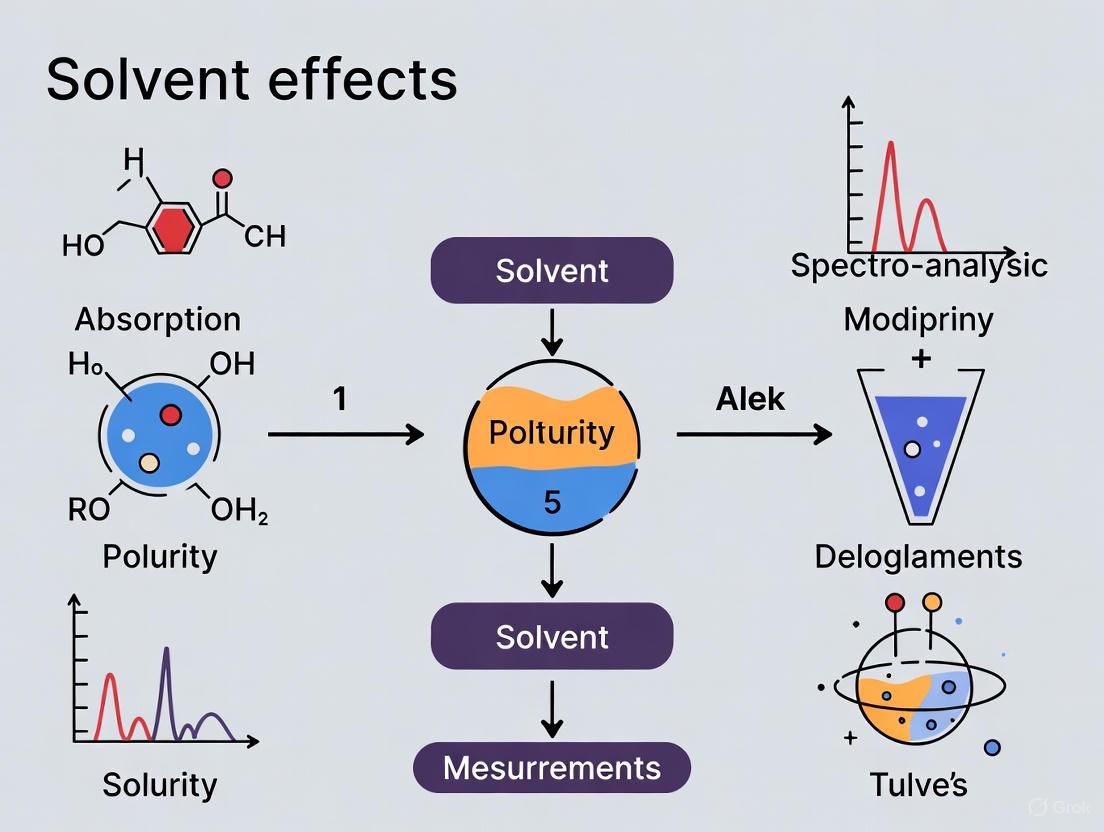
This article provides a comprehensive guide for researchers and drug development professionals on managing solvent effects in UV-Vis spectrophotometric analysis.
Mastering Solvent Effects in Spectrophotometry: A Practical Guide for Pharmaceutical Researchers
Abstract
This article provides a comprehensive guide for researchers and drug development professionals on managing solvent effects in UV-Vis spectrophotometric analysis. It covers fundamental principles of solvent-analyte interactions, advanced methodological applications for complex mixtures, practical troubleshooting strategies for common issues, and rigorous validation protocols. By integrating foundational knowledge with current case studies from pharmaceutical analysis and green chemistry metrics, this resource aims to enhance measurement accuracy, method robustness, and environmental sustainability in analytical workflows.
Understanding Solvent-Analyte Interactions: The Foundation of Accurate Spectrophotometry
Core Principles of Solvent Effects on Absorption Spectra
The solvent environment is a critical, non-passive factor in ultraviolet-visible (UV-Vis) spectrophotometry. The physical and chemical interactions between a solute molecule and the surrounding solvent molecules can significantly alter the energy, intensity, and shape of the recorded absorption spectra. Understanding these solvent effects is not merely an academic exercise; it is essential for accurate method development, validation, and interpretation in pharmaceutical analysis and drug development. These effects stem from specific and non-specific solute-solvent interactions that stabilize the electronic states of a molecule to varying degrees, leading to observable shifts in its absorption profile [1].
The fundamental principle involves the interaction of the solvent with the ground state and excited state of the solute. When a photon is absorbed, promoting a molecule to a higher energy level, the resulting redistribution of electron density can create a species with a different dipole moment than the ground state. The solvent molecules, which were in equilibrium with the ground-state dipole, will reorganize to stabilize this new charge distribution. The extent and nature of this stabilization dictate the direction and magnitude of the spectral shift. Two primary types of electronic transitions are most sensitive to solvent effects: n→π* and π→π* transitions. These transitions respond differently to the polarity and hydrogen-bonding capacity of the solvent, a phenomenon that can be leveraged for analytical purposes [2] [3].
Key Solute-Solvent Interactions and Spectral Shifts
The following table summarizes the primary interactions responsible for solvent-induced spectral changes.
Table 1: Core Solute-Solvent Interactions and Their Spectral Effects
| Interaction Type | Physical Origin | Effect on n→π* Transitions | Effect on π→π* Transitions |
|---|---|---|---|
| Non-Specific (Polarity) | Dielectric stabilization of the solute's dipole moment. | Hypsochromic (Blue) Shift | Bathochromic (Red) Shift & Hyperchromic Effect |
| Specific (H-Bonding) | Hydrogen bond donation from solvent to solute, or solute to solvent. | Hypsochromic (Blue) Shift (if solute is H-bond acceptor) | Bathochromic (Red) Shift & Hyperchromic Effect (if solute is H-bond donor) |
| Polarizability | Dispersion forces and induction between solute and solvent electron clouds. | Variable influence | Bathochromic (Red) Shift |
The direction of the shift provides diagnostic information about the nature of the electronic transition. A bathochromic (red) shift towards longer wavelengths indicates that the excited state is more stabilized by the solvent than the ground state. This is typical for π→π* transitions, where the excited state often has a larger dipole moment. Conversely, a hypsochromic (blue) shift towards shorter wavelengths indicates that the ground state is more stabilized than the excited state. This is a hallmark of n→π* transitions, where the lone pair electrons involved in the transition are stabilized by hydrogen-bonding solvents in the ground state, raising the energy required for excitation [2] [1].
For instance, studies on molecules like rhaponticin and nitro-substituted pyridinocoumarins demonstrate that an increase in solvent polarity leads to a bathochromic shift in the absorption spectra, confirming the π→π* nature of the transition and the increased dipole moment in the excited state [1] [4]. In contrast, the simplicity of the 4-pyrone molecule, which lacks an extended π-system or intramolecular hydrogen bond, makes its spectra more susceptible to large solvent shifts [2].
Diagram 1: The workflow of solvent-solute interaction and its effect on absorption spectra.
Troubleshooting Guide: Frequently Asked Questions (FAQs)
Q1: I am developing a UV method for a new API. My absorption spectrum shifts when I change the solvent from methanol to water. Does this invalidate my method?
A: Not necessarily. A solvent-induced shift is an expected physical phenomenon. It does not automatically invalidate your method but must be thoroughly characterized. For a validated method, you must:
- Fix the solvent system as part of the method specification. The method is only valid for the specified solvent or solvent mixture.
- Justify your solvent choice based on solubility, stability, and the need to avoid spectral shifts during analysis.
- Perform robustness testing where you deliberately introduce small, controlled variations in solvent composition (e.g., ±2% water in methanol) to ensure the absorption maximum (λₘₐₓ) and intensity remain acceptably stable [5] [6].
Q2: I suspect my compound has both n→π* and π→π* transitions. How can I use solvent effects to confirm this?
A: You can perform a simple solvent polarity study. Prepare solutions of your compound in a series of solvents with increasing polarity but minimal hydrogen-bonding capacity (e.g., cyclohexane → diethyl ether → ethyl acetate → acetonitrile). Measure the absorption spectra in each solvent.
- If a band moves to shorter wavelengths (blue-shifts) as polarity increases, it is likely an n→π* transition.
- If a band moves to longer wavelengths (red-shifts) as polarity increases, it is likely a π→π* transition. This approach was used effectively to assign transitions in studies of 3-hydroxyflavone derivatives and rhaponticin [2] [1].
Q3: My API forms a charge-transfer (CT) complex with an excipient. How does the solvent affect this interaction?
A: The stability of a charge-transfer complex is highly solvent-dependent. A solvent with a high dielectric constant or one that can specifically solvate (and stabilize) either the donor or acceptor molecule will weaken the CT complex. This results in a decrease in the intensity of the CT band in the absorption spectrum. In contrast, non-polar solvents provide a medium where the CT interaction is favorable, leading to a more intense CT band. This principle is applied in analytical methods, such as the determination of sulfanilamide via its CT complex with pyromellitic dianhydride (PMDA), where the solvent environment is optimized for complex stability [7].
Q4: Why does the vibrational fine structure in my spectrum become sharper when I cool the solution or use a non-polar solvent?
A: At higher temperatures or in polar, hydrogen-bonding solvents, broadening occurs due to increased molecular collisions and a heterogeneous solvation environment. Cooling the solution reduces thermal energy and collisions. Using a non-polar solvent minimizes solute-solvent interactions that can smear out energy levels. This provides a more uniform environment, allowing the discrete vibrational energy levels within the electronic state to be resolved, thus revealing the vibrational fine structure of the spectrum [3].
Essential Experimental Protocols
Protocol: Systematic Solvent Polarity Study
This protocol is designed to characterize the solvatochromic behavior of a new chemical entity.
- Solvent Selection: Choose a series of at least 5-6 solvents that cover a wide range of polarity (e.g., n-hexane, toluene, dichloromethane, ethyl acetate, acetone, ethanol, acetonitrile, water). Caution: Ensure the solute has adequate solubility in all selected solvents.
- Solution Preparation: Prepare stock solutions of the analyte in each solvent. Dilute to an appropriate concentration to achieve an absorbance within the ideal range (0.3 - 1.0 AU) for the primary peak of interest.
- Spectrum Acquisition: Using a matched set of quartz cuvettes, record the full UV-Vis absorption spectrum for each solution against a pure solvent blank. Maintain a constant temperature (e.g., 25°C) using a temperature-controlled cuvette holder if available.
- Data Analysis:
- Record the wavelength of maximum absorption (λₘₐₓ) for each key band.
- Plot the λₘₐₓ values against a standard solvent polarity scale, such as the Eₜ(30) scale or the orientation polarizability (Δf). A linear correlation confirms solvatochromism. The slope of the plot indicates the sensitivity of the transition to the solvent [1] [4].
Protocol: Investigating Hydrogen Bonding Effects
This protocol helps deconvolute general polarity effects from specific hydrogen-bonding interactions.
- Protic vs. Aprotic Solvent Comparison: Select solvent pairs with similar overall polarity but different hydrogen-bonding capabilities.
- Pair 1: Dichloroethane (aprotic, non-HBD) vs. Chloroform (aprotic, weak HBD).
- Pair 2: Dimethylformamide (DMF, aprotic, HBA) vs. Methanol (protic, HBD & HBA).
- Pair 3: Acetonitrile (aprotic, HBA) vs. Water (protic, strong HBD & HBA). HBD = Hydrogen Bond Donor, HBA = Hydrogen Bond Acceptor
- Spectrum Acquisition: Prepare solutions of identical analyte concentration in each solvent pair and acquire the absorption spectra as in Protocol 4.1.
- Interpretation: A significant blue-shift of an absorption band in the protic solvent (especially water or alcohols) compared to the aprotic solvent is strong evidence for an n→π* transition, where the lone pair is specifically stabilized by hydrogen bonding in the ground state [2].
The Scientist's Toolkit: Key Research Reagent Solutions
Table 2: Essential Materials for Studying Solvent Effects
| Reagent/Material | Function in Research | Example Application |
|---|---|---|
| Solvent Polarity Series | To establish a correlation between absorption λₘₐₓ and solvent properties. | n-Hexane (non-polar), Diethyl ether, Ethyl acetate, Acetone, Acetonitrile, Methanol, Water (polar) [1]. |
| Protic & Aprotic Solvents | To discriminate between general polarity effects and specific hydrogen-bonding interactions. | Methanol & Ethanol (protic); Acetonitrile & DMF (aprotic) [2]. |
| π-Acceptor Reagents | To form charge-transfer complexes for the analysis of electron-donating drugs. | Pyromellitic Dianhydride (PMDA), DDQ, TCNE (for analyzing amines like sulfanilamide) [7]. |
| Deuterated Solvents | For coupling UV-Vis studies with NMR to investigate solvation shells and molecular interactions. | Deuterated Methanol (CD₃OD), Deuterated Chloroform (CDCl₃), Deuterated Water (D₂O). |
| Computational Software | To model solute-solvent interactions, predict spectra, and calculate dipole moments using DFT/TD-DFT. | Gaussian, Material Studio (with Dmoℓ³); using functionals like CAM-B3LYP and solvation models like PCM [2] [7] [4]. |
Advanced Topics: Computational Modeling
Computational chemistry provides a powerful complement to experimental studies. Time-Dependent Density Functional Theory (TD-DFT) calculations, combined with implicit solvation models like the Polarizable Continuum Model (PCM), can predict the absorption spectra of molecules in different solvents with remarkable accuracy [2] [4].
These methods allow researchers to:
- Visualize Molecular Orbitals: Identify the nature (n→π* or π→π*) of an electronic transition by inspecting the involved molecular orbitals.
- Calculate Dipole Moments: Quantify the change in dipole moment between the ground and excited states, which is the primary driver of solvatochromism.
- Deconvolute Complex Spectra: Assign individual absorption bands to specific electronic transitions in molecules with multiple chromophores.
For instance, DFT/TD-DFT studies on nitro-substituted pyridinocoumarins successfully explained their negative solvatochromism by revealing the existence of resonance structures with different hydrogen-bonding capabilities and frontier orbital energy gaps [4]. Similarly, HOMO-LUMO analysis confirmed the charge-transfer mechanism in the sulfanilamide-PMDA complex [7].
How Solvent Polarity Influences Spectral Shifts and Bandwidth
Troubleshooting Guides
FAQ 1: Why does my UV-Vis spectrum show an unexpected shift when I change solvents?
Unexpected spectral shifts are often due to specific and nonspecific solvent-solute interactions altering the electronic energy levels of your compound.
- Problem: The maximum absorption wavelength (λmax) of my sample shifts unexpectedly when the solvent is changed.
- Explanation: Solvent polarity directly affects the energy required for electronic transitions. A polar solvent can stabilize the excited state of a chromophore more than the ground state, leading to a bathochromic (red) shift—a shift to a longer wavelength. Conversely, a change that destabilizes the excited state can cause a hypsochromic (blue) shift. These effects are a combination of nonspecific interactions (dipole-dipole) and specific interactions (hydrogen bonding) [8]. For instance, in deprotonated porphyrins, a bathochromic shift followed by a hypsochromic shift was observed as solvent polarity was reduced [8].
- Solution:
- Consult polarity scales like the ET(30) scale to predict and rationalize shifts. The transition energy of Reichardt's dye in a solvent provides a robust measure of its overall polarity [8].
- Ensure your solvent does not chemically react with or degrade your analyte.
- For method transfer, always document and control the solvent composition precisely.
FAQ 2: Why are my absorption bands broad and poorly resolved?
Band broadening reduces spectral resolution and can hide fine structural details. It is frequently linked to the solvent environment.
- Problem: The absorption peaks in my spectrum are broad, making it difficult to distinguish between different transitions or analytes.
- Explanation: Broad bands can result from several solvent-related factors:
- Aggregation: Molecules may self-associate in certain solvents, leading to broad, often shifted, absorption bands [9].
- Vibrational Coupling: Strong interactions between the solvent and solute can couple with electronic transitions, broadening the bands.
- Multiple Species: The solvent composition may cause the analyte to exist in multiple forms (e.g., protonated/deprotonated, different tautomers), each with a slightly different spectrum, resulting in an observed broadening [8].
- Solution:
- Dilute your sample to check for and minimize aggregation.
- Change to a solvent with different properties (e.g., switch from a protic to an aprotic solvent) to disrupt specific interactions like hydrogen bonding.
- Control the pH and ensure the use of buffered solutions to maintain a single, well-defined analyte species.
FAQ 3: How does solvent choice impact my LC-MS analysis?
The injection solvent in LC-MS must be compatible with the initial mobile phase to ensure proper analyte focusing at the column head, which is critical for peak shape and sensitivity.
- Problem: Poor peak shape (tailing or fronting) and low signal intensity in LC-MS.
- Explanation: If the injection solvent has a stronger eluting strength than the starting mobile phase, analytes will not focus properly at the column inlet, leading to band broadening and distorted peaks [10]. This effect is polarity-dependent. Early-eluting polar compounds often show better peak shape and intensity in highly aqueous injection solvents, while late-eluting non-polar compounds require a higher organic solvent content to maintain solubility and response [10].
- Solution:
- Match the organic content of your injection solvent to the starting mobile phase or use a weaker solvent.
- A starting ratio of 30:70 (ACN:aqueous) is often a robust compromise for mid-polarity compounds [10].
- For methods with a high aqueous start, dilute your sample in a high-aqueous solvent. For methods with a high organic start, a solvent with higher organic content may be needed.
Key Experimental Data and Protocols
Quantitative Solvent Effects on Porphyrin Absorption
The following table summarizes data from a systematic study on the solvatochromism of deprotonated 5,10,15,20-tetrakis(p-hydroxyphenyl)porphyrin (THPP), demonstrating a non-linear relationship between solvent polarity and the lowest energy absorption band [8].
| Solvent System | ET(30) Polarity Range | Observed λmax (nm) | Spectral Class & Observations |
|---|---|---|---|
| H₂O-DMF (High Aq.) | > 48 | 666 | Hyperporphyrin (Split Soret band) |
| H₂O-DMF (90% DMF) | ~48 | 703 | Hyperporphyrin (Bathochromic shift) |
| H₂O-DMF (98% DMF) | < 45.5 | 673 | Metalloporphyrin (Hypsochromic shift, 3-band spectrum) |
| H₂O-Acetone (90% Ac.) | - | 685 | Hyperporphyrin |
| H₂O-Methanol (98% MeOH) | - | 669 | Hyperporphyrin (Minor shift) |
Experimental Protocol: Investigating Solvatochromism
This protocol outlines a general method for studying solvent effects on a UV-Vis spectrum, based on studies of porphyrin derivatives [8] [9].
Title: Systematic Evaluation of Solvent Polarity Effects on UV-Vis Absorption Spectra
Principle: The energy of electronic transitions in a molecule is sensitive to its microenvironment. By measuring the absorption spectrum in a series of solvents of varying polarity, the solvatochromic behavior of the compound can be characterized.
Materials:
- Analytical Balance
- Volumetric Flasks (e.g., 10 mL)
- Micropipettes
- UV-Vis Spectrophotometer with matched quartz cuvettes
- Sample Compound
- Solvent Series: Select a range of HPLC or spectrophotometric grade solvents covering a broad polarity range (e.g., n-hexane, toluene, dichloromethane, acetone, ethanol, methanol, water). Using binary mixtures (e.g., water-DMF) allows for fine control [8].
Procedure:
- Solution Preparation: Accurately weigh the sample compound and prepare stock solutions in each solvent or solvent mixture. Ensure the concentration is within the linear range of the spectrophotometer (typically Abs < 1.0).
- Instrument Setup: Zero the spectrophotometer with a cuvette containing the pure solvent of interest.
- Spectral Acquisition: Place the sample solution in the cuvette and acquire the full UV-Vis absorption spectrum (e.g., from 800 nm to 300 nm).
- Data Recording: For each solvent, record the wavelength of maximum absorption (λmax) for the band of interest and its absorbance. Note the shape of the spectrum and any band splitting.
- Data Analysis: Plot the observed λmax values against an empirical solvent polarity parameter, such as ET(30). Analyze the trend to determine if the compound exhibits positive (red shift with polarity) or negative (blue shift with polarity) solvatochromism.
The Scientist's Toolkit: Key Research Reagent Solutions
The following table lists essential solvents and their roles in spectrophotometric and chromatographic studies.
| Reagent/Solvent | Primary Function & Rationale |
|---|---|
| Acetonitrile (ACN) | A polar aprotic solvent with low UV cutoff and low viscosity. Ideal for HPLC and LC-MS due to its high elution strength and minimal background interference [11]. |
| Methanol (MeOH) | A polar protic solvent. Often used in spectroscopy and chromatography. Can act as a hydrogen bond donor, affecting solvatochromism. Used in MS to enhance analyte ionization [11]. |
| Water (H₂O) | The universal polar solvent. Used to create binary mixtures for fine polarity control. Essential for studying aqueous solubility and ionizable compounds [8] [11]. |
| N,N-Dimethylformamide (DMF) | A polar aprotic solvent with a high boiling point. Good for dissolving a wide range of compounds. Used in studies of deprotonation and metal complex formation [8] [9]. |
| Reichardt's Dye | A solvatochromic betaine dye used to establish the empirical ET(30) solvent polarity scale. Its large spectral shift in different solvents provides a standard for polarity comparison [8]. |
| Ion-Pairing Reagents (e.g., HFBA) | Additives like heptafluorobutyric acid (HFBA) improve the chromatographic separation of ionic compounds (e.g., basic drugs) in LC-MS by forming ion pairs, enhancing retention and peak shape, albeit with a potential moderate cost to ionization efficiency [12]. |
Frequently Asked Questions (FAQs)
1. What are HOMO-LUMO interactions and why are they affected by solvents? The Highest Occupied Molecular Orbital (HOMO) and Lowest Unoccupied Molecular Orbital (LUMO) are the frontier molecular orbitals involved in electronic transitions when a molecule absorbs light [13] [14]. The energy difference between them, the HOMO-LUMO gap, determines the energy (and thus wavelength) of absorbed light [14]. Solvents interact with the solute molecule through specific (e.g., hydrogen bonding) and non-specific (dipolar) interactions. These interactions stabilize the ground and excited states to different degrees, thereby altering the HOMO-LUMO energy gap and causing shifts in the absorption spectrum, a phenomenon known as solvatochromism [15] [3].
2. My UV-Vis spectra are broad and featureless. How can I resolve vibrational structure? Vibrational fine structure is often obscured at room temperature due to thermal motion and solvent interactions. To resolve it, lower the temperature of your sample [3]. Cooling reduces thermal broadening and minimizes disruptive solute-solvent interactions, allowing the vibrational bands embedded within the electronic transition to become visible in the spectrum.
3. How do I choose the right solvent for my spectrophotometric measurements? Selecting a solvent requires considering its polarity, hydrogen-bonding capability, and transparency in your spectral range of interest. A systematic approach involves using solvents that span a range of properties. The table below lists common solvents and their key parameters to guide your selection [15].
Table: Common Solvents and Their Physicochemical Parameters
| Solvent | π* (Polarity/Polarizability) | α (H-Bond Donor Ability) | β (H-Bond Acceptor Ability) |
|---|---|---|---|
| Cyclohexane | 0.00 | 0.00 | 0.00 |
| 1,4-Dioxane | 0.55 | 0.00 | 0.37 |
| Acetonitrile (ACN) | 0.75 | 0.19 | 0.40 |
| Dimethylsulfoxide (DMSO) | 1.00 | 0.00 | 0.76 |
| Methanol (MeOH) | 0.60 | 0.98 | 0.66 |
4. Can I computationally predict solvent effects on my compound's spectra? Yes, computational methods are highly effective. Time-Dependent Density Functional Theory (TD-DFT) is widely used to calculate electronic excitation energies and simulate UV-Vis spectra [15] [16]. For accurate results, you must include solvent effects in the calculation using either an implicit model (e.g., Polarizable Continuum Model - PCM) or a more advanced hybrid explicit/implicit model [17]. These simulations can help assign observed spectral bands to specific electronic transitions.
Troubleshooting Guides
Problem 1: Unpredictable Solvatochromic Shifts
Symptoms
- Absorption maxima (λmax) shifts do not correlate with simple solvent polarity scales.
- Irregular changes in λmax when using protic vs. aprotic solvents.
Investigation and Resolution Protocol
- Systematic Data Collection: Measure the absorption spectrum of your compound in a minimum of 8-10 solvents with varying properties (e.g., cyclohexane, 1,4-dioxane, acetonitrile, DMSO, alcohols) [15].
- Multi-Parameter Analysis: Correlate the spectral shifts (e.g., wavenumber,
ν̄) with the Kamlet-Taft solvent parameters (α, β, π*) using a Linear Solvation Energy Relationship (LSER). The multi-parameter equation takes the form [15]:XYZ = XYZ₀ + sπ* + aα + bβWheres,a, andbare susceptibility coefficients that quantify the dependence of the spectral shift on the solvent's dipolarity, HBD, and HBA abilities, respectively. - Theoretical Validation: Perform a TD-DFT calculation (e.g., using B3LYP/6-311+G(d,p) basis set) with an implicit solvent model (PCM) on the optimized geometry. Compare the simulated spectra with your experimental results to validate the electronic transitions [15] [13].
Problem 2: Non-Linear Behavior in Binary Solvent Mixtures
Symptoms
- Changes in absorption maxima are not proportional to the mole fraction of the solvents in a mixture.
- Observed spectral shifts suggest the local environment around the solute differs from the bulk solvent composition.
Investigation and Resolution Protocol
- Identify Preferential Solvation: This phenomenon occurs when a solute is preferentially surrounded by molecules of one solvent component over the other. It is common in mixtures where one solvent can form specific interactions (like hydrogen bonds) with the solute [15].
- Experimental Confirmation: Record UV-Vis spectra of your compound in a binary solvent mixture (e.g., cyclohexane-ethanol or acetonitrile-ethanol) across the entire composition range (from 0 to 100% of each component).
- Interpretation: A non-linear variation of the absorption maximum with solvent composition is a clear indicator of preferential solvation. For example, in cyclohexane-ethanol mixtures, flavone is preferentially solvated by ethanol molecules due to favorable intermolecular hydrogen bonds [15].
Problem 3: Inaccurate Computational Predictions of Solvent Effects
Symptoms
- Large discrepancies between computationally predicted and experimentally observed absorption wavelengths.
- Poor correlation between calculated HOMO-LUMO gaps and measured transition energies.
Investigation and Resolution Protocol
- Check Solvent Model: A purely implicit model (like PCM) may be insufficient for solvents that form strong specific interactions (hydrogen bonds) with your solute. Consider using a hybrid solvent model that includes a few explicit solvent molecules around the solute (especially around HBD/HBA sites) embedded in a continuum model [17].
- Validate Method and Basis Set: Ensure your chosen DFT functional (e.g., B3LYP, PBE0) and basis set (e.g., 6-311+G(d,p)) are appropriate for your system. TD-DFT methods can sometimes systematically underestimate excitation energies [15] [16].
- Extrapolate for Bulk Solvation: When using explicit cluster models, remember that the calculated properties (like LUMO energy and electron affinity) converge as the cluster size increases. Extrapolate your results to an infinite system size for a more accurate prediction of bulk solvation behavior [17].
The Scientist's Toolkit: Key Reagents & Materials
Table: Essential Materials for Studying Solvent-Driven Electronic Transitions
| Item/Category | Function & Rationale |
|---|---|
| Solvent Kit (Cyclohexane, 1,4-Dioxane, Acetonitrile, DMSO, Methanol, Ethanol, etc.) | Provides a matrix of solvents with varying polarity (π*), hydrogen-bond donor (α), and acceptor (β) abilities for systematic LSER analysis [15]. |
| Kamlet-Taft Solvent Parameters | Quantitative scales of solvent properties; essential for correlating spectral shifts with specific solute-solvent interactions [15]. |
| TD-DFT Computational Software (Gaussian 09, G98, etc.) | Used to calculate molecular orbitals, HOMO-LUMO gaps, and simulate electronic absorption spectra, including solvent effects [15] [13] [16]. |
| Polarizable Continuum Model (PCM) | An implicit solvation model in computational chemistry that approximates the solvent as a continuous dielectric medium; corrects for bulk electrostatic effects [17]. |
| Hybrid Explicit/Implicit Solvent Model | A more advanced model that includes specific solvent molecules (explicit) immersed in a dielectric continuum (implicit); crucial for modeling strong, specific interactions like hydrogen bonding [17]. |
Scientist's Toolkit: Key Reagent Solutions for Spectrophotometric Analysis
The following table details essential reagents and their functions in preparing pharmaceutical compounds for spectrophotometric analysis.
Table 1: Key Reagents in Spectrophotometric Pharmaceutical Analysis [18]
| Reagent Category | Example Reagents | Primary Function in Analysis |
|---|---|---|
| Complexing Agents | Ferric chloride, Ninhydrin, Potassium permanganate | Form stable, colored complexes with analytes to enhance absorbance and enable quantification of compounds that do not inherently absorb strongly [18]. |
| Oxidizing/Reducing Agents | Ceric ammonium sulfate, Sodium thiosulfate | Modify the oxidation state of the drug compound to create a product with different, often more measurable, absorbance properties [18]. |
| pH Indicators | Bromocresol green, Phenolphthalein | Change color based on the solution's pH, useful for analyzing acid-base equilibria of drugs and ensuring correct formulation pH [18]. |
| Diazotization Reagents | Sodium nitrite & Hydrochloric acid, N-(1-naphthyl)ethylenediamine | Convert primary aromatic amines in pharmaceuticals into highly colored azo compounds for sensitive quantification [18]. |
Troubleshooting Guides and FAQs
FAQ 1: How does solvent polarity impact my spectrophotometric analysis?
Solvent polarity directly influences solubility and the interaction between the analyte, solvent, and light.
- Problem: Inadequate solubility due to mismatched polarity can lead to inaccurate concentration readings, light scattering, and precipitation.
- Solution: Match the solvent polarity to the chemical nature of your Active Pharmaceutical Ingredient (API).
- Best Practice: During method development, test a range of solvents to achieve complete dissolution and a clear, stable analytical signal [11].
FAQ 2: Why is solvent purity critical, and what grade should I use?
Impurities in solvents can interfere with analytical results by absorbing light at the same wavelength as your analyte, causing false peaks or elevated baselines [11].
- Problem: High background noise or unidentified peaks in the absorbance spectrum.
- Solution: Always use high-purity solvents graded for your specific application.
- Best Practice: Filter solvents using appropriate membrane filters (e.g., 0.2 µm or 0.45 µm) to remove particulates that could scatter light [11].
FAQ 3: My sample has low absorbance. How can I enhance detection?
Many pharmaceutical compounds lack strong chromophores. Chemical reagents can be used to enhance their detectability [18].
- Problem: The API does not absorb light strongly enough for accurate quantification.
- Solution: Employ derivatization techniques.
- Best Practice: Optimize reaction conditions (time, temperature, pH) to ensure complete complex formation [18].
FAQ 4: What regulatory considerations exist for residual solvents?
Regulatory agencies like the FDA and ICH set strict limits on residual solvents in final drug products to ensure patient safety [19] [20].
- Problem: Residual solvents from the manufacturing process remain in the final pharmaceutical product.
- Solution: Adhere to ICH Q3C guidelines, which classify solvents and set permissible limits [20].
- Class 1: Solvents to be avoided (e.g., benzene).
- Class 2: Solvents to be limited (e.g., methanol, dichloromethane).
- Class 3: Solvents with low toxic potential (e.g., ethanol, acetone) [20].
- Best Practice: Select Class 3 solvents whenever possible. For other classes, demonstrate through testing (e.g., gas chromatography) that residues are below the prescribed limits [19] [20].
Framework for Solvent Selection: Properties and Regulations
Selecting a solvent requires balancing multiple physicochemical properties with regulatory and safety requirements.
Table 2: Solvent Selection Criteria at a Glance [11] [21] [20]
| Criterion | Considerations | Impact on Analysis & Manufacturing |
|---|---|---|
| Purity & Grade | Spectrophotometric grade, HPLC grade, ACS grade; level of UV-absorbing impurities. | Directly affects accuracy, sensitivity, and background noise of the measurement [11]. |
| Polarity | Polar (water, methanol) vs. Non-polar (hexane); must match analyte solubility. | Impacts solubility of the API, dissolution kinetics, and can influence the absorbance spectrum [11]. |
| Volatility | Boiling point; ease of evaporation and removal. | Critical for sample preparation concentration steps and for controlling residual solvent levels in the final product [11] [20]. |
| Chemical Compatibility | Reactivity with the API, excipients, and instrument components (e.g., chromatographic column). | Prevents degradation of the API and damage to analytical instrumentation [11]. |
| Safety & Toxicity | ICH Q3C classification; flammability; toxicity to humans and the environment. | Ensures worker safety, patient safety, and regulatory compliance; influences waste handling costs [21] [20]. |
| Regulatory Compliance | Adherence to USP/NF monographs, ICH Q3C, and other pharmacopeial standards. | Mandatory for market approval; non-compliance can lead to product rejection and regulatory action [19] [20]. |
Experimental Protocol: Sample Preparation for UV-Vis Spectrophotometric Assay
This protocol outlines a general method for quantifying an API in a tablet formulation using a complexing agent to enhance detection [18].
Objective: To determine the concentration of a drug compound (e.g., one with phenolic groups) in a pharmaceutical tablet using UV-Vis Spectrophotometry.
Principles: The method is based on Beer-Lambert's Law, where the absorbance of a solution is directly proportional to the concentration of the absorbing species. A reagent is added to form a colored complex with the target analyte, increasing the sensitivity of the measurement [18].
Materials & Equipment:
- UV-Vis Spectrophotometer
- Analytical balance
- Volumetric flasks (e.g., 10 mL, 25 mL, 100 mL)
- Pipettes and volumetric pipettes
- Filtration apparatus (e.g., 0.45 µm membrane filter)
- Solvent (e.g., methanol, water)
- Complexing agent (e.g., Ferric Chloride solution)
- Standard Reference API
- Pharmaceutical tablet sample
Procedure:
- Standard Stock Solution Preparation: Accurately weigh about 10 mg of the standard reference API. Transfer it to a 25 mL volumetric flask, dissolve, and dilute to volume with an appropriate solvent to obtain a stock solution of known concentration (e.g., 400 µg/mL) [18].
- Calibration Curve Preparation: Pipette a series of aliquots (e.g., 0.5, 1.0, 1.5, 2.0 mL) of the standard stock solution into separate 10 mL volumetric flasks. To each flask, add a fixed volume of the complexing reagent (e.g., 1 mL of Ferric Chloride solution). Dilute each to the mark with solvent and mix thoroughly. Allow sufficient time for color development [18].
- Sample Preparation:
- Accurately weigh and finely powder not less than 10 tablets.
- Weigh a portion of the powder equivalent to one tablet's declared API content.
- Transfer the powder to a suitable volumetric flask (e.g., 100 mL), add about 50 mL of solvent, and sonicate for 15-20 minutes with intermittent shaking.
- Dilute to volume with solvent and mix well.
- Filter the solution, discarding the first portion of the filtrate.
- Pipette a suitable aliquot of the clear filtrate (e.g., 1 mL) into a 10 mL volumetric flask. Add the same volume of complexing reagent as used for the standards, dilute to volume with solvent, and allow for color development [18].
- Absorbance Measurement:
- Set the spectrophotometer to the predetermined wavelength of maximum absorbance (λmax) for the complex.
- Using the solvent with the complexing agent as a blank, measure the absorbance of each standard and the sample solution [18].
- Calculation:
- Construct a calibration curve by plotting the absorbance of the standard solutions against their known concentrations.
- Determine the concentration of the API in the sample solution from the calibration curve equation.
- Calculate the content of the API in the tablet (mg/tablet) or the percentage of the labeled claim, accounting for all dilution factors [18].
Workflow and Regulatory Pathway
The following diagram visualizes the decision-making framework for selecting an optimal solvent.
Advanced Method Development: Leveraging Solvent Properties for Pharmaceutical Analysis
Troubleshooting Guides
Guide 1: Troubleshooting Poor Solubility of APIs in Green Solvents
Problem: The Active Pharmaceutical Ingredient (API) does not dissolve adequately in a preliminary green solvent, leading to inaccurate spectrophotometric readings.
- Issue: Low solubility of Sulfamethizole in water and basic organic solvents.
- Solution: Employ aqueous binary mixtures or computational screening to identify effective, greener solvent systems.
| Solvent System | Solubility Trend (Sulfamethizole) | Temperature Dependence | Greenness Profile |
|---|---|---|---|
| Neat Solvents [22] | DMF > DMSO > Methanol > Acetonitrile > 1,4-Dioxane >> Water | Solubility increases with temperature | DMF is hazardous; Methanol is greener |
| Aqueous Binary Mixtures [22] | Synergistic effect; maximum solubility often at intermediate compositions | Solubility increases with temperature | Reduced organic solvent use is beneficial |
| Green Alternative (Theoretical) [22] | 4-Formylmorpholine identified as a high-dissolution-potential replacer for DMF | Data specific to compound | More environmentally friendly than DMF |
Step-by-Step Protocol: Experimental Solubility Determination via Shake-Flask Method [22]
- Preparation: Place an excess of solid API (e.g., Sulfamethizole) into a glass test tube and add 2000 µL of the solvent or solvent mixture.
- Equilibration: Seal the tubes and agitate them in an orbital shaker incubator at 60 rpm for at least 24 hours to reach solid-liquid equilibrium. Maintain a constant temperature (e.g., 298.15 K).
- Separation: After equilibration, filter the saturated solution using a preheated syringe and a 0.22 µm PTFE filter to remove undissolved particles.
- Analysis:
- Dilute an aliquot of the filtrate (e.g., 100 µL) with a miscible solvent like methanol.
- Determine the concentration of the API spectrophotometrically at its maximum absorbance wavelength (e.g., λmax = 284 nm for Sulfamethizole).
- Use a pre-established calibration curve for accurate concentration quantification.
Guide 2: Troubleshooting Solvent-Induced Spectral Shifts and Band Shape Changes
Problem: The absorption or emission spectrum of the analyte changes shape, shifts, or shows unexpected bands when switching to a green solvent, complicating analysis and quantification.
- Issue: Solvent polarity and hydrogen-bonding capacity can cause significant shifts in UV-Vis spectra.
- Solution: Understand and anticipate these shifts using theoretical models and select solvents that minimize undesirable effects.
| Solvent Effect | Spectral Manifestation | Example Impact on 3-Hydroxyflavone (3-HF) [2] |
|---|---|---|
| Polarity (General) | Shift in absorption/emission maxima | π→π* transitions redshift with increasing polarity; n→π* may blueshift. |
| Hydrogen Bonding | Changes in band shape and intensity; can enable processes like ESIPT | Protic solvents can suppress ESIPT, eliminating tautomer emission. |
| Polarizability | Subtle shifts in transition energies | Larger π-systems show smaller solvent shifts [2]. |
Step-by-Step Protocol: Theoretical Screening of Solvent Effects using TDDFT/PCM [2]
- Geometry Optimization: Optimize the molecular geometry of your analyte in the gas phase and in a continuum solvent model (like water or ethanol) using Density Functional Theory (DFT).
- Excitation Calculation: Use Time-Dependent DFT (TDDFT) on the optimized geometries to calculate the vertical excitation energies to the first few excited states.
- Continuum Solvation: Incorporate solvent effects during the TDDFT calculation using a Polarizable Continuum Model (PCM). Compare results from different specific-state methods (e.g., cLR, IBSF) for accuracy.
- Analysis: Compare the computed transition energies in different solvent environments to predict the direction and magnitude of spectral shifts before conducting experiments.
Frequently Asked Questions (FAQs)
What defines a "green solvent" in the context of spectrophotometry?
In spectrophotometry, green solvents are characterized by their reduced environmental and health impact compared to traditional petroleum-based solvents. Key categories include [23]:
- Bio-based solvents: Such as ethanol, methanol, and d-limonene, derived from renewable biomass.
- Deep Eutectic Solvents (DES): Particularly natural DES (NADES), which are mixtures of natural compounds with low toxicity and high biodegradability.
- Ionic Liquids: Salts in a liquid state with negligible vapor pressure, though their full greenness requires lifecycle assessment.
- Subcritical and Supercritical Fluids: Such as supercritical CO2 and subcritical water.
- Surfactant-based solutions: Including supramolecular solvents.
How can I quickly screen for an effective green solvent without extensive experimentation?
A combined theoretical and experimental approach is most efficient [22].
- Computational Screening: Use a machine learning model trained on quantum-chemical molecular descriptors (like σ-potentials from COSMO-RS) to predict solubility across a vast range of solvent mixtures.
- Guided Experimentation: The computational model narrows down the most promising candidates, such as identifying 4-formylmorpholine as a green replacement for DMF. This targeted approach significantly reduces the number of lab experiments needed.
Why does my compound's fluorescence spectrum look completely different in ethanol compared to hexane?
This is a classic solvatochromic effect, often related to the solvent's ability to form hydrogen bonds. For molecules like 3-Hydroxyflavone (3-HF), which undergo Excited-State Intramolecular Proton Transfer (ESIPT), protic solvents like ethanol can disrupt the intramolecular hydrogen bond necessary for the process [2]. This suppression of ESIPT eliminates the tautomer's fluorescence signal, leaving only the "normal" emission band and making the spectrum appear profoundly different.
Are there standardized guidelines for evaluating the greenness of a solvent?
Yes, several frameworks exist to assess solvent greenness quantitatively [23]:
- CHEM21 Selection Guide: A widely used guide for selecting solvents based on safety, health, and environmental criteria.
- Life Cycle Assessment (LCA): Evaluates the environmental impact of a solvent from production to disposal.
- CO2 Emission Metrics: Quantifies the carbon footprint associated with solvent manufacture and use. These tools help researchers make informed, data-driven decisions when selecting solvents for sustainable spectrophotometry.
Experimental Protocols
This protocol outlines a method for predicting API solubility in various solvents to guide green solvent selection.
Research Reagent Solutions
| Item | Function in Protocol |
|---|---|
| COSMO-RS Software | Generates σ-potential profiles, which are quantum-chemistry-derived molecular descriptors of the solute and solvents. |
| Machine Learning Model (e.g., ENNM) | An Ensemble of Neural Networks Model is trained on σ-potential data to predict solubility in untested solvent mixtures. |
| Solute (e.g., API) Structure File | A digital representation (e.g., .mol file) of the molecule for which solubility needs to be predicted. |
| Solvent Dataset | A digital library of potential green and conventional solvents for screening. |
This protocol describes how to experimentally measure and validate the influence of different green solvents on a compound's absorption spectrum.
Research Reagent Solutions
| Item | Function in Protocol |
|---|---|
| UV-Vis Spectrophotometer | Instrument to measure the absorption of light by the sample solution across a range of wavelengths. |
| Quartz Cuvettes | Cells that hold the sample solution; transparent in the UV-Vis range. |
| Selected Green Solvents | A range of solvents with varying polarity and hydrogen-bonding capability (e.g., water, ethanol, Cyrene). |
| Analytically Pure Analyte | The compound of interest, purified to avoid spectroscopic impurities. |
Resolving Spectral Overlap in Drug Mixtures Through Solvent Optimization
Troubleshooting Guide: Addressing Common Solvent-Related Issues
This guide helps you diagnose and fix common problems that arise from solvent selection when measuring overlapping drug spectra.
Unexpected Peaks or Spectral Shifts
- Problem: Your spectrum shows peaks that are not from the analyte, or the expected peaks have shifted from their standard positions.
- Potential Cause & Solution:
- Cause 1: Solvent or Cuvette Contamination. Impurities in the solvent or on the cuvette can introduce unexpected peaks [24].
- Solution: Use high-purity solvents (e.g., HPLC or spectrophotometric grade). Thoroughly wash cuvettes before use and handle them with gloved hands to avoid fingerprints [24].
- Cause 2: Solvent-Solute Interactions. The solvent can interact with the drug molecules, altering their energy states and causing spectral shifts. For example, hydrogen bonding with hydroxylic solvents can lower the energy of π orbitals, changing the absorption profile [9].
- Solution: If spectral shifts are problematic for your analysis, consider switching to a solvent with different polarity or hydrogen-bonding capacity. Document the solvent used for all measurements, as the same drug will have different spectral properties in different solvents.
Excessive Noise or Signal Saturation
- Problem: The absorbance signal is too noisy, or the peak is off-scale (absorbance is too high, often above 1.0 or 2.0), leading to unreliable data [24] [25].
- Potential Cause & Solution:
- Cause: Incorrect Sample Concentration. A high concentration of the analyte is the most common reason for signal saturation. More concentrated samples scatter light more intensely, reducing the light detected [24].
- Solution:
- Dilute the sample: This is the most straightforward action to increase the signal quality [24].
- Use a shorter path length cuvette: A cuvette with a thinner path length (e.g., 1 mm instead of 10 mm) reduces the amount of sample the light travels through, effectively lowering the measured absorbance [24].
Poor Solubility and Precipitation
- Problem: The drug does not fully dissolve in the chosen solvent, leading to cloudiness, settling, or inconsistent results [26].
- Potential Cause & Solution:
- Cause: Mismatch between Solvent Polarity and Drug Properties. The solvent lacks the necessary solvating power for the drug molecule [11].
- Solution:
- Use a Green Solvent Selection Tool: Tools are available that provide a composite score based on safety, health, and environmental impact, and can also guide you towards solvents with good solubility properties. For instance, propylene glycol has been successfully selected this way for drugs poorly soluble in water [26].
- Employ Hydrotropy: Increase the solubility of a sparingly soluble drug in water by adding another solute, such as sodium acetate or urea [26]. Note that finding the right hydrotropic agent and its optimal concentration may require experimentation [26].
- Use Solvent Blends: Combining solvents (e.g., water-DMF mixtures [9]) can create a custom solvent environment with the desired solvating power. Always ensure the solvents are miscible to prevent precipitation.
Frequently Asked Questions (FAQs)
Q1: My drugs have completely overlapping spectra in a standard solvent like methanol. Is there still a way to quantify them without switching to HPLC? A1: Yes. Even with significant overlap, you can employ chemometric methods that use mathematical techniques to resolve the spectra. These methods allow for simultaneous quantification without physical separation. The table below summarizes several proven techniques [26] [27] [5].
Table 1: Spectrophotometric Methods for Resolving Overlapping Spectra
| Method Name | Brief Principle | Example Application |
|---|---|---|
| Derivative Spectroscopy [26] [5] | Converts the zero-order spectrum into its first or higher derivative, which can enhance minor spectral differences and suppress background interference. | Determination of Terbinafine and Ketoconazole using the third derivative [5]. |
| Ratio-Based Methods [26] [27] [28] | Involves dividing the absorption spectrum of the mixture by the spectrum of one component (a "divisor"), which simplifies the contribution of the other component for measurement. | Analysis of Amlodipine and Telmisartan [26]; Remdesivir and Moxifloxacin [28]. |
| Mean Centering of Ratio Spectra [28] | A further mathematical processing of ratio spectra that simplifies the relationship between signal and concentration. | Simultaneous analysis of Remdesivir and Moxifloxacin [28]. |
| Dual-Wavelength Method [27] | Selects two wavelengths where the interfering component has the same absorbance, thus canceling out its contribution and allowing the target component to be measured. | Quantification of Felodipine and Metoprolol [27]. |
| Area Under the Curve (AUC) [28] | Uses the integrated area under the absorption curve over a selected wavelength range, which can be related to concentration using mathematical models like Cramer's Rule. | Determination of Remdesivir and Moxifloxacin in mixtures [28]. |
Q2: How does the solvent actually change the absorption spectrum of a drug? A2: Solvents interact with drug molecules through forces like hydrogen bonding and dipole-dipole interactions. These interactions can stabilize or destabilize the drug's electronic energy levels. When the energy levels involved in light absorption change, the wavelength and intensity of the absorbed light also change—a phenomenon known as a solvatochromic effect. For example, in a porphyrin compound, hydrogen bonding in aqueous solvents was shown to significantly change the energy of its π orbitals, altering its Soret band [9].
Q3: I want to make my analytical methods more environmentally friendly. How can I choose a "green" solvent without compromising analytical performance? A3: The field of Green Analytical Chemistry provides tools for this exact purpose. You can:
- Use a Green Solvent Selection Tool: These tools assign a composite score based on safety, health, and environmental factors, helping you identify sustainable options like propylene glycol [26].
- Evaluate with Metric Tools: Use standardized metrics like the Analytical GREEnness (AGREE) metric or the Green Analytical Procedure Index (GAPI) to assess and compare the environmental impact of your methods [26] [27] [5]. The goal is to select solvents that are less hazardous, reduce waste, and are from renewable sources.
Q4: My absorbance readings are unstable over time. What could be causing this? A4: Instability is often related to changes in the sample itself. A common cause is solvent evaporation, especially if you are working with volatile solvents or taking measurements over an extended period. Evaporation increases the analyte concentration, leading to a drifting absorbance reading [24]. Ensure your cuvette is properly sealed to prevent evaporation.
Detailed Experimental Protocol: Solvent Optimization for Spectral Resolution
The following workflow outlines a systematic approach for selecting an optimal solvent and analytical method to resolve overlapping spectra of a binary drug mixture.
Procedure Steps:
Preparation of Standard Solutions:
- Prepare separate stock solutions of each drug (e.g., 200 µg/mL) by dissolving an accurately weighed amount in a selected solvent [26]. Suitable solvents for initial testing include methanol, water, or a targeted green solvent like propylene glycol [26].
- Dilute these stock solutions with the same solvent to obtain working standard solutions in the desired concentration range (e.g., 5-25 µg/mL).
Solvent Screening and Spectral Acquisition:
- Repeat the dissolution process for each drug using a range of solvents with different polarities (e.g., water, methanol, acetonitrile, ethanol, propylene glycol) [11].
- Using a dual-beam UV-Vis spectrophotometer, record the zero-order absorption spectra (from 200 to 400 nm) of each working standard solution against a blank of the corresponding solvent [26] [5]. Use a 1 cm quartz cell and set the spectral bandwidth to 1 nm.
Analysis of Spectral Overlap:
- Overlay the spectra of the two drugs obtained in the same solvent. Visually inspect the degree of overlap at the λmax of each drug [26].
- If the spectra are well-separated, direct quantification at respective λmax may be possible. If the spectra are severely overlapped, proceed to the application of chemometric methods.
Application of Chemometric Methods:
- Using the spectrophotometer's software or external data processing tools, apply one or more of the methods listed in Table 1.
- Example for Ratio Difference Method [26] [28]:
- Divide the absorption spectra of Drug A by a standard spectrum of Drug B (the "divisor") to obtain the ratio spectrum for Drug A.
- Select two wavelengths in the ratio spectrum of Drug A where the contribution from Drug B is constant or negligible.
- The difference in amplitudes at these two wavelengths (ΔP) is directly proportional to the concentration of Drug A.
- Repeat the inverse process (dividing by a spectrum of Drug A) to quantify Drug B.
Method Validation and Greenness Assessment:
- Validate the chosen method and solvent system according to ICH guidelines, establishing linearity, precision, accuracy, and limits of detection and quantification (LOD/LOQ) [26] [5].
- Evaluate the environmental impact of the final optimized method using greenness assessment tools such as the AGREE calculator [27] [28].
The Scientist's Toolkit: Key Reagents & Materials
Table 2: Essential Research Reagents and Materials for Solvent Optimization Studies
| Item | Function / Application | Key Considerations |
|---|---|---|
| Propylene Glycol | A greener organic solvent used to dissolve poorly water-soluble drugs for analysis [26]. | Selected via green solvent tools; has a high greenness score. Check for interference in the UV region of interest [26]. |
| Methanol & Acetonitrile (HPLC Grade) | High-purity organic solvents commonly used for dissolution and dilution in UV-spectrophotometry and chromatography [11]. | Ensure high purity to avoid UV-absorbing impurities. Acetonitrile is often preferred for low UV cutoff. |
| Sodium Acetate / Urea | Hydrotropic agents used to enhance the aqueous solubility of poorly soluble drugs [26]. | Requires experimentation to find the correct molarity (e.g., 1M-4M) for complete dissolution [26]. |
| Quartz Cuvettes (10 mm path length) | Standard cells for holding liquid samples during UV-Vis spectral measurement [24]. | Ensure they are clean and free of scratches. Use a shorter path length (e.g., 1 mm) if sample concentration is too high [24]. |
| Deuterium Lamp | The light source in a UV-Vis spectrophotometer for the ultraviolet range [25]. | Allow the lamp to warm up for ~20 minutes before measurements for stable output [24]. |
| Greenness Assessment Software (e.g., AGREE, GAPI) | Software tools used to calculate metric scores and evaluate the environmental friendliness of an analytical method [26] [27]. | Helps in justifying the replacement of traditional, more harmful methods with sustainable alternatives. |
Charge-transfer complexes (CTCs) are supramolecular assemblies formed through the interaction between an electron donor (D) and an electron acceptor (A). The resulting complex is stabilized by electrostatic forces, where partial electron transfer from the donor to the acceptor occurs. This process can lead to the formation of a new electronic state, and the excitation to this state often results in an intense absorption band in the visible or ultraviolet region, known as a charge-transfer band. These complexes are characterized by high molar absorptivities, making them highly valuable in analytical chemistry, particularly for the sensitive detection and quantification of pharmaceuticals and other organic compounds. The formation, stability, and spectroscopic properties of CTCs are profoundly influenced by the solvent environment, a factor that researchers must carefully manage to ensure analytical accuracy and reproducibility [29] [30].
Within the context of a broader thesis on managing solvent effects in spectrophotometric research, this technical support guide addresses the practical challenges and solutions for working with CTCs. It provides targeted troubleshooting advice, detailed protocols, and essential resources to help researchers, scientists, and drug development professionals leverage the full potential of charge-transfer complexation in their work.
The Scientist's Toolkit: Key Research Reagent Solutions
Familiarity with common electron acceptors and donors is the first step in designing a charge-transfer complex-based assay. The table below summarizes some of the most frequently used reagents.
Table 1: Common Reagents in Charge-Transfer Complex Formation
| Reagent Name | Type (Donor/Acceptor) | Common Applications & Examples |
|---|---|---|
| Chloranilic Acid | Electron Acceptor | Used for the determination of cephalosporins, moclobemide, phenothiazines, and tetracyclines [30]. |
| 2,3-Dichloro-5,6-dicyano-p-benzoquinone (DDQ) | Electron Acceptor | Forms complexes with ciprofloxacin, colchicine, ranitidine, rifampicin, and amlodipine besylate [30]. |
| 7,7,8,8-Tetracyanoquinodimethane (TCNQ) | Electron Acceptor | Employed with trazodone, norfloxacin, cinnarizine, and various other pharmaceuticals [29] [30]. |
| Tetracyanoethylene (TCNE) | Electron Acceptor | Used in complexes with norfloxacin, ciprofloxacin, and colchicine [29] [30]. |
| Iodine (I₂) | Electron Acceptor | Applied for the determination of amantadine HCl, ganciclovir, phenobarbital, and lansoprazole, often in chloroform or 1,2-dichloroethane [29] [30]. |
| p-Chloranil | Electron Acceptor | Forms complexes with ciprofloxacin, rifampicin, diclofenac, and amantadine [30]. |
| Pharmaceuticals (e.g., Amitriptyline, Ciprofloxacin) | Electron Donor | Many drugs containing nitrogen, oxygen, or sulfur heteroatoms can act as electron donors when paired with a suitable acceptor [30]. |
Fundamentals of Charge-Transfer Complexes
What is a Charge-Transfer Complex?
A charge-transfer complex, or electron donor-acceptor complex, is a supramolecular assembly where two or more molecules or ions self-attract through electrostatic forces. One molecule acts as an electron donor (possessing at least a partial negative charge), and the other acts as an electron acceptor (possessing at least a partial positive charge). The ground state of the complex can be thought of as a weak intermolecular association. Upon the absorption of light, an electron is partially transferred from the donor to the acceptor, leading to an excited state that has a significant contribution from a D⁺•A⁻ structure. This electronic transition is responsible for the characteristic, often intense, color of CTCs [29] [31].
Why are Charge-Transfer Bands So Sensitive to Solvent Polarity?
The extreme sensitivity of charge-transfer absorption bands to solvent polarity stems from the highly polar nature of the excited state. The ground state of the CTC is typically less polar than the excited state, which is a charge-separated D⁺A⁻ ion pair. Polar solvents stabilize this dipolar excited state more effectively than the ground state through dipole-dipole interactions. This preferential stabilization lowers the energy gap between the ground and excited states. Consequently, as solvent polarity increases, less energy is required for the electronic transition, and the absorption band shifts to longer wavelengths (a red-shift or bathochromic shift) [32] [31].
The self-energy of the dipole in the excited state is given by (E = q^2/(8\pi\epsilon_0 \epsilon a)), where (\epsilon) is the solvent's dielectric constant. This inverse relationship with dielectric constant quantitatively explains the red-shift in more polar solvents [31].
Diagram 1: The effect of solvent polarity on CT absorption.
Experimental Protocols
Standard Protocol for Forming and Measuring a Charge-Transfer Complex
This protocol outlines a general method for forming a CTC and determining its formation constant using UV-Vis spectrophotometry.
1. Reagent and Solution Preparation:
- Stock Solutions: Prepare separate stock solutions of the electron donor (e.g., a pharmaceutical compound) and the electron acceptor (e.g., DDQ, Chloranilic Acid) in a carefully selected, dry solvent. Acetonitrile is a common choice due to its moderate polarity and ability to dissolve many organic compounds [30].
- Standard Dilutions: Create a series of standard solutions where the concentration of one component (e.g., the donor) is kept constant, while the concentration of the other (the acceptor) is varied over a suitable range, or vice-versa.
2. Complex Formation and Spectroscopic Measurement:
- Mixing: Combine equal volumes of the donor and acceptor solutions in a series of cuvettes to achieve the desired final concentrations.
- Incubation: Allow the mixtures to stand for a predetermined time (e.g., 5-30 minutes) at a constant temperature to ensure complete complex formation. The formation of the complex is often visually confirmed by the development of a vivid color.
- Blank Measurement: Prepare a blank containing only the solvent.
- Absorbance Scanning: Using a UV-Vis spectrophotometer, scan the absorbance of each solution across a relevant wavelength range (e.g., 400-600 nm). The charge-transfer complex will exhibit a distinct absorption band that is not present in the spectra of the individual components [30].
3. Data Analysis and Determination of Equilibrium Constant (K):
- The equilibrium constant for the complex formation ( \text{D + A} \rightleftharpoons \text{DA} ) can be determined using the Benesi-Hildebrand method or its modifications [29].
- Benesi-Hildebrand Plot: For a 1:1 complex, plot ( \frac{[A]0}{A} ) versus ( \frac{1}{[D]0} ), where [A]₀ and [D]₀ are the initial concentrations of the acceptor and donor, and A is the measured absorbance of the complex at a specific wavelength.
- The equilibrium constant (K) can be calculated from the slope and intercept of the linear plot [29].
Protocol for Investigating Solvent Effects on a CTC
To systematically study how solvent choice impacts your specific charge-transfer complex, follow this experimental design.
1. Solvent Selection:
- Select a series of solvents spanning a range of polarities. Common choices include non-polar solvents like n-hexane or cyclohexane, and polar solvents like methanol, acetonitrile, or water [32] [33].
- Ensure the solvents are of high purity and that both the donor and acceptor are sufficiently soluble in all chosen solvents.
2. Preparation and Measurement:
- Prepare identical concentrations of the donor and acceptor in each of the selected solvents.
- Form the complex and measure the UV-Vis absorption spectrum for each solvent system as described in the standard protocol.
3. Data Analysis:
- Record the wavelength of maximum absorption (( \lambda_{\text{max}} )) for the charge-transfer band in each solvent.
- Correlate the observed ( \lambda{\text{max}} ) with a solvent polarity parameter, such as the dielectric constant ((\epsilon)) or the Reichardt's (ET(30)) parameter.
- You will typically observe a bathochromic (red) shift in ( \lambda_{\text{max}} ) as solvent polarity increases [32] [31].
Table 2: Expected Spectral Shifts with Solvent Polarity
| Transition Type | Effect of Increasing Solvent Polarity | Observed Shift | Example Compound |
|---|---|---|---|
| n-π* | Stabilization of n orbital > stabilization of π* orbital | Hypsochromic (Blue-Shift) | Pyridine [32] |
| π-π* | Stabilization of π* orbital > stabilization of π orbital | Bathochromic (Red-Shift) | Benzene [32] |
| Charge-Transfer | Significant stabilization of polar excited state (D⁺A⁻) | Bathochromic (Red-Shift) | TTF-TCNQ and related complexes [31] |
Troubleshooting Guides and FAQs
FAQ 1: During method development, my charge-transfer band is very weak or not detectable. What could be the cause?
- Cause A: The solvent may be disrupting the complex formation. Charge-transfer complexes are often stabilized in non-polar or low-polarity solvents. In highly polar solvents like water or alcohols, the electrostatic interaction between the donor and acceptor can be weakened, leading to dissociation of the complex [29].
- Solution: Switch to a less polar solvent such as dichloroethane, chloroform, or acetonitrile, as indicated in many pharmacopeial methods [30].
- Cause B: The concentrations of the donor or acceptor may be too low to drive significant complex formation.
- Solution: Increase the concentration of the reactants, ensuring they remain within the soluble range and that the absorbance stays within the linear range of the spectrophotometer (ideally below 1.0 AU) [34].
FAQ 2: The absorbance readings for my CTC are unstable over time. How can I fix this?
- Cause: The complex may be unstable or reacting further. Some charge-transfer complexes are intermediates in chemical reactions and can proceed to form other products. Alternatively, the solvent or ambient light could be degrading the complex [29] [30].
- Solution:
- Optimize Incubation Time: Perform a kinetic study to find the time point where the absorbance is at a maximum and stable.
- Control Temperature: Perform the experiment in a temperature-controlled environment.
- Protect from Light: Use amber vials or cover samples to avoid photodegradation.
- Ensure Solvent Purity: Use dry, high-purity solvents to prevent side reactions.
FAQ 3: My calibration curve is non-linear, even at what should be acceptable absorbance values. What should I do?
- Cause A: The inner-filter effect can be a cause of non-linearity, especially in fluorescence measurements, but it can also affect absorbance if there is significant reabsorption [34].
- Solution: For absorbance measurements, ensure all samples have an absorbance below 1.0, and preferably below 2.0, to stay within the instrument's reliable range. For fluorescence, keep the absorbance at the excitation wavelength below 0.1 [34].
- Cause B: The complex may not have a 1:1 stoichiometry under your experimental conditions, or there may be aggregation at higher concentrations.
- Solution: Re-examine your Job's plot or Benesi-Hildebrand data to confirm the stoichiometry. If aggregation is suspected, try a wider range of dilutions.
FAQ 4: I am observing a different color and absorption maximum than what is reported in the literature for the same donor-acceptor pair. Why?
- Cause: This is almost certainly due to a difference in solvent. As established, the position of the CT band is extremely sensitive to solvent polarity [32] [31].
- Solution: Precisely replicate the solvent system described in the literature, including the solvent's water content and purity grade. If you have changed the solvent, expect a shift and re-characterize the complex's properties.
FAQ 5: How do I confirm that the new absorption band is indeed a charge-transfer band and not from one of the individual components?
- Solution: Run control experiments.
- Record the UV-Vis spectra of the donor solution alone.
- Record the UV-Vis spectra of the acceptor solution alone.
- The spectrum of the mixture should show a new, distinct absorption band that is not present in either of the individual component spectra. This new band is the charge-transfer band [29] [30].
FAQs: Addressing Common Spectrophotometric Challenges in Drug Analysis
This section addresses frequently encountered issues in the spectrophotometric analysis of pharmaceutical compounds, with a specific focus on managing solvent effects.
FAQ 1: Why do I get inconsistent absorbance readings when analyzing drugs in different solvent systems? Solvent effects significantly impact absorbance readings by altering the properties of both the solvent and the analyte. Key challenges include:
- Spectral Shifts: Changes in temperature can alter molecular vibrations and electronic energy levels, leading to shifts in absorption peak positions and shapes [35].
- Solvent Properties: Variations in solvent viscosity, density, and refractive index due to temperature fluctuations can systematically affect absorption properties [35].
- Chemical Interference: The solvent can participate in chemical reactions with the analyte, altering its absorbance characteristics [35].
Mitigation Strategy: Always use the same solvent batch and type for both sample preparation and calibration standards. Employ temperature-controlled cuvettes to maintain consistent experimental conditions and choose solvents with minimal temperature dependence for sensitive measurements [35].
FAQ 2: How can I improve the detection of drugs present at very low concentrations in complex biological matrices? Complex samples like biological fluids present challenges due to matrix effects, where matrix components can alter the absorbance properties of the analyte, decreasing sensitivity [35].
Mitigation Strategies:
- Matrix-Matching: Prepare calibration standards in a similar matrix as the samples to account for matrix effects [35].
- Sample Pre-Treatment: Use techniques like solid-phase extraction (SPE) or derivatization to remove interfering matrix components [35].
- Parameter Optimization: Enhance sensitivity by optimizing path length, concentration range, and detection wavelength [35].
FAQ 3: What are the primary causes of non-linear calibration curves in drug quantification, and how can I correct them? Deviations from linearity, especially at high concentrations, often stem from instrumental limitations like stray light or chemical factors such as molecular associations.
Mitigation Strategies:
- Concentration Range: Ensure analyte concentrations are within the instrument's linear dynamic range. Excessive concentration can cause non-linear behavior.
- Stray Light: Regular maintenance of optical components and use of proper optical filters can reduce stray light interference [35].
- Chemical Interactions: Understand the chemical behavior of analytes and use stabilizing agents to prevent unwanted associations [35].
FAQ 4: My drug analyte is photosensitive. How can I prevent photodegradation during analysis? Some compounds undergo chemical changes upon light exposure, leading to inaccurate results [35].
Mitigation Strategies:
- Light Exposure Control: Minimize sample exposure to light using amber glassware or aluminum foil wrapping [35].
- Analysis Conditions: Conduct measurements under low-light conditions and shorten analysis times as much as possible [35].
Troubleshooting Guides for Drug Analysis
Troubleshooting Spectrophotometric Analysis of Antifungal Drugs
Antifungal drugs like azoles and polyenes require careful handling to ensure accurate spectrophotometric analysis.
Table: Troubleshooting Antifungal Drug Analysis
| Problem | Potential Cause | Solution |
|---|---|---|
| Unstable baseline during kinetics study | Temperature variations altering reaction rates [35] | Use temperature-controlled cuvette holders; allow instrument to warm up [35] [36] |
| Spectral interference in formulation analysis | Excipients or impurities absorbing at similar wavelengths [35] | Employ spectral deconvolution algorithms; use derivative spectroscopy to resolve overlapping peaks [35] |
| Low sensitivity for low-dose azoles | Concentration below detection limit; matrix interference [35] | Increase path length with a longer cuvette; implement solid-phase extraction to concentrate and purify sample [35] |
| Photodegradation of polyene antifungals | prolonged exposure to light source [35] | Wrap sample vials in foil; use instrument's shutter to block light between readings [35] |
Troubleshooting Analysis in Complex Matrices
Analyzing drugs in wastewater or biological samples presents unique challenges due to complex compositions and low analyte concentrations.
Table: Troubleshooting Analysis in Complex Matrices
| Challenge | Impact on Analysis | Recommended Protocol |
|---|---|---|
| Complex Sample Matrix (e.g., wastewater, biological fluids) | Matrix components alter analyte absorbance, causing inaccuracies [35] [37] | Use matrix-matched calibration standards; implement sample pre-treatment (e.g., SPE, centrifugation) [35] |
| Low Analyte Concentration | Signal is too weak for reliable quantification [37] | Optimize path length and detection wavelength; employ sensitive techniques like fluorescence detection if applicable [35] |
| Analyte Stability | Degradation between sample collection and analysis leads to underestimation [37] | Acidify samples to inhibit microbial activity (if compatible with analyte); store at -20°C; freeze SPE cartridges for long-term stability [37] |
| Multi-analyte Determination with Diverse Properties | Single method fails to efficiently extract or detect all target analytes [37] | Simplify workflow with direct injection for liquid chromatography or use versatile sorbents like Oasis HLB for solid-phase extraction [37] |
Experimental Protocols for Managing Solvent Effects
Protocol: Evaluation of Solvent Effects on Drug Absorbance
Objective: To systematically investigate how different solvents and temperatures influence the absorption maxima and intensity of a target drug compound.
Materials:
- Drug Analyte: Standard of the antifungal/antibacterial drug.
- Solvents: A series of solvents with varying polarity (e.g., water, methanol, acetonitrile, chloroform).
- Equipment: UV-Vis Spectrophotometer, matched quartz cuvettes, temperature-controlled cuvette holder, volumetric flasks, micropipettes.
Procedure:
- Sample Preparation: Prepare stock solutions of the drug analyte in each solvent. Dilute to a concentration within the Beer-Lambert law's linear range (e.g., 10 µg/mL).
- Baseline Correction: Scan the pure solvent over the required wavelength range (e.g., 200-400 nm) and use it as a blank to baseline-correct the sample spectrum.
- Spectral Acquisition: Place the drug solution in a cuvette and acquire the absorption spectrum against the corresponding solvent blank. Record the wavelength of maximum absorption (λmax) and the absorbance value at λmax.
- Temperature Variation: Using a temperature-controlled holder, repeat the spectral acquisition for the same sample at 20°C, 25°C, 30°C, and 40°C.
- Data Analysis: Tabulate λmax and absorbance values for each solvent-temperature combination. Plot absorbance versus temperature for each solvent to visualize the trend.
Protocol: Standard Addition Method for Complex Matrices
Objective: To accurately quantify drug concentration in a complex matrix (e.g., serum, wastewater) where the matrix may enhance or suppress the analyte's signal.
Materials:
- Unknown Sample: Biological or environmental sample containing the drug.
- Drug Standard: Pure reference standard of the drug.
- Matrix Blank: The same complex matrix (e.g., drug-free serum) known to be free of the analyte.
- Equipment: UV-Vis Spectrophotometer, quartz cuvettes, volumetric flasks, micropipettes.
Procedure:
- Prepare Spiked Solutions: Pipette equal volumes of the unknown sample into five different volumetric flasks.
- Spike Addition: Add increasing known amounts of the drug standard (e.g., 0, 10, 20, 30, 40 µg) to each flask. Dilute all to the mark with an appropriate solvent.
- Measurement: Measure the absorbance of each spiked solution at the predetermined λmax.
- Data Analysis: Plot absorbance on the y-axis versus the concentration of the added standard on the x-axis. Extrapolate the linear plot to the x-axis. The absolute value of the x-intercept gives the concentration of the analyte in the unknown sample.
Workflow Visualization
The Scientist's Toolkit: Key Research Reagent Solutions
Table: Essential Reagents and Materials for Spectrophotometric Drug Analysis
| Item | Function/Application | Key Consideration |
|---|---|---|
| High-Purity Solvents (HPLC-grade water, methanol, acetonitrile) | Dissolving drug analytes and preparing standards; used as a blank. | Low UV absorbance to minimize background noise; consistent purity between batches is critical [35]. |
| Buffer Salts (Phosphate, acetate) | Maintaining constant pH to stabilize drug molecules and prevent spectral shifts. | Choose a buffer with low absorbance in the UV range; ensure pH compatibility with the drug and cuvette material. |
| Reference Standards (e.g., USP-grade drugs) | Preparing calibration curves for accurate quantification. | Purity must be certified and traceable; store as per manufacturer's instructions to maintain stability. |
| Solid-Phase Extraction (SPE) Cartridges (e.g., Oasis HLB) | Extracting and concentrating analytes from complex matrices; removing interfering substances [37]. | Select sorbent chemistry based on the polarity of the target drug; condition with appropriate solvents before use. |
| Quartz Cuvettes | Holding liquid samples for spectrophotometric measurement. | Use for UV range analysis; ensure matched pairs for sample and reference; handle by edges to avoid scratches. |
| Certified Reference Materials (CRM) | Validating and verifying the accuracy of the entire analytical method. | Provides a known matrix with certified analyte concentrations for quality control. |
Solving Practical Challenges: Troubleshooting Solvent-Related Spectrophotometric Errors
Diagnosing and Correcting Solvent-Induced Baseline Drift and Unexpected Peaks
Frequently Asked Questions (FAQs)
What are the most common causes of solvent-induced baseline drift in UV detection? The most common cause is a difference in the UV absorbance of the individual mobile phase components at the detection wavelength. During a gradient run, as the proportion of solvents changes, the overall absorbance of the mobile phase stream changes, causing the baseline to drift. This is particularly problematic at low UV wavelengths (<220 nm) where solvents like methanol have significant absorbance [38]. Other factors include temperature instability, solvent impurities, and bubbles in the flow cell [39] [40].
Why do I see unexpected peaks in my chromatograms when I change my sample solvent? Unexpected peaks, or artifact peaks, can originate from several solvent-related issues. The organic solvent in your sample diluent may contain ionic impurities that elute as sharp peaks [41]. Furthermore, the solvent itself can undergo electrochemical reactions at the suppressor electrode in Ion Chromatography (IC), generating oxidized products that appear as peaks [41] [42]. Contamination from vial septa or sampling equipment upon contact with the sample solvent is another documented source of artifact peaks [43].
How can I minimize baseline drift when using methanol in low-wavelength UV methods? Instead of using pure water as the aqueous solvent, use a buffer like 10 mM potassium phosphate. The buffer salts have a UV absorbance that more closely matches that of methanol, resulting in a much flatter baseline [38]. Alternatively, consider switching to acetonitrile, which typically has lower UV absorbance at low wavelengths compared to methanol [38]. Increasing the detection wavelength to 254 nm or higher can also mitigate the issue, though this may reduce analyte response [38].
Which organic solvents are least likely to cause issues in Ion Chromatography (IC)? Systematic studies have found that electrochemically stable solvents such as 2-propanol (IPA), acetone, and dimethyl sulfoxide (DMSO) have the least impact on IC baseline stability and separation efficiency when used as sample diluents [41] [42].
Troubleshooting Guide: A Step-by-Step Diagnostic Workflow
The following diagram outlines a logical pathway for diagnosing and resolving solvent-related baseline issues.
Research Reagent Solutions: Essential Materials and Their Functions
The table below lists key reagents and materials used to prevent and correct solvent-related issues in chromatographic analyses.
| Item | Function & Application |
|---|---|
| Potassium Phosphate Buffer | Added to the aqueous mobile phase to balance its UV absorbance with the organic solvent (e.g., methanol), drastically reducing baseline drift in gradient UV methods [38]. |
| Trifluoroacetic Acid (TFA) | A volatile ion-pairing reagent used in biomolecule separations. When added to both aqueous and organic phases (e.g., water and acetonitrile), it can produce nearly flat baselines at 215 nm [38]. |
| Acetonitrile (HPLC Grade) | Often preferred over methanol for low-wavelength UV (<220 nm) work due to its inherently lower UV absorbance, minimizing baseline drift during gradients [38]. |
| 2-Propanol (IPA) | An electrochemically stable organic solvent recommended for use as a sample diluent in Ion Chromatography to minimize baseline disturbance and artifact peaks [41] [42]. |
| Solvent Dilution Device (SDD) | A specially designed device for IC that dilutes the organic solvent from the sample before it reaches the suppressor, reducing the generation of oxidized products that cause baseline issues [41] [42]. |
| Ion-Exchange Resin | Used to pre-treat organic solvents to remove ionic impurities that are a source of unexpected artifact peaks in the chromatogram [41]. |
Quantitative Data for Solvent Selection
UV Absorbance and Baseline Drift in HPLC
Table 1: Solvent and additive effects on baseline drift in HPLC-UV.
| Solvent A (Aqueous) | Solvent B (Organic) | Detection Wavelength | Observed Baseline Drift | Recommended Use |
|---|---|---|---|---|
| Water | Methanol | 215 nm | Large positive drift (~1 AU) | Not recommended for full-range gradients <220 nm [38] |
| 10 mM Potassium Phosphate | Methanol | 215 nm | Very minor drift | Recommended for use with methanol at low UV [38] |
| Water | Acetonitrile | 200 nm | Flat baseline | Preferred for very low UV wavelengths [38] |
| 0.1% TFA in Water | 0.1% TFA in Acetonitrile | 215 nm | Nearly flat baseline | Ideal for peptides/proteins at low UV; MS-compatible [38] |
Organic Solvent Performance in Ion Chromatography
Table 2: Impact of organic solvents as sample diluents on Ion Chromatography (IC) baseline.
| Solvent | Electrochemical Stability | Impact on IC Baseline | Recommended for IC Sample Prep |
|---|---|---|---|
| 2-Propanol (IPA) | High | Least Impact | Yes [41] [42] |
| Acetone | High | Least Impact | Yes [41] [42] |
| Dimethyl Sulfoxide (DMSO) | High | Least Impact | Yes [41] [42] |
| Acetonitrile | Low to Moderate | Higher Impact (can be mitigated with SDD) | With caution/SDD [41] |
| Methanol | Low to Moderate | Higher Impact (can be mitigated with SDD) | With caution/SDD [41] |
Detailed Experimental Protocols
Protocol: Compensating for UV Absorbance Drift with Buffer
Objective: To eliminate the large baseline drift observed in a water-methanol gradient at 215 nm by using a phosphate-buffered mobile phase [38].
Mobile Phase Preparation:
- Solvent A: Accurately weigh and dissolve materials to prepare a 10 mM potassium phosphate buffer solution. Adjust the pH to 2.8 using phosphoric acid or potassium hydroxide as needed. Filter through a 0.45 µm or 0.22 µm membrane filter.
- Solvent B: Use high-purity HPLC-grade methanol.
System Equilibration:
- Prime the HPLC system with the new mobile phases.
- Set the column temperature to a stable value (e.g., 30-40°C).
- Run a blank gradient (e.g., from 5% to 100% B over 15 minutes) at the method's operational flow rate until a stable, reproducible baseline is achieved.
Data Collection:
- Execute the gradient method and record the baseline.
- The baseline drift using the phosphate-methanol system will be dramatically reduced compared to the water-methanol system, allowing for a more practical display scale and improved data quality [38].
Protocol: Identifying and Eliminating Septa-Induced Artifact Peaks
Objective: To determine if artifact peaks are caused by contamination from the vial septum and to implement a solution [43].
Observation and Hypothesis:
- Note the appearance of small, non-reproducible peaks in second or subsequent injections of the same sample.
- Formulate the hypothesis that the sample solvent is leaching contaminants from the vial's PTFE-rubber septum.
Experimental Testing:
- Prepare multiple aliquots of the same sample solution.
- For one set of vials, ensure the sample solution is in direct contact with the septum by filling vials normally and crimping the cap.
- For a second set, use vials where the sample solution does not contact the septum (e.g., using insert vials or carefully underfilling the vial).
- Run the sequence, injecting from both sets of vials.
Analysis and Solution:
- Compare the chromatograms. If the peaks appear only in the vials where the solution contacted the septum, the source is confirmed.
- Permanent Solution: Change the sample preparation procedure or vial type to entirely prevent contact between the sample solvent and the septum [43].
Optimizing Solvent Concentration and Path Length to Overcome Signal Saturation
Troubleshooting Guides and FAQs
Frequently Asked Questions
Q1: My absorbance readings are off the scale or stuck at a maximum value. What is the first thing I should check?
The first and most common cause is that your sample concentration is too high. In highly concentrated samples, too much light is scattered or absorbed, preventing enough light from reaching the detector and resulting in a maximum, saturated reading [24]. Your immediate action should be to dilute your sample and remeasure.
Q2: I cannot dilute my sample without affecting my experiment. What are my alternatives?
If dilution is not an option, you should use a cuvette with a shorter path length. Reducing the distance the light must travel through the sample decreases the probability of light scattering and absorption, thereby bringing your signal back within a measurable range [24].
Q3: Why does my absorbance signal change over time during a long measurement?
This is often due to solvent evaporation, especially in volatile solvents. As the solvent evaporates, the concentration of your solute increases, leading to a corresponding increase in absorbance. Ensure your sample is properly sealed to prevent evaporation [24].
Q4: How does the choice of solvent influence my spectrophotometric measurements?
The solvent environment can significantly affect your sample's properties. For instance, a dye like Indocyanine Green (ICG) exhibits concentration-dependent H-aggregation in water, which alters its absorption spectrum and reduces its fluorescence quantum yield. This behavior is less pronounced in solvents like ethanol or DMSO [44]. The table below summarizes the properties of ICG in different solvents.
Table 1: Solvent-Dependent Properties of Indocyanine Green (ICG) at Low Concentration (c < 0.2 μM) [44]
| Solvent | Absorption Maximum (nm) | Fluorescence Quantum Yield (fQY) | Excited-State Lifetime (ps) | Key Observation |
|---|---|---|---|---|
| Water | ~778 nm | ~5% | 120 - 160 ps | Pronounced concentration-dependent H-aggregation. |
| Ethanol (EtOH) | ~787 nm | ~22% | 500 - 600 ps | Negligible aggregation; strong solvation. |
| Dimethyl Sulfoxide (DMSO) | ~795 nm | ~42% | 700 - 900 ps | Negligible aggregation; strong solvation. |
Q5: What are the best practices for sample preparation to ensure accurate results?
- Cuvette Cleanliness: Always use clean cuvettes. Unclean cuvettes can introduce unexpected peaks in your spectrum [24].
- Cuvette Material: Use quartz glass cuvettes for UV-Vis measurements due to their high transmission in the UV and visible light regions. Ensure disposable plastic cuvettes are compatible with your solvents [24].
- Sample Positioning: Ensure the excitation beam passes only through your sample. For solutions, use sufficient volume so the beam is not interrupted [24].
Key Experimental Protocols
Protocol 1: Systematic Approach to Overcoming Signal Saturation
This protocol provides a step-by-step method to address signal saturation, a common issue in spectrophotometric measurements.
Table 2: Troubleshooting Steps for Signal Saturation
| Step | Action | Rationale & Additional Details |
|---|---|---|
| 1 | Observe Saturation | The measured absorbance is exceptionally high (e.g., >1.0-1.5 AU) or appears truncated. |
| 2 | Verify Instrument Calibration | Calibrate the spectrometer with an appropriate blank (pure solvent) in absorbance vs. wavelength mode [45]. |
| 3 | Dilute the Sample | Perform a serial dilution (e.g., 1:10, 1:100) and remeasure. A subsequent decrease in absorbance confirms concentration was the issue. |
| 4 | Switch Cuvette Path Length | If dilution is not feasible, replace the standard 1 cm path length cuvette with a shorter one (e.g., 2 mm or 1 mm). This reduces the effective concentration the light interacts with [24]. |
| 5 | Re-calibrate and Re-measure | Always recalibrate your instrument with the blank after changing the cuvette. The new measurement should now be within the linear range of the instrument. |
Protocol 2: Investigating Solvent and Concentration Effects (Based on ICG Study)
This methodology outlines how to characterize solvent effects on a chromophore, using a published study on ICG as a template [44].
Sample Preparation:
- Prepare a stock solution of the analyte (e.g., ICG) in a suitable solvent.
- Create a series of dilutions covering a broad concentration range (e.g., from 0.08 μM to 100 μM) in at least three different solvents with varying polarities and chemical properties (e.g., water, ethanol, DMSO).
- Use the appropriate cuvette path length for the concentration: 1 mm for high concentrations (e.g., 15-100 μM) and 1 cm for low concentrations (e.g., 0.08-15 μM) [44].
Steady-State Measurements:
- Allow the spectrometer's light source to warm up for the recommended time (~20 minutes for halogen lamps) to ensure stable output [24].
- Collect absorption and fluorescence spectra for each concentration in each solvent.
- Analyze the spectra for shifts in absorption/emission maxima, changes in band shape, and the emergence of new peaks, which indicate aggregation or solvent-chromophore interactions [44].
Data Analysis:
- Plot the absorbance at a specific wavelength against concentration to check for deviations from the Beer-Lambert law, which suggests aggregation [44].
- Calculate fluorescence quantum yields (fQY) and observe its trend with concentration. A decrease in fQY with increasing concentration often indicates concentration quenching or aggregation [44].
Workflow Diagram
The following diagram illustrates the logical decision process for troubleshooting and optimizing measurements to overcome signal saturation.
The Scientist's Toolkit: Essential Research Reagents and Materials
Table 3: Key Materials for Spectrophotometric Experiments
| Item | Function & Rationale |
|---|---|
| Quartz Cuvettes | Ideal for UV-Vis spectroscopy due to high transmission across UV and visible wavelengths. Available in various path lengths (e.g., 1 cm, 2 mm, 1 mm) to manage different sample concentrations [24]. |
| High-Purity Solvents | Solvents like ethanol, DMSO, and water are used to dissolve samples. Their purity is critical to avoid contaminant peaks, and their chemical properties (polarity, proticity) directly influence solute behavior and spectra [44]. |
| Micro-pipettes and Volumetric Flasks | Essential for preparing highly accurate serial dilutions of stock solutions to achieve the desired concentration for measurement and to troubleshoot saturation [24]. |
| Deuterium or Tungsten-Halogen Lamp | The light source for the spectrophotometer. Requires sufficient warm-up time (e.g., 20 minutes) to achieve stable, consistent output for reliable measurements [24]. |
| Standard Reference Materials | Compounds with known and stable optical properties (e.g., ICG for NIR fluorescence quantum yield) used to validate instrument performance and method accuracy [44]. |
Managing Temperature and Evaporation Effects in Solvent-Based Measurements
FAQs: Understanding Core Principles and Common Issues
Q1: Why do solvent evaporation and temperature fluctuations cause errors in spectrophotometric measurements?
Solvent evaporation is an endothermic process where surface molecules gain sufficient kinetic energy to transition from a liquid to a gaseous state, occurring even below the solvent's boiling point [46]. In spectrophotometric measurements, this leads to errors by increasing the analyte concentration, altering the meniscus level, and forming microscopic bubbles that scatter light [47]. Temperature fluctuations change the density and refractive index of the solution, impacting absorbance readings and the stability of the instrument's baseline [47].
Q2: What are the most critical factors controlling the rate of solvent evaporation?
The rate of evaporation is governed by several factors, as described by kinetic theory [46]. Key among them are:
- Vapor Pressure: Solvents with higher vapor pressure evaporate faster.
- Enthalpy of Vaporization: A lower enthalpy means less energy is required for molecules to escape the liquid phase, increasing the evaporation rate.
- Surface Area: A larger surface area directly increases the evaporation rate.
- Gas Temperature and Flow: Using a heated gas stream (like nitrogen blowdown) significantly accelerates evaporation by providing energy and displacing the solvent surface [46].
Q3: How can I prevent solvent evaporation during lengthy measurements, such as thermal stability studies?
For measurements requiring precise temperature control over an extended period, using a dedicated liquid temperature device with sealed measurement systems or solvent traps is highly effective [48]. These accessories are specifically designed to prevent solvent evaporation and sample drying, which is critical for accurate rheological and spectrophotometric characterization.
Troubleshooting Guide
This guide addresses common problems arising from temperature and evaporation effects.
| Problem | Possible Causes | Recommended Solutions |
|---|---|---|
| Drifting or Unstable Readings | 1. Sample evaporation changing concentration.2. Insufficient instrument warm-up.3. Air bubbles formed from temperature shifts.4. Environmental drafts or temperature changes [47]. | 1. Seal samples or use solvent traps [48]. Let instrument warm up 15-30 mins [47].2. Tap cuvette to dislodge bubbles; ensure sample is homogenous [47].3. Place instrument on stable bench away from vents [47]. |
| Inconsistent Replicate Measurements | 1. Evaporative loss between readings altering concentration.2. Cuvette orientation not consistent.3. Sample degradation from heat or light [47]. | 1. Minimize time between reads; keep cuvette covered [47].2. Always place cuvette in same orientation [47].3. Use fresh samples; protect light-sensitive samples. |
| Negative Absorbance Readings | 1. The blank solution was "dirtier" (had higher absorbance) than the sample.2. The cuvette used for the blank was dirtier than the one used for the sample [47]. | 1. Use the exact same cuvette for both blank and sample measurements.2. Ensure the blank is prepared in the exact same solvent as the sample and that cuvettes are meticulously clean [47]. |
| Unexpectedly High Absorbance | 1. Significant solvent evaporation has concentrated the analyte.2. Microbubbles in the light path due to temperature changes. | 1. Prepare fresh sample; use sealed containers for storage.2. Gently tap the cuvette or degas the solvent before measurement. |
Experimental Data and Protocols
Quantitative Evaporation Rates for Common Solvents
Understanding the relative evaporation rates of different solvents is crucial for planning experiments. The following table summarizes average evaporation rates for common solvents under controlled nitrogen blowdown conditions, influenced by gas temperature and flow rate [46].
Table: Average Solvent Evaporation Rates (μL/min) under Nitrogen Blowdown
| Solvent | Boiling Point (°C) | 30°C & 55 L/min | 60°C & 55 L/min | 80°C & 55 L/min | 30°C & 75 L/min | 60°C & 75 L/min | 80°C & 75 L/min |
|---|---|---|---|---|---|---|---|
| Methanol | 64.7 | 16.2 | 19.8 | 26.1 | Data not available in source | ||
| Acetonitrile | 82.0 | 18.9 | 30.8 | Data not available in source | Data not available in source | ||
| Water | 100.0 | 3.4 | 6.1 | Data not available in source | Data not available in source |
Source: Adapted from Porvair Sciences Limited [46]
Protocol: Gravimetric Determination of Solvent Evaporation Rate
This protocol is adapted from a method used to quantitatively measure solvent evaporation rates under controlled conditions [46].
Objective: To determine the evaporation rate of a specific solvent under defined laboratory conditions.
Materials:
- Solvent of interest
- Analytical balance (4 decimal places)
- Deep-well collection plate (e.g., 96-well, 2 mL polypropylene) and sealing mat
- Nitrogen blowdown evaporator (e.g., Ultravap Mistral) or controlled environment chamber
- Timer
Method:
- Tare Weight: Measure and record the mass of the empty collection plate and sealing mat.
- Initial Mass: Add a known volume of solvent (e.g., 1 mL per well) to the plate. Seal the plate and measure the total mass.
- Evaporation: Place the unsealed plate into the evaporation system with predefined parameters (e.g., gas temperature, flow rate, needle height). Start the timer.
- Intermittent Weighing: At regular time intervals (e.g., 2-15 minutes), remove the plate, seal it immediately, and measure its mass. Record the time and mass.
- Height Adjustment (if using blowdown): If the solvent volume has decreased, adjust the evaporator's needle height to maintain a fixed distance (~10 mm) from the solvent surface.
- Repeat: Repeat steps 4 and 5 until all solvent has evaporated.
- Data Analysis:
- Convert the mass of solvent remaining at each time point to volume using the solvent's density.
- Plot the average solvent volume per well against time.
- The gradient of the linear portion of this plot represents the average evaporation rate (μL/min).
Workflow Diagram
The following diagram outlines a logical workflow for diagnosing and resolving issues related to temperature and evaporation in spectrophotometric measurements.
The Scientist's Toolkit: Essential Research Reagent Solutions
Table: Key Instruments and Materials for Managing Solvent Effects
| Item | Function/Benefit |
|---|---|
| Nitrogen Blowdown Evaporator | Gently concentrates or dries samples by directing a stream of heated nitrogen onto the solvent surface, allowing for rapid evaporation at lower temperatures and reducing thermal degradation [46]. |
| Hygienic Pressure Transmitter | Provides reliable gage and absolute pressure measurements in processes involving solvent evaporation and recovery, crucial for monitoring system conditions [49]. |
| RTD Temperature Sensor | Delivers accurate and reliable temperature measurements across a wide range (e.g., -196 to 600°C), essential for monitoring process temperatures during solvent evaporation steps [49]. |
| Solvent Trap | An accessory for temperature control systems that prevents the evaporation and drying of samples during lengthy measurements, ensuring data integrity [48]. |
| Quartz Cuvettes | Must be used for measurements in the ultraviolet (UV) range, as standard glass or plastic cuvettes will absorb UV light and lead to incorrect readings [47]. |
Best Practices for Cuvette Selection and Handling with Different Solvent Types
The Scientist's Toolkit: Essential Research Reagent Solutions
The following materials are fundamental for conducting reliable spectrophotometric experiments with various solvents.
| Item | Function & Rationale |
|---|---|
| Quartz Cuvettes (Enhanced Chemical Resistance) | Preferred for corrosive solutions (e.g., aqua regia) and a wide range of organic solvents; made of synthetic quartz glass for UV-Vis and fluorescence spectroscopy [50]. |
| Spectrophotometric Grade Solvents | High-purity solvents free of suspended materials, lanolic oils, or impurities that can introduce spectral artifacts and measurement errors [51]. |
| Powder-Free Gloves | Prevent fingerprint contamination on the optical surfaces of cuvettes, a common source of inaccurate absorbance readings [51]. |
| PTFE Septum Screw Caps | Provide an airtight seal for cuvettes, preventing solvent evaporation and atmospheric contamination of sensitive samples [50]. |
| Acid Solutions (e.g., Diluted HCl/H₂SO₄) | Used as dedicated cleaning solutions to remove sample residue; a post-use HCl rinse followed by distilled water rinse is recommended for routine cleaning [51]. |
| Cuvette Washer & Drying Rack | Specialized glassware, often used with a vacuum pump, for efficient and consistent cleaning and drying of cuvettes between samples [51]. |
Troubleshooting Guides
Cuvette Material Selection and Solvent Compatibility
Choosing the wrong cuvette material for your solvent is a primary cause of damaged equipment and inaccurate data. Adhere to the following compatibility charts.
Table 1: Plastic Cuvette Chemical Compatibility [52] Guide: "Excellent" = properties remain intact after 24h exposure. "Poor" = properties will not remain intact.
| Chemical | Polystyrene (PS) | PMMA | UV-Grade |
|---|---|---|---|
| Acetic acid (96%) | Poor | Poor | Excellent |
| Acetone | Poor | Poor | Excellent |
| Acetonitrile | Poor | Poor | Excellent |
| Chloroform | Poor | Poor | Poor |
| Diethyl Ether | Poor | Poor | Marginal |
| Dimethyl Sulfoxide (DMSO) | Marginal | Poor | Excellent |
| Ethanol | Poor | Poor | Excellent |
| Hexane | Poor | Excellent | Poor |
| Hydrochloric Acid (32%) | Marginal | Poor | Excellent |
| Sodium Hydroxide | Excellent | Poor | Excellent |
| Toluene | Poor | Poor | Poor |
Table 2: Quartz Cuvette Solvent Property Thresholds (2025 Reference) [53] Note: Standard quartz cuvettes are not compatible with strong alkalis or hydrofluoric acid. Enhanced chemical resistance versions are required for corrosive solutions [50].
| Solvent Type | Maximum Concentration (%) | Safe Temperature (°C) | Risk Category |
|---|---|---|---|
| Water, buffers | 100 | 100 | Low |
| Ethanol, methanol | 95 | 60 | Low |
| Acetone | 50 | 40 | Moderate |
| Dichloromethane | 40 | 30 | Moderate |
| Hydrofluoric acid | 1 | 25 | High |
Ensuring Accurate Spectroscopic Measurements
Solvents directly impact spectroscopic results beyond cuvette integrity, affecting the sample itself.
- Problem: Abnormal peak shapes (tailing, bifurcation), shifting baselines, or unstable absorbance readings.
- Principle: The solvent effect describes the adverse impact on chromatographic or spectroscopic behavior due to differences in the state of the analyte (e.g., ionization, solvation) between the sample diluent and the final measurement environment [54]. Solvents can alter the position, intensity, and shape of absorption bands based on their polarity [33].
- Solution:
- Match Solvent to Spectral Range: Ensure the solvent is optically transparent in your measurement wavelength range. Always run a blank and subtract the solvent's absorption [33].
- Control Solvent Polarity: Use nonpolar solvents (e.g., n-hexane, cyclohexane) to resolve fine spectral details. Polar solvents (e.g., water, ethanol) can obliterate these details but are often necessary for solubility [33].
- Minimize Injection Volume in HPLC: In HPLC, a large volume of a strong sample solvent (e.g., pure acetonitrile) injected into a weaker mobile phase can cause severe peak distortion. Reducing the injection volume can alleviate this [54].
- Adjust pH and Buffering: For ionizable compounds, ensure the pH of the diluent is close to that of the mobile phase to prevent slow re-equilibration of the analyte's ionization state, which causes peak shape anomalies [54].
Experimental Protocols
Protocol 1: Standard Cuvette Handling and Cleaning
Objective: To maintain cuvette integrity and ensure measurement accuracy through proper handling and cleaning. [51]
- Handling: Always wear powder-free gloves. Hold the cuvette by the top upper section to avoid fingerprints on the optical surfaces.
- Filling and Insertion:
- Fill the cuvette with sample before inserting it into the instrument.
- Place the cuvette in the holder with its engraved markings (e.g., the "Q" for quartz) facing the light source.
- Push the cuvette straight down into the holder. Do not twist or force it, as this can cause breakage.
- Cleaning:
- Empty the sample immediately after use.
- For routine cleaning, rinse the cuvette with a diluted hydrochloric acid solution, followed by several rinses with distilled water.
- For sticky residues, soak the cuvette in diluted sulfuric acid. Use a dedicated cuvette squeegee to gently scrape the walls if needed.
- Drying and Storage:
- Ensure the cuvette is completely dry before storage.
- Store cuvettes in their original protective cases to prevent damage and contamination.
- Warnings:
- Do not use an ultrasonic cleaner, as the vibrations can crack or damage the cuvette.
- Always use highly pure, spectrophotometric grade solvents for cleaning and experiments.
Protocol 2: Testing New Solvents with Quartz Cuvettes
Objective: To safely evaluate the compatibility and establish handling protocols for a new solvent with quartz cuvettes. [53]
- Risk Assessment: Classify the solvent as low, moderate, or high risk based on published thresholds (see Table 2).
- Small-Scale Immersion Test:
- Perform a small-scale test using a single cuvette.
- Fill the cuvette with the new solvent, not exceeding 50% capacity.
- Observe for any immediate clouding, etching, or cracking.
- Allow it to stand for the maximum expected duration of your experiment.
- Spectroscopic Validation:
- After immersion, empty and clean the cuvette according to Protocol 1.
- Measure the cuvette's baseline transmission or absorbance against air.
- Compare this to the baseline measured before the solvent test. A deviation of ≤0.3% is considered acceptable under modern NIST-aligned standards [53].
- Documentation: Record the solvent type, concentration, exposure time, temperature, and any observed changes in physical integrity or optical performance. This builds your lab-specific compatibility database.
Frequently Asked Questions (FAQs)
Q1: My quartz cuvette was exposed to toluene. Is it ruined? A: Standard quartz cuvettes assembled with glue or quartz glass powder are not compatible with solvents like toluene, benzene, or chloroform, as these can degrade the bonds and cause leaks [50]. You should inspect the cuvette for cloudiness or structural weakness and discontinue use if any damage is suspected. For such solvents, you must use cuvettes with enhanced chemical resistance, which are monolithically co-fired and designed for compatibility [50].
Q2: Why are my absorbance readings inconsistent between measurements? A: This is a common issue with multiple potential causes. First, ensure you are handling cuvettes with gloves to prevent fingerprints [51]. Second, check that the cuvette is placed in the holder with the same orientation (engraved side facing the light) each time. Third, verify that your solvent is pure and that the cuvette is perfectly clean and dry before each sample. Finally, inconsistencies can be a symptom of the solvent effect, where the sample's state differs between the diluent and the measurement environment, leading to unstable readings [54].
Q3: How can I clean a cuvette with a stubborn, sticky residue? A: After emptying the sample, soak the cuvette in a diluted sulfuric acid solution [51]. For physical removal, use a soft, dedicated cuvette squeegee to gently scrape the interior walls. Avoid using abrasive tools or excessive force. Always finish with multiple rinses of distilled water.
Q4: What is the "solvent effect" in chromatography and how is it solved? A: In HPLC, the solvent effect often refers to peak distortion (bifurcation, tailing) when the sample's diluent has a stronger elution strength than the mobile phase [54]. Solutions include: 1) using a diluent with a composition close to the mobile phase, 2) reducing the injection volume, and 3) enhancing the buffering capacity of the mobile phase to quickly adjust the ionization state of the analyte [54] [55].
Ensuring Method Reliability: Validation, Green Metrics, and Comparative Analysis
Validating Spectrophotometric Methods in Compliance with ICH Guidelines
In the development and validation of spectrophotometric methods for pharmaceutical analysis, solvent selection is far more than a mere convenience; it is a critical analytical variable that directly impacts the reliability and compliance of your data. Solvent effects, often dismissed as undesirable noise, can in fact be exploited to probe solvation structure and dynamics, but must be thoroughly understood and controlled during method validation [56]. The interaction between solvent and solute molecules influences molecular geometry, electronic structure, and dipolar moments, ultimately affecting the position, intensity, and shape of absorption bands—a phenomenon known as solvatochromism [57].
Within the framework of ICH Q2(R2) and complementary ICH Q14 guidelines, analytical procedures must demonstrate fitness for purpose through structured validation [58] [59]. For spectrophotometric methods, this requires special attention to how solvent systems affect key validation parameters, particularly specificity, accuracy, and robustness. This technical support center provides targeted troubleshooting guides and FAQs to help researchers address specific challenges related to solvent effects when validating spectrophotometric methods, ensuring both scientific rigor and regulatory compliance.
Key ICH Validation Parameters and Solvent-Related Challenges
Core Validation Parameters Table
The following table summarizes the key ICH validation parameters with their definitions and specific considerations related to solvent effects:
| Validation Parameter | Definition | Solvent-Related Considerations |
|---|---|---|
| Specificity | Ability to measure analyte unequivocally in the presence of potential interferents [60] | Solvent-induced spectral shifts (solvatochromism) may cause band overlap with impurities [57] [61] |
| Accuracy | Closeness of measured value to true value [58] [60] | Solvent polarity affects hydration state and extinction coefficients, impacting recovery calculations |
| Precision | Degree of scatter among repeated measurements [60] | Variation in solvent purity, hydration, or composition affects signal reproducibility |
| Linearity & Range | Proportionality of response to analyte concentration [60] | Solvent-dependent spectral shifts can cause non-linearity if not properly characterized |
| LOD & LOQ | Lowest detectable/quantifiable analyte levels [60] | Solvent background absorption and purity affect signal-to-noise ratios |
| Robustness | Capacity to remain unaffected by small, deliberate parameter variations [58] [60] | Method performance with slight changes in solvent composition, pH, or polarity |
Validation Workflow Diagram
The following diagram illustrates the comprehensive workflow for validating a spectrophotometric method, integrating solvent selection and evaluation as a critical component:
Troubleshooting Guides: Addressing Solvent-Related Challenges
Specificity Challenges from Solvatochromic Shifts
Problem: Inability to distinguish analyte peak from impurities or matrix components due to solvent-induced spectral shifts.
Root Cause: Solvatochromism—where solvent polarity and hydrogen-bonding properties cause bathochromic (red) or hypsochromic (blue) shifts in absorption maxima [57] [61]. Specific solute-solvent interactions, particularly hydrogen bonding with protic solvents like methanol, can significantly alter electronic transitions [2].
Solutions:
- Systematic Solvent Characterization: Test multiple solvents with different polarities (protic, aprotic, non-polar) during development to understand solvatochromic behavior [57] [61]
- Binary Solvent Optimization: Consider mixed solvent systems (e.g., methanol-DMF) that can enhance specificity through preferential solvation [62] [57]
- Wavelength Verification: Confirm analyte peak identity across different solvent systems to ensure peak purity
- Standard Addition: Use standard addition methods in complex matrices to verify specificity despite solvent effects
Preventive Measures:
- Document solvent-induced spectral shifts during method development
- Include control samples with potential interferents in validation protocol
- Establish system suitability criteria that account for solvent variability
Accuracy and Precision Issues from Solvent Interactions
Problem: Inconsistent recovery rates or high variability in precision studies due to solvent effects.
Root Cause: Solvent-dependent changes in analyte extinction coefficient, hydration state, or aggregation behavior. Protic solvents like methanol can form intermolecular hydrogen bonds with solutes, altering their spectroscopic properties and leading to measurement inaccuracies [2] [57].
Solutions:
- Solvent Standardization: Strictly control solvent source, grade, and water content
- Matrix-Matched Calibration: Prepare standards in the same solvent composition as samples
- Extraction Efficiency Studies: For sample preparation involving extraction, optimize solvent for complete recovery
- Temperature Control: Maintain consistent temperature during analysis as solvent effects are temperature-dependent
Validation Approach:
- Conduct accuracy studies with at least nine determinations across three concentration levels [60]
- Evaluate precision (repeatability and intermediate precision) with different solvent lots and preparation days
- For intermediate precision, include different analysts, instruments, and solvent batches to capture true variability [60]
Method Robustness Challenges with Solvent Variations
Problem: Method performance deteriorates with minor changes in solvent composition or properties.
Root Cause: Insufficient understanding of critical solvent parameters affecting method performance. Different solvent physicochemical properties (protic vs. aprotic, polarity, hydrogen bonding capacity) significantly impact extraction-ionization efficiency and spectral characteristics [62] [57].
Solutions:
- Design of Experiments (DOE): Systematically vary critical solvent parameters (pH, composition, purity) to establish robust ranges
- Buffer-Solvent Compatibility: Assess buffer-solvent interactions that might affect spectral properties
- Forced Degradation Studies: Conduct studies in the validation solvent system to verify stability-indicating capability
ICH Q2(R2) Compliance:
- Document all robustness testing with clear acceptance criteria
- Establish system suitability tests that monitor solvent-sensitive parameters
- Define permissible adjustments for solvent parameters in the method protocol [59]
Frequently Asked Questions (FAQs)
Q1: How do we justify solvent selection according to ICH Q14 for spectrophotometric methods?
A: ICH Q14 emphasizes a science- and risk-based approach to analytical procedure development. Justify solvent selection based on:
- Solubility data for the analyte in different solvents
- Spectroscopic compatibility - minimal background absorption in regions of interest
- Spectral shift characterization - document solvatochromic behavior during development
- Chemical stability - solvent should not react with analyte
- Practical considerations - toxicity, cost, and environmental impact [58]
Include this justification in the method development report with supporting data on alternative solvents evaluated.
Q2: What specific acceptance criteria should we set for solvent-related parameters in validation?
A: While ICH guidelines don't prescribe specific acceptance criteria, industry best practices include:
- Specificity: Complete resolution (R > 2.0) between analyte and nearest potential interferent [60]
- Accuracy: Mean recovery of 98-102% with RSD ≤ 2% for assay methods [60]
- Precision: RSD ≤ 2% for repeatability of standard solutions [60]
- Robustness: Method should tolerate ±5% relative change in organic solvent composition without significant impact on system suitability
Q3: How do we handle solvent effects when transferring a validated spectrophotometric method to another laboratory?
A: Method transfer presents particular challenges with solvent-sensitive methods:
- Pre-transfer verification: Conduct limited testing with the receiving laboratory's solvents
- Harmonization: Use the same solvent grade, supplier, and preparation procedures
- System suitability: Establish criteria that detect solvent-related performance issues
- Training: Ensure all analysts understand critical solvent-related parameters
- Documentation: Provide detailed troubleshooting guide for solvent-related issues [58]
Q4: What is the scientific basis for solvent-induced spectral shifts, and how can we predict them during method development?
A: Solvent effects on spectral properties arise from multiple interactions:
- Non-specific interactions: Polarity-polarizability effects described by solvent parameters like Kamlet-Taft π* [57]
- Specific interactions: Hydrogen bonding donor (HBD) and acceptor (HBA) capabilities characterized by α and β parameters [57]
- Preferential solvation: In mixed solvents, the solute may be preferentially solvated by one component, creating non-linear responses to solvent composition [57]
Modern computational methods like Time-Dependent Density Functional Theory (TD-DFT) combined with polarizable continuum models (PCM) can predict solvent effects on electronic transitions, helping anticipate spectral shifts during development [2].
The Scientist's Toolkit: Essential Reagents and Materials
Research Reagent Solutions Table
| Reagent/Material | Function in Spectrophotometric Analysis | Key Considerations for Validation |
|---|---|---|
| High-Purity Solvents (HPLC/spectroscopic grade) | Dissolve analyte and create measurement environment | Low UV absorption; controlled water content; consistent purity between lots |
| Standard Reference Materials (CRS/primary standards) | Establish accuracy and calibration | Certified purity; proper storage to maintain integrity; solubility verification |
| Buffer Components (analytical grade salts, acids, bases) | Control pH and ionic environment | pH stability in chosen solvent; UV transparency; compatibility with analyte |
| System Suitability Standards | Verify method performance before sample analysis | Stable, well-characterized compounds; sensitive to critical method parameters |
Solvent Selection Guide Diagram
The following diagram illustrates the decision-making process for selecting appropriate solvents based on analyte properties and method requirements:
Successful validation of spectrophotometric methods in compliance with ICH Q2(R2) requires thorough investigation and control of solvent effects. By understanding solvatochromic behavior, establishing science-based acceptance criteria, and implementing robust troubleshooting strategies, researchers can develop methods that remain reliable and reproducible throughout their lifecycle. The integration of ICH Q14 principles during method development provides the necessary foundation for validation success, emphasizing that solvent selection is not merely a practical consideration but a critical scientific decision that directly impacts method performance and regulatory compliance.
In the realm of modern analytical chemistry, particularly in spectrophotometric research and drug development, the principles of Green Analytical Chemistry (GAC) have become paramount. GAC focuses on minimizing the adverse environmental and health impacts of analytical procedures while maintaining the quality of results [63] [64]. This involves reducing the consumption of hazardous reagents and solvents, minimizing energy use and waste generation, and enhancing operator safety.
To systematically evaluate and compare the environmental footprint of analytical methods, several standardized metrics have been developed. Among the most prominent are AGREE (Analytical GREEnness), GAPI (Green Analytical Procedure Index), and BAGI (Blue Applicability Grade Index) [65]. This technical support center article details these tools, providing troubleshooting guides and FAQs to help researchers effectively integrate them into their method development workflows, with a special focus on dealing with solvent effects in spectrophotometric measurements.
Understanding the Greenness Metrics
The following table summarizes the core characteristics of the three greenness assessment tools.
Table 1: Overview of Key Green Analytical Chemistry (GAC) Metrics
| Metric | Full Name | Primary Function | Output Format | Scoring System |
|---|---|---|---|---|
| AGREE [63] [64] | Analytical GREEnness Calculator | Evaluates the overall greenness of an entire analytical method against the 12 GAC principles. | Pictogram (circular) with a 0-1 score | 0-1 scale (1 = ideal greenness) |
| GAPI [63] [64] | Green Analytical Procedure Index | Provides a detailed visual assessment of the greenness of each step in an analytical procedure. | Pictogram (pentagon) with colored segments | Qualitative (Green/Yellow/Red) |
| BAGI [65] | Blue Applicability Grade Index | Assesses the practicality and applicability of a method, balancing greenness with analytical performance. | Pictogram (square) with a score | 0-100 scale (100 = best applicability) |
The Workflow for Selecting a Greenness Metric
The diagram below illustrates a logical pathway for selecting and applying the most appropriate greenness metric for your analytical method.
Experimental Protocols for Metric Application
This section provides detailed methodologies for applying AGREE, GAPI, and BAGI to your analytical procedures.
Protocol for Using the AGREE Calculator
The AGREE metric is a comprehensive, semi-quantitative tool that evaluates an analytical method against all 12 principles of GAC [63] [64].
Detailed Methodology:
- Data Collection: Gather all relevant data from your analytical procedure, including:
- Sample preparation type (e.g., direct, minimal, extensive).
- Amounts and toxicity of all reagents and solvents used.
- Energy consumption of instruments per sample (in kWh).
- Sample size and throughput.
- Amount and nature of waste generated.
- Potential for operator hazards (e.g., corrosivity, toxicity).
- Type of derivatization used, if any.
- Software Input: Access the freely available AGREE software (usually an Excel-based calculator or online tool). Input the collected data into the corresponding fields for each of the 12 GAC principles.
- Weighting (if applicable): Some versions of AGREE allow you to assign different weights to each principle based on your specific environmental or regulatory priorities.
- Interpretation: The software generates a circular pictogram with a central score from 0 to 1. The circle is divided into 12 sections, each corresponding to one GAC principle. Each section is colored from red (poor) to green (excellent). A score closer to 1 indicates a greener method.
Protocol for Applying the GAPI Index
GAPI provides a more granular, qualitative visual assessment of an analytical method's greenness at every stage [63] [64].
Detailed Methodology:
- Deconstruct the Method: Break down your entire analytical procedure into its core steps: sample collection, preservation, transport, storage, sample preparation (extraction, purification), and final analysis (instrumentation and detection).
- Identify GAPI Parameters: For each step, identify the relevant parameters that GAPI evaluates. These typically include:
- Sample Preparation: Use of hazardous reagents, energy consumption, waste generation.
- Instrumentation: Type of instrument, scale of operation (micro vs. macro), energy demand.
- Quantification: Whether the method is direct or requires derivatization.
- Color the Pictogram: Using the standard GAPI template, color each segment of the pentagram based on the environmental impact of that specific step:
- ⬤ Green = Low environmental impact.
- ⬤ Yellow = Medium environmental impact.
- ⬤ Red = High environmental impact.
- Interpretation: The resulting colored pictogram offers an immediate visual summary of the method's environmental hotspots, allowing you to easily identify which steps require optimization for greener performance.
Protocol for Applying the BAGI Metric
BAGI was developed to complement purely environmental metrics by also evaluating the practical applicability and analytical performance of a method [65].
Detailed Methodology:
- Performance Data Collection: Compile data related to the method's performance and practicality:
- Number of analytes determined in a single run.
- Sample throughput (samples per hour).
- Analytical performance (e.g., accuracy, precision, detection limits).
- Cost-effectiveness and economic benefits.
- Degree of automation and miniaturization.
- Input and Calculation: Input the data into the BAGI framework. The tool evaluates these parameters against set criteria.
- Interpretation: BAGI outputs a pictogram (often a blue-tinted square) with a score, typically on a scale from 0 to 100. A higher score indicates a method with better overall applicability and practical performance, providing a counterbalance to purely environmental assessments.
The Scientist's Toolkit: Research Reagent Solutions
Table 2: Essential Materials and Their Functions in Green Spectrophotometric Analysis
| Reagent / Material | Function in Analysis | Green Considerations & Alternatives |
|---|---|---|
| Organic Solvents (e.g., Acetonitrile, Methanol) | Dissolving samples and reagents for spectroscopic measurement [33]. | Toxicity & Waste: High toxicity and volatile organic compound (VOC) emissions. Alternatives: Use water or ethanol-based solvents where possible; recover and recycle solvents [66]. |
| Water | Universal solvent; used as a diluent and in mobile phases. | Green Choice: Non-toxic, safe, and readily available. The ideal green solvent for spectrophotometry where analyte solubility permits [64]. |
| Bio-based / Green Solvents (e.g., Ethanol, Cyrene) | Replace traditional hazardous organic solvents. | Advantage: Derived from renewable resources, often biodegradable, and less toxic. Useful for reducing the penalty points in metrics like Analytical Eco-Scale [64]. |
| Derivatization Agents | Chemicals used to alter analytes for better detection. | Waste Generation: These reactions add steps and generate additional waste. Green Principle: Avoid derivatization if possible (a key GAC principle). If unavoidable, use less hazardous agents [63]. |
| Micro-extraction Devices (e.g., SPME fibers) | Miniaturized sample preparation and pre-concentration of analytes. | Waste Reduction: Significantly reduce solvent consumption (often to zero) and waste generation compared to traditional liquid-liquid extraction [65]. |
Troubleshooting Guides and FAQs
FAQ 1: How do I handle solvent effects when evaluating the greenness of a spectrophotometric method?
Answer: Solvent effects, which influence the position and intensity of absorption bands, are a critical consideration in UV-Vis spectrophotometry [33]. From a greenness perspective:
- Problem: A solvent like acetonitrile may be chosen for its optimal spectroscopic properties but is hazardous and penalized by green metrics.
- Solution: First, explore whether a greener solvent like ethanol or water can be used without compromising the accuracy of the measurement. Nonpolar solvents like n-hexane can provide finer spectral details but may pose other health hazards [33]. The choice involves a trade-off between analytical performance and greenness, which is precisely what metrics like BAGI are designed to evaluate.
- Troubleshooting Step: If a hazardous solvent is unavoidable, the AGREE and GAPI scores can be improved by minimizing the volume of solvent used per analysis, implementing solvent recovery systems, and properly treating the waste [66].
FAQ 2: My method uses a solventless extraction technique, but my AGREE score is still low. Why?
Answer: While solventless techniques (e.g., Solid-Phase Microextraction - SPME) significantly improve the greenness profile of the sample preparation step [65], AGREE evaluates the entire analytical procedure against all 12 GAC principles. Other factors could be lowering your score:
- High Energy Consumption: The analytical instrument (e.g., HPLC, GC) may have high energy demands per sample.
- Waste Generation: The detection step or the instrument's mobile phase might still produce waste.
- Other Hazards: The method might use corrosive or toxic reagents elsewhere, or the sample collection process itself may not be green.
- Action: Use the GAPI pictogram to visually identify which specific step is colored yellow or red, indicating the area needing improvement.
FAQ 3: Which single metric should I use for my thesis to prove my method is green?
Answer: It is highly recommended to use more than one evaluation tool [65]. Relying on a single metric can provide an incomplete picture.
- For a Comprehensive View: Use AGREE for a holistic, semi-quantitative score based on the 12 GAC principles.
- For Identifying Problem Areas: Use GAPI to pinpoint the exact step in your procedure that has the highest environmental impact.
- For Justifying Practicality: Use BAGI to demonstrate that your green method also maintains high analytical performance and practical applicability. Using these tools synergistically provides a far more robust and convincing argument for the greenness of your method in your thesis.
FAQ 4: I need to use a buffered solution for pH control in my sample dissolution. How does this affect the GAPI score?
Answer: The use of reagents, including buffers, is a key parameter in GAPI and other metrics.
- Impact: The GAPI segment for "Reagents" will be colored based on the quantity and hazard of the buffers used. Large amounts of potentially corrosive or toxic buffers (e.g., those containing heavy metals) will result in a yellow or red score.
- Improvement Strategy:
- Miniaturization: Reduce the scale of your analysis to use minimal buffer volumes.
- Green Alternatives: Where possible, replace hazardous buffers with safer, biodegradable alternatives.
- Waste Treatment: Account for proper waste treatment of the buffer in your assessment, as proper treatment can mitigate the negative impact in some scoring systems [66].
FAQ 5: How can I improve a poor score from any of these metrics?
Answer: A low score is a diagnostic tool, not a final judgment. Use it to guide optimization:
- To Improve AGREE/AGREEprep & GAPI Scores:
- Replace: Substitute hazardous solvents with safer alternatives (e.g., ethanol for acetonitrile).
- Reduce: Minimize sample size, solvent volumes, and scale of analysis.
- Recycle: Implement procedures to recover and recycle solvents and reagents.
- Automate: Use automated systems to improve throughput and reduce reagent use per sample.
- Direct Analysis: Develop methods that require minimal or no sample preparation [64].
- To Improve BAGI Score:
- Multi-analyte Methods: Develop the method to determine multiple analytes in a single run.
- Increase Throughput: Optimize the method for faster analysis (more samples per hour).
- Automate and Miniaturize: These factors positively impact both greenness and applicability scores [65].
In spectrophotometric analysis, the choice of solvent is a critical parameter that directly influences analytical outcomes. Solvents can significantly alter UV absorption spectra through various effects, including peak shifting, broadening, and changes in absorbance intensity. These effects stem from solute-solvent interactions at the molecular and electronic levels, which can either enhance or compromise method accuracy, sensitivity, and sustainability. Within the framework of green analytical chemistry (GAC), there is a growing imperative to transition from traditional organic solvents to safer, renewable alternatives without sacrificing analytical performance. This technical support center provides troubleshooting guidance, experimental protocols, and essential resources to help researchers navigate solvent effects while advancing sustainability goals in pharmaceutical and environmental analysis.
Understanding Solvent Types and Properties
Classification and Characteristics of Solvent Systems
Solvents used in analytical chemistry can be broadly categorized into traditional organic solvents and green alternatives. Each class exhibits distinct properties that influence their environmental impact, safety profile, and analytical performance.
Table 1: Comparative Properties of Traditional vs. Green Solvents
| Property | Traditional Organic Solvents | Green Solvents |
|---|---|---|
| Source | Petroleum-based fossil fuels | Renewable resources (plants, agricultural waste) or designed for low impact [67] [68] |
| Toxicity | Often high toxicity and carcinogenicity | Generally low toxicity and safer for human health [67] [68] |
| Biodegradability | Low biodegradability, environmentally persistent | Often readily biodegradable [67] [68] |
| Volatility | High volatility, contributing to VOC emissions | Low volatility, reducing air pollution [67] [68] |
| Flammability | Often highly flammable | Typically non-flammable or low flammability [67] |
| Environmental Impact | Significant ecological and health risks | Minimal environmental footprint [67] [68] |
Green Solvent Alternatives for Spectrophotometry
Several classes of green solvents have emerged as viable alternatives to traditional organic solvents in spectrophotometric applications:
- Bio-based Solvents: Derived from renewable biomass resources, these include:
- Deep Eutectic Solvents (DES): Formed by mixing a hydrogen bond donor and acceptor, creating a eutectic mixture with a melting point lower than either component [69] [67]. Terpene-based DES have shown excellent extraction capabilities for pharmaceutical compounds [69].
- Water: Universally available, non-toxic, and capable of dissolving a wide range of substances, water represents the ideal green solvent when applicable [6] [68].
- Supercritical Fluids: Particularly supercritical CO₂ (scCO₂), which is non-toxic, recyclable, and operates under mild conditions [67] [68].
- Ionic Liquids: Composed of organic cations and inorganic anions with negligible vapor pressure and tunable properties [67] [68].
Troubleshooting Guides and FAQs
Frequently Asked Questions on Solvent Selection and Effects
Q1: How does solvent choice affect UV spectrophotometric measurements? Solvent selection directly impacts UV absorption through solute-solvent interactions that can cause peak broadening, shifts in wavelength maxima, and changes in absorbance intensity. The solvent's polarity, pH, and ability to form hydrogen bonds can alter the electronic transitions of chromophores. Computer-aided Greenness-by-Design approaches using molecular dynamics simulations can help select solvents that minimize peak broadening and enhance spectral resolution [70].
Q2: What are the most effective strategies for transitioning from traditional to green solvents? Begin with solvent substitution assessments using tools like the Green Solvent Selection Tool (GSST). Consider water-based systems first, then explore ethanol-water mixtures, terpene-based solvents, or DES. Implement a systematic evaluation of the green solvent's performance against analytical criteria. Recent studies have successfully employed ethanol-water (1:1 v/v) mixtures as a green alternative for spectrophotometric drug analysis [71].
Q3: How can I resolve emulsion formation in liquid-liquid extraction? Emulsion formation can be addressed through several techniques: (1) gentle swirling instead of vigorous shaking; (2) addition of brine or salt water to increase ionic strength; (3) filtration through glass wool or phase separation filter paper; (4) centrifugation; or (5) addition of a small amount of different organic solvent to adjust solvent properties. Supported liquid extraction (SLE) using diatomaceous earth can prevent emulsions altogether [72].
Q4: What green solvents are suitable for spectrophotometric pharmaceutical analysis? Water [6], ethanol-water mixtures [71], terpene-based deep eutectic solvents [69], and bio-based solvents like ethyl lactate [68] have all been successfully applied in pharmaceutical analysis. The optimal choice depends on the specific compounds being analyzed and their solubility characteristics.
Troubleshooting Common Solvent-Related Issues
Table 2: Troubleshooting Solvent-Related Problems in Spectrophotometry
| Problem | Possible Causes | Solutions |
|---|---|---|
| Peak Broadening | High extra-column volume; solvent-solute interactions causing longitudinal dispersion; detector cell volume too large [73] | Use shorter capillary connections; reduce flow cell volume; optimize solvent selection to minimize interactions; use solvents that produce sharper UV signals [70] [73] |
| Peak Tailing | Silanol interactions with basic compounds (in HPLC); insufficient buffer capacity; column degradation [73] | Use high-purity silica columns; increase buffer concentration; add competing bases like triethylamine; replace degraded column [73] |
| Emulsion Formation in LLE | Surfactant-like compounds in sample (phospholipids, proteins, fatty acids) [72] | Use gentle swirling instead of shaking; add brine; employ filtration or centrifugation; switch to supported liquid extraction [72] |
| Irreproducible Peak Areas | Sample degradation; air in autosampler fluidics; leaking injector seal; dissolved gases in samples [73] | Use appropriate sample storage; flush autosampler fluidics; replace injector seals; degas samples and reduce draw speed [73] |
| Abnormal Peak Shapes (Fronting) | Blocked column frit; column channels; sample dissolved in strong eluent; column overload [73] | Replace pre-column frit; dissolve sample in starting mobile phase; reduce sample amount; replace column [73] |
| High Background Noise | Mobile phase contamination; insufficient degassing; quenching effects [73] | Use HPLC-grade solvents; check degasser operation; ensure mobile phase compatibility with detection method [73] |
Experimental Protocols: Green Solvent Methodologies
Protocol 1: Terpene-Based Deep Eutectic Solvent for Microextraction
This protocol adapts the methodology from recent research on terpene-based deep eutectic solvents (DES) for liquid-liquid microextraction of pharmaceutical compounds [69].
Materials and Equipment:
- Hydrophobic terpene (e.g., D-limonene) as hydrogen bond acceptor
- Hydrogen bond donor (e.g., thymol, decanoic acid)
- Vortex mixer
- Centrifuge
- HPLC system with DAD detector
Procedure:
- DES Preparation: Mix terpene and hydrogen bond donor at a predetermined molar ratio (typically 1:1 to 2:1) in a glass vial. Heat at 50-60°C with continuous stirring until a homogeneous liquid forms.
- Microextraction: To an aqueous sample containing target analytes, add optimized volume of DES (typically 50-200 μL). Vortex for a defined time (30-120 seconds) to facilitate extraction.
- Phase Separation: Centrifuge at 5000 rpm for 5 minutes to separate the DES phase.
- Analysis: Collect the DES phase and dilute if necessary. Analyze via HPLC or spectrophotometry.
- Optimization: Systematically evaluate key parameters including DES type and volume, vortex time, ionic strength, and pH.
Applications: This method has been successfully applied for extraction of flutamide and finasteride from plasma and river water samples, achieving recovery rates of 97-102% with LODs of 0.016-0.033 μg/mL [69].
Protocol 2: Green UV-Spectrophotometric Analysis Using Ethanol-Water Solvent
This protocol describes a sustainable approach for simultaneous drug analysis using chemometric modeling with green solvents [71].
Materials and Equipment:
- Ethanol (HPLC grade)
- Deionized water
- UV-Vis spectrophotometer with 1 cm quartz cells
- Software for chemometric analysis (e.g., MATLAB, Python with scikit-learn)
Procedure:
- Solvent Preparation: Prepare ethanol-water (1:1 v/v) mixture as the green solvent system.
- Standard Solutions: Prepare stock solutions of target analytes in the ethanol-water solvent. For meloxicam and rizatriptan analysis, linear ranges of 1-18 μg/mL and 1-14 μg/mL were established [71].
- Calibration Design: Implement Fedorov algorithm or D-optimal design to select calibration mixtures, reducing required experiments by up to 70% [71].
- Spectral Acquisition: Record UV spectra of calibration and validation samples against solvent blank.
- Chemometric Modeling: Develop multivariate models (e.g., PCR, GA-PLS, FA-PLS, MCR-ALS) for spectral resolution and quantification.
Applications: This approach has been successfully applied for simultaneous analysis of meloxicam and rizatriptan in fixed-dose combination tablets, achieving detection limits of 0.0196 and 0.0158 μg/mL respectively [71].
Protocol 3: Water-Based Spectrophotometric Analysis for Ternary Mixtures
This protocol outlines a green approach for analyzing complex pharmaceutical mixtures using water as the sole solvent [6].
Materials and Equipment:
- UV-spectrophotometer with matched quartz cells
- Ultra-purified water system
- Standard reference materials
Procedure:
- Solution Preparation: Prepare stock and working standard solutions using ultra-purified water as solvent.
- Spectral Analysis: Employ direct spectrophotometry, absorbance resolution, or factorized zero-order methods to resolve overlapping spectra without separation steps.
- Specificity Evaluation: Prepare laboratory mixtures simulating various concentration ratios to evaluate method specificity.
- Validation: Validate according to ICH guidelines, establishing linearity, accuracy, precision, and detection limits.
Applications: This method has been applied to simultaneously determine alcaftadine, ketorolac tromethamine, and benzalkonium chloride in ophthalmic formulations, achieving linearity within 1.0-14.0 μg/mL for alcaftadine and 3.0-30.0 μg/mL for ketorolac [6].
The Scientist's Toolkit: Essential Research Reagent Solutions
Table 3: Key Reagents and Materials for Green Spectrophotometric Analysis
| Reagent/Material | Function/Application | Green Characteristics |
|---|---|---|
| Terpene-based DES | Extraction solvent for microextraction techniques; particularly effective for pharmaceutical compounds [69] | Biodegradable, low toxicity, renewable sourcing from plant materials [69] [67] |
| Ethanol-Water Mixtures | Green solvent platform for UV-spectrophotometric analysis; suitable for chemometric approaches [71] | Reduced environmental impact, avoidance of hazardous organic solvents [71] |
| Ultra-purified Water | Primary solvent for spectrophotometric analysis of water-soluble compounds [6] | Non-toxic, abundant, minimal environmental footprint [6] [68] |
| Bio-based Ethanol | Extraction solvent and mobile phase component; derived from renewable biomass [67] [68] | Renewable sourcing, biodegradable, reduced VOC emissions compared to traditional solvents [67] [68] |
| Ethyl Lactate | Bio-based solvent for extraction and synthesis; derived from lactic acid [68] | Biodegradable, low toxicity, renewable feedstock [68] |
| Supercritical CO₂ | Extraction solvent for non-polar to moderately polar compounds [67] [68] | Non-toxic, recyclable, leaves no solvent residues [67] [68] |
Workflow Visualization: Solvent Selection and Method Development
Sustainability Assessment and Future Directions
The adoption of green solvent systems represents a significant advancement toward sustainable analytical chemistry. Modern assessment tools like the Multi-color Assessment (MA) tool and Need-Quality-Sustainability (NQS) index enable quantitative evaluation of method environmental impact. Recent studies have demonstrated that green spectrophotometric methods can achieve exceptional whiteness scores of 81.8% on the MA tool and NQS indices of 89%, with minimal carbon footprints of 0.032 kg CO₂-equivalent per analysis [71].
Future developments in solvent technology will likely focus on addressing current challenges including scalability, production costs, and comprehensive lifecycle assessments. The integration of computer-aided design approaches, such as molecular dynamics simulations for solvent selection, represents a promising direction for minimizing experimental effort while optimizing solvent performance [70]. As green solvent technologies continue to evolve, they will play an increasingly vital role in helping industries and research laboratories reduce their environmental footprint while maintaining analytical excellence.
Troubleshooting Guides
Guide 1: Addressing Spectrophotometer Measurement Errors in Method Validation
Problem: Inconsistent or drifting readings during data collection for statistical validation. This issue can compromise the precision of your calibration curve and subsequent correlation studies with reference methods [47].
- Possible Cause 1: Insufficient instrument warm-up time.
- Solution: Allow the spectrophotometer to warm up for at least 15-30 minutes before taking measurements to ensure the light source stabilizes [47].
- Possible Cause 2: Air bubbles in the sample or improper cuvette handling.
- Solution: Gently tap the cuvette to dislodge bubbles. Always handle cuvettes by the frosted sides and wipe clear surfaces with a lint-free cloth before measurement. Ensure the sample is homogeneous [47].
- Possible Cause 3: Sample concentration is too high (absorbance outside the linear range).
- Solution: Dilute the sample with the appropriate solvent to bring its absorbance into the optimal range of 0.1–1.0 AU [47].
Problem: Inconsistent readings between replicate measurements. This directly impacts the precision data required for uncertainty assessment [74].
- Possible Cause 1: The cuvette is placed in a different orientation for each measurement.
- Solution: Always insert the cuvette with the same side facing the light path to ensure identical light path conditions [47].
- Possible Cause 2: Sample degradation or evaporation.
- Solution: If the sample is light-sensitive or volatile, conduct readings quickly after preparation and keep the cuvette covered when not in use [47].
Guide 2: Troubleshooting Method Correlation and Uncertainty Estimation
Problem: Poor correlation (low r²) when comparing your spectrophotometric method with a reference chromatographic method. This challenges the validity of your method for drug development applications [75] [76].
- Possible Cause 1: Significant matrix effect from solvent or formulation components.
- Solution: Evaluate and compensate for the matrix effect. As demonstrated in pesticide residue analysis, a matrix-matched calibration can be used, where standards are prepared in a blank sample extract to mimic the sample's composition. This helps ensure accuracy, with matrix effects ideally falling within ±20% [75] [77].
- Possible Cause 2: Unaccounted-for interference from solvent or degradation products.
Problem: High measurement uncertainty in final results. Measurement uncertainty (MU) quantifies the doubt surrounding a result and is essential for demonstrating data reliability [75] [78].
- Possible Cause: High variability in method precision (repeatability) and accuracy (recovery).
- Solution: Focus on optimizing precision and accuracy during method validation. Key steps include [75] [77]:
- Ensure recovery rates are consistent and within acceptable limits (e.g., 70-120% with an RSD < 20%).
- Use a robust calibration model with a high correlation coefficient (r² > 0.99).
- Control environmental conditions and follow standardized sample preparation protocols to minimize variability.
- Solution: Focus on optimizing precision and accuracy during method validation. Key steps include [75] [77]:
Frequently Asked Questions (FAQs)
Q1: What are the key statistical parameters I need to validate my spectrophotometric method against a reference method? You should evaluate a set of core performance characteristics as per international guidelines like ICH Q2(R1) and Eurachem [76] [77]:
- Linearity and Range: The calibration curve should be linear over the intended range with a regression coefficient (r²) typically >0.99 [75] [76].
- Accuracy: Often determined via recovery studies, where a known amount of standard is added to the sample. Recovery rates should be consistent and close to 100% [77] [78].
- Precision: Measured as repeatability (intra-day) and intermediate precision (inter-day, different analysts), expressed as Relative Standard Deviation (RSD), which should generally be <2% for assay methods [78].
- Limit of Detection (LOD) and Limit of Quantification (LOQ): The lowest levels your method can detect and reliably quantify, respectively [76] [79].
- Specificity: The ability to unequivocally assess the analyte in the presence of other components like solvents or excipients [77] [78].
Q2: How is measurement uncertainty estimated from method validation data? Measurement uncertainty (MU) is often estimated based on the data generated during method validation. A common approach uses the standard uncertainty of the method's precision and bias. For instance, the uncertainty from precision can be derived from the standard deviation of recovery experiments, while uncertainty from bias can come from the recovery estimate itself. These components are combined to calculate an expanded uncertainty, which provides an interval around the measured result where the true value is expected to lie with a high level of confidence [75] [78]. In one study, the expanded uncertainty for an HPLC assay was reported as 0.33% [78].
Q3: My blank solvent is causing unexpected absorbance. How does this affect validation? A poorly chosen blank can lead to significant errors, including negative absorbance readings, as it sets the baseline for all measurements [47].
- Solution: Your blank must be the exact same solvent or buffer that your sample is dissolved in. Blanking with pure water when your sample is in a buffered solution containing other ingredients is a common mistake. A proper blank corrects for the absorbance of the solvent and cuvette, ensuring your readings are specific to the analyte of interest [47].
Q4: What is a common pitfall in calculating the correlation coefficient (r²) for linearity? A high r² value alone does not guarantee a valid calibration model. A common pitfall is not verifying that the residuals (the differences between the observed data points and the fitted line) are randomly distributed. If residuals show a pattern, it may indicate that a linear model is not appropriate, or there could be unaccounted matrix effects influencing the measurements [75].
Experimental Protocols for Key Validation Procedures
Protocol 1: Determining Linearity and Calibration Model
This procedure is adapted from the development of a UV-Vis method for potassium bromate[cite:4] and pesticide residue analysis[cite:1].
- Preparation of Stock Solution: Prepare a primary stock solution of the analyte with high purity in an appropriate solvent.
- Serial Dilution: Make a series of dilutions from the stock solution to obtain at least five different concentration levels across the intended range of the method.
- Measurement: Measure the absorbance of each standard solution in triplicate using the optimized spectrophotometric conditions.
- Calibration Curve: Plot the average absorbance (y-axis) against the corresponding concentration (x-axis).
- Statistical Analysis: Perform linear regression analysis to determine the slope, intercept, and correlation coefficient (r²). The regression coefficient, r², should be greater than 0.99 [75] [76].
Table 1: Example Linearity Data for a Spectrophotometric Assay
| Concentration (µg/mL) | Absorbance (Replicate 1) | Absorbance (Replicate 2) | Absorbance (Replicate 3) | Mean Absorbance |
|---|---|---|---|---|
| 5.0 | 0.125 | 0.128 | 0.123 | 0.125 |
| 10.0 | 0.245 | 0.248 | 0.242 | 0.245 |
| 15.0 | 0.372 | 0.375 | 0.369 | 0.372 |
| 20.0 | 0.498 | 0.501 | 0.495 | 0.498 |
| 25.0 | 0.620 | 0.623 | 0.617 | 0.620 |
| *Regression Equation: Y = 0.0248X + 0.0005 | r² = 0.9998* |
Protocol 2: Conducting Recovery Studies for Accuracy and Precision
This protocol follows guidelines used in pharmaceutical analysis and food safety[cite:4][cite:6][cite:9].
- Sample Preparation: Select a blank matrix (e.g., placebo formulation or untreated sample) known to be free of the analyte.
- Spiking: Spike the blank matrix with known quantities of the analyte standard at three different concentration levels (e.g., 80%, 100%, and 120% of the target concentration). Prepare each level in triplicate.
- Analysis: Process and analyze the spiked samples using the validated spectrophotometric method.
- Calculation:
- % Recovery: For each spiked sample, calculate the percentage of the measured concentration compared to the theoretically spiked concentration.
- Precision (RSD): Calculate the Relative Standard Deviation (RSD) of the recoveries at each concentration level.
Table 2: Example Recovery and Precision Data for an API Assay
| Spiked Level (%) | Theoretical Conc. (µg/mL) | Measured Conc. (Mean, µg/mL) | % Recovery (Mean) | RSD (%) (n=3) |
|---|---|---|---|---|
| 80 | 8.0 | 7.95 | 99.4 | 1.2 |
| 100 | 10.0 | 10.08 | 100.8 | 0.8 |
| 120 | 12.0 | 11.90 | 99.2 | 1.5 |
The Scientist's Toolkit: Research Reagent Solutions
Table 3: Essential Materials for Spectrophotometric Method Development and Validation
| Item | Function/Brief Explanation | Example from Literature |
|---|---|---|
| Primary Standards | High-purity analyte used to prepare stock solutions for calibration; essential for establishing accuracy and linearity. | Potassium bromate (99% purity) for method development [76]. |
| Appropriate Solvents | To dissolve standards and samples; choice is critical to minimize solvent effects and UV absorption interference. | Use of ethanol in direct spectrophotometry [79]; hydrotropic solutions (e.g., urea) to solubilize poorly water-soluble drugs [80]. |
| Matrix-Matched Standards | Calibration standards prepared in a blank sample extract; corrects for matrix effects, improving accuracy in complex samples. | Used in pesticide residue analysis in okra to compensate for matrix influence [75] [77]. |
| Chromogenic Reagents | React with the analyte to produce a colored compound, enabling the detection of non-chromophores. | Promethazine hydrochloride used to form a red-colored complex with potassium bromate for detection [76]. |
Method Validation and Troubleshooting Workflow
Conclusion
Effective management of solvent effects is crucial for developing robust, accurate, and sustainable spectrophotometric methods in pharmaceutical research. By integrating fundamental understanding of solvent-analyte interactions with advanced methodological applications, systematic troubleshooting approaches, and rigorous validation protocols, researchers can significantly enhance analytical performance. Future directions will likely focus on expanding green solvent databases, integrating computational predictions of solvent effects, and developing automated optimization algorithms. These advancements will further bridge the gap between methodological innovation and practical application in drug development and quality control, ultimately contributing to more reliable and environmentally conscious analytical practices in biomedical research.
References
- 1. Solvent effects on the absorption and fluorescence spectra ... [https://www.sciencedirect.com/science/article/abs/pii/S1386142512010086]
- 2. A Theoretical Study of Solvent Effects on the Structure and ... [https://pmc.ncbi.nlm.nih.gov/articles/PMC10249394/]
- 3. Electronic Spectroscopy - Interpretation [https://chem.libretexts.org/Bookshelves/Physical_and_Theoretical_Chemistry_Textbook_Maps/Supplemental_Modules_(Physical_and_Theoretical_Chemistry)/Spectroscopy/Electronic_Spectroscopy/Electronic_Spectroscopy_-_Interpretation]
- 4. Experimental and DFT/TD-DFT computational ... [https://www.sciencedirect.com/science/article/pii/S0167732220328889]
- 5. Innovative spectrophotometric methods for the analysis of ... [https://www.nature.com/articles/s41598-025-25067-4]
- 6. Eco‐Friendly Spectrophotometric Methods for Resolving ... [https://pmc.ncbi.nlm.nih.gov/articles/PMC12282673/]
- 7. Spectrophotometric determination of sulfanilamide using ... [https://pubs.rsc.org/en/content/articlehtml/2025/ra/d5ra06443k?page=search]
- 8. Effect of Solvent Polarity on the Spectral Characteristics of 5 ... [https://pmc.ncbi.nlm.nih.gov/articles/PMC10386554/]
- 9. Solvent effects on spectrophotometric titrations and ... [https://www.sciencedirect.com/science/article/abs/pii/S1386142506003945]
- 10. Impact of Injection Solvent Composition on 90 Pesticides ... [https://www.sciencedirect.com/science/article/abs/pii/S0021967325006843]
- 11. Solvents in Sample Preparation for Chromatography and ... [https://www.organomation.com/solvents-in-sample-preparation-for-chromatography-and-mass-spectrometry]
- 12. Impact of solvent conditions on separation and detection ... [https://pubmed.ncbi.nlm.nih.gov/21530972/]
- 13. HOMO–LUMO, UV, NLO, NMR and vibrational analysis of ... [https://www.sciencedirect.com/science/article/abs/pii/S1386142515001870]
- 14. Quantum Computational, Spectroscopic (FT-IR, FT-Raman ... [https://pmc.ncbi.nlm.nih.gov/articles/PMC10004125/]
- 15. Spectroscopic Study of Solvent Effects on the Electronic ... [https://pmc.ncbi.nlm.nih.gov/articles/PMC3257107/]
- 16. Theoretical and Experimental Investigation of the ... [https://www.spectroscopyonline.com/view/theoretical-and-experimental-investigation-electronic-spectra-antitumor-compounds]
- 17. Explicit and Hybrid Solvent Models for Estimates of ... [https://pmc.ncbi.nlm.nih.gov/articles/PMC9779264/]
- 18. Spectrophotometric Methods in Pharmaceutical Analysis: Principles, Reagents, and Applications [https://juniperpublishers.com/ijesnr/IJESNR.MS.ID.556391.php]
- 19. FAQs: <467> Residual Solvents [https://www.usp.org/frequently-asked-questions/residual-solvents]
- 20. Choosing the Right Solvent for Drug Manufacturing [https://purosolv.com/key-considerations-for-selecting-solvents-in-drug-manufacturing/]
- 21. What Factors Are Taken Into Consideration When ... [https://learning.acsgcipr.org/solvents/use-of-solvents/what-factors-are-taken-into-consideration-when-selecting-a-solvent/]
- 22. Experimental and Theoretical Screening for Green ... [https://pmc.ncbi.nlm.nih.gov/articles/PMC8539550/]
- 23. Alternative green solvents in sample preparation [https://www.sciencedirect.com/science/article/pii/S2772577422000076]
- 24. UV-Vis Spectroscopy Troubleshooting Made Easy [https://www.ossila.com/pages/troubleshooting-uv-vis-spectroscopy]
- 25. Fluorescence/UV-VIS Spectrophotometer Troubleshooting ... [https://www.vernier.com/til/3918?srsltid=AfmBOoouc6dIKvFGYkeDHxHfsu1z3uAsyWjXJwL72F5zmPOoVKyfjwpO]
- 26. Spectrophotometric approach for deconvolving overlapped ... [https://pmc.ncbi.nlm.nih.gov/articles/PMC12257698/]
- 27. An eco-friendly UV-spectrophotometric quantification of a ... [https://www.sciencedirect.com/science/article/pii/S2772577425001077]
- 28. Selective six spectrophotometric methods for determination of ... [https://bmcchem.biomedcentral.com/articles/10.1186/s13065-025-01607-x]
- 29. Charge-transfer complex [https://en.wikipedia.org/wiki/Charge-transfer_complex]
- 30. Charge Transfer Complex - an overview [https://www.sciencedirect.com/topics/chemistry/charge-transfer-complex]
- 31. Charge-transfer absorption complex - solvent sensitivity [https://chemistry.stackexchange.com/questions/87184/charge-transfer-absorption-complex-solvent-sensitivity]
- 32. 2.4: Effect of Solvent [https://chem.libretexts.org/Bookshelves/Analytical_Chemistry/Molecular_and_Atomic_Spectroscopy_(Wenzel)/2%3A_Ultraviolet_Visible_Absorption_Spectroscopy/2.4%3A_Effect_of_Solvent]
- 33. Solvent Effects on the UV-visible Absorption Spectra [https://mas-iiith.vlabs.ac.in/exp/uv-visible-spectra/]
- 34. Fluorescence/UV-VIS Spectrophotometer Troubleshooting ... [https://www.vernier.com/til/3918?srsltid=AfmBOorEjUGg0SOipLI5Pur7CwEtHSuhMKopKtoPUy_arW73NUimYQDV]
- 35. What are the Key Challenges in Spectrophotometric ... [https://www.drawellanalytical.com/what-are-key-challenges-in-spectrophotometric-analysis/]
- 36. Spectrophotometer Selection and Troubleshooting [https://sperdirect.com/blogs/news/spectrophotometer-selection-and-troubleshooting-a-practical-guide?srsltid=AfmBOopbnf6qnd3psruWeUmPkBDhBCBS1DyZWGy-RZKX5UHQlvZUHQy4]
- 37. Trends and challenges in analytical chemistry for multi ... [https://pmc.ncbi.nlm.nih.gov/articles/PMC10034891/]
- 38. Gradient Elution, Part V: Baseline Drift Problems [https://www.chromatographyonline.com/view/gradient-elution-part-v-baseline-drift-problems]
- 39. Why Your HPLC Baseline Drifts—And How to Stop It [https://www.sepscience.com/why-your-hplc-baseline-drifts-and-how-to-stop-it-11018]
- 40. Baseline Drift - an overview [https://www.sciencedirect.com/topics/computer-science/baseline-drift]
- 41. Mitigating the effects of organic solvents in sample diluents ... [https://www.sciencedirect.com/science/article/abs/pii/S002196732500322X]
- 42. Mitigating the effects of organic solvents in sample diluents ... [https://pubmed.ncbi.nlm.nih.gov/40288230/]
- 43. Investigations of artifact peaks in sensitive high ... [https://www.sciencedirect.com/science/article/abs/pii/S0021967399011358]
- 44. ICG revisited: excited-state dynamics as a function of dye ... [https://pubs.rsc.org/en/content/articlehtml/2025/dt/d5dt01894c]
- 45. Fluorescence/UV-VIS Spectrophotometer Troubleshooting ... [https://www.vernier.com/til/3918?srsltid=AfmBOoo6vIv49wxr1oAHPhrTBpMIk-_oyPBDhO1jpTedUzOTpQkQWbX9]
- 46. Evaporation matters in chromatographic sample preparation [https://www.news-medical.net/whitepaper/20250227/Why-evaporation-matters-in-chromatographic-sample-preparation.aspx]
- 47. Spectrophotometer Troubleshooting [https://www.hinotek.com/spectrophotometer-troubleshooting/]
- 48. Temperature Control for MCR: Liquid ... [https://www.anton-paar.com/us-en/products/details/temperature-control-fluid-circulators-30-c-to-180-c/?srsltid=AfmBOoqcZJLmu_Z9t3t5JRaXaSTJe7VloXxS7ChsLqBKER_RXAuExY5v]
- 49. Pressure and Temperature Measurement during Solvent ... [https://www.emerson.com/en-us/automation/measurement-instrumentation/common-applications/pressure-and-temperature-measurement-during-solvent-extraction]
- 50. Synthetic Quartz Glass Cuvettes with 10 mm Path Length [https://www.thorlabs.com/newgrouppage9.cfm?objectgroup_id=5943]
- 51. Cuvette Care [https://www.fireflysci.com/news/2015/4/22/cuvette-care?srsltid=AfmBOoq0gl8VEv-CHBdJ7Dd1bHDpJAFQ4NCtAPgrDxDWh_DcFDY6KJyX]
- 52. Plastic Cuvette Chemical Compatibility Chart [http://www.brandtech.com.asp1-8.lan3-1.websitetestlink.com/cuvette_comp.asp]
- 53. How to Implement Solvent Compatibility Protocols for Quartz ... [https://toquartz.com/quartz-cuvette-solvent-protocols-2025/]
- 54. How to solve the “solvent effect”_ [https://www.uhplcslab.com/news/how-to-solve-the-solvent-effect_/]
- 55. How to Solve the "Solvent Effect" in HPLC [https://uhplcs.com/how-to-solve-solvent-effect-in-hplc/]
- 56. trends Solvation effects on spectroscopic measurements [https://www.sciencedirect.com/science/article/abs/pii/0165993682880084]
- 57. Spectroscopic Study of Solvent Effects on the Electronic ... [https://www.mdpi.com/1422-0067/12/12/8895]
- 58. ICH Guidelines for Analytical Method Validation Explained [https://amsbiopharma.com/ich-guidelines-analytical-method/]
- 59. Navigating ICH Q2(R2) compliance in analytical method ... [https://www.sciencedirect.com/science/article/abs/pii/S0022354925002072]
- 60. Key ICH Method Validation Parameters to Know [https://altabrisagroup.com/ich-method-validation-parameters/]
- 61. Exploring solvatochromism: a comprehensive analysis of ... [https://bmcchem.biomedcentral.com/articles/10.1186/s13065-024-01249-5]
- 62. Solvent effects of N,N-dimethylformamide and methanol on ... [https://pubs.rsc.org/en/content/articlelanding/2023/an/d2an01953a]
- 63. Green analytical chemistry metrics for evaluating the ... [https://www.sciencedirect.com/science/article/pii/S2095177924001102]
- 64. Green analytical chemistry metrics for evaluating the ... [https://pmc.ncbi.nlm.nih.gov/articles/PMC11697060/]
- 65. Application of new green evaluation tools to assess the ... [https://www.sciencedirect.com/science/article/pii/S2772577424000533]
- 66. Greenness evaluation metric for analytical methods and ... [https://pmc.ncbi.nlm.nih.gov/articles/PMC12318332/]
- 67. Green solvents and their role in modern sample ... [https://link.springer.com/article/10.1007/s44371-025-00325-6]
- 68. Green Analytical Approaches and Eco-Friendly Solvents [https://www.orientjchem.org/vol41no2/green-analytical-approaches-and-eco-friendly-solvents-advancing-industrial-applications-and-environmental-sustainability-a-comprehensive-review/]
- 69. Multi-criteria sustainability assessment of deep eutectic ... [https://www.sciencedirect.com/science/article/pii/S2772577425000904]
- 70. Computer aided greenness by design approach for ... [https://pmc.ncbi.nlm.nih.gov/articles/PMC12325619/]
- 71. Sustainable UV–spectrophotometric analysis of meloxicam ... [https://www.sciencedirect.com/science/article/abs/pii/S0026265X25033892]
- 72. Tips for Troubleshooting Liquid–Liquid Extractions [https://www.chromatographyonline.com/view/tips-troubleshooting-liquid-liquid-extractions]
- 73. HPLC Troubleshooting Guide [https://www.thermofisher.com/us/en/home/industrial/chromatography/chromatography-learning-center/high-performance-liquid-chromatography-hplc-support/hplc-troubleshooting.html]
- 74. Spectrophotometer Measurement Errors [https://aelabgroup.com/spectrophotometer-measurement-error/]
- 75. Method validation and measurement uncertainty estimation of ... [https://journals.plos.org/plosone/article?id=10.1371/journal.pone.0330736]
- 76. Development and validation of a green UV–Vis ... [https://www.sciencedirect.com/science/article/abs/pii/S0308814625038294]
- 77. Method validation and measurement uncertainty estimation ... [https://pmc.ncbi.nlm.nih.gov/articles/PMC12425206/]
- 78. Applying green analytical chemistry (GAC) for development of ... [https://arabjchem.org/applying-green-analytical-chemistry-gac-for-development-of-stability-indicating-hplc-method-for-determining-clonazepam-and-its-related-substances-in-pharmaceutical-formulations-and-calculating-uncer/]
- 79. Development and applications of spectrophotometric ... [https://www.sciencedirect.com/science/article/pii/S2214181215000087]
- 80. Spectrophotometric Determination of Poorly Water Soluble ... [https://pmc.ncbi.nlm.nih.gov/articles/PMC3425073/]