Qualitative vs Quantitative Spectroscopic Analysis: A Comprehensive Guide for Pharmaceutical and Biomedical Research
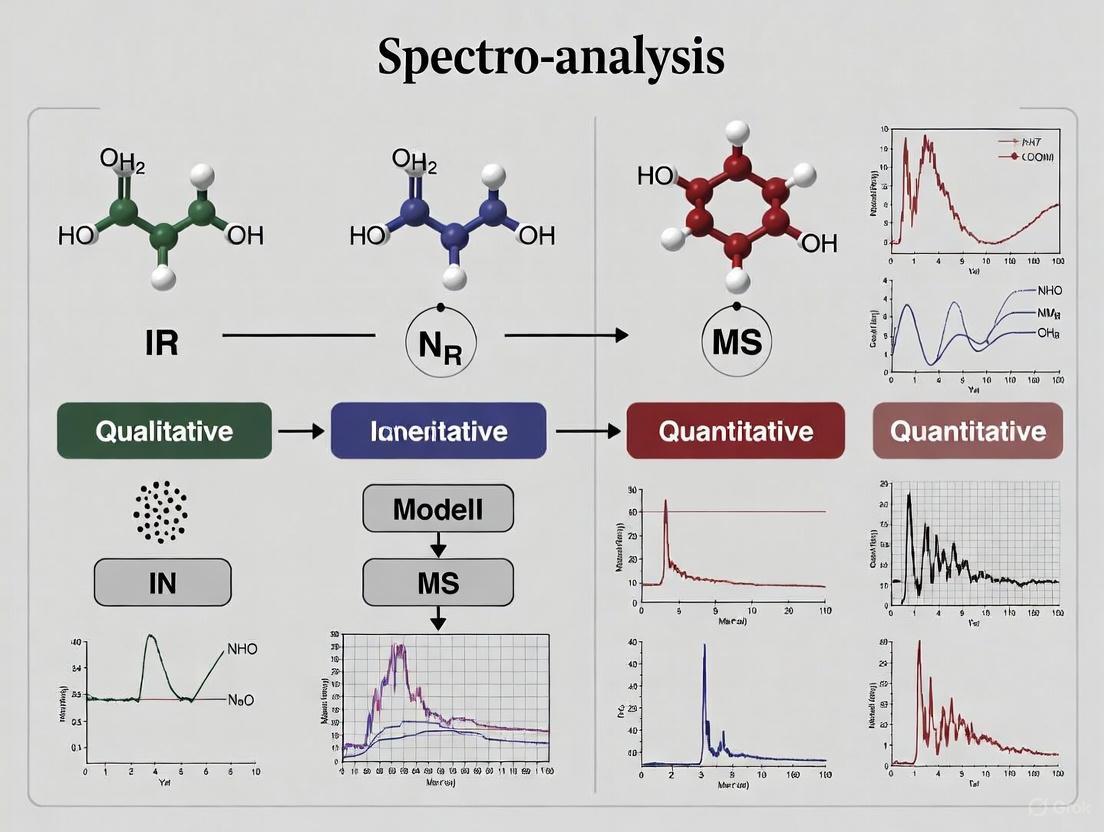
This article provides a thorough exploration of the distinctions and synergies between qualitative and quantitative spectroscopic analysis, tailored for researchers, scientists, and drug development professionals.
Qualitative vs Quantitative Spectroscopic Analysis: A Comprehensive Guide for Pharmaceutical and Biomedical Research
Abstract
This article provides a thorough exploration of the distinctions and synergies between qualitative and quantitative spectroscopic analysis, tailored for researchers, scientists, and drug development professionals. It covers foundational principles, core methodologies, and practical applications across techniques like UV-Vis, IR, NMR, MS, and Raman spectroscopy. The content addresses common analytical challenges, optimization strategies using chemometrics, and validation protocols to ensure regulatory compliance. By synthesizing current practices and emerging trends, this guide serves as an essential resource for implementing robust spectroscopic methods in research, quality control, and process optimization within the biomedical sector.
Core Principles: Understanding the 'What' vs. the 'How Much' in Spectroscopic Analysis
Spectrochemical analysis forms the cornerstone of modern analytical chemistry, particularly in regulated industries like pharmaceuticals. These methods are fundamentally divided into two distinct paradigms: qualitative analysis, concerned with identifying the chemical nature of substances, and quantitative analysis, focused on precisely measuring the amount or concentration of specific components. Within the pharmaceutical industry, both analytical approaches are integral to ensuring drug safety, efficacy, and quality from raw material testing to final product release. Qualitative analysis confirms the identity and purity of materials, while quantitative analysis verifies that active ingredients are present within the specified dosage range and that impurities are below acceptable thresholds [1].
This guide explores the defining goals, methodologies, and technical requirements of qualitative and quantitative analysis, framing them within the context of spectroscopic techniques. We will examine how their distinct purposes shape experimental design, from instrument configuration to data interpretation, and provide detailed protocols for researchers and drug development professionals.
Core Conceptual Distinctions
The primary distinction between qualitative and quantitative analysis lies in their fundamental analytical goals. Qualitative analysis answers the question "What is it?" by identifying the chemical composition, structure, or functional groups present in a sample. Its objective is non-numerical information about chemical identity. In contrast, quantitative analysis answers "How much is there?" by providing a numerical measurement of the amount or concentration of a specific substance [1].
These differing goals necessitate different approaches to data collection and interpretation. Qualitative assessment often relies on matching spectral patterns or retention times to reference standards, such as using Infrared (IR) spectroscopy to identify functional groups in a molecule or Nuclear Magnetic Resonance (NMR) spectroscopy to elucidate molecular structure [1]. Quantitative measurement, however, depends on establishing a relationship between instrumental response and analyte concentration, most commonly through the Beer-Lambert law in spectroscopy or calibration curves in chromatographic and mass spectrometric techniques [2].
Table 1: Conceptual Comparison Between Qualitative and Quantitative Analysis
| Feature | Qualitative Analysis | Quantitative Analysis |
|---|---|---|
| Primary Goal | Identification of components, chemical structure, and purity [1] | Measurement of precise concentration or amount [1] |
| Research Question | "What is this substance?" | "How much of this substance is present?" |
| Output | Non-numerical data (e.g., identity, structure, presence/absence) [1] | Numerical data (e.g., concentration, percentage, mass) [1] |
| Key Pharmaceutical Applications | Raw material identification, impurity screening, identity confirmation [3] [1] | Assay of active ingredient, dissolution testing, impurity quantification [3] |
Technical Requirements and Methodologies
The fundamental differences in analytical goals directly translate to specific technical requirements, particularly in spectroscopic instrumentation and method validation.
Instrumental Configuration: The Monochromator Example
A clear example of this methodological divergence is in the configuration of monochromator slit widths in spectroscopic instruments. Quantitative analysis requires high resolution and precision in absorbance measurements to accurately determine concentration. This is achieved by using narrow slit widths, which enhance spectral resolution and ensure that the measured absorbance is specific to the analyte's wavelength, thereby yielding a more linear and reliable calibration curve [4].
Conversely, qualitative analysis, especially when surveying an unknown sample, prioritizes signal intensity to detect the presence of all potential components. This is achieved with wider slit widths, which allow more light to pass through the sample, improving the signal-to-noise ratio and enabling the detection of trace components that might otherwise be missed [4]. While this comes at the cost of reduced spectral resolution, it is a necessary trade-off for comprehensive identification.
Calibration and Validation Approaches
Calibration methods also differ significantly between the two paradigms.
- Quantitative Calibration: Relies on generating a calibration curve by plotting instrument response against known concentrations of standard solutions [2] [5]. The Beer-Lambert law ((A = εbc)) forms the basis for quantitative spectroscopic analysis, where absorbance (A) is proportional to concentration (c) [2]. To mitigate matrix effects, the internal standard method is often employed, where a known compound with similar properties to the analyte is added to correct for variations [2] [5].
- Qualitative Calibration: Often involves building spectral libraries. For example, techniques like FTNIR and Raman spectroscopy require a validated library of reference materials. Unknown samples are then identified by matching their spectral signature to an entry in this library [1].
Table 2: Technical Requirements for Qualitative vs. Quantitative Spectroscopic Analysis
| Technical Aspect | Qualitative Analysis | Quantitative Analysis |
|---|---|---|
| Primary Instrumental Goal | Detection and identification | Precise and accurate measurement |
| Typical Slit Width | Wider for better signal and detection [4] | Narrower for higher resolution and precision [4] |
| Calibration Method | Spectral libraries, retention time databases [1] | Calibration curves (e.g., using standard solutions) [2] [5] |
| Data Output | Spectrum, chromatogram, functional group identification | Concentration, mass, percentage, ratio |
| Key Performance Metrics | Probability of identification, specificity, selectivity | Accuracy, precision, limit of detection (LOD), limit of quantification (LOQ) [2] |
| Linear Dynamic Range | Less critical | Essential; defines the working concentration range for accurate measurement [2] |
Experimental Protocols in Pharmaceutical Analysis
Protocol for Qualitative Identification of a Raw Material by FTIR
Objective: To confirm the identity of an incoming raw material (e.g., an active pharmaceutical ingredient or excipient) against a certified reference standard.
Methodology: Fourier-Transform Infrared (FTIR) Spectroscopy
Sample Preparation:
- For a solid sample, mix a small quantity (1-2 mg) of the test material with dry potassium bromide (KBr, ~100 mg). Grind thoroughly using an agate mortar and pestle to create a homogeneous mixture.
- Compress the mixture into a transparent pellet using a hydraulic press.
- For the reference standard, prepare a pellet in an identical manner.
Instrumental Analysis:
- Acquire a background spectrum using a clean KBr pellet.
- Load the sample pellet and obtain the IR spectrum in the range of 4000-400 cm⁻¹.
- Under the same conditions, obtain the IR spectrum of the reference standard pellet.
Identification and Analysis:
- Compare the positions and relative shapes of the major absorption bands (functional group region and fingerprint region) of the test sample to those of the reference standard.
- The identity is confirmed if the spectrum of the test sample exhibits all significant absorption maxima and minima present in the reference standard spectrum.
Protocol for Quantitative Analysis by ICP-MS
Objective: To quantify trace levels of elemental impurities (e.g., As, Se, Cd) in a drug substance.
Methodology: Inductively Coupled Plasma Mass Spectrometry (ICP-MS) with Internal Standardization [5].
Sample Preparation:
- Accurately weigh approximately 0.1 g of the homogenized drug substance.
- Digest the sample in 5 mL of high-purity concentrated nitric acid using a microwave digester.
- After digestion and cooling, dilute the solution to a final volume of 50 mL with deionized water, resulting in a final acid concentration of 1% HNO₃.
Standard and Internal Standard Preparation:
- Prepare a series of multi-element calibration standards (e.g., STD1: blank, STD2: 0.5 µg/L, STD3: 1 µg/L, STD4: 2 µg/L for As and Se; appropriate levels for Cd) in 1% HNO₃ [5].
- Add internal standard elements (e.g., Gallium (Ga) and Indium (In) at 5 µg/L each) to all calibration standards and to the prepared unknown test samples [5]. The internal standard should have similar mass and ionization potential to the analytes.
Instrumental Analysis:
- Tune the ICP-MS for optimal sensitivity and stability.
- For quantitative analysis, set the instrument to monitor specific isotopes (e.g., As-75, Se-78, Cd-111) and the internal standard isotopes (Ga-71, In-115) with longer integration times than used for qualitative surveys.
- Run the calibration standards to generate a calibration curve for each element, with the y-axis as the ratio of the analyte ion intensity to the internal standard ion intensity (IS/IR) [5].
Quantification:
- Analyze the unknown test sample.
- The instrument software converts the measured ion intensity ratio for each analyte into concentration based on the calibration curve equation.
Workflow Visualization
The following diagram illustrates the generalized workflows for qualitative and quantitative analysis, highlighting their distinct paths and decision points.
The Scientist's Toolkit: Essential Research Reagents and Materials
Table 3: Key Reagents and Materials for Spectroscopic Analysis
| Item | Function/Application |
|---|---|
| Certified Reference Standards | High-purity materials with certified identity and/or purity; essential for both qualitative identification and constructing quantitative calibration curves. |
| Potassium Bromide (KBr) | Infrared-transparent matrix used for preparing solid samples for FTIR analysis via the KBr pellet method [1]. |
| Internal Standard Solutions | Known compounds (e.g., Ga, In, Y for ICP-MS) added to correct for matrix effects and instrument drift in quantitative analysis [5]. |
| High-Purity Acids & Solvents | Essential for sample preparation and digestion (e.g., nitric acid for ICP-MS) to prevent contamination that would interfere with analysis [5]. |
| Mobile Phase Solvents (HPLC grade) | High-purity solvents and buffers used as the liquid phase in HPLC for separating components before detection. |
| Spectroscopic Cells/Cuvettes | Containers of defined path length (e.g., for UV-Vis) made from materials (quartz, glass) transparent to the relevant radiation. |
Qualitative and quantitative analyses, while often employed on the same samples, serve fundamentally different purposes that dictate every aspect of methodological design. Qualitative analysis prioritizes detection and identification, often employing techniques and instrument settings that maximize the ability to detect the presence of components. Quantitative analysis demands precision, accuracy, and numerical rigor, requiring carefully calibrated methods that can reliably translate an instrument's signal into a definitive concentration value. In the pharmaceutical industry, the synergy between these two approaches is critical. Confirming a material's identity is meaningless without knowing its potency, and measuring potency is futile without first verifying identity. A deep understanding of their distinct goals, requirements, and methodologies is therefore indispensable for researchers dedicated to ensuring product quality and patient safety.
Spectroscopic analysis is fundamentally based on the interactions between matter and electromagnetic radiation. When light energy interacts with a sample, it can be absorbed, emitted, or scattered in ways that are characteristic of the sample's molecular and atomic composition. These interactions form the basis for two complementary analytical approaches: qualitative analysis, which identifies what is present in a sample, and quantitative analysis, which determines how much is present [6]. In qualitative analysis, specific energy transitions create spectral "fingerprints" that are unique to particular chemical structures, functional groups, or elements. Quantitative analysis builds upon these identified features, measuring the intensity of these spectroscopic responses to determine concentration based on fundamental relationships like the Beer-Lambert law [7].
The pharmaceutical and biopharmaceutical industries rely heavily on both approaches throughout drug discovery, development, and quality control. From identifying unknown compounds during early research to precisely quantifying active ingredients in final dosage forms, spectroscopic techniques provide critical data that ensures drug safety, efficacy, and consistency [8]. This technical guide explores the core principles, methodologies, and applications of qualitative and quantitative spectroscopic analysis, providing researchers with a comprehensive framework for leveraging these powerful analytical tools.
Foundational Principles: Qualitative Versus Quantitative Analysis
Core Definitions and Distinctions
Qualitative Analysis: This approach focuses on identifying the chemical components, functional groups, and molecular structures present in a sample. It answers the question "What is this substance?" by detecting characteristic spectral patterns. For example, infrared spectroscopy can identify an alcohol by the presence of a broad O-H stretch around 3200-3600 cm⁻¹, while nuclear magnetic resonance (NMR) spectroscopy can distinguish between different hydrogen environments in a molecule [6] [7].
Quantitative Analysis: This approach measures the concentration or amount of specific components in a sample, answering "How much is present?" It relies on the relationship between the intensity of a spectroscopic signal and the concentration of the analyte. Ultraviolet-visible (UV-Vis) spectroscopy, for instance, uses absorbance measurements at specific wavelengths to determine analyte concentration through established calibration curves [6].
Complementary Relationship in the Analytical Workflow
In practice, qualitative and quantitative analyses form a sequential, complementary workflow. Qualitative assessment typically precedes quantitative measurement, as a component must first be identified before it can be reliably quantified. A typical analytical process involves initial spectral fingerprinting to identify components of interest, followed by method development to establish quantitative parameters for these components, and finally precise measurement of their concentrations [6] [9]. This workflow is particularly crucial in pharmaceutical quality control, where both the identity and purity of drug compounds must be verified.
Table 1: Core Distinctions Between Qualitative and Quantitative Spectroscopic Analysis
| Feature | Qualitative Analysis | Quantitative Analysis |
|---|---|---|
| Primary Goal | Identify components, functional groups, and structures [6] | Determine concentration or amount of specific analytes [6] |
| Key Output | Spectral fingerprint, functional group identification, structural elucidation | Concentration values, purity percentages, compositional ratios |
| Common Techniques | FTIR, NMR (for structural elucidation), Raman spectroscopy [8] [7] | UV-Vis, ICP-MS, ICP-OES, NIR with chemometrics [8] [10] |
| Data Interpretation | Pattern matching, spectral library searches, functional group region analysis | Calibration curves, statistical analysis, regression models |
| Typical Workflow Stage | Exploratory research, unknown identification, method development | Quality control, process monitoring, purity assessment |
Essential Spectroscopic Techniques and Their Applications
Modern laboratories employ a diverse array of spectroscopic techniques, each with unique strengths for specific qualitative or quantitative applications. The choice of technique depends on multiple factors including the nature of the analyte, required sensitivity, sample matrix, and the specific information needed (structural versus concentration data) [11].
Fourier-Transform Infrared (FTIR) Spectroscopy is a versatile technique that provides information about molecular vibrations and chemical bonds. It is widely used for qualitative identification of functional groups and organic compounds through their unique infrared absorption patterns in the mid-IR region (4000-400 cm⁻¹). The fingerprint region (1200-400 cm⁻¹) is particularly useful for identifying specific compounds [7]. With proper calibration and chemometric analysis, FTIR can also be applied to quantitative analysis, such as determining compound levels in plant-based medicines and supplements [9].
Nuclear Magnetic Resonance (NMR) Spectroscopy exploits the magnetic properties of certain atomic nuclei to provide detailed information about molecular structure, dynamics, and chemical environment. It is considered a gold standard for qualitative structural elucidation, particularly for organic molecules and complex natural products [12]. NMR can also be used for quantitative analysis (qNMR) to determine purity and concentration without requiring identical reference standards, making it valuable for pharmaceutical applications [8].
Mass Spectrometry (MS) techniques identify and quantify compounds based on their mass-to-charge ratio. While fundamentally quantitative due to its direct relationship between ion abundance and concentration, MS also provides qualitative information through fragmentation patterns that reveal structural characteristics. Advanced hyphenated techniques like LC-MS/MS and ICP-MS combine separation power with sensitive detection and are particularly valuable for trace analysis in complex matrices [8] [13].
Atomic Spectroscopy techniques, including Inductively Coupled Plasma Mass Spectrometry (ICP-MS) and Inductively Coupled Plasma Optical Emission Spectroscopy (ICP-OES), are primarily quantitative methods for elemental analysis. They offer exceptional sensitivity for detecting trace metals in pharmaceutical raw materials, finished products, and biological samples [8]. For example, ICP-MS can detect ultra-trace levels of metals interacting with proteins during drug development [8].
UV-Visible Spectroscopy is predominantly used for quantitative analysis due to its straightforward relationship between absorbance and concentration (Beer-Lambert Law). It finds applications in concentration determination of analytes in solution, with microvolume UV-vis spectroscopy recently being applied to quantify nanoplastics in environmental research [14]. While less specific for qualitative identification than vibrational or NMR spectroscopy, UV-Vis can provide some structural information based on chromophore absorption patterns.
Molecular Rotational Resonance (MRR) Spectroscopy is an emerging technique that provides unambiguous structural information on compounds and isomers within mixtures, without requiring pre-analysis separation. MRR can combine the speed of mass spectrometry with the structural information of NMR, making it particularly valuable for chiral analysis and characterizing impurities in pharmaceutical raw materials [12].
Table 2: Technical Comparison of Major Spectroscopic Techniques
| Technique | Primary Qualitative Applications | Primary Quantitative Applications | Typical Sensitivity | Pharmaceutical Application Example |
|---|---|---|---|---|
| FTIR | Functional group identification, polymorph screening [7] | Content uniformity, coating thickness [9] | µg to mg | Drug stability studies using hierarchical cluster analysis [8] |
| NMR | Structural elucidation, stereochemistry determination [12] | qNMR purity assessment, concentration determination [8] | µg to mg | Monitoring mAb structural changes in formulation [8] |
| MS | Structural characterization, metabolite identification [15] | Bioavailability studies, impurity profiling [8] | pg to ng | SEC-ICP-MS for metal-protein interactions [8] |
| ICP-MS | Elemental identification | Trace metal quantification [8] | ppq to ppt | Metal speciation in cell culture media [8] |
| UV-Vis | Chromophore identification | Concentration measurement, dissolution testing [14] | ng to µg | Inline Protein A affinity chromatography monitoring [8] |
| Raman | Polymorph identification, molecular imaging [8] | Process monitoring, content uniformity [8] | µg to mg | Real-time monitoring of product aggregation during bioprocessing [8] |
| MRR | Isomer differentiation, chiral identification [12] | Enantiomeric excess determination, impurity quantification [12] | ng to µg | Raw material impurity analysis without chromatographic separation [12] |
Advanced and Hyphenated Techniques
The combination of multiple analytical techniques through hyphenation has significantly expanded the capabilities of spectroscopic analysis. Hyphenated techniques such as LC-MS, GC-MS, and LC-NMR combine the separation power of chromatography with the detection specificity of spectroscopy, enabling both qualitative and quantitative analysis of complex mixtures [15]. These approaches are particularly valuable in pharmaceutical analysis where samples often contain multiple components in complex matrices.
Advanced implementations of traditional techniques continue to emerge. Surface-Enhanced Raman Spectroscopy (SERS) and Tip-Enhanced Raman Spectroscopy (TERS) dramatically improve sensitivity, enabling detection of low concentration substances and analysis of protein dynamics and aggregation mechanisms [8]. These enhanced techniques provide both qualitative structural information and quantitative concentration data for challenging analytes.
Experimental Protocols: From Theory to Application
Protocol 1: Quantitative Analysis of Total Acidity in Table Grapes Using Vis-NIR Spectroscopy and Si-PLS
This protocol demonstrates a quantitative application of spectroscopy combined with chemometrics for rapid quality assessment, as exemplified in food and agricultural analysis [10].
Principle: Near-infrared radiation interacts with organic molecules through overtone and combination vibrations of fundamental molecular bonds (C-H, O-H, N-H). The resulting spectral signatures can be correlated with chemical properties of interest using multivariate calibration methods.
Materials and Equipment:
- Vis-NIR spectrophotometer (400-1100 nm range)
- Seedless White table grape samples
- Reflective measurement accessory
- Chemometrics software with Si-PLS capability
- Standard laboratory equipment for reference analysis (titration apparatus)
Procedure:
- Sample Preparation: Homogenize representative grape samples to create a uniform matrix. Maintain consistent temperature and presentation geometry across all samples.
- Spectral Acquisition: Collect diffuse reflectance spectra from each sample across the 400-1100 nm wavelength range. Use consistent instrument parameters (scan number, resolution, gain) for all measurements.
- Reference Method Analysis: Determine actual total acidity (TA) values for all samples using standard titration methods to establish ground truth data for model development.
- Spectral Preprocessing: Apply preprocessing algorithms to reduce scattering effects and enhance spectral features. The first derivative combined with Savitzky-Golay smoothing has been identified as particularly effective for this application [10].
- Variable Selection: Utilize Synergy Interval Partial Least Squares (Si-PLS) to identify optimal spectral subintervals most correlated with TA content. This improves model performance by focusing on informative spectral regions.
- Model Development: Develop PLS regression models using both full-spectrum data and selected subintervals. Validate model performance using cross-validation and independent prediction sets.
- Performance Evaluation: Assess models using correlation coefficients (Rc, Rp), root mean square errors (RMSEC, RMSEP), and residual predictive deviation (RPD). The optimal model for grape TA typically achieves Rc > 0.9 and RPD > 1.8 [10].
Protocol 2: Qualitative and Quantitative Analysis of Phytochemicals in Herbal Medicines Using FTIR Spectroscopy
This protocol outlines the use of FTIR spectroscopy for both identification and quantification of active components in complex plant matrices, relevant to pharmaceutical quality control [9].
Principle: Mid-infrared radiation excites fundamental molecular vibrations, creating absorption spectra that serve as molecular fingerprints. Chemical composition affects these spectra in measurable ways that can be correlated with component concentrations.
Materials and Equipment:
- FTIR spectrometer with deuterated triglycine sulfate (DTGS) detector
- Attenuated Total Reflectance (ATR) accessory
- Solid herbal medicine samples
- Standard compounds for calibration
- Chemometrics software for multivariate analysis
Procedure:
- Sample Preparation: Grind herbal samples to fine powder (<100 µm). For ATR measurement, apply uniform pressure to ensure good crystal contact. For transmission measurements, prepare KBr pellets containing precisely weighed sample amounts.
- Spectral Acquisition: Collect spectra in the 4000-400 cm⁻¹ range with 4 cm⁻¹ resolution. Accumulate 64 scans per spectrum to improve signal-to-noise ratio. Include background scans under identical conditions.
- Qualitative Analysis:
- Examine functional group region (4000-1200 cm⁻¹) for characteristic absorption bands (O-H, C=O, C-O, etc.)
- Compare fingerprint region (1200-400 cm⁻¹) to reference spectra for identification
- Use second derivative spectroscopy to resolve overlapping bands
- Quantitative Method Development:
- Prepare calibration standards with known concentrations of target phytochemicals
- Apply spectral preprocessing (normalization, derivatives, multiplicative scatter correction)
- Select informative spectral variables using interval PLS (iPLS) or genetic algorithms (GA)
- Develop PLS regression models correlating spectral data with reference concentrations
- Model Validation: Validate using cross-validation and independent test sets. Report RMSEC, RMSEP, RMSEV, and R² values. For example, FTIR quantification of rosmarinic acid in Rosmarini leaves using ATR-IR with MSC and second derivative preprocessing has demonstrated excellent predictive ability [9].
Protocol 3: Quantitative Analysis of Residual Solvents Using Molecular Rotational Resonance (MRR) Spectroscopy
This protocol describes the application of emerging MRR technology for pharmaceutical solvent analysis, offering advantages over traditional GC-based methods [12].
Principle: MRR spectroscopy measures the pure rotational transitions of gas-phase molecules in the microwave region. Each molecule has a unique rotational spectrum that serves as a fingerprint, enabling identification and quantification without separation.
Materials and Equipment:
- Commercial MRR spectrometer
- Headspace autosampler
- Standard solvents and samples
- Data analysis software
Procedure:
- Sample Introduction: Use static headspace sampling to introduce volatile components into the MRR spectrometer. Maintain consistent vial size, sample volume, and equilibration conditions.
- Spectral Acquisition: Acquire broadband rotational spectra in the 2-8 GHz frequency range. The chirped-pulse Fourier-transform microwave technique enables rapid acquisition of the entire bandwidth simultaneously.
- Qualitative Identification: Compare observed rotational transitions to reference spectra for unambiguous identification of solvent molecules, including differentiation of isomers.
- Quantitative Calibration:
- Prepare standard solutions with known concentrations of target solvents
- Measure rotational transition intensities for each standard
- Establish calibration curves relating signal intensity to concentration
- Sample Analysis: Introduce unknown samples and measure rotational transition intensities. Calculate concentrations using established calibration models. For USP <467> Class 2, Procedure C solvents, MRR provides equivalent sensitivity and better quantitative performance compared to GC systems, with dramatically simplified method development [12].
Data Analysis and Chemometrics
Spectral Preprocessing and Variable Selection
The raw spectral data acquired from spectroscopic instruments often contains variations unrelated to the chemical properties of interest. Spectral preprocessing techniques are essential for enhancing the useful information and minimizing confounding factors [9].
Common preprocessing methods include:
- Derivative Spectroscopy: First and second derivatives help resolve overlapping peaks, remove baseline offsets, and enhance small spectral features. The Savitzky-Golay algorithm is widely used for derivative calculation with simultaneous smoothing [13] [10].
- Scatter Correction: Multiplicative Scatter Correction (MSC) and Standard Normal Variate (SNV) transformation correct for light scattering effects caused by particle size differences in solid samples.
- Normalization: Area normalization, vector normalization, or normalization to an internal standard peak (such as potassium thiocyanate in FTIR analysis) corrects for path length or concentration variations [13].
Variable selection is another critical step in chemometric analysis, particularly for quantitative applications. Rather than using entire spectra, selecting specific wavelengths or regions that contain information relevant to the analyte of interest can significantly improve model performance and robustness. Techniques include interval Partial Least Squares (iPLS), Synergy iPLS (Si-PLS), and Genetic Algorithms (GA) [10] [9]. For NIR data, variable selection is more commonly employed than for mid-IR data due to the broader, more overlapping peaks in the NIR region [9].
Multivariate Calibration and Model Validation
Multivariate calibration methods are essential for extracting quantitative information from complex spectroscopic data, particularly when analytes exhibit overlapping spectral features. The most widely used method is Partial Least Squares (PLS) regression, which finds latent variables that maximize covariance between spectral data and reference concentration values [10]. Advanced variants include interval PLS (iPLS) and synergy interval PLS (Si-PLS), which focus on informative spectral regions.
Other multivariate techniques include:
- Principal Component Regression (PCR): Uses principal components of the spectral data as predictors in regression models.
- Artificial Neural Networks (ANN): Nonlinear modeling approach useful for complex relationships, successfully applied to alkaloid quantification in Coptidis rhizoma [9].
- Support Vector Machines (SVM): Particularly effective for classification problems and nonlinear regression.
Model validation is crucial for ensuring reliable quantitative results. Common validation strategies include:
- Cross-validation: Typically leave-one-out or k-fold cross-validation to optimize model complexity and prevent overfitting.
- Independent test set validation: Using samples not included in model development to assess predictive performance.
- Performance metrics: Reporting correlation coefficients (R², Q²), root mean square errors (RMSEC, RMSECV, RMSEP), and residual predictive deviation (RPD) values [10] [9].
The Scientist's Toolkit: Essential Research Reagents and Materials
Table 3: Key Research Reagents and Materials for Spectroscopic Analysis
| Item | Function/Application | Technical Specifications |
|---|---|---|
| Potassium Thiocyanate (KSCN) | Internal standard for FTIR spectroscopy [13] | High purity grade; used for spectral normalization and quality control |
| Tandem Mass Tag (TMT) Reagents | Isobaric labels for multiplexed quantitative proteomics via LC-MS/MS [13] | 6-plex or 11-plex sets; enable simultaneous quantification of multiple samples |
| Size Exclusion Chromatography (SEC) Columns | Separation of macromolecules prior to elemental analysis via ICP-MS [8] | Appropriate pore size for target proteins; compatible with aqueous mobile phases |
| Chiral Tag Molecules | Enantiomeric excess determination using MRR spectroscopy [12] | Small, chiral molecules that form diastereomeric complexes with target analytes |
| Pluronic F-127 | Stabilizing agent for liquid crystalline nanoparticles in targeted therapy studies [8] | Pharmaceutical grade; used in specific ratios with glycerol monooleate (GMO) |
| Deuterated Solvents | NMR spectroscopy for structural elucidation and quantification [8] | High deuteration degree (>99.8%); minimal water content |
| Chemometric Software | Multivariate data analysis for quantitative spectroscopic applications [10] [9] | PLS, iPLS, Si-PLS algorithms; spectral preprocessing capabilities |
Workflow Visualization: From Sample to Result
The following diagrams illustrate key workflows in qualitative and quantitative spectroscopic analysis, showing the logical progression from sample preparation to final results.
Spectroscopic techniques provide powerful capabilities for both qualitative identification and quantitative measurement of chemical substances through the fundamental interactions between matter and light. The complementary nature of these approaches enables comprehensive characterization of samples across pharmaceutical, environmental, and materials science applications. As spectroscopic technology continues to advance, with emerging techniques like MRR spectroscopy and enhanced methods such as SERS and TERS, the resolution, sensitivity, and application scope of both qualitative and quantitative analysis continue to expand. By understanding the fundamental principles, appropriate methodologies, and proper data analysis techniques presented in this guide, researchers can effectively leverage these powerful tools to address complex analytical challenges in drug development and beyond.
In the realm of spectroscopic analysis, a spectral fingerprint refers to the unique pattern of electromagnetic radiation that a substance emits or absorbs, serving as a characteristic identifier for that specific element or molecule [16]. These fingerprints arise from the quantized energy transitions within atoms and molecules, producing spectral patterns that are as distinctive as human fingerprints. When light or any form of energy passes through a substance, atoms or molecules absorb specific wavelengths of energy to jump to higher energy states, or emit characteristic wavelengths as they fall to lower states. This pattern, when plotted as a graph of intensity versus wavelength or frequency, creates a spectrum that provides a definitive signature for the substance [16]. The fundamental principle underpinning spectral fingerprints is that every element and molecule possesses a unique arrangement of electrons and energy levels. Consequently, when excited, they interact with electromagnetic radiation in a pattern that is exclusive to their atomic or molecular structure, allowing for unambiguous identification [16].
The concept of the fingerprint extends across various spectroscopic techniques, each probing different types of interactions. In vibrational spectroscopy, such as Raman and FT-IR, the fingerprint region is typically considered to be between 300 to 1900 cm⁻¹ [17]. This region is dominated by complex vibrational modes involving the entire molecule, making it highly sensitive to minor structural differences. This article delves into the core principles of spectral fingerprints, framing their critical role in qualitative identification within the broader context of spectroscopic research, which is often divided into the distinct paradigms of qualitative and quantitative analysis.
Theoretical Foundations
The Physics of Spectral Formation
Spectral fingerprints are a direct manifestation of quantum mechanical principles. The formation of these spectra is governed by the interaction between electromagnetic radiation and the discrete energy levels of atoms and molecules.
- Atomic Spectra: For atoms, the absorption or emission of light occurs when electrons transition between defined energy orbitals. These transitions result in a line spectrum, which appears as a series of sharp, discrete lines at specific wavelengths against a dark background. The well-defined nature of atomic energy levels means these spectra are relatively simple and consist of distinct lines [16].
- Molecular Spectra: Molecules exhibit more complex spectra due to the combination of three types of energy transitions: electronic, vibrational, and rotational. The complex interplay between these energy modes gives rise to a band spectrum, characterized by groups or "bands" of closely spaced lines. The high density of transitions in the fingerprint region creates a unique pattern for each molecule, enabling its identification [16].
The Fingerprint Region in Vibrational Spectroscopy
In vibrational spectroscopy, the fingerprint region (300–1900 cm⁻¹) is particularly crucial for qualitative analysis. A more focused sub-region from 1550 to 1900 cm⁻¹ has been identified as a "fingerprint within a fingerprint" for analyzing Active Pharmaceutical Ingredients (APIs) [17]. This narrow region is rich with functional group vibrations, such as:
- C=N vibrations (1610–1680 cm⁻¹)
- C=O vibrations (1680–1820 cm⁻¹)
- N=N vibrations (approximately 1580 cm⁻¹) [17]
A key characteristic of this specific region is that common pharmaceutical excipients (inactive ingredients) show no Raman signals, while APIs exhibit strong, unique vibrations. This absence of interference makes it an ideal spectral zone for the unambiguous identification of active compounds in complex drug products [17].
Qualitative vs. Quantitative Spectroscopic Analysis
Spectroscopic research can be broadly categorized into two complementary approaches: qualitative and quantitative analysis. Understanding their differences and interdependencies is fundamental to designing effective analytical strategies. The table below summarizes the core distinctions.
Table 1: Core Differences Between Qualitative and Quantitative Spectroscopic Research
| Aspect | Qualitative Analysis | Quantitative Analysis |
|---|---|---|
| Primary Goal | Identify components; understand composition and structure [18] | Measure concentrations or amounts; test hypotheses [18] |
| Nature of Data | Words, meanings, spectral patterns, and images [18] | Numbers, statistics, and numerical intensities [18] |
| Research Approach | Inductive; explores ideas and forms hypotheses [19] | Deductive; tests predefined hypotheses [19] |
| Data Collection | Focus on in-depth understanding; smaller, purposive samples [19] | Focus on generalizability; larger, representative samples [19] |
| Data Interpretation | Ongoing and tentative, based on thematic analysis [19] | Conclusive, stated with a predetermined degree of certainty using statistics [19] |
The Role of Spectral Fingerprints in Qualitative Analysis
The unique nature of spectral fingerprints makes them the cornerstone of qualitative spectroscopic analysis. A line spectrum is so distinctive for an element that it is often termed its 'fingerprint,' allowing scientists to identify the presence of that element in a sample, whether in a laboratory or a distant star [16]. This non-destructive identification is invaluable across fields, from forensic science, where it can detect drugs of abuse in latent fingerprints [20], to pharmaceutical development, where it ensures the identity of raw materials [17].
The Synergy with Quantitative Analysis
While this article focuses on identification, it is crucial to recognize that modern analytical instruments increasingly blur the line between qualitative and quantitative work. High-Resolution Mass Spectrometry (HRMS) exemplifies this trend. Unlike traditional triple-quadrupole MS (QQQ-MS) used for targeted quantification, HRMS can acquire a high-resolution full-scan of all ions in a sample [21]. This provides a global picture, enabling both the quantification of target compounds and the qualitative, untargeted screening for unknown substances within a single analysis. This paradigm shift supports more holistic approaches in systems biology and personalized medicine [21].
Key Spectroscopic Techniques and Experimental Protocols
Raman Spectroscopy for API Identity Testing
Raman spectroscopy is a powerful, non-destructive technique that requires minimal sample preparation, making it ideal for qualitative identification in pharmaceuticals [17].
Experimental Protocol: Leveraging the "Fingerprint in the Fingerprint" Region
- Instrumentation: Use an FT-Raman spectrometer (e.g., Thermo Nicolet NXR 6700) equipped with a 1064 nm laser source and an InGaAs detector. Spectral resolution should be set to 4 cm⁻¹ over a range of 150–3700 cm⁻¹ [17].
- Sample Preparation: For solid dosage forms (tablets, capsules), minimal preparation is needed. The sample is simply placed under the laser objective. Bulk products can even be tested through transparent packaging [17].
- Data Acquisition: Focus the laser on the sample. A laser power of ~0.5 W is suitable for a microstage attachment. Collect the scattered light, which is transferred through an interferometer to the detector.
- Qualitative Analysis:
- Visually inspect the acquired spectrum in the 1550–1900 cm⁻¹ region.
- Compare the spectral signals against a library of known API references.
- Confirm identity by matching unique vibrational signals (e.g., C=O, C=N stretches) specific to the expected API. The absence of signals in this region from excipients simplifies interpretation [17].
Table 2: Key Research Reagents and Materials for Raman Spectroscopic Analysis
| Item | Function / Explanation |
|---|---|
| FT-Raman Spectrometer | Core instrument for measuring inelastic scattering of light from molecular vibrations [17]. |
| 1064 nm Laser | Excitation source; this longer wavelength helps reduce fluorescence in samples [17]. |
| Indium Gallium Arsenide (InGaAs) Detector | Specialized detector optimized for the near-infrared region, compatible with a 1064 nm laser [17]. |
| Reference Excipients (e.g., Mg Stearate, Lactose) | Used to build spectral libraries and confirm the absence of interfering signals in the API fingerprint region [17]. |
| Standard Spectral Libraries (e.g., USP) | Compendial databases of verified spectra for definitive identification and qualification of instruments [17]. |
| Open-Source Raman Datasets | Publicly available data (e.g., Figshare repositories) containing thousands of spectra for calibration, modeling, and training [22]. |
Detection of Drugs of Abuse in Fingerprints
Raman spectroscopy can be applied in forensics to detect contaminants like drugs of abuse in latent fingerprints, even after they have been developed with powders and lifted with adhesive tapes [20].
Experimental Protocol: Forensic Analysis of Contaminated Fingerprints
- Sample Collection: Latent fingerprints are deposited on a clean surface (e.g., glass slide). To simulate real-world conditions, the subject should handle the drug of abuse prior to deposition.
- Fingerprint Development: Develop the latent print using standard forensic powders (e.g., aluminium flake or magnetic powders) applied with a glass fibre or magnetic applicator [20].
- Recovery: Lift the developed fingerprint using a low-tack clear adhesive film or a hinge lifter, which is then placed on a contrasting backing sheet.
- Spectral Analysis:
- Place the lifted print under a Raman microscope.
- Scan across the fingerprint residue to locate particulate contaminants.
- Obtain Raman spectra from the particles and compare them to reference spectra of pure and seized drug samples (e.g., cocaine, MDMA, amphetamine). The analysis can successfully identify the drug despite the presence of development powder, though locating the particles may take longer [20].
Data Analysis and Interpretation Workflows
The journey from raw spectral data to confident qualitative identification follows a structured workflow. The diagram below illustrates the key decision points and processes in spectral fingerprint analysis.
Diagram 1: Workflow for qualitative spectral identification.
Data Preprocessing
Raw spectral data is often corrupted by noise and baseline offsets, making preprocessing essential before any interpretation. For Raman spectra, common steps include:
- Cropping: Remove non-informative spectral regions (e.g., wavenumbers ≥ 3150 cm⁻¹ which lack Raman activity) [22].
- Baseline Correction: Subtract fluorescent backgrounds and linear offsets. A simple two-point linear correction can be effective, while more advanced algorithms like asymmetric least squares (ALS) or Savitzky-Golay filters may be used for complex baselines [22].
- Scaling/Normalization: Apply techniques like Standard Normal Variate (SNV) or min-max normalization per sample to correct for intensity variations and allow for easier comparison between spectra [22].
Pattern Recognition and Identification
After preprocessing, the core qualitative analysis begins.
- Spectral Library Searching: The processed spectrum is compared against a database of known reference spectra. High similarity (matching peaks and patterns) to a library entry provides a primary identification [17]. Open-source databases are increasingly available to support this task [22].
- Functional Group Analysis: If a definitive library match is not found, or to confirm a match, analysts interpret the spectrum by identifying characteristic peaks. For instance, in the Raman "fingerprint in the fingerprint" region, a peak at 1700 cm⁻¹ would strongly suggest a C=O functional group, narrowing down the possible identities [17].
- Chemometric Analysis: Multivariate statistical methods like Principal Component Analysis (PCA) are used to classify spectra and identify patterns or outliers within large datasets, which is particularly useful in metabolomics or the analysis of complex mixtures [21].
Spectral fingerprints provide an unparalleled foundation for the qualitative identification of substances at the molecular and atomic levels. The unique and characteristic nature of these patterns allows researchers to definitively identify elements and compounds across diverse fields, from ensuring drug safety to solving crimes. While qualitative identification ("what is it?") and quantitative measurement ("how much is there?") are distinct research pursuits with different methodologies and goals, they are inherently linked. The qualitative identity of a substance is the essential prerequisite for any meaningful quantitative analysis. Modern technological advancements, particularly in high-resolution full-scan techniques, are forging a new paradigm where these two approaches are seamlessly integrated. This synergy promises a more holistic understanding of complex samples, ultimately driving progress in scientific research and its applications.
In scientific research, the analysis of materials via spectroscopy falls into two distinct categories: qualitative and quantitative analysis. Qualitative research seeks to answer questions like "why" and "how," focusing on subjective experiences, motivations, and reasons. In spectroscopy, this translates to identifying which substances are present in a sample based on their absorption characteristics [23]. Conversely, quantitative research uses objective, numerical data to answer questions like "what" and "how much" [23]. The Beer-Lambert Law is the foundational principle that enables the quantitative side of this paradigm, allowing researchers to precisely determine the concentration of a specific substance within a solution [24] [25] [26].
The law synthesizes the historical work of Pierre Bouguer, Johann Heinrich Lambert, and August Beer, formalizing the relationship between light absorption and the properties of an absorbing solution [24]. This whitepaper explores the Beer-Lambert Law's derivation, applications, and limitations, framing it within the broader context of spectroscopic research for drug development professionals and scientists who require robust, quantitative concentration measurements.
Fundamental Principles of the Beer-Lambert Law
Mathematical Formulation
The Beer-Lambert Law provides a direct linear relationship between the concentration of an absorbing species in a solution and the absorbance of light passing through it. It is mathematically expressed as:
Where:
- A is the Absorbance (a dimensionless quantity) [24].
- ε is the Molar Absorptivity (also known as the molar extinction coefficient), with typical units of L mol⁻¹ cm⁻¹ [24] [25].
- c is the Concentration of the absorbing species in the solution, with units of mol L⁻¹ [24].
- l is the Path Length, representing the distance light travels through the sample, typically measured in cm [24].
Absorbance itself is defined in terms of the intensity of incident light (I₀) and transmitted light (I): A = log₁₀(I₀/I) [27] [24]
This formula can be rearranged to solve for concentration, which is its most common application in quantitative analysis: c = A / (εl) [24]
Underlying Mechanism and Derivation
The law is derived from the observation that the decrease in light intensity (dI) as it passes through an infinitesimally thin layer (dx) of a solution is proportional to the incident intensity (I) and the concentration of the absorber [24].
The step-by-step derivation is as follows:
- The proportional relationship is established:
-dI/dx ∝ I * cwhich becomes-dI/dx = αIc, where α is an absorption coefficient. - This differential equation is integrated:
∫(dI/I) = -αc ∫dx. - Evaluation of the integral gives:
ln(I) = -αc x + C. - Applying the boundary condition that
I = I₀whenx = 0solves the constant:C = ln(I₀). - This results in:
ln(I) - ln(I₀) = -αc xorln(I/I₀) = -αc x. - Converting from natural logarithm to base-10 logarithm:
log₁₀(I/I₀) = -(α / 2.303) c x. - By defining the molar absorptivity as
ε = α / 2.303and the path length asl = x, we arrive at the classic form:A = log₁₀(I₀/I) = ε c l[24].
The following flowchart illustrates the logical dependencies and relationships between the core concepts of the Beer-Lambert Law.
Quantitative vs. Qualitative Analysis in Spectroscopy
Understanding the distinction between quantitative and qualitative analysis is critical for applying the correct spectroscopic approach. The following table summarizes the key differences.
| Aspect | Quantitative Analysis | Qualitative Analysis |
|---|---|---|
| Core Question | "How much?" or "What concentration?" [23] | "What is it?" or "Why?" [23] |
| Data Type | Numerical, objective, and countable [23] | Descriptive, subjective, and based on language [23] |
| Role of Beer-Lambert Law | Foundation for calculating precise concentrations [25] [26] | Not directly applicable; used indirectly for identifying peaks |
| Typical Output | Concentration value (e.g., 3.1 × 10⁻⁵ mol L⁻¹) [24] | Identity of a substance (e.g., "bilirubin is present") [27] |
| Data Presentation | Statistical analysis, averages, trends [23] | Grouping into categories and themes [23] |
In practice, these approaches are often combined. A researcher might first use qualitative analysis to identify the absorption spectrum of a protein in a solution and then apply the Beer-Lambert Law for quantitative analysis to determine its concentration throughout a purification process [26].
Experimental Protocols for Quantitative Measurement
Standard Protocol for Concentration Determination
This protocol outlines the steps for using UV-Vis spectroscopy and the Beer-Lambert Law to determine the concentration of an unknown sample, such as a protein or DNA solution.
- Preparation of Standard Solutions: Prepare a series of standard solutions with known concentrations of the analyte of interest. The concentrations should bracket the expected concentration of the unknown sample [25].
- Selection of Path Length and Wavelength: Choose an appropriate cuvette with a known path length (l), typically 1.0 cm. Using a spectrophotometer, identify the wavelength of maximum absorption (λ_max) for the analyte [24] [25].
- Measurement of Absorbance: Measure the absorbance (A) of each standard solution at the predetermined λ_max. Also, measure the absorbance of the unknown sample at the same wavelength [25].
- Construction of Calibration Curve: Plot a graph of the measured absorbance (y-axis) against the known concentration (x-axis) for the standard solutions. The Beer-Lambert Law predicts this will be a straight line through the origin [24] [25].
- Determination of Molar Absorptivity: The slope of the linear calibration curve is equal to the product of the molar absorptivity and the path length (slope = εl). If the path length is known, ε can be calculated [24].
- Calculation of Unknown Concentration: Determine the concentration of the unknown sample by either reading its value from the calibration curve using its measured absorbance or by direct calculation using the formula
c = A / (εl)if ε is known [24].
The Scientist's Toolkit: Essential Research Reagents and Materials
Successful quantitative spectroscopy requires specific materials and reagents. The following table details key items and their functions.
| Item | Function in Experiment |
|---|---|
| Spectrophotometer / USB Spectrometer | Instrument that measures the intensity of light transmitted through a sample, enabling absorbance calculation [25]. |
| Cuvette | A container, typically with a standard path length (e.g., 1 cm), that holds the liquid sample during measurement [24]. |
| Standard (Analyte) of Known Purity | A high-purity reference material used to prepare standard solutions for constructing the calibration curve [25]. |
| Appropriate Solvent | The liquid in which the analyte is dissolved; it must be transparent at the wavelengths of measurement and not react with the analyte [24]. |
| Monomochromatic Light Source | A light source that emits light of a single wavelength (or a narrow band), which is essential for the Beer-Lambert Law to hold true [24]. |
Applications, Limitations, and Data Presentation
Key Applications in Research and Industry
The Beer-Lambert Law is a cornerstone of quantitative analysis across diverse scientific fields.
- Pharmaceutical Analysis and Drug Development: Used to determine the concentration of active pharmaceutical ingredients (APIs) in solutions during research, quality control, and stability testing [26].
- Biological Assays: Routinely employed to quantify biomolecules such as proteins (e.g., using the Bradford or Lowry assays) and nucleic acids (DNA/RNA) in molecular biology laboratories [26].
- Environmental Monitoring: Applied to measure the concentration of pollutants, such as nitrates and heavy metals, in water and air samples [26].
- Clinical Diagnostics: Used in automated analyzers to measure concentrations of specific analytes in blood samples, such as bilirubin [27] [24].
Limitations and Deviations from the Law
Despite its utility, the Beer-Lambert Law has well-defined limitations. Deviations from linearity occur under specific conditions, which are summarized in the following flowchart.
The primary limitations include:
- High Concentrations: At high concentrations (typically > 10 mM), electrostatic interactions between molecules can alter the molar absorptivity, and changes in refractive index lead to non-linearity [27] [24] [26].
- Chemical Changes: The law assumes no chemical changes during measurement. Association, dissociation, or chemical reactions of the absorbing species will cause deviations [24].
- Non-Monochromatic Light: The law requires monochromatic light. The use of polychromatic light, especially with broad-band light sources, can lead to inaccuracies [24].
- Sample Issues: Scattering of light due to particulates or turbidity in the sample will cause apparent absorption and violate the law's assumptions [24] [26].
Quantitative Data and Workflow Table
The following table consolidates key quantitative data and steps involved in applying the Beer-Lambert Law, aiding in experimental planning and analysis.
| Parameter | Symbol | Typical Units | Example Value | Application Note |
|---|---|---|---|---|
| Absorbance | A | Dimensionless | 0.37, 0.81, 1.0 [24] | Calculated as log₁₀(I₀/I); should generally be between 0.1 and 1.0 for optimal accuracy. |
| Molar Absorptivity | ε | L mol⁻¹ cm⁻¹ | 2371, 5342, 8850 [27] [24] | Substance- and wavelength-specific constant; determined experimentally. |
| Concentration | c | mol L⁻¹ (M) | 3.1 × 10⁻⁵ M, 90 nM [24] | The target variable in quantitative analysis; law is best for dilute solutions. |
| Path Length | l | cm | 1.00, 3.00, 0.002 [27] [24] | Standard cuvettes are 1.0 cm; a known, fixed length is critical. |
| Transmitted Light | I | Relative Intensity | - | I/I₀ = 10⁻ᴬ; an absorbance of 1 means 10% of light is transmitted [24]. |
The Beer-Lambert Law remains an indispensable tool in the scientist's arsenal, providing a direct and robust method for quantitative concentration measurement. Its formulation, A = εcl, serves as the critical bridge between the qualitative identification of substances via their absorption spectra and the precise numerical data required in fields from drug development to environmental science. While its limitations must be respected, understanding its principles and correct application allows researchers to reliably answer the fundamental quantitative question, "How much is present?". As spectroscopic technologies advance, the Beer-Lambert Law continues to underpin the rigorous quantitative analysis that drives scientific discovery and innovation.
Spectroscopic techniques form the cornerstone of modern analytical chemistry, enabling researchers to elucidate molecular structure, identify chemical substances, and determine their quantities with precision. These techniques measure the interaction between matter and electromagnetic radiation, producing signals that can be interpreted for both qualitative and quantitative analysis. Qualitative analysis focuses on identifying chemical entities based on their unique spectral patterns, while quantitative analysis measures the concentration or amount of specific components in a sample. Within pharmaceutical research and development, these methodologies play indispensable roles in drug discovery, quality control, and clinical application, providing critical analytical data that guides scientific decision-making [28] [29].
This technical guide provides a comprehensive overview of four principal spectroscopic techniques: UV-Vis, IR, NMR, and Mass Spectrometry. Each technique offers complementary capabilities, with varying strengths in structural elucidation, sensitivity, and quantitative precision. The content is framed within the broader research context of understanding the distinctions between qualitative and quantitative spectroscopic analysis, addressing the specific needs of researchers, scientists, and drug development professionals who rely on these methodologies in their investigative work.
Fundamental Principles: Qualitative vs. Quantitative Analysis
In spectroscopic analysis, qualitative and quantitative approaches serve distinct but complementary purposes, each with specific methodological requirements and challenges.
Qualitative analysis aims to identify substances based on their characteristic spectral patterns. In UV-Vis spectroscopy, this involves observing absorption maxima at specific wavelengths, while IR spectroscopy identifies functional groups through their unique vibrational frequencies in the fingerprint region (1200 to 700 cm⁻¹) [30] [31]. Mass spectrometry provides qualitative information through mass-to-charge ratios and fragmentation patterns, and NMR spectroscopy offers detailed structural insights based on chemical shifts, coupling constants, and integration patterns [28] [32].
Quantitative analysis measures the concentration of specific analytes in a sample, relying on the relationship between signal intensity and analyte amount. The fundamental principle for UV-Vis quantification is the Beer-Lambert law, which states that absorbance is proportional to concentration [33]. In mass spectrometry, quantitative capabilities have been significantly enhanced through technological improvements addressing instrument-related and sample-related factors that affect measurement precision [28]. Quantitative NMR (qNMR) exploits the direct proportionality between signal area and nucleus concentration, providing a primary ratio method without compound-specific calibration [32].
Each technique faces distinct challenges in quantitative applications. For MS, these include ion suppression, sample matrix effects, and the need for appropriate internal standards [28]. IR spectroscopy requires careful baseline correction and path length determination, while UV-Vis can suffer from interferences in complex mixtures [33] [31].
UV-Visible Spectroscopy
Principles and Applications
UV-Visible spectroscopy measures electronic transitions from lower energy molecular orbitals to higher energy ones when molecules absorb ultraviolet or visible light. The fundamental principle governing its quantitative application is the Beer-Lambert law, which establishes a linear relationship between absorbance and analyte concentration: A = εbc, where A is absorbance, ε is the molar absorptivity coefficient, b is the path length, and c is the concentration [33]. This technique operates primarily in the 200-700 nm wavelength range, making it suitable for analyzing conjugated systems, aromatic compounds, and inorganic complexes [33].
In pharmaceutical analysis, UV-Vis spectroscopy serves as a rapid, cost-effective method for both qualitative and quantitative drug analysis. Qualitatively, the position and shape of absorption spectra provide information about chromophores in drug molecules. Quantitatively, it enables determination of drug concentrations in formulations through direct measurement or after derivatization to enhance sensitivity or selectivity [33]. The technique's simplicity, ease of handling, and relatively low cost contribute to its widespread adoption in quality control laboratories.
Experimental Protocols
Sample Preparation Protocol:
- Prepare appropriate standard solutions of known concentrations using high-purity solvents
- Ensure sample compatibility with the solvent system (common solvents include water, methanol, and hexane)
- Filter turbid samples if necessary to eliminate light scattering
- Employ matched quartz or glass cuvettes depending on the wavelength range
- Maintain consistent temperature during analysis to prevent refractive index changes
Quantitative Analysis Methodology:
- Perform wavelength scanning to determine λmax of the analyte
- Prepare a calibration curve using at least five standard concentrations
- Measure absorbance of unknown samples at the predetermined λmax
- Calculate concentration using the linear regression equation from the calibration curve
- Validate method performance using quality control samples
For cell-in cell-out method, the same cuvette is used for all measurements to eliminate cell-to-cell variation, while the baseline method selects a suitable absorption band and measures P0 and P values for log (P0/P) calculation [31]. Method validation should establish linearity, accuracy, precision, and limit of quantification according to regulatory guidelines.
Infrared (IR) Spectroscopy
Principles and Applications
Infrared spectroscopy probes molecular vibrational transitions, providing information about functional groups and molecular structure. When incident infrared radiation is applied to a sample, part is absorbed by molecules while the remainder is transmitted. The resulting spectrum represents a molecular fingerprint unique to each compound, with the region between 1200-700 cm⁻¹ being particularly discriminative [30] [31]. Fourier Transform Infrared (FTIR) spectroscopy has largely displaced dispersive instruments, offering improved speed, sensitivity, and wavelength accuracy.
IR spectroscopy delivers diverse applications in qualitative analysis, including identification of organic and inorganic compounds, detection of impurities, study of reaction progress through monitoring functional group transformations, and investigation of structural features like isomerism and tautomerism [31]. In quantitative analysis, IR measures specific functional group absorption bands related to analyte concentration, though it generally offers lower sensitivity and precision compared to UV-Vis or NMR techniques.
Experimental Protocols
Sample Preparation Methods:
- KBr Pellet Technique: Grind 1-2 mg sample with 200-400 mg dried potassium bromide; press under high pressure to form transparent pellet
- Solution Method: Dissolve sample in appropriate non-aqueous solvent (e.g., chloroform, CCl₄) using sealed liquid cells with fixed path lengths
- ATR (Attenuated Total Reflectance): Place sample directly on ATR crystal requiring minimal preparation; ideal for solids, liquids, and gels
Quantitative Analysis Workflow:
- Select an absorption band unique to the analyte with minimal interference
- Prepare standard solutions spanning the expected concentration range
- Collect spectra using consistent instrumental parameters (resolution, scans)
- Measure absorbance using baseline method (connect spectrum points on either side of absorption peak)
- Construct calibration curve plotting absorbance versus concentration
- Apply derivative spectroscopy (first or second derivative) to enhance resolution of overlapping bands [30]
For industrial applications like analysis of multilayered polymeric films or heterogeneous catalysts, diffuse reflectance spectroscopy (DRS) provides rapid characterization without extensive sample preparation [31].
Nuclear Magnetic Resonance (NMR) Spectroscopy
Principles and Applications
Nuclear Magnetic Resonance spectroscopy exploits the magnetic properties of certain atomic nuclei (e.g., ¹H, ¹³C, ¹⁹F, ³¹P) when placed in a strong magnetic field. The fundamental principle of quantitative NMR (qNMR) rests on the direct proportionality between the integrated signal area and the number of nuclei generating that signal, without requiring identical response factors for different compounds [32]. This unique attribute distinguishes qNMR from other quantitative techniques and enables its application to diverse compound classes without compound-specific calibration.
qNMR has gained significant traction in pharmaceutical analysis for purity determination of active pharmaceutical ingredients (APIs), quantitation of natural products, analysis of forensic samples, and food science applications [32]. The technique provides exceptionally rich structural information concurrently with quantitative data, allowing both identification and quantification in a single experiment. With proper experimental controls, qNMR can achieve accuracy with errors of less than 2%, making it suitable for high-precision applications like reference standard qualification [32].
qNMR Methodologies
Internal Standard Method:
- Select certified reference standard with high purity and minimal spectral interference
- Precisely weigh analyte and reference standard using calibrated analytical balance
- Co-dissolve in appropriate deuterated solvent ensuring complete dissolution
- Acquire spectrum with optimized parameters (relaxation delay ≥5×T1, 90° pulse angle)
- Integrate target signals from analyte and reference standard
- Calculate purity or concentration using: Cₓ = (Iₓ/Iᵣ) × (Nᵣ/Nₓ) × (Mₓ/Mᵣ) × mᵣ/mₓ × Pᵣ Where Cₓ is analyte concentration, I is integral, N is number of nuclei, M is molecular weight, m is mass, and P is purity [32]
Absolute Integral Method:
- Establish "Concentration Conversion Factor" (CCF) using reference standard of known concentration
- Apply same CCF to determine chemical components in future experiments under identical conditions
- Utilize artificial signals like ERETIC or QUANTAS as internal references
- Employ residual protonated solvent signals (e.g., DMSO-d5H) as concentration reference
The experimental workflow for qNMR requires careful attention to data acquisition parameters, particularly sufficient relaxation delay to ensure complete longitudinal relaxation between scans, and appropriate signal-to-noise ratio (typically >250:1) for accurate integration [32].
Diagram 1: qNMR Experimental Workflow
Mass Spectrometry
Principles and Applications
Mass spectrometry separates ionized chemical species based on their mass-to-charge ratios (m/z) in the gas phase, providing both qualitative identification through exact mass measurement and fragmentation patterns, and quantitative analysis through measurement of ion abundance [28]. The technique involves three fundamental steps: ionization of analyte molecules in the ion source, separation of ions by mass analyzers according to m/z ratios, and detection of separated ions to produce mass spectra [28]. The development of electrospray ionization (ESI) and other soft ionization techniques has dramatically expanded MS applications to biomacromolecules and complex biological samples.
In pharmaceutical research, MS has become a standard bioanalytical technique with extensive applications in quantitative and qualitative analysis. It supports drug discovery and development by elucidating pharmacokinetics, pharmacodynamics, and toxicity profiles of new molecular entities, natural products, metabolites, and biomarkers [29]. The coupling of MS with separation techniques like liquid chromatography (LC-MS) and capillary electrophoresis (CE-MS) has significantly enhanced its quantitative capabilities in complex matrices.
Quantitative MS Challenges and Protocols
Key Challenges in Quantitative MS:
- Ion suppression effects from co-eluting matrix components
- Variable ionization efficiencies between different analytes
- Requirement for appropriate internal standards (often stable isotope-labeled analogs)
- Instrumental drift and signal instability over time
- Need for expert knowledge in data interpretation [28]
Sample Preparation Workflow:
- Extract analytes from biological matrix (plasma, urine, tissue homogenate)
- Incorporate internal standard early in preparation to correct for losses
- Employ purification techniques like protein precipitation, liquid-liquid extraction, or solid-phase extraction
- Reconstitute in MS-compatible solvent system
- Optionally employ chemical derivatization to enhance ionization efficiency
LC-MS/MS Quantitative Protocol:
- Perform chromatographic separation to reduce matrix effects
- Optimize MS parameters for multiple reaction monitoring (MRM)
- Establish calibration curve using matrix-matched standards
- Include quality control samples at low, medium, and high concentrations
- Acquire data using validated method with appropriate acceptance criteria
- Process data using peak area ratios (analyte/internal standard) against calibration curve
For absolute quantification of proteins or metabolites, the gold standard approach employs stable isotope-labeled internal standards with identical chemical properties but distinct mass signatures [34]. This approach corrects for variability in sample preparation, ionization efficiency, and matrix effects.
Comparative Analysis of Techniques
Table 1: Comparison of Key Spectroscopic Techniques for Quantitative Analysis
| Technique | Quantitative Principle | Linear Range | Sensitivity | Key Applications | Primary Challenges |
|---|---|---|---|---|---|
| UV-Vis | Beer-Lambert Law (A=εbc) | 3-4 orders of magnitude | Moderate (μM-nM) | Drug purity, dissolution testing, content uniformity | Interferences from chromophores, limited to UV-absorbing species |
| IR | Beer-Lambert Law (band intensity) | 1-2 orders of magnitude | Low (mg levels) | Polymer composition, functional group quantification, industrial QC | Water interference, weak absorption, scattering effects |
| NMR | Signal area proportional to nuclei number | 2-3 orders of magnitude | Low (mM-μM) | API purity, natural product quantitation, metabolic profiling | Low sensitivity, high instrument cost, specialized training |
| Mass Spectrometry | Ion abundance proportional to concentration | 4-6 orders of magnitude | High (pM-fM) | Biomarker validation, PK/PD studies, metabolomics, proteomics | Matrix effects, ion suppression, requires internal standards |
Table 2: Research Reagent Solutions for Spectroscopic Analysis
| Reagent/Material | Technique | Function | Application Examples |
|---|---|---|---|
| Deuterated Solvents | NMR | Provides locking signal and solvent environment without interfering proton signals | DMSO-d6 for polar compounds, CDCl3 for non-polar compounds |
| Stable Isotope-Labeled Standards | MS | Internal standards for accurate quantification | ¹³C/¹⁵N-labeled peptides in proteomics, d3-methyl labeled pharmaceuticals |
| KBr Powder | IR | Transparent matrix for pellet preparation | Solid sample analysis for organic compounds |
| Reference Standards | qNMR | Certified materials for quantitative calibration | Purity determination of APIs, forensic analysis |
| HPLC-grade Solvents | UV-Vis/LC-MS | High purity solvents for mobile phase and sample preparation | Minimizing background interference in sensitive analyses |
Advanced Applications and Future Perspectives
The integration of spectroscopic techniques with separation methods and computational approaches continues to expand their applications in pharmaceutical research. Hyphenated techniques like LC-MS, GC-IR, and CE-NMR combine separation power with detection specificity, enabling comprehensive analysis of complex mixtures [30] [34]. In drug development, MS-based techniques are increasingly applied to biomarker discovery and validation, providing crucial insights into disease mechanisms and therapeutic responses [34].
Recent advancements in quantitative mass spectrometry have focused on addressing challenges related to sample preparation, ionization interferences, and data processing [28]. The development of novel instrumentation with improved sensitivity and resolution, coupled with advanced computational algorithms for data management and mining, continues to enhance the quantitative capabilities of MS platforms [34]. Similarly, methodological improvements in qNMR have positioned it as a valuable metrological tool for purity assignment of reference materials, with potential to complement or even replace traditional chromatography-based approaches in specific applications [32].
Future developments in spectroscopic analysis will likely focus on increasing automation and throughput while maintaining analytical precision, enhancing capabilities for analyzing increasingly complex samples, and improving data processing algorithms to extract meaningful information from large multivariate datasets. The continuing evolution of these techniques will further solidify their essential role in pharmaceutical research and quality control, enabling more comprehensive characterization of drug substances and products throughout their development lifecycle.
Techniques in Action: Selecting and Applying Spectroscopic Methods for Pharmaceutical and Biomedical Analysis
Qualitative analysis is a fundamental process in analytical chemistry focused on identifying the chemical composition of a sample, determining which elements or functional groups are present rather than measuring their precise quantities [35]. This approach stands in contrast to quantitative analysis, which deals with measurable quantities and numerical data to determine how much of a particular substance exists [36]. In the context of spectroscopic analysis, qualitative methodologies provide researchers with critical information about molecular structure, functional groups, and elemental composition, forming the essential first step in characterizing unknown compounds, particularly in natural product discovery and drug development [35].
The importance of qualitative analysis lies in its ability to provide a foundation for further research, including structural elucidation, quantification, and understanding the biological activities of natural products [35]. While spectroscopic techniques like NMR and IR can provide some quantitative data, their primary application in structure determination is inherently qualitative, enabling researchers to deduce structural features through pattern recognition and spectral interpretation [35] [37] [38]. This guide explores three cornerstone qualitative methodologies—functional group identification with IR spectroscopy, structural elucidation with NMR, and elemental analysis—framed within the broader context of differentiating qualitative from quantitative spectroscopic analysis research.
Theoretical Framework: Qualitative vs. Quantitative Analysis
Fundamental Distinctions
The distinction between qualitative and quantitative analysis represents a fundamental dichotomy in analytical chemistry and research methodology. Qualitative analysis is primarily concerned with the classification of objects according to their properties and attributes, while quantitative analysis focuses on classifying data based on computable values [36]. In spectroscopic terms, qualitative analysis identifies what elements or functional groups are present (e.g., detecting a carbonyl group via IR spectroscopy), while quantitative analysis measures how much of that component exists (e.g., determining the concentration of a compound using NMR integration) [36] [39].
The choice between these approaches depends largely on the research objectives. Quantitative research typically aims to confirm or test hypotheses, while qualitative research seeks to understand concepts, thoughts, or experiences [18]. In spectroscopy, this translates to using quantitative methods to determine concentrations or yield, while qualitative methods elucidate molecular structure and connectivity [35] [38].
Comparative Characteristics
Table 1: Key Differences Between Qualitative and Quantitative Analytical Approaches
| Characteristic | Qualitative Analysis | Quantitative Analysis |
|---|---|---|
| Nature of Data | Properties, attributes, meanings | Numbers, statistics, measurements |
| Research Approach | Exploratory, subjective, inductive | Conclusive, objective, deductive |
| Sample Size | Small, often unrepresentative samples | Large, representative samples |
| Data Collection | Interviews, observations, open-ended questions | Measurements, surveys, controlled experiments |
| Output | Understanding of "why" or "how" | Determination of "how much" or "how many" |
| Generalizability | Findings specific to objects studied | Findings applicable to general population |
| Typical Questions | What functional groups are present? What is the structure? | What is the concentration? What is the yield? |
Functional Group Identification Using Infrared (IR) Spectroscopy
Principles and Applications
Infrared spectroscopy is a powerful qualitative analytical technique that measures molecular vibrations, providing characteristic information about functional groups and molecular structure [35]. The fundamental principle involves the absorption of infrared radiation by molecular vibrations, with different functional groups exhibiting characteristic absorption bands that serve as molecular fingerprints [35] [37]. IR spectroscopy is particularly valuable for preliminary compound identification, reaction monitoring, and quality control in pharmaceutical development [35] [40].
The identification process relies on recognizing patterns within specific wavenumber regions correlated with particular bond vibrations. For organic chemists, this technique is indispensable for quickly verifying the presence or absence of key functional groups in synthetic compounds or natural product isolates [37]. While IR can provide some quantitative information through Beer-Lambert law applications, its primary strength lies in qualitative identification, making it a cornerstone technique in the initial stages of compound characterization [35].
Characteristic IR Absorption Frequencies
Table 2: Characteristic Infrared Absorption Frequencies of Common Functional Groups
| Functional Group | Bond Type | Absorption Frequency (cm⁻¹) | Intensity |
|---|---|---|---|
| Alkanes | C-H stretch | 3000-2850 | Medium to strong |
| C-H bend | 1470-1450 | Medium | |
| Alkenes | =C-H stretch | 3100-3000 | Medium |
| C=C stretch | 1680-1640 | Variable | |
| Alkynes | -C≡C-H: C-H stretch | 3330-3270 | Strong |
| -C≡C- stretch | 2260-2100 | Variable | |
| Alcohols | O-H stretch (H-bonded) | 3500-3200 | Strong, broad |
| C-O stretch | 1260-1050 | Strong | |
| Carbonyls | Aldehyde C=O stretch | 1740-1720 | Strong |
| Ketone C=O stretch | 1725-1705 | Strong | |
| Ester C=O stretch | 1750-1730 | Strong | |
| Carboxylic acid C=O stretch | 1725-1700 | Strong | |
| Aromatics | C-H stretch | 3100-3000 | Variable |
| C-C stretch (in-ring) | 1600-1585, 1500-1400 | Variable |
Experimental Protocol for IR Spectral Analysis
Sample Preparation Methods:
- KBr Pellet Technique: Grind 1-2 mg of solid sample with 100-200 mg of dry potassium bromide. Press the mixture under high pressure (approximately 10,000 psi) to form a transparent pellet for analysis.
- Solution Method: Dissolve sample in an appropriate solvent (e.g., CHCl₃, CCl₄) and place in a solution cell with precisely spaced windows (typically 0.1-1.0 mm pathlength).
- ATR (Attenuated Total Reflectance): Place solid or liquid sample directly on the ATR crystal (diamond, ZnSe, or Ge). Apply consistent pressure to ensure good contact between sample and crystal.
Instrumental Parameters:
- Spectral range: 4000-400 cm⁻¹
- Resolution: 4 cm⁻¹ (standard), 2 cm⁻¹ (high resolution)
- Scans: 16-64 accumulations to improve signal-to-noise ratio
Spectral Interpretation Workflow:
- Examine the carbonyl region (1830-1650 cm⁻¹) for strong absorption bands
- Check the OH/NH region (3650-3200 cm⁻¹) for broad or sharp peaks
- Analyze fingerprint region (1500-400 cm⁻¹) for compound-specific patterns
- Correlate observed absorptions with known functional group frequencies
- Confirm assignments by comparing with reference spectra when available
Figure 1: IR Spectral Interpretation Workflow
Advanced Applications: Machine Learning in IR Analysis
Recent advances have integrated machine learning with IR spectral analysis to enhance functional group identification. Convolutional Neural Networks (CNNs) can be trained on large spectral databases to identify functional groups with high accuracy [41]. One study developed image-based machine learning models that transform intensity-frequency data into spectral images, successfully training models for 15 common organic functional groups [41]. These approaches significantly reduce analysis time and facilitate interpretation of FTIR spectra, particularly for complex mixtures or novel compounds [40] [41].
Artificial neural networks trained on multiple spectroscopic data types (FT-IR, ¹H NMR, and ¹³C NMR) have demonstrated superior performance in functional group identification compared to models using single spectroscopy types, achieving macro-average F1 scores of 0.93 [40]. This multi-technique approach mirrors the practices of expert spectroscopists who routinely correlate data from multiple analytical methods to confirm structural assignments.
Structural Elucidation with Nuclear Magnetic Resonance (NMR) Spectroscopy
Principles and Techniques
Nuclear Magnetic Resonance spectroscopy represents one of the most powerful qualitative analytical tools for molecular structure determination, providing detailed information about molecular structure and dynamics [35] [38]. NMR operates on the principle of nuclear spin transitions in the presence of a magnetic field, where nuclei with non-zero spin states absorb electromagnetic radiation at characteristic frequencies dependent on their chemical environment [35]. The resulting chemical shifts, coupling constants, and integration values provide a wealth of structural information that enables comprehensive molecular characterization.
NMR spectroscopy plays a crucial role in structural elucidation, particularly when combined with high-resolution mass spectrometry (HRMS) to establish molecular formulas [38]. For organic chemists and natural product researchers, NMR provides unambiguous evidence of carbon frameworks, proton connectivity, and stereochemical relationships that cannot be obtained through other spectroscopic methods [38] [42]. While quantitative NMR (qNMR) applications exist, the primary strength of NMR lies in its qualitative application for determining molecular structure and connectivity.
Essential NMR Experiments for Structural Elucidation
Table 3: Essential NMR Experiments for Qualitative Structural Elucidation
| Experiment Type | Nuclei Involved | Information Obtained | Typical Application |
|---|---|---|---|
| ¹H NMR | ¹H | Chemical shift, integration, multiplicity, coupling constants | Proton count, environment, and connectivity |
| ¹³C NMR | ¹³C | Chemical shift, carbon type (DEPT) | Carbon count and hybridization |
| COSY | ¹H-¹H | Through-bond proton-proton correlations | Proton connectivity networks |
| HSQC | ¹H-¹³C | One-bond heteronuclear correlations | Direct carbon-hydrogen bonding |
| HMBC | ¹H-¹³C | Long-range heteronuclear correlations (²Jₐᵦ, ³Jₐᵦ) | Carbon framework connectivity |
| NOESY/ROESY | ¹H-¹H | Through-space interactions | Stereochemistry and conformation |
Experimental Protocol for NMR Structure Elucidation
Sample Preparation:
- Dissolve 2-10 mg of compound in 0.6 mL of deuterated solvent (CDCl₃, DMSO-d₆, etc.)
- Filter through cotton or microfilter to remove particulate matter
- Transfer to clean, dry NMR tube, avoiding bubbles
Standard Experimental Set: Modern structure elucidation relies on a common set of 1D- and 2D-NMR experiments [38]:
- 1D ¹H NMR: Acquire with sufficient digital resolution (0.1-0.3 Hz/point); 16-64 transients depending on concentration
- 1D ¹³C NMR: Acquire with broadband decoupling; 256-1024 transients for adequate signal-to-noise
- 2D COSY: Resolve proton-proton coupling networks; gradient-selected version for efficiency
- 2D HSQC: Identify direct ¹H-¹³C correlations; phase-sensitive with echo-antiecho gradient selection
- 2D HMBC: Detect long-range ¹H-¹³C correlations (typically ⁷-8 Hz); optimize for ²Jₐᵦ and ³Jₐᵦ correlations
Advanced Experiments for Complex Problems:
- 1,1- and 1,n-ADEQUATE: For establishing carbon-carbon connectivity, though sensitivity challenges limit application
- H2BC: Simplified correlation between ¹H and ¹³C nuclei
- Pure Shift NMR: Suppress homonuclear coupling to simplify complex proton spectra
Figure 2: NMR Structure Elucidation Workflow
Computer-Assisted Structure Elucidation (CASE) and Machine Learning
The complexity of modern structural elucidation has led to the development of Computer-Assisted Structure Elucidation systems that mimic the reasoning of human experts [38]. These systems use the same set of "axioms" or spectral-structural relationships as human spectroscopists but deliver all possible structures satisfying the given constraints more quickly and reliably [38]. CASE systems have demonstrated particular utility in avoiding structural misassignments that can occur due to resonance overlap or mistaken logical conclusions [38].
Machine learning approaches have revolutionized computational NMR by enabling quantum-quality chemical shift predictions at significantly reduced computational cost [42]. Methods like ShiftML and IMPRESSION use machine learning trained on DFT-calculated chemical shifts from structural databases to predict NMR parameters with accuracy comparable to quantum mechanical calculations but in a fraction of the time [42]. These advances have made computational verification of proposed structures more accessible and reliable, particularly for complex natural products with multiple stereocenters.
Qualitative Elemental Analysis
Principles and Methodologies
Elemental analysis encompasses techniques for determining the elemental composition of substances, with qualitative analysis focused on identifying which elements are present without necessarily quantifying their amounts [43] [39]. Traditional qualitative elemental analysis methods include the sodium fusion test for detecting halogens, sulfur, and nitrogen in organic compounds, and the Schöniger oxidation method for similar applications [43] [39]. These classical approaches have been largely supplemented by instrumental techniques that offer greater sensitivity, specificity, and the ability to handle complex mixtures.
Modern qualitative elemental analysis employs spectroscopic methods that probe the inner electronic structure of atoms or separate elements based on mass-to-charge ratios [43] [39]. While many of these techniques can be adapted for quantitative analysis, their fundamental application in structural elucidation remains qualitative—providing essential information about which elements comprise an unknown compound, which in turn informs the interpretation of spectral data from NMR and IR spectroscopy [43].
Comparative Techniques for Qualitative Elemental Analysis
Table 4: Techniques for Qualitative Elemental Analysis
| Technique | Principle | Elements Detected | Sample Requirements |
|---|---|---|---|
| Mass Spectrometry (MS) | Separation by mass-to-charge ratio | Virtually all elements | Minimal (ng-μg) |
| X-ray Photoelectron Spectroscopy (XPS) | Measurement of electron emissions after X-ray irradiation | All except H, He | Solid surfaces, thin films |
| Auger Electron Spectroscopy | Analysis of electron emissions from excited atoms | All except H, He | Solid surfaces |
| Energy Dispersive X-ray Spectroscopy (EDS/EDX) | Characteristic X-ray emission | Elements with Z > 4 | Solid surfaces |
| Inductively Coupled Plasma MS (ICP-MS) | Plasma ionization with mass separation | Metals, some non-metals | Solution, minimal digestion |
| Sodium Fusion Test | Chemical conversion to water-soluble ions | Halogens, S, N, P | Organic compounds, mg scale |
Experimental Protocol: Sodium Fusion Test
Procedure:
- Place a small piece of sodium metal (50-100 mg) in a dry fusion tube
- Add 2-3 mg of organic compound to the tube
- Carefully heat the tube until it fuses and then plunge it into 10 mL distilled water in a mortar
- Boil the solution for few minutes, then filter (this is the fusion extract)
- Divide the extract into several portions for specific element tests
Specific Element Tests:
- Nitrogen: To 2 mL extract, add 2-3 drops of fresh ferrous sulfate solution. Boil, acidify with dilute sulfuric acid, and look for Prussian blue precipitate or color.
- Sulfur: To 2 mL extract, add few drops of sodium nitroprusside solution. Appearance of violet color indicates sulfur.
- Halogens: Acidify 2 mL extract with dilute HNO₃, boil to expel HCN/H₂S if present. Add few drops of AgNO₃ solution. White precipitate (Cl), pale yellow (Br), or yellow (I).
Limitations and Considerations:
- Does not differentiate between different halogens without additional tests
- Not reliable for compounds with nitro or azo groups which may not give positive nitrogen test
- Safety concerns with metallic sodium require careful handling
Integrated Approach to Qualitative Analysis
Complementary Nature of Techniques
The most effective qualitative analysis integrates multiple spectroscopic and elemental analysis techniques to build a comprehensive understanding of molecular structure [35] [38]. Each method provides complementary information: elemental analysis establishes the atomic composition, IR spectroscopy identifies functional groups, and NMR reveals carbon frameworks and connectivity [35] [43]. This multi-technique approach compensates for the limitations of individual methods and provides cross-validation for structural assignments.
The synergistic relationship between these techniques is particularly important for complex structure elucidation problems, such as novel natural product identification or unknown compound characterization in pharmaceutical development [38] [42]. By combining the specific strengths of each method, researchers can overcome the inherent ambiguities that might arise from relying on a single analytical approach.
Research Reagent Solutions and Essential Materials
Table 5: Essential Research Reagents and Materials for Qualitative Analysis
| Reagent/Material | Application | Function | Technical Specifications |
|---|---|---|---|
| Deuterated Solvents (CDCl₃, DMSO-d₆) | NMR Spectroscopy | Solvent for NMR analysis providing deuterium lock signal | 99.8% isotopic purity, anhydrous |
| Potassium Bromide (KBr) | IR Spectroscopy | Matrix for pellet preparation | FT-IR grade, spectroscopic purity |
| TMS (Tetramethylsilane) | NMR Spectroscopy | Internal chemical shift reference | 99.9% purity, sealed in ampules |
| ATR Crystals (Diamond, ZnSe) | IR Spectroscopy | Internal reflection element for ATR-FTIR | Optical grade, specific refractive indices |
| NMR Sample Tubes | NMR Spectroscopy | Contain sample within magnetic field | Precision wall thickness, specific diameters |
| Elemental Standards | Elemental Analysis | Calibration and verification references | Certified reference materials (CRMs) |
| Sodium Metal | Qualitative Analysis | Strong reducing agent for sodium fusion test | Stored under inert atmosphere |
Qualitative methodologies for functional group identification with IR, structural elucidation with NMR, and elemental analysis form the cornerstone of molecular characterization in chemical research. While each technique provides specific structural insights, their integrated application offers a powerful approach to deciphering molecular structure that exemplifies the fundamental principles of qualitative analysis. The distinction between qualitative and quantitative analysis remains essential for understanding the appropriate application and interpretation of each spectroscopic method.
Recent advances in machine learning and computer-assisted structure elucidation have enhanced the speed and accuracy of qualitative analysis while maintaining the fundamental principles of spectral interpretation [38] [42] [40]. These developments continue to shape the field, offering new possibilities for handling increasingly complex structural challenges in natural product discovery, pharmaceutical development, and materials science. As spectroscopic technologies evolve, the complementary relationship between qualitative and quantitative approaches will continue to drive innovations in molecular characterization, each serving distinct but interconnected roles in scientific discovery.
Within the broader framework of spectroscopic research, a fundamental distinction exists between qualitative and quantitative analysis. Qualitative analysis focuses on identifying the chemical structure, functional groups, and composition of a sample, answering the question, "What is present?". In contrast, quantitative analysis is concerned with determining the precise amount or concentration of an analyte, answering, "How much is present?". Ultraviolet-Visible (UV-Vis) spectroscopy is a cornerstone technique in both realms. This guide focuses on its quantitative applications, detailing the methodologies for accurate concentration determination essential for fields like pharmaceutical development and environmental monitoring [44] [8] [45].
UV-Vis spectroscopy measures the amount of discrete wavelengths of UV or visible light absorbed by a sample. The fundamental principle is that the amount of light absorbed is directly proportional to the concentration of the absorbing species in the solution, as described by the Beer-Lambert Law [45]. This relationship provides the foundation for all quantitative methodologies discussed in this guide.
Theoretical Foundations of UV-Vis Spectroscopy
The Beer-Lambert Law
The Beer-Lambert Law establishes the linear relationship between absorbance and concentration, forming the bedrock of quantitative UV-Vis analysis. It is mathematically expressed as:
A = εlc
Where:
- A is the Absorbance (a dimensionless quantity).
- ε is the Molar Absorptivity (or extinction coefficient) with units of L mol⁻¹ cm⁻¹.
- l is the Path Length of the cuvette (the distance light travels through the sample), typically 1 cm.
- c is the Concentration of the analyte, usually in mol L⁻¹ [45].
Absorbance (A) is defined as the logarithm of the ratio of the intensity of incident light (I₀) to the intensity of transmitted light (I). Transmittance (T), which is I/I₀, is related to absorbance by A = -log₁₀(T) [45]. For accurate quantitation, absorbance values should generally be kept below 1 to ensure the instrument operates within its dynamic range and the Beer-Lambert Law remains valid [45].
Instrumentation and Key Components
A UV-Vis spectrophotometer operates through a sequence of components designed to generate, select, and measure light interacting with the sample. Table 1 summarizes the essential reagents and materials required for quantitative UV-Vis analysis.
Table 1: Key Research Reagent Solutions and Materials for UV-Vis Analysis
| Item | Function/Description | Critical Considerations |
|---|---|---|
| Standard Sample | High-purity analyte used to prepare calibration standards. | Must be of known purity and identity; the primary reference material. |
| Appropriate Solvent | Liquid in which the sample and standards are dissolved (e.g., 0.1N NaOH, aqueous buffer). | Must be transparent in the UV-Vis range being analyzed; should not react with the analyte [46]. |
| Volumetric Flasks | For precise preparation and dilution of standard and sample solutions. | Essential for achieving accurate and known concentrations. |
| Cuvettes | Containers that hold the sample solution in the light path. | Must be made of material transparent to the wavelength used (e.g., quartz for UV, glass/plastic for visible) [45]. |
| Reference/Blank | A sample containing only the solvent and any other reagents used, but not the analyte. | Used to zero the instrument and account for any light absorption by the solvent or cuvette [45]. |
The workflow of a typical UV-Vis spectrophotometer, from light source to detection, is illustrated below.
The Calibration Curve Method
Principles and Procedure
The calibration curve method is the most common approach for determining the concentration of an unknown sample. It involves preparing a series of standard solutions of known concentrations, measuring their absorbances, and constructing a graph of absorbance versus concentration. The concentration of an unknown sample is then determined from its measured absorbance using this calibration curve [47].
A detailed, step-by-step protocol for implementing this method is as follows:
- Preparation of Stock Solution: Accurately weigh a specified quantity of the high-purity standard (e.g., 100 mg of riboflavin) and transfer it quantitatively to a 100 mL volumetric flask. Dissolve and dilute to the mark with the appropriate solvent (e.g., 0.1N NaOH) to create a stock solution of known concentration (e.g., 1000 ppm) [46].
- Preparation of Standard Solutions (Serial Dilution): Prepare working standards via serial dilution.
- Pipette a specific volume of the stock solution (e.g., 10 mL) into a 100 mL volumetric flask and dilute to the mark with solvent to make a secondary stock (e.g., 100 ppm).
- From this, pipette varying volumes (e.g., 0.5 mL, 1.0 mL, 1.5 mL, 2.0 mL, 2.5 mL, 3.0 mL) into a series of 10 mL volumetric flasks. Dilute each to the mark with solvent to produce a calibration range (e.g., 5, 10, 15, 20, 25, 30 ppm) [46] [47].
- Measurement of Absorbance: Using a UV-Vis spectrophotometer, measure the absorbance of each standard solution at the predetermined analytical wavelength (λmax). Always use the pure solvent as a blank to zero the instrument before measurements [46] [45].
- Construction of Calibration Curve: Plot the measured absorbance values (y-axis) against the corresponding known concentrations (x-axis) [47].
- Data Fitting and Analysis: Fit a straight line (y = mx + c) to the data points using linear regression. The correlation coefficient (R²) should be close to 1 (e.g., 0.999) to confirm linearity [46] [47].
- Determination of Unknown Concentration: Measure the absorbance of the unknown sample under the same conditions. Use the equation of the calibration curve to calculate its concentration.
Data Analysis and Validation
The following table summarizes exemplary data and validation parameters obtained from a calibration curve study for Riboflavin.
Table 2: Calibration Data and Validation Parameters for Riboflavin Analysis by UV-Vis [46]
| Parameter | Result / Value | Interpretation / Acceptance Criteria |
|---|---|---|
| λmax | 445 nm | Wavelength of maximum absorption for Riboflavin in 0.1N NaOH. |
| Linear Range | 5 - 30 ppm | The concentration range over which Beer-Lambert Law holds. |
| Correlation Coefficient (R²) | 0.999 | Indicates excellent linearity of the calibration curve. |
| Precision (Intra-day %RSD) | 1.05 - 1.39% | Measure of repeatability within the same day (should be <2%). |
| Precision (Inter-day %RSD) | 0.66 - 1.04% | Measure of reproducibility across different days (should be <2%). |
| Accuracy (% Recovery) | 99.51 - 100.01% | Indicates closeness of measured value to the true value (80-120% range). |
| LOD / LOQ | Determined experimentally | Limit of Detection (LOD) and Limit of Quantification (LOQ). |
The logical flow of the calibration curve method, from preparation to the final determination of the unknown, is visualized below.
The Standard Addition Method
Principles and Applications
The standard addition method is a vital technique used to overcome matrix effects, where other components in a sample (the matrix) can interfere with the analyte's absorption, leading to inaccurate results with a traditional calibration curve. This method is particularly valuable in analyzing complex samples such as biological fluids, environmental samples, and formulated drug products [44] [8].
Instead of using pure solvent for dilution, this method involves adding known quantities of the standard analyte directly to aliquots of the unknown sample. This ensures that the matrix is identical in all measured solutions, thereby compensating for any interference it may cause. The fundamental principle is that the matrix effect will be constant across all samples, allowing for an accurate determination of the original unknown concentration.
Experimental Protocol and Data Interpretation
A detailed protocol for the standard addition method is as follows:
- Sample Preparation: Divide the unknown sample solution into several equal aliquots (e.g., five 10 mL aliquots).
- Standard Spiking: Add increasing, known amounts of the standard analyte solution (e.g., 0 mL, 1 mL, 2 mL, 3 mL, 4 mL of a 100 ppm standard) to each aliquot. Dilute all solutions to the same final volume.
- Absorbance Measurement: Measure the absorbance of each spiked solution.
- Data Plotting and Analysis: Plot the measured absorbance values on the y-axis against the concentration of the added standard on the x-axis. Extrapolate the best-fit line to the x-axis. The absolute value of the x-intercept gives the concentration of the analyte in the original unknown sample.
The process of the standard addition method and its key graphical output are shown below.
Advanced Applications in Pharmaceutical and Environmental Research
The robustness of UV-Vis quantitative methodologies is evidenced by their widespread application in critical, real-world scenarios.
In pharmaceutical research, UV-Vis plays a pivotal role in Process Analytical Technology (PAT). For instance, it is used for inline monitoring during the purification of monoclonal antibodies (mAbs) via Protein A affinity chromatography. By monitoring absorbance at 280 nm (for mAb) and 410 nm (for host cell proteins), researchers can optimize separation conditions in real-time, achieving high recovery (95.92%) and impurity removal [8]. Furthermore, UV-Vis is fundamental in drug stability testing and API quantification, as demonstrated by the validated method for Riboflavin, which ensures drug quality and efficacy [46].
In environmental analysis, UV-Vis spectroscopy is packaged into chemosensors for detecting contaminants in water. It is crucial for measuring the concentration of analytes like nitrates, heavy metals, and organic pollutants, often following the calibration curve methodologies outlined in this guide [44].
Within the spectrum of spectroscopic analysis, quantitative UV-Vis methodologies provide the essential link between identifying a substance and knowing its exact quantity. The calibration curve and standard addition methods are powerful, versatile tools that enable precise and accurate concentration determination. Mastery of these techniques—including rigorous validation and an understanding of their appropriate application—is indispensable for researchers and drug development professionals dedicated to ensuring product quality, advancing scientific discovery, and protecting public and environmental health.
In modern drug development, ensuring product quality, safety, and efficacy requires precise analytical methods for assessing drug substance and product stability, purity, and solid-form properties. Vibrational spectroscopic techniques provide powerful tools for both qualitative identification and quantitative measurement of chemical composition and physical attributes, offering molecular-level insights critical for pharmaceutical quality control [48]. These techniques are non-destructive, rapid, and capable of providing real-time information about molecular structure, chemical composition, and physical form [11] [49].
The International Council for Harmonisation (ICH) has recently consolidated its stability testing guidelines into a comprehensive document, ICH Q1 (2025 Draft), which emphasizes science- and risk-based approaches to stability testing [50]. This modernized framework moves beyond prescriptive rules toward a principle-based approach that aligns with Quality by Design (QbD) principles, where deep product understanding—often gained through spectroscopic analysis—is paramount [50] [51]. Within this regulatory context, spectroscopic methods provide the critical data needed to justify stability strategies, understand degradation pathways, and control polymorphic forms throughout the drug lifecycle.
Spectroscopic Techniques: Principles and Pharmaceutical Applications
Fundamental Techniques and Their Information Content
Table 1: Key Spectroscopic Techniques in Pharmaceutical Analysis
| Technique | Spectral Range | Primary Molecular Interactions | Key Pharmaceutical Applications |
|---|---|---|---|
| Ultraviolet (UV) Spectroscopy | 190–360 nm | Excitation of electrons in chromophores | Quantitative assay of compounds with chromophores; HPLC detection [49] |
| Visible (Vis) Spectroscopy | 360–780 nm | Electronic transitions in colored compounds | Color measurement of solutions and solid dosage forms [49] |
| Infrared (IR) Spectroscopy | 4000–400 cm⁻¹ | Fundamental molecular vibrations | Identification of functional groups; polymorph screening; degradation product identification [49] |
| Near-Infrared (NIR) Spectroscopy | 780–2500 nm | Overtone and combination bands | Raw material identification; moisture content analysis; content uniformity [49] |
| Raman Spectroscopy | 4000–10 cm⁻¹ | Inelastic scattering and molecular vibrations | Polymorph characterization; in-process monitoring; aqueous solution analysis [49] |
Qualitative versus Quantitative Analysis Paradigms
The application of spectroscopy in pharmaceutical analysis follows two complementary approaches:
Qualitative Analysis focuses on material identification and classification based on spectral patterns. This includes verifying drug substance identity, detecting polymorphic forms, and identifying unknown impurities. Techniques like IR and Raman spectroscopy provide molecular fingerprints that are highly specific to chemical structure and solid-form arrangement [52] [49]. For example, IR spectroscopy can distinguish between different polymorphs based on characteristic shifts in fundamental vibrational bands, while Raman spectroscopy is particularly sensitive to symmetric vibrations and crystal lattice modes [53] [49].
Quantitative Analysis measures the concentration of specific components using the relationship between spectral response and analyte amount. This includes determining potency, quantifying degradation products, and measuring polymorphic purity. UV-Vis spectroscopy traditionally dominates quantitative applications due to its adherence to the Beer-Lambert law, while NIR and Raman spectroscopy require chemometric methods like Partial Least Squares (PLS) regression for multivariate calibration [48] [49]. The accuracy of quantitative spectroscopic methods must be validated against reference methods, as demonstrated in breast milk analysis where protein content determined by spectroscopy was verified using the Kjeldahl method [48].
Experimental Protocols for Pharmaceutical Analysis
Drug Polymorphism Analysis Protocol
Polymorphism significantly impacts drug solubility, bioavailability, and stability, with approximately 25% of hormones, 60% of barbiturates, and 70% of sulfonamides exhibiting polymorphic behavior [53]. The following protocol outlines a comprehensive approach to polymorph screening and characterization:
Sample Preparation for Polymorph Screening:
- Prepare saturated solutions of the drug substance in various solvents (e.g., water, alcohols, acetones, chlorinated solvents) [53] [52].
- Utilize multiple crystallization methods: slow evaporation, rapid cooling, solvent-mediated transformation, and grinding [53].
- For nanocrystal preparation, employ "top-down" methods (high-pressure homogenization) or "bottom-up" approaches (precipitation from oversaturated solutions) [53].
Solid Form Characterization:
- Analyze all crystalline materials using a combination of X-ray Powder Diffraction (XRPD), Differential Scanning Calorimetry (DSC), and Thermal Gravimetric Analysis (TGA) [52].
- Perform vibrational spectroscopy analysis using both Raman and IR spectroscopy to identify polymorph-specific spectral signatures [52].
- Assess physical stability at high relative humidity using Gravimetric Vapor Sorption (GVS) with subsequent XRPD analysis to detect form changes [52].
Stability and Transformation Monitoring:
- Monitor polymorphic transformations in suspension using Process Analytical Technology (PAT) tools such as Focused Beam Reflectance Measurement (FBRM) and ReactIR probes [52].
- Characterize the thermodynamic relationship between forms through slurry conversion experiments at various temperatures [53] [52].
- Determine kinetic stability of metastable forms by accelerated stability studies under ICH storage conditions [50] [53].
Stability Testing and Impurity Profiling Protocol
The ICH Q1 (2025) draft guideline provides an updated framework for stability testing, emphasizing stability lifecycle management and science-based justification [50]. The following protocol aligns with these modern requirements:
Forced Degradation Studies:
- Expose drug substance to accelerated stress conditions: acid/base hydrolysis (0.1-1M HCl/NaOH), thermal stress (50-70°C), oxidative stress (0.3-3% H₂O₂), and photolytic stress (ICH Q1B option) [50] [51].
- Monitor degradation using stability-indicating methods, typically HPLC-UV or HPLC with advanced detection (MS, CAD).
- Use vibrational spectroscopy to identify and characterize major degradation products, with IR spectroscopy detecting new functional groups and Raman monitoring solid-state changes [49].
Long-Term and Accelerated Stability Studies:
- Prepare at least three primary batches of drug substance/product using the proposed commercial manufacturing process [50] [51].
- Store according to ICH storage conditions: long-term (25°C ± 2°C/60% RH ± 5%), accelerated (40°C ± 2°C/75% RH ± 5%), and intermediate conditions where appropriate [50].
- Employ spectroscopic methods for stability testing: NIR for moisture content, Raman for polymorphic stability, and UV-Vis for assay in dissolution testing [49].
Data Evaluation and Modeling:
- Analyze stability data using statistical methods as outlined in ICH Q1 Annex 2, which formally introduces stability modeling approaches [50].
- Establish shelf life using regression analysis for quantitative attributes that change over time [50] [51].
- For complex degradation pathways, employ multivariate analysis of spectral data to identify correlated changes in multiple quality attributes [48].
The Scientist's Toolkit: Essential Research Reagent Solutions
Table 2: Key Reagents and Materials for Pharmaceutical Spectroscopy
| Reagent/Material | Function/Application | Technical Considerations |
|---|---|---|
| Reference Standards | Qualification of instruments and methods; quantitative calibration | Must be of certified purity and stored according to stability requirements [51] |
| Stabilizers and Preservatives | Maintain sample integrity during analysis; prevent degradation | Selection depends on drug substance compatibility and analytical technique [48] |
| Specialized Solvents | Sample preparation for spectral analysis; polymorph screening | Must be spectroscopically pure; deuterated solvents for NMR; polarity varied for crystallization [53] |
| Nanoparticle Contrast Agents | Enhancement of spectroscopic signals; imaging applications | Gold nanospheres and nanorods improve sensitivity in spectroscopic OCT [54] |
| Chemometric Software | Multivariate data analysis; quantitative model development | Required for NIR and Raman quantitative methods; PLS regression essential [48] [49] |
Regulatory Framework and Quality Considerations
The recent consolidation of ICH stability guidelines (Q1A-F and Q5C) into a single comprehensive document reflects the evolving regulatory landscape for pharmaceutical stability testing [50] [55] [51]. Key updates include:
- Expanded Scope: The guideline now explicitly applies to advanced therapy medicinal products (ATMPs), vaccines, oligonucleotides, and other complex products previously not adequately covered [50] [51].
- Lifecycle Management: New Section 15 formalizes stability lifecycle management, integrating stability testing with the Pharmaceutical Quality System and post-approval change management per ICH Q12 [50].
- Risk-Based Approaches: The guideline encourages science- and risk-based principles, allowing alternative approaches with proper justification, which aligns with the flexibility offered by spectroscopic PAT tools [50] [51].
For polymorphic substances, regulatory agencies require comprehensive characterization and control strategies. The US FDA emphasizes the importance of detecting polymorphic forms and implementing comprehensive control at different development stages [53]. This is particularly critical since polymorphic transformations, as experienced with ritonavir, can significantly impact drug product performance [53] [52].
Spectroscopic techniques provide an indispensable toolkit for addressing the complex analytical challenges in modern pharmaceutical development. The distinction between qualitative and quantitative spectroscopic analysis represents complementary approaches rather than separate methodologies—qualitative analysis enables identification and understanding of molecular properties, while quantitative analysis provides the numerical data required for specification setting and regulatory justification.
The recent updates to ICH Q1 guidelines, with their emphasis on science-based justification and lifecycle management, further elevate the importance of spectroscopic methods that can provide molecular-level understanding of drug stability and polymorphism [50]. As pharmaceutical products grow more complex, from synthetic molecules to biologics and ATMPs, the application of UV, IR, NIR, and Raman spectroscopy will continue to evolve, supported by advanced chemometrics and process analytical technology implementation.
The integration of these spectroscopic techniques within a robust regulatory framework ensures that drug products maintain their quality, safety, and efficacy throughout their shelf life, ultimately protecting patient health and advancing pharmaceutical science.
Biomolecular analysis through spectroscopic and spectrometric techniques forms the backbone of modern disease research and diagnostic development. These methods, encompassing both qualitative and quantitative analysis, provide a comprehensive view of the complex molecular changes underlying pathological states. Qualitative analysis focuses on identifying unknown substances—determining what is present in a sample—often through spectral comparison that reveals specific structural elements or molecular identities [56] [57]. In contrast, quantitative analysis measures the precise concentrations of these identified molecules, revealing how much is present and enabling researchers to track dynamic changes in biological systems [56] [57]. This distinction is crucial across the analytical workflow, from initial biomarker discovery to clinical validation.
The integration of proteomics (the large-scale study of proteins) and metabolomics (the comprehensive analysis of small molecule metabolites) has proven particularly powerful in biomedical research [58]. These fields rely heavily on advanced analytical technologies to map the intricate molecular networks that drive disease processes. As these omics approaches continue to evolve, they are unlocking new dimensions in biology and disease research, shaping the future of molecular diagnostics and personalized medicine [59].
Core Analytical Approaches: Qualitative and Quantitative Frameworks
Fundamental Principles and Applications
The relationship between qualitative and quantitative analysis represents a fundamental paradigm in spectroscopic biomolecular analysis. Qualitative analysis provides the essential foundation for all subsequent investigation by determining molecular identity. In UV-Vis spectroscopy, for instance, this often involves comparing the spectrum of an unknown solution with reference spectra, where peaks represent specific chromophores and particular structural elements [57]. However, UV-Vis spectra typically show only a few broad absorption bands, thus providing limited qualitative information alone [57]. This limitation underscores why techniques like mass spectrometry are often employed in conjunction with separation methods to build a comprehensive identification framework.
Quantitative analysis builds upon qualitative identification to measure abundance relationships critical for understanding biological processes. According to Beer's Law, which describes the simple linear relationship between absorbance and concentration, quantitative UV-Vis spectroscopy enables analysis of very dilute solutions (< 10⁻² M) with good sensitivities typically of 10⁻⁴ to 10⁻⁵ M [57]. This quantitative approach is characterized by wide application to organic and inorganic compounds, moderate to high selectivity (often aided by sample preparation procedures), good accuracy, and ease of measurement acquisition [57].
Table 1: Comparison of Qualitative and Quantitative Analytical Approaches
| Feature | Qualitative Analysis | Quantitative Analysis |
|---|---|---|
| Primary Objective | Identify components in a sample [56] | Determine concentration or amount of components [56] |
| Information Provided | Molecular structure, functional groups, elemental composition [56] | Numerical data on abundance, expression levels, or metabolic concentrations |
| Common Techniques | Spectral library matching, fragmentation pattern analysis [60] | Calibration curves, stable isotope dilution, multiple reaction monitoring [61] |
| Data Output | Identification of unknowns through reference comparison [57] | Concentration values with accuracy and precision measurements [57] |
| Key Applications | Biomarker discovery, structural elucidation, metabolic pathway identification [58] | Biomarker validation, therapeutic monitoring, drug pharmacokinetics [61] |
Advanced Spectroscopic and Spectrometric Techniques
Several advanced analytical platforms form the cornerstone of modern biomolecular analysis, each with distinct strengths in qualitative and quantitative applications:
Gas Chromatography-Mass Spectrometry (GC-MS) combines molecular separation capabilities with mass-based identification, making it particularly valuable for analyzing volatile compounds [60]. This technique has been regarded as a "gold standard" for forensic substance identification because it performs a specific test that positively identifies a substance's presence [60]. The high specificity comes from the low probability that two different molecules will behave identically in both the gas chromatograph and mass spectrometer [60].
Liquid Chromatography-Mass Spectrometry (LC-MS) has revolutionized clinical biochemistry applications with its ability to analyze a broader range of biological molecules compared to GC-MS [61]. The development of electrospray ionization (ESI) provided a simple and robust interface, allowing analysis of moderately polar molecules well-suited to metabolites, xenobiotics, and peptides [61]. LC-MS enables highly sensitive and accurate assays using tandem MS and stable isotope internal standards, with fast scanning speeds allowing multiplexed measurement of many compounds in a single analytical run [61].
Nuclear Magnetic Resonance (NMR) Spectroscopy utilizes the radio-wave region of the electromagnetic spectrum to probe the placement of certain active atoms in a molecule, providing exceptional structural information for organic chemicals [56]. Metabolomics cores often employ high-field, state-of-the-art NMR spectrometers for data acquisition, complementing mass spectrometry-based approaches [62].
Technical Methodologies in Proteomics and Metabolomics
Experimental Workflows and Protocols
The analytical process in proteomics and metabolomics follows structured workflows that integrate both qualitative and quantitative approaches. The workflow below illustrates the generalized pathway from sample preparation to data interpretation:
Detailed Methodological Protocols
Protein Identification and Quantification Protocol
Sample Preparation: Proteins are extracted from tissues or cell cultures using laser capture microdissection of frozen and paraffin-embedded tissue to ensure sample purity [62]. Extracted proteins are then subjected to gel electrophoresis for initial separation [62].
Digestion and Separation: Proteins are enzymatically digested (typically with trypsin) into peptides, which are then separated using liquid chromatography. The LC system uses a capillary column whose separation properties depend on the column's dimensions and phase properties [60].
Mass Spectrometry Analysis: Separated peptides are ionized using electrospray ionization (ESI), where liquid samples are pumped through a metal capillary maintained at 3-5 kV and nebulized to form a fine spray of charged droplets [61]. Under normal conditions, ESI is a "soft" ionisation source, causing little fragmentation and producing predominantly singly-charged ions (M+H⁺) for small molecules or multiply-charged ions for larger peptides and proteins [61].
Data Acquisition and Analysis: Mass spectra are acquired, and proteins are identified by matching observed peptide masses and fragmentation patterns to theoretical digests in protein databases. For quantitative analysis, label-free methods or isotopic labeling approaches are used to compare protein abundance across samples [62].
Metabolite Profiling Protocol
Sample Preparation: Biological samples (blood, urine, tissue) are prepared using protein precipitation to remove interfering macromolecules. For volatile compound analysis, purge and trap (P&T) concentrator systems extract target analytes by mixing the sample with water and purging with inert gas into an airtight chamber [60].
Chromatographic Separation: Metabolites are separated using gas chromatography (GC) or liquid chromatography (LC). GC is particularly suited to volatile organic compounds (VOCs) and BTEX compounds, while LC handles a broader range of biological molecules [60] [61].
Mass Spectrometry Analysis: For GC-MS, electron ionization (EI) is most common, where molecules are bombarded with free electrons (typically 70 eV) causing characteristic fragmentation [60]. For LC-MS, electrospray ionization in positive or negative mode is used based on the metabolite properties [61].
Data Processing: Raw data undergoes peak detection, alignment, and normalization. Metabolites are identified by comparing mass spectra and retention times to reference standards or spectral libraries. Quantitative analysis uses calibration curves with internal standards for precise concentration measurements [58].
Applications in Disease Diagnostics and Biomarker Discovery
Cancer Biomarker Discovery
Proteomics and metabolomics have emerged as powerful tools in cancer biomarker research, enabling the identification of molecular signatures for early diagnosis, prognosis, and therapeutic monitoring [58]. Proteomics provides insights into the complex molecular changes in cancer cells, including differential protein expression, post-translational modifications, and protein-protein interactions that characterize different cancer stages [58]. Through techniques such as mass spectrometry and protein microarrays, researchers can identify potential biomarkers for tumor identification and treatment response monitoring [58].
Metabolomics enables the identification of metabolic alterations associated with cancer, as tumor cells often exhibit reprogrammed metabolic pathways to sustain growth [58]. This makes metabolites particularly valuable as biomarkers for early cancer detection and treatment stratification. Spatial biology technologies have further advanced this field by enabling researchers to study the relationship between gene function and the transformation of normal cells to cancer cells within their native tissue microenvironment [62].
Clinical Biochemistry Applications
Liquid chromatography-mass spectrometry (LC-MS) has transformed clinical biochemistry, competing with conventional liquid chromatography and immunoassay techniques [61]. One of the earliest clinical applications was in biochemical genetics, particularly the analysis of neonatal dried blood spot samples for inborn errors of metabolism [61]. The technique's high specificity and ability to handle complex mixtures make it indispensable for unambiguous identification in complex biological samples.
Table 2: Quantitative Analysis of Disease Biomarkers Using Advanced Analytical Platforms
| Disease Area | Analytical Platform | Biomarkers Measured | Quantitative Performance | Clinical Utility |
|---|---|---|---|---|
| Cancer | LC-MS/MS Proteomics | Differential protein expression, PTMs [58] | Identification of cancer-specific signatures [58] | Early diagnosis, treatment monitoring [58] |
| Inborn Errors of Metabolism | GC-MS, LC-MS | Metabolite panels [61] | High specificity in complex mixtures [61] | Newborn screening, diagnostic confirmation [61] |
| Endocrine Disorders | LC-MS/MS | Steroid hormones, Vitamin D metabolites [61] | Improved sensitivity with APCI [61] | Hormone status assessment, deficiency diagnosis |
| Cardiovascular Disease | Targeted Metabolomics | Lipid species, metabolic intermediates | High accuracy with isotope standards [61] | Risk stratification, therapeutic monitoring |
Pharmaceutical and Biotechnology Applications
In drug development, proteomics and metabolomics approaches are applied throughout the discovery and development pipeline. These techniques enable the identification of therapeutic targets, assessment of drug efficacy, and evaluation of mechanism of action. The "wide range of substances that can be measured, both qualitatively and quantitatively, as well as its nondestructive character" makes spectroscopic analysis particularly valuable in pharmaceutical applications [56].
Mass spectrometry techniques support research in disease diagnosis and prevention by assisting investigators with profiling the metabolites involved in micro (cellular) and macro (organ) physiology [62]. Stable isotope-labeled metabolic studies in both human and animal models provide crucial quantitative data on drug metabolism and distribution [62].
Essential Research Reagents and Materials
The following reagents and materials represent critical components for experimental workflows in proteomics and metabolomics research:
Research Reagent Solutions
- Chromatography Columns: Capillary columns with specific phase properties (e.g., 5% phenyl polysiloxane) for molecule separation based on chemical properties and relative affinity for the stationary phase [60].
- Ionization Reagents: For chemical ionization (CI), reagent gases such as methane or ammonia are introduced into the mass spectrometer to produce softer ionization than electron ionization [60].
- Protein Digestion Enzymes: Trypsin and other proteolytic enzymes for cleaving proteins into peptides for mass spectrometry analysis [61].
- Stable Isotope-Labeled Internal Standards: Compounds with stable isotopic labels (e.g., ¹³C, ¹⁵N) used for precise quantification in mass spectrometry by correcting for matrix effects and ionization efficiency variations [61].
- Mass Calibration Standards: Chemical compounds with known mass-to-charge ratios used to calibrate mass spectrometers before sample analysis [60].
- Protein Extraction and Solubilization Reagents: Buffers containing detergents and chaotropes for efficient extraction of proteins from tissues and cell cultures [62].
- Metabolite Extraction Solvents: Methanol, acetonitrile, and chloroform-based solvent systems for comprehensive extraction of polar and non-polar metabolites from biological samples.
- Derivatization Reagents: Chemicals such as MSTFA (N-Methyl-N-(trimethylsilyl)trifluoroacetamide) for GC-MS analysis that increase volatility and stability of metabolites [60].
Analytical Pathways in Disease Research
The application of biomolecular analysis in disease research follows structured pathways that integrate multiple analytical approaches. The pathway below illustrates how qualitative discovery transitions to quantitative validation in translational research:
The field of biomolecular analysis continues to evolve rapidly, with cutting-edge advancements focusing on increased sensitivity, throughput, and spatial resolution. Emerging technologies like single-cell proteomics and advanced metabolite profiling are pushing the boundaries of what can be detected and quantified in complex biological systems [59]. Spatial biology technologies that characterize cells within their native tissue microenvironment represent another significant advancement, enabling researchers to understand complex cellular interactions and molecularly characterize processes in situ [62].
The integration of multiple omics datasets (proteomics, metabolomics, genomics) through advanced computational and bioinformatics tools presents both opportunities and challenges for the future [59]. As these technologies become more accessible and affordable, they are transitioning from specialized core facilities to more widespread implementation in clinical and research laboratories [61]. This democratization of advanced biomolecular analysis promises to accelerate biomarker discovery and validation, ultimately enhancing patient care through improved diagnostic capabilities and personalized treatment approaches [59].
In conclusion, the symbiotic relationship between qualitative and quantitative spectroscopic analysis provides the foundation for modern proteomics and metabolomics research. As these fields continue to advance, they will undoubtedly uncover new dimensions in biology and disease mechanisms, shaping the future of medical diagnostics and therapeutic development.
Process Analytical Technology (PAT) is a framework designed and utilized by the pharmaceutical and biopharmaceutical industries to enhance process understanding and control through the real-time monitoring of Critical Process Parameters (CPPs) to ensure predefined Critical Quality Attributes (CQAs) of the final product [63]. In an era of increasing competition, particularly with the market entry of biosimilars, PAT plays a pivotal role in process automation, cost reduction, and ensuring robust product quality [64]. The paradigm shifts from traditional quality-by-testing to Quality by Design (QbD), where quality is built into the process through deliberate design and control, rather than merely tested in the final product [63].
The integration of PAT is a cornerstone of the digital transformation sweeping through the rather conservative biopharmaceutical industry, enabling data-driven decision-making and facilitating the development of "future facilities" and "Biopharma 4.0" [64] [63]. By providing real-time insights, PAT sensors allow for timely adjustments, optimization, and intervention during manufacturing, ultimately leading to improved process robustness, faster development-to-market times, and a significant competitive advantage [64] [63].
PAT as the Bridge Between Qualitative and Quantitative Analysis
PAT inherently bridges the worlds of qualitative and quantitative spectroscopic research. At its core, PAT's objective is to generate quantitative data for process control. However, the journey to developing a robust quantitative model often begins with qualitative analysis to understand the fundamental characteristics of the process and the materials involved.
- Qualitative Analysis focuses on understanding meanings, exploring ideas, and characterizing the chemical and physical nature of components within a process [65]. In PAT, this might involve using spectroscopy to identify the presence of specific functional groups, confirm the identity of a raw material, or monitor the appearance or disappearance of a key intermediate during a reaction. This exploratory research is essential for formulating theories and hypotheses about the process.
- Quantitative Analysis is concerned with generating and analyzing numerical data to quantify variables, often using statistical and mathematical techniques to test hypotheses [65]. In PAT, this translates to developing calibration models that correlate spectral data (e.g., from Raman or NIR spectroscopy) to reference values (e.g., concentration, density, pH) obtained from primary methods. This conclusive research allows for the real-time prediction of CPPs and CQAs.
The synergy between these two approaches is critical. A qualitative understanding of the process is a prerequisite for developing a reliable quantitative model. The quantitative model then enables the real-time control that is the ultimate goal of PAT.
Core Spectroscopic PAT Tools: A Quantitative Comparison
The selection of an appropriate spectroscopic method is a key element in PAT implementation, with decisions hinging on factors like sensitivity, selectivity, linear range, and suitability for the process environment, particularly when dealing with aqueous solutions common in biopharmaceuticals [64].
The following table summarizes the key characteristics of major spectroscopic techniques used in PAT:
Table 1: Comparison of Spectroscopic Techniques for PAT Applications
| Technique | Typical Wavelength Range | Key Measurable Features | Sensitivity to Proteins in Water | Advantages | Key Challenges |
|---|---|---|---|---|---|
| UV Spectroscopy | Ultraviolet | Peptide backbone, Aromatic amino acids (Tryptophan, Tyrosine), Disulfide bonds [64] | High (quantification to mg/L range) [64] | Low water interference, Large linear range, Simple instrumentation [64] | Limited structural selectivity, Overlap of chromophores [64] |
| Fluorescence Spectroscopy | Ultraviolet/Visible | Aromatic amino acids (intrinsic), External fluorescent probes [64] | High (at low concentrations) [64] | High sensitivity, Low water interference [64] | Inner filter effect causes non-linearity, Photobleaching [64] |
| Raman Spectroscopy | Visible/NIR | Molecular vibrations, Crystal form, Polymorphs [66] | Low (but can be enhanced) [64] | Low water interference, Rich structural information, Suitable for aqueous solutions [64] [66] | Small scattering cross-sections (weak signal), Fluorescence interference [64] |
| Near-Infrared (NIR) Spectroscopy | Near-Infrared | O-H, N-H, C-H bonds (overtone/combinations) [64] | Challenging for dilute solutions (<1 g/L) [64] | Deep penetration, Suitable for opaque samples, Fiber-optic probes [66] | High water absorption, Complex spectra requiring multivariate analysis, Temperature sensitivity [64] |
| Mid-Infrared (MIR) Spectroscopy | Mid-Infrared | Fundamental molecular vibrations (C=O, etc.) [64] | Challenging for dilute solutions (<1 g/L) [64] | High structural selectivity and sensitivity [64] | Very high water absorption, Requires short pathlengths, Temperature sensitivity [64] |
| Nuclear Magnetic Resonance (NMR) | Radiofrequency | Molecular structure, Identity, Metabolism [66] | Varies | Non-destructive, Provides definitive structural information [66] | High cost, Complexity, Lower sensitivity compared to other techniques [66] |
PAT Implementation Framework: From Data to Control
Implementing a PAT method is a multi-step process that moves from qualitative assessment to quantitative control. The following workflow outlines the key stages and their relationships:
Chemometrics and Data Analysis
The complex, multivariate data generated by spectroscopic PAT sensors necessitates advanced data analysis strategies, collectively known as chemometrics [64]. This is a crucial step in transforming qualitative spectral data into quantitative predictions.
- Multivariate Model Development: Techniques like Principal Component Analysis (PCA) are used for qualitative data exploration, outlier detection, and process trajectory monitoring [67]. For quantitative prediction, Partial Least Squares (PLS) regression is the workhorse for building calibration models that correlate spectral data (X-matrix) with reference analytical data (Y-matrix) [64].
- Model Validation and Applicability Domain (AD): A rigorously validated model is essential for reliable PAT. This involves using an independent set of samples not used in model calibration. The concept of an Applicability Domain (AD) defines the chemical space represented by the model's training set, ensuring that predictions are only made for samples falling within this domain, thereby increasing reliability and managing the risk of false hits [67].
- Data Fusion and Soft Sensors: To overcome the limitations of a single sensor, multiple PAT sensors can be combined—a approach known as data fusion [64]. The combination of sensor data and chemometric models for attribute estimation is often referred to as a soft sensor [64]. This can lead to improved accuracy and robustness in predicting CQAs.
Real-Time Control and the PAT Ecosystem
The ultimate goal of a PAT system is to enable real-time process control. With a validated chemometric model in place, the real-time predictions of CQAs or CPPs can be fed into a Process Control System.
- Model Predictive Control (MPC): MPC uses a dynamic model of the process to predict future behavior and compute optimal control actions to maintain the process within the predefined design space [64]. This moves PAT from a monitoring tool to an active control system.
- Closed-Loop Control: In advanced implementations, this can form a closed-loop control system where the PAT data automatically adjusts process parameters (e.g., feed rate, temperature) to ensure the product consistently meets its quality specifications.
The Scientist's Toolkit: Essential PAT Reagents and Materials
Successful PAT implementation relies on more than just hardware and software. The following table details key materials and their functions in developing and maintaining PAT methods.
Table 2: Key Research Reagent Solutions for PAT
| Item / Solution | Function in PAT | Application Context |
|---|---|---|
| Standard Reference Materials | Calibration and validation of PAT sensors; ensuring measurement traceability and accuracy. | Used during chemometric model development and for periodic performance verification of instruments like Raman or NIR spectrometers. |
| Chemical Calibrants | Creating a range of known concentrations for building quantitative PLS models. | Solutions of glucose, glutamate, lactate, etc., used to simulate process variations in cell culture media for model training [63]. |
| Stable Isotope-Labeled Compounds | Act as internal standards in complex matrices to improve quantitative accuracy in spectroscopic methods. | Particularly useful in NMR-based PAT for tracking specific metabolic pathways in upstream bioprocessing [66]. |
| Profilers (in Software) | Codified knowledge (e.g., functional groups, mechanistic alerts) to profile chemicals for preliminary screening or category formation [68]. | Used in tools like the QSAR Toolbox to support grouping and read-across for impurity risk assessment, linking to PAT data. |
| Validation Kits | Pre-formulated samples with certified properties to independently test the predictive accuracy of a deployed PAT method. | Confirms model robustness before and during GMP manufacturing campaigns. |
Process Analytical Technology represents a fundamental shift in pharmaceutical manufacturing, from a reactive, quality-by-testing approach to a proactive, quality-by-design framework. The journey of PAT implementation beautifully illustrates the essential synergy between qualitative and quantitative research; it begins with exploratory qualitative analysis to achieve deep process understanding and culminates in the deployment of rigorous quantitative models for real-time prediction and control. As the industry advances towards Biopharma 4.0, the integration of advanced PAT tools—including multi-sensor data fusion, robust chemometrics, and model predictive control—will be instrumental in building the agile, efficient, and quality-focused manufacturing processes of the future.
Overcoming Analytical Challenges: Strategies for Robust and Reliable Spectroscopic Results
In the realm of spectroscopic and chromatographic analysis, the path to accurate data is often obstructed by three pervasive challenges: matrix effects, spectral interferences, and baseline drift. These phenomena introduce non-chemical variance that can compromise the reliability of both qualitative identification and quantitative measurement, fundamentally impacting scientific conclusions [69] [70]. Qualitative analysis, which focuses on identifying the presence or absence of specific chemical substances, can be misled by these pitfalls, resulting in false positives or incorrect compound identification [71]. Quantitative analysis, which determines the precise concentration of analytes, can suffer from inaccuracies in peak intensity, integration, and calibration, directly affecting the accuracy of reported values [72] [73] [71]. This technical guide provides an in-depth examination of these pitfalls, offering researchers and drug development professionals a comprehensive resource for their detection, correction, and prevention.
Matrix Effects
Definition and Origins
Matrix effects refer to the alteration of an analyte's signal due to the influence of co-eluting or co-existing substances present in the sample matrix. This is a predominant concern in techniques like liquid chromatography-mass spectrometry (LC-MS) and gas chromatography-mass spectrometry (GC-MS) [69] [74]. In LC-MS, the most common manifestation is ion suppression, where co-eluting matrix components interfere with the ionization efficiency of the target analyte [69]. The mechanisms include competition for available charge in the liquid phase (ESI), changes in droplet surface tension affecting desorption efficiency, and gas-phase neutralization of ions [69] [74].
The sources of matrix effects are primarily categorized as:
- Endogenous Substances: Naturally occurring components in biological samples, such as salts, lipids, carbohydrates, peptides, and metabolites (e.g., urea, creatinine) [69].
- Exogenous Substances: Compounds introduced during sample collection or preparation, including mobile phase additives (e.g., trifluoroacetic acid), anticoagulants (e.g., Li-heparin), plasticizers (e.g., phthalates), and contaminants from solvents or reagents [69] [75].
Table 1: Common Matrix Components Causing Effects in Biological Samples
| Matrix | Endogenous Components | Exogenous Components |
|---|---|---|
| Plasma/Serum | Salts, lipids, phospholipids, peptides, urea [69] | Anticoagulants, plasticizers [69] |
| Urine | Urea, creatinine, uric acid, salts [69] | Preservatives, contaminants [69] |
| Breast Milk | Lipids, triglycerides, proteins, lactose [69] | Environmental contaminants, dietary components [69] |
Impact on Qualitative and Quantitative Analysis
The effects of matrix components have distinct consequences for qualitative and quantitative analysis:
- Qualitative Analysis: Matrix effects can lead to misidentification of compounds. Ion suppression may reduce the signal of an analyte below the detection limit, causing a false negative. Conversely, ion enhancement or the presence of isobaric interferences can create a false positive signal [69] [71].
- Quantitative Analysis: The accuracy and precision of concentration measurements are severely compromised. Matrix effects cause non-linear calibration curves, reduced sensitivity, and poor reproducibility, ultimately leading to inaccurate quantification [69] [74]. This is particularly critical in regulated environments like pharmaceutical development where data accuracy is paramount.
Detection and Evaluation Methods
Several established methods can detect and evaluate the severity of matrix effects:
- Post-Extraction Spike Method: This method involves comparing the analyte signal in a clean mobile phase to its signal when spiked into a blank, extracted sample matrix. A significant difference in response indicates a matrix effect [74]. The matrix factor (MF) is often calculated as the ratio of the peak area in the presence of matrix ions to the peak area in the neat solution. An MF of 1 indicates no effect, <1 indicates suppression, and >1 indicates enhancement [69].
- Post-Column Infusion Method: A solution of the analyte is continuously infused into the LC eluent post-column while a blank matrix extract is injected. A dip or rise in the baseline at specific retention times reveals regions of ionization suppression or enhancement in the chromatogram, allowing for method development to avoid these regions [74].
Strategies for Mitigation and Correction
A multi-faceted approach is required to manage matrix effects.
- Sample Preparation: Techniques like solid-phase extraction (SPE), protein precipitation, and liquid-liquid extraction can remove many interfering matrix components before analysis [74].
- Chromatographic Optimization: Improving the separation by adjusting the stationary phase, mobile phase composition, gradient profile, or column temperature can resolve the analyte from co-eluting interferents [74].
- Internal Standardization: This is the most effective way to correct for matrix effects.
- Stable Isotope-Labeled Internal Standards (SIL-IS): These are the gold standard because they have nearly identical chemical and chromatographic properties to the analyte and co-elute with it, perfectly compensating for ionization suppression/enhancement [74].
- Structural Analogues: If a SIL-IS is unavailable, a closely related compound that co-elutes with the analyte can be used as a cheaper, though less ideal, alternative [74].
- Standard Addition Method: This technique, widely used in atomic spectroscopy and applicable to LC-MS, involves adding known amounts of the analyte to the sample matrix itself. It is particularly useful for analyzing endogenous compounds where a true blank matrix is unavailable [74].
Diagram: A strategic workflow for mitigating matrix effects in quantitative analysis, highlighting sample preparation, chromatographic separation, and internal standardization as key steps.
Spectral Interferences and Scatter Effects
Understanding the Phenomena
In vibrational spectroscopy (e.g., NIR, IR, Raman), the primary physical artifacts are multiplicative scatter and additive baseline effects. These are not chemical in origin but stem from the physical interaction of light with the sample [70].
- Multiplicative Scatter: Caused by variations in particle size, sample packing density, and path length, which scale the entire spectrum by a factor, affecting the spectral slope [70].
- Additive Baseline Effects: Arise from instrumental drift, background absorption, or sample fluorescence, which adds a non-constant offset to the spectrum [72] [70].
Impact on Analysis
- Qualitative Analysis: Scatter and baseline distortions can alter the "fingerprint" region of a spectrum, leading to misclassification or incorrect identification when using spectral library matching or multivariate models [70].
- Quantitative Analysis: These effects introduce non-chemical variance that corrupts the relationship between spectral features and analyte concentration, resulting in inaccurate and non-robust multivariate calibration models [70].
Correction Methodologies
A range of mathematical preprocessing techniques are employed to correct for these physical artifacts.
Table 2: Spectral Preprocessing Techniques for Scatter and Baseline Correction
| Technique | Principle | Best For | Advantages | Disadvantages |
|---|---|---|---|---|
| Multiplicative Scatter Correction (MSC) | Models each spectrum as a linear transformation (a + b*Reference) of a reference spectrum and corrects it [70]. | Diffuse reflectance spectra (NIR) | Effective for scatter; widely used. | Requires a good reference spectrum; assumes linearity. |
| Standard Normal Variate (SNV) | Centers and scales each spectrum individually to zero mean and unit variance [70]. | Heterogeneous samples, no reference needed. | Simple, no reference required. | Can be sensitive to noise. |
| Extended MSC (EMSC) | Generalizes MSC to also model and remove polynomial baseline trends and known interferents [70]. | Complex spectra with multiple artifacts. | Highly flexible, corrects multiple effects simultaneously. | More complex, requires more parameters. |
| Asymmetric Least Squares (AsLS) | Fits a smooth baseline by penalizing positive residuals (peaks) more than negative ones [70]. | Nonlinear baseline drift. | Adaptable to various baseline shapes. | Requires selection of smoothing and asymmetry parameters. |
| Wavelet Transform | Decomposes spectrum into frequency components; baseline is removed by subtracting low-frequency components [73] [70]. | Noisy spectra with complex baselines. | Preserves sharp spectral features. | Computationally intensive; requires parameter selection. |
Baseline Drift
Baseline drift is a low-frequency, directional change in the baseline signal over time, common in spectroscopy (FTIR) and chromatography (HPLC) [72] [73] [76].
- Instrumental Sources:
- Temperature Fluctuations: Changes in room, detector, or mobile phase temperature are a leading cause [76] [75].
- Light Source Temperature (FTIR): A change between background and sample scans causes a near-linear drift in the absorbance baseline [76].
- Moving Mirror Tilt (FTIR): Causes interferometer modulation errors, leading to distorted baselines [76].
- Electronic Drift: Detector noise, source intensity fluctuations, and capacitor charging in ECD detectors [72] [75].
- Sample/Matrix Sources:
Consequences for Data Integrity
- Quantitative Analysis: Drift leads to inaccurate peak integration for both area and height, directly impacting concentration calculations [73].
- Qualitative Analysis: Can obscure small peaks or be mistaken for a broad spectral feature, leading to errors in peak picking and identification [72].
Baseline Correction Techniques
Correction methods range from simple manual adjustment to sophisticated algorithms.
- Manual/Polynomial Fitting: A baseline is estimated by fitting a polynomial (linear, quadratic, cubic) to user-selected baseline points and then subtracted [72]. It is simple but can be user-biased.
- Automated Algorithms:
- Preventive Measures:
- Temperature Stabilization: Allow the instrument and mobile phase to equilibrate in a temperature-controlled environment for at least two hours before analysis [75].
- High-Purity Solvents: Use high-quality HPLC-grade solvents and high-purity water to minimize contamination-related drift [75].
- Instrument Maintenance: Regular maintenance and using manufacturer-recommended columns and consumables can prevent issues related to component wear or incompatibility [75].
Experimental Protocols and Workflows
Protocol for Assessing Matrix Effects in LC-MS/MS
This protocol uses the post-extraction spike method to quantitatively evaluate matrix effects [69] [74].
- Prepare Solutions:
- Solution A (Neat Solution): Prepare the analyte at a known concentration in the mobile phase.
- Solution B (Post-spiked Matrix): Process a blank biological matrix (e.g., plasma, urine) through the entire sample preparation procedure. After extraction, spike the same concentration of analyte into the cleaned matrix extract.
- Solution C (Standard in Solvent): Prepare the analyte at the same concentration in a pure solvent.
- LC-MS/MS Analysis: Inject Solutions A, B, and C in triplicate into the LC-MS/MS system under the exact analytical conditions.
- Data Analysis and Calculation:
- Calculate the Matrix Factor (MF) for each analyte:
MF = Peak Area (Solution B) / Peak Area (Solution A). - Calculate the Internal Standard Normalized MF:
IS-normalized MF = MF (Analyte) / MF (Internal Standard). - An MF or IS-normalized MF of 1.0 indicates no matrix effect. Values <0.85 or >1.15 typically indicate significant suppression or enhancement, respectively, requiring mitigation strategies [69] [74].
- Calculate the Matrix Factor (MF) for each analyte:
Protocol for Baseline Correction of an FTIR Spectrum
This protocol outlines the use of asymmetric least squares (AsLS) for automated baseline correction [70].
- Data Input: Load the raw absorbance spectrum, which is a vector of intensities.
- Parameter Selection:
λ(smoothing parameter): Controls the smoothness of the fitted baseline. A higher value produces a smoother baseline (e.g., 10^4 to 10^6).p(asymmetry parameter): Determines the weight of positive residuals (peaks). A typical value for baseline correction is 0.001-0.01.
- Optimization Problem: The algorithm solves the following minimization:
argmin_z { Σ_i [w_i (y_i - z_i)^2] + λ Σ_i (Δ²z_i)² }whereyis the raw signal,zis the fitted baseline,Δ²is the second difference, andw_iis a weight:w_i = pify_i > z_i(peak point) andw_i = 1-pify_i < z_i(baseline point). - Iterative Fitting: The weights
w_iand baselinezare updated iteratively until convergence. - Baseline Subtraction: Subtract the fitted baseline
zfrom the raw signalyto obtain the corrected spectrum:y_corrected = y - z.
Diagram: The iterative workflow for Asymmetric Least Squares (AsLS) baseline correction, showing the process of parameter setting, baseline fitting, weight updating, and final subtraction.
The Scientist's Toolkit: Essential Reagents and Materials
The following table details key reagents and materials crucial for experiments aimed at controlling the discussed analytical pitfalls.
Table 3: Essential Research Reagents and Materials for Mitigating Analytical Pitfalls
| Item Name | Function/Purpose | Key Considerations |
|---|---|---|
| Stable Isotope-Labeled Internal Standards (SIL-IS) | Corrects for matrix effects in quantitative LC-MS/MS by co-eluting with the analyte and compensating for ionization efficiency changes [74]. | Ideally, the label should be ³H, ¹³C, or ¹⁵N; should be added to the sample at the earliest possible stage. |
| High-Purity HPLC/Spectroscopy Grade Solvents | Minimizes baseline drift and noise caused by UV-absorbing or MS-ionizing contaminants in the mobile phase [75]. | Use solvents specifically graded for HPLC or spectroscopy; ensure water purification systems produce high-resistance (18.2 MΩ·cm) water. |
| Solid-Phase Extraction (SPE) Cartridges | Removes interfering matrix components (e.g., phospholipids, proteins) during sample preparation, reducing matrix effects [74]. | Select sorbent chemistry (e.g., C18, ion-exchange) based on the chemical properties of the analyte and interferences. |
| Certified Reference Materials (CRMs) | Provides a known, traceable standard for both qualitative verification and quantitative calibration, ensuring method accuracy [71]. | Must be obtained from a certified supplier; should be used for instrument calibration and method validation. |
| PEEK HPLC Tubing | Replaces stainless-steel tubing to prevent leaching of metal ions into the mobile phase, which can contribute to baseline drift and unwanted reactions [75]. | Chemically inert and preferred for bioanalytical and LC-MS applications to minimize adsorption and contamination. |
Matrix effects, spectral interferences, and baseline drift are not mere nuisances but fundamental challenges that directly impact the integrity of both qualitative and quantitative analytical data. Addressing them requires a holistic strategy that combines robust instrumentation, optimized sample preparation, intelligent method development, and sophisticated data preprocessing. The choice of mitigation technique, whether it is SIL-IS for LC-MS, SNV for NIR spectroscopy, or AsLS for baseline correction, must be guided by the specific analytical technique, the nature of the sample, and the required data quality. By systematically understanding, detecting, and correcting for these pitfalls, researchers and drug development professionals can ensure their data is not only chemically accurate but also reliable and defensible, forming a solid foundation for scientific discovery and regulatory decision-making.
Chemometrics, defined as the chemical discipline that uses mathematics, statistics, and formal logic to design optimal experimental procedures and extract maximum relevant chemical information from data, has become an indispensable tool in modern spectroscopic analysis [77]. This field has matured since its inception in the 1970s, evolving into a cornerstone of analytical chemistry that enables researchers to transform complex spectral data into actionable knowledge [78]. The fundamental challenge in spectroscopy lies in interpreting multidimensional data structures that often contain more variables than samples, significant noise components, and complex correlations between variables [79]. Chemometric techniques address these challenges by providing powerful tools for both qualitative and quantitative analysis, allowing scientists to identify chemical compounds based on their spectral patterns (qualitative) and determine their concentrations (quantitative) even in complex mixtures [78].
The integration of chemometrics with spectroscopic techniques has created a powerful synergy that enhances the value of spectroscopic data across numerous application domains. In pharmaceutical and biomedical analysis, these tools enable rapid identification of active compounds and quantification of biomarkers [78]. In food authentication and environmental monitoring, they facilitate the detection of adulterants and pollutants [80] [81]. The core value of chemometrics lies in its ability to extract meaningful information from spectral data that often contains overlapping signals, baseline variations, and other sources of interference that would otherwise obscure the chemically relevant information [77].
Table 1: Core Chemometric Techniques for Spectroscopic Analysis
| Technique Type | Primary Function | Qualitative/Quantitative Application | Key Advantage |
|---|---|---|---|
| PCA | Exploratory data analysis, dimensionality reduction | Primarily qualitative: cluster detection, outlier identification, visualization | Unsupervised method reveals inherent data structure |
| PLS | Multivariate calibration, regression modeling | Primarily quantitative: concentration prediction of analytes | Maximizes covariance between spectral data and reference values |
| PLS-DA | Discriminant analysis, classification | Qualitative: sample classification into predefined categories | Supervised method optimizes class separation |
| SVM | Classification and regression | Both qualitative and quantitative applications | Effective for nonlinear problems and complex datasets |
Theoretical Foundations of Key Chemometric Methods
Principal Component Analysis (PCA)
Principal Component Analysis serves as the fundamental workhorse of exploratory chemometric analysis, providing an unsupervised approach to understanding the intrinsic structure of multivariate spectral data [82]. Mathematically, PCA operates by transforming the original variables into a new set of orthogonal variables called principal components (PCs), which are linear combinations of the original variables and are calculated to successively capture the maximum possible variance in the data [79]. This process begins with the covariance matrix C, calculated as C = (1/(n-1))XᵀCₙX, where X is the data matrix and Cₙ is the n×n centering matrix [79]. The loading vectors, which define the direction of the principal components, are then derived from the eigenvectors and eigenvalues of this covariance matrix [79].
The application of PCA in spectroscopy provides several critical functionalities for qualitative analysis. It enables visualization of complex multivariate data in reduced dimensions (typically 2D or 3D scores plots), allowing researchers to identify natural clustering trends, detect outliers, recognize the effect of variability factors, and compress data without significant loss of information [82]. In the context of spectroscopic analysis, the projection of samples into the principal component space preserves the original distances between samples while providing a more intuitive visualization of their relationships. The first few components typically capture the chemically relevant information, while the latter components often represent noise, allowing for effective noise filtering when appropriately applied [82]. This decomposition makes PCA particularly valuable as a first step in spectroscopic data analysis, serving as a foundation for other multivariate methods such as unsupervised classification or Multivariate Statistical Process Control (MSPC) [82].
Partial Least Squares (PLS) Regression
Partial Least Squares regression represents a supervised dimensionality reduction technique that has become the most widely used method in chemometrics for quantitative analysis [82]. Unlike PCA, which focuses solely on the variance in the X-block (spectral data), PLS specifically maximizes the covariance between the spectral data (X) and the response variable (y), such as analyte concentration or sample property [82] [79]. The fundamental objective of the PLS algorithm in each iteration (component) h is to maximize the covariance between the projected X-block and the response variable, formally expressed as max(cov(Xₕaₕ, yₕbₕ)), where aₕ and bₕ are the loading vectors for the X and y blocks respectively, and Xₕ and yₕ are the residual matrices after transformation with the previous h-1 components [79].
The components derived through PLS, known as Latent Variables (LVs), are specifically constructed to model the relationship with the response variable, making PLS generally more performant than Principal Component Regression (PCR) for quantitative spectroscopic applications [82]. The critical consideration in PLS modeling is the careful selection of the number of latent variables—too few may lead to underfitting, while too many may incorporate noise and reduce model robustness [82]. This balance is essential for creating predictive models that remain stable when applied to new samples. The superiority of PLS over multiple linear regression (MLR) becomes particularly evident when dealing with spectroscopic data characterized by numerous correlated variables, where MLR fails due to collinearity issues and the constraint that the number of samples must exceed the number of variables [82].
Machine Learning Integration in Chemometrics
Contemporary chemometrics has increasingly integrated machine learning techniques to address complex analytical challenges that extend beyond the capabilities of traditional multivariate methods. Support Vector Machines (SVM) have emerged as particularly valuable for handling nonlinear relationships or complex classification problems in spectroscopic data [82]. The SVM approach operates by transforming data into a higher-dimensional feature space using kernel functions (commonly Gaussian), where it identifies a hyperplane that maximizes the margin between different classes [82]. This transformation enables effective handling of spectral patterns that may not be linearly separable in the original variable space.
Artificial Neural Networks (ANNs), particularly Multi-Layer Perceptrons (MLPs), provide another powerful machine learning framework for chemometric analysis. These networks typically consist of an input layer (corresponding to spectral variables), one or more hidden layers that learn appropriate weight transformations, and an output layer (providing quantitative predictions or class assignments) [82]. The nonlinear activation functions at each node (typically sigmoid or tangent functions) enable ANNs to model complex nonlinear relationships between spectral features and analyte properties [82]. More recently, Convolutional Neural Networks (CNNs) have demonstrated remarkable capabilities in spectral analysis, with research showing that even simple CNN architectures can achieve classification accuracy of 86% on non-preprocessed test data compared to 62% for standard PLS, and 96% versus 89% on preprocessed data [83]. This performance advantage, coupled with the ability of CNNs to identify important spectral regions without rigorous preprocessing, represents a significant advancement in spectroscopic analysis.
Data Pre-processing Methodologies for Spectroscopic Data
Fundamental Pre-processing Techniques
Data pre-processing constitutes an essential preliminary step in chemometric analysis of spectroscopic data, aimed at reducing variability due to non-chemical factors, diminishing instrumental noise, and enhancing chemically relevant signals [77]. Without appropriate pre-processing, multivariate models may capture artifacts rather than genuine chemical information, leading to unreliable results. The selection of pre-processing techniques must be guided by the specific characteristics of the spectroscopic data and the analytical objectives, with different methods addressing distinct types of interference.
Baseline correction represents one of the most critical initial pre-processing steps, addressing offsets and drifts that commonly occur in spectroscopic measurements due to light scattering, matrix effects, or instrumental factors [77]. Standard Normal Variate (SNV) is a widely applied multivariate technique that effectively corrects for baseline shifts and scatter effects by centering and scaling each individual spectrum [77]. Derivative preprocessing, particularly first and second derivatives, serves to remove constant baseline offsets (first derivative) and both offsets and linear drifts (second derivative), while simultaneously enhancing resolution of overlapping peaks [77]. The Savitzky-Golay algorithm represents a particularly sophisticated approach to derivative computation, incorporating simultaneous smoothing to mitigate noise amplification [81].
Table 2: Essential Data Pre-processing Techniques for Spectroscopy
| Pre-processing Method | Primary Function | Typical Application Context | Key Considerations |
|---|---|---|---|
| Baseline Correction | Removes offset and drift from spectra | All spectroscopic techniques, especially reflectance measurements | Essential before quantitative analysis; often automated in instrument software |
| Standard Normal Variate (SNV) | Corrects for scatter effects and path length differences | Diffuse reflectance spectroscopy, particularly NIR | Centers and scales each spectrum independently |
| Savitzky-Golay Derivatives | Enhances resolution, removes baseline effects | FT-IR, Raman, NIR when peak separation is crucial | Parameters (window size, polynomial order) require optimization |
| Normalization | Adjusts for total signal intensity variation | All quantitative spectroscopic applications | Prevents concentration-dependent artifacts in multivariate models |
| Smoothing | Reduces high-frequency noise | Noisy spectra, particularly with low signal-to-noise ratios | Excessive smoothing may cause loss of spectral detail |
Advanced Signal Processing Techniques
Beyond the fundamental pre-processing methods, advanced signal processing techniques have emerged to address specific challenges in spectroscopic analysis. Wavelet transforms represent a particularly powerful mathematical framework that decomposes spectral signals into different frequency components with resolution matched to scale [78]. Unlike traditional Fourier methods that provide only frequency information, wavelet analysis preserves both frequency and location information, making it exceptionally valuable for noise removal, resolution enhancement, and data compression in spectroscopic applications [78]. The adaptability of wavelets to local spectral features has led to their increasing preference over conventional signal processing algorithms in chemometric modeling [78].
The short-time Fourier transform (STFT) provides another time-frequency analysis method particularly relevant to spectroscopic techniques such as spectroscopic optical coherence tomography (sOCT) [84]. STFT applies a moving window to the signal, calculating the Fourier transform within each window to generate a spectrogram that reveals how the frequency content evolves across the spectral range [84]. For a Gaussian window function, the STFT exhibits an inherent trade-off between spectral and spatial resolution, with the spectral resolution Δλ related to the spatial window width Δz by the relationship Δλ = λ²/(2Δz) [84]. This resolution trade-off must be carefully balanced according to the specific analytical requirements, with narrower windows providing better spatial localization but poorer spectral resolution.
Experimental Protocols and Implementation
Protocol for PCA-Based Exploratory Analysis
The implementation of Principal Component Analysis for exploratory spectroscopic analysis follows a systematic protocol designed to extract maximum insight from spectral data sets. The initial step involves assembling a representative spectral data matrix X with dimensions n×m, where n represents the number of samples and m represents the number of spectral variables (wavelengths, wavenumbers, etc.) [82]. Appropriate pre-processing (as detailed in Section 3) must be applied to address baseline variations, scatter effects, and noise. The data matrix is then mean-centered (and optionally scaled) to ensure that all variables contribute appropriately to the variance-based model.
The computational core of PCA involves eigenanalysis of the covariance matrix to generate the loading vectors that define the principal component directions [79]. Interpretation typically focuses on the scores plot, which reveals sample patterns, clusters, and outliers in the reduced-dimensionality space, and the loadings plot, which identifies which spectral variables contribute most significantly to each component [82]. For optimal results, the number of components retained should capture the chemically relevant variance while excluding noise-dominated components, typically determined by scree plot analysis or cross-validation. This PCA workflow serves as a foundational step for numerous applications, including quality control of spectroscopic measurements, identification of natural sample groupings, and detection of anomalous samples that may represent outliers or contaminated specimens [82].
Protocol for PLS Regression Modeling
Developing a robust PLS regression model for quantitative spectroscopic analysis requires careful execution of a structured protocol. The process begins with assembling a calibration set comprising samples with known reference values for the target analyte(s), ensuring appropriate concentration ranges and matrix representation [82]. The spectral data (X-block) undergoes suitable pre-processing, while the reference values (y-block) may require normalization or transformation depending on their distribution. The critical modeling phase involves computing the PLS components (latent variables) that maximize the covariance between the pre-processed spectra and reference values [79].
The optimal number of latent variables represents the most crucial parameter in PLS modeling, typically determined through cross-validation techniques such as venetian blinds, random subsets, or leave-one-out validation [79]. Too few components may underfit the model, while too many will incorporate noise and reduce predictive performance on new samples [82]. The model performance should be evaluated using multiple metrics, including root mean square error of calibration (RMSEC), root mean square error of prediction (RMSEP) for an independent validation set, and the coefficient of determination (R²) [81]. For spectroscopic applications where the number of variables greatly exceeds the number of samples, specialized variants such as sparse PLS (sPLS) may be employed, incorporating LASSO-like penalties to select the most relevant spectral variables and enhance model interpretability [79].
Experimental Design for Chemometric Model Validation
Robust validation represents an essential phase in chemometric modeling, particularly given the propensity of multivariate methods to overfit spectral data. The fundamental principle involves evaluating model performance using samples that were not included in the model building process [79]. For data sets with sufficient samples, a three-way split into training, validation, and test sets provides the most reliable assessment, with the training set used for model building, the validation set for parameter optimization, and the test set for final performance evaluation [81].
When limited samples are available, cross-validation techniques become essential, with k-fold cross-validation representing the most common approach [79]. In this method, the data set is partitioned into k subsets, with k-1 subsets used for model training and the remaining subset for validation, rotating until all subsets have served as validation data. For spectroscopic applications where the number of features (wavelengths) often far exceeds the number of samples, special caution must be exercised, as the curse of dimensionality can lead to spuriously good apparent performance [79]. Research has demonstrated that PLS-DA can find perfectly separating hyperplanes merely by chance when the ratio of features to samples becomes sufficiently unfavorable, with this risk increasing as the n/m ratio decreases from 2:1 to 1:200 or beyond [79]. This underscores the critical importance of proper validation, particularly for applications in pharmaceutical analysis or clinical diagnostics where erroneous models could have significant consequences.
Applications in Spectroscopic Analysis
Qualitative Analysis Applications
Qualitative chemometric analysis focuses on sample classification, authentication, and identification based on spectral patterns without direct concentration determination. In pharmaceutical sciences, PCA and PLS-DA have been successfully applied to infrared and Raman spectroscopy for identification of illicit drug products, enabling rapid screening of suspected substances in harm reduction contexts [77]. The SIMCA (Soft Independent Modeling of Class Analogy) method, which builds separate PCA models for each class and establishes confidence boundaries based on residual variance (Q) and leverage (Hotelling's T²), has proven particularly valuable for authentication applications where products have distinctive spectral signatures [82].
In food and agricultural analytics, chemometric techniques have revolutionized authenticity verification and quality assessment. Research has demonstrated the integration of chemometrics and AI for evaluating cereal authenticity and nutritional quality, using multivariate models derived from NIR and hyperspectral data to detect adulteration with exceptional precision [80]. Similar approaches have been successfully applied to classify edible oils using FT-IR spectroscopy with machine learning models such as random forests and support vector machines achieving high accuracy in differentiating between refined, blended, and pure oil samples [80]. Environmental monitoring represents another significant application domain, with machine learning-assisted laser-induced breakdown spectroscopy (LIBS) enabling classification of electronic waste alloys to facilitate recycling of valuable elements from complex waste matrices [80].
Quantitative Analysis Applications
Quantitative chemometric analysis enables the determination of analyte concentrations or material properties from spectroscopic measurements, with PLS regression serving as the cornerstone methodology. In pharmaceutical analysis, PLS models facilitate the quantification of active ingredients in complex formulations using vibrational spectroscopy, providing a rapid alternative to chromatographic methods [77]. The performance of these quantitative models is typically evaluated through figures of merit including root mean square error of prediction (RMSEP), relative standard error of prediction (RSEP), and the ratio of performance to deviation (RPD) [81].
Biomedical spectroscopy represents a particularly promising application domain, with Raman spectroscopy combined with PLS modeling enabling quantitative assessment of disease biomarkers and therapeutic agents. Research has demonstrated the use of AI-guided Raman spectroscopy for biomedical diagnostics and drug analysis, where neural network models capture subtle spectral signatures associated with disease biomarkers, cellular components, and pharmacological compounds [80]. In environmental analysis, quantitative chemometric methods have been applied to spectroscopic data for determination of potentially toxic elements in various matrices, with one study utilizing ICP-OES combined with multivariate data analysis to determine levels of aluminum, chromium, manganese, and other elements in tea leaves and infusions, revealing specific contamination patterns and associated health risks [44].
Table 3: Performance Comparison of Chemometric Techniques Across Applications
| Application Domain | Analytical Technique | Chemometric Method | Reported Performance |
|---|---|---|---|
| Plastic Waste Classification | NIR Spectroscopy | PLS-DA | 99% Non-Error Rate across training, cross-validation, and test sets [81] |
| Breast Cancer Subtyping | Raman Spectroscopy | PCA-LDA | 70-100% accuracy for different molecular subtypes [83] |
| Fruit Spirits Authentication | FT-Raman Spectroscopy | Machine Learning | 96.2% classification accuracy for trademark origin [83] |
| Skin Inflammation Prediction | Raman Spectroscopy | PCA with AI | 93.1% accuracy with AI implementation vs 80.0% without [83] |
| E-waste Classification | LIBS Spectroscopy | Machine Learning | Successful identification of copper and aluminum alloys [80] |
Essential Research Reagent Solutions
The implementation of chemometric methods in spectroscopic analysis requires both computational tools and physical materials to ensure robust and reliable results. The research reagents and materials listed in Table 4 represent fundamental components for developing and validating chemometric models across various application domains. These materials serve critical functions in method development, calibration transfer, and model validation, forming the practical foundation for successful implementation of the theoretical frameworks discussed in previous sections.
Table 4: Essential Research Reagents and Materials for Chemometric Analysis
| Reagent/Material | Function in Chemometric Analysis | Application Examples |
|---|---|---|
| Certified Reference Materials (CRMs) | Provides ground truth for model calibration and validation | Quantification of active ingredients in pharmaceuticals, elemental analysis in environmental samples |
| Potassium Bromide (KBr) | Sample preparation for transmission FT-IR analysis | Pharmaceutical polymorphism studies, material identification |
| Silver/Gold Nanoparticles | SERS substrates for signal enhancement | Trace detection of contaminants, biomarker analysis in clinical samples |
| Atmospheric Pressure Plasma | Excitation source for elemental analysis | ICP-MS, ICP-OES for elemental quantification in environmental and biological samples |
| Magnetic Nanoparticles | Preconcentration agents for enhanced sensitivity | Trace element analysis in water samples, pollutant detection |
Visualization of Chemometric Workflows
The integration of chemometric techniques into spectroscopic analysis follows logical workflows that can be visualized to enhance understanding and implementation. The following diagrams illustrate key processes in qualitative and quantitative spectroscopic analysis using the DOT language, adhering to the specified formatting requirements.
Emerging Trends and Future Perspectives
The field of chemometrics continues to evolve rapidly, with several emerging trends reshaping its application in spectroscopic analysis. Explainable AI (XAI) represents a significant advancement, addressing the "black box" limitation of complex machine learning models by providing human-understandable rationales for analytical decisions [80]. Techniques such as SHapley Additive exPlanations (SHAP) and Local Interpretable Model-agnostic Explanations (LIME) are being increasingly applied to spectral models, revealing which wavelengths or chemical bands drive analytical decisions and thereby bridging data-driven inference with chemical understanding [80]. This transparency is particularly valuable in regulated applications such as pharmaceutical analysis and clinical diagnostics, where model interpretability is essential for validation and regulatory compliance.
Generative AI represents another frontier in chemometric development, introducing novel approaches to address the perennial challenge of limited training data in specialized applications [80]. Generative adversarial networks (GANs) and diffusion models can simulate realistic spectral profiles, enabling data augmentation that improves calibration robustness and facilitates inverse design—predicting molecular structures from spectral data [80]. The development of integrated platforms such as SpectrumLab and SpectraML signals a trend toward standardized benchmarks and reproducible research in spectroscopic chemometrics, offering unified environments that integrate multimodal datasets, transformer architectures, and foundation models trained across millions of spectra [80]. Looking forward, the integration of physical knowledge into data-driven models through physics-informed neural networks promises to enhance model robustness by preserving real spectral and chemical constraints, potentially revolutionizing how spectroscopic analysis is performed across industrial, clinical, and environmental applications [80].
In spectroscopic analysis, the fundamental distinction between qualitative and quantitative research shapes the entire analytical approach [65]. Qualitative analysis focuses on non-numerical data, seeking to understand the characteristics, patterns, and underlying meanings within a spectrum—it answers "what is present" through identifying functional groups and molecular fingerprints [85]. In contrast, quantitative analysis deals with numerical data and statistical evaluations to measure the exact amount or concentration of an analyte—it answers "how much is present" through precise calibration and measurement [65] [85]. The signal-to-noise ratio (SNR) serves as the critical bridge between these two domains, as it directly determines both the detection capabilities for qualitative identification and the measurement accuracy for quantitative analysis [86].
This technical guide explores how strategic parameter optimization enhances SNR, subsequently improving both qualitative detection and quantitative measurement precision across spectroscopic techniques. A higher SNR enables the revelation of subtle spectral features essential for accurate qualitative assessment while simultaneously improving the reliability and detection limits of quantitative results [87] [86].
Theoretical Foundations of Signal-to-Noise Ratio
Fundamental SNR Equation and Its Components
The signal-to-noise ratio is mathematically defined as the ratio of the desired signal to the unwanted noise [86]:
[ SNR = \frac{S}{N} ]
where (S) represents the signal amplitude and (N) represents the noise amplitude [86]. In spectroscopic systems, the total noise comprises multiple components, which for a CCD detector can be expressed as [88]:
[ N = \sqrt{F S0 + \bar{G} M Nd \delta t + N_R^2} ]
where (F S0) represents shot noise, (\bar{G} M Nd \delta t) quantifies dark current noise, and (NR) encompasses read noise [88]. The gain (\bar{G}) varies by detector type ((G) for CCD and ICCD, (G{EM}) for EMCCD) [88].
Relationship Between SNR, Sensitivity, and Detection Limits
The limit of detection (LOD) has a direct mathematical relationship with SNR, particularly in single-particle ICP-MS where the LOD for nanoparticle diameter can be calculated as [89]:
[ LoD{size} = 2 \times \left( \frac{3\sigma{Bgd}}{m_{cal} \times \rho} \right)^{1/3} ]
where (\sigma{Bgd}) is the standard deviation of the blank signal, (m{cal}) is the calibration curve slope, and (\rho) is the density [89]. This formulation demonstrates how SNR improvements directly enhance detection capabilities by reducing measurable LOD.
Figure 1: SNR Relationship Framework. SNR forms the foundation for key analytical performance metrics, influenced by both signal and multiple noise components.
Parameter Optimization Strategies Across Spectroscopic Techniques
Detector and Instrument Parameter Optimization
Strategic adjustment of detector parameters significantly enhances SNR across various spectroscopic platforms. In CCD spectroscopy, vertical binning (summing signal over a set of pixels) enhances SNR by increasing signal intensity while averaging noise contributions [88]. The binning factor (M) quantifies this intensity enhancement, directly improving SNR particularly for weak signals [88].
Temperature control represents another critical parameter, as dark current noise ((N_d)) exhibits exponential temperature dependence [88]:
[ Nd \propto T^{3/2} e^{-Eg/2kT} ]
where (T) is temperature, (k) is Boltzmann's constant, and (E_g) is the bandgap energy [88]. Cooling detectors significantly reduces this noise component, with CCD cameras often operated at temperatures as low as -60°C to minimize dark current.
For Raman spectroscopy, laser source optimization proves essential. Implementing laser line filters suppresses amplified spontaneous emission (ASE), improving the Side Mode Suppression Ratio (SMSR) from ~45 dB to >60 dB, which substantially reduces background noise [87]. This allows for better measurement of low wavenumber Raman emissions (<100 cm⁻¹) previously obscured by laser-related noise [87].
In plasma-based spectroscopy such as ICP-MS, the composition of plasma gases offers significant SNR optimization opportunities. Research demonstrates that adding nitrogen to argon plasma flow increases power density, which reduces matrix effects and improves atomization/ionization efficiency for specific elements [89]. This mixed-gas plasma approach particularly enhances detection limits for challenging elements like sulfur, phosphorus, and calcium [89].
The experimental data reveals that while pure argon plasma provides superior LoDsize for most elements, Ar-N₂ mixed-gas plasma significantly improves LoDsize for ³³S, ³¹P, and ⁴⁴Ca due to oxygen scavenging by N₂ within the plasma [89]. However, the addition of H₂ to form Ar-N₂-H₂ plasma often negates these benefits due to accompanying sensitivity loss [89].
Table 1: Comparative Analysis of SNR Optimization Techniques Across Spectroscopic Methods
| Technique | Optimization Parameter | Effect on SNR | Key Application Context |
|---|---|---|---|
| CCD Spectroscopy [88] | Vertical binning (factor M) | Signal enhancement proportional to √M | Spectroscopic applications requiring preservation of spectral resolution |
| CCD Spectroscopy [88] | Temperature reduction | Dark current reduction: (Nd \propto T^{3/2} e^{-Eg/2kT}) | Low-light applications, long exposure times |
| Raman Spectroscopy [87] | Laser line filters | SMSR improvement from ~45 dB to >60 dB | Measurement of low wavenumber Raman emission (<100 cm⁻¹) |
| spICP-MS [89] | Mixed-gas plasma (Ar-N₂) | LoDsize improvement for S, P, Ca via oxygen scavenging | Nanoparticle analysis of difficult-to-ionize elements |
| General Spectroscopy [86] | Signal averaging (n scans) | SNR improvement proportional to √n | Most applications with stationary signal and noise characteristics |
Acquisition Strategy Optimization
In addition to hardware parameter optimization, strategic design of acquisition protocols provides substantial SNR benefits. Research comparing four different acquisition strategies in CCD spectroscopy reveals that the most promising approach delivers all signal energy in a single pulse within a single exposure [88]. However, delivering more pulses at lower energy within a single exposure appears equivalent when long exposure times are not permitted [88].
For k independent acquisitions from pulses of amplitude (P_0), the variance decreases with increasing acquisitions [88]:
[ var\left( \overline{S0} \right) = \frac{var\left( S0 \right)}{k} ]
This mathematical foundation supports the use of signal averaging, where SNR improves proportionally to the square root of the number of averaged measurements [86].
Advanced Computational and Data Analysis Approaches
Graph Spectroscopic Analysis Framework
Emerging computational approaches extend SNR improvement beyond traditional parameter optimization. The Graph Spectroscopic Analysis Framework leverages temporal relationships between detection events, using neural networks with attention mechanisms to improve nuclide detection limits by 2× compared to traditional spectroscopic methods [90] [91].
This framework operates within the Classifier Based Counting Experiment paradigm, where detection events are scored based on how "signal-like" they appear using multiple parameters including energy, arrival time, and pulse characteristics [90]. The attention mechanism enables the network to learn relational matrices among all elements of the input sequence, identifying how different detection events interact and influence each other [90].
Figure 2: Computational SNR Enhancement Workflow. Advanced frameworks utilize multiple detection event parameters and attention mechanisms to improve classification and SNR beyond traditional methods.
Traditional Signal Processing Techniques
Despite advances in machine learning approaches, traditional signal processing remains highly effective for SNR optimization. Averaging multiple measurements reduces random noise components, with SNR improving by a factor of √n, where n is the number of averaged scans [86]. Digital filtering techniques, including low-pass and band-pass filters, selectively attenuate noise frequencies while preserving signal components [86]. Wavelet denoising provides particularly effective noise reduction for non-stationary signals common in spectroscopic applications, preserving transient features while removing background noise [86].
Experimental Protocols for SNR Optimization
Protocol 1: spICP-MS with Mixed-Gas Plasma for Improved Elemental Detection
This protocol details the optimization of single-particle ICP-MS using mixed-gas plasma to improve detection limits for challenging elements such as S, P, and Ca [89]:
Instrument Preparation: Utilize a quadrupole-based ICP-MS instrument with nickel sampler and skimmer cones. Introduce ultrahigh purity N₂ (99.999%) through an additional gas inlet to the plasma gas flow. For hydrogen-enhanced plasma, introduce ultrahigh purity H₂ (99.999%) into the central gas channel through a sheathing device [89].
Parameter Optimization: Optimize plasma parameters for maximum sensitivity and robustness using nanoparticle solutions (e.g., 49.9 nm Au NPs). Typical parameters include: RF power 1.4 kW, plasma gas flow 18 L/min, auxiliary gas flow 1.8 L/min, nebulizer gas flow 1.05 L/min, and N₂ gas flow 0.7 L/min for mixed-gas plasma [89].
Data Acquisition: Acquire data in steady-state analysis mode with 10 replicates of 25 scans each. Monitor 1-4 isotopes per element with a dwell time of 5 ms. Determine transport efficiency using nanoparticle reference materials [89].
Data Processing: Process data by constructing calibration curves for each monitored isotope. Calculate LoDsize using the formula provided in Section 2.2, assuming spherical nanoparticles with bulk density [89].
Protocol 2: Raman Spectroscopy Laser Line Filter Implementation
This protocol describes the implementation of laser line filters to improve SNR in Raman spectroscopy systems [87]:
Laser Selection: Select a wavelength-stabilized external-cavity laser with narrow linewidth (spectral bandwidth narrower than detector resolution). For example, use a 638 nm or 785 nm single spatial mode laser diode [87].
Filter Implementation: Integrate one or two laser line filters into the laser system. For a 638 nm laser with conventional AR coating, intrinsic SMSR of ~45 dB can be improved to >50 dB (single filter) or >60 dB (dual filters). For a 785 nm laser with low-AR coating, intrinsic SMSR of ~50 dB can be improved to >60 dB (single filter) or >70 dB (dual filters) [87].
System Characterization: Measure emission intensity versus wavelength with 0, 1, and 2 laser line filters to verify ASE suppression. Confirm improved SMSR in the spectral region near the laser emission line, enabling better measurement of low wavenumber Raman emission (<100 cm⁻¹) [87].
Validation: Validate system performance using standard Raman samples, comparing SNR and detection limits before and after filter implementation [87].
Essential Research Reagent Solutions
Table 2: Key Research Reagents and Materials for SNR Optimization Experiments
| Reagent/Material | Specification | Function in SNR Optimization |
|---|---|---|
| Au Nanoparticles [89] | 49.9 ± 2.2 nm PEG carboxyl-coated, 4.2 × 10¹⁰ particles/mL | Transport efficiency determination and method optimization in spICP-MS |
| Pt Nanoparticles [89] | 45 ± 5 nm in 2 mM citrate, 4.8 × 10¹⁰ particles/mL | Method optimization for spICP-MS |
| Multielement Standards [89] | 37 elements (Ag, Al, Co, Cr, Cu, etc.) from 1000-10000 mg/L monoelemental standards | Calibration curve construction for LoD determination |
| Nitrogen Gas [89] | Ultrahigh purity (99.999%) | Mixed-gas plasma formation for improved ionization of S, P, Ca |
| Hydrogen Gas [89] | Ultrahigh purity (99.999%) | Additional plasma modification in Ar-N₂-H₂ mixed-gas plasmas |
| Laser Line Filters [87] | Single or dual filter configurations | Suppression of amplified spontaneous emission in Raman lasers |
The optimization of signal-to-noise ratio represents a fundamental concern that unites both qualitative and quantitative spectroscopic analysis. Through strategic parameter tuning—spanning detector operations, source modifications, and advanced computational approaches—researchers can significantly enhance both the detection capabilities essential for qualitative identification and the measurement precision required for quantitative analysis. The experimental protocols and optimization strategies detailed in this guide provide a roadmap for achieving substantive improvements in sensitivity and detection limits across diverse spectroscopic platforms. As analytical challenges continue to evolve toward lower concentrations and more complex matrices, the continued refinement of SNR optimization approaches will remain essential for advancing both qualitative and quantitative spectroscopic research.
The analytical landscape of spectroscopy is fundamentally divided into two complementary approaches: qualitative and quantitative analysis. Qualitative analysis focuses on identifying the chemical composition, molecular structure, and presence of specific functional groups within a sample. In contrast, quantitative analysis determines the precise concentration or amount of these components [11]. For researchers and drug development professionals, this distinction is critical when selecting analytical strategies for complex samples, which are by nature multicomponent mixtures with non-uniform compositions that often include analytes at low concentrations within challenging matrices like aqueous solutions [92]. The fundamental challenge lies in extracting meaningful qualitative identifications and reliable quantitative measurements from these intricate systems despite interference effects, sensitivity limitations, and dynamic compositional ranges.
This technical guide examines advanced spectroscopic techniques and methodologies specifically engineered to address these challenges, focusing on their applications within pharmaceutical and biopharmaceutical contexts. By comparing the capabilities of various spectroscopic methods for both qualitative and quantitative assessment of complex samples, we provide a framework for selecting appropriate techniques based on specific analytical requirements.
Advanced Spectroscopic Techniques for Complex Sample Analysis
Hyphenated Techniques for Enhanced Separation and Identification
Hyphenated techniques, which combine separation methods with spectroscopic detection, have revolutionized the analysis of complex mixtures by significantly increasing sensitivity and specificity while providing more comprehensive analytical information [93].
Supercritical Fluid Chromatography-Mass Spectrometry (SFC-MS) utilizes carbon dioxide as a primary mobile phase, offering superior separation capabilities for thermally unstable and large molecular weight compounds compared to traditional GC. When coupled with MS, it eliminates the need for derivatization and organic solvent extract evaporation processes. Modern SFC-MS systems are packed with sub-2 micrometer particles, providing high resolution and robustness for analyzing complex samples in agricultural, petrochemical, environmental, and bioanalytical applications [92]. Within bioanalysis, SFC-MS performs highly specific quantitative analysis of various xenobiotic, endogenous, and metabolic compounds in biological matrices including whole blood, plasma, serum, saliva, and urine. It has become a primary technique for lipidomic studies and analysis of fat-soluble vitamins, tocopherols, carotenoids, peptides, and amino acids [92].
Liquid Chromatography-Nuclear Magnetic Resonance (LC-NMR) combines the separation capabilities of liquid chromatography with the detailed structural analysis capabilities of nuclear magnetic resonance spectroscopy. This powerful combination enables researchers to identify and quantify complex molecules directly in mixtures, providing unparalleled structural information for pharmaceutical analysis and impurity detection [93].
Molecular Rotational Resonance (MRR) Spectroscopy has emerged as a powerful tool for the pharmaceutical industry, providing unambiguous structural information on compounds and isomers within mixtures without requiring pre-analysis separation [12]. MRR can combine the speed of mass spectrometry with the structural information of NMR, making it particularly valuable for characterizing impurities, analyzing chiral purity, and supporting deuterium incorporation studies in drug development. Its ability to directly analyze mixtures of isomers significantly reduces method development time compared to chromatographic approaches [12].
Enhanced Sensitivity Methods for Low-Concentration Analytes
Analyzing trace-level compounds presents significant sensitivity challenges, particularly for techniques like NMR that typically require medium-to-high millimolar concentrations [94]. Several advanced methodologies overcome these limitations through signal enhancement and specialized approaches.
Signal Amplification By Reversible Exchange (SABRE) is a hyperpolarization technique that utilizes hydrogen enriched in the para spin-isomer (pH₂) to achieve substantial NMR signal enhancements. When combined with benchtop NMR spectrometers, SABRE has demonstrated capability for quantitative trace analysis of mixtures at micromolar concentrations, achieving signal enhancements on the order of 750-fold [94]. This approach makes benchtop NMR competitive with modern high-field spectrometers in terms of sensitivity for specific applications. The technique's stability and robustness for quantitative analysis is confirmed by the linear dependence observed between signal integral and analyte concentration across a concentration series, with research demonstrating a limit of detection of approximately 5 μM for 3-methylpyrazole under controlled conditions [94].
Surface-Enhanced Raman Spectroscopy (SERS) employs advanced nanostructured substrates to dramatically amplify the Raman signal, enabling detection of trace analytes. Recent developments in sample preparation have further advanced SERS applications for complex samples through several strategic approaches [95]:
- 'All-in-one' strategy enables simultaneous separation, enrichment, and in-situ SERS detection.
- Integrated strategy combines high-speed pretreatment with high throughput analysis.
- Derivatization strategy activates SERS activity for molecules with inherently weak responses.
- Field-assisted strategy accelerates preconcentration steps.
- Instrument combination strategy enables online processing and real-time SERS analysis.
Method-Specific Experimental Protocols
Protocol: SABRE-Hyperpolarized Benchtop NMR for Micromolar Analysis
This protocol details the application of SABRE hyperpolarization with benchtop NMR for quantifying analytes in mixtures at micromolar concentrations, based on methodology demonstrated in recent research [94].
1. Sample Preparation:
- Prepare a mixture containing each analyte at concentrations ranging from 10-60 μM.
- Add 100 μM [Ir(SIMes)(COD)]Cl catalyst precursor to the solution.
- Include 1 mM of pyridine-d₅ as a cosubstrate to restore SABRE efficiency at low analyte concentrations.
- Use deuterated pyridine rather than 1-methyl-1,2,3-triazole to avoid large signals dominating the aromatic region of the NMR spectrum.
2. SABRE Hyperpolarization Setup:
- Utilize an automated shuttling system that moves the sample between a polarization region at 6 mT and the benchtop NMR spectrometer.
- In the polarization vessel, bubble para-enriched hydrogen (pH₂) through the solution to initiate the reversible exchange process that transfers spin order to the target analytes.
- Maintain consistent bubbling time and gas pressure across all samples to ensure reproducibility.
3. NMR Acquisition Parameters:
- Instrument: 1 T benchtop NMR spectrometer (43 MHz ¹H frequency)
- Acquisition: Collect multiple consecutive scans (typically 32-64) to improve signal-to-noise ratio
- Phase cycling: Apply appropriate phase cycles to eliminate artifacts
- Stability monitoring: Track signal variability across scans (target ~8% standard deviation for hyperpolarized signals)
4. Quantitative Analysis:
- Identify well-resolved peaks for each analyte of interest.
- Plot signal integrals versus concentration for standard samples to establish linearity.
- Determine unknown concentrations using the standard addition method to account for molecule-dependent enhancement factors.
- Calculate limits of detection based on signal-to-noise ratio of 5:1.
Protocol: Raman Spectroscopy for Aqueous Solution Analysis
This protocol outlines the use of Raman spectroscopy for characterizing and quantifying species in aqueous solutions, particularly relevant for pharmaceutical and bioanalytical applications [96].
1. Instrument Configuration:
- Laser Source: Visible green light (514 or 532 nm) to minimize fluorescence while maintaining sensitivity for aqueous solutions.
- Spectrometer: Equipped with a notch or bandpass filter to remove Rayleigh scattered radiation.
- Detector: CCD detector cooled to reduce thermal noise.
- Sampling: Use optical fibers for deported measurements when necessary for in situ monitoring.
2. Sample Presentation:
- Place aqueous samples in glass vials mounted vertically in a custom sample holder.
- Position vials to eliminate interfering Raman signals from container materials.
- For heterogeneous samples, use a small stirrer plate to maintain homogeneity during data acquisition.
- Utilize a laser spot size of approximately 500 μm for standard measurements.
3. Data Collection Parameters:
- Spectral Range: Typically 400-4000 cm⁻¹ to capture fingerprint and functional group regions.
- Resolution: Set to 2-4 cm⁻¹ for most applications.
- Integration Time: Adjust based on sample concentration and laser power (typically 1-10 seconds).
- Accumulations: Collect multiple spectra (3-10) and average to improve signal-to-noise ratio.
4. Spectral Analysis and Quantification:
- Pre-process spectra: Apply baseline correction and vector normalization.
- For quantitative analysis: Monitor specific peak areas or intensities corresponding to analyte of interest.
- Construct calibration curves using standard solutions of known concentration.
- For complex mixtures, employ chemometric methods such as Partial Least Squares (PLS) regression to extract quantitative information for multiple components simultaneously.
Protocol: SFC-MS Analysis of Complex Bioanalytical Samples
This protocol describes the application of SFC-MS for the analysis of complex samples, with specific focus on bioanalytical applications [92].
1. Sample Preparation:
- For biological matrices (plasma, serum, urine): Implement protein precipitation or liquid-liquid extraction as needed.
- For lipid-rich samples: Minimal preparation required due to SFC's compatibility with hydrophobic compounds.
- Use appropriate internal standards for quantitative applications.
2. SFC Separation Conditions:
- Mobile Phase: Primary component is carbon dioxide (CO₂), often with organic modifiers (methanol, ethanol, or acetonitrile) as co-solvents.
- Column: Select from specialized SFC columns packed with sub-2 micrometer particles for high resolution.
- Gradient: Employ gradient elution with increasing modifier percentage to elute compounds of varying polarity.
- Backpressure: Maintain precise control of backpressure throughout separation.
3. Mass Spectrometry Detection:
- Ionization: Utilize atmospheric pressure ionization (API) interfaces, most commonly APCI or ESI.
- Mass Analyzer: Triple quadrupole for targeted quantitation; time-of-flight for untargeted analysis.
- Acquisition: Multiple reaction monitoring (MRM) for sensitive quantitation; full scan for comprehensive analysis.
4. Data Interpretation:
- For targeted analysis: Identify compounds based on retention time and mass spectral fragmentation patterns.
- For untargeted analysis: Use multivariate statistical analysis to identify discriminating features between sample groups.
- Quantification: Employ internal standard calibration with stable isotope-labeled analogs when available.
Comparative Analysis of Spectroscopic Techniques
Table 1: Technical Comparison of Advanced Spectroscopic Techniques for Complex Sample Analysis
| Technique | Qualitative Strengths | Quantitative Capabilities | Optimal Sample Types | Sensitivity Range | Key Limitations |
|---|---|---|---|---|---|
| SFC-MS [92] | Identification of thermally unstable compounds, lipid profiling, metabolite identification | Excellent for hydrophobic compounds (vitamins, lipids); requires internal standards | Biofluids, food extracts, environmental samples | Mid-nM to μM range | Limited for highly polar compounds; specialized equipment |
| SABRE-NMR [94] | Structural elucidation, identification of isomers in mixtures | Quantitative with standard addition; linear response 10-60 μM demonstrated | Complex mixtures, biofluids, reaction monitoring | Low μM range (≈5 μM LOD) | Requires specific catalyst; limited to compatible substrates |
| Raman Spectroscopy [96] [48] | Molecular fingerprinting, functional group identification, spatial mapping | PLS regression for multi-component analysis; concentration determination via calibration curves | Aqueous solutions, biological tissues, pharmaceuticals | μM to mM range (highly compound-dependent) | Weak inherent signal; potential fluorescence interference |
| SERS [95] | Enhanced fingerprinting of trace analytes, single-molecule detection | Quantitative with advanced calibration; extreme sensitivity for target compounds | Trace analysis, contaminants, bio-markers | Sub-nM to single molecule | Reproducibility challenges; complex substrate preparation |
| MRR Spectroscopy [12] | Unambiguous structural identification, chiral analysis, isomer differentiation | Direct quantification without calibration; exceptional specificity | Volatile compounds, reaction mixtures, residual solvents | Varies by compound; high specificity enables trace detection | Limited to polar molecules with dipole moments; new to commercial applications |
Table 2: Research Reagent Solutions for Spectroscopic Analysis of Complex Samples
| Reagent/Material | Technical Function | Application Context | Specific Usage Example |
|---|---|---|---|
| [Ir(SIMes)(COD)]Cl [94] | Catalyst precursor for SABRE hyperpolarization | Enables NMR signal enhancement for low-concentration analytes | 100 μM concentration in SABRE-NMR of micromolar mixtures |
| Pyridine-d₅ [94] | Deuterated cosubstrate for SABRE | Restores SABRE efficiency at low analyte concentrations; minimizes spectral interference | 1 mM concentration in SABRE hyperpolarization mixtures |
| Para-enriched hydrogen (pH₂) [94] | Source of nuclear spin polarization | Provides singlet order for transfer to target molecules via reversible exchange | Bubbled through solution at 6 mT magnetic field for SABRE |
| SERS substrates [95] | Nanostructured metal surfaces | Enhances Raman signal via plasmonic effects | Preconcentration and detection of trace analytes in complex matrices |
| Sub-2 μm particles [92] | Stationary phase for chromatographic separation | Provides high resolution separation in SFC columns | SFC-MS analysis of complex lipid samples |
| Pluronic F-127 [8] | Stabilizing polymer for nanoparticles | Forms liquid crystalline nanoparticles for targeted drug delivery and imaging | Functionalization of theranostic FA-Bi₂O₃-DOX-NPs for melanoma |
Workflow and Technical Pathways
Diagram 1: Decision Pathway for Spectroscopic Technique Selection. This workflow illustrates the logical process for selecting appropriate spectroscopic methods based on sample characteristics and analytical objectives, particularly focusing on challenges associated with complex mixtures, low-concentration analytes, and aqueous matrices.
The evolving landscape of spectroscopic analysis continues to provide increasingly sophisticated solutions for handling complex samples, with recent advancements particularly addressing the intertwined challenges of mixture complexity, low analyte concentrations, and aqueous matrix effects. The distinction between qualitative identification and quantitative measurement remains fundamental to selecting appropriate methodologies, with techniques like MRR spectroscopy offering unprecedented structural elucidation capabilities directly in mixtures, while SABRE-enhanced NMR pushes quantitative detection limits to previously inaccessible ranges in benchtop instruments.
For pharmaceutical researchers and development professionals, these advanced spectroscopic methods provide powerful tools for accelerating drug development, enhancing quality control, and navigating regulatory requirements. The continued refinement of these technologies, coupled with integrated sample preparation strategies and advanced data analysis approaches, promises to further expand the boundaries of what can be reliably identified and quantified in even the most challenging sample matrices. As these techniques become more commercially accessible and routinely applicable, they represent critical additions to the analytical toolkit for addressing the persistent challenges in complex sample analysis.
In forensic science and analytical chemistry, qualitative analysis aims to identify the presence or absence of specific chemicals in a sample, while quantitative analysis determines the concentration or amount of a substance present [71]. For instance, qualitative analysis can confirm the presence of an illicit drug, and subsequent quantitative analysis determines its concentration in a blood sample [71]. Spectroscopic methods are uniquely versatile, as techniques like Ultraviolet-Visible (UV-Vis), Infrared (IR), and Raman spectroscopy can be configured for both qualitative identification and quantitative measurement, depending on the analytical approach and data processing [97] [49] [71].
This guide provides a step-by-step workflow for developing robust spectroscopic methods, framed within the context of transitioning from initial qualitative compound identification to precise quantitative measurement. The reliability of any quantitative result is fundamentally dependent on the careful execution of each preceding step, from sample preparation to data interpretation [97] [98].
Foundational Principles and Technique Selection
The foundation of quantitative spectroscopy is the Beer-Lambert law, which states that the absorbance (A) of light by a sample is directly proportional to the concentration (c) of the analyte: (A = \epsilon lc), where (\epsilon) is the molar absorptivity and (l) is the path length [97]. This linear relationship enables the use of calibration curves for determining unknown concentrations.
Selecting the appropriate spectroscopic technique is a critical first step in method development. The choice depends on the nature of the analyte, the required sensitivity, and the type of information needed (qualitative or quantitative).
Table 1: Common Spectroscopic Techniques and Their Applications [97] [49] [71]
| Technique | Spectral Region | Primary Qualitative Applications | Primary Quantitative Applications | Common Sample Types |
|---|---|---|---|---|
| UV-Vis Spectroscopy | 190–780 nm | Identifying chromophores (e.g., double bonds, conjugated systems) [49]. | Concentration measurement of analytes with UV-Vis absorption [97]. | Liquid solutions, pharmaceuticals. |
| IR Spectroscopy | Mid-IR (Fundamental vibrations) | "Fingerprinting" and identifying functional groups (e.g., C=O, N-H, O-H) and specific compounds [49]. | Univariate calibration for specific functional group concentration [49]. | Solids, liquids, gases, biological tissues. |
| NIR Spectroscopy | Near-IR | Identification of molecular vibrations (overtone/combination bands) in complex matrices like agricultural products [49]. | Multivariate calibration for concentration in complex mixtures (e.g., proteins, moisture) [49]. | Intact solid and liquid samples, often requiring no preparation. |
| Raman Spectroscopy | Varies (cm⁻¹) | Identifying specific molecular vibrations (e.g., -C≡C-, S-S, azo-groups); complementary to IR [49]. | Quantifying analytes in aqueous solutions or glass containers where IR is less effective [49]. | Aqueous solutions, solids, samples in glass. |
Step-by-Step Method Development Workflow
Step 1: Sample Preparation and Handling
Proper sample preparation is paramount for obtaining accurate and reproducible results, especially at trace levels.
- Liquid Samples: For techniques like ICP-OES and ICP-MS, which are designed for liquid analysis, the goal is a clear, particle-free solution [98]. This often requires sample digestion using hot blocks, microwaves, or fusion for insoluble materials [98]. The Total Dissolved Solids (TDS) must be controlled, typically below 0.2–0.5% for ICP-MS to avoid signal suppression and drift [98].
- Solid Samples: Direct analysis of solids is possible using techniques like Laser Ablation (LA) ICP-MS, which converts solid material directly into an aerosol, eliminating the need for hazardous chemicals [98]. This is particularly useful for heterogeneous materials, lateral distribution mapping, and valuable samples where minimal destruction is desired [98].
- Contamination Control: At trace and ultratrace levels, contamination from vials, caps, reagents, and water is a significant concern [98]. A rigorous cleanliness protocol is essential:
- Acid Selection: The choice of acid is critical for effective digestion and analyte stabilization.
- Nitric acid (HNO₃) is a common diluent but is often ineffective for digestion alone [98].
- Aqua regia (a 3:1 mixture of HCl and HNO₃) is effective for dissolving metallic materials [98].
- Hydrochloric acid (HCl) helps stabilize elements like mercury by forming soluble chloro complexes [98].
- Hydrofluoric acid (HF) is required for silicates but necessitates the use of inert (non-quartz) sample introduction systems [98].
Step 2: Instrumentation and Data Acquisition
Once the sample is prepared, it is introduced to the spectrometer for data acquisition. Key considerations include:
- Calibration: Quantitative analysis requires a calibration curve created by measuring the absorbance of standards with known concentrations [97]. This curve establishes the relationship between signal intensity and analyte concentration.
- Automation and Smart Dilution: Automated sample preparation systems can perform tasks like dilution, filtration, and extraction, reducing human error and improving throughput [99]. Intelligent, software-controlled liquid dilution can automatically re-analyze samples that fall outside the calibrated range, saving time and improving accuracy [98].
- Advanced Data Acquisition Tools: The field is evolving with powerful software tools. For example, SpecViz is an open-source application for interactive 1-D spectral visualization and analysis, supporting model fitting and manipulation of spectral features [100]. SearchLight is a web-based tool for quantitatively evaluating the compatibility of fluorophores with filter sets, light sources, and detectors by calculating signal, noise, and signal-to-noise ratio [100].
Step 3: Data Processing and Analysis
Raw spectral data must be processed to extract meaningful qualitative and quantitative information.
- Data Preprocessing: Techniques like baseline correction, normalization, and scatter correction are used to transform raw spectra into reliable inputs for analysis [101] [102].
- Quantification Techniques:
- Univariate Calibration: Used when a single, isolated spectral feature can be attributed to the analyte, as is common in IR spectroscopy [49]. It relies on the Beer-Lambert law and calibration curves [97].
- Multivariate Analysis (Chemometrics): Essential for complex or overlapping spectra, such as those from NIR spectroscopy [49]. Methods like Principal Component Analysis (PCA) and Partial Least Squares (PLS) regression are used to build calibration models that relate spectral data to reference values [102].
- Spectral Interpretation and Fusion: For complex samples, data fusion can provide deeper insights. One study combined Raman spectroscopy (for chemical identification), reflectance spectrophotometry (for color data), and 3D optical profilometry (for surface topology) into a single analytical map for comprehensive artwork characterization [103].
The Scientist's Toolkit: Essential Research Reagents and Materials
Table 2: Key Reagents and Materials for Spectroscopic Sample Preparation
| Item | Function / Purpose | Key Considerations |
|---|---|---|
| High-Purity Acids (e.g., HNO₃, HCl) | Digest and dissolve samples for elemental analysis. | Required for ultratrace analysis (e.g., ICP-MS) to minimize background contamination. Sub-boiling distillation can purify lower-grade acids [98]. |
| Hydrogen Peroxide (H₂O₂) | Acts as an oxidant in digestion mixtures, especially for organic matrices. | Used in combination with nitric acid for effective decomposition of organic materials like food and feed [98]. |
| Inert Vials and Vessel | Hold samples and acids during preparation and digestion. | Material must be compatible with acids used. Purity must be verified via leach tests to avoid contamination, especially for alkali and transition metals [98]. |
| Solid-Phase Extraction (SPE) Kits | Isolate, purify, and concentrate analytes from complex matrices. | Available as standardized kits with optimized protocols for specific applications (e.g., PFAS analysis, oligonucleotide extraction), reducing variability and preparation time [99]. |
| Calibration Standards | Create calibration curves for quantitative analysis. | Should be matrix-matched to samples when possible to correct for interferences. Automated online dilution can create curves from a single stock solution [98]. |
| Ultrapure Water | Diluent and reagent for trace element analysis. | Must have resistivity of 18.2 MΩ·cm; regular checks and system maintenance are required [98]. |
Workflow Visualization
The following diagram illustrates the comprehensive method development workflow, from initial sample assessment to final quantitative or qualitative result.
Method Development Workflow
The path often begins with qualitative goals to identify what is in a sample before progressing to quantitative analysis to determine how much is there. The diagram above outlines the parallel yet interconnected workflows for these two analytical approaches.
A rigorous, step-by-step approach to spectroscopic method development is the cornerstone of reliable analytical results. The workflow begins with understanding the fundamental distinction between qualitative and quantitative questions and selecting the appropriate technique. It then demands meticulous attention to sample preparation to avoid contamination and ensure a representative analysis. Finally, leveraging modern instrumentation, automation, and advanced data processing tools—from multivariate calibration to data fusion—transforms raw spectral data into meaningful and actionable information. By adhering to this structured pathway, researchers and drug development professionals can ensure their spectroscopic methods are robust, accurate, and fit for purpose.
Ensuring Accuracy and Choosing the Right Tool: Validation Protocols and Technique Comparison
In the realm of pharmaceutical development, validating analytical procedures is a critical component of ensuring reliable, reproducible, and scientifically sound data [104]. The International Council for Harmonisation (ICH) provides a harmonized international framework for this validation through its ICH Q2(R2) guideline, which presents a discussion of elements for consideration during the validation of analytical procedures included as part of registration applications [105]. This framework is especially crucial in spectroscopic analysis, a fundamental "workhorse" technique in both research and industrial laboratories [56]. Spectroscopic methods, which involve the interaction of light with matter to determine substance composition, concentration, and structural characteristics, inherently serve two distinct purposes: qualitative analysis (identifying what is present) and quantitative analysis (determining how much is present) [56] [85] [106].
The revised ICH Q2(R2) guideline, adopted in 2023, represents a significant update to align with modern analytical technologies and the ICH Q14 guideline on Analytical Procedure Development [107] [104]. It expands its scope to include validation principles for spectroscopic or spectrometry data (e.g., NIR, Raman, NMR, MS), some of which require multivariate statistical analyses [107]. This technical guide will delve into establishing four core validation parameters—specificity, linearity, accuracy, and precision—within the context of both qualitative and quantitative spectroscopic analysis, providing researchers and drug development professionals with detailed methodologies and regulatory perspectives.
Core Principles: Qualitative vs. Quantitative Spectroscopic Analysis
Spectroscopic analysis is a vital laboratory technique widely used for qualitative and quantitative measurement of various substances [56]. The method's nondestructive nature and ability to detect substances at varying concentrations, down to parts per billion, make it indispensable for quality assurance and research [56].
Qualitative Analysis focuses on non-numerical, descriptive data to understand the identity, characteristics, and structure of materials [85]. In spectroscopy, this involves identifying substances based on their unique interaction with electromagnetic radiation, resulting in characteristic patterns or "fingerprints" [56]. For instance, in FTIR spectroscopy, the specific absorption frequencies of functional groups provide a molecular fingerprint that can identify unknown materials [108]. Qualitative answers are often binary (yes/no), such as confirming the identity of a drug substance or detecting the presence of a specific functional group [106].
Quantitative Analysis deals with numerical data and measurements to determine the amount or concentration of an analyte [85]. This relies on the principle that the intensity of light absorbed or emitted by a substance is proportional to the number of atoms or molecules present in the beam being detected [56]. Techniques like HPLC spectroscopy are widely used for quantitative analysis of Active Pharmaceutical Ingredients (APIs), impurities, and degradation products due to their ability to deliver precise and reproducible results [109].
The relationship between these analysis types is often sequential: qualitative analysis identifies components, while quantitative analysis measures their amounts [106]. The validation parameters discussed subsequently apply differently to each type, as summarized in the table below.
Table 1: Application of Validation Parameters in Qualitative vs. Quantitative Spectroscopic Analysis
| Validation Parameter | Role in Qualitative Analysis | Role in Quantitative Analysis |
|---|---|---|
| Specificity | Primary parameter; ensures method can distinguish target analyte from similar substances [109] [110]. | Critical parameter; confirms analyte can be accurately measured despite potential interferents [109] [104]. |
| Linearity | Generally not applicable, as it deals with numerical proportionality. | Core parameter; demonstrates direct proportionality between analyte concentration and instrumental response over a defined range [109] [104]. |
| Accuracy | Indirectly assessed through correct identification of known standards. | Fundamental parameter; measures closeness of results to the true value, often via recovery studies [109] [110]. |
| Precision | Assesses consistency of identification results under varied conditions. | Essential parameter; evaluates the closeness of agreement among a series of measurements [109] [110]. |
Establishing Specificity
Definition and Regulatory Significance
Specificity is the ability of an analytical procedure to assess the analyte unequivocally in the presence of components that may be expected to be present, such as impurities, degradants, or matrix components [109] [110]. For identification tests (qualitative), specificity ensures the identity of an analyte [110]. For assays and impurity tests (quantitative), it demonstrates that the value obtained is attributable solely to the analyte of interest [110]. In the context of the revised ICH Q2(R2), this parameter is crucial for demonstrating that a procedure is "fit for purpose" across different analytical techniques, including modern spectroscopic methods [107] [104].
Experimental Protocols for Specificity Determination
The experimental approach for establishing specificity varies based on the type of spectroscopic analysis and its application.
For Qualitative Identification (e.g., API Identity Testing):
- Protocol: Analyze the pure analyte (e.g., drug substance) using the spectroscopic method and record the characteristic spectrum (e.g., FTIR, NMR, or NIR spectrum) [108]. This serves as the reference standard. Then, analyze samples containing the analyte along with expected excipients and potential impurities. The identification test (e.g., spectrum matching) should only be positive for samples containing the target analyte.
- Acceptance Criteria: The spectrum of the sample must match the reference standard spectrum within predefined acceptance criteria (e.g., meeting a correlation threshold in library searching for FTIR or NIR) [108]. Interference from excipients or other components must be demonstrated to be absent.
For Quantitative Assays (e.g., Purity or Potency):
- Protocol: For techniques like HPLC, challenge the method by analyzing samples spiked with potential interferents like impurities, degradants (generated under stress conditions), or excipients [109] [104]. The resolution between the analyte peak and the closest eluting potential interferent peak is measured.
- Acceptance Criteria: The method is specific if the analyte peak is resolved from all other peaks, and the assay result for the analyte remains accurate and precise in the presence of these components [104]. A common acceptance criterion is a resolution factor, Rs > 2.0, between the analyte and the closest eluting peak [104].
Establishing Linearity and Range
Definition and Regulatory Significance
Linearity is the ability of an analytical procedure to obtain test results that are directly proportional to the concentration (amount) of analyte in the sample within a given range [109] [110]. The range is the interval between the upper and lower concentrations of analyte for which the procedure has demonstrated suitable levels of precision, accuracy, and linearity [109] [110]. The revised ICH Q2(R2) introduces updated concepts, noting that for some procedures (e.g., biological assays), the term "reportable range" may be more appropriate than linearity, acknowledging that not all analytical responses are linear [107].
Experimental Protocols for Linearity and Range Determination
Linearity is a cornerstone of quantitative analysis, establishing the foundation for accurate concentration measurements [56].
Protocol:
- Preparation of Standard Solutions: Prepare a minimum of five concentrations of the analyte over the claimed range [109] [104]. A series from 50% to 150% of the target concentration is common for assay methods.
- Analysis: Analyze each concentration level in a randomized order. For spectroscopic methods like UV-Vis, this involves measuring the absorbance. For separation methods like HPLC, the peak response (e.g., area or height) is measured.
- Data Analysis: Plot the instrumental response (y-axis) against the analyte concentration (x-axis). Perform statistical analysis using linear least-squares regression to calculate the correlation coefficient (r), y-intercept, slope of the regression line, and the residual sum of squares.
Table 2: Acceptance Criteria for Linearity and Range Evaluation
| Parameter | Typical Acceptance Criteria | Comment |
|---|---|---|
| Correlation Coefficient (r) | Often r > 0.999 for assay | Demonstrates strength of the linear relationship [104]. |
| Y-Intercept | Should be statistically indistinguishable from zero or be a small, justified value. | Indicates the absence of a constant systematic error. |
| Relative Standard Deviation (RSD) of Slope | ≤ 2% is commonly acceptable [104]. | A measure of the variability of the regression slope. |
| Visual Inspection of Plot | Data points should be randomly scattered around the regression line. | Helps identify deviations from linearity not captured by r. |
The range is established as the interval over which acceptable linearity, accuracy, and precision are confirmed [110].
Diagram 1: Linearity & Range Workflow
Establishing Accuracy
Definition and Regulatory Significance
Accuracy expresses the closeness of agreement between the value found by the analytical procedure and the value that is accepted either as a conventional true value or an accepted reference value [109] [110]. It is a key parameter for quantitative procedures and is often expressed as percent recovery of the known, added amount of analyte [109]. Accurate methods are vital for ensuring correct potency assignment, reliable impurity quantification, and overall product quality [104].
Experimental Protocols for Accuracy Determination
The protocol for accuracy varies depending on whether the method is intended for a drug substance (API) or a drug product (formulated product).
Protocol for Drug Substance:
- Method 1 (Comparison to Reference Standard): Analyze the drug substance using the analytical procedure and compare the result to the value obtained from a well-characterized reference standard of known purity, analyzed by a separate, validated method [104].
- Method 2 (Recovery of Spiked Solution): If a reference standard is unavailable, accuracy is assessed by determining the recovery of the analyte from a solution spiked with a known, precise amount of the analyte [109].
Protocol for Drug Product:
- Standard Addition (Spiking) Method: This is the most common approach.
- Prepare a placebo mixture (all excipients without the API) in the same proportions as in the drug product.
- Spike the placebo with known quantities of the API at multiple levels, typically covering 50%, 100%, and 150% of the label claim. Prepare a minimum of three replicates per level.
- Analyze these samples using the validated method.
- Calculate the recovery for each level using the formula:
% Recovery = (Measured Concentration / Theoretical Concentration) * 100.
Table 3: Typical Acceptance Criteria for Accuracy (Assay Methods)
| Sample Type | Levels Tested | Typical Acceptance Criteria (% Recovery) |
|---|---|---|
| Drug Substance | Target Concentration | 98.0 - 102.0% [104] |
| Drug Product | 50%, 100%, 150% of target | Mean recovery of 98.0 - 102.0% per level [104] |
| Impurities | Near LOQ, 50%, 100% of spec | Recovery data should be provided (e.g., 80-120%) with justification [109]. |
Establishing Precision
Definition and Regulatory Significance
Precision expresses the closeness of agreement (degree of scatter) between a series of measurements obtained from multiple samplings of the same homogeneous sample under the prescribed conditions [109] [110]. It is usually expressed as the variance, standard deviation, or coefficient of variation (percent relative standard deviation, %RSD) [109] [110]. Precision is investigated at three levels, providing a complete picture of the method's variability under different conditions.
Experimental Protocols for Precision Determination
1. Repeatability (Intra-assay Precision)
- Protocol: Reflects precision under the same operating conditions over a short interval of time [109] [110]. Perform a minimum of six determinations at 100% of the test concentration, or prepare and analyze three samples at three different concentrations (e.g., 80%, 100%, 120%) with a minimum of six replicates total.
- Acceptance Criteria: The %RSD for the results is calculated. For assay of finished products, an %RSD of ≤ 2.0% is often considered acceptable, though this should be justified based on the method's purpose [109] [104].
2. Intermediate Precision
- Protocol: Expresses within-laboratory variations, such as different days, different analysts, different equipment, etc. [109] [110]. A designed study is executed where two or more analysts perform the analysis on different days using different instruments (if available), following the same procedure.
- Acceptance Criteria: The overall %RSD from the combined intermediate precision study is calculated. The acceptance criterion is often set based on the method's requirements, ensuring that the method's performance remains acceptable under normal laboratory variations.
3. Reproducibility
- Protocol: Expresses the precision between laboratories, typically assessed during collaborative studies for method standardization [110]. This is not always required for regulatory submissions unless the method is intended for standardization in a pharmacopoeia.
Diagram 2: Precision Hierarchy
Table 4: Experimental Design for a Comprehensive Precision Study
| Precision Level | Variables | Minimum Experimental Design | Reported Metric |
|---|---|---|---|
| Repeatability | None (same analyst, day, equipment) | 6 determinations at 100% concentration | %RSD |
| Intermediate Precision | Analyst, Day, Equipment | 2 analysts, 2 days, 6 determinations total | Overall %RSD |
| Reproducibility | Laboratory | Multiple labs, each performing repeatability study | %RSD from collaborative study |
The Scientist's Toolkit: Essential Research Reagent Solutions
The successful validation of spectroscopic methods relies on a foundation of high-quality materials and reagents. The following table details key solutions and their functions in this context.
Table 5: Key Research Reagent Solutions for Analytical Method Validation
| Item | Function in Validation |
|---|---|
| Certified Reference Standards | Serves as the benchmark for establishing accuracy and assigning purity. Provides the "accepted true value" for comparison [109]. |
| High-Purity Solvents | Ensure minimal interference in spectroscopic analysis, crucial for achieving low background noise, specificity, and accurate baseline determination. |
| Pharmaceutical Grade Placebo | Used in accuracy studies for drug products to simulate the sample matrix without the analyte, allowing for recovery calculations via standard addition [109]. |
| System Suitability Standards | Used to perform routine checks (e.g., resolution, precision, tailing factor) to confirm the analytical system is performing as expected before and during validation runs [104]. |
| Stressed Samples (Forced Degradation) | Samples of the drug substance or product subjected to stress conditions (heat, light, acid, base, oxidation) are used to challenge the method's specificity and stability-indicating properties [104]. |
The rigorous validation of analytical procedures per ICH Q2(R2) guidelines is a fundamental pillar of pharmaceutical quality assurance, ensuring that the data generated for identity, potency, and purity are reliable and scientifically sound [105] [104]. Within the domain of spectroscopic analysis, this process is intrinsically linked to the fundamental distinction between qualitative and quantitative purposes [56] [85]. As demonstrated, the validation parameters of specificity, linearity, accuracy, and precision are applied and interpreted differently depending on whether the goal is identification or measurement.
The recent harmonization of ICH Q2(R2) with ICH Q14 on Analytical Procedure Development underscores a shift towards a more holistic, risk-based, and lifecycle approach to analytical methods [107] [104]. For researchers and drug development professionals, this means that validation is not a one-time event but an integrated process beginning with robust, scientifically justified method development. By meticulously establishing these core validation parameters, scientists not only fulfill regulatory requirements but also build a foundation of confidence in the data that drives critical decisions in the development of safe and effective pharmaceutical products.
Vibrational spectroscopy serves as a cornerstone technique in analytical chemistry for determining molecular structure, identifying chemical species, and quantifying analytes. These techniques can be broadly categorized into absorption and scattering methods, which, while both probing molecular vibrations, operate on fundamentally different physical principles. Infrared (IR) spectroscopy is the archetypal absorption technique, whereas Raman spectroscopy represents the key scattering-based approach. Within the framework of qualitative and quantitative spectroscopic research, understanding the distinction between these mechanisms is paramount. Qualitative analysis focuses on identifying the presence of specific functional groups or compounds based on characteristic spectral signatures, while quantitative analysis seeks to determine the concentration of those species, often relying on the relationship between signal intensity and analyte amount [111]. This guide provides an in-depth technical comparison of these two pivotal techniques, detailing their theoretical foundations, practical methodologies, and distinct roles in both qualitative and quantitative research, with a special emphasis on applications relevant to drug development and scientific research.
Theoretical Foundations and Selection Rules
The primary distinction between absorption and scattering techniques lies in the fundamental nature of the light-matter interaction. In absorption spectroscopy, such as Infrared (IR), a molecule directly absorbs incident photons whose energy matches the energy required to promote a vibrational transition from the ground state to an excited vibrational state [112] [111]. The resulting spectrum is a plot of absorbed energy versus wavelength, providing a unique molecular "fingerprint" [113].
In contrast, Raman spectroscopy is an inelastic scattering process. When monochromatic light from a laser interacts with a molecule, most photons are elastically scattered (Rayleigh scattering). However, a tiny fraction undergoes inelastic scattering, meaning the scattered photon has a different energy than the incident photon. This energy shift, known as the Raman shift, corresponds to the vibrational energy levels of the molecule [114] [112]. The spectrum thus reports on these energy shifts, which also provide a vibrational fingerprint of the sample.
The "selection rules" governing whether a vibrational mode is active or visible in a spectrum are fundamentally different for these two techniques, making them highly complementary.
- IR Activity: For a vibrational mode to be IR active, it must involve a change in the dipole moment of the molecule during the vibration [112]. Polar bonds and functional groups (e.g., O-H, C=O, N-H) are typically strong IR absorbers.
- Raman Activity: For a vibrational mode to be Raman active, there must be a change in the polarizability of the molecule's electron cloud during the vibration [114] [112]. Homonuclear bonds and symmetric vibrational modes (e.g., S-S, C=C, ring breathing modes) are often strong Raman scatterers.
The following diagram illustrates the distinct energy transitions underlying these two techniques.
A classic example demonstrating these complementary selection rules is the carbon dioxide (CO₂) molecule. Its asymmetric stretching vibration, which involves a change in dipole moment, is IR active. Conversely, its symmetric stretching vibration, which involves a change in polarizability but no net change in dipole moment, is Raman active [112]. Consequently, using both techniques in tandem provides a more complete picture of a molecule's vibrational structure.
Comparative Analysis: IR and Raman Spectroscopy
The different physical principles of IR and Raman spectroscopy lead to a suite of practical advantages and limitations for each technique. The choice between them often depends on the specific sample matrix, the information required, and practical constraints like cost and time.
The table below summarizes the core strengths and limitations of each technique, critical for selecting the appropriate method for a given analysis.
| Parameter | IR Spectroscopy (Absorption) | Raman Spectroscopy (Scattering) |
|---|---|---|
| Fundamental Process | Measures absorption of IR light [114] [111] | Measures inelastic scattering of monochromatic light [114] [115] |
| Selection Rule | Change in dipole moment [112] | Change in polarizability [114] [112] |
| Key Advantage | High sensitivity for polar functional groups; well-established, often lower cost [114] [115] | Minimal water interference; excellent for aqueous solutions [114] [112] [113] |
| Sample Preparation | Can be minimal with ATR, but can be complex (e.g., KBr pellets) [115] [113] | Generally minimal; can analyze through glass/plastic [114] [113] |
| Water Compatibility | Poor (water is a strong IR absorber) [114] [112] | Excellent (water is a weak Raman scatterer) [114] [112] [113] |
| Key Limitation | Interference from water vapor; sensitive to sample thickness [115] | Fluorescence interference; inherently weak signal [115] [112] |
| Sensitivity | Generally more sensitive [115] [112] | Less sensitive, but enhanced by techniques like SERS [114] |
| Quantitative Strength | Robust quantitative analysis using Beer-Lambert law [111] | Possible, but can be challenged by fluorescence and sample heating [114] |
Experimental Protocols and Methodologies
The practical application of these techniques requires distinct experimental setups and protocols.
Fourier Transform Infrared (FTIR) Spectroscopy with ATR: Modern FTIR spectrometers use an interferometer and Fourier Transform algorithm to simultaneously collect all wavelengths, offering a high signal-to-noise ratio and rapid data acquisition [113]. A common sampling method is Attenuated Total Reflectance (ATR).
- Instrument Calibration: The spectrometer's background is collected using the clean ATR crystal (e.g., diamond, ZnSe) to establish a reference.
- Sample Preparation: A solid or liquid sample is placed in direct contact with the ATR crystal. For solids, pressure is applied to ensure good optical contact. No grinding or pressing is typically required [113].
- Data Acquisition: The IR beam is directed into the crystal, where it undergoes total internal reflection. An evanescent wave penetrates a short distance (microns) into the sample and is absorbed at characteristic frequencies. The interferogram is collected and transformed into an absorption spectrum [113].
- Data Analysis: The resulting spectrum is analyzed for characteristic functional group absorption bands (e.g., C=O stretch at ~1700 cm⁻¹). For quantitative analysis, the Beer-Lambert law (A = εlc) is applied, where absorbance (A) is proportional to concentration (c) [111].
Raman Spectroscopy:
- Laser Selection: An appropriate laser wavelength (e.g., 532 nm, 785 nm, 1064 nm) is selected. Near-infrared lasers (785 nm, 1064 nm) are often used to minimize fluorescence from samples [114] [115].
- Sample Loading: The sample, which can be a solid, liquid, or gas, is placed under the microscope objective or in a sample holder. Little to no preparation is needed. Aqueous solutions are analyzed directly [114].
- Data Acquisition: The laser is focused onto the sample, and the scattered light is collected. Rayleigh scattered light is filtered out, and the Raman scattered light (Stokes and Anti-Stokes) is dispersed by a spectrometer and detected, typically by a CCD camera [114].
- Data Analysis: The spectrum is plotted as intensity versus Raman shift (cm⁻¹). Peaks are assigned to specific molecular vibrations. Quantification is possible but requires careful calibration, as the signal is proportional to the laser power and can be affected by sample positioning and fluorescence.
The Scientist's Toolkit: Essential Research Reagents and Materials
Successful spectroscopic analysis relies on a set of key materials and reagents. The following table details essential items for a research laboratory utilizing these techniques.
| Item | Function | Application Context |
|---|---|---|
| ATR Crystals (Diamond, ZnSe) | Provides internal reflection surface for sample contact in FTIR [113] | Universal sampling for solids, liquids, and pastes in FTIR. |
| KBr (Potassium Bromide) | IR-transparent matrix for preparing pellets for transmission IR [111] | Traditional method for analyzing solid powder samples in FTIR. |
| NIR/Vis/NIR Lasers | High-intensity monochromatic light source for excitation [114] | Essential for Raman spectroscopy; choice of wavelength mitigates fluorescence. |
| SERS Substrates | Nano-structured metal surfaces (Au, Ag) that enhance Raman signal [114] | Surface-Enhanced Raman Spectroscopy for detecting trace analytes. |
| Calibration Standards | Materials with known, stable spectral features (e.g., polystyrene) [111] | Verifying wavelength accuracy and instrument performance for both IR and Raman. |
Application in Qualitative and Quantitative Analysis
The complementary nature of IR and Raman spectroscopy makes them powerful tools for both qualitative and quantitative analysis, a core aspect of spectroscopic research.
Qualitative Analysis: The primary strength of both techniques lies in qualitative identification. The unique spectral "fingerprint" allows for the identification of unknown compounds, verification of raw materials in pharmaceuticals, and detection of specific functional groups [115] [111]. For instance, IR is excellent for identifying reaction intermediates with polar bonds, while Raman is superior for characterizing symmetric structures like carbon nanotubes and polymer backbones [115] [113]. The combination of both is often used for full sample characterization, as they provide complementary vibrational information [112].
Quantitative Analysis: Both techniques can be used for quantitative analysis, though their practical implementation differs. IR spectroscopy, particularly FTIR, is widely used for quantification based on the well-established Beer-Lambert law, which relates the absorbance of light at a specific wavelength to the concentration of the analyte [111]. Raman spectroscopy can also be used quantitatively, as the intensity of a Raman band is proportional to the number of scattering molecules. However, its quantitative use can be more challenging due to the weak nature of the Raman signal and potential interference from fluorescence [114]. Advanced chemometric methods and Artificial Intelligence (AI) are now revolutionizing quantitative analysis for both techniques. Machine learning and deep learning models can handle complex spectral data, correct for baseline drift, and resolve overlapping peaks, thereby improving the accuracy and robustness of quantitative models [80].
The following workflow diagram illustrates how these techniques integrate into a modern research process, incorporating advanced data analysis methods.
The comparative analysis of absorption (IR) and scattering (Raman) techniques reveals that neither is universally superior; rather, they are complementary partners in the analytical scientist's arsenal. IR spectroscopy excels in sensitivity towards polar functional groups and is a robust, often more accessible, tool for quantitative work based on the Beer-Lambert law. Raman spectroscopy offers distinct advantages for analyzing aqueous samples, requires minimal sample preparation, and provides superior insights into symmetric molecular vibrations and crystal lattices. The integration of both techniques provides a more holistic view of molecular structure and composition.
The future of these fields is being shaped by technological miniaturization, leading to portable and handheld devices for on-site analysis [116] [113], and the powerful integration of Artificial Intelligence (AI) and chemometrics [80]. Explainable AI (XAI) and deep learning models are enhancing the interpretability, accuracy, and automation of spectral analysis, bridging the gap between data-driven pattern recognition and fundamental chemical understanding. For researchers and drug development professionals, a thorough understanding of the strengths, limitations, and complementary nature of IR and Raman spectroscopy is essential for designing effective analytical strategies, solving complex material characterization problems, and advancing both qualitative and quantitative spectroscopic research.
The fundamental challenge in analytical spectroscopy lies in selecting the optimal technique that aligns with the specific analytical question, the nature of the sample matrix, and the type of information required—whether qualitative identification or quantitative measurement. This decision is critical in pharmaceutical development and research, where the choice between qualitative analysis (identifying what is present) and quantitative analysis (determining how much is present) dictates the entire analytical approach, from sample preparation to data interpretation [117]. The sample matrix—the complex environment surrounding the analyte—introduces significant effects that can alter analytical signals, leading to suppressed or enhanced results and ultimately compromising data accuracy and reliability [118]. These matrix effects are a pervasive issue across instrumental techniques and must be proactively addressed through method design [118].
This guide provides a structured framework for navigating this complex decision-making process. By integrating a systematic Decision Matrix Analysis with a detailed understanding of spectroscopic principles, researchers can make informed, objective choices that enhance methodological robustness, saving valuable time and resources while ensuring data integrity throughout the research lifecycle.
Fundamental Principles: Qualitative vs. Quantitative Analysis
In spectroscopic research, the analytical objective fundamentally shapes the methodology. Qualitative analysis focuses on establishing the identity, structure, or functional groups within a sample, essentially answering "What is it?" [117] [108]. It relies on pattern recognition and comparison to reference libraries, such as identifying molecular structures via their unique infrared absorption fingerprints or using mass spectrometry for compound identity confirmation [117] [108].
Quantitative analysis, in contrast, determines the concentration or amount of an analyte, answering "How much is present?" [108]. It requires establishing a calibrated relationship between the analytical signal's intensity or magnitude and the analyte's concentration [118]. The accuracy of quantification is inherently susceptible to matrix effects, where co-eluting components or the sample's physical properties can suppress or enhance the analyte signal, leading to inaccurate results [118].
The Pervasive Challenge of Matrix Effects
Matrix effects represent a critical variable in technique selection. These effects are defined as the influence of the sample matrix on the analytical signal, causing either suppression or enhancement [118]. The consequences include inaccurate quantification, reduced method sensitivity and specificity, increased variability, and compromised robustness [118].
The sources vary by technique:
- In Chromatography (e.g., LC-MS): Ion suppression occurs due to co-eluting matrix components competing with the analyte during ionization [118].
- In Spectroscopy: Spectral interference from overlapping signals or sample inhomogeneity can skew results [118].
- In ICP-MS: High concentrations of matrix elements can induce changes in analyte sensitivity, historically thought to be mass-dependent, though recent studies suggest the relationship is more complex [119].
Understanding these fundamental principles is the first step in selecting a suitable technique. The next section introduces a structured tool to navigate the subsequent selection criteria.
Decision Matrix Analysis: A Structured Selection Tool
Decision Matrix Analysis, also known as a Pugh Matrix or Multi-Criteria Decision Analysis (MCDA), is a quantitative decision-making tool that evaluates and prioritizes multiple options against a set of weighted criteria [120] [121]. It converts qualitative pros and cons into numerical scores, enabling an objective, apples-to-apples comparison of complex alternatives—such as choosing between spectroscopic techniques [120].
Application to Spectroscopic Technique Selection
The process of applying Decision Matrix Analysis to select a spectroscopic technique involves five key steps [120] [121]:
- List Alternatives: Define the spectroscopic techniques under consideration (e.g., FTIR, NIR, ICP-MS, Raman).
- Define Criteria: Identify the factors critical for the decision (e.g., sensitivity, speed, cost, tolerance to matrix effects).
- Assign Weights: Assign a relative weight to each criterion based on its importance (typically summing to 100% or using a scale of 0-5).
- Rate Performance: Score each technique on how well it meets each criterion (e.g., on a scale of 1-5 or 1-10).
- Calculate & Analyze: Multiply scores by weights and sum them to get a total score for each technique. The option with the highest score represents the best-balanced choice.
Table: Decision Matrix Analysis for Selecting Spectroscopic Techniques
| Criteria | Weight | Technique A (e.g., FTIR) | Technique B (e.g., NIR) | Technique C (e.g., ICP-MS) | |||
|---|---|---|---|---|---|---|---|
| Sensitivity | 30% | Score: 3 | Weighted: 0.9 | Score: 2 | Weighted: 0.6 | Score: 5 | Weighted: 1.5 |
| Analysis Speed | 20% | Score: 2 | Weighted: 0.4 | Score: 5 | Weighted: 1.0 | Score: 3 | Weighted: 0.6 |
| Cost | 15% | Score: 3 | Weighted: 0.45 | Score: 4 | Weighted: 0.6 | Score: 1 | Weighted: 0.15 |
| Tolerance to Matrix Effects | 25% | Score: 3 | Weighted: 0.75 | Score: 4 | Weighted: 1.0 | Score: 2 | Weighted: 0.5 |
| Ease of Sample Prep | 10% | Score: 2 | Weighted: 0.2 | Score: 5 | Weighted: 0.5 | Score: 1 | Weighted: 0.1 |
| Total Score | 100% | 2.7 | 3.7 | 2.85 |
In the example above, Technique B (NIR) emerges as the preferred option based on the predefined criteria and weights, excelling in speed, cost, and ease of use, despite having lower sensitivity than Technique C (ICP-MS). This structured approach clarifies trade-offs and guides teams toward the highest-value choice [120].
Comparative Analysis of Spectroscopic Techniques
Choosing the right technique requires a clear understanding of the strengths and limitations of each method. The following tables provide a detailed comparison based on key analytical parameters and their response to common sample matrices.
Technique Comparison by Analytical Capabilities
Table: Spectroscopic Techniques at a Glance
| Technique | Primary Analytical Information | Common Applications | Key Advantages | Key Limitations |
|---|---|---|---|---|
| FTIR [108] | Molecular fingerprints; chemical bonds and functional groups. | Material science, chemical analysis, polymer identification. | Detailed molecular structure information; wide spectral range. | Often requires sample preparation; generally not portable. |
| NIR [108] | Overtone and combination vibrations of C-H, O-H, N-H bonds. | Pharmaceutical QC, agricultural monitoring, food analysis. | Rapid, non-destructive, minimal sample prep; portable devices available. | Less specific molecular information; relies on chemometrics for calibration. |
| Raman/SERS [117] [44] | Molecular vibrations, rotational states; provides a molecular fingerprint. | Nanoplastic detection, pollutant tracking, material science. | Minimal interference from water; excellent for aqueous solutions. | Fluorescence can overwhelm signal; can require enhanced substrates (SERS). |
| ICP-MS [44] | Trace elemental composition and concentration. | Environmental monitoring, single-cell analysis, clinical research. | Extremely high sensitivity for trace metals; multi-element capability. | Susceptible to severe matrix effects; high operational cost. |
| UV-Vis [117] | Electronic transitions in molecules; concentration of chromophores. | Concentration analysis, reaction kinetics, HPLC detection. | Simple, fast, and inexpensive; well-established for quantification. | Requires the analyte to be UV-Vis active; can have limited specificity. |
| XRF [44] | Elemental composition (generally heavier elements). | Mining, geology, analysis of solid materials. | Non-destructive; direct analysis of solids with minimal prep. | Poor sensitivity for light elements (e.g., Li, Be, B). |
Matrix Effect Profiles and Mitigation Strategies
The sample matrix is a dominant factor in determining analytical accuracy. The propensity for matrix effects and common mitigation strategies vary significantly by technique.
Table: Matrix Effect Considerations by Technique
| Technique | Common Matrix Effects | Typical Mitigation Strategies | Best Suited For |
|---|---|---|---|
| ICP-MS [118] [119] | Signal suppression/enhancement from high dissolved solids; space charge effect. | Internal standardization, sample dilution, matrix-matched calibration, isotope dilution. | Trace metal analysis in complex but diluted samples (e.g., biological, environmental). |
| LC-MS [118] | Ion suppression from co-eluting compounds. | Improved chromatographic separation, sample cleanup (SPE), stable isotope-labeled internal standards. | Molecular quantification in complex mixtures (e.g., drug metabolites in plasma). |
| NIR [108] | Physical effects (e.g., light scattering from particle size, moisture). | Scatter correction algorithms (SNV, Detrend), robust calibration sets with natural matrix variation. | Quantitative analysis of bulk organic materials (e.g., tablets, grains). |
| Raman/SERS [44] | Fluorescence background; heterogeneous analyte distribution on SERS substrate. | Fluorescence quenching, surface enhancement (SERS), advanced chemometrics. | Detection of specific molecules at low concentrations in water or on surfaces. |
| FTIR [108] | Strong water absorption bands; scattering in ATR mode due to poor contact. | ATR mode for minimal prep, transmission cells with controlled pathlengths, background subtraction. | Qualitative identification of organic compounds and functional groups. |
Implementing the Decision: Methodologies and Protocols
After selecting a technique, the focus shifts to rigorous implementation to ensure data quality. This involves standardized workflows and proactive management of matrix effects.
Generalized Workflow for Spectroscopic Analysis
The following diagram outlines a universal workflow for spectroscopic analysis, from sample to result. This process is foundational for both qualitative and quantitative studies.
Detailed Experimental Protocol: ICP-MS for Trace Elements
The methodology for ICP-MS exemplifies the careful planning required for a quantitative technique highly susceptible to matrix effects [118] [44].
1. Sample Preparation:
- Digestion: Weigh 0.5 g of solid sample (e.g., plant material, soil) into a digestion vessel. Add 8 mL of concentrated nitric acid (HNO₃) and 2 mL of hydrogen peroxide (H₂O₂). Perform microwave-assisted digestion using a stepped program (e.g., ramp to 180°C over 20 min, hold for 15 min). After cooling, dilute the digestate to 50 mL with ultrapure water (from a system like Milli-Q) [44].
- Dilution: For liquid samples or sample digests with high total dissolved solids (TDS > 0.2%), a further dilution factor (e.g., 1:10 or 1:100) is often necessary to minimize matrix suppression and prevent cone clogging [118].
2. Instrumental Setup & Calibration:
- Instrument Tuning: Optimize the ICP-MS (e.g., PerkinElmer NexION, Thermo Element 2) for sensitivity (Li, Co, Y, Tl) and oxide levels (CeO/Ce < 2.5%) using a multi-element tuning solution [119].
- Calibration: Prepare a blank and a series of multi-element calibration standards (e.g., 0.1, 1, 10, 100, 1000 µg/L) in a solution matrix matched to the samples (e.g., 2% HNO₃). Include an internal standard (IS) such as Scandium (Sc), Germanium (Ge), Rhodium (Rh), or Indium (In) at a consistent concentration in all blanks, standards, and samples. The IS corrects for instrument drift and matrix-induced signal suppression/enhancement [118] [119].
3. Data Acquisition & Analysis:
- Run samples, standards, and quality control (QC) materials in sequence. A typical QC plan includes continuing calibration verification (CCV) every 10-15 samples and a procedural blank.
- Quantify analyte concentrations based on the calibration curve. The internal standard response is used to correct analyte signals, improving quantitative accuracy despite matrix effects [118].
Detailed Experimental Protocol: NIR for Active Pharmaceutical Ingredient (API) Quantification
This protocol for NIR spectroscopy highlights its rapid, non-destructive nature, which is useful for qualitative identity testing and quantitative analysis of solid dosages [108].
1. Sample Preparation:
- Minimal preparation is required. Intact tablets or powdered blends can be presented directly to the instrument. Ensure a consistent presentation geometry and packing density for quantitative work.
2. Instrumental Setup & Calibration (Chemometric Model Development):
- Spectral Collection: Using a handheld or benchtop NIR spectrometer (e.g., from companies like NIRLAB or Metrohm), collect spectra of a large set of calibration samples (n > 50) with known API concentrations (as determined by a primary method like HPLC). Ensure the calibration set encompasses all expected sources of variance (e.g., tablet hardness, particle size, excipient lot) [108].
- Data Preprocessing & Model Building: Preprocess spectra using techniques like Standard Normal Variate (SNV) to remove scatter effects and Savitzky-Golay derivatives to enhance spectral features. Use multivariate regression techniques, such as Partial Least Squares (PLS), to build a model that correlates the spectral data to the known API concentrations [108].
3. Routine Analysis & Model Validation:
- For unknown samples, collect their NIR spectrum and use the pre-built PLS model to predict the API concentration.
- Validate the model's performance regularly with independent validation samples and monitor for model drift. The model must be updated if the product formulation or process changes significantly [108].
The Scientist's Toolkit: Essential Reagents and Materials
Successful spectroscopic analysis relies on a suite of essential reagents and materials to ensure accuracy and precision.
Table: Essential Research Reagents and Materials
| Item | Function/Application | Key Considerations |
|---|---|---|
| Internal Standards (e.g., Rh, Sc, In) [118] | Correct for signal drift and matrix effects in quantitative mass spectrometry. | Should not be present in the sample and should behave similarly to the analyte. |
| Certified Reference Materials (CRMs) [44] | Validate analytical methods and ensure accuracy by providing a material with a certified composition. | Must be matrix-matched to the samples being analyzed. |
| Ultrapure Water System (e.g., Milli-Q) [122] | Provide water free of interferents for sample preparation, dilution, and mobile phases. | Required to minimize background contamination in trace analysis. |
| Solid-Phase Extraction (SPE) Cartridges [118] | Clean up complex samples (e.g., biological fluids) by selectively retaining analytes or impurities, reducing matrix effects in LC-MS. | Select sorbent chemistry based on the analyte's properties. |
| Matrix-Matched Calibration Standards [118] | Prepare calibration curves in a solution that mimics the sample matrix, compensating for suppression/enhancement effects. | Critical for accurate quantification in techniques like ICP-MS and LC-MS. |
| SERS-Active Substrates (e.g., Au clusters@rGO) [44] | Enhance the Raman signal by several orders of magnitude for sensitive detection of low-concentration analytes. | Design aims for high enhancement factor, stability, and reproducibility. |
Selecting the optimal spectroscopic technique is a multidimensional challenge that balances analytical goals, sample properties, and practical constraints. By integrating a structured Decision Matrix Analysis with a deep understanding of the matrix effects inherent to each method, researchers and drug development professionals can move beyond subjective choice to a defensible, objective selection. This rigorous approach ensures that the chosen technique—whether for qualitative identification or precise quantification—is robust, reliable, and fit-for-purpose, ultimately strengthening the scientific validity of the research and accelerating the drug development process.
Hyperspectral imaging (HSI) represents a transformative advancement in spectroscopic analysis, merging imaging and spectroscopy to simultaneously capture spatial and spectral information. This hybrid approach provides a powerful data cube with two spatial and one spectral dimension, enabling both the qualitative identification and quantitative assessment of materials across a scene. Within the broader context of spectroscopic research, this technology bridges a crucial gap: traditional qualitative analysis focuses on identifying constituent materials based on their spectral signatures, while quantitative analysis aims to precisely determine the concentration or abundance of these materials [7]. Hyperspectral imaging supports both paradigms by providing spatially resolved spectral data that can be interpreted for material classification or, through advanced modeling, for concentration mapping [123] [124].
The integration of hyperspectral data with other imaging modalities and analytical techniques further enhances its capabilities, creating robust hybrid systems capable of addressing complex challenges in fields ranging from biomedical diagnostics to pharmaceutical development and environmental monitoring. This whitepaper provides an in-depth technical examination of these hybrid and hyperspectral approaches, focusing on their role in advancing both qualitative and quantitative spectroscopic research.
Core Principles: From Qualitative Identification to Quantitative Analysis
The Hyperspectral Data Cube
The fundamental data structure in HSI is a three-dimensional cube. Each spatial location (x, y) in the scene contains a complete spectrum, a unique "fingerprint" that can be used for qualitative analysis to identify materials based on characteristic absorption or reflectance features [123] [7]. Conversely, for a specific wavelength or spectral band, the image plane can be used for quantitative analysis, measuring spatial variations in a target's concentration. The intensity of a spectral feature, under appropriate conditions, can be correlated with the concentration of a target analyte using the Beer-Lambert law, forming the basis for quantitative mapping [54].
Contrast Mechanisms and Agents
While endogenous chromophores like hemoglobin provide natural contrast, many applications, especially in biomedical imaging, require exogenous contrast agents to enhance sensitivity and specificity. Nanoparticles, particularly gold nanorods (GNRs) and gold nanospheres (GNSs), are highly effective because their surface plasmon resonance creates strong, tunable absorption peaks in the visible and near-infrared regions [54]. These peaks serve as clear qualitative markers. Their concentration can be quantified by measuring the extinction coefficient (μ(λ)) using a modified Beer-Lambert law: μ(λ) = - (1/L) ⋅ ln( I(λ) / I0(λ) ), where L is path length, and I(λ) and I0(λ) are the sample and reference spectra, respectively [54]. The concentration C is then derived from μ = C ⋅ ε(λ) / log10(e), where ε(λ) is the molar extinction coefficient [54]. This demonstrates a direct application of a quantitative spectroscopic principle within an imaging framework.
Key Technologies and Workflows
The implementation of hybrid hyperspectral systems involves specialized hardware and sophisticated data processing workflows designed to handle the high-dimensionality of the data.
System Architectures and Data Acquisition
Hyperspectral systems consist of specialized sensors capable of capturing data across hundreds of contiguous spectral bands [123]. These sensors can be mounted on various platforms, including satellites, drones, aircraft, or laboratory setups. A prominent example in the visible spectrum is a parallel Fourier-domain optical coherence tomography (pfdOCT) system, which uses a super-continuum laser source and an imaging spectrograph to simultaneously detect multiple interferograms in parallel [54]. This setup can achieve an axial resolution of 1.2 µm and a transverse resolution of 6.9 µm, providing the high spatial fidelity necessary for detailed analysis [54].
Data Processing and Integration Workflow
Processing the raw data cube into meaningful qualitative and quantitative information requires a multi-step workflow. The following diagram illustrates the key stages from data acquisition to the generation of analytical results.
This workflow highlights the divergence and interplay between qualitative and quantitative analysis paths. Advanced algorithms, including machine learning models, are increasingly vital for processing the vast datasets generated, performing tasks like calibration, noise reduction, and spectral unmixing [123]. The Dual Window (DW) processing method is a key technique for spectroscopic optical coherence tomography, which computes two short-time Fourier transforms (STFTs) with different spectral windows and combines them to produce a time-frequency distribution with high resolution in both spatial and spectral domains [54]. This allows for the precise extraction of spectral information at each spatial location, which can then be fed into the qualitative or quantitative modeling branches.
Experimental Protocols and Reagent Solutions
Protocol: Nanoparticle Concentration and Contrast Measurement
This protocol details the use of nanoparticles as contrast agents and their quantification, a common experiment in developing hyperspectral assays [54].
- Sample Preparation: Prepare colloidal suspensions of contrast agents (e.g., GNS and GNR) in a solvent such as deionized water/glycerol (1:9 volume ratio). Glycerol increases viscosity to minimize fringe washout from Brownian motion. Prepare a series of dilutions for a concentration curve.
- Container Setup: Use a sample container with a coverslip top and a silver-coated coverslip bottom, separated by a spacer of known thickness (e.g., L = 120 µm).
- Data Acquisition: Place the container in the pfdOCT system. Acquire data for both the nanoparticle samples and a solvent-only control. Collect multiple B-scans (e.g., 128 spatial locations) with a set exposure time (e.g., 20 ms).
- Spectral Processing: Process the interferograms with the DW method to extract the absorption spectrum
I(λ)for each sample andI0(λ)for the control. - Quantitative Calculation: For each sample, compute the average extinction spectrum. Apply the Beer-Lambert law to calculate the extinction coefficient
μ(λ). Perform a linear least squares fit to relate the measured extinction to the known concentration and path length to determine the concentration and the limit of detection (LOD). Studies have demonstrated sub-nanomolar sensitivity, with LODs of 60.9 pM for GNS and 0.5 nM for GNR [54]. - Colorimetric Imaging: For qualitative demonstration, create tissue phantoms with layers of Intralipid (scattering), nanoparticle-infused Agar, and TiO2 (high scattering). Acquire and process data to generate true-color OCT images that visually represent the spatial distribution of different nanoparticles.
Research Reagent Solutions
The following table catalogues essential materials used in hyperspectral and hybrid imaging experiments, particularly in the life sciences.
Table 1: Key Research Reagents and Materials for Hyperspectral Imaging
| Reagent/Material | Function and Application | Example Use-Case |
|---|---|---|
| Gold Nanospheres (GNS) | Exogenous contrast agent with a tunable plasmon resonance peak for enhanced optical contrast [54]. | Contrast enhancement and concentration quantification in tissue phantoms and cell studies [54]. |
| Gold Nanorods (GNR) | Similar to GNS but with a longitudinal resonance peak in the NIR/visible spectrum, offering different colorimetric properties [54]. | Multispectral contrast when used with GNS, allowing for true-color spectroscopic OCT [54]. |
| Near-Infrared (NIR) Dyes | Organic dyes with absorption features within the OCT source spectrum, used as contrast agents where endogenous contrast is low [125]. | Enhancing contrast for SOCT in biological tissues, with a potential link to fluorescence imaging [125]. |
| Intralipid/TiO2 | Optical scattering agents used to simulate the scattering properties of biological tissues in phantom studies [54]. | Creating realistic tissue phantoms to validate imaging depth, resolution, and contrast in a controlled environment [54]. |
| Agar | A biopolymer used as a matrix to suspend nanoparticles and scattering agents in solid tissue phantoms [54]. | Providing structural integrity to tissue phantoms for layered experiments mimicking biological structures [54]. |
Applications Spanning Qualitative and Quantitative Analysis
Hyperspectral and hybrid approaches are being deployed across a wide range of scientific and industrial fields.
Table 2: Applications of Hybrid and Hyperspectral Imaging
| Field | Application | Qualitative vs. Quantitative Focus |
|---|---|---|
| Biomedical Imaging & Drug Development | Molecular imaging true-colour spectroscopic OCT (METRiCS OCT) for cancer detection [126] [54]. | Qualitative: Identifying tumor margins based on endogenous chromophores (e.g., hemoglobin). Quantitative: Measuring hemoglobin oxygen saturation levels and exogenous nanoparticle concentrations [126] [54]. |
| Quantitative analysis of drug release using ³¹P qNMR spectroscopy, a complementary spectroscopic technique [127]. | Quantitative: Direct, real-time quantification of in vitro drug release kinetics and encapsulation efficiency in nano-formulations [127]. | |
| Pharmaceuticals & Food Safety | Detection of adulterants in extra virgin olive oil using Raman spectroscopy [128]. | Qualitative: Identifying the presence of non-olive oils. Quantitative: Detecting adulterant levels as low as 20% (sensitivity is highly dependent on sample diversity) [128]. |
| Quantification of hemicellulose in bleached kraft pulps using infrared spectroscopy [128]. | Quantitative: Accurate quantification of chemical contents in complex industrial biomaterials despite natural variance [128]. | |
| Astronomy & Remote Sensing | Spectrophotometric color calibration (SPCC) in astrophotography using data from the Gaia space mission [129]. | Quantitative: High-precision computation of star brightness and color indices through specific filters, enabling accurate color representation [129]. |
| Environmental Monitoring | Characterization of calcined clay as a supplementary cementitious material using FTIR and NMR [127]. | Qualitative & Quantitative: Identifying structural changes upon thermal activation and quantifying pozzolanic activity [127]. |
Discussion and Future Outlook
The integration of hybrid and hyperspectral approaches marks a significant evolution in spectroscopic analysis. The core strength of these technologies lies in their ability to unify qualitative and quantitative paradigms. A single data acquisition can first be used to answer "what is it?" through spatial-spectral classification, and then "how much is there?" through rigorous calibration and modeling [123] [124] [7].
Looking forward, several trends are expected to accelerate adoption. The miniaturization of sensors and their deployment on drones and portable devices will make this technology more accessible [123]. Advances in machine learning and artificial intelligence are critical for automating the analysis of large, complex hyperspectral datasets, improving the accuracy of both classification and quantification [123]. Furthermore, the push for standardization and interoperability (e.g., through Open Geospatial Consortium standards) will facilitate data sharing and integration across different platforms and systems, enhancing the robustness of hybrid analytical workflows [123].
Despite the promise, challenges remain. The high volume of data demands substantial storage and processing resources, and high initial investment costs can be an inhibitor [123]. However, continued innovation in computational methods, sensor design, and data management is poised to overcome these barriers, solidifying the role of hybrid and hyperspectral approaches as indispensable tools for scientific research and industrial analysis.
In the pharmaceutical industry, ensuring the identity, purity, and quality of drug substances and products is paramount. Analytical techniques, particularly spectroscopic methods, play a crucial role in addressing these challenges throughout the drug development and manufacturing lifecycle. This case study provides a direct comparison of spectroscopic methods for solving a typical pharmaceutical analysis problem: the identification and quantification of a crystalline active pharmaceutical ingredient (API) in a solid dosage form. The analysis is framed within the broader context of qualitative versus quantitative spectroscopic analysis research, highlighting how each approach serves distinct but complementary roles in pharmaceutical research and development [130] [131].
Qualitative analysis focuses on identifying the chemical identity and structural features of a compound, such as confirming the presence of specific functional groups, polymorphic forms, or verifying the identity of an API against a reference standard. In contrast, quantitative analysis aims to determine the concentration or amount of a substance in a sample, which is critical for assessing potency, uniformity, and stability [130] [131]. This case study will demonstrate how researchers select and apply these techniques to solve real-world analytical problems, with a specific focus on the analysis of piroxicam, a nonsteroidal anti-inflammatory drug known to exist in multiple crystalline solid forms [132].
Analytical Problem Definition
Problem Scenario
A batch of piroxicam tablets requires comprehensive quality control testing to ensure the correct solid-state form of the API and to verify the API content per tablet. Piroxicam exhibits polymorphism, where different crystalline structures can significantly impact the drug's solubility, stability, and bioavailability. The specific analytical challenges include:
- Confirming the correct polymorphic form of piroxicam in the tablet formulation.
- Quantifying the API content to ensure it falls within the specified potency limits (e.g., 95%-105% of label claim).
- Detecting potential solid-state transformations that might have occurred during manufacturing or storage.
This scenario represents a common yet critical problem in pharmaceutical quality control, where both the identity and quantity of the API must be verified to ensure product safety and efficacy [132].
Spectroscopic Techniques Selected for Comparison
For this case study, we compare the performance of three established spectroscopic techniques:
- Low-Frequency Raman Spectroscopy
- Mid-Frequency Raman Spectroscopy
- Fourier-Transform Infrared (FT-IR) Spectroscopy
These techniques were selected based on their widespread application in solid-state pharmaceutical analysis, their non-destructive nature, and their complementary strengths for qualitative and quantitative analysis [8] [130] [132].
Theoretical Foundations: Qualitative vs. Quantitative Analysis
Principles of Qualitative Spectroscopic Analysis
Qualitative spectroscopy aims to identify substances based on their characteristic molecular vibrations, transitions, or scattering patterns. The fundamental principle involves exposing a sample to electromagnetic radiation and analyzing the resulting interactions to create a molecular "fingerprint" unique to that substance [130] [131].
FT-IR Spectroscopy measures the absorption of infrared light, which excites molecular vibrations. Different functional groups absorb at characteristic frequencies, creating a spectrum that reveals structural information about the molecule. For pharmaceutical analysis, this is particularly valuable for identifying specific chemical bonds and functional groups present in an API and distinguishing between different polymorphic forms [8] [130].
Raman Spectroscopy relies on inelastic scattering of monochromatic light, typically from a laser. The energy shifts in the scattered light correspond to vibrational energies of molecular bonds. The mid-frequency region (typically 400-2000 cm⁻¹) provides information on molecular vibrations similar to IR spectroscopy, while the low-frequency region (< 200 cm⁻¹) is particularly sensitive to lattice vibrations and crystal structure, making it ideal for polymorph identification [132].
Principles of Quantitative Spectroscopic Analysis
Quantitative spectroscopy establishes a relationship between the intensity of a spectroscopic signal and the concentration of the analyte. The Beer-Lambert law forms the foundation for many quantitative absorption-based techniques, stating that absorbance (A) is proportional to concentration (c): A = εlc, where ε is the molar absorptivity and l is the path length [130] [131].
In Raman spectroscopy, the intensity of a characteristic band is directly proportional to the number of scattering molecules, enabling quantitative analysis without extensive sample preparation. For both techniques, multivariate calibration methods such as Partial Least Squares (PLS) regression are often employed to handle complex spectral data and improve predictive accuracy, especially when analyzing mixtures where spectral features may overlap [133] [132].
Experimental Protocols and Methodologies
Sample Preparation
API and Excipients:
- Piroxicam API (known polymorphic forms: Form I, Form II)
- Common tablet excipients: microcrystalline cellulose, lactose, magnesium stearate
- Preparation of calibration standards with known concentrations (0.5-10% w/w) of piroxicam in excipient matrix
- Preparation of validation samples with known polymorphic composition and API concentration [132]
Tablet Formulation:
- Model tablets containing 20 mg piroxicam and standard excipients
- Homogeneous powder mixtures for calibration models
- Controlled stress conditions (heat, humidity) to induce potential solid-state transformations [132]
Instrumentation Parameters and Settings
Table 1: Instrumental Parameters for Spectroscopic Techniques
| Parameter | Low-Frequency Raman | Mid-Frequency Raman | FT-IR Spectroscopy |
|---|---|---|---|
| Instrument | Raman spectrometer with near-infrared laser | Raman spectrometer with visible laser | FT-IR spectrometer with ATR accessory |
| Laser Wavelength | 785 nm or 830 nm | 532 nm or 785 nm | N/A (thermal source) |
| Spectral Range | 10-200 cm⁻¹ | 400-2000 cm⁻¹ | 4000-400 cm⁻¹ |
| Resolution | 4-8 cm⁻¹ | 4-8 cm⁻¹ | 4 cm⁻¹ |
| Scanning Time | 10-30 seconds per scan | 5-15 seconds per scan | 16-32 scans per measurement |
| Sample Presentation | Solid powder in glass vial or directly on tablet | Solid powder in glass vial or directly on tablet | Solid powder on ATR crystal or tablet directly pressed onto crystal |
Data Analysis and Chemometrics
Qualitative Analysis:
- Spectral collection and preprocessing (baseline correction, normalization)
- Principal Component Analysis (PCA) for pattern recognition and outlier detection
- Soft Independent Modeling of Class Analogy (SIMCA) for classification of polymorphic forms [133]
Quantitative Analysis:
- Partial Least Squares (PLS) regression for concentration prediction
- Model validation using cross-validation and external test sets
- Calculation of figures of merit: Root Mean Square Error of Calibration (RMSEC), Root Mean Square Error of Prediction (RMSEP), and coefficient of determination (R²) [133] [132]
Results and Comparative Analysis
Qualitative Analysis Performance
All three techniques successfully identified the polymorphic form of piroxicam in the tablet formulation, but with varying degrees of specificity and ease of interpretation.
Low-Frequency Raman Spectroscopy provided the most direct and unambiguous identification of piroxicam polymorphs due to its exceptional sensitivity to lattice vibrations and crystal structure. The technique clearly distinguished between Form I and Form II based on distinct low-energy lattice vibrations below 100 cm⁻¹, which are highly specific to the crystal packing arrangement [132].
Mid-Frequency Raman Spectroscopy also successfully differentiated between polymorphic forms but relied on more subtle spectral differences in the fingerprint region (400-1200 cm⁻¹). While effective, the interpretation required more advanced chemometric tools like PCA to consistently classify samples [132].
FT-IR Spectroscopy demonstrated good capability for polymorph identification through characteristic absorption bands in the fingerprint region. However, the technique was more susceptible to spectral interference from excipients, particularly in the formulation matrix, necessitating careful spectral subtraction or multivariate analysis for reliable interpretation [8] [130].
Quantitative Analysis Performance
The quantitative performance of each technique was evaluated for determining piroxicam content in the tablet formulation, with results summarized in Table 2.
Table 2: Quantitative Performance Comparison for Piroxicam Analysis
| Technique | Spectral Marker Used | Linear Range (% w/w) | R² | RMSEP (% w/w) | LOD (% w/w) |
|---|---|---|---|---|---|
| Low-Frequency Raman | Lattice vibration at 55 cm⁻¹ | 1-10 | 0.987 | 0.42 | 0.25 |
| Mid-Frequency Raman | C=O stretching at 1640 cm⁻¹ | 0.5-10 | 0.994 | 0.28 | 0.15 |
| FT-IR Spectroscopy | C=O stretching at 1625 cm⁻¹ | 1-10 | 0.979 | 0.58 | 0.35 |
Mid-Frequency Raman Spectroscopy demonstrated superior quantitative performance with the highest correlation coefficient (R² = 0.994) and lowest prediction error (RMSEP = 0.28% w/w). The strong, well-defined Raman bands provided excellent signal-to-noise ratio for concentration determination, and the minimal sample preparation requirement offered significant advantages for rapid analysis [132].
Low-Frequency Raman Spectroscopy showed good quantitative capability, particularly impressive given its primary strength in qualitative polymorph identification. The direct relationship between lattice vibration intensity and API concentration enabled accurate quantification while simultaneously confirming crystal form [132].
FT-IR Spectroscopy provided acceptable quantitative results but with higher prediction errors compared to Raman techniques. The ATR sampling approach helped minimize path length variations, but spectral overlap from excipients and potential baseline drift presented challenges that required more sophisticated preprocessing and multivariate modeling to overcome [130].
The Scientist's Toolkit: Essential Research Reagent Solutions
Table 3: Key Research Reagents and Materials for Pharmaceutical Spectroscopy
| Reagent/Material | Function/Application |
|---|---|
| Polymorphic API Standards | Reference materials for method development and validation of qualitative polymorph identification |
| Certified Reference Materials | Quantification standards with known purity for calibration curve establishment |
| ATR Crystals (Diamond, ZnSe) | Internal reflection elements for FT-IR spectroscopy, enabling direct solid sample analysis |
| Raman Calibration Standards | Silicon or other materials with known Raman shift for instrument calibration |
| Chemometric Software | Data analysis tools (PCA, PLS, SIMCA) for extracting qualitative and quantitative information from complex spectral data |
| Process Control Materials | Stable reference materials for ongoing method verification and quality control during manufacturing |
Workflow and Logical Relationships
The following diagram illustrates the integrated workflow for solving the pharmaceutical analysis problem using spectroscopic techniques, highlighting the complementary nature of qualitative and quantitative analysis:
Integrated Workflow for Pharmaceutical Analysis
This direct comparison of spectroscopic methods for pharmaceutical analysis reveals that each technique offers distinct advantages for specific aspects of the analytical problem. Low-frequency Raman spectroscopy excels in qualitative polymorph identification due to its exceptional sensitivity to crystal lattice vibrations, while mid-frequency Raman spectroscopy provides superior quantitative performance for API concentration determination. FT-IR spectroscopy serves as a complementary technique with its own strengths in functional group identification and widespread availability [132].
The case study demonstrates that the choice between techniques depends heavily on the primary analytical objective. For routine quality control where both identity and quantity must be verified, low-frequency Raman offers the unique advantage of providing both types of information from a single measurement. For high-precision quantification in formulation development, mid-frequency Raman delivers superior accuracy and precision. FT-IR remains a valuable tool, particularly for identity confirmation and when equipment availability or cost are considerations [130] [132].
From a broader research perspective, this comparison highlights how qualitative and quantitative spectroscopic analyses, while conceptually distinct, are fundamentally interconnected in pharmaceutical applications. The future of pharmaceutical analysis lies not in selecting a single "best" technique, but in understanding the complementary strengths of multiple methods and applying them strategically to solve complex analytical challenges throughout the drug development pipeline. As spectroscopic technologies continue to advance, particularly with integration of machine learning and artificial intelligence for data analysis, the synergy between qualitative and quantitative approaches will only become more powerful in ensuring the quality, safety, and efficacy of pharmaceutical products [8] [133].
Conclusion
Qualitative and quantitative spectroscopic analyses are not mutually exclusive but are powerfully complementary approaches essential for modern pharmaceutical and biomedical research. Mastering the foundational principles, applying the correct methodological and chemometric tools, and rigorously validating methods are paramount for ensuring drug safety, efficacy, and quality. The future of spectroscopic analysis points toward greater automation, the integration of artificial intelligence for real-time data interpretation, and the expanded use of hyperspectral imaging for spatial resolution in complex biological tissues. These advancements will further solidify spectroscopy's role as a cornerstone technique for driving innovation in drug development, clinical diagnostics, and personalized medicine.
References
- 1. Quantitative and Qualitative Analysis in Pharmaceuticals - Veeprho [https://veeprho.com/quantitative-and-qualitative-analysis-in-pharmaceuticals/]
- 2. and Quantitative methods | analysis Class... calibration Spectroscopy [https://fiveable.me/spectroscopy/unit-15/quantitative-analysis-calibration-methods/study-guide/lbLTamwORTI0aKeO]
- 3. UV Spectrophotometry as a Pharmaceutical Testing Solution | HunterLab [https://www.hunterlab.com/blog/uv-spectrophotometry-as-a-pharmaceutical-testing-solution/]
- 4. Problem 2 Why do quantitative and qualitat... [FREE SOLUTION] | Vaia [https://www.vaia.com/en-us/textbooks/chemistry/principles-of-instrumental-analysis-7-edition/chapter-7/problem-2-why-do-quantitative-and-qualitative-analyses-often/]
- 5. Qualitative and Quantitative by ICP-MS | Inductively... Analysis [https://www.shimadzu.com/an/service-support/technical-support/inductively-coupled-plasma-mass-spectrometry/analysis-results/qualitative-and-quantitative-analysis-by-icp-ms.html]
- 6. Quantitative vs. Qualitative Chemical Analysis [https://capitalresin.com/quantitative-vs-qualitative-chemical-analysis/]
- 7. IR Spectroscopy in Qualitative and Quantitative Analysis | IntechOpen [https://www.intechopen.com/chapters/83478]
- 8. A Review of the Latest Spectroscopic Research in Pharmaceutical and Biopharmaceutical Applications | Spectroscopy Online [https://www.spectroscopyonline.com/view/review-latest-spectroscopic-research-pharmaceutical-and-biopharmaceutical-applications]
- 9. Infrared spectroscopy technique for quantification of compounds in plant-based medicine and supplement - PMC [https://www.ncbi.nlm.nih.gov/pmc/articles/PMC7832193/]
- 10. Feasibility quantitative analysis of NIR spectroscopy coupled with... [https://maxapress.com/article/doi/10.48130/fia-0025-0018]
- 11. Spectroscopy | Labcompare.com [https://www.labcompare.com/Spectroscopy/]
- 12. MRR: A New Tool in Applied Analysis for the Pharmaceutical Industry | Spectroscopy Online [https://www.spectroscopyonline.com/view/mrr-a-new-tool-in-applied-analysis-for-the-pharmaceutical-industry]
- 13. of mass Comparison and fourier transform... | PLOS One spectrometry [https://journals.plos.org/plosone/article?id=10.1371/journal.pone.0330743]
- 14. JRC Publications Repository - Quantitative evaluation of true-to-life... [https://publications.jrc.ec.europa.eu/repository/handle/JRC142147]
- 15. [Use of spectroscopic methods in drug analysis] - PubMed [https://pubmed.ncbi.nlm.nih.gov/1242343/]
- 16. : Key Concepts, Types & Applications in Spectrum Chemistry [https://www.vedantu.com/chemistry/spectrum]
- 17. A Fingerprint in a Fingerprint: A Raman Spectral Analysis of Pharmaceutical Ingredients | Spectroscopy Online [https://www.spectroscopyonline.com/view/a-fingerprint-in-a-fingerprint-a-raman-spectral-analysis-of-pharmaceutical-ingredients]
- 18. . Qualitative Research | Differences, Examples... vs Quantitative [https://www.scribbr.com/methodology/qualitative-quantitative-research/]
- 19. - Difference and Qualitative | Diffen vs Quantitative Comparison [https://www.diffen.com/difference/Qualitative_vs_Quantitative]
- 20. The spectroscopic detection of drugs of abuse in fingerprints after development with powders and recovery with adhesive lifters - ScienceDirect [https://www.sciencedirect.com/science/article/abs/pii/S1386142508003971]
- 21. and Quantitative LC-High-Resolution MS... | IntechOpen Qualitative [https://www.intechopen.com/chapters/63893]
- 22. Open-source Raman spectra of chemical compounds for active pharmaceutical ingredient development | Scientific Data [https://www.nature.com/articles/s41597-025-04848-6]
- 23. . Qualitative Data in vs : The Quantitative Research Difference [https://www.fullstory.com/blog/qualitative-vs-quantitative-data/]
- 24. - Beer Derivation, Formula & Lambert Explained Law Applications [https://www.vedantu.com/physics/derivation-of-beer-lambert-law]
- 25. | Ossila Beer Lambert Law [https://www.ossila.com/pages/beer-lambert-law]
- 26. Mastering Beer - Lambert in Spectroscopy Law [https://www.numberanalytics.com/blog/ultimate-guide-beer-lambert-law-spectroscopy]
- 27. - GeeksforGeeks Beer Lambert Law [https://www.geeksforgeeks.org/physics/beer-lambert-law/]
- 28. Quantitative mass spectrometry: an overview - PMC [https://pmc.ncbi.nlm.nih.gov/articles/PMC5031646/]
- 29. Molecules | Special Issue : Mass Spectrometry: Quantitative and Qualitative Analysis in Pharmaceutical Research [https://www.mdpi.com/journal/molecules/special_issues/7VOX1VE732]
- 30. (PDF) IR in Spectroscopy and Qualitative Quantitative Analysis [https://www.academia.edu/120235227/IR_Spectroscopy_in_Qualitative_and_Quantitative_Analysis]
- 31. Apllication of ir | pptx spectroscopy [https://www.slideshare.net/slideshow/irapplicationshruti/42116622]
- 32. What is qNMR and why is it important? - Mestrelab Resources [https://resources.mestrelab.com/what-is-qnmr/]
- 33. Review on qualitative and quantitative of drugs by... analysis [https://zenodo.org/records/7982675]
- 34. Mass spectrometry techniques for qualitative and quantitative analysis of biomarkers - ScienceDirect [https://www.sciencedirect.com/science/article/abs/pii/S1740674904000204]
- 35. Unlocking Nature's Secrets: Qualitative Analysis [https://www.numberanalytics.com/blog/qualitative-analysis-in-chemistry-of-natural-products]
- 36. Difference between Qualitative and Analysis Quantitative Analysis [https://www.differencebetween.net/science/difference-between-qualitative-analysis-and-quantitative-analysis/]
- 37. 12.8: Infrared Spectra of Some Common Functional Groups - Chemistry LibreTexts [https://chem.libretexts.org/Bookshelves/Organic_Chemistry/Organic_Chemistry_(Morsch_et_al.)/12:_Structure_Determination_-_Mass_Spectrometry_and_Infrared_Spectroscopy/12.08:_Infrared_Spectra_of_Some_Common_Functional_Groups]
- 38. Identification and structure elucidation by NMR spectroscopy - ScienceDirect [https://www.sciencedirect.com/science/article/abs/pii/S0165993615000874]
- 39. Different Techniques in Qualitative and Quantitative Elemental Analysis [https://www.azom.com/article.aspx?ArticleID=17516]
- 40. Machine-Learning Approach to Identify Organic Functional ... Groups [https://pmc.ncbi.nlm.nih.gov/articles/PMC11966250/]
- 41. Functional Group Identification for FTIR Spectra Using Image-Based Machine Learning Models - PubMed [https://pubmed.ncbi.nlm.nih.gov/34190551/]
- 42. Frontiers | Machine learning in computational NMR-aided structural elucidation [https://www.frontiersin.org/journals/natural-products/articles/10.3389/fntpr.2023.1122426/full]
- 43. Elemental analysis - Wikipedia [https://en.wikipedia.org/wiki/Elemental_analysis]
- 44. A Brief Review of the Latest Spectroscopic Research in Environmental Analysis [https://www.spectroscopyonline.com/view/a-brief-review-of-the-latest-spectroscopic-research-in-environmental-analysis]
- 45. - UV : Principle, Strengths and... | Technology Networks Vis Spectroscopy [https://www.technologynetworks.com/analysis/articles/uv-vis-spectroscopy-principle-strengths-and-limitations-and-applications-349865]
- 46. Development and validation of uv -visible spectrometric method for... [https://ijpsr.com/bft-article/development-and-validation-of-uv-visible-spectrometric-method-for-estimation-of-water-soluble-vitamin-riboflavin/?view=fulltext]
- 47. Video: Calibration : Principles and Applications Curves [https://app.jove.com/v/10188/calibration-curves-principles-and-applications]
- 48. Qualitative and quantitative vibrational spectroscopic analysis of macronutrients in breast milk - PMC [https://pmc.ncbi.nlm.nih.gov/articles/PMC7684643/]
- 49. The Essentials of Analytical Spectroscopy: Theory and Applications | Spectroscopy Online [https://www.spectroscopyonline.com/view/the-essentials-of-analytical-spectroscopy-theory-and-applications]
- 50. Deep Dive in to ICH Q1 2025 Draft: Stability of Testing ... Drug [https://www.linkedin.com/pulse/deep-dive-ich-q1-2025-draft-stability-testing-drug-products-shetty-ye9yf]
- 51. ICH Guidance Q1: Stability of Testing Substances and Drug ... Drug [https://www.regulatoryaffairsnews.com/post/ich-guidance-q1-stability-testing-of-drug-substances-and-drug-products-step-2-draft-2025-public]
- 52. Polymorphism – All About Drugs [https://www.allfordrugs.com/polymorphism/]
- 53. The Polymorphism of Drugs: New Approaches to the Synthesis of Nanostructured Polymorphs - PMC [https://pmc.ncbi.nlm.nih.gov/articles/PMC7022426/]
- 54. Multispectral nanoparticle contrast agents for true-color spectroscopic optical coherence tomography - PMC [https://pmc.ncbi.nlm.nih.gov/articles/PMC3409709/]
- 55. Federal Register :: Q1 Stability of Testing Substances and Drug ... Drug [https://www.federalregister.gov/documents/2025/06/24/2025-11552/q1-stability-testing-of-drug-substances-and-drug-products-international-council-for-harmonisation]
- 56. Spectroscopic Analysis | Research Starters | EBSCO Research [https://www.ebsco.com/research-starters/chemistry/spectroscopic-analysis]
- 57. Study Notes: Overview of Qualitative and Quantitative Analysis [https://simulab.ltt.com.au/5/Laboratory/StudyNotes/snOverQualQuantAnal.htm]
- 58. and Proteomics in cancer biomarker discovery metabolomics [https://pubmed.ncbi.nlm.nih.gov/41033718/]
- 59. Advances in Proteomics & Metabolomics | Technology Networks [https://www.technologynetworks.com/proteomics/online-events/advances-in-proteomics-metabolomics-2025-395618]
- 60. Gas chromatography–mass spectrometry - Wikipedia [https://en.wikipedia.org/wiki/Gas_chromatography%E2%80%93mass_spectrometry]
- 61. Principles and Applications of Liquid Chromatography-Mass Spectrometry in Clinical Biochemistry - PMC [https://pmc.ncbi.nlm.nih.gov/articles/PMC2643089/]
- 62. service line - Mayo... - Mayo Clinic Research Biomolecular analysis [https://www.mayo.edu/research/core-facilities/services/biomolecular-analysis]
- 63. - Real & Control in Biopharmaceuticals Time Monitoring [https://www.sigmaaldrich.com/US/en/integrated-offerings/biopharma-4-0/process-analytical-technology]
- 64. A critical review of recent trends, and a future perspective of optical... [https://link.springer.com/article/10.1007/s00216-020-02407-z]
- 65. vs Qualitative Research - Differences... | Researcher.Life Quantitative [https://researcher.life/blog/article/qualitative-vs-quantitative-research/]
- 66. Enhancing manufacturing with process ... analytical technology [https://www.europeanpharmaceuticalreview.com/webinar/245567/enhancing-manufacturing-with-process-analytical-technology-pat-in-2025/]
- 67. Frontiers | The importance of good practices and false hits for... [https://www.frontiersin.org/journals/drug-discovery/articles/10.3389/fddsv.2023.1237655/full]
- 68. QSAR Toolbox [https://qsartoolbox.org/]
- 69. Biological Matrix in Effects Tandem Mass... Quantitative [https://pmc.ncbi.nlm.nih.gov/articles/PMC4695332/]
- 70. and Scatter: Correcting the Baseline ... | Spectroscopy Online Spectral [https://www.spectroscopyonline.com/view/baseline-and-scatter-correcting-the-spectral-chameleons]
- 71. Quantitative and qualitative analysis of chemicals in forensics | Research Starters | EBSCO Research [https://www.ebsco.com/research-starters/chemistry/quantitative-and-qualitative-analysis-chemicals-forensics]
- 72. The Art of Baseline Correction in Spectroscopy [https://www.numberanalytics.com/blog/baseline-correction-spectroscopy-techniques-best-practices]
- 73. Baseline Drift - an overview | ScienceDirect Topics [https://www.sciencedirect.com/topics/computer-science/baseline-drift]
- 74. Strategies for the Detection and Elimination of Matrix in... Effects [https://www.chromatographyonline.com/view/strategies-detection-and-elimination-matrix-effects-quantitative-lc-ms-analysis]
- 75. Understanding Baseline Drift in HPLC-ECD | Amuza Inc [https://www.amuzainc.com/blog/hplc-ecd-baseline-drift-troubleshooting/]
- 76. Origins of Baseline Drift and Distortion in Fourier Transform Spectra - PMC [https://pmc.ncbi.nlm.nih.gov/articles/PMC9268569/]
- 77. Chemometrics and infrared spectroscopy – A winning team for the analysis of illicit drug products [https://www.degruyter.com/document/doi/10.1515/revac-2022-0046/html]
- 78. Chemometrics-based Spectroscopy for Pharmaceutical and Biomedical Analysis | Frontiers Research Topic [https://www.frontiersin.org/research-topics/6301/chemometrics-based-spectroscopy-for-pharmaceutical-and-biomedical-analysis/magazine]
- 79. So you think you can PLS -DA? | BMC Bioinformatics | Full Text [https://bmcbioinformatics.biomedcentral.com/articles/10.1186/s12859-019-3310-7]
- 80. Recent Research in Chemometrics and AI for Spectroscopy, Part II: Emerging Applications, Explainable AI, and Future Trends | Spectroscopy Online [https://www.spectroscopyonline.com/view/recent-research-in-chemometrics-and-ai-for-spectroscopy-part-ii-emerging-applications-explainable-ai-and-future-trends]
- 81. (PDF) Evaluating chemometric strategies and machine ... learning [https://www.academia.edu/121089627/Evaluating_chemometric_strategies_and_machine_learning_approaches_for_a_miniaturized_near_infrared_spectrometer_in_plastic_waste_classification]
- 82. The most common methods of Chemometrics and Machine Learning [https://ondalys.fr/en/scientific-resources/machine-learning-methods/]
- 83. Artificial Intelligence in Analytical Spectroscopy, Part II: Examples in Spectroscopy | Spectroscopy Online [https://www.spectroscopyonline.com/view/artificial-intelligence-in-analytical-spectroscopy-part-ii-examples-in-spectroscopy]
- 84. Quantitative comparison of analysis methods for spectroscopic optical coherence tomography - PMC [https://pmc.ncbi.nlm.nih.gov/articles/PMC3829551/]
- 85. Difference Between Qualitative and Quantitative Analysis [https://www.vedantu.com/neet/difference-between-qualitative-and-quantitative-analysis-in-chemistry]
- 86. Mastering Signal - to - Noise in Instrumental Ratio Analysis [https://www.numberanalytics.com/blog/signal-to-noise-ratio-instrumental-analysis]
- 87. - Optimizing - Signal in Raman to Noise Ratio Spectroscopy [https://www.azom.com/article.aspx?ArticleID=24198]
- 88. of Optimization - Signal - to in a CCD for Noise ... Ratio Spectroscopic [https://link.springer.com/chapter/10.1007/978-3-030-85318-1_26]
- 89. Improvement of the Limits of Detection for P, S, and Ca Nanoparticle Size in the Absence of Dissolved Analyte Using a Mixed-Gas Plasma in Single-Particle Inductively Coupled Plasma–Mass Spectrometry [https://www.spectroscopyonline.com/view/improvement-limits-detection-p-s-and-ca-nanoparticle-size-absence-dissolved-analyte-using-mixed-gas]
- 90. Improvement of Nuclide Detection through Graph Spectroscopic Analysis Framework and its Application to Nuclear Facility Upset Detection [https://arxiv.org/html/2506.16522v1]
- 91. [2506.16522] Improvement of Nuclide Detection through Graph Spectroscopic Analysis Framework and its Application to Nuclear Facility Upset Detection [https://arxiv.org/abs/2506.16522]
- 92. Supercritical Fluid Chromatography-Mass Spectrometry [https://www.news-medical.net/life-sciences/Analyzing-Complex-Samples-with-Supercritical-Fluid-Chromatography-Mass-Spectrometry.aspx]
- 93. Advanced Spectroscopy in Modern Analysis Techniques [https://www.numberanalytics.com/blog/advanced-spectroscopy-techniques-instrumental-analysis]
- 94. Quantitative Trace Analysis of Dilute Mixtures Using a Benchtop NMR... [https://pmc.ncbi.nlm.nih.gov/articles/PMC12138871/]
- 95. Advanced sample preparation techniques for rapid surface-enhanced... [https://pubmed.ncbi.nlm.nih.gov/35660320/]
- 96. Using Raman Spectroscopy for Characterization of Aqueous Media... [https://www.intechopen.com/chapters/51969]
- 97. Quantitative Analysis in Spectroscopy [https://www.numberanalytics.com/blog/quantitative-analysis-spectroscopy-guide]
- 98. Key Steps to Create a Sample ... | Preparation Online Spectroscopy [https://www.spectroscopyonline.com/view/key-steps-to-create-a-sample-preparation-strategy-for-inductively-coupled-plasma-icp-or-icp-mass-spectrometry-icp-ms-analysis]
- 99. Chromatography 2025 : Sample Goes Automated Preparation [https://www.sepscience.com/chromatography-2025-sample-preparation-goes-automated-11259]
- 100. spectral analysis tools: Topics by Science.gov [https://www.science.gov/topicpages/s/spectral+analysis+tools.html]
- 101. Spectroscopy Online [https://www.spectroscopyonline.com/]
- 102. , Sample , Spectral Preparation ... | SpringerLink Data Acquisition Data [https://link.springer.com/chapter/10.1007/978-3-030-84426-4_8]
- 103. Canvas Painting Analysis Using Spectroscopic Analysis and Microcharacterisation Techniques - PMC [https://pmc.ncbi.nlm.nih.gov/articles/PMC8878647/]
- 104. ICH Guidelines for Analytical Method Validation Explained | AMSbiopharma [https://amsbiopharma.com/ich-guidelines-analytical-method/]
- 105. ICH Q2(R2) Validation of analytical procedures - Scientific guideline | European Medicines Agency (EMA) [https://www.ema.europa.eu/en/ich-q2r2-validation-analytical-procedures-scientific-guideline]
- 106. The difference between Qualitative and... [https://www.bwbtech.com/post/the-difference-between-qualitative-and-quantitative-analysis-in-chemistry]
- 107. ICH Q2(R2) Validation of Analytical Procedures: An Overview of the Revised Guideline | QbD Group [https://www.qbdgroup.com/en/blog/ich-q2r2-validation-of-analytical-procedures-an-overview-of-the-revised-guideline/]
- 108. FTIR vs . NIR Spectroscopy : A Comparative - NIRLAB Analysis [https://www.nirlab.com/ftir-vs-nir-spectroscopy-a-comparative-analysis/]
- 109. Analytical Method Validation : Ensuring Quality and Consistency in... [https://www.webofpharma.com/2025/11/analytical-method-validation-ensuring.html]
- 110. | PPTX ich guidelines [https://www.slideshare.net/slideshow/analytical-method-validation-parameters-according-to-international-council/72081802]
- 111. Essentials for Inorganic Chemists Spectroscopy [https://www.numberanalytics.com/blog/spectroscopy-essentials-inorganic-chemists]
- 112. or Infrared ? | Edinburgh Instruments Raman Spectroscopy [https://www.edinst.com/de/blog/infrared-or-raman-spectroscopy/]
- 113. Fourier Transform Infrared (FTIR) vs . Raman ... Spectroscopy [https://www.labx.com/resources/fourier-transform-infrared-ftir-vs-raman-spectroscopy-a-comprehensive-guide/177]
- 114. - The IR and Disadvantages Versus Raman Advantages [https://www.azooptics.com/Article.aspx?ArticleID=1291]
- 115. | Separation Science IR vs Raman Spectroscopy [https://www.sepscience.com/ir-vs-raman-spectroscopy-9516]
- 116. Trends in Spectroscopy: A Snapshot of Notable Advances and Applications | Spectroscopy Online [https://www.spectroscopyonline.com/view/trends-spectroscopy-snapshot-notable-advances-and-applications]
- 117. Exploring the Spectrum of Analytical Techniques for Material Characterization | Spectroscopy Online [https://www.spectroscopyonline.com/view/exploring-the-spectrum-of-analytical-techniques-for-material-characterization]
- 118. Effects in Instrumental Matrix Analysis [https://www.numberanalytics.com/blog/ultimate-guide-to-matrix-effects-in-instrumental-analysis]
- 119. Questioning the Relationship Between Analyte ... | Spectroscopy Online [https://www.spectroscopyonline.com/view/questioning-relationship-between-analyte-ion-mass-and-icp-ms-matrix-effects]
- 120. Guide: Decision » Learn Lean Sigma Matrix Analysis [https://www.learnleansigma.com/guides/decision-matrix-analysis/]
- 121. - Making a Decision by Weighing Up... Matrix Analysis Decision [https://www.mindtools.com/aksic2i/decision-matrix-analysis]
- 122. 2025 Review of Spectroscopic Instrumentation [https://www.spectroscopyonline.com/view/2025-review-of-spectroscopic-instrumentation]
- 123. How Hyperspectral Works — In One Simple Flow ( Imaging ) 2025 [https://www.linkedin.com/pulse/how-hyperspectral-imaging-works-one-simple-flow-2025-93tcf]
- 124. quantitative spectroscopic analysis: Topics by Science.gov [https://www.science.gov/topicpages/q/quantitative+spectroscopic+analysis]
- 125. Near-infrared dyes as contrast - enhancing agents for spectroscopic ... [https://experts.illinois.edu/en/publications/near-infrared-dyes-as-contrast-enhancing-agents-for-spectroscopic/]
- 126. Molecular imaging true-colour spectroscopic optical coherence tomography | Nature Photonics [https://www.nature.com/articles/nphoton.2011.257]
- 127. Practical Applications of Infrared, Raman and Nuclear Magnetic Resonance Spectroscopic Techniques for Qualitative, Quantitative and Structural Analysis of Pharmaceutical Drugs, Cementitious Material and Organic Molecules Containing Phosphorous [https://mospace.umsystem.edu/xmlui/handle/10355/59262]
- 128. Challenges in the spectrochemical analysis of complex materials - UBC Library Open Collections [https://open.library.ubc.ca/soa/cIRcle/collections/ubctheses/24/items/1.0167681]
- 129. PixInsight Reference Documentation | Spectrophotometry–based Color Calibration in PixInsight [https://pixinsight.com/doc/docs/SPCC/SPCC.html]
- 130. Comparison of Optical Spectroscopy Techniques for Pharmaceutical Analysis | American Pharmaceutical Review - The Review of American Pharmaceutical Business & Technology [https://www.americanpharmaceuticalreview.com/Featured-Articles/618205-Comparison-of-Optical-Spectroscopy-Techniques-for-Pharmaceutical-Analysis/]
- 131. Unlocking Molecular Secrets with Spectroscopy [https://www.numberanalytics.com/blog/ultimate-guide-spectroscopy-instrumental-analysis]
- 132. of low- and mid-frequency Raman spectroscopy for... Direct comparison [https://researchportal.helsinki.fi/en/publications/direct-comparison-of-low-and-mid-frequency-raman-spectroscopy-for]
- 133. Chemometric Methods for Spectroscopy-Based Pharmaceutical Analysis - PubMed [https://pubmed.ncbi.nlm.nih.gov/30519559/]