Quantifying Therapeutics: A Practical Guide to Beer-Lambert Law in UV-Vis Spectroscopy for Drug Analysis
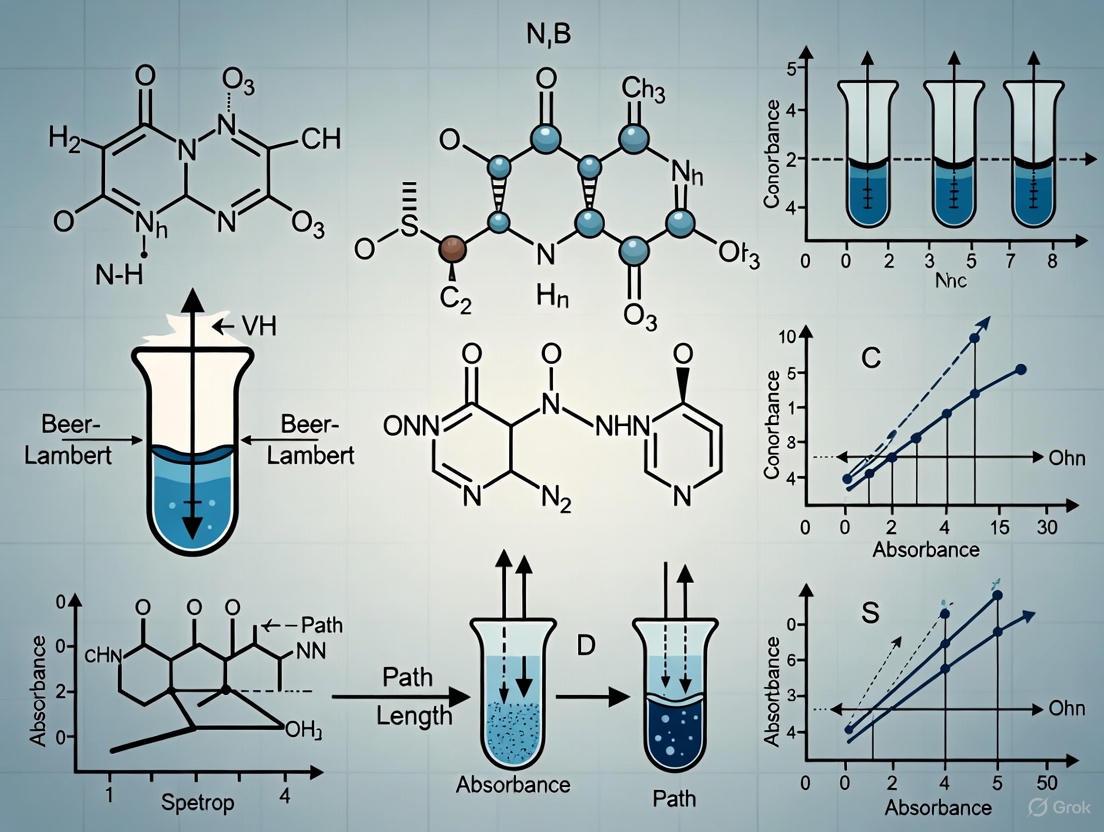
This article provides a comprehensive guide for researchers and drug development professionals on the application of the Beer-Lambert Law in UV-Visible spectroscopy for drug concentration analysis.
Quantifying Therapeutics: A Practical Guide to Beer-Lambert Law in UV-Vis Spectroscopy for Drug Analysis
Abstract
This article provides a comprehensive guide for researchers and drug development professionals on the application of the Beer-Lambert Law in UV-Visible spectroscopy for drug concentration analysis. It covers the foundational principles of the law, detailed methodologies for accurate quantification, solutions to common limitations and deviations encountered in pharmaceutical matrices, and advanced validation techniques. By integrating current research and practical troubleshooting strategies, this resource aims to enhance the accuracy, efficiency, and reliability of spectroscopic methods in drug development and quality control processes.
The Beer-Lambert Law Demystified: Core Principles for Pharmaceutical Science
The Beer-Lambert law stands as a cornerstone of quantitative absorption spectroscopy, forming an indispensable foundation for analytical techniques used throughout pharmaceutical research and development. This fundamental principle establishes the linear relationship between the absorbance of light and the properties of the material through which it travels, enabling precise determination of analyte concentrations in solution [1]. In modern drug development, this law provides the theoretical basis for ultraviolet-visible (UV-Vis) spectroscopy applications ranging from active pharmaceutical ingredient (API) quantification to stability testing and quality control [2] [3]. The journey from its initial empirical observations to its current application as a validated analytical technique spans nearly three centuries of scientific discovery, refinement, and technological integration.
This review traces the historical development of the Beer-Lambert law from its origins in the 18th century to its contemporary applications in pharmaceutical analysis. By examining the individual contributions of Bouguer, Lambert, and Beer, alongside modern instrumental advances, we contextualize this essential analytical principle within the framework of drug concentration research—a field where accuracy, precision, and reliability are paramount for ensuring product safety and efficacy.
Historical Foundations
The Individual Contributions
The development of the law now known as the Beer-Lambert law represents a convergence of insights from multiple scientists across more than a century, with each researcher building upon earlier observations to advance understanding of light attenuation phenomena.
Pierre Bouguer (1729): In his astronomical work, Bouguer made crucial observations about light attenuation in the atmosphere, noting that "light intensity had an exponential dependence on length traveled" [4] [5]. His seminal work, published in 1729, established that the intensity of light decays exponentially as it passes through an absorbing medium, laying the essential groundwork for future mathematical formalization of this relationship.
Johann Heinrich Lambert (1760): Lambert expanded upon Bouguer's findings in his work Photometria (1760), expressing the relationship mathematically in a form remarkably similar to modern formulations [4] [6]. He proposed that the loss of light intensity when propagating through a medium is directly proportional to both the intensity itself and the path length traveled, resulting in a differential equation whose solution yields the exponential decay relationship:
I = I₀e^(-μd)[4] [5].August Beer (1852): Beer extended the concept from path length to concentration, discovering that colored solutions followed a similar attenuation principle [4] [7]. He demonstrated that transmittance remains constant when the product of concentration and path length stays constant, thereby establishing the concentration dependence essential for analytical applications [5]. Beer's critical insight connected light absorption to the amount of absorbing species present in solution.
The merger of these individual discoveries into the modern Beer-Lambert law formulation occurred gradually. The first combined mathematical formulation appeared in 1913, when Robert Luther introduced the equation A = ε·c·l, uniting the separate contributions into the single relationship used today [5].
Evolution to Modern Form
The transition from separate empirical observations to a unified mathematical law required both conceptual advances and notational evolution, with key developments including:
Table: Historical Evolution of the Beer-Lambert Law
| Year | Scientist | Contribution | Mathematical Expression |
|---|---|---|---|
| 1729 | Pierre Bouguer | Exponential decay of light with distance | I ∝ e^(-αd) |
| 1760 | Johann Heinrich Lambert | Mathematical formalization of attenuation | I = I₀e^(-μd) |
| 1852 | August Beer | Concentration dependence established | T constant if c·l constant |
| 1857 | Bunsen & Roscoe | Early combined expression | ln(I₀/I) = K·d·C |
| 1913 | Robert Luther | Modern formulation with absorbance | A = ε·c·l |
The introduction of the absorbance concept A = -log(T) = -log(I/I₀) provided a more convenient linear relationship with concentration and path length [5]. This logarithmic transformation created a direct proportionality between absorbance and both concentration and path length, yielding the familiar form of the law: A = ε·c·l [1] [7]. The development of the extinction coefficient ε (or molar absorptivity) created a substance-specific constant that quantified the probability of electronic transitions at specific wavelengths, completing the theoretical framework [1].
Fundamental Principles
Mathematical Formulation
The Beer-Lambert law in its modern form establishes a direct proportional relationship between the absorbance of light by a solution and the concentration of the absorbing species, expressed mathematically as:
Beer-Lambert Law Derivation
The fundamental equation is:
Where:
- A is absorbance (unitless)
- ε is the molar absorptivity or molar extinction coefficient (L·mol⁻¹·cm⁻¹)
- c is the concentration of the absorbing species (mol/L)
- l is the optical path length through the sample (cm)
This relationship derives from the logarithmic dependence of absorbance on transmittance, where transmittance T is defined as T = I/I₀, the ratio of transmitted to incident light intensity [8]. Consequently, the relationship between intensity and concentration becomes:
I = I₀ · 10^(-ε·c·l) [1]
For multi-component systems with non-interacting absorbers, the law becomes additive, with total absorbance representing the sum of individual contributions [7]:
Quantitative Applications
The Beer-Lambert law enables quantitative determination of unknown concentrations by measuring absorbance, as demonstrated in this example:
Table: Absorbance and Transmittance Relationship
| Absorbance (A) | % Transmittance | Fraction Transmitted (I/I₀) |
|---|---|---|
| 0 | 100% | 1.0 |
| 0.3 | 50% | 0.5 |
| 0.6 | 25% | 0.25 |
| 1.0 | 10% | 0.1 |
| 2.0 | 1% | 0.01 |
| 3.0 | 0.1% | 0.001 |
Consider a practical example: A 5.00 × 10⁻⁴ M solution of analyte in a 1.00 cm pathlength cell exhibits an absorbance of 0.338 at 490 nm. The molar absorptivity can be calculated as:
ε = A/(b·C) = 0.338/(1.00 cm × 5.00×10⁻⁴ M) = 676 cm⁻¹·M⁻¹ [7]
This calculated ε value then enables determination of unknown concentrations for the same analyte. For instance, a solution of the same compound with absorbance 0.228 measured under identical conditions would have concentration:
C = A/(ε·b) = 0.228/(676 M⁻¹·cm⁻¹ × 1.00 cm) = 3.37 × 10⁻⁴ M [7]
Modern Refinements and Modifications
Addressing Limitations
Despite its widespread utility, the Beer-Lambert law has recognized limitations that have prompted refinements for specific applications. The fundamental law assumes ideal conditions that may not always reflect experimental reality, particularly in complex biological or pharmaceutical matrices [5]. Key limitations include:
- Electromagnetic considerations: The simple exponential decay model does not fully account for wave optics effects that can cause band shifts and intensity changes based on optical conditions [5].
- Scattering effects: The original formulation does not accommodate light scattering, which is particularly problematic in biological tissues and turbid pharmaceutical formulations [6].
- High concentration limitations: At elevated concentrations (>0.01 M), intermolecular interactions can alter absorptivity, violating the linearity assumption [5].
- Reflection losses: The law assumes all intensity reduction arises from absorption, neglecting reflection at interfaces which becomes significant with refractive index mismatches [5].
Modified Beer-Lambert Law
For biological and pharmaceutical applications involving scattering media, the modified Beer-Lambert law incorporates additional parameters to address these limitations [6]:
A = ε · c · d · DPF + G
Where:
- d is the source-detector separation (cm)
- DPF is the differential pathlength factor (unitless), accounting for increased pathlength due to scattering
- G is a scattering-dependent offset (unitless)
This modification is particularly relevant for near-infrared (NIR) spectroscopy applications in pharmaceutical analysis, where it enables accurate quantification in turbid suspensions, emulsions, and solid dosage forms [6]. The DPF represents how much longer the actual photon pathlength is compared to the physical source-detector separation, with values typically ranging from 3 to 6 in biological tissues depending on wavelength and tissue type [6].
Pharmaceutical Research Applications
Drug Development Workflow
UV-Vis spectroscopy based on the Beer-Lambert law integrates throughout the pharmaceutical development pipeline, from initial discovery through manufacturing and quality control, as illustrated below:
Drug Development Workflow
Experimental Protocols
API Quantification Method
Principle: This protocol details the quantitative determination of active pharmaceutical ingredient (API) concentration in solution using UV-Vis spectroscopy and the Beer-Lambert law [7] [8].
Materials and Equipment:
- Double-beam UV-Vis spectrophotometer
- Matched quartz cuvettes (typically 1.0 cm pathlength)
- API reference standard of known purity
- Appropriate solvent (spectroscopic grade)
- Volumetric flasks and precision pipettes
Table: Research Reagent Solutions for API Quantification
| Reagent/Material | Specification | Function in Experiment |
|---|---|---|
| API Reference Standard | Certified purity ≥99.5% | Primary standard for calibration curve |
| Spectroscopic Solvent | HPLC/UV-Vis grade | Dissolve API without interfering absorbance |
| Volumetric Flasks | Class A, various sizes | Precise solution preparation |
| Quartz Cuvettes | Matched pair, 1.0 cm pathlength | Contain sample with minimal pathlength variation |
Procedure:
- Standard Solution Preparation: Prepare a stock solution of API reference standard at approximately 100 μg/mL in suitable solvent. Prepare serial dilutions to cover the concentration range 10-80 μg/mL.
- Spectrum Acquisition: Scan each standard solution from 200-800 nm to identify λ_max (wavelength of maximum absorption).
- Absorbance Measurement: Measure absorbance of each standard at λ_max against solvent blank.
- Calibration Curve: Plot absorbance versus concentration and perform linear regression. The slope equals ε·b.
- Sample Analysis: Measure absorbance of unknown samples at the same λ_max and calculate concentration using the calibration curve.
Validation Parameters:
- Linearity: R² > 0.995 over working range
- Accuracy: 95-105% recovery of spiked standards
- Precision: RSD <2% for replicate measurements
Forced Degradation Studies
Principle: This method applies the Beer-Lambert law to monitor API degradation under stress conditions (acid, base, oxidation, heat, light) by tracking absorbance changes over time [2].
Procedure:
- Stress Conditions: Expose API solutions to 0.1M HCl, 0.1M NaOH, 3% H₂O₂, heat (60°C), and UV light.
- Time-Course Monitoring: Withdraw aliquots at predetermined time points and measure absorbance at API λ_max.
- Degradation Kinetics: Plot concentration (calculated from absorbance) versus time to determine degradation rate constants.
Advanced Pharmaceutical Applications
Modern spectroscopic techniques derived from the Beer-Lambert law serve multiple critical functions throughout the pharmaceutical lifecycle:
Process Analytical Technology (PAT): UV-Vis and NIR spectroscopy provide real-time monitoring of manufacturing processes, enabling immediate detection of deviations and ensuring product consistency [9] [3]. These systems employ fiber-optic probes immersed in reaction vessels to track reactant consumption and product formation in real time.
Polymorph Characterization: Differences in crystal packing of pharmaceutical solids create distinct spectral signatures in NIR and Raman spectra, allowing identification and quantification of polymorphic forms that exhibit different bioavailability and stability profiles [2].
Counterfeit Detection: Portable NIR spectrometers utilizing the Beer-Lambert law enable rapid field screening of pharmaceutical products to identify counterfeit medications through spectral fingerprint mismatches [10].
Biopharmaceutical Analysis: Advanced implementations like A-TEEM (Absorbance-Transmission Excitation Emission Matrix) spectroscopy simultaneously capture absorbance and fluorescence data from biopharmaceuticals such as monoclonal antibodies, providing higher-order structural information for vaccine characterization and protein stability assessment [9].
Current Instrumentation and Future Perspectives
2024-2025 Instrumentation Advances
Recent spectroscopic instrumentation reflects ongoing refinement of Beer-Lambert law applications in pharmaceutical analysis, with several notable introductions:
Table: Recent Spectroscopic Instrumentation (2024-2025)
| Instrument | Manufacturer | Technology | Pharmaceutical Application |
|---|---|---|---|
| Vertex NEO Platform | Bruker | Vacuum FT-IR with vacuum ATR | Protein studies, far-IR with atmospheric interference removal |
| FS5 v2 Spectrofluorometer | Edinburgh Instruments | Enhanced performance spectrofluorometer | Photochemistry, photophysics research |
| Veloci A-TEEM Biopharma | Horiba | Simultaneous A-TEEM | mAb analysis, vaccine characterization, protein stability |
| OMNIS NIRS Analyzer | Metrohm | NIR spectroscopy | Maintenance-free PAT, method development |
| NaturaSpec Plus | Spectral Evolution | Field UV-vis-NIR | Field analysis with GPS documentation |
| ProteinMentor | Protein Dynamic Solutions | QCL microscopy (1800-1000 cm⁻¹) | Protein impurity identification, deamidation monitoring |
Emerging Trends
The continuing evolution of Beer-Lambert law applications demonstrates several significant trends that will likely shape future pharmaceutical analysis:
Miniaturization and Portability: The development of handheld and portable spectrometers enables field-based drug quality screening, supporting regulatory efforts against counterfeit medications in resource-limited settings [9] [10].
Hyphenated Techniques: Combining UV-Vis spectroscopy with separation techniques like HPLC and capillary electrophoresis provides comprehensive characterization of complex pharmaceutical mixtures, with the Beer-Lambert law enabling precise quantification of resolved components [2].
Advanced Data Analytics: Integration of multivariate analysis with spectral data enhances information extraction, allowing quantification of multiple analytes in complex matrices despite spectral overlap [2].
Biologics Focus: Increasing emphasis on biopharmaceutical characterization drives development of specialized instruments like the ProteinMentor, which applies quantitative absorption principles to protein structure and stability assessment [9].
The journey from Bouguer's initial observations of atmospheric light attenuation to today's sophisticated pharmaceutical analysis platforms demonstrates how fundamental scientific principles evolve to address contemporary challenges. The Beer-Lambert law has transitioned from an empirical relationship describing light transmission through homogeneous media to a sophisticated analytical framework supporting critical decisions throughout drug development and manufacturing.
In pharmaceutical research, this historical principle remains vibrantly relevant, underpinning quality control systems, stability assessments, and process monitoring technologies that ensure medication safety and efficacy. As spectroscopic technology continues advancing with miniaturized platforms, enhanced sensitivity, and sophisticated data analytics, the Beer-Lambert law maintains its central position as the quantitative foundation enabling these innovations.
For drug development professionals, understanding both the historical context and modern implementations of this essential law provides not only practical analytical capabilities but also a deeper appreciation of how fundamental scientific principles translate to real-world impact through improved patient outcomes and enhanced therapeutic product quality.
The Beer-Lambert Law (BLL) stands as a cornerstone empirical relationship in quantitative absorption spectroscopy, providing the fundamental mathematical framework that links the attenuation of light to the properties of the material through which it passes [1] [4]. In the field of drug development and pharmaceutical research, this principle transitions from a theoretical concept to an indispensable practical tool. It enables researchers to accurately determine the concentration of active pharmaceutical ingredients (APIs), excipients, and impurities in solutions, facilitating critical analyses from dissolution testing to content uniformity and stability studies [11]. The law formally states that the intensity of monochromatic radiation decays exponentially as it travels through an absorbing medium, with the degree of attenuation being proportional to the concentration of the absorbing species and the path length the light traverses [4]. This foundational relationship provides the basis for most quantitative analyses performed using UV-Vis spectroscopy in pharmaceutical laboratories.
The modern formulation of the Beer-Lambert Law, often termed the Beer-Bouguer-Lambert law, synthesizes centuries of scientific inquiry. Its origins trace back to the early 18th-century work of Pierre Bouguer, who discovered light intensity's exponential dependence on path length through the atmosphere [4]. Johann Heinrich Lambert later expressed this relationship in its recognizable mathematical form in 1760 [4]. The crucial connection to concentration was established by August Beer in 1852, who observed that colored solutions followed a similar attenuation principle, ultimately leading to the integrated law used today [4]. For pharmaceutical scientists, this historical convergence means that path length and concentration exert mathematically equivalent effects on light absorption—a fundamental insight that underpins experimental design in drug development.
Deconstructing the Formula: A = εbc
The Beer-Lambert Law is most commonly expressed by the equation A = εbc, where each parameter represents a distinct physical quantity crucial for accurate quantification [1] [8] [12]. A comprehensive understanding of these variables and their interrelationships is essential for proper application in pharmaceutical analysis.
Absorbance (A)
Absorbance (A) represents the dimensionless, unitless measure of how much light a sample absorbs at a specific wavelength [1] [8]. It is defined mathematically as the base-10 logarithm of the ratio of incident light intensity ((I_0)) to transmitted light intensity ((I)):
[ A = \log{10} \left( \dfrac{Io}{I} \right) ]
This logarithmic relationship means that an absorbance of 0 corresponds to 100% transmittance (no absorption), while an absorbance of 1 indicates that 90% of the light has been absorbed, with only 10% transmitted [1] [8]. The term "optical density" (OD) has historically been used synonymously with absorbance, but its use is discouraged by IUPAC in favor of the standardized term "absorbance" [8].
Table 1: Relationship Between Absorbance and Transmittance
| Absorbance (A) | Transmittance (T) | Percent Transmittance (%T) | Light Absorbed |
|---|---|---|---|
| 0 | 1 | 100% | 0% |
| 0.3 | 0.5 | 50% | 50% |
| 1 | 0.1 | 10% | 90% |
| 2 | 0.01 | 1% | 99% |
| 3 | 0.001 | 0.1% | 99.9% |
Molar Absorptivity (ε)
Molar absorptivity (ε), also known as the molar extinction coefficient, is a substance-specific constant that measures how strongly a chemical species absorbs light at a particular wavelength [1] [12]. Expressed in units of L·mol⁻¹·cm⁻¹, this intrinsic property is effectively a measure of the probability that an electronic transition will occur when a photon interacts with a molecule [1]. The value of ε depends on both the nature of the absorbing species and the wavelength of incident light [8]. In pharmaceutical research, compounds with high molar absorptivity values are more easily quantified at low concentrations, making this parameter crucial for method development and sensitivity assessments in API quantification [12].
Path Length (b)
Path length (b) represents the distance, typically measured in centimeters (cm), that light travels through the sample solution [1] [12]. In standard UV-Vis spectroscopy, this is determined by the width of the cuvette used for measurement, with 1.0 cm being the most common dimension [8] [12]. The relationship between absorbance and path length is direct and proportional—doubling the path length doubles the absorbance, as the light must interact with more molecules along its extended journey through the solution [1]. This principle is exploited in specialized spectroscopic techniques where varying path lengths can help measure samples with very high or very low absorbance.
Concentration (c)
Concentration (c) of the absorbing species in the solution, expressed in moles per liter (mol·L⁻¹ or M), completes the fundamental relationship [1] [12]. The Beer-Lambert Law establishes that absorbance is directly proportional to concentration, forming the basis for quantitative analysis in pharmaceutical applications [8] [12]. This linear relationship holds true across a defined concentration range for most compounds, though deviations can occur at very high concentrations due to molecular interactions or instrumental limitations [12].
Diagram 1: Fundamental components of Beer-Lambert Law
Experimental Methodology in Pharmaceutical Research
The practical application of the Beer-Lambert Law in drug development requires meticulous experimental design and execution. The following protocols outline standardized methodologies for employing UV-Vis spectroscopy in pharmaceutical analysis.
Calibration Curve Development Protocol
Objective: To establish a quantitative relationship between absorbance and analyte concentration for unknown sample determination.
Stock Solution Preparation: Precisely weigh 10.0 mg of reference standard API and dissolve in appropriate solvent (e.g., phosphate buffer, methanol) to create a stock solution of known concentration (e.g., 100 μg/mL).
Standard Solution Preparation: Serially dilute the stock solution to create a minimum of five standard solutions covering the expected concentration range (e.g., 5, 10, 25, 50, 75 μg/mL). Ensure all dilutions are performed volumetrically with precision glassware.
Spectroscopic Measurement:
- Zero the spectrophotometer with a blank solution containing only solvent.
- Set the detection wavelength to the λmax of the analyte (previously determined by spectral scan).
- Using matched quartz or optical glass cuvettes (path length = 1.0 cm), measure the absorbance of each standard solution in triplicate.
- Record average absorbance values with standard deviations.
Calibration Curve Generation:
- Plot average absorbance (y-axis) versus concentration (x-axis).
- Perform linear regression analysis to obtain the equation: A = (εb)c + intercept
- Verify linearity with correlation coefficient (R²) > 0.995.
- The slope of the line equals εb, from which ε can be calculated if path length is known.
Table 2: Example Calibration Data for Theoretical API-X
| Concentration (μg/mL) | Absorbance (Mean) | Standard Deviation |
|---|---|---|
| 5.0 | 0.125 | 0.005 |
| 10.0 | 0.241 | 0.007 |
| 25.0 | 0.598 | 0.012 |
| 50.0 | 1.195 | 0.018 |
| 75.0 | 1.802 | 0.022 |
Diffusion Coefficient Measurement Protocol
Objective: To investigate the effect of dissolution media on API diffusivity using a modified UV-Vis method [11].
Apparatus Modification:
- Attach a 3D-printed cover with a precisely defined open slit to a standard UV-Vis cuvette.
- This configuration ensures incident UV light passes only through the slit to measure local API concentration.
Experimental Setup:
- Prepare a concentrated API solution in the desired dissolution medium (e.g., simulated gastric fluid, phosphate buffer).
- Carefully layer the solution in the cuvette to establish an initial concentration gradient.
- Position the cuvette such that the slit is at the measurement height.
Diffusion Monitoring:
- Set the spectrophotometer to the λmax of the API.
- Measure absorbance at the slit location as a function of time as API molecules diffuse upward.
- Continue measurements until equilibrium is approached (typically 2-4 hours).
Data Analysis:
- Apply Fick's law of diffusion using analytical or numerical approaches.
- Calculate diffusion coefficients from the concentration-time profile.
- Compare results across different media types to assess formulation effects.
Diagram 2: UV-Vis method development and quantification workflow
The Scientist's Toolkit: Essential Research Materials
Successful implementation of Beer-Lambert Law applications in pharmaceutical research requires specific reagents, instruments, and materials. The following toolkit details essential components for robust spectroscopic analysis.
Table 3: Essential Research Reagents and Materials for UV-Vis Pharmaceutical Analysis
| Item | Specification | Function/Application |
|---|---|---|
| Reference Standards | USP/PhEur certified purity (>98%) | Primary calibration standards for accurate quantification |
| Solvents | HPLC/spectroscopic grade, low UV cutoff | Sample dissolution and dilution without interference |
| Buffer Systems | Phosphate, acetate, borate (ACS grade) | Maintain physiological pH in dissolution media |
| Cuvettes | Quartz (UV range) or optical glass (Vis range), path length 1.0 cm | Sample containment with precise light path definition |
| UV-Vis Spectrophotometer | Dual-beam design, 1-2 nm bandwidth, 190-1100 nm range | Absorbance measurement with wavelength selection |
| 3D-Printed Cuvette Accessories | Custom designs with defined slit openings | Diffusion coefficient measurements [11] |
Advanced Applications in Drug Development
The Beer-Lambert Law finds diverse applications throughout the pharmaceutical development pipeline, extending beyond simple concentration measurements to more sophisticated analytical challenges.
Dissolution Media Effects on Diffusivity
Recent methodological advances have demonstrated how standard UV-Vis spectrometers can be modified to investigate how dissolution media affect the diffusion coefficients of small molecules and proteins [11]. This application is particularly valuable in biopharmaceutical classification systems and formulation development. Studies measuring diffusion coefficients in various aqueous media and polymer solutions have revealed that different media can affect diffusion coefficients of small molecules by <10% and proteins by <15% [11]. These relatively small but statistically significant differences can profoundly impact drug release profiles and bioavailability predictions.
Method Validation Parameters
For regulatory submissions, Beer-Lambert-based analytical methods must undergo comprehensive validation as outlined in ICH guidelines:
- Linearity: Demonstrated across the specified concentration range (typically R² > 0.995)
- Accuracy: Recovery of 98-102% for API quantification
- Precision: Relative standard deviation <2% for replicate measurements
- Specificity: Ability to quantify analyte in presence of excipients and impurities
- Limit of Quantification (LOQ): Typically determined as 10× signal-to-noise ratio
The fundamental relationship A = εbc enables the calculation of critical validation parameters, particularly sensitivity metrics like LOQ, which can be estimated based on the minimum detectable absorbance and the method's molar absorptivity.
Troubleshooting and Practical Considerations
While the Beer-Lambert Law provides a straightforward mathematical relationship, several practical considerations can impact its successful application in pharmaceutical research.
Common Deviations from Linearity
- Chemical Deviations: Occur due to association/dissociation equilibria, complex formation, or pH-dependent chromophore changes that alter ε at different concentrations
- Instrumental Deviations: Result from polychromatic radiation (non-monochromatic light), stray light, or detector non-linearities
- Matrix Effects: Caused by sample turbidity, scattering, or interference from excipients that produce non-absorbance-related light attenuation
Best Practices for Reliable Results
- Wavelength Selection: Always use λmax for maximum sensitivity and minimal relative error in concentration measurements
- Concentration Range: Maintain absorbance values between 0.1-1.0 AU for optimal photometric accuracy (extends to 0.05-2.0 AU with modern instruments)
- Blank Correction: Use matched solvent blanks containing all solution components except the analyte
- Cuvette Handling: Ensure cleanliness, proper orientation, and consistent placement in the sample compartment
- Temperature Control: Maintain constant temperature during measurements, as ε can exhibit temperature dependence
The enduring utility of the Beer-Lambert Law in pharmaceutical research stems from its robust mathematical foundation and practical adaptability. By thoroughly understanding each component of the A = εbc relationship and implementing rigorous experimental methodologies, drug development professionals can leverage this fundamental principle to obtain reliable, reproducible quantitative data throughout the drug development pipeline.
The Beer-Lambert Law (BLL) is a fundamental principle in spectroscopy that describes how light attenuates as it passes through an absorbing medium [13]. In the field of pharmaceutical research and drug development, this law provides the foundational framework for quantifying drug concentrations using UV-Visible spectrophotometry [14]. The law establishes a linear relationship between the absorbance of a solution and the concentration of the absorbing species, expressed mathematically as A = εlc, where A represents absorbance, ε is the molar absorptivity coefficient, l is the path length of light through the solution, and c is the concentration of the analyte [1] [4]. This relationship enables researchers to determine unknown concentrations of active pharmaceutical ingredients (APIs) through simple absorbance measurements, forming the basis for quality control protocols in drug manufacturing and formulation analysis [14].
The reliability of this quantitative relationship, however, depends critically on several ideal assumptions that must be satisfied for accurate results. When these assumptions are violated, significant deviations from linearity can occur, potentially compromising analytical accuracy in pharmaceutical quality control [13]. This technical guide examines the three core ideal assumptions of the Beer-Lambert Law—the use of monochromatic light, homogeneous solutions, and non-interacting molecules—within the context of UV-Vis spectrophotometry for drug concentration research. We explore the theoretical basis for each assumption, consequences of their violation, validation methodologies, and practical applications in pharmaceutical analysis, providing drug development professionals with a comprehensive framework for ensuring analytical validity in concentration measurements.
The Critical Role of Monochromatic Light
Theoretical Foundation
The assumption of monochromatic light requires that the radiation source consists of a single wavelength without significant spectral bandwidth [13]. This condition is fundamental to the Beer-Lambert Law because the molar absorptivity (ε) is both wavelength-specific and unique to each chemical compound [1]. Modern UV-Vis spectrophotometers typically generate monochromatic light through a combination of broadband sources (such as deuterium or tungsten lamps) and wavelength selection devices like monochromators, which utilize diffraction gratings or prisms to isolate specific wavelengths [15]. The monochromator's bandwidth, defined as the spectral range of light passing through the sample, must be narrow compared to the absorption band of the analyte to maintain linearity between absorbance and concentration [13].
The theoretical necessity for monochromatic light stems from the exponential nature of the absorption relationship. When polychromatic light transits an absorbing medium, each wavelength component experiences different attenuation according to its specific molar absorptivity, leading to non-linear absorption behavior that deviates from the ideal Beer-Lambert relationship [16]. This deviation occurs because the measured absorbance represents an integrated value across all wavelengths in the beam, rather than the true absorbance at a specific wavelength where ε remains constant [13]. Consequently, pharmaceutical spectrophotometric methods rigorously specify the analytical wavelength, typically at the maximum absorption (λmax) of the target compound, where the absorbance is least sensitive to small instrumental wavelength variations [14].
Consequences of Violation and Methodological Controls
Deviations from the monochromatic light assumption manifest as negative deviations from the ideal Beer-Lambert relationship, where the measured absorbance becomes progressively lower than predicted at higher concentrations [16]. This non-linearity introduces significant errors in quantitative pharmaceutical analysis, particularly when developing calibration curves for drug concentration determination [14]. The magnitude of deviation increases with both the spectral bandwidth of the instrument and the steepness of the analyte's absorption band, creating particularly problematic scenarios for compounds with sharp absorption peaks [13].
To control this critical parameter in pharmaceutical research, several methodological approaches are employed:
- Instrumental Calibration: Regular verification of spectrophotometer wavelength accuracy using holmium oxide or didymium filters [15]
- Bandwidth Optimization: Selection of appropriate spectrometer slit widths to balance between energy throughput and spectral purity [13]
- λmax Determination: Preliminary scanning to identify the wavelength of maximum absorption for the target analyte where the effect of small wavelength variations is minimized [14]
Table 1 summarizes the key considerations for maintaining monochromaticity in pharmaceutical UV-Vis analysis:
Table 1: Monochromatic Light Considerations in Pharmaceutical Analysis
| Factor | Impact on Analysis | Control Strategy |
|---|---|---|
| Spectral Bandwidth | Excessive bandwidth causes negative deviation from linearity | Use minimum slit width compatible with adequate signal-to-noise ratio |
| Analytical Wavelength | Absorbance measurements at slopes of peaks show greater sensitivity to wavelength drift | Set analytical wavelength at λmax where absorbance is least sensitive to small wavelength variations |
| Source Stability | Wavelength drift during analysis introduces measurement error | Implement regular instrumental calibration and performance verification |
Figure 1: The role of monochromatic light in ensuring accurate concentration measurements. A monochromator isolates specific wavelengths to maintain constant molar absorptivity during sample interaction.
The Requirement for Homogeneous Solutions
Fundamental Principles and Scattering Effects
The assumption of homogeneous solutions dictates that the absorbing species must be uniformly distributed throughout the solvent medium, forming a optically clear solution without suspended particles or localized concentration gradients [13]. This condition ensures that light encounters a consistent number of absorbing molecules per unit path length, maintaining the direct proportionality between absorbance and concentration [1]. In pharmaceutical applications, homogeneity is particularly crucial for accurate potency measurements of active pharmaceutical ingredients (APIs) in quality control laboratories [14].
The primary violation of this assumption occurs through light scattering, where suspended particles or molecular aggregates deflect photons from the direct path between the light source and detector [13]. This scattering effect introduces significant positive deviations from the Beer-Lambert Law, as the measured attenuation exceeds that caused by pure absorption alone [16]. In biological and pharmaceutical contexts, this phenomenon becomes especially relevant when analyzing turbid samples such as protein suspensions, colloidal drug formulations, or poorly dissolved compounds [13]. The combined effect of absorption and scattering is formally described as attenuation, with the overall attenuation coefficient (μ) representing the sum of absorption (μa) and scattering (μs) coefficients: μ = μa + μs [4].
Pharmaceutical Validation Methods and Turbidity Mitigation
The validation of solution homogeneity represents a critical step in pharmaceutical analytical method development. Researchers employ several techniques to verify and maintain this fundamental assumption:
- Visual Inspection: Examination of samples against light to detect visible turbidity or particulate matter [14]
- Filtration and Centrifugation: Removal of suspended particles through 0.45μm or 0.22μm membrane filtration or high-speed centrifugation [15]
- Scattering Correction: Application of mathematical corrections using dual-wavelength or derivative spectroscopy methods [13]
Advanced modification of the Beer-Lambert Law has been developed specifically for turbid biological samples, incorporating terms to account for scattering effects. The modified Beer-Lambert law (MBLL) for tissue diagnostics expresses optical density as: OD = DPF · μa·d + G, where DPF represents the differential pathlength factor accounting for increased photon pathlength due to scattering, μa is the absorption coefficient, d is the inter-optode distance, and G is a geometry-dependent factor [13]. While developed for tissue optics, this approach demonstrates the fundamental principles of accounting for scattering effects in quantitative absorption measurements.
Table 2 outlines common causes of heterogeneity in pharmaceutical solutions and their respective mitigation strategies:
Table 2: Homogeneity Challenges in Pharmaceutical Solution Analysis
| Cause of Heterogeneity | Impact on Analysis | Mitigation Strategy |
|---|---|---|
| Incomplete Dissolution | Results in undissolved API particles causing light scattering | Optimize dissolution protocol; use appropriate solvents and heating |
| Precipitation | Drug particles form during analysis creating turbidity | Stabilize solution conditions; use co-solvents for hydrophobic compounds |
| Microbubbles | Gas bubbles scatter light and cause erratic absorbance readings | Degas solutions prior to analysis; allow thermal equilibration |
| Molecular Aggregation | Self-association of molecules creates scattering centers | Modify pH or ionic strength to enhance solubility; use surfactants |
The Necessity of Non-Interacting Molecules
Molecular Independence and Equilibrium Assumptions
The assumption of non-interacting molecules requires that each absorbing species behaves independently, with absorption probabilities unaffected by neighboring molecules [13]. This condition implies that the molar absorptivity (ε) remains constant regardless of concentration, ensuring the linear relationship fundamental to the Beer-Lambert Law [1]. At the molecular level, this assumption presumes the absence of chemical interactions such as molecular association, dimerization, polymerization, or complex formation that might alter the electronic transition probabilities responsible for light absorption [16].
In pharmaceutical research, this assumption is particularly vulnerable to violation, as many drug molecules contain functional groups capable of specific intermolecular interactions [14]. Protonation equilibria of ionizable groups can shift with concentration or pH changes, producing different molecular species with distinct absorption profiles [15]. Similarly, aromatic compounds frequently form π-π complexes or stacking interactions at higher concentrations, creating molecular aggregates with altered spectral characteristics compared to monomeric species [16]. These interactions effectively create new chemical entities with different molar absorptivities, violating the fundamental assumption of constant ε across concentration ranges [13].
Concentration-Dependent Interactions and Validation Protocols
Deviations from the non-interaction assumption typically manifest as negative deviations from linearity at higher concentrations, as the effective molar absorptivity changes with increasing molecular proximity [16]. These deviations establish practical upper limits for Beer-Lambert Law applicability in pharmaceutical analysis and define the validated concentration ranges for analytical methods [14]. The following experimental approaches are used to detect and quantify molecular interactions:
- Spectral Shift Analysis: Comparison of absorption spectra across concentration ranges to identify wavelength shifts or isosbestic points indicating equilibrium [14]
- Job's Method: Continuous variation analysis to identify stoichiometry of molecular complexes [15]
- Temperature Studies: Investigation of absorbance-temperature relationships to distinguish molecular association processes [16]
For analytes exhibiting molecular interactions, researchers must establish validated concentration ranges where deviations remain within acceptable limits for the intended application [14]. The International Council for Harmonisation (ICH) guidelines Q2(R1) recommend establishing linearity across at least five concentration levels, with correlation coefficients exceeding 0.999 for pharmaceutical quality control methods [14].
Figure 2: The impact of molecular interactions on Beer-Lambert Law linearity. As concentration increases, molecular interactions alter molar absorptivity, causing negative deviations from ideal behavior.
Experimental Validation Protocols for Pharmaceutical Applications
Comprehensive Method Validation
The verification of Beer-Lambert Law assumptions constitutes an integral component of analytical method validation in pharmaceutical research [14]. A structured validation protocol ensures that spectrophotometric methods generate accurate, precise, and reliable concentration data for drug substances and products. The following validation parameters must be established for regulatory compliance in pharmaceutical quality control:
- Linearity and Range: Demonstration of direct proportionality between absorbance and concentration across the specified analytical range, typically verified through minimum five concentration levels with correlation coefficient ≥0.999 [14]
- Accuracy: Determination through recovery studies spiking known amounts of analyte into placebo or biological matrices, with acceptable recovery criteria of 98-102% for API quantification [14]
- Precision: Evaluation of repeatability (intra-day) and intermediate precision (inter-day, inter-analyst) with relative standard deviation typically ≤2% for pharmaceutical applications [14]
- Specificity: Verification that measured absorbance corresponds specifically to the target analyte without interference from excipients, degradation products, or solvent systems [14]
Table 3 outlines key experimental parameters for validating Beer-Lambert Law assumptions in pharmaceutical analysis:
Table 3: Experimental Validation Parameters for Beer-Lambert Law Compliance
| Validation Parameter | Experimental Approach | Acceptance Criteria |
|---|---|---|
| Monochromatic Verification | Wavelength accuracy verification using standard reference materials | ±1nm deviation from certified wavelength standard |
| Homogeneity Confirmation | Absorbance ratio method at multiple wavelengths | Ratio variation <5% across sample replicates |
| Molecular Independence | Linearity testing across specified concentration range | R² ≥ 0.999; residual plot random distribution |
| Solvent Compatibility | Absorbance scanning of solvent blank | No significant absorption at analytical wavelength |
Case Study: Simultaneous API Analysis
Recent research demonstrates the practical application of these validation principles in the simultaneous spectrophotometric analysis of paracetamol and ibuprofen in combined dosage forms [14]. This study established a validated method using a mixed solvent system of ethanol and sodium hydroxide (3:1 ratio), addressing multiple Beer-Lambert assumptions through rigorous experimental design:
- Monochromatic Assurance: Identification of distinct, non-overlapping absorbance maxima at 243nm (paracetamol) and 221nm (ibuprofen) to enable simultaneous quantification without spectral interference [14]
- Homogeneity Confirmation: Verification that the ethanol-NaOH solvent system maintained complete solubility of both APIs across the validated concentration range, eliminating scattering artifacts [14]
- Molecular Independence: Linear calibration curves for both compounds across therapeutic concentration ranges (R² > 0.999), confirming absence of significant molecular interactions in the selected solvent system [14]
This case study exemplifies how deliberate methodological design addresses the fundamental assumptions of the Beer-Lambert Law, enabling accurate simultaneous API quantification in complex pharmaceutical formulations [14].
Essential Research Reagents and Materials
The following toolkit represents essential materials and reagents required for validating Beer-Lambert Law assumptions in pharmaceutical UV-Vis spectrophotometry:
Table 4: Essential Research Toolkit for Beer-Lambert Law Compliance
| Reagent/Material | Specification | Primary Function |
|---|---|---|
| High-Purity Solvents | HPLC/spectrophotometric grade | Minimize background absorption; ensure solution homogeneity |
| Standard Reference Materials | Certified wavelength standards (e.g., holmium oxide) | Verify monochromaticity and wavelength accuracy |
| Matched Quartz Cuvettes | 1cm pathlength, ±0.5% tolerance | Control path length variable; minimize reflection losses |
| pH Buffer Systems | Analytical grade buffers (±0.02 pH units) | Control ionization state of ionizable APIs |
| Membrane Filters | 0.45μm or 0.22μm pore size | Remove particulate matter ensuring solution homogeneity |
| Standard API References | Pharmacopoeial reference standards | Establish molar absorptivity coefficients |
The ideal assumptions of the Beer-Lambert Law—monochromatic light, homogeneous solutions, and non-interacting molecules—represent fundamental requirements for accurate drug concentration measurements in pharmaceutical research and quality control [13]. While these conditions are rarely perfectly achieved in practice, understanding their theoretical basis and methodological implications enables researchers to design robust analytical methods with defined operational boundaries [14]. Through systematic validation protocols that verify compliance with these core assumptions, pharmaceutical scientists can ensure the reliability of spectrophotometric data supporting drug development and manufacturing [14]. The continued relevance of the Beer-Lambert Law in modern pharmaceutical analysis stems from this robust conceptual framework, which accommodates both ideal behavior and measurable deviations through well-defined methodological controls [15]. As spectroscopic technologies advance, these fundamental principles maintain their critical importance in ensuring the accuracy and precision of quantitative drug analysis.
The Critical Role of Molar Absorptivity (ε) in Drug-Specific Method Development
In the realm of pharmaceutical analysis, the development of robust, specific, and validated methods for drug quantification stands as a cornerstone of quality control and regulatory compliance. Within this context, the Beer-Lambert Law forms the fundamental theoretical basis for ultraviolet-visible (UV-Vis) spectrophotometry, one of the most widely employed techniques in drug analysis. While the Beer-Lambert Law establishes a linear relationship between absorbance (A) and concentration (c) of an analyte in solution (A = εcl), the critical proportionality constant in this equation—the molar absorptivity (ε)—often receives insufficient attention despite its paramount importance. Molar absorptivity, also known as the molar extinction coefficient, is not merely a constant but a substance-specific intrinsic property that quantifies how strongly a chemical species absorbs light at a particular wavelength [8] [1]. This parameter serves as a definitive fingerprint of a compound's absorption characteristics, making its accurate determination indispensable for developing drug-specific analytical methods that are accurate, sensitive, and reproducible.
The significance of molar absorptivity extends beyond theoretical calculations into practical pharmaceutical applications, including drug discovery, formulation development, stability testing, and quality assurance. A comprehensively characterized molar absorptivity value enables researchers to predict the sensitivity of an analytical method, optimize experimental parameters, and validate quantification protocols for new drug entities [17]. This technical guide explores the critical role of molar absorptivity in developing drug-specific UV-Vis methods, provides detailed experimental protocols for its determination, and presents contemporary applications within pharmaceutical research and development, all framed within the broader context of utilizing the Beer-Lambert Law for drug concentration research.
Theoretical Foundations: Beer-Lambert Law and Molar Absorptivity
The Beer-Lambert Law: Fundamental Principles
The Beer-Lambert Law describes a linear relationship between the absorbance of light by a substance and its concentration in a homogeneous solution. The mathematical expression of this law is:
A = εcl
Where:
- A is the measured absorbance (unitless)
- ε is the molar absorptivity (L·mol⁻¹·cm⁻¹)
- c is the concentration of the absorbing species (mol·L⁻¹)
- l is the optical path length of the measurement cell (cm) [8] [1]
This relationship holds true for monochromatic light and dilute solutions where solute molecules behave independently without molecular interactions that could alter absorption characteristics [18]. The logarithmic relationship between absorbance and transmittance (A = -log₁₀T = -log₁₀(I/I₀)) means that absorbance provides a direct measure of the light absorbed by the sample, making it the preferred parameter for quantitative analysis rather than transmittance [8] [19].
Molar Absorptivity: Significance and Interpretation
Molar absorptivity (ε) represents the absorbing power of a one molar solution of the analyte measured with a one centimeter path length [1]. This parameter is a physical constant characteristic of a given substance at a specific wavelength, solvent system, and temperature. The magnitude of molar absorptivity provides crucial insights into the electronic structure of the molecule and the probability of electronic transitions occurring upon photon absorption [1].
Higher molar absorptivity values indicate stronger absorption and consequently higher potential analytical sensitivity, which is particularly important for detecting and quantifying drugs at low concentrations. For instance, a compound with ε = 100,000 L·mol⁻¹·cm⁻¹ will produce an absorbance of 1.0 at a concentration of 10 μmol·L⁻¹ in a 1 cm pathlength cell, while a compound with ε = 1,000 L·mol⁻¹·cm⁻¹ would require a concentration of 1 mmol·L⁻¹ to achieve the same absorbance [8]. This relationship directly impacts method development decisions regarding sample preparation, dilution factors, and instrument selection.
Table 1: Quantitative Relationship Between Absorbance, Transmittance, and Light Absorption
| Absorbance (A) | Percent Transmittance (%T) | Fraction of Light Absorbed |
|---|---|---|
| 0.0 | 100% | 0% |
| 0.1 | 79.4% | 20.6% |
| 0.3 | 50.1% | 49.9% |
| 0.5 | 31.6% | 68.4% |
| 1.0 | 10.0% | 90.0% |
| 2.0 | 1.0% | 99.0% |
| 3.0 | 0.1% | 99.9% |
Source: Adapted from [8]
Practical Determination of Molar Absorptivity in Pharmaceutical Analysis
Standard Experimental Protocol
Accurate determination of molar absorptivity requires meticulous experimental execution. The following protocol outlines the standard approach for establishing this critical parameter for drug substances:
Standard Solution Preparation: Prepare a stock solution of the drug substance using a high-purity solvent that does not significantly absorb in the spectral region of interest. Accurately weigh the drug using an analytical balance and quantitatively transfer to a volumetric flask. For drugs with unknown ε, initial concentrations of approximately 1-5 mM are appropriate [20].
Dilution Series Preparation: Create a series of dilutions covering a concentration range that will yield absorbances between 0.1 and 1.5 AU, as this range typically exhibits the best adherence to the Beer-Lambert Law and minimizes measurement errors [18]. A minimum of five concentrations is recommended for establishing a reliable calibration curve.
Spectral Acquisition: Using a double-beam UV-Vis spectrophotometer, scan each solution across the UV-Vis range (typically 200-800 nm) to identify the wavelength of maximum absorption (λmax) [19]. The instrument should be equipped with matched quartz cuvettes (typically 1 cm path length) and maintained at constant temperature (±0.5°C) throughout the analysis.
Absorbance Measurement: Measure the absorbance of each standard solution at λmax against a solvent blank. Perform replicate measurements (n ≥ 3) for each concentration to assess precision.
Data Analysis and ε Calculation: Plot absorbance versus concentration and perform linear regression analysis. The slope of the resulting calibration curve (A vs. c) corresponds to εl, from which ε can be calculated by dividing by the path length l [1] [20].
The following diagram illustrates this experimental workflow:
Method Validation Parameters
For regulatory submissions and quality control applications, the determination of molar absorptivity must be accompanied by appropriate validation parameters. The International Conference on Harmonisation (ICH) guidelines recommend assessing the following parameters [20]:
- Linearity: Verification that the absorbance-concentration relationship is linear across the specified range, typically demonstrated by a correlation coefficient (r) ≥ 0.999.
- Precision: Evaluation of both intra-day and inter-day variability, expressed as percent relative standard deviation (%RSD), with values <2% generally considered acceptable.
- Accuracy: Determination through recovery studies using standard addition methods, with recoveries of 98-102% typically expected.
- Limits of Detection and Quantification: Calculation of LOD and LOQ based on the standard deviation of the response and the slope of the calibration curve.
Table 2: Exemplary Validation Parameters for Ceftriaxone Sodium UV Assay
| Validation Parameter | Result | Acceptance Criteria |
|---|---|---|
| Linearity Range | 5-50 μg/mL | R² ≥ 0.998 |
| Correlation Coefficient (r) | 0.9983 | R² ≥ 0.998 |
| Molar Absorptivity (ε) | 2.046 × 10³ L·mol⁻¹·cm⁻¹ | Consistent across replicates |
| Sandell's Sensitivity | 0.02732 μg/cm²/0.001 AU | N/A |
| LOD | 0.0332 μg/mL | Signal-to-noise ratio ≥ 3 |
| LOQ | 0.1008 μg/mL | Signal-to-noise ratio ≥ 10 |
| Intra-day Precision (%RSD) | <2% | ≤2% |
| Inter-day Precision (%RSD) | <2% | ≤2% |
Source: Adapted from [20]
Advanced Applications and Contemporary Research
Drug Analysis in Formulations
Molar absorptivity plays a pivotal role in the analysis of active pharmaceutical ingredients (APIs) in finished dosage forms. A validated UV-Vis method based on accurately determined molar absorptivity enables rapid quantification of drugs without extensive separation steps, provided there is no interference from excipients. For example, research on dronedarone hydrochloride, an antiarrhythmic drug, demonstrated the development of three spectrophotometric methods based on oxidation reactions followed by measurement of unreacted oxidant using different dyes [21]. The calculated molar absorptivity values for these methods ranged from 3.12 × 10⁴ to 4.23 × 10⁴ L·mol⁻¹·cm⁻¹, indicating high sensitivity suitable for quantifying the drug in pharmaceutical formulations.
Similarly, a stability-indicating method for ceftriaxone sodium employed direct absorbance measurement at 241 nm with a molar absorptivity of 2.046 × 10³ L·mol⁻¹·cm⁻¹ [20]. This method demonstrated specificity by effectively quantifying the drug in the presence of degradation products formed under various stress conditions, including acid, base, oxidative, photolytic, and thermal degradation.
Multicomponent Analysis and Spectral Deconvolution
In complex pharmaceutical formulations containing multiple absorbing compounds, molar absorptivity values at multiple wavelengths enable the simultaneous quantification of several components despite overlapping absorption spectra. Advanced mathematical approaches, including multilinear regression analysis, partial least squares (PLS), and neural networks, utilize the unique molar absorptivity profiles of each component to resolve mixtures [22]. These methodologies rely on the additive property of absorbance in multicomponent systems, where the total absorbance at any wavelength equals the sum of individual absorbances contributed by each component according to their respective molar absorptivities and concentrations.
The application of these techniques is particularly valuable in pharmaceutical analysis for quantifying drug combinations in fixed-dose formulations, assessing impurity profiles, and monitoring degradation products without physical separation. The accuracy of such multicomponent analysis directly depends on the precision of the predetermined molar absorptivity values for each compound across the spectral range of interest.
Innovative Approaches for Molar Absorptivity Determination
Recent research has focused on developing sample-sparing techniques for estimating molar absorptivity, addressing challenges when limited material is available for testing, a common scenario in early drug discovery. Three innovative approaches have emerged [17]:
- Electrospray Mass Spectrometry: Utilizes high-resolution incorporation ratios of dye-labeled proteins to determine concentration independently of absorbance measurements.
- Covalent Linking: Involves attaching the unknown dye to a reference compound with a known absorption coefficient, enabling relative quantification.
- Fluorescence Correlation Spectroscopy: Determines fluorophore concentration in solution through analysis of fluorescence fluctuation statistics.
These techniques provide viable alternatives to traditional methods when material availability, compound solubility, or stability present challenges for conventional molar absorptivity determination.
The Scientist's Toolkit: Essential Reagents and Materials
Table 3: Key Research Reagent Solutions for Molar Absorptivity Determination
| Reagent/Material | Function in Analysis | Application Notes |
|---|---|---|
| High-Purity Drug Standard | Primary reference material for calibration | Should be of certified purity (>98%) and properly stored to prevent degradation |
| UV-Grade Solvents | Dissolution medium for drug substance | Must exhibit minimal UV absorption in spectral region of interest; commonly water, methanol, or acetonitrile |
| Quartz Cuvettes | Sample container for spectral measurement | Typically 1 cm path length; must be matched for double-beam instruments |
| Certified Reference Materials | Instrument qualification and method validation | Holmium oxide filters for wavelength verification; nicotinic acid for linearity checks |
| Oxidizing/Derivatizing Agents | Enhance absorption characteristics or enable indirect quantification | Ceric ammonium sulfate used in dronedarone analysis [21] |
| Buffer Systems | Maintain constant pH environment | Critical for ionizable drugs whose ε may vary with pH |
Limitations and Methodological Considerations
Common Deviations from Beer-Lambert Law
While the Beer-Lambert Law provides the theoretical foundation for UV-Vis quantification, several practical limitations can cause deviations from ideal behavior:
- High Concentration Effects: At elevated concentrations (typically >0.01 M), intermolecular distances decrease, potentially leading to molecular interactions that alter absorption characteristics. These effects include dimerization, aggregation, or electrostatic interactions that can cause nonlinearity [23].
- Scattering Effects: Turbid or particulate samples scatter light, resulting in apparent absorbance that does not represent true electronic absorption. This is particularly problematic in biological matrices or poorly dissolved samples [18].
- Stray Light: Instrument imperfections allowing light outside the nominal wavelength to reach the detector cause deviations from linearity, especially at high absorbances (>1.5 AU) [18].
- Chemical Deviations: Equilibrium processes such as association-dissociation, complex formation, or acid-base equilibria that change with concentration can lead to nonlinear absorbance-concentration relationships [23].
Matrix Effects and Interference
Pharmaceutical analysis often involves complex matrices including tablet excipients, capsule components, or biological fluids that may interfere with absorbance measurements. These matrix effects can alter the effective molar absorptivity through light scattering, additional absorption, or chemical interactions with the analyte. Method development must include strategies to account for these effects, such as background subtraction, sample purification, or standard addition methodologies [18].
Recent research has demonstrated that in highly scattering media such as whole blood, nonlinear machine learning models may outperform traditional linear regression approaches based strictly on the Beer-Lambert Law, suggesting that while molar absorptivity remains fundamental, its application in complex matrices may require advanced computational support [23].
Molar absorptivity (ε) stands as a critical parameter in the development of drug-specific analytical methods based on UV-Vis spectroscopy. Its accurate determination enables researchers to establish sensitive, accurate, and robust quantification methods essential for pharmaceutical quality control, stability testing, and formulation development. While the Beer-Lambert Law provides the theoretical foundation for these applications, a comprehensive understanding of molar absorptivity's role, precise measurement protocols, and awareness of potential limitations are indispensable for successful method development.
As pharmaceutical analysis continues to evolve with increasing demands for sensitivity, speed, and application in complex matrices, the fundamental importance of molar absorptivity remains unchanged. Contemporary research focuses on innovative approaches for its determination with minimal material, application in multidimensional spectroscopy, and integration with advanced computational methods. Through meticulous attention to this fundamental parameter, pharmaceutical scientists can develop analytical methods that reliably support the development of safe, effective, and quality drug products.
Ultraviolet-Visible (UV-Vis) spectroscopy is a cornerstone analytical technique in modern laboratories, providing critical insights for material characterization and quantitative analysis. The fundamental principle underpinning this technique is the Beer-Lambert Law (also known as the Beer-Lambert-Bouguer law), which establishes a direct relationship between light absorption and the properties of a material [1]. This law states that the absorbance (A) of light by a solution is directly proportional to the concentration (c) of the absorbing species and the path length (l) the light travels through the solution [24]. The mathematical expression of this relationship is:
A = ε × c × l
In this equation, ε represents the molar absorptivity (or molar extinction coefficient), a substance-specific constant that indicates how strongly a chemical species absorbs light at a particular wavelength [1]. Absorbance (A) is defined mathematically as the logarithm of the ratio of incident light intensity (I₀) to transmitted light intensity (I) [1]:
A = log₁₀ (I₀ / I)
For researchers in drug development, this relationship is indispensable. It allows for the accurate determination of analyte concentrations in solutions without complex separation steps, provided the absorptivity is known and measurements fall within the linear dynamic range of the instrument [1] [24]. The Beer-Lambert Law thus forms the theoretical foundation for quantitative applications of UV-Vis spectroscopy in pharmaceutical analysis, from drug discovery to quality control.
Fundamental Operating Principles
Electronic Transitions and Light-Matter Interaction
At its core, UV-Vis spectroscopy probes the electronic structure of molecules. The technique utilizes light from the ultraviolet (typically 190-400 nm) and visible (400-800 nm) regions of the electromagnetic spectrum [25]. When this light interacts with a sample, chromophores—specific light-absorbing molecular structures—can absorb photons whose energy corresponds exactly to the energy required to promote electrons from a ground state to a higher energy excited state [25].
This electronic transition occurs because the energy of photons in the UV-Vis range matches the energy gaps between molecular orbitals in many organic compounds and metal complexes. The specific wavelengths absorbed provide a characteristic "fingerprint" for identifying substances, while the extent of absorption at a given wavelength relates directly to concentration through the Beer-Lambert Law [25]. Different molecules undergo distinct electronic transitions depending on their chemical structure, which explains why substances have unique absorption spectra.
Key Components and Instrumentation
Modern UV-Vis spectrophotometers integrate several critical components that work in concert to measure light absorption accurately. The basic components and their functions are summarized in the table below.
Table 1: Key Components of a Modern UV-Vis Spectrophotometer
| Component | Function | Common Examples & Technologies |
|---|---|---|
| Light Source | Emits broadband light across UV and/or visible wavelengths | Deuterium lamp (UV), Tungsten-Halogen lamp (Vis), Xenon lamp (both) [26] [25] |
| Wavelength Selector | Isolates specific, narrow wavelengths from the broadband source | Monochromator (using diffraction gratings), absorption or interference filters [26] |
| Sample Container | Holds the sample solution in a defined path length for measurement | Cuvette (typically with 1 cm path length), microplates for high-throughput [26] |
| Detector | Measures the intensity of light transmitted through the sample | Photomultiplier Tube (PMT), Photodiode, Charge-Coupled Device (CCD) [26] |
The following diagram illustrates the fundamental workflow and logical relationship between these components in a typical UV-Vis spectrophotometer.
Figure 1: Simplified workflow of a UV-Vis spectrophotometer, showing the path from light source to absorbance output.
In practice, instruments utilize either single-beam or double-beam optics. Single-beam instruments measure the reference and sample intensities sequentially, while double-beam instruments (as suggested in the diagram) use a beam splitter to measure both nearly simultaneously, improving stability and compensation for source fluctuations [25].
Evolution of Modern UV-Vis Instrumentation
UV-Vis instrumentation has evolved significantly from bulky, standalone machines to sophisticated, integrated systems. In 2025, the focus is squarely on speed, usability, connectivity, and reliability [27]. These advancements directly enhance laboratory efficiency, particularly in high-throughput environments like pharmaceutical quality control and drug discovery.
Key Trends in Modern UV-Vis Design
- Intuitive User Interfaces: Modern instruments feature touchscreen interfaces with guided workflows and real-time visual feedback, which reduce training time and minimize user error, making the technology accessible to non-experts in multidisciplinary teams [27].
- Higher Speed and Throughput: Engineered for rapid operation, newer models like the Techcomp UV2500 deliver quick, stable readings without compromising precision, which is essential for labs processing dozens or hundreds of samples daily [27].
- Compact Footprints: With bench space at a premium, manufacturers have developed compact, benchtop instruments that deliver full-spectrum performance without sacrificing functionality, making them suitable for both research and teaching labs [27].
- Improved Optical Stability: Enhanced robustness is achieved through systems with fewer moving parts, thermal regulation, enhanced detectors, and solid-state light sources. This improves measurement stability, reduces drift, increases instrument lifespan, and decreases the frequency of required calibration [27].
- Integration with Digital Lab Ecosystems: Modern spectrophotometers are no longer isolated devices. They feature integrated data-saving options (like SD card slots) and connectivity (USB, Ethernet) for secure data handling, automatic backup, and integration with Laboratory Information Management Systems (LIMS) [27] [28].
Advanced Detection Systems
The 2025 instrumentation landscape shows a clear division between traditional laboratory instruments and field-portable devices [9]. Laboratory systems continue to advance in sensitivity and automation. For instance, the AvaSpec ULS2034XL+ from Avantes offers better performance specifications than its predecessor, while companies like Metrohm offer modular "Discover-It-Yourself" R&D platforms that allow researchers to swap out components for specific project needs [9]. These developments provide drug researchers with flexible, high-performance tools tailored to their specific analytical challenges.
Practical Application: Drug Concentration Analysis
Experimental Design and Protocol
The determination of drug concentration using UV-Vis spectroscopy relies on the direct application of the Beer-Lambert Law. The following protocol outlines a general method for quantifying a single active pharmaceutical ingredient (API).
Table 2: Standard Protocol for Drug Concentration Quantification via UV-Vis
| Step | Procedure | Critical Parameters & Notes |
|---|---|---|
| 1. Preparation of Standard Solutions | Prepare a series of standard solutions with known concentrations of the pure API. | Concentrations should span the expected range of the unknown; use appropriate solvent. |
| 2. Blank Measurement | Place the solvent (without API) in the cuvette and measure the baseline (I₀). | Ensures the solvent and cuvette do not contribute to the absorbance reading. |
| 3. Standard Curve Generation | Measure absorbance of each standard solution at λ_max (wavelength of maximum absorption). | λ_max is predetermined from a preliminary scan; use 1 cm path length cuvettes typically. |
| 4. Data Analysis & Calibration | Plot absorbance vs. concentration of standards; perform linear regression. | The slope is εl; the plot should be linear (R² > 0.99) for accurate quantification [1]. |
| 5. Unknown Sample Measurement | Measure absorbance of the unknown sample solution at the same λ_max. | Ensure the sample absorbance falls within the range of the standard curve. |
| 6. Concentration Calculation | Calculate the unknown concentration using the regression equation: c = A / (εl). | Where εl is the slope from the standard curve. |
The Scientist's Toolkit: Essential Research Reagents and Materials
Table 3: Key Research Reagent Solutions and Materials for UV-Vis Analysis
| Item | Function / Purpose | Application Notes |
|---|---|---|
| High-Purity Solvent | Dissolves the analyte without interfering in the spectral window of interest. | Must be transparent at the measurement wavelength; common choices are water, methanol, hexane. |
| Standard Reference Material | Provides a known concentration of the target analyte to establish the calibration curve. | Essential for quantitative accuracy; purity should be >98% [29]. |
| Quartz Cuvettes | Holds the sample solution in the light path. | Required for UV range (<350 nm); glass or plastic can be used for visible light only [26]. |
| Buffer Solutions | Maintains constant pH, which can critical for the stability and absorptivity of some drugs. | Prevents shifts in λ_max or changes in ε for pH-sensitive compounds. |
Advanced Application: Analysis of Complex Multi-Drug Mixtures
For complex samples containing multiple absorbing drugs with overlapping spectra, traditional single-wavelength analysis fails. Advanced chemometric methods are now employed to deconvolute these signals. A 2025 study demonstrated the simultaneous determination of three cardiovascular drugs—propranolol, rosuvastatin, and valsartan—in ternary mixtures using UV-Vis spectroscopy coupled with Artificial Neural Networks (ANN) [29].
The researchers used a partial factorial design to create a calibration set of 25 samples with varying concentrations of the three drugs. The UV absorption spectra (200-400 nm) of these mixtures were used as inputs for the ANN models. To enhance the model's performance, a Firefly Algorithm (FA) was implemented as a variable selection tool to identify the most informative wavelengths, resulting in simpler models with improved predictive accuracy [29]. The workflow of this advanced approach is illustrated below.
Figure 2: Advanced workflow for analyzing multi-drug mixtures using AI-enhanced UV-Vis spectroscopy.
This methodology successfully addressed the significant spectral overlap of the drugs, validating that modern UV-Vis spectroscopy, when enhanced with machine learning, can serve as a rapid, cost-effective, and environmentally friendly alternative to chromatographic methods for complex pharmaceutical analyses [29].
Critical Considerations and Limitations
While the Beer-Lambert Law is foundational, users must be aware of its limitations to avoid analytical errors. The law assumes a linear relationship between absorbance and concentration; however, this relationship can break down at high concentrations (typically >0.01 M) due to molecular interactions or changes in refractive index [24] [30].
Other factors causing deviation from ideal behavior include:
- Stray Light: Light reaching the detector at wavelengths outside those intended by the monochromator, which becomes significant at high absorbances and causes negative deviation from the Beer-Lambert Law [1].
- Chemical Deviations: Shifts in chemical equilibria (e.g., association/dissociation, polymerization) that change with concentration can alter the absorptivity coefficient [24].
- Scattering Effects: Particulate matter in the sample can scatter light, leading to apparent absorbance increases not related to electronic transitions [24] [30].
- Interference Effects: In thin films or with certain sample geometries, interference fringes caused by the wave nature of light can distort spectra and affect apparent absorbance [30].
For reliable quantitative results, absorbance readings should generally be kept below 1.0 (within the dynamic range of the instrument), and samples may require dilution or use of a shorter path length if readings are too high [26] [1]. Method validation should always confirm linearity over the intended concentration range.
Modern UV-Vis spectrophotometry represents a powerful synergy of fundamental physical principles and advanced instrumentation. The Beer-Lambert Law remains the indispensable theoretical foundation for quantitative analysis, enabling researchers to extract precise concentration data from light absorption measurements. Contemporary instruments have evolved to offer not only robust optical performance but also enhanced usability, connectivity, and speed—features that directly address the needs of today's high-efficiency drug development laboratories.
The application of UV-Vis spectroscopy in pharmaceutical research continues to expand, from routine quality control of single-component formulations to the analysis of complex multi-drug mixtures aided by sophisticated machine learning algorithms. By understanding both the theoretical principles and practical considerations of the technique, scientists can leverage UV-Vis spectroscopy as a versatile, reliable, and indispensable tool in the drug development pipeline.
From Theory to Tablet: Practical Workflows for Drug Concentration Assay
This technical guide provides a standardized protocol for preparing pharmaceutical solutions, selecting appropriate cuvettes, and performing blank correction for accurate UV-Vis spectroscopy analysis. Framed within the context of the Beer-Lambert law, this whitepaper addresses the critical need for robust methodologies in drug concentration research and development. The procedures outlined ensure measurement accuracy, minimize experimental artifacts, and support regulatory compliance in pharmaceutical analysis.
The Beer-Lambert Law (also called Beer's Law) establishes a fundamental relationship between the attenuation of light through a substance and the properties of that substance, serving as the foundational principle for quantitative UV-Vis spectroscopy in pharmaceutical applications [8]. This law states that the absorbance (A) of light by a solution is directly proportional to the concentration (c) of the absorbing species and the path length (l) of the light through the solution, expressed mathematically as A = εlc, where ε is the molar absorptivity coefficient [1]. This linear relationship enables pharmaceutical researchers to determine drug concentrations in solutions by measuring their absorbance, making it indispensable for drug development, quality control, and analytical testing [8].
In the context of pharmaceutical analysis, adherence to the Beer-Lambert Law requires meticulous attention to sample preparation, instrument calibration, and interference elimination. The logarithmic relationship between transmittance and absorbance means that small measurement errors can significantly impact concentration calculations [8]. For instance, as shown in Table 1, an absorbance of 1 corresponds to only 10% transmittance, highlighting the sensitivity of these measurements [8]. This technical guide establishes standardized protocols to ensure the validity of Beer-Lambert Law applications throughout pharmaceutical development workflows.
Theoretical Foundation: Beer-Lambert Law and Quantification
Mathematical Formulations and Practical Implications
The Beer-Lambert Law defines absorbance through the relationship: ( A = \log{10} \left( \frac{I0}{I} \right) = \epsilon l c ) , where I₀ is the incident light intensity, I is the transmitted light intensity, ε is the molar absorptivity (in M⁻¹cm⁻¹), l is the path length (in cm), and c is the concentration (in mol/L) [1]. This logarithmic relationship converts the exponential attenuation of light into a linear function proportional to concentration, enabling straightforward quantitative analysis of pharmaceutical compounds.
The molar absorption coefficient (ε) is a compound-specific property representing the probability of light absorption at a particular wavelength [8]. Pharmaceutical researchers must determine this value experimentally for each analyte to establish valid calibration curves. The linear relationship between absorbance and concentration holds true only within specific concentration ranges, typically yielding absorbance values between 0.1 and 1.5 AU [1]. Beyond this range, deviations occur due to instrumental limitations or molecular interactions, necessitating sample dilution or path length adjustment for accurate quantification [8] [1].
Transmittance and Absorbance Relationship
The inverse logarithmic relationship between transmittance (%T) and absorbance (A) fundamentally impacts measurement strategy in pharmaceutical analysis. Table 1 illustrates key values in this relationship, demonstrating how small changes in high-absorbance samples produce significant transmittance variations [8]. This relationship necessitates precise blank correction and instrument calibration to maintain accuracy across the measurable range, particularly for drug substances with high molar absorptivity.
Table 1: Absorbance and Transmittance Values
| Absorbance | Transmittance |
|---|---|
| 0 | 100% |
| 0.5 | 31.6% |
| 1 | 10% |
| 2 | 1% |
| 3 | 0.1% |
Source: Adapted from Edinst Resource Center [8]
Materials and Equipment
Research Reagent Solutions and Essential Materials
Table 2: Essential Materials for Pharmaceutical UV-Vis Analysis
| Material/Reagent | Function and Specification |
|---|---|
| Pharmaceutical Reference Standard | Provides known purity material for calibration curve preparation and method validation. |
| HPLC-Grade Solvents | Ensure minimal UV absorption in measurement region; common choices include water, methanol, acetonitrile. |
| Quartz Cuvettes (1 cm path length) | Standard optical containers with high UV-Vis transmission; suitable for 190-2500 nm range. |
| Volumetric Flasks (Class A) | Precisely measure and dilute solutions to target concentrations. |
| Syringe Filters (0.45 μm or 0.22 μm) | Remove particulate matter that could cause light scattering. |
| Buffer Solutions | Maintain consistent pH to ensure stable analyte absorption properties. |
| Blank Matrix Solution | Contains all solution components except the active pharmaceutical ingredient for reference measurements. |
Source: Adapted from Ossila Sample Preparation Guide [31]
Equipment Selection Criteria
Spectrophotometer selection requires careful consideration of analytical needs. For drug quantification, UV-Vis systems with wavelength accuracy of ±1 nm and photometric accuracy of ±0.002 AU ensure precise measurements [32]. Dual-beam instruments provide superior stability for longer measurement sequences by simultaneously monitoring reference and sample paths, minimizing drift from source fluctuation [32]. Modern array-based systems offer rapid full-spectrum acquisition, beneficial for method development and peak purity assessment during pharmaceutical analysis.
Sample Preparation Protocol
Solution Preparation Workflow
Figure 1: Pharmaceutical Sample Preparation Workflow
Critical Preparation Steps
Solvent Selection: Choose a solvent that completely dissolves the pharmaceutical compound while exhibiting minimal absorption in the spectral region of interest [31]. For UV analysis below 300 nm, high-purity solvents like water, acetonitrile, or cyclohexane are preferable to avoid solvent absorption interference.
Concentration Optimization: Prepare samples within the validated linear range of the Beer-Lambert relationship, typically yielding absorbance values between 0.1-1.5 AU [31]. This may require preliminary testing to determine appropriate dilution factors. Overly concentrated solutions can result in non-linearity, while excessively dilute solutions may yield insufficient signal-to-noise ratios [31].
Filtration and Degassing: Filter all solutions through 0.45 μm or 0.22 μm membrane filters to remove particulate matter that could cause light scattering [31]. For volatile solvents or temperature-sensitive compounds, degas solutions to prevent bubble formation during analysis, which can scatter light and produce erratic absorbance readings.
Cuvette Preparation: Before loading the sample, rinse the cuvette with the solvent used for sample dissolution to remove residual contaminants [31]. Handle cuvettes only by the opaque sides to prevent fingerprint marks on optical surfaces, and ensure the solution is free of air bubbles that could scatter light.
Cuvette Selection Guide
Material Compatibility with Pharmaceutical Applications
Table 3: Cuvette Selection Guide for Pharmaceutical Analysis
| Cuvette Material | Wavelength Range | Typical Applications | Advantages | Limitations |
|---|---|---|---|---|
| Quartz (Fused Silica) | 190-2500 nm | UV-Vis spectroscopy, low-wavelength measurements | Excellent UV transmission, chemically resistant | Higher cost, fragile |
| Optical Glass | 340-2500 nm | Visible spectrum drug formulations, colorimetric assays | Good visible transmission, economical | Not suitable for UV analysis |
| Disposable Plastic | 340-800 nm | High-throughput screening, routine quality control | Low cost, no cleaning required | Limited solvent compatibility, lower optical quality |
Source: Adapted from Ossila Sample Preparation Guide [31]
Path Length Considerations
The cuvette path length directly influences absorbance according to the Beer-Lambert Law [8]. While 1 cm path lengths are standard for most pharmaceutical applications, shorter path lengths (1 mm or less) enable analysis of highly absorbing compounds without excessive dilution [31]. Micro-volume cuvettes with reduced path lengths conserve precious drug substances during early development phases when material availability is limited. For all measurements, maintain consistent cuvette orientation using the manufacturer's alignment markings to ensure reproducible positioning relative to the light path [33].
Blank Correction Procedure
Blank Preparation and Measurement
Figure 2: Blank Correction Procedure Workflow
The blank solution serves as a critical reference in spectrophotometric analysis, accounting for absorbance contributions from the solvent, cuvette, and reagents other than the analyte of interest [33]. Proper blank preparation involves creating a solution that matches the sample matrix exactly, except for the absence of the target pharmaceutical compound [34]. For drug formulation analysis, this may include excipients, preservatives, and stabilizers at the same concentrations present in the test samples.
To execute blank correction:
- Prepare the blank solution using the identical solvent and additive concentrations as the sample solution, omitting only the active pharmaceutical ingredient [34]
- Fill a meticulously cleaned cuvette with the blank solution, ensuring no air bubbles are present
- Insert the cuvette into the spectrophotometer and measure the blank absorbance
- Use the instrument's "auto-zero" or "blank correction" function to set this measurement as the baseline [33]
- Replace the blank with the sample solution and measure the sample absorbance, which the instrument now reports as the blank-corrected value
This procedure effectively subtracts background interference, isolating the absorbance attributable solely to the drug compound [34]. For methods requiring maximum precision, use the same cuvette for both blank and sample measurements to eliminate cuvette-to-cuvette variation [33].
Types of Blanks in Pharmaceutical Analysis
Different analytical scenarios require specific blank types to address particular interference sources:
Solvent Blank: Contains only the solvent used for dissolution, correcting for solvent absorption and cuvette effects [34]. This is the most fundamental blank type for simple drug solutions.
Matrix Blank: Incorporates all formulation components except the active pharmaceutical ingredient, essential for accounting for excipient absorbance in final drug products [34].
Reagent Blank: Includes any developing reagents used in derivatization methods, correcting for color development not attributable to the drug compound [34].
Calibration and Quality Control
Establishing a Calibration Curve
The calibration curve represents the practical application of the Beer-Lambert Law for quantitative analysis [8]. To establish a valid curve:
- Prepare a series of standard solutions from pharmaceutical reference standard material at minimum five concentration levels spanning the expected sample range
- Measure the blank-corrected absorbance for each standard at the predetermined analytical wavelength
- Plot absorbance versus concentration and perform linear regression analysis
- Verify linearity with a correlation coefficient (R²) ≥0.999 for quantitative pharmaceutical methods
A well-constructed calibration curve enables the determination of unknown drug concentrations by interpolating sample absorbance measurements [8]. The slope of the curve provides the molar absorptivity (ε) for the compound under the specific analytical conditions, a key parameter for method transfer and validation.
Quality Control Measures
Incorporate quality control samples at minimum two concentrations (low and high) within each analytical run to verify calibration integrity [32]. System suitability tests should include assessment of blank signal stability, wavelength accuracy verification using holmium oxide filters, and photometric accuracy confirmation with neutral density filters. Document all calibration and quality control data according to regulatory requirements for pharmaceutical analysis.
Troubleshooting Common Issues
Table 4: Troubleshooting Guide for Pharmaceutical UV-Vis Analysis
| Problem | Potential Causes | Corrective Actions |
|---|---|---|
| Non-linear Calibration | Excessive concentration, chemical associations, stray light, incorrect blank | Dilute samples, change solvent, verify spectrophotometer performance, prepare proper blank |
| Drifting Absorbance Readings | Temperature fluctuations, lamp instability, insufficient warm-up time | Allow instrument to warm up 30+ minutes, monitor laboratory temperature, replace aging lamp |
| High Blank Absorbance | Contaminated solvent, dirty cuvettes, incorrect blank composition | Use higher purity solvents, thoroughly clean cuvettes, verify blank formulation |
| Noisy Baseline | Dirty optical components, electrical interference, bubble formation in cuvette | Clean sample compartment, check grounding, degas solutions before measurement |
| Negative Absorbance Values | Blank with higher absorbance than sample, contaminated blank, incorrect zeroing | Prepare fresh blank solution, ensure clean cuvettes, re-calibrate instrument |
Source: Adapted from Spectrophotometer Troubleshooting Guide [32]
Proper sample preparation, appropriate cuvette selection, and rigorous blank correction constitute essential practices for reliable pharmaceutical analysis using UV-Vis spectroscopy. When executed according to the protocols outlined in this guide, these techniques ensure valid application of the Beer-Lambert Law for accurate drug concentration determination. Implementation of these standardized methodologies supports drug development objectives by generating robust, reproducible analytical data that meets regulatory standards and advances pharmaceutical research.
In ultraviolet-visible (UV-Vis) absorption spectroscopy, the Beer-Lambert law establishes a linear relationship between the concentration of an analyte in solution and the absorbance of light at a specific wavelength. This law is fundamentally expressed as A = εlc, where A is the measured absorbance, ε is the molar absorptivity coefficient (L·mol⁻¹·cm⁻¹), l is the path length of light through the sample (cm), and c is the analyte concentration (mol·L⁻¹) [4] [8]. The molar absorptivity (ε) is a wavelength-dependent property of the analyte, reaching its maximum value at a specific wavelength known as λ_max (absorption maximum). Selecting this optimal wavelength is paramount for achieving maximum analytical sensitivity in drug concentration research, as it yields the strongest absorbance signal per unit concentration, thereby enhancing detection limits and quantification reliability [8] [26].
This technical guide details the theoretical principles and practical methodologies for identifying λ_max, framed within the context of pharmaceutical analysis. Adherence to these protocols ensures the development of robust, sensitive, and reproducible spectroscopic methods for drug quantification, a critical component in pharmaceutical quality control and research [35] [36].
Theoretical Foundation: Why λ_max Ensures Maximum Sensitivity
The fundamental parameter linking measurement to concentration in the Beer-Lambert law is the molar absorptivity, ε. Its value varies with wavelength for a given substance. The underlying physical principle is that a specific amount of energy is required to promote electrons in a molecule from a ground state to an excited state [26]. The wavelength of light (λ) is inversely proportional to its energy (E), as described by the equation E = hc/λ, where h is Planck's constant and c is the speed of light. Consequently, light of a particular wavelength corresponds to a precise quantum of energy. When this energy matches the energy gap required for an electronic transition within the molecule, absorption is at its strongest [26].
At λmax, the energy of the incident photons is most efficiently absorbed by the analyte molecules, resulting in the highest possible value of the molar absorptivity coefficient (εmax). According to the Beer-Lambert law (A = εlc), for a fixed path length (l) and concentration (c), the absorbance (A) is directly proportional to ε. Therefore, operating at λ_max provides the highest possible absorbance signal for a given concentration, which is the cornerstone of maximum analytical sensitivity [8]. This enhanced signal minimizes the relative impact of instrumental noise and potential interferences, leading to improved precision, lower limits of detection (LOD), and a wider linear dynamic range for quantitative analysis [36].
Table 1: The Impact of Wavelength Selection on Analytical Sensitivity Parameters
| Parameter | At λ_max | At a Sub-Optimal Wavelength |
|---|---|---|
| Molar Absorptivity (ε) | Maximum (ε_max) | Lower |
| Absorbance Signal | Highest for a given concentration | Weaker |
| Signal-to-Noise Ratio | Maximized | Reduced |
| Limit of Detection | Lowest | Higher |
| Calibration Slope | Steepest | Less steep |
Methodological Approaches for Identifying λ_max
Fundamental Protocol: Zero-Order Spectral Scanning
The most direct and essential method for determining λ_max is acquiring the zero-order absorption spectrum of the analyte.
Experimental Protocol:
- Solution Preparation: Prepare a standard solution of the pure drug analyte within a concentration range that ensures the maximum absorbance in the resulting spectrum will be below 1.0 AU (typically 3–20 µg/mL for many pharmaceutical compounds) to remain within the linear dynamic range of the spectrophotometer and avoid detector saturation [35] [36] [26]. Use an appropriate solvent that is transparent in the spectral region of interest and does not react with the analyte. Common choices in green chemistry include methanol or ethanol [35] [36].
- Reference Measurement: Fill a high-quality quartz cuvette (required for UV region analysis as glass and plastic absorb UV light) with the pure solvent and place it in the sample beam [26]. This serves as the blank or reference measurement.
- Instrumental Setup: Using a double-beam UV-Vis spectrophotometer, set the scanning parameters to record the absorption spectrum from a wavelength range that encompasses the expected absorption band, typically 200–400 nm for many drugs [35] [37]. A scan speed of "fast" with a 1 nm interval is often sufficient for this initial identification [37].
- Spectral Acquisition: Replace the blank cuvette with the cuvette containing the analyte solution and initiate the spectral scan. The instrument will record the absorbance as a function of wavelength [26].
- Identification of λmax: The output is an absorption spectrum, which is a plot of absorbance versus wavelength. The λmax is identified as the wavelength value corresponding to the highest peak in the spectrum [36] [26]. Figure 4 in [26] provides a classic example of an absorption spectrum, clearly showing a distinct peak where λ_max can be read.
Figure 1: Experimental workflow for identifying λ_max via zero-order spectral scanning.
Advanced Techniques for Complex Mixtures
In pharmaceutical research, analysts frequently encounter multi-component formulations where the absorption spectra of active ingredients overlap significantly, making the identification of an isolated λ_max for each drug challenging [35]. Several advanced spectrophotometric techniques can resolve these overlaps.
Derivative Spectroscopy: This technique involves using the first or higher-order derivative of the absorption spectrum instead of the zero-order spectrum [35] [36]. The process of derivation transforms a broad absorption peak in the zero-order spectrum into a sharper, more defined feature (e.g., a peak or a cross-over point) in the derivative spectrum. This can effectively resolve overlapping bands, and the wavelength of this new feature (e.g., a peak in the first-derivative spectrum, P282.5–313 nm for TEL as in [35]) can be used for quantification, often with enhanced selectivity despite a potential sacrifice in signal strength [35].
Successive Ratio Subtraction and Constant Multiplication (SRS-CM): This is a univariate method where the spectrum of one component is successively subtracted from the mixture spectrum after applying a scaling factor based on its known concentration or a predetermined ratio [35]. This manipulation sequentially isolates the spectra of the individual components, allowing for the identification of their respective λ_max values free from interference.
Chemometric Modeling with Variable Selection: Multivariate calibration techniques, such as Partial Least Squares (PLS) regression, coupled with variable selection algorithms like Interval-PLS (iPLS) or Genetic Algorithm-PLS (GA-PLS), represent a powerful, computer-driven approach [35]. These methods utilize the entire spectral region but identify and weight the most informative wavelengths (variables) for quantifying each component in a mixture. The Firefly Algorithm (FA) is another nature-inspired optimization technique evaluated for selecting optimal wavelengths to develop Artificial Neural Network (ANN) models, resulting in simpler models with improved predictive performance [37].
Table 2: Advanced Techniques for Wavelength Selection in Mixtures
| Technique | Principle | Key Advantage | Example Application from Literature |
|---|---|---|---|
| Derivative Spectroscopy | Uses 1st or higher-order derivative of absorbance vs. wavelength. | Resolves overlapping spectral peaks; enhances selectivity. | Determination of TEL, CHT, AML using first-derivative spectra [35]. |
| Successive Ratio Subtraction (SRS-CM) | Mathematically subtracts one component's spectrum from the mixture. | Islates λ_max of individual components in a mixture without physical separation. | Analysis of ternary antihypertensive drug mixtures [35]. |
| Chemometrics (e.g., iPLS, GA-PLS) | Multivariate statistical modeling of full spectral data. | Identifies optimal wavelength combinations for quantification in complex matrices. | Comparison of univariate and multivariate methods for TEL, CHT, AML [35]. |
| Firefly Algorithm with ANN | Nature-inspired optimization for wavelength selection in machine learning models. | Enhances model predictive performance and simplicity by using key wavelengths. | Simultaneous determination of propranolol, rosuvastatin, valsartan [37]. ``` |
Critical Experimental Considerations and Validation
Instrumental and Procedural Parameters
The accurate determination of λ_max and subsequent quantitative analysis depend heavily on stringent control of experimental conditions.
- Solvent Selection: The solvent must dissolve the analyte, be optically transparent in the region of interest, and not react with the drug. The choice of solvent can cause slight shifts in the observed λ_max due to solute-solvent interactions. From a green chemistry perspective, solvents like ethanol or methanol are preferred over more hazardous options [35] [36].
- Cuvette and Path Length: Standard quartz cuvettes with a 1 cm path length are used for UV-Vis measurements. Quartz is essential for UV work below ~350 nm, as glass and plastic absorb strongly in this region [26]. Consistency in path length is critical for applying the Beer-Lambert law.
- Spectral Bandwidth and Resolution: The instrument's spectral bandwidth should be narrow enough to resolve fine spectral features. A higher groove frequency in the diffraction grating provides better optical resolution [26].
- Concentration Range (Beer's Law Compliance): The linear relationship A = εlc holds only for ideal conditions within a limited concentration range. It is crucial to verify that the selected analyte concentration for the λ_max determination, and for the final calibration curve, falls within this linear range. Absorbance values should ideally be kept below 1.0 to avoid deviations from linearity due to instrumental factors like stray light [8] [26].
Method Validation
Once λ_max is identified and an analytical method is established, its performance must be validated according to international guidelines, such as those from the International Council for Harmonisation (ICH) [35] [36].
- Linearity: Demonstrate that the absorbance at λ_max is directly proportional to the analyte concentration across the specified range. A high coefficient of determination (R² > 0.998) is typically expected [35] [36].
- Accuracy: Typically assessed by recovery studies, where a known amount of standard is added to a sample, and the measured concentration is compared to the theoretical value. Recovery rates of 98–102% are common benchmarks [35] [36].
- Precision: Evaluated as repeatability (intra-day) and intermediate precision (inter-day), expressed as the relative standard deviation (%RSD). A %RSD of less than 2% is generally acceptable [35] [36].
- Sensitivity: Determined by calculating the Limit of Detection (LOD) and Limit of Quantification (LOQ) from the calibration data, confirming the method is fit for its intended purpose at low concentration levels [36].
The Scientist's Toolkit: Essential Research Reagents and Materials
Table 3: Key Reagents and Materials for UV-Vis Drug Analysis
| Item | Function/Role in Analysis | Technical Notes |
|---|---|---|
| High-Purity Drug Standards | Serves as the reference material for method development and calibration. | Certified purity (e.g., >98%) is essential for accurate quantification [35] [37]. |
| UV-Grade Solvents (e.g., Methanol, Ethanol) | Dissolves the analyte and serves as the blank/reference medium. | Must be transparent in the scanned UV region; ethanol is a greener alternative [35] [36]. |
| Quartz Cuvettes (1 cm path length) | Holds the sample solution for spectral measurement. | Quartz is transparent down to ~200 nm; required for UV analysis [26]. |
| Double-Beam UV-Vis Spectrophotometer | Measures the intensity of light before (I₀) and after (I) it passes through the sample. | Double-beam design compensates for source drift, improving stability [35] [26]. |
| Certified Volumetric Glassware | Ensures precise and accurate preparation of standard and sample solutions. | Critical for maintaining the integrity of dilution series and calibration [35]. |
This technical guide provides a comprehensive framework for developing a robust calibration curve in UV-Visible (UV-Vis) spectrophotometry, contextualized within the fundamental principles of the Beer-Lambert law for drug concentration research. We detail systematic protocols for preparing standard solutions, performing linear regression analysis with appropriate statistical validation, and defining critical method performance parameters such as dynamic range. Designed for researchers, scientists, and drug development professionals, this whitepaper serves as an essential resource for establishing reliable quantitative analytical methods, ensuring data integrity, and maintaining regulatory compliance in pharmaceutical analysis.
In pharmaceutical research, the accurate quantification of active pharmaceutical ingredients (APIs) is a cornerstone of drug development and quality control. UV-Vis spectrophotometry remains a widely employed technique for this purpose, primarily due to its simplicity, cost-effectiveness, and reliability. The foundation of this quantitative analysis is the Beer-Lambert law (or Beer's law), which states that the absorbance (A) of a solution is directly proportional to the concentration (c) of the absorbing species and the path length (l) of the light through the solution: ( A = \epsilon l c ), where ( \epsilon ) is the molar absorptivity [38].
A calibration curve is the practical application of this law—a regression model used to predict the unknown concentrations of analytes of interest based on the instrumental response to known standards [39]. It establishes the critical relationship between the measured absorbance and the analyte concentration, transforming the spectrophotometer from a simple measuring device into a powerful quantitative tool. The reliability of any subsequent concentration determination is entirely dependent on the rigor with which this calibration curve is constructed and validated. This guide meticulously outlines the process, from preparing standards to defining the dynamic range, within the context of a UV-Vis method for drug analysis.
Theoretical Foundations: Beer-Lambert Law and Calibration
The Beer-Lambert law provides the theoretical basis for UV-Vis spectrophotometric quantification. For a calibration curve to be valid, the analyte must adhere to this law within the chosen concentration range, meaning the absorbance must be a linear function of concentration. Molar absorptivity (ε) is a characteristic of the analyte and indicates how strongly it absorbs light at a specific wavelength [38].
When a calibration curve is a straight-line, it is represented by the equation: [ y = \beta0 + \beta1 x ] where ( y ) is the analyte’s signal (absorbance, ( A )), and ( x ) is the analyte’s concentration (( C{std} )). The constants ( \beta0 ) and ( \beta_1 ) are the calibration curve’s expected y-intercept and expected slope, respectively [40]. The slope is related to the sensitivity of the method; a steeper slope indicates a greater change in absorbance for a given change in concentration. The process of determining the best equation for the calibration curve is called linear regression [40].
Materials and Equipment: The Scientist's Toolkit
The following table catalogs the essential materials and equipment required for the successful preparation of a calibration curve in UV-Vis spectrophotometry.
Table 1: Essential Materials and Reagents for Calibration Curve Preparation
| Item | Function and Importance |
|---|---|
| Personal Protective Equipment (PPE) | Protects the analyst; includes gloves, lab coat, and safety glasses to prevent exposure to chemicals and samples [41]. |
| Standard Solution | A solution with a known, high-purity concentration of the target analyte (e.g., drug compound). Used to prepare all calibration standards [41]. |
| Compatible Solvent | Dissolves the analyte without interfering with its absorbance. Must be spectroscopically pure for the wavelength range of interest (e.g., ethanol, methanol, deionized water) [41]. |
| Volumetric Flasks | Used for precise preparation and dilution of standard solutions to ensure accurate volume measurements [41]. |
| Precision Pipettes and Tips | Enable accurate measurement and transfer of specific, small volumes of liquid during serial dilution [41]. |
| UV-Vis Spectrophotometer | The core instrument used to measure the absorbance of the standard and unknown samples at a specified wavelength [41]. |
| Cuvettes | Sample holders placed in the spectrophotometer. Must be transparent to the wavelengths used (e.g., quartz for UV light) [41]. |
| Computer with Statistical Software | Used to operate the spectrometer, record data, plot the calibration curve, and perform linear regression analysis [41]. |
Experimental Protocol: A Step-by-Step Guide
Preparation of Standard Solutions
The accuracy of the entire analytical method hinges on the precise preparation of standard solutions.
- Make a Concentrated Stock Solution: Accurately weigh the pure analyte and transfer it to a volumetric flask. Dilute to the mark with the chosen solvent to create a stock solution of known, high concentration [41].
- Perform Serial Dilution: A minimum of five to six standard concentrations across the expected range is recommended for a good calibration curve [41] [39].
- Label a series of volumetric flasks corresponding to the desired concentrations.
- Pipette a calculated volume of the stock solution into the first flask and dilute to the mark with solvent. Mix thoroughly.
- From this first dilution, pipette a volume into the next flask and dilute to the mark. Repeat this process to create a series of standards covering the concentration range of interest, ensuring each is properly mixed [41].
Instrumental Analysis and Data Collection
- Prepare the Spectrophotometer: Allow the instrument to warm up and initialize. Set the wavelength to the absorbance maximum (λmax) of the analyte, which should be determined from a prior spectral scan [14].
- Measure Absorbance: Start with the blank (solvent only) to zero the instrument.
- Transfer each standard solution, from lowest to highest concentration, into a clean cuvette and measure its absorbance.
- Obtain between three and five replicate readings for each standard to assess precision [41].
- Record all absorbance values in a spreadsheet, noting the average absorbance for each concentration.
Data Analysis and Linear Regression
Plotting and Visual Inspection
Plot the data with the average absorbance on the y-axis and the concentration on the x-axis [41]. Visually examine the plot. The calibration curve should appear linear over a significant range. A non-linear section at higher concentrations, known as the limit of linearity (LOL), indicates the instrument is nearing saturation [41].
Performing Linear Regression
The simplest model for a calibration curve is a straight line, fitted using the method of least squares to the equation ( y = mx + b ), where ( m ) is the slope (units of absorbance/concentration) and ( b ) is the y-intercept (units of absorbance) [40] [41]. The goal is to find the line that minimizes the sum of the squared differences (residuals) between the observed data points and the points predicted by the line [39].
Figure 1: Linear Regression Workflow. This flowchart outlines the iterative process of developing and validating a linear regression model for a calibration curve.
Assessing Linearity and Model Fit
The correlation coefficient (r) or coefficient of determination (r²) is often used to express linearity. However, an r value close to 1 is not sufficient evidence to conclude the curve is linear [39]. A clear curved relationship may still have a high r² value. Therefore, additional statistical assessments are required:
- Residual Analysis: A plot of the residuals (difference between observed and predicted y-values) should be randomly scattered around zero. Any clear pattern or curvature suggests a lack-of-fit and that a non-linear model may be more appropriate [39].
- Weighting Factors: Over a wide concentration range, the variance of the response is often not constant (heteroscedasticity). Larger deviations at higher concentrations can unduly influence the regression line, leading to inaccuracy at lower concentrations. Using weighted least squares linear regression (WLSLR) can counteract this and improve accuracy across the range [39].
Table 2: Key Parameters for Assessing Calibration Curve Linearity
| Parameter | Description | Acceptance Criteria (Typical) |
|---|---|---|
| Coefficient of Determination (R²) | Measures the proportion of variance in the dependent variable that is predictable from the independent variable. | > 0.990 (for high-precision work) [39]. |
| Y-Intercept | The calculated absorbance when concentration is zero. | Should not be statistically different from zero; significant deviation may indicate systematic error [39]. |
| Slope | Represents the sensitivity of the method (change in absorbance per unit concentration). | Should be statistically different from zero. A steeper slope indicates higher sensitivity [40] [39]. |
| Residual Plot | A graph showing the difference between observed and predicted values. | Residuals should be randomly scattered, showing no systematic patterns [39]. |
Defining the Dynamic Range and Other Performance Parameters
Dynamic Range
The dynamic range (DR) of an analytical procedure is the range between the lowest and highest concentrations of analyte that can be reliably measured. The upper limit is often defined by the limit of linearity (LOL), where the response deviates from the Beer-Lambert law. The lower limit is determined by the limit of quantification (LOQ). In the context of the instrument itself, dynamic range is defined as the maximum possible signal level divided by the noise level when no light is entering the spectrometer (dark noise) [42]. It is often expressed in decibels (dB) as: [ DR = 20 \log \left( \frac{P{max}}{P{min}} \right) ] where ( P{max} ) is the maximum measurable signal and ( P{min} ) is the minimum detectable signal (noise) [43].
Limit of Detection and Limit of Quantification
- Limit of Detection (LOD): The lowest concentration of analyte that can be detected, but not necessarily quantified, under the stated experimental conditions. It is typically estimated as ( 3 \times \sigma / \text{slope} ), where ( \sigma ) is the standard deviation of the blank response [39].
- Limit of Quantification (LOQ): The lowest concentration of analyte that can be quantitatively determined with acceptable precision and accuracy. It is typically estimated as ( 10 \times \sigma / \text{slope} ) [39].
Figure 2: Analytical Method Performance Ranges. This diagram illustrates the key concentration ranges of an analytical method, from non-detect to saturation.
Method Validation and Application
After developing the calibration model, the analytical method must be validated to demonstrate that future measurements will be close to the true values. This involves analyzing Quality Control (QC) samples—samples with known concentrations of the analyte—prepared independently from the calibration standards [39]. Key validation parameters include:
- Accuracy and Precision: Determination of how close the measured value is to the true value (accuracy) and the reproducibility of the measurement (precision).
- Specificity/Selectivity: Demonstrating that the method can unequivocally assess the analyte in the presence of other components, such as excipients or degradation products.
Once validated, the calibration curve equation is used to determine the concentration of unknown samples by measuring their absorbance and solving for ( x ) in the equation ( y = mx + b ).
Constructing a robust calibration curve is a fundamental activity in pharmaceutical research utilizing UV-Vis spectrophotometry. By meticulously preparing standards, understanding and correctly applying linear regression with appropriate statistical tests, and clearly defining the dynamic range, LOD, and LOQ, researchers can ensure their quantitative methods are accurate, precise, and fit for purpose. Adherence to this detailed protocol provides a solid foundation for reliable drug concentration analysis, ultimately supporting the development of safe and effective pharmaceutical products.
Ultraviolet-Visible (UV-Vis) spectroscopy is a cornerstone analytical technique in pharmaceutical research and quality control laboratories worldwide. This technique measures the amount of discrete wavelengths of ultraviolet or visible light that are absorbed by or transmitted through a sample solution [26]. The fundamental principle underpinning its quantitative application is the Beer-Lambert Law (also known as Beer's Law), a linear relationship between the attenuation of light through a substance and the properties of that substance [8]. For drug development professionals, this relationship provides a powerful, non-destructive, and cost-effective method to accurately determine the concentration of an Active Pharmaceutical Ingredient (API) in a solution, which is critical for ensuring drug efficacy, stability, and safety [19] [44]. The reliability of this method stems from its foundation in well-understood physicochemical principles, where the absorption of light by a chromophore—a light-absorbing region in a molecule—is directly and quantitatively related to its concentration in a solution [45].
The following diagram illustrates the core components and workflow of a UV-Vis spectrophotometer used for such analyses:
Figure 1: Schematic of a UV-Vis Spectrophotometer Workflow
Theoretical Foundation: The Beer-Lambert Law
Fundamental Principles and Mathematical Formulation
The Beer-Lambert Law establishes a direct linear relationship between the absorbance of a solution and the concentration of the absorbing species within it [8] [1]. This relationship is mathematically expressed as:
A = εlc
Where:
- A is the Absorbance (a dimensionless quantity) [8] [1].
- ε is the Molar Absorptivity (or molar extinction coefficient), a substance-specific constant with units of L·mol⁻¹·cm⁻¹ that indicates how strongly a chemical species absorbs light at a given wavelength [1] [46].
- l is the Path Length, representing the distance (in cm) the light travels through the solution, typically determined by the width of the cuvette [8] [1].
- c is the Molar Concentration of the absorbing substance in the solution (mol·L⁻¹) [1] [46].
Absorbance itself is defined through the intensities of incident and transmitted light. If I₀ is the intensity of light incident on the sample and I is the intensity of the light transmitted through it, then absorbance is calculated as A = log₁₀(I₀/I) [1]. The relationship between absorbance and transmittance (T = I/I₀) is therefore A = -log₁₀(T) [8] [19]. This logarithmic relationship means that an absorbance of 1 corresponds to 10% transmittance, an absorbance of 2 corresponds to 1% transmittance, and so on [8].
The Calibration Curve: From Theory to Practice
A direct application of the Beer-Lambert Law equation is often impractical for analyzing an unknown API concentration because the molar absorptivity (ε) may not be precisely known. To circumvent this, the most reliable and widely used method involves constructing a calibration curve [46]. This process involves preparing a series of standard solutions with known, precise concentrations of the API and measuring their absorbance at a specific wavelength—typically the wavelength of maximum absorption (λₘₐₓ) [8] [47]. A plot of absorbance (y-axis) versus concentration (x-axis) is then generated. According to the Beer-Lambert Law, this plot should yield a straight line passing through the origin, with a slope equal to the product εl [46]. The concentration of an unknown sample can then be determined by measuring its absorbance and finding the corresponding concentration on this calibration line [8].
Table 1: Example Absorbance and Transmittance Relationship [8]
| Absorbance (A) | Transmittance (T) |
|---|---|
| 0 | 100% |
| 1 | 10% |
| 2 | 1% |
| 3 | 0.1% |
| 4 | 0.01% |
| 5 | 0.001% |
Experimental Design and Methodology
Research Reagent Solutions and Essential Materials
The accuracy of a UV-Vis based concentration assay is highly dependent on the quality and appropriateness of the materials and reagents used. The following table details the key components required for the experiment.
Table 2: Essential Research Reagents and Materials for UV-Vis Analysis of API
| Item | Function & Critical Specifications |
|---|---|
| High-Purity API Standard | Serves as the reference material for preparing calibration standards. Must be of known purity and identity. |
| Appropriate Solvent | Dissolves the API to form a homogeneous solution. Must be transparent (non-absorbing) in the spectral region of interest for the API [26]. |
| UV-Transparent Cuvettes | Holds the sample and reference solutions. Must be made of quartz for UV light analysis (below ~350 nm); glass or plastic may be used for visible light measurements [26] [19]. |
| Volumetric Glassware | Used for precise preparation and dilution of standard and sample solutions. Class A glassware is recommended for high accuracy. |
| UV-Vis Spectrophotometer | The core instrument comprising a light source, wavelength selector, sample holder, and detector to measure light absorption [26]. |
Detailed Experimental Protocol
Preparation of Standard Solutions and Calibration Curve
- Stock Solution Preparation: Precisely weigh an appropriate amount of the high-purity API reference standard. Transfer it quantitatively into a volumetric flask and dilute to the mark with the chosen solvent to create a stock solution of known concentration.
- Serial Dilution: Using precise dilution techniques, prepare a series of at least five standard solutions from the stock solution, covering a concentration range that ensures absorbance readings will fall within the validated linear range of the instrument (typically 0.1 to 1.0 AU) [26] [47].
- Blank Measurement: Fill a cuvette with the pure solvent (without API) to serve as the blank or reference. This corrects for any light absorption or reflection by the solvent and cuvette [26].
- Spectral Scan: Place the blank in the spectrophotometer and perform a baseline correction. Replace the blank with each standard solution and measure the absorbance. For maximum sensitivity and to minimize deviations from the Beer-Lambert Law, use a monochromatic light source set at the API's λₘₐₓ [46].
- Curve Construction: Plot the measured absorbance values (y-axis) against the corresponding known concentrations (x-axis) of the standard solutions. Perform linear regression analysis to obtain the equation of the best-fit line (y = mx + b), where the slope (m) is εl and the y-intercept (b) should ideally be very close to zero [47].
Analysis of the Unknown API Sample
- Sample Preparation: Prepare the pharmaceutical sample containing the unknown concentration of API according to the specific product protocol. This may involve dissolving a tablet or capsule contents in the solvent, followed by filtration or centrifugation to obtain a clear solution [44].
- Absorbance Measurement: Using the same instrumental settings and pathlength cuvette, measure the absorbance of the prepared sample solution at the same λₘₐₓ used for the calibration standards.
- Concentration Calculation: Use the measured absorbance of the unknown sample (y-value) and the equation of the calibration curve to calculate the concentration (x-value): c = (A - b) / m [47].
The following diagram summarizes this experimental workflow:
Figure 2: API Concentration Determination Workflow
Data Analysis and Interpretation
Case Study: Analysis of a Medicinal Product
A practical application of this methodology is illustrated in a study that investigated the concentration of an active ingredient 'M' in five medicinal products from a drug company [47]. The researchers first established a calibration curve using five standard solutions with known concentrations, which showed a highly linear relationship with a coefficient of determination (R²) of 0.9999 [47].
Table 3: Calibration Data for Active Ingredient M [47]
| Sample Identification Code | Concentration (M) | Absorbance |
|---|---|---|
| Q5000 | 4.00 × 10⁻⁴ | 0.750 |
| Q5001 | 3.20 × 10⁻⁴ | 0.602 |
| Q5002 | 2.40 × 10⁻⁴ | 0.447 |
| Q5003 | 1.60 × 10⁻⁴ | 0.299 |
| Q5004 | 8.00 × 10⁻⁵ | 0.150 |
This calibration model was then used to determine the concentration of the active ingredient in unknown drug samples based on their measured absorbance.
Table 4: Determined Concentrations in Tested Drug Samples [47]
| Sample Identification Code | Absorbance | Determined Concentration (M) |
|---|---|---|
| M21050-1 | 0.359 | 1.92 × 10⁻⁴ |
| M21050-2 | 0.356 | 1.90 × 10⁻⁴ |
| M21050-3 | 0.339 | 1.81 × 10⁻⁴ |
| M21050-4 | 0.376 | 2.01 × 10⁻⁴ |
| M21050-5 | 0.522 | 2.79 × 10⁻⁴ |
Advanced Application: Slope Spectroscopy with Variable Pathlength
A significant source of error in traditional A280 analysis for proteins is the need for manual sample dilution to bring concentrated samples into the instrument's linear range [44]. Slope spectroscopy using variable pathlength technology (e.g., Solo VPE system) offers a sophisticated solution. This technique leverages the Beer-Lambert law by making multiple absorbance measurements of the same sample at different, precisely controlled pathlengths [44].
The law, A = αlc, can be rearranged to A/l = αc. A plot of Absorbance (A) versus pathlength (l) yields a straight line with a slope (m) equal to αc. The sample's concentration can then be calculated directly as c = m/α, eliminating dilution-related errors and significantly improving accuracy and turnaround time [44]. This method has been successfully validated for measuring protein solutions with concentrations as high as 300 mg/mL without dilution [44].
Method Validation, Limitations, and Best Practices
Limitations and Potential Deviations from the Beer-Lambert Law
While the Beer-Lambert Law is foundational, several factors can cause deviations from the ideal linear relationship between absorbance and concentration:
- High Concentrations (>0.01 M): At high concentrations, absorbing molecules can interact with each other, altering their absorptivity. Additionally, changes in the refractive index of the solution can lead to non-linear behavior [46].
- Chemical Reactions: The analyte may undergo dissociation, association, or polymerization in solution, which changes the nature of the absorbing species and thus the absorbance characteristics [46].
- Non-Monochromatic Light: The law assumes the use of light of a single wavelength. The use of a wide band of light can lead to deviations, as ε varies with wavelength [46].
- Stray Light: Light that reaches the detector without passing through the sample can cause measured absorbance values to be lower than the true value, particularly at high absorbances [26] [46].
- Temperature Fluctuations: Changes in temperature can affect the molar absorptivity (ε) of the compound and may shift chemical equilibria, leading to inconsistent readings [46].
Best Practices for Reliable Results
To ensure the generation of accurate and reproducible data, researchers should adhere to the following best practices:
- Work within the Linear Range: Always perform measurements where absorbance is proportional to concentration, typically between 0.1 and 1.0 AU. For samples outside this range, either dilute the sample or use a cuvette with a shorter pathlength [26].
- Use a Validated Calibration Model: Establish the linearity of the calibration curve with an appropriate number of standard solutions (minimum of 5) and verify that the coefficient of determination (R²) meets acceptance criteria (e.g., >0.995) [47].
- Ensure Sample Homogeneity: Samples must be clear and free of particulates that could scatter light. Filtration or centrifugation may be necessary [44].
- Maintain Instrumentation: Regularly calibrate and maintain the spectrophotometer, ensuring the light source, optics, and detector are functioning correctly.
This technical guide has detailed the application of UV-Vis spectroscopy and the Beer-Lambert Law for determining the concentration of an API in a solution. From fundamental theory and detailed experimental protocols to advanced techniques like slope spectroscopy, this methodology provides a robust framework for quantitative analysis crucial to pharmaceutical research and quality control. The case study presented demonstrates its practical utility in verifying the content of medicinal products, a critical step in ensuring patient safety and regulatory compliance. By understanding both the power and the limitations of the technique, and by adhering to rigorous experimental design and validation protocols, scientists and drug development professionals can rely on this established method for accurate, precise, and efficient concentration determination.
Ultraviolet-Visible (UV-Vis) spectroscopy is a cornerstone analytical technique in pharmaceutical quality control, enabling precise measurement of drug substance concentration. The fundamental principle governing this quantitative analysis is the Beer-Lambert Law (also known as Beer's Law). This law establishes a direct relationship between the attenuation of light passing through a substance and the properties of that substance, providing the scientific basis for critical quality control tests including potency testing, dissolution profiling, and raw material verification [8].
The Beer-Lambert Law states that the absorbance of light by a solution is directly proportional to the concentration of the absorbing species and the path length the light travels through [1]. Mathematically, this is expressed as:
A = εlc
Where:
- A is the measured Absorbance (dimensionless)
- ε is the Molar Absorptivity (L·mol⁻¹·cm⁻¹)
- l is the Path Length (cm)
- c is the Concentration (mol/L)
This linear relationship between absorbance and concentration enables the construction of calibration curves, allowing scientists to determine unknown concentrations of active pharmaceutical ingredients (APIs) in raw materials, in-process samples, and finished dosage forms by measuring their absorbance [8] [1]. The subsequent sections of this guide detail the practical application of these principles across the pharmaceutical quality control landscape.
Theoretical Foundation: The Beer-Lambert Law
Defining Transmittance and Absorbance
When monochromatic light passes through a sample solution, its intensity decreases. This attenuation is quantified through two key parameters: transmittance and absorbance.
Transmittance (T) is defined as the ratio of the transmitted light intensity (I) to the incident light intensity (I₀) [8]:
T = I / I₀
Transmittance is often expressed as a percentage (%T). Absorbance (A) has a logarithmic relationship with transmittance, defined as [8] [1]:
A = log₁₀ (I₀ / I)
This relationship means that absorbance increases as transmittance decreases. Absorbance is a dimensionless quantity, and while often labeled with "AU" (Absorbance Units), these units are redundant [8]. The following table illustrates the inverse logarithmic relationship between absorbance and percentage transmittance.
Table 1: Absorbance and Transmittance Relationship
| Absorbance (A) | Transmittance (%T) |
|---|---|
| 0 | 100% |
| 1 | 10% |
| 2 | 1% |
| 3 | 0.1% |
| 4 | 0.01% |
| 5 | 0.001% |
Practical Assumptions and Limitations
The Beer-Lambert Law holds true under specific conditions, and violations can lead to inaccurate quantification. Key assumptions include [1]:
- Monochromatic Light: The incident light should consist of a single wavelength.
- Low Concentrations: The law generally applies to dilute solutions (typically below 10 mM).
- Chemical Stability: The analyte should not undergo chemical change (e.g., dissociation, association, or reaction with the solvent) during measurement.
Deviations from linearity can occur due to factors such as high analyte concentration, instrumental stray light, or chemical phenomena like dimerization [48]. Therefore, ensuring the validity of the Beer-Lambert relationship over the working concentration range is a critical first step in any analytical method development.
Conceptual Workflow of Quantitative Analysis
The following diagram illustrates the logical process of applying the Beer-Lambert Law for drug concentration analysis, from sample preparation to quantitative determination.
Potency Testing of Finished Dosage Forms
Objective and Principle
Potency testing, also referred to as assay testing, is a fundamental quality control requirement for finished pharmaceutical products. Its primary objective is to confirm that the active pharmaceutical ingredient (API) is present in the correct quantity, ensuring the final product contains the labeled amount of drug substance within the specified acceptance limits (e.g., 90-110% of label claim) [49]. This verification is critical for guaranteeing both therapeutic efficacy and patient safety, as sub-potent products may be ineffective while super-potent products could cause adverse effects.
The principle relies on extracting the API from the dosage form (tablet, capsule, etc.) into a suitable solvent, followed by UV-Vis spectroscopic analysis. The absorbance of the resulting sample solution is measured and compared against a reference standard of known purity and concentration using the Beer-Lambert Law [49] [50].
Detailed Experimental Protocol for Tablet Potency
1. Reagent and Standard Preparation:
- Solvent Selection: Choose an appropriate solvent (e.g., water, hydrotropic solution, or a compatible organic solvent) that completely dissolves the API without interfering with the UV-Vis analysis [51].
- Standard Stock Solution: Accurately weigh a high-purity reference standard of the API. Dissolve it in the chosen solvent to prepare a stock solution of known concentration, typically around the expected concentration of the final test solution.
2. Sample Preparation:
- Crush and homogenize a representative number of tablets (e.g., 20 tablets) into a fine powder [51].
- Accurately weigh a portion of the powder equivalent to the label claim of a single tablet and transfer it to a volumetric flask.
- Add solvent, sonicate to facilitate API extraction, and dilute to volume. Filter the solution to remove insoluble excipients, discarding the first portion of the filtrate [51].
3. Absorbance Measurement and Calculation:
- Measure the absorbance of both the standard and sample solutions at the predetermined wavelength of maximum absorption (λmax).
- The potency is calculated using the following formula, which is a direct application of the Beer-Lambert Law comparing the sample to the standard:
Dealing with Poorly Water-Soluble Drugs
Many modern APIs are lipophilic and exhibit poor aqueous solubility, making direct spectrophotometric analysis challenging. A proven technique to overcome this is hydrotropic solubilization. Hydrotropic agents are water-soluble compounds that enhance the solubility of poorly soluble substances without forming micelles [51].
Table 2: Common Hydrotropic Agents and Applications
| Hydrotropic Agent | Example Concentration | Application Example |
|---|---|---|
| Urea | 6 M | Solubilization of Rosiglitazone Maleate for analysis [51] |
| Sodium Benzoate | 1-2 M | Solubilization of various hydrophobic drugs |
| Niacinamide | 1-3 M | Used for drugs like Ketoprofen, Theophylline |
| Sodium Salicylate | 1-2 M | Enhancement for steroids and other non-polar compounds |
For instance, a study on Rosiglitazone Maleate demonstrated a more than 14-fold enhancement in solubility using a 6M urea solution, enabling accurate and precise spectrophotometric determination without using toxic organic solvents [51]. The method was validated and showed no precipitation for at least 48 hours, confirming its suitability for routine analysis.
Dissolution Profiling
The Role of Dissolution Testing
Dissolution testing is a critical quality control and development tool that measures the rate and extent of drug release from a solid oral dosage form (such as a tablet or capsule) under standardized conditions [49]. It serves as a vital predictor of in vivo bioavailability, as a drug must be dissolved in the gastrointestinal fluid to be absorbed into the bloodstream. This test ensures batch-to-batch consistency and can detect manufacturing deviations that affect drug performance, such as changes in particle size, crystal form, or compression force [49] [52].
Linking Dissolution Testing to UV-Vis Spectroscopy
While dissolution apparatuses (USP Apparatus 1 [Basket] and 2 [Paddle]) simulate the physiological environment for drug release, the quantification of the dissolved API in the dissolution medium almost invariably relies on UV-Vis spectroscopy [52]. At predetermined time intervals, samples of the dissolution medium are withdrawn, filtered to remove any undissolved particles, and analyzed using a UV-Vis spectrophotometer. The absorbance measured at each time point is converted to concentration via the Beer-Lambert Law, using a pre-established calibration curve, allowing for the construction of a dissolution profile—a plot of the cumulative percentage of drug released versus time [49].
Workflow for Dissolution Testing and Analysis
The entire process of dissolution testing, from apparatus setup to data analysis, involves multiple coordinated steps as visualized below.
Advanced Considerations and Automation
Automation in Dissolution: Modern laboratories are increasingly adopting automated dissolution systems to improve efficiency and data quality. These systems can automate media preparation, sampling, filtration, and even analysis via online UV-Vis flow cells [52]. The key advantages include reduced manual labor, minimized human error, better reproducibility, and higher throughput, though they require higher initial investment and qualification effort [52].
Dealing with Cross-Linking: For gelatin capsules, cross-linking of the gelatin shells can occur under certain storage conditions (e.g., high temperature/humidity), leading to delayed dissolution. When this is suspected, enzymes (such as pepsin in acidic media or pancreatin in neutral media) must be added to the dissolution medium to digest the cross-linked gelatin. A pre-treatment step without surfactant may be required to preserve enzyme activity [53].
Raw Material Verification
Identity Testing of APIs and Excipients
Raw material verification is the first line of defense in ensuring pharmaceutical product quality. A crucial component of this is identity testing, which confirms that the incoming material is, in fact, the intended substance [49] [50]. UV-Vis spectroscopy, particularly when combined with other techniques, provides a rapid and reliable means of identity confirmation.
The typical procedure involves:
- Preparing a solution of the raw material at a known concentration.
- Recording its UV-Vis spectrum over a defined range (e.g., 200-400 nm).
- Comparing the obtained spectrum—including the λmax (wavelength of maximum absorption) and the overall spectral shape—to that of a certified reference standard.
A match between the sample and reference standard spectra provides high confidence in the identity of the raw material [50].
The Scientist's Toolkit: Essential Reagents and Materials
The following table catalogues key reagents and materials essential for conducting the quality control analyses described in this guide.
Table 3: Key Research Reagent Solutions and Materials
| Item | Function/Explanation |
|---|---|
| Reference Standards | High-purity API of known identity and potency; critical for calibrating instruments and validating analytical methods. |
| Hydrotropic Agents | Compounds like urea or sodium benzoate used to solubilize poorly water-soluble drugs for spectrophotometric analysis. |
| Dissolution Media | Buffered aqueous solutions (e.g., pH 1.2, 4.5, 6.8) simulating gastrointestinal fluids for dissolution testing. |
| Enzymes (Pepsin/Pancreatin) | Used in dissolution media to counteract gelatin capsule cross-linking, ensuring proper drug release. |
| Qualified Cuvettes | Optical cells (typically 1 cm path length) for holding samples during UV-Vis measurement; must be spectrometrically matched. |
Method Validation and Regulatory Compliance
Key Validation Parameters
Any analytical method used for quality control, including those based on UV-Vis spectroscopy, must be rigorously validated to ensure it is fit for purpose. This process provides documented evidence that the method consistently produces reliable results. Key validation parameters as per ICH guidelines include [54] [51]:
- Linearity and Range: The ability of the method to obtain test results that are directly proportional to analyte concentration within a specified range. This is demonstrated by a high correlation coefficient (r² > 0.998) for the calibration curve [51].
- Accuracy: The closeness of agreement between the accepted reference value and the value found. It is typically assessed through recovery studies, where a known amount of standard is spiked into the sample, and the percentage recovery is calculated (ideally 98-102%) [51].
- Precision: The degree of agreement among individual test results under prescribed conditions. This includes repeatability (intra-day precision) and intermediate precision (inter-day, different analysts) [51].
- Specificity: The ability to assess the analyte unequivocally in the presence of other components such as excipients, degradation products, or solvents.
Table 4: Summary of Key Method Validation Parameters
| Parameter | Typical Acceptance Criteria | How it is Assessed |
|---|---|---|
| Linearity | Correlation coefficient (r²) > 0.998 | Analyze a series of standard solutions across the claimed range. |
| Accuracy | Recovery 98-102% | Spiking known amounts of API into placebo or pre-analyzed sample. |
| Precision | Relative Standard Deviation (RSD) < 2.0% | Multiple measurements of a homogeneous sample. |
| Specificity | No interference from placebo or degradation products at λmax. | Compare spectra of standard, sample, placebo, and stressed samples. |
Navigating the Regulatory Landscape
Adherence to global regulatory standards is non-negotiable in pharmaceutical quality control. Key regulatory bodies and guidelines include [49] [54]:
- ICH Guidelines: ICH Q2(R1) outlines the validation of analytical procedures, while Q14 focuses on analytical procedure development, promoting a lifecycle approach [54].
- United States Pharmacopeia (USP): Provides compulsory methods for tests like dissolution (<711>), disintegration (<701>), and assay [49] [53].
- Food and Drug Administration (FDA): Enforces current Good Manufacturing Practices (cGMP) and reviews analytical data as part of the drug approval process [49].
The regulatory landscape is evolving towards greater harmonization and a stronger emphasis on data integrity governed by the ALCOA+ principles (Attributable, Legible, Contemporaneous, Original, Accurate, plus Complete, Consistent, Enduring, and Available) [54]. Furthermore, modern trends like Quality by Design (QbD) encourage building quality into the analytical method itself through risk assessment and defined operational ranges, moving beyond traditional quality-by-testing paradigms [54].
The Beer-Lambert Law remains the fundamental scientific principle underpinning the quantitative application of UV-Vis spectroscopy in pharmaceutical quality control. Its robust and predictable linear relationship between absorbance and concentration makes it an indispensable tool for ensuring the identity, potency, and performance of pharmaceutical products. From the verification of raw materials to the critical assessment of dissolution profiles and final product potency, methodologies derived from this law provide the data necessary to safeguard public health. As the industry advances with trends like automation, QbD, and real-time release testing, the core principles of the Beer-Lambert Law will continue to be a vital component of the pharmaceutical analyst's toolkit, ensuring that every tablet, capsule, or oral dosage form delivered to patients is safe, effective, and of the highest quality.
Beyond Linearity: Solving Common Deviations in Pharmaceutical Analysis
Identifying and Correcting for Non-Linearity at High Concentrations
In the field of drug concentration research, the Beer-Lambert law is a foundational principle for quantifying analytes using UV-Vis spectroscopy. It postulates a linear relationship between the absorbance of light and the concentration of an absorbing species in solution [55] [56]. This principle is indispensable for high-throughput drug analysis, formulation checks, and purity assessment [26] [57]. However, a pervasive challenge in quantitative analytics is the occurrence of deviations from this linearity, particularly at high concentrations [56] [5]. This guide examines the root causes of these deviations and provides researchers with validated methods to identify and correct for them, ensuring the reliability of spectroscopic data in pharmaceutical development.
The Theoretical Basis of the Beer-Lambert Law
The Beer-Lambert Law (also referred to as Beer's Law) describes the attenuation of light as it passes through an absorbing sample. It is commonly expressed as:
A = εlc
Where:
- A is the absorbance (a dimensionless quantity) [1] [8].
- ε is the molar absorptivity (or molar extinction coefficient) with typical units of L·mol⁻¹·cm⁻¹ [55] [12].
- l is the path length of the light through the sample, usually in cm [55] [8].
- c is the concentration of the absorbing species, typically in mol/L [55] [12].
This relationship forms the basis for generating a linear calibration curve, where absorbance is plotted against the concentration of standard solutions [55] [8]. The concentration of an unknown sample is then determined by measuring its absorbance and interpolating from this calibration curve [8].
Fundamental Causes of Non-Linearity at High Concentrations
Deviations from the Beer-Lambert law at high concentrations are not merely experimental artifacts but have well-understood physicochemical origins. The assumption that the molar absorptivity (ε) is a constant begins to break down, leading to a non-linear absorbance response.
Table 1: Primary Causes of Non-Linearity at High Concentrations
| Cause | Underlying Mechanism | Impact on Absorbance |
|---|---|---|
| Electromagnetic & Interference Effects | At high concentrations, the refractive index of the solution changes significantly. This alters how light is refracted and reflected at the cuvette interfaces. Furthermore, the wave nature of light leads to interference effects from multiple internal reflections, which are not accounted for in the simple Beer-Lambert model [30] [5]. | Non-linear, fluctuating dependence on concentration and path length; can cause both band shifts and intensity changes [5]. |
| Molecular Interactions & Changes in Extinction Coefficient | Increased solute concentration raises the probability of molecular interactions (e.g., dimerization, aggregation). The local electronic environment of a molecule is influenced by surrounding molecules of the same type, altering its ability to absorb light and thus its effective molar absorptivity (ε) [30] [5]. | The molar absorptivity is no longer constant, leading to a progressive deviation from linearity, often a sub-linear response [56]. |
| Instrumental Limitations | Using a non-monochromatic light source can cause deviations. If the bandwidth of the light is too broad, the measured absorbance is an average over wavelengths where ε differs. Furthermore, at very high absorbances (A > 1), the intensity of transmitted light (I) is very low, pushing the detector beyond its sensitive range and causing a flattening of the calibration curve [26] [56]. | Apparent deviation from linearity, especially at the high and low ends of the concentration range [26]. |
| Scattering in Complex Matrices | In biologically relevant matrices such as serum or whole blood, the medium is highly scattering. Scattering losses reduce the transmitted light intensity, leading to an overestimation of absorbance that does not follow the linear relationship defined for a pure, absorbing solute [56]. | Introduces non-linear effects that complicate the direct application of the Beer-Lambert law [56]. |
Experimental Protocols for Identifying Deviations
A systematic approach is required to diagnose non-linearity in a quantitative method.
Calibration Curve Analysis
The first and most critical step is to construct a multi-point calibration curve spanning the entire expected concentration range, including the high concentrations of interest. The curve should be visually inspected for deviations from a straight line. Statistical analysis, such as checking the coefficient of determination (R²), can be useful, but a visual assessment is often more sensitive for detecting curvature. A curve that plateaus or bends away from the origin indicates a deviation [55] [56].
Investigating Scattering Effects
To isolate the effect of a scattering matrix, comparative datasets should be generated. As demonstrated in a study on lactate quantification, calibration curves should be prepared in:
- A simple phosphate buffer solution (PBS).
- Incrementally more complex matrices like human serum.
- Whole blood [56].
The performance of linear models is then compared across these datasets. A significant drop in predictive accuracy (e.g., higher Root Mean Square Error of Cross-Validation, RMSECV) in scattering media like blood, compared to the clear PBS solution, provides evidence of matrix-induced non-linearity [56].
Comparative Model Fitting
An empirical method to detect non-linearity involves fitting both linear and non-linear regression models to the calibration data and comparing their performance. This protocol was effectively used to investigate lactate non-linearity [56].
Detailed Methodology:
- Prepare Standards: Create a set of standard solutions with concentrations in the range of interest (e.g., 0–600 mmol/L for an extreme test) [56].
- Measure Absorbance: Acquire UV-Vis spectra for all standard solutions.
- Model and Compare:
- Fit linear models such as Principal Component Regression (PCR) and Partial Least Squares (PLS).
- Fit non-linear models such as Support Vector Regression (SVR) with quadratic, cubic, or Radial Basis Function (RBF) kernels.
- Use a nested cross-validation routine to avoid overfitting and to obtain robust performance metrics like RMSECV and R²_CV [56].
- Interpret Results: If the non-linear models demonstrate a statistically significant and substantial improvement in predictive performance over the linear models, it is strong evidence of significant non-linearity in the data [56].
The following workflow outlines the logical decision process for identifying and addressing non-linearity:
Corrective Strategies and Solutions
Once non-linearity is identified, researchers can employ several strategies to regain accurate quantitation.
Sample Dilution
The most straightforward and widely used corrective action is to simply dilute the sample into the linear range of the method (typically where A < 1) [26]. This reduces the analyte concentration to a point where molecular interactions and refractive index changes are negligible, and the detector operates within its optimal range. The dilution factor must be accurately accounted for in the final concentration calculation.
Non-Linear Calibration Models
When dilution is not desirable or possible, employing non-linear machine learning models can directly handle the curvature in the data. Empirical studies have shown that models like Support Vector Regression (SVR) with non-linear kernels and Artificial Neural Networks (ANN) can deliver more accurate predictions than traditional linear PLS or PCR in cases where significant non-linearities are present, particularly in scattering media like blood [56].
Path Length Adjustment
For highly absorbing samples, using a cuvette with a shorter path length reduces the effective absorbance, as 'l' is directly proportional to 'A' in the Beer-Lambert equation. Switching from a standard 1 cm path length to a 1 mm path length can reduce the measured absorbance by a factor of 10, bringing it back into the linear dynamic range of the instrument [26].
Focusing on Weak Absorbance Bands
For the analysis of liquid or solid mixtures at high concentrations, one recommended strategy is to select a weak absorption band for quantitation. The reasoning is that bands with lower molar absorptivity (weaker transition moments) have a smaller effect on the polarizability of the molecule and are therefore less susceptible to the environmental changes that cause non-linearity at high concentrations [30].
Table 2: Summary of Corrective Strategies for Non-Linearity
| Strategy | Protocol | Best Suited For |
|---|---|---|
| Sample Dilution | Dilute the sample with an appropriate solvent and re-measure absorbance. Ensure the final absorbance reading falls within the linear range (ideally A < 1) of the pre-established calibration curve. | Most common and practical solution for aqueous and simple organic solutions. |
| Non-Linear Modelling | Implement models like SVR with RBF kernels or ANN. Use nested cross-validation for model training and hyperparameter tuning to prevent overfitting, especially with small sample sizes. | Complex, scattering matrices (serum, blood) and high-concentration datasets where dilution is not feasible. |
| Path Length Adjustment | Use a cuvette with a shorter path length (e.g., 1 mm instead of 10 mm) for measurement. Re-calibrate the method with the new path length if absolute quantitation is required. | Very high concentration samples where absorbance values are off-scale with standard cuvettes. |
| Weak Band Analysis | During method development, identify a weaker absorption band of the analyte. Perform quantitation at this wavelength, as it is less prone to saturation and molecular interaction effects. | Neat substances or complex mixtures where other strategies are ineffective. |
The Scientist's Toolkit: Essential Research Reagents & Materials
The following table details key materials and their functions for conducting robust UV-Vis analysis, particularly when investigating non-linearity.
Table 3: Essential Materials for UV-Vis Spectroscopic Analysis in Drug Research
| Item | Function & Importance |
|---|---|
| Quartz Cuvettes | Required for UV range analysis as quartz is transparent to most UV light. Glass and plastic cuvettes absorb UV light and are unsuitable for wavelengths below ~350 nm [26]. |
| High-Purity Solvents | Used for preparing standard solutions, blanks, and sample dilutions. Solvent impurities can contribute to background absorbance, interfering with accurate measurement of the target analyte [55] [57]. |
| Analytical Balance | Critical for the precise weighing of drug standards to ensure the accurate preparation of stock and calibration solutions, which is the foundation of any quantitative method [57]. |
| Certified Reference Material (CRM) | A high-purity substance with certified concentration, used to establish the accuracy and traceability of the analytical method by preparing primary standard solutions [57]. |
| UV-Vis Spectrophotometer | The core instrument. Key components include a deuterium lamp (UV), tungsten/halogen lamp (Vis), a monochromator (to select specific wavelengths), and a detector (e.g., photomultiplier tube) [26]. |
The Beer-Lambert law is a powerful tool in drug concentration research, but its uncritical application at high concentrations can lead to significant quantitative errors. Understanding the fundamental limits of this "ideal absorption law" is crucial for the modern scientist. By recognizing the signs of non-linearity—whether from electromagnetic effects, molecular interactions, or scattering matrices—and by employing strategic corrections such as sample dilution, path length adjustment, or advanced non-linear modelling, researchers can ensure the generation of accurate, reliable, and defensible spectroscopic data throughout the drug development pipeline.
The Beer-Lambert Law (BLL) serves as a fundamental principle in ultraviolet-visible (UV-Vis) spectroscopy for drug concentration research, establishing a linear relationship between absorbance and analyte concentration [1]. This relationship is mathematically expressed as A = εlc, where A is absorbance, ε is the molar absorptivity coefficient, l is the path length, and c is the concentration [8] [1]. In ideal conditions, this law enables precise quantification of active pharmaceutical ingredients (APIs). However, real-world pharmaceutical samples often contain complex matrices that significantly deviate from these ideal conditions, introducing analytical challenges that can compromise data accuracy and reliability.
Pharmaceutical formulations typically consist not only of the active compound but also numerous excipients, stabilizers, fillers, and other components that can interfere with spectroscopic measurements. These matrix effects include light scattering from suspended particles or macromolecules, turbidity caused by insoluble components, and unwanted solvent absorption [13] [58]. Such effects violate the core assumptions of the classical Beer-Lambert Law, which presumes a monochromatic light source, non-scattering samples, and no chemical interactions between absorbers [13] [5]. When these assumptions are violated, the linear relationship between absorbance and concentration breaks down, leading to inaccurate concentration determinations that can impact drug development and quality control processes.
This technical guide examines the primary matrix effects encountered in pharmaceutical UV-Vis spectroscopy, provides detailed methodologies for their identification and compensation, and presents advanced analytical approaches to maintain data integrity in drug concentration research.
Theoretical Foundations: Deviations from the Beer-Lambert Law
Fundamental Limitations of the Classical Beer-Lambert Law
The classical Beer-Lambert Law operates under several stringent conditions that are frequently unmet in pharmaceutical analysis. The law assumes that the incident light is monochromatic, the sample is homogeneous and non-scattering, the light path is collimated and orthogonal to the sample surface, and absorbers act independently without molecular interactions [13]. In practice, these conditions are rarely fully achieved, especially when analyzing complex drug formulations, biological fluids containing drugs, or suspensions.
Deviations from these ideal conditions manifest in two primary forms: apparent deviations, caused by instrumental or physical factors, and real deviations, resulting from chemical interactions or sample properties [5]. Apparent deviations include factors such as insufficient instrumental bandwidth, stray light, and the electromagnetic effects arising from the wave nature of light, which can cause band shifts and intensity changes based solely on optical conditions [5]. Real deviations include molecular aggregation, chemical equilibria, and the scattering effects that are prevalent in pharmaceutical suspensions and emulsions.
Modified Beer-Lambert Law (MBLL) for Complex Matrices
To address these limitations, particularly in biological and pharmaceutical contexts, the Modified Beer-Lambert Law (MBLL) has been developed. For diffuse reflectance measurements in scattering media, the MBLL incorporates additional factors to account for photon path lengthening and light loss [13]. The modified expression is:
OD = -log(I/I₀) = DPF · μₐ · d + G [13]
Where:
- OD is the optical density (accounting for both absorption and scattering)
- I/I₀ is the ratio of transmitted to incident light intensity
- DPF is the differential pathlength factor, dependent on absorption and scattering coefficients
- μₐ is the absorption coefficient
- d is the inter-optode distance between light source and detector
- G is a geometry-dependent factor [13]
The DPF values for biological tissues typically range from 3 (muscle) to 6 (adult head), indicating that light travels 3-6 times farther than the physical separation between source and detector due to scattering [13]. This path lengthening significantly increases the apparent absorbance, leading to overestimation of drug concentrations if not properly accounted for in formulations designed for topical or transdermal application.
Characterizing Major Matrix Effects
Light Scattering from Excipients and Particles
Pharmaceutical excipients, particularly those in solid dosage forms or suspensions, can cause significant light scattering. Common scattering excipients include microcrystalline cellulose, magnesium stearate, talc, and other insoluble fillers. The scattering effect depends on particle size, concentration, and the refractive index mismatch between particles and the suspension medium [13].
Scattering introduces two primary detrimental effects on UV-Vis measurements: (1) it reduces the transmitted light intensity, leading to falsely elevated absorbance readings, and (2) it causes pathlength uncertainty as photons travel varying distances through the sample [13]. In blood-containing samples, Twersky's analysis provides a framework for accounting for scattering from red blood cells by supplementing the BLL with intensity loss due to scattering [13]:
OD = log(I₀/I) = εcd - log(10^(-sH(1-H)d) + qαq(1-10^(-sH(1-H)d))) [13]
Where H is hematocrit, s is a factor depending on wavelength and particle size, and q is a factor depending on light detection efficiency. This approach demonstrates how scattering corrections can be mathematically incorporated for more accurate quantification.
Turbidity Effects in Pharmaceutical Suspensions
Turbidity represents a special case of scattering where suspended particles cause light to be scattered rather than absorbed, leading to significant deviations in absorbance measurements [58] [59]. Turbidity effects are particularly problematic in liposomal formulations, suspension-based drugs, and poorly soluble API formulations. The interference follows a distinct spectral pattern, typically exhibiting greater influence at shorter wavelengths and producing baseline shifts that affect quantification across the spectrum [59].
Recent research demonstrates that turbidity compensation can be achieved across the entire UV-Vis spectrum (250-900 nm), enabling accurate detection of substances appearing at higher wavelengths, such as chlorophylls in herbal medicine extracts, even at high turbidity levels [58]. This represents a significant advancement over earlier methods that were limited to specific wavelength ranges (e.g., 200-400 nm) and failed with increasing turbidity [58].
Solvent and Background Absorption
Solvent absorption constitutes another significant matrix effect, particularly when using organic solvents or buffered solutions with significant UV cutoff wavelengths. Common pharmaceutical solvents such as ethanol, methanol, acetonitrile, and dimethyl sulfoxide (DMSO) each have characteristic absorption profiles that can interfere with API quantification. Additionally, buffers containing aromatic compounds or preservatives may contribute unwanted background absorption.
The interference mechanism is straightforward: solvent absorption adds to the total measured absorbance, leading to positive errors in API concentration determination. This effect becomes particularly problematic at lower API concentrations where background absorption constitutes a significant portion of the total signal. The table below summarizes absorption characteristics of common pharmaceutical solvents:
Table 1: UV Cutoff Wavelengths of Common Pharmaceutical Solvents
| Solvent | UV Cutoff (nm) | Common Pharmaceutical Applications |
|---|---|---|
| Water | <190 nm | Aqueous formulations, buffers |
| Acetonitrile | 190 nm | HPLC mobile phase |
| Methanol | 205 nm | Extraction solvent, formulations |
| Ethanol | 210 nm | Tinctures, liquid formulations |
| DMSO | 235 nm | Solubilization of poorly soluble APIs |
| Chloroform | 245 nm | Extraction solvent |
| Acetone | 330 nm | Cleaning solvent, synthesis |
Molecular Aggregation and Chemical Interactions
Molecular aggregation of APIs represents another significant deviation from the Beer-Lambert Law. Certain drug molecules, particularly those with aromatic structures or specific functional groups, tend to form aggregates in solution at specific concentration thresholds. A recent study on ibuprofen acid aggregation in deionized water demonstrated that monomeric ibuprofen is essentially absent in water solutions, with dimers and larger aggregates (32 and 128 monomeric units) coexisting at higher concentrations [60]. The critical micelle concentration for ibuprofen was estimated at 7.8 ppm, with aggregation occurring when pH drops below the pKa value (determined to be 4.62) [60].
Such aggregation phenomena significantly alter absorption spectra through various mechanisms: hypsochromic shifts (blue shifts), hyperchromic effects (increased absorbance), band broadening, and the appearance of new spectral features. These changes directly violate the concentration linearity assumption of the classical BLL and require specialized analytical approaches for accurate quantification.
Experimental Protocols for Identification and Compensation
Protocol for Scattering Effect Assessment and Correction
Materials and Equipment:
- UV-Vis spectrophotometer with integrating sphere attachment
- Centrifuge with temperature control
- Filtration setup (0.22μm or 0.45μm filters)
- Reference standards of known absorbance
- Quartz cuvettes of varying path lengths
Procedure:
- Sample Preparation: Prepare the pharmaceutical sample according to standard protocol. Divide into three aliquots: one untreated, one centrifuged (15,000 rpm for 15 minutes), and one filtered through an appropriate membrane.
Baseline Correction: Measure the pure solvent or buffer in both sample and reference beams to establish a proper baseline.
Spectral Acquisition: Collect absorption spectra of all three aliquots across the relevant wavelength range (200-800 nm). Use identical instrument settings for all measurements.
Scattering Identification: Compare the three spectra. A significant reduction in baseline offset between the untreated sample and the centrifuged/filtered samples indicates substantial scattering contribution. Scattering typically manifests as a sloping baseline that increases with decreasing wavelength.
Pathlength Verification: Confirm effective pathlength using a standard solution with known absorbance (e.g., potassium dichromate in 0.005 M H₂SO₄) at multiple concentrations.
Data Correction: Apply appropriate scattering correction algorithms, such as:
- Baseline Subtraction: Subtract the absorbance value at a wavelength where the API doesn't absorb (e.g., 550-700 nm) from all data points.
- Multiplicative Scatter Correction (MSC): Normalize spectra to correct for scaling differences.
- Extended Multiplicative Signal Correction (EMSC): Account for both additive and multiplicative scattering effects using a reference spectrum [61].
Protocol for Turbidity Compensation
Materials and Equipment:
- UV-Vis spectrophotometer with turbidity measurement capability
- Formazine standards for turbidity calibration
- Scattered light measurement setup (850 nm detection)
- Appropriate filtration apparatus
Procedure:
- Turbidity Quantification: Simultaneously determine sample turbidity using scattered light measurement at 850 nm [58]. Establish a calibration curve using formazine standards.
Spectral Acquisition: Measure the absorption spectrum of the turbid sample across the UV-Vis range (250-900 nm).
Turbidity Curve Generation: Use the turbidity measurement to generate a turbidity-compensation curve specific to the sample.
Spectrum Correction: Apply the compensation curve to correct the absorption spectrum according to the Lambert-Beer law [58]. The corrected absorbance (Acorrected) can be calculated as: Acorrected = Ameasured - Aturbidity
Validation: Validate the compensation method by comparing results with those obtained from filtered aliquots of the same sample. For rhodamine B predictions, this method has demonstrated reduction of root mean square error (RMSE) from 0.5935 mg L⁻¹ to 0.0218 mg L⁻¹ [58].
Table 2: Comparison of Turbidity Compensation Methods
| Method | Principle | Wavelength Range | Limitations | Effectiveness |
|---|---|---|---|---|
| Single Wavelength Subtraction | Subtracts absorbance at non-absorbing wavelength | Limited applicability | Assumes wavelength-independent scattering | Moderate for simple systems |
| Dual Wavelength Method | Uses ratio of two wavelengths to estimate turbidity | Specific wavelength pairs | Requires prior knowledge of system | Good for defined matrices |
| Fourth-Derivative Method | Eliminates particle interference through derivation | Full spectrum | Signal-to-noise reduction | High for overlapping bands [61] |
| Mie Scattering Correction | Calculates particle distribution and extinction | Visible to UV extrapolation | Computationally intensive | High with known parameters [61] |
| Deep Learning (1D U-Net) | Neural network trained on turbid/clear pairs | Full spectrum | Requires extensive training data | Very high (R²: 0.918 to 0.965) [61] |
Protocol for Solvent Background Compensation
Materials and Equipment:
- High-purity solvents
- Matched quartz cuvettes
- Temperature-controlled spectrophotometer
- Degassing apparatus
Procedure:
- Reference Preparation: Prepare a reference cell containing only the solvent or formulation matrix without the API.
Baseline Recording: Record baseline spectrum with solvent in both sample and reference compartments.
Sample Measurement: Measure the sample solution against the solvent reference.
Background Verification: Confirm solvent transparency at analytical wavelengths by comparing to water or air reference when appropriate.
Difference Spectroscopy: For systems with shifting equilibria, employ difference spectroscopy techniques where the sample is placed in both beams with and without specific modification (e.g., pH change).
Multi-Component Analysis: For complex formulations with multiple absorbing species, apply multi-component analysis algorithms such as partial least squares (PLS) regression or principal component analysis (PCA) to resolve overlapping signals [22].
Advanced Methodologies for Complex Matrices
Multi-Component Analysis Approaches
For pharmaceutical formulations containing multiple absorbing species with overlapping spectra, multi-component analysis provides a powerful solution. These methods employ mathematical algorithms to resolve individual component contributions from the combined absorption spectrum [22]. Key approaches include:
Multilinear Regression Analysis (MLR): Uses absorbance values at multiple wavelengths to simultaneously determine concentrations of several components. Requires the number of wavelengths to equal or exceed the number of components.
Partial Least Squares (PLSR): Particularly effective for handling correlated absorbance data and noisy measurements. PLSR models the relationship between spectral data and component concentrations while reducing dimensionality.
Gauss-Newton Method: An iterative nonlinear least-squares approach suitable for systems where the Beer-Lambert relationship becomes nonlinear due to chemical interactions.
Artificial Neural Networks (ANNs): Powerful pattern recognition systems that can model complex nonlinear relationships between spectral data and concentrations without prior knowledge of the system's physics [22].
These multicomponent methods enable researchers to simultaneously quantify API concentration while accounting for interfering excipients, degradation products, or metabolites without physical separation.
Derivative and Computational Spectroscopy
Derivative spectroscopy represents another powerful approach for resolving overlapping absorption bands and eliminating baseline effects. By converting normal absorption spectra into first, second, or higher-order derivatives, these techniques enhance resolution of overlapping peaks and suppress background interference [22]. The fourth-derivative method has been particularly effective for eliminating particle interference, as fourth-derivative spectra with different turbidities maintain peaks and valleys at the same wavelength positions, thus canceling out turbidity effects [61].
Recent advances in computational spectroscopy have introduced deep learning approaches for turbidity compensation. The 1D U-Net architecture, adapted from image processing, has demonstrated remarkable effectiveness in compensating for turbidity interference in UV-Vis spectra of environmental water samples, with determination coefficient (R²) between predicted and true values increasing from 0.918 to 0.965 after turbidity compensation [61]. While developed for environmental monitoring, these approaches show significant promise for pharmaceutical suspensions and emulsions.
The Scientist's Toolkit: Essential Research Reagents and Materials
Table 3: Essential Materials for Managing Matrix Effects in UV-Vis Spectroscopy
| Item | Function | Application Notes |
|---|---|---|
| Quartz Cuvettes (Various Pathlengths) | Sample containment with UV transparency | Superior UV transmission below 300 nm; path lengths from 1mm to 100mm for concentration adjustment |
| High-Purity Solvents | Minimize background absorption | Use HPLC or spectrophotometric grade; check UV cutoff before use |
| Microfiltration Assemblies | Particle removal for scattering reduction | 0.22μm or 0.45μm membranes compatible with organic solvents |
| Integrating Sphere Attachment | Diffuse light collection for scattering samples | Essential for accurate measurement of turbid samples; captures both transmitted and scattered light |
| Standard Reference Materials | Instrument validation and pathlength verification | Potassium dichromate, holmium oxide, or didymium filters for wavelength and absorbance calibration |
| Centrifuge with Temperature Control | Sample clarification | Removes suspended particles; typically 10,000-15,000 rpm for 10-20 minutes |
| Digital pH Meter | Control of ionization state | Critical for ionizable compounds whose spectra change with pH |
| Degassing Equipment | Removal of dissolved oxygen | Eliminates oxygen absorption bands in UV region; particularly important for non-polar solvents |
Workflow Visualization for Managing Matrix Effects
The following diagram illustrates a systematic approach to identifying and compensating for matrix effects in pharmaceutical UV-Vis spectroscopy:
Systematic Workflow for Matrix Effect Management
This structured approach ensures that common matrix effects are systematically identified and addressed before final quantification, improving the accuracy and reliability of UV-Vis spectroscopic determination of drug concentrations in complex formulations.
Successfully managing matrix effects in UV-Vis spectroscopy for drug concentration research requires a comprehensive understanding of both the theoretical limitations of the Beer-Lambert Law and practical compensation methodologies. Scattering from excipients, turbidity, and solvent absorption represent significant challenges that can be overcome through appropriate experimental design, sample preparation, and computational correction methods. By implementing the protocols and strategies outlined in this technical guide, researchers can maintain analytical accuracy even when working with complex pharmaceutical matrices, ensuring reliable drug quantification throughout the development pipeline.
In the realm of drug concentration research, UV-Visible spectroscopy serves as a cornerstone analytical technique, fundamentally reliant on the Beer-Lambert law for quantifying analyte concentrations. This law establishes a direct proportionality between absorbance and concentration, providing a seemingly straightforward pathway for pharmaceutical analysis. However, the practical application of this principle is often compromised by three significant instrumental pitfalls: stray light, bandwidth disagreements, and baseline drift. These factors can introduce substantial errors in measurement accuracy, particularly concerning when determining critical quality attributes of active pharmaceutical ingredients (APIs) and finished drug products.
For researchers and drug development professionals, understanding these pitfalls is not merely academic—it directly impacts method validation, regulatory submissions, and quality control protocols. The deviation from ideal Beer-Lambert behavior caused by these factors can lead to inaccurate concentration measurements, potentially compromising drug safety and efficacy profiles. This technical guide examines the underlying mechanisms of each pitfall, provides standardized testing methodologies, and offers practical correction strategies specifically contextualized within pharmaceutical analysis, drawing upon current best practices and pharmacopeial standards.
Stray Light: Origins, Impact, and Quantification
Fundamental Principles and Pharmaceutical Significance
Stray light is defined as any light reaching the detector that falls outside the spectral region isolated by the monochromator [62]. In practical terms, if a monochromator is set to 600 nm, any light detected other than at 600 nm constitutes stray light [62]. This phenomenon primarily originates from imperfections in optical components, particularly diffraction gratings, where manufacturing flaws in the regularly etched lines scatter light [62]. Modern holographic gratings produced by photo-lithographic processes exhibit significantly lower stray light compared to less expensive mechanically ruled gratings [62].
In pharmaceutical analysis, stray light becomes particularly problematic when measuring high absorbance samples, such as concentrated API solutions. It manifests as a negative deviation from the Beer-Lambert law, causing absorbance readings to plateau and eventually decrease as actual concentration increases [62] [63]. This occurs because stray light constitutes an increasing proportion of the total light reaching the detector as the transmitted light through the sample diminishes [62]. The resulting inaccuracies are especially concerning in dissolution testing, assay content uniformity, and impurity profiling, where high absorbance values are common.
Experimental Protocols for Stray Light Verification
Pharmacopeial Standards and Methodologies
Regulatory bodies including the European Pharmacopoeia (Ph. Eur.) and United States Pharmacopeia (USP <857>) have established standardized protocols for stray light verification [64]. These procedures utilize specific cutoff filters that effectively block all light below certain wavelengths, allowing any detected signal at these wavelengths to be attributed to stray light.
Table 1: Stray Light Verification Standards According to Pharmacopeial Methods
| Filter/Solution | Concentration | Testing Wavelength | Acceptance Criterion | Applicable Standard |
|---|---|---|---|---|
| Potassium chloride | 12 g/L | 198 nm | ≥ 2.0 Abs | Ph. Eur., USP <857> |
| Sodium iodide | 10 g/L | 220 nm | ≥ 3.0 Abs | Ph. Eur., USP <857> |
| Potassium iodide | 10 g/L | 250 nm | ≥ 3.0 Abs | Ph. Eur. |
| Sodium nitrite | 50 g/L | 340 nm & 370 nm | ≥ 3.0 Abs | Ph. Eur., USP <857> |
| Acetone | - | 300 nm | ≥ 2.0 Abs | USP <857> |
Step-by-Step Experimental Procedure (Ph. Eur.)
- Preparation: Prepare the appropriate stray light filter solution at the specified concentration using high-purity water and analytical grade reagents [64].
- Reference Measurement: Fill a matched quartz cuvette with purified water and place it in the reference beam.
- Sample Measurement: Fill a second matched quartz cuvette with the stray light filter solution and place it in the sample beam.
- Measurement: Record the absorbance value at the specified wavelength (e.g., 198 nm for potassium chloride) [64].
- Interpretation: The measured absorbance must meet or exceed the pharmacopeial acceptance criterion. Values lower than specified indicate excessive stray light that requires instrumental correction or maintenance.
Alternative USP Procedure A involves measuring a filter with 10 mm path length against a reference of the same solution with 5 mm path length, then calculating the stray light value using the formula: Sλ = 0.25 × 10^(-2ΔA), where ΔA is the observed maximum absorbance, with acceptance criteria of ΔA ≥ 0.7 Abs and Sλ ≤ 0.01 [64].
Figure 1: Stray Light Verification Workflow according to Pharmacopeial Standards
Mitigation Strategies for Stray Light
Advanced spectrophotometer designs incorporate several strategies to minimize stray light, including double monochromators with two gratings in series, which significantly reduce stray light compared to single grating instruments [62]. For pharmaceutical laboratories, regular verification using the aforementioned protocols is essential, along with proper instrument maintenance including cleaning of optical components and ensuring light-tight sample compartments [63] [65]. When excessive stray light is detected, service interventions may include realignment of optical components, replacement of degraded gratings, or installation of baffles to reduce internal reflections.
Bandwidth Disagreements: Resolution and Selectivity Challenges
Theoretical Framework and Instrument Design Considerations
Spectral bandwidth (SBW), defined as the full width at half maximum (FWHM) intensity of the light exiting the monochromator, represents a critical specification in UV-Vis spectrophotometers that directly influences measurement accuracy and spectral resolution [66] [67]. The fundamental challenge arises from the discrepancy between the natural bandwidth of the absorbing species and the instrumental bandwidth selected for analysis [66].
Two primary instrument architectures approach bandwidth control differently:
Monochromator-based systems utilize a single detector with a monochromator to isolate individual wavelengths sequentially. In these instruments, spectral bandwidth is determined by the physical slit width and the dispersion characteristics of the monochromator [66]. A narrower slit width provides higher spectral resolution but reduces light throughput, potentially decreasing sensitivity and increasing measurement time [66].
Diode-array instruments employ an array of detectors that simultaneously measure multiple wavelengths. Their spectral bandwidth is often fixed, determined by the physical design and spacing of the diodes in the array [66]. While enabling rapid data acquisition, this design typically offers less user flexibility in adjusting resolution [66].
The relationship between slit width and bandwidth is mathematically expressed as: Δλ = (d × cosβ / n × f) × Δx, where d is the groove spacing of the diffraction grating, β is the diffraction angle, n is the diffraction order, f is the focal length, and Δx is the slit width [67].
Impact on Pharmaceutical Analysis Accuracy
The accuracy of absorbance measurements in pharmaceutical applications depends critically on the ratio between the instrument's spectral bandwidth and the natural bandwidth of the analyte's absorption band [66]. When the spectral bandwidth is too large relative to the natural bandwidth, measured absorbance values decrease, leading to underestimation of API concentrations [67]. This effect is particularly pronounced for sharp absorption peaks, which are common with many pharmaceutical compounds.
Table 2: Impact of Spectral Bandwidth to Natural Bandwidth Ratio on Measurement Accuracy
| SBW/Natural Bandwidth Ratio | Measured Absorbance Accuracy | Practical Implications for Pharmaceutical Analysis |
|---|---|---|
| ≤ 0.1 | ≥ 99.5% | Ideal for quantitative methods, regulatory submissions |
| 0.1 - 0.2 | ~99% | Acceptable for most quality control applications |
| > 0.2 | < 99% | Unacceptable for quantitative work; method requires optimization |
| > 0.5 | Significant distortion | Peak broadening, loss of spectral features, unsuitable for identity testing |
Experimental data demonstrates that when measuring absorption peaks with a natural half-width of 15 nm, bandwidth settings of 2 nm, 10 nm, and 20 nm produce dramatically different results [67]. As bandwidth increases, peaks collapse and broaden, potentially obscuring spectral details critical for pharmaceutical identification and qualification [67].
Bandwidth Selection Protocol for Drug Analysis
- Determine Natural Bandwidth: Record the absorption spectrum of a standard API solution and measure the width of the target absorption peak at half its maximum height (FWHM).
- Select Appropriate Instrument Bandwidth: Apply the "1/10 Rule" – set the spectral bandwidth to 1/10 or less of the natural peak width [67]. For example, an absorption peak with 15 nm natural bandwidth requires an instrument bandwidth of 1.5 nm or less to maintain measurement errors below 0.5% [67].
- Optimize Signal-to-Noise: Balance resolution requirements with signal-to-noise ratio. Narrower bandwidths reduce light throughput, potentially increasing noise and requiring longer integration times [66].
- Verify with Reference Materials: Validate bandwidth settings using certified reference materials with known spectral characteristics, particularly for regulatory methods.
Figure 2: Spectral Bandwidth Optimization Protocol for Pharmaceutical Applications
Etiology and Manifestation in Pharmaceutical Settings
Baseline drift refers to the unintended gradual shift in the baseline absorbance over time, potentially leading to significant errors in quantitative pharmaceutical analysis [68]. This phenomenon arises from multiple sources:
- Instrumental factors: Degradation or instability of light sources (particularly deuterium lamps in the UV region), detector sensitivity fluctuations, and temperature-induced alignment shifts in optical components [68].
- Environmental influences: Temperature fluctuations, humidity changes, and external vibrations affecting instrument stability [68].
- Sample-related issues: Formation of bubbles, precipitation of excipients or API, scattering from insoluble particles, or microbial growth in samples during extended analysis sequences [68].
- Solvent effects: Evaporation or degradation of solvent, particularly in automated systems running multiple samples over extended periods.
In drug development workflows, baseline drift becomes particularly problematic during dissolution testing, stability studies, and content uniformity assessments where multiple samples are analyzed sequentially over extended timeframes. The drift manifests as a gradual increase or decrease in baseline absorbance, potentially leading to inaccurate concentration determinations for both APIs and impurities.
Advanced Correction Techniques for Regulated Environments
Proactive Preventive Measures
- Instrument Maintenance Regimen: Establish regular calibration schedules using NIST-traceable standards; clean optical components; replace aging light sources proactively; ensure proper warm-up time before measurements [68].
- Environmental Control: Maintain constant temperature and humidity in instrument rooms; use vibration-damping tables; eliminate drafts affecting sample compartments [68].
- Sample Preparation Protocols: Degas solvents to prevent bubble formation; filter samples to remove particulates; use stabilizers when analyzing light-sensitive compounds; employ matched quartz cuvettes to minimize pathlength variations [68].
Computational Correction Methodologies
Modern spectrophotometers incorporate software-based correction algorithms, but understanding their principles is essential for proper implementation in regulated environments:
- Baseline Subtraction: Collect a baseline scan with reference solvent before sample measurements, then subtract this baseline from all subsequent sample spectra.
- Multi-point Baseline Correction: Select baseline points at wavelengths where the analyte has minimal absorption, fit a mathematical function (linear, polynomial, or spline) to these points, and subtract the fitted baseline from the entire spectrum.
- Derivative Spectroscopy: Apply first or second derivative transformations to emphasize sharp spectral features while minimizing broad baseline effects.
- Scattering Correction Algorithms: For turbid samples common in biological pharmaceuticals, implement advanced algorithms based on Rayleigh and Mie scattering principles to correct for baseline artifacts caused by particulates or protein aggregates [69].
Table 3: Troubleshooting Guide for Baseline Drift in Pharmaceutical Analysis
| Symptoms | Potential Causes | Corrective Actions |
|---|---|---|
| Gradual upward drift across all wavelengths | Lamp aging | Replace deuterium or tungsten lamp |
| Random baseline fluctuations | Electrical interference or grounding issues | Use dedicated power lines; install line conditioners |
| Cyclical baseline variations | Temperature fluctuations in lab | Improve environmental control; allow longer instrument warm-up |
| Increased drift at UV wavelengths | Solvent degradation or contamination | Use fresh, high-purity solvents; degas thoroughly |
| Sudden baseline shifts | Bubble formation in flow cells or cuvettes | Implement degassing; allow temperature equilibration |
| Wavelength-dependent drift | Stray light issues | Perform stray light verification; service instrument |
Integrated Quality Assurance Framework
The Scientist's Toolkit: Essential Research Reagents and Materials
Table 4: Essential Quality Control Materials for UV-Vis Spectrophotometry in Pharmaceutical Analysis
| Reagent/Material | Specification | Primary Application | Regulatory Reference |
|---|---|---|---|
| Potassium chloride | Analytical grade, 12 g/L aqueous solution | Stray light verification at 198 nm | Ph. Eur. 2.2.25; USP <857> |
| Sodium iodide | Analytical grade, 10 g/L aqueous solution | Stray light verification at 220 nm | Ph. Eur. 2.2.25; USP <857> |
| Sodium nitrite | Analytical grade, 50 g/L aqueous solution | Stray light verification at 340 nm & 370 nm | Ph. Eur. 2.2.25; USP <857> |
| Holmium oxide filter | NIST-traceable certified reference material | Wavelength accuracy verification | USP <857>; Ph. Eur. 2.2.25 |
| Neutral density filters | Certified absorbance values at specified wavelengths | Photometric accuracy validation | USP <857> |
| Matched quartz cuvettes | Defined pathlength (typically 10 mm), ±0.01 mm tolerance | Sample and reference containment | USP <857> |
| High-purity water | HPLC grade or equivalent | Solvent for aqueous preparations; reference blank | USP <857> |
Harmonized Testing Protocol for Routine Instrument Qualification
A comprehensive instrument qualification protocol should be established following a risk-based approach, with frequency determined by instrument criticality and usage patterns:
- Daily Verification: Visual inspection of cuvettes for cleanliness; air-to-air baseline scan to detect major abnormalities; system suitability testing using method-specific standards.
- Weekly Assessment: Photometric accuracy check using neutral density filters at critical wavelengths; absorbance repeatability with API standard solution.
- Monthly Comprehensive Review: Stray light verification using appropriate cutoff filters; wavelength accuracy confirmation with holmium oxide; resolution assessment using toluene in hexane solution; baseline flatness and noise evaluation.
- Quarterly Preventive Maintenance: Full optical alignment check; lamp output intensity measurement; replacement of aging components; comprehensive performance validation following manufacturer specifications and regulatory requirements.
The rigorous application of UV-Vis spectroscopy in pharmaceutical research and quality control demands thorough understanding and systematic management of instrumental pitfalls. Stray light, bandwidth disagreements, and baseline drift represent significant challenges to the accurate application of the Beer-Lambert law for drug concentration determination. Through implementation of the verification protocols, mitigation strategies, and quality control frameworks presented in this guide, researchers and drug development professionals can maintain data integrity, ensure regulatory compliance, and uphold the critical quality standards demanded in pharmaceutical analysis. Regular monitoring, coupled with proactive instrument maintenance, establishes a foundation for reliable spectroscopic measurements throughout the drug development lifecycle.
Ultraviolet-visible (UV-Vis) spectroscopy serves as a cornerstone technique in pharmaceutical analysis for quantifying drug concentration and assessing stability. Its operational principle, governed by the Beer-Lambert law, establishes a direct relationship between analyte concentration and light absorbance. However, the accuracy and reliability of this method are critically dependent on controlling chemical and environmental factors. This whitepaper provides an in-depth examination of how pH sensitivity and temperature fluctuations can induce degradation and spectral shifts in active pharmaceutical ingredients (APIs). Structured data tables, detailed experimental protocols, and visual workflows are presented to equip researchers and drug development professionals with the methodologies necessary to ensure data integrity and predict drug stability in compliance with rigorous pharmaceutical standards.
Theoretical Foundations of UV-Vis Spectroscopy and the Beer-Lambert Law
UV-Vis spectroscopy is an analytical technique that measures the amount of discrete wavelengths of ultraviolet or visible light absorbed by or transmitted through a sample in comparison to a reference or blank sample [26]. The physical basis for this technique is the interaction between light energy and the electrons in a substance's molecules. A specific amount of energy is needed to promote electrons to a higher energy state, and this energy corresponds to specific wavelengths of light [26]. Since electrons in different bonding environments require different energy inputs, the absorption of light occurs at unique wavelengths for different substances, providing a foundational mechanism for identification and quantification [26].
The quantitative application of UV-Vis spectroscopy is formalized by the Beer-Lambert Law. This law states that the absorbance (A) of light by a sample is directly proportional to the concentration (c) of the absorbing species and the path length (L) of the light through the sample. The mathematical relationship is expressed as:
A = ε * c * L
Where:
- A is the measured absorbance (unitless)
- ε is the molar absorptivity or extinction coefficient (typically with units of L mol⁻¹ cm⁻¹)
- c is the concentration of the analyte (mol L⁻¹)
- L is the path length of the cuvette or sample holder (cm) [26]
For this relationship to hold true and provide accurate concentration measurements, the system must be carefully controlled. The presence of uncontrolled chemical and environmental factors, such as pH-induced structural changes or temperature-dependent reaction kinetics, can alter the molar absorptivity (ε) or the apparent concentration of the absorbing species, thereby violating the law's assumptions and leading to significant analytical error.
The Impact of pH and Temperature on Spectral Integrity
The stability of a drug compound and its spectral profile are highly susceptible to the chemical environment. pH and temperature act as critical stressors that can accelerate degradation pathways, directly impacting the accuracy of UV-Vis analysis.
pH Sensitivity and Degradation Mechanisms
Variations in pH can trigger profound chemical reactions in API molecules, leading to instability. For ionizable compounds, a shift in pH can alter the electronic structure of the chromophore—the light-absorbing part of the molecule—resulting in a shift of the absorbance maximum (λmax) and a change in the molar absorptivity [70]. Beyond spectral shifts, pH deviations can cause more permanent degradation:
- Hydrolysis and Oxidation: Deviations from the optimal pH range can induce chemical reactions like hydrolysis or oxidation, which permanently alter the drug's chemical structure [70] [71].
- Physical Manifestations: This degradation can manifest as visible color changes (e.g., red fading to pale pink or clear solutions developing a purple hue), discoloration like yellowing or browning, and physical separation such as pigment sedimentation [70].
Temperature Fluctuations and Degradation Pathways
Temperature is a key factor in the rate of chemical reactions and the physical stability of formulations. Its impact varies with the nature of the pigments and colorants used in formulations, which serve as analogs for API stability:
- Heat-Induced Degradation: High temperatures can provide the activation energy needed for degradation reactions. This can cause pigment particles to clump together (agglomeration), leading to uneven color distribution and permanent structural changes [70]. Synthetic pigments like iron oxides are generally heat-resistant, whereas natural and organic colorants are far more sensitive [70].
- Cold-Induced Damage: Freezing conditions can make pigment particles brittle, causing fractures. In liquid formulations, freezing can cause the components to separate, making it difficult to re-establish a uniform mixture [70].
- Accelerated Aging: The Arrhenius equation describes the relationship between temperature and reaction rate, forming the basis for accelerated aging studies. These studies simulate long-term stability by exposing drugs to elevated temperatures, such as 40°C (104°F) at 75% relative humidity for 12 weeks, to predict shelf-life [70] [71].
Synergistic Effects of pH and Temperature
The combined effect of pH and temperature can be more detrimental than either factor alone, creating compounded stability challenges. Temperature often amplifies pH-related sensitivities by increasing the rate of chemical reactions. A formulation stable at room temperature at its ideal pH may degrade rapidly when exposed to higher temperatures, even with a minor pH deviation [70]. This interaction is a critical consideration for products facing diverse environmental conditions during shipping and storage across different climate zones [70].
Table 1: Degradation Pathways Induced by pH and Temperature
| Stress Factor | Primary Degradation Mechanism | Impact on UV-Vis Spectrum & API |
|---|---|---|
| pH Shift (Acidic/Basic) | Hydrolysis, Oxidation, Chromophore alteration [70] [71] | Shift in λmax, Change in absorbance intensity, Formation of new peaks from degradants |
| High Temperature | Increased kinetic energy accelerating degradation reactions, Agglomeration [70] | Decrease in API peak intensity (potency loss), Increase in degradant peaks |
| Freezing/Low Temperature | Phase separation, Brittle fracture of particles [70] | Light scattering (increased baseline absorbance), Loss of homogeneity, Inaccurate concentration reading |
| pH & Temperature Combined | Synergistic acceleration of degradation pathways [70] | Rapid and often non-linear degradation, complicating stability prediction |
Experimental Protocols for Stability Assessment
Robust experimental design is essential for accurately assessing the stability of APIs under various stressors. The following protocols outline methodologies for forced degradation studies using UV-Vis spectroscopy.
Protocol for pH Stability Profiling
This protocol determines the optimal pH for API stability and identifies conditions that cause degradation.
- Sample Preparation: Prepare a stock solution of the API in a suitable solvent. If needed, a mixed solvent system like ethanol and sodium hydroxide (in a 3:1 ratio) can be used to enhance solubility, as demonstrated for paracetamol and ibuprofen [14].
- Buffer Series: Prepare a series of buffered solutions covering a physiologically and pharmaceutically relevant pH range (e.g., pH 3.0 to 9.0).
- Sample Incubation: Mix aliquots of the API stock solution with each buffer. Allow the solutions to incubate at a controlled room temperature for a predetermined period (e.g., 1-24 hours).
- Spectral Acquisition: Using a UV-Vis spectrophotometer, scan the absorbance of each solution across a suitable wavelength range (e.g., 200-400 nm). A quartz cuvette is required for UV light transmission [26].
- Data Analysis: Identify the λmax at each pH. Plot both the absorbance value at λmax and the position of λmax against the pH. The optimal pH is indicated by the region showing the most stable and intense absorbance.
Protocol for Thermal Stability and Accelerated Aging
This protocol evaluates the effect of temperature on API stability over time, predicting long-term shelf-life.
- Sample Preparation: Prepare a standardized solution of the API at its optimal pH.
- Thermal Stressing: Divide the solution into aliquots and store them in controlled environments, such as:
- 4°C (refrigeration)
- 25°C (room temperature)
- 40°C (accelerated condition) [70]
- -20°C (freezing)
- Periodic Sampling: At regular time points (e.g., 1, 2, 4, 8 weeks), retrieve samples from each storage condition.
- Quantitative Analysis: Using a UV-Vis spectrophotometer, measure the absorbance of each sample at its known λmax. Ensure absorbance values are kept below 1.0 for reliable quantitation, which can be achieved by dilution or using a cuvette with a shorter path length [26].
- Kinetic Modeling: Apply the Beer-Lambert law to calculate the remaining API concentration at each time point. Use this data to plot degradation kinetics and determine the reaction order and rate constant (k) at each temperature.
Table 2: Key Experimental Parameters for UV-Vis Stability Studies
| Parameter | Considerations & Best Practices | Technical Rationale |
|---|---|---|
| Solvent System | Use solvents transparent in UV range; Mixtures (e.g., Ethanol-NaOH 3:1) can enhance solubility [14]. | Ensures solvent does not interfere with analyte absorbance; maintains analyte in solution. |
| Cuvette Material | Quartz for UV range (200-400 nm); Glass or plastic for visible range only [26]. | Plastic and glass absorb UV light, leading to inaccurate results. |
| Path Length (L) | Standard is 1 cm; reduce to 1 mm for concentrated samples [26]. | Prevents signal saturation (A > 1), keeping measurements within the dynamic range of the instrument. |
| Reference/Blank | Must contain all components except the API (e.g., solvent, buffer) [26]. | Automatically corrects for light absorption and scattering from the solvent and cuvette. |
| Wavelength Selection | Identify λmax for the API under stable conditions using a full-wavelength scan. | Maximizes analytical sensitivity and adherence to Beer-Lambert law. |
The following workflow diagram illustrates the logical sequence and decision points in a comprehensive stability assessment study.
Data Analysis and Interpretation
Translating spectral data into actionable stability insights requires careful analysis. The following table guides the interpretation of common spectral changes.
Table 3: Interpretation of Spectral Changes in Stability Studies
| Observed Spectral Change | Potential Chemical/Physical Cause | Impact on Beer-Lambert Law Validity |
|---|---|---|
| Hyperchromic Shift (Increase in Absorbance) | Formation of a new chromophore via degradation; Change in pH altering molar absorptivity (ε) [70]. | Law is invalidated; apparent concentration overestimates true API content. |
| Hypochromic Shift (Decrease in Absorbance) | Loss of chromophore due to API degradation (e.g., hydrolysis, oxidation) [71]. | Law is invalidated; calculated concentration underestimates true API content. |
| Bathochromic Shift (Red shift of λmax) | Change in pH or solvent polarity stabilizing the excited state of the chromophore [70]. | Measurement at original λmax is inaccurate; ε is changed. |
| Hypsochromic Shift (Blue shift of λmax) | Alteration in the molecular environment that destabilizes the excited state [70]. | Measurement at original λmax is inaccurate; ε is changed. |
| Increased Background Scatter | Formation of insoluble degradants or particle agglomeration due to temperature stress [70]. | Introduces non-absorbance light loss, leading to false high absorbance readings. |
The relationship between experimental stressors and the resulting spectral data can be visualized through the following degradation pathway diagram.
The Scientist's Toolkit: Essential Research Reagent Solutions
Successful execution of stability studies requires high-quality materials and reagents. The following table details key components for a robust experimental setup.
Table 4: Essential Research Reagents and Materials for UV-Vis Stability Studies
| Reagent/Material | Function & Purpose | Technical Specifications & Considerations |
|---|---|---|
| High-Purity APIs & Reference Standards | Serves as the analytical target for quantification and degradation profiling. | Must be of the highest available purity (>98%) to establish a baseline spectral profile free from interferents. |
| UV-Transparent Solvents (HPLC Grade) | Dissolves the API to create a homogeneous solution for analysis. | Must be transparent in the spectral region of interest; Acetonitrile, methanol, and ethanol are common choices. |
| pH Buffer Systems | Maintains a constant ionic strength and pH environment during stability tests. | Should not absorb light in the UV region. Phosphate, acetate, and borate buffers are commonly used. |
| Quartz Cuvettes | Holds the sample solution in the light path of the spectrophotometer. | Essential for UV range analysis (down to ~200 nm) as glass and plastic cuvettes absorb UV light [26]. |
| Antioxidants & Chelating Agents (e.g., EDTA) | Investigates and mitigates specific degradation pathways like oxidation. | EDTA binds trace metal ions that can catalyze oxidation reactions, helping to isolate other degradation mechanisms [70]. |
| Technical-Grade Pigments/Stabilizers | Used in formulation stability testing to model API-excipient interactions. | High-quality, consistent raw materials are non-negotiable for reliable results, as impurities can catalyze degradation [70]. |
The Beer-Lambert Law (BLL) serves as a fundamental principle in optical spectroscopy for quantifying analyte concentration in solutions. However, its classical form proves inadequate for scattering media like biological tissues, turbid suspensions, and pharmaceutical formulations where light pathlength becomes ambiguous. The Modified Beer-Lambert Law (MBLL) addresses these limitations by incorporating pathlength factors and accounting for scattering effects, creating an indispensable tool for modern drug development research. This technical guide explores the theoretical foundation of MBLL, provides detailed experimental protocols for its application in pharmaceutical sciences, and presents quantitative frameworks for analyzing complex media where traditional spectrophotometric methods fail.
The classical Beer-Lambert Law establishes a linear relationship between absorbance (A), molar concentration (c), and pathlength (l) through the equation (A = \epsilon l c), where (\epsilon) is the molar absorptivity coefficient [1]. This relationship assumes a non-scattering, homogeneous medium where light travels a straight, predictable path. While valid for ideal solutions, these assumptions break down in biologically relevant media and pharmaceutical formulations containing suspended particles, emulsions, or macromolecular structures that scatter light [5] [13].
In drug development research, scientists frequently encounter scattering media when studying:
- Biological tissues for transdermal drug delivery assessment
- Proteinaceous solutions and suspension formulations
- Polymer-based drug delivery systems and microgels [72]
- Turbid dissolution media during drug release testing [11]
In these scenarios, photons undergo multiple scattering events, increasing their effective pathlength and causing non-linear deviations from classical BLL predictions. The MBLL addresses this through introduction of a differential pathlength factor (DPF) that corrects for the elongated photon paths, enabling accurate concentration measurements in scattering environments [73] [13].
Theoretical Foundation of MBLL
Mathematical Formulation
The Modified Beer-Lambert Law expresses optical density (OD) in scattering media as:
[OD = \log\left(\frac{I0}{I}\right) = DPF \cdot \mua \cdot d + G]
Where:
- (OD) = Optical Density (equivalent to absorbance in scattering media)
- (I_0) = Incident light intensity
- (I) = Transmitted light intensity
- (DPF) = Differential Pathlength Factor (unitless)
- (\mu_a) = Absorption coefficient ((mm^{-1}))
- (d) = Inter-optode distance (physical source-detector separation) (mm)
- (G) = Geometry-dependent factor accounting for light losses [13]
For media containing multiple chromophores, the expression expands to:
[OD = DPF \cdot d \cdot \sumi (\epsiloni \cdot c_i) + G]
Where (\epsiloni) and (ci) represent the molar absorptivity and concentration of the i-th chromophore, respectively [73].
The Differential Pathlength Factor (DPF)
The DPF represents the ratio of the mean actual photon pathlength to the physical source-detector separation. This factor accounts for the increased distance photons travel due to multiple scattering events in turbid media [13].
The DPF depends on:
- Absorption and scattering properties of the medium
- Wavelength of incident light
- Sample geometry and source-detector configuration
For biological tissues, DPF values typically range from 3 to 6, meaning photons travel 3-6 times farther than the physical separation between light source and detector [13].
Table 1: Typical DPF Values in Biological Tissues
| Tissue Type | Wavelength (nm) | DPF Value | Reference |
|---|---|---|---|
| Adult Head | 800 | 5.8-6.1 | [13] |
| Muscle | 800 | 3.2-3.6 | [13] |
| Forearm | 800 | 4.0-4.3 | [13] |
Experimental Protocols for Pharmaceutical Applications
Diffusion Coefficient Determination in Dissolution Media
UV-Vis spectrometry with MBLL correction enables precise measurement of drug diffusion coefficients in various dissolution media, crucial for predicting drug release profiles and bioavailability [11].
Protocol:
- Apparatus Modification: Attach a 3D-printed cover with a precisely defined open slit (typically 0.5-1mm) to a standard UV-Vis cuvette to control the measurement zone.
- Sample Preparation: Prepare drug solutions at relevant concentrations in desired dissolution media (aqueous buffers, simulated gastric/intestinal fluids).
- Data Acquisition:
- Fill the modified cuvette with the drug solution
- Monitor absorbance at characteristic wavelength as function of time
- Record data until steady-state equilibrium is reached
- Data Analysis:
- Calculate diffusion coefficient using Fick's law of diffusion
- Apply MBLL correction for pathlength elongation due to media turbidity
- Use both analytical and numerical approaches for robust determination [11]
Validation: This method demonstrates high reproducibility with accuracy >95% for small molecules and proteins in various aqueous media and polymer solutions [11].
Drug Stability Testing in Turbid Formulations
MBLL enables accurate stability assessment of active pharmaceutical ingredients (APIs) in suspensions, emulsions, and other heterogeneous formulations.
Protocol:
- Sample Preparation: Prepare drug formulations with appropriate stressors (temperature, pH, oxidation agents).
- Spectroscopic Measurement:
- Use integrating sphere attachment if available to capture scattered light
- Measure reflectance and transmittance simultaneously
- Collect spectra at multiple source-detector separations if possible
- Data Processing:
- Calculate optical density using MBLL formulation
- Determine DPF through time-resolved measurement or literature values
- Monitor changes in API concentration through accelerated stability testing [71]
Application: This approach allows researchers to predict commercial viability of drug formulations by accurately quantifying API degradation kinetics despite formulation turbidity [71].
Essential Research Reagents and Materials
Table 2: Research Reagent Solutions for MBLL Applications
| Reagent/Material | Function in MBLL Experiments | Example Applications |
|---|---|---|
| UV-Vis Spectrophotometer with integrating sphere | Captures both transmitted and scattered light | Measurements in highly scattering media |
| 3D-printed cuvette accessories | Creates defined measurement zones | Diffusion coefficient studies [11] |
| Poly(N-isopropylacrylamide) microgels | Model scattering media for method validation | Drug release studies [72] |
| Noble metal nanoparticles (Au, Ag) | Scattering probes for pathlength calibration | Sensor development [72] |
| Tissue phantoms (Intralipid, India ink) | Calibrates DPF for specific instruments | Method validation [13] |
Visualization of MBLL Concepts and Workflows
Conceptual Relationship Between BLL and MBLL
Diagram Title: Conceptual Evolution from BLL to MBLL
Experimental Workflow for MBLL in Drug Development
Diagram Title: MBLL Experimental Workflow
Critical Considerations and Limitations
While MBLL significantly extends applicability of spectrophotometric analysis to scattering media, researchers must acknowledge its limitations:
DPF Dependence: The accuracy of MBLL depends on correct DPF estimation, which varies with medium composition, wavelength, and temperature [13].
Non-Linearity at High Concentrations: Like classical BLL, MBLL assumes linearity that may break down at high absorber concentrations due to electrostatic interactions or chemical equilibria [5].
Geometric Factor Uncertainty: The G factor in MBLL equation is instrument-specific and challenging to determine absolutely, often requiring relative measurements instead of absolute quantification [13].
Spectral Bandwidth Effects: Excessive spectral bandwidth can cause deviations from MBLL predictions, particularly for sharp absorption features [74].
For precise quantitative work, researchers should calibrate MBLL parameters using standard samples with known optical properties that approximate their experimental media.
The Modified Beer-Lambert Law represents an essential advancement in spectroscopic analysis for pharmaceutical research, enabling accurate concentration measurements in biologically relevant scattering media that defy classical Beer-Lambert assumptions. By incorporating pathlength correction through the DPF and accounting for scattering losses, MBLL extends the utility of UV-Vis spectroscopy to complex drug formulations, biological tissues, and turbid dissolution media. The experimental protocols and theoretical frameworks presented in this guide provide pharmaceutical researchers with robust methodologies for implementing MBLL in drug development workflows, ultimately supporting more accurate prediction of drug behavior in physiologically relevant environments.
Ensuring Accuracy: Method Validation and Advanced Analytical Correlations
The Beer-Lambert law establishes the fundamental relationship between a substance's concentration and its light absorbance, forming the theoretical bedrock of UV-Vis spectrophotometry for drug concentration research. However, the journey from theoretical principle to reliable analytical method requires rigorous validation to ensure results are trustworthy, reproducible, and fit for their intended purpose. For researchers and drug development professionals, this process is governed by the International Council for Harmonisation (ICH) Q2(R2) guideline, which provides the framework for validating analytical procedures [75]. This guidance outlines key validation characteristics that must be demonstrated, including linearity, accuracy, precision, and the limits of detection and quantification (LOD/LOQ). In the context of pharmaceutical analysis, validation transforms a simple spectrophotometric measurement into a validated scientific tool capable of supporting critical decisions in drug development, manufacturing, and therapeutic monitoring. This article provides an in-depth technical guide to these core validation parameters, framed within the practical context of UV-Vis spectroscopic analysis and its foundation in the Beer-Lambert law.
Core Principles: Beer-Lambert Law and ICH Q2(R2)
The Beer-Lambert Law in Modern Pharmaceutical Analysis
The Beer-Lambert law (also known as the Beer-Lambert-Bouguer law) states that the absorbance (A) of a solution is directly proportional to the concentration (c) of the absorbing species and the path length (b) of the radiation through the solution: ( A = \varepsilon b c ), where (\varepsilon) is the molar absorptivity coefficient. This linear relationship is the essential principle that enables the quantitative use of UV-Vis spectroscopy. In practice, this law allows for the construction of a calibration curve where the absorbance of standard solutions of known concentration is plotted, and the concentration of unknown samples is determined from this curve.
However, the apparent simplicity of this relationship belies the complexity of its accurate application in real-world scenarios. The law assumes monochromatic light, dilute solutions, and the absence of chemical interactions or instrumental stray light—conditions that are only approximately met in practice. Furthermore, the Beer-Lambert law alone does not address whether the method can reliably distinguish the analyte from interferents, consistently produce the same result, or detect the analyte at the required low concentrations. This is where the ICH validation framework becomes indispensable, providing standardized criteria to evaluate these aspects of method performance systematically.
The ICH Q2(R2) guideline, titled "Validation of Analytical Procedures," provides a structured approach to demonstrate that an analytical method is suitable for its intended purpose [75]. The guideline was updated in 2024 to reflect modern analytical science and includes a more integrated approach to validation throughout the analytical procedure lifecycle. For UV-Vis spectroscopic methods used in drug concentration research, the following validation characteristics are typically required:
- Linearity: The ability of the method to obtain test results directly proportional to the concentration of the analyte.
- Accuracy: The closeness of agreement between the value found and the value accepted as a true or reference value.
- Precision: The closeness of agreement between a series of measurements (expressed as repeatability and intermediate precision).
- LOD and LOQ: The lowest amounts of analyte that can be detected and quantified with acceptable accuracy and precision.
Other characteristics such as specificity, range, and robustness are also important but beyond the scope of this focused guide. The implementation of ICH Q2(R2) ensures that the UV-Vis method is not merely theoretically sound but also practically reliable in the context of drug research, whether for active pharmaceutical ingredient (API) quantification, dissolution testing, or therapeutic drug monitoring.
Critical Validation Parameters and Experimental Protocols
Linearity
Linearity demonstrates that the analytical procedure produces results that are directly proportional to analyte concentration within a specified range. This parameter directly tests the applicability of the Beer-Lambert law over the intended working range of the method.
Experimental Protocol:
- Prepare a minimum of five standard solutions of the analyte across the claimed range (e.g., 25%, 50%, 75%, 100%, 125%, and 150% of the target concentration).
- Measure the absorbance of each standard solution in triplicate.
- Plot the mean absorbance against concentration and perform linear regression analysis.
- Calculate the correlation coefficient (r), slope, y-intercept, and residual sum of squares.
- Evaluate the linearity by visual inspection of the plot and statistical analysis of the residuals.
Acceptance Criteria: The correlation coefficient (r) should typically be greater than 0.999 for API quantification, though values above 0.995 may be acceptable for certain analyses [76] [77]. The y-intercept should not be statistically significantly different from zero, and residuals should be randomly distributed around the regression line.
Accuracy
Accuracy expresses the closeness of agreement between the measured value and the value accepted as a true value. It is typically assessed using spiked samples where known amounts of analyte are added to a placebo or blank matrix.
Experimental Protocol (Recovery Study):
- Prepare samples in triplicate at three concentration levels (e.g., 50%, 100%, and 150% of the target concentration) by adding known quantities of analyte to the appropriate matrix (e.g., placebo, blank saliva, or buffer).
- Analyze the samples using the validated method.
- Calculate the recovery percentage for each concentration: ( \text{Recovery} \% = \frac{\text{Found Concentration}}{\text{Added Concentration}} \times 100 )
- Calculate the mean recovery and relative error (%RE) across all levels.
Acceptance Criteria: Mean recovery should typically be between 98-102% for API quantification, though wider ranges such as 80-115% may be acceptable for biological matrices like saliva or plasma where more interference is expected [78] [79] [77]. The %RE should be within predefined limits based on the method's requirements.
Precision
Precision expresses the closeness of agreement between a series of measurements from multiple sampling of the same homogeneous sample under prescribed conditions. It contains three tiers: repeatability (intra-day precision), intermediate precision (inter-day precision, different analysts, different instruments), and reproducibility.
Experimental Protocol (Repeatability):
- Prepare six independent samples at 100% of the test concentration.
- Analyze the samples in a single session by the same analyst using the same instrument.
- Calculate the mean, standard deviation (SD), and relative standard deviation (%RSD).
Experimental Protocol (Intermediate Precision):
- Repeat the repeatability study on a different day, with a different analyst if possible, and potentially using a different instrument from the same type.
- Combine the results from both series and calculate the overall mean, SD, and %RSD.
Acceptance Criteria: For repeatability, the %RSD should generally be ≤2.0% for API analysis [76]. For analyses in complex biological matrices, higher %RSD values up to 15% may be acceptable, particularly at lower concentrations near the LOQ [78] [77].
Limit of Detection (LOD) and Limit of Quantification (LOQ)
The LOD is the lowest amount of analyte that can be detected but not necessarily quantified, while the LOQ is the lowest amount that can be quantified with acceptable accuracy and precision.
Experimental Protocol (Signal-to-Noise Method):
- Prepare a sample with a very low concentration of analyte.
- Measure the signal from the analyte and the noise from the blank matrix.
- For LOD, the signal-to-noise ratio should be 3:1. For LOQ, the signal-to-noise ratio should be 10:1.
Experimental Protocol (Standard Deviation of the Response):
- Measure the standard deviation of the response (SD) based on the standard deviation of the blank, the residual standard deviation of the regression line, or the standard deviation of the y-intercepts of regression lines.
- Calculate using the formulas: ( \text{LOD} = \frac{3.3 \times SD}{\text{Slope}} ) and ( \text{LOQ} = \frac{10 \times SD}{\text{Slope}} ).
Acceptance Criteria: At the LOQ, the method should demonstrate an accuracy of 80-120% and precision (RSD) of ≤20% [76] [77]. The LOD and LOQ should be sufficient to detect and quantify the analyte at the required levels for the intended application.
Data Presentation: Validation Parameters in Practice
Table 1: Validation Parameters from Representative UV-Vis Spectrophotometric Studies
| Analyte/Matrix | Linearity Range (μg/mL) | Correlation Coefficient (r²) | Accuracy (% Recovery) | Precision (%RSD) | LOD/LOQ (μg/mL) |
|---|---|---|---|---|---|
| Dexlansoprazole/Bulk & Formulation [76] | 1-25 | 0.999 | 98-102% (by difference) | Intra-day: 1.31-1.73Inter-day: 1.59-2.00 | LOD: 0.1008LOQ: 0.3058 |
| Levofloxacin/Saliva [78] | 2.5-50.0 | 0.997 | -5.2% to 2.4% (bias) | Overall: 2.1-16.1 | Not specified |
| Rifampicin/Biological Matrices [77] | Not specified | 0.999 | %RE: -11.62 to 14.88 | %RSD: 2.06-13.29 | LOD: 0.25-0.49 |
| Potassium Bromate/Bread [79] | 0.370-2.570 | 0.9962 | 82.97-108.54% | Not specified | LOD: 0.005 μg/gLOQ: 0.016 μg/g |
| Chalcone/Solutions [80] | 0.3-17.6 | 0.9994 | 98-102% | CV: 1.92-2.08% | Not specified |
Table 2: Typical Acceptance Criteria for UV-Vis Spectrophotometric Methods in Pharmaceutical Analysis
| Validation Parameter | API/Bulk Material | Formulations | Biological Matrices |
|---|---|---|---|
| Linearity (r²) | >0.999 | >0.998 | >0.995 |
| Accuracy (% Recovery) | 98-102% | 95-105% | 80-115% |
| Precision (%RSD) | ≤2.0% | ≤2.0-3.0% | ≤15% (at LOQ) |
| LOQ Precision (%RSD) | ≤5.0% | ≤5.0-10.0% | ≤20% |
Experimental Workflow for Method Validation
The following diagram illustrates the comprehensive workflow for developing and validating a UV-Vis spectroscopic method according to ICH Q2(R2) guidelines, connecting the fundamental Beer-Lambert law to practical validation activities.
The Scientist's Toolkit: Essential Research Reagents and Materials
Table 3: Essential Research Reagents and Materials for UV-Vis Method Validation
| Item | Function/Purpose | Examples from Literature |
|---|---|---|
| UV-Vis Spectrophotometer | Measures light absorbance by samples at specific wavelengths | NP80 NanoPhotometer [78], Cary 60 UV-Vis [79] |
| Reference Standards | Provide known purity material for calibration curve preparation | Levofloxacin (≥98% purity) [78], Dexlansoprazole API [76] |
| Appropriate Solvent System | Dissolves analyte without interfering with absorbance | Water with 40% acetonitrile [76], Carbon tetrachloride [80] |
| Biological Matrices | Real-world sample matrices for method validation | Human saliva [78], Plasma, Brain tissue [77] |
| Chromogenic Reagents | Create detectable color change for specific analytes | Promethazine for potassium bromate detection [79] |
| Sample Preparation Materials | Process samples to suitable form for analysis | Syringe filters (0.22 μm) [78], Salivette collection devices [78] |
Advanced Considerations and Troubleshooting
Addressing Matrix Effects and Interferences
When applying UV-Vis spectroscopy to complex matrices such as biological fluids or formulated products, matrix effects can significantly impact validation parameters. The levofloxacin saliva assay demonstrated the use of derivative spectroscopy to enhance selectivity [78]. By employing the second-order derivative of the UV-Vis spectrum between 300 and 400 nm, the researchers could suppress broad absorbance bands from large molecules (e.g., proteins) while maintaining the sharp absorbance bands of the target analyte. The Savitsky-Golay method for polynomial fitting of spectral data further minimized interference effects [78]. When interference is identified, possible solutions include modifying the sample preparation to remove interferents, selecting an alternative wavelength with less interference, or applying mathematical corrections to the spectral data.
Robustness and Ruggedness
While not explicitly covered in the core parameters above, robustness and rugdedness are critical validation elements. Robustness evaluates the method's capacity to remain unaffected by small, deliberate variations in method parameters (e.g., wavelength ±2 nm, pH ±0.2 units, different solvent batches). Ruggedness assesses the reproducibility of results when the method is performed under actual use conditions, such as different analysts, instruments, or laboratories. The dexlanoprazole method demonstrated excellent robustness with %RSD below 2% despite variations in experimental conditions [76]. During method development, a robustness test should be planned where key parameters are intentionally varied within reasonable limits to identify critical factors that must be carefully controlled during method application.
The validation of a UV-Vis spectroscopic method according to ICH Q2(R2) guidelines represents a critical bridge between the theoretical foundation of the Beer-Lambert law and the practical requirements of pharmaceutical analysis. By systematically addressing linearity, accuracy, precision, LOD, and LOQ, researchers can transform a basic spectrophotometric technique into a validated analytical procedure capable of supporting drug development, manufacturing, and therapeutic monitoring. The examples presented from recent literature demonstrate that while acceptance criteria may vary depending on the matrix and application, the fundamental validation principles remain consistent. As UV-Vis spectroscopy continues to evolve with innovations in mobile instrumentation and advanced data processing techniques [78], the rigorous application of these validation principles will ensure that new methods generate reliable, meaningful data for years to come.
In the field of analytical chemistry and drug development, selecting the appropriate technique for compound quantification is pivotal to the success and accuracy of research. Ultraviolet-visible (UV-Vis) spectroscopy, high-performance liquid chromatography (HPLC), and liquid chromatography-mass spectrometry (LC-MS) represent cornerstone methodologies for drug concentration analysis. Each technique offers distinct advantages and limitations, often rooted in their underlying principles. For researchers focused on drug concentration research, a deep understanding of the Beer-Lambert law—the fundamental principle governing UV-Vis spectroscopy—is essential not only for applying the technique correctly but also for recognizing when its use is appropriate and when a more complex technique like HPLC or LC-MS is warranted. This guide provides an in-depth technical comparison of these methods, framed within the context of drug research, to empower scientists in making informed methodological decisions.
Theoretical Foundations: The Role of the Beer-Lambert Law
The Beer-Lambert Law forms the cornerstone of quantitative analysis using light absorption techniques, creating a direct link between a molecule's concentration and its measured absorbance.
Principle and Mathematical Formulation
The Beer-Lambert Law (also called Beer's Law) establishes a linear relationship between the absorbance of a solution and the concentration of the absorbing species [8]. It states that light absorbed by a substance dissolved in a fully transmitting solvent is directly proportional to the concentration of the substance and the path length of the light through the solution [13]. The fundamental mathematical expression is:
[ A = \epsilon \cdot c \cdot l ]
Where:
- A is the measured Absorbance (unitless)
- ε is the Molar Absorptivity (L·mol⁻¹·cm⁻¹)
- c is the Concentration (mol/L)
- l is the Path Length (cm) [8]
This law assumes that the incident light is monochromatic, the sample is homogeneous, and no chemical interactions alter the absorption characteristics during measurement [13].
Practical Applications and Limitations in Drug Research
In practice, the Beer-Lambert Law enables researchers to determine unknown concentrations of drugs or biomarkers by measuring absorbance against a set of standard solutions with known concentrations [8]. For instance, proteins are typically quantified at 280 nm due to aromatic amino acid absorption, while nucleic acids are quantified at 260 nm [81].
However, the law's simplicity also leads to limitations, particularly in complex biological matrices. Deviations from linearity can occur at high concentrations due to molecular interactions or instrumental factors [13]. Furthermore, the presence of unrelated absorbing compounds or light scattering in turbid samples (like biological fluids) can lead to significant inaccuracies, a critical consideration in drug research [13].
UV-Vis Spectroscopy: Principles and Workflows
UV-Vis spectroscopy is a versatile and widely accessible analytical technique that measures the absorption of ultraviolet or visible light by a sample.
Core Instrumentation and Functionality
A UV-Vis spectrophotometer operates by passing monochromatic light through a sample and measuring the intensity of the transmitted light [26]. Key components include:
- Light Source: Typically a xenon lamp for full spectrum coverage, or separate deuterium (UV) and tungsten/halogen (visible) lamps.
- Wavelength Selector: A monochromator containing a diffraction grating to isolate specific wavelengths.
- Sample Holder: Cuvettes, typically quartz for UV studies (as glass absorbs UV light).
- Detector: Converts light intensity into an electrical signal, often a photomultiplier tube (PMT) or photodiode [26].
The instrument quantifies how much light is absorbed by the sample at a particular wavelength, which is then related to concentration via the Beer-Lambert Law.
Experimental Protocol for Drug Quantification
The following workflow describes a typical experiment for determining drug concentration using UV-Vis spectroscopy, as exemplified in levofloxacin analysis [82]:
- Wavelength Selection: Scan the standard drug solution across the UV-Vis range (e.g., 200–400 nm) to identify the wavelength of maximum absorption (λmax). For levofloxacin, this was found to be 290 nm [82].
- Preparation of Standard Solutions: Precisely prepare a series of standard solutions with known concentrations covering the expected range of the unknown samples. For levofloxacin, the linear range was established as 0.05–300 µg/ml [82].
- Blank Measurement: Use the solvent (e.g., Simulated Body Fluid or buffer) to zero the instrument and account for any background absorption.
- Standard Curve Generation: Measure the absorbance of each standard solution at the predetermined λmax and plot absorbance versus concentration.
- Sample Measurement: Measure the absorbance of the unknown sample under identical conditions.
- Quantification: Calculate the sample concentration using the linear regression equation from the standard curve (e.g., y = 0.065x + 0.017 for levofloxacin) [82].
Key Research Reagent Solutions
Table 1: Essential reagents and materials for UV-Vis drug analysis.
| Reagent/Material | Function in Analysis | Example Specifications |
|---|---|---|
| Drug Reference Standard | Provides the known analyte for calibration curve generation. | High-purity levofloxacin (e.g., from National Institutes for Food and Drug Control) [82]. |
| Solvent/Buffer | Dissolves the analyte and provides a compatible matrix for measurement. | Simulated Body Fluid (SBF), aqueous buffers, or HPLC-grade methanol [82]. |
| Quartz Cuvettes | Holds the sample solution for analysis; quartz is transparent to UV light. | 1 cm pathlength is standard; various pathlengths (0.1 mm - 1 cm) available for different concentration ranges [26] [81]. |
HPLC and LC-MS: Principles and Workflows
HPLC and LC-MS are separation-based techniques that offer high specificity for complex mixtures, overcoming a key limitation of direct UV-Vis analysis.
Core Principles of HPLC
HPLC separates the components of a mixture based on their differential distribution between a stationary phase (packed inside a column) and a mobile phase (liquid pumped under high pressure) [83]. The fundamental components of an HPLC system include:
- High-Pressure Pump: Delivers a constant flow of the mobile phase.
- Injector: Introduces the sample into the mobile phase stream.
- Chromatographic Column: The core component where separation occurs.
- Detector: Identifies and quantifies the eluting compounds, commonly a UV-Vis, Photodiode Array (PDA), or Mass Spectrometer (MS) [84] [83].
The separation mechanism allows HPLC to distinguish between the target drug compound, its impurities, and degradants, which is a significant advantage over direct UV-Vis analysis of mixtures [84].
The LC-MS Hyphenated Technique
LC-MS couples the superior separation power of liquid chromatography with the exceptional detection specificity and sensitivity of mass spectrometry. The mass spectrometer acts as a detector that identifies compounds based on their mass-to-charge ratio (m/z) [84] [85]. This combination is particularly powerful for identifying unknown compounds, confirming the structure of known analytes, and conducting trace-level analysis in complex biological matrices like plasma or urine [84].
Experimental Protocol for Drug Analysis via HPLC
A representative methodology for quantifying drug release from a scaffold, as in the levofloxacin study, involves [82]:
- Chromatographic Setup: A reversed-phase C18 column (e.g., 250 mm × 4.6 mm, 5 µm) is used. The mobile phase is often a mixture of buffer and organic solvent (e.g., 0.01 mol/L KH₂PO₄ and methanol with an ion-pairing agent) delivered at a specific flow rate (e.g., 1 mL/min).
- Detection Wavelength: The UV detector is set to an appropriate wavelength for the drug (e.g., 290 nm for levofloxacin).
- Sample Preparation: Samples are extracted, often with an organic solvent, mixed with an internal standard (e.g., Ciprofloxacin), and centrifuged. The supernatant is then injected into the HPLC system.
- System Calibration: A series of standard solutions are analyzed to create a calibration curve (e.g., y = 0.033x + 0.010 for levofloxacin via HPLC) [82].
- Data Analysis: The concentration of the active pharmaceutical ingredient (API) and any related substances are quantified based on their retention times and peak areas, often requiring less than 0.1% relative standard deviation for precision in quantitative assays [84].
Comparative Analysis: Performance and Applications
A direct comparison of the quantitative performance of UV-Vis and HPLC, as demonstrated in the levofloxacin study, reveals critical differences.
Table 2: Quantitative performance comparison of HPLC vs. UV-Vis for levofloxacin analysis [82].
| Parameter | HPLC Method | UV-Vis Method |
|---|---|---|
| Regression Equation | y = 0.033x + 0.010 | y = 0.065x + 0.017 |
| Coefficient of Determination (R²) | 0.9991 | 0.9999 |
| Recovery Rate (Low Conc.) | 96.37 ± 0.50% | 96.00 ± 2.00% |
| Recovery Rate (Medium Conc.) | 110.96 ± 0.23% | 99.50 ± 0.00% |
| Recovery Rate (High Conc.) | 104.79 ± 0.06% | 98.67 ± 0.06% |
While both methods showed excellent linearity, the recovery rate data is particularly telling. The HPLC method showed greater variability in recovery across concentrations (96-111%), whereas the UV-Vis method showed more consistent recovery (96-99%). However, this apparent consistency for UV-Vis can be misleading, as the technique was found to be less accurate for measuring drugs loaded on biodegradable composite scaffolds due to impurity interference, making HPLC the preferred method for such sustained-release studies [82].
Table 3: Overall technique comparison for drug concentration research.
| Characteristic | UV-Vis Spectroscopy | HPLC | LC-MS |
|---|---|---|---|
| Principle | Beer-Lambert Law (Light Absorption) | Separation + Detection (e.g., UV) | Separation + Mass Detection |
| Key Strength | Simplicity, speed, cost-effectiveness, high linearity (R²=0.9999 for Levofloxacin) [82]. | High resolution, precise quantification, robust for QC [84]. | Unparalleled specificity and sensitivity, ideal for complex matrices [84]. |
| Key Limitation | Susceptible to interference; cannot analyze mixtures without separation [82]. | Higher cost, complexity, and solvent consumption [83]. | Highest cost and operational complexity [84]. |
| Ideal Use Case | Quantification of pure, single-component samples; high-throughput screening [81]. | Stability-indicating assays; impurity profiling; QC of formulated drugs [84]. | Bioanalytics (PK/PD studies); metabolite identification; trace residue analysis [84] [85]. |
Complementary Roles in the Drug Development Workflow
The true power of these techniques is realized when they are used complementarily throughout the drug research and development lifecycle. The following diagram illustrates a typical workflow where UV-Vis, HPLC, and LC-MS are integrated for comprehensive drug analysis.
This workflow demonstrates how the techniques are interconnected. For example, UV-Vis serves as a rapid, initial tool for quantifying pure compounds or high-concentration stock solutions. HPLC then provides rigorous analysis of the formulated drug product, separating and quantifying the active ingredient from its impurities and degradants, which is crucial for stability studies [84]. When unknown peaks are detected during HPLC analysis, or when extreme sensitivity is required for biological samples, LC-MS is employed to definitively identify and characterize these compounds [85]. In some controlled environments, once a robust HPLC method is established, a validated UV-Vis method may be deployed for high-throughput quality checks.
UV-Vis spectroscopy, HPLC, and LC-MS are not mutually exclusive techniques but rather complementary tools in the analytical chemist's arsenal. The choice between them is dictated by the specific stage of drug development and the required level of specificity, accuracy, and sensitivity.
UV-Vis spectroscopy, governed by the foundational Beer-Lambert law, offers unmatched simplicity and speed for the analysis of pure compounds. However, its susceptibility to interference makes it unsuitable for complex mixtures. HPLC overcomes this limitation by providing high-resolution separation and precise quantification, making it the workhorse for pharmaceutical quality control. LC-MS builds upon this by adding a powerful dimension of detection, offering definitive identification and unparalleled sensitivity for the most challenging analytical problems.
A thorough understanding of the principles, strengths, and limitations of each technique—especially the context in which the Beer-Lambert law is applicable—enables researchers to design more effective experiments, generate more reliable data, and accelerate the drug development process. The ongoing trends towards miniaturization, automation, and data fusion promise to further enhance the synergistic application of these powerful analytical methods.
The Beer-Lambert Law establishes the fundamental principle for quantitative analysis in ultraviolet-visible (UV-Vis) spectroscopy, stating that absorbance is directly proportional to the concentration of an absorbing species in solution [86]. This relationship, expressed as ( A = \varepsilon l c ) (where ( A ) is absorbance, ( \varepsilon ) is the molar absorptivity, ( l ) is the path length, and ( c ) is the concentration), provides the theoretical foundation for determining drug concentrations in pharmaceutical research [87]. However, in practice, this linear relationship exhibits significant limitations, particularly when analyzing complex matrices and multi-component formulations where spectral overlap, intermolecular interactions, and matrix effects introduce deviations from ideal behavior [88] [86].
Understanding the boundaries of the Beer-Lambert Law's applicability and developing strategies to address its limitations represents a critical challenge in analytical pharmaceutical development. This technical review synthesizes empirical evidence on linearity limits, examines advanced modeling approaches that extend beyond traditional Beer-Lambert applications, and provides methodological guidance for robust analytical development within drug concentration research.
Theoretical Framework and Linearity Limits
Fundamental Principles and Deviation Mechanisms
The Beer-Lambert Law operates under several key assumptions: monochromatic light, non-interacting absorbing species, uniform distribution of absorbers, and the absence of scattering or fluorescence [87]. In controlled conditions with dilute solutions of single analytes, this relationship typically holds across absorbance values up to approximately 1.0 AU [89]. Beyond this threshold, several physical and chemical phenomena can induce deviations from predicted linearity.
Table 1: Common Deviations from Beer-Lambert Linearity and Underlying Mechanisms
| Deviation Type | Primary Mechanism | Typical Occurrence Context |
|---|---|---|
| Negative Deviation (Absorbance lower than predicted) | Stray light reaching detector [86] | High analyte concentrations (>0.01 M) |
| Positive Deviation (Absorbance higher than predicted) | Chemical association/aggregation [86] | Specific solvent-analyte systems |
| Saturation/Flattening | Nearly 100% light absorption [86] | Very high concentrations or long path lengths |
| Spectral Overlap | Multiple absorbing species [29] | Complex mixtures and formulations |
| Scattering Effects | Particulates or bubbles in sample [89] | Improperly prepared or heterogeneous samples |
The practical linear range for most UV-Vis spectrophotometers typically falls between 0.1 and 1.0 absorbance units, with optimal accuracy near 0.4 AU [89]. At higher concentrations, the absorption bands may saturate, exhibiting absorption flattening where close to 100% of the light is already being absorbed, making further concentration increases difficult to detect [86]. This phenomenon can be identified by varying the path length; in valid Beer-Lambert conditions, diluting a solution by a factor of 10 should have the same effect as shortening the path length by a factor of 10 [86].
Matrix and Environmental Effects
The chemical environment significantly influences absorption characteristics. Solvent polarity can induce solvatochromic shifts, altering ( \lambda_{max} ) values [86] [89]. Hydrogen-bonding solvents like water or alcohols may interact with chromophores, further distorting spectral features [89]. pH-dependent chromophores, such as tyrosine, demonstrate substantial changes in absorption maxima and molar extinction coefficients with varying pH levels [86].
For complex pharmaceutical formulations containing multiple active ingredients and excipients, these effects compound, creating challenging analytical scenarios where traditional Beer-Lambert application becomes insufficient for accurate quantification [29].
Empirical Studies on Model Performance
Advanced Calibration Methodologies
Proper calibration methodology is essential for accurate concentration determination. A prevalent issue in pharmaceutical analysis is the misuse of calibration curves, where absorbance is incorrectly treated as the independent variable [88]. Proper inverse regression approaches should position concentration as the independent variable (( x )) and absorbance as the dependent variable (( y )) to minimize prediction error [88].
Recent research has demonstrated that multivariate calibration techniques coupled with computational approaches effectively address Beer-Lambert limitations in complex systems. A 2025 study by Scientific Reports developed artificial neural networks (ANN) with firefly algorithm (FA) optimization for simultaneous quantification of propranolol, rosuvastatin, and valsartan in ternary mixtures [29]. This approach successfully resolved significant spectral overlap in the 200-350 nm range, where conventional UV spectroscopy would fail due to nearly identical chromophore characteristics.
Table 2: Performance Comparison of UV-Vis Methods for Cardiovascular Drug Analysis
| Methodological Approach | Linear Range (μg/mL) | Key Advantages | Identified Limitations |
|---|---|---|---|
| Traditional Beer-Lambert (Single analyte) | 2-10 [29] | Simple implementation, minimal equipment | Limited to single-component analysis |
| HPLC-UV (Reference method) | Varies by compound [29] | High selectivity, regulatory acceptance | Solvent consumption, longer analysis time |
| ANN with Firefly Algorithm (Ternary mixture) | 2-10 [29] | Handles spectral overlap, green chemistry principles | Complex model development required |
| Derivative Spectroscopy | Not specified | Resolves overlapping peaks [19] | Reduced signal-to-noise ratio |
The FA-ANN models demonstrated excellent predictive performance with relative root mean square error of prediction (RRMSEP) values below 5% for all three analytes, exceeding ICH validation requirements for pharmaceutical analysis [29]. This approach represents a paradigm shift from direct Beer-Lambert application to computational spectroscopy capable of modeling both linear and non-linear relationships in complex spectral data.
Analytical Greenness Assessment
The greenness of the FA-ANN UV-Vis method was evaluated using the Analytical Greenness (AGREE) tool, demonstrating significantly improved environmental friendliness compared to traditional HPLC methods, which consume substantial organic solvents [29]. This aligns with growing emphasis on sustainable analytical chemistry in pharmaceutical quality control.
Experimental Protocols for Linearity Assessment
Fundamental Verification Protocol
Objective: To empirically determine the linear working range of a UV-Vis spectrophotometer for a specific analyte and validate Beer-Lambert Law compliance.
Materials and Reagents:
- UV-Vis spectrophotometer with wavelength calibration verification
- Matched quartz cuvettes (typically 1 cm path length)
- Stock solution of analyte in appropriate solvent
- Solvent for blank and dilution series
Procedure:
- Prepare a concentrated stock solution of the analyte at near-saturation solubility.
- Create a serial dilution series covering concentrations expected to produce absorbances from 0.05 to 2.0 AU.
- Record absorbance spectra for each concentration at the analyte's ( \lambda_{max} ).
- Plot absorbance versus concentration and perform linear regression analysis.
- Statistically evaluate linearity through residual analysis and coefficient of determination.
Validation Criteria: Linear regression should yield ( R^2 > 0.995 ) with random residual distribution. The linear range endpoint is identified where consecutive measurements show >5% deviation from predicted values [88] [89].
Advanced Protocol for Complex Mixtures
Objective: To simultaneously quantify multiple active pharmaceutical ingredients (APIs) in a formulation despite significant spectral overlap.
Materials and Reagents:
- UV-Vis spectrophotometer with 1 nm spectral resolution
- 1 cm quartz cells
- Pure reference standards for each API
- Pharmaceutical formulation samples
- Appropriate solvent for extraction
Procedure (Based on FA-ANN Methodology [29]):
- Experimental Design: Prepare a calibration set using partial factorial design (e.g., 25 samples for 3 factors at 5 levels each).
- Spectral Acquisition: Record full UV spectra (200-400 nm) for all calibration standards and unknown samples.
- Data Preprocessing: Exclude non-informative spectral regions (e.g., >350 nm if no significant absorbance).
- Model Development:
- Implement Firefly Algorithm for wavelength selection to identify optimal spectral regions.
- Train Artificial Neural Network using absorbance values as inputs and known concentrations as outputs.
- Optimize ANN architecture (hidden layers, neurons) using cross-validation.
- Model Validation:
- Predict concentrations in independent validation set.
- Calculate relative root mean square error of prediction (RRMSEP).
- Assess accuracy and precision per ICH guidelines (% recovery, RSD%).
Diagram 1: FA-ANN analytical workflow for complex mixtures.
The Scientist's Toolkit: Essential Research Reagents and Materials
Table 3: Essential Research Materials for UV-Vis Pharmaceutical Analysis
| Item/Category | Specification Guidelines | Critical Function |
|---|---|---|
| UV-Vis Spectrophotometer | Double-beam configuration, 190-1100 nm range [19] | Quantitative absorbance measurement |
| Cuvettes | Quartz or fused silica (190-800 nm transmission) [19] | Sample containment with defined path length |
| Reference Standards | Pharmaceutical grade (>98% purity) [29] | Method calibration and validation |
| Solvents | Spectrophotometric grade, low UV absorbance [86] | Sample dissolution and blank preparation |
| Digital Pipettes | Variable volume, appropriate capacity range [89] | Precise solution preparation |
| Syringe Filters | 0.45 μm pore size, solvent-compatible [29] | Sample clarification for scattering reduction |
Visualization of Linearity Assessment Workflow
Diagram 2: UV-Vis method selection based on analytical complexity.
Empirical evidence confirms that while the Beer-Lambert Law provides an essential foundation for quantitative UV-Vis spectroscopy, its application in pharmaceutical research requires careful consideration of linearity limits, particularly for complex matrices. Traditional single-component analysis remains effective within defined concentration ranges (typically 0.1-1.0 AU), but requires rigorous validation to identify deviation points. For multi-component formulations with spectral overlap, advanced computational approaches like firefly algorithm-optimized artificial neural networks demonstrate superior performance by effectively modeling both linear and non-linear relationships. These methodologies extend beyond Beer-Lambert limitations while incorporating green chemistry principles, representing the evolving landscape of pharmaceutical analysis where computational spectroscopy enables accurate quantification in increasingly complex therapeutic formulations.
In the field of pharmaceutical analysis, researchers frequently encounter complex mixtures where multiple active ingredients must be quantified simultaneously. Ultraviolet-Visible (UV-Vis) spectroscopy, grounded in the Beer-Lambert law, serves as a powerful technique for such analyses due to its rapid, non-destructive nature and applicability across various settings from quality control laboratories to online process monitoring [90] [91]. The Beer-Lambert law establishes a linear relationship between the absorbance of a solution and the concentration of the absorbing species, mathematically expressed as A = εlc, where A is absorbance, ε is the molar attenuation coefficient, l is the path length, and c is the concentration [90].
However, a significant limitation arises with multi-component mixtures: spectral overlap, where multiple compounds absorb light at similar wavelengths. This overlap makes it difficult or impossible to quantify individual components using traditional univariate calibration methods. This challenge is exemplified in research on pharmaceuticals like ibuprofen, where UV-Visible spectroscopy has been employed to study aggregation equilibria in the 0.1–20.1 ppm concentration range [90]. In such complex systems, where multiple aggregates co-exist in solution, conventional analysis proves insufficient. This is where chemometric techniques—multivariate statistical methods for extracting chemical information—become indispensable, with Principal Component Regression (PCR) and Partial Least Squares (PLS) regression standing as two of the most powerful tools for building predictive models from spectral data [91] [92].
Theoretical Foundations of PCR and PLS
Principal Component Regression (PCR)
PCR is a two-step multivariate technique that combines Principal Component Analysis (PCA) with multiple linear regression [93] [94]. In the first step, PCA is performed on the original predictor variables (spectral data) to transform them into a new set of uncorrelated variables called principal components. These components are calculated in such a way that they successively capture the directions of maximum variance in the data [91]. Mathematically, this decomposition is represented as:
X = TPᵀ + E
Where X is the original data matrix, T is the scores matrix containing the coordinates of the samples in the new component space, P is the loadings matrix defining the directions of the principal components, and E is the residual matrix [91]. The scores represent the samples in the new reduced-dimension space, while the loadings indicate how the original variables contribute to each principal component, allowing interpretation of which spectral regions are most influential [91].
In the second step of PCR, these principal component scores—rather than the original spectral data—are used as predictors in a multiple linear regression model to predict the concentration of the analyte of interest [93] [95]. This approach addresses the multicollinearity problem commonly encountered in spectroscopic data, where absorbance values at adjacent wavelengths are often highly correlated [95]. By using orthogonal principal components as predictors, PCR stabilizes the regression solution and avoids the coefficient instability that plagues ordinary multiple linear regression with correlated predictors [95].
Partial Least Squares (PLS) Regression
PLS regression, also known as projection to latent structures, shares similarities with PCR but incorporates a fundamental difference in how components are extracted [96]. While PCA in PCR identifies components that explain maximum variance in the predictor matrix (X) alone, PLS finds components that maximize the covariance between X and the response matrix (Y) [96]. This directional constraint makes PLS particularly effective for predictive modeling.
The underlying model for multivariate PLS with ℓ components is represented as [96]:
X = TPᵀ + E Y = UQᵀ + F
Where T and U are the score matrices for X and Y blocks, respectively, P and Q are the corresponding loading matrices, and E and F represent the error terms [96]. The PLS algorithm iteratively extracts components to maximize this covariance, making it especially suitable for situations where the goal is prediction of response variables rather than mere data reduction [96].
A key advantage of PLS is its ability to handle data where the number of predictor variables exceeds the number of observations, a common scenario in spectroscopic applications [96] [97]. This capability, combined with its inherent handling of multicollinearity, has made PLS a cornerstone technique in chemometrics, particularly in pharmaceutical analysis where it has been successfully applied for quantifying multiple drug components in complex matrices including bulk material, tablets, and even spiked human plasma [92].
Comparative Analysis: PCR vs. PLS in Pharmaceutical Applications
Table 1: Comparison of PCR and PLS Characteristics for Spectroscopic Analysis
| Feature | Principal Component Regression (PCR) | Partial Least Squares (PLS) |
|---|---|---|
| Primary Objective | Data reduction followed by regression | Direct prediction of responses |
| Component Extraction | Maximizes variance in X | Maximizes covariance between X and Y |
| Model Structure | Two-step process | Simultaneous decomposition and regression |
| Handling of Multicollinearity | Excellent (through orthogonal components) | Excellent (through covariance maximization) |
| Performance with Noisy X-data | Good (noise filtered to later components) | Excellent (focuses on Y-relevant variance) |
| Interpretation | Separate PCA and regression interpretation | Integrated interpretation of X-Y relationship |
The fundamental distinction between PCR and PLS lies in their component extraction strategies. PCR identifies components that explain the maximum variance in the spectral data (X-block) without considering the response variable (Y-block). In contrast, PLS directly incorporates the response variable into the component extraction process, finding components that simultaneously explain variance in both X and Y while maximizing their covariance [96]. This makes PLS typically more efficient for prediction, as it focuses on the Y-relevant variation in X from the beginning.
In practical pharmaceutical applications, both methods have demonstrated exceptional performance. A recent study quantifying five pharmaceutical compounds (Rabeprazole, Lansoprazole, Levofloxacin, Amoxicillin, and Paracetamol) in bulk, tablets, and spiked human plasma reported that both PCR and PLS models achieved remarkably high correlation coefficients (R ≥ 0.9997) with low prediction errors [92]. This performance highlights the effectiveness of these chemometric techniques for resolving complex, overlapping spectral data from multi-component pharmaceutical systems.
Experimental Protocols and Methodologies
Sample Preparation and Spectral Acquisition
The foundation of robust PCR and PLS models lies in careful experimental design and sample preparation. For pharmaceutical applications, researchers typically prepare calibration sets spanning the expected concentration ranges of all analytes of interest. A Taguchi orthogonal array design can be employed to efficiently construct calibration and validation sets with varied component ratios, ensuring the models can handle the natural variability encountered in real samples [92].
In a typical protocol for drug analysis [92]:
- Stock solutions of each pharmaceutical compound are prepared at appropriate concentrations in suitable solvents
- Calibration mixtures are created according to the experimental design, covering the expected concentration ranges
- Spectral acquisition is performed using UV-Vis spectrophotometers, collecting absorbance data across relevant wavelengths
- Validation samples are prepared independently to test model performance
For ibuprofen characterization studies, researchers have prepared aqueous stock solutions (e.g., 20 ppm) in deionized water with magnetic stirring for extended periods (up to three days) to ensure aggregation equilibria are attained. Analytical solutions are then prepared by dilution with further stirring prior to analysis [90].
Data Preprocessing and Model Building
Table 2: Key Steps in PCR and PLS Model Development
| Step | PCR Protocol | PLS Protocol |
|---|---|---|
| Data Collection | Collect spectra of calibration samples with known concentrations | Collect spectra and reference values for all response variables |
| Preprocessing | Mean centering, scaling, potentially smoothing or derivative spectroscopy | Same as PCR, with possible Y-block preprocessing |
| Component Selection | Cross-validation to determine optimal number of principal components | Cross-validation to determine optimal number of latent variables |
| Model Fitting | Perform PCA on X-block, then regress scores against Y | Simultaneous decomposition of X and Y to maximize covariance |
| Validation | Predict independent test set, calculate RMSEP, REP, R² | Same as PCR, with additional Y-validation |
Critical to both PCR and PLS modeling is the selection of optimal number of components. Too few components underfit the data, leaving relevant structure unmodeled, while too many components overfit the data, incorporating noise and reducing predictive ability. Cross-validation techniques, such as leave-one-out or k-fold cross-validation, are typically employed to determine the optimal number of components that minimizes prediction error [95].
For PCR, the modeling process follows these specific steps [95]:
- Build a PCA model on the X-data, determining the optimal number of components (A) through cross-validation
- Examine SPE (Squared Prediction Error) and Hotelling's T² plots to ensure the model is not biased by unusual outliers
- Use the scores matrix (T) from PCA as predictors in multiple linear regression against the response variable
- Solve for regression coefficients: b = (TᵀT)⁻¹Tᵀy
Implementation Workflows
PCR Implementation Workflow
Diagram 1: PCR Implementation Workflow for Pharmaceutical Analysis
PLS Implementation Workflow
Diagram 2: PLS Implementation Workflow for Multi-Component Analysis
The Scientist's Toolkit: Essential Research Reagents and Materials
Table 3: Essential Materials for Chemometric Analysis of Pharmaceuticals
| Material/Software | Specification | Application/Function |
|---|---|---|
| UV-Vis Spectrophotometer | Wavelength range 190-800 nm, preferably with temperature control | Spectral data acquisition for calibration and prediction samples [90] |
| Quartz Cuvettes | Various path lengths (e.g., 1 cm, 5 cm) | Hold samples for spectral measurement without interfering in UV region [90] |
| Pharmaceutical Standards | High purity (>99%) reference materials | Prepare calibration curves and validate method accuracy [92] |
| HPLC-Grade Solvents | Methanol, ethanol, deionized water | Sample dissolution and dilution without introducing spectral interference [90] |
| Chemometric Software | R (pls, chemometrics packages), Python (scikit-learn), MATLAB, JMP, SIMCA | Perform PCR, PLS, and other multivariate analyses [97] |
| Temperature Control System | Thermostatic circulating bath | Maintain constant temperature during spectral acquisition [90] |
Successful implementation of PCR and PLS methods requires not only statistical expertise but also careful attention to experimental conditions. For example, in ibuprofen aggregation studies, researchers used a temperature-controlled cell maintained with a thermostatic circulating bath to collect spectra at precisely controlled temperatures (20, 30, and 40°C), recognizing the temperature dependence of aggregation equilibria [90]. Similarly, the choice of solvent and preparation protocol can significantly impact results, as evidenced by the extended stirring times (up to three days) required to achieve equilibrium aggregation states in ibuprofen solutions [90].
Advanced Applications and Extensions
Orthogonal Projections to Latent Structures (OPLS)
An important extension of traditional PLS is Orthogonal Projections to Latent Structures (OPLS), which separates the systematic variation in the X-matrix into two parts: predictive variation (correlated to Y) and orthogonal variation (uncorrelated to Y) [96]. This separation improves model interpretability by allowing researchers to distinguish between variation relevant for prediction and structured noise unrelated to the response variable. The OPLS model is represented as [96]:
X = TPᵀ + Tᵧ-orthoPᵧ-orthoᵀ + E Y = UQᵀ + F
Where Tᵧ-orthoPᵧ-orthoᵀ represents the Y-orthogonal variation in X. While OPLS does not necessarily improve predictive performance, it significantly enhances model interpretation by isolating the Y-predictive components [96].
Multi-Analyte Determination in Complex Matrices
Both PCR and PLS have demonstrated exceptional capability for quantifying multiple pharmaceutical compounds in complex matrices. In one comprehensive study, researchers successfully applied these methods to simultaneously quantify five drugs—Rabeprazole, Lansoprazole, Levofloxacin, Amoxicillin, and Paracetamol—in diverse matrices including bulk powder, tablets, and spiked human plasma [92]. The models achieved remarkable accuracy with correlation coefficients ≥0.9997 and low prediction errors (REP values between 0.2221 and 0.8022), demonstrating the power of these chemometric techniques for resolving complex, overlapping spectral profiles in challenging analytical scenarios [92].
Principal Component Regression and Partial Least Squares regression represent powerful chemometric tools that extend the utility of UV-Vis spectroscopy beyond the limitations of traditional Beer-Lambert law applications. By effectively handling spectral overlap and multicollinearity, these techniques enable accurate quantification of multiple components in complex pharmaceutical mixtures. The choice between PCR and PLS depends on the specific analytical context: PCR offers straightforward interpretation through separate PCA and regression steps, while PLS typically provides more efficient prediction by directly incorporating the response variable into component extraction.
As pharmaceutical analysis continues to evolve toward more sustainable and efficient methodologies, the integration of chemometric techniques like PCR and PLS with spectroscopic methods will play an increasingly vital role in quality control, formulation development, and analytical research. The demonstrated success of these methods in quantifying multiple drug components, even in challenging matrices like spiked human plasma, underscores their value in modern pharmaceutical analysis and their alignment with sustainable analytical practices [92].
The field of pharmaceutical development is undergoing a profound transformation, driven by the convergence of advanced analytical techniques and artificial intelligence. For decades, the Beer-Lambert law has served as a fundamental principle in quantitative analysis, enabling researchers to determine drug concentrations through light absorption measurements in Ultraviolet-Visible (UV-Vis) spectroscopy. This relationship between absorbance, concentration, path length, and molar absorptivity provides the foundational physics for chemical quantification [25]. While this principle remains physically valid, a new paradigm is emerging where machine learning (ML) models enhance predictive accuracy by learning from complex, high-dimensional data that traditional methods cannot fully capture. This integration represents a significant advancement beyond the conventional application of the Beer-Lambert law, enabling researchers to predict critical formulation properties with unprecedented speed and accuracy, ultimately accelerating the development of new therapeutics [98] [99].
The global AI-powered drug formulation market is witnessing rapid growth, fueled by the pharmaceutical industry's need to develop optimized drug formulations more efficiently and at lower costs [100]. This technological shift is particularly crucial given the expanding pharmaceutical drug delivery market, which is forecasted to grow to USD 2546.0 billion by 2029 [98]. This review examines the current state of ML integration in drug formulation, provides detailed experimental frameworks, and explores the synergistic relationship between foundational spectroscopic principles and cutting-edge machine learning algorithms.
Current Landscape and Market Trends
The adoption of AI and ML in pharmaceutical formulation is accelerating globally, with significant investments from both public and private sectors. Current market analyses indicate robust growth and substantial technological adoption across the industry.
Table 1: Global Market Overview for AI in Drug Formulation and Related Technologies
| Market Segment | Market Size (2024/2025) | Projected Market Size | Compound Annual Growth Rate (CAGR) |
|---|---|---|---|
| AI-Powered Drug Formulation [100] | Not Specified | Not Specified | Rapid growth reported |
| Pharmaceutical Drug Delivery [98] | Not Specified | USD 2546.0 billion by 2029 | Not Specified |
| UV Spectroscopy [101] | USD 21.52 billion (2025) | USD 27.62 billion by 2030 | 5.12% (2025-2030) |
| In-Line UV-Vis Spectroscopy [102] | USD 1.29 billion (2024) | USD 2.47 billion by 2034 | 6.72% (2025-2034) |
| Machine Learning in Drug Discovery [103] | Not Specified | Several hundred million by 2034 | Not Specified |
North America currently dominates the AI-powered drug formulation market, accounting for over 62% of global AI-assisted drug formulation patents by the end of 2024 [100]. However, the Asia-Pacific region is expected to witness the fastest growth during the forecast period, driven by emerging economies like India and China, which are expanding their pharmaceutical industries and investing heavily in AI research [102] [100]. In 2024, South Korea emerged as a significant AI drug formulation innovation hub, filing 45% more patents than in 2023 [100].
The technological transition is further evidenced by adoption rates; a 2024 R&D report by IQVIA indicated that more than 40% of late-stage drug development programs currently use AI-based formulation and predictive modeling tools, compared to 27% in 2022 [100]. Regulatory bodies worldwide are responding to this trend by developing appropriate frameworks. The U.S. FDA has launched initiatives such as the AI Drug Development Challenge to accelerate the development of AI-based formulation platforms, while the European Medicines Agency (EMA) is operating under the proposed EU AI Act with a focus on ethical AI deployment and transparency [100].
Machine Learning Approaches in Formulation Development
Key Algorithms and Techniques
Machine learning applications in drug formulation leverage diverse algorithmic approaches, each with distinct strengths for specific aspects of the formulation development process.
Table 2: Key Machine Learning Algorithms and Their Applications in Drug Formulation
| Algorithm Category | Specific Algorithms | Pharmaceutical Applications | Performance Examples |
|---|---|---|---|
| Ensemble Methods | AdaBoost with Decision Trees (ADA-DT), AdaBoost with K-Nearest Neighbors (ADA-KNN) | Drug solubility prediction, activity coefficient (gamma) estimation | ADA-DT achieved R² of 0.9738 for solubility prediction; ADA-KNN achieved R² of 0.9545 for gamma prediction [99] |
| Deep Learning | Multilayer Perceptron (MLP), Deep Neural Networks | Structure-based predictions, protein modeling, de novo drug design | Growing capabilities in structure-based predictions and AlphaFold use in protein modeling [103] |
| Supervised Learning | Decision Trees, K-Nearest Neighbors, Support Vector Machines | Predicting drug activity and properties, molecular characterization | Held ~40% revenue share in ML drug discovery market (2024) [103] |
| Hybrid Approaches | ML-integrated Quality by Design (QbD) | Optimizing critical quality attributes (CQAs) in nanoparticle formulations | Demonstrated higher validation accuracy than traditional QbD with lower RMSE [104] |
Ensemble methods, particularly those enhanced with boosting techniques like AdaBoost, have demonstrated exceptional performance in predicting key formulation parameters. These approaches combine multiple weak learners to create a strong predictive model, reducing variance and bias while improving generalization [99]. For solubility prediction—a critical challenge in formulation development—the ADA-DT model has demonstrated remarkable performance, achieving an R² score of 0.9738 on test data with a Mean Squared Error (MSE) of 5.4270E-04 [99].
Data Requirements and Preparation
The success of ML applications in drug formulation heavily depends on data quality and comprehensiveness. Research indicates that reliable AI applications in drug delivery require formulation datasets containing at least 500 entries, covering a minimum of 10 drugs and all significant excipients [98]. The study by Scientific Reports utilized a substantial dataset of over 12,000 data rows with 24 input features containing molecular descriptors and thermodynamic parameters [99].
Data preprocessing plays a crucial role in model performance. Key steps include:
- Outlier Removal: Using statistical measures like Cook's distance to identify and remove influential outliers that could skew model predictions [99].
- Feature Scaling: Applying Min-Max scaling to standardize features between 0 and 1, ensuring no single feature disproportionately influences the model, particularly important for distance-based algorithms like KNN [99].
- Feature Selection: Employing techniques like Recursive Feature Elimination (RFE) to identify the most relevant molecular descriptors, reducing model complexity and improving efficiency [99].
Integration with UV-Vis Spectroscopy
The integration of ML with UV-Vis spectroscopy represents a particularly powerful synergy for pharmaceutical analysis. While traditional UV-Vis applications rely on the Beer-Lambert law for concentration measurements, ML enhances these capabilities through:
- Spectral Analytics: AI-powered chemometrics use ML algorithms to analyze spectral data, improving pattern recognition in complex samples [101] [102].
- Real-time Process Monitoring: In-line UV-Vis sensors combined with ML enable real-time tracking of critical quality attributes in pharmaceutical manufacturing, reducing batch failures and downtime [101].
- Advanced Quantification: ML algorithms can handle spectral interferences and overlapping absorbance peaks that challenge traditional Beer-Lambert applications, particularly in complex biological or formulation matrices [102].
The UV spectroscopy market is increasingly incorporating AI-enhanced spectral analytics, with inline UV sensors enabling real-time monitoring of critical quality attributes in pharmaceutical manufacturing [101]. This integration supports the industry's transition toward continuous manufacturing and Quality by Design (QbD) principles.
Experimental Protocols and Methodologies
Framework for ML-Enhanced Formulation Development
Case Study: Predictive Modeling for Drug Solubility
A comprehensive study published in Scientific Reports provides a detailed protocol for developing ML models to predict drug solubility in formulations [99]. The methodology can be summarized as follows:
Dataset Construction:
- Compiled extensive dataset of over 12,000 entries with 24 input features
- Included molecular descriptors derived from thermodynamic analysis and quantum calculations
- Covered multiple drugs and polymers to ensure broad applicability
Preprocessing Pipeline:
- Applied Cook's distance to identify and remove outliers (threshold: 4/(n-p-1))
- Implemented Min-Max scaling to normalize all features to [0,1] range
- Employed Recursive Feature Elimination (RFE) with feature count as hyperparameter
Model Development and Training:
- Evaluated three base models: Decision Tree (DT), K-Nearest Neighbors (KNN), and Multilayer Perceptron (MLP)
- Enhanced base models using AdaBoost ensemble method
- Optimized hyperparameters using Harmony Search (HS) algorithm
- Trained separate models for drug solubility and activity coefficient (gamma) prediction
Validation Framework:
- Employed k-fold cross-validation
- Evaluated performance using R², Mean Squared Error (MSE), and Mean Absolute Error (MAE)
- Tested final models on holdout validation sets
The results demonstrated the superiority of ensemble methods, with ADA-DT achieving an R² of 0.9738 for solubility prediction and ADA-KNN achieving an R² of 0.9545 for gamma prediction [99].
Case Study: ML-Integrated QbD for Polymeric Nanoparticles
Another study illustrates the application of ML-integrated Quality by Design for developing resveratrol-loaded polymeric nanoparticles [104]. The protocol included:
Critical Quality Attributes (CQAs) Identification:
- Particle size (PS)
- Polydispersity index (PDI)
- Zeta potential (ZP)
- Percentage encapsulation efficiency (%EE)
ML-QbD Integration:
- Compared regression models from traditional QbD with algorithm models from ML-integrated QbD
- Used ML models to predict CQAs based on critical material attributes (CMAs) and critical process parameters (CPPs)
- Generated design space for formulation optimization
The ML-integrated QbD approach demonstrated higher validation accuracy than traditional QbD, indicated by lower root mean squared error (RMSE) and higher R² values [104]. The optimal formulation identified through this process exhibited excellent skin permeation, cell viability, antioxidant activity, and stability.
Implementation Guide: The Scientist's Toolkit
Essential Research Reagent Solutions
Table 3: Key Research Reagents and Materials for ML-Enhanced Formulation Studies
| Reagent/Material | Function in Research | Example Application |
|---|---|---|
| Polymeric Excipients (Polyacrylic acid, Gelatin, Poloxamer 407) | Nanoparticle formation and stabilization | RES-PNPs formulation optimization [104] |
| Chromophores | Light absorption in UV-Vis range | Quantitative analysis via spectroscopy [25] |
| Reference Standards | Calibration and method validation | UV-Vis spectrometer qualification [101] |
| Molecular Descriptors | Input features for ML models | Predicting drug solubility in polymers [99] |
| Certified Reference Materials (e.g., Mettler-Toledo's CertiRef) | Automated verification of wavelength, photometric accuracy, and stray-light | Compliance with FDA data-integrity rules [101] |
Instrumentation and Software Requirements
Successful implementation of ML-enhanced formulation development requires specific instrumentation and computational resources:
Analytical Instruments:
- UV-Vis Spectrometers: Dual-beam or diode-array configurations with high sensitivity; dual-beam systems held 41.45% revenue share in 2024 [101]
- In-line UV-Vis Probes: For real-time process monitoring; market projected to reach $304.2 million in 2025 [105]
- Characterization Tools: Particle size analyzers, zeta potential analyzers, HPLC systems for validation
Computational Infrastructure:
- Software Platforms: AI-powered formulation software (dominant market segment by component) [100]
- Deployment Modes: Cloud-based solutions (held ~70% revenue share in 2024) enable handling of large datasets and facilitate collaboration [103]
- High-Performance Computing: Essential for training complex ML models, particularly deep learning architectures
Future Directions and Challenges
Emerging Trends
The integration of ML in drug formulation continues to evolve with several emerging trends:
- Generative AI and Hybrid Approaches: The generative AI and hybrid AI approaches segment is set to experience the fastest market growth from 2025 to 2034 [100]. These technologies enable de novo design of novel formulations rather than merely optimizing existing ones.
- Digital Twin Technology: Leading pharmaceutical companies are implementing AI-enabled digital twin models to simulate formulation processes, enabling adaptive production with minimal waste [100].
- Large Language Models: The application of large language models represents a promising frontier, potentially capable of extracting formulation knowledge from vast scientific literature [98].
- Advanced Process Control: Integration with Industry 4.0 technologies, including IoT and cloud-based data analytics, supports real-time process optimization and predictive maintenance [102].
Implementation Challenges
Despite the promising advancements, several challenges remain:
- Data Quality and Availability: The development of accurate ML models requires large, high-quality datasets with comprehensive coverage of drugs and excipients [98].
- Computational Resources: Training complex ML models requires significant computational resources, contributing to high upfront costs that may challenge smaller organizations [103] [100].
- Workforce Development: There is a shortage of professionals with dual expertise in pharmaceutical sciences and machine learning, creating implementation hurdles [98] [101].
- Regulatory Compliance: Evolving regulatory frameworks for AI/ML applications in pharmaceutical development require careful navigation [100].
- Interpretability and Validation: The "black box" nature of some complex ML models presents challenges for scientific understanding and regulatory approval [98].
Strategic Recommendations
To successfully implement ML-enhanced formulation development:
- Build Comprehensive Datasets: Prioritize the collection of high-quality, well-annotated formulation data following guidelines such as the "Rule of Five" for AI applications [98].
- Foster Multidisciplinary Collaboration: Bridge the gap between computational and pharmaceutical sciences through integrated teams [98].
- Implement Phased Integration: Begin with well-defined formulation challenges before expanding to more complex applications.
- Develop Regulatory Strategy: Engage early with regulatory bodies to ensure compliance with evolving AI/ML guidelines [100].
- Invest in Talent Development: Build capabilities through training programs and strategic hiring to address the skills gap [98] [101].
The integration of machine learning with drug formulation represents a paradigm shift in pharmaceutical development, enhancing the foundational principles of analytical techniques like UV-Vis spectroscopy. By moving beyond the traditional Beer-Lambert law approach to incorporate multidimensional data and complex pattern recognition, ML enables more accurate predictions of critical formulation properties. This integration accelerates development timelines, reduces costs, and enables more sophisticated formulation strategies, including personalized medicine approaches. As the field continues to evolve, successful implementation will require addressing challenges related to data quality, computational resources, and workforce development while navigating an evolving regulatory landscape. The organizations that strategically invest in these capabilities will be well-positioned to lead the next generation of pharmaceutical innovation.
Conclusion
The Beer-Lambert Law remains a cornerstone of quantitative analysis in pharmaceutical development, providing a direct and efficient means to determine drug concentration. However, its successful application demands a rigorous understanding of its foundational assumptions, a meticulous methodological approach, and proactive strategies to overcome deviations caused by complex matrices and instrumentation. By validating methods against regulatory standards and embracing advanced computational techniques like PLS and machine learning, scientists can unlock even greater precision and insight. The future of UV-Vis spectroscopy in drug analysis lies in its continued integration with these advanced tools, paving the way for more robust, high-throughput, and informative analyses that accelerate drug development and ensure product quality.
References
- 1. The Beer-Lambert Law [https://chem.libretexts.org/Bookshelves/Physical_and_Theoretical_Chemistry_Textbook_Maps/Supplemental_Modules_(Physical_and_Theoretical_Chemistry)/Spectroscopy/Electronic_Spectroscopy/Electronic_Spectroscopy_Basics/The_Beer-Lambert_Law]
- 2. Spectroscopic Techniques in Modern Drug Characterization [https://www.walshmedicalmedia.com/open-access/spectroscopic-techniques-in-modern-drug-characterization-135337.html]
- 3. The Role of Spectroscopy in Modern Pharmaceutical Industry [https://www.simsonpharma.com/us/blog-details/the-role-of-spectroscopy-in-modern-pharmaceutical-industry]
- 4. Beer–Lambert law [https://en.wikipedia.org/wiki/Beer%E2%80%93Lambert_law]
- 5. The Bouguer‐Beer‐Lambert Law: Shining Light on the ... [https://pmc.ncbi.nlm.nih.gov/articles/PMC7540309/]
- 6. Lambert Law - an overview [https://www.sciencedirect.com/topics/engineering/lambert-law]
- 7. 13.2: Beer's Law [https://chem.libretexts.org/Bookshelves/Analytical_Chemistry/Instrumental_Analysis_(LibreTexts)/13%3A_Introduction_to_Ultraviolet_Visible_Absorption_Spectrometry/13.02%3A_Beer's_Law]
- 8. Beer-Lambert Law | Transmittance & Absorbance [https://www.edinst.com/resource/the-beer-lambert-law/]
- 9. 2025 Review of Spectroscopic Instrumentation [https://www.spectroscopyonline.com/view/2025-review-of-spectroscopic-instrumentation]
- 10. Unveiling the transformative power of near-infrared ... [https://www.sciencedirect.com/science/article/pii/S0928098725001745]
- 11. Application of a UV-vis spectrometer to investigate the ... [https://www.sciencedirect.com/science/article/pii/S0022354924004131]
- 12. 3.13 Beer-Lambert Law - AP Chem [https://fiveable.me/ap-chem/unit-3/beer-lambert-law/study-guide/smCHzraorVz6qlWW1oeB]
- 13. Beer–Lambert law for optical tissue diagnostics [https://pmc.ncbi.nlm.nih.gov/articles/PMC8553265/]
- 14. Simultaneous UV Spectrophotometric Analysis of Paracetamol ... [https://ijrpas.com/AbstractView.aspx?PID=2025-4-4-13]
- 15. Beer-Lambert's Law: Principles and Applications in Daily Life [https://www.findlight.net/blog/beer-lamberts-law-explained-applications/]
- 16. Derivation of Beer-Lambert Law [https://www.geeksforgeeks.org/physics/derivation-of-beer-lambert-law/]
- 17. Three sample-sparing techniques to estimate the molar ... [https://www.sciencedirect.com/science/article/pii/S2405580825000585]
- 18. UV-VIS Spectroscopy Not Working? Common Limitations ... [https://www.pgeneral.com/service-maintenance-and-repair/uv-vis-spectroscopy-not-working-common-limitations-and-how-to-overcome-them/]
- 19. UV-Vis Spectroscopy: Principle, Parts, Uses, Limitations [https://microbenotes.com/uv-vis-spectroscopy/]
- 20. Development and Validation of Stability Indicating ... [https://pmc.ncbi.nlm.nih.gov/articles/PMC4897461/]
- 21. Development and validation of spectrophotometric ... [https://www.sciencedirect.com/science/article/pii/S2666831924000699]
- 22. From mono- to multicomponent methods in UV-VIS ... [https://www.sciencedirect.com/science/article/pii/S0165993622002552]
- 23. An empirical investigation of deviations from the Beer ... [https://pmc.ncbi.nlm.nih.gov/articles/PMC8253732/]
- 24. Beer-Lambert Law: Principles and Applications - CSIR NET ... [https://www.letstalkacademy.com/beer-lambert-law-principles-and-applications/]
- 25. What Is the Principle of UV-Vis Spectroscopy and Why It ... [https://connect.ssllc.com/learning-center/principle-of-uv-vis-spectroscopy/]
- 26. UV-Vis Spectroscopy: Principle, Strengths and Limitations ... [https://www.technologynetworks.com/analysis/articles/uv-vis-spectroscopy-principle-strengths-and-limitations-and-applications-349865]
- 27. How UV-Vis is Evolving in 2025 for Better Lab Efficiency [https://www.richmondscientific.com/how-uv-vis-is-evolving-in-2025-for-better-lab-efficiency?srsltid=AfmBOooE10Joi7DCQ-bbwdglqZpsMYmxd9kCaP0irk8XMCLZmzTrF0_-]
- 28. How UV Spectrophotometer Works — In One Simple Flow ... [https://www.linkedin.com/pulse/how-uv-spectrophotometer-works-one-simple-flow-2025-5dvee]
- 29. UV-Vis spectroscopy coupled with firefly algorithm ... [https://www.nature.com/articles/s41598-025-89187-7]
- 30. Understanding the Limits of the Bouguer-Beer-Lambert Law [https://www.spectroscopyonline.com/view/understanding-the-limits-of-the-bouguer-beer-lambert-law]
- 31. Sample Preparation for UV-Vis Spectroscopy [https://www.ossila.com/pages/preparing-samples-uv-vis-spectroscopy]
- 32. Spectrophotometer Selection and Troubleshooting [https://sperdirect.com/blogs/news/spectrophotometer-selection-and-troubleshooting-a-practical-guide?srsltid=AfmBOoq6toFpb8kMdw5rxwKv9xvTjGZCtojhG9ViGy9P4gb35A-8Tkgo]
- 33. The Blank in Photometry [https://www.eppendorf.com/us-en/lab-academy/life-science/cell-biology/the-blank-in-photometry/]
- 34. How Does a Blank Improve Spectrophotometry Results? [https://ucallmlabs.com/what-is-the-purpose-of-a-blank-in-spectrophotometry/]
- 35. Univariate and multivariate signal processing ... [https://www.nature.com/articles/s41598-025-22700-0]
- 36. Optimization of UV spectrophotometric techniques for ... [https://www.sciencedirect.com/science/article/abs/pii/S0003450925001294]
- 37. UV-Vis spectroscopy coupled with firefly algorithm-enhanced ... [https://pmc.ncbi.nlm.nih.gov/articles/PMC11953262/]
- 38. UV-Visible Spectroscopy [https://www2.chemistry.msu.edu/faculty/reusch/virttxtjml/spectrpy/uv-vis/spectrum.htm]
- 39. Linearity of Calibration Curves for Analytical Methods [https://www.intechopen.com/chapters/58596]
- 40. 5.4: Linear Regression and Calibration Curves [https://chem.libretexts.org/Bookshelves/Analytical_Chemistry/Analytical_Chemistry_2.1_(Harvey)/05%3A_Standardizing_Analytical_Methods/5.04%3A_Linear_Regression_and_Calibration_Curves]
- 41. How to Make a Calibration Curve: A Step-by-Step Guide [https://www.labmanager.com/how-to-make-a-calibration-curve-28411]
- 42. Signal to noise ratio and dynamic range definitions [https://ibsen.com/resources/detector-resources/signal-to-noise-ratio-and-dynamic-range-definitions/]
- 43. Dynamic Range - an overview [https://www.sciencedirect.com/topics/physics-and-astronomy/dynamic-range]
- 44. UV-Vis Based Determination of Protein Concentration [https://www.bioprocessintl.com/monoclonal-antibodies/uv-vis-based-determination-of-protein-concentration-validating-and-implementing-slope-measurements-using-variable-pathlength-technology]
- 45. UV-Visible Spectroscopy - JASCO Inc [https://jascoinc.com/learning-center/theory/spectroscopy/uv-vis-spectroscopy/]
- 46. Absorbance and Concentration - 3.0The Beer–Lambert Law [https://allen.in/jee/chemistry/absorbance-vs-concentration]
- 47. Study of Concentrations Using the Beer-Lambert ... [https://studycorgi.com/study-of-concentrations-using-the-beer-lambert-spectroscopic-law/]
- 48. UV–VIS absorption spectroscopy: Lambert-Beer reloaded [https://www.sciencedirect.com/science/article/pii/S1386142516305558]
- 49. Testing of Tablets, Capsules, and Oral Dosage Forms [https://contractlaboratory.com/testing-of-tablets-capsules-and-oral-dosage-forms-ensuring-quality-safety-and-compliance/]
- 50. Quality Control Release Testing for Pharmaceutical Products [https://www.sgs.com/en-gb/service-groups/quality-control-release-testing-for-pharmaceutical-products]
- 51. Spectrophotometric Determination of Poorly Water Soluble ... [https://pmc.ncbi.nlm.nih.gov/articles/PMC3425073/]
- 52. Dissolution Testing in Pharmaceutical Analysis (Part 3) [https://www.gmp-compliance.org/gmp-news/dissolution-testing-in-pharmaceutical-analysis-part-3]
- 53. Questions and Answers May 2025 [https://dissolutiontech.com/issues/202505/202505qa.php]
- 54. 2025 Trends In Pharmaceutical Analytical Methods ... [https://agnopharma.com/blog/trends-in-pharmaceutical-analytical-methods-development-validation/]
- 55. 1.2: Beer's Law [https://chem.libretexts.org/Bookshelves/Analytical_Chemistry/Molecular_and_Atomic_Spectroscopy_(Wenzel)/1%3A_General_Background_on_Molecular_Spectroscopy/1.2%3A_Beers_Law]
- 56. An empirical investigation of deviations from the Beer– ... [https://www.nature.com/articles/s41598-021-92850-4]
- 57. Development and validation of the UV-spectrophotometric ... [https://pmc.ncbi.nlm.nih.gov/articles/PMC3658052/]
- 58. A novel turbidity compensation method for water ... [https://www.sciencedirect.com/science/article/pii/S0263224124013320]
- 59. Research of turbidity influence on UV-vis absorption ... [https://ui.adsabs.harvard.edu/abs/2018SPIE10821E..1AF/abstract]
- 60. Ultraviolet light spectroscopic characterization of ibuprofen ... [https://www.sciencedirect.com/science/article/pii/S2405844023084682]
- 61. Deep learning–based turbidity compensation for ultraviolet ... [https://www.frontiersin.org/journals/environmental-science/articles/10.3389/fenvs.2022.986913/full]
- 62. What is stray light? [https://www.ssi.shimadzu.com/service-support/faq/uv-vis/resolution-and-stray-light/3/index.html]
- 63. What is Stray light and how it is monitored? [https://lab-training.com/what-is-stray-light-and-how-it-is-monitored/]
- 64. Checking for stray light - Calibration Standards [https://www.hellma.com/en/calibration-standards/checking-for-stray-light]
- 65. What is Stray Light and How to Test for it [https://www.fireflysci.com/news/2015/11/18/what-is-stray-light-and-how-to-test-for-it?srsltid=AfmBOopxBJ9EJNxKcEDkJxosWECeDYEK6pLji_uWCh0d9geUEOeLtkkf]
- 66. What Is Spectral Bandwidth within UV-Vis Spectroscopy? [https://knowledge.cphnano.com/en/pages/what-is-spectral-bandwidth-within-uv-vis-spectroscopy]
- 67. Principles of UV/vis spectroscopy (7) Bandwidth [https://www.jasco-global.com/principle/principles-of-uv-vis-spectroscopy-7-bandwidth/]
- 68. Correcting Baseline Drift in UV-Vis Spectrophotometers [https://eureka.patsnap.com/article/correcting-baseline-drift-in-uv-vis-spectrophotometers]
- 69. Correcting Ultraviolet-Visible Spectra for Baseline Artifacts [https://www.sciencedirect.com/science/article/pii/S0022354923003350]
- 70. pH vs. Temperature in Colorant Stability [https://allanchem.com/ph-temperature-colorant-stability/]
- 71. Using UV-Vis Spectrophotometry In Drug Stability Testing ... [https://www.hunterlab.com/blog/using-uv-vis-spectrophotometry-in-drug-stability-testing-can-predict-commercial-viability/]
- 72. UV-Vis spectroscopy in the characterization and ... [https://pmc.ncbi.nlm.nih.gov/articles/PMC11606387/]
- 73. Modified Beer-Lambert Law [https://openfnirs.org/2024/01/01/modified-beer-lambert-law/]
- 74. UV–VIS absorption spectroscopy: Lambert-Beer reloaded - ScienceDirect [https://www.sciencedirect.com/science/article/abs/pii/S1386142516305558]
- 75. [June 2024] Implementing ICH Q2(R2) Validation of ... [https://insider.thefdagroup.com/p/june-2024-implementing-ich-q2r2-validation]
- 76. Development and Validation of UV-Visible ... [https://jddtonline.info/index.php/jddt/article/view/7332]
- 77. Validation of UV-Vis spectrophotometric colorimetric ... [https://pubmed.ncbi.nlm.nih.gov/40366746/]
- 78. A mobile microvolume UV/visible light spectrophotometer for ... [https://pmc.ncbi.nlm.nih.gov/articles/PMC7816168/]
- 79. Development and validation of a green UV–Vis ... [https://www.sciencedirect.com/science/article/abs/pii/S0308814625038294]
- 80. Development and validation of a UV–Vis ... [https://www.sciencedirect.com/science/article/pii/S2215016124005703]
- 81. UV/Vis Spectroscopy for DNA & Protein Analysis [https://www.unchainedlabs.com/uv-vis-spectroscopy/]
- 82. Comparison of high-performance liquid chromatography ... [https://pmc.ncbi.nlm.nih.gov/articles/PMC6425260/]
- 83. Advantages, Limitations, And Future Trends Of High- ... [https://www.alwsci.com/news/advantages-limitations-and-future-trends-of-85237687.html]
- 84. The Essence of Modern HPLC: Advantages, Limitations ... [https://www.chromatographyonline.com/view/essence-modern-hplc-advantages-limitations-fundamentals-and-opportunities]
- 85. UV-Vis absorption spectrophotometry and LC-DAD-MS-ESI ... [https://www.sciencedirect.com/science/article/pii/S0003267023007845]
- 86. –visible Ultraviolet - Wikipedia spectroscopy [https://en.wikipedia.org/wiki/Ultraviolet%E2%80%93visible_spectroscopy]
- 87. Mastering Beer - Lambert in Law Spectroscopy [https://www.numberanalytics.com/blog/ultimate-guide-beer-lambert-law-spectroscopy]
- 88. Misuse of Beer – Lambert and other calibration curves - PMC Law [https://pmc.ncbi.nlm.nih.gov/articles/PMC8808104/]
- 89. How to Interpret UV-Vis Spectroscopy Results [https://www.azooptics.com/Article.aspx?ArticleID=2768]
- 90. Ultraviolet light spectroscopic characterization of ibuprofen ... [https://pmc.ncbi.nlm.nih.gov/articles/PMC10598541/]
- 91. Chemometric Methods for Spectroscopy-Based ... [https://pmc.ncbi.nlm.nih.gov/articles/PMC6258797/]
- 92. Eco-friendly chemometric analysis: Sustainable ... [https://www.sciencedirect.com/science/article/pii/S2211715624004570]
- 93. Principal component regression [https://en.wikipedia.org/wiki/Principal_component_regression]
- 94. Principal Component Regression (PCR) [https://www.graphpad.com/guides/prism/latest/statistics/stat_pcr_overview.htm]
- 95. 6.6. Principal Component Regression (PCR) [https://learnche.org/pid/latent-variable-modelling/principal-components-regression]
- 96. Partial least squares regression [https://en.wikipedia.org/wiki/Partial_least_squares_regression]
- 97. Partial Least Squares Analysis [https://oit.utk.edu/news/partial-least-squares-analysis/]
- 98. Artificial intelligence for drug delivery: Yesterday, today and ... [https://www.sciencedirect.com/science/article/pii/S2211383525006227]
- 99. Machine learning-based analysis on pharmaceutical ... [https://www.nature.com/articles/s41598-025-05535-7]
- 100. AI-Powered Drug Formulation Market Size, Report by 2034 [https://www.precedenceresearch.com/ai-powered-drug-formulation-market]
- 101. UV Spectroscopy Market Size & Share Analysis [https://www.mordorintelligence.com/industry-reports/uv-spectroscopy-market]
- 102. In-Line UV-Vis Spectroscopy Market Size 2025 to 2034 [https://www.precedenceresearch.com/in-line-uv-vis-spectroscopy-market]
- 103. Machine Learning in Drug Discovery Market 2025 Trends [https://www.towardshealthcare.com/insights/machine-learning-in-drug-discovery-market-sizing]
- 104. Predictive modeling approach using machine learning ... [https://pubmed.ncbi.nlm.nih.gov/40825415/]
- 105. In-line UV-Vis Spectroscopy 2025 Trends and Forecasts ... [https://www.archivemarketresearch.com/reports/in-line-uv-vis-spectroscopy-328861]