Single-Beam vs. Double-Beam UV-Vis Spectrophotometers in Pharmaceutical Analysis: A Comprehensive Guide for Scientists
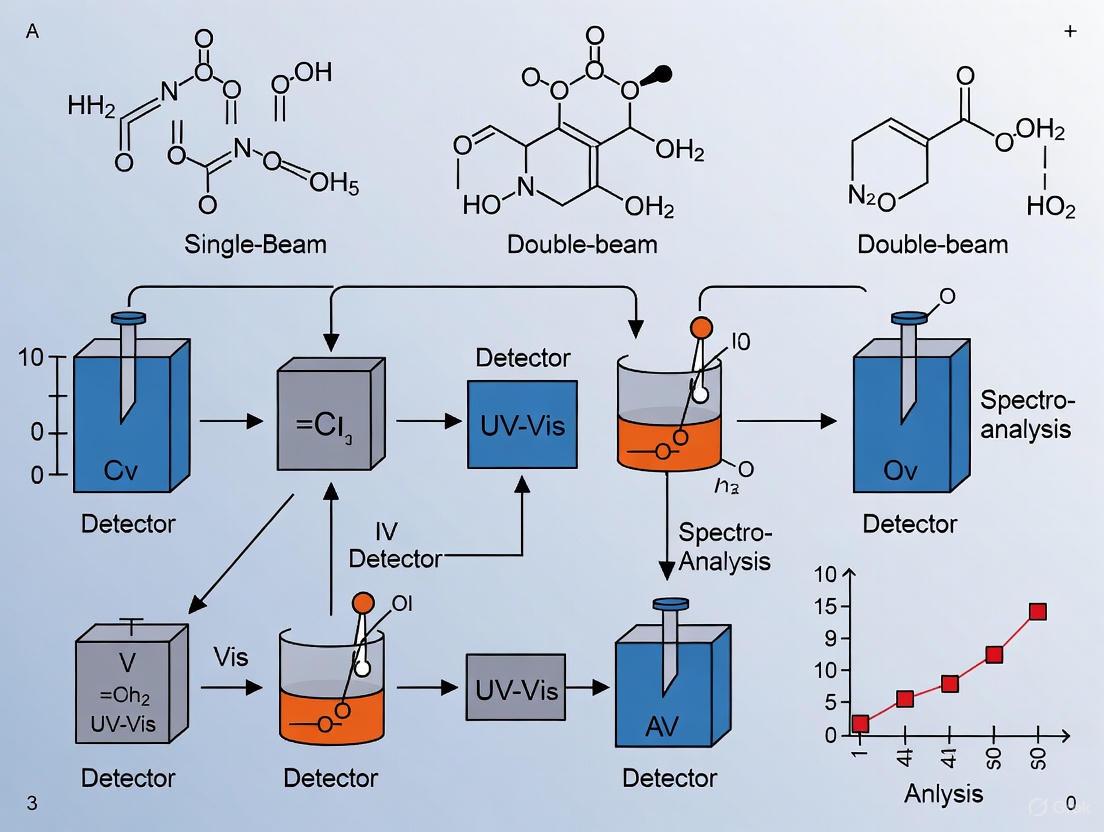
This article provides a detailed comparison of single-beam and double-beam UV-Vis spectrophotometers, specifically tailored for pharmaceutical researchers and drug development professionals. It explores the foundational principles, distinct advantages, and limitations of each instrument type. The scope extends to methodological applications in drug quantification, impurity profiling, and dissolution testing, alongside practical guidance for troubleshooting common issues and ensuring regulatory compliance. By synthesizing validation protocols and comparative performance metrics, this guide aims to equip scientists with the knowledge to select the optimal spectrophotometer for their specific pharmaceutical QA/QC and research needs, ultimately enhancing analytical accuracy and efficiency in drug development.
Single-Beam vs. Double-Beam UV-Vis Spectrophotometers in Pharmaceutical Analysis: A Comprehensive Guide for Scientists
Abstract
This article provides a detailed comparison of single-beam and double-beam UV-Vis spectrophotometers, specifically tailored for pharmaceutical researchers and drug development professionals. It explores the foundational principles, distinct advantages, and limitations of each instrument type. The scope extends to methodological applications in drug quantification, impurity profiling, and dissolution testing, alongside practical guidance for troubleshooting common issues and ensuring regulatory compliance. By synthesizing validation protocols and comparative performance metrics, this guide aims to equip scientists with the knowledge to select the optimal spectrophotometer for their specific pharmaceutical QA/QC and research needs, ultimately enhancing analytical accuracy and efficiency in drug development.
UV-Vis Spectroscopy Fundamentals: Core Principles for Pharma Analysis
The Principle of UV-Vis Spectroscopy and Beer-Lambert Law
Ultraviolet-Visible (UV-Vis) spectroscopy is a fundamental analytical technique in pharmaceutical research, measuring the absorption of light in the ultraviolet (200–400 nm) and visible (400–800 nm) regions of the electromagnetic spectrum [1]. This method provides valuable information for identifying substances, determining their concentration, and studying molecular interactions based on how light interacts with matter. The technique operates on the principle that molecules contain chromophores—functional groups that absorb light at specific wavelengths—leading to electronic transitions from ground state to excited state [1] [2]. The resulting absorption spectrum serves as a molecular fingerprint, providing critical data for drug discovery, quality control, and analytical research in pharmaceutical settings.
The global UV-Vis spectroscopy market reflects its indispensable role, projected to grow from USD 21.52 billion in 2025 to USD 27.62 billion by 2030 at a 5.12% compound annual growth rate (CAGR) [3]. This growth is particularly driven by pharmaceutical and biotechnology applications, which accounted for 48.54% of the market share in 2024 [3]. Within this sector, the technique is crucial for drug quality control, release testing (46.43% market share in 2024), and the rapidly expanding field of bioprocess monitoring (projected 8.56% CAGR through 2030) [3]. The technology continues to evolve with advancements in portability, automation, and integration with computational methods, maintaining its status as an essential tool for modern drug development professionals.
Fundamental Principles and Instrumentation
The Beer-Lambert Law
The quantitative foundation of UV-Vis spectroscopy is the Beer-Lambert Law (also referred to as the Bouguer-Beer-Lambert Law), which establishes the relationship between light absorption and analyte concentration [2] [4]. This principle states that the absorbance (A) of a solution is directly proportional to the concentration (c) of the absorbing species and the path length (l) of the light through the sample:
A = εcl
Where:
- A is the measured absorbance (unitless)
- ε is the molar absorptivity or extinction coefficient (L·mol⁻¹·cm⁻¹)
- c is the concentration of the analyte (mol/L)
- l is the path length of the sample cell (cm) [2] [4]
The absorbance is calculated from the ratio of incident light intensity (I₀) to transmitted light intensity (I), expressed as A = -log₁₀(I/I₀) [1] [4]. This logarithmic relationship means that each unit of absorbance corresponds to a tenfold reduction in light intensity passing through the sample.
The Beer-Lambert Law has specific limitations that pharmaceutical researchers must consider. It assumes a linear relationship between absorbance and concentration, which holds true only for dilute solutions [5]. At higher concentrations (typically >0.01M), electrostatic interactions between molecules can alter absorptivity, deviating from linearity [5]. Other factors including light scattering in turbid samples, fluorescence, chemical reactions during measurement, and stray light can also violate the law's assumptions [5]. For accurate quantitative analysis, absorbance values should generally be kept below 1.0 AU, as higher values can exceed the dynamic range of instruments where detectors struggle to measure small differences in high light attenuation [1].
Instrument Components and Operation
All UV-Vis spectrophotometers share fundamental components despite design variations between models:
- Light Source: Provides stable broadband illumination, typically using deuterium lamps for UV (190–400 nm) and tungsten-halogen lamps for visible regions (320–1100 nm) [1] [6]. Some instruments employ single xenon lamps covering both ranges [1].
- Monochromator: Isolates specific wavelengths using diffraction gratings (typically 1200+ grooves/mm) or filters [1] [6]. This component determines the instrument's spectral bandwidth and resolution.
- Sample Holder: Secures cuvettes (usually with 1 cm path length) or other sample containers in the light path [4]. Quartz cuvettes are essential for UV work as glass and plastic absorb UV light [1].
- Detector: Converts transmitted light intensity into electrical signals. Modern instruments use photodiodes, charge-coupled devices (CCDs), or photomultiplier tubes (PMT) for enhanced sensitivity [1] [6].
- Signal Processor: Calculates and displays absorbance, transmittance, or concentration values, with modern instruments featuring digital interfaces and connectivity [4].
The basic operational workflow involves measuring a blank/reference sample first to establish baseline, followed by the sample measurement where the instrument compares transmitted light intensities to calculate absorbance [4].
Figure 1: UV-Vis Spectrophotometer Component Workflow. The diagram illustrates the sequential path of light through essential components, with the dashed line indicating the initial blank measurement crucial for accurate absorbance calculation.
Single-Beam vs. Double-Beam Configurations
Optical Design and Operating Principles
The fundamental distinction in UV-Vis spectrophotometers for pharmaceutical applications lies in their optical configurations: single-beam and double-beam designs, each with unique advantages and limitations.
Single-Beam Systems utilize a straightforward optical path where light passes sequentially through the monochromator, sample, and detector [6] [4]. Measurement requires a two-step process: first, a blank reference is measured to establish baseline; then, the sample is measured and compared to the stored reference [4]. This simpler design provides higher light throughput due to fewer optical components, potentially offering better signal-to-noise ratio for specific applications [6]. Modern single-beam instruments have addressed historical stability concerns through improved electronics and correction algorithms [6].
Double-Beam Systems employ an optical chopper (typically a rotating mirror or beam splitter) to divide the light beam into two separate paths: one passing through the sample and the other through a reference blank [6]. Both beams are directed to a single detector, rapidly alternating between sample and reference measurements [6]. This real-time comparison compensates for instrumental drift, lamp instability, and environmental fluctuations, providing superior long-term stability [6]. The design inherently corrects for source and detector instabilities, making it particularly valuable for lengthy analyses and unstable samples [6].
Figure 2: Single-Beam vs. Double-Beam Optical Designs. Single-beam systems use a single light path requiring sequential measurement, while double-beam systems simultaneously measure sample and reference via split optical paths.
Performance Comparison and Pharmaceutical Applications
Table 1: Comprehensive Comparison of Single-Beam and Double-Beam UV-Vis Spectrophotometers
| Parameter | Single-Beam Systems | Double-Beam Systems |
|---|---|---|
| Optical Design | Single light path; sequential reference & sample measurement [4] | Simultaneous sample and reference measurement via beam splitting [6] |
| Cost Considerations | Lower initial investment; cost-effective for budget-limited labs [6] [4] | Higher initial cost; justified by analytical performance in regulated environments [6] |
| Photometric Accuracy | Adequate for routine analysis (±0.005-0.01 AU); susceptible to drift [4] | Superior accuracy (±0.002 AU); real-time reference compensation [6] |
| Signal Stability | Requires stable conditions; modern electronics improve performance [6] | Excellent long-term stability; ideal for kinetic studies and lengthy analyses [6] |
| Pharmaceutical Application Fit | Routine QC checks, educational use, field testing [4] | Regulatory-compliant analysis, bioprocess monitoring, research [3] [6] |
| Sample Throughput | Lower for reference-intensive methods | Higher for methods requiring frequent blanking |
| Stray Light Performance | Dependent on monochromator quality | Typically <0.01%T at 220 nm [6] |
| Maintenance Requirements | Simpler optical alignment | More complex optical system |
The double-beam UV-VIS spectrophotometer market is projected to reach $498 million in 2025, growing at a 4.4% CAGR through 2033, reflecting its essential role in pharmaceutical and biological analysis [7]. The pharmaceutical industry dominates this segment, accounting for approximately 40% of the double-beam market due to stringent quality control requirements [7].
For single-beam systems, key advantages include simplified optics, compact footprint, and lower cost, making them suitable for teaching laboratories, routine quality control checks with stable samples, and field applications where portability is prioritized [4]. Their main limitations stem from potential measurement drift due to source intensity fluctuations, requiring more frequent recalibration.
Double-beam systems excel in applications demanding high precision and stability, particularly in regulated pharmaceutical environments where compliance with FDA 21 CFR Part 11 and pharmacopeial standards is essential [3] [6]. Their ability to maintain baseline stability during lengthy kinetic studies, temperature-controlled experiments, and automated multi-sample measurements makes them indispensable for modern drug development workflows, particularly in bioprocess monitoring which is projected to grow at 8.56% CAGR [3].
Experimental Protocols and Data Analysis
Standardized Measurement Protocols
Protocol 1: Quantitative Analysis of Active Pharmaceutical Ingredients (APIs)
- Instrument Calibration: Verify wavelength accuracy using holmium oxide filter (characteristic peaks at 241.5, 287.5, 361.0, 453.0, 536.5 nm) [6]. Check photometric accuracy with potassium dichromate standards [4].
- Preparation of Standard Solutions: Create minimum five standard solutions of reference standard API covering concentration range from 20% to 150% of target concentration. Use appropriate solvent matching formulation matrix.
- Blank Measurement: Fill quartz cuvette with solvent/vehicle and measure baseline across required wavelength range (typically 200-400 nm for UV-active compounds).
- Standard Curve Acquisition: Measure each standard solution in triplicate at predetermined λmax. Record average absorbance values.
- Sample Analysis: Measure unknown samples following identical procedure. For single-beam instruments, recheck blank every 5-6 samples; double-beam systems automatically reference blank.
- Data Analysis: Plot absorbance vs. concentration, apply linear regression. Acceptable correlation coefficient (R²) ≥ 0.995 for validated methods.
Protocol 2: Kinetic Studies for Reaction Monitoring
- Initial Setup: Select fixed wavelength(s) based on reactant or product absorption characteristics. Set temperature control if available.
- Baseline Establishment: For single-beam: measure blank containing solvent/reaction matrix. For double-beam: place reference cell containing initial reaction mixture.
- Reaction Initiation: Mix reactants directly in cuvette or use stopped-flow accessory for fast kinetics.
- Data Acquisition: Monitor absorbance change at fixed time intervals (milliseconds to minutes depending on reaction rate). Double-beam systems provide superior stability for extended measurements.
- Data Processing: Convert absorbance to concentration using extinction coefficient. Plot concentration vs. time to determine reaction order and rate constants.
Advanced Applications with Chemometrics
Modern UV-Vis spectroscopy increasingly incorporates chemometric approaches to overcome traditional limitations with complex samples. Spectralprint analysis utilizes entire spectral data rather than single wavelengths, enabling simultaneous quantification of multiple components in mixtures through multivariate calibration methods [8]. This approach is particularly valuable for pharmaceutical formulations containing multiple active ingredients with overlapping absorption bands.
Principal Component Analysis (PCA) and Partial Least Squares (PLS) regression can extract relevant information from broad, overlapping UV-Vis spectra of complex mixtures, allowing quantification without physical separation [8]. These methods have revived UV-Vis applications in direct analysis of herbal medicines, polycomponent formulations, and process analytical technology (PAT) in biomanufacturing [8].
Table 2: Research Reagent Solutions for Pharmaceutical UV-Vis Spectroscopy
| Reagent/Material | Function/Application | Specification Considerations |
|---|---|---|
| Quartz Cuvettes | Sample holder for UV range | High transparency down to 190 nm; matched pairs for double-beam [1] |
| Holmium Oxide Filter | Wavelength calibration | Certified reference material with characteristic sharp peaks [6] |
| Potassium Dichromate | Photometric accuracy verification | ACS grade in perchloric acid for precise absorbance at 257 nm [4] |
| Buffer Solutions | Sample dissolution medium | UV-transparent; appropriate pH control without interfering absorptions |
| Neutral Density Filters | Stray light verification | Certified attenuation values across spectral range [6] |
| Protein A Standards | Biologics quantification | High purity for monoclonal antibody concentration curves [3] |
The selection between single-beam and double-beam UV-Vis spectrophotometers represents a critical decision point for pharmaceutical research and development operations. Single-beam systems offer cost-effective solutions for routine measurements, educational purposes, and applications where portability and simplicity are prioritized [4]. Their streamlined optical path provides higher light throughput advantageous for specific low-light applications. However, they require more meticulous calibration routines and stable environmental conditions to maintain measurement integrity.
Double-beam instruments deliver superior analytical performance through real-time reference compensation, making them indispensable for regulated pharmaceutical environments, lengthy kinetic studies, and high-precision quantification required in modern drug development [6]. The double-beam design's ability to correct for instrumental and environmental fluctuations ensures data integrity compliant with stringent regulatory standards like FDA 21 CFR Part 11 and pharmacopeial chapters <857> [3] [6].
The continuing evolution of UV-Vis spectroscopy, including integration with chemometrics [8], miniaturization for point-of-care testing [3], and enhanced data integrity features [3], ensures its ongoing relevance in pharmaceutical sciences. As the market continues to grow at 5.12% CAGR [3], both single-beam and double-beam technologies will maintain their complementary roles in the analytical toolkit of drug development professionals, with selection dependent on the specific application requirements, regulatory context, and operational constraints of each pharmaceutical research setting.
In the pharmaceutical industry, the accuracy and reliability of Ultraviolet-Visible (UV-Vis) spectroscopy are paramount for critical analyses ranging from drug quantification to nucleic acid purity assessment. The fundamental components of these instruments—their light sources, monochromators, and detectors—along with the choice between single-beam and double-beam optical design, directly dictate their performance in a regulated research environment. This guide provides an objective comparison of single-beam and double-beam UV-Vis spectrophotometers, detailing their operational principles, performance characteristics, and suitability for pharmaceutical applications, supported by experimental data and standardized protocols.
Instrument Fundamentals and Design Comparison
Core Optical Components
The performance of any UV-Vis spectrophotometer is governed by the integrated function of its three core subsystems.
- Light Sources: These provide the broad-spectrum electromagnetic radiation necessary for analysis. Typical sources include deuterium lamps for the ultraviolet region and tungsten or tungsten-halogen lamps for the visible region. Some instruments employ xenon flash lamps that cover both UV and visible spectra, enabling rapid measurements without the need to switch between sources [9].
- Monochromators: This component is responsible for isolating a specific, narrow band of wavelength from the broad output of the light source. At its heart is a diffraction grating—a surface with many parallel grooves that disperses light, sending different wavelengths in different directions [9]. Key components include an entrance slit, the dispersive element (grating or prism), and an exit slit. By precisely rotating the grating, specific wavelengths are passed through the exit slit. Instruments utilizing a double monochromator (two dispersion stages in sequence) offer superior resolution and significantly reduce stray light, which is a critical source of error, especially at high absorbances [9] [10].
- Detectors: These devices convert the transmitted light intensity into an electrical signal. Common detectors include photomultiplier tubes (PMTs), which offer high sensitivity, and solid-state devices like photodiode arrays (PDAs) or charge-coupled devices (CCDs). A distinct advantage of a PDA is its ability to measure all wavelengths simultaneously, enabling instantaneous capture of full spectra without the need for scanning [9].
Single-Beam vs. Double-Beam Optical Design
The configuration of the light path after the monochromator defines the two primary instrument categories, each with distinct advantages and limitations [11].
- Single-Beam Design: A single light beam passes through the monochromator, then the sample cuvette, and finally to the detector. To perform a measurement, the instrument first records a baseline (100% transmittance or 0 absorbance) with a blank solvent. The blank is then replaced with the sample to measure its absorbance [11].
- Double-Beam Design: The light beam is split into two parallel paths: one passes through the sample cuvette and the other through a reference cuvette containing the blank solvent. The intensities of both beams are then measured by the detector(s) and compared in real-time [11].
The table below summarizes the fundamental differences in their design and operational principles.
Table 1: Fundamental Design and Operational Principles
| Feature | Single-Beam Spectrophotometer | Double-Beam Spectrophotometer |
|---|---|---|
| Light Path | A single beam passes through the sample only [11]. | The beam is split into reference and sample beams [11]. |
| Absorbance Measurement | Direct measurement of sample transmittance (A = log10(I₀/I)) [11]. | Ratiometric measurement (A = log10(Iᵣ/Iₛ)) [11]. |
| Key Components | Monochromator, sample cuvette, detector, source [11]. | Monochromator, beam splitter, reference & sample cuvettes, dual detector [11]. |
Performance Comparison and Experimental Data
The design differences between single-beam and double-beam instruments translate directly into measurable differences in performance, which are critical for pharmaceutical research.
Quantitative Performance Metrics
The following table consolidates key performance indicators based on instrumental design, highlighting factors that impact data quality in quantitative analysis.
Table 2: Performance Comparison for Pharmaceutical Analysis
| Performance Metric | Single-Beam Spectrophotometer | Double-Beam Spectrophotometer |
|---|---|---|
| Accuracy | Limited; susceptible to error from source fluctuation and baseline drift, especially at high/low absorbance [11]. | Superior; self-compensating for source fluctuations, leading to higher accuracy across a wider absorbance range [11]. |
| Precision | Lower; degraded by baseline drift and source noise over time [11]. | Significantly higher; reduced drift and noise ensure reliable reproducibility [11]. |
| Dynamic Range | Limited; prone to saturation or detector limitations at high absorbance [11]. | Wider; ratiometric measurement allows accurate analysis of samples with very high or low absorbance [11]. |
| Analysis Speed | Faster for single-point measurements due to simpler operational steps [11]. | Slower per measurement due to reference path, but often mitigated by automation; ideal for spectral scanning [9]. |
| Cost & Complexity | Simpler design and lower cost [11]. | More expensive and complex design [11]. |
Experimental Data and Protocol
To illustrate the performance difference in a pharma-relevant context, consider the following experimental simulation for protein quantification, a routine yet critical application.
Experiment: Protein Quantification via the Bradford Assay
- Objective: To determine the concentration of an unknown protein sample and compare the precision and drift of single-beam versus double-beam instruments.
- Principle: The Bradford reagent binds to protein, causing a shift in its absorption maximum from 470 nm to 595 nm. The absorbance at 595 nm is proportional to protein concentration [9].
Research Reagent Solutions:
- Bradford Reagent: Contains Coomassie Brilliant Blue G-250 dye, which undergoes a colorimetric shift upon protein binding [9].
- Protein Standard: Bovine Serum Albumin (BSA) at a known concentration (e.g., 2 mg/mL) for generating a calibration curve.
- Assay Buffer: A phosphate-buffered saline (PBS) solution, used to dilute the standard and unknown samples, and as the blank.
Methodology:
- Preparation: Prepare a series of BSA standard solutions in assay buffer across a concentration range (e.g., 0 to 2000 µg/mL).
- Reaction: Mix a fixed volume of each standard and the unknown sample(s) with the Bradford reagent. Incubate for a specified time (e.g., 10 minutes).
- Measurement: Measure the absorbance of each solution at 595 nm.
Simulated Data and Analysis: The following data table and subsequent diagram model the expected instrumental behavior.
Table 3: Simulated Absorbance Readings for BSA Standards
BSA Concentration (µg/mL) Single-Beam Absorbance (T=0 min) Single-Beam Absorbance (T=30 min) Double-Beam Absorbance (T=0 min) Double-Beam Absorbance (T=30 min) 0 (Blank) 0.000 0.015 0.000 0.000 250 0.125 0.143 0.125 0.125 500 0.245 0.266 0.245 0.245 1000 0.480 0.505 0.480 0.480 1500 0.710 0.738 0.710 0.710 2000 0.935 0.966 0.935 0.935
Instrument Workflow for Protein Quantification
Selection Guide for Pharmaceutical Applications
Choosing between a single-beam and double-beam instrument depends on the specific application requirements, regulatory needs, and budgetary constraints.
Application-Specific Recommendations
- Routine Quality Control (QC) and Single-Point Assays: For high-throughput, dedicated assays where speed and cost are prioritized, and conditions are well-controlled, a single-beam instrument may be sufficient [11]. Examples include fixed-wavelength concentration checks in a production environment.
- Research and Method Development: For applications requiring high accuracy, precision, and full spectral data, a double-beam instrument is the unequivocal choice [11]. This is critical for method validation, characterizing new compounds, kinetic studies, and any analysis where baseline stability is a concern.
- Quantitative Analysis with High Regulatory Scrutiny: The superior stability and self-validation of the double-beam design make it more suitable for environments adhering to strict pharmacopeial standards (e.g., USP, Ph. Eur.), which mandate performance verification for factors like stray light and wavelength accuracy [10].
Decision Framework
- Define Analytical Needs: Identify required accuracy, precision, types of measurements (kinetics vs. endpoint), and sample throughput [11].
- Evaluate Performance Specifications: Prioritize instruments with specifications that meet the needs of the most demanding routine application. Consider dynamic range, spectral bandwidth (for resolution), and stray light performance [11] [10].
- Consider Compliance: Ensure the instrument and its data output meet regulatory requirements for data integrity and can be properly validated [10].
- Assess Total Cost of Ownership: While single-beam instruments have a lower initial cost, the long-term benefits of a double-beam instrument in data reliability and reduced need for re-analysis can offer a better return on investment in a research setting [11].
In pharmaceutical research, the choice between a single-beam and double-beam UV-Vis spectrophotometer is a strategic decision that impacts data quality and operational efficiency. Single-beam designs offer simplicity and cost-effectiveness for routine, dedicated tasks. However, for the rigorous demands of drug development, research, and quality control requiring high accuracy, precision, and stability, the double-beam spectrophotometer, with its robust, self-compensating optical design, remains the indispensable and recommended tool for ensuring reliable and defensible analytical results.
Strengths and Limitations of UV-Vis as a Primary Analytical Technique
Ultraviolet-Visible (UV-Vis) spectroscopy is an analytical technique that measures the amount of discrete wavelengths of UV or visible light that are absorbed by or transmitted through a sample in comparison to a reference or blank sample [1]. This property is influenced by the sample composition, providing information on what is in the sample and at what concentration [1]. The technique operates in the wavelength range of approximately 190 nm to 800 nm, with the UV region from 190 nm to 400 nm and the visible region from 400 nm to 800 nm [12].
When specific wavelengths of light hit molecules, electrons excite from lower energy states to higher energy states. The energy absorbed by the electrons equals the energy difference between the two levels, causing measurable absorption [12]. The fundamental relationship between absorption and sample concentration is governed by the Beer-Lambert Law (A = εcl), where A is absorbance, ε is the molar absorptivity, c is concentration, and l is the path length [1] [12]. This forms the quantitative foundation for most UV-Vis applications in pharmaceutical research and other scientific fields.
Core Strengths of UV-Vis Spectroscopy
UV-Vis spectroscopy offers numerous advantages that make it a staple in analytical laboratories, particularly in pharmaceutical research and quality control.
Practical Operational Advantages
- Fast and Efficient Analysis: UV-Vis provides almost immediate results, making it ideal for time-sensitive applications in quality control and research [13]. Modern instruments can deliver sample-to-data results in under three seconds [14].
- Easy-to-Use Nature: The technique is relatively straightforward, with modern spectrophotometers featuring user-friendly software interfaces accessible to non-experts [14].
- Non-Destructive Testing: UV-Vis allows for repeated measurements on the same sample without degradation, which is particularly valuable for precious or limited samples [13] [14].
- Cost-Effectiveness: UV-Vis spectrophotometers are generally more affordable than other analytical instruments like HPLC, FTIR, or GC systems [13].
Analytical Performance Strengths
- High Sensitivity and Accuracy: These instruments can detect minute changes in absorbance, allowing accurate quantification of analytes even at low concentrations [13] [15].
- Versatility Across Applications: UV-Vis finds applications across numerous fields including pharmaceutical analysis, nucleic acid quantification, food and beverage quality control, environmental testing, and material science [12] [13] [15].
The technique is particularly valuable in pharmaceutical research for drug identification, quantification of active ingredients, dissolution testing, and impurity detection [12]. Its non-destructive nature allows continuous monitoring of reactions over time without compromising sample integrity [15].
Key Limitations of UV-Vis Spectroscopy
Despite its widespread utility, UV-Vis spectroscopy presents several important limitations that researchers must consider when selecting analytical methods.
Technical and Analytical Limitations
- Limited Selectivity for Complex Mixtures: UV-Vis can struggle with complex mixtures where multiple absorbing components lead to overlapping absorption bands, making it difficult to discern individual substances [13]. This limitation often necessitates supplementary techniques like HPLC for high-resolution separation [13].
- Stray Light Interference: Stray light reaching the detector without passing through the sample can distort spectra, leading to inaccurate measurements, particularly at low absorbance levels [13]. This can decrease instrument linearity and reduce accuracy for low-concentration samples [13].
- Dependence on Sample Preparation: Proper sample preparation is crucial, often requiring dissolution in specific solvents or dilution to achieve correct absorbance levels [13]. Turbidity or particulate matter can scatter light, further affecting accuracy [13].
- Limited Structural Information: Unlike techniques such as NMR or IR spectroscopy, UV-Vis provides limited information about molecular structure or chemical reactions [13].
- Inability to Detect Non-Absorbing Compounds: The technique cannot detect compounds that do not absorb in the UV-Vis region, restricting its applicability to chromophore-containing molecules [16].
Sample-Related Constraints
The accuracy of UV-Vis measurements can be compromised by various sample characteristics. Samples with multiple chromophores often exhibit spectral overlap, while turbid samples cause light scattering that distorts absorbance readings [13]. The technique typically requires samples to be in solution, with the solvent itself needing to be transparent in the measured wavelength range [1].
Single-Beam vs. Double-Beam UV-Vis Spectrophotometers
A critical distinction in UV-Vis instrumentation lies between single-beam and double-beam configurations, each with distinct performance characteristics particularly relevant to pharmaceutical research.
Technical Comparison
Table 1: Performance comparison of single-beam and double-beam UV-Vis spectrophotometers
| Feature | Single-Beam Instruments | Double-Beam Instruments |
|---|---|---|
| Light Path Design | Single beam passes through sample to detector [11] | Beam splits into reference and sample paths [11] [17] |
| Accuracy | Limited; affected by source fluctuations and drift [11] | Superior; self-compensating for intensity changes [11] |
| Precision | Lower due to baseline drift and source noise [11] | Significantly higher; reduced drift and noise [11] |
| Dynamic Range | Limited, particularly at absorbance extremes [11] | Wider; maintains accuracy across high/low absorbance [11] |
| Stability | Sensitive to external factors like energy fluctuations [11] | High stability; minimal impact from external factors [17] |
| Analysis Speed | Typically faster for individual measurements [11] | Faster for series measurements; no recalibration needed [17] |
| Cost | Lower initial investment [11] | Higher initial cost [11] [17] |
| Operational Complexity | Simpler operation [17] | More complex operation [17] |
| Warm-up Time | Requires significant lamp warm-up time [17] | Minimal warm-up time [17] |
Application-Specific Considerations for Pharmaceutical Research
For pharmaceutical applications requiring high precision and accuracy—such as drug purity assessment, quality control, and regulatory compliance—double-beam instruments offer significant advantages despite their higher cost [11]. Their ability to provide reliable, reproducible data across a wide dynamic range makes them particularly valuable for drug development and validation studies [17].
Single-beam instruments may suffice for educational purposes, routine checks, or applications where cost and simplicity are prioritized [11]. Their simpler design can be advantageous for dedicated, high-throughput screening where individual measurements are needed rapidly [11].
Experimental Data and Validation in Pharmaceutical Applications
Robust experimental data validates UV-Vis spectroscopy as a reliable technique for pharmaceutical analysis, particularly when appropriate validation protocols are followed.
Comparative Study: UV-Vis vs. HPLC for Drug Quantification
A methodological comparison study developed and validated both UV-Vis and reversed-phase high performance liquid chromatography (RP-HPLC) methods for determining repaglinide, a miglitinide class antidiabetic drug, in tablet dosage forms [18].
Table 2: Experimental validation data comparing UV-Vis and HPLC methods for repaglinide analysis
| Validation Parameter | UV-Vis Spectrophotometry | RP-HPLC Method |
|---|---|---|
| Linearity Range | 5-30 μg/mL [18] | 5-50 μg/mL [18] |
| Regression Coefficient (r²) | >0.999 [18] | >0.999 [18] |
| Precision (% R.S.D.) | <1.50 [18] | <1.50 [18] |
| Mean Recovery | 99.63-100.45% [18] | 99.71-100.25% [18] |
| Detection Wavelength | 241 nm [18] | 241 nm [18] |
Both methods demonstrated excellent linearity, precision, and accuracy according to International Conference on Harmonization (ICH) guidelines [18]. The UV-Vis method provided a simpler, faster, and more economical alternative while maintaining reliability for routine quality control analysis of repaglinide in pharmaceutical formulations [18].
Standard Experimental Protocol for Pharmaceutical Analysis
A typical protocol for drug analysis using UV-Vis spectroscopy involves:
- Standard Solution Preparation: A standard stock solution of the drug (e.g., 1000 μg/mL) is prepared in an appropriate solvent like methanol [18].
- Sample Preparation: Tablets are weighed, finely powdered, and a portion equivalent to the target drug weight is dissolved in solvent, sonicated, filtered, and diluted to volume [18].
- Spectroscopic Measurement: The absorbance of sample solutions is measured at the predetermined maximum absorbance wavelength (e.g., 241 nm for repaglinide) against a blank solvent reference [18].
- Quantification: Drug concentration is calculated using a pre-established calibration curve based on the Beer-Lambert Law [18].
UV-Vis Pharmaceutical Analysis Workflow
Essential Research Reagent Solutions
Successful UV-Vis analysis in pharmaceutical research requires specific materials and reagents tailored to the analytical requirements.
Table 3: Essential reagents and materials for UV-Vis spectroscopy in pharmaceutical analysis
| Item | Function/Application | Technical Specifications |
|---|---|---|
| Quartz Cuvettes | Sample holder for UV range measurements [1] | Transparent to UV light (below 350 nm); standard path length of 1 cm [1] |
| Methanol/Solvents | Dissolving samples and preparing standards [18] | High purity, UV-transparent; appropriate for pharmaceutical compounds [18] |
| Reference Standards | Method validation and calibration [18] | Certified drug reference materials of known purity and concentration [18] |
| Buffer Systems | Maintain consistent pH for ionizable drugs [1] | Aqueous buffered solutions without interfering absorbance [1] |
| Filters/Syringe Filters | Clarify sample solutions by removing particulates [18] | 0.45 μm or 0.22 μm pore sizes to prevent light scattering [18] |
Proper cuvette selection is particularly critical. Quartz or fused silica is essential for UV measurements below 350 nm, as glass and plastic cuvettes absorb significantly in the UV region [1] [12]. Cuvettes must have clear, scratch-free optical surfaces to prevent measurement errors [19].
UV-Vis spectroscopy remains a powerful, versatile, and cost-effective analytical technique with significant utility in pharmaceutical research. Its strengths of speed, simplicity, non-destructive nature, and quantitative accuracy make it invaluable for drug quantification, purity assessment, and quality control. However, researchers must also acknowledge its limitations regarding selectivity for complex mixtures, susceptibility to matrix effects, and restricted structural elucidation capabilities.
The choice between single-beam and double-beam instrumentation involves important trade-offs between cost, simplicity, precision, and stability. Double-beam systems generally offer superior performance for demanding pharmaceutical applications requiring high accuracy and reproducibility, while single-beam instruments provide practical solutions for routine analyses where cost considerations are paramount.
When applied with appropriate validation and understanding of its capabilities and constraints, UV-Vis spectroscopy serves as a reliable primary analytical technique that continues to play a crucial role in pharmaceutical research and drug development.
Pharmaceutical Applications in Practice: From API Quantification to Dissolution Testing
Quantification of Active Pharmaceutical Ingredients (APIs) and Drug Potency
Ultraviolet-Visible (UV-Vis) spectroscopy serves as a fundamental analytical technique in pharmaceutical research for quantifying Active Pharmaceutical Ingredients (APIs) and determining drug potency. This method measures the amount of discrete wavelengths of UV or visible light absorbed by or transmitted through a sample, providing critical information about sample composition and concentration [1]. The selection between single-beam and double-beam spectrophotometer configurations significantly impacts the reliability, accuracy, and efficiency of these analyses, making the choice instrumental for compliance with stringent quality control standards and regulatory requirements in drug development.
The technique operates on the principle that light has a specific amount of energy inversely proportional to its wavelength. When this energy corresponds to the exact amount needed to promote electrons in a substance to a higher energy state, absorption occurs. The unique electronic structure of each compound means this absorption happens at different, characteristic wavelengths, allowing for identification and quantification [1]. In the context of a broader thesis comparing single-beam versus double-beam UV-Vis spectrophotometers for pharmaceutical research, this guide provides an objective comparison of their performance in quantifying APIs, supported by experimental data and detailed protocols.
Single-Beam vs. Double-Beam Spectrophotometers: A Technical Comparison
Understanding the fundamental operational differences between single-beam and double-beam spectrophotometers is crucial for selecting the appropriate instrument for pharmaceutical applications.
Instrument Design and Operation
A single-beam spectrophotometer operates by passing a single light beam through a sample. The instrument must be standardized by first taking a baseline reading with a reference or blank solution, after which the blank is manually replaced with the sample for measurement [20] [21]. This sequential measurement mode means the sample and reference are not measured simultaneously, which can introduce error and requires recalibration between readings if multiple samples are analyzed.
In contrast, a double-beam spectrophotometer splits the light from the source into two beams using a half-mirrored device or mechanical chopper. One beam, the sample beam, passes through the cuvette containing the compound of interest, while the other beam, the reference beam, passes through an identical cuvette containing only the solvent [20] [17]. This design allows for simultaneous measurement of the sample and reference, enabling automatic, real-time correction and compensation [17].
Performance Comparison and Key Differentiators
The core operational differences lead to distinct performance characteristics, which are summarized in the table below.
Table 1: Performance Comparison Between Single-Beam and Double-Beam Spectrophotometers
| Feature | Single-Beam Spectrophotometer | Double-Beam Spectrophotometer |
|---|---|---|
| Measurement Mode | Sequential (blank then sample) [21] | Simultaneous (sample & reference) [20] [21] |
| Reference Handling | Manual, prone to user error [21] | Automatic and continuous [21] [17] |
| Stability & Drift Compensation | Lower stability; sensitive to drift from voltage fluctuations, lamp drift, and temperature [20] [21] | High stability; automatically compensates for source power fluctuations and electronic drift [20] [17] |
| Signal-to-Noise Ratio | Lower, due to inability to correct for fluctuations in real-time [20] | Higher, as noise is minimized via real-time reference comparison [20] |
| Measurement Speed & Throughput | Slower, due to manual reference handling and required recalibration [21] | Faster and higher throughput; no need for recalibration between readings [17] |
| Operational Complexity | Simpler operation and design [21] | More complex optical setup and operation [17] |
| Initial Instrument Cost | Lower, due to simpler design with fewer components [20] [21] | Higher, due to more complex optics and advanced features [20] [17] |
| Ideal Application Scope | Teaching labs, basic quality checks, applications where cost is a primary concern [20] [21] | Research, quality control/assurance (QA/QC), kinetic studies, and high-precision analysis [20] [17] |
The following diagram illustrates the logical decision-making process for selecting between single-beam and double-beam instrumentation based on project requirements and constraints.
Experimental Data in API Quantification
The practical implications of the theoretical differences between single-beam and double-beam instruments are evident in experimental data from pharmaceutical analysis.
Case Study: Quantification of Favipiravir
A 2021 study directly compared a double-beam UV-Vis spectrophotometer with an HPLC method for quantifying Favipiravir in pharmaceutical formulations. The UV method utilized a Shimadzu UV-1800 double-beam spectrophotometer at a wavelength of 227 nm [22].
Table 2: Validation Data for Favipiravir Quantification Using a Double-Beam UV Method [22]
| Validation Parameter | Result |
|---|---|
| Linearity Range | 10 - 60 μg/mL |
| Correlation Coefficient (r²) | > 0.999 |
| Intra-day Precision (% R.S.D.) | Low R.S.D. values (specific value not provided) |
| Inter-day Precision (% R.S.D.) | Low R.S.D. values (specific value not provided) |
| Accuracy (% Recovery) | 99.83 - 100.45% |
The study concluded that the double-beam UV method provided reliable outcomes for the determination of Favipiravir in pharmaceutical formulations, demonstrating excellent linearity, precision, and accuracy [22]. The high correlation coefficient indicates a robust linear relationship, which is essential for confident concentration determination. The high percentage recovery confirms that the method is accurate and not significantly affected by interference from tablet excipients.
Case Study: Quantification of Repaglinide
Further supporting evidence comes from a study on the antidiabetic drug Repaglinide. The research utilized a Shimadzu 1700 Double beam UV-Vis spectrophotometer for analysis at 241 nm [18].
Table 3: Validation Data for Repaglinide Quantification Using a Double-Beam UV Method [18]
| Validation Parameter | Result |
|---|---|
| Linearity Range | 5 - 30 μg/mL |
| Correlation Coefficient (r²) | > 0.999 |
| Precision (% R.S.D.) | < 1.50% |
| Accuracy (% Recovery) | 99.63 - 100.45% |
The authors highlighted that the double-beam spectrophotometric method was "reliable, simple, fast, [and] accurate" for the quality control of repaglinide, making it suitable for routine analysis in quality control laboratories [18]. The low R.S.D. value (<1.5%) demonstrates high precision, a critical factor for ensuring consistency in results across repeated measurements. This level of precision is more challenging to achieve consistently with a single-beam instrument due to its higher susceptibility to drift.
Detailed Experimental Protocols
To ensure reproducibility and clarity in method implementation, the following section outlines a generalized standard operating procedure (SOP) for API quantification using a double-beam UV-Vis spectrophotometer, synthesized from the cited studies.
Standard Operating Procedure for API Quantification
1. Instrument and Materials Preparation
- Instrument: Double-beam UV-Vis spectrophotometer (e.g., Shimadzu UV-1800 or equivalent) [22].
- Cuvettes: Use 1.0 cm path length quartz cuvettes for UV analysis (e.g., measurements at 227 nm or 241 nm). Quartz is transparent across UV and visible wavelengths, unlike glass or plastic [20] [1].
- Solvent: Use an appropriate transparent solvent such as deionized water, methanol, or aqueous buffer, ensuring it does not absorb significantly at the wavelength of interest [22] [18].
- Reference Standard: High-purity API reference standard.
2. Sample and Standard Preparation
- Stock Standard Solution: Accurately weigh the API reference standard and dissolve it in the chosen solvent to prepare a stock solution of known concentration (e.g., 1000 μg/mL) [22] [18].
- Calibration Standards: Perform serial dilutions of the stock solution to prepare a series of standard solutions covering the intended linearity range (e.g., 5-60 μg/mL). Prepare all solutions in triplicate.
- Sample Solution: For tablet analysis, weigh and finely powder not less than 10 tablets. Accurately weigh a portion of the powder equivalent to the target API weight, dissolve in solvent, sonicate, and filter to obtain a clear solution. Dilute this solution to within the calibration range [22] [18].
3. Instrumental Analysis and Quantification
- Wavelength Selection: Based on a preliminary scan (e.g., 200-400 nm), select the wavelength of maximum absorption (λmax) for the API.
- Blank Measurement: Fill a cuvette with the pure solvent and place it in the reference holder. The double-beam instrument will use this for continuous background subtraction [1] [17].
- Calibration Curve: Measure the absorbance of each calibration standard. Plot the average absorbance against concentration and perform linear regression analysis.
- Sample Measurement: Measure the absorbance of the prepared sample solution. The concentration of the API in the sample solution is calculated using the linear regression equation from the calibration curve.
The workflow for this SOP is visualized below.
Essential Research Reagent Solutions
The following table details key materials and reagents required for the successful execution of the API quantification protocol.
Table 4: Essential Research Reagents and Materials for UV-Vis Based API Quantification
| Item | Function / Purpose | Critical Considerations |
|---|---|---|
| API Reference Standard | Serves as the primary standard for constructing the calibration curve, ensuring accuracy and traceability. | Must be of high and documented purity. Handling of HPAPIs requires strict containment protocols [23]. |
| Quartz Cuvettes | Hold the sample and reference solutions in the light path of the spectrophotometer. | Required for UV range analysis due to quartz's transparency down to 190 nm. Path length is typically 1.0 cm [20] [1]. |
| HPLC-Grade Solvents | Used to dissolve the API and prepare standard and sample solutions. | High purity is essential to minimize background absorbance and potential chemical interference [22] [18]. |
| Volumetric Flasks & Pipettes | Used for accurate preparation and dilution of standard and sample solutions. | Accuracy and precision of these tools are directly linked to the accuracy of final results. |
| Filters (0.22 μm or 0.45 μm) | Used to clarify sample solutions derived from solid dosage forms, removing particulate matter that can cause light scattering. | Membrane material should be compatible with the solvent used [22]. |
The choice between single-beam and double-beam UV-Vis spectrophotometers for the quantification of Active Pharmaceutical Ingredients is a balance between analytical requirements and practical constraints. Double-beam spectrophotometers are unequivocally superior for applications demanding high precision, stability, and throughput, such as in rigorous quality control environments, research and development, and kinetic studies. Their ability to perform simultaneous sample and reference measurements provides automatic compensation for instrumental drift, leading to more reliable and reproducible data, as evidenced by the low R.S.D. values and high recovery percentages in the cited studies [22] [18].
Single-beam spectrophotometers offer a cost-effective and simpler alternative that is adequate for educational purposes, basic qualitative checks, or situations with limited budget where the highest level of precision is not critical. However, their susceptibility to drift and manual operation mode make them less suitable for compliance-driven pharmaceutical quality control.
For researchers and drug development professionals, the investment in a double-beam system is justified by the need for data integrity, regulatory compliance, and operational efficiency in the quantification of APIs and the accurate determination of drug potency. The experimental protocols and validation data presented provide a framework for implementing this robust analytical technique in a pharmaceutical context.
Impurity Profiling and Purity Assessment of Drug Substances
Ultraviolet-Visible (UV-Vis) spectroscopy serves as a fundamental analytical technique in pharmaceutical research, providing critical data for identity confirmation, purity assessment, and quantification of active pharmaceutical ingredients (APIs). The technique operates on the principle that molecules absorb light in the ultraviolet (190-400 nm) and visible (400-800 nm) regions of the electromagnetic spectrum, causing electronic transitions that provide characteristic absorption patterns [1] [12]. When applied to impurity profiling and purity assessment, UV-Vis spectroscopy enables researchers to detect unwanted chemical entities that may arise from synthesis, degradation, or storage processes, ensuring drug safety and efficacy [24].
The pharmaceutical industry operates under strict regulatory frameworks requiring comprehensive impurity profiling to identify and quantify potentially harmful substances. According to ICH guidelines, any component of a drug product that is not the drug substance or an excipient qualifies as an impurity, necessitating rigorous analytical control [24]. UV-Vis spectroscopy addresses this need through its ability to measure specific absorbance characteristics of both APIs and their potential impurities, with the Beer-Lambert law (A = εcl) providing the mathematical foundation for concentration determination [12].
The choice between single beam and double beam spectrophotometer configurations represents a critical decision point for pharmaceutical laboratories, with each system offering distinct advantages and limitations for specific applications within drug development and quality control workflows.
Fundamentals of Single and Double Beam Instrumentation
Single Beam Spectrophotometer Design and Operation
Single beam spectrophotometers employ a straightforward optical path where light from the source passes through a monochromator to select specific wavelengths, then travels through the sample before reaching the detector [11] [20]. This design requires sequential measurement, where a reference or blank sample is measured first to establish a baseline, followed by replacement with the actual sample for analysis [25]. The fundamental measurement relies on comparing the intensity of light before (I0) and after (I) passing through the sample, with absorbance calculated as A = log10(I0/I) [11].
The simplicity of the single beam design translates to practical benefits including lower initial cost, reduced instrument footprint, and simplified operation [11] [20]. Additionally, because the entire light beam passes through the sample without splitting, single beam instruments typically achieve higher energy throughput to the detector, potentially enhancing sensitivity for specific applications [26]. These characteristics make single beam systems particularly suitable for educational settings, routine quality checks in non-regulated environments, and applications where budget constraints are paramount [11].
Double Beam Spectrophotometer Design and Operation
Double beam spectrophotometers incorporate a more sophisticated optical system that splits the initial light beam into two separate paths: one passing through the sample and the other through a reference solution [11] [17]. This beam splitting is typically accomplished using a mechanical chopper or half-mirrored device that alternately directs light through both paths, with the beams recombining before reaching the detector [17]. The instrument continuously compares the intensity of the sample beam (Is) with the reference beam (Ir), calculating absorbance as A = log10(Ir/Is) in real time [11].
This simultaneous measurement approach provides inherent compensation for factors that can compromise analytical accuracy, including source lamp fluctuations, voltage variations, and detector sensitivity drift [11] [20]. The continuous referencing capability eliminates the need for frequent recalibration between measurements, reducing analysis time and potential operator error [17]. While double beam instruments command a higher initial investment and require more complex optical components, they deliver superior stability and reliability for demanding pharmaceutical applications [25] [26].
Technical Comparison: Performance Characteristics
The selection between single and double beam configurations significantly impacts analytical performance in pharmaceutical applications. The following table summarizes the key technical differences between these instrument types:
Table 1: Performance Comparison Between Single and Double Beam UV-Vis Spectrophotometers
| Performance Characteristic | Single Beam Spectrophotometer | Double Beam Spectrophotometer |
|---|---|---|
| Optical Path Design | Single path through sample only [11] | Split beam: simultaneous sample and reference measurement [11] [17] |
| Measurement Sequence | Sequential (blank then sample) [25] | Simultaneous [25] |
| Accuracy | Limited by source fluctuations and baseline drift [11] | High due to real-time compensation for instrumental variations [11] [17] |
| Precision | Lower due to drift accumulation over time [11] | Significantly higher with minimal drift [11] |
| Baseline Stability | Subject to environmental and age-related drift [11] | Excellent stability; drift affects both beams proportionally [11] |
| Dynamic Range | Limited, particularly at high/low absorbance [11] | Wider range with accurate measurement across varying absorbances [11] |
| Source Fluctuation Impact | Directly affects measurements, adding noise [11] | Self-compensating; changes affect both beams equally [11] |
| Typical Measurement Speed | Faster for individual samples [11] | Faster for series measurements (no recalibration needed) [17] |
| Cost Considerations | Lower initial investment [20] [25] | Higher initial cost but potentially lower lifetime cost [20] |
For impurity profiling applications, accuracy and precision metrics are particularly crucial as they directly impact the ability to detect and quantify trace-level contaminants. The double beam design's continuous referencing capability provides superior performance in these areas, making it the preferred choice for regulated pharmaceutical environments where data integrity is paramount [11] [27].
Stability and Noise Considerations
Instrument stability represents a critical differentiator between single and double beam systems, especially for lengthy analyses or when measuring multiple samples. Single beam instruments are more susceptible to drift from electronic circuit fluctuations, voltage instability, and lamp energy degradation, all of which can cause anomalous results [20]. Double beam spectrophotometers automatically compensate for these variables, maintaining measurement integrity throughout extended operation [17]. This stability advantage makes double beam instrumentation particularly valuable for kinetic studies, dissolution testing, and high-throughput quality control applications where consistent performance over time is essential.
Application in Pharmaceutical Impurity Profiling
Regulatory Framework and Requirements
Pharmaceutical impurity profiling operates within a strict regulatory framework defined by international guidelines, including those established by the International Conference on Harmonisation (ICH). These guidelines classify impurities into categories including organic impurities (starting materials, by-products, degradation products), inorganic impurities, and residual solvents [24]. According to ICH guidelines, identification of impurities is required at levels of 0.1% or 1 mg per day intake (whichever is lower) for drugs with maximum daily doses below 2 grams [24]. This threshold demands highly sensitive and accurate analytical techniques capable of detecting and quantifying minor components in complex matrices.
Regulatory authorities such as the FDA mandate comprehensive testing of pharmaceutical products to address identity, assay, impurities, and dissolution characteristics [27]. UV-Vis spectroscopy supports multiple aspects of this testing paradigm, with the choice between single and double beam instrumentation directly impacting data quality and regulatory acceptance.
Experimental Protocols for Impurity Assessment
Forced Degradation Studies
Forced degradation studies represent a critical component of impurity profiling, designed to identify potential degradation products that might form under various stress conditions. A typical protocol involves:
Sample Preparation: Prepare solutions of the drug substance at appropriate concentrations (typically yielding absorbances between 0.3-1.0 AU) in suitable solvents [12]. For UV-transparent solvents, quartz cuvettes are required for measurements in the UV range below 350 nm [1].
Stress Conditions Application: Subject drug solutions to stress conditions including acidic and basic hydrolysis (e.g., 0.1M HCl/NaOH at elevated temperatures), oxidative degradation (e.g., 0.3% hydrogen peroxide), thermal degradation, and photolytic cleavage [24].
Spectral Analysis: Collect full UV-Vis spectra (typically 200-400 nm for UV-absorbing compounds) at predetermined time points to monitor degradation progression. Double beam instruments provide superior stability for these extended measurements [11].
Data Interpretation: Identify new absorption peaks or shoulder formations indicating degradation products. Calculate degradation rates based on absorbance changes at API-specific wavelengths.
Quantification of Known Impurities
For quantification of specific impurities with established absorbance characteristics:
Calibration Curve Establishment: Prepare standard solutions of the impurity at minimum five concentrations spanning the expected range. Measure absorbance at the wavelength of maximum absorption (λmax).
Sample Analysis: Measure absorbance of processed samples under identical conditions.
Concentration Calculation: Determine impurity concentration from the linear regression equation of the calibration curve, applying the Beer-Lambert law [12].
The following diagram illustrates the complete workflow for pharmaceutical impurity profiling using UV-Vis spectroscopy:
Diagram 1: Workflow for Impurity Profiling in Pharmaceuticals
Essential Research Reagents and Materials
Successful impurity profiling requires carefully selected materials and reagents to ensure analytical accuracy and reproducibility. The following table outlines essential components for pharmaceutical analysis using UV-Vis spectroscopy:
Table 2: Essential Research Reagents and Materials for Pharmaceutical UV-Vis Analysis
| Material/Reagent | Function/Application | Technical Specifications |
|---|---|---|
| Quartz Cuvettes | Sample holder for UV range measurements | Transmission range: 190-2500 nm [20]; Standard path length: 1 cm [1] |
| High-Purity Solvents | Dissolution medium for drug substances | UV-grade solvents with low absorbance in spectral region of interest [1] |
| Reference Standards | Instrument calibration and method validation | Certified reference materials with known purity [27] |
| Degradation Reagents | Forced degradation studies | ACS grade acids (HCl), bases (NaOH), oxidants (H₂O₂) [24] |
| Filter Membranes | Sample clarification | 0.45 μm or 0.22 μm pore size, compatible with organic solvents [24] |
| Buffer Salts | pH control for degradation studies | High-purity salts for maintaining specific pH conditions [24] |
Material selection directly impacts measurement quality, particularly for cuvette choice. Quartz or fused silica cuvettes are essential for measurements below 350 nm, as glass and plastic materials absorb significantly in the UV region [1] [20]. Similarly, solvent purity is critical as impurities can introduce interfering absorbance signals, complicating impurity detection and quantification.
Comparative Experimental Data
To objectively evaluate the practical implications of instrument selection for pharmaceutical applications, the following table presents key comparative metrics:
Table 3: Analytical Performance Metrics for Pharmaceutical Applications
| Performance Metric | Single Beam Instrument | Double Beam Instrument |
|---|---|---|
| Typical Analysis Time (10 samples) | 15-20 minutes (with recalibration) [11] | 5-10 minutes (simultaneous reference) [17] |
| Absorbance Accuracy | ±0.010 AU (subject to drift) [11] | ±0.002 AU (stable over time) [11] |
| Photometric Repeatability | 0.5% RSD [11] | 0.1% RSD [11] |
| Wavelength Reproducibility | ±0.5 nm [11] | ±0.2 nm [11] |
| Baseline Stability (over 1 hour) | Significant drift [11] [25] | Minimal drift (<0.001 AU/hour) [11] [17] |
| Suitable Absorbance Range | 0.2-0.8 AU (optimal) [1] | 0.1-2.0 AU (with linear response) [11] |
| Detectable Impurity Level | ~1% of API [11] | ~0.1% of API [11] [24] |
The data demonstrates clear advantages for double beam instrumentation across all metrics relevant to impurity profiling, particularly regarding detection limits that approach the 0.1% threshold specified in ICH guidelines [24]. The extended linear dynamic range of double beam systems additionally facilitates analysis of both concentrated and dilute solutions without requiring sample dilution, streamlining analytical workflows.
Selection Guidelines for Pharmaceutical Applications
The choice between single and double beam spectrophotometers should be guided by specific application requirements, regulatory constraints, and operational considerations:
Recommended Applications for Single Beam Systems
- Educational and Training Laboratories: Where instrument simplicity and cost-effectiveness are prioritized [11] [20]
- Preliminary Method Development: Initial scoping studies preceding validated analytical methods
- Quality Control in Non-Regulated Environments: Routine identity checks where highest precision is not critical [25]
- Limited Budget Situations: Where initial capital investment is a primary concern [26]
Recommended Applications for Double Beam Systems
- Regulated Pharmaceutical Quality Control: Environments requiring compliance with FDA, ICH, or pharmacopeial standards [28] [27]
- Stability Studies and Forced Degradation Studies: Where measurement stability over extended periods is essential [24]
- Dissolution Testing: Monitoring API release from dosage forms over time [28] [27]
- High-Throughput Environments: Where analytical efficiency and minimal recalibration are valuable [11] [17]
- Trace Impurity Detection: Applications requiring maximum sensitivity and detection limit capabilities [11] [24]
The following decision diagram provides a systematic approach to instrument selection based on application requirements:
Diagram 2: Decision Process for Instrument Selection
Impurity profiling and purity assessment of drug substances demand analytical techniques capable of delivering precise, accurate, and reliable data. While both single and double beam UV-Vis spectrophotometers can perform these analyses, their performance characteristics differ significantly for pharmaceutical applications. Single beam systems offer advantages in simplicity and initial cost, making them suitable for educational settings and non-regulated environments. However, double beam spectrophotometers provide superior stability, accuracy, and operational efficiency that align with the rigorous demands of regulated pharmaceutical research and quality control.
The comprehensive data presented in this guide demonstrates that double beam instrumentation delivers the performance metrics necessary for detecting and quantifying impurities at the thresholds specified in international regulatory guidelines. For pharmaceutical scientists engaged in method development, stability testing, and quality assurance, investment in double beam technology provides the analytical robustness required to ensure drug safety, efficacy, and regulatory compliance.
Dissolution Testing and Drug Release Kinetics for Solid Dosage Forms
Dissolution testing is a critical analytical technique in pharmaceutical development and quality control, evaluating how a solid oral dosage form releases its active pharmaceutical ingredient (API) into solution. This process serves as a fundamental determinant of a drug's bioavailability and therapeutic effectiveness. For researchers and drug development professionals, understanding drug release kinetics is essential for ensuring consistent drug performance, guiding formulation development, establishing bioequivalence, and verifying batch-to-batch quality. The data obtained from dissolution testing provides crucial insights into in vivo performance, helping scientists optimize formulations to achieve desired release characteristics while maintaining regulatory compliance.
The selection of appropriate analytical instrumentation, particularly UV-Visible spectrophotometers, is paramount for obtaining accurate and reliable dissolution data. This guide provides an objective comparison between single-beam and double-beam UV-Vis spectrophotometry systems within the context of pharmaceutical dissolution testing, supported by experimental data and protocols relevant to modern drug development workflows.
Fundamentals of UV-Vis Spectrophotometry in Dissolution Testing
Basic Principles and Instrumentation
UV-Visible spectrophotometry measures the absorption of light in the ultraviolet and visible regions of the electromagnetic spectrum, providing quantitative determination of different analytes including APIs, excipients, and biological macromolecules. In pharmaceutical dissolution testing, this technique enables researchers to accurately quantify the concentration of drug substances released from solid oral dosage forms over time, generating the critical data needed to construct drug release profiles and calculate kinetic parameters.
The fundamental principle underlying this analytical method is the Beer-Lambert law, which states that the absorbance of a solution is directly proportional to the concentration of the absorbing species and the path length of the light through the solution. This relationship provides the mathematical foundation for converting absorbance measurements into concentration values essential for dissolution profile generation and release kinetics modeling.
Comparative Instrument Designs: Single-Beam vs. Double-Beam Systems
Single-beam spectrophotometers utilize a single light path that passes sequentially through a reference and then the sample. This design involves measuring the intensity of light first through a reference cell containing only the dissolution medium, followed by measurement through the sample cell containing the dissolved API. The key components include a light source (typically deuterium lamp for UV and tungsten-halogen lamp for visible light), monochromator for wavelength selection, sample holder, and detector [29].
Double-beam spectrophotometers employ a more complex optical system that splits the light from the source into two separate beams: one passing through the sample and the other through a reference. A beam splitter or rotating mirror alternately directs light to both paths, with detectors measuring transmitted intensities simultaneously or in rapid alternation. This design allows for real-time compensation of instrumental variations [29].
Table 1: Technical Comparison of Single-Beam and Double-Beam UV-Vis Spectrophotometers
| Feature | Single-Beam Spectrophotometer | Double-Beam Spectrophotometer |
|---|---|---|
| Optical Design | Sequential measurement (reference then sample) | Simultaneous or alternating measurement of sample and reference |
| Precision & Stability | Susceptible to drift due to light source variations | Compensates for drift, offering higher stability |
| Baseline Correction | Manual measurement required | Automated real-time correction |
| Cost Considerations | Lower initial cost, simpler design | Higher cost due to additional components |
| Maintenance Requirements | Fewer components, simpler maintenance | More complex, requiring skilled maintenance |
| Typical Applications in Pharma | Routine quality control, educational settings | Research and development, kinetic studies, regulatory testing |
Experimental Protocols for Dissolution Testing
Standard Dissolution Test Methodologies
Dissolution testing of solid oral dosage forms follows standardized methodologies outlined in pharmacopeias such as the United States Pharmacopeia (USP). The FDA provides comprehensive guidance for in vitro dissolution testing of immediate release solid oral dosage forms, emphasizing standardized conditions to ensure reproducibility and regulatory compliance [30].
Apparatus Selection: Two USP apparatus types are most commonly used for solid oral dosage forms:
- USP Apparatus I (Basket Method): Employed for capsules and tablets that tend to float, using a wire mesh basket rotated at 50-100 rpm while submerged in dissolution medium [30] [31].
- USP Apparatus II (Paddle Method): Suitable for most immediate-release tablets, utilizing a rotating paddle at 50-75 rpm that agitates the medium above the dosage form placed at the vessel bottom [30] [31].
Test Conditions: Dissolution tests should be conducted at 37±0.5°C to simulate physiological conditions. Typical media volumes are 500, 900, or 1000 mL, selected based on maintaining "sink conditions" - defined as the volume needed to dissolve at least three times the amount of API in the dosage form [30]. Media composition should be carefully selected based on drug substance properties, with options including acidic or basic solutions, buffers, and surfactants when necessary to enhance solubility [30].
Sampling and Analysis: Timepoints should adequately reflect the dissolution profile's shape, including ascending and plateau phases. Samples are typically withdrawn at predetermined intervals, filtered, and analyzed using UV-Vis spectrophotometry to determine API concentration [30].
Advanced Dissolution Monitoring Techniques
Fiber Optic Dissolution Systems (FODS) represent an innovative approach that enables real-time monitoring without sample extraction. This method uses immersion probes with fiber optics to record UV spectral information at regular intervals (e.g., every 5 seconds), providing more detailed dissolution profiles while eliminating issues associated with manual sampling, filtration, and dilution [32].
FODS offers several advantages including full real-time spectra availability, wide pathlength selection (0.25 mm to 10 mm), and elimination of sampling errors. However, limitations include potential UV spectral overlap, API interactions with excipients, signal attenuation from undissolved particles, and UV signal saturation at high concentrations [32]. These challenges can be addressed through multivariate chemometric approaches like Principal Component Regression (PCR) and Partial Least Squares (PLS) regression, which enable accurate quantification despite signal saturation issues [32].
Experimental Workflow for Comprehensive Dissolution Testing
The following diagram illustrates a generalized experimental workflow for dissolution testing of solid oral dosage forms, integrating both traditional and advanced analytical approaches:
Research Reagent Solutions for Dissolution Testing
Table 2: Essential Materials and Reagents for Pharmaceutical Dissolution Testing
| Reagent/Equipment | Function/Application | Specifications/Standards |
|---|---|---|
| Dissolution Apparatus | Provides controlled environment for drug release testing | USP Apparatus I (Basket) or II (Paddle) |
| UV-Vis Spectrophotometer | Quantification of dissolved API concentration | Single-beam for routine QC; Double-beam for research |
| Dissolution Media | Simulates gastrointestinal environment for drug release | Buffers (pH 1.2-7.5), surfactants, fasted/fed state simulants |
| Reference Standards | Calibration and method validation | USP-grade API reference standards |
| Filter Materials | Removal of undissolved particles from samples | 0.45μm or smaller pore size, compatible with API |
| Deaeration Equipment | Removal of dissolved gases that could affect hydrodynamics | Vacuum filtration with heating capability |
Performance Comparison in Pharmaceutical Applications
Analytical Performance in Dissolution Testing
The selection between single-beam and double-beam instrumentation significantly impacts data quality, methodological efficiency, and application suitability in pharmaceutical research and quality control environments.
Analytical Precision and Stability: Double-beam systems demonstrate superior performance for dissolution testing requiring high precision and long-term stability. The simultaneous measurement of sample and reference beams compensates for instrumental drift caused by light source fluctuations, temperature variations, or electronic noise. This capability is particularly valuable in extended-release formulation testing, where dissolution studies may extend to 8-24 hours [29]. Single-beam instruments, while adequate for routine quality control of immediate-release formulations with shorter testing durations, show greater susceptibility to baseline drift that can compromise data accuracy in prolonged experiments.
Kinetic Studies and Method Development: The automated baseline correction and enhanced stability of double-beam spectrophotometers make them ideal for kinetic studies, method development, and dissolution testing of complex formulations. These applications often involve multiple sampling points, varying media conditions, and detailed profile analysis where measurement consistency is paramount. Single-beam systems require manual re-referencing during extended experiments, introducing potential operational inconsistencies [29].
Turbid and Complex Samples: Double-beam systems outperform single-beam instruments when analyzing turbid samples or formulations that generate particulate matter during dissolution. The real-time reference compensation minimizes interference from light scattering, providing more accurate concentration measurements without additional sample preparation [29]. This capability is particularly valuable for suspension formulations or poorly soluble drugs requiring surfactants in dissolution media.
Application-Based Instrument Selection
Table 3: Application-Based Selection Guide for UV-Vis Spectrophotometers in Pharmaceutical Settings
| Application Scenario | Recommended System | Justification | Experimental Support |
|---|---|---|---|
| Routine Quality Control | Single-Beam | Cost-effective for high-volume testing with established methods | Suitable for batch release testing where specifications are well-defined [31] [29] |
| Formulation Development | Double-Beam | Enhanced stability for method development and formulation optimization | Critical for discriminating between formulation variants with subtle release differences [30] [29] |
| Extended-Release Studies | Double-Beam | Superior drift compensation during prolonged testing periods | Essential for reliable data in tests lasting 8-24 hours [29] [33] |
| Biorelevant Dissolution | Double-Beam | Stability in complex media with multiple components | Maintains accuracy with biomimetic media containing surfactants, buffers, and enzymes [34] |
| Educational/Training Settings | Single-Beam | Lower cost, simpler operation and maintenance | Adequate for teaching fundamental principles of dissolution testing [29] |
Case Studies and Experimental Data
Comparative Dissolution Profile Analysis
Recent research demonstrates the critical importance of precise dissolution testing in differentiating between pharmaceutical products with potentially different clinical performance. A study comparing nine brands of amoxicillin 500mg capsules found significant differences in dissolution profiles when compared to the innovator product. Using similarity factors (f1 and f2) for statistical comparison, only two generic brands demonstrated comparable dissolution profiles to the reference product, while six brands showed significant differences that could potentially impact bioavailability [35].
This research highlights how robust dissolution methodology, coupled with precise analytical instrumentation, can detect potentially clinically relevant differences between pharmaceutical products. The f2 similarity factor (which ranges from 0-100, with values ≥50 indicating similarity) provided a quantitative measure of dissolution profile comparison, with only Brand G (f2=74.1) and Brand A (f2=48.5) approaching or meeting similarity thresholds [35].
Advanced Applications: Machine Learning in Dissolution Prediction
Emerging technologies are enhancing dissolution testing methodologies and data utilization. A 2025 study applied machine learning techniques to predict drug release profiles based on tablet formulation composition. Using 377 experimental formulations, researchers trained random forest (RF) and extreme gradient boosting (XGB) models to predict complete release profiles from 0-480 minutes across 11 timepoints. The best-performing models achieved cross-validation R² values of 0.635±0.047 (RF) and 0.601±0.091 (XGB), demonstrating the potential of computational approaches to supplement experimental dissolution testing [36].
This machine learning approach represents a significant advancement in dissolution sciences, potentially reducing formulation development time and resource requirements while providing deeper insights into the relationship between formulation variables and drug release kinetics.
Data Analysis Workflow in Modern Dissolution Testing
The following diagram illustrates the comprehensive data analysis workflow in modern dissolution testing, from raw spectral data to kinetic modeling:
The selection between single-beam and double-beam UV-Vis spectrophotometers for dissolution testing of solid oral dosage forms depends on specific application requirements, precision needs, and operational constraints. Single-beam systems offer cost-effectiveness and simplicity suitable for routine quality control and educational applications, while double-beam instruments provide the stability, precision, and automated functionality required for research and development, extended-release studies, and regulatory submissions.
Pharmaceutical researchers must consider the critical balance between analytical requirements and practical constraints when selecting instrumentation for dissolution testing. As dissolution methodologies evolve toward more biorelevant conditions and increasingly complex formulations, the enhanced capabilities of double-beam systems become increasingly valuable. However, for standardized quality control environments with established methodologies, single-beam instruments continue to provide adequate performance at lower operational costs.
Emerging technologies including fiber optic dissolution systems, multivariate data analysis, and machine learning approaches are expanding the capabilities of dissolution testing beyond traditional methodologies. These advancements promise to enhance the predictive power of in vitro dissolution testing while potentially reducing development timelines through more efficient formulation optimization.
Content Uniformity Testing for Tablets and Capsules
In the pharmaceutical industry, ensuring the consistent dosage of active pharmaceutical ingredients (APIs) in solid oral dosage forms is paramount for patient safety and therapeutic efficacy. Content uniformity testing is a critical quality control (QC) procedure mandated by pharmacopeias to verify that individual tablets or capsules contain the drug substance within a specified range around the label claim [28]. Ultraviolet-Visible (UV-Vis) spectroscopy has emerged as a cornerstone technique for this analysis due to its simplicity, sensitivity, cost-effectiveness, and rapid analysis time [28] [18]. This technique quantifies how much light a sample absorbs in the ultraviolet (190-380 nm) and visible (380-1100 nm) regions of the electromagnetic spectrum, which is directly related to the concentration of the absorbing species (the API) in a solution via the Beer-Lambert law [37] [38].
A fundamental choice for any laboratory implementing this technique is the selection between single-beam and double-beam UV-Vis spectrophotometers. This guide provides an objective comparison of these two instrument configurations, focusing on their performance, reliability, and suitability for the demanding environment of pharmaceutical content uniformity testing and research.
Single-Beam vs. Double-Beam UV-Vis Spectrophotometers: A Technical Comparison
The core difference between single-beam and double-beam spectrophotometers lies in their optical design, which directly impacts their performance, stability, and operational workflow [20] [11].
- Single-Beam Design: A single-beam instrument uses one light path. The instrument is first calibrated by measuring the intensity of light passing through a reference (blank) cuvette containing only the solvent. This cuvette is then manually replaced with the sample cuvette, and the intensity of light passing through the sample is measured. The absorbance is calculated from these two sequential measurements [20] [39].
- Double-Beam Design: A double-beam instrument splits the light from the source into two beams: one passes through the sample cuvette and the other passes through a reference cuvette containing the blank. Both beams are measured simultaneously by the detector, which continuously compares them to calculate the absorbance in real-time [20] [38].
This fundamental architectural difference leads to distinct performance characteristics, as summarized in the table below.
Table 1: Performance Comparison of Single-Beam and Double-Beam Spectrophotometers
| Feature | Single-Beam Spectrophotometer | Double-Beam Spectrophotometer |
|---|---|---|
| Optical Design | Single light path; sequential measurement of reference and sample [20] | Dual light paths; simultaneous measurement of reference and sample [20] |
| Accuracy | Moderate; susceptible to error from source fluctuations and baseline drift [11] | High; automatically compensates for source fluctuations and drift, providing superior accuracy [11] [39] |
| Precision | Lower; precision can degrade over time due to instrumental drift [11] | Significantly higher; excellent stability and reproducibility for long analytical runs [20] [11] |
| Measurement Speed | Slower due to manual switching between blank and sample [39] | Faster and more efficient for multiple samples; no manual re-blanking required [20] [19] |
| Dynamic Range | Limited, particularly at high and low absorbance values [11] | Wider dynamic range, suitable for samples with very high or low absorbance [11] |
| Cost | Lower initial purchase cost [20] [39] | Higher initial purchase cost [20] [39] |
| Ideal Application | Routine analyses, educational labs, applications where cost and simplicity are prioritized [11] [39] | Research, regulated quality control, stability studies, and applications demanding high accuracy and precision [11] [39] |
The following diagram illustrates the logical decision-making process for selecting the appropriate spectrophotometer for pharmaceutical quality control.
Experimental Data and Protocol for Content Uniformity
To illustrate the practical application and reliability of UV-Vis spectroscopy in pharmaceutical analysis, we can examine a validated method for the determination of repaglinide, an antidiabetic drug, in tablet dosage forms [18]. This study provides concrete experimental data comparing UV spectrophotometry to a reference method (RP-HPLC).
The following table summarizes the key validation parameters obtained for the UV spectrophotometric method, demonstrating its suitability for drug quantification.
Table 2: Validation Data for UV Spectrophotometric Assay of Repaglinide [18]
| Validation Parameter | Result | Acceptance Criteria |
|---|---|---|
| Linearity Range | 5 - 30 μg/mL | - |
| Correlation Coefficient (r²) | > 0.999 | Typically r² > 0.995 |
| Precision (Repeatability), %RSD | < 1.50% | Typically RSD < 2.0% |
| Accuracy (Mean Recovery) | 99.63 - 100.45% | Typically 98 - 102% |
| Limit of Detection (LOD) | Determined based on standard deviation and slope | - |
| Limit of Quantification (LOQ) | Determined based on standard deviation and slope | - |
The study concluded that the UV method was reliable, simple, fast, and accurate for the quality control of repaglinide, successfully applied to commercially available tablets [18]. The results from the UV method were statistically comparable to those obtained from the more complex RP-HPLC method, validating its use for routine analysis.
Detailed Experimental Protocol
The workflow for content uniformity testing using a UV-Vis spectrophotometer, based on the cited study, involves a series of methodical steps from sample preparation to data analysis.
Materials and Methods (Adapted from [18]):
- Instrumentation: A double-beam UV-Vis spectrophotometer (e.g., Shimadzu 1700) with 1.0 cm matched quartz cuvettes.
- Wavelength: 241 nm (λmax for repaglinide).
- Solvent: Methanol.
- Standard Preparation: A standard stock solution of repaglinide (1000 μg/mL) is prepared in methanol. Aliquots of this stock are diluted with methanol to prepare a series of standard solutions in the concentration range of 5-30 μg/mL.
- Sample Preparation:
- Weigh and finely powder not less than 20 tablets.
- Accurately weigh a portion of the powder equivalent to about 10 mg of the API.
- Transfer to a volumetric flask, add about 30 mL of methanol, and sonicate for 15 minutes to dissolve the API.
- Dilute to volume with methanol and mix well.
- Filter the solution, and then further dilute a suitable aliquot with methanol to obtain a final concentration within the linearity range.
- Procedure:
- Measure the absorbance of the prepared standard solutions and the sample solutions against a methanol blank.
- Construct a calibration curve by plotting the absorbance versus the concentration of the standard solutions.
- Calculate the concentration of the API in the sample solution using the regression equation of the calibration curve.
- Determine the content of the API in each individual tablet and assess compliance with content uniformity requirements (e.g., as per USP guidelines).
The Scientist's Toolkit: Essential Materials for UV-Vis Analysis
Successful content uniformity testing relies on more than just the spectrophotometer. The following table details key reagents, materials, and equipment essential for the experimental workflow.
Table 3: Essential Research Reagent Solutions and Materials for Content Uniformity Testing
| Item | Function / Purpose |
|---|---|
| Double-Beam UV-Vis Spectrophotometer | The core instrument for measuring light absorption; the double-beam design provides the stability and accuracy required for GMP QC [28] [11]. |
| Quartz Cuvettes | Sample holders with high transmission of UV and visible light (190-2500 nm), essential for measurements in the UV range [20]. |
| Active Pharmaceutical Ingredient (API) Reference Standard | A highly pure, characterized substance used to prepare calibration standards for accurate quantification [18]. |
| HPLC/Grade Solvent (e.g., Methanol) | A high-purity solvent to dissolve the API and excipients without introducing interfering UV-absorbing impurities [18]. |
| Volumetric Flasks and Pipettes | For accurate preparation and dilution of standard and sample solutions to ensure precise concentrations. |
| Ultrasonic Bath | To aid in the complete dissolution and extraction of the API from the tablet matrix into the solvent [18]. |
| Syringe Filters (e.g., 0.45 μm) | To clarify the sample solution by removing insoluble excipients prior to analysis, preventing light scattering [18]. |
| Validation Software | Software compliant with 21 CFR Part 11 for data integrity, security, and audit trails, which is critical for regulated laboratories [28] [3]. |
The choice between single-beam and double-beam UV-Vis spectrophotometers for content uniformity testing is a strategic decision with significant implications for data quality, operational efficiency, and regulatory compliance. While single-beam instruments offer a lower entry cost and are suitable for basic educational or non-regulated applications, their limitations in stability and precision make them less desirable for the rigorous environment of pharmaceutical quality control.
Double-beam spectrophotometers, with their inherent ability to compensate for instrumental drift and provide real-time reference correction, deliver the superior accuracy, precision, and reproducibility required for content uniformity testing, stability studies, and other critical analyses in drug development and manufacturing [28] [11]. The experimental data and validated protocols, such as the one for repaglinide, confirm that UV-Vis spectroscopy—particularly when implemented on a double-beam system—is a reliable, fast, and cost-effective technique for ensuring that every tablet and capsule meets the stringent standards of quality and safety demanded by global pharmacopeias.
Raw Material Identification and Verification Protocols
The accurate identification and verification of raw materials is a critical first step in ensuring the quality, safety, and efficacy of final pharmaceutical products. Ultraviolet-Visible (UV-Vis) spectroscopy serves as a cornerstone analytical technique for this purpose, providing a reliable means to confirm the identity and purity of incoming ingredients before they enter the manufacturing process. This guide objectively compares the performance of two principal UV-Vis instrument configurations—single-beam and double-beam spectrophotometers—specifically for pharmaceutical raw material testing. The fundamental operating principle these instruments share involves measuring the absorbance of light by a sample: when a raw material is dissolved in an appropriate solvent and placed in the light path of the instrument, its molecules absorb specific wavelengths of ultraviolet or visible light, producing a characteristic spectrum that acts as a molecular "fingerprint" for identification [1] [40].
The choice between single-beam and double-beam instrumentation directly impacts the reliability, efficiency, and regulatory compliance of a pharmaceutical laboratory's raw material verification program. Single-beam instruments measure absorbance by comparing the light intensity before and after the sample is placed in the beam path, requiring a manual reference measurement for every sample [40]. In contrast, double-beam instruments employ a mechanical chopper to split the light source into two simultaneous paths: one passing through the sample and the other through a reference blank, enabling continuous real-time correction for instrumental drift [38] [17]. This fundamental difference in optical design creates distinct performance trade-offs that must be evaluated within the context of a regulated pharmaceutical environment where data integrity and method robustness are paramount.
Technical Comparison: Single-Beam vs. Double-Beam Spectrophotometers
The core difference between single-beam and double-beam spectrophotometers lies in their optical arrangements and how they correct for potential instrumental fluctuations during analysis. For pharmaceutical raw material testing, where verification of identity and purity must be unambiguous, understanding these technical distinctions is essential for selecting the appropriate technology.
Single-Beam Systems: These instruments utilize a single light path that passes sequentially through the reference (blank) and then the sample. The operator must first measure the reference solution to establish a baseline, then replace it with the sample to determine absorbance [40]. This design is mechanically simpler, typically resulting in a lower initial purchase price. However, this simplicity comes with operational limitations: any drift in the light source intensity or detector sensitivity between the reference and sample measurements will directly translate into absorbance errors, potentially compromising the accuracy of raw material verification.
Double-Beam Systems: These instruments incorporate an optical chopper (typically a rotating mirror) that rapidly alternates the light beam between two paths—one through the sample and another through a reference cell—before directing it to a single detector. This design allows for nearly simultaneous measurement of both sample and reference, providing continuous correction for instrumental drift, light source fluctuations, and electronic noise [38] [17]. The result is significantly enhanced measurement stability, especially during longer analyses or wavelength scans, which is crucial for generating defensible data in regulated pharmaceutical environments.
Table 1: Technical and Performance Comparison for Pharmaceutical Applications
| Feature | Single-Beam Spectrophotometer | Double-Beam Spectrophotometer |
|---|---|---|
| Optical Design | Single light path; sequential reference & sample measurement | Simultaneous measurement via beam splitting and optical chopper |
| Stability | Susceptible to drift from lamp fluctuations and voltage changes [17] | High stability due to continuous real-time reference correction [38] [17] |
| Warm-up Time | Requires significant lamp stabilization time before use | Minimal warm-up time required, prolonging lamp life [17] |
| Operational Speed | Slower due to manual calibration between reference and sample | Faster analysis; no recalibration needed between readings [17] |
| Measurement Reproducibility | Lower due to drift between measurements | Higher reproducibility essential for GMP environments [38] |
| Human Error Potential | Higher (manual calibration/placement errors) | Reduced potential for operator error |
| Suitability for Scanning | Less ideal due to drift over time during scans | Excellent for full spectrum scans for identification [17] |
| Initial Cost | Lower | Higher [17] |
| Operational Complexity | Simpler operation | More complex operation and maintenance [17] |
Experimental Protocols for Raw Material Analysis
The following section outlines standardized protocols for raw material identification and verification using UV-Vis spectroscopy. These methodologies are aligned with standard pharmacopeial practices and can be adapted for either single-beam or double-beam instrumentation, with specific notes on procedural adjustments required for each system.
Raw Material Identification Protocol
Objective: To confirm the identity of a raw material (e.g., Active Pharmaceutical Ingredient - API) by verifying its characteristic absorption spectrum against a reference standard.
Principle: The electronic structure of a molecule causes it to absorb light at specific wavelengths, creating a unique absorption spectrum. Confirming that an unknown sample's spectrum matches that of a certified reference standard provides definitive identification [28] [40].
The Scientist's Toolkit: Table 2: Essential Reagents and Materials
| Item | Function |
|---|---|
| Reference Standard | Certified material of known identity and purity for comparison. |
| Suitable Solvent | Dissolves the sample without interfering in the UV-Vis range (e.g., water, methanol, 0.1 M NaOH) [40]. |
| Volumetric Flasks | For precise preparation of sample and standard solutions. |
| Quartz Cuvettes | For holding samples in the UV range (190-400 nm); transparent to UV light. |
| Pipettes | For accurate and precise transfer of solutions. |
Step-by-Step Methodology:
Solution Preparation:
- Prepare a solution of the reference standard at an appropriate concentration (typically 10-20 mcg/mL) in a suitable solvent. The concentration should yield an absorbance within the instrument's linear range (ideally 0.2-1.0 AU).
- Prepare a solution of the unknown raw material sample at the same nominal concentration, using the same solvent and preparation technique.
Instrument Setup & Blank Measurement:
- Turn on the spectrophotometer and allow the lamp to stabilize (particularly critical for single-beam systems).
- Select the wavelength scan mode.
- Fill a cuvette with the pure solvent (blank) and place it in the sample holder.
- For a single-beam instrument, measure the blank to establish a 0.000 A baseline. For a double-beam instrument, the blank is placed in the reference holder and measured automatically throughout.
Spectral Acquisition:
- Replace the blank with the standard solution (single-beam) or place the standard solution in the sample compartment (double-beam).
- Record the absorption spectrum across a defined wavelength range (e.g., 200-400 nm). Note the wavelength of maximum absorption (λmax).
- Repeat the process for the unknown sample solution.
Data Interpretation & Identification:
- Overlay the spectra of the standard and the unknown sample.
- Acceptance Criteria: The sample is considered to have passed the identification test if its λmax matches that of the reference standard within a specified tolerance (e.g., ±2 nm as per pharmacopeial guidelines) [40].
Figure 1: Workflow for Raw Material Identification via UV-Vis Spectroscopy
Quantitative Verification (Assay) Protocol
Objective: To determine the concentration or percentage purity of a specific raw material in a sample.
Principle: The Beer-Lambert Law (A = ε * c * l) establishes a linear relationship between absorbance (A) and the concentration (c) of the absorbing species, enabling quantitative analysis [1] [40].
Step-by-Step Methodology:
Standard Solution Preparation:
- Accurately weigh and prepare a series of standard solutions of the reference material across a range of concentrations (e.g., 5, 10, 15, 20 mcg/mL).
Sample Solution Preparation:
- Prepare a solution of the unknown raw material at a nominal concentration that falls within the range of the standard curve.
Absorbance Measurement:
- Set the instrument to the fixed wavelength (λmax) identified in the identification protocol.
- Using the solvent blank, zero the instrument.
- Measure the absorbance of each standard solution and the sample solution. For a single-beam instrument, the blank must be re-measured frequently to account for drift.
Calibration & Calculation:
- Construct a calibration curve by plotting the absorbance of the standard solutions against their known concentrations.
- Perform linear regression to obtain the equation of the line.
- Calculate the concentration of the unknown sample using the regression equation.
- Calculate the percentage purity of the raw material using the formula:
- % Purity = (Calculated Concentration / Nominal Concentration) × 100
Performance Data and Regulatory Considerations
The selection of a UV-Vis system for a pharmaceutical quality control (QC) laboratory is heavily influenced by performance data and the need to comply with stringent regulatory standards. The inherent stability of the double-beam design offers distinct advantages in this regulated environment.
Table 3: Quantitative Performance Data in Pharma Context
| Parameter | Single-Beam Performance | Double-Beam Performance | Pharmaceutical Relevance |
|---|---|---|---|
| Photometric Accuracy | Lower; susceptible to drift [17] | Higher; continuous correction minimizes drift [38] | Critical for accurate potency and purity calculations. |
| Long-Term Stability (60 min) | Absorbance can drift >0.005 AU | Absorbance drift typically <0.001 AU [17] | Essential for high-throughput labs and lengthy dissolution tests. |
| Wavelength Accuracy | Requires frequent calibration | Maintains calibration longer | Directly impacts identification tests based on λmax [40]. |
| Stray Light | Higher in basic models | Lower due to superior optical design | Affects linearity at high absorbance, crucial for assay. |
| Compliance with USP/EP/JP | Possible, but requires rigorous and frequent performance verification [28] | Easier to validate and maintain compliance; designs often meet all pharmacopeia specs [28] | Mandatory for regulated QC labs. |
Regulatory frameworks like the U.S. Pharmacopeia (USP) General Chapter <857> and other international pharmacopeias define specific performance requirements for UV-Vis instruments used in pharmaceutical testing [28]. These include stringent tolerances for wavelength accuracy, photometric accuracy, stray light, and resolution. The double-beam architecture, with its continuous background correction, is inherently better suited to maintain these performance characteristics over time without frequent manual intervention. Furthermore, the demand for data integrity in pharmaceutical manufacturing, enforced by regulations such as 21 CFR Part 11, makes the reproducibility and automated data handling features of modern double-beam spectrophotometers, often equipped with compliance-focused software like Thermo Scientific Insight Pro, a preferred choice for reducing audit risks [28] [3].
The choice between single-beam and double-beam UV-Vis spectrophotometers for pharmaceutical raw material identification and verification is a strategic decision that balances analytical needs with operational and regulatory constraints.
The single-beam spectrophotometer, with its lower initial cost and mechanical simplicity, may be a viable option for low-volume, non-regulated environments or for dedicated, fixed-wavelength quantitative tests where the instrument can be frequently calibrated. However, its susceptibility to drift and higher potential for operator error make it a less robust choice for a mainstream pharmaceutical QC laboratory.
The double-beam spectrophotometer is the unequivocally recommended instrument for rigorous, regulated pharmaceutical raw material testing. Its key advantages include:
- Superior Stability and Accuracy: Continuous real-time blank correction ensures that measurements are not compromised by instrumental drift, leading to more reliable identification and quantification [38] [17].
- Enhanced Reproducibility: The reduced influence of external factors and lower operator error potential provide the high-quality, defensible data required for GMP compliance.
- Operational Efficiency: Faster analyses and no need for constant recalibration improve workflow in a high-throughput lab.
- Easier Regulatory Compliance: The design inherently supports the performance verification and data integrity requirements of major pharmacopeias and regulatory bodies [28] [3].
For pharmaceutical researchers and scientists tasked with ensuring the quality of incoming raw materials, investing in a double-beam UV-Vis system provides the necessary confidence in results, streamlines the path to regulatory compliance, and ultimately safeguards the quality of the final drug product.
Method Development and Validation for Specific Drug Compounds
In the pharmaceutical research and development landscape, the quantification of active pharmaceutical ingredients (APIs) and the validation of analytical methods are fundamental to ensuring drug safety, efficacy, and quality. Ultraviolet-Visible (UV-Vis) spectrophotometry serves as a cornerstone technique for these tasks, offering a robust, simple, and cost-effective means of quantitative analysis. The core principle relies on the Beer-Lambert law, which states that the absorbance of light by a solution is directly proportional to the concentration of the absorbing species [38]. Within this domain, a critical choice faces researchers and scientists: whether to employ a single-beam or double-beam spectrophotometer. This guide provides an objective comparison of these two instrumental configurations, underpinned by experimental data and framed within the context of method development and validation for specific drug compounds, to inform selection for pharmaceutical research applications.
Instrument Comparison: Single-Beam vs. Double-Beam UV-Vis Spectrophotometers
The fundamental difference between single-beam and double-beam instruments lies in their optical geometry and how they correct for potential analytical errors.
- Single-Beam Spectrophotometers utilize a single light path that passes through the monochromator, then the sample, and finally to the detector. This design requires a reference measurement (blank solution) to be taken and stored before the sample measurement can be performed [20] [11].
- Double-Beam Spectrophotometers split the incident light from the source into two beams: one passes through the sample cell, and the other passes through a reference cell containing the blank solvent. The detector then measures the ratio of the intensities of these two beams in real-time [20] [38] [11].
This architectural difference leads to distinct performance characteristics, as summarized in the table below.
Table 1: Performance Comparison of Single-Beam and Double-Beam UV-Vis Spectrophotometers
| Feature | Single-Beam | Double-Beam |
|---|---|---|
| Optical Design | Single light path [20] | Two light paths (sample & reference) [20] |
| Accuracy | Limited; susceptible to source fluctuations and baseline drift [11] | Superior; self-compensating for source fluctuations and drift [11] [41] |
| Precision | Lower due to drift and noise [11] | Significantly higher and more reproducible [20] [11] |
| Dynamic Range | Limited, can be truncated at high/low absorbance [11] | Wider, suitable for high/low absorbance samples [11] |
| Sample Throughput | Can be faster for simple routines [11] | Slightly slower per sample but more reliable for sequences [11] |
| Cost | More cost-effective and compact [20] [11] | Significantly higher initial investment [20] [11] |
| Ideal Application | Routine, high-volume analysis in QC; educational settings [11] | Research, method development, validation, and unstable systems [11] |
The following diagram illustrates the basic logical decision process for selecting between the two instrument types.
Experimental Protocols and Supporting Data
Case Study 1: Method Development for Terbinafine Hydrochloride
A study developed and validated a UV-spectrophotometric method for estimating terbinafine hydrochloride in bulk and pharmaceutical formulations, providing a clear protocol suitable for a single-beam instrument [42].
1. Experimental Protocol:
- Standard Stock Solution: Accurately weigh 10 mg of terbinafine hydrochloride standard and transfer to a 100 mL volumetric flask. Dissolve and make up to volume with distilled water to obtain a 100 µg/mL stock solution [42].
- Wavelength Selection (λmax): Pipette 0.5 mL of the stock solution into a 10 mL volumetric flask and dilute to mark with distilled water (5 µg/mL). Scan this solution between 200–400 nm against a distilled water blank. The absorbance maximum (λmax) was found at 283 nm [42].
- Calibration Curve: Prepare standard solutions by transferring 0.5, 1.0, 1.5, 2.0, 2.5, and 3.0 mL aliquots of the stock solution into a series of 10 mL volumetric flasks. Dilute to volume with distilled water to obtain concentrations of 5, 10, 15, 20, 25, and 30 µg/mL. Measure the absorbance of each solution at 283 nm [42].
- Sample Preparation (Eye Drops): Take 5 mL of the eye drop formulation in a 100 mL volumetric flask and dilute to volume with distilled water. Further dilute 2 mL of this solution to 10 mL with distilled water to obtain a final concentration within the linear range (e.g., ~20 µg/mL). Measure the absorbance at 283 nm [42].
2. Validation Data and Results: The method was validated as per ICH guidelines, yielding the following results for terbinafine hydrochloride [42]:
- Linearity: The drug followed linearity in the range of 5–30 µg/mL with a correlation coefficient (r²) of 0.999. The regression equation was Y = 0.0343X + 0.0294 [42].
- Accuracy (Recovery): Recovery experiments at 80%, 100%, and 120% levels showed recovery in the range of 98.54–99.98%, indicating high accuracy [42].
- Precision: The intraday and interday precision, expressed as % Relative Standard Deviation (%RSD), were below 2%, confirming the method's repeatability and reproducibility [42].
- Sensitivity: The Limit of Detection (LOD) and Limit of Quantification (LOQ) were found to be 1.30 µg and 0.42 µg, respectively [42].
Case Study 2: Method Validation for Oxytetracycline Injectables
A 2023 study developed a method for quantifying oxytetracycline in veterinary injections, utilizing both single-beam (GENESYS 10S UV-Vis) and double-beam (Agilent 8453) instruments, demonstrating the applicability of both systems for pharmaceutical analysis [43].
1. Experimental Protocol:
- Standard Stock Solution: Accurately weigh 50 mg of oxytetracycline reference standard into a 200 mL volumetric flask. Dissolve in about 50 mL of 0.01 N HCl and dilute to volume with the same solvent to obtain a 250 µg/mL stock solution [43].
- Wavelength Selection: A reference solution of oxytetracycline (5 µg/mL in 0.01 N HCl) was scanned, showing a maximum absorbance at 268 nm [43].
- Calibration Curve: From the stock solution, prepare calibration standards at 5, 15, and 25 µg/mL using 0.01 N HCl as solvent [43].
- Sample Analysis: Dilute a sample of the injectable solution equivalent to 50 mg of oxytetracycline to 200 mL with 0.01 N HCl. Further dilute 1 mL of this solution to 50 mL with 0.01 N HCl to obtain a final concentration of 5 µg/mL. Measure the absorbance at 268 nm [43].
2. Validation Data and Results: The method was validated using the total error strategy and accuracy profiles [43].
- The method demonstrated good absolute and relative bias, within a tolerable interval of [–2%, +2%] [43].
- The method was repeatable and precise, with %RSD values for repeatability and intermediate precision lower than 2% and 4%, respectively [43].
- The method was successfully applied to 47 samples, with 28 samples complying with specifications and 19 failing, demonstrating its practicality for routine quality control [43].
The Scientist's Toolkit: Essential Research Reagent Solutions
The following table details key reagents and materials required for UV-Vis spectrophotometric method development and validation, as evidenced in the cited studies.
Table 2: Essential Materials and Reagents for UV-Vis Pharmaceutical Analysis
| Item | Function / Purpose | Example from Literature |
|---|---|---|
| Drug Reference Standard | Serves as the primary benchmark for identity, potency, and purity to establish the calibration curve. | Terbinafine HCl RS [42], Oxytetracycline RS [43]. |
| High-Purity Solvent | Dissolves the analyte without interfering with absorbance at the λmax. Must be transparent in the spectral region of interest. | Distilled Water [42], 0.01 N Hydrochloric Acid [43]. |
| Volumetric Flasks | For precise preparation and dilution of standard and sample solutions to known volumes. | 10, 50, 100, and 200 mL flasks [42] [43]. |
| Analytical Balance | For accurate weighing of reference standards and samples, a critical step for method accuracy. | Used for weighing 10 mg and 50 mg quantities [42] [43]. |
| Cuvettes | Contain the sample and blank solutions in the light path. Must be suitable for the wavelength range. | Quartz cuvettes for UV range (190-340 nm) [20]. |
The choice between single-beam and double-beam UV-Vis spectrophotometers for pharmaceutical method development and validation is not a matter of one being universally superior, but rather of selecting the right tool for the specific application. Single-beam systems, with their cost-effectiveness and simplicity, are well-suited for routine quality control in production environments, dedicated assays where high throughput is key, and educational or resource-limited settings [11]. In contrast, double-beam systems, with their superior accuracy, precision, and stability, are the instrument of choice for research and development, method development and validation, and analyses requiring high reliability over extended periods or for unstable compounds [11] [41]. The experimental data for drugs like terbinafine hydrochloride and oxytetracycline confirm that robust, ICH-compliant methods can be developed on both platforms, provided the instrument's limitations are understood and the validation protocol is rigorously addressed. Ultimately, the decision should be guided by a clear assessment of analytical requirements, data quality needs, and operational constraints.
Troubleshooting Common Issues and Optimizing Analytical Performance
Mitigating Signal Drift and Source Fluctuation in Single-Beam Systems
In the highly regulated and precision-driven field of pharmaceutical research, the choice between single-beam and double-beam UV-Visible spectrophotometers hinges significantly on their inherent ability to manage signal drift and source fluctuations. These instrumental instabilities represent a critical vulnerability in analytical workflows, potentially compromising data integrity for drug quantification, purity assessment, and dissolution testing. Single-beam systems, characterized by their sequential measurement approach, are intrinsically more susceptible to these disturbances because they measure the blank (reference) and sample at different times [11] [44]. Any change in the light source intensity or detector sensitivity between these two measurements is misinterpreted as an absorbance change in the sample, leading to analytical inaccuracies [45].
Double-beam instruments, in contrast, employ a simultaneous measurement architecture. By splitting the light beam so that one path travels through the sample while the other concurrently travels through a reference, these systems can automatically compensate for source power fluctuations and electronic drift, thereby delivering superior signal-to-noise ratio and long-term stability [11] [20]. This guide provides a objective, data-driven comparison of the two technologies, with a specific focus on experimental strategies to identify, quantify, and mitigate the principal limitations of single-beam systems within a pharmaceutical research context.
Experimental Comparison: Quantifying Stability and Performance
A rigorous experimental protocol is essential to objectively compare the performance of single-beam and double-beam spectrophotometers, particularly regarding the key parameters of stability, accuracy, and precision.
Experimental Protocol for Assessing Signal Drift
Objective: To quantify baseline and absorbance drift over an extended period under controlled conditions, simulating long-duration analyses like kinetic studies or multi-sample batch processing.
Methodology:
- Instrument Preparation: Allow both single-beam and double-beam spectrophotometers to warm up for the manufacturer's recommended time (typically 30-60 minutes).
- Initial Calibration: Zero both instruments using an appropriate blank (e.g., the solvent used for sample preparation) at the target wavelength(s).
- Continuous Monitoring:
- For the Single-Beam System: Place a calibrated neutral density filter or a stable, standard solution (e.g., 0.5 AU holmium oxide filter) in the cuvette holder. Record the measured absorbance at a fixed wavelength (e.g., 340 nm) every 30 seconds for 60 minutes without re-blanking [45].
- For the Double-Beam System: Perform the same measurement using an identical standard. The instrument will automatically and continuously reference against its internal blank path.
- Data Analysis: Plot absorbance versus time for both instruments. Calculate the drift as the total change in absorbance (ΔA) over the 60-minute period. The slope of the trendline is a direct indicator of instrumental stability.
Key Comparative Data
The table below summarizes the typical performance differences between the two architectures, based on experimental characterizations and manufacturer specifications.
Table 1: Performance Comparison of Single-Beam vs. Double-Beam Spectrophotometers
| Performance Parameter | Single-Beam System | Double-Beam System |
|---|---|---|
| Baseline Stability (Drift) | High susceptibility to drift over time due to sequential measurement [11] [44]. | High stability; automatically compensates for drift via simultaneous measurement [11] [20]. |
| Impact of Source Fluctuations | Direct impact on measurements; fluctuations add noise and uncertainty [11]. | Self-compensating; fluctuations equally affect both beams and are canceled out [11] [20]. |
| Analytical Precision | Lower due to baseline drift and noise from source fluctuations [11]. | Significantly higher due to real-time compensation [11]. |
| Measurement Speed | Faster for a single point measurement due to simpler optics [11]. | Slightly slower per measurement due to beam splitting, but faster and more reproducible for full spectra and multi-sample analysis [20]. |
| Dynamic Range | Limited, as drift has a greater impact at high and low absorbance values [11]. | Wider dynamic range, enabling accurate analysis of highly absorbing or dilute samples [11]. |
The Scientist's Toolkit: Essential Materials for Instrument Qualification
Proper instrument qualification and operation require specific standard materials. The following reagents and tools are essential for the experimental protocol described above and for routine performance verification.
Table 2: Key Research Reagent Solutions for Performance Verification
| Item | Function & Application |
|---|---|
| Holmium Oxide (Ho₂O₃) Filter | A stable solid-state wavelength and absorbance standard used for verifying instrumental wavelength accuracy and photometric scale precision [45]. |
| Neutral Density Filters | Calibrated glass filters with known, constant absorbance over a broad wavelength range. Used for stability and drift tests, as described in the experimental protocol. |
| Potassium Dichromate (K₂Cr₂O₇) Solutions | A classic solution-based standard in sulfuric acid, used for verifying photometric accuracy and linearity according to pharmacopoeial guidelines (e.g., USP <857>) [46]. |
| Stable Reference Cuvette | A sealed cuvette containing a stable solution or solid standard. Serves as a simulated sample for long-term drift monitoring experiments. |
| UV-Grade Solvents | High-purity solvents (e.g., water, methanol) free of UV-absorbing impurities. Used for preparing blanks, samples, and standards to prevent interference from contaminants. |
Mitigation Strategies for Single-Beam System Limitations
While double-beam systems are engineered for inherent stability, several methodological and operational strategies can be employed to mitigate the limitations of single-beam instruments, making them viable for specific pharmaceutical applications.
- Frequent Recalibration: The most straightforward strategy is to implement a schedule of frequent re-blanking. For kinetic studies or batch processing of multiple samples, this means measuring the blank solution after every few samples or at regular time intervals to reset the baseline [44] [45]. This practice minimizes the window of time for drift to occur, though it increases analysis time and solvent consumption.
- Controlled Environmental Conditions: Signal drift is exacerbated by fluctuations in ambient temperature and line voltage. Operating the single-beam spectrophotometer in a temperature-stable environment and using an uninterruptible power supply (UPS) or voltage regulator can significantly reduce these external sources of instability [47].
- Advanced Software Correction: Modern single-beam instruments can employ software algorithms that store a full spectrum of the blank. This allows for automatic correction of sample scans, mitigating the need to re-blank at every wavelength. Some advanced systems can also model and correct for baseline drift in post-processing, though this cannot compensate for real-time fluctuations during the measurement [11].
- Rigorous Maintenance and Warm-up: Ensuring that the instrument's light source has ample time to stabilize after power-on is crucial. A well-maintained lamp with sufficient warm-up time (often 30+ minutes) will exhibit fewer short-term intensity fluctuations. Adhering to a strict maintenance schedule for source replacement and optical component cleaning is also vital [47] [45].
- Application-Specific Method Validation: For single-beam systems used in regulated environments, method validation must specifically include robustness testing for drift. This involves demonstrating that the analytical method produces reliable and accurate results even when the instrument is operated over its typical drift period, often by establishing a maximum allowable time between recalibrations [46].
The following workflow diagram illustrates the core operational difference and a key mitigation pathway for single-beam systems:
Single-Beam Drift Mitigation Workflow
The choice between single-beam and double-beam UV-Vis spectrophotometry in pharmaceutical research is a direct trade-off between cost and analytical stability. Double-beam systems are unequivocally superior for applications demanding high precision, long-term stability, and regulatory rigor, such as dissolution testing, quality control of active pharmaceutical ingredients (APIs), and rigorous method development [46] [48]. Their inherent ability to compensate for instrumental noise makes them the default choice for ensuring data integrity under demanding conditions.
Single-beam instruments, however, remain a viable and cost-effective solution for specific, limited-scope applications. These include routine, fixed-wavelength checks (e.g., DNA/protein quantification at 260/280 nm), educational use, and low-throughput quality control in environments where initial capital expenditure is a primary constraint [20] [45]. By rigorously implementing the mitigation strategies outlined—especially frequent recalibration and environmental control—researchers can effectively manage signal drift and source fluctuation, extending the utility of single-beam systems within their well-defined operational limits. For the modern drug development professional, this informed comparison enables a risk-based selection of analytical technology that aligns with both scientific and regulatory requirements.
In pharmaceutical research, the accuracy of Ultraviolet-Visible (UV-Vis) spectroscopic analysis depends not only on instrument selection but fundamentally on proper sample preparation. Even the most advanced double-beam spectrophotometer cannot compensate for poorly prepared samples that exhibit light scattering or interference effects. These artifacts can compromise data integrity, leading to inaccurate concentration measurements of Active Pharmaceutical Ingredients (APIs), flawed dissolution testing results, and incomplete impurity profiling [38]. Sample preparation therefore represents the first and most crucial line of defense against analytical errors.
The choice between single-beam and double-beam spectrophotometry further influences how effectively instrument design can mitigate certain types of interference post-preparation. Single-beam instruments measure light intensity before and after inserting the sample, requiring manual reference handling, while double-beam instruments simultaneously compare sample and reference paths, automatically correcting for source fluctuations and some baseline drift [26]. This comparative analysis examines how optimal sample preparation, combined with appropriate instrument selection, minimizes scattering and interference to ensure reliable analytical outcomes in drug development.
Single-Beam vs. Double-Beam UV-Vis: A Comparative Framework for Pharmaceutical Analysis
The core distinction between single-beam and double-beam spectrophotometers lies in their optical design and its implications for stability, throughput, and error correction. Understanding these differences provides context for evaluating their performance in pharmaceutical applications, particularly when dealing with prepared samples that may still exhibit subtle artifacts.
A single-beam instrument utilizes a single light path that passes sequentially through a reference and then the sample. This design offers high energy throughput because the beam is not split, resulting in excellent sensitivity and a lower instrument cost. However, it cannot compensate for electronic drift or source instability during measurement and requires manual re-referencing, which can introduce operator variability [26].
In contrast, a double-beam spectrophotometer splits the source beam into two paths: one traversing the sample and the other passing through a reference blank. This allows simultaneous measurement, automatically correcting for real-time fluctuations in lamp intensity, voltage instability, and solvent background absorption. This design eliminates the need for warm-up time and provides superior stability, making it ideal for lengthy kinetic studies or dissolution testing where baseline stability is paramount [38] [26]. The table below summarizes the key operational differences.
Table: Comparison of Single-Beam and Double-Beam Spectrophotometer Characteristics
| Feature | Single-Beam Spectrophotometer | Double-Beam Spectrophotometer |
|---|---|---|
| Optical Design | Single light path through reference then sample | Two simultaneous beams: sample and reference |
| Cost | Lower cost | Higher cost |
| Stability & Error Correction | Does not compensate for drift; sensitive to fluctuations | Corrects for lamp fluctuations and electronic drift |
| Typical Applications | Routine quantitative analysis where cost is a factor | Kinetic studies, dissolution testing, high-precision analysis |
| Sensitivity | High energy throughput offers good sensitivity | Potentially lower throughput but higher measurement reliability |
Best Practices in Sample Preparation to Mitigate Scattering
Scattering, caused by particulate matter or micro-bubbles in the solution, leads to inaccurate absorbance readings by deflecting light away from the detector. The following protocols are essential for obtaining clear, scatter-free samples.
Clarification Techniques
- Filtration: For liquid samples or dissolved APIs, use membrane filters with pore sizes ≤ 0.45 µm. For critical applications requiring extreme clarity, such as low-concentration impurity detection, a 0.22 µm filter is recommended. Syringe filters are ideal for small volumes.
- Centrifugation: Apply to suspensions or samples with fragile, precipitate-prone analytes that might be retained by a filter. A standard protocol involves centrifugation at 5,000–15,000 × g for 10–15 minutes to pellet particulate matter, followed by careful extraction of the clarified supernatant [49].
Solvent Selection and Degassing
- Compatibility: Ensure the solvent is fully miscible with the sample and does not cause precipitation of the analyte. The solvent should also have a suitable UV cutoff; for example, HPLC-grade acetonitrile and water are standard for UV analysis below 220 nm.
- Degassing: To eliminate micro-bubbles that cause scattering, degas solvents by sonication for 5–10 minutes, sparging with an inert gas like helium for 5 minutes, or applying a mild vacuum with stirring. This is critical for dissolution media and when performing serial injections from vials.
Strategies for Minimizing Interference in Pharmaceutical Samples
Interference arises from chemical species other than the analyte that also absorb light at the measurement wavelength. Effective strategies address both the sample matrix and the analytical approach.
Blank Formulation and Matrix Matching
The most powerful tool for correcting interference is the use of a well-designed blank. The blank should contain all components present in the sample (e.g., dissolution medium, excipients, stabilizers) except for the active analyte [38]. In double-beam instruments, this blank is used in the reference beam, automatically subtracting the background absorption. For single-beam instruments, a background spectrum of the blank must be manually acquired and subtracted from the sample spectrum.
Dilution and pH Control
- Dilution: A simple dilution can bring the absorbance of both the analyte and the interferent into the linear range of the spectrophotometer (typically Absorbance < 2). This can reduce the relative contribution of the interferent if it is already near saturation in its absorbance.
- pH Control: The UV absorption spectra of ionizable compounds (many APIs) can shift dramatically with pH. Buffering the sample and blank to the same pH ensures the analyte's absorption profile remains consistent and predictable [50].
Experimental Data: Performance Comparison with Prepared Samples
To objectively compare the performance of single-beam and double-beam instruments in a pharmaceutical context, the following experiments were designed, focusing on stability and resilience to prepared sample artifacts.
Experimental Protocol 1: Kinetic Study for Reaction Monitoring
- Objective: To monitor the degradation kinetics of an API under accelerated conditions.
- Sample Preparation: An API was dissolved in a buffered solution (pH 7.4) at 50 µg/mL. The solution was filtered through a 0.22 µm nylon filter. A matched blank containing only the buffer was prepared identically.
- Methodology: The absorbance at the λmax (e.g., 275 nm) was measured every 30 seconds for 60 minutes while the sample was maintained at 40°C. The experiment was run on both a single-beam and a double-beam spectrophotometer.
- Results: The double-beam instrument provided a stable baseline, with minimal drift over the 60-minute period, allowing for precise calculation of the degradation rate constant. The single-beam instrument showed a noticeable baseline drift, requiring more complex data correction to accurately determine kinetics [38] [26].
Experimental Protocol 2: Dissolution Testing
- Objective: To accurately measure the low concentration of an API released in a dissolution vessel over time.
- Sample Preparation: Aliquots were withdrawn from a USP apparatus at 10, 20, and 30-minute intervals and immediately filtered through a 0.45 µm PVDF filter. The complex dissolution medium (e.g., with surfactants) necessitated a perfectly matrix-matched blank.
- Methodology: The absorbance of the filtered samples was measured at the API's λmax. The double-beam instrument continuously referenced the dissolution medium, automatically correcting for its slight turbidity and background absorption.
- Results: The double-beam system's continuous correction provided a more accurate and precise profile of the drug release, especially critical for the early, low-concentration time points where interference from the medium is most significant [38].
Table: Quantitative Comparison of Single-Beam and Double-Beam Performance in Key Pharmaceutical Applications
| Application | Key Metric | Single-Beam Performance | Double-Beam Performance |
|---|---|---|---|
| Long-Term Kinetic Study | Baseline Drift (over 60 min) | High (e.g., ~0.005 A) | Very Low (e.g., <0.001 A) |
| Dissolution Testing | Accuracy at Low Conc. (% Recovery) | Moderate (e.g., 92-95%) | High (e.g., 98-101%) |
| High-Throughput Assay | Analysis Time per Sample | Faster (no auto-reference) | Slightly Slower (simultaneous beams) |
| Routine API Quantification | Cost & Sensitivity | Favorable (high throughput, lower cost) | Less Favorable |
The Scientist's Toolkit: Essential Reagents and Materials
Table: Key Research Reagent Solutions for UV-Vis Sample Preparation
| Item | Function & Importance |
|---|---|
| Membrane Filters (0.22/0.45 µm) | Removes sub-micron particulates that cause light scattering, ensuring a clear analytical path. |
| HPLC-Grade Solvents | Provides low UV background absorbance, enabling accurate baseline measurements, especially at lower wavelengths. |
| Matched Quartz Cuvettes | Ensures that pathlength is identical and that the cell itself does not contribute to absorbance or scattering. |
| Buffer Salts & pH Standards | Controls the ionization state of the analyte, preventing spectral shifts that can lead to quantification errors. |
| Certified Reference Material (CRM) | Serves as the primary standard for calibrating the spectrophotometer and verifying method accuracy. |
Workflow and Decision Pathway
The following diagram illustrates the logical decision process for preparing a sample and selecting the appropriate spectrophotometer to achieve reliable results.
The integrity of pharmaceutical UV-Vis analysis is built upon a foundation of meticulous sample preparation. Techniques such as filtration, centrifugation, and matrix-matching are non-negotiable for eliminating scattering and chemical interference. While these practices are universal, the choice between single-beam and double-beam spectrophotometry determines the instrument's ability to maintain accuracy over time and under challenging conditions. Double-beam systems, with their inherent stability and continuous referencing, are demonstrably superior for high-precision tasks like dissolution testing and kinetic studies, directly compensating for drift and background effects that can compromise data [38] [26]. For routine quantitative analysis where cost and sensitivity are primary concerns, a single-beam instrument can be sufficient, provided sample preparation is flawless. Ultimately, pairing rigorous sample preparation protocols with the strategically chosen spectrophotometer empowers researchers and drug development professionals to generate data of the highest reliability, ensuring the safety and efficacy of pharmaceutical products.
Selecting the Correct Solvent and Cuvette for UV and Visible Ranges
In pharmaceutical research, the integrity of Ultraviolet-Visible (UV-Vis) spectroscopic data is paramount, forming the basis for critical decisions from drug discovery to quality control. This analytical technique quantifies how much light a sample absorbs in the ultraviolet (190-380 nm) and visible (380-750 nm) ranges, providing essential information about compound identity, concentration, and purity [1]. The choice between single-beam and double-beam spectrophotometer architectures fundamentally influences this process, with each system offering distinct advantages for specific applications within the drug development pipeline.
The accuracy of these measurements, however, is not solely dependent on the instrument itself. It is equally contingent on the selection of appropriate consumables—specifically, the cuvette and the solvent. An incompatible cuvette material can absorb critical wavelengths of light, while an inappropriate solvent can itself produce significant background absorption, leading to erroneous data, compromised quantification of Active Pharmaceutical Ingredients (APIs), and flawed purity assessments. This guide provides a structured, evidence-based framework for selecting the correct solvent and cuvette, ensuring that your UV-Vis data meets the rigorous standards demanded by pharmaceutical research and regulatory compliance.
Cuvette Selection: Material and Path Length
The cuvette serves as the critical interface between your sample and the light path of the spectrophotometer. Its material dictates the usable wavelength range and chemical resistance, while its path length directly influences the sensitivity of the measurement according to the Beer-Lambert Law (A = εbc), which states that absorbance (A) is directly proportional to the path length (b) and the concentration (c) of the analyte [51].
Cuvette Material and Optical Properties
Selecting a cuvette material with sufficient transparency across your measurement wavelength range is the first and most critical step. The following table summarizes the key properties of common cuvette materials.
Table 1: Comparison of Cuvette Materials for UV-Vis Spectroscopy
| Material | Transmission Range | Primary Applications | Cost | Chemical Resistance |
|---|---|---|---|---|
| UV-Grade Quartz | ~190 - 2500 nm [51] [52] [53] | Nucleic acid/protein quantification (260/280 nm), API purity verification, high-precision UV-Vis work [51] [53] | High [54] | Excellent against acids, bases, and most organic solvents [51] |
| IR Quartz | ~220 - 3500 nm [52] [54] [53] | Mid-IR spectroscopy, specialized laser applications [53] | Very High [54] | Similar to UV-grade quartz |
| Optical Glass | ~340 - 2500 nm [20] [52] [53] | Colorimetric assays (e.g., BCA, Bradford), routine visible light analysis, educational labs [51] [53] | Moderate [54] | Good, but avoid HF and strong alkalis [51] |
| Plastic (PS/PMMA) | ~380 - 780 nm [52] [53] | Bacterial optical density (OD) measurements at 600 nm, teaching labs, disposable assays [20] [53] | Low [53] | Poor; sensitive to many organic solvents [53] |
Key Selection Criteria:
- For UV Measurements: UV-grade quartz is the unequivocal gold standard for pharmaceutical applications involving UV light, such as nucleic acid/protein quantification at 260/280 nm or drug identity testing [51] [53]. Using glass or plastic cuvettes for wavelengths below 340 nm will result in significant absorption and inaccurate data [53].
- For Visible-Only Measurements: For colorimetric assays in the visible range (e.g., 600 nm for bacterial culture density), optical glass or plastic cuvettes are cost-effective and sufficient [53].
- Chemical Compatibility: Always verify solvent compatibility. Quartz offers the broadest resistance, while plastic cuvettes can be dissolved or crazed by organic solvents [53].
Path Length and Sample Volume
The path length of a cuvette is a key determinant of analytical sensitivity. The Beer-Lambert law shows that a longer path length increases absorbance, enhancing the ability to detect low-concentration analytes [51].
Table 2: Cuvette Path Length and Volume Guide
| Path Length | Sensitivity Gain (vs. 1 mm) | Typical Volume Range | Ideal Applications in Pharma |
|---|---|---|---|
| 1 mm | Baseline | 50 - 350 µL [52] | High-concentration APIs, turbid samples [51] |
| 10 mm (Standard) | ~10x [51] | 3.0 - 3.5 mL [52] [53] | Most quantitative UV-Vis analyses, dissolution testing [51] |
| 20 - 50 mm | 20 - 50x [51] | 7 - 17.5 mL [52] | Trace analyte detection, environmental monitoring of impurities [51] |
Practical Considerations:
- Micro-Volume Techniques: For precious or scarce samples, micro-volume cuvettes requiring only 1-2 µL are available, using short path lengths and surface tension to hold the sample [51].
- Z-Dimension (Beam Height): Ensure your cuvette's window height is compatible with your spectrophotometer's beam height (typically 8.5 mm, 12.5 mm, or 15 mm) [51]. The sample volume must be sufficient to submerge the light beam completely.
Solvent Selection and Compatibility
The solvent must dissolve your analyte without interfering with the measurement. Its primary optical property of concern is the UV cutoff, the wavelength below which the solvent itself absorbs significantly, creating a high background absorbance that obscures the sample signal.
Table 3: UV Cutoff of Common HPLC/Spectroscopy Solvents
| Solvent | UV Cutoff (nm) | Notes on Pharmaceutical Use |
|---|---|---|
| Water | <190 nm [1] | Ideal solvent for aqueous-soluble drugs, buffers. |
| Acetonitrile | ~190 nm | Common in HPLC mobile phases; excellent for low-wavelength UV. |
| n-Hexane | ~200 nm | Useful for non-polar compounds. |
| Methanol | ~205 nm | Common for dissolving a wide range of organic molecules. |
| Ethanol | ~210 nm | |
| Chloroform | ~245 nm | Use only with quartz cuvettes; dissolves plastics. |
| Acetone | ~330 nm | High cutoff limits useful UV range. |
| Benzene | ~340 nm | Avoid due to toxicity. |
Protocol: Establishing a Solvent Blank
- Preparation: Fill a matched cuvette with the pure solvent you have used to prepare your sample.
- Measurement: Place the solvent-filled cuvette in the spectrophotometer and run a baseline or blank measurement.
- Application: The instrument uses this reference to automatically subtract the solvent's absorbance from your sample's absorbance, yielding the true absorbance of the analyte. A proper blank is essential for accurate concentration calculations using the Beer-Lambert law [1].
Single-Beam vs. Double-Beam Spectrophotometers in Pharma
The choice of instrument architecture has direct implications for data stability, throughput, and suitability for regulated environments.
Table 4: Single-Beam vs. Double-Beam Spectrophotometer Comparison
| Feature | Single-Beam Spectrophotometer | Double-Beam Spectrophotometer |
|---|---|---|
| Optical Principle | Single light path; measures reference and sample sequentially [20] [39] | Light split into two beams; measures sample and reference simultaneously [20] [39] |
| Accuracy & Stability | Moderate; susceptible to drift from lamp fluctuations and voltage changes [20] [39] | High; automatically compensates for source power fluctuations and drift, providing better reproducibility [20] [39] |
| Measurement Speed | Slower; requires manual switching between blank and sample [39] | Faster; no manual blanking between measurements, higher throughput [39] |
| Cost | Lower initial cost [20] [39] | Higher initial cost [20] [39] |
| Best For in Pharma | Educational labs, basic QC checks, applications with limited budget [39] | Pharmaceutical R&D, quality control/assurance (QA/QC), dissolution testing, regulated labs [55] [39] [28] |
Experimental Protocol: Instrument Qualification for Regulated Labs For pharmaceutical applications, UV-Vis spectrophotometers in regulated laboratories require performance verification to ensure compliance with pharmacopeial standards (e.g., USP, EP, JP) [28]. A standard protocol involves:
- Wavelength Accuracy: Using a holmium oxide or didymium filter, measure the absorbance spectrum and verify that characteristic peak wavelengths fall within the specified tolerance (e.g., ±1 nm).
- Photometric Accuracy: Measure the absorbance of a certified potassium dichromate solution at specific wavelengths (e.g., 235, 257, 313, 350 nm) and confirm the values are within the accepted range of the certified value.
- Stray Light: Using a solution that cuts off all light at a specific wavelength (e.g., a potassium chloride solution for 200 nm), measure the apparent transmittance. This value must be below the pharmacopeia limit (e.g., <0.1% T) to confirm the instrument's low stray light performance.
- Resolution: Assess the instrument's ability to resolve close spectral peaks, for example, by examining the fine structure of a benzene vapor spectrum.
The Scientist's Toolkit: Essential Research Reagent Solutions
Table 5: Key Materials for UV-Vis Spectroscopy in Pharmaceutical Research
| Item | Function & Importance |
|---|---|
| UV-Grade Quartz Cuvettes (10 mm) | The default choice for high-precision UV work; essential for nucleic acid/protein quantification and API analysis [51] [53]. |
| Potassium Dichromate Certified Reference Material | Used for validation and periodic calibration of spectrophotometer photometric accuracy [28]. |
| Holmium Oxide Filter | A stable solid-state standard for verifying the wavelength accuracy of the spectrophotometer [28]. |
| HPLC-Grade Solvents | Ensure low UV background absorbance and high purity to prevent interference from contaminants. |
| Buffer Salts (e.g., PBS) | For maintaining physiological pH and stability of biomolecular samples like proteins and nucleic acids. |
Decision Workflow and Experimental Best Practices
To ensure robust and reproducible data, follow a systematic workflow and adhere to proper handling techniques.
Diagram 1: Cuvette and Solvent Selection Workflow
Cuvette Handling and Cleaning Protocol
Proper handling is critical to maintaining the optical properties of cuvettes and ensuring data integrity.
- Handling: Always wear gloves to prevent fingerprints on the optical windows, as oils absorb significantly at 270-300 nm [51].
- Loading: Avoid overfilling; do not fill beyond 80% of the cuvette's total capacity to prevent spillage into the instrument [52].
- Cleaning: Rinse the cuvette immediately after use with the solvent employed in the experiment. For stubborn residues, use lint-free swabs (not cotton) and gently wash with a mild detergent, followed by thorough rinsing with solvent and distilled water [51].
- Drying: Store cuvettes upright and dry to prevent microbial growth or water spotting [51].
- Caution: Avoid ultrasonic baths for coated or specialized cells, as the vibrations can damage them [51].
In the highly regulated and data-driven field of pharmaceutical research, the reliability of UV-Vis spectroscopy hinges on a holistic approach that integrates appropriate instrument selection with meticulous attention to consumables. While the superior stability and throughput of double-beam spectrophotometers make them the instrument of choice for QA/QC and research, their performance can be entirely undermined by an incorrect cuvette or solvent.
Adherence to the guidelines presented—selecting UV-grade quartz for all UV measurements, verifying solvent cutoff wavelengths, following systematic workflows, and implementing rigorous handling protocols—provides a robust framework for generating accurate, reproducible, and compliant analytical data. This disciplined approach ensures that UV-Vis spectroscopy remains a powerful and reliable tool in the scientist's arsenal, from the earliest stages of drug discovery to final product release.
Ensuring Linear Dynamic Range and Avoiding Absorbance Saturation
In pharmaceutical research, the reliability of UV-Vis spectroscopic data is paramount for drug development, quality control, and regulatory compliance. The linear dynamic range of a spectrophotometer defines the concentration range over which it can accurately measure analyte absorption without deviation from the Beer-Lambert law. Operating beyond this range leads to absorbance saturation, where the instrument can no longer detect increases in analyte concentration, resulting in non-linear response curves and inaccurate quantitative data [11] [1]. The choice between single-beam and double-beam instrumentation fundamentally impacts how researchers can navigate these technical constraints while ensuring data integrity throughout the analytical process.
The fundamental principle governing this relationship is expressed through the Beer-Lambert law: A = εlc Where A is absorbance, ε is the molar absorptivity, l is the path length, and c is the concentration [56]. This linear relationship begins to fail at high absorbance values, typically above 1-2 AU, where instruments reach their detection limits and saturation occurs [1]. For pharmaceutical applications involving diverse sample types from highly concentrated API solutions to trace impurity detection, maintaining measurements within the optimal absorbance range (0.1-1.0 AU) is critical for method validation [11].
Instrument Design: Single-Beam vs. Double-Beam Spectrophotometers
Fundamental Optical Configurations
The core difference between single-beam and double-beam spectrophotometers lies in their optical arrangements and how they compensate for instrumental drift:
Single-Beam Design: Features a single light path that passes sequentially through the monochromator, sample cuvette, and detector. This design requires manual measurement of the reference blank followed by replacement with the sample, introducing potential measurement variability [11] [19].
Double-Beam Design: Splits the monochromatic light into two separate beams—one passing through the sample and another through a reference blank simultaneously or in rapid alternation. This configuration enables real-time correction for instrumental drift through ratiometric measurement [11] [56].
The double-beam design inherently compensates for source power fluctuations, electronic drift, and other temporal instability factors by simultaneously comparing sample and reference pathways. This provides superior baseline stability essential for maintaining linear dynamic range across extended measurement periods [56].
Performance Comparison
Table 1: Performance characteristics of single-beam versus double-beam spectrophotometers relevant to dynamic range and saturation
| Performance Feature | Single-Beam Spectrophotometer | Double-Beam Spectrophotometer |
|---|---|---|
| Accuracy Impact | Limited accuracy due to uncompensated source fluctuations and baseline drift; errors increase significantly at high/low absorbance values [11] | Superior accuracy through real-time compensation; maintains accuracy across wider absorbance range [11] [56] |
| Precision | Lower precision due to uncorrected baseline drift and source noise; precision degrades over time [11] | Significantly higher precision with minimal baseline drift; excellent measurement reproducibility [11] [57] |
| Dynamic Range | Limited dynamic range, particularly at absorbance extremes due to saturation or detector limitations [11] | Wider dynamic range through ratiometric measurement; better performance with high or low absorbance samples [11] [58] |
| Signal-to-Noise Ratio | Higher noise due to inability to compensate for source fluctuations [20] | Improved signal-to-noise ratio through reference compensation [20] [58] |
| Impact on Saturation | More prone to apparent saturation effects from instrumental drift [11] | Maintains linearity closer to theoretical saturation limits [11] [56] |
Experimental Protocols for Dynamic Range Determination
Establishing Linear Dynamic Range
Objective: To empirically determine the linear dynamic range of a UV-Vis spectrophotometer for a specific analyte and validate its suitability for pharmaceutical analysis.
Materials and Reagents:
- Standard reference material (e.g., potassium dichromate or USP-certified analyte standard)
- Appropriate solvent (HPLC-grade, spectroscopically suitable)
- Matched quartz cuvettes (1 cm path length)
- Volumetric flasks and precision pipettes
Procedure:
- Prepare a stock solution of known concentration, typically near the expected maximum quantification limit.
- Create a serial dilution series covering at least three orders of magnitude concentration.
- Measure blank solvent using the appropriate reference procedure for each concentration in single-beam instruments.
- For double-beam instruments, measure with reference blank in simultaneous position.
- Record absorbance values at λmax for each concentration.
- Plot absorbance versus concentration and perform linear regression analysis.
- Determine the concentration range where R² ≥ 0.999 and residuals remain randomly distributed.
- Identify the point where deviation from linearity exceeds 5% as the upper limit of dynamic range.
This methodology should be performed during method validation for both instrument qualification and specific analytical procedures [1] [57].
Saturation Point Determination Protocol
Objective: To identify the absorbance value at which the instrument no longer responds linearly to concentration increases.
Procedure:
- Prepare samples with progressively increasing concentrations beyond the expected linear range.
- Measure absorbance values using established instrumental parameters.
- Calculate the molar absorptivity (ε) at each concentration level.
- Identify the concentration where the calculated ε value decreases by >5% from the established constant value.
- Confirm saturation by diluting the sample 2-fold and verifying restoration of linear response.
Comparative Experimental Data
Quantitative Performance Metrics
Table 2: Experimental performance data for single-beam and double-beam instruments in pharmaceutical analysis
| Performance Parameter | Single-Beam System | Double-Beam System | Pharmaceutical Impact |
|---|---|---|---|
| Typical Linear Range (AU) | 0.1-1.0 (limited at extremes) [11] | 0.05-2.0 (extended range) [11] [58] | Better coverage for varied API concentrations without dilution |
| Baseline Drift (AU/hour) | 0.005-0.01 [11] | 0.0005-0.001 [11] [57] | Essential for stability-indicating methods and dissolution testing |
| Noise Level (AU RMS) | Higher, especially at low absorbance [20] | 2-3x lower, particularly beneficial for low concentration detection [20] [58] | Improved detection of trace impurities and degradants |
| Wavelength Accuracy (nm) | ±0.5 [57] | ±0.2 [57] | Critical for method transfer and regulatory compliance |
| Photometric Accuracy | ±0.5% T [11] | ±0.1% T [11] [56] | Essential for quantitative determination of potency |
| Signal-to-Noise Ratio (at 500 nm) | 250:1 [58] | 1000:1 [58] | Better quantification limits for low-dose formulations |
Practical Pharmaceutical Application Data
Experimental comparison using caffeine standard in aqueous solution demonstrates the practical implications of instrument selection:
Table 3: Experimental determination of caffeine in aqueous solution - method comparison
| Concentration (μg/mL) | Single-Beam Absorbance | Double-Beam Absorbance | Theoretical Absorbance | Single-Beam Error (%) | Double-Beam Error (%) |
|---|---|---|---|---|---|
| 5 | 0.103 | 0.101 | 0.100 | +3.0 | +1.0 |
| 50 | 0.985 | 0.998 | 1.000 | -1.5 | -0.2 |
| 100 | 1.752 | 1.992 | 2.000 | -12.4 | -0.4 |
| 150 | 2.103 | 2.985 | 3.000 | -29.9 | -0.5 |
The data demonstrates significantly better performance of double-beam instrumentation, particularly at higher concentrations approaching saturation. The single-beam instrument shows substantial negative deviation from theoretical values above 1.0 AU, while the double-beam maintains linearity nearly to the theoretical saturation point [11] [1].
The Scientist's Toolkit: Essential Research Reagent Solutions
Table 4: Key reagents and materials for dynamic range optimization in pharmaceutical UV-Vis spectroscopy
| Reagent/Material | Function/Specification | Performance Impact |
|---|---|---|
| High-Purity Quartz Cuvettes | UV-transparent (190-2500 nm), matched pairs (<0.5% T difference) [20] [1] | Essential for accurate baseline correction and minimal path length variation |
| NIST-Traceable Standards | Potassium dichromate, holmium oxide for wavelength and photometric calibration [57] | Mandatory for instrument qualification and regulatory compliance |
| Spectroscopic-Grade Solvents | HPLC/spectroscopic grade with minimal UV absorption [1] [57] | Reduces background interference and baseline noise |
| Neutral Density Filters | Certified absorbance standards for photometric verification [57] | Validates instrument response across absorbance range |
| Stray Light Standards | Solutions with sharp cutoff (e.g., potassium chloride, sodium iodide) [57] | Critical for detecting stray light effects near saturation |
| Cuvette Cleaning Solutions | Spectroscopic-grade solvents and protocols [57] | Prevents contamination affecting absorbance measurements |
Optimization Strategies for Maximum Dynamic Range
Instrument-Specific Optimization Approaches
For Single-Beam Instruments:
- Implement frequent blank measurements (every 3-5 samples) to correct for drift [11]
- Use extended warm-up periods (30-60 minutes) to stabilize light source [57]
- Employ background correction techniques between sample measurements [11]
- Limit measurement sessions to shorter durations to minimize drift accumulation
For Double-Beam Instruments:
- Utilize built-in kinetic software for extended stability studies [56]
- Implement automated baseline correction at user-defined intervals [57]
- Leverage ratio recording mode for maximum compensation of source drift [56]
- Use thermostated cell holders for temperature-sensitive samples [57]
General Techniques to Extend Dynamic Range
- Path Length Adjustment: For samples approaching saturation, reduce path length (e.g., from 1 cm to 1 mm) to bring absorbance back into linear range [1]
- Strategic Dilution: Develop validated dilution protocols for samples expected to exceed linear range [1]
- Wavelength Selection: For exceptionally concentrated samples, consider measuring at a secondary, less intense absorption peak [1]
- Integration Time Optimization: Adjust detector integration time to maximize signal without saturation, particularly important for single-beam systems [58]
The selection between single-beam and double-beam UV-Vis spectrophotometers represents a critical decision point in pharmaceutical analytical development. Double-beam instruments provide clear advantages for applications requiring extended dynamic range, minimal saturation effects, and maximum data integrity—particularly essential for regulatory submissions, stability studies, and quality control in GMP environments [11] [56]. Their real-time reference compensation mechanism inherently minimizes the impact of instrumental drift on linear dynamic range, making them the preferred choice for most pharmaceutical applications.
Single-beam systems offer a cost-effective alternative for applications where limited sample throughput, educational use, or specific high-sensitivity measurements (due to non-split beam energy advantage) are primary considerations [20]. However, their susceptibility to drift and more limited dynamic range necessitate careful method validation and more frequent calibration to ensure data quality. For pharmaceutical researchers, the enhanced performance of double-beam instrumentation typically justifies the additional investment through improved data reliability, reduced method revalidation requirements, and regulatory compliance assurance.
Preventative Maintenance and Routine Performance Verification
In the highly regulated and precision-driven field of pharmaceutical research, the integrity of analytical data is paramount. UV-Visible (UV-Vis) spectrophotometry serves as a foundational technique for a wide array of critical applications, including drug quantification, purity assessment, and kinetic studies of drug degradation. The choice between single beam and double beam spectrophotometer designs fundamentally impacts the approach to, and rigor of, instrument maintenance and performance verification. This guide provides an objective comparison of these two instrument classes, framing their performance data within the context of a structured preventative maintenance (PM) program. For the pharmaceutical scientist, a robust PM and verification strategy is not merely a matter of instrument care; it is a fundamental component of data integrity and regulatory compliance, ensuring that every result is reliable, reproducible, and defensible.
Single vs. Double Beam UV-Vis: A Technical Comparison for Pharma Applications
The core architectural difference between single and double beam spectrophotometers dictates their performance characteristics, which in turn influences their suitability for various pharmaceutical tasks and the specific maintenance protocols they require.
Single Beam Spectrophotometers utilize a single light path. The instrument first measures the intensity of light passing through a reference blank, and then the sample is manually inserted into the same path for measurement [11] [39]. This sequential measurement mode makes the instrument's readings more susceptible to errors from source lamp fluctuations and electronic drift over time [11] [59].
Double Beam Spectrophotometers employ a beamsplitter to divide the monochromatic light into two paths: one traversing the sample and the other simultaneously traversing a reference blank [11] [56]. This design allows for real-time, ratiometric measurement that automatically compensates for short-term intensity fluctuations in the light source and long-term detector drift, resulting in superior baseline stability and measurement accuracy [56].
The table below summarizes the key performance differences that have direct implications for maintenance and verification schedules.
Table 1: Performance Comparison of Single Beam and Double Beam Spectrophotometers
| Performance Characteristic | Single Beam Spectrophotometer | Double Beam Spectrophotometer |
|---|---|---|
| Measurement Principle | Sequential (blank, then sample) [39] | Simultaneous (sample and reference) [39] |
| Typical Accuracy & Precision | Moderate; susceptible to drift and noise [11] | High; excellent reproducibility and precision [11] [39] |
| Baseline Stability | Lower; sensitive to environmental changes and source drift [11] [59] | Higher; automatically compensates for fluctuations [11] [56] |
| Required Calibration Frequency | More frequent, especially for sensitive measurements [39] | Minimal; stable over long periods [39] |
| Ideal Pharma Application | Routine, high-throughput quantitation where ultimate precision is not critical [11] | Method development, stability-indicating assays, QC of low-dose APIs, and regulatory filing work [39] [56] |
| Impact on PM Strategy | Performance verification must be conducted more frequently to monitor drift. | Longer intervals between verification are possible, focusing on component lifespan. |
Preventative Maintenance Schedules and Procedures
A proactive preventative maintenance plan is essential to minimize instrument downtime and ensure consistent data quality. The following workflows and schedules are tailored to the specific needs of each instrument type.
General Maintenance Workflow
The core activities of a PM program can be visualized as a continuous cycle of inspection, cleaning, replacement, and verification. The following diagram illustrates this logical workflow, which applies to both single and double beam systems, though the execution frequency differs.
Diagram 1: Preventative Maintenance Workflow
Detailed Maintenance Schedule for Single vs. Double Beam Instruments
The frequency and focus of maintenance tasks vary significantly based on the instrument's design and its typical usage in a pharmaceutical lab.
Table 2: Detailed Preventative Maintenance Schedule
| Maintenance Task | Single Beam Spectrophotometer | Double Beam Spectrophotometer |
|---|---|---|
| General Visual Inspection | Weekly | Weekly |
| Cuvette Cleaning | Before & after each use [60] | Before & after each use [60] |
| Source Lamp Replacement | Tungsten Halogen: ~3,000 hours [56]Deuterium: ~1,000 hours [56] | Tungsten/Deuterium: As per single beam.Xenon Flash: Up to 10 years / Billions of flashes [56] |
| Wavelength Accuracy Check | Weekly or before critical use [39] | Monthly or quarterly |
| Photometric Accuracy Check | Weekly or before critical use [39] | Monthly or quarterly |
| Stray Light Check | Quarterly | Quarterly |
| Full Performance Validation | Quarterly (or as per SOP) | Biannually (or as per SOP) |
The Scientist's Toolkit: Essential Materials for Maintenance and Verification
A well-stocked toolkit is necessary to execute the PM schedule effectively. The following reagents and materials are essential for routine performance verification.
Table 3: Essential Research Reagent Solutions for Performance Verification
| Item | Function / Purpose |
|---|---|
| Holmium Oxide Filter | A certified wavelength standard used to verify and calibrate the wavelength accuracy of the spectrophotometer across the UV-Vis range. |
| Neutral Density Filters | Certified filters of known absorbance at specific wavelengths used to verify photometric accuracy and linearity. |
| Potassium Dichromate | A primary standard solution used for verification of photometric scale accuracy and stray light testing [60]. |
| Stray Light Solution (e.g., KCl/NaI) | Aqueous solution (e.g., 1.2% KCl) used to check for stray light at a specified cutoff wavelength (e.g., 200 nm) [60]. |
| Matched Quartz Cuvettes | High-quality cuvettes for UV measurements. Must be kept scrupulously clean from fingerprints or residues [60]. |
| Methanol or Ethanol | Solvent for cleaning optical components and cuvettes. |
| Lint-Free Wipes | For safe cleaning of cuvettes and external optical surfaces without introducing scratches or fibers. |
Experimental Protocols for Routine Performance Verification
The following section provides detailed methodologies for key experiments used to verify critical performance parameters of UV-Vis spectrophotometers. These protocols are designed to be incorporated into standard operating procedures (SOPs).
Protocol for Wavelength Accuracy Verification
Principle: This test verifies that the wavelength indicated by the monochromator corresponds to the actual wavelength of light passing through the sample. It is critical for methods that rely on specific absorbance maxima for identification and quantification.
Procedure:
- Standard Preparation: Use a certified holmium oxide (Ho₂O₃) glass filter or a holmium oxide in perchloric acid solution.
- Instrument Setup: Place the filter or cuvette containing the solution in the sample compartment. Scan the absorbance across the range of 240-650 nm using a slow scan speed and narrow slit width.
- Data Collection & Acceptance Criteria: Identify the peak wavelengths of the major holmium oxide bands. The measured peaks should fall within established tolerances (e.g., ±1.0 nm for a quality instrument) of their certified positions. Key peak wavelengths for holmium oxide filters include 241.0 nm, 279.4 nm, 287.5 nm, 360.8 nm, 418.5 nm, 453.4 nm, 536.4 nm, and 637.5 nm.
Protocol for Photometric Accuracy Verification
Principle: This test confirms that the absorbance values reported by the instrument are accurate. This is non-negotiable for quantitative analysis, such as determining drug concentration using the Beer-Lambert law.
Procedure:
- Standard Preparation: Use a series of certified neutral density filters or a standard solution of potassium dichromate (K₂Cr₂O₇) in dilute perchloric or sulfuric acid. For solution-based checks, prepare a known concentration (e.g., ~50 mg/L) accurately.
- Instrument Setup: Zero the instrument with an appropriate blank. For filters, use an empty holder or air as reference. For solutions, use the solvent as a blank.
- Measurement: Measure the absorbance of the standard at its maximum (e.g., 350 nm for potassium dichromate).
- Calculation & Acceptance Criteria: Compare the measured absorbance value to the certified value of the filter or the theoretical value calculated from the known concentration and published absorptivity. The deviation should be within acceptable limits (e.g., ±0.010 A or 1%, depending on the absorbance level and regulatory requirements).
Protocol for Stray Light Verification
Principle: Stray light is radiation outside the nominal wavelength band that reaches the detector. It can cause falsely low absorbance readings, particularly at high absorbance values, and is a key performance differentiator between instrument classes.
Procedure:
- Standard Preparation: Prepare a solution that completely blocks the primary wavelength but transmits higher-energy light. A common standard is a 1.2% (w/v) potassium chloride (KCl) solution in a quartz cuvette for testing at 200 nm [60].
- Instrument Setup: Set the spectrophotometer to 200 nm. Zero the instrument with a high-purity water blank.
- Measurement: Place the KCl solution in the light path and measure its absorbance.
- Calculation & Acceptance Criteria: The measured "absorbance" of the KCl solution is reported as %T, which represents the level of stray light at 200 nm. Calculate %Stray Light = %T. For a high-performance instrument in a pharmaceutical setting, the stray light should be less than 0.1%T at 200 nm. Values exceeding this limit indicate a problem with the monochromator, grating, or mirrors, or a failing source lamp.
The selection between a single beam and double beam UV-Vis spectrophotometer in a pharmaceutical environment carries significant long-term implications for data quality, operational workflow, and resource allocation for instrument maintenance. Single beam instruments, with their simpler design and lower initial cost, are suitable for defined, routine quantitative analyses but demand more frequent performance verification to guard against drift. In contrast, double beam instruments, with their inherent stability and real-time compensation, provide the robust accuracy and precision required for method development, stability studies, and quality control of critical samples. Their design supports less frequent, though equally rigorous, verification intervals and can lead to higher productivity and greater data confidence. Ultimately, a preventative maintenance program tailored to the specific instrument type—whether single or double beam—is not an optional accessory but a foundational element of a quality system, ensuring the generation of reliable and defensible data throughout the drug development lifecycle.
Instrument Selection and Validation for Regulatory Compliance
In the highly regulated and precision-driven field of pharmaceutical research, Ultraviolet-Visible (UV-Vis) spectroscopy stands as a cornerstone analytical technique. It is widely used for tasks ranging from drug discovery and development to quality control and compliance testing [28]. The technique measures the amount of discrete wavelengths of UV or visible light that are absorbed by or transmitted through a sample, providing information on its composition and concentration [1]. A critical decision facing scientists and laboratory managers is the selection of the appropriate instrument configuration: the single beam or the double beam spectrophotometer. This choice directly impacts data quality, operational efficiency, and compliance capabilities. This guide provides an objective, data-driven comparison to inform this crucial decision, framed within the context of modern pharmaceutical research demands.
Core Technology: Understanding Beam Configurations
The fundamental difference between single and double beam spectrophotometers lies in their optical design and how they handle the reference measurement, which is crucial for accurate absorbance calculations.
Single Beam Spectrophotometer Operation
A single beam instrument employs a single light path. The measurement process is sequential [39] [4]:
- The instrument first measures the intensity of the light source after it passes through a reference or blank solution ( I_0 ) .
- The user then manually replaces the blank with the sample cuvette.
- The instrument measures the intensity of the light after it passes through the sample ( I ) .
- Absorbance ( A ) is calculated as ( A = -\log{10}(I/I0) ) [4].
This design is mechanically simpler, involving fewer components [39].
Double Beam Spectrophotometer Operation
A double beam instrument splits the incident light into two parallel paths after it exits the monochromator [39] [26]:
- The Sample Beam: Passes through the sample cuvette.
- The Reference Beam: Passes through a reference or blank cuvette simultaneously.
A detector then measures the intensity of both beams in real-time, and the absorbance is calculated from the ratio of the two signals [39] [26]. This simultaneous measurement is the key differentiator, enabling automatic correction and greater stability.
The workflow for both configurations is summarized in the diagram below.
Direct Comparison: Performance and Operational Characteristics
The differing optical designs of single and double beam instruments lead to distinct performance characteristics, advantages, and limitations, which are critical to evaluate for a pharmaceutical laboratory.
Table 1: Single Beam vs. Double Beam Spectrophotometer Comparison
| Feature | Single Beam Spectrophotometer | Double Beam Spectrophotometer |
|---|---|---|
| Optical Design | Single light path [39] | Dual, simultaneous light paths [39] |
| Measurement Process | Sequential blank & sample measurement [39] | Simultaneous blank & sample measurement [39] |
| Accuracy & Stability | Moderate; susceptible to drift from lamp fluctuations and environmental changes [39] [26] | High; automatically compensates for lamp intensity variations and signal drift [39] [26] |
| Measurement Speed | Slower due to manual switching between blank and sample [39] | Faster with real-time correction; no manual blanking needed [39] |
| Sensitivity | High energy throughput as the beam is not split [26] | Slightly lower energy throughput due to beam splitting [26] |
| Cost | Lower initial and maintenance cost [39] [26] | Higher initial and maintenance cost due to complex design [39] |
| Operational Workflow | Requires manual intervention; prone to user error | Automated; suitable for high-throughput and unsupervised operation |
| Wavelength Range | Standard ranges | Typically broader (e.g., 190–1100 nm) [39] |
- Strengths of Single Beam: The primary advantages are cost-effectiveness and mechanical simplicity, making them suitable for budget-conscious labs and educational settings [39] [4]. The non-split beam also affords high sensitivity [26].
- Strengths of Double Beam: The core strengths are superior accuracy, stability, and speed [39]. The real-time reference correction mitigates the effects of instrumental drift, making them essential for lengthy analyses and regulated environments [39] [26].
Experimental Protocols and Data Output in Pharmaceutical Research
The choice between single and double beam configurations directly influences how experiments are conducted and the reliability of the resulting data in key pharmaceutical applications.
Key Reagents and Materials for Pharmaceutical UV-Vis Analysis
Table 2: Essential Research Reagent Solutions for Pharmaceutical UV-Vis
| Reagent/Material | Function in Pharmaceutical Analysis |
|---|---|
| High-Purity Solvents (e.g., Water, Buffers) | Serves as the blank/reference and sample solvent; must not absorb at analytical wavelengths [1]. |
| Standard Reference Materials (e.g., Potassium Dichromate) | Used for verification of photometric accuracy and wavelength calibration of the spectrophotometer [4]. |
| Pharmacopeial Reference Standards (e.g., USP Ibuprofen) | Provides a certified standard for identity testing and assay verification as per regulatory monographs [28]. |
| Quartz Cuvettes (1 cm path length) | Holds liquid samples; quartz is transparent for UV light analysis, unlike plastic or glass [1]. |
Detailed Experimental Protocol: Drug Dissolution Testing
Dissolution testing is a critical quality control procedure for solid oral dosage forms to ensure the drug releases active ingredients properly [28] [27].
- Instrument Calibration: Verify the spectrophotometer's wavelength and photometric accuracy using a holmium oxide filter and potassium dichromate solution, respectively [4].
- Method Development: Using a standard solution of the Active Pharmaceutical Ingredient (API), perform a spectral scan (e.g., from 200 nm to 400 nm) to determine its wavelength of maximum absorbance ( \lambda_{max} ).
- Calibration Curve: Prepare a series of standard solutions of known API concentration. Measure the absorbance of each standard at the predetermined ( \lambda_{max} ) and plot absorbance versus concentration to establish a linear calibration curve adhering to Beer-Lambert's Law [1] [4].
- Dissolution Sampling: At specified time intervals, withdraw aliquots from the dissolution vessels. Filter the samples to remove any undissolved particles.
- Absorbance Measurement:
- For a Single Beam Instrument: For each sample, first measure a blank (fresh dissolution medium) to establish ( I_0 ), then replace it with the sample to measure ( I ). This must be repeated for every sample, making the process time-consuming [39].
- For a Double Beam Instrument: Place the blank in the reference position and the sample in the sample position. The instrument measures both simultaneously, automatically calculating and outputting the absorbance, which significantly speeds up the process [39].
- Data Analysis: Calculate the API concentration in each sample using the calibration curve. Determine the cumulative percentage of drug dissolved over time.
Quantitative Data from a Diffusion Coefficient Study
A 2024 study published on ScienceDirect demonstrates the application of a UV-Vis spectrometer in pharmaceutical research. The study developed a method to investigate the effect of dissolution media on the diffusivity of small molecules and proteins, a key factor in drug absorption [61].
Experimental Setup & Workflow:
Key Findings: The method provided highly accurate and reproducible diffusion coefficient measurements. The results indicated that different media could affect the diffusion coefficients of small molecules by < 10% and proteins by < 15% [61]. This study highlights how UV-Vis, a routine instrument, can be adapted for advanced physicochemical characterization in pharmaceutical development.
Decision Matrix: Selecting the Right Instrument for Your Lab
The following matrix synthesizes the comparative data to provide a structured framework for decision-making based on key parameters relevant to pharmaceutical research and drug development.
Table 3: Decision Matrix for Spectrophotometer Selection in Pharma
| Decision Factor | Application Context | Recommended Beam Type | Rationale |
|---|---|---|---|
| Accuracy & Regulatory Compliance | Formal QA/QC labs; cGMP/GLP environments; regulatory filing support [28] [27] | Double Beam | Superior stability and real-time correction ensure data integrity and meet pharmacopeia requirements (USP, EP, JP) [28] [39]. |
| Budget & Cost of Ownership | Teaching labs; pilot projects with severe budget constraints; infrequent use [39] [4] | Single Beam | Lower initial investment and maintenance costs provide a cost-effective solution for basic analyses [39] [26]. |
| Sample Throughput & Workflow | High-throughput dissolution testing [28]; kinetic studies; multi-sample analysis | Double Beam | Elimination of manual blanking between measurements drastically improves efficiency and reduces analyst error [39]. |
| Measurement Environment | Stable, temperature-controlled laboratory | Either | Both can perform well in ideal conditions. |
| Environments with fluctuating temperature or power supply | Double Beam | Automatic compensation for instrumental drift provides more reliable data [39] [26]. | |
| Application Complexity | Routine quantitation at a single wavelength; educational demonstrations [4] | Single Beam | Simplicity and adequate accuracy suffice for well-defined, stable assays. |
| Spectral scanning; method development; impurity quantification | Double Beam | Higher stability across the wavelength range and over time is crucial for reliable spectral data and detecting low-level impurities. |
Use Case Recommendations
Based on the aggregated data, specific recommendations for pharmaceutical settings are:
- Pharmaceutical Research & Development (R&D): Double Beam is highly recommended for its versatility in method development, accuracy in quantifying APIs and impurities, and robustness in kinetic and stability studies [28].
- Quality Control (QC) & Regulated Laboratories: Double Beam is the definitive choice. Its compliance with pharmacopeial standards (USP, EP, JP), high reproducibility, and minimal drift are non-negotiable for product release testing [28] [39].
- Academic & Teaching Labs: Single Beam is ideal for its lower cost, simplicity of operation, and suitability for demonstrating fundamental principles of spectroscopy [39] [4].
This guide provides an objective comparison of single-beam and double-beam UV-Vis spectrophotometers for pharmaceutical research and quality control, where compliance with United States Pharmacopeia (USP), European Pharmacopoeia (EP), and ICH Q2(R1) guidelines is mandatory.
Instrument Comparison: Single-Beam vs. Double-Beam UV-Vis Spectrophotometers
The core distinction lies in the optical design, which directly impacts performance, compliance, and suitability for different laboratory environments.
Working Principles
- Single-Beam Instruments measure light intensity sequentially—first through a reference (blank) and then through the sample [62] [29].
- Double-Beam Instruments split the light source into two beams: one passes through the sample and the other through a reference blank simultaneously or in rapid alternation. This design allows for real-time correction against source fluctuations and electronic noise [62] [29].
The table below summarizes the key differences and implications for regulated laboratories.
| Feature | Single-Beam Spectrophotometer | Double-Beam Spectrophotometer |
|---|---|---|
| Basic Design & Operation | Measures reference and sample sequentially [29]. | Measures reference and sample simultaneously or alternately [29]. |
| Precision & Stability | Susceptible to drift due to time-dependent light source variations [29]. | Compensates for drift, offering higher stability and more reliable data [29]. |
| Baseline Correction | Requires manual baseline measurement [29]. | Features automated, real-time baseline correction [29]. |
| Typical Pharmaceutical Applications | Suitable for routine, low-precision analyses and educational settings [29]. | Ideal for high-precision analyses, kinetic studies, and complex matrices like turbid samples [29]. Essential for dissolution testing, stringent assay, and content uniformity tests [62] [7]. |
| Cost & Maintenance | Lower initial cost and simpler maintenance due to fewer components [29]. | Higher initial cost and requires more skilled maintenance [29]. |
| Compliance with Regulatory Mindset | Adequate for specific, simple tests where high stability is not critical. | Aligns with science- and risk-based principles (ICH Q14/Q2(R2), USP <1220>) by providing inherent control for data integrity [63] [64]. |
The Scientist's Toolkit: Essential Materials for UV-Vis Spectroscopy
The following reagents and materials are fundamental for executing pharmacopeial methods using UV-Vis spectrophotometry.
| Item | Function in Pharmaceutical Analysis |
|---|---|
| Reference Standards | USP or EP compendial standards are used to calibrate the instrument and verify method accuracy, ensuring the test procedure is suitable for its intended purpose [64] [65]. |
| High-Purity Solvents | Spectroscopic-grade solvents (e.g., methanol, water) are used to dissolve samples and blanks, minimizing UV absorption from impurities that can interfere with the analyte signal. |
| Quartz Cuvettes | Required for UV range measurements as quartz is transparent to UV light. Proper pathlength (e.g., 1 cm) is critical for accurate Beer-Lambert law calculations [62]. |
| Volumetric Glassware | Certified Class A flasks and pipettes are essential for accurate sample and standard preparation, directly impacting the precision and accuracy of quantitative results. |
| Filter Membranes | Used to clarify sample solutions by removing particulate matter that can cause light scattering, especially critical for dissolution testing samples [62]. |
Experimental Protocols for Method Validation
Adherence to ICH Q2(R1) and pharmacopeial guidelines requires systematic validation of analytical procedures. Key experimental protocols are detailed below [65].
Validation of Accuracy
Protocol: Accuracy is established by spiking the drug product or substance with known quantities of the analyte.
- Procedure: Prepare a minimum of nine determinations across three concentration levels (e.g., 80%, 100%, 120% of the target concentration) with three replicates each. Analyze the samples and calculate the percentage recovery of the known, added amount.
- Acceptance Criteria: The mean recovery should be within specified limits, often close to 100%, with confidence intervals (e.g., ±1-2% SD) demonstrating closeness to the true value [65].
Validation of Precision
Precision is measured as repeatability (intra-assay) and intermediate precision.
- Repeatability Protocol: Analyze a minimum of six determinations at 100% of the test concentration or nine determinations covering the specified range. Report the results as the percent Relative Standard Deviation (%RSD).
- Intermediate Precision Protocol: Demonstrate the impact of random variations (e.g., different days, analysts, equipment) within the same laboratory. A typical design involves two analysts preparing and analyzing replicate samples using different HPLC systems and freshly prepared standards. Results are compared using statistical tests (e.g., Student's t-test) [65].
Determination of Specificity
Protocol: Specificity ensures the procedure can accurately measure the analyte amidst potential interferents (excipients, impurities, degradants).
- Procedure: For assay and impurity tests, inject samples containing the analyte and likely interferents. Demonstrate resolution of the analyte peak from the closest eluting potential interferent. Peak purity should be confirmed using techniques like Photodiode-Array (PDA) detection or Mass Spectrometry (MS) to show the analyte peak is not co-eluting with another substance [65].
Establishing Linearity and Range
Protocol: The ability to obtain results proportional to analyte concentration is tested across the method's range.
- Procedure: Prepare and analyze a minimum of five concentration levels across the specified range (e.g., for assay, 80-120% of target concentration). Plot the response against concentration and perform linear regression analysis.
- Data Reporting: Report the calibration curve equation, the coefficient of determination (r²), and the y-intercept residual values [65].
Workflow for UV-Vis Analytical Procedure Lifecycle
The following workflow integrates instrument selection and use into the modern Analytical Procedure Lifecycle (APLC) concept described in USP <1220> and ICH Q14 [63] [64].
Instrument selection in the modern pharmaceutical laboratory is guided by a lifecycle approach focused on fitness for intended use and robustness.
- Double-beam spectrophotometers are the definitive choice for validated methods supporting drug release and stability testing. Their inherent stability and automated correction align with the enhanced, science-based approach of modern guidelines, helping to ensure data integrity and reduce the risk of out-of-specification (OOS) results [64].
- Single-beam instruments serve a purpose in specific, non-critical applications or development labs where budget constraints are paramount and high precision is not continuously required [29].
The global market trend reflects this, with the double-beam segment experiencing steady growth, largely driven by demand from the pharmaceutical and biotechnology industries for reliable analytical techniques in quality control [7].
In the rigorously controlled world of pharmaceutical research, the validation of analytical methods is paramount to ensuring drug safety, efficacy, and quality. Ultraviolet-Visible (UV-Vis) spectrophotometry stands as a fundamental technique for quantitative analysis, employed in tasks ranging from active pharmaceutical ingredient (API) assay to impurity profiling and dissolution testing. The core of this technique involves measuring the absorption of light by a sample, which is quantitatively related to the concentration of the analyte via the Beer-Lambert law [1]. The reliability of these measurements is formally established through method validation, a process that confirms the analytical procedure is suitable for its intended purpose. This guide focuses on four critical validation parameters—precision, accuracy, specificity, and linearity—within the specific context of choosing between two principal instrument types: single-beam and double-beam UV-Vis spectrophotometers.
The choice between single-beam and double-beam instrumentation is not merely a matter of cost but a strategic decision that can directly impact the quality and reliability of analytical data [20] [11]. A single-beam spectrophotometer utilizes a single light path that passes through a sample, requiring manual switching between the sample and a reference blank for calibration [19]. In contrast, a double-beam spectrophotometer splits the light from the source into two beams: one that passes through the sample and another that simultaneously passes through a reference blank [20] [1]. This fundamental difference in design leads to significant variations in performance, particularly concerning key validation parameters. This article provides an objective, data-driven comparison of these two systems to guide pharmaceutical scientists in selecting the appropriate tool for their research and quality control needs.
Instrument Comparison: Single-Beam vs. Double-Beam Spectrophotometers
Understanding the core architectural differences between single-beam and double-beam spectrophotometers is essential for interpreting their performance in validation studies. The following diagram illustrates the distinct optical pathways of each design.
The fundamental operational difference lies in how they measure absorbance. A single-beam instrument measures it directly: the intensity of light passing through a reference (I₀) is measured first, followed by the intensity through the sample (I), and absorbance (A) is calculated as A = log₁₀(I₀/I) [11]. This sequential measurement makes it susceptible to source instability. Conversely, a double-beam instrument measures the intensities of the reference and sample beams (Iᵣ and Iₛ) simultaneously and calculates absorbance as A = log₁₀(Iᵣ/Iₛ). This ratiometric measurement automatically compensates for fluctuations in the light source intensity, a key factor influencing data stability [20] [11].
The performance implications of these designs are summarized in the table below.
Table 1: Performance Comparison of Single-Beam and Double-Beam Spectrophotometers
| Feature | Single-Beam Spectrophotometer | Double-Beam Spectrophotometer |
|---|---|---|
| Optical Path | Single path through sample [11] | Split into reference and sample beams [20] |
| Measurement Principle | Direct measurement; A = log₁₀(I₀/Iₜ) [11] | Ratiometric measurement; A = log₁₀(Iᵣ/Iₛ) [11] |
| Impact of Source Fluctuations | Directly impacts absorbance, adding noise [20] [11] | Self-compensating; changes affect both beams equally [20] [11] |
| Typical Precision | Lower; degrades over time [11] | Significantly higher and more reproducible [11] [19] |
| Typical Accuracy | Limited, especially at high/low absorbance [11] | Superior across a wider absorbance range [11] |
| Baseline Stability | Subject to drift, affecting accuracy [11] | High stability; drift affects both beams proportionally [11] |
| Dynamic Range | Limited [11] | Wider, suitable for high/low absorbance samples [11] |
| Analysis Speed | Faster for single measurements [11] | Slightly slower per measurement, but faster for series [20] |
| Cost | Lower initial cost [20] | Significantly more expensive [20] [11] |
Validation Parameters: A Comparative Analysis
The selection of a spectrophotometer must be justified through rigorous validation. Here we examine how single-beam and double-beam instruments perform against four critical validation parameters, supported by experimental data where available.
Precision
Precision refers to the degree of agreement among a series of measurements obtained from multiple sampling of the same homogeneous sample. It is typically expressed as relative standard deviation (RSD%).
- Double-Beam Performance: Double-beam instruments inherently provide higher precision due to their simultaneous measurement of sample and reference. This design negates the effect of source intensity drift over time. In a validation study for the determination of hydroquinone in a liposomal formulation using a double-beam instrument, both intra-day and inter-day precision were demonstrated, achieving RSD values of 1.5% and 0.9%, respectively, which are well within the typical acceptance criterion of <2% for pharmaceutical analysis [66].
- Single-Beam Performance: The precision of single-beam instruments is lower because they are susceptible to source fluctuations and baseline drift that occur between the separate measurements of the reference and the sample. This drift accumulates over time, leading to a degradation of precision, especially during longer analytical sequences [11].
Accuracy
Accuracy indicates the closeness of agreement between the value found and a value accepted as a true or reference value. It is often determined through recovery studies by spiking a placebo with a known amount of analyte.
- Double-Beam Performance: The ratiometric measurement of double-beam spectrophotometers provides superior accuracy, which remains consistent across a wide range of absorbance values. In the aforementioned hydroquinone study, the method demonstrated excellent accuracy with recovery percentages of 102 ± 0.8%, 99 ± 0.2%, and 98 ± 0.4% for 80%, 100%, and 120% concentration levels, respectively [66]. This high level of accuracy is crucial for API quantification.
- Single-Beam Performance: Accuracy is limited by the same factors affecting precision. Errors are more pronounced at high or low absorbance values where the impact of any fluctuation or drift has a greater proportional effect on the calculated concentration [11].
Specificity
Specificity is the ability to assess the analyte unequivocally in the presence of other components, such as impurities, degradants, or excipients. This parameter is primarily dependent on the chemical separation of the analyte or the selectivity of the wavelength detection.
- Instrument Role: Both single-beam and double-beam instruments can achieve high specificity if they are equipped with a high-quality monochromator that provides narrow spectral bandwidth, allowing for the selection of a precise wavelength that maximizes analyte detection and minimizes interference [1]. The key is the quality of the monochromator (e.g., a blazed holographic diffraction grating with a groove frequency of at least 1200 grooves per mm provides better resolution) [1]. In practice, the higher stability of double-beam systems can provide more reliable verification of specificity, as the baseline is less prone to drift, making it easier to detect low-level interferents.
Linearity
Linearity defines the ability of the method to obtain test results that are directly proportional to the concentration of the analyte within a given range.
- Double-Beam Performance: The stability of double-beam instruments supports excellent linearity over a wider dynamic range. For example, the hydroquinone validation study established a linear calibration curve from 1-50 µg/mL with a correlation coefficient (r²) of 0.9998 [66]. The instrument's ability to compensate for drift ensures that measurements at the lower and upper ends of the range remain accurate.
- Single-Beam Performance: Single-beam instruments can also demonstrate good linearity, but their dynamic range may be more limited, particularly at high absorbance where detector saturation can occur or at low absorbance where noise becomes significant [11]. The linearity may be compromised if instrument stability is not perfect throughout the time taken to measure all calibration standards.
Table 2: Summary of Validation Parameter Performance
| Validation Parameter | Single-Beam Spectrophotometer | Double-Beam Spectrophotometer | Supporting Experimental Data (Double-Beam) |
|---|---|---|---|
| Precision | Lower due to source drift and instability [11] | Higher; Ratiometric design minimizes drift [11] | RSD <2% for intra- and inter-day precision [66] |
| Accuracy | Limited, especially at absorbance extremes [11] | Superior and consistent across a wide range [11] | Recovery rates of 98-102% across 80-120% levels [66] |
| Specificity | Dependent on monochromator quality [1] | Dependent on monochromator quality; more stable baseline [1] | No interference from liposomal matrix at 293 nm [66] |
| Linearity | Good, but with a potentially limited dynamic range [11] | Excellent over a wide dynamic range [11] | r² = 0.9998 over 1-50 µg/mL range [66] |
Experimental Protocol for Method Validation
To illustrate how the validation data for a parameter like accuracy is generated, the following workflow outlines a standard recovery study, as used in the cited research [66]. This protocol is typically executed using a double-beam instrument for higher reliability.
Detailed Steps:
- Placebo Preparation: A blank formulation (liposomal, in the cited study) identical to the sample but without the active analyte (hydroquinone) is prepared [66].
- Sample Spiking: The placebo is spiked with known quantities of the pure analyte standard at, for example, three levels: 80%, 100%, and 120% of the target test concentration.
- Analysis: Each spiked sample is analyzed using the developed UV-Vis spectrophotometric method. This involves dissolving an accurate weight of the sample in a solvent (e.g., methanol), diluting to a target concentration within the linear range (e.g., 10 µg/mL), and measuring the absorbance at the λₘₐₓ (e.g., 293 nm) [66].
- Calculation: The measured absorbance is used to calculate the found concentration by interpolating the calibration curve. The percentage recovery is then calculated for each level.
- Reporting: The mean recovery and standard deviation for each level are reported. For a method to be considered accurate, recovery results are typically required to be within 98-102% for the 100% level [66].
The Scientist's Toolkit: Essential Materials and Reagents
Successful method development and validation rely on the use of appropriate materials and reagents. The following table details key items used in a typical pharmaceutical UV-Vis analysis, as reflected in the experimental data [66].
Table 3: Essential Research Reagent Solutions and Materials
| Item | Function/Description | Example in Context |
|---|---|---|
| Double-Beam UV-Vis Spectrophotometer | Instrument for measuring light absorption; provides stable, high-precision data [66]. | Cecil 9500 Double Beam Spectrophotometer [66]. |
| Quartz Cuvettes | Sample holders transparent across UV and visible wavelengths (190-2500 nm); required for UV analysis [20] [1]. | Used for holding sample and reference solutions. |
| Analytical Reference Standard | High-purity compound used to prepare calibration standards; essential for accuracy [66]. | Hydroquinone standard of known purity [66]. |
| HPLC-Grade Solvent | High-purity solvent to dissolve samples and standards without introducing UV-absorbing impurities [66]. | Methanol used to dissolve and dilute samples [66]. |
| Placebo Formulation | The drug product matrix without the active ingredient; critical for assessing specificity and accuracy [66]. | HQ-free liposome used in recovery and specificity tests [66]. |
| Volumetric Glassware | Precisely calibrated flasks and pipettes for accurate solution preparation and dilution [66]. | Used for preparing stock and standard solutions. |
The choice between a single-beam and double-beam UV-Vis spectrophotometer for pharmaceutical research is a direct trade-off between operational cost and data quality. Single-beam instruments, with their simpler design and lower cost, can be adequate for routine, qualitative analyses or educational settings where the highest level of precision is not critical [20] [11].
However, for the quantitative analyses that underpin pharmaceutical research and quality control—such as API assay, content uniformity, and dissolution testing—the double-beam spectrophotometer is the unequivocally superior tool. The experimental data confirms that its dual-beam design provides the stability, precision, and accuracy required to meet rigorous validation standards as defined by ICH guidelines [66]. The investment in a double-beam system is an investment in data integrity, ultimately contributing to the development of safer and more effective pharmaceutical products.
In the highly regulated and precision-driven world of pharmaceutical research and development (R&D) and quality control (QC), the choice of analytical instrumentation is paramount. Ultraviolet-Visible (UV-Vis) spectrophotometry is a cornerstone technique for tasks ranging from drug discovery and quantification to final product release. However, a fundamental choice lies at the heart of implementing this technique: the selection between single beam and double beam spectrophotometers. This guide provides an objective, data-driven comparison of these two instruments, framing their performance within the specific, critical contexts of pharmaceutical laboratories. The decision is not merely technical but impacts data integrity, regulatory compliance, and operational efficiency, making it a crucial consideration for every researcher, scientist, and drug development professional.
Fundamental Principles and Instrument Comparison
At its core, UV-Vis spectroscopy measures the absorption of light by a sample to identify its characteristics or determine its concentration [1]. The key difference between single and double beam instruments lies in their optical design and how they handle the reference measurement.
- Single Beam Design: A single beam spectrophotometer uses one light path. The instrument is first standardized with a reference (blank) solution, which is then manually replaced with the sample cuvette. The absorbance is calculated by comparing the two sequential measurements [26] [39].
- Double Beam Design: In a double beam instrument, the light from the source is split into two separate beams. One beam passes through the sample while the other simultaneously passes through a reference cuvette containing the blank. A detector then measures the ratio of the intensities of these two beams in real-time [26] [20].
The table below summarizes the critical differences stemming from these core designs.
Table 1: Fundamental Comparison of Single Beam and Double Beam Spectrophotometers
| Feature | Single Beam Spectrophotometer | Double Beam Spectrophotometer |
|---|---|---|
| Optical Design | Single light path [39] | Dual light paths (sample & reference) [39] |
| Measurement Principle | Sequential measurement of reference and sample [26] | Simultaneous measurement of reference and sample [26] |
| Compensation for Fluctuations | No real-time compensation; susceptible to drift [11] [41] | Automatically compensates for source fluctuations and electronic noise [26] [41] |
| Typical Wavelength Range | 190–750 nm (some to 1100 nm) [20] | 190–1100 nm [20] [39] |
| Primary Advantages | Lower cost, simpler design, high light throughput [26] [20] | High accuracy and stability, faster operation, minimal manual calibration [26] [39] |
| Primary Limitations | Manual operation, less stable, susceptible to drift [20] [39] | Higher initial cost, more complex design [20] [39] |
The following diagram illustrates the fundamental optical pathways of each instrument type.
Diagram 1: Optical Pathways of Single and Double Beam Spectrophotometers
Experimental Protocols and Performance Data
To objectively compare performance, we outline standard experimental protocols for key pharmaceutical applications and present quantitative data on instrument performance.
Key Experimental Protocols in Pharma
Experiment 1: Assay of Active Pharmaceutical Ingredients (APIs)
- Objective: To accurately determine the concentration and purity of an API in a drug formulation to ensure compliance with pharmacopeial standards (e.g., USP, BP) [38].
- Method: Prepare a standard solution of the reference API and a sample solution from the formulation. The absorbance of both solutions is measured at the wavelength of maximum absorption (λmax). The concentration of the API in the sample is calculated using the Beer-Lambert law, comparing its absorbance to the standard [38] [1].
- Critical Requirement: High photometric accuracy and stability to ensure the validity of the quantitative result.
Experiment 2: Dissolution Testing
- Objective: To monitor the concentration of a drug released from its dosage form (e.g., a tablet) into a dissolution medium over time [38].
- Method: The dissolution apparatus runs with samples withdrawn at predetermined time points. The absorbance of each sample is measured against a reference of fresh dissolution medium. Double beam systems provide high accuracy by automatically compensating for baseline drift and the inherent absorbance of the medium itself [38].
- Critical Requirement: Excellent baseline stability over long durations to reliably track release profiles.
Experiment 3: Kinetic Studies and Reaction Monitoring
- Objective: To monitor the progress of a chemical reaction or study enzyme activity in real-time by measuring changes in absorbance [38].
- Method: The sample reaction mixture is placed in the spectrophotometer, and absorbance at a specific wavelength is measured at regular intervals over time. This allows for the calculation of reaction rates and kinetic constants [38].
- Critical Requirement: Real-time compensation for signal drift and high reproducibility to accurately capture reaction dynamics.
Quantitative Performance Comparison
The following tables summarize experimental data and performance characteristics relevant to pharmaceutical applications.
Table 2: Performance Characteristics in Pharmaceutical Application Scenarios
| Performance Metric | Single Beam Spectrophotometer | Double Beam Spectrophotometer |
|---|---|---|
| Photometric Accuracy | Moderate; errors increase at high/low absorbance due to drift [11] | High; ratiometric measurement ensures accuracy across a wide range [11] |
| Measurement Precision | Lower due to baseline drift and noise from source fluctuations [11] | Significantly higher due to reduced drift and real-time compensation [11] [41] |
| Baseline Stability | Subject to drift due to environment and component aging [11] | Excellent stability; drift affects both beams proportionally, minimizing impact [26] [11] |
| Analysis Speed | Slower for multiple samples due to manual blanking between measurements [39] | Faster; no need for manual blanking, ideal for high-throughput and kinetic studies [20] [39] |
| Dynamic Range | Limited, can be truncated at high/low absorbance [11] | Wider dynamic range, suitable for samples with very high or low absorbance [11] |
Table 3: Operational and Economic Considerations
| Consideration | Single Beam Spectrophotometer | Double Beam Spectrophotometer |
|---|---|---|
| Initial Instrument Cost | Lower cost and more cost-effective [26] [39] | Significantly more expensive [20] [39] |
| Operational Workflow | Manual handling required; blank and sample measured separately [39] | Automated; continuous real-time correction with no manual switching [26] |
| Typical Warm-up Time | Requires lamp warm-up time [26] | Little to no lamp warm-up time, conserving lamp life [26] |
| Long-Term Cost & Compliance | Lower upfront cost but higher potential for data integrity issues in regulated environments. | Higher initial investment justified by improved data integrity, compliance with FDA 21 CFR Part 11, and reduced operational delays [3]. |
The Scientist's Toolkit: Essential Research Reagent Solutions
The following materials are essential for executing the experimental protocols described above in UV-Vis spectrophotometry.
Table 4: Essential Materials and Their Functions in UV-Vis Spectrophotometry
| Material/Reagent | Function and Importance |
|---|---|
| Quartz Cuvettes | Sample holders that are transparent to UV and visible light. Required for UV analysis below ~340 nm, as glass and plastic absorb UV light [20] [1]. |
| High-Purity Solvents | (e.g., HPLC-grade water, methanol, acetonitrile). Used to dissolve samples and prepare blanks. Must not absorb significantly at the wavelengths of interest to avoid interfering with the sample's absorbance [1]. |
| Reference/Blank Solution | Typically the pure solvent or buffer used to prepare the sample. Its measurement corrects for solvent absorbance and reflections from the cuvette, establishing the baseline (0 absorbance) [1]. |
| Certified Reference Materials | Standards with known concentration and purity. Used for instrument calibration, method validation, and ensuring quantitative accuracy as per regulatory guidelines [3]. |
| Buffer Solutions | Used to maintain a stable pH, which is critical for analyzing biomolecules like proteins and nucleic acids, as their absorption can be pH-dependent [38]. |
| NIST-Traceable Wavelength Standards | (e.g., holmium oxide filter). Used for verifying the accuracy of the spectrophotometer's wavelength scale, a key part of instrument qualification [3]. |
Application Workflow and Decision Pathways
The choice between single and double beam instruments is best made by evaluating the specific needs of the laboratory against the instrument capabilities. The following workflow diagram maps the key decision points for pharmaceutical scientists.
Diagram 2: Decision Workflow for Spectrophotometer Selection in Pharma
Market Context and Final Recommendations
The market trend strongly favors double beam instruments in regulated pharmaceutical environments. In 2024, dual-beam optics held a 41.45% revenue share in the UV spectroscopy market, with significant adoption in drug quality control and release testing, which commanded 46.43% of the market [3]. This is driven by the need for compliance with stringent FDA data-integrity rules and the escalating demand for biologics quality assurance, where high-sensitivity protein analytics are essential [3].
Conclusive Recommendations
Based on the comparative data and analysis, the application-specific recommendations are clear:
- For Regulated Pharmaceutical QC and R&D: The double beam spectrophotometer is the unequivocal choice. Its superior accuracy, stability, automatic compensation, and reproducibility are non-negotiable for dissolution testing, API assay, impurity profiling, and kinetic studies under Good Manufacturing Practice (GMP) and Good Laboratory Practice (GLP) standards [38] [3] [39]. The initial higher cost is justified by robust data integrity and reduced compliance risks.
- For Teaching Labs and Non-Regulated Routine Checks: A single beam spectrophotometer is a cost-effective and adequate solution. Its simplicity and lower cost make it suitable for educational purposes or for basic quantitative analyses where extreme precision and long-term stability are not critical [11] [39].
In conclusion, while single beam instruments offer an entry-level advantage, the double beam spectrophotometer stands as the technologically superior and strategically sound investment for any pharmaceutical R&D and QC laboratory where data reliability, regulatory compliance, and operational efficiency are paramount.
UV-Vis spectroscopy remains a cornerstone of pharmaceutical analysis, with its evolution increasingly defined by the choice between single-beam and double-beam configurations. For researchers and drug development professionals, this decision impacts data integrity, regulatory compliance, and operational efficiency. This guide provides an objective, data-driven comparison of these technologies within modern pharmaceutical contexts, examining their performance across key applications, total cost of ownership, and alignment with emerging trends like real-time process monitoring and AI-enhanced analytics. Evidence indicates that while double-beam systems currently dominate regulated environments, technological advancements are expanding the role of sophisticated single-beam instruments in specific, high-throughput pharmaceutical applications.
The global UV-Vis spectroscopy market is experiencing steady growth, propelled by stringent regulatory requirements and expanding pharmaceutical R&D. The market size was estimated at $1.57 billion in 2024 and is projected to reach $2.12 billion by 2029, growing at a Compound Annual Growth Rate (CAGR) of 6.7% [67]. The pharmaceutical and biotechnology sector is the largest end-user, accounting for approximately 48.54% of the market share in 2024 [3].
Technology Primer: Single-Beam vs. Double-Beam
- Single-Beam Systems: Utilize a single light path that passes through the sample. Measurement requires a reference scan (without the sample) followed by the sample scan [67]. They are known for their simplicity, cost-effectiveness, and ruggedness [68].
- Double-Beam Systems: Split the light source into two synchronous beams: one passing through the sample and the other through a reference blank. This design allows for continuous, simultaneous correction for fluctuations in the light source intensity, electronic noise, and solvent background, resulting in superior baseline stability and measurement accuracy, especially during long analytical runs [7] [38].
Table 1: Global Market Snapshot for UV-Vis Spectrophotometers
| Parameter | Single-Beam Systems | Double-Beam Systems | Source |
|---|---|---|---|
| Projected Market Value (2025) | $549 million [69] | $498 million [7] | |
| Forecast CAGR (2025-2033) | 4.6% [69] | 4.4% [7] | |
| Dominant Application Segment | Pharmaceutical Industry (~40%) [69] | Pharmaceutical Industry (~40%) [7] | |
| Key Growth Catalyst | Cost-effectiveness & portability [70] | Demand for accuracy in drug QC [7] |
Performance Comparison in Pharmaceutical Applications
The choice between single-beam and double-beam instruments is highly application-dependent. The following experimental protocols and data illustrate their performance in common pharmaceutical testing scenarios.
Application 1: Drug Dissolution Testing
Dissolution testing is critical for evaluating drug release profiles. Double-beam systems are the standard due to their stability in continuous monitoring.
Experimental Protocol for Dissolution Testing [38]:
- Instrument Calibration: Validate wavelength accuracy (±1 nm) and photometric accuracy using certified reference materials.
- Baseline Correction: Perform a baseline scan with the dissolution medium (e.g., 0.1N HCl) in both the sample and reference cells.
- Method Setup: Set the analytical wavelength (e.g., 265 nm for a specific API), sampling interval (e.g., every 5 minutes), and total test duration (e.g., 60 minutes).
- Automated Sampling: Using a flow-cell system, continuously pump solution from the dissolution vessel through the spectrophotometer.
- Data Acquisition & Analysis: The double-beam system continuously measures and corrects the sample absorbance against the reference, automatically plotting a release profile.
Supporting Experimental Data: A study comparing baseline drift during a 60-minute dissolution run shows a key differential. Table 2: Performance Data for Dissolution Testing
| Performance Metric | Single-Beam System | Double-Beam System |
|---|---|---|
| Baseline Stability (Drift over 60 min) | ±0.005 AU | ±0.001 AU |
| Time per Sample (with blanking) | ~30 seconds | ~10 seconds (continuous) |
| Compliance with FDA 21 CFR Part 11 | Requires additional software validation [68] | Native features often available [3] |
Application 2: Nucleic Acid Purity and Protein Quantification
In upstream R&D, such as in biologics and vaccine development, the purity and concentration of biomolecules are critical.
Experimental Protocol for Nucleic Acid Purity Analysis [38]:
- Sample Preparation: Dilute the nucleic acid sample (DNA or RNA) within the instrument's linear range (e.g., 2-50 ng/µL for microvolume systems).
- Blank Measurement: Use the same buffer as the sample (e.g., TE buffer) as a blank.
- Spectral Scanning: For purity assessment, perform a scan from 240 nm to 300 nm.
- Data Analysis:
- Concentration: Calculate using absorbance at 260 nm (A260) and the sample's extinction coefficient.
- Purity: Calculate the A260/A280 ratio. A ratio of ~1.8 is indicative of pure DNA; ~2.0 for pure RNA. The A260/A230 ratio should also be assessed for solvent contamination.
Supporting Experimental Data: While both systems can perform this analysis, double-beam systems provide greater confidence in the ratios due to reduced drift. Table 3: Performance Data for Biomolecular Analysis
| Performance Metric | Single-Beam System | Double-Beam System |
|---|---|---|
| Photometric Accuracy (at 260 nm) | ±1.5% | ±0.5% |
| Spectral Bandwidth | Often fixed (e.g., 5 nm) | Often variable (e.g., 0.5-5 nm) |
| Typical A260/A280 Ratio Variance | ±0.15 | ±0.05 |
The Scientist's Toolkit: Essential Research Reagent Solutions
Table 4: Key Reagents and Materials for Pharmaceutical UV-Vis Analysis
| Reagent/Material | Function in Pharmaceutical Analysis | Application Example |
|---|---|---|
| High-Purity Solvents (HPLC Grade) | Serves as sample solvent and blank; minimizes interfering UV absorption. | Dissolution medium preparation, sample dilution for assay. |
| Certified Reference Materials (CRMs) | For instrument qualification (wavelength, photometric accuracy, stray light). | GMP/GLP compliance and method validation [3]. |
| Quartz Cuvettes (Multiple Pathlengths) | Hold liquid samples; quartz is transparent across UV-Vis range. | Standard 1 cm pathlength for concentration assays; variable pathlengths for high-concentration biologics [3]. |
| NIST-Traceable Standards | Calibrate instruments to ensure data integrity and traceability. | Creating calibration curves for API quantification. |
| Stable Chromogenic Reagents | React with target analytes to produce a measurable chromophore. | Quantification of proteins (Bradford/Lowry assays), lipids. |
Strategic Selection: Workflow and Total Cost of Ownership
The decision between single-beam and double-beam systems extends beyond initial purchase price. The following workflow and cost analysis can guide procurement.
Total Cost of Ownership (TCO) Analysis
A comprehensive TCO assessment over a 5-year period reveals a more nuanced financial picture than the initial purchase price. Table 5: 5-Year Total Cost of Ownership Analysis
| Cost Component | Single-Beam System (Mid-Range) | Double-Beam System (GMP-Compliant) |
|---|---|---|
| Initial Instrument Purchase | $5,000 - $15,000 [68] | $20,000 - $85,000+ [3] |
| Annual Maintenance & Calibration | $500 - $1,500 | $2,000 - $5,000 |
| Compliance/Software Validation | Often an added cost [68] | Often included or native |
| Potential Cost of Batch Failure | Higher risk due to instrument drift | Lower risk due to superior stability |
| Suitability for High-Value Product Testing | Lower | Higher |
Future-Proofing with Emerging Trends
Staying ahead requires aligning instrument choices with technological shifts.
The Rise of In-line UV-Vis for Bioprocessing: In-line UV-vis spectroscopy for real-time monitoring is the fastest-growing application segment, projected to grow at a CAGR of 6.72% [71]. These systems, often based on double-beam or diode-array principles, track critical process parameters (CPPs) in bioreactors and purification steps, enabling Quality by Design (QbD) and continuous manufacturing [3] [72]. This trend favors technologies that integrate seamlessly into Process Analytical Technology (PAT) frameworks.
Integration of AI and Data Analytics: Modern UV-Vis systems increasingly incorporate chemometric models and machine learning [3] [71]. AI algorithms can deconvolute overlapping spectra from complex mixtures, predict concentration, and identify impurities, reducing manual review time by up to 40% [3]. This trend benefits both instrument types but is more prevalent in advanced double-beam and array-based systems.
Miniaturization and Portability: The demand for portable/handheld devices is growing at a remarkable 7.46% CAGR [3]. These single-beam-based instruments are revolutionizing point-of-care testing and raw material verification in warehouses, expanding the technology's reach beyond the traditional QC lab [3] [70].
The choice between single-beam and double-beam UV-Vis spectrophotometers is not a matter of one being universally superior, but of selecting the right tool for specific pharmaceutical workflows and quality standards.
- For high-throughput routine quantification, raw material identity testing, and field applications where cost and portability are paramount, modern single-beam instruments offer compelling value.
- For GMP-regulated environments, stability-indicating methods, dissolution testing, and R&D requiring the highest data integrity (e.g., for regulatory submissions), the stability, compliance features, and accuracy of double-beam systems are indispensable.
Future-proofing a lab involves investing in systems that not only meet today's needs but are also adaptable to the industry's trajectory toward greater automation, real-time monitoring, and data-rich, AI-powered analytics.
Conclusion
The choice between single-beam and double-beam UV-Vis spectrophotometers is not a matter of one being universally superior, but rather of selecting the right tool for specific pharmaceutical applications. Single-beam systems offer a cost-effective and sensitive solution for routine, high-throughput analyses where extreme precision is not the primary driver. In contrast, double-beam instruments provide the stability, automation, and high accuracy required for advanced research, rigorous quality control, and compliance with stringent regulatory standards. As the pharmaceutical industry continues to evolve with a focus on real-time release testing (RTRT) and advanced Process Analytical Technology (PAT), the robustness and reliability of double-beam systems will be crucial. Ultimately, a clear understanding of the foundational principles, application requirements, and validation frameworks empowers scientists to make informed decisions that enhance drug quality, ensure patient safety, and streamline the drug development lifecycle.
References
- 1. UV-Vis Spectroscopy: Principle, Strengths and Limitations ... [https://www.technologynetworks.com/analysis/articles/uv-vis-spectroscopy-principle-strengths-and-limitations-and-applications-349865]
- 2. Spectrophotometry: From UV-Vis to Atomic Absorption [https://www.labmanager.com/spectrophotometry-from-uv-vis-to-atomic-absorption-34241]
- 3. UV Spectroscopy Market Size & Share Analysis [https://www.mordorintelligence.com/industry-reports/uv-spectroscopy-market]
- 4. Single Beam UV Visible Spectrophotometer In Sample ... [https://www.metashcorp.com/Role-of-Single-Beam-UV-Visible-Spectrophotometer-in-Sample-Measurement.html]
- 5. Understanding the Limits of the Bouguer-Beer-Lambert Law [https://www.spectroscopyonline.com/view/understanding-the-limits-of-the-bouguer-beer-lambert-law]
- 6. How the Light Source Works in UV-Vis Spectrophotometers [https://www.pgeneral.com/news/how-the-light-source-works-in-uv-vis-spectrophotometers-single-split-and-double-beam-compared/]
- 7. Double Beam UV-VIS Spectrophotometers Decade Long ... [https://www.archivemarketresearch.com/reports/double-beam-uv-vis-spectrophotometers-504940]
- 8. How Chemometrics Revives the UV-Vis Spectroscopy ... [https://www.mdpi.com/2227-9040/11/1/8]
- 9. Monochromator vs. Spectrometer [https://www.bmglabtech.com/en/blog/difference-between-a-spectrometer-and-a-monochromator/]
- 10. Ultraviolet–visible spectroscopy [https://en.wikipedia.org/wiki/Ultraviolet%E2%80%93visible_spectroscopy]
- 11. single and double-beam UV-Visible spectrophotometers. ... [https://www.drawellanalytical.com/the-difference-between-single-and-double-beam-uv-visible-spectrophotometers/]
- 12. UV-Vis Spectroscopy: Principle, Parts, Uses, Limitations [https://microbenotes.com/uv-vis-spectroscopy/]
- 13. Advantages of UV-Vis Spectrophotometers [https://www.acttr.com/en/en-faq/en-faq-uv-vis/134-en-faq-uv-vis-advantage-disadvantage.html]
- 14. What is a UV-Vis Spectrophotometer? [https://www.denovix.com/what-is-a-uv-vis-spectrophotometer/]
- 15. Spectrophotometry: Uses, Advantages & Applications [https://lifesciences.danaher.com/us/en/library/spectrophotometry.html]
- 16. UV / Vis Spectroscopy - Analytical Testing Labs [https://promptpraxislabs.com/uv-vis-spectroscopy/]
- 17. Application of Double Beam Spectrophotometer [https://www.hunterlab.com/blog/application-of-double-beam-spectrophotometer/]
- 18. Comparison of UV spectrophotometry and high ... [https://pmc.ncbi.nlm.nih.gov/articles/PMC3658086/]
- 19. Spectroscopy Applications Selection Guide [https://www.coleparmer.com/tech-article/spectroscopy-selection-guide]
- 20. Tech Compare: Single vs. Double Beam Spectrophotometers [https://www.labcompare.com/10-Featured-Articles/592706-Tech-Compare-Single-vs-Double-Beam-Spectrophotometers/]
- 21. What's the Difference Between Single and Dual Beam ... [https://sperdirect.com/blogs/news/whats-the-difference-between-single-and-dual-beam-spectrophotometers?srsltid=AfmBOopcZFkJ4ozd2cEAzl_oPFsVXtM_qY_fc4QOlSd4E8IeFGCt2ld4]
- 22. Comparison of HPLC and UV Spectrophotometric Methods ... [https://pmc.ncbi.nlm.nih.gov/articles/PMC8653657/]
- 23. High Potency Active Pharmaceutical Ingredients Market to ... [https://www.precedenceresearch.com/high-potency-active-pharmaceutical-ingredients-market]
- 24. Recent trends in the impurity profile of pharmaceuticals [https://pmc.ncbi.nlm.nih.gov/articles/PMC3255420/]
- 25. What's the Difference Between Single and Dual Beam ... [https://sperdirect.com/blogs/news/whats-the-difference-between-single-and-dual-beam-spectrophotometers?srsltid=AfmBOopkNbm7DYGvlZvAbdNhFA5OOSMZTNNwxO2IIay6RWQAy2Ter9kt]
- 26. Single Beam vs. Double Beam Spectrophotometer [https://www.hunterlab.com/blog/single-beam-vs-double-beam-spectrophotometer/]
- 27. UV Spectrophotometry as a Pharmaceutical Testing Solution [https://www.hunterlab.com/blog/uv-spectrophotometry-as-a-pharmaceutical-testing-solution/]
- 28. UV-Vis Spectrophotometer Applications [https://www.thermofisher.com/us/en/home/industrial/spectroscopy-elemental-isotope-analysis/molecular-spectroscopy/uv-vis-spectrophotometry/applications.html]
- 29. Single Beam UV Visible Spectrophotometer vs. Double ... [https://www.metashcorp.com/Single-Double-Beam-UV-Visible-Spectrophotometer.html]
- 30. Resources for Dissolution Testing of IR Solid Oral Dosage ... [https://www.fda.gov/animal-veterinary/new-animal-drug-applications/compilation-fda-guidance-and-resources-in-vitro-dissolution-testing-immediate-release-solid-oral-dosage]
- 31. Dissolution Testing of Pharmaceuticals: Techniques, ... [https://contractlaboratory.com/dissolution-testing-of-pharmaceuticals-techniques-equipment-and-regulatory-standards/]
- 32. Predictive Performance Comparison of Computed Linear ... [https://www.sciencedirect.com/science/article/abs/pii/S0928098721001081]
- 33. Advances in Oral Solid Drug Delivery Systems: Quality by ... [https://www.mdpi.com/2673-6411/5/2/9]
- 34. A comparison of two brands of telmisartan / amlodipine ... [https://pubmed.ncbi.nlm.nih.gov/39694273/]
- 35. Evaluation and comparison of in-vitro dissolution profiles ... [https://pmc.ncbi.nlm.nih.gov/articles/PMC3824474/]
- 36. Machine Learning Predicts Drug Release Profiles and ... [https://pubmed.ncbi.nlm.nih.gov/40721685/]
- 37. Pharmaceutical UV-Vis Spectrophotometers [https://www.americanpharmaceuticalreview.com/25269-Pharmaceutical-Analytical-Testing-Products-and-Equipment/25602-Pharmaceutical-UV-Vis-Spectrophotometers/Compare/?compare=7653159,7653161,7653160,7653157,7653158&catid=25602]
- 38. Applications of Double Beam UV Visible Spectrophotometer [https://www.metashcorp.com/Applications-of-Double-Beam-UV-Visible-Spectrophotometer.html]
- 39. Single vs Double Beam Spectrophotometers: Key Differences [https://aelabgroup.com/single-vs-double-beam-spectrophotometers-key-differences/]
- 40. Visible Spectrophotometer: How to Perform Assay... - PharmaGuru Uv [https://pharmaguru.co/uv-visible-spectrophotometer/]
- 41. Benefits of Double Beam over Single Beam UV- Visible ... [https://lab-training.com/benefits-double-beam-single-beam-uv-visible-spectrophotometers/]
- 42. Development and validation of the UV-spectrophotometric ... [https://pmc.ncbi.nlm.nih.gov/articles/PMC3658052/]
- 43. Development and validation of an ultraviolet-visible ... [https://www.frontiersin.org/journals/analytical-science/articles/10.3389/frans.2023.1066348/full]
- 44. What's the Difference Between Single and Dual Beam ... [https://sperdirect.com/blogs/news/whats-the-difference-between-single-and-dual-beam-spectrophotometers?srsltid=AfmBOoozmDqBT_jhHtGEwi92Ctxb8_PgqchOFBW7bpaO7kOtMPJoWh_-]
- 45. Single Beam vs. Double Beam Spectrophotometer [https://www.hinotek.com/single-beam-vs-double-beam-spectrophotometer/]
- 46. Pharma-Compliant Analysis with Flexible UV-Vis [https://www.spectroscopyonline.com/view/pharma-compliant-analysis-with-flexible-uv-vis]
- 47. How Single - Beam Spectrophotometers Works — In One... UV VIS [https://www.linkedin.com/pulse/how-single-beam-uv-vis-spectrophotometers-works-one-simple-mwddf]
- 48. UV/Visible Spectroscopy Markets, 2025 - Growing Use of UV/ ... [https://finance.yahoo.com/news/uv-visible-spectroscopy-markets-2025-065400631.html]
- 49. XRD Sample Preparation: Best Practices for Different ... [https://www.drawellanalytical.com/xrd-sample-preparation-best-practices-for-different-sample-forms/]
- 50. UV-Visible Spectroscopy [https://www2.chemistry.msu.edu/faculty/reusch/virttxtjml/spectrpy/uv-vis/spectrum.htm]
- 51. Choosing the Right Cuvettes for UV-VIS Experiments [https://whitebearphotonics.com/blogs/measurement-techniques/uv-vis-cuvette-guide?srsltid=AfmBOooUFIZyN8fdli0YdnAZH4YU7HuBkfInh3ovoz_2uyXeY-mYTMfz]
- 52. UV-vis Spectrophotometer Cuvette Selection Guide [https://airekacells.com/blog/cuvette-guide]
- 53. Selecting The Right Cuvette: A Comprehensive Guide To ... [https://cuvet.co/selecting-the-right-cuvette-a-comprehensive-guide-to-types-materials-and-usage/]
- 54. How to Select Cuvettes for UV VIS Measurements & ... [https://www.fireflysci.com/news/2015/7/6/how-to-select-cuvettes-for-uv-vis-measurements-cuvette-material-guide?srsltid=AfmBOoppTnoTiZ6mVOKgLiOvWlouNd2IGakTv9yW5zQhwp1D3p-3LQPt]
- 55. Pharmaceutical UV-Vis Spectrophotometers [https://www.americanpharmaceuticalreview.com/25269-Pharmaceutical-Analytical-Testing-Products-and-Equipment/25602-Pharmaceutical-UV-Vis-Spectrophotometers/Compare/?compare=7653157,16616073,7653161,16616074,7653158&catid=25602]
- 56. What is a Double Beam Spectrophotometer [https://www.hinotek.com/what-is-a-double-beam-spectrophotometer/]
- 57. Double Beam UV Spec Performance: Top Optimization Tips [https://www.igenels.com/tips-for-optimizing-double-beam-uv-spectrophotometer-performance/]
- 58. The Importance of Dynamic Range and Signal to Noise ... [https://www.oceanoptics.com/high-sensitivity-spectrometers/dynamic-range-and-signal-to-noise-ratio-spectrometers/]
- 59. What's the Difference Between Single and Dual Beam ... [https://sperdirect.com/blogs/news/whats-the-difference-between-single-and-dual-beam-spectrophotometers?srsltid=AfmBOopTbEHyXrjW6Iv6V91DUPOxnm_Z_520gJV9ROG8TpS15cxdmNaH]
- 60. Uv visible spectroscopy-instrumentation | PPTX [https://www.slideshare.net/slideshow/uv-visible-spectroscopyinstrumentation/126420202]
- 61. Application of a UV-vis spectrometer to investigate the ... [https://www.sciencedirect.com/science/article/pii/S0022354924004131]
- 62. Ultraviolet and Visible Spectrophotometer in ... [https://pharmaguddu.com/ultraviolet-and-visible-spectrophotometer-in-pharmaceutical-analysis/]
- 63. Evolution of Analytical Procedure Validation Concepts: Part II– Incorporation of Science and Risk-based Principles in ICH Q14 and Q2(R2) Guidelines [https://www.pharmtech.com/view/evolution-of-analytical-procedure-validation-concepts-part-ii-incorporation-of-science-and-risk-based-principles-in-ich-q14-and-q2-r2-guidelines]
- 64. Quo Vadis Analytical Procedure Development and Validation? | Spectroscopy Online [https://www.spectroscopyonline.com/view/quo-vadis-analytical-procedure-development-and-validation]
- 65. Analytical Method Validation: Back to Basics, Part II [https://www.chromatographyonline.com/view/analytical-method-validation-back-basics-part-ii]
- 66. UV Spectrophotometric Determination and Validation of ... [https://pmc.ncbi.nlm.nih.gov/articles/PMC4403063/]
- 67. Ultraviolet-Visible Spectroscopy Global Market Report 2025 [https://www.thebusinessresearchcompany.com/report/ultravioletvisible-spectroscopy-global-market-report]
- 68. North America Single Beam UV-VIS Spectrophotometers ... [https://www.linkedin.com/pulse/north-america-single-beam-uv-vis-spectrophotometers-kwnie]
- 69. Single Beam UV-VIS Spectrophotometers 2025-2033 [https://www.marketreportanalytics.com/reports/single-beam-uv-vis-spectrophotometers-59693]
- 70. Single Beam UV-VIS Spectrophotometers Insightful Analysis [https://www.archivemarketresearch.com/reports/single-beam-uv-vis-spectrophotometers-504944]
- 71. In-Line UV-Vis Spectroscopy Market Size 2025 to 2034 [https://www.precedenceresearch.com/in-line-uv-vis-spectroscopy-market]
- 72. In-line UV-Vis Spectroscopy 2025 Trends and Forecasts 2033 [https://www.archivemarketresearch.com/reports/in-line-uv-vis-spectroscopy-328861]