Spectrometry vs. Spectroscopy: A Clear-Cut Guide for Scientists and Drug Developers
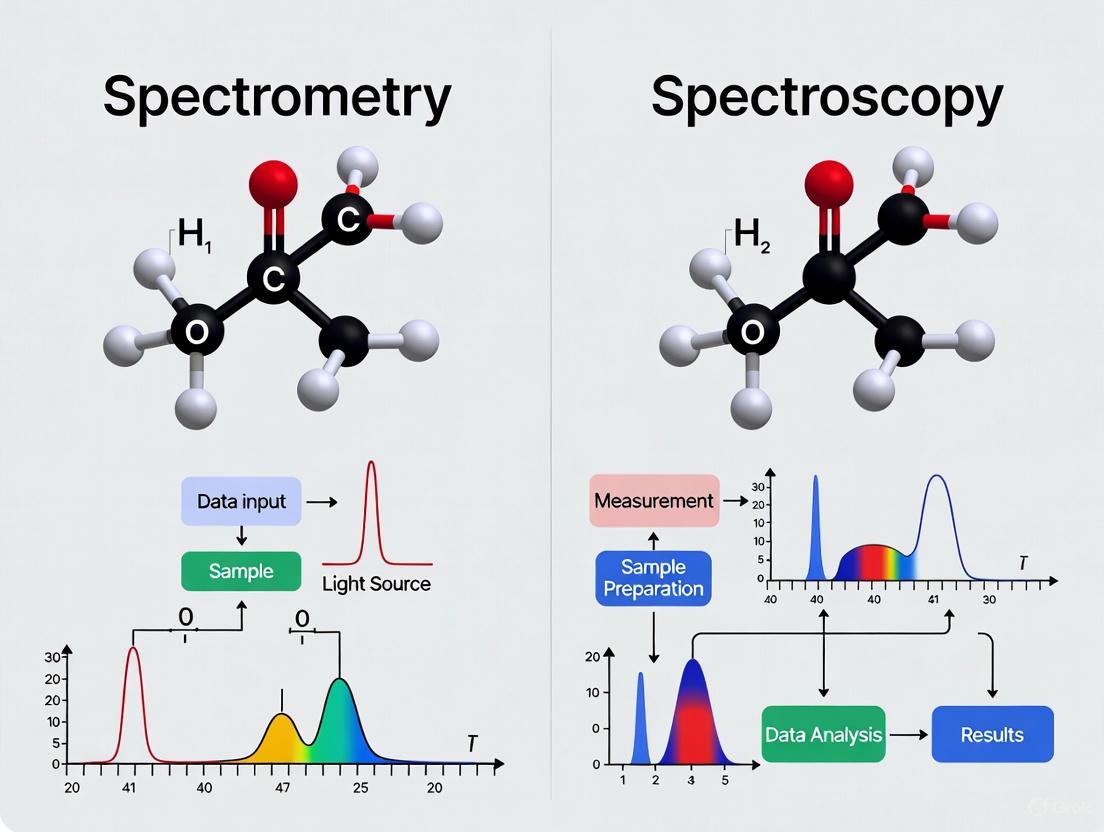
This article clarifies the critical distinction between spectroscopy, the theoretical study of light-matter interactions, and spectrometry, the practical measurement of spectra, a nuance essential for researchers and drug development professionals.
Spectrometry vs. Spectroscopy: A Clear-Cut Guide for Scientists and Drug Developers
Abstract
This article clarifies the critical distinction between spectroscopy, the theoretical study of light-matter interactions, and spectrometry, the practical measurement of spectra, a nuance essential for researchers and drug development professionals. We explore foundational principles, delve into key methodological applications in biomedicine, address common operational challenges, and provide a framework for instrument selection and data validation. By synthesizing current trends, including the integration of AI and portable devices, this guide aims to enhance analytical precision and strategic decision-making in research and development.
Spectroscopy and Spectrometry Demystified: Core Concepts for Researchers
In the fields of analytical science and drug development, the terms "spectroscopy" and "spectrometry" are often used interchangeably, creating a persistent source of confusion. However, for researchers and scientists, understanding this distinction is crucial for selecting the appropriate technique, accurately interpreting data, and effectively communicating findings. This guide delineates the core differences by framing spectroscopy as the theoretical framework for understanding energy-matter interactions, and spectrometry as the practical application concerned with the measurement of spectra to obtain quantitative data [1] [2] [3].
Core Definitions: Theory Meets Practice
The International Union of Pure and Applied Chemistry (IUPAC) provides definitive distinctions that form the basis for a clear understanding of these concepts [2] [3].
Spectroscopy is defined as "the study of physical systems by the electromagnetic radiation with which they interact or that they produce" [4] [2] [3]. It is the science of observing what happens when light or other radiant energy interacts with matter. This field is deeply rooted in quantum mechanics, as the observed interactions—whether absorption, emission, or scattering of radiation—reveal fundamental information about the electronic, vibrational, and rotational energy levels of molecules and atoms [2]. In essence, spectroscopy provides the theoretical foundation and principles.
Spectrometry is defined as "the measurement of such radiations as a means of obtaining information about the systems and their components" [4] [2] [3]. If spectroscopy is the science, spectrometry is the practical methodology. It involves the actual process of acquiring and quantifying a spectrum—a plot of the intensity of radiation as a function of wavelength or mass [1]. The term is most accurately applied to techniques that do not rely solely on electromagnetic radiation for analysis, with mass spectrometry being the prime example [2].
The relationship between these concepts, along with their associated instruments, is summarized in the table below.
Table 1: Core Concepts and Their Relationships
| Term | Core Definition | Primary Focus | Example Instrument |
|---|---|---|---|
| Spectroscopy | The study of energy-matter interactions [2] [3]. | Theoretical understanding of quantum states and molecular structure. | N/A |
| Spectrometry | The measurement of a specific spectrum [1]. | Quantitative analysis and data acquisition. | Spectrometer |
| Spectrometer | The physical instrument used to measure spectra [1]. | Hardware for generating, dispersing, and detecting signals. | Mass Spectrometer, Optical Emission Spectrometer |
Technical Distinctions in Instrumentation and Data
The theoretical divide between spectroscopy and spectrometry manifests in tangible differences in laboratory instrumentation and the nature of the data produced.
Instrumentation and Measurement Principles
The design of instruments for spectroscopy versus spectrometry varies significantly based on the physical principles being harnessed.
Spectroscopic Instrumentation: Techniques like Ultraviolet-Visible (UV-Vis), Infrared (IR), Nuclear Magnetic Resonance (NMR), and Raman spectroscopy rely on a light source and a detector, often with optical components to manipulate electromagnetic radiation [2]. The detector, which could be a simple photodiode or an array detector like a CMOS camera, records changes in the radiation after its interaction with the sample [3].
Spectrometric Instrumentation: In a technique like mass spectrometry, the instrumentation is designed to handle charged particles. It typically includes an ionization source to fragment the sample, electromagnetic fields to control ion trajectories, and a charged particle detector such as a combination of phosphor screens and multichannel plates [2].
Table 2: Comparison of Technique Principles and Applications
| Technique | Classification | Fundamental Principle | Key Measured Output | Primary Application in Pharma |
|---|---|---|---|---|
| NMR Spectroscopy [5] | Spectroscopy | Absorption of radio waves by atomic nuclei in a magnetic field. | Chemical shift (ppm) | Molecular structure determination [6]. |
| Raman Spectroscopy [5] | Spectroscopy | Inelastic scattering of monochromatic light. | Wavenumber shift (cm⁻¹) | Molecular identification, impurity detection [7]. |
| Mass Spectrometry [8] | Spectrometry | Ionization and separation of ions by mass-to-charge ratio (m/z). | Mass-to-charge ratio (m/z) | Protein identification, metabolite screening [8]. |
| UV-Vis Spectroscopy [3] | Spectroscopy | Absorption of ultraviolet or visible light. | Absorbance | Concentration determination, HOMO-LUMO gap analysis [3]. |
The Scientist's Toolkit: Essential Reagents and Materials
The following table details key reagents and materials used in the featured spectroscopic and spectrometric techniques within pharmaceutical research.
Table 3: Key Research Reagent Solutions in Pharmaceutical Analysis
| Item | Function | Example Technique |
|---|---|---|
| Deuterated Solvents | Provides a magnetically inert environment for NMR analysis without adding interfering signals. | NMR Spectroscopy [6] |
| Internal Standard | A compound of known concentration and properties used for quantitative calibration in spectroscopic analysis. | qNMR [6] |
| Referent Compound | A pure substance used as a benchmark for calculating the concentration of an analyte in quantitative measurements. | qNMR [6] |
| Matrix for MALDI | A compound that absorbs laser energy and facilitates the soft ionization of large, non-volatile molecules. | Mass Spectrometry [9] |
Experimental Protocols: From Theory to Quantification
The distinction between spectroscopy and spectrometry comes to life in experimental workflows. The following protocols illustrate how the theoretical principles of spectroscopy are applied through spectrometric measurement to yield quantitative, actionable data.
Protocol 1: Quantitative NMR (qNMR) for Drug Solubility and Purity
Quantitative NMR is a powerful application that transforms the qualitative, information-rich technique of NMR spectroscopy into a precise quantitative spectrometric method [6].
1. Sample Preparation:
- Dissolve a precisely weighed amount of the drug substance (analyte) in a suitable deuterated solvent (e.g., D₂O, CDCl₃) [6].
- Add a precise amount of a well-characterized internal standard. Ideal standards have a simple, non-overlapping NMR signal, are chemically stable, and do not interact with the analyte. Common examples include caffeine or 3-(trimethylsilyl)propionic acid [6].
2. Data Acquisition:
- Use a adequately powered NMR spectrometer (e.g., 400 MHz or higher).
- Employ a pulse sequence that allows for complete relaxation of nuclei between scans (long recycle delay) to ensure the integrated signal area is directly proportional to the number of nuclei [6].
- Acquire a sufficient number of scans to achieve a high signal-to-noise ratio.
3. Data Analysis and Quantification:
- Identify a characteristic, non-overlapping signal for the analyte and the internal standard in the acquired spectrum.
- Precisely integrate the area under each chosen peak (Ianalyte and Istandard).
- Calculate the concentration or molar ratio using the inherent quantitative relationship of qNMR [6]:
- Molar Ratio: ( n{\text{analyte}} / n{\text{standard}} = (I{\text{analyte}} / N{\text{analyte}}) / (I{\text{standard}} / N{\text{standard}}) )
- Absolute Content: ( m{\text{analyte}} = (I{\text{analyte}} / N{\text{analyte}}) \times (N{\text{standard}} / I{\text{standard}}) \times (M{\text{analyte}} / M{\text{standard}}) \times m{\text{standard}} )
Where
nis moles,Iis integral area,Nis the number of nuclei contributing to the signal,Mis molar mass, andmis gravimetric mass [6].
Diagram: qNMR Experimental Workflow. This protocol transforms NMR spectroscopy into a quantitative spectrometric tool.
Protocol 2: AI-Enhanced Raman Spectroscopy for Impurity Detection
The integration of artificial intelligence with Raman spectroscopy exemplifies the evolution of a spectroscopic technique into a high-throughput, quantitative analysis platform [7].
1. Spectral Data Collection:
- Use a Raman spectrometer to analyze multiple batches of a pharmaceutical product, including both pure samples and those with known, controlled levels of impurities.
- For each sample, collect the full Raman spectrum, which serves as a molecular "fingerprint" [7].
2. AI Model Training:
- Pre-process the raw spectral data to reduce noise and correct for baseline drift.
- Annotate the spectra with their known impurity status or concentration to create a labeled training dataset.
- Train a deep learning model, such as a Convolutional Neural Network (CNN) or Transformer, to learn the complex patterns in the spectral data that are correlated with the presence of impurities [7]. The model learns to differentiate the subtle spectral changes caused by contaminants from the signal of the main API.
3. Prediction and Interpretation:
- Input the Raman spectrum of an unknown production batch into the trained AI model.
- The model outputs a prediction regarding impurity presence and can often provide a confidence score.
- To address the "black box" nature of AI, employ interpretability methods like attention mechanisms to highlight which regions of the Raman spectrum were most influential in the model's decision, thereby connecting the AI's output back to spectroscopic theory [7].
Diagram: AI-Enhanced Raman Workflow. AI adds a quantitative, predictive layer to spectroscopic data.
The divide between spectroscopy and spectrometry is not a barrier but a definition of roles. Spectroscopy provides the fundamental theoretical understanding of how matter behaves at the quantum level when probed with energy. Spectrometry provides the rigorous, quantitative measurement framework that turns those interactions into actionable data. In modern drug development, from using qNMR to determine API solubility to employing AI-powered Raman for quality control, these disciplines are not opposed but are synergistic partners [6] [7]. A clear comprehension of this distinction empowers scientists to better select techniques, interpret results, and drive innovation in pharmaceutical research and beyond.
The journey from a simple glass prism to modern mass spectrometers represents a cornerstone of analytical science, fundamentally shaping research across physics, chemistry, and biology. This evolution is framed by a critical conceptual distinction: spectroscopy is the theoretical science investigating the interaction between radiated energy and matter [10] [1], while spectrometry refers to the practical measurement and quantification of a spectrum to generate analytical results [10] [1]. This whitepaper traces the key historical milestones in this field, details the experimental methodologies that enabled these discoveries, and provides a toolkit for researchers, all within the context of this fundamental dichotomy between theory and practice. Understanding this history and its underlying principles is essential for today's scientists, particularly in drug development, where these techniques are pivotal for everything from target identification to clinical candidate analysis [11] [12].
Historical Timeline: Key Milestones
The development of spectroscopy and spectrometry was not a single event but a cumulative process spanning centuries, with each building upon the work of predecessors. The table below summarizes the pivotal discoveries and the key figures behind them.
Table 1: Key Historical Milestones in Spectroscopy and Spectrometry
| Date | Scientist(s) | Contribution | Impact on Spectroscopy/Spectrometry |
|---|---|---|---|
| 1666-1672 | Sir Isaac Newton [13] [14] | Used a prism to disperse white light into a continuous spectrum of colors, which he named the "spectrum" [15] [14]. | Foundational Spectroscopy: Established the composite nature of white light and provided the basic experimental model. |
| 1802 | William Hyde Wollaston [13] | Built an improved spectrometer with a lens to focus the spectrum onto a screen, noting dark gaps in the Sun's spectrum [13]. | Early Spectrometry: Developed the first true instrument for spectral measurement, leading to the discovery of absorption lines. |
| 1815 | Joseph von Fraunhofer [13] | Replaced the prism with a diffraction grating, greatly improving resolution; systematically mapped and quantified the dark lines in the solar spectrum (Fraunhofer lines) [13]. | Father of Spectroscopy: Transitioned from qualitative observation to precise, quantifiable spectrometry. |
| 1859 | Gustav Kirchhoff & Robert Bunsen [15] [13] | Demonstrated that each element has a unique spectral signature and that Fraunhofer lines correspond to absorption by elements in the Sun's atmosphere [15] [13]. | Theoretical Spectroscopy: Linked spectral lines to atomic composition, creating spectroscopy as a tool for chemical identification. |
| Early 1900s | Niels Bohr, Werner Heisenberg, Erwin Schrödinger [15] | Developed quantum theory, providing the theoretical explanation for why elements emit and absorb at specific wavelengths [15]. | Theoretical Foundation: Explained the mechanistic origin of spectral lines, completing the theoretical framework of spectroscopy. |
| 20th-21st Century | Continuous Innovations | Development of diverse techniques (UV, IR, Atomic, Mass Spectrometry) [15] and advanced instruments like ICP-MS [15] and hybrid mass spectrometers [12]. | Modern Spectrometry: Expansion into various energy-matter interactions and application across countless fields, from pharmaceuticals to materials science [15] [12]. |
The following diagram visualizes this progression of knowledge and technology from the initial observation of the spectrum to the modern theoretical understanding.
Experimental Methodologies: From Foundational to Modern
The historical progression was enabled by key experiments whose methodologies can be clearly delineated.
Newton's Prism Experiment (1666)
- Objective: To investigate the nature of white light.
- Protocol:
- A beam of sunlight was allowed into a dark room through a small slit.
- This beam was passed through a glass prism.
- The resulting output was observed on a screen [14].
- Outcome: The white light was dispersed into its constituent colors—red, orange, yellow, green, blue, indigo, violet—producing a continuous spectrum. This demonstrated that white light is composite, not a simple, pure entity [14].
Fraunhofer's Diffraction Grating Experiment (c. 1815)
- Objective: To achieve higher resolution spectral measurements and quantify wavelengths.
- Protocol:
- Newton's prism was replaced with a diffraction grating (a plate with many parallel, closely spaced slits) as the dispersive element [13].
- Light from a source (e.g., the sun) was passed through a single rectangular slit before hitting the diffraction grating.
- The resulting dispersed spectrum was observed and measured [13].
- Outcome: The spectral resolution was vastly improved, allowing for the precise mapping of the dark absorption lines (Fraunhofer lines) in the solar spectrum. This marked a shift from qualitative observation to quantitative spectrometry [13].
Kirchhoff and Bunsen's Spectral Analysis (1859)
- Objective: To determine the relationship between absorption/emission lines and chemical elements.
- Protocol:
- Purified chemical elements were heated in a flame (Bunsen burner) to produce emission spectra [15].
- The characteristic bright lines in the emission spectra of these heated elements were recorded [15].
- These laboratory emission lines were then compared to the dark absorption lines (Fraunhofer lines) in the solar spectrum [15] [13].
- Outcome: They established that the dark lines in the solar spectrum were due to the absorption of light by specific elements in the Sun's (and Earth's) atmosphere. This proved that spectral analysis could identify elements in distant stars and terrestrial samples, founding the science of spectroscopic chemical analysis [15] [13].
The Scientist's Toolkit: Instruments and Reagents
Modern spectrometry encompasses a wide array of techniques, each with specific instrumentation and applications, particularly in drug discovery and development.
Table 2: Key Spectrometry Techniques and Research Reagent Solutions
| Technique / Item | Category | Function & Application in Research |
|---|---|---|
| Prism | Optical Component | Disperses light via refraction. Foundational for early spectrometers and educational demonstrations [15]. |
| Diffraction Grating | Optical Component | Disperses light via diffraction and interference. Provides higher resolution than a prism and is standard in modern optical spectrometers [15] [10]. |
| Mass Spectrometer (MS) | Instrument | Measures mass-to-charge ratio of ions to identify and quantify molecules in a sample. Central to proteomics, metabolomics, and pharmacokinetics [10] [12]. |
| Liquid Chromatograph (LC) | Sample Prep / Separation | Often coupled with MS (LC-MS) to separate complex mixtures before mass analysis. Essential for analyzing biomolecules in biological fluids [12] [16]. |
| Inductively Coupled Plasma (ICP) Source | Ionization Source | Used in ICP-MS to detect minute quantities of trace elements, such as metals in biological samples (e.g., urine) [15]. |
| Triple Quadrupole Mass Analyzer | Mass Analyzer | A type of mass spectrometer known for high sensitivity and precision in quantitative analysis, commonly used in biomarker and drug metabolite quantification [12] [16]. |
| Infrared (IR) Spectrometer | Instrument | Measures molecular vibrations to identify functional groups and unknown compounds. Used for protein characterization and quality control [15] [10]. |
| Quantum Cascade Laser (QCL) | Light Source | A modern, tunable IR laser source that provides high intensity and precision for specific absorption bands (e.g., the Amide I band for proteins), improving IR sensitivity [10]. |
The workflow for a generic optical spectrometer, integrating these core components, is illustrated below.
The journey from Newton's prism to today's high-resolution mass spectrometers is a powerful narrative of scientific progress. It underscores the perpetual and critical interplay between theory (spectroscopy) and practice (spectrometry). The theoretical understanding of how energy interacts with matter, pioneered by Newton, Fraunhofer, Kirchhoff, and the quantum physicists, provided the essential framework. This framework, in turn, empowered the development of increasingly sophisticated tools of measurement—the spectrometers—that define modern analytical science.
This legacy is profoundly evident in today's biopharmaceutical industry, where spectrometry is indispensable. It accelerates drug discovery [11], enables the precise quantification of biomarkers [16], ensures drug safety [12], and drives the development of novel therapies through techniques like multi-omics research [11] [12]. As spectrometry continues to evolve with advancements in automation, AI, and quantum technologies [11], its role in empowering researchers and scientists to solve complex biological problems will only become more central, continuing a history of innovation that began with a simple beam of light and a prism.
In scientific research, particularly in fields like drug development and material science, the terms spectroscopy and spectrometry are often used interchangeably, yet they represent distinct concepts. Spectroscopy is the theoretical science that studies the interaction between radiated energy and matter [10]. It involves the principles behind how matter absorbs, emits, or scatters electromagnetic radiation to reveal its properties [1]. Spectrometry, in contrast, is the practical application; it is the method used to acquire a quantitative measurement of a spectrum [10]. Essentially, spectroscopy provides the theoretical framework for understanding energy-matter interactions, while spectrometry is the process of generating quantifiable results [1].
The spectrometer is the physical instrument that forms the crucial bridge between these concepts and empirical data. It is the device that measures the variation of a physical characteristic—such as light intensity, mass-to-charge ratio, or nuclear resonant frequencies—over a given range to produce a spectrum [10]. This guide explores how spectrometers translate theoretical interactions into actionable data, detailing the core technologies, methodologies, and applications that make them indispensable in modern research.
Spectrometer Technologies: The Core of Quantitative Analysis
Spectrometers are engineered to measure specific types of interactions, and their design is tailored to the physical principles they exploit. The most common types found in research laboratories are optical spectrometers, mass spectrometers, and Nuclear Magnetic Resonance (NMR) spectrometers [10]. Each type generates a different kind of spectrum, from which researchers can extract precise quantitative information about a sample's composition, structure, and dynamics.
Table 1: Key Spectrometer Technologies and Their Applications in Research
| Technology | Measured Property | Primary Research Applications | Key Strengths |
|---|---|---|---|
| Optical Spectrometer [17] | Variation in light absorption, emission, or scattering | UV-VIS: Protein, metabolite, and nucleic acid analysis [17]. IR: Vibrational analysis of molecular bonds [18]. | Non-destructive, highly accurate, applicable to solids, liquids, and gases [17]. |
| Mass Spectrometer (MS) [10] | Mass-to-charge ratio (m/z) of ions | Isotope dating, protein characterization, identification of unknown compounds [10] [18]. | High sensitivity for trace element detection, capable of identifying a wide range of compounds [19]. |
| NMR Spectrometer [10] | Nuclear resonant frequencies | Molecular structure determination, metabolic profiling (e.g., MRS for brain chemistry) [10]. | Provides detailed atomic-level structural information. |
| X-ray Fluorescence (XRF) [20] | Emission of inner-shell electrons | Quantitative elemental analysis of soils, alloys, and materials [20]. | Non-destructive, requires minimal sample preparation. |
| Raman Spectrometer [17] | Inelastically scattered light | Identification of chemical structures and phases in solids, liquids, and gases. | Requires no sample preparation, non-destructive, can probe aqueous samples [17]. |
The fundamental operation of an optical spectrometer, the most common type, involves three core functions: producing a spectrum from a light source, dispersing it, and measuring the intensities of its spectral lines [17]. Light is passed from an incandescent source to a diffraction grating and then to a mirror, which projects the diffracted wavelengths onto a detector, such as a charge-coupled device (CCD) [10]. This process allows scientists to identify a substance by comparing its unique spectral pattern to known markers [17].
Table 2: Hybrid Chromatography-Spectrometry Systems
| System | Separation Method | Ionization Method | Ideal Application in Drug Development |
|---|---|---|---|
| Gas Chromatography-Mass Spectrometry (GC/MS) [19] | Gas mobile phase & heat | Electron impact ionization | Analysis of volatile, thermally stable compounds (e.g., residual solvents, metabolic screening) [19]. |
| Liquid Chromatography-Mass Spectrometry (LC/MS) [19] | Liquid mobile phase & high pressure | Electrospray ionization (ESI) | Analysis of non-volatile, thermally labile, or polar molecules (e.g., proteins, peptides, most pharmaceuticals) [19]. |
Experimental Methodologies: From Sample to Spectrum
Robust experimental protocols are essential for generating reliable data. The following sections detail methodologies for two critical techniques: XRF quantitative analysis and chromatographic separation coupled with mass spectrometry.
Protocol: Deep Learning-Enhanced Quantitative XRF Analysis
This protocol, based on a 2025 study, uses a Multi-energy State Attention Fusion Network (MSAF-Net) to achieve high-precision elemental analysis [20].
- Objective: To accurately quantify the concentration of elements (Si, Al, Fe, Mg, Ca, K, and heavy metals) in soil samples using multi-energy XRF spectra.
- Materials and Reagents:
- XRF Spectrometer with a multi-energy excitation source.
- 9855 simulated soil spectra for model training.
- 118 field-collected soil samples for validation.
- MSAF-Net Software: A custom deep learning environment (Python, TensorFlow/PyTorch).
- Procedure:
- Data Acquisition: Collect XRF spectral data from the sample at multiple energy states.
- Spectral Preprocessing:
- Model Application:
- Process the weighted spectra from each energy state through the Dynamic Fusion Scoring Module (DFSM). This module learns distinct weights for each energy state to ensure balanced information integration [20].
- The DFSM evaluates the fused output using a pre-training scoring mechanism.
- Model Training:
- Employ a two-stage optimization strategy to prevent the model from settling on a mediocre solution [20]:
- Stage 1 (Pre-training): Individually train each energy state branch of the neural network.
- Stage 2 (Joint Training): Conduct constrained joint training of all branches to promote comprehensive information sharing.
- Employ a two-stage optimization strategy to prevent the model from settling on a mediocre solution [20]:
- Quantitative Prediction: Use the trained MSAF-Net model to predict elemental concentrations from the fused and processed spectral data.
- Validation: The model's performance is validated by achieving a coefficient of determination (R²) above 0.98 for major elements and a Ratio of Performance to Deviation (RPD) above 7.5 [20].
Protocol: Compound Identification via GC/MS or LC/MS
This protocol outlines the general workflow for separating and identifying compounds in a complex mixture, common in pharmaceutical and biomedical analysis [19].
- Objective: To separate, identify, and quantify individual components within a complex chemical mixture (e.g., drug metabolites, forensic samples).
- Materials and Reagents:
- GC/MS or LC/MS System.
- GC Consumables: Inert gas carrier (e.g., Helium), fused-silica capillary column, liners, septa.
- LC Consumables: High-purity solvents (e.g., water, acetonitrile, methanol), analytical column (e.g., C18), buffers.
- Standard solutions of target analytes for calibration.
- Procedure:
- Sample Preparation:
- For GC/MS: The sample must be volatile and thermally stable. Derivatization may be necessary to increase volatility.
- For LC/MS: The sample is dissolved in a solvent compatible with the mobile phase. Filtration is often required to remove particulates.
- Chromatographic Separation:
- GC/MS: A微量 amount of sample is injected into a heated port, vaporized, and carried by an inert gas through a capillary column. The oven temperature is precisely controlled to separate compounds based on their volatility and affinity for the stationary phase [19].
- LC/MS: The sample is injected into a stream of liquid mobile phase and pumped at high pressure through a packed column. Compounds are separated based on their polarity, size, and affinity for the stationary phase [19].
- Ionization and Mass Analysis:
- As separated compounds elute from the chromatograph, they are ionized.
- GC/MS typically uses Electron Impact (EI) ionization.
- LC/MS typically uses softer ionization like Electrospray Ionization (ESI).
- The resulting ions are introduced into the mass spectrometer, where they are separated based on their mass-to-charge ratio (m/z) and detected [19].
- As separated compounds elute from the chromatograph, they are ionized.
- Data Analysis: The data system generates a chromatogram (intensity vs. time) and a mass spectrum for each detected peak. Compounds are identified by comparing their mass spectra and retention times to those of known standards in a library.
- Sample Preparation:
Diagram 1: GC/MS analysis workflow.
The Scientist's Toolkit: Essential Research Reagent Solutions
Table 3: Essential Materials for Spectrometric Experiments
| Item | Function | Application Example |
|---|---|---|
| Quantum Cascade Laser (QCL) [10] | A tunable mid-infrared laser source that provides high intensity and precision for excitation. | Used in advanced IR spectrometers (e.g., RedShiftBio Aurora) for highly sensitive analysis of the Amide I band in proteins [10]. |
| Diffraction Grating [10] | Disperses incident light into its constituent wavelengths to create a spectrum for measurement. | A core component in optical spectrometers, replacing prisms in modern devices for higher resolution [10]. |
| Charge-Coupled Device (CCD) [10] | A highly sensitive light detector that captures the 2D spectral data projected by the diffraction grating. | Used in digital spectroscopy to capture spectra that are then extracted and manipulated into 1D spectral data [10]. |
| EDX Detector [10] | Identifies and quantifies elements present in a sample by measuring energy-dispersive X-rays. | Coupled with Scanning Electron Microscopes (SEM) for spatially-resolved elemental analysis at the nanoscale [10]. |
| Mobile Phases (GC & LC) [19] | The solvent or gas that carries the sample through the chromatographic column. | GC: Inert gases like Helium. LC: Solvent mixtures (e.g., water/acetonitrile) often with modifiers for optimal separation [19]. |
Data Processing and Analysis: From Raw Signal to Scientific Insight
The raw data captured by a spectrometer is rarely used directly. Spectral data is inherently prone to interference from environmental noise, instrumental artifacts, and sample impurities, which can significantly degrade measurement accuracy [21]. A robust preprocessing pipeline is therefore critical.
Diagram 2: Spectral data preprocessing workflow.
Key preprocessing steps include [21]:
- Cosmic Ray Removal: Filtering out sharp, high-intensity spikes caused by high-energy particles.
- Baseline Correction: Removing the non-linear background signal caused by instrumental artifacts or sample scattering.
- Normalization: Scaling spectra to a common standard to correct for variations in absolute intensity.
- Spectral Derivatives: Applying derivatives (e.g., Savitzky-Golay) to enhance spectral features and resolve overlapping peaks.
The field is undergoing a transformation with the integration of machine learning. As demonstrated by the MSAF-Net for XRF, deep learning models can adaptively weight spectral features, fuse data from multiple sources, and overcome traditional limitations in quantitative analysis, achieving classification accuracy greater than 99% [20] [21].
The spectrometer stands as the definitive instrumental link, transforming the theoretical concepts of spectroscopy into the quantitative data of spectrometry. This bridge enables researchers to decode the fundamental composition of matter, from characterizing a protein's structure to quantifying toxic elements in soil. As spectrometer technology continues to evolve—integrated with advanced computing, sophisticated data processing, and machine learning—its role as the cornerstone of empirical scientific discovery will only grow more profound, ensuring that the questions posed by theoretical science can be answered with precise, actionable data.
The study of how light and matter interact forms the cornerstone of analytical techniques indispensable to modern scientific research, particularly in pharmaceutical development. These interactions—absorption, emission, and scattering—provide the fundamental basis for spectroscopy, which is defined as the study of physical systems by the electromagnetic radiation with which they interact or that they produce [3]. The measurement of such radiations to obtain information about systems and their components is termed spectrometry [3] [2]. This distinction frames spectroscopy as the theoretical framework and spectrometry as the practical measurement process. In pharmaceutical sciences, these methodologies enable researchers to determine molecular structures, identify compounds, quantify concentrations, and monitor reactions in real-time, forming an critical part of drug discovery, development, and quality control [22] [23].
The electromagnetic spectrum utilized in these investigations spans a broad range of energies, each interacting with matter in distinct ways. X-ray regimes (0.1 nm to 100 nm) involve high-energy photons that excite core electrons and can cause ionization, making them suitable for elemental analysis [22]. The ultraviolet and visible (UV-Vis) regime (100 nm to 1 μm) is dominated by electronic transitions in molecules, particularly those with chromophores, conjugated pi-systems, or aromatic rings [22]. The infrared regime (1 to 30 μm) probes molecular vibrations, with the near-infrared (NIR) revealing overtone and combination bands, while the mid-infrared exposes fundamental vibrational modes [22]. The terahertz regime (30 to 3000 μm) investigates intermolecular vibrations such as hydrogen bonding and dipole-dipole interactions, and the microwave regime (3 to 300 mm) studies molecular rotations [22]. Understanding how each spectral region interacts with matter provides researchers with a diverse analytical toolkit for addressing complex pharmaceutical challenges.
Fundamental Principles and Theoretical Framework
Absorption
Absorption occurs when the energy of an incident photon corresponds exactly to the energy difference between two quantum mechanical states in an atom or molecule, resulting in the photon's energy being transferred to the species [22]. This process promotes electrons from ground states to excited states or excites molecular vibrations/rotations, depending on the photon energy. The resulting attenuation of the transmitted light intensity follows the Beer-Lambert Law, which states that absorbance is proportional to the concentration of the absorbing species and the path length of light through the sample [22]. In the X-ray region, absorption involves the ejection of core-level electrons (e.g., from 1s, 2s, or 2p orbitals) when the incident photon energy equals or exceeds their binding energy [24]. This creates a characteristic sharp increase in absorption known as an "absorption edge," which is element-specific [24]. In UV-Vis spectroscopy, absorption corresponds to electronic transitions between molecular orbitals, providing information about chromophores and conjugated systems, with the HOMO-LUMO gap being particularly important for optoelectronic materials [3] [22].
Emission
Emission processes occur when excited species return to lower energy states, releasing the excess energy as photons. This can happen through various pathways: photoluminescence (including fluorescence and phosphorescence) involves prior absorption of photons, chemiluminescence results from chemical reactions, and radioluminescence occurs following ionization [3]. In X-ray spectroscopy, emission accompanies the relaxation of atoms following the creation of a core hole. When an electron from a higher shell fills the core hole, the energy difference is emitted as a characteristic X-ray photon [24]. This emitted radiation is measured in techniques like X-ray Emission Spectroscopy (XES), providing information about the electronic structure and local chemical environment [24]. The intensity and spectral distribution of emission can reveal molecular concentrations, environmental conditions, and energy transfer efficiencies, with quantum yield being an important parameter for light-emitting applications [3].
Scattering
Scattering involves the redirection of photons by matter, occurring in two primary forms. Elastic scattering (Rayleigh or Mie scattering) happens when photons change direction without energy exchange, preserving the incident wavelength [25] [22]. Inelastic scattering involves energy transfer between the photon and the scattering material. The most significant inelastic process is Raman scattering, where the photon either loses energy to (Stokes shift) or gains energy from (anti-Stokes shift) molecular vibrations or rotations [25]. Raman scattering occurs due to temporary distortion of the electron cloud during photon interaction, depending on changes in molecular polarizability rather than dipole moments [25]. Unlike absorption-emission processes that occur on picosecond-to-microsecond timescales, scattering is virtually instantaneous, happening within femtoseconds [22]. Raman spectroscopy benefits from low interference from water molecules, making it particularly valuable for biomedical and pharmaceutical applications where aqueous environments are common [25] [22].
Table 1: Fundamental Light-Matter Interaction Processes
| Interaction Type | Energy Exchange | Key Governing Principle | Resulting Phenomena |
|---|---|---|---|
| Absorption | Photon energy transferred to matter | Energy matching between photon and quantum states | Electronic, vibrational, or rotational excitation |
| Emission | Excess energy released as photon | Relaxation from excited to ground state | Fluorescence, phosphorescence, X-ray emission |
| Elastic Scattering | No energy exchange | Electromagnetic interaction preserving photon energy | Rayleigh scattering, Mie scattering |
| Inelastic Scattering | Energy exchange between photon and matter | Temporary distortion of electron cloud | Raman scattering (Stokes, anti-Stokes) |
Quantum Mechanical Foundations
The interaction between light and matter is fundamentally governed by quantum mechanics, with spectroscopy often described as "applied quantum mechanics" [3] [2]. The energy of electromagnetic radiation is quantized into photons, with energy E = hν, where h is Planck's constant and ν is the frequency. Molecules possess discrete energy levels corresponding to electronic, vibrational, and rotational states, with electronic energies typically in the UV-Vis range, vibrational energies in the infrared, and rotational energies in the microwave region [22]. Transitions between these states obey selection rules based on quantum numbers and symmetry considerations. For absorption to occur, the incident photon must match the energy difference between states, and the interaction must induce a change in dipole moment (for IR absorption) or polarizability (for Raman scattering) [25] [22]. The quantum mechanical framework not only explains observed spectroscopic phenomena but also enables prediction of molecular behavior and design of materials with tailored optical properties [3].
Spectroscopic Techniques Based on Light-Matter Interactions
Absorption-Based Techniques
Ultraviolet-Visible (UV-Vis) Spectroscopy measures electronic transitions between molecular orbitals, particularly in chromophores with conjugated π-systems [22]. This technique provides information about HOMO-LUMO gaps in optoelectronic materials and can monitor solute-solvent interactions [3]. Quantitative analysis follows the Beer-Lambert law, where absorbance is proportional to concentration, enabling determination of solute concentrations in solutions [22]. Infrared (IR) Spectroscopy probes molecular vibrations that involve changes in dipole moment, with the mid-IR region (400-4000 cm⁻¹) providing characteristic fingerprint patterns for molecular identification [22]. IR spectroscopy can be performed in transmission mode or using attenuated total reflection (ATR), which is particularly useful for analyzing solids, liquids, and pastes without extensive sample preparation [22]. X-ray Absorption Spectroscopy (XAS) measures the absorption coefficient of a material as a function of incident X-ray energy, providing element-specific information about unoccupied electronic states and local atomic structure [24]. XAS encompasses several sub-techniques: XANES (X-ray Absorption Near-Edge Structure) reveals oxidation states and coordination chemistry, while EXAFS (Extended X-ray Absorption Fine Structure) provides bond distances and coordination numbers [24].
Emission-Based Techniques
Fluorescence Spectroscopy measures the emission of photons following electronic excitation, providing information about molecular environment, conformational changes, and intermolecular interactions [3]. The technique offers high sensitivity and is widely used in pharmaceutical analysis for studying drug-biomolecule interactions [24]. X-ray Emission Spectroscopy (XES) analyzes the characteristic X-rays emitted when core holes are filled by higher-level electrons, offering complementary information to XAS about occupied electronic states and chemical bonding [24]. Resonant Inelastic X-ray Scattering (RIXS) is a more advanced emission technique that provides enhanced insights into electronic excitations by tuning the incident X-ray energy to specific absorption resonances [24]. In pharmaceutical applications, emission techniques are valuable for probing metal centers in proteins, studying drug-DNA interactions, and characterizing active pharmaceutical ingredients (APIs) in both crystalline and amorphous forms [24].
Scattering-Based Techniques
Raman Spectroscopy relies on inelastic scattering of light to probe molecular vibrations that involve changes in polarizability [25]. Unlike IR spectroscopy, Raman is particularly effective for studying aqueous systems and symmetric molecular vibrations [25]. The Raman effect is inherently weak, with only approximately 1 in 10⁷ photon-matter interactions resulting in inelastic scattering [25]. Surface-Enhanced Raman Spectroscopy (SERS) dramatically increases sensitivity by several orders of magnitude through adsorption of molecules on rough metal surfaces or colloidal nanoparticles, enabling single-molecule detection in some cases [25]. Resonance Raman Spectroscopy (RRS) provides signal enhancements of up to six orders of magnitude by tuning the excitation wavelength to coincide with electronic transitions of the analyte [25]. These enhanced Raman techniques have opened new possibilities for biomedical diagnostics, including cancer detection, neurosurgical guidance, and analysis of circulating tumor cells [25]. Elastic Scattering Techniques including Rayleigh and Mie scattering are used for particle size determination and structural characterization, though they provide less chemical information than inelastic methods [22].
Table 2: Major Spectroscopic Techniques and Their Applications in Pharmaceutical Research
| Technique | Primary Interaction | Information Obtained | Pharmaceutical Applications |
|---|---|---|---|
| UV-Vis Spectroscopy | Absorption | Electronic structure, concentration | API quantification, HOMO-LUMO gap determination |
| IR Spectroscopy | Absorption | Molecular vibrations, functional groups | Compound identification, polymorph characterization |
| XAS/XES | Absorption & Emission | Local atomic structure, oxidation states | Metal-drug complexes, protein-metal interactions |
| Fluorescence | Emission | Molecular environment, interactions | Drug-biomolecule binding studies, conformational changes |
| Raman/SERS | Inelastic scattering | Molecular vibrations, structural fingerprint | In vivo tissue analysis, cancer diagnosis, formulation testing |
Experimental Methodologies and Measurement Approaches
X-ray Absorption Spectroscopy Protocols
XAS experiments are typically performed at synchrotron facilities that provide intense, tunable X-ray sources [24]. Samples can be analyzed as solids, liquids, or gases without special preparation, though the measurement mode must be selected based on sample properties [24]. The transmission mode is preferred for concentrated samples (>10% element of interest) with uniform thickness, measuring intensity before (I₀) and after (Iₜ) the sample using ionization chambers [24]. The absorption coefficient μ is calculated as ln(I₀/Iₜ) [24]. For dilute samples or those with inhomogeneous distribution, fluorescence detection is employed, where the intensity of characteristic X-rays (Iƒ) emitted after absorption is measured at 90° to the incident beam using specialized detectors [24]. This approach significantly improves signal-to-noise for trace elements but may suffer from self-absorption effects that require mathematical correction [24]. Electron yield detection measures electrons emitted during the relaxation process and is particularly surface-sensitive [24]. Modern XAS experiments often employ in situ or operando setups to monitor dynamic processes in real-time, with acquisition times ranging from milliseconds to minutes depending on concentration and beam intensity [24].
Raman and SERS Experimental Protocols
Conventional Raman spectroscopy requires minimal sample preparation, with solids, liquids, and gases all amenable to analysis [25]. The experimental setup involves a laser source (typically in UV, visible, or NIR regions), a spectrometer with wavelength dispersion capability, and a sensitive detector (commonly CCD cameras) [25]. For SERS measurements, substrate preparation is critical: roughened metal electrodes, metal nanoparticle colloids, or nanostructured metal films are used to create plasmonic hot spots that enhance Raman signals [25]. Optimal enhancement occurs when the laser wavelength overlaps with the surface plasmon resonance of the metal substrate [25]. Biological samples for SERS analysis often require specific preparation techniques to ensure proper interaction with the enhancing substrate while maintaining biological activity [25]. For in vivo applications, fiber-optic probes enable remote sensing and imaging in clinical settings [25]. Data acquisition parameters (laser power, integration time, spectral range) must be optimized to maximize signal while minimizing sample degradation, particularly for sensitive biological specimens [25].
Data Analysis and Interpretation Methods
Spectroscopic data analysis ranges from simple univariate approaches to complex multivariate techniques [22]. Qualitative analysis typically involves comparison of measured spectra with reference databases using cross-correlation algorithms [22]. Quantitative analysis may employ univariate methods based on Beer-Lambert law (for absorption) or calibration curves when distinct spectral signatures can be assigned to specific analytes [22]. For complex mixtures with overlapping signals, multivariate analysis techniques are essential: Partial Least Squares Regression (PLSR) establishes relationships between spectral variables and concentration, Support Vector Machines (SVM) handle classification tasks, and Artificial Neural Networks (ANN) model nonlinear relationships in large datasets [22]. Raman spectral analysis often incorporates machine learning frameworks to identify disease-specific patterns from complex biological samples, though care must be taken to avoid overfitting with overly complex models [25]. XAS data processing involves background subtraction, normalization, and Fourier transformation of EXAFS oscillations to obtain radial distribution functions for bond distance and coordination number determination [24].
The Scientist's Toolkit: Essential Research Reagents and Materials
Table 3: Key Research Reagent Solutions for Spectroscopic Experiments
| Reagent/Material | Function/Purpose | Application Examples |
|---|---|---|
| Synchrotron Radiation Source | High-intensity, tunable X-rays for excitation | XAS, XES experiments requiring element-specific excitation [24] |
| Metal Nanoparticles (Au, Ag) | Plasmonic enhancement for signal amplification | SERS substrates for trace molecular detection [25] |
| Ionization Chambers | Measurement of X-ray intensity before/after sample | Transmission mode XAS experiments [24] |
| ATR Crystals (Diamond, ZnSe) | Internal reflection element for evanescent wave sampling | FTIR spectroscopy of solids, liquids without preparation [22] |
| Fluorescence Detectors | Measurement of characteristic emission signals | XES, fluorescence yield XAS for dilute samples [24] |
| Monochromators | Wavelength selection and dispersion | Scanning spectroscopy, Raman spectrometer systems [3] |
| CCD Detectors | High-sensitivity light detection for weak signals | Raman spectroscopy, dispersive spectrometer systems [3] [25] |
| UHPLC Systems | High-pressure separation for complex mixtures | LC-MS integration for proteomics, biopharmaceutical analysis [26] |
| Orbitrap Mass Analyzers | High-resolution accurate mass measurement | Proteomic research, biopharmaceutical characterization [27] [26] |
Pharmaceutical Applications and Research Implications
The application of spectroscopy and spectrometry in pharmaceutical research continues to expand with technological advancements. Drug Development and Quality Control increasingly relies on spectroscopic methods for both qualitative and quantitative analysis [22]. UV-Vis spectroscopy provides rapid concentration measurements, while IR and Raman techniques offer molecular fingerprinting for identity confirmation and polymorph characterization [22]. The non-destructive nature of many spectroscopic methods makes them ideal for analyzing precious compounds and for at-line or in-line process analytical technology (PAT) applications in manufacturing [22]. Biopharmaceutical Characterization has been revolutionized by advanced mass spectrometry techniques, particularly LC-MS systems incorporating Orbitrap technology that deliver increased speed, sensitivity, and multiplexing capabilities [27]. These systems enable researchers to quantify and validate proteins with greater precision, accelerating discoveries in precision medicine and complex diseases like Alzheimer's and cancer [27]. The Orbitrap Astral Zoom mass spectrometer, for example, enables 35% faster scan speeds and 40% higher throughput compared to previous generations, marking an important milestone in translating proteomics to clinical research applications [27].
Biomedical Diagnostics represents another growing application area, particularly for Raman and SERS techniques [25]. The integration of Raman spectroscopy with machine learning algorithms has demonstrated diagnostic accuracy exceeding 85% for conditions including brain disorders, various cancers, and infectious diseases like COVID-19 [25]. SERS-based biosensors can detect viral RNA and proteins from swab samples within minutes, offering extremely high sensitivity, rapid response, and convenient operation [25]. In neurosurgery, Raman techniques provide real-time guidance for tumor margin detection, helping surgeons maximize tumor resection while preserving healthy tissue [25]. Drug-Molecule Interaction Studies benefit greatly from X-ray absorption and emission spectroscopies, which can probe local atomic structure around metal centers in metallodrugs and investigate coordination environments in protein-metal complexes [24]. These element-specific techniques provide information about oxidation states, electronic configuration, and local geometry that complements structural data from other analytical methods [24]. The high penetration depth of X-rays enables studies of samples in various states (solid, liquid, gas) without special preparation, while the absence of long-range order requirements makes XAS suitable for both crystalline and amorphous materials [24].
The fundamental principles of light-matter interaction—absorption, emission, and scattering—provide the theoretical foundation for spectroscopic science, while their practical measurement constitutes spectrometry. These complementary approaches enable comprehensive characterization of pharmaceutical compounds from atomic to macroscopic scales. Absorption techniques reveal electronic and vibrational structures, emission methods provide insights into excited states and relaxation processes, and scattering approaches yield molecular fingerprint information even in challenging environments like aqueous solutions. The continuing evolution of spectroscopic instrumentation, including higher-resolution mass spectrometers, brighter X-ray sources, and enhanced Raman systems, promises to further expand pharmaceutical applications. Likewise, advances in data analysis through machine learning and multivariate algorithms are extracting increasingly sophisticated information from spectroscopic data. As these technologies mature and become more accessible, spectroscopy and spectrometry will remain indispensable tools for pharmaceutical researchers addressing complex challenges in drug discovery, development, and clinical application.
Techniques in Action: Applying Spectroscopic and Spectrometric Methods in Biomedicine
In the field of analytical science, the terms spectroscopy and spectrometry are often used interchangeably, but they represent distinct concepts. Spectroscopy is the theoretical science studying the interaction between radiated energy and matter. It focuses on the absorption, emission, or scattering of electromagnetic radiation to gather qualitative information about a sample's molecular structure and environment [10] [1]. In contrast, spectrometry refers to the practical measurement of spectra to obtain quantifiable results. It is the application of spectroscopic principles to acquire and analyze data, often involving instruments called spectrometers [10] [3]. This whitepaper explores three core spectroscopic techniques—NMR, UV-Vis, and IR spectroscopy—framed within this important distinction, focusing on their application in protein characterization and biomarker research for drug development.
Fundamental Principles and Techniques
Nuclear Magnetic Resonance (NMR) Spectroscopy
NMR spectroscopy exploits the magnetic properties of certain atomic nuclei, such as ^1H or ^13C. When placed in a strong magnetic field, these nuclei absorb and re-emit electromagnetic radiation in the radio frequency range. The resulting NMR spectrum provides detailed information about the local electronic environment of each nucleus, allowing researchers to determine molecular structure, dynamics, and interaction states of proteins in solution at an atomic level [28].
Ultraviolet-Visible (UV-Vis) Spectroscopy
UV-Vis spectroscopy measures the absorption of ultraviolet and visible light by molecules, which causes electronic transitions from ground state to excited states. In proteins, the aromatic amino acids—tryptophan, tyrosine, and phenylalanine—act as intrinsic chromophores, absorbing light in the UV range (around 280 nm). Shifts in absorption maxima can indicate conformational changes, protein folding, unfolding, and ligand-binding events [28].
Infrared (IR) Spectroscopy
IR spectroscopy probes the vibrational motions of chemical bonds within a molecule. When infrared radiation is passed through a sample, bonds absorb energy at characteristic frequencies based on atom mass and bond strength. The amide I band (approximately 1600-1700 cm⁻¹), primarily from C=O stretching vibrations of the peptide backbone, is particularly valuable for determining protein secondary structure content (α-helices and β-sheets). Fourier Transform Infrared (FTIR) spectroscopy has largely replaced dispersive IR methods, offering higher signal-to-noise ratio, rapid scanning, and improved resolution through interferometry [28] [29].
Comparative Analysis of Spectroscopic Techniques
Table 1: Key Characteristics of NMR, UV-Vis, and IR Spectroscopy for Protein Analysis
| Feature | NMR Spectroscopy | UV-Vis Spectroscopy | IR Spectroscopy |
|---|---|---|---|
| Physical Principle | Nuclear spin transitions in a magnetic field [28] | Electronic transitions in chromophores [28] | Molecular bond vibrations [28] [29] |
| Spectral Range | Radio frequency | 200-400 nm (UV), 400-800 nm (Visible) [28] | Mid-IR: ~4000-400 cm⁻¹ [28] |
| Sample Form | Solution, solid | Solution (liquid), solid films [28] | Solution, solid, powders, tissues [28] |
| Key Protein Information | Atomic-level 3D structure, dynamics, interactions [28] | Concentration, folding/unfolding, aromatic residue environment [28] | Secondary structure (via Amide I/II bands), functional groups [28] [29] |
| Typical Application | Protein 3D structure determination, ligand binding kinetics | Protein quantification (A280), stability studies, kinetic assays | Secondary structure quantification, conformational changes, post-translational modification analysis [28] |
Table 2: Advantages and Limitations for Biomarker Research
| Technique | Key Advantages | Major Limitations |
|---|---|---|
| NMR | Provides atomic-resolution structural data; can study proteins in near-native states; label-free quantification [28] | Low sensitivity requires high sample concentration; expensive instrumentation; complex data analysis [28] |
| UV-Vis | Simple, rapid, and inexpensive; requires small sample volumes; non-destructive [28] | Limited structural detail; interference from other chromophores; less specific [28] |
| IR | High structural sensitivity; can analyze complex samples (tissues, films); compatible with H₂O solutions [28] [29] | Water absorption can obscure signals; complex spectral interpretation; overlapping bands can be challenging to deconvolute [28] |
Experimental Protocols for Protein Analysis
Protein Secondary Structure Analysis via FTIR
This protocol uses the Amide I band to quantify secondary structure elements in proteins [28] [29].
Sample Preparation:
- Prepare protein solution in appropriate buffer. Note that phosphate buffers are preferred over those with strong IR absorption (e.g., Tris).
- For solution studies, use a demountable cell with CaF₂ or BaF₂ windows and a path length of 5-50 μm.
- Alternatively, create a solid film by air-drying or lyophilizing a small volume of protein solution directly onto an IR-transparent crystal.
Instrument Setup:
- Use an FTIR spectrometer equipped with a deuterated triglycine sulfate (DTGS) or mercury cadmium telluride (MCT) detector.
- Purge the instrument with dry, CO₂-free nitrogen for at least 15 minutes before and during data acquisition to minimize atmospheric water vapor interference.
- Set resolution to 4 cm⁻¹ and accumulate 64-256 scans to achieve an optimal signal-to-noise ratio.
Data Acquisition:
- Collect a background spectrum with the empty cell or clean crystal.
- Load the sample and collect the sample spectrum under identical instrument conditions.
- The spectrum should be measured across at least the 1800-1500 cm⁻¹ region to encompass the Amide I (~1700-1600 cm⁻¹) and Amide II (~1600-1500 cm⁻¹) bands.
Data Processing and Analysis:
- Subtract the buffer or background spectrum from the sample spectrum.
- Perform baseline correction to ensure the spectrum baseline is flat.
- Apply Fourier self-deconvolution or second-derivative analysis to resolve overlapping bands within the Amide I region.
- Use curve-fitting procedures (e.g., Gaussian or Lorentzian functions) to quantify the area of individual bands assigned to α-helices (~1650-1658 cm⁻¹), β-sheets (~1620-1640 cm⁻¹ & ~1670-1695 cm⁻¹), and random coils (~1640-1650 cm⁻¹).
Protein-Ligand Interaction Studied by UV-Vis Spectroscopy
This method detects binding-induced changes in a protein's UV absorption spectrum [28].
Sample Preparation:
- Prepare a highly purified protein solution in a suitable buffer. The buffer should not absorb significantly in the UV range; avoid buffers containing azides or high concentrations of amines.
- The optimal protein concentration is typically in the range of 0.1-1 mg/mL to ensure the absorbance at 280 nm is within the linear range of the instrument (0.1-1.0 AU).
- Prepare a concentrated stock solution of the ligand in the same buffer or a compatible solvent (e.g., DMSO, ensuring the final DMSO concentration is ≤1%).
Instrument Setup:
- Use a dual-beam UV-Vis spectrophotometer with matched quartz cuvettes (1 cm path length).
- Set the scanning speed to medium or slow (e.g., 60-120 nm/min) and the data interval to 0.5-1 nm for sufficient spectral detail.
- Set the wavelength range from 240 nm to 350 nm to capture protein absorption and potential ligand-related shifts.
Titration Experiment:
- Place the protein solution in the sample cuvette and the reference buffer in the reference cuvette.
- Acquire a baseline-corrected spectrum of the protein alone.
- Add small, incremental volumes of the ligand stock solution to the sample cuvette, mixing thoroughly after each addition. Add a corresponding volume of pure buffer to the reference cuvette to maintain matched conditions.
- After each addition and mixing step, allow the solution to equilibrate for 1-2 minutes, then record the spectrum.
- Continue the titration until no further spectral changes are observed, indicating binding saturation.
Data Analysis:
- Note the change in absorption intensity (hypochromicity or hyperchromicity) and/or the shift in the wavelength of maximum absorption (λmax).
- Plot the change in absorbance (ΔA) at a specific wavelength (e.g., 280 nm) against the ligand concentration.
- Fit the binding isotherm to an appropriate model (e.g., 1:1 binding) to calculate the dissociation constant (Kd).
The Scientist's Toolkit: Essential Research Reagents and Materials
Table 3: Key Reagents and Materials for Spectroscopic Protein Analysis
| Item | Function/Application | Technical Notes |
|---|---|---|
| Deuterated Solvents (e.g., D₂O) | NMR solvent; minimizes interfering ^1H signals, allows exchangeable proton studies [28] | High isotopic purity (>99.9%) is critical; store under inert atmosphere |
| ATR Crystals (ZnSe, Diamond, Ge) | FTIR sampling; internal reflection element for attenuated total reflectance measurement [29] | Diamond is most durable; ZnSe offers best general performance; clean thoroughly between uses |
| Quartz Cuvettes | UV-Vis sample holder; transparent down to 190 nm UV range [28] | Use for UV measurements; ensure pathlength is appropriate for sample concentration |
| Chaotropes & Stabilizers | Control protein folding state; induce unfolding for stability studies | Urea, guanidine HCl (chaotropes); Sucrose, trehalose (stabilizers) |
| Isotope-Labeled Nutrients (^15N, ^13C) | NMR; produce labeled proteins for structural studies, simplifying complex spectra [28] | Used in bacterial/yeast expression systems; significantly increases cost |
| Buffer Components | Maintain protein stability and pH; mimic physiological conditions | Phosphate, HEPES, Tris; avoid IR-absorbing buffers (e.g., citrate) for FTIR |
NMR, UV-Vis, and IR spectroscopy provide a complementary toolkit for protein and biomarker analysis, each operating on distinct physical principles and offering unique insights. NMR excels in providing atomic-resolution structural details, UV-Vis offers simplicity for quantification and interaction studies, and FTIR is powerful for probing secondary structure and conformational changes. The distinction between spectroscopy as the science of energy-matter interaction and spectrometry as the practice of spectral measurement underpins the application of these techniques. For drug development professionals, selecting the appropriate technique—or a combination thereof—depends on the specific research question, from initial biomarker discovery and protein characterization to detailed mechanistic studies of drug-target interactions.
To understand the power of mass spectrometry, it is essential to distinguish it from the broader field of spectroscopy. Spectroscopy is the theoretical science studying the absorption and emission of light and other radiation by matter, focusing on the interaction between energy and materials to deduce physical and chemical properties [10]. Spectrometry refers to the practical measurement of these interactions, generating quantitative data about a spectrum [10]. Mass spectrometry (MS) is a prime example of spectrometry, measuring the mass-to-charge ratio (m/z) of ions to identify and quantify molecules within a sample [10].
Mass spectrometry has revolutionized proteomics and metabolomics by offering unparalleled capabilities for both discovery and validation. The metabolome, representing the total complement of metabolites in a sample, is highly informative as it reflects genetics, diet, drug effects, disease status, and more [30]. Similarly, in proteomics, MS enables detailed analysis of protein expression, modifications, and interactions [31]. This guide explores how targeted and untargeted mass spectrometry strategies provide a comprehensive toolkit for deciphering biological systems, driving innovations in biomarker discovery, drug development, and clinical diagnostics.
Core Analytical Strategies: Targeted vs. Untargeted Workflows
Mass spectrometry-based 'omics' studies primarily follow two analytical strategies: targeted and untargeted. Each has distinct objectives, workflows, and applications.
Untargeted Metabolomics and Proteomics
Untargeted analysis is a global, hypothesis-generating approach designed to comprehensively measure all detectable analytes (metabolites, lipids, or peptides) in a sample [32].
- Objective: To achieve broad coverage for biomarker discovery and novel biological insight without bias toward specific metabolites or pathways [32].
- Workflow: Involves global metabolite extraction, often using biphasic solvents like methanol/chloroform/water to capture a wide physico-chemical diversity of molecules [30]. Data acquisition is typically via high-resolution mass spectrometry (HRMS) such as Quadrupole-Time-of-Flight (Q-TOF) or Orbitrap instruments, which provide accurate mass measurements for tentative compound identification [32] [33].
- Data Output: Results in relative quantification of thousands of features, enabling the detection of unexpected metabolic changes [32].
Targeted Metabolomics and Proteomics
Targeted analysis is a hypothesis-driven approach focused on the precise measurement of a predefined set of analytes [32].
- Objective: To achieve highly accurate and reproducible absolute quantification of specific compounds, often for validation purposes [32].
- Workflow: Relies on optimized sample preparation for specific metabolites, frequently using isotopically labeled internal standards to correct for matrix effects and ionization efficiency variations [30] [32]. Data acquisition commonly employs triple quadrupole (QQQ) mass spectrometers operating in Selected/Multiple Reaction Monitoring (SRM/MRM) mode, which offers high sensitivity, specificity, and a broad dynamic range [33].
- Data Output: Provides absolute concentrations for a typically smaller set of analytes (e.g., ~20 in many protocols), facilitating robust statistical comparisons between sample groups [32].
Strategic Comparison and Selection
The choice between targeted and untargeted approaches involves trade-offs, summarized in the table below.
Table 1: Comparison of Untargeted and Targeted Mass Spectrometry Approaches
| Feature | Untargeted Approach | Targeted Approach |
|---|---|---|
| Scope | Global, comprehensive analysis of all detectable analytes [32] | Focused analysis of a predefined set of characterized analytes [32] |
| Hypothesis | Hypothesis-generating [32] | Hypothesis-driven [32] |
| Identification | Qualitative identification and relative quantification of thousands of metabolites [32] | Absolute quantification of known metabolites [32] |
| Quantification | Relative quantification [32] | Absolute quantification using internal standards [30] [32] |
| Throughput | High-throughput for discovery [32] | High-throughput for validation [33] |
| Key Advantage | Unbiased discovery of novel biomarkers and pathways [32] | High sensitivity, specificity, and precision for validation [32] |
| Primary Limitation | Complex data processing, unknown metabolite identification challenges [32] | Limited to known metabolites, requiring a priori knowledge [32] |
The Mass Spectrometry Instrumentation Toolkit
A range of mass spectrometers, each with unique strengths, is deployed in proteomics and metabolomics.
Table 2: Comparison of Mass Spectrometry Instruments for Proteomics and Metabolomics
| Instrument | Mass Analyzer Type | Key Features | Strengths | Ideal Use Cases |
|---|---|---|---|---|
| TSQ Quantum Access MAX [33] | Triple Quadrupole | H-SRM, fast polarity switching | High sensitivity and selectivity for quantification; robust LC-MS/MS | Targeted quantification, clinical assays, environmental monitoring [33] |
| Orbitrap Fusion Lumos [33] | Quadrupole + Orbitrap + Linear Ion Trap | Ultrafast MSn, multiple fragmentation modes | Versatile; excellent for structural analysis; ultrahigh resolution | Advanced proteomics, post-translational modifications, metabolomics [33] |
| Agilent 6540 UHD Q-TOF [33] | Quadrupole + Time-of-Flight | Jet Stream ESI, high mass accuracy | Good resolution; accurate mass; fast MS/MS | Small molecule identification, metabolomics, fast screening [33] |
| Q Exactive Plus [33] | Quadrupole + Orbitrap | High resolution (up to 280,000), HCD fragmentation | Excellent for both quantification and identification; high resolution | Quantitative proteomics, lipidomics, complex mixture analysis [33] |
Ionization techniques are critical for generating ions from liquid or solid samples. Key methods include:
- Electrospray Ionization (ESI): Ideal for liquid chromatography (LC) coupling and analyzing large, non-volatile molecules like proteins and peptides [31].
- Nano-ESI: An enhancement of ESI using finer capillaries, offering improved sensitivity for limited samples [31].
- Matrix-Assisted Laser Desorption/Ionization (MALDI): Often used for surface analysis and imaging, allowing for spatial mapping of molecules in tissues [31].
Integrated and Advanced Methodologies
The SQUAD Workflow: Bridging Discovery and Validation
A significant innovation is the Simultaneous Quantitation and Discovery (SQUAD) approach, which combines targeted and untargeted workflows into a single experiment [34]. SQUAD leverages advanced mass spectrometers like the Orbitrap Exploris MS, which can perform full-scan MS1 profiling for untargeted discovery while simultaneously conducting targeted MS2 experiments for precise quantification in the same injection [35]. This hybrid method allows researchers to gain deep biological knowledge without compromising on quantitative rigor, saving time and resources [34] [35].
Sample Preparation and Experimental Design
Robust sample preparation is foundational to successful MS analysis. Key steps include:
- Sample Collection and Quenching: Rapid quenching of metabolism (e.g., flash-freezing in liquid nitrogen) is crucial for tissues and cells to immediately halt enzymatic activity and preserve the in vivo metabolic state [30].
- Metabolite Extraction: Liquid-liquid extraction is common. For broad coverage in untargeted studies, biphasic solvents like methanol/chloroform/water are used to extract both polar (into the methanol/water phase) and non-polar metabolites (into the chloroform phase) [30].
- Internal Standards: Adding known amounts of isotopically labeled standards prior to extraction is vital in targeted workflows. They correct for losses during preparation and variability in instrument response, enabling absolute quantification [30].
Essential Research Reagents and Materials
Successful MS experiments rely on a suite of high-quality reagents and materials.
Table 3: Key Research Reagent Solutions for Mass Spectrometry
| Reagent/Material | Function | Application Examples |
|---|---|---|
| Isotopically Labeled Internal Standards (e.g., ¹³C, ¹⁵N) [30] | Enables accurate absolute quantification by correcting for matrix effects and analytical variability. | Quantification of specific amino acids, lipids, or drugs in plasma [30]. |
| LC-MS Grade Solvents (e.g., methanol, acetonitrile, water) [30] | High-purity solvents for mobile phases and sample extraction to minimize background noise and ion suppression. | Reversed-phase liquid chromatography; metabolite extraction using methods like Bligh & Dyer [30]. |
| Chromatography Columns (e.g., C18, HILIC) | Separates complex mixtures of peptides or metabolites prior to MS analysis to reduce ion suppression and isobaric interferences. | C18 for proteomics and lipidomics; HILIC for polar metabolomics. |
| Derivatization Reagents (e.g., for GC-MS) | Chemically modifies analytes to enhance volatility, stability, or ionization efficiency. | Silylation of metabolites for Gas Chromatography-MS analysis. |
Workflow Visualization
The following diagram illustrates the integrated SQUAD workflow for mass spectrometry analysis:
Applications and Future Directions
Mass spectrometry has become indispensable in biomedical research and drug development. Key applications include:
- Biomarker Discovery: Untargeted metabolomics and proteomics identify novel diagnostic, prognostic, or predictive biomarkers for diseases like cancer, diabetes, and neurodegenerative disorders [36] [31].
- Drug Metabolism and Pharmacokinetics (DMPK): Targeted MS assays quantify drug compounds and their metabolites in biological fluids to study absorption, distribution, metabolism, and excretion (ADME) [31].
- Precision Medicine: FTIR spectroscopy, combined with MS, shows promise for rapid patient stratification, such as predicting outcomes in critically ill patients, facilitating faster clinical decision-making [36].
Future directions point toward deeper integration and higher throughput. The Orbitrap Astral MS, for example, demonstrates emerging capabilities by providing over 90% MS2 coverage of all compounds in a sample within a single run, nearly eliminating the trade-off between coverage and analytical depth [35]. The continued convergence of targeted and untargeted paradigms, along with advancements in ambient ionization and miniaturization, will further solidify the role of MS as a cornerstone of analytical science [31] [33].
The biopharmaceutical industry is navigating a period of unprecedented innovation, driven by an increasing understanding of disease biology and the rise of novel therapeutic modalities [37]. In this complex landscape, advanced analytical techniques are not merely supportive tools but critical enablers for drug discovery, development, and quality control. The distinction between spectroscopy—the theoretical study of the interaction between radiated energy and matter—and spectrometry—the practical measurement of a specific spectrum to obtain quantifiable results—is foundational [10] [1]. This whitepaper explores two powerful techniques embodying this principle: Hybrid Liquid Chromatography-Tandem Mass Spectrometry (LC-MS/MS), a cornerstone of quantitative spectrometry, and A-TEEM (Absorbance-Transmission and Excitation-Emission Matrix), an advanced form of fluorescence spectroscopy. Framed within the broader thesis of spectrometry and spectroscopy research, this guide details their operational principles, methodologies, and applications, providing drug development professionals with the insights needed to leverage these technologies for complex analytical challenges.
Core Principles: Spectrometry vs. Spectroscopy
While the terms are often used interchangeably, understanding their distinct roles is crucial for selecting the appropriate analytical strategy.
Spectroscopy is the science of studying how radiated energy and matter interact. It involves the splitting of light into its constituent wavelengths to create a spectrum, which can be analyzed to gather information about a sample's properties, such as its composition or structure [10]. It is primarily a theoretical and observational science.
Spectrometry is the methodological application that deals with the measurement of a specific spectrum. It uses instruments to produce quantifiable data, such as the intensity of radiation at different wavelengths or mass-to-charge ratios [10] [1].
In essence, spectroscopy provides the theoretical framework, while spectrometry provides the practical measurement tools and data [1]. Mass spectrometry is a prime example of a spectrometry technique, where the mass-to-charge ratio (m/z) of ions is measured to identify and quantify molecules in a sample [38].
Hybrid LC-MS/MS: A Workhorse for Bioanalysis
Hybrid LC-MS/MS is a powerful bioanalytical technique that combines the selective affinity capture of a target molecule with the precise detection power of tandem mass spectrometry [39]. This hybrid approach typically requires only one antibody for capture, unlike conventional ligand-binding assays (LBAs) that usually need two [39]. The process works in two main steps: first, a selective affinity capture step (using magnetic beads or similar supports) isolates the target protein or peptide from a complex biological matrix. The captured protein is then digested to generate surrogate peptides. In the second step, these peptides are separated by liquid chromatography and specifically detected using MS/MS. The mass spectrometer performs a tandem analysis: the first mass analyzer selects specific peptide ions, which are then fragmented, and the second analyzer detects the resulting fragments [39]. This two-stage process enables highly precise identification and quantitation.
Key Experimental Protocols and Methodologies
Developing a robust hybrid LC-MS/MS assay requires careful optimization of several critical steps. The European Bioanalysis Forum (EBF) has outlined best practices for method development [40].
Sample Preparation and Enrichment: The goal is to improve selectivity and sensitivity, especially for low-abundance proteins. Enrichment can be achieved through:
- Affinity Capture: Using immobilized reagents specific to the analyte (e.g., anti-idiotypic antibodies) or non-specific (e.g., Protein A/G for all IgGs). The choice of capture reagent is crucial for determining whether the assay measures total, active, or free drug concentration [40].
- Other Techniques: Selective precipitation or filtration can also be used to enrich the target analyte [40].
Automation: Automating sample processing—including immunocapture, digestion, and clean-up steps—is highly recommended for large sample sets. It enhances efficiency, robustness, and reproducibility [40].
Instrument Selection: The choice of mass spectrometer significantly impacts performance.
- Triple Quadrupole (QqQ): The workhorse for quantitative analysis, known for its sensitivity and robustness in Selected Reaction Monitoring (SRM) mode.
- High-Resolution Mass Spectrometers (HRMS): Offer accurate mass measurement and are valuable for qualitative analysis and complex assays, though they present unique data processing and regulatory challenges [40].
Data Processing: HRMS data requires specialized software and careful documentation. Robust data processing protocols are essential for regulatory compliance [40].
Applications in Biopharmaceutical Development
Hybrid LC-MS/MS is a flexible solution for several complex analytical challenges in drug development [39].
- Generic Monoclonal Antibody (mAb) Assays: Enables rapid method development using standardized conditions for in vivo PK studies across preclinical species [39].
- Antibody-Drug Conjugates (ADCs): Allows for the quantification of multiple components (e.g., the intact conjugate and total antibody) potentially within a single assay [39].
- Protein Biomarkers: Supports the measurement of total, free, or bound forms of biomarkers, even in the absence of reference standards [39].
- Novel Drug Conjugates: Increasingly used for analyzing Antibody-Oligonucleotide Conjugates (AOCs), ARCs, and other novel formats [39].
Diagram 1: Hybrid LC-MS/MS Bottom-Up Workflow. This illustrates the key steps in a bottom-up LC-MS/MS protein assay, from sample preparation to quantitation.
A-TEEM Spectroscopy: A Rapid PAT Tool
A-TEEM is a proprietary fluorescence spectroscopy technique that simultaneously acquires Absorbance, Transmission, and fluorescence Excitation-Emission Matrix (EEM) measurements. A key advantage is its ability to correct for the inner filter effect on the fly, leading to more accurate quantitative data [41]. Fluorescence is inherently sensitive to molecules containing conjugated rings (e.g., proteins, aromatic amino acids, co-enzymes) while being insensitive to common excipients without conjugation, such as water and sugars [41]. This makes A-TEEM a powerful tool for characterizing biopharmaceutical products in complex matrices at sub-parts-per-billion (ppb) levels.
Key Experimental Protocols and Methodologies
A-TEEM methodology is designed for rapid analysis and integration into Process Analytical Technology (PAT) frameworks [42].
Sample Preparation: Typically requires minimal preparation. Putting a sample in a cuvette is often the only step needed. For quantitative measurements, dilution may be required to bring the analyte within the instrument's dynamic range [41].
Instrument Calibration and Validation: The HORIBA Aqualog, a common A-TEEM instrument, facilitates calibration and validation according to USP chapters <853> Fluorescence Spectroscopy and <857> Ultraviolet-Visible Spectroscopy. Installation Qualification/Operational Qualification (IQ/OQ) protocols ensure proper installation and operation according to regulatory requirements [41].
Data Acquisition and Analysis: The technology generates a unique molecular fingerprint for a sample. This fingerprint can be used for qualitative identification or, when combined with chemometric models like Partial Least Squares (PLS), for quantitative analysis. It can be deployed for process analytics, reaction monitoring, and screening for batch-to-batch variance [41] [42].
Applications in Biopharmaceutical Development
A-TEEM is gaining traction for its speed and sensitivity in several key areas [41] [42].
- Rapid Vaccine Characterization: Differentiates vaccine formulations, detects aggregation, and identifies amino acid substitutions and post-translational modifications much faster than separations-based approaches [41].
- Viral Vector Characterization: Can resolve Adeno-Associated Virus (AAV) serotypes and quantify the payload filling percentage (empty vs. full ratio), serving as a rapid alternative to techniques like Transmission Electron Microscopy (TEM) [41].
- Cell Culture Media QC: Provides a robust method to assess the quality of raw cell culture media, including complex, non-chemically defined media, prior to the start of a bio-fermentation [41].
- Protein Structure and Stability: Unique A-TEEM molecular fingerprints can provide insights into aggregation and protein secondary structure, as demonstrated in differentiating short-acting and long-acting insulin formulations [41].
Diagram 2: A-TEEM Data Acquisition and Processing. This workflow shows how A-TEEM integrates multiple measurements to create a corrected molecular fingerprint for analysis.
Comparative Analysis and Industry Outlook
Side-by-Side Comparison
The table below summarizes the core characteristics of Hybrid LC-MS/MS and A-TEEM spectroscopy.
Table 1: Comparative Analysis of Hybrid LC-MS/MS and A-TEEM
| Feature | Hybrid LC-MS/MS | A-TEEM |
|---|---|---|
| Core Principle | Affinity capture + Tandem Mass Spectrometry [39] | Absorbance-Transmission + Fluorescence EEM [41] |
| Classification | Spectrometric Technique | Spectroscopic Technique |
| Primary Readout | Mass-to-charge ratio (m/z) of ions [38] | Absorbance, Transmission, and Fluorescence EEM [41] |
| Key Strength | High specificity for closely related molecules; sequence confirmation [39] | High speed, sensitivity to conjugated rings; minimal sample prep [41] |
| Typical Workflow | Multi-step (capture, digest, separate, ionize, detect); can be automated [40] | Rapid, often minimal preparation (dilution only) [41] |
| Throughput | High, but requires method development and longer analysis time | Very high, suited for real-time monitoring and PAT [42] |
| Key Applications | PK/TK of mAbs, ADCs, biomarkers; total/active/free drug [39] [40] | Vaccine ID, viral vector titer, cell media QC, protein stability [41] |
The Scientist's Toolkit: Essential Research Reagents and Materials
Successful implementation of these techniques relies on a suite of critical reagents and materials.
Table 2: Essential Research Reagent Solutions
| Item | Function | Used in Technique |
|---|---|---|
| Anti-Idiotypic Antibodies | Selective capture reagent for the specific analyte of interest [40]. | Hybrid LC-MS/MS |
| Protein A/G Magnetic Beads | For non-specific capture of IgG-based therapeutics [40]. | Hybrid LC-MS/MS |
| Trypsin/Lys-C | Proteolytic enzyme for digesting captured proteins into surrogate peptides for analysis [39]. | Hybrid LC-MS/MS |
| Stable Isotope-Labeled (SIL) Peptides | Internal standards for precise and accurate quantitation [40]. | Hybrid LC-MS/MS |
| Optical Cuvettes | High-quality quartz cuvettes for holding liquid samples during spectroscopic measurement [41]. | A-TEEM |
| Quantum Cascade Laser (QCL) | A precise and tunable light source, as used in advanced IR spectroscopy, indicative of the sophisticated sources available for modern spectroscopy [10]. | Related Spectroscopic Techniques |
| Certified Reference Materials | For instrument calibration and validation according to USP <853> and <857> [41]. |
A-TEEM |
Strategic Role in Future Biopharma Trends
The biopharma industry is focusing on innovation amid growing complexity, with key trends including portfolio optimization, the rise of novel modalities, and the adoption of AI and advanced process analytics [37] [43]. In this context, both Hybrid LC-MS/MS and A-TEEM are strategically important.
- Supporting Novel Modalities: As an estimated 15% of the market in 2030 will consist of novel modalities (up from 5% in 2020), versatile analytical techniques are essential [37]. LC-MS/MS is already a preferred method for ADCs, AOCs, and other complex drugs [39], while A-TEEM is proving valuable for characterizing viral vectors, lipid nanoparticles, and exosomes [41].
- Enabling Speed and Efficiency: The industry's need for speed and agility [37] is met by A-TEEM's rapid analysis for quality control and process monitoring [42] and by the high-throughput capabilities of automated LC-MS/MS platforms [39].
- Integration with Digital Supply Networks: The move towards smart manufacturing and digitalized supply chains [43] aligns perfectly with A-TEEM's role as a Process Analytical Technology (PAT) tool for real-time monitoring and control [42].
Hybrid LC-MS/MS and A-TEEM represent the cutting edge of analytical science in biopharmaceuticals, each with a distinct and complementary role. Hybrid LC-MS/MS, a spectrometric technique, offers unparalleled specificity and quantitative rigor for characterizing therapeutic and biomarker proteins in complex biological fluids. In contrast, A-TEEM, an advanced spectroscopic method, provides exceptional speed and sensitivity for real-time process monitoring and quality control of complex biomolecules. As the industry continues its trajectory toward more complex and personalized therapeutics, the strategic deployment of these powerful techniques—understanding their foundational principles, optimal applications, and respective strengths—will be instrumental in accelerating the development of safe and effective life-changing treatments for patients.
The field of chemical analysis is defined by the foundational concepts of spectroscopy and spectrometry. Spectroscopy is the theoretical study of the interaction between radiated energy and matter, while spectrometry refers to the practical measurement of spectra to generate quantifiable results [3] [1]. This evolution from theoretical study to practical application provides the essential context for understanding a major trend in the field: the rapid movement away from centralized, benchtop instruments and toward portable, handheld, and on-site analyzers.
This shift is driven by the need to bring the analytical power of spectrometry directly to the sample, enabling real-time, on-site decision-making across industries from pharmaceuticals to environmental monitoring [44] [45]. Advancements in miniaturization, optics, and wireless technology are making portable spectrometers increasingly viable, compact, and versatile, transforming them from niche tools into essential components of the modern analytical workflow [46].
Market and Quantitative Data on Portable Adoption
The growing dominance of portable spectrometry is reflected in market data and forecasts. The global market for mobile spectrometers is experiencing significant growth, propelled by demand for rapid, on-site material analysis.
Table 1: Global Market Forecast for Mobile Spectrometers
| Metric | Value | Time Period | Source |
|---|---|---|---|
| Market Size | USD 1.47 Billion | 2025 | [46] |
| Projected Market Size | USD 2.46 Billion | 2034 | [46] |
| Compound Annual Growth Rate (CAGR) | 7.7% | 2025-2034 | [46] |
| Projected Production Volume | 3.5 Million Units | 2025 | [47] |
This growth is not uniform across all technologies. The portable spectrometer market is segmented by the type of technology and its application, with Near-Infrared (NIR) and X-Ray Fluorescence (XRF) leading in adoption.
Table 2: Portable Spectrometer Segmentation and Applications
| Segment | Leading Technologies | Key Applications |
|---|---|---|
| Type | NIR Spectrometers, XRF Spectrometers | Chemical identification (NIR), Elemental analysis (XRF) [47] |
| Application | Agriculture, Medicine & Health, Food Safety, Petrochemical | Soil analysis, drug authentication, contaminant detection, material ID [47] |
| End-User | Pharmaceutical, Biotechnology, Agriculture, Environmental Science | Quality control, R&D, field testing, monitoring [5] [48] |
Geographically, North America currently leads the market due to robust R&D infrastructure and stringent regulatory standards, but the Asia-Pacific region is expected to witness the fastest growth, driven by rapid industrialization and rising investments in research [47] [48].
Core Technologies and Methodologies Driving Miniaturization
The development of portable analyzers relies on several key technological advancements.
Enabling Hardware Technologies
- Micro-Electro-Mechanical Systems (MEMS): These miniaturized mechanical and electro-mechanical elements are crucial for creating smaller, more robust spectrometers. For instance, Hamamatsu has introduced a new version of its MEMS FT-IR with an improved footprint and faster data acquisition [44].
- Advanced Detectors and Optics: Innovations in detector technology, such as room-temperature focal plane array detectors, have enabled new classes of instruments. Similarly, miniaturized and more efficient optical components are fundamental to shrinking instrument size without sacrificing performance [44] [46].
- Ruggedized Design and Battery Technology: For field use, devices require rugged designs to withstand harsh environments like extreme temperatures, dust, and humidity. Coupled with improved battery life, these features allow for extended operation away from traditional lab power sources [46] [47].
Data Processing and Connectivity
- Onboard Computing and AI Integration: Modern handheld spectrometers are increasingly equipped with sophisticated software. Artificial Intelligence (AI), particularly deep learning algorithms like Convolutional Neural Networks (CNNs), are being integrated to automatically identify complex patterns in noisy data, a task that traditionally required expert manual intervention [7].
- Cloud Connectivity and Data Management: The integration of cloud-based software and mobile apps enables real-time data sharing, remote collaboration, and centralized management of analytical results. This transforms the handheld device from a data collection tool into a node in a larger analytical network [46] [45].
Experimental Protocols for Portable Analysis
The application of portable spectrometers follows a general methodological workflow that can be adapted for various techniques like NIR and Raman spectroscopy.
Detailed Methodological Steps
- Sample Preparation: Most analyses using portable devices are non-destructive or require minimal preparation. For example, a solid can be measured directly, while a liquid might be placed in a simple vial. The key is that this step is performed on-site, whether in a warehouse, field, or production floor [5] [45].
- Instrument Setup and Calibration: The device is powered on and calibrated using an integrated or external standard. Modern instruments often feature guided workflows and automated calibration checks to ensure data integrity and minimize operator error [44] [47].
- Spectral Data Acquisition: The measurement probe is placed in contact with or proximity to the sample. The instrument irradiates the sample and collects the resulting spectrum (e.g., absorbed, emitted, or scattered light). This process is typically rapid, taking seconds to minutes [44] [45].
- Data Processing and AI Analysis: The raw spectral data is processed onboard the device or transmitted to a cloud platform. Advanced algorithms, including AI models, perform tasks such as baseline correction, noise reduction, and most critically, comparison against pre-loaded spectral libraries for substance identification or quantification [7] [45].
- Result Interpretation and Reporting: The instrument displays the results in a user-friendly format, such as a compound name, concentration, or pass/fail indication. Results, along with metadata like GPS coordinates and timestamps, can be saved, shared, or integrated into laboratory information management systems (LIMS) immediately [44] [47].
The Scientist's Toolkit: Essential Research Reagent Solutions
While portable spectrometry minimizes wet-lab reagents, specific consumables and solutions remain critical for calibration, validation, and sample preparation.
Table 3: Essential Research Reagent Solutions for Portable Spectrometry
| Item | Function | Application Example |
|---|---|---|
| Calibration Standards | To verify the wavelength and photometric accuracy of the spectrometer; essential for quantitative analysis. | Using a polystyrene film or a rare-earth oxide standard to calibrate a handheld NIR or Raman device before a measurement session [47]. |
| Validation Reference Materials | To independently verify that the entire analytical system (instrument + method) is performing correctly. | Measuring a certified reference material (CRM) with a known property (e.g., protein content) to validate a method for grain analysis [47]. |
| Ultrapure Water | For sample dilution, cleaning of measurement windows, or preparing liquid calibration standards. | Using water from a system like the Millipore Sigma Milli-Q to dilute a viscous liquid sample for stable Raman measurement or to clean a probe between analyses [44]. |
| Specialized Spectral Libraries | Databases of reference spectra used by the instrument's software to identify unknown materials or build quantification models. | A library containing spectra of common polymers for plastic waste sorting, or a library of active pharmaceutical ingredients (APIs) and excipients for counterfeit drug detection [7] [47]. |
Application-Specific Workflows and Impact
The adoption of portable analyzers is revolutionizing workflows in several key industries.
Pharmaceutical Industry
In pharmaceuticals, portable spectrometers enable real-time quality control on the production floor and rapid raw material identification in warehouses, streamlining processes and reducing the risk of errors [5] [45]. AI-powered Raman spectroscopy is advancing drug development and disease diagnosis by improving the accuracy and efficiency of spectral analysis for tasks like impurity detection and biomolecule interaction studies [7]. Furthermore, handheld devices are crucial for counterfeit drug detection in supply chains, allowing for non-destructive screening of packaging and composition directly in distribution centers and pharmacies [45].
Agriculture and Food Safety
Portable NIR and Raman spectrometers allow for on-the-spot decision-making. In agriculture, farmers can scan crops in the field to determine optimal harvest time based on sugar or moisture content, improving yield and reducing waste [45]. For food safety, these devices enable rapid screening for contaminants, adulterants, and allergens at various points in the supply chain, from processing plants to retail outlets [47].
Environmental Monitoring and Industrial Control
The ability to perform on-site elemental and chemical analysis is critical in environmental and industrial settings. Handheld XRF spectrometers are used for soil contamination monitoring and waste sorting for recycling [47]. In the petrochemical industry, portable analyzers provide immediate identification of raw materials and quality verification of finished products, enhancing safety and operational efficiency [47] [45].
Challenges, Limitations, and Future Directions
Despite the rapid progress, the field of portable spectrometry faces several challenges. The initial acquisition cost of high-performance devices can be a barrier, and their spectral resolution and sensitivity can, in some cases, still be limited compared to advanced benchtop systems [47] [48]. Library development and maintenance for specific applications can be resource-intensive, and optimal use often requires skilled operators for complex data interpretation, despite improvements in user interfaces [47].
Future developments will focus on overcoming these limitations. Key trends include the creation of multi-technology devices that combine, for example, NIR and XRF in a single unit for more comprehensive analysis [47]. The deep integration of AI and machine learning will continue to enhance data interpretation, moving towards more predictive analytics and interpretable AI to overcome the "black box" problem [7]. Finally, the drive for greater miniaturization and ruggedness will persist, expanding the use of these tools into even more demanding and remote field environments [46].
Navigating Analytical Challenges: A Troubleshooting Guide for Complex Samples
In the fields of spectrometry and spectroscopy, research and development teams face significant pressure to justify capital expenditures and operational costs while maintaining scientific rigor. The distinction between these two closely related disciplines is foundational to making informed financial decisions: spectroscopy constitutes the theoretical science of how matter interacts with radiated energy, while spectrometry refers to the practical measurement and quantification of spectra [10] [1] [3]. This understanding directly informs strategic resource allocation, as spectroscopic principles guide experimental design while spectrometric equipment represents the substantial capital investment requiring optimization.
High-performance analytical instrumentation, particularly mass spectrometers and NMR systems, represents investments ranging from hundreds of thousands to millions of dollars, with operational complexities contributing significantly to total cost of ownership [31] [49]. This technical guide provides actionable methodologies for researchers, scientists, and drug development professionals to maximize return on investment through strategic technology selection, operational optimization, and emerging technique implementation.
Core Distinctions: Spectroscopy Versus Spectrometry
A clear understanding of the fundamental differences between spectroscopy and spectrometry is essential for appropriate technique selection and resource allocation. The table below delineates key conceptual and practical distinctions:
| Aspect | Spectroscopy | Spectrometry |
|---|---|---|
| Core Definition | Theoretical study of energy-matter interactions [10] [50] | Practical measurement of spectral data [10] [1] |
| Primary Focus | Interaction between radiated energy and matter [1] [3] | Quantitative measurement of spectrum characteristics [10] [51] |
| Nature of Output | Qualitative analysis of interaction mechanisms [1] | Quantitative results (e.g., concentration, mass-to-charge ratio) [10] [51] |
| Key Examples | Absorption, Emission, NMR, Raman [3] | Mass Spectrometry, Ion-Mobility Spectrometry [1] |
| Instrumentation | Spectroscopes for visual observation [52] | Spectrometers for precise measurement [10] [52] |
| Role in Workflow | Guides experimental design and interpretation [10] | Generates analytical data for decision-making [1] |
This distinction manifests practically in drug development, where spectroscopic principles inform the understanding of molecular interactions, while spectrometric instruments provide the quantitative data on drug concentration, metabolite identification, and biomolecular characterization [53] [31].
Current Landscape: Cost Drivers and Operational Challenges
Major Financial Barriers in Analytical Instrumentation
The implementation and maintenance of spectroscopic/spectrometric capabilities present significant financial challenges:
- Capital Acquisition Costs: High-resolution mass spectrometers (Orbitrap, FT-ICR) and NMR systems require investments from $300,000 to over $1,000,000, with advanced configurations exceeding $2,000,000 [31] [49]
- Operational Expenses: Consumables (columns, solvents, gases), calibration standards, and maintenance contracts typically represent 15-25% of initial instrument cost annually [53]
- Personnel Costs: Highly trained operators and data scientists command premium salaries, with spectroscopy professionals averaging $91,129 annually according to industry surveys [49]
- Downtime Impacts: Unplanned instrument downtime can cost research programs $5,000-$15,000 daily in lost productivity and delayed outcomes [1]
Technical Complexity and Integration Challenges
Operational complexity presents additional barriers to maximizing ROI:
- Sample Preparation Intensity: Techniques like LC-MS/MS require extensive sample preparation including protein precipitation, digestion, and purification, consuming significant personnel time [53]
- Data Management Burden: High-resolution MS instruments generate terabytes of data monthly, requiring sophisticated bioinformatics infrastructure and expertise [53] [31]
- Method Development Time: Developing and validating new analytical methods for novel compounds requires 3-9 months for complex drug molecules [53]
- Regulatory Compliance: GLP/GMP compliance adds 25-40% to operational costs through documentation, validation, and quality control requirements [49]
Strategic Approaches for Cost Optimization and ROI Maximization
Technique Selection and Workflow Design
Strategic selection of analytical techniques based on specific research requirements dramatically impacts operational costs and outcomes:
Comparative Technique Selection Guide
| Analytical Need | Cost-Effective Solution | Premium Solution | ROI Consideration |
|---|---|---|---|
| Protein Identification | MALDI-TOF MS (~$150,000-$300,000) [31] | LC-Orbitrap MS (~$700,000-$1,200,000) [31] | Premium justified for complex mixtures, high-throughput needs |
| Elemental Analysis | ICP-OES (~$100,000-$250,000) [49] | ICP-MS (~$300,000-$500,000) [49] | ICP-MS provides lower detection limits; evaluate required sensitivity |
| Molecular Structure | FTIR Spectroscopy (~$50,000-$150,000) [52] | NMR Spectroscopy (~$500,000-$1,500,000) [49] | NMR provides atomic-level detail; FTIR sufficient for functional groups |
| Surface Analysis | EDX with SEM (~$300,000-$600,000) [10] | XPS/Tof-SIMS (>$1,500,000) [49] | Consider sample throughput and detection limit requirements |
Workflow Integration Strategies
- Tiered Approach: Implement screening methods (UV-Vis, fluorescence) for rapid analysis followed by high-resolution techniques (MS, NMR) only for samples warranting detailed characterization [54] [52]
- Hybrid Systems: Deploy integrated systems like quadrupole-Orbitrap hybrids that combine multiple capabilities, reducing sample transfer losses and operator time [31]
- Automated Sample Preparation: Implement robotic liquid handling systems to reduce personnel requirements and improve reproducibility for high-throughput applications [53]
Operational Efficiency and Resource Management
Improving operational efficiency directly impacts ROI through enhanced productivity and reduced downtime:
Maintenance and Calibration Optimization
- Predictive Maintenance: Utilize instrument monitoring software to anticipate component failures before they cause unplanned downtime [1]
- Preventative Maintenance Contracts: Comprehensive service contracts typically cost 10-15% of instrument value annually but reduce meandown time by 50-70% compared to time-and-materials approaches [1]
- Calibration Protocols: Implement staggered calibration schedules based on instrument stability history rather than fixed intervals, reducing consumable usage by 15-30% [1]
Personnel and Training Strategies
- Cross-Training Programs: Develop personnel with competencies across multiple instrument platforms to maintain operations during absences or turnover [49]
- Structured Training: Implement competency-based training programs reducing method development errors by 45% and instrument downtime by 35% [53]
- Data Science Integration: Train existing staff in basic bioinformatics to reduce dependency on specialized bioinformaticians for routine data processing [53]
Emerging Technologies and Methodologies
Innovative Approaches with High ROI Potential
Emerging technologies present opportunities to achieve analytical objectives with reduced operational complexity and cost:
Ambient Ionization Mass Spectrometry
- DESI (Desorption Electrospray Ionization): Enables direct analysis of samples in their native state without extensive preparation, reducing sample processing time by 60-80% [31]
- DART (Direct Analysis in Real Time): Provides rapid analysis of solids, liquids, and gases with minimal sample preparation, ideal for high-throughput screening applications [31]
Miniaturized and Portable Systems
- Handheld Spectrometers: Portable XRF and Raman systems costing $15,000-$50,000 enable field analysis and reduce sample transport/logistics costs [49]
- Microfluidic Integration: Chip-based separation devices reduce solvent consumption by 90-95% compared to conventional LC systems [31]
Advanced Automation and AI Applications
- Intelligent Data Acquisition: AI-driven instrument control prioritizes data collection on relevant analytes, reducing data storage requirements and processing time [31]
- Automated Method Development: Machine learning algorithms optimize instrument parameters reducing method development time from weeks to days for complex assays [53]
Experimental Protocols for Cost-Effective Analysis
High-Efficiency Protein Characterization Workflow
This optimized protocol for protein identification and characterization demonstrates principles for maximizing output while minimizing resource consumption:
Step-by-Step Methodology
- Sample Preparation (4-6 hours)
- Protein precipitation using cold acetone (1:4 ratio sample:acetone)
- Redissolution in 50mM ammonium bicarbonate with 0.1% RapiGest (Waters)
- Reduction with 5mM DTT (30 minutes, 60°C)
- Alkylation with 15mM iodoacetamide (30 minutes, room temperature, dark)
- Trypsin digestion (1:50 enzyme:protein, 37°C, 4 hours)
LC-MS/MS Analysis (90 minutes/sample)
- Instrument: Nanoflow LC coupled to Q-TOF or Orbitrap mass spectrometer
- Column: C18 reversed-phase (75μm × 150mm, 2.5μm particles)
- Mobile phase: A: 0.1% formic acid in water; B: 0.1% formic acid in acetonitrile
- Gradient: 5-35% B over 60 minutes, flow rate 300 nL/min
- MS settings: Data-dependent acquisition, top 20 precursors per cycle
Data Processing (2-4 hours)
- Database search using MaxQuant or similar software
- Parameters: Trypsin digestion, 2 missed cleavages, carbamidomethylation fixed modification, oxidation variable modification
- False discovery rate threshold: 1% at protein and peptide level
ROI Optimization Features
- Miniaturized Separation: Nanoflow chromatography reduces solvent consumption by 95% compared to analytical-scale LC [53]
- Sensitive Detection: Modern mass analyzers enable identification of low-microgram sample amounts [31]
- Automated Data Processing: High-throughput bioinformatics enables parallel processing of multiple datasets [53]
Essential Research Reagents and Materials
Key Consumables for Spectrometric Analysis
| Reagent/Material | Function | Cost-Saving Alternatives |
|---|---|---|
| Trypsin, sequencing grade | Proteolytic digestion for MS analysis | Use longer digestion times with lower enzyme concentrations |
| RapiGest SF Surfactant | Protein solubilization and digestion enhancement | Alternative surfactants available at 30-50% cost reduction |
| C18 LC Columns | Peptide separation prior to MS | Extended column lifetimes with proper maintenance (50% cost reduction) |
| Ammonium Bicarbonate | Digestion buffer component | High-purity reagent available from multiple suppliers |
| Formic Acid, LC-MS Grade | Mobile phase additive | Bulk purchasing (1L) reduces cost by 40% compared to 100mL bottles |
| Acetonitrile, LC-MS Grade | LC mobile phase | HPLC grade with in-line filtering for some applications (30% savings) |
| Water, LC-MS Grade | LC mobile phase | In-house purification systems reduce long-term costs by 60% |
Implementation Framework and ROI Measurement
Strategic Implementation Roadmap
A phased approach to implementing cost optimization strategies ensures minimal disruption while maximizing financial returns:
ROI Metrics and Performance Monitoring
Effective measurement of ROI optimization strategies requires tracking both financial and operational metrics:
Key Performance Indicators for Analytical Operations
| Metric Category | Specific Metrics | Benchmark Targets |
|---|---|---|
| Financial | Cost per sample analyzed | 15-25% reduction within 12 months |
| Instrument utilization rate | >75% for core instruments | |
| Consumable costs as percentage of operational budget | <40% of total operational costs | |
| Operational | Sample throughput (samples/FTE/day) | 20-30% improvement within 6 months |
| Method development timeline | 25-40% reduction for standard methods | |
| Instrument downtime | <5% of scheduled operational time | |
| Scientific | Data quality metrics (accuracy, precision) | Maintain or improve despite cost reductions |
| Publication/output productivity | Stable or increasing trend | |
| Method transfer success rate | >90% first-time success |
Addressing the high costs and operational complexity in spectrometry and spectroscopy requires a balanced approach that preserves scientific quality while optimizing resource utilization. By understanding the fundamental distinctions between spectroscopic science and spectrometric measurement, research organizations can make more informed decisions about technology investments and operational priorities.
The most successful organizations implement these strategies as an integrated framework rather than isolated initiatives, creating a culture of continuous improvement that systematically identifies and eliminates inefficiencies while maintaining scientific excellence. Through strategic technique selection, operational optimization, and adoption of emerging technologies, research teams can achieve 30-50% improvements in analytical efficiency while maintaining or enhancing data quality.
As mass spectrometry continues to evolve with innovations in ionization sources, mass analyzers, and hybrid systems [31], and atomic spectroscopy advances through laser-based techniques like LIBS and LA-ICP-MS [49], new opportunities for cost-effective analysis will continue to emerge. Organizations that maintain flexibility to adopt these innovations while implementing robust operational frameworks will achieve the greatest long-term ROI from their analytical science investments.
The fields of spectroscopy and spectrometry form the bedrock of modern analytical science, with critical applications spanning from drug development to materials characterization. Spectroscopy is defined as the theoretical study of the interaction between matter and radiated energy, while spectrometry refers to the practical measurement of spectra to obtain quantitative data [10] [3]. This distinction, while fundamental, represents just one layer of complexity that researchers must master. The current shortage of skilled personnel capable of navigating both the theoretical underpinnings and practical implementations of these techniques creates significant bottlenecks in research and development pipelines. This whitepaper explores how automated workflows and intelligent software solutions are bridging this expertise gap, enabling researchers to maintain scientific rigor while expanding analytical capabilities.
Core Concepts: Spectrometry vs. Spectroscopy
Fundamental Definitions and Distinctions
The precise distinction between spectroscopy and spectrometry, though often blurred in casual usage, remains scientifically significant. According to the International Union of Pure and Applied Chemistry (IUPAC), spectroscopy is "the study of physical systems by the electromagnetic radiation with which they interact or that they produce," whereas spectrometry is "the measurement of such radiations as a means of obtaining information about the systems and their components" [3]. In practical terms, spectroscopy provides the theoretical framework for understanding energy-matter interactions, while spectrometry generates the quantitative measurements that form the basis for analytical conclusions [10] [51].
Table 1: Core Conceptual Differences Between Spectroscopy and Spectrometry
| Aspect | Spectroscopy | Spectrometry |
|---|---|---|
| Primary Focus | Study of energy-matter interactions [10] | Measurement of specific spectra [10] [1] |
| Nature | Theoretical science [10] | Practical measurement method [10] |
| Output | Understanding of absorption/emission characteristics [10] | Quantitative spectrum data (e.g., absorbance, optical density) [10] [51] |
| Role in Analysis | Provides theoretical framework [51] | Generates analytical results [51] |
Common Techniques and Their Classifications
The spectroscopic and spectrometric landscape encompasses numerous techniques, each with specific applications and instrumentation requirements. These methods are broadly classified based on the type of radiative energy involved and the nature of the interaction with matter [55].
Table 2: Common Spectroscopic and Spectrometric Techniques
| Technique | Classification | Key Applications |
|---|---|---|
| UV-Vis Absorption Spectroscopy | Absorption spectroscopy using ultraviolet-visible light [54] | Quantitative determination of analytes, concentration measurements [54] |
| Mass Spectrometry (MS) | Mass-based spectrometry [10] [1] | Protein identification, elemental analysis, metabolite screening [10] [53] |
| Infrared (IR) Spectroscopy | Absorption spectroscopy using infrared radiation [54] | Molecular vibrations analysis, functional group identification [54] |
| Nuclear Magnetic Resonance (NMR) Spectroscopy | Resonance spectroscopy [55] | Molecular structure determination [55] |
| Optical Emission Spectroscopy (OES) | Emission spectroscopy [1] | Elemental composition analysis of metals [1] |
The Expertise Gap: Technical Complexity in Spectroscopic Analysis
Theoretical Knowledge Requirements
The implementation and interpretation of spectroscopic methods demand substantial theoretical knowledge across multiple domains. Researchers must understand quantum mechanical principles that govern electronic, vibrational, and rotational transitions [54] [55]. For instance, UV-Vis spectroscopy involves exciting valence electrons between molecular orbitals, particularly between the highest occupied molecular orbital (HOMO) and the lowest unoccupied molecular orbital (LUMO) [54]. Similarly, interpreting infrared spectra requires knowledge of molecular vibrations and their relationship to functional groups [54]. This theoretical foundation is essential for selecting appropriate techniques and correctly interpreting results.
Practical Implementation Challenges
Beyond theoretical knowledge, practical implementation presents significant hurdles, including:
- Sample Preparation Complexity: Techniques like LC-MS/MS require extensive sample preparation including proteolytic digestion (e.g., with trypsin) and separation by reversed-phase chromatography [53].
- Instrument Operation Expertise: Modern spectrometers incorporate multiple components including light sources, dispersion elements (prisms or diffraction gratings), and detectors that require precise operation [56].
- Data Interpretation Skills: Mass spectrometry data interpretation requires understanding fragmentation patterns, where peptide bonds are cleaved to produce b-ions and y-ions that facilitate sequence determination [53].
These technical demands create a high barrier to entry and contribute to the personnel shortage impacting research productivity.
Automated Workflows: Compensating for Technical Expertise Gaps
Intelligent Sample Preparation and Separation
Automated sample handling systems have dramatically reduced the manual expertise required for complex preparative protocols. In liquid chromatography tandem mass spectrometry (LC-MS/MS), automated reversed-phase chromatography systems now precisely control solvent gradients to separate hydrophilic and hydrophobic peptides, with elution times carefully optimized without constant manual intervention [53]. These systems automatically manage the increasing gradient of non-polar solvents over polar solvents (e.g., acetonitrile over water) that determines peptide separation efficiency [53].
Figure 1: Automated LC-MS/MS Workflow
Integrated Instrument Control Systems
Modern spectroscopic instruments incorporate intelligent control systems that automate previously manual operations. Contemporary UV-Vis spectrophotometers now automatically manage critical parameters including wavelength selection, slit width, detector sensitivity, and data recording [54]. These systems often include self-calibration routines and diagnostic checks that ensure instrument performance without requiring constant expert supervision. For fluorescence spectroscopy, automated systems manage excitation wavelength selection, emission scanning, and intensity measurements while maintaining optimal signal-to-noise ratios [54].
Intelligent Software Solutions: Enhancing Data Interpretation and Analysis
Automated Spectral Processing and Interpretation
Intelligent software has revolutionized the interpretation of complex spectral data, which previously required extensive expert knowledge. Modern bioinformatics platforms can automatically process LC-MS/MS data by correlating experimental spectra with theoretical spectra predicted from protein databases [53]. Search engines like Mascot, Sequest, and Andromeda algorithmically match experimental spectra to in silico digests of theoretical proteins, assigning probability scores to peptide identifications with minimal manual intervention [53].
For UV-Vis applications, software now automatically applies the Beer-Lambert Law (A = ε·c·l, where A is absorbance, ε is the molar absorption coefficient, c is concentration, and l is pathlength) to determine analyte concentrations without manual calculation [54]. These systems can automatically generate standard curves, detect outliers, and calculate concentrations for unknown samples.
Database Integration and Predictive Analytics
Sophisticated database integration has dramatically reduced the expertise needed for compound identification. Mass spectrometry systems now automatically search comprehensive databases like UniProt containing known protein sequences to identify experimental peptides [53]. For specialized applications, such as antibody analysis, software can integrate with custom databases derived from next-generation sequencing of B cell-derived transcripts to enable rapid characterization [53].
Figure 2: Automated Spectral Analysis Pipeline
Case Study: Automated Protein Characterization via LC-MS/MS
Experimental Protocol for Automated Protein Identification
Liquid chromatography tandem mass spectrometry (LC-MS/MS) represents a paradigm for how automation addresses expertise gaps in complex analytical workflows:
Sample Preparation: Proteins are separated by SDS-PAGE, and target bands are automatically excised using robotic systems, then digested with trypsin in automated digesters [53].
Chromatographic Separation: Peptides are automatically loaded onto reversed-phase LC columns. Systems precisely control the increasing gradient of non-polar solvents (e.g., from 5% to 40% acetonitrile over 60-120 minutes) to separate peptides based on hydrophobicity [53].
Mass Spectrometric Analysis:
- Ionization: Eluting peptides are automatically ionized via electrospray ionization.
- MS1 Analysis: Precursor ions are analyzed in the first mass analyzer to determine m/z ratios.
- Fragmentation: Selected precursors are automatically fragmented via collision-induced dissociation (CID).
- MS2 Analysis: Resulting b-ions and y-ions are analyzed in the second mass analyzer [53].
Data Processing: Software automatically correlates experimental spectra with theoretical fragmentation patterns from databases, reporting peptides with reliability scores [53].
Key Research Reagent Solutions
Table 3: Essential Reagents for Automated LC-MS/MS Protein Characterization
| Reagent/Material | Function | Automation Compatibility |
|---|---|---|
| Trypsin | Proteolytic enzyme for protein digestion into peptides | Available in immobilized formats for automated digestion columns |
| Reversed-Phase LC Columns | Separation of peptides based on hydrophobicity | Compatible with standard LC systems and solvent gradients |
| Ionization Reagents (e.g., Formic Acid) | Enhances protonation of peptides for ESI ionization | Integrated into mobile phase systems for continuous operation |
| Heavy Isotope-Labeled Peptide Standards | Internal standards for quantitative accuracy | Pre-mixed kits available for automated spiking protocols |
| SDS-PAGE Reagents | Protein separation prior to digestion | Pre-cast gels and standardized buffers enable reproducibility |
Implementation Framework: Integrating Automation into Spectroscopic Workflows
System Selection Criteria
When selecting automated systems to mitigate expertise gaps, consider:
- Software Integration: Platforms should seamlessly integrate instrument control, data acquisition, and analysis with minimal manual intervention.
- Database Connectivity: Systems should offer comprehensive access to relevant spectral libraries and protein databases.
- Workflow Customization: Solutions should allow protocol customization while maintaining ease of use.
- Technical Support: Vendors should provide robust support to compensate for internal expertise limitations.
Staff Training and Transition Planning
Successful implementation requires strategic approaches to staff development:
- Progressive Skill Building: Start with routine operations (e.g., quantitative UV-Vis) before advancing to complex techniques (e.g., LC-MS/MS).
- Theoretical Foundation: Combine practical training with theoretical education on spectroscopic principles.
- Vendor Partnership: Leverage vendor expertise for initial training and ongoing support.
- Knowledge Documentation: Create standardized protocols and troubleshooting guides.
Future Directions: AI and Machine Learning in Spectroscopic Analysis
Emerging artificial intelligence technologies promise to further reduce expertise barriers in spectroscopic analysis. Machine learning algorithms are increasingly capable of predicting spectral features from molecular structures, suggesting optimal experimental parameters, and identifying subtle patterns in complex datasets beyond human detection capabilities. These developments point toward a future where sophisticated spectroscopic analysis becomes increasingly accessible to non-specialists, potentially transforming drug development and materials characterization pipelines.
The distinction between spectroscopy as theoretical framework and spectrometry as practical measurement provides a crucial lens through which to address the skilled personnel shortage in analytical sciences. Through strategic implementation of automated workflows and intelligent software solutions, research organizations can maintain analytical rigor while expanding their capabilities. As these technologies continue to evolve, they offer a promising pathway to democratizing sophisticated spectroscopic analyses, accelerating drug development, and enhancing research productivity across scientific domains.
In the fields of analytical science and drug development, the distinction between spectroscopy and spectrometry is not merely semantic but foundational to implementing quality controls. Spectroscopy is the theoretical science studying the interaction between matter and radiated energy [10] [3]. Spectrometry is the practical application concerned with the measurement of specific spectra to generate quantitative results [10] [1]. This guide details the best practices for calibration, maintenance, and sample preparation essential for ensuring data integrity across these techniques, with particular emphasis on their applications in pharmaceutical research and development.
The reliability of data generated from techniques such as Mass Spectrometry (MS) and UV-Vis Absorption Spectroscopy is paramount in drug discovery, where it is used for everything from initial compound identification to understanding drug metabolism and protein binding [57] [58]. Robust procedures for instrument stewardship and sample handling form the bedrock of reproducible, accurate, and compliant scientific research.
Foundational Principles: Spectrometry vs. Spectroscopy
Core Definitions and Interactions
Understanding the operational definitions of these core concepts is crucial for appreciating their respective data integrity challenges.
- Spectroscopy: This is the study of the absorption and emission of light and other radiation by matter [10]. It involves splitting electromagnetic radiation into its constituent wavelengths to create a spectrum, which is then studied to understand the interaction with the sample [10] [59]. As a theoretical science, it provides the framework for understanding energy-matter interactions but does not, in itself, generate quantitative results [10] [1].
- Spectrometry: This is the method used to acquire a quantitative measurement of the spectrum [10]. It deals with the measurement of the interactions between light and matter, and the reactions and measurements of radiation intensity and wavelength [10]. Spectrometry is the practical application where results are generated, leading to the quantification of absorbance, optical density, or transmittance [10] [3].
Key Techniques and Their Applications in Drug Development
The table below summarizes major techniques and their roles in ensuring data integrity within drug development.
Table 1: Key Spectroscopic and Spectrometric Techniques in Drug Development
| Technique | Category | Principle | Key Drug Development Application | Primary Data Output |
|---|---|---|---|---|
| UV-Vis Absorption Spectroscopy [54] | Spectroscopy | Measures absorption of UV/visible light, exciting valence electrons [60]. | Protein concentration quantification (e.g., at 280 nm) [54], reaction monitoring. | Absorbance spectrum |
| Mass Spectrometry (MS) [57] | Spectrometry | Measures mass-to-charge ratio (m/z) of ions [57] [1]. | Identifying and quantifying drugs/metabolites, protein characterization, target validation [57] [58]. | Mass spectrum |
| Fourier-Transform Infrared (FTIR) [59] | Spectroscopy | Measures absorption of IR light, exciting molecular vibrations. | Determination of functional groups and molecular structure [59]. | Transmission/Absorption spectrum |
| Nuclear Magnetic Resonance (NMR) [3] | Spectroscopy | Studies absorption of radio waves by atomic nuclei in a magnetic field. | Elucidating molecular structure and dynamics [3]. | NMR spectrum |
Best Practices for Calibration
Regular and precise calibration is fundamental to ensuring that spectrometric measurements are accurate and traceable to recognized standards.
Calibration Standards and Frequencies
A risk-based approach should be taken to calibration frequency, considering instrument usage, stability, and required performance specifications.
Table 2: Calibration Standards and Schedules for Common Techniques
| Technique | Calibration Type | Standard(s) Used | Recommended Frequency |
|---|---|---|---|
| Mass Spectrometry | Mass Accuracy & Resolution | Certified reference materials (e.g., sodium formate, ESI tuning mix) [57]. | Daily or before each analytical batch. |
| UV-Vis Spectrophotometry | Wavelength & Photometric Accuracy [61] [60] | Holmium oxide filter (wavelength), Neutral density filters/standard solutions (absorbance) [61]. | Quarterly; after lamp replacement or major servicing. |
| IR Spectrophotometry | Wavelength Accuracy | Polystyrene film [59]. | Quarterly. |
Detailed Calibration Protocol: UV-Vis Spectrophotometer
This protocol ensures the instrument provides accurate wavelength and absorbance readings.
- Principle: The instrument's response is verified against known physical standards to correct for any drift or deviation in its light source, wavelength selector, or detector [61] [60].
- Materials:
- Holmium oxide (HoO₃) wavelength standard filter.
- NIST-traceable neutral density filters or potassium dichromate (K₂Cr₂O₇) solution for absorbance verification.
- Appropriate solvent for blank (e.g., water, ethanol).
- Methodology:
- System Warm-up: Allow the instrument to warm up for at least 30 minutes to stabilize the light source.
- Baseline Correction: Run a blank solvent to establish a baseline for 100% transmittance (0 Absorbance).
- Wavelength Calibration: Scan the holmium oxide filter over the specified range (e.g., 200-700 nm). Record the measured peak maxima. They must fall within the manufacturer's tolerance (typically ±1 nm) of the certified values.
- Absorbance Calibration: Measure the absorbance of the neutral density filter or potassium dichromate solution at its specific wavelength. The measured value must be within the certified tolerance (e.g., ±0.01 A) [61].
- Data Integrity Action: If values are outside tolerance, the instrument must be taken out of service for corrective maintenance and recalibration. All calibration data and actions must be documented in a logbook.
Instrument Maintenance for Optimal Performance
Proactive and preventative maintenance minimizes instrument downtime and ensures consistent data quality.
Maintenance Schedules and Tasks
Adherence to a structured maintenance schedule is non-negotiable for data integrity.
Table 3: Preventative Maintenance Schedule for Spectrometers
| Component / System | Maintenance Task | Frequency | Purpose & Data Integrity Impact |
|---|---|---|---|
| Light Source (e.g., Deuterium, Halogen lamps) [59] | Check intensity/output; Replace if below threshold. | As needed; monitor daily. | Ensures sufficient signal-to-noise ratio; prevents quantitative errors [59]. |
| Mass Spectrometer Ion Source [57] | Clean or replace ionization components (e.g., ESI capillary). | Weekly to monthly (based on usage). | Maintains consistent ion current and sensitivity; critical for detection limits [57] [58]. |
| Vacuum System (MS) | Check oil levels/pump filters; Monitor vacuum pressure. | Weekly / Monthly | Poor vacuum degrades resolution and mass accuracy [57]. |
| General Inspection | Check for software updates, loose cables, leaks. | Daily / Weekly | Prevents catastrophic failures and unplanned downtime [1]. |
Performance Qualification Protocol
Regular performance qualification (PQ) ensures the instrument continues to be fit for its intended purpose using a well-characterized test sample.
- Principle: A system suitability test is performed to verify that the complete analytical system (instrument, reagents, and methodology) is capable of providing data of the required quality [57].
- Materials: A standard or control sample relevant to the analysis (e.g., a standard drug compound for an LC-MS assay).
- Methodology:
- Prepare the standard at a known concentration.
- Analyze the standard according to the established method, performing multiple replicates (n≥5).
- Calculate key performance parameters: Signal-to-Noise Ratio, Resolution (if separating multiple components), Retention Time Reproducibility (for LC-MS), Mass Accuracy, and Peak Area Precision (%RSD).
- Data Integrity Action: Compare the results against pre-defined acceptance criteria (e.g., mass accuracy < 5 ppm, %RSD < 2%). If the system fails PQ, analysis must stop until the root cause is identified and corrected.
Sample Preparation Protocols
The integrity of analytical data is only as good as the quality of the sample introduced into the instrument. Inconsistent or improper sample preparation is a major source of error.
The Scientist's Toolkit: Essential Research Reagents and Materials
Table 4: Essential Materials for Sample Preparation in Spectroscopic Analysis
| Item | Function & Importance for Data Integrity |
|---|---|
| High-Purity Solvents (HPLC-grade, MS-grade) | Minimize background interference and ion suppression in MS, ensure transparent baseline in UV-Vis [57]. |
| Certified Reference Materials (CRMs) | Used for calibration and as internal standards to correct for sample loss and matrix effects, ensuring quantitative accuracy [57]. |
| Optical Cuvettes (e.g., Quartz, Glass) [61] | Hold liquid samples; must have a defined pathlength and be clean/scratches-free to avoid light scattering and pathlength inaccuracies. |
| Protein Binding Beads/Matrix [58] | For chemical proteomics, used to immobilize drug molecules for unbiased identification of drug-protein interactions (off-target effects) [58]. |
| Stable Isotope-Labeled Internal Standards (for MS) [57] | Co-extracted and co-analyzed with the target analyte to account for variability in sample prep, ionization efficiency, and matrix effects. |
| pH Buffers | Maintain the chemical stability of the analyte and its ionization state, which can critically affect absorption spectra and ionization efficiency. |
Detailed Protocol: Protein Sample Preparation for UV-Vis Quantification
This is a standard method for determining protein concentration using the absorbance at 280 nm.
- Principle: Aromatic amino acids (tryptophan, tyrosine, and phenylalanine) in proteins absorb ultraviolet light at 280 nm. The absorbance is proportional to the protein concentration, as described by the Beer-Lambert Law (A = ε * c * l) [54].
- Materials:
- Protein sample.
- UV-transparent cuvette (e.g., Quartz).
- Dilution buffer (e.g., PBS).
- UV-Vis spectrophotometer.
- Methodology:
- Blank Preparation: Fill the cuvette with the dilution buffer and use it to zero the spectrophotometer.
- Sample Dilution: Dilute the protein sample to an estimated concentration that will yield an absorbance between 0.2 and 0.8, which is the linear range for most spectrophotometers [54].
- Measurement: Place the diluted sample in the cuvette and measure the absorbance at 280 nm.
- Calculation: Calculate the concentration using the formula: Concentration (mg/mL) = A₂₈₀ / (ε * l), where 'ε' is the extinction coefficient for the specific protein and 'l' is the pathlength of the cuvette in cm.
- Data Integrity Considerations:
- Pathlength Accuracy: Ensure the cuvette is correctly oriented and the pathlength is known.
- Sample Homogeneity: Mix samples thoroughly before measurement.
- Contamination: Visually inspect cuvettes for scratches or residue and clean meticulously between uses. Use dedicated, high-quality cuvettes for UV work [61].
Integrated Workflows and Data Management
A holistic view of the analytical process, from sample to result, is key to robust data integrity.
Experimental Workflow for Drug-Target Interaction Study
The following diagram visualizes a sophisticated integrated workflow combining multiple techniques to study drug-target interactions, a critical process in drug development.
Workflow for identifying drug-protein interactions using chemical proteomics and MS.
Data Management and Documentation
- Electronic Lab Notebooks (ELN): Use ELNs for immutable, time-stamped recording of all procedures, including deviations.
- Metadata Capture: Automatically capture instrument method files, sequence files, and audit trails alongside raw data files.
- Version Control: Maintain strict version control for all analytical methods and standard operating procedures (SOPs).
- Backup and Archiving: Implement a robust, automated system for the regular backup and long-term, secure archiving of all raw and processed data in compliance with regulatory standards (e.g., FDA 21 CFR Part 11).
In the rigorous world of drug discovery and development, where spectroscopy provides the theoretical understanding and spectrometry delivers the quantitative measurements, data integrity is paramount. Ensuring this integrity is not a single action but a continuous culture, built upon a foundation of meticulous calibration, disciplined preventative maintenance, and reproducible sample preparation. By adhering to the detailed protocols and best practices outlined in this guide—from the regular use of certified reference materials to the implementation of integrated workflows—researchers and scientists can generate data that is not only scientifically sound but also regulatory-compliant. This unwavering commitment to quality at every step accelerates the reliable journey from a promising molecule to an effective and safe medicine.
Within the broader context of spectroscopic research, spectrometry distinguishes itself as the practical application focused on obtaining quantitative measurements of spectra [10] [1]. In drug discovery and development, mass spectrometry (MS) has emerged as a powerful spectrometric tool, with high-throughput (HT) screening becoming essential for efficiently processing thousands of compounds to identify pharmacologically active "hits" [62] [63]. Unlike traditional fluorescence-based assays that may suffer from compound interference, MS-based methods provide direct, label-free measurement of the mass-to-charge ratio (m/z) of analytes, enabling high selectivity and sensitivity for virtually any biological system in vitro without the need for labeling [62] [63]. This guide details the current scanning modes and fragmentation techniques that optimize HT-MS for modern drug discovery pipelines.
Core High-Throughput Mass Spectrometry Technologies
The foundation of any HT-MS workflow is the ionization source and mass analyzer, which together determine the speed, sensitivity, and resolution of the analysis.
- Acoustic Ejection Mass Spectrometry (AEMS): This contactless sampling technology uses sound waves to eject nanoliter-sized droplets from a source well directly into the MS ion source. Systems like the Echo MS+ can achieve sampling rates of up to one sample per second, drastically reducing sample preparation and eliminating carryover [64] [62].
- Matrix-Assisted Laser Desorption/Ionization (MALDI): A "soft" ionization technique that provides high responses for unfragmented molecular ions. Modern MALDI lasers operate at frequencies as high as 10 kHz, enabling run times well below one second per sample and making it suitable for ultra-HTS applications in 1536-well formats [63].
- Electrospray Ionization (ESI) with Automated SPE: Systems like the RapidFire utilize solid-phase extraction (SPE) coupled with ESI to rapidly purify samples online, removing salts and buffers before analysis. In its fastest "BLAZE" mode, cycling times can be as low as 2.5 seconds per sample [62].
Mass Analyzers and Orthogonal Separation
- Quadrupole Time-of-Flight (QTOF): Provides high mass accuracy and resolution (routinely >50,000), which is crucial for distinguishing analytes from complex sample matrices [63].
- Trapped Ion Mobility Spectrometry (TIMS): When coupled with QTOF in timsTOF systems, TIMS adds an orthogonal separation dimension by sorting ions based on their collisional cross-section (CCS) in the gas phase. This allows for the separation of isobars and even isomers, which mass analysis alone cannot distinguish, without significantly impacting HT analysis speeds [63].
Table 1: Comparison of High-Throughput MS Ionization and Analysis Platforms
| Technology | Mechanism | Throughput (samples/sec) | Key Advantage | Example Application |
|---|---|---|---|---|
| Acoustic Ejection (AEMS) | Acoustic droplet ejection | ~1 | Minimal sample prep, no carryover | Label-free biochemical assays [64] |
| MALDI | Laser desorption/ionization | >1 | High sensitivity for a broad mass range | Phenotypic screening & imaging [63] |
| ESI-RapidFire | Microfluidic SPE with ESI | ~0.4 (2.5 s/cycle) | Online desalting and purification | Enzymatic activity assays [62] |
| TIMS-QTOF | Ion mobility + mass analysis | >1 (with MALDI) | Separates isobars/isomers via CCS | HTE synthetic chemistry monitoring [63] |
Scanning Modes: DDA vs. DIA in High-Throughput Workflows
The method by which a mass spectrometer selects precursors for fragmentation is a critical choice that balances depth of information with quantitative accuracy.
Data-Dependent Acquisition (DDA)
In DDA, the instrument performs a preliminary survey scan (MS1) to identify the most intense precursor ions, which are then isolated and fragmented to produce MS2 spectra. While this is effective for identification, it introduces stochasticity and can lead to missing significant quantitative data because the instrument is occupied with MS/MS acquisition, leaving gaps in the MS1 chromatogram [65]. This can be a limitation in HT screens where comprehensive quantification is the primary goal.
Data-Independent Acquisition (DIA)
DIA modes, such as SWATH-MS, systematically fragment all ions within pre-defined, wide m/z isolation windows across the entire mass range [62]. This approach provides a more complete record of the sample's composition and reduces missing data. Recent advances have made DIA more accessible and powerful, especially when combined with intelligent data analysis workflows [66]. DIA is increasingly favored for its superior quantitative consistency in complex samples.
Fragmentation Techniques for Structural Elucidation
Selecting the appropriate fragmentation technique is paramount for obtaining detailed structural information. While Collision-Induced Dissociation (CID) is the gold standard, alternative techniques provide complementary insights.
Established and Emerging Fragmentation Methods
- Collision-Induced Dissociation (CID): The most common fragmentation technique, known for its explainability, reproducibility, and speed. It primarily generates b- and y-type peptide fragments but can be ineffective for CID-labile post-translational modifications (PTMs) like phosphorylation and glycosylation [66].
- Electron-Transfer Dissociation (ETD) / Electron-Capture Dissociation (ECD): These electron-based techniques (ExD) are excellent for preserving labile PTMs. They predominantly generate c- and z-type ions, providing complementary sequence coverage. ECD has been optimized on advanced platforms with irradiation times of ~50 ms for efficient LC-MS analysis [66].
- Ultraviolet Photodissociation (UVPD): This technique uses laser photons to fragment ions, producing a rich and diverse spectrum of a-, b-, c-, x-, y-, and z-type fragments. On the Omnitrap platform, optimal peptide identification was achieved with four laser pulses at 6 mJ/pulse [66]. UVPD offers unparalleled depth of structural information.
- Electron-Induced Dissociation (EID): Another electron-based technique that generates comprehensive fragmentation patterns. Its optimal performance was observed with irradiation times of 50-75 ms, depending on the fragment ion types used for analysis [66].
Table 2: Comparison of Fragmentation Techniques for High-Throughput Proteomics
| Technique | Principle | Primary Ions | Advantages | Optimal Parameters |
|---|---|---|---|---|
| CID/HCD | Collisions with inert gas | b, y | Fast, robust, reproducible | N/A (widespread standard) |
| ETD/ECD | Electron transfer/capture | c, z | Preserves labile PTMs | ~50 ms irradiation time [66] |
| UVPD | Photon absorption | a, b, c, x, y, z | Rich, comprehensive spectra | 4 pulses @ 6 mJ/pulse [66] |
| EID | Electron irradiation | All main-series (a,c,x,z,b,y) | Rich spectra, alternative pathways | 50-75 ms irradiation time [66] |
Workflow for Method Selection and Integration
The following diagram illustrates a decision workflow for selecting and integrating these technologies into a coherent HT-MS strategy.
High-Throughput MS Technique Selection Workflow
Experimental Protocols for High-Throughput MS
Protocol: High-Throughput Biochemical Assay for Enzyme Inhibition
This protocol is adapted for a system like the RapidFire MS or Echo MS+.
- Assay Setup: In a 384-well or 1536-well plate, combine the enzyme, its substrate, and the compound library in a physiologically relevant buffer. Incubate to allow the reaction to proceed.
- Reaction Termination: The reaction can be stopped chemically or by dilution, depending on the system.
- High-Throughput Sampling:
- For AEMS: Use acoustic energy to directly eject nanoliter droplets from the assay plate into the MS ion source [64].
- For RapidFire: Use the integrated robotics to aspirate a small volume from each well. The sample is then rapidly desalted and purified online via SPE before being introduced to the ESI source [62].
- MS Analysis: Operate the mass spectrometer in a label-free, quantitative mode (e.g., SIM or MRM) to measure the decrease in substrate and/or the increase in product. The total cycle time can be optimized to 2.5-6 seconds per sample [62] [64].
- Data Analysis: Integrate the peak areas for the substrate and product. Calculate enzyme activity and percent inhibition for each test compound.
Protocol: Generating Multi-Stage Fragmentation (MSn) Libraries
This protocol, based on the creation of the MSnLib resource, allows for the high-throughput generation of deep spectral trees for compound identification [67].
- Compound Sourcing and Curation: Obtain diverse compound libraries (e.g., natural products, FDA-approved drugs, synthetic scaffolds). Use a metadata clean-up script (e.g., in Python) to standardize structures, remove salts, and calculate molecular properties.
- High-Throughput Sample Preparation: Pool up to 10 compounds per injection to maximize efficiency. Prepare samples in MS-compatible solvents.
- Data Acquisition with Flow Injection: Use a dual-pump flow injection system instead of LC to maximize speed. For each injection, the MS method should automatically trigger:
- An MS1 survey scan.
- MS2 fragmentation of the precursor ion(s).
- MS3 (and MS4) fragmentation of the most abundant or informative MS2 fragment ions.
- The method should be optimized for automatic gain control, injection time, and mass resolution to ensure high spectral quality [67].
- Automated Data Processing: Use an open-source software like MZmine to automatically:
- Import raw data and build MSn spectral trees.
- Annotate features by matching accurate mass to the curated compound list.
- Perform quality checks (e.g., on precursor purity) and export the final library in an open format [67].
The Scientist's Toolkit: Essential Research Reagents and Materials
Table 3: Key Reagents and Materials for High-Throughput MS
| Item | Function / Application | Example / Specification |
|---|---|---|
| Compound Libraries | Source of chemical matter for screening | NIH NPAC natural products, Enamine diverse sets, MCE bioactive compounds [67] |
| LC-MS Grade Solvents | Sample preparation & mobile phases | Methanol, Acetonitrile, Water, Formic Acid (Thermo Scientific) [67] |
| Microplates | Reaction vessel for HTS | 384-well and 1536-well plates with MS-compatible coatings |
| Proteases | Generate peptides for proteomics | Trypsin, Lys-C, Glu-C, Chymotrypsin for multi-enzyme digestions [66] |
| Open-Spectral Libraries | Reference for compound annotation | MSnLib (>2.3M MSn spectra), GNPS, MassBank [67] |
| Data Analysis Software | Processing, visualization, and statistical analysis | MZmine (open-source), Prosit (deep learning), SCIEX OS, FragPipe [67] [66] |
The optimization of high-throughput mass spectrometry hinges on the strategic selection of scanning modes and fragmentation techniques, guided by the specific biological question. While CID-based DDA remains a robust and widely used workflow, the field is moving towards more comprehensive DIA scans and richer fragmentation methods like UVPD and ExD to gain deeper structural insights. The integration of orthogonal separation technologies like TIMS and ultra-fast sampling via AEMS or MALDI is pushing the boundaries of throughput and specificity. As these technologies mature and are supported by advanced data analysis tools, including artificial intelligence for spectral prediction and rescoring, MS solidifies its role as an indispensable, versatile, and powerful spectrometric tool in the relentless pursuit of new therapeutics [68] [62] [66].
Choosing Your Tool: A Strategic Comparison for Validation and Compliance
The terms spectroscopy and spectrometry are often used interchangeably, but they hold distinct meanings fundamental to analytical science. Spectroscopy is the theoretical science of studying the interaction between matter and electromagnetic radiation [2] [10]. It involves probing the energy levels and quantum mechanical properties of a sample by analyzing its absorption or emission of light [2] [69]. Spectrometry, in contrast, is the practical measurement of a spectrum to obtain quantitative data [2] [70]. Mass spectrometry is a prime example of spectrometry, as it measures the mass-to-charge ratio of ions rather than direct interaction with light [2]. This guide operates within this crucial distinction, focusing on the practical application of mass spectrometry to help researchers select the optimal technology for their specific challenges.
The mass spectrometer landscape is driven by innovation, as seen in the 2025 launch of the Orbitrap Astral Zoom MS, which promises a 35% faster scan speed and 40% higher throughput for proteomics, pushing the boundaries of biomarker discovery [71]. This continuous evolution makes an informed instrument selection critical for leveraging the latest capabilities in biopharma and omics research.
Core Mass Spectrometry Technologies
This section details the operating principles, strengths, and limitations of three predominant high-end mass spectrometry technologies.
Triple Quadrupole (QqQ)
- Principle: A triple quadrupole mass spectrometer consists of three sequential quadrupole mass analyzers. The first (Q1) and third (Q3) quadrupoles act as mass filters, while the second (q2) is a collision cell. This setup enables classic experiments like Selected Reaction Monitoring (SRM), where Q1 selects a specific precursor ion, q2 fragments it via collision-induced dissociation, and Q3 selects a specific product ion for detection [71].
- Strengths: Unmatched quantitative precision and sensitivity for targeted analysis. It is the gold standard for applications requiring the accurate and reproducible measurement of known compounds, such as pharmacokinetic studies or environmental contaminant testing.
- Weaknesses: Limited to targeted, pre-defined analyses. It is not suitable for untargeted discovery or high-resolution accurate mass (HRAM) measurements due to its unit mass resolution.
Orbitrap
- Principle: An Orbitrap mass analyzer operates by trapping ions in an electrostatic field around a central spindle. The ions oscillate around this spindle with a frequency that is inversely proportional to their mass-to-charge ratio (m/z). The image current generated by these oscillating ions is detected and converted via a Fourier transform into a high-resolution mass spectrum [71].
- Strengths: Delivers exceptional resolution and mass accuracy (HRAM). This allows for precise determination of elemental composition and is ideal for identifying unknown compounds, characterizing complex mixtures, and analyzing large biomolecules like proteins and antibodies.
- Weaknesses: Typically has a slower scan rate compared to Time-of-Flight (TOF) analyzers and a more limited dynamic range than triple quadrupoles for absolute quantification.
Quadrupole Time-of-Flight (Q-TOF)
- Principle: A Q-TOF instrument combines a quadrupole mass filter for precursor ion selection with a time-of-flight (TOF) mass analyzer for separation. Ions are pulsed into the TOF drift tube, and their m/z is determined by measuring the time they take to reach the detector; lighter ions arrive first [71].
- Strengths: Provides high-resolution, high-speed capabilities, making it excellent for both untargeted screening and quantitative analysis of complex samples. Its fast acquisition rate is well-suited for coupling with ultra-high-performance liquid chromatography (UHPLC).
- Weaknesses: Generally has lower resolution than an Orbitrap and may not achieve the same level of quantitative sensitivity as a triple quadrupole in SRM mode.
Instrument Selection Matrix and Quantitative Data
Selecting the right instrument requires matching its inherent capabilities to the specific goals of the analysis. The following table provides a high-level application-based guide.
Table 1: Application-Based Technology Selection Matrix
| Application Goal | Recommended Technology | Key Rationale |
|---|---|---|
| Targeted Quantification (e.g., therapeutic drug monitoring) | Triple Quadrupole (QqQ) | Superior sensitivity, precision, and dynamic range in SRM/MRM modes [71]. |
| Untargeted Discovery (e.g., proteomics, metabolomics) | Orbitrap | High resolution and mass accuracy enable confident identification of unknowns [71]. |
| High-Throughput Screening (e.g., forensic toxicology) | Q-TOF | Fast acquisition speeds coupled with high resolution for reliable screening [71]. |
| Intact Protein & Biopharma Characterization (e.g., mAb analysis) | Orbitrap | Sufficient resolution to characterize post-translational modifications (PTMs) and monitor higher-order structure [71]. |
| Mixed Targeted/Untargeted Workflows | Q-TOF | Versatility to handle both quantitative and qualitative analyses within a single run [71]. |
For a more detailed comparison, the core performance specifications of these technologies are summarized below. Note that specific values are model-dependent; the table represents typical high-end performance.
Table 2: Comparative Technical Specifications of Mass Analyzers
| Parameter | Triple Quadrupole (QqQ) | Orbitrap | Q-TOF |
|---|---|---|---|
| Mass Resolution | Unit (1,000) | Very High (240,000 - 1,000,000+) | High (30,000 - 100,000) |
| Mass Accuracy | > 100 ppm | < 1 - 3 ppm | < 1 - 5 ppm |
| Scan Speed | Moderate | Moderate to Fast | Very Fast |
| Dynamic Range | 10^5 - 10^6 | 10^3 - 10^4 | 10^4 - 10^5 |
| Optimal Application | Targeted Quantitation | Untargeted Discovery, Top-Down Proteomics | Untargeted Screening, Metabolomics |
Experimental Protocols for Key Applications
Protocol: Untargeted Proteomics Profiling using an Orbitrap Mass Spectrometer
This protocol is designed for the discovery of differentially expressed proteins in complex biological samples, such as cell lysates or plasma, using a Thermo Scientific Orbitrap Astral platform [71].
1. Sample Preparation:
- Protein Extraction: Lyse cells or tissue in a suitable buffer (e.g., RIPA) containing protease inhibitors.
- Reduction and Alkylation: Reduce disulfide bonds with dithiothreitol (DTT) and alkylate cysteine residues with iodoacetamide (IAA).
- Digestion: Cleave proteins into peptides using a sequence-grade protease, typically trypsin, overnight at 37°C.
- Desalting: Purify and concentrate the resulting peptides using a C18 solid-phase extraction (SPE) cartridge or stage tips.
2. Liquid Chromatography (LC) Separation:
- Column: Use a reverse-phase C18 column (e.g., 75µm x 25cm, 2µm particle size).
- Gradient: Employ a nanoflow or capillary flow system with a 60-180 minute gradient from 2% to 35% acetonitrile in 0.1% formic acid.
3. Mass Spectrometry Data Acquisition with an Orbitrap Astral:
- Ion Source: Nanospray or ESI source.
- Full Scan MS1: Acquire in the Orbitrap with a resolution of 120,000, mass range of 375-1500 m/z, and an AGC target of 1e6.
- Data-Dependent MS2: Select the top 20-40 most intense ions for fragmentation. Fragment using Higher-energy C-trap Dissociation (HCD) and analyze the fragments in the Astral mass analyzer.
4. Data Analysis:
- Database Search: Use software like MaxQuant or Proteome Discoverer to search the raw data against a protein sequence database (e.g., Swiss-Prot).
- Quantification: Utilize label-free (e.g., MaxLFQ) or isobaric label-based (e.g., TMT) quantification methods to identify significantly altered proteins.
Diagram: Untargeted Proteomics Workflow with Orbitrap-Astral MS
Protocol: Targeted Protein Quantification using a Triple Quadrupole Mass Spectrometer
This protocol, suitable for a triple quadrupole instrument, outlines the precise measurement of a specific protein (e.g., a biomarker) via its signature peptide.
1. Signature Peptide Selection:
- Use in-silico tools to select a unique proteotypic peptide that is specific to the target protein.
- Ensure the peptide is readily observable by MS (typically 8-20 amino acids) and does not contain problematic residues like methionine.
2. Stable Isotope-Labeled Internal Standard (SIS) Preparation:
- Synthesize the signature peptide with incorporated heavy isotopes (e.g., 13C, 15N).
- Use this SIS peptide for absolute quantification, as it corrects for variability in sample preparation and ionization.
3. Sample Preparation and Digestion:
- Follow a protocol similar to 4.1, but add a known amount of the SIS peptide to the sample before digestion.
4. LC-MRM/MS Data Acquisition on a Triple Quadrupole:
- Chromatography: Use a stable, reproducible LC method.
- Mass Spectrometry: Define MRM transitions for both the native (light) and SIS (heavy) peptides. Q1 and Q3 are set to the specific m/z values of the precursor and a dominant product ion for each peptide. Monitor these transitions throughout the chromatographic run.
5. Data Analysis and Quantification:
- Integrate the chromatographic peaks for the light and heavy MRM transitions.
- Calculate the ratio of the light (sample) to heavy (internal standard) peak areas.
- Generate a calibration curve using standard mixtures to determine the absolute concentration of the target protein in the original sample.
The Scientist's Toolkit: Essential Research Reagents and Materials
Successful mass spectrometry experiments rely on high-quality reagents and consumables. The following table details key items for the protocols described.
Table 3: Essential Reagents and Materials for Mass Spectrometry
| Item | Function/Application | Example |
|---|---|---|
| Trypsin, Sequence Grade | Protease that specifically cleaves proteins at the C-terminal side of lysine and arginine residues, generating peptides for LC-MS/MS analysis. | Trypsin, MS-grade |
| Triethylammonium bicarbonate (TEAB) Buffer | A volatile buffer used in digestion protocols; it is easily removed during lyophilization and does not interfere with MS analysis. | 1.0M TEAB, pH 8.5 |
| C18 Solid-Phase Extraction (SPE) Tips/Plates | For desalting and concentrating peptide mixtures prior to LC-MS injection, removing salts and detergents. | C18 ZipTip, Stage Tips |
| Stable Isotope-Labeled Internal Standard (SIS) Peptides | Synthesized peptides with heavy isotopes for absolute quantification in targeted MS; they correct for sample loss and ion suppression. | Heavy AQUA Peptides |
| Reverse-Phase LC Column | The core separation component for nanoLC or UHPLC systems, separating peptides based on hydrophobicity before they enter the mass spectrometer. | C18 column, 75µm i.d. |
The choice between a Triple Quadrupole, Orbitrap, and Q-TOF is not a search for a universal "best" instrument, but rather a strategic decision to find the "right" tool for a specific scientific question. The Triple Quadrupole remains the undisputed champion for sensitive and reproducible targeted quantification. The Orbitrap family, with its exceptional resolution, is the leading technology for deep, untargeted discovery in proteomics and metabolomics, as evidenced by next-generation systems like the Orbitrap Astral Zoom [71]. The Q-TOF strikes a powerful balance, offering the speed and resolution needed for high-throughput screening and complex mixture analysis.
The commercial landscape for these technologies is robust and growing, with constant innovation from leading suppliers ensuring that researchers have access to ever-more powerful tools [2] [71] [72]. By applying the principles and selection matrix outlined in this guide, researchers and drug development professionals can strategically navigate this landscape, aligning their technological investments with their most critical application needs to drive discoveries in precision medicine and complex disease research.
The pursuit of spectral accuracy is fundamentally rooted in the core distinction between spectroscopy and spectrometry. Spectroscopy is the theoretical science concerned with the interaction between radiated energy and matter, such as the absorption and emission of light [10] [3]. Spectrometry, in contrast, is the practical application involving the measurement of these interactions to generate quantifiable results and spectra [10] [1]. This relationship dictates that without robust validation of the measurement process (spectrometry), the theoretical interpretations (spectroscopy) lack credibility. In regulated environments like pharmaceutical development, this translates to a mandatory framework of benchmarking and validation protocols to ensure that spectroscopic systems are fit for their intended use and that the data they produce is reliable, accurate, and reproducible [73].
The regulatory landscape for analytical procedures, including those based on spectroscopy, is clearly defined by guidelines such as the International Council for Harmonisation (ICH) Q2(R2) [74]. These guidelines outline the validation characteristics required for analytical procedures, providing a foundation for ensuring data quality. For the spectrometers themselves, regulators emphasize a combined approach of Analytical Instrument Qualification (AIQ) and Computerized System Validation (CSV) [73]. This integrated lifecycle approach, illustrated in the diagram below, ensures that both the physical instrument and its controlling software are proven to be suitable for generating and processing spectral data.
Regulatory Framework and Core Validation Principles
Adherence to regulatory standards is not merely a procedural hurdle but a critical component of the instrument lifecycle. Regulators, as noted in the World Health Organization (WHO) Technical Report Series (TRS) 1019, treat qualification and validation as separate but interconnected topics [73]. A significant challenge is that the software is required to qualify the instrument, and the instrument is necessary to validate the software. This interdependency makes an integrated approach, not a sequential one, essential for avoiding gaps in the validation package [73].
The Role of the User Requirements Specification (URS)
The foundation of any validation effort is a comprehensive User Requirements Specification (URS). This document defines the system's intended use from a user perspective and is the single most important validation document [73]. A well-written URS must include:
- Instrument and software requirements: Detailed performance criteria for the spectrometer and its software functions.
- GxP and data integrity requirements: Adherence to regulatory mandates for data integrity, including features like audit trails.
- Pharmacopoeial requirements: Specific methods and performance criteria as defined in official compendia like the USP.
It is critical that the URS is a user-generated document. Laboratories must avoid the pitfall of copying and pasting supplier marketing specifications, which are often expressed to maximize the impression of performance [73]. The URS is a living document that should be updated as the project progresses and the system is selected.
Key Validation Parameters for Spectral Methods
For the analytical procedures themselves, ICH Q2(R2) provides the framework for validation [74]. The table below summarizes the key parameters and their relevance to spectroscopic methods.
Table 1: Key Analytical Procedure Validation Parameters per ICH Q2(R2)
| Validation Parameter | Definition | Considerations for Spectroscopic Methods |
|---|---|---|
| Accuracy | The closeness of agreement between a measured value and a true accepted value. | Assessed by analyzing a blank matrix spiked with known concentrations of the analyte across the specification range. |
| Precision | The closeness of agreement between a series of measurements. | Includes repeatability (multiple injections of a homogeneous sample) and intermediate precision (different days, analysts, instruments). |
| Specificity | The ability to assess the analyte unequivocally in the presence of expected interferences. | Critical for spectroscopy; demonstrated by showing the method can distinguish the analyte from placebo, degradants, or matrix components. |
| Linearity | The ability of the method to obtain results directly proportional to analyte concentration. | Established by preparing and analyzing samples across a defined range, typically from 50% to 150% of the target concentration. |
| Range | The interval between the upper and lower concentrations of analyte for which suitable levels of precision, accuracy, and linearity are demonstrated. | Confirms the validated interval for routine use, derived from the linearity and accuracy studies. |
| Detection Limit (LOD) | The lowest amount of analyte that can be detected, but not necessarily quantified. | For spectroscopic methods, often determined based on a signal-to-noise ratio (e.g., 3:1). |
| Quantitation Limit (LOQ) | The lowest amount of analyte that can be quantitatively determined with acceptable precision and accuracy. | For spectroscopic methods, often determined based on a signal-to-noise ratio (e.g., 10:1). |
Advanced Benchmarking Methodologies with Machine Learning
The complexity of modern spectral data, particularly in clinical or bioprocess applications, increasingly necessitates advanced machine learning (ML) techniques. However, the "black-box" nature of many ML models, combined with a lack of standardized datasets, has historically hindered their optimization, interpretability, and benchmarking [75]. Recent advances are addressing this challenge through innovative use of synthetic data and robust model architectures.
Synthetic Data for Controlled Benchmarking
To systematically evaluate ML algorithms, researchers have developed a Monte Carlo-based framework for generating fully synthetic spectral datasets [75]. This approach creates a versatile "sandbox" environment by simulating artificial spectra that mimic real-world complexities without being tied to specific experimental data or chemical structures.
Table 2: Benchmarking Machine Learning Models on Synthetic Spectral Data
| Machine Learning Model / Approach | Key Strengths / Characteristics | Reported Application / Performance |
|---|---|---|
| Partial Least Squares Discriminant Analysis (PLS-DA) | A standard chemometric method for classification and dimensionality reduction. | Used as a baseline; performance can be limited by non-linearities and complex spectral features [75]. |
| Orthogonal PLS-DA (oPLS-DA) | Separates discriminant from non-discriminant variance, improving interpretability. | Shows higher sensitivity, specificity, and interpretability compared to standard PLS-DA on synthetic data [75]. |
| Convolutional Neural Networks (CNNs) | Excel at identifying local patterns and features within spectral data. | Have been shown to significantly outperform PLS in prediction accuracy for Raman spectroscopy in bioprocess monitoring [76]. |
| Transformer-based Architectures | Use self-attention mechanisms to weigh the importance of different spectral regions. | State-of-the-art for IR structure elucidation; recent patches-based models achieve high Top-1 accuracy [77]. |
| Gradient Boosted Trees (e.g., XGBoost) | Powerful ensemble method for tabular data, often robust against overfitting. | Competitive performance has been observed in benchmarking studies against deep learning models for spectral regression tasks [76]. |
The synthetic data generated can be adjusted to simulate various challenges, including:
- Overlapping spectral markers and non-discriminant features.
- Different levels of instrumental noise and signal-to-noise ratios.
- Varying numbers of spectral interferences.
- Different sample sizes to study the impact on model performance [75].
This methodology allows for the controlled evaluation of how different data analysis strategies perform under specific, challenging conditions, providing insights that are often difficult to isolate in real, complex datasets.
Benchmarking Workflow for ML Algorithms
The following diagram illustrates a generalized workflow for benchmarking machine learning algorithms using synthetic or experimental spectral data, integrating steps from data generation to model performance validation.
Experimental Protocols and the Scientist's Toolkit
Implementing the validation and benchmarking strategies discussed requires meticulous experimental design. Below are detailed protocols and key reagents for two critical areas: bioprocess Raman spectroscopy and IR-based structure elucidation.
Detailed Protocol: Benchmarking ML for Raman Bioprocess Monitoring
A recent systematic study provides a robust protocol for evaluating machine learning models on Raman spectral data for upstream bioprocess monitoring [76].
Reference Dataset Creation:
- Instrumentation: Use a Raman spectrometer equipped with a probe for in-line or at-line measurements.
- Sample Generation: Utilize an automated pipetting system to generate a large dataset (e.g., 6,960 annotated spectra) of fermentation broths. This ensures a broad and unbiased representation of concentration variations for key substrates and products.
- Reference Analysis: Use a reference analytical method (e.g., HPLC) to obtain accurate concentration values for the target analytes, which serve as the ground-truth labels for the spectral data.
Model Training and Comparison:
- Model Selection: Train a wide array of models, including Partial Least Squares (PLS) as a traditional baseline, Convolutional Neural Networks (CNNs), Transformer architectures, and Gradient Boosted Trees (e.g., XGBoost).
- Evaluation Metrics: Evaluate model performance primarily using the coefficient of determination (R²) and the mean absolute error (MAE) for the regression task of predicting analyte concentrations.
- Validation: Employ rigorous cross-validation strategies to ensure that performance metrics are representative and not due to overfitting.
Key Finding: Several deep learning approaches, particularly CNNs and in-context learning methods like Tabular Prior-data Fitted Networks, have been shown to significantly outperform traditional PLS in terms of R² and MAE, although performance can vary by analyte [76].
Detailed Protocol: AI-Driven IR Structure Elucidation
For the challenging task of predicting molecular structure from IR spectra, state-of-the-art protocols involve sophisticated deep-learning architectures [77].
Data Preparation and Augmentation:
- Data Representation: Represent IR spectra using a patch-based method (inspired by Vision Transformers) instead of discretized text. This preserves fine-grained spectral details by segmenting the spectrum into smaller fixed-size patches (e.g., 75 data points per patch).
- Data Augmentation: Drastically improve model generalization by employing:
- Horizontal shifting of spectra.
- Gaussian smoothing.
- SMILES augmentation to include non-canonical molecular representations.
- Pseudo-experimental spectra generation to bridge the gap between simulated and real data.
Model Architecture and Training:
- Architecture: Utilize a Transformer model with specific enhancements: post-layer normalization for better gradient flow, Gated Linear Units (GLUs) for improved model expressivity, and learned positional embeddings for adaptive sequence representation.
- Training Regime: Pre-train the model on a large corpus of simulated IR spectra (e.g., >1.3 million spectra) followed by fine-tuning on a smaller set of high-quality experimental spectra from databases like NIST.
Key Finding: This integrated approach, combining architectural refinements with advanced data strategies, has raised the state-of-the-art Top-1 accuracy for molecular structure identification from IR spectra to 63.79% [77].
The Scientist's Toolkit: Essential Reagents and Materials
Table 3: Key Research Reagent Solutions for Spectroscopic Validation and Benchmarking
| Item / Reagent | Function in Experimental Protocol |
|---|---|
| Certified Reference Materials (CRMs) | Provides ground truth for method validation; used to establish accuracy, linearity, and range during analytical procedure validation. |
| Deuterium-Labeled Compounds | Serves as metabolic probes in advanced techniques like DO-SRS; allows detection of newly synthesized macromolecules via carbon-deuterium bonds [78]. |
| NIST-Traceable Standards | Ensures data integrity and instrument qualification; used for wavelength and photometric accuracy checks in UV-Vis and IR spectrometers. |
| Quantum Cascade Laser (QCL) | Acts as a high-intensity, tunable mid-IR light source in modern spectrometers; enables highly sensitive and specific detection in the "fingerprint" region [10]. |
| Stimulated Raman Scattering (SRS) Microscope | A core instrumental platform for high-resolution, chemical-specific imaging in biological tissues; enables metabolic imaging with high sensitivity [78]. |
| Synthetic Spectral Datasets | Provides a controlled, ground-truth environment for benchmarking machine learning algorithms without the cost and variability of physical experiments [75]. |
The terms "spectroscopy" and "spectrometry" are often used interchangeably, but they represent distinct concepts in analytical science. Spectroscopy is the theoretical science studying the interaction between radiated energy and matter [10] [1] [3]. It investigates how matter absorbs or emits electromagnetic radiation (such as infrared, UV-Vis, or radio waves) to reveal information about molecular structure, energy levels, and dynamics [10]. In contrast, spectrometry refers to the practical measurement of spectra to obtain quantifiable results [10] [1]. It is the application of spectroscopic principles to generate quantitative data, measuring radiation intensity, mass-to-charge ratios, or other physical properties [10].
This distinction creates a natural division of labor: spectroscopy primarily serves for qualitative structural elucidation, while spectrometry excels at quantitative measurement [79]. Understanding this functional separation is crucial for researchers selecting the appropriate analytical technique for their specific challenges in drug development, materials science, and chemical analysis.
Spectroscopy for Structural Elucidation
Core Principles and Techniques
Spectroscopic techniques probe the interaction of molecules with electromagnetic radiation across various energy ranges. These interactions are characteristic of specific molecular structures, functional groups, and chemical environments [80]. The resulting spectra serve as molecular "fingerprints," providing detailed insights into:
- Molecular framework and connectivity
- Functional group identification
- Stereochemistry and three-dimensional configuration
- Dynamic molecular processes and interactions
Nuclear Magnetic Resonance (NMR) spectroscopy exemplifies this capability. When a compound is placed in a strong magnetic field and exposed to radiofrequency pulses, atomic nuclei (such as ¹H or ¹³C) resonate at characteristic frequencies [81]. These resonances appear as chemical shifts in an NMR spectrum, revealing the number of hydrogen or carbon environments, electronic surroundings, neighboring atoms, bond connectivity, and stereochemical details [81].
Table 1: Key Spectroscopic Techniques for Structure Elucidation
| Technique | Structural Information Provided | Common Applications in Research |
|---|---|---|
| NMR Spectroscopy | Full molecular framework, stereochemistry, atomic connectivity, dynamics [81] | Pharmaceutical R&D, natural products chemistry, polymer science [81] |
| Infrared (IR) Spectroscopy | Functional group identification, molecular fingerprinting [82] | Cannabis potency analysis, material characterization [82] |
| Raman Spectroscopy | Molecular vibrations, crystal structure, polymorphism [44] | Material science, pharmaceutical analysis [44] |
| Ultraviolet-Visible (UV-Vis) Spectroscopy | Electronic structure, conjugation, chromophore identification [3] | Solute-solvent interactions, electronic structure analysis [3] |
Experimental Protocols in NMR Structure Elucidation
A comprehensive NMR approach for complete structure determination typically involves a hierarchical experimental workflow:
Sample Preparation: Dissolve 2-5 mg of sample in 0.6 mL of deuterated solvent (e.g., CDCl₃, DMSO-d₆) [81]. For water-soluble compounds, D₂O may be used. Transfer to a high-quality NMR tube.
1D NMR Analysis:
- ¹H NMR: Acquire a standard proton spectrum with sufficient digital resolution. Use the chemical shift (δ, ppm), integration (number of protons), and multiplicity (s, d, t, q, etc.) to identify proton environments [81].
- ¹³C NMR: Acquire a proton-decoupled carbon spectrum to identify distinct carbon environments. DEPT (Distortionless Enhancement by Polarization Transfer) experiments (DEPT-45, DEPT-90, DEPT-135) differentiate between CH₃, CH₂, CH, and quaternary carbon atoms [81].
2D NMR Analysis:
- COSY (Correlation Spectroscopy): Identify proton-proton coupling networks through bonds (typically 2-3 bonds) [81].
- HSQC (Heteronuclear Single Quantum Coherence): Correlate directly bonded protons and carbons (¹JCH) [81].
- HMBC (Heteronuclear Multiple Bond Correlation): Detect long-range proton-carbon couplings (²,³JCH), establishing connectivity between molecular fragments [81].
- NOESY/ROESY (Nuclear Overhauser Effect Spectroscopy): Determine spatial proximity between atoms (through space, not bonds), critical for establishing stereochemistry and three-dimensional structure [81].
Data Interpretation and Structure Validation: Integrate all spectral data to propose a complete molecular structure. Computational spectroscopy tools, including density functional theory (DFT) calculations, can validate the proposed structure by comparing calculated and experimental spectra [80].
NMR Structure Elucidation Workflow: This diagram outlines the hierarchical experimental workflow for complete molecular structure determination using Nuclear Magnetic Resonance spectroscopy.
Spectrometry for Quantification
Core Principles and Techniques
Spectrometry focuses on obtaining quantitative measurements of physical properties, typically generating numerical data rather than the rich structural information provided by spectroscopy [10]. The most prominent example is mass spectrometry (MS), which measures the mass-to-charge ratio (m/z) of ions to identify and quantify compounds [10] [3].
Mass spectrometry operates on the principle that ionized molecules can be separated and quantified based on their mass-to-charge ratios in electromagnetic fields [10]. The technique involves:
- Ionization: Converting sample molecules to gas-phase ions (e.g., by electron impact, electrospray)
- Mass Analysis: Separating ions by their m/z values (using quadrupoles, time-of-flight analyzers, etc.)
- Detection: Measuring the abundance of separated ions
The quantitative nature of mass spectrometry makes it invaluable for applications requiring precise measurement of compound concentrations, such as determining active pharmaceutical ingredient (API) levels, monitoring reaction progress, or quantifying biomarkers [12].
Table 2: Key Spectrometric Techniques for Quantification
| Technique | Measurement Principle | Quantitative Applications |
|---|---|---|
| Mass Spectrometry (MS) | Mass-to-charge ratio (m/z) of ions [10] [79] | Drug metabolism studies, biomarker quantification, environmental contaminant analysis [12] |
| Liquid Chromatography-MS (LC-MS) | Separation + m/z measurement [12] [83] | Pharmaceutical quality control, bioanalysis, metabolomics [12] [83] |
| Gas Chromatography-MS (GC-MS) | Volatile separation + m/z measurement [83] | Forensic analysis, environmental testing, petrochemical analysis [83] |
| Triple Quadrupole MS/MS | Tandem mass filtering with collision cell [83] | High-sensitivity targeted quantification, clinical diagnostics [83] |
Experimental Protocols in Quantitative LC-MS/MS
Liquid Chromatography coupled with tandem Mass Spectrometry (LC-MS/MS) represents the gold standard for sensitive and specific quantification of small molecules in complex matrices. A typical protocol includes:
Sample Preparation:
- For biological matrices (plasma, urine, tissue homogenates): Protein precipitation using organic solvents (e.g., acetonitrile, methanol) followed by centrifugation [83].
- For solid samples: Homogenization followed by liquid extraction.
- Use of internal standards (preferably stable isotope-labeled analogs of analytes) to correct for variability in extraction and ionization [83].
Liquid Chromatographic Separation:
- Column: Reversed-phase C18 column (50-150 mm length, 2.1-4.6 mm internal diameter, 1.8-5 μm particle size).
- Mobile Phase: A: aqueous buffer (e.g., 0.1% formic acid in water); B: organic modifier (e.g., 0.1% formic acid in acetonitrile).
- Gradient elution: Typically 5-95% B over 5-15 minutes, optimized for compound separation.
- Flow rate: 0.2-1.0 mL/min depending on column dimensions.
- Column temperature: 30-50°C.
Mass Spectrometric Detection (Triple Quadrupole):
- Ionization Source: Electrospray Ionization (ESI) or Atmospheric Pressure Chemical Ionization (APCI) in positive or negative mode.
- Source parameters: Optimize desolvation temperature, desolvation gas flow, cone voltage for each analyte.
- Mass spectrometer operation in Multiple Reaction Monitoring (MRM) mode:
- Quadrupole 1: Select precursor ion (parent mass)
- Collision Cell: Fragment precursor ion (optimize collision energy)
- Quadrupole 2: Select product ion (fragment mass)
- Dwell time: 10-100 ms per transition.
Data Analysis and Quantification:
- Integrate chromatographic peaks for each MRM transition.
- Calculate peak area ratios (analyte/internal standard).
- Generate calibration curve using standards of known concentration (typically 5-8 points).
- Use linear or quadratic regression with 1/x or 1/x² weighting.
- Apply quality control samples to ensure accuracy and precision throughout the batch.
LC-MS/MS Quantification Workflow: This diagram illustrates the complete analytical process for precise quantification using Liquid Chromatography with tandem Mass Spectrometry, highlighting sample preparation, separation, ionization, detection, and data processing steps.
Comparative Analysis: Strategic Technique Selection
Side-by-Side Comparison
The choice between spectroscopy and spectrometry depends fundamentally on the analytical question: is the primary need structural information or quantitative data?
Table 3: Direct Comparison of Spectroscopy and Spectrometry
| Parameter | Spectroscopy | Spectrometry |
|---|---|---|
| Primary Function | Qualitative structural elucidation [79] [81] | Quantitative measurement [10] [79] |
| Information Provided | Molecular framework, functional groups, stereochemistry, connectivity [81] | Concentration, mass-to-charge ratio, abundance [10] |
| Typical Output | Spectrum (chemical shifts, absorption peaks) [81] [82] | Numerical data (concentrations, peak areas) [79] |
| Key Strengths | Determines complete molecular structure; identifies isomers; non-destructive [79] [81] | High sensitivity; excellent specificity; wide dynamic range; handles complex mixtures [79] |
| Common Limitations | Less sensitive for trace analysis; limited quantification without standards [79] | Limited structural detail; may require compound-specific optimization [79] |
| Sample Requirements | Small amount (1-5 mg), often recoverable [81] | Can require extensive sample preparation; may consume sample [79] |
| Instrument Cost | Moderate to high (especially high-field NMR) [81] | High (especially high-resolution MS systems) [12] |
Decision Framework for Technique Selection
Selecting the appropriate technique requires consideration of multiple factors, as visualized in the following decision pathway:
Technique Selection Decision Pathway: This decision tree guides researchers in selecting the most appropriate analytical technique based on their specific research questions, whether focused on structural elucidation or quantification.
Complementary Applications in Pharmaceutical Research
The most powerful analytical approaches often combine spectroscopic and spectrometric techniques to leverage their complementary strengths:
Pharmaceutical Impurity Identification:
- LC-MS first separates and quantifies impurities, indicating which peaks exceed threshold levels [83].
- NMR spectroscopy then provides definitive structural identification of the impurities, including isomeric forms that MS cannot distinguish [81].
Metabolite Profiling:
- MS-based screening identifies and quantifies potential metabolites in biological samples based on mass shifts and retention times [12].
- NMR structural analysis confirms metabolite structures and identifies unexpected biotransformations [81].
Natural Product Discovery:
- MS-guided fractionation rapidly pinpoints fractions containing compounds of interest based on mass signatures [12].
- Comprehensive NMR analysis determines complete structures, including challenging stereochemical assignments [81].
The Scientist's Toolkit: Essential Research Reagents and Materials
Successful implementation of spectroscopic and spectrometric techniques requires specific reagents and materials optimized for each methodology.
Table 4: Essential Research Reagents and Materials
| Item | Function/Purpose | Application Notes |
|---|---|---|
| Deuterated Solvents (CDCl₃, DMSO-d₆, D₂O) | NMR solvent providing field frequency lock; minimizes interfering proton signals [81] | Must be of high isotopic purity (>99.8% D); stored properly to prevent H₂O absorption [81] |
| NMR Reference Standards (TMS, DSS) | Chemical shift calibration standards for NMR spectroscopy [81] | Added in small quantities (0.01-0.1%); inert and easily identifiable in spectra [81] |
| HPLC/MS Grade Solvents | High-purity solvents for LC-MS mobile phases and sample preparation [83] | Low UV absorbance; minimal particulate matter; prevent ion suppression in MS [83] |
| Internal Standards (especially stable isotope-labeled) | Normalize for variability in sample preparation and ionization efficiency in MS [83] | Ideally deuterated or ¹³C-labeled analogs of analytes; exhibit nearly identical behavior to analytes [83] |
| Mass Calibration Standards | Calibrate mass axis of mass spectrometers [83] | Available for different mass ranges and ionization modes; used regularly for instrument qualification [83] |
| ATR Crystals (diamond, ZnSe) | Internal reflection element for FT-IR sample analysis [82] | Enable direct analysis of solids and liquids without extensive sample preparation [82] |
The distinction between spectroscopy and spectrometry represents a fundamental division in analytical methodology that directly informs their respective applications. Spectroscopy, particularly NMR and IR, provides unparalleled capabilities for structural elucidation, revealing molecular architecture, functional groups, stereochemistry, and connectivity through the interaction of matter with electromagnetic radiation [81]. Spectrometry, particularly mass spectrometry, delivers exceptional quantitative capabilities, offering high sensitivity, specificity, and dynamic range for concentration measurement [10] [79].
Rather than viewing these techniques as competitors, researchers should recognize their complementary nature. Modern analytical challenges, especially in pharmaceutical development and complex materials characterization, increasingly require integrated approaches that leverage both structural insights from spectroscopy and quantitative data from spectrometry [83] [81]. The most effective analytical strategies employ these techniques in concert, using each where it provides maximum value while recognizing that the choice between them fundamentally depends on whether the primary analytical need is qualitative structural understanding or quantitative measurement.
As analytical technologies continue to advance, with developments in computational spectroscopy [80], hybrid separation-spectrometry systems [44] [83], and more sensitive detection methods, this complementary relationship will only grow more synergistic, providing researchers with increasingly powerful tools for molecular characterization.
The fields of spectrometry and spectroscopy are undergoing a dual transformation, driven by advances in artificial intelligence (AI) and shifts in business models for analytical instrumentation. Spectroscopy, defined as the theoretical study of the absorption and emission of light and other radiation by matter, provides the fundamental framework for understanding energy-matter interactions [10]. Spectrometry, in contrast, refers to the practical measurement of these interactions to generate quantifiable results [10] [1]. This distinction is crucial for laboratories seeking to modernize, as AI tools and new purchasing models impact both the theoretical interpretation and practical measurement aspects of these techniques.
The integration of AI is particularly transformative for interpreting complex spectral data, moving beyond traditional analysis methods to extract deeper insights from vibrational spectra and phonon dynamics [84]. Concurrently, the growing adoption of subscription-based pricing for instrumentation and software demands careful financial and operational evaluation. This guide provides a structured framework for assessing these technologies within spectrometry and spectroscopy research, enabling researchers, scientists, and drug development professionals to make strategic decisions that enhance both scientific capability and operational flexibility.
Core Concepts: Spectrometry vs. Spectroscopy
Understanding the fundamental distinction between spectrometry and spectroscopy is essential for contextualizing technological advancements. The following table outlines their key differences:
| Aspect | Spectroscopy | Spectrometry |
|---|---|---|
| Core Definition | The science of studying interactions between radiated energy and matter [10] [1] | The method used to acquire a quantitative measurement of a spectrum [10] |
| Primary Nature | Theoretical science [10] | Practical measurement [10] |
| Core Focus | Absorption characteristics and interaction behavior of matter with electromagnetic radiation [10] | Measurement of radiation intensity and wavelength to produce quantifiable results [10] |
| Key Question | How does matter interact with radiated energy? [10] | How can this interaction be measured and quantified? [10] |
| Example Techniques | Absorption, Emission, Infrared (IR), Raman, Nuclear Magnetic Resonance (NMR) spectroscopy [10] [3] | Mass Spectrometry (MS), Ion-Mobility Spectrometry (IMS), Rutherford Backscattering Spectrometry (RBS) [1] |
This relationship is foundational: spectroscopy provides the theoretical principles that spectrometry applies to generate analytical data. AI-driven analysis is now impacting both domains, aiding in the theoretical interpretation of complex spectral patterns and enhancing the accuracy and throughput of practical measurements.
AI-Driven Data Analysis in Spectroscopy and Spectrometry
Artificial intelligence is revolutionizing the interpretation of spectral data, overcoming traditional limitations in processing complex, high-dimensional datasets.
Core AI Applications and Techniques
AI and machine learning (ML) algorithms are being deployed across various spectroscopic techniques to improve efficiency, accuracy, and predictive capability.
- Spectral Analysis and Interpretation: Machine learning models, including graph neural networks and autoencoders, are used to compress spectra into lower-dimensional "latent spaces" [84]. This enables more efficient pattern recognition, noise reduction, and anomaly detection than traditional methods like Principal Component Analysis (PCA) [84].
- Predictive Modeling: AI-powered tools, particularly graph neural networks and machine-learned interatomic potentials, can predict vibrational spectra and dynamics without the need for exhaustive and computationally expensive simulations [84]. This makes feasible the study of large-scale molecular systems and quantum materials.
- Explainable AI (XAI) for Spectral Validation: The "black box" nature of complex AI models is a significant barrier in scientific fields. Explainable AI (XAI) methods are being applied to provide transparent explanations for AI model outputs [85]. Techniques like SHapley Additive exPlanations (SHAP) and Local Interpretable Model-agnostic Explanations (LIME) are favored for their model-agnostic nature, helping researchers identify significant spectral bands and understand the reasoning behind AI-generated conclusions [85].
Experimental Protocol: Implementing AI for Spectral Classification
The following workflow details a generalized methodology for implementing a machine learning model to classify samples based on spectral data.
1. Data Acquisition and Preprocessing:
- Spectral Collection: Acquire raw spectral data (e.g., Raman, IR, NMR) from a well-characterized sample set. The dataset should include a sufficient number of replicates for statistical robustness.
- Preprocessing: Apply standard spectral preprocessing steps to the raw data. This typically includes:
- Noise Reduction: Using smoothing algorithms (e.g., Savitzky-Golay filter).
- Baseline Correction: To remove fluorescent backgrounds or instrumental offsets.
- Normalization: Scaling spectra to a uniform intensity range (e.g., Unit Vector Normalization) to minimize variations due to sample concentration or path length.
2. Model Selection and Training:
- Feature Extraction/Selection: Input the preprocessed spectra into the model. For complex data, autoencoders can be used for unsupervised feature extraction and dimensionality reduction [84].
- Algorithm Training: Train a chosen ML algorithm (e.g., Support Vector Machine (SVM), Random Forest, or a Convolutional Neural Network) on a labeled subset of the data. A standard practice is to use 70-80% of the data for training and validation.
- Hyperparameter Tuning: Optimize model parameters using techniques like grid search or Bayesian optimization to maximize performance on a validation set.
3. XAI Validation and Interpretation:
- Model Application: Apply the trained model to the remaining 20-30% hold-out test set to evaluate its classification performance.
- Explanation Generation: Use XAI methods (e.g., SHAP, LIME) on the model's predictions to identify which specific spectral features (wavenumbers, peaks) were most influential for each classification decision [85].
- Expert Correlation: Correlate the AI-identified significant features with known spectroscopic assignments from domain knowledge. This step is critical for validating the model's reasoning and ensuring chemically or biologically plausible interpretations.
The Scientist's Toolkit: Key Reagents and Materials for AI-Enhanced Spectroscopy
The following table lists essential components for conducting AI-driven spectroscopic analysis.
| Item | Function | Specific Examples |
|---|---|---|
| High-Quality Reference Materials | Provides standardized data for model training and validation. | NIST-traceable standards, certified chemical compounds [49] |
| Specialized Sample Preparation Kits | Ensures consistency and reproducibility of sample presentation. | Microplates, filtration devices, solid-phase extraction cartridges |
| Data Analysis Software Platforms | Provides the environment for developing, training, and applying ML models. | Python with scikit-learn/TensorFlow/PyTorch, commercial spectroscopy software with AI modules [84] |
| Explainable AI (XAI) Software Libraries | Enables interpretation of AI model decisions, building trust and providing insights. | SHAP, LIME, What-If Tool (WIT) [85] |
Evaluating Subscription-Based Pricing Models
The shift from capital expenditure (CapEx) to operational expenditure (OpEx) for instrumentation and software via subscription models offers both opportunities and challenges for research laboratories.
Quantitative Model Comparison
The financial and operational implications of subscription versus traditional purchase are multifaceted. The table below summarizes key quantitative factors to consider.
| Factor | Traditional Purchase (CapEx) | Subscription Model (OpEx) |
|---|---|---|
| Upfront Cost | High initial purchase price | Low or no upfront cost; predictable periodic fees [86] |
| Total Cost of Ownership (TCO) | Potentially lower over long-term, stable use | Can be higher over time; requires careful monitoring of cumulative fees and add-ons [86] |
| Hidden Costs | Maintenance contracts, repair costs, consumables | Fees for add-ons, user licenses, advanced features, and exceeding usage tiers [86] |
| Technology Refresh Cycle | Risk of obsolescence; requires new capital investment for upgrades | Access to continuous updates and potentially newer technology during subscription term [86] |
| Budget Predictability | High upfront cost, predictable ongoing maintenance | Predictable recurring fees, but vulnerable to cost accumulation and unexpected price increases [86] |
Strategic Evaluation Framework for Subscriptions
A structured approach is necessary to determine if a subscription model aligns with your lab's goals.
- Assess Flexibility and Scalability Needs: Subscription models are most advantageous when analytical needs fluctuate. The ability to scale services up or down or adjust subscription tiers to meet project demands without renegotiating contracts is a key benefit [86]. Labs should establish a quarterly or biannual usage review process to ensure subscriptions align with actual needs.
- Scrutinize Total Cost and Transparency: The perceived benefit of low upfront cost must be balanced against the total cost over a typical instrument lifecycle (e.g., 5-7 years). Insist on granular pricing breakdowns from vendors for all features, user fees, and potential surcharges to avoid "cost surprises" that erode trust and budgets [86].
- Evaluate the Value of Continuous Innovation: In a subscription, providers are expected to deliver regular, meaningful software and capability updates. Before committing, labs should request a detailed product roadmap from the vendor to see how planned updates align with the lab's future research directions [86].
- Balance Standardization and Customization: Avoid paying for a one-size-fits-all bundle that includes unused features. Work with vendors to design tailored packages that prioritize the modules and functionalities your lab actually needs [86].
Future-proofing a laboratory in the age of AI and evolving business models requires a strategic and integrated approach. For spectrometry and spectroscopy, this means leveraging AI not merely as a computational tool but as a partner that enhances both theoretical understanding and practical measurement. Concurrently, the evaluation of subscription models must extend beyond simple cost analysis to encompass strategic flexibility, access to innovation, and long-term partnership viability.
Successful labs will be those that architect a synergistic ecosystem where AI-driven data analysis unlocks deeper insights from sophisticated spectroscopic techniques, while flexible subscription and purchasing models provide the operational and financial agility to adapt this toolkit as scientific questions evolve. By adopting the structured evaluation frameworks presented here for both technology and business models, researchers can position their laboratories at the forefront of scientific discovery.
Conclusion
The clear distinction between spectroscopy and spectrometry is more than semantic; it is foundational to selecting the right analytical strategy, interpreting data correctly, and driving innovation in biomedical research. As the field evolves, the convergence of high-resolution techniques, AI-powered analytics, and miniaturized hardware is set to deepen our understanding of disease mechanisms and accelerate drug development. For scientists and drug developers, staying abreast of these trends—from the dominance of mass spectrometry in proteomics to the rise of portable NIR devices for point-of-care testing—will be crucial for maintaining a competitive edge. The future lies in leveraging the synergistic power of spectroscopic theory and spectrometric measurement to unlock new diagnostic and therapeutic possibilities.
References
- 1. Spectroscopy vs. Spectrometry in OES [https://verichek.net/spectroscopy-vs-spectrometry.html]
- 2. How Are Spectrometry and Spectroscopy ? Different [https://www.azonano.com/article.aspx?ArticleID=6529]
- 3. What is the Difference Between Spectrometry and ... [https://www.azooptics.com/Article.aspx?ArticleID=2270]
- 4. - Chemistry Stack... Spectrometer vs Spectrometry vs Spectroscopy [https://chemistry.stackexchange.com/questions/121840/spectrometer-vs-spectrometry-vs-spectroscopy]
- 5. The Role of Spectroscopy in Modern Pharmaceutical Industry [https://www.simsonpharma.com/us/blog-details/the-role-of-spectroscopy-in-modern-pharmaceutical-industry]
- 6. NMR spectroscopy in drug discovery and development [https://pmc.ncbi.nlm.nih.gov/articles/PMC8963582/]
- 7. AI-Powered Raman Spectroscopy Signals New Era for ... [https://www.spectroscopyonline.com/view/ai-powered-raman-spectroscopy-signals-new-era-for-drug-development-and-disease-diagnosis]
- 8. Mass Spectrometry Applications Areas [https://www.thermofisher.com/us/en/home/industrial/mass-spectrometry/mass-spectrometry-learning-center/mass-spectrometry-applications-area.html]
- 9. Present and Future Applications of High Resolution Mass ... [https://pmc.ncbi.nlm.nih.gov/articles/PMC6941556/]
- 10. Understanding Spectrometry and Spectroscopy [https://www.atascientific.com.au/spectrometry/]
- 11. Discovery & Development US 2025 [https://oxfordglobal.com/discovery-development/events/discovery-development-us]
- 12. Mass Spectrometry Market Analysis 2025-2030 by Product ... [https://finance.yahoo.com/news/mass-spectrometry-market-analysis-2025-093300234.html]
- 13. Who Discovered Spectroscopy? - PASCO Blog | PASCO [https://www.pasco.com/resources/blog/243]
- 14. The Visible Light Spectrum: From Newton ’ s to Prism Photonics Modern [https://ggjia-led.com/blogs/news/the-visible-light-spectrum-from-newton-s-prism-to-modern-photonics]
- 15. | PPTX Spectrometer [https://www.slideshare.net/slideshow/spectrometer-16457186/16457186]
- 16. ASMS Conference For Mass Spectrometry I Pharmaron CRO [https://www.pharmaron.com/about-us/upcoming-events/asms-annual-conference-mass-spectrometry/]
- 17. What is a Spectrometer & its Benefits? [https://spectrecology.com/blog/what-is-a-spectrometer/]
- 18. Spectrometer Technology and Applications [https://www.azom.com/article.aspx?ArticleID=10245]
- 19. The Difference Between GC/MS and LC/MS Systems [https://conquerscientific.com/the-difference-between-gc-ms-and-lc-ms-systems/]
- 20. Enhanced quantitative elemental analysis in XRF ... [https://pubs.rsc.org/en/content/articlelanding/2025/ja/d5ja00208g]
- 21. A review on spectral data preprocessing techniques for ... [https://www.sciencedirect.com/science/article/pii/S258900422501020X]
- 22. Comparison of Optical Spectroscopy Techniques for ... [https://www.americanpharmaceuticalreview.com/Featured-Articles/618205-Comparison-of-Optical-Spectroscopy-Techniques-for-Pharmaceutical-Analysis/]
- 23. Spectroscopy Applications [https://www.news-medical.net/life-sciences/Spectroscopy-Applications.aspx]
- 24. X-Ray Absorption and Emission Spectroscopy in ... [https://www.mdpi.com/2076-3417/15/19/10784]
- 25. Insights of Surface Enhancing Raman Spectroscopy for ... [https://www.sciencedirect.com/science/article/abs/pii/S1046202325001719]
- 26. Latest News on Mass Specs – February 2025 [https://www.phenomenex.com/news/news/2025/02/mass-specs?srsltid=AfmBOorq4W6QCUywNT3rPi-_XPyJHSVydtI4QZ2q2E3XgJeHpUTNoaZM]
- 27. Thermo Fisher Scientific unveils next-generation mass ... [https://www.drugdiscoverynews.com/thermo-fisher-scientific-unveils-next-generation-mass-spectrometers-at-asms-2025-to-revolutionize-biopharma-applications-and-omics-research-16429]
- 28. Difference Between UV, IR, and NMR Spectroscopy [https://www.creative-biostructure.com/difference-between-uv-ir-and-nmr-spectroscopy.htm?srsltid=AfmBOoqCaONVoDcRAPeuOhcFAj5bHk2IxvPbBowo28Bmz_23nIdhwcOy]
- 29. Infrared spectroscopy of proteins [https://www.sciencedirect.com/science/article/pii/S0005272807001375]
- 30. Mass-spectrometry based metabolomics - PubMed Central - NIH [https://pmc.ncbi.nlm.nih.gov/articles/PMC12105183/]
- 31. Advancements and Emerging Techniques in Mass ... [https://www.chromatographyonline.com/view/advancements-and-emerging-techniques-in-mass-spectrometry-a-comprehensive-review]
- 32. Targeted vs Untargeted Metabolomics [https://www.metabolon.com/blog/targeted-vs-untargeted-metabolomics/]
- 33. Top Mass Spectrometry Instruments Compared: Features, ... [https://www.metwarebio.com/top-mass-spectrometry-technologies-comparison/]
- 34. Simultaneous Quantitation and Discovery (SQUAD) Analysis [https://pubmed.ncbi.nlm.nih.gov/37233689/]
- 35. Simultaneous Quantitation and Discovery (SQUAD) ... [https://www.thermofisher.com/us/en/home/industrial/mass-spectrometry/metabolomics-lipidomics/simultaneous-quantitation-discovery-squad/workflows.html]
- 36. Comparison of two metabolomics-platforms to discover ... [https://www.sciencedirect.com/science/article/pii/S0010482524014781]
- 37. Biopharma Trends 2025 [https://www.bcg.com/publications/2025/biopharma-trends]
- 38. A Beginner's Guide to Mass Spectrometry [https://www.acdlabs.com/blog/a-beginners-guide-to-mass-spectrometry/]
- 39. Understanding Hybrid LC-MS/MS Bioanalysis [https://kcasbio.com/blogs/what-is-hybrid-lc-ms-ms-and-how-can-it-benefit-you/]
- 40. Bioanalysis [https://pmc.ncbi.nlm.nih.gov/articles/PMC11801336/]
- 41. Biotech and Biopharma Analysis with A-TEEM Spectroscopy [https://www.horiba.com/usa/scientific/products/fluorescence-spectrometers/a-teem/a-teem-applications/a-teem-for-biotech-and-biopharma/]
- 42. Enhancing PAT in Biopharma with A-TEEM: Advanced ... [https://www.spectroscopyonline.com/view/enhancing-pat-in-biopharma-with-a-teem-advanced-fluorescence-insights]
- 43. Trends Shaping Biopharma in 2025 [https://www.deloitte.com/us/en/Industries/life-sciences-health-care/blogs/health-care/trends-shaping-biopharma.html]
- 44. 2025 Review of Spectroscopic Instrumentation [https://www.spectroscopyonline.com/view/2025-review-of-spectroscopic-instrumentation]
- 45. Portable vs. Benchtop NIR – Which One Will Lead the ... [https://www.nirlab.com/portable-vs-benchtop-nir-which-one-will-lead-the-future-of-spectroscopy/]
- 46. Mobile Spectrometers Market Trends, Analysis, and Forecast [https://www.globenewswire.com/news-release/2025/06/30/3107642/28124/en/Mobile-Spectrometers-Market-Trends-Analysis-and-Forecast-2025-2034-Handheld-Spectrometers-Drive-Rapid-Growth-in-On-the-Go-Material-Analysis.html]
- 47. Portable Handheld Spectrometer Analysis 2025 and ... [https://www.archivemarketresearch.com/reports/portable-handheld-spectrometer-438371]
- 48. Molecular Spectroscopy Market to Reach USD 9.04 Billion by [https://www.globenewswire.com/news-release/2025/10/28/3175584/0/en/Molecular-Spectroscopy-Market-to-Reach-USD-9-04-Billion-by-2034-Driven-by-Expanding-Healthcare-Applications-and-Research-Growth.html]
- 49. Trends in Spectroscopy: A Snapshot of Notable Advances ... [https://www.spectroscopyonline.com/view/trends-spectroscopy-snapshot-notable-advances-and-applications]
- 50. What is the difference between spectroscopy and ... [https://www.labfriend.com.tw/insights/is-spectroscopy-the-same-as-spectrometry]
- 51. Spectrophotometry vs. Spectroscopy [https://www.hunterlab.com/blog/spectrophotometry-vs-spectroscopy/]
- 52. Spectroscopy - Resources [https://www.pasco.com/resources/articles/what-is-spectroscopy?srsltid=AfmBOooMvehHUqmjCX4ogJmZzwj4snnP67X8o994H2VM9xCSkFQRZ6GS]
- 53. Research Techniques Made Simple: Mass Spectrometry ... [https://pmc.ncbi.nlm.nih.gov/articles/PMC8569914/]
- 54. Important Spectroscopic Techniques and Examples [https://andor.oxinst.com/learning/view/article/fundamentals-of-spectroscopy-history-explanations-and-applications]
- 55. Spectroscopy [https://en.wikipedia.org/wiki/Spectroscopy]
- 56. Spectroscopy - Resources [https://www.pasco.com/resources/articles/what-is-spectroscopy?srsltid=AfmBOoo58-7LZ_CuU5N99WZR1byMcibd3dTdkv9doPi8TjhKqERYMP7-]
- 57. Mass Spectrometry in Drug Discovery and Development [https://lifesciences.danaher.com/us/en/products/mass-spectrometers/topics/mass-spectrometry-in-drug-discovery-development.html]
- 58. Mass spectrometry and drug development – how the two ... [https://www.drugtargetreview.com/article/33455/mass-spectrometry-and-drug-development-how-the-two-come-together/]
- 59. Spectroscopy - Resources [https://www.pasco.com/resources/articles/what-is-spectroscopy?srsltid=AfmBOopwI4xCcyBKI-mawj_YqnQgAe-erKMVAUQUYloC6qFh8jsznIv_]
- 60. Principles of Spectrophotometry: Seeing Science Through ... [https://www.msesupplies.com/blogs/news/principles-of-spectrophotometry-seeing-science-through-light?srsltid=AfmBOope7pqsiuWbWDAx77ZdgcDm_DH__rr6TBXz0V028t0yS73QTkfl]
- 61. 2.1.5: Spectrophotometry [https://chem.libretexts.org/Bookshelves/Physical_and_Theoretical_Chemistry_Textbook_Maps/Supplemental_Modules_(Physical_and_Theoretical_Chemistry)/Kinetics/02%3A_Reaction_Rates/2.01%3A_Experimental_Determination_of_Kinetics/2.1.05%3A_Spectrophotometry]
- 62. Advances in high‐throughput mass spectrometry in drug ... [https://pmc.ncbi.nlm.nih.gov/articles/PMC9832828/]
- 63. Transforming high-throughput screening with mass ... [https://www.ddw-online.com/transforming-high-throughput-screening-with-mass-spectrometry-19633-202210/]
- 64. High-throughput mass spectrometry [https://sciex.com/applications/pharma-and-biopharma/drug-discovery-research/high-throughput-mass-spectrometry]
- 65. Streaming visualisation of quantitative mass spectrometry data ... [https://pmc.ncbi.nlm.nih.gov/articles/PMC4405052/]
- 66. Integrating Alternative Fragmentation Techniques into ... [https://pmc.ncbi.nlm.nih.gov/articles/PMC12154582/]
- 67. efficient generation of open multi-stage fragmentation mass ... [https://www.nature.com/articles/s41592-025-02813-0]
- 68. Advanced mass spectrometry techniques for monitoring ... [https://www.sciencedirect.com/science/article/pii/S0167779925003117]
- 69. What is the difference between mass spectroscopy and ... [https://www.aatbio.com/resources/faq-frequently-asked-questions/what-is-the-difference-between-mass-spectroscopy-and-mass-spectrometry]
- 70. Mass Spectrometry vs. Mass Spectroscopy: What's Different? [https://gentechscientific.com/mass-spectrometry-vs-mass-spectroscopy-whats-different/]
- 71. News Details - Investors - Thermo Fisher Scientific [https://ir.thermofisher.com/investors/news-events/news/news-details/2025/Thermo-Fisher-Scientific-Unveils-Next-generation-Mass-Spectrometers-at-ASMS-2025-to-Revolutionize-Biopharma-Applications-and-Omics-Research/default.aspx]
- 72. 2025 Mass Spectrometry Market for Clinical Applications [https://www.scienceandmedicinegroup.com/product/2025-mass-spectrometry-market-for-clinical-applications/]
- 73. Do We Qualify or Validate a Spectrometer? [https://www.spectroscopyonline.com/view/do-we-qualify-or-validate-a-spectrometer-]
- 74. ICH Q2(R2) Validation of analytical procedures [https://www.ema.europa.eu/en/ich-q2r2-validation-analytical-procedures-scientific-guideline]
- 75. Monte Carlo Peaks: Simulated datasets to benchmark ... [https://www.sciencedirect.com/science/article/pii/S0169743925002333]
- 76. Deep Learning for Raman Spectroscopy [https://papers.ssrn.com/sol3/papers.cfm?abstract_id=5239248]
- 77. Setting new benchmarks in AI-driven infrared structure ... [https://pubs.rsc.org/en/content/articlehtml/2025/dd/d5dd00131e]
- 78. Lingyan Shi of the University of California, San Diego [https://www.spectroscopyonline.com/view/the-2025-emerging-leader-in-molecular-spectroscopy-lingyan-shi-of-the-university-of-california-san-diego]
- 79. What exactly is the difference between chromatography ... [https://www.utstesters.com/blog/what-exactly-is-the-difference-between-chromatography-spectroscopy-and-mass-spectrometry-_b185]
- 80. Computational spectroscopy for crystalline materials [https://pubs.rsc.org/en/content/articlehtml/2025/ce/d5ce00342c]
- 81. 2025 Pharma Trends: Structure elucidation services by NMR [https://resolvemass.ca/structure-elucidation-services-by-nmr/]
- 82. Spectroscopy Versus Chromatography for Potency Analysis [https://www.cannabissciencetech.com/view/spectroscopy-versus-chromatography-potency-analysis]
- 83. Chromatography and Spectrometry - The Perfect ... [https://blog.organomation.com/blog/chromatography-and-spectrometry-the-perfect-combination]
- 84. AI Shakes Up Spectroscopy as New Tools Reveal the ... [https://www.spectroscopyonline.com/view/ai-shakes-up-spectroscopy-as-new-tools-reveal-the-secret-life-of-molecules]
- 85. Explainable artificial intelligence for spectroscopy data [https://pmc.ncbi.nlm.nih.gov/articles/PMC11958459/]
- 86. What Healthcare Providers Are Saying About Subscription ... [https://engage.klasresearch.com/blog/what-healthcare-providers-are-saying-about-subscription-models/5874/]