The Electromagnetic Spectrum and Spectroscopy: A Comprehensive Guide for Pharmaceutical Research and Drug Development
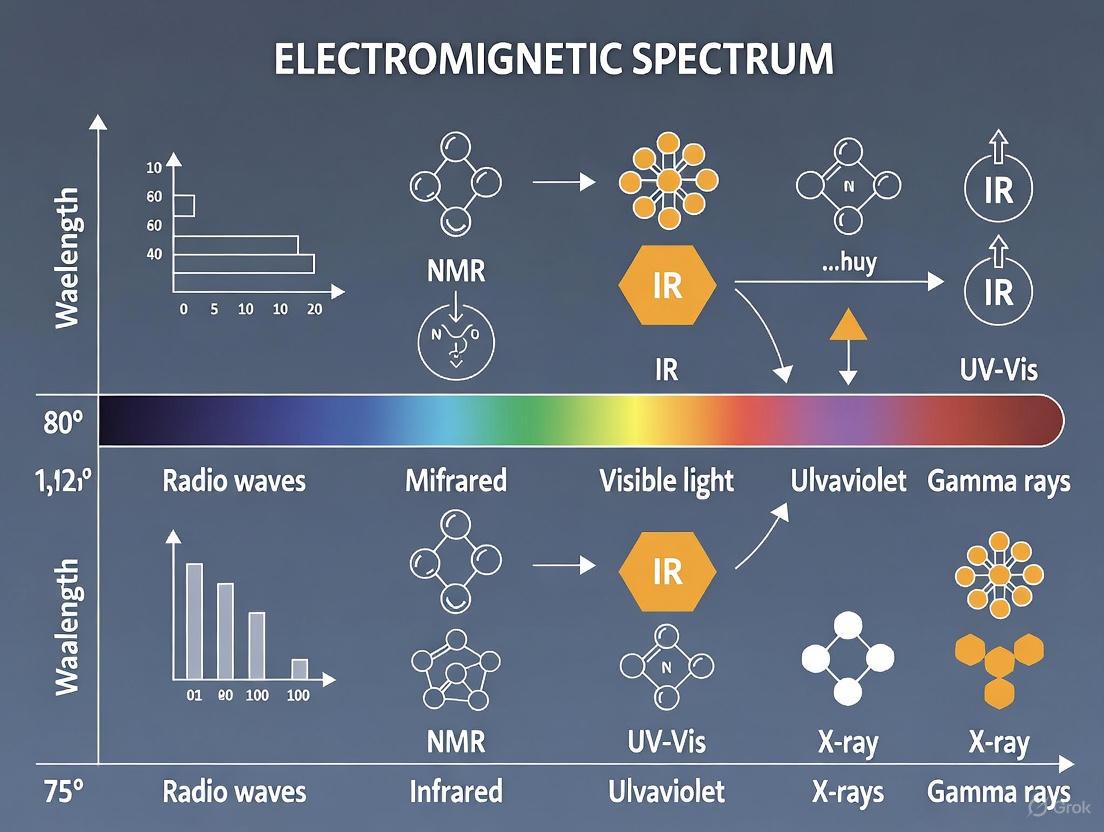
This article provides a comprehensive exploration of the fundamental relationship between the electromagnetic spectrum and spectroscopic techniques, tailored for researchers and professionals in drug development.
The Electromagnetic Spectrum and Spectroscopy: A Comprehensive Guide for Pharmaceutical Research and Drug Development
Abstract
This article provides a comprehensive exploration of the fundamental relationship between the electromagnetic spectrum and spectroscopic techniques, tailored for researchers and professionals in drug development. It covers core principles of light-matter interactions across spectral regions, from UV-Vis to terahertz and infrared. The scope includes practical methodological applications in pharmaceutical analysis, optimization strategies to overcome sensitivity and selectivity challenges, and comparative validation of techniques. By integrating foundational knowledge with advanced topics like machine learning and metamaterial-enhanced spectroscopy, this guide serves as a vital resource for enhancing analytical capabilities in drug discovery, quality control, and process monitoring.
Light-Matter Interactions: Core Principles of the Electromagnetic Spectrum for Spectral Analysis
The electromagnetic (EM) spectrum represents one of the most fundamental frameworks in analytical science, encompassing all electromagnetic radiation arranged according to frequency or wavelength. This spectrum extends from high-frequency, short-wavelength gamma rays to low-frequency, long-wavelength radio waves, with each region offering unique interactions with matter that form the basis for spectroscopic analysis. For researchers, scientists, and drug development professionals, understanding these regions and their analytical applications is crucial for selecting appropriate characterization techniques, interpreting experimental data, and developing new analytical methodologies.
The relationship between the electromagnetic spectrum and spectroscopy is foundational to modern analytical chemistry and pharmaceutical development. Spectroscopy, in its various forms, investigates the interaction between matter and electromagnetic radiation as a function of wavelength or frequency. Different regions of the spectrum probe distinct molecular and atomic phenomena—from electronic transitions and molecular vibrations to rotational dynamics and nuclear interactions. This whitepaper provides a comprehensive technical guide to the major regions of the electromagnetic spectrum relevant to analytical spectroscopy, with particular emphasis on their applications in pharmaceutical research and drug development.
Fundamental Regions of the Electromagnetic Spectrum
The electromagnetic spectrum used in analytical applications can be divided into several key regions based on the energy of the photons and their corresponding interactions with matter. Table 1 summarizes the wavelength ranges, energy characteristics, and primary molecular interactions for the most scientifically significant regions.
Table 1: Characteristics of Electromagnetic Spectrum Regions in Spectroscopy
| Spectral Region | Wavelength Range | Frequency Range | Photon Energy | Primary Molecular Interactions |
|---|---|---|---|---|
| X-Rays | 0.01 nm - 10 nm | 30 EHz - 30 PHz | 124 keV - 124 eV | Inner electron excitation, core electron transitions |
| Ultraviolet (UV) | 10 nm - 400 nm | 30 PHz - 750 THz | 124 eV - 3 eV | Valence electron transitions (π → π, n → π) |
| Visible (Vis) | 400 nm - 750 nm | 750 THz - 400 THz | 3 eV - 1.7 eV | Valence electron transitions, color perception |
| Infrared (IR) | 750 nm - 1 mm | 400 THz - 300 GHz | 1.7 eV - 1.24 meV | Molecular vibrations, stretching, bending |
| Microwaves | 1 mm - 1 m | 300 GHz - 300 MHz | 1.24 meV - 1.24 μeV | Molecular rotations, spin transitions |
| Radio Waves | ≥ 1 m | ≤ 300 MHz | ≤ 1.24 μeV | Nuclear spin transitions (NMR) |
The energy of electromagnetic radiation determines the specific molecular or atomic processes it can probe. High-energy radiation such as X-rays interacts with inner-shell electrons, while lower-energy radiation like infrared light excites molecular vibrations, and microwaves affect molecular rotations [1] [2] [3]. This relationship forms the basis for selecting appropriate spectroscopic techniques for specific analytical challenges in drug development and materials characterization.
Spectroscopic Techniques and Their Applications
High-Energy Region: X-Ray Spectroscopy
X-rays occupy the high-frequency portion of the electromagnetic spectrum, with wavelengths between 0.01 and 10 nanometers and energies ranging from 124 eV to 124 keV [1]. This high energy enables X-rays to interact with inner-shell electrons of atoms, making X-ray spectroscopy particularly valuable for elemental analysis and structural determination.
Experimental Protocol: X-Ray Crystallography for Protein Structure Determination
Sample Preparation: Purified protein samples are concentrated to 5-20 mg/mL in an appropriate buffer solution and subjected to crystallization trials using vapor diffusion, microbatch, or microdialysis methods [4].
Crystal Harvesting: Well-diffracting crystals are harvested using cryo-loops and flash-cooled in liquid nitrogen with cryoprotectants to prevent ice formation.
Data Collection: Crystals are exposed to monochromatic X-rays (typically copper Kα = 1.5418 Å or molybdenum Kα = 0.7107 Å) at cryogenic temperatures (100 K). Diffraction patterns are collected using area detectors as the crystal is rotated through a series of angles [4].
Data Processing: The diffraction spots are indexed, integrated, and scaled using software packages like HKL-3000 or XDS to produce structure factor amplitudes.
Phase Determination: Experimental phases are determined using molecular replacement (for homologous structures), isomorphous replacement, or anomalous dispersion methods.
Model Building and Refinement: An atomic model is built into the electron density map and iteratively refined against the diffraction data using programs like Phenix or Refmac.
In pharmaceutical research, X-ray crystallography is indispensable for determining the three-dimensional structure of drug targets, such as enzymes and receptors, and for studying drug-target interactions at atomic resolution [4]. This structural information guides rational drug design and optimization.
UV-Visible Spectroscopy
The ultraviolet (10-400 nm) and visible (400-750 nm) regions of the spectrum probe electronic transitions in molecules [3]. UV-Vis spectroscopy measures the absorption of light resulting from promotions of electrons from ground states to excited states, typically involving π → π, n → π, and n → σ* transitions.
Experimental Protocol: Determination of Protein Concentration Using UV Absorbance
Instrument Calibration: A double-beam spectrophotometer is initialized and allowed to warm up for 30 minutes. The instrument is zeroed with the sample buffer [5].
Blank Measurement: A cuvette containing the buffer solution (typically phosphate-buffered saline) is placed in both reference and sample compartments to establish a baseline.
Sample Measurement: The protein solution is transferred to a clean quartz cuvette (for UV measurements below 320 nm) or glass cuvette (for visible measurements) and placed in the sample compartment.
Spectral Acquisition: The absorbance spectrum is recorded from 240 to 350 nm. The absorbance at 280 nm is used for concentration determination based on the Beer-Lambert law: A = εcl, where A is absorbance, ε is molar absorptivity, c is concentration, and l is path length [3].
Data Analysis: Protein concentration is calculated using known extinction coefficients derived from the amino acid composition (primarily tryptophan and tyrosine residues).
UV-Vis spectroscopy finds extensive application in drug development for quantifying biomolecules, monitoring enzyme kinetics, assessing protein purity (A260/A280 ratio), and studying ligand-binding interactions [5] [3].
Infrared Spectroscopy
Infrared spectroscopy (wavelengths from 750 nm to 1 mm) investigates molecular vibrations, including stretching, bending, and rotational modes [6]. The mid-infrared region (approximately 4000-400 cm⁻¹) is particularly informative for functional group identification and structural elucidation.
Experimental Protocol: FT-IR Analysis of Protein Secondary Structure
Sample Preparation: Protein samples are prepared in deuterated buffers to avoid interference from H₂O bending vibrations. Samples are concentrated to 5-10 mg/mL for transmission measurements [6].
Data Collection: Using a Fourier Transform Infrared (FT-IR) spectrometer, interferograms are collected at 4 cm⁻¹ resolution with 64-256 scans to ensure adequate signal-to-noise ratio. The sample compartment is purged with dry air to minimize water vapor contributions.
Background Subtraction: A background spectrum is collected and subtracted from the sample spectrum to correct for atmospheric contributions.
Spectral Processing: The amide I band (1600-1700 cm⁻¹) is analyzed by Fourier self-deconvolution or second-derivative analysis to resolve overlapping components.
Secondary Structure Determination: The deconvoluted spectrum is curve-fitted with Gaussian functions corresponding to α-helix (1650-1658 cm⁻¹), β-sheet (1620-1640 cm⁻¹), turns (1660-1680 cm⁻¹), and random coil (1640-1650 cm⁻¹) structures.
In biopharmaceutical analysis, FT-IR spectroscopy is employed for protein characterization, monitoring structural changes under stress conditions, and studying protein-ligand interactions [6]. Recent advances include the development of quantum cascade laser (QCL)-based microscopes for high-resolution spatial mapping of protein distribution in formulations [6].
Microwave Spectroscopy
Microwaves (wavelengths from 1 mm to 1 m) induce rotational transitions in molecules and are also employed in electron paramagnetic resonance (EPR) spectroscopy [2]. Rotational spectroscopy provides precise information about molecular structure, dipole moments, and rotational constants.
Experimental Protocol: Chirped-Pulse Fourier Transform Microwave (CP-FTMW) Spectroscopy
Sample Introduction: The analyte is vaporized at 50-100°C in a carrier gas (typically argon or neon) and pulsed into the vacuum chamber through a solenoid valve [6].
Microwave Excitation: A chirped microwave pulse (1-20 GHz range) is applied perpendicular to the molecular beam direction, coherently exciting multiple rotational transitions simultaneously.
Signal Detection: The molecular free induction decay (FID) is recorded in the time domain using a digital oscilloscope.
Fourier Transformation: The time-domain signal is Fourier-transformed to produce a frequency-domain rotational spectrum.
Spectral Analysis: Rotational transitions are assigned, and molecular parameters (rotational constants, centrifugal distortion constants, and nuclear quadrupole coupling constants) are determined through least-squares fitting.
Microwave spectroscopy has recently gained attention in pharmaceutical analysis with the introduction of commercial instruments, such as the BrightSpec broadband chirped pulse microwave spectrometer, for unambiguous determination of molecular structure and configuration in the gas phase [6]. This technique is particularly valuable for distinguishing between stereoisomers and conformers of drug molecules.
Recent Technological Advances in Spectroscopic Instrumentation
The field of spectroscopic instrumentation continues to evolve rapidly, with recent introductions focusing on enhanced sensitivity, portability, and specialized applications. Table 2 highlights notable advancements in spectroscopic instrumentation from 2024-2025.
Table 2: Recent Advances in Spectroscopic Instrumentation (2024-2025)
| Technique | Instrument | Manufacturer | Key Features | Applications |
|---|---|---|---|---|
| FT-IR Spectrometry | Vertex NEO Platform | Bruker | Vacuum ATR accessory, multiple detector positions, interleaved time-resolved spectra | Protein studies, far-IR research |
| Fluorescence | Veloci A-TEEM Biopharma Analyzer | Horiba Instruments | Simultaneous A-TEEM collection, alternative to separation methods | Monoclonal antibodies, vaccine characterization |
| Raman Microscopy | LUMOS II ILIM | Bruker | QCL-based, focal plane array detector, imaging rate 4.5 mm²/s | Spectral imaging in transmission/reflection |
| Microwave Spectroscopy | Broadband Chirped Pulse Platform | BrightSpec | First commercial instrument using CP-FTMW technology | Molecular structure determination |
| UV-Vis-NIR | NaturaSpec Plus | Spectral Evolution | Integrated GPS, real-time video, field-portable | Field documentation, remote sensing |
| NIR Analysis | OMNIS NIRS Analyzer | Metrohm | Nearly maintenance-free, simplified method development | Quality control, pharmaceutical analysis |
The trend in spectroscopic instrumentation demonstrates a clear division between laboratory systems offering enhanced capabilities and field-portable devices enabling analysis outside traditional laboratory settings [6]. For drug development professionals, several innovations are particularly relevant, including the Horiba Veloci A-TEEM Biopharma Analyzer for characterizing biologics and the Bruker LUMOS II ILIM for high-resolution chemical imaging of pharmaceutical formulations [6].
Experimental Design and Workflow Integration
The effective application of electromagnetic spectroscopy in research requires careful experimental design and integration of multiple techniques. The following diagram illustrates a generalized workflow for structural characterization of a pharmaceutical compound using multiple spectroscopic techniques:
Diagram 1: Multi-technique characterization workflow for pharmaceutical compounds. Each spectroscopic method provides complementary structural information, with data integration enabling comprehensive molecular characterization.
This integrated approach leverages the unique capabilities of each spectral region, from UV-Vis for initial purity assessment and chromophore identification to X-ray crystallography for definitive structural determination. For biomolecules, additional techniques such as circular dichroism (CD) spectroscopy provide information about secondary and tertiary structure [6].
Essential Research Reagents and Materials
Successful spectroscopic analysis requires appropriate selection of reagents, accessories, and sample preparation materials. Table 3 catalogues key research reagents and their functions in spectroscopic experiments.
Table 3: Essential Research Reagent Solutions for Spectroscopic Analysis
| Reagent/Material | Technical Function | Application Examples |
|---|---|---|
| Ultrapure Water Systems (e.g., Milli-Q SQ2) | Provides water free of UV-absorbing impurities and particles | Sample preparation, buffer preparation, mobile phases for HPLC-coupled spectroscopy [6] |
| Deuterated Solvents | Minimizes interference from solvent proton signals; enables IR analysis of H₂O-sensitive samples | NMR spectroscopy, FT-IR spectroscopy of proteins in solution |
| ATR Crystals (Diamond, ZnSe, Ge) | Enables internal reflection element for sample contact; different crystal materials optimize for various spectral ranges | FT-IR sampling of solids, liquids, and gels without extensive preparation [6] |
| Stabilized Halogen & Deuterium Lamps | Provides continuous spectrum in UV-Vis-NIR regions; stable output for quantitative measurements | UV-Vis spectrophotometer light sources for accurate absorbance measurements |
| Quantum Cascade Lasers | Offers high power and tunability in mid-IR region; enables rapid spectral acquisition | IR microscopy, standoff detection, high-sensitivity gas sensing [6] |
| Cryostats and Temperature Controllers | Maintains precise temperature control for spectral measurements; reduces thermal broadening | Temperature-dependent studies, stabilization of sensitive samples |
The selection of appropriate reagents and accessories is critical for obtaining high-quality spectroscopic data. Recent advancements include the development of nanomechanical-based accessories for FT-IR that provide high sensitivity without cryogenic cooling and enable picogram detection levels [6].
The strategic application of electromagnetic spectroscopy across multiple spectral regions provides powerful capabilities for drug discovery and development. From high-energy X-rays that elucidate atomic-level structures to microwaves that probe molecular rotations, each region offers unique insights into molecular properties and interactions. The continuing evolution of spectroscopic instrumentation—with trends toward miniaturization, enhanced sensitivity, and specialized biopharmaceutical applications—ensures that these techniques will remain indispensable in the researcher's toolkit.
For drug development professionals, a comprehensive understanding of the electromagnetic spectrum enables informed selection of analytical techniques throughout the drug development pipeline, from initial target identification and hit validation through formulation development and quality control. The integration of multiple spectroscopic methods, coupled with advances in data analysis and computational modeling, provides a robust framework for understanding the structural basis of drug action and optimizing therapeutic efficacy.
This whitepaper provides an in-depth technical examination of the fundamental light-matter interactions—absorption, emission, and scattering—framed within the critical relationship between the electromagnetic spectrum and spectroscopic science. For researchers and drug development professionals, mastery of these interactions is not merely academic; it enables precise material characterization, elucidates molecular structures, and drives innovation in analytical methodologies and therapeutic discovery [7]. Spectroscopy, as the measurement science harnessing these interactions, serves as a cornerstone for analytical techniques across scientific disciplines, from revealing the composition of distant stars to identifying trace chemical pollutants and characterizing novel pharmaceutical compounds [8].
The ensuing sections will dissect the quantum mechanical principles governing each interaction, present quantitative data across spectral regions, detail standardized experimental protocols, and visualize core concepts and workflows. The content is structured to function as both a foundational reference and a practical guide for experimental design.
Fundamental Principles and the Electromagnetic Spectrum
At its core, spectroscopy involves probing matter with electromagnetic radiation and interpreting the resultant signals to extract material properties [8]. The interaction is governed by the principle that the internal energy of atoms and molecules is quantized. When light—a propagating electromagnetic wave—impinges on matter, energy can be exchanged only in discrete amounts, or quanta, corresponding to the difference between specific energy levels within the material [7] [9].
The nature of the interaction is determined by the energy (and thus frequency) of the incident light relative to the available energy transitions of the material. The entire electromagnetic spectrum, from low-energy radio waves to high-energy gamma rays, is employed in spectroscopic analysis, with different spectral regions probing distinct material properties [10].
Table 1: Regions of the Electromagnetic Spectrum Relevant to Spectroscopy
| Spectral Region | Wavelength Range | Frequency (Hz) Approx. | Energy Transitions Probed | Common Analytical Uses |
|---|---|---|---|---|
| Ultraviolet (UV) | 190 - 360 nm | ~10¹⁵ | Electronic (σ→σ, n→π, etc.) [10] | HPLC detection, chromophore identification |
| Visible (Vis) | 360 - 780 nm | ~10¹⁴ - 10¹⁵ | Electronic (d-d transitions, conjugated systems) [10] | Color measurement, quantitative colorimetry |
| Near-Infrared (NIR) | 780 - 2500 nm | ~10¹³ - 10¹⁴ | Molecular vibrational overtones & combinations [10] | Agricultural product analysis, moisture content |
| Infrared (IR) | 2.5 - 25 µm | ~10¹² - 10¹³ | Fundamental molecular vibrations [8] [10] | Polymer identification, functional group analysis |
| Raman | Varies (Laser dep.) | - | Fundamental molecular vibrations [10] | Aqueous sample analysis, symmetric bond detection |
The specific frequencies absorbed or emitted by an atom or molecule constitute its unique "spectral fingerprint," allowing for definitive identification and quantification [8]. This fingerprint arises from the specific configuration of electrons, protons, and neutrons, and any incident light with a frequency matching a possible energy transition can be absorbed, causing those particles to rearrange into a higher-energy configuration [8].
Core Light-Matter Interaction Mechanisms
Absorption
Absorption occurs when matter takes in light energy, causing electrons to jump from a lower to a higher energy state [9]. This process decreases the intensity of the transmitted light at the specific frequencies that match the energy gap between the states [9]. The probability of absorption is highest when the photon energy exactly matches this energy gap.
The relationship between the extent of absorption and the properties of the sample is quantitatively described by the Beer-Lambert Law: ( A = \varepsilon b c ), where ( A ) is the measured absorbance, ( \varepsilon ) is the molar absorptivity (a compound-specific constant indicating how strongly it absorbs at a given wavelength), ( b ) is the path length of light through the sample, and ( c ) is the concentration of the absorbing species [9]. This law forms the basis for most quantitative absorption spectroscopy.
Electronic transitions involved in UV-Vis absorption include ( \sigma \to \sigma^* ) (high energy), ( n \to \sigma^* ), and the lower energy ( \pi \to \pi^* ) and ( n \to \pi^* ) transitions found in conjugated systems [9]. The absorption process follows the Franck-Condon principle, which states that because the electronic transition is much faster than nuclear motion, the transition probability is maximized for vertical transitions on an energy diagram where the nuclear configuration remains unchanged [9].
Emission
Emission is the process by which matter releases absorbed light energy as electrons return from a higher, excited energy state to a lower one [9]. The energy of the emitted photon equals the energy difference of the transition [9]. Emission can occur through several pathways:
- Spontaneous Emission: Happens naturally without external stimulation, such as in fluorescence [9].
- Stimulated Emission: Requires interaction with an incoming photon and is the fundamental physical process behind laser operation [9].
Two primary types of photoluminescence are fluorescence and phosphorescence, which are often represented in a Jablonski diagram that visualizes electronic states and transitions [9].
- Fluorescence: A rapid emission process (nanoseconds to microseconds) involving transitions between states of the same spin multiplicity, typically singlet-to-singlet. The emitted photon has lower energy than the absorbed photon due to energy loss prior to emission, a phenomenon known as the Stokes shift [9].
- Phosphorescence: A much slower process (milliseconds to hours) involving a forbidden transition from a triplet excited state to a singlet ground state. This slow decay occurs due to the quantum mechanically "forbidden" nature of the spin state change [9].
The efficiency of emission is characterized by the quantum yield, which is the ratio of photons emitted to photons absorbed [9].
Scattering
Scattering describes the process where light changes direction upon interaction with matter, but unlike absorption, there is no net energy transfer to the material [9]. Scattering techniques are powerful because they often require minimal sample preparation and can be used with aqueous solutions or glass containers [10].
- Elastic Scattering: The scattered light has the same wavelength as the incident light. Rayleigh scattering of sunlight by atmospheric molecules is a common example [9].
- Inelastic Scattering: The scattered light undergoes a shift in wavelength, providing information about the vibrational or rotational modes of the molecule. Raman spectroscopy is the most prominent analytical technique based on this principle [7] [9]. It is complementary to infrared absorption spectroscopy and is particularly sensitive to different types of molecular vibrations, such as symmetric bonds and covalent linkages like S-S and C-S [10].
Advanced techniques like Surface-Enhanced Raman Spectroscopy (SERS) use metallic nanostructures to create localized plasmonic fields, dramatically boosting the inherently weak Raman signal by many orders of magnitude and enabling single-molecule detection [11].
{{< table title="Diagram 1: Light-Matter Interaction Pathways" >}}
Experimental Protocols and Methodologies
This section details standard protocols for measuring the core light-matter interactions, providing a reproducible framework for researchers.
Protocol: UV-Vis Absorption Spectroscopy for Concentration Determination
Principle: This protocol uses the Beer-Lambert law to determine the concentration of a light-absorbing analyte in solution by measuring its absorbance at a specific wavelength [9] [10].
Materials:
- UV-Vis spectrophotometer with a deuterium (UV) and tungsten (Vis) lamp
- Quartz cuvettes (for UV) or glass/plastic cuvettes (for Vis only)
- Analytical balance
- Volumetric flasks and pipettes
- Solvent (e.g., water, hexane, methanol) and analyte standard
Procedure:
- Instrument Warm-up and Initialization: Power on the spectrophotometer and allow the lamps and electronics to stabilize for at least 15 minutes. Initialize the instrument software and select the absorption mode.
- Background Measurement: Fill a cuvette with the pure solvent, ensuring the clear optical faces are clean and fingerprint-free. Place it in the sample holder and acquire a background or blank spectrum over the desired wavelength range (e.g., 200-800 nm). This corrects for any solvent or cuvette absorption.
- Standard Solution Preparation: Precisely prepare a series of standard solutions with known concentrations of the analyte, covering the expected concentration range of the unknown. Ensure all solutions are within the linear range of the Beer-Lambert law (typically Absorbance < 2).
- Standard Measurement: For each standard solution, replace the blank cuvette with the standard, record the absorbance value at the predetermined analytical wavelength (λ_max), and rinse the cuvette with the next standard or solvent between measurements.
- Calibration Curve Generation: Plot the recorded absorbance values against the known concentrations of the standard solutions. Perform a linear regression analysis to obtain the slope (which is equal to ( \varepsilon b )), y-intercept, and correlation coefficient (R²).
- Unknown Sample Measurement: Prepare the unknown sample in the same solvent matrix. Measure its absorbance at the same λ_max.
- Concentration Calculation: Use the equation of the calibration curve to calculate the concentration of the unknown sample: ( c{unknown} = (A{unknown} - \text{intercept}) / \text{slope} ).
Protocol: Steady-State Fluorescence Spectroscopy
Principle: This protocol measures the emission spectrum of a fluorophore to identify its characteristic fluorescence signature and determine its quantum yield relative to a standard [9].
Materials:
- Fluorescence spectrophotometer (fluorometer) with a Xenon arc lamp and photomultiplier tube (PMT) detector
- Quartz cuvettes (all four sides clear)
- Standard fluorophore with known quantum yield (e.g., quinine sulfate)
- Nitrogen or argon gas supply (for degassing, if necessary)
Procedure:
- Instrument Setup: Power on the fluorometer and lamp. Allow the system to stabilize. Set the excitation and emission slit widths to control the bandpass and intensity of light.
- Wavelength Calibration: If required, perform a wavelength calibration using the instrument's recommended procedure or a standard lamp.
- Excitation Scan (Optional): To find the optimal excitation wavelength, place the sample in the cuvette, set the emission monochromator to a known emission wavelength, and scan the excitation monochromator. The peak is λ_ex.
- Emission Scan: Set the excitation monochromator to λex. Scan the emission monochromator across a wavelength range that is longer (lower energy) than λex to generate the full emission spectrum. Note the peak emission wavelength (λ_em).
- Quantum Yield Determination (Relative Method):
- Prepare solutions of the unknown sample and the standard fluorophore that have the same absorbance at the same excitation wavelength.
- Measure the integrated fluorescence intensity (area under the emission curve) for both the standard and the sample under identical instrument settings (slits, voltage, etc.).
- Calculate the quantum yield (Φ) of the unknown using the formula: ( \Phi{unknown} = \Phi{standard} \times (I{unknown} / I{standard}) \times (\eta{unknown}^2 / \eta{standard}^2) ) where ( I ) is the integrated intensity and ( \eta ) is the refractive index of the solvent.
Protocol: Raman Spectroscopy for Solid Material Analysis
Principle: This protocol uses inelastic light scattering to obtain a vibrational fingerprint of a solid material, which is highly specific and requires minimal sample preparation [10].
Materials:
- Raman spectrometer (benchtop or portable) with a visible or near-infrared laser (e.g., 532 nm, 785 nm)
- Microscope attachment for micro-Raman analysis (if applicable)
- Glass slide or aluminum stub for mounting solid samples
- Standard for wavelength calibration (e.g., silicon wafer)
Procedure:
- Laser Safety: Ensure all appropriate laser safety protocols are followed, including wearing protective eyewear.
- Instrument Calibration: Perform a wavelength calibration using a standard like a silicon wafer, which has a known Raman peak at 520.7 cm⁻¹.
- Sample Preparation: Place a small amount of the solid powder on a glass slide or mount a larger solid piece on a stub. Ensure the surface is clean and representative of the material. For powders, apply gentle pressure to create a flat surface.
- Microscope Alignment (if applicable): Place the sample on the microscope stage. Use the microscope to locate the area of interest on the sample surface and bring it into focus.
- Acquisition Parameter Setting: Set the laser power to a level that does not cause sample degradation or burning. Start with a low power and increase gradually. Set the integration time and number of accumulations to achieve a good signal-to-noise ratio without saturating the detector.
- Spectral Acquisition: Acquire the Raman spectrum over the desired wavenumber range (e.g., 100-4000 cm⁻¹). The spectrum will show peaks at Raman shifts corresponding to the vibrational modes of the molecules in the sample.
- Data Analysis: Identify the major peaks in the spectrum by comparing them to reference spectral libraries. Key Raman-active vibrations include acetylenic -C≡C- stretches, olefinic C=C stretches (1680–1630 cm⁻¹), and S-S stretches [10].
{{< table title="Diagram 2: General Spectroscopy Workflow" >}}
The Scientist's Toolkit: Essential Research Reagents and Materials
Table 2: Key Research Reagent Solutions and Materials for Spectroscopic Analysis
| Item | Function & Application | Technical Specification Notes |
|---|---|---|
| Quartz Cuvettes | Hold liquid samples for UV-Vis and fluorescence spectroscopy. | Must be used for UV measurements (<300 nm) due to quartz's UV transparency. Pathlengths typically 10 mm. |
| Deuterated Solvents | Solvents for NMR spectroscopy with deuterium replacing hydrogen. | Provides a lock signal for the NMR magnet and minimizes solvent proton interference in the spectrum. Examples: CDCl₃, D₂O. |
| FT-IR Crystal (ATR) | Enables sample analysis via Attenuated Total Reflectance in IR. | Diamond crystal is common for its durability and wide spectral range. Allows direct analysis of solids and liquids without preparation. |
| Raman Standard (Silicon Wafer) | Provides a known reference peak for calibrating Raman spectrometers. | The single crystal silicon peak at 520.7 cm⁻¹ is used for precise wavelength calibration across instruments. |
| Quantum Yield Standard | A fluorophore with a known, stable quantum yield used for relative determination. | Examples: Quinine sulfate in sulfuric acid (Φ ~0.54), Fluorescein in NaOH (Φ ~0.92). Must be matched to sample's excitation range. |
| Metallic Nanoparticles (SERS) | Enhance the weak Raman signal by many orders of magnitude. | Colloidal solutions of gold or silver nanoparticles create "hot spots" for extreme electromagnetic field enhancement in SERS [11]. |
| HPLC-grade Solvents | Used for preparing samples for UV-Vis detection in HPLC. | High purity is critical to avoid contaminant peaks that absorb in the UV-Vis range and interfere with analyte detection. |
The fundamental interactions of light with matter—absorption, emission, and scattering—form the bedrock of spectroscopic science and its indispensable relationship with the electromagnetic spectrum. A deep, quantitative understanding of these processes enables researchers to select the optimal spectroscopic technique, design robust experiments, and interpret complex data. As instrumentation advances, allowing for greater precision, portability, and the exploration of quantum regimes, these core principles will continue to underpin new discoveries [7] [11]. For the drug development professional, this knowledge translates directly into the ability to characterize molecular structures, monitor reactions, ensure purity, and ultimately accelerate the delivery of new therapies. The continued refinement of spectroscopic methods promises to further illuminate the intricate relationship between light, matter, and measurement.
Molecular spectroscopy decodes chemical structure by measuring discrete energy transitions that follow the principles of quantum mechanics. When molecules interact with electromagnetic radiation, they undergo electronic, vibrational, and rotational energy transitions that create unique spectral fingerprints across different regions of the spectrum. These fingerprints provide critical information for identifying molecular structures, understanding chemical bonding, and predicting material properties. The interpretation of these complex spectra requires sophisticated computational approaches, as the structural information encoded within them can only be decoded using quantum mechanics [12].
The relationship between molecular structure and spectral signatures represents a fundamental principle in analytical chemistry, with applications ranging from drug development to materials science. Contemporary computational molecular spectroscopy has evolved from merely supporting spectral interpretation to leading innovation in molecular design and discovery. The future development of this field lies in effectively integrating experimental and computational approaches, potentially through engineered molecular spectroscopic databases that function according to universal computing approaches [12]. This whitepaper examines the core transitions that constitute molecular fingerprints and explores advanced methodologies for their interpretation within the broader context of electromagnetic spectrum research.
Theoretical Foundations of Molecular Transitions
Quantum Mechanical Framework
Molecular spectroscopy measures transitions between discrete molecular energy levels governed by quantum mechanics. The total internal energy of a molecule can be approximated as the sum of electronic, vibrational, and rotational components:
[E{\text{total}} = E{\text{electronic}} + E{\text{vibrational}} + E{\text{rotational}}]
This separation of energy scales allows for the observation of distinct spectral regions, though in practice, transitions often involve multiple energy types simultaneously. The Born-Oppenheimer approximation enables this separation by treating nuclear and electronic motions independently, allowing computational methods to solve for electronic wavefunctions while considering nuclear positions fixed [13].
Electronic Transitions and Vibronic Coupling
Electronic transitions occur when molecules absorb energy in the visible to ultraviolet range, promoting electrons to higher energy orbitals. However, these transitions are rarely purely electronic. According to quantum mechanical principles, electronic transitions typically accompany both vibrational and rotational transitions, creating a complex spectral pattern known as vibronic structure [13].
For a diatomic molecule, the total energy in wavenumbers can be expressed using the following equation:
[\tilde{E}{\text{total}} = \tilde{\nu}{el} + \tilde{\nu}e \left(v + \frac{1}{2}\right) - \tilde{\chi}e \tilde{\nu}_e \left(v + \frac{1}{2}\right)^2 + \tilde{B} J(J + 1) - \tilde{D} J^2(J + 1)^2]
Where (\tilde{\nu}{el}) represents the electronic transition energy, (\tilde{\nu}e) is the vibrational constant, (v) is the vibrational quantum number, (\tilde{\chi}_e) is the anharmonic constant, (\tilde{B}) is the rotational constant, (J) is the rotational quantum number, and (\tilde{D}) is the centrifugal distortion constant [13]. This equation highlights how electronic transitions incorporate vibrational and rotational energy components, creating unique spectral fingerprints for each molecular species.
Table 1: Characteristic Spectral Regions and Transitions
| Spectral Region | Wavelength Range | Energy Transitions | Information Obtained |
|---|---|---|---|
| Rotational | Microwave (mm-cm) | Rotational energy levels | Molecular geometry, bond lengths |
| Vibrational | Infrared (2.5-25 µm) | Vibrational energy levels | Functional groups, bond strength |
| Electronic | UV-Visible (180-780 nm) | Electronic energy levels | Electronic structure, conjugation |
| Fingerprint | 6.7-20 µm | Combined vibrations | Molecular identity, structural features |
The Fingerprint Region
The molecular fingerprint region, typically spanning 6.7–20 µm (approximately 1500–500 cm⁻¹) in the infrared spectrum, provides critical information for compound identification [14]. This region contains complex vibrational patterns arising from coupled motions of atoms within the molecule, creating a unique identifier much like a human fingerprint. In Raman spectroscopy, a narrower subset from 1550 to 1900 cm⁻¹ has been identified as particularly valuable for pharmaceutical applications, termed the "fingerprint in the fingerprint" region [15]. This specific region contains signals from functional groups like C=N (1610–1680 cm⁻¹), C=O (1680–1820 cm⁻¹), and N=N (approximately 1580 cm⁻¹) vibrations that are highly characteristic of active pharmaceutical ingredients while showing minimal interference from common excipients [15].
Computational Methods and AI Advances
Traditional Computational Spectroscopy
Computational molecular spectroscopy has traditionally employed quantum mechanical methods to simulate and interpret spectral data. Density Functional Theory (DFT) has been widely used for predicting IR and NMR spectra by solving electronic structure problems. However, conventional approaches often rely on the harmonic approximation, which truncates the potential energy surface at the second order (Hessian matrix) and neglects anharmonic effects [16]. This limitation results in systematic frequency shifts and intensity errors when compared to experimental results, particularly in the crowded fingerprint region where vibrational modes couple and overlap [16].
More advanced computational approaches incorporate anharmonicity through methods like molecular dynamics (MD) simulations. These methods compute IR spectra from dipole-dipole autocorrelation functions obtained from MD trajectories at room temperature, intrinsically accounting for anharmonic effects such as mode coupling and overtone bands [16]. Hybrid approaches that combine classical MD with machine learning-accelerated dipole moment predictions have emerged as promising tools for generating accurate synthetic spectral data at scale [16].
Artificial Intelligence and Machine Learning
Recent advances in artificial intelligence have transformed molecular spectroscopy from an interpretive tool to a predictive science. Transformer-based architectures have demonstrated remarkable success in predicting molecular structures directly from IR spectra. Current state-of-the-art models achieve Top-1 accuracy of 63.79% and Top-10 accuracy of 83.95% in structure elucidation tasks [17].
Key architectural improvements enabling this performance include:
- Patch-based Spectral Representation: Segmenting IR spectra into fixed-size patches preserves fine-grained spectral details, inspired by Vision Transformers originally developed for image data [17].
- Post-Layer Normalization: Replacing pre-layer normalization optimizes gradient flow during training, leading to more effective model convergence [17].
- Gated Linear Units (GLUs): These enhance model parametrization without additional depth, improving expressivity over traditional activation functions [17].
- Learned Positional Embeddings: Unlike fixed sinusoidal encodings, these adaptive representations develop throughout training to better capture spectral sequences [17].
Table 2: Performance Comparison of AI Models for IR Structure Elucidation
| Model Architecture | Patch Size | Top-1 Accuracy (%) | Top-10 Accuracy (%) |
|---|---|---|---|
| Pre-LN + Sinusoidal | 125 | 42.59 ± 2.64 | 78.04 ± 2.81 |
| Post-LN + Sinusoidal | 125 | 48.36 ± 3.14 | 81.58 ± 2.08 |
| Post-LN + Learned | 125 | 49.55 ± 1.77 | 82.39 ± 0.83 |
| Post-LN + Learned + GLU | 125 | 50.01 ± 1.53 | 83.09 ± 1.83 |
| Post-LN + Learned + GLU | 75 | 52.25 ± 2.71 | 83.00 ± 2.14 |
Hybrid Molecular Representations
Beyond structure elucidation, machine learning approaches have been developed to create hybrid molecular representations that combine structural and spectral data. For predictive modeling tasks such as logP prediction, hybrid fingerprints integrating chemical structure and mid-infrared (MIR) spectral data into compact binary descriptors offer uniquely interpretable approaches [18]. While traditional structure-based fingerprints like Morgan (1024 bits) and MACCS (166 bits) currently achieve lower prediction errors (RMSE of 1.056 and 0.995, respectively, for logP), hybrid representations bridge experimental spectral evidence with cheminformatics modeling, laying the foundation for spectrum-informed quantitative structure-activity relationship (QSAR) workflows [18].
In olfactory research, Morgan-fingerprint-based machine learning models have demonstrated superior performance in predicting fragrance odors, achieving an area under the receiver operating curve (AUROC) of 0.828 [19]. This highlights the capacity of molecular fingerprints to capture subtle structural features that relate to complex molecular properties and interactions.
Experimental Methodologies and Protocols
Advanced Spectroscopic Techniques
Bright Broadband Infrared Frequency Combs
Traditional Fourier-transform infrared (FTIR) spectroscopy has been revolutionized by the development of bright, broadband infrared frequency combs. These combs generate super-octave spectra spanning 4–12 µm (2500–830 cm⁻¹) with high frequency precision and rapid data acquisition [14]. The technology utilizes intra-pulse difference frequency generation (DFG) in orientation-patterned gallium phosphide (OP-GaP) crystals pumped by few-cycle pulses derived from Er:fiber laser technology.
The experimental implementation involves:
- Generating femtosecond pulses from a 100 MHz Er:fiber mode-locked oscillator
- Amplifying pulses to 3.5 nJ energy (350 mW average power)
- Spectral broadening using normal dispersion highly nonlinear fiber (ND-HNLF)
- Compression to few-cycle pulses (~12 fs duration)
- Parametric conversion in OP-GaP crystal with quasi-phase matching [14]
This approach produces tabletop sources with brightness comparable to infrared synchrotron beamlines, enabling high-precision dual-frequency-comb spectroscopy with resolution of 0.0033 cm⁻¹ and frequency accuracy of (1 \times 10^{-11}) [14].
Raman Spectral Analysis of Pharmaceuticals
Raman spectroscopy provides complementary information to IR absorption spectroscopy and is particularly valuable for pharmaceutical applications. The "fingerprint in the fingerprint" region (1550–1900 cm⁻¹) has proven especially useful for active pharmaceutical ingredient (API) identity testing [15].
Standard experimental protocol:
- Instrumentation: Thermo Nicolet NXR 6700 FT-Raman spectrometer with 1064 nm laser source
- Laser Power: 0.5 W for microstage attachment, 1.0 W for 180° reflectance attachment
- Detection: Indium gallium arsenide (InGaAs) detector collecting scattered light
- Spectral Range: 150–3700 cm⁻¹ at 4 cm⁻¹ resolution
- Data Analysis: Omnic spectral software with principal component analysis (PCA) using standard normal variate (SNV) transformation and first derivative preprocessing [15]
This methodology allows nondestructive analysis of solid dosage forms with minimal sample preparation, enabling rapid identification of APIs without excipient interference.
Synthetic Data Generation Protocols
The limited availability of large-scale experimental spectroscopic datasets has motivated the development of synthetic data generation protocols. A comprehensive approach for generating IR and NMR spectra involves:
Molecular Dynamics Setup:
- Select molecules from chemical databases (e.g., USPTO dataset) filtered for specific elements (B, Br, C, Cl, F, H, I, N, O, P, S, Si)
- Convert SMILES representations to XYZ coordinates using RDKit
- Parameterize molecules using Generalized Amber Force Field (GAFF2)
- Perform equilibration at 300 K using Langevin thermostat (25 ps, 0.5 fs timestep)
- Run production simulations in NVE ensemble (100 ps) [16]
DFT Calculations:
- Extract snapshots from classical MD trajectories
- Perform first-principles calculations using PBE exchange-correlation functional
- Apply Goedecker-Teter-Hutter (GTH) pseudopotentials with 100 Ry plane-wave cutoff
- Conduct Wannier function analysis for dipole moment computation [16]
Machine Learning Acceleration:
- Train Deep Potential (DP) framework on DFT-computed dipole moments
- Use deep neural network potential for accelerated dipole predictions across full trajectories
- Generate anharmonic IR spectra from dipole-dipole autocorrelation functions [16]
This hybrid computational approach efficiently generates realistic spectral data while capturing anharmonic effects neglected by harmonic approximation methods.
Visualization of Spectral Transitions and Workflows
Molecular Energy Transition Diagram
Diagram 1: Molecular Energy Transitions illustrating coupled electronic-vibrational (vibronic) transitions between ground (S₀) and excited (S₁) electronic states, each with associated vibrational energy levels (v=0,1,2).
AI-Driven Structure Elucidation Workflow
Diagram 2: AI-Driven Structure Elucidation Workflow showing how experimental IR spectra are processed through patch-based representation, transformer encoders, and SMILES decoders to predict molecular structures, with data augmentation strategies to enhance model performance.
Research Reagents and Materials
Table 3: Essential Research Reagents and Materials for Advanced Molecular Spectroscopy
| Material/Reagent | Function/Application | Specifications | Key Features |
|---|---|---|---|
| OP-GaP Crystal | Nonlinear frequency conversion | Orientation period: 61.1 µm | High nonlinear coefficient (d_eff = 27 pm/V), quasi-phase matching |
| Er:fiber Laser System | Pump source for frequency combs | 100 MHz repetition rate, 3.5 nJ pulse energy | Robust, commercially available technology |
| ND-HNLF | Spectral broadening | 4 cm length, normal dispersion | Generates ~600 nm bandwidth from Er:fiber pump |
| GAFF2 Force Field | Classical MD simulations | Second-generation Generalized Amber Force Field | Accurate parameterization for organic molecules |
| MCT Detector | IR radiation detection | Spectral response up to 12 µm | Cryogenically cooled for low-noise measurement |
| Pharmaceutical Excipients | Reference materials | USP compendium methodology | Validated identity and purity for spectral libraries |
Molecular fingerprints across electronic, vibrational, and rotational spectral regions provide a comprehensive framework for understanding molecular structure and interactions. The integration of advanced spectroscopic techniques with computational methods and artificial intelligence has transformed this field from descriptive to predictive science. Modern approaches combining bright broadband light sources, hybrid computational spectra generation, and transformer-based AI models have achieved unprecedented accuracy in molecular structure elucidation, with Top-1 accuracy exceeding 63% [17].
The continuing evolution of spectroscopic technologies, particularly bright tabletop sources rivaling synchrotron brightness [14] and the identification of highly specific spectral subregions like the "fingerprint in the fingerprint" [15], enables increasingly precise molecular characterization. These advances support critical applications in pharmaceutical development, materials science, and chemical research where understanding molecular structure-property relationships is essential. Future progress will depend on continued integration of experimental and computational approaches, development of multimodal spectroscopic databases, and implementation of digital twin methodologies for predictive molecular design.
Spectroscopic Techniques and Their Corresponding Energy Regimes
Spectroscopic methods are foundational analytical techniques that probe the interaction between electromagnetic radiation and matter to determine material composition, structure, and physical properties [10] [20]. These methods are indispensable across scientific disciplines, providing rapid, non-destructive analysis for applications ranging from pharmaceutical development to materials science [20]. The analytical capability of any spectroscopic technique is intrinsically governed by the energy regime of the electromagnetic radiation employed, as different energy levels probe distinct molecular and atomic phenomena [10] [20].
The electromagnetic spectrum encompasses multiple regions characterized by photon energy, including gamma rays, X-rays, ultraviolet (UV), visible (vis), infrared (IR), microwave, and radio waves [10]. Each region interacts with matter in specific ways: high-energy radiation like X-rays can excite core electrons, while lower-energy radiation like radio waves interacts with nuclear spins [20]. This relationship between energy regime and molecular interaction forms the fundamental principle underlying all spectroscopic analysis, enabling researchers to select the optimal technique for their specific analytical needs within the context of electromagnetic spectrum research.
Fundamental Principles of Light-Matter Interactions
Spectroscopic techniques are classified according to three primary interaction mechanisms between light and matter: absorption, emission, and scattering [20].
Absorption occurs when incident photon energy matches the energy required for a quantum mechanical transition within an atom or molecule, such as electron excitation, molecular vibration, or nuclear spin reorientation [10] [20]. The measurement of transmitted radiation intensity as a function of wavelength produces an absorption spectrum, which provides molecular fingerprints of species exhibiting a dipole moment [20]. Common absorption-based techniques include Ultraviolet-Visible (UV-Vis), Infrared (IR), and Nuclear Magnetic Resonance (NMR) spectroscopy.
Emission processes involve the release of electromagnetic radiation from materials after they have absorbed energy and reached an excited state [21]. The emitted light is analyzed to obtain information about the sample's composition. Fluorescence and phosphorescence are examples of photoluminescence, where light emission occurs following the absorption of photons [21].
Scattering encompasses interactions where incident photons are deflected by a sample. In elastic scattering (Rayleigh or Mie scattering), the scattered photons have the same energy as the incident photons [20]. Inelastic scattering, such as Raman scattering, involves an energy exchange between the photon and the molecule, providing information about molecular vibrations [20]. Unlike absorption-emission processes that occur on pico- to microsecond timescales, scattering is a virtually instantaneous process happening within femtoseconds [20].
Technical Specifications of Spectroscopic Techniques
Table 1: Comparative analysis of major spectroscopic techniques and their corresponding energy regimes.
| Technique | Energy Regime | Wavelength Range | Frequency | Molecular/Atomic Phenomenon Probed | Information Obtained |
|---|---|---|---|---|---|
| X-ray Spectroscopy | High-energy | 0.1 nm – 100 nm [20] | 3×10⁶ – 3×10³ THz [20] | Excitation of core electrons, ionization [20] | Elemental analysis [20] |
| UV-Vis Spectroscopy | Electronic transitions | 190 nm – 780 nm [10] | 3×10³ – 300 THz (approx.) [20] | Electronic transitions in chromophores, conjugated systems [10] [20] | Identification of functional groups, quantitative analysis [10] |
| Near-Infrared (NIR) Spectroscopy | Vibrational overtone | 780 nm – 2500 nm [10] | ~400 – 130 THz (approx.) | Overtone and combination bands of fundamental vibrations [10] [20] | Multicomponent analysis of organic compounds (proteins, carbohydrates) [10] |
| Infrared (IR/FTIR) Spectroscopy | Vibrational fundamental | 1 μm – 30 μm [20] (Mid-IR: 2.5 – 25 μm) | 300 – 10 THz [20] | Fundamental molecular vibrations [10] [20] | Functional group identification, molecular fingerprinting [10] [22] |
| Raman Spectroscopy | Vibrational scattering | Varies with laser source [23] | Varies with laser source | Inelastic scattering from polarizable bonds [10] [20] | Complementary vibrational information to IR [10] |
| Terahertz Spectroscopy | Low-energy vibrational | 30 μm – 3000 μm [20] | 10 – 0.1 THz [20] | Intermolecular vibrations (hydrogen bonds, dipole-dipole) [20] | Bulk and surface measurements of molecular interactions [20] |
| Electron Paramagnetic Resonance (EPR/ESR) | Microwave | N/A (microwave) | ~9.5 – 35 GHz (e.g., 0.34T–1.25T) [24] | Reorientation of electron magnetic moments in unpaired electrons [24] | Detection of paramagnetic substances, free radicals [24] |
| Nuclear Magnetic Resonance (NMR) | Radio frequency | N/A (radio waves) | ~300 – 800 MHz (e.g., 6.97T–18.6T) [24] | Reorientation of nuclear magnetic moments [24] [22] | Molecular structure, connectivity, dynamics [22] |
Table 2: Characteristic analytical information and common applications across spectroscopic techniques.
| Technique | Detection Sensitivity | Sample Compatibility | Key Applications | Technique Limitations |
|---|---|---|---|---|
| X-ray Spectroscopy | High for elements | Solids, thin films | Life sciences, material characterization [20] | Requires lab environment; elemental rather than molecular focus [20] |
| UV-Vis Spectroscopy | Moderate to High | Liquids, solutions | Pharmaceutical analysis (HPLC detection), concentration determination [25] [10] | Limited to chromophores; less specific than IR [10] |
| NIR Spectroscopy | Moderate | Solids, liquids, biological tissues | Agricultural products, pharmaceutical QA/QC, food analysis [25] [10] | Overlapping bands require chemometrics [10] |
| IR/FTIR Spectroscopy | High | Solids, liquids, gases [22] | Polymer science, organic compound identification, forensic analysis [10] [22] | Strong water absorption; generally incompatible with fiber optics [10] |
| Raman Spectroscopy | Variable (enhanced with SERS) | Aqueous solutions, solids [10] | Pharmaceutical analysis, carbon material characterization, cell imaging [23] [10] | Fluorescence interference; potentially lower sensitivity [23] |
| Terahertz Spectroscopy | Moderate | Virtually all materials [20] | Security screening, pharmaceutical polymorph analysis [20] | Emerging technology; limited database availability |
| EPR/ESR | High (for unpaired electrons) | Paramagnetic species | Free radical detection, transition metal analysis [24] | Limited to systems with unpaired electrons [24] |
| NMR | Lower than EPR [24] | Liquids, solids (with special equipment) [22] | Drug discovery, protein folding, organic structure elucidation [22] | Expensive equipment; requires nuclei with spin ≠ 0 [24] [22] |
Experimental Protocols and Methodologies
Ultraviolet-Visible (UV-Vis) Absorption Spectroscopy
Protocol for Quantitative Analysis of Pharmaceutical Compounds
Principle: UV-Vis spectroscopy measures the absorption of light in the 190–780 nm range, where electrons in chromophores are excited to higher energy states [10]. The technique is widely used for quantitative determination of analytes like transition metal ions and conjugated organic compounds [25].
Materials and Reagents:
- UV-Vis Spectrophotometer (Single-beam, double-beam, or array-based system) [25]
- Quartz cuvettes (for UV range below 350 nm)
- Matching solvent cuvette for reference measurement
- High-purity solvents (e.g., water, methanol, acetonitrile)
- Standard solutions of known concentration for calibration
- Sample solutions at appropriate dilution
Procedure:
- Instrument Calibration: Warm up the spectrophotometer for 30 minutes. Perform a baseline correction with the pure solvent as reference [10].
- Wavelength Selection: Identify the maximum absorption wavelength (λmax) for the target analyte using a preliminary scan from 190–780 nm.
- Standard Curve Preparation: Prepare a series of standard solutions with known concentrations spanning the expected sample concentration range.
- Absorbance Measurement: Measure absorbance of each standard solution at λmax, ensuring values fall within the instrument's linear range (typically 0.1–1.0 AU).
- Quantitative Analysis: Measure sample absorbance and determine concentration using the Beer-Lambert law (A = εbc, where A is absorbance, ε is molar absorptivity, b is pathlength, and c is concentration) [20].
- Validation: Perform replicate measurements (n≥3) and calculate statistical parameters for method validation per ICH guidelines [20].
Data Analysis: Create a calibration curve by plotting absorbance versus concentration of standard solutions. Apply linear regression to determine the relationship, then calculate unknown sample concentrations using the regression equation.
Fourier-Transform Infrared (FTIR) Spectroscopy
Protocol for Functional Group Analysis in Organic Compounds
Principle: FTIR measures absorption of infrared radiation corresponding to fundamental molecular vibrations, providing information about chemical bonds and functional groups [10] [22]. The technique employs an interferometer to simultaneously collect data across a broad spectral range [22].
Materials and Reagents:
- FTIR Spectrometer with interferometer and appropriate IR source
- ATR (Attenuated Total Reflection) accessory or traditional transmission cells
- Compression anvil for solid samples (if using ATR)
- Potassium bromide (KBr) for pellet preparation (transmission mode)
- Solvent-grade methanol or acetone for cleaning accessories
Procedure:
- Background Collection: Collect a background spectrum with no sample present or with clean ATR crystal.
- Sample Preparation:
- ATR Method: Place solid sample directly on ATR crystal and apply consistent pressure using compression anvil. For liquids, apply directly to crystal.
- Transmission Method: Mix 1–2 mg of sample with 100–200 mg dry KBr powder. Compress into a transparent pellet using a hydraulic press.
- Spectral Acquisition: Acquire sample spectrum typically over 4000–400 cm⁻¹ range with 4 cm⁻¹ resolution. Accumulate 16–32 scans to improve signal-to-noise ratio.
- Data Processing: Subtract background spectrum from sample spectrum. Apply baseline correction and atmospheric compensation (for CO₂ and water vapor).
Data Analysis: Identify characteristic absorption bands corresponding to functional groups (e.g., C=O stretch at 1650–1750 cm⁻¹, O-H stretch at 3200–3600 cm⁻¹) [10]. Compare with reference spectra for compound identification.
Raman Spectroscopy
Protocol for Molecular Fingerprinting with Wavelength Selection Considerations
Principle: Raman spectroscopy measures inelastically scattered light from a sample, providing information about molecular vibrations based on polarizability changes [10] [20]. The Raman effect is an inelastic scattering process where the energy shift corresponds to vibrational energy levels [23].
Materials and Reagents:
- Raman Spectrometer with appropriate laser wavelength
- Microscope objectives for micro-Raman applications
- Glass slides or capillaries for sample mounting
- Surface-Enhanced Raman Scattering (SERS) substrates (if analyzing trace compounds) [23]
Laser Wavelength Selection Protocol [23]:
- Evaluate Fluorescence Interference: For biological samples or colored materials, select longer wavelengths (785 nm) to minimize fluorescence.
- Assess Signal Intensity Requirements: Shorter wavelengths (532 nm) provide stronger Raman scattering (proportional to 1/λ⁴) but may cause sample damage or fluorescence.
- Consider Sample Compatibility: UV excitation (239 nm) may be suitable for resonant enhancement with specific analytes but requires specialized optics [23].
- Balance Safety and Sensitivity: Higher power lasers at longer wavelengths may be needed to compensate for reduced scattering efficiency [23].
Procedure:
- Laser Alignment: Align and focus the laser on the sample using the instrument's visualization system.
- Power Optimization: Adjust laser power to maximize signal while avoiding sample degradation.
- Spectral Acquisition: Collect Raman spectra with appropriate integration time and accumulations.
- Data Processing: Apply cosmic ray removal, baseline correction, and vector normalization.
Data Analysis: Identify characteristic Raman shifts corresponding to molecular vibrations (e.g., C=C stretch at 1600–1680 cm⁻¹, S-H stretch at 2550–2600 cm⁻¹) [10]. For complex mixtures, employ multivariate analysis techniques.
Diagram: Spectroscopic Techniques Across the Electromagnetic Spectrum
Essential Research Reagent Solutions
Table 3: Key research reagents and materials for spectroscopic analysis.
| Reagent/Material | Technical Function | Application Context |
|---|---|---|
| ATR Crystals (diamond, ZnSe) | Provides internal reflection for attenuated total reflectance measurements | FTIR sampling of solids, liquids, and gels without extensive preparation [20] |
| SERS Substrates (gold/silver nanoparticles, nanostructured surfaces) | Enhances Raman signal via plasmonic resonance | Trace detection of analytes in surface-enhanced Raman spectroscopy [23] |
| Deuterated Solvents (CDCl₃, D₂O, DMSO-d₆) | NMR solvent with minimal interference in ¹H NMR spectrum | Solvent for NMR spectroscopy that doesn't produce strong interfering signals [24] |
| KBr Powder (Potassium Bromide) | IR-transparent matrix material | Preparation of pellets for transmission FTIR spectroscopy |
| Spectrophotometric Cuvettes (quartz, glass, plastic) | Containment vessel with defined pathlength for liquid samples | UV-Vis spectroscopy measurement cell [10] |
| NMR Reference Standards (TMS, DSS) | Chemical shift reference compounds | Calibration of NMR chemical shift scale [24] |
| UV-Vis Reference Standards | Wavelength and absorbance calibration | Validation of UV-Vis spectrophotometer performance [10] |
| High-Purity Solvents (HPLC-grade) | Sample dissolution and dilution medium | Preparation of samples for various spectroscopic techniques to minimize interference |
Advanced Applications in Pharmaceutical Research
Spectroscopic techniques serve critical roles in pharmaceutical development, from drug discovery to quality control. The growing ultraviolet-visible spectroscopy market, projected to reach $2.12 billion by 2029 at a 6.7% CAGR, reflects increasing pharmaceutical application [25]. Recent innovations focus on enhanced throughput and specificity, particularly for biological macromolecules.
High-Throughput Biopharmaceutical Analysis: Raman plate readers like the PoliSpectra enable fully automated measurement of 96-well plates, integrating liquid handling for pharmaceutical high-throughput screening [6]. This approach accelerates drug discovery by rapidly generating structural information on candidate compounds.
Protein Characterization: Advanced techniques like Quantum Cascade Laser (QCL) microscopy, exemplified by the ProteinMentor system, provide specialized analysis of protein therapeutics [6]. Operating from 1800–1000 cm⁻¹, these systems determine protein impurity identification, stability information, and monitor deamidation processes critical to biopharmaceutical development [6].
Process Analytical Technology (PAT): Spectroscopic methods increasingly serve as PAT tools for real-time monitoring of pharmaceutical manufacturing processes [20]. NIR spectroscopy with fiber optic probes enables non-destructive analysis of blend uniformity and reaction progression, while Raman spectroscopy provides alternatives for aqueous systems where IR absorption by water molecules presents challenges [20].
Regulatory-Compliant Analysis: Modern spectroscopic systems incorporate features ensuring data integrity and regulatory compliance. Shimadzu's UV-Vis instruments include software functions assuring properly collected data, essential for pharmaceutical quality control and Good Manufacturing Practice (GMP) compliance [6]. Method validation per ICH Q2(R1) guidelines remains imperative for pharmaceutical applications [20].
Emerging Trends and Future Perspectives
The field of analytical spectroscopy continues to evolve with several significant trends shaping future development. Miniaturization of instrumentation represents a major direction, with handheld UV-Vis [25], NIR [6], and Raman [23] systems enabling field-based analysis. The Metrohm TaticID-1064ST handheld Raman, designed for hazardous materials response teams with onboard cameras and documentation capabilities, exemplifies this trend toward portability without sacrificing functionality [6].
Hyphenated techniques combining separation methods with spectroscopic detection continue to advance, particularly for natural product analysis [26]. The integration of chromatography with spectroscopy provides powerful tools for complex mixture analysis, while hyperspectral imaging combines spatial and spectral information for detailed material characterization.
Computational spectroscopy is emerging as a transformative approach, with multivariate techniques like partial least-squares regression (PLSR), support vector machines (SVM), and artificial neural networks (ANN) extracting maximum information from complex spectral data [20]. The Moku Neural Network from Liquid Instruments exemplifies this trend, implementing FPGA-based neural networks directly within analytical instruments for enhanced data analysis and hardware control [6].
Novel spectroscopic modalities continue to emerge, with broadband chirped pulse microwave spectroscopy representing a recent innovation. Commercialized by BrightSpec, this technique unambiguously determines molecular structure and configuration in the gas phase through rotational spectrum analysis, finding applications in academia, pharmaceutical, and chemical industries [6].
As these trends progress, the relationship between energy regimes and molecular information will continue to guide spectroscopic technique selection, ensuring optimal analytical approaches for specific research requirements across the electromagnetic spectrum.
Ultraviolet-visible (UV-Vis) spectroscopy is a fundamental analytical technique in modern scientific research, operating on the principle of measuring the interaction between light and matter. This technique probes the electronic transitions within molecules when they are exposed to light across the ultraviolet and visible regions of the electromagnetic spectrum, typically from 100 to 900 nm [27]. The resulting data provides critical insights into molecular structure, concentration, purity, and the presence of specific functional groups, making it indispensable for researchers and drug development professionals [27].
The relationship between a molecule's structure and its interaction with the electromagnetic spectrum is central to this technique. The energy carried by photons in the UV-Vis range is sufficient to promote valence electrons from their ground state to higher-energy excited states [3] [28]. The specific wavelengths at which these transitions occur, and their intensity, form a spectral fingerprint that can be decoded to reveal intricate details about the molecule's electronic environment and constitution [3].
Fundamental Principles of Light Absorption
The Nature of Chromophores
A chromophore is the molecular moiety responsible for light absorption, comprising an atom or group of atoms that confers color to a compound by absorbing specific wavelengths of electromagnetic radiation [29]. Fundamentally, any visible light reflected or transmitted by the molecule is perceived as color, while absorbed radiation can promote ground-state electrons to an excited state, inducing conformational changes via electronic transitions [29].
Chromophores can be systematically categorized based on their orbital chemistry:
- Chromophores containing only π electrons (in double bonds) undergo π→π* transitions.
- Chromophores containing both π and non-bonding (n) electrons (typically lone pairs on heteroatoms like N, O, or S) can undergo both n→π and π→π transitions [29].
The energy required for these electronic promotions corresponds to light wavelengths between 200-800 nm, placing them squarely within the operational range of UV-Vis spectroscopy [29].
Electronic Transitions and Molecular Orbitals
When a chromophore absorbs light of appropriate energy, an electron is promoted from a bonding (or non-bonding) orbital to a higher-energy anti-bonding orbital [30]. The energy gap between these orbitals determines the wavelength of light absorbed. This relationship is quantified by the equation:
E = hν
where E is energy, h is Planck's constant, and ν is the frequency of light [30]. This fundamental relationship demonstrates that higher-frequency (shorter wavelength) light carries more energy, which is necessary for larger electronic energy gaps.
The most significant transitions in organic chromophores include:
- π→π* transitions: These occur in systems with double bonds and are typically high-probability transitions with high molar absorptivities (ε > 10,000) [3].
- n→π* transitions: These involve the promotion of a non-bonding electron to a π* orbital, typically exhibiting lower probabilities and intensities (ε = 10-100) [3].
- n→σ* transitions: These occur in saturated compounds with heteroatoms but generally absorb at wavelengths below 200 nm [27].
Table 1: Characteristics of Common Electronic Transitions
| Transition Type | Typical λmax (nm) | Molar Absorptivity (ε) | Chromophore Example |
|---|---|---|---|
| π→π* | 170-220 (isolated) | 10,000-20,000 | Ethene, conjugated dienes |
| n→π* | 270-300 | 10-100 | Carbonyl compounds |
| n→σ* | <200 | 100-3000 | Alcohols, amines |
| σ→σ* | <200 | 1000-10,000 | Alkanes |
Chromophore Functional Groups and Their Spectral Characteristics
Core Chromophores and Their Absorption Properties
Specific functional groups serve as classic chromophores with well-characterized absorption properties. These groups contain the necessary electron configurations to facilitate electronic transitions when irradiated with UV-Vis light [29].
Table 2: Chromophoric Functional Groups and Their Absorption Characteristics
| Group Name | Structure | Primary Transitions | Typical λmax (nm) | Characteristics |
|---|---|---|---|---|
| Alkene | C=C | π→π* | 170-190 (isolated) | π-conjugated |
| Carbonyl | C=O | n→π, n→σ | 270-300 (n→π*) | Strong electron-withdrawing |
| Azo | N=N | n→π* | 350-400 (weak) | Dependent on surrounding moieties |
| Nitro | NO₂ | n→π* | 200-250 & 350-400 | Strong electron-withdrawing |
| Nitroso | N=O | n→π* | 300-400 (weak) | π-conjugated |
| Amide | CONH₂ | n→π* | 200-220 | Electron-rich |
The position and intensity of absorption bands provide diagnostic information about molecular structure. For instance, aromatic compounds typically display π→π* transitions near 250-280 nm, while carbonyl compounds show characteristic n→π* transitions around 270-300 nm [27]. Extended conjugation significantly alters these baseline values through bathochromic shifts (red shifts), moving absorption to longer wavelengths [27].
The Role of Conjugation
Conjugation represents perhaps the most influential structural feature affecting UV-Vis absorption characteristics. When multiple chromophores are connected through alternating single and double bonds, their π-systems become delocalized, creating a molecular orbital system with decreased energy separation between the highest occupied molecular orbital (HOMO) and the lowest unoccupied molecular orbital (LUMO) [29] [30].
This phenomenon is elegantly demonstrated by comparing simple alkenes:
- Ethene (isolated C=C): λmax = 174 nm [30]
- 1,3-Butadiene (conjugated diene): λmax = 217 nm [28]
- 1,3,5-Hexatriene (further conjugation): λmax = 258 nm [30]
As conjugation length increases, the HOMO-LUMO gap decreases, requiring less energy (longer wavelength) for electronic excitation [29]. This systematic relationship enables researchers to estimate conjugation length from spectral data and design molecules with tailored absorption properties for specific applications.
Auxochromes and Their Effects
An auxochrome is a functional group that itself does not absorb radiation in the near-UV region but modifies the absorption characteristics of a chromophore when attached to it [29]. These groups typically contain non-bonded electron pairs and influence absorption through electronic effects.
Common auxochromes include:
- Hydroxyl group (-OH): n→σ* transitions; polar character
- Amino group (-NH₂, -NHR, -NR₂): n→σ* transitions; polar, basic
- Thiol group (-SH): n→σ* transitions; polar [29]
Auxochromes generally induce bathochromic shifts (red shifts) to longer wavelengths and often produce hyperchromic effects (increased absorption intensity) [27]. For example, attaching an auxochrome like an amino group to a benzene ring can shift the primary absorption band by +60 nm [31]. This auxiliary effect is particularly valuable in molecular engineering for fine-tuning light absorption properties.
Quantitative Analysis and Interpretation Methodologies
The Beer-Lambert Law and Quantitative Applications
The Beer-Lambert Law forms the foundation for quantitative analysis in UV-Vis spectroscopy, establishing the relationship between absorbance and concentration:
A = εcl
Where:
- A = Absorbance (unitless)
- ε = Molar absorptivity (L·mol⁻¹·cm⁻¹)
- c = Molar concentration (mol·L⁻¹)
- l = Path length (cm) [31] [3]
This linear relationship enables researchers to determine unknown concentrations of analytes by measuring absorbance at specific wavelengths. For accurate results, absorbance values should typically fall within the 0.1 to 1.0 range, as deviations from linearity may occur at higher concentrations due to instrumental limitations or intermolecular interactions [27].
Molar absorptivity (ε) provides valuable information about transition probabilities, with strongly absorbing chromophores exhibiting values >10,000, while weak absorbers range from 10 to 100 [3]. This parameter reflects both chromophore size and the probability that light of a given wavelength will be absorbed when striking the chromophore [3].
Interpretation Workflow and Spectral Analysis
Systematic interpretation of UV-Vis spectra follows a logical progression to extract maximum structural information:
Step 1: Identify Lambda Max (λmax) – Locate the wavelength of maximum absorbance, which represents the energy required for specific electronic transitions and serves as a distinguishing feature for identifying functional groups [27].
Step 2: Analyze Peak Intensity – Determine the absorbance value at λmax, which relates to transition probability and concentration through the Beer-Lambert Law [27].
Step 3: Identify Chromophores and Transitions – Correlate observed λmax values with known chromophore absorptions, differentiating between π→π* (higher intensity) and n→π* (lower intensity) transitions [27] [29].
Step 4: Evaluate Spectral Shifts – Assess bathochromic (red) or hypsochromic (blue) shifts caused by conjugation, solvent effects, or auxochromes [27].
Step 5: Correlate with Molecular Structure – Integrate spectral data to develop plausible structural candidates consistent with observed absorption characteristics [27].
Empirical Rules for Conjugated Systems
For complex conjugated systems, empirical rules such as the Woodward-Fieser rules provide systematic methods for predicting λmax values based on molecular structure:
Table 3: Woodward-Fieser Rules for Dienes and Carbonyls
| Structural Feature | Base Value/Increment | Application |
|---|---|---|
| Acyclic diene | 215 nm (base) | Transoid diene systems |
| Homoannular diene | 260 nm (base) | Cyclohexadiene systems |
| Alkyl substituent | +5 nm | Each alkyl group attached to chromophore |
| Exocyclic double bond | +5 nm | Double bond external to a ring system |
| Extended conjugation | +30 nm | Each additional double bond in conjugation |
| Phenyl group | +60 nm | Aromatic ring attached to chromophore |
These rules enable researchers to calculate expected λmax values and compare them with experimental data to verify proposed structures or identify unexpected electronic effects [31].
Experimental Protocols and Methodologies
Sample Preparation and Instrumentation
Proper experimental technique is crucial for obtaining reliable and reproducible UV-Vis spectra. The following protocol outlines standard methodology for solution-based analysis:
Solvent Selection Criteria:
- High transparency in spectral region of interest
- Non-reactive with analyte
- Appropriate polarity for sample solubility
- Common choices: water, ethanol, hexane, cyclohexane [31]
- Avoid solvents with double/triple bonds or heavy atoms (S, Br, I) that may absorb in UV region [31]
Sample Preparation Guidelines:
- Accurate dilution to achieve optimal absorbance range (0.1-1.0)
- Complete dissolution to avoid light scattering
- Proper handling to prevent contamination or degradation
- Appropriate concentration based on expected molar absorptivity [27]
Research Reagent Solutions and Essential Materials
Table 4: Essential Research Reagents and Materials for UV-Vis Spectroscopy
| Reagent/Material | Specification | Function/Application |
|---|---|---|
| Spectroscopic Solvents | UV-Vis grade, low in impurities | Sample dissolution and reference blanks |
| Quartz Cuvettes | 1 cm pathlength, matched pairs | Hold liquid samples for measurement |
| Reference Standards | Certified absorbance standards | Instrument calibration and validation |
| Buffer Solutions | Appropriate pH, UV-transparent | Maintain biological activity and stability |
| Degassing Equipment | Inert gas supply or vacuum line | Remove oxygen for oxygen-sensitive samples |
Advanced Considerations and Research Applications
Spectral Shifts and Solvent Effects
The molecular environment significantly influences UV-Vis absorption characteristics through several well-documented effects:
Solvatochromism refers to the dependence of absorption spectra on solvent polarity. Polar solvents can stabilize n-orbitals more effectively than π* orbitals, leading to:
- Bathochromic shifts for n→π* transitions (to longer wavelengths)
- Hypsochromic shifts for π→π* transitions (to shorter wavelengths) [27]
Hypsochromic shifts (blue shifts) move absorption to shorter wavelengths, typically indicating reduced conjugation or changes in molecular conformation [27].
Hyperchromic effects increase absorption intensity, often resulting from conformational changes that enhance transition probabilities, while hypochromic effects decrease intensity, suggesting aggregation or interactions that restrict electronic transitions [27].
Troubleshooting and Method Validation
Common experimental challenges and their solutions include:
Solvent Selection Errors: Solvents that absorb in the same spectral region as the analyte (e.g., acetone) can obscure sample absorption, creating artifacts. Hydrogen-bonding solvents (water, alcohols) may interact with chromophores, distorting spectra [27].
Sample Preparation Issues: Improper dilution, incomplete dissolution, or chemical degradation during preparation can cause inaccurate absorbance readings, nonlinear Beer-Lambert behavior, or detector saturation [27].
Instrumental Factors: Stray light from imperfect monochromators reduces absorbance accuracy at high concentrations. Bandwidth effects can cause peak broadening, reducing resolution for closely spaced absorption bands [27].
Cuvette-Related Problems: Scratched or dirty cuvettes scatter light, increasing apparent absorbance. Mismatched cuvettes between sample and reference introduce systematic errors from path length differences [27].
Applications in Drug Development and Materials Science
UV-Vis spectroscopy provides critical analytical capabilities for pharmaceutical and materials research:
Purity Assessment: Detection of impurities or contaminants through unexpected absorption bands or ratio measurements at characteristic wavelengths [27].
Quantitative Analysis: Concentration determination of active pharmaceutical ingredients (APIs) using validated Beer-Lambert relationships [27].
Equilibrium Studies: Monitoring chemical equilibria, such as acid-base or tautomeric equilibria, through spectral changes under varying conditions [27].
Kinetic Monitoring: Time-dependent absorbance measurements to track reaction progress, degradation pathways, or enzymatic activity [27].
Polymer Characterization: Analysis of conjugated polymers for electronic applications, correlating conjugation length with absorption properties [29].
The integration of UV-Vis spectroscopy with other analytical techniques creates powerful multidimensional characterization platforms that accelerate research and development across scientific disciplines.
Spectroscopic Techniques in Action: Pharmaceutical Applications from Discovery to Quality Control
Structural Elucidation with NMR and IR Spectroscopy in Drug Discovery and Development
In the landscape of modern drug discovery, the elucidation of molecular structure is a cornerstone for understanding function, activity, and safety. Techniques leveraging the electromagnetic spectrum, particularly Nuclear Magnetic Resonance (NMR) and Infrared (IR) spectroscopy, provide indispensable tools for this task. NMR spectroscopy exploits the magnetic properties of certain nuclei in a magnetic field, using radiofrequency radiation to reveal detailed information about molecular structure, dynamics, and environment [32]. IR spectroscopy, on the other hand, utilizes infrared light to excite molecular vibrations, providing a fingerprint of functional groups and molecular conformation [33]. The fundamental relationship between these techniques is their shared basis in molecular interactions with specific energy ranges of the electromagnetic spectrum, yielding complementary data on the structural and chemical properties of drug candidates.
The pharmaceutical industry's investment in these structure elucidation services is growing, driven by the increasing complexity of drug molecules, such as biologics and complex small molecules, and stringent regulatory mandates from agencies like the FDA and EMA [32]. This guide provides an in-depth technical examination of how NMR and IR spectroscopy are synergistically applied in drug discovery and development, featuring advanced protocols, illustrative data, and emerging trends.
NMR Spectroscopy: Delivering Atomic-Level Resolution
Core Principles and Techniques
NMR spectroscopy is a powerful technique for determining the precise structure of a molecule, including its conformation, functional groups, stereochemistry, and dynamics [32]. When a sample is placed in a strong magnetic field, nuclei such as ¹H and ¹³C absorb and re-emit radiofrequency radiation. The resulting spectrum provides a wealth of information through parameters like chemical shift, coupling constants, and integration [32].
Common NMR Experiments Used in Structure Elucidation [32]:
| Experiment Type | NMR Technique | Key Information Provided |
|---|---|---|
| 1D NMR | ¹H NMR | Type, number, and environment of hydrogen atoms. |
| ¹³C NMR | Distinct carbon environments in a molecule. | |
| 2D NMR | COSY (Correlation Spectroscopy) | Spin-spin coupling and connectivity between protons. |
| HSQC/HMQC (Heteronuclear Single/Multiple Quantum Coherence) | Direct correlation between ¹H and its bonded ¹³C atom. | |
| HMBC (Heteronuclear Multiple Bond Correlation) | Long-range couplings between ¹H and ¹³C nuclei (2-3 bonds apart). | |
| NOESY/ROESY (Nuclear Overhauser Effect Spectroscopy) | Spatial proximity between atoms, critical for determining 3D configuration. |
Advanced Applications and Protocol: Stereochemical Determination of an API
A critical application of NMR is determining the stereochemistry of Active Pharmaceutical Ingredients (APIs), where an incorrect configuration can render a drug ineffective or unsafe.
Detailed Experimental Protocol for 2D NMR Analysis [32]:
- Sample Preparation: Dissolve approximately 10-20 mg of the purified API in 0.6-0.7 mL of a deuterated solvent (e.g., DMSO-d6, CDCl3). Use a high-field NMR spectrometer (e.g., 600 MHz) for optimal resolution.
- Data Acquisition:
- ¹H NMR: Acquire a standard one-dimensional spectrum to identify proton environments and assess sample purity.
- ¹³C NMR: Acquire a proton-decoupled spectrum to identify all unique carbon environments.
- COSY: Run to identify proton-proton coupling networks.
- HSQC: Perform to identify all direct carbon-hydrogen bonds.
- HMBC: Acquire to observe long-range carbon-hydrogen couplings, crucial for establishing connections between molecular fragments.
- NOESY/ROESY: Conduct to obtain information through space (not just through bonds), which is essential for confirming relative stereochemistry and three-dimensional structure.
- Data Processing and Interpretation: Process all free induction decays (FIDs) with appropriate window functions. Analyze the combined 2D data sets to piece together the molecular structure. For example, a NOESY cross-peak between two specific protons indicates they are in close spatial proximity, allowing for the assignment of stereochemistry at a chiral center.
- Case Study Insight: A mid-sized pharmaceutical company used this 2D NMR approach (COSY, HSQC, HMBC) to identify a stereochemical inversion at the 4th carbon of a novel antihypertensive small molecule. This early correction reduced development time by 30% and resulted in significant cost savings [32].
IR Spectroscopy: Functional Group Identification and Beyond
Core Principles and Techniques
IR spectroscopy measures the absorption of infrared light by a molecule, which causes vibrational excitations. The resulting spectrum is a plot of absorbance versus wavenumber (cm⁻¹), divided into the functional group region (approximately 4000-1500 cm⁻¹) and the fingerprint region (1500-400 cm⁻¹) [33]. The functional group region contains signals from specific bond stretches (e.g., C=O, O-H, N-H), while the fingerprint region is unique to each molecule and is used for identity confirmation.
Advancements in IR instrumentation, as highlighted in a 2025 review, include [6]:
- QCL-based Microscopy: Systems like the LUMOS II ILIM and Protein Mentor use Quantum Cascade Lasers for high-resolution chemical imaging in the mid-IR range, particularly beneficial for protein analysis in biopharmaceuticals.
- Portable/Hyphenated Systems: Growth in handheld NIR devices and hyphenated systems (e.g., GC-IR) for field-based analysis and complex sample characterization.
Advanced Application and Protocol: Differentiating Similar Isomers with IR
While often underutilized for complex structural problems, IR spectroscopy provides complementary information to NMR, especially for distinguishing between similar isomers.
Detailed Experimental Protocol for Isomer Differentiation [34]:
- Sample Preparation: Prepare a pure, solid sample by grinding 1-2 mg of the compound with approximately 100 mg of dry potassium bromide (KBr). Press the mixture under high pressure to form a clear pellet. For liquid samples, a thin film between NaCl plates can be used.
- Data Acquisition: Acquire the FT-IR spectrum in transmittance mode with a resolution of 4 cm⁻¹, collecting 32 scans over a range of 4000 to 400 cm⁻¹ to ensure a high signal-to-noise ratio.
- Spectral Analysis with IR.Cai Algorithm: The experimental spectrum is scored against DFT-calculated spectra of the proposed isomeric candidates using a matching algorithm (e.g., IR.Cai) [34]. The algorithm compares the entire spectrum, not just key peaks, providing a quantitative score (between 0 and 1) for how well the experimental data matches each candidate structure.
- Interpretation: The isomer with the highest IR.Cai score is the most likely correct structure. In a study of 99 challenging isomer pairs, IR spectroscopy alone achieved an accuracy close to that of proton NMR in distinguishing between them [34].
The Synergistic Power of NMR and IR
The combination of NMR and IR spectroscopy is significantly more powerful than either technique alone. NMR provides exquisitely detailed atom-atom connectivity and spatial information, while IR offers rapid, sensitive insights into functional groups and the overall molecular fingerprint. Their informational outputs are highly complementary.
Quantitative Performance of Combined NMR and IR for Structure Verification [34]:
| True Positive Rate | Unsolved Isomer Pairs (NMR Alone) | Unsolved Isomer Pairs (IR Alone) | Unsolved Isomer Pairs (NMR + IR Combined) |
|---|---|---|---|
| 90% | 27% - 49% | 27% - 49% | 0% - 15% |
| 95% | 39% - 70% | 39% - 70% | 15% - 30% |
This data demonstrates that the combination of techniques drastically reduces the number of ambiguous cases, providing much higher confidence in automated structure verification.
Workflow for Combined Structural Verification
The following diagram illustrates the integrated workflow for verifying a chemical structure using both NMR and IR data, as applied to a set of isomeric candidates [34].
Emerging Trends and Computational Advances
The field of structural elucidation is being transformed by computational methods, including machine learning (ML) and artificial intelligence (AI), and the generation of large-scale spectral datasets.
Machine Learning for Automated Structure Elucidation
For NMR, deep learning is being integrated to assist with complex tasks such as optimizing pure shift NMR spectra, which suppresses scalar coupling to dramatically improve spectral resolution in crowded regions [35].
For IR, a transformative application is the direct prediction of molecular structure from an IR spectrum. A 2024 study used a transformer model pre-trained on over 600,000 simulated IR spectra and fine-tuned on experimental data. The model takes the IR spectrum and chemical formula as input and outputs the molecular structure as a SMILES string, achieving a top-1 accuracy of 44.4% and a top-10 accuracy of 69.8% for molecules containing 6 to 13 heavy atoms [33]. The workflow for this approach is shown below.
Large-Scale Multimodal Datasets
The development of powerful AI models requires large, high-quality datasets. A 2025 data descriptor published in Scientific Data introduced a multimodal computational dataset containing IR and NMR spectra for over 177,000 patent-extracted organic molecules [36]. This dataset, which uses molecular dynamics simulations to capture anharmonic effects in IR spectra and DFT for NMR chemical shifts, is a vital resource for benchmarking and training multimodal AI models for joint spectral interpretation [36].
The Scientist's Toolkit: Essential Research Reagents and Materials
The following table details key reagents and materials essential for conducting NMR and IR experiments in a pharmaceutical development setting.
| Item | Function & Technical Specification |
|---|---|
| Deuterated Solvents (e.g., DMSO-d6, CDCl3) | Required for NMR spectroscopy to provide a signal lock and avoid overwhelming solvent proton signals. Must be of high isotopic purity (≥99.8% D) [32]. |
| KBr (Potassium Bromide) | An IR-transparent salt used for preparing solid samples for IR spectroscopy via the KBr pellet method. Must be spectroscopic grade and kept dry to avoid water absorption [34]. |
| NMR Reference Standards (e.g., TMS) | Provides a reference peak (0 ppm) for chemical shift calibration in both ¹H and ¹³C NMR spectra [32]. |
| ATR Crystals (Diamond, ZnSe) | Used in modern FT-IR spectrometers for Attenuated Total Reflectance sampling, allowing for direct analysis of solid and liquid samples without preparation [6]. |
| GAFF2 Force Field Parameters | A generalized force field for classical molecular dynamics simulations, used in the computational generation of anharmonic IR spectra for machine learning datasets [36]. |
| DFT Software (e.g., CPMD) | Software for performing Density Functional Theory calculations to predict NMR chemical shifts and reference dipole moments for IR spectrum simulation [36]. |
NMR and IR spectroscopy, grounded in their specific interactions with the electromagnetic spectrum, remain foundational techniques for structural elucidation in drug discovery. NMR provides unparalleled detail on atomic connectivity and three-dimensional structure, while IR offers a rapid, sensitive fingerprint for functional group identification and identity confirmation. The convergence of these techniques with advanced computational methods—including machine learning, automated structure verification algorithms, and large-scale multimodal datasets—is revolutionizing the field. This synergy enables researchers to tackle the structural complexity of modern drug candidates with greater speed, accuracy, and confidence, ultimately accelerating the delivery of new therapeutics to market.
The application of the electromagnetic spectrum in pharmaceutical analysis represents a cornerstone of modern quality control, enabling precise, non-destructive quantification of Active Pharmaceutical Ingredients (APIs). This technical guide focuses on two critical spectroscopic regions: Ultraviolet-Visible (UV-Vis) and Near-Infrared (NIR), which provide complementary approaches for API analysis across manufacturing processes. UV-Vis spectroscopy utilizes high-energy radiation in the 200-780 nm range to measure electronic transitions in chromophores, while NIR spectroscopy (780-2500 nm) probes weaker overtone and combination vibrations of C-H, O-H, and N-H bonds [37] [38]. Both techniques have evolved into indispensable Process Analytical Technology (PAT) tools under regulatory frameworks like the FDA's PAT Guidance, facilitating real-time quality assurance and moving beyond traditional end-product testing [39] [37].
Fundamental Principles and Comparative Analysis
Electromagnetic Foundations and Molecular Interactions
The analytical power of UV-Vis and NIR spectroscopy stems from their specific interactions with molecular structures. In UV-Vis spectroscopy, molecules absorb electromagnetic radiation in the 200-780 nm range, promoting electrons to higher energy states. This produces characteristic absorption spectra ideal for quantifying conjugated systems and chromophores in APIs [37] [40]. NIR spectroscopy utilizes longer wavelengths (800-2500 nm) to excite overtone and combination vibrations of fundamental molecular bonds, particularly C-H, O-H, and N-H groups. These complex vibrational patterns, while less intense than fundamental IR absorptions, provide rich chemical fingerprints suitable for analyzing intact samples with minimal preparation [39] [41].
Technical Comparison for Pharmaceutical Application
The table below summarizes the key technical characteristics of UV-Vis and NIR spectroscopy for API analysis:
Table 1: Comparative Analysis of UV-Vis and NIR Spectroscopy in Pharmaceutical Applications
| Parameter | UV-Vis Spectroscopy | NIR Spectroscopy |
|---|---|---|
| Spectral Range | 200-780 nm [37] [42] | 800-2500 nm (typically 900-1700 nm for instruments like Visum Palm) [41] |
| Molecular Transitions | Electronic transitions (π→π, n→π) [40] | Overtone and combination vibrations (C-H, O-H, N-H) [39] [41] |
| Typical Detection Limits | Concentrations typically >0.1% w/w [41] | ~0.1-1.0% w/w (limit of quantification) [41] |
| Sample Preparation | Often requires dissolution/solvents | Minimal to none; direct analysis of solids, powders, intact tablets [39] [41] |
| Analytical Mode | Primarily quantitative [40] | Quantitative and qualitative (identification, classification) [41] |
| PAT Integration | In-line monitoring in continuous processes (e.g., HME) [37] [42] | In-line, on-line, at-line for blending, granulation, coating [39] [43] |
| Key Advantage | High sensitivity for chromophores, simple quantification | Non-destructive, deep penetration, minimal sample preparation [41] [40] |
| Primary Challenge | Limited to chromophore-containing compounds | Lower sensitivity; requires multivariate calibration (chemometrics) [39] [41] |
Experimental Methodologies and Protocols
Quantitative API Analysis Using NIR Spectroscopy
Calibration Model Development for Content Uniformity
The development of a robust quantitative NIR method requires careful execution of multiple procedural stages, as illustrated below:
Diagram 1: NIR Quantitative Method Development Workflow
Critical Protocol Steps:
Calibration Set Design: Prepare laboratory samples spanning the expected API concentration range (typically 70-130% of label claim) by doping milled production tablets with pure API (overdosed) or excipient mixture (underdosed) [39] [43]. For a tablet with 80% w/w API target, prepare standards from 72% to 96% w/w API [41].
Spectral Acquisition: Acquire spectra in reflectance mode using an NIR spectrophotometer (e.g., Foss NIRSystems). Optimal parameters: average of 32 scans at 2-nm intervals over 1100-2498 nm range. For intact tablets, analyze both sides and average spectra [39].
Spectral Pre-processing: Apply mathematical treatments to reduce scatter and enhance spectral features:
- Standard Normal Variate (SNV): Corrects for multiplicative scatter effects
- Savitzky-Golay Derivatives: Use 11-point window with 2nd-order polynomial for 1st or 2nd derivatives to resolve overlapping peaks and remove baseline offsets [39]
Multivariate Calibration: Develop Partial Least Squares (PLS) regression models using pre-processed spectra and reference values (e.g., from HPLC or UV-Vis). Select optimal number of factors based on minimum Prediction Residual Error Sum of Squares (PRESS) from cross-validation [39] [43].
Model Validation: Validate according to ICH/EMEA guidelines. Assess Root Mean Square Error of Prediction (RMSEP) - acceptable models typically achieve <2% error for granules and tablets [39].
Essential Research Reagents and Materials
Table 2: Essential Research Reagents and Materials for NIR Analysis
| Material/Equipment | Specification/Function |
|---|---|
| NIR Spectrophotometer | Reflectance mode with rapid content analyzer (e.g., Foss NIRSystems, Visum Palm) [39] [41] |
| Calibration Standards | Production tablets milled and doped with API/excipients to expand concentration range [39] |
| Reference Materials | Pure API for overdosing; excipient mixtures matching formulation for underdosing [39] |
| Chemometric Software | Vision (Foss), Unscrambler, or Visum Master for PLS modeling and spectral processing [39] [41] |
| Sample Presentation | Quartz cells for powders; reflective adapters for intact tablets [39] [43] |
In-line API Quantification Using UV-Vis Spectroscopy in Hot Melt Extrusion
Real-time Monitoring Methodology
UV-Vis spectroscopy provides exceptional capabilities for real-time API quantification during continuous manufacturing processes like Hot Melt Extrusion (HME). The experimental configuration and analytical workflow are illustrated below:
Diagram 2: UV-Vis PAT Method Development for HME
Critical Protocol Steps:
Analytical Quality by Design (AQbD) Implementation:
In-line PAT Configuration:
- Install transmission UV-Vis probes (e.g., Inspectro X ColVisTec) into extruder die
- Set reference transmittance spectrum with empty die at process temperature (e.g., 140°C)
- Configure transmittance data collection: 230-816 nm range with 1 nm resolution, 0.5 Hz frequency, averaging 10 scans per spectrum [37] [42]
Multivariate Calibration Development:
- Correlate UV-Vis absorbance spectra with API concentration using PLS regression
- Incorporate CIELAB color parameters (L* lightness, b* yellow-blue axis) as Critical Analytical Attributes when monitoring colored compounds [37]
- For piroxicam/Kollidon VA64 systems, develop models for 10-20% w/w API range [37]
Validation via Accuracy Profile:
Pharmaceutical Application Case Studies
NIR Analysis of Low-Dose Formulation Blend Uniformity
Challenge: Ensure content uniformity of apixaban (3.0% w/w, 2.5 mg) in direct compression formulation with very small API particle size (d90 ~ 7 μm), where segregation risk is high [43].
Experimental Approach:
- Calibration Design: Prepare synthetic calibration samples from 70% to 130% of label claim (1.75 to 3.25 mg)
- Spectral Analysis: Identify API characteristic regions: first overtone (1120-1150 nm for methyl groups), second overtone (1950-1990 nm for carboxamide), combination band (2180-2210 nm for methoxyphenyl) [43]
- Multivariate Modeling: Develop PLS model with second derivative SNV pre-processing and thickness correction
Results: The optimized NIR method achieved exceptional correlation with UV reference method (R² = 0.9989), enabling reliable quantification of low-dose API blend homogeneity with minimal sample preparation and rapid analysis time [43].
UV-Vis Monitoring of Piroxicam in Hot Melt Extrusion
Challenge: Real-time quantification of piroxicam content in Kollidon VA64 polymer carrier during continuous HME processing [37] [42].
Experimental Approach:
- Process Parameters: Barrel temperature profile 120-140°C, screw speed 200 rpm, feed rate 7 g/min
- In-line Monitoring: UV-Vis transmittance spectra collected directly in extruder die at 140°C
- Quality by Design: Application of AQbD principles with defined ATP and robustness testing
Results: The validated method demonstrated 95% β-expectation tolerance limits within ±5% acceptance limits across the target concentration range (∼15% w/w piroxicam). Method robustness was confirmed under varied screw speeds (150-250 rpm) and feed rates (5-9 g/min) [37] [42].
Regulatory Compliance and Method Validation
Implementation of UV-Vis and NIR methods for API quantification requires adherence to regulatory standards and proper validation protocols. The following table summarizes key validation parameters and acceptance criteria:
Table 3: Method Validation Parameters for Spectroscopic API Quantification
| Validation Parameter | NIR Spectroscopy | UV-Vis Spectroscopy |
|---|---|---|
| Accuracy | RSEP <2% for granules and tablets [39] | Accuracy profile with ±5% acceptance limits [37] |
| Precision | % RSEC from cross-validation [39] | Intermediate precision via robustness testing [37] |
| Linearity | R² >0.99 for calibration models [41] [43] | Verified over specified concentration range [37] |
| Range | Typically 70-130% of label claim [43] | Defined by ATP (e.g., 10-20% w/w for HME) [37] |
| Robustness | Tested across production batches over 6 months [39] | Evaluated for process parameter variations [37] |
| Regulatory Framework | USP <1119>, Ph. Eur. 2.2.40, FDA 21 CFR Part 11 [41] | ICH Q2(R1), Q14, PAT Guidance [37] |
UV-Vis and NIR spectroscopy provide powerful, complementary approaches for API quantification within modern pharmaceutical quality systems. NIR spectroscopy excels in non-destructive analysis of solid dosage forms with minimal sample preparation, while UV-Vis spectroscopy offers robust solutions for in-line monitoring of continuous manufacturing processes. Both techniques align with regulatory initiatives promoting PAT and real-time release testing, ultimately enhancing product quality while reducing manufacturing costs and cycle times. The successful implementation of these technologies requires appropriate calibration design, multivariate modeling, and validation based on analytical quality by design principles, ensuring reliable quantification throughout the pharmaceutical manufacturing lifecycle.
Process Analytical Technology (PAT) has been defined by regulatory bodies as a system for designing, analyzing, and controlling manufacturing through timely measurements of critical quality and performance attributes of raw and in-process materials and processes, with the goal of ensuring final product quality [44]. The fundamental principle of PAT is that quality cannot be tested into products but should be built-in or by design. This represents a significant paradigm shift from traditional quality control methods, which relied heavily on statistical process control (SPC) and offline testing of finished products—approaches that often detected problems too late for correction and provided no assurance that entire lots met specifications [44]. The U.S. Food and Drug Administration's (FDA) publication of the PAT guidance in September 2004 formally recognized this framework as essential for innovative pharmaceutical manufacturing and quality, a initiative subsequently adopted by the European Medicines Agency (EMA) and Japan's Ministry of Health, Labour and Welfare (MHLW) [44].
The adoption of PAT is closely intertwined with other modern pharmaceutical quality frameworks, including Quality by Design (QbD), Continuous Process Verification (CPV), and Real-Time Release Testing (RTRT) [44]. Within this integrated framework, PAT serves as the fundamental enabling technology that provides the real-time data necessary for these systematic approaches to quality management. PAT enables a control strategy where an appropriate combination of process controls and predefined material attributes and intermediate quality attributes (IQAs) during processing provides greater assurance of product quality than end-product testing alone [44]. The implementation of PAT tools allows for continuous quality monitoring throughout the manufacturing process, facilitating rapid problem resolution, optimization, defect detection, and timely adjustment of process parameters to ensure stable product quality while shortening overall manufacturing time [44].
The Electromagnetic Basis of Raman and NIR Spectroscopy
Vibrational spectroscopy techniques, including Raman and Near-Infrared (NIR) spectroscopy, analyze the interaction between light and matter to obtain valuable information about molecular composition and structure. Despite this common goal, they are based on fundamentally different physical processes and regions of the electromagnetic spectrum.
Near-Infrared (NIR) Spectroscopy
NIR spectroscopy operates in the wavelength range of 780 to 2500 nm (12,820 to 4,000 cm⁻¹), which lies adjacent to the visible light region [45] [46]. This technique is an absorption spectroscopy method that measures how much near-infrared radiation a sample absorbs. The interaction of NIR light with matter is primarily attributed to overtones and combinations of molecular vibrations [46]. Specifically, the observed spectra are attributed to overtones of CH, NH, and OH stretches and combinations of the stretches and angle deformations [47]. The region between 700 and 1600 nm is typically assigned to overtones (14,300–6,250 cm⁻¹), while the region between 1600 and 2500 nm is assigned to combinations (6,250–4,000 cm⁻¹) [47]. Because these transitions involve a single photon and represent forbidden transitions with low probability, NIR absorption is inherently weak, allowing for the analysis of relatively thick materials without extensive sample preparation [47].
Raman Spectroscopy
Raman spectroscopy relies on a different physical phenomenon—inelastic scattering of photons, known as Raman scattering [48]. When monochromatic light, usually from a laser in the visible, near infrared, or near ultraviolet range, interacts with a sample, most photons are elastically scattered (Rayleigh scattering) at the same wavelength as the excitation source. However, a tiny fraction (approximately 1 in 10⁷ photons) undergoes inelastic scattering, where the energy of the laser photons shifts up or down due to interactions with molecular vibrations, phonons, or other excitations in the system [48]. This energy shift provides information about vibrational modes in the system. The magnitude of the Raman effect correlates with the change in the polarizability of the electrons in a molecule during vibration [48]. For a molecule to exhibit a Raman effect, there must be a change in its electric dipole-electric dipole polarizability with respect to the vibrational coordinate [48].
Complementary Nature and Selection Rules
The different physical mechanisms underlying these techniques make them highly complementary. The contrasting selection rules mean that vibrations that are strong in IR (and by extension NIR) absorption are often weak in Raman scattering, and vice versa [47]. For instance, highly polar bonds (e.g., C-O, N-O, O-H) are strong IR absorbers but weak Raman scatterers, while relatively neutral bonds (e.g., C-C, C-H, C=C) are strong Raman scatterers but weak in IR absorption [48]. This complementary relationship enables a more complete vibrational characterization of complex pharmaceutical materials when both techniques are employed.
Diagram 1: Fundamental mechanisms of NIR and Raman spectroscopy within the electromagnetic spectrum.
Technical Comparison of Raman and NIR Spectroscopy
The table below provides a detailed technical comparison of Raman and NIR spectroscopy across multiple parameters relevant to pharmaceutical applications.
Table 1: Technical comparison of Raman and NIR spectroscopy for PAT applications
| Parameter | NIR Spectroscopy | Raman Spectroscopy |
|---|---|---|
| Electromagnetic Region | 780-2500 nm [45] [46] | Typically visible, NIR, or NUV lasers [48] |
| Physical Principle | Absorption [46] | Inelastic scattering [48] |
| Molecular Basis | Overtone and combination vibrations of CH, NH, OH [47] | Polarizability changes during molecular vibrations [48] |
| Sample Preparation | Minimal to none [45] | Minimal to none [49] |
| Measurement Mode | Diffuse reflection (solids), transmission (liquids) [45] | Direct illumination with collection of scattered light [48] |
| Acquisition Time | Seconds to milliseconds [45] [50] | Seconds to minutes (varies with sample) [48] |
| Water Interference | Strong absorption [47] | Weak scattering (minimal interference) [49] |
| Detection Limits | Typically >0.1% [50] | Can reach ppm levels for strong scatterers [49] |
| Key Advantages | Rapid, non-destructive, deep penetration, fiber-optic compatible [45] | Minimal water interference, high specificity, spatial resolution [49] |
| Primary Limitations | Weak signals, overlapping bands, complex data analysis [47] | Fluorescence interference, weak signals, potential sample damage [48] |
PAT Implementation in Pharmaceutical Unit Operations
Blending and Blend Uniformity
Blending is a critical unit operation in solid dosage form manufacturing, with significant implications for content uniformity in the final product. Both Raman and NIR spectroscopy have been successfully applied to monitor blending endpoints and ensure blend homogeneity.
NIR Spectroscopy Applications: NIR is the most widely applied PAT tool for monitoring continuous powder blending processes [50]. It is particularly valuable for assessing drug content and blend uniformity in real-time. The implementation typically involves placing a diode array NIR spectrometer at strategic locations in the continuous manufacturing line to monitor the flowing powder stream [50]. Diode array spectrometers are often preferred over Fourier-transform NIR (FT-NIR) for this application because they can measure an entire spectrum without moving parts, enabling faster measurement times (milliseconds) and detection of the same powder fraction across the entire wavelength range [50].
Experimental Protocol for NIR Blend Monitoring:
- Sampling Interface Selection: Position a reflectance probe at a strategic location in the blender or continuous powder stream to ensure representative sampling [50].
- Spectral Acquisition: Collect spectra at high frequency (e.g., 1-10 spectra/second) to capture process dynamics using a diode array NIR spectrometer [50].
- Multivariate Model Development: Build a partial least squares (PLS) regression model using reference spectra with known drug concentrations [50].
- Real-time Monitoring: Apply the model to convert spectral data into drug concentration measurements during processing.
- Endpoint Determination: Use moving block standard deviation of concentration measurements or similar statistical approaches to determine blending endpoint [50].
Raman Spectroscopy Applications: While less common than NIR for powder blending, Raman spectroscopy offers advantages for low-concentration actives and can provide complementary information. Its applicability depends on the specific formulation and active pharmaceutical ingredient (API) characteristics.
Granulation and Drying
Granulation processes, particularly high-shear wet granulation, are commonly monitored using PAT to track critical quality attributes such as granule size distribution, moisture content, and granule strength.
NIR for Moisture Monitoring: NIR spectroscopy is exceptionally well-suited for monitoring moisture content during wet granulation and subsequent drying operations due to the strong water absorption bands in the NIR region [49]. The technique can detect water signals even through container walls, enabling non-invasive monitoring.
Experimental Protocol for Granulation Moisture Monitoring:
- Probe Placement: Install a transmission or reflectance NIR probe in the granulator or dryer to ensure representative sampling.
- Calibration Development: Create a PLS model correlating spectral data with moisture content reference values obtained by loss-on-drying or Karl Fischer titration.
- Real-time Tracking: Monitor moisture content throughout the granulation and drying process.
- Endpoint Determination: Establish scientifically justified endpoints based on moisture content and its relationship to granule properties.
Reaction Monitoring
Both Raman and NIR spectroscopy are valuable for monitoring chemical reactions, including API synthesis and polymorphic transformations.
Raman for Crystallization Monitoring: Raman spectroscopy is particularly powerful for monitoring crystallization processes and polymorphic forms due to its sensitivity to crystal lattice vibrations and molecular symmetry [49]. The technique can distinguish between different polymorphs, hydrates, and solvates in real-time.
Experimental Protocol for Raman Crystallization Monitoring:
- Immersion Probe Setup: Install a Raman immersion probe with appropriate window materials in the crystallizer.
- Spectral Acquisition: Collect spectra at regular intervals throughout the crystallization process.
- Multivariate Analysis: Use principal component analysis (PCA) or PLS to track spectral changes associated with polymorphic transformations.
- Endpoint Detection: Establish specific spectral markers that indicate completion of the desired polymorphic transformation.
Coating
Film coating processes benefit from PAT implementation to ensure uniform coating thickness and composition, which directly impacts drug release profiles.
NIR for Coating Thickness: NIR spectroscopy can monitor coating thickness and uniformity in real-time by detecting spectral changes as the coating layer builds up on tablet cores [49]. The technique is particularly useful for water-based coatings where moisture evaporation kinetics provide additional process insights.
Advanced Applications and Data Integration
Data Fusion Strategies
The concept of data fusion (DF) represents the next evolutionary step in PAT, where data from multiple analytical sources are integrated to provide a more comprehensive understanding of the system than any single data source could offer [51]. The underlying principle is that the fused dataset will be more informative than individual datasets, enabling more robust data-driven decision-making [51].
Data fusion strategies in PAT can be implemented at different levels:
- Low-level (data) fusion: Combining raw data from multiple sources before model building.
- Mid-level (feature) fusion: Extracting features from each data source and combining them before modeling.
- High-level (decision) fusion: Building separate models for each data source and combining their predictions.
The implementation of data fusion is particularly valuable for predicting complex quality attributes that are influenced by multiple factors not adequately captured by a single PAT tool [51].
Continuous Manufacturing
The transition from batch to continuous manufacturing represents a significant paradigm shift in pharmaceutical production, and PAT is an indispensable component of this transformation [50]. Continuous processes require real-time monitoring to demonstrate state of control and detect quality variations promptly [51]. Raman and NIR spectroscopy are particularly valuable in continuous manufacturing due to their ability to provide real-time data on critical quality attributes at various points in the integrated manufacturing line [50] [49].
Diagram 2: Integration of Raman and NIR spectroscopy at multiple control points in a continuous manufacturing line with real-time release testing.
Essential Research Reagent Solutions and Materials
Successful implementation of Raman and NIR spectroscopy in PAT requires specific reagents, materials, and instrumentation. The table below outlines key components of the research toolkit for these applications.
Table 2: Essential research reagents and materials for PAT implementation with Raman and NIR spectroscopy
| Category | Specific Items | Function and Importance |
|---|---|---|
| Reference Standards | USP/EP chemical reference standards | Method validation and system suitability testing [51] |
| Calibration Materials | Certified reference materials with known properties | Development and validation of multivariate calibration models [45] |
| Spectral Accessories | Lab-grade white references (Spectralon), wavelength standards | Instrument calibration and performance verification [50] |
| Sample Presentation | Glass vials, quartz cuvettes, reflectance cups | Consistent sample presentation for reproducible measurements [45] |
| Chemometric Software | Multivariate analysis packages (e.g., MATLAB, SIMCA, Unscrambler) | Development of calibration models and real-time prediction [45] [51] |
| Fiber Optic Probes | Immersion, reflectance, transmission probes with appropriate materials | Interface between spectrometer and process stream [50] |
| Laser Sources | Various wavelength lasers (532, 785, 1064 nm) for Raman | Excitation source for Raman spectroscopy [48] |
| NIR Light Sources | Tungsten-halogen lamps | Broadband NIR illumination [52] |
Current Challenges and Future Perspectives
Implementation Challenges
Despite the demonstrated benefits of Raman and NIR spectroscopy in PAT, several challenges persist in their widespread implementation:
Regulatory Considerations: The highly regulated nature of the pharmaceutical industry creates hurdles for implementing novel PAT approaches. Regulatory expectations continue to evolve with the emergence of new guidelines such as ICH Q13 (continuous manufacturing) and ICH Q14 (analytical procedure development) [51]. Successful regulatory submission requires thorough method validation and lifecycle management.
Method Robustness: PAT methods must maintain performance throughout their lifecycle despite potential changes in raw material properties, environmental conditions, and process parameters. Physical variations in powder streams, such as particle size distribution, density, and flowability, can significantly impact NIR spectral responses and require robust modeling approaches [50].
Data Management and Integration: The large multivariate datasets generated by PAT tools require specialized data management infrastructure and analytical expertise. Effective data fusion strategies demand careful consideration of data structures, synchronization, and modeling approaches [51].
Emerging Trends and Future Directions
Pharma 4.0 Integration: The integration of PAT with Pharma 4.0 concepts represents the future of pharmaceutical manufacturing. This includes the development of smart manufacturing systems where PAT data is automatically processed and used for real-time process control without human intervention [51].
Advanced Modeling Techniques: Artificial intelligence and machine learning approaches are being increasingly applied to PAT data for enhanced prediction accuracy and pattern recognition. These techniques show particular promise for handling complex, multi-source data fusion applications [51].
Miniaturized and Modular Systems: The development of smaller, more robust spectroscopic systems enables wider implementation across various manufacturing scales and locations. This trend supports the adoption of distributed manufacturing and point-of-use production concepts.
Raman and NIR spectroscopy have established themselves as cornerstone technologies within the PAT framework for modern pharmaceutical manufacturing. Their complementary physical principles, derived from different interactions with the electromagnetic spectrum, make them uniquely suited for monitoring diverse critical quality attributes throughout various unit operations. The non-destructive nature, rapid analysis capabilities, and suitability for real-time monitoring align perfectly with the objectives of Quality by Design, Continuous Process Verification, and Real-Time Release Testing. While implementation challenges remain, particularly regarding method robustness and regulatory acceptance, the continued advancement of these technologies and their integration with data fusion strategies and Pharma 4.0 concepts will further transform pharmaceutical manufacturing toward more efficient, responsive, and quality-focused operations.
Stability Studies and Degradation Pathway Analysis
Stability testing is a critical component of pharmaceutical development, ensuring the quality, safety, and efficacy of drug substances and products throughout their shelf life [53]. These studies determine how environmental factors such as temperature, humidity, and light affect a product over time, enabling the establishment of appropriate storage conditions and expiration dates [53]. Within the broader context of electromagnetic spectrum research, spectroscopic techniques provide indispensable analytical capabilities for detecting and quantifying degradation products, forming a critical bridge between molecular analysis and electromagnetic energy interactions. This technical guide examines the systematic approach to stability studies, degradation pathway analysis, and the integral role of spectroscopic methods within a comprehensive electromagnetic framework.
Fundamentals of Drug Degradation Pathways
Drug substances undergo various chemical degradation mechanisms when exposed to environmental stress factors. Understanding these pathways is essential for developing stable formulations and appropriate packaging [54].
- Hydrolytic Degradation: Many Active Pharmaceutical Ingredients (APIs), particularly those containing ester, amide, lactone, or lactam functional groups, are susceptible to cleavage in the presence of water [54]. This degradation can be catalyzed by both acids and bases, making it crucial to evaluate stability across pH ranges [54].
- Oxidative Degradation: Drugs containing oxidation-sensitive functional groups like alcohols, aldehydes, or thiols can degrade when exposed to oxygen or peroxides [54]. This pathway often requires specific controls and stabilizers in the formulation.
- Photolytic Degradation: Light exposure, particularly UV radiation, can cause photochemical degradation of chromophores or unsaturated bonds in drug molecules, generating reactive species and degradation products [54].
- Thermal Degradation: Elevated temperatures accelerate chemical degradation reactions, including hydrolysis, oxidation, and decarboxylation. Drugs with low thermal stability are prone to degradation during storage and transportation [54].
The following workflow outlines the systematic approach to stability testing and degradation pathway analysis, integrating key experimental and analytical phases:
Stability Testing Protocols and Methodologies
Stability studies are conducted in phases aligned with the drug development lifecycle, from initial formulation to commercial marketing [53].
Types of Stability Studies
Table 1: Stability Study Types and Conditions
| Study Type | Typical Conditions | Purpose | Duration |
|---|---|---|---|
| Long-Term | 5°C ± 3°C / 25°C ± 2°C / 60% ± 5% RH | Establish shelf life under recommended storage [53] | Proposed shelf life (e.g., 24 months) [53] |
| Intermediate | 30°C ± 2°C / 65% ± 5% RH | Bridge accelerated and long-term data [53] | Typically 6-12 months [53] |
| Accelerated | 40°C ± 2°C / 75% ± 5% RH [53] | Predict stability and identify degradation pathways [53] | Typically 6 months [53] |
| Forced Degradation | Extreme pH, heat, light, oxidizers [54] | Determine intrinsic stability and degradation products [54] | Hours to weeks [54] |
Protocol Implementation
Forced degradation (stress testing) is essential early in drug development to understand degradation pathways, intrinsic stability, and to generate stability-indicating assay methods (SIAMs) [54]. Stress testing involves degrading drug products under more severe conditions than accelerated testing to generate degradation products for study [54]. The Stability Toolkit for the Appraisal of Bio/Pharmaceuticals’ Level of Endurance (STABLE) provides a standardized framework for assessing API stability across five key stress conditions: oxidative, thermal, acid-catalyzed hydrolysis, base-catalyzed hydrolysis, and photostability [54].
Acid- and Base-Catalyzed Hydrolysis Stress Testing:
- Typically use 0.1–1 mol/L HCl or NaOH solutions to simulate acid/base-induced stress [54].
- Exposure conditions vary from ambient temperature to reflux, with duration adjusted to achieve 5-20% degradation [54].
- Stressed samples are neutralized using an appropriate base or acid prior to analysis to halt further degradation [54].
Oxidative Stress Testing:
- Employ oxidizing agents to challenge drugs with oxidation-sensitive functional groups [54].
- Concentrations and exposure times are optimized to achieve appropriate degradation levels without over-stressing.
Thermal Stress Testing:
- Samples are exposed to elevated temperatures (e.g., 40°C, 60°C, or higher) to accelerate solid-state degradation [54].
- Testing helps identify thermal liabilities and supports appropriate storage recommendation development.
Photostability Testing:
- Drugs are exposed to light sources providing both UV and visible light to meet regulatory requirements [54].
- Particularly critical for drugs with chromophores or those packaged in light-transparent containers.
Analytical Techniques in Stability Studies
A variety of analytical techniques are employed to monitor degradation, with spectroscopic methods playing a central role within the electromagnetic spectrum context.
Chromatographic and Electrophoretic Techniques
- High-Performance Liquid Chromatography (HPLC): Used with UV, photodiode array, or mass spectrometric detection to separate and quantify drug substances from degradation products [53]. Size-exclusion chromatography (SEC) specifically monitors protein aggregation [53].
- Ion-Exchange Chromatography (IEC): Assesses charge variants resulting from degradation processes such as deamidation or oxidation [53].
- Capillary Electrophoresis (CE): Provides high-resolution separation of degradation products, particularly for biologics.
Spectroscopic Techniques
Spectroscopic techniques leverage various regions of the electromagnetic spectrum to probe molecular structure and detect degradation.
- Mass Spectrometry (MS): Often coupled with LC, MS identifies and characterizes degradation products based on mass-to-charge ratio [53]. It provides structural information for elucidating degradation pathways.
- Raman Spectroscopy: This technique relies on inelastic scattering of monochromatic light, typically from a laser in the visible, near-infrared, or near-UV range [23]. The resulting spectrum provides a vibrational fingerprint capable of detecting subtle molecular changes, crystallinity shifts, and degradation products. Laser wavelength selection is crucial, balancing signal intensity (which decreases at longer wavelengths as ~1/λ⁴) with fluorescence minimization (often favoring red or NIR lasers) [23].
- Near-Infrared Spectroscopy (NIRS): A rapid, non-destructive technique emerging as a promising alternative for quality testing, including detecting hazardous substances and potential degradation in various products [55].
- Circular Dichroism (CD) Spectroscopy: Used to monitor changes in protein secondary structure during stability studies [53].
- Differential Scanning Calorimetry (DSC): Measures thermal stability and conformational changes in proteins [53].
Table 2: Electromagnetic Spectrum Regions in Pharmaceutical Analysis
| Technique | Electromagnetic Region | Application in Stability Studies |
|---|---|---|
| NIRS | Near-Infrared | Rapid, non-destructive quantification and identification [55] |
| Raman Spectroscopy | Visible/NIR/UV | Chemical structure and crystallinity monitoring [23] |
| UV-Vis Spectroscopy | Ultraviolet-Visible | Concentration assay, color change monitoring [53] |
| Mass Spectrometry | Not applicable (Mass-based) | Degradation product identification and structural elucidation [53] |
The Scientist's Toolkit: Essential Research Reagents and Materials
Table 3: Key Research Reagent Solutions for Stability Studies
| Reagent/Material | Function in Stability Testing | Typical Application Notes |
|---|---|---|
| Hydrochloric Acid (HCl) | Acid-catalyzed hydrolysis stress testing [54] | 0.1-1 mol/L solutions; samples neutralized post-stress [54] |
| Sodium Hydroxide (NaOH) | Base-catalyzed hydrolysis stress testing [54] | 0.1-1 mol/L solutions; samples neutralized post-stress [54] |
| Hydrogen Peroxide | Oxidative stress testing [54] | Concentration optimized to achieve 5-20% degradation |
| Buffer Salts | pH control for formulations and stress studies | Critical for maintaining specific pH conditions relevant to storage |
| Reference Standards | Quantification of drug substance and degradation products | Qualified impurities and degradation products are essential for method validation |
| Chromatographic Columns | Separation of APIs from degradation products | Selectivity is critical for stability-indicating methods |
Data Analysis, Modeling, and Regulatory Framework
Statistical Analysis and Shelf-Life Prediction
Statistical tools are fundamental for analyzing stability data and determining product expiration dates and retest periods [53].
- Regression Analysis: Models the relationship between degradation and time under various storage conditions. The slope of the regression line provides the degradation rate [53].
- Analysis of Covariance (ANCOVA): Assesses the consistency of degradation trends across multiple batches, a regulatory expectation [53].
- Arrhenius Equation: Uses accelerated stability data at elevated temperatures to predict long-term stability at recommended storage temperatures [53]. This model relies on the temperature dependence of reaction rates.
Stability data analysis and the relationship between testing protocols and shelf-life prediction are complex processes that integrate multiple data sources:
Regulatory and Compliance Considerations
Regulatory agencies require stability data to support shelf-life claims and storage recommendations [53]. The ICH Q1A guideline provides the core international standard for stability testing [53]. A minimum of three primary stability batches is typically required for regulatory submissions [53]. Testing frequency must be sufficient to establish an adequate stability profile—typically every three months in the first year, every six months in the second year, and annually thereafter for long-term studies [53]. Companies must provide a stability commitment to continue monitoring the product throughout its marketed life [53].
Stability studies and degradation pathway analysis form a scientific and regulatory cornerstone of pharmaceutical development. A systematic approach encompassing forced degradation, formal stability studies, and robust analytical monitoring is essential for understanding drug product behavior over time. The integration of advanced spectroscopic techniques, which leverage specific regions of the electromagnetic spectrum, provides critical insights into molecular-level changes during degradation. Furthermore, statistical modeling of stability data ensures scientifically justified shelf-life predictions. As pharmaceutical systems grow more complex, the continued evolution of stability testing frameworks—such as the STABLE toolkit—and analytical technologies will remain vital for ensuring the delivery of safe, effective, and high-quality medicines to patients.
Surface-enhanced spectroscopy represents a revolutionary advancement in optical sensing, transforming conventional vibrational techniques into powerful tools for probing molecular interactions at the nanoscale. These techniques leverage precisely engineered nanostructures to amplify inherently weak spectroscopic signals, enabling detection sensitivities that were previously unattainable. Within the broader context of electromagnetic spectrum research, surface-enhanced methods provide a critical bridge between fundamental light-matter interactions and practical applications across chemical analysis, biomedical diagnostics, and drug development. This whitepaper examines three pivotal technologies—Surface-Enhanced Raman Scattering (SERS), Surface-Enhanced Infrared Absorption (SEIRA), and metamaterial-enhanced spectroscopy—detailing their underlying mechanisms, experimental implementations, and transformative potential for scientific research.
The fundamental limitation of conventional vibrational spectroscopy lies in the weak signals generated by Raman scattering and infrared absorption, which typically require high analyte concentrations or long acquisition times. Surface-enhanced techniques overcome these constraints by concentrating electromagnetic fields at metal-dielectric interfaces, thereby dramatically increasing interaction strengths between light and analyte molecules [56]. Metamaterials, with their artificially designed subwavelength structures, further extend these capabilities by enabling precise control over light propagation and resonance characteristics across the electromagnetic spectrum [56] [57]. For researchers and drug development professionals, these advancements open new possibilities for monitoring drug kinetics, detecting disease biomarkers, and understanding molecular interactions at previously inaccessible scales.
Fundamental Principles and Enhancement Mechanisms
Core Enhancement Mechanisms
Surface-enhanced spectroscopic techniques primarily operate through two complementary mechanisms: electromagnetic enhancement and chemical enhancement. The electromagnetic mechanism, responsible for the majority of signal amplification, arises from the excitation of localized surface plasmons—coherent oscillations of conduction electrons in metal nanostructures when illuminated at appropriate frequencies [58]. This phenomenon generates intensely localized electromagnetic fields, particularly at nanoscale gaps and sharp features known as "hot spots," where enhancement factors can reach 10⁸-10¹¹, enabling single-molecule detection in exceptional cases [59]. The chemical mechanism, typically contributing enhancement factors of 10-100, involves charge transfer between the analyte molecules and metal surface, which modifies the electronic polarizability and increases Raman scattering cross-sections [58].
In SERS, these mechanisms combine to enhance the inherently weak Raman scattering effect, where molecules undergo inelastic scattering with photons leading to energy shifts corresponding to molecular vibrational energies [59]. SEIRA operates on a similar principle but enhances the absorption of infrared photons by molecules adsorbed on nanostructured metal surfaces, particularly in the molecular "fingerprint" region where functional groups exhibit characteristic vibrations [56]. The resulting spectra for both techniques provide rich vibrational information that serves as a molecular fingerprint for identifying chemical structures and monitoring molecular interactions.
Metamaterial-Enhanced Spectroscopy
Metamaterials expand these capabilities through artificially structured materials with tailored subwavelength unit cells that exhibit optical properties not found in natural materials [56]. These engineered structures support various resonance modes that can be optimized for specific spectroscopic applications:
- Localized Surface Plasmon Resonance (LSPR): Occurring in metal nanostructures where electron oscillations create enhanced localized fields, LSPR forms the basis for most SERS and SEIRA enhancements [56].
- Mie Resonance: Supported by high-refractive-index dielectric nanostructures, Mie resonances produce enhanced fields with lower energy losses compared to plasmonic metals [56].
- Bound States in the Continuum (BIC): These topologically protected resonances exhibit exceptionally high quality factors, enabling extreme field confinement and enhancement for ultrasensitive detection [56].
- Fano Resonance: arising from the interference between discrete and continuum states, Fano resonances produce sharp, asymmetric spectral features highly sensitive to environmental changes [56].
These resonant modes enable metamaterials to concentrate electromagnetic energy into deep subwavelength volumes, dramatically enhancing light-matter interactions across ultraviolet to terahertz frequencies [56]. The flexibility in designing metamaterial unit cells allows researchers to tailor resonance frequencies, field distributions, and polarization responses for specific analytical challenges.
Table 1: Comparison of Surface-Enhanced Spectroscopy Techniques
| Parameter | SERS | SEIRA | Metamaterial-Enhanced SERS |
|---|---|---|---|
| Spectral Range | Visible to NIR | Mid-infrared | UV to Terahertz |
| Enhancement Factor | 10⁶-10¹¹ | 10³-10⁵ | Up to 10¹⁴ at hot spots |
| Primary Enhancement Mechanism | Electromagnetic > Chemical | Primarily electromagnetic | Engineered electromagnetic resonances |
| Key Applications | Molecular fingerprinting, single-molecule detection, bioimaging | Functional group identification, chemical sensing | Ultrasensitive detection, multiplexed assays |
| Water Compatibility | High (weak Raman scattering) | Challenging (strong IR absorption) | Varies with design |
| Spatial Resolution | ~10 nm (with super-resolution) | ~100 nm | Diffraction-limited to sub-diffraction |
Experimental Methodologies and Protocols
Substrate Design and Fabrication
The performance of surface-enhanced spectroscopy hinges on the careful design and fabrication of enhancing substrates. For SERS, the most common substrates employ gold or silver nanoparticles (typically 20-100 nm) that support strong plasmon resonances in visible and near-infrared wavelengths [58]. These nanoparticles can be used in colloidal form or assembled into two-dimensional and three-dimensional structures to create high-density hot spots. More advanced SERS substrates include:
- Composite Nanostructures: Bimetallic nanoparticles (e.g., Ag-Au) combine the high enhancement factors of silver with the chemical stability of gold [58]. Metal-dielectric hybrids, such as Au nanoparticles on TiO₂ nanotubes, enhance stability and enable photocatalytic applications [58].
- Metamaterial SERS Substrates: Precisely patterned plasmonic nanostructures (e.g., nanodisk arrays, split-ring resonators) with controlled gap dimensions generate reproducible hot spots with enhancement factors exceeding 10¹⁰ [56].
- Flexible and Porous Substrates: Metal nanostructures deposited on filter papers or embedded in polymer matrices enable sample filtration and pre-concentration, significantly improving detection limits for dilute analytes [58].
SEIRA substrates typically employ metal island films or engineered metamaterials with infrared resonances tuned to molecular absorption bands. Metamaterial-enhanced SEIRA substrates often feature asymmetric split-ring resonators or complementary structures that couple strongly to incident infrared radiation, enhancing molecular absorption signals by 10³-10⁵ times [56].
Experimental Workflow for Surface-Enhanced Spectroscopy
Protocol for SERS-Based Drug Monitoring in Serum
The following detailed protocol outlines a representative experimental procedure for detecting pharmaceutical compounds in biological matrices using SERS, adaptable for various analyte types [60] [61]:
Substrate Preparation:
- Synthesize gold nanocubes (75 nm edge length) or gold nanorods (aspect ratio 3-4) using seed-mediated growth methods. Characterize nanoparticles using UV-Vis spectroscopy (confirming plasmon resonance) and transmission electron microscopy (determining size distribution).
- Functionalize nanoparticles with a mixed self-assembled monolayer of thiolated polyethylene glycol (HS-PEG, 5 kDa) and HS-PEG-carboxyl (3 kDa) at 10:1 molar ratio to prevent non-specific protein adsorption while providing conjugation sites.
- Incubate functionalized nanoparticles with Raman reporter molecules (e.g., 4-mercaptobenzoic acid, 1 mM) for 2 hours, followed by centrifugation (8000 rpm, 10 minutes) and resuspension in phosphate-buffered saline (PBS, pH 7.4).
Sample Preparation:
- Collect blood samples in EDTA-coated vacuum tubes and separate plasma by centrifugation at 3000 rpm for 15 minutes.
- For drug extraction, mix 100 μL plasma with 300 μL acetonitrile to precipitate proteins. Vortex for 30 seconds and centrifuge at 12,000 rpm for 10 minutes.
- Transfer supernatant to a new tube and evaporate under nitrogen stream at 40°C. Reconstitute dried extract in 50 μL PBS.
- Incubate 10 μL of reconstituted sample with 90 μL of functionalized SERS nanoparticles for 30 minutes at room temperature.
SERS Measurement:
- Deposit 5 μL of the nanoparticle-analyte mixture onto an aluminum-coated glass slide and allow to dry under ambient conditions.
- Acquire spectra using a Raman microscope with 785 nm laser excitation, 10 mW power at sample, 50× objective (NA 0.75), and 20-second integration time.
- Collect at least 20 spectra from different spots for each sample to account for substrate heterogeneity.
Data Analysis:
- Preprocess spectra by subtracting polynomial baseline, vector normalizing, and smoothing with Savitzky-Golay filter (window size 9, polynomial order 2).
- For quantitative analysis, prepare calibration standards of target drug in drug-free plasma (0.1-100 μM) and process alongside samples.
- Use partial least squares regression or machine learning algorithms to correlate spectral features with drug concentrations, employing leave-one-out cross-validation to assess model performance.
This protocol typically achieves detection limits in the nanomolar range for most pharmaceutical compounds, with quantitative recovery rates of 85-110% from spiked plasma samples [61]. The PEG coating minimizes biofouling, enabling reliable detection in complex biological matrices.
Protocol for Tandem SEIRAS and SERS Investigation
For comprehensive characterization of molecular adsorption on catalytic surfaces, tandem SEIRAS and SERS measurements provide complementary information [62]. The following protocol enables direct comparison between these techniques on identical electrode surfaces:
Substrate Preparation:
- For SEIRAS, deposit a thin ( approximately 20 nm) Pt or Pd film on a silicon ATR crystal using electroless chemical plating or electrochemical deposition.
- Characterize film morphology by scanning electron microscopy to ensure appropriate roughness (RMS roughness 5-15 nm) for enhancement.
- For SERS measurements on the same surface, subsequently deposit SiO₂-coated Au nanoparticles (Au@SiO₂, 60 nm core, 5 nm shell) by drop-casting to enhance Raman signals without interfering with electrochemical processes.
Spectroelectrochemical Cell Assembly:
- Assemble a three-electrode electrochemical cell with the metal-coated Si crystal as working electrode, Pt wire counter electrode, and Ag/AgCl reference electrode.
- Use 0.1 M HClO₄ or 0.1 M KOH electrolyte depending on reaction conditions, purging with Ar or CO for 15 minutes before measurements.
Tandem SEIRAS and SERS Measurements:
- First conduct SEIRAS measurements in ATR configuration using an FTIR spectrometer with liquid nitrogen-cooled MCT detector. Collect spectra at 4 cm⁻¹ resolution with 256 scans.
- Transfer the same electrode to a custom-designed SERS flow cell maintaining identical electrochemical configuration.
- Acquire SERS spectra using 632.8 nm HeNe laser excitation with spot size approximately 2 μm, 1 mW power, and 30-second integration time.
- Apply identical electrochemical protocols (potentiostatic control or cyclic voltammetry) during both SEIRAS and SERS measurements.
Data Correlation:
- Normalize both SEIRA and SERS spectra to internal standard bands when possible.
- Compare band positions, intensities, and Stark tuning rates (shift in vibrational frequency with applied potential) between techniques.
- Identify potential differences in sampled adsorbate subpopulations due to different selection rules and enhancement mechanisms.
This tandem approach reveals that SEIRAS and SERS may probe different subpopulations of adsorbed species, particularly on weakly-binding surfaces like Au and Cu, providing more comprehensive understanding of surface molecular structures [62].
Table 2: Key Experimental Parameters for Surface-Enhanced Spectroscopy
| Parameter | SERS | SEIRA | Tandem SEIRAS/SERS |
|---|---|---|---|
| Excitation Source | 532, 633, 785 nm lasers | Globar or FTIR source | Laser + FTIR source |
| Spectral Range | 500-2000 cm⁻¹ | 1000-4000 cm⁻¹ | 500-4000 cm⁻¹ |
| Detector | CCD with notch filters | MCT or DTGS detector | CCD + MCT detectors |
| Enhancement Factor | 10⁶-10¹¹ | 10³-10⁵ | Varies between techniques |
| Measurement Mode | Reflection or microspectroscopy | ATR configuration | Sequential ATR + reflection |
| Temporal Resolution | Seconds to minutes | Milliseconds to seconds | Minutes to hours |
| Key Applications | Molecular fingerprinting, single-molecule detection | Functional group identification, surface bonding | Comprehensive surface characterization |
The Scientist's Toolkit: Essential Research Reagents and Materials
Successful implementation of surface-enhanced spectroscopy requires carefully selected materials and reagents optimized for specific applications. The following table catalogs essential components for researchers developing these methodologies:
Table 3: Essential Research Reagents for Surface-Enhanced Spectroscopy
| Reagent/Material | Function | Application Notes |
|---|---|---|
| Gold Nanospheres (20-100 nm) | Plasmonic substrate for SERS | Tunable LSPR; biocompatible; functionalizable with thiol chemistry |
| Silver Nanocubes (40-80 nm) | High-enhancement SERS substrate | Strong electromagnetic enhancement; more susceptible to oxidation |
| Thiol-PEG-Carboxyl | Nanoparticle functionalization | Reduces non-specific binding; provides conjugation sites |
| Raman Reporters (e.g., 4-MBA, DTNB) | SERS signal generation | Must bind strongly to metal surface; distinct, sharp Raman features |
| Silicon ATR Crystals | SEIRAS substrate | High refractive index; transparent in mid-IR |
| Metamaterial Templates (e.g., PMMA) | Lithographic patterning | Defines nanostructure geometry; compatible with E-beam or nanoimprint lithography |
| Plasma/Serum Samples | Biological matrix | Source of analytes; requires preprocessing to reduce interference |
| Protein Removal Agents (e.g., ACN) | Sample preparation | Precipitates proteins to reduce masking effects and fouling |
| Reference Compounds (e.g., 4-CBT) | Spectral calibration | Provides consistent internal standard for quantitative comparisons |
Advanced Applications in Biomedical Research and Drug Development
Therapeutic Drug Monitoring
Surface-enhanced spectroscopy has emerged as a powerful approach for therapeutic drug monitoring, addressing critical needs in personalized medicine. SERS enables rapid quantification of drug concentrations in blood, serum, and other biological fluids with minimal sample preparation [61]. For example, SERS-based detection of analgesics and anesthetics in serum achieves detection limits in the nanomolar range, allowing real-time monitoring during surgical procedures [61]. Antibiotic concentrations can be tracked in microdialysate samples using silver-functionalized silicon nanowire substrates, providing essential pharmacokinetic data for optimizing dosing regimens [61]. These applications leverage the key advantages of SERS: minimal sample requirements, rapid analysis times (minutes versus hours for HPLC-MS), and compatibility with point-of-care instrumentation.
The integration of artificial intelligence with SERS analysis further enhances these applications by enabling robust spectral interpretation despite biological matrix effects. Machine learning algorithms can deconvolute overlapping spectral features from multiple analytes and interfering substances, improving accuracy for complex samples [60]. This capability is particularly valuable for combination therapies where multiple drugs must be monitored simultaneously. With continued development, SERS-based drug monitoring platforms promise to transform clinical pharmacology by providing rapid feedback for dose individualization, especially for drugs with narrow therapeutic windows.
Cancer Diagnosis and Tumor Margin Delineation
In oncology, SERS imaging has demonstrated exceptional capabilities for tumor detection, classification, and intraoperative guidance. Label-free SERS analysis of tissue biopsies can discriminate between cancerous and normal tissues based on intrinsic molecular fingerprints, achieving diagnostic accuracies exceeding 90% for various cancer types including colorectal, breast, and oral cancers [63] [59]. The technique detects subtle biochemical changes in proteins, lipids, and nucleic acids that precede morphological alterations, enabling earlier disease detection.
Multiplexed SERS imaging using targeted nanoparticles functionalized with antibodies or peptides provides enhanced specificity for tumor characterization [59]. By employing multiple SERS tags with distinct spectral signatures, researchers can simultaneously visualize different biomarkers on tumor cells, enabling molecular subtyping and heterogeneity assessment [59]. During surgical resection, SERS-guided navigation helps delineate tumor margins in real-time, improving completeness of tumor removal while preserving healthy tissue. The exceptional photostability of SERS nanoparticles compared to fluorescent dyes enables prolonged imaging without signal degradation, a critical advantage for lengthy surgical procedures.
Metamaterial Enhancement Mechanism
Cellular Microenvironment Monitoring
The tumor microenvironment exhibits characteristic biochemical alterations including pH gradients, metabolic shifts, and hypoxia that influence therapeutic responses. SERS nanoprobes can monitor these parameters in live cells and in vivo, providing insights into tumor physiology and treatment resistance mechanisms [59]. pH-sensitive SERS tags employing pH-responsive Raman reporters enable spatial mapping of pH gradients within tumors, revealing acidic regions associated with glycolytic metabolism and drug resistance [59].
Metabolic profiling using label-free SERS detects compositional changes in cancer cells and their secretomes, identifying metabolic signatures correlated with drug sensitivity [60] [59]. This approach analyzes subtle shifts in Raman bands associated with proteins, lipids, and nucleic acids that reflect metabolic reprogramming in response to therapeutics. For drug development, these capabilities enable real-time monitoring of cellular responses to candidate compounds, accelerating screening and mechanism-of-action studies.
Current Challenges and Future Perspectives
Despite significant advances, several challenges remain for widespread adoption of surface-enhanced spectroscopy in research and clinical settings. Substrate reproducibility remains a critical issue, as slight variations in nanostructure geometry dramatically influence enhancement factors and measurement consistency [58] [60]. Standardization of fabrication protocols and implementation of quality control measures are essential to address this limitation. Spectral interpretation complexity, particularly for heterogeneous biological samples, requires sophisticated computational approaches including machine learning and multivariate analysis [60] [61]. Developing user-friendly software tools integrating these algorithms will make the technology more accessible to non-specialists.
Future developments will likely focus on several key areas. Multimodal integration combining SERS or SEIRA with other analytical techniques such as mass spectrometry or electrochemical methods will provide complementary information for comprehensive sample characterization [59]. Portable, field-deployable instruments employing simplified substrate designs and compact spectrometers will expand applications beyond laboratory settings [56] [61]. Quantitative accuracy will improve through advanced internal standardization and calibration transfer algorithms between instruments. Finally, biocompatible substrate designs with optimized in vivo performance will enable new diagnostic and theranostic applications in clinical medicine.
As these advancements mature, surface-enhanced spectroscopy is poised to transform biomedical research and clinical practice. The unparalleled sensitivity and molecular specificity of these techniques provide powerful tools for understanding disease mechanisms, monitoring therapeutic responses, and guiding treatment decisions. For drug development professionals, these technologies offer new approaches to accelerate candidate screening, pharmacokinetic profiling, and personalized medicine implementation. Through continued innovation in substrate engineering, instrumentation, and data analysis, surface-enhanced spectroscopy will increasingly bridge the gap between fundamental research and practical applications across the biomedical sciences.
Optimizing Spectroscopic Methods: Overcoming Sensitivity, Selectivity, and Matrix Challenges
In the broader context of electromagnetic spectrum research, Raman spectroscopy stands as a pivotal technique that exploits the inelastic scattering of light to probe molecular vibrations. The choice of laser excitation wavelength represents one of the most fundamental parameters in any Raman experiment, directly influencing signal intensity, spectral quality, and analytical outcomes [23]. This technical guide examines the multifaceted considerations underlying laser wavelength selection, framing them within the essential relationship between the laser's position on the electromagnetic spectrum and the resultant spectroscopic information.
Modern Raman systems have evolved significantly since the early gas lasers, with semiconductor-based diodes at 785 nm now commonly serving as the default choice for many applications [23]. However, as research extends into more complex analytical scenarios—from pharmaceutical development to food safety testing—the optimal excitation wavelength depends critically on the specific experimental goals, sample properties, and instrumental constraints [23]. This review provides a comprehensive framework for making this critical decision, with particular emphasis on balancing the often-competing demands of signal strength, fluorescence rejection, spatial resolution, and safety requirements.
Fundamental Principles and Trade-offs
The Raman Scattering Intensity Relationship
The intensity of Raman scattering exhibits a strong dependence on excitation wavelength, fundamentally shaping instrument design and experimental approaches. The scattering efficiency follows a λ⁻⁴ relationship, meaning shorter wavelengths generate significantly stronger Raman signals than longer wavelengths [23] [64]. This physical principle would seemingly favor ultraviolet and visible lasers, yet this advantage must be balanced against several competing factors, most notably the pervasive challenge of sample fluorescence.
The Fluorescence Dilemma
Fluorescence presents the most common obstacle in conventional Raman spectroscopy, as its probability is orders of magnitude higher than Raman scattering [64]. When laser excitation falls within a molecule's electronic absorption band, the resulting fluorescence can completely overwhelm the weaker Raman signal. This problem frequently arises from the target analyte itself or from trace impurities in the sample [64].
The established strategy to mitigate fluorescence involves shifting to longer excitation wavelengths, typically into the near-infrared region, to move outside the absorption profiles of common fluorophores [23] [64]. As demonstrated in studies of commercial polystyrene, 785-nm excitation often yields significantly reduced fluorescent backgrounds compared to 532-nm excitation, despite the inherent signal reduction due to the λ⁻⁴ relationship [64].
Table 1: Key Considerations in Laser Wavelength Selection
| Factor | Impact on Raman Experiment | Preferred Wavelength Range |
|---|---|---|
| Signal Intensity | Shorter wavelengths provide stronger signal (λ⁻⁴ dependence) | UV-Visible (e.g., 244 nm, 532 nm) |
| Fluorescence Interference | Longer wavelengths minimize fluorescence excitation | NIR (e.g., 785 nm, 1064 nm) |
| Spatial Resolution | Shorter wavelengths enable smaller spot sizes | UV-Visible (e.g., 405 nm, 532 nm) |
| Sample Penetration | Longer wavelengths penetrate deeper into materials | NIR (e.g., 785 nm, 1064 nm) |
| Sample Damage | Shorter wavelengths carry higher photon energy, increasing damage risk | NIR (e.g., 785 nm, 1064 nm) |
| Detector Compatibility | Silicon CCDs optimal for 350-1100 nm; InGaAs required for >1100 nm | Visible-NIR (for silicon CCD detectors) |
Spatial Resolution and Sampling Depth
For micro-Raman applications where microscopic spatial resolution is critical, shorter excitation wavelengths provide a distinct advantage. The diffraction-limited spot size is directly proportional to wavelength, following the Airy disk diameter formula: D = 1.22λ/NA, where λ is the wavelength and NA is the numerical aperture of the objective [64]. Consequently, a 532-nm laser achieves approximately 360-nm resolution, while a 785-nm laser provides only 530-nm resolution under identical optical conditions [64].
Additionally, excitation wavelength controls sampling depth in absorbing materials. Longer wavelengths penetrate deeper into samples, which is advantageous for probing subsurface features but problematic when analyzing thin surface layers. For instance, analyzing strained silicon layers on silicon substrates requires violet or UV excitation to confine the probe volume to the surface layer and avoid overwhelming signals from the substrate [64].
Wavelength Selection for Advanced Raman Techniques
Surface-Enhanced Raman Spectroscopy (SERS)
Surface-Enhanced Raman Spectroscopy (SERS) employs plasmonic nanostructures to amplify Raman signals by factors up to 10⁸-10¹¹, enabling single-molecule detection in some cases [65] [66]. This dramatic enhancement, primarily governed by the electromagnetic mechanism arising from localized surface plasmon resonance, creates a strong wavelength dependence tied to the plasmonic properties of the nanostructured substrate [66].
SERS substrate optimization must therefore coordinate the laser excitation wavelength with the plasmon resonance peak of the substrate material. Silver nanoparticles typically exhibit stronger plasmon resonance than gold in the visible range, while gold nanostructures offer better biocompatibility and stability [65]. Recent research focuses on precisely engineering "hotspots" through morphological control of nanostructures (e.g., triangles, rods, stars, cubes) and gap engineering using molecular spacers like DNA to achieve reproducible enhancement [65].
Table 2: Representative Laser Wavelengths in SERS Applications
| Application Domain | Typical Laser Wavelengths | Substrate Materials | Detection Limits Demonstrated |
|---|---|---|---|
| Pesticide Detection | 532 nm, 785 nm | rGO/AgNPs, Au@Ag core-shell | Ametryn: 1.0 × 10⁻⁷ mol L⁻¹ [67] |
| Mycotoxin Analysis | 785 nm | Au nanoparticles, CS-Fe₃O₄ composites | Aflatoxin B₁: Ultra-sensitive detection [65] |
| Pathogen Detection | 633 nm, 785 nm | Au-decorated PDMS, mesoporous silica | Multiple pathogen identification [65] |
| Biomolecular Sensing | 532 nm, 785 nm | DNA-mediated assemblies, MOFs | miRNA, proteins at pM levels [66] |
Resonance Raman Spectroscopy
Resonance Raman spectroscopy employs laser excitation wavelengths that coincide with electronic transitions of the target molecules, enhancing specific Raman bands by factors of 10²-10⁶ compared to normal Raman scattering. This selective enhancement provides a powerful tool for studying specific chromophores within complex systems, such as heme proteins in biological matrices or dyes in artistic pigments.
The implementation of resonance Raman requires tunable laser systems to precisely match molecular absorptions, typically involving dyes or optical parametric oscillators. While offering exceptional sensitivity for target analytes, the technique risks photo-decomposition due to the strong absorption at the excitation wavelength and may still suffer from fluorescence interference.
Ultraviolet Raman Spectroscopy
Deep UV excitation (200-250 nm) offers unique advantages for specific applications, particularly in security and pharmaceutical fields. The shorter wavelengths provide inherent resonance enhancement for many explosives, pharmaceuticals, and biomolecules while virtually eliminating fluorescence, which typically occurs at longer wavelengths [23]. Additionally, UV Raman enables increased sensitivity with lower laser powers and benefits from solar blindness for field applications.
However, UV Raman requires specialized optics, UV-transparent materials, and careful safety considerations due to the higher photon energy [23]. The technique has demonstrated particular utility for detecting substances like cocaine in oral fluid using 239-nm excitation [23].
Practical Implementation and Experimental Design
Safety Considerations Across the Spectrum
Laser safety represents a critical factor in wavelength selection, with different hazards associated across the electromagnetic spectrum. Near-infrared wavelengths around 785 nm pose significant ocular hazards as they are barely visible to the human eye, potentially leading to inadequate protective responses [23]. Additionally, higher power lasers (often required for NIR excitation to compensate for reduced scattering efficiency) typically correspond to Class 3B specifications, requiring strict control measures [23].
UV lasers introduce different safety concerns, including potential damage to human cells from higher energy photons and increased risk of sample photodecomposition [23]. Furthermore, UV-Raman systems require specialized mirrors and diffraction gratings, adding to system complexity and cost [23].
Representative Experimental Protocols
Protocol 1: SERS Substrate Optimization for Pesticide Detection
This protocol outlines the development of optimized SERS substrates for detecting pesticide residues on food peels, achieving an ∼21,500-fold enhancement in SERS signal intensity compared to conventional Raman spectroscopy [67].
- Substrate Fabrication: Reduced graphene oxide/silver nanoparticles (rGO/AgNPs) thin films are synthesized via a liquid-liquid interfacial route. The graphene oxide component provides a large surface area and chemical enhancement, while the silver nanoparticles contribute primarily through electromagnetic enhancement.
- Multivariate Optimization: A systematic approach incorporating factorial and Box-Behnken experimental designs enhances SERS performance. Critical parameters include precursor concentrations, reduction time, temperature, and nanoparticle density.
- Hyperspectral Imaging: Wide sample areas are mapped to minimize inherent SERS variability, improving detection limits and reliability. This spatial averaging approach compensates for hotspot heterogeneity across the substrate.
- Detection Methodology: Direct detection of herbicides like Ametryn on apple and potato peels is performed with minimal sample preparation. The optimized substrate achieves detection limits as low as 1.0 × 10⁻⁷ mol L⁻¹ [67].
Protocol 2: Multi-Wavelength SERS Investigation
Doherty et al. demonstrated a comprehensive approach to wavelength-dependent SERS studies employing multiple laser lines (594 nm, 633 nm, 671 nm, 692 nm, and 780 nm) with power levels appropriately scaled from 5 mW to 55 mW to account for the λ⁻⁴ scattering dependence [23]. This systematic investigation highlights how plasmonic enhancement factors vary with excitation wavelength relative to the substrate's localized surface plasmon resonance maximum.
Decision Framework for Wavelength Selection
The following workflow diagrams the systematic process for selecting appropriate laser wavelengths in Raman spectroscopy based on analytical priorities and sample properties:
Emerging Trends and Future Perspectives
Miniaturization and Portable Systems
The growing demand for field-deployable Raman systems has driven significant innovation in miniaturized instrumentation, particularly since 2010 [23]. Portable and handheld Raman spectrometers increasingly leverage 785-nm excitation as a compromise between signal strength and fluorescence avoidance, with recent introductions like the Metrohm TaticID-1064ST utilizing 1064-nm excitation specifically for hazardous materials analysis to further reduce fluorescence in complex samples [6].
Integration of Artificial Intelligence
AI and machine learning are revolutionizing Raman spectroscopy by addressing traditional challenges in spectral analysis [68]. Deep learning algorithms, including convolutional neural networks (CNNs) and long short-term memory networks (LSTM), can automatically extract meaningful features from noisy Raman data, significantly improving classification accuracy and detection limits [68]. These approaches are particularly valuable for analyzing complex biological samples and enabling high-throughput screening applications, as demonstrated by systems like the HORIBA PoliSpectra Rapid Raman Plate Reader capable of measuring 96-well plates within one minute [6] [68].
Advanced Substrate Engineering
Future advances in SERS will continue to focus on precise nanofabrication techniques to create reproducible hotspots with enormous enhancement factors. Emerging strategies include DNA-directed self-assembly for sub-nanometer gap control, multi-material heterostructures combining plasmonic metals with semiconductors or metal-organic frameworks, and stimuli-responsive substrates whose enhancement properties can be tuned dynamically [65] [66].
Table 3: Essential Research Reagents and Materials in SERS
| Material Category | Specific Examples | Primary Function | Key Considerations |
|---|---|---|---|
| Plasmonic Nanoparticles | AgNPs, AuNPs, Au@Ag core-shell | Electromagnetic enhancement via LSPR | Ag offers stronger enhancement; Au provides better stability [65] |
| 2D Materials & Supports | Reduced graphene oxide (rGO), graphene | Chemical enhancement, large surface area | Improves adsorption of target analytes, charge transfer [67] |
| Nanogap Spacers | DNA oligonucleotides, alkanethiols | Precise control of hotspot distances | Enables sub-5 nm gaps for extreme field enhancement [65] |
| Functional Materials | Metal-organic frameworks (MOFs) | Analyte pre-concentration, selectivity | Enhances detection of low-concentration targets [66] |
| Magnetic Materials | Fe₃O₄ nanoparticles | Sample enrichment, separation | Enables magnetic concentration of analytes [65] |
The selection of laser excitation wavelength in Raman spectroscopy represents a critical multidimensional optimization problem that balances competing physical principles and practical constraints. The fundamental λ⁻⁴ dependence of scattering efficiency favors shorter wavelengths, while the pervasive challenge of fluorescence often necessitates longer wavelength excitation. Practical considerations including spatial resolution requirements, sample penetration depth, available detector technology, and safety considerations further complicate this decision.
As Raman spectroscopy continues to expand into new application domains—from pharmaceutical development to food safety testing—the optimal wavelength choice becomes increasingly context-dependent. Emerging trends in instrument miniaturization, artificial intelligence integration, and sophisticated substrate engineering promise to further enhance the capabilities of Raman spectroscopy across the electromagnetic spectrum. By applying the systematic framework presented in this review, researchers can make informed decisions regarding laser wavelength selection to maximize analytical performance for their specific applications.
Addressing Fluorescence Interference and Sample Degradation
Spectroscopy is the study of the interaction between electromagnetic radiation and matter, fundamental to analytical techniques used across scientific research [69] [70]. The electromagnetic spectrum encompasses all wavelengths of electromagnetic radiation, organized from high-energy, short-wavelength gamma rays to low-energy, long-wavelength radio waves [71]. Different regions of the spectrum probe distinct molecular transitions: microwaves excite rotational energy levels, infrared radiation induces vibrational transitions, and ultraviolet-visible (UV-Vis) light promotes electrons to higher electronic energy states [70]. The energy of a photon is inversely proportional to its wavelength, as described by the equation ( E = \frac{hc}{\lambda} ), where ( E ) is energy, ( h ) is Planck's constant, ( c ) is the speed of light, and ( \lambda ) is wavelength [69] [71]. This relationship directly influences the type of molecular interaction that occurs when radiation encounters a sample.
In pharmaceutical development and materials science, spectroscopic techniques are indispensable for characterizing substances and monitoring stability. However, researchers frequently encounter two significant technical challenges: fluorescence interference, which can obscure signal detection, and sample degradation, which alters the chemical composition and properties of the material under investigation. This guide examines the mechanisms of these challenges and provides detailed protocols for their mitigation, framed within the context of electromagnetic theory.
Understanding and Addressing Fluorescence Interference
Mechanisms of Fluorescence
Fluorescence occurs when a substance absorbs high-energy photons (typically in the UV or visible range) and subsequently re-emits lower-energy photons as it returns to its ground state. This emitted light can overwhelm the desired signal in techniques like Raman spectroscopy, leading to poor data quality. The interference is particularly problematic when the excitation laser wavelength overlaps with electronic transitions in the sample or impurities.
Quantitative Impact of Signal-to-Noise Ratio (SNR)
The detectability of a target signal amidst fluorescence background is quantitatively expressed by the Signal-to-Noise Ratio (SNR). Research has demonstrated that the performance of spot detection methods in fluorescence microscopy varies significantly with SNR levels [72]. The table below summarizes the effectiveness of different detection categories across SNR conditions:
Table: Detection Method Efficacy vs. Signal-to-Noise Ratio (SNR)
| SNR Range | Recommended Detection Method | Typical Performance Characteristics |
|---|---|---|
| Very Low (≈2) | Supervised (Machine Learning) Methods | Highest overall detection accuracy; requires training data [72]. |
| Low to Moderate | Unsupervised Methods (h-dome transform, multiscale variance-stabilizing transform) | Comparable performance to supervised methods without requiring learning stage [72]. |
| High (>5) | All Detectors (supervised and unsupervised) | Negligible difference in performance between method categories [72]. |
Experimental Protocols for Mitigating Fluorescence
Protocol 1: Wavelength Optimization for Raman Spectroscopy
- Objective: Select an excitation laser wavelength that minimizes fluorescence onset.
- Materials: Spectrometer system with multiple laser lines (e.g., 785 nm, 633 nm, 532 nm).
- Procedure:
- Acquire spectra of the sample using different laser wavelengths.
- Compare the baseline intensity and signal-to-noise ratio of characteristic peaks.
- Select the longest wavelength (lowest energy) that provides sufficient Raman scattering intensity, as longer wavelengths are less likely to excite electronic transitions causing fluorescence.
- Analysis: The Raman intensity is inherently weaker at longer wavelengths, so a balance must be struck between signal strength and fluorescence suppression.
Protocol 2: Chemical Quenching with Additives
- Objective: Introduce fluorescence-quenching agents to reduce emission lifetime.
- Materials: Potassium iodide (KI), acrylamide, or other known quenchers compatible with the sample.
- Procedure:
- Prepare a series of sample solutions with increasing concentrations of the quenching agent (e.g., 0-100 mM KI).
- Measure the fluorescence intensity (e.g., using a fluorometer) upon excitation at the target wavelength.
- Identify the concentration that yields maximal fluorescence reduction without inducing sample aggregation or degradation.
- Analysis: Quenchers operate through energy or electron transfer mechanisms, reducing the fluorescence quantum yield.
The following diagram illustrates the decision workflow for addressing fluorescence interference:
Investigating and Mitigating Sample Degradation
Degradation Mechanisms and Kinetics
Sample degradation is a chemical process where a substance undergoes undesirable changes, often accelerated by environmental factors such as oxygen, moisture, and light [73] [74]. In pharmaceutical contexts, forced degradation studies are employed to intentionally expose drugs to severe conditions (e.g., heat, light, acid, base, oxidation) to identify potential degradation pathways and products [74]. For advanced materials like black phosphorus (BP), degradation can be particularly rapid; thin flakes (<10 nm thickness) degrade within days or even hours under ambient conditions due to oxidative processes [73]. The degradation kinetics are strongly influenced by material properties, with thinner flakes exhibiting faster degradation rates [73].
Quantitative Monitoring of Degradation
Statistical Raman Spectroscopy (SRS) provides a powerful method for quantifying degradation. For black phosphorus, the ratio of the A₁g to A₂g Raman peak intensities serves as a diagnostic fingerprint for monitoring oxidation [73]. Furthermore, a calibration curve correlating the normalized remaining silicon substrate Raman intensity (at 521 cm⁻¹) with flake thickness (measured by AFM) enables rapid, non-destructive thickness estimation, which is a key indicator of degradation extent [73]. When this normalized Si intensity is above 30% compared to the pure substrate, the BP flakes are typically thinner than 10 nm [73].
Table: Factors Influencing Black Phosphorus Degradation and Monitoring Techniques
| Factor | Impact on Degradation | Quantitative Monitoring Technique |
|---|---|---|
| Thickness | Flakes <10 nm degrade in days/hours; bulk more stable [73]. | AFM thickness mapping; Normalized Si Raman intensity calibration [73]. |
| Lateral Dimensions | Smaller lateral dimensions may influence degradation rate [73]. | Scanning Raman Microscopy (SRM) with ~1 μm step size [73]. |
| Light Illumination | Visible light fosters photo-oxidation [73]. | Control laser exposure during measurement; statistical analysis [73]. |
| Ambient Exposure | Oxygen and moisture cause oxidative degradation [73]. | A₁g/A₂g Raman ratio mapping over time [73]. |
Experimental Protocols for Degradation Analysis and Suppression
Protocol 3: Forced Degradation Study for Method Validation
- Objective: Elucidate degradation pathways and validate stability-indicating analytical methods [74].
- Materials: Drug substance or product, relevant solvents, heated bath, UV chamber, HPLC system with detector.
- Procedure:
- Acid/Base Stress: Treat sample with 0.1-1 M HCl or NaOH at elevated temperature (e.g., 60°C) for several hours to days.
- Oxidative Stress: Expose sample to 0.1-3% hydrogen peroxide at room temperature.
- Thermal Stress: Incubate solid or solution samples at elevated temperatures (e.g., 70-80°C).
- Photostability: Expose sample to UV light (e.g., ~320-400 nm).
- Analysis: Use chromatography (e.g., HPLC) to separate and quantify the parent compound and its degradation products. Develop a stability-indicating method that can accurately measure the analyte in the presence of degradation products [74].
Protocol 4: Passivation of Air-Sensitive 2D Materials (e.g., Black Phosphorus)
- Objective: Suppress environmental degradation of air-sensitive samples for long-term stability [73].
- Materials: Mechanically exfoliated BP flakes on SiO₂/Si substrate, imidazolium-based ionic liquid (IL) or 1-methyl-2-pyrrolidone (NMP), inert atmosphere glovebox (<0.1 ppm H₂O and O₂).
- Procedure:
- Preparation: Perform all initial sample preparation and exfoliation inside an argon-filled glovebox [73].
- Passivation: Apply a thin layer of ionic liquid (e.g., by drop-casting or spin-coating) onto the BP flake surface.
- Solvent-Assisted Refinement: Carefully remove excess bulk IL using a compatible solvent, leaving an ultrathin protection layer [73].
- Monitoring: Characterize the flakes periodically using Raman spectroscopy and AFM, tracking the A₁g/A₂g ratio and thickness over time.
- Analysis: Compare the degradation rate (changes in Raman signatures and morphology) of passivated flakes versus unprotected controls stored under ambient conditions. Effective IL passivation can suppress degradation for months [73].
The following workflow outlines the key steps in a systematic degradation study and mitigation strategy:
The Scientist's Toolkit: Key Research Reagent Solutions
The following table catalogs essential reagents and materials cited in the referenced research for addressing fluorescence and degradation challenges.
Table: Research Reagent Solutions for Fluorescence and Degradation Challenges
| Reagent/Material | Function/Application | Key Mechanism / Note |
|---|---|---|
| Ionic Liquids (ILs) | Passivation layer for air-sensitive materials (e.g., Black Phosphorus) [73]. | Forms a thin barrier against O₂/H₂O; provides month-scale stability [73]. |
| 1-Methyl-2-pyrrolidone (NMP) | High-boiling point solvent for creating oxygen penetration barriers [73]. | Forms tightly packed solvation shells on material surfaces [73]. |
| Potassium Iodide (KI) | Fluorescence quenching agent in spectroscopic studies. | Reduces fluorescence intensity via collisional quenching mechanisms. |
| Perylene Diimides (PDI) | Non-covalent functionalization agent for 2D materials [73]. | Dramatically increases the environmental stability of few-layer BP [73]. |
| Hydrogen Peroxide (H₂O₂) | Oxidative stressor in forced degradation studies [74]. | Helps identify oxidative degradation products and pathways. |
| Aluminum Oxide (Al₂O₃) | Encapsulation layer for device stabilization [73]. | Thin-film coating to protect sensitive active materials. |
| Hexagonal Boron Nitride (hBN) | 2D encapsulation material [73]. | Used with other 2D materials like graphene to create protective heterostructures [73]. |
The interplay between the electromagnetic spectrum and molecular matter is the foundation of spectroscopic analysis, yet it also introduces the dual challenges of fluorescence interference and sample degradation. Effectively addressing these issues requires a fundamental understanding of photon energy relationships and quantitative monitoring techniques. As demonstrated, strategies such as SNR-based detection methods, wavelength optimization, and advanced passivation using ionic liquids can significantly enhance data quality and material stability. By integrating these detailed protocols and analytical frameworks into their workflow, researchers can advance the reliability of their spectroscopic analyses and accelerate progress in drug development and materials science.
Enhancing Sensitivity Through Surface-Enhanced Techniques and Metamaterials
The interaction between light and matter forms the cornerstone of analytical techniques that are vital across scientific research, environmental monitoring, and biomedical diagnostics. Surface-enhanced spectroscopy represents a paradigm shift in this domain, enabling the detection of molecular fingerprints at extremely low concentrations that were previously undetectable. These technological advances are largely powered by metamaterials—artificially engineered materials with subwavelength structures that can manipulate electromagnetic waves in ways natural materials cannot [56]. This synergy between sophisticated material design and spectroscopy has opened new frontiers in sensitivity, particularly for pharmaceutical development where detecting minute quantities of impurities or understanding drug-target interactions can significantly impact therapeutic efficacy and safety [68] [75].
The fundamental challenge in traditional spectroscopic methods like Raman, infrared, and fluorescence spectroscopy lies in their inherent sensitivity limitations when analyzing trace samples or complex biological matrices. Metamaterials address these limitations by creating intense electromagnetic hot spots that dramatically enhance the interaction between light and analytes, thereby amplifying the spectroscopic signals by several orders of magnitude [56]. This technical guide explores the physical mechanisms underpinning these enhancements, details the various spectroscopic techniques benefiting from metamaterial integration, and provides practical experimental frameworks for researchers seeking to implement these advanced methodologies in drug development and other precision-sensitive fields.
Fundamental Principles of Metamaterials and Resonance Mechanisms
Common Resonance Modes
Metamaterials achieve their extraordinary properties through carefully designed subwavelength structures that support specific resonance modes when interacting with electromagnetic waves. These resonances enable the strong localization and enhancement of electromagnetic fields that are harnessed for sensing applications [56]. Four primary resonance mechanisms form the foundation of most metamaterial-enhanced spectroscopic techniques:
Localized Surface Plasmon Resonance (LSPR): In metallic nanostructures smaller than the incident wavelength, free electrons oscillate collectively in response to light, creating localized field enhancements maximal at the particle surface and decaying rapidly with distance. LSPR does not require wavevector matching, simplifying experimental setups compared to propagating surface plasmons [56].
Mie Resonance: First theoretically described by Gustav Mie in 1908, these resonances occur in high-refractive-index dielectric nanostructures where displacement currents from bounded electron oscillations create resonant modes with minimal nonradiative losses compared to plasmonic counterparts [56].
Bound States in the Continuum (BIC): These are resonant states that remain perfectly confined within a structure despite having energies within the radiation continuum, enabling exceptionally high-quality factors (Q-factors) that dramatically narrow spectral features for ultra-sensitive detection [56].
Fano Resonance: arising from the interference between a discrete resonant state and a continuous spectrum, Fano resonances produce characteristically asymmetric spectral lineshapes that are exquisitely sensitive to minor perturbations in the local environment [56].
Material Platforms for Metamaterials
The implementation of these resonance mechanisms relies on three primary material platforms, each offering distinct advantages for specific applications and spectral regions:
Plasmonic Metamaterials: Typically composed of noble metals (gold, silver) that support strong plasmonic resonances from ultraviolet to near-infrared wavelengths, these materials provide intense field enhancement but suffer from ohmic losses that limit resonance quality factors [56].
All-Dielectric Metamaterials: Utilizing high-refractive-index materials like silicon, these structures leverage Mie resonances to achieve efficient light manipulation with significantly reduced losses compared to metallic counterparts, making them ideal for visible and infrared applications where heating must be minimized [56].
Hybrid Metamaterials: Combining metallic and dielectric components allows engineers to optimize the trade-off between field enhancement and propagation losses, creating systems that benefit from both plasmonic field concentration and dielectric low-loss propagation [56].
Table 1: Comparison of Fundamental Resonance Mechanisms in Metamaterials
| Resonance Type | Physical Principle | Key Characteristics | Typical Materials |
|---|---|---|---|
| Localized Surface Plasmon Resonance (LSPR) | Collective electron oscillations in subwavelength metallic structures | Strong near-field enhancement, no wavevector matching required, moderate Q-factors | Gold, silver, aluminum |
| Mie Resonance | Displacement currents in high-index dielectrics | Low non-radiative losses, magnetic and electric resonances, high efficiency | Silicon, germanium, TiO₂ |
| Bound States in the Continuum (BIC) | Perfectly confined states within radiation continuum | Extremely high Q-factors, sharp spectral features, topological protection | Dielectric superlattices, photonic crystals |
| Fano Resonance | Quantum interference between discrete and continuum states | Asymmetric line shapes, high environmental sensitivity, tunable lineshape | Coupled metallic-dielectric systems |
Surface-Enhanced Spectroscopic Techniques Across the Electromagnetic Spectrum
Metamaterial-enhanced spectroscopic techniques now span the entire electromagnetic spectrum, each targeting specific molecular information and applications. The figure below illustrates the logical relationships between these techniques, their operating principles, and their position in the electromagnetic spectrum.
Technique-Specific Enhancement Mechanisms
Surface-Enhanced Raman Scattering (SERS) leverages the enormous electromagnetic field enhancement provided by plasmonic metamaterials to amplify the inherently weak Raman scattering signals by factors up to 10¹⁰-10¹¹, enabling single-molecule detection [56]. The enhancement primarily occurs through two mechanisms: (1) electromagnetic enhancement from localized surface plasmons, and (2) chemical enhancement through charge-transfer processes. When combined with artificial intelligence, SERS transforms pharmaceutical analysis by enabling automated identification of complex spectral patterns in noisy data, significantly advancing drug development, impurity detection, and clinical diagnostics [68].
Surface-Enhanced Infrared Absorption (SEIRA) exploits the strong light-matter interaction in metamaterials to enhance the typically weak molecular vibration signals in the infrared region. Metamaterial structures designed for SEIRA create resonant modes that overlap with molecular vibrational frequencies, dramatically increasing the absorption cross-sections and enabling detection of monolayer-level analytes. This technique provides direct access to molecular fingerprint regions that are crucial for identifying functional groups and molecular conformations [56].
Surface-Enhanced Fluorescence (SEF) utilizes metamaterials to manipulate both excitation and emission processes of fluorophores. The plasmonic nanostructures can enhance excitation rates through local field enhancement, modify emission rates through Purcell effects, and improve emission directionality. However, the distance between emitter and metamaterial must be carefully optimized to balance enhancement against quenching effects that occur at very short distances [56].
Terahertz (THz) Sensing addresses the challenging terahertz gap in the electromagnetic spectrum where many molecules exhibit characteristic rotational and vibrational modes. Metamaterials designed for THz frequencies can concentrate these weak signals and enhance interactions, enabling detection of chemical and biological substances that are invisible to other spectroscopic techniques. THz metamaterial sensors have shown particular utility in security screening and pharmaceutical crystal analysis [56] [76].
Refractive Index (RI) Sensing operates by detecting minute changes in the local dielectric environment through shifts in resonant frequencies of metamaterial structures. The extreme sensitivity of metamaterial resonators to surrounding dielectric properties enables label-free detection of molecular binding events, conformational changes, and concentration variations without requiring specific molecular recognition elements [56].
Chiral Sensing takes advantage of the asymmetric design of metamaterials to create strong optical chiral fields that interact differentially with left-handed and right-handed molecules. This enables discrimination between enantiomers—molecules with identical chemical composition but mirror-image structures—which is crucial in pharmaceutical development where different enantiomers can have dramatically different biological activities [56].
Table 2: Performance Characteristics of Surface-Enhanced Spectroscopic Techniques
| Technique | Spectral Range | Enhancement Factor | Key Applications | Limitations |
|---|---|---|---|---|
| SERS | UV-Visible | 10⁶-10¹¹ | Single-molecule detection, pharmaceutical impurity analysis, pathogen identification | Signal reproducibility, substrate uniformity, potential fluorescence interference |
| SEIRA | Mid-infrared | 10³-10⁵ | Molecular fingerprinting, protein conformation studies, polymer characterization | Limited to IR-active vibrations, water interference in biological samples |
| SEF | UV-Visible | 10¹-10³ | Bioimaging, immunoassays, DNA sequencing | Distance-dependent quenching, photobleaching of fluorophores |
| THz Sensing | Terahertz (0.1-10 THz) | N/A (frequency shift detection) | Explosives detection, pharmaceutical polymorph identification, semiconductor characterization | Low resolution for complex mixtures, water absorption |
| RI Sensing | Broadband | N/A (resolution ~10⁻⁶ RIU) | Label-free biomolecular binding kinetics, concentration measurements, temperature sensing | Non-specific binding interference, temperature sensitivity |
| Chiral Sensing | UV-Visible-NIR | 10-100 (g-factor) | Enantiomeric excess determination, asymmetric reaction monitoring, biomolecular conformation | Complex fabrication, limited to chiral analytes |
Experimental Protocols and Methodologies
Metamaterial-Enhanced SERS for Pharmaceutical Analysis
Objective: Detect and identify trace impurities in drug compounds using AI-enhanced SERS with metamaterial substrates.
Materials and Reagents:
- Plasmonic metamaterial substrate (patterned gold or silver nanostructures on silicon/silica)
- Analytical standard of active pharmaceutical ingredient (API)
- Potential impurity standards
- Solvent compatible with both analyte and metamaterial (e.g., HPLC-grade methanol or water)
- Raman spectrometer with laser excitation (532 nm, 785 nm typical)
Procedure:
- Substrate Characterization: Image metamaterial substrate using SEM to verify structural integrity and uniformity. Perform reference SERS measurement to confirm enhancement factor.
- Sample Preparation:
- Prepare standard solutions of API and suspected impurities at concentrations ranging from 1 mM to 1 pM.
- Apply 1-2 µL of each solution to separate regions of the metamaterial substrate.
- Allow solvent to evaporate completely under gentle nitrogen flow.
- Spectral Acquisition:
- Focus laser beam to a spot size of ~1 µm on the sample area.
- Acquire spectra with integration times of 1-10 seconds, averaging 10-50 scans.
- Maintain consistent laser power (typically 0.1-1 mW) to prevent sample degradation.
- Collect spectra from at least 10 different locations to account for spatial heterogeneity.
- AI-Enhanced Data Analysis:
- Preprocess spectra using baseline correction and vector normalization.
- Employ convolutional neural network (CNN) to extract features from spectral data.
- Use attention mechanisms to identify most discriminative spectral regions for impurity identification.
- Validate model performance using cross-validation and independent test sets.
Critical Considerations: Maintain consistent environmental conditions (temperature, humidity) as they can affect spectral reproducibility. For quantitative applications, include internal standards to correct for variations in substrate enhancement. The integration of deep learning algorithms significantly improves the identification of complex patterns in noisy Raman data, reducing the need for manual feature extraction [68].
Label-Free Biomolecular Detection Using Split-Ring Resonator Metamaterials
Objective: Detect binding events between biomolecules (e.g., biotin-streptavidin) without fluorescent labeling using microwave-frequency metamaterial sensors.
Materials and Reagents:
- Split-ring resonator (SRR) array fabricated on dielectric substrate with gold metallization
- Single-stranded DNA (ss-DNA) linked to biotin
- Streptavidin solution (1 µg/mL in PBS buffer)
- Phosphate buffered saline (PBS, pH 7.4) for washing
- Ethanol for cleaning
- Network analyzer for microwave transmission measurements
Procedure:
- Baseline Measurement:
- Measure transmission spectrum (8-12 GHz) of clean SRR biosensor to establish baseline resonant frequency.
- Record resonant frequency (f₀) with high precision (≥1 MHz resolution).
- Surface Functionalization:
- Immobilize ss-DNA-linked biotin onto gold surface of SRR via thiol-gold chemistry.
- Incubate for 2 hours at room temperature in humidified chamber.
- Rinse thoroughly with PBS buffer to remove unbound molecules.
- Measure resonant frequency after immobilization (f₁).
- Binding Detection:
- Introduce streptavidin solution to functionalized SRR surface.
- Incubate for 1 hour to allow biotin-streptavidin binding.
- Rinse with PBS to remove unbound streptavidin.
- Measure resonant frequency after binding (f₂).
- Data Analysis:
- Calculate frequency shifts: Δfimmobilization = f₀ - f₁; Δfbinding = f₁ - f₂.
- Relate frequency shifts to biomolecular concentration using established calibration curves.
- The resonant frequency shift stems from changes in capacitance due to the binding of molecules with different permittivities to the resonator surface [76].
Critical Considerations: The sensitivity of SRR-based biosensors depends critically on the quality factor (Q-factor) of the resonance. Higher Q-factors enable detection of smaller frequency shifts. Environmental electromagnetic interference must be minimized during measurements. For quantitative applications, control experiments with non-complementary molecules should be performed to confirm binding specificity.
The experimental workflow for metamaterial-enhanced sensing involves careful substrate preparation, controlled binding events, and precise measurement of optical or electromagnetic responses, as illustrated below:
The Researcher's Toolkit: Essential Materials and Reagents
Successful implementation of surface-enhanced spectroscopic techniques requires specific materials and reagents optimized for metamaterial-based sensing. The following table details critical components and their functions in experimental workflows.
Table 3: Essential Research Reagents and Materials for Metamaterial-Enhanced Spectroscopy
| Category | Specific Items | Function/Role | Technical Considerations |
|---|---|---|---|
| Substrate Materials | Gold/silver nanostructures; Silicon metasurfaces; Hybrid metal-dielectric systems | Provides enhanced electromagnetic fields for signal amplification | Gold: biocompatible, stable; Silver: higher enhancement but oxidizes; Silicon: low loss in visible/NIR |
| Functionalization Chemistry | Thiolated DNA/RNA; Silane coupling agents; Biotin-streptavidin system | Enables specific immobilization of target analytes onto metamaterial surfaces | Thiol-gold chemistry provides stable monolayers; silanes for oxide surfaces |
| Biological Recognition Elements | Antibodies; Aptamers; Engineered proteins; Molecular imprinted polymers | Confers molecular specificity to sensing platform | Antibodies: high specificity but limited stability; Aptamers: more stable, customizable |
| Reference Materials | 4-aminothiophenol (for SERS); Polystyrene beads (for SEM calibration); Rhodamine 6G (for fluorescence) | Enables standardization and cross-platform comparison of enhancement factors | Essential for quantitative comparisons and reproducibility assessments |
| Analytical Standards | Pharmaceutical impurities; Metabolite standards; Isotopically-labeled compounds | Provides reference signals for identification and quantification in complex mixtures | Critical for pharmaceutical and clinical applications where accuracy is regulated |
| Computational Tools | FDTD simulation software; DFT calculation packages; Deep learning frameworks (CNN, LSTM, GAN) | Designs metamaterial structures; Interprets complex spectral data | AI algorithms automatically identify patterns in noisy data, reducing manual analysis [68] |
Emerging Trends and Future Perspectives
The field of metamaterial-enhanced spectroscopy is rapidly evolving, with several emerging trends poised to further transform sensitivity capabilities in pharmaceutical research and development. Artificial intelligence and machine learning are now being deeply integrated with spectroscopic systems, enabling automated analysis of complex spectral data, identification of subtle patterns indicative of disease states, and prediction of molecular structures from spectral signatures [68]. The development of interpretable AI methods, including attention mechanisms and ensemble learning techniques, addresses the critical need for transparency in analytical results, particularly important for regulatory acceptance in pharmaceutical applications [68].
Multi-functional metamaterial systems that combine different enhancement mechanisms in a single platform represent another significant advancement. These systems can simultaneously monitor multiple molecular species or different aspects of molecular interactions, providing a more comprehensive analytical picture. For instance, platforms combining SERS and SEIRA capabilities can capture both vibrational fingerprint information and electronic transitions from the same sample location. The push toward miniaturized and integrated sensing systems leverages the planar nature of many metamaterial designs to create compact, potentially portable devices for point-of-care diagnostics and real-time environmental monitoring [56].
The integration of metamaterials with other advanced technologies such as microfluidics, optoelectronics, and quantum sensing opens new possibilities for automated sample processing, electrical readout of optical signals, and ultimate sensitivity limits approaching the quantum realm. Specialized conference sessions dedicated to "AI empowered meta-optics" and "New Advances in Metamaterials and Their Functional Applications" highlight the growing research interest in these convergent technologies [77].
In pharmaceutical development specifically, these advanced spectroscopic techniques are increasingly embedded within integrated, cross-disciplinary pipelines that combine computational prediction, chemical synthesis, and biological validation [75]. This integration enables earlier, more confident decisions in drug development pipelines and reduces late-stage failures—a critical advancement given the enormous costs associated with pharmaceutical R&D. As these trends continue, surface-enhanced spectroscopic techniques based on metamaterials are expected to become increasingly central to drug discovery, quality control, and clinical diagnostics, ultimately contributing to more efficient development of safer and more effective therapeutics.
Machine Learning for Spectral Analysis and Prediction of Electronic Properties
The field of spectroscopy, the study of matter through its interaction with electromagnetic radiation, has been revolutionized by the integration of machine learning (ML). This synergy addresses one of the most formidable challenges in the field: the automated prediction of a sample's structure and composition from its spectrum [78]. Traditionally, interpreting spectra relied on expert knowledge, chemical intuition, and theoretical simulations limited by computational expense [78]. ML now enables computationally efficient predictions of electronic properties, expands libraries of synthetic data, and facilitates high-throughput screening [78].
This technical guide explores the core methodologies at the intersection of ML and spectroscopy, with a specific focus on the prediction of electronic properties—key descriptors for understanding material behavior and biological activity [79]. We will detail the fundamental ML techniques, provide explicit experimental and computational protocols, and outline the essential toolkit for researchers, particularly those in drug development, to deploy these powerful approaches in their work on the electromagnetic spectrum.
Machine Learning Fundamentals in Spectroscopy
Machine learning techniques applied to spectroscopic data can be broadly categorized into three types: supervised, unsupervised, and reinforcement learning [78]. The choice of approach depends on the nature of the available data and the specific analytical goal.
- Supervised Learning: This is the most common paradigm for spectral analysis. It involves learning a mapping function,
f, from an input spaceX(e.g., a spectrum or molecular structure) to an output spaceY(e.g., a property or class label) [78]. Training is achieved by minimizing a loss function,L(f(x), y), which quantifies the error between the model's predictions and the known target values. Supervised learning tasks in spectroscopy are often regression models (predicting continuous values) or classification tasks (identifying categories) [78]. - Unsupervised Learning: This approach is concerned with finding hidden patterns or structures in data without pre-existing labels. Common techniques include dimensionality reduction (e.g., Principal Component Analysis) and clustering, which are valuable for post-processing and analyzing spectral datasets [78].
- Reinforcement Learning: This paradigm involves an agent learning to make decisions by interacting with an environment and receiving rewards or punishments. While less common in spectroscopy, it has been used for tasks like transition state searches in computational chemistry [78].
A critical consideration in supervised learning is the type of output a model is designed to predict, which can be categorized as follows [78]:
- Primary Output: The most fundamental output of a quantum chemical calculation, such as the electronic wavefunction. Learning this is complex and remains a significant challenge [78].
- Secondary Output: Properties computed directly from the Schrödinger equation, such as electronic energy, dipole moments, or excited states. Learning these preserves rich physical information [78].
- Tertiary Output: The final computed or experimental spectrum itself. While learning this directly is common, it can result in a loss of underlying electronic structure interpretability [78].
Figure 1: Hierarchy of ML model outputs in computational spectroscopy, showing the flow from molecular structure to final properties.
Core Methodologies for Electronic Property Prediction
Quantum Mechanical Descriptor Analysis
The electronic properties of molecules serve as powerful predictors for their biological activity. In pharmaceutical research, quantum mechanical descriptors derived from electronic structure calculations can be correlated with experimental efficacy, optimizing the selection of novel active compounds [79].
Experimental Protocol: Predicting Anticholinesterase Activity This protocol details the methodology for using ML and electronic properties to predict biological activity, as demonstrated for chalcone derivatives [79].
Molecular Structure Selection and Preparation:
- Select a congeneric series of molecules with a shared structural framework and known experimental bioactivity values (e.g., IC₅₀) [79].
- Use computational chemistry software (e.g., Gaussian, ORCA, GAMESS) to perform geometry optimization of the molecular structures, ensuring they correspond to stable, low-energy conformations.
Electronic Structure Calculation:
- Perform quantum mechanical calculations (e.g., Density Functional Theory (DFT)) on the optimized structures to compute electronic descriptors [79].
- Key descriptors include:
- Orbital Energies: Highest Occupied Molecular Orbital (HOMO), HOMO-1, HOMO-2, HOMO-3 energies; Lowest Unoccupied Molecular Orbital (LUMO), LUMO+1, LUMO+2 energies [79].
- Energy Gaps: Differences between orbital energies (e.g., HOMO-LUMO gap, HOMO-1 - HOMO) [79].
- Atomic Charges: Computed charges on specific atoms of interest (e.g., M1, M3 in chalcones) [79].
Feature Selection:
- Conduct statistical analysis (e.g., Pearson correlation coefficient) on the calculated descriptors to identify the most relevant features for the biological activity [79].
- Exclude highly correlated parameters (e.g., |ρ| ≥ 0.8) to reduce redundancy and prevent overfitting. This results in a refined feature set for model training [79].
Machine Learning Model Training and Validation:
- Use the curated feature set and experimental activity data to train supervised ML models (e.g., tree-based models, neural networks).
- Implement a k-fold cross-validation strategy to assess model performance and generalizability.
- Evaluate models based on metrics such as accuracy, precision, and recall for classification tasks.
Table 1: Key Electronic Properties as Predictors of Biological Activity
| Electronic Property | Description | Role in Biological Activity Prediction | Example from Literature |
|---|---|---|---|
| HOMO/LUMO Energies | Energy levels of the frontier molecular orbitals | Determines reactivity and interaction with biological targets; HOMO-LUMO gap is a stability indicator [79]. | Crucial for identifying anticholinesterase activity in chalcones [79]. |
| HOMO-1 Energy | Energy of the orbital below the HOMO | Can be a critical parameter; difference with HOMO energy influences biological behavior [79]. | Identified as a key descriptor for chalcone derivatives [79]. |
| Atomic Partial Charges | Electron density distribution across atoms | Reflects electrostatic potential and binding affinity to specific sites on a protein [79]. | Difference in charges (M1-M3) in chalcones' aromatic region influences activity [79]. |
| Dipole Moment | Measure of molecular polarity | Affects intermolecular interactions and solvation energy, influencing drug-receptor binding. | Used in QSAR models and for predicting spectroscopic secondary outputs [78]. |
Direct Electron Density Prediction via Transfer Learning
Predicting the ground state electron density—the fundamental variable in Kohn-Sham Density Functional Theory (KS-DFT)—is highly attractive as it contains a wealth of material information. However, the cubic scaling cost of KS-DFT with system size stymies training data generation for large systems [80]. Transfer Learning (TL) addresses this by leveraging the multi-scale nature of the data.
Computational Protocol: Multi-Scale Electron Density Prediction This protocol describes a TL approach to predict electron density for large systems, including those with defects and different alloy compositions [80].
Data Generation for Small Systems:
- Use KS-DFT to perform ground state calculations on a large number of small systems (e.g., tens of atoms).
- Extract the electron density field for these systems. This data is computationally inexpensive to generate in large quantities [80].
Data Generation for Large Systems:
- Perform KS-DFT calculations on a select few large systems (e.g., hundreds to thousands of atoms), comprehensively sampling system configurations through thermalization [80].
- Extract the electron density field. This data is computationally expensive but crucial for learning large-scale phenomena [80].
Base Model Pre-training:
- Train a Bayesian Neural Network (BNN) model to predict electron density using only the abundant data from small systems.
- The model uses invariant descriptors (e.g., distances, scalar products of angles) encoding local atomic neighborhood information to ensure rotational and permutational invariance [80].
Transfer Learning and Fine-Tuning:
- Take the pre-trained model and retrain (fine-tune) a part of it using the small amount of expensive data from the large systems [80].
- This step allows the model to adapt its predictions to larger scales without forgetting the general patterns learned from small systems.
Uncertainty Quantification and Prediction:
Figure 2: Transfer learning workflow for scalable electron density prediction, combining cheap small-system data with limited large-system data.
Table 2: Comparison of ML Approaches for Electronic Property Prediction
| Aspect | Quantum Descriptor Analysis (QDA) | Direct Density Prediction (DDP) |
|---|---|---|
| Primary Objective | Correlate electronic indices with macroscopic properties (e.g., bioactivity) [79]. | Serve as a KS-DFT surrogate to compute the ground state electron density [80]. |
| Typical Input | 2D Molecular structure or simplified 3D conformation [79]. | Precise 3D atomic coordinates of the system [80]. |
| Model Output | Biological activity classification/regression, or scalar electronic properties [79]. | The spatially resolved electron density field; from which multiple properties can be derived [80]. |
| Key Advantage | Direct interpretability of specific electronic features for drug design [79]. | Generalizability; one model provides access to a wide range of electronic properties [80]. |
| Data Efficiency | Can work with dozens to hundreds of molecules [79]. | Requires substantial initial DFT data, mitigated by transfer learning [80]. |
| Uncertainty Handling | Typically not inherent; relies on validation techniques. | Built-in via Bayesian Neural Networks [80]. |
Table 3: Key Research Reagent Solutions for ML-Driven Spectroscopy
| Tool / Resource | Category | Function in Research |
|---|---|---|
| Quantum Chemistry Software (Gaussian, ORCA, GAMESS) | Computational Chemistry | Performs electronic structure calculations to generate quantum mechanical descriptors (orbital energies, charges) for ML training [79]. |
| Kohn-Sham DFT Codes (VASP, Quantum ESPRESSO) | Computational Materials Science | Generates the ground truth electron density and energy data for training surrogate ML models of electronic structure [80]. |
| Metamaterial Platforms (LSPR, SEIRA, SERS substrates) | Experimental Spectroscopy | Enhances spectroscopic signals (fluorescence, Raman, IR) by generating strong electromagnetic fields, improving detection sensitivity for ML analysis [56]. |
| Spectroscopic Instrumentation (FT-IR, NIR, Raman Spectrometers) | Analytical Equipment | Acquires experimental spectral data which can be used as input for ML models or for validating theoretical predictions [6]. |
| Bayesian Neural Networks (BNNs) | Machine Learning Algorithm | A class of ML model that provides uncertainty quantification alongside predictions, crucial for assessing confidence in density predictions [80]. |
| Preprocessing Algorithms (Baseline Correction, Scattering Correction, Normalization) | Data Processing | Critical for preparing raw spectral data by removing noise and artifacts, which significantly improves the performance of subsequent ML analysis [81]. |
The integration of machine learning with spectroscopy has fundamentally advanced our capacity to predict and analyze electronic properties. Techniques range from using quantum descriptors for efficient drug candidate screening to employing transfer learning for large-scale electron density prediction. These methods are poised to become even more transformative with the rise of deep learning, robust uncertainty quantification, and the integration of multimodal data. For researchers, mastering these tools is no longer a niche skill but a core competency for driving innovation in the understanding of the electromagnetic spectrum's interaction with matter, with profound implications for materials science and pharmaceutical development.
Multivariate Calibration and Chemometric Models for Complex Samples
The electromagnetic spectrum provides the fundamental foundation for spectroscopic analysis, serving as a critical bridge between physical measurement and chemical information extraction. Spectroscopy exploits the interaction between light and matter to gather information about molecular composition, structure, and concentration across various frequency ranges [8]. When light interacts with a sample, specific frequencies are absorbed or emitted based on the internal configuration of electrons, protons, and neutrons within molecules, creating unique spectral fingerprints that enable identification and quantification [8]. Multivariate calibration transforms these complex spectral datasets into predictive models that can handle the intricate relationships within analytical data, particularly for chemically complex samples where spectral features frequently overlap.
The advancement of chemometric methods has revolutionized analytical spectroscopy by providing mathematical tools to extract meaningful chemical information from increasingly complex datasets [82]. Modern analytical instruments generate vast amounts of data, enabling rapid analysis of complex, often heterogeneous material systems [83]. In pharmaceutical applications, for instance, these techniques allow researchers to simultaneously quantify multiple active ingredients in formulations without time-consuming separation steps, significantly enhancing analytical efficiency while reducing solvent consumption and waste generation [84]. This technical guide explores the foundational principles, methodological frameworks, and practical implementations of multivariate calibration within the broader context of electromagnetic spectroscopy research.
Theoretical Foundations: From Spectral Data to Chemical Information
The Electromagnetic Spectrum as an Analytical Resource
The electromagnetic spectrum encompasses radiation from extremely-low-frequency waves to ultra-energetic gamma rays, with different regions providing distinct advantages for chemical analysis [8]. Absorption spectroscopy measures light that has passed through samples, with missing frequencies indicating specific molecular absorptions, while emission spectroscopy measures frequencies emitted by excited samples [8]. Near-infrared (NIR) spectroscopy has gained particular prominence in pharmaceutical and chemical analysis due to its non-destructive nature, minimal sample preparation requirements, and ability to probe both chemical composition and physical properties [85].
The complex nature of spectral data from heterogeneous samples necessitates sophisticated mathematical approaches. Each wavelength measured represents a variable, resulting in datasets with thousands of correlated measurements [82]. Collinearity between adjacent wavelengths and the presence of various noise sources create significant challenges for traditional univariate calibration methods, making multivariate approaches essential for accurate model development [85].
Core Chemometric Principles
Multivariate calibration methods establish mathematical relationships between a set of predictor variables (spectral responses) and response variables (chemical parameters of interest) [86]. The fundamental model can be represented as:
Y = XB + E
Where Y is the matrix of response variables, X is the matrix of predictor variables (spectral data), B contains the regression coefficients, and E represents the residual errors [85]. For complex samples, additional considerations must be addressed, including heteroscedasticity (varying measurement error distributions across different experimental conditions) [85], spectral overlapping, and non-linear responses at higher concentrations.
Table 1: Core Multivariate Calibration Methods and Their Applications
| Method | Primary Use | Key Advantage | Limitation | Typical Application |
|---|---|---|---|---|
| Principal Component Regression (PCR) | Quantitative analysis | Handles collinearity by reducing dimensionality | May discard chemically relevant variance | Process monitoring of chemical reactions [85] |
| Partial Least Squares (PLS) | Quantitative analysis | Maximizes covariance between X and Y | Complex interpretation with many latent variables | Pharmaceutical formulation analysis [84] |
| Multivariate Curve Resolution-Alternating Least Squares (MCR-ALS) | Resolution of mixture spectra | Extracts pure component profiles | Rotational ambiguity in solutions | Dissolution testing of multicomponent tablets [84] |
| Artificial Neural Networks (ANN) | Nonlinear modeling | Handles complex nonlinear relationships | Requires large training datasets | Spectral pattern recognition in complex mixtures [84] |
Methodological Framework: Implementing Robust Calibration Models
Experimental Design and Sample Preparation
Proper experimental design is crucial for developing robust multivariate calibration models. For complex samples, the total spectral variation typically has multiple sources: intra-object variation (within individual samples over time) and inter-object variation (between different samples or sample types) [86]. A systematic approach to sample selection and preparation ensures that calibration models capture the full range of variability expected in future predictions.
Sample subset selection addresses the need to manage data volume while preserving information content, particularly important for heterogeneous materials [83]. Methodologies can be categorized into seven distinct approaches: sampling-based, distance-based, clustering-inspired, experimental design-inspired, variable selection-inspired, outlier detection-inspired, and preprocessing-inspired methods [83]. For example, in total reflection X-ray fluorescence spectroscopy (TXRF), multivariate experimental methodology has been successfully applied to evaluate sample preparation techniques, identifying optimal drying methods and internal calibration elements through cluster analysis and principal component analysis [87].
Data Preprocessing and Quality Control
Before model development, data quality control is essential to identify and potentially remove anomalous measurements that can severely compromise model performance [83]. Outlier detection methods, such as Hotelling's T2 and Q residuals from Principal Component Analysis (PCA), should be applied, though analysts must exercise caution to avoid removing extreme values that represent legitimate observations [83].
Data partitioning divides available samples into distinct groups for model development (calibration set), model tuning (validation set), and final performance assessment (test set) [83]. While best practices often advocate for an additional independent test set, many sample subset selection methods focus primarily on the calibration/validation split [83]. Proper partitioning ensures that models maintain predictive accuracy when applied to new samples not included in the original calibration.
Advanced Modeling Techniques
Traditional multivariate methods like PCR and PLS assume independent and identically distributed Gaussian errors, which is often violated in real-world analytical applications [85]. Heteroscedastic systems, where the covariance matrix of measurement errors changes with measurement conditions, require specialized approaches such as Heteroscedastic Principal Component Regression (H-PCR) that explicitly account for these variations [85].
The integration of artificial intelligence (AI) and machine learning (ML) has dramatically expanded analytical capabilities in spectroscopy, enabling data-driven pattern recognition, nonlinear modeling, and automated feature discovery [82]. Deep learning (DL), a specialized subset of ML employing multi-layered neural networks, excels at hierarchical feature extraction from complex spectral data [82]. These advanced approaches are particularly valuable for handling unstructured data sources such as hyperspectral images and high-throughput sensor arrays [82].
Diagram 1: Chemometric Modeling Workflow. This flowchart illustrates the systematic process for developing multivariate calibration models, highlighting critical decision points for outlier screening, data partitioning, and model selection.
Practical Implementation: Pharmaceutical Analysis Case Study
Experimental Protocol for Multicomponent Formulation Analysis
A practical implementation of multivariate calibration for complex samples involves the simultaneous quantification of multiple active ingredients in pharmaceutical formulations. The following protocol outlines a validated approach for analyzing Paracetamol (PARA), Chlorpheniramine maleate (CPM), Caffeine (CAF), and Ascorbic acid (ASC) in combined dosage forms using green smart multivariate spectrophotometric models [84]:
- Instrumentation: UV-Vis spectrophotometer with 1.00 cm quartz cells, measuring range 200-400 nm with 1 nm resolution.
- Software: MATLAB with PLS Toolbox, MCR-ALS Toolbox, and Neural Network Toolbox for data analysis.
- Standard Preparation: Prepare individual stock solutions of each compound at 1.00 mg/mL in methanol. Prepare working solutions at 100.00 µg/mL by appropriate dilution.
- Calibration Design: Implement a five-level, four-factor calibration design producing 25 mixtures with varying concentrations: PARA (4.00-20.00 µg/mL), CPM (1.00-9.00 µg/mL), CAF (2.50-7.50 µg/mL), ASC (3.00-15.00 µg/mL).
- Spectral Acquisition: Measure absorption spectra from 200.0-400.0 nm, transferring spectral data points (220.0-300.0 nm) to MATLAB for analysis.
- Data Preprocessing: Mean-center spectral data before model construction to enhance numerical stability and model performance.
Table 2: Research Reagent Solutions for Pharmaceutical Chemometric Analysis
| Reagent/Material | Specification | Function in Analysis | Handling Considerations |
|---|---|---|---|
| Paracetamol | Reference standard, ≥99% purity | Primary analyte, model development | Protect from light, store in amber containers |
| Chlorpheniramine maleate | Reference standard, ≥98% purity | Secondary analyte, model development | Hygroscopic, store in desiccator |
| Caffeine | Reference standard, ≥99% purity | Tertiary analyte, model development | Stable under normal conditions |
| Ascorbic acid | Reference standard, ≥99% purity | Antioxidant analyte, model development | Light and oxygen sensitive, prepare fresh solutions |
| Methanol | HPLC grade, 99.9% purity | Solvent medium for spectral analysis | Use in well-ventilated area, avoid inhalation |
| Grippostad C capsules | Marketed formulation | Real-world sample for method validation | Document batch number and expiration date |
Model Development and Optimization
For PCR and PLS models, optimize the number of latent variables (LVs) using leave-one-out cross-validation, selecting the number that corresponds to the least significant error of calibration [84]. For the MCR-ALS model, apply non-negativity constraints to concentration profiles to enforce chemical relevance [84]. For Artificial Neural Networks, establish a feed-forward model based on Levenberg-Marquardt backpropagation as the training algorithm, optimizing the number of nodes in the hidden layer, learning rate, and number of epochs [84].
Model performance should be evaluated using multiple metrics, including recovery percentages and root mean square error of prediction (RMSEP), comparing results against official methods to validate accuracy and precision [84]. Additionally, assess the greenness of analytical methods using tools such as the Analytical GREEnness Metric Approach (AGREE) and eco-scale assessment to promote sustainable analytical practices [84].
Advanced Applications and Future Directions
Integration of Artificial Intelligence in Chemometrics
The convergence of chemometrics and AI represents a paradigm shift in spectroscopic analysis [82]. Machine learning approaches can be categorized into three primary paradigms: supervised learning for regression and classification tasks, unsupervised learning for discovering latent structures in unlabeled data, and reinforcement learning for adaptive calibration in dynamic environments [82]. Specific algorithms showing particular promise in spectroscopic applications include:
- Random Forest (RF): An ensemble method that constructs multiple decision trees using bootstrap-resampled spectral subsets, offering strong generalization capability and reduced overfitting [82].
- Support Vector Machines (SVM): Supervised learning algorithms that find optimal decision boundaries in high-dimensional spectral space, particularly effective with limited training samples and many correlated wavelengths [82].
- Convolutional Neural Networks (CNNs): Deep learning architectures that learn localized spectral features, especially valuable for vibrational band analysis and imaging spectroscopy [82].
Handling Heteroscedastic and Complex Data Structures
Real-world analytical measurements often exhibit heteroscedastic uncertainty, where measurement errors are not constant across the experimental domain [85]. Traditional multivariate calibration methods implicitly assume independent and identically distributed measurement Gaussian errors, which can lead to suboptimal model performance when this assumption is violated [85]. Advanced approaches such as Heteroscedastic Principal Component Regression (H-PCR) explicitly account for variations in the covariance matrix of measurement fluctuations across different experimental conditions, providing more accurate and robust calibration models [85].
For NIR spectroscopy applications, factors such as temperature oscillations, mechanical vibration, and sample preparation variations can introduce correlated fluctuations that traditional methods struggle to accommodate [85]. By characterizing the error structure of measurements through replication and incorporating this information into the modeling framework, analysts can significantly enhance model performance and prediction accuracy [85].
Diagram 2: AI-Chemometrics Integration Framework. This diagram illustrates the relationship between artificial intelligence and chemometric methods, showing how machine learning, deep learning, and generative AI complement traditional multivariate approaches.
Multivariate calibration and chemometric models represent indispensable tools for analyzing complex samples across pharmaceutical, environmental, and materials science applications. By leveraging the fundamental interactions between matter and the electromagnetic spectrum, these approaches transform complex spectral data into actionable chemical information. The ongoing integration of artificial intelligence with traditional chemometric methods continues to expand analytical capabilities, enabling more accurate predictions, enhanced model interpretability, and greater analytical efficiency.
As spectroscopic technologies advance and computational power increases, multivariate calibration methods will continue to evolve, offering increasingly sophisticated solutions for analyzing complex samples. Future developments will likely focus on enhancing model interpretability through explainable AI, improving handling of heteroscedastic and non-linear data structures, and expanding the integration of generative AI for data augmentation and simulation. Through these advancements, multivariate calibration will maintain its critical role in extracting meaningful chemical information from complex spectral data across diverse scientific and industrial applications.
Technique Selection and Validation: Comparative Analysis for Regulatory Compliance
The interaction between electromagnetic radiation and matter forms the cornerstone of analytical science, providing researchers with powerful tools to decipher the composition, structure, and dynamics of materials at molecular and atomic levels. Spectroscopic techniques leverage these interactions across the electromagnetic spectrum, each operating at specific energy ranges that probe distinct molecular transitions [88] [8]. For researchers and drug development professionals, understanding the comparative strengths and limitations of these methods is crucial for selecting appropriate characterization strategies in complex analytical scenarios.
The fundamental principle underlying all spectroscopic methods is the quantized energy exchange between photons and matter. When electromagnetic radiation interacts with atoms or molecules, specific frequencies are absorbed or emitted, corresponding to transitions between discrete energy states [88]. These spectral signatures serve as molecular fingerprints, enabling identification and quantification of substances across diverse samples [8]. The relationship between the electromagnetic spectrum and spectroscopic techniques is systematic: higher energy radiation (e.g., X-rays, UV) probes electronic transitions, while lower energy radiation (e.g., infrared, microwave) investigates vibrational and rotational transitions [88].
Recent technological advancements have significantly expanded the capabilities of spectroscopic analysis. The integration of artificial intelligence and machine learning has revolutionized data interpretation, enabling more precise pattern recognition and predictive analytics from complex spectral data [89] [90]. Furthermore, the development of miniaturized and portable instruments has facilitated real-time, on-site analysis, while enhanced detector technologies have pushed detection limits to unprecedented levels [89] [6].
Fundamental Principles of Spectroscopy
Electromagnetic Spectrum and Matter Interactions
The electromagnetic spectrum encompasses a broad range of wavelengths and frequencies, with different regions interacting with matter through distinct mechanisms. The energy of electromagnetic radiation is inversely proportional to its wavelength and directly proportional to its frequency, determining the type of molecular transitions that can be excited [91] [88]. Spectroscopy exploits these energy-matter interactions through three primary phenomena: absorption, emission, and scattering [89].
Absorption occurs when electrons in a material transition to higher energy states by absorbing specific wavelengths of radiation [89] [88]. The resulting absorption spectrum provides information about the electronic structure, chemical bonds, and functional groups present. Emission spectroscopy measures photons released when excited electrons return to lower energy states [89]. Scattering techniques, such as Raman spectroscopy, analyze how light is dispersed when it interacts with matter, providing insights into molecular vibrations and rotations [10].
Quantitative Principles and Beer-Lambert Law
The Beer-Lambert law forms the quantitative foundation for many absorption spectroscopy techniques, establishing the relationship between analyte concentration and light absorption [91] [88]. Mathematically expressed as A = εlc, where A is absorbance, ε is the molar absorptivity coefficient, l is the path length, and c is the concentration [91]. This relationship enables quantitative analysis across various spectroscopic methods, including UV-Vis and IR spectroscopy.
For fluorescence spectroscopy, the quantum yield (Φ) represents the efficiency of photon emission relative to photon absorption, calculated as the number of photons emitted divided by the number of photons absorbed [88]. Fluorescence lifetime (τ) measurements provide additional information about molecular dynamics and environmental interactions [88]. These quantitative parameters enable researchers to extract precise information about molecular structure, concentration, and intermolecular interactions from spectral data.
Comparative Analysis of Spectroscopic Techniques
Ultraviolet-Visible (UV-Vis) Spectroscopy
Principle and Instrumentation: UV-Vis spectroscopy measures the absorption of ultraviolet (190-360 nm) and visible (360-780 nm) light by molecules, resulting from electronic transitions between molecular orbitals [10] [91]. Valence electrons are excited from the highest occupied molecular orbital (HOMO) to the lowest unoccupied molecular orbital (LUMO) [88]. A typical UV-Vis spectrophotometer consists of a light source (tungsten/halogen lamp for visible, deuterium lamp for UV), wavelength selector (monochromator or filters), sample holder, and detector (photodiode, CCD, or PMT) [91].
Strengths: UV-Vis spectroscopy offers exceptional quantitative capabilities for concentration determination via the Beer-Lambert law [91]. The technique is characterized by simplicity of operation, relatively low cost, and high reproducibility [91]. It provides excellent sensitivity for molecules containing chromophores such as conjugated systems, carbonyl groups, and aromatic rings [10]. Modern instruments feature automated sampling, microvolume capabilities, and rapid scanning, making them ideal for high-throughput applications in pharmaceutical analysis and quality control [91].
Limitations: UV-Vis spectra often lack specificity due to broad, overlapping absorption bands, making identification of complex mixtures challenging without separation techniques [91]. The method is restricted to chromophore-containing compounds, limiting its applicability for alkanes and other saturated compounds [10]. Sample turbidity can cause light scattering, interfering with accurate measurements, while the technique provides limited structural information compared to vibrational spectroscopy [91].
Table 1: Key Applications and Methodological Considerations for UV-Vis Spectroscopy
| Application Area | Specific Use Case | Sample Preparation | Data Interpretation |
|---|---|---|---|
| Pharmaceutical Analysis | Drug purity assessment, HPLC detection | Dissolution in appropriate solvent, reference measurement | Absorbance at λmax compared to standards [10] [91] |
| Protein Quantification | Concentration measurement at 280 nm | Aqueous buffer solutions | Beer-Lambert law application using molar absorptivity of aromatic amino acids [88] |
| Nucleic Acid Analysis | Purity and concentration assessment | Dilution in buffer, microvolume techniques | A260/A280 ratio for purity, Beer-Lambert law for concentration [91] |
Infrared (IR) and Fourier-Transform IR (FTIR) Spectroscopy
Principle and Instrumentation: IR spectroscopy probes molecular vibrations and rotations by measuring absorption of infrared light (typically 4000-400 cm⁻¹) [10]. The technique identifies functional groups through their characteristic vibrational frequencies [89]. FTIR employs an interferometer and Fourier transformation to simultaneously collect all frequencies, significantly improving speed, sensitivity, and signal-to-noise ratio compared to dispersive instruments [6]. Advanced FTIR systems may incorporate attenuated total reflectance (ATR) accessories that minimize sample preparation requirements [89].
Strengths: FTIR provides excellent molecular specificity through detailed vibrational fingerprints that enable unambiguous compound identification [10]. The technique requires minimal sample preparation, especially with ATR accessories, and offers rapid analysis times (seconds to minutes) [89] [6]. It accommodates various sample types (solids, liquids, gases) and is highly effective for identifying functional groups and characterizing molecular structure [10]. Modern FTIR instruments achieve high spatial resolution for microscopic analysis and can be coupled with other techniques for comprehensive material characterization [6].
Limitations: IR spectroscopy has limited sensitivity for trace analysis compared to fluorescence or mass spectrometry techniques [92]. Water interference poses significant challenges for aqueous samples, requiring specialized cells or sampling techniques [10]. The technique is primarily qualitative for complex mixtures, often requiring hyphenation with separation methods, and has restricted penetration depth, particularly for ATR measurements [89] [10].
Table 2: Comparative Analysis of Vibrational Spectroscopy Techniques
| Parameter | FTIR Spectroscopy | NIR Spectroscopy | Raman Spectroscopy |
|---|---|---|---|
| Spectral Range | 4000-400 cm⁻¹ [10] | 14000-4000 cm⁻¹ [10] | 4000-50 cm⁻¹ [10] |
| Primary Transitions | Fundamental vibrations [10] | Overtone and combination bands [10] | Molecular vibrations causing polarization changes [10] |
| Sample Preparation | Minimal (ATR), may require pellet preparation [89] | Minimal, compatible with fiber optics [10] | Minimal, no special preparation [10] |
| Water Compatibility | Problematic [10] | Compatible [10] | Excellent [10] |
| Spatial Resolution | ~10 μm (microscopy) [6] | Limited | <1 μm (microscopy) [6] |
Nuclear Magnetic Resonance (NMR) Spectroscopy
Principle and Instrumentation: NMR spectroscopy exploits the magnetic properties of certain atomic nuclei (e.g., ^1H, ^13C) when placed in a strong magnetic field [89]. Nuclei absorb electromagnetic radiation in the radio frequency range and undergo transitions between spin states, providing detailed information about molecular structure, dynamics, and environment [89] [92]. Modern NMR spectrometers consist of a powerful magnet, radiofrequency transmitter, receiver, and sophisticated data processing systems [92].
Strengths: NMR provides comprehensive structural information through chemical shift, coupling constants, and integration data that elucidate atomic connectivity and stereochemistry [92]. The technique is inherently quantitative with signal intensity directly proportional to the number of nuclei [92]. It requires minimal sample derivation, is non-destructive, and enables real-time monitoring of chemical reactions and metabolic processes [92]. NMR can analyze complex mixtures and provide atomic-level resolution of molecular structure without requiring crystallization or specific alignment [92].
Limitations: NMR suffers from relatively low sensitivity compared to mass spectrometry, often requiring concentrated samples or extended acquisition times [92]. High instrumentation and maintenance costs limit accessibility, and the technique has limited applicability for low-abundance metabolites or samples with low solubility [92]. Interpretation requires significant expertise, and overlapping signals in complex mixtures can complicate analysis without hyphenated techniques [92].
Mass Spectrometry (MS)
Principle and Instrumentation: Mass spectrometry measures the mass-to-charge ratio (m/z) of gas-phase ions to identify and quantify compounds [92]. The technique involves sample ionization (e.g., ESI, MALDI), mass separation (e.g., quadrupole, time-of-flight, Orbitrap), and ion detection [92]. Advanced hybrid instruments combine multiple mass analyzers (e.g., Q-TOF, Triple Quadrupole) for enhanced performance and structural elucidation through tandem MS [92].
Strengths: MS offers exceptional sensitivity, capable of detecting compounds at attomole levels, and high specificity through exact mass measurement and fragmentation patterns [92]. The technique provides rapid analysis times and excellent compatibility with separation techniques like LC and GC [92]. It enables high-throughput screening and can analyze complex mixtures with wide dynamic range [92]. Modern MS systems achieve mass resolution >100,000, enabling precise elemental composition determination [92].
Limitations: MS requires sample ionization, which can cause fragmentation or suppression effects, potentially compromising quantitative accuracy [92]. Matrix effects can significantly influence ionization efficiency, and the technique is generally destructive [92]. Instrument costs and operational complexity can be substantial, and isomeric compounds may be challenging to distinguish without chromatographic separation or advanced fragmentation techniques [92].
Emerging and Specialized Techniques
Near-Infrared (NIR) Spectroscopy: NIR spectroscopy (14000-4000 cm⁻¹) probes overtone and combination bands of fundamental molecular vibrations [10]. While bands are broader and less distinct than in mid-IR, NIR enables rapid, non-destructive analysis with minimal sample preparation [10] [93]. The technique excels in quantitative analysis of complex matrices when combined with chemometrics, making it invaluable for pharmaceutical, agricultural, and food applications [10] [93]. Deep penetration capability facilitates analysis of bulk materials and intact samples, while fiber optic probes enable remote, real-time process monitoring [93].
Raman Spectroscopy: Raman spectroscopy measures inelastic light scattering from molecular vibrations, providing complementary information to IR spectroscopy [10]. The technique offers excellent compatibility with aqueous samples, minimal sample preparation, and high spatial resolution (<1 μm) for microscopic analysis [10] [6]. Recent advancements include surface-enhanced Raman spectroscopy (SERS) for trace detection, spatially offset Raman spectroscopy (SORS) for subsurface analysis, and handheld devices for field applications [89] [6].
X-ray Spectroscopy: X-ray techniques, including X-ray fluorescence (XRF) and X-ray absorption spectroscopy (XAS), provide elemental and structural information [89]. XRF offers non-destructive elemental analysis with minimal sample preparation, while XAS techniques (XANES and EXAFS) probe local electronic structure and coordination environment [89]. These methods are particularly valuable for analyzing metal-containing compounds, nanomaterials, and complex materials where elemental speciation is critical [89].
Table 3: Overall Comparison of Major Spectroscopic Techniques
| Technique | Information Obtained | Detection Limits | Sample Requirements | Analysis Time |
|---|---|---|---|---|
| UV-Vis | Electronic transitions, concentration | nM-μM [91] | Solution, clear | Seconds-minutes [91] |
| FTIR | Functional groups, molecular structure | ~1% [10] | Solid, liquid, gas | Seconds-minutes [6] |
| NMR | Molecular structure, dynamics | mM-μM [92] | mg quantities, soluble | Minutes-hours [92] |
| MS | Molecular mass, structure | aM-fM [92] | pg-ng | Seconds-minutes [92] |
| NIR | Overtone vibrations, composition | ~0.1% [10] | Minimal preparation | Seconds [10] |
Experimental Protocols and Workflows
UV-Vis Spectroscopy for Protein Quantification
Principle: This method quantifies protein concentration based on absorbance at 280 nm by aromatic amino acids (tryptophan, tyrosine, and phenylalanine) [88]. The strong correlation between absorbance and concentration enables application of the Beer-Lambert law for quantitative analysis [91] [88].
Materials and Reagents:
- UV-transparent cuvettes: Quartz cuvettes for UV measurements below 320 nm [91]
- Reference solvent: Matched solvent without analyte for blank measurement [91]
- Protein standards: Crystallized bovine serum albumin (BSA) for calibration curve [88]
- Buffer solution: Appropriate pH buffer to maintain protein stability [88]
Procedure:
- Turn on the UV-Vis spectrophotometer and allow the lamp to warm up for 15-30 minutes [91]
- Prepare protein standards in the concentration range of 0.2-2 mg/mL using appropriate buffer [88]
- Pipette reference buffer into a quartz cuvette and place in the sample holder [91]
- Perform blank measurement to establish baseline absorbance [91]
- Replace reference with protein sample and measure absorbance at 280 nm [88]
- Construct calibration curve using standard concentrations and determine sample concentration from linear regression [88]
Data Analysis:
- Apply Beer-Lambert law: A = εlc, where ε is molar absorptivity, l is path length (cm), and c is concentration (M) [88]
- For proteins, approximate extinction coefficients can be calculated from aromatic amino acid composition [88]
- Ensure absorbance values fall within the linear range of 0.1-1.0 AU for optimal accuracy [91]
FTIR Spectroscopy for Functional Group Analysis
Principle: FTIR spectroscopy identifies functional groups in organic compounds by measuring absorption of infrared radiation at characteristic frequencies [89] [10]. Molecular vibrations (stretching, bending) produce specific absorption patterns that serve as molecular fingerprints [10].
Materials and Reagents:
- FTIR spectrometer: With ATR accessory or transmission capability [6]
- ATR crystal: Diamond, germanium, or zinc selenide for solid and liquid samples [89]
- Potassium bromide (KBr): For pellet preparation if using transmission mode [10]
- Solvent: Spectroscopic-grade for sample washing and background collection [10]
Procedure:
- Ensure the FTIR instrument is properly purged with dry air to minimize water vapor and CO₂ interference [6]
- Collect background spectrum with clean ATR crystal or empty sample chamber [89]
- For solid samples: Place finely ground powder directly on ATR crystal and apply consistent pressure [89]
- For liquid samples: Apply droplet directly to ATR crystal or use liquid cell [10]
- Acquire spectrum with appropriate resolution (typically 4 cm⁻¹) and sufficient scans (16-64) for acceptable signal-to-noise ratio [6]
- Clean ATR crystal thoroughly with appropriate solvent between measurements [89]
Data Analysis:
- Examine major absorption bands between 4000-400 cm⁻¹ and correlate with characteristic functional group frequencies [10]
- Identify carbonyl stretch (1700-1750 cm⁻¹), O-H stretch (3200-3600 cm⁻¹), N-H stretch (3300-3500 cm⁻¹), and C-H stretch (2850-3000 cm⁻¹) [10]
- Use library search algorithms for compound identification when available [90]
Advanced Applications and Integrated Approaches
Hyphenated Techniques and Multimodal Analysis
The combination of multiple analytical techniques through hyphenated systems has significantly expanded the capabilities of spectroscopic analysis [90] [26]. Liquid chromatography coupled with mass spectrometry (LC-MS) and mass spectrometry with NMR (MS-NMR) provide comprehensive characterization of complex mixtures by leveraging the separation power of chromatography with the structural elucidation capabilities of spectroscopic methods [92] [26]. These integrated approaches are particularly valuable in natural product research, metabolomics, and pharmaceutical analysis where sample complexity exceeds the capabilities of individual techniques [26].
Recent advances in multimodal imaging combine spectroscopic techniques with high spatial resolution to correlate chemical composition with morphological features [6]. IR and Raman microscopy, when combined with mass spectrometry imaging, enable comprehensive molecular characterization of heterogeneous samples like biological tissues and pharmaceutical formulations [6]. These approaches provide insights into spatial distribution of compounds, phase separation, and molecular interactions within complex matrices [6].
Pharmaceutical and Biomedical Applications
Spectroscopic techniques play critical roles throughout the drug development pipeline, from target identification to quality control [90]. UV-Vis spectroscopy provides rapid quantification of protein and nucleic acid concentrations during biopharmaceutical production [91] [88]. FTIR and Raman spectroscopy monitor chemical reactions, polymorph formation, and assess drug-polymer interactions in formulation development [6]. NMR spectroscopy remains the gold standard for structural elucidation of novel compounds and determination of absolute configuration [92].
In biomedical research, fluorescence spectroscopy enables sensitive detection of biomarkers through techniques like FRET (Förster Resonance Energy Transfer), which is particularly valuable for studying protein-protein interactions and conformational changes [88]. The strong distance dependence of FRET efficiency (1/r⁶) makes it exceptionally useful for investigating molecular proximity and interactions at the nanoscale [88]. Mass spectrometry imaging has emerged as a powerful tool for spatial mapping of drugs, metabolites, and lipids in biological tissues, providing insights into drug distribution and metabolic pathways [92].
Technological Innovations and Future Directions
The field of spectroscopy continues to evolve through several technological innovations that enhance analytical capabilities. The integration of artificial intelligence and machine learning has transformed data analysis, enabling automated spectral interpretation, pattern recognition, and predictive modeling [89] [90]. These computational approaches extract more information from complex datasets and improve the accuracy of quantitative analysis, particularly in hyperspectral imaging and complex mixture analysis [90].
Miniaturization and portability represent another significant trend, with handheld Raman, NIR, and XRF spectrometers enabling field-based analysis in agricultural, forensic, and environmental applications [6] [93]. These portable instruments maintain performance characteristics approaching laboratory systems while offering unprecedented flexibility for on-site analysis [6]. The development of quantum cascade laser (QCL) based infrared instruments provides enhanced brightness and spectral resolution, particularly beneficial for microscopic and imaging applications [6].
Advanced detector technologies continue to push the boundaries of sensitivity and resolution. Focal plane array detectors enable rapid hyperspectral imaging, while superconducting detectors achieve single-molecule sensitivity in specialized applications [6]. The ongoing development of synchrotron-based techniques provides unparalleled brightness and resolution for specialized applications requiring extreme sensitivity or spatial resolution [89].
Essential Research Reagent Solutions
Table 4: Key Research Reagents and Materials for Spectroscopic Analysis
| Reagent/Material | Technical Function | Application Examples |
|---|---|---|
| Quartz Cuvettes | UV-transparent sample containment for 190-2500 nm range [91] | UV-Vis spectroscopy, fluorescence measurements [91] |
| ATR Crystals (Diamond, ZnSe, Ge) | Internal reflection element for minimal sample preparation [89] | FTIR spectroscopy of solids, liquids, and gels [89] |
| Deuterated Solvents | NMR-inert solvents with minimal interference in ^1H NMR region [92] | NMR spectroscopy for structural elucidation [92] |
| KBr Powder | IR-transparent matrix for pellet preparation [10] | FTIR transmission measurements of solid samples [10] |
| Mobile Phase Additives (TFA, ammonium salts) | Enhance ionization efficiency and separation in LC-MS [92] | HPLC-MS analysis of small molecules and biomolecules [92] |
| SERS Substrates (Au/Ag nanoparticles) | Enhance Raman signal through plasmonic effects [89] | Surface-enhanced Raman spectroscopy for trace detection [89] |
| Fluorescent Dyes (Fluorescein, Rhodamine) | Provide strong fluorescence signal for detection and imaging [88] | Fluorescence spectroscopy, bioimaging, and sensor development [88] |
| Mass Standards | Calibrate mass analyzers for accurate mass measurement [92] | Mass spectrometry across different mass ranges [92] |
The comparative analysis of spectroscopic techniques reveals a complementary landscape of methods, each with distinctive strengths and limitations suited to particular analytical challenges. UV-Vis spectroscopy offers simplicity and excellent quantitative capabilities for chromophore-containing compounds, while FTIR provides detailed molecular fingerprints through vibrational signatures [91] [10]. NMR spectroscopy delivers comprehensive structural information but with relatively lower sensitivity, whereas mass spectrometry achieves exceptional detection limits and molecular specificity [92].
The selection of appropriate spectroscopic methods depends critically on the specific analytical requirements, including the nature of the information needed (structural, quantitative, spatial), sample characteristics, and required sensitivity [89] [92]. For complex analytical challenges, integrated approaches combining multiple techniques often provide the most comprehensive solution [90] [26].
Future developments in spectroscopy will likely focus on enhancing sensitivity and spatial resolution, further miniaturization for field applications, and increasingly sophisticated data analysis through AI and machine learning [89] [6] [90]. These advancements will continue to expand the applications of spectroscopic techniques across scientific disciplines, particularly in pharmaceutical research, materials science, and biomedical fields where molecular characterization is fundamental to progress.
Vibrational spectroscopy techniques, particularly Near-Infrared (NIR) spectroscopy and Hyperspectral Imaging (HSI), have emerged as powerful analytical tools in forensic science. Both techniques utilize the near-infrared region of the electromagnetic spectrum (750–2500 nm) to probe molecular vibrations, providing chemical composition data without destroying precious evidence [94] [95]. The fundamental distinction lies in their data acquisition approach: conventional NIR spectroscopy provides spectral information from a single measurement point, representing the average chemical composition of the sampled area [94] [95]. In contrast, NIR-HSI systems integrate spectroscopic and imaging techniques, simultaneously collecting both spatial and spectral data to form a three-dimensional "hypercube" [94] [96]. This hypercube enables the creation of chemical distribution maps, visualizing compositional gradients across a sample at the pixel level [94].
The forensic science community increasingly values these non-destructive, non-contact methods that require minimal sample preparation [97] [98]. Traditional chemical tests, such as those for body fluid identification, are often presumptive in nature with limited specificity and risk of cross-reactivity [98]. Spectroscopy offers an alternative that preserves evidence integrity while providing objective, data-rich results. With the advent of portable and handheld instrumentation, both NIR and HSI technologies have transitioned from laboratory settings to crime scene investigations, enabling rapid on-site analysis that can guide investigative directions without the time and cost delays associated with laboratory submissions [99] [100] [97].
Technical Comparative Analysis: HSI versus Conventional NIR
Core Technological Differences
The operational distinction between hyperspectral imaging and conventional NIR spectroscopy stems from their fundamental design principles and data output characteristics. Conventional NIR spectrophotometers acquire a single spectrum representing the average chemical composition of the measured area, making them ideal for homogeneous materials or situations where average composition values suffice [94] [101]. This single-point measurement approach is computationally efficient and often sufficient for quantitative analysis of well-mixed substances.
Hyperspectral imaging systems employ a markedly different approach by combining imaging and spectroscopy to capture spatial and spectral information simultaneously [94] [96]. Each pixel in a hyperspectral image contains a full spectrum, resulting in thousands to millions of spectra per sample depending on the image size and spatial resolution [94] [102]. This data-rich output enables forensic analysts to not only determine what chemicals are present but also visualize their spatial distribution across heterogeneous evidence items [94].
Table 1: Fundamental Technical Specifications and Operational Characteristics
| Parameter | Conventional NIR Spectroscopy | Hyperspectral Imaging (NIR-HSI) |
|---|---|---|
| Spectral Range | 750–2500 nm [94] [95] | 750–2500 nm (typically in VNIR: 400-1000 nm and SWIR: 1000-2500 nm) [94] [96] [102] |
| Data Output | Single-point spectrum (average composition) [94] [95] | Hypercube (spatial + spectral data) [94] [96] |
| Spatial Information | None [94] | Detailed distribution maps at pixel level [94] [102] |
| Sample Throughput | Higher for homogeneous samples [101] | Lower due to larger data volumes [101] |
| Cost | Lower for standard systems [99] | Higher hardware investment [101] |
| Detector Types | InGaAs (900-1700 nm), Mercury Cadmium Telluride (1000-2500 nm) [94] | InGaAs, Mercury Cadmium Telluride, Silicon CCD for VNIR [94] [96] |
| Ideal Forensic Applications | Homogeneous drug identification, bulk material analysis [99] [103] | Stain pattern analysis, heterogeneous evidence, trace evidence mapping [96] [97] |
Performance and Analytical Capabilities
Comparative studies in analytical chemistry domains provide objective performance metrics for these techniques. Research comparing HSI and NIRS for determining nitrogen and carbon concentrations in wheat samples demonstrated comparable prediction accuracy between the methods, with HSI sometimes achieving slightly higher accuracy due to the larger statistical population from multiple pixels [102]. The HSI system achieved R² values of 0.97 for both carbon and nitrogen prediction, compared to NIRS values of 0.90 for carbon and 0.96 for nitrogen [102].
The "hypercube" data structure fundamental to HSI consists of two spatial dimensions (x, y) and one spectral dimension (λ) [94] [96]. This structure allows for advanced data processing techniques, including dimensionality reduction algorithms like Principal Component Analysis (PCA) and convolutional auto-encoders (CAE) to extract meaningful information while reducing computational load [96]. For conventional NIR, chemometric methods such as Partial Least Squares Regression (PLSR), Standard Normal Variate (SNV), and Multiplicative Signal Correction (MSC) are routinely applied to extract relevant chemical information from complex spectral data [99] [102].
Table 2: Analytical Performance and Practical Considerations in Forensic Settings
| Consideration | Conventional NIR Spectroscopy | Hyperspectral Imaging (NIR-HSI) |
|---|---|---|
| Handling Sample Heterogeneity | Limited; requires homogeneous samples or representative sampling [102] | Excellent; visualizes and quantifies heterogeneity [94] [102] |
| Detection Limits | Suitable for major components [100] | Can detect minor components with distinct spatial distribution [94] |
| Data Volume | Moderate (single spectra) [94] | Large (thousands of spectra per sample) [94] [96] |
| Portability | High (miniaturized devices available) [99] [100] | Moderate (portable systems emerging) [94] [97] |
| Analysis Speed | Seconds per sample [99] | Minutes to hours depending on area and resolution [96] |
| Evidence Visualization | No imaging capability [94] | Chemical imaging and mapping [94] [97] |
| Regulatory Acceptance | Established for certain applications [99] | Emerging, requires further validation [100] |
Forensic Application Case Studies
Case Study 1: Beverage Stain Identification Using Hyperspectral Imaging
The forensic analysis of beverage stains at crime scenes can provide crucial evidence, particularly in cases involving intoxication, poisoning, or date rape drugs. A 2021 study published in Scientific Reports demonstrated the capability of HSI to detect and classify beverage stains on paper towels with high accuracy [96].
Experimental Protocol: Researchers created stain samples using 12 different beverages (including wines, beer, coffee, tea, juices, and soft drinks) deposited on four types of paper towels [96]. The hyperspectral image acquisition employed a push-broom HySpex VNIR-1800 camera sensitive across 400–1000 nm with 3.18 nm spectral resolution, resulting in 186 spectral bands [96]. The imaging system featured two halogen lights in 45°:0° geometry and a polarizer to reduce specular reflection [96]. Images were captured at multiple time intervals (0, 15, 30 minutes and 1, 3, 24, 48, 72 hours) to monitor spectral changes during drying and aging [96].
Data Analysis Workflow: The analytical process incorporated a convolutional auto-encoder (CAE) for dimensionality reduction, compressing the 186-dimensional spectral data to 3-6 dimensions while preserving critical information [96]. A Support Vector Machine (SVM) classifier then identified beverage types based on the reduced dataset [96]. The Volume-Gradient-Based Band Selection (VGBS) algorithm identified the most discriminative spectral bands, optimizing the model for future analyses with multispectral systems targeting specific wavelengths [96].
Key Findings: The HSI-based approach successfully discriminated between different beverage types with high accuracy, demonstrating feasibility for rapid, non-contact beverage stain analysis in forensic contexts [96]. Furthermore, the time-series spectral data enabled tracking chemical changes as stains aged, potentially allowing estimation of time-since-deposition—a crucial parameter in crime scene reconstruction [96].
Case Study 2: Body Fluid Analysis Using Handheld NIR Spectroscopy
The identification of body fluids is fundamental to forensic biology, and current presumptive tests have limitations including false positives and sample destruction. Research has explored handheld NIR spectroscopy as a non-destructive alternative for identifying blood, semen, and saliva stains [98].
Experimental Protocol: The study collected body fluid samples (blood, semen, saliva) from healthy human donors and deposited them on glass substrates [98]. Analysis used a commercial handheld NIR spectrometer to collect spectral data at multiple time points over four weeks to assess temporal stability [98]. The experimental design included household substances known to produce false positives with conventional tests (toothpaste, apple juice, fake blood) to evaluate method specificity [98].
Data Analysis Workflow: Spectral data from known body fluids built a training library for developing chemometric models [98]. These models were validated against new body fluid samples and potential interferents. The approach focused on extracting fluid-specific spectral signatures while accounting for biological variation between donors [98].
Key Findings: The handheld NIR spectrometer successfully identified blood stains with low false-positive rates when tested against common interferents [98]. Research also explored determining biological sex from body fluid stains, demonstrating the technique's potential for gathering multiple intelligence leads from a single non-destructive analysis [98] [103]. The method showed promise as a rapid, affordable alternative to presumptive tests that preserves evidence for subsequent DNA analysis [98].
Essential Research Reagents and Materials
Successful implementation of spectroscopic methods in forensic analysis requires specific materials and computational tools. The following table details key components referenced in the cited studies.
Table 3: Essential Research Reagents and Materials for Spectroscopic Forensic Analysis
| Category | Specific Examples | Function and Application |
|---|---|---|
| Reference Materials | Spectralon, white ceramic tiles [99] | Provides reflectance reference for instrument calibration, ensuring measurement accuracy across different environments [99]. |
| Sample Substrates | Glass slides, multiple paper towel types [96] [98] | Controlled deposition surfaces for evidence samples; different substrates tested to account for background interference [96] [98]. |
| Calibration Standards | Ethylene Diamine Tetra Acetic Acid (EDTA) [102] | Reference standard for elemental analyzers during validation studies comparing spectroscopic methods to reference techniques [102]. |
| Software Algorithms | SVM, CAE, PCA, PLSR, SNV, MSC [96] [99] [102] | Chemometric and machine learning tools for spectral data processing, dimensionality reduction, and classification model development [96] [99] [102]. |
| Instrumentation | Halogen lights, polarizers, translational stages [96] | Accessory equipment for controlled illumination, glare reduction, and precise sample positioning during HSI scanning [96]. |
Implementation Considerations for Forensic Workflows
Practical Deployment Factors
Selecting between HSI and NIR spectroscopy for forensic applications requires careful consideration of multiple operational factors. For crime scene investigations, portability and analysis speed are often paramount. Handheld NIR spectrometers weighing as little as 100-200 grams offer true field deployability for rapid evidence screening [99]. These devices enable investigators to make preliminary identifications of substances, potentially including drugs and body fluids, within seconds [99] [98]. While portable HSI systems are emerging, they currently present greater challenges for field deployment due to more complex operating requirements [94] [97].
For laboratory analysis, the decision often hinges on the nature of the evidence and the information required. Heterogeneous samples—such as mixed stains, questioned documents, or evidence with spatial distribution patterns—benefit significantly from HSI's chemical imaging capabilities [94] [96] [97]. Conversely, homogeneous substances like pure drugs or uniform liquids can be efficiently analyzed with conventional NIR without the computational overhead of HSI data processing [101].
Analytical Trade-offs and Limitations
Both techniques present specific limitations that forensic practitioners must acknowledge. Portable NIR spectrometers may exhibit higher noise levels at spectral extremes and require proper warm-up time for signal stability [99]. The necessity for frequent reference measurements using standardized materials adds procedural steps, particularly important in varying environmental conditions [99]. Perhaps most significantly, like many screening techniques, portable spectroscopy must balance sensitivity, specificity, and selectivity, potentially resulting in false positives or negatives that require confirmatory testing [100].
HSI systems face different challenges, including substantial data volumes that demand significant storage capacity and processing power [94] [96]. The technology typically comes with higher hardware costs and longer analysis times compared to conventional NIR [101]. For both techniques, robust chemometric models require extensive calibration datasets encompassing expected variations in sample composition and environmental conditions, making method development resource-intensive [96] [99].
Hyperspectral imaging and near-infrared spectroscopy offer complementary capabilities for modern forensic analysis, with the optimal choice dependent on specific evidentiary requirements. HSI provides unparalleled spatial-chemical information crucial for analyzing heterogeneous evidence, pattern visualization, and detecting minor components with distinct distributions [94] [97]. Conventional NIR spectroscopy, particularly in portable formats, delivers rapid, cost-effective identification of homogeneous materials ideal for field-deployable screening applications [99] [100].
The ongoing miniaturization and development of both technologies will continue to expand their forensic applications. Future advancements are likely to focus on improving the specificity and sensitivity of portable devices to reduce false positives/negatives [100], developing more efficient data processing algorithms to handle HSI data volumes [96], and creating comprehensive spectral libraries for various evidence types [98] [103]. The integration of machine learning and artificial intelligence with spectroscopic data holds particular promise for extracting maximum intelligence from evidence while maintaining the non-destructive character essential for forensic preservation [100] [103].
As these technologies evolve, they will increasingly support forensic science's dual needs for reliable, objective analysis and evidence preservation, potentially transforming crime scene investigation through rapid, on-site chemical characterization while maintaining the integrity of evidence for subsequent judicial proceedings.
Validation Protocols and Regulatory Compliance for Pharmaceutical Applications
In the modern pharmaceutical landscape, validation protocols and regulatory compliance are not merely administrative checkpoints but are foundational to ensuring drug safety, efficacy, and quality. These processes have evolved into data-driven, continuous disciplines, deeply integrated with technological advancements. Framed within broader research on the electromagnetic spectrum, spectroscopic techniques provide the critical analytical data that underpins and informs the entire validation lifecycle. From equipment qualification to continued process verification, the ability to accurately measure molecular properties via interactions with electromagnetic radiation is indispensable. This guide details the current regulatory expectations for 2025 and beyond, explores the integral role of spectroscopic methods across the validation lifecycle, and provides detailed experimental protocols that leverage these techniques to ensure robust compliance and product quality [104].
The regulatory shift is moving from static, document-centric validation to a dynamic, lifecycle approach. The US Food and Drug Administration's (FDA) Process Validation Guidance emphasizes a three-stage model: Process Design, Process Qualification, and Continued Process Verification (CPV). By 2025, validation must demonstrate ongoing control, supported by digital data from sensors, Manufacturing Execution Systems (MES), and AI-driven predictive analytics. Furthermore, with the FDA's focus on Data Integrity and Compliance with cGMP, paper-based systems are being rapidly phased out in favor of Part 11-compliant electronic systems that ensure secure audit trails and tamper-proof records [104]. This digital transformation, often termed Pharma 4.0, integrates validation with IoT-enabled equipment, smart sensors, and digital twins, reducing qualification time while enhancing compliance [104].
The Regulatory Framework and Key Validation Types
What are US FDA Pharmaceutical Validation Services? These are structured activities that ensure pharmaceutical processes, systems, and facilities consistently produce products meeting predefined quality attributes and safety standards. They form the foundation of Good Manufacturing Practice (GMP) compliance and typically include [104]:
- Equipment & Facility Qualification (IQ/OQ/PQ): Verifying that equipment is installed correctly (Installation Qualification), operates as intended (Operational Qualification), and performs consistently within specified parameters (Performance Qualification).
- Process Validation (PV): Establishing documented evidence that a process consistently produces a result meeting its predetermined specifications and quality attributes.
- Computer System Validation (CSV): Ensuring that computer-based systems operate reliably and reproducibly, in compliance with regulations like 21 CFR Part 11.
- Cleaning Validation: Demonstrating that cleaning procedures effectively remove product residues, cleaning agents, and microorganisms to acceptable levels.
- Analytical Method Validation: Establishing that an analytical method is suitable for its intended purpose, demonstrating characteristics like accuracy, precision, and specificity.
A pivotal trend is the adoption of Digital Validation Platforms (DVPs) or Digital Validation Management Systems (DVMS) such as ValGenesis and Kneat Gx. These systems automate document control, integrate validation data with Laboratory Information Management Systems (LIMS) and Quality Management Systems (QMS), and generate FDA-compliant reports instantly. A case study of an Indian sterile injectables manufacturer demonstrated that implementing a DVMS reduced validation documentation effort by 45% and led to an audit closure with zero data integrity findings [104].
The Scientists Toolkit: Spectroscopic Techniques in the Electromagnetic Spectrum
Spectroscopic techniques, which probe matter using different regions of the electromagnetic spectrum, are vital tools in the pharmaceutical scientist's arsenal for validation. Their non-destructive nature, specificity, and speed make them ideal for various stages of process and analytical validation. The following table summarizes key spectroscopic techniques and their primary functions in pharmaceutical validation.
Table 1: Spectroscopic Techniques in the Electromagnetic Spectrum for Pharmaceutical Validation
| Technique | Region of Electromagnetic Spectrum | Primary Function in Validation | Exemplar Instrumentation (2025) |
|---|---|---|---|
| Ultraviolet-Visible (UV-Vis) | Ultraviolet, Visible | Content uniformity, dissolution testing, raw material identity [6] | Shimadzu Lab UV-vis, Avantes AvaSpec ULS2034XL+ (portable) [6] |
| Fluorescence Spectroscopy | Ultraviolet, Visible | Protein characterization, vaccine stability, aggregation studies [6] | Horiba Veloci A-TEEM Biopharma Analyzer, Edinburgh Instruments FS5 v2 [6] |
| Infrared (IR) & Near-Infrared (NIR) | Infrared, Near-Infrared | Raw material ID, blend homogeneity, polymorph screening, moisture analysis [6] | Bruker Vertex NEO FT-IR, Metrohm OMNIS NIRS Analyzer, SciAps field vis-NIR [6] |
| Raman Spectroscopy | Visible (laser) | Polymorph identification, in-process monitoring, counterfeit detection [6] | Horiba SignatureSPM, PoliSpectra, Metrohm TaticID-1064ST (handheld) [6] |
| Terahertz Spectroscopy | Terahertz (Far-IR) | Solid-state characterization, coating thickness analysis [105] | Metasurface-based super-resolution imaging systems [105] |
| Microwave Spectroscopy | Microwave | Unambiguous determination of molecular structure and configuration in gas phase [6] | BrightSpec broadband chirped pulse microwave spectrometer [6] |
The instruments listed in Table 1 highlight the ongoing innovation in the field. For instance, the Bruker Vertex NEO platform incorporates a vacuum ATR accessory, removing atmospheric interferences which is crucial for studying proteins or working in the far IR [6]. Similarly, the move towards portable and handheld devices, such as the Metrohm TaticID-1064ST Raman spectrometer, allows for validation activities to be conducted at the point of need, including in hazardous material response or on the manufacturing floor [6].
Table 2: Essential Research Reagent Solutions for Spectroscopic Validation
| Reagent/Material | Function in Validation |
|---|---|
| USP Reference Standards | Calibrate instruments and validate analytical methods; critical for regulatory compliance [106] |
| Ultrapure Water (e.g., Milli-Q SQ2) | Sample preparation, buffer and mobile phase preparation; ensures no interference from impurities [6] |
| Stable Isotope-Labeled Compounds | Internal standards for Mass Spectrometry; used in method development and validation |
| Validated Cell Lines & Reagents | Ensure consistency and reproducibility in bioassays for biopharmaceutical validation (e.g., monoclonal antibodies) |
| Certified Reference Materials (CRMs) | Provide a traceable standard for method validation and quality control of raw materials |
Experimental Protocols: Methodologies for Spectroscopic Validation
Protocol: Validation of an NIR Method for Blend Homogeneity Analysis
This protocol outlines the validation of a Near-Infrared (NIR) spectroscopic method for determining the homogeneity of a powder blend in a pharmaceutical manufacturing process, a critical step in process validation [104] [6].
1. Objective: To establish and validate a NIR spectroscopic method for the quantitative determination of Active Pharmaceutical Ingredient (API) homogeneity in a powder blend.
2. Scope: This protocol applies to the development and validation of the analytical method for the [Product Name, API Concentration] final blend.
3. Materials and Equipment:
- NIR Spectrometer (e.g., Metrohm OMNIS NIRS Analyzer) [6]
- Powder blend samples
- USP Reference Standards for API and excipients [106]
- Sample cups or vials compatible with the NIR instrument
4. Experimental Methodology: 4.1. Calibration Model Development:
- Prepare calibration samples with API concentrations spanning the expected range (e.g., 70% to 130% of label claim).
- Collect NIR spectra for each calibration sample using appropriate instrument settings (e.g., scan number, resolution).
- Use chemometric software to develop a quantitative model (e.g., Partial Least Squares regression) correlating spectral data to known API concentrations.
4.2. Method Validation Tests:
- Accuracy: Analyze a set of independent validation samples with known API concentrations. Calculate the percentage recovery for each.
- Precision:
- Repeatability: Analyze six individual samples from a homogeneous blend at 100% concentration. Calculate the Relative Standard Deviation (RSD).
- Intermediate Precision: Perform the analysis on a different day, with a different analyst, and/or using a different instrument. The RSD between the two sets of results should meet pre-defined criteria.
- Specificity: Demonstrate that the method can distinguish the API from excipients and any potential degradation products by analyzing individual components and mixtures.
- Robustness: Deliberately vary method parameters (e.g., sample packing density, ambient temperature) to assess the method's resilience.
The workflow for this analytical method validation is systematic and iterative.
Protocol: FT-IR Microscopy for Contaminant Identification
This protocol details the use of Fourier Transform-Infrared (FT-IR) microscopy for the identification of unknown particulate contaminants, a key activity in investigative quality control and cleaning validation [6].
1. Objective: To identify an unknown particulate contaminant found in a drug product vial using FT-IR microscopy.
2. Scope: This protocol applies to the analysis of foreign particulates in parenteral products.
3. Materials and Equipment:
- FT-IR Microscope (e.g., PerkinElmer Spotlight Aurora or Jasco microscope accessory) [6]
- Diamond anvil cell or other suitable micro-compression device
- Infrared-transparent windows (e.g., KBr, BaF₂)
- Fine-tip tweezers and micro-manipulation tools
4. Experimental Methodology: 4.1. Sample Preparation:
- Under a clean-air microscope, isolate the particulate contaminant from the product matrix using fine-tip tweezers.
- Flatten the particulate by compressing it between two diamond anvils to achieve an appropriate pathlength for transmission IR analysis.
- Alternatively, for reflectance measurements, place the particulate on a reflective low-e microscope slide.
4.2. Data Acquisition:
- Transfer the prepared sample to the FT-IR microscope stage.
- Using the visible light camera, locate and isolate the particulate, defining the aperture to ensure spectra are collected only from the contaminant.
- Collect the IR spectrum of the particulate over a range of 4000 cm⁻¹ to 650 cm⁻¹, co-adding an adequate number of scans for a satisfactory signal-to-noise ratio.
4.3. Data Analysis and Reporting:
- Process the spectrum (e.g., atmospheric suppression, baseline correction).
- Search the processed spectrum against commercial IR spectral libraries (e.g., of polymers, fibers, common contaminants).
- Report the identity of the contaminant based on the library match, along with the match quality and any relevant spectral interpretations.
The following diagram illustrates the decision-making pathway for contaminant identification, culminating in a root cause analysis and corrective actions.
Data Integrity and Structured Reporting in Validation
A cornerstone of modern regulatory compliance is demonstrable data integrity. The FDA's guidance mandates that electronic systems be Part 11-compliant, ensuring data is attributable, legible, contemporaneous, original, and accurate (ALCOA+) [104]. This is crucial for all spectroscopic data generated during validation activities.
Structuring Data for Analysis: Data must be structured in a tabular format that clearly defines what each row represents—the granularity. For example, each row in a validation dataset from an NIR blend study should represent a single spectrum from a specific sample at a precise time point. Fields (columns) should be well-defined, such as "SampleID," "Timepoint," "APIConcentration," and "Spectrum_Filepath." This structured approach facilitates traceability and analysis in tools like Tableau or statistical software [107].
Structured Study Protocols: Journals like Trials are now advocating for highly structured study protocols that include Standard Protocol Items: Recommendations for Interventional Trials (SPIRIT) headings and item identifiers within the protocol itself. This enhances clarity, completeness, and searchability. While designed for clinical trials, this principle is directly applicable to validation protocols, ensuring all critical elements—from objectives and eligibility criteria (of materials/samples) to statistical methods—are explicitly documented [108].
The Future of Validation: AI, Digitalization, and Global Standards
The future of pharmaceutical validation is digital, intelligent, and globally harmonized. Key trends shaping the 2025-2030 horizon include [104]:
- AI-Driven Validation Analytics: AI models are now used for predictive process control, and the FDA expects these to be validated under emerging Good Machine Learning Practice (GMLP) guidelines. This includes validating algorithm reliability, model drift detection, and data training integrity.
- 100% Paperless Validation: Cloud-native Digital Validation Platforms (DVPs) will fully replace manual paper binders, providing real-time compliance tracking and automated reporting.
- Predictive Validation: AI will forecast process deviations before they occur, shifting validation from a reactive to a proactive discipline.
- Blockchain-Backed Data Integrity: Blockchain technology may be adopted to ensure validation records are unalterable and fully transparent.
- Unified Global Framework: There is a growing push for the harmonization of validation standards across the FDA, European Medicines Agency (EMA), and the World Health Organization (WHO), which is particularly important for emerging markets in India, Nigeria, and ASEAN countries as they scale exports to regulated markets [104].
Validation protocols and regulatory compliance are undergoing a profound transformation, driven by digitalization and data-centric regulatory expectations. Within this framework, spectroscopic techniques spanning the electromagnetic spectrum provide the critical, scientifically rigorous data required to demonstrate process understanding and control throughout the product lifecycle. From the use of handheld NIR for raw material identification to the application of advanced QCL microscopy for contaminant investigation, spectroscopy is the linchpin connecting the physical and chemical attributes of a product to its validated state. By embracing digital validation platforms, adhering to structured data integrity principles, and leveraging the power of spectroscopic analysis, pharmaceutical researchers and scientists can ensure robust compliance, foster innovation, and ultimately safeguard public health.
In the evolving landscape of analytical chemistry, spectroscopic techniques have become indispensable tools for characterizing chemical composition and material properties across diverse fields including pharmaceutical development, environmental monitoring, and food quality control. However, a fundamental limitation persists: no single spectroscopic technique can fully capture the complex chemical and physical information contained within a sample [109]. Vibrational spectroscopy methods such as infrared (IR) and Raman probe molecular vibrations and functional groups, while atomic spectroscopy techniques like UV-Vis and fluorescence reveal elemental composition and oxidation states [109]. Each technique provides a different perspective on the sample, with unique strengths and informational blind spots.
Data fusion has emerged as a powerful paradigm to address this limitation by systematically integrating multiple data sources to generate a more comprehensive analytical picture. This approach involves combining spectroscopic data from different instrumental sources to enhance the accuracy, robustness, and information content of chemical analysis [110]. The fundamental premise is that by harnessing complementary information from multiple techniques, analysts can develop superior predictive models for quantitative analysis and classification tasks compared to those derived from any single source [111]. In pharmaceutical applications, for instance, this might involve combining IR spectroscopy for excipient content analysis with ICP-MS for tracking elemental impurities, thereby providing a more complete picture of drug safety and composition [109].
The mathematical foundation for multi-technique analysis rests on the relationship between different regions of the electromagnetic spectrum, which was first comprehensively mapped through foundational work by scientists including Maxwell, Herschel, and Ritter [112]. Maxwell's equations in the 1860s established that light of all wavelengths—from radio waves to gamma rays—represents electromagnetic radiation propagating at a constant speed, differing only in frequency and wavelength [112]. This theoretical understanding underpins modern spectroscopic practice, as it confirms that different spectroscopic techniques are fundamentally probing the same underlying physical phenomena, merely emphasizing different energy transitions and thus different molecular or atomic characteristics.
Foundational Concepts: The Electromagnetic Spectrum and Spectroscopic Complementarity
The electromagnetic spectrum encompasses a continuous range of wavelengths and frequencies, with conventional spectroscopic techniques occupying specific regions that probe distinct molecular and atomic transitions [112]. The historical discovery of regions beyond visible light—beginning with Herschel's identification of infrared radiation in 1800 and Ritter's discovery of ultraviolet light in 1801—established that what we perceive as "light" represents only a tiny fraction of the broader electromagnetic continuum [112]. This understanding is crucial for data fusion, as it provides the physical basis for why different spectroscopic techniques provide complementary information about samples.
Table: Regions of the Electromagnetic Spectrum Relevant to Spectroscopy
| Spectral Region | Wavelength Range | Energy Transitions Probed | Example Techniques |
|---|---|---|---|
| X-rays | < 10 nm | Core electron transitions | X-ray fluorescence, X-ray diffraction |
| Ultraviolet (UV) | 10-400 nm | Valence electron transitions | UV-Vis spectroscopy |
| Visible (VIS) | 400-700 nm | Valence electron transitions | UV-Vis spectroscopy |
| Near Infrared (NIR) | 0.75-2.5 μm | Overtone and combination molecular vibrations | NIR spectroscopy |
| Mid Infrared (MIR) | 2.5-25 μm | Fundamental molecular vibrations | FTIR, ATR-IR |
| Far Infrared | 25-1000 μm | Rotational transitions and lattice vibrations | Far-IR spectroscopy |
| Raman | Varies with laser source | Molecular vibrational and rotational modes | Raman spectroscopy |
The complementarity between different spectroscopic techniques arises from their sensitivity to different molecular properties and their operation across different regions of the electromagnetic spectrum. For example, mid-infrared (MIR) spectroscopy measures fundamental molecular vibrations resulting from changes in dipole moments, while Raman spectroscopy detects vibrations associated with changes in molecular polarizability [111]. These techniques often provide complementary selection rules and sensitivity to different functional groups. Similarly, atomic spectroscopy techniques such as inductively coupled plasma atomic emission spectroscopy (ICP-AES) provide elemental composition data that complements the molecular information derived from vibrational techniques [109].
This physical basis for complementarity enables the informational synergy that data fusion exploits. In a pharmaceutical context, for example, vibrational methods can quantify excipients and crystallinity, while atomic methods track elemental impurities—together providing a comprehensive picture of drug composition and safety [109]. The key insight is that while each technique alone provides valuable information, their combination reveals a more complete chemical portrait of the sample than any single approach could achieve.
Data Fusion Methodologies: Strategic Approaches and Algorithms
Data fusion strategies can be systematically categorized into three primary approaches based on the stage at which data integration occurs: low-level, mid-level, and high-level fusion. More recently, advanced hybrid approaches such as Complex-level Ensemble Fusion (CLF) have emerged that combine elements across these traditional categories [111]. Each approach offers distinct advantages and limitations, making them suitable for different analytical scenarios and data characteristics.
Low-Level (Early) Fusion
Low-level fusion, also known as early fusion or feature-level fusion, involves the direct concatenation of raw or preprocessed spectral data from multiple techniques into a single combined dataset [109] [110]. This approach creates an augmented feature matrix that incorporates the original variables from all analytical sources. For example, combining Raman and UV-Vis spectra of the same samples would involve aligning the wavelength axes and creating a single spectral profile that spans both techniques' measurement ranges.
The mathematical representation of low-level fusion can be expressed as:
Where Xtechnique1 through XtechniqueN represent the data matrices from different spectroscopic methods. This combined matrix then serves as input for traditional multivariate analysis methods such as Principal Component Analysis (PCA) or Partial Least Squares (PLS) regression [109].
The primary advantage of low-level fusion is its conceptual and computational simplicity, as it requires no specialized algorithms beyond standard chemometric techniques. However, it presents significant challenges including data scaling issues between techniques with different measurement units and dynamic ranges, potential redundancy in highly correlated variables, and the curse of dimensionality when combining many high-dimensional datasets [110]. Effective implementation typically requires careful preprocessing including normalization, scaling, and potentially variable selection to mitigate these limitations.
Mid-Level (Intermediate) Fusion
Mid-level fusion operates on dimension-reduced representations or selected features from each dataset rather than the raw data [110]. This approach applies feature extraction or variable selection methods to each data source independently before combining the most informative components. Common extraction methods include PCA scores, PLS latent variables, or features selected using genetic algorithms or interval methods [111] [110].
The mid-level fusion process can be summarized as:
Where Ttechnique1 through TtechniqueN represent the scores or latent variables from each technique after dimension reduction. These combined features then serve as inputs for regression or classification models.
Mid-level fusion offers several advantages over low-level approaches: it reduces dimensionality by eliminating noise and uninformative variables, decreases computational requirements, and can enhance model performance by focusing on the most relevant information from each technique [110]. The approach also enables the use of multi-block methods such as Sequential and Orthogonal Partial Least Squares (SO-PLS) or Parallel and Orthogonal Partial Least Squares (PO-PLS), which explicitly model relationships between data blocks while accounting for their inherent structure [110]. The disadvantage is that feature extraction may discard potentially useful information if not properly optimized.
High-Level (Late) Fusion
High-level fusion, also known as late fusion or decision-level fusion, involves building separate models for each data source and subsequently combining their predictions [109] [110]. This approach maintains the integrity of each technique's modeling process while leveraging their complementary strengths at the decision stage.
The fusion process occurs as:
Where ytechnique1 through ytechniqueN represent the predictions from individual technique-specific models, and f() is a fusion function that combines these predictions through averaging, weighted voting, or more sophisticated meta-learning approaches.
High-level fusion preserves the interpretability of each technique's contribution to the final prediction, allows for technique-specific preprocessing and optimization, and avoids issues of scale incompatibility between different measurement domains [110]. However, it may underutilize shared information between techniques and requires building multiple models, increasing computational complexity [109].
Complex-Level Ensemble Fusion (CLF)
Complex-level ensemble fusion represents a sophisticated hybrid approach that combines elements across fusion levels. A recently demonstrated CLF framework jointly selects variables from concatenated MIR and Raman spectra using a genetic algorithm, projects them with PLS, and stacks the latent variables into an XGBoost regressor [111]. This approach simultaneously captures feature- and model-level complementarities in a single workflow.
In benchmark studies against single-source models and traditional fusion schemes, CLF consistently demonstrated significantly improved predictive accuracy on paired MIR and Raman datasets from industrial lubricant additives and RRUFF minerals [111]. The method robustly outperformed established methodologies by effectively leveraging complementary spectral information, particularly in challenging real-world spectroscopic regressions comprising fewer than one hundred samples.
Data Fusion Methodologies Overview
Table: Comparative Analysis of Data Fusion Strategies
| Fusion Strategy | Data Integration Stage | Key Advantages | Common Algorithms | Typical Applications |
|---|---|---|---|---|
| Low-Level Fusion | Raw or preprocessed data | Simple implementation; preserves all information | PCA, PLS on concatenated data | Single-domain analyses with compatible scales |
| Mid-Level Fusion | Feature/latent variable level | Reduces dimensionality; focuses on relevant information | SO-PLS, PO-PLS, MB-PLS | Multi-block data with correlated features |
| High-Level Fusion | Decision/prediction level | Maintains interpretability; avoids scaling issues | Model averaging, stacking | Heterogeneous data sources with different characteristics |
| Complex-Level Fusion | Multiple stages simultaneously | Captures feature- and model-level complementarities | GA-VS-PLS-XGBoost ensemble | Challenging regressions with small sample sizes |
Experimental Protocols and Implementation Framework
Successful implementation of spectroscopic data fusion requires meticulous attention to experimental design, data preprocessing, and model validation. This section outlines a systematic framework for developing and validating fused spectroscopic models, drawing from established protocols in the literature.
Sample Preparation and Experimental Design
The foundation of any successful data fusion study begins with careful experimental design and sample preparation. Key considerations include:
- Sample Sets: Prepare a sufficient number of samples to ensure statistical validity, typically with separate calibration and validation sets. For complex fusion models, sample sizes of 50-100 may be adequate with proper validation [111].
- Reference Analyses: Employ reference analytical methods to obtain ground truth values for the properties of interest (e.g., concentration, quality parameters).
- Experimental Controls: Include appropriate controls and replicates to account for instrumental variation and experimental error.
- Randomization: Randomize measurement order to avoid confounding time-dependent effects with sample properties.
In a representative study fusing laser-induced breakdown spectroscopy (LIBS) and diffuse reflectance spectroscopy (DRS) for analysis of plasma-facing materials, researchers prepared 66 standard samples to simulate impurities, with 15 samples randomly selected as the prediction set and the remaining 51 used for calibration [113]. This balanced approach ensured robust model training and validation.
Data Acquisition and Preprocessing
Consistent data acquisition and rigorous preprocessing are critical for successful fusion. The protocol should include:
- Spectral Acquisition: Collect spectra from all techniques using consistent sample presentation and measurement conditions.
- Spectral Preprocessing: Apply appropriate preprocessing to minimize non-chemical variances:
- Scatter Correction: Standard Normal Variate (SNV) or Multiplicative Scatter Correction (MSC)
- Smoothing: Savitzky-Golay filters to reduce high-frequency noise
- Derivatives: First or second derivatives to resolve overlapping peaks and remove baseline effects
- Normalization: Vector normalization or min-max scaling to standardize intensities [110]
- Data Alignment: Address differences in resolution, sampling intervals, and data structure between techniques through interpolation or warping functions when necessary [109].
- Scaling and Weighting: Apply block scaling or variance weighting to ensure equal contribution from different data sources, particularly important for low-level fusion [110].
Fusion Model Development
The core fusion methodology follows these systematic steps:
- Data Splitting: Divide the dataset into training (calibration) and test (validation) sets using appropriate strategies such as random selection, Kennard-Stone, or SPXY algorithms.
- Feature Selection/Extraction: For mid-level fusion, apply dimension reduction techniques:
- PCA: Extract principal components explaining >95% of variance
- PLS: Select latent variables based on cross-validation performance
- Genetic Algorithms: Implement for variable selection in complex fusion schemes [111]
- Model Training: Develop models using the training set:
- Single-Technique Models: Build baseline models for each technique individually
- Fusion Models: Implement low-, mid-, and high-level fusion strategies
- Hyperparameter Optimization: Use cross-validation to optimize model parameters
- Model Validation: Assess model performance on the independent test set using appropriate metrics:
- RMSEP: Root Mean Square Error of Prediction
- R²: Coefficient of determination
- RE: Relative Error for quantitative analysis [113]
Case Study Protocol: LIBS-DRS Fusion for Plasma-Facing Materials
A representative experimental protocol from recent literature demonstrates the implementation of data fusion for quantitative analysis [113]:
Table: Research Reagent Solutions and Materials
| Material/Reagent | Specifications | Function in Experimental Setup |
|---|---|---|
| Tungsten Standards | High-purity (99.95%) | Simulation of plasma-facing component impurities |
| Lithium Compounds | Anhydrous LiF or Li₂CO₃ | Simulation of fusion reactor co-deposits |
| Iron Reference Materials | NIST-traceable standards | Representative metallic impurity simulation |
| Oxygen-containing Compounds | WO₃, Fe₂O₃ | Oxide phase representation in deposits |
| Polymer Binders | Polyethylene or cellulose | Sample matrix for pellet preparation |
| Calibration Standards | Custom mixtures with graded concentrations | Model development and validation |
Experimental Workflow:
- Sample Preparation: Prepare 66 standard samples simulating co-deposited impurities on plasma-facing components using tungsten, lithium, iron, and oxygen compounds with polymer binders.
- LIBS Acquisition: Acquire LIBS spectra using a Nd:YAG laser source at 1064 nm, 5 ns pulse width, with spectrometers covering 200-980 nm range.
- DRS Acquisition: Collect diffuse reflectance spectra using a spectrophotometer with integrating sphere attachment across 250-2500 nm.
- Data Preprocessing: Apply background correction and normalization to both LIBS and DRS data.
- Model Development: Develop individual PLS models for LIBS and DRS, then implement mid-level fusion by combining latent variables from both techniques.
- Validation: Assess model performance using the independent prediction set of 15 samples.
Results: The data fusion model demonstrated significant improvement over single-technique approaches, with average relative errors of 2.23% (W), 1.95% (Li), 2.08% (Fe), and 0.39% (O). Compared to the LIBS-only model, RMSEP values were reduced by 19.4-21.4% across the four elements [113].
Experimental Workflow for LIBS-DRS Fusion
Applications in Pharmaceutical Research and Development
The pharmaceutical industry represents a particularly fertile ground for spectroscopic data fusion applications, with implementation spanning drug discovery, development, and quality control. The complex molecular systems and stringent regulatory requirements in pharma create an ideal environment for multi-technique approaches that enhance analytical robustness.
In drug discovery and development, data fusion enables more comprehensive characterization of complex drug compounds and their interactions. The Contract Research Organization (CRO) mass spectroscopy services market, valued at $1.6 billion in 2024 and projected to reach $1.81 billion in 2025, reflects the growing reliance on sophisticated analytical approaches in pharmaceutical development [114]. This sector's growth at a 13.3% CAGR underscores the increasing importance of advanced spectroscopic solutions in drug development pipelines.
Specific pharmaceutical applications include:
- Drug Formulation Analysis: Combining NIR spectroscopy for macronutrient assessment with X-ray fluorescence for trace mineral analysis provides complete characterization of solid dosage forms [109].
- Protein Therapeutics Characterization: Fusing mass spectrometry with vibrational spectroscopy techniques enables comprehensive analysis of protein structure, post-translational modifications, and higher-order structure [114].
- Impurity Profiling: Integrating ICP-MS for elemental impurities with Raman spectroscopy for crystallinity and polymorph assessment offers complete impurity characterization [109].
- High-Throughput Screening: Combining UV-Vis spectroscopy with fluorescence detection in automated screening platforms enhances hit identification in drug discovery [114].
The integration of artificial intelligence with spectroscopic data fusion is particularly transformative in pharmaceutical applications. AI-enhanced platforms like Spectronaut 20 and SpectroMine 5 have demonstrated significantly increased sensitivity and accuracy in detecting low-abundance peptides, providing deeper proteome coverage and improved neoantigen identification [114]. By replacing manual, error-prone data interpretation with automated, machine learning-driven analytics, these tools accelerate therapeutic target validation in biopharmaceutical development.
Table: Performance Improvements from Spectroscopic Data Fusion in Various Applications
| Application Domain | Techniques Combined | Fusion Strategy | Performance Improvement | Reference |
|---|---|---|---|---|
| Industrial Lubricant Analysis | MIR + Raman | Complex-level ensemble fusion | Significantly improved predictive accuracy vs. single-source models | [111] |
| Plasma-Facing Materials | LIBS + DRS | Mid-level fusion | 19.4-21.4% RMSEP reduction for element quantification | [113] |
| Dairy Product Authentication | NIR + Fluorescence spectroscopy | Low- and mid-level fusion | Enhanced classification accuracy for product origin | [110] |
| Pharmaceutical Quality Control | IR + ICP-MS | Decision-level fusion | Comprehensive impurity detection and excipient analysis | [109] |
Future Directions and Emerging Trends
The field of spectroscopic data fusion continues to evolve rapidly, driven by advances in instrumentation, computational power, and algorithmic sophistication. Several emerging trends are poised to further transform analytical capabilities across scientific and industrial domains.
Nonlinear Fusion Approaches represent a significant frontier beyond traditional linear methods. Kernel methods and deep learning architectures are increasingly employed to capture complex, nonlinear relationships between different spectroscopic techniques [109]. Convolutional Neural Networks (CNNs) can automatically extract hierarchical spectral features from raw or minimally preprocessed data, while Recurrent Neural Networks (RNNs) and Transformers can capture sequential dependencies across wavelengths or time-resolved spectra [82]. These approaches are particularly valuable for analyzing complex biological systems or heterogeneous materials where linear approximations may be insufficient.
Explainable AI (XAI) frameworks are addressing the "black box" limitation of complex fusion models. As neural networks and ensemble methods become more prevalent, there is growing emphasis on developing interpretable models that highlight spectral regions most responsible for predictions [109]. Techniques such as SHAP (SHapley Additive exPlanations), Grad-CAM, and spectral sensitivity maps are being integrated with fusion models to preserve chemical interpretability—a central goal for spectroscopists seeking both accuracy and understanding [82]. This is particularly crucial in regulated industries like pharmaceuticals, where model interpretability is essential for method validation and regulatory compliance.
Transfer Learning approaches are being explored to enhance model generalizability across instruments and modalities. The ability to apply models trained on one instrument or modality to another addresses practical challenges in analytical method transfer and implementation [109]. This is especially valuable for maintaining consistent analytical performance across multiple laboratory sites or when upgrading instrumentation.
Hybrid Physical-Statistical Models represent another promising direction that incorporates spectroscopic theory directly into fusion models to improve interpretability and physical relevance [109]. By combining first principles understanding of spectroscopy with data-driven approaches, these models offer enhanced extrapolation capability and more chemically meaningful predictions.
The market trajectory for spectroscopy software, projected to grow from $1.1 billion in 2024 to $2.5 billion by 2034 at a 9.1% CAGR, reflects the increasing commercialization and adoption of these advanced analytical approaches [90]. Key developments in the software landscape include greater integration of AI and ML algorithms, cloud-based data management solutions, and more intuitive user interfaces that make sophisticated fusion methodologies accessible to non-specialists [90].
The long-term vision for the field is coherent multimodal spectroscopy, where measurements across different vibrational and atomic domains are seamlessly integrated into predictive digital twins for real-time chemical system monitoring and control [109]. As these technologies mature, spectroscopic data fusion will continue to enhance its transformative impact across scientific research, industrial quality control, and diagnostic applications.
This technical guide provides an in-depth examination of core performance metrics—sensitivity, specificity, and detection limits—within the context of electromagnetic spectroscopy research. We establish rigorous mathematical definitions, detailed experimental protocols for determination, and advanced benchmarking methodologies essential for validating spectroscopic techniques in pharmaceutical development and analytical research. The whitepaper further explores the critical interrelationships between these metrics and their practical implications for method validation, instrument selection, and regulatory compliance in spectroscopic applications across the electromagnetic spectrum.
Performance benchmarking forms the foundation of analytical method validation, particularly in spectroscopic techniques that leverage the electromagnetic spectrum for chemical analysis. These metrics provide the quantitative framework necessary to objectively compare analytical methods, optimize operational parameters, and establish confidence in experimental results. For researchers and drug development professionals, understanding the mathematical foundations and practical implications of these metrics is crucial for developing robust, reliable analytical methods.
The electromagnetic spectrum provides diverse interaction mechanisms with matter, from high-energy gamma rays to low-energy radio waves. Spectroscopic techniques exploit these interactions to identify and quantify chemical substances, with each technique requiring careful performance characterization. Near-infrared spectroscopy (NIRS), for instance, has emerged as a promising alternative for dairy quality and safety testing, offering benefits of being rapid, nondestructive, and cost-effective, though it remains constrained by challenges in sensitivity for trace-level analyte detection and model robustness [55]. Similar performance considerations apply across spectroscopic methods, making systematic benchmarking essential.
This guide focuses on three fundamental benchmarking categories: classification accuracy (sensitivity and specificity), detection capability (limits of detection and quantification), and separation performance (chromatographic metrics for hyphenated techniques). Together, these metrics provide a comprehensive framework for evaluating spectroscopic method performance across the diverse applications encountered in pharmaceutical research and development.
Core Performance Metrics: Definitions and Mathematical Foundations
Sensitivity and Specificity
Sensitivity and specificity are statistical measures used to evaluate the performance of binary classification tests, such as determining whether a spectroscopic analysis confirms the presence or absence of a target analyte [115]. These metrics are derived from a confusion matrix, which categorizes all possible outcomes of a test against a known ground truth [116].
Mathematical Definitions:
Sensitivity (True Positive Rate): Probability of a positive test result given the condition is present $$Sensitivity = \frac{TP}{TP + FN} = \frac{\text{number of true positives}}{\text{total number of sick individuals in population}}$$ [115]
Specificity (True Negative Rate): Probability of a negative test result given the condition is absent $$Specificity = \frac{TN}{TN + FP} = \frac{\text{number of true negatives}}{\text{total number of well individuals in population}}$$ [115]
Precision (Positive Predictive Value): Proportion of positive test results that are true positives $$Precision = \frac{TP}{TP + FP}$$ [116]
Recall: Proportion of actual positives correctly identified (equivalent to sensitivity) $$Recall = \frac{TP}{TP + FN}$$ [116]
Table 1: Confusion Matrix for Binary Classification
| Condition Present (Truth) | Condition Absent (Truth) | |
|---|---|---|
| Test Positive | True Positive (TP) | False Positive (FP) |
| Test Negative | False Negative (FN) | True Negative (TN) |
In medical and analytical contexts, sensitivity represents a test's ability to correctly identify those with the condition (true positive rate), while specificity represents the ability to correctly identify those without the condition (true negative rate) [115]. For example, if 100 patients known to have a disease are tested and 43 test positive, the test has 43% sensitivity. If 100 without disease are tested and 96 return negative results, the test has 96% specificity [115].
Application Contexts and Metric Selection
The choice between sensitivity-specificity and precision-recall depends on dataset characteristics and analytical goals. Sensitivity and specificity are most useful when true positive and negative rates are balanced and both error types have similar importance [116]. This approach considers every state within the confusion matrix, making it valuable in fields like medical diagnostics where both positive and negative findings carry significance [116].
Precision and recall become particularly valuable with imbalanced datasets where negative results significantly outnumber positives [116]. In spectroscopic applications like variant calling across a genome, variant sites are vastly outnumbered by non-variant sites, creating substantial imbalance [116]. Neither precision nor recall uses true negatives in their calculations, focusing evaluation specifically on positive calls [116].
Table 2: Metric Selection Guidelines for Spectroscopic Applications
| Scenario | Recommended Metrics | Rationale | Spectroscopy Example |
|---|---|---|---|
| Balanced datasets | Sensitivity & Specificity | Both error types are equally important | Pathogen detection in infected vs. control samples |
| Imbalanced datasets | Precision & Recall | Focus on reliability of positive calls | Contaminant detection in bulk materials |
| Diagnostic applications | Sensitivity & Specificity | Clinical need to know both presence and absence | Medical diagnostic spectroscopy |
| Method optimization | F1-score (harmonic mean of precision & recall) | Balanced view of both false positives and negatives | Method development for trace analysis |
Detection and Quantification Limits in Analytical Methods
Definitions and Regulatory Standards
The limit of detection (LoD) and limit of quantification (LoQ) are critical performance parameters defining the minimum amount of analyte that can be reliably detected and quantified, respectively [117]. According to the Clinical Laboratory Standards Institute (CLSI):
LoD: "The lowest amount of analyte in a sample that can be detected with (stated) probability, although perhaps not quantified as an exact value" [117].
LoQ: "The lowest amount of measurand in a sample that can be quantitatively determined with stated acceptable precision and stated, acceptable accuracy, under stated experimental conditions" [117].
In many clinical laboratories and diagnostic applications, LoD is used interchangeably with "sensitivity," "analytical sensitivity," and "detection limit," though this can be confusing as "sensitivity" also refers to the slope of the calibration curve in some contexts [117].
Determination Methods
For techniques generating a signal proportional to analyte amount with a measurable background, LoD can be determined with standard statistical approaches. Working at 95% confidence:
$$LoB = mean{blank} + 1.645 \times σ{blank}$$
$$LoD = LoB + 1.645 \times σ_{low\ concentration\ sample}$$
where σ represents standard deviation [117].
For techniques with logarithmic responses like qPCR, where no signal is obtained for negative samples and standard deviation cannot be calculated conventionally, alternative approaches are necessary. One method involves analyzing replicates across a dilution series and applying logistic regression modeling to determine the concentration where detection probability reaches a defined threshold [117].
Advanced Determination Protocol for Spectroscopic Applications
Experimental Design for LoD/LoQ Determination:
Sample Preparation: Prepare a calibration curve using at least 5 concentration levels spanning the expected detection limit, plus blank samples [117].
Replication: Analyze a minimum of 3 replicates at each concentration level, with increased replication (e.g., n=10) at the lowest concentrations near the expected detection limit [117].
Data Collection: For spectroscopic methods, collect full spectral data rather than single wavelengths to account for matrix effects and variability.
Statistical Analysis:
- Calculate mean and standard deviation for each concentration level
- Perform linear regression of signal versus concentration
- Determine LoD as typically 3.3 × σ/S, where σ is the standard deviation of the blank and S is the slope of the calibration curve
- Determine LoQ as typically 10 × σ/S [117]
Validation: Verify determined limits with independent samples at the LoD and LoQ concentrations.
Experimental Design for Method Benchmarking
Benchmarking Framework Essentials
Rigorous benchmarking requires careful experimental design to generate accurate, unbiased, and informative results [118]. The essential principles include:
Defined Purpose and Scope: Clearly articulate whether the benchmark demonstrates a new method, compares existing methods, or functions as a community challenge [118].
Comprehensive Method Selection: For neutral benchmarks, include all available methods or define explicit, unbiased inclusion criteria [118].
Appropriate Dataset Selection: Use diverse datasets representing real-world applications, including both simulated data (with known ground truth) and experimental data [118].
Consistent Parameterization: Apply equivalent tuning efforts across all methods rather than extensively optimizing some methods while using defaults for others [118].
Multiple Evaluation Criteria: Employ both primary quantitative metrics and secondary measures like usability, computational efficiency, and robustness [118].
Reference Materials and Controls
Research Reagent Solutions for Spectroscopic Benchmarking:
Table 3: Essential Materials for Spectroscopic Method Validation
| Reagent/Material | Function in Benchmarking | Application Example |
|---|---|---|
| Certified Reference Materials (CRMs) | Establish ground truth for accuracy determination | NIST-traceable standards for quantitative spectroscopy |
| Blank Matrix Materials | Assess background interference and specificity | Cell lysate, serum, or formulation base without analyte |
| Internal Standard Compounds | Monitor analytical performance and normalize signals | Stable isotope-labeled analogs in mass spectrometry |
| Calibration Standards | Construct quantitative calibration curves | Serial dilutions of analyte in appropriate solvent |
| Quality Control Samples | Monitor assay precision and reproducibility | Low, medium, and high concentration pools |
| Sample Preparation Kits | Standardize extraction and cleanup procedures | Solid-phase extraction, protein precipitation kits |
Advanced Applications in Spectroscopy and Separation Science
Chromatographic Performance Metrics
For hyphenated techniques like LC-MS/MS, additional performance metrics characterize separation efficiency [119] [120]. These include:
Chromatographic Peak Width: Measured at half-height, with sharper peaks indicating better resolution [119].
Retention Time Stability: Consistency in elution times across replicates indicates robust chromatographic performance [119].
Peak Capacity: Number of peaks separable within a specific time interval, defining the separation power of the method [120].
Separation Measure: Metric evaluating the degree of separation between two peaks, considering both retention time difference and peak widths [120].
In proteomics analyses, laboratories have developed 46 system performance metrics for monitoring chromatographic performance, electrospray source stability, MS1 and MS2 signals, dynamic sampling of ions for MS/MS, and peptide identification [119]. These metrics typically display variations less than 10% and can reveal subtle differences in performance of system components [119].
Spectroscopic Techniques and Performance Considerations
Different spectroscopic techniques present unique performance benchmarking challenges:
Near-Infrared Spectroscopy (NIRS):
- Strengths: Rapid, nondestructive, minimal sample preparation [55]
- Performance Challenges: Sensitivity limitations for trace analytes, matrix interference, model robustness [55]
- Current Research Frontiers: Signal enrichment enhancement, deep learning, multimodal analysis, and artificial intelligence integration to boost detection performance [55]
Mass Spectrometry (coupled with separation techniques):
- Performance Metrics: MS1 intensity stability, precursor mass accuracy, fragmentation efficiency [119]
- Quality Indicators: Electrospray stability (monitored via MS1 signal jumps), distribution of charge states, mass measurement accuracy [119]
Performance Optimization and Trade-off Analysis
Metric Interdependencies and Trade-offs
Optimizing analytical performance typically involves balancing competing metrics, as naturally occurring trade-offs prevent simultaneous optimization of all parameters [116].
Key Trade-offs in Spectroscopic Methods:
Sensitivity vs. Specificity: Increasing sensitivity often decreases specificity and vice versa [116] [115]. This manifests in spectroscopic techniques as lowering detection thresholds increases true positives but may also increase false positives from background interference.
Precision vs. Recall: Method optimization must balance these competing metrics, with the F1-score (harmonic mean) providing a single metric for comparison [116].
Detection Limit vs. Analysis Time: Lower detection limits generally require longer acquisition times or sample pre-concentration, reducing throughput.
Resolution vs. Signal-to-Noise: Higher spectral resolution typically decreases signal-to-noise ratio, potentially compromising detection capability.
Optimization Approaches
Receiver Operating Characteristic (ROC) Analysis: ROC curves plot true positive rate (sensitivity) against false positive rate (1-specificity) across different threshold values, visualizing the sensitivity-specificity trade-off and identifying optimal operating points [116].
Precision-Recall Curves: Particularly valuable for imbalanced datasets, these curves illustrate the relationship between precision and recall across classification thresholds, helping optimize methods where negative results significantly outnumber positives [116].
Multi-objective Optimization: Advanced optimization techniques can balance multiple performance metrics simultaneously, particularly important when developing methods requiring specific performance characteristics for regulatory compliance or specific application needs.
Performance benchmarking using sensitivity, specificity, and detection limits provides the foundation for validating spectroscopic methods across pharmaceutical development and analytical research. These metrics establish the reliability, detection capability, and discriminatory power of analytical techniques leveraging the electromagnetic spectrum. As spectroscopic technologies advance with integration of artificial intelligence, deep learning, and multimodal analysis, rigorous benchmarking remains essential for translating technological innovations into validated analytical methods. The frameworks and methodologies presented in this guide provide researchers with the tools necessary to conduct comprehensive performance assessments, ultimately supporting the development of more sensitive, specific, and robust spectroscopic methods for pharmaceutical applications and beyond.
Conclusion
The synergistic relationship between the electromagnetic spectrum and spectroscopic techniques continues to revolutionize pharmaceutical research and drug development. From foundational principles to advanced applications, spectroscopy provides unparalleled capabilities for molecular characterization, process monitoring, and quality assurance. The integration of machine learning, metamaterials, and multi-technique approaches is pushing detection limits and analytical precision to new frontiers. Future directions point toward increased miniaturization, real-time sensing platforms, and sophisticated data fusion algorithms that will further transform therapeutic development. For researchers and drug development professionals, mastering these spectroscopic principles and their optimal application across the electromagnetic spectrum remains essential for driving innovation in medicine and patient care.
References
- 1. X-Rays [https://science.nasa.gov/ems/11_xrays/]
- 2. Microwave [https://en.wikipedia.org/wiki/Microwave]
- 3. UV-Visible Spectroscopy [https://www2.chemistry.msu.edu/faculty/reusch/virttxtjml/spectrpy/uv-vis/spectrum.htm]
- 4. X-rays [https://www.arpansa.gov.au/understanding-radiation/what-is-radiation/ionising-radiation/x-ray]
- 5. 1.3: UV/Vis and IR Spectroscopy [https://chem.libretexts.org/Courses/Cornell_College/CC_CHM_411%3A_Advanced_Analytical_Chemistry/01%3A_Spectroscopic_Methods/1.03%3A_UV_Vis_and_IR_Spectroscopy]
- 6. 2025 Review of Spectroscopic Instrumentation [https://www.spectroscopyonline.com/view/2025-review-of-spectroscopic-instrumentation]
- 7. Spectroscopy: The Science of Light and Matter Interaction [https://www.scitechnol.com/peer-review/spectroscopy-the-science-of-light-and-matter-interaction-yTpS.php?article_id=27752]
- 8. Spectroscopy: A Measurement Powerhouse [https://www.nist.gov/spectroscopy/what-spectroscopy]
- 9. Light-matter interactions: absorption, emission, and scattering [https://fiveable.me/photochemistry/unit-1/light-matter-interactions-absorption-emission-scattering/study-guide/iRklLVEpLbO1Spq0]
- 10. The Essentials of Analytical Spectroscopy: Theory and ... [https://www.spectroscopyonline.com/view/the-essentials-of-analytical-spectroscopy-theory-and-applications]
- 11. Correlate light–matter interactions in different spectral ... [https://www.nature.com/articles/s41377-022-00724-9]
- 12. Future of computational molecular spectroscopy-from supporting interpretation to leading the innovation - PubMed [https://pubmed.ncbi.nlm.nih.gov/36826794/]
- 13. 13.6: Electronic Spectra Contain Electronic, Vibrational, and Rotational Information - Chemistry LibreTexts [https://chem.libretexts.org/Bookshelves/Physical_and_Theoretical_Chemistry_Textbook_Maps/Physical_Chemistry_(LibreTexts)/13:_Molecular_Spectroscopy/13.06:_Electronic_Spectra_Contain_Electronic_Vibrational_and_Rotational_Information]
- 14. Molecular fingerprinting with bright, broadband infrared ... [https://opg.optica.org/optica/fulltext.cfm?uri=optica-5-6-727]
- 15. A Fingerprint in a Fingerprint: A Raman Spectral Analysis ... [https://www.spectroscopyonline.com/view/a-fingerprint-in-a-fingerprint-a-raman-spectral-analysis-of-pharmaceutical-ingredients]
- 16. IR-NMR multimodal computational spectra dataset for 177K ... [https://pmc.ncbi.nlm.nih.gov/articles/PMC12331906/]
- 17. Setting new benchmarks in AI-driven infrared structure ... [https://pubs.rsc.org/en/content/articlehtml/2025/dd/d5dd00131e]
- 18. Developing a Hybrid Molecular Representation Combining ... [https://pubmed.ncbi.nlm.nih.gov/41191455/]
- 19. A comparative study of machine learning models on ... [https://www.nature.com/articles/s42004-025-01651-7]
- 20. Comparison of Optical Spectroscopy Techniques for ... [https://www.americanpharmaceuticalreview.com/Featured-Articles/618205-Comparison-of-Optical-Spectroscopy-Techniques-for-Pharmaceutical-Analysis/]
- 21. 10: Spectroscopic Methods [https://chem.libretexts.org/Bookshelves/Analytical_Chemistry/Analytical_Chemistry_2.1_(Harvey)/10%3A_Spectroscopic_Methods]
- 22. Difference between FTIR and NMR? - Rocky Mountain Labs [https://rockymountainlabs.com/difference-between-ftir-and-nmr/]
- 23. Laser wavelength selection in Raman spectroscopy [https://pubs.rsc.org/en/content/articlehtml/2025/an/d5an00324e]
- 24. Comparison of Electron Paramagnetic Resonance and ... [https://www.molecularcloud.org/p/comparison-of-electron-paramagnetic-resonance-and-nuclear-magnetic-resonance]
- 25. Ultraviolet-Visible Spectroscopy Global Market Report 2025 [https://www.thebusinessresearchcompany.com/report/ultravioletvisible-spectroscopy-global-market-report]
- 26. A comprehensive review-current development in ... [https://www.sciencedirect.com/science/article/pii/S2211715625003248]
- 27. How to Interpret UV-Vis Spectroscopy Results [https://www.azooptics.com/Article.aspx?ArticleID=2768]
- 28. Electronic Spectra - Ultraviolet and Visible Spectroscopy [https://chem.libretexts.org/Courses/Providence_College/CHM_331_Advanced_Analytical_Chemistry_1/09%3A_Applications_of_Ultraviolet-Visable_Molecular_Absorption_Spectrometry/9.02%3A_Absorbing_Species/9.2.01%3A_Electronic_Spectra_-__Ultraviolet_and__Visible__Spectroscopy_-_Organics]
- 29. What is a Chromophore? | Functional Groups and Examples [https://www.ossila.com/pages/chromophore]
- 30. Introduction To UV-Vis Spectroscopy [https://www.masterorganicchemistry.com/2016/09/16/introduction-to-uv-vis-spectroscopy/]
- 31. UV-Visible Spectroscopy [https://www2.chemistry.msu.edu/faculty/reusch/virttxtjml/spectrpy/uv-vis/uvspec.htm]
- 32. 2025 Pharma Trends: Structure elucidation services by NMR [https://resolvemass.ca/structure-elucidation-services-by-nmr/]
- 33. Leveraging infrared spectroscopy for automated structure ... [https://www.nature.com/articles/s42004-024-01341-w]
- 34. the powerful combination of 1 H NMR and IR spectroscopy [https://pubs.rsc.org/en/content/articlehtml/2025/sc/d5sc06866e]
- 35. NMR Pure Shift Spectroscopy and Its Potential Applications ... [https://pubmed.ncbi.nlm.nih.gov/40263759/]
- 36. IR-NMR multimodal computational spectra dataset for ... [https://www.nature.com/articles/s41597-025-05729-8]
- 37. Development and Validation of an in-line API ... [https://pmc.ncbi.nlm.nih.gov/articles/PMC7076712/]
- 38. (PDF) The Electromagnetic Spectrum: Knowledge and ... [https://www.academia.edu/66166820/The_Electromagnetic_Spectrum_Knowledge_and_Experimental_Techniques]
- 39. API Determination by NIR Spectroscopy Across ... [https://pmc.ncbi.nlm.nih.gov/articles/PMC2628264/]
- 40. The Role of Spectroscopy in Modern Pharmaceutical Industry [https://www.simsonpharma.com/us/blog-details/the-role-of-spectroscopy-in-modern-pharmaceutical-industry]
- 41. Quantitative analysis of pharmaceutical forms [https://www.iris-eng.com/quantitative-analysis-of-pharmaceutical-forms/]
- 42. Development and Validation of an in-line API ... [https://www.mdpi.com/1999-4923/12/2/150]
- 43. Monitoring low dose API blend uniformity with Parteck® M ... [https://www.pharmaexcipients.com/news/parteckm-mannitol-nir/]
- 44. Process Analytical Technology Tools for Monitoring ... [https://pmc.ncbi.nlm.nih.gov/articles/PMC8234957/]
- 45. NIR Spectroscopy: What It Is, Principles, Advantages, and ... [https://www.azom.com/article.aspx?ArticleID=23386]
- 46. How does Near-infrared spectroscopy work? [https://www.nirlab.com/nir-spectroscopy-nutshell/]
- 47. Analytical Vibrational Spectroscopy - NIR, IR, and Raman [https://www.spectroscopyonline.com/view/analytical-vibrational-spectroscopy-nir-ir-and-raman]
- 48. Raman spectroscopy [https://en.wikipedia.org/wiki/Raman_spectroscopy]
- 49. NIR technology and Raman spectroscopy [https://www.iris-eng.com/nir-technology-and-raman-spectroscopy-pharmaceutical-industry/]
- 50. Challenges, opportunities and recent advances in near ... [https://www.sciencedirect.com/science/article/abs/pii/S0378517322000151]
- 51. Challenges and Opportunities of Implementing Data ... [https://pmc.ncbi.nlm.nih.gov/articles/PMC9369811/]
- 52. Near-Infrared (NIR) Spectroscopy - Detailed Explanation [https://tec5usa.com/nir-spectroscopy/]
- 53. Statistical Tools for Biologics Stability Testing [https://www.bioprocessintl.com/qa-qc/comprehensive-stability-assessment-of-biotechnological-products-degradation-mechanisms-statistical-tools-and-regulatory-compliance-part-1]
- 54. Stability Toolkit for the Appraisal of Bio/Pharmaceuticals ... [https://www.mdpi.com/2673-4532/6/3/25]
- 55. A review on near-infrared spectroscopy for rapid detection ... [https://www.sciencedirect.com/science/article/pii/S0022030225008471]
- 56. Surface-enhanced spectroscopy technology based on ... [https://www.nature.com/articles/s41378-025-00905-7]
- 57. Surface-enhanced spectroscopy technology based on ... [https://pubmed.ncbi.nlm.nih.gov/40180920/]
- 58. Recent Advances in Surface-Enhanced Raman Scattering ... [https://www.mdpi.com/1424-8220/25/5/1370]
- 59. Surface-enhanced Raman scattering (SERS) technology [https://www.sciencedirect.com/science/article/abs/pii/S1046202325001306]
- 60. Monitoring the Kinetic Changes in Drugs and Metabolites ... [https://www.spectroscopyonline.com/view/monitoring-the-kinetic-changes-in-drugs-and-metabolites-using-sers]
- 61. Surface-enhanced Raman spectroscopy in the monitoring ... [https://www.sciencedirect.com/science/article/abs/pii/S0165993625002183]
- 62. Understanding the complementarities of surface-enhanced ... [https://www.nature.com/articles/s41467-022-30262-2]
- 63. Role of Raman spectroscopy and surface enhanced ... [https://pmc.ncbi.nlm.nih.gov/articles/PMC4865710/]
- 64. Selecting an Excitation Wavelength for Raman Spectroscopy [https://www.spectroscopyonline.com/view/selecting-excitation-wavelength-raman-spectroscopy]
- 65. Recent advances in SERS hotspot regulatory strategies ... [https://www.sciencedirect.com/science/article/abs/pii/S0308814625037409]
- 66. Research progress on regulation strategies for surface ... [https://pubs.rsc.org/en/content/articlehtml/2025/ay/d5ay00555h]
- 67. Optimization of a surface-enhanced Raman spectroscopy ... [https://pubmed.ncbi.nlm.nih.gov/41237731/]
- 68. AI-Powered Raman Spectroscopy Signals New Era for ... [https://www.spectroscopyonline.com/view/ai-powered-raman-spectroscopy-signals-new-era-for-drug-development-and-disease-diagnosis]
- 69. 12.5: Spectroscopy and the Electromagnetic Spectrum [https://chem.libretexts.org/Courses/Athabasca_University/Chemistry_350%3A_Organic_Chemistry_I/12%3A_Structure_Determination-_Mass_Spectrometry_and_Infrared_Spectroscopy/12.05%3A_Spectroscopy_and_the_Electromagnetic_Spectrum]
- 70. Spectroscopy and the Electromagnetic Spectrum - AP Chem [https://fiveable.me/ap-chem/unit-3/spectroscopy-electromagnetic-spectrum/study-guide/Swp8nLjZFev1h1Fu9sqJ]
- 71. Electromagnetic spectrum [https://en.wikipedia.org/wiki/Electromagnetic_spectrum]
- 72. Quantitative comparison of spot detection methods in ... [https://pubmed.ncbi.nlm.nih.gov/19556194/]
- 73. Fundamental Insights into the Degradation and ... [https://pmc.ncbi.nlm.nih.gov/articles/PMC5578363/]
- 74. Development of forced degradation and stability indicating ... [https://www.sciencedirect.com/science/article/pii/S2095177913001007]
- 75. Top 5 Drug Discovery Trends 2025 Driving Breakthroughs [https://www.pelagobio.com/cetsa-drug-discovery-resources/blog/drug-discovery-trends-2025/]
- 76. Metamaterials Application in Sensing - PMC [https://pmc.ncbi.nlm.nih.gov/articles/PMC3376603/]
- 77. Special Sessions | META 2025 | 15th Conference on ... [https://metaconferences.org/META25/index.php/META/sessions]
- 78. Machine learning spectroscopy to advance computation ... [https://pmc.ncbi.nlm.nih.gov/articles/PMC12590498/]
- 79. Machine learning-based analysis of electronic properties ... [https://www.sciencedirect.com/science/article/abs/pii/S2210271X2500204X]
- 80. Electronic structure prediction of multi-million atom systems ... [https://www.nature.com/articles/s41524-024-01305-7]
- 81. A review on spectral data preprocessing techniques for ... [https://www.sciencedirect.com/science/article/pii/S258900422501020X]
- 82. Recent Research in Chemometrics and AI for ... [https://www.spectroscopyonline.com/view/recent-research-in-chemometrics-and-ai-for-spectroscopy-part-i-foundations-definitions-and-the-integration-of-artificial-intelligence-in-chemometric-analysis]
- 83. A review on sample subset selection methods for ... [https://www.sciencedirect.com/science/article/abs/pii/S0169743925001789]
- 84. Application of smart chemometric models for spectra ... [https://pmc.ncbi.nlm.nih.gov/articles/PMC10909257/]
- 85. A Numerical Procedure for Multivariate Calibration Using ... [https://www.mdpi.com/2227-9717/9/9/1686]
- 86. Adaptable Multivariate Calibration Models for Spectral ... [https://pubmed.ncbi.nlm.nih.gov/10905313/]
- 87. Multivariate experimental methodology for the evaluation of ... [https://www.sciencedirect.com/science/article/abs/pii/S0003267098005352]
- 88. Important Spectroscopic Techniques and Examples [https://andor.oxinst.com/learning/view/article/fundamentals-of-spectroscopy-history-explanations-and-applications]
- 89. Recent Advances in Spectroscopic Techniques for... | IntechOpen [https://www.intechopen.com/chapters/1217431]
- 90. Spectroscopy Software Market: 2025-2034 Growth ... [https://www.gminsights.com/industry-analysis/spectroscopy-software-market]
- 91. UV-Vis Spectroscopy : Principle, Strengths and Limitations and... [https://www.technologynetworks.com/analysis/articles/uv-vis-spectroscopy-principle-strengths-and-limitations-and-applications-349865]
- 92. The strengths and weaknesses of NMR spectroscopy and mass... [https://pubmed.ncbi.nlm.nih.gov/25677154/]
- 93. Near-infrared Spectroscopy Market Set to Surge by 2025, ... [https://www.openpr.com/news/4268768/near-infrared-spectroscopy-market-set-to-surge-by-2025-key]
- 94. Conventional Near-Infrared Spectroscopy and ... [https://pmc.ncbi.nlm.nih.gov/articles/PMC12195655/]
- 95. Conventional Near-Infrared Spectroscopy and ... [https://www.mdpi.com/1420-3049/30/12/2479]
- 96. Forensic analysis of beverage stains using hyperspectral ... [https://www.nature.com/articles/s41598-021-85737-x]
- 97. Forensics with hyperspectral imaging [https://www.specim.com/forensics-with-hyperspectral-imaging/]
- 98. Investigating handheld near-infrared spectroscopy for ... [https://www.sciencedirect.com/science/article/pii/S1355030625000437]
- 99. Handheld NIR Spectrophotometers: Transforming Forensic ... [https://www.spectroscopyonline.com/view/handheld-nir-spectrophotometers-transforming-forensic-analysis-with-portable-technology]
- 100. Portable Spectroscopy and Forensic Analysis: Trends and ... [https://www.spectroscopyonline.com/view/portable-spectroscopy-and-forensic-analysis-trends-and-emerging-technologies]
- 101. Does hyperspectral always matter? A critical assessment of ... [https://www.sciencedirect.com/science/article/pii/S2665927124001394]
- 102. Comparison of Hyperspectral Imaging and Near-Infrared ... [https://www.mdpi.com/2072-4292/13/6/1128]
- 103. Innovative Vibrational Spectroscopy Research for Forensic ... [https://nij.ojp.gov/library/publications/innovative-vibrational-spectroscopy-research-forensic-application]
- 104. The Future of US FDA Pharmaceutical Validation Services ... [https://confiancapharmazon.com/future-us-fda-pharmaceutical-validation-services-2025/]
- 105. AND SPECTROSCOPY ANALYSIS — Explore... - Peeref SPECTRAL [https://www.peeref.com/journals/7605/spectroscopy-and-spectral-analysis]
- 106. Quality and Regulatory Predictability: Shaping USP ... [https://www.fda.gov/drugs/news-events-human-drugs/quality-and-regulatory-predictability-shaping-usp-standards-12112025]
- 107. Structure Data for Analysis [https://help.tableau.com/current/pro/desktop/en-us/data_structure_for_analysis.htm]
- 108. Structured Study Protocol Template - Trials - BioMed Central [https://trialsjournal.biomedcentral.com/submission-guidelines/preparing-your-manuscript/study-protocol/structured-study-protocol-template]
- 109. Data Fusion in Action: Integrating Different Vibrational and ... [https://www.spectroscopyonline.com/view/data-fusion-in-action-integrating-different-vibrational-and-atomic-spectroscopy-data]
- 110. Spectroscopic technologies and data fusion: Applications ... [https://www.frontiersin.org/journals/nutrition/articles/10.3389/fnut.2022.1074688/full]
- 111. Data fusion of spectroscopic data for enhancing machine ... [https://www.sciencedirect.com/science/article/pii/S2772508125000559]
- 112. The Electromagnetic Spectrum: A History [https://www.spectroscopyonline.com/view/electromagnetic-spectrum-history]
- 113. Data fusion of laser-induced breakdown spectroscopy and ... [https://pubs.rsc.org/en/content/articlelanding/2025/ja/d5ja00221d]
- 114. Contract Research Organization (CRO) Mass Spectroscopy [https://www.globenewswire.com/news-release/2025/11/04/3180545/0/en/Contract-Research-Organization-CRO-Mass-Spectroscopy-Services-Market-Report-2025-Opportunities-in-Adopting-Advanced-Technologies-AI-Integration-Strategic-Acquisitions-Global-Foreca.html]
- 115. Sensitivity and specificity [https://en.wikipedia.org/wiki/Sensitivity_and_specificity]
- 116. Benchmarking performance with sensitivity, specificity, ... [https://epi2me.nanoporetech.com/benchmarking-performance/]
- 117. Methods to determine limit of detection and ... [https://pmc.ncbi.nlm.nih.gov/articles/PMC5496743/]
- 118. Essential guidelines for computational method benchmarking [https://pmc.ncbi.nlm.nih.gov/articles/PMC6584985/]
- 119. Performance Metrics for Liquid Chromatography-Tandem ... [https://pmc.ncbi.nlm.nih.gov/articles/PMC2830836/]
- 120. Metrics of separation performance in chromatography. Part ... [https://www.sciencedirect.com/science/article/abs/pii/S0021967311008296]