UV-Vis Spectrophotometry for Content Uniformity Testing: Principles, Methods, and Advanced Applications
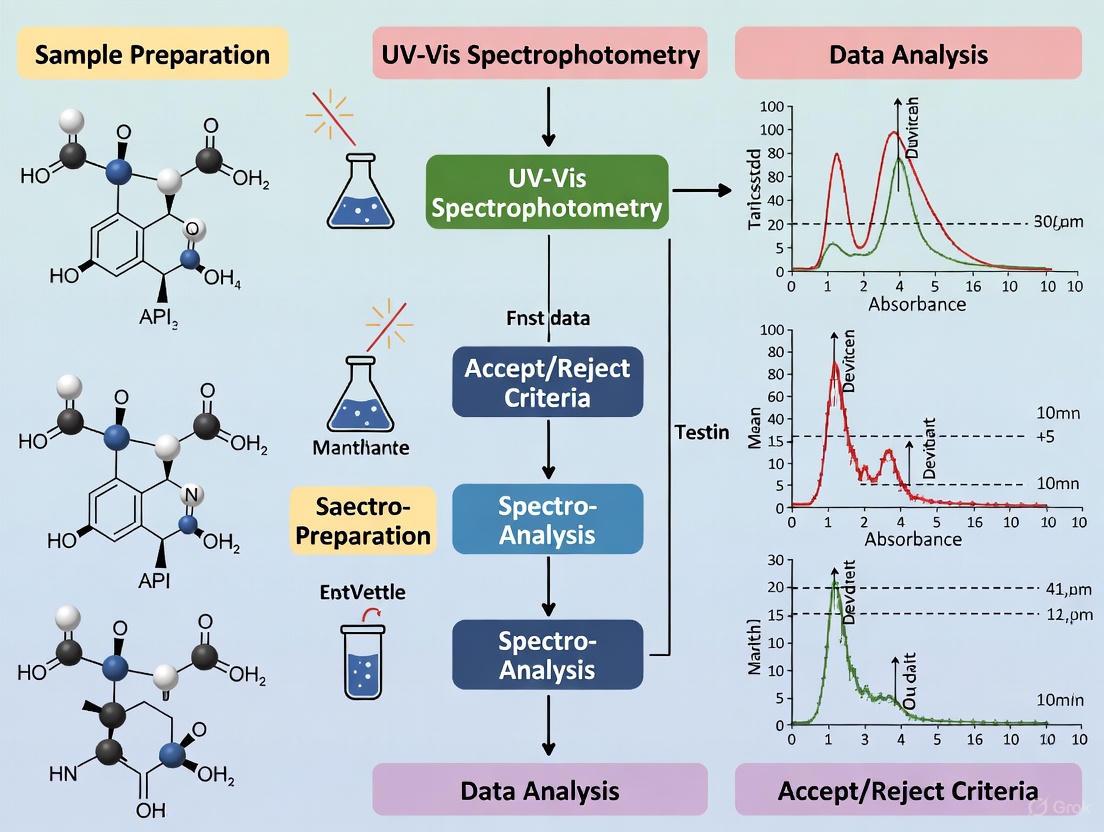
This article provides a comprehensive overview of the application of UV-Vis spectrophotometry for content uniformity testing in pharmaceutical solid dosage forms.
UV-Vis Spectrophotometry for Content Uniformity Testing: Principles, Methods, and Advanced Applications
Abstract
This article provides a comprehensive overview of the application of UV-Vis spectrophotometry for content uniformity testing in pharmaceutical solid dosage forms. It covers foundational principles, from the critical role of content uniformity as a CQA in QbD frameworks to the basic theory of UV-Vis spectroscopy. The article details established and emerging methodological approaches, including in-line monitoring for continuous manufacturing and advanced techniques like factorized response spectra for analyzing complex mixtures. It addresses common troubleshooting challenges and optimization strategies for real-world implementation and thoroughly examines validation requirements per ICH guidelines and comparative analyses with other techniques like NIR and Raman spectroscopy. Tailored for researchers, scientists, and drug development professionals, this guide serves as a vital resource for leveraging UV-Vis spectrophotometry to ensure drug product quality and safety.
Content Uniformity and UV-Vis Fundamentals: Ensuring Dosage Consistency from Theory to Practice
Why Content Uniformity is a Critical Quality Attribute (CQA) in Pharmaceutical Manufacturing
In pharmaceutical manufacturing, Content Uniformity (CU) is a Critical Quality Attribute (CQA) that ensures each individual dosage unit, such as a tablet, contains an amount of active pharmaceutical ingredient (API) within a specified range around the label claim [1]. This is fundamental to patient safety and therapeutic efficacy, as it guarantees that the patient receives the correct dose in every single administered unit [1]. The requirement for content uniformity testing is particularly crucial for products where the dosage form contains 50 mg or less of the active ingredient [2].
Content uniformity is a CQA because it directly impacts the safety, efficacy, and quality of the drug product. A failure to achieve content uniformity can result in some patients receiving a subtherapeutic dose, leading to treatment failure, while others may receive a toxic overdose, causing adverse effects [1]. Since drug content in single-dose preparations depends on numerous manufacturing processes, it is unrealistic to expect every unit to possess exactly the same amount of API. Therefore, pharmacopeial standards have established permissible limits, typically requiring that individual units fall within 85-115% of the label claim, with specific statistical criteria for acceptance [2] [1].
The Role of UV-Vis Spectrophotometry in Content Uniformity Testing
UV-Vis spectrophotometry has emerged as a powerful, cost-effective, and sustainable technique for content uniformity testing. It aligns with the principles of Green Analytical Chemistry (GAC) by minimizing hazardous waste, reducing energy consumption, and avoiding toxic solvents compared to traditional chromatographic methods [3] [4] [5].
Advantages for CU Analysis
- Simplicity and Speed: UV-Vis methods often require less complex sample preparation and faster data analysis compared to HPLC, enabling higher throughput for routine quality control [2] [5].
- Non-Destructive Potential: When implemented as an in-line or at-line PAT tool, UV-Vis spectroscopy can provide non-destructive analysis, preserving samples for further testing [6] [7].
- Green Credentials: The use of environmentally benign solvents like water-ethanol mixtures significantly reduces the environmental impact of analytical procedures [3] [4].
Advanced UV-Vis methods have been successfully developed and validated for the simultaneous determination of multiple APIs in fixed-dose combination tablets, which is essential for modern therapeutic regimens [3] [2] [4]. Furthermore, the integration of chemometric models such as Partial Least Squares (PLS) and Multivariate Curve Resolution–Alternating Least Squares (MCR-ALS) allows for the resolution of overlapping spectra in complex mixtures, enhancing the selectivity and accuracy of UV-Vis methods [3] [4].
Analytical Techniques and Methodologies
A comparison of common techniques used for content uniformity testing is summarized in the table below.
Table 1: Comparison of Techniques for Content Uniformity Testing
| Technique | Principle | Key Advantages | Key Limitations | Applicability for CU |
|---|---|---|---|---|
| UV-Vis Spectrophotometry | Measurement of light absorption in UV/Visible range [2] | Cost-effective, simple, fast, green solvent potential, high throughput [2] [5] | Limited for complex overlapping spectra without chemometrics [3] | Excellent for single API; requires chemometrics for multi-API [3] [4] |
| Near-Infrared Chemical Imaging (NIR-CI) | Measures chemical composition based on NIR absorption and spatial distribution [7] | Very high throughput, non-destructive, no sample prep, simultaneous multi-tablet analysis [7] | High computational effort, requires multivariate data analysis [6] [7] | Excellent for high-throughput screening and spatial distribution analysis [7] |
| Transmission Raman Spectroscopy (TRS) | Measures vibrational spectroscopy signals through sample [8] | Non-destructive, minimal sub-sampling, high sample throughput [8] | Specialized equipment, requires model development | Ideal for extended UDU testing and real-time release [8] |
| High-Performance Liquid Chromatography (HPLC) | Separation of components followed by detection [1] [9] | High specificity and sensitivity, reference method for compendial testing [1] | Time-consuming, destructive, uses large volumes of organic solvents [7] [5] | Gold standard for specific quantification, but slower and less green [1] |
Advanced UV-Vis Spectrophotometric Methods
To overcome the challenge of analyzing multi-component mixtures with overlapping spectra, several advanced univariate and multivariate spectrophotometric methods have been developed.
Table 2: Advanced Spectrophotometric Methods for Multi-Component Analysis
| Method | Principle | Application Example |
|---|---|---|
| Simultaneous Equation Method | Solving equations based on absorptivity at two wavelengths [2] | Determination of atenolol and losartan in combined tablets [2] |
| Successive Ratio Subtraction & Constant Multiplication | Successive spectral manipulation to resolve one component at a time [4] | Analysis of telmisartan, chlorthalidone, and amlodipine in triple combination [4] |
| Factorized Response Techniques | Uses factorized spectra for quantification without prior separation [5] | Determination of chlorphenoxamine HCl and caffeine in formulation [5] |
| Chemometric Models (e.g., PLS, GA-PLS, MCR-ALS) | Multivariate calibration that correlates spectral data to concentration [3] [4] | Analysis of meloxicam and rizatriptan in FDA-approved tablets [3] |
Detailed Experimental Protocols
This section provides a detailed protocol for determining the content uniformity of a tablet formulation using a UV-Vis spectrophotometric method, adaptable for single or multiple APIs.
Protocol: Content Uniformity Testing of Tablets via UV-Vis Spectrophotometry
I. Scope This procedure applies to the content uniformity testing of individual tablet units using UV-Vis spectrophotometry, with options for univariate or chemometric analysis.
II. Experimental Workflow
III. Materials and Reagents
- API Reference Standards: Certified purity for calibration [4].
- Green Solvent System: e.g., water:ethanol (1:1 v/v) [3] [4].
- Volumetric Flasks: Class A, various volumes (e.g., 10 mL, 25 mL, 50 mL, 100 mL).
- Ultrasonic Bath: For facilitating dissolution.
- Syringe Filters: 0.45 μm, if filtration is needed.
- Double-beam UV-Vis Spectrophotometer: With 1.0 cm quartz cells [3] [2].
IV. Procedure
- Standard Stock Solution Preparation: Accurately weigh and transfer about 50 mg of API reference standard into a 100 mL volumetric flask. Dissolve and dilute to volume with the chosen solvent to obtain a concentration of approximately 500 μg/mL [4].
- Calibration Curve Construction: From the stock solution, prepare a series of standard solutions covering the expected concentration range (e.g., 5-40 μg/mL). Scan the absorbance of each standard solution and measure at the λmax for univariate analysis, or retain the full spectral data for chemometric modeling [2] [4].
- Sample Preparation: a. Accurately weigh 10 individual tablet units [2] [1]. b. Place each tablet into a separate volumetric flask (e.g., 50 mL or 100 mL). c. Add a sufficient amount of solvent, sonicate for 10-15 minutes to ensure complete dissolution, and dilute to volume [2]. d. Filter if necessary. Further dilute the solution to bring the concentration within the linear range of the calibration curve.
- Spectral Acquisition: Scan the absorbance of the sample solutions over the appropriate wavelength range (e.g., 200-400 nm) using a 1.0 cm quartz cell with solvent as the blank [4].
- Quantification:
- Univariate Path: Measure the absorbance of the sample at the predetermined λmax. Calculate the concentration using the regression equation of the calibration curve [2].
- Chemometric Path: Process the full spectrum of the sample using a pre-validated chemometric model (e.g., PLS, GA-PLS, MCR-ALS) to determine the API concentration [3] [4].
- Content Uniformity Assessment: For each of the 10 units, calculate the drug content as a percentage of the label claim. The requirements are typically met if the acceptance value (AV) of the first 10 units is ≤ L1% (e.g., 15.0 per USP/BP) and no individual value is outside 75% to 125% of the label claim [1].
Protocol: In-line CU Monitoring using UV-Vis as a PAT Tool
I. Scope This procedure describes the setup for in-line monitoring of API content during tableting using a UV-Vis probe.
II. Materials and Equipment
- Rotary Tablet Press with a PAT integration port.
- UV-Vis Reflectance Probe with a dedicated light source and spectrometer.
- Data Acquisition and Control Software.
III. Procedure
- Probe Installation: Implement the UV-Vis probe in the ejection position of the tablet press to measure the surface of each tablet after compression [6] [10].
- Method Development: Correlate the reflectance (or converted CIELAB C* value) of tablets with known API content (determined by a reference method) to establish a univariate or multivariate calibration model [6] [10].
- Real-time Monitoring: During production, collect spectra from every tablet or at a defined frequency. Convert the spectral data to API content in real-time using the developed model [6].
- Process Control: Use the real-time data as a feedback control mechanism to maintain the process within a state of control and ensure content uniformity across the entire batch.
The Scientist's Toolkit: Key Research Reagent Solutions
Table 3: Essential Materials and Reagents for CU Testing via UV-Vis
| Item | Function & Importance | Example & Notes |
|---|---|---|
| Green Solvents | To dissolve API without toxicity or environmental burden. | Ethanol-Water Mixtures [3] [4]. Preferred over acetonitrile or methanol for sustainability. |
| API Reference Standards | To create a calibration curve for accurate quantification. | Certified purity materials traceable to USP/BP standards [4]. |
| Chemometric Software | To build multivariate models for resolving complex, overlapping spectra. | PLS Toolbox for MATLAB, "R" packages. Essential for GA-PLS, MCR-ALS, iPLS modeling [3] [4]. |
| UV-Vis Spectrophotometer | Core instrument for measuring light absorption by the sample. | Double-beam configuration with 1.0 cm quartz cells; instruments from Shimadzu, Jasco are typical [3] [2] [4]. |
| PAT Probe | For in-line, real-time monitoring of content uniformity during manufacturing. | UV-Vis reflectance probe integrated into a tablet press feed frame or ejection position [6] [10]. |
Content uniformity stands as a non-negotiable CQA to ensure the safety and efficacy of every single dose of medicine a patient takes. The evolution of UV-Vis spectrophotometry, bolstered by advanced chemometric techniques and alignment with green chemistry principles, provides the pharmaceutical industry with robust, sustainable, and efficient tools for content uniformity testing. The implementation of these methods, both in the quality control laboratory and as in-line PAT, supports the industry's shift towards more efficient, controlled, and environmentally responsible manufacturing processes, ultimately safeguarding public health.
Essential Principles of UV-Vis Spectrophotometry and Beer-Lambert Law
Theoretical Foundations
The Beer-Lambert Law
The Beer-Lambert Law (also called Beer's Law) describes the fundamental relationship between the absorption of light and the properties of the material through which the light is traveling. This law states that the absorbance of light by a solution is directly proportional to the concentration of the absorbing species and the path length of the light through the solution [11] [12].
The mathematical expression of the Beer-Lambert Law is: A = εlc Where:
- A is the absorbance (unitless)
- ε is the molar absorptivity or molar absorption coefficient (L·mol⁻¹·cm⁻¹)
- l is the path length of the sample cuvette (cm)
- c is the concentration of the compound in solution (mol·L⁻¹) [13] [14] [12]
The absorbance (A) is defined via the incident intensity (I₀) and transmitted intensity (I) by the relationship: A = log₁₀(I₀/I) [12]
Transmittance and Absorbance Relationship
Transmittance (T) is defined as the ratio of the transmitted light intensity (I) over the incident light intensity (I₀), while absorbance has a logarithmic relationship to transmittance [11].
Table 1: Absorbance and Transmittance Values
| Absorbance | Transmittance |
|---|---|
| 0 | 100% |
| 1 | 10% |
| 2 | 1% |
| 3 | 0.1% |
| 4 | 0.01% |
| 5 | 0.001% |
An absorbance of 1 corresponds to 10% transmittance, meaning 90% of the light at that wavelength has been absorbed by the sample [11] [12].
Molar Absorptivity
The molar absorptivity (ε) is a sample-dependent property that measures how strong an absorber the sample is at a particular wavelength of light [11]. This parameter reflects both the size of the chromophore (light-absorbing group) and the probability that light of a given wavelength will be absorbed when it strikes the chromophore [15].
Molar absorptivities can vary significantly:
- Strongly absorbing chromophores: >10,000 L·mol⁻¹·cm⁻¹
- Weakly absorbing chromophores: 10-100 L·mol⁻¹·cm⁻¹ [15]
UV-Vis Spectrophotometry Instrumentation
Instrument Components
A UV-Vis spectrophotometer consists of several key components that work together to measure light absorption [13]:
Figure 1: Schematic of UV-Vis Spectrophotometer Components
UV-Vis instruments typically employ multiple light sources to cover different wavelength ranges:
- Deuterium lamp: Common source for UV light (approximately 100-400 nm)
- Tungsten or halogen lamp: Used for visible light (approximately 350-800 nm)
- Xenon lamp: High-intensity source for both UV and visible ranges, though more expensive and less stable [13]
Wavelength Selection
Several methods are available for selecting specific wavelengths:
- Monochromators: Separate light into a narrow band of wavelengths using diffraction gratings (typically 1200-2000 grooves per mm)
- Absorption filters: Colored glass or plastic designed to absorb particular wavelengths
- Interference filters: Use multiple layers of dielectric material to select wavelengths through constructive and destructive interference [13]
Sample Holders
The choice of sample holder material is critical:
- Quartz cuvettes: Required for UV examination as quartz is transparent to most UV light
- Glass cuvettes: Absorb UV light below approximately 350 nm, suitable only for visible measurements
- Plastic cuvettes: Generally inappropriate for UV absorption studies [13]
Detectors
Detectors convert light intensity into electronic signals:
- Photomultiplier tubes (PMT): Based on the photoelectric effect, useful for detecting very low light levels
- Photodiodes: Semiconductor-based detectors
- Charge-coupled devices (CCD): Allow simultaneous detection of multiple wavelengths [13]
Instrument Configurations
Different spectrometer designs offer various advantages:
- Single beam instruments: Have a filter or monochromator between the source and sample to analyze one wavelength at a time
- Double beam instruments: Split the beam to pass through both reference and sample simultaneously for more accurate readings
- Simultaneous instruments: Use diode array detectors to detect absorbance at all wavelengths simultaneously, offering greater speed and efficiency [14]
Experimental Protocols for Content Uniformity Testing
Content Uniformity Testing in Pharmaceutical Development
Content uniformity testing ensures that individual dosage units contain active ingredient amounts within specified limits around the label claim [1]. This is particularly critical for single-dose preparations where patient safety and efficacy depend on consistent dosing [1]. UV-Vis spectroscopy serves as a valuable tool for this application due to its simplicity, speed, and minimal sample preparation requirements [6] [4].
Protocol: UV-Vis Spectroscopy for Tablet Content Uniformity
Scope and Purpose
This protocol describes the procedure for determining content uniformity of tablet formulations using UV-Vis spectrophotometry, based on established methodologies for pharmaceutical quality control [6] [4].
Materials and Reagents
Table 2: Essential Research Reagent Solutions
| Item | Specification | Function |
|---|---|---|
| UV-Vis Spectrophotometer | Double beam with deuterium and tungsten lamps | Quantitative absorbance measurements |
| Quartz Cuvettes | 1 cm path length | Sample holder for UV transparency |
| Analytical Balance | Accuracy ±0.1 mg | Precise weighing of samples and standards |
| Volumetric Flasks | Class A, various sizes | Precise solution preparation |
| Reference Standards | Certified purity >98% | Calibration curve establishment |
| Solvent (e.g., Ethanol) | HPLC grade | Sample dissolution and dilution |
| Syringe Filters | 0.45 μm porosity | Sample clarification before analysis |
Sample Preparation Procedure
Standard Solution Preparation:
- Accurately weigh 50 mg of reference standard API and transfer to a 100-mL volumetric flask
- Dissolve with and dilute to volume with appropriate solvent to obtain 500 μg/mL stock solution
- Prepare serial dilutions to create working standards covering the expected concentration range (e.g., 5-100 μg/mL) [4]
Tablet Sample Preparation:
- For each batch, randomly select at least 10 individual tablets
- Precisely weigh each tablet and calculate average weight
- Place individual tablets in separate volumetric flasks, add solvent, and sonicate until completely dissolved
- Dilute to volume and filter if necessary to obtain clear solutions [6] [1]
Blank Solution Preparation:
- Prepare solvent blank using the same solvent and conditions as sample solutions
Instrumental Analysis
Spectrophotometer Setup:
- Turn on instrument and allow lamps to warm up for 15-30 minutes
- Select appropriate wavelength based on API absorbance maximum (determined from preliminary scan)
- Set scan parameters: wavelength range 200-400 nm, medium scan speed, 1 nm bandwidth
Calibration Curve Construction:
- Measure absorbance of standard solutions at λmax
- Plot absorbance versus concentration and determine regression equation
- Verify correlation coefficient (R²) of 0.99 or better [14]
Sample Measurement:
- Measure absorbance of each tablet sample solution at predetermined λmax
- Calculate API concentration using calibration curve equation
- Express results as percentage of label claim for each individual tablet
Content Uniformity Assessment
Figure 2: Content Uniformity Testing Workflow
Current pharmacopeial standards use a two-tier approach for content uniformity assessment [1]:
Acceptance Criteria:
- Stage 1 (10 tablets): Acceptance Value (AV) ≤ 15.0; all individual units between 85-115% of label claim
- Stage 2 (30 tablets): AV ≤ 15.0; all individual units between 85-115% with maximum one unit between 75-125%
The Acceptance Value is calculated using a parametric tolerance interval approach that provides simultaneous control on the mean and standard deviation of the batch [1].
Advantages of UV-Vis for Content Uniformity Testing
UV-Vis spectroscopy offers several benefits for content uniformity testing in pharmaceutical manufacturing:
- Simpler data analysis compared to NIR or Raman spectroscopy, often requiring no multivariate analysis [6]
- High sensitivity with detection capabilities at low weight fractions [6]
- Rapid analysis with exposure times in the sub-millisecond range [6]
- Cost-effectiveness requiring less expensive instrumentation [4]
Advanced Applications in Pharmaceutical Analysis
Multivariate Analysis for Complex Formulations
For fixed-dose combination products containing multiple active ingredients, advanced spectrophotometric methods may be employed:
- Successive Ratio Subtraction with Constant Multiplication (SRS-CM): Resolves spectral overlap without prior separation
- Successive Derivative Subtraction with Constant Multiplication (SDS-CM): Uses derivative spectra for component identification and quantification
- Multivariate Chemometrics: Interval-Partial Least Squares (iPLS) and Genetic Algorithm-PLS (GA-PLS) enhance predictive ability by focusing on relevant spectral intervals [4]
In-line Monitoring in Continuous Manufacturing
UV-Vis spectroscopy can be implemented as an in-line Process Analytical Technology (PAT) tool for real-time content uniformity monitoring during tablet production:
- UV-Vis probes integrated directly into rotary tablet presses
- Continuous monitoring of API uniformity during the tableting process
- Rapid detection of deviations from steady-state process conditions [6]
Method Validation Parameters
For regulatory compliance, UV-Vis methods for content uniformity testing should be validated according to ICH guidelines including:
- Specificity: Ability to measure analyte response in the presence of excipients
- Linearity: Absorbance response proportional to concentration across specified range
- Precision: Repeatability and intermediate precision studies
- Accuracy: Recovery studies comparing measured versus actual concentration [6] [4]
Troubleshooting and Best Practices
Common Issues and Solutions
- Absorbance values too high (>1.0): Dilute sample or use shorter path length cuvette
- Poor linearity: Verify solution preparation accuracy and instrument calibration
- Scattering effects: Filter samples to remove particulate matter
- Solvent absorption: Ensure reference blank uses identical solvent [13] [14]
Optimal Measurement Conditions
- Maintain absorbance values between 0.1-1.0 for best accuracy
- Use high-purity solvents with low UV absorption
- Allow instrument to stabilize before measurements
- Regularly verify wavelength accuracy and photometric accuracy [13]
This application note details the core advantages of Ultraviolet-Visible (UV-Vis) spectrophotometry—simplicity, speed, and cost-effectiveness—and their critical relevance to content uniformity testing in pharmaceutical development. The document provides validated experimental protocols and data to enable researchers and scientists to implement this technique for robust, routine analysis of active pharmaceutical ingredients (APIs) in dosage forms, aligning with the stringent requirements of modern Quality by Design (QbD) and Process Analytical Technology (PAT) frameworks [6].
In the context of continuous manufacturing (CM) and enhanced quality control paradigms in the pharmaceutical industry, content uniformity of the active pharmaceutical ingredient (API) stands as a paramount Critical Quality Attribute (CQA) [6]. UV-Vis spectrophotometry has emerged as a foundational analytical technique for its assessment, offering a compelling balance of performance and practicality. Its principle, based on the measurement of a substance's absorption of light in the ultraviolet and visible regions, provides a direct, often non-destructive, means of quantitative analysis.
The technique's versatility and user-friendly design make it accessible even to personnel with minimal training, facilitating seamless integration into daily workflows and reducing associated training costs [16]. Furthermore, the initial investment and operational expenses for UV-Vis spectrophotometers are comparatively low, contributing to their exceptional cost-effectiveness over the instrument's operational lifetime [16]. This note elaborates on these advantages through specific application data and provides a detailed protocol for content uniformity testing.
Core Advantages and Supporting Data
The following tables summarize quantitative data from recent studies and instrument specifications that underscore the key advantages of the UV-Vis technique.
Table 1: Validation Data from UV-Vis Analysis of Various APIs in Content Uniformity and Assay Applications
| API (Matrix) | Wavelength (nm) | Linearity Range (µg/mL) | Accuracy (Avg. Recovery %) | Precision (RSD %) | Reference / Application |
|---|---|---|---|---|---|
| Vardenafil HCl (Tablets) | 244 | 0.1 - 2.0 | 100 ± 1.0 | < 1.6% | Content Uniformity Testing [17] |
| Theophylline (Tablets) | N/A | 7 - 13 wt% | Meeting ICH Q2 specs | High Precision | In-line Monitoring [6] |
| Guaifenesin (Tablets/Syrups) | 222 | 2 - 40 | 100 ± 1.0 | < 1.4% | Content Uniformity Testing [18] |
| Vitamin B1 (Tablets) | 235 | 2.5 - 30 | 100 ± 0.8 | < 1.9% | Content Uniformity Testing [19] |
| Sofosbuvir (Chemometric) | N/A | Calibration Model | 99.70 - 100.39% | Low RRMSEP* | Green Pharmaceutical Analysis [20] |
*RRMSEP: Relative Root Mean Square Error of Prediction
Table 2: Comparative Advantages of Modern UV-Vis Spectrophotometers
| Feature | Traditional Instruments | Modern Evolutions (2025) | Impact on Routine Analysis |
|---|---|---|---|
| Ease of Use | Complex interfaces; extensive training required | Intuitive touchscreens, pre-programmed methods, guided workflows [21] | Reduces training time & user error; accessible to non-experts |
| Speed & Throughput | Slow scanning speeds; multiple manual steps | High-speed scanning; rapid, stable readings; automated data handling [21] | Accelerates time-from-sample-to-result; ideal for high sample volumes |
| Cost & Footprint | Large, bulky instruments; high operational cost | Compact benchtop designs; low maintenance; affordable initial investment [16] [21] | Saves lab space; lowers capital and lifetime costs |
| Data Connectivity | Standalone operation; manual data recording | Integrated SD cards, PC software, connectivity to LIMS & cloud platforms [21] | Enhances data integrity, traceability, and compliance |
Advantage 1: Simplicity and Ease of Use
The simplicity of UV-Vis spectrophotometry is twofold: in operation and in data analysis. Instruments are engineered with intuitive interfaces that streamline the process from sample preparation to data acquisition [16]. For content uniformity testing, which requires a high number of assays on individual tablets, this simplicity is crucial for maintaining workflow efficiency [17] [18]. Furthermore, unlike techniques like NIR or Raman spectroscopy which often require complex Multivariate Data Analysis (MVDA), UV-Vis data can frequently be evaluated using simpler, univariate calibration models, reducing computational effort and expertise requirements [6].
Advantage 2: Speed and High Throughput
The technique is characterized by its rapid analysis times. Measurements can be obtained in a matter of seconds, and modern instruments are designed with faster scan speeds and improved optical systems to accelerate the process further [21]. This is complemented by minimal sample preparation—often involving just dissolution and dilution—without the need for complex derivatization or lengthy separation steps, as would be required in chromatographic methods. This speed makes UV-Vis ideal for in-line monitoring applications, where it can provide timely data for process control [6].
Advantage 3: Cost-Effectiveness
UV-Vis spectrophotometry offers a compelling economic case. The initial investment for a capable system is relatively low compared to techniques like HPLC or mass spectrometry [16]. Operational costs are also minimized due to low maintenance requirements, the durability of the instruments, and the minimal consumption of inexpensive solvents (often just water or simple alcohols). This overall cost-effectiveness makes UV-Vis an attractive and accessible technique for quality control laboratories across the globe, including in resource-limited settings.
Application Protocol: Content Uniformity Testing of Tablets
This protocol outlines a general method for determining the content uniformity of an API in tablets using UV-Vis spectrophotometry, based on procedures documented in recent literature [17] [18] [19].
Research Reagent Solutions and Materials
Table 3: Essential Materials and Reagents for Content Uniformity Testing
| Item | Function / Specification |
|---|---|
| Double-Beam UV-Vis Spectrophotometer | Equipped with 1.0 cm matched quartz cells for absorbance measurement. |
| Analytical Balance | For precise weighing of standards and sample aliquots. |
| API Standard | High-purity reference material of the Active Pharmaceutical Ingredient. |
| Distilled or Deionized Water | Used as a primary solvent for preparing standard and sample solutions. |
| Volumetric Flasks | For accurate preparation and dilution of standard and sample solutions. |
| Syringe Filters | (Optional) For filtration of sample solutions post-dissolution, if necessary. |
| Magnetic Stirrer & Stir Bars | For facilitating the dissolution of powdered tablet mass. |
Experimental Workflow
The following diagram illustrates the step-by-step workflow for the content uniformity testing protocol.
Step-by-Step Procedure
Part A: Standard Calibration Curve
- Stock Standard Solution: Accurately weigh about 10 mg of the API reference standard. Transfer it quantitatively into a 1000 mL volumetric flask, dissolve, and make up to volume with distilled water to obtain a concentration of approximately 10 µg/mL [17] [19].
- Working Standard Solutions: Pipette appropriate volumes of the stock solution (e.g., 0.5, 1.0, 1.5, 2.0 mL) into a series of 10 mL volumetric flasks. Dilute to volume with distilled water to create a calibration series covering the expected concentration range (e.g., 0.5 - 2.0 µg/mL) [17].
- Absorbance Measurement: Using the spectrophotometer, measure the absorbance of each working standard solution at the predetermined λmax of the API (e.g., 244 nm for Vardenafil HCl) against a distilled water blank [17].
- Curve Construction: Plot the average absorbance readings against the corresponding concentrations. Perform linear regression to obtain the calibration equation (y = mx + c) and correlation coefficient (r²), which should be ≥ 0.999 [17].
Part B: Sample Preparation and Analysis
- Powder Preparation: Weigh and finely powder not less than 20 tablets. Thoroughly mix the powder to ensure a homogeneous mixture [17] [18].
- Sample Solution: Accurately weigh a portion of the powder equivalent to the weight of one tablet (or an aliquot containing about 1 mg of API). Transfer to a suitable container, add about 90 mL of distilled water, and stir magnetically for 20 minutes to ensure complete dissolution of the API [17] [19].
- Dilution and Filtration: Transfer the solution quantitatively into a 1000 mL volumetric flask, rinse the container, make up to volume with distilled water, and mix well. If the solution is not clear, filter it through a 0.45 µm membrane filter, discarding the first few mL of the filtrate [18].
- Further Dilution: Pipette 10 mL of the filtrate into a 100 mL volumetric flask and dilute to volume with distilled water to obtain a final concentration within the range of the calibration curve [17].
- Measurement: Measure the absorbance of the final sample solution at the same λmax used for the standard curve.
Data Analysis and Acceptance Criteria
- API Content per Tablet: Calculate the amount of API in each tablet (in mg) using the calibration curve equation and accounting for all dilution factors.
- Content Uniformity Assessment: According to pharmacopeial standards (e.g., USP), the requirement is met if the amount of API in each individual tablet is within the range of 85% to 115% of the label claim, and the Relative Standard Deviation (RSD) of the 10 tested tablets is less than or equal to 6% [17] [18]. The method's high precision (typically RSD < 2%, as shown in Table 1) is essential for reliably meeting this criterion.
UV-Vis spectrophotometry remains an indispensable tool in the pharmaceutical analyst's arsenal, particularly for routine content uniformity testing. Its core strengths of simplicity, speed, and cost-effectiveness do not come at the expense of data quality, as demonstrated by the excellent accuracy and precision metrics achieved in validated methods. As the technique continues to evolve with more intuitive interfaces, faster hardware, and better connectivity, its value in ensuring drug product quality and supporting efficient pharmaceutical manufacturing is set to grow even further.
Content uniformity (CU) testing is a critical quality assessment for solid dosage forms, such as tablets, ensuring that each unit contains an active pharmaceutical ingredient (API) amount within the specified range to guarantee consistent therapeutic effect [22]. This application note details the integration of UV-Vis spectrophotometry as a Process Analytical Technology (PAT) tool for CU testing, framed within the regulatory contexts of the United States Pharmacopeia (USP), ICH Q2(R2) validation guidelines, and PAT initiatives [6] [23] [24]. The shift from traditional, offline testing to modern, in-line monitoring supports the pharmaceutical industry's move toward Continuous Manufacturing (CM) and Quality by Design (QbD) principles, enabling real-time quality assurance and more efficient control strategies [6] [24].
The Regulatory and Quality Landscape
A thorough understanding of the interconnected regulatory guidelines is essential for developing robust analytical procedures for content uniformity testing.
United States Pharmacopeia (USP) Guidelines
USP guidelines, such as <905> Uniformity of Dosage Units, set the foundational requirements for assessing content uniformity in final solid dosage forms [22]. The traditional test typically involves analyzing 10 individual dosage units, with provisions for testing additional units if the initial results are outside acceptance criteria. There is a growing regulatory emphasis on testing a larger number of samples (e.g., 100–10,000 units) to gain higher confidence in batch quality, a practice made feasible by modern spectroscopic PAT tools [22]. The International Society for Pharmaceutical Engineering (ISPE) Blend and Content Uniformity (BUCU) team has been instrumental in proposing advanced statistical sampling plans, such as stratified sampling, to replace outdated thief sampling methods and improve the reliability of blend and content uniformity assessments [22].
ICH Q2(R2) Validation of Analytical Procedures
The ICH Q2(R2) guideline provides the framework for validating analytical procedures, ensuring they are suitable for their intended use [23]. For a quantitative CU method using UV-Vis spectroscopy, the following validation characteristics are typically assessed per ICH Q2(R2) [6] [5]:
- Specificity: Ability to assess the analyte unequivocally in the presence of excipients.
- Linearity & Range: The method's ability to obtain results directly proportional to the analyte concentration within a specified range.
- Accuracy: The closeness of agreement between the accepted reference value and the value found.
- Precision: Includes repeatability (same operating conditions over a short time) and intermediate precision (different days, different analysts, different equipment).
Process Analytical Technology (PAT) and Quality by Design (QbD)
PAT is a system for designing, analyzing, and controlling manufacturing through timely measurements of Critical Quality Attributes (CQAs) of raw and in-process materials [24]. In the context of CU, the API content is a primary CQA for tablets [6]. PAT encourages the use of in-line, on-line, or at-line tools to monitor and control the process in real-time, moving away from traditional end-product testing. This aligns with the QbD approach, which emphasizes product and process understanding based on sound science and quality risk management [24]. Implementing UV-Vis spectroscopy as a PAT tool facilitates Real-Time Release Testing (RTRT), where CU can be verified based on process data, enabling Continuous Process Verification (CPV) [24].
The following diagram illustrates the logical relationship and integration of these regulatory and quality frameworks in the context of pharmaceutical development and manufacturing.
UV-Vis Spectrophotometry as a PAT Tool for Content Uniformity
While Near-Infrared (NIR) and Raman spectroscopy are well-established for CU monitoring, UV-Vis spectroscopy presents a compelling alternative with distinct advantages, particularly for APIs with suitable chromophores [6].
Advantages and Application in Tablet Monitoring
UV-Vis spectroscopy is characterized by its high sensitivity, even at low API weight fractions, and the ability to use very short exposure times (sub-millisecond), enabling high-frequency measurement during tablet production [6]. A significant operational advantage is the potential for simpler and faster data analysis; unlike NIR and Raman which often require Multivariate Data Analysis (MVDA), UV-Vis data can frequently be evaluated using univariate analysis, reducing computational complexity and facilitating faster implementation [6]. Research has successfully demonstrated the in-line implementation of a UV-Vis probe in a rotary tablet press for real-time content uniformity characterization, validating the method according to ICH Q2(R2) for a model formulation containing theophylline [6].
Comparative Analysis of Spectroscopic PAT Tools
The table below summarizes a comparison of different spectroscopic techniques used for content uniformity monitoring, highlighting the position of UV-Vis spectroscopy.
Table 1: Comparison of Spectroscopic PAT Tools for Content Uniformity
| Feature | UV/Vis Spectroscopy | NIR Spectroscopy | Raman Spectroscopy |
|---|---|---|---|
| Sensitivity | High [6] | Lower sensitivity at low concentrations [6] | High specificity [6] |
| Data Analysis | Relatively simple; often univariate [6] | Requires Multivariate Data Analysis (MVDA) [6] | Requires Multivariate Data Analysis (MVDA) [6] |
| Measurement Speed | Very fast (sub-millisecond exposure) [6] | Fast | Can require longer exposure times [6] |
| Key Advantage | Simplicity, speed, high sensitivity for UV-active APIs | Non-destructive, deep penetration | Specificity for complex mixtures [6] |
| Primary Challenge | API must have UV-Vis chromophore; spectral overlap | High computational effort; sensitivity to physical properties [6] | High computational effort; fluorescence interference [6] |
Detailed Experimental Protocol: In-line UV-Vis CU Monitoring
This protocol is adapted from validated research for in-line monitoring of theophylline tablet content uniformity on a rotary tablet press [6].
Research Reagent and Material Solutions
Table 2: Essential Materials and Their Functions for CU Monitoring Experiments
| Material/Component | Function | Research Context & Justification |
|---|---|---|
| Theophylline Monohydrate | Active Pharmaceutical Ingredient (API) | Model compound with a suitable UV-Vis absorption profile for method development and validation [6]. |
| Lactose Monohydrate | Filler/Binder | Inert excipient constituting the bulk of the formulation; allows for studying API distribution [6]. |
| Magnesium Stearate | Lubricant | Standard pharmaceutical lubricant to prevent adhesion during tableting [6]. |
| UV-Vis Spectrophotometer with Reflectance Probe | PAT Tool for in-line analysis | Configured for reflectance measurements. Enables real-time spectral acquisition directly in the tablet press [6]. |
| Rotary Tablet Press with Feed Frame | Manufacturing Equipment | Standard equipment for continuous tablet manufacturing. The feed frame is an ideal location for PAT probe integration [6]. |
Method and Procedure
- Formulation Preparation: A powder blend is prepared containing 10% w/w theophylline monohydrate, 0.5% w/w magnesium stearate, and lactose monohydrate as the balance. The components are blended using a 3D shaker mixer to achieve a homogenous mixture [6].
- PAT Integration: A UV-Vis reflectance fiber-optic probe is integrated into the tablet press, typically in the feeding system or at the compression zone, to directly face the tablet during the brief pause before compression.
- Spectral Acquisition: The tablet production process is initiated. The spectrophotometer is triggered to collect a reflectance spectrum from each tablet as it passes the probe. The reflected light intensity (
I) is measured, and reflectance (R) is calculated asR = I / I₀, whereI₀is the intensity of the emitted light [6]. - Data Pre-processing:
- Synchronization: Ensure spectrum acquisition is synchronized with tablet position to avoid measuring empty spaces or tablet edges.
- Filtering: Remove spectra where the tablet was not correctly positioned in front of the probe.
- Averaging: For each tablet, average all valid spectra collected from its surface to create a single, representative spectrum.
Data Analysis and Content Calculation
- Calibration Model: Develop a univariate calibration curve by correlating the reflectance values (or a transformed metric like absorbance) at a specific wavelength characteristic of theophylline with known API concentrations from calibration samples [6].
- Content Prediction: For each in-line measured tablet spectrum, apply the calibration model to predict the API content in real-time.
- Uniformity Assessment: Calculate the acceptance value (AV) as per USP <905> guidelines based on the content of individual tablets measured in-line. The process can be monitored using control charts.
The workflow for this experimental protocol, from setup to data analysis, is summarized in the following diagram.
Regulatory Validation per ICH Q2(R2)
The following table outlines the key validation parameters and typical targets for a UV-Vis method for content uniformity, based on a model theophylline formulation [6].
Table 3: ICH Q2(R2) Validation Parameters for a UV-Vis CU Method
| Validation Characteristic | Protocol Description | Acceptance Criteria / Outcome (Theophylline Example) |
|---|---|---|
| Specificity | Verify that excipients (lactose, Mg stearate) do not interfere with the API signal at the analytical wavelength. | No significant contribution from excipients observed in the specified range, confirming method specificity for the API [6]. |
| Linearity & Range | Prepare and analyze samples with API concentrations across a range (e.g., 7-13% w/w). Plot response vs. concentration. | A linear relationship with a determination coefficient (R²) of ~0.99 was achieved in the 7-13% w/w range [6]. |
| Accuracy | Analyze a series of samples with known concentrations (e.g., 80%, 100%, 120% of target). Calculate recovery %. | Recovery rates close to 100% demonstrated, confirming method accuracy [6]. |
| Precision | Repeatability: Analyze multiple samples (n=6) at 100% concentration in one session.Intermediate Precision: Repeat the study on a different day/with a different analyst. | Low relative standard deviation (RSD) for both repeatability and intermediate precision, confirming method precision [6]. |
Advanced Spectrophotometric Data Processing Techniques
For formulations with overlapping spectra, advanced factorized response techniques can be employed to resolve the mixture without separation. These methods enhance the selectivity of UV-Vis spectrophotometry, making it competitive with chromatographic techniques [5].
- Factorized Zero Order Method (FZM): This method uses the zero-order (D⁰) absorption spectrum. A factorized spectrum is derived by dividing the D⁰ spectrum of a pure component by its absorbance value at a specific, pre-determined wavelength (λs). The concentration of the target component in the mixture is then determined by multiplying the absorbance value of the mixture at λs by this factorized spectrum [5].
- Factorized Derivative Method (FDM): This method utilizes the first-order derivative (D¹) spectra. The derivative spectrum of a pure component is divided by its amplitude at a specific wavelength (a peak or trough) to create a factorized amplitude spectrum. The derivative spectrum of the target component in the mixture is then obtained by multiplying the amplitude of the mixture's derivative spectrum at that wavelength by the factorized amplitude spectrum [5].
- Factorized Ratio Difference Method (FRM): This method is suitable for binary mixtures with complete spectral overlap. The ratio spectrum of the mixture is obtained using a divisor from one component. The amplitude difference at two selected wavelengths in the ratio spectrum is proportional to the concentration of the other component, allowing for its quantification [5].
The integration of UV-Vis spectrophotometry within the structured framework of USP standards, ICH Q2(R2) validation, and PAT principles provides a robust, efficient, and regulatory-compliant strategy for ensuring content uniformity. This approach aligns with the modern pharmaceutical industry's goals of implementing Continuous Manufacturing and QbD. By enabling real-time, in-line monitoring with high sensitivity and simplified data analysis, UV-Vis spectroscopy serves as a powerful PAT tool that enhances process understanding and control, ultimately ensuring the consistent delivery of high-quality drug products.
Methodologies and Real-World Applications: From Traditional Assays to PAT Integration
Within pharmaceutical analysis, particularly in a research thesis focusing on content uniformity testing using UV-Vis spectrophotometry, understanding the standard United States Pharmacopeia (USP) methods is fundamental. Content uniformity testing ensures that individual dosage units possess a drug substance content within a specified range around the label claim, which is critical for guaranteeing product safety and efficacy. The primary USP general chapter governing this analytical procedure is <905> Uniformity of Dosage Units [25]. This application note provides detailed protocols and methodologies framed within the context of advanced UV-Vis spectrophotometry research, offering scientists a clear framework for implementing these standards in both development and quality control environments.
A significant evolution in this field is the upcoming revision to USP Chapter <1099>, which provides a statistical method for assessing large data sets using a zero-tolerance criterion (ZTC) and introduces new procedures and tables for evaluating large samples exceeding 30 units [26]. This revised chapter, with a comment period open until July 31, 2025, clarifies that it is not linked to Uniformity of Dosage Units <905> and moves statistical formulas to an appendix, offering researchers more flexible tools for data assessment [26].
Key USP Standards and Regulatory Framework
The following USP chapters provide the regulatory and methodological foundation for content uniformity testing and related physical testing of dosage forms.
Table 1: Key USP General Chapters for Dosage Unit Analysis
| USP Chapter | Official Title | Primary Focus | Key Updates |
|---|---|---|---|
| <905> | Uniformity of Dosage Units | Defines procedures and criteria for assessing the consistency of active ingredient amount in single-dose formulations. | Harmonized PDG standard; removed weight variation allowance for certain tablets/capsules; added content uniformity for semi-solids [25]. |
| <1099> | Limit on Number of Large Deviations When Assessing Content Uniformity in Large Samples | Provides statistical methods for evaluating large data sets (n>30) using a zero-tolerance criterion [26]. | New draft introduces flexible confidence interval approach (e.g., Jeffreys’ method); official comment period until July 31, 2025 [26]. |
| <382> | Elastomeric Component Functionality in Injectable Pharmaceutical Packaging | Replaces <381>; details test methodologies for functional performance of components like vial stoppers and syringe plungers [27]. | Official from Dec 1, 2025; focuses on holistic system performance rather than isolated component testing [27]. |
The Role of Expert Committees
The development and maintenance of these standards are managed by independent Expert Committees of volunteer scientists. For instance, the General Chapters—Dosage Forms Expert Committee is responsible for the formal approval of <905> [25]. Furthermore, various Biologics Expert Committees (e.g., Biologics 1, Biologics 2, and Biologics 4) work on advancing standards for complex therapeutic products like peptides, oligonucleotides, proteins, and cell and gene therapies, which often require specialized content uniformity assessment techniques [28]. These committees collaborate with the FDA and other stakeholders to develop new chapters, reference standards, and analytical tools.
Experimental Protocols for Content Uniformity (USP <905>)
Workflow for Content Uniformity Assessment
The following diagram outlines the core decision-making and analytical workflow for conducting content uniformity testing according to USP <905> principles, integrating the assessment of large datasets as per USP <1099>.
Sample Preparation Protocol
Objective
To prepare a representative sample of dosage units for content uniformity analysis using UV-Vis spectrophotometry, ensuring the sample accurately represents the entire batch.
Materials and Equipment
- Thirty (30) individual dosage units (tablets, capsules, etc.)
- Appropriate solvent (see Section 4.1 for selection criteria)
- Volumetric flasks (size appropriate for expected concentration)
- Analytical balance (accuracy ±0.1 mg)
- Mechanical shaker or sonicator
- Syringe filters (0.45 μm or appropriate porosity)
- Pipettes and volumetric glassware
Step-by-Step Procedure
- Selection: Randomly select at least thirty dosage units from the batch.
- Initial Handling:
- For tablets, carefully remove any film coating if it interferes with analysis.
- For hard capsules, empty the contents quantitatively without losing any particulate matter.
- For semi-solid dosage forms, homogenize the entire unit before sampling.
- Transfer: Accurately transfer the entire content of one dosage unit (or an equivalent aliquot) into a suitable volumetric flask.
- Solvent Addition: Fill the flask approximately halfway with the selected solvent.
- Extraction:
- Shake or sonicate the mixture vigorously for a predetermined time (e.g., 30 minutes) to ensure complete extraction of the active ingredient.
- For complex matrices, heating or repeated extraction may be necessary (validate any deviation from room temperature extraction).
- Dilution: Allow the solution to reach room temperature if heated. Dilute to volume with the same solvent and mix thoroughly.
- Filtration: Filter an aliquot of the solution through a syringe filter, discarding the first few mL of the filtrate.
- Replication: Repeat steps 3-7 for each of the 30 individual dosage units. Prepare sample solutions for UV-Vis analysis.
UV-Vis Spectrophotometric Analysis Protocol
Objective
To quantify the amount of active pharmaceutical ingredient (API) in each prepared sample solution based on its ultraviolet-visible absorption characteristics.
Materials and Equipment
- UV-Vis spectrophotometer with matched quartz cuvettes
- Standard reference material of the API (USP Reference Standard if available)
- Diluted and filtered sample solutions from Section 3.2.3
Step-by-Step Procedure
- Instrument Calibration: Turn on the UV-Vis spectrophotometer and allow it to warm up. Zero the instrument using a cuvette filled only with the solvent.
- Wavelength Selection: Set the instrument to the predetermined analytical wavelength (λ_max) for the API, typically established from a preliminary scan or literature.
- Standard Preparation: Prepare a series of standard solutions from the reference material at concentrations spanning the expected sample concentration range.
- Calibration Curve: Measure the absorbance of each standard solution and construct a calibration curve (Absorbance vs. Concentration).
- Sample Measurement: Measure the absorbance of each of the 10 initial filtered sample solutions.
- Quantification: Using the calibration curve, calculate the concentration of the API in each sample solution, then back-calculate to the content per dosage unit.
Data Analysis and Acceptance Criteria
The analysis of the first 10 units (Stage 1) follows the Acceptance Value (AV) calculation detailed in USP <905>. If the sample proceeds to Stage 2, testing an additional 20 units (for a total of n=30), the revised USP <1099> provides the statistical framework for evaluation [26].
Table 2: USP <905> Acceptance Criteria for Uniformity of Dosage Units
| Stage | Number of Units Tested | Acceptance Criteria | Application in Research |
|---|---|---|---|
| Stage 1 | 10 | Acceptance Value (AV) ≤ 15.0. No individual dosage unit outside 75.0%-125.0% of label claim. | Initial method validation; high-precision formulation screening. |
| Stage 2 | 20 (Total of 30) | AV ≤ 15.0. No individual dosage unit outside 75.0%-125.0% of label claim. All 30 units are evaluated using the large-sample statistical method in USP <1099> [26]. | Comprehensive data analysis for thesis research; final product release assessment. |
The Scientist's Toolkit: Reagents and Materials
Successful implementation of USP content uniformity methods requires specific, high-quality reagents and materials.
Table 3: Essential Research Reagent Solutions for USP Content Uniformity Analysis
| Item | Function / Purpose | Key Considerations for Selection |
|---|---|---|
| USP API Reference Standard | Serves as the primary standard for calibration curve construction in UV-Vis quantification. | Must be of highest purity and traceable to a recognized standard body; essential for method validation [28]. |
| HPLC-Grade Solvents | Used for sample extraction and dilution; minimizes UV-Vis spectral interference. | Low UV cutoff, high purity, and compatibility with the API and dosage form matrix. |
| Buffer Salts | Prepare mobile phases or extraction solvents at controlled pH to stabilize the API. | pH and ionic strength must be optimized to ensure complete extraction and API stability. |
| Syringe Filters (0.45 μm, Nylon) | Clarify sample solutions prior to UV-Vis analysis to remove particulate matter. | Must be compatible with the solvent and not adsorb the API; pre-filtration validation is recommended. |
| Analytical Reference Materials (ARMs) | System suitability testing and method verification as developed by USP Expert Committees [28]. | Used to ensure the analytical method is performing as expected on a given day. |
Advanced Applications: Specialized Dosage Forms
The principles of content uniformity are extended to complex and emerging therapeutic products. The Biologics 4 Expert Committee, for instance, is responsible for advancing standards for gene therapies, cell therapies, and mRNA therapies [28]. Similarly, the Biologics 1 Expert Committee focuses on standards for therapeutic peptides and oligonucleotides [28]. While the analytical techniques for these products (e.g., HPLC, bioassays) may differ from small molecule UV-Vis analysis, the underlying statistical framework for assessing unit-to-unit consistency remains critical. Furthermore, the mechanical functionality of the delivery system, governed by standards like USP <382> for elastomeric components, is an integral part of ensuring the delivered dose is uniform, especially for injectable biologics [27].
This application note has detailed the standard USP methods for sample preparation, solvent selection, and analysis within the critical framework of content uniformity testing. Adherence to USP <905> and the emerging USP <1099> for large datasets provides a robust, statistically sound methodology that is vital for both pharmaceutical research and regulatory compliance [25] [26]. For scientists employing UV-Vis spectrophotometry in thesis research, a deep understanding of these protocols—from proper sample extraction to accurate data interpretation—is indispensable. The ongoing modernization of USP chapters, including the replacement of <381> with <382> and <1382>, reflects a broader industry shift toward a more holistic, system-based approach to quality assurance, ensuring that analytical results truly reflect product performance in real-world use [27].
Simultaneous Equation Methods for Multi-Component Formulations
Content uniformity testing ensures that each individual dosage unit contains an active pharmaceutical ingredient (API) amount close to the label claim, making it a critical quality attribute for patient safety and drug efficacy [29]. For multi-component formulations, where multiple active ingredients coexist in a single dosage form, this testing becomes particularly complex. UV-Vis spectrophotometry offers a robust, cost-effective analytical technique for this purpose, with simultaneous equation methods (SEM) providing a reliable approach for quantifying individual components without prior separation [2] [30].
These methods are especially valuable in quality control environments where routine analysis of combination products is required, as they eliminate the need for expensive instrumentation and extensive sample preparation while delivering accurate results [5] [30]. The fundamental principle underpinning SEM is that in a mixture of n components, the total absorbance at any wavelength equals the sum of individual absorbances of all components, according to Beer-Lambert's law [2]. By measuring absorbance at multiple wavelengths and solving simultaneous equations, the concentration of each component can be precisely determined.
Theoretical Foundation
Mathematical Principles
For a two-component system containing APIs X and Y, the following simultaneous equations can be established using absorbance measurements at two wavelengths, λ1 and λ2 [2] [30]:
A₁ = aˣ₁Cˣ + aʸ₁Cʸ A₂ = aˣ₂Cˣ + aʸ₂Cʸ
Where:
- A₁ and A₂ represent the total absorbance of the mixture at wavelengths λ1 and λ2, respectively
- aˣ₁ and aˣ₂ are the absorptivities of X at λ1 and λ2
- aʸ₁ and aʸ₂ are the absorptivities of Y at λ1 and λ2
- Cˣ and Cʸ represent the concentrations of X and Y, respectively
The concentrations of each component are determined by solving these equations [2]:
Cˣ = (A₂aʸ₁ - A₁aʸ₂) / (aˣ₂aʸ₁ - aˣ₁aʸ₂) Cʸ = (A₁aˣ₂ - A₂aˣ₁) / (aˣ₂aʸ₁ - aˣ₁aʸ₂)
Wavelength Selection Criteria
Proper wavelength selection is fundamental to method success. The ideal wavelengths should correspond to the absorbance maxima of each component [30]. However, significant spectral overlap necessitates careful evaluation to ensure each component contributes sufficiently at selected wavelengths while maintaining mathematical independence between equations [2].
For atenolol and losartan potassium analysis, researchers successfully used 226.4 nm (λmax of atenolol) and 254 nm (λmax of losartan) despite spectral overlap [2]. Similarly, for rabeprazole sodium and aceclofenac, wavelengths of 283 nm and 276 nm were effectively employed [30].
Advanced Factorized Response Techniques
Recent methodological advances incorporate factorized response spectra (FRS) to enhance selectivity without separation steps [5]. These approaches mathematically process spectral data to improve component resolution:
- Absorbance Resolution Method: Utilizes absorbance differences at selected wavelengths where one component shows identical absorbance [5]
- Factorized Derivative Method: Applies first-order derivative spectra to resolve overlapping peaks [5]
- Factorized Ratio Difference Method: Uses ratio spectra for complete spectral overlap scenarios [5]
These advanced techniques maintain the practicality of UV-Vis spectrophotometry while approaching the selectivity of chromatographic methods [5].
Experimental Protocols
Method Development and Validation
Table 1: Method validation parameters for simultaneous equation methods
| Validation Parameter | Acceptance Criteria | Atenolol/Losartan [2] | Rabeprazole/Aceclofenac [30] |
|---|---|---|---|
| Linearity Range | R² > 0.998 | 8-24 μg/mL | 10-60 μg/mL |
| Precision (% RSD) | < 2% | < 2% | < 2% |
| Accuracy (% Recovery) | 98-102% | 98-102% | 99-101% |
| LOD | Signal-to-noise ≈ 3:1 | Not specified | Determined per ICH |
| LOQ | Signal-to-noise ≈ 10:1 | Not specified | Determined per ICH |
Protocol for Two-Component Formulation Analysis
Reagent Preparation
- Standard Stock Solutions (1000 μg/mL): Accurately weigh 25 mg of each API reference standard and transfer to separate 25 mL volumetric flasks. Dissolve and dilute to volume with appropriate solvent (typically methanol or water) [2]
- Working Standard Solutions (100 μg/mL): Pipette 5 mL of each stock solution into separate 50 mL volumetric flasks and dilute to volume with solvent [2]
- Sample Solution: Individually weigh and powder not less than 20 tablets. Transfer an accurately weighed portion of powder equivalent to one dosage unit to a volumetric flask. Add approximately 30 mL of solvent, sonicate for 15 minutes with occasional shaking, then dilute to volume with the same solvent. Filter through a sintered glass filter (G3) or 0.45μm membrane filter, discarding the first few mL of filtrate [2]
Spectral Analysis and Absorptivity Determination
- Preliminary Scanning: Scan working standard solutions of individual components (16 μg/mL) over the UV range (400-200 nm) to identify λmax values for each component [2]
- Calibration Curve: Prepare a series of standard solutions (e.g., 8, 12, 16, 20, 24 μg/mL) from working standards for both components [2]
- Absorptivity Calculation: Measure absorbance of each standard solution at both selected wavelengths. Calculate absorptivity (A/1%C) for each component at both wavelengths [2] [30]
Table 2: Typical absorptivity values for drug combinations
| Drug Combination | Wavelength (nm) | Component | Absorptivity | Reference |
|---|---|---|---|---|
| Atenolol/Losartan | 226.4 | Atenolol | 413 | [2] |
| 226.4 | Losartan | 620 | [2] | |
| 254 | Atenolol | 21 | [2] | |
| 254 | Losartan | 321 | [2] | |
| Rabeprazole/Aceclofenac | 283 | Rabeprazole | 0.02803 | [30] |
| 283 | Aceclofenac | 0.03022 | [30] | |
| 276 | Rabeprazole | 0.02631 | [30] | |
| 276 | Aceclofenac | 0.03289 | [30] |
Content Uniformity Testing
- Sample Preparation: Prepare sample solutions from ten individual dosage units following the protocol in section 3.2.1 [2] [29]
- Absorbance Measurement: Measure absorbance of each sample solution at both selected wavelengths against solvent blank [2]
- Concentration Calculation: Substitute absorbance values and predetermined absorptivity coefficients into the simultaneous equations to calculate individual API concentrations [2] [30]
- Acceptance Criteria Assessment: According to pharmacopeial standards, content uniformity requirements are met if none of the individual results fall outside 85-115% of label claim, with relative standard deviation (RSD) not more than 6% [2] [1]
Workflow Visualization
Figure 1: SEM development and application workflow
The Scientist's Toolkit
Table 3: Essential research reagents and materials
| Item | Function | Example Specifications |
|---|---|---|
| Reference Standards | Provide known purity materials for calibration curve construction and method validation | USP/EP grade, ≥98% purity |
| Methanol/Solvent | Dissolve APIs and prepare standard/sample solutions | HPLC/AR grade, low UV cutoff |
| Volumetric Flasks | Accurate preparation of standard and sample solutions | Class A, various sizes (10mL, 25mL, 50mL, 100mL) |
| UV Cuvettes | Hold samples during spectrophotometric analysis | Quartz, 1cm path length, matched pair |
| Sintered Glass Filter | Clarify sample solutions by removing insoluble excipients | Porosity G3 (15-40μm) |
| Syringe Filters | Alternative filtration method for sample clarification | 0.45μm PVDF or nylon membrane |
| Sonicator | Enhance dissolution of APIs and facilitate extraction from dosage forms | Frequency 35-45kHz, temperature control |
| Analytical Balance | Accurately weigh reference standards and tablet powder samples | Capacity 100g, readability 0.1mg |
Applications in Pharmaceutical Analysis
Simultaneous equation methods have been successfully applied to numerous multi-component formulations. Researchers developed and validated a method for atenolol and losartan potassium in combined tablet dosage forms, analyzing ten individual units from five market formulations [2]. All brands complied with pharmacopeial content uniformity requirements (85-115% of label claim), demonstrating the method's reliability for quality control [2].
Similarly, for rabeprazole sodium and aceclofenac in capsule dosage form, both simultaneous equation and absorbance ratio methods provided accurate results with percentage estimations of 100.22% and 99.96% for rabeprazole and aceclofenac, respectively [30]. The high precision (RSD < 2%) and excellent recovery (99-101%) confirmed method suitability for routine analysis [30].
Recent advances include the application of factorized response techniques for chlorphenoxamine HCl and caffeine mixtures, enabling analysis without initial processing while maintaining environmental sustainability through reduced solvent consumption [5].
Regulatory Considerations and Method Validation
Content uniformity testing must comply with pharmacopeial standards outlined in USP <905> and PhEur 2.9.40 [22] [1]. Regulatory agencies encourage the implementation of quality by design (QbD) principles and process analytical technology (PAT) for enhanced process understanding and control [6] [22].
For content uniformity testing of multi-component formulations, method validation must include specificity, linearity, accuracy, precision, and range determination per ICH Q2(R2) guidelines [6] [5]. UV/Vis spectroscopy has been successfully validated for in-line monitoring of content uniformity in tablet manufacturing, demonstrating compliance with regulatory requirements for specificity, linearity (R² ≈ 0.99), precision (RSD < 2%), and accuracy [6].
Figure 2: Method validation parameters for regulatory compliance
Simultaneous equation methods using UV-Vis spectrophotometry provide efficient, cost-effective solutions for content uniformity testing of multi-component pharmaceutical formulations. Their simplicity, minimal solvent consumption, and rapid analysis make them particularly valuable for quality control environments where routine analysis of combination products is required [5] [30].
When properly validated according to ICH guidelines, these methods demonstrate excellent accuracy, precision, and specificity comparable to more sophisticated chromatographic techniques [6] [2]. The integration of advanced mathematical approaches, such as factorized response spectra, further enhances their capability to resolve complex mixtures without physical separation [5].
As pharmaceutical formulations continue to evolve toward more complex combination products, simultaneous equation methods remain indispensable tools for ensuring content uniformity, ultimately contributing to drug safety and efficacy by guaranteeing consistent dosing in every unit.
Advanced Factorized Response Spectra Techniques for Overlapping Signals
The analysis of multi-component mixtures using UV-Vis spectrophotometry often presents a significant challenge due to severe spectral overlap, where the absorption bands of individual components coincide, making quantification difficult. Factorized Response Spectra (FRS) techniques have emerged as powerful mathematical manipulation tools that resolve these overlapping signals without requiring physical separation of components [5]. These methods leverage the built-in software of modern spectrophotometers to deconvolute complex spectra, recovering the pure zero-order (D°) or derivative (D¹) spectrum of each analyte within a mixture [31] [32].
The fundamental principle underlying factorized spectra approaches involves generating a factorized spectrum by dividing the stored spectrum of a pure component by a specific response value (absorbance or amplitude difference) at a selected wavelength [5]. This factorized spectrum serves as a unique fingerprint that, when multiplied by the same response value obtained from the mixture spectrum, recovers the pure component's profile. This process enables accurate quantification even for critically low concentrations and complete spectral overlap scenarios [33] [31]. Within the context of content uniformity testing—a critical quality control assessment in pharmaceutical manufacturing—these techniques offer a rapid, eco-friendly alternative to chromatographic methods while maintaining the necessary precision and accuracy [5].
Theoretical Framework and Key Concepts
Mathematical Foundations
Factorized Response Spectra techniques are grounded in the linear relationship described by Beer-Lambert's law, which states that absorbance is directly proportional to concentration. For a binary mixture containing components X and Y, the total absorbance at any wavelength (Aₜ) can be expressed as:
Aₜ = aₓCₓ + aᵧCᵧ
where aₓ and aᵧ are the absorptivities of X and Y, respectively, and Cₓ and Cᵧ are their concentrations [31]. The power of FRS methods lies in their ability to mathematically isolate the contribution of each component through strategic wavelength selection and spectral manipulation.
The factorized spectrum (FS) of a component is generated through the division of its pure zero-order or derivative spectrum by a specific response value at a selected wavelength (λₛ) where the interfering component shows no contribution:
FS = Component (D°) / Response(λₛ)
This factorized spectrum, when multiplied by the same response value obtained from the mixture spectrum, reconstructs the pure component's profile within the mixture:
Response(λₛ) × FS = Recovered D° of Component
This elegant mathematical approach forms the basis for all variant FRS techniques, enabling the selective extraction of individual component signals from complex overlapping spectra [31] [5].
Classification of Spectral Manipulation Windows
Modern spectrophotometric software platforms typically provide multiple manipulation windows, each offering distinct advantages for resolving spectral overlaps:
Window I (Zero-Order Manipulation): Operates directly on the original absorption spectra (D°), making it the most straightforward approach with minimal mathematical requirements [31]. Techniques in this window include Absorbance Resolution (AR), Extended Absorbance Difference (EAD), and Factorized Zero-order Method (FZM).
Window II (Derivative Transformation): Utilizes first or higher-order derivative spectra (D¹, D²) to enhance spectral resolution and eliminate baseline drifts [5]. The Factorized Derivative Method (FDM) falls under this category.
Window III (Ratio Spectra Manipulation): Involves dividing the absorption spectrum by a divisor spectrum of a known component, followed by amplitude difference measurements [5]. The Factorized Ratio Difference Method (FRM) is a prominent technique in this window.
Window IV (Manipulated Ratio Spectra): Applies additional mathematical operations to ratio spectra for further resolution enhancement, though this is less commonly implemented in basic FRS applications.
The selection of an appropriate window depends on the nature of spectral overlap, concentration ratios, and the analytical requirements of the specific application.
Key Techniques and Methodologies
Factorized Zero-Order Absorption Methods
Absorbance Resolution (AR) Method is applied to binary mixtures where one component (Y) exhibits significantly different absorbance values at two selected wavelengths, while the other component (X) shows identical absorbance at these wavelengths [5]. The procedural steps include:
- Scan and store the D° spectra of pure Y within its linearity range
- Calculate the absorbance difference (ΔA = A₁ - A₂) at two wavelengths where X is canceled
- Generate the Factorized Response Spectrum (FRΔAS) of Y by dividing its D° spectrum by ΔA
- For mixture analysis, measure ΔA of the binary mixture and multiply by FRΔAS of Y to recover Y's D° spectrum
- Determine Y's concentration using its regression equation at λₘₐₓ
- Obtain X's spectrum through spectrum subtraction (D°ₓ = D°ₘᵢₓ - D°ᵧ) and quantify using its regression equation
Extended Absorbance Difference (EAD) Method is particularly useful when one component (X) exhibits a spectrally extended region where the other component (Y) shows minimal or no absorption [5]. The protocol involves:
- Scan and store the D° spectra of pure X within its linearity range
- Identify a wavelength pair in the extended region where ΔA of Y is zero
- Generate the factorized spectrum of X by dividing its D° spectrum by its ΔA value
- For mixture analysis, measure ΔA of the binary mixture and multiply by the factorized spectrum of X to recover X's D° spectrum
- Determine X's concentration using its regression equation at λₘₐₓ
- Obtain Y's spectrum through spectrum subtraction and quantify using its regression equation
Factorized Zero-order Method (FZM) represents the simplest approach, requiring only a single wavelength for quantification [5]. The methodology consists of:
- Scan and store the D° spectra of pure X within its linearity range
- Select an appropriate wavelength (λₛ) where Y shows no contribution (isosbestic point or Y's zero absorbance)
- Generate the factorized spectrum of X by dividing its D° spectrum by its absorbance value at λₛ
- For mixture analysis, measure the absorbance of the mixture at λₛ and multiply by the factorized spectrum of X to recover X's D° spectrum
- Determine X's concentration using its regression equation at λₘₐₓ
- Obtain Y's spectrum through spectrum subtraction and quantify using its regression equation
Factorized Derivative and Ratio Methods
Factorized Derivative Method (FDM) enhances selectivity by operating on first-order derivative (D¹) spectra, which provide better resolution of overlapping peaks [5]. The experimental procedure includes:
- Obtain D¹ spectra of pure components and mixture using appropriate Δλ and scaling factors
- Select a wavelength (λₛ) in the D¹ spectrum where only the target component shows significant amplitude
- Generate the factorized amplitude spectrum by dividing the D¹ spectrum of the pure component by its amplitude at λₛ
- For mixture analysis, measure the amplitude at λₛ and multiply by the factorized amplitude spectrum to recover the component's D¹ spectrum
- Use the regression equation correlating D¹ amplitude at λₛ to concentration for quantification
Factorized Ratio Difference Method (FRM) combines the advantages of ratio and derivative spectrophotometry for analyzing mixtures with complete spectral overlap [5]. The methodology involves:
- Obtain ratio spectra by dividing the D° spectra of pure components and mixture by a divisor spectrum of appropriate concentration
- Select two wavelengths (λ₁ and λ₂) in the ratio spectrum where the difference in amplitudes is zero for one component
- Generate the factorized amplitude difference spectrum by dividing the ratio spectrum of the pure component by its amplitude difference (ΔP = P₁ - P₂)
- For mixture analysis, measure ΔP of the mixture's ratio spectrum and multiply by the factorized amplitude difference spectrum
- Quantify using the regression equation correlating ΔP to concentration
Advanced Resolution Scenarios
Interpoint Data Difference Resolution Scenarios (IDDRS) represent an advanced framework that systematically applies factorized spectra principles across different wavelength regions based on the specific spectral characteristics of the analyte mixture [31]. This approach recognizes that the optimal resolution strategy varies depending on the wavelength region being analyzed and the extent of spectral overlap.
The IDDRS framework includes Absorbance Resolution coupled with Spectrum Subtraction (AR-SS) and Induced Absorbance Resolution (IAR) methods, which can be selectively applied to different spectral regions (200-250 nm, 240-300 nm, and 270-320 nm) based on the unique features of each region [31]. This tailored approach maximizes the accuracy and precision of quantification by adapting the resolution strategy to the local spectral characteristics rather than applying a one-size-fits-all method across the entire spectrum.
Experimental Protocols
General Instrumentation and Software Requirements
Modern double-beam UV-Vis spectrophotometers equipped with high-resolution monochromators (1-2 nm bandwidth) and photodiode array detectors are essential for acquiring quality spectral data for FRS analysis [34] [35]. The instrument should be coupled with computer software capable of storing, manipulating, and performing mathematical operations on spectral data. Commonly used platforms include:
- Shimadzu UV-Probe software (versions 2.32-2.71) [34] [33]
- Jasco Spectra Manager [32]
- Agilent Cary WinUV software
- PerkinElmer UV WinLab software
Key instrument parameters for optimal FRS applications include:
- Spectral bandwidth: 1.0 nm
- Scanning speed: Medium to slow (2800-4000 nm/min)
- Data interval: 0.5-1.0 nm
- Scan range: 200-400 nm for most pharmaceutical applications
- Cell path length: 1.0 cm matched quartz cells
Standard Solution Preparation
Materials and Reagents:
- Certified reference standards of target analytes (purity ≥98%)
- High-purity solvents (water, ethanol, methanol, propylene glycol)
- Volumetric flasks (Class A)
- Analytical balance (accuracy ±0.1 mg)
Stock Solution Preparation:
- Accurately weigh 10-50 mg of each reference standard
- Transfer to separate 50-100 mL volumetric flasks
- Dissolve in an appropriate solvent (consider green solvent selection)
- Sonicate for 10-20 minutes to ensure complete dissolution
- Dilute to volume with the same solvent
- Store under refrigeration (2-8°C) when not in use
Working Solution Preparation:
- Prepare serial dilutions from stock solutions to cover the expected linearity range
- Use the same solvent system for all dilutions to maintain consistency
- Prepare fresh working solutions daily or verify stability under storage conditions
Specific Protocol for Factorized Zero-Order Method
Application Context: Simultaneous determination of Chlorphenoxamine HCl (CPX) and Caffeine (CAF) in combined dosage forms [5]
Materials:
- Standard CPX (99% purity)
- Standard CAF (99% purity)
- Pharmaceutical formulation (tablets)
- Distilled water as solvent
Procedure:
- Primary Stock Solutions (100 μg/mL):
- Accurately weigh 10 mg of each pure drug
- Transfer to separate 100 mL volumetric flasks
- Dissolve in and dilute to volume with distilled water
Working Solutions (10 μg/mL):
- Transfer 10 mL from each primary stock to separate 100 mL volumetric flasks
- Dilute to volume with distilled water
Spectral Acquisition:
- Scan and store D° spectra of working solutions over 200-400 nm range
- Using the spectrophotometer software, generate factorized spectra:
- For CPX: Divide its D° spectrum by absorbance at 261 nm (isosbestic point)
- For CAF: Divide its D° spectrum by absorbance at 273 nm (λₘₐₓ)
Calibration Curves:
- Prepare series of standard solutions (3-35 μg/mL for CAF; 3-45 μg/mL for CPX)
- Measure absorbance at selected wavelengths
- Construct calibration curves (absorbance vs. concentration)
Sample Analysis:
- Extract and prepare sample solution from pharmaceutical formulation
- Scan D° spectrum of the sample mixture
- Measure absorbance at 261 nm and 273 nm
- Multiply each absorbance value by the corresponding factorized spectrum to recover pure component spectra
- Quantify using respective regression equations
Content Uniformity Testing:
- Analyze 10 individual dosage units following the above procedure
- Calculate mean content, standard deviation, and acceptance value (AV)
- Apply USP content uniformity criteria (AV ≤ 15.0)
Specific Protocol for Factorized Derivative Method
Application Context: Resolution of overlapping spectra of Amlodipine besylate (AMLB) and Telmisartan (TEL) in combined antihypertensive formulations [34]
Materials:
- Standard AMLB and TEL (certified purity ≥99%)
- Propylene glycol as green solvent
- Millipore water for dilutions
Procedure:
- Stock Solution Preparation (200 μg/mL):
- Accurately weigh 20 mg of each drug
- Transfer to separate 100 mL volumetric flasks
- Dissolve in 50 mL propylene glycol with sonication for 20 minutes
- Dilute to volume with propylene glycol
Derivative Spectrum Generation:
- Obtain D° spectra of standard solutions
- Apply first derivative transformation (Δλ = 4 nm, scaling factor = 10)
- Store D¹ spectra for both pure components
Factorized Amplitude Spectra:
- For AMLB: Divide D¹ spectrum by amplitude at 364 nm
- For TEL: Divide D¹ spectrum by amplitude at 322 nm
Mixture Analysis:
- Prepare sample solution from pharmaceutical formulation
- Obtain D¹ spectrum of the mixture
- Measure amplitudes at 364 nm and 322 nm
- Multiply each amplitude by corresponding factorized amplitude spectrum
- Quantify using respective regression equations
Method Validation:
- Determine linearity range (e.g., 2-20 μg/mL for AMLB, 4-40 μg/mL for TEL)
- Calculate LOD (0.1211-0.4304 μg/mL for AMLB, 0.0773-0.5640 μg/mL for TEL)
- Assess precision (RSD <2%) and accuracy (recovery 98-102%)
Data Analysis and Interpretation
Quantitative Comparison of FRS Techniques
Table 1: Performance Characteristics of Different Factorized Response Techniques
| Technique | Linear Range (μg/mL) | LOD (μg/mL) | Accuracy (% Recovery) | Precision (% RSD) | Applications |
|---|---|---|---|---|---|
| AR-SS | 2.0-12.0 (CAR), 1.0-11.0 (HCT) | 0.08-0.19 | 98.5-101.2 | 0.81-1.62 | Carvedilol-Hydrochlorothiazide [31] |
| FZM | 3.0-35.0 (CAF), 3.0-45.0 (CPX) | 0.24-0.31 | 98.0-102.0 | 0.51-1.32 | Caffeine-Chlorphenoxamine HCl [5] |
| FDM | 1.0-10.0 (TCB), 2.0-14.0 (LVM) | 0.08-0.19 | 99.0-101.5 | 0.78-1.45 | Triclabendazole-Levamisole HCl [32] |
| FRM | 5-40 (MEL), 2-24 (RIZ) | 0.41-0.89 | 98.5-101.8 | 0.92-1.67 | Meloxicam-Rizatriptan [3] |
| EAD | 4.0-40.0 (CAR), 2.0-20.0 (HCT) | 0.12-0.25 | 99.2-101.0 | 0.45-1.28 | Carvedilol-Hydrochlorothiazide [31] |
Table 2: Greenness Assessment of FRS Techniques Using Modern Metric Tools
| Technique | AGREE Score | Analytical Eco-Scale | GAPI | NEMI | Green Solvent |
|---|---|---|---|---|---|
| AR-SS | 0.82 | 88 | ⬤⬤⬤ | ⬤⬤⬤⬤ | Water [31] |
| FZM | 0.85 | 90 | ⬤⬤⬤ | ⬤⬤⬤⬤ | Water [5] |
| FDM | 0.81 | 86 | ⬤⬤⬤ | ⬤⬤⬤⬤ | Methanol-HCl [32] |
| FRM | 0.84 | 89 | ⬤⬤⬤ | ⬤⬤⬤⬤ | Water-Ethanol [3] |
| First Derivative | 0.78 | 85 | ⬤⬤⬤ | ⬤⬤⬤⬤ | Propylene glycol [34] |
Statistical Analysis and Validation
Comprehensive validation of FRS techniques should follow ICH/VICH guidelines, assessing the following parameters:
Linearity: Minimum of 5 concentration levels across the working range with correlation coefficient (r) ≥ 0.999 [34] [5]
Accuracy: Determined through recovery studies at three concentration levels (80%, 100%, 120% of target concentration) with acceptance criteria of 98-102% recovery [31] [5]
Precision:
- Repeatability (intra-day): RSD ≤ 1% for n=3
- Intermediate precision (inter-day): RSD ≤ 2% for n=3 over 3 days [5]
Specificity: Demonstrated through complete resolution of overlapping spectra and absence of interference from excipients or degradation products [31] [32]
Detection and Quantification Limits: Typically LOD of 0.08-0.56 μg/mL and LOQ of 0.24-1.70 μg/mL depending on the specific technique and analytes [34] [32]
Robustness: Evaluation of the effect of small, deliberate variations in method parameters (wavelength selection, Δλ in derivative methods, scaling factors) [31]
Application in Content Uniformity Testing
Content uniformity testing ensures that individual dosage units contain active ingredient amounts within a specified range around the label claim. The United States Pharmacopeia (USP) requires testing of 10 individual units with specific acceptance criteria (AV ≤ 15.0) [5]. FRS techniques offer significant advantages for content uniformity testing due to their:
- Rapid analysis time compared to chromatographic methods
- Minimal sample preparation requirements
- High throughput capabilities
- Reduced solvent consumption and waste generation
- Excellent accuracy and precision meeting pharmacopeial requirements
A recent study demonstrated the successful application of FRS techniques for content uniformity testing of chlorphenoxamine HCl and caffeine in combined pharmaceutical formulations, analyzing 10 individual tablets with acceptance values well within USP specifications [5]. The methods showed excellent agreement with reference methods while offering superior greenness profiles and reduced analysis time.
The integration of FRS techniques with quality-by-design (QbD) principles and process analytical technology (PAT) initiatives further enhances their utility in modern pharmaceutical manufacturing, allowing real-time release testing and continuous quality verification [10].
The Scientist's Toolkit
Table 3: Essential Research Reagents and Materials for FRS Applications
| Item | Specification | Function | Application Notes |
|---|---|---|---|
| Reference Standards | Certified purity ≥98% | Method development and calibration | Verify purity before use; store according to supplier recommendations |
| Solvents | HPLC/spectroscopic grade | Dissolving samples and standards | Prefer green solvents (water, ethanol, propylene glycol) [34] [35] |
| Volumetric Flasks | Class A, various sizes (10, 25, 50, 100 mL) | Precise solution preparation | Calibrate periodically; use consistent temperature during preparation |
| UV Cuvettes | Quartz, 1 cm pathlength, matched pairs | Spectral measurements | Clean meticulously; check for scratches or defects regularly |
| pH Buffers | Analytical grade, appropriate pH range | Adjusting ionization states | Select buffers with minimal UV absorption in working range |
| Syringe Filters | 0.45 μm or 0.22 μm pore size | Sample clarification | Use appropriate membrane material (nylon, PVDF) based on solvent |
Workflow and Signaling Pathways
Diagram 1: Comprehensive Workflow for Factorized Response Spectra Techniques in Content Uniformity Testing
Advanced Factorized Response Spectra techniques represent a significant advancement in spectrophotometric analysis, offering robust solutions to the persistent challenge of spectral overlap in multi-component systems. These methods provide mathematical filtration capabilities that enable accurate quantification of individual components in complex mixtures without physical separation, making them particularly valuable for pharmaceutical analysis including content uniformity testing [31] [5].
The environmental benefits of FRS techniques, demonstrated through various greenness assessment tools (AGREE, GAPI, Analytical Eco-Scale), combined with their compliance with White Analytical Chemistry principles, position them as sustainable alternatives to traditional chromatographic methods [34] [31] [32]. Their simplicity, cost-effectiveness, and minimal solvent consumption make them especially suitable for routine quality control laboratories in pharmaceutical industries and regulatory settings.
As UV-Vis spectrophotometry continues to evolve with improved instrumentation and software capabilities, FRS techniques are poised to play an increasingly important role in modern analytical chemistry, particularly in the implementation of Process Analytical Technology (PAT) and real-time release testing (RTRT) frameworks [10]. The ongoing development of novel factorized response approaches and their integration with chemometric modeling further expands their application scope, ensuring their continued relevance in pharmaceutical analysis and beyond.
In-line UV-Vis Probe Integration for Real-Time Monitoring in Continuous Manufacturing
Process Analytical Technology (PAT) is a system for designing, analyzing, and controlling manufacturing through timely measurements of critical quality and performance attributes of raw and in-process materials and processes [6]. In-line UV-Vis spectroscopy is a powerful PAT tool for continuous manufacturing (CM), enabling real-time quality assurance by performing measurements directly in the process stream without interrupting production [36] [37]. This Application Note details the implementation of in-line UV-Vis probes for monitoring content uniformity and critical quality attributes (CQAs) during pharmaceutical continuous manufacturing, framed within research on UV-Vis spectrophotometry for content uniformity testing.
The fundamental advantage of in-line UV-Vis systems lies in their ability to provide continuous, real-time quality assurance and control (QA/QC) [37]. This allows manufacturers to continually adjust key process parameters to precisely maintain product quality, reducing cycle times and increasing throughput and yield while maximizing equipment utilization [37]. Unlike traditional off-line methods such as HPLC, which require sample removal and preparation, in-line UV-Vis analysis provides immediate insights into process performance without tampering with the process stream [36] [22].
Technology Advantages and Comparison with Other PAT Tools
UV-Vis spectroscopy offers distinct advantages for continuous manufacturing monitoring, particularly in early phase product development and content uniformity applications. The technique tends to be simple and fast both to set up and to interpret, with short integration times in the millisecond-range delivering rapid results with high sensitivity [36]. This real-time monitoring with fast results makes it easy to identify and change parameters immediately, saving time in testing critical quality parameters and ensuring reproducibility [36].
Compared to other spectroscopic PAT tools such as Near Infrared (NIR) and Raman spectroscopy, UV-Vis is characterized by simpler and faster data analysis, often without requiring complex multivariate data analysis [6]. The sensitivity is comparatively high despite exposure times in the sub-millisecond range [6]. While NIR and Raman spectroscopy have been extensively used as PAT tools, they often involve high computational effort for data evaluation and may lack sensitivity at low weight fractions [6].
Table 1: Comparison of PAT Tools for Content Uniformity Monitoring
| Parameter | UV-Vis Spectroscopy | NIR Spectroscopy | Raman Spectroscopy |
|---|---|---|---|
| Measurement Speed | Millisecond to sub-millisecond range [6] | Seconds to minutes | Seconds to minutes (often limited by low signal intensity) [6] |
| Data Analysis Complexity | Simple, often univariate [6] | Complex, requires multivariate analysis [6] [22] | Complex, requires multivariate analysis [6] [22] |
| Sensitivity | High [6] | Moderate | Moderate to high |
| API Concentration Range | Suitable for many formulations [6] [38] | Broad range | Broad range |
| Setup Complexity | Simple and fast [36] | Complex | Complex |
| Cost | Lower | High [36] | High [36] |
For content uniformity testing, UV-Vis spectroscopy has been successfully validated for tablets containing 7–13 wt% theophylline according to ICH Q2 guidelines, demonstrating specificity, linearity, precision, and accuracy for in-line monitoring [6]. The technique is particularly valuable for APIs exhibiting pronounced absorption in the UV spectrum (230–380 nm) or visible spectrum (380–780 nm) [36].
Experimental Protocols and Methodologies
Protocol 1: In-Line UV-Vis System Configuration for Hot Melt Extrusion
Objective: To integrate an in-line UV-Vis spectrophotometer into a hot melt extrusion (HME) process for real-time monitoring of API concentration and solid dispersion quality.
Materials and Equipment:
- Twin-screw hot melt extruder (e.g., Leistritz Nano16) [36] [38]
- UV-Vis spectrophotometer with fiber optic probes (e.g., Inspectro X ColVisTec) [38]
- Appropriate data acquisition software
- API (e.g., piroxicam) and polymer carrier (e.g., Kollidon VA64) [36] [38]
Procedure:
- Probe Installation: Install UV-Vis transmission probes into the extruder die, ensuring proper alignment and secure connection to the spectrophotometer [38]. The spot size of typical UV-Vis spectrophotometer probes is 2 mm diameter with a sample volume of approximately 2.5 mm³ [38].
Reference Measurement: Obtain a reference UV-Vis transmittance signal with an empty die at the selected process temperature (e.g., 140°C) [38].
System Configuration:
Process Parameters:
Data Collection: Initiate extrusion and simultaneously begin spectral collection, monitoring absorbance values at API-specific wavelengths and calculating color parameters (L, a, b*) from the visible spectrum [36] [38].
Protocol 2: Content Uniformity Monitoring in Tablet Press
Objective: To implement UV-Vis spectroscopy as an in-line monitoring tool in a rotary tablet press for content uniformity characterization during processing.
Materials and Equipment:
- Rotary tablet press
- UV-Vis reflectance probe and spectrophotometer
- Powder blend: API (e.g., theophylline), lubricant (e.g., magnesium stearate), filler/binder (e.g., lactose monohydrate) [6]
- Data processing software
Procedure:
- Probe Integration: Integrate a UV-Vis probe in the tablet press to measure the sidewall of tablets during compression [6].
Synchronization: Ensure synchronization between tablet production and spectrum acquisition to avoid measurements without tablets or hitting tablet edges [6].
Data Evaluation:
Validation Parameters:
Continuous Monitoring: Implement real-time monitoring during tableting with appropriate data processing to provide immediate feedback on content uniformity.
Protocol 3: Analytical Method Validation Using Accuracy Profile Approach
Objective: To develop and validate a quantitative method for predicting API concentration using Analytical Quality by Design (AQbD) principles and accuracy profile strategy.
Materials and Equipment:
- Standard mixtures with known API concentrations
- In-line UV-Vis system
- Reference analytical method (e.g., HPLC)
Procedure:
- Define Analytical Target Profile (ATP): Establish predefined objectives for the analytical procedure, including accuracy and precision requirements [38].
Risk Assessment: Perform failure mode effect analysis to identify risks impacting the analytical procedure's ability to measure API consistently [38].
Calibration Model Development:
Accuracy Profile Validation:
- Validate based on the accuracy profile strategy and ICH Q2(R1) validation criteria [38]
- Ensure 95% β-expectation tolerance limits for all concentration levels are within the combined trueness and precision acceptance limits (typically ±5%) [38]
- Test method robustness by evaluating effects of process parameters (screw speed, feed rate) on API content prediction [38]
Data Analysis and Interpretation
Quantitative Analysis of UV-Vis Spectra
In-line UV-Vis systems provide both quantitative and qualitative information about the manufacturing process. For API quantification, absorbance values at specific wavelengths can be correlated with concentration through appropriate calibration models. Additionally, the entire spectrum from 230–780 nm provides information about product quality, including color changes that may indicate degradation or oversaturation [36].
Table 2: Critical UV-Vis Spectral Parameters and Their Pharmaceutical Significance
| Spectral Parameter | Wavelength Range | Pharmaceutical Significance | Application Example |
|---|---|---|---|
| Absorbance Peak | 230–380 nm (UV) | API concentration, identity | Piroxicam quantification in Kollidon VA64 [36] [38] |
| Baseline Shift | 380–780 nm (Visible) | Scattering due to oversaturation | Detection of PRX oversaturation at >20% w/w [36] |
| Lightness (L*) | 380–780 nm (Calculated) | Product color, degradation | Monitoring thermal degradation [36] [38] |
| Color Coordinates (a, b) | 380–780 nm (Calculated) | Product color, formulation consistency | Yellow to blue color parameters for PIROXICAM [38] |
Detection of Oversaturation and Solubility Limits
UV-Vis spectroscopy can readily identify API oversaturation in polymer matrices, a critical factor in amorphous solid dispersion development. Oversaturation causes scattering in the visible range, observed as a shift of the baseline in the visible part of the spectrum [36]. For piroxicam in Kollidon VA64, oversaturation was observed for concentrations higher than 20% w/w, evidenced by increased scattering and changes in absorbance and L* values [36].
Real-time monitoring of lightness (L*) and absorbance in the visible region enables identification of solubility threshold limits during process development [36]. This provides immediate feedback on formulation suitability without requiring extensive off-line testing.
Essential Research Reagent Solutions
Successful implementation of in-line UV-Vis monitoring requires specific materials and equipment designed for pharmaceutical continuous manufacturing environments.
Table 3: Essential Research Reagent Solutions for UV-Vis PAT Implementation
| Item | Specification | Function/Application | Example |
|---|---|---|---|
| UV-Vis Spectrophotometer | Fiber-optic, in-line configuration, 230–780 nm range | Real-time spectral acquisition | Inspectro X ColVisTec [38] [39] |
| Transmission Probes | High-temperature resistant, 2 mm spot size | Direct measurement in process stream | TPMP probes [38] |
| Polymer Carriers | Appropriate thermal and solubility properties | Matrix for amorphous solid dispersions | Kollidon VA64 [36] [38] |
| Model APIs | UV-active, challenging solubility | Method development and validation | Piroxicam, Theophylline [36] [6] |
| Data Analysis Software | Real-time processing, calibration modeling | Spectral processing and API quantification | Vendor-specific solutions [39] |
| Calibration Standards | Certified reference materials | Method validation and calibration | Prepared mixtures with known API content [38] |
Implementation Considerations and Best Practices
System Integration and Validation
Successful implementation of in-line UV-Vis monitoring requires careful planning and validation. The system should be integrated with existing manufacturing equipment and control systems to enable real-time process adjustments. Method validation should follow ICH Q2(R2) guidelines, demonstrating specificity, linearity, precision, and accuracy for the intended application [6] [38].
For content uniformity monitoring in tableting, validation should include two different tableting throughputs, as higher throughputs may lead to more accurate measurement results and increased sample sizes in the same time frame [6]. The measurement range should cover at least 70–130% of the target API concentration, with accuracy profiles showing that 95% β-expectation tolerance limits are within acceptance limits [6] [38].
Analytical Quality by Design (AQbD) Approach
Implementing an AQbD approach for method development enhances robustness and facilitates regulatory acceptance. This begins with defining an Analytical Target Profile (ATP) that summarizes the performance requirements for the measurement [38]. Critical analytical attributes should be identified, including color parameters (L, a, b*) that are linked to the ability to measure API content and transmittance characteristics [38].
Risk assessment tools such as Failure Mode and Effect Analysis (FMEA) should be employed to identify factors that may impact method performance. Control strategies should then be established for these factors to ensure consistent method performance throughout the method lifecycle [38].
In-line UV-Vis spectroscopy represents a robust, practical PAT tool for real-time monitoring in continuous manufacturing processes. Its simplicity, speed, and sensitivity make it particularly valuable for early phase product development and content uniformity monitoring. When implemented following the protocols and considerations outlined in this Application Note, UV-Vis probe integration provides comprehensive insights into critical quality attributes, enabling real-time release testing and enhanced process control in pharmaceutical continuous manufacturing.
Overcoming Common Challenges: A Troubleshooting Guide for Robust UV-Vis Methods
Addressing Spectral Interferences and Excipient Overlap
Within the framework of content uniformity testing using UV-Vis spectrophotometry, a significant analytical challenge is the accurate quantification of active pharmaceutical ingredients (APIs) in the presence of spectral interferences. These interferences often arise from other active components in fixed-dose combinations (FDCs) or from excipients and preservatives within the formulation matrix [40] [35]. Overcoming these challenges is a critical prerequisite for ensuring drug quality, safety, and efficacy, as it enables precise and accurate content uniformity assessment.
Traditional UV-Vis methods often fail to resolve severely overlapping spectra without prior separation. However, advanced mathematical processing techniques and strategic experimental design now allow for the direct analysis of such complex mixtures. This Application Note details practical protocols and reagent solutions for addressing these issues, ensuring reliability in content uniformity testing for pharmaceutical development.
The Scientist's Toolkit: Key Research Reagent Solutions
The following table details essential reagents and materials used in spectrophotometric methods to overcome spectral interference and excipient overlap.
Table 1: Key Research Reagent Solutions for Spectrophotometric Analysis
| Reagent/Material | Function in Analysis | Application Example |
|---|---|---|
| Complexing Agents (e.g., Ferric Chloride, Potassium Permanganate) | Form stable, colored complexes with APIs that lack strong chromophores, enhancing absorbance and sensitivity. [41] | Analysis of phenolic drugs like paracetamol. [41] |
| pH Indicators (e.g., Bromocresol Green, Phenolphthalein) | Indicate acid-base equilibria; color change alters light-absorbing properties for detection. [41] | Assay of weak acids or base-forming drugs in formulations. [41] |
| Diazotization Reagents (e.g., Sodium Nitrite & Hydrochloric Acid) | Convert primary aromatic amines in APIs into diazonium salts, which form highly colored azo compounds for sensitive detection. [41] | Quantification of sulfonamide antibiotics or procaine. [41] |
| Oxidizing/Reducing Agents (e.g., Ceric Ammonium Sulfate) | Modify the oxidation state of the analyte, creating a product with measurable color change. [41] | Determination of ascorbic acid (Vitamin C) and other antioxidants. [41] |
| Green Solvents (e.g., Water) | An eco-friendly, non-toxic, and abundant solvent that minimizes hazardous waste and exposure risks. [35] | Primary solvent for dissolving samples and standards in green analytical methods. [35] [42] |
Advanced Spectrophotometric Resolution Techniques
When excipients or other actives cause spectral overlap, simple zero-order spectrophotometry is insufficient. The following advanced techniques can resolve these challenges.
Table 2: Advanced Spectrophotometric Resolution Methods
| Method | Underlying Principle | Key Advantage | Application Example |
|---|---|---|---|
| Factorized Response Spectrum (FRS) | Uses mathematical factorization (e.g., D⁰, derivative, ratio spectra) to extract the pure spectrum of one analyte from a mixture. [5] | Does not require prior separation or searching for zero-crossing points. [5] | Resolution of Chlorphenoxamine HCl and Caffeine in a binary formulation. [5] |
| Derivative Spectrophotometry | Transforms zero-order spectra into first or higher-order derivatives to amplify subtle spectral differences and eliminate baseline effects. [43] | Resolves intense spectral overlap by using derivative amplitudes at specific wavelengths. [43] | Analysis of Terbinafine and Ketoconazole in combined tablets using third-derivative (D³) spectra. [43] |
| Ratio Difference Spectrophotometry | Involves dividing the mixture's spectrum by a divisor spectrum of one component, then measuring the amplitude difference in the ratio spectrum. [43] | Cancels the contribution of the interfering component, allowing for the direct measurement of the analyte of interest. [43] | Simultaneous determination of Terbinafine and Ketoconazole. [43] |
| Dual-Wavelength Method | Selects two wavelengths where the interferent has the same absorbance, but the analyte does not. The difference in absorbance is proportional only to the analyte. [5] | Effectively cancels out the spectral contribution of the interfering substance. [5] | Used in Absorbance Resolution (AR) and Induced Dual-Wavelength (IDW) methods. [5] [43] |
Workflow for Method Selection and Application
The following diagram illustrates the decision-making workflow for selecting and applying the appropriate technique to resolve spectral interferences.
Experimental Protocols
Protocol 1: Drug-Excipient Compatibility Study Using IST and FTIR
This protocol is crucial for identifying physical-chemical incompatibilities between the API and excipients that could cause spectral interference or stability issues. [40]
Procedure:
- Sample Preparation: Prepare binary mixtures of the API with individual excipients (e.g., 1:1 mass ratio). Include controls of pure API and pure excipients.
- Isothermal Stress Testing (IST):
- Seal the samples in vials and place them in ovens at elevated temperatures (e.g., 40°C, 60°C) for defined periods (e.g., 3-4 weeks). [40]
- Store control samples under refrigerated conditions.
- FTIR Analysis with Principal Component Analysis (PCA):
- Analyze the stressed samples, controls, and initial mixtures using ATR-FTIR spectroscopy. [40]
- Preprocess the spectral data (e.g., baseline correction, normalization).
- Perform PCA on the spectral region from 550 to 1800 cm⁻¹. [40]
- Interpretation: In the PCA scores plot, compatible mixtures will show a trend along the principal component axis with increasing API ratio. Incompatibility is indicated by a separation of the API or excipient from their blends, or a lack of trend. [40]
Protocol 2: Resolution of a Binary Mixture Using Factorized Zero-Order Method (FZM)
This protocol is ideal for binary mixtures where the components' spectra overlap but can be resolved using factorized spectra. [5]
Procedure:
- Standard Solutions: Prepare separate stock solutions (e.g., 1 mg/mL) of each pure API (X and Y) in a suitable solvent like water. Dilute to working concentrations.
- Record Zero-Order Spectra (D⁰): Scan the D⁰ spectra of a range of standard solutions for both X and Y (e.g., 3–45 μg/mL). [5]
- Construct Factorized Spectrum:
- For component X, divide its D⁰ spectrum by its absorbance value at a specific wavelength (λs). This yields the factorized spectrum of X:
aX / [aX(λs)]'. [5] - The chosen λs should be a maxima or isopoint.
- For component X, divide its D⁰ spectrum by its absorbance value at a specific wavelength (λs). This yields the factorized spectrum of X:
- Analyze the Binary Mixture:
- Record the D⁰ spectrum of the sample mixture.
- Measure the absorbance of the mixture at the same λs used in Step 3.
- Reconstruct the D⁰ spectrum of X in the mixture by multiplying this absorbance value by the factorized spectrum of X. [5]
- Determine the concentration of X from its reconstructed spectrum using a pre-established calibration curve.
- Determine the Second Component (Y):
- Subtract the reconstructed spectrum of X from the total mixture spectrum to obtain the D⁰ spectrum of Y. [5]
- Determine the concentration of Y from its extracted spectrum using its calibration curve.
Protocol 3: Analysis Using Derivative and Ratio Spectrophotometry
This protocol is effective for mixtures with highly overlapping spectra, such as Terbinafine HCl (TFH) and Ketoconazole (KTZ). [43]
Procedure:
- Solution Preparation: Prepare stock and working standard solutions of TFH (e.g., 0.6–12.0 μg/mL) and KTZ (e.g., 1.0–10.0 μg/mL) using distilled water as a solvent. [43]
- Third Derivative Method (D³) (Method I):
- Obtain the third-order derivative spectra (D³) of the standard and sample solutions using a Δλ = 8 nm and scaling factor = 10. [43]
- Measure the D³ amplitude of TFH at 214.7 nm and of KTZ at 208.6 nm. [43]
- Plot the amplitudes against concentration to create calibration curves and calculate the regression equations.
- Ratio Difference Method (Method II):
- Divide the absorption spectra of TFH standards by a spectrum of a standard KTZ solution (e.g., 3.0 μg/mL) as a divisor. [43]
- Similarly, divide the spectra of KTZ standards by a spectrum of a standard TFH solution (e.g., 4.0 μg/mL) as a divisor. [43]
- For TFH, calculate the difference in amplitudes of its ratio spectrum at two selected wavelengths (e.g., ΔP 222.7-204.3 nm). For KTZ, use ΔP 209.8-233.2 nm. [43]
- Plot these amplitude differences against the corresponding concentrations to build the calibration curves.
The logical relationship and workflow for the techniques in Protocol 3 are summarized below.
Spectral interferences and excipient overlap are manageable challenges in UV-Vis spectrophotometry. By employing a systematic approach that includes rigorous drug-excipient compatibility testing and the application of advanced resolution techniques like derivative, ratio, and factorized spectrum methods, accurate content uniformity data can be obtained. These validated, cost-effective, and increasingly green protocols provide reliable tools for pharmaceutical scientists in drug development and quality control.
The pharmaceutical industry is undergoing a significant transition from traditional batch manufacturing to continuous manufacturing (CM), driven by advantages such as shorter production times, reduced plant footprints, simplified scale-up, and enhanced product quality [6]. This shift necessitates advanced process control strategies where content uniformity of the active pharmaceutical ingredient (API) represents a critical quality attribute (CQA) requiring rigorous monitoring. Tablets constitute approximately 80% of market share among all dosage forms, making content uniformity during tableting a primary focus for pharmaceutical development professionals [6].
Traditional thief sampling for blend uniformity analysis presents significant limitations, including delayed feedback, potential for sample disturbance, and limited statistical representation. In-line monitoring tools, particularly UV-Vis spectroscopy, now enable real-time, non-destructive measurement of API content uniformity during processing, aligning with Quality by Design (QbD) principles and Process Analytical Technology (PAT) frameworks endorsed by regulatory agencies [6]. This application note details methodologies for implementing UV-Vis spectroscopy as an in-line monitoring tool for content uniformity testing, providing validated protocols suitable for pharmaceutical research and development.
Technical Background: Spectroscopic Principles and Advantages
Fundamental Principles of UV-Vis Spectroscopy
UV-Vis spectroscopy operates on the principle of measuring light absorption by molecular compounds in the ultraviolet and visible regions. When photons interact with a sample, electrons transition between energy levels, resulting in characteristic absorption spectra. The relationship between absorption and concentration is governed by the Beer-Lambert Law:
A = ϵ · c · l
Where:
- A = Absorbance (unitless)
- ϵ = Molar absorptivity (L·mol⁻¹·cm⁻¹)
- c = Concentration (mol·L⁻¹)
- l = Path length (cm) [44]
For solid dosage forms, reflectance measurements often replace transmission measurements, requiring appropriate calibration models relating reflected light intensity to API concentration [6].
Comparative Analysis of Spectroscopic PAT Tools
Table 1: Comparison of Spectroscopic Techniques for Content Uniformity Monitoring
| Technique | Sensitivity | Data Analysis Complexity | Measurement Speed | Suitability for Low Concentrations |
|---|---|---|---|---|
| UV-Vis Spectroscopy | High | Low (often univariate) | Sub-millisecond exposure times [6] | Validated for 7-13% API [6] |
| NIR Spectroscopy | Moderate | High (requires MVDA) [6] | Fast | Limited at low weight fractions [6] |
| Raman Spectroscopy | High | High (requires MVDA) [6] | Limited by signal intensity [6] | Effective for 1.5-4.5% API [45] |
UV-Vis spectroscopy offers distinct advantages for content uniformity applications, including simpler data analysis without multivariate calibration requirements, high sensitivity despite rapid measurement times, and reduced computational overhead compared to NIR and Raman techniques [6].
Experimental Protocols: UV-Vis Spectroscopy for Content Uniformity
Instrumentation and Material Setup
Research Reagent Solutions and Essential Materials:
Table 2: Essential Materials for In-line UV-Vis Content Uniformity Analysis
| Item | Specification | Function/Application |
|---|---|---|
| UV-Vis Spectrophotometer | Fiber-optic reflectance probe, sub-millisecond exposure capability [6] | In-line measurement of API content |
| Rotary Tablet Press | Integrated with PAT tools | Sample presentation and compression |
| API Reference Standard | Theophylline monohydrate (or compound of interest) [6] | Calibration and validation |
| Excipients | Lactose monohydrate (filler/binder) [6] | Formulation matrix |
| Lubricant | Magnesium stearate (0.5 w%) [6] | Formulation component |
| Cuvettes/Substrates | Quartz glass [46] | Sample presentation for validation |
Formulation Preparation:
- Prepare powder blends containing 10 w% theophylline monohydrate as API, 0.5 w% magnesium stearate as lubricant, and lactose monohydrate as filler/binder [6].
- Blend materials using a 3D shaker mixer (e.g., Turbula) for 15 minutes at 49 rpm [6].
- Sieve blends through a 500 μm sieve to eliminate agglomerates and ensure uniform distribution.
Instrument Integration and Calibration
UV-Vis Probe Integration:
- Install a fiber-optic reflectance probe directly into the tablet press, positioned to measure the tablet surface before ejection from the die [6].
- Align the probe perpendicular to the tablet surface with a fixed measurement distance.
- Connect the probe to a UV-Vis spectrometer capable of reflectance measurements across 200-800 nm range.
Calibration Protocol:
- Prepare calibration standards with API concentrations spanning 7-13 w% [6].
- For each standard, collect reflectance (R) spectra calculated as R = I/I₀, where I is reflected light intensity and I₀ is emitted light intensity [6].
- Identify the wavelength of maximum absorbance (λmax) for the API (e.g., 272 nm for theophylline).
- Establish a univariate calibration curve plotting absorbance at λmax against API concentration.
- Validate the calibration model using independent validation standards with accuracy within ±5% of nominal concentration.
Data Acquisition and Processing Workflow
Data Processing Methodology:
- For each measured spectrum, convert reflectance to absorbance using A = -log(R).
- Apply data filters to exclude spectra collected from tablet edges or positions without tablet presence [6].
- Calculate API concentration using the established calibration model at the target wavelength.
- For continuous monitoring, acquire spectra at a frequency aligned with tablet production rate (e.g., one measurement per tablet).
Method Validation According to ICH Guidelines
Specificity: Demonstrate that excipients do not interfere with API measurement at the target wavelength [6].
Linearity: Evaluate across the 7-13 w% API range with a minimum correlation coefficient of R² > 0.99 [6].
Precision:
- Repeatability: Assess with six replicate measurements at 100% target concentration (RSD < 2%)
- Intermediate precision: Evaluate over different days or operators (RSD < 3%)
Accuracy: Determine recovery at 80%, 100%, and 120% of target concentration with mean recovery of 98-102% [6].
Results and Data Interpretation
Performance Metrics for Content Uniformity Monitoring
Table 3: Validation Results for UV-Vis Content Uniformity Method at Different Throughputs
| Validation Parameter | Target Value | Low Throughput Results | High Throughput Results |
|---|---|---|---|
| Linearity (R²) | > 0.990 | 0.992 | 0.998 |
| Repeatability (%RSD) | ≤ 2.0% | 1.8% | 1.2% |
| Intermediate Precision (%RSD) | ≤ 3.0% | 2.7% | 2.1% |
| Accuracy (% Recovery) | 98-102% | 99.5% | 100.2% |
| Range | 7-13 w% API | Suitable | Suitable |
Higher tableting throughputs generally yield more accurate measurements with increased sample sizes, enhancing statistical confidence in content uniformity assessment [6].
Implementation Considerations and Troubleshooting
Sample Presentation Factors:
- Ensure consistent tablet positioning relative to the measurement probe
- Maintain clean optical surfaces to prevent signal attenuation
- Control environmental lighting conditions to minimize interference
Method Optimization Guidelines:
- Adjust measurement frequency based on tablet production rate
- Validate method robustness against normal process variations
- Establish control limits based on validation data and product specifications
Common Challenges and Solutions:
- Inadequate signal-to-noise: Increase light source intensity or optimize probe positioning
- Excipient interference: Select alternative wavelength or implement background correction
- Concentration outliers: Verify powder blend homogeneity and tablet weight control
Implementation Strategy: Integrating UV-Vis into PAT Framework
Integration with Continuous Manufacturing:
- Position the UV-Vis probe at the tablet press outlet for 100% unit verification
- Implement real-time data acquisition systems with automated alert generation
- Establish control strategies with defined actions for out-of-specification results
- Document the entire methodology for regulatory submissions including development reports and validation protocols
Regulatory Compliance Considerations:
- Align method validation with ICH Q2(R2) guidelines [6]
- Implement electronic record systems compliant with 21 CFR Part 11
- Maintain data integrity throughout the acquisition and processing workflow
Implementation of in-line UV-Vis spectroscopy for content uniformity monitoring represents a significant advancement over traditional thief sampling methods, providing real-time, non-destructive assessment of critical quality attributes during pharmaceutical manufacturing. The methodologies detailed in this application note demonstrate robust approaches for integrating UV-Vis technology into tablet production processes, validated according to regulatory standards. This PAT approach enables pharmaceutical scientists to move beyond retrospective testing to proactive quality assurance, ultimately enhancing product quality, reducing manufacturing losses, and accelerating release processes.
Method Optimization for Low-Dose API Formulations
Content uniformity is a critical quality attribute for solid dosage forms, ensuring each unit contains the intended dose of the Active Pharmaceutical Ingredient (API). This is particularly crucial for low-dose, highly potent drugs with narrow therapeutic windows, where even small variations can lead to therapeutic failure or adverse effects [47]. Regulatory bodies like the FDA and EMA require content uniformity testing to ensure product quality, efficacy, and patient safety [47] [22].
Traditional methods for content uniformity testing, such as High-Performance Liquid Chromatography (HPLC), are destructive, time-consuming, and require significant solvent use [22] [48]. UV-Vis spectrophotometry presents a rapid, cost-effective, and environmentally friendly alternative. When enhanced with chemometric modeling and green analytical principles, it becomes a powerful tool for the quantitative analysis of low-dose APIs in complex formulations, aligning with the pharmaceutical industry's shift toward continuous manufacturing and Process Analytical Technology (PAT) [6] [3].
This application note details optimized UV-Vis spectrophotometric methods for determining low-dose APIs, providing detailed protocols for formulators and analytical scientists.
Methodological Approaches
The analysis of low-dose APIs in multi-component formulations often involves spectral overlaps, which can be resolved using various spectrophotometric techniques. The choice between univariate and multivariate methods depends on the complexity of the mixture and the extent of spectral interference.
Table 1: Overview of UV-Vis Spectrophotometric Methods for API Quantification
| Method Type | Key Technique | Principle | Typical API Concentration Range | Best For |
|---|---|---|---|---|
| Univariate | Successive Ratio/Derivative Subtraction [4] | Resolves overlaps by successive subtraction of ratioed or derivative spectra | 5–100 µg/mL [4] [18] | Binary/ternary mixtures with distinct maxima |
| Multivariate Calibration | Partial Least Squares (PLS), Principal Component Regression (PCR) [6] [3] | Builds a model relating spectral data to concentration using latent variables | 7–13 wt% (in-line on tablets) [6] | Complex mixtures, in-line PAT applications |
| Multivariate Resolution | Multivariate Curve Resolution-Alternating Least Squares (MCR-ALS) [3] | Resolves the spectral profile of each component in a mixture | Varies with API and formulation | Complex mixtures where standard spectra are unavailable |
| Net Analyte Signal (NAS) | NAS with Standard Addition [48] | Isotes the part of the signal specific to the analyte of interest | 1.5–15% w/w (in solid samples) [48] | Direct analysis of solid powders and tablets |
Detailed Experimental Protocols
Protocol 1: Univariate Analysis via Successive Ratio Subtraction
This protocol is suitable for quantifying Telmisartan (TEL), Chlorthalidone (CHT), and Amlodipine (AML) in a fixed-dose combination tablet [4].
Workflow Overview
The following diagram illustrates the sequential steps for the successive ratio subtraction method:
Materials and Reagents
- API Reference Standards: Telmisartan (TEL), Chlorthalidone (CHT), Amlodipine besylate (AML) with certified purities.
- Solvent: Ethanol (HPLC grade).
- Equipment: Double-beam UV-Vis spectrophotometer with 1.0 cm quartz cells.
Procedure
- Standard Solution Preparation: Prepare individual stock solutions of TEL, CHT, and AML at 500 µg/mL in ethanol. Dilute to working concentrations as needed [4].
- Calibration Curve Construction:
- For AML: Scan the zero-order absorption spectrum. Measure absorbance at 359.5 nm for concentrations ranging from 5.0 to 25.0 µg/mL. Construct a calibration curve [4].
- For CHT: Obtain the ratio spectrum of the mixture using an AML spectrum as a divisor. The concentration of CHT is proportional to the amplitude at 275.0 nm. Prepare calibration standards from 10.0 to 100.0 µg/mL [4].
- For TEL: Subtract the spectra of AML and CHT from the mixture spectrum. The concentration of TEL is determined from the residual spectrum at 295.7 nm, with a calibration range of 5.0 to 40.0 µg/mL [4].
- Sample Analysis: Process tablet formulations similarly and use the respective regression equations to determine API concentrations.
Protocol 2: Multivariate Analysis using PLS Regression for In-Line Monitoring
This protocol validates UV/Vis spectroscopy as an in-line PAT tool for monitoring theophylline content uniformity in tablets during continuous manufacturing [6].
Materials and Formulation
- API: Theophylline monohydrate.
- Excipients: Lactose monohydrate (filler/binder), Magnesium stearate (lubricant).
- Formulation: 10 wt% Theophylline, 89.5 wt% Lactose, 0.5 wt% Magnesium stearate [6].
- Equipment: Rotary tablet press with an integrated UV/Vis reflectance probe.
Procedure
- Blending: Blend API and lactose in a 3D shaker mixer for 12 minutes. Add magnesium stearate and blend for another 1.5 minutes [6].
- In-Line Spectral Acquisition:
- Integrate a UV/Vis probe into the ejection position of the tablet press.
- Collect reflectance (R) spectra from the sidewall of the tablets during production. Calculate reflectance as R = I / I₀, where I is reflected light intensity and I₀ is emitted light intensity [6].
- Data Pre-processing and Model Development:
- Synchronization: Discard spectra not captured from the tablet center.
- Calibration Set: Use spectra from tablets with known API content (e.g., 7, 10, 13 wt%) to develop a PLS regression model.
- Validation: Validate the model according to ICH Q2(R2) for specificity, linearity, precision, and accuracy [6].
Experimental Design and Setup
Research Reagent Solutions
Table 2: Essential Materials and Reagents for UV-Vis Content Uniformity Analysis
| Item | Function / Role | Example from Protocols |
|---|---|---|
| API Reference Standards | Certified pure material for calibration curve construction | Telmisartan, Amlodipine besylate, Theophylline monohydrate [4] [6] |
| Green Solvents | Dissolving medium for analysis; preferred for low environmental impact | Ethanol, Water:Ethanol mixtures [4] [3] |
| Pharmaceutical Excipients | Inert carriers to simulate or form the final dosage; critical for testing in formulation context | Microcrystalline Cellulose (MCC), Lactose Monohydrate, Magnesium Stearate [47] [6] |
| UV-Vis Spectrophotometer | Core instrument for measuring light absorption/reflection | Double-beam instrument with quartz cells [4] [3] |
| In-Line Reflectance Probe | For direct, non-destructive measurement on a process line | UV/Vis probe integrated into a tablet press [6] |
| Chemometric Software | For developing multivariate calibration models (PLS, PCR, MCR-ALS) | MATLAB with PLS Toolbox, Jasco Spectra Manager [4] [3] |
Advanced Chemometric Model Optimization
For complex formulations, advanced algorithms can enhance model performance and sustainability.
Integration of the Fedorov Algorithm The Fedorov exchange algorithm serves as an efficient tool for optimal calibration set selection in multivariate model development, reducing experimental runs and chemical waste [3].
Workflow Overview
The diagram below illustrates the integration of the Fedorov algorithm into the chemometric modeling workflow:
Procedure
- Initial Sampling: Prepare a large pool of potential calibration samples covering the expected concentration ranges and formulation variability.
- Algorithm Application: Input the spectral data from the sample pool into the Fedorov algorithm. The algorithm uses D- and A-optimality criteria to identify the most informative subset of samples for model building [3].
- Model Building and Validation: Construct the final chemometric model (e.g., GA-PLS, MCR-ALS) using the optimally selected calibration set. Validate with an independent test set.
Data Analysis and Interpretation
Validation Parameters and Acceptance Criteria
Adherence to regulatory guidelines is essential for method validation. The following parameters should be assessed [6] [4]:
- Specificity: Ability to assess the analyte unequivocally in the presence of excipients.
- Linearity: A correlation coefficient (R²) > 0.99 is typically expected, for example, across ranges such as 5–40 µg/mL for Telmisartan [4].
- Precision: Relative Standard Deviation (RSD%) for repeatability should be low; for instance, an RSD of <1.4% was reported for Guaifenesin [18].
- Accuracy: Average recovery should be close to 100%, e.g., 100 ± 1.0% [18].
- Range: The concentration interval over which linearity, accuracy, and precision are demonstrated.
Content Uniformity Testing Application
The developed UV-Vis methods can be applied to the content uniformity testing of individual dosage units as per pharmacopeial requirements [22] [18]. For example, ten individual tablets are analyzed, and the percentage of the label claim for each is calculated. The acceptance value is calculated to ensure compliance with standards like USP <905> [22]. The RSD of the results for ten tablets should be low (e.g., 0.14%), confirming uniform drug distribution [18].
Optimized UV-Vis spectrophotometric methods, ranging from sophisticated univariate techniques to multivariate models enhanced by experimental design algorithms, provide robust, green, and efficient solutions for quantifying low-dose APIs. These protocols enable researchers to ensure content uniformity in pharmaceutical development and manufacturing, aligning with modern QbD and PAT initiatives. The detailed methodologies outlined herein serve as a practical guide for reliable and sustainable analytical practices in drug development.
In the pharmaceutical industry, content uniformity testing is a critical quality control (QC) process that ensures each individual dosage unit contains an active pharmaceutical ingredient (API) amount within the acceptable range around the label claim [22]. UV-Vis spectrophotometry serves as a well-established, rapid, and cost-effective analytical technique for this purpose, playing a fundamental role in assuring drug product safety and efficacy [49]. The reliability of the data generated during these analyses is paramount and is underpinned by rigorous validation of three core analytical performance characteristics: precision, accuracy, and linearity [50] [51]. This application note provides detailed protocols and experimental methodologies for conducting these essential checks within the context of content uniformity testing, ensuring compliance with international regulatory guidelines such as ICH Q2(R1) [51] [49].
Core Principles of Analytical Validation
Defining the Key Parameters
The trustworthiness of any analytical method, including UV-Vis spectrophotometry for content uniformity, is quantified through the following parameters:
- Accuracy represents the closeness of agreement between the measured value obtained by the method and the true value (or an accepted reference value). It is typically expressed as a percentage recovery of the known added amount of analyte [51].
- Precision indicates the closeness of agreement between a series of measurements obtained from multiple sampling of the same homogeneous sample under the prescribed conditions. It is usually expressed as the relative standard deviation (%RSD) of a series of measurements [50] [51].
- Linearity of an analytical procedure is its ability (within a given range) to obtain test results that are directly proportional to the concentration (amount) of analyte in the sample [51].
The Regulatory and Quality Framework
In pharmaceutical QA/QC, spectroscopic methods must be developed and validated according to internationally recognized guidelines to ensure data integrity and regulatory compliance [49]. ICH Q2(R1) defines the validation parameters and their acceptance criteria for analytical procedures. Furthermore, the principles of Quality by Design (QbD) and Process Analytical Technology (PAT) encourage the implementation of tools like UV-Vis spectroscopy for real-time monitoring and control of Critical Quality Attributes (CQAs), such as content uniformity, during manufacturing [6] [49].
Experimental Protocols for Validation Checks
Reagent and Instrumentation Setup
Research Reagent Solutions and Essential Materials
| Item/Category | Specification/Function |
|---|---|
| API Reference Standard | Certified, high-purity material for preparing calibration standards; used to establish the true value for accuracy studies. |
| Placebo Blend | A mixture of all excipients without the API; crucial for assessing specificity and for preparing accuracy (recovery) samples. |
| Suitable Solvent | e.g., Methanol, Water, or Buffer; must be UV grade and transparent in the spectral region of interest to avoid interference [2] [51]. |
| Volumetric Glassware | Class A pipettes and volumetric flasks; ensure precise and accurate preparation of standard and sample solutions. |
| Quartz Cuvettes | Required for UV range analysis as glass and plastic absorb UV light; standard 1 cm path length is most common [13]. |
| UV-Vis Spectrophotometer | Instrument with validated performance specifications for wavelength accuracy and photometric accuracy [50]. |
General Workflow for Method Validation
The following diagram outlines the logical workflow for planning and executing the validation of a UV-Vis method for content uniformity.
Protocol 1: Determining Linearity and Range
Objective: To demonstrate that the analytical procedure yields results that are directly proportional to the concentration of the API over the specified range.
Experimental Procedure:
- Stock Solution: Prepare a standard stock solution of the API at a concentration of approximately 1000 µg/mL using an appropriate solvent [2] [51].
- Working Solutions: From the stock solution, prepare a series of at least five standard solutions spanning the expected concentration range. For example, for an API with a target concentration of 20 µg/mL, prepare standards at 8, 12, 16, 20, and 24 µg/mL [2].
- Measurement: Measure the absorbance of each standard solution at the predetermined λmax of the API against a blank of the solvent.
- Data Analysis: Plot the average absorbance (y-axis) against the corresponding concentration (x-axis). Perform linear regression analysis to obtain the calibration equation (y = mx + c) and the correlation coefficient (r²).
Acceptance Criteria: The correlation coefficient (r²) should be not less than 0.999 [51]. The residuals should be randomly scattered around zero.
Protocol 2: Establishing Accuracy
Objective: To determine the closeness of the measured value to the true value, typically conducted as a recovery study.
Experimental Procedure:
- Sample Preparation: Prepare a placebo blend equivalent to the final dosage form but without the API.
- Spiking: To a fixed and known amount of placebo, add known amounts of the API reference standard at three different levels (e.g., 80%, 100%, and 120% of the target concentration) in triplicate [51].
- Analysis: Process and analyze these spiked samples according to the proposed method.
- Calculation: Calculate the percentage recovery for each level using the formula:
- % Recovery = (Measured Concentration / Theoretical Concentration) × 100
Acceptance Criteria: The mean recovery at each level should be within 98.0% to 102.0% [51].
Protocol 3: Evaluating Precision
Objective: To ascertain the degree of scatter between a series of measurements from the same homogeneous sample.
Experimental Procedure: Precision is evaluated at multiple levels, with the results typically expressed as %RSD.
- Repeatability (Intra-day Precision): Analyze six independent sample preparations from the same homogeneous sample batch at 100% of the test concentration within the same day [50] [51].
- Intermediate Precision (Inter-day Precision): Analyze the same sample preparations on three different days over a period of one week [51]. This may also include analysis by different analysts or using different instruments.
Data Analysis: Calculate the mean, standard deviation (SD), and %RSD for the measured concentrations.
- %RSD = (Standard Deviation / Mean) × 100
Acceptance Criteria: The %RSD for repeatability should be not more than 2.0% [51].
Data Analysis and Acceptance Criteria
The following table summarizes the key parameters and their typical acceptance criteria for a validated UV-Vis method in content uniformity testing.
Table 1: Summary of Validation Parameters and Acceptance Criteria
| Parameter | Experimental Design | Key Output | Typical Acceptance Criteria |
|---|---|---|---|
| Linearity & Range | Minimum of 5 concentrations | Correlation Coefficient (r²) | r² ≥ 0.999 [51] |
| Accuracy | Triplicate at 3 levels (80%, 100%, 120%) | Mean % Recovery | 98.0% - 102.0% [51] |
| Precision (Repeatability) | Six replicate measurements | % Relative Standard Deviation (%RSD) | %RSD ≤ 2.0% [51] |
Rigorous validation of precision, accuracy, and linearity is not merely a regulatory formality but a fundamental scientific requirement for ensuring the reliability of UV-Vis spectrophotometry in content uniformity testing. The detailed protocols outlined in this application note provide a clear roadmap for researchers and scientists to establish and verify the performance of their analytical methods. By adhering to these practices and the defined acceptance criteria, pharmaceutical manufacturers can generate high-quality, trustworthy data that underpins drug product quality, patient safety, and regulatory compliance.
Method Validation and Technique Comparison: Ensuring Compliance and Selecting the Right Tool
Within the pharmaceutical industry, demonstrating that an analytical procedure is suitable for its intended purpose is a fundamental regulatory requirement. For content uniformity testing using UV-Vis spectrophotometry, this formal demonstration process is known as analytical procedure validation. The International Council for Harmonisation (ICH) Q2(R2) guideline provides the foundational framework for this validation, defining the key validation characteristics and their evaluation methodologies [52]. This application note provides detailed protocols for establishing three critical validation parameters—Specificity, Linearity, and Accuracy—within the specific context of UV-Vis spectrophotometric methods for content uniformity testing. These parameters collectively ensure that the method can accurately and reliably quantify the active pharmaceutical ingredient (API) in a solid dosage form without interference from excipients or degradation products.
Theoretical Foundations and Regulatory Context
The ICH Q2(R2) guideline, entitled "Validation of Analytical Procedures," applies to new or revised analytical procedures used for the release and stability testing of commercial drug substances and products [52]. It is directed at the most common purposes of analytical procedures, including assay, purity testing, and impurity quantification. The guideline provides a collection of terms and their definitions, and offers recommendations on how to derive and evaluate various validation tests [52]. A risk-based approach is encouraged throughout the validation process to ensure the analytical procedure remains fit-for-purpose throughout its lifecycle.
For content uniformity testing, the analytical procedure must be capable of providing precise and accurate results for individual dosage units. UV-Vis spectrophotometry is a common technique for this application due to its simplicity, speed, and cost-effectiveness. However, its successful implementation hinges on a rigorous validation that conclusively demonstrates the method can distinguish the API from other components (Specificity), that the detector response is proportional to analyte concentration (Linearity), and that the measured value reflects the true value (Accuracy).
Experimental Protocols and Application Notes
Specificity
Objective: To demonstrate that the analytical procedure can unequivocally assess the analyte (API) in the presence of components that may be expected to be present, such as excipients, impurities, and degradation products.
Protocol for Specificity in Content Uniformity Testing:
Preparation of Solutions:
- Test Solution: Prepare a solution from the drug product (e.g., a ground tablet suspension in suitable solvent, filtered) at the target concentration.
- Placebo Solution: Prepare a solution containing all excipients in the same concentrations as present in the drug product, but without the API.
- Standard Solution: Prepare a solution of the API reference standard at the target concentration.
- Forced Degradation Solutions: Stress the drug product under relevant conditions (e.g., acid/base hydrolysis, oxidation, thermal, photolytic). Prepare solutions from the stressed samples.
Analysis:
- Scan all solutions over the appropriate wavelength range (e.g., 200-400 nm) using a UV-Vis spectrophotometer.
- Record the absorption spectra for each solution.
Evaluation and Acceptance Criteria:
- The spectrum of the placebo solution should show no significant absorption at the analytical wavelength chosen for the API, confirming no interference.
- The spectrum of the test solution should be identical in shape to the standard solution and should not show any additional peaks or shoulders attributable to excipients or degradation products.
- For forced degradation samples, the method should be able to detect the formation of degradation products that absorb at the analytical wavelength. The API peak should be resolved from any degradation peaks.
The following workflow outlines the key steps in the specificity protocol:
Linearity
Objective: To demonstrate that the analytical procedure produces test results that are directly proportional to the concentration of the analyte in a defined range.
Protocol for Linearity in Content Uniformity Testing:
Preparation of Solutions:
- Prepare a stock solution of the API reference standard at a concentration near the upper end of the expected range.
- From this stock, prepare a minimum of 5 calibration solutions spanning a range from, for example, 50% to 150% of the target test concentration (e.g., 80%, 90%, 100%, 110%, 120%).
Analysis:
- Measure the absorbance of each solution at the analytical wavelength.
- The measurements should be performed in a randomized order to avoid systematic bias.
Evaluation and Acceptance Criteria:
- Plot the measured absorbance (y-axis) against the corresponding concentration (x-axis).
- Perform a linear regression analysis on the data to calculate the correlation coefficient (r), coefficient of determination (R²), slope, and y-intercept.
- Acceptance Criterion: The correlation coefficient (r) should be ≥ 0.999 [53]. This is equivalent to R² ≥ 0.998. The plot of residuals (difference between observed and predicted values) should show no obvious pattern.
Table 1: Example Linear Regression Data for a Hypothetical API
| Concentration (µg/mL) | Absorbance | Predicted Absorbance | Residual |
|---|---|---|---|
| 8.0 | 0.201 | 0.199 | +0.002 |
| 9.0 | 0.226 | 0.224 | +0.002 |
| 10.0 | 0.249 | 0.249 | 0.000 |
| 11.0 | 0.273 | 0.274 | -0.001 |
| 12.0 | 0.300 | 0.299 | +0.001 |
Note on Photometric Linearity: The European Pharmacopoeia requires control of the photometric linearity of the spectrophotometer itself [53]. This is distinct from method linearity and involves using certified absorption filters to verify the instrument's performance across a range of absorbance values. A downloadable tool is available to facilitate this check, requiring a correlation coefficient of R² > 0.999 [53].
Accuracy
Objective: To establish the closeness of agreement between the value found by the analytical procedure and the value accepted as either a conventional true value or an accepted reference value.
Protocol for Accuracy (Recovery Study) in Content Uniformity Testing:
Study Design:
- Accuracy is typically determined by a recovery experiment using the drug product placebo spiked with known quantities of the API.
- Prepare a minimum of 3 concentration levels (e.g., 80%, 100%, 120% of the target concentration), with a minimum of 3 replicates per level.
Preparation of Solutions:
- Weigh an appropriate amount of placebo into each volumetric flask.
- Add known, precise amounts of the API reference standard to the flasks to achieve the target concentrations.
- Proceed with the sample preparation procedure as defined for the content uniformity test (e.g., dissolution, dilution, filtration).
Analysis and Calculation:
- Analyze each prepared solution using the validated UV-Vis method.
- Calculate the recovery (%) for each sample using the formula:
- Recovery (%) = (Measured Concentration / Theoretical Concentration) × 100
Evaluation and Acceptance Criteria:
- The mean recovery at each level should be within 98.0% - 102.0%.
- The % Relative Standard Deviation (%RSD) for the replicates at each level should be ≤ 2.0%.
Table 2: Example Accuracy (Recovery) Data for a Hypothetical API
| Spike Level (%) | Theoretical Conc. (µg/mL) | Measured Conc. (µg/mL) | Recovery (%) | Mean Recovery (%) | %RSD |
|---|---|---|---|---|---|
| 80 | 8.00 | 7.95 | 99.4 | 99.5 | 0.25 |
| 80 | 8.00 | 7.96 | 99.5 | ||
| 80 | 8.00 | 7.97 | 99.6 | ||
| 100 | 10.00 | 9.98 | 99.8 | 99.9 | 0.15 |
| 100 | 10.00 | 10.01 | 100.1 | ||
| 100 | 10.00 | 9.99 | 99.9 | ||
| 120 | 12.00 | 11.95 | 99.6 | 99.7 | 0.10 |
| 120 | 12.00 | 11.96 | 99.7 | ||
| 120 | 12.00 | 11.96 | 99.7 |
The relationship between the three validation parameters and the overall analytical procedure lifecycle is summarized below:
The Scientist's Toolkit: Essential Materials and Reagents
Successful validation and execution of a UV-Vis method for content uniformity require specific high-quality materials. The following table details key reagent solutions and essential materials.
Table 3: Key Research Reagent Solutions and Essential Materials
| Item | Function / Purpose |
|---|---|
| API Reference Standard | A highly purified and characterized material used as the primary standard to prepare calibration solutions for linearity and accuracy studies. It is the benchmark for quantifying the API in the sample. |
| Drug Product Placebo | A mixture containing all the formulation excipients but without the API. It is critically used in specificity (to check for interference) and accuracy (as the matrix for recovery studies). |
| High-Purity Solvents | Suitable solvents (e.g., water, methanol, buffer solutions) that do not contain impurities absorbing at the analytical wavelength, thus preventing interference with the API signal. |
| Certified Absorption Filters | Calibration standards used to verify the photometric linearity performance of the UV-Vis spectrophotometer itself, as required by pharmacopoeias like the European Pharmacopoeia [53]. |
| Volumetric Glassware (Class A) | Precise flasks and pipettes used to ensure accurate and precise preparation of all standard and sample solutions, which is fundamental for achieving reliable linearity and accuracy results. |
The rigorous validation of specificity, linearity, and accuracy as per ICH Q2(R2) is a non-negotiable prerequisite for generating reliable and regulatory-compliant content uniformity data using UV-Vis spectrophotometry. The detailed protocols and acceptance criteria outlined in this application note provide a clear roadmap for scientists to demonstrate that their analytical method is fit-for-purpose. By systematically establishing that the method is free from interference, exhibits a proportional response across the relevant range, and accurately recovers the analyte, drug development professionals can have a high degree of confidence in the quality and consistency of the drug product being tested. This validation forms the bedrock of a robust control strategy, ensuring patient safety and product efficacy.
Content uniformity testing is a critical quality control process in pharmaceutical manufacturing, ensuring that each dosage unit contains an active pharmaceutical ingredient (API) within the designated range to guarantee therapeutic efficacy and patient safety. While UV-Vis spectrophotometry has traditionally been employed for this purpose, the pharmaceutical industry is increasingly adopting Process Analytical Technology (PAT) initiatives, shifting from end-product testing to real-time release testing (RTRT). This transition has accelerated the adoption of advanced spectroscopic techniques including Near-Infrared (NIR) and Raman spectroscopy. These PAT tools enable non-destructive, rapid analysis with minimal sample preparation, facilitating continuous quality monitoring during manufacturing processes. This application note provides a detailed comparative analysis of UV-Vis, NIR, and Raman spectroscopy for content uniformity testing, offering experimental protocols and implementation guidelines for pharmaceutical scientists and drug development professionals.
Theoretical Principles and Applications
Fundamental Spectroscopic Characteristics
The three spectroscopic techniques leverage different regions of the electromagnetic spectrum and involve distinct molecular interactions, making each uniquely suited for specific analytical scenarios in pharmaceutical analysis.
Ultraviolet-Visible (UV-Vis) Spectroscopy operates in the 190-780 nm range, measuring electronic transitions from ground state to excited states. Chromophores such as nitriles (160 nm), acetylenes (170 nm), alkenes (175 nm), ketones (180 nm & 280 nm), and aldehydes (190 nm & 290 nm) exhibit characteristic absorbances in this region. While less information-rich than vibrational spectroscopy, UV-Vis provides sufficient specificity for identity confirmation and quantitative analysis of APIs with suitable chromophores [54].
Near-Infrared (NIR) Spectroscopy utilizes the 780-2500 nm region, measuring overtones and combination bands of fundamental molecular vibrations. The technique detects vibrational modes from O-H, C-H, N-H, and S-H bonds, with dominant features including methyl C-H stretching vibrations, methylene C-H stretching, aromatic C-H stretching, O-H stretching vibrations, and N-H from amines and amides [54]. NIR spectra typically display broad, overlapping bands requiring multivariate chemometric analysis for quantitative applications [55] [56].
Raman Spectroscopy measures inelastic scattering of monochromatic light, typically from visible or near-infrared lasers. The technique provides molecular vibrational information complementary to infrared spectroscopy, with particular sensitivity to symmetric vibrations, homonuclear bonds, and functional groups including acetylenic -C≡C- stretching, olefinic C=C stretching (1680-1630 cm⁻¹), N=N (azo-) stretching, S-H stretching, C=S stretching, and aromatic ring vibrations [54] [57]. Raman spectroscopy benefits from minimal interference from water, making it ideal for aqueous formulations [58].
Application Suitability for Content Uniformity Testing
Table 1: Comparative Analysis of Spectroscopic Techniques for Content Uniformity Testing
| Parameter | UV-Vis Spectroscopy | NIR Spectroscopy | Raman Spectroscopy |
|---|---|---|---|
| Spectral Information | Electronic transitions | Vibrational overtones & combinations | Molecular vibrations & polarizability changes |
| Measurement Mode | Transmission through solutions; Diffuse reflectance for solids | Transmission through solids; Diffuse reflectance | Backscatter from solids & liquids |
| Sample Preparation | Extensive (extraction, dilution, dissolution) | Minimal to none | Minimal to none |
| Measurement Time | Minutes to hours (including preparation) | Seconds to minutes | Seconds to minutes |
| Spatial Resolution | Bulk analysis | Bulk analysis with some spatial capability | Microscopic (confocal systems: μm scale) |
| Depth Profiling | Not available | Limited | Excellent (confocal systems) |
| Water Compatibility | Limited (strong absorption) | Moderate absorption | Excellent (weak scatterer) |
| Quantitative Approach | Univariate (Beer-Lambert) | Multivariate (PLS, PCA) | Multivariate (PLS, PCA) with advanced ML |
| API Specificity | Moderate (requires chromophore) | Moderate to high with modeling | High (specific molecular fingerprints) |
| Primary Content Uniformity Applications | Traditional QC of extracted samples; API assay in dissolution media | Real-time monitoring of blending & tableting; intact tablet analysis | Chemical mapping; coating uniformity; suspension testing |
UV-Vis spectroscopy traditionally serves as a workhorse for content uniformity testing through extracted samples, with HPLC-UV validation considered the gold standard [59] [56]. Recent innovations have expanded its applications to include direct tablet analysis through diffuse reflectance spectroscopy coupled with CIELAB color space transformation for simultaneous monitoring of chemical and physical tablet properties [10].
NIR spectroscopy excels in real-time monitoring of continuous manufacturing processes, with demonstrated applications in monitoring ribbon density and strength during roller compaction [60], and content uniformity analysis of intact tablets in transmission mode [56]. The technique's capacity for non-destructive analysis through packaging enables innovative quality control approaches.
Raman spectroscopy offers superior spatial resolution for content uniformity assessment, enabling chemical mapping of API distribution in solid dosage forms with micron-scale resolution [61]. The technique's compatibility with aqueous systems makes it particularly valuable for suspension formulations [58], while its minimal sample preparation requirements support rapid at-line and in-line deployment.
Experimental Protocols
UV-Vis Spectroscopy with CIELAB Transformation for Tablet Analysis
Principle: This innovative approach combines UV-Vis diffuse reflectance spectroscopy with CIELAB color space transformation to simultaneously monitor API content and physical tablet properties (porosity, tensile strength) based on surface reflection behavior [10].
Materials and Equipment:
- UV/Vis spectrophotometer with diffuse reflectance probe
- Rotary tablet press with probe implementation capability
- Standards for wavelength and photometric calibration
- Five formulations with varied particle size and deformation behavior
- Magnesium stearate as lubricant
- CIELAB color space analysis software
Procedure:
- Formulation Preparation: Prepare five formulations varying in particle size and deformation behavior according to Table 1. Include theophylline monohydrate (10%) as model API with UV/Vis absorption characteristics and magnesium stearate (0.5%) as lubricant [10].
- Material Characterization: Determine particle size distributions via laser diffraction and deformation behavior through Heckel analysis [10].
- Blending: Blend all components except lubricant for 12 minutes using a 3D shaker mixer at 32 rpm. Add lubricant and blend for additional 1.5 minutes [10].
- Tableting: Compress tablets on a rotary tablet press at main compression forces from 3-18 kN in equidistant steps. Implement UV/Vis probe at ejection position for in-line measurements [10].
- Spectral Acquisition: Collect diffuse reflectance spectra in the 380-780 nm range. Convert raw spectra to CIELAB color space coordinates (L, a, b, C) [10].
- Reference Analysis: Measure tablet porosity and tensile strength using reference methods for model correlation.
- Data Correlation: Establish linear relationships between chroma value (C*) and tablet porosity/tensile strength using univariate analysis [10].
NIR Spectroscopy for Content Uniformity of Intact Tablets
Principle: NIR transmission spectroscopy quantifies API content in intact tablets through overtone and combination band absorption, coupled with multivariate calibration to account for overlapping spectral features [56].
Materials and Equipment:
- NIR spectrometer with transmission capability (800-1650 nm)
- Automated tablet tray loader
- Wavelength standard (traceable to NIST SRM-2035)
- Chlorpheniramine maleate (CPM) as model API
- Excipients: lactose, microcrystalline cellulose, magnesium stearate
- Multivariate calibration software (PLS capability)
Procedure:
- Calibration Set Design: Prepare tablets with API concentrations spanning target range (0-8 mg CPM) using full factorial design [60] [56].
- Spectral Acquisition: Load tablets in automated tray system. Collect transmission spectra from 800-1650 nm with 0.5-nm data intervals. Co-add 32 scans per spectrum with reference scan before each set [56].
- Spectral Preprocessing: Apply second derivative transformation (segment: 10, gap: 0) to enhance spectral features and normalize baselines. Implement thickness correction via normalization function over 1250-1350 nm region [56].
- Reference Analysis: Analyze all calibration tablets using validated HPLC method to establish reference values [56].
- Model Development: Develop PLS regression model using spectral data and HPLC reference values. Determine optimal number of factors through PRESS analysis. Target R² >0.99 and minimal SEC [56].
- Model Validation: Perform one-left-out cross-validation to evaluate predictive performance. Establish standard error of cross-validation (SECV) [56].
- Routine Analysis: Implement content uniformity testing using optimized model. Analyze 10 tablets in <5 minutes with automated percent label claim and RSD calculation [56].
Raman Spectroscopy for API Quantification in Suspensions
Principle: Raman spectroscopy quantifies API concentration in aqueous suspensions through characteristic vibrational fingerprints, leveraging water's weak Raman scattering and the technique's minimal sample preparation requirements [58].
Materials and Equipment:
- Raman spectrometer with 785 nm laser excitation
- Immersion probe with 50-80 μm spot size
- Sampling apparatus with flow-through cell
- Magnetic stirrer for lab measurements
- Acetaminophen or 5-aminosalicylic acid as model API
- Multivariate analysis software with PCA and ML capabilities
Procedure:
- System Configuration: Install immersion probe in flowing stream (production) or stirred vessel (lab). Set laser power at 450 mW, exposure time 2 seconds, with 3 accumulations [58].
- Flow Rate Optimization: Maintain consistent flow velocity (≥0.15 m/s) past probe tip to ensure representative sampling and consistent intensity measurements [58].
- Calibration Set Preparation: Prepare suspension samples across concentration range (5.0-33.3% w/w for acetaminophen) covering expected operating range [58].
- Spectral Acquisition: Collect Raman spectra under dynamic flow conditions. Ensure consistent laser focusing and power output throughout calibration [58].
- Data Preprocessing: Apply background correction and normalization. Utilize Principal Component Analysis (PCA) for dimensionality reduction (9 components) [62].
- Advanced Modeling: Implement machine learning algorithms (Kernel Ridge Regression, Kernel-based Extreme Learning Machine, Quantile Regression) with Sailfish Optimizer for hyperparameter tuning [62].
- Model Validation: Employ k-fold cross-validation. Target R² >0.99 on training set and >0.99 on test set with minimal MSE (0.0004) [62].
- At-line Monitoring: Deploy model for continuous potency monitoring during manufacturing. Compare with compact HPLC for orthogonal verification [58].
Implementation Workflows
Essential Research Reagent Solutions
Table 2: Essential Materials and Reagents for Spectroscopic Content Uniformity Testing
| Category | Specific Items | Function/Purpose | Technique Applicability |
|---|---|---|---|
| Model APIs | Chlorpheniramine maleate [60] [56], Theophylline monohydrate [10], 5-aminosalicylic acid [62] | Method development and validation; calibration standards | UV-Vis, NIR, Raman |
| Excipients | α-lactose monohydrate (different particle sizes) [10], Microcrystalline cellulose [10] [60], Magnesium stearate [10] [60] | Formulation matrix; particle size and deformation studies | UV-Vis, NIR, Raman |
| Calibration Standards | NIST-traceable wavelength standards [56], Photometric standards [56] | Instrument qualification and performance verification | UV-Vis, NIR, Raman |
| Spectroscopic Accessories | Automated tablet trays [56], Diffuse reflectance probes [10], Immersion flow cells [58], Rotary tablet press with PAT implementation [10] | Sample presentation and interface with process equipment | UV-Vis, NIR, Raman |
| Data Analysis Tools | PLS regression software [56], CIELAB color space transformation [10], Machine learning algorithms (KRR, K-ELM, QR) [62], Principal Component Analysis [62] | Multivariate calibration and predictive modeling | UV-Vis, NIR, Raman |
The comparative analysis of UV-Vis, NIR, and Raman spectroscopy reveals distinctive advantages for each technique in pharmaceutical content uniformity testing. UV-Vis spectroscopy with CIELAB transformation provides a novel approach for simultaneous chemical and physical property monitoring. NIR spectroscopy excels in non-destructive analysis of intact solid dosage forms with rapid analysis capabilities. Raman spectroscopy offers superior spatial resolution and water compatibility for advanced mapping and suspension analysis. The integration of machine learning algorithms with spectroscopic data has significantly enhanced predictive accuracy, particularly for complex release patterns. Technique selection should be guided by specific sample characteristics, information requirements, and implementation environment, with all three methods offering viable pathways for PAT implementation and real-time release testing in modern pharmaceutical manufacturing.
The growing emphasis on environmental responsibility within analytical laboratories has made the evaluation of method greenness an integral part of modern pharmaceutical analysis. Green Analytical Chemistry (GAC) aims to minimize the environmental impact of analytical procedures by reducing or eliminating hazardous substances, decreasing energy consumption, and managing waste effectively [63]. This evolution from traditional analysis to sustainable practices has necessitated the development of reliable assessment tools, which are particularly relevant in content uniformity testing where high sample throughput can amplify environmental consequences [5]. Within the triadic model of White Analytical Chemistry (WAC), the "green component" specifically addresses environmental sustainability, complementing the practical ("blue") and performance ("red") aspects of method evaluation [64].
Several metrics have been developed to quantify and compare the environmental footprint of analytical methods. The National Environmental Methods Index (NEMI) was an early foundational tool that used a simple pictogram to indicate whether a method met four basic environmental criteria [63]. While user-friendly, its binary assessment approach proved insufficient for distinguishing degrees of greenness [65]. The Analytical Eco-Scale Assessment (ESA) introduced a quantitative scoring system, while the Green Analytical Procedure Index (GAPI) and Analytical GREEnness (AGREE) metrics offered more comprehensive visual and numerical evaluations of entire analytical workflows [63]. For content uniformity testing using UV-Vis spectrophotometry, these tools provide crucial guidance for developing methods that maintain analytical validity while reducing environmental impact [5] [64].
Comparative Analysis of Green Metrics
Metric Fundamentals and Scoring Systems
Table 1: Core Characteristics of Major Greenness Assessment Tools
| Metric Tool | Assessment Basis | Scoring System | Visual Output | Key Advantages | Reported Limitations |
|---|---|---|---|---|---|
| NEMI | Four basic criteria: PBT, corrosive, hazardous, waste quantity | Binary (pass/fail per criterion) | Simple quadrant pictogram | High simplicity and accessibility [63] | Lacks granularity; multiple methods often score identically [65] [63] |
| Analytical Eco-Scale | Penalty points for non-green attributes | 0-100 scale (100 = ideal); >75 = excellent greenness [64] | Numerical score only | Quantitative results enable direct method comparison [65] [63] | Subjective penalty assignment; no visual component [63] |
| GAPI | Multiple aspects across sample preparation and instrumentation | Qualitative color coding (green/yellow/red) [64] | Five-part color pictogram | Comprehensive workflow assessment; intuitive visualization [65] | Complex assessment; no overall numerical score [65] [63] |
| AGREE | 12 principles of Green Analytical Chemistry | 0-1 scale (1 = ideal greenness) [64] | Circular diagram with color coding | Comprehensive coverage; combines numerical score with visual output [65] | Subjective weighting of criteria; limited pre-analytical process coverage [63] |
Performance Evaluation in Pharmaceutical Applications
Comparative studies demonstrate significant differences in assessment outcomes across these metrics. In one evaluation of 16 chromatographic methods for Hyoscine N-butyl bromide, NEMI proved least effective as 14 methods had identical pictograms, failing to differentiate greenness levels [65]. Meanwhile, AGREE and ESA provided reliable numerical assessments with different sensitivities, while GAPI and AGREE both offered detailed three-colored pictograms [65].
The AGREE metric particularly excels in highlighting the weakest points in analytical techniques needing greenness improvements, with additional advantages of automation and user-friendliness compared to GAPI [65]. Recent advancements have yielded specialized tools like AGREEprep (focused on sample preparation), Modified GAPI (MoGAPI), and Analytical Green Star Analysis (AGSA), which provide even more targeted environmental impact evaluations [63].
Experimental Protocols for Greenness Assessment
Sample Preparation and Analysis Workflow
The following workflow illustrates the integration of greenness assessment with content uniformity testing:
Protocol for Green Content Uniformity Testing of Pharmaceutical Tablets Using UV-Vis Spectrophotometry [5] [64]
Materials and Reagents:
- Active Pharmaceutical Ingredient (API) reference standards
- Eco-friendly solvents (water, ethanol, or micellar solutions)
- Pharmaceutical tablets (minimum of 10 units for uniformity assessment)
- Volumetric flasks (class A)
- Micropipettes
- UV-Vis spectrophotometer with matched quartz cells
Procedure:
- Standard Solution Preparation: Accurately weigh 100 mg of API reference standard and transfer to a 100 mL volumetric flask. Dissolve with and dilute to volume with eco-friendly solvent to obtain 1000 µg/mL stock solution. Prepare working standards through serial dilution.
Sample Preparation:
- Weigh and individually crush 10 tablets to ensure homogeneity.
- Transfer powder equivalent to single dosage unit to 100 mL volumetric flask.
- Add approximately 70 mL of selected solvent and sonicate for 30 minutes with occasional shaking.
- Dilute to volume with solvent and mix thoroughly.
- Filter solution if necessary, discarding first few mL of filtrate.
Spectrophotometric Analysis:
- Scan standard solutions across 200-400 nm to determine λmax.
- Measure absorbance of sample solutions at predetermined λmax.
- Prepare and analyze samples in triplicate to ensure precision.
- Calculate API content per unit and acceptance value according to USP guidelines [5].
Greenness Assessment:
- Document all materials, energy consumption, waste generation, and safety considerations.
- Input parameters into AGREE, GAPI, and Eco-Scale calculators.
- Compare scores with alternative methods to identify improvement opportunities.
The Scientist's Toolkit: Essential Research Reagent Solutions
Table 2: Key Reagents and Materials for Green UV-Spectrophotometric Content Uniformity Testing
| Item | Function/Application | Green Alternatives | Considerations for Sustainability |
|---|---|---|---|
| Ethanol | Eco-friendly solvent for drug extraction [64] | Biobased ethanol | Renewable resource; lower toxicity than acetonitrile or methanol [66] |
| Micellar Solutions (e.g., SDS, Brij-35) | Solubilization enhancement without organic solvents [67] [68] | Biodegradable surfactants | Eliminates need for hazardous organic solvents; reduces waste [67] |
| Aqueous Buffers | pH adjustment for analytical stability | Phosphate-free alternatives | Reduced environmental impact; preferable for waste disposal [5] |
| Reusable Volumetric Glassware | Precise solution preparation | Class A volumetric flasks | Minimizes consumable waste; long-term resource conservation |
| Digital Documentation System | Electronic record keeping | Tablet/laptop with analytical software | Reduces paper consumption; enhances data traceability |
Assessment Protocols for Individual Metrics
Analytical Eco-Scale Assessment Protocol
Principle: The Analytical Eco-Scale assigns penalty points to non-green aspects of an analytical method, with the final score calculated by subtracting penalties from a baseline of 100. Higher scores indicate superior greenness, with scores >75 considered excellent green analysis [64].
Procedure:
- Identify Penalty Categories: Evaluate reagents, instruments, waste, and occupational hazards.
- Assign Penalty Points:
- Reagents: Score based on quantity and hazard (e.g., 1-5 points per gram/mL)
- Instruments: Penalize energy-intensive equipment (e.g., 0-3 points)
- Waste: Assess volume and hazard (e.g., 1-5 points per gram)
- Occupational hazards: Penalize for lack of safety measures
- Calculate Final Score: Subtract total penalties from 100.
- Interpret Results:
- >75: Excellent green analysis
- 50-75: Acceptable green analysis
- <50: Insufficient green analysis [64]
GAPI (Green Analytical Procedure Index) Assessment Protocol
Principle: GAPI provides a comprehensive pictogram evaluating 15 aspects of the analytical procedure across five categories: sample collection, preservation, transport, preparation, and final analysis [64].
Procedure:
- Divide Analysis into Stages: Identify all steps from sample collection to final determination.
- Evaluate Each Criterion: Assess environmental impact of each aspect:
- Sample preparation: Direct and indirect impacts
- Reagents and solvents: Toxicity, safety, quantity
- Instrumentation: Energy consumption, throughput
- Waste generation: Quantity, treatment, recycling
- Assign Color Codes:
- Green: Minimal environmental impact
- Yellow: Moderate environmental impact
- Red: Significant environmental impact
- Construct Pictogram: Fill corresponding segments with appropriate colors.
- Comparative Analysis: Use completed pictogram to identify environmental hotspots and compare methods [65] [64].
AGREE (Analytical GREEnness) Assessment Protocol
Principle: AGREE evaluates methods against all 12 principles of Green Analytical Chemistry, providing both a numerical score (0-1) and a circular pictogram for visual interpretation [64].
Procedure:
- Input Method Parameters: Enter data corresponding to each of the 12 GAC principles:
- Direct analytical techniques
- Minimal sample preparation
- Reduced sample size
- In-situ measurements
- Automated methods
- Derivatization avoidance
- Waste minimization
- Multi-analyte capability
- Energy minimization
- Green reagents
- Safety enhancement
- Waste degradability
- Assign Weighting: Adjust importance of each principle if needed (default equal weighting).
- Generate Output: Software calculates overall score and creates color-coded circular diagram.
- Interpret Results:
Applications in Pharmaceutical Analysis and Content Uniformity Testing
The implementation of green metrics has demonstrated significant value in pharmaceutical analysis, particularly for content uniformity testing where multiple sample analyses are required. Several studies illustrate this application:
In the analysis of chlorphenoxamine HCl and caffeine in combined formulations, researchers developed five spectrophotometric methods and evaluated their environmental impact using AES, GAPI, and AGREE metrics [5]. The methods achieved excellent greenness profiles while maintaining analytical validity, with the AGREE metric particularly effective at highlighting the advantages of spectrophotometry over chromatographic techniques for this application [5].
Similarly, for the determination of chloramphenicol and dexamethasone in ophthalmic preparations, the application of greenness assessment revealed that spectrophotometric methods provided substantially better environmental profiles than reported HPLC methods while satisfying all analytical requirements [64]. This demonstrates how green metrics can guide selection of appropriate techniques for routine quality control.
The evaluation of a micellar spectrofluorometric method for Elagolix determination further illustrates the importance of multi-metric assessment [68]. The method utilized 1% sodium dodecyl sulfate to enhance fluorescence intensity, eliminating need for organic solvents. When evaluated using GAPI, Analytical Eco-Scale, and AGREE, the approach demonstrated superior greenness while successfully applied to content uniformity testing and biological fluid analysis [68].
The integration of greenness assessment into analytical method development represents a critical advancement in sustainable pharmaceutical analysis. For content uniformity testing using UV-Vis spectrophotometry, tools like AGREE, GAPI, and Analytical Eco-Scale provide structured frameworks to evaluate and improve environmental performance while maintaining analytical validity [5] [64].
The evolution of these metrics continues, with recent developments like AGREEprep, Carbon Footprint Reduction Index (CaFRI), and White Analytical Chemistry (WAC) assessment providing increasingly sophisticated evaluation capabilities [63]. The ideal approach utilizes multiple complementary metrics to obtain a comprehensive understanding of a method's environmental impact, enabling researchers to make informed decisions that balance analytical performance with ecological responsibility [65] [63].
For pharmaceutical scientists, the routine application of these greenness assessment tools represents not merely regulatory compliance but an essential contribution to sustainable industrial practices. By selecting and optimizing analytical methods through the lens of green metrics, the pharmaceutical industry can significantly reduce its environmental footprint while maintaining the highest standards of product quality and patient safety.
Within pharmaceutical manufacturing, content uniformity is a Critical Quality Attribute (CQA) for solid dosage forms, ensuring each unit contains an active pharmaceutical ingredient (API) amount within the predefined range to guarantee safety and efficacy [6]. The industry's shift from batch to continuous manufacturing necessitates the development of robust Process Analytical Technology (PAT) tools for real-time quality assurance [6]. In-line UV-Vis spectroscopy has emerged as a promising PAT tool for content uniformity testing, characterized by simpler and faster data analysis compared to other spectroscopic techniques like NIR or Raman, and often without the need for multivariate data analysis [6].
This case study details the validation of an in-line UV-Vis method for determining theophylline content uniformity in tablets, framed within a broader thesis on content uniformity testing. Theophylline, a bronchodilator with a narrow therapeutic window, serves as an ideal model compound due to the critical need for precise dosing [69] [70]. The work follows ICH Q2(R2) validation guidelines and demonstrates the application of this PAT tool in a simulated continuous manufacturing environment [6].
The Rationale for In-line UV-Vis Spectroscopy
Traditional content uniformity methods often rely on off-line testing, which is time-consuming and provides only retrospective quality assessment. The implementation of in-line measurement methods with in-situ sampling in the product flow is particularly suitable for real-time monitoring of CQAs during continuous production [6].
While Near-Infrared (NIR) and Raman spectroscopy have been established for blend and content uniformity monitoring, they present certain limitations. These methods often require multivariate data analysis (MVDA) and may lack sensitivity at low API weight fractions [6]. In contrast, UV-Vis spectroscopy offers distinct advantages for this application, including [6]:
- Simpler and faster data analysis without mandatory MVDA
- High sensitivity despite sub-millisecond exposure times
- High measurement frequency capabilities
For theophylline specifically, which demonstrates significant interindividual pharmacokinetic variability and a narrow therapeutic window (10–20 μg mL⁻¹), the implementation of robust in-process controls is particularly valuable for ensuring final product quality [69] [70].
Experimental Protocol
Materials and Instrumentation
- API and Excipients: Theophylline monohydrate (API), magnesium stearate (lubricant), and lactose monohydrate (filler/binder) [6].
- Instrumentation: A UV-Vis spectrophotometer equipped with a reflectance probe for in-line measurements. The system should be connected to a data acquisition system compatible with the tablet press [6].
- Tablet Press: A rotary tablet press capable of continuous operation, fitted with appropriate probe integration ports [6].
Formulation
The model formulation consists of [6]:
- 10 wt% theophylline monohydrate as API
- 0.5 wt% magnesium stearate as lubricant
- Lactose monohydrate as filler and binder
Method Development Workflow
The following diagram illustrates the experimental workflow for method development and validation:
In-line Implementation and Data Acquisition
- Probe Integration: A UV-Vis probe was integrated into a rotary tablet press. The measurement position was optimized in a pre-study to ensure proper alignment with tablet surfaces during compression [6].
- Spectra Acquisition: The reflectance (R) was calculated from the intensity of the reflected light (I) and the intensity of the emitted light (I₀) using the equation: R = I/I₀ [6].
- Synchronization: Tablet production and spectrum acquisition must be synchronized. In preliminary studies, technical limitations may require post-acquisition filtering to exclude spectra recorded without a tablet in front of the measuring probe or those hitting only the tablet's edge [6].
Data Pre-treatment and Analysis
A specific data pre-treatment strategy was developed to convert spectral data into API content information [6]:
- Reflectance Calibration: Establishing a correlation between reflectance values and theophylline concentration.
- Signal Processing: Applying filters to minimize noise from tablet surface variability and machine vibrations.
- Univariate Analysis: For systems where theophylline exhibits a distinct absorbance peak with minimal interference, a univariate approach based on specific wavelengths can be sufficient, simplifying the model compared to MVDA-requiring techniques [6].
Validation According to ICH Q2(R2)
The method was comprehensively validated following ICH Q2(R2) guidelines [6]. The table below summarizes key validation parameters and results:
Table 1: Summary of Method Validation Results for In-line UV-Vis Determination of Theophylline
| Validation Parameter | Experimental Details | Results | Acceptance Criteria |
|---|---|---|---|
| Specificity | Ability to assess analyte in mixture | No interference from excipients confirmed | Analytes should be unaffected by blank |
| Linearity | Range: 7–13 wt% theophylline | ~R² = 0.99 | R² > 0.990 |
| Range | 7–13 wt% theophylline | Established from linearity | Meets ICH requirements |
| Accuracy | Recovery study | Excellent recovery demonstrated | Consistent, precise results |
| Precision (Repeatability) | Multiple measurements, same day | Conforms to guidelines | RSD < 2% |
| Intermediate Precision | Different days, different analysts | Conforms to guidelines | RSD < 2% |
| Throughput Effects | Two throughputs investigated | Higher throughput: more accurate results and increased sample sizes | Process-dependent optimization |
The validation study investigated the impact of tableting throughput, finding that a higher throughput led to more accurate measurement results and increased sample sizes, highlighting the importance of process parameter optimization during method implementation [6].
Content Uniformity Testing Protocol
For content uniformity testing, the following specific protocol, aligned with United States Pharmacopoeia (USP) recommendations, should be applied [5]:
- Sample Collection: During tableting, analyze a sufficient number of tablets (typically starting with n=10) in-line using the validated UV-Vis method.
- Data Analysis: Calculate the API content for each individual tablet unit based on the calibrated reflectance model.
- Acceptance Criteria Assessment: Apply statistical criteria per USP guidelines, where the acceptance value (AV) is calculated. Generally, the requirements are met if no individual tablet content falls outside 85%-115% of the label claim [2].
Essential Research Reagent Solutions
The following table details the key materials and reagents required for implementing this analytical method:
Table 2: Essential Research Reagent Solutions for In-line UV-Vis Content Uniformity Testing
| Item | Function/Role in the Analysis | Specifications/Notes |
|---|---|---|
| Theophylline Monohydrate | Active Pharmaceutical Ingredient (API) | Model compound; narrow therapeutic window necessitates precise dosing [69] [6] |
| Lactose Monohydrate | Filler/Binder | Major excipient in direct compression formulations [6] |
| Magnesium Stearate | Lubricant | Ensures proper tablet ejection from dies; used at 0.5 wt% [6] |
| UV-Vis Spectrophotometer with Reflectance Probe | In-line PAT tool | Enables real-time, non-destructive measurement during tableting [6] |
| Calibrators & Quality Control Samples | Method calibration and performance verification | Essential for establishing the quantitative model and ensuring ongoing accuracy [70] |
Analytical Quality by Design Considerations
The following diagram illustrates the logical relationships in the Analytical Quality by Design (AQbD) framework applied to this method:
This case study successfully demonstrates the validation of a specific, linear, accurate, and precise in-line UV-Vis spectroscopic method for content uniformity testing of theophylline tablets. The methodology aligns with the PAT framework and ICH Q2(R2) guidelines, supporting the broader thesis that UV-Vis spectroscopy is a viable, simpler alternative to NIR or Raman for in-line monitoring where measurement conditions are favorable [6].
The method's simpler data analysis offers a significant practical advantage for routine implementation in a pharmaceutical quality control environment, facilitating real-time release testing and enhancing quality assurance in continuous manufacturing. This approach contributes to the evolving landscape of Quality by Design in pharmaceutical development and manufacturing.
Conclusion
UV-Vis spectrophotometry remains a powerful, accessible, and highly relevant technique for content uniformity testing, successfully bridging traditional quality control and modern Process Analytical Technology (PAT) frameworks. Its strengths in simplicity, rapid data analysis without complex multivariate models, and high sensitivity make it a compelling choice for both offline analysis and in-line monitoring in continuous manufacturing. As the pharmaceutical industry advances, the integration of UV-Vis with green chemistry principles and its application in real-time release testing present significant future opportunities. For researchers and drug development professionals, mastering both foundational and advanced UV-Vis applications is crucial for developing robust, compliant, and efficient analytical methods that ultimately ensure the delivery of safe and effective medicines to patients.
References
- 1. STUDY OF THE APPLICABILTY OF CONTENT ... [https://pmc.ncbi.nlm.nih.gov/articles/PMC5698354/]
- 2. A Method for Content Uniformity Determination of Atenolol ... [https://pmc.ncbi.nlm.nih.gov/articles/PMC3178985/]
- 3. Sustainable UV–spectrophotometric analysis of meloxicam ... [https://www.sciencedirect.com/science/article/abs/pii/S0026265X25033892]
- 4. Univariate and multivariate signal processing ... [https://www.nature.com/articles/s41598-025-22700-0]
- 5. Smart green spectrophotometric estimation and content ... [https://www.nature.com/articles/s41598-025-92166-7]
- 6. UV/Vis spectroscopy as an in-line monitoring tool for tablet ... [https://www.sciencedirect.com/science/article/abs/pii/S0731708523004909]
- 7. High-Throughput Analysis of Pharmaceutical Tablet ... [https://www.spectroscopyonline.com/view/high-throughput-analysis-pharmaceutical-tablet-content-uniformity-near-infrared-chemical-imaging]
- 8. Extended Uniformity of Dosage Unit Testing ... [https://www.spectroscopyonline.com/view/extended-uniformity-of-dosage-unit-testing-of-pharmaceutical-tablets-using-transmission-raman-spectroscopy]
- 9. Comparative Purity Study of UV Spectrophotometric and ... [https://biomedres.us/fulltexts/BJSTR.MS.ID.005246.php]
- 10. Utilization of CIELAB Color Space - PMC - PubMed Central [https://pmc.ncbi.nlm.nih.gov/articles/PMC11944359/]
- 11. Beer-Lambert Law | Transmittance & Absorbance [https://www.edinst.com/resource/the-beer-lambert-law/]
- 12. The Beer-Lambert Law [https://chem.libretexts.org/Bookshelves/Physical_and_Theoretical_Chemistry_Textbook_Maps/Supplemental_Modules_(Physical_and_Theoretical_Chemistry)/Spectroscopy/Electronic_Spectroscopy/Electronic_Spectroscopy_Basics/The_Beer-Lambert_Law]
- 13. UV-Vis Spectroscopy: Principle, Strengths and Limitations ... [https://www.technologynetworks.com/analysis/articles/uv-vis-spectroscopy-principle-strengths-and-limitations-and-applications-349865]
- 14. 4.4: UV-Visible Spectroscopy [https://chem.libretexts.org/Bookshelves/Analytical_Chemistry/Physical_Methods_in_Chemistry_and_Nano_Science_(Barron)/04%3A_Chemical_Speciation/4.04%3A_UV-Visible_Spectroscopy]
- 15. UV-Visible Spectroscopy [https://www2.chemistry.msu.edu/faculty/reusch/virttxtjml/spectrpy/uv-vis/spectrum.htm]
- 16. Advantages and Applications of UV-Vis Analysis [https://www.richmondscientific.com/advantages-and-applications-of-uv-vis-analysis?srsltid=AfmBOoruxTvgRX6RqfsGs5CEAcMMdCpd1o_1fbwqzZ6BwV5cgIUEAEr4]
- 17. Spectrophotometric Estimation of Vardenafil Hydrochloride ... [https://www.auctoresonline.org/article/spectrophotometric-estimation-of-vardenafil-hydrochloride-in-pharmaceutical-preparations-and-environmental-wastewater-samples-application-to-content-uniformity-testing]
- 18. Novel Eco-Friendly Spectrophotometric Determination of ... [https://clinicsearchonline.org/article/novel-eco-friendly-spectrophotometric-determination-of-guaifenesin-in-pharmaceutical-preparations-and-environmental-wastewater-samples-application-to-content-uniformity-testing]
- 19. Journal of Healthcare and Nursing Research [https://www.pubtexto.com/journals/journal-of-healthcare-and-nursing-research/fulltext/a-fast-greener-and-sensitive-estimation-of-vitamin-b1-in-pharmaceutical-preparations-and-environmental-wastewater-samples-applicat]
- 20. An eco-friendly chemometrics assisted UV spectrophotometric ... [https://pmc.ncbi.nlm.nih.gov/articles/PMC12128377/]
- 21. How UV-Vis is Evolving in 2025 for Better Lab Efficiency [https://www.richmondscientific.com/how-uv-vis-is-evolving-in-2025-for-better-lab-efficiency?srsltid=AfmBOoqPKp0btdNafGVACkEHt-B2yT96xuulhQfi6uWDZY75aCK0onav]
- 22. Analyzing Content Uniformity [https://www.pharmtech.com/view/analyzing-content-uniformity]
- 23. Q2(R2) Validation of Analytical Procedures March 2024 [https://www.fda.gov/regulatory-information/search-fda-guidance-documents/q2r2-validation-analytical-procedures]
- 24. Process Analytical Technology Tools for Monitoring ... [https://pmc.ncbi.nlm.nih.gov/articles/PMC8234957/]
- 25. <905> Uniformity of Dosage Units [https://www.usp.org/harmonization-standards/pdg/general-methods/uniformity-dosage-units]
- 26. Update of USP Chapter <1099> on Content Uniformity in ... [https://www.gmp-compliance.org/gmp-news/update-of-usp-chapter-1099-on-content-uniformity-in-large-samples]
- 27. Transformation of USP 381 and Its Replacements [https://www.instron.com/en/resources/blog/2025/august/transformation-of-usp-381-and-its-replacements/]
- 28. 2025-2030 Expert Committees [https://www.usp.org/about/volunteer-experts/expert-committees-2025-2030]
- 29. What Is Content Uniformity in Pharmaceuticals? [https://vicihealthsciences.com/ensuring-content-uniformity-in-solid-oral-dosage-forms-a-critical-quality-attribute/]
- 30. Spectrophotometric methods for simultaneous estimation of ... [https://pmc.ncbi.nlm.nih.gov/articles/PMC3658056/]
- 31. Risk assessment based on spectrophotometric signals ... [https://www.nature.com/articles/s41598-024-69746-0]
- 32. Spectrum subtraction as a complementary method for six ... [https://bmcchem.biomedcentral.com/articles/10.1186/s13065-023-01009-x]
- 33. Advanced approaches for the treatment and amplification ... [https://www.sciencedirect.com/science/article/abs/pii/S1386142519307292]
- 34. Spectrophotometric approach for deconvolving overlapped ... [https://bmcchem.biomedcentral.com/articles/10.1186/s13065-025-01565-4]
- 35. Eco‐Friendly Spectrophotometric Methods for Resolving ... [https://pmc.ncbi.nlm.nih.gov/articles/PMC12282673/]
- 36. In-Line UV-Vis Spectroscopy as a Fast-Working Process ... [https://pmc.ncbi.nlm.nih.gov/articles/PMC6321000/]
- 37. In-line Process Analysis During Drug Manufacturing [https://www.thermofisher.com/blog/behindthebench/in-line-process-analysis-during-drug-manufacturing/]
- 38. Development and Validation of an in-line API ... [https://pmc.ncbi.nlm.nih.gov/articles/PMC7076712/]
- 39. ColVisTec.de - Leaders in inline spectroscopy [https://www.colvistec.de/]
- 40. A Comprehensive Approach to Compatibility Testing Using ... [https://pmc.ncbi.nlm.nih.gov/articles/PMC8002671/]
- 41. Spectrophotometric Methods in Pharmaceutical Analysis [https://juniperpublishers.com/ijesnr/IJESNR.MS.ID.556391.php]
- 42. Method Development and Validation of Vitamin C ... [https://www.journals.scholarpublishing.org/index.php/AIVP/article/view/18346]
- 43. Innovative spectrophotometric methods for the analysis of ... [https://www.nature.com/articles/s41598-025-25067-4]
- 44. Principles of Absorbance and UV-Vis Spectrophotometry [https://www.pgeneral.com/news/optimizing-spectrophotometric-measurements-best-practices-for-accurate-absorbance-readings/]
- 45. Blend Uniformity in Pharmaceutical Manufacturing with In- ... [https://www.thermofisher.com/blog/behindthebench/blend-uniformity-in-pharmaceutical-manufacturing-with-in-line-raman-spectroscopy/]
- 46. Sample Preparation for UV-Vis Spectroscopy [https://www.ossila.com/pages/preparing-samples-uv-vis-spectroscopy]
- 47. UV–VIS imaging-based investigation of API concentration ... [https://www.pharmaexcipients.com/news/investigation-api-concentration/]
- 48. Analysis of Solid Formulates Using UV-Visible Diffused ... [https://www.mdpi.com/2227-9040/12/11/227]
- 49. Spectroscopic Methods in Pharma QA/QC: UV-Vis, IR, and ... [https://www.labmanager.com/spectroscopic-methods-in-pharma-qa-qc-uv-vis-ir-and-nmr-applications-34005]
- 50. Specifying accuracy and precision criteria for ultraviolet ... [https://www.spectroscopyeurope.com/quality/specifying-accuracy-and-precision-criteria-ultraviolet-spectrometers]
- 51. Development and validation of the UV-spectrophotometric ... [https://pmc.ncbi.nlm.nih.gov/articles/PMC3658052/]
- 52. ICH Q2(R2) Validation of analytical procedures - Scientific guideline | European Medicines Agency (EMA) [https://www.ema.europa.eu/en/ich-q2r2-validation-analytical-procedures-scientific-guideline]
- 53. Checking the photometric linearity [https://www.hellma.com/en/calibration-standards/checking-the-photometric-linearity]
- 54. The Essentials of Analytical Spectroscopy: Theory and ... [https://www.spectroscopyonline.com/view/the-essentials-of-analytical-spectroscopy-theory-and-applications]
- 55. Unveiling the transformative power of near-infrared ... [https://www.sciencedirect.com/science/article/pii/S0928098725001745]
- 56. Near-Infrared Assay and Content Uniformity of Tablets [https://www.pharmtech.com/view/near-infrared-assay-and-content-uniformity-tablets]
- 57. Material analysis demystified: A comparison of Raman and ... [https://www.news-medical.net/whitepaper/20240821/Material-analysis-demystified-A-comparison-of-Raman-and-infrared-spectroscopy.aspx]
- 58. Immersion Probe Raman for Pharmaceutical Suspension ... [https://www.sciencedirect.com/science/article/abs/pii/S0022354925003624]
- 59. Tablet or Content Uniformity QC Testing [https://www.pion-inc.com/blog/tablet-or-content-uniformity-qc-testing]
- 60. Application of Near-Infrared Spectroscopy in Real-Time ... [https://pmc.ncbi.nlm.nih.gov/articles/PMC3581668/]
- 61. Raman Spectroscopy for Pharmaceutical Applications [https://barnett-technical.com/confocal-raman-apps/pharmaceutical-applications-of-raman-spectroscopy/]
- 62. Combination of machine learning and Raman ... [https://www.nature.com/articles/s41598-025-10417-z]
- 63. Assessing the Environmental Impact of Analytical Methods [https://www.chromatographyonline.com/view/the-green-component-assessing-the-environmental-impact-of-analytical-methods]
- 64. Comparative statistical evaluation of greenness, blueness ... [https://www.nature.com/articles/s41598-025-96091-7]
- 65. Comparative study of four greenness assessment tools for ... [https://pubmed.ncbi.nlm.nih.gov/33404016/]
- 66. Micellar eco-friendly HPLC method for simultaneous analysis ... [https://bmcchem.biomedcentral.com/articles/10.1186/s13065-023-00929-y]
- 67. assessment using GAPI, AGREE and analytical Eco-scale ... [https://www.sciencedirect.com/science/article/abs/pii/S0026265X22010906]
- 68. Greenness assessment of micellar spectrofluorometric ... [https://pmc.ncbi.nlm.nih.gov/articles/PMC8654795/]
- 69. Determination of Theophylline Across Biological ... [https://pmc.ncbi.nlm.nih.gov/articles/PMC12472580/]
- 70. Determination of theophylline concentration in serum by ... [https://pmc.ncbi.nlm.nih.gov/articles/PMC1390635/]