UV-Vis Spectroscopy for Drug Quantification: Principles, Methods, and Validation in Pharmaceutical Analysis
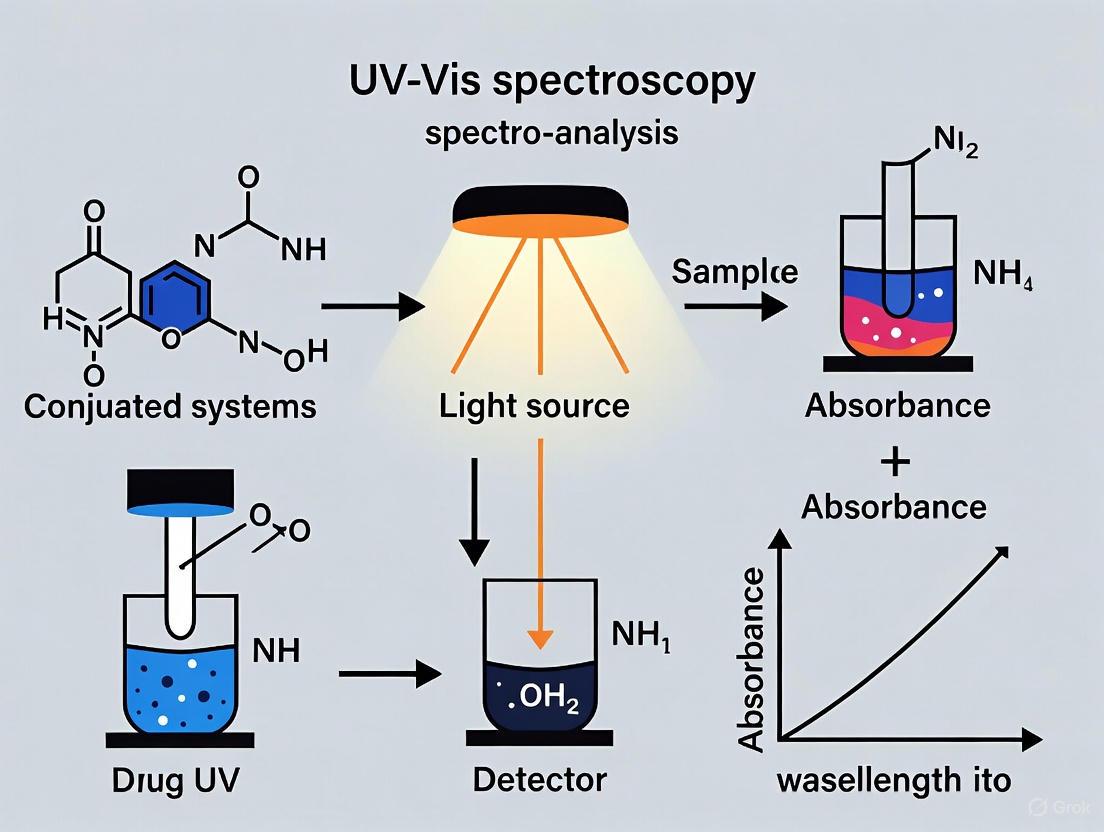
This article provides a comprehensive guide to Ultraviolet-Visible (UV-Vis) spectroscopy for drug quantification, tailored for researchers and pharmaceutical development professionals.
UV-Vis Spectroscopy for Drug Quantification: Principles, Methods, and Validation in Pharmaceutical Analysis
Abstract
This article provides a comprehensive guide to Ultraviolet-Visible (UV-Vis) spectroscopy for drug quantification, tailored for researchers and pharmaceutical development professionals. It covers fundamental principles of how UV-Vis spectroscopy operates, including light absorption phenomena and instrumentation. The content explores methodological applications from simple concentration measurements to advanced techniques like derivative spectroscopy and area-under-curve analysis for complex matrices. The article addresses critical troubleshooting aspects for common pitfalls and details rigorous validation protocols following ICH guidelines. By synthesizing foundational knowledge with practical applications and validation frameworks, this resource supports robust, reliable, and regulatory-compliant drug analysis in pharmaceutical development and quality control.
The Science Behind UV-Vis Spectroscopy: Understanding Light-Matter Interactions for Drug Analysis
Ultraviolet-Visible (UV-Vis) spectroscopy is a fundamental analytical technique that operates on the principle of measuring the absorption of ultraviolet and visible light by molecules. This technique utilizes light from the ultraviolet (typically 190-400 nm) and visible (400-800 nm) regions of the electromagnetic spectrum [1]. When light in these wavelengths interacts with matter, molecules containing chromophores—light-absorbing components—can absorb specific wavelengths of light, causing electrons to transition from their ground state to higher energy excited states [1]. The measurement of this light absorption provides both qualitative and quantitative information about the sample, making UV-Vis spectroscopy particularly valuable in pharmaceutical research for drug quantification, identity confirmation, and purity assessment [2].
The widespread adoption of UV-Vis spectroscopy in drug development and quality control laboratories stems from its robustness, simplicity, and accuracy in determining compound concentrations and identifying chemical components [1] [2]. As pharmaceutical materials have become more sophisticated, UV-Vis instrumentation and methodologies have similarly evolved to meet increasing analytical demands, maintaining its status as an indispensable tool for researchers and scientists in the field [3].
Fundamental Principles
Electronic Transitions and Energy Absorption
The foundational principle of UV-Vis spectroscopy involves the interaction between ultraviolet/visible light and electrons in molecular orbitals. When a molecule is exposed to UV or visible light, electrons can absorb photons with specific energies that match the energy difference between their current molecular orbital and a higher, unoccupied orbital. This process results in electronic transitions where electrons jump to excited states [1]. The specific wavelengths absorbed are characteristic of particular molecular structures, creating a unique absorption fingerprint that can be used for compound identification.
Several types of electronic transitions can occur, including π→π, n→π, σ→σ, and n→σ transitions, each requiring different energy levels and therefore occurring at different wavelengths. Chromophores, the functional groups responsible for color and UV absorption (such as C=C, C=O, and aromatic rings), contain electrons that can undergo these transitions when exposed to appropriate light energies [1]. The energy required for these transitions follows the relationship E = hc/λ, where h is Planck's constant, c is the speed of light, and λ is the wavelength, explaining why different compounds absorb at different wavelengths based on their electronic structure.
The Beer-Lambert Law
The relationship between light absorption and sample properties is quantitatively described by the Beer-Lambert Law, which forms the mathematical basis for concentration measurements in UV-Vis spectroscopy [4]. The law is expressed as:
A = εbc
Where:
- A is the measured absorbance (unitless)
- ε is the molar absorptivity or extinction coefficient (M⁻¹cm⁻¹)
- b is the path length of the sample cell (cm)
- c is the concentration of the analyte (M)
According to this relationship, absorbance is directly proportional to both the concentration of the absorbing species and the path length of light through the sample [1] [4]. The molar absorptivity (ε) is a compound-specific constant that indicates how strongly a chemical species absorbs light at a particular wavelength, with larger values corresponding to greater absorption sensitivity. This linear relationship enables researchers to determine unknown concentrations of pharmaceutical compounds by measuring absorbance and comparing to standards with known concentrations.
Table 1: Key Parameters of the Beer-Lambert Law
| Parameter | Symbol | Units | Description |
|---|---|---|---|
| Absorbance | A | Unitless | Measure of light absorbed by sample |
| Molar Absorptivity | ε | M⁻¹cm⁻¹ | Measure of how strongly a species absorbs light |
| Path Length | b | cm | Distance light travels through sample |
| Concentration | c | M | Amount of chemical substance in solution |
Instrumentation and Measurement
Core Components of UV-Vis Spectrometers
UV-Vis spectrometers consist of several essential components that work in concert to measure light absorption accurately [1]:
Light Source: Provides broad-spectrum radiation covering both UV and visible wavelengths. Common sources include deuterium lamps for UV light and tungsten or halogen lamps for visible light [1]. Some instruments use xenon lamps for the entire range, though these can suffer from instability issues.
Wavelength Selector: This component, typically a monochromator containing a prism or diffraction grating, narrows the broad-spectrum light to specific wavelengths for analysis [1]. This allows the instrument to scan through a range of wavelengths or select a particular wavelength for measurement.
Sample Container: Also known as a cuvette, this holds the liquid sample during analysis. Cuvettes are typically rectangular with a standard path length of 1 cm and are made of materials transparent to UV and/or visible light, such as quartz for UV measurements and glass or plastic for visible range only.
Detector: Measures the intensity of light passing through the sample and converts it into an electrical signal. Modern instruments often use photodiode array detectors that can simultaneously measure multiple wavelengths, significantly speeding up analysis [4].
Instrument Configurations
UV-Vis spectrometers are available in different configurations, each with distinct advantages:
Single-Beam Instruments: These have a single light path that passes through the sample. A reference measurement is taken with the blank solvent, then the sample is measured [4]. While simpler and less expensive, they require careful calibration and are susceptible to source fluctuations.
Double-Beam Instruments: These split the light beam into two paths—one passing through the sample and the other through a reference blank [1] [4]. This allows simultaneous measurement of both sample and reference, compensating for solvent absorption and source drift, resulting in more stable and accurate measurements.
Simultaneous Instruments: Featuring a diode array detector, these instruments can detect absorbance at all wavelengths simultaneously without needing a monochromator after the sample [4]. This configuration provides rapid full-spectrum acquisition and is particularly useful for kinetic studies.
UV-Vis Spectroscopy in Pharmaceutical Research
Key Applications in Drug Development
UV-Vis spectroscopy serves multiple critical functions throughout the pharmaceutical development and manufacturing process:
Drug Identity Testing: Confirms that a drug substance is correctly identified and labeled by matching its absorption spectrum to reference standards [2]. Each compound has a characteristic absorption profile that serves as a molecular fingerprint.
Assay and Potency Testing: Quantifies the amount of active pharmaceutical ingredient (API) in drug formulations to ensure they contain the labeled amount [2]. This application directly leverages the Beer-Lambert law to determine concentrations accurately.
Dissolution Testing: Monitors the release of active ingredients from solid dosage forms like tablets and capsules into solution over time, a critical factor for drug bioavailability [2]. Recent innovations have adapted UV-Vis systems to investigate how dissolution media affects the diffusivity of small molecules and proteins [5].
Impurity and Degradation Product Detection: Identifies and quantifies impurities or degradation products that may form during manufacturing or storage [2]. Even small amounts of impurities can often be detected if they contain chromophores with different absorption characteristics than the main API.
Raw Material Quality Control: Verifies the quality and composition of incoming raw materials used in drug manufacturing [2].
Advanced Research Applications
Beyond quality control, UV-Vis spectroscopy enables cutting-edge pharmaceutical research:
Diffusion Coefficient Measurements: Researchers have developed modified UV-Vis methods using 3D-printed accessories to accurately measure diffusion coefficients of small molecules and proteins in different media [5]. This provides valuable information about how drug molecules move through various biological environments.
Quantitative Analysis of Biomarkers: Advanced quantitative UV-visible spectroscopy helps researchers study cancer biomarkers by measuring vascular volume, oxygenation, extracellular matrix extent, and cellular proliferation in tissues [6].
Spectroelectrochemical Analysis: Combined techniques like spectroelectrochemistry (SEC) unite UV-Vis spectroscopy with electrochemistry to provide insights into redox properties, mechanisms, and molecular structures of drug compounds [7].
Table 2: Pharmaceutical Quality Control Tests Using UV-Vis Spectroscopy
| Test Type | Purpose | Regulatory Reference |
|---|---|---|
| Identity Testing | Verify correct drug substance | FDA Requirements [2] |
| Assay Testing | Confirm labeled amount of API | FDA Requirements [2] |
| Impurity Testing | Detect and quantify impurities | FDA Requirements [2] |
| Dissolution Testing | Measure drug release from dosage form | FDA Requirements [2] |
| Container Transmission | Determine light protection of packaging | USP <671> [3] |
Experimental Protocols for Drug Quantification
Standard Calibration Protocol for Drug Concentration Measurement
Accurate drug quantification requires careful calibration following established protocols:
Preparation of Stock Solution: Precisely weigh the reference standard drug substance and dissolve in appropriate solvent to make a stock solution of known concentration.
Preparation of Calibration Standards: Create a series of standard solutions covering the expected concentration range of the samples. Typically, at least five concentrations are prepared, spaced relatively equally apart, with the highest concentration just above the expected sample concentration and the lowest about an order of magnitude lower [4].
Blank Measurement: Place the pure solvent in a cuvette and measure the baseline absorbance to zero the instrument.
Standard Measurement: Measure the absorbance of each calibration standard at the predetermined analytical wavelength, typically at the peak maximum of absorption.
Calibration Curve Construction: Plot absorbance versus concentration for the standards and perform linear regression analysis. The correlation coefficient (R²) should be 0.9 or better for acceptable calibration [4].
Sample Measurement: Measure the absorbance of unknown samples under identical conditions and calculate their concentrations using the calibration curve.
Advanced Protocol: Measuring Diffusion Coefficients
A recent innovative application of UV-Vis spectroscopy in pharmaceutical research involves measuring the effect of dissolution media on diffusivity:
Apparatus Modification: Attach a 3D-printed cover with an open slit to a standard UV-Vis cuvette. This modification allows incident UV light to pass only through the slit to measure local drug concentration [5].
Sample Preparation: Prepare drug solutions at known concentrations in the dissolution media of interest, which may include various aqueous media or polymer solutions.
Diffusion Experiment: Load the drug solution into the modified cuvette, allowing drug molecules to diffuse from the cuvette bottom to the slit region over time.
Concentration Monitoring: Measure concentration as a function of time as diffusion progresses [5].
Data Analysis: Calculate diffusion coefficients based on Fick's law of diffusion using both analytical and numerical approaches [5]. This method has demonstrated high reproducibility and accuracy in measuring how different media affect diffusion coefficients of small molecules (<10% variation) and proteins (<15% variation) [5].
The Scientist's Toolkit: Essential Research Reagents and Materials
Successful implementation of UV-Vis spectroscopy in pharmaceutical research requires specific reagents and materials:
Table 3: Essential Research Reagents and Materials for UV-Vis Spectroscopy
| Item | Specification | Function in Pharmaceutical Analysis |
|---|---|---|
| Reference Standards | Certified purity (>95%) | Provide known concentrations for calibration and method validation |
| Solvents | Spectrophotometric grade | Minimize background absorption and impurity interference |
| Cuvettes | Quartz (UV), glass/plastic (Vis) | Contain samples during measurement with defined path length |
| Buffer Systems | Pharmaceutical-grade | Maintain physiological pH for dissolution and stability testing |
| 3D-Printed Slit Covers | Custom design | Enable localized concentration measurements for diffusion studies [5] |
| Filter Membranes | Appropriate pore size | Clarify suspensions for accurate absorbance measurement |
Recent Advances and Future Directions
UV-Vis spectroscopy continues to evolve with technological advancements that enhance its pharmaceutical applications:
Flexible UV-Vis Systems: New instruments like the Agilent Cary 3500 offer enhanced workflow efficiency through features such as a wide linear dynamic range that allows direct measurement of highly absorbing samples, minimizing preparation time and increasing analysis accuracy [3].
Solid Sample Analysis: Traditional UV-Vis primarily analyzed liquids, but innovative accessories now enable solid sample measurements, including spectral transmission analysis of pharmaceutical containers in accordance with USP <671> [3].
Variable Pathlength Technology: Advanced cell holders with variable pathlength capabilities facilitate measurements of impurities in ethanol as outlined in various pharmacopeias (USP, EP, JP) without requiring sample dilution [3].
Hybrid Techniques: Combining UV-Vis with other analytical methods, such as spectroelectrochemistry, creates powerful hybrid platforms that provide complementary information about drug molecules [7].
These innovations ensure that UV-Vis spectroscopy remains a vital technique in pharmaceutical research, adapting to meet the challenges of analyzing increasingly sophisticated drug compounds and formulations while maintaining the core principle of measuring the absorption of ultraviolet and visible light by molecules.
Ultraviolet-Visible (UV-Vis) spectroscopy serves as a foundational analytical technique in drug quantification research, enabling scientists to determine the concentration of active pharmaceutical ingredients (APIs) with precision and reliability. The analytical power of this methodology hinges on three core instrumentation components: the light source that generates optical energy, the monochromator that selects specific wavelengths, and the detector that measures light intensity after interaction with the sample. Within pharmaceutical development, UV-Vis spectroscopy provides critical data for quality control, purity assessment, and stability testing of drug substances and products, often complying with rigorous International Council on Harmonisation (ICH) guidelines that require detection capabilities for impurities as low as 0.05–0.10% [8]. This technical guide examines the operating principles, characteristics, and selection criteria for these essential components, providing drug development professionals with the knowledge to optimize analytical outcomes.
Fundamental Principles of UV-Vis Spectroscopy in Drug Analysis
UV-Vis spectroscopy measures the absorption of ultraviolet or visible light by a sample relative to a reference. The technique operates on the principle that molecules containing chromophores—functional groups with electrons capable of undergoing electronic transitions—will absorb light of specific energies corresponding to the UV-Vis spectrum (typically 190–800 nm) [9]. When analyzing active pharmaceutical ingredients like ibuprofen, acetylsalicylic acid, or paracetamol, the absorbed light promotes electrons from ground state molecular orbitals to higher energy excited states [10] [9].
The fundamental relationship governing quantitative analysis is the Beer-Lambert Law, which states that absorbance (A) is proportional to the concentration (c) of the absorbing species, the path length (L) of the sample container, and the molar absorptivity (ε) of the compound:
This linear relationship enables the construction of calibration curves from standard solutions of known concentration, allowing researchers to quantify unknown concentrations of drug compounds in test samples. For the law to apply accurately, measurements must avoid instrumental deviations such as excessive stray light or bandwidth issues, and chemical deviations including molecular associations or high concentrations that cause saturation [9].
The light source in a UV-Vis spectrophotometer must generate stable, continuous radiation across the entire ultraviolet and visible wavelength range. No single lamp source covers this entire spectrum effectively, so most instruments employ multiple sources with automatic switching between them.
Table 1: Characteristics of Common UV-Vis Light Sources
| Source Type | Spectral Range | Key Characteristics | Common Applications |
|---|---|---|---|
| Deuterium Lamp | 190–400 nm (UV) | Continuous spectrum, high intensity in UV region; limited visible output | Primary for UV drug analysis; quantification of APIs with UV chromophores |
| Tungsten-Halogen Lamp | 350–2500 nm (Visible-NIR) | Stable, smooth output in visible region; lower UV performance | Visible region analysis; colored compound quantification |
| Xenon Lamp | 190–1000 nm (UV-Vis-NIR) | Broad continuous spectrum, high intensity | Single-source instruments; rapid scanning applications |
| LED Sources | Varies by diode | Long lifetime, compact size; potentially narrow emission bands | Portable or dedicated systems; specific wavelength applications |
Most conventional spectrophotometers use a deuterium lamp for the UV region and a tungsten-halogen lamp for the visible region [10] [11]. The switch between sources typically occurs at 300–350 nm, where both lamps emit similar intensity, ensuring a smooth transition [10]. More advanced systems may incorporate xenon lamps, which provide a continuous spectrum across both UV and visible regions but come with higher costs and potential stability challenges [10]. Emerging technologies are increasingly utilizing light-emitting diodes (LEDs) for specific applications, offering extended lifespan and reduced power requirements [10].
In pharmaceutical analysis, the choice of light source impacts method sensitivity, signal-to-noise ratio, and the usable wavelength range for drug quantification. For instance, analyzing compounds with absorbance maxima below 350 nm (such as many APIs with aromatic rings) requires a robust deuterium lamp with stable output in the UV region to ensure precise and reproducible results [8].
Core Component 2: Monochromators
The monochromator serves the critical function of isolating specific wavelengths from the broad-spectrum output of the light source, effectively acting as the wavelength selection heart of the spectrophotometer. This component determines the spectral bandwidth and purity of light reaching the sample, directly impacting the resolution and accuracy of absorbance measurements [10] [9].
Operational Principles and Components
A monochromator typically consists of:
- Entrance slit that admits polychromatic light from the source while controlling the light intensity
- Collimating mirror or lens that creates parallel light rays
- Dispersive element (diffraction grating or prism) that separates light into its constituent wavelengths
- Focusing element that directs the separated wavelengths toward the exit plane
- Exit slit that allows only a narrow band of wavelengths to pass through to the sample [12] [13]
Most modern instruments employ diffraction gratings as the dispersive element, featuring closely spaced parallel grooves (typically 300–2000 grooves per mm) that angularly separate different wavelengths through constructive and destructive interference [10] [13]. The grating can be rotated to direct specific wavelengths through the exit slit, enabling wavelength scanning across a spectral range. Holographic gratings generally produce less stray light and fewer artifacts compared to traditionally ruled gratings due to their superior optical quality [10].
Monochromator Configurations: Single vs. Double
UV-Vis spectrophotometers implement monochromators in different configurations, primarily as single or double monochromator systems, each with distinct advantages for pharmaceutical applications.
Diagram: Comparison of Single vs. Double Monochromator Configurations
Table 2: Comparison of Single and Double Monochromator Systems
| Parameter | Single Monochromator | Double Monochromator |
|---|---|---|
| Stray Light | Higher (~3 AU typical) | Significantly lower (~6 AU typical) |
| Light Throughput | Higher intensity | Reduced due to additional optics |
| Cost | Lower | Higher |
| Linear Range | Up to ~2 AU | Up to ~3 AU or higher |
| Ideal Applications | Routine quantification, dilute samples | High-absorbance samples, low-transmittance materials, research applications |
| Pharmaceutical Use Cases | Standard QC of drug formulations, dissolution testing | High-concentration API solutions, optical filter characterization |
Single monochromator systems provide brighter optical output and are suitable for most routine drug quantification work, particularly with samples exhibiting moderate absorbance [14]. However, they generate more stray light—light of unintended wavelengths that reaches the detector—which can cause significant measurement errors, especially at high absorbances (>2 AU) where the stray light constitutes a substantial portion of the total signal [14] [9].
Double monochromator systems arrange two monochromators in series, dramatically reducing stray light through sequential purification of the wavelength band [14]. This configuration enables accurate measurement of highly absorbing samples (up to 8 AU in some advanced systems) and is particularly valuable for characterizing high-concentration drug solutions or materials with low transmittance [14]. The trade-off includes higher instrument cost and reduced light throughput, which may necessitate longer measurement times or more sensitive detection systems [14] [13].
Impact of Spectral Bandwidth
The spectral bandwidth—the range of wavelengths passing through the exit slit—fundamentally affects measurement accuracy and resolution [9]. Narrower bandwidths provide better resolution of closely spaced absorption peaks but reduce light intensity at the detector, potentially worsening the signal-to-noise ratio [9] [12]. For most pharmaceutical applications, a bandwidth of 1–2 nm is sufficient to resolve API absorption peaks while maintaining adequate signal strength [9]. The optimal bandwidth should be substantially narrower than the natural width of the absorption band being measured to avoid distorting the spectral shape and reducing the apparent molar absorptivity [9].
Core Component 3: Detectors
Detectors convert the light intensity transmitted through the sample into an electrical signal that can be quantified and processed. The sensitivity, dynamic range, and noise characteristics of the detector ultimately determine the reliability and detection limits of UV-Vis measurements in pharmaceutical analysis.
Detector Technologies
Table 3: Common Detector Types in UV-Vis Spectrophotometry
| Detector Type | Operating Principle | Key Advantages | Limitations | Pharmaceutical Applications |
|---|---|---|---|---|
| Photomultiplier Tube (PMT) | Photoelectric emission with electron multiplication through dynodes | High sensitivity, excellent signal-to-noise ratio, wide dynamic range | Larger size, requires high voltage, can saturate with high light levels | Low-concentration impurity detection, trace analysis |
| Silicon Photodiode | Semiconductor electron-hole pair generation when exposed to light | Compact, rugged, low power requirements, no high voltage needed | Lower sensitivity compared to PMT | Routine drug quantification, HPLC detectors |
| Charge-Coupled Device (CCD) | Array of light-sensitive capacitors that transfer charge for readout | Multi-wavelength simultaneous detection, high spatial resolution | Higher dark current, potentially more expensive | Diode-array detection, hyperspectral imaging, rapid scanning |
Photomultiplier tubes (PMTs) utilize the photoelectric effect, where photons striking a photocathode eject electrons that are then multiplied through a series of dynodes, creating a measurable current proportional to light intensity [10]. This amplification mechanism makes PMTs exceptionally sensitive for detecting very low light levels, ideal for measuring highly absorbing samples or detecting minor impurities in drug substances [10] [8].
Semiconductor-based detectors, including photodiodes and charge-coupled devices (CCDs), operate by generating electron-hole pairs when photons strike the semiconductor material [10]. Photodiodes offer robustness, linear response, and compact size, making them suitable for routine quantitative analysis [10] [8]. CCD detectors consist of arrays of thousands of individual detection elements (pixels), enabling simultaneous measurement across a broad wavelength range in diode-array spectrophotometers [10] [15]. This capability is particularly valuable for recording full spectra during chromatographic separations or for verifying peak purity in drug analysis [8].
Detector Selection Criteria
Choosing the appropriate detector for pharmaceutical applications involves balancing several performance parameters:
- Sensitivity: The ability to detect weak signals, crucial for low-concentration analytes or impurity profiling
- Signal-to-noise ratio: Determines the precision and detection limits of measurements
- Dynamic range: The span between the detection limit and saturation point, important for analyzing both major components and minor impurities
- Response time: Critical for high-speed applications such as UHPLC detection or kinetic studies
- Spectral response: The wavelength-dependent sensitivity, which should align with the analytical requirements [10] [8]
Modern UV-Vis detectors for pharmaceutical analysis typically achieve noise levels below ±1×10⁻⁵ AU, enabling highly precise quantification essential for compliance with pharmacopeial standards [8].
Integrated System Operation in Drug Quantification
The coordinated operation of light source, monochromator, and detector enables the precise quantification of drug compounds. The following diagram illustrates the signal pathway and component interaction in a typical UV-Vis spectrophotometer configured for pharmaceutical analysis.
Diagram: UV-Vis Spectrophotometer Signal Pathway for Drug Quantification
In a typical drug quantification experiment, the light source emits broadband radiation that enters the monochromator, where a specific wavelength is selected based on the absorption maximum (λmax) of the analyte [10]. This monochromatic light passes through the sample cell containing the drug solution dissolved in an appropriate solvent, and the transmitted light intensity is measured by the detector [10]. A parallel reference beam passing through a solvent blank enables automatic correction for solvent absorption and reflection losses [10]. The detector converts the light intensity ratio into an electrical signal processed to display absorbance values according to the Beer-Lambert law [10] [9].
For advanced applications such as hyperspectral UV imaging, modified configurations employ a spectrograph and CCD detector to spatially resolve drug distribution within solid dosage forms, enabling non-destructive analysis of tablet composition and homogeneity [15]. This emerging application demonstrates how detector technology evolution continues to expand the capabilities of UV-Vis spectroscopy in pharmaceutical research.
Essential Research Reagent Solutions
Successful drug quantification using UV-Vis spectroscopy requires appropriate selection of reagents and materials that meet specific optical and chemical criteria.
Table 4: Essential Research Reagents and Materials for UV-Vis Drug Analysis
| Reagent/Material | Specification Requirements | Function in Analysis |
|---|---|---|
| UV-Transparent Solvents | High purity, low UV absorbance in spectral region of interest | Dissolve drug analyte without interfering absorbance; common examples: water, methanol, hexane |
| Reference Standards | Certified purity, traceable to reference standards | Create calibration curves for quantitative analysis |
| Quartz Cuvettes | High transparency down to 190 nm, matched pathlength | Sample container with minimal UV absorption; standard 1 cm pathlength |
| Buffer Systems | UV-transparent components (e.g., phosphate), controlled pH | Maintain physiological relevance and drug stability |
| Filters | 0.45 μm or 0.22 μm pore size, compatible with solvent | Remove particulate matter that causes light scattering |
| Cuvette Cleaning Solutions | High-purity solvents without residues | Maintain optical clarity and prevent sample carryover |
Proper solvent selection is particularly critical, as many common solvents absorb significantly in the UV range [9]. Water, high-grade acetonitrile, and hexane are typically transparent down to 190 nm, while solvents such as chloroform and dimethyl sulfoxide exhibit strong UV absorption that may interfere with analysis [9]. For solid dosage form analysis using emerging techniques like UV hyperspectral imaging, Spectralon reference materials provide standardized reflectance surfaces for instrument calibration [15].
Experimental Protocol: Drug Quantification via UV-Vis Spectroscopy
This standardized protocol outlines the procedure for quantifying active pharmaceutical ingredients using UV-Vis spectroscopy, incorporating appropriate controls and calibration standards.
Materials and Equipment Setup
- Double-beam UV-Vis spectrophotometer with deuterium and tungsten-halogen sources
- Matched quartz cuvettes (1 cm pathlength)
- Analytical balance (0.1 mg sensitivity)
- Volumetric flasks (Class A)
- Micropipettes with appropriate volume ranges
- Drug reference standard of certified purity
- UV-transparent solvent (e.g., methanol, water, or buffer)
- Filter units (0.45 μm) and syringes for solvent filtration
Preparation of Standard Solutions
- Accurately weigh 25 mg of drug reference standard and transfer to a 25 mL volumetric flask.
- Dissolve with and dilute to volume with appropriate solvent to create 1000 μg/mL stock solution.
- Prepare serial dilutions to create at least five standard solutions covering the expected sample concentration range (typically yielding concentrations such as 5, 10, 15, 20, and 25 μg/mL).
- Filter all solutions through 0.45 μm filters to remove particulate matter.
Instrument Calibration and Measurement
- Turn on the spectrophotometer and allow the lamps to warm up for at least 30 minutes.
- Select the appropriate wavelength based on the drug's absorption maximum (e.g., 265 nm for paracetamol, 273 nm for acetylsalicylic acid) [15].
- Set the spectral bandwidth to 1–2 nm for optimal resolution and signal-to-noise ratio.
- Using the solvent blank, perform baseline correction to zero the instrument.
- Measure the absorbance of each standard solution in triplicate, ensuring proper cuvette orientation.
- Construct a calibration curve by plotting average absorbance versus concentration.
Sample Analysis and Data Interpretation
- Prepare test samples (e.g., extracted drug substance or diluted formulation) using the same solvent system as standards.
- Measure sample absorbance against the solvent blank.
- Determine drug concentration from the calibration curve regression equation.
- Apply dilution factors as necessary to calculate original sample concentration.
- For method validation, determine linearity (R² > 0.995), precision (%RSD < 2%), and accuracy (90–110% recovery) following ICH guidelines [8].
This methodology provides reliable quantification of chromophore-containing drugs, with modifications possible for specialized applications such as dissolution testing or hyperspectral imaging of solid dosage forms [16] [15].
The sophisticated interplay between light sources, monochromators, and detectors forms the technological foundation of UV-Vis spectroscopy as applied to drug quantification research. Each component's performance characteristics directly impact the sensitivity, accuracy, and reliability of pharmaceutical analysis. Light source stability ensures consistent energy output across the spectral range, monochromator quality determines wavelength precision and stray light rejection, and detector sensitivity establishes the fundamental limits of detection for impurities and low-concentration analytes. As pharmaceutical analysis evolves toward more complex formulations and stricter regulatory requirements, continued refinement of these core components will further enhance the capabilities of UV-Vis spectroscopy. Emerging technologies including diode-array detection, hyperspectral imaging, and advanced monochromator designs already enable more comprehensive drug characterization, solidifying the role of UV-Vis spectroscopy as an indispensable tool in pharmaceutical research and quality control.
The Beer-Lambert Law (also known as Beer's Law) is a fundamental principle in optical spectroscopy that establishes a quantitative relationship between the absorption of light and the properties of the material through which the light is traveling [17]. This law serves as the cornerstone for ultraviolet-visible (UV-Vis) spectroscopy, a technique indispensable in pharmaceutical research for drug identification and quantification [10] [18]. For drug development professionals, understanding this law is crucial for accurately determining the concentration of active pharmaceutical ingredients (APIs), ensuring product consistency, and validating analytical methods according to regulatory standards such as ICH Q2(R1) and FDA guidelines [18].
The law represents a combination of two separate principles: Beer's law, which states that absorbance is proportional to concentration, and Lambert's law, which states that absorbance is proportional to the path length of light through the sample [19] [20]. When applied to drug quantification research, this relationship allows scientists to determine unknown concentrations of pharmaceutical compounds by measuring their light absorption characteristics, providing a rapid, reliable, and non-destructive analytical method [18] [21].
Historical Context and Development
The foundational work towards the Beer-Lambert Law began with Pierre Bouguer's astronomical observations in 1729, where he discovered that light intensity had an exponential dependence on the distance traveled through the atmosphere [20]. This work was subsequently popularized by Johann Heinrich Lambert in his 1760 publication Photometria, where he expressed the law in mathematical form [22] [20]. Lambert proposed that the loss of light intensity when propagating through a medium is directly proportional to both the intensity itself and the path length [20].
In 1852, August Beer extended this principle to colored solutions, recognizing that concentration played a critical role in light absorption [20]. Beer's work demonstrated that transmittance remained constant as long as the product of the volume fraction of the solute and the cuvette thickness stayed constant [22]. Interestingly, Beer corrected for reflection losses in his experiments, acknowledging that the law represented an approximation rather than an exact relationship [22]. The modern formulation combining both contributions, expressed with molar concentration and the molar absorptivity coefficient, was developed later, with an early formulation appearing in a 1913 paper by Robert Luther and Andreas Nikolopulos [22] [20].
Mathematical Formulation
Fundamental Equation
The Beer-Lambert Law is mathematically expressed through several equivalent formulations that relate the attenuation of light to sample properties [17] [20]. The most common form used in pharmaceutical analysis is:
A = ε · c · l
Where:
- A is the absorbance (a dimensionless quantity) [17]
- ε is the molar absorptivity or molar extinction coefficient (typically with units of L·mol⁻¹·cm⁻¹) [17]
- c is the concentration of the absorbing species (typically in mol·L⁻¹) [17]
- l is the path length of light through the sample (typically in cm) [17]
Absorbance is defined through the incident intensity (I₀) and transmitted intensity (I) by the relationship:
A = log₁₀(I₀/I) [17]
Derived Formulations
For applications involving multiple absorbing species in a sample, the law extends to:
A = l · Σ(εᵢ · cᵢ) [20]
This additive property is particularly valuable in pharmaceutical analysis where excipients or impurities might contribute to the overall absorption spectrum [18]. When working with very precise measurements or theoretical derivations, the Napierian logarithm form may be used:
ln(I₀/I) = τ = σ · l · n [20]
Where τ is the attenuation, σ is the absorption cross-section, and n is the number density of absorbers [20].
Table 1: Parameters of the Beer-Lambert Law Equation
| Parameter | Symbol | Typical Units | Description |
|---|---|---|---|
| Absorbance | A | Dimensionless | Measure of light absorbed by sample |
| Molar Absorptivity | ε | L·mol⁻¹·cm⁻¹ | Measure of how strongly a species absorbs light |
| Concentration | c | mol·L⁻¹ | Amount of absorbing substance per unit volume |
| Path Length | l | cm | Distance light travels through the sample |
| Transmittance | T | Dimensionless or % | Ratio of transmitted to incident light intensity |
Theoretical Principles and Underlying Mechanisms
Physical Basis of Light Absorption
The Beer-Lambert law operates on the principle that when light passes through a solution, the probability of a photon being absorbed is proportional to the number of molecules in its path [20]. This probability is quantified by the molar absorptivity (ε), which represents the intrinsic absorption strength of a particular chemical species at a specific wavelength [17]. In UV-Vis spectroscopy used for drug quantification, absorption occurs when electrons in pharmaceutical molecules transition between different energy levels upon encountering light with energy matching these transitions [10].
The law derives from assuming that each layer of infinitesimal thickness (dz) in a sample absorbs an equal fraction of light passing through it [20]. This leads to an exponential decay of light intensity as it propagates through the medium, mathematically expressed as a differential equation whose solution yields the familiar logarithmic relationship [22] [20]. For drug quantification research, this means that the concentration of an active pharmaceutical ingredient can be determined by measuring how much light it absorbs at a characteristic wavelength [18] [21].
Relationship Between Key Optical Parameters
The following diagram illustrates the fundamental relationship between light absorption and solution properties described by the Beer-Lambert Law:
The fundamental relationship described by the Beer-Lambert Law enables the determination of drug concentrations through measurable optical properties. The amount of light absorbed by a solution depends on both the concentration of the absorbing species and the distance the light travels through the solution [19] [17]. This linear relationship forms the basis for quantifying active pharmaceutical ingredients in various formulations during drug development and quality control processes [18].
Practical Application in Drug Quantification Research
UV-Vis Spectroscopy in Pharmaceutical Analysis
In pharmaceutical research and quality control, UV-Vis spectroscopy leveraging the Beer-Lambert Law provides a rapid, non-destructive method for quantifying drug substances [18]. The technique is particularly valuable for ensuring consistent concentration of APIs, assessing drug product uniformity, and evaluating dissolution profiles during stability testing [18]. Modern implementations can measure sample volumes as small as 2 μL while maintaining accuracy within 2% of certified reference values, meeting both USP and Ph. Eur. guidelines [21].
The application typically involves creating a calibration curve by measuring absorbance values of standard solutions with known concentrations [23]. This curve establishes the relationship between absorbance and concentration under specific experimental conditions, enabling the determination of unknown concentrations in test samples [23] [10]. For example, in a recent study quantifying promethazine hydrochloride, Beer-Lambert Law was validated over a concentration range of 6.0-20 μg/mL with a correlation coefficient of 0.9996, demonstrating excellent linearity for pharmaceutical applications [24].
Experimental Workflow for Drug Quantification
The following diagram illustrates a standard experimental workflow for drug quantification using UV-Vis spectroscopy and the Beer-Lambert Law:
Essential Research Reagents and Materials
Table 2: Key Research Reagent Solutions for Beer-Lambert Law Applications in Drug Quantification
| Reagent/Material | Function in Experiment | Application Notes |
|---|---|---|
| Standard Reference Material | Calibration and accuracy verification | Certified materials like NISTmAb for validation [21] |
| High-Purity Solvents | Sample dissolution and dilution | Must be optically clear and compatible with analyte [18] |
| Buffer Solutions | pH control and sample stability | Maintains consistent chemical environment [10] |
| Quartz Cuvettes | Sample holder for UV measurements | Required for UV range; transparent down to 200 nm [10] |
| N-Bromosuccinimide | Oxidizing agent for derivatization | Used in oxidative coupling reactions for detection [24] |
| Anillinium Chloride | Coupling reagent | Forms colored products for enhanced detection [24] |
Experimental Protocols and Methodologies
Standard Protocol for Drug Quantification Using UV-Vis Spectroscopy
Protocol Objective: To determine the concentration of an active pharmaceutical ingredient (API) in a solution using UV-Vis spectroscopy and the Beer-Lambert Law.
Materials and Equipment:
- UV-Vis spectrophotometer with appropriate light source (deuterium lamp for UV, tungsten/halogen for visible) [10]
- Matched quartz cuvettes (typically 1 cm path length) [18]
- High-purity analytical grade solvent
- Standard reference compound of known purity
- Volumetric flasks and precision pipettes
Procedure:
- Preparation of Standard Solutions: Prepare a series of standard solutions covering the concentration range of 0.5-50 μg/mL, depending on the expected absorbance characteristics of the analyte [18] [24]. Ensure all solutions are optically clear and free from particulate matter that could cause light scattering [18].
Instrument Calibration: Zero the instrument using a blank solution containing only the solvent [10]. Select the appropriate wavelength based on the maximum absorption of the compound (e.g., 280 nm for proteins, 260 nm for nucleic acids, or specific wavelengths for particular pharmaceuticals) [21].
Absorbance Measurement: Measure the absorbance of each standard solution, ensuring that readings fall within the optimal linear range of 0.1-1.0 AU [18]. If absorbance values exceed this range, dilute samples appropriately or use cuvettes with shorter path lengths [10].
Calibration Curve Generation: Plot absorbance versus concentration for the standard solutions and perform linear regression analysis [23]. The slope of this curve corresponds to ε·l, from which the molar absorptivity can be calculated if the path length is known [17].
Sample Analysis: Measure the absorbance of the unknown sample under identical conditions and calculate the concentration using the established calibration curve or directly through the Beer-Lambert equation if the molar absorptivity is known [23].
Advanced Protocol: Oxidative Coupling Reaction for Enhanced Detection
For trace-level quantification of specific pharmaceuticals such as promethazine hydrochloride, specialized derivatization protocols can enhance sensitivity [24]:
Specialized Materials:
- N-bromosuccinimide (NBS) as oxidizing agent
- Anillinium chloride as coupling reagent
- Buffer solution (pH ~5.6)
Procedure:
- Derivatization: Mix the drug solution with NBS and anillinium chloride to form a colored oxidation product [24].
- Incubation: Allow the reaction to proceed until the colored product stabilizes (typically >140 minutes) [24].
- Measurement: Measure absorbance at the characteristic wavelength of the product (e.g., 589 nm for promethazine derivative) [24].
- Quantification: Apply Beer-Lambert Law using previously determined molar absorptivity values for the derivative [24].
Limitations and Potential Deviations
Chemical and Instrumental Limitations
While the Beer-Lambert Law provides a fundamental relationship for absorption spectroscopy, several limitations must be considered in pharmaceutical applications:
Chemical Deviations:
- High Concentration Effects: At high concentrations (>0.01 M), the average distance between absorbing molecules decreases, potentially altering their absorption characteristics [19]. This can lead to negative deviations from linearity as refractive index changes become significant [19].
- Molecular Interactions: Equilibrium between different molecular forms (e.g., association complexes between solute and solvent) can cause non-linear behavior [19]. These chemical interactions change the absorptivity of the species, violating the assumption of constant ε [17].
- Fluorescence and Photodegradation: Fluorescent compounds or those susceptible to photodecomposition may not obey the law due to competing light-matter interactions [19].
Instrumental Limitations:
- Polychromatic Light: Strictly, the law applies to monochromatic light, but practical instruments use wavelength bands [10]. If the bandwidth covers regions where molar absorptivity changes significantly, deviations from linearity occur [10].
- Stray Light: Imperfections in optical components can allow light outside the selected wavelength to reach the detector, causing deviations particularly at high absorbance values [10].
- Detector Nonlinearity: Detector response may become non-linear at very high or very low light intensities, necessitating regular instrument calibration [10].
Electromagnetic Theory and Fundamental Limitations
Beyond practical considerations, the Beer-Lambert Law faces fundamental limitations arising from its incomplete compatibility with electromagnetic theory [22]. The law assumes that absorption is the sole mechanism of light attenuation, neglecting electromagnetic effects such as:
- Band shifts and intensity changes based on optical conditions and substrate effects [22]
- Dispersion phenomena and the complex refractive index in strongly absorbing media [22]
- Scattering effects from particulates or molecular aggregates in solution [20]
These electromagnetic considerations become particularly important when precise quantitative interpretation of spectral features is required beyond simple concentration determination [22]. As noted in contemporary literature, "the BBL law and spectroscopy on the one hand and electromagnetic theory founded on Maxwell's equations and dispersion theory on the other hand were developed at the same time" but were not fully integrated, leading to limitations in applying the law under certain conditions [22].
Table 3: Common Limitations and Compensating Methodologies in Beer-Lambert Law Applications
| Limitation Type | Impact on Measurements | Compensation Methodology |
|---|---|---|
| High Concentration | Non-linear absorbance | Sample dilution to A < 1.0 [10] |
| Chemical Association | Changing molar absorptivity | Chemical separation or derivative formation [24] |
| Stray Light | Deviation at high absorbance | Instrument maintenance and validation [10] |
| Light Scattering | Apparent increased absorption | Sample filtration or centrifugation [18] |
| Fluorescence Interference | Underestimation of absorption | Use of specific quenchers or correction factors [19] |
Regulatory Considerations and Validation Parameters
For pharmaceutical applications, methods based on the Beer-Lambert Law must undergo rigorous validation to meet regulatory standards [18]. Key validation parameters include:
- Linearity and Range: Demonstration that the absorbance response is proportional to analyte concentration across the specified range [18] [24]. For example, in the promethazine hydrochloride method, linearity was established across 6.0-20 μg/mL with a correlation coefficient of 0.9996 [24].
- Accuracy: The closeness of measured values to true concentrations, typically verified using certified reference materials [21]. Modern UV-Vis systems can achieve accuracy within 2% of NIST-certified values [21].
- Precision: The degree of agreement among individual test results, expressed as relative standard deviation (RSD%) [24]. Validated methods should demonstrate RSD% <1-2% depending on application requirements [24] [21].
- Specificity: The ability to unequivocally assess the analyte in the presence of expected impurities, excipients, or matrix components [18].
Regulatory bodies including the FDA, EMA, and ICH provide guidelines (ICH Q2(R1)) for validating spectroscopic methods used in pharmaceutical quality control [18]. Compliance with these standards ensures that drug quantification results are reliable, reproducible, and suitable for regulatory submissions.
Ultraviolet-Visible (UV-Vis) spectroscopy serves as a cornerstone analytical technique in drug discovery and development, enabling the identification, quantification, and purity assessment of active pharmaceutical ingredients (APIs). The fundamental principle underlying this technique is the interaction of light with specific structural features in molecules known as chromophores. This whitepaper provides an in-depth technical guide on the structural features of chromophores that facilitate the absorption of UV-Vis light, thereby enabling critical quantitative analysis in pharmaceutical research. We detail the electronic transitions involved, the impact of structural conjugation, and provide standardized protocols for leveraging these properties in drug quantification.
The Fundamental Principles of UV-Vis Light Absorption
UV-Vis spectroscopy measures the absorption of light in the ultraviolet (typically 190-400 nm) and visible (400-800 nm) regions of the electromagnetic spectrum [10] [1]. The energy associated with this radiation ranges from approximately 300 to 600 kJ/mol (70-140 kcal/mol) for the UV region and 150 to 300 kJ/mol (35-70 kcal/mol) for the visible region [25]. When a molecule is exposed to light with energy that matches a possible electronic transition, photons are absorbed, promoting electrons from a ground state to an excited state [26]. The spectrometer records the wavelengths at which absorption occurs and the degree of absorption at each wavelength, producing a graph of absorbance versus wavelength known as an absorption spectrum [26].
The Beer-Lambert Law and Quantification
The relationship between the absorption of light and the properties of the material through which the light is traveling is described by the Beer-Lambert Law [10] [27]. This law states that the absorbance (A) of a solution is directly proportional to the concentration (c) of the absorbing species and the path length (l) of the light through the solution:
A = ε c l
Here, ε is the molar absorptivity (also known as the molar extinction coefficient), a characteristic constant for a given chromophore at a specific wavelength that indicates how strongly it absorbs light [26] [25]. Its units are typically L mol⁻¹ cm⁻¹. The absorbance is also defined as A = log₁₀(I₀/I), where I₀ is the intensity of the incident light and I is the intensity of the transmitted light [27]. This linear relationship is the foundation for the quantitative application of UV-Vis spectroscopy in determining drug concentrations [25].
Chromophores: The Light-Absorbing Centers in Molecules
Definition and Key Characteristics
Chromophores are molecular moieties possessing π-electrons or heteroatoms with non-bonding valence-shell electron pairs (n-electrons) that can absorb light in the UV-Vis region [26] [28]. The term literally means "color bearer," as these groups are responsible for the color of compounds [26]. The characteristic feature of chromophores is their ability to absorb specific wavelengths of UV and visible light, which can be used to determine their concentration via absorption photometry [27].
Electronic Transitions in Chromophores
The absorption of UV-Vis light corresponds to the energy required to excite an electron from a bonding or non-bonding orbital to an antibonding orbital. The most common transitions in drug molecules are:
- π → π* Transitions: These involve the promotion of an electron from a π-bonding molecular orbital to a π* antibonding orbital. They are typically high-energy transitions and are common in molecules with double or triple bonds [29] [25]. The molar absorptivity for π→π* transitions is generally high (often >10,000 L mol⁻¹ cm⁻¹) [26].
- n → π* Transitions: These involve the promotion of a non-bonding electron (e.g., from oxygen or nitrogen) to a π* antibonding orbital. These transitions require less energy than π→π* transitions and thus occur at longer wavelengths. However, they are weaker, with lower molar absorptivities (typically 10-100 L mol⁻¹ cm⁻¹) [29].
The energy required for these electronic transitions and the probability of absorption are dictated by the molecular and electronic structure of the chromophore. The most favorable electron promotion is typically from the Highest Occupied Molecular Orbital (HOMO) to the Lowest Unoccupied Molecular Orbital (LUMO), and the energy difference between these orbitals (ΔE) determines the wavelength of absorption [26] [29].
Figure 1: Electronic Transitions in Chromophores. This diagram illustrates the common electronic transitions from the HOMO (π orbital) and non-bonding (n) orbitals to the LUMO (π* orbital), which are induced by the absorption of UV-Vis photons.
Structural Features and Modifications Influencing Absorption
The Critical Role of Conjugation
Conjugation, the alternating pattern of single and multiple bonds, is the most significant structural feature affecting the absorption properties of a chromophore [26]. When two or more π-bonds are conjugated, the p-atomic orbitals combine to create a system of molecular orbitals that are delocalized across the entire conjugated system.
- Bathochromic Shift: Conjugation decreases the energy gap (ΔE) between the HOMO and LUMO orbitals. This results in absorption at longer wavelengths (a red shift) [26] [29]. For example, extending a conjugated system by one double bond typically shifts the absorption maximum (λmax) by approximately 30 nm to a longer wavelength [26].
- Hyperchromic Effect: Conjugation often increases the probability of light absorption, leading to a greater molar absorptivity (ε). The molar absorptivity roughly doubles with each new conjugated double bond in a polyene system [26].
A comparison of 1-pentene (λmax = 178 nm) with isoprene (a conjugated diene, λmax = 222 nm) clearly demonstrates the bathochromic shift induced by conjugation [26]. In large, extensively conjugated systems like beta-carotene (with 11 conjugated double bonds), the energy gap becomes so small that absorption occurs in the visible region, giving these compounds their characteristic color [29].
Auxochromes and Their Impact
Auxochromes are functional groups attached to a chromophore that do not themselves absorb significantly in the UV-Vis region but can modify the chromophore's absorption [25]. Common auxochromes include hydroxyl (-OH), amino (-NH₂), and alkoxy (-OR) groups, which contain non-bonding electrons.
- Shift in Wavelength: Auxochromes can cause both bathochromic (red) and hypsochromic (blue) shifts.
- Absorbance Changes: They can also lead to hyperchromic (increased absorbance) or hypochromic (decreased absorbance) effects.
The presence of an auxochrome can alter the absorption spectrum by interacting with the electrons of the chromophore, for instance, by extending conjugation through resonance or by participating in n→π* transitions [25].
Quantitative Data for Common Pharmaceutical Chromophores
The table below summarizes the absorption characteristics of several chromophores frequently encountered in pharmaceutical compounds and assays.
Table 1: Spectral Properties of Common Chromophores in Drug Molecules and Assays [27]
| Chromophore | Typical Detection Wavelength (λmax, nm) | Molar Absorptivity (ε, M⁻¹cm⁻¹) | Notes and Applications |
|---|---|---|---|
| p-Nitroanilide (pNA) | 405 - 410 | 9,450 (at 405 nm) | Commonly used substrates for serine and cysteine proteases. |
| p-Nitrophenyl Ester (ONp) | 347 | 5,500 | Used to measure esterase activity; absorption is pH-independent at this wavelength. |
| Thiobenzyl Ester (SBzl) | 324 / 410 | 19,800 / 14,000 | Measured after reaction with DTNB (Ellman's reagent) or 4,4’-dithiodipyridine. |
| 2,4-Dinitrophenyl (Dnp) | 365 / 400 | 17,300 / ~6,500 | Often used as a quencher for fluorophores; also detectable after extraction. |
| 3-(2-Furyl)acryloyl (FA) | 322 - 345 | 13,400 - 24,700 | A decrease in absorbance is measured upon hydrolysis for protease assays. |
Experimental Protocols for Drug Quantification
Standard Protocol for Concentration Measurement
This protocol outlines the general steps for quantifying a drug compound using UV-Vis spectroscopy, based on the Beer-Lambert Law.
1. Instrument Calibration and Blank Measurement:
- Turn on the UV-Vis spectrophotometer and allow the lamps to warm up for the recommended time (typically 15-30 minutes) [10].
- Select the appropriate wavelength for the analyte (e.g., the λmax from the literature or a preliminary scan).
- Using a matched pair of cuvettes (e.g., quartz for UV, glass/plastic for visible), fill one with the pure solvent (e.g., buffer, water) used to prepare the drug sample. This is the blank or reference.
- Place the blank cuvette in the sample holder and perform the blank measurement to set the 0% absorption (100% transmittance) baseline [10].
2. Preparation of Standard Solutions:
- Prepare a series of standard solutions of the known drug compound with precise, increasing concentrations. The concentrations should be chosen such that the expected absorbance values fall within the linear range of the Beer-Lambert law (ideally Absorbance < 1.0 to avoid detector saturation) [10] [25].
- Use the same solvent and conditions (pH, ionic strength) as the unknown samples to ensure consistency, as these factors can influence molar absorptivity [27].
3. Measurement and Calibration Curve:
- Measure the absorbance of each standard solution at the selected wavelength.
- Plot a calibration curve of Absorbance (y-axis) versus Concentration (x-axis). The slope of the resulting linear plot is equal to εl [25].
4. Analysis of Unknown Samples:
- Measure the absorbance of the unknown drug sample under the exact same conditions.
- Use the equation of the calibration curve (or the known ε value if the pathlength is known) to calculate the concentration of the unknown: c = A / (εl) [27] [25].
Protocol for λmax Determination and Method Validation
For characterizing a new drug substance, determining its absorption maximum (λmax) is critical for developing a robust quantitative method.
1. Spectral Scanning:
- Prepare a diluted solution of the drug compound.
- Configure the spectrophotometer in scan mode over a relevant wavelength range (e.g., 200-400 nm for UV-absorbing drugs).
- Place the sample in the cuvette and run a full spectrum scan against a solvent blank.
- Identify the wavelength of maximum absorption (the peak) from the resulting spectrum. This λmax will be the optimal wavelength for quantification to achieve maximum sensitivity [10].
2. Verification of Beer-Lambert Law Linearity:
- Using the determined λmax, measure the absorbance of the standard solutions from the previous protocol.
- Perform linear regression analysis on the calibration curve. The correlation coefficient (R²) should be >0.995 for a reliable quantitative method.
- Determine the linear dynamic range—the concentration range over which absorbance remains linearly proportional to concentration.
Figure 2: UV-Vis Drug Quantification Workflow. A sequential overview of the key experimental steps for quantifying drug concentration using UV-Vis spectroscopy and the Beer-Lambert Law.
The Scientist's Toolkit: Essential Reagents and Materials
Successful quantification of drugs via UV-Vis spectroscopy requires specific reagents and instrumentation. The following table details key components of the research toolkit.
Table 2: Essential Research Reagent Solutions and Materials for UV-Vis Analysis
| Item | Function and Importance | Technical Considerations |
|---|---|---|
| High-Purity Solvents | To dissolve the drug analyte without introducing interfering absorptions. | Solvents must be UV-grade (e.g., HPLC grade). Water must be ultrapure (18.2 MΩ·cm). Alcohols and ethers are suitable for UV as they lack strong chromophores above ~200 nm [26]. |
| Reference/Blank Solution | To correct for background absorption from the solvent and cuvette, establishing the baseline. | Must be identical to the sample solvent and contain all components except the analyte of interest [10]. |
| Standard Compound | The pure, known drug substance used to construct the calibration curve for quantification. | Purity must be accurately known (e.g., via HPLC, NMR). Essential for determining the molar absorptivity (ε) [30]. |
| Cuvettes | The sample container through which light passes. | Quartz is mandatory for UV range (<330 nm); glass/plastic can be used for visible light. Path length is typically 1.0 cm [10]. |
| Buffer Systems | To maintain a constant pH, which can critical for chromophore stability and ε value. | Buffer components (e.g., phosphate, Tris) should not absorb significantly at the wavelength of analysis. Molar absorptivity can be pH-dependent [27]. |
| UV-Vis Spectrophotometer | The instrument that generates light, selects wavelengths, and detects absorbed light. | Can be single-beam (measures blank then sample) or double-beam (measures blank and sample simultaneously). Diode-array detectors allow rapid full-spectrum acquisition [10] [25]. |
The power of UV-Vis spectroscopy as a tool for drug quantification is fundamentally rooted in the interaction of light with the chromophoric centers of drug molecules. Understanding the structural features of these chromophores—specifically, the presence of π-systems, heteroatoms with n-electrons, and the profound effect of conjugation—allows researchers to predict and exploit their absorption characteristics. By applying the Beer-Lambert law through rigorous experimental protocols, scientists can accurately determine drug concentration, assess purity, and monitor reactions. As a cost-effective, versatile, and non-destructive technique, UV-Vis spectroscopy, grounded in a deep understanding of chromophores, remains an indispensable asset in the drug development pipeline [31].
In the field of pharmaceutical research, the quantification of active pharmaceutical ingredients (APIs) and the assessment of drug stability are critical for ensuring drug efficacy and safety [32]. Ultraviolet-Visible (UV-Vis) spectroscopy is a cornerstone technique for these analyses, valued for its speed, sensitivity, and economic efficiency [32] [30]. Its applications span from early drug discovery and development to quality control in manufacturing [32] [1] [30]. However, the reliability of this data is fundamentally dependent on the proper performance of the spectrophotometer. Inaccurate measurements can lead to flawed conclusions about drug content, stability, and purity, potentially compromising product quality and patient safety [33]. Therefore, rigorous verification of key instrument performance parameters—wavelength accuracy, stray light, and photometric linearity—is not just a best practice but a necessity in the regulated pharmaceutical environment. This guide provides an in-depth technical overview of these essential parameters, offering detailed methodologies for their assessment to ensure data integrity in drug quantification research.
Fundamental Principles of UV-Vis Spectroscopy in Drug Analysis
UV-Vis spectroscopy measures the absorption of ultraviolet or visible light by a sample. The basic principle involves the excitation of electrons from a ground state to a higher energy state when they absorb photons of specific energy (wavelength) [10] [1]. The amount of light absorbed at a particular wavelength is quantitatively related to the concentration of the absorbing species (chromophores) in the sample through the Beer-Lambert Law [10] [1].
The Beer-Lambert Law is expressed as: A = εlc Where:
- A is the Absorbance (a unitless quantity)
- ε is the molar absorptivity (L·mol⁻¹·cm⁻¹)
- l is the path length of the light through the sample (cm)
- c is the concentration of the absorbing species (mol·L⁻¹)
This linear relationship is the foundation for quantifying API concentration in drug formulations [10] [1]. The instrumentation of a UV-Vis spectrophotometer consists of several key components: a light source (e.g., deuterium lamp for UV, tungsten or halogen lamp for visible), a wavelength selector (typically a monochromator), a sample container (cuvette), and a detector (e.g., photomultiplier tube, photodiode) to convert light into an electrical signal [10] [1]. Any deviation in the performance of these components can affect the critical parameters of wavelength accuracy, stray light, and photometric linearity, leading to errors in analytical results.
Essential Performance Parameters & Verification Methods
Wavelength Accuracy
Wavelength accuracy is defined as the deviation of the wavelength scale from a known reference value. Inaccurate wavelength can lead to misidentification of compounds or incorrect concentration calculations due to the reliance on absorbance at specific, characteristic wavelengths [33].
Testing Methodologies:
- Emission Line Sources: This is the most accurate method and is typically used for master instrument calibration. The known emission lines of deuterium or hydrogen lamps are used. For example, deuterium has a characteristic line at 656.100 nm [33]. The instrument scans across these regions, and the recorded peak maxima are compared to the certified wavelengths.
- Holmium Oxide Filters: Holmium oxide (in solution or as a solid glass filter) possesses sharp and well-defined absorption peaks at specific wavelengths across the UV-Vis range [33]. The instrument measures the transmittance of a holmium filter, and the observed absorption maxima are compared to the certified values (e.g., 360.8 nm, 418.5 nm, 536.4 nm). A key advantage is the stability and ease of use of solid holmium filters.
- Didymium Filters: Didymium glass filters have broader absorption bands and can be used for less critical checks, though they are less precise than holmium for wavelength verification [33].
The table below summarizes the standard materials and acceptance criteria for verifying wavelength accuracy.
Table 1: Standards and Criteria for Wavelength Accuracy Verification
| Standard Material | Type | Characteristic Wavelength(s) (nm) | Typical Acceptance Criterion |
|---|---|---|---|
| Holmium Oxide Filter | Solid Glass or Solution | 360.8, 418.5, 536.4 [33] | ±0.5 nm |
| Deuterium Lamp | Emission Line Source | 486.0, 656.1 [33] | ±0.5 nm |
| Didymium Filter | Solid Glass | ~573 nm (broad peak) [33] | ±1.0 nm |
Stray Light
Stray light is defined as radiation outside the nominal wavelength band that reaches the detector [34] [33]. It can be caused by scattering, diffraction, poor optical alignment, or damaged components [34]. Stray light is particularly problematic at high absorbance values, as it causes a deviation from the Beer-Lambert Law, leading to underestimated concentrations and a reduction in the effective measuring range [34] [33].
Testing Methodologies:
Stray light is checked using solutions or solid filters that absorb virtually all light at a target wavelength. Any signal detected at this wavelength is, therefore, stray light [34].
- Procedure according to Ph. Eur./USP: Cut-off filters like potassium chloride, sodium iodide, and sodium nitrite are used. The filter is measured against an air or water blank at its specified wavelength [34].
The table below provides a summary of key stray light tests.
Table 2: Standard Solutions for Stray Light Verification according to Pharmacopoeias
| Filter / Solution | Concentration | Test Wavelength (nm) | Minimum Absorbance Requirement |
|---|---|---|---|
| Potassium Chloride | 12 g/L | 198 nm | ≥ 2.0 [34] |
| Sodium Iodide | 10 g/L | 220 nm | ≥ 3.0 [34] |
| Potassium Iodide | 10 g/L | 250 nm | ≥ 3.0 [34] |
| Sodium Nitrite | 50 g/L | 340 nm & 370 nm | ≥ 3.0 [34] |
Photometric Linearity
Photometric linearity, or photometric accuracy, confirms that the instrument's absorbance reading is linearly proportional to the concentration of the analyte, as dictated by the Beer-Lambert Law. A failure in photometric linearity will result in systematic errors in concentration calculations across the working range [33].
Testing Methodologies:
- Neutral Density Filters: Certified neutral density filters (glass or metal) with known transmittance or absorbance values at specific wavelengths are measured. The observed values are compared against the certified values. This is a highly stable and reproducible method [33].
- Standard Solutions: A series of solutions with known concentrations of an analyte with a stable and well-characterized molar absorptivity is used. Potassium dichromate in acidic solution is a common standard. The absorbance of these solutions is measured, and a linear regression analysis of Absorbance vs. Concentration is performed. The correlation coefficient (R²) should be >0.999, and the y-intercept should be close to zero [33].
Table 3: Standards and Methods for Verifying Photometric Linearity
| Standard Material | Type | Key Characteristics | Typical Acceptance Criterion |
|---|---|---|---|
| Neutral Density Filters | Solid Filters | Certified absorbance values at specific wavelengths (e.g., 0.5 A, 1.0 A) | Measured value within ±0.5% of certified value |
| Potassium Dichromate | Solution | Well-defined molar absorptivity in acidic medium [33] | Linear regression R² > 0.999 |
Experimental Workflow for Instrument Qualification
The following diagram illustrates the logical sequence for systematically verifying the three critical performance parameters of a UV-Vis spectrophotometer.
The Scientist's Toolkit: Essential Research Reagents & Materials
This table lists key materials and reagents required for the performance verification experiments described in this guide.
Table 4: Essential Materials for UV-Vis Performance Verification and Their Functions
| Item / Reagent | Function / Application | Key Specification / Notes |
|---|---|---|
| Holmium Oxide (Ho₂O₃) Filter | Verification of wavelength accuracy [33] | Solid glass filter with certified absorption peaks (e.g., 360.8, 418.5 nm) |
| Potassium Chloride (KCl) | Stray light verification in the far-UV region [34] | 12 g/L solution, measured at 198 nm |
| Sodium Nitrite (NaNO₂) | Stray light verification in the UV-A region [34] | 50 g/L solution, measured at 340 nm & 370 nm |
| Neutral Density Filters | Verification of photometric linearity and accuracy [33] | Certified filters with known transmittance/absorbance values |
| Potassium Dichromate (K₂Cr₂O₇) | Preparation of standard solutions for photometric linearity checks [33] | High-purity grade, used in acidic solution (e.g., 0.001 M H₂SO₄) |
| Spectrophotometric Cuvettes | Sample containment for liquid measurements | Quartz for UV range (below 350 nm); matched path length (e.g., 1 cm) |
In the context of drug quantification research, the implications of improperly characterized instrument performance are severe. For instance, poor wavelength accuracy could lead to misidentification of an API or its degradation products during stability testing [32]. High stray light can cause significant underestimation of API concentration in high-potency drugs where sample solutions have high absorbance, directly impacting dosage determination and commercial viability assessments [32] [34]. A lack of photometric linearity invalidates the fundamental principle used for calculating API concentration from a calibration curve, risking the release of a subpotent or superpotent drug product [33].
Adherence to the verification protocols outlined for wavelength accuracy, stray light, and photometric linearity is not merely procedural. It is a fundamental requirement for generating reliable, high-quality data that supports the entire drug development pipeline—from early-stage formulation and forced degradation studies [32] to in-line monitoring during hot-melt extrusion [35] and final quality control before product release. By rigorously maintaining these performance parameters, pharmaceutical scientists can ensure that UV-Vis spectroscopy remains a robust, accurate, and trustworthy pillar of analytical science in the pursuit of safe and effective medicines.
Practical Applications and Advanced Spectrophotometric Techniques in Pharmaceutical Analysis
Ultraviolet-visible (UV-Vis) spectroscopy stands as a cornerstone analytical technique in pharmaceutical research and drug development. This method measures the amount of discrete wavelengths of ultraviolet or visible light that are absorbed by or transmitted through a sample in comparison to a reference or blank sample [10]. The fundamental principle underpinning its utility in drug quantification is the Beer-Lambert Law, which establishes a direct proportional relationship between the absorbance of light at a specific wavelength and the concentration of the absorbing substance in a solution [10] [36]. For drug development professionals, this provides a rapid, cost-effective, and non-destructive means of quantifying active pharmaceutical ingredients (APIs), proteins, nucleic acids, and other critical molecules throughout the development and quality control processes [21] [36]. The technique is particularly valued for its short turnaround time, minimal sample preparation requirements, and its non-destructive nature, which allows for further characterization of precious samples using other analytical methods [36].
The application of UV-Vis spectroscopy in a drug quantification context typically targets molecules containing chromophores—molecular moieties that absorb light in the UV-Vis range. These often involve systems with conjugated pi-electrons or heteroatoms with non-bonding valence-shell electron pairs [26]. In biologics development, for instance, the intrinsic absorbance of proteins at 280 nm, driven by aromatic amino acids like tryptophan and tyrosine, is routinely exploited for concentration determination [36]. Understanding the complete workflow, from sample preparation through to data analysis, is therefore critical for generating accurate, reliable, and reproducible quantification data that meets the stringent regulatory requirements of the pharmaceutical industry.
Theoretical Foundations
The Beer-Lambert Law
The quantitative aspect of UV-Vis spectroscopy is predominantly governed by the Beer-Lambert Law. This law can be mathematically expressed as:
A = ε * c * l
Where:
- A is the measured absorbance (no units) [10]
- ε is the molar absorptivity or extinction coefficient (with units of L mol⁻¹ cm⁻¹) [10] [26]
- c is the concentration of the analyte (with units of mol L⁻¹) [10]
- l is the path length of the light through the sample (with units of cm) [10]
The molar absorptivity (ε) is a compound-specific constant that represents the absorbing strength of a chromophore at a given wavelength [26]. For accurate quantification, the absorbance values should ideally be kept below 1 to remain within the instrument's dynamic range, as an absorbance of 1 corresponds to 90% of the incoming light being absorbed, which can challenge the detector's sensitivity [10]. Samples exhibiting absorbance that is too high require either dilution or measurement with a shorter path length cuvette to bring the reading into a reliable range.
Electronic Transitions and Chromophores
Absorption of UV or visible light occurs when the energy of the incoming photons matches the energy required to promote a molecular electron from a ground state to a higher energy excited state [10] [26]. This is termed an electronic transition. The most common transitions relevant to drug quantification involve the promotion of π-electrons in conjugated systems to anti-bonding π* orbitals (π→π* transitions) or the excitation of non-bonding electrons (n-electrons) to π* anti-bonding orbitals (n→π* transitions) [26].
Conjugation—the presence of alternating single and multiple bonds in a molecule—has a profound effect on the absorption characteristics. It leads to both a shift of the absorption maximum to longer wavelengths (a bathochromic shift) and an increase in the intensity of absorption (a hyperchromic effect) [26]. This is because conjugation lowers the energy gap between the highest occupied molecular orbital (HOMO) and the lowest unoccupied molecular orbital (LUMO), making the electronic transition energetically more accessible [26]. Understanding the chromophoric properties of a drug molecule is therefore essential for selecting the appropriate wavelength for quantification.
Instrumentation and Key Components
A UV-Vis spectrophotometer, while varying in design and capability, is fundamentally composed of several key components that work in concert to measure light absorption.
- Light Source: A stable source emitting light across a broad wavelength range is required. Instruments may use a single xenon lamp for both UV and visible ranges, or a combination of lamps, typically a deuterium lamp for the UV region (approx. 200-400 nm) and a tungsten or halogen lamp for the visible region (approx. 350-800 nm) [10]. The instrument seamlessly switches between these sources during a scan.
- Wavelength Selector: This component isolates specific, narrow bands of wavelength from the broad spectrum emitted by the source. Monochromators, which utilize diffraction gratings, are the most versatile and common method for this purpose [10]. The groove density of the grating (e.g., >1200 grooves per mm) influences the optical resolution [10]. Filters, including absorption, interference, cutoff, and bandpass filters, may also be used, often in conjunction with a monochromator, to further refine the light selection and improve the signal-to-noise ratio [10].
- Sample Holder: Samples are typically contained in cuvettes with a standard path length of 1 cm. The material of the cuvette is critical; for UV measurements below 350 nm, quartz cuvettes are mandatory as they are transparent to UV light. Glass or plastic cuvettes, which absorb UV light, are suitable only for visible wavelength analyses [10]. Recent technological advances have introduced cuvette-free systems that use microfluidic circuits and fixed path lengths for analyzing very small sample volumes (e.g., 2 µL) with high accuracy [21].
- Detector: The detector converts the light that has passed through the sample into an electrical signal. Common detectors include Photomultiplier Tubes (PMTs), which are highly sensitive and capable of detecting very low light levels, and semiconductor-based detectors like photodiodes and Charge-Coupled Devices (CCDs) [10]. The resulting electrical signal is then processed and output to a computer system for analysis.
Standard Quantification Workflow
The following diagram illustrates the core steps in the standard UV-Vis quantification workflow, from sample preparation to final data analysis.
Sample Preparation
Proper sample preparation is the most critical step for ensuring accurate and reproducible results.
- Solvent Selection: The solvent must be transparent in the spectral region of interest and not react chemically with the analyte. High-purity, spectroscopic-grade solvents and buffers are essential to minimize background absorbance and interference [36]. Common choices include water, various buffer solutions, hexane, and methanol [26].
- Analyte Considerations: The sample must be free of particulates that can cause light scattering. For turbid samples, filtration or centrifugation is often necessary. The target analyte must also contain a chromophore that absorbs light in the accessible UV-Vis range (typically 200-800 nm) [10] [26].
- Concentration and Path Length: The sample concentration and cuvette path length should be chosen such that the measured absorbance at the target wavelength is ideally between 0.1 and 1.0, which is within the linear range of the Beer-Lambert Law for most instruments [10]. For concentrated protein samples, this often requires dilution. The use of microvolume instruments with very short, fixed path lengths (e.g., 0.1 mm) can eliminate the need for diluting concentrated samples [21].
Instrument Calibration and Blank Measurement
Before sample measurement, the instrument must be prepared.
- Instrument Calibration: Regular calibration of the spectrophotometer using certified reference materials, such as those from the National Institute of Standards and Technology (NIST), is crucial for maintaining accuracy [21] [36]. This may involve wavelength accuracy checks and photometric accuracy checks.
- Blank Measurement: A "blank" or reference sample, containing everything except the analyte of interest, must be measured [10]. This is typically the pure solvent or buffer used to prepare the sample. The instrument uses the blank measurement to automatically correct for the background absorbance from the solvent and cuvette, establishing a baseline for zero absorbance [10].
Sample Measurement and Data Collection
The prepared sample is placed in the spectrophotometer, and an absorption spectrum is acquired across a relevant wavelength range (e.g., 230-750 nm) [21]. This full-spectrum scan helps confirm the identity of the analyte based on its characteristic absorption profile (λmax) and checks for potential interferences from contaminants. For routine quantification, the absorbance is then measured at the specific wavelength of maximum absorption (λmax), such as 280 nm for proteins or 260 nm for nucleic acids [21] [36]. Modern instruments allow for high-throughput measurement of multiple samples, with some systems capable of analyzing 96 samples in approximately 10 minutes [21].
Data Analysis and Quantification
Quantification relies on applying the Beer-Lambert Law.
- Direct Calculation: If the molar absorptivity (ε) of the analyte is known, the concentration can be calculated directly from the measured absorbance (A), the path length (l), and the formula c = A / (ε * l) [36].
- Calibration Curve: For analytes with an unknown ε or when analyzing complex matrices, a calibration curve is the preferred method. A series of standard solutions of known concentrations are prepared and measured. A graph of absorbance versus concentration is plotted, and the slope of the linear fit corresponds to (ε * l). The concentration of the unknown sample is then determined from its absorbance using the equation of the calibration curve [10].
Result Validation
The final step involves validating the results. This includes assessing the quality of the calibration curve (e.g., R² value > 0.99), verifying that sample absorbance values fall within the linear range of the curve, and potentially cross-validating the concentration using an orthogonal method, especially for critical samples [36]. Documentation of all parameters, including instrument conditions, sample preparation steps, and raw data, is essential for regulatory compliance.
Essential Research Reagents and Materials
The following table details key materials and reagents required for successful UV-Vis quantification.
| Item | Function | Key Considerations |
|---|---|---|
| High-Purity Solvents/Buffers | Dissolve the analyte without contributing significant background absorbance. | Essential for minimizing interference; use spectroscopic grade [36]. |
| Quartz Cuvettes | Hold liquid sample for analysis in the light path. | Required for UV measurements (<350 nm) due to UV transparency [10] [36]. |
| Cuvette-Free Plates | Enable analysis of microvolume samples (e.g., 2 µL). | Ideal for precious samples; uses fixed path lengths for high accuracy without dilution [21]. |
| Certified Reference Materials (CRMs) | Calibrate the spectrophotometer and validate methods. | e.g., NIST monoclonal antibody (NISTmAb); ensures data accuracy and regulatory compliance [21] [36]. |
| Standard Proteins/Analytes | Generate calibration curves for quantification. | Used to establish the relationship between absorbance and concentration [36]. |
Advanced Applications in Drug Research
UV-Vis spectroscopy finds diverse and critical applications in pharmaceutical research and development beyond simple concentration checks.
- Nucleic Acid Purity and Quantification: The ratio of absorbance at 260 nm versus 280 nm (A260/A280) is a classic measure of nucleic acid purity. Pure DNA typically has a ratio of ~1.8, while pure RNA is ~2.0. Deviations indicate contamination, often by proteins or solvents [10] [21].
- Protein Aggregation and Purity: Shifts in the absorption spectrum or changes in the baseline can indicate the presence of protein aggregates or impurities. Combining UV-Vis with techniques like dynamic light scattering (DLS) in a single instrument provides a more comprehensive view of protein quantity and quality [21].
- Color Analysis in Formulations: Using an integrating sphere accessory and color analysis software, UV-Vis can quantify the color of drug formulations, inks, or coatings according to standardized color models like CIELab [37]. This is vital for quality control of final products where appearance is a critical attribute.
- Kinetic Studies and Reaction Monitoring: The progress of enzymatic reactions or chemical degradation pathways can be monitored in real-time by tracking the appearance or disappearance of a chromophore, providing valuable kinetic data [21].
Method Validation and Troubleshooting
Ensuring the reliability of UV-Vis data is paramount in a regulated drug development environment.
Common Limitations and Interferences
- Contaminant Interference: Nucleic acids absorb strongly at 260 nm and can interfere with A280-based protein quantification, and vice versa. Other common interferents include salts, detergents, and aromatic compounds [36].
- Chemical Composition Dependence: The accuracy of protein quantification at A280 is dependent on the content of aromatic amino acids (tryptophan and tyrosine). Proteins with atypical compositions will have anomalous extinction coefficients, leading to concentration inaccuracies if a general value is used [36].
- Limited Dynamic Range: Very high concentrations can lead to absorbance values >1, pushing the instrument beyond its linear response. Very low concentrations may fall below the detection limit of the instrument [10] [36].
Best Practices and Orthogonal Methods
To overcome limitations and validate results, researchers should adhere to several best practices and employ complementary techniques.
- Best Practices:
- Always use high-purity reagents and buffers [36].
- Validate the method with a standard curve for the specific analyte being measured [36].
- Ensure sample concentrations are within the linear dynamic range of the instrument; dilute if necessary [10] [36].
- Perform replicate measurements to assess precision and identify outliers [36].
- Orthogonal Methods for Protein Quantification:
- Colorimetric Assays (Bradford, BCA, Lowry): These assays are based on a color change upon protein binding and are generally more sensitive than direct A280 measurement and less susceptible to interference from free amino acids [36].
- Fluorescence-Based Assays: These offer even higher sensitivity and specificity, ideal for very dilute protein samples [36].
- Mass Spectrometry: Provides the highest level of specificity and accuracy, allowing for precise quantification and identification of post-translational modifications, though it is more complex and costly [36].
A standardized workflow for UV-Vis spectroscopy, encompassing meticulous sample preparation, proper instrument operation, and rigorous data analysis, is indispensable for generating reliable quantification data in drug research. While the technique offers exceptional speed, simplicity, and cost-effectiveness, a thorough understanding of its principles, strengths, and limitations is crucial. By integrating UV-Vis spectroscopy with orthogonal analytical methods and adhering to established best practices, researchers and drug development professionals can effectively leverage this powerful tool to advance therapeutic candidates through the development pipeline with confidence in the quality of their analytical data.
Ultraviolet-Visible (UV-Vis) spectroscopy serves as a cornerstone technique in pharmaceutical analysis due to its simplicity, cost-effectiveness, and reliability for routine quality control. This technical guide focuses on zero-order absorbance methods, which involve the direct measurement of a compound's absorbance at its wavelength of maximum absorption (λmax) to determine concentration. These methods leverage the fundamental Beer-Lambert Law, which establishes that absorbance (A) is proportional to the concentration (c) of the absorbing species when using a constant path length (l) and molar absorptivity (ε): A = εlc [38]. Within the context of drug development and quality assessment, these direct spectrophotometric methods provide researchers with a rapid, robust means of quantifying active pharmaceutical ingredients (APIs) in bulk substances, formulated products, and dissolution media, playing a crucial role in ensuring drug efficacy and safety [39] [40].
The following diagram illustrates the fundamental workflow of a zero-order spectrophotometric method for drug quantification, from sample preparation to data analysis and interpretation.
Theoretical Foundations of Zero-Order Spectroscopy
Fundamental Principles of UV-Vis Absorption
In UV-Vis spectroscopy, molecules undergo electronic transitions when they absorb light in the ultraviolet (200-400 nm) or visible (400-800 nm) regions of the electromagnetic spectrum. These transitions involve the promotion of electrons from ground state to excited state molecular orbitals, primarily involving chromophores - light-absorbing groups containing π-electrons or heteroatoms with non-bonding valence-shell electron pairs [26]. The specific wavelength at which a compound exhibits maximum absorption (λmax) and the intensity of that absorption (molar absorptivity) are characteristic of its molecular structure. Compounds with extended conjugation typically exhibit bathochromic shifts (to longer wavelengths) and hyperchromic effects (increased absorbance intensity) due to decreased energy separation between the highest occupied molecular orbital (HOMO) and lowest unoccupied molecular orbital (LUMO) [26].
The Beer-Lambert Law in Quantitative Analysis
The Beer-Lambert Law forms the quantitative foundation for zero-order spectrophotometric methods [38]. This relationship can be utilized in two primary ways for concentration determination:
- Direct Calculation: When the molar absorptivity (ε) is known from reference data, concentration can be calculated directly from the measured absorbance: c = A/εl [38].
- Calibration Curve Method: A more reliable approach involves preparing a series of standard solutions of known concentrations, measuring their absorbances at λmax, and constructing a calibration curve of absorbance versus concentration. The concentration of an unknown sample is then determined by interpolating its measured absorbance on this curve [38].
This direct approach distinguishes zero-order methods from more complex derivative or chemometric techniques that require mathematical manipulation of spectral data to resolve overlapping signals in multi-component mixtures [39] [41].
Experimental Protocols and Methodologies
Standard Method Development Protocol
The development of a validated zero-order spectrophotometric method requires systematic optimization and validation. The following protocol outlines the key stages:
Step 1: Solvent Selection and Solution Preparation
- Select an appropriate solvent that dissolves the API completely, does not absorb significantly at the target λmax, and provides adequate drug stability [40] [42]. Common choices include methanol, water, hydrochloric acid solutions, or buffer systems.
- Prepare a stock solution of the reference standard API at approximately 100-1000 µg/mL concentration.
- Dilute aliquots of the stock solution to obtain working standard solutions covering the expected concentration range (typically 2-25 µg/mL for many pharmaceuticals) [42].
Step 2: Spectral Scanning and λmax Determination
- Scan the standard solutions across the UV-Vis range (200-800 nm) using a matched quartz cell and appropriate solvent blank.
- Identify the wavelength of maximum absorption (λmax) where the analyte exhibits peak absorbance with minimal interference from excipients or solvent [40] [42].
- For Escitalopram Oxalate, this was determined to be 238 nm in 80% aqueous methanol [42]; for oxytetracycline in 0.01N HCl, λmax is 268 nm [40].
Step 3: Method Optimization
- Optimize experimental parameters including solvent composition, stability duration, and reaction time if the method involves derivatization [41] [42].
- For compounds lacking inherent chromophores (e.g., Azithromycin), a derivatization step may be necessary, such as oxidation with perchloric acid to produce a measurable chromophore with λmax at 482 nm [41].
Comprehensive Method Validation
Following method development, validation is conducted according to International Council for Harmonisation (ICH) guidelines to ensure reliability, accuracy, and reproducibility for intended applications [43] [40] [42]. The table below summarizes the key validation parameters and typical acceptance criteria for a zero-order spectrophotometric method.
Table 1: Validation Parameters for Zero-Order Spectrophotometric Methods
| Validation Parameter | Experimental Approach | Acceptance Criteria |
|---|---|---|
| Linearity & Range | Prepare & analyze ≥5 concentrations in triplicate; plot absorbance vs. concentration | Correlation coefficient (r) ≥ 0.999; residual concentration random dispersion [42] [44] |
| Accuracy | Spike placebo with known API amounts at 80%, 100%, 120% levels; calculate recovery | Mean recovery 98-102% with %RSD < 2 [42] [44] |
| Precision (Repeatability) | Analyze multiple preparations of same sample (n=6) by same analyst on same day | %RSD < 2.0 [42] |
| Intermediate Precision | Analyze on different days, different analysts, or different instruments | %RSD < 4.0 [40] |
| Specificity | Compare API spectrum with placebo & stressed samples; verify no interference at λmax | No interference from excipients, degradants, or solvents at λmax [43] [42] |
| LOD & LOQ | Based on signal-to-noise ratio of 3:1 for LOD, 10:1 for LOQ | LOD ~0.16 µg/mL, LOQ ~0.53 µg/mL (varies by compound) [42] |
The relationship between these validation parameters and the overall quality assurance framework is visualized in the following diagram:
Applications in Pharmaceutical Analysis
API Quantification in Formulations
Zero-order spectrophotometry provides a straightforward approach for determining the content of APIs in various dosage forms, exemplified by these applications:
- Escitalopram Oxalate Tablets: Method validation demonstrated excellent linearity (r = 0.9999) in the concentration range of 2-20 µg/mL, with precision (%RSD < 0.8%) and accuracy (mean recovery 98.99-99.12%) [42].
- Oxytetracycline Injectable Solutions: The validated method at 268 nm enabled quality assessment of 47 samples, identifying 19 non-compliant products and demonstrating the method's practical utility in regulatory quality control [40].
- Multi-component Antibiotic Formulations: For complex mixtures like clofazimine and dapsone, zero-order methods can be coupled with chemometric tools (PLS, MCR-ALS) to resolve spectral overlaps, achieving recovery rates near 100% [39].
Analysis of Natural Products and Exotic Compounds
The adaptability of zero-order methods extends to natural product analysis:
- Total Chalcone Content: A specific method developed for chalcone quantification at 390 nm showed linearity between 0.3-17.6 µg/mL (R² = 0.9994) with recoveries of 98-102%, enabling estimation of total chalcone content in plant extracts as trans-chalcone equivalents [44].
The Scientist's Toolkit: Essential Reagents and Materials
Successful implementation of zero-order spectrophotometric methods requires specific instrumentation, reagents, and materials. The following table details these essential components and their functions in pharmaceutical analysis.
Table 2: Essential Research Reagent Solutions and Materials for Zero-Order Spectrophotometric Analysis
| Item | Specification/Example | Function/Purpose |
|---|---|---|
| UV-Vis Spectrophotometer | Single/double-beam with deuterium/xenon lamp; 1-2 nm bandwidth [40] | Measures light absorption at specific wavelengths |
| Quartz Cuvettes | 1 cm pathlength, matched pairs [38] | Holds sample solution with consistent light path |
| Reference Standard | Certified API with known purity (≥97-98%) [39] [40] | Provides benchmark for calibration and identification |
| Solvent Systems | Methanol, 0.01N HCl, buffer solutions [40] [42] | Dissolves analyte without interfering at λmax |
| Derivatization Reagents | Perchloric acid, sulfuric acid [41] | Creates chromophores for compounds lacking native absorbance |
| Filter Membranes | 0.22-0.45 μm pore size [40] | Removes particulate matter for clear solutions |
Comparative Analysis with Other Spectrophotometric Methods
Zero-order methods occupy a specific niche in the analytical toolkit, with distinct advantages and limitations compared to more sophisticated approaches:
- Versus First-Order Derivative Methods: While zero-order measures direct absorbance at λmax, first-derivative methods (peak-to-peak measurements) can resolve overlapping spectra in mixtures without physical separation, as demonstrated for Azithromycin and Levofloxacin combinations [41].
- Versus Chemometric Approaches: Partial Least Squares (PLS) and Multivariate Curve Resolution-Alternating Least Squares (MCR-ALS) offer superior capabilities for analyzing complex multi-component systems but require specialized software and expertise [39].
- Versus Chromatographic Methods: High-Performance Liquid Chromatography (HPLC) provides higher specificity and better separation of complex mixtures but consumes more solvents, requires longer analysis times, and needs more skilled operators [39].
Zero-order absorbance methods represent a fundamental, yet powerful approach for drug quantification in pharmaceutical research and quality control. Their enduring value lies in methodological simplicity, cost-effectiveness, and analytical robustness when properly validated. While advanced techniques offer solutions for increasingly complex analytical challenges, the direct measurement of absorbance at λmax remains indispensable for routine analysis of single-component systems and continues to form the foundation upon which more sophisticated analytical strategies are built. The comprehensive validation protocols and application examples presented in this guide provide researchers with a framework for implementing these methods to ensure accurate, precise, and reliable drug quantification.
In the field of drug development and pharmaceutical analysis, Ultraviolet-Visible (UV-Vis) spectroscopy serves as a fundamental analytical technique for identifying and quantifying chemical compounds. The core principle of conventional UV-Vis spectroscopy involves measuring the absorption of light by molecules as electrons transition to higher energy states when exposed to specific wavelengths within the ultraviolet (190-400 nm) and visible (400-800 nm) regions of the electromagnetic spectrum [1]. According to the Beer-Lambert law, this absorption is directly proportional to the concentration of the absorbing species and the path length of the light through the sample, enabling quantitative analysis [1]. While this technique provides valuable data for single-component systems, pharmaceutical researchers frequently encounter a significant analytical challenge: overlapping absorption spectra from multiple compounds or excipients in complex formulations.
Derivative spectrophotometry emerges as a powerful advanced solution to this limitation, transforming traditional spectral analysis through mathematical differentiation of the parent zero-order absorption spectrum [45] [46]. This process generates first or higher-order derivative spectra that exhibit enhanced resolution of overlapping signals, effectively separating analyte peaks from interference and background matrix effects [45]. The derivative approach provides researchers with a sophisticated tool for multi-component analysis without preliminary separation steps, offering substantial benefits in method development efficiency, analytical selectivity, and cost-effectiveness compared to more complex chromatographic techniques [47] [45]. For drug development professionals working with fixed-dose combinations or complex matrices, derivative spectroscopy represents an invaluable technique in the analytical arsenal, enabling precise quantification of individual components despite significant spectral overlap in their native absorption profiles.
Theoretical Foundations and Working Principles
Fundamental Mechanism of Derivative Transformation
Derivative spectroscopy operates on mathematical principles that transform a conventional zero-order absorption spectrum into its differential counterparts. The process involves calculating the rate of change of absorbance with respect to wavelength, creating new spectral profiles with distinct characteristics [45]. The first-derivative spectrum (dA/dλ) represents the slope of the tangent to the zero-order absorption curve at each wavelength, converting inflection points into distinct maxima and minima while transforming the original absorption maxima into zero-crossing points [45] [46]. Subsequent differentiations yield higher-order derivatives (second, third, fourth), each providing progressively enhanced resolution of subtle spectral features while increasingly emphasizing higher-frequency components, including potential noise [48].
The mathematical foundation typically employs the Savitzky-Golay filter, a digital processing technique that performs smoothing and differentiation simultaneously through linear least-squares regression within a moving window across spectral data points [48]. This algorithm applies polynomial fitting to consecutive data segments, calculating derivatives based on the fitted coefficients according to the formula:
[ yi^{n} = \sum{j = -m}^{m} cj y{i + j} ]
Where (yi^{n}) represents the nth derivative of the smoothed data point at index (i), (y{i+j}) are the original absorbance values within a window of size ((2m+1)), and (c_j) represents the Savitzky-Golay filter coefficients specific to the desired derivative order and polynomial degree [48]. This simultaneous smoothing and differentiation is crucial for maintaining acceptable signal-to-noise ratios in higher-order derivative spectra.
Spectral Resolution Enhancement Mechanism
The enhanced resolving power of derivative spectra stems from their ability to amplify subtle spectral features and suppress broad background interference [45]. When two compounds exhibit overlapping absorption bands in zero-order spectra, their combined profile often appears as a single broad peak, preventing individual quantification. The derivative process discriminates between closely adjacent peaks by emphasizing regions where their slopes differ significantly [49]. This effect enables the identification of "shoulders" on major peaks that might represent critical analytes in pharmaceutical mixtures.
The zero-crossing technique represents a particularly valuable application of derivative spectroscopy for multi-component analysis [47] [46]. By identifying wavelengths where one compound's derivative spectrum crosses zero (indicating a point of maximum absorption in the zero-order spectrum) while another compound exhibits significant derivative amplitude, analysts can selectively quantify the second component without interference from the first [47]. This principle forms the basis for numerous pharmaceutical applications where active ingredients and excipients or multiple active compounds exhibit partial spectral overlap.
Table 1: Characteristics of Different Derivative Orders in Spectral Analysis
| Derivative Order | Key Features | Primary Applications | Limitations |
|---|---|---|---|
| First Derivative | Highlights rate of absorbance change; removes constant baseline offsets; converts maxima to zero-crossing points | Resolving overlapping peaks; eliminating baseline drift; quantitative analysis in binary mixtures | Limited resolution for severely overlapping peaks; retains some broad interference |
| Second Derivative | Emphasizes curvature of spectrum; removes linear baselines; enhances resolution of narrow bands | Resolving closely-spaced peaks; eliminating linear background interference; identifying weak spectral features | Increased sensitivity to noise; more complex interpretation |
| Third/Fourth Derivatives | Further enhanced resolution; suppression of very broad spectral features | Analyzing complex mixtures with severe overlap; detecting subtle spectral differences | Significantly amplified noise; requires extensive optimization |
Practical Implementation and Methodologies
Instrumentation and Software Requirements
Modern derivative spectroscopy implementations leverage computer-controlled double-beam UV-Vis spectrophotometers capable of recording high-resolution digital spectra across the UV-Vis range [47] [1]. These instruments typically incorporate deuterium lamps for UV radiation and tungsten or halogen lamps for visible light, with monochromators for wavelength selection and sensitive detectors for measuring transmitted light intensity [1]. The critical requirement for derivative applications is software capable of mathematical transformation of the acquired zero-order spectra, typically incorporating Savitzky-Golay algorithms with user-definable parameters for derivative order, polynomial degree, and smoothing window size [48].
The instrumental parameters must be carefully optimized and consistently maintained throughout analysis, as derivative spectra demonstrate significant sensitivity to variations in scanning speed, spectral bandwidth, and data acquisition interval [45] [46]. Even minor changes in these parameters can alter the shape and amplitude of derivative peaks, potentially affecting quantitative results. For pharmaceutical quality control applications where reproducibility is paramount, establishing standardized instrumental protocols represents an essential methodological requirement.
Experimental Workflow for Method Development
The following diagram illustrates the systematic workflow for developing and validating a derivative spectroscopic method for drug quantification:
The initial phase involves recording zero-order spectra of standard solutions for each analyte individually to characterize their absorption profiles and identify regions of overlap [47]. Subsequent derivative transformation reveals wavelengths where differential measurements enable selective quantification, typically utilizing zero-crossing points or distinct peaks specific to each compound [47]. For example, in analyzing lamivudine and zidovudine combinations, researchers identified 279 nm (where lamivudine shows zero derivative amplitude) for zidovudine quantification and 300 nm (where zidovudine shows zero derivative amplitude) for lamivudine quantification [47].
Calibration curves then establish the relationship between derivative amplitude and analyte concentration across the validated linear range, followed by rigorous method validation assessing accuracy, precision, specificity, linearity, and robustness according to ICH guidelines [47]. The optimized and validated method subsequently applies to pharmaceutical formulations, typically involving sample preparation through dissolution, filtration, and appropriate dilution in compatible solvents such as 0.1N HCl [47].
Pharmaceutical Application Case Study: Lamivudine and Zidovudine Quantification
Experimental Protocol
A representative application of derivative spectroscopy in pharmaceutical analysis involves the simultaneous quantification of the antiretroviral drugs lamivudine (LAM) and zidovudine (ZID) in combined tablet formulations [47]. The following detailed methodology outlines the complete analytical procedure:
Standard Solution Preparation: Accurately weigh and transfer 10 mg of LAM and ZID reference standards into separate 100 mL volumetric flasks. Dissolve and dilute to volume with 0.1N HCl to obtain primary stock solutions of 0.1 mg/mL concentration. Further dilute 1 mL aliquots of each stock solution to 10 mL with 0.1N HCl to produce working standards of 10 μg/mL concentration [47].
Sample Solution Preparation: Weigh and finely powder twenty tablets. Transfer a portion equivalent to 50 mg LAM and 100 mg ZID into a 100 mL volumetric flask. Add approximately 50 mL of 0.1N HCl and ultrasonicate for 5 minutes to ensure complete dissolution. Cool to room temperature, dilute to volume with the same solvent, and filter through Whatman filter paper No. 41. Discard the first few mL of filtrate, then further dilute an aliquot to obtain final concentrations within the validated range (approximately 10 μg/mL LAM and 20 μg/mL ZID) [47].
Instrumental Parameters: Use a double-beam UV-Vis spectrophotometer with 1 nm spectral bandwidth and 10 mm matched quartz cells. Set the scanning range from 200-400 nm with medium scanning speed. Process spectra using first-derivative transformation with Savitzky-Golay smoothing (typically polynomial degree 2-3 and appropriate window size) [47].
Quantification Measurements: Measure the first-derivative amplitudes at 279 nm (for ZID quantification, where LAM shows zero-crossing) and 300 nm (for LAM quantification, where ZID shows zero-crossing). Calculate concentrations using the predetermined calibration equations [47].
Analytical Performance Data
The developed method was rigorously validated according to ICH guidelines, demonstrating excellent analytical performance for both compounds as summarized in the table below:
Table 2: Validation Parameters for Lamivudine and Zidovudine Assay by First-Derivative Spectroscopy
| Validation Parameter | Lamivudine (LAM) | Zidovudine (ZID) |
|---|---|---|
| Linearity Range | 10-50 μg/mL | 10-50 μg/mL |
| Regression Equation | Y = 0.0457x - 0.0677 | Y = 0.0391x - 0.0043 |
| Correlation Coefficient (r²) | 0.9998 | 0.9999 |
| Accuracy (% Recovery) | 99.74-100.43% | 98.65-99.65% |
| Intra-day Precision (% RSD) | 0.45-0.54% | 0.35-0.46% |
| Inter-day Precision (% RSD) | 0.35-0.44% | 0.39-0.58% |
| Assay of Commercial Formulation | 99.98 ± 0.645% | 98.56 ± 0.542% |
The validation data confirms the method's excellent linear response across the specified concentration range, with correlation coefficients exceeding 0.999 for both analytes [47]. Recovery studies demonstrated high accuracy with values close to 100%, while precision studies showed minimal variability with relative standard deviation (RSD) values consistently below 2% [47]. When applied to commercial tablet formulations (Combivir), the method provided assay results approaching 100% of the labeled claim, confirming its suitability for quality control applications in pharmaceutical manufacturing [47].
The Scientist's Toolkit: Essential Research Reagents and Materials
Successful implementation of derivative spectroscopic methods requires specific reagents, materials, and instrumentation. The following table catalogues essential components for pharmaceutical applications based on the cited research:
Table 3: Essential Research Reagents and Materials for Derivative Spectroscopy
| Item | Specification | Function in Analysis |
|---|---|---|
| Reference Standards | Pharmacopeial grade lamivudine and zidovudine (>98% purity) | Primary standards for calibration curve construction and method validation |
| Solvent (0.1N HCl) | Analytical grade hydrochloric acid in purified water | Dissolution medium providing appropriate solubility and spectral characteristics |
| Volumetric Flasks | Class A glassware (10, 50, 100, 1000 mL capacities) | Precise preparation and dilution of standard and sample solutions |
| Filter Paper | Whatman No. 41 or equivalent qualitative filter paper | Removal of insoluble excipients and particulate matter from sample solutions |
| Quartz Cuvettes | Matched pairs with 10 mm path length | Sample containment for UV-Vis measurement with minimal spectral interference |
| UV-Vis Spectrophotometer | Double-beam configuration with derivative software | Instrumentation for spectral acquisition and mathematical transformation |
The selection of 0.1N HCl as a solvent provides particular advantages in this application, offering cost-effectiveness, ready availability, and favorable solvation properties for both active pharmaceutical ingredients while minimizing unwanted spectral interference from the solvent matrix [47]. The double-beam instrument configuration enables simultaneous measurement of sample and reference pathways, effectively compensating for potential solvent absorption and lamp intensity fluctuations, thereby enhancing baseline stability in derivative spectra [1].
Advantages, Limitations, and Future Perspectives
Comparative Benefits in Pharmaceutical Analysis
Derivative spectroscopy offers compelling advantages for drug quantification research, particularly in the context of fixed-dose combination products and formulations with complex matrices. The technique provides significant cost savings compared to chromatographic methods, requiring less sophisticated instrumentation and eliminating expenses associated with HPLC-grade solvents and columns [47] [45]. The simplified sample preparation reduces analysis time and labor requirements while minimizing potential sources of error, and the non-destructive nature of the technique preserves valuable samples for additional testing if required [45].
From an analytical perspective, derivative methods demonstrate exceptional selectivity in resolving overlapping spectral bands, enabling precise quantification of individual components without physical separation [45] [49]. The approach effectively eliminates various background interferences, including constant baseline offsets (first derivative) and linear baseline drift (second derivative), which commonly complicate direct absorbance measurements in pharmaceutical samples [48]. When properly validated, these methods provide accuracy and precision comparable to more complex techniques while offering substantially higher throughput for routine quality control applications [47].
Methodological Limitations and Considerations
Despite its significant advantages, derivative spectroscopy presents certain limitations that require consideration during method development. The technique demonstrates higher sensitivity to instrumental parameters than direct absorbance measurements, with derivative spectral features influenced by scanning speed, spectral bandwidth, and data interval [46]. These parameters must be carefully controlled and standardized to ensure method reproducibility across different instruments and laboratories.
Additionally, derivative transformation inherently amplifies high-frequency noise along with spectral features, particularly problematic with higher derivative orders [45] [48]. This limitation necessitates optimization of smoothing parameters or implementation of signal averaging techniques, potentially trading some spectral resolution for improved signal-to-noise ratios. Furthermore, derivative methods generally offer somewhat lower sensitivity for trace analysis compared to advanced chromatographic techniques with specialized detection systems, potentially limiting applications for impurity quantification or drugs with weak chromophores [45].
Emerging Trends and Future Directions
The ongoing evolution of derivative spectroscopy incorporates advanced mathematical processing techniques that further expand its pharmaceutical applications. Ratio derivative spectrophotometry enhances selectivity in complex mixtures by normalizing spectral data before differentiation, while derivative spectroelectrochemistry combines electrochemical modulation with derivative spectral detection to provide enhanced sensitivity for electroactive drug compounds [45] [7]. Multivariate calibration methods incorporating partial least squares (PLS) regression and principal component analysis (PCA) leverage derivative spectral data for quantifying complex multi-component systems with severe spectral overlap [45] [46].
Future developments will likely focus on intelligent algorithm integration for automated parameter optimization and miniaturized portable systems enabling derivative analysis for point-of-care therapeutic drug monitoring. Additionally, the application of machine learning approaches for pattern recognition in derivative spectra may further enhance method selectivity while reducing dependency on extensive method development procedures. These advancements will solidify the position of derivative spectroscopy as a powerful, accessible technique within the comprehensive analytical framework supporting modern drug development and quality assurance.
In pharmaceutical research, the term Area Under the Curve (AUC) carries dual significance. In the context of UV-Vis spectroscopy, it refers to a specific quantitative technique where the area under the absorbance curve across a defined wavelength range is used for simultaneous drug quantification in multi-component samples [50] [51]. This approach is distinct from the machine learning metric AUC-ROC (Area Under the Receiver Operating Characteristic Curve), though both aim to improve analytical accuracy. The fundamental principle underlying UV-Vis spectroscopy is the Beer-Lambert Law, which states that the absorbance of a solution at a particular wavelength is directly proportional to the concentration of the absorbing species and the path length of light through the solution [8]. The AUC method enhances traditional single-wavelength spectrophotometry by integrating absorbance across a spectral window, thereby improving accuracy for complex pharmaceutical formulations where spectral overlapping occurs between active components [50] [51].
Core Principles of UV-Vis AUC Methodology
Theoretical Foundation
The AUC method in UV-Vis spectroscopy exploits the fact that different pharmaceutical compounds exhibit distinct absorption spectra. For a single component, Beer's Law defines absorbance as A = εbc, where ε is the molar absorptivity, b is the path length, and c is the concentration. In the AUC approach, this relationship extends to the integrated absorbance across a specified wavelength interval [51]. The mathematical foundation establishes that the area under the absorbance curve between two wavelengths (λ1 and λ2) is directly proportional to the concentration of the absorbing species, provided that other components' interference is accounted for through appropriate calibration [51]. This method proves particularly advantageous for analyzing binary drug mixtures where the absorption spectra partially overlap, as it captures the complete absorption profile rather than relying on a single data point, thereby enhancing measurement precision and accuracy [50].
Instrumentation and Detection Systems
Modern UV-Vis spectrophotometers for AUC analysis typically employ either Variable Wavelength Detectors (VWD) or Photodiode Array Detectors (PDA/DAD) [8]. While VWDs use a monochromator to select specific wavelengths, PDA detectors simultaneously capture the entire spectrum by utilizing an array of photodiodes, making them particularly suited for AUC measurements requiring spectral integration [8]. Key instrumental components include:
- Deuterium lamps providing stable light sources across UV spectra (190-400 nm)
- Monochromators or diffraction gratings for wavelength selection
- Flow cells with standard 10mm pathlengths and minimal volumes (8-18μL for HPLC)
- Photodiode sensors converting light intensity to electrical signals
The detector's spectral bandwidth (typically 5-8nm) and linearity range critically impact AUC measurement accuracy, with modern instruments achieving high precision (<0.2% RSD) essential for pharmaceutical applications complying with ICH guidelines [8].
Experimental Protocols for AUC Method Development
Method Development and Validation
The following workflow details the systematic development and validation of AUC methods for simultaneous drug quantification:
Detailed Analytical Procedure
Sample Preparation Protocol:
- Standard Stock Solutions: Accurately weigh 20mg of each reference standard and dissolve in sufficient methanol in separate 100mL volumetric flasks. Make up to volume with methanol to obtain 200μg/mL stock solutions [51].
- Working Standard Solutions: Pipette appropriate aliquots from stock solutions and dilute with methanol to prepare mixed standard solutions covering the calibration range (typically 5-25μg/mL for both components) [51].
- Sample Preparation: Weigh and powder tablets. Transfer powder equivalent to 20mg of active ingredient to 100mL volumetric flask, dissolve in 50mL methanol by sonication for 15 minutes, make up to volume with methanol, and filter through Whatman filter paper No. 41 [51].
AUC Measurement and Calculation:
- Select appropriate wavelength ranges for each component based on their absorption maxima (e.g., 238.8-258.8nm for paracetamol and 259.2-279.2nm for nabumetone) [51].
- Scan standard and sample solutions across selected wavelength ranges using UV spectrophotometer.
- Integrate the area under the curve for each wavelength range using instrument software.
- Calculate concentrations using simultaneous equations:
- C₁ = (A₁·y₂ - A₂·y₁) / (x₁·y₂ - x₂·y₁)
- C₂ = (A₂·x₁ - A₁·x₂) / (x₁·y₂ - x₂·y₁) Where C₁ and C₂ are concentrations, A₁ and A₂ are AUC values at the two selected ranges, x and y are absorptivities of components 1 and 2 at respective ranges [51].
Advanced Applications and Comparative Analysis
Pharmaceutical Application Case Studies
Table 1: AUC Method Applications in Pharmaceutical Analysis
| Drug Combination | Wavelength Ranges | Linearity Range (μg/mL) | Reported Recovery (%) | Reference |
|---|---|---|---|---|
| Raloxifene & Aspirin | 280-290nm (Raloxifene)217-227nm (Aspirin) | 2-14 for both | High recoveries with satisfactory validation | [50] |
| Paracetamol & Nabumetone | 248.8±10nm (Paracetamol)269.2±10nm (Nabumetone) | 5-25 for both | 101.67-102.43% (Paracetamol)96.69-98.49% (Nabumetone) | [51] |
The AUC method has demonstrated particular utility in simultaneous estimation of binary drug combinations in fixed-dose formulations. For the analysis of raloxifene and aspirin, researchers developed three spectrophotometric methods (simultaneous equation, AUC, and first-order derivative), with the AUC method operating at 280-290nm for raloxifene and 217-227nm for aspirin [50]. Similarly, for paracetamol and nabumetone combination tablets, the AUC method applied at 248.8±10nm and 269.2±10nm respectively showed excellent linearity (r²=0.9983 for paracetamol, r²=0.9993 for nabumetone) across 5-25μg/mL range for both components [51]. These applications highlight the method's reliability for quality control in pharmaceutical manufacturing.
Comparative Method Performance
Table 2: Comparison of UV Spectrophotometric Methods for Drug Analysis
| Parameter | Single Wavelength | Simultaneous Equation | AUC Method | Derivative Method |
|---|---|---|---|---|
| Principle | Absorbance at single λ | Absorbance at two λmax | Integrated absorbance across wavelength range | Derivative absorbance at specific λ |
| Spectral Overlap Handling | Poor | Moderate | Good | Excellent |
| Implementation Complexity | Low | Moderate | Moderate | High |
| Data Processing | Simple | Matrix calculations | Area integration | Derivative transformation |
| Accuracy in Complex Samples | Limited | Good | Very Good | Excellent |
Advanced UV imaging technologies have further expanded AUC applications beyond traditional dissolution testing. UV dissolution imaging now enables spatially and temporally resolved absorbance mapping, allowing researchers to visualize dissolution phenomena at the solid-liquid interface and monitor drug release in real-time [16]. This provides insights into intrinsic dissolution rates (IDRs), form changes, precipitation behavior, and diffusion processes that are not captured by traditional offline measurements [16].
The Scientist's Toolkit: Essential Research Reagents and Materials
Table 3: Essential Materials for AUC Method Development
| Reagent/Material | Specification | Function in Analysis |
|---|---|---|
| Reference Standards | Pharmaceutical grade (≥98% purity) | Primary calibration standards for accurate quantification |
| Methanol/HPLC Grade Solvents | UV spectroscopic grade, low UV cutoff | Solvent for sample and standard preparation |
| Volumetric Flasks | Class A, various volumes (10mL, 100mL, 1000mL) | Precise solution preparation and dilution |
| UV Cuvettes/Flow Cells | Quartz, 10mm pathlength, minimal stray light | Sample holder for absorbance measurements |
| Syringe Filters | 0.45μm or 0.2μm pore size, compatible with solvent | Sample clarification prior to analysis |
| Buffer Components | Analytical grade, controlled pH | Mobile phase modification for HPLC applications |
Method Validation and Regulatory Considerations
The International Council for Harmonisation (ICH) guidelines mandate rigorous validation of analytical methods like AUC for pharmaceutical applications [50] [8]. Key validation parameters include:
- Linearity: Demonstrated across specified range (e.g., 2-14μg/mL or 5-25μg/mL) with correlation coefficient (r²) typically >0.998 [50] [51].
- Accuracy: Established through recovery studies (80-120% of label claim) with percent recovery ideally 98-102% [51].
- Precision: Expressed as %RSD for repeatability (<2%) and intermediate precision [51].
- Specificity: Confirmed by analyzing placebo and checking for interference at selected wavelength ranges [50].
- LOD and LOQ: Determined by signal-to-noise ratio of 3:1 and 10:1 respectively [51].
For regulatory testing, the higher precision achievable with UV detection (<0.2% RSD) is pivotal as typical potency specifications for drug substances require 98.0-102.0% accuracy [8]. ICH Q3A guidelines implicitly assume UV detection for stability-indicating methods with sensitivity requirements of 0.05-0.10% [8].
Challenges and Future Perspectives
Despite its advantages, the AUC method faces challenges including spectral interference in complex multi-component mixtures, necessity for complete solubility of analytes throughout analysis, and requirement for clear separation of absorption maxima for accurate quantification [50] [51]. Future developments are focusing on integration with separation techniques like HPLC, where AUC values with UV detection are equated with purity percentages by weight in pharmaceutical quality control [8]. The emergence of UV dissolution imaging represents another advancement, generating spatially and temporally resolved absorbance maps that provide unprecedented insight into dissolution processes and solid-state transformations [16]. Furthermore, the application of green analytical chemistry principles to AUC methods is gaining attention, with assessments using ComplexGAPI, AGREE, and RGB models to evaluate environmental friendliness and sustainability of analytical procedures [50]. As pharmaceutical formulations grow more complex, the AUC method continues to evolve as a robust, reproducible approach for drug quantification that balances analytical performance with practical implementation requirements.
Ultraviolet-visible (UV-Vis) spectroscopy is an indispensable analytical technique in pharmaceutical research and development. It measures the amount of discrete wavelengths of UV or visible light absorbed by or transmitted through a sample compared to a reference or blank sample [10]. The fundamental principle underlying this technique is that electrons in different bonding environments within a substance require specific energy amounts to reach higher energy states, which we detect as absorption. Since light energy is inversely proportional to its wavelength, shorter wavelengths carry more energy than longer wavelengths [10]. This property provides critical information about sample composition and concentration, making UV-Vis spectroscopy particularly valuable for quantifying pharmaceutical compounds such as hemoglobin in oxygen carriers and specialty drugs like tafamidis.
The absorption of light follows the Beer-Lambert law, which states that absorbance (A) is directly proportional to the concentration (c) of the absorbing species, the path length (L) of the sample, and the molar absorptivity (ε). This relationship is mathematically expressed as A = εLc, forming the quantitative foundation for drug concentration measurements [10]. Instrumentation typically includes a light source (xenon, tungsten, halogen, or deuterium lamps), wavelength selection components (monochromators or filters), sample holders, and detectors (photomultiplier tubes or semiconductor-based devices) [10]. The versatility, rapid analysis time, and cost-effectiveness of UV-Vis spectroscopy have cemented its role across multiple stages of drug development, from initial formulation to quality control.
Theoretical Foundations and Instrumentation
How UV-Vis Spectrophotometry Works
A UV-Vis spectrophotometer operates by passing a beam of light through a sample and measuring the intensity of light that reaches a detector. The instrument consists of several key components that work in concert to provide accurate absorption measurements. A steady source emits light across a wide range of wavelengths, with tungsten or halogen lamps commonly used for visible light and deuterium lamps for UV light [10]. For instruments employing two lamps, the switchover typically occurs between 300 and 350 nm where light emission from both sources is similar, ensuring a smooth transition [10].
Following the light source, wavelength selection components isolate specific wavelengths suited to the sample type and analyte. Monochromators, which separate light into narrow bands using diffraction gratings, are most common due to their versatility. The quality of spectroscopic measurements depends critically on the diffraction grating, with blazed holographic diffraction gratings generally providing better quality measurements than ruled diffraction gratings due to fewer physical imperfections [10]. Filters, including absorption, interference, cutoff, and bandpass filters, are often used with monochromators to further narrow wavelength selection and improve the signal-to-noise ratio.
The selected light then passes through the sample contained in an appropriate holder. Quartz cuvettes are essential for UV examination because quartz is transparent to most UV light, unlike plastic or glass which absorb UV wavelengths [10]. The reference sample (blank) measurement is crucial as it establishes a baseline that the instrument uses to calculate true analyte absorbance values. After interacting with the sample, the transmitted light reaches a detector that converts it into an electronic signal. Photomultiplier tubes (PMT), which exploit the photoelectric effect, are common detectors particularly useful for detecting very low light levels. Semiconductor-based detectors like photodiodes and charge-coupled devices (CCDs) are also widely employed [10].
Fundamental Principles of Light Absorption
When a molecule absorbs UV or visible light, electrons transition from ground states to excited states. The specific wavelength at which absorption occurs depends on the molecular structure and the environment of the chromophores - the light-absorbing components of molecules. The resulting spectrum plots absorbance versus wavelength, providing both qualitative and quantitative information about the sample. The absorption spectrum serves as a fingerprint for substance identification while the intensity of absorption at specific wavelengths enables concentration determination through the Beer-Lambert law [10].
For accurate quantification, absorbance values should generally be kept below 1, which corresponds to 10% transmittance. Values exceeding this range may lead to unreliable quantification because insufficient light reaches the detector [10]. This challenge can be addressed by either diluting the sample or decreasing the path length. The term optical density (OD) is sometimes incorrectly used interchangeably with absorbance, but OD accounts for light scattering losses while absorbance does not. When minimal light scattering is present, OD can be approximated using absorbance [10].
Case Study 1: Quantifying Hemoglobin in Hemoglobin-Based Oxygen Carriers (HBOCs)
Background and Research Significance
The growing demand for effective alternatives to red blood cells (RBCs) has spurred significant research into hemoglobin (Hb)-based oxygen carriers (HBOCs). These semi-synthetic systems aim to address critical limitations of donor blood, including potential shortages, cross-matching requirements, infection risks, and limited storage life [52]. Accurate characterization of HBOCs - specifically Hb content, encapsulation efficiency, and yield - is paramount for ensuring effective oxygen delivery, economic viability, and preventing adverse effects caused by free hemoglobin [52].
Quantifying potential Hb release from HBOCs is particularly crucial because free intravascular Hb can cause severe adverse effects, including renal toxicity, vasoconstriction, and subsequent cardiovascular complications [52]. Underestimation of free Hb could lead to oversight of adverse effects, potentially resulting in HBOC failure, while overestimation might raise unfounded concerns or prematurely terminate development. Despite the importance of selecting appropriate Hb quantification methods, researchers often base their choices on tradition, analysis speed, reagent availability, or habit rather than comprehensive methodological assessment [52].
Comparative Evaluation of Hb Quantification Methods
A recent systematic study compared various UV-Vis spectroscopy-based methods for Hb quantification, focusing on their efficacy in measuring Hb extracted from bovine RBCs across different concentration levels [52]. The research evaluated both non-specific methods (BCA, Coomassie blue, and absorbance at 280 nm) and Hb-specific methods (cyanmethemoglobin and sodium lauryl sulfate Hb) to determine concentrations in three different Hb stocks.
Table 1: Comparison of Hb Quantification Methods in HBOC Research
| Method | Principle | Specificity for Hb | Key Findings | Limitations |
|---|---|---|---|---|
| SLS-Hb | Detects Hb in presence of sodium lauryl sulfate | High | Preferred method due to specificity, ease of use, cost-effectiveness, and safety [52] | Requires specific SLS reagent |
| CyanmetHb | Converts Hb to cyanmethemoglobin | High | Traditional specific method [52] | Uses toxic cyanide reagents [52] |
| BCA Assay | Copper reduction and BCA chelation | Low | Used for Hb quantification in some studies [52] | Non-specific; detects all proteins [52] |
| Coomassie Blue (Bradford) | Dye-binding to proteins | Low | Employed in HBOC characterization [52] | Non-specific; detects all proteins [52] |
| Absorbance at 280 nm | Aromatic amino acid absorption | Low | Simple direct measurement [52] | Non-specific; detects all proteins with aromatic residues [52] |
| Soret Peak Absorbance | Heme group absorption | Moderate | Direct measurement of Soret band (~414 nm) [52] | May be affected by Hb oxidation state |
The study identified the sodium lauryl sulfate hemoglobin (SLS-Hb) method as the preferred choice due to its specificity for Hb, ease of use, cost-effectiveness, and safety, particularly when compared to cyanmethemoglobin-based methods that require toxic cyanide reagents [52]. The importance of considering carrier components and potential interferences by analyzing the complete absorbance spectrum before selecting a method was emphasized.
Detailed Experimental Protocol: Hb Extraction and SLS-Hb Quantification
Hb Extraction from Bovine RBCs:
- Wash bovine blood three times (2000× g, 20 min, 4°C) with 0.9% NaCl solution using 1:1 volume ratio [52].
- Mix resulting RBC pellet with distilled water and toluene (1:1:0.4 volume ratio) [52].
- Place mixture in separation funnel and store overnight at 4°C [52].
- Collect lowest layer (stroma-free Hb solution), centrifuge (8000× g, 20 min, 4°C), and filter [52].
- Prepare 2 mL aliquots and store at -80°C for future use [52].
SLS-Hb Quantification Method:
- Prepare Hb standards in appropriate concentration ranges (e.g., 0-2 mg mL⁻¹) [52].
- Perform serial dilutions of unknown Hb stocks to obtain absorbance values compatible with standards [52].
- Add sodium lauryl sulfate reagent to both standards and samples.
- Measure absorbance at appropriate wavelength (typically 540-560 nm).
- Construct calibration curve and calculate Hb concentrations in unknown samples.
Figure 1: Experimental Workflow for Hemoglobin Extraction and Quantification
Case Study 2: Quantifying Tafamidis in Pharmaceutical Formulations
Background and Analytical Challenges
Tafamidis is a clinically approved drug for transthyretin-mediated amyloidosis, functioning as a transthyretin stabilizer. Recent studies have also investigated its potential interactions with biological macromolecules like DNA, revealing a moderate-to-strong binding affinity with a binding constant on the order of 10⁵ M⁻¹, primarily driven by hydrophobic interactions [53]. The development of simple, cost-effective, accurate, and precise UV spectrophotometric methods for tafamidis quantification addresses essential needs in pharmaceutical quality control.
Pharmaceutical analysis must balance analytical performance with environmental considerations, leading to increased interest in green analytical chemistry. Modern method development emphasizes not only traditional validation parameters but also environmental impact assessment using tools like AGREE and ComplexGAPI metrics [54]. This dual focus ensures regulatory compliance while minimizing ecological footprint.
Spectrophotometric Method Development and Validation
A recent study developed and validated four novel UV/visible spectrophotometric methods for tafamidis meglumine quantification in bulk drug, proprietary capsules, and spiked urine samples [54]. These approaches utilized both absorbance and area under the curve (AUC) measurements, employing zero-order and first-order derivative techniques. Method validation followed ICH Q2(R1) guidelines, assessing linearity, accuracy, precision, sensitivity, and greenness [54].
Table 2: Validation Parameters for Tafamidis UV Spectrophotometric Methods
| Validation Parameter | Zero-Order Method | First-Order Derivative Method | AUC-Based Method | Requirements |
|---|---|---|---|---|
| Linearity Range | 2-12 μg/mL [55] | 3-18 μg/mL [54] | 3-18 μg/mL [54] | Specific range |
| Correlation Coefficient (R²) | 0.9995 [55] | 0.9980-0.9995 [54] | 0.9980-0.9995 [54] | >0.995 |
| Accuracy (% Recovery) | 100-103% [55] | 99.00-100.57% [54] | 99.00-100.57% [54] | 98-102% |
| Precision (%RSD) | <2% [55] | <2% [54] | <2% [54] | <2% |
| Limit of Detection (LOD) | 0.112 μg/mL [55] | 0.27-2.3 μg/mL [54] | 0.27-2.3 μg/mL [54] | Method-dependent |
| Limit of Quantification (LOQ) | 0.34 μg/mL [55] | 0.27-2.3 μg/mL [54] | 0.27-2.3 μg/mL [54] | Method-dependent |
| Greenness Assessment | Not reported | High AGREE and ComplexGAPI scores [54] | High AGREE and ComplexGAPI scores [54] | Environmentally friendly |
Another study focused on developing a simple UV spectrophotometric method for tafamidis analysis, identifying maximum absorbance at 310 nm [55]. The method demonstrated excellent linearity (y = 0.1724x - 0.0443, R² = 0.9995) over 2-12 μg/mL concentration ranges, with accuracy ranging from 100-103% and precision below 2% for both intraday and interday measurements [55]. The limits of detection and quantification were 0.112 μg/mL and 0.34 μg/mL, respectively [55].
Detailed Experimental Protocol: Tafamidis Quantification
Zero-Order Spectrophotometric Method:
- Prepare standard stock solutions of tafamidis in methanol or appropriate solvent [54].
- Dilute to working concentrations in the range of 2-12 μg/mL [55].
- Scan solutions in the UV range (200-400 nm) to identify maximum absorbance at 310 nm [55].
- Measure absorbance of standard solutions at 310 nm against blank solvent [55].
- Construct calibration curve (absorbance vs. concentration) and determine regression equation [55].
- Analyze unknown samples under identical conditions and calculate concentrations using regression equation.
Method Validation Procedure:
- Specificity: Verify no interference from excipients or solvents at analysis wavelength.
- Linearity: Prepare and analyze minimum of six concentrations across specified range [55].
- Accuracy: Perform recovery studies by spiking known amounts into pre-analyzed samples [55].
- Precision: Conduct repeatability (intra-day) and intermediate precision (inter-day) studies [55].
- Robustness: Deliberately vary method parameters (e.g., wavelength, analyst) and observe impact.
- Solution Stability: Monitor standard and sample solutions over time (e.g., up to 12 hours) [55].
Figure 2: Tafamidis Quantification and Method Validation Workflow
The Scientist's Toolkit: Essential Research Reagents and Materials
Table 3: Essential Research Reagents and Materials for UV-Vis Based Drug Quantification
| Reagent/Material | Application | Function | Specific Examples |
|---|---|---|---|
| Quartz Cuvettes | Sample holder for UV analysis | Transparent to UV and visible light | 1 mm pathlength for concentrated samples [15], 10 mm standard pathlength [15] |
| Methanol | Solvent for drug extraction/dilution | Green solvent for sample preparation | Used for tafamidis standard solutions [54] |
| Sodium Lauryl Sulfate (SLS) | Hb quantification | Lyses cells and forms complex with Hb | SLS-Hb method for specific hemoglobin detection [52] |
| Potassium Cyanide | CyanmetHb method | Forms stable cyanmethemoglobin complex | Traditional Hb method (toxic alternative) [52] |
| BCA Reagents | Protein assay | Copper reduction and color formation | BCA assay for total protein quantification [52] |
| Coomassie Blue Reagent | Protein assay | Dye-binding to proteins | Bradford assay for total protein quantification [52] |
| Buffer Solutions (PBS, Tris) | Sample preparation and dilution | Maintains pH and ionic strength | Phosphate buffer for hemoglobin dissolution [10] |
| Deuterium Lamp | UV light source | Provides UV wavelength illumination | Standard in UV-Vis spectrophotometers [10] |
| Tungsten/Halogen Lamp | Visible light source | Provides visible wavelength illumination | Standard in UV-Vis spectrophotometers [10] |
Advanced Applications and Future Perspectives
Emerging Techniques in UV-Vis Spectroscopy
Hyperspectral imaging in the UV region represents a cutting-edge advancement with significant potential for pharmaceutical applications. Recent research has developed laboratory prototypes for hyperspectral imaging from 225 to 400 nm to rapidly characterize active pharmaceutical ingredients (APIs) in tablets [15]. This technique combines conventional imaging with spectroscopy, producing a 3D data matrix (hypercube) containing both spatial and spectroscopic information [15]. Such systems can differentiate between pharmaceutical compounds like ibuprofen, acetylsalicylic acid, and paracetamol using principal component analysis (PCA), offering non-destructive, rapid analysis suitable for integration into industrial production environments as a Process Analytical Technology (PAT) tool [15].
Another innovative application involves modified UV-Vis spectrometers for diffusion coefficient measurements. By attaching 3D-printed covers with open slits to standard cuvettes, researchers can measure local drug concentrations as molecules diffuse from the cuvette bottom to the slit [5]. This approach allows accurate determination of diffusion coefficients for both small molecules and proteins in various dissolution media using Fick's law of diffusion [5]. Since UV-Vis spectrometers are routine instruments in pharmaceutical laboratories, this method has potential for widespread adoption in studying mass transfer phenomena critical to drug dissolution and release.
Stability Testing and Commercial Viability Assessment
UV-Vis spectrophotometry plays a crucial role in drug stability testing, helping pharmaceutical companies predict commercial viability early in development. Stability testing establishes appropriate shelf-life, storage, and usage instructions, but also helps identify promising drug candidates worth further investment [32]. Forced, accelerated, and real-time aging studies coupled with UV-Vis analysis allow researchers to monitor active pharmaceutical ingredient levels and identify contaminants introduced by environmental stressors like light, temperature, pH changes, oxidation, and hydrolysis [32].
The ability of UV-Vis spectroscopy to objectively assess key stability indicators makes it invaluable throughout drug development and manufacturing. As noted by industry experts, efficacy alone doesn't guarantee commercial success - stability considerations can determine whether a drug progresses through development [32]. The speed, economy, and accuracy of UV-Vis methods provide critical data for these decisions, potentially saving significant resources by identifying stability issues early in the development pipeline.
UV-Vis spectroscopy remains a cornerstone analytical technique in pharmaceutical research, offering robust, cost-effective solutions for drug quantification across diverse applications. The case studies presented - hemoglobin quantification in HBOCs and tafamidis analysis in pharmaceutical formulations - demonstrate the versatility and reliability of well-designed spectrophotometric methods. The continued evolution of UV-Vis techniques, including hyperspectral imaging and modified instrumentation for specialized measurements, ensures this technology will maintain its relevance in advancing pharmaceutical sciences. By combining established principles with innovative approaches, researchers can address increasingly complex analytical challenges while meeting growing demands for both analytical excellence and environmental responsibility in pharmaceutical development.
Ultraviolet-visible (UV-Vis) spectroscopy serves as a cornerstone analytical technique in pharmaceutical research and development, providing critical data for drug quantification, quality assessment, and performance prediction. This technical guide explores three sophisticated applications of UV-Vis spectroscopy—purity checks, stability testing, and diffusion coefficient measurements—within the framework of drug quantification research. For researchers and drug development professionals, mastering these applications enables more informed decisions throughout the drug development pipeline, from early candidate selection to final product quality control.
The fundamental principle of UV-Vis spectroscopy involves measuring the amount of discrete wavelengths of UV or visible light absorbed by or transmitted through a sample compared to a reference or blank sample [10]. This absorption is quantitatively related to the sample's composition through the Beer-Lambert law, which states that absorbance (A) is proportional to the concentration (c) of the absorbing species, the path length (L) of the sample, and the molar absorptivity (ε) of the species [10]. The relationship is expressed as A = εLc, forming the mathematical foundation for all quantitative applications discussed in this guide.
Fundamental Principles of UV-Vis Spectroscopy in Drug Quantification
Instrumentation and Components
A UV-Vis spectrophotometer consists of several key components that work in concert to provide accurate quantitative data:
- Light Source: Typically a combination of lamps, such as a deuterium lamp for UV light and a tungsten or halogen lamp for visible light, providing broad-wavelength illumination [10].
- Wavelength Selection: Monochromators containing diffraction gratings (typically with 1200 grooves per mm or more) isolate specific wavelengths from the broad spectrum emitted by the source [10].
- Sample Analysis: Samples are contained in quartz cuvettes for UV transparency, with appropriate reference measurements crucial for accurate absorbance values [10].
- Detection: Photomultiplier tubes (PMT) or semiconductor-based detectors (photodiodes, CCDs) convert light intensity into electronic signals for data processing [10].
Quantitative Foundations
The Beer-Lambert law enables direct quantification of drug compounds in solution. For accurate quantification, absorbance values should ideally remain below 1.0, as higher values can exceed the dynamic range of many instruments due to insufficient light reaching the detector [10]. Practical solutions to maintain linearity include sample dilution or using cuvettes with shorter path lengths [10].
Table 1: Key Parameters for UV-Vis Quantification in Drug Development
| Parameter | Description | Considerations for Drug Quantification |
|---|---|---|
| Absorbance (A) | Logarithmic measure of light absorbed by sample | Unitless; values 0.1-1.0 AU typically ensure linearity |
| Molar Absorptivity (ε) | Substance-specific absorption coefficient | Units: L·mol⁻¹·cm⁻¹; determines sensitivity |
| Path Length (L) | Distance light travels through sample | Standard: 1 cm; shorter paths for concentrated solutions |
| Concentration (c) | Amount of analyte in solution | Units: mol·L⁻¹; calculated from A = εLc |
| Wavelength (λ) | Specific wavelength of maximum absorption | λ_max is compound-specific and used for quantification |
Purity Checks and Compositional Analysis
Principles of Purity Assessment
UV-Vis spectroscopy enables rapid assessment of drug purity through spectral characteristics and calculated purity indices. The technique exploits the distinct absorption profiles of active pharmaceutical ingredients (APIs) and potential contaminants, with aromatic compounds and conjugated systems exhibiting particularly strong UV absorption [56].
Nucleic Acid and Protein Purity Assessment
In biological drug development, the A260/A280 ratio method provides a quick purity assessment for biomolecules:
- Nucleic Acids: Pure DNA typically exhibits an A260/A280 ratio of ~1.8, while pure RNA has a ratio of ~2.0 [56].
- Proteins: Protein solutions absorb strongly at 280 nm due to tryptophan and tyrosine residues [56].
- Contamination Detection: Deviations from expected ratios indicate contamination—for example, protein contamination in nucleic acid preparations lowers the A260/A280 ratio [56].
Small Molecule Drug Purity
For synthetic drug molecules, UV-Vis spectroscopy can identify impurities through:
- Spectral Overlap Analysis: Comparing sample spectra against reference standards [57].
- Multi-wavelength Monitoring: Measuring absorbance at multiple wavelengths to detect anomalous absorption [57].
- Chemometric Analysis: Advanced mathematical techniques for resolving overlapping spectral features [39].
Advanced Chemometric Approaches for Multicomponent Analysis
In complex drug formulations containing multiple active ingredients, spectral overlapping presents significant analytical challenges. Techniques such as Partial Least Squares (PLS) and Multivariate Curve Resolution-Alternating Least Squares (MCR-ALS) have demonstrated exceptional efficacy in resolving these complex mixtures [39].
Table 2: Chemometric Methods for Multicomponent Drug Analysis
| Method | Principle | Application Example | Performance Characteristics |
|---|---|---|---|
| Partial Least Squares (PLS) | Correlates spectral data with concentration variables | Simultaneous quantification of clofazimine and dapsone in anti-leprosy drugs | Recovery rates near 100% for dapsone quantification [39] |
| Multivariate Curve Resolution-Alternating Least Squares (MCR-ALS) | Decomposes spectral data matrices to identify pure components | Resolution of clofazimine and dapsone spectra from overlapped signals | Superior predictive capability for clofazimine with recovery rates near 100% [39] |
| Ratio Spectra Manipulation | Mathematical transformation of ratio spectra | Concurrent quantification of amlodipine and celecoxib in combined formulation | Excellent linearity (r²<0.999) across 1-6 μg/mL for AML, 5-40 μg/mL for CEL [57] |
Drug Stability Testing
Stability Testing Fundamentals
Drug stability testing represents a critical application of UV-Vis spectroscopy in pharmaceutical development, providing data essential for determining shelf life, storage conditions, and commercial viability [32]. Stability testing helps identify how environmental stressors such as temperature, humidity, light, pH changes, oxidation, and hydrolysis affect drug products over time [32].
Forced Degradation and Accelerated Stability Studies
UV-Vis spectroscopy enables rapid stability assessment through:
- Forced Degradation Studies: Intentional exposure of drug substances to extreme conditions (elevated temperature, strong light, extreme pH) to identify potential degradation products [32].
- Accelerated Stability Testing: Monitoring API levels and degradation products under elevated stress conditions to predict long-term stability [32].
- Real-time Stability Monitoring: Periodic testing of drug products under proposed storage conditions throughout their shelf life [32].
Stability-Indicating Methodologies
Advanced UV-Vis techniques can track specific stability indicators:
- API Quantification: Monitoring decrease in primary active ingredient concentration [32].
- Degradant Formation: Detecting appearance and increase in impurity peaks [32].
- Spectrophotometric Kinetics: Measuring rate constants for degradation reactions under various conditions [32].
The experimental workflow for drug stability testing integrates multiple stress conditions and analytical measurements to comprehensively assess product stability profiles.
Diffusion Coefficient Measurements
Principles of Diffusion Coefficient Determination
Recent methodological advances have enabled UV-Vis spectroscopy for precise determination of diffusion coefficients, critical parameters for understanding drug release behavior and bioavailability. These techniques leverage Fick's laws of diffusion to quantify molecular mobility in solution [5].
UV/Vis Diffusion-Ordered Spectroscopy (UV/Vis-DOSY)
UV/Vis-DOSY represents an innovative adaptation of nuclear magnetic resonance concepts to optical spectroscopy, simultaneously probing molecular size and electronic absorption characteristics [58]. This technique:
- Creates a step-function concentration profile inside an optical cell using parallel flow technology [58].
- Monitors time-dependent absorption spectra in initially solvent-filled regions [58].
- Calculates diffusion coefficients from the rate at which molecules appear in the detection zone [58].
- Generates 2D spectra with absorption wavelength on one axis and diffusion coefficient (size) on the other [58].
Practical Implementation of Diffusion Measurements
A simplified adaptation for pharmaceutical laboratories involves:
- Modified Cuvette Design: 3D-printed cover with open slit mounted on standard UV cuvette [5].
- Spatially-Resolved Detection: Incident UV light passes only through the slit to measure local concentration [5].
- Time-Dependent Monitoring: Tracking drug molecules as they diffuse into the detection zone [5].
- Mathematical Modeling: Calculating diffusion coefficients using Fick's law with analytical or numerical approaches [5].
This method has demonstrated high reproducibility, accurately measuring diffusion coefficients with variations of less than 10% for small molecules and less than 15% for proteins across different media [5].
Experimental Protocol: Diffusion Coefficient Measurement
Materials and Equipment:
- UV-Vis spectrophotometer with array detector [58]
- 3D-printed cuvette cover with precision slit (width ≤ L/8 of total channel width) [5]
- Double-syringe pump for parallel injection [58]
- Temperature control system
- Standard quartz cuvettes
Procedure:
- Prepare drug solution in desired dissolution medium
- Fill one syringe with drug solution, another with pure solvent
- Inject solutions simultaneously into diffusion cell at equal flow rates (e.g., 0.1 mL/min) [58]
- Stop flow at t=0 to initiate diffusion process
- Record time-dependent absorption spectra at position initially containing only solvent
- Collect spectra at regular intervals (e.g., every minute) with appropriate integration times [58]
- Analyze time-dependent absorption data using solution to diffusion equation:
c(L/2,t) = C(Dt/L²) where C(τ) = 1/2 - 2/π · Σ [(-1)ⁿ/(2n+1) · exp(-(2n+1)²π²τ/4)] for n=0 to 3 [58]
- Fit experimental data to determine diffusion coefficient D
Data Analysis:
- Plot absorption versus time for characteristic wavelengths
- Apply mathematical model to extract diffusion coefficients
- Use hydrodynamic radius calculation via Stokes-Einstein relation: R = kT/6πηD [58] where k is Boltzmann's constant, T is temperature, and η is solvent viscosity
The Scientist's Toolkit: Essential Research Reagents and Materials
Successful implementation of UV-Vis spectroscopy applications in drug development requires specific materials and reagents optimized for each analytical scenario.
Table 3: Essential Materials for UV-Vis Spectroscopy in Drug Development
| Item | Specifications | Function and Application Notes |
|---|---|---|
| Quartz Cuvettes | UV-transparent; path lengths 1 mm-1 cm | Sample containment; quartz essential for UV measurements below 300 nm [10] |
| Reference Standards | Certified purity; matched to analyte matrix | Blank correction and method calibration [10] |
| Degassed Solvents | HPLC-grade; filtered through 0.45 μm membrane | Sample preparation; degassing prevents bubble formation during diffusion studies [58] |
| pH Buffers | Appropriate pKa for drug stability; non-absorbing in UV range | Maintain physiological relevance in stability and diffusion studies [5] |
| Syringe Pump System | Dual-syringe capability; precise flow control (0.1 mL/min) | Creating defined concentration gradients in DOSY experiments [58] |
| 3D-Printed Cuvette Accessories | Custom slits (width ≤ L/8 channel width) | Spatial resolution for diffusion coefficient measurements [5] |
| Chemometric Software | PLS and MCR-ALS algorithms | Resolution of overlapping spectral features in multicomponent analysis [39] |
UV-Vis spectroscopy provides an indispensable toolkit for critical analyses throughout the drug development pipeline. The techniques discussed—purity assessment, stability testing, and diffusion coefficient measurement—offer robust, reproducible methodologies for quantifying key pharmaceutical parameters. As instrumentation advances and computational methods evolve, UV-Vis spectroscopy continues to expand its utility in pharmaceutical analysis, providing critical data for decision-making while maintaining advantages of simplicity, cost-effectiveness, and accessibility compared to more complex analytical techniques. For drug development professionals, mastery of these applications enables more efficient candidate selection, formulation optimization, and final product quality assurance.
Optimizing Performance and Overcoming Common Challenges in UV-Vis Drug Analysis
In drug development research, Ultraviolet-Visible (UV-Vis) spectroscopy serves as a fundamental analytical technique for quantifying active pharmaceutical ingredients (APIs), assessing purity, and monitoring reaction kinetics. The principle underpinning this method is that molecules absorb light in the ultraviolet (190–400 nm) and visible (400–800 nm) regions of the electromagnetic spectrum, causing electronic transitions from the ground state to an excited state [26] [1]. The extent of light absorption at specific wavelengths provides both qualitative identification and, via the Beer-Lambert Law, quantitative concentration data [10] [59]. The reliability of this data, however, is critically dependent on two fundamental choices: the solvent used to dissolve the drug compound and the cuvette that contains the sample. Incompatible solvents can mask or alter the analyte's true absorbance profile, while an inappropriate cuvette can introduce significant measurement errors, compromising the entire analytical workflow from research to quality control.
Theoretical Foundation: The Beer-Lambert Law and Electronic Transitions
The Quantitative Basis of Absorbance
The Beer-Lambert Law (Equation 1) forms the cornerstone of quantitative UV-Vis analysis in drug research. It establishes a linear relationship between a compound's concentration and the absorbance of light by its solution.
Equation 1: The Beer-Lambert Law [ A = \varepsilon b c ] Where:
- ( A ) is the measured Absorbance (unitless)
- ( \varepsilon ) is the Molar Absorptivity (L·mol⁻¹·cm⁻¹), a compound-specific constant
- ( b ) is the Path Length (cm) of the cuvette
- ( c ) is the Concentration (mol·L⁻¹) of the analyte [10] [59]
For drug quantification, a calibration curve is constructed by plotting the absorbance of standard solutions of known concentration against their respective concentrations. The slope of this linear curve incorporates the ( \varepsilon b ) product, allowing for the determination of unknown sample concentrations [59].
Electronic Transitions and Chromophores
Absorption of UV-Vis light corresponds to the excitation of electrons within molecular orbitals. In organic drug molecules, the most relevant transitions involve promoting electrons from π-orbitals in conjugated systems to higher-energy π* anti-bonding orbitals (π→π), or from non-bonding orbitals (n) to π orbitals (n→π*) [26]. Molecular regions responsible for light absorption, known as chromophores, are often aromatic rings or extended conjugated systems common in APIs. The degree of conjugation influences the energy required for excitation; greater conjugation lowers the energy requirement, causing a bathochromic shift (red-shift) to longer wavelengths [26]. Understanding the chromophores present in a drug molecule is the first step in predicting its absorbance spectrum and selecting the appropriate analytical wavelength for quantification.
Cuvette Selection: Material, Path Length, and Geometry
Cuvette Material and Transmission Range
The cuvette material is the primary factor determining the usable wavelength range of an analysis, as different materials have distinct optical cut-off points below which they absorb most of the light.
Table 1: Cuvette Material Properties and Selection Guide
| Material | Transmission Range | Typical UV Transmission | Primary Applications | Cost & Reusability |
|---|---|---|---|---|
| Optical Glass | ~340–2500 nm [60] [61] [62] | ~82% at 350 nm [61] | Visible light analyses; educational labs; medium-concentration APIs. [62] | Low cost; reusable. [62] |
| ES Quartz | 190–2500 nm [60] [61] | ~83% at 220 nm [61] | Drug R&D standard; DNA/RNA purity (260/280 nm); low-wavelength UV analysis. [60] [62] | Higher cost; reusable and durable. [60] [62] |
| IR Quartz | ~220–3500 nm [61] | High in UV-Vis | UV-Vis-NIR analyses; specialized applications. [61] | Highest cost; reusable. |
| Plastic (PS/PMMA) | ~380–780 nm [61] [62] | Opaque to UV | Visible light colorimetry; high-throughput, disposable assays. [62] | Very low cost; disposable. [62] |
For drug quantification research, which frequently involves measuring absorbance at wavelengths below 300 nm (e.g., for many aromatic compounds and nucleic acids), ES Quartz is the unequivocal material of choice. Its transparency down to 190 nm ensures accurate baseline measurements and uncompromised sensitivity across the entire UV spectrum [60] [62]. Using a glass or plastic cuvette for such analyses would block the relevant UV light, leading to invalid data.
Path Length, Volume, and Geometry
The cuvette's path length directly influences analytical sensitivity according to the Beer-Lambert Law.
Table 2: Cuvette Path Length and Volume Guide
| Path Length | Typical Volume | Sensitivity Gain (vs. 1 mm) | Ideal Application in Drug Research |
|---|---|---|---|
| 1 mm | < 50 µL [60] | Baseline | High-concentration API solutions, turbid suspensions. [60] |
| 10 mm (Standard) | 3.5 mL [61] | 10x | Most quantitative analyses of APIs in solution. [60] [61] |
| 20–50 mm | 7–17.5 mL [61] | 20–50x | Trace analyte quantification; impurity profiling; environmental monitoring. [60] |
Modern microvolume cuvettes require only 1–2 µL of sample, leveraging surface tension to hold the sample in the light path, which is ideal for precious or scarce drug compounds [60]. Additionally, dual-path length cuvettes (e.g., 10x2 mm) offer flexibility, allowing a single cuvette to analyze both high and low concentration samples by simply rotating it 90 degrees in the holder [61].
Cuvette Handling and Cleaning Protocols
Improper handling is a major source of error. A standard operating procedure (SOP) should include:
- Cleaning: Rinse immediately after use with a compatible solvent (e.g., the one used for the sample). For stubborn residues, use a series of solvents from mild to strong. Clean with lint-free swabs to avoid scratches [60].
- Handling: Always use gloves to prevent fingerprint oils from absorbing light in the 270–300 nm range. Hold cuvettes by the frosted sides only [60].
- Storage: Store clean and dry cuvettes in their original cases to prevent dust accumulation and physical damage [60].
Solvent Selection: Transparency, Polarity, and Solvation
Solvent UV Cutoff and Transparency
The solvent must be transparent—exhibiting minimal absorbance—at the analytical wavelength chosen for the drug compound. Every solvent has a UV cutoff, the wavelength below which its absorbance becomes excessive (>1.0 AU), thereby obscuring the analyte's signal.
Table 3: Common Solvent UV Cutoff Wavelengths
| Solvent | UV Cutoff (nm) | Applicability for Drug Analysis |
|---|---|---|
| Water | <190 nm [26] | Excellent for water-soluble compounds; buffers for biomolecules. |
| n-Hexane | <200 nm [26] | Excellent for non-polar compounds; preserves fine spectral structure. |
| Methanol | 205 nm [26] | Good for a wide range of polar and semi-polar APIs. |
| Ethanol | 210 nm [26] | Similar to methanol; commonly used. |
| Chloroform | 240 nm [26] | Suitable for analyses above 250 nm; use quartz cuvettes. |
| Dimethylformamide (DMF) | 270 nm [26] | Limited to longer UV wavelengths; can interfere with many drug analytes. |
| Acetone | 330 nm [26] | Unsuitable for most UV analyses; high cutoff. |
A fundamental rule is to select a solvent with a UV cutoff at least 20-30 nm shorter than the primary absorbance peak of the analyte. For instance, to measure a drug that absorbs at 260 nm, a solvent with a cutoff of 240 nm or lower, like ethanol, is required.
Solvent Polarity and Solvatochromic Effects
Solvent polarity can induce solvatochromic shifts—changes in the position and intensity of absorbance maxima. Polar solvents can stabilize n→π* transitions, typically causing a hypsochromic (blue) shift to shorter wavelengths. Conversely, they can stabilize π→π* transitions, leading to a bathochromic (red) shift to longer wavelengths [26]. This effect mandates that the same solvent be used for both standard and sample preparation to ensure a valid calibration. Method development should include testing a drug candidate in different solvents to characterize and account for these shifts.
Integrated Experimental Workflow for Drug Quantification
The following diagram and protocol outline a standardized workflow for a drug quantification experiment, integrating the principles of solvent and cuvette selection.
Diagram: UV-Vis Drug Quantification Workflow. This integrated protocol ensures sample compatibility and data reliability.
Detailed Experimental Protocol
Step 1: Pre-Analysis Scans
- Solvent Blank Scan: Fill a quartz cuvette with the selected pure solvent and place it in the spectrometer. Run a baseline correction or scan to record the solvent's absorbance profile from 200 nm (or higher, depending on cutoff) to 400 nm. This profile should be flat and near-zero absorbance outside the solvent's cutoff region [59].
- Analyte Scan: Prepare a dilute solution of the drug compound in the selected solvent. Using an identical quartz cuvette, obtain a full UV-Vis spectrum (e.g., 200-400 nm) to identify the wavelength of maximum absorption (λmax). Confirm the solvent is transparent at this λmax.
Step 2: Calibration Curve Construction
- Standard Preparation: Accurately prepare at least five standard solutions of the drug, spanning a concentration range from just above the estimated unknown to an order of magnitude below. Use volumetric flasks and digital pipettes for precision [59].
- Absorbance Measurement: Using the same 10 mm quartz cuvette for all measurements, measure the absorbance of each standard at the predetermined λmax. Rinse the cuvette with the next standard solution at least three times between measurements.
- Plot and Validate: Plot absorbance (y-axis) against concentration (x-axis). The plot should be linear. Calculate a linear regression; a correlation coefficient (R²) of 0.99 or higher is typically required for reliable quantification [59].
Step 3: Sample Analysis and Data Integrity
- Unknown Measurement: Measure the absorbance of the unknown sample under identical conditions (same cuvette, solvent, and instrument parameters).
- Concentration Calculation: Use the linear regression equation from the calibration curve to calculate the concentration of the unknown sample.
- Quality Control: Periodically re-measure a standard or a blank to check for instrument drift. Ensure all sample absorbances fall within the dynamic range of the calibration curve (preferably below an absorbance of 1.0 for highest accuracy) [10].
The Scientist's Toolkit: Essential Research Reagents and Materials
Table 4: Key Reagents and Materials for UV-Vis Drug Analysis
| Item | Function & Rationale |
|---|---|
| ES Quartz Cuvettes (10 mm) | Standard sample holder for UV-transparent measurements; essential for accuracy at low wavelengths [60] [61]. |
| HPLC-Grade Solvents | High-purity solvents minimize UV-absorbing impurities that can raise the baseline and interfere with analysis. |
| Volumetric Flasks | For precise preparation of standard and sample solutions to ensure accurate concentration data [59]. |
| Digital Micropipettes | For accurate and reproducible transfer of liquid samples and standards during serial dilution. |
| Buffer Salts (e.g., PBS) | For maintaining physiological pH and ionic strength when analyzing biomolecules like proteins or nucleic acids. |
| Lint-Free Wipes | For safe cleaning and drying of cuvette optical windows without introducing scratches or fibers [60]. |
| Nitrile Gloves | To prevent contamination of cuvettes and glassware with skin oils and proteins [60]. |
In pharmaceutical research, the integrity of UV-Vis spectroscopic data for drug quantification is non-negotiable. This integrity is secured not only by the instrument itself but by the rigorous, premeditated selection of consumables. The synergistic combination of a spectrally transparent solvent and a compatible, high-quality cuvette is a prerequisite for generating reliable, reproducible, and publication-quality data. By adhering to the guidelines presented herein—selecting quartz cuvettes for UV analyses, choosing solvents with appropriate cutoffs, and following a meticulous experimental workflow—researchers can ensure sample compatibility and uphold the highest standards in drug development and quantification.
In drug quantification research, maintaining absorbance linearity is not merely a technical recommendation but a fundamental prerequisite for generating reliable, reproducible, and regulatory-compliant data. Ultraviolet-Visible (UV-Vis) spectroscopy operates on the principle of the Beer-Lambert law, which states that the absorbance (A) of a solution is directly proportional to the concentration (c) of the absorbing species and the path length (l) of the light through the sample, expressed as A = εcl, where ε is the molar absorptivity [63] [64] [65]. This relationship is the cornerstone of quantitative analysis, enabling scientists to determine the concentration of an Active Pharmaceutical Ingredient (API) in a solution.
However, this linear relationship holds true only within a specific absorbance range. When analyzing high-concentration samples commonly encountered in drug research—such as stock API solutions, dissolution testing media, or concentrated formulations—the measured absorbance can exceed this linear range, leading to saturation, non-linearity, and significant quantification errors [63] [66]. This technical whitepaper provides an in-depth examination of the causes of non-linearity and details evidence-based strategies, including path length optimization, to manage these challenges effectively. The goal is to equip drug development professionals with the knowledge to design robust analytical methods that ensure data integrity throughout the development pipeline, from early-stage research to quality control in manufacturing.
Theoretical Foundations and Limits of Linearity
The Beer-Lambert Law and Its Boundaries
The Beer-Lambert law provides a linear model for absorbance, but several factors can cause deviation from this ideal behavior at high concentrations. Fundamentally, the law assumes that the absorbing species act independently of one another. At high concentrations, this assumption can break down due to molecular interactions, such as the aggregation of API molecules, which can alter their absorption characteristics [66]. Furthermore, the refractive index of the solution changes with concentration, and at high solute levels, this can lead to measurable deviations from the predicted linear absorbance [67].
The instrumental limitations are equally critical. Stray light—any light that reaches the detector without passing through the sample—becomes a significant source of error at high absorbances. When a sample absorbs strongly, the transmitted light signal (I) becomes very weak. Stray light then constitutes a larger fraction of the total signal detected, leading to a lower-than-expected measured absorbance [65]. This effect manifests as a plateau in the calibration curve at high concentrations.
Defining the Optimal and Maximum Absorbance Range
For reliable quantitative measurements, it is crucial to operate within the instrument's linear dynamic range. As a best practice:
- Recommended Linear Range: For the highest accuracy and precision, absorbance values should be maintained between 0.1 and 1.0 [63] [65]. This range corresponds to a transmittance of 80% to 10%, where the signal-to-noise ratio is favorable and the Beer-Lambert law is most reliably followed.
- Upper Limit for Quantitative Work: Absorbance measurements become increasingly unreliable above 3.0, and this value is generally considered the upper limit for quantitative analysis [63]. Measurements with an absorbance of 3-4 are subject to greater error and reduced accuracy due to the factors described above.
The following table summarizes the interpretation of absorbance values:
Table 1: Interpretation of Absorbance Values and Linearity
| Absorbance Range | Interpretation | Suitability for Quantification |
|---|---|---|
| 0.1 - 1.0 | Optimal linear range; high signal-to-noise | Excellent |
| 1.0 - 3.0 | Acceptable range, but may exhibit slight non-linearity | Good, but may require curve validation |
| > 3.0 | Significant risk of non-linearity due to stray light, molecular interactions | Not recommended; dilution or path length adjustment required |
Strategic Approaches to Manage High Concentrations
Path Length Optimization: The Primary Lever
Modifying the path length is one of the most effective and fundamental strategies for managing absorbance. The linear relationship A ∝ l means that reducing the path length directly reduces the absorbance for a given concentration [68]. This allows for the direct analysis of high-concentration samples without physical or chemical alteration.
- Traditional Cuvettes: Using cuvettes with a shorter path length (e.g., 1 mm or 0.1 mm instead of the standard 10 mm) is a straightforward way to bring high-absorbance samples back into the linear range [68].
- Innovative Variable Path length Cells: Recent advancements have led to the design of variable path length cells. One novel design features a triangular channel, creating a continuous gradient of path lengths within a single cell [68]. A single image of this cell filled with sample allows researchers to immediately identify the path length at which the absorbance enters and exits the linear range, thereby defining the "window of linearity" for that specific sample and enabling valid quantification.
Sample Dilution and Preparation
For samples where path length adjustment is not feasible, dilution is a universally applicable method.
- Systematic Dilution Protocols: A sample with an excessively high absorbance should be diluted with an appropriate solvent so that its absorbance falls within the optimal 0.1-1.0 range [65]. The dilution factor must then be applied to back-calculate the original concentration. It is critical to use a solvent that does not absorb at the analytical wavelength to avoid interference.
- Mitigating Solvent Interference: The solvent used for dilution or sample preparation must be transparent at the wavelength of interest. If the solvent has significant absorbance, it will contribute to the background signal and reduce the analytical range [65].
Advanced Instrumental and Computational Techniques
- Microvolume Spectrophotometry: Microvolume instruments use very small sample volumes (e.g., 1-2 µL) and inherently short path lengths (e.g., 0.2-0.5 mm) to measure highly concentrated samples without dilution, preserving precious samples [69].
- Multicomponent Analysis: For complex mixtures where multiple components absorb light, advanced mathematical techniques such as multilinear regression analysis and partial least squares (PLS) can be employed [70]. These methods can deconvolute overlapping absorption signals from the API and excipients, improving quantification accuracy even when total absorbance is high.
Experimental Protocols for Linearity Management
Protocol 1: Establishing a Linear Calibration Curve with Path Length Validation
This protocol is designed to rigorously define the linear working range for an API using a variable path length cell.
- API Stock Solution: Prepare a concentrated stock solution of the API in a suitable solvent.
- Sample Preparation: Dilute the stock solution to create a series of standard solutions across the expected concentration range.
- Variable Path length Cell Setup: Fill the variable path length cell with each standard solution [68]. The cell is placed on a stable light source and imaged with a camera under controlled, consistent lighting conditions.
- Data Acquisition and Processing:
- For each standard solution, extract grayscale or RGB intensity values along the entire path length gradient of the cell from the captured image.
- Calculate the apparent absorbance (A) at each point using the formula A = -log(I/I₀), where I is the intensity at a given path length, and I₀ is the intensity from a blank (solvent-only) measurement.
- Linearity Assessment: For each concentration, plot absorbance versus path length. The plot will be linear up to a certain path length, after which it will deviate. The point of deviation indicates the limit of linearity for that concentration.
- Calibration Curve: For quantification, use the absorbance values from the linear region of the path length plot to construct a traditional concentration vs. absorbance calibration curve.
The workflow for this validation protocol is outlined below:
Protocol 2: In-line Concentration Monitoring During Hot Melt Extrusion
This protocol demonstrates the application of UV-Vis for real-time, in-process monitoring of API concentration in a polymer melt, a common pharmaceutical manufacturing process [35].
- System Setup: Install in-line UV-Vis spectrophotometer probes in a transmission configuration directly into the die of a hot melt extruder.
- Calibration Model Development: Process well-characterized mixtures of API and polymer (e.g., Piroxicam in Kollidon VA 64) at known concentrations. Collect UV-Vis transmittance spectra and use them to build a multivariate calibration model (e.g., using PLS regression) that correlates spectral data to API content.
- Real-Time Monitoring and Validation: During production, the system continuously collects spectra. The calibration model converts these spectra into real-time API concentration readings. Method robustness is tested by varying process parameters like screw speed and feed rate to ensure the model's accuracy is maintained under different conditions [35].
Data Presentation and Analysis
Quantitative Comparison of Linearity Management Strategies
The following table summarizes the key strategies, their applications, and their respective advantages and limitations for pharmaceutical research.
Table 2: Strategies for Managing Absorbance Linearity in High-Concentration Samples
| Strategy | Mechanism | Best For | Advantages | Limitations |
|---|---|---|---|---|
| Path Length Reduction | Directly exploits A ∝ l relationship [68] | High-concentration stock solutions, in-line monitoring | No dilution required; maintains sample integrity; fast | Requires specialized cuvettes or flow cells |
| Sample Dilution | Reduces concentration (c) to lower A | Most laboratory settings, especially during method development | Universally applicable; simple to implement | Introduces dilution error; consumes more sample |
| Microvolume Spectrophotometry | Uses tiny volumes with very short path lengths [69] | Precious samples where volume is limited (e.g., biological APIs) | Minimal sample consumption (1-2 µL); no dilution | Not suitable for heterogeneous or particulate-laden samples |
| Multicomponent Analysis | Mathematical deconvolution of spectral signals [70] | Complex mixtures (APIs with absorbing excipients) | Resolves overlapping peaks; no physical change to sample | Requires advanced software and chemometric expertise |
The Scientist's Toolkit: Essential Research Reagents and Materials
Table 3: Key Research Reagent Solutions and Materials for Absorbance Linearity Management
| Item | Function/Application |
|---|---|
| Variable Pathlength Cell | A cell with a gradient path length (e.g., triangular channel) used to empirically determine the linear absorbance range for a sample in a single measurement [68]. |
| Short Pathlength Cuvettes | Cuvettes with path lengths less than 1 cm (e.g., 1 mm, 0.5 mm) used to physically reduce absorbance of concentrated samples without dilution. |
| Microvolume Spectrophotometer | An instrument that holds a tiny sample droplet between two optical surfaces, creating a short path length ideal for measuring high-concentration, low-volume samples [69]. |
| In-line UV-Vis Probe | A fiber-optic probe installed directly into process equipment (e.g., an extruder die) for real-time monitoring of API concentration during manufacturing [35]. |
| Chemometrics Software | Software capable of performing multivariate regression analysis (e.g., PLS, MLR) to resolve spectral data from complex mixtures [70]. |
Successfully managing absorbance linearity is a critical component of robust and reliable drug quantification using UV-Vis spectroscopy. For the drug development professional, a thorough understanding of the theoretical limits of the Beer-Lambert law is the first step. When faced with high-concentration samples, the strategic application of path length optimization—whether through traditional short-pathlength cuvettes or innovative variable pathlength cells—provides a powerful and often superior alternative to dilution. Coupled with advanced instrumental techniques and computational methods, these strategies form a comprehensive toolkit. By systematically implementing these protocols, scientists can ensure their analytical methods yield accurate, precise, and defensible data, thereby strengthening the entire drug development and quality control process.
Identifying and Minimizing Interferences from Excipients, Degradation Products, and Sample Matrix
Ultraviolet-Visible (UV-Vis) spectroscopy is a fundamental analytical technique in pharmaceutical research due to its simplicity, speed, and non-destructive nature for drug quantification [71] [10]. The core principle involves measuring the absorption of light in the UV and visible regions of the electromagnetic spectrum by a sample, which provides information about the electronic structure of molecules and can be used to identify and quantify compounds based on the Beer-Lambert Law [10]. However, a significant challenge in achieving accurate results lies in managing interferences from a drug's formulation and environment. These interferences primarily originate from excipients, degradation products, and the overall sample matrix, all of which can absorb light at similar wavelengths as the active pharmaceutical ingredient (API), leading to inaccurate concentration readings [72] [73] [74]. Effectively identifying and minimizing these interferences is therefore critical for ensuring drug safety, efficacy, and quality, making it a central focus in analytical method development.
Excipients and Sample Matrix
Excipients are inert substances included in drug formulations to serve various purposes, such as stabilizers, binders, fillers, and colorants. While not pharmacologically active, many of these compounds or their impurities can absorb UV-Vis light, causing positive analytical bias if they overlap with the API's absorbance band [72]. The sample matrix encompasses all components of the sample other than the analyte of interest. According to the International Union of Pure and Applied Chemistry (IUPAC), the matrix effect is the "combined effect of all components of the sample other than the analyte on the measurement of the quantity" [75]. This effect can manifest through:
- Chemical and Physical Interactions: Matrix components can interact with the analyte, altering its form or detectability. This includes solvation processes and physical effects like light scattering or pathlength variations [75].
- Instrumental and Environmental Effects: Variations in conditions such as temperature or humidity can introduce spectral noise or baseline shifts, distorting the analytical signal [75].
Degradation Products
Degradation products are impurities that form from the API itself due to chemical decomposition during storage or under stress conditions like heat, light, or changes in pH [74]. These products pose a dual threat: they can directly interfere with spectroscopic measurements and, more critically, may be potentially toxic, impacting product safety [72]. Predicting and identifying these products is a complex but essential part of drug development. Stress testing is a key predictive tool used to discover the degradation pathways available to a drug molecule, with particular emphasis on complex areas like oxidation and photodegradation [74]. The goal is to ensure that analytical methods can distinguish the API from its degradation products.
Table 1: Common Sources of Interference and Their Impact
| Interference Source | Origin | Potential Impact on UV-Vis Analysis |
|---|---|---|
| Excipients & Additives | Binders, fillers, lubricants, colorants, preservatives in the formulation. | Absorbance at wavelengths overlapping with the API, leading to falsely high concentration readings. |
| Degradation Products | API decomposition via hydrolysis, oxidation, photolysis, or thermal stress. | Additional spectral peaks or shoulder formations, complicating API quantification and risking patient safety. |
| Leachables | Chemical entities migrating from packaging or manufacturing components (e.g., stoppers, tubing, containers). | Introduction of new, potentially absorbing compounds into the drug product, especially problematic at low analyte concentrations [72]. |
| Sample Matrix Components | Solvents, salts, buffers, and other analytes in complex mixtures. | Can cause light scattering, baseline drift, or non-specific absorption, affecting the accuracy of Beer-Lambert law application [75]. |
Strategic Approaches for Identifying and Minimizing Interferences
Method Development and Sample Preparation
A robust analytical method begins with strategic sample preparation designed to isolate the analyte and reduce matrix complexity.
- Sample Preparation Techniques: Techniques such as Solid Phase Extraction (SPE) and Liquid-Liquid Extraction (LLE) are widely used to separate the analyte from interfering substances within the matrix [72]. More recent advances include Solid Phase Microextraction (SPME) and Dispersive Liquid-Liquid Microextraction (DLLME), which can offer higher pre-concentration factors and better efficiency for trace-level analytes like leachables [72].
- Baseline Manipulation Spectroscopy: This methodology is highly effective for analyzing binary drug mixtures. It involves using a solution of one analyte as the blank to cancel out its absorbance, thereby isolating the spectrum of the second analyte. This method can be Singular (constant blank composition) or Multiple (changing blank composition for ternary mixtures) [73]. For example, in a mixture of drotaverine (DRT) and etoricoxib (ETR), using a DRT solution as a blank allows for the direct quantification of ETR at its unique maximum wavelength [73].
Advanced Analytical and Chemometric Techniques
For complex and unpredictable impurities, advanced instrumental techniques and data analysis are required.
- Hyperspectral Imaging: This rapid, non-destructive technique combines conventional imaging with spectroscopy, generating a 3D data matrix (hypercube). When integrated with chemometric tools like Principal Component Analysis (PCA), it can spatially and spectrally differentiate between APIs and excipients in solid dosage forms like tablets, making it a powerful Process Analytical Technology (PAT) tool for quality control [15].
- Matrix Matching with MCR-ALS: To mitigate matrix effects in multivariate calibration, a Multivariate Curve Resolution–Alternating Least Squares (MCR-ALS) based matrix-matching procedure can be employed. This strategy systematically selects calibration subsets that best match the unknown sample in terms of both spectral characteristics and concentration profiles, ensuring robust and accurate predictions [75].
- Forced Degradation Studies: These studies are crucial for proactive interference management. They involve stressing the API under harsh conditions (e.g., extreme pH, heat, light, oxidizers) to force the formation of degradation products [74]. The resulting samples are analyzed using high-resolution techniques like Liquid Chromatography-Mass Spectrometry (LC-MS) and Gas Chromatography-Mass spectrometry (GC-MS) to identify the structures of these degradants, which informs the development of stability-indicating methods [72] [74].
The following diagram illustrates a systematic workflow for identifying and addressing interferences in pharmaceutical analysis.
Method Validation
Once a method is developed, its ability to withstand interferences must be rigorously validated. Key parameters include:
- Specificity/Selectivity: Demonstrating that the method can accurately measure the analyte in the presence of other potential components like impurities or excipients.
- Accuracy: Recovery studies, where a known amount of standard is added to the sample, confirm the method's accuracy in the presence of the matrix [73].
- Precision: This includes both intra-day and inter-day repeatability of results, ensuring the method is reliable over time [73].
- Linearity and Range: Establishing that the analyte response is linear over the intended concentration range.
- Robustness: Evaluating the method's resilience to deliberate, small changes in experimental conditions (e.g., wavelength, extraction time) [73].
Table 2: Key Reagents and Materials for Interference Assessment
| Research Reagent / Material | Function in Analysis |
|---|---|
| Solid Phase Extraction (SPE) Cartridges | Selective extraction and pre-concentration of the analyte; removal of matrix interferences. |
| Forced Degradation Reagents (e.g., 0.1 N HCl/NaOH, H₂O₂, AIBN) | To intentionally degrade the API under hydrolytic, oxidative, or thermal stress, revealing potential degradation products [74]. |
| Reference Standards (API, known impurities) | Essential for positive identification and accurate quantitation of analytes and impurities via chromatographic or spectroscopic methods [72]. |
| Multivariate Calibration Sets | A set of samples with varying compositions used to build chemometric models that are robust to matrix effects [75]. |
In the context of drug quantification research, UV-Vis spectroscopy remains a powerful tool, but its accuracy is heavily dependent on the analyst's ability to manage interferences. A comprehensive strategy that combines thoughtful sample preparation, proactive forced degradation studies, and the application of advanced chemometric techniques like baseline manipulation and matrix matching is essential. By systematically identifying and minimizing the contributions from excipients, degradation products, and the sample matrix, scientists can develop robust, stability-indicating analytical methods. This rigorous approach ensures the reliability of drug quantification data, which is foundational to guaranteeing pharmaceutical product safety, efficacy, and quality throughout the development lifecycle and manufacturing process.
In the field of drug development, ultraviolet-visible (UV-Vis) spectroscopy is a fundamental analytical technique for the quantification of active pharmaceutical ingredients (APIs) and the assessment of impurities. Its operation is based on the principle that molecules absorb light in the UV and visible regions, and the extent of absorption follows the Beer-Lambert law, which relates absorbance to the concentration of the analyte. [10] The accuracy of this technique, however, is critically dependent on the performance and stability of the instrument. Instrument-related artifacts such as noise, baseline drift, and stray light effects can significantly compromise data integrity, leading to inaccurate quantification and potentially affecting critical decisions in the drug development pipeline. This guide provides an in-depth examination of these issues, offering researchers and scientists detailed methodologies for their identification, quantification, and mitigation within the specific context of pharmaceutical research.
Fundamental Principles of UV-Vis Spectroscopy in Drug Quantification
UV-Vis spectroscopy measures the amount of discrete wavelengths of ultraviolet or visible light that are absorbed by a sample compared to a reference or blank. The fundamental equation governing quantitative analysis is the Beer-Lambert law: A = εlc where A is the measured absorbance, ε is the molar absorptivity coefficient (L·mol⁻¹·cm⁻¹), l is the path length of the cuvette (cm), and c is the concentration of the analyte (mol·L⁻¹). [10] This relationship is the cornerstone for determining the concentration of drug compounds in solution.
A typical UV-Vis spectrophotometer consists of several key components: a light source (often a combination of deuterium and tungsten/halogen lamps), a wavelength selector such as a monochromator, a sample holder, and a detector (e.g., a photomultiplier tube or a photodiode). [10] The proper functioning of each component is essential for generating reliable data. For drug quantification, especially in regulated environments, regular performance verification of the instrument is not just good practice but often a mandatory requirement to ensure compliance with pharmacopeial standards. [76]
Understanding and Characterizing Noise
In UV-Vis spectroscopy, noise refers to the random fluctuations in the measured signal that obscure the true absorbance value. It is a critical determinant of the method's limit of detection (LOD) and limit of quantitation (LOQ), which are essential parameters in drug impurity testing and low-concentration API assays.
Noise can originate from various sources, both within the instrument and from the external environment. Photonic noise is inherent to the quantum nature of light and cannot be completely eliminated. Electronic noise arises from the detector and associated electronics, such as photomultiplier tubes or charge-coupled devices (CCDs). [10] Environmental influences like temperature fluctuations, humidity changes, and mechanical vibrations can also introduce significant noise into the system. [77] A key contemporary insight from recent studies is that modern spectrophotometers are often not Poisson-noise-limited, meaning that their precision limits are more complex than traditionally assumed. [78]
Quantitative Characterization of Noise
The primary metric for characterizing noise is the Relative Standard Deviation (RSD) of the absorbance signal. A lower RSD indicates a more stable and precise measurement. Contrary to long-standing guidance, which suggested restricting absorbance measurements to a range of 0.1 to 1.0 absorbance units (AU) with an optimum at 0.43 AU, recent large-scale analyses reveal that the optimal absorbance for minimum RSD is instrument-dependent and can sometimes be above 1.0 AU. [78] This finding is crucial for drug quantification, as it suggests that blindly adhering to the old "0.1-1.0 AU" rule may not yield the most precise results.
Table 1: Characterization of Noise Types and Mitigation Strategies
| Noise Type | Characteristics | Primary Sources | Recommended Mitigation Strategies |
|---|---|---|---|
| Photonic Noise | Random, signal-dependent fluctuation | Quantum nature of the light source | Increase light intensity or measurement integration time |
| Electronic Noise | Random, signal-independent | Detector and amplifier circuits | Use cooled detectors; optimize detector gain settings |
| Environmental Noise | Low-frequency drift or sudden spikes | Temperature, humidity, vibrations | Use instrument in a controlled, stable environment; employ vibration isolation tables |
Experimental Protocol for Noise Assessment
Objective: To characterize the noise profile of a UV-Vis spectrophotometer at a wavelength relevant for a specific drug compound (e.g., the λ_max of the API).
- Instrument Preparation: Allow the spectrophotometer to warm up for the manufacturer's recommended time (typically 30-60 minutes) to ensure stability.
- Baseline Recording: Fill a matched quartz cuvette with the pure solvent used for drug dissolution (e.g., phosphate-buffered saline, methanol). Scan the baseline or monitor the absorbance at the target wavelength for a period of 30 minutes.
- Data Collection: Record the absorbance values at a high frequency (e.g., 1 point per second). Ensure the measured absorbance is within the instrument's validated dynamic range.
- Data Analysis: Calculate the standard deviation and RSD of the collected absorbance data. The RSD is calculated as (Standard Deviation / Mean Absorbance) × 100%. Plot the absorbance vs. time to visualize drift and high-frequency noise.
- Determine Optimal Absorbance: Repeat the measurement with a stable reference standard (e.g., a potassium dichromate solution) at different concentrations to generate absorbance values across a range (e.g., 0.05, 0.2, 0.5, 1.0, 1.5 AU). For each concentration, calculate the RSD. The absorbance yielding the lowest RSD is the optimal working range for that specific instrument and wavelength.
Correcting Baseline Drift
Baseline drift is a low-frequency change in the baseline signal over time, which can manifest as a steady rise or fall. It is particularly problematic in lengthy analyses, such as dissolution testing or stability studies, as it can lead to incorrect absorbance readings and faulty concentration calculations.
Origins of Baseline Drift
The causes of baseline drift can be categorized as follows:
- Instrumental Factors: Gradual degradation or instability of the light source (e.g., lamp aging), fluctuations in detector sensitivity, and warming up of optical components. [77]
- Environmental Influences: Changes in ambient temperature and humidity around the instrument can cause physical expansion or contraction of components, directly affecting the baseline. [77]
- Sample and Solvent Effects: In drug quantification, a primary cause of drift is the difference in UV absorbance between the mobile phase solvents used in HPLC-UV methods, especially during gradient runs. [79] [80] Temperature changes within the sample itself can also cause drift.
Strategies for Drift Mitigation and Correction
A multi-faceted approach is required to address baseline drift:
- Instrument Maintenance and Control: Implement a rigorous schedule of regular calibration and performance verification. Ensure the instrument is housed in a temperature- and humidity-controlled environment, away from drafts and vibration sources. [77]
- Solvent Matching: For gradient elution methods, this is a critical step. Prepare the aqueous and organic solvents (e.g., water and acetonitrile) to have as similar a UV absorbance as possible at the detection wavelength. This can often be achieved by adding a UV-absorbing buffer, such as phosphate, to both solvents. [79] Trifluoroacetic acid (TFA) is another common additive used in peptide and protein analysis to minimize baseline drift at low wavelengths. [79]
- Software Correction: Utilize the instrument's built-in software features for real-time baseline subtraction or post-run correction. Modern spectrophotometers and chromatography data systems can often model and subtract a drifting baseline. [77] [80]
- Wavelength Selection: If the analyte's absorptivity allows, shifting the detection wavelength to a higher value (e.g., from 215 nm to 254 nm) can often reduce or eliminate drift caused by solvent absorbance differences. [79]
Mitigating Stray Light Effects
Stray light, defined as detected radiation outside the intended wavelength band, is one of the most significant factors affecting photometric accuracy. It causes a deviation from the Beer-Lambert law, leading to a flattening of the calibration curve and negatively impacting the accuracy of concentration measurements, particularly at high absorbance values. [76] [81]
Causes and Consequences of Stray Light
Stray light originates from imperfections within the optical system. Key sources include scattering from the diffraction grating, inter-reflections between optical components, and higher-order diffraction. [82] Its impact is quantified by the stray light coefficient (SLC), defined as SLC = Istray / Itotal, where Istray is the intensity of stray light and Itotal is the total measured intensity. [81] The effect is most pronounced when measuring a sample with high absorbance at the target wavelength but low absorbance elsewhere, as the stray light from these other regions becomes a significant portion of the total signal reaching the detector.
Performance Verification and Testing
Regular testing for stray light is a critical part of instrument performance qualification, especially in pharmaceutical quality control labs following pharmacopeial guidelines (e.g., USP). [76] A common test involves using solutions with very sharp cutoff filters, such as potassium chloride or sodium iodide, which block all light below a specific wavelength.
Table 2: Standard Stray Light Performance Verification Tests
| Test Solution | Cutoff Wavelength | Measurement Wavelength | Acceptance Criterion (Typical) | Relevance to Drug Analysis |
|---|---|---|---|---|
| Potassium Chloride (12 g/L) | ~200 nm | 200 nm | Absorbance < 2.0 AU | Ensures accuracy for low-wavelength API detection |
| Sodium Iodide (10 g/L) | ~220 nm | 220 nm | Absorbance < 2.0 AU | Verifies performance for common peptide/protein assays |
| Potassium Nitrate | ~250 nm | 340 nm | Absorbance < 0.01 AU | Checks for visible light interference in UV assays |
Advanced Mitigation Techniques
Mitigating stray light requires a combination of optical design and data processing:
- Optical Design: High-quality instruments use blazed holographic diffraction gratings, which produce less stray light than ruled gratings. [10] Baffles and light traps are incorporated to absorb scattered light. Sophisticated designs may include double monochromators or integrated filter wheels to physically block unwanted wavelengths. [82]
- Mathematical Correction: An advanced method involves characterizing the instrument's "stray light matrix" or "signal distribution function" using a tunable laser. Once characterized, a mathematical model can correct the measured spectra, potentially reducing stray light by one to two orders of magnitude. [82]
Experimental Protocol for Stray Light Verification
Objective: To verify that the spectrophotometer's stray light level is within acceptable limits at a critical wavelength (e.g., 220 nm) for drug analysis.
- Solution Preparation: Accurately prepare a 10 g/L sodium iodide (NaI) solution in high-purity water. This solution will transmit light above approximately 220 nm and block light below it.
- Instrument Setup: Use a matched pair of quartz cuvettes. Fill one with high-purity water as the blank reference.
- Measurement: Place the NaI solution in the sample compartment and measure its absorbance at 220 nm against the water blank.
- Analysis: The measured absorbance value of the NaI solution at 220 nm is directly related to the level of stray light. A high-quality instrument should report an absorbance greater than 2.0 AU. A reading significantly lower than this indicates excessive stray light, meaning the instrument requires service or should not be used for critical quantitative work at or near that wavelength.
The Scientist's Toolkit: Essential Reagents and Materials
For researchers performing high-precision UV-Vis spectroscopy in drug development, having the correct tools is paramount. The following table details key materials and their functions in method development and instrument qualification.
Table 3: Essential Research Reagent Solutions for UV-Vis Spectroscopy
| Reagent/Material | Function/Application | Key Considerations |
|---|---|---|
| Potassium Dichromate | A certified absorbance standard used for instrument validation and pathlength verification. | Provides traceable standards for ensuring photometric accuracy. |
| Holmium Oxide Filter | Wavelength accuracy standard used to calibrate and verify the wavelength scale of the spectrophotometer. | Essential for ensuring the correct identification of analyte λ_max. |
| Stray Light Test Solutions (e.g., KCl, NaI) | Solutions used for performance verification to ensure the instrument meets stray light specifications. [76] | Critical for compliance with pharmacopeial methods (USP, Ph. Eur.). |
| High-Purity Quartz Cuvettes | Sample holders for UV measurements, as quartz is transparent down to ~200 nm. | Must be matched for pathlength and checked for scratches or defects. |
| Trifluoroacetic Acid (TFA) | A volatile ion-pairing reagent and acidifier for LC-UV and LC-MS of biomolecules. Minimizes baseline drift in gradients. [79] | Its low UV absorbance makes it ideal for low-wavelength detection. |
| Phosphate Buffers | Common aqueous buffer for mobile phases in reversed-phase HPLC-UV. Can be used to match solvent absorbance. [79] | Concentration must be optimized to balance buffering capacity and UV absorbance. |
Effectively managing instrument-related issues is not merely a technical exercise but a fundamental requirement for generating reliable and defensible data in drug quantification research. Noise, baseline drift, and stray light represent a triad of challenges that can significantly impact the accuracy, precision, and sensitivity of UV-Vis spectroscopic measurements. By understanding the underlying principles of these phenomena, as outlined in this guide, scientists can proactively implement the described strategies for instrument qualification, method development, and data correction. Adhering to rigorous experimental protocols for noise assessment and stray light verification, while applying systematic troubleshooting for baseline drift, ensures the integrity of the analytical results. This disciplined approach directly supports the broader objectives of pharmaceutical research: ensuring drug safety, efficacy, and quality.
Ultraviolet-visible (UV-Vis) spectroscopy is an analytical technique that measures the amount of discrete wavelengths of UV or visible light absorbed by or transmitted through a sample in comparison to a reference or blank sample [10]. This property is influenced by the sample composition, providing information on both identity and concentration of analytes. The technique relies on the principle that light energy is inversely proportional to its wavelength, with shorter wavelengths carrying more energy [10]. A specific amount of energy is needed to promote electrons in a substance to a higher energy state, which we detect as absorption. Since electrons in different bonding environments require different specific energy amounts to promote them to higher energy states, absorption occurs at different wavelengths for different substances [10].
In pharmaceutical research, UV-Vis spectroscopy serves as a fundamental tool for drug quantification due to its simplicity, cost-effectiveness, and reliability. The technique is particularly valuable in quality control environments where rapid analysis is essential. When applied to complex matrices such as biological fluids and multi-component formulations, however, method development requires sophisticated approaches to overcome challenges like spectral overlap and matrix interference. This technical guide explores optimized methodologies for employing UV-Vis spectroscopy in these challenging scenarios, with specific application to drug quantification research.
Fundamental Principles and Instrumentation
How UV-Vis Spectrophotometry Works
A UV-Vis spectrophotometer consists of several key components: a light source, wavelength selection mechanism, sample holder, and detector [10]. For instruments employing two lamps, a tungsten or halogen lamp is commonly used for visible light, while a deuterium lamp is the common source of UV light [10]. The transition between these light sources typically occurs between 300 and 350 nm where light emission is similar from both sources, ensuring a smooth transition [10].
Wavelength selection is most commonly achieved using monochromators, which separate light into a narrow band of wavelengths via diffraction gratings. The quality of spectroscopic measurements is sensitive to physical imperfections in the diffraction grating and optical setup, with blazed holographic diffraction gratings generally providing significantly better quality measurements than ruled diffraction gratings [10]. Following wavelength selection, light passes through the sample, and the transmitted light is captured by a detector such as a photomultiplier tube (PMT), photodiode, or charge-coupled device (CCD) that converts the light into a readable electronic signal [10].
The fundamental relationship governing quantitative analysis is the Beer-Lambert law, which states that absorbance (A) is proportional to the concentration (c) of the absorbing species, the path length (L) of the sample, and the molar absorptivity (ε) of the species [10]. This relationship enables the determination of analyte concentrations in unknown samples based on their absorbance values.
Critical Instrumentation Considerations for Complex Matrices
The analysis of complex matrices requires careful consideration of instrumentation parameters. Sample holders must be selected based on the wavelength range of interest—quartz cuvettes are essential for UV examination because quartz is transparent to the majority of UV light, whereas plastic cuvettes are generally inappropriate for UV absorption studies as plastic typically absorbs UV light [10]. For measurements with wavelengths shorter than 200 nm, a special setup filled with pure argon gas is necessary because air absorbs these wavelengths due to molecular oxygen [10].
Modern advancements have led to cuvette-free systems that enable analysis of very small sample volumes, which is particularly valuable for precious biological samples or high-throughput pharmaceutical screening [21]. These systems, such as those employing microfluidic circuits with fixed pathlengths, prevent cross-contamination and evaporation while delivering highly accurate absorbance spectra [21]. For quantitative accuracy, absorbance values should generally be kept below 1, within the dynamic range of the instrument, as absorbance values exceeding this threshold result in insufficient light reaching the detector for reliable quantification [10].
Analytical Challenges in Complex Matrices
Biological Fluids
Biological fluids such as blood, semen, saliva, vaginal fluid, urine, and sweat present unique challenges for UV-Vis spectroscopic analysis due to their complex composition [83]. These fluids contain numerous interfering compounds that can absorb light in similar regions to target analytes, leading to inaccurate quantification. The primary limitation of UV-Vis spectroscopy for biological fluid analysis is the difficulty in confirming the presence of specific fluids due to limited selectivity, as different body fluids can produce similar spectral profiles [83].
Despite these challenges, UV-Vis spectroscopy shows potential for discriminating body fluids, particularly when combined with advanced statistical analysis [83]. The technique offers advantages of being non-destructive, requiring minimal sample preparation, and allowing for subsequent DNA analysis—a critical consideration in forensic applications and clinical research.
Multi-Component Formulations
Multi-component pharmaceutical formulations present challenges primarily due to spectral overlap, where multiple active pharmaceutical ingredients (APIs) exhibit absorption maxima at similar wavelengths [57]. This overlap makes direct quantification impossible without mathematical or procedural separation techniques. Excipients and formulation components can further complicate analysis by contributing to background absorption or interacting with APIs.
Fixed-dose combination products are particularly problematic for conventional UV-Vis analysis. As noted in research on amlodipine besylate and celecoxib combinations, "the ultraviolet (UV) spectrum of CEL completely overlaps that of AML, making it difficult to quantify both analytes by direct measurement" [57]. Similar challenges were reported for paracetamol and nabumetone mixtures, where specialized methods were required for simultaneous estimation [51].
Method Optimization Strategies
Mathematical Processing Techniques
Ratio Spectra Manipulation
Ratio spectra manipulation methods provide effective solutions for analyzing mixtures with overlapping spectra. Two prominent approaches include:
Ratio-Difference Method: This technique involves dividing the absorption spectrum of the mixture by the spectrum of one of the components at a specific concentration, then calculating the difference in amplitudes between selected peak and trough wavelengths in the ratio spectrum [57]. For amlodipine and celecoxib mixtures, researchers used the amplitude difference between 336.4 nm (peak) and 345.6 nm (trough) for amlodipine quantification, and between 266.8 nm and 236.5 nm for celecoxib [57].
Ratio First-Derivative Method: This approach converts ratio spectra into first-derivative spectra (typically using Δλ = 4 nm), then uses the peak amplitudes at specific wavelengths for quantification [57]. This method demonstrated excellent linearity (r² > 0.999) for both amlodipine and celecoxib across therapeutic concentration ranges [57].
Area Under Curve (AUC) Method
The AUC method involves determining the area under the curve for a specific wavelength range around the absorption maxima of each analyte [51]. For paracetamol and nabumetone mixtures, researchers selected ranges of 248.8 ± 10 nm for paracetamol and 269.2 ± 10 nm for nabumetone [51]. The area values are then used in simultaneous equations to calculate concentrations:
Where CPARA and CNAB are concentrations of paracetamol and nabumetone, AUC is area under curve at specified wavelength ranges, and XD and XA are absorptivities of the drugs at respective wavelengths [51].
Multivariate Calibration Methods
For highly complex mixtures, multivariate calibration methods such as Partial Least Squares (PLS) and Multivariate Curve Resolution-Alternating Least Squares (MCR-ALS) offer powerful solutions [39]. These approaches correlate spectral information across multiple wavelengths with analyte concentrations, effectively handling spectral overlap and matrix effects.
In the analysis of clofazimine and dapsone in combined formulations, both PLS and MCR-ALS demonstrated high accuracy, with MCR-ALS showing superior predictive capability for clofazimine [39]. These methods successfully quantified antibiotics in dissolution studies, with results consistent with HPLC reference methods [39].
Experimental Design and Sample Preparation
Sample Preparation Techniques for Biological Fluids
Proper sample preparation is crucial for accurate analysis of biological fluids. Protein precipitation, filtration, and dilution are common approaches to reduce matrix effects. For forensic identification of body fluids, minimal sample preparation is preferred to preserve evidence for subsequent DNA analysis [83].
The following experimental workflow illustrates the methodological approach for biological fluid analysis:
Method Validation
Regardless of the specific approach, rigorous method validation is essential for reliable quantification. Key validation parameters include:
- Linearity: Demonstrated across the intended concentration range with correlation coefficients typically >0.999 [51] [57].
- Accuracy: Assessed through recovery studies at multiple concentration levels (e.g., 80%, 100%, 120% of target concentration), with ideal recovery rates of 98-102% [51] [57].
- Precision: Evaluated through repeatability and intermediate precision, expressed as %RSD, which should generally be <2% [51] [57].
- Limit of Detection (LOD) and Limit of Quantification (LOQ): Determined based on signal-to-noise ratios of 3:1 and 10:1, respectively [51].
The following table summarizes validation parameters for representative UV-Vis methods for multi-component formulations:
Table 1: Method Validation Parameters for Representative Multi-Component Formulations
| Formulation | Analytes | Linearity Range (μg/mL) | Correlation Coefficient (r²) | Recovery (%) | LOD (μg/mL) | LOQ (μg/mL) | Reference |
|---|---|---|---|---|---|---|---|
| Anti-hypertensive/OA | Amlodipine | 1-6 | >0.999 | 100.13 | - | - | [57] |
| Anti-hypertensive/OA | Celecoxib | 5-40 | >0.999 | 99.70 | - | - | [57] |
| Analgesic/NSAID | Paracetamol | 5-25 | 0.9983 | 101.67-102.43 | 0.2610 | 0.7912 | [51] |
| Analgesic/NSAID | Nabumetone | 5-25 | 0.9993 | 96.69-98.49 | 0.2609 | 0.7908 | [51] |
| Anti-leprosy | Clofazimine | - | - | ~100 (MCR-ALS) | - | - | [39] |
| Anti-leprosy | Dapsone | - | - | ~100 (MCR-ALS) | - | - | [39] |
Advanced Applications and Emerging Trends
UV Dissolution Imaging
UV dissolution imaging represents an emerging application that generates spatially and temporally resolved absorbance maps, providing insights into dissolution phenomena at the solid-liquid interface [16]. This technology enables visualization of API behavior during dissolution, including form changes, precipitation, and diffusion processes that are not captured in traditional offline measurements [16].
Applications of UV dissolution imaging include intrinsic dissolution rate (IDR) determination, form selection, drug-excipient compatibility studies, and whole dosage form release studies [16]. The technique is particularly valuable for understanding release mechanisms from complex dosage forms and for non-oral formulations where traditional dissolution testing faces limitations.
Chemometrics-Assisted Spectroscopy
The integration of chemometrics with UV-Vis spectroscopy continues to expand the applicability of the technique to increasingly complex systems. Advanced algorithms can resolve heavily overlapping spectra, identify spectral patterns characteristic of specific body fluids, and quantify multiple analytes in the presence of unknown interferents [83] [39].
Recent research demonstrates that "spectroscopic analysis combined with Partial Least Squares Regression (PLS) and Multivariate Curve Resolution-Alternating Least Squares (MCR-ALS)" enables simultaneous quantification of antibiotics in multicomponent drug formulations with accuracy comparable to HPLC methods [39]. This approach offers significant advantages in terms of reduced solvent consumption, faster analysis times, and simplified procedures.
The following workflow illustrates the method development process for multi-component formulations:
Practical Implementation Guidelines
The Scientist's Toolkit: Essential Research Reagents and Materials
Successful implementation of UV-Vis methods for complex matrices requires careful selection of reagents and materials. The following table outlines essential components:
Table 2: Research Reagent Solutions for UV-Vis Method Development
| Reagent/Material | Function/Application | Technical Considerations |
|---|---|---|
| HPLC-grade methanol/ethanol | Solvent for standard and sample solutions | Must exhibit low UV cutoff; preserve analyte stability [51] [57] |
| Quartz cuvettes (1 cm path length) | Sample holder for UV range | Superior UV transparency compared to glass or plastic [10] |
| Buffer solutions (phosphate, etc.) | Maintain physiological pH conditions | Buffer selection should not interfere with analyte absorption [51] |
| Standard reference materials | Method validation and calibration | Certified reference materials ensure accuracy [21] |
| Filter membranes (Whatman, etc.) | Sample clarification | Remove particulate matter without adsorbing analytes [51] [57] |
| Derivatization reagents (if needed) | Enhance sensitivity/selectivity | Must produce stable derivatives with predictable spectra |
Method Selection Framework
Choosing the appropriate method optimization strategy depends on several factors:
- For binary mixtures with partial spectral overlap: Ratio methods or area under curve approaches provide sufficient resolution with simpler implementation [51] [57].
- For complex multi-component formulations (>2 components): Multivariate calibration methods (PLS, MCR-ALS) are necessary to handle extensive spectral overlap [39].
- For biological fluids with unknown interferents: Pattern recognition approaches combined with multivariate statistics offer the best potential for discrimination and identification [83].
- For dissolution testing and release profiling: UV imaging techniques provide spatial resolution to complement traditional spectroscopic data [16].
UV-Vis spectroscopy remains a powerful technique for drug quantification in complex matrices when coupled with appropriate method optimization strategies. Mathematical processing techniques, multivariate calibration methods, and advanced imaging approaches have significantly expanded the capability of this fundamental analytical tool to address challenging pharmaceutical analysis problems. The continuous development of chemometric algorithms and instrumentation enhancements promises to further broaden applications in both formulation development and biological fluid analysis. By selecting and validating the appropriate method optimization strategy based on the specific matrix and analytical requirements, researchers can leverage the simplicity, speed, and cost-effectiveness of UV-Vis spectroscopy while maintaining the rigorous accuracy and precision demanded in pharmaceutical research.
Method Validation, Regulatory Compliance, and Comparative Analysis of UV-Vis Approaches
Comprehensive Method Validation Following ICH Q2(R1) Guidelines
Ultraviolet-visible (UV-Vis) spectroscopy is a fundamental analytical technique in pharmaceutical research and quality control, enabling the precise identification and quantification of drug substances. The technique measures the amount of discrete wavelengths of UV or visible light that are absorbed by or transmitted through a sample in comparison to a reference or blank sample [10]. This property is influenced by the sample composition, providing critical information about what is in the sample and at what concentration. The International Council for Harmonisation (ICH) Q2(R1) guideline establishes the standard validation requirements for analytical procedures, ensuring that methods employed in drug development and testing produce reliable, accurate, and reproducible results. For drug quantification research, UV-Vis spectroscopy offers a robust, cost-effective solution when properly validated according to these regulatory standards.
The underlying principle of UV-Vis spectroscopy involves electrons' ability to absorb specific wavelengths of light and move to a higher energy state [1]. When light in the UV (190-400 nm) or visible (400-800 nm) range interacts with chromophores (light-absorbing molecules) in a sample, electrons undergo electronic transitions from ground state to excited state [1]. The specific amount of energy required for these transitions depends on the molecular structure of the substance, resulting in characteristic absorption patterns that serve as analytical fingerprints for compound identification and quantification.
Fundamental Principles of UV-Vis Spectroscopy
Instrumentation and Components
A UV-Vis spectrophotometer consists of several key components that work in concert to measure light absorption [10] [1]:
- Light Source: Provides broad-spectrum UV and visible light, typically using a combination of deuterium lamps (UV region) and tungsten or halogen lamps (visible region), though single xenon lamps may also be employed [10].
- Wavelength Selector: Monochromators containing diffraction gratings (typically 1200 grooves per mm or higher) are most commonly used to isolate specific wavelengths from the broad spectrum emitted by the light source [10].
- Sample Container: Holds the sample in either single-beam or double-beam configurations. Quartz cuvettes are essential for UV analysis as glass and plastic absorb UV light [10]. Standard path lengths are 1 cm, though shorter path lengths can be used for highly absorbing samples.
- Detector: Converts transmitted light into an electrical signal proportional to light intensity. Photomultiplier tubes (PMTs) are common for their high sensitivity, while photodiodes and charge-coupled devices (CCDs) offer alternative semiconductor-based detection [10].
Table 1: UV-Vis Spectrophotometer Components and Functions
| Component | Types | Function | Considerations |
|---|---|---|---|
| Light Source | Deuterium, Tungsten-Halogen, Xenon | Emits broad spectrum UV/Visible light | Source stability affects measurement precision |
| Wavelength Selector | Monochromators, Absorption Filters, Interference Filters | Isolates specific wavelengths | Higher groove frequency provides better resolution |
| Sample Container | Quartz, Glass, Plastic Cuvettes | Holds sample for measurement | Quartz essential for UV range (<400 nm) |
| Detector | PMT, Photodiodes, CCD | Measures transmitted light intensity | PMT offers highest sensitivity for low light |
The Beer-Lambert Law and Quantification
The quantitative foundation of UV-Vis spectroscopy is the Beer-Lambert law, which states that absorbance is directly proportional to the concentration of the absorbing species and the path length of light through the sample [10] [1]. The mathematical relationship is expressed as:
A = ε × L × C
Where:
- A = Absorbance (no units)
- ε = Molar absorptivity (L·mol⁻¹·cm⁻¹)
- L = Path length (cm)
- C = Concentration (mol·L⁻¹)
This linear relationship enables the construction of calibration curves for drug quantification. The absorbance value can also be expressed as the logarithm of the ratio of incident light (I₀) to transmitted light (I), related by the equation: A = log₁₀(I₀/I) [10]. For accurate quantification, absorbance values should generally be maintained below 1.0 (within the dynamic range of the instrument), which can be achieved by sample dilution or reduced path length [10].
ICH Q2(R1) Validation Framework for UV-Vis Methods
The ICH Q2(R1) guideline outlines the key validation parameters required to demonstrate that an analytical procedure is suitable for its intended purpose. For UV-Vis spectroscopic methods used in drug quantification, the following parameters must be systematically evaluated and documented.
Validation Parameters and Acceptance Criteria
Table 2: ICH Q2(R1) Validation Parameters for UV-Vis Spectrophotometric Methods
| Validation Parameter | Definition | Typical Experimental Approach | Acceptance Criteria Examples |
|---|---|---|---|
| Accuracy | Closeness between accepted reference value and measured value | Spiked recovery studies at multiple concentration levels (e.g., 80%, 100%, 120%) | Recovery: 98-102% [44] |
| Precision (Repeatability) | Degree of agreement among individual test results under same conditions | Multiple measurements of homogeneous sample by same analyst, same conditions | RSD ≤ 2% [44] |
| Intermediate Precision | Within-laboratory variations (different days, analysts, equipment) | Multiple measurements under varied conditions within same laboratory | No statistically significant differences (p > 0.05) [44] |
| Linearity | Ability to obtain results directly proportional to analyte concentration | Series of standard solutions at 5+ concentration levels across specified range | R² ≥ 0.999 [44] |
| Range | Interval between upper and lower concentration levels with suitable precision, accuracy, and linearity | Established from linearity data | Demonstrated from 0.3 to 17.6 µg/mL in chalcone study [44] |
| Specificity | Ability to measure analyte accurately in presence of potential interferents | Compare analyte response with and without interferents (excipients, impurities) | No interference from related compounds [44] |
| Detection Limit (LOD) | Lowest amount of analyte that can be detected | Signal-to-noise ratio (3:1) or standard deviation of blank | Method-dependent |
| Quantitation Limit (LOQ) | Lowest amount of analyte that can be quantified | Signal-to-noise ratio (10:1) or standard deviation of blank | Method-dependent |
| Robustness | Capacity to remain unaffected by small, deliberate variations in method parameters | Deliberate changes in wavelength, extraction time, solvent volume | Method remains unaffected |
Detailed Experimental Protocols
Specificity and Selectivity Assessment
Objective: Demonstrate that the method can accurately quantify the target analyte in the presence of potential interferents such as excipients, impurities, or degradation products.
Procedure:
- Prepare separate solutions of the pure drug substance, placebo formulation (containing all excipients but no active), and forced degradation samples (acid/base hydrolysis, oxidation, thermal stress)
- Scan all solutions across the UV-Vis spectrum (typically 200-800 nm)
- Identify the analytical wavelength where the drug substance shows maximum absorption with minimum interference
- Verify that excipients and degradation products do not exhibit significant absorption at the selected wavelength
Example: In the chalcone quantification method, specificity was demonstrated by showing that the flavanol (+)-catechin, the flavone luteolin, and the flavonol quercetin did not interfere with trans-chalcone measurement at 390 nm [44].
Linearity and Range Determination
Objective: Establish the concentration range over which the method demonstrates acceptable linearity, accuracy, and precision.
Procedure:
- Prepare a minimum of five standard solutions spanning the expected concentration range (e.g., 50-150% of target concentration)
- Measure absorbance of each standard solution in triplicate
- Plot average absorbance versus concentration and perform linear regression analysis
- Calculate correlation coefficient (R²), y-intercept, and slope of the regression line
- Evaluate residual plots to confirm random distribution around zero
Example: The chalcone quantification method demonstrated linearity within the concentration range of 0.3 to 17.6 µg/mL with an R² value of 0.9994 and random dispersion of residual concentrations [44].
Accuracy Evaluation through Recovery Studies
Objective: Verify that the method yields results that are close to the true value.
Procedure:
- Prepare placebo samples spiked with known quantities of drug substance at multiple concentration levels (typically 80%, 100%, 120% of target)
- Analyze each spike level in triplicate using the validated method
- Calculate percentage recovery for each spike level: (Measured Concentration/Added Concentration) × 100
- Calculate mean recovery and relative standard deviation for each level
Example: In the chalcone method validation, recovery studies demonstrated percentages ranging from 98% to 102%, meeting typical acceptance criteria for pharmaceutical analysis [44].
Precision Assessment
Objective: Determine the degree of scatter between a series of measurements from the same homogeneous sample.
Repeatability Procedure:
- Prepare six independent sample preparations from a homogeneous batch at 100% of test concentration
- Analyze all samples using the validated method
- Calculate mean, standard deviation, and relative standard deviation (RSD)
Intermediate Precision Procedure:
- Repeat the precision study on a different day, with a different analyst, or using different equipment
- Compare results using statistical tests such as Student's t-test
- The compared data should show no statistically significant differences based on p-values (typically > 0.05)
Example: The chalcone method validation showed coefficients of variation of 1.92% and 2.08% in repeatability studies, and inter-day precision studies demonstrated no statistically significant differences based on p-values from Student's t-test [44].
Analytical Workflow and Visualization
The following diagram illustrates the complete workflow for developing and validating a UV-Vis spectroscopic method according to ICH Q2(R1) guidelines:
UV-Vis Method Validation Workflow
The Scientist's Toolkit: Essential Research Reagents and Materials
Table 3: Essential Research Reagents and Materials for UV-Vis Method Validation
| Item | Specification | Function in Method Validation |
|---|---|---|
| Reference Standard | Certified purity (typically >98%) | Provides known concentration for calibration curve construction and accuracy determination |
| Sample Solvent | HPLC/spectroscopic grade, UV-transparent | Dissolves analyte without interfering absorption in measured region |
| Cuvettes | Quartz (UV range), optical glass (visible only) | Sample containment with defined path length (typically 1 cm) |
| Volumetric Flasks | Class A, various volumes (10-100 mL) | Precise preparation of standard and sample solutions |
| Micropipettes | Calibrated, variable volumes | Accurate delivery of small liquid volumes for sample preparation |
| Filter Membranes | 0.45 μm or 0.22 μm pore size | Sample clarification by removing particulate matter that could cause light scattering |
| Buffer Components | Analytical grade, UV-transparent | Maintains constant pH to ensure consistent analyte absorption properties |
Case Study: Validation of a UV-Vis Method for Chalcone Quantification
A recent study demonstrates the practical application of ICH Q2(R1) principles for validating a UV-Vis spectrophotometric method to estimate total chalcone content [44]. This case study exemplifies how each validation parameter was addressed in a real-world scenario:
Method Overview: The method involved diluting samples in carbon tetrachloride and adding antimony pentachloride, with detection at 390 nm [44].
Key Validation Results:
- Linearity: Excellent linear response (R² = 0.9994) across concentration range of 0.3-17.6 μg/mL
- Accuracy: Recovery rates of 98-102% across all spike levels
- Precision: Repeatability demonstrated with coefficients of variation of 1.92% and 2.08%
- Specificity: Method specific for trans-chalcone in the presence of potentially interfering flavonoids
- Application: Successfully applied to plant extracts for estimation of total chalcone content in trans-chalcone equivalents
This case study illustrates how proper validation enables the development of a reliable, straightforward spectrophotometric method suitable for quantitative analysis of natural products.
Regulatory Context and Recent Developments
While ICH Q2(R1) remains the foundational guideline for analytical method validation, recent updates have introduced enhanced approaches. The transition to ICH Q2(R2) and the introduction of ICH Q14 represent a significant evolution in validation standards [84]. Key advancements include:
- Lifecycle Approach: Continuous validation throughout the method's operational life rather than treating validation as a one-time event [84]
- Enhanced Method Development: Implementation of Quality by Design (QbD) principles and defined Analytical Target Profiles (ATP) [84]
- Risk Management: Systematic risk assessments to identify and mitigate potential failures during method execution [84]
These updates address the increasing complexity of modern pharmaceuticals, particularly biologics, which present unique analytical challenges not fully covered in the original Q2(R1) guideline [84]. The ICH has released comprehensive training materials to support harmonized understanding and implementation of these new guidelines [85].
For researchers conducting drug quantification studies using UV-Vis spectroscopy, understanding both the foundational Q2(R1) requirements and these evolving standards ensures development of robust, future-ready analytical methods that meet current regulatory expectations while accommodating emerging analytical challenges in pharmaceutical development.
Ultraviolet-visible (UV-Vis) spectroscopy serves as a cornerstone analytical technique in pharmaceutical research and development due to its simplicity, robustness, and effectiveness for drug quantification. The fundamental principle underpinning this technique involves the measurement of discrete wavelengths of UV or visible light absorbed by molecules in a sample. When light energy corresponds to the energy required to promote electrons to higher molecular orbitals, absorption occurs, providing a quantitative relationship between analyte concentration and light absorption governed by the Beer-Lambert Law [10] [1].
The analytical performance of a UV-Vis method—defined by its linearity, range, accuracy, precision, Limit of Detection (LOD), and Limit of Quantification (LOQ)—determines its suitability for drug quantification in research, quality control, and regulatory submissions. Establishing these parameters ensures that the method produces reliable, reproducible data that accurately reflects the quality and composition of pharmaceutical products, from raw materials to finished formulations [35] [43].
Core Analytical Performance Parameters
For any quantitative analytical method, specific performance characteristics must be experimentally established and validated to demonstrate reliability. These parameters form the foundation of method validation in pharmaceutical analysis.
Linearity and Range
Linearity defines the ability of the method to obtain test results that are directly proportional to analyte concentration within a given range. The range is the interval between the upper and lower concentration levels of analyte for which demonstrated linearity, accuracy, and precision are achieved [86].
Linearity is typically established by preparing and analyzing a series of standard solutions at a minimum of five to six concentration levels across the anticipated range. The absorbance data is then plotted against concentration, and statistical methods are used to evaluate the goodness of fit. A correlation coefficient (r) of ≥0.995 or a coefficient of determination (r²) of ≥0.990 is generally considered acceptable [87] [44].
Table 1: Exemplary Linearity Data from Pharmaceutical Studies
| Analyte | Concentration Range | Regression Equation | Correlation Coefficient (r²) | Reference |
|---|---|---|---|---|
| Ascorbic Acid | 10-18 ppm | Y = 0.020x + 0.030 | 0.995 | [87] |
| Chalcone | 0.3-17.6 µg/mL | Not specified | 0.9994 | [44] |
| Saxagliptin | 2-10 µg/mL | Y = 0.1126x - 0.0103 | 0.9907 | [86] |
Accuracy
Accuracy expresses the closeness of agreement between the measured value and the value accepted as a true or reference value. It is typically reported as percent recovery of known amounts of analyte spiked into the sample matrix [43] [86].
Accuracy is determined by analyzing samples with known analyte concentrations (typically prepared in triplicate at three concentration levels covering the range—e.g., 80%, 100%, and 120% of the target concentration) and comparing the measured value to the true value. Recovery values of 98-102% are generally expected for drug quantification in pharmaceutical formulations [44] [86].
Precision
Precision describes the closeness of agreement between a series of measurements obtained from multiple sampling of the same homogeneous sample under prescribed conditions. It is usually expressed as the relative standard deviation (%RSD) of a series of measurements [87] [43].
Precision has three tiers:
- Repeatability (Intra-day Precision): Precision under the same operating conditions over a short interval of time.
- Intermediate Precision (Inter-day Precision): Precision on different days, with different analysts, or different instruments.
- Reproducibility: Precision between different laboratories.
Acceptance criteria for precision typically require an %RSD of ≤2% for repeatability, though this may vary based on analyte concentration and method requirements [87] [86].
Table 2: Precision and Accuracy Data from Validation Studies
| Analyte | Matrix | Accuracy (% Recovery) | Precision (%RSD) | Reference |
|---|---|---|---|---|
| Ascorbic Acid | Beverage | 103.5% | 0.13% | [87] |
| Rifampicin | Biological Matrices | 88.38-114.88%* | 2.06-13.29% | [43] |
| Saxagliptin | API | 93.75-104.16% | Within limits (specified) | [86] |
| Note: The wider range for Rifampicin reflects the complexity of biological matrices. |
Limit of Detection (LOD) and Limit of Quantification (LOQ)
The Limit of Detection (LOD) is the lowest amount of analyte in a sample that can be detected, but not necessarily quantified, under the stated experimental conditions. The Limit of Quantification (LOQ) is the lowest amount of analyte that can be quantitatively determined with acceptable precision and accuracy [87] [86].
LOD and LOQ can be determined based on the standard deviation of the response and the slope of the calibration curve:
- LOD = 3.3 × σ / S
- LOQ = 10 × σ / S
Where σ is the standard deviation of the response (absorbance) and S is the slope of the calibration curve. For drug quantification, the LOQ must demonstrate acceptable accuracy and precision, typically with an %RSD of ≤10% and recovery of 80-120% [87] [43].
Table 3: Exemplary LOD and LOQ Values
| Analyte | LOD | LOQ | Reference |
|---|---|---|---|
| Ascorbic Acid | 0.429 ppm | 1.3 ppm | [87] |
| Rifampicin | 0.25-0.49 µg/mL | Not specified | [43] |
| Saxagliptin | 6.77 µg/mL | 20.33 µg/mL | [86] |
Experimental Protocols for Parameter Establishment
Standard Solution Preparation
Materials:
- Analytical balance
- Volumetric flasks
- Micropipettes
- Reference standard of the analyte
- Appropriate solvent (e.g., methanol, water, buffer)
Procedure:
- Accurately weigh approximately 100 mg of drug standard and transfer to a 100 mL volumetric flask.
- Dissolve and dilute to volume with solvent to create a primary stock solution (e.g., 1000 µg/mL).
- Prepare a series of working standards through serial dilution to cover the expected range (e.g., 2-10 µg/mL for saxagliptin) [86].
- Measure absorbance of each standard at the predetermined λmax.
- Plot absorbance versus concentration and perform linear regression analysis.
Accuracy (Recovery) Study
Procedure:
- Prepare samples of the placebo or blank matrix spiked with known quantities of standard analyte at three concentration levels (e.g., 80%, 100%, 120% of target).
- Analyze each sample in triplicate using the validated method.
- Calculate percent recovery for each level: (Measured Concentration / Theoretical Concentration) × 100.
- Determine mean recovery across all levels [86].
Precision Assessment
Repeatability (Intra-day Precision):
- Prepare six independent samples at 100% of the test concentration.
- Analyze all samples during the same analytical run under identical conditions.
- Calculate mean, standard deviation, and %RSD of the measurements [86].
Intermediate Precision (Inter-day Precision):
- Prepare samples at 100% of test concentration as above.
- Analyze on three different days or by two different analysts.
- Calculate mean, standard deviation, and %RSD across all measurements [86].
LOD and LOQ Determination
Procedure (Based on Standard Deviation of Blank and Slope):
- Run multiple replicates (n≥10) of a blank sample.
- Measure the absorbance response and calculate the standard deviation (σ).
- Determine the slope (S) from the linearity study calibration curve.
- Calculate LOD and LOQ using the formulas: LOD = 3.3σ/S and LOQ = 10σ/S [86].
- Verify the calculated LOQ by preparing and analyzing samples at the LOQ concentration to confirm precision (%RSD ≤10%) and accuracy (80-120% recovery).
Advanced Methodologies: AQbD and In-line Applications
The application of Analytical Quality by Design (AQbD) principles represents a paradigm shift in UV-Vis method development, moving from a traditional one-off validation to a systematic, risk-based approach that ensures robustness throughout the method's lifecycle [35].
In AQbD, an Analytical Target Profile (ATP) is first defined, outlining the method performance requirements. Critical method parameters that could impact the ATP are identified through risk assessment tools like Failure Mode and Effect Analysis (FMEA). Method operable design regions are then established, within which method performance criteria are consistently met [35].
UV-Vis spectroscopy has also evolved beyond benchtop analysis to become a valuable Process Analytical Technology (PAT) tool. In-line UV-Vis systems with fiber-optic probes can be integrated directly into manufacturing processes, such as hot-melt extrusion, to enable real-time monitoring of critical quality attributes like API concentration [35] [88].
For example, an in-line UV-Vis method for quantifying piroxicam during hot-melt extrusion was validated using the accuracy profile approach, which establishes 95% β-expectation tolerance limits to ensure that a defined percentage of future measurements will fall within predefined acceptance limits [35]. This approach demonstrated that UV-Vis spectroscopy could adequately quantify API content despite process variations, fulfilling its role as a robust PAT tool.
The Research Toolkit: Essential Reagents and Materials
Table 4: Key Research Reagent Solutions for UV-Vis Method Validation
| Item | Function in Analysis | Example Specifications |
|---|---|---|
| Reference Standards | Provides known purity material for calibration curve preparation | Pharmaceutical secondary standards with certified purity [87] |
| HPLC-Grade Solvents | Dissolve samples and standards without introducing UV-absorbing impurities | Methanol, water, acetonitrile with low UV cutoff [86] |
| Buffer Salts | Maintain constant pH to ensure consistent analyte absorbance | Phosphate buffers, acetate buffers at appropriate pH [43] |
| Quartz Cuvettes | Hold samples for analysis; quartz is transparent to UV light | 1 cm pathlength, suitable for UV range (200-400 nm) [10] |
| Filters | Clarify samples by removing particulate matter that causes light scattering | 0.22 µm or 0.45 µm syringe filters [86] |
Method Validation Workflow
The following diagram illustrates the logical relationship and workflow for establishing the core analytical performance parameters for a UV-Vis method:
Establishing the core analytical performance parameters—linearity, range, accuracy, precision, LOD, and LOQ—is fundamental to developing a reliable UV-Vis spectroscopic method for drug quantification. Through systematic experimental protocols and validation procedures, researchers can ensure their methods generate data that accurately reflects the quality and composition of pharmaceutical materials. The integration of AQbD principles and the application of UV-Vis spectroscopy as a PAT tool further enhance method robustness and regulatory compliance, ultimately supporting the development of safe and effective pharmaceutical products. As demonstrated through various case studies, properly validated UV-Vis methods provide a powerful, cost-effective analytical tool throughout the drug development lifecycle.
In pharmaceutical research and development, the reliability of analytical data is paramount. Ultraviolet-Visible (UV-Vis) spectroscopy serves as a fundamental technique for drug quantification, enabling scientists to determine the concentration of chromophoric compounds in substances with high precision [8]. The technique operates on the principle that molecules absorb specific wavelengths of UV or visible light, with the amount of absorption being quantitatively related to their concentration according to the Beer-Lambert law [10]. For this quantitative data to be trusted in regulatory submissions and quality control, the instrument itself must be regularly verified to be performing within specified parameters. This guide details the core tests—wavelength accuracy, photometric accuracy, and stray light verification—that ensure the validity of UV-Vis spectroscopic data in the critical context of drug quantification research.
Fundamental Principles of UV-Vis Spectroscopy
A UV-Vis spectrophotometer operates by passing a beam of light through a sample and measuring the intensity of light that is transmitted. The key components include a light source (often deuterium for UV and tungsten/halogen for visible regions), a wavelength selector (such as a monochromator with a diffraction grating), a sample holder (cuvette), and a detector (such as a photomultiplier tube or photodiode) that converts light into an electrical signal [10].
The fundamental relationship used for quantification is the Beer-Lambert Law: A = εlc Where:
- A is the measured Absorbance (unitless)
- ε is the molar absorptivity (L·mol⁻¹·cm⁻¹)
- l is the path length of the cuvette (cm)
- c is the concentration of the analyte (mol·L⁻¹) [10]
Absorbance is calculated as A = log₁₀(I₀/I), where I₀ is the intensity of the incident light and I is the intensity of the transmitted light [10]. Any inaccuracy in the wavelength setting, the absorbance scale, or the presence of stray light directly compromises the accuracy of this relationship and, consequently, the reliability of drug concentration measurements.
Core Verification Tests: Methodologies and Protocols
Rigorous instrument qualification is a non-negotiable practice in the pharmaceutical laboratory. The following tests form the cornerstone of UV-Vis performance verification.
Wavelength Accuracy
Wavelength accuracy confirms that the wavelength selected on the instrument is the actual wavelength of light passing through the sample. An error in wavelength can lead to significant quantitation errors, as absorbance values are highly wavelength-dependent, especially near the absorbance maximum (λmax) of a drug compound.
Experimental Protocol using Holmium Oxide Solution:
- Standard: Use a certified Holmium Oxide solution (e.g., 4% w/v in perchloric acid), which is chemically identical to NIST Standard Reference Material (SRM) 2034 [89].
- Procedure: Fill a quartz cuvette with the Holmium Oxide solution and place it in the sample holder. Use the solvent (e.g., 0.001N perchloric acid or water) as the blank in the reference holder. Scan the absorbance spectrum over a range of approximately 240 nm to 650 nm.
- Measurement and Acceptance: Identify the wavelengths of the characteristic absorption peaks from the recorded spectrum. The measured peak wavelengths must fall within a specified tolerance (typically ±1 nm) of the certified values. While Holmium Oxide has 14 certified bands, six key bands are often sufficient for routine calibration [89].
Certified Wavelengths for Holmium Oxide Solution (NIST SRM 2034) [89]
| Band Number | Certified Wavelength (nm) | Band Number | Certified Wavelength (nm) |
|---|---|---|---|
| 1 | 241.5 | 8 | 418.4 |
| 2 | 249.8 | 9 | 453.2 |
| 3 | 278.1 | 10 | 460.0 |
| 4 | 287.2 | 11 | 484.5 |
| 5 | 333.7 | 12 | 536.2 |
| 6 | 345.5 | 13 | 637.5 |
| 7 | 361.5 | 14 | 645.5 |
Photometric Accuracy and Linearity
Photometric accuracy verifies that the absorbance values reported by the instrument are correct. This is critical for ensuring that concentration calculations based on the Beer-Lambert law are accurate. Linearity demonstrates that the instrument's response is proportional to analyte concentration across a useful range.
Experimental Protocol using Potassium Dichromate:
- Standards: Use a series of certified potassium dichromate (K₂Cr₂O₇) solutions in 0.001N perchloric acid, with concentrations ranging from approximately 0.02 mg/mL to 0.14 mg/mL. These solutions are chemically identical to NIST SRM 935a [89].
- Procedure: Using the diluent as a blank, measure the absorbance of each standard solution at specific wavelengths, primarily at 235 nm, 257 nm, and 350 nm, using a 1 cm pathlength quartz cuvette [89] [90].
- Measurement and Acceptance: Plot the measured absorbance against the known specific absorbance values for each concentration. The resulting plot should be linear. The accuracy is typically expressed as the percent deviation of the measured absorbance from the certified value, with a common acceptance criterion being >99% accuracy for modern instruments [89].
Apparent Specific Absorbance Values for Potassium Dichromate [90]
| Concentration (mg/mL) | Absorbance at 257 nm | Absorbance at 350 nm |
|---|---|---|
| 0.02 | 0.139 | 0.042 |
| 0.04 | 0.278 | 0.084 |
| 0.06 | 0.417 | 0.126 |
| 0.08 | 0.556 | 0.168 |
| 0.10 | 0.695 | 0.210 |
| 0.12 | 0.834 | 0.252 |
Stray Light
Stray light is defined as detected light outside the nominal wavelength band selected by the monochromator. It causes a nonlinear, negative deviation from the Beer-Lambert law at high absorbances, leading to inaccurate concentration readings, particularly for samples that are highly absorbing.
Experimental Protocol using Potassium Iodide:
- Standard: Use a 1.0% w/v Potassium Iodide (KI) solution in water, which is the basis for NIST SRM 2032 [89].
- Procedure: Use high-purity water as the blank. Set the instrument wavelength to 240 nm. Place the 1% KI solution in a 1 cm quartz cuvette and measure its absorbance.
- Measurement and Acceptance: The 1% KI solution acts as an "absolute cutoff filter," absorbing all UV light below ~260 nm. Any signal detected at 240 nm is, therefore, stray light. The stray light value is calculated as S = I/I₀, where I is the signal with the KI solution and I₀ is the signal with the water blank. A well-maintained spectrophotometer typically shows stray light of <0.2% at 240 nm [89].
The Scientist's Toolkit: Key Research Reagent Solutions
The following table summarizes the essential materials required for the performance verification tests described in this guide.
| Reagent Solution | Function & Principle | Reference Standard |
|---|---|---|
| Holmium Oxide Solution | Wavelength calibration; provides sharp, certified absorption peaks across UV-Vis spectrum. | NIST SRM 2034 [89] |
| Potassium Dichromate Solutions | Photometric accuracy and linearity; provides certified absorbance values across a range of concentrations. | NIST SRM 935a [89] |
| Potassium Iodide Solution | Stray light determination; completely absorbs light below ~260 nm, revealing stray light signal. | NIST SRM 2032 [89] |
| Perchloric Acid Diluent | Solvent for preparing potassium dichromate linearity standards; serves as the measurement blank. | NIST-traceable [89] |
UV-Vis Qualification Workflow
The following diagram illustrates the logical sequence and key decision points in the instrument qualification process.
For researchers and drug development professionals, the process of instrument qualification is not merely a regulatory checkbox but a fundamental scientific practice. In the context of drug quantification, where HPLC-UV methods with precision of <0.2% RSD are required for drug potency specifications of 98.0-102.0% [8], the integrity of the underlying UV-Vis data is non-negotiable. Regular verification of wavelength accuracy, photometric accuracy, and stray light using NIST-traceable standards [89] ensures that the spectroscopic foundation of drug analysis is sound, safeguarding the accuracy, efficacy, and safety of pharmaceutical products.
Ultraviolet-Visible (UV-Vis) spectroscopy serves as a cornerstone technique in pharmaceutical analysis, offering a range of methodologies for drug quantification. This technical guide provides a comparative evaluation of specific chemometric-assisted techniques against non-specific direct absorbance measurements within the context of drug development. The analysis delineates the operational principles, applications, and limitations of each approach, supported by quantitative data from recent studies. Detailed protocols for implementing key experiments, including chemometric model development and dissolution profiling, are provided to facilitate method transfer. Furthermore, this review integrates essential signaling pathways, workflow visualizations, and a comprehensive list of research reagent solutions to equip scientists with a practical toolkit for selecting optimal quantification strategies based on analytical requirements, thereby enhancing drug quality control and accelerating development pipelines.
UV-Vis spectroscopy is an analytical technique that measures the amount of discrete wavelengths of ultraviolet or visible light absorbed by or transmitted through a sample in comparison to a reference or blank sample [10]. This property is influenced by the sample composition, providing critical information about the identity and concentration of analytes. The fundamental principle governing quantitative analysis is the Beer-Lambert Law, which states that absorbance (A) is proportional to the concentration (c) of the absorbing species, the path length (L) of the sample, and the molar absorptivity (ε) of the species, expressed as A = εlc [10]. This relationship enables the quantification of drug molecules in various matrices, from pure active pharmaceutical ingredients (APIs) to complex biological samples.
The technique's versatility makes it indispensable throughout the drug development lifecycle, from early API characterization to quality control in manufacturing and stability testing [32] [30]. For drug quantification, methodologies can be broadly categorized into specific and non-specific approaches. Non-specific methods rely on direct absorbance measurements at predetermined wavelengths and are ideal for single-component analysis. In contrast, specific methods employ advanced mathematical techniques, particularly chemometrics, to resolve and quantify individual components in complex mixtures where spectral overlap occurs [39]. The choice between these approaches depends on multiple factors, including the complexity of the sample matrix, required specificity, analytical throughput, and available resources.
Theoretical Foundations and Instrumentation
How UV-Vis Spectrophotometry Works
A UV-Vis spectrophotometer operates by passing light of specific wavelengths through a sample and measuring the intensity of light transmitted. The core components include a light source (e.g., xenon lamp for broad spectrum, deuterium lamp for UV, tungsten/halogen lamp for visible), a wavelength selector (e.g., monochromator with diffraction gratings or filters), a sample compartment, and a detector (e.g., photomultiplier tube, photodiode, or charge-coupled device) that converts light into an electronic signal [10]. The instrument quantifies the attenuation of light beam intensity after it passes through the sample, providing a spectrum of absorbance or transmittance as a function of wavelength.
The energy carried by light is inversely proportional to its wavelength. When a molecule absorbs light, electrons are promoted from a ground state to an excited state. The specific amount of energy required for this transition corresponds to particular wavelengths characteristic of the molecular structure [10]. This is why different drug substances exhibit unique absorption spectra—their distinct bonding environments require different energy inputs for electronic transitions. For accurate UV examination, quartz sample holders are essential as quartz is transparent to most UV light, unlike glass or plastic which absorb UV radiation [10].
Specific vs. Non-Specific Quantification: A Conceptual Framework
In pharmaceutical analysis, the concepts of specificity and non-specificity extend beyond binary classification to encompass a spectrum of binding and recognition capabilities.
Non-Specific Quantification Methods typically involve direct measurement of absorbance at a characteristic wavelength without additional processing to isolate the signal from potential interferents. These methods assume the absence of other absorbing compounds in the sample matrix. They are straightforward to implement and sufficient for quality control of single-component formulations or pure substances [10]. However, their utility diminishes in complex mixtures due to significant spectral overlap, limiting their selectivity.
Specific Quantification Methods employ techniques that enhance selectivity, enabling the detection and measurement of a target analyte in the presence of interferents such as excipients, degradation products, or other APIs. These methods include derivative spectroscopy, which improves spectral resolution and suppresses broad absorbance bands from large molecules [91], and chemometric modeling, which uses multivariate calibration to correlate spectral information with concentration [39]. Specific methods are analogous to "specific" RNA-protein interactions, where proteins associate preferentially with defined RNA sequence or structure motifs [92].
The following diagram illustrates the decision pathway for selecting an appropriate quantification method based on sample characteristics and analytical goals.
Comparative Analysis of Quantification Methods
Performance Metrics for Analytical Techniques
Evaluating the efficacy of quantification methods requires assessment against standardized performance metrics. The table below summarizes key parameters critical for method validation in pharmaceutical analysis.
Table 1: Key Performance Metrics for Analytical Method Validation
| Metric | Definition | Target Value | Importance in Drug Quantification |
|---|---|---|---|
| Accuracy | The closeness of agreement between a measured value and a true or accepted reference value [57]. | Recovery rates of 98-102% | Ensures the measured API concentration reflects the true content, critical for dosing accuracy. |
| Precision | The degree of agreement among individual test results when the procedure is applied repeatedly to multiple samplings [57]. | %RSD < 2% | Demonstrates method reliability and consistency during routine use. |
| Linearity | The ability of the method to obtain test results directly proportional to the analyte concentration within a given range [91]. | Correlation coefficient (R²) > 0.999 | Validates the quantitative relationship essential for concentration determination. |
| Specificity | The ability to assess the analyte unequivocally in the presence of other components [39]. | No interference from excipients or other APIs | Confirms that the measured signal is derived solely from the target analyte. |
| Sensitivity | The ability of the method to detect small changes in analyte concentration, often related to the limit of detection (LOD) [93]. | Low LOD and LOQ | Important for detecting low-concentration impurities or degradation products. |
Quantitative Comparison of Specific and Non-Specific Methods
Recent studies on anti-leprosy and cardiovascular drugs provide robust quantitative data for comparing specific and non-specific UV-Vis methods. The following table synthesizes findings from these investigations, highlighting the enhanced performance of specific chemometric techniques.
Table 2: Comparative Performance of UV-Vis Methods in Drug Analysis
| Drug Analyzed | Methodology | Linear Range (μg/mL) | Accuracy (% Recovery) | Precision (%RSD) | Key Finding |
|---|---|---|---|---|---|
| Clofazimine (CLZ) & Dapsone (DAP) [39] | Non-Specific (Direct) | Not Applicable | Highly Variable | High | Spectral overlap prevents accurate direct quantification. |
| CLZ & DAP [39] | Specific (MCR-ALS) | Not Specified | ~100% for CLZ | < 2% | Superior predictive capability for CLZ; handles matrix effects. |
| CLZ & DAP [39] | Specific (PLS) | Not Specified | Similar to MCR-ALS for DAP | < 2% | Performance similar to MCR-ALS for DAP quantification. |
| Amlodipine (AML) & Celecoxib (CEL) [57] | Specific (Ratio-First Derivative) | AML: 1-6; CEL: 5-40 | AML: 100.13%; CEL: 99.70% | < 2% | Resolved complete UV spectrum overlap; validated per ICH guidelines. |
| Levofloxacin [91] | Specific (2nd Order Derivative) | 2.5-50.0 | 94.8 - 102.4% | 2.1 - 16.1% | Effective in complex saliva matrix; suitable for TDM. |
The data demonstrates that specific methods consistently achieve accuracy near 100% recovery with high precision (%RSD < 2%), even in challenging matrices like combined drug formulations and biological fluids [39] [57]. Non-specific methods fail when spectral overlap occurs, as with CLZ and DAP, producing highly variable and inaccurate results [39]. Furthermore, specific methods maintain performance across a wide linear range, which is essential for analyzing drugs at varying concentration levels, from potent low-dose APIs to standard-dose medications.
Experimental Protocols for Key Applications
Protocol 1: Chemometric Method Development for Multicomponent Formulations
This protocol details the simultaneous quantification of Clofazimine (CLZ) and Dapsone (DAP) in a fixed-dose combination tablet using UV-Vis spectroscopy with PLS and MCR-ALS modeling [39].
I. Reagents and Materials
- APIs: Clofazimine (purity ≥98%) and Dapsone (purity >97%).
- Excipients: Microcrystalline cellulose, β-cyclodextrin, sodium starch glycolate, colloidal silicon dioxide, sodium stearyl fumarate.
- Solvent: Hydrochloric acid solution (pH 1.2) or another suitable solvent matching the dissolution medium.
- Equipment: UV-Vis spectrophotometer with 1 cm quartz cuvettes, analytical balance, ultrasonic bath.
II. Procedure
- Stock Solution Preparation: Accurately weigh and dissolve CLZ and DAP separately in solvent to prepare primary stock solutions (e.g., 100 μg/mL).
- Calibration Set Design: Use a factorial design (e.g., 5²) to create a training set of synthetic mixtures covering the expected concentration ranges of both drugs (e.g., CLZ: 1–5 μg/mL, DAP: 5–25 μg/mL). This ensures model robustness.
- Spectra Acquisition: Scan the UV-Vis spectrum (e.g., 200-600 nm) for each mixture in the calibration set and for the individual pure components. Store all spectra digitally.
- Chemometric Modeling:
- PLS Model: Use chemometric software to correlate the spectral data matrix (X) with the known concentration matrix (Y) for CLZ and DAP. Split data into calibration and validation sets. Optimize the number of latent variables to prevent overfitting.
- MCR-ALS Model: Apply the MCR-ALS algorithm to the spectral data matrix of the mixtures. Use constraints such as non-negativity (for concentrations and spectra) and closure during the iterative alternating least squares optimization to resolve the pure spectral profiles and their relative concentrations.
- Model Validation: Use an independent test set of mixtures not included in the model building. Calculate the Relative Root Mean Square Error of Prediction (RMSEP) and the correlation between predicted and actual concentrations to assess model performance.
- Tablet Analysis: Powder and extract tablets in solvent. Dilute the extract to fall within the model's calibration range, record its spectrum, and use the developed PLS or MCR-ALS model to predict the CLZ and DAP content.
Protocol 2: Dissolution Profiling Using Derivative Spectroscopy
This protocol describes the use of derivative UV-Vis spectroscopy to monitor the in vitro release profile of drugs from a formulation, using levofloxacin as an example [91].
I. Reagents and Materials
- Dissolution Media: Comply with pharmacopeial standards (e.g., pH 1.2 HCl buffer, pH 4.5 acetate buffer, pH 6.8 phosphate buffer).
- Equipment: USP-approved dissolution apparatus (paddles or baskets), UV-Vis spectrophotometer capable of derivative calculations, nanovolume spectrophotometer if measuring small volumes.
II. Procedure
- Dissolution Test: Place the tablet into the dissolution vessel containing a defined volume of pre-warmed media (typically 500-900 mL at 37±0.5°C). Operate the apparatus at the specified speed (e.g., 50 rpm for paddles).
- Sample Withdrawal: At predetermined time intervals (e.g., 5, 10, 15, 20, 30, 45, 60 minutes), automatically withdraw small aliquots (e.g., ≥3 μL for nanophotometer) or larger volumes (e.g., 5-10 mL for standard spectrometer) from the dissolution vessel.
- Filtration: Filter samples immediately through a 0.22 μm syringe filter to remove undissolved particles.
- Derivative Spectral Acquisition:
- For a standard spectrometer, dilute the sample if necessary and place it in a quartz cuvette.
- For a nano-photometer, place a small drop (≥3 μL) on the sample pedestal.
- Scan the UV-Vis spectrum. Apply the Savitsky-Golay algorithm to calculate the second-order derivative spectrum.
- Quantification:
- Prepare a calibration curve of second-derivative amplitude (e.g., at a peak around 300-400 nm for levofloxacin) versus concentration using standard solutions.
- Determine the concentration of the dissolution samples from the calibration curve.
- Profile Generation: Plot the cumulative percentage of drug released versus time to generate the dissolution profile.
The workflow below visualizes the key stages of a dissolution study incorporating spectroscopic analysis.
The Scientist's Toolkit: Essential Research Reagents and Materials
Successful implementation of UV-Vis quantification methods requires carefully selected reagents and materials. The following table catalogs essential components for setting up these analyses in a pharmaceutical laboratory.
Table 3: Essential Research Reagent Solutions for UV-Vis Drug Quantification
| Item | Function/Role | Application Notes |
|---|---|---|
| Quartz Cuvettes | Sample holder for UV-Vis measurement. | Essential for UV range analysis as quartz is transparent to most UV light, unlike glass or plastic [10]. |
| High-Purity Solvents | Dissolving and diluting drug substances. | Ethanol, methanol, or aqueous buffers. Must be spectroscopically pure with low UV absorbance to minimize background noise [57]. |
| Buffer Salts | Preparation of dissolution media and buffers for pH control. | Critical for dissolution testing and simulating biological conditions (e.g., pH 1.2 for gastric fluid) [39]. |
| Certified Reference Standards | Primary standard for calibration curves. | High-purity (>98%) drug substances are required for accurate quantification and method validation [39] [57]. |
| Syringe Filters (0.22/0.45 μm) | Clarification of samples prior to analysis. | Removes undissolved particles or precipitates that cause light scattering, especially important for dissolution testing [91]. |
| Chemometric Software | Data processing for multivariate calibration. | Required for developing PLS, MCR-ALS, and other models to resolve complex, overlapping spectra [39]. |
This comparative analysis demonstrates that the choice between specific and non-specific UV-Vis quantification methods is contingent upon the analytical challenge. Non-specific direct absorbance methods offer simplicity and speed for single-analyte systems, while specific chemometric and derivative techniques provide the necessary selectivity and accuracy for complex, multi-analyte formulations and biological matrices. The experimental protocols and toolkit provided herein serve as a foundational guide for researchers to implement these robust methods. As the pharmaceutical industry advances towards more complex drug products and personalized medicine, the integration of sophisticated UV-Vis techniques with chemometrics will be paramount for ensuring drug quality, safety, and efficacy. Future directions point toward the increased use of in-line UV probes for real-time monitoring of manufacturing processes and the development of portable spectrophotometers for point-of-care therapeutic drug monitoring.
The adoption of Green Analytical Chemistry (GAC) principles represents a paradigm shift in pharmaceutical analysis, focusing on the development and application of sustainable and environmentally friendly methods. This is particularly pertinent in the field of drug quantification, where traditional techniques often involve hazardous reagents and generate substantial waste [94]. Ultraviolet-visible (UV-Vis) spectroscopy has emerged as a powerful technique that aligns with these green principles, providing a foundation for rapid, non-destructive analysis while minimizing resource consumption and waste generation [95] [94]. This whitepaper assesses the environmental impact of analytical methods, framing the discussion within the context of drug quantification research and the specific application of UV-Vis spectroscopy. We provide a detailed examination of how green chemistry metrics can be used to quantify and improve the sustainability of analytical practices, offering a technical guide for researchers, scientists, and drug development professionals.
Fundamental Principles of UV-Vis Spectroscopy in Drug Quantification
UV-Vis spectroscopy is an analytical technique that measures the amount of discrete wavelengths of UV or visible light absorbed by or transmitted through a sample compared to a reference or blank sample [10]. The fundamental principle underpinning this technique is that light energy is inversely proportional to its wavelength; shorter wavelengths carry more energy [10]. A specific amount of energy is needed to promote electrons in a substance to a higher energy state, which is detected as absorption [10]. Electrons in different bonding environments require different specific energy amounts, which is why absorption occurs at different wavelengths for different substances, providing a means to identify and quantify them [10].
The operation of a UV-Vis spectrophotometer involves several key components. A steady light source, such as a xenon, tungsten, halogen, or deuterium lamp, emits light across a wide wavelength range [10]. This light then passes through a wavelength selector, like a monochromator or absorption filter, to choose specific wavelengths for sample examination [10]. The selected light passes through the sample, and a detector, such as a photomultiplier tube (PMT), photodiode, or charge-coupled device (CCD), converts the transmitted light into an electronic signal [10]. For drug quantification in aqueous solutions, the absorbance (A) follows the Beer-Lambert law, which relates absorbance to the concentration of the analyte (c), the path length (L), and the molar absorptivity (ε) [10]. This relationship is fundamental for determining drug concentrations in pharmaceutical research.
The Scientist's Toolkit: Essential Components for UV-Vis Spectroscopy
Table 1: Key Research Reagent Solutions and Equipment in UV-Vis Spectroscopy
| Component | Function | Common Examples & Notes |
|---|---|---|
| Light Source | Provides broad-spectrum electromagnetic radiation | Xenon lamp (high intensity, UV-Vis); Tungsten/Halogen lamp (visible); Deuterium lamp (UV) [10]. |
| Wavelength Selector | Isolates specific wavelengths for sample interrogation | Monochromator (most versatile, uses diffraction gratings); Absorption/Interference filters [10]. |
| Sample Holder | Contains the sample solution during analysis | Quartz cuvettes (required for UV range); Plastic cuvettes (visible range only); Cuvette-free systems for micro-samples [10]. |
| Detector | Converts transmitted light intensity into an electrical signal | Photomultiplier Tube (PMT, high sensitivity); Photodiodes; Charge-Coupled Devices (CCDs) [10]. |
| Solvent | Dissolves the analyte for analysis | Water, ethanol, methanol (preferred for greenness); Acetonitrile (common, less green) [95] [96]. |
| Reference Standard | Provides a baseline for accurate absorbance measurement | High-purity solvent without the analyte (e.g., buffer solution, sterile culture media) [10]. |
Green Chemistry Metrics for Analytical Method Assessment
The environmental impact of analytical methods can be systematically evaluated using several validated metric tools. These tools provide a semi-quantitative and quantitative framework for assessing the greenness and practical applicability of methods like UV-Vis spectroscopy and High-Performance Liquid Chromatography (HPLC).
Key Metric Tools and Descriptions
- AGREE (Analytical Greenness Metric Approach and Software): This tool uses a comprehensive 0-1 scoring system based on the 12 principles of Green Analytical Chemistry. It provides an overall pictogram with a score, where a higher score indicates a greener method [95].
- GAPI (Green Analytical Procedure Index): A complementary tool that provides a detailed pictogram evaluating the environmental impact of each step of an analytical procedure, from sample collection to final determination [95] [96].
- BAGI (Blue Applicability Grade Index): This metric focuses on the practical applicability and efficiency of a method, with a threshold score of 60 typically qualifying a method for industrial applications [95].
Comparative Assessment of UV-Vis and HPLC Methods
Table 2: Quantitative Green Metric Scores for Fosravuconazole Determination Methods [95]
| Analytical Method | AGREE Score | BAGI Score | Key Environmental Advantages |
|---|---|---|---|
| UV-Vis Spectrophotometry | Higher | 82.5 | Simpler, faster, lower solvent consumption, reduced energy use, and less waste generation. |
| Reversed-Phase HPLC | Lower | 72.5 | Higher solvent consumption and waste generation, though still above the industrial applicability threshold. |
The data in Table 2 clearly demonstrates that the UV spectrophotometric method for determining fosravuconazole possesses a superior green profile compared to the RP-HPLC method, as evidenced by its higher AGREE score [95]. Furthermore, the high BAGI score for the UV method (82.5) confirms its strong practical feasibility for use in industrial settings, successfully balancing analytical performance with environmental and practical considerations [95].
Advanced Green UV-Vis Methodologies in Pharmaceutical Analysis
The Independent Concentration Extraction (ICE) Approach
A novel spectrophotometric approach called Independent Concentration Extraction (ICE) has been developed for the direct estimation of analytes with severely overlapped spectra in binary mixtures without the need for preliminary separation or complex optimization [96]. This method is an extension of the constant extraction (CE) method but uses the normalized spectrum of one drug as a divisor, thereby modulating the extracted constant directly to the concentration [96].
Experimental Protocol for ICE [96]:
- Solution Preparation: Prepare standard solutions of individual drugs (M and N) and their binary mixtures within the linear range of the spectrophotometer (e.g., 3.0–30.0 μg mL⁻¹).
- Spectra Acquisition: Record the UV-Vis spectra of the pure drugs and the binary mixtures.
- Normalization: Obtain the normalized spectrum of drug M ((ns_M)) from its pure standard solution.
- Ratio Spectrum Generation: Divide the spectrum of the binary mixture (M+N) by (ns_M).
- Amplitude Measurement: Measure the amplitude of the resulting ratio spectrum at two carefully selected wavelengths (λ1 and λ2) where both drugs contribute to the absorption.
- Concentration Calculation: The difference in amplitudes (ΔP) at these wavelengths is directly proportional to the concentration of component N, canceling out the constant contribution from M. A corresponding regression equation is established for quantification.
This ICE procedure was successfully applied to resolve and concurrently determine levocloperastine and chlorpheniramine in a combined cough preparation [96]. The greenness of this method was assessed using AGREE and GAPI metrics, confirming its ecological safety and establishing it as a sustainable alternative to more wasteful chromatographic techniques [96].
Figure 1: ICE Method Workflow for Binary Mixture Analysis
UV-Vis Spectroscopy as a Process Analytical Technology (PAT)
UV-Vis spectroscopy can be implemented as a Process Analytical Technology (PAT) tool for real-time monitoring of Critical Quality Attributes (CQAs), such as the density of compressed pharmaceutical materials [97]. A novel approach correlates changes in the CIELAB color space values (L, a, b, C, h°), derived from the visible spectrum (380-780 nm) of a compact, with its density [97].
Experimental Protocol for Density Determination via CIELAB [97]:
- Material Preparation: Prepare powder mixtures and compact them into tablets using varying compression forces to achieve a range of known densities.
- Density Calculation: Calculate the density of each compact from its precise geometric measurements (thickness, diameter) and weight.
- Spectral Measurement: Obtain the UV-Vis spectra of the compacts using a suitable spectrophotometer.
- Color Space Calculation: Use the instrument's software to calculate the CIELAB color space values (L, a, b, C, h°) directly from the obtained spectral data curves.
- Model Development: Correlate the C* value (chroma) with the geometrically determined density using linear regression to create a prediction model.
This method has been shown to predict compact density with accuracy identical to that of more complex partial least squares (PLS) regression but with the significant advantages of easier and faster data processing, requiring no excessive data pre-processing or specialist training in multivariate analysis [97]. This makes it a highly efficient and green PAT application.
The integration of green chemistry metrics into the assessment of analytical methods is crucial for fostering a more environmentally conscious and sustainable scientific community. Within the specific context of drug quantification research, UV-Vis spectroscopy consistently demonstrates a superior green profile compared to techniques like HPLC, as quantified by tools such as AGREE, GAPI, and BAGI [95]. The technique's inherent advantages—minimal solvent use, low energy consumption, reduced waste generation, and non-destructive nature—are complemented by advanced methodologies like ICE for resolving complex mixtures and its application as a PAT for real-time quality control [97] [96]. As the pharmaceutical industry moves towards more sustainable practices, the adoption of green analytical methods, underpinned by rigorous metric assessments, will be paramount. UV-Vis spectroscopy, supported by continuous methodological innovations, is poised to remain a cornerstone technique in this green transition.
Ultraviolet-Visible (UV-Vis) spectroscopy serves as a cornerstone analytical technique within the pharmaceutical industry, providing essential support for quality control (QC) of both drug substances and products. This technique measures the absorption of light in the ultraviolet (190-400 nm) and visible (400-800 nm) regions of the electromagnetic spectrum, enabling the quantification and identification of chromophoric molecules [98]. The fundamental principle operates on the Beer-Lambert Law, which states that the absorbance (A) of a solution is directly proportional to the concentration (c) of the absorbing species and the pathlength (l) of the measurement cell: A = εcl, where ε is the molar absorptivity coefficient [98]. This direct relationship between absorbance and concentration provides the foundation for its extensive use in drug quantification research and regulatory compliance.
In the context of pharmaceutical quality control, regulatory bodies worldwide, including the U.S. Food and Drug Administration (FDA), require manufacturers to demonstrate that their products meet strict standards for identity, strength, quality, and purity [2]. UV-Vis spectroscopy offers a rapid, cost-effective, and reliable means to verify these critical quality attributes throughout the drug development and manufacturing process. The technique's versatility allows it to be applied to various sample types, including active pharmaceutical ingredients (APIs), raw materials, and final dosage forms, making it an indispensable tool for ensuring drug safety and efficacy [99].
Regulatory Framework and Compendial Requirements
Global Pharmacopeia Standards
Pharmaceutical quality control laboratories must adhere to stringent global pharmacopeia standards that define specific performance requirements for analytical instruments and methods. The United States Pharmacopeia (USP), European Pharmacopoeia (Eur. Ph.), and Japanese Pharmacopoeia (JP) provide detailed monographs for drug substances and products that often incorporate UV-Vis spectroscopic methods [100] [99]. These compendial standards establish testing criteria for key parameters including wavelength accuracy, photometric accuracy, stray light, and resolution, ensuring that instruments produce reliable and reproducible results [100].
Compliance with these standards is not optional but a regulatory necessity for pharmaceutical manufacturers seeking market approval for their products. Modern UV-Vis systems designed for pharmaceutical applications, such as the LAMBDA 365+ UV/Vis spectrophotometer, are specifically engineered to meet these global pharmacopoeia requirements while supporting the diverse workflows from research and development to quality control [100]. The integration of enhanced security software and client-server architecture further ensures data integrity and compliance with electronic record regulations such as 21 CFR Part 11 [100].
FDA Regulatory Requirements
The FDA's Center for Drug Evaluation and Research (CDER) mandates that pharmaceutical manufacturers provide comprehensive analytical data demonstrating that drug products meet four fundamental quality attributes [2]:
- Identity: Confirmation that the drug is correctly identified and labeled.
- Assay: Verification that the drug quantity matches the labeled amount.
- Impurities: confirmation that unacceptable levels of impurities and degradation products are not present.
- Dissolution: For solid oral dosage forms, verification that the active ingredients properly dissolve for absorption.
UV-Vis spectroscopy directly supports the assessment of all these critical quality attributes, providing the analytical data necessary for regulatory submissions and ongoing quality monitoring [2] [99]. The technique's precision, with relative standard deviations typically below 0.2%, makes it particularly suitable for potency testing where specifications often require results between 98.0% and 102.0% of the labeled claim [8].
Critical QC Applications and Methodologies
Identity Testing and Assay
UV-Vis spectroscopy provides a primary method for confirming the identity and quantity of active pharmaceutical ingredients through their characteristic absorption profiles. The identification process involves comparing the absorption spectrum of a sample against that of a reference standard, with specific emphasis on the maximum absorption wavelength (λmax) and the overall spectral profile [99] [8]. For assay applications, the concentration of the API is determined directly from the absorbance measurement at a specific wavelength using the Beer-Lambert relationship.
The following experimental protocol outlines a standardized approach for drug identity and assay testing:
Protocol: Drug Identity Confirmation and Assay by UV-Vis Spectroscopy
Standard Solution Preparation: Precisely weigh and dissolve a certified reference standard of the drug substance in an appropriate solvent to create a stock solution of known concentration. Serial dilutions may be performed to create a calibration curve.
Sample Solution Preparation: Prepare the test sample following the same procedure as the standard to ensure methodological consistency.
Spectrum Acquisition: Scan both standard and sample solutions across the relevant UV-Vis range (typically 200-400 nm for most pharmaceuticals) using a matched quartz cuvette with 1 cm pathlength.
Identity Verification: Overlay the sample spectrum with the reference standard spectrum and confirm that the λmax values correspond within specified tolerances (typically ±1-2 nm) and that the overall spectral profiles match.
Quantitative Analysis: Measure absorbance at the predetermined λmax and calculate the sample concentration using the established calibration curve or by direct comparison with the standard absorbance.
This methodology is applied to various pharmaceutical compounds including ibuprofen, paracetamol, and acetylsalicylic acid, all of which contain chromophores that absorb characteristic wavelengths of UV light [15]. For ibuprofen specifically, both USP and EP monographs include UV-Vis identification tests to confirm sample quality [99].
Dissolution Testing
Dissolution testing represents a critical quality control step for solid oral dosage forms, ensuring that the drug product releases the active ingredient in a consistent and predictable manner. UV-Vis spectroscopy provides a robust method for analyzing dissolution samples, often through continuous monitoring using fiber optic probes or discrete sampling from dissolution vessels [16].
Traditional dissolution testing methods measure the cumulative amount of API released into the dissolution medium over time, typically generating a dissolution profile that must meet compendial requirements [2]. Recent advancements in UV dissolution imaging have enabled more sophisticated analysis by providing spatially and temporally resolved absorbance maps, allowing researchers to visualize dissolution phenomena at the solid-liquid interface and better understand drug release mechanisms [16].
Protocol: UV-Vis Analysis of Dissolution Samples
Media Selection: Choose an appropriate dissolution medium that satisfies sink conditions and has suitable UV transparency at the analytical wavelength.
Calibration: Prepare standard solutions covering the expected concentration range in the dissolution medium to establish a calibration curve.
Sampling: Withdraw aliquots from dissolution vessels at predetermined time points (e.g., 10, 15, 20, 30, 45, and 60 minutes), filtering if necessary to remove undissolved particles.
Absorbance Measurement: Analyze each sample using a UV-Vis spectrophotometer at the validated wavelength, using dissolution medium as the blank.
Data Analysis: Calculate the percentage of drug released at each time point and compare the dissolution profile against established specifications.
The integration of fiber optic UV probes allows for real-time, in-situ monitoring of the dissolution process without the need for discrete sampling, thereby reducing analytical variability and providing continuous data streams for better process understanding [16].
Impurity and Degradation Analysis
UV-Vis spectroscopy plays a crucial role in the detection and quantification of impurities and degradation products in pharmaceutical formulations. According to ICH guidelines, analytical methods must demonstrate sufficient sensitivity to detect and quantify impurities at levels as low as 0.05-0.10% [8]. While chromatography remains the primary technique for separating impurities, UV-Vis detection provides the quantitative basis for impurity assessment.
For stability testing, UV-Vis spectrophotometry offers a fast and economical method for assessing drug stability indicators, allowing researchers to monitor API levels and identify contaminants in response to environmental stressors such as light, temperature, pH changes, oxidation, and hydrolysis [32]. This application is particularly valuable during forced degradation studies and accelerated stability testing, where early detection of instability issues can inform decisions about product viability and formulation strategies.
Protocol: Forced Degradation Study with UV-Vis Monitoring
Stress Conditions Application: Expose the drug substance to various stress conditions including acid/base hydrolysis, oxidative stress, thermal stress, and photostability.
Sample Withdrawal: Remove samples at predetermined time points and prepare solutions for analysis.
Spectral Analysis: Obtain full UV-Vis spectra of stressed samples and compare against untreated controls to identify new absorption peaks indicative of degradation products.
Kinetic Profiling: Monitor changes in absorbance at specific wavelengths over time to establish degradation kinetics.
Method Validation: Confirm that the analytical method can separate and quantify degradation products, demonstrating specificity, accuracy, and precision.
The use of derivative spectroscopy can enhance the resolution of overlapping absorbance peaks, facilitating the identification and quantification of specific impurities in complex mixtures [98].
Advanced Applications and Emerging Technologies
Hyperspectral UV Imaging
Recent advances in hyperspectral imaging have extended UV spectroscopy into the spatial domain, enabling the characterization of API distribution within solid dosage forms. This emerging technology combines conventional imaging with spectroscopy to produce a three-dimensional data matrix (hypercube) containing both spatial and spectral information [15]. Unlike traditional methods such as HPLC that require sample destruction, hyperspectral UV imaging provides a rapid, non-destructive alternative for chemical analysis of pharmaceutical tablets.
In a recent application, researchers developed a laboratory prototype for hyperspectral imaging in the UV region (225-400 nm) that successfully characterized APIs including ibuprofen, acetylsalicylic acid, and paracetamol in commercial tablets [15]. Principal component analysis (PCA) of the hyperspectral data completely separated all samples using the first two principal components, demonstrating the technique's potential for rapid identification and quality verification in a manufacturing environment.
UV Dissolution Imaging
UV dissolution imaging represents a significant advancement over traditional dissolution testing by providing visualization of the dissolution process itself. This technology generates spatially and temporally resolved absorbance maps that reveal concentration gradients and dissolution phenomena at the solid-liquid interface [16]. Applications include determination of intrinsic dissolution rates, form selection, drug-excipient compatibility studies, and whole dosage form release studies.
The methodology offers particular benefits for understanding dissolution mechanisms, as it can capture transient events such as precipitation, polymorphic transformations, and surface phenomena that are not detectable with traditional bulk solution measurements [16]. While currently primarily a research tool, UV dissolution imaging shows promise as a process analytical technology (PAT) for formulation development and quality control.
Instrumentation and Qualification
UV-Vis Instrument Components
Modern UV-Vis spectrophotometers consist of several key components that collectively determine instrument performance [98]:
- Light Source: Typically a deuterium lamp for the UV region and a tungsten or halogen lamp for the visible region.
- Wavelength Selector: A monochromator containing a diffraction grating or prism to disperse light and select specific wavelengths.
- Sample Container: Cuvettes with precise pathlengths, typically made of quartz for UV applications.
- Detector: Photodiodes or photomultiplier tubes that convert transmitted light into electrical signals.
Two primary optical designs dominate modern instrumentation: single-beam and double-beam spectrophotometers. Single-beam instruments measure light intensity before and after sample insertion, while double-beam instruments split the light source into sample and reference beams simultaneously, providing better compensation for source fluctuations [98].
Instrument Qualification and Validation
Regular instrument qualification is essential for maintaining regulatory compliance in pharmaceutical quality control. USP general chapters <857> "ULTRAVIOLET-VISIBLE SPECTROSCOPY" and similar chapters in other pharmacopeias define specific performance verification tests that must be conducted at installation and at regular intervals thereafter [100]. Key qualification parameters include:
- Wavelength Accuracy: Verification that the instrument accurately measures wavelength, typically using holmium oxide or didymium filters with characteristic absorption peaks.
- Photometric Accuracy: Confirmation of absorbance measurement accuracy using neutral density filters or potassium dichromate solutions.
- Stray Light: Assessment of unwanted light outside the nominal wavelength band using solutions like potassium chloride or sodium iodide.
- Resolution: Evaluation of the instrument's ability to distinguish closely spaced spectral features.
Pharmaceutical laboratories must maintain comprehensive documentation of all qualification activities, including system suitability tests performed at the time of analysis. Modern UV-Vis systems designed for regulated environments often include embedded qualification protocols and electronic documentation features to streamline this process [100] [99].
Experimental Design and Data Analysis
Research Reagent Solutions
Pharmaceutical UV-Vis analysis requires specific materials and reagents to ensure accurate and reproducible results. The following table details essential research reagent solutions and their functions in pharmaceutical quality control applications.
Table 1: Essential Research Reagent Solutions for Pharmaceutical UV-Vis Analysis
| Reagent/Material | Function/Application | Technical Considerations |
|---|---|---|
| High-Purity Solvents (methanol, water, buffered solutions) | Sample dissolution and reference blanks | Must have high UV transparency at analytical wavelengths; degas if necessary |
| Certified Reference Standards | Method calibration and system suitability | Must be traceable to national/international standards; stored according to supplier recommendations |
| Quartz Cuvettes | Sample containment for measurement | Typically 1 cm pathlength; must be matched for double-beam instruments; require proper cleaning |
| Holmium Oxide Filter | Wavelength accuracy verification | Provides characteristic sharp peaks for calibration validation |
| Neutral Density Filters | Photometric accuracy verification | Certified absorbance values at specific wavelengths |
| Potassium Chloride Solution | Stray light verification | 1.2% w/v solution for checking stray light at 200 nm |
| Buffer Solutions | pH control for dissolution and stability studies | Must not interfere spectroscopically with analyte |
Method Validation Requirements
For regulatory applications, UV-Vis methods must undergo comprehensive validation to demonstrate they are suitable for their intended purpose. Key validation parameters include [2] [99]:
- Specificity: Ability to measure the analyte accurately in the presence of potential interferents.
- Linearity: The relationship between concentration and response across the specified range.
- Accuracy: Closeness of measured values to the true value, typically established through spike recovery studies.
- Precision: Includes repeatability (intra-assay) and intermediate precision (inter-day, inter-analyst).
- Range: The interval between upper and lower concentration levels that demonstrates acceptable linearity, accuracy, and precision.
- Robustness: Capacity to remain unaffected by small, deliberate variations in method parameters.
Method validation protocols must be documented in standard operating procedures, with results maintained as part of the method lifecycle documentation.
Workflow Visualization
The following diagram illustrates the integrated workflow for pharmaceutical quality control using UV-Vis spectroscopy, highlighting critical decision points and regulatory requirements.
UV-Vis Pharmaceutical QC Workflow
Comparative Analysis of QC Applications
The table below summarizes the key quantitative parameters for major pharmaceutical quality control applications of UV-Vis spectroscopy, providing a quick reference for method development and regulatory compliance.
Table 2: Quantitative Parameters for Pharmaceutical UV-Vis QC Applications
| Application | Typical Wavelength Range | Common Sample Preparation | Regulatory Reference | Typical Precision (RSD%) |
|---|---|---|---|---|
| Identity Testing | 200-400 nm | Dissolution in suitable solvent | USP <197> [99] | N/A (Qualitative) |
| Assay/Potency | λmax of API | Direct dissolution or extraction | USP <621> [2] | <1.0% |
| Dissolution Testing | λmax of API | Filtration of dissolution samples | USP <711> [16] | <2.0% |
| Impurity Quantification | λmax of impurity | May require separation | ICH Q3A [8] | <5.0% at specification level |
| Stability Testing | Multiple wavelengths as needed | Minimal manipulation to preserve sample | ICH Q1A [32] | Method-dependent |
UV-Vis spectroscopy remains an indispensable analytical technique for pharmaceutical quality control, providing robust, compendial methods for verifying the identity, strength, quality, and purity of drug substances and products. Its compliance with global pharmacopeia standards, combined with ongoing technological advancements in areas such as hyperspectral imaging and dissolution monitoring, ensures its continued relevance in regulated laboratory environments. By implementing validated methods with properly qualified instrumentation and following established workflows, pharmaceutical manufacturers can effectively leverage UV-Vis spectroscopy to meet rigorous regulatory standards while ensuring the safety and efficacy of pharmaceutical products reaching patients.
Conclusion
UV-Vis spectroscopy remains an indispensable analytical technique in pharmaceutical research and quality control, offering an optimal balance of simplicity, cost-effectiveness, and reliability for drug quantification. The foundational principles of light absorption, when coupled with robust methodological approaches—from basic absorbance measurements to advanced derivative and AUC techniques—provide versatile solutions for diverse analytical challenges. Successful implementation requires diligent attention to method optimization, thorough troubleshooting of matrix effects and instrumentation, and rigorous validation adhering to international regulatory standards. As pharmaceutical analysis continues to evolve, UV-Vis spectroscopy maintains its critical role, with future directions pointing toward increased automation, integration with green chemistry principles, and expanded applications in characterizing complex drug delivery systems and biologics. Its proven precision and compliance with stringent pharmaceutical regulations ensure its enduring relevance in advancing drug development and ensuring patient safety.
References
- 1. What Is the Principle of UV-Vis Spectroscopy and Why It ... [https://connect.ssllc.com/learning-center/principle-of-uv-vis-spectroscopy/]
- 2. UV Spectrophotometry as a Pharmaceutical Testing Solution [https://www.hunterlab.com/blog/uv-spectrophotometry-as-a-pharmaceutical-testing-solution/]
- 3. Improve Your Pharmaceutical Workflows with Innovative ... [https://www.spectroscopyonline.com/view/improve-your-pharmaceutical-workflows-with-innovative-uv-vis-spectroscopy]
- 4. 4.4: UV-Visible Spectroscopy [https://chem.libretexts.org/Bookshelves/Analytical_Chemistry/Physical_Methods_in_Chemistry_and_Nano_Science_(Barron)/04%3A_Chemical_Speciation/4.04%3A_UV-Visible_Spectroscopy]
- 5. Application of a UV-vis spectrometer to investigate the ... [https://www.sciencedirect.com/science/article/pii/S0022354924004131]
- 6. Advances in Quantitative UV-Visible Spectroscopy for ... [https://pmc.ncbi.nlm.nih.gov/articles/PMC2742920/]
- 7. Progress and future directions in determining drugs using ... [https://www.sciencedirect.com/science/article/pii/S2949771X25000180]
- 8. Ultraviolet Detectors: Perspectives, Principles, and Practices [https://www.chromatographyonline.com/view/ultraviolet-detectors-perspectives-principles-and-practices]
- 9. Ultraviolet–visible spectroscopy [https://en.wikipedia.org/wiki/Ultraviolet%E2%80%93visible_spectroscopy]
- 10. UV-Vis Spectroscopy: Principle, Strengths and Limitations ... [https://www.technologynetworks.com/analysis/articles/uv-vis-spectroscopy-principle-strengths-and-limitations-and-applications-349865]
- 11. UV-Vis Sources [https://sites.chem.utoronto.ca/chemistry/coursenotes/analsci/molec/uv-vis2.html]
- 12. What is a monochromator in a UV-Vis spectrophotometer? [https://knowledge.cphnano.com/en/pages/what-is-a-spectral-bandwidth]
- 13. The Monochromator and Its Role in the Spectrograph [https://www.technologynetworks.com/analysis/articles/the-monochromator-and-its-role-in-the-spectrograph-369390]
- 14. Characteristics of Single and Double Monochromator UV ... [https://www.shimadzu.com/an/service-support/technical-support/analysis-basics/fundamentals-uv/single_double.html]
- 15. Characterization of Pharmaceutical Tablets Using UV ... [https://pmc.ncbi.nlm.nih.gov/articles/PMC8271527/]
- 16. Application of UV dissolution imaging to pharmaceutical ... [https://www.sciencedirect.com/science/article/abs/pii/S0169409X21003422]
- 17. The Beer-Lambert Law [https://chem.libretexts.org/Bookshelves/Physical_and_Theoretical_Chemistry_Textbook_Maps/Supplemental_Modules_(Physical_and_Theoretical_Chemistry)/Spectroscopy/Electronic_Spectroscopy/Electronic_Spectroscopy_Basics/The_Beer-Lambert_Law]
- 18. Spectroscopic Methods in Pharma QA/QC: UV-Vis, IR, and ... [https://www.labmanager.com/spectroscopic-methods-in-pharma-qa-qc-uv-vis-ir-and-nmr-applications-34005]
- 19. Derivation of Beer Lambert Law [https://byjus.com/physics/derivation-of-beer-lambert-law/]
- 20. Beer–Lambert law [https://en.wikipedia.org/wiki/Beer%E2%80%93Lambert_law]
- 21. UV/Vis Spectroscopy for DNA & Protein Analysis [https://www.unchainedlabs.com/uv-vis-spectroscopy/]
- 22. The Bouguer‐Beer‐Lambert Law: Shining Light on the ... [https://pmc.ncbi.nlm.nih.gov/articles/PMC7540309/]
- 23. Beer-Lambert Law | Transmittance & Absorbance [https://www.edinst.com/resource/the-beer-lambert-law/]
- 24. Developing and validating a rapid, quantitative, and ... [https://www.sciencedirect.com/science/article/pii/S2211715625004527]
- 25. UV-Visible Spectrophotometry: Introduction, Quantification, ... [https://www.intechopen.com/chapters/1201950]
- 26. UV-Visible Spectroscopy [https://www2.chemistry.msu.edu/faculty/reusch/virttxtjml/spectrpy/uv-vis/spectrum.htm]
- 27. Chromophores, Fluorophores: properties and characteristics [https://www.bachem.com/knowledge-center/technical-notes/chromophores-fluorophores-spectral-properties-and-characteristics/]
- 28. Chromophore - an overview | ScienceDirect Topics [https://www.sciencedirect.com/topics/chemistry/chromophore]
- 29. 4.5: Ultraviolet and visible spectroscopy [https://chem.libretexts.org/Bookshelves/Organic_Chemistry/Book%3A_Organic_Chemistry_with_a_Biological_Emphasis_v2.0_(Soderberg)/04%3A_Structure_Determination_I-_UV-Vis_and_Infrared_Spectroscopy_Mass_Spectrometry/4.05%3A_Ultraviolet_and_visible_spectroscopy]
- 30. What are some popular uses of UV-Vis spectrophotometry? [https://knowledge.cphnano.com/en/pages/uv-vis-common-uses]
- 31. UV/VIS Spectroscopy - an overview [https://www.sciencedirect.com/topics/chemistry/uv-vis-spectroscopy]
- 32. Using UV-Vis Spectrophotometry In Drug Stability Testing ... [https://www.hunterlab.com/blog/using-uv-vis-spectrophotometry-in-drug-stability-testing-can-predict-commercial-viability/]
- 33. Errors in Spectrophotometry and Calibration Procedures to ... [https://pmc.ncbi.nlm.nih.gov/articles/PMC5293527/]
- 34. Checking for stray light - Calibration Standards [https://www.hellma.com/en/calibration-standards/checking-for-stray-light]
- 35. Development and Validation of an in-line API ... [https://pmc.ncbi.nlm.nih.gov/articles/PMC7076712/]
- 36. UV-VIS Spectrometry for Protein Concentration Analysis [https://www.mabion.eu/science-hub/articles/uv-vis-spectrometry-for-protein-concentration-analysis/]
- 37. The quantification of color [https://www.shimadzu-webapp.eu/magazine/issue-2018-3_en/the-quantification-of-color/]
- 38. Using UV-visible Absorption Spectroscopy [https://chem.libretexts.org/Bookshelves/Physical_and_Theoretical_Chemistry_Textbook_Maps/Supplemental_Modules_(Physical_and_Theoretical_Chemistry)/Spectroscopy/Electronic_Spectroscopy/Electronic_Spectroscopy_Basics/Using_UV-visible_Absorption_Spectroscopy]
- 39. Quantification of antibiotics in multicomponent drug ... [https://www.sciencedirect.com/science/article/abs/pii/S0169743925000395]
- 40. Development and validation of an ultraviolet-visible ... [https://www.frontiersin.org/journals/analytical-science/articles/10.3389/frans.2023.1066348/full]
- 41. Green analytical methods for simultaneous determination ... [https://pmc.ncbi.nlm.nih.gov/articles/PMC7494460/]
- 42. Zero Order Spectrophotometric Method for Estimation of ... [https://pmc.ncbi.nlm.nih.gov/articles/PMC3019386/]
- 43. Validation of UV-Vis spectrophotometric colorimetric ... [https://pubmed.ncbi.nlm.nih.gov/40366746/]
- 44. Development and validation of a UV–Vis ... [https://www.sciencedirect.com/science/article/pii/S2215016124005703]
- 45. Derivative UV-vis absorption spectra as an invigorated ... [https://www.sciencedirect.com/science/article/abs/pii/S0165993615301357]
- 46. Derivative spectrophotometry—recent applications and ... [https://www.sciencedirect.com/science/article/abs/pii/S0039914004002152]
- 47. Derivative Spectrophotometric Method for Estimation of ... [https://pmc.ncbi.nlm.nih.gov/articles/PMC3846014/]
- 48. Derivative [https://docs.spectrify.app/preprocessing/derivative]
- 49. The Analysis of Overlapping Spectral Absorption Bands by ... [https://opg.optica.org/abstract.cfm?uri=as-9-2-78]
- 50. Development of three UV-spectroscopic methods for ... [https://www.sciencedirect.com/science/article/pii/S2772577423000393]
- 51. UV-visible spectrophotometric simultaneous estimation of ... [https://pmc.ncbi.nlm.nih.gov/articles/PMC3658063/]
- 52. Comparative Evaluation of UV-Vis Spectroscopy-Based ... [https://pmc.ncbi.nlm.nih.gov/articles/PMC11430504/]
- 53. Deciphering the binding mechanism of tafamidis to calf ... [https://pubs.rsc.org/en/content/articlelanding/2025/ra/d5ra04723d]
- 54. Optimization of UV Spectrophotometric Techniques for ... [https://pubmed.ncbi.nlm.nih.gov/40825392/]
- 55. Spectrophotometric Approach for Quantitative Analysis of a ... [https://link.springer.com/article/10.1007/s10812-025-01896-z]
- 56. What Is UV-Vis Spectrophotometry Used For in Biochemistry? [https://synapse.patsnap.com/article/what-is-uv-vis-spectrophotometry-used-for-in-biochemistry]
- 57. Development of UV spectrophotometry methods for ... [https://pmc.ncbi.nlm.nih.gov/articles/PMC6746368/]
- 58. UV/Visible Diffusion-Ordered Spectroscopy: A Simultaneous ... [https://pmc.ncbi.nlm.nih.gov/articles/PMC11428122/]
- 59. 4.12: UV-Visible Spectroscopy [https://chem.libretexts.org/Courses/University_of_Illinois_Springfield/Introduction_to_Organic_Spectroscopy/4%3A_Conjugated_Compounds_and_Ultraviolet_Spectroscopy/4.12%3A_UV-Visible_Spectroscopy]
- 60. Choosing the Right Cuvettes for UV-VIS Experiments [https://whitebearphotonics.com/blogs/measurement-techniques/uv-vis-cuvette-guide?srsltid=AfmBOoo_oO09iqhbixCKq51yyWaqGS14SW0j-PXkBSjtaMsCK6L1-8nv]
- 61. UV-vis Spectrophotometer Cuvette Selection Guide [https://airekacells.com/blog/cuvette-guide]
- 62. How to Select Cuvette Material for UV-VIS Absorbance ... [https://lab-training.com/select-right-cuvette-material-uv-vis-absorbance-studies/]
- 63. Optical density and absorbance measurements [https://www.bmglabtech.com/en/blog/optical-density-for-absorbance-assays/]
- 64. Absorbance: Basics and Applications [https://www.samaterials.com/content/absorbance-basics-and-applications.html]
- 65. Principles of Absorbance and UV-Vis Spectrophotometry [https://www.pgeneral.com/news/optimizing-spectrophotometric-measurements-best-practices-for-accurate-absorbance-readings/]
- 66. Comparative Investigation of the Spectroscopic Behavior ... [https://pmc.ncbi.nlm.nih.gov/articles/PMC10454424/]
- 67. Absorbance Spectroscopy & Spectra Explained [https://www.ossila.com/pages/absorbance-spectroscopy]
- 68. Variable pathlength cell for internal data validation in ... [https://pubs.rsc.org/en/content/articlehtml/2025/dd/d5dd00245a]
- 69. Quantitative evaluation of true-to-life nanoplastics using UV ... [https://pubs.rsc.org/en/content/articlehtml/2025/en/d5en00502g]
- 70. From mono- to multicomponent methods in UV-VIS ... [https://www.sciencedirect.com/science/article/pii/S0165993622002552]
- 71. UV / Vis Spectroscopy - Analytical Testing Labs [https://promptpraxislabs.com/uv-vis-spectroscopy/]
- 72. Analytical challenges and recent advances in the ... [https://www.sciencedirect.com/science/article/abs/pii/S0165993621001096]
- 73. Development and validation of UV-Visible ... [https://pmc.ncbi.nlm.nih.gov/articles/PMC3658078/]
- 74. Predicting Degradation Related Impurities and ... [https://pmc.ncbi.nlm.nih.gov/articles/PMC3909161/]
- 75. Matrix Effect Assessment via Matrix Matching Strategy ... [https://www.sciencedirect.com/science/article/abs/pii/S0003267025010864]
- 76. and Performance Verification - Advances in Stray / Light ... UV VIS [https://www.chemeurope.com/en/whitepapers/126585/stray-light-and-performance-verification.html]
- 77. Correcting Baseline Drift in UV-Vis Spectrophotometers [https://eureka.patsnap.com/article/correcting-baseline-drift-in-uv-vis-spectrophotometers]
- 78. Raw data and noise in spectrophotometry [https://www.sciencedirect.com/science/article/pii/S0003267024011942]
- 79. Gradient Elution: Baseline Drift Problems [https://www.chromatographyonline.com/view/gradient-elution-baseline-drift-problems]
- 80. Why is my UV baseline changing during flash column ... [https://www.biotage.com/blog/why-is-my-uv-baseline-changing-during-flash-column-chromatography]
- 81. Mastering Stray in Instrumental Analysis Light [https://www.numberanalytics.com/blog/ultimate-guide-stray-light-instrumental-analysis]
- 82. Causes and Reduction Gigahertz-Optik Stray Light [https://www.gigahertz-optik.com/en-us/service-and-support/knowledge-base/stray-light-suppression-correction-in-spectroradiometers/]
- 83. Emerging spectrometric techniques for the forensic ... [https://www.sciencedirect.com/science/article/abs/pii/S0165993614002179]
- 84. Navigating the Biopharmaceutical Method Validation [https://synergbiopharma.com/navigating-the-evolution-from-ich-q2r1-to-ich-q2r2-and-implementation-of-ich-q14-in-biopharmaceutical-method-validation/]
- 85. ICH publishes Training Materials on Q2(R2) and Q14 [https://www.gmp-compliance.org/gmp-news/ich-publishes-training-materials-on-q2r2-and-q14]
- 86. Analytical Method Development and Validation of UV- ... [https://juniperpublishers.com/gjpps/GJPPS.MS.ID.555735.php]
- 87. Validation of the UV-Vis Spectrophotometric Method for ... [https://oahsj.org/index.php/oahsj/article/view/101]
- 88. In-line UV spectroscopy for the quantification of low-dose ... [https://www.sciencedirect.com/science/article/abs/pii/S000326701830196X]
- 89. What is the UV-vis Calibration Spectrophotometer PQ Kit [https://www.mtc-usa.com/uvcal_1]
- 90. UV/Vis Standards [https://www.gfschemicals.com/Corporate-Capabilities/Analytical-Laboratory/UV-Vis-Standards?srsltid=AfmBOop2zaSMa7kjzBe8o-Ge5X1mM4OY8dF4Z3FUbPsYgXpO2P5XWmhO]
- 91. A mobile microvolume UV/visible light spectrophotometer for ... [https://pmc.ncbi.nlm.nih.gov/articles/PMC7816168/]
- 92. Specificity and non-specificity in RNA–protein interactions - PMC [https://pmc.ncbi.nlm.nih.gov/articles/PMC4744649/]
- 93. Comparison of Reproducibility, Accuracy, Sensitivity, and ... [https://www.sciencedirect.com/science/article/pii/S2211124719315694]
- 94. Gongutri Borah - RSC Publishing [https://pubs.rsc.org/en/content/articlehtml/2024/va/d4va00028e]
- 95. Green chemistry approaches in the analytical validation of ... [https://www.sciencedirect.com/science/article/pii/S2772577425000126]
- 96. Independent concentration extraction as a novel green ... [https://bmcchem.biomedcentral.com/articles/10.1186/s13065-024-01260-w]
- 97. UV–VIS spectra as potential process analytical technology ... [https://www.sciencedirect.com/science/article/abs/pii/S0378517321004737]
- 98. UV-Vis Spectroscopy: Principle, Parts, Uses, Limitations [https://microbenotes.com/uv-vis-spectroscopy/]
- 99. UV-Vis Spectrophotometer Applications [https://www.thermofisher.com/us/en/home/industrial/spectroscopy-elemental-isotope-analysis/molecular-spectroscopy/uv-vis-spectrophotometry/applications.html]
- 100. Pharma-Compliant Analysis with Flexible UV-Vis [https://www.spectroscopyonline.com/view/pharma-compliant-analysis-with-flexible-uv-vis]